
DATA ANALYSIS IN PUBLIC SOCIAL NETWORKS
|
|
|
- Allen Hunt
- 10 years ago
- Views:
Transcription


1 International Scientific Conference & International Workshop Present Day Trends of Innovations th 29 th May 2012 Łomża, Poland DATA ANALYSIS IN PUBLIC SOCIAL NETWORKS Lubos Takac 1 Michal Zabovsky 2 1 University of Zilina, Faculty of Management Science and Informatics, Univerzitna 8215/1, Zilina, Slovak Republic, [email protected] 2 University of Zilina, Faculty of Management Science and Informatics, Univerzitna 8215/1, Zilina, Slovak Republic, [email protected] ABSTRACT Public social networks affect significant number of people with different professional and personal background. Presented paper deals with data analysis and in addition with safety of information managed by online social networks. We will show methods for data analysis in social networks based on its scale-free characteristics. Experimental results will be discussed for the biggest social network in Slovakia which is popular for more than 10 years. Key words: social networks 1, big data 2, scale-free networks 3, data security 4, graph theory 5 INTRODUCTION Social networks are phenomena of these days. Increasing number of users and personal character of data leads to the problem with security and unwilling loss of privacy. The advantages of using social networks are in free and fast communication with friends usually in a form of objects such as tweets, pictures, videos and texts. Another feature is creation of networks friends, colleagues, family members. The problem comes with the possibility to trace activities, relations and communication together with limited possibility to manage critical activities such as delete of data. The information managed by different kinds of social networks is very interesting mostly for its potential to form overall personal profile. The aggregation of information from public profiles is very useful for specific purposes. The problem with representation comes with complex structure of social networks. The graph theory allows us to use relatively good algorithms for analysis and data processing together with very good characteristics for specific types of networks. In this paper we will define an algorithm for getting data from semi-public social networks such as Facebook, MySpace and others. Analytical processing will use methods from graph theory and will help us with formulation of basic characteristics of created network. For the experimental evaluation we will use social network Pokec 1 which is in comparison to e.g. Facebook smaller in scale but has been provided for more than 10 years and connects over 1.6 million users. It offers 1 December 2011

2 chat, fast , , picture and video sharing services. Pokec is the most popular social network in Slovakia and is very popular in Czech Republic as well. GETTING SOCIAL NETWORK DATA For analyses of social networks some public, encrypted data sets are available. The encryption is necessary for the security reasons, thus names or usernames are replaced by artificial text produced by hash function. Identification of relations is possible together with some other characteristics such as age, but the association with real person is not possible. Pokec stores profile and contact information in a way that most of the profiles are public. The reason is that default settings in Pokec for contacts and profile information are predefined as a public. The most interesting assumption comes with the fact that if constructed network is scale-free, then we can find relatively short path between every person in created graph. This can be addressed as a special data security problem. By using knowledge on scale-free networks and based on fact that the most of the contact and profile information comes publicly available, we created web robot for getting data from Pokec social network. The algorithm for crawling social data is defined by following steps: 1. Insert user into queue. The user is identified by the nick name. 2. Take the first nick from the queue. If the queue is empty, algorithm ends. 3. Take a profile by using Pokec s URL together with the nick added at the end of URL. Get all not processed contacts from the profile and put them to the queue. Continue with step 2. The web robot is in principle nick crawler and constructs social graph where nicks form vertices and friendship is represented by an edge. Web robot also getting data from profiles which are publicly available and stores them for future processing. The process of harvesting data was initially run locally, since the time consuming character, features for parallel processing were added. After then ten robots get all data in two days. Constructed network includes 1.6 million users (vertices) and more than 40 million relations (edges). More than 66 percent of users have their contacts published! SCALE-FREE CHARACTER OF SOCIAL NETWORK Scale-free network (SFN) is a network whose degrees distribution of nodes follows power law, at least asymptotically as defined by expression P(k) ~ ck -γ (1) where P(k) is a probability that degree of node is k, c is normalization constant, and γ is parameter whose value is typically in the range 2 < γ < 3. In the SFN majority of nodes has a low degree but some nodes (called hubs) have enormously high node degree (see Figure 1). Hubs keep network stable and resistant 2 / 6

3 to damage [1]. For example if we cancel randomly some edges or nodes in random network and in SFN, random network tends to split in sub graphs while SFN not. SFN is then resistant to random attacks. Only direct attack to hubs can split such network type. In other words, the core of the network is stable. Figure 1 The difference between random (Erdös-Rényi) and scale-free network [5] is in nodes degree distribution. In scale-free networks there are some nodes called hubs which have exponentially more edges than the others nodes. Based on previous definition, we suppose that if we create social network by web robot where 66% of users have public contacts we can recognize it as a significantly good sample. It is similar to random cancelation of edges in scale-free network when we canceled edges from 34% of nodes. It is very unlikely that this network splits into sub graphs and the core of network is broken. Now we have to show that the network we get is scale-free. After analyzing nodes degrees of obtained network we have seen very nice power law distribution in figure 2. Hence Pokec network can be considered as scale-free. Figure 2 The figure shows nodes degree distribution of network Pokec obtained by a web robot. The chart clearly shows power law distribution which is specific for the scale-free networks. On the x-axis are abundances and on the y-axis are probabilities. Another typical characteristic of SFN is very short distance between nodes. According to Cohen and Havlin, the diameter or the mean distance between nodes in typical SFN with 2 < γ < 3 can be bounded by interval [2] where N is number of nodes in network. <ln ln N, ln N / ln ln N> (2) 3 / 6
![Figure 1 The difference between random (Erdös-Rényi) and scale-free network [5] is in nodes degree distribution.](/docs-images/43/2908338/images/page_3.jpg "In scale-free networks there are some nodes called hubs which have exponentially more edges than the others nodes.")
4 During the experimental evaluation we made a test where we calculated the shortest distance between several randomly selected nodes. We could not calculate average distance exactly because of complexity of the task. Table 1 shows results of the experiment on 100 random nodes. The network was composed by vertices and edges. Table 1 Table shows output from experiment of 100 random selected pairs. DISTANCE TIME (min) MIN MAX AVG The average shortest distance calculated in experiment lies in appropriate interval for this network. Calculated distance is: ln ln N < diameter < ln N / ln ln N 2.66 < 4.67 < 5.38 N= This shows that calculated average shortest distance between nodes from the experiment lies in the interval specified for typical scale-free network with respect to N. DATA ANALYSIS We did some analysis on obtained data from users profiles. At first we have to note that it is necessary to take into account that not all users fill they profile truthfully and some people should have more than one profile. But we believe that most of people fill their profiles seriously so the resulting statistics are not very distorted. Table 2 shows basic facts such as overall user count, gender representation, number and percentage of users which published their friendships contacts and age. Figure 3 shows overall structure of users based on distribution by age. Table 2 Basic facts about Pokec social network. COUNT % Users Men Women Public contacts Public age / 6
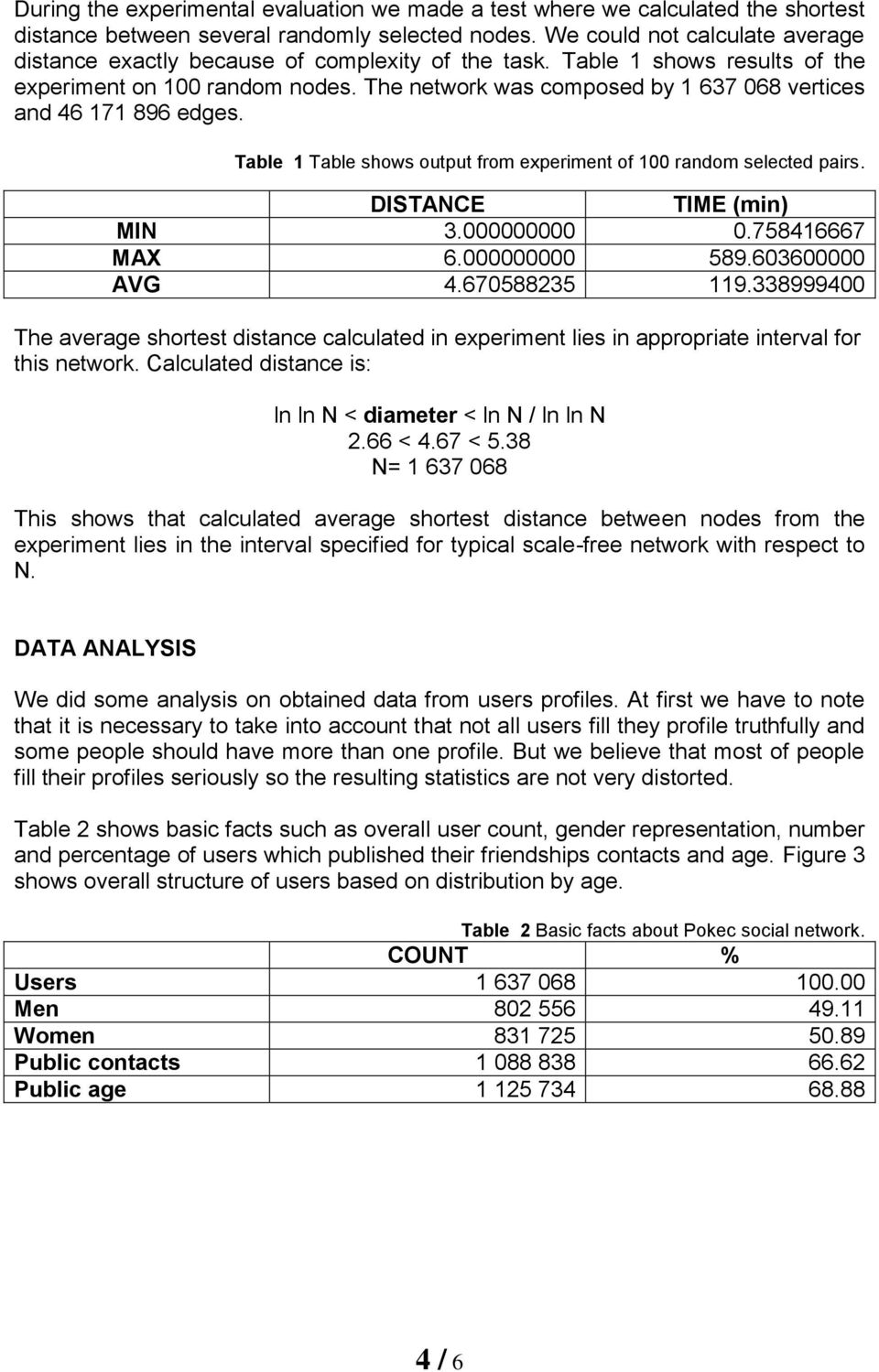
5 Figure 3 The figure shows age distribution of Pokec users. There are dominated group of young people between 15 and 30. Approximately 33% of women and 29% of men have their age nonpublic. Friendships or relations between users are in Pokec oriented. It means that if user1 has friend user2, user1 need not to be a friend of user2. But most of all there are friendships on both sides. Most connected nodes (users with most friends) are called in scale-free networks hubs. Interesting fact is that hubs in Pokec are not people but commercial companies which advertise through this network. Table 3 Average user friendship count and maximal number of friends. AVG MAX Has friends Is friend Pokec is holding and displaying last visit date and registration date for every profile. So there is an easy way how to get monthly visit rate or number of new registered user per month. Other profile data are divided into 58 categories such as region, physical and psychical characteristics, hobbies, job, languages skills, social and sexual preferences, smoking and alcoholic habits, etc. If a user writes anything to the profile, it is publicly available for all users. Only age and friendships can be nonpublic in Pokec. The basic recommendation is to create more powerful options for user to manage their personal data. We calculated from obtained data that the average profile is filled to %. Based on this database detailed marketing research on user interests and preferences segmented for example by age, region, and gender can be done. The user profile also includes video and photo albums which are optional and can be secured by password but lots of them are public for all. We did not deal with these types of data. CONCLUSION We have shown methods for obtaining social and personal data from semipublic social network using scale-free character of such networks. Discussed current problems with security and privacy of data managed by social networks led us to formulation of recommendations in the form of simple rules for reduction its effects on 5 / 6
6 user s privacy. Experimental part of work, applied on the largest social network in Slovakia, disclosed potential problems with security together with possible ways of personal data processing by the third party. In future work we plan to repeat our test to see modification of network in time. In addition to this basic work we would like to check user s behavior changes according to security of personal information. This work was supported by the Agency of the Slovak Ministry of Education for the Structural Funds of the EU, under project ITMS: REFERENCES [1] BARABÁSI, A. L.: Linked: How Everything Is Connected to Everything Else and What it Means for Business, Science, and Everyday Life ISBN [2] COHEN, C., HAVLIN S.: Scale-Free Networks Are Ultra small. Physical Review Letters, 7 Feb [3] GAO, J., MENG, Y.: Research on Degree Control Resistance to Frangibility Of Scale-free Networks. Second International Conference on Communication Software and Networks, Feb [4] TAKÁČ, Ľ.: Data processing over very large databases. Winter School MICT, Šachtičky Slovakia, 3-8 Jan [5] ERDŐS, P., RÉNYI, A.: On the evolution of random graphs. Institute of Mathematics, Hungarian Academy of Science, 1960 [6] TAKÁČ, Ľ.: Visualization of Large Multivariate Data Sets using Parallel Coordinates., Transcom, University of Žilina, 2011 [7] ALBERT, R., JEONG, BARABÁSI, A. L.: Diameter of the World Wide Web. Nature 401, 1999 [8] ZÁBOVSKÝ, M., ZÁBOVSKÁ, K.: Big Data. Proceedings of 12th International Conference System Integration 2010, 6-7 Sept [9] MATIAŠKO, K., VAJSOVÁ, M., ZÁBOVSKÝ, M., CHOCHLÍK, M.: Database Systems. Edis, University of Žilina, ISBN / 6
ATM Network Performance Evaluation And Optimization Using Complex Network Theory
 ATM Network Performance Evaluation And Optimization Using Complex Network Theory Yalin LI 1, Bruno F. Santos 2 and Richard Curran 3 Air Transport and Operations Faculty of Aerospace Engineering The Technical
Chapter 29 Scale-Free Network Topologies with Clustering Similar to Online Social Networks
 Chapter 29 Scale-Free Network Topologies with Clustering Similar to Online Social Networks Imre Varga Abstract In this paper I propose a novel method to model real online social networks where the growing
So today we shall continue our discussion on the search engines and web crawlers. (Refer Slide Time: 01:02)
 Internet Technology Prof. Indranil Sengupta Department of Computer Science and Engineering Indian Institute of Technology, Kharagpur Lecture No #39 Search Engines and Web Crawler :: Part 2 So today we
Introduction to Networks and Business Intelligence
 Introduction to Networks and Business Intelligence Prof. Dr. Daning Hu Department of Informatics University of Zurich Sep 17th, 2015 Outline Network Science A Random History Network Analysis Network Topological
Big Data Analytics of Multi-Relationship Online Social Network Based on Multi-Subnet Composited Complex Network
 , pp.273-284 http://dx.doi.org/10.14257/ijdta.2015.8.5.24 Big Data Analytics of Multi-Relationship Online Social Network Based on Multi-Subnet Composited Complex Network Gengxin Sun 1, Sheng Bin 2 and
DECENTRALIZED SCALE-FREE NETWORK CONSTRUCTION AND LOAD BALANCING IN MASSIVE MULTIUSER VIRTUAL ENVIRONMENTS
 DECENTRALIZED SCALE-FREE NETWORK CONSTRUCTION AND LOAD BALANCING IN MASSIVE MULTIUSER VIRTUAL ENVIRONMENTS Markus Esch, Eric Tobias - University of Luxembourg MOTIVATION HyperVerse project Massive Multiuser
Graph models for the Web and the Internet. Elias Koutsoupias University of Athens and UCLA. Crete, July 2003
 Graph models for the Web and the Internet Elias Koutsoupias University of Athens and UCLA Crete, July 2003 Outline of the lecture Small world phenomenon The shape of the Web graph Searching and navigation
Branch-and-Price Approach to the Vehicle Routing Problem with Time Windows
 TECHNISCHE UNIVERSITEIT EINDHOVEN Branch-and-Price Approach to the Vehicle Routing Problem with Time Windows Lloyd A. Fasting May 2014 Supervisors: dr. M. Firat dr.ir. M.A.A. Boon J. van Twist MSc. Contents
USING SPECTRAL RADIUS RATIO FOR NODE DEGREE TO ANALYZE THE EVOLUTION OF SCALE- FREE NETWORKS AND SMALL-WORLD NETWORKS
 USING SPECTRAL RADIUS RATIO FOR NODE DEGREE TO ANALYZE THE EVOLUTION OF SCALE- FREE NETWORKS AND SMALL-WORLD NETWORKS Natarajan Meghanathan Jackson State University, 1400 Lynch St, Jackson, MS, USA [email protected]
Six Degrees of Separation in Online Society
 Six Degrees of Separation in Online Society Lei Zhang * Tsinghua-Southampton Joint Lab on Web Science Graduate School in Shenzhen, Tsinghua University Shenzhen, Guangdong Province, P.R.China [email protected]
SYSM 6304: Risk and Decision Analysis Lecture 5: Methods of Risk Analysis
 SYSM 6304: Risk and Decision Analysis Lecture 5: Methods of Risk Analysis M. Vidyasagar Cecil & Ida Green Chair The University of Texas at Dallas Email: [email protected] October 17, 2015 Outline
Exploring Big Data in Social Networks
 Exploring Big Data in Social Networks [email protected] ([email protected]) INWEB National Science and Technology Institute for Web Federal University of Minas Gerais - UFMG May 2013 Some thoughts about
Introduction Course in SPSS - Evening 1
 ETH Zürich Seminar für Statistik Introduction Course in SPSS - Evening 1 Seminar für Statistik, ETH Zürich All data used during the course can be downloaded from the following ftp server: ftp://stat.ethz.ch/u/sfs/spsskurs/
ZOINED RETAIL ANALYTICS. User Guide
 ZOINED RETAIL ANALYTICS User Guide Contents Using the portal New user Profile Email reports Portal use Dashboard Drilling down into the data Filter options Analytics Managing analysis Saving the analysis
Social Network Mining
 Social Network Mining Data Mining November 11, 2013 Frank Takes ([email protected]) LIACS, Universiteit Leiden Overview Social Network Analysis Graph Mining Online Social Networks Friendship Graph Semantics
TIBCO Spotfire Network Analytics 1.1. User s Manual
 TIBCO Spotfire Network Analytics 1.1 User s Manual Revision date: 26 January 2009 Important Information SOME TIBCO SOFTWARE EMBEDS OR BUNDLES OTHER TIBCO SOFTWARE. USE OF SUCH EMBEDDED OR BUNDLED TIBCO
Graphs over Time Densification Laws, Shrinking Diameters and Possible Explanations
 Graphs over Time Densification Laws, Shrinking Diameters and Possible Explanations Jurij Leskovec, CMU Jon Kleinberg, Cornell Christos Faloutsos, CMU 1 Introduction What can we do with graphs? What patterns
Research Article A Comparison of Online Social Networks and Real-Life Social Networks: A Study of Sina Microblogging
 Mathematical Problems in Engineering, Article ID 578713, 6 pages http://dx.doi.org/10.1155/2014/578713 Research Article A Comparison of Online Social Networks and Real-Life Social Networks: A Study of
Dynamic programming formulation
 1.24 Lecture 14 Dynamic programming: Job scheduling Dynamic programming formulation To formulate a problem as a dynamic program: Sort by a criterion that will allow infeasible combinations to be eli minated
Healthcare Analytics. Aryya Gangopadhyay UMBC
 Healthcare Analytics Aryya Gangopadhyay UMBC Two of many projects Integrated network approach to personalized medicine Multidimensional and multimodal Dynamic Analyze interactions HealthMask Need for sharing
Diagram of Security. - define the attributes of Diagram of security that make it possible to evaluate security properties of modeled elements,
 Diagram of Security Marek Vysoký Department of Computers and Informatics Faculty of Electrical Engineering and Informatics Technical University of Košice Letná 9, 042 00 Košice, Slovakia [email protected]
Complexity Theory. IE 661: Scheduling Theory Fall 2003 Satyaki Ghosh Dastidar
 Complexity Theory IE 661: Scheduling Theory Fall 2003 Satyaki Ghosh Dastidar Outline Goals Computation of Problems Concepts and Definitions Complexity Classes and Problems Polynomial Time Reductions Examples
Design of LDPC codes
 Design of LDPC codes Codes from finite geometries Random codes: Determine the connections of the bipartite Tanner graph by using a (pseudo)random algorithm observing the degree distribution of the code
Complex Networks Analysis: Clustering Methods
 Complex Networks Analysis: Clustering Methods Nikolai Nefedov Spring 2013 ISI ETH Zurich [email protected] 1 Outline Purpose to give an overview of modern graph-clustering methods and their applications
Graphical degree sequences and realizations
 swap Graphical and realizations Péter L. Erdös Alfréd Rényi Institute of Mathematics Hungarian Academy of Sciences MAPCON 12 MPIPKS - Dresden, May 15, 2012 swap Graphical and realizations Péter L. Erdös
Graph Mining and Social Network Analysis
 Graph Mining and Social Network Analysis Data Mining and Text Mining (UIC 583 @ Politecnico di Milano) References Jiawei Han and Micheline Kamber, "Data Mining: Concepts and Techniques", The Morgan Kaufmann
Data Structures and Algorithms Written Examination
 Data Structures and Algorithms Written Examination 22 February 2013 FIRST NAME STUDENT NUMBER LAST NAME SIGNATURE Instructions for students: Write First Name, Last Name, Student Number and Signature where
Why? A central concept in Computer Science. Algorithms are ubiquitous.
 Analysis of Algorithms: A Brief Introduction Why? A central concept in Computer Science. Algorithms are ubiquitous. Using the Internet (sending email, transferring files, use of search engines, online
Data Deduplication in Slovak Corpora
 Ľ. Štúr Institute of Linguistics, Slovak Academy of Sciences, Bratislava, Slovakia Abstract. Our paper describes our experience in deduplication of a Slovak corpus. Two methods of deduplication a plain
IC05 Introduction on Networks &Visualization Nov. 2009. <[email protected]>
 IC05 Introduction on Networks &Visualization Nov. 2009 Overview 1. Networks Introduction Networks across disciplines Properties Models 2. Visualization InfoVis Data exploration
Simple Predictive Analytics Curtis Seare
 Using Excel to Solve Business Problems: Simple Predictive Analytics Curtis Seare Copyright: Vault Analytics July 2010 Contents Section I: Background Information Why use Predictive Analytics? How to use
New Hash Function Construction for Textual and Geometric Data Retrieval
 Latest Trends on Computers, Vol., pp.483-489, ISBN 978-96-474-3-4, ISSN 79-45, CSCC conference, Corfu, Greece, New Hash Function Construction for Textual and Geometric Data Retrieval Václav Skala, Jan
Open Source Software Developer and Project Networks
 Open Source Software Developer and Project Networks Matthew Van Antwerp and Greg Madey University of Notre Dame {mvanantw,gmadey}@cse.nd.edu Abstract. This paper outlines complex network concepts and how
International Journal of Advanced Research in Computer Science and Software Engineering
 Volume 3, Issue 3, March 2013 ISSN: 2277 128X International Journal of Advanced Research in Computer Science and Software Engineering Research Paper Available online at: www.ijarcsse.com Performance of
An Interest-Oriented Network Evolution Mechanism for Online Communities
 An Interest-Oriented Network Evolution Mechanism for Online Communities Caihong Sun and Xiaoping Yang School of Information, Renmin University of China, Beijing 100872, P.R. China {chsun.vang> @ruc.edu.cn
Dmitri Krioukov CAIDA/UCSD
 Hyperbolic geometry of complex networks Dmitri Krioukov CAIDA/UCSD [email protected] F. Papadopoulos, M. Boguñá, A. Vahdat, and kc claffy Complex networks Technological Internet Transportation Power grid
Effects of node buffer and capacity on network traffic
 Chin. Phys. B Vol. 21, No. 9 (212) 9892 Effects of node buffer and capacity on network traffic Ling Xiang( 凌 翔 ) a), Hu Mao-Bin( 胡 茂 彬 ) b), and Ding Jian-Xun( 丁 建 勋 ) a) a) School of Transportation Engineering,
An Empirical Study of Two MIS Algorithms
 An Empirical Study of Two MIS Algorithms Email: Tushar Bisht and Kishore Kothapalli International Institute of Information Technology, Hyderabad Hyderabad, Andhra Pradesh, India 32. [email protected],
On the effect of forwarding table size on SDN network utilization
 IBM Haifa Research Lab On the effect of forwarding table size on SDN network utilization Rami Cohen IBM Haifa Research Lab Liane Lewin Eytan Yahoo Research, Haifa Seffi Naor CS Technion, Israel Danny Raz
Policy-based Pre-Processing in Hadoop
 Policy-based Pre-Processing in Hadoop Yi Cheng, Christian Schaefer Ericsson Research Stockholm, Sweden [email protected], [email protected] Abstract While big data analytics provides
Bioinformatics: Network Analysis
 Bioinformatics: Network Analysis Graph-theoretic Properties of Biological Networks COMP 572 (BIOS 572 / BIOE 564) - Fall 2013 Luay Nakhleh, Rice University 1 Outline Architectural features Motifs, modules,
CURRENT TRENDS AND DEVELOPMENT OF THE AUTOMOTIVE INDUSTRY IN THE SLOVAK REPUBLIC
 CURRENT TRENDS AND DEVELOPMENT OF THE AUTOMOTIVE INDUSTRY IN THE SLOVAK REPUBLIC Martin Jurkovič 1, Tomáš Kalina 2 Summary: Automakers often use the services of logistics operators who provide comprehensive
Enterprise Organization and Communication Network
 Enterprise Organization and Communication Network Hideyuki Mizuta IBM Tokyo Research Laboratory 1623-14, Shimotsuruma, Yamato-shi Kanagawa-ken 242-8502, Japan E-mail: [email protected] Fusashi Nakamura
SOCIAL NETWORKING. And Employment Considerations. Bonnie Curran, Human Resources Consultant University of Tennessee, MTAS.
 SOCIAL NETWORKING And Employment Considerations Bonnie Curran, Human Resources Consultant University of Tennessee, MTAS Page 1 of 20 SOCIAL NETWORKING Up to 300 million users (Sept. 2009) 100+ million
Bebras Contest An International Contest on Informatics and Computer Fluency for all Secondary School Pupils
 Bebras Contest An International Contest on Informatics and Computer Fluency for all Secondary School Pupils Gerald Futschek Vienna University of Technology Austrian Computer Society OCG 1 Aim of Information
Efficient Crawling of Community Structures in Online Social Networks
 Efficient Crawling of Community Structures in Online Social Networks Network Architectures and Services PVM 2011-071 Efficient Crawling of Community Structures in Online Social Networks For the degree
SIMS 255 Foundations of Software Design. Complexity and NP-completeness
 SIMS 255 Foundations of Software Design Complexity and NP-completeness Matt Welsh November 29, 2001 [email protected] 1 Outline Complexity of algorithms Space and time complexity ``Big O'' notation Complexity
Max Flow, Min Cut, and Matchings (Solution)
 Max Flow, Min Cut, and Matchings (Solution) 1. The figure below shows a flow network on which an s-t flow is shown. The capacity of each edge appears as a label next to the edge, and the numbers in boxes
Network Analysis. BCH 5101: Analysis of -Omics Data 1/34
 Network Analysis BCH 5101: Analysis of -Omics Data 1/34 Network Analysis Graphs as a representation of networks Examples of genome-scale graphs Statistical properties of genome-scale graphs The search
M. Sugumaran / (IJCSIT) International Journal of Computer Science and Information Technologies, Vol. 2 (3), 2011, 1001-1006
 A Design of Centralized Meeting Scheduler with Distance Metrics M. Sugumaran Department of Computer Science and Engineering,Pondicherry Engineering College, Puducherry, India. Abstract Meeting scheduling
Social Media Mining. Graph Essentials
 Graph Essentials Graph Basics Measures Graph and Essentials Metrics 2 2 Nodes and Edges A network is a graph nodes, actors, or vertices (plural of vertex) Connections, edges or ties Edge Node Measures
ProM 6 Exercises. J.C.A.M. (Joos) Buijs and J.J.C.L. (Jan) Vogelaar {j.c.a.m.buijs,j.j.c.l.vogelaar}@tue.nl. August 2010
 ProM 6 Exercises J.C.A.M. (Joos) Buijs and J.J.C.L. (Jan) Vogelaar {j.c.a.m.buijs,j.j.c.l.vogelaar}@tue.nl August 2010 The exercises provided in this section are meant to become more familiar with ProM
A hierarchical multicriteria routing model with traffic splitting for MPLS networks
 A hierarchical multicriteria routing model with traffic splitting for MPLS networks João Clímaco, José Craveirinha, Marta Pascoal jclimaco@inesccpt, jcrav@deecucpt, marta@matucpt University of Coimbra
( ) = ( ) = {,,, } β ( ), < 1 ( ) + ( ) = ( ) + ( )
 { } ( ) = ( ) = {,,, } ( ) β ( ), < 1 ( ) + ( ) = ( ) + ( ) max, ( ) [ ( )] + ( ) [ ( )], [ ( )] [ ( )] = =, ( ) = ( ) = 0 ( ) = ( ) ( ) ( ) =, ( ), ( ) =, ( ), ( ). ln ( ) = ln ( ). + 1 ( ) = ( ) Ω[ (
1. Then f has a relative maximum at x = c if f(c) f(x) for all values of x in some
 Section 3.1: First Derivative Test Definition. Let f be a function with domain D. 1. Then f has a relative maximum at x = c if f(c) f(x) for all values of x in some open interval containing c. The number
MOBILE SOCIAL NETWORKS FOR LIVE MEETINGS
 Computer Science 13 (4) 2012 http://dx.doi.org/10.7494/csci.2012.13.4.87 Michał Wrzeszcz Jacek Kitowski MOBILE SOCIAL NETWORKS FOR LIVE MEETINGS Abstract In this article, we present an idea of combining
Distance Degree Sequences for Network Analysis
 Universität Konstanz Computer & Information Science Algorithmics Group 15 Mar 2005 based on Palmer, Gibbons, and Faloutsos: ANF A Fast and Scalable Tool for Data Mining in Massive Graphs, SIGKDD 02. Motivation
PUBLIC TRANSPORT SYSTEMS IN POLAND: FROM BIAŁYSTOK TO ZIELONA GÓRA BY BUS AND TRAM USING UNIVERSAL STATISTICS OF COMPLEX NETWORKS
 Vol. 36 (2005) ACTA PHYSICA POLONICA B No 5 PUBLIC TRANSPORT SYSTEMS IN POLAND: FROM BIAŁYSTOK TO ZIELONA GÓRA BY BUS AND TRAM USING UNIVERSAL STATISTICS OF COMPLEX NETWORKS Julian Sienkiewicz and Janusz
General Network Analysis: Graph-theoretic. COMP572 Fall 2009
 General Network Analysis: Graph-theoretic Techniques COMP572 Fall 2009 Networks (aka Graphs) A network is a set of vertices, or nodes, and edges that connect pairs of vertices Example: a network with 5
Clustering UE 141 Spring 2013
 Clustering UE 141 Spring 013 Jing Gao SUNY Buffalo 1 Definition of Clustering Finding groups of obects such that the obects in a group will be similar (or related) to one another and different from (or
SEO 360: The Essentials of Search Engine Optimization INTRODUCTION CONTENTS. By Chris Adams, Director of Online Marketing & Research
 SEO 360: The Essentials of Search Engine Optimization By Chris Adams, Director of Online Marketing & Research INTRODUCTION Effective Search Engine Optimization is not a highly technical or complex task,
The Clar Structure of Fullerenes
 The Clar Structure of Fullerenes Liz Hartung Massachusetts College of Liberal Arts June 12, 2013 Liz Hartung (Massachusetts College of Liberal Arts) The Clar Structure of Fullerenes June 12, 2013 1 / 25
Cluster Analysis for Evaluating Trading Strategies 1
 CONTRIBUTORS Jeff Bacidore Managing Director, Head of Algorithmic Trading, ITG, Inc. [email protected] +1.212.588.4327 Kathryn Berkow Quantitative Analyst, Algorithmic Trading, ITG, Inc. [email protected]
Mining Social Network Graphs
 Mining Social Network Graphs Debapriyo Majumdar Data Mining Fall 2014 Indian Statistical Institute Kolkata November 13, 17, 2014 Social Network No introduc+on required Really? We s7ll need to understand
Facebook Smart Card FB 121211_1800
 Facebook Smart Card FB 121211_1800 Social Networks - Do s and Don ts Only establish and maintain connections with people you know and trust. Review your connections often. Assume that ANYONE can see any
Load Balancing. Load Balancing 1 / 24
 Load Balancing Backtracking, branch & bound and alpha-beta pruning: how to assign work to idle processes without much communication? Additionally for alpha-beta pruning: implementing the young-brothers-wait
vii TABLE OF CONTENTS CHAPTER TITLE PAGE DECLARATION DEDICATION ACKNOWLEDGEMENT ABSTRACT ABSTRAK
 vii TABLE OF CONTENTS CHAPTER TITLE PAGE DECLARATION DEDICATION ACKNOWLEDGEMENT ABSTRACT ABSTRAK TABLE OF CONTENTS LIST OF TABLES LIST OF FIGURES LIST OF ABBREVIATIONS LIST OF SYMBOLS LIST OF APPENDICES
ERDOS PROBLEMS ON IRREGULARITIES OF LINE SIZES AND POINT DEGREES A. GYARFAS*
 BOLYAI SOCIETY MATHEMATICAL STUDIES, 11 Paul Erdos and his Mathematics. II, Budapest, 2002, pp. 367-373. ERDOS PROBLEMS ON IRREGULARITIES OF LINE SIZES AND POINT DEGREES A. GYARFAS* Problems and results
Algorithmic Aspects of Big Data. Nikhil Bansal (TU Eindhoven)
 Algorithmic Aspects of Big Data Nikhil Bansal (TU Eindhoven) Algorithm design Algorithm: Set of steps to solve a problem (by a computer) Studied since 1950 s. Given a problem: Find (i) best solution (ii)
Practical Graph Mining with R. 5. Link Analysis
 Practical Graph Mining with R 5. Link Analysis Outline Link Analysis Concepts Metrics for Analyzing Networks PageRank HITS Link Prediction 2 Link Analysis Concepts Link A relationship between two entities
IRLbot: Scaling to 6 Billion Pages and Beyond
 IRLbot: Scaling to 6 Billion Pages and Beyond Presented by Xiaoming Wang Hsin-Tsang Lee, Derek Leonard, Xiaoming Wang, and Dmitri Loguinov Internet Research Lab Computer Science Department Texas A&M University
The average distances in random graphs with given expected degrees
 Classification: Physical Sciences, Mathematics The average distances in random graphs with given expected degrees by Fan Chung 1 and Linyuan Lu Department of Mathematics University of California at San
Using simulation to calculate the NPV of a project
 Using simulation to calculate the NPV of a project Marius Holtan Onward Inc. 5/31/2002 Monte Carlo simulation is fast becoming the technology of choice for evaluating and analyzing assets, be it pure financial
Graphs, Networks and Python: The Power of Interconnection. Lachlan Blackhall - [email protected]
 Graphs, Networks and Python: The Power of Interconnection Lachlan Blackhall - [email protected] A little about me Graphs Graph, G = (V, E) V = Vertices / Nodes E = Edges NetworkX Native graph
Discuss the size of the instance for the minimum spanning tree problem.
 3.1 Algorithm complexity The algorithms A, B are given. The former has complexity O(n 2 ), the latter O(2 n ), where n is the size of the instance. Let n A 0 be the size of the largest instance that can
Salisbury Township School District Guidelines for Guiding Staff, Students and Parents in Use of Social Media
 What is social media? Social media is defined as any form of online publication or presence that allows end users to engage in multidirectional conversations in or around the content on the website. (Online
What is SNA? A sociogram showing ties
 Case Western Reserve University School of Medicine Social Network Analysis: Nuts & Bolts Papp KK 1, Zhang GQ 2 1 Director, Program Evaluation, CTSC, 2 Professor, Electrical Engineering and Computer Science,
Online Appendix to Social Network Formation and Strategic Interaction in Large Networks
 Online Appendix to Social Network Formation and Strategic Interaction in Large Networks Euncheol Shin Recent Version: http://people.hss.caltech.edu/~eshin/pdf/dsnf-oa.pdf October 3, 25 Abstract In this
IT services for analyses of various data samples
 IT services for analyses of various data samples Ján Paralič, František Babič, Martin Sarnovský, Peter Butka, Cecília Havrilová, Miroslava Muchová, Michal Puheim, Martin Mikula, Gabriel Tutoky Technical
Searching the Social Network: Future of Internet Search? [email protected]
 Searching the Social Network: Future of Internet Search? [email protected] Alessio Signorini Who am I? I was born in Pisa, Italy and played professional soccer until a few years ago. No coffee
6.852: Distributed Algorithms Fall, 2009. Class 2
 .8: Distributed Algorithms Fall, 009 Class Today s plan Leader election in a synchronous ring: Lower bound for comparison-based algorithms. Basic computation in general synchronous networks: Leader election
14.10.2014. Overview. Swarms in nature. Fish, birds, ants, termites, Introduction to swarm intelligence principles Particle Swarm Optimization (PSO)
 Overview Kyrre Glette kyrrehg@ifi INF3490 Swarm Intelligence Particle Swarm Optimization Introduction to swarm intelligence principles Particle Swarm Optimization (PSO) 3 Swarms in nature Fish, birds,
Arrangements And Duality
 Arrangements And Duality 3.1 Introduction 3 Point configurations are tbe most basic structure we study in computational geometry. But what about configurations of more complicated shapes? For example,
Experimental Comparison of Symbolic Learning Programs for the Classification of Gene Network Topology Models
 Experimental Comparison of Symbolic Learning Programs for the Classification of Gene Network Topology Models Andreas D. Lattner, Sohyoung Kim, Guido Cervone, John J. Grefenstette Center for Computing Technologies
Big Data, Small Loans
 PressKit Big Data, Small Loans About 5 billion people worldwide still have no access to credit products. This is exactly why the Hamburg based BIG DATA startup Kreditech has developed a completely new