
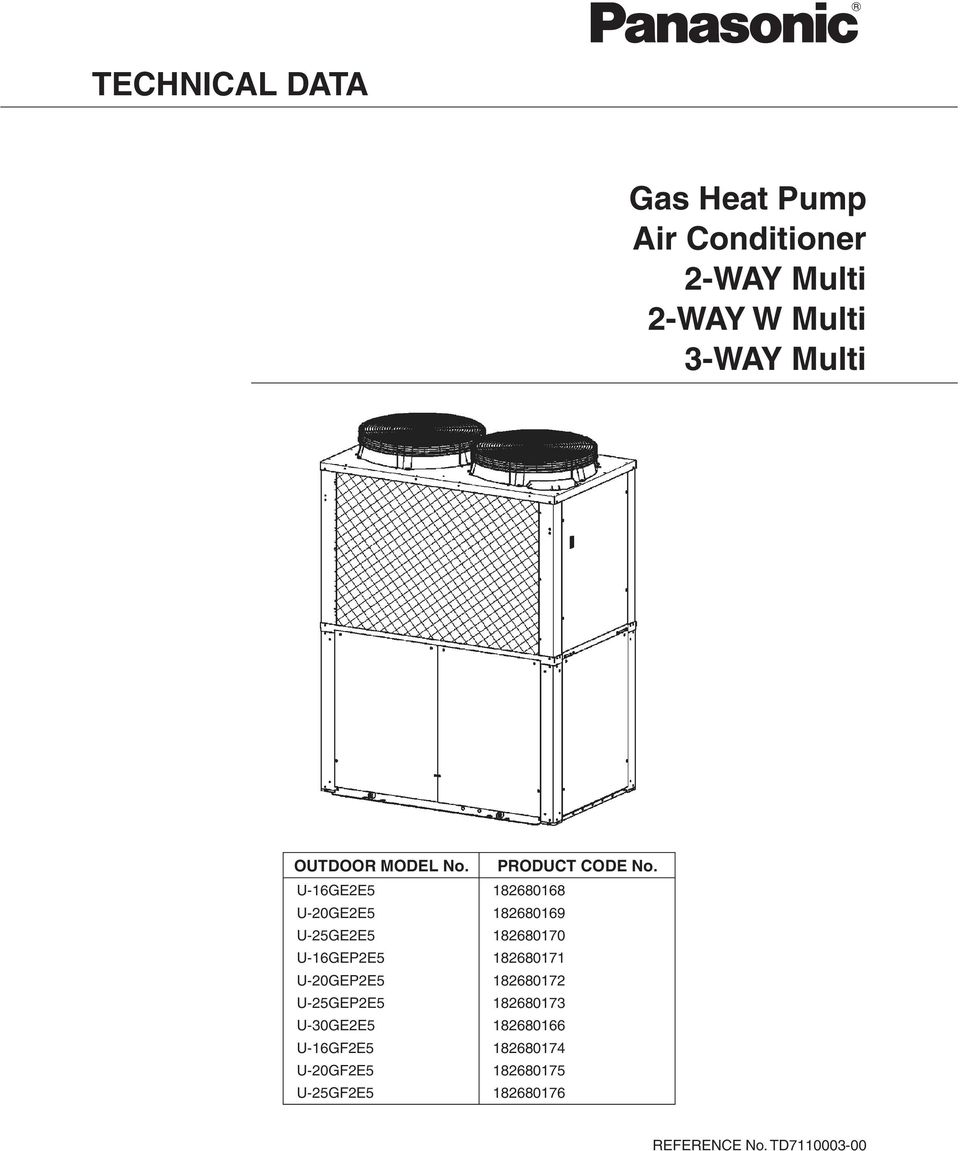
TECHNICAL DATA. Gas Heat Pump Air Conditioner 2-WAY Multi 2-WAY W Multi 3-WAY Multi
|
|
|
- Alberta Poole
- 9 years ago
- Views:
Transcription
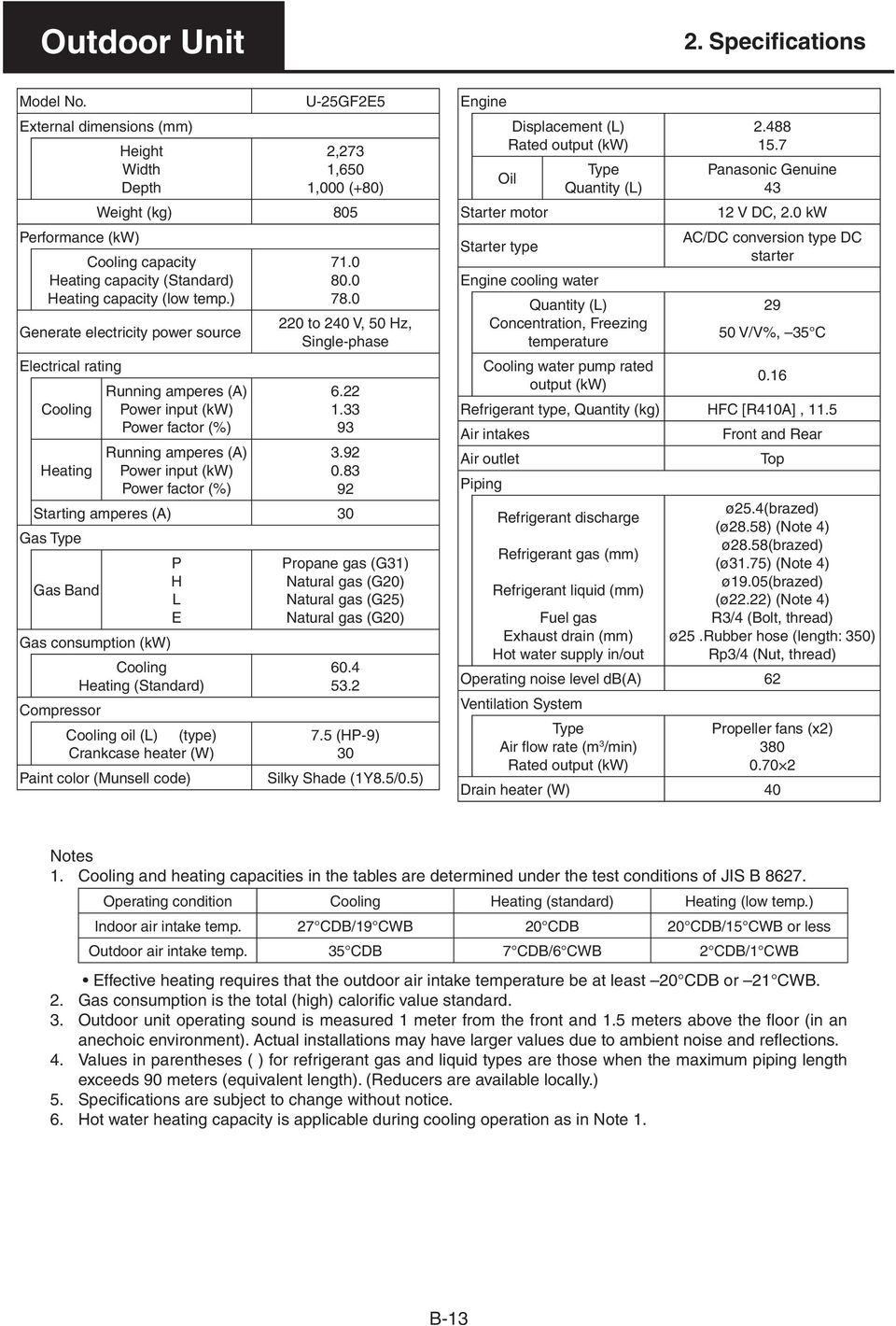
1 TECHNICAL DATA Gas Heat Pump Air Conditioner 2-WAY Multi 2-WAY W Multi 3-WAY Multi OUTDOOR MODEL No. U-16GE2E5 U-20GE2E5 U-25GE2E5 U-16GEP2E5 U-20GEP2E5 U-25GEP2E5 U-30GE2E5 U-16GF2E5 U-20GF2E5 U-25GF2E5 PRODUCT CODE No REFERENCE No. TD
2

3 W Multi Contents System Confi guration...a-1 Outdoor Unit...B-1 Control-Related...C-1 System Design...D-1 Installation Work...E-1 Separately Sold Parts...F-1 Periodic Inspection...G-1

4

5 System Configuration 1. Type Confi guration Contents (1) Outdoor unit... A-2 A-1
6 System Configuration 1. Type Configuration (1) Outdoor Unit 2-WAY Multi (30 Horsepower) 2-WAY W Multi (16, 20 and 25 Horsepower) 3-WAY Multi (16, 20 and 25 Horsepower) U-16GE2E5 U-20GE2E5 U-25GE2E5 U-16GEP2E5 U-20GEP2E5 U-25GEP2E5 U-30GE2E5 U-16GF2E5 U-20GF2E5 U-25GF2E5 A-2

7 Outdoor Unit Contents 1. Gas Usage Conditions (1) Usable Gas... B-2 (2) Gas Supply Pressure... B-2 (3) Applicable Gas Type... B-2 (4) Gas Maximum Flow Volume... B-2 (5) When using Propane... B-3 2. Specifi cations...b-4 3. External Dimensions...B Wiring Diagram...B Performance Characteristics...B Operating Sound Level Characteristics (1) Standard Mode... B-28 (2) Quiet Mode... B Vibration Force (1) Measurement Points... B-36 (2) Vibration Force... B-36 B-1
8 Outdoor Unit 1. Gas Usage Conditions (1) Usable Gas 1) Depending upon the calorifi c value of the natural gas, the setting for the gas fuel fl ow rate adjustment nozzle will differ. (2) Gas Supply Pressure Units: mbar Gas Type Maximum Standard Minimum P H, L, E (3) Applicable Gas Type Group P H L E Gas composition Standard gas Calorific value (MJ/m 3 N) Model Name 45.0 kw Type 56.0 kw Type 71.0 kw Type 85.0 kw Type C 3 H 8 100% G CH 4 100% G CH 4 86% N 2 14% G CH 4 100% G Applicability : Standard setting when shipped from the factory : Necessary to change the gas type setting on site (4) Gas Maximum Flow Volume Outdoor unit type Gas Maximum Flow Volume (kw) 45.0 kw kw kw kw 90 The gas maximum flow volume is the quantity of gas consumed after start up and operating at full capacity, with the gas at 40 C and at standard pressure. B-2

9 Outdoor Unit 1. Gas Usage Conditions (5) When using Propane * When using Propane as the gas fuel, it is necessary to adjust the fuel adjustment valve and the gas type setting. (1) Fuel valve setting With the power supply breaker for the outdoor unit OFF 1) Move the lever of the P/N switch that is attached to the mixer part of the engine to the position shown in the diagram. Turn it 180 degrees in the clockwise direction (there is a stopper provided). Do not apply unnecessary force to turn it any further. 2) In the electrical equipment box, fi x the "Gas type setting/adjustment Completed" label to the prescribed position for the PL NAME. (2) Fuel Gas Type Setting Check that the fuel adjustment valve setting has been set before operating the outdoor control board. 1) Press the home key (S004) for longer than one second and the menu item number will be displayed. 2) Next, press the up (S005)/down (S006) key to set the menu item number to. 3) After displaying, is displayed. When is displayed press the set (S007) key. The green LED (D053) lights up, and the system address setting is displayed. (For example: ) 4) Next operate the down (S006)/up (S005) key, to display the gas type setting. When the gas type setting is displayed, press the set (S007) key for longer than one second. Note: When setting the gas type, ** is displayed.(for ** enter 00-05) 5) A red LED (D052) lights up, indicating that a forced setting is being carried out. In this condition, press the down (S006)/up (S005) key, and select the gas type. The relationship between display and gas type is as shown in the following table. Status/setting display Type of gas Band P (LPG) Status/setting display No Use Type of gas DOWN UP No Use Band H (Natural Gas) Band H (Natural Gas) Band (Natural Gas) No Use No Use No Use No Use No Use No Use No Use No Use Band LNG (Natural Gas) No Use * When the H/L/E gas type is selected, the oil replacement time warning is not displayed. 6) After completing selection of gas type, press the set (S007) key for longer than 1 second. The red LED (D052) will be extinguished. 7) Press the home (S004) key to complete the setting. Note: When using propane, change the setting in accordance with the above procedure to B-3

10 Outdoor Unit 2. Specifications Model No. U-16GE2E5 External dimensions (mm) Height 2,273 Width 1,650 Depth 1,000 (+80) Weight (kg) 755 Performance (kw) Cooling capacity Heating capacity (Standard) Heating capacity (low temp.) Hot Water (Cooling mode) Generate electricity power source Electrical rating Cooling Heating Running amperes (A) Power input (kw) Power factor (%) Running amperes (A) Power input (kw) Power factor (%) (Note 7) 15.0 C outlet) 220 to 240 V, 50 Hz, Single-phase Starting amperes (A) 30 Gas Type P H Gas Band L E Gas consumption (kw) Cooling Heating (Standard) Compressor Cooling oil (L) (type) Crankcase heater (W) Paint color (Munsell code) Propane gas (G31) Natural gas (G20) Natural gas (G25) Natural gas (G20) (HP-9) 30 Silky Shade (1Y8.5/0.5) Engine Displacement (L) Rated output (kw) Oil Type Quantity (L) Panasonic Genuine V DC, 2.0 kw Starter motor Starter type AC/DC conversion type DC starter Engine cooling water Quantity (L) 21 Concentration, Freezing temperature 50 V/V%, 35 C Cooling water pump rated output (kw) 0.16 Refrigerant type, Quantity (kg) HFC [R410A], 10.5 Air intakes Front and Rear Air outlet Top Piping Refrigerant gas (mm) ø28.58(brazed) (ø31.75) (Note 4) Refrigerant liquid (mm) ø12.7(brazed) (ø15.88) (Note 4) Fuel gas R3/4 (Bolt, thread) Exhaust drain (mm) ø25.rubber hose (length: 350) Hot water supply in/out Rp3/4 (Nut, thread) Operating noise level db(a) 57 Ventilation System Type Air fl ow rate (m 3 /min) Rated output (kw) Propeller fans (x2) Drain heater (W) 40 Notes 1. Cooling and heating capacities in the tables are determined under the test conditions of JIS B Operating condition Cooling Heating (standard) Heating (low temp.) Indoor air intake temp. 27 CDB/19 CWB 20 CDB 20 CDB/15 CWB or less Outdoor air intake temp. 35 CDB 7 CDB/6 CWB 2 CDB/1 CWB Effective heating requires that the outdoor air intake temperature be at least 20 CDB or 21 CWB. 2. Gas consumption is the total (high) calorifi c value standard. 3. Outdoor unit operating sound is measured 1 meter from the front and 1.5 meters above the fl oor (in an anechoic environment). Actual installations may have larger values due to ambient noise and refl ections. 4. Values in parentheses ( ) for refrigerant gas and liquid types are those when the maximum piping length exceeds 90 meters (equivalent length). (Reducers are available locally.) 5. Specifi cations are subject to change without notice. 6. Hot water heating capacity is applicable during cooling operation as in Note The maximum water temperature that can be obtained is 75 C. Water heating performance and temperature vary with the air conditioning load. Because the hot water heating system uses waste heat from the engine, which runs the air conditioning, its ability to heat water is not guaranteed. B-4

11 Outdoor Unit 2. Specifications Model No. U-20GE2E5 External dimensions (mm) Height 2,273 Width 1,650 Depth 1,000 (+80) Weight (kg) 780 Performance (kw) Cooling capacity Heating capacity (Standard) Heating capacity (low temp.) Hot Water (Cooling mode) Generate electricity power source Electrical rating Cooling Heating Running amperes (A) Power input (kw) Power factor (%) Running amperes (A) Power input (kw) Power factor (%) (Note 7) 20.0 C outlet) 220 to 240 V, 50 Hz, Single-phase Starting amperes (A) 30 Gas Type P H Gas Band L E Gas consumption (kw) Cooling Heating (Standard) Compressor Cooling oil (L) (type) Crankcase heater (W) Paint color (Munsell code) Propane gas (G31) Natural gas (G20) Natural gas (G25) Natural gas (G20) (HP-9) 30 Silky Shade (1Y8.5/0.5) Engine Displacement (L) Rated output (kw) Oil Type Quantity (L) Panasonic Genuine V DC, 2.0 kw Starter motor Starter type AC/DC conversion type DC starter Engine cooling water Quantity (L) 24 Concentration, Freezing temperature 50 V/V%, 35 C Cooling water pump rated output (kw) 0.16 Refrigerant type, Quantity (kg) HFC [R410A], 11.5 Air intakes Front and Rear Air outlet Top Piping Refrigerant gas (mm) ø28.58(brazed) (ø31.75) (Note 4) Refrigerant liquid (mm) ø15.88(brazed) (ø19.05) (Note 4) Fuel gas R3/4 (Bolt, thread) Exhaust drain (mm) ø25.rubber hose (length: 350) Hot water supply in/out Rp3/4 (Nut, thread) Operating noise level db(a) 58 Ventilation System Type Air fl ow rate (m 3 /min) Rated output (kw) Propeller fans (x2) Drain heater (W) 40 Notes 1. Cooling and heating capacities in the tables are determined under the test conditions of JIS B Operating condition Cooling Heating (standard) Heating (low temp.) Indoor air intake temp. 27 CDB/19 CWB 20 CDB 20 CDB/15 CWB or less Outdoor air intake temp. 35 CDB 7 CDB/6 CWB 2 CDB/1 CWB Effective heating requires that the outdoor air intake temperature be at least 20 CDB or 21 CWB. 2. Gas consumption is the total (high) calorifi c value standard. 3. Outdoor unit operating sound is measured 1 meter from the front and 1.5 meters above the fl oor (in an anechoic environment). Actual installations may have larger values due to ambient noise and refl ections. 4. Values in parentheses ( ) for refrigerant gas and liquid types are those when the maximum piping length exceeds 90 meters (equivalent length). (Reducers are available locally.) 5. Specifi cations are subject to change without notice. 6. Hot water heating capacity is applicable during cooling operation as in Note The maximum water temperature that can be obtained is 75 C. Water heating performance and temperature vary with the air conditioning load. Because the hot water heating system uses waste heat from the engine, which runs the air conditioning, its ability to heat water is not guaranteed. B-5

12 Outdoor Unit 2. Specifications Model No. U-25GE2E5 External dimensions (mm) Height 2,273 Width 1,650 Depth 1,000 (+80) Weight (kg) 810 Performance (kw) Cooling capacity Heating capacity (Standard) Heating capacity (low temp.) Hot Water (Cooling mode) Generate electricity power source Electrical rating Cooling Heating Running amperes (A) Power input (kw) Power factor (%) Running amperes (A) Power input (kw) Power factor (%) (Note 7) 30.0 C outlet) 220 to 240 V, 50 Hz, Single-phase Starting amperes (A) 30 Gas Type P H Gas Band L E Gas consumption (kw) Cooling Heating (Standard) Compressor Cooling oil (L) (type) Crankcase heater (W) Paint color (Munsell code) Propane gas (G31) Natural gas (G20) Natural gas (G25) Natural gas (G20) (HP-9) 30 Silky Shade (1Y8.5/0.5) Engine Displacement (L) Rated output (kw) Oil Type Quantity (L) Panasonic Genuine V DC, 2.0 kw Starter motor Starter type AC/DC conversion type DC starter Engine cooling water Quantity (L) 25 Concentration, Freezing temperature 50 V/V%, 35 C Cooling water pump rated output (kw) 0.16 Refrigerant type, Quantity (kg) HFC [R410A], 11.5 Air intakes Front and Rear Air outlet Top Piping Refrigerant gas (mm) ø28.58(brazed) (ø31.75) (Note 4) Refrigerant liquid (mm) ø15.88(brazed) (ø19.05) (Note 4) Fuel gas R3/4 (Bolt, thread) Exhaust drain (mm) ø25.rubber hose (length: 350) Hot water supply in/out Rp3/4 (Nut, thread) Operating noise level db(a) 62 Ventilation System Type Air fl ow rate (m 3 /min) Rated output (kw) Propeller fans (x2) Drain heater (W) 40 Notes 1. Cooling and heating capacities in the tables are determined under the test conditions of JIS B Operating condition Cooling Heating (standard) Heating (low temp.) Indoor air intake temp. 27 CDB/19 CWB 20 CDB 20 CDB/15 CWB or less Outdoor air intake temp. 35 CDB 7 CDB/6 CWB 2 CDB/1 CWB Effective heating requires that the outdoor air intake temperature be at least 20 CDB or 21 CWB. 2. Gas consumption is the total (high) calorifi c value standard. 3. Outdoor unit operating sound is measured 1 meter from the front and 1.5 meters above the fl oor (in an anechoic environment). Actual installations may have larger values due to ambient noise and refl ections. 4. Values in parentheses ( ) for refrigerant gas and liquid types are those when the maximum piping length exceeds 90 meters (equivalent length). (Reducers are available locally.) 5. Specifi cations are subject to change without notice. 6. Hot water heating capacity is applicable during cooling operation as in Note The maximum water temperature that can be obtained is 75 C. Water heating performance and temperature vary with the air conditioning load. Because the hot water heating system uses waste heat from the engine, which runs the air conditioning, its ability to heat water is not guaranteed. B-6

13 Outdoor Unit 2. Specifications Model No. U-16GEP2E5 External dimensions (mm) Height 2,273 Width 1,650 Depth 1,000 (+80) Weight (kg) 770 Performance (kw) Cooling capacity Heating capacity (Standard) Heating capacity (low temp.) Hot Water (Cooling mode) Generate electricity power source Electrical rating Cooling Heating Running amperes (A) Power input (kw) Power factor (%) Running amperes (A) Power input (kw) Power factor (%) (Note 7) 15.0 C outlet) 220 to 240 V, 50 Hz, Single-phase Starting amperes (A) 30 Gas Type P H Gas Band L E Gas consumption (kw) Cooling Heating (Standard) Compressor Cooling oil (L) (type) Crankcase heater (W) Paint color (Munsell code) Propane gas (G31) Natural gas (G20) Natural gas (G25) Natural gas (G20) (HP-9) 30 Silky Shade (1Y8.5/0.5) Engine Displacement (L) Rated output (kw) Oil Type Quantity (L) Panasonic Genuine V DC, 2.0 kw Starter motor Starter type AC/DC conversion type DC starter Engine cooling water Quantity (L) 21 Concentration, Freezing temperature 50 V/V%, 35 C Cooling water pump rated output (kw) 0.16 Refrigerant type, Quantity (kg) HFC [R410A], 10.5 Air intakes Front and Rear Air outlet Top Piping Refrigerant gas (mm) ø28.58(brazed) (ø31.75) (Note 4) Refrigerant liquid (mm) ø12.7(brazed) (ø15.88) (Note 4) Fuel gas R3/4 (Bolt, thread) Exhaust drain (mm) ø25.rubber hose (length: 350) Hot water supply in/out Rp3/4 (Nut, thread) Operating noise level db(a) 57 Ventilation System Type Air fl ow rate (m 3 /min) Rated output (kw) Propeller fans (x2) Drain heater (W) 40 Notes 1. Cooling and heating capacities in the tables are determined under the test conditions of JIS B Operating condition Cooling Heating (standard) Heating (low temp.) Indoor air intake temp. 27 CDB/19 CWB 20 CDB 20 CDB/15 CWB or less Outdoor air intake temp. 35 CDB 7 CDB/6 CWB 2 CDB/1 CWB Effective heating requires that the outdoor air intake temperature be at least 20 CDB or 21 CWB. 2. Gas consumption is the total (high) calorifi c value standard. 3. Outdoor unit operating sound is measured 1 meter from the front and 1.5 meters above the fl oor (in an anechoic environment). Actual installations may have larger values due to ambient noise and refl ections. 4. Values in parentheses ( ) for refrigerant gas and liquid types are those when the maximum piping length exceeds 90 meters (equivalent length). (Reducers are available locally.) 5. Specifi cations are subject to change without notice. 6. Hot water heating capacity is applicable during cooling operation as in Note The maximum water temperature that can be obtained is 75 C. Water heating performance and temperature vary with the air conditioning load. Because the hot water heating system uses waste heat from the engine, which runs the air conditioning, its ability to heat water is not guaranteed. B-7

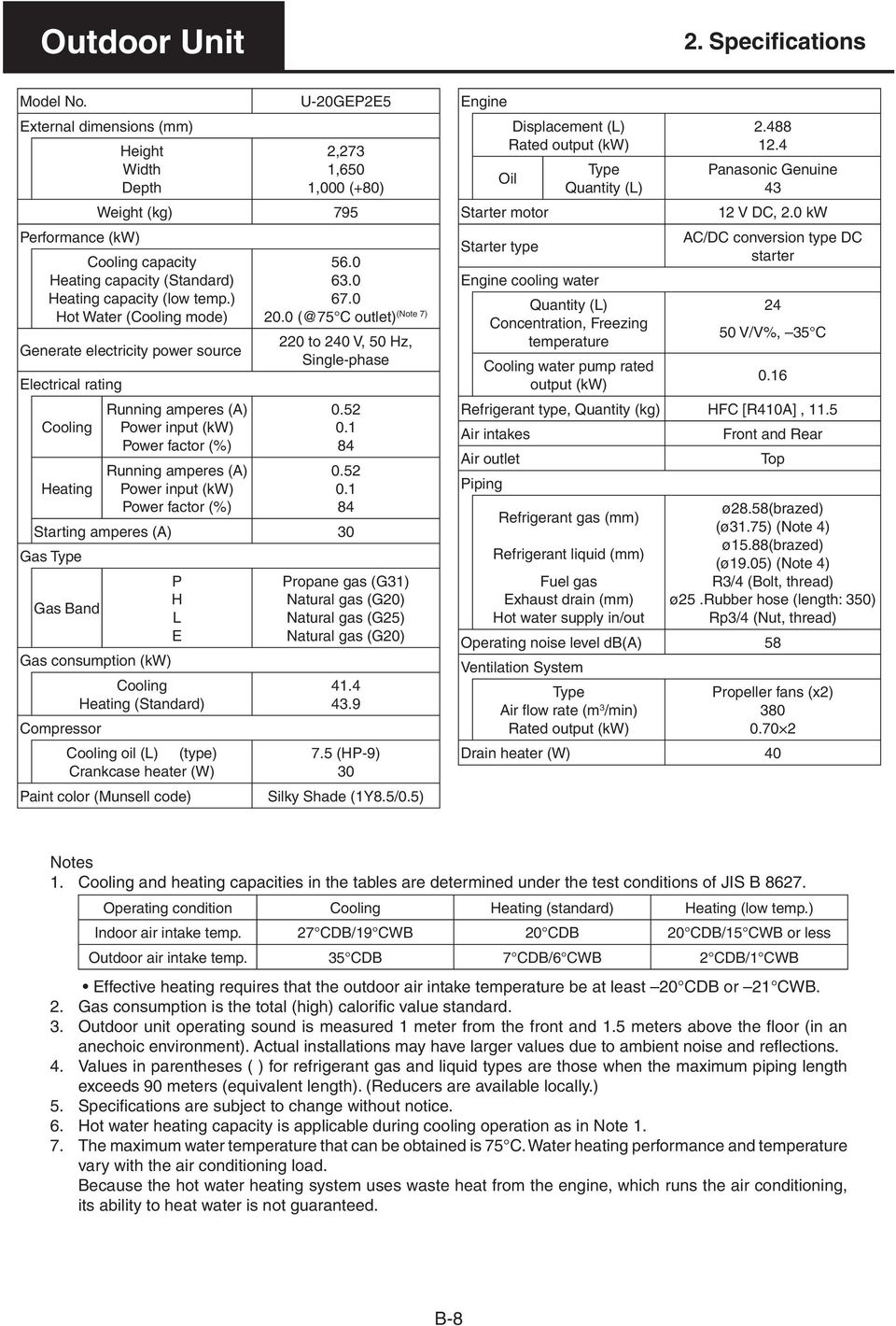
14 Outdoor Unit 2. Specifications Model No. U-20GEP2E5 External dimensions (mm) Height 2,273 Width 1,650 Depth 1,000 (+80) Weight (kg) 795 Performance (kw) Cooling capacity Heating capacity (Standard) Heating capacity (low temp.) Hot Water (Cooling mode) Generate electricity power source Electrical rating Cooling Heating Running amperes (A) Power input (kw) Power factor (%) Running amperes (A) Power input (kw) Power factor (%) (Note 7) 20.0 C outlet) 220 to 240 V, 50 Hz, Single-phase Starting amperes (A) 30 Gas Type P H Gas Band L E Gas consumption (kw) Cooling Heating (Standard) Compressor Cooling oil (L) (type) Crankcase heater (W) Paint color (Munsell code) Propane gas (G31) Natural gas (G20) Natural gas (G25) Natural gas (G20) (HP-9) 30 Silky Shade (1Y8.5/0.5) Engine Displacement (L) Rated output (kw) Oil Type Quantity (L) Panasonic Genuine V DC, 2.0 kw Starter motor Starter type AC/DC conversion type DC starter Engine cooling water Quantity (L) 24 Concentration, Freezing temperature 50 V/V%, 35 C Cooling water pump rated output (kw) 0.16 Refrigerant type, Quantity (kg) HFC [R410A], 11.5 Air intakes Front and Rear Air outlet Top Piping Refrigerant gas (mm) ø28.58(brazed) (ø31.75) (Note 4) Refrigerant liquid (mm) ø15.88(brazed) (ø19.05) (Note 4) Fuel gas R3/4 (Bolt, thread) Exhaust drain (mm) ø25.rubber hose (length: 350) Hot water supply in/out Rp3/4 (Nut, thread) Operating noise level db(a) 58 Ventilation System Type Air fl ow rate (m 3 /min) Rated output (kw) Propeller fans (x2) Drain heater (W) 40 Notes 1. Cooling and heating capacities in the tables are determined under the test conditions of JIS B Operating condition Cooling Heating (standard) Heating (low temp.) Indoor air intake temp. 27 CDB/19 CWB 20 CDB 20 CDB/15 CWB or less Outdoor air intake temp. 35 CDB 7 CDB/6 CWB 2 CDB/1 CWB Effective heating requires that the outdoor air intake temperature be at least 20 CDB or 21 CWB. 2. Gas consumption is the total (high) calorifi c value standard. 3. Outdoor unit operating sound is measured 1 meter from the front and 1.5 meters above the fl oor (in an anechoic environment). Actual installations may have larger values due to ambient noise and refl ections. 4. Values in parentheses ( ) for refrigerant gas and liquid types are those when the maximum piping length exceeds 90 meters (equivalent length). (Reducers are available locally.) 5. Specifi cations are subject to change without notice. 6. Hot water heating capacity is applicable during cooling operation as in Note The maximum water temperature that can be obtained is 75 C. Water heating performance and temperature vary with the air conditioning load. Because the hot water heating system uses waste heat from the engine, which runs the air conditioning, its ability to heat water is not guaranteed. B-8
15 Outdoor Unit 2. Specifications Model No. U-25GEP2E5 External dimensions (mm) Height 2,273 Width 1,650 Depth 1,000 (+80) Weight (kg) 825 Performance (kw) Cooling capacity Heating capacity (Standard) Heating capacity (low temp.) Hot Water (Cooling mode) Generate electricity power source Electrical rating Cooling Heating Running amperes (A) Power input (kw) Power factor (%) Running amperes (A) Power input (kw) Power factor (%) (Note 7) 30.0 C outlet) 220 to 240 V, 50 Hz, Single-phase Starting amperes (A) 30 Gas Type P H Gas Band L E Gas consumption (kw) Cooling Heating (Standard) Compressor Cooling oil (L) (type) Crankcase heater (W) Paint color (Munsell code) Propane gas (G31) Natural gas (G20) Natural gas (G25) Natural gas (G20) (HP-9) 30 Silky Shade (1Y8.5/0.5) Engine Displacement (L) Rated output (kw) Oil Type Quantity (L) Panasonic Genuine V DC, 2.0 kw Starter motor Starter type AC/DC conversion type DC starter Engine cooling water Quantity (L) 25 Concentration, Freezing temperature 50 V/V%, 35 C Cooling water pump rated output (kw) 0.16 Refrigerant type, Quantity (kg) HFC [R410A], 11.5 Air intakes Front and Rear Air outlet Top Piping Refrigerant gas (mm) ø28.58(brazed) (ø31.75) (Note 4) Refrigerant liquid (mm) ø15.88(brazed) (ø19.05) (Note 4) Fuel gas R3/4 (Bolt, thread) Exhaust drain (mm) ø25.rubber hose (length: 350) Hot water supply in/out Rp3/4 (Nut, thread) Operating noise level db(a) 62 Ventilation System Type Air fl ow rate (m 3 /min) Rated output (kw) Propeller fans (x2) Drain heater (W) 40 Notes 1. Cooling and heating capacities in the tables are determined under the test conditions of JIS B Operating condition Cooling Heating (standard) Heating (low temp.) Indoor air intake temp. 27 CDB/19 CWB 20 CDB 20 CDB/15 CWB or less Outdoor air intake temp. 35 CDB 7 CDB/6 CWB 2 CDB/1 CWB Effective heating requires that the outdoor air intake temperature be at least 20 CDB or 21 CWB. 2. Gas consumption is the total (high) calorifi c value standard. 3. Outdoor unit operating sound is measured 1 meter from the front and 1.5 meters above the fl oor (in an anechoic environment). Actual installations may have larger values due to ambient noise and refl ections. 4. Values in parentheses ( ) for refrigerant gas and liquid types are those when the maximum piping length exceeds 90 meters (equivalent length). (Reducers are available locally.) 5. Specifi cations are subject to change without notice. 6. Hot water heating capacity is applicable during cooling operation as in Note The maximum water temperature that can be obtained is 75 C. Water heating performance and temperature vary with the air conditioning load. Because the hot water heating system uses waste heat from the engine, which runs the air conditioning, its ability to heat water is not guaranteed. B-9

16 Outdoor Unit 2. Specifications Model No. U-30GE2E5 External dimensions (mm) Height 2,273 Width 2,026 Depth 1,000 (+80) Weight (kg) 840 Performance (kw) Cooling capacity Heating capacity (Standard) Heating capacity (low temp.) Hot Water (Cooling mode) Generate electricity power source Electrical rating Cooling Heating Running amperes (A) Power input (kw) Power factor (%) Running amperes (A) Power input (kw) Power factor (%) (Note 7) 30.0 C outlet) 220 to 240 V, 50 Hz, Single-phase Starting amperes (A) 30 Gas Type P H Gas Band L E Gas consumption (kw) Cooling Heating (Standard) Compressor Cooling oil (L) (type) Crankcase heater (W) Paint color (Munsell code) Propane gas (G31) Natural gas (G20) Natural gas (G25) Natural gas (G20) (HP-9) 30 Silky Shade (1Y8.5/0.5) Engine Displacement (L) Rated output (kw) Oil Type Quantity (L) Panasonic Genuine V DC, 2.0 kw Starter motor Starter type AC/DC conversion type DC starter Engine cooling water Quantity (L) 26 Concentration, Freezing temperature 50 V/V%, 35 C Cooling water pump rated output (kw) 0.16 Refrigerant type, Quantity (kg) HFC [R410A], 11.5 Air intakes Front and Rear Air outlet Top Piping Refrigerant gas (mm) ø31.75(brazed) (ø38.1) (Note 4) Refrigerant liquid (mm) ø19.05(brazed) (ø22.22) (Note 4) Fuel gas R3/4 (Bolt, thread) Exhaust drain (mm) ø25.rubber hose (length: 350) Hot water supply in/out Rp3/4 (Nut, thread) Operating noise level db(a) 63 Ventilation System Type Air fl ow rate (m 3 /min) Rated output (kw) Propeller fans (x2) Drain heater (W) 40 Notes 1. Cooling and heating capacities in the tables are determined under the test conditions of JIS B Operating condition Cooling Heating (standard) Heating (low temp.) Indoor air intake temp. 27 CDB/19 CWB 20 CDB 20 CDB/15 CWB or less Outdoor air intake temp. 35 CDB 7 CDB/6 CWB 2 CDB/1 CWB Effective heating requires that the outdoor air intake temperature be at least 20 CDB or 21 CWB. 2. Gas consumption is the total (high) calorifi c value standard. 3. Outdoor unit operating sound is measured 1 meter from the front and 1.5 meters above the fl oor (in an anechoic environment). Actual installations may have larger values due to ambient noise and refl ections. 4. Values in parentheses ( ) for refrigerant gas and liquid types are those when the maximum piping length exceeds 90 meters (equivalent length). (Reducers are available locally.) 5. Specifi cations are subject to change without notice. 6. Hot water heating capacity is applicable during cooling operation as in Note The maximum water temperature that can be obtained is 75 C. Water heating performance and temperature vary with the air conditioning load. Because the hot water heating system uses waste heat from the engine, which runs the air conditioning, its ability to heat water is not guaranteed. B-10

17 Outdoor Unit 2. Specifications Model No. U-16GF2E5 External dimensions (mm) Height 2,273 Width 1,650 Depth 1,000 (+80) Weight (kg) 775 Performance (kw) Cooling capacity Heating capacity (Standard) Heating capacity (low temp.) Generate electricity power source Electrical rating Cooling Heating Running amperes (A) Power input (kw) Power factor (%) Running amperes (A) Power input (kw) Power factor (%) to 240 V, 50 Hz, Single-phase Starting amperes (A) 30 Gas Type P H Gas Band L E Gas consumption (kw) Cooling Heating (Standard) Compressor Cooling oil (L) (type) Crankcase heater (W) Paint color (Munsell code) Propane gas (G31) Natural gas (G20) Natural gas (G25) Natural gas (G20) (HP-9) 30 Silky Shade (1Y8.5/0.5) Engine Displacement (L) Rated output (kw) Oil Type Quantity (L) Panasonic Genuine V DC, 2.0 kw Starter motor Starter type AC/DC conversion type DC starter Engine cooling water Quantity (L) 24 Concentration, Freezing temperature 50 V/V%, 35 C Cooling water pump rated output (kw) 0.16 Refrigerant type, Quantity (kg) HFC [R410A], 10.5 Air intakes Front and Rear Air outlet Top Piping Refrigerant discharge ø22.22(brazed) (ø25.4) (Note 4) Refrigerant gas (mm) ø28.58(brazed) (ø31.75) (Note 4) Refrigerant liquid (mm) ø19.05(brazed) (ø22.22) (Note 4) Fuel gas R3/4 (Bolt, thread) Exhaust drain (mm) ø25.rubber hose (length: 350) Hot water supply in/out Rp3/4 (Nut, thread) Operating noise level db(a) 57 Ventilation System Type Air fl ow rate (m 3 /min) Rated output (kw) Propeller fans (x2) Drain heater (W) 40 Notes 1. Cooling and heating capacities in the tables are determined under the test conditions of JIS B Operating condition Cooling Heating (standard) Heating (low temp.) Indoor air intake temp. 27 CDB/19 CWB 20 CDB 20 CDB/15 CWB or less Outdoor air intake temp. 35 CDB 7 CDB/6 CWB 2 CDB/1 CWB Effective heating requires that the outdoor air intake temperature be at least 20 CDB or 21 CWB. 2. Gas consumption is the total (high) calorifi c value standard. 3. Outdoor unit operating sound is measured 1 meter from the front and 1.5 meters above the fl oor (in an anechoic environment). Actual installations may have larger values due to ambient noise and refl ections. 4. Values in parentheses ( ) for refrigerant gas and liquid types are those when the maximum piping length exceeds 90 meters (equivalent length). (Reducers are available locally.) 5. Specifi cations are subject to change without notice. 6. Hot water heating capacity is applicable during cooling operation as in Note 1. B-11

18 Outdoor Unit 2. Specifications Model No. U-20GF2E5 External dimensions (mm) Height 2,273 Width 1,650 Depth 1,000 (+80) Weight (kg) 775 Performance (kw) Cooling capacity Heating capacity (Standard) Heating capacity (low temp.) Generate electricity power source Electrical rating Cooling Heating Running amperes (A) Power input (kw) Power factor (%) Running amperes (A) Power input (kw) Power factor (%) to 240 V, 50 Hz, Single-phase Starting amperes (A) 30 Gas Type P H Gas Band L E Gas consumption (kw) Cooling Heating (Standard) Compressor Cooling oil (L) (type) Crankcase heater (W) Paint color (Munsell code) Propane gas (G31) Natural gas (G20) Natural gas (G25) Natural gas (G20) (HP-9) 30 Silky Shade (1Y8.5/0.5) Engine Displacement (L) Rated output (kw) Oil Type Quantity (L) Panasonic Genuine V DC, 2.0 kw Starter motor Starter type AC/DC conversion type DC starter Engine cooling water Quantity (L) 24 Concentration, Freezing temperature 50 V/V%, 35 C Cooling water pump rated output (kw) 0.16 Refrigerant type, Quantity (kg) HFC [R410A], 11.5 Air intakes Front and Rear Air outlet Top Piping Refrigerant discharge ø25.4(brazed) (ø28.58) (Note 4) Refrigerant gas (mm) ø28.58(brazed) (ø31.75) (Note 4) Refrigerant liquid (mm) ø19.05(brazed) (ø22.22) (Note 4) Fuel gas R3/4 (Bolt, thread) Exhaust drain (mm) ø25.rubber hose (length: 350) Hot water supply in/out Rp3/4 (Nut, thread) Operating noise level db(a) 58 Ventilation System Type Air fl ow rate (m 3 /min) Rated output (kw) Propeller fans (x2) Drain heater (W) 40 Notes 1. Cooling and heating capacities in the tables are determined under the test conditions of JIS B Operating condition Cooling Heating (standard) Heating (low temp.) Indoor air intake temp. 27 CDB/19 CWB 20 CDB 20 CDB/15 CWB or less Outdoor air intake temp. 35 CDB 7 CDB/6 CWB 2 CDB/1 CWB Effective heating requires that the outdoor air intake temperature be at least 20 CDB or 21 CWB. 2. Gas consumption is the total (high) calorifi c value standard. 3. Outdoor unit operating sound is measured 1 meter from the front and 1.5 meters above the fl oor (in an anechoic environment). Actual installations may have larger values due to ambient noise and refl ections. 4. Values in parentheses ( ) for refrigerant gas and liquid types are those when the maximum piping length exceeds 90 meters (equivalent length). (Reducers are available locally.) 5. Specifi cations are subject to change without notice. 6. Hot water heating capacity is applicable during cooling operation as in Note 1. B-12

19 Outdoor Unit 2. Specifications Model No. U-25GF2E5 External dimensions (mm) Height 2,273 Width 1,650 Depth 1,000 (+80) Weight (kg) 805 Performance (kw) Cooling capacity Heating capacity (Standard) Heating capacity (low temp.) Generate electricity power source Electrical rating Cooling Heating Running amperes (A) Power input (kw) Power factor (%) Running amperes (A) Power input (kw) Power factor (%) to 240 V, 50 Hz, Single-phase Starting amperes (A) 30 Gas Type P H Gas Band L E Gas consumption (kw) Cooling Heating (Standard) Compressor Cooling oil (L) (type) Crankcase heater (W) Paint color (Munsell code) Propane gas (G31) Natural gas (G20) Natural gas (G25) Natural gas (G20) (HP-9) 30 Silky Shade (1Y8.5/0.5) Engine Displacement (L) Rated output (kw) Oil Type Quantity (L) Panasonic Genuine V DC, 2.0 kw Starter motor Starter type AC/DC conversion type DC starter Engine cooling water Quantity (L) 29 Concentration, Freezing temperature 50 V/V%, 35 C Cooling water pump rated output (kw) 0.16 Refrigerant type, Quantity (kg) HFC [R410A], 11.5 Air intakes Front and Rear Air outlet Top Piping Refrigerant discharge ø25.4(brazed) (ø28.58) (Note 4) Refrigerant gas (mm) ø28.58(brazed) (ø31.75) (Note 4) Refrigerant liquid (mm) ø19.05(brazed) (ø22.22) (Note 4) Fuel gas R3/4 (Bolt, thread) Exhaust drain (mm) ø25.rubber hose (length: 350) Hot water supply in/out Rp3/4 (Nut, thread) Operating noise level db(a) 62 Ventilation System Type Air fl ow rate (m 3 /min) Rated output (kw) Propeller fans (x2) Drain heater (W) 40 Notes 1. Cooling and heating capacities in the tables are determined under the test conditions of JIS B Operating condition Cooling Heating (standard) Heating (low temp.) Indoor air intake temp. 27 CDB/19 CWB 20 CDB 20 CDB/15 CWB or less Outdoor air intake temp. 35 CDB 7 CDB/6 CWB 2 CDB/1 CWB Effective heating requires that the outdoor air intake temperature be at least 20 CDB or 21 CWB. 2. Gas consumption is the total (high) calorifi c value standard. 3. Outdoor unit operating sound is measured 1 meter from the front and 1.5 meters above the fl oor (in an anechoic environment). Actual installations may have larger values due to ambient noise and refl ections. 4. Values in parentheses ( ) for refrigerant gas and liquid types are those when the maximum piping length exceeds 90 meters (equivalent length). (Reducers are available locally.) 5. Specifi cations are subject to change without notice. 6. Hot water heating capacity is applicable during cooling operation as in Note 1. B-13
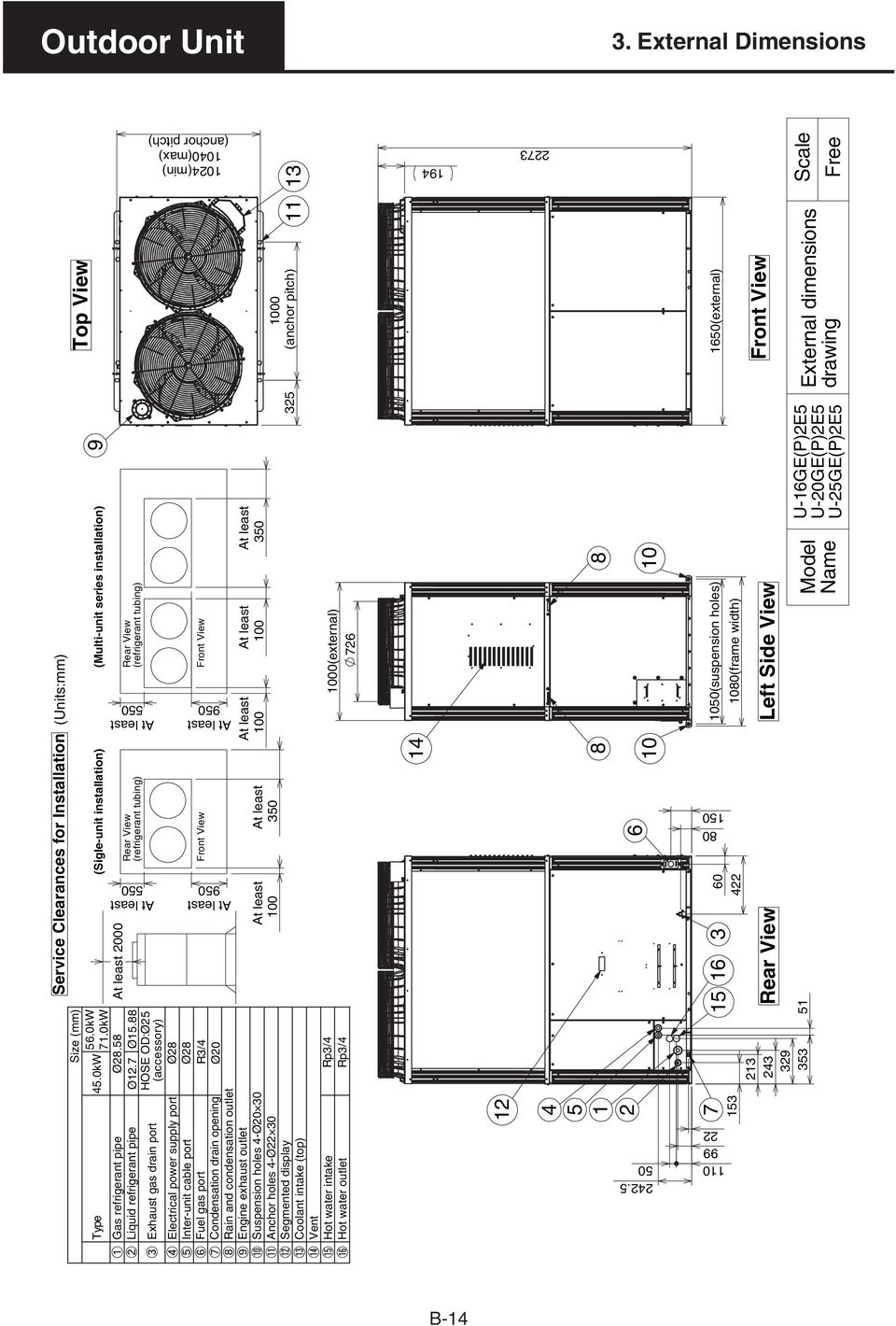
20 Outdoor Unit 3. External Dimensions Service Clearances for Installation At least At least 950 At least 550 At least 550 At least At least 100 (Sigle-unit installation) Rear View (refrigerant tubing) Front View At least At least (Units:mm) (Multi-unit series installation) Rear View (refrigerant tubing) Front View At least (external) 726 At least Rear View 1050(suspension holes) Model Name U-16GE(P)2E5 U-20GE(P)2E5 U-25GE(P)2E (external) Front View External dimensions drawing Scale Free (min) 1040(max) (anchor pitch) Type 45.0kW Size (mm) 56.0kW 71.0kW Gas refrigerant pipe Ø28.58 Liquid refrigerant pipe Ø12.7 Ø15.88 HOSE OD:Ø25 Exhaust gas drain port (accessory) Ø28 Electrical power supply port Inter-unit cable port Fuel gas port Condensation drain opening Rain and condensation outlet Engine exhaust outlet Suspension holes 4-Ø20 30 Anchor holes 4-Ø22 30 Segmented display Coolant intake (top) Vent Hot water intake Hot water outlet Ø28 R3/4 Ø20 Rp3/4 Rp3/ (frame width) Left Side View Top View 1000 (anchor pitch) B-14
21 Outdoor Unit 3. External Dimensions Service Clearances for Installation 950 At least 950 At least 550 At least 550 At least At least 2000 (Sigle-unit installation) Rear View (refrigerant tubing) (Units:mm) (Multi-unit series installation) Rear View (refrigerant tubing) At least 100 Front View At least At least Front View At least (external) 726 At least Rear View (suspension holes) (min) 1040(max) (anchor pitch) Size (mm) Gas refrigerant pipe Ø31.75 Liquid refrigerant pipe Ø19.05 HOSE OD:Ø25 Exhaust gas drain port (accessory) Electrical power supply port Ø28 Inter-unit cable port Fuel gas port Condensation drain opening Rain and condensation outlet Engine exhaust outlet Suspension holes 4-Ø20 30 Anchor holes 4-Ø22 30 Segmented display Coolant intake (top) Vent Hot water intake Hot water outlet Ø28 R3/4 Ø20 Rp3/4 Rp3/ (frame width) Left Side View 8 10 Model Name U-30GE2E5 Top View 1000 (anchor pitch) (external) Front View External dimensions drawing 13 Scale Free B-15
22 Outdoor Unit 3. External Dimensions Service Clearances for Installation At least At least 950 At least 550 At least 550 At least At least 100 (Sigle-unit installation) Rear View (refrigerant tubing) Front View At least At least (Units:mm) (Multi-unit series installation) Rear View (refrigerant tubing) Front View At least (external) 726 At least Rear View (suspension holes) 1080(frame width) Left Side View 9 11 Model Name U-16GF2E5 U-20GF2E5 U-25GF2E5 1650(external) Front View External dimensions drawing Scale Free (min) 1040(max) (anchor pitch) Type 45.0kW 56.0kW 71.0kW Suction refrigerant pipe Ø28.58 Discharge refrigerant pipe Ø22.22 Ø25.4 Liquid refrigerant pipe Exhaust gas drain port Electrical power supply port Inter-unit cable port Fuel gas port Condensation drain opening Ø20 Rain and condensation outlet Engine exhaust outlet Suspension holes 4-Ø20 30 Anchor holes 4-Ø22 30 Segmented display Coolant intake (top) Vent Size (mm) Ø19.05 HOSE OD:Ø25 (accessory) Ø28 Ø28 R3/ Top View 1000 (anchor pitch) B-16
23 Outdoor Unit 4. Wiring Diagram B-17
24 Outdoor Unit 5. Performance Characteristics <Cooling> Indoor intake air wet bulb temperature Performance ratio [%] C 22 C 20 C 19 C 18 C 16 C Outdoor intake air dry bulb temperature [ C] <Heating> C Indoor intake air dry bulb temperature Performance ratio [%] C 18 C 20 C 22 C 24 C Outdoor intake air wet bulb temperature [ C] U-16GE2E5 B-18
25 Outdoor Unit 5. Performance Characteristics <Cooling> Indoor intake air wet bulb temperature Performance ratio [%] C 22 C 20 C 19 C 18 C 16 C Outdoor intake air dry bulb temperature [ C] <Heating> C Indoor intake air dry bulb temperature Performance ratio [%] C 18 C 20 C 22 C 24 C Outdoor intake air wet bulb temperature [ C] U-20GE2E5 B-19
26 Outdoor Unit 5. Performance Characteristics <Cooling> Indoor intake air wet bulb temperature Performance ratio [%] C 22 C 20 C 19 C 18 C 16 C Outdoor intake air dry bulb temperature [ C] <Heating> C Indoor intake air dry bulb temperature Performance ratio [%] C 18 C 20 C 22 C 24 C Outdoor intake air wet bulb temperature [ C] U-25GE2E5 B-20
27 Outdoor Unit 5. Performance Characteristics <Cooling> Indoor intake air wet bulb temperature Performance ratio [%] C 22 C 20 C 19 C 18 C 16 C Outdoor intake air dry bulb temperature [ C] <Heating> C Indoor intake air dry bulb temperature Performance ratio [%] C 18 C 20 C 22 C 24 C Outdoor intake air wet bulb temperature [ C] U-16GEP2E5 B-21
28 Outdoor Unit 5. Performance Characteristics <Cooling> Indoor intake air wet bulb temperature Performance ratio [%] C 22 C 20 C 19 C 18 C 16 C Outdoor intake air dry bulb temperature [ C] <Heating> C Indoor intake air dry bulb temperature Performance ratio [%] C 18 C 20 C 22 C 24 C Outdoor intake air wet bulb temperature [ C] U-20GEP2E5 B-22
29 Outdoor Unit 5. Performance Characteristics <Cooling> Indoor intake air wet bulb temperature Performance ratio [%] C 22 C 20 C 19 C 18 C 16 C Outdoor intake air dry bulb temperature [ C] <Heating> C Indoor intake air dry bulb temperature Performance ratio [%] C 18 C 20 C 22 C 24 C Outdoor intake air wet bulb temperature [ C] U-25GEP2E5 B-23
30 Outdoor Unit 5. Performance Characteristics <Cooling> Indoor intake air wet bulb temperature Performance ratio [%] C 22 C 20 C 19 C 18 C 16 C Outdoor intake air dry bulb temperature [ C] <Heating> C Indoor intake air dry bulb temperature Performance ratio [%] C 18 C 20 C 22 C 24 C Outdoor intake air wet bulb temperature [ C] U-30GE2E5 B-24
31 Outdoor Unit 5. Performance Characteristics <Cooling> Indoor intake air wet bulb temperature Performance ratio [%] C 22 C 20 C 19 C 18 C 16 C Outdoor intake air dry bulb temperature [ C] <Heating> C Indoor intake air dry bulb temperature Performance ratio [%] C 18 C 20 C 22 C 24 C Outdoor intake air wet bulb temperature [ C] U-16GF2E5 B-25
32 Outdoor Unit 5. Performance Characteristics <Cooling> Indoor intake air wet bulb temperature Performance ratio [%] C 22 C 20 C 19 C 18 C 16 C Outdoor intake air dry bulb temperature [ C] <Heating> C Indoor intake air dry bulb temperature Performance ratio [%] C 18 C 20 C 22 C 24 C Outdoor intake air wet bulb temperature [ C] U-20GF2E5 B-26
33 Outdoor Unit 5. Performance Characteristics <Cooling> Indoor intake air wet bulb temperature Performance ratio [%] C 22 C 20 C 19 C 18 C 16 C Outdoor intake air dry bulb temperature [ C] <Heating> C Indoor intake air dry bulb temperature Performance ratio [%] C 18 C 20 C 22 C 24 C Outdoor intake air wet bulb temperature [ C] U-25GF2E5 B-27
34 Outdoor Unit 6. Operating Sound Level Characteristics (1) Standard Mode Model name 45.0 kw Type Operating sound level db(a) 57 Measurement position 1m from front, 1.5m from bottom Octave Band Level db (0 db= µbar) Approximate minimum audible level during continuous operation Octave Band Center Frequency Hz B-28
35 Outdoor Unit 6. Operating Sound Level Characteristics Model name 56.0 kw Type Operating sound level db(a) 58 Measurement position 1m from front, 1.5m from bottom Octave Band Level db (0 db= µbar) Approximate minimum audible level during continuous operation Octave Band Center Frequency Hz B-29
36 Outdoor Unit 6. Operating Sound Level Characteristics Model name 71.0 kw Type Operating sound level db(a) 62 Measurement position 1m from front, 1.5m from bottom Octave Band Level db (0 db= µbar) Approximate minimum audible level during continuous operation Octave Band Center Frequency Hz B-30
37 Outdoor Unit 6. Operating Sound Level Characteristics Model name 85.0 kw Type Operating sound level db(a) 63 Measurement position 1m from front, 1.5m from bottom Octave Band Level db (0 db= µbar) Approximate minimum audible level during continuous operation Octave Band Center Frequency Hz B-31
38 Outdoor Unit 6. Operating Sound Level Characteristics (2) Quiet Mode Model name Operating sound level db(a) Measurement position 45.0 kw Type 55 (Quiet Mode) 1m from front, 1.5m from bottom Octave Band Level db (0 db= µbar) Approximate minimum audible level during continuous operation Octave Band Center Frequency Hz B-32
39 Outdoor Unit 6. Operating Sound Level Characteristics Model name Operating sound level db(a) Measurement position 56.0 kw Type 56 (Quiet Mode) 1m from front, 1.5m from bottom Octave Band Level db (0 db= µbar) Approximate minimum audible level during continuous operation Octave Band Center Frequency Hz B-33
40 Outdoor Unit 6. Operating Sound Level Characteristics Model name Operating sound level db(a) Measurement position 71.0 kw Type 60 (Quiet Mode) 1m from front, 1.5m from bottom Octave Band Level db (0 db= µbar) Approximate minimum audible level during continuous operation Octave Band Center Frequency Hz B-34
41 Outdoor Unit 6. Operating Sound Level Characteristics Model name 85.0 kw Type Operating sound level db(a) 60 Measurement position 1m from front, 1.5m from bottom Octave Band Level db (0 db= µbar) Approximate minimum audible level during continuous operation Octave Band Center Frequency Hz B-35
42 Outdoor Unit 7. Vibration Force (1) Measurement Points (2) Vibration Force Maximum vibration force at each frequency is measured over the whole range of engine rotation speeds and loads. 1) Types 45.0 kw to 71.0 kw Maximum values while changing rotation rate from 800 to 2200 r/min. 1/3 rd octave Frequency (Hz) Vibration force F (N) Vibration force level 20log 10 F F 0 Vibration acceleration (db) F: Vibration Force (N) F 0 : 1N Compound Value B-36
43 Control-Related Contents 1. System Block Diagram...C-2 2. Remote Control Warning List (1) Remote Control Warning List (With Indoor Unit connected)... C-3 C-1
44 Control-Related 1. System Block Diagram C-2
45 Control-Related 2. Remote Control Warning List (1) Remote Control Warning List (With Indoor Unit connected) Engine protection device operation Serial transmission faults, invalid settings Detection Item Engine oil pressure fault Engine oil fault Engine over-rev fault Engine low-rev fault Ignition power fault Engine start failure Fuel gas valve fault Engine system faults Stalling High exhaust gas temperature Engine oil level fault Throttle failure Oil pressure switch fault Crank angle fault Cam angle fault Accidental fi re fault Starter power output short circuited Starter system faults Starter lock CT fault (bad starter current detected) Low coolant temperature High coolant temperature Coolant system faults Coolant level fault Coolant pump overload Clutch fault Catalyzer temperature fault (for only model with catalyzer) Generator fault (for only G-POWER and W multi models) Converter fault (for only G-POWER and W multi models) Fuel gas low pressure fault Remote control unit Faulty remote control reception detected an abnormal Faulty remote control transmission signal from an indoor unit Faulty reception of (focused) remote control by indoor unit Warning Display A01 A02 A03 A04 A05 A06 A07 A08 A10 A11 A12 A14 A23 A24 A26 A15 A16 A17 A19 A20 A21 A22 A25 A27 A28 A29 A30 E01 E02 E03 : Flashing : Lit : Off Wireless Remote Control Lamp Display Device Checked Outdoor unit Remote controller Indoor unit Duplicate indoor unit address setting E08 Invalid setting Remote Multiple parent remote control settings E09 controller Faulty reception at indoor unit from signal output board E11 Indoor unit Automatic address setting is in progress; automatic address setting start is prohibited E12 Outdoor unit Faulty transmission from an indoor unit to remote control E13 Faulty group control wiring communication E18 Indoor unit Faulty reception by an indoor unit from an outdoor unit E04 Faulty transmission from an indoor unit to an outdoor unit E05 Indoor unit Faulty reception by an outdoor unit from an indoor unit E06 Faulty transmission from an outdoor unit to an indoor unit Automatic address Too few units warning Too many units No indoor unit Outdoor main controller board fault Outdoor main controller board sensor fault Faulty communications between outdoor units (for only W multi model) Wrong guantity of outdoor units (for only W multi model) Outdoor unit wrong tubing connection (for only W multi model) Abnormal transmission within a unit E07 E15 E16 E20 E21 E22 E24 E26 E28 E31 Outdoor unit When the water heat exchanger unit is connected in the table above, please replace indoor unit with water heat exchanger unit for the alarm. Note: Some items are not indicated, depending in model type. C-3
46 Control-Related 2. Remote Control Warning List Indoor unit sensor faults Detection Item Indoor heat exchanger inlet temperature sensor fault (E1) Water heat exchanger refrigerant anti-icing sensor fault Indoor heat exchanger outlet temperature sensor fault (E3) Warning Display F01 F02 F03 Wireless Remote Control Lamp Display Device Checked Indoor unit Indoor unit intake temperature sensor fault F10 Indoor unit blow out temperature sensor fault F11 Compressor outlet temperature sensor fault F04 Sensor faults Outdoor heat exchanger inlet temperature sensor fault Outdoor heat exchanger outlet temperature sensor fault External air temperature sensor fault F06 F07 F08 Compressor inlet temperature sensor fault F12 Outdoor unit sensor faults Coolant temperature sensor fault Compressor inlet/outlet pressure sensor fault Hot water outlet temperature sensor fault (for only hot water removal model) F13 F16 F17 Outdoor unit Exhaust gas temperature sensor fault F18 Clutch coil temperature sensor fault F20 Clutch-2 coil temperature sensor fault F21 Oil level sensor fault (for only W multi model) H08 Compressor oil empty (for only W multi model) H07 Indoor nonvolatile memory (EEPROM) fault (*1) F29 Indoor unit Clock function (RTC) fault Outdoor nonvolatile memory (EEPROM) fault F30 F31 Outdoor unit Invalid or missing setting Incompatible outdoor/indoor unit (non-ghp equipment connected) Multiple parent devices set for group control Indoor unit priority Indoor unit priority settings duplicated Non-indoor unit priority Group control cable present for individual-control indoor unit Indoor unit address not set Indoor unit capacity not set Duplicate system (outdoor unit) address setting Outdoor unit capacity not set Faulty indoor unit type setting Faulty indoor unit combination Wrong gas type setting L02 L03 L05 L06 L07 L08 L09 L04 L10 L13 L15 L21 Indoor unit Outdoor unit Indoor unit Outdoor unit When the water heat exchanger unit is connected in the table above, please replace indoor unit with water heat exchanger unit for the alarm. Note: Some items are not indicated, depending in model type. C-4
47 Control-Related 2. Remote Control Warning List Detection Item Faulty connection at indoor unit ceiling panel connector Protection device operation Indoor protection devices Outdoor protection devices Indoor blower fault/ Indoor blower rotation fault Indoor unit fl oat switch fault Indoor DC fan fault High compressor discharge temperature Refrigerant high pressure switch action Power supply fault Water heat exchanger freeze fault (when the water heat exchanger unit is connected) Refrigerant circuit fault (for only W multi and 3-WAY multi) O 2 sensor signal All refrigerant gas lost Bypass valve fault 4-Way valve lock fault (not detected 3-Way multi) High refrigerant pressure fault Outdoor blower fault Water heat exchanger unit interlock fault (for only water heat exchanger unit is connected) Clutch engagement fault Warning Display P09 P01 P10 P12 P03 P04 P05 P11 P13 P14 P15 P18 P19 P20 P22 P23 P26 Wireless Remote Control Lamp Display Device Checked Indoor unit Outdoor unit Sub unit of group control fault (System controller) P30 System controller Group control fault (Warning) P31 Indoor unit Oil replacement time (level) warning Outdoor display: oil Automatic backup online (*2) Backup operating display without power generation when the converter is abnormal Oil check check GE Outdoor unit When the water heat exchanger unit is connected in the table above, please replace indoor unit with water heat exchanger unit for the alarm. Note: Some items are not indicated, depending in model type. *1: If the indoor nonvolatile memory (EEPROM) is faulty when the power supply is turned on, warning code F29 is not indicated, but the power source LED on the indoor board starts to fl icker. *2: In this case, operation of the system is possible, but one of the outdoor units is detected to have stopped abnormally. Warning P30 (group controlled device fault) is sometimes displayed at the system controller. C-5
48 System Design Contents 1. System Confi guration (1) Procedure for selecting model type and calculating performance... D-2 (2) Calculation of actual performance... D-3 2. Operating temperature ranges for heating and cooling...d-5 3. Refrigerant piping design (1) System piping... D-7 (2) Selecting system header and branch piping sizes... D-8 (3) Selecting header piping... D-9 (4) Selecting branch and header piping... D-11 (5) Equivalent length of refrigerant piping... D-17 (6) Calculation of amount of additional refrigerant charge... D-18 (7) Checking the density limit... D-19 (8) Future system expansion... D Effect of refrigerant pipe length on performance...d Outdoor unit positioning requirements (1) Combined installation criteria... D-25 (2) Verandah installation criteria... D Sound-proofi ng measures (1) Installation location and sound-proofi ng measures... D-33 (2) Attenuation of sound over distance... D-33 (3) Sound attenuation by a noise barrier... D-34 (4) Additional sound from refl ections... D-35 (5) Combining sounds... D-35 (6) Converting from octave band levels to overall A weighting... D-36 (7) Designing sound-proofi ng countermeasures... D-36 (8) Sound-proofi ng calculation sheet (example)... D Center-of-gravity and earthquake resistance (1) Earthquake resistance calculations... D-38 (2) Verifying the strength of foundation bolts during an earthquake... D-38 (3) Installation position and center of gravity... D-47 (4) Example anchor bolt calculation... D-49 D-1
49 System Design 1. System Configuration (1) Procedure for selecting model type and calculating performance Perform the following procedures to select a model type and calculate performance capabilities. Calculate indoor A/C load Calculate the maximum A/C load for each room or zone. Select A/C system Design the control system Select the indoor unit type Provisionally select indoor/- outdoor unit combination Correct performance for indoor/outdoor performance ratio For each room or zone, select the most suitable air conditioning method using GHP. E.g., Individual, centralized or centrally monitored control (see the section on Control Information document) Select the appropriate indoor unit type for the A/C system, e.g., ceiling cassette, all-duct built-in-ceiling, ceiling-mount, kitchen, or fl oor-mounted type. Indoor units with up 130% of outdoor unit capacity can be connected. * Up to 24 indoor units can be connected to an outdoor unit. If the total capacity of the indoor units exceeds outdoor unit capacity, apply a performance correction. Check piping length and mounting height difference between indoor and outdoor units Because outdoor unit limitations are model-dependent, be sure to locate the equipment so that the specified tolerances for refrigerant piping lengths and mounting height difference are maintained when allocating units. Correct performance for pipe length, height difference and ambient conditions Make performance corrections for ambient air conditions, piping lengths (effective length), and mounting height difference. Reconfi rm combined performance of indoor and outdoor units If a provisionally selected model type is inadequate after performance corrections, reconsider your confi guration. Determine the piping layout Calculate the additional charge amount Design wiring to handle system capacity Design the pipe layout so as to minimize the required amount of additional refrigerant charge. If system expansion is contemplated, include those considerations in the design. Calculate the amount of additional refrigerant charge from the diameters and lengths of refrigerant pipes on the refrigerant pipe system drawing and the unit additional charge amount. Check the minimum indoor performance capability and floor area (density limit) for the amount of refrigerant. If the density limit is exceeded, reconsider ventilation equipment. Select wiring capacity according to power supply capabilities. There are limitations if indoor and outdoor units are powered from a bus system. If a bus system is employed for the indoor units, consider including the outdoor unit(s) in the system as much as possible. D-2
50 System Design 1. System Configuration (2) Calculation of actual performance Indoor units with up 130% of outdoor unit capacity can be connected. * Up to 24 indoor units can be connected to an outdoor unit. Multi-unit air conditioning system performance depends on ambient temperature, piping lengths and mounting height differences, so each correction factor should be taken into account when selecting the model type. (1) Dependence of multi-unit air conditioning system performance on installation conditions 1) Indoor unit cooling capability = (Outdoor unit rated cooling capacity) Note 1 (Indoor unit rated cooling capacity) Note 3 (Total rated cooling capacity of the indoor units) Note 5 (Correction factor for temperature and connected capacity, from performance characteristics) Note 7 (Correction factor for piping length) Note 8 2) Indoor unit heating capability = (Outdoor unit rated heating capacity) Note 2 (Indoor unit rated heating capacity) Note 4 (Total rated heating capacity of the indoor units) Note 6 (Correction factor for temperature and connected capacity, from the performance characteristics) Note 7 (Correction factor for piping length) Note 8 Note 1. Outdoor unit rated total cooling capacity (see the outdoor unit specifi cation table) is the cooling capacity under JIS conditions (indoor side: 27 CDB, 19 CWB, outdoor side: 35 CDB, - CWB) Note 2. Outdoor unit rated total heating capacity (see the outdoor unit specifi cation table) is the heating capacity under JIS conditions (indoor side: 20 CDB, - CWB, outdoor side: 7 CDB, 6 CWB) Note 3. Read the rated cooling capacity of the applicable indoor unit from the indoor unit specification table. Note 4. Read the rated heating capacity of the applicable indoor unit from the indoor unit specification table. Note 5. Read the rated cooling capacity of the applicable indoor unit from the indoor unit specification table, and obtain the total for all units.. Note 6. Read the rated heating capacity of the applicable indoor unit from the indoor unit specification table, and obtain the total for all units.. Note 7. Read the percentage data at the required temperature from the relevant capacity table in the Model Basic Data Table for the outdoor unit, and divide by 100. (Contact your Sanyo business representative for the Model Basic Data Table.) *In the case of two outdoor units, calculate as follows: Σ (Correction factor for outdoor unit rated capacity of outdoor unit) System correction factor = Σ (Rated capacity of outdoor unit) Example) Connecting two units (A/C) α 1 = Correction factor of outdoor unit 1, W 1 = Rated cooling capacity of outdoor unit 1 α 2 = Correction factor of outdoor unit 2, W 2 = Rated cooling capacity of outdoor unit 2 α 1 W 1 + α 2 W 2 System correction factor = W 1 + W 2 Note 8. Correction factor for piping length Determine the effective length of refrigerant piping and the mounting height difference between outdoor and indoor units (positive when the outdoor unit is higher, and negative when the indoor unit is higher). Read the correction factor from the Performance correction for refrigerant piping length for the outdoor unit, and divide by 100 for percentage. D-3
51 System Design 1. System Configuration (2) Example of calculation of actual performance [Example calculation conditions] Indoor units: Six type 112 units, and four type 140 units Outdoor units: Two type 560 W-Multi outdoor units Indoor/outdoor temperatures: cooling (indoors 22 CWB, outdoors 33 CDB); heating (indoors 22 CWB, outdoors 3 CDB) Height difference between indoor/outdoor units: Outdoor unit is higher by no more than 50m Refrigerant effective piping length: 120m 1) Indoor unit cooling capability Outdoor unit rated cooling capacity Note 1 = = (kw) Indoor unit rated cooling capacity Note 3 Type 112 = 11.2 kw, type 140 = 14.0 kw Total rated cooling capacity of indoor units Note 5 = (kw) =123.2 From the performance table, the correction factor for temperatures and connected capacity Note 7 = 1.08 The connected capacity of the indoor units as a percentage of the outdoor capacity is ( ) 100 = 110%. Next obtain the correction factor for each outdoor unit. From the 110% air conditioner capacity table for each outdoor unit, note the value at the crossover point of the indoor wet bulb temperature 22 CWB and the outdoor air temperature 33 CDB, and then divide the value by 100. The correction factor for type 560 outdoor units is: 107.9% System correction factor = = The correction factor for piping length Note 8 = 0.86 From the Performance correction for refrigerant piping length table for the selected unit type, note the crossover point for the equivalent length of 120m and the height difference of 50m, which is 86%, and divide this by 100. a) Cooling capacity of each indoor unit Indoor unit type 112 cooling capability = Note 1 Note 3 Note 5 Note 7 Note 8 = kw Calculating the same way, Type 140 provides 13.7 kw. b) Total cooling capability of the indoor units is therefore = kw. 2) Indoor unit heating capability Outdoor unit rated heating capacity Note 1 = = (kw) Indoor unit rated heating capacity Note 3 Type 112 = 12.5 kw, type 140 = 16.0 kw Total rated heating capacity of indoor units Note 5 = (kw) = From the performance table, the correction factor for temperatures and connected capacity Note 7 = Indoor unit selection was based upon cooling capacity, so the connected capacity of the indoor units as a percentage of the outdoor unit capacity is ( ) 100 = 130% Next obtain the correction factor for each outdoor unit. Read the values for 22ºCWB from the 110% heating capacity table for each outdoor unit, and the value in the table for outdoor temperature of 3ºCDB, and divide by 100. The correction factor for type 560 outdoor units is: 102.5% System correction factor = = The correction factor for piping length Note 8 = From the Performance correction for refrigerant piping length table for the selected unit type, note the crossover point for the equivalent length of 120m and the height difference of 50m, which is 95.4%, and divide this by 100. a) Heating capacity of each indoor unit Indoor unit type 112 heating capability = Note 1 Note 3 Note 5 Note 7 Note 8 = kw Calculating the same way, type 140 provides 14.8 kw. b) Total heating capability of the indoor units is therefore = kw. D-4
52 System Design 2. Operating temperature ranges for heating and cooling Cooling (for 2-WAY W multi) 40 Indoor intake air wet bulb temperature Standard Specification Operating range for cooling Indoor relative humidity 45-85% With added gas shut-off valve (sold separately) (ºCWB) Outdoor intake air dry bulb temperature (ºCDB) (for 2-WAY multi and 3-WAY multi) 40 Indoor intake air wet bulb temperature Standard Specification Operating range for cooling Indoor relative humidity 45-85% (WBºC) Outdoor intake air dry bulb temperature (DBºC) D-5
53 System Design 2. Operating temperature ranges for heating and cooling Heating (for 2-WAY W multi) 40 Indoor intake air dry bulb temperature Operating range for 20 heating (DBºC) Outdoor intake air wet bulb temperature (WBºC) (for 2-WAY multi and 3-WAY multi) Indoor intake air dry bulb temperature Operating range for heating (ºCDB) D Outdoor intake air wet bulb temperature (ºCWB) Note 1 : The remote control temperature setting range is as shown in the table below. This is slightly different from the system operating temperature range. Upper limit Lower limit Cooling Heating Note 2 : When heating starts (during warm-up), the system can operate even if the indoor temperature is below 10ºC.
54 System Design 3. Refrigerant piping design (1) System piping 1) Limitations on refrigerant piping length When T-tee branch tubing is used (header branch method) No. 1 branch 40 cm or less 40 cm or less Used for expansion Symbols Branch tube (APR purchased separately) Ball valve (purchased separately) T-tee (provided by installer) Closed (pinch) weld 2-Way Multi Models Table 1-1 Ranges for Refrigerant Tubing Length and Installation Height Difference Equivalent Horsepower Ratio of capacity for indoor unit to outdoor units Minimum capacity of indoor units that can be connected Maximum number of indoor units that can be connected (per system) % D % Min: Across the system, a minimum outdoor unit capacity of 50% Max: Total capacity of 130% with 2 outdoor units Type 22 or greater (equivalent to 0.8 horsepower) 48 (A maximum of 24 indoor units can be connected per 1 outdoor unit) * The number of indoor units that can be connected when a W-multi outdoor unit is installed by itself is 24 units or fewer. 2) Ranges for Refrigerant Tubing Length and Installation Height Difference Category Symbol Description Tubing length (m) 170 (equivalent L1 Max. allowable tubing length length 200) Allowable tubing length Allowable height difference Allowable length for branched tubing (header branch) ΔL=(L2-L4) Difference between longest and shortest tubing lengths after the No. 1 branch (fi rst branching point) 70 LM Max. length for main tube (tube with widest diameter) 7 LM 120 l1, l2...l48 Max. length for each tube branch 30 L5 Distance between outdoor units 7 H1 Max. height difference between indoor and outdoor units If outdoor unit is above 50 If outdoor unit is below 35 (*1) H2 Max. height difference between indoor units α (*2) H3 Max. height difference between outdoor units 1 L3 Max. length between fi rst T-tee branch (provided by installer) and the closed tube end (*1) If cooling mode is expected to be used when the external temperature is 10 C or below, the maximum length is 30 m. (*2) The max/min permissible height between indoor units (α) is found by the difference ( L) between the maximum length and the minimum length from the fi rst branch. α=35- L/2 (however, 0 α 15) 2
55 System Design 3. Refrigerant piping design (2) Selecting system header and branch piping sizes Outdoor and indoor units are connected together by a pair of headers. If the maximum tubing length exceeds 90 m (effective length), increase the size of the main tubing for both liquid and gas by one size. Be careful when selecting tube sizes, as the wrong size may impair performance. 1) Outdoor Tubing/Main Tube Size ( * 1) ( * 2) Outdoor tubing Main tubing Outdoor unit (gross) capacity (kw) Gas tube (mm) Ø28.58 (Ø31.75) Ø31.75 (Ø38.1) Ø38.1 Liquid tube (mm) Ø12.7 (Ø15.88) Ø15.88 (Ø19.05) Ø19.05 (Ø22.22) (*1) If there are plans for future expansion, choose plumbing sizes according to the total capacity after such expansion. However, if tube size is stepped up 3 levels, expansion is not possible. (*2) If the maximum tube length exceeds 90 m (or equivalent length), use the fi gure in parentheses ( ) to size the main tubing, along with those of the liquid and gas tubes. However, size the gas tube only up to Ø38.1. (A reducer has to be fi tted on-site) 2) Size of main tubing after branch ( * 1) ( * 2) When indoor unit(s) are connected Main tube after branching Post-branching indoor unit capacity (kw)* Over Gas tube (mm) Liquid tube (mm) Ø15.88 Ø22.22 Ø25.4 Ø12.7 Ø15.88 Ø19.05 Ø22.22 Ø28.58 (Ø31.75) (Ø19.05) (Ø25.4) (Ø28.58) Ø15.88 Ø9.52 Ø9.52 (Ø12.7) Ø12.7 (Ø15.88) (Ø19.05) Ø31.75 Ø38.1 (Ø38.1) Ø19.05 (Ø22.22) (*1) Select a diameter for the main tubing after a branch that is no larger than that of the header. (In cases where the main tubing after a branch would have to be larger than the header tubing, select tubing of the same size, and never exceed the header size.) (*2) If the maximum tube length exceeds 90 m (or equivalent length), use the fi gure in parentheses ( ) to size the main tube after branching, along with those of the liquid and gas tubes. However, size the gas tube only up to Ø38.1. (*3) * * in the table above means ** kw or less. 3) Branch/Header Tube Selection Use the following branch tubing sets or tubing sets for branching the system s main tube and indoor unit tubing. Capacity after branch Gas tube (mm) Branch tube size (*1) Liquid tube (mm) Branch tube number Branch tubing APR-P160BG APR-P680BG APR-P1350BG Over 72.8 kw Ø31.75 Ø19.05 Over 45.0 kw to 72.8 kw Ø28.58 Ø15.88 Over 35.5 kw to 45.0 kw Ø28.58 Ø12.7 Over 28.0 kw to 35.5 kw Ø25.4 Ø12.7 Over 22.4 kw to 28.0 kw Ø22.22 Ø9.52 Over 16.0 kw to 28.0 kw Ø19.05 Ø9.52 Over 5.6 kw to 16.0 kw Ø15.88 Ø9.52 (*3) (*3) 5.6 kw or below Ø12.7 (*2) Ø9.52 (*3) (*3) (*1) Make a selection so as not to exceed the main tubing size. (*2) Even when 5.6 kw or below, make the gas tube diameter Ø15.88 if 2 or more indoor units are connected after branching. (*3) As the tube diameter for the supplied reducer does not match, another reducer must be provided by the installer. D-8
56 System Design 3. Refrigerant piping design 4) Selecting ball valves Valve connection tube diameter (mm) *1 Applicable outdoor unit Applicable indoor unit Total indoor unit capacity through valve Model Type No. Gas Liquid Balance SGP-BV710K Ø31.75 Ø Type 710 (over 90 m) Over 72.8 kw to kw SGP-BV450K Ø28.58 Ø Over 35.5 kw to 72.8 kw SGP-BV355K Ø28.58 Ø Type 710 or 560 Over 45.0 kw to 72.8 kw SGP-BV450M Ø28.58 Ø Type 450 Over 35.5 kw to 45.0 kw BV-RXP335AGB Ø25.4 Ø Type 355 Over 28.0 kw to 35.5 kw BV-RXP280AGB Ø22.22 Ø Over 22.4 kw to 28.0 kw BV-RXP224AGB Ø19.05 Ø Over 16.0 kw to 22.4 kw BV-RXP160AGB Ø15.88 Ø Over 5.6 kw to 16.0 kw BU-RXP56AGB Ø12.7 * 2 Ø kw or less BV-RP3GB Ø9.52 For balance tube Note 1. The ID of these valves is about the same as that of the connecting copper tube, so no correction for pressure loss is necessary. Note 2. Leakage pressure rating must be at least 4.15 MPa. *1. Select a size that does not exceed header size. *2. Even for 5.6 kw or less, if the indoor unit tubing branches, use mm diameter gas tube. (3) Selecting header piping Connect outdoor and indoor units together using a pair of header tubes. 1) Pipe diameters Header tube (LM) diameter Gas tube Liquid tube (mm)* 1 Ø31.75 Ø19.05 Note: The balance tube (tube between outdoor units) is 9.52 mm dia. *1. If the maximum tubing length (L1) exceeds 90m (equivalent length), increase the size of the main piping for both liquid and gas by one size. However, gas tube diameter should not exceed 38.1 mm. (Reducers are available locally.) [Anticipating additional indoor units] 1) Ball valve installation position: Install on main piping after branching. 2) Installation guidelines Slope main pipes after branches so as to prevent oil buildup. Locate ball valves as close as possible to (within 40 cm) of their branch points. If the pipe diameter at the ball valve is smaller than that of the main pipe after branching, install reducers only at the ball valve connections. Locate the equipment where it will be easy to operate and inspect in the future. Caution When installing indoor piping (including that for future indoor expansion) along a main pipe after a branch, be sure to position service ports to face in the direction of their units (see dashed lines in the example above). D-9
57 System Design 3. Refrigerant piping design [Anticipating additional outdoor units] 1) Ball valve installation position: Install on main piping after branching. 2) Installation guidelines Slope main pipes after branches so as to prevent oil buildup. Locate ball valves as close as possible to (within 40 cm) of their branch points. If the pipe diameter at the ball valve is smaller than that of the main pipe after branching, install reducers only at the ball valve connections. Caution When installing outdoor piping (including that for future indoor expansion), be sure to position the valve service port to face in the direction of the outdoor unit (see dashed lines in the example above), and at least 50 cm from the outdoor unit. D-10
58 System Design 3. Refrigerant piping design (4) Selecting branch and header piping <for 2-WAY Multi Models> 1) When a branch pipe set is used Select the branch set from the following table. * For details, see the section on items sold separately. Total capacity Up to 16 kw kw kw kw kw Max. piping length Up to 90m equivalent length APR-P160BG APR-P680BG APR-P1350BG Over 90m equivalent length APR-P160BG APR-P680B APR-P1350BG 2) Header piping sets Select the header piping set from the following table. * For details, see the section on items sold separately. Total capacity 56.0 kw and 71.0 kw 45.0 kw Type Max. piping length and 85.0 kw Type Up to 90m equivalent length SGP-HCH280K SGP-HCH560K Over 90m equivalent length SGP-HCH560K * When maximum piping length (L1) exceeds 90m (equivalent length), or if interior unit connected capacity exceeds 130% of outdoor unit capacity, increase the diameter of both liquid and gas pipes (LA) by one size. Be careful when selecting pipe sizes, as the wrong size may impair performance. D-11
59 System Design 3. Refrigerant piping design 3-WAY Multi Models (1) Limitations on refrigerant piping length Outdoor unit 3-tube line (discharge gas tube, suction gas tube, liquid tube) 2-tube line (gas tube, liquid tube) CAUTION : 1) Each indoor unit requires a solenoid valve kit. 2) Never branch the tube between a solenoid valve kit and indoor unit. 3) Never branch the tube again after the header branching. 4) If using an external electric valve kit, install it between the solenoid valve kit and the indoor unit. Indoor unit External electric valve kit Solenoid valve kit d21 d22 d23 Externally mounted solenoid valve kit (sold separately) Solenoid valve kit (purchased separately) Branch tube (purchased separately) Ball valve (purchased separately) D1 Dn Header d24 Maximum length of each branch tube d 30 m T-tee (provided by installer) Closed (pinch) weld Header (purchased separately) H1 First branch (Branch line) L3 (Minimum length after fi rst branch) D2 Solenoid valve kit d1 D3 d2 H2 (Height difference between indoor units) 15 m Maximum allowable tubing length L1 120 m L2 (Maximum length after fi rst branch) d3 L5 L4 d4 d5 Indoor unit (2) Difference in height of Indoor units after last branch Height difference between indoor units after the fi nal branch must be less than 4 m. If height difference between indoor units after the fi nal branch cannot be less than 4 m, divide the height difference between upper and lower units (2 to 1). 4 m or less 2X m or more More than 4 m X m D-12
60 System Design 3. Refrigerant piping design (2) Selecting system header and branch piping sizes <for 3-WAY Multi Models> Table 1. Refrigerant tubing length and range of rise/fall Indoor unit 45.0 kw 56.0 kw 71.0 kw Capacity proportion of the indoor units to the outdoor unit % Minimum capacity of indoor units that can be connected 22 type (equivalent to 0.8 horsepower) Maximum number of indoor units (systems) that can be connected 24 Maximum allowable tubing length (L) L1 120 m (equivalent length 145 m) (*1) Difference between longest and shortest tubing lengths after the No. 1 branch (fi rst branching point) L2 - L8 30 m Maximum length of each tube branch l1, l2...l8 30 m Maximum allowable height difference If outdoor unit is above H1 50 m between indoor and outdoor units If outdoor unit is below H2 35 m (*2) Maximum allowable height difference between indoor units H3 15 m (*3) Maximum length from the fi rst T-tee to the last T-tee L3 2 m (*1) The minimum length of tubes between outdoor units and indoor units is 7 m. (*2) If cooling mode is expected to be used when the external temperature is 10 C or below, install so the maximum length is 30 m. (*3) Install so that the height difference between indoor units after the fi nal branch is within the limits shown in Fig 3. Table 2. Main Piping Diameter Main Tubing Diameter Type 16 Type 20 Type 25 Suction Tube Ø28.58 (Ø31.75) Discharge Tube Liquid Tube Ø22.22 Ø19.05 Suction Tube Ø28.58 (Ø31.75) Discharge Tube D-13 Liquid Tube Ø25.4 Ø19.05 Suction Tube Ø28.58 (Ø31.75) Discharge Tube Liquid Tube Ø25.4 Ø19.05 If the equivalent length of piping is 90m or more or if the total capacity for connected indoor units exceeds 130% use the suction tube size in ( ). Table 3. Main tubing size after distriburion (D2, D3, Dn) Outdoor unit Outdoor tubing (mm) Post-branch main tubing Total capacity for connected indoor units (kw) 35.6 to to to to 16.0 Under 9.0 Suction tube Ø28.58 Ø28.58 Ø28.58 Ø25.4 Ø19.05 Ø15.88 (Ø31.75) (Ø31.75) 45.0 kw Discharge tube Ø22.22 Ø22.22 Ø22.22 Ø19.05 Ø15.88 Ø12.7 Liquid tube Ø19.05 Ø15.88 Ø15.88 Ø12.7 Ø9.52 Ø9.52 Suction tube Ø28.58 Ø28.58 Ø28.58 Ø25.4 Ø19.05 Ø15.88 (Ø31.75) (Ø31.75) 56.0 kw Discharge tube Ø25.4 Ø25.4 Ø22.22 Ø19.05 Ø15.88 Ø12.7 Liquid tube Ø19.05 Ø19.05 Ø15.88 Ø12.7 Ø9.52 Ø9.52 Suction tube Ø28.58 Ø28.58 Ø28.58 Ø25.4 Ø19.05 Ø15.88 (Ø31.75) (Ø31.75) 71.0 kw Discharge tube Ø25.4 Ø25.4 Ø22.22 Ø19.05 Ø15.88 Ø12.7 Liquid tube Ø19.05 Ø19.05 Ø15.88 Ø12.7 Ø9.52 Ø9.52 *1 If anticipating future expansion, select tube diameters according to total capacity after expansion. *2 If the maximum tubing length exceeds 90 m (equivalent length), increase the diameter of the main tubing to the size in ( ) for both liquid and gas tubes. However, gas tube diameter should not exceed mm. (Reducers are available locally.) *3 * * in the table above means ** kw or less
61 System Design 3. Refrigerant piping design Table 4. Distribution Solenoid valve kit connection piping (3-tube line) Indoor unit Tubing dia. D-14 <for 3-WAY Multi Models> Type Equivalent HP Suction tube Ø15.88 Discharge tube Ø12.7 Liquid tube Ø9.52 Table 5. Solenoid Valve Kit Indoor unit connection piping (2-tube line) Indoor unit Tubing dia. Type Equivalent HP Suction tube Ø12.7 (*1) Ø12.7 Ø15.88 Liquid tube Ø6.35 Ø9.52 *1 The fl are connection method is join Solenoid Valve Kit (option) and the indoor units. Please refer to the operation manual. (3) Branch Pipe and Ball Valve Selection (1) Branch pipe selection From the following branch and header pipe sets, select the applicable model for branches from the system main pipe and indoor unit piping. Capacity after branch (kw) Branch pipe model number Branch pipe set Header pipe set APR-RZP224BGB APR-RZP680BGB APR-RZP1350BGB SGP-HCHZ560M <9.0 Not usable when the maximum piping length exceeds 90m (equivalent length) or the connected indoor capacity exceeds 130%. Make arrangements locally if the pipe diameters do not match. (2) Ball valve selection Model No. Valve connection pipe diameter *1 Applicable Outdoor Applicable Indoor Unit Suction Liquid Discharge Unit Total indoor unit capacity through valve SGP-BV710K Ø31.75 Ø19.05 Over kw SGP-BV450K Ø28.58 Ø19.05 Type 450,560 or 710 Over kw SGP-BV355K Ø28.58 Ø15.88 Over kw SGP-BV450M Ø28.58 Ø12.7 Over kw BV-RXP335AGB Ø25.4 Ø12.7 Over kw BV-RXP280AGB Ø22.22 Ø9.52 Over kw BV-RXP224AGB Ø19.05 Ø9.52 Over kw BV-RXP160AGB Ø15.88 Ø9.52 Over kw BU-RXP56AGB Ø12.7 *2 Ø kw or less SGP-BVZ280K Ø19.05 For discharge pipe Note 1. The inside diameter of these valves is about the same as that of the connecting copper pipe, so no correction for pressure loss is necessary. Note 2. Leakage pressure rating must be at least 4.15 MPa. *1. Select a size that does not exceed header size. *2. Even for 5.6 kw or less, if the indoor unit piping branches, use mm diameter gas pipe.
62 System Design 3. Refrigerant piping design [Anticipating additional indoor units] 1) Ball valve installation position: Install on main piping after branching. <for 3-WAY Multi Models> 2) Installation guidelines * Slope main pipes after branches to prevent oil buildup. * Locate ball valves as close as possible to within 40 cm of their branch points. If the pipe diameter at the ball valve is smaller than that of the main pipe after branching, install reducers only at the ball valve connections. * Locate the equipment where it will be easy to operate and inspect in the future. Caution * When installing indoor piping (including that for future indoor expansion) along a main pipe after a branch, be sure to position service ports to face in the direction of their units (see dashed lines in the example above). * Install a service port between the branch and solenoid valve kit, and with additional solenoid valve kits when expanding indoor units. D-15
63 System Design 3. Refrigerant piping design (3) Solenoid Valve Kits (sold separately) <for 3-WAY Multi Models> Model Name Model No. Compatible Indoor Units Solenoid Valve Kit CZ-P56HR2 Types 22 to 56 CZ-P160HR2 Types 71 to 160 Wiring Procedure Connect the 9P connector coming from the solenoid valve kit through the power inlet of the indoor unit to the 9P connector (red) of the 3 WAY PCB (sold separately). (Fig. 1) Accessory wire length is 5 m. In case the wire is not long enough, cut the wire halfway and connect additional wire (fi eld supply) as an extension using a terminal box (fi eld supply) as shown in Fig. 2. Anchor the cabtyre cable using the binding bands inside the unit. Do not route the cabtyre cable through the same wiring conduit as the remote controller wiring or interunit control wiring. Note You must follow your local electrical codes. The wire should be fi xed with the clamp inside the indoor unit. Do not route the wire through a tube together with the remote-control line and inter-unit operation line run. Recommended wire size 5-core cable, 0.75 mm 2 or more (300 V or more) Grounding should be done between the indoor unit and solenoid valve kit. D-16
64 System Design 3. Refrigerant piping design (5) Equivalent length of refrigerant piping The following table shows the equivalent straight piping length of connectors that may be used in the piping system. Table 3. Equivalent straight piping length of connectors Units (m) Inlet pipe or thick pipe (gas pipe) Ø9.52 Ø12.7 Ø15.88 Ø19.05 Ø22.22 Ø25.4 Ø28.58 Ø31.75 Ø º elbow º elbow T-tee Socket U bend (R60-100mm) Trap bend Branch pipe 0.5 Header pipe 1 Ball valve for service Not applicable to equivalent length calculation Table 4. Equivalent straight piping length of bent pipe R Equivalent length Calculation example d 45º bend 90º bend 180º bend d 40.0 d 53.5 d d: OD R: Bend radius R d = = d 18.5 d 25.8 d Example: For a 19 mm dia. Pipe bent 90º with 30 mm radius d 12.2 d 16.4 d (d=19 R=30) d 10.0 d 13.4 d d 9.2 d 12.3 d From the table, Length = 12.2 x 19 =231 mm d 9.0 d 12.0 d The result is d 9.2 d 12.2 d d 10.0 d 13.4 d d 11.0 d 14.8 d D-17
65 System Design 3. Refrigerant piping design (6) Calculation of amount of additional refrigerant charge 1) Table 2 shows the refrigerant charge at factory shipping time. Additional refrigerant must be added according to the size and length of the piping (calculated from the size and diameter of the liquid piping using the values in Table 1). Table 1. Quantity of additional refrigerant charge Table 2. Liquid tube size (mm) Additional charge quantity per meter (g/m) Type Quantity of refrigerant charge when shipped (kg) Ø kw 10.5 Ø kw Ø kw Ø kw Ø Ø Required additional refrigerant charge (g) = 456 (A) (B) (C) (D) (E) + 56 (F) + 26 (G) + Unit additional charge amount (H) (A) = total length in meters of 25.4 mm diameter liquid tubing (B) = total length in meters of mm diameter liquid tubing (C) = total length in meters of mm diameter liquid tubing (D) = total length in meters of mm diameter liquid tubing (E) = total length in meters of 12.7 mm diameter liquid tubing (F) = total length in meters of 9.52 mm diameter liquid tubing (G) = total length in meters of 6.35 mm diameter liquid tubing (H) = Unit additional charge amount (Table 7) 2) Be careful to charge accurately according to refrigerant weight. D-18 Table 3. Type Unit additional charge amount (kg) 45.0 kw 56.0 kw kw kw 11.0* 1 *1 When connecting a water heat exchange unit, the value is 10.0 kg. 3) Charging procedure Evacuate the system, close the gauge manifold at the gas pipe side to ensure that no refrigerant enters the gas pipe side, then charge the system with liquid refrigerant at the liquid pipe side. While charging, keep all valves fully closed. The compressor can be damaged if liquid refrigerant is added at the gas pipe side. 4) If the system does not accept the predetermined quantity of refrigerant, fully open all valves and run the system (either heating or cooling). While the system is running, gradually add refrigerant at the low pressure side by slightly opening the valve on the cylinder just enough so that the liquid refrigerant is gasifi ed as it is sucked into the system. (This step is normally only needed when commissioning the system.) All outdoor unit valves should be fully open. 5) When charging is completed, fully open all valves. 6) Avoid liquid back-fl ow when charging with R410A refrigerant by adding small amounts at a time. Notes When charging with additional refrigerant, use liquid only. R410A cylinders are colored gray with a pink top. Check whether a siphon pipe is present (indicated on the label at the top of the cylinder). Depending on refrigerant and system pressure, conventional refrigerant (R22, R407A) equipment may or may not be compatible with R410A equipment, so care is needed. In particular, the gauge manifold used must be specifi cally designed for R410A. Be sure to check the limiting density. Refer to the section Opening the closed valves when the instructions call for fully opening all valves.
66 System Design 3. Refrigerant piping design (7) Checking the density limit The refrigerant (R410A) used in a multi-unit air conditioning installation is in itself a safe refrigerant that is neither flammable nor poisonous, but just in case a leak in a small room should occur, steps need to be taken to prevent gas from exceeding the permissible concentration and causing asphyxiation. The Japan Refrigeration and Air Conditioning Association have stipulated a threshold concentration for refrigerants in its publication Guidelines for Ensuring Safety in the Event of a Refrigerant Leak from a Multi-Unit Air Conditioning System (JRA GL-13:2010). Apart from the lowest level underground, the threshold concentration for the charge in a system has been set to total refrigerant/living space capacity 0.42 kg/m 3 (R410A models). If this condition is not met, the system must either be equipped with two of the countermeasures (alarm, ventilation or safety shut-off valve) or be redesigned. Please note, when the system is in the lowest level underground, depending on the type of refrigerant, the threshold concentration and number of countermeasures required may vary. For further details, either refer to the technical document JRA-GL-13 or consult with your dealer. Threshold concentration Living Space (m 3 ) If the concentration of the refrigerant is within this range, the system must either be equipped with two of the countermeasures (alarm, ventilation or safety shut-off valve) or be redesigned. Total Refrigerant Charge (kg) of a Multi-Unit Package Air Conditioning System Fig. 1 Permissible Refrigerant Charge for Specific Systems and their Required Countermeasures (R410A Refrigerant) <Not Including Lowest Level Underground> D-19
67 System Design 3. Refrigerant piping design (8) Future system expansion <for W Multi Models> (1) Conditions for adding indoor units 1) Up to 24 indoor units can be connected to an outdoor unit. (Up to two W-Multi outdoor units can be installed for up to 48 indoor units.) 2) Usable indoor unit capacity ranges are: Minimum: 50% of the minimum capacity of the outdoor units Maximum: 130% of the total capacity of the outdoor units (2) Outdoor unit connection conditions (during initial installation, be sure to select piping sizes that will support the total horsepower after expansion). The following table shows the possible combination for future expansion based on the pipe (main pipe) size. Outdoor unit planned for current installation 16 HP 20 HP 25 HP Outdoor unit considered for expansion (up to two units, or 50 HP) 16 HP 20 HP 25 HP 1) Outdoor units other than those indicated above cannot be used for expansion. (Doing so may result in a failure.) 2) During initial system installation, be sure to consider the requirements for indoor unit piping after expansion. (3) Select piping sizes according to requirements after expansion. [Refer to section 2, System Piping. ] (4) If future system expansion is anticipated, install ball valves (sold separately) at the outdoor and indoor unit sides of the branch pipe. (Figure 1) 1) To prevent oil from being drawn inside, slope piping opposite to fl ow direction. 2) Locate ball valves as close as possible to the main piping (within 40 cm). 3) If the diameter of the ball valve is smaller than the main piping, install a reducer at the valve. 4) Locate the equipment where it will be easy to operate and inspect in the future. 5) Ball valves for expansion should be installed with their service ports facing the future units they will serve. Additional outdoor unit (expansion) For expansion First branch 40 cm or less For expansion 40 cm or less For expansion Figure 1 D-20
68 System Design 4. Effect of refrigerant pipe length on performance For 2-WAY Multi (45.0 ~ 85.0 kw Type) Refrigerant piping length: 90m (equivalent length) or less D-21
69 System Design 4. Effect of refrigerant pipe length on performance Refrigerant piping length: Over 90m (equivalent length) D-22
70 System Design 4. Effect of refrigerant pipe length on performance For 3-WAY Multi Refrigerant piping length: 90m (equivalent length) or less Capacity change ratio (%) Capacity change ratio (%) D-23
71 System Design 4. Effect of refrigerant pipe length on performance Refrigerant piping length: Over 90m (equivalent length) Capacity change ratio (%) Capacity change ratio (%) D-24
72 System Design 5. Outdoor unit positioning requirements (1) Combined installation criteria If several outdoor units are installed on, for example, the roof of a building, the space required for normal operating airfl ow may be insuffi cient, causing exhaust air from one outdoor unit to be sucked into another, creating a kind of airfl ow short circuit. This can cause an increase in the effective ambient air temperature, impeding cooling capability or even forcing emergency shutdown. Therefore, when installing multiple GHP units, follow the instruction criteria below to ensure suffi cient airfl ow. Compared with cooling, the effect on heating is slight, so there should be no problems if the installation criteria for cooling are satisfi ed. Note: In unusual installation circumstances, give these criteria appropriate consideration when making installation decisions. (1) Scope of applicability of criteria These criteria apply to installations in either of the following situations: When eight or more outdoor units are installed in combination When seven or fewer outdoor units are installed where walls are present that may impede air circulation (2) Conditions for combined installation To ensure adequate airfl ow, the following conditions must be met in combined installations: Adequate spacing must be provided between each outdoor unit and between rows of units. Adequate clearance for airfl ow from the surroundings must be provided for the combined outdoor units. (3) Parameters for combined installations [1] Rows of outdoor units L a = Average distance between outdoor units (m) When the distance between outdoor units is unequal, La is the average. Locate no more than three outdoor units near each other. If there are six or more units in a row, leave a one-meter gap every three units. L u = distance between rows (m) All distances Lu should be equal. L N = Row length (m) L M = Depth of outside of installation (m) L W = Distance from wall to nearest outdoor unit (m) If no wall, LW = 6. U W = Width of outdoor unit (m) U D = Depth of outdoor unit (m) D-25
73 System Design 5. Outdoor unit positioning requirements Outdoor unit installation methods Concrete pad mounting Catwalk mounting U H = Height of outdoor unit (m) H t = Air exhaust duct height (m) Hu: Height of pad or catwalk (m) H = H u + H t (m) Note: When an air exhaust duct is used, take steps to prevent engine exhaust gas from entering the heat exchanger, such as extending the exhaust pipe to the same height as the air exhaust duct. (4) Outdoor unit array design fl owchart Start Determine actual installation capacity (horsepower) Increase distance from wall to outdoor unit Increase mounting height Install an exhaust duct Change to catwalk mounting Change number of units per row, or L a Refer to (5)? [1] Provisional configuration Preliminarily determine average distance L a between outdoor units Calculate L u, the distance between rows Refer to (5)? [2] Will you calculate row length L N and external installation dimension L M? Yes No Increase wall opening size Decrease wall height Increase distance from wall to outdoor unit Refer to (5)? [3] Is ambient airflow adequate? No Refer to (6) Yes Correct cooling capacity END D-26
74 System Design 5. Outdoor unit positioning requirements (5) Outdoor unit array design considerations [1] Provisional design (calculation of distance between units and rows) Consider the provisional arrangement of different model types (Table 1) Table 1 Model Type 16 HP 20 HP 25 HP 30 HP Outdoor unit type 45.0 kw 56.0 kw 71.0 kw 85.0 kw 1) Calculation parameters (Table 2) Outdoor unit external dimensions Outdoor unit airfl ow (Table 3) U H = Height (m) Q = Fan fl ow rate (m 3 /min) U W = Width (m) U D = Depth (m) Table 2 Table 3 Model Type UH UW UD Model Type Q 16, 20 and 25 HP , 20 and 25 HP HP HP 440 Note: For installation parameters, see (3), Combined installation parameters. 2) Calculate the average distance between units (L a ) and the distance between rows (L u ) Here, a provisional value for L a is selected from Table 4, and L u is then calculated. If L a is large, L u is small, and if L a is small, L u is large.. Note: The minimum maintenance space between units and rows shown in Table 4 must bemaintained. Table 4 Model Type 16, 20, 25 and 30 HP Minimum spacing between units 0.1m Minimum spacing between rows 0.95m a) Provisional determination of L a [Pattern 1] Independent arrangement Rows can be arranged in three patterns, as follows. (continuous groups of up to three units) L a is determined respectively as follows. For L 0.35m (n units) L a = L For L < 0.35m L L L Provide a space of at least 0.35m every three units. (L ) L a is the average distance between units. L+L+L 2 +L+ + La= N-1 L L L 2 L L 1 = Minimum distance between continuously [Pattern 2] Paired units spaced units (see Table 4) L 2 = Provide a larger space (at least 0.35m) between each pair. (L ) L a is the average distance between units. (n units) La= L 1 +L 2 +L 1 +L 2 +L 1 N-1 L 1 L 2 L 1 L 2 L 1 (n units) L 1 = Minimum distance between continuously [Pattern 3] 3-unit clusters spaced units (see Table 4) L 2 = Provide larger space (at least 0.35m) between each 3-unit cluster. (L ) If there are six or more units in a row, leave a one-meter gap every three units. L a is the average distance between units. L 1 +L 1 +L 2 +L 1 +L 1 La= N-1 L 1 L 1 L 2 L 1 L 1 (n units) D-27 (1m)
75 System Design 5. Outdoor unit positioning requirements b) Calculating L U Calculating necessary passage area S (m 2 ) (calculated on the basis that the airfl ow between units or rows is a standard 1.5 m/s) S= Qm N (M-1) 90 Qm= Total outdoor unit airfl ow (m3 /min) No. of outdoor units Calculation of actual passage area Sa (m 2 ) For installations on concrete pads Sa = [(U H + H) La La 2 ] 2(N - 1) For installations on catwalks Sa = [(U H + H) La La 2 ] 2(N - 1) + 2N U W H U + 2M U D H U In this example, airfl ow to the catwalk is obstructed by a wall L W In the diagram at the left, if L W U H + H U, airflow to the catwalk is obstructed. Airfl ow from the wall side should be assumed to be zero. U H H U Catwalk Wall In the above formula, the second parameter is obtained from the area of air infl ow from Wall1 and Wall3 sides, and the third parameter is obtained from the air infl ow area from the Wall2 and Wall4 sides. When L W > U H + H U, obtain Sa from the above formulae. Calculation of Lu, the distance between rows For installations on concrete pads Lu= - (U H +H) + (U H +H) 2 +(S-Sa) / [2(M-1)] 0.5 For installations on catwalks As shown in the diagram at the left, obtain Lu from the formula below by considering airfl ow from the bottom of the unit. However, if L W U H + H U, Lu is the same as for concrete pads. Catwalk Airflow Lu= (S-Sa)+(U W U D N (M-1) [U W N+La (N-1)] (M-1) -U D D-28
76 System Design 5. Outdoor unit positioning requirements [2] Determining row length L N and depth of outside of installation L M 1) Calculating row length L N Obtain the row length from the following formula. (Refer to paragraph (5)-[1] for descriptions of parameters.) L N =U W N+La (N-1) 2) Calculating depth of outside of installation L M L M =U D M+Lu (M-1) Note: If L N and L M are unsuitable, perform one or more of the following, and recalculate. Change the units per row or La, and rearrange Increase the height of pads or catwalks Install exhaust ducts Change from pads to catwalk mounts Return to paragraph (5) -[1] [3] Providing area for air infl ow Procedure: 1) Calculate necessary infl ow area Sr 2) Calculate the area of air infl ow from surroundings a) Calculate effective infl ow height Hwe 1. Walls the permit air passage (incl. no wall) 2. Walls that block air passage b) Calculate effective infl ow length Le c) Calculate effective infl ow area Se (= Hwe Le) 3) Determine infl ow area 1) Calculate necessary infl ow area Sr Obtain the necessary air infl ow area Sr (m 2 ) to outdoor units in a combined installation from the following formula. (Sr is the minimum area necessary to avoid degrading system performance.) Sr= (U S1 N T1 ) where Sr = necessary infl ow area (m 2 ) U S1 = necessary infl ow area per outdoor unit (m 2 ) (see table below) N T1 = total number of outdoor units installed Necessary air infl ow are per outdoor unit (U S1 ) [m 2 ] 16 HP 20 HP 25 HP 30 HP Note: When an air exhaust duct is used, take steps to prevent engine exhaust gas from entering the heat exchanger, such as extending the exhaust pipe to the same height as the air exhaust duct. D-29
77 System Design 5. Outdoor unit positioning requirements 2) Calculate the area of air infl ow from surroundings Calculate the effective inflow area, considering the effect of surrounding walls. a) Calculate effective inflow height Hwe The calculation method depends on the type of wall. The two types to consider are louvers, which allow air to pass, and sound barrier walls, which do not. i). Walls the permit air passage (including the case of no wall) Use the following formula to calculate the height of infl ow, Ha 1 to Ha 4 (m) for each wall. Ha = L W + Hu + 1.5Ht + U H where Ha = infl ow height (m) L W = Distance from wall to nearest outdoor unit (m) However, when there is no wall, L W = 6. (Refer to item (5) -[1]-1) for details of U H.) Calculate effective infl ow height Hwe (m) for each wall. Depending upon wall height and infl ow height Ha, apply one of the following formulae. For Hw Ha, Hwe =(Ha (H U + H H + Ht)) Xw + (H U + H H + Ht) Xw 2 For Hw < Ha, Hwe =(Ha Hw + [Hw (H U + H H + Ht)] Xw + (H U + H H + Ht) Xw 2 where Hw = Wall height (m) Xw = Wall opening fraction The wall height below the exhaust part (H U + H H + Ht) has twice the weighting of other parts (infl ow wind speed is doubled from 0.5 to 1 m/s). When there is no wall, Hwe = Ha. ii). Walls that block air passage Use the following formula to calculate apparent heights Hb 1 to Hb 4 (m) for each wall. Hb = Hw H U 1.5Ht where Hb = Apparent height (m) of wall Hw = Wall height (m) For each wall, use the diagram at the right to obtain the effective infl ow heights Hwe 1 to Hwe 4 (m) for each wall. b) Calculate effective inflow length Le From the effective infl ow height Hwe calculated for each wall, calculate effective infl ow lengths Le 1 to Le 4. Calculate the effective distance from each boundary surface (wall) to the nearest unit, Lwei (m). With no wall: Lwei = 6 If Lwi 6m, then Lwei = 6 If Lwi < 6m, then Lwei = Lwei Calculate effective infl ow lengths Le 1 to Le 4 (m) for each wall. Le 1 =L N +Lwe 4 +Lwe 2 Le 2 =L M +Lwe 3 +Lwe 1 Le 3 =Le 1 Le 4 =Le 2 c) Calculate effective inflow area From effective infl ow heights Hwe 1 to Hwe 4 and lengths Le 1 to Le 4, calculate the effective infl ow area for each wall. i) Calculate effective infl ow area Se 1 to Se 4 (m) for each wall. Se 1 =Hwe 1 Le 1 Se 2 =Hwe 2 Le 2 Se 3 =Hwe 3 Le 3 Se 4 =Hwe 4 Le 4 ii) Calculate the overall effective infl ow area, Set (m 2 ). Set=Se 1 +Se 2 +Se 3 +Se 4 iii) Calculate the areas of adjoining surfaces. Se 12 =Se 1 +Se 2 Se 23 =Se 2 +Se 3 Se 34 =Se 3 +Se 4 Se 41 =Se 4 +Se 1 D-30
78 System Design 5. Outdoor unit positioning requirements 3) Judge the infl ow area From the required infl ow area calculated in 1), and the effective infl ow area calculated in 2)-C), satisfy the following two conditions. 1) Overall effective infl ow area (Set) must be greater than required infl ow area Sr. 2) In an array with three or more rows, the smallest value of infl ow area of two adjoining walls (Se 12, Se 23, Se 34 or Se 41 ) must be greater than 25% of Sr: Min(Se 12, Se 23, Se 34 or Se 41 ) 0.25 Sr If these conditions are not satisfi ed, apply the following measures, and recalculate. Increase mounting height Install exhaust ducts Change from pads to catwalk mounts Increase wall opening size Lower the height of walls Increase the distance from walls to units Return to paragraph (5) -[1] Return to paragraph (5)-[3]-2) (6) Correction of cooling capability By meeting these criteria, the temperature of the intake air in this combined installation is expected to rise by 3ºC during cooling. Obtain the reduction in cooling capability for each unit from the characteristics for that model type. D-31
79 System Design 5. Outdoor unit positioning requirements (2) Verandah installation criteria If outdoor units are installed on a verandah where they are surrounded (by walls and ceiling) on fi ve sides, the design layout must take into account short-circuit airflow and maintenance space requirements. Evaluate the installation on each fl oor of a building in the same way. (1) Design points 1) Do not allow the exhaust air from an outdoor unit to recirculate, as this would seriously degrade system performance. 2) Do not install a gallery on the exhaust outlet. (Installing a gallery reduces airfl ow by over 10%.) 3) Create an environment in which exhaust air from the outdoor unit will not cause any problems. 4) Comply with local regulations regarding operating noise from outdoor units. 5) Distance to the nearest building should be at least 10m. 6) Design external air conditions are based on ambient temperature of 35ºCDB or less. 7) Make certain to provide adequate maintenance space. (2) Necessary infl ow area 1) For an installation like that of Figure 1, the shaded area indicates the infl ow area. 2) The necessary infl ow area for one 13- to 25-HP outdoor unit is 12.7m 2, so the shaded area is the necessary infl ow area (3) Maintenance space Provide maintenance space with the dimensions in Figures 1 and 2. At least R1000 Exhaust outlet At least 350 At least 350 At least 1000 (Front) At least 1000 (Refrigerant pipe side) Figure 1 Figure 2 (4) Installations on each story When installing on multiple stories, a horizontal separation of 5m should be provided as shown in Figure 3 to prevent intake of exhaust air from outdoor units on the fl oor below. Outdoor unit 3F Outdoor unit 2F Outdoor unit 1F Figure 3. D-32 At least 5 m
80 System Design 6. Sound-proofing measures (1) Installation location and sound-proofi ng measures If no suitable installation location is available and it is necessary to install in a confi ned location where there are houses, offi ces or other buildings nearby, it may be necessary to provide sound barrier walls, sound absorption chambers or other secondary sound-proofi ng measures. Secondary sound-proofi ng measure include: Attenuation over distance Sound-proofi ng with noise barriers Sound-proofi ng using sound absorbing chambers Sound-proofi ng by vibration isolation (anti-vibration pads, fl exible couplings, etc.) The following criteria are from Tokyo Pollution Prevention Regulations. Criteria for everyday sound levels Area type Type 1 Type 2 Type 3 Type 4 Condition Residential and school areas, etc. Residential and undesignated areas Commercial, light industrial, industrial areas Shopping areas and specially designated areas Sound level (phon) Ordinary standards Morning Daytime Evening Night Time Sound level (phon) Time Sound level (phon) Time Sound level (phon) AM to 7 PM to PM PM AM to 8 AM AM to 8 PM to 8 PM 11 PM Time 11 PM to 6 AM Special standards Near schools and hospitals (approx. 50m) Same as at left At least 5 phon lower than at left (2) Attenuation of sound over distance The fi gure at the right shows sound attenuation over distance. (Figure 1) Operating sound is measured 1m from its source. Example. For a type 280 outdoor unit, the sound level in the 50-Hz range at 3m distance is specifi ed as 56 db(a). In Figure 1, follow the 3m distance line downwards to where it crosses the slope (a), and then horizontally to point (b) at the left to fi nd the attenuation of 6.8 db(a). Therefore, = 49.2 db(a) D-33
81 System Design 6. Sound-proofing measures (3) Sound attenuation by a noise barrier Sound attenuation of an indoor unit at a reception point behind a noise barrier or building depends on the frequency and path length difference. δ = path length difference δ = (A+B) d Ex. 2 Outdoor unit Ex. 1 A Outdoor unit A B d Sound barrier d? Reception point Building B? Reception point Ex. 3 Outdoor unit A B Building d? Reception point Figure 2. Diffraction attenuation The barrier should be located as close as possible to the outdoor unit (sound source). (Figure 3) (Be certain to preserve the required space for air intake and exhaust, service and maintenance.) The barrier should be suffi ciently higher than the top of the outdoor unit. (Figure 3) (However, not more than 1m higher.) The width of the barrier should be at least several times the height, on both sides of the center. Where this is not possible, the barrier should bend around the unit as shown in Figure 4. Outdoor unit A B Sound barrier 1 m or less Effective area As close as possible (while maintaining minimum clearances required for intake, exhaust and servicing of each unit) Figure 3. Sound barrier At least several times the barrier height Reception point At least several times the barrier height? Sound barrier Outdoor unit Figure 4. Sound barrier When adjoining barriers, longer than this line. D-34
82 System Design 6. Sound-proofing measures (4) Additional sound from refl ections Operating sound from outdoor units refl ects from the walls of building and ground surfaces. These refl ections are received at the reception point, increasing the sound level of the system. The sound received at the reception point is the sum of the sound propagated directly from the source plus refl ected sound. The refl ected sound level is obtained by establishing a virtual sound source (A'), and estimating the sound level at B from A' (subtract the distance attenuation over the path A'-B). See the next paragraph on combining sounds for a description of how to add direct and refl ected sounds. Sound source A Virtual sound source A' A B Sound barrier Reception point Outdoor Unit Reception point B Reflected sound (reflection surface) Figure 6. Adding reflected sound (wall surface) (5) Combining sounds For multiple outdoor units, the sound level at the reception point is determined by combining the sounds from each unit. The combined sound from n units L 1, L 2, L n is expressed by the following formula. If L = the combined sound level, L1 L2 L3 L = 10 log 10 ( ) For example, adding 61 phones and 62 phones gives L = 10 log 10 ( ) = 64.5 db This for of expression is applicable for any value of n. Although sound level can be calculated this way, for simplicity, we have prepared graphs to use instead. Figure 5. Combined sound correction values <Calculation Example 1> Calculate the combined sound level of L 1 = 62 [db] and L 2 = 61 [db]. L 1 L 2 = = 1 [db], the correction value from Figure 5 is 2.5 [db], and = 64.5 [db], so the combined sound level is 64.5 [db]. <Calculation Example 2> To combine sound levels of 60, 64, 63 and 65 db, fi rst sort the values in order of magnitude. 65, 64, 63 and 60 db Then combine 65 and 64 db to obtain the difference, = 1 db, which has a correction value of 2.5 db, and = 67.5 db. Next, combine 67.5 and 63 db for a difference of 4.5 db, for which the correction value is 1.3 db, and = 68.8 db. In the same way, combine 68.8 and 60 db for level difference of 8.8 db, for which the correction value is 0.5 db. And fi nally, = 69.3 db, which is the combined level of the four sounds Difference = 1 Correction value = =67.5 Difference = 4.5 Correction value = =68.8 Difference = 8.8 Correction value = = 69.3 db D-35 Reception point B Figure 7. Adding reflected sound (ground surface)
83 System Design 6. Sound-proofing measures (6) Converting from octave band levels to overall A weighting Table 1. Correction factor for converting from octave bands to A weighting Octave band Hz Conversion factor db Using the above table, the A weighting is obtained by adjusting the calculated value for each band by its conversion factor. These values are then combined in order of magnitude, as shown in the following example, to obtain the overall A weighting. <Calculation example> The octave band levels (db) are obtained from the frequency analysis table (the operating sound level at the center frequency of each octave band). These values are corrected with the A weighting correction factor to obtain the A weighting. The following calculation determines the operating sound level. Octave band Hz Octave band level db Conversion correction db A weighting db(a) These A-weighting values are combined one-by-one in order of magnitude (in the same away as combining different operating sounds) Difference = =59 Difference = =59.95 Difference = =60.4 Difference = =60.75 Difference = =60.85 Difference = The overall A weighting is thus calculated to be db(a) =60.95 (7) Designing sound-proofi ng countermeasures <Calculation example> In the installation drawing at the right, a scheme to suppress operating sound at the reception point is required. First, determine the operating sound level of the outdoor unit at each frequency. By applying this information to Table 1, the soundproofi ng calculation sheet, sound attenuation and additions are calculated for the installation. No further calculation necessary D-36
84 System Design 6. Sound-proofing measures Table 1. Sound-proofi ng calculation sheet (fi lled-in example) Frequency Hz From the operating sound characteristics diagram in the outdoor unit 1) Operating sound of db manual outdoor unit ) Distance attenuation db From distance attenuation From Fig. 1, attenuation of unit operating sound = -22 3) Refraction attenuation db Fig. 2, Refraction attenuation, sound path difference δ = A + B d = 0.5 4) Additional sound from refl ections (wall surface) 5) Additional sound from refl ections (ground surface) db Fig. 6, Additional sound due to refl ections (wall) By calculation or the simplifi ed method, the maximum value of the two combined sounds is +3 Fig. 7, Addition sound due to refl ection (ground surface) db By calculation or the simplifi ed method, the maximum value of the two combined sounds is +3 6) Subtotals db ) Overall A-weighting Conversion factors for A weighting db correction factors ) A weighting db(a) When the calculations of Table 1 are completed, the overall A weighting can be calculated Difference = 0.5 ( ) 33.7 Difference = 4.7 ( ) 34.9 The overall A weighting at the reception point is calculated to be db(a). If the ambient noise (when the unit is not operating) is 30.0 db(a), the combining these levels gives 36.9 db(a). Difference = 6.9 ( ) Difference = 5.95 Difference = 12.2 ( ) = db =36.9 (8) Sound-proofing calculation sheet (example) Frequency Hz From the operating sound characteristics diagram in the outdoor unit 1) Operating sound of db manual outdoor unit 2) Distance attenuation db 3) Refraction attenuation db 4) Additional sound from refl ections (wall db surface) 5) Additional sound from refl ections (ground db surface) 6) Subtotals db 7) Overall A-weighting db correction factors 8) A weighting db(a) Distance attenuation Distance attenuation value = Refraction attenuation, sound path difference δ = A + B d, δ = Additional sound due to refl ections (wall) By calculation or the simplifi ed method, the maximum value of the two combined sounds is +3 Fig. 7, Addition sound due to refl ection (ground surface) By calculation or the simplifi ed method, the maximum value of the two combined sounds is +3 Conversion factors for A weighting By completing the calculations in the above table, the overall A weighting at the reception point is obtained (calculate in order from the highest sound level). Once the overall A weighting has been calculated, combine with the ambient noise level to obtain to total sound level at the reception point. D-37
85 System Design 7. Center-of-gravity and earthquake resistance (1) Earthquake resistance calculations Several earthquake-resistance ranks are used for carrying out earthquake-resistance calculations, as shown in the following table. Gas heat pump air conditioners are considered to be common use equipment. Equipment earthquake-resistance ranks Earthquake-resistance ranks and their meanings are as follows Equipment Earthquake Resistance Earthquake resistant type Common use type Small equipment Maintenance of operation Can be operated after inspection Can be operated after small-scale repairs (Note 1) Horiz. design force (Horizontal seismic coeffi cient) 1.5 G Strength calculation Design target value 1.0 G As above Earthquake-resistance evaluation Strength calculation or verifi cation test (Note 2), and installation earthquakeresistance Installation earthquakeresistance evaluation (Note 3) As above 0.6 G As above As above Notes 1) Small-scale repairs are those that require up to two days to complete. 2) Mainframe strength (static), fasteners for each component (bolts, etc.) 3) Mounting bolt calculations, etc. * The table is from Earthquake-resistant equipment specifi cation criteria for package air conditioners and water chillers published by the Japan Refrigeration and Air Conditioning Industry Association. The above criteria are applicable to normal air conditioning equipment installed in buildings subject to normal approval procedures under the Buildings Standard Law (e.g., less than 60m high) (2) Verifying the strength of foundation bolts during an earthquake Calculation formulae and table of allowable stresses Design earthquake force 1) The design earthquake force consists of a horizontal force and a vertical force, acting simultaneously on the equipment through the center of gravity. 2) The following formula gives the design earthquake force. F H =K H W F H : Design horizontal force (N) W : Equipment operating weight (N) F V = 1 2 F H K H : Design horizontal quake magnitude F V : Design vertical force (N) Equipment rank Earthquake resistant Common use type (Floor or pad mounting) (Japanese scale) Design horiz. Magnitude K H (Japanese scale) 1.5 G 1.0 G Notes 1) Earthquake resistant refers to essential building services 2) Common use type refers to non-essential building services 3) Equipment with earthquake-resistant supports incorporates stoppers to prevent amplification of shaking due to resonance. In this case, shockabsorbent materials are placed between the stoppers and equipment so that the stoppers are not damaged or deformed by impact. D-38
86 System Design 7. Center-of-gravity and earthquake resistance In the diagram above, G : Position of center-of-gravity of equipment W : Weight (N) of equipment alone R b : Pull-out force of one mounting bolt (N) n : Total no. of mounting bolts n t : No. of mounting bolts on one side subject to tension by toppling force (in the direction being considered) h G : Height of unit center-of-gravity above mounting surface (mm) L : Bold span (mm) from direction of concern (L 1 : End-on direction, L 2 = Broadside direction) L G : Distance from center-of-bolt to center-of-gravity as viewed from direction of concern (but L G /2 (mm)) Mounting bolt pull-out force Rb= F H h G - (W-F V ) L G L nt Mounting bolt shear stress τ= F H n A F H : Design horizontal force (N) (F H =K H W) FV : Design vertical force (N) F V = 1 2 F H A : Nominal cross-sectional area of one mounting bolt (mm 2 ) τ: Shear stress on bolt (N/ mm 2 ) f ts : Allowable tensile stress on a bolt with simultaneous shear stress (N/ mm 2 ) However, f ts ft Mounting bolt tensile stress δ= R b A Allowable tensile stress on a bolt with simultaneous shear stress f ts = 1.4f t - 1.6τ Table of allowable stress on bolts Units (N/ mm 2 ) Bolt material Bolt diameter SS400 Long-term allowable stress Short-term allowable stress Tension (f t ) Shear (f s ) Tension (f t ) Shear (f s ) 40 mm or less More than 40 mm mm or less SUS304 More than 40 mm Notes 1) The values in the above table are derived from Steel structure design criteria published by the Architects Institute of Japan. 2) Use the value ft in the table if necessary to investigate bolt tensile stress. 3) Strength of a bolt subject to simultaneous tension and shear can be checked as follows. a) τ f s b) σ the smaller of f t or f ts, but f ts = 1.4f t 1.6τ where, τ : Shear stress on bolt σ : Tensile stress on bolt (σ = R b /A) f s : Allowable stress on bolt with shear stress only (value from above table) f t : Allowable stress on bolt with tensile stress only (value from above table) f ts : Allowable tensile stress on a bolt with simultaneous shear stress, but f ts f t 4) The allowable tensile stresses in the above table are evaluated using the cross-sectional area of the minor diameter of the screw thread. However, when calculating for selection purposes, the cross-sectional area based upon the nominal diameter may be used. 5) If the threaded portion is subject to shear, then if using the cross-sectional area based upon the nominal diameter, multiply the value of f s in the above table by D-39
87 System Design 7. Center-of-gravity and earthquake resistance (1) Allowable pull-out force of embedded J- and JA-type bolts Installation location: a) Solid foundation b) Upper surface of normal fl oor slab c) Bottom surface of normal ceiling slab, concrete wall surface Short-term allowable pull-out load of a bolt is obtained with the following formulae. However, if the shear stress on the bolt exceeds 44.1 N/mm 2 (for SS400), bolt strength and assurance that allowable tensile stress is not exceeded must be verifi ed. Ta=6π L 2 p (a) Where, Ta = Anchor bolt allowable short-term pull-out load (N) L = Embedded length of anchor bolt (mm) However, L must be between 60 and 300 p = Correction factor for concrete design strength is P = 1 6 Min Fc 30, Fc 100 FC = Concrete design characteristic strength (N/mm 2 ) (Normally, 17.6 N/mm 2 is used.) For bolts near a corner or edge of a foundation, if the distance from the center of the bolt to the edge is C L, the allowable short-term pull-out load of the bolt is given by either formula (b) or (c) below. 1) For L C + h, Ta=6π C 2 p (b) 2) For L > C + h, Ta=6π (L h) 2 p (c) Where C = the distance from the edge of the foundation to the center of the bolt (mm) However, L C 4d, and 1 C 50 mm 2 h = Foundation pad height (mm) Notes 1. L should be 6d (where d = nominal anchor bolt diameter). 2. In the above diagram, is approx. 4.5 d for a JIS bolt. 3. If type 1 or 2 lightweight concrete is used, allow 10% margin. Bolt diameter d (nominal) Short-term pull-out load (N) Concrete thickness (mm) M M M M M M Length of bolt embedded, L (mm) 100-d 130-d 160-d 180-d Notes 1. These are short-term allowable pull-out loads for bolts embedded as shown in the diagram above. 2. The concrete design characteristic strength is taken to be FC = 17.6 N/mm When the dimensions differ from the above diagram, or if the concrete design characteristic strength differs, then the pull-out load can be calculated according with the formulae for bolts in a strong foundation, at the left. In any case, the allowable pull-out load on one bolt must not exceed 11,760 N. 4. It is desirable that L 6d. The conditions indicated by - in the above table should be avoided. 5. In the above diagram, is approx. 4.5 d for a JIS bolt. 6. If type 1 or 2 lightweight concrete is used, allow 10% margin. Bolt diameter d (nominal) Long-term allowable pull-out load (N) Concrete thickness (mm) M M M M M M Length of bolt embedded, L (mm) 100-d 130-d 160-d 180-d Notes 1. These are short-term allowable pull-out loads for bolts embedded as shown in the diagram above. 2. The concrete design characteristic strength is taken to be F C = 17.6 N/mm When the dimensions differ from the above diagram, or if the concrete design characteristic strength differs, then the pull-out load can be calculated according with the formulae for bolts in a strong foundation, at the left, and divide the result by 1.5 to obtain the allowable pull-out load. In any case, the allowable pull-out load on one bolt must not exceed 7,840 N. 4. It is desirable that L 6d. The conditions indicated by - in the above table should be avoided. 5. In the above diagram, l is approx. 4.5 d for a JIS bolt. 6. It is necessary to investigate the short-term pull-out load of normal supports with regard to earthquakes when the supports are installed in the bottom of ceiling slabs and on concrete walls designed to support heavy objects. For this short-term pull-out load, see Item b, Short-term pull-out loads. 7. If type 1 or 2 lightweight concrete is used, allow 10% margin. D-40
88 System Design 7. Center-of-gravity and earthquake resistance (2) Allowable pull-out load of embedded L- and LA-type bolts Installation location: a) Solid foundation b) Upper surface of normal fl oor slab c) Bottom surface of normal ceiling slab, concrete wall surface Short-term allowable pull-out load of a bolt is obtained with the following formulae. However, if the shear stress on the bolt exceeds 44.1 N/mm 2 (for SS400), bolt strength and assurance that allowable tensile stress is not exceeded must be verifi ed. Ta = π d fc (a) Where, Ta = Anchor bolt allowable short-term pull-out load (N) d = Anchor bolt nominal diameter (mm) = Embedded length of anchor bolt (mm). (the length from 20mm below the surface of the concrete foundation.) fc = short-term allowable bond stress in reinforced concrete fc = FC (from Standard for RC structures design, published by the Architectural Institute of Japan) FC = Concrete design characteristic strength (N/mm 2 ) (Normally, 17.6 N/mm 2 is used.) For anchor bolts positioned in the corner or near the edge of the foundation, the short-term allowable pull-out load shall be taken to be the minimum of the values from formulae (b) below, and (a). Ta = 6 π C 2 p (b) Where C = the distance from the edge of the foundation to the center of the bolt (mm) However, C 4d, and C - d 50 mm 2 p = Correction factor for concrete design strength is P = 1 6 Min Fc 30, Fc 100 Notes 1. L should be 6d (where d = nominal anchor bolt diameter). 2. If type 1 or 2 lightweight concrete is used, allow 10% margin. Bolt diameter d (nominal) Short-term pull-out load (N) Concrete thickness (mm) M M M M M M Effective embedded length ( ) (mm) Notes 1. These are short-term allowable pull-out loads for bolts embedded as shown in the diagram above. 2. The concrete design characteristic strength is taken to be FC = 17.6 N/mm When the dimensions differ from the above diagram, or if the concrete design characteristic strength differs, then the pull-out load can be calculated according with the formulae for bolts in a strong foundation, at the left. In any case, the allowable pull-out load on one bolt must not exceed 11,760 N. 4. It is desirable that L 6d. The conditions indicated by - in the above table should be avoided. 5. If type 1 or 2 lightweight concrete is used, allow 10% margin. Bolt diameter d (nominal) Long-term allowable pull-out load (N) Concrete thickness (mm) M M M M M M Effective embedded length ( ) (mm) Notes 1. These are short-term allowable pull-out loads for bolts embedded as shown in the diagram above. 2. The concrete design characteristic strength is taken to be FC = 17.6 N/mm When the dimensions differ from the above diagram, or if the concrete design characteristic strength differs, then the pull-out load can be calculated according with the formulae for bolts in a strong foundation, at the left, and divide the result by 1.5 to obtain the allowable pull-out load. In any case, the allowable pull-out load on one bolt must not exceed 7,840 N. 4. It is desirable that L 6d. The conditions indicated by - in the above table should be avoided. 5. It is necessary to investigate item b), the short-term pull-out load of normal supports with regard to earthquakes when the supports are installed in the bottom of ceiling slabs and on concrete walls designed to support heavy objects. 6. If type 1 or 2 lightweight concrete is used, allow 10% margin. D-41
89 System Design 7. Center-of-gravity and earthquake resistance (3) Allowable pull-out load of embedded bolts with heads Installation location: a) Solid foundation b) Upper surface of normal fl oor slab c) Bottom surface of normal ceiling slab, concrete wall surface Short-term allowable pull-out load of a bolt is obtained with the following formulae. However, if the shear stress on the bolt exceeds 44.1 N/mm 2 (for SS400), bolt strength and assurance that allowable tensile stress is not exceeded must be verifi ed. Ta=6π L(L+B) p (a) Where, Ta = Anchor bolt allowable short-term pull-out load (N) d = Anchor bolt nominal diameter (mm) B = Minimum bolt head width (mm), (distance across flat sides of JIS standard hex bolt head) p = Correction factor for concrete design strength is P = 1 6 Min Fc 30, Fc 100 FC = Concrete design characteristic strength (N/mm 2 ) (Normally, 17.6 N/mm 2 is used.) For bolts near a corner or edge of a foundation, if the distance from the center of the bolt to the edge is C L + B, the allowable short-term pull-out load of the bolt is given by either formula (b) or (c) below. 1) For L C + h, Ta=6π C 2 p (b) 2) For L > C + h, Ta=6π C 2 p (c) Where C = the distance from the edge of the foundation to the center of the bolt (mm) However, L + B C, and C - d 50 mm 2 h = Foundation pad height (mm) Notes 1. L should be 6d (where d = nominal anchor bolt diameter). 2. Thickness H in the above diagram should be no less than that of a JIS standard hex bolt head. 3. If type 1 or 2 lightweight concrete is used, allow 10% margin. Bolt diameter d (nominal) Short-term pull-out load (N) Concrete thickness (mm) Bolt size H (mm) B (mm) M M M M M M Length of bolt embedded, L (mm) 100-H 130-H 160-H 180-H Notes 1. The table shows the short-term pull-out load for bolts embedded in concrete of various thicknesses as shown in the above diagram. 2. The concrete design characteristic strength is taken to be FC = 17.6 N/mm When the dimensions differ from the above diagram, or if the concrete design characteristic strength differs, then the pull-out load can be calculated according with the formulae for bolts in a strong foundation, at the left. In any case, the allowable pull-out load on one bolt must not exceed 11,760 N. 4. It is desirable that L 6d. The conditions indicated by - in the above table should be avoided. 5. Dimensions B and H in the above diagram are the distance across the fl at sides of the head and the thickness of the head, respectively, for JIS standard hex bolt. 6. If type 1 or 2 lightweight concrete is used, allow 10% margin. Bolt diameter d (nominal) Long-term allowable pull-out load (N) Concrete thickness (mm) Bolt size H (mm) B (mm) M M M M M M Length of bolt embedded, L (mm) 100-H 130-H 160-H 180-H Notes 1. These are short-term allowable pull-out loads for bolts embedded as shown in the diagram above. 2. The concrete design characteristic strength is taken to be FC = 17.6 N/mm When the dimensions differ from the above diagram, or if the concrete design characteristic strength differs, then the pull-out load can be calculated according with the formulae for bolts in a strong foundation, at the left, and divide the result by 1.5 to obtain the allowable pull-out load. In any case, the allowable pull-out load on one bolt must not exceed 7,840 N. 4. It is desirable that L 6d. The conditions indicated by - in the above table should be avoided. 5. It is necessary to investigate the short-term pull-out load of normal supports with regard to earthquakes when the supports are installed in the bottom of ceiling slabs and on concrete walls designed to support heavy objects. For this short-term pull-out load, see Item b, Short-term pull-out loads. 6. If type 1 or 2 lightweight concrete is used, allow 10% margin. D-42
90 System Design 7. Center-of-gravity and earthquake resistance (4) Allowable pull-out load of J- and JA-type bolts and headed bolts in boxouts (Boxout techniques are not applicable to the underside of ceiling slabs or concrete wall surfaces) Installation location: a) Solid foundation b) Upper surface of normal fl oor slab c) Bottom surface of normal ceiling slab, concrete wall surface Short-term allowable pull-out load of a bolt is obtained with the following formulae. However, if the shear stress on the bolt exceeds 44.1 N/mm2 (for SS400), bolt strength and assurance that allowable tensile stress is not exceeded must be verifi ed. For FC1 FC2 Ta = FC1 80 π L W (a) For FC1 > FC2 (e.g., in non-shrink mortar) Ta = FC2 80 π L W (a) Where, Ta = Anchor bolt allowable short-term pull-out load (N) L = Embedded length of anchor bolt (mm) FC1 = Characteristic design strength of backfi ll mortar (N/mm 2 ) FC2 = Characteristic design strength of surrounding concrete (N/mm 2 ) Normally, FC1 = 11.8 N/mm 2 and FC2 = 17.6 N/mm 2 are used. W = Width of anchor bolt boxout (between 100mm and 150mm). Use the smallest dimension for rectangular shapes. However, the internal surfaces of the box insert must be suffi ciently roughened. For anchor bolts positioned in the corner or near the edge of the foundation, the short-term allowable pull-out load shall be taken to be either of the values from formulae (c) and (d) or (e) and (f) below. 1) For FC1 FC2 and L h, Ta = FC1 80 π L W A 10 2) For FC1 FC2 and L > h, (c) Ta = FC1 80 π L W ( L - h + A 10 h ) (d) 3) For FC1 > FC2 and L h, Ta = FC2 80 π L W A 10 4) For FC1 > FC2 and L > h, (e) Ta = FC2 80 π L W ( L - h + A 10 h ) (f) Where, h = Foundation pad height (mm) A = Distance from edge of anchor boxout to edge of foundation pad (mm) Notes 1. L should be 6d (where d = nominal anchor bolt diameter). 2. If type 1 or 2 lightweight concrete is used, allow 10% margin. Bolt diameter d (nominal) Short-term pull-out load (N) Concrete thickness (mm) M M M M M M Length of bolt embedded, L (mm) 80-d 110-d 140-d 160-d Notes 1. These are short-term allowable pull-out loads for bolts embedded as shown in the diagram above, with FC1 = 11.8 N/mm 2, FC2 = 17.6 N/mm 2, and W = 100 mm. 2. When the dimensions differ from the above diagram, or if the concrete design characteristic strength differs, then the pull-out load can be calculated according with the formulae for bolts in a strong foundation, at the left. In any case, the allowable pull-out load of one bolt must not exceed 11,760 N. 3. It is desirable that L 6d. The conditions indicated by - in the above table should be avoided. 4. The above table can be used for boxout widths up to 150 mm. 5. If type 1 or 2 lightweight concrete is used, allow 10% margin. Long-term allowable pull-out load (N) Bolt diameter d (nominal) Concrete thickness (mm) M M M M M M Length of bolt embedded, L (mm) 80-d 110-d 140-d 160-d Notes 1. These are short-term allowable pull-out loads for bolts embedded as shown in the diagram above, with FC1 = 20.6 N/mm 2, FC2 = 17.6 N/mm 2, and W = 100 mm. 2. When the dimensions differ from the above diagram, or if the concrete design characteristic strength differs, then the pull-out load can be calculated according with the formulae for bolts in a strong foundation, at the left. In any case, the allowable pull-out load on one bolt must not exceed 11,760 N. 3. It is desirable that L 6d. The conditions indicated by - in the above table should be avoided. 4. The above table can be used for boxout widths up to 150 mm. 5. If type 1 or 2 lightweight concrete is used, allow 10% margin. D-43
91 System Design 7. Center-of-gravity and earthquake resistance (5) Allowable pull-out load of embedded L- and LA-type bolts in boxouts (Boxout techniques are not applicable to the underside of ceiling slabs or concrete wall surfaces) Installation location: a) Solid foundation b) Upper surface of normal fl oor slab c) Bottom surface of normal ceiling slab, concrete wall surface The short-term allowable pull-out load of a bolt is the smaller of the value obtained from formula (a) in item (2) or the following formulae. However, if the pull-out load on the bolt exceeds 14.7 N/mm 2 (for SS400), bolt strength and assurance that allowable tensile stress is not exceeded must be verified. For FC1 FC2 Ta = FC1 80 π L W (a) For FC1 > FC2 (e.g., in non-shrink mortar) Ta = FC2 80 π L W (b) Where, Ta = Anchor bolt allowable short-term pull-out load (N) L = Embedded length of anchor bolt (mm) FC1 = Characteristic design strength of backfi ll mortar (N/mm 2 ) FC2 = Characteristic design strength of surrounding concrete (N/mm 2 ) Normally, FC1 = 11.8 N/mm 2 and FC2 = 17.6 N/mm 2 are used. W = Width of anchor bolt boxout (between 100mm and 150mm). Use the smallest dimension for rectangular shapes. However, the internal surfaces of the box insert must be suffi ciently roughened. For anchor bolts positioned in the corner or near the edge of the foundation, the short-term allowable pull-out load shall be taken to be either of the values from formulae (a) in item (2), and (c) and (d) or (e) and (f) below. 1) For FC1 FC2 and L h, Ta = FC1 80 π L W A 10 2) For FC1 FC2 and L > h, (c) Ta = FC1 80 π L W ( L - h + A 10 h ) (d) 3) For FC1 > FC2 and L h, Ta = FC2 80 π L W A 10 4) For FC1 > FC2 and L > h, (e) Ta = FC2 80 π L W ( L - h + A 10 h ) (f) Where, h = Foundation pad height (mm) A : A = Distance from edge of anchor boxout to edge of foundation pad (mm), and A is greater than 100 mm, but not more than 150 mm Notes 1. L should be 6d (where d = nominal anchor bolt diameter). 2. If type 1 or 2 lightweight concrete is used, allow 10% margin. Bolt diameter d (nominal) Short-term pull-out load (N) Concrete thickness (mm) M M M M M M Length of bolt embedded, L (mm) Effective length of bolt embedded, ( ) (mm) 80-d 110-d 140-d 160-d Notes 1. These are short-term allowable pull-out loads for bolts embedded as shown in the diagram above, with FC1 = 11.8 N/mm 2, FC2 = 17.6 N/mm 2, and W = 100 mm. 2. When the dimensions differ from the above diagram, or if the concrete design characteristic strength differs, then the pull-out load can be calculated according with the formulae for bolts in a strong foundation, at the left. In any case, the allowable pull-out load on one bolt must not exceed 11,760 N. 3. It is desirable that L 6d. The conditions indicated by - in the above table should be avoided. 4. The above table can be used for boxout widths up to 150 mm. 5. If type 1 or 2 lightweight concrete is used, allow 10% margin. Long-term allowable pull-out load (N) Bolt diameter d (nominal) Concrete thickness (mm) M M M M M M Length of bolt embedded, L (mm) Effective length of bolt embedded, ( ) (mm) 80-d 110-d 140-d 160-d Notes 1. These are short-term allowable pull-out loads for bolts embedded as shown in the diagram above, with FC1 = 20.6 N/mm 2, FC2 = 17.6 N/mm 2, and W = 100 mm. 2. When the dimensions differ from the above diagram, or if the concrete design characteristic strength differs, then the pull-out load can be calculated according with the formulae for bolts in a strong foundation, at the left. In any case, the allowable pull-out load on one bolt must not exceed 11,760 N. 3. It is desirable that L 6d. The conditions indicated by - in the above table should be avoided. 4. The above table can be used for boxout widths up to 150 mm. 5. If type 1 or 2 lightweight concrete is used, allow 10% margin. D-44
92 System Design 7. Center-of-gravity and earthquake resistance (6) Allowable pull-out load of post-drilled resin anchors Installation location: a) Solid foundation b) Upper surface of normal fl oor slab c) Bottom surface of normal ceiling slab, concrete wall surface Short-term allowable pull-out load of a bolt is obtained with the following formulae. However, if the shear stress on the bolt exceeds 44.1 N/mm 2 (for SS400), bolt strength and assurance that allowable tensile stress is not exceeded must be verifi ed. Ta= Fc 8 π d2 L (a) Where, Ta = Anchor bolt allowable short-term pull-out load (N) L = Embedded length of anchor bolt (mm) d2 = Diameter of drilled hole in concrete (mm) FC = Concrete design characteristic strength (N/mm 2 ) For foundation bolts positioned near a corner or edge of the foundation, the short-term allowable pull-out strength shall be taken to be the minimum of the values from formula (a) above, or formula (b) or (c) below. 1) For L C + h, Ta=6π C 2 p (b) 2) For L > C + h, Ta=6π(L-h) 2 p (c) Where C = the distance from the edge of the foundation to the center of the bolt (mm) However, C 4d, and C - d 50 mm 2 p = Correction factor f or concrete design strength is P = 1 6 Min Fc 30, Fc 100 Notes 1. L should be 6d (where d = nominal anchor bolt diameter). 2. If the concrete design characteristic strength FC exceeds 29.4 N/mm 2, perform the calculation using 29.4 N/mm Diameter d2 of the drilled hole in concrete should be that recommended by the resin anchor bolt manufacturer. 4. If type 1 or 2 lightweight concrete is used, allow 10% margin. Bolt diameter d (nominal) Short-term pull-out load (N) Concrete thickness (mm) Embedded length L (mm) Drilled hole dia. d2 (mm) M M M M Length limit of embedded bolt (mm) Notes 1. The table shows the short-term allowable pull-out load for resin anchor bolts embedded for the lengths shown in drilled holes with the indicated diameters. 2. The concrete design characteristic strength is taken to be FC = 17.6 N/mm When the dimensions differ from the above diagram, or if the concrete design characteristic strength differs, then the pull-out load can be calculated according with the formulae for bolts in a strong foundation, at the left. In any case, the allowable pull-out load on one bolt must not exceed 11,760 N. 4. It is desirable that L 6d. The conditions indicated by - in the above table should be avoided. 5. If type 1 or 2 lightweight concrete is used, allow 10% margin. Bolt diameter d (nominal) Long-term allowable pull-out load (N) Concrete thickness (mm) Embedded length L (mm) Drilled hole dia. d2 (mm) M M M M Length limit of embedded bolt (mm) Notes 1. The table shows the short-term allowable pull-out load for resin anchor bolts embedded for the lengths shown in drilled holes with the indicated diameters. 2. The concrete design characteristic strength is taken to be FC = 17.6 N/mm When the dimensions differ from the above diagram, or if the concrete design characteristic strength differs, then the pull-out load can be calculated according with the formulae for bolts in a strong foundation, at the left, and divide the result by 1.5 to obtain the allowable pull-out load. In any case, the allowable pull-out load on one bolt must not exceed 7,840 N. 4. It is desirable that L 6d. The conditions indicated by - in the above table should be avoided. 5. It is necessary to investigate the short-term pull-out load of normal supports with regard to earthquakes when the supports are installed in the bottom of ceiling slabs and on concrete walls designed to support heavy objects. For this short-term pull-out load, see Item b, Short-term pull-out loads. 6. If type 1 or 2 lightweight concrete is used, allow 10% margin. D-45
93 System Design 7. Center-of-gravity and earthquake resistance (7) Allowable pull-out load for post-installed screw-type mechanical anchor bolts Installation location: a) Solid foundation b) Upper surface of normal fl oor slab c) Bottom surface of normal ceiling slab, concrete wall surface Short-term allowable pull-out load of a bolt is obtained with the following formulae. However, if the shear stress on the bolt exceeds 44.1 N/mm 2 (for SS400), bolt strength and assurance that allowable tensile stress is not exceeded must be verifi ed. Ta= 6π L 2 p (a) Where, Ta = Anchor bolt allowable short-term pull-out load (N) L = Embedded length of anchor bolt (mm) (May be taken to be the depth of the drilled hole.) P = Correction factor for concrete design strength is P = 1 6 Min Fc 30, Fc 100 FC = Concrete design characteristic strength (N/mm2) (Normally, 17.6 N/mm2 is used.) For bolts near a corner or edge of a foundation, if the distance from the center of the bolt to the edge is C L, the allowable short-term pull-out load of the bolt is given by formula (b) below. Ta= 6π C 2 p (b) Where C = the distance from the edge of the foundation to the center of the bolt (mm) However, C 4d, and C - d 50 mm 2 Note 1. If type 1 or 2 lightweight concrete is used, allow 10% margin. Bolt diameter d (nominal) Short-term pull-out load (N) Concrete thickness (mm) Embedded length L (mm) M M M M M M Length limit of embedded bolt (mm) 100 or less 120 or less 160 or less 180 or less Notes 1. The above table shows the short-term allowable pull-out load for anchor bolts embedded for the lengths shown. 2. The concrete design characteristic strength is taken to be F C = 17.6 N/mm When the dimensions differ from the above diagram, or if the concrete design characteristic strength differs, then the pull-out load can be calculated according with the formulae for bolts in a strong foundation, at the left. In any case, the allowable pull-out load on one bolt must not exceed 11,760 N. 4. Do not use bolts with an embedded length less than that shown in the rightmost column. 5. If type 1 or 2 lightweight concrete is used, allow 10% margin. Bolt diameter d (nominal) Long-term allowable pull-out load (N) Concrete thickness (mm) Embedded length L (mm) M M M M M M Length limit of embedded bolt (mm) 100 or less 120 or less 160 or less 180 or less Notes 1. The above table shows the short-term allowable pull-out load for anchor bolts embedded for the lengths shown. 2. The concrete design characteristic strength is taken to be FC = 17.6 N/mm When the dimensions differ from the above diagram, or if the concrete design characteristic strength differs, then the pull-out load can be calculated according with the formulae for bolts in a strong foundation, at the left, and divide the result by 1.5 to obtain the allowable pull-out load. In any case, the allowable pull-out load on one bolt must not exceed 7,840 N. 4. Do not use bolts with an embedded length less than that shown in the rightmost column. 5. It is necessary to investigate the short-term pull-out load of normal supports with regard to earthquakes when the supports are installed in the bottom of ceiling slabs and on concrete walls designed to support heavy objects. For this short-term pull-out load, see Item b, Short-term pull-out loads. 6. If type 1 or 2 lightweight concrete is used, allow 10% margin. D-46
94 System Design 7. Center-of-gravity and earthquake resistance (3) Installation position and center of gravity For 2-WAY Type Outdoor Unit 1) Position of center-of-gravity Broadside (front view) End-on (side view) h G h G L G1 L G1 L 1 L G2 L 2 L G2 Outdoor unit type Position of Position of center-of-gravity Unit Weight (kg) mounting points 2-WAY Multi/2-WAY L 1 L 2 L G1 L G1 L G2 L G2 h G Hight Power Model 45.0 kw 1,000 1, / kw 1,000 1, / kw 1,000 1, / kw 1,000 1, For earthquake-resistant design, compare L G1 and L G1', and L G2 and L G2', and use the smallest value. 2) Mounting pad (foundation) size Unit: mm A (mm) B (mm) C (mm) 45.0/56.0/ 71.0 kw 85.0 kw Installation on ground Installation on roof Installation on ground Installation on roof Without vibration-resistant frame With vibration-resistant frame (single type) With vibration-resistant frame (interlocking type) Without vibration-resistant frame With Vibration-resistant frame 1,700 or more 1,850 or more 2,000 or more 1,850 1,700 or more D-47 1,170 or more 2,000 or more 1,170 or more 1,850 or more 2,000 2,000 or more or more 120 or more 140 or more 120 or more 140 or more Note: The foundation is either a solid pad, or directly on the fl oor slab. 3) Size and type of anchor bolts i) All anchor bolts are M12. ii) Use one of the following types of anchor bolts. Embedded-type: L-type, LA-type, headed bolts, J-type, JA-type Boxout-compatible: L, LA, headed, J or JA (however, base dimension C must be at least 180 mm), post-drilled resin anchors or post-installed male-threaded mechanical anchor bolts. Female screw anchors provide insuffi cient pull-out strength, so cannot be used. B A C
95 System Design 7. Center-of-gravity and earthquake resistance For 3-WAY Type Outdoor Unit 1) Position of center-of-gravity Broadside (front view) End-on (side view) h G h G L G1 L G1 L 1 L G2 L 2 L G2 Position of Position of center-of-gravity Outdoor unit type mounting points Unit Weight (kg) L 1 L 2 L G1 L G1 L G2 L G2 h G 45.0 kw 1,000 1, kw 1,000 1, kw 1,000 1, For earthquake-resistant design, compare L G1 and L G1', and L G2 and L G2', and use the smallest value. 2) Mounting pad (foundation) size Unit: mm A (mm) B (mm) C (mm) Installation on ground Installation on roof Without vibration-resistant frame With Vibration-resistant frame 1,700 or more 1,170 or more 1,850 or more 2,000 2,000 or more or more 120 or more 140 or more Note: The foundation is either a solid pad, or directly on the fl oor slab. 3) Size and type of anchor bolts i) All anchor bolts are M12. ii) Use one of the following types of anchor bolts. Embedded-type: L-type, LA-type, headed bolts, J-type, JA-type Boxout-compatible: L, LA, headed, J or JA (however, base dimension C must be at least 180 mm), post-drilled resin anchors or post-installed male-threaded mechanical anchor bolts. Female screw anchors provide insuffi cient pull-out strength, so cannot be used. B A C D-48
96 System Design 7. Center-of-gravity and earthquake resistance (4) Example anchor bolt calculation Earthquake-resistance evaluation of Model U-25GE2E5 1) The earthquake-resistance type is Common use, so design horizontal earthquake factor K H is 1.0 G. (K H = 1.0 for rooftop installations, and 0.4 for ground installations.) 2) Refer to paragraph (3) on the previous page for the equipment center-of-gravity position. 3) Anchor bolts Number of bolts = 4 Bolt diameter M12 (12 mm) Note: If calculations give unacceptable results, change conditions and recalculate. Example of evaluation using calculations (1) Anchor bolt conditions 1) Total no. of bolts (N) N = 4 current models have four bolts 2) Bolt diameter (D) D = 12 mm for M12 bolts 3) Bolt cross-sectional area (A) A = πd 2 / 4 = 113 mm 2 4) Bolts on one side (end-on direction, n 1 ) n 1 = 2 current models have two bolts (broadside direction, n 2 ) n 2 = 2 current models have two bolts 5) The installation method is for embedded J or JA type bolts, on a 15-cm-thick slab Anchor bolt allowable short-term tensile load (T a ) Ta = 11,760 N (The installation method may also be selected after completing calculations.) (2) Calculation 1) Design horizontal seismic magnitude (K H ) K H = 1.0 Installation location: K H roof : 1.0 ground : 0.4 2) Operating load (W) W = 7,938 N (= operating mass 9.8) 3) Horizontal earthquake force (F H) F H = K H W = 7,938 N 4) Height of center-of-gravity (h G ) h G = 860 mm 5) Vertical earthquake force (F V ) F V = F H / 2 = 3,969 N 6) Distance from center-of-gravity to bolt End-on direction (L G1) Broadside direction (L G2) L G1 = 515 mm L G2 = 510 mm D-49
97 System Design 7) Bolt span End-on direction (L 1 ) Broadside direction (L 2 ) 7. Center-of-gravity and earthquake resistance L 1 = 1,000 mm L 2 = 1,040 mm 8) Actual strength of anchor bolts Short-term allowable tensile stress (f t ) f t = 176 N/mm 2 for SS400, f t = 176 Short-term allowable shear stress (f s ) f s = 99 N/mm 2 for SS400, f s = 132 x ) Pull-out load on one bolt End-on direction (R b1 ) R b1 = F H h G (W F V ) L G1 L 1 n 1 = 2,391 N Broadside direction (R b2 ) R b2 = F H h G (W F V ) L G2 L 2 n 2 = 2,309 N 10) Anchor bolt shear stress ( ) τ = 11) Mounting bolt tensile stress End-on direction (δ 1 ) δ 1 = F H N A R b1 A = 17.6 N/mm2 = 21.2 N/mm 2 Broadside direction (δ 2 ) δ 2 = R b2 A = 20.4 N/mm 2 12) Allowable tensile stress on a bolt subject to both tensile and shear stresses (f ts ) (3) Judgment f ts =1.4 f t 1.6τ = N/mm 2 1) Tensile load End-on direction, if R b1 < T a OK R b1 = 2,391 < T a = 11,760 Broadside direction, if R b2 < T a OK R b2 = 2,304 < T a = 11,760 2) Shear stress ifτ< f s, OK τ = 17.6 < f s = 99 3) Tensile stress End-on direction: if δ 1 < f t < f t = 176 OK δ 1 = 21.2 δ 1 <f ts < f ts = Broadside direction: if δ 2 < f t < f t = 176 OK δ 2 = 20.4 δ 2 <f ts < f ts = D-50
98 Installation Work Contents 1. Points regarding refrigerant pipe work (1) Points regarding branch pipe work... E-2 (2) Points regarding header pipe work... E-6 (3) Refrigerant pipe connection work... E-7 (4) Charging with additional refrigerant... E-9 2. Points regarding electrical work (outdoor unit) (1) Wiring thickness and device capacity... E-13 (2) Electrical wiring system diagram... E-14 (3) Precautions regarding electrical work... E Outdoor unit installation work...e-17 E-1
99 Installation Work 1. Points regarding refrigerant pipe work (1) Points regarding branch pipe work CZ-P160BK2 1. Accompanying Parts Check the contents of your distribution joint kit. 2. Distribution Joint Kits (with insulation) Parts Kit 1 Parts Kit 2 Size of connection point on each part (Shown are inside diameters of tubing) Size Part A Part B Part C Part D Part E mm Ø19.05 Ø15.88 Ø12.7 Ø9.52 Ø6.35 Inch 3/4 5/8 1/2 3/8 1/4 3. Making Branch Connections For branching tubes, install 150mm or larger (including reducer) straight tubing up to the point where the tube branches (or after the point where the tubes join together). Using a tube cutter, cut the joints at the diameter required to match the outside diameter of the tubing you are connecting. (This is usually done at the installation site.) The tube diameter depends on the total capacity of the indoor unit. Note that you do not have to cut the joints if it already matches the tubing end size. For size selection of the tube diameter, refer to the installation instructions provided with the outdoor unit. Note Avoid forceful cutting that may harm the shape of the joints or tubing. (Inserting the tubing will not be possible if the tube shape is not proper.) Cut off as far away from stopper as possible. After cutting the joints, be sure to remove burrs on the inside of the joints. (If the joints have been squashed or dented badly, reshaped them using a tube spreader.) Make sure there is no dirt or other foreign substances inside the distribution joint. The distribution joint can be either horizontal or vertical. In the case of horizontal, the L-shaped tubing must be slanted slightly upward (15 to 30 ). When brazing a pipe E to the reducer of which middle pipe inner dimension is D as shown above chart, cut the middle pipe as long as possible as that the pipe E can be inserted. When brazing, replace air inside the tube with nitrogen gas to prevent copper oxide from forming. To insulate the distribution joint, use the supplied tubing insulation. (If using insulation other than that supplied, make sure that its heat resistance is 120 C or higher.) For additional details, refer to the installation instructions provided with the outdoor unit. E-2
100 Installation Work 1. Points regarding refrigerant pipe work CZ-P680BK2 1. Accompanying Parts Check the contents of your distribution joint kit. 2. Distribution Joint Kits (with insulation) Part Name Distribution Joints Insulations Reducing Joints Parts Kit Parts Kit Parts Kit 1 Parts Kit 2 Size of connection point on each part (Shown are inside diameters of tubing) Size Part A Part B Part C Part D Part E Part F Part G Part H mm Ø28.58 Ø25.4 Ø22.22 Ø19.05 Ø15.88 Ø12.7 Ø9.52 Ø6.35 Inch 1-1/8 1 7/8 3/4 5/8 1/2 3/8 1/4 3. Making Branch Connections For branching tubes, install 150mm or larger (including reducer) straight tubing up to the point where the tube branches (or after the point where the tubes join together). Using a tube cutter, cut the joints at the diameter required to match the outside diameter of the tubing you are connecting. (This is usually done at the installation site.) The tube diameter depends on the total capacity of the indoor unit. Note that you do not have to cut the joints if it already matches the tubing end size. For size selection of the tube diameter, refer to the installation instructions provided with the outdoor unit. Note Avoid forceful cutting that may harm the shape of the joints or tubing. (Inserting the tubing will not be possible if the tube shape is not proper.) Cut off as far away from stopper as possible. After cutting the joints, be sure to remove burrs on the inside of the joints. (If the joints have been squashed or dented badly, reshaped them using a tube spreader.) Make sure there is no dirt or other foreign substances inside the distribution joint. The distribution joint can be either horizontal or vertical. In the case of horizontal, the L-shaped tubing must be slanted slightly upward (15 to 30 ). When brazing, replace air inside the tube with nitrogen gas to prevent copper oxide from forming. To insulate the distribution joint, use the supplied tubing insulation. (If using insulation other than that supplied, make sure that its heat resistance is 120 C or higher.) For additional details, refer to the installation instructions provided with the outdoor unit. E-3
101 Installation Work 1. Points regarding refrigerant pipe work CZ-P1350BK2 1. Accompanying Parts Check the contents of your distribution joint kit. 2. Distribution Joint Kits (with insulation) Parts Kit 1 Part Name Distribution Joints Insulations Reducing Joints Parts Kit Parts Kit 2 Parts Kit Size of connection point on each part (Shown are inside diameters of tubing) Size Part A Part B Part C Part D Part E Part F Part G Part H Part I Part J mm Ø38.1 Ø31.75 Ø28.58 Ø25.4 Ø22.22 Ø19.05 Ø15.88 Ø12.7 Ø9.52 Ø6.35 Inch 1-1/2 1-1/4 1-1/8 1 7/8 3/4 5/8 1/2 3/8 1/4 3. Making Branch Connections For branching tubes, install 150mm or larger (including reducer) straight tubing up to the point where the tube branches (or after the point where the tubes join together). Using a tube cutter, cut the joints at the diameter required to match the outside diameter of the tubing you are connecting. (This is usually done at the installation site.) The tube diameter depends on the total capacity of the indoor unit. Note that you do not have to cut the joints if it already matches the tubing end size. For size selection of the tube diameter, refer to the installation instructions provided with the outdoor unit. Note Avoid forceful cutting that may harm the shape of the joints or tubing. (Inserting the tubing will not be possible if the tube shape is not proper.) Cut off as far away from stopper as possible. After cutting the joints, be sure to remove burrs on the inside of the joints. (If the joints have been squashed or dented badly, reshaped them using a tube spreader.) Make sure there is no dirt or other foreign substances inside the distribution joint. When brazing, replace air inside the tube with nitrogen gas to prevent copper oxide from forming. To insulate the distribution joint, use the supplied tubing insulation. (If using insulation other than that supplied, make sure that its heat resistance is 120 C or higher.) For additional details, refer to the installation instructions provided with the outdoor unit. E-4
102 Installation Work 1. Points regarding refrigerant pipe work CZ-P680PJ2 CZ-P1350PJ2 1. Accompanying Parts Check the contents of your distribution joint kit. Capacity Parts Kit Combination 135kW or less Parts Kit 1 Parts Kit 3 68kW or less Parts Kit 2 Parts Kit 3 2. Distribution Joint Kits (with insulation) Parts Kit 1 Parts Kit 2 Parts Kit 3 Size of connection point on each part (Shown are inside diameters of tubing) Size Part A Part B Part C Part D Part E Part F Part G Part H Part I mm Ø38.1 Ø31.75 Ø28.58 Ø25.4 Ø22.22 Ø19.05 Ø15.88 Ø12.7 Ø9.52 Inch 1-1/2 1-1/4 1-1/8 1 7/8 3/4 5/8 1/2 3/8 3. Making Branch Connections For branching tubes, install 150mm or larger (including reducer) straight tubing up to the point where the tube branches (or after the point where the tubes join together). Using a tube cutter, cut the joints at the diameter required to match the outside diameter of the tubing you are connecting. (This is usually done at the installation site.) The tube diameter depends on the total capacity of the indoor unit. Note that you do not have to cut the joints if it already matches the tubing end size. For size selection of the tube diameter, refer to the installation instructions provided with the outdoor unit. Note Avoid forceful cutting that may harm the shape of the joints or tubing. (Inserting the tubing will not be possible if the tube shape is not proper.) Cut off as far away from stopper as possible. After cutting the joints, be sure to remove burrs on the inside of the joints. (If the joints have been squashed or dented badly, reshaped them using a tube spreader.) Make sure there is no dirt or other foreign substances inside the distribution joint. The distribution joint can be either horizontal or vertical. In the case of horizontal, the L-shaped tubing must be slanted slightly upward (15 to 90 ). When brazing, replace air inside the tube with nitrogen gas to prevent copper oxide from forming. To insulate the distribution joint, use the supplied tubing insulation. (If using insulation other than that supplied, make sure that its heat resistance is 120 C or higher.) For additional details, refer to the installation instructions provided with the outdoor unit. E-5
103 Installation Work 1. Points regarding refrigerant pipe work (2) Points regarding header pipe work Header pipes should be oriented as shown in the following fi gures. In particular, care should be taken when using them vertically. <Horizontal use> <Vertical use> (1) Horizontal pointing to the side (2) Horizontal pointing up Slant at 15 to 30. For the branch pipe on the indoor unit side, make sure you bring the pipe up as shown in the figure below and then lay it horizontally. Cut the branch pipe of the header to match the size of the refrigerant pipe on the indoor unit side. If three indoor units are to be used, cut and connect three branches to match the size of the refrigerant pipes on the indoor unit side. Positions that are not being used should be just left as they are. If 5 to 8 indoor units are to be used, connect and use two header pipes as shown in the fi gure below. <Connection of header pipe> For the cutting positions of the pipes, refer to the following fi gure. For further details, refer to the installation work manual. E-6
104 Installation Work 1. Points regarding refrigerant pipe work (3) Refrigerant pipe connection work <not detected 3-WAY multi> (1) Preparing and installing the tubing Material: Phosphorous deoxidized copper seamless tubing (C1220T) Tube size: Use the correct size according to Table 1. Table 1 Tube size (mm) Outer dia. Ø9.52 (C1220 O) Ø12.7 (C1220 O) Ø15.88 (C1220 O) (C1220 O) Ø19.05 Ø22.2 (C1220 (C1220 1/2,H) 1/2,H) Ø25.4 (C1220 1/2,H) Ø28.58 (C1220 1/2,H) Ø31.75 (C1220 1/2,H) Ø38.1 (C1220 1/2,H) Thickness T0.8 T 0.8 T 1.0 T 1.2 T 1.0 T 1.0 T 1.0 T 1.0 T 1.1 T 1.35 (2) Precautions regarding piping work! Caution Apply thermal insulation to all tubing, including branch tubes. Make sure that there are no gaps or openings in the thermal insulation that may allow moisture to enter. Use thermal insulation that can withstand a minimum of 120 C for the gas side (wide tube system), and a minimum of 80 C for the liquid side (narrow tube system). Failure to do so can result in water leakage and dripping condensation, leading to wall discoloration, paddling, etc. Use separate piping for the power cables and the control cables. If the cables are passed through the same pipes, the effects of electrical noise and induction can cause malfunctions. Thermal insulation (120 C or higher heat resistance) Control cable Gas tube (3) Select the gas pipe, liquid pope, blanches(separately sold), and make the necessary preparations for installation. After cutting the tube, be sure to remove all burrs and fi nish tubing ends to the correct surface. (The same must be done for branch tubes (purchased separately).) When bending tubes, be sure the bend radius is at least 4 times the outer diameter of the tube. When cutting or bending tubes, be careful not to cause any pinching or blockage of the tube.! Caution Prevent foreign substances such as dirt or water from entering the tube by sealing the end of the tubes with either a cap or with tape. Otherwise, this can damage the devices and result in malfunction. Figure 1 Duct (or similar) tape (for waterproofi ng) Thermal insulation Liquid tube Figure 2 E-7
105 Installation Work 1. Points regarding refrigerant pipe work (4) Connecting the refrigerant tubing <not detected 3-WAY multi> 1. Remove the fastening rubber. 2. Connect the tubes and perform brazing. 3. Reattach the gas tube, liquid tube fastening panel, and fastening rubber as they were originally.! Caution Be sure to perform the following before brazing. The rubber that fastens the tubes is damaged easily by heat. Be sure to remove it before brazing. Cool the tubes with wet clothes or other materials to prevent the value inside the machine from being damaged by the brazing heat. Do not use commercially available oxide fi lm agents (antioxidants). They can adversely affect the refrigerant and the refrigeration oil, and can cause malfunctions. Tube connection panel Liquid tube fastening rubber Gas tube fastening rubber Liquid tube Gas tube Figure 3! Caution Be sure to replace the contents of the tube with nitrogen to prevent the formation of an oxide fi lm. (Oxygen, carbon dioxide or refrigerant may not be used) If using fl are connections (for the indoor connectors or other part), apply refrigeration oil to the fl ared part. Pressure reducing valve Nitrogen Liquid tube Gas tube Figure 4 E-8
106 Installation Work 1. Points regarding refrigerant pipe work (5) Tubing airtightness test and vacuum application <not detected 3-WAY multi> An airtightness test is required for gas heat pump A/C as part of industry installation guidelines. Follow the procedure below to perform the test and confi rm there is no leakage from any connections. Connect the manifold gauge to both service ports - on the wide tube side and narrow tube size. Then connect the nitrogen tank, vacuum pump, and other items as shown in Fig. 5. Connect an R410A control valve (Schrader valve) at the service port for the shut-off valve. If an R410A control valve (Schrader valve) is not connected, it may cause a frost burn due to refrigerant leaking when the charge hose is removed.! Caution Use nitrogen to raise the pressure to the airtightness test pressure (4.15 MPaG) and confirm that there is no leakage. Refrigerant leakage can cause suffocation and injury to nearby persons. Pressure reducing valve Pressure gauge Nitrogen Siphon tube Refringerant container R410A Vacuum pump Weight scale Liquid tube Gas tube Figure 5 When performing airtightness tests or creating vacuums, perform them for all service ports simultaneously. (All outdoor unit valves should remain closed.) Always use nitrogen for the airtightness test. (Do not use oxygen, carbon dioxide, other refrigerants, etc.) When performing the airtightness test for newly installed indoor/outdoor unit tubing, we recommend testing the tubes separately before connecting them to outdoor units. After the airtightness test is completed, apply vacuum of 667 Pa (-755 mmhg, 5 Torr) or below to the indoor unit and tubing. Do not leave for a long period of time after the vacuum state has been reached. The service ports are check valves. (4) Charging with additional refrigerant The charge amount of refrigerant at the time of shipping from the factory is 11.5 kg. Add the necessary additional charge to the unit. The piping section has not been considered. Add additional refrigerant in accordance with the length of the piping. For details on the charge amount of refrigerant, see the section Calculation of the additional charge amount of refrigerant. E-9
107 Installation Work 1. Points regarding refrigerant pipe work (3) Refrigerant pipe connection work <for 3-WAY multi> (1) Preparing and installing the tubing Material: Phosphorous deoxidized copper seamless tubing (C1220T) Tube size: Use the correct size according to Table 1. Table 1 Tube size (mm) Outer dia. Ø9.52 (C1220 O) Ø12.7 (C1220 O) Ø15.88 (C1220 O) (C1220 O) Ø19.05 Ø22.2 (C1220 (C1220 1/2,H) 1/2,H) Ø25.4 (C1220 1/2,H) Ø28.58 (C1220 1/2,H) Ø31.75 (C1220 1/2,H) Ø38.1 (C1220 1/2,H) Thickness T0.8 T 0.8 T 1.0 T 1.2 T 1.0 T 1.0 T 1.0 T 1.0 T 1.1 T 1.35 (2) Precautions regarding piping work! Caution Apply thermal insulation to all tubing, including branch tubes. Make sure that there are no gaps or openings in the thermal insulation that may allow moisture to enter. Use thermal insulation that can withstand a minimum of 120 C for the gas side (wide tube system), and a minimum of 80 C for the liquid side (narrow tube system). Failure to do so can result in water leakage and dripping condensation, leading to wall discoloration, paddling, etc. Use separate piping for the power cables and the control cables. If the cables are passed through the same pipes, the effects of electrical noise and induction can cause malfunctions. Discharge tube (mid-size tube) Thermal insulation (3) Select the gas pipe, liquid pope, blanches(separately sold), and make the necessary preparations for installation. After cutting the tube, be sure to remove all burrs and fi nish tubing ends to the correct surface. (The same must be done for branch tubes (purchased separately).) When bending tubes, be sure the bend radius is at least 4 times the outer diameter of the tube. When cutting or bending tubes, be careful not to cause any pinching or blockage of the tube.! Caution Prevent foreign substances such as dirt or water from entering the tube by sealing the end of the tubes with either a cap or with tape. Otherwise, this can damage the devices and result in malfunction. Duct (or similar) tape Figure 1 Suction tube (largest tube) Liquid tube (small tube) Figure 2 E-10
108 Installation Work 1. Points regarding refrigerant pipe work (4) Connecting the refrigerant tubing <for 3-WAY multi> 1. Remove the fastening rubber. 2. Connect the tubes and perform brazing. 3. Reattach the gas tube, liquid tube fastening panel, and fastening rubber as they were originally.! Caution Be sure to perform the following before brazing. The rubber that fastens the tubes is damaged easily by heat. Be sure to remove it before brazing. Cool the tubes with wet clothes or other materials to prevent the value inside the machine from being damaged by the brazing heat. Do not use commercially available oxide fi lm agents (antioxidants). They can adversely affect the refrigerant and the refrigeration oil, and can cause malfunctions. Tube connection panel Discharge tube fastening rubber Liquid tube fastening rubber Gas tube fastening rubber Discharge tube Gas tube Liquid tube Figure 3! Caution Be sure to replace the contents of the tube with nitrogen to prevent the formation of an oxide fi lm. (Oxygen, carbon dioxide or refrigerant may not be used) If using fl are connections (for the indoor connectors or other part), apply refrigeration oil to the fl ared part. Liquid tube Discharge tube Valves should remain closed Gas tube Pressure reducing valve Pressure gauge Nitrogen Figure 4 E-11
109 Installation Work 1. Points regarding refrigerant pipe work (5) Tubing airtightness test and vacuum application <for 3-WAY multi> An airtightness test is required for gas heat pump A/C as part of industry installation guidelines. Follow the procedure below to perform the test and confi rm there is no leakage from any connections. Connect the manifold gauge to both service ports - on the wide tube side and narrow tube size. Then connect the nitrogen tank, vacuum pump, and other items as shown in Fig. 5. Connect an R410A control valve (Schrader valve) at the service port for the shut-off valve. If an R410A control valve (Schrader valve) is not connected, it may cause a frost burn due to refrigerant leaking when the charge hose is removed.! Caution Use nitrogen to raise the pressure to the airtightness test pressure (4.15 MPaG) and confi rm that there is no leakage. Refrigerant leakage can cause suffocation and injury to nearby persons. Liquid tube Discharge tube Control valve (Schrader valve) Gas tube Pressure reducing valve Pressure gauge Siphon tube Nitrogen Vacuum pump Refringerant container R410A Figure 5 Weight scale When performing airtightness tests or creating vacuums, perform them for all service ports simultaneously. (All outdoor unit valves should remain closed.) Always use nitrogen for the airtightness test. (Do not use oxygen, carbon dioxide, other refrigerants, etc.) When performing the airtightness test for newly installed indoor/outdoor unit tubing, we recommend testing the tubes separately before connecting them to outdoor units. After the airtightness test is completed, apply vacuum of 667 Pa (-755 mmhg, 5 Torr) or below to the indoor unit and tubing. Do not leave for a long period of time after the vacuum state has been reached. The service ports are check valves. (4) Charging with additional refrigerant The charge amount of refrigerant at the time of shipping from the factory is 11.5 kg. Add the necessary additional charge to the unit. The piping section has not been considered. Add additional refrigerant in accordance with the length of the piping. For details on the charge amount of refrigerant, see the section Calculation of the additional charge amount of refrigerant. E-12
110 Installation Work 2. Points regarding electrical work (outdoor unit) (1) Wiring thickness and device capacity Wiring capacity (They must be provided by the installer.) Unit area Outdoor side 45.0 kw, 56.0 kw, 71.0 kw 85.0 kw Contents Single phase Single phase Switch capacity (A) 30 Fuse capacity (A) 15 Earth leakage circuit breaker Power cable (Metal piping, PVC piping) Capacity (A) 20 Leakage current (ma) 30 Operatin time (sec) 0.1 Minimum power cable cross section area 2 mm 2 (17 m) 2 mm 2 (14 m) Length (Up to 25 m) 3.5 mm mm 2 (Up to 50 m) 8 mm 2 8 mm 2 (Voltage drop (Up to 75 m) 14 mm 2 14 mm 2 standard: 2%) (Up to 100 m) 14 mm 2 14 mm 2 Grounding wire cross section area Equal or larger cross section of power cable Control wiring Inter-unit (between outdoor and indoor units) control wiring 0.75 mm 2 (AWG #18) Use shielded wiring Remote control wiring 0.75 mm 2 (AWG #18) Use shielded wiring Control wiring for group control 0.75 mm 2 (AWG #18) Use shielded wiring Max. 1,000 m Max. 500 m Max. 500 m (Total) The value in parentheses beneath the minimum power cable thickness indicates the maximum cable length (m). The outdoor-side power cannot be wired across multiple units. The indoor-side wiring capacity is not included. Note that it is not possible to draw general power from the indoor side. When selecting an earth leakage circuit breaker for the power side, we recommend one that provides coodinated protection. The electrical installation shall comply with national and local wiring/installation requirements. This equipment complies with EN/IEC provided that the system impedance Zmax is less than or equal to the values corresponding to each model as shown in the table below at the interface point between the user s supply and the public system. Consult with the supply authority for the system impedance Zmax. Zmax 0.33 Ω E-13
111 Installation Work 2. Points regarding electrical work (outdoor unit) (2) Electrical wiring system diagram For electrical wiring work, refer to the Electrical Wiring System Diagram (Fig. 1) and the electrical circuit diagram attached to the indoor unit. (2 WAY-type) * When connecting indoor/outdoor control cables, no more than two cables should be connected to a single terminal section on the terminal board. If you need to connect a third or forth cable, connect the cables to 3 and 4 on the terminal board. Fig. 1 Electrical Wiring System Diagram (2 WAY-Type) Operating power for the external hot water pump (2 WAY-type only) The external pump is powered via screws 1 and 2 on the 2P terminal board of the outdoor unit's terminal box. Output type: No-voltage A-contact (contact closed when external pump is operating and open when it is not operating) Contact capacity: 220 V AC, 1A (cosθ=0.4) Fig. 2 E-14
112 Installation Work 2. Points regarding electrical work (outdoor unit) (3) Precautions regarding electrical work Procedures and Technical Points for Electrical Wiring Work (Outdoors) The following is instead for the installer responsible for outdoor electrical connections of this air conditioning system, and should be carefully read before beginning. In addition, the following instruction manuals are attached for the indoor and outdoor units: Procedures and Technical Points for Electrical Wiring Work (Indoors), Installation Instructions, and Test Run Procedures. Be sure to refer to these manuals as necessary. The Precautions given in this manual consist of specific Warning and Cautions. They provide important safety-related information and are important for your safety, the safety of others, and trouble-free operation of the system. Be sure to strictly observe all safety procedures. The labels and their meanings are as described below. This symbol refers to a hazard or unsafe practice which can result on severe personal injury or death. New Refrigerant R410A This symbol refers to a hazard or unsafe practice which can rasult in personal injury or product or property damage. SAFETY PRECAUTIONS Be sure to arrange installation from the dealer where the system was purchased or using a professional installer. Electric shock or fire may result if an inexperienced person performs any installation or warining procedures incorrectly. Only a qualified electrician shall connect this system, in accordance with the instructions given in Engineering Standard Related to Electrical Equipment, Building Wiring Regulations, and Procedures and Technical Points for Electrical Wiring Work (Outdoors). Electric shock or fire may result if electrical work in not correctly done. ELECTRICAL WIRING REQUIREMENTS (a) Precautions regarding electrical wiring Use a dedicated branch circuit for the power wiring. Do not share the branch circuit with any other electrical devices. Doing so may result in secondary damage occurring if the breaker is tripped. Use the specifi ed power cables (type and wiring diameter) for the electrical connections, and connect the cables securely. Run and fasten the cables securely so that external forces or pressure placed on the cables will not be transmitted to their connection terminals. Overheating or fi re may result if connections or attachment are not secure. For each device, install an overcurrent breaker of the designated capacity. If the wrong breaker is installed, there is danger of fi re resulting from overheating or short circuit. For each device, install an earth leakage circuit breaker of the designated capacity. (Earth leakage circuit breaker rating: 30 ma, 0.1s or less) If an earth leakage circuit breaker is not installed, there is danger of electric shock or fi re. Protective Earthing of the electrical installation shall comply with the national and local wiring/installation requirements. E-15
113 Installation Work 2. Points regarding electrical work (outdoor unit) This device includes an inverter. Use an earth leakage circuit breaker that is suitable for use with an inverter. Fasten power cables and indoor/outdoor control cables inside the outdoor unit with wiring clamps. Be sure that they do not come in contact with any of the following: (1) Engines, motors, fan blades, and other moving or high-temperature devices or fi xtures (2) Refrigerant tubing, pressure release tubes, or other parts of the refrigerant circuit (3) Installation brackets or other sharp parts With the exception of single-phase models, if the external power phases are not correctly aligned, the system s reverse-phase detection function activates and causes the outdoor unit protection device to issue an alarm. ( P05 appears on the outdoor unit control panel.) If this occurs, reverse the two power source phases (polarity). Use signal cables for the communications cables (remote controller cables and indoor/outdoor control cables) which are identifi able as different from the power cables (AC230V). In addition, do not run the communications cables parallel to the power cables. Run the A/C power cables and communications cables at least 3 meters distant from any units, antennas, control cables, or power cables of televisions, radios, stereos, intercoms, computers, word processors, and similar devices. If they are less than 3 meters away, electrical noise interference may occur. E-16
114 Installation Work 3. Outdoor unit installation work Procedures and Technical Points for System Installation The following is instead for the installer responsible for installation of this air conditioning system, and should be carefully read before beginning. New Refrigerant R410A In addition, the following instruction documents are attached for the outdoor units: Procedures and technical Points for Electrical Wiring Work (Outdoors), and Procedures and Technical Points for Test Run. Be sure to refer to these documents. IMPORTANT! Please Read Before Starting This air conditioning system meets strict safety and operating standard. As the installer or service person, it is an important part of your job to install or service the system so it operates safety and effi ciently. For safe installation and trouble-free operation, you must: Carefully read this instruction booklet before beginning. Follow each installation or repair step exactly as shown. Observe all local, state, and national electrical codes. Pay close attention to all warning and caution notices given in this manual. This symbol refers to a hazard or unsafe practice which can result in severe personal injury or death. This symbol refers to a hazard or unsafe practice which can result in personal injury or product or property damage. If Necessary, Get Help These instructions are all you need for most installation sites and maintenance conditions. If you require help for a special problem, contact our sales/service outlet or your certifi ed dealer for additional instructions. In Case of Improper Installation The manufacturer shall in no way be responsible for improper installation or maintenance service, including failure to follow the instructions in this document. SPECIAL PRECAUTIONS When Wiring ELECTRICAL SHOCK CAN CAUSE SEVERE PERSONAL INJURY OR DEATH. ONLY A QUALIFIED, EXPERIENCED ELECTRICIAN SHOULD ATTEMPT TO WIRE THIS SYSTEM. Do not supply power to the unit all wiring and tubing are completed or reconnected and checked. Highly dangerous electrical voltage are used in this system. Carefully refer to the wiring diagram and these instructions when wiring. Improper connections and inadequate grounding can cause accidental injury or death. Ground the unit following local electrical codes. Connect all wiring tightly. Loose wiring may cause overheating at connection points and a possible fi re hazard. When Transporting Be careful when picking up and moving the indoor and outdoor units. Get a partner to help, and bend your knees when lifting to reduce strain on your back. Sharp edges or thin aluminum fi ns on the air conditioner can cut your fingers. When Installing......In a Ceiling or Wall Make sure the ceiling/wall is strong enough to hold the unit s weight. It may be necessary to construct a strong wood or metal frame to provide added support....in a Room Property insulate any tubing run inside a room to prevent sweating that can cause dripping and water damage to walls and floors....in Moist or Uneven Locations Use a raised concrete pad or concrete blocks to provide a solid, level foundation for the outdoor unit. This prevents water damage and abnormal vibration....in an Area with High Winds Securely anchor the outdoor unit down with bolts and a metal frame. Provide a suitable air baffl e....in a Snowy Area (for Heat Pump-type Systems) Install the outdoor unit on a raised platform that is higher than drifting snow. Provide snow vents. When Connecting Refrigerant Tubing Use the frame method for connecting tubing. Apply refrigerant lubricant to the matching surfaces of the fl are and union tubes before connecting them, then tighten the nut with a torque wrench for a leak-free connection. Check carefully for leaks before starting the test run. E-17
115 Installation Work 3. Outdoor unit installation work When Servicing Turn the power OFF at the main power box (mains) before opening the unit to check or repair electrical parts and wiring. Keep your fingers and clothing away from any moving parts. Clean up the site after you finish, remembering to check that no metal scraps or bits of wiring have been left inside the unit being serviced. Gas Supply Pressure Gas Supply Pressure(mbar) Gas Supply Pressure(mbar) G20, G25 Min. Normal Max. G31 Min. Normal Max. (Natural Gas) (LPG) Others Ventilate any enclosed areas when installing or testing the refrigeration system. Escaped refrigerant gas, on contact with fire or heat, can produce dangerously toxic gas. Confi rm upon completing installation that no refrigerant gas is leaking. If escaped gas comes in contact with a stove, gas water heater, electric room heater or other heat source, it can produce dangerously toxic gas. NOTICE The English text is the original instructions. Other languages are translation of the original instructions. SAFETY PRECAUTIONS Be sure to arrange installation from the dealer where the system was purchased or using a professional installer. If you attempt to perform the work yourself, and do so incorrectly, there is danger of poisoning caused by exhaust gases entering the building, as well as danger of water leakage, electric shock and fire. Installation work must be performed correctly, in accordance with the instructions listed here. Hazards from incorrect installation include dangerous exhaust gas buildup, water leakage, electric shock and fire. Check the type of engine fuel used. If the wrong type of gas is used, the engine can suffer combustion problems, and there is danger of poisoning caused by exhaust gases. Ventilate the area in case refrigerant gas leaks during installation work. If refrigerant gas comes into contact with frame during the tube brazing process, toxic gas will be produced. When installation work is completed, check that there is no refrigerant gas leakage. If refrigerant gas leaks into the room and contacts the frame of a fan heater, stove, burner, or other device, toxic gases will be produced. Never use (top up or replace) any refrigerant other than the specified refrigerant (noted on the nameplate). Doing so may cause a rupture in or breakdown of the device, or personal injury. When installing or moving the A/C unit, do not allow refrigerants other than the one specified (written on the label on the unit) or air to enter the unit s refrigeration cycle. Always use nitrogen for the airtightness test. (Do not use oxygen-based gases.) Never modify or repair the system yourself. When handling refrigerant gas, do not come in contact with the gas directly. Doing so may result in frostbite. Check that all provided parts are present. Provided documents: Remote power switch label Label showing the actual length of refrigerant tubing and amount of refrigerant charge Seal labels This manual ( Procedures and Technical Points for System Installation ) Procedures and Technical Points for Test Run Procedures and Technical Points for Electrical Wiring Work (Outdoors) E-18
116 Installation Work 3. Outdoor unit installation work 1. SELECTING THE INSTALLATION LOCATION (1) Install the gas heat pump A/C so that it satisfi es all local regulations and government safety codes, as well as installation standards and service guidelines for industrial gas devices. (2) Choose a suitable installation location (with adequate space for servicing), as below. Install the outdoor unit in a location where exhaust gases will not enter the building s air intake or exhaust vents or windows, and will not enter the building through tubes or vents that lead inside the building. There is danger of poisoning if exhaust gases enter the building. Install the outdoor unit outdoors, in a location open to the air, so that there is no accumulation of exhaust gases. There is danger of the gases entering the building and causing poisoning. The exhaust gases must be open to the air in a location where they will not adversely affect the surroundings. There is danger of exhaust gases entering the building and causing poisoning. (Be certain not to allow exhaust gases to be discharged into a drainage basin, gutter, or similar location.) Install the outdoor unit securely in a location that can fully bear the weight of the unit. There is danger of gas leakage or injury if the outdoor unit tips over or falls. When installing outdoor units, bear in mind the need of space for maintenance. Check with Fig. 1 and make sure there is enough space. If you fail to ensure enough space, it may result in injury from falling while performing maintenance work. If the outdoor unit is installed on a roof or other elevated location, install a permanent ladder, handrails, and other necessary items in the passageway leading up to the unit, and install a fence, handrails, or similar structure around the outdoor unit. If such protections are not installed, an injury from falling while working may result. Be sure to stand on a stable surface when installing the outdoor unit on an elevated base or location, and avoid using stepladders. Leave the distances shown in Fig. 2 between the outdoor unit and any flammable materials. There is danger of fire if these distances are insufficient. Do not install the outdoor unit in a location where flammable gases may be generated, flow, accumulate or leak, or in a location where volatile substances are handled or stored. There may be danger of fire or explosion if the unit is installed in such a location. Install the outdoor unit in a location where exhaust gases and fan air will not harm plants or animals. The exhaust gases and fan air may adversely affect plants and animals. Avoid installation near locations such as parking lots and flowerbeds where damage from clinging dust and particles may occur. If installation in such locations is unavoidable, be sure to put a covering on the outdoor unit or take other measures to protect it. In addition to heeding the WARNING and CAUTION notes, avoid installation in locations where the unit will be exposed to the following: excessive dust fumes from organic solvents excessively salty air, such as near the sea high fl uctuations in power voltage sulfuric gases, such as near hot springs electromagnetic interference from other devices excessive water, vapors, or oil fumes (ex: from machines) In order to improve heat exchange, install the outdoor unit in a location that is well ventilated. Provide maintenance space and separation from fl ammable materials as per Figs. 1 and 2. If installing in a poorly ventilated location, or if installing multiple outdoor units, ensure suffi cient space to prevent short circuits. E-19
117 Installation Work 3. Outdoor unit installation work (Top view) Over 1 cm (Front view) Over 60 cm Refrigerant tubing side Over 55 cm Over 35 cm Over 95 cm Over 2 m Over 15 cm Over 1 cm Over 10 cm Over m Over Over 95 cm 10 cm 10 cm Over 15 cm Maintenance Space Required distance from fl ammable materials (3) In snowy regions, be sure to install a snow-protection hood and enclosure. Even in regions that do not have heavy snowfall, install a snow-protection roof (such as a snow hood) if the unit is installed in a location where snow may build up and fall from the building s roof or other surface onto the unit. (Install the hood so that the coolant supply opening at the top of the unit can be used.) (4) Take care that operating noise and exhaust do not disturb neighboring buildings or homes. In particular, install so that noise-related local environmental standards, if any, are satisfi ed at the border with a neighboring dwelling. (5) Because this gas heat pump A/C may affect other electrical devices with noise, give due consideration when installing AC units (both indoors and outdoors) at enough distance (at least 3 m) from the main unit of TVs, radios, stereos, intercoms, PCs, word processors, telephones, etc., as well as their antenna cables, signal wires, power cords, etc. (6) Select an installation location so that the length of refrigerant tubing is within the ranges shown in the table below. Table 1 Ranges for Refrigerant Tubing Length and Installation Height Difference Category Symbol Description Tubing length (m) Allowable tubing length Allowable height difference Allowable length for branched tubing (header branch) Fig. 1 L1 Max. allowable tubing length 170 (equivalent length 200) ΔL=(L2-L4) Difference between longest and shortest tubing lengths after the No. 1 branch (fi rst branching point) 70 LM Max. length for main tube (tube with widest diameter) 7 LM 120 l1, l2...l48 Max. length for each tube branch 30 L5 Distance between outdoor units 7 H1 Max. height difference between indoor and outdoor units If outdoor unit is above 50 If outdoor unit is below 35 (*1) H2 Max. height difference between indoor units α (*2) H3 Max. height difference between outdoor units 1 L3 Max. length between fi rst T-tee branch (provided by installer) and the closed tube end (*1) If cooling mode is expected to be used when the external temperature is 10 C or below, the maximum length is 30 m. (*2) The max/min permissible height between indoor units (α) is found by the difference ( L) between the maximum length and the minimum length from the fi rst branch. α=35- L/2 (however, 0 α 15) Fig. 2 2 E-20
118 Installation Work 3. Outdoor unit installation work The maximum number of indoor units that can be connected is 48. (When only one W Multi outdoor unit is installed, the maximum number of indoor units that can be connected is 24.) The capacities that can be connected to the indoor units are %. (When connecting indoor units in a W Multi system, connect capacities of at least 50% the smallest outdoor unit capacity, and 130% or below the total outdoor unit capacity.) When only one W Multi outdoor unit is installed, the capacities that can be connected to the indoor units are %. When T-tee branch tubing is used (header branch method) No. 1 branch 40 cm or less Used for expansion 40 cm or less Symbols Branch tube (APR purchased separately) Ball valve (purchased separately) T-tee (provided by installer) Closed (pinch) weld Fig. 3 Length of Refrigerant Tubing 1. The precautions for use of the separately purchased branch tube ( ) are included in the package with the part. Be sure to refer to them. 2. When using a T-tee branch tube (provided by installer) (only with L3 at 2 m or less), the main tubing must be either level or vertical. The openings of each branch tube must be a raised angle from the ground when the main tubing is level. The openings can be set any angle when the main tubing is vertical, but be sure to curve a portion of the connected tubing upward. Always close weld the end point of the T-tee tubing. In addition, pay special attention to the insertion dimensions for each connected tube so that refrigerant fl ow is not blocked at the T-tee branches. Be sure to use only standard T-tees. 3. Do not use commercially available Y-shape joints ( ) for liquid tubing (for the branch tubing that is provided by the installer). Fig. 4 Level Use Fig. 5 Vertical Use E-21
119 Installation Work 3. Outdoor unit installation work The grouping of tubes that connect the outdoor units to the indoor units is referred to as the main tubing. When the maximum tubing length is more than 90 m (equivalent length), upgrade the tube size 1 rank for both the liquid and gas tubes of the main tubing. The prescribed performance cannot be guaranteed if the wrong size is selected. Table 1-2 Outdoor tubing/main tubing size * 1, * 2 Outdoor tubing Main tubing Outdoor unit (gross) capacity (kw) Gas tube (mm) Ø28.58 (Ø31.75) Ø31.75 (Ø38.1) Ø38.1 Liquid tube (mm) Ø12.7 (Ø15.88) Ø15.88 (Ø19.05) Ø19.05 (Ø22.22) *1 If there are plans for future expansion, choose plumbing sizes according to the total capacity after such expansion. However, if tube size is stepped up 3 levels, expansion is not possible. *2 If the maximum tube length exceeds 90 m (or equivalent length), use the fi gure in parentheses ( ) to size the main tubing, along with those of the liquid and gas tubes. However, size the gas tube only up to Ø38.1. (A reducer has to be fi tted on-site) Table 1-3 Main tube size after branching * 1, * 2 When indoor unit(s) are connected Main tube after branching Post-branching indoor unit capacity (kw)* Over Gas tube (mm) Liquid tube (mm) Ø15.88 Ø22.22 Ø25.4 Ø12.7 Ø15.88 Ø19.05 Ø22.22 Ø28.58 (Ø31.75) (Ø19.05) (Ø25.4) (Ø28.58) Ø15.88 Ø9.52 Ø9.52 (Ø12.7) Ø12.7 (Ø15.88) (Ø19.05) Ø31.75 Ø38.1 (Ø38.1) Ø19.05 (Ø22.22) *1 Select a diameter for the main tubing after a branch that is no larger than that of the header. (In cases where the main tubing after a branch would have to be larger than the header tubing, select tubing of the same size, and never exceed the header size.) *2 If the maximum tube length exceeds 90 m (or equivalent length), use the fi gure in parentheses ( ) to size the main tube after branching, along with those of the liquid and gas tubes. However, size the gas tube only up to Ø38.1. *3 * * in the table above means ** kw or less. E-22
120 Installation Work 3. Outdoor unit installation work Table 4 Branch/Header Tube Selection Use the following branch tubing sets or tubing sets for branching the system s main tube and indoor unit tubing. Capacity after branch Gas tube (mm) Branch tube size (*1) Liquid tube (mm) Branch tube number Branch tubing APR-P160BG APR-P680BG APR-P1350BG Over 72.8 kw Ø31.75 Ø19.05 Over 45.0 kw to 72.8 kw Ø28.58 Ø15.88 Over 35.5 kw to 45.0 kw Ø28.58 Ø12.7 Over 28.0 kw to 35.5 kw Ø25.4 Ø12.7 Over 16.0 kw to 28.0 kw Ø22.22 Ø9.52 Over 5.6 kw to 16.0 kw Ø15.88 Ø9.52 (*3) (*3) 5.6 kw or below Ø12.7 (*2) Ø9.52 (*3) (*3) (*1) Make a selection so as not to exceed the main tubing size. (*2) Even when 5.6 kw or below, make the gas tube diameter Ø15.88 if 2 or more indoor units are connected after branching. (*3) As the tube diameter for the supplied reducer does not match, another reducer must be provided by the installer. Table 5 Tubes Connecting Outdoor Units and Indoor Units Outdoor Units Tubing connecting to outdoor units (la to lb) Tube size Unit type 45.0 kw 56.0 kw 71.0 kw 81.0 kw Equivalent horsepower Gas tube (mm) Ø28.58 Ø31.75 Liquid tube (mm) Ø12.7 Ø15.88 Ø19.05 Indoor Units Tubing connecting to indoor units (la to lb) Tube size Unit type Equivalent horsepower Gas tube (mm) Ø12.7 Ø15.88 Ø22.22 Ø25.4 Liquid tube (mm) Ø6.35 Ø9.52 Ø12.7 Note: Keep the maximum length between l1 to l48 within 30 m. Gas trip-valve kit (SGP-VK32K) As shown in Fig. 6, install the gas trip-value kit between the outdoor unit and refrigerant gas tube (wide) of the main tubing. * Refer to 7. USING A VIBRATION-RESISTANT FRAME when using a vibration-resistant frame. Line anchor point Main tube Liquid tube (small tube) Gas tube (largest tube) Gas Cut-off Valve Kit SGP-VK32K (sold separately) Fig. 6 Tubing anchor E-23
121 Installation Work 3. Outdoor unit installation work (7) Check the room limit concentration The refrigerant (R410A) used in a multi-unit air conditioning installation is in itself a safe refrigerant that is neither flammable nor poisonous, but just in case a leak in a small room should occur, steps need to be taken to prevent gas from exceeding the permissible concentration and causing asphyxiation. The Japan Refrigeration and Air Conditioning Association have stipulated a threshold concentration for refrigerants in its publication Guidelines for Ensuring Safety in the Event of a Refrigerant Leak from a Multi-Unit Air Conditioning System (JRA GL-13:2010). Apart from the lowest level underground, the threshold concentration for the charge in a system has been set to total refrigerant/living space capacity 0.42 kg/m 3 (R410A models). If this condition is not met, the system must either be equipped with two of the countermeasures (alarm, ventilation or safety shut-off valve) or be redesigned. Please note, when the system is in the lowest level underground, depending on the type of refrigerant, the threshold concentration and number of countermeasures required may vary. For further details, either refer to the technical document JRA-GL-13 or consult with your dealer. Threshold concentration Living Space (m 3 ) If the concentration of the refrigerant is within this range, the system must either be equipped with two of the countermeasures (alarm, ventilation or safety shut-off valve) or be redesigned. Total Refrigerant Charge (kg) of a Multi-Unit Package Air Conditioning System Fig. 7 Permissible Refrigerant Charge for Specific Systems and their Required Countermeasures (R410A Refrigerant) <Not Including Lowest Level Underground> E-24
122 Installation Work 3. Outdoor unit installation work 2. PRECAUTIONS FOR INSTALLATION WORK (1) Foundation construction The foundation for the outdoor A/C unit must be made of concrete or similar material, and must be sturdy and level, with good drainage. Imperfections may cause the outdoor unit to turn over, resulting in gas leakage and/or injury. Use a level to make sure the foundation is level. If level is not maintained, it may result in a breakdown. When installing the outdoor unit, be sure to use the specified size of anchor bolts (shown in Fig. 8) and anchor the unit security. Failure to do so may result in the outdoor unit tipping over, causing gas leakage and personal injury. Spread a vibration-resistant mat over the surface where the bottom of the outdoor unit contacts the ground, so that the load is applied evenly. Use rubber bushings and anchors in such a way does not diminish the vibration-resistant effects. Foundation Table /56.0/ 71.0 kw 85.0 kw Vibration-resistant mat Installation on ground Installation on roof Installation on ground Installation on roof M12 anchor bolt Fig. 8 Foundation diagram (mat foundation) Without vibration-resistant frame Unit: mm a (mm) b (mm) c (mm) d (mm) e (mm) f (mm) 1,700 or more 1,850 or more With vibration-resistant frame (single type) 2,000 or more With vibration-resistant frame (interlocking type) 1,850 Without vibration-resistant frame With Vibration-resistant frame 1,700 or more 1,850 or more 2,000 or more 1,170 or more 2,000 or more 1,170 or more 2,000 or more 1,000 1,040 1,450 1,000 1,040 1, or more 140 or more 120 or more 140 or more Unit: mm Be sure to take the following steps to prevent shifting of the foundation. A mat foundation that is simply placed on a fl oor slab (A-a type) must be of the dimensions shown in the Table 3 or larger in order to prevent shifting of the foundation in case of earthquake. If the mat foundation is smaller than these dimensions, take steps such as connecting the foundation and the building structure with reinforcing bars, in accordance with building utilities earthquake-resistant design and construction guidelines. Foundation types A-b, A-c, A-d, and A-e are provided as examples. Use one of the following types of anchors. Use bolts of size M12 or larger for all bolts. 1. Embedded-type: L-type, LA-type, headed bolts, J-type, JA-type 2. Blockout-type: L-type, LA-type, headed bolts, J-type, JA-type (Make dimension f of the foundation 180 mm or more.) 3. Plastic anchor 4. External-thread type mechanical anchor CAUTION: Do not use an internal-thread type mechanical anchor. E-25
123 Installation Work 3. Outdoor unit installation work If you wish to reduce the foundation weight when installing on a roof, use a light-weight foundation that utilizes a suitable steel frame (for more information, please contact sakes offi ce) The light-weight foundation is in accordance with building utilities earthquake-resistant design and construction guidelines. For construction, follow the installation instructions from the manufacturer supplying the steel frame. Fuel gas inlet R3/4 external thread (male) Exhaust drain port Condensate drain port Fig. 9 Unit: mm (2) Fuel piping work As needed, attach devices, or to the outdoor unit external fuel gas pipe. (Fig. 10) Flexible gas hose Pressure release tap Strainer Master valve Pipe bracket A main valve must be installed for servicing the fuel gas tube. Use a reinforced gas hose or a low-pressure gas hose with fuel gas joint bracket between the fuel gas pipe master valve and the outdoor unit. In addition, avoid excess pressure or shock to the outdoor unit s fuel gas inlet by taking measures such as making the pipe path leading up to the gas hose as short as possible. Otherwise, there is danger of fi re resulting from fuel gas leakage. If necessary, install pipe brackets in the fuel gas pipe path to reduce the risk of pressure or shock to the pipe path. In particular, take suffi cient precautions when installing near roads. There is a danger of fi re or explosion resulting from fuel gas leakage. * In regions with heavy snowfall, take precautions to protect the fuel gas pipe path from snow damage (Fig. 11). After installation work is completed, check that there is no gas leakage from the fuel gas pipe/hose path. There is danger of fire resulting from fuel gas leakage. To ensure safety in case of a gas leak, make sure that airfl ow surrounding the outdoor unit is suffi cient and gas will not accumulate. Accumulation of gas may result in fi re or explosion. Fig. 10 Fuel Pipe Structure Diagram Protective cover Fuel gas pipe Fig. 11 Fuel pipe protection example E-26
124 Installation Work 3. Outdoor unit installation work (3) Exhaust drain pipe work If connecting the outdoor unit s exhaust drain to a covered drainage basin or gutter, or draining multiple outdoor units to the same location, be sure to configure the pipes (as shown in Fig. 13) so that exhaust gases are discharged into open air. (Make sure that the opening in the receiving drain pipe is at least 50A in nominal diameter.) Exhaust gases flowing into the building or indoor/outdoor units may result in poisoning or corrosion of the unit. If a pipe is used for outdoor unit exhaust draining, do not use the same pipe for other purposes (condensate draining for outdoor units, indoor unit draining, etc.). Exhaust gases flowing into the building or indoor/outdoor units may result in poisoning or corrosion of the unit. If installing the outdoor unit on a roof, extend the exhaust drain pipe to the water drain (as shown in Fig. 13). PROHIBITED: Do not install the drain pipes so they drain directly onto concrete surfaces, waterproof sheets, or metal roofing. Doing so may result in discoloring of concrete and metal surfaces, damage to waterproof sheets, holes, and other damage. Fasten the exhaust drain hose (included) with a hose clamp. If the exhaust drain hose leaks, it may cause corrosion to the equipment. When installing the exhaust drain hose (included) and plumbing the exhaust drain water tube, take care that it is not blocked from bending/smashing the exhaust drain hose. If the exhaust drain hose is blocked, it will result in poor engine combustion and may lead to an equipment breakdown. Slope the drain pipe at a gradient of 1/50 or more, and do not taper the pipe diameter (Fig. 12, 13). In addition, do not create any traps or peaks in the pipe. If connecting multiple outdoor units to a single exhaust drain pipe, be sure to prevent exhaust gases from fl owing backward by allowing the gases to discharge into open air where the drain hose enters the drain pipe (with the drain pipe opening at least 50A in nominal diameter). Exhaust gases flowing back into the outdoor units while they are stopped may result in starting failures, engine stalls, corrosion of the unit, and other problems. In addition, take measures to prevent drain water from splattering in locations where wind is strong. In cold regions where the exhaust drain pipe is likely to freeze, wrap heat tape or take other measures to prevent freezing. Use PVC or stainless steel tubing for the exhaust drain pipe. As condensed water drips from the unit, be sure to install it in a location with good drainage. (Tubing for the condensate drain port (Fig. 9) is not necessary, but follow the above precautions if tubing is installed.) * Condensed water from the refrigerant tubing inside the unit is released through the condensate drain port. Condensed water from the heat exchanger and water that gets inside the unit is released through the drainage ports located at the center of either side panel. Downward slope of 1/50 or more Exhaust drain pipe Drainage basin Exhaust drain hose Open to air (opening at least 50A in nominal diameter) Fig. 12 Draining the exhaust into a drainage basin Downward slope of 1/50 or more Exhaust drain pipe Water drain Exhaust drain hose Open to air (opening at least 50A in nominal diameter) Fig. 13 Draining the exhaust into a water drain (roof) E-27
125 Installation Work 3. INSTALLATION PROCEDURE 3-1. Anchoring the outdoor unit Transporting the outdoor unit by hoist: For hoisting, pass the rope over the hoisting brackets on the unit vase at 4 locations. (Fig. 14) Insert wood separators as protective shielding when using the hoist to prevent the outer casing from being scratched or deformed by the rope. Be sure not to touch or apply pressure on tube connectors. (Fig. 14) When hoisting with a crane, the crane hook position must be 1 m or more above the unit. 3. Outdoor unit installation work Rope Over 1 m Tube connectors Wood shielding Rear view Side view Fig. 14 Do not lay the outdoor unit on its side during transportation. This can damage the devices and result in malfunction Preparing and installing the tubing Material: Phosphorous deoxidized copper seamless tubing (C1220T) Tubing size: Choose tubing sizes according to tables 1-2, 1-3, 1-5, and 2-2 to 2-4. Use tube with thickness as per Table 7. Table 7 Tubing size (mm) Exterior diameter Wall thickness Type Ø9.52 T0.8 Ø12.7 T0.8 O Ø15.88 T1.0 Ø19.05 T1.0 Ø22.22 T1.0 Ø25.4 T1.0 Ø28.58 T1.0 1/2 H or H Ø31.75 T1.1 Ø38.1 T1.35 After cutting the tube, be sure to remove all burrs and fi nish tubing ends to the correct surface. (The same must be done for branch tubes (purchased separately).) When bending tubes, be sure the bend radius is at least 4 times the outer diameter of the tube. When cutting or bending tubes, be careful not to cause any pinching or blockage of the tube. Fig. 15 Prevent foreign substances such as dirt or water from entering the tube by sealing the end of the tubes with either a cap or with tape. Otherwise, this can damage the devices and result in malfunction. E-28
126 Installation Work 3. Outdoor unit installation work 3-3. Connecting the refrigerant tubing 1. Remove the rubber washers on the gas and liquid tubes from the pipe connection panel. 2. Connect the tubes and perform brazing. 3. Reattach the gas tube, liquid tube fastening panel, and fastening rubber as they were originally. Tube connection panel Liquid tube fastening rubber Gas tube fastening rubber Liquid tube Gas tube Fig. 16 Pressure reducing valve Nitrogen Liquid tube Gas tube Fig. 17 Be sure to perform the following before brazing. The rubber that fastens the tubes is damaged easily by heat. Be sure to remove it before brazing. Cool the tubes with wet cloths or other materials to prevent the value inside the machine from being damaged by the brazing heat. Be sure to replace the contents of the tube with nitrogen to prevent the formation of an oxide fi lm. (Oxygen, carbon dioxide or refrigerant may not be used) Do not use commercially available oxide fi lm agents (antioxidants). They can adversely affect the refrigerant and the refrigeration oil, and can cause malfunctions. If using fl are connections (for the indoor connectors or other part), apply refrigeration oil to the fl ared part. * With a 3-way multi system, there will be 3 tubes. Treat each of the tubes in the same way. E-29
127 Installation Work 3. Outdoor unit installation work 3-4. Tubing airtightness test and vacuum application An airtightness test is required for gas heat pump A/C as part of industry installation guidelines. Follow the procedure below to perform the test and confi rm there is no leakage from any connections. Connect the manifold gauge to both service ports - on the wide tube side and narrow tube size. Then connect the nitrogen tank, vacuum pump, and other items as shown in Fig. 18. Connect an R410A control valve (Schrader valve) at the service port for the shut-off valve. If an R410A control valve (Schrader valve) is not connected, it may cause a frost burn due to refrigerant leaking when the charge hose is removed. Use nitrogen to raise the pressure to the airtightness test pressure (4.15 MPaG) and confi rm that there is no leakage. Refrigerant leakage can cause suffocation and injury to nearby persons. Pressure reducing valve Pressure gauge Nitrogen Siphon tube Refringerant container R410A Vacuum pump Weight scale Liquid tube Gas tube Fig. 18 When checking for air/vacuum tightness, do so at all service ports at the same time. (With all the valves to the outdoor units closed.) Always use nitrogen when performing air tightness checks. (Oxygen, carbon dioxide or refrigerant may not be used) When performing air tightness checks on the tubes between indoor/outdoor units, we recommend doing so on the tubes independently, prior to connecting outdoor units. After the airtightness test is completed, apply vacuum of 667 Pa (-755 mmhg, 5 Torr) or below to the indoor unit and tubing. Do not leave for a long period of time after the vacuum state has been reached. There is a check valve at each service port. * With a 3-way multi system, there will be 3 tubes. Treat each of the tubes in the same way. E-30
128 Installation Work 3. Outdoor unit installation work 3-5. Refrigerant charge Calculation of amount of additional refrigerant charge Table 6 shows the refrigerant charge at factory shipping time. Additional refrigerant must be added according to the size and length of the tubing. If a water heat exchanger unit is installed, provide an additional refrigerant charge for the connecting line portion. (Use the values in Table 5 to calculate liquid tube size and length.) Table 8 Quantity of additional refrigerant charge Table 9 Liquid tube size (mm) Additional charge quantity per meter (g/m) Type Quantity of refrigerant charge when shipped (kg) Ø kw 10.5 Ø kw Ø kw Ø kw Ø Ø Required additional refrigerant charge (g) = 456 (A) (B) (C) (D) (E) + 56 (F) + 26 (G) + Unit additional charge amount (H) (A) = total length in meters of 25.4 mm diameter liquid tubing (B) = total length in meters of mm diameter liquid tubing (C) = total length in meters of mm diameter liquid tubing (D) = total length in meters of mm diameter liquid tubing (E) = total length in meters of 12.7 mm diameter liquid tubing (F) = total length in meters of 9.52 mm diameter liquid tubing (G) = total length in meters of 6.35 mm diameter liquid tubing (H) = Unit additional charge amount (Table 7) Table 10 Type Unit additional charge amount (kg) 45.0 kw 56.0 kw kw kw 11.0* 1 *1 When connecting a water heat exchange unit, the value is 10.0 kg. Be careful to charge accurately according to refrigerant weight. Charging procedure Evacuate the system, close the gauge manifold at the gas tube side to ensure that no refrigerant enters the gas tube side, then charge the system with liquid refrigerant at the liquid tube side. While charging, keep all valves fully closed. The compressor can be damaged if liquid refrigerant is added at the gas tube side. If the system does not accept the predetermined quantity of refrigerant, fully open all valves and run the system (either heating or cooling). While the system is running, gradually add refrigerant at the low pressure side by slightly opening the valve on the cylinder just enough so that the liquid refrigerant is gasifi ed as it is sucked into the system. (This step is normally only needed when commissioning the system.) All outdoor unit valves should be fully open. When charging is completed, fully open all valves. Avoid liquid back-fl ow when charging with R410A refrigerant by adding small amounts at a time. E-31
129 Installation Work 3. Outdoor unit installation work When charging with additional refrigerant, use liquid only. R410A cylinders are colored gray with a pink top. Check whether a siphon tube is present (indicated on the label at the top of the cylinder). Depending on refrigerant and system pressure, conventional refrigerant (R22, R407C) equipment may or may not be compatible with R410A equipment, so care is needed. In particular, the gauge manifold used must be specifically designed for R410A. Be sure to check the limiting density. Refer to the section 4. OPENING THE CLOSED VALVES ( page 17) when the instructions call for fully opening all valves. Siphon tube Pink R410A cylinder Liquid refrigerant 3-6. Finishing the outer tubing covering Insulate absolutely all of the tubes to units, including branch tubes. The surface of insulating materials is subject to condensation, especially in a hot, humid environment, so choose insulation that is thick enough, as per JIS A Further, fi ll in any gaps to prevent moisture from getting in at the ends and joints of the insulation. If not enough insulation is used, it may result in leaking or dripping water. The criteria for selecting insulation are provided in the installation planning guide, so refer to it in selecting materials. Use insulation for gas tubes that is heat resistant to at least 120 C and at least 80 C for liquid (and suction tubes) tubes. Use separate piping for the power cables and the control cables. If the cables are passed through the same pipes, the effects of electrical noise and induction can cause malfunctions. Thermal insulation (120 C or higher heat resistance) Control cable Gas tube 3-Way Multi 3-tube Side Discharge tube (mid-size tube) Thermal insulation Duct (or similar) tape Fig. 19 Duct (or similar) tape (for waterproofi ng) Thermal insulation Liquid tube Suction tube (largest tube) Liquid tube (small tube) 4. OPENING THE CLOSED VALVES Ball valves are used for the closed valves on the outdoor unit. Each can be opened and closed by rotating the tab 90 degrees. Follow the procedure below to securely open the valves. 1. Remove the cap. Rotate the tab 90 degrees. 2. Slowly and securely turn the tab to the left (counterclockwise) 90 degrees. The valve is fully open when the tab has been rotated 90 degrees (when it contacts the stopper). Do not forcefully attempt to turn the tab past this point. Fully closed (time of shipping) Fully open Be sure to open the closed valve all the way. Fig. 20 Rotating the Tab E-32
130 Installation Work 3. Outdoor unit installation work 3. Reattach and tighten the cap. Cap tightening torque Liquid side (45.0 kw) Liquid side ( kw) Gas side ( kw) <3WAY> Liquid side Suction gas side Discharge gas side 13 N m 30 N m 30 N m 13 N m 30 N m 30 N m 5. AFTER INSTALLATION IS COMPLETED Record the actual length of refrigerant tubing and the amount of refrigerant charge. With the outdoor unit, the label for showing the actual length of refrigerant tubing and the amount of refrigerant charged is provided. Enter the details in the designated spaces, and apply the label to the inside of the electrical box panel, at the top. This will be needed for subsequent maintenance. Be sure to enter this information and apply the label. 6. ENGINE REPLACEMENT PATHWAY During installation, consider the engine external dimensions listed at right and ensure that there is a suffi cient pathway for moving the engine. This pathway will be required should the engine need to be replaced. Table 11 Engine external dimensions (mm) Package weight (kg) Width Depth Height 670 (810) 640 (760) 650 (700) 170 * Figures in parentheses are the external dimensions of the wood shipping crate. 7. USING A VIBRATION-RESISTANT FRAME A vibration-reduction frame must be used if the unit is installed in locations where noise and vibration can be a problem, such as on rooftops above living spaces or conference rooms. If a vibration-resistant frame is used, be sure to install steady braces or other support, and take measures to prevent applying excessive force to the refrigerant tubing. Refer to the instruction manual supplied with the vibration-resistant frame when installing the frame. (1) When Using Singular Frames When anchoring the refrigerant tubing, be sure to set the tubing anchor for each outdoor unit at least 1.5 m away from the respective unit (as shown in Fig. 21-1). When installing a ball valve, be sure to install them within area B. (Installation in area A is prohibited.) E-33
131 Installation Work 3. Outdoor unit installation work Ball valve (provided by installer) SGP-BV355K (for 25/20 hp)(purchased separately) SGP-BV 450M (for 16 hp) (purchased separately) Tubing anchor Gas trip-valve kit SGP-VK32K (purchased separately) (At least 1.5 m) Liquid tube (narrow) Gas tube (wide) (At least 1.5 m) Tubing anchor Ball valve (provided by installer) SGP-VK35K (for 25/20 hp)(purchased separately) SGP-VK45K (for 16 hp) (purchased separately) Fig Gas trip-valve kit SGP-VK32K (purchased separately) When using single-type vibrationresistant frames, never install tubing in the manner shown at the right. Doing so puts excessive weight on the entire tubing installation and may result tube damage. Tubing anchor Liquid tube Gas tube Fig (2) When Using Interlocking Frames When using interlocking vibration-resistant frames, always use frames designed for use with the GHP-W Multi series. * There are is no vibration-resistant frame for connected types of units compatible with U-30GE2E5 or U-30GEP2E5. After installing the frame, be sure to install steady braces or other support, and take measures to prevent applying excessive force to the refrigerant tubing. If installing gas trip-valve kits or ball valves to each outdoor unit, be sure to install them on the vibrationresistant frame. (Installation on the ground is prohibited.) When anchoring the refrigerant tubing, always anchor the tubing at the main tubing to prevent tube damage from excessive weight. When determining the anchor position, refer to the dimensions for A in Fig. 22. Tubing anchor Main tubing At least 1.5 m Liquid tube Gas tube Fig. 22 E-34
132 Installation Work 3. Outdoor unit installation work Procedure and Technical Points for System Installation - Hot Water Circulation The following instruction documents are attached for the outdoor unit: Procedures and Technical Points for Electrical Wiring Work (Outdoors) and Procedures and Technical Points for Test Run. Be sure to also refer to these documents. Precautions on installation for hot water piping The permitted pressure in hot water piping in outdoor unit is 0.7 MPa. Install suitable water drainage valves and air extraction valves for hot water piping. Air mixing with fluid inside the pipes may result in noise, corrosion and reduced performance. Use a hot water circulation volume within the range of 2.1 m 3 /h to 3.9 m 3 /h. Operation outside this range may result in malfunction due to corrosion in the heat exchanger and freezing in the pipe or in air residue. Always provide ample heat insulation work for the hot water pipes. Inadequate heat insulation will cause heat loss. There is also a danger of breakage in extremely cold weather. Install the hot water circulation pump on the hot water inlet piping side. Ensure that the nozzle gauge for the hot water outlet piping is greater than the nozzle gauge of the connecting piping (i.e., 20 A), and that there are as few bending portions and as little fl ow disturbance in the piping as possible. Also, use union joints near the outdoor unit, and ensure that the unit can be easily separated. In the inlet piping of the outdoor unit, install a strainer (80 mesh or greater) to protect the hot water outlet heat exchanger. Also, install valves in the outlet pipes, and before and after the strainer for maintenance and servicing. Fit the piping with temperature and pressure gauges. There are necessary for checking and maintenance work. Fit the water piping with a water temperature gauge and fl ow adjustment valve so that it is possible to adjust the rate of hot water fl ow while reading the water temperature gauge during trial operation. Do not touch the adjustment valve after the adjustment. Install support fixtures as appropriate for hot water outlet piping and ensure that the outdoor unit is not subject to excessive loads. Cleaning of hot water piping and air purging Always clean the piping to remove waste and burr and also any remains of fl ux inside the piping, which may cause deterioration of antifreeze agent and gelling. Note Ensure that air is thoroughly discharged. Residual air may prevent water fl ow and obstruct pipe cleaning. Antifreeze and antirust Failure to use antifreeze may result in damage due to freezing around and resting of the appliance and piping. An antifreeze fi lling method is used to prevent freezing in the water circulation system. For prevention of freezing and rust, always use the recommended antifreeze agent: Sanyo genuine Apollo GHP Coolant S. Apply this antifreeze agent at a concentration of 35 to 55% in order to attain the rated performance for rust and freezing prevention. Dilute the antifreeze using tap water. Set the level of concentration of the antifreeze referring to a temperature 10 C below the lowest year-round outdoor temperature. Antifreeze Performance Concentration (capacity) 35% 40% 45% 50% 55% Specifi c gravity (20 C) Freezing point -20 C -24 C -30 C -35 C -42 C E-35
133
134 Periodic Inspection Contents 1. Periodic inspection items and intervals (1) Test run... G-2 (2) Warranty period... G-2 (3) Periodic inspection items outside the warranty period... G-2 2. Periodic replacement parts...g-4 G-1
135 Periodic Inspection 1. Periodic inspection items and intervals In order to use a gas heat pump (GHP) air conditioning system for a long time, periodic inspections need to be performed by a specialist service person. Sanyo operates a yearly periodic inspection contract system, so customers are encouraged to take out a contract when they purchase GHP. After a contract is concluded, a specialist service person will visit to perform periodic inspections at intervals based on the number of hours of operation and depending on the periodic inspection content. For further details regarding the contract, consult with the dealer where this system was purchased or our service company. (1) Test run Inspection items (Test run inspection) Verification of installation work Inspection of electrics Inspection of main unit Inspection of engine system Inspection of safety protection devices Acquisition of operation data Check for gas leaks Note: If any installation work problem is found during the test run, the customer should request that the contractor that installed the equipment remedy the problem. (2) Warranty period The period of warranty is one year from the day of completion of hand-over of the equipment after performing a test run. However, for the engine and parts requiring periodic replacement, the period shall be the shorter of one year from the date of completion of hand-over of the system after performing a test run or 2,000 operating hours. (3) Periodic inspection items outside the warranty period The number of periodic inspections per year varies depending upon the number of hours of operating the heating and cooling system. The table below shows the case for 2,000 hours of heating/cooling operation in one year. If a periodic inspection contract is concluded, then a GHP specialist service person will visit to carry out the indicated inspections, replace parts, and make adjustments. (The time to visit will be determined by the service person.) Inspection period Inspection items Periodic replacement parts Periodic adjustments Periodic inspection items To be determined by the specialist GHP service person. Coolant level inspection and fi lling: 10,000 hours or 5 years Drain fi lter fi ller inspection: 10,000 hours or 5 years Inspection and adjustment of each part: In accordance with the company s periodic inspection content Inspection of engine system Inspection of safety protection devices Inspection and fi lling of engine oil Acquisition of operation data Check for gas leaks Replacement interval 10,000 hours or 5 years Part name Model Type 45.0 kw/56.0 kw/71.0 kw/85.0 kw Engine oil Engine oil fi lter Air cleaner element Spark plugs Compressor operation belt Oil absorbent mat Oil absorbent tube Note: The engine and the sub-oil panel are subject to the engine oil change. Adjustment of the engine valve clearances: 10,000 hours or 5 years G-2
136 Periodic Inspection 1. Periodic inspection items and intervals A charge is made for periodic inspection. Note: The periodic replacement period is calculated on the basis of 2,000 operating hours per year, and 13 years of use. If it becomes necessary to replace parts other than the periodic replacement parts above, there will be a charge separate from the periodic inspection contract charge. Note: Garbage and dust sticking to the heat exchanger fans of the indoor unit and outdoor unit may result in reduced performance or a failure. Therefore, it is recommended that you consult with the dealer where the system was purchased or with a specialist service company, and have garbage removed from the heat exchangers, and the heat exchangers cleaned. (A charge will be made for this service.) G-3
137 Periodic Inspection 2. Periodic replacement parts U-16GE2E5 U-20GE2E5 U-25GE2E5 U-16GF2E5 U-20GF2E5 U-25GF2E5 Replacement rank (Replacement time) C-5 (10,000 hours or 5 years) C-10 (20,000 hours or 10 years) Maintenance kit Part code Part name Quantity CZ-PSK560S CZ-PSK560S CV Oil fi lter 1 CV Air cleaner element 1 CV Spark plugs 4 CV Compressor operation belt 1 CV Oil absorbent mat 14 CV Drain fi lter packing 1 CV Oil fi lter 1 CV Air cleaner element 1 CV Spark plugs 4 CV Compressor operation belt 1 CV Oil absorbent mat 14 CV Drain fi lter packing 1 U-16GEP2E5 U-20GEP2E5 U-25GEP2E5 Replacement rank Maintenance kit Part code Part name Quantity (Replacement time) C-5 (10,000 hours or 5 years) C-10 (20,000 hours or 10 years) CZ-PSK560SP CZ-PSK560SP CV Oil fi lter 1 CV Air cleaner element 1 CV Spark plugs 4 CV Compressor operation belt 1 CV Oil absorbent mat 14 CV Drain fi lter packing 1 CV Generator operation belt 1 CV Oil fi lter 1 CV Air cleaner element 1 CV Spark plugs 4 CV Compressor operation belt 1 CV Oil absorbent mat 14 CV Drain fi lter packing 1 CV Generator operation belt 1 G-4
138 Periodic Inspection 2. Periodic replacement parts U-30GE2E5 Replacement rank (Replacement time) C-5 (10,000 hours or 5 years) C-10 (20,000 hours or 10 years) Maintenance kit Part code Part name Quantity CV Oil fi lter 1 CV Air cleaner element 1 CZ-PSK850S CV Spark plugs 4 CV Compressor operation belt 1 CV Oil absorbent mat 14 CV Drain fi lter packing 1 CV Oil fi lter 1 CV Air cleaner element 1 CZ-PSK850S CV Spark plugs 4 CV Compressor operation belt 1 CV Oil absorbent mat 14 CV Drain fi lter packing 1 G-5
139
sip Sanyo Modbus Guide Technical Specification Pinouts, Cable Connections & Wiring Issue 2: February 2009 Synapsys Solutions Ltd, all rights reserved
 Sanyo Section : Section : Section : Section : Section : sip Modbus Guide Configuration Modbus Table Technical Specification Pinouts, Cable Connections & Wiring Alarm Fault Codes Issue : February 009 Section
technical data air conditioning systems RXS20-25-35E (single phase) FBQ-B8V1-B8V3B Split Heat Pump Condensing Units Split Sky Air
 technical data RXS20-25-35E FBQ-B8V-B8V3B (single phase) Split Heat Pump Condensing Units air conditioning systems Split Sky Air Outdoor Units R-40A RXS-E2VB Split Sky Air Outdoor Units Features O u t
HP switch LP switch Discharge thermo Comp. Surface thermo
 1 Specifications Zubadan Model Name PUHZ-SHW80VHA PUHZ-SHW11VHA PUHZ-SHW11YHA Power supply (phase, cycle, voltage) 1φ, V, Hz 1φ, V, Hz 3φ, 0V, Hz Max. current A 9.5 35.0 13.0 Breaker size A 3 16 Outer
Air Conditioners Technical Data
 Air Conditioners Technical Data O u t d o o r U n i t E E D E N 2-0 0 RX-JV Outdoor Unit RX-JV TABLE OF CONTENTS RX-JV Features............................................................. 2 2 Specifications.......................................................
SERVICE MANUAL MUZ-GE25VA - E1 MUZ-GE25VAH - E1 MUZ-GE35VA - E1 MUZ-GE35VAH - E1 MUZ-GE42VA - E1 MUZ-GE42VAH - E1 MUZ-GE50VA - E1 MUZ-GE50VAH - E1
 SPLIT-TYPE AIR CONDITIONERS Revision A: MUZ-GE42/50VA(H) - E1 has been added. Please void OBH516. OUTDOOR UNIT SERVICE MANUAL HFC utilized R410A. OBH516 REVISED EDITION-A Models MUZ-GE25VA - E1 MUZ-GE25VAH
SERVICE MANUAL OUTDOOR UNIT. No. OBH590 REVISED EDITION-B. Models HFC
 SPLIT-TYPE AIR CONDITIONERS Revision B: MUZ-EF25/35/42/50VE - E2 and MUZ-EF25/35VEH - E2 have been added. Please void OBH590 REVISED EDITION-A. OUTDOOR UNIT SERVICE MANUAL HFC utilized R410A. OBH590 REVISED
Indoor coil is too warm in cooling mode or too cold in heating mode. Reversing valve or coil thermistor is faulty
 Codes Room Air Conditioner range: Indoor unit alarm s If timer lamp flashes for 1 second on, 1 second off, this indicates pre heating on the coil during heating mode and is not an error. If timer lamp
ECOCIAT. Domestic hot water heat recovery unit
 Heat recovery unit Domestic hot water High energy efficiency with R410A Compact and quiet Scroll compressors Brazed-plate heat exchangers Heating Heat recovery ENVIRONMENTALLY HFC R410A PROTECTION DE FRIENDLY
Appendix - Controllers 179
 Version: 200703 Appendix - Controllers 179 -3- -4- -5- -6- -7- -8- 2. Specifications 2.1 Specifications for inverter units item Model AB182ACERA Function cooling heating Capacity kw 5.01.8--5.8 5.22.0---6.2
THERMO KING TRUCK & TRAILER UNIT ALARM CODES THIS DOCUMENT SHOWS ALL CURRENT ALARM CODES FOR THERMO KING TRUCK AND TRAILER UNITS.
 THERMO KING TRUCK & TRAILER UNIT ALARM CODES THIS DOCUMENT SHOWS ALL CURRENT ALARM CODES FOR THERMO KING TRUCK AND TRAILER UNITS. NOT ALL CODES ARE POSSIBLE ON ANY INDIVIDUAL UNIT. IF THE ALARM APPLIES
HEATER, AIR CONDITIONING AND VENTILATION
 55-1 GROUP 55 HEATER, AIR CONDITIONING AND VENTILATION CONTENTS GENERAL DESCRIPTION 55-2 HEATER AND AIR CONDITIONING SYSTEM 55-4 HEATER CONTROL 55-6 A/C-ECU 55-7 A/C COMPRESSOR 55-9 CONDENSER 55-9 DUCT
R22. K Control. Indoor Unit. Nomenclature. Compatibility PL H 3 G K H B. Unit style Heat Pump Horse Power
 R22. K Control. Indoor Unit. Nomenclature. PL H 3 G K H B Compatibility Unit style Heat Pump Horse Power Control Boost Heaters R22. K Control. Outdoor Unit. Nomenclature. PU H 3 Y K A Compatibility Outdoor
1 4. 3 4-2 ABNORMAL OPERATION. 4-2-1 Error code Display. Specifics Error Code. Subsection Error Code. Subsection and Specifics Error code target
 4-2 ABNORMAL OPERATI 4-2-1 An is represented by 3 digit characters. The first 2 digit means the subsection, and the last 1 digit means the specifics. Ex.) Indoor unit Network communication Error Subsection
LG Air Conditioning Multi F(DX) Fault Codes Sheet. Multi Split Units
 Multi Split Units If there is a fault on any LG Multi unit, an Error mark is indicated on the display window of the indoor unit, wired-remote controller, and LED s of outdoor unit control board. A two
CLOSE CONTROL SYSTEM. PFD series provide you with highly reliable computer room cooling system. High Reliability
 PFD-P250VM-E PUHY-P250YJM-A(-BS) PUHY-P500YSJM-A(-BS) PQHY-P250YHM-A CLOSE CONTROL SYSTEM MITSUBISHI ELECTRIC s Close Control System (PFD series) is specifically designed for computer rooms, laboratories
CoolTop. A unique water cooled air-conditioning unit for server room cooling from the top AC-TOPx-CW-240/60
 CoolTop A unique water cooled air-conditioning unit for server room cooling from the top AC-TOPx-CW-240/60 Application CoolTop is a new, unique air conditioning unit especially designed for datacenters.
SERVICE MANUAL MUZ-GE09NA MUZ-GE12NA MUZ-GE15NA MUZ-GE18NA MUZ-GE24NA MUY-GE09NA MUY-GE12NA MUY-GE15NA MUY-GE18NA MUY-GE24NA OUTDOOR UNIT
 SPLIT-TYPE AIR CONDITIONERS Revision B: Descriptions regarding the outdoor fan motor have been corrected. Please void OBH549 REVISED EDITION-A. OUTDOOR UNIT SERVICE MANUAL HFC utilized R410A. OBH549 REVISED
ROOFTOP - HEAT PUMP UNIT. This document applies when installing into an air handler or as part of an air handling system.
 ROOFTOP - HEAT PUMP UNIT Technical data Applies to Model YNRA R410A This document applies when installing into an air handler or as part of an air handling system. CONTENTS 1. General description... 2
New Deluxe Wall Mounted Heat Pump Series EXTERIOS
 New Deluxe Wall Mounted Heat Pump Series EXTERIOS May 2013 New Deluxe Wall Mounted Heat Pump Series Panasonic Adding New Air Conditioner Lineup Setting Another Mile Stone in the US Ductless Split History
PANASONIC TROUBLE SHOOTING GUIDE
 A General Guide To Room Style Products Pipework Pipe sizes and lengths should be as the relevant Technical Guide Both lines should be insulated No line accessories or oil traps should be fitted In cooling
Air Conditioners. Technical Data. Wall Mounted Unit. www.daikin.eu RX-JV/GV
 Air Conditioners Technical Data Wall Mounted Unit www.daikin.eu RX-JV/GV Air Conditioners Technical Data Wall Mounted Unit www.daikin.eu RX-JV/GV TABLE OF CONTENTS RX-JV/GV 1 Features.............................................................
AIR-CONDITIONER SPLIT TYPE
 FILE NO. A08-016 SERVICE MANUAL AIR-CONDITIONER SPLIT TYPE RAS-M10PKVP-E, RAS-M13PKVP-E, RAS-M16PKVP-E, RAS-M18PKVP-E / RAS-M10PKVP-ND, RAS-M13PKVP-ND, RAS-M16PKVP-ND, RAS-M18PKVP-ND / RAS-3M26GAV-E1,
york air-conditioning products Residential & VRF News 2015
 york air-conditioning products Residential & VRF News 2015 york air-conditioning products Catalogue Content Split Systems Pag. High wall High Efficiency Inverter YWHJZH 09 to 24 K 6 High wall Inverter
NEW 3-PIPE ECOi MF2 SERIES
 NEW 3-PIPE ECOi MF2 SERIES SIMULTANEOUS HEATING AND COOLING VRF SYSTEM Internet Control Ready INTERNET CONTROL NEW Energy Environmentally friendly refrigerant R410A Down to -20 ºC in heating mode OUTDOOR
Panasonic/Sanyo A/C Interface Modbus RTU Installation Instructions
 Panasonic/Sanyo A/C Interface Modbus RTU Installation Instructions Preface Safety warnings To avoid injury, or damage to the Modbus interface, read all installation and configuration instructions in this
TMS TANK MANAGEMENT SYSTEM
 TMS TANK MANAGEMENT SYSTEM Page 1 of 9 Operating Instructions GENERAL The Tank Management System is a bespoke design to control, monitor and accommodate efficient storage and dispensing of TMS. FUNCTIONS
REFRIGERATED TYPE COMPRESSED AIR DRYERS INSTRUCTION MANUAL. For Sales & Service please contact:
 7610.478.16 8/99 INSTRUCTION MANUAL Models 8005, 8010, 8015 For Sales & Service please contact: CENTRAIR Air Systems & Supplies Phone: 705-722-5747 Fax: 705-722-5458 Email: [email protected] Website: www.centrair.ca
SERVICE MANUAL OUTDOOR UNIT MUZ-A09NA,- 1,- U1,- U2 MUZ-A12NA,- U1 MUZ-A15NA,- U1 MUZ-A17NA,- U1 MUY-A15NA MUY-A17NA MUY-A24NA,- 1,- U1,- U2
 SPLIT-TYPE AIR CONDITIONERS Revision E: MUZ-GA24NA and MUY-GA24NA have been added. Please void OB451 REVISED EDITION-D. OUTDOOR UNIT SERVICE MANUAL HFC utilized R410A. OB451 REVISED EDITION-E Models MUZ-A09NA,-
Service manual. Website: www.andico.com.au CAUTION - BEFORE SERVICING THE UNIT, READ THE SAFETY - PRECAUTIONS IN THIS MANUAL.
 Website: www.andico.com.au Service manual CAUTION - BEFORE SERVICING THE UNIT, READ THE SAFETY - PRECAUTIONS IN THIS MANUAL. - ONLY FOR AUTHORISED SERVICE PERSONNEL. MODELS: MPK1-09CR-QB8 MPK1-12ER-QB6
SERVICE MANUAL. Room Air Conditioner Multi Split type Outdoor unit /R410A DC Inverter/
 SERVICE MANUAL Room Air Conditioner Multi Split type Outdoor unit /R410A DC Inverter/ FS2MI-147HFD FS2MI-187HFD FS3MI-217HFD FS3MI-277HFD FS4MI-277HFD FS4MI-367HFD FS5MI-367HFD NOTE: Before servicing the
13. Troubleshooting. Indoor unit s LED indication of Corona DC inverter unit. Indoor unit s LED indication of Alfa DC inverter unit
 Troubleshooting 13. Troubleshooting Indoor unit s LED indication of Corona DC inverter unit MCAC-HTSM-2007-11 E0 E1 E2 E3 E5 E6 P0 P1 P2 P3 P5 EEPROM error outdoor communication error Zero-crossing examination
TWE+TTA TWE+TWA 6.25-20 T.R.
 TWE+TTA TWE+TWA 6.25-20 T.R. Main features : TWE indoor unit : Convertible cabinet, vertical or horizontal. Adjustable speed pulley-belt drive centrifugal fan motor. Aluminium fin coil with copper-tubes.
Split-type Air-Conditioner INSTALLATION MANUAL CONTENTS FOR INSTALLER MXZ-3A30NA MXZ-4A36NA ATTENTION. English. Français. Español
 Split-type Air-Conditioner MXZ-3A30NA MXZ-4A36NA INSTALLATION MANUAL Refer to the installation manual of each indoor unit for indoor unit installation. English Français Español ATTENTION This manual mentions
SERVICE MANUAL SPLIT SYSTEM ROOM AIR CONDITIONER SHARP CORPORATION SHARP CORPORATION CONTENTS
 SERVICE MANUAL SPLIT SYSTEM ROOM AIR CONDITIONER INDOOR UNIT AH-129 AH-MP14 OUTDOOR UNIT AU-129 AU-MP14 CONTENTS SPECIFICATIONS...2 EXTERNAL DIMENSIONS...4 WIRING DIAGRAMS...5 ELECTRICAL PARTS...6 MICROCOMPUTER
Unico Inverter. Unique and efficient.
 Unico Inverter. Unique and efficient. INTERNATIONAL PATENT PENDING The first fixed air conditioner without outdoor unit featuring DC Inverter technology. Great performance, reduced consumption. Designed
hore PRODUCT CATALOGUE nd Offsh arine an ms for Ma & Refrig AUTONOMOUS AIR CONDITIONERS HV VAC &
 hore nd Offsh arine an ms for Ma geration System & Refrig HV VAC & PRODUCT CATALOGUE AUTONOMOUS AIR CONDITIONERS O ! "# $ % & " ' (! ) * +,+( -../01..2 PRODUCT CATALOGUE 72-17 AUTONOMOUS AIR CONDITIONERS
USER S MANUAL HSC-24A
 AIRREX AIR CONDITIONER USER S MANUAL HSC-24A Thank you for purchasing an AIRREX AIR CONDITIONER. BEFORE operation please read this user s manual carefully. Keep this manual readily available. It is ESSENTIAL
LG Air Conditioning - Universal Split Fault Codes Sheet. Universal Split Systems
 Universal Split Systems If there is a fault on any LG Universal unit, a two digit number will appear on the remote controllers led display. If the unit does not have a remote controller the fault will
INNOVATIVE SOLUTION OF DOMESTIC HEATING SPLIT TYPE SPLIT DHW INTEGRATED TYPE MONOBLOC TYPE
 INNOVATIVE SOLUTION OF DOMESTIC HEATING SPLIT TYPE SPLIT DHW INTEGRATED TYPE MONOBLOC TYPE Fujitsu General realizes considerable energy saving operations by the Heat pump heating system using the ambient
LG Electronics AE Company, Commercial Air Conditioning
 www.lgeaircon.com New concept Ecofriendly Highefficiency Heating solution Total heating & Hot water Solution for MULTI V LG Electronics AE Company, Commercial Air Conditioning 2 Yeouidodong, Yeongdeungpogu,
SiBE12-625. D-Series / E-Series. [Applied Models] Inverter Multi : Cooling Only Inverter Multi : Heat Pump
![SiBE12-625. D-Series / E-Series. [Applied Models] Inverter Multi : Cooling Only Inverter Multi : Heat Pump](/thumbs/24/2925602.jpg "SiBE12-625. D-Series / E-Series. [Applied Models] Inverter Multi : Cooling Only Inverter Multi : Heat Pump") SiBE12-625 D-Series / E-Series [Applied Models] Inverter Multi : Cooling Only Inverter Multi : Heat Pump SUPER MULTI NX D-Series / E-Series Cooling Only Indoor Unit FTKS20D3VMW FTKS20CAVMB FDKS25CAVMB
SiBE12-625 D-Series / E-Series [Applied Models] Inverter Multi : Cooling Only Inverter Multi : Heat Pump SUPER MULTI NX D-Series / E-Series Cooling Only Indoor Unit FTKS20D3VMW FTKS20CAVMB FDKS25CAVMB
DIESEL-FUELED, BLOWN AIR, DUCTABLE HEATERS
 DIESEL-FUELED, BLOWN AIR, DUCTABLE HEATERS Electronic thermostatically controlled Low power consumption Compact space saving size Short heat-up times Dehumidification of the cabin Quiet when running Combustion
HEAVY DUTY STORAGE GAS
 Multi-Fin flue technology Flue damper saves energy Electronic controls HEAVY DUTY STORAGE GAS Dependability The Rheem heavy duty gas range is the work horse of the industry having proved itself over many
Inverter Air Conditioning for Light Commercial Use
 Inverter Air Conditioning for Light Commercial Use 02 Cost Saving Comfort An efficient use of time 03 SDISuper Digital Inverter Very efficient energy consumption Keeps down operating costs Heater operation
Air Conditioner Water Heater - A Product of HotSpot Energy LLC
 Air Conditioner Water Heater - A Product of HotSpot Energy LLC PLEASE READ THIS BEFORE YOU INSTALL THE UNIT 1. This air conditioner must be installed and/or repaired by a qualified technician. If you perform
AquaFREE System. Technical Catalogue. Outdoor units: RAS-(3~5)HVRNE RAS-(4/5)HRNE. Indoor units: RWM-(3~5)FSN1E RWM-(3~5)FSN1E-(4.
 AquaFREE System Technical Catalogue Outdoor units: RAS-(3~5)HVRNE RAS-(4/5)HRNE Indoor units: RWM-(3~5)FSN1E RWM-(3~5)FSN1E-(4.5/6)H(1/3) Specifications in this manual are subject to change without notice
Aerona Air Source Heat Pumps
 ADDENDUM to INSTALLATION INSTRUCTIONS for Aerona Air Source Heat Pumps DOC.87-05/05 Rev.04 March 2013 ATTENTION INSTALLERS - UPDATED INFORMATION! Your Grant Aerona Air Source Heat Pump has a number of
01-3 0000-00 6810-20 AIR CONDITIONING SYSTEM 1. FFH SPECIFICATION AIR CONDITIONING SYSTEM RODIUS 2004.09
 0000-00 01-3 6810-20 1. FFH SPECIFICATION 01-4 0000-00 2. SYSTEM LAYOUT AND COMPONENTS 0000-00 01-5 01-6 0000-00 3. FFH GENERAL INFORMATION The system is to increase the coolant temperature quickly by
Rotary screw compressors kw 5,5 7,5 11 15 18,5 22 30 bar 8 10 13 15 MODULO
 Rotary screw compressors kw 5,5 7,5 11 15 18,5 22 30 bar 8 10 13 15 MODULO The sum of technology TriAB Air ends The BALMA screw compressors are fitted with the unique TriAB air ends that are designed and
Si10-417_C. Pocket Manual. Service Diagnosis SPLIT & MULTI
 Pocket Manual Service Diagnosis SPLIT & MULTI Service Diagnosis SPLIT & MULTI 1. Troubleshooting with LED...5 1.1 Indoor Unit... 5 1.2 Outdoor Unit... 10 2. Troubleshooting by Symptoms...11 2.1 Air conditioner
AUTOMATIC CONTROL HEATING, VENTILATION AND AIR CONDITIONING SYSTEM
 SECTION 7D AUTOMATIC CONTROL HEATING, VENTILATION AND AIR CONDITIONING SYSTEM TABLE OF CONTENTS Description and Operation... 7D- General... 7D- FATC Control... 7D- FATC Input/Output Routing Diagram...
Failure code manual. content
 Failure code manual content 一 wall split AC series 2 二 floor standing AC series. 4 三 portable AC series.. 5 四 dehumidifer 6 五 DC inverter single split series...7 六 DC inverter multi-split series 10 1 一
CoolTeg Plus Chilled Water (CW) version: AC-TCW
 version: 12-04-2013 CONTEG DATASHEET TARGETED COOLING CoolTeg Plus Chilled Water (CW) version: AC-TCW CONTEG, spol. s r.o. Czech Republic Headquarters: Na Vítězné pláni 1719/4 140 00 Prague 4 Tel.: +420
Fault codes DM1. Industrial engines DC09, DC13, DC16. Marine engines DI09, DI13, DI16 INSTALLATION MANUAL. 03:10 Issue 5.0 en-gb 1
 Fault codes DM1 Industrial engines DC09, DC13, DC16 Marine engines DI09, DI13, DI16 03:10 Issue 5.0 en-gb 1 DM1...3 Abbreviations...3 Fault type identifier...3...4 03:10 Issue 5.0 en-gb 2 DM1 DM1 Fault
CRAC Precision climate control units for data centres
 CRAC Precision climate control units for data centres 2 Rittal Computer Room Air Conditioner The whole is more than the sum of its parts The same is true of Rittal The System. With this in mind, we have
USER INSTRUCTIONS FOR GET PORTABLE 12k BTU AIR CONDITIONER MODEL No. GPACU12HR
 USER INSTRUCTIONS FOR GET PORTABLE 12k BTU AIR CONDITIONER MODEL No. GPACU12HR CONTENTS Introduction Safety Notes Identification of parts Installation instructions Operation instructions Maintenance Troubleshooting
Daker DK 1, 2, 3 kva. Manuel d installation Installation manual. Part. LE05334AC-07/13-01 GF
 Daker DK 1, 2, 3 kva Manuel d installation Installation manual Part. LE05334AC-07/13-01 GF Daker DK 1, 2, 3 kva Index 1 Introduction 24 2 Conditions of use 24 3 LCD Panel 25 4 Installation 28 5 UPS communicator
Note: This information obtained from internet sources and not verified- use at your own risk!!!!
 Cummins Engine Diagnostic Fault Codes for 2003 and later engines (generally for 2004 and later Alpines; see page 13 for earlier engine diagnostic codes): Note: This information obtained from internet sources
Condensing unit type EPSILON-ECHOS LE Technical information manual
 Condensing unit type EPSILON-ECHOS LE Technical information manual 2 > EPSILON ECHOS Water chiller > EPSILON ECHOS /HP Reversible heat pump > EPSILON ECHOS /ST Water chiller with storage tank and pumps
Model: AC-S13CG x 2. Model No: AC-S13CGx2.doc Version 1.0
 Air Conditioner Service Manual 2 3 Model: AC-S13CG x 2 3 Content Technical specification.. 4 Performance curve.5 Outline & dimension of indoor unit..10 Outline & dimension of outdoor unit 11 Exploded view
DIESEL-FUELED, BLOWN AIR, DUCTABLE HEATERS
 DIESEL-FUELED, BLOWN AIR, DUCTABLE HEATERS Electronic thermostatically controlled Low power consumption Compact space saving size Short heat-up times Dehumidification of the cabin Quiet when running Combustion
SERVICE INSTRUCTION R410A. SPLIT TYPE ROOM AIR CONDITIONER Universal Floor / Ceiling Duct / Cassette Wall Mounted / Floor type INVERTER MULTI
 SERVICE INSTRUCTION SPLIT TYPE ROOM AIR CONDITIONER Universal Floor / Ceiling Duct / Cassette Wall Mounted / Floor type INVERTER MULTI R410A Models Indoor unit Outdoor unit AB*14LBAJ AB*18LBAJ AB*F14LAT
NewAir AC-10100E / AC-10100H Portable Air Conditioner Owner s Manual PLEASE READ AND SAVE THESE INSTRUCTIONS
 NewAir AC-10100E / AC-10100H Portable Air Conditioner Owner s Manual PLEASE READ AND SAVE THESE INSTRUCTIONS ELECTRICAL SAFETY This appliance is for indoor use only. Always turn off the unit and unplug
MOBILE FIRE - RESCUE DEPARTMENT FIRE CODE ADMINISTRATION
 MOBILE FIRE - RESCUE DEPARTMENT FIRE CODE ADMINISTRATION Fire Pump Plan Review 2009 International Fire Code and NFPA 20 Date of Review / / BLD201 - Project Address: Project Name: Contractor s Business
www.inspection-for-industry.com
 Quality Control Form (TEST RUNNING RECORD FOR AIR HANDLING UNIT) SUB POWER SUPPLY: MAIN POWER V, Hz, CONTROL V, Blower 1 kw, Blower 2 kw, Compressor: (1) kw (2) kw (3) kw (4) kw Heating Element: kw 1.
Cooling kw 5.2 6.0 7.1 Heating kw 5.65 6.35 7.75
 Specifications COOLING ONLY / HEAT PUMP 005 006 007 Capacity (Eurovent) Cooling kw 5.2 6.0 7.1 Heating kw 5.65 6.35 7.75 Nominal input (Eurovent) Cooling kw 1.89 2.35 2.95 Heating kw 1.97 2.24 2.83 EER
Technical data. Danfoss DHP-A
 Technical data Danfoss DHP-A An air heat pump which produces both heat and hot water Can operate efficiently down to -0 C Danfoss TWS tank gives plenty of hot water quickly and with low operating costs
SERVICE MANUAL INDOOR UNIT
 SPLIT-TYPE AIR CONDITIONERS Revision E: MSZ-GE22VAD- A1 has been added. Please void OBH531 REVISED EDITION-D. INDOOR UNIT SERVICE MANUAL. OBH531 REVISED EDITION-E Models MSZ-GE22VA - A1 MSZ-GE50VA - A1
14. Troubleshooting Guide
 14. Guide 14.1 Refrigeration Cycle System In order to diagnose malfunctions, ensure the air conditioner is free from electrical problems before inspecting the refrigeration cycle. Such problems include
TECHNICAL & SERVICE MANUAL SPLIT SYSTEM AIR CONDITIONER + SAP C181MA + SAP C181GA + SAP C181BA + SAP C241MA + SAP C241BA FILE NO.
 TECHNICAL & SERVICE MANUAL SAP K161GJA SAP K181GJA SAP K181MBA SAP K241GJA SAP K241MBA + SAP C161GA + SAP C161JA + SAP C181GA + SAP C181JA + SAP C181MA + SAP C181BA + SAP C241GA + SAP C241JA + SAP C241MA
TECHNICAL DATA & SERVICE MANUAL SPLIT SYSTEM AIR CONDITIONER INDOOR UNIT: AW52AL AW64AL AW52AL 387030095 AW64AL 0.8180.463.0 07/05
 TECHNICAL DATA & SERVICE MANUAL INDOOR UNIT: AW52AL AW64AL SPLIT SYSTEM AIR CONDITIONER Model No. Product Code No. AW52AL 387030095 AW64AL 387030096 0.8180.463.0 07/05 IMPORTANT! Please read before installation
SERVICE INSTRUCTION R410A. WALL MOUNTEDtype INVERTER SPLIT TYPE ROOM AIR CONDITIONER. Models Indoor unit Outdoor unit
 SERVICE INSTRUCTION SPLIT TYPE ROOM AIR CONDITIONER WALL MOUNTEDtype INVERTER Models Indoor unit Outdoor unit ASYG07LECA ASYG09LECA ASYG12LECA ASYG14LECA AOYG07LEC AOYG09LEC AOYG12LEC AOYG14LEC R410A CONTENTS
Operating Instructions Split System Air Conditioner
 Operating Instructions Split System Air Conditioner Model No. Indoor Unit Type Indoor Unit Type Nominal Capacity 26 36 F2 Low Silhouette Ducted S-26PF2U6 S-36PF2U6 Connectable outdoor unit lineup This
SECTION 15750 PACKAGED ROOFTOP AIR CONDITIONING UNITS
 SECTION 15750 PART 1 - GENERAL 1.01 DESCRIPTION A. Section includes requirements for roof mounted, self-contained units, with electric cooling, and electric or reverse refrigeration cycle (heat pump) heating
Compressor Service & Maintenance Manual
 Compressor Service & Maintenance Manual C Series COMPRESSOR (D)C1103 (D)C1203 (D)C2106 (D)C2206 (D)C3210 Copyright 2006 DCI. All Rights Reserved. 92311, Rev. C, 08/13 1 C1000 Series Service & Maintenance
Cat Electronic Technician 2015A v1.0 Product Status Report 4/20/2016 2:49 PM
 Page 1 of 19 Cat Electronic Technician 2015A v1.0 Product Status Report 2:49 PM Product Status Report Parameter Value Product ID WRK00337 Equipment ID WRK00337 Comments A01-52 C9 330D (THX37891) Parameter
DC INVERTER SPLIT SYSTEM AIR CONDITIONER
 TECHNICAL & SERVICE MANUAL CSKS12NB41 & CZ18BT1U + CUKS12NK1A CSKS18NB4UW & CZ18BT1U + CUKS18NKU CSKS18NB4UW & CZ18BT1U + CUKS18NKUA DC INVERTER SPLIT SYSTEM AIR CONDITIONER Indoor Model No. Body (Panel)
543-0032-00, 943-0032-00. User s Manual
 543-0032-00, 943-0032-00 User s Manual 1 Comfort Alert Diagnostics Faster Service And Improved Accuracy The Comfort Alert diagnostics module is a breakthrough innovation for troubleshooting heat pump and
Air conditioning service unit CAAS500
 Air conditioning service unit CAAS500 OPERATING INSTRUCTIONS TES1453 09/2004 C A A S 5 0 0 O P E R A T I N G I N S T R U C T I O N S P a g e 2 IMPORTANT THIS MANUAL CONTAINS INFORMATION PERTINENT TO OPERATOR
DERON Air/Water Swimming pool Heat Pump. CY/DY series for Heating/Cooling. Description
 Description Compact air/water heat pump for outside installation. With suction gas cooled rotary compressor. With extensive aluminium/cu lamellar tube evaporator and PVC Titanium condenser. Axial fan Refrigerant
Fire Pump Plan Review March 2010
 Fire Pump Plan Review March 2010 Date of Review: / / Permit Number: Business/Building Name: Address of Project: Designer Name: Designer s Phone: Contractor: Contractor s Phone: Occupancy Classification:
Air conditioning, electrical testing
 just a test. Air conditioning, electrical testing 01-253 Wire and component test using VAG1598 A test box Special tools and equipment VAG 1598 A test box and VAG 1598/11 adapter cable and VAG 1598/12 VAG1526
HVAC SYSTEM (AUTO A/C) (DIAGNOSTICS) AC
 HVAC SYSTEM (AUTO A/C) (DIAGNOSTICS) AC Page. Basic Diagnostic Procedure.... General Description...3 3. Electrical Components Location...6 4. A/C Control Module I/O Signal...8 5. Self-diagnosis...0 6.
Diagnostic Fault Codes For Cummins Engines
 Section - Diagnostic Fault Codes For Cummins Engines Applies to Engine Models T, T, QSL T, QSM, QS, QSK9, QSK, QST, QSK//8 Note: These fault codes are current at date of publication. Always refer to engine
SECTION 23 81 03 - PACKAGED ROOFTOP AIR CONDITIONING UNITS NON-CUSTOM
 SECTION 23 81 03 - PACKAGED ROOFTOP AIR CONDITIONING UNITS NON-CUSTOM PART 1 - GENERAL 1.1 SUMMARY A. Section Includes: 1. Packaged rooftop air conditioning unit (5 tons and smaller). 2. Roof curb. 1.2
Portable Air Conditioner. OWNER S MANUAL Read these instructions before use. Model: MF08CESWW. Voltage rating: 115V~60Hz Power rating : 800W
 MODE ALARM Portable Air Conditioner OWNER S MANUAL Read these instructions before use 8 Model: MF08CESWW Voltage rating: 115V~60Hz Power rating : 800W Customer Support : 1-800-474-2147 For product inquiries
SWIMMING POOL HEAT PUMP
 SWIMMING POOL HEAT PUMP Installation & User Manual Model HP40B HP50B HP65B Hayward Pool Products Canada, Inc. T: 1-888-238-7665 www.haywardpool.ca CONTENT I. Application 4 II. Features 4 III. Technical
Hitachi Air Conditioning. Engineered for tomorrow. Room Air Conditioning GENERAL CATALOGUE
 Hitachi Air Conditioning Engineered for tomorrow. Room Air Conditioning GENERAL CATALOGUE Contents Page 04 Product Range 08-09 RAC Summit Wall Mounted 10 RAC Shirokuma Wall mounted 11 RAC S Series - Wall
COOLSIDE box R410A. conditioned server - racks for direct installation into the room INVERTER E C
 COOLS conditioned server - racks for direct installation into the room COOLSIDE box INVERTER R410A E C 2 COOLSIDE box GENERAL FEATURES COOLSIDE BOX is a split system consisting of an outdoor motocondensing
Water Fired Chiller/Chiller-Heater. WFC-S Series: 10, 20 and 30 RT Cooling
 Water Fired Chiller/Chiller-Heater WFC-S Series: 1, 2 and 3 RT Cooling W E A R E F R I E N D L Y T O T H E E A R T H Water Fired SINGLE-EFFECT Chiller or Chiller-Heater Absorption Principle Cooling Cycle
Signature and ISX CM870 Electronics
 Signature and ISX CM870 Electronics Cummins West Training Center System Description General Information The Signature and ISX CM870 engine control system is an electronically operated fuel control system
ELECTRICAL WIRING (R.H. DRIVE VEHICLES)
 C-1 ELECTRICAL WIRING (R.H. DRIVE VEHICLES) CONTENTS GENERAL.......................... 3 WIRING HARNESS CONFIGURATION DIAGRAMS......................... 4 ENGINE COMPARTMENT................ 4 DASH PANEL...........................
CONTINUOUSLY VARIABLE TRANSMISSION (CVT)
 GROUP 23 CONTINUOUSLY VARIABLE TRANSMISSION (CVT) CONTENTS CVT........................... 23-2 GENERAL INFORMATION............. 23-2 ELECTRONIC CONTROL SYSTEM...... 23-3 EEPROM...........................
AIR CONDITIONER INSTALLATION MANUAL
 INSTALLATION MANUAL AIR CONDITIONER Please read this installation manual completely before installing the product. Installation work must be performed in accordance with the national wiring standards by
Earth can hardly wait for a change in the atmosphere. Nor can we. By making air conditioning supremely energy-efficient, quiet, easy to install, and
 1 Earth can hardly wait for a change in the atmosphere. Nor can we. By making air conditioning supremely energy-efficient, quiet, easy to install, and cost-effective, Toshiba aims at the heart of growing
Test Report issued under the responsibility of:
 Test Report issued under the responsibility of: TEST REPORT EHPA-DACH Testing Regulation Supplemental requirements for granting the international quality label for heat pumps Testing of Air/Water Heat
Instruction manual for Firstline FCS12000CH
 Instruction manual for Firstline FCS12000CH Contents Introduction... 2 Safety Awareness... 3 Safety Awareness... 4 Name of Parts... 5 Name of Parts... 6 Remote Controller Preparation... 7 Operation of
User Manual: C100. 9052 Long Point Houston, TX 77055 888.827.1675 [email protected] Facebook.com/CoolAZone Twitter.com/CoolAZone
 User Manual: C100 9052 Long Point Houston, TX 77055 888.827.1675 [email protected] Facebook.com/CoolAZone Twitter.com/CoolAZone w w w. c o o l a z o n e. c o m Table of Contents Table of Contents & How
DC INVERTER MULTI-SYSTEM AIR CONDITIONER
 TECHNICAL & SERVICE MANUAL OUTDOOR UNIT : AEMI0AH AEMIAHB AEMIAH AEMI0AH FILE NO. Destination: Europe DC INVERTER MULTI-SYSTEM AIR CONDITIONER Capacity.0k.k.k.0k Outdoor Model No. AEMI0AH AEMIAHB AEMIAH
SERVICE MANUAL MUZ-FE09NA MUZ-FE12NA MUZ-FE18NA OUTDOOR UNIT. No. OBH543 REVISED EDITION-A. Models HFC
 SPLIT-TYPE AIR CONDITIONERS Revision A: MUZ-FE18NA has been added. Please void OBH543. OUTDOOR UNIT SERVICE MANUAL HFC utilized R410A. OBH543 REVISED EDITION-A Models MUZ-FE09NA MUZ-FE12NA MUZ-FE18NA Indoor