
Method for Positioning Musical Instrument Frets That Compensate for Fretting-Induced String Tension
|
|
|
- Antony Fitzgerald
- 9 years ago
- Views:
Transcription
1 Method for Positioning Musical Instrument Frets That Compensate for Fretting-Induced String Tension START BASIC DIMENSIONS AND PROPERTIES FRETTED DIMENSIONS AND PROPERTIES FRETTED TENSION BASED INTERVALS INTER-STRING INTERVAL ALIGNMENT END Copyright Gary Magliari Drawing Sheet 1 of 6
2 Method for Positioning Musical Instrument Frets That Compensate for Fretting-Induced String Tension VIBRATING LENGTH (SCALE LENGTH) Fig. 1 LBS NUT FINGERBOARD PRESSED HERE NECK BASIC SCALE LENGTH FRET FRETTED VIBRATING LENGTH Fig. 2a TO BRIDGE Fig. 2b TO BRIDGE Drawing Sheet 2 of 6
3 Method for Positioning Musical Instrument Frets That Compensate for Fretting-Induced String Tension START TEST STRINGS FOR (m ul ) & (A * E) no STRING PROPERTY DATA yes CALCULATE (T) then (L or) ADJUST SCALE LENGTH L sug = ( L* davg) / d ENTER (L sug) as (L) SELECT END LOC. ( L fret n2 ) DETERMINE FRETTED LENGTH (L ) s CALC AVG ALIGN DIST (d avg) ( L fret n 1 to L fret n2 ) yes CALCULATE FRETTED TENSION (T s) AVG ALIGN. DIST (d avg) no ALIGN FRET SETS START LOC. ( L fret n 1) no CALCULATE FRET INTERVALS ( L fret n ) INTER-STR FRET SETS ALIGNED yes DERIVE NUT & SADDLE OFFSETS END Fig. 3 Drawing Sheet 3 of 6
4 Method for Positioning Musical Instrument Frets That Compensate for Fretting-Induced String Tension NUT FRETS NOT ALIGNED COMMON NUT-TO-SADDLE SCALE LENGTH SADDLE Fig. 4 Drawing Sheet 4 of 6
5 Method for Positioning Musical Instrument Frets That Compensate for Fretting-Induced String Tension NUT "ZERO-out" FRET 3 (FRETS ALIGNED) AVG DIST B/T FRETS 3 & 14 FRET 14 (FRETS NOT ALIGNED) Fig. 5 SADDLE NUT "ZERO-out" FRET 3 (FRETS ALIGNED) ADJUST SCALE LENGTH AND FRET POS. RECALC. FOR EACH STRING UNTIL FRET 14 IS ALIGNED "EVEN-out" FRET 14 (FRETS ALIGNED) Fig. 6 SADDLE Drawing Sheet 5 of 6
6 Method for Positioning Musical Instrument Frets That Compensate for Fretting-Induced String Tension 3 14 COMPENSATED NUT COMPENSATED FRET PLACEMENT COMPENSATED SADDLE Fig. 7 Drawing Sheet 6 of 6
7 Method for Positioning Musical Instrument Frets That Compensate for Fretting-Induced String Tension by Gary Magliari Overview The procedure disclosed in this paper specifically applies to stringed musical instruments with fretted fingerboards. Though the process relates to all fretted instruments, I will be discussing guitars in particular to explain the concept. All formulae shown are not depicted in typical mathematical notation but are written in a manner that would make them easier to enter directly into a computer spreadsheet application such as Excel, etc. The user need only substitute actual numerical values or cell addresses in place of formulae variables. Background of the Procedure When a musician picks up a guitar and places their hand on the fingerboard, then presses a string down to a fret and plucks that string, it creates a sound with a pitch that is specific to that string and fret position. The fret positions or intervals have traditionally been determined by a mathematical relationship known as the rule of 18, or more precisely: The rule basically states that: If you divide the scale length (the distance from the nut to the bridge) by , you end up with the first fret position starting from the nut end of the fingerboard. If you then take the scale length minus the first fret distance and divide the remainder by , you end up with the second fret position located from the first fret. Next if you take the scale length minus the first and second fret distances and divide the Copyright Gary Magliari
8 remainder by , you end up with the third fret position located from the second fret. This process is repeated until all frets required are located. Mathematically this is known as a geometric progression. It is based on the 12 th root of 2 or 2^(1/12), which equals The 12 comes from the twelve steps or intervals between octaves; A, A#, B, C, C#, D, D#, E, F, F#, G, G# & A. The number is the ratio between fret intervals. For example, on a guitar with a 25.5 scale length, the distance between the nut and the first fret is The distance between the first and second frets is If you divide the two (1.4312/1.3509) you get This value is fundamental to a system of tuning known as twelve-tone equal temperament (12-TET) and is the basis for all western music. It affects all musical instruments designed for the equal tempered scale. Another way to calculate fret position or vibrating length as measured from the bridge this time would be as follows: L 0 = Scale Length = L 1 = L 0 / = L 2 = L 1 / = L 3 = etc where, L 1 = 1 st fret L 2 = 2 nd fret L 3 = 3 rd fret, etc A variation of the formula above can be used to calculate the frequencies (Hz) of the notes in the equal tempered scale. Starting with a particular note such as A 4 (440 Hz.) we can find the following: 2 of 19
9 If, A 4 = 440 Hz. then, A # 4 = 440 * A # 4 = Hz. When the mathematics described above was created for deriving pitch intervals and, as applied to stringed instruments, establishing vibrating length and ultimately fret locations on a fingerboard, it was based on a string with equal tension. This means that if we start with a 25.5 vibrating length (or scale length) and tighten the dia. high E string until it reaches a tension force of 27.4 lbs., and we pluck the string, it will ring out at a frequency of Hz. or a pitch of E 4 (see fig. 1). If we physically shorten the vibrating length by one fret interval (-1.431) and maintain the tension at 27.4 lbs. the new vibrating length will be: vibrating length = = Knowing that the starting frequency is Hz. (E 4 ) for a vibrating length of 25.5 we can easily calculate the frequency for the length shortened by one interval, i.e., , using the formula from the previous section which gives us a new higher frequency of Hz. (F 4 ). But let s assume for the moment that we have no idea what the starting frequency or original vibrating length is. Assume that all we know is vibrating length (L), tension (T), and the string property (m ul ) known as mass per unit length (lbs./in.). Using the following formula we can calculate the new frequency (f): f = SQRT((g * T) / m ul ) / (2 * L) f = SQRT(( * 27.4) / ) / (2 * ) f = Hz 3 of 19
10 Plucking the string again will cause it to ring out at a frequency of Hz. or a pitch of F 4. By the way, (g) is the constant for gravity ( in./sec 2 ) and is necessary to use in this formula if we want units of measurement to be in inches and pounds. The reason for using this alternate and slightly more complicated formula to solve for frequency (f) is because later on when tension compensated fret placement is discussed in more detail a variation of this formula will be used to locate frets. However what these examples thus far demonstrate is how strings of varying lengths but kept under equal tension can produce different notes. This is also what the mathematics of equal temperament are based on as applied to stringed instruments; equal tension and vibrating length. The examples also clearly illustrate how vibrating length (L), tension (T), frequency (f), and the basic string property (m ul ) relate to each other. If you know the value of any three of these variables you can easily solve for the fourth. This is all well and good for establishing the theory and setting up the basis for calculating fret intervals, but in the real world of fretted instruments the vibrating length is controlled by pressing a string down to a particular fret. Deflecting a string out of its straight-line nut-to-bridge equilibrium causes it to stretch (see fig. 2a & 2b). When a string is stretched its tension increases which in turn causes the pitch to increase. And now the fret, whose position was based on the string s pre-stretched tension, is not in the correct location because its actual fretted tension is higher. And therein lies the dilemma. Fret intervals based on the rule of 18 are accurate as long as you don t press a string down to a fret. The fret location should be recalculated based on the new higher tension. Theoretically this means shifting the fret slightly away from the bridge to increase its vibrating length thereby reducing its pitch to the correct frequency. However, traditionally the vibrating length is increased by moving the bridge or saddle away from the fret (or nut). This is known typically as bridge compensation and is sometimes accomplished with the aid of an adjustable saddle. The technique involves adjusting the saddle until the note fretted and plucked at the 12 th fret equals the pitch of the 1 st overtone or harmonic 4 of 19
11 plucked at approximately the same location, i.e., center of the vibrating length of the open string. Traditionally this method has allowed luthiers to intonate their instruments reasonably well especially given the fact that it can be performed with little or no special equipment, just a discerning ear. It may accurately compensate for fretted tension at the 12 th fret, but it does not accurately compensate for fretted tension at the remaining frets. The reason for this is because fretted tension, or the amount that tension increases above the open string tension, varies from fret-to-fret. So bridge compensation corrects only by using a middle of the road location, e.g., the 12 th fret, and compensating for what is more or less a rough average of the fretted tension of all fret locations at once. This leaves every remaining fret location below and above the 12 th fret either overcompensated or under-compensated by design. In order of importance, the two primary factors that affect the amount of compensation required are string stiffness (spring rate k ) and action or string height. The stiffness of a string is the relationship between the elastic modulus of the core material and the physical size of the core itself (cross-section and unstressed length). The stiffness determines how much the tension goes up for a given amount of stretch. This is to say that strings with greater stiffness will have a higher increase ( ) in tension than strings with lower stiffness given the same amount of stretch. So consequently strings with higher stiffness and ultimately higher fretted tension require more compensation. Action, on the other hand, determines how much the strings will stretch during fretting. A note will not ring out clearly unless the string is pressed down to a fret and slightly beyond. The action or string height above the frets varies from being low at the first fret and gradually gets higher as you go up the fingerboard. The action can also vary from string-to-string, being lower for the thinner strings and higher for the thicker ones. And the higher it is the more the strings stretch. As with stiffness, action contributes greatly to fretted tension. 5 of 19
12 What the previous few paragraphs illustrate is that fretted tension is not linear but varies depending on what string your pressing down on and at what fret location your pressing it down to. They are all different. Investigating the intonation issues associated with fretted instruments has been an extremely enlightening experience. I can understand why so few have taken up the challenge of an in-depth study. Prior to desktop computers becoming commonplace, performing this exercise by hand would have been a long slow laborious process. Changing one or two variables could require many hours or even days of recalculation, whereas, with a computer answers come instantly. In many cases we are dealing with very small numbers and even smaller results. An accurate and significant conclusion could be hard to come by due to rounding-off errors which tend to accumulate. For example, a medium set of strings set at a low-to-medium action will only stretch roughly between and depending on where they are fretted. These are very small numbers. Still they have a significant effect on pitch especially considering that instruments are traditionally intonated at the 12 th fret. In this scenario the average stretch at the 12 th fret is approximately What happens to the difference? It is certainly easy to overlook. Over the years luthiers have followed time-honored methods for placing frets and intonating their instruments. They have been able to produce meaningful results that provided acceptable intonation just by compensating at the bridge or maybe tweaking the nut through trial and error. They may have even limited themselves to improving only those areas which were audibly most noticeable such as regions involving the first few strings or frets. Everyone has their methods. So why not stay with tradition? As a player, I can tell you that there is nothing more inspiring then when everything is clicking. I mean when the feel and action are dead on, you strum a chord and it speaks back with a thunderous response and sustaining notes ring out like chimes with perfect intonation. There is nothing more satisfying. This is what players want. And I believe a 6 of 19
13 very big part of that equation is intonation, without a doubt. And it is an attribute that most players are not aware of how good it can be. They usually just get moments of good intonation or areas of good intonation. They rarely, if ever, get consistently great intonation top to bottom. For this reason, and this reason alone, departing from tradition is certainly worth considering. The effect that intonation has, whether it is good or bad, on the perception of an instrument is much greater than the sum of its parts. Its significance cannot be overstated. Take four instruments made exactly the same way, made from the same tree in fact. Put rule of eighteen fret placement on three and tension compensated fret placement on one. Allow a group of respected musicians to thoroughly evaluate them and they will pick out the latter almost every time as being the one they favor. Their reasons may vary but they all will basically equate to the same thing, There s just something special about this one. Perception! From a builder s perspective there is another and more practical reason to try tension compensated fret placement. Besides the fact that it will make the instrument sound better, it does not add to the cost of construction. Not in time or materials. You still have a nut, the same amount of frets, a bridge and a saddle. There are no extra parts, spring-loaded devices or contraptions to install. All you will be doing is placing the frets in a slightly different location and possibly changing the shape of the nut and saddle. The physical differences are so visually subtle that unless pointed out most players will not even notice them. Lets summarize what has been discussed so far relative to traditional fret placement and intonation: The 12 th root of 2 or is the ratio between pitch frequencies or intervals in the twelve-tone equal tempered scale. This value also determines the spacing between frets in traditional placement. 7 of 19
14 It is not possible to accurately intonate a fretted instrument throughout the fingerboard using rule of 18 fret placement and bridge saddle compensation alone. Fretted tension is not linear but varies at every fret interval. There is a close relationship between vibrating length (L), tension (T), frequency (f), and the string property (m ul ). If you know the value of any three of these variables you can solve for the fourth. The two most important factors that determine the amount of compensation an instrument will require are string stiffness (spring rate k ) and action or string height. Greater stiffness requires more compensation for a given amount of stretch. Action determines how much the strings will stretch when they are pressed down to a fret. Intonation quality can have a significant effect on a player s overall perception of an instrument. Instruments with better than average intonation are perceived as being physically or mechanically superior as a whole. Traditionally fretted tension is, and has been, compensated for at the 12 th fret. By design this leaves quite a bit of error built into the fingerboard. The only simple way to correct for this inaccuracy without adding extra parts or effort is through fret compensation. Fret placement based on real string tension is a natural progression in the evolution of fretted instruments. This could virtually eliminate the intonation short comings that have been inherent to the history of fretted instruments. Tension Compensated Fret Placement The following pages will describe a detailed method for determining musical instrument fret intervals, nut offsets, and bridge/saddle offsets based on actual fretted tension. The ultimate goal being to provide an instrument with a much improved intonation profile throughout the fingerboard given a specific set of circumstances based on string 8 of 19
15 properties, action height, scale length, etc. It is highly recommended that the user develop a comprehensive spreadsheet or similar computer application to facilitate this process. A software program would not only allow the user to create a tensioncompensated fingerboard, nut, and bridge saddle, but also allow them to study different scenarios and variables while scrutinizing the results. The following detailed procedure illustrates one way this can be achieved (see fig. 3), however anyone skilled in the art could arrive at a similar conclusion using a variety of other mathematical or empirical means. P r o c e d u r e 1) Select a set of strings to use and supply the following property values for each string. This data will be used for the remainder of the procedure: m ul = String mass per unit length, lbs./ inch A = Area, core wire, in. 2 E = Modulus of Elasticity, core wire, psi If some or all of this information is unavailable then the user may have to extract this data directly from the strings through testing. See the section entitled String Evaluation for more information on this subject. Once these properties are known, start by calculating the open string tension (T) for each of the strings based on their open string frequencies (see Pitch/Frequency Chart): T = (m ul * (2* L* f )^2) / g where, T = Tension, lbs. 9 of 19
16 L = Scale Length, in. f = Frequency, Hz. g = Gravity, in./sec 2 Next, calculate the original unstressed string length (L or ) for each string using the following equation: L or = L / ((T / (E * A)) + 1) 2) Create a set of rule of 18 derived fret intervals, or equivalent, as a location reference for knowing where to press the string down at each interval. Use the formulae shown on the first few pages of this disclosure to facilitate this process. Next graphically press each string down to each fret interval (and beyond depending on touch preferred). Determine how much longer the strings grow or stretch beyond the basic scale length. The total fretted (stretched) length (L s ) must be found for each string pressed at each fret interval (n). This can be facilitated with the help of a CAD (computer-aided-design) program or string geometry section within a spreadsheet software application. If you decide to use a CAD program to facilitate this process the following procedure is one way you can accomplish this. Make sure you draw as carefully and accurately as possible since the dimensions you derive from this will be used to calculate fretted tension and ultimately compensated fret placement. Start by drawing a side profile of the fingerboard with the rule of 18 derived frets shown. Include a nut and saddle shown at the uncompensated location exactly the scale length distance apart. Knowing the 1 st fret clearance dimension (action) and the 10 of 19
17 12 th fret clearance dimension, draw a line between these two points above the frets, then extend the line to the nut and then to the saddle. Now you have the open string depicted at the preferred action height. If you check the actual length (at least four decimal places) of this string you will find that it is a little longer than the actual scale length. This is because it is on a slight angle due to the action. Now create a similar profile for each of the remaining strings since the action will vary slightly from string-tostring. Next starting with the first string profile, draw a line from the saddle to the top of the 1 st fret. Then draw a line from the top of the 1 st fret to where your finger would be. And finally draw a line from where your finger would be to the nut. You can join the pieces together into a single polyline or just trim them to each other before adding up their lengths (at least four decimal places) to arrive at the total fretted length (L s ) for the first string at the first fret. At the remaining fret locations (ex. 2 thru 20) there will probably be more than (3) string sections to add up. Repeat this process the same way for all fret locations and for all strings. If you have (20) frets & (6) strings you will end up with (120) values for total fretted length (L s ). I believe you can see where a spreadsheet would come in handy. 3) With the total fretted length (L s ) determined for each string and fret interval (n), the stretched or fretted tension (T s ) can be found. Calculate the fretted tension (T s1, T s2, T s3, ) for each string at each fret interval: T sn = ((L sn - L or ) / L or ) * E * A where, L sn = Length, fretted, in., (L s at fret position n ) L or = Length, original unstressed, in. 11 of 19
18 4) With the fretted tensions (T sn ) known for each string at each fret interval, the tension-compensated fret positions can now be calculated. You will be creating a complete set of fret intervals for each string based on a common scale length. In order to proceed we also need to know what the pitch frequencies (f n ) are at each of these intervals (see Pitch/Frequency [Hz.] Chart). The results will give you the vibrating lengths (L fret n ) from the bridge saddle offset to the fret intervals. Calculate the fret placement (L fret 1, L fret 2, L fret 3, ) for each string at each fret interval as measured from the bridge saddle offset: L fret n = SQRT((g * T sn )/ m ul ) / (2 * f n ) where, g = Gravity, in./sec 2 T sn = Tension, fretted, lbs., (T s at interval n ) m ul = String mass per unit length, lbs./in. f n = Frequency, Hz., (f at interval n ) What the process should reveal to you at this point is that each string s fret placement varies from string-to-string by a significant amount even though they share the same scale length (see fig. 4). This is to say that each string will have its own dimensionally unique set of tension compensated fret intervals given a common scale length. The reason for this is because each string has its own stiffness value and action height. These properties cause each string s fret placement to move as a set, either closer to, or farther away from the saddle offsets. It even causes the fret-to-fret spacing to vary between strings. 12 of 19
19 These variations do increase the complexity of the problem somewhat. If we just line up the fret sets, for example let s say at the 1 st fret, and average the remaining fret locations for all the strings, we end up with a set of tension-compensated fret intervals that are derived from dimensional windows at each interval that can be quite large for a set of medium acoustic guitar strings. This would produce intonation errors from various strings and fret locations that could fluctuate from approximately 4 to 15 cents (one cent = 1/100 of a semitone). As a design baseline this would not be acceptable. In order for this method to produce an optimal intonation profile, each string s tensioncompensated fret spacing must be made more dimensionally in synch with every other string s fret spacing. The total average difference between them must be reduced to just fractions of a cent to be acceptable. This can be accomplished by varying the scale length of each string and recalculating the results until all six strings share a dimensionally common set of fret intervals. You can visualize this as working something like an accordion. When you increase the scale length the frets spread apart and when you reduce the scale length the frets squeeze closer together. When the fret spacing s are all aligned and matching between the strings you ll end up with an accurate set of tension compensated fret intervals. And by default you will also end up with the distances between the nut and first fret, which are different for each string (compensated nut), and the distances between the first fret and the saddle, which are also different for each string (compensated bridge saddle). The following continuation of the procedure explains how to dimensionally unify the fret intervals for all strings. 5) With the tension-compensated fret intervals (L fret n ) established for each string, first select a specific starting fret interval to be used as a ZEROout (datum-0) location to align all string fret sets to. For example, using fret location 3 (L fret 3 ), align and affix all string fret sets so they line up 13 of 19
20 exactly at fret 3. Hold each string s fret set together at this location during the following steps. 6) Select a second fret interval farther up the fingerboard some distance apart from the ZERO-out fret to be used as an EVEN-out (floating) fret location. For example, let s select fret 14 (L fret 14 ) for the EVEN-out fret location. Now calculate the average distance between fret 3 and fret 14 for all string fret sets (see fig. 5). 7) Using the calculated average distance (d avg ) between frets 3 and 14 as a reference, start varying the scale length (L) for each string and recalculate the entire application. This will cause EVEN-out fret 14 to start shifting either longer or shorter depending on the new scale length chosen. Continue varying the scale lengths until the EVEN-out fret for all strings are in dimensional alignment to each other. The distance between fret 3 and fret 14 for all string fret sets should equal the reference average distance (d avg ) within three decimal places (see fig. 6). To speed this process, use the equation below to derive a suggested scale length (L sug ). Enter the result into the application and recalculate. This may have to be performed two or three times until (d) equals (d avg ). Also remember to input the updated variables (L & d) each time before recalculating. L sug = (L * d avg ) / d where, L sug = suggested scale length, in. (single string) d avg = average distance, in. (ZERO-out to EVEN-out for all strings) d = distance, in. (ZERO-out to EVEN-out for a single string) 14 of 19
21 8) The fret intervals for all strings should line up exactly together at frets 3 and 14. With all strings still in alignment at fret 3, you will find that the distance between fret 3 and the nut will be different for each string. This will give you the dimensional offsets for a compensated nut. The same holds true for the distances between fret 3 and the bridge. The differences here will yield the dimensional offsets for a compensated bridge saddle (see fig. 7). The remaining fret locations (1, 2, 4-13, and 15-24) can be averaged for the different strings. Now that two fret locations are in alignment, the calculated error from averaging the remaining fret locations will be reduced to just fractions of a cent. Conclusion There are a few things to be careful of when attempting this procedure. For one, there are many subtleties that can affect the outcome. They can range from fret geometry, string action, core wire properties to finger pressure. However one of the most important considerations is accurately obtaining the total fretted (stretched) lengths (L s ) for all fret intervals. Make sure you do this operation carefully. After all this is what your compensating for. In general no quantity or property, regardless of its size, can be ignored because deriving a useable result is a cumulative effort. Forces and deflections on this scale are part of the micro world, not the macro. Get used to using decimal places. 15 of 19
22 String Evaluation To perform accurate fret interval calculations it is very important to have precise string property data. However, it is most unfortunate that many, if not all, musical instrument string manufacturers are reluctant to share this information, especially their core wire data. It appears that if we want meaningful data to work with, then we will have to extract this information from the strings ourselves. To be more specific we need to know the following string properties: m ul = String mass per unit length, lbs. per linear inch A = Area, core wire, in. 2 E = Modulus of Elasticity, core wire, psi In the most critical formulae the product of the two (E * A) is acceptable in lieu of individual values. This data can be extracted directly from the strings using a test fixture. The fixture will have a known and reasonably accurate scale length (L) spanning two supports, one of which will be moveable for stretching the sample string a known distance. This can be accomplished with a sliding bed or rack with the moveable support mounted to it. The movement can be controlled by a draw-screw such as a ½ -20 bolt or equivalent and monitored by a dial indicator for accuracy. The string will be put under tension (T) with accurately measured weights or with a tuner at one end and a force gauge at the other. Once stabilized, the string will be lightly plucked or excited in some consistent manner (for frequency stability) and it s frequency will be measured directly with a frequency counter such as one that may be included as part of a digital strobe tuner or related software. The frequency s unit of measure will need to be in hertz (Hz). Once the frequency (f) and tension (T) are known, the mass per unit length (m ul ) in lbs. per linear inch can be derived using the following equation: m ul = (g * T) / (2* L* f )^2 16 of 19
23 where, g = Gravity, in./sec 2 T = Tension, lbs. L = Scale Length, in. f = Frequency, Hz. Next, the string will be locked or clamped down at the weight or force gauge side to prevent slippage. The string s frequency should be checked again to make sure it s reading hasn t changed or adjusted if it has. Now the string can be stretched using the draw-screw to shift the moveable support a known distance (as confirmed by a dial indicator). The amount of movement should probably be in the range lengthening or stretching the string. At this point it s increased frequency will be measured again. With the extended total length (L s ) known and the higher frequency (f s ) measured, the new higher tension (T s ) can now be calculated using the following equation: T s = (m ul * (2* L s * f s )^2) / g where, L s = Length, stretched, in. f s = Frequency, stretched, Hz. Calculate the length of original stretch ( L or ) from no-load to full tension (T) using the following equation: L or = T / ((1/ L s ) * T s ) where, L s = L s - L, in. T s = T s - T, lbs. 17 of 19
24 Calculate the original no-load string length (L or ) before tension was applied using the equation: L or = L - L or Now calculate the modulus of Elasticity x Area (E * A): (E*A) = L or * (1/ L s ) * T s where, E = Modulus of Elasticity, core wire, psi A = Area, core wire, in of 19
25 E 2 - Guitar A D F A # D # F # B 3 - Guitar E G C F G # C # F # A 2 - Guitar D G A # D # G # B E 4 - Guitar A C F A # C # F # B D 3 - Guitar G C D # G # C # E A D F A # D # F # B E G 3 - Guitar C G # C # Pitch / Frequency (Hz) Chart 19 of 19
The Physics of Guitar Strings
 The Physics of Guitar Strings R. R. McNeil 1. Introduction The guitar makes a wonderful device to demonstrate the physics of waves on a stretched string. This is because almost every student has seen a
The Tuning CD Using Drones to Improve Intonation By Tom Ball
 The Tuning CD Using Drones to Improve Intonation By Tom Ball A drone is a sustained tone on a fixed pitch. Practicing while a drone is sounding can help musicians improve intonation through pitch matching,
How they invented chord patterns for the guitar. J. Chaurette. Dec., 2012
 How they invented chord patterns for the guitar J. Chaurette Dec., 2012 The guitar has a very long history; it has evolved over the ages to what it is now. It has achieved its final distinct form in 1770,
Advanced Techniques for the Walkingbass
 Advanced Techniques for the Walkingbass I have seen guys with 5 string basses who can t get half the sounds that you are getting out of just three. -Buddy Fo of the Invitations If you have read the Beginners
A MUSICAL APPROACH TO LEARNING THE BANJO NECK
 A MUSICAL APPROACH TO LEARNING THE BANJO NECK Introduction One of the things that has become clear to me, after a number of years of playing banjo, is that if I have any hope of improvising creatively
Mathematical Harmonies Mark Petersen
 1 Mathematical Harmonies Mark Petersen What is music? When you hear a flutist, a signal is sent from her fingers to your ears. As the flute is played, it vibrates. The vibrations travel through the air
GUITAR THEORY REVOLUTION. Part 1: How To Learn All The Notes On The Guitar Fretboard
 GUITAR THEORY REVOLUTION Part 1: How To Learn All The Notes On The Guitar Fretboard Contents Introduction Lesson 1: Numbering The Guitar Strings Lesson 2: The Notes Lesson 3: The Universal Pattern For
Beginners Guide to the Walkingbass
 Beginners uide to the Walkingbass Learning to play a new instrument can open up a whole new world of creativity. It certainly has for me. The 3-string Walkingbass is an easy instrument to learn, yet it
Beginner Guitar Level I
 Welcome to Beginner Guitar Level I E A D G B E * Please fill out the student form * Who is this guy? E A D G B E Logistics, etc.. sign in / out everyday start promptly -> don t be late! breaks / bathrooms
Sound and stringed instruments
 Sound and stringed instruments Lecture 14: Sound and strings Reminders/Updates: HW 6 due Monday, 10pm. Exam 2, a week today! 1 Sound so far: Sound is a pressure or density fluctuation carried (usually)
Music Theory: Explanation and Basic Principles
 Music Theory: Explanation and Basic Principles Musical Scales Musical scales have developed in all cultures throughout the world to provide a basis for music to be played on instruments or sung by the
Electric Guitar/Electric Bass/Acoustic Guitar/Classic Guitar Produced by ARIA Owner s Manual
 Electric Guitar/Electric Bass/Acoustic Guitar/Classic Guitar Produced by ARIA Owner s Manual Thank you for choosing an Aria instrument. Please take a moment to read through this owners manual. We will
Everyone cringes at the words "Music Theory", but this is mainly banjo related and very important to learning how to play.
 BLUEGRASS MUSIC THEORY 101 By Sherry Chapman Texasbanjo The Banjo Hangout Introduction Everyone cringes at the words "Music Theory", but this is mainly banjo related and very important to learning how
Drum-Set Tuning Guide
 Drum-Set Tuning Guide Tune-Bot enables you to accurately tune your drums to a specific notes or frequencies and once you know the notes or frequencies you want, you can quickly tune and retune your drums.
FREE CHORD BOOK Introduction
 FREE CHORD BOOK Introduction Hi, I m Andy and welcome to my chord book for beginners! Most chord books are packed full hundreds of chord diagrams, so many in fact it could take literally years to play
UKULELE CHORD SHAPES. More Strumming, Less Memorizing BRAD BORDESSA
 UKULELE CHORD SHAPES More Strumming, Less Memorizing BRAD BORDESSA TABLE OF CONTENTS GRATITUDES 2 9th 26 13th 26 INTRODUCTION 3 Altered 27 HOW TO USE THIS BOOK 4 Suspended 2 28 The Fingerboard 5 Suspended
Intonation and Compensation of Fretted String Instruments. Abstract arxiv:0906.0127v2 [physics.class-ph] 5 Sep 2009
![Intonation and Compensation of Fretted String Instruments. Abstract arxiv:0906.0127v2 [physics.class-ph] 5 Sep 2009](/thumbs/27/10474438.jpg "Intonation and Compensation of Fretted String Instruments. Abstract arxiv:0906.0127v2 [physics.class-ph] 5 Sep 2009") Intonation and Compensation of Fretted String Instruments Gabriele U. Varieschi and Christina M. Gower Department of Physics, Loyola Marymount University - Los Angeles, CA 90045, USA Abstract arxiv:0906.0127v2
Intonation and Compensation of Fretted String Instruments Gabriele U. Varieschi and Christina M. Gower Department of Physics, Loyola Marymount University - Los Angeles, CA 90045, USA Abstract arxiv:0906.0127v2
Trigonometric functions and sound
 Trigonometric functions and sound The sounds we hear are caused by vibrations that send pressure waves through the air. Our ears respond to these pressure waves and signal the brain about their amplitude
6.4 Normal Distribution
 Contents 6.4 Normal Distribution....................... 381 6.4.1 Characteristics of the Normal Distribution....... 381 6.4.2 The Standardized Normal Distribution......... 385 6.4.3 Meaning of Areas under
Elasticity. I. What is Elasticity?
 Elasticity I. What is Elasticity? The purpose of this section is to develop some general rules about elasticity, which may them be applied to the four different specific types of elasticity discussed in
Banjo Basics For Standard G Tuning
 Banjo Basics For Standard G uning by D.A. Jacobs his text is distributed free of charge o all Banjo Students D.A.Jacobs 2004 All Rights Reserved Why his ext? When I first decided to learn banjo I had one
1.7 Graphs of Functions
 64 Relations and Functions 1.7 Graphs of Functions In Section 1.4 we defined a function as a special type of relation; one in which each x-coordinate was matched with only one y-coordinate. We spent most
Guitar Method Beginner: Book 1
 Guitar Method Beginner: Book 1 This book has been a project in the works for over a year, and now my dream of releasing it has finally come true. I would like to thank everyone who has encouraged or helped
The Chord Book - for 3 string guitar
 The Chord Book - for 3 string guitar Prepared for: 3 string fretted cbg Prepared by: Patrick Curley Forward This short ebook will help you play chords on your 3 string guitar. I m tuned to G, if you re
Simple Harmonic Motion
 Simple Harmonic Motion 1 Object To determine the period of motion of objects that are executing simple harmonic motion and to check the theoretical prediction of such periods. 2 Apparatus Assorted weights
Force measurement. Forces VECTORIAL ISSUES ACTION ET RÉACTION ISOSTATISM
 Force measurement Forces VECTORIAL ISSUES In classical mechanics, a force is defined as "an action capable of modifying the quantity of movement of a material point". Therefore, a force has the attributes
Piano Accordion vs. Chromatic Button Accordion
 Piano Accordion vs. Chromatic Button Accordion Which is best, piano accordion (PA), or five row chromatic button accordion (CBA)? This is a question which is often debated in newsgroups. The question should
The Force Table Vector Addition and Resolution
 Name School Date The Force Table Vector Addition and Resolution Vectors? I don't have any vectors, I'm just a kid. From Flight of the Navigator Explore the Apparatus/Theory We ll use the Force Table Apparatus
The Sonometer The Resonant String and Timbre Change after plucking
 The Sonometer The Resonant String and Timbre Change after plucking EQUIPMENT Pasco sonometers (pick up 5 from teaching lab) and 5 kits to go with them BK Precision function generators and Tenma oscilloscopes
Suitable for: Beginners with absolutely no previous experience. Beginners who appear particularly shy or nervous.
 Lesson plan 1: CHORD STRUMMING FOR THE BEGINNER Suitable for: Beginners with absolutely no previous experience. Beginners who appear particularly shy or nervous. Prerequisites: None General Objective:
AN EXPLANATION OF JOINT DIAGRAMS
 AN EXPLANATION OF JOINT DIAGRAMS When bolted joints are subjected to external tensile loads, what forces and elastic deformation really exist? The majority of engineers in both the fastener manufacturing
The Basics of FEA Procedure
 CHAPTER 2 The Basics of FEA Procedure 2.1 Introduction This chapter discusses the spring element, especially for the purpose of introducing various concepts involved in use of the FEA technique. A spring
The CAGED Guitar System
 The CAGED Guitar System First of all, let s look at an example below on how to use the CAGED guitar system: 1 The example showed above demonstrates the general idea of how the CAGED system works in a certain
Pie Charts. proportion of ice-cream flavors sold annually by a given brand. AMS-5: Statistics. Cherry. Cherry. Blueberry. Blueberry. Apple.
 Graphical Representations of Data, Mean, Median and Standard Deviation In this class we will consider graphical representations of the distribution of a set of data. The goal is to identify the range of
GUITAR THEORY REVOLUTION
 GUITAR THEORY REVOLUTION The Major and Minor Pentatonic Scales Copyright Guitar Theory Revolution 2011 1 Contents Introduction 3 What are the Major and Minor Pentatonic Scales 3 Diagrams for all the Pentatonic
J. JENNINGS PUBLISHING COMPANY 5012 Kahn Street, Carmichael, CA 95608
 I N T R O D U C T I O N This packet contains introductory lessons for Emerson Karaoke Guitar 1. We assume you are a total beginner. The exercises start out very easy and will progress gradually. Have some
CALCULATIONS & STATISTICS
 CALCULATIONS & STATISTICS CALCULATION OF SCORES Conversion of 1-5 scale to 0-100 scores When you look at your report, you will notice that the scores are reported on a 0-100 scale, even though respondents
Probability and Statistics Prof. Dr. Somesh Kumar Department of Mathematics Indian Institute of Technology, Kharagpur
 Probability and Statistics Prof. Dr. Somesh Kumar Department of Mathematics Indian Institute of Technology, Kharagpur Module No. #01 Lecture No. #15 Special Distributions-VI Today, I am going to introduce
Graphical Integration Exercises Part Four: Reverse Graphical Integration
 D-4603 1 Graphical Integration Exercises Part Four: Reverse Graphical Integration Prepared for the MIT System Dynamics in Education Project Under the Supervision of Dr. Jay W. Forrester by Laughton Stanley
Easy Machining Center Setup
 White Paper Document No. MWA-072-EN_01_1404 April 2014 Easy Machining Center Setup Using FANUC s Direct Input of Workpiece Origin Setting Measured and Tool Length Measurement features to easily establish
Session 7 Bivariate Data and Analysis
 Session 7 Bivariate Data and Analysis Key Terms for This Session Previously Introduced mean standard deviation New in This Session association bivariate analysis contingency table co-variation least squares
A: zero everywhere. B: positive everywhere. C: negative everywhere. D: depends on position.
 A string is clamped at both ends and then plucked so that it vibrates in a standing wave between two extreme positions a and c. (Let upward motion correspond to positive velocities.) When the
Fine Tuning. By Alan Carruth Copyright 2000. All Rights Reserved.
 Fine Tuning By Alan Carruth Copyright 2000. All Rights Reserved. I've been working toward a rational understanding of guitar acoustics for nearly as long as I've been making guitars (more than twenty years
Introduction to Solid Modeling Using SolidWorks 2012 SolidWorks Simulation Tutorial Page 1
 Introduction to Solid Modeling Using SolidWorks 2012 SolidWorks Simulation Tutorial Page 1 In this tutorial, we will use the SolidWorks Simulation finite element analysis (FEA) program to analyze the response
Designing and Drawing a Sprocket Visualizing ideas through the creation of CAD solid models is a key engineering skill.
 05 Webster St. Hanover Massachusetts 0339 Tel. 78 878 5 Fax 78 878 6708 Designing and Drawing a Sprocket Visualizing ideas through the creation of CAD solid models is a key engineering skill. The following
Developing Finger Technique
 Lesson Twenty One Developing Lead Guitar Techniques (Hammering On and Pulling Off) Gigajam Guitar School Lesson 21 IGS HOPO Lesson Objectives. Develop a library of Lead Guitar Playing Techniques. Develop
Objectives. Experimentally determine the yield strength, tensile strength, and modules of elasticity and ductility of given materials.
 Lab 3 Tension Test Objectives Concepts Background Experimental Procedure Report Requirements Discussion Objectives Experimentally determine the yield strength, tensile strength, and modules of elasticity
Microeconomics Sept. 16, 2010 NOTES ON CALCULUS AND UTILITY FUNCTIONS
 DUSP 11.203 Frank Levy Microeconomics Sept. 16, 2010 NOTES ON CALCULUS AND UTILITY FUNCTIONS These notes have three purposes: 1) To explain why some simple calculus formulae are useful in understanding
Copyright 2008 Pearson Education, Inc., publishing as Pearson Addison-Wesley.
 Chapter 20. Traveling Waves You may not realize it, but you are surrounded by waves. The waviness of a water wave is readily apparent, from the ripples on a pond to ocean waves large enough to surf. It
Copyright 2011 Casa Software Ltd. www.casaxps.com. Centre of Mass
 Centre of Mass A central theme in mathematical modelling is that of reducing complex problems to simpler, and hopefully, equivalent problems for which mathematical analysis is possible. The concept of
Unit 1 Number Sense. In this unit, students will study repeating decimals, percents, fractions, decimals, and proportions.
 Unit 1 Number Sense In this unit, students will study repeating decimals, percents, fractions, decimals, and proportions. BLM Three Types of Percent Problems (p L-34) is a summary BLM for the material
Preliminary Mathematics
 Preliminary Mathematics The purpose of this document is to provide you with a refresher over some topics that will be essential for what we do in this class. We will begin with fractions, decimals, and
The Secret Weapon for Bar Chords
 Created by BCM The Secret Weapon for Bar Chords This handy device will make it much easier to form bar chords on your guitar. It is an effective tool that will give you immediate results. No more hours
Sound and Music. Drum. Drum. Guitar. Flute. Guitar. Trumpet. Flute. Trumpet
 Sound and Music Look at the drawings above. Read the names of the parts of each instrument. Answer the following questions. 1. Which part creates the sound for each of these instruments? Drum Guitar Flute
Design Project 2. Sizing of a Bicycle Chain Ring Bolt Set. Statics and Mechanics of Materials I. ENGR 0135 Section 1040.
 Design Project 2 Sizing of a Bicycle Chain Ring Bolt Set Statics and Mechanics of Materials I ENGR 0135 Section 1040 November 9, 2014 Derek Nichols Michael Scandrol Mark Vavithes Nichols, Scandrol, Vavithes
Sample Pages. This pdf contains sample pages from the ebook The Easy Guide to Jazz Guitar Arpeggios. To get the full ebook, Click Here
 1 Sample Pages This pdf contains sample pages from the ebook The Easy Guide to Jazz Guitar Arpeggios. To get the full ebook, Click Here 2 Contents Introduction....6 What Are Arpeggios?....7 Chapter 1:
6 3 The Standard Normal Distribution
 290 Chapter 6 The Normal Distribution Figure 6 5 Areas Under a Normal Distribution Curve 34.13% 34.13% 2.28% 13.59% 13.59% 2.28% 3 2 1 + 1 + 2 + 3 About 68% About 95% About 99.7% 6 3 The Distribution Since
The Bending Strength of Pasta
 The Bending Strength of Pasta 1.105 Lab #1 Louis L. Bucciarelli 9 September, 2003 Lab Partners: [Name1] [Name2] Data File: Tgroup3.txt On the cover page, include your name, the names of your lab partners,
Equations, Lenses and Fractions
 46 Equations, Lenses and Fractions The study of lenses offers a good real world example of a relation with fractions we just can t avoid! Different uses of a simple lens that you may be familiar with are
Chapter 2 How To Cheat A Barre Chord
 Chapter 2 How To Cheat A Barre Chord Now that you ve learned a variety of chords in different positions, there are times that we want to eliminate some of the notes. I know, in the previous chapter I explained
Solved with COMSOL Multiphysics 4.3
 Vibrating String Introduction In the following example you compute the natural frequencies of a pre-tensioned string using the 2D Truss interface. This is an example of stress stiffening ; in fact the
The Secret to Playing Your Favourite Music By Ear
 The Secret to Playing Your Favourite Music By Ear By Scott Edwards - Founder of I ve written this report to give musicians of any level an outline of the basics involved in learning to play any music by
FOURIER TRANSFORM BASED SIMPLE CHORD ANALYSIS. UIUC Physics 193 POM
 FOURIER TRANSFORM BASED SIMPLE CHORD ANALYSIS Fanbo Xiang UIUC Physics 193 POM Professor Steven M. Errede Fall 2014 1 Introduction Chords, an essential part of music, have long been analyzed. Different
PARAMETRIC MODELING. David Rosen. December 1997. By carefully laying-out datums and geometry, then constraining them with dimensions and constraints,
 1 of 5 11/18/2004 6:24 PM PARAMETRIC MODELING David Rosen December 1997 The term parametric modeling denotes the use of parameters to control the dimensions and shape of CAD models. Think of a rubber CAD
Bass Guitar Investigation. Physics 498, Physics of Music Sean G. Ely Randall Fassbinder
 Bass Guitar Investigation Physics 498, Physics of Music Sean G. Ely Randall Fassbinder May 14, 2009 Table of Contents 1. INTRODUCTION...1 2. EXPERIMENTAL SETUP AND PROCEDURE...1 2.1 PICKUP LOCATION...1
RANDOM VIBRATION AN OVERVIEW by Barry Controls, Hopkinton, MA
 RANDOM VIBRATION AN OVERVIEW by Barry Controls, Hopkinton, MA ABSTRACT Random vibration is becoming increasingly recognized as the most realistic method of simulating the dynamic environment of military
Using Excel 2000 to Create a Weighted-Grade Grade Book
 Using Excel 2000 to Create a Weighted-Grade Grade Book This handout assumes that you already have familiarity with creating and copying formulas in Excel 2000. If you do not, you should consult our handout
Problem of the Month: Once Upon a Time
 Problem of the Month: The Problems of the Month (POM) are used in a variety of ways to promote problem solving and to foster the first standard of mathematical practice from the Common Core State Standards:
Jim Hall Chords and Comping Techniques
 Jim Hall Chords and Comping Techniques Jazz guitar comping is an art form in its own right. The comping rhythms, melodies, and voicings of the greatest Jazz guitarists are delightful to listen to, with
Chords and More Chords for DGdg Tenor Banjo By Mirek Patek
 Chords and More Chords for DGdg Tenor Banjo By Mirek Patek This tenth article about the fingerstyle tenor banjo in DGdg tuning will be focused on banjo accompaniment, i.e. on playing chords. The goal is
Lead Screw Backlash and Mach3, version 2
 Lead Screw Backlash and Mach3, version 2 By R. G. Sparber Copyleft protects this document. 1 This article looks closely at backlash and then explains how to measure it. The resulting numbers are used in
Creating 2D Isometric Drawings
 1-(800) 877-2745 www.ashlar-vellum.com Creating 2D Isometric Drawings Using Graphite TM Copyright 2008 Ashlar Incorporated. All rights reserved. C62DISO0806. Ashlar-Vellum Graphite No matter how many Top,
AP Physics 1 and 2 Lab Investigations
 AP Physics 1 and 2 Lab Investigations Student Guide to Data Analysis New York, NY. College Board, Advanced Placement, Advanced Placement Program, AP, AP Central, and the acorn logo are registered trademarks
Shaft- Mounted Speed Reducers
 Torque Arm Design Considerations for Todd R. Bobak has worked in the gear industry for 15 years. He has held positions in technical service, design and development, and quality assurance. He is a product
7.6 Approximation Errors and Simpson's Rule
 WileyPLUS: Home Help Contact us Logout Hughes-Hallett, Calculus: Single and Multivariable, 4/e Calculus I, II, and Vector Calculus Reading content Integration 7.1. Integration by Substitution 7.2. Integration
Analysis of an Acoustic Guitar
 I. Introduction Analysis of an Acoustic Guitar The acoustic guitar has been a common component in many genres of music for many years. Its versatile, rich tones and popularity with famous artists have
OPERATING P L AYA B I L I T Y P R E C I S I O N D E S I G N
 P L AYA B I L I T Y P R E C I S I O N P E R F O R M A N C E OPERATING INSTRUCTIONS FOR: GolfWorks Loft and Lie Gauges code: HGCG/DGCG/LOLI2 4820 Jacksontown Road P.O. Box 3008 Newark, Ohio 43058-3008 Toll-Free:
The Taxman Game. Robert K. Moniot September 5, 2003
 The Taxman Game Robert K. Moniot September 5, 2003 1 Introduction Want to know how to beat the taxman? Legally, that is? Read on, and we will explore this cute little mathematical game. The taxman game
Basic numerical skills: FRACTIONS, DECIMALS, PROPORTIONS, RATIOS AND PERCENTAGES
 Basic numerical skills: FRACTIONS, DECIMALS, PROPORTIONS, RATIOS AND PERCENTAGES. Introduction (simple) This helpsheet is concerned with the ways that we express quantities that are not whole numbers,
G C.3 Construct the inscribed and circumscribed circles of a triangle, and prove properties of angles for a quadrilateral inscribed in a circle.
 Performance Assessment Task Circle and Squares Grade 10 This task challenges a student to analyze characteristics of 2 dimensional shapes to develop mathematical arguments about geometric relationships.
PENDULUM PERIODS. First Last. Partners: student1, student2, and student3
 PENDULUM PERIODS First Last Partners: student1, student2, and student3 Governor s School for Science and Technology 520 Butler Farm Road, Hampton, VA 23666 April 13, 2011 ABSTRACT The effect of amplitude,
Guitar Reference. By: Frank Markovich
 Guitar Reference By: Frank Markovich Guitar Reference Introduction The purpose of this book is to give the student the reference materials for learning how to play the guitar. In this book you will find
BASS BLUES LICKS AND PROGRESSIONS BOOK ON DEMAND V1.1, 2004
 BASS BLUES LICKS AND PROGRESSIONS BOOK ON DEMAND V1.1, 2004 Get It All.Net!, 2004, All Rights Reserved http://www.get-it-all.net/ 1 TABLATURE REFERENCE BASS FRETBOARD MAP (Past the 12 th fret the pattern
Determination of g using a spring
 INTRODUCTION UNIVERSITY OF SURREY DEPARTMENT OF PHYSICS Level 1 Laboratory: Introduction Experiment Determination of g using a spring This experiment is designed to get you confident in using the quantitative
Odyssey of the Mind Technology Fair. Simple Electronics
 Simple Electronics 1. Terms volts, amps, ohms, watts, positive, negative, AC, DC 2. Matching voltages a. Series vs. parallel 3. Battery capacity 4. Simple electronic circuit light bulb 5. Chose the right
7.S.8 Interpret data to provide the basis for predictions and to establish
 7 th Grade Probability Unit 7.S.8 Interpret data to provide the basis for predictions and to establish experimental probabilities. 7.S.10 Predict the outcome of experiment 7.S.11 Design and conduct an
Mathematics. Steps to Success. and. Top Tips. Year 5
 Pownall Green Primary School Mathematics and Year 5 1 Contents Page 1. Multiplication and Division 3 2. Positive and Negative Numbers 4 3. Decimal Notation 4. Reading Decimals 5 5. Fractions Linked to
BEGINNER GUITAR - LESSON 1
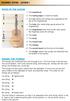 BEGINNER GUITAR - LESSON 1 PARTS OF THE GUITAR 1- The headstock. 2- The tuning pegs or machine heads. 3- The nut (where the strings are supported at the top of the fingerboard). 4- The frets (the metal
MILS and MOA A Guide to understanding what they are and How to derive the Range Estimation Equations
 MILS and MOA A Guide to understanding what they are and How to derive the Range Estimation Equations By Robert J. Simeone 1 The equations for determining the range to a target using mils, and with some
Relative and Absolute Change Percentages
 Relative and Absolute Change Percentages Ethan D. Bolker Maura M. Mast September 6, 2007 Plan Use the credit card solicitation data to address the question of measuring change. Subtraction comes naturally.
AP1 Waves. (A) frequency (B) wavelength (C) speed (D) intensity. Answer: (A) and (D) frequency and intensity.
 1. A fire truck is moving at a fairly high speed, with its siren emitting sound at a specific pitch. As the fire truck recedes from you which of the following characteristics of the sound wave from the
Grade 5 Math Content 1
 Grade 5 Math Content 1 Number and Operations: Whole Numbers Multiplication and Division In Grade 5, students consolidate their understanding of the computational strategies they use for multiplication.
Chapter 3. The Concept of Elasticity and Consumer and Producer Surplus. Chapter Objectives. Chapter Outline
 Chapter 3 The Concept of Elasticity and Consumer and roducer Surplus Chapter Objectives After reading this chapter you should be able to Understand that elasticity, the responsiveness of quantity to changes
Joist. Reinforcement. Draft 12/7/02
 Joist Reinforcement Draft 12/7/02 1 JOIST REINFORCING The purpose of this CSD Design Aid is to provide procedures and suggested details for the reinforcement of open web steel joists. There are three basic
Session 7 Fractions and Decimals
 Key Terms in This Session Session 7 Fractions and Decimals Previously Introduced prime number rational numbers New in This Session period repeating decimal terminating decimal Introduction In this session,
Managerial Economics Prof. Trupti Mishra S.J.M. School of Management Indian Institute of Technology, Bombay. Lecture - 13 Consumer Behaviour (Contd )
 (Refer Slide Time: 00:28) Managerial Economics Prof. Trupti Mishra S.J.M. School of Management Indian Institute of Technology, Bombay Lecture - 13 Consumer Behaviour (Contd ) We will continue our discussion
The Reflexion Filter. Manual. Electronics
 The Reflexion Filter Manual Electronics SE Electronics Instrument Reflexion Filter Manual Thank you for purchasing the Reflexion Filter portable vocal booth. The main idea behind this product is to facilitate
The Basic Jazz Guitar Chord Book
 The Basic Jazz Guitar Chord Book By Dirk Laukens / January 25, 2005 Hello and welcome to the basic jazz guitar chord book, brought to you by www.jazzguitar.be. How are guitar chords built? What makes a
The Physics and Math of Ping-pong and How It Affects Game Play. By: Connor Thompson & Andrew Johnson
 The Physics and Math of Ping-pong and How It Affects Game Play 1 The Physics and Math of Ping-pong and How It Affects Game Play By: Connor Thompson & Andrew Johnson The Practical Applications of Advanced
Determining the Acceleration Due to Gravity
 Chabot College Physics Lab Scott Hildreth Determining the Acceleration Due to Gravity Introduction In this experiment, you ll determine the acceleration due to earth s gravitational force with three different