
BEGINNER GUITAR - LESSON 1
|
|
|
- Gabriel Goodman
- 9 years ago
- Views:
Transcription
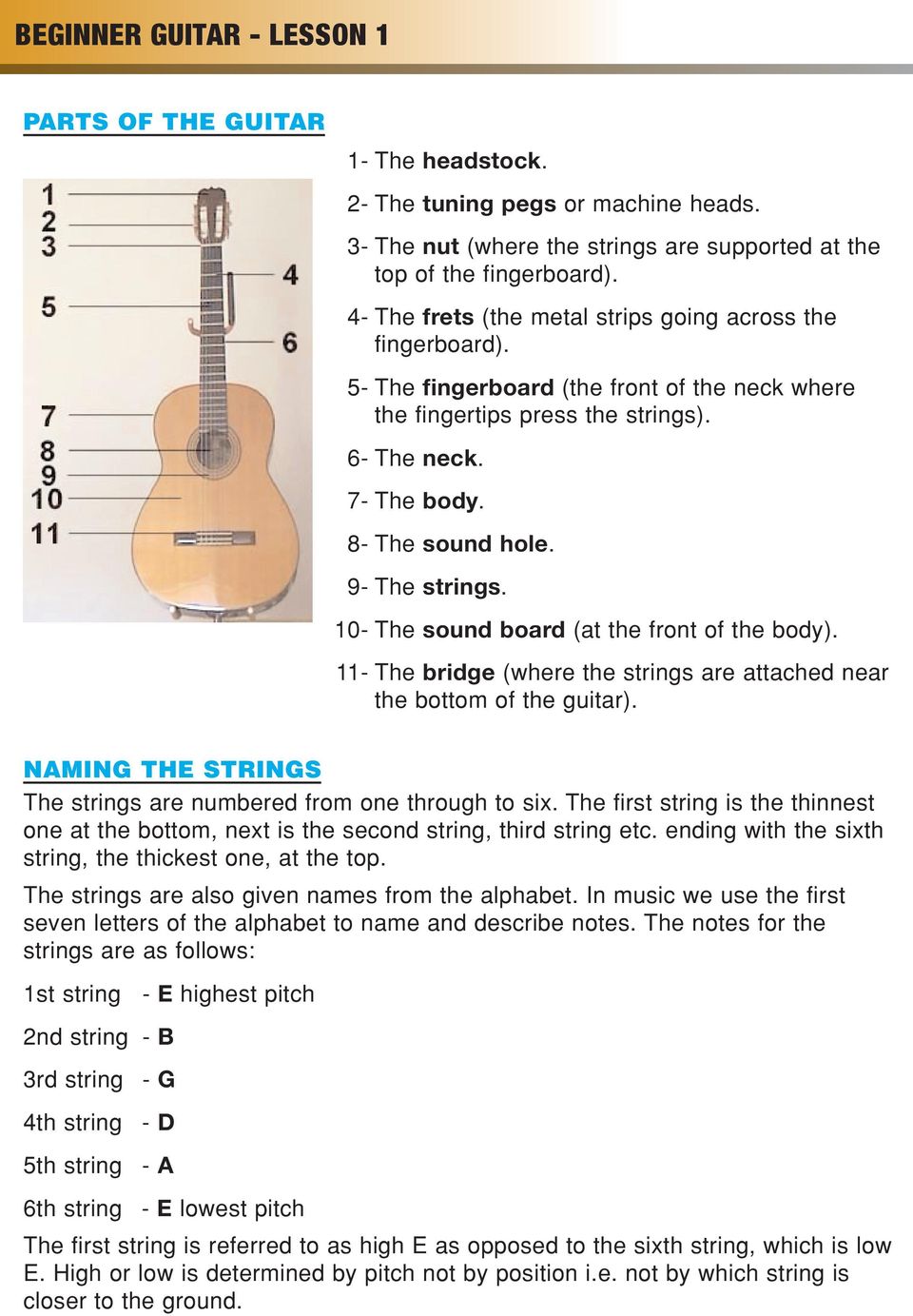
1 BEGINNER GUITAR - LESSON 1 PARTS OF THE GUITAR 1- The headstock. 2- The tuning pegs or machine heads. 3- The nut (where the strings are supported at the top of the fingerboard). 4- The frets (the metal strips going across the fingerboard). 5- The fingerboard (the front of the neck where the fingertips press the strings). 6- The neck. 7- The body. 8- The sound hole. 9- The strings. 10- The sound board (at the front of the body). 11- The bridge (where the strings are attached near the bottom of the guitar). NAMING THE STRINGS The strings are numbered from one through to six. The first string is the thinnest one at the bottom, next is the second string, third string etc. ending with the sixth string, the thickest one, at the top. The strings are also given names from the alphabet. In music we use the first seven letters of the alphabet to name and describe notes. The notes for the strings are as follows: 1st string - E highest pitch 2nd string - B 3rd string - G 4th string - D 5th string - A 6th string - E lowest pitch The first string is referred to as high E as opposed to the sixth string, which is low E. High or low is determined by pitch not by position i.e. not by which string is closer to the ground.
2 BEGINNER GUITAR - LESSON 1 NOTES ON THE FIRST STRING Playing E, F and G. Practice reading and playing the three notes E, F and G on the first string.

3 BEGINNER GUITAR - LESSON 1B NOTES ON THE FIRST STRING Playing E, F and G. Practice reading and playing the three notes E, F and G on the first string.

4 READING TABLATURE BASICS BASIC TAB EXPLANATION Tab is a system for writing down guitar notes using numbers rather than the standard music sheet style which makes it faster to read and play. Tab will tell you what strings to hit, whether to use hammer-ons, pull-offs, bends, slides, harmonics and vibrato. However tab will not tell you the rhythm of the song you play. It's up to you to figure that out by listen to the song. Tab won't tell you where to use up or downstrokes most the time or which fingers to fret with, those things are up to you. Tab has six lines, which represent the strings of the guitar. The top line corresponds to the 1st string (the high E string) of your guitar; the next line corresponds to the B string, etc. The spaces between the lines don't have any musical significance. If you were to place the guitar on your knee, then lay it flat so the strings are facing you, the above is how the strings would look. The High E is the string on the first line, then B, and so on through Low E. These numbers indicate which string and fret to press down to play the desired note. By playing the fret and string indicated you should be able to get something like the song you are trying to play - assuming that the person who wrote the tab was accurate! One of the shortcomings of tab is the difficulty in showing time values. E B G D A E E B G D A E A chord would look like this. This is a D chord, the zero on the D string means you strum the open string. Chords can also be in arpeggio form. That basically means that you pick each of the notes of the chord individually, rather than just strumming it. In tab, an arpeggio chord looks like: E B G D A E Now that you know how to read notes, there are a few more things to understand in order to get started. You will often see pieces in tablature that look similar to these: The 'h' between the numbers indicates a hammer-on. E B G D A h h h E Another often used technique is the pull-off. This technique looks like this on tab: E B G D A p p p E Here are several other letters and symbols used in tab: h - hammer on p - pull off b - bend string up r - release bend / - slide up \ - slide down v - vibrato (it's sometimes written as ~) t - right hand tap x - play 'note' with heavy damping

5 BEGINNER GUITAR - LESSON B2 NOTES ON THE SECOND STRING copyright 2011 Lessonsbyjames To play the notes on the second string move all of the right hand fingers from the second string onto the third string and rest the thumb on the sixth string. Maintain the same hand position we used for the first string, the three fingers now on the third string, wrist off the body of the guitar and the little finger NOT on the body of the guitar. If you play the open second string, again using the first finger of the right hand to pluck the string, this note is called open B. If you look at the left hand, the note at the first fret, using the first finger, is C. On the third fret, using the third finger, we have the note D. You may notice that these notes are at the same frets as F and G were on the first string. These notes are shown below. Once again without looking at the right hand, play the notes and say their names to yourself as you go. This will be a bit trickier this time, as the finger of your right hand might end up striking the first string. If this happens, avoid looking at your hand; you will be able to hear the mistake, just make the correction without looking and carry on. Be careful you are not gripping the edge of the neck or pointing your fingers out when finished playing a note, just lift your fingertip off to sit in position over the fingerboard ready to play.

6 BEGINNER GUITAR - LESSON 2 NOTES ON THE FIRST STRING Playing B, C and D. Practice reading and playing the three notes B, C and D on the second string.

7 BEGINNER GUITAR - LESSON B2 TUNING THE GUITAR There are several devices available to provide the correct pitch to tune to. The easiest is using an electronic tuner. The string is played and the tuner indicates whether the note is sharp (high), flat (low) or at the correct pitch. You can also use a pitch pipe, tuning fork or tune to a piano. It is best to play the low E and tune the other strings to it. RELATIVE TUNING Recall that the open sixth string is an E. If you press the sixth string just behind the 5th fret it will produce the note A, which is the same as the open fifth string. Play one note then the other, beginning with the lower string, rather than both notes at the same time and adjust the tuning peg till the two strings are in tune. This process can be repeated on all strings, as outlined below. Notice the comparison note is on the 5th fret for all but the third string, which uses the 4th fret to compare with the open second string. READING MUSIC We are now going to learn how to read music. Don t panic - it is not really that hard to do in spite of what you may have heard. We will be covering the notes one string at a time but here is a quick overview: Guitar music is written on a set of five lines and four spaces known as the staff. At the beginning of the staff is the treble clef. The lines and spaces represent points or positions where the notes can be fixed and these correspond to notes on the guitar. These positions are fixed. Starting at the bottom, the lines represent the notes E, G, B, D and F. The spaces represent the notes F, A, C and E. There is an easy way to memorize these, which you may recall. The notes in the spaces spell the word face. This is handy if you get lost; go to the bottom and spell up to the space you are at to get the note name. Similarly for the lines you may remember the rhyme every good boy deserves favor, again start at the bottom line and spell up to the line note in question. You may well be wondering how to possibly get all the notes on the guitar in a series of five lines and four spaces. The answer is that you can t. The notes that are higher in pitch than the note F, on the top line, need additional lines and spaces. These are termed ledger lines and are added as required. The same works for the deep notes lower in pitch than the E at the bottom line. Additional ledger lines are added for the lower pitch notes of the guitar. You may be wondering what the vertical lines between the groups of notes are called. These are commonly called bar lines and their purpose is to divide the staff into sections called measures. This divides the music into time, but we will deal with that later.

8 BEGINNER GUITAR - LESSON 3 In this lesson we will combine the notes we learned on the first string, E, F and G, with the notes on the second string, B, C and D. We will then learn our first song. NOTES ON THE FIRST AND SECOND STRINGS Once again curl the fingers over and position them on the third string, ready to play notes on both the first and second strings. If you want to play a note on the first string, the right-hand fingers still sit on the third string; you do not need to jump them around. Say you want to go from B to E. The first finger picks the open second string for B then reaches forward and plays the open first string for E. If you need to play another note on the second string the finger comes back again and picks the second string. Try to get a feel for where the strings are with your right hand without having to look. We will begin with a short series of notes on the two strings as shown below. Usually a series of notes in alphabetical order are referred to as a scale, so this would be a short scale. Let s now look at some common problems when playing on more than one string. When going from D on the second string at the 3rd fret to open E on the first string, lift your third finger off D while you are hitting E. Otherwise you will get a blurring together of the two notes, which is not desirable. We want a nice legato effect between the notes. The following can be quite confusing for beginners at this stage. They want to play a D, but because they are looking at the music, their finger winds up landing on the third fret of the third string rather than the third fret of the second string. They are picking the second string and an unpleasant muted sound is coming out of the guitar because the left-hand finger is partially muting the second string. Another mistake is this: Let s say you are playing E and you want to go to D. Your finger lines up exactly where it should behind the fret on the D but the first finger of your right hand does not move over to play the second string and continues playing the first string E not producing the correct note D. These are common mistakes to watch out for. Familiarize yourself with them and build in the corrections as you go. TIMING We are now at the threshold of learning to read music properly and ready to get on with our very first tune. So far we have seen how notes on the staff correspond to the guitar. For example, you look at a note on the staff and play it on the guitar. However, not all notes ring for the same length of time. To distinguish the different lengths of time a note rings for, the notes are drawn differently. So far we have only been dealing with one kind of note, a quarter note. The following diagram illustrates the different types of notes and how long they ring for. First we have a quarter note and it is worth the equivalent of one count. When playing the note it only lasts as long as it takes to say one. Or, if it is the second note, it will last the time to say two. Next is the half note and it is worth two counts; that is, the time to count one, two. Finally we have the whole note which rings for four counts. Play the note and let it ring for the count one, two, three, four. If you look at the line of music above, you will notice that after the treble clef there are two numbers, in this case 4/4. This is the time signature or meter and indicates how many beats are in a bar as well as how long each beat lasts. The upper number refers to how many counts there will be in a measure. Here the upper number is four so there are four beats per bar. For example, you will count 1, 2, 3, 4 as you go along bar by bar reading the music. Sometimes this number will change; for example it could be a 3, in which case there would be three counts to the measure. In this case, the bottom number is 4 and indicates that a quarter note gets one count; that is each beat is one-quarter note. JINGLE BELLS Our first tune will be Jingle Bells. This is in 4/4 time, four counts to the measure with a quarter note getting one count. Let s review some common problems in playing this piece. The first bar consists of open E notes. There is a temptation to play them too quickly and then be unable to maintain that speed for the fretted notes. Select a slow, comfortable pace to allow for even timing when fingering notes later in the tune, particularly in the third bar when shifting between strings. Once you have the timing mastered you may encounter a problem going from G to C where you cut off the note G prematurely. Try holding the G to the last minute before switching to the C. Also, when going from D to E, lift your finger off the D so that the notes do not blur together. Set your right-hand fingers on the third string and look only at the left hand or the sheet music when playing.

9 BEGINNER GUITAR - LESSON 3 NOTES ON THE FIRST AND SECOND STRINGS In this lesson we will combine the notes we learned on the first string, E, F and G, with the notes on the second string, B, C and D. We will then learn our first song. We will begin with a short series of notes on the two strings as shown below. Usually a series of notes in alphabetical order are referred to as a scale, so this would be a short scale.

10 BEGINNER GUITAR - LESSON 3 JINGLE BELLS

11 BEGINNER GUITAR - LESSON 3 TIMING We are now at the threshold of learning to read music properly and ready to get on with our very first tune. So far we have seen how notes on the staff correspond to the guitar. For example, you look at a note on the staff and play it on the guitar. However, not all notes ring for the same length of time. To distinguish the different lengths of time a note rings for, the notes are drawn differently. So far we have only been dealing with one kind of note, a quarter note. The following diagram illustrates the different types of notes and how long they ring for. First we have a quarter note and it is worth the equivalent of one count. When playing the note it only lasts as long as it takes to say one. Or, if it is the second note, it will last the time to say two. Next is the half note and it is worth two counts; that is, the time to count one, two. Finally we have the whole note which rings for four counts. Play the note and let it ring for the count one, two, three, four. If you look at the line of music above, you will notice that after the treble clef there are two numbers, in this case 4/4. This is the time signature or meter and indicates how many beats are in a bar as well as how long each beat lasts. The upper number refers to how many counts there will be in a measure. Here the upper number is four so there are four beats per bar. For example, you will count 1, 2, 3, 4 as you go along bar by bar reading the music. Sometimes this number will change; for example it could be a 3, in which case there would be three counts to the measure. In this case, the bottom number is 4 and indicates that a quarter note gets one count; that is each beat is one-quarter note.

12 BEGINNER GUITAR - LESSON 4 copyright 2011 lessonsbyjames LEARNING CHORDS In this lesson we are going to learn how to play some chords. A chord is just a combination of two or more notes played at the same time. We will be using a pick, or plectrum, which gives a nice bright clean sound when strumming. Chords are usually used for accompaniment when singing. E-MINOR CHORD The left hand holds down different fingerings or chord shapes while the right hand strums the strings. The first chord we will learn is E-minor. D-MAJOR CHORD Let s now try a D-major chord. CHANGING CHORDS

13 BEGINNER GUITAR - LESSON 5 copyright 2011 lessonbyjames ROCK PATTERN Let s now learn a rock pattern on the first three strings.

14 BEGINNER GUITAR - LESSON 5 DRUNKEN SAILOR In this lesson we will use the chords E-minor and D-major for the song Drunken Sailor. The chord changes and strumming are outlined below. You can sing the song yourself or play along with James singing.

15 BEGINNER GUITAR - LESSON 5 NOTES ON THE THIRD STRING There are only two notes on the 3rd string, open G and A at the second fret using the middle (second) finger of the left hand.

16 BEGINNER GUITAR - LESSON 6 copyright 2011 lessonsbyjames RHYTHM PATTERNS To begin strum down on the one and up on the +, followed by down strokes on the remaining beats. The 1 + represents two eighth notes being played in the time of one beat. Once you can evenly strum the pattern with two eighth notes on the first beat try the following with eighth note strokes down and up on the second beat. And these examples with eighth note strums on the third and then the fourth beat.

17 BEGINNER GUITAR - LESSON 6 C-MAJOR CHORD We will now learn a new chord, C-major. For the C chord we want to strum with the pick from the 5th string down. Practice going from D to C and lift your fingers up when changing the chords, do not just scoot over the surface of the strings.

18 BEGINNER GUITAR - LESSON 7 HAPPY BIRTHDAY In this lesson we will begin by learning a familiar tune on the 1st, 2nd and 3rd strings - Happy Birthday. If you refer to the written music you will notice that this piece begins not on the first beat of the bar but on the third, and the third beat is divided into two eighth notes. This is referred to as an incomplete measure.

19 BEGINNER GUITAR - LESSON 7 NEW CHORDS G AND F We will now learn two new chords, G-major and F-major. Be warned that F is the very worst chord of all to master. It will be quite frustrating but, with practice, you will be successful. G-MAJOR CHORD F-MAJOR CHORD Now the dreaded F chord. F is a lot like the C chord in appearance. Play the chord from the 4th string down hitting each note.

20 BEGINNER GUITAR - LESSON 8 NOTES ON THE 4TH STRING On the 4th string we have an open D, E at the 2nd fret and F at the 3rd fret.

21 BEGINNER GUITAR - LESSON 8 NOTES ON THE 5TH STRING On the 5th string we have open A, B at the 2nd fret and C at the 3rd fret. Practice reading the notes on the lower three strings and we will be ready next lesson to learn another rock pattern on the lower strings.
22 BEGINNER GUITAR - LESSON 8 NOTES ON THE LOWER STRINGS In this section we are going to learn the remaining notes on the 4th, 5th and 6th strings. Recall the open 4th string was D, the open 5th was A and the open 6th string was a very low or deep sounding E. The 6th string and the 1st string are actually the same note but two octaves apart. NOTES ON THE 6TH STRING Start with the open 6th string, an E. Notice that this note requires three extra ledger lines below the staff and even then it is the space below the third line where the note is positioned. The notes for this string are the same as we had on the 1st string. We have F at the 1st fret and G at the 3rd fret. Practice reading the notes on the low E string.
23 BEGINNER GUITAR - LESSON 8 CHORD CHANGES FOR HAPPY BIRTHDAY We are going to continue learning Happy Birthday, but this time we are going to apply the chords C, G and F as an accompaniment for the song. ALTERNATE RHYTHM PATTERN In the above we are using a simple strum pattern because these chords are quite difficult to change. If you can manage these changes you may want to make the rhythm pattern a bit more complicated by strumming on each beat; that is, using quarter notes.
24 BEGINNER GUITAR - LESSON 9 ROCK PATTERN ON BASS STRINGS In this lesson we are going to learn how to play a rock pattern on the bass strings using the thumb. This is actually the same pattern we learned on the three high strings. LEFT HAND EXERCISES We will now learn some left-hand exercises, which will strengthen your fingers and enable you to tackle some more difficult pieces. Also try playing this in reverse order. With all of your fingers down, lift off one at a time playing as you go from the 4th fret down to the 1st fret.
25 BEGINNER GUITAR - LESSON 9 HAMMER ON We now look at a technique called hammering on. Let the open string ring for a bit, then before it dies hammer on to produce the next tone. PULL OFF The reverse of a hammer on is a pull off. Play the note, keep pressing and without playing the note again pull your middle finger off to the side of the string. HAMMER ON AND PULL OFF EXERCISE We are now going to use the hammer on and pull off technique for a new exercise on the first four frets of the first string. Try to practice these left-hand exercises daily if possible. You will notice a substantial improvement in your ability to play both chords and single note tunes.
26 BEGINNER GUITAR - LESSON 10 ARPEGGIO In this lesson we are going to switch over to the right hand and learn how to use our thumb and fingers independently. Once you can do the above we will make the pattern slightly more complicated. We will change the timing to eighth notes. For the timing count and run the notes together continuously.
27 BEGINNER GUITAR - LESSON 10 D7 CHORD We will now look at a D7 chord, a variation of the D chord we covered earlier. Hit this chord from the 4th string down. With our arpeggio the thumb hits the 4th string and the fingers play the pattern. G AND C CHORDS Hit this chord from the 6th string down. With our arpeggio the thumb hits the 6th string and the fingers play the pattern. Hit this chord from the 5th string down. With our arpeggio the thumb hits the 5th string and the fingers play the pattern.
28 BEGINNER GUITAR - LESSON 10 SILENT NIGHT We now use this new chord and the arpeggio technique to play a new song, Silent Night. We need to change from D7 to G to C.
29 BEGINNER GUITAR - LESSON 11 In this lesson we are going to learn a new tune, Auld lang syne, using the first three strings. We will introduce a new note, A, on the 1st string at the 5th fret as well as tied notes and dotted notes. TIED AND DOTTED NOTES A dot following a note or rest increases the time value by half. For example a half note, when dotted, would increase from two to three beats. A tie indicates the note is to be extended for the duration of both tied notes. The note is only played once and held. This allows notes to be continued across bar lines. AULD LANG SYNE
30 BEGINNER GUITAR - LESSON 11 MAJOR AND MINOR CHORDS We will now add two more chords to your collection, E-major and A-minor.There is a difference between the sound of major and minor chords. Minor chords tend to sound a little sad while major chords sound happier. Major chords are often referred to using just the letter name, rather than E-major it would simply be E. For minor chords an abbreviation is often used, rather than A-minor it would be Amin. E-MAJOR CHORD A-MINOR CHORD With this chord you need to be careful and strum from the 5 th string down.
31 BEGINNER GUITAR - LESSON 11 SIXTEENTH NOTE TIMING As you recall, quarter notes each get one count. For example, 1, 2, 3, 4. We also discussed the fact that each quarter note can be divided into two eighth notes, for a count of Notes can be broken down further into sixteenth notes. To give a verbal syllable for each count we use 1 e + a, 2 e + a, 3 e + a, 4 e + a. The beat is on the number and the four sixteenth notes are all played in the count of one quarter note.
32 BEGINNER GUITAR - LESSON 12 A-MAJOR For this chord strum the strings from the 5th string down. D-MINOR For this chord strum the strings from the 4th string down. SWITCHING BETWEEN CHORDS When practicing switching between chords do not play too fast. Select a speed at which you can comfortably change the chords without missing a beat between bars.
33 BEGINNER GUITAR - LESSON 12 TIMING FOR SHUFFLE The timing for the right hand down strokes on the 4th and 5th strings is referred to as a shuffle. To get this feel, the first note in each pair is held longer than the second note. The A pattern is played four times, then with the first finger jump the gap to the D pattern on the 4th and 3rd strings and play it twice. Then back to A twice followed by the E pattern on the 6th and 5th strings played twice. Then directly to D twice and finally back to A four times, then the whole thing starts again.
34 BEGINNER GUITAR - LESSON 12 UP TEMPO ROCK PATTERN With a slight variation of this same pattern we can do what is called an up tempo rock pattern.
35 BEGINNER GUITAR - LESSON 13 B7 CHORD We are going to round this lesson off by learning another chord, B7. CHANGING CHORDS Now we will incorporate the B7 chord with two other chords, E and A. Strum each chord four times then change to the next chord.
36 BEGINNER GUITAR - LESSON 13 GREENSLEEVES When playing Greensleeves you may want to be really adventurous and try playing without resting your thumb or fingers in position. That is keeping your thumb and fingers a little off the strings while still maintaining your right hand in its proper position for playing.
37 BEGINNER GUITAR - LESSON 14 BAR CHORDS As a beginner you will likely find bar chords quite difficult initially because they involve placing your first finger right behind the fret and covering all six strings. The nearest we came to a bar chord in the previous sections was the F chord where the first finger held a mini-bar on the 1st and 2nd strings. BAR ON THREE STRINGS There are different versions of bar chords; the easiest to try initially uses the first finger pressing on the three high strings only. Press with the first finger at the 3rd fret on the 1st, 2nd and 3rd strings. Position your thumb at the back of the neck under the first finger. By squeezing your thumb and finger together, with practice, you should be able to produce a nice clean sound. If your first finger comes onto the top of the fret you will get a muffled or muted sound. If your finger is too far back you will get that awful sound referred to as fret buzz. If you find it too difficult covering all three strings you can start with the mini-bar on the 1st and 2nd strings as we had for the F chord and gradually work your way up to three strings. BAR ON SIX STRINGS Once you can produce a clean tone covering three strings you may wish to try covering all six strings. There are a few things to watch for when barring all of the strings. If your thumb is too far around the neck you may find that your first finger bends up off the fingerboard. Shifting your thumb back under the neck in line with the first finger will help straighten the first finger out. Try to get each individual string to ring. Sometimes if a string is right under the groove of a joint in your finger it will produce fret buzz. You can move your finger a bit so that a fleshy part is involved in pressing down the string.
38 BEGINNER GUITAR - LESSON 14 E-MAJOR SHAPE BAR CHORD Once you can manage a full bar try adding an E-major chord shape. You now have an E shape chord with the first finger free to bar the remaining strings. Take this shape and slide up the neck so the third and little fingers are at the 5th fret. Put the thumb under the neck and practice putting the first finger bar all the way across the six strings. You may find that your little finger wants to flatten out at his point and end up barring some strings you do not want it to at the 5th fret. To avoid this keep the finger fairly vertical to the fingerboard. One advantage with an E shape is that your barring finger does not have to press on the 5th, 4th and 3rd strings. You only have to worry about barring the 1st, 2nd and 6th strings. Spend some time to master barring as it will open up a lot of possibilities for playing more complicated songs. That brings us to the end of the Beginners Series. We hope you have enjoyed learning as much as we have enjoyed teaching you. If you have mastered most of the material, you will be well prepared to go on to any of the other more advanced categories on the site. We look forward to seeing you there.
Beginners Guide to the Walkingbass
 Beginners uide to the Walkingbass Learning to play a new instrument can open up a whole new world of creativity. It certainly has for me. The 3-string Walkingbass is an easy instrument to learn, yet it
Advanced Techniques for the Walkingbass
 Advanced Techniques for the Walkingbass I have seen guys with 5 string basses who can t get half the sounds that you are getting out of just three. -Buddy Fo of the Invitations If you have read the Beginners
FREE CHORD BOOK Introduction
 FREE CHORD BOOK Introduction Hi, I m Andy and welcome to my chord book for beginners! Most chord books are packed full hundreds of chord diagrams, so many in fact it could take literally years to play
Guitar Method Beginner: Book 1
 Guitar Method Beginner: Book 1 This book has been a project in the works for over a year, and now my dream of releasing it has finally come true. I would like to thank everyone who has encouraged or helped
Suitable for: Beginners with absolutely no previous experience. Beginners who appear particularly shy or nervous.
 Lesson plan 1: CHORD STRUMMING FOR THE BEGINNER Suitable for: Beginners with absolutely no previous experience. Beginners who appear particularly shy or nervous. Prerequisites: None General Objective:
Guitar Reference. By: Frank Markovich
 Guitar Reference By: Frank Markovich Guitar Reference Introduction The purpose of this book is to give the student the reference materials for learning how to play the guitar. In this book you will find
Learning to play the piano
 Learning to play the piano INTRODUCTION TO THE KEYBOARD... 2 STEPPING UP... 2 TREBLE SPACES... 7 BASS SPACES... 9 TIME SIGNATURE... 12 UP AND DOWN THE HILLS... 15 UP AND DOWN THE HILLS IN G MAJOR... 16
GRADE THREE THEORY REVISION
 GRADE THREE THEORY REVISION Note Pitches Use flashcards to make sure you know all your notes including leger lines. Whenever you name a note remember to check the clef, keysignature, and for accidentals
Learning To Play The Guitar An Absolute Beginner s Guide By Anthony Pell
 Learning To Play The Guitar An Absolute Beginner s Guide By Anthony Pell http://www.learningtoplaytheguitar.net All Rights Reserved. No part of this publication may be reproduced in any form or by any
Beginner Guitar Level I
 Welcome to Beginner Guitar Level I E A D G B E * Please fill out the student form * Who is this guy? E A D G B E Logistics, etc.. sign in / out everyday start promptly -> don t be late! breaks / bathrooms
2.13 Guitar notation and tab
 reference.book Page 103 Sunday, March 9, 2008 11:12 PM! 1.5 Guitar tab input, 2.7 Chord diagrams, 2.17 Lute tablature, 8.16 ASCII tab files. Guitar music features a wide array of special markings including
The Secret Weapon for Bar Chords
 Created by BCM The Secret Weapon for Bar Chords This handy device will make it much easier to form bar chords on your guitar. It is an effective tool that will give you immediate results. No more hours
GUITAR THEORY REVOLUTION. Part 1: How To Learn All The Notes On The Guitar Fretboard
 GUITAR THEORY REVOLUTION Part 1: How To Learn All The Notes On The Guitar Fretboard Contents Introduction Lesson 1: Numbering The Guitar Strings Lesson 2: The Notes Lesson 3: The Universal Pattern For
J. JENNINGS PUBLISHING COMPANY 5012 Kahn Street, Carmichael, CA 95608
 I N T R O D U C T I O N This packet contains introductory lessons for Emerson Karaoke Guitar 1. We assume you are a total beginner. The exercises start out very easy and will progress gradually. Have some
Developing Finger Technique
 Lesson Twenty One Developing Lead Guitar Techniques (Hammering On and Pulling Off) Gigajam Guitar School Lesson 21 IGS HOPO Lesson Objectives. Develop a library of Lead Guitar Playing Techniques. Develop
Bell Music Reading Course #1 Introduction 101. D. Rod Lloyd Columbia River Handbells 2010
 Bell Music Reading Course #1 Introduction 101 D. Rod Lloyd Columbia River Handbells 2010 1 How Music Works Music is a graphical presentation of sounds played in a precise, predetermined order. Music is
A MUSICAL APPROACH TO LEARNING THE BANJO NECK
 A MUSICAL APPROACH TO LEARNING THE BANJO NECK Introduction One of the things that has become clear to me, after a number of years of playing banjo, is that if I have any hope of improvising creatively
Everyone cringes at the words "Music Theory", but this is mainly banjo related and very important to learning how to play.
 BLUEGRASS MUSIC THEORY 101 By Sherry Chapman Texasbanjo The Banjo Hangout Introduction Everyone cringes at the words "Music Theory", but this is mainly banjo related and very important to learning how
How to Read Music Notation
 How to Read Music Notation The New School of American Music IN JUST 30 MINUTES! C D E F G A B C D E F G A B C D E F G A B C D E F G A B C D E F G A B C D E 1. MELODIES The first thing to learn about reading
Electric Guitar/Electric Bass/Acoustic Guitar/Classic Guitar Produced by ARIA Owner s Manual
 Electric Guitar/Electric Bass/Acoustic Guitar/Classic Guitar Produced by ARIA Owner s Manual Thank you for choosing an Aria instrument. Please take a moment to read through this owners manual. We will
Chapter 2 How To Cheat A Barre Chord
 Chapter 2 How To Cheat A Barre Chord Now that you ve learned a variety of chords in different positions, there are times that we want to eliminate some of the notes. I know, in the previous chapter I explained
This PDF is designed to go right along with the DVD. Print it out and keep it in front of you while working through the lessons.
 Beginner Strumming This PDF is designed to go right along with the DVD. Print it out and keep it in front of you while working through the lessons. Introduction You don t need to know much to get started
Learn How To Play Guitar
 Learn How To Play Guitar by Stefan Schyga 2000 Guitar Studio Publishing http://www.learnhowtoplayguitar.com http://www.mp3.com/learnhowtoplayguitar About The Author Stefan Schyga received his Masters Degree
Beautiful Simple Guitar Chord Progressions
 Beautiful Simple Guitar Chord Progressions The purpose of beautiful simple guitar chord progressions is to present guitar mechanisms as simply as possible. Using mostly three finger chords beautiful guitar
An Introduction to Chords
 1 An Introduction to Chords by David Gilson A chord is the musical sound produced by playing a number of notes at the same time. The sound of the chord is different depending on the key you are playing
How to Read Chord Charts
 How to Read Chord Charts Learning to read chord charts is fun, easy and it will open a new world of songs to you, as you will now be able to decipher the code. As a teacher and studio guitarist, I use
Banjo Basics For Standard G Tuning
 Banjo Basics For Standard G uning by D.A. Jacobs his text is distributed free of charge o all Banjo Students D.A.Jacobs 2004 All Rights Reserved Why his ext? When I first decided to learn banjo I had one
5 Ways To A Monster Guitar Technique Bill Tyers - February 2015
 5 Ways To A Monster Guitar Technique Bill Tyers - February 2015 The age old saying 'practice makes perfect' is still the very best advice that any student of the guitar can follow. Unfortunately for some
6) Minor Seventh & Suspended Chords. 7) Barre Chords on the 6 th String. 8) Barre Chords on the 5 th String. 9) The Secret to Great Strumming
 Table of Contents SESSIONS 1) Starting Off Right Overview 3 Finger Exercise 1 5 Finger Exercise 2 6 Finger Exercise 3 7 Alternating Finger Exercise 8 C & G7 Chord Exercise 9 2) Reading Music & Notes on
C Chord. Play these three notes at the same time with your right hand. These three notes make up a C chord.
 This book will get you playing keyboard instantly-whether you read music or not. We put together a band with some of our friends and recorded some really fun music. The Instant Keyboard CD has songs ready
Viola Time Book 2. RGP (Release, Glide and Press) Shifting Method 2
 Viola Time Book RGP (Release, Glide and Press) Shifting Method st Finger shifting without accidentals Exercise : st-rd Position shifting in C major Scale and arpeggio of C major Kayaking Down the Tarwin
GUITAR THEORY REVOLUTION
 GUITAR THEORY REVOLUTION The Major and Minor Pentatonic Scales Copyright Guitar Theory Revolution 2011 1 Contents Introduction 3 What are the Major and Minor Pentatonic Scales 3 Diagrams for all the Pentatonic
Guitar Chord Chart for Standard Tuning
 Page 1 Guitar Chord Chart for Standard Tuning This is the base Standard tuning chart for each string: Next, we'll walk through the neck positions for the chords you'll find in your rock songs. Each has
Jim Hall Chords and Comping Techniques
 Jim Hall Chords and Comping Techniques Jazz guitar comping is an art form in its own right. The comping rhythms, melodies, and voicings of the greatest Jazz guitarists are delightful to listen to, with
LEARN TO PLAY IX HYMNS IN SIX DAY
 S S IX HYMNS IN SIX DAY LEARN TO PLAY Week One And you don t need to know anything about music!! Learn over 130 Hymns and Children Songbook Songs plus Free Internet Video Instructions keyboard templates
Legacy Learning Systems 2510 Franklin Pike, Suite 200 Nashville, TN 37204
 Legacy Learning Systems 2510 Franklin Pike, Suite 200 Nashville, TN 37204 Gibson's Learn and Master Guitar. Copyright 2010 by Legacy Learning Systems, Inc. All rights reserved. No part of this product,
UKULELE CHORD SHAPES. More Strumming, Less Memorizing BRAD BORDESSA
 UKULELE CHORD SHAPES More Strumming, Less Memorizing BRAD BORDESSA TABLE OF CONTENTS GRATITUDES 2 9th 26 13th 26 INTRODUCTION 3 Altered 27 HOW TO USE THIS BOOK 4 Suspended 2 28 The Fingerboard 5 Suspended
INSTANT UKULELE. Dennis McKenna. www.instantukulele.com
 INSTANT UKULELE TM The Fast, Easy, FUN Way To Learn to Play Ukulele! You Can Play 100 s of Songs... Now! Great Tips Found Nowhere Else! List of Classic Songs You Can Play Instantly! Dennis McKenna www.instantukulele.com
Chords and More Chords for DGdg Tenor Banjo By Mirek Patek
 Chords and More Chords for DGdg Tenor Banjo By Mirek Patek This tenth article about the fingerstyle tenor banjo in DGdg tuning will be focused on banjo accompaniment, i.e. on playing chords. The goal is
Guitar Rubric. Technical Exercises Guitar. Debut. Group A: Scales. Group B: Chords. Group C: Riff
 Guitar Rubric Technical Exercises Guitar Debut In this section the examiner will ask you to play a selection of exercises drawn from each of the three groups shown below. Groups A and B contain examples
How they invented chord patterns for the guitar. J. Chaurette. Dec., 2012
 How they invented chord patterns for the guitar J. Chaurette Dec., 2012 The guitar has a very long history; it has evolved over the ages to what it is now. It has achieved its final distinct form in 1770,
C Major F Major G Major A Minor
 For this task you will create a 16 bar composition with a Ground Bass Accompaniment. REMINDER A chord is built on the notes 1 3 5 of a scale. e.g. chord of C would have the notes C E G. The first note
Make Smooth, Seamless Chord Changes In 5 Minutes Or Less
 Make Smooth, Seamless Chord Changes In 5 Minutes Or Less by Brett McQueen of UkuleleTricks.com All contents copyright 2014 McQueen Machine, LLC. All rights reserved. No part of this document or accompanying
Put Your Song to the Tests
 Put Your Song to the Tests By Pat & Pete Luboff We ve been listening to songs in a professional capacity for over 20 years, as songwriting consultants, workshop leaders, contest judges and Taxi screeners.
Users Manual. Version 1.0 June 2003 V-TONE GM108 ENGLISH
 Users Manual Version 1.0 June 2003 Top-notch electric guitar Padded gig bag BEHRINGER V-TONE GM108 modeling amplifier Adjustable black nylon strap 6.5 foot high-quality instrument cable 3 picks Chord chart
BASS BLUES LICKS AND PROGRESSIONS BOOK ON DEMAND V1.1, 2004
 BASS BLUES LICKS AND PROGRESSIONS BOOK ON DEMAND V1.1, 2004 Get It All.Net!, 2004, All Rights Reserved http://www.get-it-all.net/ 1 TABLATURE REFERENCE BASS FRETBOARD MAP (Past the 12 th fret the pattern
The Instant Impresario Guitar Instruction Guide
 The Instant Impresario Guitar Instruction Guide (Everything you need to know to get playing right away!) First Things First: This guitar can either be powered by the AC Adapter (included) or via eight
Introduction to Guzheng
 Introduction to Guzheng Guzheng is a Chinese musical instrument that has a history dating back to 500 BC It has many descendants all over Asia, such as the koto of Japan, the kayagum of Korea, and the
Keyboard Basics. By Starling Jones, Jr. http://www.starlingsounds.com& http://www.smoothchords.com
 Keyboard Basics By Starling Jones, Jr. In starting on the piano I recommend starting on weighted keys. I say this as your fingers will be adjusted to the stiffness of the keys. When you then progress to
Learning To Play The Guitar An Absolute Beginner s Guide
 Learning To Play The Guitar An Absolute Beginner s Guide By Anthony Pell http://www.learningtoplaytheguitar.net All Rights Reserved. No part of this publication may be reproduced in any form or by any
Lesson 7 Contents. Overview of Lesson 7 1. F Chord Variation. G7 Chord Variation
 Lesson 7 Contents Use this table of contents to make sure your book pages are in correct order. You will need highlighters and/or colored pencils and a pencil or pen. If you have internet access, you can
Getting Started on the Hawaiian Steel Guitar
 Getting Started on the Hawaiian Steel Guitar Acoustic Hawaiian Steel Guitar Played in the Old Taro Patch Open G Tuning by Konabob - [email protected] When Hawaiians began playing guitars flat on their laps,
How to Play Chords on your Mountain Dulcimer tuned DAd
 How to Play Chords on your Mountain Dulcimer tuned DAd (or Surviving in a Multi-Instrument Jam) by Missy Strothers If you are like me, sooner or later you ll get into a festival situation where you ll
Piano Accordion vs. Chromatic Button Accordion
 Piano Accordion vs. Chromatic Button Accordion Which is best, piano accordion (PA), or five row chromatic button accordion (CBA)? This is a question which is often debated in newsgroups. The question should
Definitive Piano Improvisation Course
 Definitive Piano Improvisation Course By Yoke Wong 2007 Harmony and Melody Studio Inc Contents Pages Introduction Pentatonic Scale Improvisation 1 Country Western Style Made Easy 4 Left Hand Harmonizing
This e-book/lesson will serve as a basic introduction to barre chords for latebeginner/early-intermediate
 INTRODUCTION Hello, fellow six-stringer! We guitarists spend the vast majority of our time playing chords also known as rhythm guitar so building a strong chord vocabulary is fundamental to our success.
Keyboard FUNdamentals James Lambert & Judy Moonert
 1 I. BASIC MUSIC THEORY A beginning mallet percussionist must memorize the 12 major scales. These scales relate to other harmonic information that the student will need. With each marimba bar one half
The open strings. There are notes all up and down the neck of the ukulele when you put your finger behind any of the frets and play just one string.
 The open strings It is important to tune your ukulele each time that you play it When your ukulele is in tune, it trains your ear to hear the right notes. Each string sounds a single note. You can remember
2010 Barry Liesch ch8 Drumming Guide for 10 Worship Styles 1
 2010 Barry Liesch ch8 Drumming Guide for 10 Worship Styles 1 9 pages 63 examples Chapter 8 Drumming Guide for 10 Worship Styles This chapter explores ways drumming can be performed in ten worship styles.
The Chord Book - for 3 string guitar
 The Chord Book - for 3 string guitar Prepared for: 3 string fretted cbg Prepared by: Patrick Curley Forward This short ebook will help you play chords on your 3 string guitar. I m tuned to G, if you re
Country Blues Guitar In Open Tunings taught by Stefan Grossman
 Country Blues Guitar In Open Tunings taught by by taught Stefan Grossman EXPLANATION OF THE TAB SYSTEM Learning from listening is unquestionably the best way, the only way that suits this kind of music.
The Physics of Guitar Strings
 The Physics of Guitar Strings R. R. McNeil 1. Introduction The guitar makes a wonderful device to demonstrate the physics of waves on a stretched string. This is because almost every student has seen a
Swing & Jump Blues Guitar Matthieu Brandt
 Swing & Jump Blues Guitar Matthieu Brandt Goto www.swingblues.com for more on Swing and Jump Blues Guitar. 1997-2016 No part of this material (book/cd/website) may be reproduced in any way without prior
Playing By Ear Who Can Play By Ear?... 2 How To Play By Ear... 3 Happy Birthday To You (By Ear)... 4 Match Tones... 5 Add Chords...
 Playing By Ear Who Can Play By Ear?... 2 How To Play By Ear... 3 Happy Birthday To You (By Ear)... 4 Match Tones... 5 Add Chords... 6 Allcanplay TM Piano * MaxLearning.Net 2009 * Playing By Ear * 4/6/2009
UKULELE IN THE CLASSROOM
 UKULELE IN THE CLASSROOM FIRST LESSONS Ann Rae In 1879, a ship called the Ravenscrag sailed from Portugal to Hawaii. The sailors brought a small guitar like instrument with only 4 strings. The Hawaiians
acousticguitarworkshop.com RICK PAYNE SP FINGERSTYLE BLUES More chapters in the story of how to play Fingerstyle Blues
 acousticguitarworkshop.com RICK PAYNE SP FINGERSTYLE BLUES More chapters in the story of how to play Fingerstyle Blues 2 Fingerstyle Blues 2 - Contents Welcome to Fingerstyle Blues 2! In the first course,
Playing Guitar: A Beginner s Guide. by Darrin Koltow www.maximummusician.com Copyright 2002 Darrin Koltow
 Playing Guitar: A Beginner s Guide by Darrin Koltow www.maimummusician.com Copyright Darrin Koltow Playing Guitar: A Beginner s Guide Page Contents Contents... Acknowledgements... 4 Also on MaimumMusician.com...
Standard 1: Skills and Techniques 1
 1 Standard 1: Skills and Techniques 1 CB.1.1 Instrument Knowledge Skills CB.1.1.1 Instrument in good playing condition- including proper assembly, reed care, and cleaning. CB.1.2 Playing Posture Skills
Your First Ukulele Lesson and Then Some
 2 Your First Ukulele Lesson and Then Some A Complete Beginner s Crash Course to Playing Ukulele by Brett McQueen of the Ukulele Tricks blog This ebook is dedicated to my grandfather who taught and inspired
Guitar Chords: a Beginner's Guide DEMO VERSION by Darrin Koltow
 Guitar Chords: a Beginner's Guide DEMO VERSION by Darrin Koltow Copyright 2002 Darrin Koltow Guitar Chords: a Beginner's Guide - DEMO VERSION Page 2 Table of Contents Other Ebooks...3 Introduction...4
The Tuning CD Using Drones to Improve Intonation By Tom Ball
 The Tuning CD Using Drones to Improve Intonation By Tom Ball A drone is a sustained tone on a fixed pitch. Practicing while a drone is sounding can help musicians improve intonation through pitch matching,
Music Theory. Level 1. Printable Music Theory Books. A Fun Way to Learn Music Theory. Student s Name: Class:
 A Fun Way to Learn Music Theory Printable Music Theory Books Music Theory Level 1 Student s Name: Class: American Language Version Printable Music Theory Books Level One Published by The Fun Music Company
Your First Ukulele Lesson and Then Some
 1 Your First Ukulele Lesson and Then Some A Complete Beginner s Crash Course to Playing Ukulele by Brett McQueen of UkuleleTricks.com All contents copyright 2015 McQueen Machine, LLC. All rights reserved.
Musical Literacy. Clarifying Objectives. Musical Response
 North Carolina s Kindergarten Music Note on Numbering/Strands: ML Musical Literacy, MR Musical Response, CR Contextual Relevancy Musical Literacy K.ML.1 Apply the elements of music and musical techniques
How To Determine Chords for Mountain Dulcimer Playing (How The Person Who Wrote the Chord Book Figured It Out)
 How To Determine Chds f Mountain Dulcimer Playing (How The Person Who Wrote the Chd Book Figured It Out) by Roger Huffmaster Did you ever wonder how the person who wrote the mountain dulcimer chd chart
Please Read This Page First
 Mandolin and Fiddle Improvisation Using the Chord Tone Scale Copyright 2008 by Pete Martin Please Read This Page First This book is distributed using the shareware system. Try it out, if you like it please
Music Theory for Cajun Accordionists
 1 Music Theory for Cajun Accordionists Right off the bat, I need to make clear that I m no expert; far from it. I ve had to piece together what little I know about music theory from here and there, mostly
Intervals Harmony Chords and Scales. Workbook
 Intervals Harmony Chords and Scales Workbook Introduction In writing this book I was able to make many discoveries for myself both in methods of teaching and basic use of music theory. In every discipline
Bass Clef Sight-Reading Exercise Worksheet
 Bass Clef Sight-Reading Exercise Worksheet Instructions: In this exercise you will work through five different levels of sight-reading ability. You may wish to print four copies of the music sheet for
Mathematical Harmonies Mark Petersen
 1 Mathematical Harmonies Mark Petersen What is music? When you hear a flutist, a signal is sent from her fingers to your ears. As the flute is played, it vibrates. The vibrations travel through the air
Easy to Follow Guide On: How to Play the Piano
 Easy to Follow Guide On: How to Play the Piano Composed by: Kim Gardner - 1 Table of Contents Unit 1 - Beginning in the Middle...Page 3 Unit 2 - Learning to Read the Beautiful Language of Music.Page 6
At the piano; learning a natural hand position; the steady beat; pre-reading: two black keys Learning finger numbers, posture, and arm weight;
 PREPARATORY 0 1 At the piano; learning a natural hand position; the steady beat; pre-reading: two black keys Learning finger numbers, posture, and arm weight; pre-reading: three black keys; double bar
Study Kit No 9. Aura Lee (Love Me Tender)
 Study Kit No 9 Aura Lee (Love Me Tender) Reharmonization Study Kit No. 9 Aura Lee Author: Rosablanca Suen Web: www.learnpianowithrosa.com Email: [email protected] Cover Design: Raymond Suen Copyright
Companion Workbook to the bonus section with Glenn Pearce
 Companion Workbook to the bonus section with Glenn Pearce Page 1 of 21 Page 2 of 21 Chapter 1 leadworship.com title page Chapter 2 main menu and Paul s introduction Electric guitar players - what to play
Handale Primary School Music Curriculum Year EYFS ( 4-5 year olds)
 Handale Primary School Music Curriculum Year EYFS ( 4-5 year olds) Music at EYFS stage reflects the different ways in which children learn and engage with other people. Many examples of stories, songs
Sample of Version 2.0 of Swing & Jump Blues Guitar
 The Charlie Christian Approach Charlie Christian (1916 1942) was one of the first real swing guitar players that had a lasting influence on all other swing and jump guitar players after him. Even more
Douglas Niedt's GUITAR TECHNIQUE TIP OF THE MONTH
 1 Douglas Niedt's GUITAR TECHNIQUE TIP OF THE MONTH Yes, it's "Doug's Dirty Little Secrets" I subtitled my Tech Tip "Doug's Dirty Little Secrets" after reading someone's posted message on a guitar web
Developing a cohesive walking bass line 2005 Eric Elias
 Developing a cohesive walking bass line 00 Eric Elias Developing a walking bass lines is a subject that many of my students (guitarists and bassists alike) have been interested in. If you are a jazz player,
If you put your mind to it, you can accomplish anything. Marty Mcfly
 If you put your mind to it, you can accomplish anything. Marty Mcfly My biggest inspiration for picking up a guitar is the scene from the movie Back To The Future where Marty plays the song Johnny B. Goode
PHYSICS 202 Practice Exam Waves, Sound, Reflection and Refraction. Name. Constants and Conversion Factors
 PHYSICS 202 Practice Exam Waves, Sound, Reflection and Refraction Name Constants and Conversion Factors Speed of sound in Air œ $%!7Î= "'!*7/>/
Sample Pages. This pdf contains sample pages from the ebook The Easy Guide to Jazz Guitar Arpeggios. To get the full ebook, Click Here
 1 Sample Pages This pdf contains sample pages from the ebook The Easy Guide to Jazz Guitar Arpeggios. To get the full ebook, Click Here 2 Contents Introduction....6 What Are Arpeggios?....7 Chapter 1:
Phonics. High Frequency Words P.008. Objective The student will read high frequency words.
 P.008 Jumping Words Objective The student will read high frequency words. Materials High frequency words (P.HFW.005 - P.HFW.064) Choose target words. Checkerboard and checkers (Activity Master P.008.AM1a
UNDERGRADUATE MUSIC THEORY PLACEMENT TEST INFORMATION
 UNDERGRADUATE MUSIC THEORY PLACEMENT TEST INFORMATION The theory placement test is designed to determine whether you are ready to enroll in MUS 121 (Music Theory I) or whether you must first take MUS 120
National Standards for Music Education
 National Standards for Music Education 1. Singing, alone and with others, a varied repertoire of music. 2. Performing on instruments, alone and with others, a varied repertoire of music. 3. Improvising
How to create bass lines
 First rule: always memorize the melody of the song! Always. Always. Always. You should be able to sing and play it in the original key. If you really want to be totally extra, extra awesome, you will be
The DADGAD Chord Primer: How to Build Chords in DADGAD Tuning. Version 2.2. By: Mark Parnis www.markparnis.com [email protected]
 The DADGAD Chord Primer: How to Build Chords in DADGAD Tuning Version 2.2 By: Mark Parnis www.markparnis.com [email protected] DADGAD is essentially a variant on open D tuning, DADF # AD. The subtle
2015 Pride Percussion TECHNIQUE & EXERCISE PROGRAM
 2015 Pride Percussion TECHNIQUE & EXERCISE PROGRAM Table of Contents Technique..3 Matched Grip Traditional Grip Bass Drum Grip Set Positions/Playing Areas..6 Snare Drum Keyboards Tenor Drums Bass Drum
Lesson DDD: Figured Bass. Introduction:
 Lesson DDD: Figured Bass Introduction: In this lesson you will learn about the various uses of figured bass. Figured bass comes from a Baroque compositional practice in which composers used a numerical
Fun Learning Activities for Mentors and Tutors
 Fun Learning Activities for Mentors and Tutors Mentors can best support children s academic development by having fun learning activities prepared to engage in if the child needs a change in academic/tutoring
Pentatonic Guitar Magic How To Use The Simple Pentatonic Scale To Solo Over Chords from Blues to Rock tojazz.
 Pentatonic Guitar Magic How To Use The Simple Pentatonic Scale To Solo Over Chords from Blues to Rock tojazz. This ebook may be freely distributed but not copied or altered in any way. WARNING: There is