
Metamorphic Rocks Practice Questions and Answers Revised October 2007
|
|
|
- Gwendolyn Welch
- 9 years ago
- Views:
Transcription
1 Metamorphic Rocks Practice Questions and Answers Revised October Metamorphism is a that involves no melt phase. 2. The protolith of a metamorphic rock is the (a) sibling (b) brother (c) parent (d) daughter 3. Fabric refers to the way in a rock are arranged. 4. Foliation is defined by the arrangement of minerals. 5. Typical platy minerals (sheet silicates) defining a foliation include (select all that apply) (a) chlorite (b) muscovite (c) biotite (d) hornblende (e) pyroxene 6. Directed pressure during metamorphism produces a. 7. If elements do not enter or leave a rock during recrystallization, then the rock system is described as or. 8. Marble is a metamorphic rock composed of coarse-grained (a) dolomite (b) quartz (c) calcite (d) epidote (e) garnet 9. Quartzite is a metamorphic rock composed of a dense network of interlocking (a) dolomite (b) quartz (c) calcite (d) epidote (e) garnet 10. Basalts when metamorphosed at temperatures of ~500 o C or higher are transformed into.

2 11. Slates are characterized by a tendency to break into even-parallel sheets due to the parallel alignment of the flat crystal faces of (a) garnet and kyanite (b) sillimanite and biotite (c) chlorite and muscovite (d) quartz and epidote 12. The foliation in a slate is called slaty (a) schistosity (b) gneissosity (c) cleavage (d) foliage 13. Assuming a mudstone protolith, the transformation to a slate occurs at ~ o C. 14. Phyllites are grained than slates, and when held up to the sunlight exhibit a marked, as rays of light reflect off the aligned crystals of and. 15. Assuming a mudstone protolith, the transformation to schist occurs at temperatures between about and o C. The resulting foliation is called. 16. Schist derived from a mudstone at temperatures between about 500 o C and 650 o C will consist of quartz, feldspar, muscovite, biotite, garnet, and. Such a rock would be grained than a phyllite. 17. The coarsest grained metamorphic rock is a (a) phyllite (b) slate (c) schist (d) gneiss 18. A foliation in gneiss would be called. It forms as ions migrate over microscopic distances at temperatures above to o C. 19. Metamorphic grade refers to the broad pressure conditions of metamorphism. True or false
3 20. In general, metamorphic grade is dependent upon the (a) geobarometer (b) isotherm (c) geotherm (d) lithobar 21. Given a specific geotherm, low metamorphic grade rocks occur in the part of the crust while higher grade rocks will occur at levels. 22. Given a mudstone protolith, and a geothermal gradient typical of arc-continent collisions, at temperatures over 700 o C, the stable metamorphic mineral assemblage will consist of quartz, feldspar, and. 23. Isotherms are curves or surfaces of equal (a) composition (b) volume (c) pressure (d) temperature 24. Isotherms bend downward within (a) volcanic arcs (b) continental interiors (c) divergent margins (d) subduction zone settings 25. In volcanic arc settings, isotherms bend downward due to the introduction of hot magma. True or false 26. An envelope of recrystallized rock surrounding a pluton is called a (a) rim of hard rock (b) envelope of hard rock (c) contact metamorphic aureole (d) contact metamorphic rim 27. Non-foliated rocks found in contact metamorphic aureoles are called (a) granofels (b) hornfels (c) lithofels (d) petrofels 28. Phase diagrams depict the PT conditions under which various minerals are stable. True or false

4 29. Is andalusite a low or high pressure phase relative to kyanite? 30. Is sillimanite a low or high temperature phase relative to andalusite? 31. Which of the following metamorphic facies represent rocks that were metamorphosed under the lowest PT conditions recognized by geologists? (a) eclogite (b) amphibolite (c) greenschist (d) granulite (e) zeolite 32. Which of the following metamorphic facies represent rocks that were metamorphosed under the highest pressure conditions recognized by geologists? (f) eclogite (g) amphibolite (h) greenschist (i) granulite (j) zeolite 33. The hornfels facies forms during metamorphism. 34. In subduction zone settings the geotherm is. 35. The geotherm in collisional zones and active regions of continents is about. 36. The geotherm in island arcs is about. 37. Why do isotherms bow upward in island arcs and mid-ocean ridges? 38. Why do isotherms bend downward in subduction zone settings? 39. How would describe the distribution of metamorphic facies within a zone of collision between an island arc and a passive continental margin? 40. What would happen to a mudstone if it were metamorphosed at temperatures in excess of 700 o C under wet conditions?
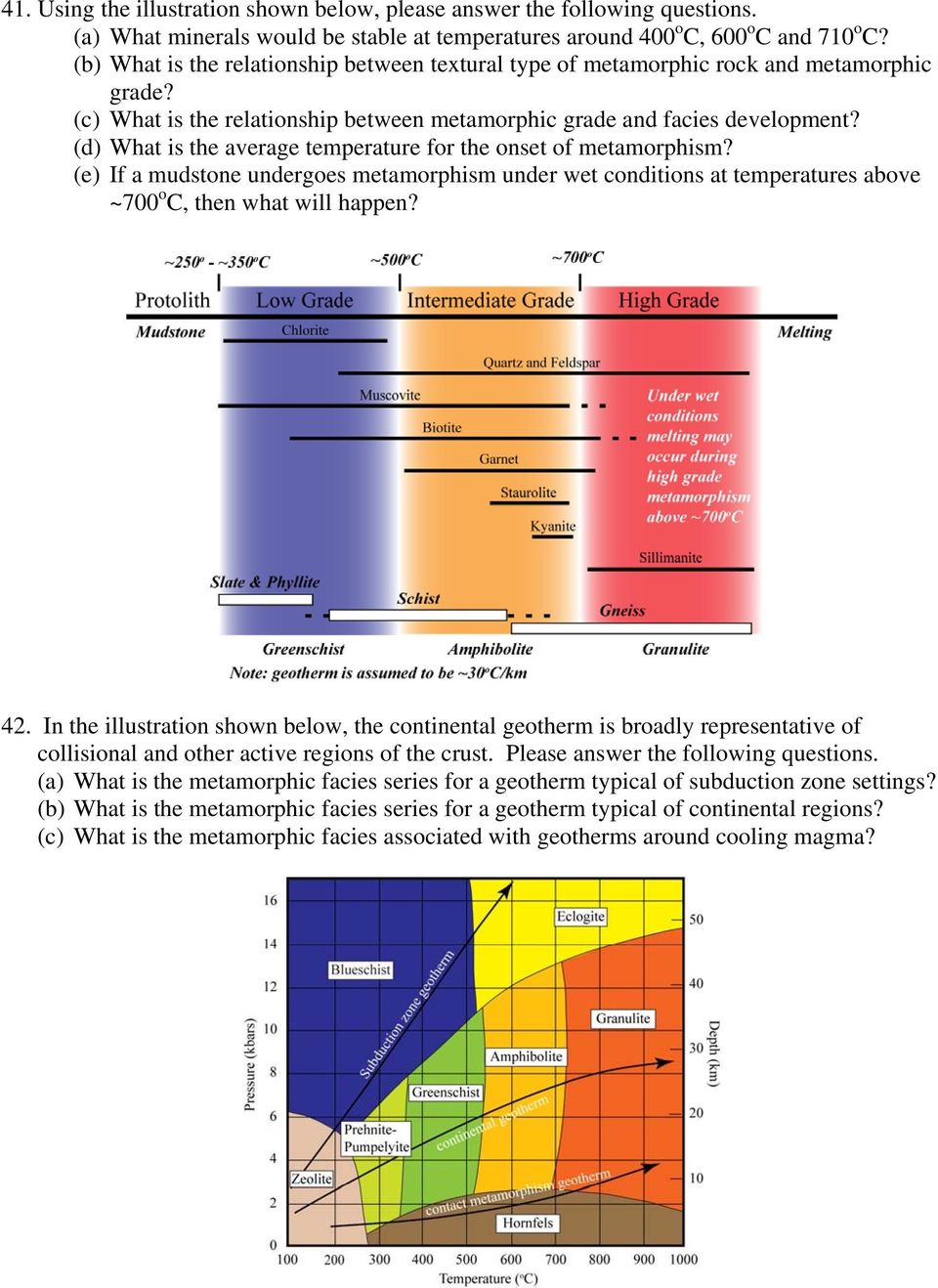
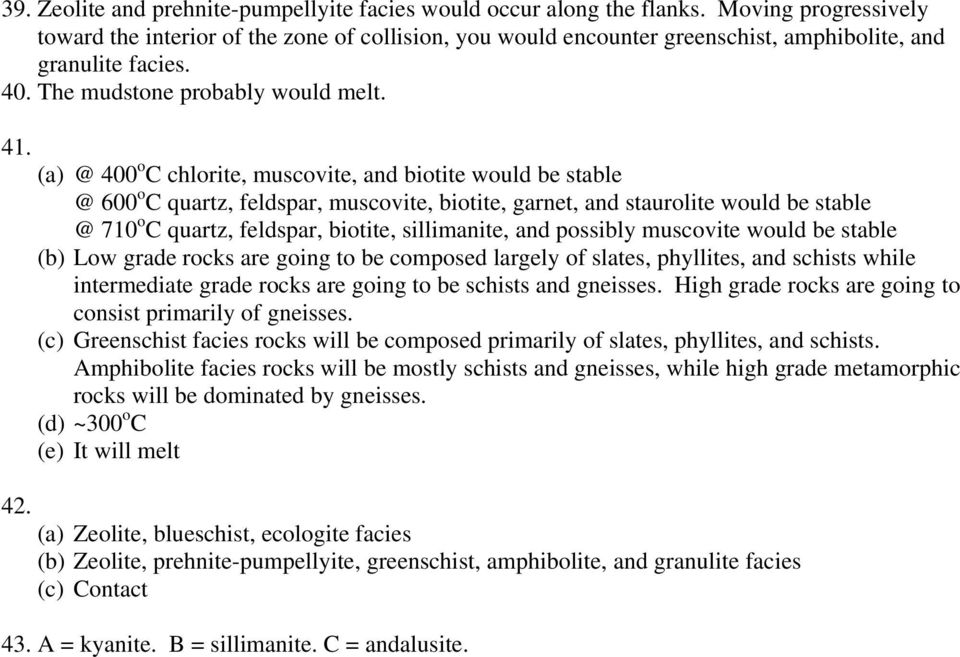
5 41. Using the illustration shown below, please answer the following questions. (a) What minerals would be stable at temperatures around 400 o C, 600 o C and 710 o C? (b) What is the relationship between textural type of metamorphic rock and metamorphic grade? (c) What is the relationship between metamorphic grade and facies development? (d) What is the average temperature for the onset of metamorphism? (e) If a mudstone undergoes metamorphism under wet conditions at temperatures above ~700 o C, then what will happen? 42. In the illustration shown below, the continental geotherm is broadly representative of collisional and other active regions of the crust. Please answer the following questions. (a) What is the metamorphic facies series for a geotherm typical of subduction zone settings? (b) What is the metamorphic facies series for a geotherm typical of continental regions? (c) What is the metamorphic facies associated with geotherms around cooling magma?
6 43. In the following illustration what do the fields labeled A, B, and C represent?
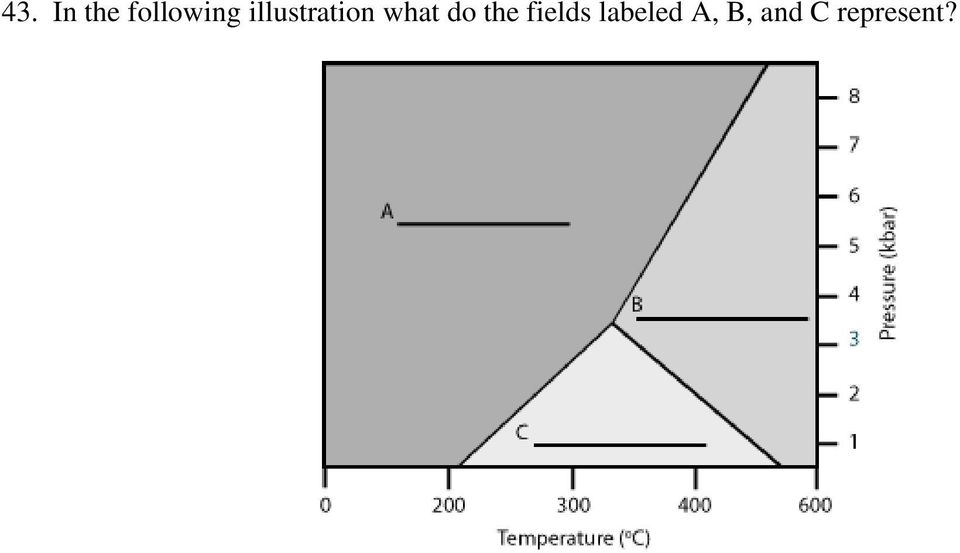
7 Answers 1. solid-state recrystallization 2. (c) parent 3. minerals 4. plane or planar 5. (a) chlorite, (b) muscovite, (c) biotite 6. foliation 7. closed, isochemical 8. (c) calcite 9. (b) quartz 10. amphibolite 11. (c) chlorite and muscovite 12. (c) cleavage coarser, sheen, chlorite, muscovite , 500, schisosity 16. staurolite, coarser 17. (d) gneiss 18. gneissosity, 600, False, metamorphic grade refers to the relative temperature conditions under which rocks were metamorphosed 20. (c) geotherm - note that this is sometimes referred to as the geothermal gradient 21. upper, deeper 22. sillimanite 23. (d) temperature 24. (d) subduction zone settings 25. False 26. (c) contact metamorphic aureole 27. (b) hornfels 28. True 29. low pressure 30. high temperature 31. (e) zeolite facies 32. (a) eclogite 33. contact o C/km o - 35 o C/km o C/km 37. Isotherms bow upward in island arcs and mid-ocean ridges because hot magma is introduced in these regions. 38. Isotherms bend downward in subduction zone settings because the cold subducting lithospheric plate descends at a rate faster than it can equilibrate (warm up) to the temperatures of the over ridging plate.
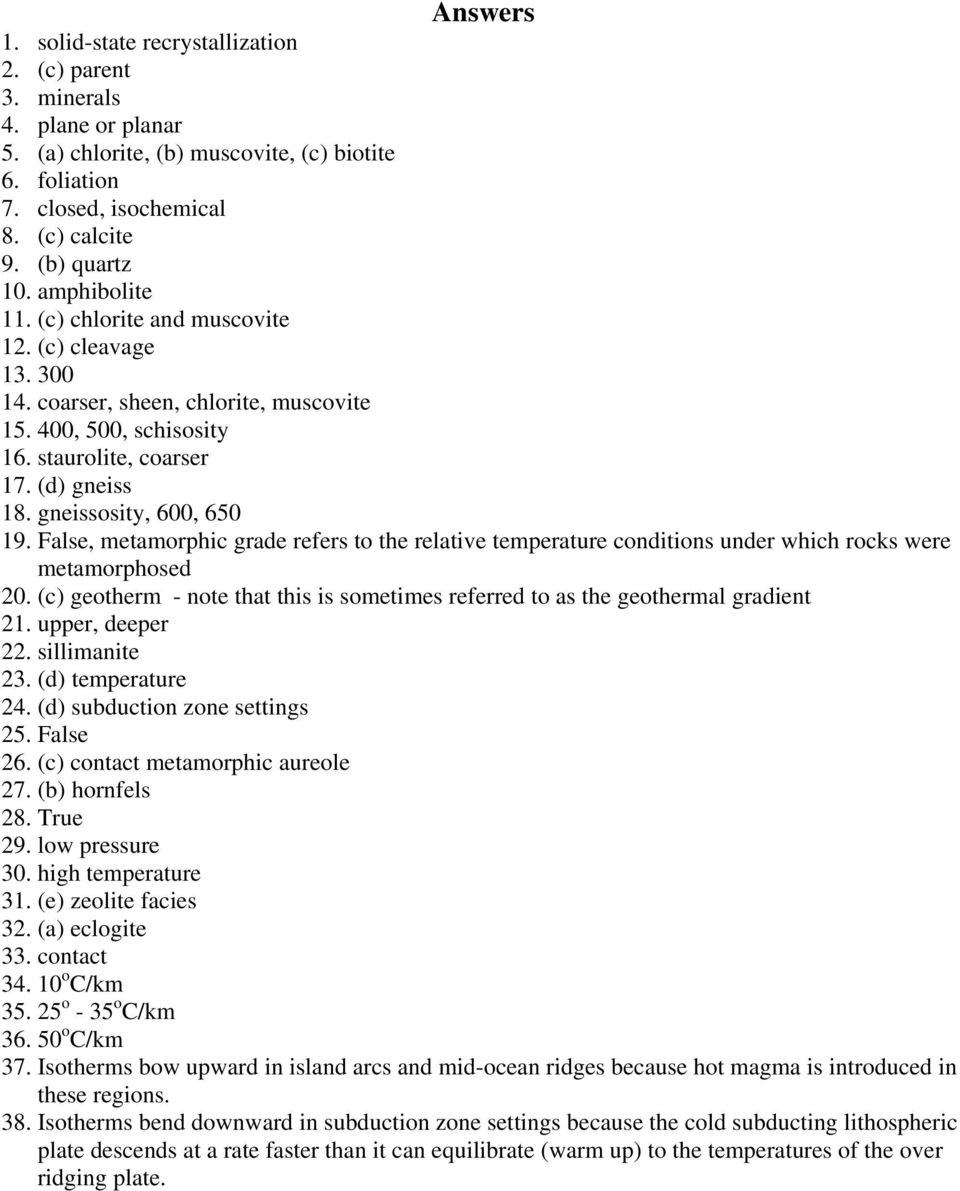
8 39. Zeolite and prehnite-pumpellyite facies would occur along the flanks. Moving progressively toward the interior of the zone of collision, you would encounter greenschist, amphibolite, and granulite facies. 40. The mudstone probably would melt o C chlorite, muscovite, and biotite would be 600 o C quartz, feldspar, muscovite, biotite, garnet, and staurolite would be 710 o C quartz, feldspar, biotite, sillimanite, and possibly muscovite would be stable (b) Low grade rocks are going to be composed largely of slates, phyllites, and schists while intermediate grade rocks are going to be schists and gneisses. High grade rocks are going to consist primarily of gneisses. (c) Greenschist facies rocks will be composed primarily of slates, phyllites, and schists. Amphibolite facies rocks will be mostly schists and gneisses, while high grade metamorphic rocks will be dominated by gneisses. (d) ~300 o C (e) It will melt (a) Zeolite, blueschist, ecologite facies (b) Zeolite, prehnite-pumpellyite, greenschist, amphibolite, and granulite facies (c) Contact 43. A = kyanite. B = sillimanite. C = andalusite.
Metamorphic rocks are rocks changed from one form to another by intense heat, intense pressure, and/or the action of hot fluids.
 Metamorphic Rocks, Processes, and Resources Metamorphic rocks are rocks changed from one form to another by intense heat, intense pressure, and/or the action of hot fluids. Protolith or parent rock is
O.Jagoutz. We know from ~ 20.000 borehole measurements that the Earth continuously emits ~ 44TW
 Lecture Notes 12.001 Metamorphic rocks O.Jagoutz Metamorphism Metamorphism describes the changes a rock undergoes with changing P, T and composition (X). For simplistic reasons we will focus here in the
Geology Laboratory: Metamorphic Rocks
 OBJECTIVES Learn to identify metamorphic rocks by structure and mineralogy. Identify major minerals contained within a metamorphic rock. Distinguish between foliated and non-foliated metamorphic rocks.
Rocks & Minerals. 10. Which rock type is most likely to be monomineralic? 1) rock salt 3) basalt 2) rhyolite 4) conglomerate
 1. Of the Earth's more than 2,000 identified minerals, only a small number are commonly found in rocks. This fact indicates that most 1) minerals weather before they can be identified 2) minerals have
METAMORPHIC ROCKS. Teacher Guide including Lesson Plans, Student Readers, and More Information
 METAMORPHIC ROCKS Teacher Guide including Lesson Plans, Student Readers, and More Information Lesson 1 - Formation of Metamorphic Rocks Lesson 2 - Metamorphic Rock Classification Chart Lesson 3 - Metamorphic
Chapter 4. Metamorphic Rocks. 4.1 Types of Metamorphism
 Chapter 4 Metamorphic Rocks Metamorphic rocks are rocks that have undergone a change in texture and/or mineralogy due to high temperature or pressure, or through the action of chemical alteration induced
Questions & Answers Proposed for Exam #3
 Questions & Answers Proposed for Exam #3 GE50 Introduction to Physical Geology (Geology for Engineers) Missouri University of Science and Technology Fall Semester 2007, Leslie Gertsch ([email protected])
Instructor: Ms. Terry J. Boroughs Geology 305 INTRODUCTION TO ROCKS AND THE ROCK CYCLE
 DATE DUE: Name: Instructor: Ms. Terry J. Boroughs Geology 305 INTRODUCTION TO ROCKS AND THE ROCK CYCLE Instructions: Read each question carefully before selecting the BEST answer Provide specific and detailed
Earth Materials: Intro to rocks & Igneous rocks. The three major categories of rocks Fig 3.1 Understanding Earth
 Earth Materials: 1 The three major categories of rocks Fig 3.1 Understanding Earth 2 Intro to rocks & Igneous rocks Three main categories of rocks: Igneous Sedimentary Metamorphic The most common minerals
What is a rock? How are rocks classified? What does the texture of a rock reveal about how it was formed?
 CHAPTER 4 1 The Rock Cycle SECTION Rocks: Mineral Mixtures BEFORE YOU READ After you read this section, you should be able to answer these questions: What is a rock? How are rocks classified? What does
Rock Identification. Introduction
 Introduction Rock Identification In our everyday lives, we often find confusion between the terms rock and mineral. People will sometimes use the terms interchangeably since they are both found in the
P1: Rock identification (I)
 P1: Rock identification (I) Examine the rocks specimens provided with the aid of these notes. All the rocks come from Ireland, as detailed on the attached map. Answer the short question on each specimen
Igneous, Sedimentary, and Metamorphic Rocks Earth Science Rock Lab. Introduction
 Igneous, Sedimentary, and Metamorphic Rocks Earth Science Rock Lab Introduction A rock is any natural aggregate composed of minerals, mineraloids, glass, or organic particles. There are three primary rock
Instructor: Ms. Terry J. Boroughs Geology 305 INTRODUCTION TO ROCKS AND THE ROCK CYCLE
 DATE DUE: Name: Instructor: Ms. Terry J. Boroughs Geology 305 INTRODUCTION TO ROCKS AND THE ROCK CYCLE Instructions: Read each question carefully before selecting the BEST answer Provide specific and detailed
Rocks and Minerals Multiple Choice
 Rocks and Minerals Multiple Choice 1. The basaltic bedrock of the oceanic crust is classified as (1) felsic, with a density of 2.7 g/cm3 (2) felsic, with a density of 3.0 g/cm3 (3) mafic, with a density
INTRODUCTION TO TYPES AND CLASSIFICATION OF ROCKS
 Presented at Short Course IX on Exploration for Geothermal Resources, Organized by UNU-GTP, GDC and KenGen, at Lake Bogoria and Lake Naivasha, Kenya, Nov. 2-24, 2014. Kenya Electricity Generating Co.,
Rocks and Plate Tectonics
 Name: Class: _ Date: _ Rocks and Plate Tectonics Multiple Choice Identify the choice that best completes the statement or answers the question. 1. What is a naturally occurring, solid mass of mineral or
Presents the. Rock Test Study Resource
 Presents the Rock Test Study Resource Created by Simone Markus Published by EngLinks 1 Preface This is a free resource provided by EngLinks for students in APSC 151. This presentation is a supplementary
EARTH SCIENCE 110 INTRODUCTION to GEOLOGY MINERALS & ROCKS LABORATORY
 EARTH SCIENCE 110 INTRODUCTION to GEOLOGY DR. WOLTEMADE NAME: SECTION: MINERALS & ROCKS LABORATORY INTRODUCTION The identification of minerals and rocks is an integral part of understanding our physical
Name: Rocks & Minerals 1 Mark Place, www.learnearthscience.com
 Name: Rocks & Minerals 1 KEY CONCEPT #1: What is a mineral? It is a, substance which has a What would be the opposite of this? KEY CONCEPT #2: What causes minerals to have different physical properties?
How Did These Ocean Features and Continental Margins Form?
 298 10.14 INVESTIGATION How Did These Ocean Features and Continental Margins Form? The terrain below contains various features on the seafloor, as well as parts of three continents. Some general observations
Unit 8.3.1 Study Guide: Rocks, Minerals, and the Rock Cycle
 Name Date Per Unit 8.3.1 Study Guide: Rocks, Minerals, and the Rock Cycle I Can Statements I Can Statements are the learning targets for each unit. By the time you take the test for this unit, you should
1. Base your answer to the following question on on the photographs and news article below. Old Man s Loss Felt in New Hampshire
 UNIT 3 EXAM ROCKS AND MINERALS NAME: BLOCK: DATE: 1. Base your answer to the following question on on the photographs and news article below. Old Man s Loss Felt in New Hampshire FRANCONIA, N.H. Crowds
Metamorphic rocks from the middle of the crust Quad Creek area, MT. Image: Darrell Henry
 Introduction to Metamorphism (Chapter 21) Metamorphic rocks from the middle of the crust Quad Creek area, MT. Image: Darrell Henry IUGS-SCMR SCMR definition n of metamorphism Folded marble in the Campolungo
Rocks & Minerals 1 Mark Place, www.learnearthscience.com
 Name: KEY Rocks & Minerals 1 KEY CONCEPT #1: What is a mineral? It is a naturally occurring, inorganic substance which has a definite chemical composition What would be the opposite of this? man-made,
Igneous Rocks. Geology 200 Geology for Environmental Scientists
 Igneous Rocks Geology 200 Geology for Environmental Scientists Magma Compositions Ultramafic - composition of mantle Mafic - composition of basalt, e.g. oceanic crust. 900-1200 o C, 50% SiO 2 Intermediate
Plate Tectonics Practice Questions and Answers Revised August 2007
 Plate Tectonics Practice Questions and Answers Revised August 2007 1. Please fill in the missing labels. 2. Please fill in the missing labels. 3. How many large plates form the outer shell of the earth?
1. Foliation or schistose textures are easily seen in rocks consisting of. 2. Which of these tectonic settings will be hottest at 20km depth?
 2nd Midterm Questions Metamorphic Rocks 1. Foliation or schistose textures are easily seen in rocks consisting of. a. framework silicates (quartz, feldspar) b. platy minerals (micas) c. chain-silicates
ES 104: Laboratory # 7 IGNEOUS ROCKS
 ES 104: Laboratory # 7 IGNEOUS ROCKS Introduction Igneous rocks form from the cooling and crystallization of molten rock material. This can occur below the surface of the earth forming intrusive rocks
Igneous Geochemistry. What is magma? What is polymerization? Average compositions (% by weight) and liquidus temperatures of different magmas
 1 Igneous Geochemistry What is magma phases, compositions, properties Major igneous processes Making magma how and where Major-element variations Classification using a whole-rock analysis Fractional crystallization
II. Earth Science (Geology) Section (9/18/2013)
 EAPS 100 Planet Earth Lecture Topics Brief Outlines II. Earth Science (Geology) Section (9/18/2013) 1. Interior of the Earth Learning objectives: Understand the structure of the Earth s interior crust,
Plate tectonics states that the Earth's crust and upper mantle are broken into sections, called plates.
 Notes on Plate Tectonics Plate tectonics states that the Earth's crust and upper mantle are broken into sections, called plates. These plates move around the mantle. Plates are composed of the crust and
Magmas and Igneous Rocks
 Page 1 of 14 EENS 1110 Tulane University Physical Geology Prof. Stephen A. Nelson Magmas and Igneous Rocks This page last updated on 03-Sep-2015 Magma and Igneous Rocks Igneous Rocks are formed by crystallization
Rock Identification Lab
 Rock Identification Lab Name Mineral Hardness Objective: You will determine the relative hardness of common objects relative to the known hardness of index minerals. We will use fingernail, copper, glass,
4. Plate Tectonics II (p. 46-67)
 4. Plate Tectonics II (p. 46-67) Seafloor Spreading In the early 1960s, samples of basaltic ocean crust were dredged up from various locations across the ocean basins. The samples were then analyzed to
Three Main Types of Rocks Igneous Rocks. Sedimentary Rocks Metamorphic Rocks. Made by Liesl at The Homeschool Den
 Three Main Types of Rocks Igneous Rocks Sedimentary Rocks Metamorphic Rocks Igneous Rocks Above and below: Basalt Above: Gabbro Above: Pumice Above: Basalt, Giant Causeway in Ireland Above: Obsidian Above:
DYNAMIC CRUST: Unit 4 Exam Plate Tectonics and Earthquakes
 DYNAMIC CRUST: Unit 4 Exam Plate Tectonics and Earthquakes NAME: BLOCK: DATE: 1. Base your answer to the following question on The block diagram below shows the boundary between two tectonic plates. Which
Geol 101: Physical Geology PAST EXAM QUESTIONS LECTURE 4: PLATE TECTONICS II
 Geol 101: Physical Geology PAST EXAM QUESTIONS LECTURE 4: PLATE TECTONICS II 4. Which of the following statements about paleomagnetism at spreading ridges is FALSE? A. there is a clear pattern of paleomagnetic
BOWEN'S REACTION SERIES
 BOWEN'S REACTION SERIES Purpose John J. Thomas Frequently, people cannot visualize the mineral associations that form the sequences of igneous rocks that you find in the earth's crust and what happens
LAB 2: MINERAL PROPERTIES AND IDENTIFICATION
 OBJECTIVES: LAB 2: MINERAL PROPERTIES AND IDENTIFICATION 1) to become familiar with the properties important in identifying minerals; 2) to learn how to identify the common rock-forming minerals. Preparatory
TECTONICS ASSESSMENT
 Tectonics Assessment / 1 TECTONICS ASSESSMENT 1. Movement along plate boundaries produces A. tides. B. fronts. C. hurricanes. D. earthquakes. 2. Which of the following is TRUE about the movement of continents?
Unit 4: The Rock Cycle
 Unit 4: The Rock Cycle Objective: E 3.1A Discriminate between igneous, metamorphic, and sedimentary rocks and describe the processes that change one kind of rock into another. E 3.1B Explain the relationship
Chapter 8: Plate Tectonics -- Multi-format Test
 Name: Class: Date: ID: A Chapter 8: Plate Tectonics -- Multi-format Test Modified True/False Indicate whether the statement is true or false. If false, change the identified word or phrase to make the
Plate Tectonics. Introduction. Boundaries between crustal plates
 Plate Tectonics KEY WORDS: continental drift, seafloor spreading, plate tectonics, mid ocean ridge (MOR) system, spreading center, rise, divergent plate boundary, subduction zone, convergent plate boundary,
AN OVERVIEW OF ANDALUSITE IN SOUHERN AFRICA: GEOLOGY AND MINERALOGY. B W Botha Imerys South Africa
 AN OVERVIEW OF ANDALUSITE IN SOUHERN AFRICA: GEOLOGY AND MINERALOGY Imerys South Africa Abstract Andalusite is part of the sillimanite-group minerals, as well as sillimanite and kyanite, which are all
EXPLORATION AND DISCOVERY IN PLANETARY SCIENCE
 Rocks and Minerals I. OBJECTIVES One of the many ways to study Earth is by examining the rocks that make up its surface. Earth is a dynamic planet, with plate tectonics, water, wind, volcanoes, and mountains.
TYPES OF ROCKS & THE ROCK CYCLE
 Visit http://www.learner.org/interactives/rockcycle/index.html to complete the following questions and activities. TYPES OF ROCKS: 1. Click on TYPES OF ROCKS. Read the information on the webpage and answer
Earth Structure, Materials, Systems, and Cycles
 Page 1 of 19 EENS 3050 Tulane University Natural Disasters Prof. Stephen A. Nelson Earth Structure, Materials, Systems, and Cycles This page last updated on 31-Aug-2016 Objectives Since this course is
FOURTH GRADE PLATE TECTONICS 1 WEEK LESSON PLANS AND ACTIVITIES
 FOURTH GRADE PLATE TECTONICS 1 WEEK LESSON PLANS AND ACTIVITIES PLATE TECTONIC CYCLE OVERVIEW OF FOURTH GRADE VOLCANOES WEEK 1. PRE: Comparing different structures of volcanoes. LAB: Modeling three types
ES Chapter 10 Review. Name: Class: Date: Multiple Choice Identify the choice that best completes the statement or answers the question.
 Name: Class: Date: ES Chapter 10 Review Multiple Choice Identify the choice that best completes the statement or answers the question. 1. Scientists used the pattern of alternating normal and reversed
THE COMPOSITION OF EARTH: ROCKS AND MINERALS. Keywords: petrology, petrography, mineralogy, rock classification, crust
 THE COMPOSITION OF EARTH: ROCKS AND MINERALS Ruth Siddall University College London, UK Keywords: petrology, petrography, mineralogy, rock classification, crust Contents 1. Introduction 2. Minerals 2.1.
SECOND GRADE PLATE TECTONICS 1 WEEK LESSON PLANS AND ACTIVITIES
 SECOND GRADE PLATE TECTONICS 1 WEEK LESSON PLANS AND ACTIVITIES PLATE TECTONIC CYCLE OVERVIEW OF SECOND GRADE VOLCANOES WEEK 1. PRE: Investigating the parts of a volcano. LAB: Comparing the parts of a
MINERALS IN BATES LIMESTONE, LEWTSTON, MAINE* Llovn W. Frsnon, Bates College, Lewi.ston, Maine. INrnonucrton
 MINERALS IN BATES LIMESTONE, LEWTSTON, MAINE* Llovn W. Frsnon, Bates College, Lewi.ston, Maine. INrnonucrton Location.-The city of Lewiston is located in the southwestern part of Maine, in Androscoggin
Plate Tectonics Web-Quest
 Plate Tectonics Web-Quest Part I: Earth s Structure. Use the following link to find these answers: http://www.learner.org/interactives/dynamicearth/structure.html 1. Label the layers of Earth in the diagram
Interactive Plate Tectonics
 Interactive Plate Tectonics Directions: Go to the following website and complete the questions below. http://www.learner.org/interactives/dynamicearth/index.html How do scientists learn about the interior
Plate Tectonics Chapter 2
 Plate Tectonics Chapter 2 Does not include complete lecture notes. Continental drift: An idea before its time Alfred Wegener First proposed his continental drift hypothesis in 1915 Published The Origin
Georgia Performance Standards Framework for Science Grade 6. Unit Organizer: Geology: Inside the Earth (Approximate Time: 7 Weeks)
 The following instructional plan is part of a GaDOE collection of Unit Frameworks, Performance Tasks, examples of Student Work, and Teacher Commentary. Many more GaDOE approved instructional plans are
Regents Questions: Plate Tectonics
 Earth Science Regents Questions: Plate Tectonics Name: Date: Period: August 2013 Due Date: 17 Compared to the oceanic crust, the continental crust is (1) less dense and more basaltic (3) more dense and
1 Exploring Earth s Interior
 1 Exploring Earth s Interior Crust Mantle Outer Core Crust-to-Mantle Inner Core Cross Section From Surface to Center SCIENCE EXPLORER Focus on Earth Science Prentice-Hall, Inc. 2 Evidence for Continental
FIRST GRADE ROCKS 2 WEEKS LESSON PLANS AND ACTIVITIES
 FIRST GRADE ROCKS 2 WEEKS LESSON PLANS AND ACTIVITIES ROCK CYCLE OVERVIEW OF FIRST GRADE CHEMISTRY WEEK 1. PRE: Comparing solids, gases, liquids, and plasma. LAB: Exploring how states of matter can change.
CLASSIFICATION // CHARACTERIZATION OF SOME ROCK FEATURES
 Reference: CLASSIFICATION // CHARACTERIZATION OF SOME ROCK FEATURES Engineering characteristics of main rock material: - Geological name, (type of rock) - Orientation of foliation/bedding/layering - Anisotropy,
Continental Drift, Sea Floor Spreading and Plate Tectonics
 Page 1 of 13 EENS 1110 Tulane University Physical Geology Prof. Stephen A. Nelson Continental Drift, Sea Floor Spreading and Plate Tectonics This page last updated on 26-Aug-2015 Plate Tectonics is a theory
What are Rocks??? Rocks are the most common material on Earth. They are a naturally occurring collection of one or more minerals.
 The Rock Cycle What are Rocks??? Rocks are the most common material on Earth. They are a naturally occurring collection of one or more minerals. The Rock Cycle a cycle that continuously forms and changes
Inside Earth Chapter 3
 Name Hour Due Date Inside Earth Chapter Page 1 Volcanoes and Plate Tectonics Page 2 Volcanic Activity Page - Mapping Earthquakes and Volcanoes Page 4 Mapping Earthquakes and Volcanoes table Page 5 - Mapping
Plate Tectonics. Plate Tectonics The unifying concept of the Earth sciences. Continental Drift
 Plate Tectonics The unifying concept of the Earth sciences. The outer portion of the Earth is made up of about 20 distinct plates (~ 100 km thick), which move relative to each other This motion is what
1. You are about to begin a unit on geology. Can anyone tell me what geology is? The study of the physical earth I.
 PLATE TECTONICS ACTIVITY The purpose of this lab is to introduce the concept of plate tectonics and the formation of mountains. Students will discuss the properties of the earth s crust and plate tectonics.
Name: Class: Date: Multiple Choice Identify the letter of the choice that best completes the statement or answers the question.
 Class: Date: Minerals Study Guide Modified True/False Indicate whether the sentence or statement is true or false. If false, change the identified word or phrase to make the sentence or statement true.
Name: Period: # Plate Tectonics. Journey to the center of the Earth
 Plate Tectonics Journey to the center of the Earth Use pages 124 129 to answer the following questions. Exploring Inside Earth (p. 125-126) 1. What are the two main types of evidence that Geologist use
Plate Tectonics. Earth, 9 th edition Chapter 2
 1 Plate Tectonics Earth, 9 th edition Chapter 2 2 3 4 5 6 7 8 9 10 11 12 13 14 15 16 Plate Tectonics: summary in haiku form Alfred Wegener gave us Continental Drift. Fifty years later... Continental Drift
Plate Tectonics Lab. Continental Drift. The Birth of Plate Tectonics
 Plate Tectonics Lab Continental Drift Take a look at a globe sometime and observe the remarkable fit between South America and Africa. Could they have, in fact, been connected? During the 19th and early
Roadstone - which rock? Investigating the best rock type for the wearing course of roads
 Roadstone - which rock? Investigating the best rock type for the wearing course of roads Roads are made of various types of rock aggregate (crushed rock fragments). Quarries provide the aggregate used
Volcanoes Erupt Grade 6
 TEACHING LEARNING COLLABORATIVE (TLC) EARTH SCIENCE Volcanoes Erupt Grade 6 Created by: Debra McKey (Mountain Vista Middle School); Valerie Duncan (Upper Lake Middle School); and Lynn Chick (Coyote Valley
SECOND GRADE ROCKS 1 WEEK LESSON PLANS AND ACTIVITIES
 SECOND GRADE ROCKS 1 WEEK LESSON PLANS AND ACTIVITIES ROCK CYCLE OVERVIEW OF SECOND GRADE CHEMISTRY WEEK 1. PRE: Comparing the states of matter. LAB: Observing the elements on the periodic table. POST:
Plate Tectonics: Big Ideas. Plate Tectonics. Plate Tectonics. The unifying concept of the Earth sciences.
 Plate Tectonics: Big Ideas Our understanding of Earth is continuously refined. Earth s systems are dynamic; they continually react to changing influences from geological, hydrological, physical, chemical,
Earth Science Chapter 14 Section 2 Review
 Name: Class: Date: Earth Science Chapter 14 Section Review Multiple Choice Identify the choice that best completes the statement or answers the question. 1. Which of the following is NOT one of the three
Geol 101: Physical Geology Fall 2006 EXAM 1
 Geol 101: Physical Geology Fall 2006 EXAM 1 Write your name out in full on the scantron form and fill in the corresponding ovals to spell out your name. Also fill in your student ID number in the space
Layers of the Earth s Interior
 Layers of the Earth s Interior 1 Focus Question How is the Earth like an ogre? 2 Objectives Explain how geologists have learned about the interior of the Earth. Describe the layers of the Earth s interior.
Chapter 2. Igneous Rocks
 Chapter 2 Igneous Rocks Most students find the definition of a mineral to be rather long and cumbersome. In contrast, the definition of a rock is short and sweet. A rock is any naturally occurring aggregate
The Geology of the Marginal Way, Ogunquit, Maine
 Geologic Site of the Month February, 2002 The Geology of the Marginal Way, Ogunquit, Maine 43 14 23.88 N, 70 35 18.36 W Text by Arthur M. Hussey II, Bowdoin College and Robert G. Marvinney,, Department
Investigation 1-Part 1: Investigating Mock Rocks. Geology: the scientific study of Earth s history and structure
 Investigation 1-Part 1: Investigating Mock Rocks Geology: the scientific study of Earth s history and structure Geologist: a person who studies the Earth and the materials of which it is made Property:
Magma Composition and Igneous Rocks By Dr. James Brophy, Indiana University
 Magma Composition and Igneous Rocks By Dr. James Brophy, Indiana University Introduction In the following chapters we will find that nearly all of the varied aspects of volcanism are either directly or
Chesapeake Bay Governor School for Marine and Environmental Science
 Choose the best answer and write on the answer sheet provided. 1. Which of the following is LEAST likely to be an effect of global warming? (a) Loss of fertile delta regions for agriculture (b) Change
[Geology Layers of the Earth] [Basic: Grade 2-3] [Advanced: Grade 5: Introduction to Plate Tectonics}
![[Geology Layers of the Earth] [Basic: Grade 2-3] [Advanced: Grade 5: Introduction to Plate Tectonics}](/thumbs/40/21755359.jpg "[Geology Layers of the Earth] [Basic: Grade 2-3] [Advanced: Grade 5: Introduction to Plate Tectonics}") [Geology Layers of the Earth] [Basic: Grade 2-3] [Advanced: Grade 5: Introduction to Plate Tectonics} BACKGROUND Scientists and geologists have been able to do some drilling on Earth. They are also able
[Geology Layers of the Earth] [Basic: Grade 2-3] [Advanced: Grade 5: Introduction to Plate Tectonics} BACKGROUND Scientists and geologists have been able to do some drilling on Earth. They are also able
Chapter Overview. Bathymetry. Measuring Bathymetry. Echo Sounding Record. Measuring Bathymetry. CHAPTER 3 Marine Provinces
 Chapter Overview CHAPTER 3 Marine Provinces The study of bathymetry charts ocean depths and ocean floor topography. Echo sounding and satellites are efficient bathymetric tools. Most ocean floor features
Study Guide Questions Earth Structure and Plate Tectonics
 Study Guide Questions Earth Structure and Plate Tectonics What evidence did Alfred Wegener present in 1912 to support the idea of continental drift? Why did most geologists at the time dismiss Wegener
Geol 101: Physical Geology Summer 2007 EXAM 2
 Geol 101: Physical Geology Summer 2007 EXAM 2 Write your name out in full on the scantron form and fill in the corresponding ovals to spell out your name. Also fill in your student ID number in the space
What are the controls for calcium carbonate distribution in marine sediments?
 Lecture 14 Marine Sediments (1) The CCD is: (a) the depth at which no carbonate secreting organisms can live (b) the depth at which seawater is supersaturated with respect to calcite (c) the depth at which
Ch6&7 Test. Multiple Choice Identify the choice that best completes the statement or answers the question.
 Ch6&7 Test Multiple Choice Identify the choice that best completes the statement or answers the question. 1. Which of the following does NOT change the form of existing rock? a. tremendous pressure c.
Plate Tectonics: Ridges, Transform Faults and Subduction Zones
 Plate Tectonics: Ridges, Transform Faults and Subduction Zones Goals of this exercise: 1. review the major physiographic features of the ocean basins 2. investigate the creation of oceanic crust at mid-ocean
Geol 101: Physical Geology Summer 2007 EXAM 1
 Geol 101: Physical Geology Summer 2007 EXAM 1 Write your name out in full on the scantron form and fill in the corresponding ovals to spell out your name. Also fill in your student ID number in the space
How can you tell rocks apart?
 How can you tell rocks apart? Grade Range: 4-7 G.L.E Focus: 1.1.5 Time Budget: 1 1.5 hours WASL Vocabulary: Overview: Different rocks have different characteristics because of their minerals, the ways
Step 2: Learn where the nearest divergent boundaries are located.
 What happens when plates diverge? Plates spread apart, or diverge, from each other at divergent boundaries. At these boundaries new ocean crust is added to the Earth s surface and ocean basins are created.
METHODS TO QUANTIFY THE PARAMETERS APPLIED IN THE RMi
 From Palmström A.: RMi a rock mass characterization system for rock engineering purposes. PhD thesis, Oslo University, Norway, 1995, 400 p. APPENDIX 3 METHODS TO QUANTIFY THE PARAMETERS APPLIED IN THE
Tectonic plates push together at convergent boundaries.
 KEY CONCEPT Plates converge or scrape past each other. BEFORE, you learned Plates move apart at divergent boundaries In the oceans, divergent boundaries mark where the sea floor spreads apart On land,
Tectonic plates have different boundaries.
 KEY CONCEPT Plates move apart. BEFORE, you learned The continents join and break apart The sea floor provides evidence that tectonic plates move The theory of plate tectonics helps explain how the plates
6.E.2.2 Plate Tectonics, Earthquakes and Volcanoes
 Name: Date: 1. The road shown below was suddenly broken by a natural event. 3. The convergence of two continental plates would produce Which natural event most likely caused the crack in the road? island
GEOL1010 Hour Exam 1 Sample
 GEOL1010 Hour Exam 1 Sample 1. The inner core of the Earth is composed of a) solid silicate b) liquid silicate magma c) liquid metal d) solid metal e) olivine. 2. The upper mantle of the Earth is composed
Characteristics of Sedimentary Rocks
 Characteristics of Sedimentary Rocks Deposited at the earth s surface by wind, water, glacier ice, or biochemical processes Typically deposited in strata (layers) under cool surface conditions. This is
WEATHERING, EROSION, AND DEPOSITION PRACTICE TEST. Which graph best shows the relative stream velocities across the stream from A to B?
 NAME DATE WEATHERING, EROSION, AND DEPOSITION PRACTICE TEST 1. The diagram below shows a meandering stream. Measurements of stream velocity were taken along straight line AB. Which graph best shows the