
Magmas and Igneous Rocks
|
|
|
- Linda Montgomery
- 9 years ago
- Views:
Transcription
1 Page 1 of 14 EENS 1110 Tulane University Physical Geology Prof. Stephen A. Nelson Magmas and Igneous Rocks This page last updated on 03-Sep-2015 Magma and Igneous Rocks Igneous Rocks are formed by crystallization from a liquid, or magma. They include two types Volcanic or extrusive igneous rocks form when the magma cools and crystallizes on the surface of the Earth Intrusive or plutonic igneous rocks wherein the magma crystallizes at depth in the Earth. Magma is a mixture of liquid rock, crystals, and gas. Characterized by a wide range of chemical compositions, with high temperature, and properties of a liquid. Magmas are less dense than surrounding rocks, and will therefore move upward. If magma makes it to the surface it will erupt and later crystallize to form an extrusive or volcanic rock. If it crystallizes before it reaches the surface it will form an igneous rock at depth called a plutonic or intrusive igneous rock. Types of Magma Chemical composition of magma is controlled by the abundance of elements in the Earth. Si, Al, Fe, Ca, Mg, K, Na, H, and O make up 99.9%. Since oxygen is so abundant, chemical analyses are usually given in terms of oxides. SiO 2 is the most abundant oxide. 1. Mafic or Basaltic-- SiO wt%, high in Fe, Mg, Ca, low in K, Na 2. Intermediate or Andesitic-- SiO wt%, intermediate. in Fe, Mg, Ca, Na, K 3. Felsic or Rhyolitic-- SiO %, low in Fe, Mg, Ca, high in K, Na. Gases - At depth in the Earth nearly all magmas contain gas. Gas gives magmas their explosive character, because the gas expands as pressure is reduced. Mostly H 2 O with some CO 2 Minor amounts of Sulfur, Cl, and F Felsic magmas usually have higher gas contents than mafic magmas. Temperature of Magmas Mafic/Basaltic o C Intermediate/Andesitic o C Felsic/Rhyolitic o C.
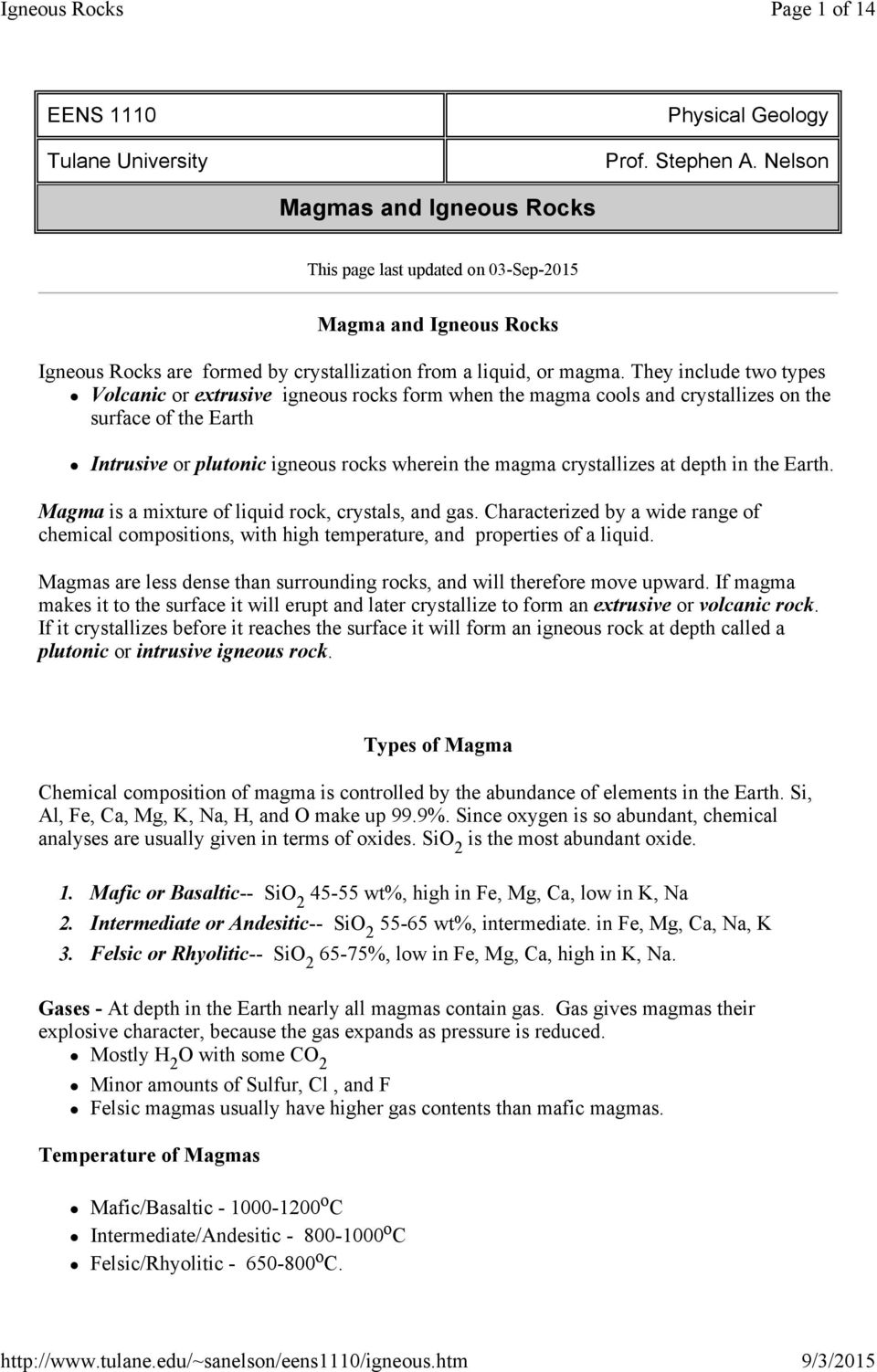
2 Page 2 of 14 Viscosity of Magmas Viscosity is the resistance to flow (opposite of fluidity). Depends on composition, temperature, & gas content. Higher SiO 2 content magmas have higher viscosity than lower SiO 2 content magmas Lower Temperature magmas have higher viscosity than higher temperature magmas. Summary Table Magma Type Solidified Volcanic Rock Solidified Plutonic Rock Chemical Composition Temperature Viscosity Gas Content Mafic or Basaltic Basalt Gabbro SiO 2 %, high in Fe, Mg, o C Low Low Ca, low in K, Na Intermediate or Andesitic Andesite Diorite SiO 2 %, intermediate in Fe, Mg, Ca, Na, K o C Intermediate Intermediate SiO 2 %, Felsic or Rhyolitic Rhyolite Granite low in Fe, Mg, Ca, high in K, Na o C High High Origin of Magma As we have seen the only part of the earth that is liquid is the outer core. But the core is not likely to be the source of magmas because it does not have the right chemical composition. The outer core is mostly Iron, but magmas are silicate liquids. Thus magmas DO NOT COME FROM THE MOLTEN OUTER CORE OF THE EARTH. Thus, since the rest of the earth is solid, in order for magmas to form, some part of the earth must get hot enough to melt the rocks present. We know that temperature increases with depth in the earth along the geothermal gradient. The earth is hot inside due to heat left over from the original accretion process, due to heat released by sinking of materials to form the core, and due to heat released by the decay of radioactive elements in the earth. Under normal conditions, the geothermal gradient is not high enough to melt rocks, and thus with the exception of the outer core, most of the Earth is solid. Thus, magmas form only under special circumstances. To understand this we must first look at how rocks and mineral melt. As pressure increases in the Earth, the melting temperature changes as well. For pure minerals, there are two general cases.
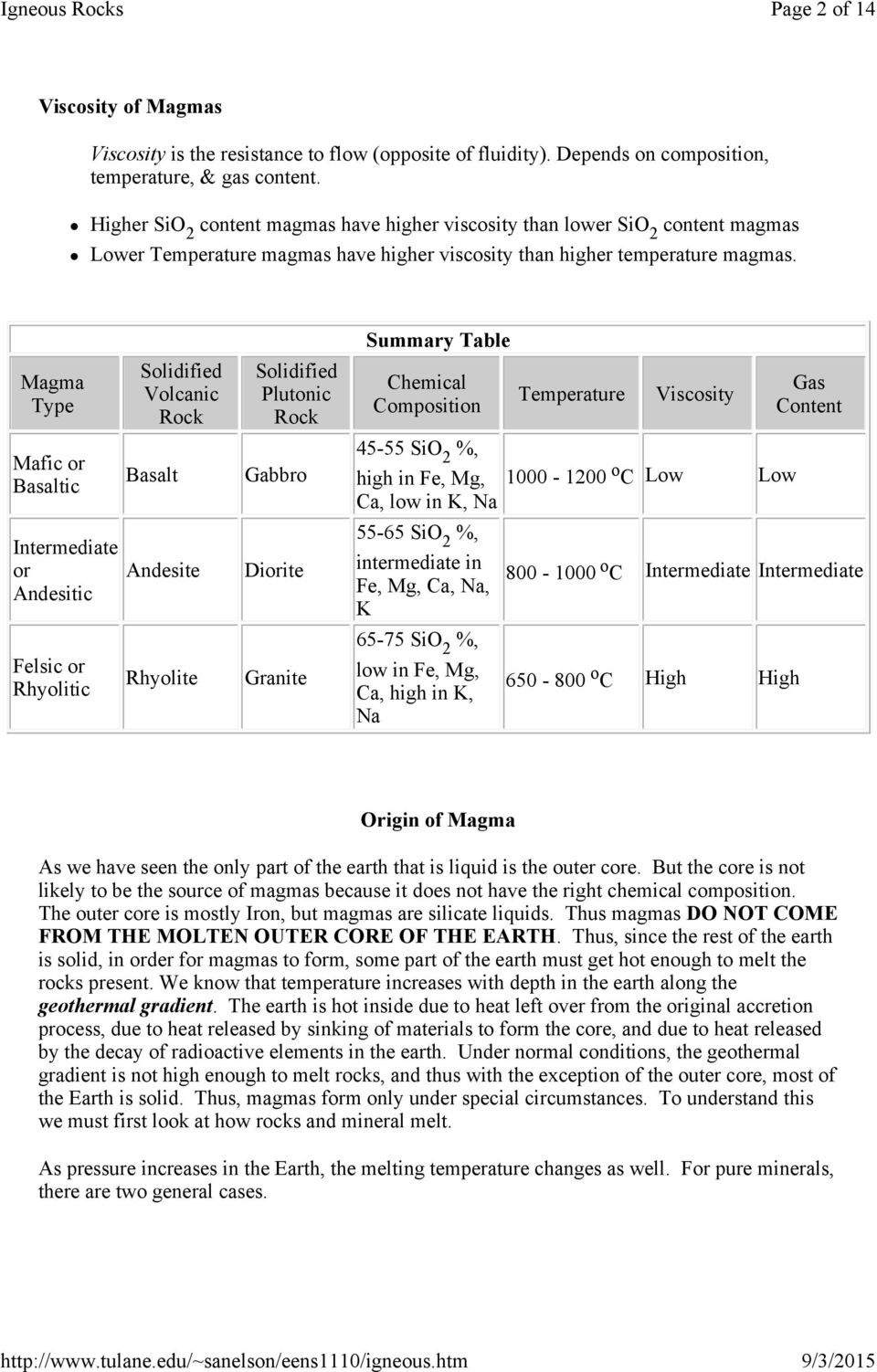
3 Page 3 of 14 For a pure dry (no H 2 O or CO 2 present) mineral, the melting temperate increases with increasing pressure. For a mineral with H 2 O or CO 2 present, the melting temperature first decreases with increasing pressure Since rocks mixtures of minerals, they behave somewhat differently. Unlike minerals, rocks do not melt at a single temperature, but instead melt over a range of temperatures. Thus, it is possible to have partial melts from which the liquid portion might be extracted to form magma. The two general cases are: Melting of dry rocks is similar to melting of dry minerals, melting temperatures increase with increasing pressure, except there is a range of temperature over which there exists a partial melt. The degree of partial melting can range from 0 to 100%
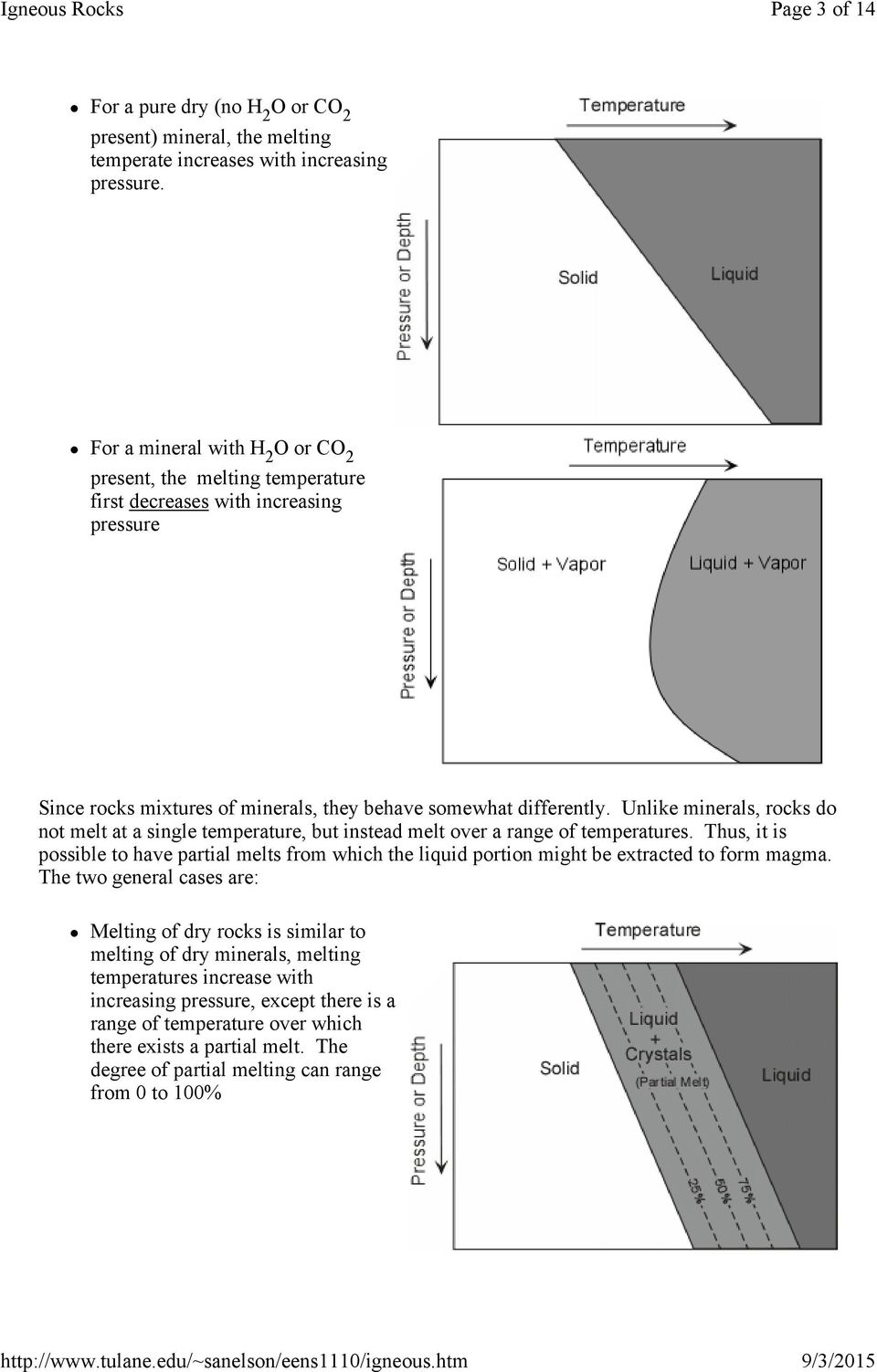
4 Page 4 of 14 Melting of rocks containing water or carbon dioxide is similar to melting of wet minerals, melting temperatures initially decrease with increasing pressure, except there is a range of temperature over which there exists a partial melt. Three ways to Generate Magmas From the above we can conclude that in order to generate a magma in the solid part of the earth either the geothermal gradient must be raised in some way or the melting temperature of the rocks must be lowered in some way. The geothermal gradient can be raised by upwelling of hot material from below either by uprise solid material (decompression melting) or by intrusion of magma (heat transfer). Lowering the melting temperature can be achieved by adding water or Carbon Dioxide (flux melting). Decompression Melting - Under normal conditions the temperature in the Earth, shown by the geothermal gradient, is lower than the beginning of melting of the mantle. Thus in order for the mantle to melt there has to be a mechanism to raise the geothermal gradient. Once such mechanism is convection, wherein hot mantle material rises to lower pressure or depth, carrying its heat with it. If the raised geothermal gradient becomes higher than the initial melting temperature at any pressure, then a partial melt will form. Liquid from this partial melt can be separated from the remaining crystals because, in general, liquids have a lower density than solids. Basaltic magmas appear to originate in this way. Upwelling mantle appears to occur beneath oceanic ridges, at hot spots, and beneath continental rift valleys. Thus, generation of magma in these three environments is likely caused by decompression melting.

5 Page 5 of 14 Transfer of Heat- When magmas that were generated by some other mechanism intrude into cold crust, they bring with them heat. Upon solidification they lose this heat and transfer it to the surrounding crust. Repeated intrusions can transfer enough heat to increase the local geothermal gradient and cause melting of the surrounding rock to generate new magmas. Transfer of heat by this mechanism may be responsible for generating some magmas in continental rift valleys, hot spots, and subduction related environments. Flux Melting - As we saw above, if water or carbon dioxide are added to rock, the melting temperature is lowered. If the addition of water or carbon dioxide takes place deep in the earth where the temperature is already high, the lowering of melting temperature could cause the rock to partially melt to generate magma. One place where water could be introduced is at subduction zones. Here, water present in the pore spaces of the subducting sea floor or water present in minerals like hornblende, biotite, or clay minerals would be released by the rising temperature and then move in to the overlying mantle. Introduction of this water in the mantle would then lower the melting temperature of the mantle to generate partial melts, which could then separate from the solid mantle and rise toward the surface. Chemical Variability of Magmas The chemical composition of magma can vary depending on the rock that initially melts (the source rock), and process that occur during partial melting and transport.

6 Page 6 of 14 Initial Composition of Magma The initial composition of the magma is dictated by the composition of the source rock and the degree of partial melting. In general, melting of a mantle source (garnet peridotite) results in mafic/basaltic magmas. Melting of crustal sources yields more siliceous magmas. In general more siliceous magmas form by low degrees of partial melting. As the degree of partial melting increases, less siliceous compositions can be generated. So, melting a mafic source thus yields a felsic or intermediate magma. Melting of ultramafic (peridotite source) yields a basaltic magma. Magmatic Differentiation But, processes that operate during transportation toward the surface or during storage in the crust can alter the chemical composition of the magma. These processes are referred to as magmatic differentiation and include assimilation, mixing, and fractional crystallization. Assimilation - As magma passes through cooler rock on its way to the surface it may partially melt the surrounding rock and incorporate this melt into the magma. Because small amounts of partial melting result in siliceous liquid compositions, addition of this melt to the magma will make it more siliceous. Mixing - If two magmas with different compositions happen to come in contact with one another, they could mix together. The mixed magma will have a composition somewhere between that of the original two magma compositions. Evidence for mixing is often preserved in the resulting rocks. Fractional Crystallization - When magma crystallizes it does so over a range of temperature. Each mineral begins to crystallize at a different temperature, and if these minerals are somehow removed from the liquid, the liquid composition will change. The processes is called magmatic differentiation by Fractional Crystallization. Because mafic minerals like olivine and pyroxene crystallize first, the process results in removing Mg, Fe, and Ca, and enriching the liquid in silica. Thus crystal fractionation can change a mafic magma into a felsic magma. Crystals can be removed by a variety of processes. If the crystals are more dense than the liquid, they may sink. If they are less dense than the liquid they will float. If liquid is squeezed out by pressure, then crystals will be left behind. Removal of crystals can thus change the composition of the liquid portion of the magma. Let me illustrate this using a very simple case. Imagine a liquid containing 5 molecules of MgO and 5 molecules of SiO 2. Initially the composition of this magma is expressed as 50% SiO 2 and 50% MgO. i.e.
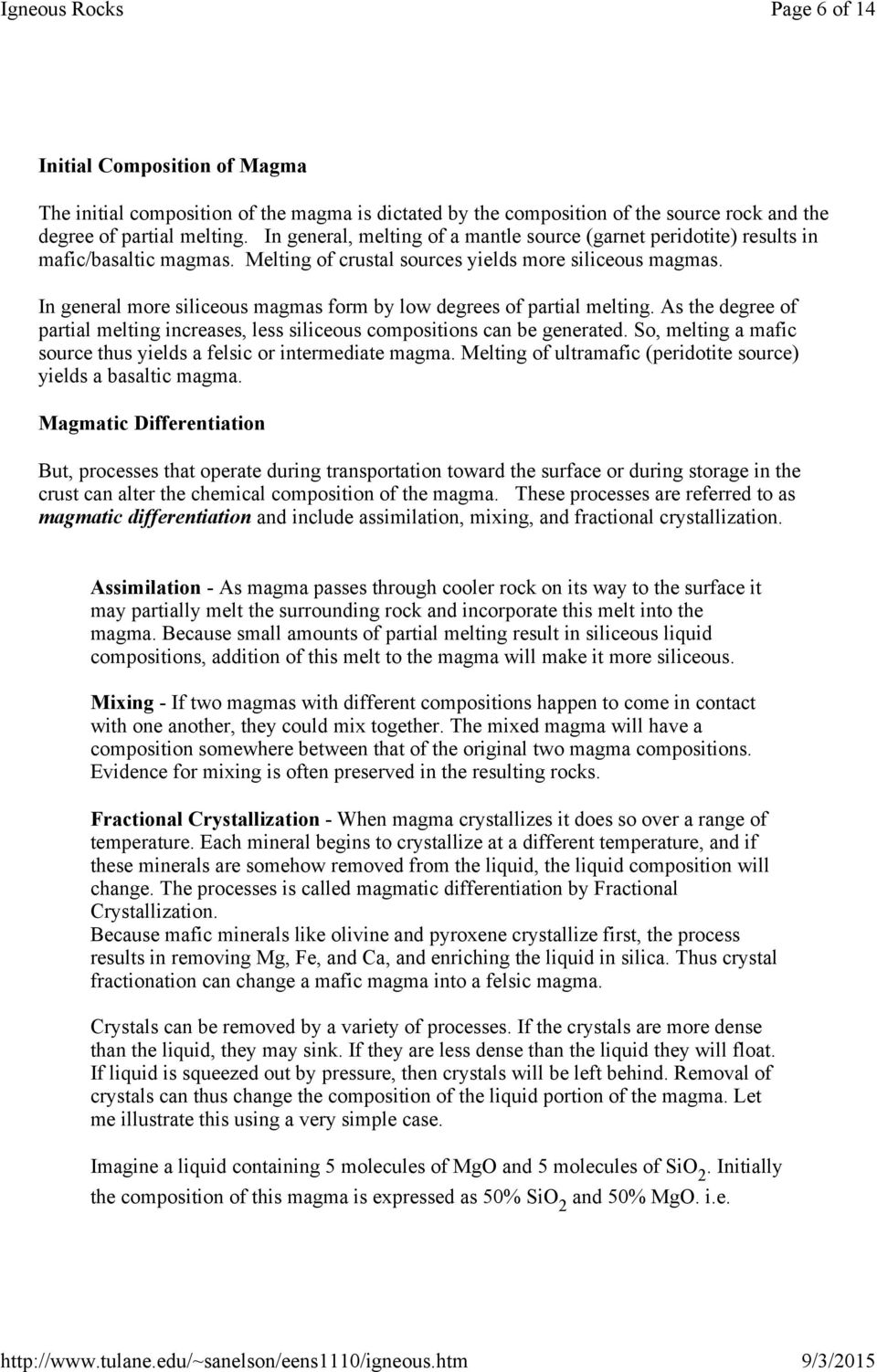
7 Page 7 of 14 Now let's imagine I remove 1 MgO molecule by putting it into a crystal and removing the crystal from the magma. Now what are the percentages of each molecule in the liquid? If we continue the process one more time by removing one more MgO molecule Thus, composition of liquid can be changed. Bowen's Reaction Series Bowen found by experiment that the order in which minerals crystallize from a basaltic magma depends on temperature. As a basaltic magma is cooled Olivine and Ca-rich plagioclase crystallize first. Upon further cooling, Olivine reacts with the liquid to produce pyroxene and Ca-rich plagioclase react with the liquid to produce less Ca-rich plagioclase. But, if the olivine and Ca-rich plagioclase are removed from the liquid by crystal fractionation, then the remaining liquid will be more SiO 2 rich. If the process continues, an original basaltic magma can change to first an andesite magma then a rhyolite magma with falling temperature
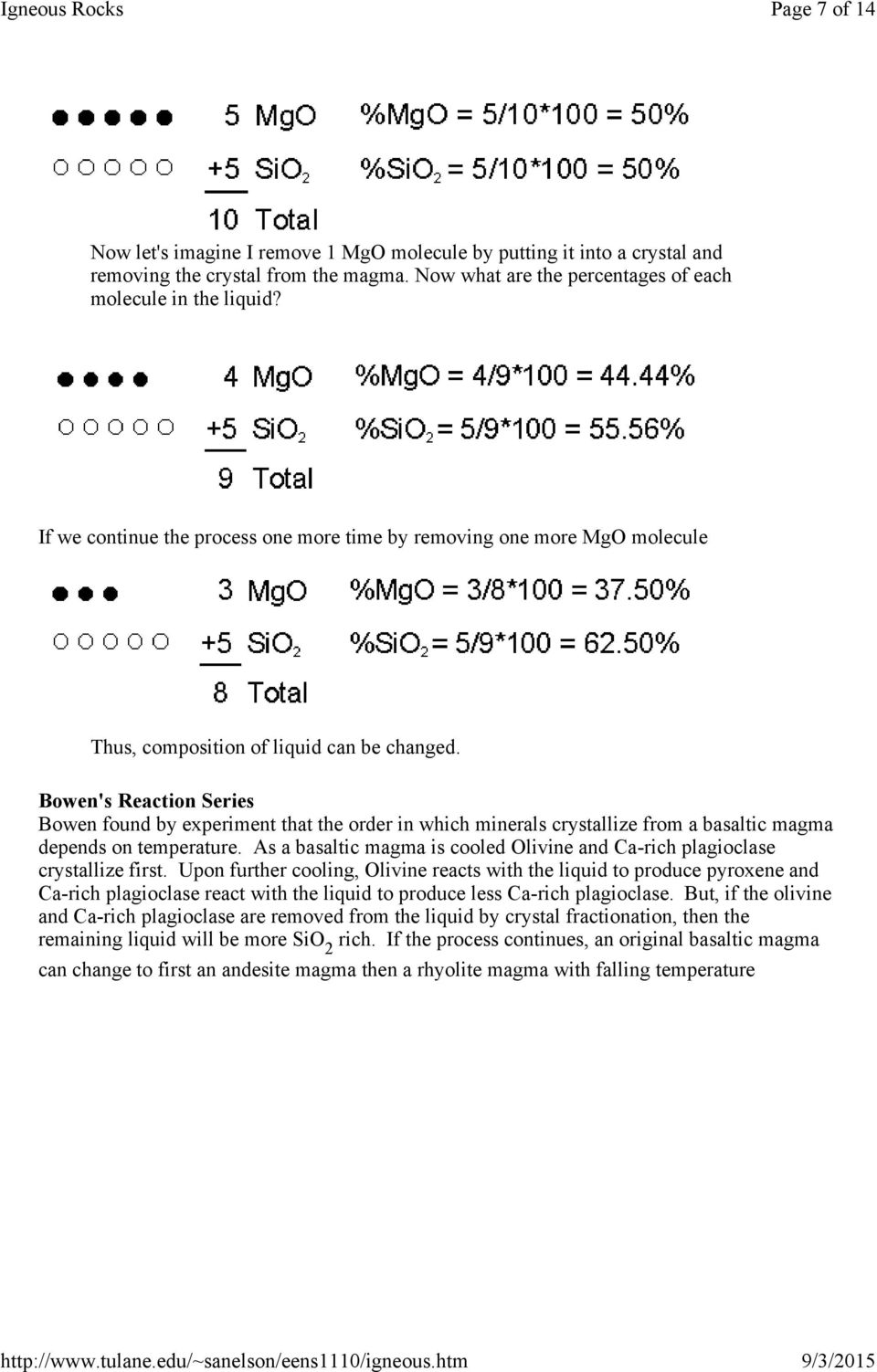
8 Page 8 of 14 Igneous Environments and Igneous Rocks The environment in which magma completely solidifies to form a rock determines: 1. The type of rock 2. The appearance of the rock as seen in its texture 3. The type of rock body. In general there are two environments to consider: The intrusive or plutonic environment is below the surface of the earth. This environment is characterized by higher temperatures which result in slow cooling of the magma. Intrusive or plutonic igneous rocks form here. Where magma erupts on the surface of the earth, temperatures are lower and cooling of the magma takes place much more rapidly. This is the extrusive or volcanic environment and results in extrusive or volcanic igneous rocks. Extrusive Environments When magmas reach the surface of the Earth they erupt from a vent called a volcano. They may erupt explosively or non-explosively. Non-explosive eruptions are favored by low gas content and low viscosity magmas (basaltic to andesitic magmas and sometimes rhyolitic magma). Usually begin with fire fountains due to release of dissolved gases
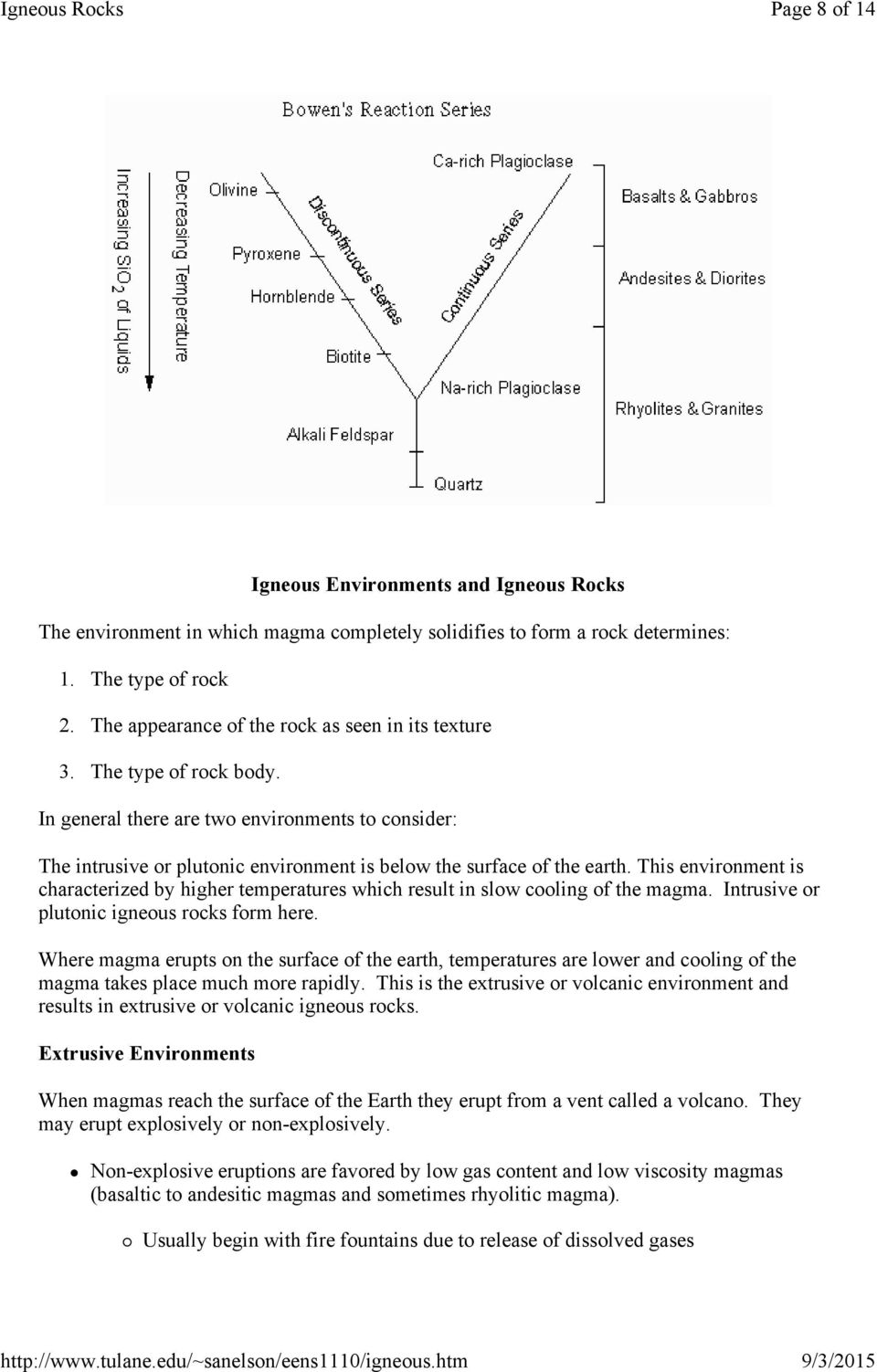
9 Page 9 of 14 Produce lava flows on surface Produce Pillow lavas if erupted beneath water Explosive eruptions are favored by high gas content and high viscosity (andesitic to rhyolitic magmas). Expansion of gas bubbles is resisted by high viscosity of magma - results in building of pressure High pressure in gas bubbles causes the bubbles to burst when reaching the low pressure at the Earth's surface. Bursting of bubbles fragments the magma into pyroclasts and tephra (ash). Cloud of gas and tephra rises above volcano to produce an eruption column that can rise up to 45 km into the atmosphere. Tephra that falls from the eruption column produces a tephra fall deposit. If eruption column collapses a pyroclastic flow may occur, wherein gas and tephra rush down the flanks of the volcano at high speed. This is the most dangerous type of volcanic eruption. The deposits that are produced are called ignimbrites. Intrusive Environments Magma that cools at depth form bodies of rocks called intrusive bodies or plutonic bodies called plutons, from Greek god of the underworld - Pluto. When magma intrudes it usually affects the surrounding rock and is also affected by the surrounding rock. It may metamorphose the surrounding rocks or cause hydrothermal alteration. The magma itself may also cool rapidly near the contact with the surrounding rock and thus show a chilled margin next to the contact.
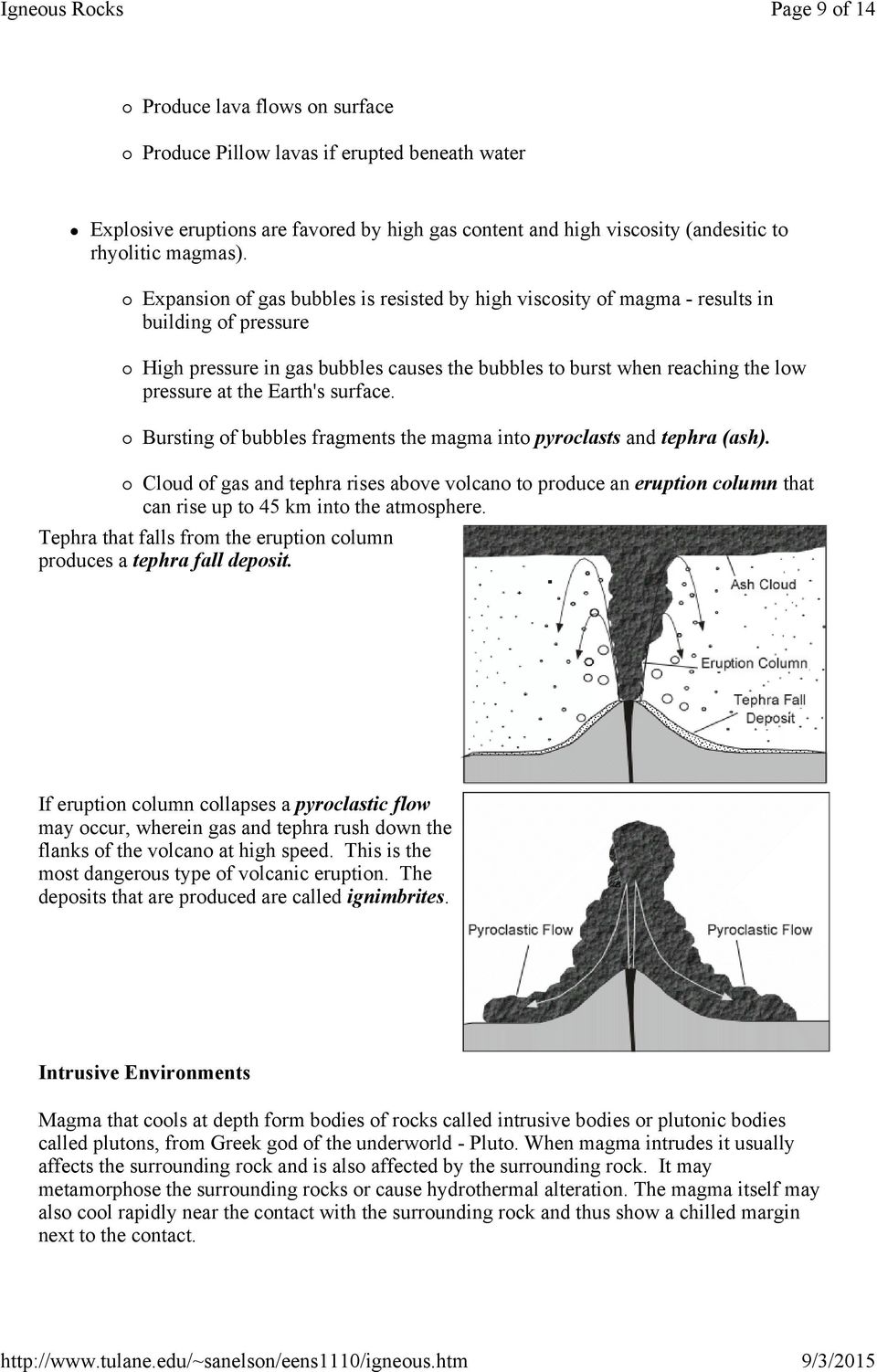
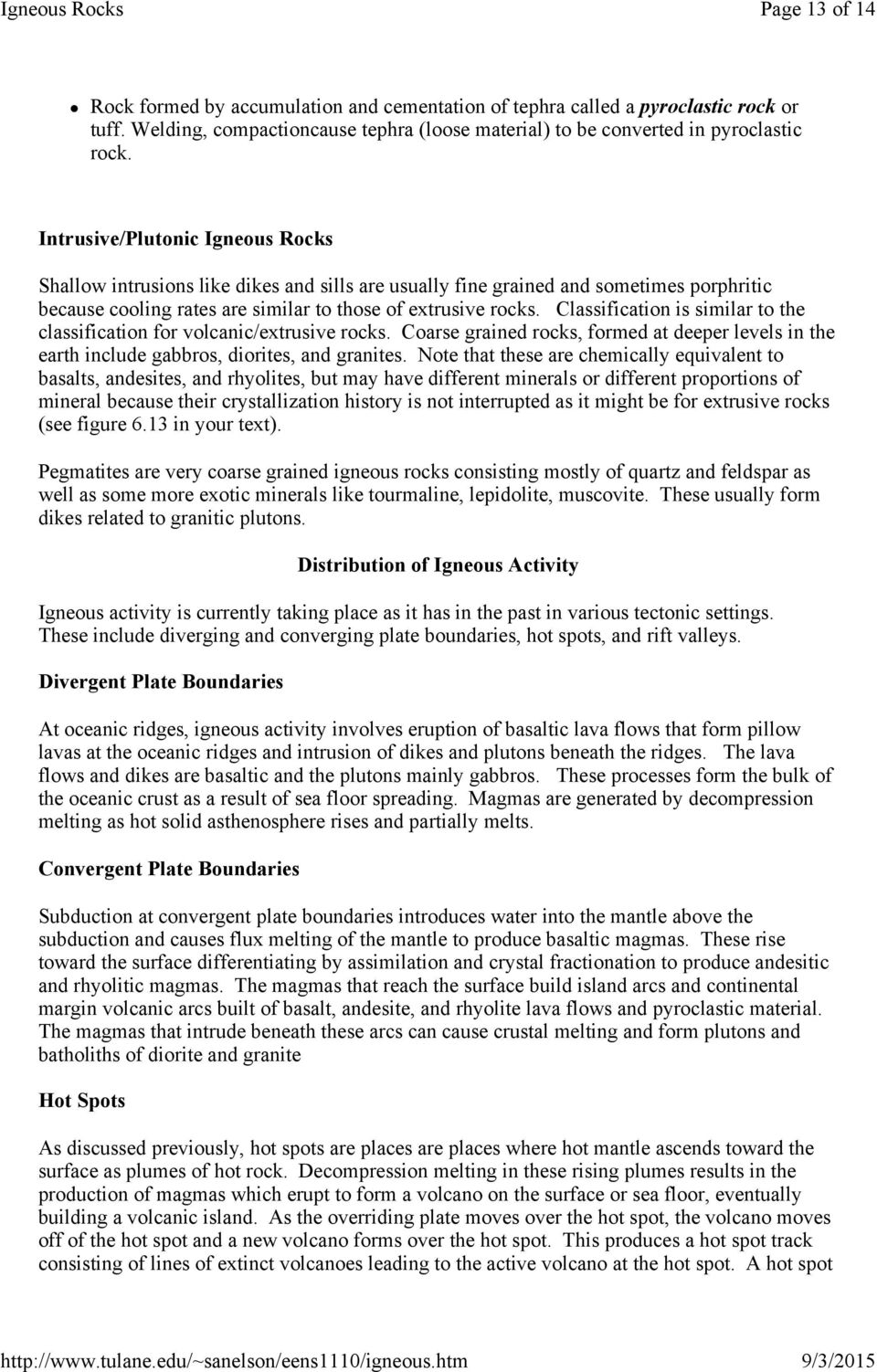
10 Page 10 of 14 It may also incorporate pieces of the surrounding rocks without melting them. These incorporated pieces are called xenoliths (foreign rocks). Magma intrudes by injection into fractures in the rock and expanding the fractures. The may also move by a process called stoping, wherein bocks are loosened by magma at the top of the magma body with these blocks then sinking through the magma to accumulate on the floor of the magma body. In relatively shallow environments intrusions are usually tabular bodies like dikes and sills or domed roof bodies called laccoliths. Dikes are small (<20 m wide) shallow intrusions that show a discordant relationship to the rocks in which they intrude. Discordant means that they cut across preexisting structures. They may occur as isolated bodies or may occur as swarms of dikes emanating from a large intrusive body at depth. Sills are also small (<50 m thick) shallow intrusions that show a concordant relationship with the rocks that they intrude. Sills usually are fed by dikes, but these may not be exposed in the field.
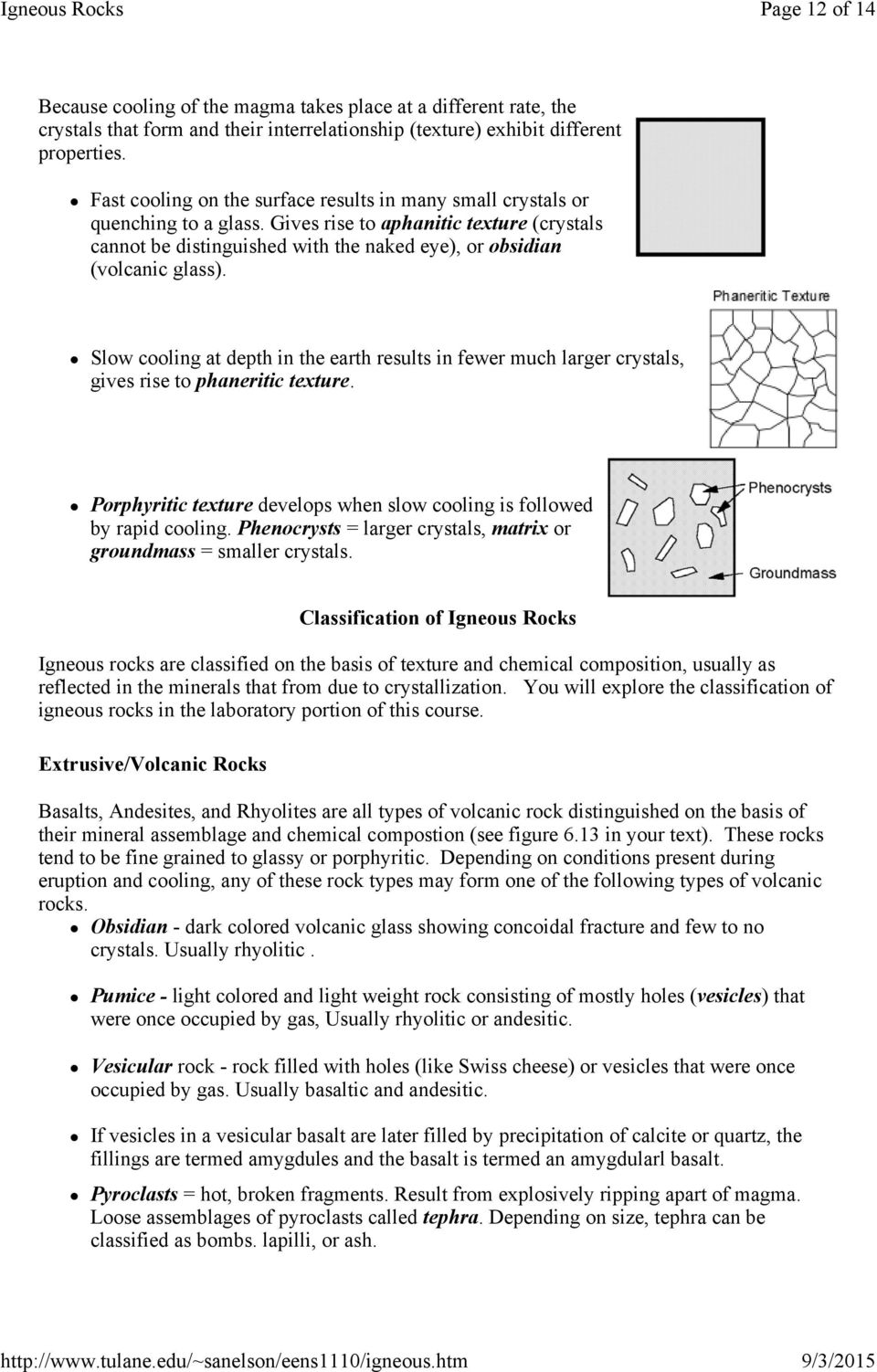
11 Page 11 of 14 Laccoliths are somewhat large intrusions that result in uplift and folding of the preexisting rocks above the intrusion. They are also concordant types of intrusions. Deeper in the earth intrusion of magma can form bulbous bodies called plutons and the coalescence of many plutons can form much larger bodies called batholiths. Plutons are large intrusive bodies, of any shape that intrude in replace rocks in an irregular fashion. Stocks are smaller bodies that are likely fed from deeper level batholiths. Stocks may have been feeders for volcanic eruptions, but because large amounts of erosion are required to expose a stock or batholith, the associated volcanic rocks are rarely exposed. If multiple intrusive events occur in the same part of the crust, the body that forms is called a batholith. Several large batholiths occur in the western U.S. - The Sierra Nevada Batholith, the Coast Range Batholith, and the Idaho Batholith, for example (See figure 6.10d in your text). During a magmatic event there is usually a close relationship between intrusive activity and extrusive activity, but one cannot directly observe the intrusive activity. Only after erosion of the extrusive rocks and other rock above the intrusions has exposed the intrusions do they become visible at the earth's surface (see figure 6.10a in your text). The rate of cooling of magma depends largely on the environment in which the magma cools. Rapid cooling takes place on the Earth's surface where there is a large temperature contrast between the atmosphere/ground surface and the magma. Cooling time for material erupted into air and water can be as short as several seconds. For lava flows cooling times are on the order of days to weeks. Shallow intrusions cool in months to years and large deep intrusions may take millions of years to cool.
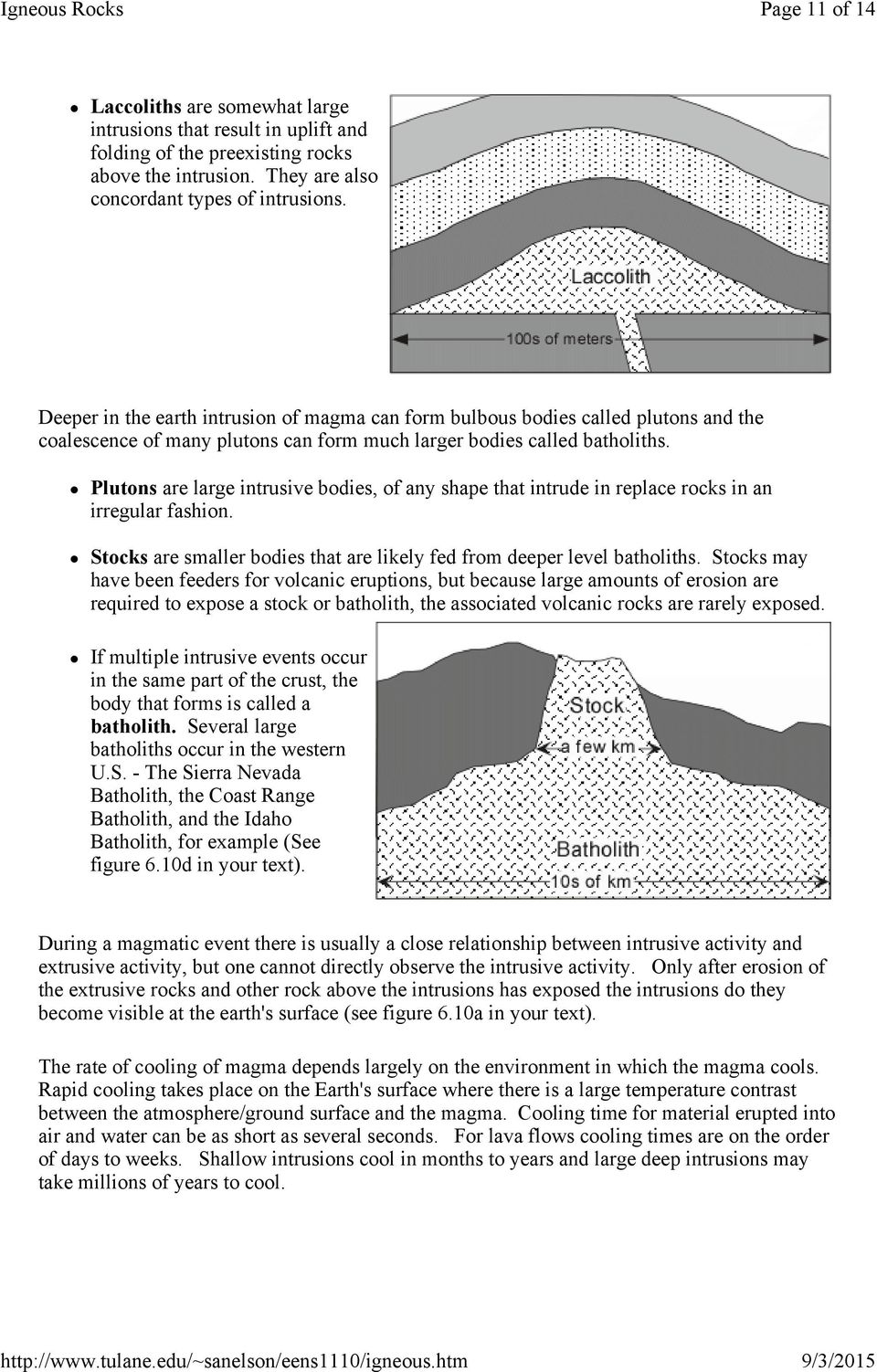
12 Page 12 of 14 Because cooling of the magma takes place at a different rate, the crystals that form and their interrelationship (texture) exhibit different properties. Fast cooling on the surface results in many small crystals or quenching to a glass. Gives rise to aphanitic texture (crystals cannot be distinguished with the naked eye), or obsidian (volcanic glass). Slow cooling at depth in the earth results in fewer much larger crystals, gives rise to phaneritic texture. Porphyritic texture develops when slow cooling is followed by rapid cooling. Phenocrysts = larger crystals, matrix or groundmass = smaller crystals. Classification of Igneous Rocks Igneous rocks are classified on the basis of texture and chemical composition, usually as reflected in the minerals that from due to crystallization. You will explore the classification of igneous rocks in the laboratory portion of this course. Extrusive/Volcanic Rocks Basalts, Andesites, and Rhyolites are all types of volcanic rock distinguished on the basis of their mineral assemblage and chemical compostion (see figure 6.13 in your text). These rocks tend to be fine grained to glassy or porphyritic. Depending on conditions present during eruption and cooling, any of these rock types may form one of the following types of volcanic rocks. Obsidian - dark colored volcanic glass showing concoidal fracture and few to no crystals. Usually rhyolitic. Pumice - light colored and light weight rock consisting of mostly holes (vesicles) that were once occupied by gas, Usually rhyolitic or andesitic. Vesicular rock - rock filled with holes (like Swiss cheese) or vesicles that were once occupied by gas. Usually basaltic and andesitic. If vesicles in a vesicular basalt are later filled by precipitation of calcite or quartz, the fillings are termed amygdules and the basalt is termed an amygdularl basalt. Pyroclasts = hot, broken fragments. Result from explosively ripping apart of magma. Loose assemblages of pyroclasts called tephra. Depending on size, tephra can be classified as bombs. lapilli, or ash.
13 Page 13 of 14 Rock formed by accumulation and cementation of tephra called a pyroclastic rock or tuff. Welding, compactioncause tephra (loose material) to be converted in pyroclastic rock. Intrusive/Plutonic Igneous Rocks Shallow intrusions like dikes and sills are usually fine grained and sometimes porphritic because cooling rates are similar to those of extrusive rocks. Classification is similar to the classification for volcanic/extrusive rocks. Coarse grained rocks, formed at deeper levels in the earth include gabbros, diorites, and granites. Note that these are chemically equivalent to basalts, andesites, and rhyolites, but may have different minerals or different proportions of mineral because their crystallization history is not interrupted as it might be for extrusive rocks (see figure 6.13 in your text). Pegmatites are very coarse grained igneous rocks consisting mostly of quartz and feldspar as well as some more exotic minerals like tourmaline, lepidolite, muscovite. These usually form dikes related to granitic plutons. Distribution of Igneous Activity Igneous activity is currently taking place as it has in the past in various tectonic settings. These include diverging and converging plate boundaries, hot spots, and rift valleys. Divergent Plate Boundaries At oceanic ridges, igneous activity involves eruption of basaltic lava flows that form pillow lavas at the oceanic ridges and intrusion of dikes and plutons beneath the ridges. The lava flows and dikes are basaltic and the plutons mainly gabbros. These processes form the bulk of the oceanic crust as a result of sea floor spreading. Magmas are generated by decompression melting as hot solid asthenosphere rises and partially melts. Convergent Plate Boundaries Subduction at convergent plate boundaries introduces water into the mantle above the subduction and causes flux melting of the mantle to produce basaltic magmas. These rise toward the surface differentiating by assimilation and crystal fractionation to produce andesitic and rhyolitic magmas. The magmas that reach the surface build island arcs and continental margin volcanic arcs built of basalt, andesite, and rhyolite lava flows and pyroclastic material. The magmas that intrude beneath these arcs can cause crustal melting and form plutons and batholiths of diorite and granite Hot Spots As discussed previously, hot spots are places are places where hot mantle ascends toward the surface as plumes of hot rock. Decompression melting in these rising plumes results in the production of magmas which erupt to form a volcano on the surface or sea floor, eventually building a volcanic island. As the overriding plate moves over the hot spot, the volcano moves off of the hot spot and a new volcano forms over the hot spot. This produces a hot spot track consisting of lines of extinct volcanoes leading to the active volcano at the hot spot. A hot spot
14 Page 14 of 14 located beneath a continent can result in heat transfer melting of the continental crust to produce large rhyolitic volcanic centers and plutonic granitic plutons below. A good example of a continental hot spot is at Yellowstone in the western U.S. Occasionally a hot spot is coincident with an oceanic ridge. In such a case, the hot spot produces larger volumes of magma than normally occur at ridge and thus build a volcanic island on the ridge. Such is the case for Iceland which sits atop the Mid-Atlantic Ridge. Rift Valleys Rising mantle beneath a continent can result in extensional fractures in the continental crust to form a rift valley. As the mantle rises it undergoes partial melting by decompression, resulting in the production of basaltic magmas which may erupt as flood basalts on the surface. Melts that get trapped in the crust can release heat resulting in melting of the crust to form rhyolitic magmas that can also erupt at the surface in the rift valley. An excellent example of a continental rift valley is the East African Rift. Large Igneous Provinces In the past, large volumes of mostly basaltic magma have erupted on the sea floor to form large volcanic plateaus, such as the Ontong Java Plateau in the eastern Pacific. Such large volume eruptions can have affects on the oceans because they change the shape of ocean floor and cause a rise in sea level, that sometimes floods the continents. The plateaus form obstructions which can drastically change ocean currents. These changes in the ocean along with massive amounts of gas released by the magmas can alter climate and have drastic effects on life on the planet. Examples of questions on this material that could be asked on an exam. 1. What are the three main types of magma and how are they distinguished in terms of their chemical composition, temperature, and viscosity? 2. What is the main difference between the way that pure minerals melt and the way the rocks melt? What effect does the addition of volatiles like H 2 0 and CO 2 have? 3. What are the main gases that occur in magma? 4. What are three ways that magma can be generated? Explain each. 5. Define the following: (a) dike, (b) sill, (c) xenolith, (d) stoping, (e) batholith, (f) obsidian, (g) pumice, (h) pyroclast, (i) pegmatite. (Use drawings if it helps). 6. What does the texture of an igneous rocks tell us about cooling history? 7. Describe the following igneous textures (a) aphanitic, (b) phaneritic, (c) porphyritic. 8. Describe the distribution of igneous activity on Earth. Return to EENS 1110 Page
Earth Materials: Intro to rocks & Igneous rocks. The three major categories of rocks Fig 3.1 Understanding Earth
 Earth Materials: 1 The three major categories of rocks Fig 3.1 Understanding Earth 2 Intro to rocks & Igneous rocks Three main categories of rocks: Igneous Sedimentary Metamorphic The most common minerals
Igneous Rocks. Geology 200 Geology for Environmental Scientists
 Igneous Rocks Geology 200 Geology for Environmental Scientists Magma Compositions Ultramafic - composition of mantle Mafic - composition of basalt, e.g. oceanic crust. 900-1200 o C, 50% SiO 2 Intermediate
Igneous Geochemistry. What is magma? What is polymerization? Average compositions (% by weight) and liquidus temperatures of different magmas
 1 Igneous Geochemistry What is magma phases, compositions, properties Major igneous processes Making magma how and where Major-element variations Classification using a whole-rock analysis Fractional crystallization
ES 104: Laboratory # 7 IGNEOUS ROCKS
 ES 104: Laboratory # 7 IGNEOUS ROCKS Introduction Igneous rocks form from the cooling and crystallization of molten rock material. This can occur below the surface of the earth forming intrusive rocks
Lecture Notes: Bill Engstrom Instructor Igneous Rocks GLG 101: Physical Geology
 Lecture Notes: Bill Engstrom Instructor Igneous Rocks GLG 101: Physical Geology In our overview of the Earth, we found out that Earth s internal heat combined with other mechanisms causes rocks to melt
BOWEN'S REACTION SERIES
 BOWEN'S REACTION SERIES Purpose John J. Thomas Frequently, people cannot visualize the mineral associations that form the sequences of igneous rocks that you find in the earth's crust and what happens
Rocks & Minerals. 10. Which rock type is most likely to be monomineralic? 1) rock salt 3) basalt 2) rhyolite 4) conglomerate
 1. Of the Earth's more than 2,000 identified minerals, only a small number are commonly found in rocks. This fact indicates that most 1) minerals weather before they can be identified 2) minerals have
Chapter 2. Igneous Rocks
 Chapter 2 Igneous Rocks Most students find the definition of a mineral to be rather long and cumbersome. In contrast, the definition of a rock is short and sweet. A rock is any naturally occurring aggregate
Name: Rocks & Minerals 1 Mark Place, www.learnearthscience.com
 Name: Rocks & Minerals 1 KEY CONCEPT #1: What is a mineral? It is a, substance which has a What would be the opposite of this? KEY CONCEPT #2: What causes minerals to have different physical properties?
Magma Composition and Igneous Rocks By Dr. James Brophy, Indiana University
 Magma Composition and Igneous Rocks By Dr. James Brophy, Indiana University Introduction In the following chapters we will find that nearly all of the varied aspects of volcanism are either directly or
Rocks & Minerals 1 Mark Place, www.learnearthscience.com
 Name: KEY Rocks & Minerals 1 KEY CONCEPT #1: What is a mineral? It is a naturally occurring, inorganic substance which has a definite chemical composition What would be the opposite of this? man-made,
IGNEOUS ROCKS. Teacher Guide including Lesson Plans, Student Readers, and More Information
 IGNEOUS ROCKS Teacher Guide including Lesson Plans, Student Readers, and More Information Lesson 1 - Rock Cycle Lesson 2 - Formation of Igneous Rocks Lesson 3 - Classification of Igneous Rocks Lesson 4
Rocks and Plate Tectonics
 Name: Class: _ Date: _ Rocks and Plate Tectonics Multiple Choice Identify the choice that best completes the statement or answers the question. 1. What is a naturally occurring, solid mass of mineral or
P1: Rock identification (I)
 P1: Rock identification (I) Examine the rocks specimens provided with the aid of these notes. All the rocks come from Ireland, as detailed on the attached map. Answer the short question on each specimen
Instructor: Ms. Terry J. Boroughs Geology 305 INTRODUCTION TO ROCKS AND THE ROCK CYCLE
 DATE DUE: Name: Instructor: Ms. Terry J. Boroughs Geology 305 INTRODUCTION TO ROCKS AND THE ROCK CYCLE Instructions: Read each question carefully before selecting the BEST answer Provide specific and detailed
Geol 101: Physical Geology PAST EXAM QUESTIONS LECTURE 4: PLATE TECTONICS II
 Geol 101: Physical Geology PAST EXAM QUESTIONS LECTURE 4: PLATE TECTONICS II 4. Which of the following statements about paleomagnetism at spreading ridges is FALSE? A. there is a clear pattern of paleomagnetic
II. Earth Science (Geology) Section (9/18/2013)
 EAPS 100 Planet Earth Lecture Topics Brief Outlines II. Earth Science (Geology) Section (9/18/2013) 1. Interior of the Earth Learning objectives: Understand the structure of the Earth s interior crust,
SGL 101: MATERIALS OF THE EARTH Lecture 5 C.M. NYAMAI SECTION 3 LECTURE 5. 5.0 NATURE AND CLASSIFICATION OF IGNEOUS ROCKS
 SECTION 3 LECTURE 5. 5.0 NATURE AND CLASSIFICATION OF IGNEOUS ROCKS 5.1 INTRODUCTION Welcome to lecture 5. You have now successfully completed section 1 and 2 of this unit. You can now state the basic
Geol 101: Physical Geology Summer 2007 EXAM 1
 Geol 101: Physical Geology Summer 2007 EXAM 1 Write your name out in full on the scantron form and fill in the corresponding ovals to spell out your name. Also fill in your student ID number in the space
Plate Tectonics Practice Questions and Answers Revised August 2007
 Plate Tectonics Practice Questions and Answers Revised August 2007 1. Please fill in the missing labels. 2. Please fill in the missing labels. 3. How many large plates form the outer shell of the earth?
Regents Questions: Plate Tectonics
 Earth Science Regents Questions: Plate Tectonics Name: Date: Period: August 2013 Due Date: 17 Compared to the oceanic crust, the continental crust is (1) less dense and more basaltic (3) more dense and
What is a rock? How are rocks classified? What does the texture of a rock reveal about how it was formed?
 CHAPTER 4 1 The Rock Cycle SECTION Rocks: Mineral Mixtures BEFORE YOU READ After you read this section, you should be able to answer these questions: What is a rock? How are rocks classified? What does
Continental Drift. Alfred Wegener (1880-1930) Proposed that all of the continents were once part of a large supercontinent - Pangaea Based on:
 Plate Tectonics and Continental Drift Continental Drift Alfred Wegener (1880-1930) Proposed that all of the continents were once part of a large supercontinent - Pangaea Based on: Similarities in shorelines
EARTH SCIENCE 110 INTRODUCTION to GEOLOGY MINERALS & ROCKS LABORATORY
 EARTH SCIENCE 110 INTRODUCTION to GEOLOGY DR. WOLTEMADE NAME: SECTION: MINERALS & ROCKS LABORATORY INTRODUCTION The identification of minerals and rocks is an integral part of understanding our physical
FOURTH GRADE PLATE TECTONICS 1 WEEK LESSON PLANS AND ACTIVITIES
 FOURTH GRADE PLATE TECTONICS 1 WEEK LESSON PLANS AND ACTIVITIES PLATE TECTONIC CYCLE OVERVIEW OF FOURTH GRADE VOLCANOES WEEK 1. PRE: Comparing different structures of volcanoes. LAB: Modeling three types
1. Base your answer to the following question on on the photographs and news article below. Old Man s Loss Felt in New Hampshire
 UNIT 3 EXAM ROCKS AND MINERALS NAME: BLOCK: DATE: 1. Base your answer to the following question on on the photographs and news article below. Old Man s Loss Felt in New Hampshire FRANCONIA, N.H. Crowds
Instructor: Ms. Terry J. Boroughs Geology 305 INTRODUCTION TO ROCKS AND THE ROCK CYCLE
 DATE DUE: Name: Instructor: Ms. Terry J. Boroughs Geology 305 INTRODUCTION TO ROCKS AND THE ROCK CYCLE Instructions: Read each question carefully before selecting the BEST answer Provide specific and detailed
The Dynamic Crust 2) EVIDENCE FOR CRUSTAL MOVEMENT
 The Dynamic Crust 1) Virtually everything you need to know about the interior of the earth can be found on page 10 of your reference tables. Take the time to become familiar with page 10 and everything
Lecture 23: Terrestrial Worlds in Comparison. This lecture compares and contrasts the properties and evolution of the 5 main terrestrial bodies.
 Lecture 23: Terrestrial Worlds in Comparison Astronomy 141 Winter 2012 This lecture compares and contrasts the properties and evolution of the 5 main terrestrial bodies. The small terrestrial planets have
How Did These Ocean Features and Continental Margins Form?
 298 10.14 INVESTIGATION How Did These Ocean Features and Continental Margins Form? The terrain below contains various features on the seafloor, as well as parts of three continents. Some general observations
DYNAMIC CRUST: Unit 4 Exam Plate Tectonics and Earthquakes
 DYNAMIC CRUST: Unit 4 Exam Plate Tectonics and Earthquakes NAME: BLOCK: DATE: 1. Base your answer to the following question on The block diagram below shows the boundary between two tectonic plates. Which
Atoms and Elements. Atoms: Learning Goals. Chapter 3. Atoms and Elements; Isotopes and Ions; Minerals and Rocks. Clicker 1. Chemistry Background?
 Chapter 3 Atoms Atoms and Elements; Isotopes and Ions; Minerals and Rocks A Review of Chemistry: What geochemistry tells us Clicker 1 Chemistry Background? A. No HS or College Chemistry B. High School
Interactive Plate Tectonics
 Interactive Plate Tectonics Directions: Go to the following website and complete the questions below. http://www.learner.org/interactives/dynamicearth/index.html How do scientists learn about the interior
4. Plate Tectonics II (p. 46-67)
 4. Plate Tectonics II (p. 46-67) Seafloor Spreading In the early 1960s, samples of basaltic ocean crust were dredged up from various locations across the ocean basins. The samples were then analyzed to
Introduction and Origin of the Earth
 Page 1 of 5 EENS 1110 Tulane University Physical Geology Prof. Stephen A. Nelson Introduction and Origin of the Earth This page last updated on 30-Jul-2015 Geology, What is it? Geology is the study of
Ch6&7 Test. Multiple Choice Identify the choice that best completes the statement or answers the question.
 Ch6&7 Test Multiple Choice Identify the choice that best completes the statement or answers the question. 1. Which of the following does NOT change the form of existing rock? a. tremendous pressure c.
Continental Drift, Sea Floor Spreading and Plate Tectonics
 Page 1 of 13 EENS 1110 Tulane University Physical Geology Prof. Stephen A. Nelson Continental Drift, Sea Floor Spreading and Plate Tectonics This page last updated on 26-Aug-2015 Plate Tectonics is a theory
6.E.2.2 Plate Tectonics, Earthquakes and Volcanoes
 Name: Date: 1. The road shown below was suddenly broken by a natural event. 3. The convergence of two continental plates would produce Which natural event most likely caused the crack in the road? island
Geol 101: Physical Geology Fall 2006 EXAM 1
 Geol 101: Physical Geology Fall 2006 EXAM 1 Write your name out in full on the scantron form and fill in the corresponding ovals to spell out your name. Also fill in your student ID number in the space
SECOND GRADE PLATE TECTONICS 1 WEEK LESSON PLANS AND ACTIVITIES
 SECOND GRADE PLATE TECTONICS 1 WEEK LESSON PLANS AND ACTIVITIES PLATE TECTONIC CYCLE OVERVIEW OF SECOND GRADE VOLCANOES WEEK 1. PRE: Investigating the parts of a volcano. LAB: Comparing the parts of a
Viscosity and Volcano Types
 20 LESSON Viscosity and Volcano Types This photo, taken in 1943 in Paricutin, Mexico, shows an eruption of the Paricutin volcano at night. Glowing hot, broken rocks outline the shape of the volcano, called
CHAPTER 6 THE TERRESTRIAL PLANETS
 CHAPTER 6 THE TERRESTRIAL PLANETS MULTIPLE CHOICE 1. Which of the following is NOT one of the four stages in the development of a terrestrial planet? 2. That Earth, evidence that Earth differentiated.
Georgia Performance Standards Framework for Science Grade 6. Unit Organizer: Geology: Inside the Earth (Approximate Time: 7 Weeks)
 The following instructional plan is part of a GaDOE collection of Unit Frameworks, Performance Tasks, examples of Student Work, and Teacher Commentary. Many more GaDOE approved instructional plans are
Plate tectonics states that the Earth's crust and upper mantle are broken into sections, called plates.
 Notes on Plate Tectonics Plate tectonics states that the Earth's crust and upper mantle are broken into sections, called plates. These plates move around the mantle. Plates are composed of the crust and
Rocks and Minerals What is right under your feet?
 Rocks and Minerals What is right under your feet? Name: 1 Before you start What do you already know? What is the difference between a rock and a mineral? What are the three categories of rocks? 1. 2. 3.
IGNEOUS, SEDIMENTARY & METAMORPHIC ROCKS
 IGNEOUS, SEDIMENTARY & METAMORPHIC ROCKS the appearance of a rock is determined by its mineralogy and its texture (Gefüge) mineralogy relative proportions of the different minerals texture size and shape
Unit 4: The Rock Cycle
 Unit 4: The Rock Cycle Objective: E 3.1A Discriminate between igneous, metamorphic, and sedimentary rocks and describe the processes that change one kind of rock into another. E 3.1B Explain the relationship
TECTONICS ASSESSMENT
 Tectonics Assessment / 1 TECTONICS ASSESSMENT 1. Movement along plate boundaries produces A. tides. B. fronts. C. hurricanes. D. earthquakes. 2. Which of the following is TRUE about the movement of continents?
Earth Structure, Materials, Systems, and Cycles
 Page 1 of 19 EENS 3050 Tulane University Natural Disasters Prof. Stephen A. Nelson Earth Structure, Materials, Systems, and Cycles This page last updated on 31-Aug-2016 Objectives Since this course is
The rock cycle. Introduction. What are rocks?
 The rock cycle This Revision looks at the three types of rock: sedimentary, igneous and metamorphic. It looks at how they are formed, the weathering of rocks and the way one form of rock turns into another,
MAJOR LANDFORMS IN VOLCANIC REGIONS
 MAJOR LANDFORMS IN VOLCANIC REGIONS Volcanism is not randomly distributed over the world. It is concentrated near plate boundaries where plate subduction or seafloor spreading takes place. Other occurrences
GEOL1010 Hour Exam 1 Sample
 GEOL1010 Hour Exam 1 Sample 1. The inner core of the Earth is composed of a) solid silicate b) liquid silicate magma c) liquid metal d) solid metal e) olivine. 2. The upper mantle of the Earth is composed
What are Rocks??? Rocks are the most common material on Earth. They are a naturally occurring collection of one or more minerals.
 The Rock Cycle What are Rocks??? Rocks are the most common material on Earth. They are a naturally occurring collection of one or more minerals. The Rock Cycle a cycle that continuously forms and changes
Lesson 13: Plate Tectonics I
 Standards Addressed Lesson 13: Plate Tectonics I Overview Lesson 13 introduces students to geological oceanography by presenting the basic structure of the Earth and the properties of Earth s primary layers.
1. You are about to begin a unit on geology. Can anyone tell me what geology is? The study of the physical earth I.
 PLATE TECTONICS ACTIVITY The purpose of this lab is to introduce the concept of plate tectonics and the formation of mountains. Students will discuss the properties of the earth s crust and plate tectonics.
Metamorphic Rocks Practice Questions and Answers Revised October 2007
 Metamorphic Rocks Practice Questions and Answers Revised October 2007 1. Metamorphism is a that involves no melt phase. 2. The protolith of a metamorphic rock is the (a) sibling (b) brother (c) parent
Tectonic plates have different boundaries.
 KEY CONCEPT Plates move apart. BEFORE, you learned The continents join and break apart The sea floor provides evidence that tectonic plates move The theory of plate tectonics helps explain how the plates
1 Exploring Earth s Interior
 1 Exploring Earth s Interior Crust Mantle Outer Core Crust-to-Mantle Inner Core Cross Section From Surface to Center SCIENCE EXPLORER Focus on Earth Science Prentice-Hall, Inc. 2 Evidence for Continental
Plate Tectonics Chapter 2
 Plate Tectonics Chapter 2 Does not include complete lecture notes. Continental drift: An idea before its time Alfred Wegener First proposed his continental drift hypothesis in 1915 Published The Origin
Chapter 5: Magma And Volcanoes
 Chapter 5: Magma And Volcanoes Introduction: Earth s Internal Thermal Engine Magma is molten rock beneath Earth s surface. Because liquid magma is less dense than surrounding solid rock, and obviously
Unit 8.3.1 Study Guide: Rocks, Minerals, and the Rock Cycle
 Name Date Per Unit 8.3.1 Study Guide: Rocks, Minerals, and the Rock Cycle I Can Statements I Can Statements are the learning targets for each unit. By the time you take the test for this unit, you should
What are the controls for calcium carbonate distribution in marine sediments?
 Lecture 14 Marine Sediments (1) The CCD is: (a) the depth at which no carbonate secreting organisms can live (b) the depth at which seawater is supersaturated with respect to calcite (c) the depth at which
Rapid Changes in Earth s Surface
 TEKS investigate rapid changes in Earth s surface such as volcanic eruptions, earthquakes, and landslides Rapid Changes in Earth s Surface Constant Changes Earth s surface is constantly changing. Wind,
FROM SEDIMENT INTO SEDIMENTARY ROCK. Objectives. Sediments and Sedimentation
 FROM SEDIMENT INTO SEDIMENTARY ROCK Objectives Identify three types of sediments. Explain where and how chemical and biogenic sediments form. Explain three processes that lead to the lithification of sediments.
Layers of the Earth s Interior
 Layers of the Earth s Interior 1 Focus Question How is the Earth like an ogre? 2 Objectives Explain how geologists have learned about the interior of the Earth. Describe the layers of the Earth s interior.
Chapter 8: Plate Tectonics -- Multi-format Test
 Name: Class: Date: ID: A Chapter 8: Plate Tectonics -- Multi-format Test Modified True/False Indicate whether the statement is true or false. If false, change the identified word or phrase to make the
Plate Tectonics Web-Quest
 Plate Tectonics Web-Quest Part I: Earth s Structure. Use the following link to find these answers: http://www.learner.org/interactives/dynamicearth/structure.html 1. Label the layers of Earth in the diagram
Volcanoes Erupt Grade 6
 TEACHING LEARNING COLLABORATIVE (TLC) EARTH SCIENCE Volcanoes Erupt Grade 6 Created by: Debra McKey (Mountain Vista Middle School); Valerie Duncan (Upper Lake Middle School); and Lynn Chick (Coyote Valley
Earth Science Grade 4 Minerals
 Earth Science Grade 4 Minerals Standards: Identifies the physical properties of minerals Teacher Background Minerals are pure substances and mix together to make rocks. Rocks have a cycle and different
[Geology Layers of the Earth] [Basic: Grade 2-3] [Advanced: Grade 5: Introduction to Plate Tectonics}
![[Geology Layers of the Earth] [Basic: Grade 2-3] [Advanced: Grade 5: Introduction to Plate Tectonics}](/thumbs/40/21755359.jpg "[Geology Layers of the Earth] [Basic: Grade 2-3] [Advanced: Grade 5: Introduction to Plate Tectonics}") [Geology Layers of the Earth] [Basic: Grade 2-3] [Advanced: Grade 5: Introduction to Plate Tectonics} BACKGROUND Scientists and geologists have been able to do some drilling on Earth. They are also able
[Geology Layers of the Earth] [Basic: Grade 2-3] [Advanced: Grade 5: Introduction to Plate Tectonics} BACKGROUND Scientists and geologists have been able to do some drilling on Earth. They are also able
Plate Tectonics. Introduction. Boundaries between crustal plates
 Plate Tectonics KEY WORDS: continental drift, seafloor spreading, plate tectonics, mid ocean ridge (MOR) system, spreading center, rise, divergent plate boundary, subduction zone, convergent plate boundary,
Volcano in the lab: a wax volcano in action: teacher s notes
 Volcano in the lab: a wax volcano in action: teacher s notes Level This activity is designed for students aged 11-14, as a simple demonstration of igneous activity. English National Curriculum reference
1. The diagram below shows a cross section of sedimentary rock layers.
 1. The diagram below shows a cross section of sedimentary rock layers. Which statement about the deposition of the sediments best explains why these layers have the curved shape shown? 1) Sediments were
Section 1 The Earth System
 Section 1 The Earth System Key Concept Earth is a complex system made up of many smaller systems through which matter and energy are continuously cycled. What You Will Learn Energy and matter flow through
ES Chapter 10 Review. Name: Class: Date: Multiple Choice Identify the choice that best completes the statement or answers the question.
 Name: Class: Date: ES Chapter 10 Review Multiple Choice Identify the choice that best completes the statement or answers the question. 1. Scientists used the pattern of alternating normal and reversed
Volcanoes Around the Globe
 Volcanoes Around the Globe Volcanoes fed by relatively silica-rich (SiO 2 -rich) magmas tend to explode while those fed by silica-poor magmas usually erupt gently. Where are the explosive volcanoes and
Rocks and Minerals Multiple Choice
 Rocks and Minerals Multiple Choice 1. The basaltic bedrock of the oceanic crust is classified as (1) felsic, with a density of 2.7 g/cm3 (2) felsic, with a density of 3.0 g/cm3 (3) mafic, with a density
EXPLORATION AND DISCOVERY IN PLANETARY SCIENCE
 Rocks and Minerals I. OBJECTIVES One of the many ways to study Earth is by examining the rocks that make up its surface. Earth is a dynamic planet, with plate tectonics, water, wind, volcanoes, and mountains.
Plate Tectonics Lab Assignment
 Plate Tectonics Lab Assignment After reading the introduction to the Plate Tectonics exercises in the lab manual, complete the questions on a hard copy of this Lab Assignment. When finished, transfer your
Earth Science Chapter 14 Section 2 Review
 Name: Class: Date: Earth Science Chapter 14 Section Review Multiple Choice Identify the choice that best completes the statement or answers the question. 1. Which of the following is NOT one of the three
Weathering, Erosion, and Soils. Weathering and Erosion. Weathering and Erosion
 Weathering, Erosion, and Soils 1 The Grand Canyon, a landscape shaped by weathering and erosion 2 Weathering vs. erosion Types of weathering Physical Chemical Rates of weathering and erosion Climate Rock
Metamorphic rocks are rocks changed from one form to another by intense heat, intense pressure, and/or the action of hot fluids.
 Metamorphic Rocks, Processes, and Resources Metamorphic rocks are rocks changed from one form to another by intense heat, intense pressure, and/or the action of hot fluids. Protolith or parent rock is
VOLCANOES AND OTHER IGNEOUS FEATURES
 VOLCANOES AND OTHER IGNEOUS FEATURES INSTRUSVE IGNEOUS FEATURES Plutonic-Intrusive igneous rocks can cool and solidify into large rock bodies: plutons Plutons form in all sizes several square meters to
Earth Egg Model Teacher Notes
 Ancient Greeks tried to explain earthquakes and volcanic activity by saying that a massive bull lay underground and the land shook when it became angry. Modern theories rely on an understanding of what
Presents the. Rock Test Study Resource
 Presents the Rock Test Study Resource Created by Simone Markus Published by EngLinks 1 Preface This is a free resource provided by EngLinks for students in APSC 151. This presentation is a supplementary
INTRODUCTION. This project is about volcanoes and how they form and how they function. It will also show you the different aspects of a volcano.
 BY RYAN O MAHONY INTRODUCTION This project is about volcanoes and how they form and how they function. It will also show you the different aspects of a volcano. MAP OF VOLCANOES AROUND THE WORLD DIAGRAM
Name: Class: Date: Multiple Choice Identify the letter of the choice that best completes the statement or answers the question.
 Class: Date: Minerals Study Guide Modified True/False Indicate whether the sentence or statement is true or false. If false, change the identified word or phrase to make the sentence or statement true.
The interior of the Earth is divided into layers based on chemical and physical properties.
 Plate Tectonics Lecture Notes: Slide 1. Title Slide Slide 2. The interior of the Earth is divided into layers based on chemical and physical properties. The Earth has an outer silica-rich, solid crust,
FIRST GRADE ROCKS 2 WEEKS LESSON PLANS AND ACTIVITIES
 FIRST GRADE ROCKS 2 WEEKS LESSON PLANS AND ACTIVITIES ROCK CYCLE OVERVIEW OF FIRST GRADE CHEMISTRY WEEK 1. PRE: Comparing solids, gases, liquids, and plasma. LAB: Exploring how states of matter can change.
Plate Tectonics. Earth, 9 th edition Chapter 2
 1 Plate Tectonics Earth, 9 th edition Chapter 2 2 3 4 5 6 7 8 9 10 11 12 13 14 15 16 Plate Tectonics: summary in haiku form Alfred Wegener gave us Continental Drift. Fifty years later... Continental Drift
Georgia Performance Standards Framework for Shaky Ground 6 th Grade
 The following instructional plan is part of a GaDOE collection of Unit Frameworks, Performance Tasks, examples of Student Work, and Teacher Commentary. Many more GaDOE approved instructional plans are
Soda Bottle Volcano An Eruption Begins
 Soda Bottle Volcano An Eruption Begins Overview: Examine how gases provide the energy to create explosive volcanic eruptions by making comparisons to gases in a soda bottle and by conducting a carefully
Name Score /225. (Make sure you identify each key concept by identifying the section [1.1, 1.2, etc.].]
![Name Score /225. (Make sure you identify each key concept by identifying the section [1.1, 1.2, etc.].]](/thumbs/40/21046969.jpg "Name Score /225. (Make sure you identify each key concept by identifying the section [1.1, 1.2, etc.].]") Name Score /225 Changing Earth Chapter 1 Worksheet Before reading Chapter 1 (pages 9 37). On a separate sheet of paper, make two columns. Title the first column Before I Read. Title the second column After
Name Score /225 Changing Earth Chapter 1 Worksheet Before reading Chapter 1 (pages 9 37). On a separate sheet of paper, make two columns. Title the first column Before I Read. Title the second column After
FIRST GRADE VOLCANOES 1 WEEK LESSON PLANS AND ACTIVITIES
 FIRST GRADE VOLCANOES 1 WEEK LESSON PLANS AND ACTIVITIES PLATE TECTONIC CYCLE OVERVIEW OF FIRST GRADE VOLCANOES WEEK 1. PRE: Learning the shapes of volcanoes. LAB: Experimenting with "lava." POST: Comparing
Transform Boundaries
 Lecture 7 Plates and Mantle Plumes Transform Boundaries Transform boundaries occur where one segment of rigid lithosphere slides horizontally past another in response to stresses in the lithosphere. The
Ride the Rock Cycle. Suggested Goals: Students will gain an understanding of how a rock can move through the different stages of the rock cycle.
 Illinois State Museum Geology Online http://geologyonline.museum.state.il.us Ride the Rock Cycle Grade Level: 5 6 Purpose: To teach students that the rock cycle, like the water cycle, has various stages
There are numerous seams on the surface of the Earth
 Plate Tectonics and Continental Drift There are numerous seams on the surface of the Earth Questions and Topics 1. What are the theories of Plate Tectonics and Continental Drift? 2. What is the evidence
How can you tell rocks apart?
 How can you tell rocks apart? Grade Range: 4-7 G.L.E Focus: 1.1.5 Time Budget: 1 1.5 hours WASL Vocabulary: Overview: Different rocks have different characteristics because of their minerals, the ways
INTRODUCTION TO TYPES AND CLASSIFICATION OF ROCKS
 Presented at Short Course IX on Exploration for Geothermal Resources, Organized by UNU-GTP, GDC and KenGen, at Lake Bogoria and Lake Naivasha, Kenya, Nov. 2-24, 2014. Kenya Electricity Generating Co.,