
Balancing Reaction Equations Oxidation State Reduction-oxidation Reactions
|
|
|
- Eleanor McCarthy
- 9 years ago
- Views:
Transcription
1 Balancing Reaction Equations Oxidation State Reduction-oxidation Reactions OCN 623 Chemical Oceanography Balanced chemical reactions are the math of chemistry They show the relationship between the reactants and the products We will use thermodynamics later on to calculate the feasibility of reactions and to understand how equilibrium is established The concept of equilibrium allows us to understand chemical processes such as ionic speciation, oxidation state distributions gas solubility, the carbonate system 1
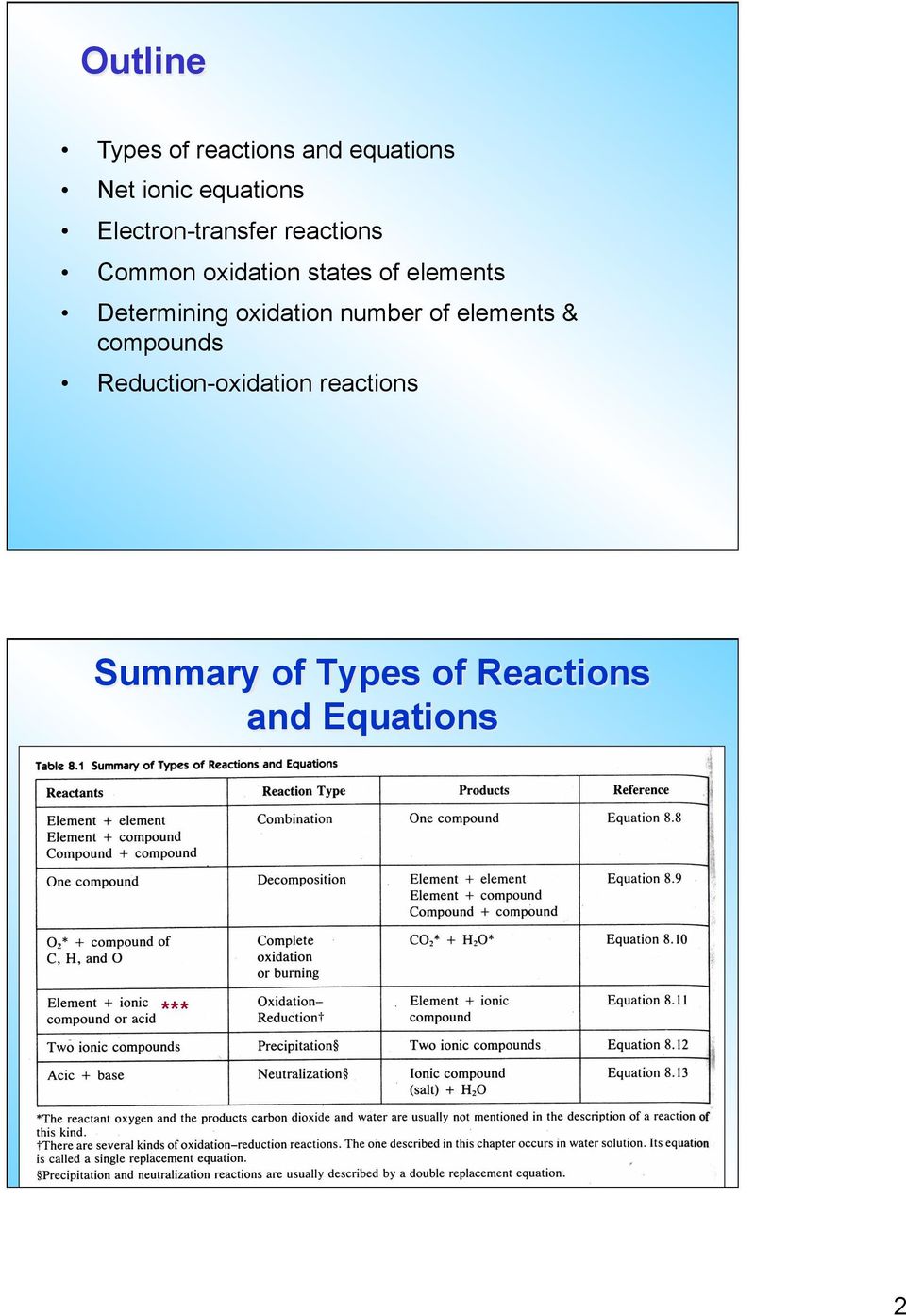
2 Outline Types of reactions and equations Net ionic equations Electron-transfer reactions Common oxidation states of elements Determining oxidation number of elements & compounds Reduction-oxidation reactions Summary of Types of Reactions and Equations *** 2
3 An example: Net Ionic Equations If a solution of lead nitrate is added to a solution of sodium chloride, lead chloride precipitates: Pb(NO 3 ) 2 (aq) + 2 NaCl(aq) PbCl 2 (s) + 2 NaNO 3 (aq) (This is a conventional equation) To better describe the reaction, the formulas of the dissolved substances are replaced with the actual species in solution: Pb 2+ (aq) + 2 NO 3- (aq) + 2 Na + (aq) + 2 Cl - (aq) PbCl 2 (s) + 2 Na + (aq) + 2 NO 3- (aq) (This is an ionic equation) We can then eliminate the spectators. The result is a net ionic equation, which tells exactly what chemical change took place, and nothing else: Pb 2+ (aq) + 2 Cl - (aq) PbCl 2 (s) Steps in writing a net ionic equation: Write the conventional equation, including designations of state [(g), (l), (s), (aq)]. Balance the equation. Write the ionic equation by replacing each dissolved substance (aq) with the species in solution. Never change states in this step. Be sure the equation is balanced for both atoms and charge. Write the net ionic equation by removing the spectators. Reduce coefficients to lowest terms. Be sure the equation is balanced for both atoms and charge. 3

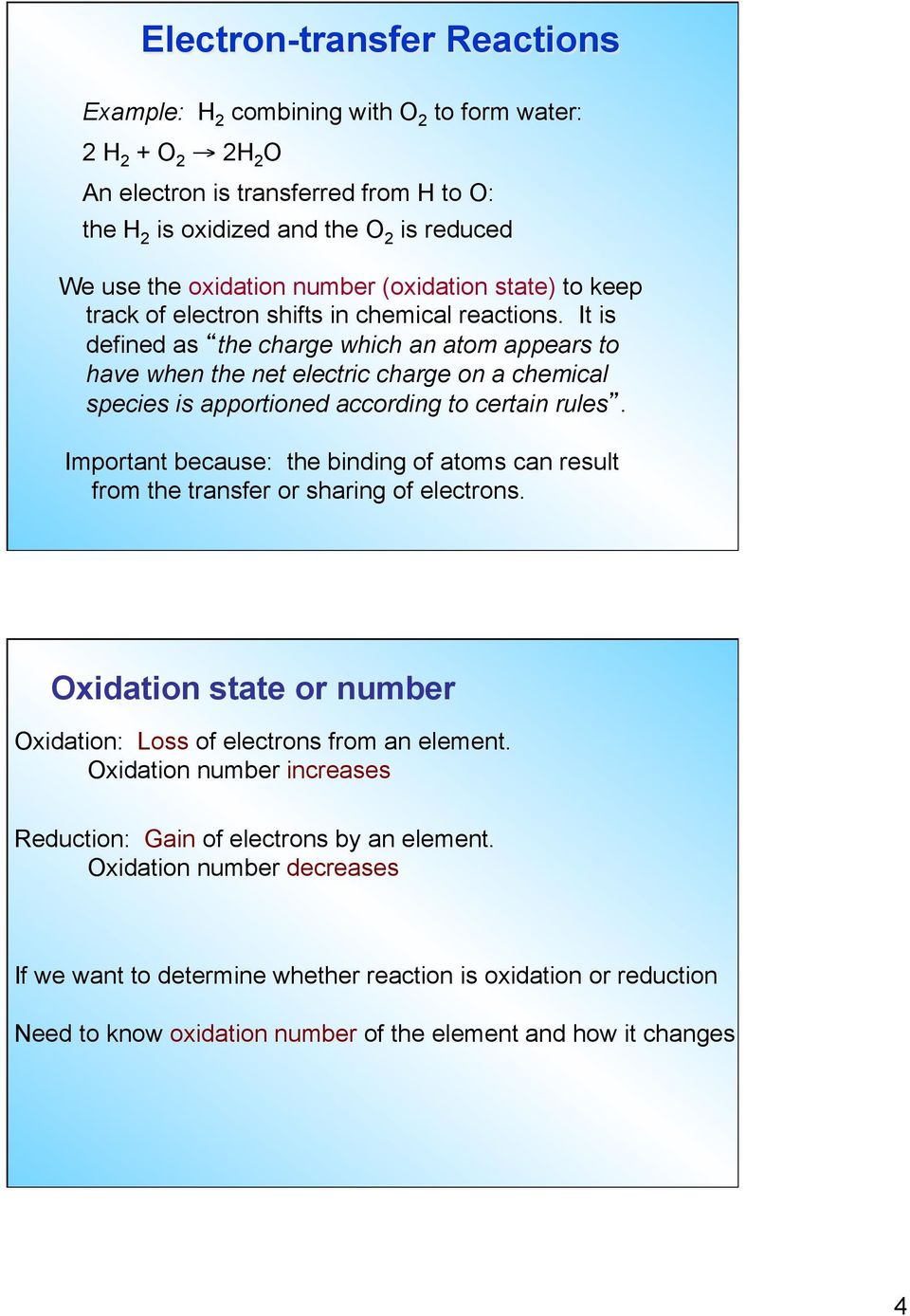
4 Electron-transfer Reactions Example: H 2 combining with O 2 to form water: 2 H 2 + O 2 2H 2 O An electron is transferred from H to O: the H 2 is oxidized and the O 2 is reduced We use the oxidation number (oxidation state) to keep track of electron shifts in chemical reactions. It is defined as the charge which an atom appears to have when the net electric charge on a chemical species is apportioned according to certain rules. Important because: the binding of atoms can result from the transfer or sharing of electrons. Oxidation state or number Oxidation: Loss of electrons from an element. Oxidation number increases Reduction: Gain of electrons by an element. Oxidation number decreases If we want to determine whether reaction is oxidation or reduction Need to know oxidation number of the element and how it changes 4
5 5

6 6

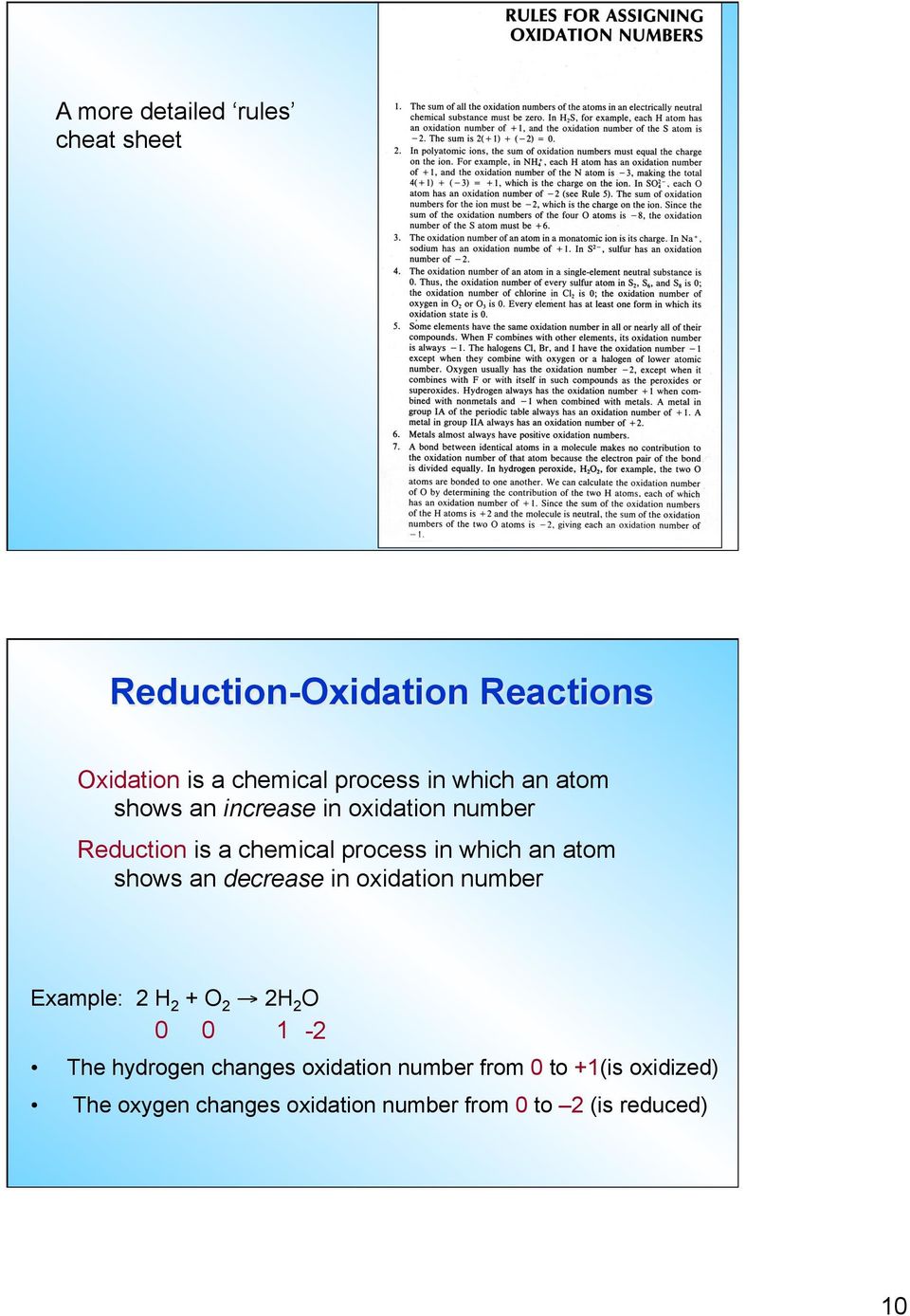
7 Determining Oxidation Number of Elements & Compounds 1. In uncombined or free elements (not ionized), each atom has an oxidation number of 0. E.g., all of the atoms in these molecules: H 2, Na, S 8, O 2, P In simple ions (i.e., charged species which contain only one atom), the oxidation number is equal to the charge on the ion. E.g., Na and K only form +1 ions; thus, their oxidation numbers are +1 in all compounds (see Fig. 20.1). Determining Oxidation Number of Elements & Compounds 3. Oxidation state of certain elements is the same in all, or almost all of their compounds e.g., Group 1A elements: Li, Na, K, Rb, Cs = +1 Group 2A elements: Be, Mg, Ca, Sr, Ba, Ra = +2 Group VIIb elements: F, Cl, Br, I, At = -1 in binary compounds Oxygen is almost always -2 (except when bonded to O or F) H is almost always +1 (except with a metal; NaH, CaH 2 is -1) 7

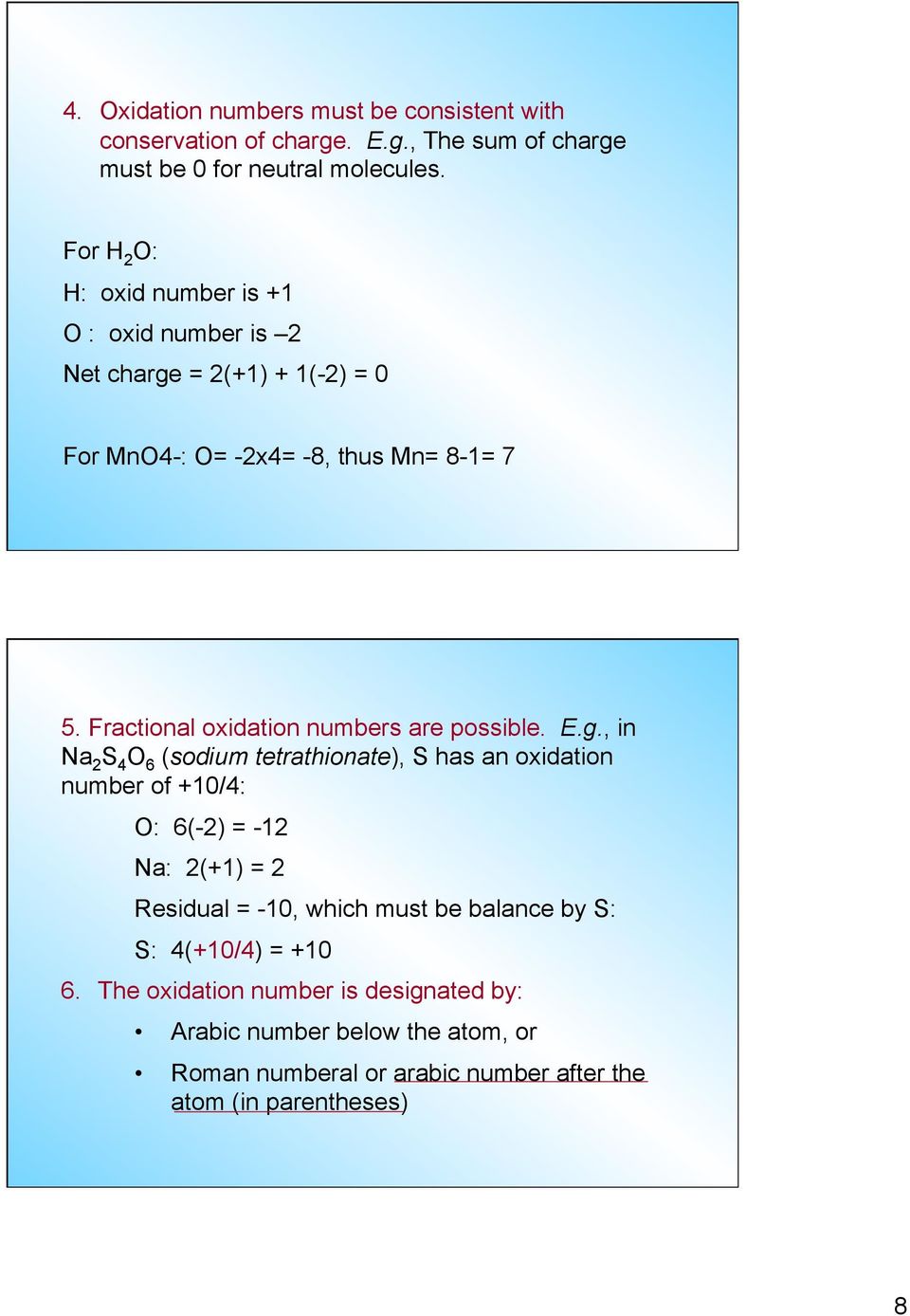
8 4. Oxidation numbers must be consistent with conservation of charge. E.g., The sum of charge must be 0 for neutral molecules. For H 2 O: H: oxid number is +1 O : oxid number is 2 Net charge = 2(+1) + 1(-2) = 0 For MnO4-: O= -2x4= -8, thus Mn= 8-1= 7 5. Fractional oxidation numbers are possible. E.g., in Na 2 S 4 O 6 (sodium tetrathionate), S has an oxidation number of +10/4: O: 6(-2) = -12 Na: 2(+1) = 2 Residual = -10, which must be balance by S: S: 4(+10/4) = The oxidation number is designated by: Arabic number below the atom, or Roman numberal or arabic number after the atom (in parentheses) 8
9 Common Oxidation States of Elements Oxidation states for important N, S and C compounds: 9

10 A more detailed rules cheat sheet Reduction-Oxidation Reactions Oxidation is a chemical process in which an atom shows an increase in oxidation number Reduction is a chemical process in which an atom shows an decrease in oxidation number Example: 2 H 2 + O 2 2H 2 O The hydrogen changes oxidation number from 0 to +1(is oxidized) The oxygen changes oxidation number from 0 to 2 (is reduced) 10
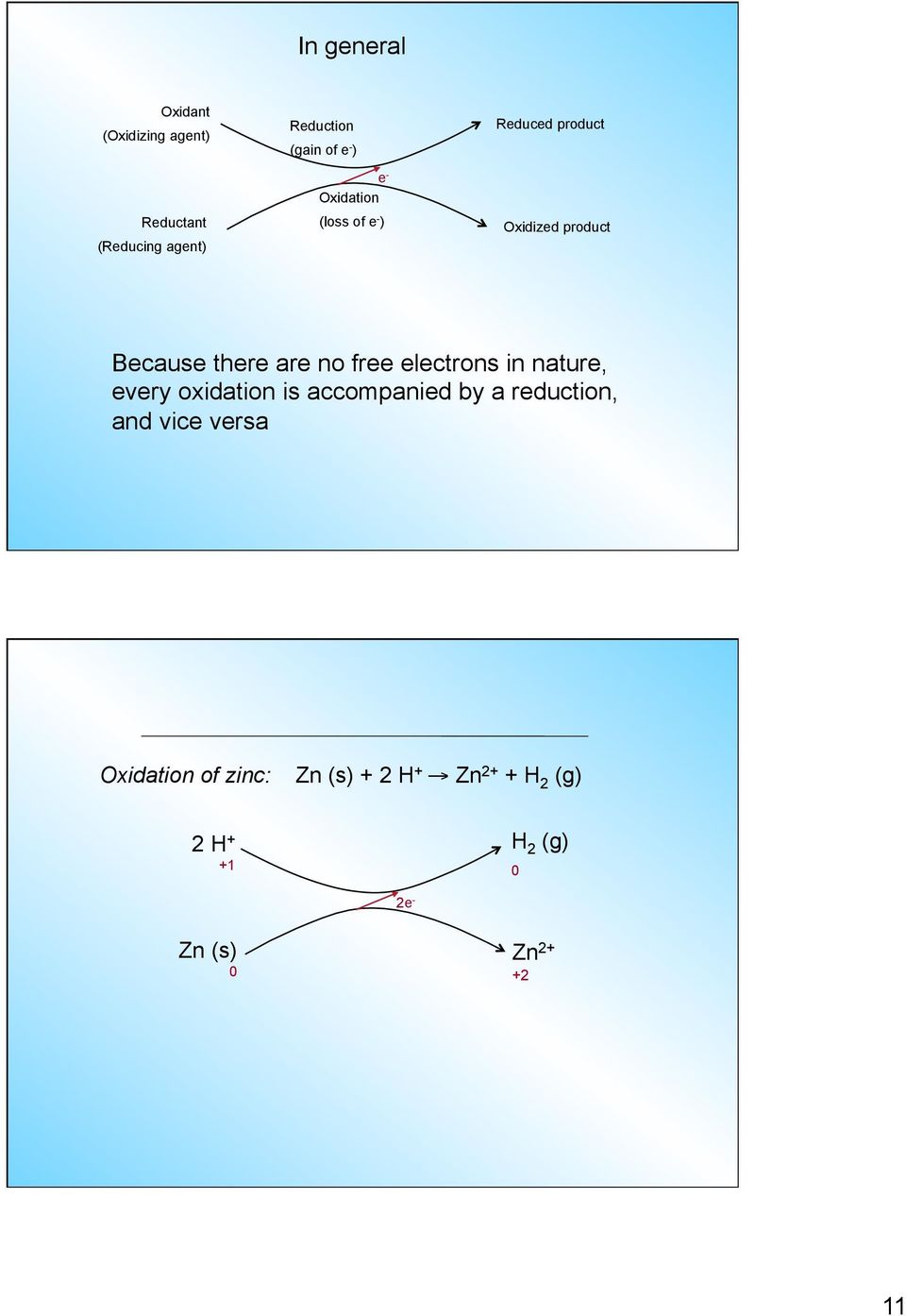
11 In general Oxidant (Oxidizing agent) Reductant (Reducing agent) Reduction (gain of e - ) e - Oxidation (loss of e - ) Reduced product Oxidized product Because there are no free electrons in nature, every oxidation is accompanied by a reduction, and vice versa Oxidation of zinc: Zn (s) + 2 H + Zn 2+ + H 2 (g) 2 H + +1 H 2 (g) 0 2e - Zn (s) 0 Zn
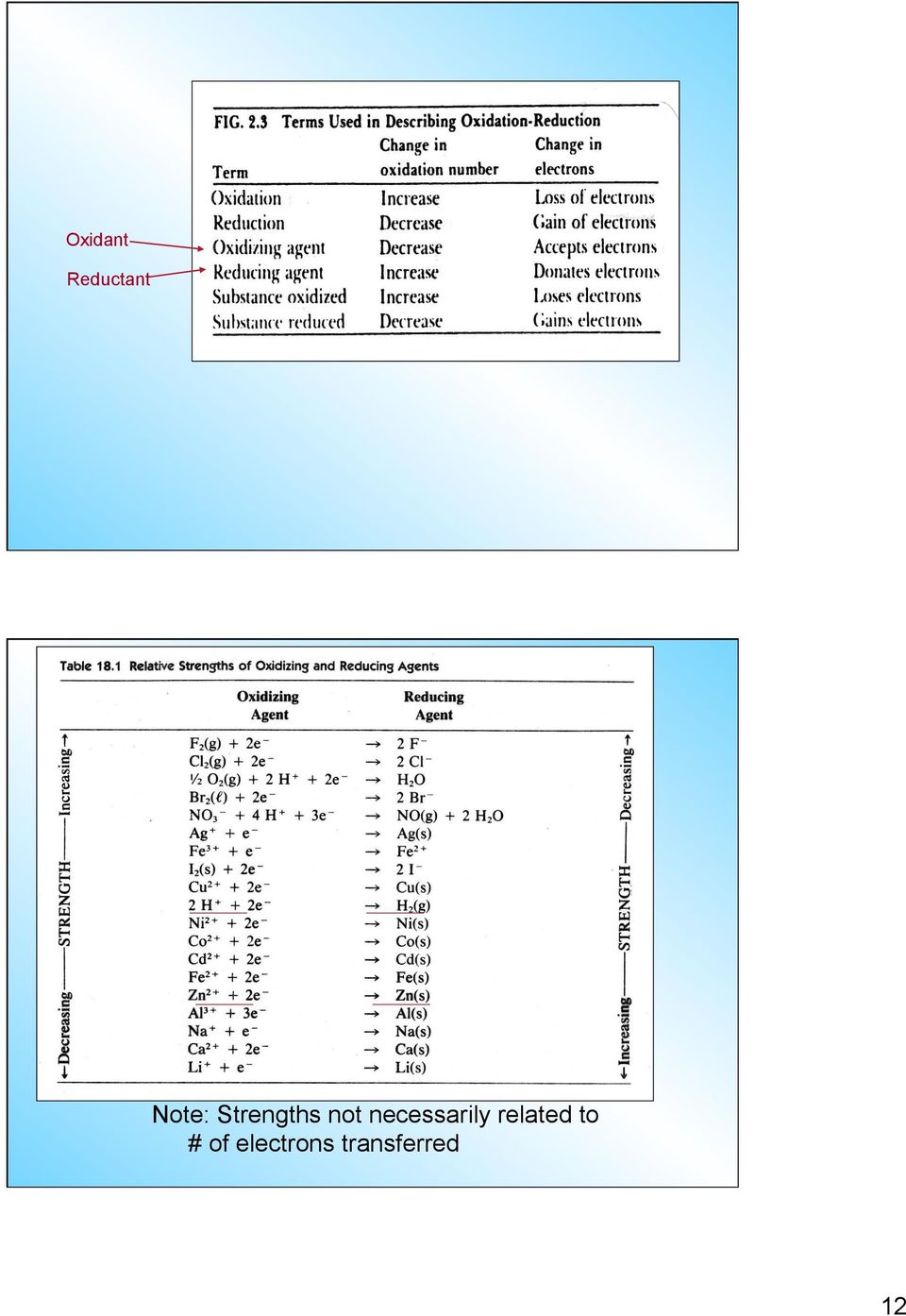
12 Oxidant Reductant Note: Strengths not necessarily related to # of electrons transferred 12
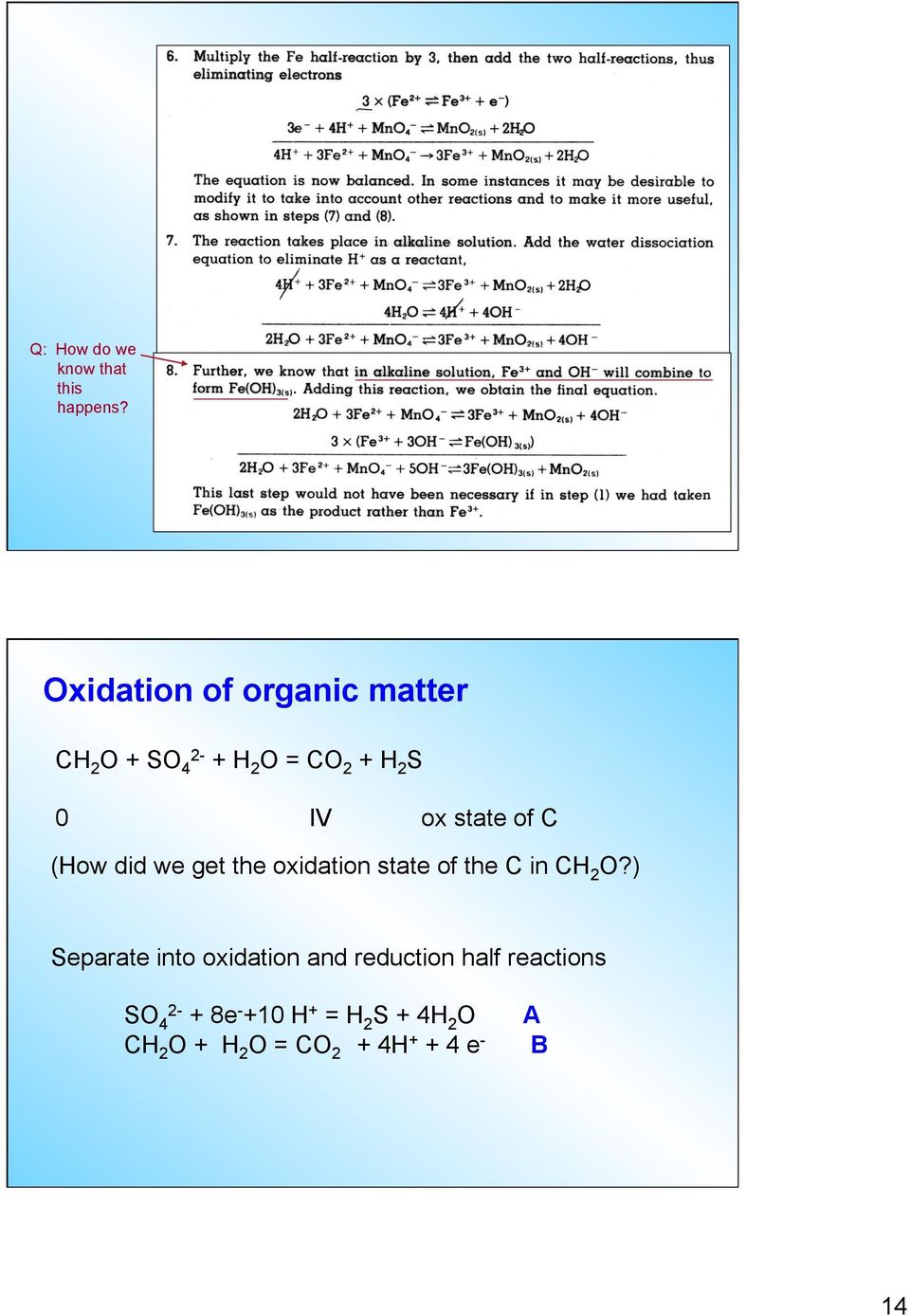
13 Procedure for balancing redox reactions in aqueous solutions: 13

14 Q: How do we know that this happens? Oxidation of organic matter CH 2 O + SO H 2 O = CO 2 + H 2 S 0 IV ox state of C (How did we get the oxidation state of the C in CH 2 O?) Separate into oxidation and reduction half reactions SO e H + = H 2 S + 4H 2 O CH 2 O + H 2 O = CO 2 + 4H e - A B 14
15 Combine so electrons balance: A + B*2 2 CH 2 O + SO H 2 O + 10H + = H 2 S + 4 H 2 O + 2 CO H + Simplify by subtracting 8 H + and 2 H 2 O from each side. 2 CH 2 O + SO H + = H 2 S + 2 H 2 O + 2 CO 2 This reaction is the oxidation of organic matter through the reduction of sulphate, you will see this reaction later in reducing sediments. D. An example in basic solution: I - + MnO 4 - = I 2 + MnO 2 Oxidation: 2I - = I 2 + 2e - A Reduction: MnO H + +3e - = MnO 2 + 2H 2 O remove H + by adding OH - to each side * 4 (4H + + 4OH - = 4 H 2 O) MnO H 2 O+ +3e - = MnO 2 + 2H 2 O + 4OH - simplify: MnO H 2 O +3e - = MnO 2 + 4OH - B combine so electrons balance: A * 3 + B * 2 6I - + 2MnO H 2 O = 3I 2 + 2MnO 2 + 8OH - 15

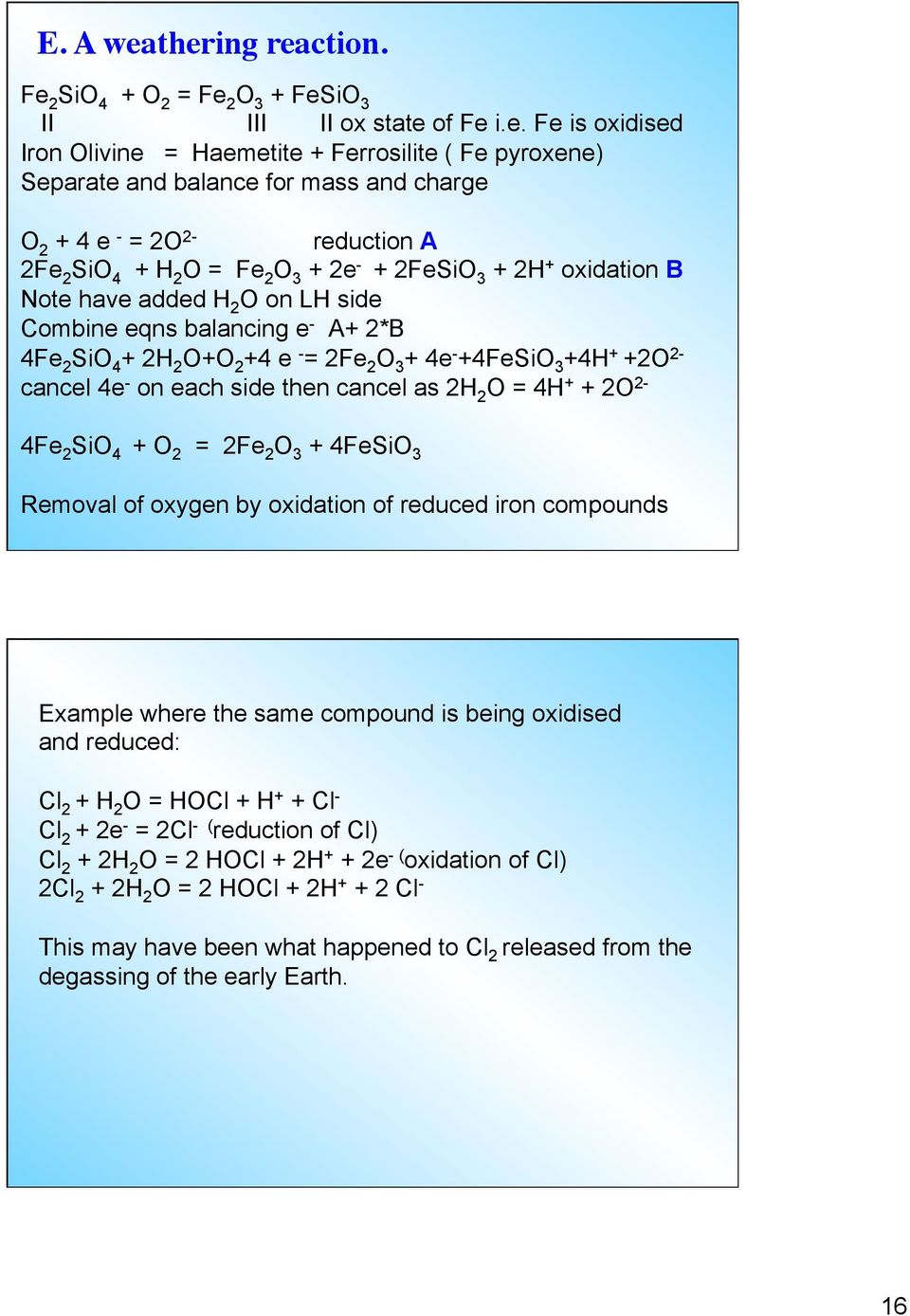
16 E. A weathering reaction. Fe 2 SiO 4 + O 2 = Fe 2 O 3 + FeSiO 3 II III II ox state of Fe i.e. Fe is oxidised Iron Olivine = Haemetite + Ferrosilite ( Fe pyroxene) Separate and balance for mass and charge O e - = 2O 2- reduction A 2Fe 2 SiO 4 + H 2 O = Fe 2 O 3 + 2e - + 2FeSiO 3 + 2H + oxidation B Note have added H 2 O on LH side Combine eqns balancing e - A+ 2*B 4Fe 2 SiO 4 + 2H 2 O+O 2 +4 e - = 2Fe 2 O 3 + 4e - +4FeSiO 3 +4H + +2O 2- cancel 4e - on each side then cancel as 2H 2 O = 4H + + 2O 2-4Fe 2 SiO 4 + O 2 = 2Fe 2 O 3 + 4FeSiO 3 Removal of oxygen by oxidation of reduced iron compounds Example where the same compound is being oxidised and reduced: Cl 2 + H 2 O = HOCl + H + + Cl - Cl 2 + 2e - = 2Cl - ( reduction of Cl) Cl 2 + 2H 2 O = 2 HOCl + 2H + + 2e - ( oxidation of Cl) 2Cl 2 + 2H 2 O = 2 HOCl + 2H Cl - This may have been what happened to Cl 2 released from the degassing of the early Earth. 16
17 More Info On Term Paper Preproposal Assignment Example of a Foundation Call for Proposals 17

18 18

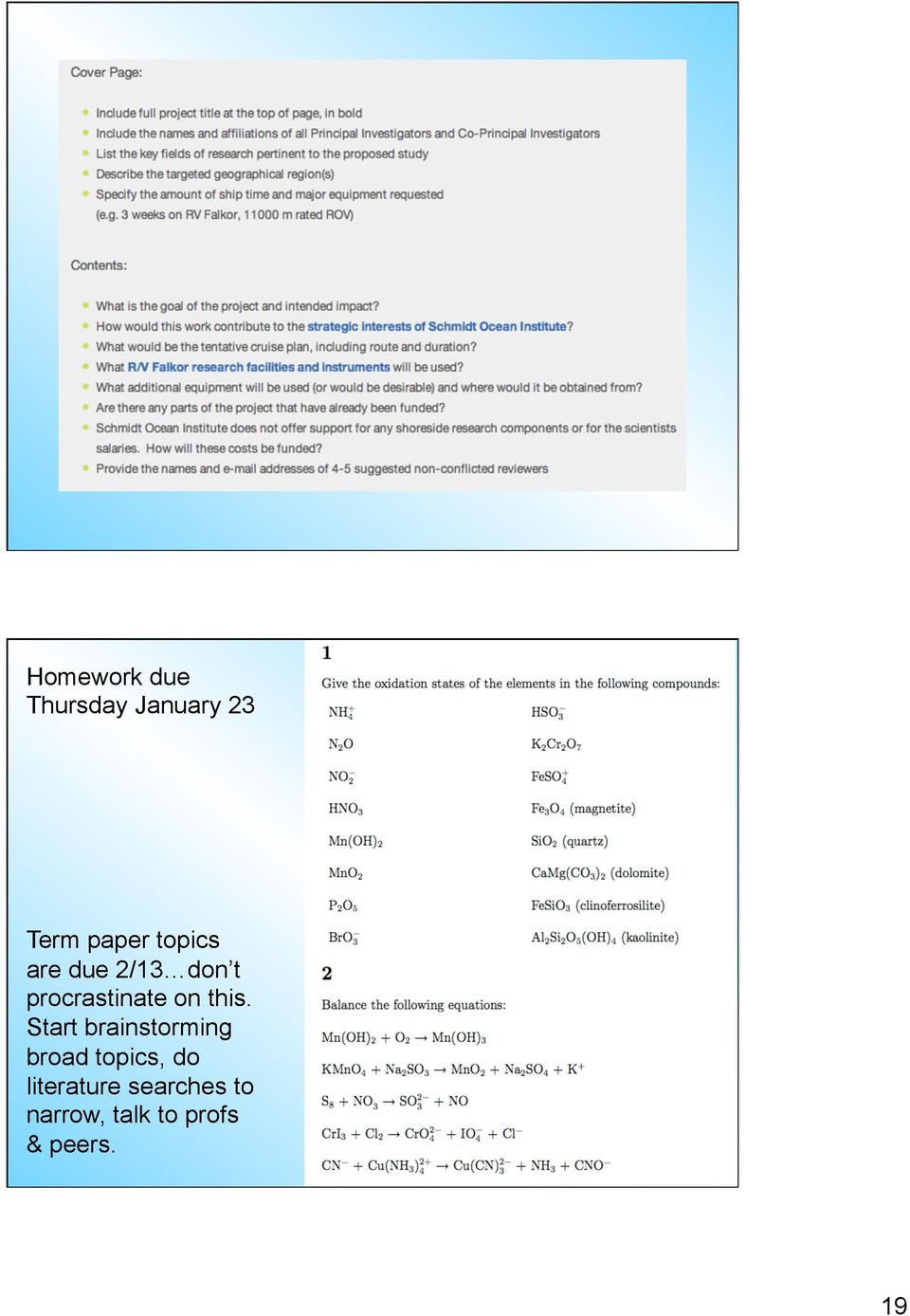
19 Homework due Thursday January 23 Term paper topics are due 2/13 don t procrastinate on this. Start brainstorming broad topics, do literature searches to narrow, talk to profs & peers. 19
stoichiometry = the numerical relationships between chemical amounts in a reaction.
 1 REACTIONS AND YIELD ANSWERS stoichiometry = the numerical relationships between chemical amounts in a reaction. 2C 8 H 18 (l) + 25O 2 16CO 2 (g) + 18H 2 O(g) From the equation, 16 moles of CO 2 (a greenhouse
Chapter 11. Electrochemistry Oxidation and Reduction Reactions. Oxidation-Reduction Reactions. Oxidation-Reduction Reactions
 Oxidation-Reduction Reactions Chapter 11 Electrochemistry Oxidation and Reduction Reactions An oxidation and reduction reaction occurs in both aqueous solutions and in reactions where substances are burned
2. DECOMPOSITION REACTION ( A couple have a heated argument and break up )
 TYPES OF CHEMICAL REACTIONS Most reactions can be classified into one of five categories by examining the types of reactants and products involved in the reaction. Knowing the types of reactions can help
Chemical Equations. Chemical Equations. Chemical reactions describe processes involving chemical change
 Chemical Reactions Chemical Equations Chemical reactions describe processes involving chemical change The chemical change involves rearranging matter Converting one or more pure substances into new pure
6 Reactions in Aqueous Solutions
 6 Reactions in Aqueous Solutions Water is by far the most common medium in which chemical reactions occur naturally. It is not hard to see this: 70% of our body mass is water and about 70% of the surface
NET IONIC EQUATIONS. A balanced chemical equation can describe all chemical reactions, an example of such an equation is:
 NET IONIC EQUATIONS A balanced chemical equation can describe all chemical reactions, an example of such an equation is: NaCl + AgNO 3 AgCl + NaNO 3 In this case, the simple formulas of the various reactants
Oxidation / Reduction Handout Chem 2 WS11
 Oxidation / Reduction Handout Chem 2 WS11 The original concept of oxidation applied to reactions where there was a union with oxygen. The oxygen was either furnished by elemental oxygen or by compounds
H 2 + O 2 H 2 O. - Note there is not enough hydrogen to react with oxygen - It is necessary to balance equation.
 CEMICAL REACTIONS 1 ydrogen + Oxygen Water 2 + O 2 2 O reactants product(s) reactant substance before chemical change product substance after chemical change Conservation of Mass During a chemical reaction,
Chapter 12: Oxidation and Reduction.
 207 Oxidation- reduction (redox) reactions Chapter 12: Oxidation and Reduction. At different times, oxidation and reduction (redox) have had different, but complimentary, definitions. Compare the following
Molarity of Ions in Solution
 APPENDIX A Molarity of Ions in Solution ften it is necessary to calculate not only the concentration (in molarity) of a compound in aqueous solution but also the concentration of each ion in aqueous solution.
Chemistry B11 Chapter 4 Chemical reactions
 Chemistry B11 Chapter 4 Chemical reactions Chemical reactions are classified into five groups: A + B AB Synthesis reactions (Combination) H + O H O AB A + B Decomposition reactions (Analysis) NaCl Na +Cl
Ch 20 Electrochemistry: the study of the relationships between electricity and chemical reactions.
 Ch 20 Electrochemistry: the study of the relationships between electricity and chemical reactions. In electrochemical reactions, electrons are transferred from one species to another. Learning goals and
Chapter 8: Chemical Equations and Reactions
 Chapter 8: Chemical Equations and Reactions I. Describing Chemical Reactions A. A chemical reaction is the process by which one or more substances are changed into one or more different substances. A chemical
Chapter 5. Chemical Reactions and Equations. Introduction. Chapter 5 Topics. 5.1 What is a Chemical Reaction
 Introduction Chapter 5 Chemical Reactions and Equations Chemical reactions occur all around us. How do we make sense of these changes? What patterns can we find? 1 2 Copyright The McGraw-Hill Companies,
YIELD YIELD REACTANTS PRODUCTS
 Balancing Chemical Equations A Chemical Equation: is a representation of a chemical reaction in terms of chemical formulas Example: 1. Word Description of a Chemical Reaction When methane gas (CH 4 ) burns
Chapter 8 - Chemical Equations and Reactions
 Chapter 8 - Chemical Equations and Reactions 8-1 Describing Chemical Reactions I. Introduction A. Reactants 1. Original substances entering into a chemical rxn B. Products 1. The resulting substances from
Chemical Reactions in Water Ron Robertson
 Chemical Reactions in Water Ron Robertson r2 f:\files\courses\1110-20\2010 possible slides for web\waterchemtrans.doc Properties of Compounds in Water Electrolytes and nonelectrolytes Water soluble compounds
Chapter 4 Chemical Reactions
 Chapter 4 Chemical Reactions I) Ions in Aqueous Solution many reactions take place in water form ions in solution aq solution = solute + solvent solute: substance being dissolved and present in lesser
Chemical Equations and Chemical Reactions. Chapter 8.1
 Chemical Equations and Chemical Reactions Chapter 8.1 Objectives List observations that suggest that a chemical reaction has taken place List the requirements for a correctly written chemical equation.
Writing and Balancing Chemical Equations
 Name Writing and Balancing Chemical Equations Period When a substance undergoes a chemical reaction, chemical bonds are broken and new bonds are formed. This results in one or more new substances, often
1. Oxidation number is 0 for atoms in an element. 3. In compounds, alkalis have oxidation number +1; alkaline earths have oxidation number +2.
 à xidation numbers In the Lewis model of bonding, when nonidentical atoms are bonded together, an important consideration is how the bonding electrons are apportioned between the atoms. There are two different
CHAPTER 5: MOLECULES AND COMPOUNDS
 CHAPTER 5: MOLECULES AND COMPOUNDS Problems: 1-6, 9-13, 16, 20, 31-40, 43-64, 65 (a,b,c,e), 66(a-d,f), 69(a-d,f), 70(a-e), 71-78, 81-82, 87-96 A compound will display the same properties (e.g. melting
WRITING CHEMICAL FORMULA
 WRITING CHEMICAL FORMULA For ionic compounds, the chemical formula must be worked out. You will no longer have the list of ions in the exam (like at GCSE). Instead you must learn some and work out others.
Chem 1100 Chapter Three Study Guide Answers Outline I. Molar Mass and Moles A. Calculations of Molar Masses
 Chem 1100 Chapter Three Study Guide Answers Outline I. Molar Mass and Moles A. Calculations of Molar Masses B. Calculations of moles C. Calculations of number of atoms from moles/molar masses 1. Avagadro
19.2 Chemical Formulas
 In the previous section, you learned how and why atoms form chemical bonds with one another. You also know that atoms combine in certain ratios with other atoms. These ratios determine the chemical formula
Chemical Reactions 2 The Chemical Equation
 Chemical Reactions 2 The Chemical Equation INFORMATION Chemical equations are symbolic devices used to represent actual chemical reactions. The left side of the equation, called the reactants, is separated
Chemistry Post-Enrolment Worksheet
 Name: Chemistry Post-Enrolment Worksheet The purpose of this worksheet is to get you to recap some of the fundamental concepts that you studied at GCSE and introduce some of the concepts that will be part
Honors Chemistry: Unit 6 Test Stoichiometry PRACTICE TEST ANSWER KEY Page 1. A chemical equation. (C-4.4)
 Honors Chemistry: Unit 6 Test Stoichiometry PRACTICE TEST ANSWER KEY Page 1 1. 2. 3. 4. 5. 6. Question What is a symbolic representation of a chemical reaction? What 3 things (values) is a mole of a chemical
Atomic Structure. Name Mass Charge Location Protons 1 +1 Nucleus Neutrons 1 0 Nucleus Electrons 1/1837-1 Orbit nucleus in outer shells
 Atomic Structure called nucleons Name Mass Charge Location Protons 1 +1 Nucleus Neutrons 1 0 Nucleus Electrons 1/1837-1 Orbit nucleus in outer shells The number of protons equals the atomic number This
Topic 4 National Chemistry Summary Notes. Formulae, Equations, Balancing Equations and The Mole
 Topic 4 National Chemistry Summary Notes Formulae, Equations, Balancing Equations and The Mole LI 1 The chemical formula of a covalent molecular compound tells us the number of atoms of each element present
Name: Teacher: Pd. Date:
 Name: Teacher: Pd. Date: STAAR Tutorial : Energy and Matter: Elements, Compounds, and Chemical Equations: 6.5C Differentiate between elements and compounds on the most basic level. 8.5F Recognize whether
1. When the following equation is balanced, the coefficient of Al is. Al (s) + H 2 O (l)? Al(OH) 3 (s) + H 2 (g)
 1. When the following equation is balanced, the coefficient of Al is. Al (s) + H 2 O (l)? Al(OH) (s) + H 2 (g) A) 1 B) 2 C) 4 D) 5 E) Al (s) + H 2 O (l)? Al(OH) (s) + H 2 (g) Al (s) + H 2 O (l)? Al(OH)
Writing Chemical Equations
 Writing Chemical Equations Chemical equations for solution reactions can be written in three different forms; molecular l equations, complete ionic i equations, and net ionic equations. In class, so far,
PART I: MULTIPLE CHOICE (30 multiple choice questions. Each multiple choice question is worth 2 points)
 CHEMISTRY 123-07 Midterm #1 Answer key October 14, 2010 Statistics: Average: 74 p (74%); Highest: 97 p (95%); Lowest: 33 p (33%) Number of students performing at or above average: 67 (57%) Number of students
Galvanic Cells. SCH4U7 Ms. Lorenowicz. Tuesday, December 6, 2011
 Galvanic Cells SCH4U7 Ms. Lorenowicz 1 Electrochemistry Concepts 1.Redox reactions involve the transfer of electrons from one reactant to another 2.Electric current is a flow of electrons in a circuit
Periodic Table, Valency and Formula
 Periodic Table, Valency and Formula Origins of the Periodic Table Mendelѐѐv in 1869 proposed that a relationship existed between the chemical properties of elements and their atomic masses. He noticed
Chemistry Themed. Types of Reactions
 Chemistry Themed Types of Reactions 1 2 Chemistry in the Community-2015-2016 Types of Reactions Date In-Class Assignment Homework T 10/20 TEST on Reactivity of Metals and Redox None W 10/21 Late Start
Find a pair of elements in the periodic table with atomic numbers less than 20 that are an exception to the original periodic law.
 Example Exercise 6.1 Periodic Law Find the two elements in the fifth row of the periodic table that violate the original periodic law proposed by Mendeleev. Mendeleev proposed that elements be arranged
Aqueous Solutions. Water is the dissolving medium, or solvent. Some Properties of Water. A Solute. Types of Chemical Reactions.
 Aqueous Solutions and Solution Stoichiometry Water is the dissolving medium, or solvent. Some Properties of Water Water is bent or V-shaped. The O-H bonds are covalent. Water is a polar molecule. Hydration
OXIDATION REDUCTION. Section I. Cl 2 + 2e. 2. The oxidation number of group II A is always (+) 2.
 OXIDATION REDUCTION Section I Example 1: Na Example 2: 2C1 Example 3: K + + e Na + + e Cl 2 + 2e K Example 4: C1 2 + 2e 2Cl 1. The oxidation number of group I A is always (+) 1. 2. The oxidation number
100% ionic compounds do not exist but predominantly ionic compounds are formed when metals combine with non-metals.
 2.21 Ionic Bonding 100% ionic compounds do not exist but predominantly ionic compounds are formed when metals combine with non-metals. Forming ions Metal atoms lose electrons to form +ve ions. Non-metal
7-5.5. Translate chemical symbols and the chemical formulas of common substances to show the component parts of the substances including:
 7-5.5 Translate chemical symbols and the chemical formulas of common substances to show the component parts of the substances including: NaCl [salt], H 2 O [water], C 6 H 12 O 6 [simple sugar], O 2 [oxygen
Chemical Equations & Stoichiometry
 Chemical Equations & Stoichiometry Chapter Goals Balance equations for simple chemical reactions. Perform stoichiometry calculations using balanced chemical equations. Understand the meaning of the term
SEATTLE CENTRAL COMMUNITY COLLEGE DIVISION OF SCIENCE AND MATHEMATICS. Oxidation-Reduction
 SEATTLE CENTRAL COMMUNITY COLLEGE DIVISION OF SCIENCE AND MATHEMATICS OxidationReduction Oxidation is loss of electrons. (Oxygen is EN enough to grab e away from most elements, so the term originally meant
Moles. Moles. Moles. Moles. Balancing Eqns. Balancing. Balancing Eqns. Symbols Yields or Produces. Like a recipe:
 Like a recipe: Balancing Eqns Reactants Products 2H 2 (g) + O 2 (g) 2H 2 O(l) coefficients subscripts Balancing Eqns Balancing Symbols (s) (l) (aq) (g) or Yields or Produces solid liquid (pure liquid)
UNIT (4) CALCULATIONS AND CHEMICAL REACTIONS
 UNIT (4) CALCULATIONS AND CHEMICAL REACTIONS 4.1 Formula Masses Recall that the decimal number written under the symbol of the element in the periodic table is the atomic mass of the element. 1 7 8 12
ATOMS. Multiple Choice Questions
 Chapter 3 ATOMS AND MOLECULES Multiple Choice Questions 1. Which of the following correctly represents 360 g of water? (i) 2 moles of H 2 0 (ii) 20 moles of water (iii) 6.022 10 23 molecules of water (iv)
Chemical Calculations: Formula Masses, Moles, and Chemical Equations
 Chemical Calculations: Formula Masses, Moles, and Chemical Equations Atomic Mass & Formula Mass Recall from Chapter Three that the average mass of an atom of a given element can be found on the periodic
Chapter 7: Chemical Reactions
 Chapter 7 Page 1 Chapter 7: Chemical Reactions A chemical reaction: a process in which at least one new substance is formed as the result of a chemical change. A + B C + D Reactants Products Evidence that
Chapter 17. How are acids different from bases? Acid Physical properties. Base. Explaining the difference in properties of acids and bases
 Chapter 17 Acids and Bases How are acids different from bases? Acid Physical properties Base Physical properties Tastes sour Tastes bitter Feels slippery or slimy Chemical properties Chemical properties
Experiment 8 - Double Displacement Reactions
 Experiment 8 - Double Displacement Reactions A double displacement reaction involves two ionic compounds that are dissolved in water. In a double displacement reaction, it appears as though the ions are
Formulae, stoichiometry and the mole concept
 3 Formulae, stoichiometry and the mole concept Content 3.1 Symbols, Formulae and Chemical equations 3.2 Concept of Relative Mass 3.3 Mole Concept and Stoichiometry Learning Outcomes Candidates should be
Chapter 3. Chemical Reactions and Reaction Stoichiometry. Lecture Presentation. James F. Kirby Quinnipiac University Hamden, CT
 Lecture Presentation Chapter 3 Chemical Reactions and Reaction James F. Kirby Quinnipiac University Hamden, CT The study of the mass relationships in chemistry Based on the Law of Conservation of Mass
20.2 Chemical Equations
 All of the chemical changes you observed in the last Investigation were the result of chemical reactions. A chemical reaction involves a rearrangement of atoms in one or more reactants to form one or more
IB Chemistry 1 Mole. One atom of C-12 has a mass of 12 amu. One mole of C-12 has a mass of 12 g. Grams we can use more easily.
 The Mole Atomic mass units and atoms are not convenient units to work with. The concept of the mole was invented. This was the number of atoms of carbon-12 that were needed to make 12 g of carbon. 1 mole
Steps for balancing a chemical equation
 The Chemical Equation: A Chemical Recipe Dr. Gergens - SD Mesa College A. Learn the meaning of these arrows. B. The chemical equation is the shorthand notation for a chemical reaction. A chemical equation
Moles. Balanced chemical equations Molar ratios Mass Composition Empirical and Molecular Mass Predicting Quantities Equations
 Moles Balanced chemical equations Molar ratios Mass Composition Empirical and Molecular Mass Predicting Quantities Equations Micro World atoms & molecules Macro World grams Atomic mass is the mass of an
Chem 31 Fall 2002. Chapter 3. Stoichiometry: Calculations with Chemical Formulas and Equations. Writing and Balancing Chemical Equations
 Chem 31 Fall 2002 Chapter 3 Stoichiometry: Calculations with Chemical Formulas and Equations Writing and Balancing Chemical Equations 1. Write Equation in Words -you cannot write an equation unless you
Chemistry 51 Chapter 8 TYPES OF SOLUTIONS. A solution is a homogeneous mixture of two substances: a solute and a solvent.
 TYPES OF SOLUTIONS A solution is a homogeneous mixture of two substances: a solute and a solvent. Solute: substance being dissolved; present in lesser amount. Solvent: substance doing the dissolving; present
Chemistry Diagnostic Questions
 Chemistry Diagnostic Questions Answer these 40 multiple choice questions and then check your answers, located at the end of this document. If you correctly answered less than 25 questions, you need to
Chem 115 POGIL Worksheet - Week 4 Moles & Stoichiometry
 Chem 115 POGIL Worksheet - Week 4 Moles & Stoichiometry Why? Chemists are concerned with mass relationships in chemical reactions, usually run on a macroscopic scale (grams, kilograms, etc.). To deal with
EXPERIMENT 8: Activity Series (Single Displacement Reactions)
 EPERIMENT 8: Activity Series (Single Displacement Reactions) PURPOSE a) Reactions of metals with acids and salt solutions b) Determine the activity of metals c) Write a balanced molecular equation, complete
Nomenclature and Formulas of Ionic Compounds. Section I: Writing the Name from the Formula
 Purpose: Theory: Nomenclature and Formulas of Ionic Compounds 1. To become familiar with the rules of chemical nomenclature, based on the classification of compounds. 2. To write the proper name of the
Nomenclature of Ionic Compounds
 Nomenclature of Ionic Compounds Ionic compounds are composed of ions. An ion is an atom or molecule with an electrical charge. Monatomic ions are formed from single atoms that have gained or lost electrons.
PERIODIC TABLE OF GROUPS OF ELEMENTS Elements can be classified using two different schemes.
 1 PERIODIC TABLE OF GROUPS OF ELEMENTS Elements can be classified using two different schemes. Metal Nonmetal Scheme (based on physical properties) Metals - most elements are metals - elements on left
Question Bank Electrolysis
 Question Bank Electrolysis 1. (a) What do you understand by the terms (i) electrolytes (ii) non-electrolytes? (b) Arrange electrolytes and non-electrolytes from the following substances (i) sugar solution
Unit 6 The Mole Concept
 Chemistry Form 3 Page 62 Ms. R. Buttigieg Unit 6 The Mole Concept See Chemistry for You Chapter 28 pg. 352-363 See GCSE Chemistry Chapter 5 pg. 70-79 6.1 Relative atomic mass. The relative atomic mass
Chapter 3: Stoichiometry
 Chapter 3: Stoichiometry Key Skills: Balance chemical equations Predict the products of simple combination, decomposition, and combustion reactions. Calculate formula weights Convert grams to moles and
CHEM 110: CHAPTER 3: STOICHIOMETRY: CALCULATIONS WITH CHEMICAL FORMULAS AND EQUATIONS
 1 CHEM 110: CHAPTER 3: STOICHIOMETRY: CALCULATIONS WITH CHEMICAL FORMULAS AND EQUATIONS The Chemical Equation A chemical equation concisely shows the initial (reactants) and final (products) results of
CP Chemistry Review for Stoichiometry Test
 CP Chemistry Review for Stoichiometry Test Stoichiometry Problems (one given reactant): 1. Make sure you have a balanced chemical equation 2. Convert to moles of the known substance. (Use the periodic
HOMEWORK 4A. Definitions. Oxidation-Reduction Reactions. Questions
 HOMEWORK 4A Oxidation-Reduction Reactions 1. Indicate whether a reaction will occur or not in each of following. Wtiring a balcnced equation is not necessary. (a) Magnesium metal is added to hydrochloric
Aqueous Ions and Reactions
 Aqueous Ions and Reactions (ions, acids, and bases) Demo NaCl(aq) + AgNO 3 (aq) AgCl (s) Two clear and colorless solutions turn to a cloudy white when mixed Demo Special Light bulb in water can test for
Periodic Table Questions
 Periodic Table Questions 1. The elements characterized as nonmetals are located in the periodic table at the (1) far left; (2) bottom; (3) center; (4) top right. 2. An element that is a liquid at STP is
Chapter 13: Electrochemistry. Electrochemistry. The study of the interchange of chemical and electrical energy.
 Chapter 13: Electrochemistry Redox Reactions Galvanic Cells Cell Potentials Cell Potentials and Equilbrium Batteries Electrolysis Electrolysis and Stoichiometry Corrosion Prevention Electrochemistry The
Solution a homogeneous mixture = A solvent + solute(s) Aqueous solution water is the solvent
 Solution a homogeneous mixture = A solvent + solute(s) Aqueous solution water is the solvent Water a polar solvent: dissolves most ionic compounds as well as many molecular compounds Aqueous solution:
1332 CHAPTER 18 Sample Questions
 1332 CHAPTER 18 Sample Questions Couple E 0 Couple E 0 Br 2 (l) + 2e 2Br (aq) +1.06 V AuCl 4 + 3e Au + 4Cl +1.00 V Ag + + e Ag +0.80 V Hg 2+ 2 + 2e 2 Hg +0.79 V Fe 3+ (aq) + e Fe 2+ (aq) +0.77 V Cu 2+
Experiment 5. Chemical Reactions A + X AX AX A + X A + BX AX + B AZ + BX AX + BZ
 Experiment 5 Chemical Reactions OBJECTIVES 1. To observe the various criteria that are used to indicate that a chemical reaction has occurred. 2. To convert word equations into balanced inorganic chemical
NAMING QUIZ 3 - Part A Name: 1. Zinc (II) Nitrate. 5. Silver (I) carbonate. 6. Aluminum acetate. 8. Iron (III) hydroxide
 NAMING QUIZ 3 - Part A Name: Write the formulas for the following compounds: 1. Zinc (II) Nitrate 2. Manganese (IV) sulfide 3. Barium permanganate 4. Sulfuric acid 5. Silver (I) carbonate 6. Aluminum acetate
Chemical Proportions in Compounds
 Chapter 6 Chemical Proportions in Compounds Solutions for Practice Problems Student Textbook page 201 1. Problem A sample of a compound is analyzed and found to contain 0.90 g of calcium and 1.60 g of
Chemistry: Chemical Equations
 Chemistry: Chemical Equations Write a balanced chemical equation for each word equation. Include the phase of each substance in the equation. Classify the reaction as synthesis, decomposition, single replacement,
12. REDOX EQUILIBRIA
 12. REDOX EQUILIBRIA The electrochemical series (reference table) 12.1. Redox reactions 12.2. Standard electrode potentials 12.3. Calculations involving electrochemical cells 12.4. Using Eʅ values to predict
Writing, Balancing and Predicting Products of Chemical Reactions.
 Writing, Balancing and Predicting Products of Chemical Reactions. A chemical equation is a concise shorthand expression which represents the relative amount of reactants and products involved in a chemical
EXPERIMENT 4 The Periodic Table - Atoms and Elements
 EXPERIMENT 4 The Periodic Table - Atoms and Elements INTRODUCTION Primary substances, called elements, build all the materials around you. There are more than 109 different elements known today. The elements
Chapter 6: Writing and Balancing Chemical Equations. AB A + B. CaCO3 CaO + CO2 A + B C. AB + C AC + B (or AB + C CB + A)
 78 Chapter 6: Writing and Balancing Chemical Equations. It is convenient to classify chemical reactions into one of several general types. Some of the more common, important, reactions are shown below.
Chem101: General Chemistry Lecture 9 Acids and Bases
 : General Chemistry Lecture 9 Acids and Bases I. Introduction A. In chemistry, and particularly biochemistry, water is the most common solvent 1. In studying acids and bases we are going to see that water
Physical Changes and Chemical Reactions
 Physical Changes and Chemical Reactions Gezahegn Chaka, Ph.D., and Sudha Madhugiri, Ph.D., Collin College Department of Chemistry Objectives Introduction To observe physical and chemical changes. To identify
Appendix D. Reaction Stoichiometry D.1 INTRODUCTION
 Appendix D Reaction Stoichiometry D.1 INTRODUCTION In Appendix A, the stoichiometry of elements and compounds was presented. There, the relationships among grams, moles and number of atoms and molecules
APPENDIX B: EXERCISES
 BUILDING CHEMISTRY LABORATORY SESSIONS APPENDIX B: EXERCISES Molecular mass, the mole, and mass percent Relative atomic and molecular mass Relative atomic mass (A r ) is a constant that expresses the ratio
Calculating Atoms, Ions, or Molecules Using Moles
 TEKS REVIEW 8B Calculating Atoms, Ions, or Molecules Using Moles TEKS 8B READINESS Use the mole concept to calculate the number of atoms, ions, or molecules in a sample TEKS_TXT of material. Vocabulary
Aqueous Chemical Reactions
 Name: Date: Lab Partners: Lab section: Aqueous Chemical Reactions The purpose of this lab is to introduce you to three major categories of reactions that occur in aqueous solutions: precipitation reactions,
Calculations and Chemical Equations. Example: Hydrogen atomic weight = 1.008 amu Carbon atomic weight = 12.001 amu
 Calculations and Chemical Equations Atomic mass: Mass of an atom of an element, expressed in atomic mass units Atomic mass unit (amu): 1.661 x 10⁻²⁴ g Atomic weight: Average mass of all isotopes of a given
Chapter 5 Chemical Quantities and Reactions. Collection Terms. 5.1 The Mole. A Mole of a Compound. A Mole of Atoms.
 Chapter 5 Chemical Quantities and Reactions 5.1 The Mole Collection Terms A collection term states a specific number of items. 1 dozen donuts = 12 donuts 1 ream of paper = 500 sheets 1 case = 24 cans 1
Multiple Choice Identify the letter of the choice that best completes the statement or answers the question.
 Introduction to Chemistry Exam 2 Practice Problems 1 Multiple Choice Identify the letter of the choice that best completes the statement or answers the question. 1.Atoms consist principally of what three
Chemical Formulas, Equations, and Reactions Test Pre-AP Write all answers on your answer document.
 Name: Period: Chemical Formulas, Equations, and Reactions Test Pre-AP Write all answers on your answer document. 1. Which of the following is a NOT a physical property of hydrogen? A. It is gas C. It is
CHEMICAL REACTIONS. Chemistry 51 Chapter 6
 CHEMICAL REACTIONS A chemical reaction is a rearrangement of atoms in which some of the original bonds are broken and new bonds are formed to give different chemical structures. In a chemical reaction,
Chapter 17. The best buffer choice for ph 7 is NaH 2 PO 4 /Na 2 HPO 4. 19)
 Chapter 17 2) a) HCl and CH 3 COOH are both acids. A buffer must have an acid/base conjugate pair. b) NaH 2 PO 4 and Na 2 HPO 4 are an acid/base conjugate pair. They will make an excellent buffer. c) H
CHEMISTRY 101 EXAM 3 (FORM B) DR. SIMON NORTH
 1. Is H 3 O + polar or non-polar? (1 point) a) Polar b) Non-polar CHEMISTRY 101 EXAM 3 (FORM B) DR. SIMON NORTH 2. The bond strength is considerably greater in HF than in the other three hydrogen halides
Balancing Chemical Equations Worksheet
 Balancing Chemical Equations Worksheet Student Instructions 1. Identify the reactants and products and write a word equation. 2. Write the correct chemical formula for each of the reactants and the products.
W1 WORKSHOP ON STOICHIOMETRY
 INTRODUCTION W1 WORKSHOP ON STOICHIOMETRY These notes and exercises are designed to introduce you to the basic concepts required to understand a chemical formula or equation. Relative atomic masses of