
SPIRIT 2.0 Lesson: A Point Of Intersection
|
|
|
- Dulcie Hood
- 9 years ago
- Views:
Transcription
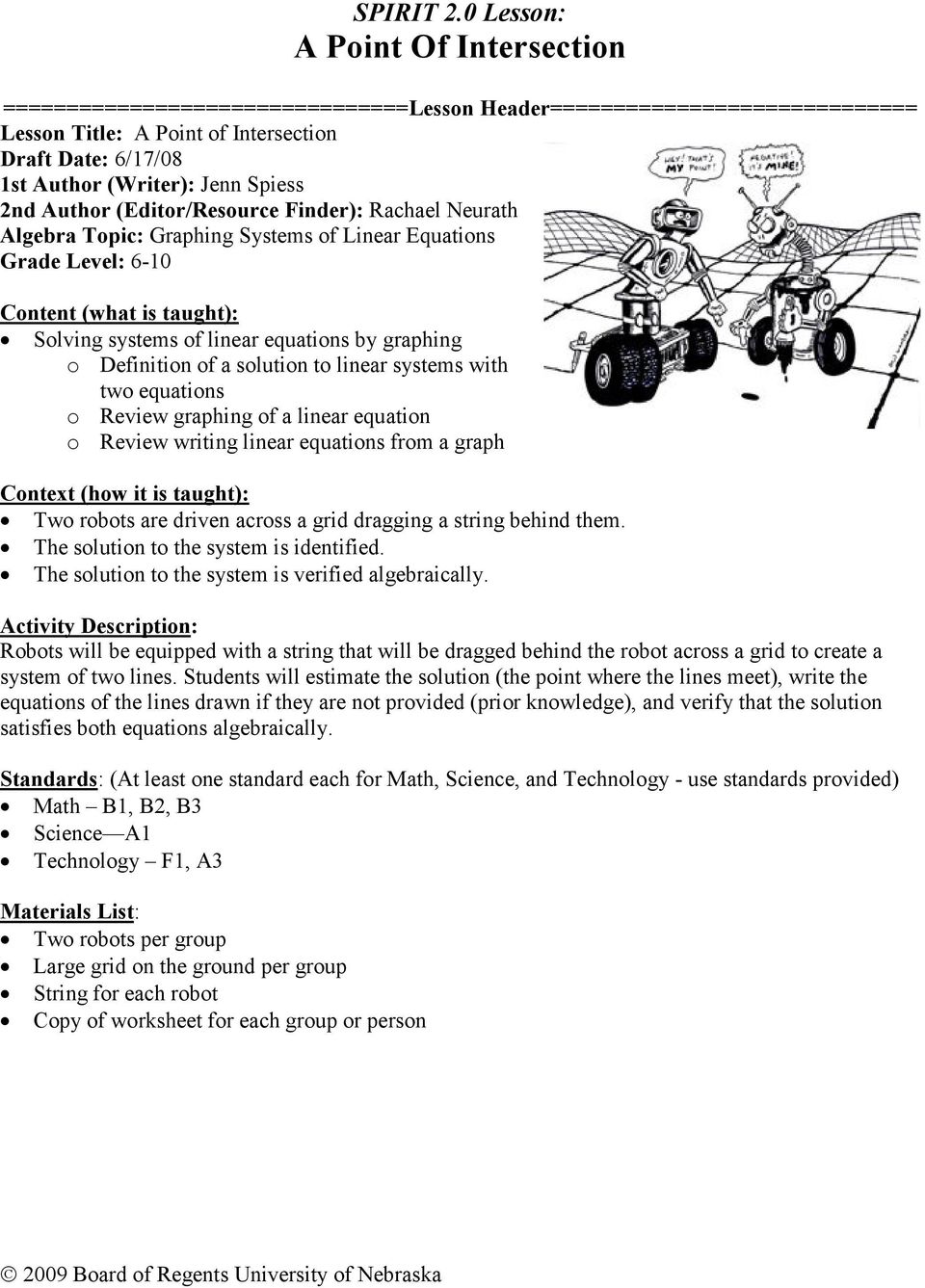
1 SPIRIT 2.0 Lesson: A Point Of Intersection ================================Lesson Header============================= Lesson Title: A Point of Intersection Draft Date: 6/17/08 1st Author (Writer): Jenn Spiess 2nd Author (Editor/Resource Finder): Rachael Neurath Algebra Topic: Graphing Systems of Linear Equations Grade Level: 6-10 Content (what is taught): Solving systems of linear equations by graphing o Definition of a solution to linear systems with two equations o Review graphing of a linear equation o Review writing linear equations from a graph Context (how it is taught): Two robots are driven across a grid dragging a string behind them. The solution to the system is identified. The solution to the system is verified algebraically. Activity Description: Robots will be equipped with a string that will be dragged behind the robot across a grid to create a system of two lines. Students will estimate the solution (the point where the lines meet), write the equations of the lines drawn if they are not provided (prior knowledge), and verify that the solution satisfies both equations algebraically. Standards: (At least one standard each for Math, Science, and Technology - use standards provided) Math B1, B2, B3 Science A1 Technology F1, A3 Materials List: Two robots per group Large grid on the ground per group String for each robot Copy of worksheet for each group or person
2 ASKING Questions Discuss the concept of a solution to a system of two linear equations graphically. When 2 lines are graphed on the same coordinate plane, one of 3 things happens. 1. The lines may be parallel. 2. The lines may intersect at a point. 3. The lines might be the same line. Lines are Parallel-0 Lines Intersect-1 solution Same Line-many solutions Using two rulers to represent lines, hold them up to show two intersecting lines Ask questions to help students identify the number of solutions possible in a system (one, none, or many) This lesson focuses only on systems with one solution. Questions Possible Answers 1. A system of equations is made up of two or more equations 1. Yes. let s start with just two for now. Holding up two rulers that cross forming an X: Do these two lines meet? 2. If these lines were on a grid, the spot where they meet would be 2. A point. called what? (May need to prod some here Is it a line?) 3. What do we know about points? 3. There s an x and a y value. 4. Is a point always made up of natural numbers like (2, 3)? 4. No. 5. What could it look like then? 5. Sample (2.75, 3.1). Answers may vary. 6. Ask students to identify the solution to various systems. Use 6. Answers will vary. either resource listed. Resources: See for sample real-life scenarios. Explore learning Gizmo

3 EXPLORING Concepts (A Point of Intersection) Students explore that a single point satisfies two equations, and is therefore the solution to the system of equations. Groups use robots to draw system. Rest of class identifies the solution. Split class into two groups so that each group may verify the solution to one of the two equations. Rotate and repeat. Activity: 1. Have a group of three or four students draw specific equations/lines on a large grid on the floor with the robots dragging the string behind and have a student stand at the solution. 2. The rest of the class should then identify the solution/point. Split this larger group in two, assign each group a different equation, and have each group determine algebraically whether the solution works for their assigned equation. Students should discover that the point works for either equation. 3. Rotate groups so that each group has an opportunity to be out of their seats to create the graph once and to verify algebraically the solutions multiple times. Another station may be added where students use the Classzone animation Chapter 7: Solve by Graphing to see these concepts in another format. Resources: Explorelearning Gizmo

4 INSTRUCTING Concepts (A Point of Intersection) Linear Functions Putting Linear Functions in Recognizable terms: Linear functions are equations that generate a [straight] line when ordered pairs that satisfy the equation are plotted on a rectangular coordinate system. Putting Linear Functions in Conceptual terms: A linear equation represents the relationship between two variables, so does a straight line on a rectangular coordinate system. In fact, we can make four statements, that when taken together, show that the plotted straight line and the linear equation each carry exactly the same amount of information about the relationship of the two variables: 1. Any ordered pair that satisfies the equation would represent a point on the plotted straight line. 2. Any point on the plotted straight line will have coordinates whose ordered pair will satisfy the linear equation. 3. Any ordered pair that does not satisfy the equation would represent a point, which is not on the plotted straight line. 4. Any point that is not on the plotted straight line will have coordinates whose ordered pair will not satisfy the linear equation. Putting Linear Functions in Mathematical terms: A linear function is an equation representing the variable y as a function of the variable x that can be written as: y = f(x) = mx + b, where m and b are any real numbers. This form is called the slope-intercept form of the linear equation. This form can be rearranged into another form (the Standard Form) of a straight line: Ax + By = C, where A, B, and C are all Real numbers. Putting Linear Functions in Process terms: Thus, for any linear equation, if you know either the x value or the y value, you can compute the unknown value since there are an infinite number of unique ordered pairs that represent solutions to (or that satisfy) the linear function. We often use x-y (ordered pair) tables to simplify this process. Putting Linear Functions in Applicable terms: Place a piece of masking tape in a straight line on your axes on the floor (plane). The tape may be oriented in any random direction. Drive the robot from the origin along the abscissa for a random amount of time. This value represents the x coordinate of an ordered pair that will satisfy the equation representing the straight line. Turn the robot 90 degrees toward the tapeline. Drive the robot to the tapeline. Turn the robot 90 degrees toward the ordinate and drive to the vertical axis. This value represents the y coordinate of the ordered pair that satisfies the equation of the straight tapeline. Now you have identified (by your ordered pair) one of many possible solutions to the equation representing the straight line.

5 ORGANIZING Learning (A Point of Intersection) Groups of students will use the robots to draw the two lines of a system, determine its solution, and verify the solution in both equations. Draw given lines with robots. Record the lines on a worksheet. Identify the solution. Verify algebraically the solution in both equations. Validate graphs and solutions using graphing calculators. Activity: A worksheet will be provided requiring students to graph two different lines using the robots and to record their graphs. The worksheet will also ask them to write the equations of both lines, estimate the solution to the system, and verify the solution satisfies both equations.

6 UNDERSTANDING Learning (A Point of Intersection) Students write a description of how to solve a system of equations by graphing. Formative assessment of solving a system of equations by graphing Summative assessment of solving a system of equations by graphing Activity: Formative Assessment As students are engaged in learning activities ask yourself or the students these types of questions: 1. Were students able to graph both lines successfully? 2. Were students able to estimate the solution successfully? 3. Can students explain how to verify a solution algebraically? Summative Assessment A. In a written or verbal interview with the teacher, students will describe how to graph each line in a system and determine the solution to the system. Students should also describe whether the solution is correct algebraically. B. Ask students to write their own word problem(s) using graphing systems to solve a problem. C. Students should be able to answer the following quiz questions: 1. The solution to which system is shown by the following graph? (Answer: C) A. B. C. D. 2. Destiny is renting a bicycle for a day. She has two options for renting the bicycle as shown in the following chart. Rent Option Deposit Price Per Hour Equation A $10 $4 (C = 4x + 10) B $15 $2 (C = 2x + 15) a. Write an equation that shows the total cost for each option. b. When will the two options cost the same amount? (2.5 hours) c. If Destiny plans to ride for two hours, which is the best option? (A) d. If Destiny plans to ride for five hours, which is the best option? (B)

Linear Equations. Find the domain and the range of the following set. {(4,5), (7,8), (-1,3), (3,3), (2,-3)}
 Linear Equations Domain and Range Domain refers to the set of possible values of the x-component of a point in the form (x,y). Range refers to the set of possible values of the y-component of a point in
The Point-Slope Form
 7. The Point-Slope Form 7. OBJECTIVES 1. Given a point and a slope, find the graph of a line. Given a point and the slope, find the equation of a line. Given two points, find the equation of a line y Slope
Solving Equations Involving Parallel and Perpendicular Lines Examples
 Solving Equations Involving Parallel and Perpendicular Lines Examples. The graphs of y = x, y = x, and y = x + are lines that have the same slope. They are parallel lines. Definition of Parallel Lines
High School Algebra Reasoning with Equations and Inequalities Solve systems of equations.
 Performance Assessment Task Graphs (2006) Grade 9 This task challenges a student to use knowledge of graphs and their significant features to identify the linear equations for various lines. A student
What does the number m in y = mx + b measure? To find out, suppose (x 1, y 1 ) and (x 2, y 2 ) are two points on the graph of y = mx + b.
 PRIMARY CONTENT MODULE Algebra - Linear Equations & Inequalities T-37/H-37 What does the number m in y = mx + b measure? To find out, suppose (x 1, y 1 ) and (x 2, y 2 ) are two points on the graph of
EQUATIONS and INEQUALITIES
 EQUATIONS and INEQUALITIES Linear Equations and Slope 1. Slope a. Calculate the slope of a line given two points b. Calculate the slope of a line parallel to a given line. c. Calculate the slope of a line
A synonym is a word that has the same or almost the same definition of
 Slope-Intercept Form Determining the Rate of Change and y-intercept Learning Goals In this lesson, you will: Graph lines using the slope and y-intercept. Calculate the y-intercept of a line when given
CHAPTER 1 Linear Equations
 CHAPTER 1 Linear Equations 1.1. Lines The rectangular coordinate system is also called the Cartesian plane. It is formed by two real number lines, the horizontal axis or x-axis, and the vertical axis or
Solving Systems of Linear Equations Graphing
 Solving Systems of Linear Equations Graphing Outcome (learning objective) Students will accurately solve a system of equations by graphing. Student/Class Goal Students thinking about continuing their academic
Basic Understandings
 Activity: TEKS: Exploring Transformations Basic understandings. (5) Tools for geometric thinking. Techniques for working with spatial figures and their properties are essential to understanding underlying
Graphing Linear Equations
 Graphing Linear Equations I. Graphing Linear Equations a. The graphs of first degree (linear) equations will always be straight lines. b. Graphs of lines can have Positive Slope Negative Slope Zero slope
NCTM Content Standard/National Science Education Standard:
 Title: Do These Systems Meet Your Expectations Brief Overview: This concept development unit is designed to develop the topic of systems of equations. Students will be able to graph systems of equations
Lines, Lines, Lines!!! Slope-Intercept Form ~ Lesson Plan
 Lines, Lines, Lines!!! Slope-Intercept Form ~ Lesson Plan I. Topic: Slope-Intercept Form II. III. Goals and Objectives: A. The student will write an equation of a line given information about its graph.
Slope-Intercept Equation. Example
 1.4 Equations of Lines and Modeling Find the slope and the y intercept of a line given the equation y = mx + b, or f(x) = mx + b. Graph a linear equation using the slope and the y-intercept. Determine
Chapter 9. Systems of Linear Equations
 Chapter 9. Systems of Linear Equations 9.1. Solve Systems of Linear Equations by Graphing KYOTE Standards: CR 21; CA 13 In this section we discuss how to solve systems of two linear equations in two variables
GRADE 8 MATH: TALK AND TEXT PLANS
 GRADE 8 MATH: TALK AND TEXT PLANS UNIT OVERVIEW This packet contains a curriculum-embedded Common Core standards aligned task and instructional supports. The task is embedded in a three week unit on systems
(Least Squares Investigation)
 (Least Squares Investigation) o Open a new sketch. Select Preferences under the Edit menu. Select the Text Tab at the top. Uncheck both boxes under the title Show Labels Automatically o Create two points
Write the Equation of the Line Review
 Connecting Algebra 1 to Advanced Placement* Mathematics A Resource and Strategy Guide Objective: Students will be assessed on their ability to write the equation of a line in multiple methods. Connections
Mathematics Curriculum Guide Precalculus 2015-16. Page 1 of 12
 Mathematics Curriculum Guide Precalculus 2015-16 Page 1 of 12 Paramount Unified School District High School Math Curriculum Guides 2015 16 In 2015 16, PUSD will continue to implement the Standards by providing
ALGEBRA. sequence, term, nth term, consecutive, rule, relationship, generate, predict, continue increase, decrease finite, infinite
 ALGEBRA Pupils should be taught to: Generate and describe sequences As outcomes, Year 7 pupils should, for example: Use, read and write, spelling correctly: sequence, term, nth term, consecutive, rule,
Acquisition Lesson Plan for the Concept, Topic or Skill---Not for the Day
 Acquisition Lesson Plan Concept: Linear Systems Author Name(s): High-School Delaware Math Cadre Committee Grade: Ninth Grade Time Frame: Two 45 minute periods Pre-requisite(s): Write algebraic expressions
Students will use various media (computer, graphing calculator, paper and pencil) to graph/sketch linear equations.
 Title: Lines, Lines, Everywhere!! A discovery/exploration lesson investigating equations of the form y = mx + b to see how the values of b and m affects the graph. Link to Outcomes: Communication/ Cooperation
with functions, expressions and equations which follow in units 3 and 4.
 Grade 8 Overview View unit yearlong overview here The unit design was created in line with the areas of focus for grade 8 Mathematics as identified by the Common Core State Standards and the PARCC Model
HOW MUCH WILL I SPEND ON GAS?
 HOW MUCH WILL I SPEND ON GAS? Outcome (lesson objective) The students will use the current and future price of gasoline to construct T-charts, write algebraic equations, and plot the equations on a graph.
1.3 LINEAR EQUATIONS IN TWO VARIABLES. Copyright Cengage Learning. All rights reserved.
 1.3 LINEAR EQUATIONS IN TWO VARIABLES Copyright Cengage Learning. All rights reserved. What You Should Learn Use slope to graph linear equations in two variables. Find the slope of a line given two points
Volumes of Revolution
 Mathematics Volumes of Revolution About this Lesson This lesson provides students with a physical method to visualize -dimensional solids and a specific procedure to sketch a solid of revolution. Students
EdExcel Decision Mathematics 1
 EdExcel Decision Mathematics 1 Linear Programming Section 1: Formulating and solving graphically Notes and Examples These notes contain subsections on: Formulating LP problems Solving LP problems Minimisation
DRAFT. New York State Testing Program Grade 8 Common Core Mathematics Test. Released Questions with Annotations
 DRAFT New York State Testing Program Grade 8 Common Core Mathematics Test Released Questions with Annotations August 2014 Developed and published under contract with the New York State Education Department
Lesson 4: Solving and Graphing Linear Equations
 Lesson 4: Solving and Graphing Linear Equations Selected Content Standards Benchmarks Addressed: A-2-M Modeling and developing methods for solving equations and inequalities (e.g., using charts, graphs,
Perimeter, Area and Volume What Do Units Tell You About What Is Being Measured? Overview
 Perimeter, Area and Volume What Do Units Tell You About What Is Being Measured? Overview Summary of Lessons: This set of lessons was designed to develop conceptual understanding of the unique attributes
A Concrete Introduction. to the Abstract Concepts. of Integers and Algebra using Algebra Tiles
 A Concrete Introduction to the Abstract Concepts of Integers and Algebra using Algebra Tiles Table of Contents Introduction... 1 page Integers 1: Introduction to Integers... 3 2: Working with Algebra Tiles...
Let s explore the content and skills assessed by Heart of Algebra questions.
 Chapter 9 Heart of Algebra Heart of Algebra focuses on the mastery of linear equations, systems of linear equations, and linear functions. The ability to analyze and create linear equations, inequalities,
Systems of Linear Equations in Three Variables
 5.3 Systems of Linear Equations in Three Variables 5.3 OBJECTIVES 1. Find ordered triples associated with three equations 2. Solve a system by the addition method 3. Interpret a solution graphically 4.
Graphs of Proportional Relationships
 Graphs of Proportional Relationships Student Probe Susan runs three laps at the track in 12 minutes. A graph of this proportional relationship is shown below. Explain the meaning of points A (0,0), B (1,4),
Microsoft Mathematics for Educators:
 Microsoft Mathematics for Educators: Familiarize yourself with the interface When you first open Microsoft Mathematics, you ll see the following elements displayed: 1. The Calculator Pad which includes
Algebra 2 PreAP. Name Period
 Algebra 2 PreAP Name Period IMPORTANT INSTRUCTIONS FOR STUDENTS!!! We understand that students come to Algebra II with different strengths and needs. For this reason, students have options for completing
Designer: Nathan Kimball. Stage 1 Desired Results
 Interpolation Subject: Science, math Grade: 6-8 Time: 4 minutes Topic: Reading Graphs Designer: Nathan Kimball Stage 1 Desired Results Lesson Overview: In this activity students work with the direct linear
Factoring Quadratic Trinomials
 Factoring Quadratic Trinomials Student Probe Factor x x 3 10. Answer: x 5 x Lesson Description This lesson uses the area model of multiplication to factor quadratic trinomials. Part 1 of the lesson consists
Unit 7 Quadratic Relations of the Form y = ax 2 + bx + c
 Unit 7 Quadratic Relations of the Form y = ax 2 + bx + c Lesson Outline BIG PICTURE Students will: manipulate algebraic expressions, as needed to understand quadratic relations; identify characteristics
A floor is a flat surface that extends in all directions. So, it models a plane. 1-1 Points, Lines, and Planes
 1-1 Points, Lines, and Planes Use the figure to name each of the following. 1. a line containing point X 5. a floor A floor is a flat surface that extends in all directions. So, it models a plane. Draw
Algebra I. In this technological age, mathematics is more important than ever. When students
 In this technological age, mathematics is more important than ever. When students leave school, they are more and more likely to use mathematics in their work and everyday lives operating computer equipment,
Week 1: Functions and Equations
 Week 1: Functions and Equations Goals: Review functions Introduce modeling using linear and quadratic functions Solving equations and systems Suggested Textbook Readings: Chapter 2: 2.1-2.2, and Chapter
Georgia Standards of Excellence Curriculum Map. Mathematics. GSE 8 th Grade
 Georgia Standards of Excellence Curriculum Map Mathematics GSE 8 th Grade These materials are for nonprofit educational purposes only. Any other use may constitute copyright infringement. GSE Eighth Grade
3.1 Solving Systems Using Tables and Graphs
 Algebra 2 Chapter 3 3.1 Solve Systems Using Tables & Graphs 3.1 Solving Systems Using Tables and Graphs A solution to a system of linear equations is an that makes all of the equations. To solve a system
Functions. MATH 160, Precalculus. J. Robert Buchanan. Fall 2011. Department of Mathematics. J. Robert Buchanan Functions
 Functions MATH 160, Precalculus J. Robert Buchanan Department of Mathematics Fall 2011 Objectives In this lesson we will learn to: determine whether relations between variables are functions, use function
Subject: Math Grade Level: 5 Topic: The Metric System Time Allotment: 45 minutes Teaching Date: Day 1
 Subject: Math Grade Level: 5 Topic: The Metric System Time Allotment: 45 minutes Teaching Date: Day 1 I. (A) Goal(s): For student to gain conceptual understanding of the metric system and how to convert
Section 1.1 Linear Equations: Slope and Equations of Lines
 Section. Linear Equations: Slope and Equations of Lines Slope The measure of the steepness of a line is called the slope of the line. It is the amount of change in y, the rise, divided by the amount of
How To Factor Quadratic Trinomials
 Factoring Quadratic Trinomials Student Probe Factor Answer: Lesson Description This lesson uses the area model of multiplication to factor quadratic trinomials Part 1 of the lesson consists of circle puzzles
Slope-Intercept Form of a Linear Equation Examples
 Slope-Intercept Form of a Linear Equation Examples. In the figure at the right, AB passes through points A(0, b) and B(x, y). Notice that b is the y-intercept of AB. Suppose you want to find an equation
Linear Equations. 5- Day Lesson Plan Unit: Linear Equations Grade Level: Grade 9 Time Span: 50 minute class periods By: Richard Weber
 Linear Equations 5- Day Lesson Plan Unit: Linear Equations Grade Level: Grade 9 Time Span: 50 minute class periods By: Richard Weber Tools: Geometer s Sketchpad Software Overhead projector with TI- 83
5 Systems of Equations
 Systems of Equations Concepts: Solutions to Systems of Equations-Graphically and Algebraically Solving Systems - Substitution Method Solving Systems - Elimination Method Using -Dimensional Graphs to Approximate
The Graphical Method: An Example
 The Graphical Method: An Example Consider the following linear program: Maximize 4x 1 +3x 2 Subject to: 2x 1 +3x 2 6 (1) 3x 1 +2x 2 3 (2) 2x 2 5 (3) 2x 1 +x 2 4 (4) x 1, x 2 0, where, for ease of reference,
4.3-4.4 Systems of Equations
 4.3-4.4 Systems of Equations A linear equation in 2 variables is an equation of the form ax + by = c. A linear equation in 3 variables is an equation of the form ax + by + cz = d. To solve a system of
Graphs of Proportional Relationships
 Graphs of Proportional Relationships Student Probe Susan runs three laps at the track in 12 minutes. A graph of this proportional relationship is shown below. Explain the meaning of points A (0,0), B (1,),
Lecture 1: Systems of Linear Equations
 MTH Elementary Matrix Algebra Professor Chao Huang Department of Mathematics and Statistics Wright State University Lecture 1 Systems of Linear Equations ² Systems of two linear equations with two variables
Review of Fundamental Mathematics
 Review of Fundamental Mathematics As explained in the Preface and in Chapter 1 of your textbook, managerial economics applies microeconomic theory to business decision making. The decision-making tools
Assessment Anchors and Eligible Content
 M07.A-N The Number System M07.A-N.1 M07.A-N.1.1 DESCRIPTOR Assessment Anchors and Eligible Content Aligned to the Grade 7 Pennsylvania Core Standards Reporting Category Apply and extend previous understandings
EE6-5 Solving Equations with Balances Pages 77 78
 EE6-5 Solving Equations with Balances Pages 77 78 STANDARDS 6.EE.B.5, 6.EE.B.6 Goals Students will use pictures to model and solve equations. Vocabulary balance equation expression sides (of an equation)
Math 113 Review for Exam I
 Math 113 Review for Exam I Section 1.1 Cartesian Coordinate System, Slope, & Equation of a Line (1.) Rectangular or Cartesian Coordinate System You should be able to label the quadrants in the rectangular
Title ID Number Sequence and Duration Age Level Essential Question Learning Objectives. Lead In
 Title ID Number Sequence and Duration Age Level Essential Question Learning Objectives Lesson Activity Barbie Bungee (75-80 minutes) MS-M-A1 Lead In (15-20 minutes) Activity (45-50 minutes) Closure (10
Temperature Scales. The metric system that we are now using includes a unit that is specific for the representation of measured temperatures.
 Temperature Scales INTRODUCTION The metric system that we are now using includes a unit that is specific for the representation of measured temperatures. The unit of temperature in the metric system is
Welcome to Harcourt Mega Math: The Number Games
 Welcome to Harcourt Mega Math: The Number Games Harcourt Mega Math In The Number Games, students take on a math challenge in a lively insect stadium. Introduced by our host Penny and a number of sporting
x x y y Then, my slope is =. Notice, if we use the slope formula, we ll get the same thing: m =
 Slope and Lines The slope of a line is a ratio that measures the incline of the line. As a result, the smaller the incline, the closer the slope is to zero and the steeper the incline, the farther the
Common Core Unit Summary Grades 6 to 8
 Common Core Unit Summary Grades 6 to 8 Grade 8: Unit 1: Congruence and Similarity- 8G1-8G5 rotations reflections and translations,( RRT=congruence) understand congruence of 2 d figures after RRT Dilations
Systems of Equations Involving Circles and Lines
 Name: Systems of Equations Involving Circles and Lines Date: In this lesson, we will be solving two new types of Systems of Equations. Systems of Equations Involving a Circle and a Line Solving a system
Pennsylvania System of School Assessment
 Pennsylvania System of School Assessment The Assessment Anchors, as defined by the Eligible Content, are organized into cohesive blueprints, each structured with a common labeling system that can be read
Discovering Math: Exploring Geometry Teacher s Guide
 Teacher s Guide Grade Level: 6 8 Curriculum Focus: Mathematics Lesson Duration: Three class periods Program Description Discovering Math: Exploring Geometry From methods of geometric construction and threedimensional
MA.8.A.1.2 Interpret the slope and the x- and y-intercepts when graphing a linear equation for a real-world problem. Constant Rate of Change/Slope
 MA.8.A.1.2 Interpret the slope and the x- and y-intercepts when graphing a linear equation for a real-world problem Constant Rate of Change/Slope In a Table Relationships that have straight-lined graphs
Chapter 4. Applying Linear Functions
 Chapter 4 Applying Linear Functions Many situations in real life can be represented mathematically. You can write equations, create tables, or even construct graphs that display real-life data. Part of
Solving Systems of Linear Equations Substitutions
 Solving Systems of Linear Equations Substitutions Outcome (lesson objective) Students will accurately solve a system of equations algebraically using substitution. Student/Class Goal Students thinking
Acquisition Lesson Planning Form Key Standards addressed in this Lesson: MM2A2c Time allotted for this Lesson: 5 Hours
 Acquisition Lesson Planning Form Key Standards addressed in this Lesson: MM2A2c Time allotted for this Lesson: 5 Hours Essential Question: LESSON 2 Absolute Value Equations and Inequalities How do you
Make sure you look at the reminders or examples before each set of problems to jog your memory! Solve
 Name Date Make sure you look at the reminders or examples before each set of problems to jog your memory! I. Solving Linear Equations 1. Eliminate parentheses. Combine like terms 3. Eliminate terms by
Overview. Observations. Activities. Chapter 3: Linear Functions Linear Functions: Slope-Intercept Form
 Name Date Linear Functions: Slope-Intercept Form Student Worksheet Overview The Overview introduces the topics covered in Observations and Activities. Scroll through the Overview using " (! to review,
LINEAR EQUATIONS IN TWO VARIABLES
 66 MATHEMATICS CHAPTER 4 LINEAR EQUATIONS IN TWO VARIABLES The principal use of the Analytic Art is to bring Mathematical Problems to Equations and to exhibit those Equations in the most simple terms that
What are the place values to the left of the decimal point and their associated powers of ten?
 The verbal answers to all of the following questions should be memorized before completion of algebra. Answers that are not memorized will hinder your ability to succeed in geometry and algebra. (Everything
Activity 6 Graphing Linear Equations
 Activity 6 Graphing Linear Equations TEACHER NOTES Topic Area: Algebra NCTM Standard: Represent and analyze mathematical situations and structures using algebraic symbols Objective: The student will be
CRLS Mathematics Department Algebra I Curriculum Map/Pacing Guide
 Curriculum Map/Pacing Guide page 1 of 14 Quarter I start (CP & HN) 170 96 Unit 1: Number Sense and Operations 24 11 Totals Always Include 2 blocks for Review & Test Operating with Real Numbers: How are
Math 1314 Lesson 8 Business Applications: Break Even Analysis, Equilibrium Quantity/Price
 Math 1314 Lesson 8 Business Applications: Break Even Analysis, Equilibrium Quantity/Price Three functions of importance in business are cost functions, revenue functions and profit functions. Cost functions
Polynomial and Rational Functions
 Polynomial and Rational Functions Quadratic Functions Overview of Objectives, students should be able to: 1. Recognize the characteristics of parabolas. 2. Find the intercepts a. x intercepts by solving
How To Understand And Solve Algebraic Equations
 College Algebra Course Text Barnett, Raymond A., Michael R. Ziegler, and Karl E. Byleen. College Algebra, 8th edition, McGraw-Hill, 2008, ISBN: 978-0-07-286738-1 Course Description This course provides
Algebraic expressions are a combination of numbers and variables. Here are examples of some basic algebraic expressions.
 Page 1 of 13 Review of Linear Expressions and Equations Skills involving linear equations can be divided into the following groups: Simplifying algebraic expressions. Linear expressions. Solving linear
Systems of Linear Equations: Two Variables
 OpenStax-CNX module: m49420 1 Systems of Linear Equations: Two Variables OpenStax College This work is produced by OpenStax-CNX and licensed under the Creative Commons Attribution License 4.0 In this section,
CGE 3b 2 What s My Ratio? The Investigate the three primary trigonometric ratios for right-angled MT2.01 triangles. Summarize investigations.
 Unit 2 Trigonometry Lesson Outline Grade 10 Applied BIG PICTURE Students will: investigate the relationships involved in right-angled triangles to the primary trigonometric ratios, connecting the ratios
MATH 60 NOTEBOOK CERTIFICATIONS
 MATH 60 NOTEBOOK CERTIFICATIONS Chapter #1: Integers and Real Numbers 1.1a 1.1b 1.2 1.3 1.4 1.8 Chapter #2: Algebraic Expressions, Linear Equations, and Applications 2.1a 2.1b 2.1c 2.2 2.3a 2.3b 2.4 2.5
Part 1: Background - Graphing
 Department of Physics and Geology Graphing Astronomy 1401 Equipment Needed Qty Computer with Data Studio Software 1 1.1 Graphing Part 1: Background - Graphing In science it is very important to find and
IV. ALGEBRAIC CONCEPTS
 IV. ALGEBRAIC CONCEPTS Algebra is the language of mathematics. Much of the observable world can be characterized as having patterned regularity where a change in one quantity results in changes in other
Hands-On Math Algebra
 Hands-On Math Algebra by Pam Meader and Judy Storer illustrated by Julie Mazur Contents To the Teacher... v Topic: Ratio and Proportion 1. Candy Promotion... 1 2. Estimating Wildlife Populations... 6 3.
SQUARES AND SQUARE ROOTS
 1. Squares and Square Roots SQUARES AND SQUARE ROOTS In this lesson, students link the geometric concepts of side length and area of a square to the algebra concepts of squares and square roots of numbers.
Aim: How do we find the slope of a line? Warm Up: Go over test. A. Slope -
 Aim: How do we find the slope of a line? Warm Up: Go over test A. Slope - Plot the points and draw a line through the given points. Find the slope of the line.. A(-5,4) and B(4,-3) 2. A(4,3) and B(4,-6)
1 Determine whether an. 2 Solve systems of linear. 3 Solve systems of linear. 4 Solve systems of linear. 5 Select the most efficient
 Section 3.1 Systems of Linear Equations in Two Variables 163 SECTION 3.1 SYSTEMS OF LINEAR EQUATIONS IN TWO VARIABLES Objectives 1 Determine whether an ordered pair is a solution of a system of linear
Geometry 1. Unit 3: Perpendicular and Parallel Lines
 Geometry 1 Unit 3: Perpendicular and Parallel Lines Geometry 1 Unit 3 3.1 Lines and Angles Lines and Angles Parallel Lines Parallel lines are lines that are coplanar and do not intersect. Some examples
3. Solve the equation containing only one variable for that variable.
 Question : How do you solve a system of linear equations? There are two basic strategies for solving a system of two linear equations and two variables. In each strategy, one of the variables is eliminated
1 Functions, Graphs and Limits
 1 Functions, Graphs and Limits 1.1 The Cartesian Plane In this course we will be dealing a lot with the Cartesian plane (also called the xy-plane), so this section should serve as a review of it and its
3.2. Solving quadratic equations. Introduction. Prerequisites. Learning Outcomes. Learning Style
 Solving quadratic equations 3.2 Introduction A quadratic equation is one which can be written in the form ax 2 + bx + c = 0 where a, b and c are numbers and x is the unknown whose value(s) we wish to find.
Quickstart for Desktop Version
 Quickstart for Desktop Version What is GeoGebra? Dynamic Mathematics Software in one easy-to-use package For learning and teaching at all levels of education Joins interactive 2D and 3D geometry, algebra,
Determine If An Equation Represents a Function
 Question : What is a linear function? The term linear function consists of two parts: linear and function. To understand what these terms mean together, we must first understand what a function is. The
Geometry and Measurement
 The student will be able to: Geometry and Measurement 1. Demonstrate an understanding of the principles of geometry and measurement and operations using measurements Use the US system of measurement for
Section 1.5 Linear Models
 Section 1.5 Linear Models Some real-life problems can be modeled using linear equations. Now that we know how to find the slope of a line, the equation of a line, and the point of intersection of two lines,
Algebra I Notes Relations and Functions Unit 03a
 OBJECTIVES: F.IF.A.1 Understand the concept of a function and use function notation. Understand that a function from one set (called the domain) to another set (called the range) assigns to each element
Prentice Hall Connected Mathematics 2, 7th Grade Units 2009
 Prentice Hall Connected Mathematics 2, 7th Grade Units 2009 Grade 7 C O R R E L A T E D T O from March 2009 Grade 7 Problem Solving Build new mathematical knowledge through problem solving. Solve problems