
Math 113 Review for Exam I
|
|
|
- Teresa Tate
- 9 years ago
- Views:
Transcription
1 Math 113 Review for Exam I Section 1.1 Cartesian Coordinate System, Slope, & Equation of a Line (1.) Rectangular or Cartesian Coordinate System You should be able to label the quadrants in the rectangular or Cartesian coordinate system. You should also be able to graph a given point. The origin is defined as the point (0,0). Sample Problems: Label the quadrants, x-axis, & y-axis in the graph shown below and plot the points (3,1) (-2,2) (-1,-1) (2,4) & (0,0). (2.) General Equation of a Line Ax + By = C x-intercept Is the point on a line that intercepts (crosses) the x-axis. To find the x- intercept let y = 0 and solve for x. y-intercept Is the point on a line that intercepts (crosses) the y-axis. To find the y- intercept let x=0 and solve for y. Example: Given the line 5x + 2y = 10 find the x-intercept and the y-intercept. x-intercept: 5x + 2 (0) = 10 5x = 10 x=2 x-intercept = (2,0) y-intercept: 5(0) + 2y = 10 2y = 10 y=5 y-intercept = (0,5) 1

2 Once you have defined two points on a line you can graph the line. Remember: The x-intercept and y-intercept are points on a line and all points should be defined by both their x and y values. Sample Problems: 2.1 Find the x-intercept and y-intercept for the following lines: a. 3x +5y = 30 b. 2x + 4y = 16 c. 7x + 2y = 14 d. 3x + 2y = 8 Now graph and label the line in 2.1.d using the 2 points you defined. 2.2 Complete the table of values for the given lines: 3x + 2y = 24 x y 0 3 2x y =8 x y 0 6 (3.) Slope of a Line The slope of a line is defined as the average rate of change of y with respect to x. Rise Δy y y Slope = m = = = Run Δ x x x

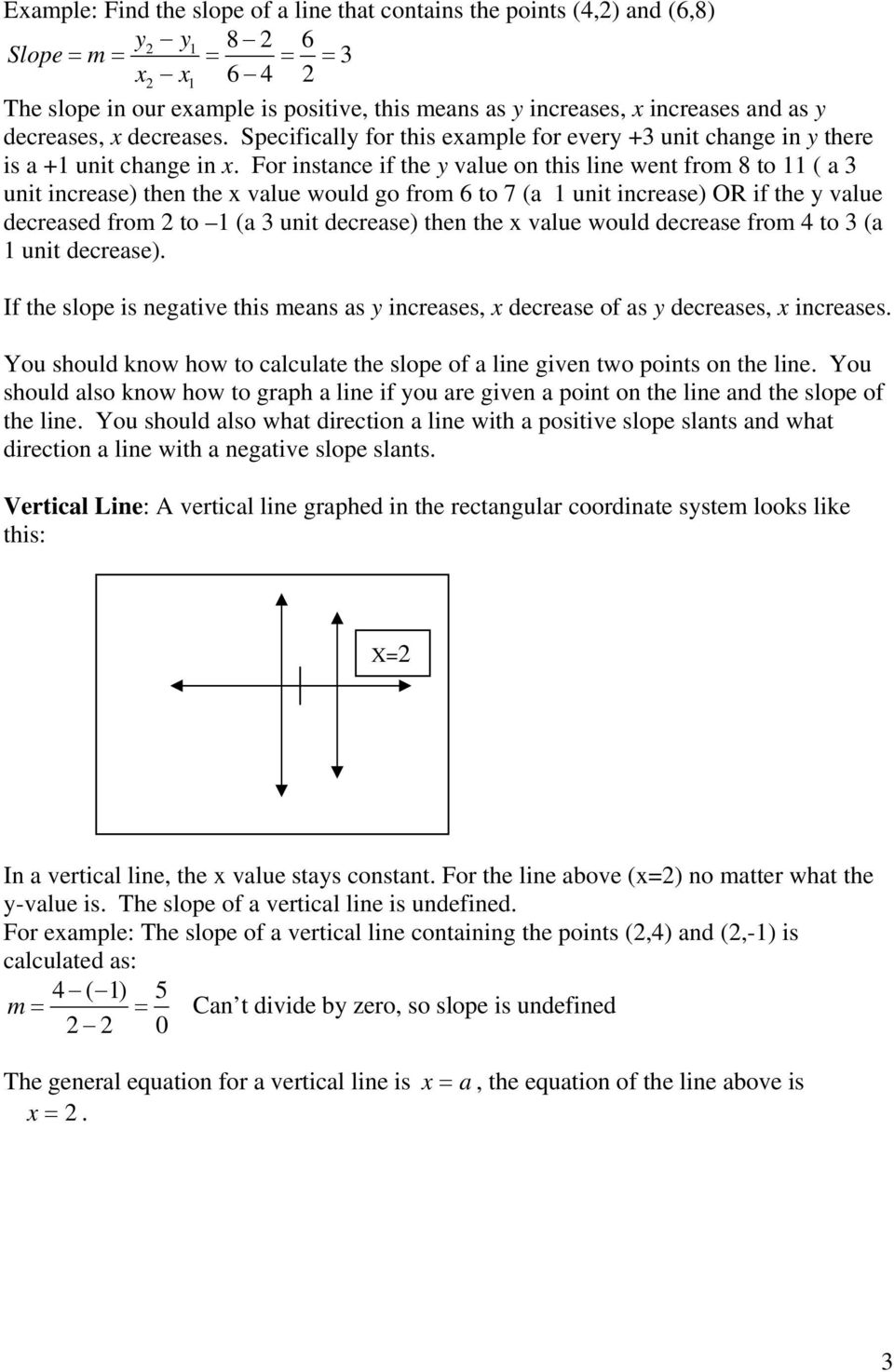
3 Example: Find the slope of a line that contains the points (4,2) and (6,8) y2 y Slope = m = = = = 3 x 2 x The slope in our example is positive, this means as y increases, x increases and as y decreases, x decreases. Specifically for this example for every +3 unit change in y there is a +1 unit change in x. For instance if the y value on this line went from 8 to 11 ( a 3 unit increase) then the x value would go from 6 to 7 (a 1 unit increase) OR if the y value decreased from 2 to 1 (a 3 unit decrease) then the x value would decrease from 4 to 3 (a 1 unit decrease). If the slope is negative this means as y increases, x decrease of as y decreases, x increases. You should know how to calculate the slope of a line given two points on the line. You should also know how to graph a line if you are given a point on the line and the slope of the line. You should also what direction a line with a positive slope slants and what direction a line with a negative slope slants. Vertical Line: A vertical line graphed in the rectangular coordinate system looks like this: X=2 In a vertical line, the x value stays constant. For the line above (x=2) no matter what the y-value is. The slope of a vertical line is undefined. For example: The slope of a vertical line containing the points (2,4) and (2,-1) is calculated as: 4 ( 1) 5 m = = Can t divide by zero, so slope is undefined The general equation for a vertical line is x = 2. x = a, the equation of the line above is 3
4 Horizontal Line: A horizontal line graphed in the rectangular coordinate system looks like this: Y=3 In a horizontal line, the y value stays constant. For the line above (y=3) no matter what the x-value is. The slope of a horizontal line is ZERO. For example: The slope of a horizontal line containing the points (2,3) & (-2,3) is calculated as: m = = = 0 2 ( 2) 4 The general equation for a horizontal line is y = 2. y = b, the equation of the line above is You should know how to define the equation of a vertical or horizontal line either (1) given that the line is horizontal or vertical and a point on the line or (2) given the slope of the line (undefined or 0) and a point on that line. Sample Problems: 3.1 Find the slope of the line containing the points (2,1) & (4,6). Use the slope of this line to find another point on the line and graph the line. LABEL YOUR POINTS. 3.2 Find the slope of the line containing the points (4,2) & (7,8). 4

5 3.3 Find the slope of the line containing the points (2,3) & (2,7). What type of line is this? What is the equation of this line? 3.4 Find the slope of the line containing the points (3,4) & (6,4). What type of line is this? What is the equation of this line? 3.5 What is the slope of a vertical line? 3.6 What is the slope of a horizontal line? 3.7 What is the equation of the line with a slope = 0 and containing the point (3,4)? 3.8 What is the equation of a vertical line containing the point (1,3)? (4.) Finding the Equation of a Line To find the equation of a line given the slope of the line and a point on the line you should use the following equation: The Point-Slope Equation: y y = m( x x ) 1 1 where: m = slope and (x 1,y 1 ) is the given point. For example: Find the equation of a line with a slope = 3 and containing the point (1,4) y y1 = m( x x1) y-4 = 3(x-1) y-4 = 3x-3 y=3x+1 Using the Point-Slope Equation and solving for y as shown in the example above gives you the equation of a line in the Slope-Intercept Form. y = mx + b 5

6 where: m = slope b= y value of the y-intercept (y-intercept = (0,b) If you are given two points on the line, then you first need to find the slope of the line and then use the Point-Slope Equation and ONE of the given points to find the equation of the line. Sample Problems: Find the equation of the lines in Slope-Intercept Form: 4.1 With a slope = 2 and the point (2,3) 4.2 With a slope = 3/2 and the point (4,6) 4.3 Containing the points (2,4) & (4,2) 4.4 Containing the points (-2, -1) and (2, -6) Find the equation of the lines in General Equation Form: 4.5 With a slope = -4 and containing the point (2,-3) 4.6 With a slope = 3 4 and containing the point (-6,2) 4.7 Containing the points (1,3) & (-2,-4) 4.8 Containing the points (3,2) & (3,0) 6

7 (5.) Word Problems The word problems in section 1.1 are asking you to find the equation of a line given two points on that line or one point on that line and the slope. The key to solving the word problems is being able to pull out the required information. A specific type of word problem asks you to find the equation that linearly relates cost and number of things produced. You should remember that cost equations have a fixed cost and a variable cost. The variable cost changes and depends on the number of things you produce. Cost = Variable Cost + Fixed Cost OR using the Slope-Intercept Form y (cost) = mx (variable cost) + b (fixed cost) Example: The cost of producing ipods can be linearly related to the number of ipods produced. If 100 ipods are produced the cost is 102,500 and if 2000 ipods are produce the cost is $150,00. Find the equation for the cost of producing ipods. Let y = cost producing ipods and x=the number of ipods produced. You are given two order pairs in the problem: (100,102500) and (2000, ) use these ordered pairs to find the equation. First find the slope, then use the slope and one pointing the Point-Slope Equation to find the equation of the line: y y m x x y y1 = m( x x1) y = 25( x 100) y = 25x 2500 y = 25x = = = = How much would it cost to produce 5000 ipods? (plug-in 5000 for x and solve for y) How many ipods can you produce with $162,500? (plug-in for y and solve for x) Some problems in this section will tell you the fixed ($amount) and variable costs($/per item), to get your cost equation pull these out and put in the y = mx +b format. 7

8 Sample Problems: 5.1) A doughnut shop has a fixed cost of $124 per day and a variable cost of $0.12 per doughnut. Find the total daily cost of producing x doughnuts (the total cost equation). How many doughnuts can be produced for a total daily cost of $3986 How much is the total daily cost to make 450 doughnuts? 5.2) A plant can manufacture 100 golf clubs per day for a total daily cost of $7,800 and 120 golf clubs per day for a total daily cost of $8,400. Assuming that the daily cost and production are linearly related, find the total daily cost of producing x golf clubs. How much would it cost to produce 250 golf clubs per day? 5.3) A small company manufactures picnic tables. The daily fixed cost is $1,200 and the variable cost is $45 per table. Find the total daily cost of producing x picnic tables. How many picnic tables can be produced for a total daily cost of $4,800? 8

9 To get more practice with word problems like these you should review problems on page 17. Section 1.2 Parallel Lines, Perpendicular Lines, Identical Lines, & Points of Intersection In section 1.2 you compare lines to determine if they are parallel, intersecting, or coincident (identical). When comparing two lines to determine if they are the same line, or if they are parallel or if they intersect you should first put the equation for the line in the Slope-Intercept form ( y = mx + b), and then compare their slopes (m) and y-intercepts (b). Parallel Lines: Do not have any points in common and have the same slope. (m 1 = m 2 ) Intersecting Lines: Have ONE point in common and do not have the same slope. A specific type of intersecting lines is Perpendicular Lines. Perpendicular lines have slopes that are negative reciprocals of each other. If L1(line 1) is perpendicular to L2 (line 2) then m 1 *m 2 = -1. Or if m 1 = 3, then m 2 = -1/3. Coincident or Identical Lines: Have an infinite (all) number of points in common. They have the same slope and same y-intercept. (i.e. m 1 = m 2 and b 1 = b 2 ). You should be able to determine if lines are parallel, intersecting, perpendicular, or identical. Example: Determine if the following lines are parallel, perpendicular,or identical: L1: 3x + 4y = 9 and L2: 3y-4x = 6 First put lines in slope-intercept form: 3x + 4y = 9 3y-4x =6 4y=-3x + 9 3y = 4x + 6 y = -3/4 x + 9/4 y = 4/3 x + 2 Since the slopes are negative reciprocals of each other these lines are perpendicular. Finding the Point of Intersection: When two lines intersect they have one point in common this is their point of intersection. To find the point of intersection you need to first put the equations of the lines in the slope-intercept form, then solve for x. This x value is the x value of your point of intersection. Plug this x value into one of the equations of the lines to find your y value. The point of intersection satisfies both equations. Example: Find the point of intersection for the following two lines: L1: 12x-3y = 15 and L2: y + 2x = 7. First put the line in slope-intercept form: 12x-3y = 15 y + 2x =7-3y = -12x +15 y = -2x +7 y = 4x -5 Now, set the equations equal to each other and solve for x: 9

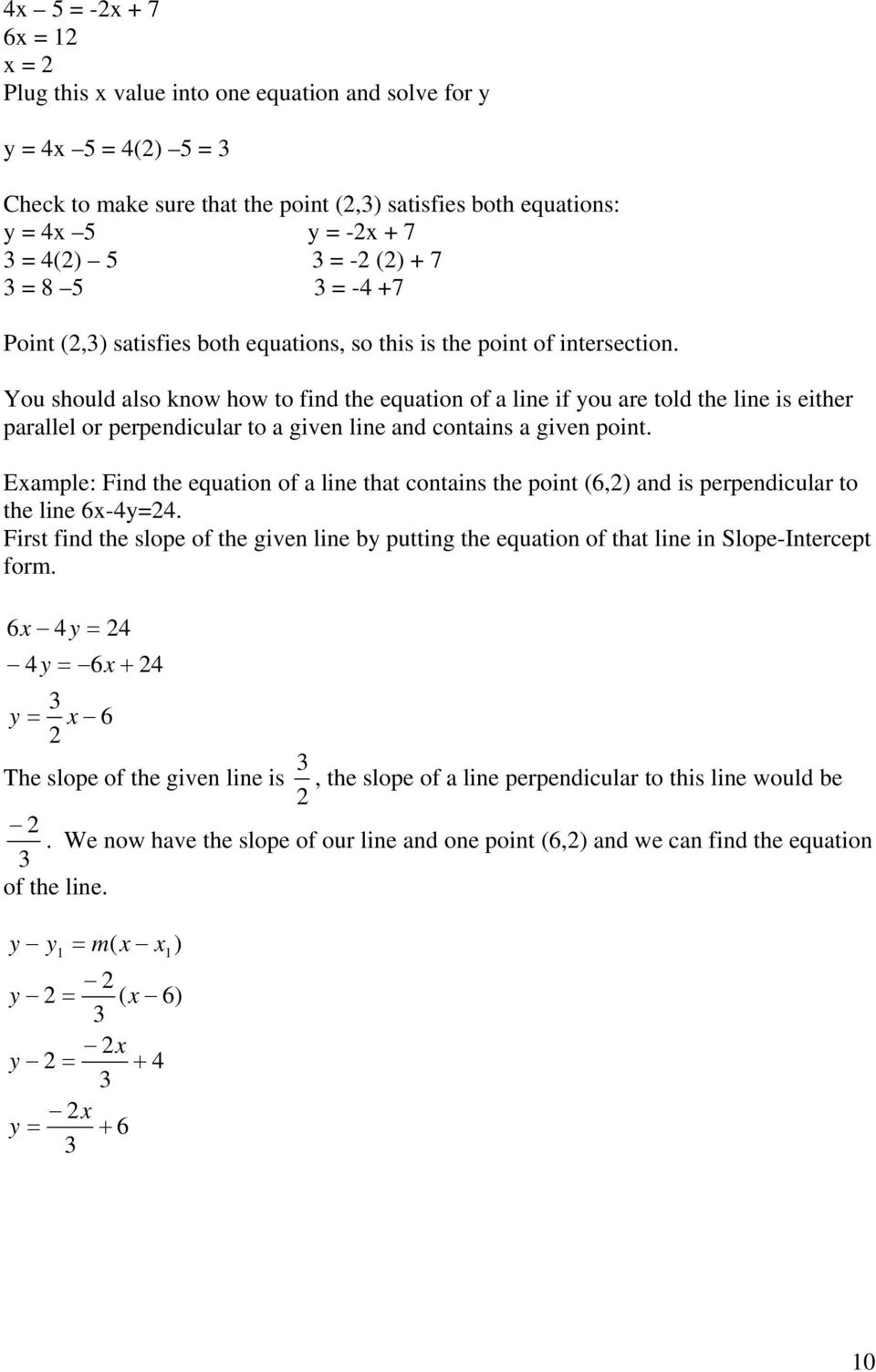
10 4x 5 = -2x + 7 6x = 12 x = 2 Plug this x value into one equation and solve for y y = 4x 5 = 4(2) 5 = 3 Check to make sure that the point (2,3) satisfies both equations: y = 4x 5 y = -2x = 4(2) 5 3 = -2 (2) = = Point (2,3) satisfies both equations, so this is the point of intersection. You should also know how to find the equation of a line if you are told the line is either parallel or perpendicular to a given line and contains a given point. Example: Find the equation of a line that contains the point (6,2) and is perpendicular to the line 6x-4y=24. First find the slope of the given line by putting the equation of that line in Slope-Intercept form. 6x 4y = 24 4y = 6x + 24 y = 3 x 6 2 The slope of the given line is 2 3, the slope of a line perpendicular to this line would be 2. We now have the slope of our line and one point (6,2) and we can find the equation 3 of the line. y y1 = m( x x1) 2 y 2 = ( x 6) 3 2x y 2 = x y =
11 Sample Problems: Determine if the following lines are parallel, coincident, or if they intersect. If they intersect, then find the point of intersection. (1.1) 2y-4x = 8 y = 2x + 4 (1.2) y 3x = 6 3y = 15 x (1.3) 2y + 3x = 13 4x 2y = 8 (1.4) x + y = 5 3y 2x = 10 (1.5) 2y 4x = 6 y-3 = 2x (1.6) Find the equation of the line that is perpendicular to the line 2x + 6 and contains the point (2,6) (1.7) Find the equation of the line that is parallel to the line 3x + 5 and contains the point (1,2) 11

12 Section 1.3 Linear Equation Applications Predicting Costs, Break-Even Point, & Mixture Problems. In section 1.3 you apply what you learned in sections 1.1 and 1.2 to solve word problems involving predicting costs, break-even points, supply and demand, & mixture problems. You should review the sample problems and homework problems in section 1.3. Predicting Costs These problems require you to find the equation of a line and then use that equation to predict costs. Within the word problem you will be given two points on the line. Set your x and y values, find your slope, and then use your slope and one point to find the equation of the line i.e. the cost function. Given a total cost (y value) use your equation to solve for x, OR given an x value solve for your total costs (y). Break Even Problems Break-Even problems are problems that require you to find the point of intersection of the linear equation that describes costs, C(x) and the linear equation that describes revenue, R(x). The break-even point is where the costs = revenue. To find the break even point set C(x) = R(x), solve for x and then plug your x value (number of items produced) into one of the equations and solve for y (costs). At the break-even point the company is not making money but they are losing money either. When Costs> Revenue the company is losing money and when Revenue > Costs the company is making money. To find the Profit equation P(x) = R(x)-C(x), make sure to simplify your expression. You will also need to know how to graph the cost function C(x) and the revenue function R(x). Supply and Demand For these types of problems you will be given two points on the price-demand equation (quantity, price) and will need to find the price-demand equation. Remember buyers (consumers) demand. You will also be given two points on the pricesupply equation (quantity, price) and will need to find the price-supply equation. Remember manufacturers supply. You might be asked to find the demand or supply quantity for a given price or the demand or supply price for a given quantity to solve these plug-in what you know, solve for what you don t. BE CAREFUL TO USE THE RIGHT EQUATION! The most popular question for Supply and Demand problems is to find the market equilibrium the point of intersection between the price-demand equation and the price-supply equation. To do this set your equations equal to each other, solve for the equilibrium quantity and then plug this value into one of the equations to solve for the equilibrium price. At market equilibrium both consumers and suppliers are happy! Mixture Problems: Mixture problems will involve two unknowns and two equations. You will have to use the given equations to solve for the unknowns. To do this you will follow the same steps you use to find the point of intersection between two linear equations. You can do this by putting both equations into the Slope-Intercept form (y = mx + b), setting the equations equal to each other, and then solving for x, then plug in the x value to solve for y. AS WITH ALL WORD PROBLEMS MAKE SURE TO LABEL YOUR ANSWERS! 12

13 Sample Problems: 1. Yearly car insurance rates have risen in the last few years. Assume that the cost for insuring a car is linearly related to the year. The rate for a small car in 1997 was $678. In 1999 the rate for a small car was $798. Find the linear equation relating cost to insure to year. Predict what the cost will be to insure a car in Producing x units of tacos costs C(x) = 5x + 20; revenue is R(x) = 15x, where C(x) and R(x) are in dollars. a. What is the break-even quantity(i.e. x value) b. What is the profit from 100 units? c. How many units will produce a profit of $500? 3. To produce x units of a religious medal costs C(x) =12x The revenue is R(x) = 25x. Both C(x) and R(x) are in dollars. a. Find the break-even quantity (x value) b. Find the profit from 250 units. c. Find the number of units that must be produced for a profit of $ A candy store sells a candy bar mixture of milk chocolate bars and dark chocolate bars. Each bag of the candy bar mixture sells for $11.50 and holds 50 candy bars. If the milk chocolate bar each cost $.20 to produce and each dark chocolate bar costs $.30 to produce, how many milk chocolate bars and dark chocolate bars should be in each bag to break-even. Would you increase or decrease the number of milk chocolate bars in order to obtain a profit? 5. A bank has outstanding loans worth $10,000. Some were loan at 10% and some were loaned at 7%. If the income from these loans was $820, how much was loaned at 10%? 6. A manufacturer produces mugs at a daily cost of $2 per item. It sells them for $5 per item. The daily operational cost is $500. Write a cost function, the revenue function, and the profit function. Find the break-even point. If the company 13

14 made $1000, how many items did they sell? If the company sold 110 items how much profit did they make? 7. The Academic T-Shirt Company did a cost study and found that it costs $1400 to produce 600 I Love Math T-shirts. The total cost is $1600 for a volume of 700 T-shirts. a. Determine the linear cost-volume function. b. What is the fixed cost? c. What is the unit cost? 8. The Computer Shop sells computers. The shop has a fixed cost of $1500 per week. Its average cost per computer is $649 each, and the average selling price is $899 each. a. Write the linear cost function b. Write the linear revenue function c. Find the cost of selling 37 computers per week d. Find the revenue from selling 37 computers e. Find the break-even point. 9. If a product has a selling price of $518, consumers are willing to buy 90 units of it. If the price is $265, they will buy 200 units. A manufacturer will produce 100 units of the product if the selling price is $250 or 210 units if the selling price is $382. a. Find the demand equation. b. Find the supply equation. c. At what price would manufacturers produce 150 units of the product? d. At what price would consumers buy 175 units of the product? e. Find the market equilibrium point (both price and quantity) 14

Linear Equations. Find the domain and the range of the following set. {(4,5), (7,8), (-1,3), (3,3), (2,-3)}
 Linear Equations Domain and Range Domain refers to the set of possible values of the x-component of a point in the form (x,y). Range refers to the set of possible values of the y-component of a point in
Graphing Linear Equations
 Graphing Linear Equations I. Graphing Linear Equations a. The graphs of first degree (linear) equations will always be straight lines. b. Graphs of lines can have Positive Slope Negative Slope Zero slope
Section 1.1 Linear Equations: Slope and Equations of Lines
 Section. Linear Equations: Slope and Equations of Lines Slope The measure of the steepness of a line is called the slope of the line. It is the amount of change in y, the rise, divided by the amount of
CHAPTER 1 Linear Equations
 CHAPTER 1 Linear Equations 1.1. Lines The rectangular coordinate system is also called the Cartesian plane. It is formed by two real number lines, the horizontal axis or x-axis, and the vertical axis or
Warm Up. Write an equation given the slope and y-intercept. Write an equation of the line shown.
 Warm Up Write an equation given the slope and y-intercept Write an equation of the line shown. EXAMPLE 1 Write an equation given the slope and y-intercept From the graph, you can see that the slope is
The Point-Slope Form
 7. The Point-Slope Form 7. OBJECTIVES 1. Given a point and a slope, find the graph of a line. Given a point and the slope, find the equation of a line. Given two points, find the equation of a line y Slope
1 Functions, Graphs and Limits
 1 Functions, Graphs and Limits 1.1 The Cartesian Plane In this course we will be dealing a lot with the Cartesian plane (also called the xy-plane), so this section should serve as a review of it and its
EQUATIONS and INEQUALITIES
 EQUATIONS and INEQUALITIES Linear Equations and Slope 1. Slope a. Calculate the slope of a line given two points b. Calculate the slope of a line parallel to a given line. c. Calculate the slope of a line
1.3 LINEAR EQUATIONS IN TWO VARIABLES. Copyright Cengage Learning. All rights reserved.
 1.3 LINEAR EQUATIONS IN TWO VARIABLES Copyright Cengage Learning. All rights reserved. What You Should Learn Use slope to graph linear equations in two variables. Find the slope of a line given two points
Slope-Intercept Equation. Example
 1.4 Equations of Lines and Modeling Find the slope and the y intercept of a line given the equation y = mx + b, or f(x) = mx + b. Graph a linear equation using the slope and the y-intercept. Determine
Coordinate Plane, Slope, and Lines Long-Term Memory Review Review 1
 Review. What does slope of a line mean?. How do you find the slope of a line? 4. Plot and label the points A (3, ) and B (, ). a. From point B to point A, by how much does the y-value change? b. From point
What does the number m in y = mx + b measure? To find out, suppose (x 1, y 1 ) and (x 2, y 2 ) are two points on the graph of y = mx + b.
 PRIMARY CONTENT MODULE Algebra - Linear Equations & Inequalities T-37/H-37 What does the number m in y = mx + b measure? To find out, suppose (x 1, y 1 ) and (x 2, y 2 ) are two points on the graph of
Section 1.5 Linear Models
 Section 1.5 Linear Models Some real-life problems can be modeled using linear equations. Now that we know how to find the slope of a line, the equation of a line, and the point of intersection of two lines,
Graphing Linear Equations in Two Variables
 Math 123 Section 3.2 - Graphing Linear Equations Using Intercepts - Page 1 Graphing Linear Equations in Two Variables I. Graphing Lines A. The graph of a line is just the set of solution points of the
Lecture 8 : Coordinate Geometry. The coordinate plane The points on a line can be referenced if we choose an origin and a unit of 20
 Lecture 8 : Coordinate Geometry The coordinate plane The points on a line can be referenced if we choose an origin and a unit of 0 distance on the axis and give each point an identity on the corresponding
Plot the following two points on a graph and draw the line that passes through those two points. Find the rise, run and slope of that line.
 Objective # 6 Finding the slope of a line Material: page 117 to 121 Homework: worksheet NOTE: When we say line... we mean straight line! Slope of a line: It is a number that represents the slant of a line
Writing the Equation of a Line in Slope-Intercept Form
 Writing the Equation of a Line in Slope-Intercept Form Slope-Intercept Form y = mx + b Example 1: Give the equation of the line in slope-intercept form a. With y-intercept (0, 2) and slope -9 b. Passing
A synonym is a word that has the same or almost the same definition of
 Slope-Intercept Form Determining the Rate of Change and y-intercept Learning Goals In this lesson, you will: Graph lines using the slope and y-intercept. Calculate the y-intercept of a line when given
Slope-Intercept Form of a Linear Equation Examples
 Slope-Intercept Form of a Linear Equation Examples. In the figure at the right, AB passes through points A(0, b) and B(x, y). Notice that b is the y-intercept of AB. Suppose you want to find an equation
Intro to Linear Equations Algebra 6.0
 Intro to Linear Equations Algebra 6.0 Linear Equations: y x 7 y x 5 x y Linear Equations generally contain two variables: x and y. In a linear equation, y is called the dependent variable and x is the
Worksheet A5: Slope Intercept Form
 Name Date Worksheet A5: Slope Intercept Form Find the Slope of each line below 1 3 Y - - - - - - - - - - Graph the lines containing the point below, then find their slopes from counting on the graph!.
Vocabulary Words and Definitions for Algebra
 Name: Period: Vocabulary Words and s for Algebra Absolute Value Additive Inverse Algebraic Expression Ascending Order Associative Property Axis of Symmetry Base Binomial Coefficient Combine Like Terms
5. Equations of Lines: slope intercept & point slope
 5. Equations of Lines: slope intercept & point slope Slope of the line m rise run Slope-Intercept Form m + b m is slope; b is -intercept Point-Slope Form m( + or m( Slope of parallel lines m m (slopes
Lines, Lines, Lines!!! Slope-Intercept Form ~ Lesson Plan
 Lines, Lines, Lines!!! Slope-Intercept Form ~ Lesson Plan I. Topic: Slope-Intercept Form II. III. Goals and Objectives: A. The student will write an equation of a line given information about its graph.
Week 1: Functions and Equations
 Week 1: Functions and Equations Goals: Review functions Introduce modeling using linear and quadratic functions Solving equations and systems Suggested Textbook Readings: Chapter 2: 2.1-2.2, and Chapter
MSLC Workshop Series Math 1148 1150 Workshop: Polynomial & Rational Functions
 MSLC Workshop Series Math 1148 1150 Workshop: Polynomial & Rational Functions The goal of this workshop is to familiarize you with similarities and differences in both the graphing and expression of polynomial
MA.8.A.1.2 Interpret the slope and the x- and y-intercepts when graphing a linear equation for a real-world problem. Constant Rate of Change/Slope
 MA.8.A.1.2 Interpret the slope and the x- and y-intercepts when graphing a linear equation for a real-world problem Constant Rate of Change/Slope In a Table Relationships that have straight-lined graphs
What are the place values to the left of the decimal point and their associated powers of ten?
 The verbal answers to all of the following questions should be memorized before completion of algebra. Answers that are not memorized will hinder your ability to succeed in geometry and algebra. (Everything
Homework #1 Solutions
 Homework #1 Solutions Problems Section 1.1: 8, 10, 12, 14, 16 Section 1.2: 2, 8, 10, 12, 16, 24, 26 Extra Problems #1 and #2 1.1.8. Find f (5) if f (x) = 10x x 2. Solution: Setting x = 5, f (5) = 10(5)
Elements of a graph. Click on the links below to jump directly to the relevant section
 Click on the links below to jump directly to the relevant section Elements of a graph Linear equations and their graphs What is slope? Slope and y-intercept in the equation of a line Comparing lines on
x x y y Then, my slope is =. Notice, if we use the slope formula, we ll get the same thing: m =
 Slope and Lines The slope of a line is a ratio that measures the incline of the line. As a result, the smaller the incline, the closer the slope is to zero and the steeper the incline, the farther the
Brunswick High School has reinstated a summer math curriculum for students Algebra 1, Geometry, and Algebra 2 for the 2014-2015 school year.
 Brunswick High School has reinstated a summer math curriculum for students Algebra 1, Geometry, and Algebra 2 for the 2014-2015 school year. Goal The goal of the summer math program is to help students
Example SECTION 13-1. X-AXIS - the horizontal number line. Y-AXIS - the vertical number line ORIGIN - the point where the x-axis and y-axis cross
 CHAPTER 13 SECTION 13-1 Geometry and Algebra The Distance Formula COORDINATE PLANE consists of two perpendicular number lines, dividing the plane into four regions called quadrants X-AXIS - the horizontal
Aim: How do we find the slope of a line? Warm Up: Go over test. A. Slope -
 Aim: How do we find the slope of a line? Warm Up: Go over test A. Slope - Plot the points and draw a line through the given points. Find the slope of the line.. A(-5,4) and B(4,-3) 2. A(4,3) and B(4,-6)
Solving Equations Involving Parallel and Perpendicular Lines Examples
 Solving Equations Involving Parallel and Perpendicular Lines Examples. The graphs of y = x, y = x, and y = x + are lines that have the same slope. They are parallel lines. Definition of Parallel Lines
Algebra I Vocabulary Cards
 Algebra I Vocabulary Cards Table of Contents Expressions and Operations Natural Numbers Whole Numbers Integers Rational Numbers Irrational Numbers Real Numbers Absolute Value Order of Operations Expression
Students will use various media (computer, graphing calculator, paper and pencil) to graph/sketch linear equations.
 Title: Lines, Lines, Everywhere!! A discovery/exploration lesson investigating equations of the form y = mx + b to see how the values of b and m affects the graph. Link to Outcomes: Communication/ Cooperation
Make sure you look at the reminders or examples before each set of problems to jog your memory! Solve
 Name Date Make sure you look at the reminders or examples before each set of problems to jog your memory! I. Solving Linear Equations 1. Eliminate parentheses. Combine like terms 3. Eliminate terms by
Write the Equation of the Line Review
 Connecting Algebra 1 to Advanced Placement* Mathematics A Resource and Strategy Guide Objective: Students will be assessed on their ability to write the equation of a line in multiple methods. Connections
Chapter 1 Linear Models page Linear Models Part 1 2 Linear Models Activities 1 17 Linear Models Part 2 21 Linear Models Activities 2 28
 Table of Contents Chapter 1 Linear Models page Linear Models Part 1 Linear Models Activities 1 17 Linear Models Part 1 Linear Models Activities 8 Chapter Linear Programming Linear Programming Part 1 34
Lesson 4: Solving and Graphing Linear Equations
 Lesson 4: Solving and Graphing Linear Equations Selected Content Standards Benchmarks Addressed: A-2-M Modeling and developing methods for solving equations and inequalities (e.g., using charts, graphs,
Lecture 9: Lines. m = y 2 y 1 x 2 x 1
 Lecture 9: Lines If we have two distinct points in the Cartesian plane, there is a unique line which passes through the two points. We can construct it by joining the points with a straight edge and extending
Mathematics Placement
 Mathematics Placement The ACT COMPASS math test is a self-adaptive test, which potentially tests students within four different levels of math including pre-algebra, algebra, college algebra, and trigonometry.
Unit 5: Coordinate Geometry Practice Test
 Unit 5: Coordinate Geometry Practice Test Math 10 Common Name: Block: Please initial this box to indicate you carefully read over your test and checked your work for simple mistakes. What I can do in this
Algebraic expressions are a combination of numbers and variables. Here are examples of some basic algebraic expressions.
 Page 1 of 13 Review of Linear Expressions and Equations Skills involving linear equations can be divided into the following groups: Simplifying algebraic expressions. Linear expressions. Solving linear
-2- Reason: This is harder. I'll give an argument in an Addendum to this handout.
 LINES Slope The slope of a nonvertical line in a coordinate plane is defined as follows: Let P 1 (x 1, y 1 ) and P 2 (x 2, y 2 ) be any two points on the line. Then slope of the line = y 2 y 1 change in
Answers for the lesson Write Linear Equations in Slope-Intercept Form
 LESSON 4.1 Answers for the lesson Write Linear Equations in Slope-Intercept Form Skill Practice 1. slope. You can substitute the slope for m and the y-intercept for b to get the equation of the line..
Graphing - Parallel and Perpendicular Lines
 . Graphing - Parallel and Perpendicular Lines Objective: Identify the equation of a line given a parallel or perpendicular line. There is an interesting connection between the slope of lines that are parallel
Chapter 4.1 Parallel Lines and Planes
 Chapter 4.1 Parallel Lines and Planes Expand on our definition of parallel lines Introduce the idea of parallel planes. What do we recall about parallel lines? In geometry, we have to be concerned about
Part 1: Background - Graphing
 Department of Physics and Geology Graphing Astronomy 1401 Equipment Needed Qty Computer with Data Studio Software 1 1.1 Graphing Part 1: Background - Graphing In science it is very important to find and
In the Herb Business, Part III Factoring and Quadratic Equations
 74 In the Herb Business, Part III Factoring and Quadratic Equations In the herbal medicine business, you and your partner sold 120 bottles of your best herbal medicine each week when you sold at your original
1.6 A LIBRARY OF PARENT FUNCTIONS. Copyright Cengage Learning. All rights reserved.
 1.6 A LIBRARY OF PARENT FUNCTIONS Copyright Cengage Learning. All rights reserved. What You Should Learn Identify and graph linear and squaring functions. Identify and graph cubic, square root, and reciprocal
MATH 60 NOTEBOOK CERTIFICATIONS
 MATH 60 NOTEBOOK CERTIFICATIONS Chapter #1: Integers and Real Numbers 1.1a 1.1b 1.2 1.3 1.4 1.8 Chapter #2: Algebraic Expressions, Linear Equations, and Applications 2.1a 2.1b 2.1c 2.2 2.3a 2.3b 2.4 2.5
Understanding Basic Calculus
 Understanding Basic Calculus S.K. Chung Dedicated to all the people who have helped me in my life. i Preface This book is a revised and expanded version of the lecture notes for Basic Calculus and other
1.2 Break-Even Analysis and Market Equilibrium
 Math 142 c Roberto Barrera, Fall 2015 1 1.2 Break-Even Analysis and Market Equilibrium Mathematical models of cost, revenue, and profits Two types of costs: 1. Fixed costs: 2. Variable costs: Total cost:
PRIMARY CONTENT MODULE Algebra I -Linear Equations & Inequalities T-71. Applications. F = mc + b.
 PRIMARY CONTENT MODULE Algebra I -Linear Equations & Inequalities T-71 Applications The formula y = mx + b sometimes appears with different symbols. For example, instead of x, we could use the letter C.
HIBBING COMMUNITY COLLEGE COURSE OUTLINE
 HIBBING COMMUNITY COLLEGE COURSE OUTLINE COURSE NUMBER & TITLE: - Beginning Algebra CREDITS: 4 (Lec 4 / Lab 0) PREREQUISITES: MATH 0920: Fundamental Mathematics with a grade of C or better, Placement Exam,
1.2 GRAPHS OF EQUATIONS. Copyright Cengage Learning. All rights reserved.
 1.2 GRAPHS OF EQUATIONS Copyright Cengage Learning. All rights reserved. What You Should Learn Sketch graphs of equations. Find x- and y-intercepts of graphs of equations. Use symmetry to sketch graphs
QUADRATIC EQUATIONS AND FUNCTIONS
 Douglas College Learning Centre QUADRATIC EQUATIONS AND FUNCTIONS Quadratic equations and functions are very important in Business Math. Questions related to quadratic equations and functions cover a wide
Algebra 1 End-of-Course Exam Practice Test with Solutions
 Algebra 1 End-of-Course Exam Practice Test with Solutions For Multiple Choice Items, circle the correct response. For Fill-in Response Items, write your answer in the box provided, placing one digit in
Law of Demand: Other things equal, price and the quantity demanded are inversely related.
 SUPPLY AND DEMAND Law of Demand: Other things equal, price and the quantity demanded are inversely related. Every term is important -- 1. Other things equal means that other factors that affect demand
Applied Finite Mathematics Second Edition. Rupinder Sekhon De Anza College Cupertino, California. Page 1
 Applied Finite Mathematics Second Edition Rupinder Sekhon De Anza College Cupertino, California Page 1 Author: Rupinder Sekhon Associate Editors: Jessica and Vijay Sekhon Rupinder Sekhon has been teaching
Overview. Observations. Activities. Chapter 3: Linear Functions Linear Functions: Slope-Intercept Form
 Name Date Linear Functions: Slope-Intercept Form Student Worksheet Overview The Overview introduces the topics covered in Observations and Activities. Scroll through the Overview using " (! to review,
Math 0980 Chapter Objectives. Chapter 1: Introduction to Algebra: The Integers.
 Math 0980 Chapter Objectives Chapter 1: Introduction to Algebra: The Integers. 1. Identify the place value of a digit. 2. Write a number in words or digits. 3. Write positive and negative numbers used
CRLS Mathematics Department Algebra I Curriculum Map/Pacing Guide
 Curriculum Map/Pacing Guide page 1 of 14 Quarter I start (CP & HN) 170 96 Unit 1: Number Sense and Operations 24 11 Totals Always Include 2 blocks for Review & Test Operating with Real Numbers: How are
Graphing - Slope-Intercept Form
 2.3 Graphing - Slope-Intercept Form Objective: Give the equation of a line with a known slope and y-intercept. When graphing a line we found one method we could use is to make a table of values. However,
Answer Key Building Polynomial Functions
 Answer Key Building Polynomial Functions 1. What is the equation of the linear function shown to the right? 2. How did you find it? y = ( 2/3)x + 2 or an equivalent form. Answers will vary. For example,
3. Solve the equation containing only one variable for that variable.
 Question : How do you solve a system of linear equations? There are two basic strategies for solving a system of two linear equations and two variables. In each strategy, one of the variables is eliminated
1 Mathematical Models of Cost, Revenue and Profit
 Section 1.: Mathematical Modeling Math 14 Business Mathematics II Minh Kha Goals: to understand what a mathematical model is, and some of its examples in business. Definition 0.1. Mathematical Modeling
a. all of the above b. none of the above c. B, C, D, and F d. C, D, F e. C only f. C and F
 FINAL REVIEW WORKSHEET COLLEGE ALGEBRA Chapter 1. 1. Given the following equations, which are functions? (A) y 2 = 1 x 2 (B) y = 9 (C) y = x 3 5x (D) 5x + 2y = 10 (E) y = ± 1 2x (F) y = 3 x + 5 a. all
Section 3.2 Polynomial Functions and Their Graphs
 Section 3.2 Polynomial Functions and Their Graphs EXAMPLES: P(x) = 3, Q(x) = 4x 7, R(x) = x 2 +x, S(x) = 2x 3 6x 2 10 QUESTION: Which of the following are polynomial functions? (a) f(x) = x 3 +2x+4 (b)
Florida Algebra 1 End-of-Course Assessment Item Bank, Polk County School District
 Benchmark: MA.912.A.2.3; Describe the concept of a function, use function notation, determine whether a given relation is a function, and link equations to functions. Also assesses MA.912.A.2.13; Solve
Basic Graphing Functions for the TI-83 and TI-84
 Basic Graphing Functions for the TI-83 and TI-84 The primary benefits of the TI-83 and TI-84 are the abilities to graph functions and to identify properties those functions possess. The purpose of this
2-2 Linear Relations and Functions. So the function is linear. State whether each function is a linear function. Write yes or no. Explain.
 1. 2. 3. 4. State whether each function is a linear function. Write yes or no. Explain. The function written as. is linear as it can be + b. cannot be written in the form f (x) = mx So the function is
3.3 Applications of Linear Functions
 3.3 Applications of Linear Functions A function f is a linear function if The graph of a linear function is a line with slope m and y-intercept b. The rate of change of a linear function is the slope m.
Algebra 2 PreAP. Name Period
 Algebra 2 PreAP Name Period IMPORTANT INSTRUCTIONS FOR STUDENTS!!! We understand that students come to Algebra II with different strengths and needs. For this reason, students have options for completing
Algebra I. In this technological age, mathematics is more important than ever. When students
 In this technological age, mathematics is more important than ever. When students leave school, they are more and more likely to use mathematics in their work and everyday lives operating computer equipment,
MA107 Precalculus Algebra Exam 2 Review Solutions
 MA107 Precalculus Algebra Exam 2 Review Solutions February 24, 2008 1. The following demand equation models the number of units sold, x, of a product as a function of price, p. x = 4p + 200 a. Please write
Linear Equations. 5- Day Lesson Plan Unit: Linear Equations Grade Level: Grade 9 Time Span: 50 minute class periods By: Richard Weber
 Linear Equations 5- Day Lesson Plan Unit: Linear Equations Grade Level: Grade 9 Time Span: 50 minute class periods By: Richard Weber Tools: Geometer s Sketchpad Software Overhead projector with TI- 83
Slope-Intercept Form and Point-Slope Form
 Slope-Intercept Form and Point-Slope Form In this section we will be discussing Slope-Intercept Form and the Point-Slope Form of a line. We will also discuss how to graph using the Slope-Intercept Form.
Vector Notation: AB represents the vector from point A to point B on a graph. The vector can be computed by B A.
 1 Linear Transformations Prepared by: Robin Michelle King A transformation of an object is a change in position or dimension (or both) of the object. The resulting object after the transformation is called
Functions Modeling Change: A Precalculus Course. Marcel B. Finan Arkansas Tech University c All Rights Reserved
 Functions Modeling Change: A Precalculus Course Marcel B. Finan Arkansas Tech University c All Rights Reserved 1 PREFACE This supplement consists of my lectures of a freshmen-level mathematics class offered
2.5 Transformations of Functions
 2.5 Transformations of Functions Section 2.5 Notes Page 1 We will first look at the major graphs you should know how to sketch: Square Root Function Absolute Value Function Identity Function Domain: [
1.4 Linear Models. Cost, Revenue, and Profit Functions. Example 1 Linear Cost Function
 16314_02_ch1_p033-112.qxd 7/17/06 4:10 PM Page 66 66 Chapter 1 Functions and Linear Models 77. If y and x are related by the linear expression y = mx + b, how will y change as x changes if m is positive?
WARM UP EXERCSE. 2-1 Polynomials and Rational Functions
 WARM UP EXERCSE Roots, zeros, and x-intercepts. x 2! 25 x 2 + 25 x 3! 25x polynomial, f (a) = 0! (x - a)g(x) 1 2-1 Polynomials and Rational Functions Students will learn about: Polynomial functions Behavior
Math 1 EOC Practice Test Answer Key:
 Math 1 EOC Practice Test Answer Key: Part 1: 1. B 2. C. B 4. D 5. D 6. 120 7. 0.75 8. 5 9. 0 10. 10 11. -5 12. 16 1. 9 14. 4 15. 1 Part 2: 1. B 2. C. D 4. C 5. B 6. D 7. C 8. B 9. D 10. B 11. D 12. A 1.
Systems of Linear Equations and Inequalities
 Systems of Linear Equations and Inequalities Recall that every linear equation in two variables can be identified with a line. When we group two such equations together, we know from geometry what can
Exhibit 7.5: Graph of Total Costs vs. Quantity Produced and Total Revenue vs. Quantity Sold
 244 13. 7.5 Graphical Approach to CVP Analysis (Break-Even Chart) A break-even chart is a graphical representation of the following on the same axes: 1. Fixed costs 2. Total costs at various levels of
Unit 1 Equations, Inequalities, Functions
 Unit 1 Equations, Inequalities, Functions Algebra 2, Pages 1-100 Overview: This unit models real-world situations by using one- and two-variable linear equations. This unit will further expand upon pervious
Florida Math for College Readiness
 Core Florida Math for College Readiness Florida Math for College Readiness provides a fourth-year math curriculum focused on developing the mastery of skills identified as critical to postsecondary readiness
Solving Systems of Linear Equations Graphing
 Solving Systems of Linear Equations Graphing Outcome (learning objective) Students will accurately solve a system of equations by graphing. Student/Class Goal Students thinking about continuing their academic
COWLEY COUNTY COMMUNITY COLLEGE REVIEW GUIDE Compass Algebra Level 2
 COWLEY COUNTY COMMUNITY COLLEGE REVIEW GUIDE Compass Algebra Level This study guide is for students trying to test into College Algebra. There are three levels of math study guides. 1. If x and y 1, what
Chapter 4. Applying Linear Functions
 Chapter 4 Applying Linear Functions Many situations in real life can be represented mathematically. You can write equations, create tables, or even construct graphs that display real-life data. Part of
Return on Investment (ROI)
 ROI 1 Return on Investment (ROI) Prepared by Sarah Major What is ROI? Return on investment (ROI) is a measure that investigates the amount of additional profits produced due to a certain investment. Businesses
Answer Key for California State Standards: Algebra I
 Algebra I: Symbolic reasoning and calculations with symbols are central in algebra. Through the study of algebra, a student develops an understanding of the symbolic language of mathematics and the sciences.
Math 1314 Lesson 8 Business Applications: Break Even Analysis, Equilibrium Quantity/Price
 Math 1314 Lesson 8 Business Applications: Break Even Analysis, Equilibrium Quantity/Price Three functions of importance in business are cost functions, revenue functions and profit functions. Cost functions
is the degree of the polynomial and is the leading coefficient.
 Property: T. Hrubik-Vulanovic e-mail: [email protected] Content (in order sections were covered from the book): Chapter 6 Higher-Degree Polynomial Functions... 1 Section 6.1 Higher-Degree Polynomial Functions...
Final Graphing Practice #1
 Final Graphing Practice #1 Beginning Algebra / Math 100 Fall 2013 506 (Prof. Miller) Student Name/ID: Instructor Note: Assignment: Set up a tutoring appointment with one of the campus tutors or with me.
IV. ALGEBRAIC CONCEPTS
 IV. ALGEBRAIC CONCEPTS Algebra is the language of mathematics. Much of the observable world can be characterized as having patterned regularity where a change in one quantity results in changes in other