
Developing Conceptual Understanding of Number. Set J: Perimeter and Area
|
|
|
- Irma Jacobs
- 9 years ago
- Views:
Transcription
1 Developing Conceptual Understanding of Number Set J: Perimeter and Area Carole Bilyk Wayne Watt
2 Perimeter and Area Vocabulary perimeter area centimetres right angle Notes In this set, students are encouraged to conceptually understand the terms perimeter and area rather than relying on formulas. Perimeter should include linear units such as millimetres, centimetres, metres, etc. If the unit of measure is unknown, students should get in the habit of including the word units. Area should include square units such as mm, cm, m, etc. If the unit of measure is unknown, students should get in the habit of including either the words square units or the symbols u. Answers. a) 5 small squares could be in Figure 4. A possible Figure 4 is: b) 8 units c) 4 square units. a) 4 cm b) cm 3. a) P = units Q = 3 units b) P = units Q = 5 units 8J-

3 Perimeter and Area. Use the pattern in the figures on the right to help answer the questions. a) How many small squares would be in Figure 4? Draw a Figure 4. b) What is the perimeter of Figure? Figure Figure Figure 3 c) What is the area of Figure 3?. What is the perimeter, in centimetres, for each figure below? cm a) 6 cm b) cm cm cm cm 4 cm cm 4 cm 4 cm cm 8 cm 6 cm 3. In each diagram, all angles are right angles. Find the missing lengths for P and Q. 3 a) b) 3 P Q 3 3 P Q 8J-

4 Perimeter and Area Vocabulary dimensions Notes For #, students should note that the given unit is squares. Answers. a) 6 squares b) 7 squares c) 5 squares. a) 7 squares b) 9.5 squares c) 6.5 squares 3. a) Possible Answers: Shape B has the greatest area as it is a full circle. Shapes A and C look like they have a similar diameter with pieces removed b) Possible Answers: Lay a grid on top of Shape A and count the units. Find the area of half the figure and double it. Find the area of one finger and multiply by a) 9 units by 4 units b) 7 units by 6 units 8J-

5 Perimeter and Area. Find the area, in small squares, for each figure: a) b) c). Find the area, by counting all the unit squares and half squares, for each figure: a) b) c) 3. Consider the following diagrams. A B C a) Which shape has the greatest area? Why? b) How could you find the area of figure A? 4. Give the dimensions of a rectangle satisfying the following conditions. a) area = 36 square units; length of one side = 9 units. b) area = 4 square units; length of one side = 7 units. 8J-

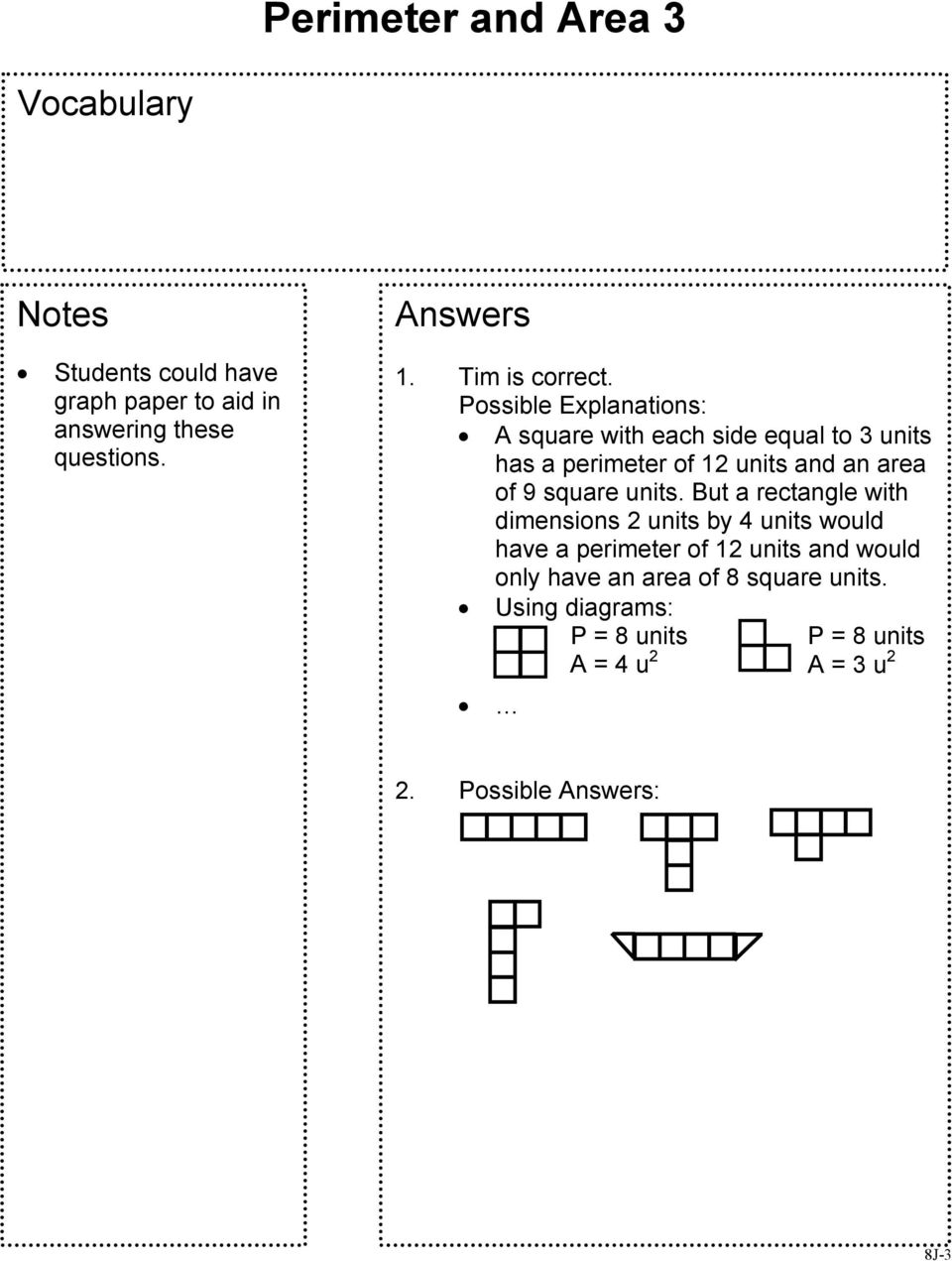
6 Perimeter and Area 3 Vocabulary Notes Students could have graph paper to aid in answering these questions. Answers. Tim is correct. Possible Explanations: A square with each side equal to 3 units has a perimeter of units and an area of 9 square units. But a rectangle with dimensions units by 4 units would have a perimeter of units and would only have an area of 8 square units. Using diagrams: P = 8 units P = 8 units A = 4 u A = 3 u. Possible Answers: 8J-3
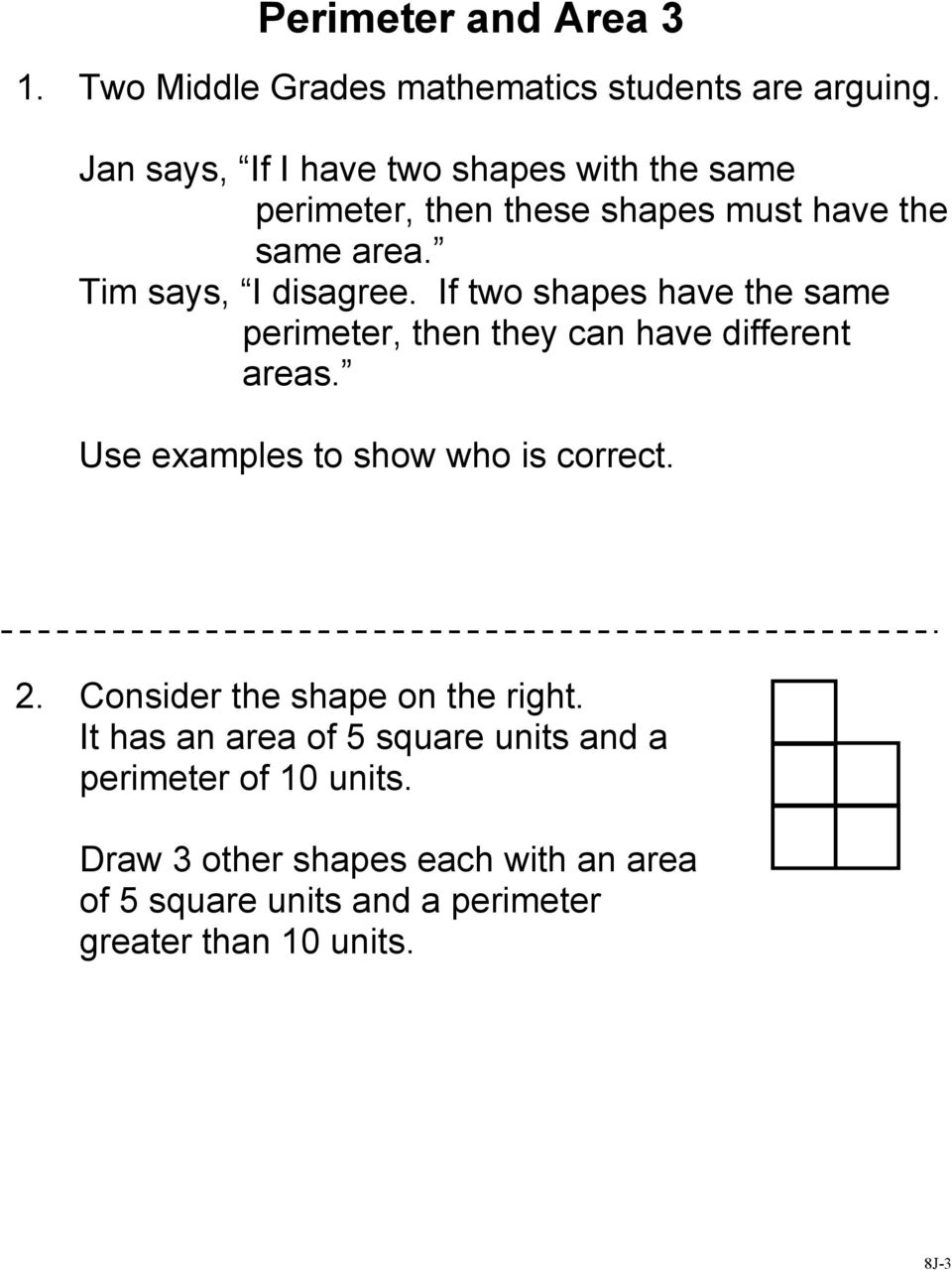
7 Perimeter and Area 3. Two Middle Grades mathematics students are arguing. Jan says, If I have two shapes with the same perimeter, then these shapes must have the same area. Tim says, I disagree. If two shapes have the same perimeter, then they can have different areas. Use examples to show who is correct.. Consider the shape on the right. It has an area of 5 square units and a perimeter of 0 units. Draw 3 other shapes each with an area of 5 square units and a perimeter greater than 0 units. 8J-3
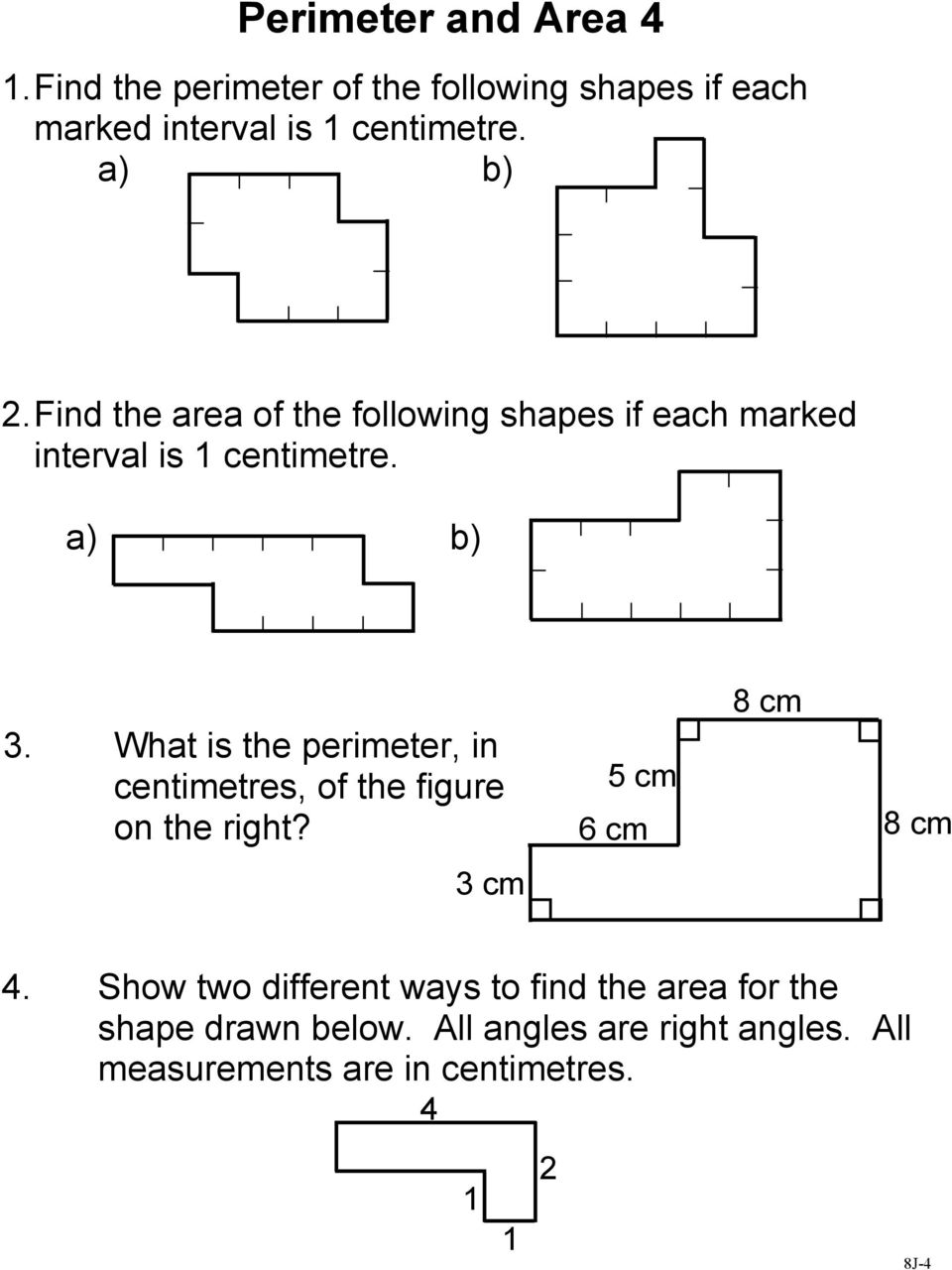
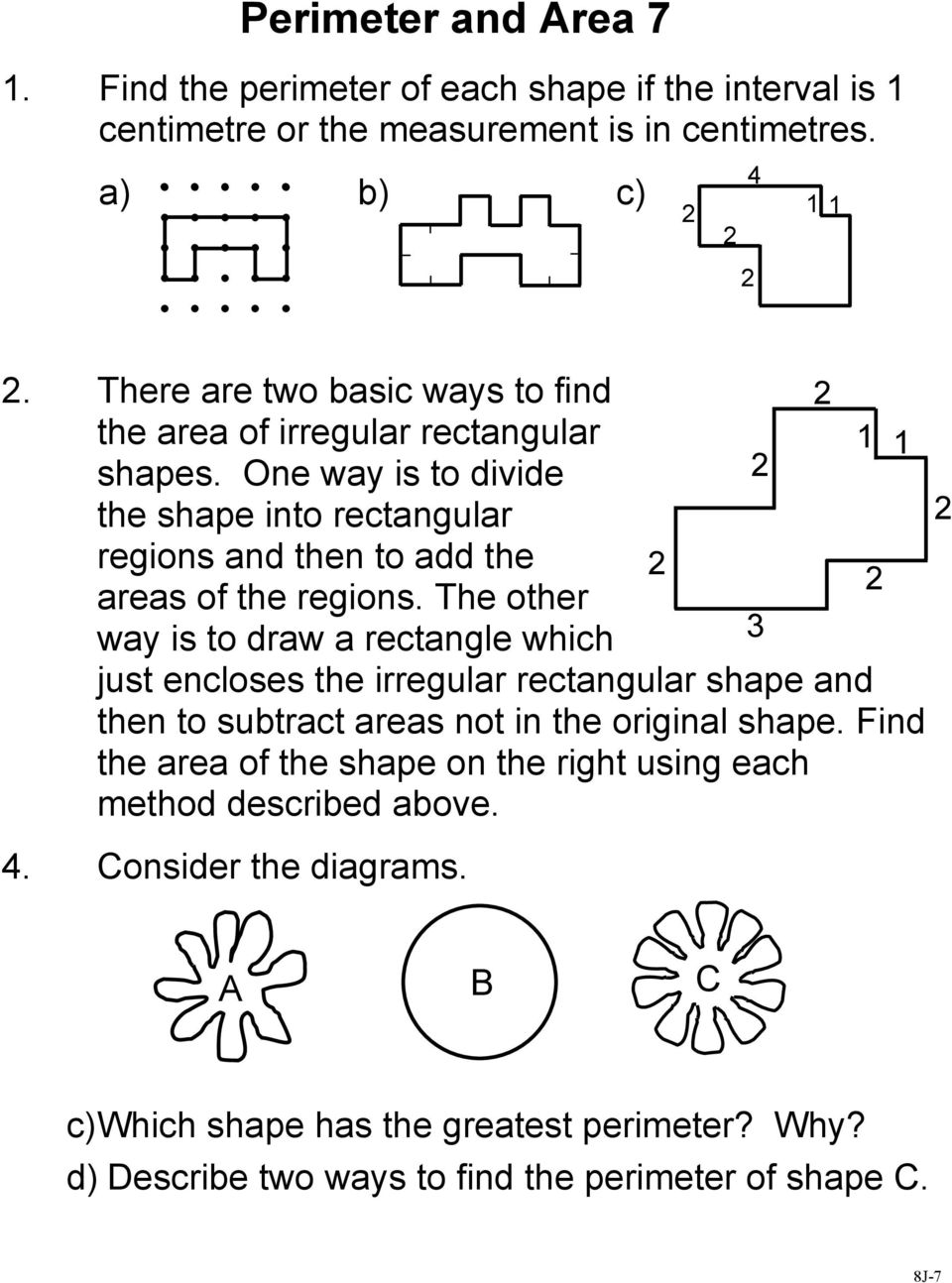
8 Perimeter and Area 4 Vocabulary interval Notes Answers. a) 4 cm b) 6 cm. a) 9 cm b) cm cm 4. Possible Answers: Split the figure into two rectangles in the following ways: (4 ) + ( ) = 5 Area is 5 cm (3 ) + ( ) = 5 Area is 5 cm Create a cm by cm grid and lay it over top of the figure. Count the squares. There would be 5 squares so the area is 5 cm. Complete the rectangle as shown below. Find its area (8) and remove or subtract the amount added (3). Area is 8 3 = 5 cm. 8J-4
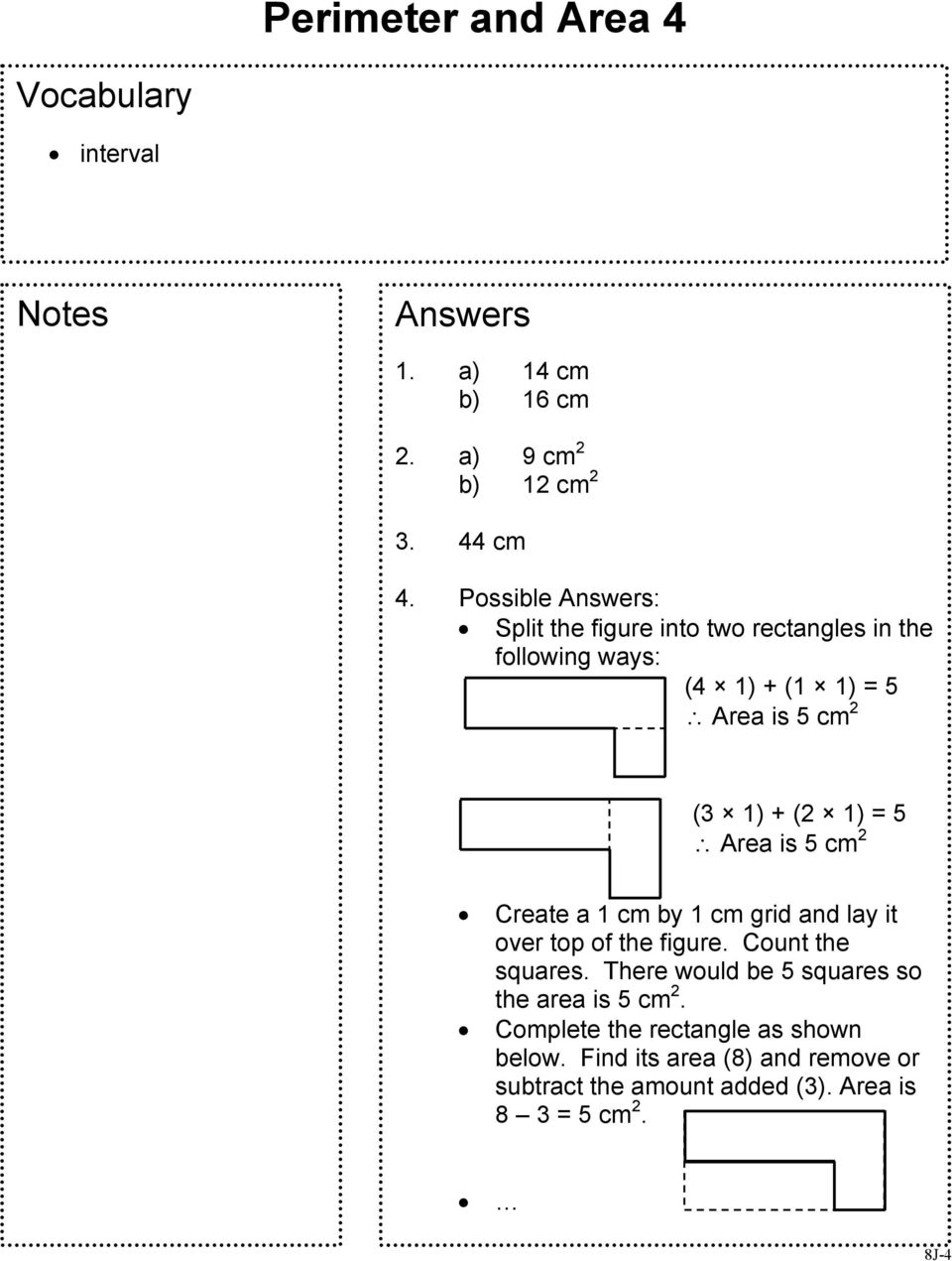
9 Perimeter and Area 4. Find the perimeter of the following shapes if each marked interval is centimetre. a) b). Find the area of the following shapes if each marked interval is centimetre. a) b) 3. What is the perimeter, in centimetres, of the figure on the right? 5 cm 6 cm 8 cm 8 cm 3 cm 4. Show two different ways to find the area for the shape drawn below. All angles are right angles. All measurements are in centimetres. 4 8J-4
10 Perimeter and Area 5 Vocabulary rectangular regions Notes For #, students should be encouraged to use different ways to divide each figure. Answers. a) cm b) 4 cm c) 8 cm. a) 3 square units b) 6 square units 3. a) C has the greatest perimeter. Possible Explanations: If I used a string to trace along each figure, I d need more string for shape C as it curves in more times or has more fingers. b) Possible Answers: Take a piece of string and trace out the shape. Then measure the piece of string. There are 8 approximately equal fingers. If the perimeter of one finger was found using a ruler, then the answer could be approximated by multiplying by 8. 8J-5
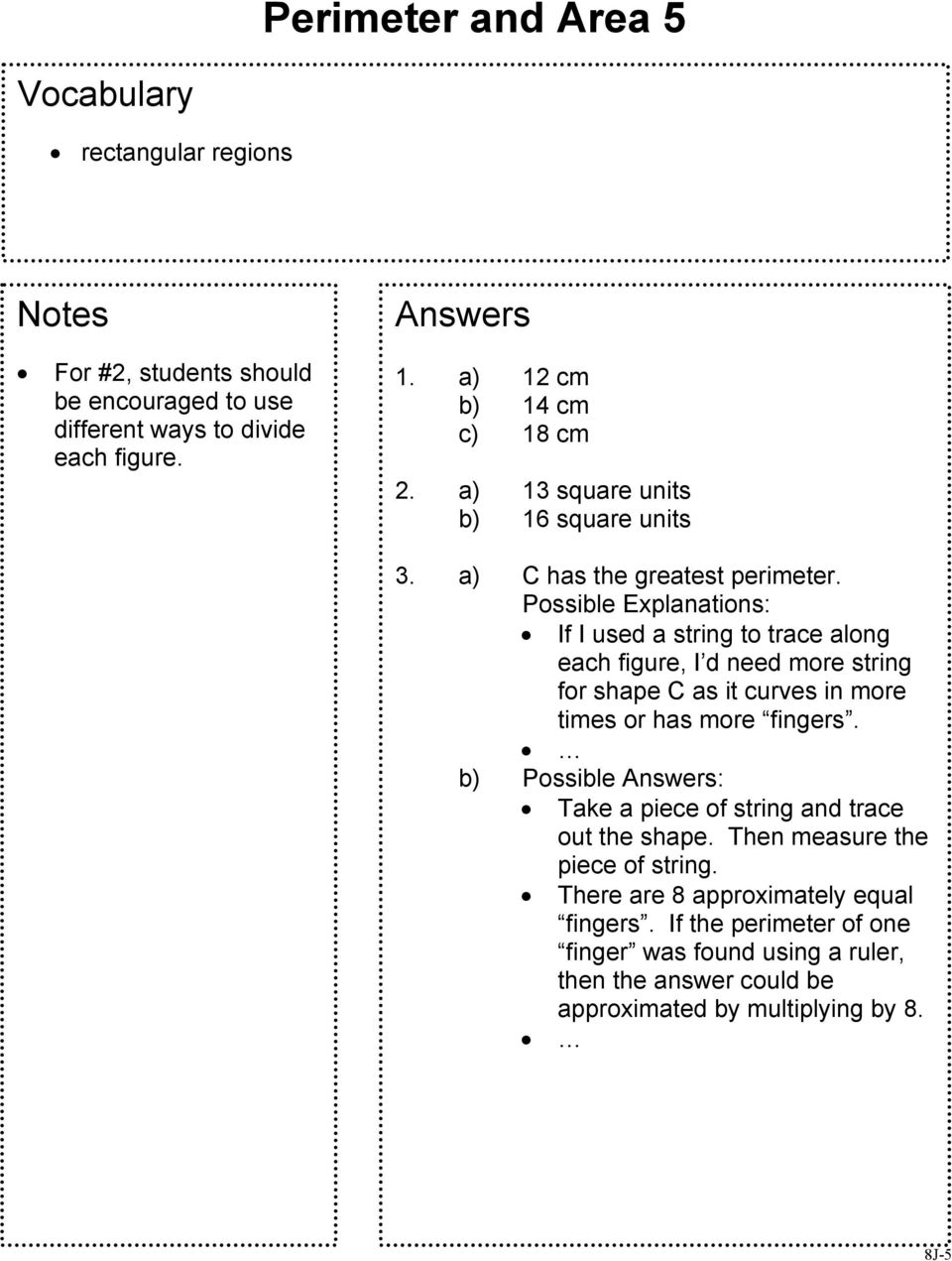
11 Perimeter and Area 5. Find the perimeter of each shape if the interval is centimetre or the measurement is in centimetres. a) b) c) 4. Divide each figure into rectangular regions. Find the total area by adding the areas of the regions. a) 4 b) 3. Consider the diagrams below. 3 3 A B C a) Which shape has the greatest perimeter? Why? b) Describe how to find the perimeter of shape A. 8J-5
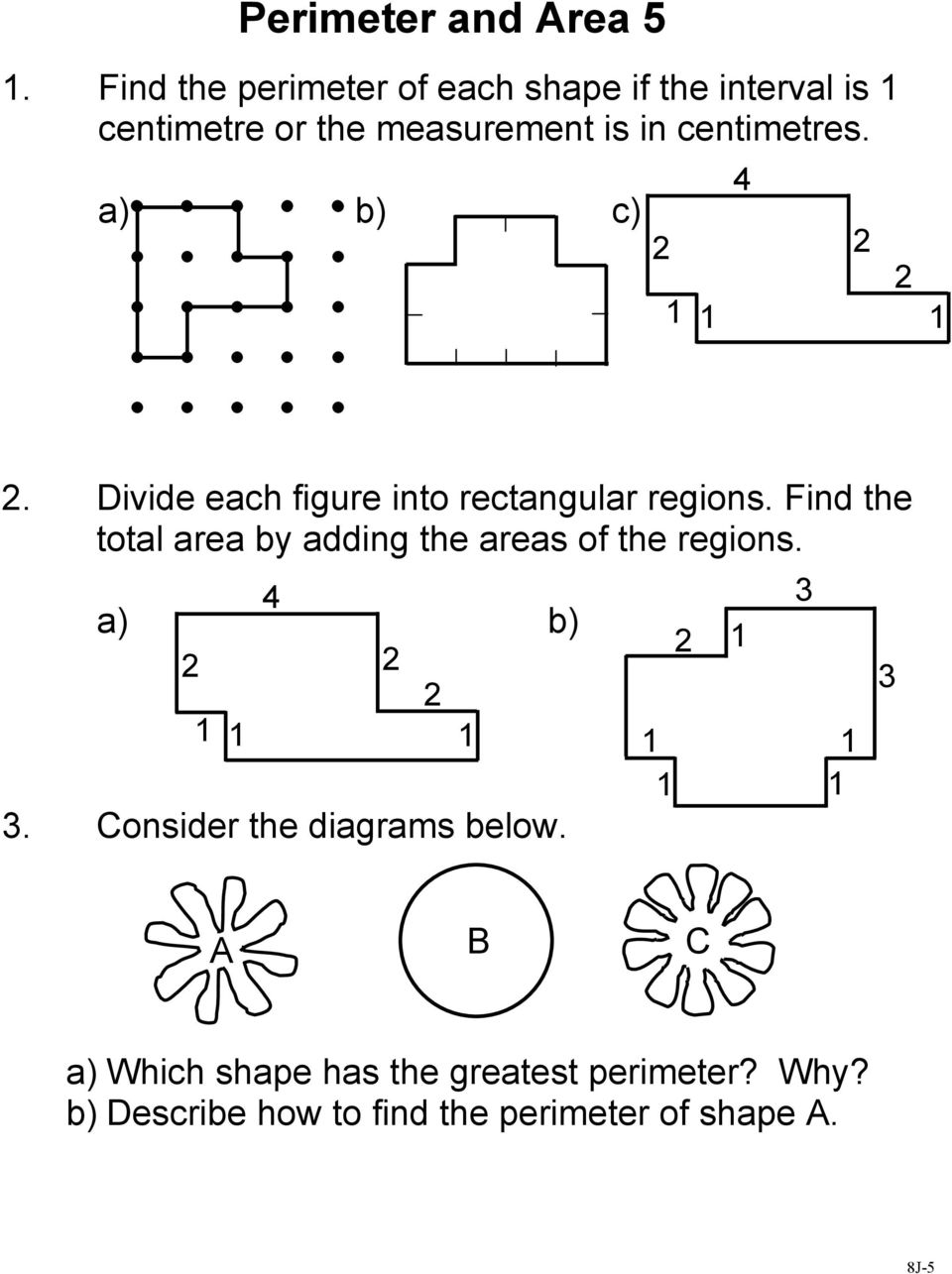
12 Perimeter and Area 6 Vocabulary Notes Answers. a) 4 cm b) cm. a) 5 cm b) cm cm 4. Possible Answers: Split the figure into two rectangles in one of the following ways: (3 ) + ( 3) = 9 Area is 9 cm ( ) + ( 4) = 9 Area is 9 cm Create a cm by cm grid and lay it over top of the figure. Count the squares. There would be 9 squares so the area is 9 cm. Complete the rectangle as shown below. Find its area () and remove or subtract the amount added (3). Area is 3 = 9 cm. 8J-6

13 Perimeter and Area 6. Find the perimeter of the following shapes if each marked interval is centimetre. b) b). Find the area of the following shapes if each marked interval is centimetre. b) b) 3. What is the perimeter, in centimetres, of the figure on the right? 6 cm 8 cm 8 cm 4. Show two different ways to find the area for the shape drawn below. All measurements are in centimetres. All angles are right angles J-6
14 Perimeter and Area 7 Vocabulary Notes Answers. a) 4 cm b) cm c) 8 cm. Possible Answers: ( ) + (3 ) + (5 ) + (3 ) = 3 square units (5 4) ( ) ( ) ( ) = 3 square units 3. a) Shape C has the largest perimeter Possible Explanations: If I used a string to trace along each figure, I d need more string for shape C as it curves more times or has more prongs/fingers. b) Possible Answers: Take a piece of string and trace out shape C. Then measure the piece of string. There are 0 approximately equal fingers. If the perimeter of one finger was found using a ruler, then the answer could be approximated by multiplying by 0. 8J-7

15 Perimeter and Area 7. Find the perimeter of each shape if the interval is centimetre or the measurement is in centimetres. a) b) c) 4. There are two basic ways to find the area of irregular rectangular shapes. One way is to divide the shape into rectangular regions and then to add the areas of the regions. The other way is to draw a rectangle which 3 just encloses the irregular rectangular shape and then to subtract areas not in the original shape. Find the area of the shape on the right using each method described above. 4. Consider the diagrams. A B C c) Which shape has the greatest perimeter? Why? d) Describe two ways to find the perimeter of shape C. 8J-7
Convert between units of area and determine the scale factor of two similar figures.
 CHAPTER 5 Units of Area c GOAL Convert between units of area and determine the scale factor of two. You will need a ruler centimetre grid paper a protractor a calculator Learn about the Math The area of
16 Circles and Cylinders
 16 Circles and Cylinders 16.1 Introduction to Circles In this section we consider the circle, looking at drawing circles and at the lines that split circles into different parts. A chord joins any two
By the end of this set of exercises, you should be able to:
 BASIC GEOMETRIC PROPERTIES By the end of this set of exercises, you should be able to: find the area of a simple composite shape find the volume of a cube or a cuboid find the area and circumference of
Charlesworth School Year Group Maths Targets
 Charlesworth School Year Group Maths Targets Year One Maths Target Sheet Key Statement KS1 Maths Targets (Expected) These skills must be secure to move beyond expected. I can compare, describe and solve
Students are able to represent and solve problems involving multiplication and division.
 Grade 3 Learning Targets and I Can Statements Operations and Algebraic Thinking Students are able to represent and solve problems involving multiplication and division. o I understand the product of multiplication
CALCULATING THE AREA OF A FLOWER BED AND CALCULATING NUMBER OF PLANTS NEEDED
 This resource has been produced as a result of a grant awarded by LSIS. The grant was made available through the Skills for Life Support Programme in 2010. The resource has been developed by (managers
Areas of Polygons. Goal. At-Home Help. 1. A hockey team chose this logo for their uniforms.
 -NEM-WBAns-CH // : PM Page Areas of Polygons Estimate and measure the area of polygons.. A hockey team chose this logo for their uniforms. A grid is like an area ruler. Each full square on the grid has
Student Outcomes. Lesson Notes. Classwork. Exercises 1 3 (4 minutes)
 Student Outcomes Students give an informal derivation of the relationship between the circumference and area of a circle. Students know the formula for the area of a circle and use it to solve problems.
Three daily lessons. Year 5
 Unit 6 Perimeter, co-ordinates Three daily lessons Year 4 Autumn term Unit Objectives Year 4 Measure and calculate the perimeter of rectangles and other Page 96 simple shapes using standard units. Suggest
Unit 8 Angles, 2D and 3D shapes, perimeter and area
 Unit 8 Angles, 2D and 3D shapes, perimeter and area Five daily lessons Year 6 Spring term Recognise and estimate angles. Use a protractor to measure and draw acute and obtuse angles to Page 111 the nearest
GAP CLOSING. 2D Measurement. Intermediate / Senior Student Book
 GAP CLOSING 2D Measurement Intermediate / Senior Student Book 2-D Measurement Diagnostic...3 Areas of Parallelograms, Triangles, and Trapezoids...6 Areas of Composite Shapes...14 Circumferences and Areas
Dŵr y Felin Comprehensive School. Perimeter, Area and Volume Methodology Booklet
 Dŵr y Felin Comprehensive School Perimeter, Area and Volume Methodology Booklet Perimeter, Area & Volume Perimeters, Area & Volume are key concepts within the Shape & Space aspect of Mathematics. Pupils
The teacher gives the student a ruler, shows her the shape below and asks the student to calculate the shape s area.
 Complex area Georgia is able to calculate the area of a complex shape by mentally separating the shape into familiar shapes. She is able to use her knowledge of the formula for the area of a rectangle
Circumference and Area of a Circle
 Overview Math Concepts Materials Students explore how to derive pi (π) as a ratio. Students also study the circumference and area of a circle using formulas. numbers and operations TI-30XS MultiView two-dimensional
Area and Perimeter. Name: Class: Date: Short Answer
 Name: Class: Date: ID: A Area and Perimeter Short Answer 1. The squares on this grid are 1 centimeter long and 1 centimeter wide. Outline two different figures with an area of 12 square centimeters and
Numeracy Targets. I can count at least 20 objects
 Targets 1c I can read numbers up to 10 I can count up to 10 objects I can say the number names in order up to 20 I can write at least 4 numbers up to 10. When someone gives me a small number of objects
AREA & CIRCUMFERENCE OF CIRCLES
 Edexcel GCSE Mathematics (Linear) 1MA0 AREA & CIRCUMFERENCE OF CIRCLES Materials required for examination Ruler graduated in centimetres and millimetres, protractor, compasses, pen, HB pencil, eraser.
GAP CLOSING. 2D Measurement GAP CLOSING. Intermeditate / Senior Facilitator s Guide. 2D Measurement
 GAP CLOSING 2D Measurement GAP CLOSING 2D Measurement Intermeditate / Senior Facilitator s Guide 2-D Measurement Diagnostic...4 Administer the diagnostic...4 Using diagnostic results to personalize interventions...4
Which two rectangles fit together, without overlapping, to make a square?
 SHAPE level 4 questions 1. Here are six rectangles on a grid. A B C D E F Which two rectangles fit together, without overlapping, to make a square?... and... International School of Madrid 1 2. Emily has
Perimeter, Area and Volume What Do Units Tell You About What Is Being Measured? Overview
 Perimeter, Area and Volume What Do Units Tell You About What Is Being Measured? Overview Summary of Lessons: This set of lessons was designed to develop conceptual understanding of the unique attributes
Geometry Solve real life and mathematical problems involving angle measure, area, surface area and volume.
 Performance Assessment Task Pizza Crusts Grade 7 This task challenges a student to calculate area and perimeters of squares and rectangles and find circumference and area of a circle. Students must find
You must have: Ruler graduated in centimetres and millimetres, protractor, compasses, pen, HB pencil, eraser, calculator. Tracing paper may be used.
 Write your name here Surname Other names Pearson Edexcel International GCSE Mathematics A Paper 1FR Centre Number Wednesday 14 May 2014 Morning Time: 2 hours Candidate Number Foundation Tier Paper Reference
Measurement with Reasoning
 compare, describe and solve practical problems for: * lengths and heights [e.g. long/short, longer/shorter, tall/short, double/half] * mass/weight [e.g. heavy/light, heavier than, lighter than] * capacity
Calculating Area, Perimeter and Volume
 Calculating Area, Perimeter and Volume You will be given a formula table to complete your math assessment; however, we strongly recommend that you memorize the following formulae which will be used regularly
Level 1 - Maths Targets TARGETS. With support, I can show my work using objects or pictures 12. I can order numbers to 10 3
 Ma Data Hling: Interpreting Processing representing Ma Shape, space measures: position shape Written Mental method s Operations relationship s between them Fractio ns Number s the Ma1 Using Str Levels
Lesson 3.1 Factors and Multiples of Whole Numbers Exercises (pages 140 141)
 Lesson 3.1 Factors and Multiples of Whole Numbers Exercises (pages 140 141) A 3. Multiply each number by 1, 2, 3, 4, 5, and 6. a) 6 1 = 6 6 2 = 12 6 3 = 18 6 4 = 24 6 5 = 30 6 6 = 36 So, the first 6 multiples
Maximum and minimum problems. Information sheet. Think about
 Maximum and minimum problems This activity is about using graphs to solve some maximum and minimum problems which occur in industry and in working life. The graphs can be drawn using a graphic calculator
Inv 1 5. Draw 2 different shapes, each with an area of 15 square units and perimeter of 16 units.
 Covering and Surrounding: Homework Examples from ACE Investigation 1: Questions 5, 8, 21 Investigation 2: Questions 6, 7, 11, 27 Investigation 3: Questions 6, 8, 11 Investigation 5: Questions 15, 26 ACE
Planning Guide. Grade 6 Factors and Multiples. Number Specific Outcome 3
 Mathematics Planning Guide Grade 6 Factors and Multiples Number Specific Outcome 3 This Planning Guide can be accessed online at: http://www.learnalberta.ca/content/mepg6/html/pg6_factorsmultiples/index.html
1MA0/3H Edexcel GCSE Mathematics (Linear) 1MA0 Practice Paper 3H (Non-Calculator) Set C Higher Tier Time: 1 hour 45 minutes
 1MA0/H Edexcel GCSE Mathematics (Linear) 1MA0 Practice Paper H (Non-Calculator) Set C Higher Tier Time: 1 hour 45 minutes Materials required for examination Ruler graduated in centimetres and millimetres,
Grade 7 Circumference
 Grade 7 Circumference 7.SS.1 Demonstrate an understanding of circles by describing the relationships among radius, diameter, and circumference of circles relating circumference to PI determining the sum
A Resource for Free-standing Mathematics Qualifications
 To find a maximum or minimum: Find an expression for the quantity you are trying to maximise/minimise (y say) in terms of one other variable (x). dy Find an expression for and put it equal to 0. Solve
Year 9 mathematics test
 Ma KEY STAGE 3 Year 9 mathematics test Tier 6 8 Paper 1 Calculator not allowed First name Last name Class Date Please read this page, but do not open your booklet until your teacher tells you to start.
Grade 8 Mathematics Measurement: Lesson 6
 Grade 8 Mathematics Measurement: Lesson 6 Read aloud to the students the material that is printed in boldface type inside the boxes. Information in regular type inside the boxes and all information outside
Paper Reference. Ruler graduated in centimetres and millimetres, protractor, compasses, pen, HB pencil, eraser, calculator. Tracing paper may be used.
 Centre No. Candidate No. Paper Reference 1 3 8 0 4 H Paper Reference(s) 1380/4H Edexcel GCSE Mathematics (Linear) 1380 Paper 4 (Calculator) Higher Tier Friday 11 June 2010 Morning Time: 1 hour 45 minutes
SCOPE & SEQUENCE. Kindergarten, First Grade, and Second Grade. Skills and Activities
 SCOPE & SEQUENCE Kindergarten, First Grade, and Second Grade Skills and Activities INNOVATIVE LEARNING CONCEPTS INC. creators of TOUCHMATH TouchMath materials were first published in 1975. Innovative Learning
MATHEMATICS TEST. Paper 1 calculator not allowed LEVEL 6 TESTS ANSWER BOOKLET. First name. Middle name. Last name. Date of birth Day Month Year
 LEVEL 6 TESTS ANSWER BOOKLET Ma MATHEMATICS TEST LEVEL 6 TESTS Paper 1 calculator not allowed First name Middle name Last name Date of birth Day Month Year Please circle one Boy Girl Year group School
Paper 1. Mathematics test. Calculator not allowed. First name. Last name. School KEY STAGE TIER
 Ma KEY STAGE 3 TIER 4 6 2005 Mathematics test Paper 1 Calculator not allowed Please read this page, but do not open your booklet until your teacher tells you to start. Write your name and the name of your
Measurement. Volume It All Stacks Up. Activity:
 Measurement Activity: TEKS: Overview: Materials: Grouping: Time: Volume It All Stacks Up (7.9) Measurement. The student solves application problems involving estimation and measurement. The student is
Imperial Length Measurements
 Unit I Measuring Length 1 Section 2.1 Imperial Length Measurements Goals Reading Fractions Reading Halves on a Measuring Tape Reading Quarters on a Measuring Tape Reading Eights on a Measuring Tape Reading
Volume of Right Prisms Objective To provide experiences with using a formula for the volume of right prisms.
 Volume of Right Prisms Objective To provide experiences with using a formula for the volume of right prisms. www.everydaymathonline.com epresentations etoolkit Algorithms Practice EM Facts Workshop Game
Lateral and Surface Area of Right Prisms
 CHAPTER A Lateral and Surface Area of Right Prisms c GOAL Calculate lateral area and surface area of right prisms. You will need a ruler a calculator Learn about the Math A prism is a polyhedron (solid
Area and Perimeter: The Mysterious Connection TEACHER EDITION
 Area and Perimeter: The Mysterious Connection TEACHER EDITION (TC-0) In these problems you will be working on understanding the relationship between area and perimeter. Pay special attention to any patterns
Geometry and Measurement
 The student will be able to: Geometry and Measurement 1. Demonstrate an understanding of the principles of geometry and measurement and operations using measurements Use the US system of measurement for
Numeracy and mathematics Experiences and outcomes
 Numeracy and mathematics Experiences and outcomes My learning in mathematics enables me to: develop a secure understanding of the concepts, principles and processes of mathematics and apply these in different
7.4A/7.4B STUDENT ACTIVITY #1
 7.4A/7.4B STUDENT ACTIVITY #1 Write a formula that could be used to find the radius of a circle, r, given the circumference of the circle, C. The formula in the Grade 7 Mathematics Chart that relates the
My Year 1 Maths Targets
 My Year 1 Maths Targets Number number and place value I can count to and across 100, forwards and backwards, beginning with 0 or 1, or from any given number. I can count in multiples of twos, fives and
Think About This Situation
 Think About This Situation A popular game held at fairs or parties is the jelly bean guessing contest. Someone fills a jar or other large transparent container with a known quantity of jelly beans and
Unit 4 Measures time, mass and area
 Unit 4 Measures time, mass and area Five daily lessons Year 4 Spring term (Key objectives in bold) Unit Objectives Year 4 Estimate/check times using seconds, minutes, hours. Page 98 Know and use the relationships
CAMI Education linked to CAPS: Mathematics
 - 1 - TOPIC 1.1 Whole numbers _CAPS curriculum TERM 1 CONTENT Mental calculations Revise: Multiplication of whole numbers to at least 12 12 Ordering and comparing whole numbers Revise prime numbers to
Geometry Progress Ladder
 Geometry Progress Ladder Maths Makes Sense Foundation End-of-year objectives page 2 Maths Makes Sense 1 2 End-of-block objectives page 3 Maths Makes Sense 3 4 End-of-block objectives page 4 Maths Makes
Year 8 mathematics test
 Ma KEY STAGE 3 Year 8 mathematics test TIER 4 6 Paper 1 Calculator not allowed First name Last name Class Date Please read this page, but do not open your booklet until your teacher tells you to start.
Primary Curriculum 2014
 Primary Curriculum 2014 Suggested Key Objectives for Mathematics at Key Stages 1 and 2 Year 1 Maths Key Objectives Taken from the National Curriculum 1 Count to and across 100, forwards and backwards,
NEW MEXICO Grade 6 MATHEMATICS STANDARDS
 PROCESS STANDARDS To help New Mexico students achieve the Content Standards enumerated below, teachers are encouraged to base instruction on the following Process Standards: Problem Solving Build new mathematical
9 Area, Perimeter and Volume
 9 Area, Perimeter and Volume 9.1 2-D Shapes The following table gives the names of some 2-D shapes. In this section we will consider the properties of some of these shapes. Rectangle All angles are right
Mathematics. Steps to Success. and. Top Tips. Year 5
 Pownall Green Primary School Mathematics and Year 5 1 Contents Page 1. Multiplication and Division 3 2. Positive and Negative Numbers 4 3. Decimal Notation 4. Reading Decimals 5 5. Fractions Linked to
Paper Reference. Ruler graduated in centimetres and millimetres, protractor, compasses, pen, HB pencil, eraser, calculator. Tracing paper may be used.
 Centre No. Candidate No. Paper Reference 1 3 8 0 2 F Paper Reference(s) 1380/2F Edexcel GCSE Mathematics (Linear) 1380 Paper 2 (Calculator) Foundation Tier Friday 12 November 2010 Morning Time: 1 hour
Problem of the Month: Once Upon a Time
 Problem of the Month: The Problems of the Month (POM) are used in a variety of ways to promote problem solving and to foster the first standard of mathematical practice from the Common Core State Standards:
Arc Length and Areas of Sectors
 Student Outcomes When students are provided with the angle measure of the arc and the length of the radius of the circle, they understand how to determine the length of an arc and the area of a sector.
Paper Reference. Ruler graduated in centimetres and millimetres, protractor, compasses, pen, HB pencil, eraser. Tracing paper may be used.
 Centre No. Candidate No. Paper Reference 1 3 8 0 3 H Paper Reference(s) 1380/3H Edexcel GCSE Mathematics (Linear) 1380 Paper 3 (Non-Calculator) Higher Tier Monday 18 May 2009 Afternoon Time: 1 hour 45
Chapter 4: The Concept of Area
 Chapter 4: The Concept of Area Defining Area The area of a shape or object can be defined in everyday words as the amount of stuff needed to cover the shape. Common uses of the concept of area are finding
Section 7.2 Area. The Area of Rectangles and Triangles
 Section 7. Area The Area of Rectangles and Triangles We encounter two dimensional objects all the time. We see objects that take on the shapes similar to squares, rectangle, trapezoids, triangles, and
Florida Department of Education/Office of Assessment January 2012. Grade 6 FCAT 2.0 Mathematics Achievement Level Descriptions
 Florida Department of Education/Office of Assessment January 2012 Grade 6 FCAT 2.0 Mathematics Achievement Level Descriptions Grade 6 FCAT 2.0 Mathematics Reporting Category Fractions, Ratios, Proportional
Applied. Grade 9 Assessment of Mathematics LARGE PRINT RELEASED ASSESSMENT QUESTIONS
 Applied Grade 9 Assessment of Mathematics 2014 RELEASED ASSESSMENT QUESTIONS Record your answers to multiple-choice questions on the Student Answer Sheet (2014, Applied). LARGE PRINT Please note: The format
TeeJay Publishers General Homework for Book 3G Ch 9 - circles. Circles
 Circles Homework Chapter 9 Exercise 1 1. For each of these circles, say whether the dotted line is a radius or a diameter :- (d) 2. Use two letters to name the line which is a diameter in this circle.
Finding Volume of Rectangular Prisms
 MA.FL.7.G.2.1 Justify and apply formulas for surface area and volume of pyramids, prisms, cylinders, and cones. MA.7.G.2.2 Use formulas to find surface areas and volume of three-dimensional composite shapes.
Paper Reference. Edexcel GCSE Mathematics (Linear) 1380 Paper 1 (Non-Calculator) Foundation Tier
 Centre No. Candidate No. Paper Reference 1 3 8 0 1 F Paper Reference(s) 1380/1F Edexcel GCSE Mathematics (Linear) 1380 Paper 1 (Non-Calculator) Foundation Tier Friday 2 March 2012 Afternoon Time: 1 hour
Paper Reference. Ruler graduated in centimetres and millimetres, protractor, compasses, pen, HB pencil, eraser. Tracing paper may be used.
 Centre No. Candidate No. Paper Reference 1 3 8 0 1 F Paper Reference(s) 1380/1F Edexcel GCSE Mathematics (Linear) 1380 Paper 1 (Non-Calculator) Foundation Tier Monday 7 June 2010 Afternoon Time: 1 hour
Filling and Wrapping: Homework Examples from ACE
 Filling and Wrapping: Homework Examples from ACE Investigation 1: Building Smart Boxes: Rectangular Prisms, ACE #3 Investigation 2: Polygonal Prisms, ACE #12 Investigation 3: Area and Circumference of
What You ll Learn. Why It s Important
 These students are setting up a tent. How do the students know how to set up the tent? How is the shape of the tent created? How could students find the amount of material needed to make the tent? Why
GAP CLOSING. Volume and Surface Area. Intermediate / Senior Student Book
 GAP CLOSING Volume and Surface Area Intermediate / Senior Student Book Volume and Surface Area Diagnostic...3 Volumes of Prisms...6 Volumes of Cylinders...13 Surface Areas of Prisms and Cylinders...18
Solve addition and subtraction word problems, and add and subtract within 10, e.g., by using objects or drawings to represent the problem.
 Solve addition and subtraction word problems, and add and subtract within 10, e.g., by using objects or drawings to represent the problem. Solve word problems that call for addition of three whole numbers
Paper 1. Calculator not allowed. Mathematics test. First name. Last name. School. Remember KEY STAGE 3 TIER 5 7
 Ma KEY STAGE 3 Mathematics test TIER 5 7 Paper 1 Calculator not allowed First name Last name School 2009 Remember The test is 1 hour long. You must not use a calculator for any question in this test. You
Numerator Denominator
 Fractions A fraction is any part of a group, number or whole. Fractions are always written as Numerator Denominator A unitary fraction is one where the numerator is always 1 e.g 1 1 1 1 1...etc... 2 3
Build your skills: Perimeter and area Part 1. Working out the perimeter and area of different shapes
 Working out the perimeter and area of different shapes This task has two parts. Part 1 In this part, you can brush up your skills and find out about perimeter and area. Part 2 In the second part, you can
0.75 75% ! 3 40% 0.65 65% Percent Cards. This problem gives you the chance to: relate fractions, decimals and percents
 Percent Cards This problem gives you the chance to: relate fractions, decimals and percents Mrs. Lopez makes sets of cards for her math class. All the cards in a set have the same value. Set A 3 4 0.75
MD5-26 Stacking Blocks Pages 115 116
 MD5-26 Stacking Blocks Pages 115 116 STANDARDS 5.MD.C.4 Goals Students will find the number of cubes in a rectangular stack and develop the formula length width height for the number of cubes in a stack.
Overview. Essential Questions. Grade 8 Mathematics, Quarter 4, Unit 4.3 Finding Volume of Cones, Cylinders, and Spheres
 Cylinders, and Spheres Number of instruction days: 6 8 Overview Content to Be Learned Evaluate the cube root of small perfect cubes. Simplify problems using the formulas for the volumes of cones, cylinders,
You must have: Ruler graduated in centimetres and millimetres, protractor, compasses, pen, HB pencil, eraser, calculator. Tracing paper may be used.
 Write your name here Surname Other names Pearson Edexcel International GCSE Mathematics A Paper 1FR Centre Number Tuesday 6 January 2015 Afternoon Time: 2 hours Candidate Number Foundation Tier Paper Reference
Math 0980 Chapter Objectives. Chapter 1: Introduction to Algebra: The Integers.
 Math 0980 Chapter Objectives Chapter 1: Introduction to Algebra: The Integers. 1. Identify the place value of a digit. 2. Write a number in words or digits. 3. Write positive and negative numbers used
WORK SCHEDULE: MATHEMATICS 2007
 , K WORK SCHEDULE: MATHEMATICS 00 GRADE MODULE TERM... LO NUMBERS, OPERATIONS AND RELATIONSHIPS able to recognise, represent numbers and their relationships, and to count, estimate, calculate and check
8 th Grade Task 2 Rugs
 8 th Grade Task 2 Rugs Student Task Core Idea 4 Geometry and Measurement Find perimeters of shapes. Use Pythagorean theorem to find side lengths. Apply appropriate techniques, tools and formulas to determine
Paper 1. Calculator not allowed. Mathematics test. First name. Last name. School. Remember KEY STAGE 3 TIER 4 6
 Ma KEY STAGE 3 Mathematics test TIER 4 6 Paper 1 Calculator not allowed First name Last name School 2007 Remember The test is 1 hour long. You must not use a calculator for any question in this test. You
Prentice Hall Mathematics: Course 1 2008 Correlated to: Arizona Academic Standards for Mathematics (Grades 6)
 PO 1. Express fractions as ratios, comparing two whole numbers (e.g., ¾ is equivalent to 3:4 and 3 to 4). Strand 1: Number Sense and Operations Every student should understand and use all concepts and
SGS4.3 Stage 4 Space & Geometry Part A Activity 2-4
 SGS4.3 Stage 4 Space & Geometry Part A Activity 2-4 Exploring triangles Resources required: Each pair students will need: 1 container (eg. a rectangular plastic takeaway container) 5 long pipe cleaners
Major Work of the Grade
 Counting and Cardinality Know number names and the count sequence. Count to tell the number of objects. Compare numbers. Kindergarten Describe and compare measurable attributes. Classify objects and count
Kristen Kachurek. Circumference, Perimeter, and Area Grades 7-10 5 Day lesson plan. Technology and Manipulatives used:
 Kristen Kachurek Circumference, Perimeter, and Area Grades 7-10 5 Day lesson plan Technology and Manipulatives used: TI-83 Plus calculator Area Form application (for TI-83 Plus calculator) Login application
10-4-10 Year 9 mathematics: holiday revision. 2 How many nines are there in fifty-four?
 DAY 1 Mental questions 1 Multiply seven by seven. 49 2 How many nines are there in fifty-four? 54 9 = 6 6 3 What number should you add to negative three to get the answer five? 8 4 Add two point five to
Indicator 2: Use a variety of algebraic concepts and methods to solve equations and inequalities.
 3 rd Grade Math Learning Targets Algebra: Indicator 1: Use procedures to transform algebraic expressions. 3.A.1.1. Students are able to explain the relationship between repeated addition and multiplication.
Perimeter is the length of the boundary of a two dimensional figure.
 Section 2.2: Perimeter and Area Perimeter is the length of the boundary of a two dimensional figure. The perimeter of a circle is called the circumference. The perimeter of any two dimensional figure whose
Paper 1. Calculator not allowed. Mathematics test. First name. Last name. School. Remember KEY STAGE 3 TIER 4 6
 Ma KEY STAGE 3 Mathematics test TIER 4 6 Paper 1 Calculator not allowed First name Last name School 2009 Remember The test is 1 hour long. You must not use a calculator for any question in this test. You
ISAT Mathematics Performance Definitions Grade 4
 ISAT Mathematics Performance Definitions Grade 4 EXCEEDS STANDARDS Fourth-grade students whose measured performance exceeds standards are able to identify, read, write, represent, and model whole numbers
10.1. Solving Quadratic Equations. Investigation: Rocket Science CONDENSED
 CONDENSED L E S S O N 10.1 Solving Quadratic Equations In this lesson you will look at quadratic functions that model projectile motion use tables and graphs to approimate solutions to quadratic equations
Mathematics Navigator. Misconceptions and Errors
 Mathematics Navigator Misconceptions and Errors Introduction In this Guide Misconceptions and errors are addressed as follows: Place Value... 1 Addition and Subtraction... 4 Multiplication and Division...
Lesson 4: Surface Area
 Lesson 4: Surface Area Selected Content Standards Benchmarks Addressed: M-1-M Applying the concepts of length, area, surface area, volume, capacity, weight, mass, money, time, temperature, and rate to
AUTUMN UNIT 3. first half. Perimeter. Centimetres and millimetres. Metres and centimetres. Area. 3D shapes PART 3 MEASURES AND PROPERTIES OF SHAPES
 PART AUTUMN first half MEASURES AND PROPERTIES OF SHAPES SECTION Perimeter SECTION Centimetres and millimetres SECTION Metres and centimetres SECTION Key Stage National Strategy CROWN COPYRIGHT 00 Area
Using Excel to find Perimeter, Area & Volume
 Using Excel to find Perimeter, Area & Volume Level: LBS 4 V = lwh Goal: To become familiar with Microsoft Excel by entering formulas into a spreadsheet in order to calculate the perimeter, area and volume
Bridging Documents for Mathematics
 Bridging Documents for Mathematics 5 th /6 th Class, Primary Junior Cycle, Post-Primary Primary Post-Primary Card # Strand(s): Number, Measure Number (Strand 3) 2-5 Strand: Shape and Space Geometry and
1 ST GRADE COMMON CORE STANDARDS FOR SAXON MATH
 1 ST GRADE COMMON CORE STANDARDS FOR SAXON MATH Calendar The following tables show the CCSS focus of The Meeting activities, which appear at the beginning of each numbered lesson and are taught daily,
Tallahassee Community College PERIMETER
 Tallahassee Community College 47 PERIMETER The perimeter of a plane figure is the distance around it. Perimeter is measured in linear units because we are finding the total of the lengths of the sides