
South Africa MILLENNIUM DEVELOPMENT GOALS MID-TERM COUNTRY REPORT
|
|
|
- Eustace Perry
- 9 years ago
- Views:
Transcription
1 South Africa MILLENNIUM DEVELOPMENT GOALS MID-TERM COUNTRY REPORT September 2007

2 TABLE OF CONTENTS EXECUTIVE SUMMARY INTRODUCTION BACKGROUND AND PURPOSE SOUTH AFRICA COUNTRY CONTEXT ASSESSMENT OF SPECIFIC GOALS GOAL 1: ERADICATE EXTREME POVERTY AND HUNGER Target 1: Halve between 1990 and 2015 the proportion of people whose income is less than US$1 per day Target 2: Halve, between 1990 and 2015, the proportion of people who suffer from hunger GOAL 2: ACHIEVE UNIVERSAL PRIMARY EDUCATION Target 3: Ensure that, by 2015, children everywhere, boys and girls alike, will be able to complete a full course of primary schooling INITIATIVES TO ACCELERATE IMPROVE QUALITY OF AND ACCESS TO EDUCATION GOAL 3: PROMOTE GENDER EQUALITY AND EMPOWER WOMEN Target 4: Eliminate gender disparity in primary and secondary education preferably by 2005 and in all levels of education no later than GOAL 4: REDUCE CHILD MORTALITY Target 5: Reduce by two thirds, between 1990 and 2015, the under-five mortality rate Decreasing Infant and Child Mortality...24 GOAL 5: IMPROVE MATERNAL HEALTH Target 6: Reduce by three-quarters, between 1990 and 2015, the maternal mortality ratio GOAL 6: COMBAT HIV AND AIDS, MALARIA AND OTHER DISEASES Target 7: Have halted by 2015, and begin to reverse the spread of HIV and AIDS Target 8: Have halted by 2015, and begin to reverse the incidence of malaria and other major diseases Decreasing Infant and Child Mortality...31 GOAL 7: ENSURE ENVIRONMENTAL SUSTAINABILITY Target 9: Integrate the principles of sustainable development into country policies and programmes, and reverse the loss of environmental resources Target 10: Halve, by 2015, the proportion of people without sustainable access to safe drinking water Target 11: Have achieved, by 2020, a significant improvement in the lives of at least 100 million slum dwellers GOAL 8: DEVELOP A GLOBAL PARTNERSHIP FOR DEVELOPMENT Target 12: Develop further an open, rule-based, predictable, non-discriminatory trading and financial system (includes commitment to good governance, development and poverty reduction both nationally and internationally) Target 13: Address the special needs of the least developed countries Target 13: Address the special needs of the least developed countries, and Target 14: Address the special needs of landlocked countries and small-island developing states 48 Target 15: Deal comprehensively with debt problems of developing countries through national and international measures in order to make debt sustainable in the long run Target 16: In cooperation with developing countries, develop and implement strategies for decent and productive work for youth Target 17: In cooperation with pharmaceutical companies, provide access to affordable drugs in developing countries Target 18: In cooperation with the private sector, make available the benefits of new technologies, especially information and communications

3 3. CONCLUDING REMARKS REFERENCES LIST OF ACRONYMS

4 Goals and targets and their indicators Goals and targets Goal 1: Eradicate extreme poverty and hunger Target 1: Halve, between 1990 and 2015, the proportion of people whose income is less than US$1 a day Target 2: Halve, between 1990 and 2015, the proportion of people who suffer from hunger Goal 2: Achieve universal primary education Target 3: Ensure that, by 2015, children everywhere, boys and girls alike, will be able to complete a full course of primary schooling Goal 3: Promote gender equality and empower women Target 4: Eliminate gender disparity in primary and secondary education preferably by 2005 and in all levels of education no later than 2015 Goal 4: Reduce child mortality Target 5: Reduce by two-thirds, between 1990 and 2015, the under-five mortality rate Goal 5: Improve maternal health Target 6: Reduce by three-quarters, between 1990 and 2015, the maternal mortality rate Goal 6: Combat HIV and AIDS, malaria and other diseases Target 7: Have halted by 2015, and begin to reverse the spread of HIV and AIDS Target 8: Have halted by 2015, and begin to reverse the incidence of malaria and other major diseases Goal 7: Ensure environmental sustainability Target 9: Integrate the principles of sustainable development into country policies and programmes and reverse the loss of environmental resources Target 10: Halve, by 2015, the proportion of people without sustainable access to safe drinking water Target11: Have achieved, by 2020, a significant improvement in the lives of at least 100 million slum dwellers Goal 8: Develop a global partnership for development Target 12: Develop further an open, rule-based, predictable, non-discriminatory trading and financial system (includes commitment to good governance, development and poverty reduction both nationally and internationally) Indicators Proportion of the population below US$ 1 a day Poverty gap ratio (incidence, times, depth of poverty) Share of poorest quintile in national consumption Prevalence of underweight children (under five years) Proportion of the population below minimum level of dietary consumption Net enrolment rate in primary education Proportion of pupils starting Grade 1 who reach Grade 7 Literacy rate of 15- to 24-year-olds Ratio of boys to girls in primary, secondary and tertiary education Ratio of literate females to males among 15- to 24-year olds Share of women in wage employment in the nonagricultural sector Proportion of seats held by women in the national parliament Under-five mortality rate Infant mortality rate (IMR) Proportion of one-year-old children immunised against measles Maternal mortality ratio Proportion of births attended by skilled health personnel HIV prevalence among 15- to 24-year-old pregnant women Contraceptive prevalence rate Number of children orphaned by HIV and AIDS Prevalence and death rates associated with malaria Proportion of the population in malaria-risk areas using effective malaria prevention and treatment measures Prevalence and death rates associated with tuberculosis Proportion of tuberculosis cases detected and cured under directly observed treatment, short-course (DOTS) Change in land area covered by forest Land area protected to maintain biological diversity GDP per unit of energy use Carbon dioxide emissions (per capita) Proportion of the population with sustainable access to an improved water source Proportion of the population with access to improved sanitation Proportion of the population with access to secure tenure Target and indicators are not presently being measured in South Africa 3

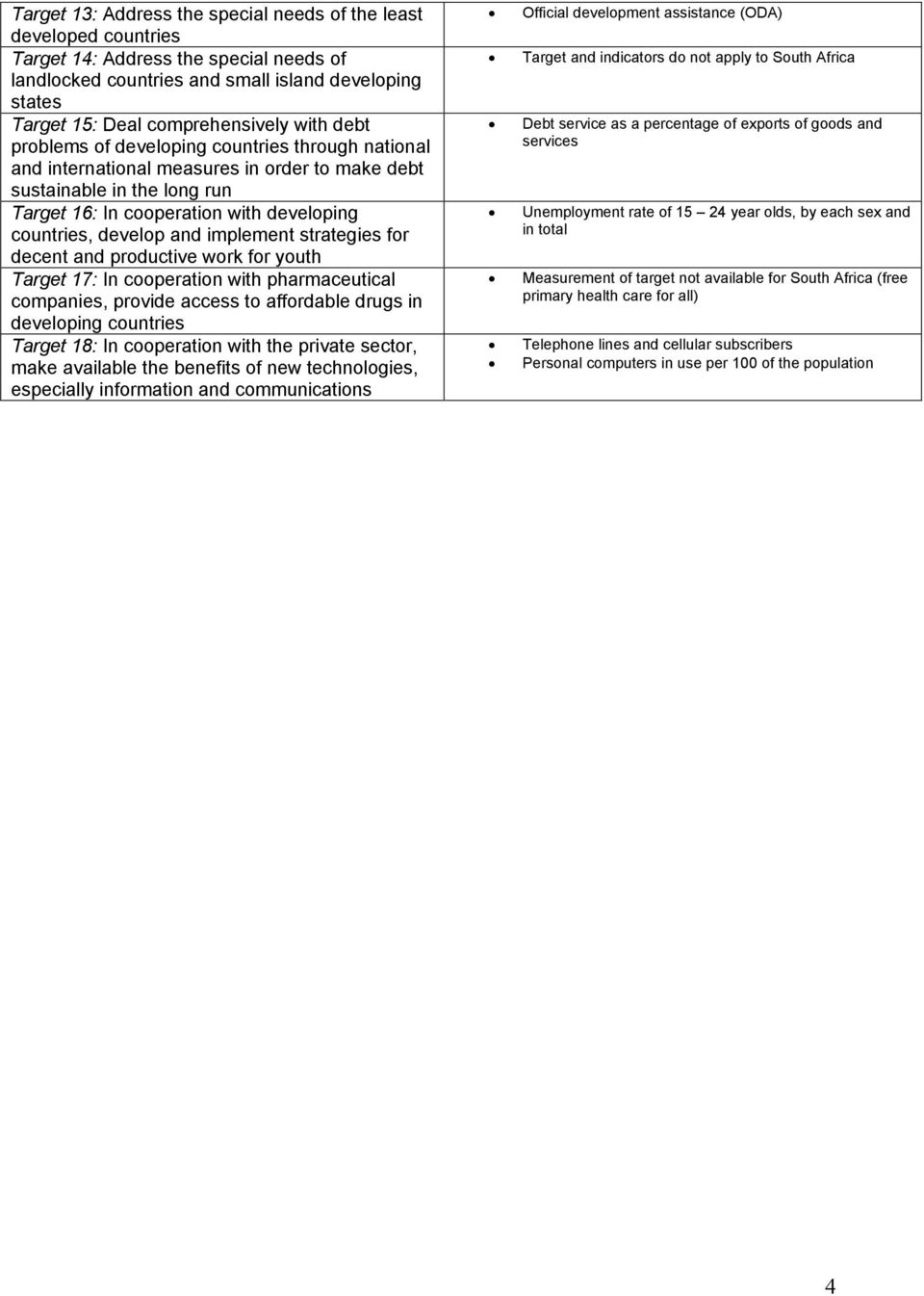
5 Target 13: Address the special needs of the least developed countries Target 14: Address the special needs of landlocked countries and small island developing states Target 15: Deal comprehensively with debt problems of developing countries through national and international measures in order to make debt sustainable in the long run Target 16: In cooperation with developing countries, develop and implement strategies for decent and productive work for youth Target 17: In cooperation with pharmaceutical companies, provide access to affordable drugs in developing countries Target 18: In cooperation with the private sector, make available the benefits of new technologies, especially information and communications Official development assistance (ODA) Target and indicators do not apply to South Africa Debt service as a percentage of exports of goods and services Unemployment rate of year olds, by each sex and in total Measurement of target not available for South Africa (free primary health care for all) Telephone lines and cellular subscribers Personal computers in use per 100 of the population 4
6 Executive Summary The 2005 South Africa s Millennium Development Goals Country Report indicated that South Africa (SA) had already met some of the MDGs targets and that for those that had not yet been achieved the country was well on course to achieve them. In fact in most cases, SA has set earlier deadlines than those of the MDGs, including close monitoring of progress. For purposes of continuity and easier comparability of progress over the years, and wherever possible, this updated report has maintained the same sources of data as those used in the 2005 report. Data continues to improve, even though some of the data challenges that were highlighted in the 2005 report remain in the current report. GOAL 1 The first Millennium Development Goal (MDG) has two targets, which are to halve, between 1990 and 2015, the proportion of people whose income is less than one dollar a day; and to halve, between 1990 and 2015, the proportion of people who suffer from hunger. Using national estimates of poverty and inequality in SA, the 2007 report indicates strong overall income growth, especially since 2002, resulting in the rise of the income of the poorest 10 and 20 percent of the population. The depth of income poverty was measured with reference to a poverty line of R3 000 per capita per annum (or just slightly above US$1 per day in 2000 constant Rand). Again, there are strong indications that the incomes and/or expenditures of those in poverty improved, bringing the very poor closer to the poverty line. In addition, the severity of poverty has been reduced, especially since However, of concern is that income inequality (as measured by Gini-coefficient) seems to have increased over most of the period. With regard to target two whose progress is measured using severe malnutrition amongst children under-5 years of age, the report observes a decline from cases in 2001 to in GOAL 2 For goal two, the target is to ensure that, by 2015, children everywhere, boys and girls alike, will be able to complete a full course of primary schooling. According to the General Household Survey (GHS), conducted by Statistics South Africa (Stats SA), over 98% of seven to 13 year old children attended education institutions in The same GHS reveals that 98% of 18 year old children had completed Grade 7 and above in This reflects an increase of close to 2% since Self-declared literacy rates obtained from the GHS suggest that youth literacy remained above 96% from 2002 to The functional literacy rate, which is based on educational achievement of up to grade 7, came close to 90% in 2006, increasing by approximately 4% from 5

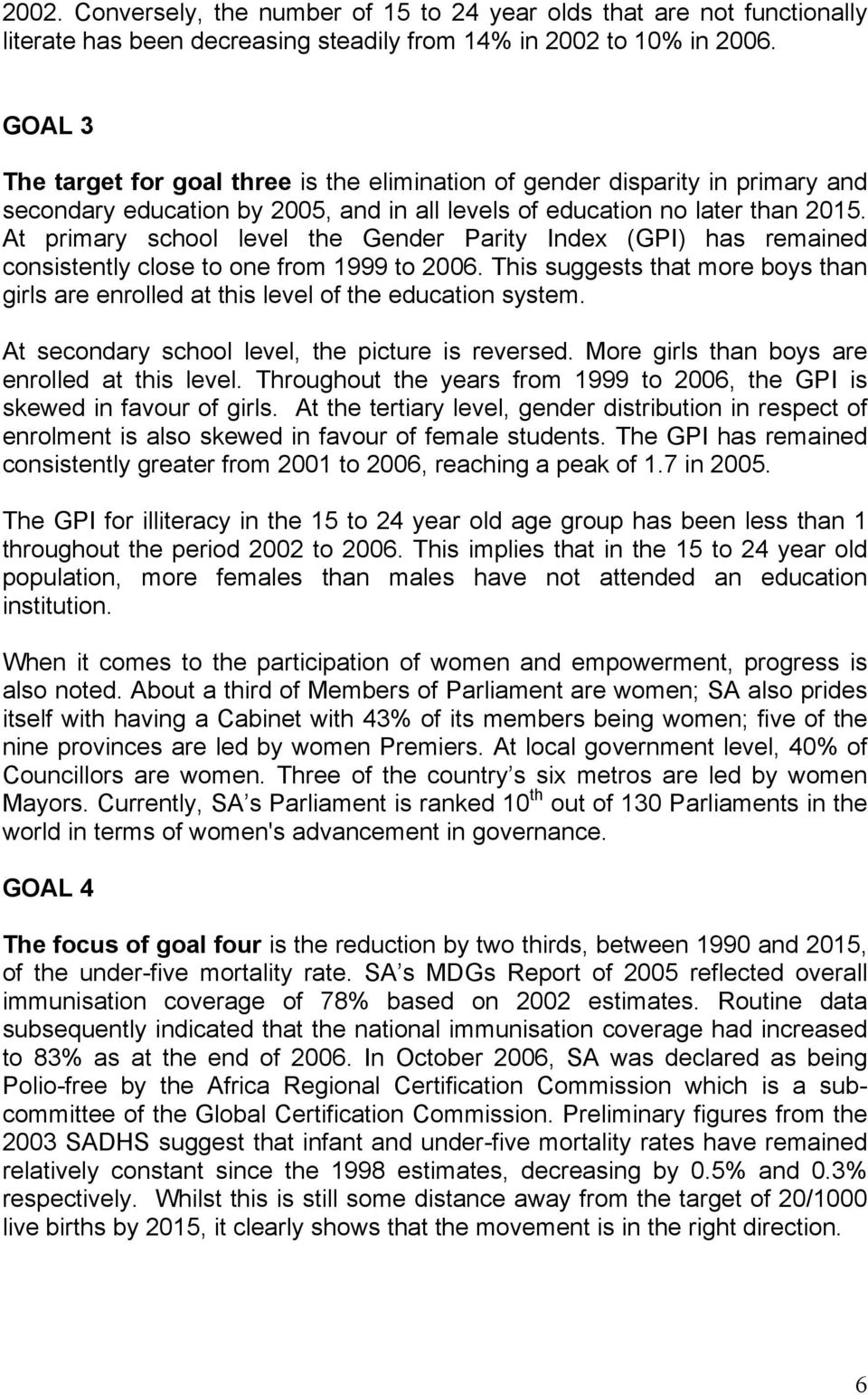
7 2002. Conversely, the number of 15 to 24 year olds that are not functionally literate has been decreasing steadily from 14% in 2002 to 10% in GOAL 3 The target for goal three is the elimination of gender disparity in primary and secondary education by 2005, and in all levels of education no later than At primary school level the Gender Parity Index (GPI) has remained consistently close to one from 1999 to This suggests that more boys than girls are enrolled at this level of the education system. At secondary school level, the picture is reversed. More girls than boys are enrolled at this level. Throughout the years from 1999 to 2006, the GPI is skewed in favour of girls. At the tertiary level, gender distribution in respect of enrolment is also skewed in favour of female students. The GPI has remained consistently greater from 2001 to 2006, reaching a peak of 1.7 in The GPI for illiteracy in the 15 to 24 year old age group has been less than 1 throughout the period 2002 to This implies that in the 15 to 24 year old population, more females than males have not attended an education institution. When it comes to the participation of women and empowerment, progress is also noted. About a third of Members of Parliament are women; SA also prides itself with having a Cabinet with 43% of its members being women; five of the nine provinces are led by women Premiers. At local government level, 40% of Councillors are women. Three of the country s six metros are led by women Mayors. Currently, SA s Parliament is ranked 10 th out of 130 Parliaments in the world in terms of women's advancement in governance. GOAL 4 The focus of goal four is the reduction by two thirds, between 1990 and 2015, of the under-five mortality rate. SA s MDGs Report of 2005 reflected overall immunisation coverage of 78% based on 2002 estimates. Routine data subsequently indicated that the national immunisation coverage had increased to 83% as at the end of In October 2006, SA was declared as being Polio-free by the Africa Regional Certification Commission which is a subcommittee of the Global Certification Commission. Preliminary figures from the 2003 SADHS suggest that infant and under-five mortality rates have remained relatively constant since the 1998 estimates, decreasing by 0.5% and 0.3% respectively. Whilst this is still some distance away from the target of 20/1000 live births by 2015, it clearly shows that the movement is in the right direction. 6
8 GOAL 5 Target six of the MDGs is the reduction by three-quarters, between 1990 and 2015, of the maternal mortality rate. As reflected in the SA MDGs Country Report for 2005, the 1998 SADHS survey found that the maternal mortality ratio (MMR) was 150/ In 2002, Stats SA, the official statistics collecting agency, reviewed all registered deaths and estimated MMR to be at 124/ This figure suggested that the country was on track towards decreasing MMR over time. Assistance at delivery by a skilled health professional is one of the key indicators for improving maternal health. As reflected in Figure 2 below, the SADHS 1998 and 2003 also showed a major increase in the percentage of women who were attended to by skilled health professionals during labour, especially by a nurse or midwife. Assistance at delivery by a nurse, midwife or a doctor increased from 84.4% in 1998 to 92.0% in GOAL 6 Goal six has two targets namely, having halted by 2015 and begin to reverse the spread of HIV and AIDS; and halving halted by 2015, and begin to reverse the incidence of malaria and other major diseases. The 2006 antenatal survey results show a statistically significant decrease in the national prevalence rates of HIV amongst pregnant women who use public health facilities between 2005 and It is for the first time after several years of relative stability, that the survey results show evidence of a decline in HIV prevalence. HIV prevalence in the age group less than 20 years old, decreased from 15.9% in 2005 to 13.7% in This implies a reduction in new infections (incidence) in the population. In addition, HIV prevalence in women in the 20 to 24 year age group also declined from 30.6% in 2005 to 28.0 in However, HIV prevalence in the older age groups (30-34 years; years; 40+) remained at levels similar to 2005, and in some instances reflected some increases, although these were not statistically significant. In order to strengthen its efforts to combat HIV and AIDS, SA produced a Comprehensive Plan for HIV and AIDS, as well as the intersectoral Strategic Plan for HIV and AIDS for 2007 to 2011, which builds on the gains of the Strategic Plan for 2000 to The Strategic Plan serves as a framework for the country s response to the challenge of HIV and AIDS. At present, 90% of public health facilities provide VCT and PMTCT. Furthermore, by April 2007, a cumulative total of patients had been put on antiretroviral treatment, in 316 sites of the Comprehensive Programme for HIV and AIDS Management, Care and Treatment (CCMT) across the nine Provinces. Additional sites are found in correctional services facilities as well as in the private for profit and not for profit health sectors. 7

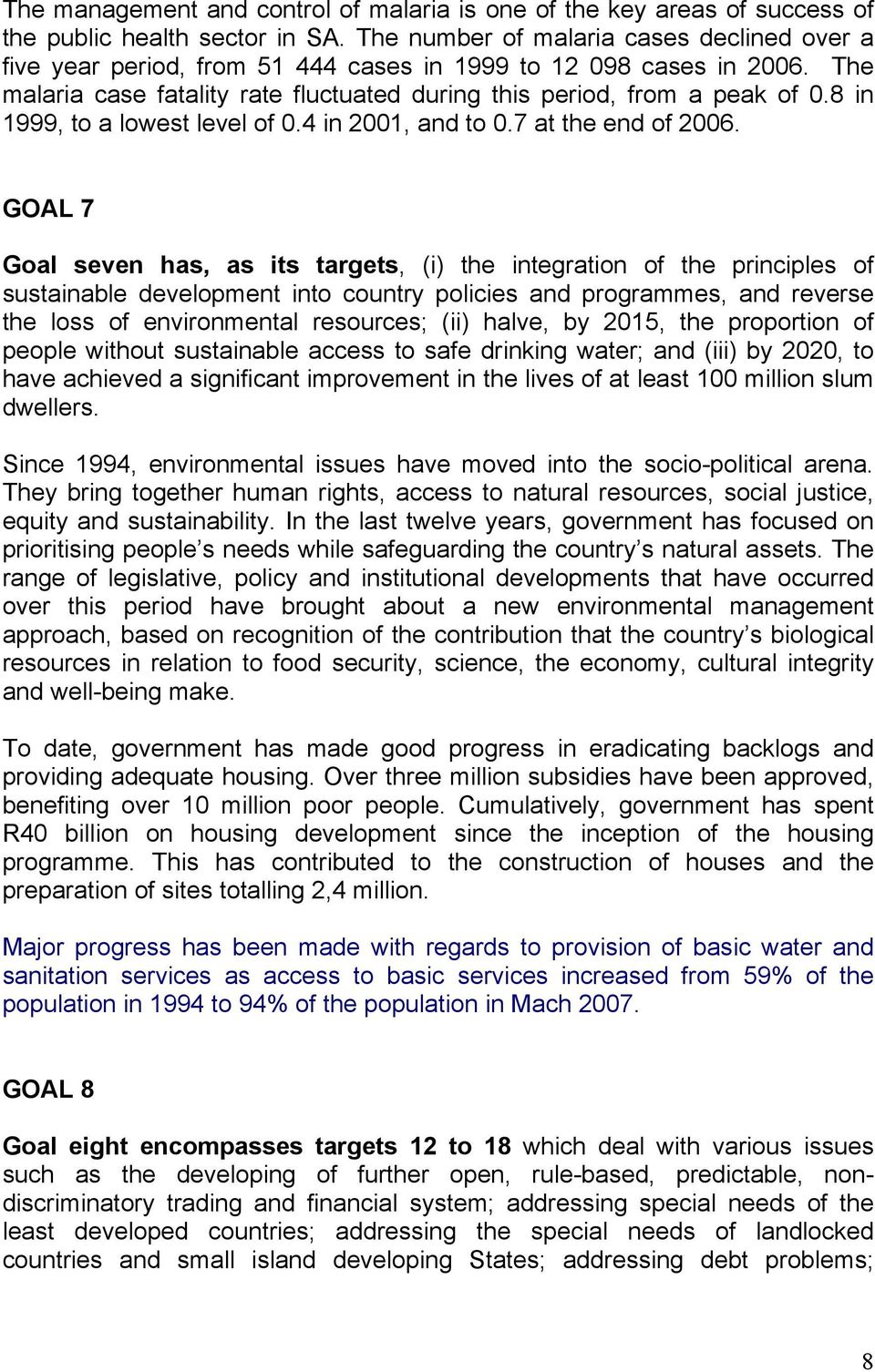
9 The management and control of malaria is one of the key areas of success of the public health sector in SA. The number of malaria cases declined over a five year period, from cases in 1999 to cases in The malaria case fatality rate fluctuated during this period, from a peak of 0.8 in 1999, to a lowest level of 0.4 in 2001, and to 0.7 at the end of GOAL 7 Goal seven has, as its targets, (i) the integration of the principles of sustainable development into country policies and programmes, and reverse the loss of environmental resources; (ii) halve, by 2015, the proportion of people without sustainable access to safe drinking water; and (iii) by 2020, to have achieved a significant improvement in the lives of at least 100 million slum dwellers. Since 1994, environmental issues have moved into the socio-political arena. They bring together human rights, access to natural resources, social justice, equity and sustainability. In the last twelve years, government has focused on prioritising people s needs while safeguarding the country s natural assets. The range of legislative, policy and institutional developments that have occurred over this period have brought about a new environmental management approach, based on recognition of the contribution that the country s biological resources in relation to food security, science, the economy, cultural integrity and well-being make. To date, government has made good progress in eradicating backlogs and providing adequate housing. Over three million subsidies have been approved, benefiting over 10 million poor people. Cumulatively, government has spent R40 billion on housing development since the inception of the housing programme. This has contributed to the construction of houses and the preparation of sites totalling 2,4 million. Major progress has been made with regards to provision of basic water and sanitation services as access to basic services increased from 59% of the population in 1994 to 94% of the population in Mach GOAL 8 Goal eight encompasses targets 12 to 18 which deal with various issues such as the developing of further open, rule-based, predictable, nondiscriminatory trading and financial system; addressing special needs of the least developed countries; addressing the special needs of landlocked countries and small island developing States; addressing debt problems; 8
10 developing and implementing strategies for decent and productive work for youth; accessing affordable essential drugs; and making available the benefits of new technologies, especially information and communications. South Africa actively supports a number of advocacy and awareness-raising efforts aimed at promoting the achievement of the MDGs by developing countries, with particular emphasis on the continent of Africa. In the latter regard, SA has played a leading role in championing the New Partnership for Africa s Development (NEPAD), which is Africa s primary socio-economic development programme through which most of the MDGs are addressed. In addition, SA is committed to the promotion and strengthening of South-South co-operation and plays a critical role in various global structures for the purposes of promoting equitable global development. SA has also been at the forefront of international efforts to promote much-needed reform of the international financial architecture. The International Monetary Fund (IMF) and the World Bank have placed an increasing emphasis on the importance of democratic governance and participatory development (the involvement of all stakeholders in the development process), if developing countries want to meet the MDGs. South Africa actively seeks to deepen and extend the economic linkages among African countries, within the context of ongoing efforts to shape the international development agenda. Regional integration remains a key policy focus area. This includes SA's participation in the SADC and the Southern African Customs Union (SACU). South Africa has maintained a high profile in international calls for debt relief for developing countries, most notably those on the continent of Africa. South African President Mbeki and other leaders have played a meaningful role in engaging the G-8 leaders on the issue of debt, making specific proposals in respect of increased aid to Africa in this regard. Equally, SA has actively participated in the work of the Commission for Africa, established by former UK Prime Minister Tony Blair, which calls on wealthier nations to double aid to poor African countries to $50 billion by 2015, reduce agricultural subsidies, and cancel the debt owed by impoverished countries. In this regard, the South African Government has tirelessly engaged the international community and policy makers, researchers and representatives of civil society in Africa to assess the role of the international community in the development of the continent. With regard to youth and the labour market, this report indicates that young people entering the labour market are struggling to find employment. They form a relatively large proportion of the unemployed, overall, but particularly young economically active women. 9

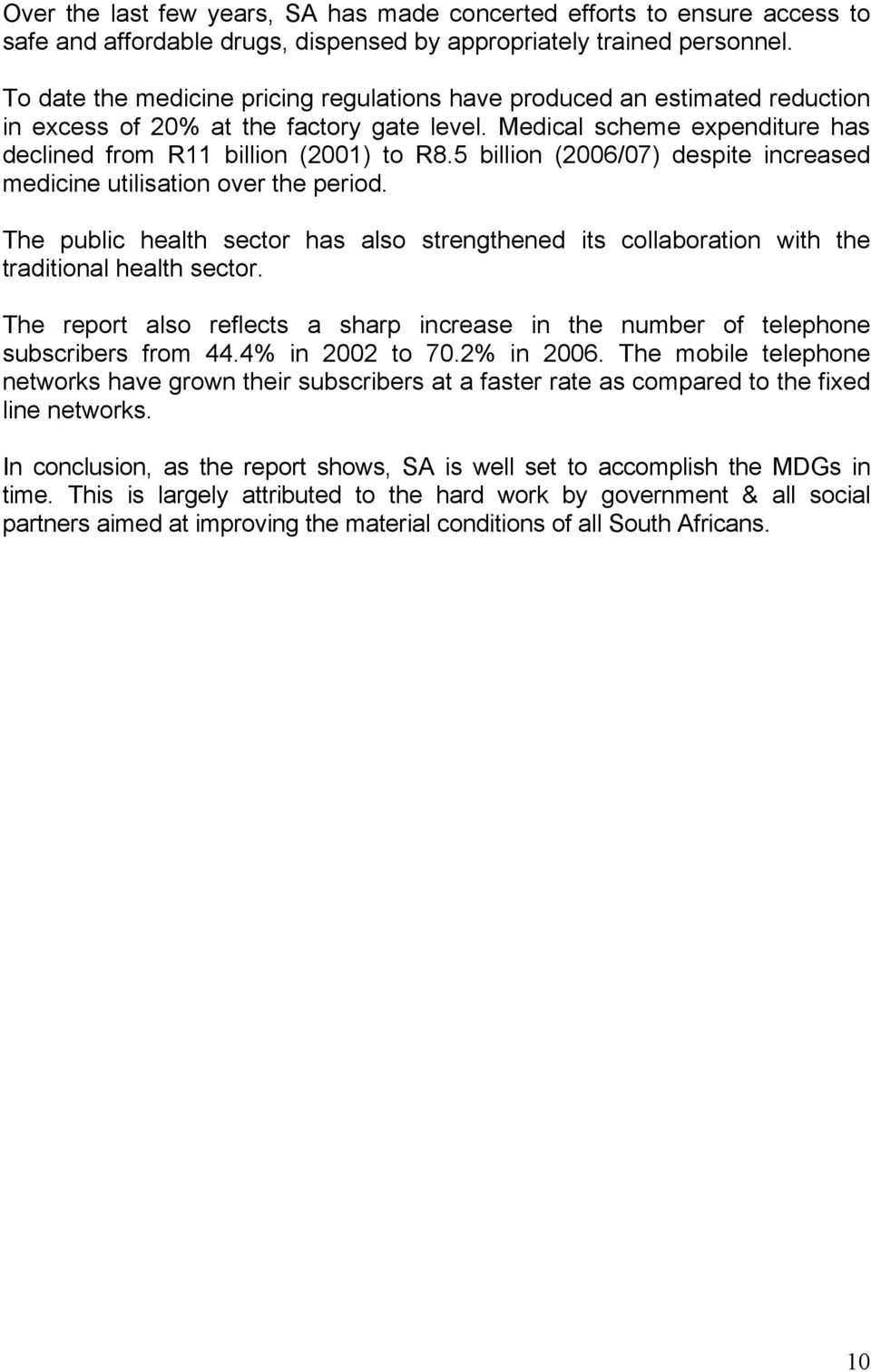
11 Over the last few years, SA has made concerted efforts to ensure access to safe and affordable drugs, dispensed by appropriately trained personnel. To date the medicine pricing regulations have produced an estimated reduction in excess of 20% at the factory gate level. Medical scheme expenditure has declined from R11 billion (2001) to R8.5 billion (2006/07) despite increased medicine utilisation over the period. The public health sector has also strengthened its collaboration with the traditional health sector. The report also reflects a sharp increase in the number of telephone subscribers from 44.4% in 2002 to 70.2% in The mobile telephone networks have grown their subscribers at a faster rate as compared to the fixed line networks. In conclusion, as the report shows, SA is well set to accomplish the MDGs in time. This is largely attributed to the hard work by government & all social partners aimed at improving the material conditions of all South Africans. 10
12 1. Introduction 1.1 Background and Purpose The MDGs commit the international community to an expanded vision of development, one that vigorously promotes human development as the key to sustaining social and economic progress in all countries, and recognises the importance of creating a global partnership for development. The goals have been commonly accepted as a framework for measuring development progress. It is reported that many of the targets of the MDGs were first set out by international conferences and summits held in the 1990s. They were later compiled and became known as the International Development Goals. In September 2000 the member states of the United Nations unanimously adopted the Millennium Declaration. Following consultations among international agencies, including the World Bank, the IMF, the OECD, and the specialised agencies of the United Nations, the General Assembly recognised the MDGs as part of the road map for implementing the Millennium Declaration. The President of the Republic of SA presented to the United Nations General Assembly (UNGA) the first South Africa MDGs country progress report in The report clearly indicated that SA is well on course to meet all MDGs and targets. In fact, the assessment of SA s performance suggested that SA had already met some of the MDGs. In the current assessment, the report indicates further progress and the consolidation of earlier gains. Given that we are at the midpoint of the MDG period, this 2007 report updates the 2005 one in the light of progress made and the new data that is available. 1.2 South Africa Country Context Briefly, SA is classified as a middle-income country, with a GDP per capita of approximately R (or US $5 321), with GDP of R billion (or US $255.3 billion) in 2006 and a population estimated at about 47 million. Since 1994, economic growth has been positive (with the exception of 1998 due to the East Asian crisis and other factors). Real GDP growth in 2006 was at around 5% and employment creation is improving. The 2005 report alluded to unique difficulties pertaining to comparative data in SA, deriving from the fact that, prior to 1994 a number of regions in the country largely the poorest areas were classified as independent homelands and therefore excluded from the country s data. Further, the data collected through each successive Income & Expenditure Survey (IES) and the GHS, for 1 Based on a mid-2006 exchange rate of R6,76 to the US$ 11

13 instance, continues to improve as the methodologies get refined more and more. This however makes comparability of data difficult across the various data collection periods. Since 1994, SA has undertaken various reforms - legislative, institutional, administrative, and otherwise in order to create a climate conducive for the improvement of the quality of life of all South Africans and ensure that SA contributes to the creation of a better Africa and a better world in line with the ideals of our Constitution. In many cases, specific goals and targets have been set. Assessment of progress towards the realisation of Government objectives has been done at several points, the most notably being the Ten Year Review. Further, progress is assessed on an ongoing basis and regularly reported on through various medium, including progress on the Government Programme of Action, State of the Nation Address, Budget Vote Speeches, Parliamentary Media Briefings, etc. In the Ten Year Review done towards the end of the First Decade of Freedom, government emphasised the need for better monitoring and evaluation of the implementation of its programmes. Subsequently, Cabinet approved a set of key development indicators to provide evidence-based pointers to the evolution of our society. Based in part on Ten Year Review's human development indicators, in 2007 Government compiled and published data on 72 indicators, informed by international good practice adapted to South African conditions. The publication summarises the data on trends mainly for the period leading up to the middle of this government's second term, two-and-half years after the April 2004 elections. Just as in the spirit of the MDGs, it is hoped that the development indicators publication will help enrich public discourse on who South Africans are, and where they are going as a nation. Similarly, it is also hoped that it will lay the basis for national consensus on how SA should measure the progress being made towards a better life for all. The next sections give details on SA s performance on each goal and target of the Millennium Declaration. As already pointed out, it should be noted that data as well as time-period of different political dispensations present challenges when comparing years. 12

14 2. Assessment of Specific Goals GOAL 1: Eradicate Extreme Poverty and Hunger Target 1: Halve between 1990 and 2015 the proportion of people whose income is less than US$1 per day South Africa s approach to eradicating extreme poverty and hunger has been a comprehensive one that seeks to address both the monetary aspects of this phenomenon and also attending to the basic needs. In addition to cash transfers in the form of social assistance grants to those that qualify, SA also provides a social wage package which includes clinic-based free primary health care (PHC) for all, compulsory education for all those aged seven to thirteen years, and to those that qualify for subsidised housing, electricity, water, sanitation, refuse removal, transportation, etc. The value of the social wage was estimated at R88 billion in The 2005 report used data from the 1995 and 2000 Income and Expenditure Surveys (IES), the 1995 OHS, and the September 2000 Labour Force Survey in order derive at extreme poverty levels in the country. The main conclusion from this report on target one is that the proportion of population living below international poverty line of US$1 per day or R87 per month was 7,6%; the proportion of population living below international poverty line of US$2 per day or R174 per month was 30,9%; poverty gap at US$1 per day stood at 0,018; poverty gap at US$2 per day was 0,106; Gini coefficient was recorded at 0,59; and the share of the poorest 20% in national consumption was 3,4%. The Gini coefficient of 0.59 excluded social transfers. If transfers are taken into account, the Gini coefficient was On the other hand, the 2007 report, while covering the same indicators as those of the 2005 report, adds a few more and provides a more comprehensive picture of extreme poverty and inequality between 1993 and 2006 In addition, the values reported are computed from the All Media and Products Survey (AMPS) data. In the following section, this report presents a trend analysis with regard to the various aspects of extreme poverty and inequality for the period 1993 up until Tables 1 and 2 present per capita real income and percentage of total income respectively 3 2 This whole section on the measurement of the various aspects of poverty is sourced from Development Indicators Mid-term Review, The Presidency, June Notes on calculations: AMPS income data show very strong growth for 2005 and this income level was maintained and even grew in This is probably more the result of better capturing of incomes in the survey rather than of real 13

15 Table 1: Per Capita Real Income (2000 constant Rand) Table 2: Percentage of Total Income Data source: Van der Berg, et al (2006) based on All Media and Products Survey (AMPS) of various years ( ). AMPS income is recorded in more than 30 household income brackets. Incomes were converted to per capita levels by applying household size. Pareto estimates of income were estimated in the open interval for each race and household size category. Income was assumed to be distributed equally within income brackets. Since 2002, strong overall income growth, including the expansion of social grants, resulted in the rise of the income of the poorest 10 and 20 per cent of the population. However, the rate of improvement of income for the poor has not matched that of the rich, and thus while income poverty is declining, inequality has not been reduced. Table 3: Percentage of population living below R3 000 per annum (Poverty Head Count Index 4 ) Data source: Van der Berg, et al (2006) based on AMPS of various years ( ). AMPS income is recorded in more than 30 household income brackets. Incomes were converted to per capita levels by applying household size. Pareto estimates of income were estimated in the open interval for each race and household size category. Income was assumed to be distributed equally within income brackets. income shifts. To rather err on the side of being conservative regarding poverty trends, AMPS incomes for these two years were adjusted downwards to give growth rates of income consistent with the National Accounts. Without these adjustments, poverty falls by another 3 percentage points in these years. These adjustments do not affect distribution estimates. Adjustment of AMPS income in 2005: Adjusted AMPS 2005 income / Unadjusted AMPS 2004 income = National Account 2005 current income / National Account 2004 current income. Adjustment of AMPS income in 2006: Adjusted AMPS 2006 income / Unadjusted AMPS 2004 income = National Account 2006 current income / National Account 2004 current income. 4 Headcount index (P0), the proportion of the population below the poverty line, at a poverty line of R3 000 in 2000 constant Rand 14

16 Table 4: Poverty Gap Analysis: Poverty Gap Index (P1) and Squared Poverty Gap Index (P2 5 ) Data source: Van der Berg, et al (2006) based on AMPS of various years ( ). AMPS income is recorded in more than 30 household income brackets. Incomes were converted to per capita levels by applying household size. Pareto estimates of income were estimated in the open interval for each race and household size category. Income was assumed to be distributed equally within income brackets. The P1 measures the depth of income poverty compared to a poverty line of R3 000 per capita per annum (or just slightly above $1 per day in 2000 constant Rand). The declining P1 shows improvement in the income and/or expenditure of those in poverty, bringing the very poor closer to the poverty line. In addition, the declining P2 shows that the severity of poverty has been reduced, especially since Table 5: Inequality Data source Van der Berg, et al (2006) based on AMPS of various years ( ) The Gini Coefficient measures income inequality and increased over most of the period. The overall increase in inequality shows that the beneficial impact of social grants and some job expansion was not enough to overcome widening income inequality, particularly between more and less skilled black workers. This indicates a growing scarcity of high level skills and the need for more and better education. Large fluctuations in single years (e.g. 2002) can probably be ascribed to sampling and data issues rather than to real changes. The Theil index is another measure of inequality. While inequality by this measure has been rising, it has changed in nature. Inequality between races has declined, while inequality within race groups has grown. In 1993, 61 per cent of inequality was between race groups; however, by 2006 inequality between race groups had declined to 40 per cent. Over the same period, inequality within race groups has become much more prominent. 5 Depth of poverty (P1), at a poverty line of R3 000 in constant 2000 constant Rand. It is based on how far the poor are from the poverty line, i.e. how deep their poverty is. Severity of poverty (P2), at a poverty line of R3 000 in constant 2000 constant Rand. It is based on the square of the gap between the poverty line and the incomes of the poor, thus it gives great weight to those who are most deeply in poverty. 15

17 As already pointed out, Government has a wide range of programmes that are at the heart of the eradication of extreme poverty. These relate to cash transfers, provision of health care, education, housing, and basic services (water, electricity, sanitation). All these have their targets set before 2014 and current progress clearly indicate that SA is indeed on course to meet the first target. In addition, current social security and retirement reforms, once implemented, will ensure adequate income support for all. The country initiatives to increase employments rate and level will ensure that more people will now have an income to support themselves and others that depend on them. Hunger: status and trends Target 2: Halve, between 1990 and 2015, the proportion of people who suffer from hunger The Development Indicators Mid-term Review released by the Presidency in June 2007 presents very positive figures with regard to nutrition. According to this report, severe malnutrition amongst children under five years of age decreased from cases in 2001 to in See Table 6 below. Table 6: Severe Malnutrition under five years Number Severe malnutrition under 5-years Source: District Health Information System (DHIS) The health sector has over the years made a significant contribution to the decline in malnutrition amongst children under five. Health sector interventions have included the provision of Vitamin A supplementation to children and mothers, which exceeded set targets. By the end of March 2007, 96.4% of children aged six to eleven months (who were seen at health facilities) had received these supplements, which exceeded the 2006/07 target of 90%. Furthermore, 53.7% of post-partum mothers were also provided with the supplements, which reflected progress towards the set target of 75% for 2006/07. While 24.3% of infants aged 12 to 59 months also received Vitamin A supplementation, this was lower than the target of 40%. It is clear therefore that additional effort needs to be made to increase vitamin A coverage for infants aged 12 to 59 months in particular.. South Africa has also made great strides towards food fortification. On 7 October 2003, the regulations for the mandatory fortification of all maize meal and white and brown bread flour, with six vitamins and two minerals, (i.e. Vitamin A, thiamine, riboflavin, niacin, pyridoxine, folic acid, iron and zinc) came into effect. The fortification programme was implemented in response to the findings of the 1999 National Food Consumption Survey (NFCS) which showed 16

18 that one out of two children aged one to nine years did not meet half their daily requirement for several nutrients. Ensuring compliance monitoring of the fortification regulations is the responsibility of the Environmental Health Practitioners (EHPs), employed by Local Authorities. During 2005/06, the public health sector developed a monitoring system for tracking the impact of the food fortification programme, with financial support from the Global Alliance for Improving Nutrition (GAIN), United Nations Children s Fund (UNICEF) and the Micronutrient Initiative. By December 2005, a total of of the targeted 1600 EHPs (99.4%) had undergone training in the monitoring of this programme. Sixty-nine dieticians and nutritionists had also been trained. In order to assist millers to comply with the fortification regulations, the Department of Trade and Industry has agreed to support millers with the purchasing and installation of fortification equipment according to the size of the mill. This assistance to millers will become available in the second half of Other interventions included the provision of food parcels and the establishment of food gardens at health facilities, schools and communities. It is acknowledged that whilst the provision of micro and macro nutrition supplementation was important, it was more important to ensure food security for poor households in particular. The trend shows a decrease in the number of children with a weight less than 60 per cent of their estimated weight for age from 2001 to Malnutrition remains one of the contributors to child morbidity and mortality in SA. The Poverty Alleviation and Food Security Strategy (national nutrition promotion programmes, including the Integrated Nutrition Programme and the Primary School Feeding Scheme) are some of the nutritional interventions that have been made. Improvement of child health also focuses on the promotion of breastfeeding, early detection of malnutrition, providing nutritional supplements for children and fortifying staple foods. GOAL 2: Achieve universal primary education Target 3: Ensure that, by 2015, children everywhere, boys and girls alike, will be able to complete a full course of primary schooling Access to education In SA, the Primary Schooling is understood as seven years of education provided in schools from Grades 1 to 7. The appropriate age for primary education is seven to thirteen. However education legislation permits six-year olds to enrol in Grade 1. 17

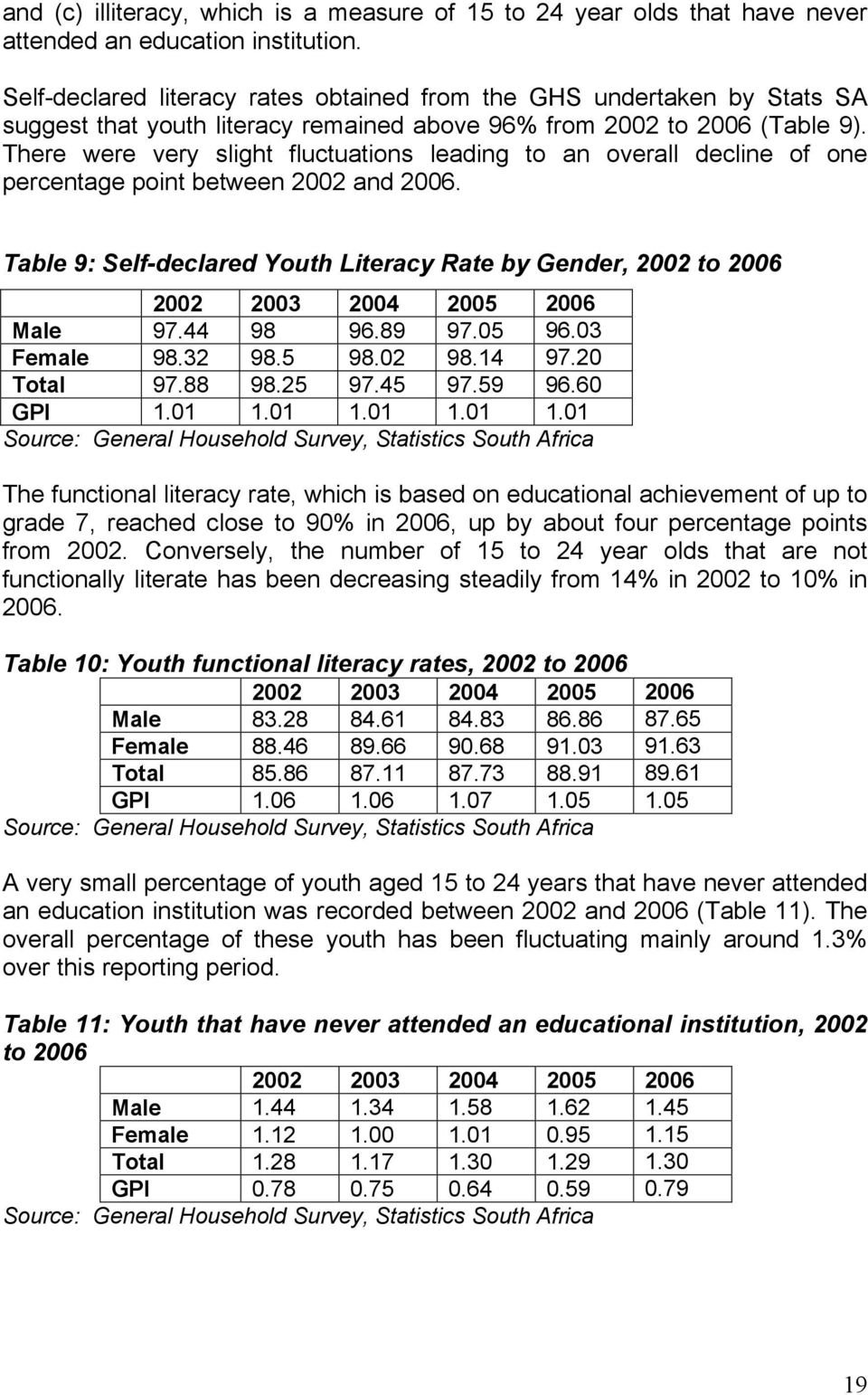
19 Given that seven to thirteen year-olds are enrolled in grades beyond grade seven, it is more applicable in the South African context to measure access to primary schooling by using the Age Specific Enrolment Ratio (ASER). In the primary education context, ASER provides a measure of seven to thirteen year olds that are enrolled in education institutions. According to the GHS conducted by Stats SA, over 98% of seven to thirteen year old children attended education institutions in This figure reflects an increase of approximately 1% since Table 7: Attendance at education institutions of 7 to 13 year olds, 2002 to Male Female Total GPI Source: General Household Survey, Statistics SA (2006, xii) Proportion of pupils starting Grade 1 who reach Grade 7 The proportion of pupils starting Grade 1 who reach Grade 7 translates into an indicator termed survival rate to grade 7. This report utilises completition rate as a proxy for survival rate since a cohort analysis of Grade 1 learners that have reached Grade 7 is not possible given the data at our disposal. According to the GHS undertaken by Stats SA, 98% of 18 year old children had completed Grade 7 and above in This reflects an increase of close to two percentage points since 2004 (see Table 8 below). Table 8: Completion of primary education and above year olds 96.34% 95.89% 98.01% Source: Department of Education Data Literacy rate of 15 to 24 year olds Youth literacy can be measured in different ways. This report provides a measure of youth literacy in three ways: (a) self-declared literacy, (b) functional literacy, which is a measure of 15 to 24 year olds that have attained Grade 7, 18

20 and (c) illiteracy, which is a measure of 15 to 24 year olds that have never attended an education institution. Self-declared literacy rates obtained from the GHS undertaken by Stats SA suggest that youth literacy remained above 96% from 2002 to 2006 (Table 9). There were very slight fluctuations leading to an overall decline of one percentage point between 2002 and Table 9: Self-declared Youth Literacy Rate by Gender, 2002 to Male Female Total GPI Source: General Household Survey, Statistics South Africa The functional literacy rate, which is based on educational achievement of up to grade 7, reached close to 90% in 2006, up by about four percentage points from Conversely, the number of 15 to 24 year olds that are not functionally literate has been decreasing steadily from 14% in 2002 to 10% in Table 10: Youth functional literacy rates, 2002 to Male Female Total GPI Source: General Household Survey, Statistics South Africa A very small percentage of youth aged 15 to 24 years that have never attended an education institution was recorded between 2002 and 2006 (Table 11). The overall percentage of these youth has been fluctuating mainly around 1.3% over this reporting period. Table 11: Youth that have never attended an educational institution, 2002 to Male Female Total GPI Source: General Household Survey, Statistics South Africa 19
21 Initiatives to accelerate improve quality of and access to education Government has undertaken a number of steps to improve access to primary education. These include: A major drive to improve access of five-year old children to Grade R. The adoption of a policy on no-fee schools, which makes it possible for over 40% of learners (5m) in schools to attend without paying fees. The provision of free transport to learners who live far away from schools. At this point in time, more than learners in the country benefit from this service. Budgets of provincial education departments indicate an upward trend in allocations for the provision of learner transport. Government is in the process of developing a policy on Learner Transport, which aims to promote equity in the provisioning of learner transport across all provinces. The adoption of the Primary School Nutrition Programme, which has been in place for a number of years, provides one meal a day to primary school learners. In addition to promoting the health status of learners, the Nutrition Programme also promotes school attendance by learners. In 2006, approximately 6m learners (approximately 50%) benefited from the school nutrition programme. The Department s investigation into systems for monitoring learner attendance and initiatives to strengthen these. A major effort, both in terms of funds as well as planning, to improve school infrastructure. This initiative aims to reduce massive infrastructural inequities inherited from the apartheid system The adoption of the Quality Education Development and Upliftment Programme (QEDSUP), which aims to improve education quality through the provision of resources, improved infrastructure and teacher development in the poorest quintiles of schools. The strengthening of teacher accountability through the establishment of a national inspectorate, which is in process. The establishment of a programme directed at girls, the Girls Education Movement (GEM), which aims to enhance the experience of girls in schools and ensure sustained access and retention of girls in schools. With regards to literacy, Government has initiated a major, national campaign and programme to eradicate illiteracy in the country by
22 GOAL 3: Promote gender equality and empower women Target 4: Eliminate gender disparity in primary and secondary education preferably by 2005 and in all levels of education no later than 2015 Progress made towards the attainment of this goal is tracked through indicators ranging from the ratio of girls to boys in primary, secondary, and tertiary education, to the ratio of literate females to males among the 15 to 24 year olds. According to UNESCO (2004:93), gender parity is achieved if the indicator index lies between 0.97 and Ratio of girls to boys in primary, secondary and tertiary education Table 12 below points to the ratio of girls to boys enrolled at the primary, secondary and tertiary levels of education. Table 12: Ratios of girls to boys (GPI) based on enrolment, 1999 to Primary Secondary Tertiary Source: Department of Education Data At primary school level, the GPI has remained consistently close to 1 from 1999 to This suggests that more boys than girls are enrolled at this level of the education system. At secondary school level, the picture is reversed. More girls than boys are enrolled at this level. Throughout the years 1999 to 2006, the GPI is skewed in favour of girls. At the tertiary level, gender distribution in respect of enrolment is also skewed in favour of female students. The GPI has remained consistently greater from 2001 to 2006, reaching a peak of 1.7 in Ratio of literate females to males among 15 to 24 year olds As indicated in Tables 9 and 10, gender parity for self-declared literacy as well as for functional literacy for 15 to 24 year olds was achieved throughout the period 2002 to The picture is somewhat different though for illiteracy (that is, youth that have never attended an education institution). Table 11 indicates that the GPI for illiteracy in the 15 to 24 year old age group has been less than 1 throughout the period 2002 to This means that, in the 15 to 24 year old population, more females than males have not attended an education institution. 21
23 Participation of women and empowerment Among the central tenets of SA s democracy is a conscious and deliberate agenda to create a truly united, non-racial and non-sexist society. Fairness and justice, including equal treatment without regard to race, gender, language, religious beliefs and creed, are the cornerstones of all government business. South Africa s commitment to the promotion of gender equality has been demonstrated by the establishment of a comprehensive National Machinery for the advancement of gender equality. This commitment is further affirmed by the explicit focus on gender issues in a variety of policy documents; by the introduction of new legislation designed to root out gender discrimination and to promote women's rights; and by the concrete projects in our Programme of Action (POA). Central to this is ensuring that women are integrally involved in the design and implementation of policy. About a third of Members of Parliament are women; and SA prides itself with having a Cabinet with 43% of its members being women; five of the nine provinces are led by women Premiers. At local government level, 40% of Councillors are women. Three of the country s six metros are led by women Mayors. In this regard, SA has already surpassed the SADC Declaration on Gender and Development, which calls for 30% representation of women in decision-making structures in the SADC community of nations. Currently, SA s Parliament is ranked 10 th out of 130 Parliaments in the world in terms of women's advancement in governance. A recent study, the Nedbank/Businesswomen's Association SA Women in Corporate Leadership Census, shows that women constitute 19,8% of executive managers and 10,7% of directors of the 372 companies surveyed. These figures are an improvement on last year's comparable figures of 14,7 percent and 7,1% respectively. However, considering that 41,3% of the working population is female, these figures still leave much room for improvement. This Census ranks SA above Australia when it comes to the percentage of women board directors, and above the US, Canada and Australia, when it comes to executive women managers. Despite these achievements SA still has some major challenges to overcome. The majority of the poor are, disproportionately, women. The level of women s participation in the economy is woefully low: as employees in most skills categories, as managers and as entrepreneurs. For instance, a recent study on Women Entrepreneurs suggests that women comprise 83% of the informal economy, of which 61% are African women mostly in survivalist activity. The same report also underlines the need to promote entrepreneurship among 22
24 women, because it says that men are 1,7 times more likely than women to be involved in entrepreneurship. Recognising that women are overrepresented in the survivalist business category and underrepresented in enterprises higher up in the value chain, there are a number of specific programmes to support the creation of successful businesses run by women. For instance a women s national directory for procurement purposes has been finalised and was launched in Further, the Presidential Women's Working Group that met on 7 August 2007 considered the immensely important initiative proposed by the women who participate in this Working Group to form a Women's Retirement Fund, and agreed that it should be launched. The Fund will be focused on significantly improving "social security and retirement provisions for women and vulnerable women workers". It will be managed by women and invest in a manner that benefits the women of SA. The women leaders responsible for this major initiative stated that the Fund would: "Harness the collective influence of current retirement savings of women to create a greater role for women, and increase (security and retirement) coverage and income security of vulnerable groups, such as domestic workers and women in rural areas." GOAL 4: Reduce Child Mortality 6 Target 5: Reduce by two thirds, between 1990 and 2015, the under-five mortality rate Progress with regard to the MDG number four, i.e. the reduction of child mortality is assessed against three main indicators, namely under-five mortality rate, IMR, and proportion of one-year-old children immunised against measles. There are several factors that contribute to the attainment of this goal, including good immunisation coverage, access to water and sanitation as well as good nutrition and maternal education. The National Department of Health (NDoH) goals for child health are guided by international child health goals, including the reduction of infant and child mortality and morbidity. Objectives include reducing the neo-natal mortality rate (NNMR) from 20 to 14 per live births, ensuring that the national IMR does not exceed 45 per 1000 live births and reducing the national U5MR to 59 per 1000 live births. 6 Please note that the major limitation in the health sector, as is with all the other goals as indicated already, is that whilst the MDGs baselines are 1990 for all the Health related MDGs, South Africa did not have reliable statistics until the first SADHS was conducted in This implies that 1998 data is the baseline 23
25 Immunisation Coverage South Africa s MDGs Report in 2005 reflected overall immunisation coverage of 78%, based on 2002 estimates. Routine data subsequently indicated that the national immunisation coverage had increased to 83% as at the end of Notwithstanding this achievement, there are still districts and sub-districts with low immunisation coverage, which require focused intervention. These have been identified, and the public health sector has begun implementing the WHO s strategy known as Reach Every District (RED), aimed at improving coverage and protecting SA s children against vaccine preventable diseases. In October 2006, SA was declared as being Polio Free by the Africa Regional Certification Commission which is a sub-committee of the Global Certification Commission. Polio Free Certification, however, will only occur once the whole Africa Region of WHO has achieved polio-free status. The need for regional collaboration on disease prevention is therefore critical for each state. In addition, SA has supported both Lesotho and Swaziland though the Inter Country Certification Committee for Polio, which was established to enable these countries to have a full complement of different experts needed for the certification process. Decreasing Infant and Child Mortality According to the 2005 Country MDG Report, under five mortality increased marginally from 59/1000 live births in 1998 to 60/1000 in The latter was a preliminary figure and the South African Demographic and Health Survey (SADHS) in 2003 confirmed the most recently available figure for Under five mortality as 57.6/1000 live births. Whilst this is still some distance away from the target of 20/1000 live births by 2015, it clearly shows that the movement is in the right direction (see figure 1 below). Figure 1: Early Childhood Mortality Rate in South Africa 1998 and 2003 Early childhood mortality rates in South Africa between 1998 and Neonatal Postneonatal Infant Child Under Source: South African Demographic and Health Survey (SADHS),
26 Health Interventions to reduce Child Mortality The health sector has implemented various interventions to decrease infant and child mortality. By March 2007, 71% of South African health facilities in which children are seen had more than 60% of health workers trained in the Integrated Management of Childhood Illnesses (IMCI). Furthermore, over 70% of health districts implemented the Household and Community Component of IMCI, which helped improve health-seeking behaviour amongst families and community members, in the effort to improve child health. Also, 42% of public health facilities with maternity beds were accredited as baby friendly. For children of school going age, school health services were also expanded. By the end of March 2007, 94% of health districts were implementing Phase One of school health services, which entails screening and assessment for basic health conditions, and referral to the health services where this is required. As has been reported elsewhere, the primary school nutrition programme also contributes to improving the health of children. In addition, the food fortification programme (of maize with a range of vitamins) also improves the health of children. The contributions made by the provision of free basic services, including PHC services, water, electricity, and sanitation, will also have contributed to the improvement in infants and child health. It is reported under MDG 7, and indeed in the POA at various reporting periods that SA has made significant inroads in reducing backlogs in the provision of basic services (water, electricity, and sanitation). In many instances, government has already halved backlogs that it inherited in GOAL 5: Improve Maternal Health Target 6: Reduce by three-quarters, between 1990 and 2015, the maternal mortality ratio As reflected in the SA MDG Country Report for 2005, the 1998 SADHS survey found that the MMR was 150/ In 2002, Stats SA - the official statistics collecting agency -reviewed all registered deaths and estimated MMR to be at 124/ This figure suggested that the country was on track towards decreasing MMR over time. However a MMR of 124/ is considered high for a middle income country such as SA. This is acknowledged in the MDG Country Report for Health Interventions to reduce Maternal Mortality In 1997 the country instituted a Confidential Inquiry into Maternal Deaths to find the specific causes of these deaths especially those that could be avoided so that action could be taken. Successive reports by the committee that assess maternal deaths found common challenges. These included: midwives and 25
27 doctors not following protocols, especially in terms of use of the partogram; some district hospitals being without bloods for transfusion; late presentation at hospitals (poor antenatal care); and inadequate availability of transport especially in rural areas. The Saving Mothers: Third Report on Confidential Enquiries into Maternal Deaths in South Africa , made ten recommendations for improving maternal health and reducing maternal mortality. These were: (i) Protocols on the management of important conditions causing maternal deaths must be available and utilised appropriately. All midwives and doctors must be trained on the use of these protocols; (ii) All pregnant women should be offered information on screening for and appropriate management of communicable and non-communicable diseases; (iii) Criteria for referral and referral routes must be established and utilised appropriately in all provinces; (iv) Emergency transport facilities must be available for all pregnant and post-partum women and their babies with complications (at any site); (v) Staffing and equipment norms must be established for each level of care and for every health institution concerned with the care of pregnant women; (vi) Blood for transfusion must be available at every institution where Caesarean sections are performed; (vii) Contraceptive used must be promoted through education and service provision and the number of mortalities from unsafe abortion must be reduced; (viii) Correct use of the partogram should become the norm in each institution conducting births. A quality assurance programme should be implemented using an appropriate tool; (ix) Skills in anaesthesia should be improved at all levels of care, particularly at Level 1 Hospitals; (x) Women, families and communities at large must be empowered, involved and participate actively in activities, projects and programmes aiming at improving maternal and neonatal health as well as reproductive health in general. By the end of March 2007, 85% of health institutions were implementing the recommendations from Saving Mothers Report, which exceeded the Department s target of 80%. Future CEMD Reports will highlight the extent to which the implementation of these recommendations contributed to the decline in maternal mortality. Assistance at delivery by a skilled health professional is one of the key indicators for improving maternal health. As reflected in Figure 2 below, the SADHS 1998 and 2003 also showed a major increase in the percentage of women who were attended to by skilled health professionals during delivery, 26
28 especially by a nurse or midwife. Assistance at delivery by a nurse, midwife or a doctor increased from 84.4% in 1998 to 92.0% in Figure 2: Assistance at Delivery Tetanus toxoid injection, antenatal care, and assistance at Delivery % From doctor From nurse/midwife From doctor From nurse/midwife Tetanus toxoid Antenatal care Assistance at delivery Source: South African Demographic and Health Survey (SADHS), 2003 GOAL 6: COMBAT HIV AND AIDS, MALARIA AND OTHER DISEASES Target 7: Have halted by 2015, and begin to reverse the spread of HIV and AIDS Combating HIV and AIDS As reflected in Table 13 below, the 2006 antenatal survey results show a statistically significant decrease in the national prevalence rates of HIV amongst pregnant women who use public health facilities; between 2005 and 2006 (only one province the Free State showed a marginal increase). It is for the first time after several years of relative stability, that the survey results show evidence of a decline in HIV prevalence. 27
29 Table 13: Provincial HIV Prevalence Estimates: South Africa Province HIV positive 95% CI (2005) HIV positive 95% CI (2006) KwaZulu-Natal 39.1 ( ) 39.1 ( ) Mpumalanga 34.8 ( ) 32.1 ( ) Gauteng 32.4 ( ) 30.8 ( ) North West 31.8 ( ) 29.0( ) Free State 30.3 ( ) 31.1 ( ) Eastern Cape 29.5 ( ) 29.0 ( ) Limpopo 21.5 ( ) 20.7 ( ) Northern Cape 18.5 ( ) 15.6 ( ) Western Cape 15.7 ( ) 15.2 ( ) National 30.2 ( ) 29.1 ( ) Source: Summary Report: National HIV and Syphilis Prevalence Survey, South Africa, 2006 Furthermore, as shown in Table 14 below, HIV prevalence in the age group less than 20-years old, decreased from 15.9% in 2005 to 13.7% in This implies a reduction in new infections (incidence) in the population. In addition, HIV prevalence in women in the 20 to 24year age group also declined significantly from 30.6% in 2005 to 28.0 in Table 14: Provincial HIV Prevalence Estimates South Africa Age Group HIV positive 95% CI (2005) HIV positive 95% CI (Years) (2006) < ( ) 13.7 ( ) ( ) 28.0 ( ) ( ) 38.7 ( ) ( ) 37.0 ( ) ( ) 29.6 ( ) ( ) 21.3 ( ) Source: Summary Report: National HIV and Syphilis Prevalence Survey, South Africa, 2006 However, HIV prevalence in the older age groups (30-34 years; years; 40+) remained at levels similar to 2005, and in some instances reflected some increases, although these were not statistically significant. In order to strengthen its efforts to combat HIV and AIDS, SA produced the Comprehensive Plan for HIV and AIDS, as well as the intersectoral Strategic Plan for HIV and AIDS for 2007 to 2011, which builds on the gains of the Strategic Plan for 2000 to The Strategic Plan serves as a framework for the country s response to the major challenge of HIV and AIDS. 28
30 At present 90% of public health facilities provide Voluntary Counselling Treatment (VCT) and PMTCT. Furthermore, by May 2007, a cumulative total of patients had been put on antiretroviral treatment, in 316 sites of the CCMT across the nine Provinces. Additional sites are found in correctional services facilities as well as in the private for profit and not for profit health sectors. Nutritional supplementation is also provided to people living with HIV and AIDS, TB and other debilitating conditions. The proportion of eligible people living with these conditions who received nutrition supplements increased from 56% in 2005/06 to 81.8% in 2006/07. The treatment of opportunistic infections has also been strengthened. By March 2007, a national STI partner notification rate of 98.3% had been achieved. However, the National STI partner tracing rate was much lower, at 23.3%. This is being continuously addressed. Combating Malaria and other major diseases Target 8: Have halted by 2015, and begin to reverse the incidence of malaria and other major diseases The management and control of malaria is one of the key areas of success of the public health sector in SA. As shown in Table 15, the number of malaria cases declined over a five year period, from cases in 1999 to cases in As shown in Table 16, the malaria case fatality rate fluctuated during this period, from a peak of 0.8 in 1999, to a lowest level of 0.4 in 2001, and to 0.7 at the end of Factors behind the successes in malaria control include: (i) An increase in indoor residual spraying using DDT, with an overall coverage of more than 80% of targeted households, and the completion of spraying before the peak in malaria transmission; (ii) The use of artemisinin-based combination therapy by the malaria affected provinces, which reduces parasite carriage; (iii) Intensified surveillance leading to early detection of any increases in malaria cases in high risk areas; (iv) epidemic preparedness teams capacitated to respond to seasonal outbreaks; (v) Advocacy with mass community mobilisation and training of healthcare workers in the malaria affected areas; (vi) Collaboration amongst African countries in improving the effectiveness of malaria control programme since the malaria vector (mosquitoes) have no regard for national borders. South Africa has worked with three neighbouring states, Mozambique, Swaziland and Zimbabwe, in two separate cross-border malaria control initiatives. The cross border collaboration between Limpopo Province in SA and the Matabeleland South Province in Zimbabwe is ongoing and the two countries are currently finalising a malaria elimination strategic plan. Also, the 29
31 Lubombo Spatial Development Initiative (LSDI) on malaria control involving SA, Swaziland and Mozambique has contributed significantly to the decline in malaria cases in all three countries. Our neighbours have also achieved excellent results partly as a result of our collaboration. Swaziland has achieved 90% reduction in malaria cases since the 2000 baseline and Maputo province in Mozambique a 60% reduction in malaria cases since the 2000 malaria baseline. These achievements can be attributed specifically to the malaria project of the LSDI, where indoor residual spraying coupled with ACTs (artemesinin based combination treatment) are the main interventions. Table 15: Malaria Cases in South Africa Source: Communicable Disease Control Directorate, National Department of Health, March 2007 Table 16: Malaria Case Fatality Rates in South Africa Source: Communicable Disease Control Directorate, National Department of Health, March
32 Challenges in the realisation of Health Related MDGs Decreasing Infant and Child Mortality There is no consensus amongst the scientific community about the exact figures for under-5 mortality. The Development Indicators Mid-term Review released by the Presidency in June 2007, cites figures from the Medical Research Council (MRC), which estimated the Under-5 mortality to be 124/1000 live births in Figures from the Health Systems Trust (HST) for the same period reflected Under-5 mortality for 2003 as being 49.3/1000. However, the fact that two reputable research institutions presented under-5 mortality figures with a 100% difference is a cause for concern. The Department of Health s own SADHS (2003) put under 5 mortality at 58/1000 live births as noted in the section above. With regard to infant mortality, as already stated, the SADHS 2003 indicated a decrease in the IMR from 45/1000 live births in 1998, to 43/1000 live births in While this is positive, it is another area of contention amongst the scientific community. The Presidency s Development Indicators Mid-term Review quotes at least five reliable sources of data, which yield the inconsistent and contradictory IMR figures reflected in the table below. For planning and implementing appropriate interventions, the health sector uses figures from the SADHS 1998 and It is clear however, that consensus is needed around a more reliable set of figures. However, whatever the true figure, additional efforts are needed to further reduce infant and under five mortality. These include health sector initiatives as well as the contributions of other sectors as noted above. 31
33 Table 17: Infant and Child Mortality Rates from Different Sources Health Systems Trust (HST) IMR (under year) CMR (under 5) Medical Research Council (MRC) IMR (under year) CMR (under 5) Stats SA IMR (under year) CMR (under 5) Actuarial Society of South African (ASSA) 2002 IMR (under year) Actuarial Society of South African (ASSA) 2003 IMR (under year) Department of Health IMR (under year) Source: Development Indicators Mid-term Review, The Presidency, June 2007 Tuberculosis In keeping with the World Heath Organisation (WHO) AFRO resolution of 2005, SA has implemented a national tuberculosis (TB) crisis management plan in 2006, in three provinces namely, Eastern Cape, Gauteng and KwaZulu-Natal. Four of the worst performing districts in these provinces were identified namely, Amathole District and Nelson Mandela Metro (Eastern Cape), City of Johannesburg (Gauteng) and Ethekwini Metro (KwaZulu-Natal). They were provided with systematic and targeted support in accordance with their locally developed plans. The aim of the interventions was in the short term, to increase the number of TB patients testing negative for TB within three months of treatment, and to increase the cure rates in the medium term. The advent of extreme -drug resistant TB in 2006 posed yet another challenge. During the planning cycle 2007/08 to 2009/10, areas of focus will include improving smear conversion rates in the four worst performing districts, strengthening of laboratory services, revision of the MDR TB treatment Guidelines, training of health care providers and a range of activities designed to better understand and treat extremely drug resistant TB. However, it is acknowledged that to decrease both MDR and XDR-TB, that the national TB Control Programme must be strengthened. The South African health sector has also made a P4 laboratory available for SADC Countries. It should be noted that there have been no new TB drugs or diagnostics for many decades. It is vital therefore for private sector in particular but also 32
34 development partners to assist developing countries to develop new TB drugs and diagnostics. NON-COMMUNICABLE DISEASES (NCDs) The incidence of non-communicable diseases has significantly increased in developing countries, including SA, thus contributing to the burden of disease. These diseases include various types of cancer, diabetes and hypertension. Self reported data from the SADHS 1998 indicated that 2.4% of men and 3.7% of women (15 years+) reported they had diabetes (type unspecified). Stats SA also reported an increase in deaths due to diabetes in the three year period 2002 to The mortality figures increased from 15,705 deaths in 2002 to 16,718 deaths in 2003, and to 16,902 deaths in A study on amputations conducted at Groote Schuur and draining hospitals reflected an increasing number of amputations between 1997 and The number of amputations conducted increased from 179 in 1997 to 211 in 1998 and to 238 in Of these amputations, approximately 40% were above knee; about 35% were below knee and approximately 25% were big toe and toectomy (other toes). A systematic assessment of the contribution of non-communicable diseases to the national burden of disease study will be conducted in the next planning cycle. Interventions to address Non-Communicable Diseases The public health sector has spearheaded a number of Healthy Lifestyle activities to reduce the burden of disease from non-communicable diseases during 2005/06 and 2006/07 and these will continue to expand into the future. During 2005/06, more than community members participated in a range of healthy lifestyles activities, including physical activity; health screening, establishment of food gardens and programmes to reduce risky behaviour such as smoking, alcohol and drug abuse. The cataract surgery project was also strengthened by the arrival of Tunisian doctors, who were allocated to the Eastern Cape Province, and performed 187 cataract surgery operations within a short period of their arrival. Vision 2020 Prevention of Blindness Programme Within the Vision 2020 Prevention of Blindness Programme, the health sector previously focused on cataract surgery but the programme has been expanded to include refractive services, with a further expansion to make low vision services available in one district per province by March Significant progress was made with sight restoration, with a total of 1030 cataract surgeries per million people performed during 2005/06, which exceeded the 33
35 target of set by the Department. During 2006/07, a cataract surgery rate of 1146 per million people was achieved. Key Interventions to Accelerate Progress towards Health-Related MDGs Key health sector interventions have been interwoven with the foregoing discussion, outlining how the health sector has tackled the challenges it has faced during 2000 to The achievements for this period have also been reflected, which include: improved training of health workers in IMCI and orientation of families and community members to the IMCI strategy; implementation of a comprehensive response to the challenge of HIV and AIDS, increasing the proportion of public health facilities offering VCT and PMTCT services; expansion of the Comprehensive Plan for HIV and AIDS Programme; provision of nutrition supplements to infants and post-partum mothers, and people living with debilitating conditions; reduction of malaria incidence and deaths in the three malaria-endemic provinces (KwaZulu-Natal, Limpopo and Mpumalanga) as well as strengthening malaria control in the Maputo and Lubombo corridors, amongst others. Looking ahead, the National Health Council (NHC) has adopted a set of 5 priorities for implementation during the period 2007/08 and 2008/09, with a view to accelerate progress towards attainment of the health-related MDGs and other priority health programmes. These priorities are: (i) development of provincial service transformation plans; (ii) strengthening human resources for health; (iii) improving quality of care; (iv) strengthening the provision of infrastructure for both clinics and hospitals; and (v) strengthening priority health programmes, with specific focus on healthy lifestyles, national TB crisis management plan, accelerated HIV prevention, and strengthening Maternal Child and Women s Health programmes with a special focus on the Expanded Programme on Immunisation (EPI) and implementing the recommendations of the Report on the Confidential Enquiry into Maternal Deaths. Given the large inequity in the distribution of resources between the public and private health care sectors (the former takes care of 80% of the population whilst the latter takes care of the remainder but with significantly more resources), government has initiated processes to decrease this inequity. One such process is the Health Charter which address two key issues: a) the inequities between the public and private health sectors; and (b) broad-based black economic empowerment. In addition to the allopathic private for profit health sector in SA, there is a large number of traditional health practitioners who use a variety of healing practices including the use of African Traditional Medicine. In addition to regulating their practice, Government has also adopted an approach to institutionalisation of 34
36 their practice as well as seeking ways to both protect and promote the use of safe and efficacious traditional medicines. Development of Service Transformation Plans With the assistance of the NDoH, provinces have developed Service Transformation Plans (STPs) that are intended to assist them to re-shape and re-size their health services, and to develop appropriate, adequately resourced and sustainable health service delivery platforms which are responsive to current health challenges facing each province and the country.. The STPs have been costed to determine the extent to which new resources are required to meet service gaps. Strengthening Human Resources The provision of sufficient numbers of adequately skilled, well-motivated, and appropriately remunerated human resources for health, is critical for the attainment of the health-related MDGs. Against this background, The National Human Resources for Health (HRH) Strategic Framework was launched on 6 April 2006, which was designated as International Day for Human Resources for Health by the World Health Organisation (WHO). The National DoH has guided the development of Provincial HRH Plans, and four provinces have produced draft Plans. Moving into the next planning cycle, the National DoH will support the remaining five provinces, and the 52 health districts to develop their HRH Plans. Over the last few years, the health sector has also implemented a variety of strategies to strengthen human resources for health. These include recruitment and retention strategies, the introduction of community service for health professionals, country-to- country agreements to recruit health professionals from countries with excess supply, memoranda of agreement on ethical recruitment of health professionals by develop countries, the development of mid-level health personnel, the introduction of a two year internship for medical students to improve their clinical skills, the use of e-health to both support health professionals working in rural facilities and the provision of rural and scare skills allowances. In addition, clinic building and upgrading and hospital revitalisation programmes have been underway to improve the working conditions in public health facilities. During 2006, the new Nursing Act was passed which provides, inter alia for community service for nursing graduates. This will in January With regard to the review of remuneration of health professionals, a task team set up between the National DoH, Treasury and Department of Public Service and Administration (DPSA) to address the issue of conditions of service for health professionals completed its work during 2006/07. It is envisaged that revised remuneration packages will be awarded to health professionals in the public 35
37 sector, in a phased manner as from the 2007/08 final year commencing with nurses. Improving Quality of Care A number of measures have been implemented to strengthen Quality of Care (QoC). To entrench health as a human right, the public health sector launched the Patients' Rights Charter, to inform users of health services of their rights to health, as well as their responsibilities. Extensive training of health workers on the Charter was conducted across health facilities, and non-governmental organisations commissioned to inform patients on these right. At PHC level, clinic supervisors, based at health district level were required to conduct regular clinic visits, with each clinic visited at least once a month, and a report compiled on the findings of the visit. During 2005/06, a national hospital improvement plan was launched and the National Infection Control Policy was finalised. Forty percent (40%) of hospitals conducted morbidity and mortality meetings during 2005/06. In 2006/07, public hospitals continued to conduct clinical audits as required. During 2007/08, clinical audits will be routinely monitored in all hospitals, especially regional and tertiary hospitals. The management of complaints in hospitals will also be strengthened with the view to reduce the time it takes to satisfactorily address complaints. In addition, all public hospitals will be assisted to conduct and publish annual patient satisfaction surveys. Community participation is another way of strengthening QoC. Governance structures of public health facilities include clinic committees and hospital boards. Their roles are to strengthen the interaction between facilities and communities they serve. Strengthening the provision of infrastructure Hospital Infrastructure In accelerating progress towards MDGs, PHC services must be supported by a network of state of the art hospitals, providing good quality services. South Africa has a hospital revitalisation programme, which consist of four components: improving infrastructure and health technology (equipment); improving QoC; improving management and organisational development; as well as strengthening project management, within each of specific target hospitals. Since the inception of the programme, the following hospitals were revitalised: Madikana KaZulu Hospital (former Mary Theresa) in the Eastern Cape; Jane Furse and Lebowakgomo in Limpopo Province; 36
38 Colesburg and Calvinia in the Northern Cape; Piet Retief in Mpumalanga Swartruggens in the North West George Hospital in the Western Cape. A total of 43 hospital projects were active during 2006/07. The National DoH will accept an additional 20 business plans from the provinces. However these will only be activated subject to the availability of funding from the National Treasury. In 2007/8 there will be 39 active projects. This is because the rest had to be temporarily stopped due to the unavailability of funds. Some of these were at the stage of completing earthworks this current financial year. Primary Health Care (PHC) Services Well functioning PHC services are a cornerstone of the mission to accomplish the MDGs. The health sector has continued to provide PHC services through the District Health System (DHS) and has strengthened planning and monitoring of service utilisation. Access to PHC services, as measured by headcounts, increased from 67,021,961 in 1998/99 to 99,365,898 in 2004/05 and to 101,758,377 in 2005/06. Planning processes at district level were strengthened, with 90% of health districts producing District Health Plans (DHP) for 2006/07, based on DHP Guidelines developed by the National Department. Key focus areas during 2007/08 will include conducting a PHC audit of services and infrastructure to assess the extent to which the full package of PHC services is delivered and the physical condition of facilities, particularly at subdistrict and facility levels. Emergency Medical Services (EMS) Infrastructure A key objective during the current planning and implementation period will be to reduce the response times of EMS in both urban and rural areas. The Department will assist provinces to implement the national EMS Strategic Plan. With the 2010 FIFA World Cup within sight, the health sector will over the next three years, finalise the operational plan for the Health and Medical Logistics for this international event. Working jointly with other government departments and key stakeholders, the Department will soon implement an intersectoral operational plan for the 2010 World Cup. Of key significance will be the implementation of improved EMS, with an adequate fleet of reliable ambulances, appropriately trained and qualified personnel, and state of the art equipment. In relation to the MDGs, some Provinces have implemented innovations such as allowing EMS vehicles transporting pregnant women to bypass normal referral routes. In addition, additional ambulances have been purchased and fixed and rotor arm aircraft have been used to both transport patients and 37
39 health workers (as part of outreach programmes) to further strengthen the health system s responsiveness. Strengthening priority health programmes Maternal, Child and Women s Health and Nutrition The health sector will continue to build on the milestones already reached, and progressively strengthen interventions to reduce morbidity and mortality amongst children and mothers. This includes accelerating the training of midwives and advanced midwives. A systemic and scientific assessment of the impact of the IMCI strategy on infant and child mortality will be undertaken. Similar studies must be conducted to assess the improvement in maternal mortality rates as a result of the implementation of the ten recommendations of the Confidential Enquiries into Maternal Deaths (CEMD) Reports. Expansion of the school health services will continue to be expanded. The provision of safe termination of pregnancy services for women will be strengthened at both hospitals and community health centres. The Choice of Termination of Pregnancy is currently being discussed by Parliament with a view of delegating to provinces the designation of health facilities at which termination of pregnancy can be offered. This will be accompanied by training of health personnel. Beyond the health sector, it is crucial that poverty alleviation programmes be expanded to reach the currently marginalised and poor. In addition, safe water and proper sanitation must be provided to those in need. Our government has put in place a programme to address the social determinants of health as reported on in this report. Tuberculosis A National Strategic Plan for Tuberculosis management has been developed, and finalised. The Plan is based on an adaptation of the WHO s Stop TB Programme and includes aspects that focus on prevention, early and reliable diagnosis as well as treatment. It is imperative though, that TB is not viewed as an exclusive health sector challenge. Lessons from other countries generated across decades, reflect that the provision of housing, jobs and reduction of poverty and unemployment are central to turning the tide against TB. These are as important as adequate clinical skills, good case management, and effective monitoring of treatment outcomes amongst health workers, as well as compliance with TB treatment amongst TB patients. 38
40 HIV and AIDS An intersectoral National Strategic Plan for HIV and AIDS was completed, which focuses on the five year period, 2007 to This process has drawn together key role players including government, business, civil society, trade unions, women, sports, people living with HIV and AIDS, youth organisations, traditional leaders and healers and community leaders. The main priority areas in the Strategic Plan for HIV and AIDS are: prevention; treatment, care and support; human rights and legal issues; and monitoring and evaluation, research and development. A restructured and re-invigorated South African National AIDS Council (SANAC), chaired by the Deputy President of SA, will provide leadership in the implementation of the National Strategic Plan for HIV and AIDS Plan. The Ministry of Health will provide technical and administrative support to the implementation of this plan. Implementation of the accelerated prevention of HIV will also continue, in keeping with the WHO/AFRO resolution of 2005, focusing on both intersectoral and health components. As was the case in 2006/07, the intersectoral aspects will entail: promoting development, alleviating poverty, and addressing gender inequities. The health aspects will consist of: strengthening social mobilisation, including a greater focus on youth; expanding and improving treatment of sexually transmitted infections (STIs); offering group counselling in addition to individual counselling; and increasing access to female condoms. It is critical that the implementation of HIV and AIDS programmes not be seen as vertical or stand alone programmes but that they contribute to the further strengthening of the national health system at all levels of care, and strengthen support systems and partnerships. GOAL 7: Ensure Environmental Sustainability Target 9: Integrate the principles of sustainable development into country policies and programmes, and reverse the loss of environmental resources The following discussion on progress with regard to goal seven summarises what was captured and reported on in the 2005 MDG report. Only in very few instances does the 2007 MDG report reflect a quantified updated progress. Table 18 below summarises the main indicators related to Target
41 Table 18: Summary indicators of environmental sustainability INDICATORS 1994/ Progress towards target MDG target Proportion of land area covered by forest 11,0 (%) Ratio (Percentage) of area protected to maintain biological diversity to surface area (%) 5,4 (1995) n.a. 10,0 Potentially attainable Energy use (kg oil equivalent) per US$ GDP 296 (1995) 283 (2001) Carbon dioxide emissions (per capita) n.a. n.a. Insufficient data. South Africa has developed a Climate Change Response Strategy and National Air Quality Act aimed at dealing with air pollution. Sources: Department of Water Affairs and Forestry, Department of Environmental Affairs and Tourism, Stats SA; Environmental Accounts As reported in the 2005 MDGs report, the apartheid era took a particularly heavy toll on SA s communities, biodiversity and ecosystems. In addition to widespread impoverishment and social dislocation, such policies caused significant ecological damage. The majority of the population was squeezed into 13% of the land in overcrowded homelands. These areas suffered massive deforestation, soil erosion and loss of biodiversity. Subsidies on water, energy and agricultural inputs (available to white industrial, agricultural and domestic users) led to wasteful practices and long-term damage were caused to the soil, rivers and wetlands of the country. Further, the establishment and expansion of national and provincial parks in many parts of the country was accompanied by severe hardships for the people and conservation policies typically mirrored the apartheid policies of the day and aimed at restricting access to protected areas. As a result, the perception grew that conservation was elitist and of no benefit to ordinary people. Forced removals, overcrowding of the vast majority of the population into the homelands, discriminatory urban policies that distorted resource flows, inequitable access to environmental services, unjust land use practices, the migratory labour system, and a protectionist approach to nature conservation produced not only widespread impoverishment and social dislocation but also contributed to significant environmental degradation (UNDP 2003:124-5). The peaceful transition in SA presented a unique opportunity for redress and recovery. Starting with the constitution, new policies and legislation have been developed across all sectors, with full public consultation and participation. The fundamental objectives of the policies and legislation are to secure sustainability and equitable access to resources. Much has been transformed in SA s first decade of democracy. Among the most remarkable turnarounds has been the attitude of South Africans towards their environment. 40
42 Since 1994, environmental issues have moved into the socio-political arena. They bring together human rights, access to natural resources, social justice and equity and sustainability. In the first decade of freedom, Government has focused on prioritising people s needs while safeguarding the country s natural assets. The range of legislative, policy and institutional developments that have occurred over this period have served to bring about a new environmental management approach (SA Yearbook. 2004/05, p. 226). South Africa has a century-long history of conservation, with a well-developed protected area network managed by a range of institutions at national, provincial and local level. However, the establishment of protected areas has been ad hoc in the past. Protected areas were often proclaimed on land marginal for agriculture or other use, and the current system of protected areas does not adequately include a representative sample of all ecosystems. Rivers in particular are poorly conserved, and where they are included in a protected area, this is often on the boundary. Coastal and marine bio-zones, particularly on the west coast, had previously been poorly protected. Currently, about 6% of the land surface of SA is formally conserved through the system of national and provincial protected areas and 17% of the shoreline is formerly conserved through proclamation as Marine Protected Areas. The target is to expand the terrestrial to 8% and marine to 20% by However, a major gap that has existed was the general lack of attention given to bio-diversity conservation outside of protected areas, with specific references to landscapes and ecosystems. Given the widespread challenges to biodiversity across the landscape, there is a clear need to move away from ad hoc protected area establishment towards a more systematic approach. This has led to a shift to bioregional approach to conservation planning, which in its early implementation phase is being driven as much by pragmatism as by conservation concerns The basis of the bioregional approach to protected areas in SA is to build on the existing protected area network, and wherever possible link these areas along mountains, rivers, wetlands, the coastline and other areas of natural vegetation. Conservation efforts are currently focused on consolidating and expanding protected areas in the country s eight hotspots, known as Wolkberg, Wakkerstroom, Drakensberg Alpine, Maputaland, Pondoland, Albany, Cape Floristic and Gariep centres of endemism. These are centres of plant diversity with high levels of species diversity as well as high levels of endemism, which are under threat from large-scale habitat modification. Many of these initiatives aim to link national parks, marine protected areas, Ramsar sites and World Heritage sites with provincial nature reserves, state forests and private land. In addition, national parks located on the borders with neighbouring countries are now nested within actual or planned Transfronteir Conservation Areas. 41
43 With the realisation that conservation through protected areas alone is inadequate; a set of planning programmes has been initiated in SA. These aim to set up achievable targets and provide planning tools to decision makers to ensure that biodiversity considerations are factored into development plans. Three such initiatives have received wide acclaim for the combination of cutting-edge science, participatory research and decision-making and integration across sectors. The Cape Action for People and the Environment (C.A.P.E), the Succulent Karoo Ecosystem Programme (SKEP) and the Subtropical Thicket Ecosystem Planning (STEP), are overarching long-term strategies for biodiversity conservation. A number of large, cross-sectoral programmes have been initiated in SA during the past decade, focusing on development and poverty alleviation. Examples include the Working for Water, Working for Wetlands, LandCare, Coast Care and Integrated Sustainable Rural Development programmes. Bioregional planning and integrated programmes have been effectively implemented in a number of internationally recognised hotpots in SA. According to the national register of formally protected areas, 5.4% of the land surface of SA was under formal protection in 1995, comprising a total of 422 different sites or areas. These included wilderness areas, national parks and provincial reserves, covering a total of 6.6 million hectares. The numbers of protected areas have since dropped to 403, reflecting the programme of consolidation and expansion, rather than de-proclamation. Although almost 6% of the country is under formal conservation protection, the goal was set in 2003 to progressively increase this to 8% by 2010, and later to 10%, to ensure that all significant vegetation types are included. This means that, ultimately, just over four million more hectares will eventually be protected. Forestry Stats SA are currently developing natural resources accounts for the forestry industry as part of the system of environmental accounts. Energy Use South Africa is a country endowed with abundant energy resources. Fossil fuels, such as coal, uranium, liquid fuels, and gas, play a central role in the socio-economic development of our country, while simultaneously providing the necessary infra-structural economic base for the country to become an attractive host for foreign investments in the energy sector. Biomass forms the main energy source in the rural domestic sector, while other renewable energy development opportunities are already being explored in the fields of solar power, wind power, pumped storage and in hydropower schemes. Successful tapping of all possible energy carriers in our country is vital for sustainable economic growth and development. We are fortunate in SA to be in 42
44 a position to utilise such a broad spectrum of energy carriers. Various economic sectors that contribute to the Gross Domestic Product (GDP) of our country are practically driven by these energy carriers. For instance, the manufacturing sector, which accounts for about 25% of GDP, and the mining industry, which accounts for about 10%, are both heavily reliant upon electricity. In fact, industry as a whole consumes approximately 40% of the total electricity generated. This means that electricity is one energy carrier that makes a significant contribution to our economic growth and development. The South African government last published a white paper on energy policy in With the end of apartheid SA experienced fundamental shifts resulting in significant changes in the energy policy context Thirteen years ago it was not easy to provide a coherent and comprehensive overview of the energy sector. Perhaps even more difficult to understand are its linkages to, and impact on, the rest of the economy and development. The 1998 white paper gives an overview of the South African energy sector s contribution to GDP, employment, taxes and the balance of payments. It concludes that the sector can greatly contribute to a successful and sustainable national growth and development strategy. In a report released in May 1996 commenting on SA energy policies, the Organisation for Economic Co-operation and Development s (OECD s) International Energy Agency stated that the lack of good data is a major weakness in the energy policy making process in SA. It also hinders transparency in the energy sector. Not only is good data required for the energy policy process but also it is fundamental to the implementation of integrated energy planning. Carbon dioxide emissions South Africa ratified the United Nations Framework Convention on Climate Change (UNFCCC) in 1997 and became a signatory of the Kyoto Protocol in According to SA s Initial National Communication (RSA 2003), carbon dioxide is the most significant greenhouse gas for SA, accounting for more than 80% of total emissions in both 1990 and The energy sector is the largest contributor of total carbon dioxide emissions, constituting 90% in 1990 and 91% in This is largely attributable to the high-energy intensity of the South African economy, which depends on largescale primary extraction and processing, particularly in the mining and minerals beneficiation industries. Unfortunately, recent official estimates of CO 2 emission per capita for SA are not available. 43
45 Water and Sanitation Target 10: Halve, by 2015, the proportion of people without sustainable access to safe drinking water Government has made a commitment to eradicate the sanitation bucket system in formal areas by December The target for universal access to water supply is 2008 and sanitation The backlog of the provision of basic services to the population of SA started to receive priority in 1994, after the advent of democracy in the country. According to the Development Indicators Mid-term Review released by the Presidency in June 2007, since 1994, the percentage of households with access to water at equal or above the Reconstruction and Development Programme (RDP 7 ) standard, increased from 61.7% to 84.7%. This rate of delivery had been achieved in the face of a 26% increase in household numbers. Progress was also made towards addressing the sanitation backlog. According to the Development Indicators Mid-term Review, households with access to basic sanitation increased from 50% in 1994, to 71% in It was also stated that progress was being towards eliminating the bucket system in established settlements by the end of June The Review also indicated that in April 2006, the backlog of access to sanitation infrastructure was more than 3.7 million households, and stated that the delivery rate will have to be accelerated, in order to achieve the set targets. However, major progress has been made with regards to provision of basic water and sanitation services as access to basic services increased from 59 % of the population in 1994 to 94% of the population in Mach Impacting Positively on the Lives of Slum Dwellers Target 11: Have achieved, by 2020, a significant improvement in the lives of at least 100 million slum dwellers In SA the term slum has not been used for decades, and tends to be associated with the pre-world War Two period. Poor neighbourhoods are more likely to be referred to as townships or informal settlements rather than slums, and they are not necessarily found in the inner city. Indeed, as a consequence of group areas legislation in the apartheid era, they are more likely to be found on the outskirts of a city, with the possible exception of Johannesburg, where some people live in inner city apartments, some of them run down, slums with insecure tenure. 7 RDP objectives include meeting basic needs, building the economy, developing human resources, democratising state and society, etc 44
46 So in this country it cannot be assumed that slums are easily equated with poor inner city neighbourhoods. The types of housing in SA that conform to the United Nations definition of a slum in relation to secure tenure, range from sublet inner city tenements, which are difficult to isolate from non-sublet dwelling units, to informal dwellings in shack settlements, backyard shacks, hostels and domestic workers rooms. Because they would be difficult to isolate inner city dwellings with insecure tenure, we have not included the inner city in our discussion of slums. From the supply side of providing dwellings with secure tenure for the poor, the Department of Housing indicates that approximately 2.4 million new houses were built with the assistance of a state subsidy, often on state-provided land, to house those without adequate housing between 1994 and Goal 8: Develop a global partnership for development Just as was prefaced to the preceding, similarly the following discussion on progress with regard to goal eight summarises what was captured and reported on in the 2005 MDG report. Only on isolated instances does the 2007 MDG report reflect a quantified updated progress. Significant additional update here is on target 17. Target 12: Develop further an open, rule-based, predictable, non-discriminatory trading and financial system (includes commitment to good governance, development and poverty reduction both nationally and internationally) Goal 8 effectively underpins the efforts of developing countries to achieve all of the other MDGs. Implicit in this goal is an acknowledgement that significant international effort and commitment is required of both developed and developing countries if the world is to be successful in achieving the MDGs. A critical aspect of the MDGs is the recognition that governments and international development organisations share collective responsibility for their achievement. Of specific importance to Africa is Chapter VII of the Millennium Declaration, Meeting the Special Needs of Africa in which the United Nations effectively responded to the call of President Mbeki and other African leaders, to make the 21 st century an African century. Achievement of the MDGs by Africa requires taking decisive action to substantially accelerate progress being made on the continent. Development co-operation across the wide range of priority areas addressed by the MDGs and their various targets requires an integrated, coordinated, comprehensive and balanced approach, one that is worthy of a truly global partnership for development. South Africa actively supports a number of advocacy and awareness-raising efforts aimed at promoting the achievement of the MDGs by developing countries, with particular emphasis on the continent of Africa. In the latter regard, SA has played a leading role in championing the New Partnership for 45
47 Africa s Development (NEPAD), which is Africa s primary socio-economic development programme through which the MDGs are addressed. Through NEPAD, African leaders have committed themselves to consolidating democracy and good governance and to implementing sustainable socioeconomic development programmes on the African continent. Assistance and support from the donor community is important for long-term success. NEPAD adopted the MDGs as the centerpiece of the African development agenda. The UN system as a whole is mandated to co-ordinate programmes of action on the continent within the framework established by the NEPAD. At the individual country level, the MDGs also inform the framework for national policy formulation and planning. Africa s main priority remains the identification of the constraints, prospects and challenges facing the continent in meeting the MDGs, in order to accurately assess the actual human, technological and financial resources needed to reach the MDGs. In addition, SA is committed to the promotion and strengthening of South-South co-operation for the purposes of promoting equitable global development. South Africa is a member of the India Brazil South Africa Dialogue Forum (IBSA), which serves as a mechanism for political consultation and coordination as well as for strengthening co-operation in sectoral areas and to improve economic relations between Member States and the countries of the South. IBSA serves as an example of developing countries seeking to strengthen their co-operation across a broad range of issues that are directly relevant to goal 8, in order to promote the international development agenda. Examples in this regard include promoting and strengthening co-operation on the implementation of effective policies to fight hunger and poverty, promote food security, health, social assistance, employment, education, human rights and environmental protection. India Brazil South Africa Dialogue Forum also seeks to strengthen co-operation in advocating for the removal of distortions in the current world order that are skewed against developing countries, by improving the rules of the multilateral trade system and making the international financial architecture more responsive to development. Target 13: Address the special needs of the least developed countries The prospects of developing countries for achieving the MDGs would be significantly enhanced with greater access to markets in industrial countries. South Africa is firmly committed to the pursuit of a fair, rules-based, nondiscriminatory multilateral trading system. This remains one of the most crucial but also most difficult of the targets to achieve in the furtherance of the international development agenda. Ensuring a successful, pro-development, and timely outcome to the Doha Round is therefore a primary responsibility of all Member States of the World Trade Organisation (WTO). One of the most significant developments in the lead-up to the 5 th Ministerial Conference of the WTO in Cancun, Mexico (September 2003), was the emergence of the group of developing countries called the G-20. Led by Brazil, 46
48 but also including India, China and SA, the group lobbied exclusively on agricultural issues, with a strong development focus that included special and differential treatment for developing countries. The G-20 also focused more on the elimination of export subsidies and trade-distorting domestic support than on market access (tariff reductions). South Africa's active participation in the G- 20 has been guided by, inter alia, the following multilateral objectives: Contributing to building and shaping a strong multilateral trading system; Seeking to make a contribution to address the challenges of development for all - in this regard the G-20 has underlined the need to effectively address development issues such as food security and rural development, erosion of preferences and the special needs of LDCs; Contributing to international efforts to build consensus and advance the development dimension of the Doha Development Agenda by working closely with other developing countries in the G90 the ACP, African Group and LDCs; Working to find solutions that recognise the need not to distort global markets and destroy the legitimate rights of poor people in developing countries; Actively promoting much-needed reform of global agricultural markets. The G-20 again played a significant role in the adoption of a framework for WTO negotiations in July 2004, which effectively put the Doha Round back on track. South Africa has also been at the forefront of international efforts to promote much-needed reform of the international financial architecture. The IMF and the World Bank have placed an increasing emphasis on the importance of democratic governance and participatory development (the involvement of all stakeholders in the development process), if developing countries want to meet the MDGs. However, it is generally acknowledged that these institutions themselves are in need of reform in the areas of representation, ownership, transparency and accountability (collectively known as the voice and participation debates). These reforms are necessary if the Bretton Woods Institutions (BWIs) want to reduce world poverty by helping poor countries to smoothly integrate into the global economy and to become more active participants in global economic decision making. The recognition has also grown that if developing countries are to contribute to international financial stability, they should be more involved in the activities of these institutions. Given this recognition and the rising concern about the increasing disparity in voting power between developed country and developing country shareholders in the BWIs, South Africa succeeded in helping to place the issue of reform on the agendas of the Fund and Bank. This is in line with the 2002 Monterrey Consensus that stated that the IMF and World Bank should continue to enhance the participation of all developing countries and countries with 47
49 economies in transition in their decision-making. The joint IMF/World Bank Development Committee (DC) subsequently requested the Boards of the Bank and Fund to review options that could contribute to an increase in voice and participation of developing countries in their operations. Given the political nature of the required reforms, however, progress on this issue has remained slow. South Africa has continued to participate actively in meetings of the G20, which brings together twenty major players in the global financial system, both emerging and developed economies, to discuss international financial and development issues and promote the need for reform of the international financial system. Target 13: Address the special needs of the least developed countries, and Target 14: Address the special needs of landlocked countries and small-island developing states South Africa actively seeks to deepen and extend the economic linkages among African countries, within the context of ongoing efforts to shape the international development agenda. Regional integration remains a key policy focus area. This includes SA's participation in the SADC and the SACU. Recent efforts in this regard have concentrated on efforts to operationalise a revised SACU agreement, covering management and institutional issues, which was signed in 2002, after eight years of negotiations. The SADC has adopted a development framework, the Regional Indicative Strategic Development Plan (RISDP) which outlines the strategic priorities of SADC and provides a framework for the integration of the SADC economies, with the ultimate objective of fostering sustainable development. South Africa is fully committed to the objectives of the Programme of Action for the Least Developed Countries ( ) of the UNEP-UNCTAD Capacity Building Task Force on Trade, Environment and Development (CBTF) which was presented at the Third United Nations Conference on Least Developed Countries (UNLDC III) in Brussels in May Equally, SA is mindful of the vulnerability of Small Island Developing States and recognises the need for an integrated approach to addressing regional sustainable development in this context. South Africa supports the objectives of the Mauritius Strategy for the Implementation of the POA for the Sustainable Development of Small Island Developing States, arising from the International Review Meeting in Port-Louis, Mauritius, in January South Africa also recognises the particular needs and problems of the landlocked developing countries and supports the implementation of the Almaty POA, Addressing the Special Needs of Landlocked Developing Countries within a New Global Framework for Transit Transport Co-operation for Landlocked and Transit Developing Countries. An important contribution made by SA to peace, stability and the African Renaissance was the establishment in 2000 of the African Renaissance and International Co-operation Fund for the purpose of enhancement of 48
50 international co-operation with and on the African Continent. The Fund is multilaterally orientated, and provides for the pro-active involvement in actionoriented programmes and projects involving organisations and parties other than the governments of countries (although not excluding the governments of countries). South Africa currently budgets R50 million per year, which is allocated to the Fund. The broad objectives of the African Renaissance are very relevant to addressing the special needs of least developed countries, landlocked countries and small island developing states in the context of Goal 8 and, indeed, for the achievement of the other MDGs that the global partnership for development seeks to support: The establishment of democratic political systems in Africa that will ensure the accomplishment of the goal that the people should govern; Ensuring that these systems take into account African specifics so that while being truly democratic and protecting human rights they are nevertheless designed in ways which really ensure that political and peaceful means can be used to address the conflicting interests of different social groups in each country; Establishing institutions and procedures which will enable the continent to deal collectively with questions of democracy, peace and stability; Achieving sustainable economic development that results in the continuous improvement of the standard of living and the quality of life of the masses of the people; Qualitatively changing Africa's place in the world economy so that it is free of the yoke of the international debt burden and no longer a supplier of raw materials and an importer of manufactured goods; and Ensuring the emancipation of women of Africa / even, successfully confront the scourge of infectious diseases such as HIV/AIDS, Tuberculosis and Malaria and lastly ensure the protection of our environment. The establishment of the African Renaissance and International Co-operation Fund has enabled the South African Government to identify and fund, in a proactive way: Co-operation between SA and other countries, particularly African countries; The promotion of democracy, good governance; The prevention and resolution of conflict; Socio-economic development and integration; Humanitarian assistance; and Human resource development. 49
51 Target 15: Deal comprehensively with debt problems of developing countries through national and international measures in order to make debt sustainable in the long run South Africa has maintained a high profile in international calls for debt relief for developing countries, most notably those on the continent of Africa. South African President Mbeki and other leaders have played a meaningful role in engaging the G-8 leaders on the issue of debt, making specific proposals in respect of increased aid to Africa in this regard. Equally, SA has actively participated in the work of the Commission for Africa, established by former UK Prime Minister Tony Blair, which calls on wealthier nations to double aid to poor African countries to $50 billion by 2015, reduce agricultural subsidies, and cancel the debt owed by impoverished countries. In this regard, the South African Government has tirelessly engaged the international community and policy makers, researchers and representatives of civil society in Africa to assess the role of the international community in the development of the continent. South Africa has actively supported the World Bank special scheme for countries with heavy debt burdens, known as the Heavily Indebted Poor Country (HIPC) Initiative, which is premised on the understanding that debt should be reduced to a "sustainable level". The Government of SA has demonstrated its support for providing debt relief to poor countries by: Contributing its balance in the Second Special Contingent Account (SCA-2), which amounts to R 7.5 million, to the HIPC Initiative as a grant; Pledging R200 million in 2000, payable in equal instalments over five years, to the Poverty Reduction Growth Facility-HIPC Trust; and Writing off loans granted to Malawi and Mozambique in the amounts of R 8.8 million and R 48.5 million respectively. Every effort should be made to prevent countries from returning to a debt trap situation once they have achieved sustainable debt levels. In as much as recent successes in promoting international support for debt relief initiatives has been encouraging, much more needs to be done in the area of securing debt relief for poor countries. This is especially so if they are to be in any position to halve poverty by 2015 and meet the other MDGs. South Africa therefore continues to call for the doubling of aid for this purpose. 50
52 Target 16: In cooperation with developing countries, develop and implement strategies for decent and productive work for youth Table 19a & b summarise the status of youth unemployment Table 19a: Expanded definition unemployment rate of years olds, by gender and total INDICATORS Sept - 00 Sept - 01 Sep-02 Sep-03 Sep-04 Sep-05 Sep-06 Male unemployed 51.9% 60.5% 61.6% 65.6% 61.1% 58.1% 56.7% Female unemployed 64.6% 72.5% 75.0% 75.4% 75.6% 72.1% 70.8% Total unemployed 58.0% 66.6% 68.3% 70.6% 68.2% 65.2% 63.7% Source: LFS Table 19b: Official definition unemployment rate of years olds, by gender and total Indicators Sept - 00 Sept - 01 Sept - 02 Sept - 03 Sept 04 Sept- 05 Sept-06 Male unemployed Female unemployed Total unemployed Source: LFS Youth unemployment rates for September 2000 to September 2006 are indicated in Tables 19a & b. Young people entering the labour market are struggling to find employment. They form a relatively large proportion of the unemployed, overall, but particularly young unemployed women. Unemployment among youth is related to highest level of education and the age at which the young person becomes economically active. In general, those with 12 years of schooling or higher qualifications have a lower unemployment rate than those who have not completed 12 years of schooling. People dropping out of education and entering the labour market between the ages of 15 to 19 years are more likely to be unemployed than those who enter the labour market at an older age. Target 17: In cooperation with pharmaceutical companies, provide access to affordable drugs in developing countries Over the last few years, SA has made concerted efforts to ensure access to safe and affordable drugs, dispensed by appropriately trained personnel. During 2005/06, the public health sector reduced the stock outs of medicines in both the Essential Drug List (EDL), as well as anti-retrovirals at accredited Comprehensive HIV and AIDS Management and Treatment Plan sites, to 51
53 almost zero level. Most pharmacies and dispensers that applied for licenses during 2005/06, and met all legislative requirements, were licensed. During 2006/07, the dispensing fee was revised after extensive engagement with the retail pharmacy sector. Despite this engagement, the retail pharmacy sector has challenged the dispensing fee in the courts. The Department of Health has made several attempts to resolve this matter with retail pharmacists. In accordance with the medicine pricing regulations a draft International Benchmarking Methodology was gazetted for comment in December The draft International Benchmarking Methodology compared medicine pricing policies and practices in 5 countries namely: SA, Canada, Spain, New Zealand and Australia. The methodology provided for South African prices to be compared and benchmarked against prices of medicines in these countries, to ensure that South Africans do not pay more for their medicines compared to the citizens in these countries. The other four countries were chosen on the basis of the following criteria namely: existence of sound policies on the pricing of medicines; similar patent protection legislation to SA; and the existence of recognised and reputable medicines registration authorities. To date the medicine pricing regulations has produced an estimated reduction in excess of 20% at the factory gate level. Medical scheme expenditure has declined from R11 billion (2001) to R8.5 billion (2006/07) despite increased medicine utilisation over the period. The public health sector has also strengthened its collaboration with the traditional health sector. With regard to the development of pharmacopoeia, (i.e. standards for individual entities of African traditional Medicines), the MRC is in the process of producing sixty monographs on medicinal plants for inclusion in the pharmacopoeia. A database of African Traditional Medicines is also being developed. Target 18: In cooperation with the private sector, make available the benefits of new technologies, especially information and communications The tables below summarise how SA stands on the Information and Communication Technology (ICT) related commitments made at the Millennium Declaration. 52
54 Table 20: ICT Indicators and Statistics at a glance Indicators ICT infrastructure & Access Total Telephone subscribers (Teledensity) (per people) Telephone fixed lines (per 1 00) people) In largest cities Cost of local call ($ per 3 minutes) Cost of international call ($ per minutes Mobile cellular subscribers (per people) Radios per people Television sets per people Broadcasting coverage 80% 90% - Post offices per people 2,440 2,640 2,855 Post Offices on the Network Computers & the Internet Personal computers (per 1000 people) Installed in schools (thousand) Internet users (per 1,000 people) , Internet Service provider charge ($) Telephone usage charge ($) ICT Impact Total ICT ($, millions) ICT as % of GDP ICT per capita ($) Sources: SA Census 1996 & 2001, ITU, The World Bank and UNESCO Table 21 below demonstrates a sharp increase in the number of telephone subscribers from 44.4% in 2002 to 70.2% in The mobile telephone networks have grown their subscribers at a faster rate as compared to the fixed line networks whose subscribers have been declining. 53
55 Table 21: Telephone subscribers* Whether the household has a telephone in dwelling and/or a cellphone Yes No Proportion of households Note: Proportions do not necessarily add up to 100, due to exclusion of unspecified access to telephone and/or cellphone Source: GHS A complementary strategy to secure affordable access to telephony was introduced through the establishment of a Universal Service Fund to subsidize network rollout to under-serviced areas and access to needy people. Sixtyeight tele-centers have since been established in these areas to provide, amongst others, basic telephone services. The Universal Service Agency is the vehicle established to achieve this objective. Although SA has the most developed infrastructure on the continent with a teledensity of over 12%, there are still areas where access to basic telephony and broadcasting signals is still a problem. Tele-density in those areas stands below 5% as compared to urban areas where the coverage, facilities and services are widely available. A process has commenced to issue additional licenses to the Second National Operator and small business operators to provide services in those underserviced areas, namely areas with less than 5% tele-density. According to the 2001 Census, at least 8.6% of households had one computer in good working order as compared to 4% during the 1996 Census. The reason for this increase is that computers are the leading access devices for Internet use, which has been on the increase. The International Telecommunication Union (ITU) has ranked SA 18 th in terms of the Internet usage. Although there are some 120 Internet service providers in SA, access to the Internet is still restricted to some geographic locations and segments of the society. Radios have demonstrated themselves to be powerful tools for disseminating information to the wider audience. The 2001 Census revealed that radio is the most prevalent household item. Overall 73,0% of households possessed at least one radio. The 2001 Census has revealed that 53,8% of households possessed at least one television set. Possession of these goods by broad settlement type indicate 54
56 that households in urban areas were more likely to have these items than those counted in urban informal settlements, deep rural areas and commercial farms. Lastly, the post office is the most accessible and convenient means available to citizens through its extended network. The ratio of postal outlets to inhabitants has improved from 1:16,659 in 1996 to 13,484 in This is still considered to be high in terms of the general criteria of 1:10,000 in habitants. 3. Concluding Remarks As the report shows, SA is well set to accomplish the MDGs in time. This is largely attributed to the hard work by government & all social partners aimed at improving the material conditions of all South Africans. Although a lot of mileage has been gained towards achieving the RDP objectives, there remain some challenges. The South African government, working with peoples of SA and social partners, is determined to overcome any obstacles that may hinder progress on ensuring a better life for all. Some of the major challenges relate to the economy s insufficient growth and its inability to generate sufficient employment opportunities. These are further compounded by the following socio-economic challenges: The number of households has been growing considerably faster than the rate of population growth which implies that the servicing obligations of the state were greater than population growth initially suggested; While employment grows, the number of unemployed and rate of unemployment is growing faster because of the rising labour force participation rate; The changing structure of the economy, with many more jobs now available or potentially available in the service sectors of the economy than in traditional sectors like agriculture, mining and construction, requires a labour force with different skills to those available to the bulk of the unemployed labour force; and Rapid migration into the urban areas as well as shifts in the demographics. In short, these trends point to the persistence of a large group of poor people who might remain marginal to the growth opportunities in the modern economy unless the government makes significant developmental interventions. Indeed, the government is making significant developmental interventions, in directly dealing with the marginalised. In addition, government, together social partners, is pursuing the major interventions recommended in the Ten Year Review and recently in A Nation in the Making Discussion Document: The need for a framework of encompassing interest amongst the main social forces of the country entailing, perhaps, a substantive social contract beyond the Growth and Development Summit agreement; 55
57 The need to considerably improve the performance of the state in focusing on better coordination and allocation of responsibilities between the spheres of government; To address the consequences of the social transition outlined above, within the philosophy of the National Spatial Development Framework; i.e. that government should invest heavily in areas where there is both great social need and economic potential, and for areas of need with less potential government should provide support for the development of human capital (especially health, education, transport and communications); and To improve the regional environment and implement NEPAD. At the core of the People s Contract, which informs the government s programme of action, is that by 2014 government would have: Reduced poverty and unemployment by half Provided the skills required by the economy Ensured that all South Africans are able to fully to exercise their constitutional rights and enjoy the full dignity of freedom Ensured compassionate government service to the people Achieved a better national health profile and massively reduced preventable causes of death, including violent crime and road accidents Significantly reduced the number of serious and priority crimes and cases awaiting trial Positioned SA strategically as an effective force in global relations. The supportive environment to achieve the above exists and is continually strengthened and elaborated. For instance, government is presently working on various programmes aimed at accelerating the growth of the economy and the eradication of poverty. These initiatives are aimed at expediting the resolve to meet the RDP objectives and meet them faster. They are aimed at responding to the challenges that have been identified in the assessment of the first decade of freedom. Lastly, government has put in place monitoring and evaluation systems that would assist in continuous assessment of whether government is meeting or not the objectives that it has set for itself. The existing monitoring and evaluation systems are being strengthened through increasing capacity in the respective areas. 56
58 4. References Ahmed, O. B., Lopez, A.D., and Inoue, M. The decline in child mortality: a reappraisal. Bulletin of the World Health Organisation 2000; 78: Altman, M. (2003) The state of employment and unemployment in South Africa In Daniel, J., Habib, A. & Southall, R. (Eds.) State of the nation: South Africa Pretoria: Human Sciences Research Council: Bah, S. (2004a). L état des statistique de la fécondité et de la mortalité en Afrique du Sud pendant et après l ère de l Apartheid. African Population Studies Vol. 19, No. 2, October 2004: Bah, S. (2004b). An Evaluation of Conducted Research Supported by UNICEF: An Input into the Mid-Tern Review of the South African Country Programme, Unpublished document prepared for UNICEF, Pretoria Bellagio Study Group on Child Survival (2003) Knowledge into action for child survival Lancet, 2003; 362: Bradshaw, D., Bourne, D., and Nannan. N. (2003) What are the leading causes of death among South African Children? Medical Research Council Policy Brief No. 3, December 2003 South African Medical Research Council, Tygerberg BWASA, South African Women in Corporate Leadership census, Cooper, D., Morroni, C., Orner, P., Moodley, J., Harries, J., Cullingworth, L., and Hoffman, M. (2004). Ten years of democracy in South Africa: Documenting transformation in reproductive health policy and status. Reproductive Health Matters 2004; 12(24): Desmond, C. and Gow, J. (2001). The Cost-Effectiveness of Six Models of Care for Orphans and Vulnerable Children in South Africa HEARD: Durban Department of Education (2002) Education for All Status Report 2002: South Africa, incorporating country plans for 2002 to Pretoria: Department of Education. Department of Education (2004) Strategic Plan: Pretoria. Department of Education (2004). Education statistics in South Africa at a glance in 2002 Pretoria: Department of Education. 57
59 Department of Health (2001) Health Goals, Objectives and Indicators, Pretoria: National Department of Health. Department of Health (2002) South Africa Demographic and Health Survey 1998: Full Report. Pretoria: Department of Health, MRC and Measure DHS+. Department of Health (2004). Enquiries into Maternal Deaths in South Africa 2004.Pretoria. Department of Health (2004a) Strategic Priorities for the National Health System, Pretoria: Department of Health. Department of Health (2004b) Monitoring and evaluation framework for the comprehensive HIV and AIDS care, management and treatment programme for South Africa Department of Health, Pretoria Department of Health (2004c) Monitoring Review: Progress Report on the Implementation of the Comprehensive HIV and AIDS Care, Management and Treatment Programme. Issue 1: September Department of Health, Pretoria ( Department of Health (2004c). Annual Report, 2003/2004 Department of Health, Pretoria Department of Health (2004 d) National HIV and Syphilis Antenatal Sero- Prevalence Survey in South Africa 2003 Pretoria: Directorate: Health Systems. Department of Health (not dated) South Africa Demographic and Health Survey 1998: Full Report Department of Health, MRC and Measure DHS+, Pretoria Department of Health (2004). Enquiries into Maternal Deaths in South Africa 2004.Pretoria. Department of Health, (2006) A Strategic Framework for the Human Resources for Health Plan: Draft for Discussion. Pretoria. ( Department of Health. (2007). National HIV and syphilis prevalence survey in South Africa, Pretoria: Department of Labour (2002) Towards a National Child Labour Action Programme for South Africa Pretoria, Department of Labour Dorrington, R., Bradshaw, D., Johnson, L., and Budlender, D. (2004) The Demographic Impact of HIV/AIDS in South Africa: National Indicators for CARE, MRC and ASSA, Cape Town. 58
60 Freedman, L., Wirth, M., Waldman, R., Chowdhury, M. and A. Rosenfield (2004) Millennium Project Task Force 4 Child Health and Maternal Health: Interim Report. New York: Millennium Project. Fonn, S., Xaba, M., Tint, K., Conco, D. and Varkery, S. (1998). Maternal health services in South Africa during the 10 th anniversary of the WHO Safe Motherhood initiate. South African Medical Journal, 1998; 88: GCIS (2005) SA Yearbook. 2004/05, GCIS. Pretoria Govender P., Budlender D. and Madlala N. (1995). Beijing Conference Report, Office of the President: Pretoria. Hill, K., AbouZahr, C., and Wardlaw, T. (2001) Estimates of maternal morality for 1995 Bulletin of the World Health Organisation, 79,3: Hill, K., Pande, R., Mahy, M., and Jones, G. (1999) Trends in child mortality in the developing world: New York: UNICEF. Hofmeyr, B.E., Mostert, W.P., van Zyl, J,A. (1997). South Africa: Findings from a series of demographic and health surveys, Pretoria: Human Sciences Research Council. Jones, G., Steketee, R., Black, R., Butta, Z., Morris, S. and the Bellagio Child Survival Study (2003) How many child deaths can we prevent this year? Lancet 2003; 362: King, L. et al. (2003). Undertaking an Analysis of the Situation of Children in the Community of Umhlontlo Municipality (Eastern Cape Province) in Relation to the Fulfilment and Protection of their Fundamental Rights BMR, Pretoria. Krug A, Pattinson RC, Power D.J (2004). Why children die: an under-5 health care survey in Mafikeng region. S Afr Med J Mar;94(3): Makubalo, L., Mulumba, R., Mahlasela, L. and Pattinson, B. (1999). Epidemiology In: Saving Mothers: Report on Confidential Enquiries into Maternal Deaths in South Africa, Edited by B. Pattiinson. Department of Health, Pretoria Millennium Development Goals: South Africa Country Report. The Presidency, Government of South Africa (2005), Unpublished document ( 59
61 MotherCare (1999). MotherCare Matters vol. 8, No. 1-May Motsei, M. (2004). National Women s Health Status Report : Ingxoxo Zamakhozikazi. Department of Health, Pretoria ( Mzolo, N. Ross, M., Ross, S. Reid, S. Knight, S. (2003). Progress with the implementation of the Recommendations of the 1998 Saving Mothers Report on the Confidential Enquiry into Maternal Deaths in South Africa: A Rapid Appraisal. Centre for Health and Social Studies, Durban. National Committee for Confidential Enquiries into Maternal Deaths (2000) Second Interim Report on Confidential Enquiries into Maternal Deaths in South Africa, Department of Health, Pretoria National Committee for Confidential Enquiries into Maternal Deaths (2003) Second Interim Report on Confidential Enquiries into Maternal Deaths in South Africa, Department of Health, Pretoria Office of the Status of Women, (2004) Report on women in political and decision-making positions. Pretoria: Presidency Pattinson R, (ed.) (2002) Saving Mothers: Second Report on Confidential Enquiries into Maternal Deaths in South Africa Pretoria: Department of Health. Pattinson R, (2004) Maternal Health. In Health Systems Trust (ed.) South African Health Review Durban: Health Systems Trust. Pattinson, B. and Moodley, J. (1999) Overview. In: Saving Mothers: Report on Confidential Enquiries into Maternal Deaths in South Africa, Edited by B. Pattinson. Department of Health, Pretoria Perry H and Arends F, 2003 Public Schooling: Human Resource Development Review. Pretoria: Human Sciences Research Council. Policy Co-ordination and Advisory Services, The Presidency (2003), Towards the Ten Year Review, Synthesis Report on Implementation of Government Programmes. The Presidency, Pretoria:Government Communication and Information System (GCIS). ( Government of South Africa). Policy Co-ordination and Advisory Services of the Presidency (2005) A Nation in the Making: Discussion Document The Presidency: Pretoria. Policy Co-ordination and Advisory Services of the Presidency (2007) Development Indicators Mid-term Review, The Presidency: Pretoria. 60
62 Rosenfield, A. (2001). Maternal mortality as a human right and gender issue In: Reproductive Health, Gender and Human Rights: A Dialogue. Edited by Elaine Murphy and Karin Ringheim. PATH, Washington, DC. South African Advertising Research Foundation (SAARF), (various years). AMPS (various years) SAARF, Johannesburg. Shisana, O., Peltzer, K., Zungu-Dirwayi, N. and JS Louw (eds) (2005) The Health of Our Educators: A focus on HIV/AIDS in South African public schools, 2004/5 Survey. Report prepared for the Education Labour Relations Council. Cape Town: Human Sciences Research Council and Medical Research Council. Sithabile Child and Youth Center (2002). Child Domestic Workers in the Gauteng Province of South Africa Sithabile Child and Youth Centre Smit, J., Beksinska, M., Ramkissoon, A., Kunene, B. and L. Penn-Kekana (2004) Reproductive Health. In Health Systems Trust (Ed.) South African Health Review 2003/04 Durban: Health Systems Trust. South African Cities Network (2003) An Overview of Urban Renewal. Johannesburg: SACN. Statistics South Africa (2000) South African Life Tables: and 1996 Report No: ( , and 1996) Stats SA, Pretoria. Statistics South Africa (various years) General Household Survey July Statistical Release: Pretoria: Statistics South Africa. Statistics South Africa (2002) Causes of death in South Africa : Advance release of recorded causes of death (P0309.2). Stats SA, Pretoria. Statistics South Africa (2005) Mortality and Causes of Death in South Africa, : Findings from death notification. Statistical Release: P Pretoria: Statistics South Africa. Statistics South Africa, Income and Expenditure of Households 2000,Statistical Release P0111, Nov. 13, 2002, Statistics South A f r i c a. ( Statistics South Africa, Census 2001, Released July 2003, Statistics South Africa: Pretoria. ( 61
63 Statistics South Africa, (2002). Income and Expenditure of Households 1995, Statistical Release P0111, Nov. 13, 2002, Statistics South Africa ( Statistics South Africa, (various years). Labour Force Survey. Statistics South Africa: Pretoria. UNICEF, (2005). State of World s Children. UNICEF, New York United Nations Development Group, Country Reporting on the Millennium Development Goals: Second Guidance Note. Varga, C. and Mbonambi, M. (2004) Social and Community Perspectives on Prevention of Mother-to-Child Transmission of HIV: Limpopo Province. Human Sciences Research Council, Durban. Walker, N., Shwartlander, B. and Bryce, J. (2002) Meeting International goals in child health survival and HIV/AIDS Lancet 2002; 360: World Health Organisation (2004) Global Tuberculosis Control: Surveillance, Planning, Financing. Geneva: WHO. WHO (1998). World Health Day 1998: Maternal Mortality. 62
64 5. List of Acronyms AMPS ASER BWIs CBTF CCMT CEMD DC DHIS DHP DHS DPSA EDL EHPs EMS EPI GAIN GDP GEM GHS GPI HIPC IBSA ICT IES IMCI IMF IMR ITU LSDI MDG MMR MRC NDoH NEPAD NFCS NHC NNMR OECD OHS PHC PMTCT POA All Media and Products Survey Age Specific Enrolment Ratio Bretton Woods Institutions Capacity Building Task Force on Trade, Environment and Development Comprehensive Programme for HIV and AIDS Management, Care and Treatment Confidential Enquires into Maternal Deaths Development Committee District Health Information System District Health Plans District Health System Department of Public Service and Administration Essential Drug List Environmental Health Practitioners Emergency Medical Services Expanded Programme on Immunisation Global Alliance for Improving Nutrition Gross Domestic Product Girls Education Movement General Household Survey Gender Parity Index Heavily Indebted Poor Country Initiative India Brazil South Africa Dialogue Forum Information and Communication Technology Income and Expenditure Survey Integrated Management of Childhood Illnesses International Monetary Fund Infant Mortality Rate International Telecommunication Union Lubombo Spatial Development Initiative Millennium Development Goal Maternal Mortality Ratio Medical Research Council National Department of Health New Partnership for Africa s Development National Food Consumption Survey National Health Council Neo-natal Mortality Rate Organisation for Economic Co-operation and Development October Household Survey Primary Health care Prevention of Mother-to-Child Treatment Programme of Action 63
65 QEDSUP QoC RDP RED RISDP SA SACU SADC SADHS SANAC SCA-2 SKEP STATS SA STEP STI STPs TYR UNDP UNESCO UNFCCC UNGA UNICEF UNLDC VCT WHO WTO Quality Education Development and Upliftment Programme Quality of Care Reconstruction and Development Programme Reach Every District Regional Indicative Strategic Development Plan South Africa Southern African Customs Union Southern African Development Community South African Demographic and Health Survey South African National AIDS Council Second Special Contingent Account Succulent Karoo Ecosystem Programme Statistics South Africa Subtropical Thicket Ecosystem Planning Sexually Transmitted Infection Service Transformation Plans Ten Year Review United Nations Development Programme United Nations Educational Scientific and Cultural Organisation United Nations Framework Convention on Climate Change United Nations General Assembly United Nations Children s Fund United Nations Conference on Least Developed Countries Voluntary Counselling and Testing World Health Organisation World Trade Organization 64
Goal 1: Eradicate extreme poverty and hunger. 1. Proportion of population below $1 (PPP) per day a
 Annex II Revised Millennium Development Goal monitoring framework, including new targets and indicators, as recommended by the Inter-Agency and Expert Group on Millennium Development Goal Indicators At
Development of Social Statistics in Indonesia: a brief note
 Development of Social Statistics in Indonesia: a brief note Wynandin Imawan [email protected] BPS Statistics Indonesia 29 September 2011 1 Legal Setting Institutional: Statistics Law No 16 1997; BPS Statistics
MDG INDONESIA: STATUS AND THE WAY FORWARD
 MDG INDONESIA: STATUS AND THE WAY FORWARD Endah Murniningtyas-National Development Planning Agency Widyono University of Indonesia Presented at the UN-DESA UN-ESCAP MDG Workshop Bangkok, 20-22 August 2008
UNICEF in South Africa
 UNICEF in South Africa A message from the Representative 47,900,000 people live in South Africa 20,200,000 are children 294,000 children are HIV-positive 1 in 17 children die before their fifth birthday
Trinidad and Tobago Strategic Actions for Children and GOTT-UNICEF Work Plan 2013-2014 1
 Trinidad and Tobago Strategic Actions for Children and GOTT-UNICEF Work Plan 2013-2014 1 The Trinidad and Tobago Strategic Actions for Children and the Government of Trinidad and Tobago-UNICEF Work Plan
Financing For Development by Sir K Dwight Venner, Governor, ECCB (3 August 2001)
 The Caribbean countries now find themselves having to make fundamental adjustments to the structure of their economies and financial systems in response to changes at the global level. The region is not
Aalborg Universitet. Responding to the Millennium Development Goals Enemark, Stig. Published in: Shaping the change. Publication date: 2006
 Aalborg Universitet Enemark, Stig Published in: Shaping the change Publication date: 2006 Document Version Publisher's PDF, also known as Version of record Link to publication from Aalborg University Citation
Social protection and poverty reduction
 Social protection and poverty reduction Despite the positive economic growth path projected for Africa, the possibility of further global shocks coupled with persistent risks for households make proactive
MDG 4: Reduce Child Mortality
 143 MDG 4: Reduce Child Mortality The target for Millennium Development Goal (MDG) 4 is to reduce the mortality rate of children under 5 years old (under-5 mortality) by two-thirds between 1990 and 2015.
cambodia Maternal, Newborn AND Child Health and Nutrition
 cambodia Maternal, Newborn AND Child Health and Nutrition situation Between 2000 and 2010, Cambodia has made significant progress in improving the health of its children. The infant mortality rate has
Gender inequalities in South African society
 Volume One - Number Six - August 2001 Gender inequalities in South African society South Africa's national policy framework for women's empowerment and gender equality, which was drafted by the national
Briefing note for countries on the 2015 Human Development Report. Burkina Faso
 Human Development Report 2015 Work for human development Briefing note for countries on the 2015 Human Development Report Burkina Faso Introduction The 2015 Human Development Report (HDR) Work for Human
Briefing note for countries on the 2015 Human Development Report. Mozambique
 Human Development Report 2015 Work for human development Briefing note for countries on the 2015 Human Development Report Mozambique Introduction The 2015 Human Development Report (HDR) Work for Human
Questions and Answers on Universal Health Coverage and the post-2015 Framework
 Questions and Answers on Universal Health Coverage and the post-2015 Framework How does universal health coverage contribute to sustainable development? Universal health coverage (UHC) has a direct impact
INDICATOR REGION WORLD
 SUB-SAHARAN AFRICA INDICATOR REGION WORLD Demographic indicators Total population (2005) 713,457,000 6,449,371,000 Population under 18 (2005) 361,301,000 2,183,143,000 Population under 5 (2005) 119,555,000
Congo (Democratic Republic of the)
 Human Development Report 2015 Work for human development Briefing note for countries on the 2015 Human Development Report Congo (Democratic Republic of the) Introduction The 2015 Human Development Report
Briefing note for countries on the 2015 Human Development Report. Philippines
 Human Development Report 2015 Work for human development Briefing note for countries on the 2015 Human Development Report Philippines Introduction The 2015 Human Development Report (HDR) Work for Human
Thailand. Country coverage and the methodology of the Statistical Annex of the 2015 HDR
 Human Development Report 2015 Work for human development Briefing note for countries on the 2015 Human Development Report Thailand Introduction The 2015 Human Development Report (HDR) Work for Human Development
Population, Health, and Human Well-Being-- Benin
 Population, Health, and Human Well-Being-- Benin Demographic and Health Indicators Benin Sub- Saharan Africa World Total Population (in thousands of people) 1950 2,046 176,775 2,519,495 2002 6,629 683,782
MILLENNIUM DEVELOPMENT GOALS
 MILLENNIUM DEVELOPMENT GOALS Time Level Skills Knowledge goal 60 90 minutes intermediate speaking, reading to raise awareness of today s global issues and the UN Millennium Development Goals Materials
HEALTH TRANSITION AND ECONOMIC GROWTH IN SRI LANKA LESSONS OF THE PAST AND EMERGING ISSUES
 HEALTH TRANSITION AND ECONOMIC GROWTH IN SRI LANKA LESSONS OF THE PAST AND EMERGING ISSUES Dr. Godfrey Gunatilleke, Sri Lanka How the Presentation is Organized An Overview of the Health Transition in Sri
Sierra Leone. Country coverage and the methodology of the Statistical Annex of the 2015 HDR
 Human Development Report 2015 Work for human development Briefing note for countries on the 2015 Human Development Report Sierra Leone Introduction The 2015 Human Development Report (HDR) Work for Human
Tanzania (United Republic of)
 Human Development Report 2015 Work for human development Briefing note for countries on the 2015 Human Development Report Tanzania (United Introduction The 2015 Human Development Report (HDR) Work for
Briefing note for countries on the 2015 Human Development Report. Niger
 Human Development Report 2015 Work for human development Briefing note for countries on the 2015 Human Development Report Niger Introduction The 2015 Human Development Report (HDR) Work for Human Development
Nepal. Country coverage and the methodology of the Statistical Annex of the 2015 HDR
 Human Development Report 2015 Work for human development Briefing note for countries on the 2015 Human Development Report Nepal Introduction The 2015 Human Development Report (HDR) Work for Human Development
United Kingdom. Country coverage and the methodology of the Statistical Annex of the 2015 HDR
 Human Development Report 2015 Work for human development Briefing note for countries on the 2015 Human Development Report United Kingdom Introduction The 2015 Human Development Report (HDR) Work for Human
Briefing note for countries on the 2015 Human Development Report. Palestine, State of
 Human Development Report 2015 Work for human development Briefing note for countries on the 2015 Human Development Report Palestine, State of Introduction The 2015 Human Development Report (HDR) Work for
El Salvador. Country coverage and the methodology of the Statistical Annex of the 2015 HDR
 Human Development Report 2015 Work for human development Briefing note for countries on the 2015 Human Development Report El Salvador Introduction The 2015 Human Development Report (HDR) Work for Human
Education is the key to lasting development
 Education is the key to lasting development As world leaders prepare to meet in New York later this month to discuss progress on the Millennium Development Goals, UNESCO s Education for All Global Monitoring
Malawi. Country coverage and the methodology of the Statistical Annex of the 2015 HDR
 Human Development Report 2015 Work for human development Briefing note for countries on the 2015 Human Development Report Malawi Introduction The 2015 Human Development Report (HDR) Work for Human Development
FINAL. World Education Forum. The Dakar Framework for Action. Education For All: Meeting our Collective Commitments. Revised Final Draft
 28/04/2000, 3 P.m. FINAL The Dakar Framework for Action Education For All: Meeting our Collective Commitments Revised Final Draft World Education Forum Dakar, Senegal, 26-28 April 2000 1 1 The Dakar Framework
Economic and Social Council
 United Nations E/ICEF/2013/P/L.16 Economic and Social Council Distr.: Limited 1 July 2013 Original: English For action United Nations Children s Fund Executive Board Second regular session 2013 3-6 September
CONCEPT NOTE. High-Level Thematic Debate
 CONCEPT NOTE High-Level Thematic Debate Advancing Gender Equality and Empowerment of Women and Girls for a Transformative Post-2015 Development Agenda 6 March 2015 Introduction The UN and the international
Madagascar. Country coverage and the methodology of the Statistical Annex of the 2015 HDR
 Human Development Report 2015 Work for human development Briefing note for countries on the 2015 Human Development Report Madagascar Introduction The 2015 Human Development Report (HDR) Work for Human
GENDER AND DEVELOPMENT. Uganda Case Study: Increasing Access to Maternal and Child Health Services. Transforming relationships to empower communities
 GENDER AND DEVELOPMENT Uganda Case Study: Increasing Access to Maternal and Child Health Services The Context World Vision has been active in working with local communities to increase access to health
Russian Federation. Country coverage and the methodology of the Statistical Annex of the 2015 HDR
 Human Development Report 2015 Work for human development Briefing note for countries on the 2015 Human Development Report Russian Federation Introduction The 2015 Human Development Report (HDR) Work for
Social Policy Analysis and Development
 Social Policy Analysis and Development UNICEF/Julie Pudlowski for children unite for children UNICEF/Giacomo Pirozzi Fast facts Children 0 14 years living below the basic needs poverty line Children 0
Zambia 2007 2010. I. Progress on key indicators
 Zambia 2007 2010 I. Progress on key indicators Indicator Value Year Value Year Child population (millions, under 18 years) 6.1 2004 6.7 2008 U5MR (per 1,000 live births) 182 2004 148 2008 Underweight (%,
Rio Political Declaration on Social Determinants of Health
 Rio Political Declaration on Social Determinants of Health Rio de Janeiro, Brazil, 21 October 2011 1. Invited by the World Health Organization, we, Heads of Government, Ministers and government representatives
INDICATOR REGION WORLD
 SUB-SAHARAN AFRICA INDICATOR REGION WORLD Demographic indicators Total population (2006) 748,886,000 6,577,236,000 Population under 18 (2006) 376,047,000 2,212,024,000 Population under 5 (2006) 125,254,000
Annex 8: SDG Indicator Mapping
 Annex 8 SDG Indicator Mapping 1. Annex 8 responds to Executive Board decision below, regarding the refinement of indicators and targets of the Strategic Plan Integrated Results and Resources Framework
Equality between women and men
 Equality between women and men Gender equality means an equal visibility, empowerment, responsibility and participation of women and men in all spheres of public and private life. It also means an equal
Education for All An Achievable Vision
 Education for All An Achievable Vision Education for All Education is a fundamental human right. It provides children, youth and adults with the power to reflect, make choices and enjoy a better life.
United Nations Educational, Scienti c and Cultural Organization EDUCATION COUNTS. Towards the Millennium Development Goals
 United Nations Educational, Scienti c and Cultural Organization EDUCATION COUNTS Towards the Millennium Development Goals The original artwork presented in the brochure was designed by Zago, New York,
As of 2010, an estimated 61 million students of primary school age 9% of the world total - are out of school vi.
 YOUTH AND EDUCATION HIGHLIGHTS 10.6% of the world s youth (15-24 years old) are non-literate i. Data from 2011 indicates that in developing countries, the percentage of non-literate youth is 12.1%, with
Banjul Declaration on the Strategies for Accelerating the Implementation of the Dakar and Beijing Platforms for Action
 Distr.: GENERAL UNITED NATIONS ECONOMIC COMMISSION FOR AFRICA E/ECA/ARCW/8/11 15 December 2009 Original: ENGLISH Eighth Africa Regional Conference on Women (Beijing + 15) 19 20 November 2009 Banjul, The
GUIDE. MENA Gender Equality Profile Status of Girls and Women in the Middle East and North Africa
 GUIDE MENA Gender Equality Profile Status of Girls and Women in the Middle East and North Africa 1 IntroductIon The objective of the Middle East and North Africa (MENA) Gender Equality Profiles is to
30% Opening Prayer. Introduction. About 85% of women give birth at home with untrained attendants; the number is much higher in rural areas.
 This is the second of four studies on maternal health M AT E R N A L a n d C H I L D H E A LT H : A f g h a n i s t a n b y K a r e n B o k m a About 85% of women give birth at home with untrained attendants;
Baku, Azerbaijan, 14 May 2008
 Address by Mr Koïchiro Matsuura, Director-General of UNESCO, on the occasion of UNESCO Regional Conference in Support of Global Literacy, Addressing Literacy Challenges in Europe with a sub-regional focus:
It is important to understand child poverty as multidimensional. Income poverty in South Africa. Annie Leatt (Children s Institute)
 Income poverty in South Africa Annie Leatt (Children s Institute) It is important to understand child poverty as multidimensional and more than just a lack of income. Nevertheless, this essay specifically
Proposed post-2015 education goals: Emphasizing equity, measurability and finance
 Education for All Global Monitoring Report Proposed post-2015 education goals: Emphasizing equity, measurability and finance INITIAL DRAFT FOR DISCUSSION March 2013 The six Education for All goals have
Statement by Dr. Sugiri Syarief, MPA
 Check against delivery_ Commission on Population and Development 45th Session Economic and Social Council Statement by Dr. Sugiri Syarief, MPA Chairperson of the National Population and Family Planning
Fact Sheet: Youth and Education
 Fact Sheet: Youth and Education 11% of the world s youth (15-24 years old) are non-literate. Data from 2005-2008 indicates that in developing countries, the percentage of nonliterate youth is 13%, with
India. Country coverage and the methodology of the Statistical Annex of the 2015 HDR
 Human Development Report 2015 Work for human development Briefing note for countries on the 2015 Human Development Report India Introduction The 2015 Human Development Report (HDR) Work for Human Development
Monitoring and Evaluation Framework and Strategy. GAVI Alliance 2011-2015
 Monitoring and Evaluation Framework and Strategy GAVI Alliance 2011-2015 NOTE TO READERS The 2011-2015 Monitoring and Evaluation Framework and Strategy will continue to be used through the end of 2016.
Summary. Accessibility and utilisation of health services in Ghana 245
 Summary The thesis examines the factors that impact on access and utilisation of health services in Ghana. The utilisation behaviour of residents of a typical urban and a typical rural district are used
2014-2017. UNICEF/NYHQ2012-1868/Noorani
 UNICEF STRATEGIC PLAN 2014-2017 UNICEF/NYHQ2012-1868/Noorani UNICEF s Strategic Plan 2014-2017 is a road map for the realization of the rights of every child. The equity strategy, emphasizing the most
How s Life in the United States?
 October 2015 How s Life in the United States? Additional information, including the data used in this country note, can be found at: www.oecd.org/statistics/hows-life-2015-country-notes-data.xlsx HOW S
Human Development Index (HDI)
 Human Development Report 2015 Work for human development Briefing note for countries on the 2015 Human Development Report Iraq Introduction The 2015 Human Development Report (HDR) Work for Human Development
The South Africa-European Union Strategic Partnership Joint Action Plan 1
 COUNCIL OF THE EUROPEAN UNION Brussels, 15 May 2007 9650/07 (Presse 105) The South Africa-European Union Strategic Partnership Joint Action Plan 1 Relations between South Africa and the European Union
Second International Conference on Health Promotion, Adelaide, South Australia, 5-9 April 1998
 Second International Conference on Health Promotion, Adelaide, South Australia, 5-9 April 1998 Adelaide Recommendations on Healthy Public Policy (WHO/HPR/HEP/95.2) The adoption of the Declaration of Alma-Ata
United Nations Programme on Youth. Interagency Expert Group Meeting on. Goals and Targets for Monitoring the Progress of Youth in the Global Economy
 BACKGROUND PAPER United Nations Programme on Youth Interagency Expert Group Meeting on Goals and Targets for Monitoring the Progress of Youth in the Global Economy New York, 30-31 May 2007 INTRODUCTION
Targets in the proposed SDGs framework
 Targets in the proposed SDGs framework Goal 3. Ensure healthy lives and promote well-being for all at all ages 3.2 By 2030, end preventable deaths of newborns and children under 5 years of age 3.6 By 2020,
Bolivia (Plurinational State of)
 Human Development Report 2015 Work for human development Briefing note for countries on the 2015 Human Development Report Bolivia (Plurinational Introduction The 2015 Human Development Report (HDR) Work
Black and Minority Ethnic Groups Author/Key Contact: Dr Lucy Jessop, Consultant in Public Health, Buckinghamshire County Council
 Black and Minority Ethnic Groups Author/Key Contact: Dr Lucy Jessop, Consultant in Public Health, Buckinghamshire County Council Introduction England is a country of great ethnic diversity, with approximately
About 870 million people are estimated to have
 Undernourishment around the world in 212 Undernourishment around the world Key messages The State of Food Insecurity in the World 212 presents new estimates of the number and proportion of undernourished
UNAIDS 2014 LESOTHO HIV EPIDEMIC PROFILE
 UNAIDS 214 LESOTHO HIV EPIDEMIC PROFILE 214 LESOTHO Overview The Kingdom of Lesotho is landlocked and surrounded by South Africa. It has a surface area of 3 355 square kilometres and its population is
Dublin Declaration. on Partnership to fight HIV/AIDS in Europe and Central Asia
 Dublin Declaration on Partnership to fight HIV/AIDS in Europe and Central Asia Against the background of the global emergency of the HIV/AIDS epidemic with 40 million people worldwide living with HIV/AIDS,
How s Life in Ireland?
 October 2015 How s Life in Ireland? Additional information, including the data used in this country note, can be found at: www.oecd.org/statistics/hows-life-2015-country-notes-data.xlsx HOW S LIFE IN IRELAND
Appeal to the Member States of the United Nations Early Childhood Development: The Foundation of Sustainable Human Development for 2015 and Beyond
 UNICEF/NYHQ2006-0450/Pirozzi Appeal to the Member States of the United Nations Early Childhood Development: The Foundation of Sustainable Human Development for 2015 and Beyond We, the undersigned, submit
Women, Wages and Work A report prepared by the UNC Charlotte Urban Institute for the Women s Summit April 11, 2011
 A report prepared by the UNC Charlotte Urban Institute for the Women s Summit April 11, 2011 A report prepared for the Women s Summit by the UNC Charlotte Urban Institute 1 Table of Contents Table of Contents...
Population, Health, and Human Well-Being-- Nigeria
 Population, Health, and Human Well-Being-- EarthTrends Country Profiles Demographic and Health Indicators Total Population (in thousands of people) 195 29,79 176,775 2,519,495 22 12,47 683,782 6,211,82
MATARA. Geographic location 4 (2006-07) Distribution of population by wealth quintiles (%), 2006-07 27.3 21.4 12.9 23.7 14.8. Source: DHS 2006-07
 Ministry of Health MATARA DEMOGRAPHICS Total population 822, (28) L and area (Sq. Km) 1,27 (26) under-five (%) 9.2 (26-7) 1 Females in reproductive age group (%) 2 5.1 (26-7) 1 Estimated housing units
Meeting Urban Development Challenges
 Discussion Draft Meeting Urban Development Challenges Its importance for both growth and poverty calls for a coherent national framework toward urbanization. The objective of such a framework should be
SOCIAL PROTECTION LANDSCAPE IN GHANA. Lawrence Ofori-Addo Deputy Director, Department of Social Welfare LEAP Coordinator Ghana
 SOCIAL PROTECTION LANDSCAPE IN GHANA Lawrence Ofori-Addo Deputy Director, Department of Social Welfare LEAP Coordinator Ghana OUTLINE OF PRESENTATION BACKGROUND Poverty Trends in Ghana SOCIAL PROTECTION
HAVING REGARD to Article 5 b) of the Convention on the Organisation for Economic Cooperation and Development of 14 December 1960;
 THE COUNCIL, HAVING REGARD to Article 5 b) of the Convention on the Organisation for Economic Cooperation and Development of 14 December 1960; HAVING REGARD to the 1976 Recommendation of the Council on
An overview of Zambia's economic and poverty situation
 Chapter 1: An overview of Zambia's economic and poverty situation Introduction Poverty is the most profound challenge that Zambia faces today. It is a social crisis with the majority of people denied a
Matti Kyrö. International comparisons of some features of
 Matti Kyrö International comparisons of some features of Finnish education and training International comparisons of some features of the Finnish education and training system The education system DOCTORAL
G20 LABOUR AND EMPLOYMENT MINISTERIAL DECLARATION MELBOURNE, 10-11 SEPTEMBER 2014
 Introduction G20 LABOUR AND EMPLOYMENT MINISTERIAL DECLARATION MELBOURNE, 10-11 SEPTEMBER 2014 Preventing structural unemployment, creating better jobs and boosting participation 1. We, the Ministers of
G20 EMPLOYMENT WORKING GROUP COUNTRY SELF-REPORTING TEMPLATE ON IMPLEMENTATION OF G20 EMPLOYMENT PLANS
 G20 EMPLOYMENT WORKING GROUP COUNTRY SELF-REPORTING TEMPLATE ON IMPLEMENTATION OF G20 EMPLOYMENT PLANS Contents 1. Key economic and labour market indicators 2. Key policy indicators 3. Checklist of commitments
2. Incidence, prevalence and duration of breastfeeding
 2. Incidence, prevalence and duration of breastfeeding Key Findings Mothers in the UK are breastfeeding their babies for longer with one in three mothers still breastfeeding at six months in 2010 compared
SIERRA LEONE UPDATES FROM THE INSTANBUL PRIORITY AREAS OF ACTION
 SIERRA LEONE UPDATES FROM THE INSTANBUL PRIORITY AREAS OF ACTION 1 OUTLINE OF PRESENTATION Recent Developments Istanbul Priority Areas of Action Poverty Levels Agenda for Prosperity Challenges Conclusion
Tanzania: Population, Reproductive Health & Development. Photo credits: IFAD / Christine Nesbitt and Robert Grossman and USAID.
 Tanzania: Population, Reproductive Health & Development Photo credits: IFAD / Christine Nesbitt and Robert Grossman and USAID. Hosted by the Government Population Planning Section President s s Office,
AGREEMENT AS AMENDED ON 06 DECEMBER 2002
 INFORMATION & COMMUNICATION TECHNOLOGIES SECTOR SUMMIT AGREEMENT AS AMENDED ON 06 DECEMBER 2002 1. INTRODUCTION 1.1 At the Presidential Jobs Summit in 1998 Nedlac constituencies Government, organised Labour,
Kenya National Bureau of Statistics, 2010 population census 2009 report.
 Background Kenya s child population is estimated to be about 53% that is about 19 million out of the 34 million with an annual growth rate of 2.2%. 1 Currently, there are several legislative milestones
Child Selection. Overview. Process steps. Objective: A tool for selection of children in World Vision child sponsorship
 Sponsorship in Programming tool Child Selection Objective: A tool for selection of children in World Vision child sponsorship We ve learned some things about selecting children. It is not a separate sponsorship
A REPORT CARD OF ADOLESCENTS IN ZAMBIA REPORT CARD 1
 A REPORT CARD OF ADOLESCENTS IN ZAMBIA REPORT CARD 1 2 A REPORT CARD OF ADOLESCENTS IN ZAMBIA CONTENTS TABLE OF CONTENTS Table of contents 4 List of figures 6 List of abbreviations 7 Summary 9 Chapter
REPUBLIC OF MAURITIUS MILLENNIUM DEVELOPMENT GOALS REPORT 2015
 REPUBLIC OF MAURITIUS MILLENNIUM DEVELOPMENT GOALS REPORT 2015 TABLE OF CONTENTS ii List of Tables iv List of Charts iv List of Boxes v Acronyms viii Foreword 1 Executive Summary 5 Background Information
The Elderly in Africa: Issues and Policy Options. K. Subbarao
 The Elderly in Africa: Issues and Policy Options K. Subbarao The scene prior to 1990s The elderly were part of the extended family and as such enjoyed care and protection. The informal old age support
2.1 Net enrolment ratio in primary education
 2.1 Net enrolment ratio in primary education GOAL AND TARGET ADDRESSED Goal 2: Achieve universal primary education Target 2.A: Ensure that, by 2015, children everywhere, boys and girls alike, will be able
Bangladesh EFA 2015 National Review: A Summary
 Bangladesh EFA 2015 National Review: A Summary Abstract At the invitation of UNESCO to assess critically EFA progress and challenges, the Bangladesh EFA 2015 review has been undertaken. With the lead given
South African Health Sector: Presented to Budget committee By Dr. Olive Shisana CEO Human Sciences Research Council
 South African Health Sector: Presented to Budget committee By Dr. Olive Shisana CEO Human Sciences Research Council Vision of the Department of Health An accessible, caring and high quality health care
Economic Planning in China by Gregory C. Chow, Princeton University CEPS Working Paper No. 219 June 2011
 Economic Planning in China by Gregory C. Chow, Princeton University CEPS Working Paper No. 219 June 2011 Economic Planning in China Gregory C. Chow This paper provides an up-to-date study of economic planning
Population, Health, and Human Well-Being-- Kuwait
 Population, Health, and Human Well-Being-- EarthTrends Country Profiles Demographic and Health Indicators Total Population (in thousands of people) 195 152 111,647 2,519,495 22 2,23 423,296 6,211,82 225
The State of Health Equity in Ontario Dennis Raphael, PhD
 The State of Health Equity in Ontario Dennis Raphael, PhD Introduction Working towards health equity is about creating the circumstances where avoidable differences or inequalities in health that is health
FOCUSING RESOURCES ON EFFECTIVE SCHOOL HEALTH:
 FOCUSING RESOURCES ON EFFECTIVE SCHOOL HEALTH: a FRESH Start to Enhancing the Quality and Equity of Education. World Education Forum 2000, Final Report To achieve our goal of Education For All, we the