
The New Structural Design Process of Supertall Buildings in China
|
|
|
- Ferdinand Rich
- 9 years ago
- Views:
Transcription
1 ctbuh.org/papers Title: Authors: Subject: Keywords: The New Structural Design Process of Supertall Buildings in China Lianjin Bao, ECADI Jianxing Chen, ECADI Peng Qian, ECADI Yongqinag Huang, ECADI Jun Tong, ECADI Dasui Wang, ECADI Structural Engineering Composite Core Foundation Mega Frame Structure Supertall Publication Date: 2015 Original Publication: International Journal of High-Rise Buildings Volume 4 Number 3 Paper Type: 1. Book chapter/part chapter 2. Journal paper 3. Conference proceeding 4. Unpublished conference paper 5. Magazine article 6. Unpublished Council on Tall Buildings and Urban Habitat / Lianjin Bao; Jianxing Chen; Peng Qian; Yongqinag Huang; Jun Tong; Dasui Wang

2 International Journal of High-Rise Buildings September 2015, Vol 4, No 3, International Journal of High-Rise Buildings The New Structural Design Process of Supertall Buildings in China Bao Lianjin 1,2,, Chen Jianxing 1,2, Qian Peng 1,2, Huang Yongqinag 1,2, Tong Jun 1,2, and Wang Dasui 1,2 1 East China Architectural Design & Research Institute Co., Ltd, No.151 Hankou Road, Shanghai , China 2 Shanghai Engineering Research Center of Super High-Rise Building Design, Shanghai , China Abstract By the end of 2014, the number of completed and under-construction supertall buildings above 250 meters in China reached 90 and 129, respectively. China has become one of the centers of supertall buildings in the world. Supertall buildings in China are getting taller, more slender, and more complex. The structural design of these buildings focuses on the efficiency of lateral resisting systems and the application of energy dissipation. Furthermore, the research, design, and construction of highperformance materials, pile foundations, and mega-members have made a lot of progress. Meanwhile, more and more challenges are presented, such as the improvement of structural system efficiency, the further understanding of failure models, the definition of design criteria, the application of high-performance materials, and construction monitoring. Thus, local structural engineers are playing a more important role in the design of supertall buildings. Keywords: Super-tall buildings, Building s profile, Structural system, Mixed structure, Composite member, Energy dissipation 1. Introduction During the last ten years, China's super-tall buildings have boomed, which attracted the focus of the whole world. By the end of 2014, 90 tall buildings above 250m were completed and 129 under design and construction. It is predicted that the amount of super-tall buildings above 250m in China will reach 258 by 2018, 90% of which adopt the steel-concrete hybrid structures (Ding et al., 2012). CTBUH 2012 and 2014 International Conference were held in Shanghai. In April, 2015, CTBUH Asia headquarter was established in Tongji University, Shanghai. The height record of tall building was constantly broken. The proposed Suzhou Zhongnan Center will exceed 700 m and higher buildings have been planned. The main functions of super-tall buildings include office, residence, hotel, and apartment. The location of super-tall buildings shifts gradually from eastern area to mid-west area. Structural lateral resisting system mainly adopts composite moment frame with RC core-tube. New systems such as diagonal braced tube, diagonal mesh tube and steel shear plate wall, and seismic energy dissipation technology have been applied widely. In a tall building above 600 m, its mass exceeds 0.8 million tons and its natural period approaches 10 s, the consumption of steel material is more than 100,000 tons. High performance structural materials were used. Relevant Corresponding author: Bao Lianjin Tel: ; Fax: [email protected] regulations and standards on materials, structural design and construction of super-tall buildings have been gradually established. Estate owners paid much more attention to the structural economic and sustainability, and introduced the peer reviewer. Local and overseas architecture and structure partners cooperate closely. The number of super-tall buildings originally designed by local structure engineer increases and the height exceeds 400 m. 2. Height and Profile Shanghai World Financial Center (SWFC, 492 m), has been the highest tall building in China since With the completion of Shanghai Tower (632 m), and the construction of Tianjin Goldin Finance 117 Tower (597 m), the height of China's super-tall buildings has been continuously renewed. The height of crown also increases, such as Dalian Greenland Center (518 m) with a 118 m high crown. Virtual height of the tower crown takes up more than 20% of the total height of the tower. The wind load on the crown shall not be ignored in areas with strong wind. In addition, the tower becomes tender, such as KingKey Financial Center with an aspect ratio of 10. Both high percentage crown and slender tall buildings bring great challenges to wind resisting and lead to substantial increase of material consumption. Tower profile tends to become more complex, such as tapering profile and connected buildings. Tapering building is a combination of architectural function and structure optimization (Wang et al., 2014). According to differ-

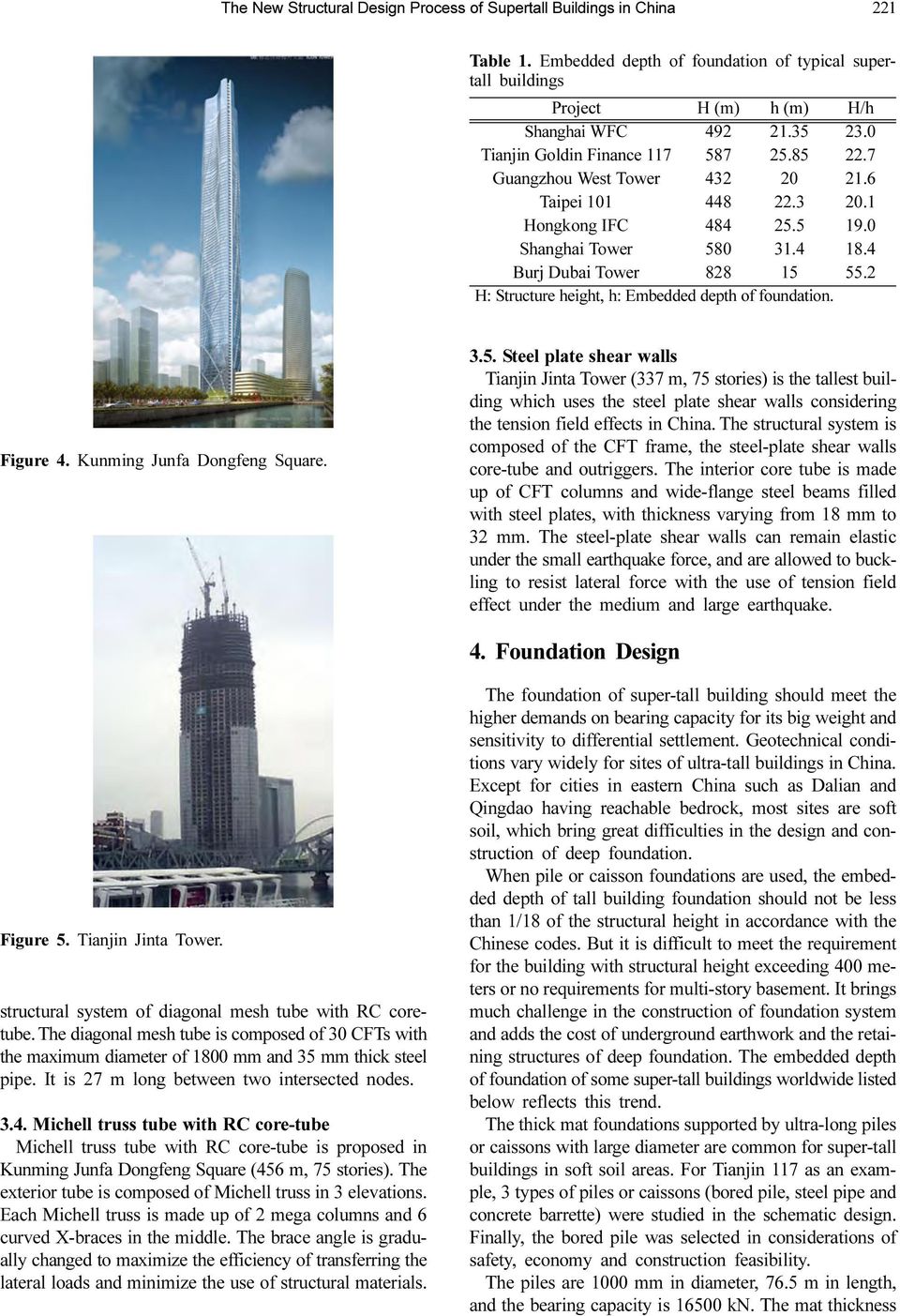
3 220 Bao Lianjin et al. International Journal of High-Rise Buildings ent functions of tall buildings, the space reserved for lift shaft becomes smaller and smaller. The tapered shape can take full advantage of structural materials and reduce wind load, especially the dynamic response of cross wind. The tapered profile can effectively improve structure s lateral stiffness, overall structural stability and shear resisting capacity of perimeter frame. Tapering profile of tall buildings is classified as follow: Staged symmetrical tapering (Shanghai Center, structural system), Staged non-symmetrical tapering (Dongjiadu Tower of the Bund), Continuous tapering (Tianjin Goldin Finance 117 Tower), Cutting regular geometry (Shanghai WFC), and Irregular torsional tapers (Shanghai Center, facade). Suzhou Gate of the Orient is the highest twin towers with link in the world. Nanjing Gold Eagle World and Wenzhou Trade Center are triple linked towers. The former adopts rigid linking with a six-floor height. In the latter, the cantilever of the tallest tower slides on the second tower, which has a sky-bridge linking the third tower. In Chongqing Raffels City, four towers are linked together by a sky-bridge supported on friction pendulum bearings at the top. Figure1. Shanghai Tower. 3. High-Efficiency Structural Systems With the increase of China s super-tall buildings in structural height and aspect ratio, more attentions are paid to the efficiency of structural systems. The structural systems of 300 m and taller buildings are characterized by the efficiency of material, such as member peripherization, braced system and composite structure. The main structural systems include: mega frame with RC core-tube, mega diagonal braced tube with RC core-tube, diagonal mesh tube with RC core-tube, and some derivative new systems such as Michell truss tube and steel plate shear walls (Zhou et al., 2014). Figure 2. Tianjin Goldin finance Mega frame with RC core-tube Shanghai Tower (632 m, 124 stories) was topped out at the end of The mega frame is composed of 8 mega SRC columns, 4 corner columns and 8 two-story high belt trusses. The core-tube is made up of composite steel plate and concrete shear walls, and 6 outrigger trusses are used to connect the core and mega frame along the height to maximize the structural efficiency (Chunyu et al. 2012) Mega diagonal braced tube with RC core-tube Goldin finance 117 (597 m, 117 stories) is in Tianjin with the aspect ratio 9.5. The mega diagonal braced tube is composed of 4 mega special-shaped columns with area of 45 m 2, 9 belt trusses and mega X-braces. The core-tube is made up of composite steel plate and concrete shear walls which is 1400 mm thick at the bottom Diagonal mesh tube with RC core-tube Guangzhou west tower (432 m, 103 stories) adopts the Figure 3. Guangzhou West Tower.

4 The New Structural Design Process of Supertall Buildings in China 221 Table 1. Embedded depth of foundation of typical supertall buildings Project H (m) h (m) H/h Shanghai WFC Tianjin Goldin Finance Guangzhou West Tower Taipei Hongkong IFC Shanghai Tower Burj Dubai Tower H: Structure height, h: Embedded depth of foundation. Figure 4. Kunming Junfa Dongfeng Square Steel plate shear walls Tianjin Jinta Tower (337 m, 75 stories) is the tallest building which uses the steel plate shear walls considering the tension field effects in China. The structural system is composed of the CFT frame, the steel-plate shear walls core-tube and outriggers. The interior core tube is made up of CFT columns and wide-flange steel beams filled with steel plates, with thickness varying from 18 mm to 32 mm. The steel-plate shear walls can remain elastic under the small earthquake force, and are allowed to buckling to resist lateral force with the use of tension field effect under the medium and large earthquake. 4. Foundation Design Figure 5. Tianjin Jinta Tower. structural system of diagonal mesh tube with RC coretube. The diagonal mesh tube is composed of 30 CFTs with the maximum diameter of 1800 mm and 35 mm thick steel pipe. It is 27 m long between two intersected nodes Michell truss tube with RC core-tube Michell truss tube with RC core-tube is proposed in Kunming Junfa Dongfeng Square (456 m, 75 stories). The exterior tube is composed of Michell truss in 3 elevations. Each Michell truss is made up of 2 mega columns and 6 curved X-braces in the middle. The brace angle is gradually changed to maximize the efficiency of transferring the lateral loads and minimize the use of structural materials. The foundation of super-tall building should meet the higher demands on bearing capacity for its big weight and sensitivity to differential settlement. Geotechnical conditions vary widely for sites of ultra-tall buildings in China. Except for cities in eastern China such as Dalian and Qingdao having reachable bedrock, most sites are soft soil, which bring great difficulties in the design and construction of deep foundation. When pile or caisson foundations are used, the embedded depth of tall building foundation should not be less than 1/18 of the structural height in accordance with the Chinese codes. But it is difficult to meet the requirement for the building with structural height exceeding 400 meters or no requirements for multi-story basement. It brings much challenge in the construction of foundation system and adds the cost of underground earthwork and the retaining structures of deep foundation. The embedded depth of foundation of some super-tall buildings worldwide listed below reflects this trend. The thick mat foundations supported by ultra-long piles or caissons with large diameter are common for super-tall buildings in soft soil areas. For Tianjin 117 as an example, 3 types of piles or caissons (bored pile, steel pipe and concrete barrette) were studied in the schematic design. Finally, the bored pile was selected in considerations of safety, economy and construction feasibility. The piles are 1000 mm in diameter, 76.5 m in length, and the bearing capacity is kn. The mat thickness
5 222 Bao Lianjin et al. International Journal of High-Rise Buildings Figure 6. Piles and Mat Layout of Tianjin Goldin 117. is optimized to 6.5 m. To distribute the vertical load more uniformly to the mat and piles, wing walls are set between the mega columns and the core-tube below B1 story. It also can improve the mat s punching capacity and bending stiffness. As far as the rigidity of superstructure is concerned, the maximum foundation settlement is 162 mm. 5. Structural Materials 5.1. High performance material Structural material with high strength and high ductility has been used in the super-tall buildings. C70 and C60 (cube strength) concrete was adopted in the SRC column and shear wall respectively in the structure with moment frame and concrete core. No higher grade concrete has been used, since insufficient ductility of them was mainly concerned about. However, C100 concrete was utilized in the CFT or CFRT columns. The self-compact concrete was used in the elements with dense rebar considering poring convenience. The high strength concrete mix was designed to be delivered to height over 600 m. Except for the conventional Q235 (yield point) and Q345 (yield point) steel, the extensive use of high strength steel plate including Q390 (65-ksi yield point) is practical in the elements of super-tall buildings, such as outriggers. Cast and forged steel are also used in the complex joints. For example, cast steel was used in Shanghai WFC, as well as forged steel was used in Dalian Greenland Center in the joint connecting outrigger with concrete core wall. The weldability and ductility are also taken into account when using the high strength steel. In the same time, the new connecting detail needs to be studied, such as high strength bolt with high friction coefficient Analysis of steel consumption Fig. 7 illustrates the steel consumption of super-tall buildings that completed or under construction in China (Shown as dots; the steel weight excludes the weight of reinforcement per unit area of the building). These supertall buildings, with height of 300 m and above, are mainly Figure 7. Steel Consumption of Super-Tall Buildings. used for offices, hotels, or apartment. Since over 90% of current super-tall buildings in China are steel and reinforced concrete hybrid structure, the data used in this article are mainly gathered from this type of buildings. In comparison, Fig. 7 also illustrates the steel consumption of super-tall building in North America with similar heights (shown as triangles). However, unlike the hybrid structures in China, the structures in North America are mostly built with steel. The following conclusions can be drawn (Wang et al., 2012). 1) The steel consumption per unit area is dispersed wildly and ranges from 100 kg/m 2 to 250 kg/m 2. This distribution index is closely related to the height of the building, the height to width ratio, and the type of lateral force resistant system utilized. 2) According to the statistics of limited data, the steel usage of frame columns (pillars) and outrigger and ring trusses account for 30% and 15% of the total structure steel consumption, respectively. The shape of the column and the steel consumption of column within the frame have one of the greatest impacts on total steel usage. 3) The amount of steel usage for super-tall building greatly varies in different regions, which indicates that wind and seismic loads are major factors that affect the amount of structural steel used. Generally, wind loads are much higher in coastal areas, so the steel usage of supertall buildings in Shanghai is much higher than those in inland cities such as Wuhan, Chongqi and Wuxi. A high usage of steel is found in Tianjin and Beijing because these cities are within high seismic load zones. 4) Super-tall buildings in China use a hybrid structure of steel and reinforced concrete rather than the pure steel structures that are used in North America. However, the steel usage of buildings in China is close to or even higher than that in North America. 6. Technology of Energy Dissipation Wind and earthquake are two main lateral loads on super-tall buildings. The structural responses arising from wind and earthquake decrease with increasing damping.

6 The New Structural Design Process of Supertall Buildings in China 223 Figure 8. BRB in Tianjin Goldin 117. However, the intrinsic damping of the super-tall building is low and uncertain. Adding supplementary damping system to a building will increase the dependable structural damping, so that the structural dynamic response will be virtually eliminated. Displacement dependent dampers, velocity dependent dampers and tuned mass dampers are three types of dampers often used in the high rise buildings. Displacement dependent dampers such as buckling restrained brace (BRB), shear panel damper, show high efficiency to seismic mitigation of structure. Viscous dampers (VD) dissipate energy under small deformation, and are capable of reducing lateral design forces and assuring occupant comfort (Jiang et al., 2014). Tuned mass dampers (TMD) at the top of building can be used to reduce windinduced accelerations Tianjin Goldin Finance BRB The length of V shape braces in the lobby is about 48m. The traditional brace was replaced with BRB to solve buckling problem of the super-long brace. Therefore, the enormous unbalanced force and moment in the horizontal bar are avoided. The steel core of ultra-long BRB consists of yielding section and non-yielding section, which are made of low yielding steel and low alloy steel respectively. The yielding capacity of BRB is kn Replaceable coupling beams In the reinforced concrete core, replaceable coupling beams are creatively used to enhance the capability of dissipating energy. Meanwhile, structural reparation after intense earthquake will be convenient (Lu et al., 2013) Urumqi Greenland Center Urumqi Greenland Center consists of twin towers with Figure 9. Replaceable Coupling Beams Figure 10. VD in Urumqi Greenland Center. 260 m height and 57 levels. As located in 8 degree-earthquake fortification zone, the towers may be subjected to strong lateral motions in earthquake. 48 viscous dampers are installed on three refugee floors at the end of cantilever trusses. Analysis results show that the structural dynamic responses under small earthquake, medium earthquake and large earthquake will be reduced by 20%, 15% and 10% respectively, and the supplemental damping will be 4.5%, 2.8% and 1.9%, respectively Shanghai Tower To enhance the occupant comfort of Shanghai Tower, a

7 224 Bao Lianjin et al. International Journal of High-Rise Buildings Figure 13. TLD in Suzhou IFC Tower. Figure 11. TMD in Shanghai Tower. Figure 12. Mega SRC in Shanghai Tower. tuned mass damper system was installed at the top of the tower. The TMD consists of pendulum frame, TMD mass, viscous damper devices, electromagnetic damping devices and snubbing system. The TMD was capable of reducing acceleration induced by wind with 10-year return period felt at the top floor from 11.4 gal to 6.2 gal Suzhou IFC Tower Suzhou IFC Tower is 450 m high with 93 stories above the ground. Tuned liquid damper is placed at the top of the tower to assure occupant comfort. The fire water pool of the building is used as TLD tank, which can provide a total water of 593 tons. With TLD, the wind induced acceleration under 10 years returned wind will be reduced from 17 gal to 12 gal. 7. Mega Composite Components As described above, the building width can be fully utilized to improve the ability of resisting overturning in mega-frame with RC core-tube system or mega braced tube system, where the huge tension forces caused by the overturning moments in mega columns can be balanced by the transferred gravity loads. It s inevitable to apply mega elements to super-tall buildings due to the high demand for capacity and axial stiffness, and composite members will be a logical choice. Three types of composite sections (SRC, CFT and CFRT) have been widely used which vary in performance of capacity, ductility, detailing, constructability, fireproofing and economy. But none is dominant, to some extent depending on the engineers experience. CFT and CFRT are more popular in Southern China. Shanghai Tower and Wuhan Greenland Center adopt mega SRC columns with section area of about 20 m 2 and steel ratio of 4~6% (Fig. 12). For reliable connection of outrigger truss elements, belt truss elements or braces to SRC columns, steel sections shall be placed separately. Due to possible poor seismic performance, latticed steel sections are not acceptable in Chinese code. Usually steel webs are used to connect separate steel sections to form solid web steel columns, which will increase the difficulty of closing stirrup and add much construction cost. Limited by transportation and hoisting, segmentation is necessary for solid web steel columns. In spite of low efficiency, uncontrolled welding deformation and residual stresses, sometimes site welding is the only possible solution for steel column splicing. On the contrary, the idea of latticed steel sections in SRC forwarded in Dalian Greenland Center can avoid the above problems. For wide engineering application of SRC with latticed steel sections and sponsored by CTBUH seed funding, a series of test program are being carried out by China Academy of Building Research (CABR) to study the ultimate load-carrying capacity

8 The New Structural Design Process of Supertall Buildings in China 225 Figure 14. Mega CFRT in Tianjin 117. Figure 15. Mega CFT in Wuhan center. and failure mechanism. Special-shaped mega CFRT with multi-caves has been used in Tianjin Goldin Finance 117. Its section area is 45 m 2 and its steel ratio is 6%. For its first application in practice, in-depth studies on capacity, column foot, welding detail and fireproofing have been developed. Complete penetration weld and partial penetration weld have been respectively used for perimeter and inner plates assemble. In column foot connection, high-strength rods have been embedded to resist the huge tension forces under rare earthquake. Mega CFT in Wuhan Center has a diameter of 3 m and the maximum tube thickness is 60 mm. Experimental study on connection of perimeter beams and outrigger truss diagonals to CFT has been conducted. Base on the experimental results, the details shown in Fig. 14 have been used in design. The ring stiffner inside the tube plays a primary role to transfer the beam shear force. Shear studs, T-shaped longitudinal stiffening ribs and reinforcement cages can reduce the adverse effects due to concrete shrinkage and creep. 8. Role of Local Structural Engineers Super-tall building design in china has undergone 3 phases: design by overseas engineers in the late 1980s, cooperating with overseas engineers in 1990s, and by local designers in the 21st century. Foreign architects and engineers have brought new ideas and technologies when they entered into China. Chinese engineers have made great progress during the cooperation. Taking their advantage and combing with domestic conditions, they have made innovations in the key technology, which has enhanced construction feasibility, shortened the construction period, and reduced the cost. For instance, as the preliminary design of Tianjin Jinta Tower, vertical load is only carried by frame columns in the core, and not by steel plate shear wall (SPSW). So SPSW should not be installed until the top out of the superstructure. Local engineers adjusted the installation order of SPSW. The SPSW of the 1 st floor was proposed to be installed when the erection of the 15 th floor had ended. In order to avoid buckling under vertical loads, the SPSW was thickened and vertical stiffeners were added. This optimization has shortened 6 months of construction period, saved nearly 10 million RMB Yuan. In the case of Tianjin 117, considering the rigidity of superstructure, the thickness of the raft was reduced from 7.5 m in preliminary design to 6.5 m by local engineers. In addition, the 8 conventional mega braces in the lower lobby were replaced by BRB to improve seismic performance of the bracing system. Nowadays, the cooperation between foreign architects and Chinese engineers from the phase of conceptual design turns out to be more and more common. For example, by the end of 2014, the number of super-tall buildings above 300 m designed by East China Architectural Design & Research Institute (ECADI) has reached 46. Among them, more than 50% projects such as Dalian Greenland Center (518 m) and Wuhan Center (438 m), were participated by ECADI from structural conceptual design. Local engineers cooperated with foreign architects including KPF, HOK, WOODS Bagot, and etc. In the project of Hefei Baoneng IFS (the tallest tower higher than 600 m), all the design work will be done by ECADI. 9. Prospect Building shape, structural system, material and construction programs should be considered in the structural design of super-tall buildings to improve the economy. Wind tunnel test is proposed in the design of super-tall building for its sensitivity to wind. In order to optimize the structure, further studies on structural design criteria such as inter-story drift, stiffness-weight ratio, shear-weight ratio and shear-resistant capacity of perimeter frame need to be carried out. Since the existing hybrid super-tall structures haven t experienced the real earthquake so far, the seismic performance of this kind of structural system needs to be studied furthermore. In high seismic intensity area, steel-concrete hybrid structure system and outriggers should be carefully used. Hybrid structural systems with energy dissipation devices or structure steel systems are advised.

9 226 Bao Lianjin et al. International Journal of High-Rise Buildings The use of mega members has brought new challenges for structure design and construction. The design method, joint detail and construction feasibility of mega columns need to be proved by more tests and practice. Some research needs to be done in the feasibility of high-strength concrete such as C70 and higher grades in core shear wall in order to reduce the thickness of shear wall, lighten the structural weight, and improve the floor efficiency. Considering the long construction period, large amount of investment in super-tall building construction, parts of a building could be occupied before the entire building is completed. Correspondingly, the postcast strip between the tower and the podium need to be poured in advance, and construction simulation analysis and construction program should be adjusted. Structural monitoring system is advised to establish in the super-tall building construction. The monitoring data including structural dynamic properties, foundation settlement, strain and deformation of key members, can be used to validate and improve the structural design. References Chunyu, T., Congzhen, X., Hong, Z., and Jinzhe, C. (2012). Shaking Table Test and Seismic Performance Evaluation of Shanghai Tower. International Journal of High-Rise Buildings, 1(3), pp. 221~228. Ding, J., Wu, H., and et al. (2012). Current situation and discussion of structural design for super high rise buildings above 250 m in China. Journal of Buildings Structures, 35(3), pp. 1~7. Jiang, Y. (2014). Allocation of Viscous Damper and Seismic Fragility Analysis Based on Harmful Story Drift. Dissertation for the Master Degree, Tongji University, Lu, X. L., Chen, Y., and Jiang, H. J. (2013). Research Progress in New Replaceable Coupling Beams. Journal of Earthquake Engineering and Engineering Vibration, 33 (1), pp. 8~15. Wang, D. S., Zhou, J. L., and Bao, L. J. (2012). Analysis on the cost of structural construction in super-tall buildings. Building Structure, 42(5), pp. 1~7. Wang, D. S., Bao, L. J., and Chen J. X. (2014). Tapered profile and structural design of super tall buildings. Proceeding of the CTBUH 2014 Shanghai Conference, pp. 571~578. Zhou, J. L., Bao, L. J., and Qian, P. (2014). Study of structural efficiency of super-tall buildings. International Journal of High-Rise Buildings, 3(3), pp. 186~190.

Tall buildings. Florea Dinu. Lecture 13: 25/02/2014
 Tall buildings Florea Dinu Lecture 13: 25/02/2014 European Erasmus Mundus Master Course Sustainable Constructions under Natural 520121-1-2011-1-CZ-ERA MUNDUS-EMMC Part II Multistorey buildings Tall buildings,
4B-2. 2. The stiffness of the floor and roof diaphragms. 3. The relative flexural and shear stiffness of the shear walls and of connections.
 Shear Walls Buildings that use shear walls as the lateral force-resisting system can be designed to provide a safe, serviceable, and economical solution for wind and earthquake resistance. Shear walls
How To Build The Burj Dubai Tower
 Burj Dubai Tower History Rising Burj Dubai Tower History Rising 2003 All rights reserved. 1 Burj Dubai Tower History Rising Burj Dubai Tower Introduction Architecture Structure Sustainability Issues Construction
A 38-story design-build steel structure features a staggered-truss frame
 ALADDIN HOTEL A 38-story design-build steel structure features a staggered-truss frame Robert J. McNamara is president of McNamara/Salvia, Inc., in Boston. Among his more notable projects during his more
Methods for Seismic Retrofitting of Structures
 Methods for Seismic Retrofitting of Structures Retrofitting of existing structures with insufficient seismic resistance accounts for a major portion of the total cost of hazard mitigation. Thus, it is
Design of Steel Structures Prof. S.R.Satish Kumar and Prof. A.R.Santha Kumar. Fig. 7.21 some of the trusses that are used in steel bridges
 7.7 Truss bridges Fig. 7.21 some of the trusses that are used in steel bridges Truss Girders, lattice girders or open web girders are efficient and economical structural systems, since the members experience
The Design and Construction of the World s Tallest Building: The Burj Khalifa, Dubai
 The Design and Construction of the World s Tallest Building: The Burj Khalifa, Dubai Bill Baker, Partner; James Pawlikowski, Associate Director; SOM LLP, Chicago, USA. Contact: [email protected]
SEISMIC DESIGN. Various building codes consider the following categories for the analysis and design for earthquake loading:
 SEISMIC DESIGN Various building codes consider the following categories for the analysis and design for earthquake loading: 1. Seismic Performance Category (SPC), varies from A to E, depending on how the
CE591 Lecture 8: Shear Walls
 CE591 Lecture 8: Shear Walls Introduction History, examples Benefits Disadvantages Plate Girder Analogy Behavior of Special Plate Shear Walls (SPSW) Design of SPSW Important considerations Special Plate
Chapter 3 DESIGN AND CONSTRUCTION FEATURES IMPORTANT TO SEISMIC PERFORMANCE
 Chapter 3 DESIGN AND CONSTRUCTION FEATURES IMPORTANT TO SEISMIC PERFORMANCE To satisfy the performance goals of the NEHRP Recommended Seismic Provisions, a number of characteristics are important to the
Hunter College school of Social Work Thesis Proposal
 Fall 2009 Hunter College school of Social Work Thesis Proposal To analyze how energy efficiency can be implemented using facade and green roof redesign. It ties structural engineering concepts with existing
Structural Systems for Tall Buildings Professor Mahjoub Elnimeiri, PhD Fall 2009 - Lecture 1
 Structural Systems for Tall Buildings Professor Mahjoub Elnimeiri, PhD Fall 2009 - Lecture 1 What is structure? Structure/Architecture Interaction State of Art of Tall Buildings (from modern era to present)
National Council of Examiners for Engineering and Surveying. Principles and Practice of Engineering Structural Examination
 Structural Effective Beginning with the April 2011 The structural engineering exam is a breadth and exam examination offered in two components on successive days. The 8-hour Vertical Forces (Gravity/Other)
Ping An: Insurance and Tall Buildings
 Ping An: Insurance and Tall Buildings Wai Ming (Thomas) Tsang, CEO, Ping An Financial Centre Yongmin (Stephen) Yuan, General Manager Risk Management Department, Ping An Life Insurance Company of China
FOUNDATION DESIGN. Instructional Materials Complementing FEMA 451, Design Examples
 FOUNDATION DESIGN Proportioning elements for: Transfer of seismic forces Strength and stiffness Shallow and deep foundations Elastic and plastic analysis Foundation Design 14-1 Load Path and Transfer to
Draft Table of Contents. Building Code Requirements for Structural Concrete and Commentary ACI 318-14
 Draft Table of Contents Building Code Requirements for Structural Concrete and Commentary ACI 318-14 BUILDING CODE REQUIREMENTS FOR STRUCTURAL CONCRETE (ACI 318 14) Chapter 1 General 1.1 Scope of ACI 318
Up-Down Construction Utilizing Steel Sheet Piles and Drilled Shaft Foundations
 Up-Down Construction Utilizing Steel Sheet Piles and Drilled Shaft Foundations Nathan A. Ingraffea, P.E., S.E. Associate, KPFF Consulting Engineers, Portland, Oregon, USA Abstract The use of steel sheet
Miss S. S. Nibhorkar 1 1 M. E (Structure) Scholar,
 Volume, Special Issue, ICSTSD Behaviour of Steel Bracing as a Global Retrofitting Technique Miss S. S. Nibhorkar M. E (Structure) Scholar, Civil Engineering Department, G. H. Raisoni College of Engineering
6 RETROFITTING POST & PIER HOUSES
 Retrofitting Post & Pier Houses 71 6 RETROFITTING POST & PIER HOUSES by James E. Russell, P.E. 72 Retrofitting Post & Pier Houses Retrofitting Post & Pier Houses 73 RETROFITTING POST AND PIER HOUSES This
DEVELOPMENT AND APPLICATIONS OF TUNED/HYBRID MASS DAMPERS USING MULTI-STAGE RUBBER BEARINGS FOR VIBRATION CONTROL OF STRUCTURES
 13 th World Conference on Earthquake Engineering Vancouver, B.C., Canada August 1-6, 2004 Paper No. 2243 DEVELOPMENT AND APPLICATIONS OF TUNED/HYBRID MASS DAMPERS USING MULTI-STAGE RUBBER BEARINGS FOR
EXAMPLES OF SEISMIC RETROFITTING IN JAPAN
 09-031 The 2005 World Sustainable Building Conference, EXAMPLES OF SEISMIC RETROFITTING IN JAPAN Hiroshi YAMAMOTO 1 Yasuhiro TSUNEKI 2 Toshihiko KOHNO 3 1 Senior Structural Engineer, Structural Engineering
Optimum proportions for the design of suspension bridge
 Journal of Civil Engineering (IEB), 34 (1) (26) 1-14 Optimum proportions for the design of suspension bridge Tanvir Manzur and Alamgir Habib Department of Civil Engineering Bangladesh University of Engineering
Simulation for the Collapse of WTC after Aeroplane Impact
 Simulation for the Collapse of WTC after Aeroplane Impact LU Xinzheng & JIANG Jianjing Department of Civil Engineering, Tsinghua University, Beijing, 100084 Abstract: Mechanical simulation and parameter
CH. 2 LOADS ON BUILDINGS
 CH. 2 LOADS ON BUILDINGS GRAVITY LOADS Dead loads Vertical loads due to weight of building and any permanent equipment Dead loads of structural elements cannot be readily determined b/c weight depends
METHOD OF STATEMENT FOR STATIC LOADING TEST
 Compression Test, METHOD OF STATEMENT FOR STATIC LOADING TEST Tension Test and Lateral Test According to the American Standards ASTM D1143 07, ASTM D3689 07, ASTM D3966 07 and Euro Codes EC7 Table of Contents
THE ARTICULATED FUNICULATOR and the TUBED MEGA FRAME. The way of the FUTURE
 THE ARTICULATED FUNICULATOR and the TUBED MEGA FRAME The way of the FUTURE By Fritz King Mats Lundström Sirpa Salavaara Peter Severin What happens if a funicular, such as the funicular to Victoria Peak
Seismic Analysis and Design of Steel Liquid Storage Tanks
 Vol. 1, 005 CSA Academic Perspective 0 Seismic Analysis and Design of Steel Liquid Storage Tanks Lisa Yunxia Wang California State Polytechnic University Pomona ABSTRACT Practicing engineers face many
Settlement of Precast Culverts Under High Fills; The Influence of Construction Sequence and Structural Effects of Longitudinal Strains
 Settlement of Precast Culverts Under High Fills; The Influence of Construction Sequence and Structural Effects of Longitudinal Strains Doug Jenkins 1, Chris Lawson 2 1 Interactive Design Services, 2 Reinforced
How to Design Helical Piles per the 2009 International Building Code
 ABSTRACT How to Design Helical Piles per the 2009 International Building Code by Darin Willis, P.E. 1 Helical piles and anchors have been used in construction applications for more than 150 years. The
Seismic Risk Prioritization of RC Public Buildings
 Seismic Risk Prioritization of RC Public Buildings In Turkey H. Sucuoğlu & A. Yakut Middle East Technical University, Ankara, Turkey J. Kubin & A. Özmen Prota Inc, Ankara, Turkey SUMMARY Over the past
Structural Design of Reinforced Concrete Tall Buildings
 Structural Design of Reinforced Concrete Tall Buildings Ali Sherif S. Rizk Author Ali Sherif S. Rizk, Director of Structural Engineering Department, Dar Al-Handasah Consultants (Shair and Partners) Dar
Detailing of Reinforcment in Concrete Structures
 Chapter 8 Detailing of Reinforcment in Concrete Structures 8.1 Scope Provisions of Sec. 8.1 and 8.2 of Chapter 8 shall apply for detailing of reinforcement in reinforced concrete members, in general. For
Prepared For San Francisco Community College District 33 Gough Street San Francisco, California 94103. Prepared By
 Project Structural Conditions Survey and Seismic Vulnerability Assessment For SFCC Civic Center Campus 750 Eddy Street San Francisco, California 94109 Prepared For San Francisco Community College District
PERFORMANCE BASED SEISMIC EVALUATION AND RETROFITTING OF UNSYMMETRICAL MEDIUM RISE BUILDINGS- A CASE STUDY
 Paper No. 682 PERFORMANCE BASED SEISMIC EVALUATION AND RETROFITTING OF UNSYMMETRICAL MEDIUM RISE BUILDINGS- A CASE STUDY Jimmy Chandra, Pennung Warnitchai, Deepak Rayamajhi, Naveed Anwar and Shuaib Ahmad
THE STAR, DARLING HOTEL AND SPA PYRMONT, NSW. Associate Director, Taylor Thomson Whitting Ltd, Sydney, Australia
 THE STAR, DARLING HOTEL AND SPA PYRMONT, NSW H Nguyen BE (Hons), CPEng MIEAUST NPER Associate Director, Taylor Thomson Whitting Ltd, Sydney, Australia ABSTRACT The redevelopment at The Star in Sydney includes
The Collapse of Building 7 by Arthur Scheuerman December 8, 06
 The Collapse of Building 7 by Arthur Scheuerman December 8, 06 WTC s Building 7 was a 47-story office building completed in 1987 by Silverstein Properties on land owned by the Port Authority. It was built
DESIGN OF SLABS. 3) Based on support or boundary condition: Simply supported, Cantilever slab,
 DESIGN OF SLABS Dr. G. P. Chandradhara Professor of Civil Engineering S. J. College of Engineering Mysore 1. GENERAL A slab is a flat two dimensional planar structural element having thickness small compared
Estimation of Adjacent Building Settlement During Drilling of Urban Tunnels
 Estimation of Adjacent Building During Drilling of Urban Tunnels Shahram Pourakbar 1, Mohammad Azadi 2, Bujang B. K. Huat 1, Afshin Asadi 1 1 Department of Civil Engineering, University Putra Malaysia
Seismic Isolation Retrofitting of Japanese Wooden Buildings
 Seismic Isolation Retrofitting of Japanese Wooden Buildings Summary Junko Suga Building Design Department Takenaka Corporation, Osaka Main Office Osaka, Japan Hiroyuki Ueda Building Design Department Takenaka
Module 5 (Lectures 17 to 19) MAT FOUNDATIONS
 Module 5 (Lectures 17 to 19) MAT FOUNDATIONS Topics 17.1 INTRODUCTION Rectangular Combined Footing: Trapezoidal Combined Footings: Cantilever Footing: Mat foundation: 17.2 COMMON TYPES OF MAT FOUNDATIONS
COLUMN-FREE OFFICE SPACE RISES IN CHICAGO S LOOP
 COLUMN-FREE OFFICE SPACE RISES IN CHICAGO S LOOP 30 x45 bay provides maximum tenant flexibility and increases leasing marketability By David E. Eckmann AIA, S.E. P.E. SURGING DEMANDS FOR RENTABLE OFFICE
bi directional loading). Prototype ten story
 NEESR SG: Behavior, Analysis and Design of Complex Wall Systems The laboratory testing presented here was conducted as part of a larger effort that employed laboratory testing and numerical simulation
SLAB DESIGN. Introduction ACI318 Code provides two design procedures for slab systems:
 Reading Assignment SLAB DESIGN Chapter 9 of Text and, Chapter 13 of ACI318-02 Introduction ACI318 Code provides two design procedures for slab systems: 13.6.1 Direct Design Method (DDM) For slab systems
Control of Seismic Drift Demand for Reinforced Concrete Buildings with Weak First Stories
 Earthquake Yoshimura: Engineering Control and of Engineering Seismic Drift Seismology Demand for Reinforced Concrete Buildings with Weak First Stories 7 Volume 4, Number, September 3, pp. 7 3 Control of
Tall Building Form Generation by Parametric Design Process
 ctbuh.org/papers Title: Authors: Subject: Keywords: Tall Building Form Generation by Parametric Design Process Mahjoub Elnimeiri, Professor, Illinois Institute of Technology Sang Min Park, PhD Candidate,
Materials. Estimating Steel. Players. Materials. Shop Drawings. Detailing Process. Standard shapes. Fabricated members, Built-up sections
 Materials Standard shapes W sections, C channels, Structural T, Angles, Pipes, Tubes, Rods and Plates Fabricated members, Built-up sections Adding plates to beam flanges, Stiffeners to beam webs Built
SEISMIC UPGRADE OF OAK STREET BRIDGE WITH GFRP
 13 th World Conference on Earthquake Engineering Vancouver, B.C., Canada August 1-6, 2004 Paper No. 3279 SEISMIC UPGRADE OF OAK STREET BRIDGE WITH GFRP Yuming DING 1, Bruce HAMERSLEY 2 SUMMARY Vancouver
Numerical Analysis of the Moving Formwork Bracket Stress during Construction of a Curved Continuous Box Girder Bridge with Variable Width
 Modern Applied Science; Vol. 9, No. 6; 2015 ISSN 1913-1844 E-ISSN 1913-1852 Published by Canadian Center of Science and Education Numerical Analysis of the Moving Formwork Bracket Stress during Construction
Analysis of a Tower Crane Accident
 The Open Construction and Building Technology Journal, 2008, 2, 287-293 287 Analysis of a Tower Crane Accident Open Access M. H. Arslan* and M. Y. Kaltakci Selcuk University, Engineering and Architecture
ADVANCED SYSTEMS FOR RATIONAL SLAB REINFORCEMENT
 ADVANCED SYSTEMS FOR RATIONAL SLAB REINFORCEMENT CASPER ÅLANDER M. Sc. (Civ. Eng.) Development manager Fundia Reinforcing Abstract This paper deals with rational and fast ways to reinforce concrete slabs.
Expected Performance Rating System
 Expected Performance Rating System In researching seismic rating systems to determine how to best classify the facilities within the Portland Public School system, we searched out what was used by other
How To Build A Luxury Apartment Complex In London
 Post Tensioning Awards 2009 Project Summary Type of structure Location Architects Structural Engineer Residential with leisure suites including Swimming pool, Cinema, Virtual Golf, Wine Cellars, and Parking
Design and Construction Planning of the Burj Khalifa, Dubai, UAE
 2993 Design and Construction Planning of the Burj Khalifa, Dubai, UAE Ahmad Abdelrazaq, SE 1 1 EVP, Samsung C&T Corp, Seoul, Korea, [email protected] ABSTRACT The Burj Khalifa Project is the
LEGACY REPORT ER-5110. www.icc-es.org. ICC Evaluation Service, Inc. Reissued November 1, 2003. Legacy report on the 1997 Uniform Building Code
 LEGACY REPORT Reissued November 1, 2003 ICC Evaluation Service, Inc. www.icc-es.org Business/Regional Office # 5360 Workman Mill Road, Whittier, California 90601 # (562) 699-0543 Regional Office # 900
1997 Uniform Administrative Code Amendment for Earthen Material and Straw Bale Structures Tucson/Pima County, Arizona
 for Earthen Material and Straw Bale Structures SECTION 70 - GENERAL "APPENDIX CHAPTER 7 - EARTHEN MATERIAL STRUCTURES 70. Purpose. The purpose of this chapter is to establish minimum standards of safety
Technical Assignment 2 TABLE OF CONTENTS
 2 TABLE OF CONTENTS Executive Summary...3 Introduction..5 Gravity Loads......6 Design Codes......7 Materials..8 Existing Structural System.. 10 Existing Floor System 15 Alternate Floor Framing Systems...17
Report on. Wind Resistance of Signs supported by. Glass Fiber Reinforced Concrete (GFRC) Pillars
 Report on Wind Resistance of Signs supported by Glass Fiber Reinforced Concrete (GFRC) Pillars Prepared for US Sign and Fabrication Corporation January, 2006 SUMMARY This study found the attachment of
Safe & Sound Bridge Terminology
 Safe & Sound Bridge Terminology Abutment A retaining wall supporting the ends of a bridge, and, in general, retaining or supporting the approach embankment. Approach The part of the bridge that carries
ASSESSMENT AND RETROFITTING OF EXISTING RC BUILDINGS IN VIETNAM IN TERMS OF EARTHQUAKE RESISTANCES
 GEM-SEA Workshop on Seismic Vulnerability of Buildings Nanyang Technological University, Singapore 1 st July 2013 ASSESSMENT AND RETROFITTING OF EXISTING RC BUILDINGS IN VIETNAM IN TERMS OF EARTHQUAKE
Specification for Structures to be Built in Disaster Areas
 Ministry of Public Works and Settlement Government of Republic of Turkey Specification for Structures to be Built in Disaster Areas PART III - EARTHQUAKE DISASTER PREVENTION (Chapter 5 through Chapter
Brief on the Construction Planning of the Burj Dubai Project, Dubai, UAE
 Brief on the Construction Planning of the Burj Dubai Project, Dubai, UAE Ahmad Abdelrazaq 1*, S.E., Kyung Jun Kim 2 and Jae Ho Kim 3 1 Executive Vice President, Highrise Building Team, Samsung Engineering
SEISMIC RETROFITTING OF STRUCTURES
 SEISMIC RETROFITTING OF STRUCTURES RANJITH DISSANAYAKE DEPT. OF CIVIL ENGINEERING, FACULTY OF ENGINEERING, UNIVERSITY OF PERADENIYA, SRI LANKA ABSTRACT Many existing reinforced concrete structures in present
EFFECTS ON NUMBER OF CABLES FOR MODAL ANALYSIS OF CABLE-STAYED BRIDGES
 EFFECTS ON NUMBER OF CABLES FOR MODAL ANALYSIS OF CABLE-STAYED BRIDGES Yang-Cheng Wang Associate Professor & Chairman Department of Civil Engineering Chinese Military Academy Feng-Shan 83000,Taiwan Republic
POST AND FRAME STRUCTURES (Pole Barns)
 POST AND FRAME STRUCTURES (Pole Barns) Post and frame structures. The following requirements serve as minimum standards for post and frame structures within all of the following structural limitations:
Type of Force 1 Axial (tension / compression) Shear. 3 Bending 4 Torsion 5 Images 6 Symbol (+ -)
 Cause: external force P Force vs. Stress Effect: internal stress f 05 Force vs. Stress Copyright G G Schierle, 2001-05 press Esc to end, for next, for previous slide 1 Type of Force 1 Axial (tension /
Nonlinear numerical analysis of SRC-RC transfer columns based on OpenSEES
 3rd International Conference on Material, Mechanical and Manufacturing Engineering (IC3ME 2015) Nonlinear numerical analysis of SRC-RC transfer columns based on OpenSEES Hao Gu 1 a * Yun ZOU 1 Ming Chen
DESIGN OF SLABS. Department of Structures and Materials Engineering Faculty of Civil and Environmental Engineering University Tun Hussein Onn Malaysia
 DESIGN OF SLABS Department of Structures and Materials Engineering Faculty of Civil and Environmental Engineering University Tun Hussein Onn Malaysia Introduction Types of Slab Slabs are plate elements
DESIGN SPECIFICATIONS FOR HIGHWAY BRIDGES PART V SEISMIC DESIGN
 DESIGN SPECIFICATIONS FOR HIGHWAY BRIDGES PART V SEISMIC DESIGN MARCH 2002 CONTENTS Chapter 1 General... 1 1.1 Scope... 1 1.2 Definition of Terms... 1 Chapter 2 Basic Principles for Seismic Design... 4
Module 7 (Lecture 24 to 28) RETAINING WALLS
 Module 7 (Lecture 24 to 28) RETAINING WALLS Topics 24.1 INTRODUCTION 24.2 GRAVITY AND CANTILEVER WALLS 24.3 PROPORTIONING RETAINING WALLS 24.4 APPLICATION OF LATERAL EARTH PRESSURE THEORIES TO DESIGN 24.5
How To Design A Post Tensioned Deck For A Building
 SAMUEL ÁVILA STRUCTURAL OPTION FACULTY CONSULTANT: THOMAS BOOTHBY UNIVERSITY OF CENTRAL FLORIDA S ACADEMIC VILLAGES ORLANDO, FL THESIS PROPOSAL EXECUTIVE SUMMARY DECEMBER 12, 2005 Introduction: The University
How To Calculate Tunnel Longitudinal Structure
 Calculation and Analysis of Tunnel Longitudinal Structure under Effect of Uneven Settlement of Weak Layer 1,2 Li Zhong, 2Chen Si-yang, 3Yan Pei-wu, 1Zhu Yan-peng School of Civil Engineering, Lanzhou University
Overhang Bracket Loading. Deck Issues: Design Perspective
 Deck Issues: Design Perspective Overhang Bracket Loading Deck overhangs and screed rails are generally supported on cantilever brackets during the deck pour These brackets produce an overturning couple
EAST LYME HIGH SCHOOL
 Overview: 1971 N 1966 GYM 1966 CLASSROOM WING 1966 AUD. 1971 GYM 1998 1998 POOL EAST LYME HIGH SCHOOL Original 1966 Building: The original East Lyme High School was constructed in 1966 and was composed
TECHNICAL NOTE. Design of Diagonal Strap Bracing Lateral Force Resisting Systems for the 2006 IBC. On Cold-Formed Steel Construction INTRODUCTION
 TECHNICAL NOTE On Cold-Formed Steel Construction 1201 15th Street, NW, Suite 320 W ashington, DC 20005 (202) 785-2022 $5.00 Design of Diagonal Strap Bracing Lateral Force Resisting Systems for the 2006
Seismic performance evaluation of an existing school building in Turkey
 CHALLENGE JOURNAL OF STRUCTURAL MECHANICS 1 (4) (2015) 161 167 Seismic performance evaluation of an existing school building in Turkey Hüseyin Bilgin * Department of Civil Engineering, Epoka University,
NUMERICAL ANALYSIS OF THE SEISMIC PERFORMANCE OF STEEL FRAMES INFILLED WITH COMPOSITE PANELS
 1NCEE Tenth U.S. National Conference on Earthquake Engineering Frontiers of Earthquake Engineering July 21-25, 214 Anchorage, Alaska NUMERICAL ANALYSIS OF THE SEISMIC PERFORMANCE OF STEEL FRAMES INFILLED
SEISMIC ANALYSIS AND RETROFITTING OF R.C.C STRUCTURE
 International Journal of Advanced Research in Biology Engineering Science and Technology (IJARBEST) Vol., Issue, April 1 SEISMIC ANALYSIS AND RETROFITTING OF R.C.C STRUCTURE M.R.NAVANEETHA KRISHNAN 1,
ARCHITECTURE. Asst. Prof. Meltem VATAN KAPTAN [email protected]
 STRUCTURES IN ARCHITECTURE Asst. Prof. Meltem VATAN KAPTAN [email protected] Istanbul Aydin University, Faculty of Engineering and Architecture ISTANBUL, TURKEY December 15, 2011 - GAZIANTEP If
System. Stability. Security. Integrity. 150 Helical Anchor
 Model 150 HELICAL ANCHOR System PN #MBHAT Stability. Security. Integrity. 150 Helical Anchor System About Foundation Supportworks is a network of the most experienced and knowledgeable foundation repair
WORLD S TALLEST TIMBER BUILDING, BERGEN
 WORLD S TALLEST TIMBER BUILDING, BERGEN Trondheim, Norway. 2014-09-26 M. Sc. Rune B Abrahamsen, Sweco, Lillehammer, Norway Bergen- og omegn boligbyggelag (BOB) is a Norwegian housing association. They
Seismic Risk Evaluation of a Building Stock and Retrofit Prioritization
 Seismic Risk Evaluation of a Building Stock and Retrofit Prioritization Seismic risk assessment of large building stocks can be conducted at various s depending on the objectives, size of the building
How To Write An Analysis System For Bridge Test
 Study of Analysis System for Bridge Test Chen Ke, Lu Jian-Ming, Research Institute of Highway, 100088, Beijing, China ([email protected], [email protected]) Summary Analysis System for Bridge Test (Chinese
REVISION OF GUIDELINE FOR POST- EARTHQUAKE DAMAGE EVALUATION OF RC BUILDINGS IN JAPAN
 10NCEE Tenth U.S. National Conference on Earthquake Engineering Frontiers of Earthquake Engineering July 21-25, 2014 Anchorage, Alaska REVISION OF GUIDELINE FOR POST- EARTHQUAKE DAMAGE EVALUATION OF RC
ARCH 331 Structural Glossary S2014abn. Structural Glossary
 Structural Glossary Allowable strength: Nominal strength divided by the safety factor. Allowable stress: Allowable strength divided by the appropriate section property, such as section modulus or cross
Stability. Security. Integrity.
 Stability. Security. Integrity. PN #MBHPT Foundation Supportworks provides quality helical pile systems for both new construction and retrofit applications. 288 Helical Pile System About Foundation Supportworks
Rehabilitation of Existing Foundation Building to Resist Lateral and Vertical Loads
 International Journal of Current Microbiology and Applied Sciences ISSN: 2319-7706 Volume 3 Number 12 (2014) pp. 950-961 http://www.ijcmas.com Original Research Article Rehabilitation of Existing Foundation
Important Points: Timing: Timing Evaluation Methodology Example Immediate First announcement of building damage
 3.3. Evaluation of Building Foundation Damage Basic Terminology: Damage: Destruction, deformation, inclination and settlement of a building foundation caused by an earthquake. Damage grade: Degree of danger
Five reasons buildings fail in an earthquake and how to avoid them
 Five reasons buildings fail in an earthquake and how to avoid them by Jeff White, AIA Published in Healthcare Design magazine There s a saying among seismologists: Earthquakes don t kill people. Buildings
How To Understand The World Trade Center'S Structural Design
 Emerging Technologies in Structural Engineering Proc. of the 9 th Arab Structural Engineering Conf., Nov. 29 Dec. 1, 2003, Abu Dhabi, UAE WORLD TRADE CENTER COLLAPSE, FIELD INVESTIGATIONS AND ANALYSES
Numerical modelling of shear connection between concrete slab and sheeting deck
 7th fib International PhD Symposium in Civil Engineering 2008 September 10-13, Universität Stuttgart, Germany Numerical modelling of shear connection between concrete slab and sheeting deck Noémi Seres
Chapter 6 ROOF-CEILING SYSTEMS
 Chapter 6 ROOF-CEILING SYSTEMS Woodframe roof-ceiling systems are the focus of this chapter. Cold-formed steel framing for a roof-ceiling system also is permitted by the IRC but will not be discussed;
A NUMERICAL ANALYSIS BASED SUBSTITUTE METHOD FOR SHAKING TABLE TEST IN CONSIDERING OF THE SOIL-STRUCTURE INTERACTION
 A NUMERICAL ANALYSIS BASED SUBSTITUTE METHOD FOR SHAKING TABLE TEST IN CONSIDERING OF THE SOIL-STRUCTURE INTERACTION Y.R. Wang 1, J.W. Dai 2, S.M. Zhan 3 and Y. Jiang 4 1 Ph.D Student, Dept. of Structural
Design of reinforced concrete columns. Type of columns. Failure of reinforced concrete columns. Short column. Long column
 Design of reinforced concrete columns Type of columns Failure of reinforced concrete columns Short column Column fails in concrete crushed and bursting. Outward pressure break horizontal ties and bend
Project Report. Structural Investigations Hotel del Sol Yuma, Arizona
 Project Report Structural Investigations Yuma, Arizona Prepared by: 2619 Spruce Street Boulder, CO 80302 303-444-3620 Prepared for: Principle Engineering Group, Inc. 833 East Plaza Circle, Suite 100 Yuma,