
Ideal Gas and Real Gases
|
|
|
- Ann Long
- 9 years ago
- Views:
Transcription
1 Ideal Gas and Real Gases Lectures in Physical Chemistry 1 Tamás Turányi Institute of Chemistry, ELTE State roerties state roerty: determines the macroscoic state of a hysical system state roerties of single comonent gases: amount of matter, ressure, volume, temerature n,,, T amount of matter ressure denoted by n name of the unit: mole (denoted by mol ) 1 mol matter contains N A = 6, articles, Avogadro constant definition = F/A, (force F acting erendicularly on area A) SI unit ascal (denoted by: Pa): 1 Pa = 1 N m - 1 bar= 10 5 Pa; 1 atm=760 Hgmm=760 torr=10135 Pa 1

2 State roerties state roerties of single comonent gases: n,,, T volume denoted by, SI unit: m 3 volume of one mole matter m molar volume temerature characterizes the thermal state of a body many features of a matter deend on their thermal state: e.g. volume of a liquid, colour of a metal 3 Temerature scales 1: Fahrenheit Fahrenheit scale (1709): 0 F (-17,77 C) the coldest temerature measured in the winter of F (37,77 C) temerature measured in the rectum of Fahrenheit s cow between these temeratures the scale is linear (measured by an alcohol thermometer) Daniel Gabriel Fahrenheit ( ) hysicists, instrument maker Problem: Fahrenheit ersonally had to make coies from his original thermometer lower and uer reference temerature arbitrary lower and uer reference temerature not reroducible an original thermometer was needed for making further coies 4

3 Temerature scales : Celsius centigrade scale or Celsius scale (174; 1750): 0 C temerature of melting ice in 1 atm air 100 C temerature of boiling water in 1 atm air between these temeratures the scale is linear (measured by an alcohol thermometer) Anders Celsius ( ) Swedish astronomer Problem: if other liquids are used (e.g. Hg), then different middle temeratures are measured lower and uer reference temerature arbitrary lower and uer reference temerature reroducible anyone can make a new centigrade scale thermometer 5 Temerature scales 3: Kelvin Kelvin scale or absolut temerature scale (1848): Lord Kelvin born as William Thomson ( ) Scottish hysicist 0 K (-73,15 C) extraolated zero volume of an ideal gas 73,16 K (0,01 C) temerature of the trile oint of water between these temeratures the scale is linear (measured by a gas thermometer) Problem: ideal gas does not exist lower and uer reference temeratures hysically well based lower and uer reference temeratures reroducible this is the real ( thermodynamic ) temerature scale 6 3

4 Zeroth Law of Thermodynamics If substance A is in thermal equilibrium with substance B and substance B is in thermal equilibrium with substance C then substance A is in thermal equilibrium with substance C. Note: the condition is thermal equilibrium, not thermodynamic equilibrium! What does it mean: Using thermometer B, the temerature of body A, then the temerature of body C is measured. If the thermometer shows the same reading, then the temerature of bodies A and C are equal. 7 Equation of state of the ideal gas: ideal gas law = n R T or m = R T ressure (Pa) volume (m 3 ) n amount of matter (mol) T temerature (K) R gas constant R= J K -1 mol -1 Regnault constant Henri ictor Regnault ( ) at high temerature and not very high ressure French chemist the equation of state of the ideal gas is a good aroximation. DEF: ideal gas or erfect gas: imagined gas that obeys exactly the erfect gas equation of state. 8 4

5 7 names on the Eiffel tower htt://en.wikiedia.org/wiki/list_of_the_7_names_on_the_eiffel_tower 9 Dalton s Law DEF For mixtures of gases, artial ressure of a comonent gas is the ressure exerted by this gas occuying the same volume alone. Dalton s Law: the ressure of a mixture of erfect gasses is equal to the sum of the artial ressures. = ( n + n + K+ n )RT 1 K n RT n RT n RT 1 K = + + K+ = K+ K n j x = n + n + j / RT = / RT j = 1 KnK j mole fraction n j of comonent j is the ratio of the corresonding artial ressure and of the total ressure. John Dalton ( ) 10 English chemist 5

6 Real gases DEF Imerfection of real gases can be characterized by the comression factor Z Z = m / RT 1,30 Z = m/rt 1,5 1,0 1,15 1,10 1,05 1,00 0,95 e d c b a 0, /bar comression factor vs. ressure diagram of nitrogen gas the significant effects are above 10 bar! f a: 33K (-40 C) b: 55 K (-18 C) c: 73 K ( 0 C) d: 37, K (54,05 C) e: 478 K (05 C) 11 Comression diagram DEF Comression diagram: Z curve 1,30 1,5 1,15 lease note: 1,10 - at (almost) zero ressure Z = 1 1,05 1,00 - for an ideal gas Z = 1 always 0,95 - real gas, high ressure: high Z 0,90 - at the Boyle temerature: Z starts horizontally - below the Boyle temerature: Z starts below 1 - above the Boyle temerature: Z is always above 1 Z = m/rt 1,0 e d c b a /bar f DEF: Boyle temerature: Z() starts horizontally at this temerature significance: at the Boyle temerature the real gases behave (almost) like the ideal gases if the ressure is not very high (e.g. < 30 bar) Boyle temerature for N : 54,05 C ( air behaves like an ideal gas at 98K) shae of the Z() curve: curvature downwards: attracting forces between the molecules going u: reelling forces / own volume of the molecules 1 6
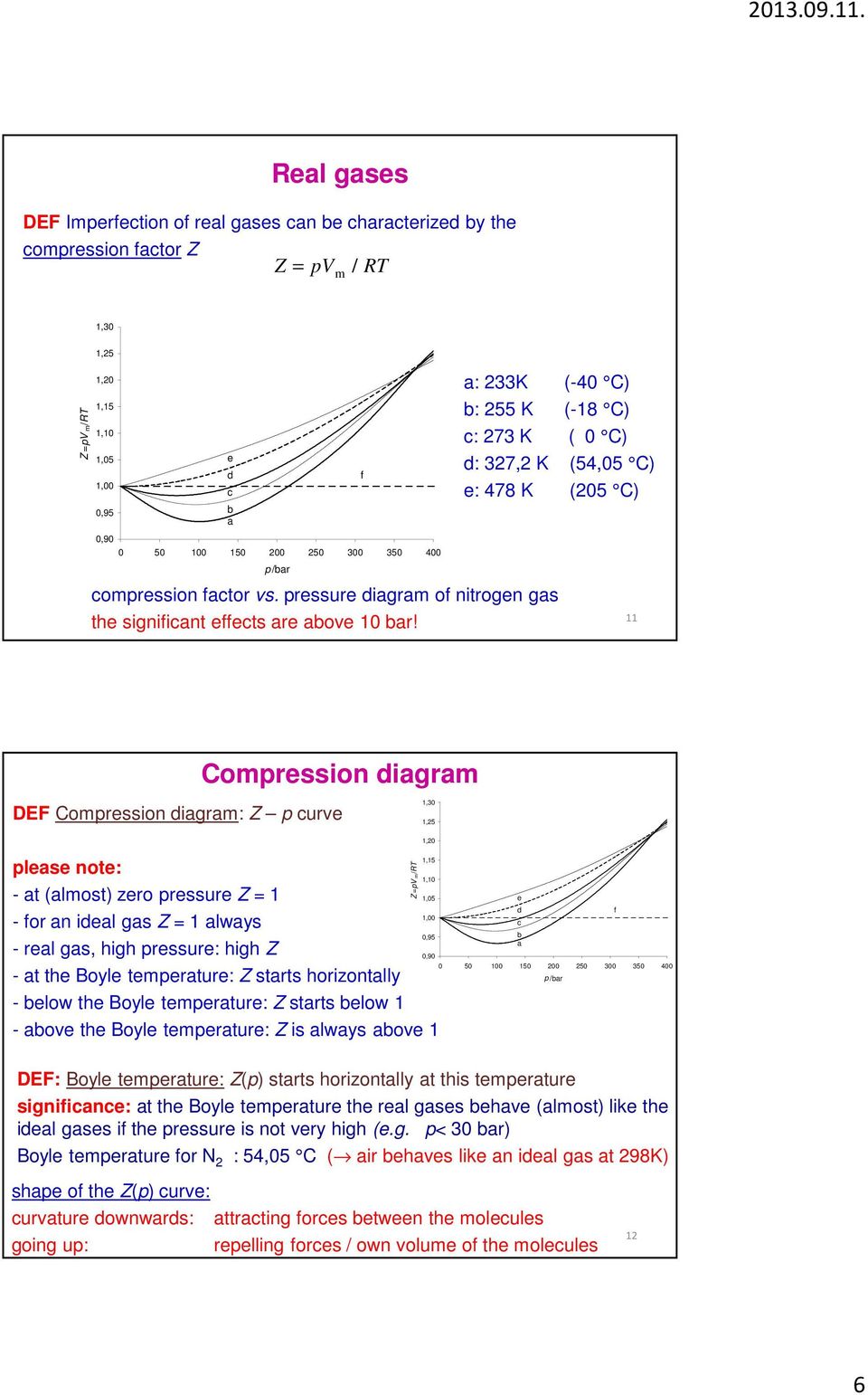
7 Equations of state of real gases T virial equation of state Z = m / RT = 1+ B + C + K lease note: using the virial equation of state, the Z() curve is aroximated with a olynomial the constant term is 1, because if =0 then Z=1 olynomial of any order can be used any accuracy can be achieved B, C... temerature deendent emirical constants the favourite of chemical engineers due to its high accuracy Robert Boyle ( ) English chemist 13 Equations of state of real gases van der Waals equation of state n a + = ( nb) nrt the idea of van der Waals: let us take the equation of state of ideal gases: = n R T Johannes Diderik van der Waals ( ) Dutch hysicist ressure is corrected with a term that takes into account the attractive forces between the molecules. This term includes emirical constant a. (the volume of the box) is corrected by the own volume of the molecules. This volume is b for 1 mole, nb for n moles of molecules a and b are emirical constants and do not deend on temerature This equation of state is simle, but not very accurate (say, error is below 1%). 7

8 Isotherms of ideal gases DEF isotherms of gases: () curve at constant temerature (axis x: volume, axis y: ressure) lower temerature: the isotherm is getting closer to the axes, but keeing the hyerbolic shae 15 (since = constant always) Isotherms of real gases c C T T c T 1 c T 3 T 4 high temerature: nearly hyerbolic (nearly ideal gas) lower temerature: distorted hyerbolic function critical isotherm: a oint having horizontal tangent aears (critical oint) critical temerature: temerature of the critical isotherm critical ressure: ressure belonging to the critical oint critical molar volume: molar volume belonging to of the critical oint significance of the critical temerature: if the temerature is higher, the gas cannot be liquefied by comression 16 8

9 Isotherms of real gases measured isotherms of CO critical temerature: K (31,1 C) critical ressure: 7.38 MPa (73,8 bar) above the critical temerature: below the critical temerature: gas vaour (liquefaction via comression) grey area: vaour and liquid are in equilibrium at the vaour ressure left of the gray area and below critical temerature: liquid 17 THE END of toic ideal gas and real gases 18 9

Boyles Law. At constant temperature the volume occupied by a fixed amount of gas is inversely proportional to the pressure on the gas 1 P = P
 Boyles Law At constant temperature the volume occupied by a fixed amount of gas is inversely proportional to the pressure on the gas 1 or k 1 Boyles Law Example ressure olume Initial 2.00 atm 100 cm 3
Thermodynamics of Mixing
 Thermodynamics of Mixing Dependence of Gibbs energy on mixture composition is G = n A µ A + n B µ B and at constant T and p, systems tend towards a lower Gibbs energy The simplest example of mixing: What
CHAPTER 12. Gases and the Kinetic-Molecular Theory
 CHAPTER 12 Gases and the Kinetic-Molecular Theory 1 Gases vs. Liquids & Solids Gases Weak interactions between molecules Molecules move rapidly Fast diffusion rates Low densities Easy to compress Liquids
Fugacity, Activity, and Standard States
 Fugacity, Activity, and Standard States Fugacity of gases: Since dg = VdP SdT, for an isothermal rocess, we have,g = 1 Vd. For ideal gas, we can substitute for V and obtain,g = nrt ln 1, or with reference
IDEAL AND NON-IDEAL GASES
 2/2016 ideal gas 1/8 IDEAL AND NON-IDEAL GASES PURPOSE: To measure how the pressure of a low-density gas varies with temperature, to determine the absolute zero of temperature by making a linear fit to
Chemistry 13: States of Matter
 Chemistry 13: States of Matter Name: Period: Date: Chemistry Content Standard: Gases and Their Properties The kinetic molecular theory describes the motion of atoms and molecules and explains the properties
Statistical Mechanics, Kinetic Theory Ideal Gas. 8.01t Nov 22, 2004
 Statistical Mechanics, Kinetic Theory Ideal Gas 8.01t Nov 22, 2004 Statistical Mechanics and Thermodynamics Thermodynamics Old & Fundamental Understanding of Heat (I.e. Steam) Engines Part of Physics Einstein
Gas Laws. The kinetic theory of matter states that particles which make up all types of matter are in constant motion.
 Name Period Gas Laws Kinetic energy is the energy of motion of molecules. Gas state of matter made up of tiny particles (atoms or molecules). Each atom or molecule is very far from other atoms or molecules.
CHEMISTRY. Matter and Change. Section 13.1 Section 13.2 Section 13.3. The Gas Laws The Ideal Gas Law Gas Stoichiometry
 CHEMISTRY Matter and Change 13 Table Of Contents Chapter 13: Gases Section 13.1 Section 13.2 Section 13.3 The Gas Laws The Ideal Gas Law Gas Stoichiometry State the relationships among pressure, temperature,
Gases. States of Matter. Molecular Arrangement Solid Small Small Ordered Liquid Unity Unity Local Order Gas High Large Chaotic (random)
 Gases States of Matter States of Matter Kinetic E (motion) Potential E(interaction) Distance Between (size) Molecular Arrangement Solid Small Small Ordered Liquid Unity Unity Local Order Gas High Large
Gases. Macroscopic Properties. Petrucci, Harwood and Herring: Chapter 6
 Gases Petrucci, Harwood and Herring: Chapter 6 CHEM 1000A 3.0 Gases 1 We will be looking at Macroscopic and Microscopic properties: Macroscopic Properties of bulk gases Observable Pressure, volume, mass,
a) Use the following equation from the lecture notes: = ( 8.314 J K 1 mol 1) ( ) 10 L
 hermodynamics: Examples for chapter 4. 1. One mole of nitrogen gas is allowed to expand from 0.5 to 10 L reversible and isothermal process at 300 K. Calculate the change in molar entropy using a the ideal
1.3 Saturation vapor pressure. 1.3.1 Vapor pressure
 1.3 Saturation vaor ressure Increasing temerature of liquid (or any substance) enhances its evaoration that results in the increase of vaor ressure over the liquid. y lowering temerature of the vaor we
AS1 MOLES. oxygen molecules have the formula O 2 the relative mass will be 2 x 16 = 32 so the molar mass will be 32g mol -1
 Moles 1 MOLES The mole the standard unit of amount of a substance the number of particles in a mole is known as Avogadro s constant (L) Avogadro s constant has a value of 6.023 x 10 23 mol -1. Example
THE IDEAL GAS LAW AND KINETIC THEORY
 Chapter 14 he Ideal Gas Law and Kinetic heory Chapter 14 HE IDEAL GAS LAW AND KINEIC HEORY REIEW Kinetic molecular theory involves the study of matter, particularly gases, as very small particles in constant
Lecture Notes: Gas Laws and Kinetic Molecular Theory (KMT).
 CHEM110 Week 9 Notes (Gas Laws) Page 1 of 7 Lecture Notes: Gas Laws and Kinetic Molecular Theory (KMT). Gases Are mostly empty space Occupy containers uniformly and completely Expand infinitely Diffuse
F321 MOLES. Example If 1 atom has a mass of 1.241 x 10⁻²³ g 1 mole of atoms will have a mass of 1.241 x 10-23 g x 6.02 x 10 23 = 7.
 Moles 1 MOLES The mole the standard unit of amount of a substance (mol) the number of particles in a mole is known as Avogadro s constant (N A ) Avogadro s constant has a value of 6.02 x 10 23 mol -1.
Problem Set 3 Solutions
 Chemistry 360 Dr Jean M Standard Problem Set 3 Solutions 1 (a) One mole of an ideal gas at 98 K is expanded reversibly and isothermally from 10 L to 10 L Determine the amount of work in Joules We start
Exam 4 Practice Problems false false
 Exam 4 Practice Problems 1 1. Which of the following statements is false? a. Condensed states have much higher densities than gases. b. Molecules are very far apart in gases and closer together in liquids
The Gas Laws. Our Atmosphere. Pressure = Units of Pressure. Barometer. Chapter 10
 Our Atmosphere The Gas Laws 99% N 2 and O 2 78% N 2 80 70 Nitrogen Chapter 10 21% O 2 1% CO 2 and the Noble Gases 60 50 40 Oxygen 30 20 10 0 Gas Carbon dioxide and Noble Gases Pressure Pressure = Force
= 800 kg/m 3 (note that old units cancel out) 4.184 J 1000 g = 4184 J/kg o C
 Units and Dimensions Basic properties such as length, mass, time and temperature that can be measured are called dimensions. Any quantity that can be measured has a value and a unit associated with it.
Gases and Kinetic-Molecular Theory: Chapter 12. Chapter Outline. Chapter Outline
 Gases and Kinetic-Molecular heory: Chapter Chapter Outline Comparison of Solids, Liquids, and Gases Composition of the Atmosphere and Some Common Properties of Gases Pressure Boyle s Law: he Volume-Pressure
1 Exercise 4.1b pg 153
 In this solution set, an underline is used to show the last significant digit of numbers. For instance in x = 2.51693 the 2,5,1, and 6 are all significant. Digits to the right of the underlined digit,
Name Class Date. In the space provided, write the letter of the term or phrase that best completes each statement or best answers each question.
 Assessment Chapter Test A Chapter: States of Matter In the space provided, write the letter of the term or phrase that best completes each statement or best answers each question. 1. The kinetic-molecular
Thermodynamics AP Physics B. Multiple Choice Questions
 Thermodynamics AP Physics B Name Multiple Choice Questions 1. What is the name of the following statement: When two systems are in thermal equilibrium with a third system, then they are in thermal equilibrium
KINETIC THEORY AND THERMODYNAMICS
 KINETIC THEORY AND THERMODYNAMICS 1. Basic ideas Kinetic theory based on experiments, which proved that a) matter contains particles and quite a lot of space between them b) these particles always move
Evolution of the Thermometer
 Evolution of the Thermometer A thermometer is a device that gauges temperature by measuring a temperature-dependent property, such as the expansion of a liquid in a sealed tube. The Greco-Roman physician
EXPERIMENT 15: Ideal Gas Law: Molecular Weight of a Vapor
 EXPERIMENT 15: Ideal Gas Law: Molecular Weight of a Vapor Purpose: In this experiment you will use the ideal gas law to calculate the molecular weight of a volatile liquid compound by measuring the mass,
TEMPERATURE 2008, 2004, 1990 by David A. Katz. All rights reserved.
 TEMPERATURE 2008, 2004, 10 by David A. Katz. All rights reserved. A BRIEF HISTORY OF TEMPERATURE MEASUREMENT Ancient people were physically aware of hot and cold and probably related temperature by the
Ideal Gas Law Introduction Lesson Plan Keith Newman Chemistry 511 Final Project 2006/2007
 Ideal Gas Law Introduction Lesson Plan Keith Newman Chemistry 511 Final Project 2006/2007 Objectives: Students will be able to solve ideal gas law problems using algebraic ratios. Students will be able
Chapter 4 Practice Quiz
 Chapter 4 Practice Quiz 1. Label each box with the appropriate state of matter. A) I: Gas II: Liquid III: Solid B) I: Liquid II: Solid III: Gas C) I: Solid II: Liquid III: Gas D) I: Gas II: Solid III:
Phys222 W11 Quiz 1: Chapters 19-21 Keys. Name:
 Name:. In order for two objects to have the same temperature, they must a. be in thermal equilibrium.
= 1.038 atm. 760 mm Hg. = 0.989 atm. d. 767 torr = 767 mm Hg. = 1.01 atm
 Chapter 13 Gases 1. Solids and liquids have essentially fixed volumes and are not able to be compressed easily. Gases have volumes that depend on their conditions, and can be compressed or expanded by
CHEM 120 Online Chapter 7
 CHEM 120 Online Chapter 7 Date: 1. Which of the following statements is not a part of kinetic molecular theory? A) Matter is composed of particles that are in constant motion. B) Particle velocity increases
Review - After School Matter Name: Review - After School Matter Tuesday, April 29, 2008
 Name: Review - After School Matter Tuesday, April 29, 2008 1. Figure 1 The graph represents the relationship between temperature and time as heat was added uniformly to a substance starting at a solid
7. 1.00 atm = 760 torr = 760 mm Hg = 101.325 kpa = 14.70 psi. = 0.446 atm. = 0.993 atm. = 107 kpa 760 torr 1 atm 760 mm Hg = 790.
 CHATER 3. The atmosphere is a homogeneous mixture (a solution) of gases.. Solids and liquids have essentially fixed volumes and are not able to be compressed easily. have volumes that depend on their conditions,
1.4.6-1.4.8 Gas Laws. Heat and Temperature
 1.4.6-1.4.8 Gas Laws Heat and Temperature Often the concepts of heat and temperature are thought to be the same, but they are not. Perhaps the reason the two are incorrectly thought to be the same is because
Kinetic Theory of Gases. 6.1 Properties of Gases 6.2 Gas Pressure. Properties That Describe a Gas. Gas Pressure. Learning Check.
 Chapter 6 Gases Kinetic Theory of Gases 6.1 Properties of Gases 6.2 Gas Pressure A gas consists of small particles that move rapidly in straight lines. have essentially no attractive (or repulsive) forces.
CHEMISTRY GAS LAW S WORKSHEET
 Boyle s Law Charles Law Guy-Lassac's Law Combined Gas Law For a given mass of gas at constant temperature, the volume of a gas varies inversely with pressure PV = k The volume of a fixed mass of gas is
Answer, Key Homework 6 David McIntyre 1
 Answer, Key Homework 6 David McIntyre 1 This print-out should have 0 questions, check that it is complete. Multiple-choice questions may continue on the next column or page: find all choices before making
5. Which temperature is equal to +20 K? 1) 253ºC 2) 293ºC 3) 253 C 4) 293 C
 1. The average kinetic energy of water molecules increases when 1) H 2 O(s) changes to H 2 O( ) at 0ºC 3) H 2 O( ) at 10ºC changes to H 2 O( ) at 20ºC 2) H 2 O( ) changes to H 2 O(s) at 0ºC 4) H 2 O( )
So T decreases. 1.- Does the temperature increase or decrease? For 1 mole of the vdw N2 gas:
 1.- One mole of Nitrogen (N2) has been compressed at T0=273 K to the volume V0=1liter. The gas goes through the free expansion process (Q = 0, W = 0), in which the pressure drops down to the atmospheric
Experiment 12E LIQUID-VAPOR EQUILIBRIUM OF WATER 1
 Experiment 12E LIQUID-VAPOR EQUILIBRIUM OF WATER 1 FV 6/26/13 MATERIALS: PURPOSE: 1000 ml tall-form beaker, 10 ml graduated cylinder, -10 to 110 o C thermometer, thermometer clamp, plastic pipet, long
Chapter 1 Classical Thermodynamics: The First Law. 1.2 The first law of thermodynamics. 1.3 Real and ideal gases: a review
 Chapter 1 Classical Thermodynamics: The First Law 1.1 Introduction 1.2 The first law of thermodynamics 1.3 Real and ideal gases: a review 1.4 First law for cycles 1.5 Reversible processes 1.6 Work 1.7
Molar Mass of Butane
 Cautions Butane is toxic and flammable. No OPEN Flames should be used in this experiment. Purpose The purpose of this experiment is to determine the molar mass of butane using Dalton s Law of Partial Pressures
HEAT UNIT 1.1 KINETIC THEORY OF GASES. 1.1.1 Introduction. 1.1.2 Postulates of Kinetic Theory of Gases
 UNIT HEAT. KINETIC THEORY OF GASES.. Introduction Molecules have a diameter of the order of Å and the distance between them in a gas is 0 Å while the interaction distance in solids is very small. R. Clausius
The Ideal Solution. ChemActivity T15
 ChemActivity T15 The Ideal Solution Focus Question: An equi-molar mixture of benzene and toluene is prepared. What will be the composition of the vapor in equilibrium with this solution? Model 1: Benzene
THE KINETIC THEORY OF GASES
 Chapter 19: THE KINETIC THEORY OF GASES 1. Evidence that a gas consists mostly of empty space is the fact that: A. the density of a gas becomes much greater when it is liquefied B. gases exert pressure
Gibbs Free Energy and Chemical Potential. NC State University
 Chemistry 433 Lecture 14 Gibbs Free Energy and Chemical Potential NC State University The internal energy expressed in terms of its natural variables We can use the combination of the first and second
The Reduced van der Waals Equation of State
 The Redued van der Waals Equation of State The van der Waals equation of state is na + ( V nb) n (1) V where n is the mole number, a and b are onstants harateristi of a artiular gas, and R the gas onstant
Final Exam CHM 3410, Dr. Mebel, Fall 2005
 Final Exam CHM 3410, Dr. Mebel, Fall 2005 1. At -31.2 C, pure propane and n-butane have vapor pressures of 1200 and 200 Torr, respectively. (a) Calculate the mole fraction of propane in the liquid mixture
Chapter 10 Temperature and Heat
 Chapter 10 Temperature and Heat What are temperature and heat? Are they the same? What causes heat? What Is Temperature? How do we measure temperature? What are we actually measuring? Temperature and Its
Temperature Notes Kelvin, Celsius, Fahrenheit Write notes, put in por7olio. Study. Read over notes daily.
 Temperature Notes Kelvin, Celsius, Fahrenheit Write notes, put in por7olio. Everything Underlined COPY IT! Study. Read over notes daily. Enjoy the learning process. Temperature is how hot or cold something
Chapter 18 Temperature, Heat, and the First Law of Thermodynamics. Problems: 8, 11, 13, 17, 21, 27, 29, 37, 39, 41, 47, 51, 57
 Chapter 18 Temperature, Heat, and the First Law of Thermodynamics Problems: 8, 11, 13, 17, 21, 27, 29, 37, 39, 41, 47, 51, 57 Thermodynamics study and application of thermal energy temperature quantity
ESSAY. Write your answer in the space provided or on a separate sheet of paper.
 Test 1 General Chemistry CH116 Summer, 2012 University of Massachusetts, Boston Name ESSAY. Write your answer in the space provided or on a separate sheet of paper. 1) Sodium hydride reacts with excess
- The value of a state function is independent of the history of the system. - Temperature is an example of a state function.
 First Law of hermodynamics 1 State Functions - A State Function is a thermodynamic quantity whose value deends only on the state at the moment, i. e., the temerature, ressure, volume, etc - he value of
Kinetic Theory & Ideal Gas
 1 of 6 Thermodynamics Summer 2006 Kinetic Theory & Ideal Gas The study of thermodynamics usually starts with the concepts of temperature and heat, and most people feel that the temperature of an object
13.1 The Nature of Gases. What is Kinetic Theory? Kinetic Theory and a Model for Gases. Chapter 13: States of Matter. Principles of Kinetic Theory
 Chapter 13: States of Matter The Nature of Gases The Nature of Gases kinetic molecular theory (KMT), gas pressure (pascal, atmosphere, mm Hg), kinetic energy The Nature of Liquids vaporization, evaporation,
There is no such thing as heat energy
 There is no such thing as heat energy We have used heat only for the energy transferred between the objects at different temperatures, and thermal energy to describe the energy content of the objects.
7. Gases, Liquids, and Solids 7.1 Kinetic Molecular Theory of Matter
 7. Gases, Liquids, and Solids 7.1 Kinetic Molecular Theory of Matter Kinetic Molecular Theory of Matter The Kinetic Molecular Theory of Matter is a concept that basically states that matter is composed
CHEMISTRY STANDARDS BASED RUBRIC ATOMIC STRUCTURE AND BONDING
 CHEMISTRY STANDARDS BASED RUBRIC ATOMIC STRUCTURE AND BONDING Essential Standard: STUDENTS WILL UNDERSTAND THAT THE PROPERTIES OF MATTER AND THEIR INTERACTIONS ARE A CONSEQUENCE OF THE STRUCTURE OF MATTER,
vap H = RT 1T 2 = 30.850 kj mol 1 100 kpa = 341 K
 Thermodynamics: Examples for chapter 6. 1. The boiling point of hexane at 1 atm is 68.7 C. What is the boiling point at 1 bar? The vapor pressure of hexane at 49.6 C is 53.32 kpa. Assume that the vapor
PV (0.775 atm)(0.0854 L) n = = = 0.00264 mol RT -1-1
 catalyst 2 5 g ¾¾¾¾ 2 4 g 2 g DH298 = rxn DS298 C H OH( ) C H ( ) + H O( ) 45.5 kj/mol ; = 126 J/(K mol ) ethanol ethene water rxn 1 atm 760 torr PV (0.775 atm)(0.0854 L) n = = = 0.00264 mol RT -1-1 (0.08206
Chemistry 110 Lecture Unit 5 Chapter 11-GASES
 Chemistry 110 Lecture Unit 5 Chapter 11-GASES I. PROPERITIES OF GASES A. Gases have an indefinite shape. B. Gases have a low density C. Gases are very compressible D. Gases exert pressure equally in all
Indiana's Academic Standards 2010 ICP Indiana's Academic Standards 2016 ICP. map) that describe the relationship acceleration, velocity and distance.
 .1.1 Measure the motion of objects to understand.1.1 Develop graphical, the relationships among distance, velocity and mathematical, and pictorial acceleration. Develop deeper understanding through representations
Thermodynamics. Chapter 13 Phase Diagrams. NC State University
 Thermodynamics Chapter 13 Phase Diagrams NC State University Pressure (atm) Definition of a phase diagram A phase diagram is a representation of the states of matter, solid, liquid, or gas as a function
Boyle s law - For calculating changes in pressure or volume: P 1 V 1 = P 2 V 2. Charles law - For calculating temperature or volume changes: V 1 T 1
 Common Equations Used in Chemistry Equation for density: d= m v Converting F to C: C = ( F - 32) x 5 9 Converting C to F: F = C x 9 5 + 32 Converting C to K: K = ( C + 273.15) n x molar mass of element
Chapter 8: Gases and Gas Laws.
 133 Chapter 8: Gases and Gas Laws. The first substances to be produced and studied in high purity were gases. Gases are more difficult to handle and manipulate than solids and liquids, since any minor
Calorimetry: Heat of Vaporization
 Calorimetry: Heat of Vaporization OBJECTIVES INTRODUCTION - Learn what is meant by the heat of vaporization of a liquid or solid. - Discuss the connection between heat of vaporization and intermolecular
Title: General Chemistry I. Department: Credits: 5 Lecture Hours:4 Lab/Studio Hours:3
 Code: CHEM-101 Title: General Chemistry I Institute: STEM Department: Chemistry Course Description:The student will investigate the fundamental concepts of chemistry from a theoretical approach and participate
Evaluation of Quantitative Data (errors/statistical analysis/propagation of error)
 Evaluation of Quantitative Data (errors/statistical analysis/propagation of error) 1. INTRODUCTION Laboratory work in chemistry can be divided into the general categories of qualitative studies and quantitative
The First Law of Thermodynamics
 Thermodynamics The First Law of Thermodynamics Thermodynamic Processes (isobaric, isochoric, isothermal, adiabatic) Reversible and Irreversible Processes Heat Engines Refrigerators and Heat Pumps The Carnot
CLASSICAL CONCEPT REVIEW 8
 CLASSICAL CONCEPT REVIEW 8 Kinetic Theory Information concerning the initial motions of each of the atoms of macroscopic systems is not accessible, nor do we have the computational capability even with
CHAPTER 14 THE CLAUSIUS-CLAPEYRON EQUATION
 CHAPTER 4 THE CAUIU-CAPEYRON EQUATION Before starting this chapter, it would probably be a good idea to re-read ections 9. and 9.3 of Chapter 9. The Clausius-Clapeyron equation relates the latent heat
Temperature Scales. The metric system that we are now using includes a unit that is specific for the representation of measured temperatures.
 Temperature Scales INTRODUCTION The metric system that we are now using includes a unit that is specific for the representation of measured temperatures. The unit of temperature in the metric system is
AP CHEMISTRY 2009 SCORING GUIDELINES (Form B)
 AP CHEMISTRY 2009 SCORING GUIDELINES (Form B) Question 3 (10 points) 2 H 2 O 2 (aq) 2 H 2 O(l) + O 2 (g) The mass of an aqueous solution of H 2 O 2 is 6.951 g. The H 2 O 2 in the solution decomposes completely
Heat and Work. First Law of Thermodynamics 9.1. Heat is a form of energy. Calorimetry. Work. First Law of Thermodynamics.
 Heat and First Law of Thermodynamics 9. Heat Heat and Thermodynamic rocesses Thermodynamics is the science of heat and work Heat is a form of energy Calorimetry Mechanical equivalent of heat Mechanical
Study the following diagrams of the States of Matter. Label the names of the Changes of State between the different states.
 Describe the strength of attractive forces between particles. Describe the amount of space between particles. Can the particles in this state be compressed? Do the particles in this state have a definite
Chemistry. The student will be able to identify and apply basic safety procedures and identify basic equipment.
 Chemistry UNIT I: Introduction to Chemistry The student will be able to describe what chemistry is and its scope. a. Define chemistry. b. Explain that chemistry overlaps many other areas of science. The
Materials 10-mL graduated cylinder l or 2-L beaker, preferably tall-form Thermometer
 VAPOR PRESSURE OF WATER Introduction At very low temperatures (temperatures near the freezing point), the rate of evaporation of water (or any liquid) is negligible. But as its temperature increases, more
Chemistry 212 VAPOR PRESSURE OF WATER LEARNING OBJECTIVES
 Chemistry 212 VAPOR PRESSURE OF WATER LEARNING OBJECTIVES The learning objectives of this experiment are to explore the relationship between the temperature and vapor pressure of water. determine the molar
HAVE A BLAST FINDING MOLAR MASS An Ideal Gas Experiment. Contents:
 EXPERIMENT 4 HAVE A BLAST FINDING MOLAR MASS An Ideal Gas Experiment Contents: Pages 2-8: Teachers Guide Pages 9-11: Student Handout ACKNOWLEDGEMENTS The creation of this experiment and its support materials
Gas Laws. vacuum. 760 mm. air pressure. mercury
 Gas Laws Some chemical reactions take place in the gas phase and others produce products that are gases. We need a way to measure the quantity of compounds in a given volume of gas and relate that to moles.
The Mole. Chapter 10. Dimensional Analysis. The Mole. How much mass is in one atom of carbon-12? Molar Mass of Atoms 3/1/2015
 The Mole Chapter 10 1 Objectives Use the mole and molar mass to make conversions among moles, mass, and number of particles Determine the percent composition of the components of a compound Calculate empirical
Lecture 1: Physical Equilibria The Temperature Dependence of Vapor Pressure
 Lecture 1: Physical Equilibria The Temperature Dependence of Vapor Pressure Our first foray into equilibria is to examine phenomena associated with two phases of matter achieving equilibrium in which the
First Law, Heat Capacity, Latent Heat and Enthalpy
 First Law, Heat Caacity, Latent Heat and Enthaly Stehen R. Addison January 29, 2003 Introduction In this section, we introduce the first law of thermodynamics and examine sign conentions. Heat and Work
Natural Gas Properties
 TPG 4140 NTNU Natural Gas Proerties Professor Jon Steinar Gudmundsson Deartment of Petroleum Engineering and Alied Geohysics Norwegian University of Science and Technology Trondheim Setember 18, 2013 Outline
Lecture 3: Models of Solutions
 Materials Science & Metallurgy Master of Philosophy, Materials Modelling, Course MP4, Thermodynamics and Phase Diagrams, H. K. D. H. Bhadeshia Lecture 3: Models of Solutions List of Symbols Symbol G M
Test 5 Review questions. 1. As ice cools from 273 K to 263 K, the average kinetic energy of its molecules will
 Name: Thursday, December 13, 2007 Test 5 Review questions 1. As ice cools from 273 K to 263 K, the average kinetic energy of its molecules will 1. decrease 2. increase 3. remain the same 2. The graph below
STOICHIOMETRY OF COMBUSTION
 STOICHIOMETRY OF COMBUSTION FUNDAMENTALS: moles and kilomoles Atomic unit mass: 1/12 126 C ~ 1.66 10-27 kg Atoms and molecules mass is defined in atomic unit mass: which is defined in relation to the 1/12
The first law: transformation of energy into heat and work. Chemical reactions can be used to provide heat and for doing work.
 The first law: transformation of energy into heat and work Chemical reactions can be used to provide heat and for doing work. Compare fuel value of different compounds. What drives these reactions to proceed
Temperature. Number of moles. Constant Terms. Pressure. Answers Additional Questions 12.1
 Answers Additional Questions 12.1 1. A gas collected over water has a total pressure equal to the pressure of the dry gas plus the pressure of the water vapor. If the partial pressure of water at 25.0
Chemistry B11 Chapter 4 Chemical reactions
 Chemistry B11 Chapter 4 Chemical reactions Chemical reactions are classified into five groups: A + B AB Synthesis reactions (Combination) H + O H O AB A + B Decomposition reactions (Analysis) NaCl Na +Cl
Chapter 6 Thermodynamics: The First Law
 Key Concepts 6.1 Systems Chapter 6 Thermodynamics: The First Law Systems, States, and Energy (Sections 6.1 6.8) thermodynamics, statistical thermodynamics, system, surroundings, open system, closed system,
1. The Kinetic Theory of Matter states that all matter is composed of atoms and molecules that are in a constant state of constant random motion
 Physical Science Period: Name: ANSWER KEY Date: Practice Test for Unit 3: Ch. 3, and some of 15 and 16: Kinetic Theory of Matter, States of matter, and and thermodynamics, and gas laws. 1. The Kinetic
Ether boils at 34.6 C. This value only has meaning because it is a comparison to the temperature at which water freezes and boils.
 Temperature Making a relative scale is simple. Create a device which reacts to changes in temperature. Pick one temperature and assign it a number. Next, pick a second temperature and assign it a number.
4. Influence of Temperature and Pressure on Chemical Changes
 4. Influence of Temerature and Pressure on Chemical Changes Toic: The influence of temerature and ressure on the chemical otential and drive and therefore the behaviour of substances. 4.1 Introduction
Distillation vaporization sublimation. vapor pressure normal boiling point.
 Distillation Distillation is an important commercial process that is used in the purification of a large variety of materials. However, before we begin a discussion of distillation, it would probably be
A Gas Law And Absolute Zero Lab 11
 HB 04-06-05 A Gas Law And Absolute Zero Lab 11 1 A Gas Law And Absolute Zero Lab 11 Equipent safety goggles, SWS, gas bulb with pressure gauge, 10 C to +110 C theroeter, 100 C to +50 C theroeter. Caution
CHEM 36 General Chemistry EXAM #1 February 13, 2002
 CHEM 36 General Chemistry EXAM #1 February 13, 2002 Name: Serkey, Anne INSTRUCTIONS: Read through the entire exam before you begin. Answer all of the questions. For questions involving calculations, show