
Percent Composition and Molecular Formula Worksheet
|
|
|
- May Byrd
- 9 years ago
- Views:
Transcription
1 Percent Composition and Molecular Formula Worksheet 1. What s the empirical formula of a molecule containing 65.5% carbon, 5.5% hydrogen, and 29.0% 2. If the molar mass of the compound in problem 1 is 110 grams/mole, what s the molecular formula? 3. What s the empirical formula of a molecule containing 18.7% lithium, 16.3% carbon, and 65.0% 4. If the molar mass of the compound in problem 3 is 73.8 grams/mole, what s the molecular formula? Write the molecular formulas of the following compounds: 5. A compound with an empirical formula of C 2 OH 4 and a molar mass of 88 grams per mole. 6. A compound with an empirical formula of C 4 H 4 O and a molar mass of 136 grams per mole. 7. A compound with an empirical formula of CFBrO and a molar mass of grams per mole. 8. A compound with an empirical formula of C 2 H 8 N and a molar mass of 46 grams per mole. Answer the following questions: 9. The percentage composition of acetic acid is found to be 39.9% C, 6.7% H, and 53.4% O. Determine the empirical formula of acetic acid. 10. The molar mass for question #9 was determined by experiment to be 60.0 g/mol. What is the molecular formula? 11. Aniline, a starting material for urethane plastic foams, consists of C, H, and N. Combustion of such compounds yields CO 2, H 2 O, and N 2 as products. If the combustion of 9.71 g of aniline yields 6.63 g H 2 O and 1.46 g N 2, what is its empirical formula? 12. The molar mass of aniline is 93 g/mol. What is its molecular formula? 13. Calculate the mass percent of carbon, nitrogen and oxygen in acetamide, C 2 H 5 NO. 14. A g sample of a compound made from phosphorus and chlorine is decomposed. Analysis of the products showed that g of phosphorus atoms were produced. What is the empirical formula of the compound? 15. When g of an oxide of mercury, (Hg x O y ) is decomposed into the elements by heating, g of mercury are produced. Calculate the empirical formula. 16. The compound benzamide has the following percent composition. What is the empirical formula? C = % H= % O = % N= % 17. A component of protein called serine has an approximate molar mass of 100 g/mole. If the percent composition is as follows, what is the empirical and molecular formula of serine? C = % H= % O = % N= %

2 Percent Composition and Molecular Formula Worksheet Key 1. What s the empirical formula of a molecule containing 65.5% carbon, 5.5% hydrogen, and 29.0% C 3 H 3 O mass = 55 g/mole 2. If the molar mass of the compound in problem 1 is 110 grams/mole, what s the molecular formula? C 6 H 6 O 2 3. What s the empirical formula of a molecule containing 18.7% lithium, 16.3% carbon, and 65.0% Li 2 CO 3 4. If the molar mass of the compound in problem 3 is 73.8 grams/mole, what s the molecular formula? Li 2 CO 3 Write the molecular formulas of the following compounds: 5. A compound with an empirical formula of C 2 OH 4 and a molar mass of 88 grams per mole. C 4 O 2 H 8 6. A compound with an empirical formula of C 4 H 4 O and a molar mass of 136 grams per mole. C 8 H 8 O 2 7. A compound with an empirical formula of CFBrO and a molar mass of grams per mole. C 2 F 2 Br 2 O 2 8. A compound with an empirical formula of C 2 H 8 N and a molar mass of 46 grams per mole. C 2 H 8 N Answer the following questions: 9. The percentage composition of acetic acid is found to be 39.9% C, 6.7% H, and 53.4% O. Determine the empirical formula of acetic acid. CH 2 O 10. The molar mass for question #9 was determined by experiment to be 60.0 g/mol. What is the molecular formula? C 2 H 4 O Aniline, a starting material for urethane plastic foams, consists of C, H, and N. Combustion of such compounds yields CO 2, H 2 O, and N 2 as products. If the combustion of 9.71 g of aniline yields 6.63 g H 2 O and 1.46 g N 2, what is its empirical formula? C 6 N 12. The molar mass of aniline is 93 g/mol. What is its molecular formula? C 6 N 13. Calculate the mass percent of carbon, nitrogen and oxygen in acetamide, C 2 H 5 NO. %C %H %N %O A g sample of a compound made from phosphorus and chlorine is decomposed. Analysis of the products showed that g of phosphorus atoms were produced. What is the empirical formula of the compound? PCl When g of an oxide of mercury, (Hg x O y ) is decomposed into the elements by heating, g of mercury are produced. Calculate the empirical formula. Hg 2 O 16. The compound benzamide has the following percent composition. What is the empirical formula? C = % H= % O = % N= % C 7 NO 17. A component of protein called serine has an approximate molar mass of 100 g/mole. If the percent composition is as follows, what is the empirical and molecular formula of serine? C = % H= % O = % N= % C 3 empirical formula C 3 molecular formula
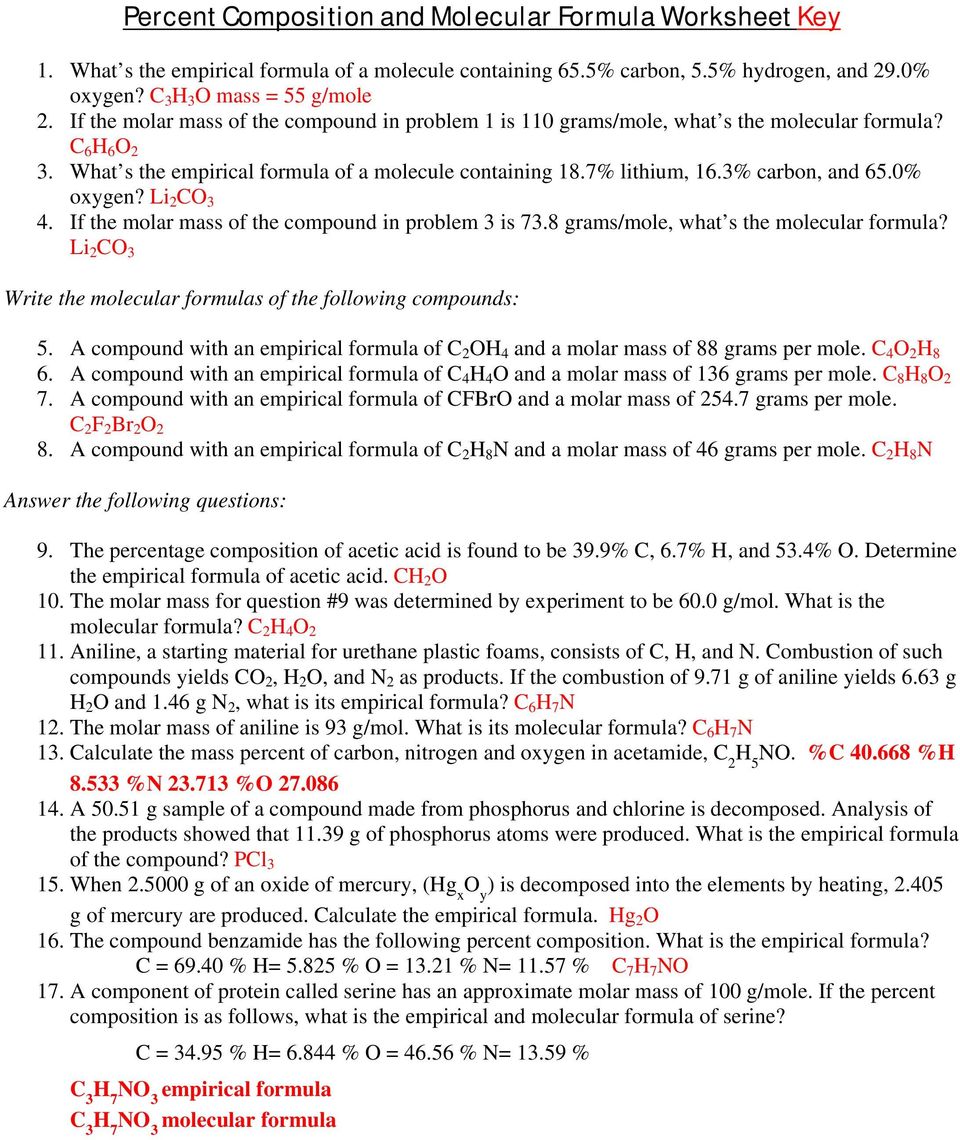
3 Molecular Formula Worksheet ANSWER KEY Write the molecular formulas of the following compounds: 1) A compound with an empirical formula of C 2 OH 4 and a molar mass of 88 grams per mole. C 4 O 2 H 8 2) A compound with an empirical formula of C 4 H 4 O and a molar mass of 136 grams per mole. C 8 H 8 O 2 3) A compound with an empirical formula of CFBrO and a molar mass of grams per mole. C 2 F 2 Br 2 O 2 4) A compound with an empirical formula of C 2 H 8 N and a molar mass of 46 grams per mole. C 2 H 8 N
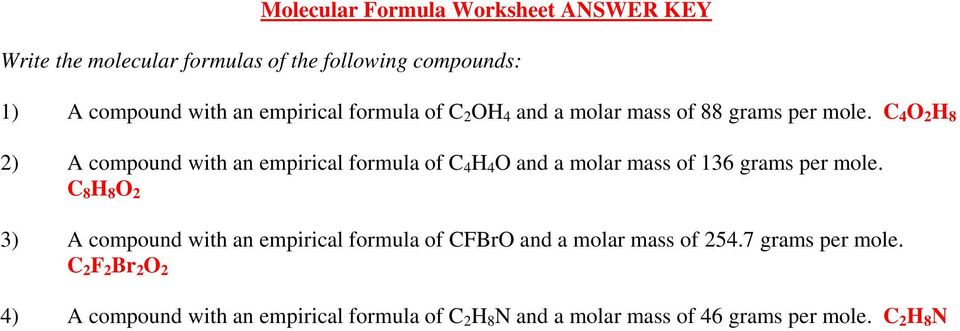
4 Percent Composition and Molecular Formula Worksheet Solutions 1) What s the empirical formula of a molecule containing 65.5% carbon, 5.5% hydrogen, and 29.0% C 3 H 3 O 2) If the molar mass of the compound in problem 1 is 110 grams/mole, what s the molecular formula? C 6 H 6 O 2 3) What s the empirical formula of a molecule containing 18.7% lithium, 16.3% carbon, and 65.0% Li 2 CO 3 4) If the molar mass of the compound in problem 3 is 73.8 grams/mole, what s the molecular formula? Li 2 CO 3 (In this case, the molecular and empirical formulas are the same, a frequent occurrence for inorganic compounds) 9. The percentage composition of acetic acid is found to be 39.9% C, 6.7% H, and 53.4% O. Determine the empirical formula of acetic acid. 10. (CH2O) The molar mass was determined by experiment to be 60.0 g/mol. What is the molecular formula? (C2H4O2) 7. Aniline, a starting material for urethane plastic foams, consists of C, H, and N. Combustion of such compounds yields CO2, H2O, and N2 as products. If the combustion of 9.71 g of aniline yields 6.63 g H2O and 1.46 g N2, what is its empirical formula? (C6H7N) The molar mass of aniline is 93 g/mol. What is its molecular formula? (C6H7N) Chapter 3: Worksheet #1 Mass Relationships 1. Calculate the mass percent of carbon, nitrogen and oxygen in acetamide, C 2 H 5 NO. %C %H %N %O A g sample of a compound made from phosphorus and chlorine is decomposed. Analysis of the products showed that g of phosphorus atoms were produced. What is the empirical formula of the compound? PCl 3 3. When g of an oxide of mercury, (Hg x O y ) is decomposed into the elements by heating, g of mercury are produced. Calculate the empirical formula. Hg 2 O 4. The compound benzamide has the following percent composition. What is the empirical formula? C = % H= % O = % N= % C 7 NO 5. A component of protein called serine has an approximate molar mass of 100 g/mole. If the percent composition is as follows, what is the empirical and molecular formula of serine? C = % H= % O = % N= %
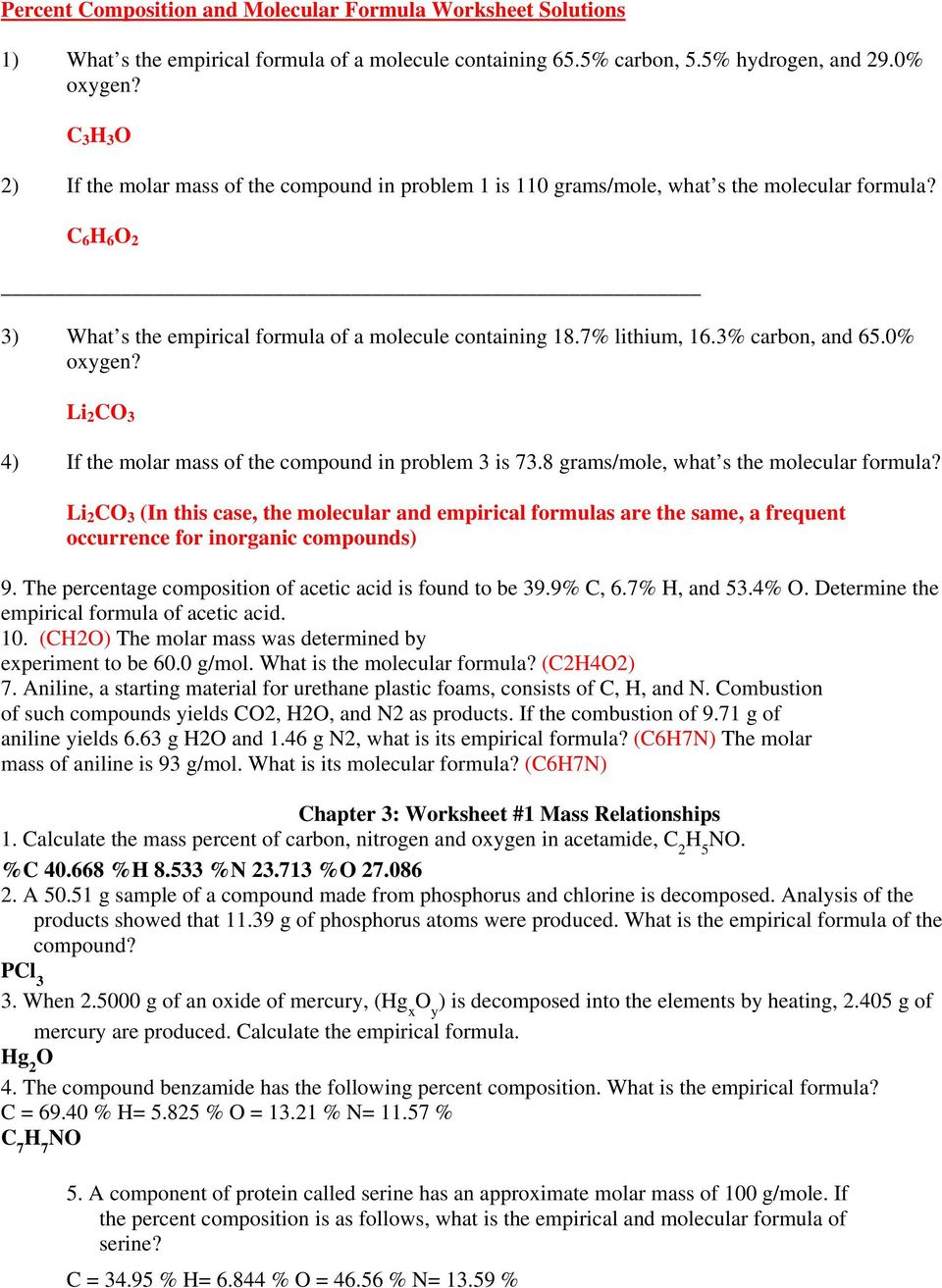
5 C 3 empirical formula C 3 molecular formula 6. Balance the following equations: 2 NaCl(aq) + Ba( ) 2 (aq) 2 Na (aq) + BaCl 2 (aq) Na 3 PO 4 (aq) + 3 Ag (aq) 3 Na (aq) + Ag 3 PO 4 (s) K 2 SO 4 (aq) + BaCl 2 (aq) BaSO 4 (s) + 2 KCl(aq) 2 HCl(aq) + Ca(OH) 2 (aq) 2 H 2 O(l) + CaCl 2 (aq) 2 Na(s) + S(s) Na 2 S(s) 2 C 2 H 6 (g) + 7 O 2 (g) 4 CO 2 (g) + 6 H 2 O(l) 2 Li(s) + 2 H 2 O(l) 2 LiOH (s) + H 2 (g) Mg(s) + CuCl 2 (aq) MgCl 2 (aq) + Cu(s)

6 2 HgO(s) 2 Hg(l) + O 2 (g) 4 FeO(s) + O 2 (g) 2 Fe 2 O 3 (s) Ca(HSO 3 ) 2 (s) CaO(s) + H 2 O(l) + 2 SO 2 (g) 2 Fe(s) + 3 Br 2 (l) 2 FeBr 3 (s) CH 3 CH 2 OH(l) + 3 O 2 2 CO 2 (g) + 3 H 2 O(l) For chemistry help, visit Cavalcade Publishing All Rights Reserved

Moles. Balanced chemical equations Molar ratios Mass Composition Empirical and Molecular Mass Predicting Quantities Equations
 Moles Balanced chemical equations Molar ratios Mass Composition Empirical and Molecular Mass Predicting Quantities Equations Micro World atoms & molecules Macro World grams Atomic mass is the mass of an
Chapter 5. Chemical Reactions and Equations. Introduction. Chapter 5 Topics. 5.1 What is a Chemical Reaction
 Introduction Chapter 5 Chemical Reactions and Equations Chemical reactions occur all around us. How do we make sense of these changes? What patterns can we find? 1 2 Copyright The McGraw-Hill Companies,
Moles. Moles. Moles. Moles. Balancing Eqns. Balancing. Balancing Eqns. Symbols Yields or Produces. Like a recipe:
 Like a recipe: Balancing Eqns Reactants Products 2H 2 (g) + O 2 (g) 2H 2 O(l) coefficients subscripts Balancing Eqns Balancing Symbols (s) (l) (aq) (g) or Yields or Produces solid liquid (pure liquid)
The Mole. 6.022 x 10 23
 The Mole 6.022 x 10 23 Background: atomic masses Look at the atomic masses on the periodic table. What do these represent? E.g. the atomic mass of Carbon is 12.01 (atomic # is 6) We know there are 6 protons
Chem 1100 Chapter Three Study Guide Answers Outline I. Molar Mass and Moles A. Calculations of Molar Masses
 Chem 1100 Chapter Three Study Guide Answers Outline I. Molar Mass and Moles A. Calculations of Molar Masses B. Calculations of moles C. Calculations of number of atoms from moles/molar masses 1. Avagadro
b. N 2 H 4 c. aluminum oxalate d. acetic acid e. arsenic PART 2: MOLAR MASS 2. Determine the molar mass for each of the following. a. ZnI 2 b.
 CHEMISTRY DISCOVER UNIT 5 LOTS OF PRACTICE ON USING THE MOLE!!! PART 1: ATOMIC MASS, FORMULA MASS, OR MOLECULAR MASS 1. Determine the atomic mass, formula mass, or molecular mass for each of the following
Chapter 8 - Chemical Equations and Reactions
 Chapter 8 - Chemical Equations and Reactions 8-1 Describing Chemical Reactions I. Introduction A. Reactants 1. Original substances entering into a chemical rxn B. Products 1. The resulting substances from
Molar Mass Worksheet Answer Key
 Molar Mass Worksheet Answer Key Calculate the molar masses of the following chemicals: 1) Cl 2 71 g/mol 2) KOH 56.1 g/mol 3) BeCl 2 80 g/mol 4) FeCl 3 162.3 g/mol 5) BF 3 67.8 g/mol 6) CCl 2 F 2 121 g/mol
1. What is the molecular formula of a compound with the empirical formula PO and a gram-molecular mass of 284 grams?
 Name: Tuesday, May 20, 2008 1. What is the molecular formula of a compound with the empirical formula PO and a gram-molecular mass of 284 grams? 2 5 1. P2O 5 3. P10O4 2. P5O 2 4. P4O10 2. Which substance
Balancing Chemical Equations Worksheet
 Balancing Chemical Equations Worksheet Student Instructions 1. Identify the reactants and products and write a word equation. 2. Write the correct chemical formula for each of the reactants and the products.
Chapter 5 Chemical Quantities and Reactions. Collection Terms. 5.1 The Mole. A Mole of a Compound. A Mole of Atoms.
 Chapter 5 Chemical Quantities and Reactions 5.1 The Mole Collection Terms A collection term states a specific number of items. 1 dozen donuts = 12 donuts 1 ream of paper = 500 sheets 1 case = 24 cans 1
Moles, Molecules, and Grams Worksheet Answer Key
 Moles, Molecules, and Grams Worksheet Answer Key 1) How many are there in 24 grams of FeF 3? 1.28 x 10 23 2) How many are there in 450 grams of Na 2 SO 4? 1.91 x 10 24 3) How many grams are there in 2.3
Sample Exercise 3.1 Interpreting and Balancing Chemical Equations
 Sample Exercise 3.1 Interpreting and Balancing Chemical Equations The following diagram represents a chemical reaction in which the red spheres are oxygen atoms and the blue spheres are nitrogen atoms.
10 Cl atoms. 10 H2O molecules. 8.3 mol HCN = 8.3 mol N atoms 1 mol HCN. 2 mol H atoms 2.63 mol CH2O = 5.26 mol H atoms 1 mol CH O
 Chem 100 Mole conversions and stoichiometry worksheet 1. How many Ag atoms are in.4 mol Ag atoms? 6.0 10 Ag atoms 4.4 mol Ag atoms = 1.46 10 Ag atoms 1 mol Ag atoms. How many Br molecules are in 18. mol
Chapter 3 Mass Relationships in Chemical Reactions
 Chapter 3 Mass Relationships in Chemical Reactions Student: 1. An atom of bromine has a mass about four times greater than that of an atom of neon. Which choice makes the correct comparison of the relative
Chapter 1 The Atomic Nature of Matter
 Chapter 1 The Atomic Nature of Matter 6. Substances that cannot be decomposed into two or more simpler substances by chemical means are called a. pure substances. b. compounds. c. molecules. d. elements.
Chemistry Post-Enrolment Worksheet
 Name: Chemistry Post-Enrolment Worksheet The purpose of this worksheet is to get you to recap some of the fundamental concepts that you studied at GCSE and introduce some of the concepts that will be part
Chemical Equations. Chemical Equations. Chemical reactions describe processes involving chemical change
 Chemical Reactions Chemical Equations Chemical reactions describe processes involving chemical change The chemical change involves rearranging matter Converting one or more pure substances into new pure
Chapter 3. Chemical Reactions and Reaction Stoichiometry. Lecture Presentation. James F. Kirby Quinnipiac University Hamden, CT
 Lecture Presentation Chapter 3 Chemical Reactions and Reaction James F. Kirby Quinnipiac University Hamden, CT The study of the mass relationships in chemistry Based on the Law of Conservation of Mass
1. How many hydrogen atoms are in 1.00 g of hydrogen?
 MOLES AND CALCULATIONS USING THE MOLE CONCEPT INTRODUCTORY TERMS A. What is an amu? 1.66 x 10⁻²⁴ g B. We need a conversion to the macroscopic world. 1. How many hydrogen atoms are in 1.00 g of hydrogen?
Study Guide For Chapter 7
 Name: Class: Date: ID: A Study Guide For Chapter 7 Multiple Choice Identify the choice that best completes the statement or answers the question. 1. The number of atoms in a mole of any pure substance
Stoichiometry. Lecture Examples Answer Key
 Stoichiometry Lecture Examples Answer Key Ex. 1 Balance the following chemical equations: 3 NaBr + 1 H 3 PO 4 3 HBr + 1 Na 3 PO 4 2 C 3 H 5 N 3 O 9 6 CO 2 + 3 N 2 + 5 H 2 O + 9 O 2 2 Ca(OH) 2 + 2 SO 2
Chemical Calculations: Formula Masses, Moles, and Chemical Equations
 Chemical Calculations: Formula Masses, Moles, and Chemical Equations Atomic Mass & Formula Mass Recall from Chapter Three that the average mass of an atom of a given element can be found on the periodic
Unit 6. Chapter 10: The MOLE! Date In Class Homework. % Composition & Calculating Empirical Formulas
 Date In Class Homework 10/22 Thur Counting By Mass Lab 10/23 Fri (mole day!!!) THE MOLE! in room 137 10/26 Mon (LSM) More on the Mole Watch empirical and molecular formula video. 10/27 Tue % Composition
Chemistry 65 Chapter 6 THE MOLE CONCEPT
 THE MOLE CONCEPT Chemists find it more convenient to use mass relationships in the laboratory, while chemical reactions depend on the number of atoms present. In order to relate the mass and number of
1. When the following equation is balanced, the coefficient of Al is. Al (s) + H 2 O (l)? Al(OH) 3 (s) + H 2 (g)
 1. When the following equation is balanced, the coefficient of Al is. Al (s) + H 2 O (l)? Al(OH) (s) + H 2 (g) A) 1 B) 2 C) 4 D) 5 E) Al (s) + H 2 O (l)? Al(OH) (s) + H 2 (g) Al (s) + H 2 O (l)? Al(OH)
MOLAR MASS AND MOLECULAR WEIGHT Themolar mass of a molecule is the sum of the atomic weights of all atoms in the molecule. Molar Mass.
 Counting Atoms Mg burns in air (O 2 ) to produce white magnesium oxide, MgO. How can we figure out how much oxide is produced from a given mass of Mg? PROBLEM: If If 0.200 g of Mg is is burned, how much
UNIT (4) CALCULATIONS AND CHEMICAL REACTIONS
 UNIT (4) CALCULATIONS AND CHEMICAL REACTIONS 4.1 Formula Masses Recall that the decimal number written under the symbol of the element in the periodic table is the atomic mass of the element. 1 7 8 12
Chapter 3: Stoichiometry
 Chapter 3: Stoichiometry Key Skills: Balance chemical equations Predict the products of simple combination, decomposition, and combustion reactions. Calculate formula weights Convert grams to moles and
Part One: Mass and Moles of Substance. Molecular Mass = sum of the Atomic Masses in a molecule
 CHAPTER THREE: CALCULATIONS WITH CHEMICAL FORMULAS AND EQUATIONS Part One: Mass and Moles of Substance A. Molecular Mass and Formula Mass. (Section 3.1) 1. Just as we can talk about mass of one atom of
stoichiometry = the numerical relationships between chemical amounts in a reaction.
 1 REACTIONS AND YIELD ANSWERS stoichiometry = the numerical relationships between chemical amounts in a reaction. 2C 8 H 18 (l) + 25O 2 16CO 2 (g) + 18H 2 O(g) From the equation, 16 moles of CO 2 (a greenhouse
Chapter 5, Calculations and the Chemical Equation
 1. How many iron atoms are present in one mole of iron? Ans. 6.02 1023 atoms 2. How many grams of sulfur are found in 0.150 mol of sulfur? [Use atomic weight: S, 32.06 amu] Ans. 4.81 g 3. How many moles
Chemistry B11 Chapter 4 Chemical reactions
 Chemistry B11 Chapter 4 Chemical reactions Chemical reactions are classified into five groups: A + B AB Synthesis reactions (Combination) H + O H O AB A + B Decomposition reactions (Analysis) NaCl Na +Cl
SCH 4C1 Unit 2 Problem Set Questions taken from Frank Mustoe et all, "Chemistry 11", McGraw-Hill Ryerson, 2001
 SCH 4C1 Unit 2 Problem Set Questions taken from Frank Mustoe et all, "Chemistry 11", McGraw-Hill Ryerson, 2001 1. A small pin contains 0.0178 mol of iron. How many atoms of iron are in the pin? 2. A sample
MASS RELATIONSHIPS IN CHEMICAL REACTIONS
 MASS RELATIONSHIPS IN CHEMICAL REACTIONS 1. The mole, Avogadro s number and molar mass of an element. Molecular mass (molecular weight) 3. Percent composition of compounds 4. Empirical and Molecular formulas
How much does a single atom weigh? Different elements weigh different amounts related to what makes them unique.
 How much does a single atom weigh? Different elements weigh different amounts related to what makes them unique. What units do we use to define the weight of an atom? amu units of atomic weight. (atomic
Chapter 6 Chemical Calculations
 Chapter 6 Chemical Calculations 1 Submicroscopic Macroscopic 2 Chapter Outline 1. Formula Masses (Ch 6.1) 2. Percent Composition (supplemental material) 3. The Mole & Avogadro s Number (Ch 6.2) 4. Molar
Unit 4 Conservation of Mass and Stoichiometry
 9.1 Naming Ions I. Monatomic Ions A. Monatomic ions 1. Ions formed from a single atom Unit 4 Conservation of Mass and Stoichiometry B. Naming Monatomic Ions 1. Monatomic cations are a. Identified by the
Unit 3 Notepack Chapter 7 Chemical Quantities Qualifier for Test
 Unit 3 Notepack Chapter 7 Chemical Quantities Qualifier for Test NAME Section 7.1 The Mole: A Measurement of Matter A. What is a mole? 1. Chemistry is a quantitative science. What does this term mean?
Formulas, Equations and Moles
 Chapter 3 Formulas, Equations and Moles Interpreting Chemical Equations You can interpret a balanced chemical equation in many ways. On a microscopic level, two molecules of H 2 react with one molecule
Chemical Calculations: The Mole Concept and Chemical Formulas. AW Atomic weight (mass of the atom of an element) was determined by relative weights.
 1 Introduction to Chemistry Atomic Weights (Definitions) Chemical Calculations: The Mole Concept and Chemical Formulas AW Atomic weight (mass of the atom of an element) was determined by relative weights.
Solution. Practice Exercise. Concept Exercise
 Example Exercise 9.1 Atomic Mass and Avogadro s Number Refer to the atomic masses in the periodic table inside the front cover of this textbook. State the mass of Avogadro s number of atoms for each of
2. The percent yield is the maximum amount of product that can be produced from the given amount of limiting reactant.
 UNIT 6 stoichiometry practice test True/False Indicate whether the statement is true or false. moles F 1. The mole ratio is a comparison of how many grams of one substance are required to participate in
STOICHIOMETRY UNIT 1 LEARNING OUTCOMES. At the end of this unit students will be expected to:
 STOICHIOMETRY LEARNING OUTCOMES At the end of this unit students will be expected to: UNIT 1 THE MOLE AND MOLAR MASS define molar mass and perform mole-mass inter-conversions for pure substances explain
Calculations and Chemical Equations. Example: Hydrogen atomic weight = 1.008 amu Carbon atomic weight = 12.001 amu
 Calculations and Chemical Equations Atomic mass: Mass of an atom of an element, expressed in atomic mass units Atomic mass unit (amu): 1.661 x 10⁻²⁴ g Atomic weight: Average mass of all isotopes of a given
Chem 115 POGIL Worksheet - Week 4 Moles & Stoichiometry Answers
 Key Questions & Exercises Chem 115 POGIL Worksheet - Week 4 Moles & Stoichiometry Answers 1. The atomic weight of carbon is 12.0107 u, so a mole of carbon has a mass of 12.0107 g. Why doesn t a mole of
IB Chemistry. DP Chemistry Review
 DP Chemistry Review Topic 1: Quantitative chemistry 1.1 The mole concept and Avogadro s constant Assessment statement Apply the mole concept to substances. Determine the number of particles and the amount
Stoichiometry Review
 Stoichiometry Review There are 20 problems in this review set. Answers, including problem set-up, can be found in the second half of this document. 1. N 2 (g) + 3H 2 (g) --------> 2NH 3 (g) a. nitrogen
Chemical Proportions in Compounds
 Chapter 6 Chemical Proportions in Compounds Solutions for Practice Problems Student Textbook page 201 1. Problem A sample of a compound is analyzed and found to contain 0.90 g of calcium and 1.60 g of
Chapter 3! Stoichiometry: Calculations with Chemical Formulas and Equations. Stoichiometry
 Chapter 3! : Calculations with Chemical Formulas and Equations Anatomy of a Chemical Equation CH 4 (g) + 2O 2 (g) CO 2 (g) + 2 H 2 O (g) Anatomy of a Chemical Equation CH 4 (g) + 2 O 2 (g) CO 2 (g) + 2
Answers and Solutions to Text Problems
 Chapter 7 Answers and Solutions 7 Answers and Solutions to Text Problems 7.1 A mole is the amount of a substance that contains 6.02 x 10 23 items. For example, one mole of water contains 6.02 10 23 molecules
Chemical Equations & Stoichiometry
 Chemical Equations & Stoichiometry Chapter Goals Balance equations for simple chemical reactions. Perform stoichiometry calculations using balanced chemical equations. Understand the meaning of the term
We know from the information given that we have an equal mass of each compound, but no real numbers to plug in and find moles. So what can we do?
 How do we figure this out? We know that: 1) the number of oxygen atoms can be found by using Avogadro s number, if we know the moles of oxygen atoms; 2) the number of moles of oxygen atoms can be found
Chem 115 POGIL Worksheet - Week 4 Moles & Stoichiometry
 Chem 115 POGIL Worksheet - Week 4 Moles & Stoichiometry Why? Chemists are concerned with mass relationships in chemical reactions, usually run on a macroscopic scale (grams, kilograms, etc.). To deal with
CHEM 110: CHAPTER 3: STOICHIOMETRY: CALCULATIONS WITH CHEMICAL FORMULAS AND EQUATIONS
 1 CHEM 110: CHAPTER 3: STOICHIOMETRY: CALCULATIONS WITH CHEMICAL FORMULAS AND EQUATIONS The Chemical Equation A chemical equation concisely shows the initial (reactants) and final (products) results of
Chemical formulae are used as shorthand to indicate how many atoms of one element combine with another element to form a compound.
 29 Chemical Formulae Chemical formulae are used as shorthand to indicate how many atoms of one element combine with another element to form a compound. C 2 H 6, 2 atoms of carbon combine with 6 atoms of
Other Stoich Calculations A. mole mass (mass mole) calculations. GIVEN mol A x CE mol B. PT g A CE mol A MOLE MASS :
 Chem. I Notes Ch. 12, part 2 Using Moles NOTE: Vocabulary terms are in boldface and underlined. Supporting details are in italics. 1 MOLE = 6.02 x 10 23 representative particles (representative particles
W1 WORKSHOP ON STOICHIOMETRY
 INTRODUCTION W1 WORKSHOP ON STOICHIOMETRY These notes and exercises are designed to introduce you to the basic concepts required to understand a chemical formula or equation. Relative atomic masses of
How To Calculate Mass In Chemical Reactions
 We have used the mole concept to calculate mass relationships in chemical formulas Molar mass of ethanol (C 2 H 5 OH)? Molar mass = 2 x 12.011 + 6 x 1.008 + 1 x15.999 = 46.069 g/mol Mass percentage of
Chapter 8: Chemical Equations and Reactions
 Chapter 8: Chemical Equations and Reactions I. Describing Chemical Reactions A. A chemical reaction is the process by which one or more substances are changed into one or more different substances. A chemical
CLASS TEST GRADE 11. PHYSICAL SCIENCES: CHEMISTRY Test 6: Chemical change
 CLASS TEST GRADE PHYSICAL SCIENCES: CHEMISTRY Test 6: Chemical change MARKS: 45 TIME: hour INSTRUCTIONS AND INFORMATION. Answer ALL the questions. 2. You may use non-programmable calculators. 3. You may
Calculating Atoms, Ions, or Molecules Using Moles
 TEKS REVIEW 8B Calculating Atoms, Ions, or Molecules Using Moles TEKS 8B READINESS Use the mole concept to calculate the number of atoms, ions, or molecules in a sample TEKS_TXT of material. Vocabulary
Unit 2: Quantities in Chemistry
 Mass, Moles, & Molar Mass Relative quantities of isotopes in a natural occurring element (%) E.g. Carbon has 2 isotopes C-12 and C-13. Of Carbon s two isotopes, there is 98.9% C-12 and 11.1% C-13. Find
Chemical Equations and Chemical Reactions. Chapter 8.1
 Chemical Equations and Chemical Reactions Chapter 8.1 Objectives List observations that suggest that a chemical reaction has taken place List the requirements for a correctly written chemical equation.
Worksheet # 8 Graham/09 Due
 CHE 100 Worksheet # 8 Graham/09 Name Key Due 1. According to the law of definite proportions, if a sample of a compound contains 7.00 grams of sulfur and 3.50 grams of oxygen, then another sample of the
The Mole Notes. There are many ways to or measure things. In Chemistry we also have special ways to count and measure things, one of which is the.
 The Mole Notes I. Introduction There are many ways to or measure things. In Chemistry we also have special ways to count and measure things, one of which is the. A. The Mole (mol) Recall that atoms of
Tuesday, November 27, 2012 Expectations:
 Tuesday, November 27, 2012 Expectations: Sit in assigned seat Get out Folder, Notebook, Periodic Table Have out: Spiral (notes), Learning Target Log (new) No Backpacks on tables Listen/Pay Attention Learning
Balancing Chemical Equations Practice
 Science Objectives Students will describe what reactants and products in a chemical equation mean. Students will explain the difference between coefficients and subscripts in chemical equations. Students
Ch. 10 The Mole I. Molar Conversions
 Ch. 10 The Mole I. Molar Conversions I II III IV A. What is the Mole? A counting number (like a dozen) Avogadro s number (N A ) 1 mole = 6.022 10 23 representative particles B. Mole/Particle Conversions
The Mole and Molar Mass
 The Mole and Molar Mass 1 Molar mass is the mass of one mole of a substance. Molar mass is numerically equal to atomic mass, molecular mass, or formula mass. However the units of molar mass are g/mol.
Chemistry Final Study Guide
 Name: Class: Date: Chemistry Final Study Guide Multiple Choice Identify the choice that best completes the statement or answers the question. 1. The electrons involved in the formation of a covalent bond
neutrons are present?
 AP Chem Summer Assignment Worksheet #1 Atomic Structure 1. a) For the ion 39 K +, state how many electrons, how many protons, and how many 19 neutrons are present? b) Which of these particles has the smallest
4. Balanced chemical equations tell us in what molar ratios substances combine to form products, not in what mass proportions they combine.
 CHAPTER 9 1. The coefficients of the balanced chemical equation for a reaction give the relative numbers of molecules of reactants and products that are involved in the reaction.. The coefficients of the
Chapter 4. Chemical Composition. Chapter 4 Topics H 2 S. 4.1 Mole Quantities. The Mole Scale. Molar Mass The Mass of 1 Mole
 Chapter 4 Chemical Composition Chapter 4 Topics 1. Mole Quantities 2. Moles, Masses, and Particles 3. Determining Empirical Formulas 4. Chemical Composition of Solutions Copyright The McGraw-Hill Companies,
CHEMISTRY COMPUTING FORMULA MASS WORKSHEET
 CHEMISTRY COMPUTING FORMULA MASS WORKSHEET Directions: Find the formula mass of the following compounds. Round atomic masses to the tenth of a decimal place. Place your final answer in the FORMULA MASS
Lecture 5, The Mole. What is a mole?
 Lecture 5, The Mole What is a mole? Moles Atomic mass unit and the mole amu definition: 12 C = 12 amu. The atomic mass unit is defined this way. 1 amu = 1.6605 x 10⁻²⁴ g How many 12 C atoms weigh 12 g?
CHEMICAL REACTIONS. Chemistry 51 Chapter 6
 CHEMICAL REACTIONS A chemical reaction is a rearrangement of atoms in which some of the original bonds are broken and new bonds are formed to give different chemical structures. In a chemical reaction,
HOMEWORK 4A. Definitions. Oxidation-Reduction Reactions. Questions
 HOMEWORK 4A Oxidation-Reduction Reactions 1. Indicate whether a reaction will occur or not in each of following. Wtiring a balcnced equation is not necessary. (a) Magnesium metal is added to hydrochloric
EXPERIMENT 12: Empirical Formula of a Compound
 EXPERIMENT 12: Empirical Formula of a Compound INTRODUCTION Chemical formulas indicate the composition of compounds. A formula that gives only the simplest ratio of the relative number of atoms in a compound
English already has many collective nouns for fixed, given numbers of objects. Some of the more common collective nouns are shown in Table 7.1.
 96 Chapter 7: Calculations with Chemical Formulas and Chemical Reactions Chemical reactions are written showing a few individual atoms or molecules reacting to form a few atoms or molecules of products.
Chem 31 Fall 2002. Chapter 3. Stoichiometry: Calculations with Chemical Formulas and Equations. Writing and Balancing Chemical Equations
 Chem 31 Fall 2002 Chapter 3 Stoichiometry: Calculations with Chemical Formulas and Equations Writing and Balancing Chemical Equations 1. Write Equation in Words -you cannot write an equation unless you
Element of same atomic number, but different atomic mass o Example: Hydrogen
 Atomic mass: p + = protons; e - = electrons; n 0 = neutrons p + + n 0 = atomic mass o For carbon-12, 6p + + 6n 0 = atomic mass of 12.0 o For chlorine-35, 17p + + 18n 0 = atomic mass of 35.0 atomic mass
Test Review Periodic Trends and The Mole
 Test Review Periodic Trends and The Mole The Mole SHOW ALL WORK ON YOUR OWN PAPER FOR CREDIT!! 1 2 (NH42SO2 %N 24.1 %H 6.9 %S 27.6 %O 41.3 % Al %C 35.3 %H 4.4 %O 47.1 Al(C2H3O23 13.2 3 How many moles are
Steps for balancing a chemical equation
 The Chemical Equation: A Chemical Recipe Dr. Gergens - SD Mesa College A. Learn the meaning of these arrows. B. The chemical equation is the shorthand notation for a chemical reaction. A chemical equation
IB Chemistry 1 Mole. One atom of C-12 has a mass of 12 amu. One mole of C-12 has a mass of 12 g. Grams we can use more easily.
 The Mole Atomic mass units and atoms are not convenient units to work with. The concept of the mole was invented. This was the number of atoms of carbon-12 that were needed to make 12 g of carbon. 1 mole
Atomic Masses. Chapter 3. Stoichiometry. Chemical Stoichiometry. Mass and Moles of a Substance. Average Atomic Mass
 Atomic Masses Chapter 3 Stoichiometry 1 atomic mass unit (amu) = 1/12 of the mass of a 12 C atom so one 12 C atom has a mass of 12 amu (exact number). From mass spectrometry: 13 C/ 12 C = 1.0836129 amu
Topic 4 National Chemistry Summary Notes. Formulae, Equations, Balancing Equations and The Mole
 Topic 4 National Chemistry Summary Notes Formulae, Equations, Balancing Equations and The Mole LI 1 The chemical formula of a covalent molecular compound tells us the number of atoms of each element present
CP Chemistry Review for Stoichiometry Test
 CP Chemistry Review for Stoichiometry Test Stoichiometry Problems (one given reactant): 1. Make sure you have a balanced chemical equation 2. Convert to moles of the known substance. (Use the periodic
A dozen. Molar Mass. Mass of atoms
 A dozen Molar Mass Science 10 is a number of objects. A dozen eggs, a dozen cars, and a dozen people are all 12 objects. But a dozen cars has a much greater mass than a dozen eggs because the mass of each
Problem Solving. Percentage Yield
 Skills Worksheet Problem Solving Percentage Yield Although we can write perfectly balanced equations to represent perfect reactions, the reactions themselves are often not perfect. A reaction does not
Lecture Topics Atomic weight, Mole, Molecular Mass, Derivation of Formulas, Percent Composition
 Mole Calculations Chemical Equations and Stoichiometry Lecture Topics Atomic weight, Mole, Molecular Mass, Derivation of Formulas, Percent Composition Chemical Equations and Problems Based on Miscellaneous
U3-LM2B-WS Molar Mass and Conversions
 U3-LM2B-WS Molar Mass and Conversions Name: KEY 1. The molar mass of chlorine is: 2 x 35.45 g/mol Cl = 70.90 g/mol Cl 2 (Remember that chlorine exists as a diatomic molecule in nature) 2. The molar mass
SYMBOLS, FORMULAS AND MOLAR MASSES
 SYMBOLS, FORMULAS AND MOLAR MASSES OBJECTIVES 1. To correctly write and interpret chemical formulas 2. To calculate molecular weights from chemical formulas 3. To calculate moles from grams using chemical
The Mole. Chapter 10. Dimensional Analysis. The Mole. How much mass is in one atom of carbon-12? Molar Mass of Atoms 3/1/2015
 The Mole Chapter 10 1 Objectives Use the mole and molar mass to make conversions among moles, mass, and number of particles Determine the percent composition of the components of a compound Calculate empirical
Unit 6 The Mole Concept
 Chemistry Form 3 Page 62 Ms. R. Buttigieg Unit 6 The Mole Concept See Chemistry for You Chapter 28 pg. 352-363 See GCSE Chemistry Chapter 5 pg. 70-79 6.1 Relative atomic mass. The relative atomic mass
Stoichiometry. Web Resources Chem Team Chem Team Stoichiometry. Section 1: Definitions Define the following terms. Average Atomic mass - Molecule -
 Web Resources Chem Team Chem Team Section 1: Definitions Define the following terms Average Atomic mass - Molecule - Molecular mass - Moles - Avagadro's Number - Conservation of matter - Percent composition
3.3 Moles, 3.4 Molar Mass, and 3.5 Percent Composition
 3.3 Moles, 3.4 Molar Mass, and 3.5 Percent Composition Collection Terms A collection term states a specific number of items. 1 dozen donuts = 12 donuts 1 ream of paper = 500 sheets 1 case = 24 cans Copyright
2. DECOMPOSITION REACTION ( A couple have a heated argument and break up )
 TYPES OF CHEMICAL REACTIONS Most reactions can be classified into one of five categories by examining the types of reactants and products involved in the reaction. Knowing the types of reactions can help
ATOMS. Multiple Choice Questions
 Chapter 3 ATOMS AND MOLECULES Multiple Choice Questions 1. Which of the following correctly represents 360 g of water? (i) 2 moles of H 2 0 (ii) 20 moles of water (iii) 6.022 10 23 molecules of water (iv)
= 11.0 g (assuming 100 washers is exact).
 CHAPTER 8 1. 100 washers 0.110 g 1 washer 100. g 1 washer 0.110 g = 11.0 g (assuming 100 washers is exact). = 909 washers 2. The empirical formula is CFH from the structure given. The empirical formula