
Define conversion and space time. Write the mole balances in terms of conversion for a batch reactor, CSTR, PFR, and PBR.
|
|
|
- Earl Rich
- 9 years ago
- Views:
Transcription
1 CONERSION ND RECTOR SIZING Objectives: Deine conversion and space time. Write the mole balances in terms o conversion or a batch reactor, CSTR, PR, and PBR. Size reactors either alone or in series once given the molar low rate o, and the rate o reaction, -r, as a unction o conversion,. Conversion: Choose one o the reactants as the basis o calculation and relate the other species involved in the rn to this basis. Space time: the time necessary to process one reactor volume o luid based on entrance conditions holding time or mean residence time

2 CONERSION ND RECTOR SIZING. Conversion Consider the general equation a bb cc dd We will choose as our basis o calculation. b c B C a a The basis o calculation is most always the limiting reactant. The conversion o species in a reaction is equal to the number o moles o reacted per mole o ed. d a D Batch low N N N Moles o reacted Moles o ed or irreversible reactions, the maimum value o conversion,, is that or complete conversion, i.e... or reversible reactions, the maimum value o conversion,, is the equilibrium conversion, i.e. e.

3 . Design Equations Batch Reactor Design Equations: Moles o Moles o reacted ed consumed [ ] [ ] N Moles o reacted Moles o ed [] Now the # o moles o that remain in the reactor ater a time t, N can be epressed in terms o N and ; [ N ] [ N ] [ N ] N N [] dn dn r preect miing [] r or batch reactors, we are interested in determining how long to leave the reactants in the reactor to achieve a certain conversion. N N dn d d d N Since N is constant [4] r r Batch reactor design eq n in dierential orm [5]
![[] dn dn r preect miing [] r or batch reactors, we are interested in determining how long to leave the reactants in the](/docs-images/46/21507770/images/page_3.jpg "reactor to achieve a certain conversion.")
4 or a constant volume batch reactor: dn dc d N / r N t N d dc rom [] Constant volume batch reactor rom [5] d Batch time, t, required to achieve a conversion. s t t low Reactor Design Equations: or continuous-low systems, time usually increases with increasing reactor volume. moles o time ed moles o reacted moles o ed Outlet low rate inlet molar low rate Molar low rate at which is consumed within the system C v moles /volume volume / time volumetric low rate, dm /s 4

5 5 or liquid systems, C is usually given in terms o molarity mol/dm or gas systems, C can be calculated using gas laws. P P Partial pressure T R P y T R P C y P Entering molar low rate is y entering mole raction o P t i t t l kp T R P y v C v P entering total pressure kpa C entering conc n mol/dm R 8.4 kpa dm / mol K T TK CSTR Design Equation CSTR Design Equation D a d C a c B a b or a rn: r Substitute or eit r r

6 PR Design Equation d r d d d Substitute back: d d d d r Seperate the variables when d pplications o Design Equations or Continuous low Reactors. Reactor Sizing Given r as a unction o conversion, -r, one can size any type o reactor. We do this by constructing a Levenspiel Plot. Here we plot either / -r or / -r as a unction o. or / -r vs., the volume o a CSTR and the volume o a PR can be represented as the shaded areas in the Levelspiel Plots shown below: Levenspiel Plots 6

7 particularly simple unctional dependence is the irst order dependence: k C k C Speciic rn rate unction o T initial conc n or this irst order rn, a plot o /-r as a unction o yields : r k C -/r Eample: Let s consider the isothermal gas-phase isomerization: B -r mol/m s [T 5 K] [P 8 kpa 8. atm] initial charge was pure 7

8 Eample: Let s consider the isothermal gas-phase isomerization: B -r mol/m s / -r [T 5 K] [P 8 kpa 8. atm] initial charge was pure Draw -/r vs : -/r We can use this igure to size low reactors or dierent entering molar low rates. Keep in mind :. i a rn is carried out isothermally, the rate is usually greatest at the start o the rn, when the conc n o reactant is greatest. when -/r is small. s, r thus /-r & n ininite reactor volume is needed to reach complete conversion. or reversible reactions B, the ma is the equilibrium conversion e. t equilibrium, r. s e, r thus /-r & n ininite reactor volume is needed to obtain e. 8

9 i.4 mol/s, we can calculate [ /-r ]m Plot /-r vs obtain Levenspiel Plot! Eample: Calculate volume to achieve 8 % conversion in CSTR. or instance: ind at.8 m r mol s.8 r eit mol m m s mol s.6 m CSTRs are usually used or liquid-phase rns..5 m 4. Numerical Evaluation o Intergrals The integral to calculate the PR volume can be evaluated using a method such as Simpson s One-Third Rule. NOTE: The intervals shown in the sketch are not drawn to scale. They should be equal. Simpson s One-Third Rule is one o the most common numerical methods. It uses three data points. One numerical methods or evaluating integrals are:. Trapezoidal Rule uses two data points. Simpson s Three-Eighth s Rule uses our data points. ive-point Quadrature ormula 9

10 Trapezoidal Rule Trapezoidal Rule ] [ ] [ h h h d h ] [ h h ive Point Quadrature ormula: ive Point Quadrature ormula: h d h where h d N or N points, where N is an integer. Eample: Eample: Consider the liquid phase reaction; Products which is to take place in a PR. The ollowing data was obtained in a batch reactor r mol/dm s..8. I the molar eed o to the PR is mol/s, what PR volume is necessary to achieve 8 % conversion under identical conditions as those under which the batch data was obtained?

11 Hint : mol/s, ed to a plug low reactor PR d Thus one needs /-r as a unction o. or Simpson s three point ormula we have: PR : PR :.8 d d r mol.4 s 4 dm s mol [ 45 5] 9dm To reach 8 % conversion, your PR must be 9. dm.

12 Sizing in PR Eample: Determine the volume in PR to achieve a 8 % conversion. d or PR : r d.8.8 d Re arranging : d Let s numerically evaluate the integral with trapezoidal rule.8 d m With ive point quadrature.65 m 8. Comparing CSTR & PR Sizing CSTR > PR or the same conversion and rn conditions. The reason is that CSTR always operates at lowest rn rate. PR starts at a high y p g rate, then gradually decreases to the eit rate.

13 Reactors in Series: The eit o one reactor is ed to the net one. Given r as a unction o conversion, one can design any sequence o reactors. moles o reacted i moles o ed to up to point i irst reactor Only valid i there are no side streams. i i Eample: Using Levenspiel plots to calculate conversion rom known reactor volumes. Pure is ed at a volumetric low rate dm /h and at a concentration o.5 mol/dm to an eisting CSTR, which is connected in series to an eisting tubular reactor I the volume o the CSTR is dm and the tubular reactor volume is reactor. I the volume o the CSTR is dm and the tubular reactor volume is 6 dm, what are the intermediate and inal conversions that can be achieved with the eisting system? The reciprocal rate is plotted in the igure below as a unction o conversion or the conditions at which the reaction is to be carried out.

14 Solution: By trial and error, we ind that a conversion o.6 gives the appropriate CSTR volume o dm. Thereore, the intermediate conversion is.6 Similarly or the PR, through trial and error, we ind that a conversion o.8 gives the appropriate PR volume o 6 dm. Thereore, the inal conversion is.8 4

15 CSTRs in Series Two CSTRs in series.4 Reactor : Mole Balance: r [] [] Combining [] & []: / -r [] -r -r.8 Reactor : Mole Balance: r [4] Combining [4] & [5]: [5] i we have the data:.4.5m. 8 r r m. m r r.8 m - /r CSTR, > CSTR,.4.8 Total 4. m < 6.4 m volume necessary to get 8 % conversion with one CSTR 5
![8 Reactor : Mole Balance: r [4] Combining [4] & [5]: [5] i we have the data:.](/docs-images/46/21507770/images/page_15.jpg "4.5m. 8 r r.4.4.8 8.m. m r r.8 m - /r CSTR, > CSTR,.4.8 Total 4. m < 6.")
16 One can approimate a PR by a large # o CSTRs in series: - /r 4 PRs in Series PR CSTR n i, i -r d.4 -r.8 d d TOTL PR, PR, The overall conversion o two PRs in series is the same as one PR with the same total volume Reactors in Series: CSTR PR CSTR Using the data in the table, calculate the reactor volumes, and or the CSTR/PR/CSTR reactors in series sequence along with the corresponding conversion. 6

17 Use the plot o vs. r a The CSTR design equation or Reactor is: at.4 the / -r dm dm.4 dm The volume o the irst CSTR is dm b Reactor : PR The dierential orm o the PR design is d d Rearranging and intergrating with limits when.4 when.7 d.7.4 d 7
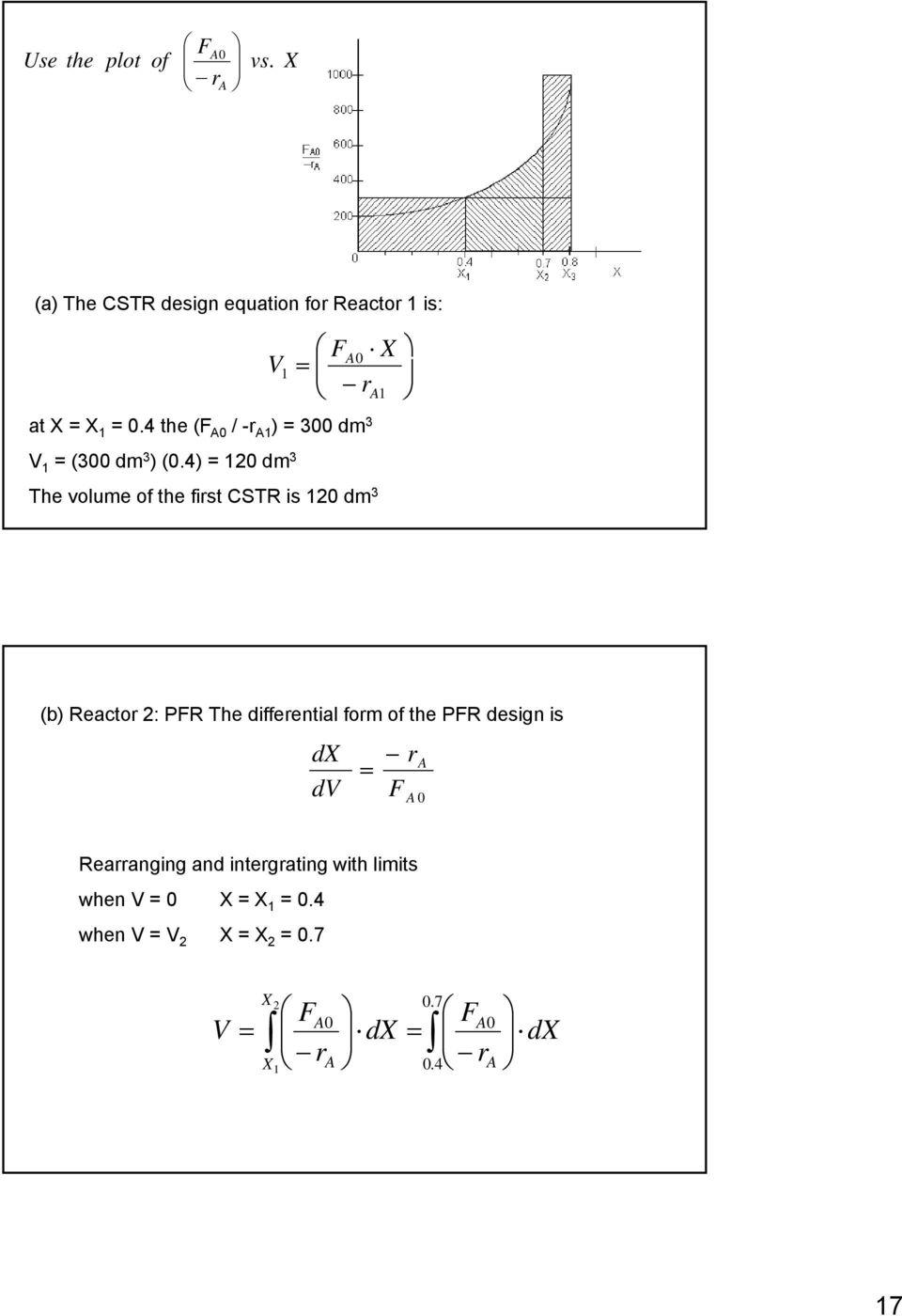
18 Choose three point quadrature ormula with r Interpreting or /-r at.55 we obtain 7dm.55 [ dm 47dm 6dm ] dm.5 9 The volume o the PR is 9 dm c Reactor : CSTR Balance in out generation r 6dm.7.4 8dm The volume o last CSTR is 8 dm 8
![55 [ dm 47dm 6dm ] dm.](/docs-images/46/21507770/images/page_18.jpg "5 9 The volume o the PR is 9 dm c Reactor : CSTR Balance in")
19 Summary: CSTR.4 dm PR dm CSTR.8 8 dm Total volume dm Reactor Sequencing Is there any dierences between having a CSTR PR system & PR CSTR system? Which arrangement is best? or 4 or isothermal rns The volumes are dierent!? 4 The choice o reactors depend on ; the Levenspiel plots relative reactor sizes. diabatic rns 9

20 Space Time The space time, tau, is obtained by dividing the reactor volume by the volumetric low rate entering the reactor: τ v Space time is the time necessary to process one volume o reactor luid at the entrance conditions. This is the time it takes or the amount o luid that takes up the entire volume o the reactor to either completely enter or completely eit the reactor. It is also called holding time or mean residence time. Eample: v. m /s and. m τ. m /. m /s s It would take s or the luid at the entrance to move to the eit. Typical space time or dierent reactors: Batch : 5 min h ew kg/day, tons/year 8 tons/day CSTR : min 4 h to 6 tons/yr Tubular: 5s.5s h 5 to 5 6 tons/yr

21 Space elocity S is deined as: S v τ instead o using volumetric low rate at the entrance, you use liquid hourly & gas hourly space velocities LHS, GHS. v or LHS is that o a liquid eed rate at 6 or 75. v or GHS is that o the one that measured at STP. v LHS v GHS liq STP
22 HW due date: eb 5: Solve the prpblem in your own way. Suggested problems rom the web: i h / / dditional Homework Problems at each chapter Eample: Consider cell as a reactor. The nutrient corn steep liquor enters the cell o the microorganism Penicillium chrysogenum and is decomposed to orm such products as amino acids, RN and DN. Write an unsteady mass balance on a the corn steep liquor, b RN, and c pencillin. ssume the cell is well mied and that RN remains inside the cell. In Out Corn Steep Liquor Penicillin Penicillium chrysogenum ssumption: Penicillin is produced in the stationary state. no cell growth & nutrients are used in making the product.
23 Mass balance or penicillin: In Out Generation ccumulati on dn p in out G p no penicilin in _ low in dn p G p rp d rp d out ssuming steady state or the rate o production o penicilin in the cells stationary state, dn p in out out r Similarity, or Corn Steep Liquor with C p p C C C C C No RN is generated or destroyed. Summary Batch low N N N Moles o reacted Moles o ed or irreversible reactions, the maimum value o conversion,, is that or complete conversion, i.e... or reversible reactions, the maimum value o conversion,, is the equilibrium conversion, i.e. e.
24 N d r Batch reactor design eq n in dierential orm CSTR r eit d PR Reactors in series Space time τ v 4
k 2f, k 2r C 2 H 5 + H C 2 H 6
 hemical Engineering HE 33 F pplied Reaction Kinetics Fall 04 Problem Set 4 Solution Problem. The following elementary steps are proposed for a gas phase reaction: Elementary Steps Rate constants H H f,
Exponential Functions
 Eponential Functions Deinition: An Eponential Function is an unction that has the orm ( a, where a > 0. The number a is called the base. Eample:Let For eample (0, (, ( It is clear what the unction means
AP CHEMISTRY 2009 SCORING GUIDELINES (Form B)
 AP CHEMISTRY 2009 SCORING GUIDELINES (Form B) Question 3 (10 points) 2 H 2 O 2 (aq) 2 H 2 O(l) + O 2 (g) The mass of an aqueous solution of H 2 O 2 is 6.951 g. The H 2 O 2 in the solution decomposes completely
ChE 344 Chemical Reaction Engineering Winter 1999 Exam I Part 1 (80%) Solution
 ChE 344 Chemical Reaction Engineering Winter 1999 Exam I Part 1 (80%) Solution (10 pts) 1) The trimerization 3A(g) A 3 (g,l) is carried out isothermally and without pressure drop in a PFR at 98 K and atm.
The Material Balance for Chemical Reactors. Copyright c 2016 by Nob Hill Publishing, LLC
 The Material Balance for Chemical Reactors Copyright c 2016 by Nob Hill Publishing, LLC 1 General Mole Balance V R j Q 0 c j0 Q 1 c j1 Conservation of mass rate of accumulation of component j = + { rate
Power functions: f(x) = x n, n is a natural number The graphs of some power functions are given below. n- even n- odd
 5.1 Polynomial Functions A polynomial unctions is a unction o the orm = a n n + a n-1 n-1 + + a 1 + a 0 Eample: = 3 3 + 5 - The domain o a polynomial unction is the set o all real numbers. The -intercepts
CHEMICAL EQUILIBRIUM (ICE METHOD)
 CHEMICAL EQUILIBRIUM (ICE METHOD) Introduction Chemical equilibrium occurs when opposing reactions are proceeding at equal rates. The rate at which the products are formed from the reactants equals the
Chapter 4: Chemical and Solution Stoichiometry
 Chapter 4: Chemical and Solution Stoichiometry (Sections 4.1-4.4) 1 Reaction Stoichiometry The coefficients in a balanced chemical equation specify the relative amounts in moles of each of the substances
The first law: transformation of energy into heat and work. Chemical reactions can be used to provide heat and for doing work.
 The first law: transformation of energy into heat and work Chemical reactions can be used to provide heat and for doing work. Compare fuel value of different compounds. What drives these reactions to proceed
1A Rate of reaction. AS Chemistry introduced the qualitative aspects of rates of reaction. These include:
 1A Rate of reaction AS Chemistry introduced the qualitative aspects of rates of reaction. These include: Collision theory Effect of temperature Effect of concentration Effect of pressure Activation energy
Liquid phase. Balance equation Moles A Stoic. coefficient. Aqueous phase
 STOICHIOMETRY Objective The purpose of this exercise is to give you some practice on some Stoichiometry calculations. Discussion The molecular mass of a compound is the sum of the atomic masses of all
EXERCISES. 16. What is the ionic strength in a solution containing NaCl in c=0.14 mol/dm 3 concentration and Na 3 PO 4 in 0.21 mol/dm 3 concentration?
 EXERISES 1. The standard enthalpy of reaction is 512 kj/mol and the standard entropy of reaction is 1.60 kj/(k mol) for the denaturalization of a certain protein. Determine the temperature range where
Gibbs Free Energy and Chemical Potential. NC State University
 Chemistry 433 Lecture 14 Gibbs Free Energy and Chemical Potential NC State University The internal energy expressed in terms of its natural variables We can use the combination of the first and second
CHEM-UA 652: Thermodynamics and Kinetics
 1 CHEM-UA 652: Thermodynamics and Kinetics Notes for Lecture 21 I. COMPLEX REACTION MECHANISMS A major goal in chemical kinetics is to determine the sequence of elementary reactions, or the reaction mechanism,
2.1: The Derivative and the Tangent Line Problem
 .1.1.1: Te Derivative and te Tangent Line Problem Wat is te deinition o a tangent line to a curve? To answer te diiculty in writing a clear deinition o a tangent line, we can deine it as te iting position
8. ENERGY PERFORMANCE ASSESSMENT OF COMPRESSORS 8.1 Introduction
 8. ENERGY PERFORMANCE ASSESSMENT OF COMPRESSORS 8.1 Introduction The compressed air system is not only an energy intensive utility but also one o the least energy eicient. Over a period o time, both perormance
Chapter 12 IVP Practice Problems
 PRACTICE PROBLEMS 43 Chapter IVP Practice Problems Use Excel and VBA to solve the following problems. Document your solutions using the Expert Problem Solving steps outlined in Table... Find an approximate
LINEAR INEQUALITIES. less than, < 2x + 5 x 3 less than or equal to, greater than, > 3x 2 x 6 greater than or equal to,
 LINEAR INEQUALITIES When we use the equal sign in an equation we are stating that both sides of the equation are equal to each other. In an inequality, we are stating that both sides of the equation are
AP Chemistry 2010 Scoring Guidelines Form B
 AP Chemistry 2010 Scoring Guidelines Form B The College Board The College Board is a not-for-profit membership association whose mission is to connect students to college success and opportunity. Founded
Chemistry 122 Mines, Spring 2014
 Chemistry 122 Mines, Spring 2014 Answer Key, Problem Set 9 1. 18.44(c) (Also indicate the sign on each electrode, and show the flow of ions in the salt bridge.); 2. 18.46 (do this for all cells in 18.44
Guide to Chapter 13. Chemical Equilibrium
 Guide to Chapter 13. Chemical Equilibrium We will spend five lecture days on this chapter. During the first class meeting we will focus on how kinetics makes a segue into equilibrium. We will learn how
IB Chemistry 1 Mole. One atom of C-12 has a mass of 12 amu. One mole of C-12 has a mass of 12 g. Grams we can use more easily.
 The Mole Atomic mass units and atoms are not convenient units to work with. The concept of the mole was invented. This was the number of atoms of carbon-12 that were needed to make 12 g of carbon. 1 mole
Chapter 6 An Overview of Organic Reactions
 John E. McMurry www.cengage.com/chemistry/mcmurry Chapter 6 An Overview of Organic Reactions Why this chapter? To understand organic and/or biochemistry, it is necessary to know: -What occurs -Why and
Problem Set 3 Solutions
 Chemistry 360 Dr Jean M Standard Problem Set 3 Solutions 1 (a) One mole of an ideal gas at 98 K is expanded reversibly and isothermally from 10 L to 10 L Determine the amount of work in Joules We start
H2 Math: Promo Exam Functions
 H Math: Promo Eam Functions S/No Topic AJC k = [,0) (iii) ( a) < ( b), R \{0} ACJC, :, (, ) Answers(includes comments and graph) 3 CJC g : ln ( ), (,0 ) - : a, R, > a, R (, ) = g y a a - 4 DHS - The graph
Return to Lab Menu. Stoichiometry Exploring the Reaction between Baking Soda and Vinegar
 Return to Lab Menu Stoichiometry Exploring the Reaction between Baking Soda and Vinegar Objectives -to observe and measure mass loss in a gas forming reaction -to calculate CO 2 loss and correlate to a
Sample Problem: STOICHIOMETRY and percent yield calculations. How much H 2 O will be formed if 454 g of. decomposes? NH 4 NO 3 N 2 O + 2 H 2 O
 STOICHIOMETRY and percent yield calculations 1 Steps for solving Stoichiometric Problems 2 Step 1 Write the balanced equation for the reaction. Step 2 Identify your known and unknown quantities. Step 3
Problem Set 5 Work and Kinetic Energy Solutions
 MASSACHUSETTS INSTITUTE OF TECHNOLOGY Department o Physics Physics 8.1 Fall 1 Problem Set 5 Work and Kinetic Energy Solutions Problem 1: Work Done by Forces a) Two people push in opposite directions on
Darcy Friction Factor Formulae in Turbulent Pipe Flow
 Darcy Friction Factor Formulae in Turbulent Pipe Flow Jukka Kiijärvi Lunowa Fluid Mechanics Paper 110727 July 29, 2011 Abstract The Darcy riction actor in turbulent pipe low must be solved rom the Colebrook
LIMITS AND CONTINUITY
 LIMITS AND CONTINUITY 1 The concept of it Eample 11 Let f() = 2 4 Eamine the behavior of f() as approaches 2 2 Solution Let us compute some values of f() for close to 2, as in the tables below We see from
Equilibrium. Ron Robertson
 Equilibrium Ron Robertson Basic Ideas A. Extent of Reaction Many reactions do not go to completion. Those that do not are reversible with a forward reaction and reverse reaction. To be really correct we
Chemical Kinetics. 2. Using the kinetics of a given reaction a possible reaction mechanism
 1. Kinetics is the study of the rates of reaction. Chemical Kinetics 2. Using the kinetics of a given reaction a possible reaction mechanism 3. What is a reaction mechanism? Why is it important? A reaction
Introduction to the course Chemical Reaction Engineering I
 Introduction to the course Chemical Reaction Engineering I Gabriele Pannocchia First Year course, MS in Chemical Engineering, University of Pisa Academic Year 2014 2015 Department of Civil and Industrial
Chemical Kinetics. Reaction Rate: The change in the concentration of a reactant or a product with time (M/s). Reactant Products A B
 Reaction Rates: Chemical Kinetics Reaction Rate: The change in the concentration of a reactant or a product with time (M/s). Reactant Products A B change in number of moles of B Average rate = change in
CHAPTER 12. Gases and the Kinetic-Molecular Theory
 CHAPTER 12 Gases and the Kinetic-Molecular Theory 1 Gases vs. Liquids & Solids Gases Weak interactions between molecules Molecules move rapidly Fast diffusion rates Low densities Easy to compress Liquids
Financial Services [Applications]
![Financial Services [Applications]](/thumbs/29/13811156.jpg "Financial Services [Applications]") Financial Services [Applications] Tomáš Sedliačik Institute o Finance University o Vienna [email protected] 1 Organization Overall there will be 14 units (12 regular units + 2 exams) Course
Financial Services [Applications] Tomáš Sedliačik Institute o Finance University o Vienna [email protected] 1 Organization Overall there will be 14 units (12 regular units + 2 exams) Course
To see how this data can be used, follow the titration of hydrofluoric acid against sodium hydroxide below. HF (aq) + NaOH (aq) H2O (l) + NaF (aq)
 Weak Acid Titration v120413 You are encouraged to carefully read the following sections in Tro (2 nd ed.) to prepare for this experiment: Sec 4.8, pp 158-159 (Acid/Base Titrations), Sec 16.4, pp 729-43
AP CHEMISTRY 2007 SCORING GUIDELINES. Question 2
 AP CHEMISTRY 2007 SCORING GUIDELINES Question 2 N 2 (g) + 3 F 2 (g) 2 NF 3 (g) ΔH 298 = 264 kj mol 1 ; ΔS 298 = 278 J K 1 mol 1 The following questions relate to the synthesis reaction represented by the
Chemistry B11 Chapter 4 Chemical reactions
 Chemistry B11 Chapter 4 Chemical reactions Chemical reactions are classified into five groups: A + B AB Synthesis reactions (Combination) H + O H O AB A + B Decomposition reactions (Analysis) NaCl Na +Cl
Lab #4 - Linear Impulse and Momentum
 Purpose: Lab #4 - Linear Impulse and Momentum The objective of this lab is to understand the linear and angular impulse/momentum relationship. Upon completion of this lab you will: Understand and know
C3: Functions. Learning objectives
 CHAPTER C3: Functions Learning objectives After studing this chapter ou should: be familiar with the terms one-one and man-one mappings understand the terms domain and range for a mapping understand the
2008 AP Calculus AB Multiple Choice Exam
 008 AP Multiple Choice Eam Name 008 AP Calculus AB Multiple Choice Eam Section No Calculator Active AP Calculus 008 Multiple Choice 008 AP Calculus AB Multiple Choice Eam Section Calculator Active AP Calculus
Pipe flow with friction losses solutions using HP and TI calculators By Gilberto E. Urroz, October 2005
 Pipe low with riction losses solutions using HP and TI calculators By Gilberto E. Urroz, October 005 1. arcy-weisbach Equation and riction actor The basic equation governing riction losses in a pipeline
CHAPTER 10 THE SHAPES OF MOLECULES
 ATER 10 TE AE MLEULE 10.1 To be the central atom in a compound, the atom must be able to simultaneously bond to at least two other atoms. e,, and cannot serve as central atoms in a Lewis structure. elium
2. The percent yield is the maximum amount of product that can be produced from the given amount of limiting reactant.
 UNIT 6 stoichiometry practice test True/False Indicate whether the statement is true or false. moles F 1. The mole ratio is a comparison of how many grams of one substance are required to participate in
Chapter 13 - Chemical Equilibrium
 Chapter 1 - Chemical Equilibrium Intro A. Chemical Equilibrium 1. The state where the concentrations of all reactants and products remain constant with time. All reactions carried out in a closed vessel
CHAPTER 14 CHEMICAL EQUILIBRIUM
 CHATER 14 CHEMICAL EQUILIBRIUM roblem Categories Biological: 14.98. Conceptual: 14.1, 14., 14.9, 14.5, 14.54, 14.55, 14.56, 14.57, 14.58, 14.59, 14.60, 14.61, 14.6, 14.66, 14.67, 14.68, 14.69, 14.81, 14.91,
Reacting System Examples
 Reacting System Examples Here are six examples of the chemical systems. The goal of this handout is to show you how to formulate a model of a chemical system, but some of the examples include solutions
Chemical Composition. Introductory Chemistry: A Foundation FOURTH EDITION. Atomic Masses. Atomic Masses. Atomic Masses. Chapter 8
 Introductory Chemistry: A Foundation FOURTH EDITION by Steven S. Zumdahl University of Illinois Chemical Composition Chapter 8 1 2 Atomic Masses Balanced equation tells us the relative numbers of molecules
a) Use the following equation from the lecture notes: = ( 8.314 J K 1 mol 1) ( ) 10 L
 hermodynamics: Examples for chapter 4. 1. One mole of nitrogen gas is allowed to expand from 0.5 to 10 L reversible and isothermal process at 300 K. Calculate the change in molar entropy using a the ideal
IMPORTANT INFORMATION: S for liquid water is 4.184 J/g degree C
 FORM A is EXAM II, VERSION 2 (v2) Name 1. DO NOT TURN THIS PAGE UNTIL DIRECTED TO DO SO. 2. These tests are machine graded; therefore, be sure to use a No. 1 or 2 pencil for marking the answer sheets.
Studying an Organic Reaction. How do we know if a reaction can occur? And if a reaction can occur what do we know about the reaction?
 Studying an Organic Reaction How do we know if a reaction can occur? And if a reaction can occur what do we know about the reaction? Information we want to know: How much heat is generated? How fast is
Business and Economic Applications
 Appendi F Business and Economic Applications F1 F Business and Economic Applications Understand basic business terms and formulas, determine marginal revenues, costs and profits, find demand functions,
CHEMISTRY. Matter and Change. Section 13.1 Section 13.2 Section 13.3. The Gas Laws The Ideal Gas Law Gas Stoichiometry
 CHEMISTRY Matter and Change 13 Table Of Contents Chapter 13: Gases Section 13.1 Section 13.2 Section 13.3 The Gas Laws The Ideal Gas Law Gas Stoichiometry State the relationships among pressure, temperature,
Final Exam CHM 3410, Dr. Mebel, Fall 2005
 Final Exam CHM 3410, Dr. Mebel, Fall 2005 1. At -31.2 C, pure propane and n-butane have vapor pressures of 1200 and 200 Torr, respectively. (a) Calculate the mole fraction of propane in the liquid mixture
Equilibria Involving Acids & Bases
 Week 9 Equilibria Involving Acids & Bases Acidic and basic solutions Self-ionisation of water Through reaction with itself: The concentration of water in aqueous solutions is virtually constant at about
F321 MOLES. Example If 1 atom has a mass of 1.241 x 10⁻²³ g 1 mole of atoms will have a mass of 1.241 x 10-23 g x 6.02 x 10 23 = 7.
 Moles 1 MOLES The mole the standard unit of amount of a substance (mol) the number of particles in a mole is known as Avogadro s constant (N A ) Avogadro s constant has a value of 6.02 x 10 23 mol -1.
The Analysis of Two-Phase Condensation Heat Transfer Models Based on the Comparison of the Boundary Condition
 Acta Polytechnica Hungarica Vol. 9, No. 6, 2012 The Analysis o Two-Phase Condensation Heat Transer Models Based on the Comparison o the Boundary Condition Róbert Sánta College o Applied Sciences Subotica
AP Chemistry 2004 Scoring Guidelines
 AP Chemistry 2004 Scoring Guidelines The materials included in these iles are intended or noncommercial use by AP teachers or course and exam preparation; permission or any other use must be sought rom
Review of Chemical Equilibrium Introduction
 Review of Chemical Equilibrium Introduction Copyright c 2016 by Nob Hill Publishing, LLC This chapter is a review of the equilibrium state of a system that can undergo chemical reaction Operating reactors
Chapter 9 Lecture Notes: Acids, Bases and Equilibrium
 Chapter 9 Lecture Notes: Acids, Bases and Equilibrium Educational Goals 1. Given a chemical equation, write the law of mass action. 2. Given the equilibrium constant (K eq ) for a reaction, predict whether
Stoichiometry. What is the atomic mass for carbon? For zinc?
 Stoichiometry Atomic Mass (atomic weight) Atoms are so small, it is difficult to discuss how much they weigh in grams We use atomic mass units an atomic mass unit (AMU) is one twelfth the mass of the catbon-12
Core Maths C1. Revision Notes
 Core Maths C Revision Notes November 0 Core Maths C Algebra... Indices... Rules of indices... Surds... 4 Simplifying surds... 4 Rationalising the denominator... 4 Quadratic functions... 4 Completing the
Thermodynamics. Thermodynamics 1
 Thermodynamics 1 Thermodynamics Some Important Topics First Law of Thermodynamics Internal Energy U ( or E) Enthalpy H Second Law of Thermodynamics Entropy S Third law of Thermodynamics Absolute Entropy
Honors Chemistry: Unit 6 Test Stoichiometry PRACTICE TEST ANSWER KEY Page 1. A chemical equation. (C-4.4)
 Honors Chemistry: Unit 6 Test Stoichiometry PRACTICE TEST ANSWER KEY Page 1 1. 2. 3. 4. 5. 6. Question What is a symbolic representation of a chemical reaction? What 3 things (values) is a mole of a chemical
Phase Equilibrium: Fugacity and Equilibrium Calculations. Fugacity
 Phase Equilibrium: Fugacity and Equilibrium Calculations (FEC) Phase Equilibrium: Fugacity and Equilibrium Calculations Relate the fugacity and the chemical potential (or the partial molar Gibbs free energy)
Chapter 4 One Dimensional Kinematics
 Chapter 4 One Dimensional Kinematics 41 Introduction 1 4 Position, Time Interval, Displacement 41 Position 4 Time Interval 43 Displacement 43 Velocity 3 431 Average Velocity 3 433 Instantaneous Velocity
Chemistry 12 Worksheet 1-1 - Measuring Reaction Rates
 Chemistry 12 Worksheet 1-1 - Measuring Reaction Rates 1. A chemist wishes to determine the rate of reaction of zinc with hydrochloric acid. The equation for the reaction is: Zn (s) + 2HCl (aq) oh 2(g)
Reading: Moore chapter 18, sections 18.6-18.11 Questions for Review and Thought: 62, 69, 71, 73, 78, 83, 99, 102.
 Thermodynamics 2: Gibbs Free Energy and Equilibrium Reading: Moore chapter 18, sections 18.6-18.11 Questions for Review and Thought: 62, 69, 71, 73, 78, 83, 99, 102. Key Concepts and skills: definitions
Concentration of a solution
 Revision of calculations Stoichiometric calculations Osmotic pressure and osmolarity MUDr. Jan Pláteník, PhD Concentration of a solution mass concentration: grams of substance per litre of solution molar
Chapter 3. Mass Relationships in Chemical Reactions
 Chapter 3 Mass Relationships in Chemical Reactions This chapter uses the concepts of conservation of mass to assist the student in gaining an understanding of chemical changes. Upon completion of Chapter
Reaction Rates and Chemical Kinetics. Factors Affecting Reaction Rate [O 2. CHAPTER 13 Page 1
 CHAPTER 13 Page 1 Reaction Rates and Chemical Kinetics Several factors affect the rate at which a reaction occurs. Some reactions are instantaneous while others are extremely slow. Whether a commercial
Experiment 1: Colligative Properties
 Experiment 1: Colligative Properties Determination of the Molar Mass of a Compound by Freezing Point Depression. Objective: The objective of this experiment is to determine the molar mass of an unknown
AS1 MOLES. oxygen molecules have the formula O 2 the relative mass will be 2 x 16 = 32 so the molar mass will be 32g mol -1
 Moles 1 MOLES The mole the standard unit of amount of a substance the number of particles in a mole is known as Avogadro s constant (L) Avogadro s constant has a value of 6.023 x 10 23 mol -1. Example
Problem Set 4 Solutions
 Chemistry 360 Dr Jean M Standard Problem Set 4 Solutions 1 Two moles of an ideal gas are compressed isothermally and reversibly at 98 K from 1 atm to 00 atm Calculate q, w, ΔU, and ΔH For an isothermal
KINETIC DETERMINATION OF SELENIUM BY VISIBLE SPECTROSCOPY (VERSION 1.8)
 Selenium Determination, Page 1 KINETIC DETERMINATION OF SELENIUM BY VISIBLE SPECTROSCOPY I. BACKGROUND. (VERSION 1.8) The majority of reactions used in analytical chemistry possess the following characteristics:
Partial Derivatives. @x f (x; y) = @ x f (x; y) @x x2 y + @ @x y2 and then we evaluate the derivative as if y is a constant.
 Partial Derivatives Partial Derivatives Just as derivatives can be used to eplore the properties of functions of 1 variable, so also derivatives can be used to eplore functions of 2 variables. In this
Partial Fractions Decomposition
 Partial Fractions Decomposition Dr. Philippe B. Laval Kennesaw State University August 6, 008 Abstract This handout describes partial fractions decomposition and how it can be used when integrating rational
Section 1.1 Linear Equations: Slope and Equations of Lines
 Section. Linear Equations: Slope and Equations of Lines Slope The measure of the steepness of a line is called the slope of the line. It is the amount of change in y, the rise, divided by the amount of
Chem 1721 Brief Notes: Chapter 19
 Chem 1721 Brief Notes: Chapter 19 Chapter 19: Electrochemistry Consider the same redox reaction set up 2 different ways: Cu metal in a solution of AgNO 3 Cu Cu salt bridge electrically conducting wire
Lecture 11 Enzymes: Kinetics
 Lecture 11 Enzymes: Kinetics Reading: Berg, Tymoczko & Stryer, 6th ed., Chapter 8, pp. 216-225 Key Concepts Kinetics is the study of reaction rates (velocities). Study of enzyme kinetics is useful for
Lab #11: Determination of a Chemical Equilibrium Constant
 Lab #11: Determination of a Chemical Equilibrium Constant Objectives: 1. Determine the equilibrium constant of the formation of the thiocyanatoiron (III) ions. 2. Understand the application of using a
CHEM 105 HOUR EXAM III 28-OCT-99. = -163 kj/mole determine H f 0 for Ni(CO) 4 (g) = -260 kj/mole determine H f 0 for Cr(CO) 6 (g)
 CHEM 15 HOUR EXAM III 28-OCT-99 NAME (please print) 1. a. given: Ni (s) + 4 CO (g) = Ni(CO) 4 (g) H Rxn = -163 k/mole determine H f for Ni(CO) 4 (g) b. given: Cr (s) + 6 CO (g) = Cr(CO) 6 (g) H Rxn = -26
Chapter 18 Homework Answers
 Chapter 18 Homework Answers 18.22. 18.24. 18.26. a. Since G RT lnk, as long as the temperature remains constant, the value of G also remains constant. b. In this case, G G + RT lnq. Since the reaction
STOICHIOMETRY OF COMBUSTION
 STOICHIOMETRY OF COMBUSTION FUNDAMENTALS: moles and kilomoles Atomic unit mass: 1/12 126 C ~ 1.66 10-27 kg Atoms and molecules mass is defined in atomic unit mass: which is defined in relation to the 1/12
Moment of Inertia & Rotational Energy Physics Lab IX Objective
 Moment o Inertia & Rotational Energy Physics Lab IX Objective In this lab, the physical nature o the moment o inertia and the conservation law o mechanical energy involving rotational motion will be examined
FIXED INCOME ATTRIBUTION
 Sotware Requirement Speciication FIXED INCOME ATTRIBUTION Authors Risto Lehtinen Version Date Comment 0.1 2007/02/20 First Drat Table o Contents 1 Introduction... 3 1.1 Purpose o Document... 3 1.2 Glossary,
Chapter 17. How are acids different from bases? Acid Physical properties. Base. Explaining the difference in properties of acids and bases
 Chapter 17 Acids and Bases How are acids different from bases? Acid Physical properties Base Physical properties Tastes sour Tastes bitter Feels slippery or slimy Chemical properties Chemical properties
Thermodynamics Worksheet I also highly recommend Worksheets 13 and 14 in the Lab Manual
 Thermodynamics Worksheet I also highly recommend Worksheets 13 and 14 in the Lab Manual 1. Predict the sign of entropy change in the following processes a) The process of carbonating water to make a soda
Practical 1: Measure the molar volume of a gas
 Practical Student sheet Practical : Wear eye protection. Ensure the delivery tube does not become blocked. Ethanoic acid will sting if it gets into cuts in the skin. Equipment boiling tube stand and clamp
Titration curves. Strong Acid-Strong Base Titrations
 Titration curves A titration is a procedure for carrying out a chemical reaction between two solutions by the controlled addition from a buret of one solution (the titrant) to the other, allowing measurements
Gases. States of Matter. Molecular Arrangement Solid Small Small Ordered Liquid Unity Unity Local Order Gas High Large Chaotic (random)
 Gases States of Matter States of Matter Kinetic E (motion) Potential E(interaction) Distance Between (size) Molecular Arrangement Solid Small Small Ordered Liquid Unity Unity Local Order Gas High Large
Chapter 8: Flow in Pipes
 Objectives 1. Have a deeper understanding of laminar and turbulent flow in pipes and the analysis of fully developed flow 2. Calculate the major and minor losses associated with pipe flow in piping networks
7-5.5. Translate chemical symbols and the chemical formulas of common substances to show the component parts of the substances including:
 7-5.5 Translate chemical symbols and the chemical formulas of common substances to show the component parts of the substances including: NaCl [salt], H 2 O [water], C 6 H 12 O 6 [simple sugar], O 2 [oxygen
Other Stoich Calculations A. mole mass (mass mole) calculations. GIVEN mol A x CE mol B. PT g A CE mol A MOLE MASS :
 Chem. I Notes Ch. 12, part 2 Using Moles NOTE: Vocabulary terms are in boldface and underlined. Supporting details are in italics. 1 MOLE = 6.02 x 10 23 representative particles (representative particles
Table 1 Mechanical Properties of Pipe Table 2 Section Properties of Pipe and Reinforcing Dowel The Fitting with the Rib
 Table 1 Mechanical Properties o Pipe Material Minimum Minimum Allowable Modulus Tensile Yield Yield o trength trength trength* Elasticity (psi) (psi) (psi) (ksi) Aluminum 6063-T6 Pipe ATM429 30,000 25,000
Core Maths C3. Revision Notes
 Core Maths C Revision Notes October 0 Core Maths C Algebraic fractions... Cancelling common factors... Multipling and dividing fractions... Adding and subtracting fractions... Equations... 4 Functions...
vap H = RT 1T 2 = 30.850 kj mol 1 100 kpa = 341 K
 Thermodynamics: Examples for chapter 6. 1. The boiling point of hexane at 1 atm is 68.7 C. What is the boiling point at 1 bar? The vapor pressure of hexane at 49.6 C is 53.32 kpa. Assume that the vapor
Volumetric Analysis. Lecture 5 Experiment 9 in Beran page 109 Prelab = Page 115
 Volumetric Analysis Lecture 5 Experiment 9 in Beran page 109 Prelab = Page 115 Experimental Aims To prepare and standardize (determine concentration) a NaOH solution Using your standardized NaOH calculate