
Experiment 1: Colligative Properties
|
|
|
- Ashlee Heath
- 9 years ago
- Views:
Transcription
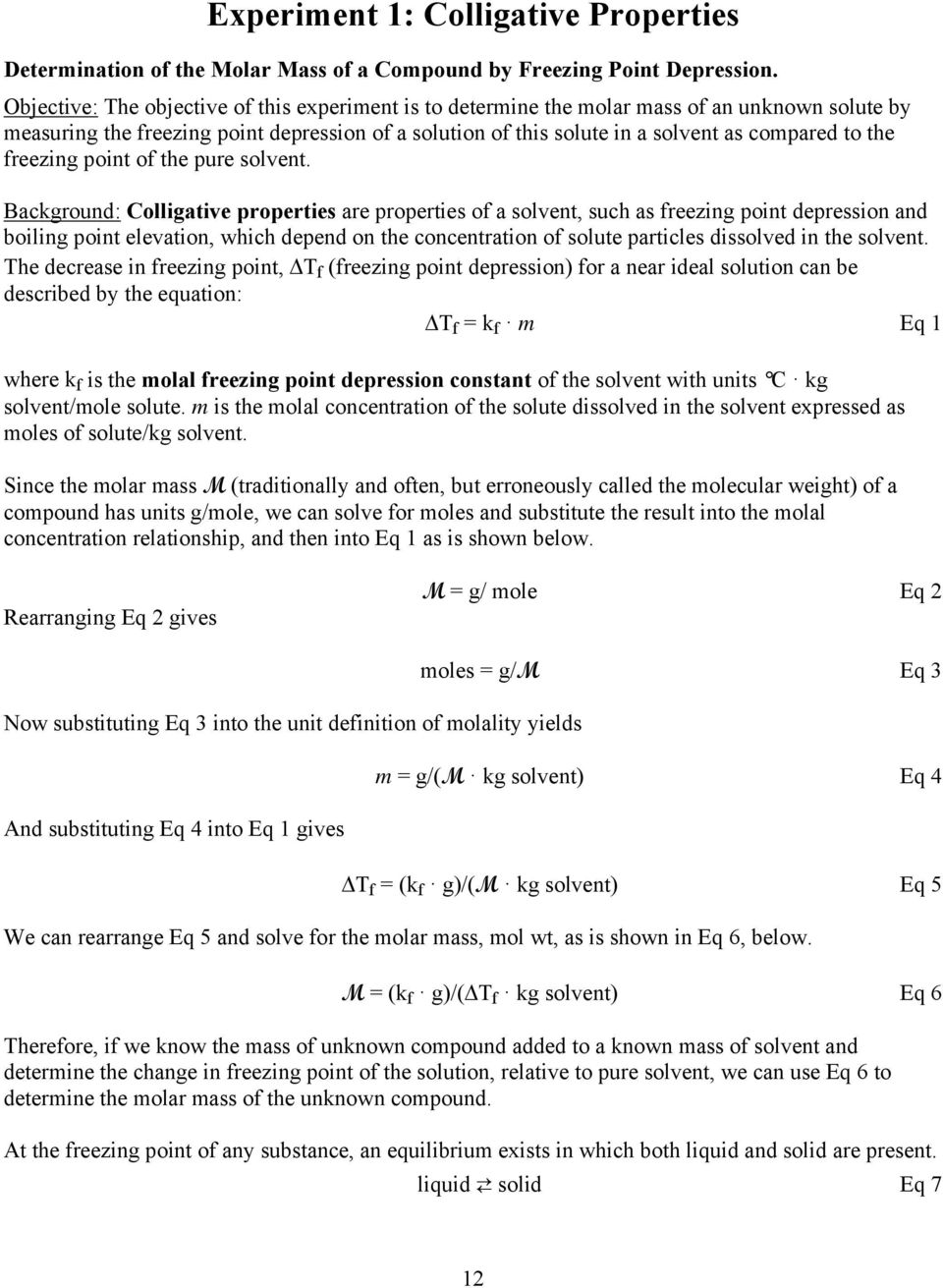
1 Experiment 1: Colligative Properties Determination of the Molar Mass of a Compound by Freezing Point Depression. Objective: The objective of this experiment is to determine the molar mass of an unknown solute by measuring the freezing point depression of a solution of this solute in a solvent as compared to the freezing point of the pure solvent. Background: Colligative properties are properties of a solvent, such as freezing point depression and boiling point elevation, which depend on the concentration of solute particles dissolved in the solvent. The decrease in freezing point, ΔT f (freezing point depression) for a near ideal solution can be described by the equation: ΔT f = k f m Eq 1 where k f is the molal freezing point depression constant of the solvent with units C kg solvent/mole solute. m is the molal concentration of the solute dissolved in the solvent expressed as moles of solute/kg solvent. Since the molar mass M (traditionally and often, but erroneously called the molecular weight) of a compound has units g/mole, we can solve for moles and substitute the result into the molal concentration relationship, and then into Eq 1 as is shown below. Rearranging Eq 2 gives M = g/ mole Eq 2 Now substituting Eq 3 into the unit definition of molality yields And substituting Eq 4 into Eq 1 gives moles = g/m Eq 3 m = g/(m kg solvent) Eq 4 ΔT f = (k f g)/(m kg solvent) Eq 5 We can rearrange Eq 5 and solve for the molar mass, mol wt, as is shown in Eq 6, below. M = (k f g)/(δt f kg solvent) Eq 6 Therefore, if we know the mass of unknown compound added to a known mass of solvent and determine the change in freezing point of the solution, relative to pure solvent, we can use Eq 6 to determine the molar mass of the unknown compound. At the freezing point of any substance, an equilibrium exists in which both liquid and solid are present. liquid solid Eq 7 12
2 The temperature at which this equilibrium exists is the freezing point of the substance. Sometimes this temperature is difficult to determine, so the use of cooling curves is required. To construct a cooling curve one would warm their sample, pure solvent or solution, to well above its melting point, then allow it to cool. As the sample cools the temperature of the sample is monitored as a function of time. As the sample begins to solidify the change in temperature will slow, and at the equilibrium shown by Eq 7 the temperature will be constant until all of the sample has solidified. A graph is made by plotting the temperature vs. time. An example of a cooling curve is shown below in Figure 1. Temp, C time, s Figure 1: Cooling curve for a pure solvent. In this cooling curve you see a steady decrease in temperature followed by a dip which is followed by a slight rise in the temperature. This dip is not unusual and results from supercooling during the early stages of the freezing process. In this example the dip is followed by a short plateau in the temperature. This plateau is at the freezing point of the pure solvent as shown in Figure 1. When solute is added to the solvent the shape of the cooling curve sometimes changes so that we don t see a clear horizontal plateau as the example shown in Figure 1. Temp, C time, s Figure 2: Cooling curve for a solution. 13

3 In Figure 2 we don t see a clear horizontal plateau. In this case we must draw a trend line through the data points corresponding to the cooling of the liquid and a trend line through the data points corresponding to the freezing of the liquid. The temperature at the point where those two lines intersect is the freezing point of the solution Temp, o C time, s Figure 3: Solution cooling curve showing best fit straight lines through the two portions of the curve discussed in the text. Figure 3 shows an example with the trend lines drawn in and the intersection of the lines. In the example shown in Figure 3 the freezing point would be measured as about 43 C. If we continue to record and plot the temperature of the solid, the data points may start to deviate from the trend line shown in Figure 3 corresponding to the freezing of the liquid. In this case you would not include those points in the trend line. In this experiment you will determine the freezing point of pure tertiary butyl alcohol (t-butanol) then the freezing point of t-butanol with an unknown solute dissolved in it. From these freezing point measurements you will be able to calculate the molar mass of the unknown solute. The t-butanol is a good solvent choice for this experiment. Its transition state from solid to liquid occurs near room temperature, so it has a relatively low melting point, thus a low freezing point. It also has a relatively large k f, 9.10 ºC kg solvent/mol solute, which is good for estimating the molar mass of a solute because it will allow us to see a greater ΔT f relative to a solvent with a lower k f. Procedure: For this experiment you will need a 150 ml beaker, two 400 ml beakers, a large test tube (25 x 150 mm), a tripod stand with wire mess, a thermometer, a stirring loop and a Bunsen burner. Freezing point of pure t-butanol: Place a 150 ml beaker on a top loader balance and tare it. Place a clean, dry 25 x 150 mm test tube in the beaker and record the mass in the data table, line 1. Fill the test tube about half full with t-butanol, reweigh and record this mass in the data table, line 2. Place the beaker and test tube aside for now. Place about 250 ml of hot tap water in one 400 ml beaker and place the test tube containing the t- butanol in the hot water; we want to warm the t-butanol to about 40 C. You may use a tripod and Bunsen burner to warm the t-butanol in the water bath if needed. (Do not heat the test tube with a 14

4 direct flame!) Insert the stirring loop into the test tube and then insert the thermometer so that the loop of the stirrer surrounds the thermometer. Periodically stir the t-butanol with the stirring loop by an up and down motion while warming it. Place about ml of ice in the other 400 ml beaker and enough cold tap water to just cover the ice. Once the temperature of the t-butanol has warmed to about 40 C, transfer the test tube to the icewater bath making sure that most of the t-butanol is below the surface of the ice-water bath, add more ice if needed. Immediately begin to take temperature readings and record them in the table every 15 seconds while continually stirring the t-butanol with the stirring loop in an up and down motion. Continue to stir and take temperature readings every 15 seconds until the t-butanol has solidified. When the t-butanol has solidified so that the stirring loop will no longer move, stop trying to stir, but continue to record the temperature every 15 seconds for one more minute. Do not try to pull the thermometer and stirrer from the frozen t-butanol! Doing so may break the thermometer. Freezing point of solutions: Place the test tube in the 150 ml beaker, the test tube may now be top heavy, so use caution, or use a 250 ml beaker. Place the beaker with test tube on a top loader balance and tare the balance. With a disposable pipette add about 0.5 g of our unknown to the test tube and record the mass, line 4. Reheat the test tube as before to about 40 C, this is sample solution 1. If you need fresh hot tap water in which to warm your sample, get it. Try to make sure all your unknown is dissolved in the t-butanol. Use the stirring loop to aid the dissolution of the solute, if needed. If you need more ice for your icewater bath get it. As before, once the temperature is about 40 C, transfer the test tube to the ice-water bath. Begin stirring and take temperature readings every 15 seconds until the solution has solidified. When the solution has solidified so that you can no longer stir it, stop trying to stir, but continue to record the temperature every 15 seconds for one more minute. Return the test tube to the 150 ml beaker and place the beaker with test tube on a top loader balance and tare the balance. With a disposable pipette add about another 0.5 g of the unknown to the test tube and record the mass, line 5 (this is sample solution 2). Repeat the melting and temperature recording steps outlined in the previous paragraph. Clean-Up: Place the test tube back in the warm water bath to melt the solid. Remove the thermometer and stirring loop. Pour the t-butanol solutions into the waste beaker under the fume hood. Wash the thermometer, stirring loop and test tube in the sink with soap and water, dry and return them to the side shelf. Empty all beakers and other glassware you used and return them to your drawer. 15

5 Data: 1) Mass of test tube: 2) Mass of test tube and t-butanol: 3) a) Mass of t-butanol (line 2 line 1): b) Mass of t-butanol in kgs: 4) Mass of first sample of unknown: 5) Mass of second sample of unknown: 6) Total mass of unknown in second solution freezing point determination (line 4 + line 5): 16

6 Data Table: t-butanol, pure solvent t-butanol plus first sample portion, solution 1 t-butanol plus second sample portion, solution 2 time temperature time temperature time temperature 17

7 Data Handling, Calculations and Questions: Use graph paper and plot temperature vs. time for the pure t-butanol and for each solution analyzed; make 3 different graphs. Use the discussion in the background section above as a guide and determine the freezing point, T f, of t-butanol and of each solution. Clearly mark on each graph all your data points and the best fit lines you used to determine each freezing point. Determine the ΔT f of solution 1 by subtracting the T f of solution 1 from the T f of pure t-butanol. Determine the ΔT f of solution 2 by subtracting the T f of solution 2 from the T f of pure t-butanol. Use the ΔT f for solution 1 along with the mass of unknown in solution 1, line 4 of the data table, the mass of solvent, t-butanol, line 3b of the data table, and the k f of t-butanol, 9.10 ºC kg solvent/mol solute, in Eq 6 to determine the molar mass, M, of your unknown compound. Repeat the calculation above for solution 2 remembering to use the total mass of solute, line 6 of the data table, and the ΔT f for solution 2. Report: In your lab report briefly discuss the theory behind why the freezing point of a solution is typically lower than the freezing point of pure solvent. Reproduce the data from the Data page and the Data Table, pages 5 and 6, and turn in with your report, along with all three graphs. Make a data and calculations page to report the T f of pure t-butanol and for each solution. Show all calculations and report the molar mass of unknown as determined in each of the two solutions. Average the two molar masses you determined and calculate the percent difference for each determination vs. the average. This should give you about a 6 or 7 page lab report, not all pages will be full of text. Reference: Some information at the following lab experiment was used for this experiment. 18

Pre-Lab Notebook Content: Your notebook should include the title, date, purpose, procedure; data tables.
 Determination of Molar Mass by Freezing Point Depression M. Burkart & M. Kim Experimental Notes: Students work in pairs. Safety: Goggles and closed shoes must be worn. Dispose of all chemical in the plastic
Experiment 13: Determination of Molecular Weight by Freezing Point Depression
 1 Experiment 13: Determination of Molecular Weight by Freezing Point Depression Objective: In this experiment, you will determine the molecular weight of a compound by measuring the freezing point of a
Physical Properties of a Pure Substance, Water
 Physical Properties of a Pure Substance, Water The chemical and physical properties of a substance characterize it as a unique substance, and the determination of these properties can often allow one to
Determination of Molar Mass by Freezing-Point Depression
 DETERMINATION OF MOLAR MASS BY FREEZING-POINT DEPRESSION 141 Determination of Molar Mass by Freezing-Point Depression OBJECTIVES: Gain familiarity with colligative properties of nonelectrolyte solutions
Determination of Molar Mass by Boiling Point Elevation of Urea Solution
 Determination of Molar Mass by Boiling Point Elevation of Urea Solution CHRISTIAN E. MADU, PhD AND BASSAM ATTILI, PhD COLLIN COLLEGE CHEMISTRY DEPARTMENT Purpose of the Experiment Determine the boiling
Freezing Point Depression: Why Don t Oceans Freeze? Teacher Advanced Version
 Freezing Point Depression: Why Don t Oceans Freeze? Teacher Advanced Version Freezing point depression describes the process where the temperature at which a liquid freezes is lowered by adding another
To measure the solubility of a salt in water over a range of temperatures and to construct a graph representing the salt solubility.
 THE SOLUBILITY OF A SALT IN WATER AT VARIOUS TEMPERATURES 2007, 1995, 1991 by David A. Katz. All rights reserved. Permission for academic use provided the original copyright is included. OBJECTIVE To measure
SOLUBILITY OF A SALT IN WATER AT VARIOUS TEMPERATURES LAB
 SOLUBILITY OF A SALT IN WATER AT VARIOUS TEMPERATURES LAB Purpose: Most ionic compounds are considered by chemists to be salts and many of these are water soluble. In this lab, you will determine the solubility,
Phase Diagram of tert-butyl Alcohol
 Phase Diagram of tert-butyl Alcohol Bill Ponder Department of Chemistry Collin College Phase diagrams are plots illustrating the relationship of temperature and pressure relative to the phase (or state
Using Freezing-Point Depression to Find Molecular Weight
 Usin Freezin-Point Depression to Find Molecular Weiht Experiment 15 When a solute is dissolved in a solvent, the freezin temperature is lowered in proportion to the number of moles of solute added. This
Recovery of Elemental Copper from Copper (II) Nitrate
 Recovery of Elemental Copper from Copper (II) Nitrate Objectives: Challenge: Students should be able to - recognize evidence(s) of a chemical change - convert word equations into formula equations - perform
SEPARATION OF A MIXTURE OF SUBSTANCES LAB
 SEPARATION OF A MIXTURE OF SUBSTANCES LAB Purpose: Every chemical has a set of defined physical properties, and when combined they present a unique fingerprint for that chemical. When chemicals are present
To calculate the value of the boiling point constant for water. To use colligative properties to determine the molecular weight of a substance.
 Colligative Properties of Solutions: A Study of Boiling Point Elevation Amina El-Ashmawy, Collin County Community College (With contributions by Timm Pschigoda, St. Joseph High School, St. Joseph, MI)
The Empirical Formula of a Compound
 The Empirical Formula of a Compound Lab #5 Introduction A look at the mass relationships in chemistry reveals little order or sense. The ratio of the masses of the elements in a compound, while constant,
CHEMISTRY 1010 Lab Manual
 CHEMISTRY 1010 Lab Manual University of Louisiana at Monroe Freshman Chemistry Lab Staff Revised: Fall 2010 Table of Contents Introduction Maps...1 Check-in Sheet...3 Safety.....4 Solubility...6 General
1. The Determination of Boiling Point
 1. The Determination of Boiling Point Objective In this experiment, you will first check your thermometer for errors by determining the temperature of two stable equilibrium systems. You will then use
Hands-On Labs SM-1 Lab Manual
 EXPERIMENT 4: Separation of a Mixture of Solids Read the entire experiment and organize time, materials, and work space before beginning. Remember to review the safety sections and wear goggles when appropriate.
In this experiment, we will use three properties to identify a liquid substance: solubility, density and boiling point..
 Identification of a Substance by Physical Properties 2009 by David A. Katz. All rights reserved. Permission for academic use provided the original copyright is included Every substance has a unique set
The Properties of Water (Instruction Sheet)
 The Properties of Water (Instruction Sheet) Property : High Polarity Activity #1 Surface Tension: PILE IT ON. Materials: 1 DRY penny, 1 eye dropper, water. 1. Make sure the penny is dry. 2. Begin by estimating
Experiment 12E LIQUID-VAPOR EQUILIBRIUM OF WATER 1
 Experiment 12E LIQUID-VAPOR EQUILIBRIUM OF WATER 1 FV 6/26/13 MATERIALS: PURPOSE: 1000 ml tall-form beaker, 10 ml graduated cylinder, -10 to 110 o C thermometer, thermometer clamp, plastic pipet, long
Chemistry 212 VAPOR PRESSURE OF WATER LEARNING OBJECTIVES
 Chemistry 212 VAPOR PRESSURE OF WATER LEARNING OBJECTIVES The learning objectives of this experiment are to explore the relationship between the temperature and vapor pressure of water. determine the molar
Experiment 6 Coffee-cup Calorimetry
 6-1 Experiment 6 Coffee-cup Calorimetry Introduction: Chemical reactions involve the release or consumption of energy, usually in the form of heat. Heat is measured in the energy units, Joules (J), defined
EXPERIMENT 9 (Organic Chemistry II) Pahlavan - Cherif Synthesis of Aspirin - Esterification
 EXPERIMENT 9 (rganic hemistry II) Pahlavan - herif Materials Hot plate 125-mL Erlenmeyer flask Melting point capillaries Melting point apparatus Büchner funnel 400-mL beaker Stirring rod hemicals Salicylic
Materials 10-mL graduated cylinder l or 2-L beaker, preferably tall-form Thermometer
 VAPOR PRESSURE OF WATER Introduction At very low temperatures (temperatures near the freezing point), the rate of evaporation of water (or any liquid) is negligible. But as its temperature increases, more
Partner: Jack 17 November 2011. Determination of the Molar Mass of Volatile Liquids
 Partner: Jack 17 November 2011 Determination of the Molar Mass of Volatile Liquids Purpose: The purpose of this experiment is to determine the molar mass of three volatile liquids. The liquid is vaporized
experiment5 Understanding and applying the concept of limiting reagents. Learning how to perform a vacuum filtration.
 81 experiment5 LECTURE AND LAB SKILLS EMPHASIZED Synthesizing an organic substance. Understanding and applying the concept of limiting reagents. Determining percent yield. Learning how to perform a vacuum
EXPERIMENT 7 Reaction Stoichiometry and Percent Yield
 EXPERIMENT 7 Reaction Stoichiometry and Percent Yield INTRODUCTION Stoichiometry calculations are about calculating the amounts of substances that react and form in a chemical reaction. The word stoichiometry
States of Matter CHAPTER 10 REVIEW SECTION 1. Name Date Class. Answer the following questions in the space provided.
 CHAPTER 10 REVIEW States of Matter SECTION 1 SHORT ANSWER Answer the following questions in the space provided. 1. Identify whether the descriptions below describe an ideal gas or a real gas. ideal gas
Solubility Curve of Sugar in Water
 Solubility Curve of Sugar in Water INTRODUCTION Solutions are homogeneous mixtures of solvents (the larger volume of the mixture) and solutes (the smaller volume of the mixture). For example, a hot chocolate
The Physical Chemistry, Theory and Technique of Freezing Point Determinations
 The Physical Chemistry, Theory and Technique of Freezing Point Determinations Table of Contents Chapter Physical Chemistry Review. Measuring the concentration of solutions.2 Comparison of concentrative
Apparatus error for each piece of equipment = 100 x margin of error quantity measured
 1) Error Analysis Apparatus Errors (uncertainty) Every time you make a measurement with a piece of apparatus, there is a small margin of error (i.e. uncertainty) in that measurement due to the apparatus
HEAT OF FORMATION OF AMMONIUM NITRATE
 303 HEAT OF FORMATION OF AMMONIUM NITRATE OBJECTIVES FOR THE EXPERIMENT The student will be able to do the following: 1. Calculate the change in enthalpy (heat of reaction) using the Law of Hess. 2. Find
Physical Chemistry Laboratory I CHEM 445 Experiment 6 Vapor Pressure of a Pure Liquid (Revised, 01/09/06)
 1 Physical Chemistry Laboratory I CHEM 445 Experiment 6 Vapor Pressure of a Pure Liquid (Revised, 01/09/06) The vapor pressure of a pure liquid is an intensive property of the compound. That is, the vapor
EXPERIMENT 15: Ideal Gas Law: Molecular Weight of a Vapor
 EXPERIMENT 15: Ideal Gas Law: Molecular Weight of a Vapor Purpose: In this experiment you will use the ideal gas law to calculate the molecular weight of a volatile liquid compound by measuring the mass,
Calorimetry: Heat of Vaporization
 Calorimetry: Heat of Vaporization OBJECTIVES INTRODUCTION - Learn what is meant by the heat of vaporization of a liquid or solid. - Discuss the connection between heat of vaporization and intermolecular
Reaction of Magnesium with Hydrochloric Acid (Gas Laws) Chemicals Needed:
 Reaction of Magnesium with Hydrochloric Acid (Gas Laws) Your Name: Date: Partner(s) Names: Objectives: React magnesium metal with hydrochloric acid, collecting the hydrogen over water. Calculate the grams
MOLECULAR WEIGHT BY BOILING POINT ELEVATION
 MOLECULAR WEIGHT BY BOILING POINT ELEVATION BACKGROUND This experiment demonstrates the use of colligative properties. The goal is to measure the molecular weight of a non-volatile solute by determining
Distillation Experiment
 Distillation Experiment CHM226 Background The distillation process is a very important technique used to separate compounds based on their boiling points. A substance will boil only when the vapor pressure
PREPARATION AND PROPERTIES OF A SOAP
 (adapted from Blackburn et al., Laboratory Manual to Accompany World of Chemistry, 2 nd ed., (1996) Saunders College Publishing: Fort Worth) Purpose: To prepare a sample of soap and to examine its properties.
Experiment 8 Synthesis of Aspirin
 Experiment 8 Synthesis of Aspirin Aspirin is an effective analgesic (pain reliever), antipyretic (fever reducer) and anti-inflammatory agent and is one of the most widely used non-prescription drugs. The
Specific Heat Capacity and Latent Heat Questions A2 Physics
 1. An electrical heater is used to heat a 1.0 kg block of metal, which is well lagged. The table shows how the temperature of the block increased with time. temp/ C 20.1 23.0 26.9 30.0 33.1 36.9 time/s
EXPERIMENT 12: Empirical Formula of a Compound
 EXPERIMENT 12: Empirical Formula of a Compound INTRODUCTION Chemical formulas indicate the composition of compounds. A formula that gives only the simplest ratio of the relative number of atoms in a compound
48 Practice Problems for Ch. 17 - Chem 1C - Joseph
 48 Practice Problems for Ch. 17 - Chem 1C - Joseph 1. Which of the following concentration measures will change in value as the temperature of a solution changes? A) mass percent B) mole fraction C) molality
AN EXPERIMENT IN ALCHEMY: COPPER TO SILVER TO GOLD 2005, 2000, 1996 by David A. Katz. All rights reserved
 AN EXPERIMENT IN ALCHEMY: COPPER TO SILVER TO GOLD 2005, 2000, 1996 by David A. Katz. All rights reserved INTRODUCTION One of the goals of the ancient alchemists was to convert base metals into gold. Although
General Chemistry I (FC, 09-10) Lab #3: The Empirical Formula of a Compound. Introduction
 General Chemistry I (FC, 09-10) Introduction A look at the mass relationships in chemistry reveals little order or sense. The ratio of the masses of the elements in a compound, while constant, does not
Test Bank - Chapter 3 Multiple Choice
 Test Bank - Chapter 3 The questions in the test bank cover the concepts from the lessons in Chapter 3. Select questions from any of the categories that match the content you covered with students. The
WATER EQUIVALENT OF THE CALORIMETER
 . Thermochemistry Experiment.. WATER EQUIVALENT OF THE CALORIMETER Aim: To determine the water equivalent of the given calorimeter. Principle: A thermos flask of about 00 cm 3 capacity fitted with a thermometer
Chapter 14 Solutions
 Chapter 14 Solutions 1 14.1 General properties of solutions solution a system in which one or more substances are homogeneously mixed or dissolved in another substance two components in a solution: solute
Synthesis of Aspirin and Oil of Wintergreen
 Austin Peay State University Department of hemistry hem 1121 autions Purpose Introduction Acetic Anhydride corrosive and a lachrymator all transfers should be done in the vented fume hood Methanol, Ethanol
Acid Base Titrations
 Acid Base Titrations Introduction A common question chemists have to answer is how much of something is present in a sample or a product. If the product contains an acid or base, this question is usually
DNA Electrophoresis Lesson Plan
 DNA Electrophoresis Lesson Plan Primary Learning Outcomes: Students will learn how to properly load a well in an agarose gel. Students will learn how to analyze the results of DNA electrophoresis. Students
Experiment 7: Titration of an Antacid
 1 Experiment 7: Titration of an Antacid Objective: In this experiment, you will standardize a solution of base using the analytical technique known as titration. Using this standardized solution, you will
Sample Test 1 SAMPLE TEST 1. CHAPTER 12
 13 Sample Test 1 SAMPLE TEST 1. CHAPTER 12 1. The molality of a solution is defined as a. moles of solute per liter of solution. b. grams of solute per liter of solution. c. moles of solute per kilogram
ISOLATION OF CAFFEINE FROM TEA
 ISLATIN F CAFFEINE FRM TEA Introduction In this experiment, caffeine is isolated from tealeaves. The chief problem with the isolation is that caffeine does not exist alone in the tealeaves, but other natural
Name Class Date. In the space provided, write the letter of the term or phrase that best completes each statement or best answers each question.
 Assessment Chapter Test A Chapter: States of Matter In the space provided, write the letter of the term or phrase that best completes each statement or best answers each question. 1. The kinetic-molecular
Physical and Chemical Properties and Changes
 Physical and Chemical Properties and Changes An understanding of material things requires an understanding of the physical and chemical characteristics of matter. A few planned experiments can help you
The most common active ingredient used in deodorants is aluminium chlorohydrate. But not all deodorants contain aluminium chlorohydrate:
 Engineeringfragrance make a deodorant practical activity 2 student instructions page 1 of 5 chemical compounds The most common active ingredient used in deodorants is aluminium chlorohydrate. But not all
Solubility Product Constants
 Solubility Product Constants PURPOSE To measure the solubility product constant (K sp ) of copper (II) iodate, Cu(IO 3 ) 2. GOALS 1 To measure the molar solubility of a sparingly soluble salt in water.
Experiment #10: Liquids, Liquid Mixtures and Solutions
 Experiment #10: Liquids, Liquid Mixtures and Solutions Objectives: This experiment is a broad survey of the physical properties of liquids. We will investigate solvent/solute mixtures. We will study and
Mixing Warm and Cold Water
 Mixing Warm and Cold Water A Continuing Investigation of Thermal Pollution By Kevin White 1 Context: This lesson is intended for students conducting an ongoing study of thermal pollution. Perhaps, students
Investigation M3: Separating Mixtures into Component Parts
 Investigation M3: Separating Mixtures into Component Parts Goals: Use various methods to separate mixtures, make inferences from temperature/time graphs, and identify substances. 81 Activity M3.3: What
Properties of Alcohols and Phenols Experiment #3
 Properties of Alcohols and Phenols Experiment #3 Objectives: To observe the solubility of alcohols relative to their chemical structure, to perform chemical tests to distinguish primary, secondary and
Catalase. ***You will be working with hot water, acids and bases in this laboratory*** ****Use Extreme Caution!!!****
 AP BIOLOGY BIOCHEMISTRY ACTIVITY #9 NAME DATE HOUR CATALASE LAB INTRODUCTION Hydrogen peroxide (H 2 O 2 ) is a poisonous byproduct of metabolism that can damage cells if it is not removed. Catalase is
Activity Sheets Enzymes and Their Functions
 Name: Date: Activity Sheets Enzymes and Their Functions amylase What are Enzymes? starch glucose Enzymes are compounds that assist chemical reactions by increasing the rate at which they occur. For example,
Experiment 10 Enzymes
 Experiment 10 Enzymes Enzymes are proteins that act as catalysts for biological reactions. Enzymes, like all catalysts, speed up reactions without being used up themselves. They do this by lowering the
# 12 Condensation Polymerization: Preparation of Two Types of Polyesters
 # 12 Condensation Polymerization: Preparation of Two Types of Polyesters Submitted by: Arturo Contreras, Visiting Scholar, Center for Chemical Education, Miami University, Middletown, OH; 1996 1997. I.
Determination of Melting Points
 Determination of Melting Points This experiment consists of three parts. In the first part, you will determine the melting point range of three known compounds. This part is mostly for practice, to make
2. Why does the solubility of alcohols decrease with increased carbon chain length?
 Colligative properties 1 1. What does the phrase like dissolves like mean. 2. Why does the solubility of alcohols decrease with increased carbon chain length? Alcohol in water (mol/100g water) Methanol
IDEAL AND NON-IDEAL GASES
 2/2016 ideal gas 1/8 IDEAL AND NON-IDEAL GASES PURPOSE: To measure how the pressure of a low-density gas varies with temperature, to determine the absolute zero of temperature by making a linear fit to
Austin Peay State University Department of Chemistry CHEM 1111. Empirical Formula of a Compound
 Cautions Magnesium ribbon is flammable. Nitric acid (HNO 3 ) is toxic, corrosive and contact with eyes or skin may cause severe burns. Ammonia gas (NH 3 ) is toxic and harmful. Hot ceramic crucibles and
Evaluation copy. Titration of a Diprotic Acid: Identifying an Unknown. Computer
 Titration of a Diprotic Acid: Identifying an Unknown Computer 25 A diprotic acid is an acid that yields two H + ions per acid molecule. Examples of diprotic acids are sulfuric acid, H 2 SO 4, and carbonic
PREPARATION FOR CHEMISTRY LAB: COMBUSTION
 1 Name: Lab Instructor: PREPARATION FOR CHEMISTRY LAB: COMBUSTION 1. What is a hydrocarbon? 2. What products form in the complete combustion of a hydrocarbon? 3. Combustion is an exothermic reaction. What
ES 106 Laboratory # 3 INTRODUCTION TO OCEANOGRAPHY. Introduction The global ocean covers nearly 75% of Earth s surface and plays a vital role in
 ES 106 Laboratory # 3 INTRODUCTION TO OCEANOGRAPHY 3-1 Introduction The global ocean covers nearly 75% of Earth s surface and plays a vital role in the physical environment of Earth. For these reasons,
Desalination of Sea Water E7-1
 Experiment 7 Desalination of Sea Water E7-1 E7-2 The Task The goal of this experiment is to investigate the nature and some properties of sea water. Skills At the end of the laboratory session you should
Organic Chemistry Lab Experiment 4 Preparation and Properties of Soap
 Organic Chemistry Lab Experiment 4 Preparation and Properties of Soap Introduction A soap is the sodium or potassium salt of a long-chain fatty acid. The fatty acid usually contains 12 to 18 carbon atoms.
Hot Leaks. See how the temperature of liquids changes the way they flow.
 P h y s i c s Q u e s t A c t i v i t i e s Activity 2 1 Hot Leaks See how the temperature of liquids changes the way they flow. Safety: This experiment requires using the hot water tap and straight pins.
REASONING AND SOLUTION
 39. REASONING AND SOLUTION The heat released by the blood is given by Q cm T, in which the specific heat capacity c of the blood (water) is given in Table 12.2. Then Therefore, T Q cm 2000 J 0.8 C [4186
DETERMINING THE ENTHALPY OF FORMATION OF CaCO 3
 DETERMINING THE ENTHALPY OF FORMATION OF CaCO 3 Standard Enthalpy Change Standard Enthalpy Change for a reaction, symbolized as H 0 298, is defined as The enthalpy change when the molar quantities of reactants
EXERCISE # 1.Metric Measurement & Scientific Notation
 EXERCISE # 1.Metric Measurement & Scientific Notation Student Learning Outcomes At the completion of this exercise, students will be able to learn: 1. How to use scientific notation 2. Discuss the importance
Chapter 12 - Liquids and Solids
 Chapter 12 - Liquids and Solids 12-1 Liquids I. Properties of Liquids and the Kinetic Molecular Theory A. Fluids 1. Substances that can flow and therefore take the shape of their container B. Relative
Ice Cream Lab- A Tasty Phase Change!
 Ice Cream Lab- A Tasty! Name Date EN Class Purpose: To investigate the effects of heat transfer on phase changes. To investigate the effects of temperature changes on physical changes. Materials: ½ cup
Lab Exercise 3: Media, incubation, and aseptic technique
 Lab Exercise 3: Media, incubation, and aseptic technique Objectives 1. Compare the different types of media. 2. Describe the different formats of media, plate, tube etc. 3. Explain how to sterilize it,
Determination of Aspirin using Back Titration
 Determination of Aspirin using Back Titration This experiment is designed to illustrate techniques used in a typical indirect or back titration. You will use the NaH you standardized last week to back
States of Matter and the Kinetic Molecular Theory - Gr10 [CAPS]
![States of Matter and the Kinetic Molecular Theory - Gr10 [CAPS]](/thumbs/40/21739317.jpg "States of Matter and the Kinetic Molecular Theory - Gr10 [CAPS]") OpenStax-CNX module: m38210 1 States of Matter and the Kinetic Molecular Theory - Gr10 [CAPS] Free High School Science Texts Project This work is produced by OpenStax-CNX and licensed under the Creative
OpenStax-CNX module: m38210 1 States of Matter and the Kinetic Molecular Theory - Gr10 [CAPS] Free High School Science Texts Project This work is produced by OpenStax-CNX and licensed under the Creative
Experiment 5 Preparation of Cyclohexene
 Experiment 5 Preparation of yclohexene In this experiment we will prepare cyclohexene from cyclohexanol using an acid catalyzed dehydration reaction. We will use the cyclohexanol that we purified in our
Multiple Choice For questions 1-10, circle only one answer.
 Test Bank - Chapter 1 The questions in the test bank cover the concepts from the lessons in Chapter 1. Select questions from any of the categories that match the content you covered with students. The
THE ACTIVITY OF LACTASE
 THE ACTIVITY OF LACTASE Lab VIS-8 From Juniata College Science in Motion Enzymes are protein molecules which act to catalyze the chemical reactions in living things. These chemical reactions make up the
Unit 1 - Pure Substances and Mixtures Chapter 2: Solutions
 2.1 Solutes & Solvents Vocabulary: Unit 1 - Pure Substances and Mixtures Chapter 2: Solutions solvent the larger part of a solution - the part of a solution into which the solutes dissolve solute the smaller
SECOND GRADE 1 WEEK LESSON PLANS AND ACTIVITIES
 SECOND GRADE 1 WEEK LESSON PLANS AND ACTIVITIES WATER CYCLE OVERVIEW OF SECOND GRADE WATER WEEK 1. PRE: Exploring the properties of water. LAB: Experimenting with different soap mixtures. POST: Analyzing
The Molar Mass of a Gas
 The Molar Mass of a Gas Goals The purpose of this experiment is to determine the number of grams per mole of a gas by measuring the pressure, volume, temperature, and mass of a sample. Terms to Know Molar
Paper Chromatography: Separation and Identification of Five Metal Cations
 Paper Chromatography: Separation and Identification of Five Metal Cations Objectives Known and unknown solutions of the metal ions Ag +, Fe 3+, Co 2+, Cu 2+ and Hg 2+ will be analyzed using paper chromatography.
CHEM 2423 Recrystallization of Benzoic Acid EXPERIMENT 4 - Purification - Recrystallization of Benzoic acid
 EXPERIMENT 4 - Purification - Recrystallization of Benzoic acid Purpose: a) To purify samples of organic compounds that are solids at room temperature b) To dissociate the impure sample in the minimum
Determining the Identity of an Unknown Weak Acid
 Purpose The purpose of this experiment is to observe and measure a weak acid neutralization and determine the identity of an unknown acid by titration. Introduction The purpose of this exercise is to identify
EXPERIMENT 3 (Organic Chemistry II) Nitration of Aromatic Compounds: Preparation of methyl-m-nitrobenzoate
 EXPERIMENT 3 (Organic Chemistry II) Nitration of Aromatic Compounds: Preparation of methyl-m-nitrobenzoate Pahlavan/Cherif Purpose a) Study electrophilic aromatic substitution reaction (EAS) b) Study regioselectivity
Percentage of Water in Popcorn
 Skills Practice DATASHEET FOR IN-TEXT LAB Percentage of Water in Popcorn Popcorn pops because of the natural moisture inside each kernel. When the internal water is heated above 100 C, the liquid water
Sample Liver Enzyme Lab
 Sample Liver Enzyme Lab Design Aspect 1: Research Question This lab will be driven by the research question, Do changes in temperature have an effect on the activity of the enzyme catalase? Pearson Baccalaureate:
Experiment 5: Phase diagram for a three-component system (Dated: April 12, 2010)
 Experiment 5: Phase diagram for a three-component system (Dated: April 12, 2010) I. INTRODUCTION It is sometimes necessary to know the mutual solubilities of liquids in a two-phase system. For example,
Sugar or Salt? Ionic and Covalent Bonds
 Lab 11 Sugar or Salt? Ionic and Covalent Bonds TN Standard 2.1: The student will investigate chemical bonding. Have you ever accidentally used salt instead of sugar? D rinking tea that has been sweetened
COMMON LABORATORY APPARATUS
 COMMON LABORATORY APPARATUS Beakers are useful as a reaction container or to hold liquid or solid samples. They are also used to catch liquids from titrations and filtrates from filtering operations. Bunsen
Pressure -Temperature Relationship in Gases. Evaluation copy. Figure 1. 125 ml Erlenmeyer flask. Vernier computer interface
 Pressure -Temperature Relationship in Gases Computer 7 Gases are made up of molecules that are in constant motion and exert pressure when they collide with the walls of their container. The velocity and