
CUNA Mutual Holding Company and Subsidiaries
|
|
|
- Clementine Bryan
- 9 years ago
- Views:
Transcription
1 CUNA Mutual Holding Company and Subsidiaries Consolidated Financial Statements As of December 31, 2015 and 2014 and for the Three Years Ended December 31, 2015 And Independent Auditors Report
2 Table of Contents Independent Auditors Report... 1 Consolidated Balance Sheets as of December 31, 2015 and Consolidated Statements of Comprehensive Income (Loss) for the Years Ended December 31, 2015, 2014, and Consolidated Statements of Policyholders Surplus for the Years Ended December 31, 2015, 2014, and Consolidated Statements of Cash Flows for the Years Ended December 31, 2015, 2014, and Notes to the Consolidated Financial Statements Note 1 General Note 2 Summary of Significant Accounting Policies Note 3 Investments, Debt Securities Note 3 Investments, Equity Securities Note 3 Investments, Mortgage Loans Note 3 Investments, Real Estate Note 3 Investments, Equity in Unconsolidated Affiliates Note 3 Investments, Limited Partnerships Note 3 Investments, Short-Term Investments Note 3 Investments, Other Invested Assets Note 3 Investments, Net Investment Income Note 3 Investments, Net Realized Investment Gains Note 3 Investments, Other-Than-Temporary Investment Impairments Note 3 Investments, Net Unrealized Investment Gains Note 3 Investments, Investment Credit Risk Note 3 Investments, Derivative Financial Instruments Note 3 Investments, Embedded Derivatives Note 3 Investments, Asset Restrictions Note 3 Investments, Securities on Deposit/Assets Designated Note 4 Fair Value Note 5 Income Tax Note 6 Reinsurance Note 7 Deferred Policy Acquisition Costs Note 8 Liability for Claim Reserves Note 9 Benefit Plans Note 10 Statutory Financial Data and Dividend Restrictions Note 11 Notes and Interest Payable Note 12 Accumulated Other Comprehensive Income (Loss) Note 13 Commitments and Contingencies Note 14 Discontinued Operations Note 15 Subsequent Events... 87

3 INDEPENDENT AUDITORS REPORT To the Board of Directors of CUNA Mutual Holding Company Madison, Wisconsin We have audited the accompanying consolidated financial statements of CUNA Mutual Holding Company and its subsidiaries (the Company ), which comprise the consolidated balance sheets as of December 31, 2015 and 2014, and the related consolidated statements of comprehensive income (loss), policyholders surplus and cash flows for each of the three years in the period ended December 31, 2015, and the related notes to the consolidated financial statements. Management s Responsibility for the Consolidated Financial Statements Management is responsible for the preparation and fair presentation of these consolidated financial statements in accordance with accounting principles generally accepted in the United States of America; this includes the design, implementation, and maintenance of internal control relevant to the preparation and fair presentation of consolidated financial statements that are free from material misstatement, whether due to fraud or error. Auditors Responsibility Our responsibility is to express an opinion on these consolidated financial statements based on our audits. We conducted our audits in accordance with auditing standards generally accepted in the United States of America. Those standards require that we plan and perform the audit to obtain reasonable assurance about whether the consolidated financial statements are free from material misstatement. An audit involves performing procedures to obtain audit evidence about the amounts and disclosures in the consolidated financial statements. The procedures selected depend on the auditor s judgment, including the assessment of the risks of material misstatement of the consolidated financial statements, whether due to fraud or error. In making those risk assessments, the auditor considers internal control relevant to the Company s preparation and fair presentation of the consolidated financial statements in order to design audit procedures that are appropriate in the circumstances, but not for the purpose of expressing an opinion on the effectiveness of the Company s internal control. Accordingly, we express no such opinion. An audit also includes evaluating the appropriateness of accounting policies used and the reasonableness of significant accounting estimates made by management, as well as evaluating the overall presentation of the consolidated financial statements. We believe that the audit evidence we have obtained is sufficient and appropriate to provide a basis for our audit opinion.

4 Opinion In our opinion the consolidated financial statements referred to above present fairly, in all material respects, the financial position of CUNA Mutual Holding Company and its subsidiaries as of December 31, 2015 and 2014, and the results of their operations and their cash flows for each of the three years in the period ended December 31, 2015 in accordance with accounting principles generally accepted in the United States of America. Emphasis of Matter As discussed in Note 14 to the consolidated financial statements, the Company sold Producers Ag Insurance Group, Inc. ( PAIG ) and its subsidiaries on January 1, As a result of the strategic shift to exit the crop insurance business, the Company s assets and liabilities of the crop insurance business have been presented as discontinued operations within the consolidated balance sheets and the results of their operations and their cash flows have been presented as discontinued operations for all comparative periods presented. Our opinion is not modified with respect to this matter. March 3,

5 Consolidated Balance Sheets December 31, 2015 and 2014 Assets Cash and investments Debt securities, available for sale, at fair value (amortized cost $9,461,648; $8,534,778) $ 9,696,441 $ 9,117,730 Equity securities, available for sale, at fair value (cost $65,436; $111,898) 70, ,076 Mortgage loans, less valuation allowance 1,717,149 1,455,472 Real estate held for the production of income, at cost less accumulated depreciation 33,704 49,778 Real estate held-for-sale, at cost less accumulated depreciation 6,422 3,218 Policy loans 103, ,921 Equity in unconsolidated affiliates 16,953 - Limited partnerships (includes $792,959; $736,644 relating to variable interest entities) 805, ,047 Short-term investments 14,745 1,027 Student loans, at fair value 15,137 17,218 Other invested assets 124, ,337 Total investments 12,605,531 11,743,824 Cash and cash equivalents (includes $14,826; $13,444 relating to variable interest entities) 200, ,447 Total cash and investments 12,806,131 12,020,271 Accrued investment income 112, ,012 Premiums receivable, net 280, ,015 Reinsurance recoverables 123, ,416 Deferred policy acquisition costs 478, ,399 Office properties, equipment and computer software, at cost less accumulated depreciation 168, ,978 Net deferred tax asset 13,487 - Goodwill, net 34,832 34,879 Intangible assets, net 4,070 5,228 Other assets and receivables (includes $0; $2,777 relating to variable interest entities) 170, ,898 Assets of discontinued operations (Note 14) 3, ,017 Separate account assets 3,074,357 3,873,407 Total assets $ 17,269,978 $ 17,686,520 See accompanying notes to the consolidated financial statements. 3

6 Consolidated Balance Sheets, continued December 31, 2015 and 2014 Liabilities and Policyholders' Surplus Liabilities Policyholder account balances $ 5,672,889 $ 5,210,464 Claim and policy benefit reserves - life and health 3,570,753 3,312,076 Loss and loss adjustment expense reserves - property and casualty 412, ,996 Unearned premiums 447, ,216 Notes and interest payable (includes $80,249; $107,369 relating to variable interest entities) 521, ,047 Dividends payable to policyholders 12,443 13,542 Reinsurance payable 78,150 73,926 Net deferred tax liability - 107,563 Net federal income taxes payable 18,574 1,069 Accrued pension and postretirement benefit liability 177, ,778 Accounts payable and other liabilities (includes $667; $689 relating to variable interest entities) 542, ,679 Liabilities of discontinued operations (Note 14) 23, ,649 Separate account liabilities 3,074,357 3,873,407 Total liabilities 14,551,917 14,966,412 Commitments and contingencies (Note 13) Policyholders' surplus Retained earnings 2,736,368 2,519,230 Accumulated other comprehensive income (loss), net of tax expense (benefit) ( ($2,904); $115,968) (18,307) 200,878 Total policyholders' surplus 2,718,061 2,720,108 Total liabilities and policyholders' surplus $ 17,269,978 $ 17,686,520 See accompanying notes to the consolidated financial statements. 4

7 Consolidated Statements of Comprehensive Income (Loss) Years Ended December 31, 2015, 2014, and Revenues Life and health premiums, net $ 1,425,659 $ 1,363,235 $ 1,339,149 Contract charges 74,813 81,919 84,378 Property and casualty premiums, net 742, , ,604 Net investment income 524, , ,010 Net realized investment gains Total other-than-temporary impairments (3,227) 32 4,296 Less: Portion of (gains) losses recognized in other comprehensive income (loss) 137 (1,151) (17,822) Net other-than-temporary impairment losses recognized in operations (3,090) (1,119) (13,526) Sales and other realized investment gains 13,437 12,736 24,322 Total net realized investment gains 10,347 11,617 10,796 Commission and fee income 301, , ,671 Other income 45,367 48,692 35,563 Total revenues 3,124,852 3,082,251 2,976,171 Benefits and expenses Life and health insurance claims and benefits, net 927, , ,596 Property and casualty insurance loss and loss adjustment expenses, net 462, , ,798 Interest credited to policyholder account balances 131, , ,508 Policyholder dividends 25,208 24,947 29,404 Operating and other expenses 1,274,749 1,233,070 1,212,555 Total benefits and expenses 2,822,564 2,732,221 2,692,861 Income from continuing operations before income taxes and equity of unconsolidated affiliates 302, , ,310 Income tax expense 104, ,743 87,941 Income from continuing operations before equity of unconsolidated affiliates 198, , ,369 Equity in income (loss) of unconsolidated affiliates, net of tax expense (benefit) ( ($152); $58; $1,319) (283) 107 2,470 Income from continuing operations 197, , ,839 (continued) See accompanying notes to the consolidated financial statements. 5

8 Consolidated Statements of Comprehensive Income (Loss), continued Years Ended December 31, 2015, 2014, and Income from continuing operations $ 197,858 $ 243,394 $ 197,839 Gain (loss) from discontinued operations, net of tax expense (benefit) ( $9,480; ($15,521); ($18,951)) (Note 14) 19,280 (37,722) (35,595) Net income 217, , ,244 Foreign currency translation adjustment, net of tax expense (benefit) - ( ($428); ($69); $10,420) 735 (1,859) 24,524 Change in unrealized gains (losses), net of tax expense (benefit) - ( ($106,250); $108,040; ($155,627)) (197,276) 201,216 (290,431) Reclassification adjustment for (gains) included in net income, net of tax (benefit) - ( ($11,403); ($8,684); ($13,900)) (21,175) (16,128) (25,815) Change in pension liability, net of tax expense (benefit) - ( ($793); ($21,387); $22,687) (1,472) (39,719) 42,897 Change in discontinued operations, net of tax expense (benefit) ( $0; ($5); $297) (290) Other comprehensive income (loss) (219,185) 144,310 (249,115) Total comprehensive income (loss) $ (2,047) $ 349,982 $ (86,871) See accompanying notes to the consolidated financial statements. 6

9 Consolidated Statements of Policyholders Surplus Years Ended December 31, 2015, 2014, and 2013 Accumulated Other Total Retained Comprehensive Policyholders' Earnings Income (Loss) Surplus Balance, December 31, 2012 $ 2,151,314 $ 305,683 $ 2,456,997 Net income 162, ,244 Other comprehensive (loss) - (249,115) (249,115) Balance, December 31, ,313,558 56,568 2,370,126 Net income 205, ,672 Other comprehensive income - 144, ,310 Balance, December 31, ,519, ,878 2,720,108 Net income 217, ,138 Other comprehensive (loss) - (219,185) (219,185) Balance, December 31, 2015 $ 2,736,368 $ (18,307) $ 2,718,061 See accompanying notes to the consolidated financial statements. 7

10 Consolidated Statements of Cash Flows Years Ended December 31, 2015, 2014, and Cash flows from continuing operating activities Income from continuing operations $ 197,858 $ 243,394 $ 197,839 Adjustments to reconcile income from continuing operations to net cash provided by continuing operating activities: Undistributed (income) losses of limited partnerships 33,485 (11,712) (25,612) Net realized investment gains (10,347) (11,617) (10,796) Undistributed (income) losses of unconsolidated subsidiaries 283 (107) (2,470) Amortization of deferred policy acquisition costs 252, , ,243 Policy acquisition costs deferred (301,764) (330,349) (304,395) Depreciation of office properties, equipment, software and real estate 35,200 30,821 28,868 Amortization of intangible assets 1,158 1,339 1,478 Amortization of bond premium and discount (7,622) (2,551) (7,837) Premium deficiency - loss recognition event - 30,917 - Deferred income taxes (3,491) 29,492 61,183 Policyholder charges on investment-type contracts (24,975) (24,382) (25,646) Interest credited to policyholder account balances 131, , ,508 Gain on sale of product line - (4,125) - Changes in other assets and liabilities Accrued investment income (4,186) (2,620) (1,184) Premiums receivable (11,179) (18,418) (26,986) Reinsurance recoverables 6,087 (6,257) (4,464) Net federal income taxes 17,460 31,122 14,735 Other assets and receivables 1, (19,403) Insurance reserves 264, , ,275 Unearned premiums 8,205 25,155 28,460 Reinsurance payable 4,229 5,859 7,807 Accounts payable and other liabilities 27,331 (40,275) 84,514 Net cash provided by continuing operating activities 617, , ,117 (continued) See accompanying notes to the consolidated financial statements. 8

11 Consolidated Statements of Cash Flows, continued Years Ended December 31, 2015, 2014, and Cash flows from investing activities Purchases of investments Debt securities $ (1,820,231) $ (1,252,389) $ (1,391,121) Equity securities (4,224) (60,195) (19,867) Mortgage loans (440,073) (390,364) (405,857) Real estate (5,050) (4,632) (2,690) Short-term investments (13,832) (20,045) (9) Limited partnerships (189,472) (206,272) (137,228) Other invested assets (466,439) (221,263) (219,030) Proceeds on sale or maturity of investments Debt securities 897, ,672 1,008,635 Equity securities 54,907 3,816 3,543 Mortgage loans 177, , ,250 Real estate 22,148 1,880 20,332 Short-term investments 91 20, Limited partnerships 101, , ,602 Other invested assets 457, , ,194 Purchases of office properties, equipment, and computer software, net (42,294) (31,545) (23,803) Investment in unconsolidated affiliates (15,000) - (1,500) Proceeds from sales of subsidiaries 104,466 74,385 - Change in policy loans and other, net 398 (894) 1,131 Net cash used in investing activities (1,180,768) (641,822) (613,426) Cash flows from financing activities Policyholder account deposits 1,414,180 1,318, ,701 Policyholder account withdrawals (1,057,785) (1,422,696) (916,688) Notes payable - borrowings 575, , ,000 Notes payable - repayments (439,836) (273,018) (86,000) Change in bank overdrafts 2,070 (15,124) 13,118 Capital lease payments (8,684) (11,365) (11,020) Proceeds from sale-leaseback - - 4,123 Payment of debt financing costs (1,179) (3,185) - Net cash provided by (used in) financing activities 483,766 12,802 (61,766) Change in cash and cash equivalents (79,793) (18,857) (21,075) Cash flow from discontinued operations (Note 14) 4,065 (21,449) (101,271) Effect of foreign exchange rate on cash (119) (1,278) 3,956 Cash and cash equivalents at beginning of year 276, , ,421 Cash and cash equivalents at end of year $ 200,600 $ 276,447 $ 318,031 Supplemental disclosure of cash information Cash paid during the year for interest $ 11,457 $ 10,840 $ 10,212 Cash paid during the year for income taxes 90,541 45,942 10,917 See accompanying notes to the consolidated financial statements. 9

12 Note 1: General Nature of Business CUNA Mutual Holding Company ( CMHC or, with its subsidiaries, the Company ) is a mutual insurance holding company organized under the laws of Iowa for the principal purpose of serving the insurance and financial services needs of credit unions and their members. Its primary products include group credit life and disability sold through credit unions; retirement plans and group life and disability products for credit union employees; and life, health and annuity policies for credit union members. The Company is also engaged in the business of property and casualty insurance, retail investment brokerage, and other businesses useful to credit unions and their members and retirement plan services. The Company markets its products for credit union members through face-to-face and direct response distribution systems, while group products are sold primarily by salaried representatives. The Company is licensed to sell insurance in all 50 states and the District of Columbia and the majority of its revenue and the revenues of its affiliated companies are generated in the United States. It also conducts business in foreign countries through branch offices or subsidiaries. None of these foreign operations and no individual state in the United States represent more than 10%, 10%, and 9% of the Company s premiums for the years ended December 31, 2015, 2014, and 2013, respectively. Note 2: Summary of Significant Accounting Policies Basis of Presentation The consolidated financial statements have been prepared in accordance with accounting principles generally accepted in the United States of America ( GAAP ). All intercompany accounts and transactions have been eliminated. Effective January 1, 2015, the Company sold its crop insurance business, which is presented as discontinued operations in the consolidated financial statements. See Note 14 for details. The Company consolidates a variable interest entity ( VIE ) when it is the primary beneficiary. A primary beneficiary is the entity with both the power to direct the activities of the VIE that most significantly impact the economic performance of the VIE and the obligation to absorb losses, or the right to receive benefits, that could potentially be significant to the VIE. Use of Estimates The preparation of consolidated financial statements in conformity with GAAP requires management to make estimates and assumptions that affect the reported amounts of assets and liabilities and the disclosure of contingent assets and liabilities at the date of the consolidated financial statements and the reported amounts of revenues and expenses during the reporting period. Actual results could differ from those estimates and, in some cases, the difference could be material. Investment valuations, determinations of other-than-temporary impairments, deferral of policy acquisition costs and the related amortization and recoverability, embedded derivatives, valuation of goodwill and intangible assets, deferred tax asset valuation reserves, insurance liabilities, reinsurance balances and pension and postretirement obligations are most affected by the use of estimates and assumptions. Investments Investments in debt securities, including bonds and redeemable preferred stocks, and investments in equity securities, including common stocks and non-redeemable preferred stocks, are classified as available for sale and are carried at fair value. 10

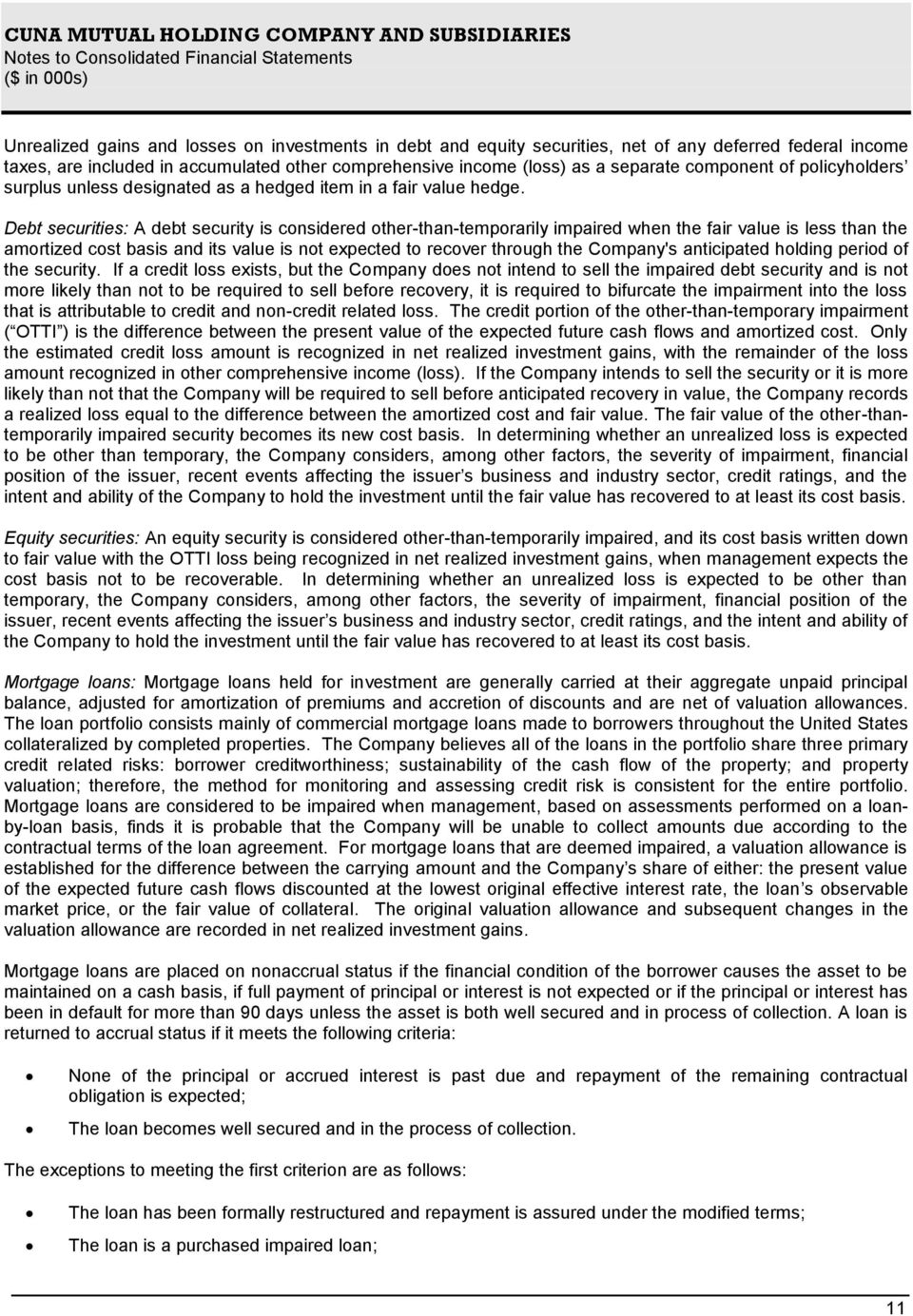
13 Unrealized gains and losses on investments in debt and equity securities, net of any deferred federal income taxes, are included in accumulated other comprehensive income (loss) as a separate component of policyholders surplus unless designated as a hedged item in a fair value hedge. Debt securities: A debt security is considered other-than-temporarily impaired when the fair value is less than the amortized cost basis and its value is not expected to recover through the Company's anticipated holding period of the security. If a credit loss exists, but the Company does not intend to sell the impaired debt security and is not more likely than not to be required to sell before recovery, it is required to bifurcate the impairment into the loss that is attributable to credit and non-credit related loss. The credit portion of the other-than-temporary impairment ( OTTI ) is the difference between the present value of the expected future cash flows and amortized cost. Only the estimated credit loss amount is recognized in net realized investment gains, with the remainder of the loss amount recognized in other comprehensive income (loss). If the Company intends to sell the security or it is more likely than not that the Company will be required to sell before anticipated recovery in value, the Company records a realized loss equal to the difference between the amortized cost and fair value. The fair value of the other-thantemporarily impaired security becomes its new cost basis. In determining whether an unrealized loss is expected to be other than temporary, the Company considers, among other factors, the severity of impairment, financial position of the issuer, recent events affecting the issuer s business and industry sector, credit ratings, and the intent and ability of the Company to hold the investment until the fair value has recovered to at least its cost basis. Equity securities: An equity security is considered other-than-temporarily impaired, and its cost basis written down to fair value with the OTTI loss being recognized in net realized investment gains, when management expects the cost basis not to be recoverable. In determining whether an unrealized loss is expected to be other than temporary, the Company considers, among other factors, the severity of impairment, financial position of the issuer, recent events affecting the issuer s business and industry sector, credit ratings, and the intent and ability of the Company to hold the investment until the fair value has recovered to at least its cost basis. Mortgage loans: Mortgage loans held for investment are generally carried at their aggregate unpaid principal balance, adjusted for amortization of premiums and accretion of discounts and are net of valuation allowances. The loan portfolio consists mainly of commercial mortgage loans made to borrowers throughout the United States collateralized by completed properties. The Company believes all of the loans in the portfolio share three primary credit related risks: borrower creditworthiness; sustainability of the cash flow of the property; and property valuation; therefore, the method for monitoring and assessing credit risk is consistent for the entire portfolio. Mortgage loans are considered to be impaired when management, based on assessments performed on a loanby-loan basis, finds it is probable that the Company will be unable to collect amounts due according to the contractual terms of the loan agreement. For mortgage loans that are deemed impaired, a valuation allowance is established for the difference between the carrying amount and the Company s share of either: the present value of the expected future cash flows discounted at the lowest original effective interest rate, the loan s observable market price, or the fair value of collateral. The original valuation allowance and subsequent changes in the valuation allowance are recorded in net realized investment gains. Mortgage loans are placed on nonaccrual status if the financial condition of the borrower causes the asset to be maintained on a cash basis, if full payment of principal or interest is not expected or if the principal or interest has been in default for more than 90 days unless the asset is both well secured and in process of collection. A loan is returned to accrual status if it meets the following criteria: None of the principal or accrued interest is past due and repayment of the remaining contractual obligation is expected; The loan becomes well secured and in the process of collection. The exceptions to meeting the first criterion are as follows: The loan has been formally restructured and repayment is assured under the modified terms; The loan is a purchased impaired loan; 11
14 The borrower is making the contractual principal and interest payments and, while the loan may not be fully current, it is reasonably assured that the loan will be able to become current within a reasonable period and the borrower has shown a sustained period of being able to make the contractual payments. When a loan is on nonaccrual status and any payments received are applied toward the principal balance, these payments are not reversed when the loan is placed back on accrual status. Generally, there is no immediate income recognition when removing a loan from nonaccrual status. Real estate held for the production of income: Investments in real estate are carried at cost net of accumulated depreciation. When events or circumstances indicate the carrying value of real estate may not be recoverable, it is tested for impairment. Real estate is deemed to be impaired when the carrying value exceeds the sum of the undiscounted cash flows expected to result from the investment. Impaired real estate is written down to estimated fair value with the impairment loss being included in net realized investment gains. Real estate held-for-sale: Certain real estate was classified as held-for-sale at December 31, 2015 and 2014 and is being actively marketed; depreciation was suspended as a result. Policy loans: Policy loans are reported at their unpaid principal balance. Valuation allowances are not established for policy loans, as they are fully collateralized by the cash surrender value of the underlying insurance policies. Any unpaid principal or interest on the loan is deducted from the cash surrender value or the death benefit prior to settlement of the insurance policy. Equity in unconsolidated affiliates: Equity in unconsolidated affiliates includes investments in companies over which the Company could exercise significant influence over the operating and financial policies of the investee. Generally, this occurs when the Company s ownership ranges from 20% to 50%. The Company accounted for these investments using the equity method whereby the Company s proportionate share of the net income (loss) of these unconsolidated affiliates are reported in the consolidated statement of comprehensive income (loss), net of related income taxes. Equity in unconsolidated affiliates investments are assessed for impairment annually or whenever events or circumstances indicated that the carrying amount of such assets may not be fully recoverable. An impairment loss may need to be recognized as an equity loss of unconsolidated affiliates to the extent the carrying value of the assets exceeded the fair value of such assets. There were no impairments in The estimation of fair values requires assumptions by management about factors that are uncertain including future cash flows, the appropriate discount rate and other factors. Limited partnerships: Limited partnerships primarily represent interests in energy, mezzanine, private equity, and real estate partnerships and are accounted for under the equity method. Due to the timing of the availability of financial statements from the partnerships general partners, limited partnership investment income is generally recorded on a three-month lag, as adjusted for contributions and distributions. Short-term investments: Short-term investments include debt securities with maturities less than one year at date of purchase and are reported at amortized cost, which approximates fair value. Student loans: Student loans primarily represent loans made through private lending arrangements. The Company elected to carry student loans at fair value, and changes in the fair value are reported in net realized investment gains. Other invested assets: Other invested assets primarily consist of derivatives, margin deposits, investment in common stock of Federal Home Loan Bank ( FHLB ), investments receivable and notes receivable. Derivative financial instruments are accounted for at fair value. See Derivative Financial Instruments for a detailed discussion of the Company s derivatives. For certain derivatives, the counterparty requires margin deposits as well as daily cash settlements of margin accounts, and amounts on deposit are included in other invested assets. The FHLB stock is a restricted stock purchased to facilitate borrowing from the FHLB and is carried at cost. 12

15 Investments receivable are carried at cost and represent receivables for investments that have been sold or interest that is due but the cash has not been received. Notes receivable are carried at amortized cost. Investment income: Interest income related to mortgage-backed and other structured securities is recognized on an accrual basis using a constant effective yield method, based on anticipated prepayments and the estimated economic life of the securities. When estimates of prepayments change, the effective yield is recalculated to reflect actual payments to date and anticipated future payments, and such adjustments are reflected in net investment income. Prepayment assumptions for loan-backed bonds and structured securities are based on industry averages or internal estimates. Interest income related to non-structured securities is recognized on an accrual basis using a constant effective yield method. Discounts and premiums on debt securities are amortized over the estimated lives of the respective securities on an effective yield basis. Dividends are recorded at the exdividend date. Investment income is also derived from real estate investments, limited partnerships, student loans, notes receivable and derivative activity. Income from real estate investments, student loans and notes receivable are accounted for on an accrual basis. Income from investments in limited partnership interests is accounted for under the equity method generally on a three-month lag, as adjusted for contributions and distributions, and recognized in net investment income. Realized gains and losses: Realized gains and losses on the sale of investments are determined on a specific identification basis and are recorded on the trade date. Derivative Financial Instruments The Company uses derivative instruments, such as swaps, options, and futures, to manage exposure to various currency and market risks. All such derivatives are recorded in the consolidated balance sheets at fair value. See Note 3, Investments-Derivative Financial Instruments and Note 4, Fair Value for additional information on the Company's derivative financial instruments. The Company issues products that contain embedded derivatives including equity-indexed annuities and guarantees contained in variable annuity and single premium deferred annuity contracts. Derivatives embedded within non-derivative host contracts are separated from the host instrument when the embedded derivative is not clearly and closely related to the host instrument. Such embedded derivatives are recorded at fair value, and they are reported as part of policyholder account balances in the consolidated balance sheets, with the change in the value being recorded in net realized investment gains. The Company may designate certain derivatives as fair value hedges, cash flow hedges or hedges of net investments. At inception of the hedge, the Company formally documents the hedging relationship, risk management objective and strategy. In addition, the documentation includes a description of the hedging instrument, hedged transaction, nature of the risk being hedged and methodologies for assessing effectiveness and measuring ineffectiveness. Quarterly, the Company performs procedures to assess the effectiveness of the hedging relationship and the change in fair value associated with any ineffectiveness is recorded in net realized investment gains. Fair Value Hedges: For instruments that qualify as fair value hedges, the changes in fair value of the hedging instruments are recorded in net realized investment gains. The changes in fair value of the hedged item, attributable to the risk being hedged, are also recorded in net realized investment gains. The difference between the changes in fair value of the hedging instrument and the changes in fair value of the hedged item represents the ineffectiveness in an otherwise effective hedging relationship. Cash Flow Hedges: The Company designates certain derivative instruments as cash flow hedges when the hedging instrument is highly effective in offsetting the hedged risk of variability in cash flows that could affect net income. The changes in fair value of the swaps attributable to hedged risk are recorded in accumulated other comprehensive income (loss) to the extent the hedge is effective, with any ineffectiveness recorded in net realized investment gains. Amounts are reclassified from accumulated other comprehensive income (loss) to net investment income when cash flows associated with the hedged item are included in net income. 13

16 Hedges of Net Investments: The Company uses certain derivative instruments to hedge a portion of the equity in its consolidated foreign affiliates from the effects of fluctuations in currency exchange rates. When deemed effective, changes in fair value of the instruments are recorded in accumulated other comprehensive income (loss). Any ineffectiveness, in an otherwise effective hedging relationship, is recorded in net realized investment gains. Non-Hedge Derivatives: The Company is party to certain interest rate swaps that are not designated as qualified hedging instruments. Changes in fair value and the income and expenses associated with derivatives not classified as qualified hedges are recorded in net realized investment gains. Cash and Cash Equivalents Cash and cash equivalents include unrestricted deposits in financial institutions, money market mutual funds, and U.S. Treasury bills with maturities at the date of purchase of 90 days or less. Variable Interest Entities A VIE is a legal entity that does not have sufficient equity at risk to finance its activities without additional subordinated financial support or is structured such that equity investors lack the ability to make significant decisions relating to the entity s operations through voting rights or do not substantively participate in the gains and losses of the entity. Consolidation of a VIE by its primary beneficiary is not based on majority voting interest, but is based on a review of the VIE s capital structure, contractual relationships and terms, nature of the VIE s operations and purpose, nature of the VIE s interests issued and the Company s involvement with the entity. When assessing the need to consolidate a VIE, the Company evaluates the design of the VIE as well as the related exposure to the variable interest holders. The primary beneficiary is the entity that has both the power to direct the activities of the VIE that most significantly affect the entity s economic performance and the obligation to absorb losses or the right to receive benefits that could be potentially significant to the VIE. While also considering these factors, the consolidation conclusion depends on the breadth of our decision-making ability and the Company s ability to influence activities that significantly affect the economic performance of the VIE. In 2014, the Company transferred its existing investments in limited partnerships into new limited partnerships it controls ( MCA Funds ). The MCA Funds meet the definition of a VIE. 14

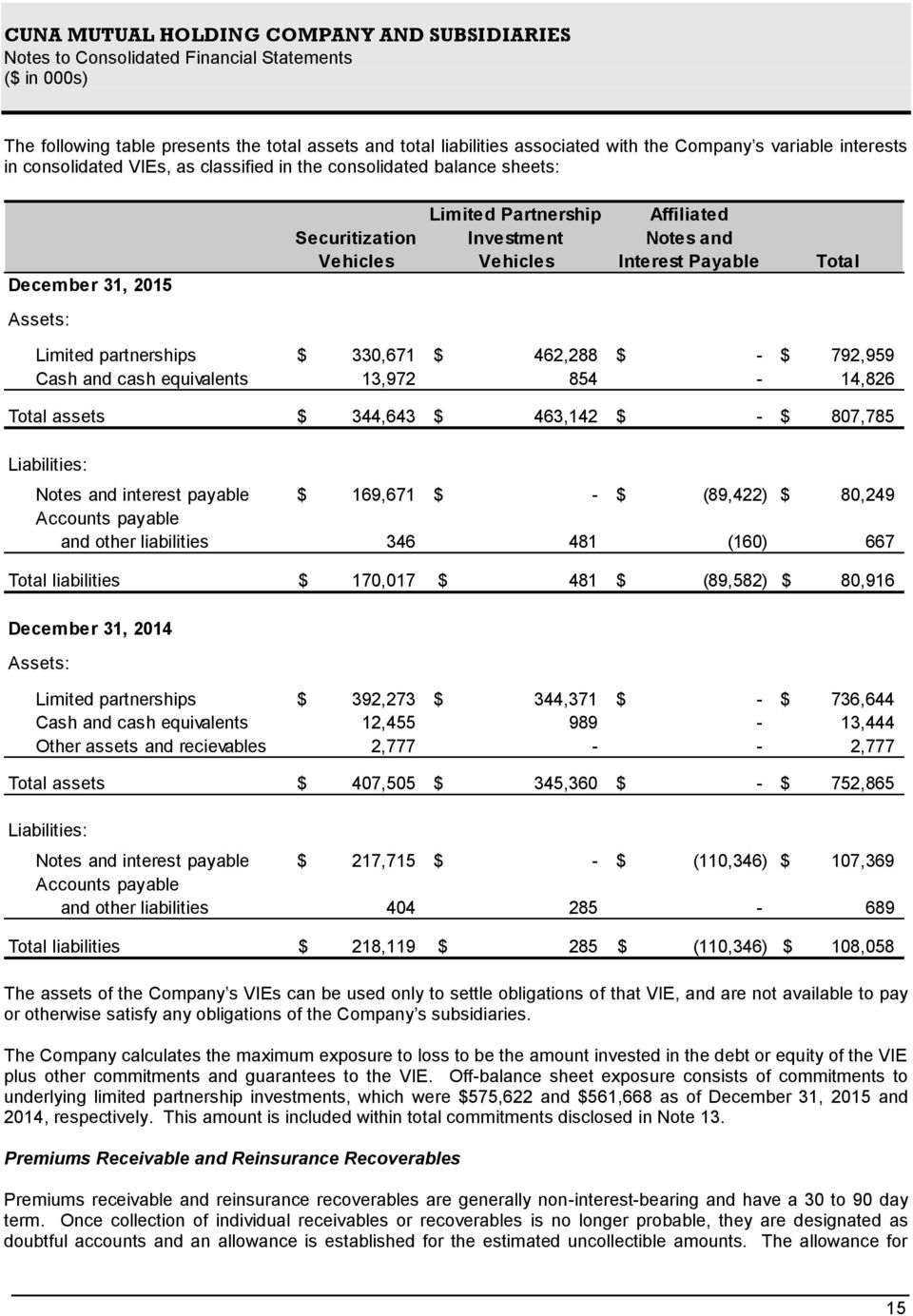
17 The following table presents the total assets and total liabilities associated with the Company s variable interests in consolidated VIEs, as classified in the consolidated balance sheets: December 31, 2015 Assets: Limited Partnership Affiliated Securitization Investment Notes and Vehicles Vehicles Interest Payable Total Limited partnerships $ 330,671 $ 462,288 $ - $ 792,959 Cash and cash equivalents 13, ,826 Total assets $ 344,643 $ 463,142 $ - $ 807,785 Liabilities: Notes and interest payable $ 169,671 $ - $ (89,422) $ 80,249 Accounts payable and other liabilities (160) 667 Total liabilities $ 170,017 $ 481 $ (89,582) $ 80,916 December 31, 2014 Assets: Limited partnerships $ 392,273 $ 344,371 $ - $ 736,644 Cash and cash equivalents 12, ,444 Other assets and recievables 2, ,777 Total assets $ 407,505 $ 345,360 $ - $ 752,865 Liabilities: Notes and interest payable $ 217,715 $ - $ (110,346) $ 107,369 Accounts payable and other liabilities Total liabilities $ 218,119 $ 285 $ (110,346) $ 108,058 The assets of the Company s VIEs can be used only to settle obligations of that VIE, and are not available to pay or otherwise satisfy any obligations of the Company s subsidiaries. The Company calculates the maximum exposure to loss to be the amount invested in the debt or equity of the VIE plus other commitments and guarantees to the VIE. Off-balance sheet exposure consists of commitments to underlying limited partnership investments, which were $575,622 and $561,668 as of December 31, 2015 and 2014, respectively. This amount is included within total commitments disclosed in Note 13. Premiums Receivable and Reinsurance Recoverables Premiums receivable and reinsurance recoverables are generally non-interest-bearing and have a 30 to 90 day term. Once collection of individual receivables or recoverables is no longer probable, they are designated as doubtful accounts and an allowance is established for the estimated uncollectible amounts. The allowance for 15
18 uncollectible receivables is estimated based on a combination of write-off history, aging analysis and any specific, known doubtful accounts. Amounts are written off when they are deemed to be uncollectible. Recognition of Insurance Revenue and Related Benefits Credit life and disability insurance coverages are issued on either a single or monthly premium basis and revenue is recognized in relation to anticipated benefits to policyholders. Certain group life and health insurance premiums are recognized on a monthly pro rata basis over the time period to which the premiums relate. Property and casualty insurance premiums are generally recognized ratably over the periods to which the premiums relate. Certain property and casualty contracts insure lenders against losses related to loan collateral, and the premium for these policies is recognized over the expected period of exposure, usually two to six years; such premium is recognized on an accelerated basis versus on a pro rata method to reflect the higher loan balance, and therefore exposure to loss, in the early period of the loan term. An unearned premium reserve is established for the unexpired portion of insurance premiums. The Company has entered into retrospective rating agreements for certain group life, credit life, credit disability, and liability contracts. Retrospective premiums are accrued as an increase or decrease to premium based on premium and claim experience for each qualifying policy and are included as part of the liability for claim and policy benefit reserves or as premium receivables. Term-life and whole-life insurance premiums are recognized as premium income when due. Policy benefits for these products are recognized in relation to the premiums so as to result in the recognition of profits over the expected lives of the policies and contracts. Revenue is recognized at the time of issue on immediate annuity and supplemental contracts that subject the Company to mortality or longevity risk (risk that the Company will have to make payments contingent upon the continued survival of an insured or insureds). A deferred profit liability is established for the excess of the gross premium collected over the sum of acquisition expenses incurred plus the initial benefit and maintenance expense reserve established. Deferred profits are included within life and health policy benefit reserves and are recognized over the expected benefit payment period. Amounts collected on policies not subject to significant mortality or longevity risk, principally group annuity and deferred annuity contracts (investment contracts), are recorded as increases in policyholder account balances. Revenues for investment contracts principally consist of net investment income and contract charges such as expense and surrender charges. Expenses for investment contracts consist of interest credited to contracts, benefits incurred in excess of related policyholder account balances and policy maintenance costs. Universal life-type policies are insurance contracts with terms that are not fixed or guaranteed. Amounts received as payments for such contracts are credited to policyholder account balances. Revenues from universal life-type policies, which are recorded as contract charges in the accompanying consolidated statements of comprehensive income, consist of fees assessed against policyholder account balances for surrender charges, cost of insurance and policy administration. Policy benefits and claims that are charged to expense include interest credited to contracts and benefits incurred in excess of related policyholder account balances. Commission and Fee Income The Company acts as an investment advisor and administrator for employee benefit plans. Revenues for advisory services are recognized pro rata, based upon contractual rates applied to the market value of each customer s portfolio. Fees received for employee benefit plan recordkeeping and reporting services are recognized as revenue when the service is performed. Administrative fees paid in advance are deferred and recognized over the period of service. The Company sells non-proprietary insurance products and recognizes commission income on the policy effective date, net of an allowance for refunds on estimated cancellations. 16

19 Deferred Policy Acquisition Costs and Sales Inducements Deferred Costs: The costs of acquiring insurance business that are directly related to the successful acquisition of new and renewal business are deferred to the extent that such costs are expected to be recoverable from future profits. Such costs principally include commissions and sales costs, direct response advertising costs, premium taxes, and certain policy issuance and underwriting costs. The Company pays credit unions for production of new and renewal business sold for the Company. These costs primarily relate to credit life and credit disability policies as well as accidental death and dismemberment and certain term and whole life products sold to credit union members, products of other insurers sold on a brokered basis, and certain investment products. Such costs totaled $287,789, $272,955, and $250,753 for the years ended December 31, 2015, 2014, and 2013, respectively. These costs are also deferred unless the expenses are associated with non-insurance products or brokered business. Amortization of Costs: Costs deferred on property and casualty insurance products and credit life and credit disability policies are amortized over the term of the related policies in proportion to the premium recognized as earned. For term-life and whole-life insurance products, deferred policy acquisition costs are amortized in proportion to the ratio of the annual premium to the total anticipated premiums generated by the deferred acquisition costs. For investment contracts, primarily deferred annuities, and universal life-type products, deferred policy acquisition costs are amortized principally over the expected contract lives and in any one period in proportion to the relationship of actual gross profits for the period to the present value of all estimated gross profits from mortality, investment, and expense margins. Deferred policy acquisition cost assets for investment contracts and universal life-type products are adjusted for changes in the present value of estimated gross profits. Such adjustments are recorded in the period that the change in the present value of future years gross profits becomes apparent. An additional adjustment to deferred policy acquisition costs on investment contracts and universal life-type products is made representing the effect on deferred policy acquisition costs that would occur if the unrealized gains and losses on investments related to these contracts were realized; the offset to this adjustment is included in accumulated other comprehensive income (loss). This adjustment is referred to as shadow deferred policy acquisition costs ( shadow DAC ). Deferred policy acquisition costs on participating insurance contracts are amortized over the life of the participating contracts at a constant rate based on the present value of the estimated gross margin expected to be realized. Estimating future gross profits is a complex process requiring considerable judgment and the forecasting of events well into the future. The primary assumptions for determining the amount of the estimated gross profits are future investment returns, including capital gains and losses on assets supporting contract liabilities, interest crediting rates to contract holders, and the effects of future persistency, mortality, expenses, and hedges, if any. Financial market volatility increases the variability and risk of estimating gross profits, which in turn could impact amortization of the deferred policy acquisition costs. Recoverability and Loss Recognition: Deferred policy acquisition costs are subject to recoverability testing at the time of policy issuance and loss recognition testing on an annual basis or when an event occurs that may indicate an inability to recover the deferred costs. To the extent that future policy premiums and investment income or gross profits are not adequate to cover the estimated anticipated losses and maintenance expenses at the time of policy issue, costs that would otherwise qualify for capitalization are not recoverable and are therefore expensed. Deferred policy acquisition costs are written down to the extent that future policy premiums and investment income or gross profits on in force policies are not adequate to cover the related estimated losses and expenses. Loss recognition in excess of the deferred policy acquisition costs balance is recognized by an increase in premium deficiency reserves, which are recorded in claim and policy benefit reserves life and health in the consolidated balance sheets. The Company expensed $22,310 in 2014 of previously deferred policy acquisition costs and recognized $8,607 of additional premium deficiency reserves related to long term care insurance as a result of the Company s loss recognition test which includes an assessment of the future profitability of those policies. No additional premium deficiency reserves were recorded in The Company recognized $13,118 of shadow loss recognition reserves in other comprehensive income related to long term care insurance in 2014 due to unrealized investment 17

20 gains, which leads to lower expected future investment income that is not sufficient to cover future expected benefit payments. Due to a decrease in unrealized investment gains, the Company fully reversed the $13,118 of shadow loss reserves in 2015 that were previously recorded in Internal Replacements: An internal replacement is defined as the modification of product benefits, features, rights or coverage that occurs by the exchange of an existing contract for a new contract, or by amendment, endorsement or rider, or by election of a feature or coverage within a contract. When an internal replacement occurs, which results in a substantial change to a policy, unamortized deferred policy acquisition costs, unearned revenues, and deferred sales inducements are expensed on the basis that the change constitutes the issuance of a new policy. Acquisition costs, sales inducements, and unearned revenue associated with the new replacement contract are deferred and amortized over the lifetime of the new contract. An internal replacement that is not a substantial change to the initial policy is accounted for as a continuation of the existing contract and the existing deferred policy acquisition costs, sales inducements and unearned revenue are carried over to the replacement contract. Sales Inducements: The costs of sales inducements offered on sales to new policyholders are deferred and recorded in other assets and receivables. These costs are primarily related to deferred annuities and are in the form of additional credits to the policyholder s account balance or enhancements to interest credited for a specified period, which are beyond amounts currently being credited to existing contracts. Deferred sales inducements are amortized over the expected contract life in relation to the present value of estimated gross profits from mortality, investment and expense margins. Office Properties, Equipment and Computer Software Office properties, equipment and computer software are carried at cost net of accumulated depreciation. Depreciation is determined on a straight-line basis over the estimated useful lives of the assets. The useful life of office equipment and purchased software is generally three to seven years. The useful life of capitalized costs for internally developed software ranges from three to ten years, while the useful life for office properties is generally 20 years. The following table provides a summary of office properties, equipment and computer software Office properties $ 205,337 $ 200,994 Office equipment 96, ,189 Computer software 170, ,503 Total cost of office properties, equipment and computer software 472, ,686 Accumulated depreciation (303,507) (311,708) Office properties, equipment and computer software at cost, less accumulated depreciation $ 168,937 $ 159,978 Depreciation expense totaled $32,848, $27,875, and $26,942 in 2015, 2014, and 2013, respectively. There were no impairments in 2015, 2014 or Goodwill and Intangible Assets Goodwill is not amortized, but is subject to an impairment test annually, or whenever events or circumstances indicate the carrying amount may not be recoverable. Definite-lived intangible assets are amortized over their estimated useful lives, ranging from two to twenty years. Amortization is based on the pattern in which the economic benefits are expected to be realized, when determinable; otherwise, straight line amortization is used. Definite-lived intangible assets are subject to an impairment test whenever events or circumstances indicate the 18

21 carrying amount may not be recoverable. Based on the results of impairment tests, no impairment charges were required for the years ended December 31, 2015, 2014, or The following table provides a rollforward of goodwill and intangible assets. Goodwill Definite-lived Intangible Assets Gross balance at January 1, 2013 $ 35,535 $ 12,556 Accumulated amortization at January 1, (3,835) Balance, net, at January 1, ,535 8,721 Amortization - (1,478) Balance, net, at December 31, ,535 7,243 Sale of product lines (656) (676) Amortization - (1,339) Balance, net, at December 31, ,879 5,228 Adjustment to prior sale of product line (47) - Amortization - (1,158) Balance, net, at December 31, ,832 4,070 Add: Accumulated amortization at December 31, ,048 Gross balance at December 31, 2015 $ 34,832 $ 11,118 Definite-lived intangible assets primarily consist of customer lists and trade names. amortization period of definite-lived assets was 10 years in 2015, 2014, and The weighted average The Company sold two product lines in 2014 resulting in goodwill and intangible asset write-offs of $656 and $676, respectively, which were recognized as an offset to the gain on sale, representing the portion of goodwill and intangible assets allocated to the Company s investment in the product lines. The sales did not qualify for discontinued operations accounting and the resulting pre-tax gain of $4,125 in 2014 is included in other income in the consolidated statement of comprehensive income (loss). In 2015, the Company wrote off an additional $47 of goodwill and intangible assets related to the earn-out of one of the product line sales. 19
22 The following table is a summary of the estimated aggregate amortization expense for intangible assets for the next four years. Estimated Aggregate Amortization Expense 2016 $ 1, , , Total estimated amortization expense $ 4,070 Separate Accounts Separate accounts represent customer accounts related to certain contracts issued by the Company, such as variable annuities and variable life insurance policies, where investment income and investment gains and losses accrue directly to the contract holders who bear the investment risk. In some contracts the Company provides certain guarantees. Such guarantees may include a minimum account value upon death, or minimum withdrawal or accumulation benefits. The liabilities for these guarantees are not included in the separate accounts as they are obligations of the Company. See Note 3, Investments Embedded Derivatives, for further discussion of the guarantees for minimum withdrawal or accumulation benefits. The additional liability held is equal to the current benefit ratio multiplied by the cumulative revenue from the contract s issue date, less cumulative excess death benefits from the issue date, plus interest, and floored at zero. The reserve for minimum death benefit guarantees was $1,191 and $1,311 as of December 31, 2015 and 2014, respectively, and is reported in policyholder account balances in the consolidated balance sheets. Contract holders are able to invest in investment funds managed for their benefit. Approximately 49% and 45% of the separate account assets are invested in unit investment trusts that are registered with the Securities and Exchange Commission as of December 31, 2015 and 2014, respectively. Separate account assets are legally segregated and may only be used to settle separate account liabilities. Separate account assets are carried at fair value, which is based on daily quoted net asset values at which the Company could transact on behalf of the contract holder. Separate account liabilities are equal to the separate account assets and represent contract holders claims to the related assets. Contract holder deposits to and withdrawals from the separate accounts are recorded directly to the separate account assets and liabilities and are not included in the Company s consolidated statements of comprehensive income (loss). Charges made by the Company to the contract holders balances include fees for maintenance, administration, cost of insurance, and surrenders of contracts prior to the contractually specified dates. Such fees are reflected as revenues (contract charges) in the accompanying consolidated statements of comprehensive income (loss) when they are assessed to the contract holder by the Company. Policyholder Account Balances The Company recognizes a liability at the stated account value for policyholder deposits that are not subject to significant policyholder mortality or longevity risk and for universal life-type policies. The account value equals the sum of the original deposit and accumulated interest, less any withdrawals and expense charges. Average credited rates ranged from 3.0% to 3.4% in 2015, 3.0% to 3.5% in 2014, and 3.0% to 3.6% in Future minimum guaranteed interest rates during the life of the contracts vary from 1.0% to 4.5%. 20
23 Insurance Reserves Life and health claim and policy benefit reserves consist principally of future policy benefit reserves and reserves for estimates of future payments on incurred claims reported but not yet paid and unreported incurred claims. Estimates for future payments on incurred claims are developed using actuarial principles and assumptions based on past experience adjusted for current trends. Any change in the probable ultimate liabilities is reflected in net income in the period in which the change is determined. Gross reserves for unpaid claims and claim adjustment expenses of $299,253 and $305,031 on certain claims, principally those resulting from a disability, are discounted at rates between 0.62% and 0.99% and 0.62% and 0.99% as of December 31, 2015 and 2014, respectively. For term-life and whole-life insurance products, future policy benefit reserves are computed using the net level premium method based on assumptions related to estimated future investment yield, mortality, morbidity, withdrawals, expenses and dividends, if applicable. The assumptions are set at issue and persist until a loss recognition event occurs. Mortality, morbidity and withdrawal assumptions reflect the Company s historical experience and industry standards. Interest rate assumptions range from 2.3% to 8.0% as of December 31, 2015 and Provisions for adverse deviation have been reflected in the interest assumption and also in the mortality and morbidity assumptions where deemed necessary. For immediate annuities or similar contracts with life contingencies, the reserve is calculated as the present value of future benefits. The mortality rates used are based on standard industry valuation tables, modified for the Company s experience if appropriate, and the interest rates used, set at issue, range from 3.4% to 7.5% and 3.5% to 7.5% as of December 31, 2015 and 2014, respectively. Loss and loss adjustment expense reserves for property and casualty products represent the estimated claim cost and loss adjustment expense necessary to cover the ultimate cost of investigating and settling all losses incurred and unpaid as of the balance sheet date. Such reserve estimates are based on individual case estimates for reported losses, estimates for incurred but not reported losses based on past experience and estimated adjustments for ultimate loss expectations based on historical experience patterns and current economic trends and are stated net of estimated salvage and subrogation recoverables of $19,384 and $22,337 at December 31, 2015 and 2014, respectively. Any change in the probable ultimate liabilities is reflected in net income in the period the change is determined to be necessary; such adjustments generally arise from new information emerging and could potentially be material. Policyholder Dividends Policyholder dividends are paid on certain policies, primarily individual life insurance. Dividends are approved by the Board of Directors, based on experience of the participating policies, and recorded on an accrual basis. Dividends are paid on policies representing 25.1% and 27.1% of the policy benefit reserves - life and health as of December 31, 2015 and 2014, respectively. Reinsurance Reinsurance premiums, claims and benefits, commission expense reimbursements, and reserves related to reinsured business ceded are accounted for on a basis consistent with the accounting for the underlying direct policies that have been ceded and the terms of the reinsurance contracts. Premiums and insurance claims and benefits in the consolidated statements of comprehensive income (loss) are reported net of the amounts ceded to other companies under such reinsurance contracts. Ceded insurance reserves and ceded benefits paid are included in reinsurance recoverables in the consolidated balance sheets. A prepaid reinsurance asset is also recorded for the portion of unearned premiums related to ceded policies. Any contracts that do not sufficiently transfer the risk of loss are recorded using the deposit method of accounting. 21
24 Benefit Plans The Company recognizes costs for its defined benefit pension and postretirement benefit plans on an accrual basis as employees perform services to earn the benefits. Net periodic benefit cost is determined using management estimates and actuarial assumptions to derive service cost, interest cost and expected return on plan assets. Net periodic benefit cost also includes the applicable amortization of any prior service cost (credit) arising from changes in prior years benefit costs due to plan amendments or initiation of new plans, as well as the applicable amortization of actuarial gains or losses arising from experience different than assumed or changes in actuarial assumptions. The Company recognizes the funded status of the benefit obligations for each of its plans on the consolidated balance sheets. The actuarial gains or losses, prior service costs and credits, and the remaining net transition asset or obligation that have not been included in net periodic benefit costs are charged, net of income tax, to accumulated other comprehensive income (loss). Each period, changes in funded status are charged or credited, net of income tax, to other comprehensive income (loss). Calculations of benefit obligations for postretirement medical benefits reflect a reduction for subsidies expected from the federal government pursuant to the Medicare Prescription Drug, Improvement and Modernization Act of The cost of benefits provided to former or inactive employees after employment, but before retirement, is recognized during an employee s service years if certain requirements are met. Postretirement medical benefits are generally funded on a pay-as-you-go basis. Income Taxes The Company recognizes taxes payable or refundable and deferred taxes for the tax consequences of differences between the financial reporting and tax basis of assets and liabilities. Deferred tax assets and liabilities are measured by applying the enacted tax rates to the difference between the financial statement and tax basis of assets and liabilities. Deferred income tax assets can be realized through future earnings, including but not limited to the generation of future income, reversal of existing temporary differences and available tax planning strategies. The Company records a valuation allowance for deferred tax assets if it determines it is more likely than not that the asset will not be realized. See Note 5 for further discussion. The Company is subject to tax-related audits. These audits may result in additional tax assets or liabilities. In establishing tax liabilities, the Company determines whether a tax position is more likely than not to be sustained under examination by the appropriate taxing authority. Tax positions that do not meet the more likely than not standard are not recognized. Tax positions that meet this standard are recognized in the consolidated financial statements within net deferred tax assets or liabilities or net federal income taxes recoverable or payable. Foreign Exchange The Company's consolidated financial statements are impacted by changes in foreign currency exchange rates related to foreign-based subsidiaries and branch operations and investment holdings denominated in foreign currencies. The accounts of foreign-based subsidiaries and branch operations are measured using the local currency as the functional currency. Revenues and expenses of these operations are translated into U.S. dollars at the average exchange rate for the period. Assets and liabilities of these operations are translated at the exchange rate as of the end of the reporting period. The resulting gains or losses from translating foreign currency are included in accumulated other comprehensive income (loss) as a separate component of policyholders surplus. The foreign exchange impacts of investment holdings classified as available for sale are included in accumulated other comprehensive income (loss) as a separate component of policyholders' surplus. The foreign exchange transaction gains (losses) from all other investment holdings are reflected in operating and other expenses in the 22
25 Company's consolidated statements of comprehensive income (loss) and were ($1,754), ($1,021), and ($513) for the years ended December 31, 2015, 2014, and 2013, respectively. Recently Adopted Accounting Standard Updates In April 2015, the Financial Accounting Standards Board ( FASB ) issued Accounting Standards Update ( ASU ) No , Simplifying the Issuance of Debt Issuance Costs ( ASU ). ASU requires debt issuance costs related to a recognized debt liability to be presented in the balance sheet as a direct deduction from the carrying amount of the corresponding debt liability, consistent with debt discounts. The Company early adopted ASU effective January 1, Since the adoption did not have a material impact on the consolidated financial statements, the Company elected not to apply the guidance retrospectively. Effective in 2014, the Company early adopted ASU No , Reporting Discontinued Operations and Disclosures of Disposals of Components of an Entity ( ASU ). The guidance increases the threshold for a disposal to qualify as a discontinued operation, expands the disclosures for discontinued operations and requires new disclosures for certain disposals that do not meet the definition of a discontinued operation. Disposals must now represent a strategic shift that has or will have a major effect on the entity s operations and financial results to qualify as discontinued operations. As discussed in Note 14, the Company sold a wholly-owned subsidiary and ended its involvement in crop insurance effective January 1, Crop insurance results are presented as discontinued operations in all years in these consolidated financial statements. No other completed dispositions or pending transactions meet the criteria to be classified as discontinued operations or must be disclosed under the new disclosure guidance. Accounting Standards Updates Pending Adoption In May 2014, the Financial Accounting Standards Board ( FASB ) issued a comprehensive new revenue recognition standard, Accounting Standards Update ( ASU ) No , Revenue from Contracts with Customers ( ASU ). The new standard will supersede nearly all existing revenue recognition guidance by establishing a five step, principles-based process; however, it will not impact the accounting for insurance contracts, leases, financial instruments, and guarantees. For those contracts that are impacted by the new guidance, ASU will require an entity to recognize revenue upon the transfer of promised goods or services to customers in an amount that reflects the consideration to which the entity expects to be entitled in exchange for those goods and services. In July 2015, the FASB approved the deferral of ASU for one year, and it is effective for annual and interim reporting periods beginning in 2018 for public business entities and 2019 for others. Early adoption in 2017 will be permitted. The Company is currently evaluating the impact of ASU on its consolidated financial statements. In August 2014, the FASB issued ASU No , Disclosure of Uncertainties about an Entity s Ability to Continue as a Going Concern ( ASU ), effective in ASU establishes guidance about management s responsibility to evaluate whether there are conditions or events that raise substantial doubt about an entity s ability to continue as a going concern and related disclosure requirements. An evaluation by management is now required every reporting period. Specifically, the amendments (1) provide a definition of the term substantial doubt, (2) require an evaluation every reporting period including interim periods, (3) provide principles for considering the mitigating effect of management s plans, (4) require certain disclosures when substantial doubt is alleviated as a result of consideration of management s plans, (5) require an express statement and other disclosures when substantial doubt is not alleviated, and (6) require an assessment for a period of one year after the date that the financial statements are issued (or available to be issued). The Company is currently evaluating the impact of ASU but does not expect it to have a material impact on its consolidated financial statements. In January 2015, the FASB issued ASU No , Amendments to the Consolidation Analysis ( ASU ), with an effective date in 2016 for public business entities and 2017 for others. The new standard modifies the evaluation of whether limited partnerships and similar legal entities are VIEs or voting interest entities, eliminates the presumption that a general partner should consolidate a limited partnership, affects the 23
26 consolidation analysis of VIEs, particularly those that have fee arrangements and related party relationships, and provides a scope exception from consolidation guidance for entities with interests in money market funds. The Company is currently evaluating the potential impact of ASU , but does not expect it to have a material impact on its consolidated financial statements. In May 2015, the FASB issued ASU No , Financial Services Insurance (Topic 944): Disclosures about Short-Duration Contracts ( ASU ), with an effective date in 2016 for public business entities and 2017 for others. This amendment requires new and expanded disclosures related to the liability for unpaid claims and claim adjustment expenses for short-duration insurance contracts. The adoption of ASU will not impact our consolidated financial position, results of operations or cash flows. The Company is currently evaluating the disclosure effects of ASU In January 2016, the FASB issued ASU No , Recognition and Measurement of Financial Assets and Liabilities ( ASU ), effective in The new standard will require equity investments to be measured at fair value, with changes in fair value recognized in net income. Other provisions in ASU do not appear to be materially applicable to the entity. The Company is currently evaluating the potential impact of ASU on its consolidated financial statements. In February 2016, the FASB issued ASU No , Leases ( ASU ) with an effective date in 2019 for public business entities and 2020 for others. The new standard will require lessees to recognize assets and liabilities for the rights and obligations created by lease arrangements with terms of more than twelve months. The classification of leases and income statement impact for lessees will depend on whether the leases meet certain criterion, including those criterion in which the lessee obtains effective control of the underlying asset. Accounting by lessors will remain largely unchanged from the current accounting guidance. The Company is currently evaluating the potential impact of ASU on its consolidated financial statements. 24
27 Note 3: Investments Debt Securities The amortized cost, gross unrealized gains and losses, and estimated fair values of debt securities at December 31, 2015 are as follows: Amortized Gross Unrealized Estimated Cost Gains Losses Fair Value U.S. government and agencies $ 258,319 $ 484 $ (6,460) $ 252,343 States and political subdivisions 986,513 87,386 (3,994) 1,069,905 Foreign government securities 26,825 - (64) 26,761 Domestic corporate securities 5,024, ,037 (121,491) 5,115,830 Mortgage-backed securities Residential mortgage-backed 447,737 32,252 (733) 479,256 Commercial mortgage-backed 685,081 30,375 (2,200) 713,256 Non-mortgage asset-backed securities Collateralized debt obligations 34,221 5,446 (1,753) 37,914 Other 392,246 4,152 (4,819) 391,579 Foreign corporate securities 1,606,422 53,860 (50,685) 1,609,597 Total debt securities $ 9,461,648 $ 426,992 $ (192,199) $ 9,696,441 The amortized cost, gross unrealized gains and losses, and estimated fair values of debt securities at December 31, 2014 are as follows: Amortized Gross Unrealized Estimated Cost Gains Losses Fair Value U.S. government and agencies $ 65,066 $ 1,287 $ (5) $ 66,348 States and political subdivisions 929, ,819 (2,150) 1,028,804 Foreign government securities 37,066 - (1,291) 35,775 Domestic corporate securities 4,556, ,335 (23,993) 4,885,309 Mortgage-backed securities Residential mortgage-backed 414,005 39,509 (601) 452,913 Commercial mortgage-backed 543,410 32,471 (1,088) 574,793 Non-mortgage asset-backed securities Collateralized debt obligations 54,809 2,311 (4,747) 52,373 Other 353,478 6,500 (2,761) 357,217 Foreign corporate securities 1,580,842 95,198 (11,842) 1,664,198 Total debt securities $ 8,534,778 $ 631,430 $ (48,478) $ 9,117,730 25
28 The amortized cost and estimated fair values of investments in debt securities at December 31, 2015, by contractual maturity, are shown below. Expected maturities may differ from contractual maturities because certain borrowers have the right to call or prepay obligations with or without call or prepayment penalties. Because of the potential for prepayment on mortgage-backed and non-mortgage asset-backed securities, such securities have not been displayed in the table below by contractual maturity. Amortized Cost Estimated Fair Value Due in one year or less $ 325,069 $ 326,633 Due after one year through five years 2,133,780 2,234,476 Due after five years through ten years 2,430,890 2,470,921 Due after ten years 3,012,624 3,042,406 Mortgage-backed securities: Residential mortgage-backed 447, ,256 Commercial mortgage-backed 685, ,256 Non-mortgage asset-backed securities: Collateralized debt obligations 34,221 37,914 Other 392, ,579 Total debt securities $ 9,461,648 $ 9,696,441 Equity Securities The cost, gross unrealized gains and losses, and estimated fair values of investments in available for sale equity securities at December 31 are as follows: Gross Unrealized Estimated Cost Gains Losses Fair Value 2015 $ 65,436 $ 5,661 $ (498) $ 70, ,898 6,400 (1,222) $ 117,076 26
29 Mortgage Loans At December 31, 2015, the commercial mortgage loan portfolio had an average remaining life of 6.5 years, with all principal due prior to The Company limits its concentrations of credit risk by diversifying its mortgage loan portfolio so that loans made in any one major metropolitan area are not greater than 20% of the aggregate mortgage loan portfolio balance. No loan to a single borrower represented more than 2.9% of the aggregate mortgage loan portfolio balance. The following table provides the current and past due amounts of the mortgage loan portfolio at December 31: Current $ 1,717,034 $ 1,454,265 Greater than 90 days past due - 1,116 Valuation allowance (1,633) (1,949) Unamortized premium 1,748 2,040 Total carrying value $ 1,717,149 $ 1,455,472 The Company had no interest accrued for loans greater than 90 days past due as of December 31, The Company s mortgage loans are located throughout the United States. The following table identifies states with greater than 5% of the commercial mortgage portfolio at December 31: California 22.6% 20.8% Wisconsin Ohio Texas Illinois Florida New York Georgia * 5.2 *Amount was less than 5%. 27
30 The types of properties collateralizing the commercial mortgage loans at December 31 are as follows: Retail 30.2% 29.0% Multi-family Industrial Office Other Total 100.0% 100.0% The Company had mortgage loan restructures in 2014 and 2013 that were considered troubled debt restructurings. These restructurings included changes to interest rates, extending payment terms and suspension of principal payments. There were no restructures in 2015 that were considered troubled debt restructurings. The terms of the restructure in 2013 resulted in a charge to net income of $115, which was included in net realized investment gains. There was no charge to net income in 2015 or The amount of the pre-restructuring contractual loan balances at December 31, 2014 and 2013 were $900 and $4,460, respectively; of these, the balance of defaulted loans at December 31, 2014 was $887. There were no loans in default status at December 31, The Company has no commitments at December 31, 2015 or 2014 to lend additional funds to mortgagors whose existing mortgage terms have been restructured in a troubled debt restructuring. Valuation allowances are maintained at a level that is adequate to absorb estimated probable credit losses of each specific loan. Management performs a periodic evaluation of the adequacy of the allowance for losses based on past loan loss experience, known and inherent risks in the portfolio, adverse situations that may affect the borrower s ability to repay, including timing of future payments, the estimated value of the underlying collateral, composition of the loan portfolio, current economic conditions, and other relevant factors. Trends in market vacancy and rental rates are incorporated into the analysis of monitored loans and may contribute to the establishment of (or an increase or decrease in) an allowance for credit losses. In addition, a review of each loan in the Company s commercial mortgage loan portfolio is performed on a quarterly basis to identify emerging risks. A valuation allowance is established or adjusted for specific loans as warranted based on this analysis. The Company s process for determining past due or delinquency status begins when a payment date is missed. The Company places loans on nonaccrual status when it is probable that income is uncollectible. There were no mortgage loans in nonaccrual status at December 31, As of December 31, 2014, mortgage loans in nonaccrual status totaled $800. Mortgage loans deemed uncollectible are written off against the allowance for losses. The allowance is also adjusted for any subsequent recoveries. The Company measures and assesses the credit quality of mortgage loans by using loan to value and debt service coverage ratios. The loan to value ratio compares the principal amount of the loan to the fair value of the underlying property collateralizing the loan and is commonly expressed as a percentage. Loan to value ratios greater than 100% indicate that the principal amount is greater than the collateral value. Therefore, all else being equal, a lower loan to value ratio generally indicates a higher quality loan. The debt service coverage ratio compares a property s net operating income to its debt service payments. Debt service coverage ratios of less than 1.0 indicate that property operations do not generate enough income to cover its current debt payments. Therefore, a higher debt service coverage ratio generally indicates a higher quality loan. The loan to value and debt service coverage ratios were updated as of December 31, 2015 and
31 Information concerning impaired mortgage loans with specific valuation allowances including those which met the criteria for a troubled debt restructuring, is as follows as of and for the years ended December 31: Number of impaired loans 3 4 Principal balance of impaired loans $ 12,581 $ 13,997 Valuation allowance 1,633 1,949 Carrying value of impaired loans 10,948 12,048 Average carrying value of impaired loans 11,087 12,178 Interest income recognized on impaired loans Amount of interest collected on impaired loans A rollforward of the valuation allowance for the years ended December 31 is as follows: Beginning balance $ 1,949 $ 2,522 Provision (132) (221) Sales and transfers (184) (352) Ending balance $ 1,633 $ 1,949 Loan to value and debt service coverage ratios are used as credit quality indicators for mortgage loans, which were as follows at December 31: Average Average Principal Debt Service Principal Debt Service Loan to Value Amount Coverage Ratio Amount Coverage Ratio Less than 65% $ 1,361, $ 1,118, % to 74% 261, , % to 100% 81, , Greater than 100% 12, , Total mortgage loans $ 1,717, $ 1,455,
32 Real Estate Real estate investments consisted of the following at December 31: Real estate held for the production of income $ 42,669 $ 64,457 Accumulated depreciation (8,965) (14,679) Net real estate held for the production of income $ 33,704 $ 49,778 Real estate held-for-sale $ 8,561 $ 4,656 Accumulated depreciation (2,139) (1,438) Net real estate held-for-sale $ 6,422 $ 3,218 Depreciation expense on investments in real estate, which is netted against rental income and included in net investment income, totaled $2,352, $2,946, and $1,926 for the years ended December 31, 2015, 2014, and 2013, respectively. In 2013, the Company acquired real estate owned properties with a fair value of $15,179 which had previously been collateral for mortgage loans. This transaction was accomplished through deed in lieu of foreclosure, and accordingly, involved no cash payment and is not included in the consolidated statements of cash flows. There were no such acquisitions in 2015 or The Company recorded impairment losses of $300, $617, and $180 in 2015, 2014, and 2013, respectively, on properties that had previously been collateral for mortgage loans. Real estate investments were categorized as follows at December 31: Real estate held for the production of income Amount Percent Amount Percent Office $ 5, % $ 16, % Land 3, , Retail 3, , Industrial 20, , Total $ 33, % $ 49, % Real estate held-for-sale Office $ 6, % $ 1, Retail - - 1, Total real estate held-for-sale $ 6, % $ 3, % 30
33 Equity in Unconsolidated Affiliates In 2013, the Company had a 50% interest in CMG Mortgage Insurance Company ( CMG MI ) and CMG Mortgage Assurance Company ( CMGA ); these investments were included in equity in unconsolidated affiliates prior to the sale on January 31, 2014, as disclosed below, along with investments in other less significant affiliates. CMG MI was a 50/50 corporate joint venture with PMI Mortgage Insurance Co. ( PMI ), and was formed in 1994 to offer residential mortgage guaranty insurance for loans originated by credit unions. CMGA was an affiliated entity, also having been jointly-owned 50/50 with PMI, which offered insurance policies on second mortgages for loans originated by credit unions from 2001 until 2008, when the existing portfolio was put into runoff. CMGA was also the parent company of CMG Mortgage Reinsurance Company ( CMG Re ), a provider of reinsurance coverage in excess of 25% of the insured loan on policies issued by CMG MI after July 1, The Company and PMI both provided services to CMG MI, CMGA and CMG Re in accordance with various service agreements. The Company primarily provided investment management, marketing, and administrative services, and PMI primarily provided underwriting, claims, actuarial, management, information technology, and accounting services. On January 30, 2014, the Company sold all of its 50% ownership interest in CMG MI and CMGA. Upon closure of the sale, the Company received $70,279 in initial payment, and in addition, an asset for contingent future payments was established in other assets and receivables. The asset for contingent future payments is based on the performance of CMG MI over the six-year post-sale period, as defined in the purchase agreement. The Company estimated and recorded the fair value of the asset as of January 30, 2014 to be $40,412, based on an estimated discounted cash flow analysis. The sale resulted in a pre-tax initial gain of $24,190, which is recorded in net realized investment gains in During 2014, the Company increased the asset for contingent future payments by $509 to reflect the final closing statement adjustment, which resulted in a cash payment of $394 and an increase to the pre-tax gain of $115, which is recorded in net realized investment gains in During 2015 and 2014, the Company also increased the asset for contingent future payments by $4,625 and $3,118, respectively, to reflect the unwind of the accretion of the asset for the change in the initial discount; this increase in the asset is recorded in realized gain (loss) in 2015 and other income in Further, the Company updated the assumptions used in its estimated discounted cash flow analysis at December 31, 2015 and December 31, As a result of updated expectations, the Company increased the asset for contingent future payments, and recorded additional pre-tax gain of $4,137 and $8,006 in 2015 and 2014, respectively. In 2015, the Company also received cash of $10,000 for fulfilling the applicable representations and warranties, pursuant to the purchase agreement. The balance of the asset for contingent future payments is $50,807 and $52,045 as of December 31, 2015 and 2014, respectively. 31
34 Limited Partnerships The Company accounts for its investments in limited partnerships using the equity method. Accordingly, the Company s investments in these limited partnerships are carried at the outstanding equity as reported by the general partner. As a result of delays in the reporting of results by the partnerships, the Company generally records its equity interests on a three-month lag, as adjusted for contributions and distributions through the reporting date. Other changes in value attributable to partnership results for the fourth quarter are not recorded until the following year. Given fourth quarter 2015 market conditions in the energy sector, the Company expects some energy limited partnerships will report to the Company losses from their fourth quarter operations. The cost and carrying values of limited partnerships by type were as follows at December 31: Cost Carrying Value Cost Carrying Value Energy $ 202,214 $ 192,369 $ 170,914 $ 208,915 Mezzanine 274, , , ,640 Private equity 297, , , ,850 Real estate 19,515 21,235 25,937 24,642 Total limited partnerships $ 794,162 $ 805,850 $ 706,365 $ 751,047 The Company made additional investments in limited partnerships of $189,472, $206,272, and $137,228 in 2015, 2014, and 2013, respectively. See Note 13, Commitments and Contingencies, for additional information regarding the Company s funding commitments to limited partnerships. The limited partnerships owned were designed to be liquidated after full funding, generally ten to twelve years, at the discretion of the general partners, and investors do not have the option to redeem their interests. For the Company's investments in limited partnerships, the majority of liquidations are expected to occur between 2016 and Energy limited partnerships invest in companies that primarily engage in the exploration, production, transportation and service industries in the oil, natural gas, metals and mining industries. Mezzanine limited partnerships invest in debt or debt like instruments but may also include an equity component. Mezzanine limited partnerships tend to generate steady interest payments. Private equity limited partnerships make direct investments in companies with the intent of improving the financial results over a period of time to allow for positive returns upon a liquidity event. Real estate limited partnerships are private equity funds that primarily invest in commercial, hospitality, office, and multi-family real estate. 32
35 Short-Term Investments Short-term investments at amortized cost, which approximates fair value, as of December 31, are as follows: U.S. government and agencies $ 12,985 $ - Certificates of deposit 1,760 1,027 Total short-term investments $ 14,745 $ 1,027 Other Invested Assets Other invested assets as of December 31 are as follows: Derivative financial instruments $ 79,279 $ 78,165 Margin deposits 18,498 21,686 Investments receivable 725 2,931 Investment in Federal Home Loan Bank restricted stock 26,478 19,570 Other - 4,985 Total other invested assets $ 124,980 $ 127,337 33
36 Net Investment Income Sources of net investment income for the years ended December 31 are summarized as follows: Debt securities, available for sale $ 427,372 $ 411,765 $ 410,912 Equity securities, available for sale 5,505 3,536 3,998 Mortgage loans 76,726 76,126 66,933 Real estate 8,601 9,050 7,250 Policy loans 7,028 6,859 6,833 Limited partnerships Equity in change in fair value (32,994) 11,712 25,612 Equity in other income 60,946 71,448 57,293 Derivative financial instruments (386) Short-term investments and other 2,749 2,361 2,360 Total gross investment income 555, , ,502 Less: Investment expenses (30,907) (30,787) (29,492) Net investment income $ 524,640 $ 562,079 $ 552,010 Limited partnerships generally carry their investments at fair value. Changes in fair value are a component of the results of operations reported by the partnerships and are therefore included in the Company s recorded share of income. This accounting policy contributes to potentially significant fluctuations in the operating results of the Company s interests in limited partnerships. In addition, determinations of the fair value of certain investments by the limited partnerships are dependent upon unobservable inputs given the nature of the investments held by these limited partnerships, and the fact that observable market data is frequently not available. Accordingly, the values assigned are subject to risks of variability. The Company s equity in the change in fair value of its limited partnerships for each of the past three years, by partnership type is summarized below: Energy $ (51,212) $ 14,142 $ 205 Mezzanine 2,821 (1,814) 6,494 Private equity 12,382 4,750 12,871 Real estate 3,015 (5,366) 6,042 Total equity in the change in fair value $ (32,994) $ 11,712 $ 25,612 34
37 Net Realized Investment Gains Net realized investment gains for the years ended December 31 are summarized as follows: Debt securities Gross gains on sales $ 7,018 $ 7,748 $ 6,797 Gross losses on sales (5,230) (1,791) (14,901) Other (2,889) 20,883 (28,558) Other-than-temporary impairment losses (2,289) (723) (10,480) Equity securities Gross gains on sales 5, Gross gains on sales - unconsolidated affiliate 8,762 32,311 - Gross losses on sales (238) (1,292) (54) Other 67 - (238) Other-than-temporary impairment losses (633) - (2,500) Mortgage loans Gross losses on sales - - (276) Other-than-temporary impairment losses (366) Real estate Gross gains on sales 7,030-11,617 Gross losses on sales (150) 769 (566) Other-than-temporary impairment losses (300) (617) (180) Derivative financial instruments 2, ,087 Derivative financial instruments - embedded (6,360) (45,289) 21,675 Student loans receivable (269) (474) 141 Other (1,703) (925) (603) Net realized investment gains $ 10,347 $ 11,617 $ 10,796 Proceeds from the sale of debt securities were $307,591, $301,495, and $406,047 in 2015, 2014, and 2013, respectively. Proceeds from the sale of equity securities were $52,725, $3,816, and $702 in 2015, 2014, and 2013, respectively. Net proceeds from the sale of unconsolidated affiliates were $69,885 in There were no proceeds from the sale of unconsolidated affiliates in 2015 or
38 Other-Than-Temporary Investment Impairments Investment securities are reviewed for OTTI on an ongoing basis. The Company creates a watchlist of securities based largely on the fair value of an investment security relative to its cost basis. When the fair value drops below the Company s cost basis, the Company monitors the security for OTTI impairment. The determination of OTTI requires significant judgment on the part of the Company and depends on several factors, including, but not limited to: The existence of any plans to sell the investment security. The extent to which fair value is less than book value. The underlying reason for the decline in fair value (credit concerns, interest rates, etc.). The financial condition and near term prospects of the issuer/borrower, including the ability to meet contractual obligations, relevant industry trends and conditions. The Company s intent and ability to retain the investment for a period of time sufficient to allow for an anticipated recovery in fair value. The Company s ability to recover all amounts due according to the contractual terms of the agreements. The Company s collateral position, in the case of bankruptcy or restructuring. A debt security is considered other-than-temporarily impaired when the fair value is less than the amortized cost basis and its value is not expected to recover through the Company's anticipated holding period of the security. If a credit loss exists, but the Company does not intend to sell the impaired debt security and is not more likely than not to be required to sell before recovery, it is required to bifurcate the impairment into the loss that is attributable to credit and non-credit related loss. The credit portion of the OTTI is the difference between the present value of the expected future cash flows and amortized cost. Only the estimated credit loss amount is recognized in net realized investment gains, with the remainder of the loss amount recognized in other comprehensive income (loss). If the Company intends to sell the security or if it is more likely than not that the Company will be required to sell before anticipated recovery in value, the Company records a realized loss equal to the difference between the amortized cost and fair value. The fair value of the other-than-temporarily impaired security becomes its new cost basis. In determining whether an unrealized loss is expected to be other than temporary, the Company considers, among other factors, any plans to sell the security, the severity of impairment, financial position of the issuer, recent events affecting the issuer s business and industry sector, credit ratings, and the ability of the Company to hold the investment until the fair value has recovered above its cost basis. For securitized debt securities, the Company considers factors including, but not limited to, commercial and residential property changes in value that vary by property type and location and average cumulative collateral loss rates that vary by vintage year. These assumptions require the use of significant management judgment and include the probability of issuer default and estimates regarding timing and amount of expected recoveries. In addition, projections of expected future debt security cash flows may change based upon new information regarding the performance of the issuer and/or underlying collateral. For certain securitized financial assets with contractual cash flows, the Company is required to periodically update its best estimate of cash flows over the life of the security. If the fair value of a securitized financial asset is less than its cost or amortized cost and there has been a decrease in the present value of the estimated cash flows since the last revised estimate, considering both timing and amount, an OTTI charge is recognized. The Company also considers its intent and ability to retain a temporarily impaired security until recovery. Estimating future cash flows involves judgment and includes both quantitative and qualitative factors. Such determinations incorporate various information and assessments regarding the future performance of the underlying collateral. In addition, projections of expected future cash flows may change based upon new information regarding the performance of the underlying collateral. 36
39 A rollforward of the amount of the credit component of OTTI recognized in comprehensive income (loss) related to debt securities is presented in the following table: Beginning balance of credit losses on debt securities at January 1 $ (55,862) $ (92,744) $ (80,269) Additions for credit impairments recognized on Securities not previously impaired (2,207) - (458) Securities previously impaired (2,929) (792) (20,821) Reductions for credit impairments previously recognized Securities that matured or were sold during the period 6,112 18,004 6,857 Securities with an increase in expected cash flows 12,756 19,670 1,947 Ending balance at December 31 $ (42,130) $ (55,862) $ (92,744) For those equity securities with a decline in the fair value deemed to be other-than-temporary, a charge is recorded in net realized investment gains equal to the difference between the fair value and cost basis of the security. The previous cost basis less the amount of the estimated impairment becomes the security s new cost basis. The Company asserts its intent and ability to retain those equity securities deemed to be temporarily impaired until the price recovers. Once identified, these securities are restricted from trading. Management believes it has made an appropriate provision for other-than-temporarily impaired securities owned at December 31, As a result of the subjective nature of these estimates, however, additional provisions may subsequently be determined to be necessary as new facts emerge and a greater understanding of economic trends develops. Consistent with the Company s past practices, additional OTTI will be recorded as appropriate and as determined by the Company s regular monitoring procedures of additional facts. In light of the variables involved, such additional OTTI could be significant. 37
40 The following table identifies the Company s net OTTI by type of investment for the years ended December 31: Domestic corporate securities $ (2,207) $ - $ - Mortgage-backed securities Residential mortgage-backed Prime - - (825) Alt-A - (1) (2,014) Sub-prime (81) (233) (277) Other - (198) - Commercial mortgage-backed (1) (147) (6,105) Non-mortgage asset-backed securities Collateralized debt obligations - (144) (1,259) Total debt securities (2,289) (723) (10,480) Equity securities (633) - (2,500) Mortgage loans (366) Real estate (300) (617) (180) Net OTTI recognized in operations $ (3,090) $ (1,119) $ (13,526) Net Unrealized Investment Gains The components of net unrealized investment gains included in accumulated other comprehensive income (loss) at December 31 were as follows: Debt securities $ 234,793 $ 582,952 $ 290,222 Equity securities 5,163 5,178 (2,056) Derivatives 2,149 11,576 7,190 Deferred policy acquisition cost adjustments (17,911) (27,177) (18,298) Deferred income taxes (78,371) (196,024) (97,074) Loss recognition reserve - (13,118) - Other (4,641) (3,754) (5,439) Net unrealized investment gains $ 141,182 $ 359,633 $ 174,545 38
41 Information regarding the Company s available for sale debt and equity securities with unrealized losses at December 31, 2015 is presented below, segregated between those that have been in a continuous unrealized loss position for less than twelve months and those that have been in a continuous unrealized loss position for twelve or more months. Months in Unrealized Loss Position Less Than Twelve Twelve Months Months or Greater Total Debt Securities U.S. government Fair Value Unrealized Loss Fair Value Unrealized Loss Fair Value Unrealized Loss Unrealized OTTI Losses and agencies $ 239,529 $ 6,460 $ - $ - $ 239,529 $ 6,460 $ - States and political subdivisions Foreign government securities Domestic corporate securities Mortgage-backed securities Residential 54,282 3,020 4, ,367 3,994-1, , ,349,008 99,078 96,474 22,413 1,445, , mortgage-backed 61, , , Commercial mortgage-backed Asset backed nonmortgage-backed securities Collateralized debt 163,811 1,855 12, ,410 2, obligations 11, ,718 1,664 25,454 1, Other 108, ,373 4, ,191 4,819 - Foreign corporate securities 493,913 37,180 52,059 13, ,972 50,685 - Total of debt securities $ 2,483,556 $ 148,831 $ 390,929 $ 43,368 $ 2,874,485 $ 192,199 $ 1,357 Equity securities $ 3,977 $ 110 $ 6,109 $ 388 $ 10,086 $ 498 $ - Total $ 2,487,533 $ 148,941 $ 397,038 $ 43,756 $ 2,884,571 $ 192,697 $ 1,357 39
42 At December 31, 2015, the Company owned 576 debt securities with a fair value of $2,874,485 in an unrealized investment loss position. Of these, 90 with a fair value of $390,929 have been in an unrealized loss position for twelve or more months. The $43,368 unrealized loss for debt securities with a loss period twelve months or greater represents a 10% price impairment. The price impairment on the remaining 486 debt securities is 5.7%. The total fair value of debt securities with unrealized losses at December 31, 2015 and which are rated investment grade, is $2,649,163 or 92.2% of the total fair value. Total unrealized losses on investment grade debt securities were $158,197 at December 31, For these purposes, investment grade is defined by the Company to be securities rated BBB or greater. At December 31, 2015, the Company owned 8 equity securities with a fair value of $10,086 in an unrealized loss position. There were 5 of the 8 equity securities in an unrealized loss position for more than 12 months. The aggregate severity of unrealized losses for these securities is 6% of cost. 40
43 Information regarding the Company s available for sale debt and equity securities with unrealized losses at December 31, 2014 is presented below, segregated between those that have been in a continuous unrealized loss position for less than twelve months and those that have been in a continuous unrealized loss position for twelve or more months. Debt Securities U.S. government Fair Value Unrealized Loss Fair Value Unrealized Loss Fair Value Unrealized Loss Unrealized OTTI Losses and agencies $ 9,031 $ 5 $ - $ - $ 9,031 $ 5 $ - States and political subdivisions Foreign government securities Domestic corporate securities Mortgage-backed securities Residential 19,327 1,295 20, ,642 2, ,195 1, ,195 1, ,901 16, ,660 7, ,561 23,993 - mortgage-backed 12, , Commercial mortgage-backed Asset backed nonmortgage-backed securities Collateralized debt 2, ,480 1,047 51,470 1, obligations ,921 4,747 10,921 4,747 3,350 Other 117,488 1, , ,877 2,761 - Foreign corporate securities Months in Unrealized Loss Position Less Than Twelve Months Twelve Months or Greater Total 169,148 8,293 61,957 3, ,105 11,842 - Total of debt securities $ 704,638 $ 30,027 $ 389,334 $ 18,451 $ 1,093,972 $ 48,478 $ 3,468 Equity securities $ 5,291 $ 118 $ 8,247 $ 1,104 $ 13,538 $ 1,222 $ - Total $ 709,929 $ 30,145 $ 397,581 $ 19,555 $ 1,107,510 $ 49,700 $ 3,468 41
44 At December 31, 2014, the Company owned 255 debt securities with a fair value of $1,093,972 in an unrealized investment loss position. Of these, 88, with a fair value of $389,334, have been in an unrealized loss position for twelve or more months. The $18,451 unrealized loss for debt securities with a loss period twelve months or greater represents a 4.5% price impairment. The price impairment on the remaining 167 debt securities is 4.1%. The total fair value of debt securities with unrealized losses at December 31, 2014 and which are rated investment grade, is $964,134 or 88.1% of the total fair value. Total unrealized losses on investment grade debt securities were $36,287 at December 31, At December 31, 2014, the Company owned 21 equity securities with a fair value of $13,538 in an unrealized loss position. There were 15 of the 21 equity securities in an unrealized loss position for more than 12 months. The aggregate severity of unrealized losses for these securities is 11.8% of cost. Investment Credit Risk The Company maintains a diversified investment portfolio including issuer, sector and geographic stratification, where applicable, and has established exposure limits, diversification standards, and review procedures to mitigate credit risk. Derivative Financial Instruments Consistent with its risk management strategy, the Company utilizes derivative financial instruments to help maximize risk-adjusted investment returns; reduce interest rate risks of long-term assets; manage exposure to various credit, currency and market risks; and manage exposure to various equity and fixed income market sectors. See related disclosures in Note 2, Summary of Significant Accounting Policies Derivative Financial Instruments, and Fair Value Measurement Recurring Basis in Note 4. Futures Contracts: Futures contracts ( futures ) are a commitment to purchase or deliver securities or currency in the future at a predetermined price or yield, and are usually settled net in cash. When a futures contract is entered into, a margin account is established with the broker based on the requirements of the futures exchange. The Company utilizes short positions in foreign currency futures to manage the foreign currency fair value risk exposure to investments denominated in foreign currencies. Foreign currency futures designated as hedging the foreign currency risk of foreign currency denominated long-term bonds and common stock are classified as foreign currency fair value hedges. The Company assesses the effectiveness of foreign currency fair value hedges based on the changes in fair value attributable to changes in spot prices. The change in the fair value of the foreign currency futures related to the changes in the difference between the spot price and the futures price is excluded from the assessment of hedge effectiveness and recognized in net income. Ineffectiveness could be present in a hedging relationship even if the assessment of effectiveness demonstrates an effective relationship. The ineffectiveness in a fair value hedge is calculated as the portion of the change in the fair value of hedging instrument that does not offset the change in the fair value of the hedged item. The Company utilizes short positions in foreign currency futures to hedge a portion of its net assets in its consolidated foreign affiliates from the effects of fluctuations in currency exchange rates and designates these futures as net investment hedges. The Company assesses the effectiveness of foreign net investment hedges based on the changes in forward exchange rates. When deemed effective, changes in fair value of the foreign currency futures are recorded in accumulated other comprehensive income (loss). The amounts in accumulated other comprehensive income (loss) are reclassified into net income in the same periods during which the hedged forecasted transactions affect net income. Foreign currency futures and equity futures that are not designated to specific foreign currency risk are not accounted for using hedge accounting. All changes in the fair value of undesignated foreign currency futures and equity futures are recorded in net realized investment gains. 42
45 Cross Currency Swaps: Cross currency swaps represent the Company s agreement with other parties to exchange, at specified intervals, the difference between functional currency (U.S. Dollar) fixed or floating rate interest amounts and foreign currency fixed or floating rate interest amounts calculated by reference to agreed upon notional principal amounts. Generally, exchanges of functional currency (U.S. Dollar) and foreign currency notional amounts are made at the initiation and maturity of the contract. The Company uses cross currency swaps to eliminate the variability in functional currency equivalent cash flows of foreign currency denominated debt instruments. The Company designates the cross currency swaps as foreign currency cash flow hedges when the swaps, offset of the hedged transactions, are deemed highly effective. The changes in fair value of the cross currency swaps attributable to the hedged risk is recorded in accumulated other comprehensive income (loss) to the extent it is effective. The amounts in accumulated other comprehensive income (loss) will be reclassified into net income in the same periods during which the hedged forecasted transactions affect net income. If the cross currency swaps were not deemed effective, the change in fair value of the cross currency swaps would be recorded in net realized investment gains. Interest Rate Swaps: The Company uses interest rate swaps to reduce market risks from changes in interest rates and to properly align the risk characteristics of assets and liabilities. Under interest rate swaps, the Company agrees with other parties to exchange, at specified intervals, the difference between fixed-rate and floating-rate interest amounts calculated by reference to an agreed notional principal amount. Generally no cash is exchanged at the outset of the contract and no principal payments are made by either party. The individual interest rate swap contracts normally provide for a single net payment to be made by one counterparty at each due date. Certain interest rate swaps are designated as cash flow hedges. The Company assesses the effectiveness of cash flow hedges based on a comparison of the change in fair value of the actual swap to the change in fair value of a "perfect" hypothetical swap which has terms that identically match the critical terms of the hedged items. Accordingly, the fair value of the actual swap is recorded at fair value on the balance sheet and accumulated other comprehensive income (loss) is adjusted to the lesser of the change in the actual swap s fair value or the hypothetical swap's fair value. If the amount in accumulated other comprehensive income (loss) is limited to the hypothetical swap's fair value, the difference, representing ineffectiveness is recorded in net realized investment gains. The amounts in accumulated other comprehensive income (loss) will be reclassified into net income in the same periods during which the cash flows associated with the hedged forecasted transactions affect net income. If the hedges are not deemed highly effective, the change in fair value of the interest rate swaps would be recorded in net realized investment gains with no offset from the hedged items. All changes in the fair value of undesignated interest rate swaps are recorded in net realized investment gains. Certain interest rate swaps are designated as fair value hedges. The Company assesses the effectiveness of fair value hedges based on the changes in fair value attributable to changes in the benchmark interest rate. If the hedges are not deemed highly effective, the change in fair value of the interest rate swaps are recorded in net realized investment gains with no offset from the hedged item. All changes in the fair value of undesignated interest rate swaps are recorded in net realized investment gains. Interest rate swaps that are not designated to specific interest rate risk are not accounted for using hedge accounting. All changes in the fair value of undesignated interest rate swaps are recorded in net realized investment gains. Options: Options are contracts that grant the purchaser, for a premium payment, the right to receive an amount of money based on a specified formula within a specified period of time. The Company purchases over-the-counter call and put options to mitigate the risk related to equity-indexed annuities and single premium deferred annuities. These annuity contracts guarantee a return of principal to the customer and credit interest based on certain indices, primarily the S&P 500 Index. A portion of the premium from each customer is invested primarily in fixed income securities. A portion of the premium is used to purchase the call and put options to hedge the potential changes in interest credited to the customer as a direct result of the changes in the related indices. 43
46 Historically, the Company issued market index certificates, equivalent to a written option. In return for the premium received, the Company agreed to pay the participant a percentage of the market price increase of an equity index above an agreed upon strike price at the end of a specified term. The Company mitigated risk from these agreements by purchasing over-the-counter equity call options with identical terms. The following table provides a summary of the fair value and notional amount of derivative financial instruments at December 31, 2015 and Derivative assets are included with other invested assets and derivative liabilities are included with accounts payable and other liabilities on the consolidated balance sheets. Notional Estimated Fair Value Notional Estimated Fair Value Amount Assets Liabilities Amount Assets Liabilities Derivatives designated as hedging instruments Futures contracts $ 9,248 $ 207 $ - $ 33,487 $ 508 $ - Cross currency swaps 27,989 3,263-27,989 1,427 (143) Interest rate swaps 302,500 3,272 (34,927) 147,500 1,012 (30,123) Total derivatives designated as hedging instruments 339,737 6,742 (34,927) 208,976 2,947 (30,266) Derivatives not designated as hedging instruments Futures contracts 4,769 4 (6) 2, Interest rate swaps 50,000 - (10) 250,000 - (145) Purchased option contracts 1,753,118 72, ,015 75,218 - Written option contracts 1,893,706 - (48,631) - - (43,092) Total derivatives not designated as hedging instruments 3,701,593 72,537 (48,647) 1,216,253 75,218 (43,237) Total derivative financial instruments $ 4,041,330 $ 79,279 $ (83,574) $ 1,425,229 $ 78,165 $ (73,503) 44
47 The following table provides the statement of comprehensive income (loss) classification and impact of derivatives used in qualifying and non-qualifying hedge relationships, excluding embedded derivatives, and the offset of the hedged item in an effective hedge for the years ended December 31: Net investment income, reclassified from accumulated other comprehensive income (loss) Interest rate swaps, cash flow hedge $ 37 $ 149 $ 149 Total reclassified to net investment income Net realized investment gains Currency futures, fair value hedge 1,891 1,037 4,413 Currency futures, ineffectiveness in hedge 7 (4) 82 Currency futures, net investment hedge 9, Currency futures, undesignated 2, (233) Equity futures, undesignated - (1,147) (21,053) Interest rate swaps, fair value hedge (1,075) (23,849) 19,179 Interest rate swaps, undesignated (2,035) (617) (441) Equity options, undesignated, single premium deferred annuity (5,882) 10,964 1,699 Equity options, undesignated (2,245) 13,327 25,441 Total net realized investment gains on derivatives 2, ,087 Accumulated other comprehensive income (loss) Currency futures, net investment hedge (9,899) 3,116 (1,171) Cross currency swaps, cash flow hedge 1,979 1,220 3,377 Interest rate swaps, cash flow hedge (1,470) Total accumulated other comprehensive income (loss) on derivatives (9,390) 4,535 2,206 Total derivative impact $ (6,980) $ 5,029 $ 31,442 45
48 The following table presents the components of accumulated other comprehensive income (loss), before income tax, related to cash flow hedges as of December 31: Unrealized gain on derivatives included in accumulated other comprehensive income as of January 1 $ 11,576 $ 7,190 $ 5,133 Gains (losses) deferred in accumulated other comprehensive income on the effective portion of cash flow hedges (9,390) 4,535 2,206 Amounts reclassified to net investment income and net realized investment (losses) (37) (149) (149) Unrealized gain on derivatives included in accumulated other comprehensive income (loss) as of December 31 $ 2,149 $ 11,576 $ 7,190 The Company is hedging its exposure to the variability in future cash flows for a maximum of 39 years on forecasted transactions excluding those transactions related to the payment of variable interest on existing instruments. There were no cash flow hedges discontinued as a result of no longer being probable that the original forecasted transactions would occur by the end of the originally specified time period or within two months of that date. The Company is exposed to credit losses in the event of nonperformance by the counterparties to its derivative instruments. The Company monitors the credit standing of the counterparties and has entered into cash collateral agreements based on the credit rating of the counterparty. The Company anticipates that the counterparties will be able to fully satisfy their obligations under the contracts given their high credit ratings. The futures contracts are traded on a regulated exchange and, in the opinion of management, have low counterparty risk. 46
49 Embedded Derivatives The Company issues products that contain embedded derivatives, including equity-indexed annuities and guarantees contained in variable annuity policies and single premium deferred annuities. Such embedded derivatives are required to be separated from their host contracts and accounted for at fair value. The following table presents the fair value of embedded derivatives, which are reported as part of policyholder account balances in the consolidated balance sheets, as of December 31: Equity-indexed annuities $ 80,010 $ 92,228 Single premium deferred annuities 122,044 45,503 Guarantees on variable annuities 10,382 5,691 Total embedded derivatives $ 212,436 $ 143,422 The increase (decrease) in fair value related to embedded derivatives was $152, $38,434, and ($21,675) for the years ended December 31, 2015, 2014, and 2013, respectively, and was recorded within net realized investment gains. Asset Restrictions At December 31, 2015 and 2014, $684,132 and $328,652, respectively, of securities were restricted from corporate use related to the single premium deferred annuity product. The Company also had mortgage loans and short-term investments of $197,353 that were also restricted as of December 31, Securities on Deposit/Assets Designated Iowa law requires that assets equal to a life insurer s legal reserve must be designated for the Iowa Department of Commerce, Insurance Division. The legal reserve is equal to the net present value of all outstanding policies and contracts involving life contingencies. At December 31, 2015 and 2014, bonds and notes, mortgage loans, policy loans and cash with a carrying value of $8,839,365 and $8,657,189, respectively, were accordingly designated for Iowa. Other regulatory jurisdictions require cash and securities to be deposited for the benefit of policyholders. Pursuant to these requirements, securities with a fair value of $18,341 and $86,876 were on deposit as of December 31, 2015 and 2014, respectively. Note 4: Fair Value The Company uses fair value measurements to record fair value of certain assets and liabilities and to estimate fair value of financial instruments not recorded at fair value but required to be disclosed at fair value. Certain financial instruments, such as insurance policy liabilities other than investment-type contracts and investments accounted for using the equity method, are excluded from the fair value disclosure requirements. Valuation Hierarchy Fair value is defined as the price that would be received to sell an asset or paid to transfer a liability in an orderly transaction between market participants at the measurement date. 47
50 The fair value hierarchy prioritizes the inputs to valuation techniques used to measure fair value of assets and liabilities into three broad levels. The Company has categorized its financial instruments, based on the degree of subjectivity inherent in the valuation technique, as follows: Level 1: Inputs are directly observable and represent quoted prices for identical assets or liabilities in active markets the Company has the ability to access at the measurement date. Level 2: All significant inputs are observable, either directly or indirectly, other than quoted prices included in Level 1, for the asset or liability. This includes: (i) quoted prices for similar instruments in active markets, (ii) quoted prices for identical or similar instruments in markets that are not active, (iii) inputs other than quoted prices that are observable for the instruments and (iv) inputs that are derived principally from or corroborated by observable market data by correlation or other means. Level 3: One or more significant inputs are unobservable and reflect the Company s estimates of the assumptions that market participants would use in pricing the asset or liability, including assumptions about risk. For purposes of determining the fair value of the Company s assets and liabilities, observable inputs are those inputs used by market participants in valuing financial instruments, which are developed based on market data obtained from independent sources. In the absence of sufficient observable inputs, unobservable inputs, reflecting the Company s estimates of the assumptions market participants would use in valuing financial assets and liabilities, are developed based on the best information available in the circumstances. The Company uses prices and inputs that are current as of the measurement date. In some instances, valuation inputs used to measure fair value fall into different levels of the fair value hierarchy. The category level in the fair value hierarchy is determined based on the lowest level input that is significant to the fair value measurement in its entirety. The hierarchy requires the use of market observable information when available for measuring fair value. The availability of observable inputs varies by investment. In situations where the fair value is based on inputs that are unobservable in the market or on inputs from inactive markets, the determination of fair value requires more judgment and is subject to the risk of variability. The degree of judgment exercised by the Company in determining fair value is typically greatest for investments categorized in Level 3. Transfers in and out of level categorizations are reported as having occurred at the end of the quarter in which the transfer occurred. Therefore, for all transfers into Level 3, all realized gains and losses and all changes in unrealized gains and losses in the fourth quarter are not reflected in the Level 3 rollforward table. Valuation Process The Company is responsible for the determination of fair value and the supporting assumptions and methodologies. The Company gains assurance on the overall reasonableness and consistent application of valuation methodologies and inputs and compliance with accounting standards through the execution of various processes and controls designed to provide assurance that the Company s assets and liabilities are appropriately valued. The Company has policies and guidelines that require the establishment of valuation methodologies and consistent application of such methodologies. These policies and guidelines govern the use of inputs and price source hierarchies and provide controls around the valuation processes. These controls include appropriate review and analysis of prices against market activity or indicators of reasonableness, approval of price source changes, price overrides, methodology changes and classification of fair value hierarchy levels. The valuation policies and guidelines are reviewed and updated as appropriate. For fair values received from third parties or internally estimated, the Company s processes are designed to provide assurance that the valuation methodologies and inputs are appropriate and consistently applied, the assumptions are reasonable and consistent with the objective of determining fair value, and the fair values are appropriately recorded. The Company performs procedures to understand and assess the methodologies, 48
51 process and controls of valuation service providers. In addition, the Company may validate the reasonableness of fair values by comparing information obtained from valuation service providers or brokers to other third party valuation sources for selected securities. When using internal valuation models, these models are developed by the Company s investment group using established methodologies. The models, including key assumptions, are reviewed with various investment sector professionals, accounting, operations, compliance, and risk management professionals. In addition, when fair value estimates involve a high degree of subjectivity, the Company validates them through reviews by members of management who have relevant expertise and who are independent of those charged with executing investment transactions. Transfers Between Levels There were no transfers between Level 1 and Level 2 during the year ended December 31, There were no transfers into Level 2 from Level 3 and one transfer totaling $1,547 into Level 3 from Level 2 during the year ended December 31, There were eight transfers totaling $35,074 into Level 2 from Level 1 during the year ended December 31, There were 13 transfers totaling $71,718 into Level 2 from Level 3 and three transfers totaling $21,805 into Level 3 from Level 2 during the year ended December 31, The 2015 transfer into Level 3 was a domestic corporate security. The 2014 transfers into Level 2 from Level 1 were US government and agencies securities. The transfers into Level 2 from Level 3 were commercial mortgage-backed securities. The transfers into Level 3 were domestic corporate securities. For both years, the transfers into Level 3 were related to changes in models using all significant inputs that were observable to models using one or more significant inputs that were unobservable. For 2014, the transfers into Level 2 occurred due to a change from a model using one or more significant inputs that were unobservable to a model using all significant inputs that were observable. 49
52 Fair Value Measurement Recurring Basis The following table summarizes the Company s assets and liabilities that are measured at fair value on a recurring basis as of December 31, Assets, at Fair Value Level 1 Level 2 Level 3 Total Cash equivalents 1 $ 37,958 $ 10,000 $ - $ 47,958 Debt securities U.S. government and agencies - 252, ,343 States and political subdivisions - 1,069,905-1,069,905 Foreign government securities - 26,761-26,761 Domestic corporate securities - 5,084,094 31,736 5,115,830 Mortgage-backed securities Residential mortgage-backed - 389,432 89, ,256 Commercial mortgage-backed - 696,485 16, ,256 Collateralized debt obligations - 4,944 32,970 37,914 Other structured securities - 214, , ,579 Foreign corporate securities - 1,603,672 5,925 1,609,597 Total debt securities - 9,342, ,100 9,696,441 Equity securities 3,911 45,348 21,340 70,599 Short-term investments 1,760 12,985-14,745 Student loans ,137 15,137 Receivable for sale of unconsolidated affiliate ,807 50,807 Derivative assets ,068-79,279 Separate account assets - 3,074,357-3,074,357 Total assets $ 43,840 $ 12,564,099 $ 441,384 $ 13,049,323 Liabilities, at Fair Value Level 1 Level 2 Level 3 Total Derivative liabilities $ 6 $ 83,568 $ - $ 83,574 Derivatives embedded in annuity contracts , ,436 Total liabilities $ 6 $ 83,568 $ 212,436 $ 296,010 1 Excludes cash of $152,642 that is not subject to fair value accounting. 50
53 The following table summarizes the Company s assets and liabilities that are measured at fair value on a recurring basis as of December 31, Assets, at Fair Value Level 1 Level 2 Level 3 Total Cash equivalents 1 $ 142,850 $ - $ - $ 142,850 Debt securities U.S. government and agencies - 66,348-66,348 States and political subdivisions - 1,028,804-1,028,804 Foreign government securities - 35,775-35,775 Domestic corporate securities - 4,845,396 39,913 4,885,309 Mortgage-backed securities Residential mortgage-backed - 347, , ,913 Commercial mortgage-backed - 563,286 11, ,793 Collateralized debt obligations - 15,006 37,367 52,373 Other structured securities - 228, , ,217 Foreign corporate securities - 1,658,711 5,487 1,664,198 Total debt securities - 8,788, ,012 9,117,730 Equity securities 52,149 45,284 19, ,076 Short-term investments 1, ,027 Student loans ,218 17,218 Receivable for sale of unconsolidated affiliate ,045 52,045 Derivative assets ,657-78,165 Separate account assets - 3,873,407-3,873,407 Total assets $ 196,534 $ 12,785,066 $ 417,918 $ 13,399,518 Liabilities, at Fair Value Level 1 Level 2 Level 3 Total Derivative liabilities $ - $ 73,503 $ - $ 73,503 Derivatives embedded in annuity contracts , ,422 Total liabilities $ - $ 73,503 $ 143,422 $ 216,925 1 Excludes cash of $133,597 that is not subject to fair value accounting. 51
54 Changes in Fair Value Measurement The following table sets forth the fair values of assets and liabilities classified as Level 3 within the fair value hierarchy at December 31, 2015: Total Realized/Unrealized Gain (Loss) Included in: Net Transfer Balance Other Purchases, into Balance January Comprehensive (Sales) and (out of) December 1, 2015 Earnings 1 Income (Loss) (Maturities) Level 3 31, Debt securities Domestic corporate securities $ 39,913 $ (1,379) $ (1,836) $ (6,509) $ 1,547 $ 31,736 Mortgage-backed securities Residential mortgage-backed 105, (1,047) (15,711) - 89,824 Commercial mortgage-backed 11,507 (427) 1,476 4,215-16,771 Collateralized debt obligations 37, ,196 (11,093) - 32,970 Other structured securities 128, (695) 48, ,874 Foreign corporate securities 5, ,925 Total debt securities 329,012 (88) 4,099 19,530 1, ,100 Equity securities 19,643 1,592 1,158 (1,053) - 21,340 Student loans 17,218 (268) - (1,813) - 15,137 Receivable for sale of unconsolidated affiliate 52,045 8,762 - (10,000) - 50,807 Total assets $ 417,918 $ 9,998 $ 5,257 $ 6,664 $ 1,547 $ 441,384 Derivatives embedded in annuity contracts $ 143,422 $ 152 $ - $ 68,862 $ - $ 212,436 Total liabilities $ 143,422 $ 152 $ - $ 68,862 $ - $ 212,436 1 Included in net income is amortization of premium/discount, impairments, realized gains and losses and lapses associated with embedded derivatives. 2 There were no significant unrealized gains (losses) for the period included in net income attributable to the fair value relating to assets and liabilities classified as Level 3 that are still held at December 31,
55 The following table provides the components of the items included in Level 3 net purchases, sales and maturities for Purchases Sales Maturities Other Net Purchases, (Sales) and (Maturities) Debt securities Domestic corporate securities $ 794 $ - $ 7,303 $ - $ (6,509) Mortgage-backed securities Residential mortgage-backed 42-15,753 - (15,711) Commercial mortgage-backed 5, ,215 Collateralized debt obligations ,093 - (11,093) Other structured securities 52,436-4,241-48,195 Foreign corporate securities Total debt securities 58,946-39,416-19,530 Equity securities 2,208-3,261 - (1,053) Student loans - - 1,813 - (1,813) Receivable for sale of unconsolidated affiliate (10,000) (10,000) Total assets $ 61,154 $ - $ 44,490 $ (10,000) $ 6,664 Derivatives embedded in annuity contracts $ 80,165 $ - $ 11,303 $ - $ 68,862 Total liabilities $ 80,165 $ - $ 11,303 $ - $ 68,862 53
56 The following table sets forth the fair values of assets and liabilities classified as Level 3 within the fair value hierarchy at December 31, 2014: Total Realized/Unrealized Gain (Loss) Included in: Net Transfer Balance Other Purchases, into Balance January Comprehensive (Sales) and (out of) December 1, 2014 Earnings 1 Income (Loss) (Maturities) Level 3 31, Debt securities Domestic corporate securities $ 26,337 $ (730) $ (671) $ (1,852) $ 16,829 $ 39,913 Mortgage-backed securities Residential mortgage-backed 136,442 1,828 6,813 (39,307) - 105,776 Commercial mortgage-backed 92,797 (1,032) 2,286 (10,826) (71,718) 11,507 Collateralized debt obligations 41, ,391 (8,169) - 37,367 Other structured securities 59, (1,748) 65,726 4, ,962 Foreign corporate securities 5, ,487 Total debt securities 361,562 1,427 10,072 5,864 (49,913) 329,012 Equity securities 18, ,643 Student loans 19,046 (474) - (1,354) - 17,218 Receivable for sale of unconsolidated affiliate - 3,118-48,927-52,045 Total assets $ 399,267 $ 4,071 $ 11,056 $ 53,437 $ (49,913) $ 417,918 Derivatives embedded in annuity contracts $ 83,963 $ 38,434 $ - $ 21,025 $ - $ 143,422 Total liabilities $ 83,963 $ 38,434 $ - $ 21,025 $ - $ 143,422 1 Included in net income is amortization of premium/discount, impairments, realized gains and losses and lapses associated with embedded derivatives. 2 There were no significant unrealized gains (losses) for the period included in net income attributable to the fair value relating to assets and liabilities classified as Level 3 that are still held at December 31,
57 The following table provides the components of the items included in Level 3 net purchases, sales and maturities for Purchases Sales Maturities Other Net Purchases, (Sales) and (Maturities) Debt securities Domestic corporate securities $ 6,923 $ - $ 8,775 $ - $ (1,852) Mortgage-backed securities: Residential mortgage-backed 19-39,326 - (39,307) Commercial mortgage-backed ,933 - (10,826) Collateralized debt obligations 73-8,242 - (8,169) Other structured securities 68,953-3,227-65,726 Foreign corporate securities Total debt securities 76,742-70,878-5,864 Student loans - 1, (1,354) Receivable for sale of unconsolidated affiliate ,927 48,927 Total assets $ 76,742 $ 1,354 $ 70,878 $ 48,927 $ 53,437 Derivatives embedded in annuity contracts $ 34,642 $ - $ 13,617 $ - $ 21,025 Total liabilities $ 34,642 $ - $ 13,617 $ - $ 21,025 Determination of Fair Values The Company determines the estimated fair value of its investments using primarily the market approach and the income approach. The use of quoted prices and matrix pricing or similar techniques are examples of market approaches, while the use of discounted cash flow methodologies is an example of the income approach. A summary of valuation techniques for classes of financial assets and liabilities by fair value hierarchy level are as follows: Level 1 Measurements Cash equivalents: Consists of money market funds; valuation is based on the closing price as of the balance sheet date. For all other Level 1 measurements, valuation is based on unadjusted quoted prices for identical assets in active markets that the Company can access. Equity securities: Consists of U.S. and Canadian exchange traded common and preferred stocks. Short-term investments: Consists of short-term debt securities and certificates of deposit. Derivative assets and liabilities: Consists of exchange traded derivatives (primarily futures and options) that are actively traded. 55
58 Level 2 Measurements Cash equivalents: Consists of U.S. Treasury bills; valuation is based on observable inputs such as the U.S. Treasury yield curve, market indicated spreads and quoted prices for identical assets in markets that are not active and/or similar assets in markets that are active. U.S. government and agencies: U.S. Treasury securities and debentures issued by agencies of the U.S. government are valued based on observable inputs such as the U.S. Treasury yield curve, market indicated spreads and quoted prices for identical assets in markets that are not active and/or similar assets in markets that are active. States and political subdivisions: Consists of municipal general obligation and revenue bonds for which pricing is determined based on observable inputs such as the U.S. Treasury yield curve, market indicated spreads by security rating and comparable trades in the municipal bond markets. Foreign government securities: Consists primarily of Canadian and Australian sovereign and provincial debentures. Valued based on observable inputs such as the applicable market yield curve, market indicated spreads by security rating, and quoted prices for identical assets in markets that are not active and/or similar assets in markets that are active. Domestic corporate securities: Valued based on observable inputs such as the U.S. Treasury yield curve, market indicated spreads by security rating and quoted prices for identical assets in markets that are not active and/or similar assets in markets that are active. Residential mortgage-backed securities: Valuation is principally based on observable inputs including quoted prices for similar assets in markets that are active and observable market data such as trades, bid price or spread, two-sided markets, benchmark curves, discount rates, derivative indices and loan level information. Commercial mortgage-backed securities: Valuation is principally based on observable inputs including quoted prices for similar assets in markets that are active and observable market data such as trades, bid price or spread, two-sided markets, benchmark curves, discount rates, derivative indices and loan level information. Collateralized debt obligations and other structured securities: Valued based on observable inputs including quoted prices for identical or similar assets in markets that are not active. Foreign corporate securities: Valued based on observable inputs such as the applicable, country-specific market yield curve, market indicated spreads by security rating and quoted prices for identical assets in markets that are not active and/or similar assets in markets that are active. Equity securities: Consists of U.S. and Canadian common and preferred stocks; valuation is based on observable inputs such as the applicable market yield curve, market indicated spreads by security rating, and quoted prices for identical assets in markets that are not active and/or similar assets in markets that are active. Short-term investments: Consists of U.S. Treasury securities that mature within one year from the date of purchase; valuation is based on observable inputs such as the U.S. Treasury yield curve, market indicated spreads and quoted prices for identical assets in markets that are not active and/or similar assets in markets that are active. Derivative assets and liabilities: Consists of derivatives such as interest-rate swaps, currency forwards, and other over the counter derivatives. Valuation inputs having a significant effect on fair value include market quoted interest rates, market-implied volatility and other observable inputs regularly used by industry participants in the over-the-counter derivatives markets. 56
59 Separate account assets: Consists of mutual funds and unit investment trusts in which the contract holder could redeem its investment at net asset value per share at the measurement date with the investee. For the majority of assets classified as Level 2 investments, the Company values the assets using third-party pricing sources, which generally rely on quoted prices for similar assets in markets that are active and observable market data. A portion of the domestic corporate securities fair value is determined using matrix pricing. Level 3 Measurements Most of the Company s financial instruments classified as Level 3 include less liquid securities such as mortgagebacked securities, certain domestic and foreign corporate securities and other equity securities, collateralized debt obligations, and derivatives embedded in annuity contracts. Domestic corporate securities, foreign corporate securities, and equity securities: Consists primarily of private equity investments that are valued using internal appraisals that rely on unadjusted information obtained from general partners of the private equity investments. The Company also owns within domestic corporate securities, tax advantaged and other notes, which are valued using internal models. Mortgage-backed securities (residential and commercial) and collateralized debt obligations: Valuations are obtained from independent, third-party pricing sources without adjustment. The Company does not have access to the significant unobservable inputs used to price these securities due to the lack of transparency in the process used by third parties to develop prices for these investments. The Company believes however, the types of inputs third parties may use would likely be similar to those used to price securities for which inputs are available to the Company, and therefore may include, but not be limited to, loss severity rates, constant prepayment rates, constant default rates and counterparty credit spreads. Other structured securities: Valuations are based on internal models, which include unobservable inputs such as market spreads and prepayment speeds. The following table presents information about significant unobservable inputs used in Level 3 for other structured securities measured at fair value developed by internal models as of December 31, 2015 and 2014: Predominant Significant Range of Values - Unobservable Input Valuation Method Unobservable Input Other structured securities Discounted cash flow Market spreads 1.60% to 7.95% with an additional consession of 50 bps for middle market securities. 1.59% to 7.13% with an additional consession of 50 bps for middle market securities. Prepayment speeds 30 constant prepayment rate assumption 30 constant prepayment rate assumption Student loans: Valuation is determined using internal models based on discounted cash flow analyses with interest rates (4.3% %) currently being offered in the marketplace for similar loans to borrowers with similar credit ratings. In addition, the Company makes assumptions regarding default rate (9.0%), prepayment rate (4.0%) and credit spreads. Loans with similar characteristics are aggregated for purposes of the calculations. The unobservable inputs are default and prepayment rates. However, these rates have a nominal impact on fair value. Increases in these unobservable inputs, in isolation, will generally have an inverse correlation with the fair value measurement. 57
60 Receivable for sale of unconsolidated affiliate: Consists of an asset for contingent future payments, which is included in other assets and receivables on the consolidated balance sheet, from the sale of CMG MI, which is valued based on an internal model using unobservable inputs. The asset for contingent future payments is based on the performance of CMG MI over the six-year post-sale earn-out period ending January 30, 2020, as defined in the purchase agreement. See Note 3 Investments, Equity in Unconsolidated Affiliates for details on the sale of CMG MI. An increase in the net premiums earned unobservable input, in isolation, will generally have a positive correlation with the fair value measurement, and increases in the discount rate, loss and LAE ratio, and expense ratio, in isolation, will generally have a negative correlation with the fair value measurement. The following table presents information about significant unobservable inputs used at December 31, 2015 and Predominant Significant Range of Values - Unobservable Input Valuation Method Unobservable Input Receivable for sale of unconsolidated affiliate Discounted cash flow Discount rate 11% 11% Net premiums earned $ 113,793 $ 166,355 Loss and LAE ratio 47% to 67% 51% to 73% Expense ratio 18% of net premiums 18% of net premiums earned earned Derivatives embedded in annuity contracts: Valuation is determined using internal models. The Company offered certain variable annuity products with guaranteed minimum benefit riders. The riders included guaranteed minimum withdrawal benefit ( GMWB ) riders and guaranteed minimum accumulation benefit ( GMAB ) riders. GMWB and GMAB riders are embedded derivatives, which are measured at fair value separately from the host variable annuity contract. Equity-indexed and single premium deferred annuities also contain embedded derivatives, the option is related to the performance of a stock index. The fair value of GMWB and GMAB embedded derivatives is estimated using the present value of future benefits minus the present value of future fees using actuarial and capital market assumptions related to the projected cash flows over the expected lives of the contracts. The Company projects cash flows from the derivatives under multiple capital market scenarios using observable risk free rates then includes an adjustment for the Company s own credit and risk margins for non-capital market inputs. In estimating the fair value of the embedded derivative of the equity-indexed annuity and single premium deferred annuity, the Company attributes a present value to the embedded derivative equal to the discounted sum of the excess cash flows of the index related fund value over the minimum guaranteed fund value. The current year portion of the embedded derivative is adjusted for known market conditions. The discount factor at which the embedded derivative is valued contains an adjustment for the Company s own credit and risk margins for unobservable non-capital market inputs. The Company s own credit adjustment is determined taking into consideration publicly available information relating to the Company s debt as well as its claims paying ability. These derivatives may be more costly than expected in volatile or declining equity markets. Changes in market conditions include, but are not limited to, changes in interest rates, equity indices, market volatility and foreign currency exchange rates. Changes in fair value may be impacted by changes in the Company s own credit standing. Lastly, changes in actuarial assumptions regarding policyholder behavior and risk margins related to 58
61 non-capital market inputs may result in significant fluctuations in the fair value of the derivatives that could materially affect net income. The following table presents information about significant unobservable inputs used in Level 3 embedded derivative liabilities measured at fair value developed by internal models as of December 31, 2015 and 2014: Predominant Significant Range of Values - Unobservable Input Valuation Method Unobservable Input Guarantees on variable annuities Stochastic modeling Lapse rates, including 0% to 45% 0% to 51% risk margin Company's own credit margin basis points add on to discount rate basis points add on to discount rate Equity-indexed annuities Discounted cash flow Lapse rates Company's own credit and risk margin 1% to 4.5% with an excess lapse rate at the end of the index period of 75% basis points add on to discount rate 1% to 25% with an excess lapse rate at the end of the index period of 60% basis points add on to discount rate Single premium deferred annuities Discounted cash flow Lapse rates Company's own credit and risk margin 2% to 4% with an excess lapse rate at the end of the index period of 95% basis points add on to discount rate 2% to 4% with an excess lapse rate at the end of the index period of 95% basis points add on to discount rate Fair Value Measurements for Financial Instruments Not Reported at Fair Value Accounting standards require disclosure of fair value information about certain on and off-balance sheet financial instruments which are not recorded at fair value on a recurring basis for which it is practicable to estimate that value. The following methods and assumptions were used by the Company in estimating the fair value disclosures for significant financial instruments: Mortgage loans: The fair values for mortgage loans are estimated using discounted cash flow analyses with interest rates currently being offered in the marketplace for similar loans to borrowers with similar credit ratings. Loans with similar characteristics are aggregated for purposes of the calculations. Fair values for mortgages in default are reported at the estimated fair value of the underlying collateral. Policy loans: The Company believes it is not practicable to determine the fair value of its policy loans since there is no stated maturity and policy loans are often repaid by reductions to policy benefits. Notes receivable: The fair values for notes receivable are estimated using discounted cash flow analyses with interest rates currently being offered in the marketplace for similar loans to borrowers with similar credit ratings. 59
62 Federal Home Loan Bank restricted stock: The Company holds FHLB restricted stock in connection with a contractual arrangement with the Federal Home Loan Bank of Des Moines. FHLB restricted stock is bought and sold at par, and is carried at cost, which represents redemption value. Cash: The carrying amount approximates its fair value due to its short term nature. Investment-type contracts: Investment-type contracts include group and individual annuity contracts and deposittype contracts in the general account. In most cases, the fair values are determined by discounting expected liability cash flows and required profit margins using the year-end swap curve plus a spread equivalent to a cost of funds for insurance companies. Notes and interest payable: The fair value for notes and interest payable is estimated using discounted cash flow analyses with interest rates currently being offered in the marketplace for similar loans to borrowers with similar credit ratings. Separate account liabilities: Separate account liabilities represent the account value owed to the contract holder, which is equal to the segregated assets carried at fair value. The carrying amounts and estimated fair values of the Company s financial instruments that are not measured at fair value on a recurring basis, at December 31 are as follows: Carrying Estimated Carrying Estimated Amount Fair Value Amount Fair Value Financial instruments recorded as assets Mortgage loans $ 1,717,149 $ 1,774,325 $ 1,455,472 $ 1,556,703 Policy loans 103,551 n/a 103,921 n/a Notes receivable - - 2,597 2,597 Federal Home Loan Bank restricted stock 26,478 26,478 19,570 19,570 Cash 152, , , ,597 Financial instruments recorded as liabilities Investment-type contracts 5,508,506 5,347,688 4,775,617 5,206,936 Notes and interest payable 524, , , ,369 Separate account liabilities 3,074,357 3,074,357 3,873,407 3,873,407 60
63 Fair Value Option and Student Loans The Company elected the fair value option with respect to all student loans to better reflect their economics. The fair value and the aggregate unpaid principal balance of the Company s student loans, a Level 3 asset, for which the fair value option has been elected at December 31, 2015 and 2014 are as follows: Loans at fair value and accrued interest outstanding 1 $ 15,512 $ 17,751 Aggregate contractual principal and accrued interest outstanding 17,439 19,409 Fair value adjustment $ (1,927) $ (1,658) 1 Fair value includes interest of $375 and $533, as of December 31, 2015 and 2014, respectively, included in accrued investment income on the consolidated balance sheets. The change in the fair value of the loans is included in net realized investment gains in the accompanying consolidated statements of comprehensive income (loss). Interest income is recorded on an accrual basis and is included in net investment income. The Company had $14,224 and $15,173 of loans at December 31, 2015 and 2014, respectively, that were in repayment status with less than $500 of loans greater than 90 days past due in both years. Note 5: Income Tax The Company and certain of its domestic subsidiaries file a consolidated federal income tax return. The Company has entered into a tax sharing agreement with its subsidiaries. The agreement provides for the allocation of tax expense based on each subsidiary s contribution to the consolidated federal income tax liability. Pursuant to the agreement, subsidiaries that have incurred losses are reimbursed regardless of the utilization of the loss in the current year. Income Tax Expense on Continuing Operations Income tax expense attributable to income from continuing operations for the years ended December 31 is as follows: Current tax expense $ 107,638 $ 77,251 $ 26,758 Deferred tax expense (benefit) (3,491) 29,492 61,183 Total income tax expense on continuing operations $ 104,147 $ 106,743 $ 87,941 61
64 Reconciliation to U.S. Tax Rate Income tax expense differs from the amount computed by applying the U.S. federal corporate income tax rate of 35% to income from continuing operations before income taxes and equity of unconsolidated affiliates due to the items listed in the following reconciliation: Tax expense computed at federal corporate tax rate $ 105,801 $ 122,510 $ 99,159 Tax-exempt investment income (7,753) (7,024) (5,354) Income tax related to prior years 5,271 (4,434) (8,603) Dividends-received deduction (3,626) (6,026) (3,919) Meals and entertainment 1, Foreign operations 1, (802) Accumulated other comprehensive income (loss) adjustments ,145 Nondeductible penalties 1, (489) Other, net Total income tax expense on continuing operations $ 104,147 $ 106,743 $ 87,941 62
65 Deferred Income Taxes Deferred income taxes reflect the net tax effect of temporary differences between the carrying amounts of assets and liabilities for financial statement purposes and the amounts for income tax purposes. Significant components of the Company s deferred tax assets and liabilities at December 31, 2015 and 2014 are as follows: Deferred tax assets Policy liabilities and reserves $ 111,860 $ 90,252 Pension and other employee benefits 90,312 90,337 Unearned revenue 15,435 18,479 Loss reserve discounting 14,878 17,112 Accrued expenses 40,278 39,783 Dividends payable to policyholders 8,419 8,553 Foreign currency translation 3,926 3,498 Loss carryforwards 2,738 1,517 Undistributed net income of unconsolidated affiliates 1,704 1,554 Other 4,159 3,625 Gross deferred tax assets 293, ,710 Less valuation allowance (3,477) - Gross deferred tax assets less valuation allowance 290, ,710 Deferred tax liabilities Unrealized investment gains 78, ,024 Investments 24,578 29,458 Deferred policy acquisition costs 114,412 99,056 Deferred and uncollected premium 12,818 12,951 Fixed assets and real estate 16,192 16,425 Intangible assets 11,999 13,172 Prepaid expenses 16,398 10,725 Other 1,977 4,462 Gross deferred tax liabilities 276, ,273 Net deferred tax asset (liability) $ 13,487 $ (107,563) Valuation Allowance The Company records a valuation allowance for deferred tax assets if it determines it is more likely than not the assets will not be realized. In evaluating the need for a valuation allowance, the Company considered the fact that certain of its subsidiaries have incurred cumulative tax losses in various state jurisdictions. Based on its evaluation, the Company determined the state deferred tax assets are not more likely than not to be realized. As a result, the Company recorded a valuation allowance of $3,477 as of December 31, 2015 against the state 63
66 deferred tax assets including deferred tax assets related to state net operating loss carryforwards. The valuation allowance increased $3,477 in 2015 primarily due to additional state operating losses incurred in There was no valuation allowance as of December 31, Other Tax Items The Company had no federal operating or capital loss carryforwards as of December 31, 2015 and As of December 31, 2015 and 2014, the Company had state operating loss carryforwards of $56,966 and $33,292, respectively; the related tax benefits are $2,738 and $1,517, respectively. These carryforwards expire in various years through The Company generally does not provide U.S. deferred taxes or foreign withholding taxes on the undistributed earnings of its non-u.s. affiliates and associated companies since the earnings are intended to be reinvested indefinitely. The total amount of undistributed earnings for which such taxes have not been provided is approximately $36,512 and $30,375 as of December 31, 2015 and 2014, respectively. The amount of unrecognized deferred tax liability associated with these earnings is approximately $7,795 and $6,385 as of December 31, 2015 and 2014, respectively. Unrecognized Tax Benefits A reconciliation of the beginning and ending amount of unrecognized tax benefits is as follows: Balance at January 1 $ 36,669 $ 24,014 Additions based on tax positions related to the current year 2,230 5,341 Additions for prior years' tax positions 595 7,320 Reductions for prior years' tax positions (3,203) (6) Reductions for settlements (500) - Balance at December 31 $ 35,791 $ 36,669 Included in the balance of unrecognized tax benefits at December 31, 2015 and 2014 are $10,663 and $11,360, respectively, of unrecognized tax benefits that, if recognized would affect the effective income tax rate in future periods. Management does not anticipate a material change to the Company s uncertain tax positions during The Company recognizes interest and penalties accrued related to unrecognized tax benefits in income tax expense in the consolidated statements of comprehensive income (loss). During the years ended December 31, 2015, 2014, and 2013, the Company recognized additions of $663, $1,123, and $615 in interest and penalties, respectively. The Company had accrued $4,792 and $4,129 for the payment of interest and penalties at December 31, 2015 and 2014, respectively. The Company files income tax returns in the U.S. federal jurisdiction and various states and foreign jurisdictions. For the major jurisdictions where it operates, the Company is generally no longer subject to income tax examinations by tax authorities for years ended before
67 Note 6: Reinsurance The Company enters into reinsurance agreements to reduce overall risk, including exposure to large losses and catastrophic events. The Company retains the risk of loss in the event that a reinsurer is unable to meet the obligations assumed under the reinsurance agreements. The Company also assumes insurance risk that was directly written by other insurance entities. The effects of reinsurance on premiums and on claims, benefits, and losses incurred for the years ended December 31 are as follows: Life & Property & Life & Property & Life & Property & Health Casualty Health Casualty Health Casualty Insurance Insurance Insurance Insurance Insurance Insurance Premiums Direct - written $ 1,418,240 $ 407,889 $ 1,372,365 $ 394,140 $ 1,359,135 $ 371,804 Direct - change in unearned 17,218 (4,432) 2,367 (4,408) 6,102 (2,923) Direct - earned 1,435, ,457 1,374, ,732 1,365, ,881 Assumed - written , ,785 1, ,152 Assumed - change in unearned 464 (9,578) 76 (7,154) (19) (26,616) Assumed - earned 1, , ,631 1, ,536 Ceded - written (11,033) (16,182) (12,423) (17,795) (26,883) (16,771) Ceded - change in unearned (77) (219) (61) (229) (499) (42) Ceded - earned (11,110) (16,401) (12,484) (18,024) (27,382) (16,813) Premiums - written, net 1,408, ,781 1,360, ,130 1,333, ,185 Premiums - change in unearned, net 17,605 (14,229) 2,382 (11,791) 5,584 (29,581) Premiums - earned, net $ 1,425,659 $ 742,552 $ 1,363,235 $ 713,339 $ 1,339,149 $ 660,604 Claims, benefits and losses, and loss adjustment expenses incurred Direct $ 943,561 $ 216,105 $ 905,290 $ 185,263 $ 882,903 $ 195,823 Assumed , , ,075 Ceded (15,807) (848) (11,750) (1,459) (12,505) (100) Claims, benefits and losses, net $ 927,921 $ 462,807 $ 893,895 $ 451,202 $ 870,596 $ 418,798 The balance of reinsurance recoverables at December 31, 2015 and 2014 was $123,326 and $129,416, respectively. These balances are subject to uncertainties similar to the estimates of the gross reserves for claims and policy benefits and loss and loss adjustment expenses. The collection of the balances is also subject to risks. 65
68 The Company evaluates the risks of collection of these balances in determining the need to establish an allowance for uncollectible reinsurance. In making this determination, the Company considers, among other factors, the credit rating of the reinsurers, its past collection experience, the aging of balances, and any known credit concerns or disputes over contract interpretations. The aggregate recoverable balance of the largest reinsurer was $94,671 or 77% and $88,809 or 70% of the total reinsurance recoverable at December 31, 2015 and December 31, 2014, respectively. No other reinsurer accounts for more than 10% of the balance at December 31, 2015 and Based on the Company s evaluation, a nominal allowance for uncollectible reinsurance balances was established at December 31, 2015 and In June 2014, the Company modified an existing agreement with a third party from which the Company assumes property and casualty insurance policies. A change to the structure of the contract resulted in the Company reducing its quota share percentage from 50% to 30%, as well as amending certain buyout terms. In exchange for agreeing to the revised terms, the Company received $17,800 in cash. Of the total, $14,800 was fixed and $3,000 was adjustable based on actual results of the business for the 12 month period ending June 30, The fixed portion was recognized in other income in the consolidated statements of comprehensive income (loss) upon receipt, while the adjustable portion was included in deferred revenue as part of accounts payable and other liabilities in the consolidated balance sheet and was recognized ratably over the 12 month period beginning July 1, In 2015, the Company returned $354 as an adjustment based on actual results of the business for the 12 month period ended June 30,
69 Note 7: Deferred Policy Acquisition Costs A summary of the deferred policy acquisition costs ( DAC ) deferred and amortized as of and for the year ended December 31, 2015 and 2014 is shown in the following table: Life and Property and Life and Property and Health Casualty Health Casualty Insurance Insurance Insurance Insurance Balance at beginning of year $ 386,986 $ 30,413 $ 382,385 $ 31,944 Policy acquisition costs deferred 236,279 65, ,081 62,268 Policy acquisition costs amortized and adjustments for changes in life and health gross profit assumptions (188,097) (64,161) (231,834) (63,799) Premium deficiency loss recognition - - (22,310) - DAC effect of change in net unrealized gains on securities available for sale 11,637 - (9,336) - Balance at end of year $ 446,805 $ 31,737 $ 386,986 $ 30,413 Deferred Sales Inducements The unamortized balance of sales inducements deferred was $2,512 and $3,205 at December 31, 2015 and 2014, respectively. Amortization of deferred sales inducements was $710, $610, and $972 for the years ended December 31, 2015, 2014, and 2013, respectively. Deferred sales inducements are included within other assets and receivables in the consolidated balance sheets. 67
70 Note 8: Liability for Claim Reserves The following table presents activity relating to unpaid claim and claim adjustment expense reserves for property and casualty and certain accident and health insurance policies: Accident and Property and Accident and Property and Health Casualty Health Casualty Insurance Insurance Insurance Insurance Balance as of January 1 $ 406,532 $ 413,996 $ 411,936 $ 399,661 Less experience refunds liability 36,402 16,312 38,534 14,943 Less reinsurance recoverables 9,445 7,511 9,390 9,138 Net balance as of January 1 360, , , ,580 Incurred, net of reinsurance recoverable, related to Current year 227, , , ,257 Prior years (25,637) (52,674) (20,457) (36,055) Total incurred 201, , , ,202 Paid, net of reinsurance recoverable related to Current year 70, ,405 76, ,404 Prior years 128, , , ,205 Total paid 198, , , ,609 Net balance at December , , , ,173 Plus experience refunds liability 37,211 19,302 36,402 16,312 Plus reinsurance recoverables 8,727 1,489 9,445 7,511 Balance at December 31 $ 409,683 $ 412,043 $ 406,532 $ 413,996 For accident and health products the liability for claim reserves from prior years decreased by $25,637 in 2015 and decreased by $20,457 in For property and casualty products, the decrease was $52,674 and $36,055 in 2015 and 2014, respectively. For accident and health products the 2015 and 2014 decreases in prior year incurred losses primarily relate to favorable development on credit disability insurance reserves due to lower losses than expected driven by lower frequency and severity. For property and casualty products, the 2015 decrease in prior years incurred losses primarily relates to fidelity, auto liability, and commercial multi-peril policies. Fidelity experienced fewer large losses than expected, auto liability frequency was better than expected and commercial multi-peril reserve decreases were primarily driven by recognition of faster claim closure for liability coverage. For property and casualty products, the 2014 decrease in prior years incurred losses primarily relates to favorable development on fidelity insurance reserves due to fewer large losses than originally expected. 68
71 Note 9: Benefit Plans The Company has noncontributory defined benefit pension plans that cover most full time employees. Certain employees and directors are also eligible for non-qualified defined benefit plans. Retirement benefits are provided using either a traditional or cash balance formula. The traditional formula provides benefits based on compensation and years of service. The cash balance formula utilizes notional accounts that credit participants with benefits equal to a percentage of eligible pay as well as earnings credits for each account balance. The cash balance formula applies to employees hired after December 31, 2001 for employees not covered under a collective bargaining agreement ( non-represented employees ) and September 1, 2005 for employees covered under a collective bargaining agreement ( represented employees ). Benefits vest according to plan schedules. The Company s policy is to fund pension costs as required to meet the minimum funding requirements under the Employee Retirement Income Security Act of Pursuant to a collective bargaining agreement ( the Agreement ) executed on May 3, 2013, the Company froze the traditional formula portion of the pension plan for represented employees as of December 31, As a result of the Agreement, a $8,683 decrease in accrued pension and postretirement liability was recognized through accumulated other comprehensive income (loss) in Effective August 1, 2009, the Company s Board adopted an amendment to freeze the traditional formula portion of the pension plan for non-represented employees. Employees retain the benefits they have accrued under the grandfathered plans as of the date of the freeze; however, no additional benefits will be accrued under the traditional formula. The Company continues to accrue future benefits for these employees under the cash balance formula. The Company has postretirement benefit plans that provide certain medical and life insurance benefits to eligible participants and dependents. The cost of postretirement benefits is recognized over the period the employees perform services to earn the benefits. As of January 1, 2016, pursuant to the Agreement above, retirement medical subsidies will be eliminated for all future retirees who do not meet certain age, years of service and/or employment status criteria. As a result of the Agreement, a $1,204 curtailment gain was recognized as a reduction to operating and other expenses in The measurement date for all benefit plans is December 31. Amounts recognized in accumulated other comprehensive income (loss) related to pension and other postretirement benefit plans as of December 31, 2015 and 2014 are as follows: Pension Benefits Other Postretirement Benefits Net prior service (benefit) $ (14,441) $ (17,410) $ (378) $ (978) Net actuarial (gain) loss 250, ,318 (2,820) (1,053) Total recognized in accumulated other comprehensive income (loss), before tax 236, ,908 (3,198) (2,031) Tax expense (benefit) (82,647) (80,651) 1, Total recognized in accumulated other comprehensive income (loss), net of tax $ 153,487 $ 151,257 $ (2,078) $ (1,320) The estimated net actuarial loss and prior service (benefit) that will be amortized from accumulated other comprehensive income (loss) into net periodic benefit cost during 2016 for the pension plans are $18,891 and ($2,969), respectively. The estimated prior service (benefit) that will be amortized from accumulated other comprehensive income (loss) into net periodic benefit cost during 2016 for other postretirement benefits is ($161). The Company does not expect to amortize any actuarial gain from accumulated other comprehensive income (loss) into net periodic benefit cost in
72 The following table summarizes information about the plans at December 31: Pension Benefits Other Postretirement Benefits Fair value of plan assets $ 711,400 $ 729,486 $ 8,216 $ 8,419 Benefit obligation (826,938) (856,408) (70,054) (69,275) Net liability recognized in the consolidated balance sheet $ (115,538) $ (126,922) $ (61,838) $ (60,856) The following table provides information for the plans for the years ended December 31: Pension Benefits Other Postretirement Benefits Employer contributions $ 32,674 $ 72,448 $ 2,440 $ 1,998 $ 1,175 $ 1,238 Benefit payments 40,310 43,391 39,924 1,998 1,175 1,238 Net periodic benefit cost 17,666 21,770 17,795 4,152 3,002 2,261 Curtailment gain ,204 The Company s accumulated benefit obligation for pension plans was $792,267 and $816,220 at December 31, 2015 and 2014, respectively. Actuarial Assumptions The Company s actuarial assumptions used to develop pension and other postretirement benefit obligations for the years ended December 31 were as follows: Pension Benefits Other Postretirement Benefits Discount rate 4.9% 4.5% 4.9% 4.5% Assumed rate of annual compensation increase The assumed health care cost trend rate used in measuring the accumulated postretirement benefit obligation is 7.5% at 2015, reducing to 4.3% by
73 The Company s actuarial assumptions used to develop pension and other postretirement benefit expenses for the years ended December 31 were as follows: Pension Benefits Other Postretirement Benefits Discount rate 4.5% 5.3% 4.3% 4.5% 5.4% 4.4% Assumed rate of annual compensation increase Expected long-term rate of return on plan assets In determining the discount rate for the years ended December 31, 2015, 2014, and 2013, the Company used a hypothetical bond portfolio of actual AA-rated securities matching the expected monthly benefits in the plans. In determining the expected long-term rate of return on plan assets, the Company used the current investment allocation applied to a long-term historical indexed rate of return for these asset classes. Medicare Part D Subsidy The Medicare Prescription Drug, Improvement and Modernization Act of 2003 introduced a prescription drug benefit under Medicare Part D as well as a federal subsidy to sponsors of retiree health care benefit plans that provide a benefit that is at least actuarially equivalent to Medicare Part D. The effects of the subsidy are reflected in the measurement of the net periodic other postretirement benefit costs. The effect of the subsidy for 2015 was a reduction of the other postretirement benefit cost of $399, including $133 related to service cost and $266 related to interest cost. Comparable figures for the effect of the subsidy for 2014 was a reduction of the other postretirement benefit cost of $128, including $118 related to service cost, $273 related to interest cost and ($263) related to recognized net actuarial gain. The effect of the subsidy for 2013 was a reduction of the other postretirement benefit cost of $218 including $159 related to service cost, and $240 related to interest cost. There was no impact related to recognized net actuarial losses in The subsidy reduced the 2015 accumulated benefit obligation for other postretirement benefits by $2,393, compared to $5,930 in 2014 and $4,685 in The Company received cash subsidies of $7 and $42 in 2014 and 2013, respectively. The Company received no cash subsidies in
74 Estimated Future Benefit Payments Estimated future benefit payments for the years ended December 31 are as follows: Pension Benefits Other Postretirement Benefits Including Subsidy Estimated future benefit payments 2016 $ 44,718 $ 2, ,981 2, ,256 3, ,491 3, ,924 4, ,370 23,823 The Company anticipates making a minimum contribution to the pension plans of approximately $30,000 in 2016 with future amounts to be determined based on asset performance and liabilities. For other postretirement benefits, the employer contribution will be equivalent to the estimated 2016 benefits. Pension Plan Assets The Company s investment targets are 80 percent debt exposure, 10 percent equity exposure, and 10 percent limited partnerships and cash exposure, achieved primarily by investments in domestic large-cap and mid-cap equity mutual funds and investment grade corporate bond mutual funds. The Company limits its concentrations of risk by diversifying its plan assets through investment in funds rather than individual holdings. The Company maintains a diversified investment portfolio including issuer, sector and geographic stratification, where applicable, and has established certain exposure limits, diversification standards, and review procedures to mitigate risk. The investment strategy is intended to match market asset movements with discount rate related liability changes as closely as possible. This strategy is intended to limit the range of contributions needed by the Company to maintain the plan at minimum funding levels. The Company invests the pension plans assets with the goal of meeting short and long term obligations, employing optimization techniques to achieve the highest expected return under a target level of portfolio risk. The portfolio risk target is based on the pension plans funded status, payout features, and participants characteristics. This methodology takes into account asset class correlations to assure appropriate portfolio diversification. Asset class allocations are allowed to approximate target with a small tolerance to changes in overall portfolio risk. The expected rates of return and variance for each asset class are derived using statistical techniques based on long-term historical data. Returns and correlations are adjusted slightly to reflect trends and portfolio manager expectations. 72
75 The fair value of the Company s pension plan assets by asset category at December 31, 2015 are presented in the following table. Level 1 Level 2 Level 3 Total Mutual funds with debt securities $ 530,246 $ - $ - $ 530,246 Mutual funds with equity securities 113, ,708 Limited partnerships ,477 51,477 Cash equivalents 15, ,969 Total plan assets $ 659,923 $ - $ 51,477 $ 711,400 The fair value of the Company s pension plan assets by asset category at December 31, 2014 are presented in the following table. Level 1 Level 2 Level 3 Total Mutual funds with debt securities $ 527,089 $ - $ - $ 527,089 Mutual funds with equity securities 138, ,768 Limited partnerships ,544 42,544 Cash equivalents 21, ,085 Total plan assets $ 686,942 $ - $ 42,544 $ 729,486 The Company s pension plan asset allocation at December 31, by asset category, as a percentage of plan assets, and the target allocation, is shown below: 2016 Target Allocation Mutual funds with debt securities 74.5% 72.3% 80.0% Mutual funds with equity securities Limited partnerships Cash equivalents Total 100.0% 100.0% 100.0% There were no transfers between levels during the years ended December 31, 2015 or
76 A summary of valuation techniques for classes of pension plan assets by fair value hierarchy level are as follows: Level 1 Measurements Mutual funds with debt securities and mutual funds with equity securities: Consists of actively traded mutual funds that have daily quoted net asset values at which the Company could transact. Cash equivalents: Consists of money market mutual funds that have daily quoted net asset values at which the Company could transact; valuation is based on the closing price as of the balance sheet date. Level 3 Measurements Limited partnerships: Valuation of limited partnerships is based on the fair value of the partnership as determined by the general partner based on the underlying holdings. The following table provides a rollforward of the fair values of assets classified as Level 3 within the fair value hierarchy at December 31, 2015 and 2014: Limited Partnerships Balance, beginning of year $ 42,544 $ 35,514 Return on plan assets - held 1,739 4,086 Return on plan assets - sold Purchases 15,695 11,603 Sales (9,498) (8,864) Balance, end of year $ 51,477 $ 42,544 Other Post-Employment Benefits The Company has a plan to provide severance pay and continuation of certain life and health benefits during the severance period to qualifying inactive or former employees. The Company also provides certain life and health benefits to employees in disability status. The liability for these other post-employment benefits was $9,842 and $8,014 at December 31, 2015 and 2014, respectively. Defined Contribution Plans The Company sponsors thrift and savings plans, which cover substantially all regular full-time employees and agents who meet certain eligibility requirements. Under the plans, the Company may make contributions based on certain criteria. The Company s contributions for the years ended December 31, 2015, 2014, and 2013 were $16,669, $13,886, and $13,302, respectively. Other Deferred Compensation Plans The Company also has a variety of deferred compensation plans for key executives and directors. The accrued liability for these plans was $71,675 and $72,076 as of December 31, 2015 and 2014, respectively, and is included in accounts payable and other liabilities in the consolidated balance sheets. 74
77 Note 10: Statutory Financial Data and Dividend Restrictions CMHC s subsidiary insurance company, CMFG Life Insurance Company ( CMFG Life ), files statutory-basis financial statements with the insurance regulatory authority of Iowa, the subsidiary s state of domicile ( Insurance Department ). Statutory capital and surplus as of December 31, 2015 and 2014 and statutory basis net income for the years ended 2015, 2014, and 2013 for CMFG Life is presented in the table below. Statutory Capital Statutory Basis and Surplus Net Income CMFG Life Insurance Company $ 1,858,445 $ 1,632,876 $ 256,212 $ 106,949 $ 101,909 CMFG Life follows a statutory accounting practice as prescribed by the Insurance Department. For statutory purposes CMFG Life holds debt securities in its separate account for its single premium deferred annuity. Insurance entities are required to report assets allocated to the separate account at fair value. As a result of the prescribed practice, the Company reports debt securities allocated to this separate account for its single premium deferred annuity at the lower of amortized cost or fair value for those investments with an NAIC designation of 6. Net income is not affected by this prescribed practice. CMFG Life is subject to statutory regulations as to the payment of dividends. CMFG Life is a wholly-owned direct subsidiary of CUNA Mutual Financial Group, Inc. ( CMFG ) and, based on statutory regulations, could pay dividends up to $228,339 during 2016, without prior approval of the Insurance Department. In Iowa, dividends in excess of this amount are classified as extraordinary dividends, and require approval by the Insurance Department prior to payment. Risk-based capital requirements promulgated by the National Association of Insurance Commissioners require U.S. insurers to maintain minimum capitalization levels that are determined based on formulas incorporating credit risk, insurance risk, interest rate risk, and general business risk. At December 31, 2015, CMFG Life and its insurance subsidiaries adjusted surplus exceeded the minimum requirements. 75
78 Note 11: Notes and Interest Payable The following table provides the details of notes and interest payable and capital lease obligations at December 31: 2015 ¹ 2014 CMFG Life Insurance Company Surplus notes (net of deferred debt acquisition costs $904) $ 87,107 $ 88,010 Line of credit - Federal Home Loan Bank 350, ,015 Loan participation 4,407 4,653 MCA Fund I Holding LLC Collateralized fund obligations - MCA Fund I (net of deferred debt acquisition costs $2,192) 80, ,369 Total notes and interest payable, net of deferred debt acquisition costs 521, ,047 Capital lease obligations 17,409 22,283 Total notes and interest payable and capital lease obligations $ 539,202 $ 412,330 ¹See Note 2, Summary of Significant Accounting Policies, Recently Adopted Accounting Standard Updates for a detailed description of the Company s adoption of ASU CMFG Life Insurance Company Surplus Notes The 8.5% surplus notes, issued in 2010, are due July Interest on the notes is payable semi-annually. The surplus notes are subordinated, unsecured obligations of CMFG Life, ranking subordinate to the claims of policyholders and all other creditors. CMFG Life may not pay any principal, interest or make-whole amounts (fee paid on prepayment of principal) unless it has given notice to the applicable insurance regulatory authority and received approval to make any such payment. A request for payment of interest due January 2016 was approved by the applicable insurance regulatory authority. Beginning on July 31, 2020, and continuing annually thereafter until July 2030, scheduled principal payments (in equal annual installments) will be due and payable, subject to the foregoing regulatory approvals. CMFG Life is required to comply with certain financial covenants including maintenance of a minimum statutory risk-based capital ratio and minimum total adjusted statutory capital level. At December 31, 2015, CMFG Life was in compliance with these covenants. CMFG Life Insurance Company Line of Credit Federal Home Loan Bank CMFG Life has borrowing capacity as a result of contractual arrangements with the Federal Home Loan Bank of Des Moines ( FHLB ) that were entered into in 2007 and evidenced by Advances, Collateral Pledge, and Security Agreements. These agreements provide that CMFG Life is entitled to borrow from the FHLB if it purchases FHLB restricted stock and provides securities as collateral for such borrowings. The amount of such permitted borrowings would be 22.5 times its FHLB stock ownership, with an overall limitation based on 30% of CMFG Life s statutory assets. Interest on borrowings was calculated daily at floating rates that ranged from 0.23% to 0.46% in 2015, 0.21% to 0.35% in 2014, and 0.20% to 0.35% in Payments were due on the line of credit at various dates through 2015 with options of renewal available. As of December 31, 2015 and 2014, CMFG Life owned $26,478 and $19,570 of FHLB restricted common stock, respectively. CMFG Life had $401,866 and $258,521 of pledged securities at December 31, 2015 and 2014, respectively. 76
79 CMFG Life Insurance Company Loan Participation In 2013, CMFG Life sold an interest in a mortgage loan to an unaffiliated entity, which has been accounted for as a secured borrowing. The Company s ongoing participation with the interest sold includes providing certain management and administrative services, including appointing and delegating the loan servicer. The interest sold is included in mortgage loans within the consolidated balance sheets. The cash flows relate to interest and principal payments received from the borrower on the original mortgage loan, less servicing fees and are paid to the counterparty in accordance with the terms of the underlying agreement. Notwithstanding this accounting treatment, the mortgage loan asset that collateralizes the note payable supplies the cash flow to pay principal and interest to the note holder, and the interest in the mortgage loan sold is not available to general creditors of CMFG Life. CUNA Mutual Financial Group, Inc. Line of Credit Wells Fargo Bank In June 2015, CMFG, CMFG Life, CUMIS Insurance Society, Inc. ( CUMIS ) and certain other subsidiaries entered into a $250,000 five year unsecured revolving credit facility agreement with Wells Fargo Bank NA and other lenders. Under the new facility, the unused fee is assessed at 0.175% at December 31, Interest amounts are calculated based on certain benchmark interest rates plus a spread that ranges from 1.25% to 1.75% based on CMFG s debt to capital ratio. CMFG is required to comply with financial covenants including a maximum ratio of total debt to capital and a minimum consolidated net worth. CMFG Life and CUMIS are required to comply with minimum statutory risk-based capital ratios. CMFG, CMFG Life and CUMIS were in compliance with these covenants at December 31, As of December 31, 2015 there were no outstanding borrowings under the facility. The facility expires in June CMFG designated up to $50,000 from the line of credit to be used to fund the capital needs of subsidiaries in the event that the subsidiaries need additional capital to meet regulatory minimums. These requirements were released in 2015 and accordingly, the entire $250,000 line of credit was available for general corporate purposes. CUNA Mutual Financial Group, Inc. Line of Credit JP Morgan Chase Bank CMFG Life entered into a $200,000 three year unsecured revolving credit facility agreement with JP Morgan Chase Bank and other lenders in In June 2012, the facility was renewed with borrowing capacity of $300,000 and reassigned to CMFG Life s parent company, CMFG. CMFG Life and other subsidiaries, including CUMIS, were designated as borrowers under the new agreement. CMFG terminated the JP Morgan Chase Bank unsecured revolving credit facility agreement in June The terminated facility s unused fee was determined based on CMFG Life s debt to capital ratio and was assessed at 0.20% at December 31, 2014 and 2013 and interest amounts were calculated based on certain benchmark interest rates plus a spread that ranged from 1.375% to 1.75% based on CMFG s debt to capital ratio. CMFG was required to comply with financial covenants including a maximum ratio of total debt to capital and a minimum consolidated net worth. CMFG Life and CUMIS were required to comply with minimum statutory risk-based capital ratios. CMFG, CMFG Life, and CUMIS were in compliance with these covenants at December 31, As of December 31, 2014, there were no outstanding borrowings under the terminated JP Morgan facility. Prior to termination of this line of credit, CMFG designated up to $95,000 to be used in the event that two insurance subsidiaries needed additional capital to meet regulatory minimums. Accordingly, $205,000 of the line of credit was available for general corporate purposes. 77
80 MCA Fund I Holding LLC Collateralized Fund Obligations MCA Fund I On June 25, 2014, MCA Fund I Holding LLC ( MCA Holding ), a consolidated subsidiary of the Company, issued $250,000 of collateralized notes ( Notes ) due August 2024, as follows: Initial Principal Amount Class Affiliated Unaffiliated Note Rate Class A Notes $ 55,000 $ 75,000 Three month LIBOR % Class B Notes 50,000 50,000 Three month LIBOR % Class C Deferrable Notes 20,000 - Three month LIBOR % Total collateralized notes $ 125,000 $ 125,000 Principal and Interest Outstanding at December 31, Class Affilated Unaffiliated Affiliated Unaffiliated Note Rate Class A Notes $ 36,257 $ 49,434 $ 47,210 $ 64,379 Three month LIBOR % Class B Notes 33,013 33,007 42,987 42,990 Three month LIBOR % Class C Deferrable Notes 20,152-20,150 - Three month LIBOR % Total collateralized notes $ 89,422 $ 82,441 $ 110,347 $ 107,369 The Notes are secured by a pledge of MCA Holding s limited partnership interest in MCA Fund I LP. Payment of principal and interest on the Notes is made quarterly. Unless redeemed or repaid earlier, each class of notes will mature and be payable on August 15, However, prior to August 2024, the Indenture under which the Notes were issued provides that cash proceeds from investments will be used, subject to certain limitation and conditions, to pay Company expenses, principal of the Notes and make payments to equity investors. The Indenture also provides for optional redemption of the Notes by MCA Holding in whole, but not in part, at any time on or after June 25, 2016 or following designated tax events. The affiliated intercompany portion of the notes has been eliminated within these consolidated financial statements. 78
81 Liquidity Loan Facility On June 25, 2014, MCA Holding, Wells Fargo Bank NA as Trustee, and Barclays Bank plc as Liquidity Lender entered into a Liquidity Loan Facility. Outstanding loans available under the Liquidity Loan Facility are limited to the lesser of (a) $20,000 or (b) 10% of the outstanding principal amount of the Class A and Class B Notes. Proceeds of borrowings under the Liquidity Loan Facility may only be used for purposes allowed under the Indenture. MCA Holding can elect an interest rate applicable to loans under the Liquidity Loan Facility equal to either (i) LIBOR plus 1.50% or (ii) the Alternate Base Rate plus 0.50%. The Alternate Base Rate is the greater of (a) the Liquidity Lender s prime rate, and (b) the Federal Funds Effective Rate (as defined in the Liquidity Loan Facility) in effect on such day plus 0.50%. The Liquidity Loan Facility terminates on the earliest of August 15, 2024, the repayment of the Class A and Class B Notes, or the acceleration of either the principal of the Notes or amounts owed under the Liquidity Loan Facility. MCA Holding must pay a quarterly commitment fee equal to 0.125% of the unfunded amount available under the Liquidity Loan Facility, which is included in Other expenses in the consolidated statement of comprehensive income (loss). As of December 31, 2015 and 2014, there were no outstanding borrowings under the Liquidity Loan Facility. Capital Lease Obligations Capital lease obligations are included in accounts payable and other liabilities in the accompanying consolidated balance sheets. 79
82 Note 12: Accumulated Other Comprehensive Income (Loss) The components of accumulated other comprehensive income (loss) are as follows: Foreign Currency Unrealized Pension Accumulated Translation Investment and Other Other Gains Gains and Postretirement DiscontinuedComprehensive (Losses) Shadow DAC Benefits Operations Income (Loss) Balance, December 31, 2013 $ (6,956) $ 174,545 $ (110,218) $ (803) $ 56,568 Change in foreign currency translation, net of tax - ($69) (1,859) $ (1,859) Change in unrealized holding gains (losses), net of tax - $99, , ,888 Change in pension and other postretirement benefits, net of tax - ($21,387) - - (39,719) - (39,719) Balance, December 31, 2014 (8,815) 359,633 (149,937) (3) 200,878 Change in foreign currency translation, net of tax - ($428) Change in unrealized holding gains (losses), net of tax - ($117,653) - (218,451) - 3 (218,448) Change in pension and other postretirement benefits, net of tax - ($793) - - (1,472) - (1,472) Balance, December 31, 2015 $ (8,080) $ 141,182 $ (151,409) $ - $ (18,307) 80
83 Reclassification Adjustments Accumulated other comprehensive income (loss) includes amounts related to unrealized investment gains and foreign currency translation, which were reclassified to net income. Reclassifications from accumulated other comprehensive income (loss) for the year ended December 31, 2015, 2014, and 2013 are included in the following table: Reclassifications from accumulated other comprehensive income (loss) Unrealized gains on available-for-sale securities included in net realized investment gains $ (32,578) $ (24,812) $ (36,509) Foreign currency translation adjustments included in net realized investment gains (7,933) - 1,197 Foreign currency translation adjustments included in operating and other expenses ,581 Unrealized gains on derivatives included in net investment income (37) (149) - Unrealized gains on available-for-sale securities included in operating and other expenses Unrealized gains on available-for-sale securities included in loss for discontinued operations Total reclassifications from accumulated other comprehensive income (loss) (40,545) (23,638) (8,731) Tax expense (benefit) (14,764) (8,504) (12,722) Net reclassifications from accumulated other comprehensive income (loss) $ (25,781) $ (15,134) $ 3,991 81
84 Note 13: Commitments and Contingencies Investment Commitments The Company has the following investment commitments outstanding at December 31: Limited partnerships Energy $ 122,774 $ 131,617 Mezzanine 239, ,549 Private equity 213, ,622 Real estate 16,564 25,913 Mortgage loans 40,280 23,840 Private placement debt 7,000 14,000 Bank loans Total investment commitments $ 640,226 $ 612,278 Limited partnership commitments generally represent commitments to acquire financial interests or instruments. The Company enters into these agreements to allow for additional participation in certain limited partnership investments. Mortgage loan commitments are agreements to fund commercial mortgages after year end for loans approved prior to year end. Private placement debt commitments are contracts signed prior to year end to purchase debt securities after year end. Bank loan commitments represent commitments to acquire loans from banks at a specified future date. Leases The Company contracts for long-term leases for office space, autos, and equipment, most of which are classified as operating leases. Certain leases have renewal options and/or fixed rental increases. Renewal options that are reasonably assured of exercise are included in determining the lease term. Any rent abatements or lease incentives, in addition to fixed rental increases, are included in the calculation of rent expense and amortized on a straight-line basis over the defined lease term. 82
85 The Company accounts for certain lease agreements as capital leases. The Company includes capital leases in office properties, equipment and computer software in the consolidated balance sheets and had the following asset balances related to capital leases at December 31: Capital leases Computer software $ 14,008 $ 28,624 Office properties 14,750 14,750 Office equipment 8,576 6,934 Total cost of office properties, equipment and computer software 37,334 50,308 Accumulated depreciation (18,990) (26,053) Capital leases less accumulated depreciation $ 18,344 $ 24,255 Depreciation of capitalized leased assets is included in operating and other expenses in the consolidated statements of comprehensive income (loss). The Company has the following future minimum capital and operating lease payments as of December 31, Future Minimum Capital Lease Payments Future Minimum Operating Lease Payments 2016 $ 13,687 $ 3, ,702 2, ,234 2, ,171 Total minimum lease payments 19,809 $ 9,812 Less amount representing interest (2,400) Present value of minimum lease payments under capital leases $ 17,409 Rental expense included in the Company s results of operations amounted to $9,589, $9,021, and $10,453 in 2015, 2014, and 2013, respectively. In December 2013, the Company entered into sale leaseback transactions with an unrelated party to sell and leaseback software. The Company had entered into similar sale leaseback transactions with software and equipment in 2012 and The lease term for software is 4 years with annual lease payments of $1,028, $2,430, and $3,686 for the leases beginning in 2013, 2012, and 2011, respectively. The lease term for the equipment is 5 years with annual lease payments of $2,459. At the end of each year of each lease, the Company has the option of purchasing the software and equipment at a predetermined percentage of the original sale price. In December 2015, the Company repurchased $3,006 of the software when the 2011 lease expired. The leases are accounted for as capital leases. 83
86 Insurance Guaranty Funds The Company is liable for guaranty fund assessments related to certain unaffiliated insurance companies that have become insolvent during 2015 and prior years. The Company includes a provision for all known assessments that will be levied as well as an estimate of amounts that it believes will be assessed in the future relating to past insolvencies. The Company has established a liability of $5,463 and $5,892 at December 31, 2015 and 2014, respectively, for guaranty fund assessments. The Company also estimates the amount recoverable from future premium tax payments related to these assessments and has established an asset of $4,587 and $4,927 at December 31, 2015 and 2014, respectively. Recoveries of assessments from premium taxes are generally made over a five-year period. Legal Matters Various legal and regulatory actions, including state market conduct exams and federal tax audits, are currently pending that involve the Company and specific aspects of its conduct of business. Like other members of the insurance industry, the Company is routinely involved in a number of lawsuits and other types of proceedings, some of which may involve claims for substantial or indeterminate amounts. These actions are based on a variety of issues and involve a range of the Company's practices. The ultimate outcome of these disputes is unpredictable. These matters in some cases raise difficult and complicated factual and legal issues and are subject to many uncertainties and complexities, including but not limited to, the underlying facts of each matter; novel legal issues; variations between jurisdictions in which matters are being litigated, heard or investigated; differences in applicable laws and judicial interpretations; the length of time before many of these matters might be resolved by settlement, through litigation or otherwise and, in some cases, the timing of their resolutions relative to other similar matters involving other companies. In connection with regulatory examinations and proceedings, government authorities may seek various forms of relief, including penalties, restitution and changes in business practices. The Company may not be advised of the nature and extent of relief sought until the final stages of the examination or proceeding. In the opinion of management, the ultimate liability, if any, resulting from all such pending actions will not materially affect the consolidated financial statements of the Company. Note 14: Discontinued Operations The Company reached an agreement to sell its crop insurance operations in September 2014 and sold certain other operations in prior years. These operations have been accounted for in the accompanying financial statements as discontinued operations. Accordingly, the results of operations and the gain or loss on the sale of the discontinued operations, net of taxes, the assets of the discontinued operations, and the liabilities of the discontinued operations are each reported on a single line in the consolidated statements of comprehensive income (loss) and balance sheets for all years presented. On January 1, 2015, the Company sold Producers Ag Insurance Group, Inc. and subsidiaries. Upon closure of the sale in 2015, the Company received $104,466 in initial cash proceeds. The sale resulted in a pre-tax gain of $30,210, which is recorded in gain (loss) from discontinued operations in Concurrent with the sale, certain reinsurance contracts were modified, whereby the Company retained all crop reinsurance year 2014 and prior business through existing reinsurance arrangements, while crop reinsurance year 2015 and subsequent business risk belongs to the purchaser. Premiums for crop insurance are included in total revenue below and are recorded on the later of the effective date of the contract or when the amount of premiums can be reasonably estimated and are earned on a daily pro rata basis over the period of risk. Most crop insurance policies are written pursuant to a federal government program, for which the government establishes guidelines, subsidizes a portion of the premium and assumes part of the risk. The Federal Crop 84
87 Insurance Corporation ( FCIC ) reinsures a portion of the Company s crop premiums and losses. As a participating insurer, the Company receives an administrative and operating subsidy from the program based on written premium volume, which partially offsets the cost of selling and servicing the policies. The subsidy is deferred and recognized as a reduction to expense ratably as the related premiums are earned. Amounts due to and from the FCIC are included in assets of discontinued operations. The following table displays the components of discontinued operations for 2015, 2014, and Total revenues $ 10,412 $ 351,254 $ 390,042 Total expenses 11, , ,588 Loss from discontinued operations, before income taxes (1,450) (53,243) (54,546) Income tax (benefit) (1,095) (15,521) (18,951) Loss from discontinued operations (355) (37,722) (35,595) Gain from sale of discontinued operations, net of tax expense ( $10,575) 19, Gain (loss) from discontinued operations, net of tax $ 19,280 $ (37,722) $ (35,595) 85
88 Net assets (liabilities) of discontinued operations at December 31, 2015 and 2014 are as follows: Assets Debt securities $ - $ 8,007 Cash and cash equivalents - 5,638 Accrued investment income - 4 Premium receivable - 35,909 Reinsurance recoverables 2, ,755 Net federal income tax recievable - 4,205 Deferred tax asset 681 6,787 Deferred policy acquisition costs - 1 Office properties, equipment and computer software - 13,525 Amounts due to/from FCIC - 151,820 Intangible assets, net - 28,225 Goodwill, net - 28,288 Other assets and recievables - 2,853 Total assets 3, ,017 Liabilities Loss and loss adjustment expense reserves - property and casualty 21, ,073 Unearned premium - 56,946 Notes and interest payable - 15,020 Reinsurance payable - 62,774 Net deferred tax liability - 11,144 Net federal income taxes payable - 1,647 Accounts payable and other liabilities 1,406 66,045 Total liabilities 23, ,649 Total net assets (liabilities) $ (19,718) $ 68,368 86
89 Summarized cash flow statement information for 2015, 2014, and 2013 relating to discontinued operations is as follows: Cash flows from operating activities $ (1,573) $ (51,342) $ (19,301) Cash flows from investing activities - 1,778 (2,824) Cash flows from financing activities - 24,510 (72,824) Cash provided (used) by discontinued operations (1,573) (25,054) (94,949) (Increase) decrease in cash included in net assets of discontinued operations 5,638 3,605 (6,322) Cash flows from discontinued operations $ 4,065 $ (21,449) $ (101,271) Note 15: Subsequent Events The Company evaluated subsequent events through March 3, 2016, the date the financial statements were available for issuance. During this period, there were no significant subsequent events that required adjustment to or disclosure in the accompanying financial statements. 87
MINNESOTA LIFE INSURANCE COMPANY AND SUBSIDIARIES. Consolidated Financial Statements And Supplementary Schedules. December 31, 2015, 2014 and 2013
 MINNESOTA LIFE INSURANCE COMPANY AND SUBSIDIARIES Consolidated Financial Statements And Supplementary Schedules December 31, 2015, 2014 and 2013 KPMG LLP 4200 Wells Fargo Center 90 South Seventh Street
NEW YORK LIFE INSURANCE COMPANY FINANCIAL STATEMENTS (STATUTORY BASIS) DECEMBER 31, 2014 and 2013
 NEW YORK LIFE INSURANCE COMPANY FINANCIAL STATEMENTS (STATUTORY BASIS) DECEMBER 31, 2014 and 2013 Table of Contents Independent Auditor's Report 1 Statutory Statements of Financial Position 3 Statutory
PRUCO LIFE INSURANCE COMPANY OF NEW JERSEY INDEX TO FINANCIAL STATEMENTS
 PRUCO LIFE INSURANCE COMPANY OF NEW JERSEY INDEX TO FINANCIAL STATEMENTS Statements of Financial Position - December 31, 2010 and 2009 B-1 Statements of Operations and Comprehensive Income Years ended
NEW YORK LIFE INSURANCE COMPANY FINANCIAL STATEMENTS. DECEMBER 31, 2013 and 2012
 NEW YORK LIFE INSURANCE COMPANY FINANCIAL STATEMENTS (STATUTORY BASIS) DECEMBER 31, 2013 and 2012 Table of Contents Independent Auditor's Report 1 Statutory Statements of Financial Position 3 Statutory
Report of Independent Registered Public Accounting Firm
 Report of Independent Registered Public Accounting Firm The Board of Directors of Massachusetts Mutual Life Insurance Company and Policy owners of Massachusetts Mutual Variable Life Separate Account II:
NEW YORK LIFE INSURANCE AND ANNUITY CORPORATION (A wholly owned subsidiary of New York Life Insurance Company)
 NEW YORK LIFE INSURANCE AND ANNUITY CORPORATION (A wholly owned subsidiary of New York Life Insurance Company) FINANCIAL STATEMENTS (STATUTORY BASIS) DECEMBER 31, 2011 and 2010 NEW YORK LIFE INSURANCE
Cathay Life Insurance Co., Ltd. Financial Statements As of December 31, 2006 and 2007 With Independent Auditors Report
 Financial Statements With Independent Auditors Report The reader is advised that these financial statements have been prepared originally in Chinese. These financial statements do not include additional
NEW YORK LIFE INSURANCE AND ANNUITY CORPORATION (A wholly owned subsidiary of New York Life Insurance Company)
 NEW YORK LIFE INSURANCE AND ANNUITY CORPORATION (A wholly owned subsidiary of New York Life Insurance Company) FINANCIAL STATEMENTS (STATUTORY BASIS) DECEMBER 31, 2010 and 2009 J pwc To the Board of Directors
Mutual of Omaha Insurance Company
 Mutual of Omaha Insurance Company Statutory Financial Statements as of and for the Years Ended December 31, 2014 and 2013, Supplemental Schedules as of and for the Year Ended December 31, 2014, and Independent
INDUSTRIAL-ALLIANCE LIFE INSURANCE COMPANY. FIRST QUARTER 2000 Consolidated Financial Statements (Non audited)
 INDUSTRIAL-ALLIANCE LIFE INSURANCE COMPANY FIRST QUARTER 2000 Consolidated Financial Statements (Non audited) March 31,2000 TABLE OF CONTENTS CONSOLIDATED INCOME 2 CONSOLIDATED CONTINUITY OF EQUITY 3 CONSOLIDATED
KOREAN AIR LINES CO., LTD. AND SUBSIDIARIES. Consolidated Financial Statements
 Consolidated Financial Statements December 31, 2015 (With Independent Auditors Report Thereon) Contents Page Independent Auditors Report 1 Consolidated Statements of Financial Position 3 Consolidated Statements
PACIFIC MUTUAL HOLDING COMPANY AND SUBSIDIARIES
 PACIFIC MUTUAL HOLDING COMPANY AND SUBSIDIARIES Consolidated Financial Statements as of December 31, 2013 and 2012 and for the years ended December 31, 2013, 2012 and 2011 and Independent Auditors' Report
American International Group, Inc.
 Financial Supplement Fourth Quarter 2013 All financial information in this document is unaudited. This report should be read in conjunction with AIG s Annual Report on Form 10-K for the year ended December
MASSACHUSETTS MUTUAL LIFE INSURANCE COMPANY AND SUBSIDIARIES
 MASSACHUSETTS MUTUAL LIFE INSURANCE COMPANY AND SUBSIDIARIES CONSOLIDATED STATUTORY FINANCIAL STATEMENTS As of and for the years ended December 31, 2005 and 2004 MASSACHUSETTS MUTUAL LIFE INSURANCE COMPANY
Forward Looking Statements 2. Condensed Consolidated Financial Statements
 Mutual of Omaha Insurance Company and Subsidiaries Executive Summary and Analysis of Financial Condition as of March 31, 2016 and December 31, 2015 and Results of Operations for the Three Months Ended
MITSUI SUMITOMO INSURANCE COMPANY, LIMITED AND SUBSIDIARIES. CONSOLIDATED BALANCE SHEETS March 31, 2005 and 2006
 CONSOLIDATED BALANCE SHEETS March 31, 2005 and 2006 2005 2006 ASSETS Investments - other than investments in affiliates: Securities available for sale: Fixed maturities, at fair value 3,043,851 3,193,503
Financial Statements
 Financial Statements Years ended March 31,2002 and 2003 Contents Consolidated Financial Statements...1 Report of Independent Auditors on Consolidated Financial Statements...2 Consolidated Balance Sheets...3
VII. Consolidated financial statements Credit Suisse (Bank) 281 Report of the Group Auditors. 283 Consolidated statements of income
 VII Consolidated financial statements Credit Suisse (Bank) 281 Report of the Group Auditors 283 Consolidated statements of income 284 Consolidated balance sheets 286 Statements of changes in shareholder
Cathay Life Insurance Co., Ltd. Financial Statements For The Three Months Ended March 31, 2012 and 2011 With Independent Auditors Review Report
 Financial Statements For The Three Months Ended March 31, 2012 and 2011 With Independent Auditors Review Report The reader is advised that these financial statements have been prepared originally in Chinese.
CONNEXUS ENERGY. Financial statements as of and for the Years Ended December 31, 2010 and 2009, and Independent Auditors Report.
 CONNEXUS ENERGY Financial statements as of and for the Years Ended December 31, 2010 and 2009, and Independent Auditors Report. INDEPENDENT AUDITORS REPORT To the Board of Directors of Connexus Energy
Consolidated Financial Statements. FUJIFILM Holdings Corporation and Subsidiaries. March 31, 2015 with Report of Independent Auditors
 Consolidated Financial Statements FUJIFILM Holdings Corporation and Subsidiaries March 31, 2015 with Report of Independent Auditors Consolidated Financial Statements March 31, 2015 Contents Report of Independent
Consolidated financial statements 2014. Zurich Insurance Group Annual Report 2014
 Consolidated financial statements 2014 Annual Report 2014 2 Annual results 2014 Consolidated financial statements Contents Consolidated income statements 3 Consolidated statements of comprehensive income
MASSACHUSETTS MUTUAL LIFE INSURANCE COMPANY AND SUBSIDIARIES
 MASSACHUSETTS MUTUAL LIFE INSURANCE COMPANY AND SUBSIDIARIES CONSOLIDATED STATUTORY FINANCIAL STATEMENTS As of and for the years ended December 31, 2014 and 2013 CONSOLIDATED STATUTORY FINANCIAL STATEMENTS
(Amounts in millions of Canadian dollars except for per share amounts and where otherwise stated. All amounts stated in US dollars are in millions.
 Notes to the Consolidated Financial Statements (Amounts in millions of Canadian dollars except for per share amounts and where otherwise stated. All amounts stated in US dollars are in millions.) 1. Significant
The Lincoln National Life Insurance Company
 The Lincoln National Life Insurance Company The Lincoln National Life Insurance Company Consolidated Financial Statements December 31, 2014 and 2013 Report of Independent Registered Public Accounting Firm
Samsung Life Insurance Co., Ltd. Separate Financial Statements March 31, 2013 and 2012
 Separate Financial Statements Index Page(s) Report of Independent Auditors 1-2 Separate Financial Statements Statements of Financial Position 3 Statements of Comprehensive Income 4 5 Statements of Changes
FUNDY MUTUAL INSURANCE COMPANY CONSOLIDATED FINANCIAL STATEMENTS
 CONSOLIDATED FINANCIAL STATEMENTS INDEX Page INDEPENDENT AUDITORS' REPORT 1-2 CONSOLIDATED FINANCIAL STATEMENTS Statement 1 - Consolidated Balance Sheet 3 Statement 2 - Consolidated General Reserve and
THE YARMOUTH MUTUAL FIRE INSURANCE COMPANY Financial Statements For the year ended December 31, 2014
 Financial Statements For the year ended Financial Statements For the year ended Table of Contents Page Independent Auditor's Report 2 Statement of Financial Position 3 Statement of Comprehensive Income
PART III. Consolidated Financial Statements of Hitachi, Ltd. and Subsidiaries: Independent Auditors Report 47
 PART III Item 17. Financial Statements Consolidated Financial Statements of Hitachi, Ltd. and Subsidiaries: Schedule: Page Number Independent Auditors Report 47 Consolidated Balance Sheets as of March
COMMUNICATING ARTS CREDIT UNION, INC. FINANCIAL STATEMENTS YEARS ENDED DECEMBER 31, 2014 AND 2013 WITH INDEPENDENT AUDITORS REPORT
 FINANCIAL STATEMENTS YEARS ENDED WITH INDEPENDENT AUDITORS REPORT TABLE OF CONTENTS INDEPENDENT AUDITORS REPORT 1 FINANCIAL STATEMENTS Statements of Financial Condition 3 Statements of Income 4 Statements
Consolidated Financial Statements
 Consolidated Financial Statements Reports 111 Management s responsibility for financial reporting 111 Report of Independent Registered Chartered Accountants 112 Management s report on internal control
TIAA-CREF LIFE INSURANCE COMPANY
 Audited Statutory Basis Financial Statements as of December 31, 2015 and 2014 and for the three years ended December 31, 2015 INDEX TO STATUTORY - BASIS FINANCIAL STATEMENTS Page Independent Auditor s
Starr Insurance & Reinsurance Limited and Subsidiaries
 Starr Insurance & Reinsurance Limited and Subsidiaries Financial Statements Table of Contents Page Independent Auditors Report 1 Financial Statements Consolidated Balance Sheet 2 Consolidated Statement
Dumfries Mutual Insurance Company Financial Statements For the year ended December 31, 2010
 Dumfries Mutual Insurance Company Financial Statements For the year ended December 31, 2010 Contents Independent Auditors' Report 2 Financial Statements Balance Sheet 3 Statement of Operations and Unappropriated
Notes to Consolidated Financial Statements Note 1: Basis of Presentation
 NOTES TO CONSOLIDATED FINANCIAL STATEMENTS to Consolidated Financial Statements Note 1: Basis of Presentation Bank of Montreal ( the bank ) is a public company incorporated in Canada having its registered
American Automobile Association of Northern California, Nevada & Utah (AAA NCNU) Consolidated Financial Statements December 31, 2014 and 2013
 American Automobile Association of Northern California, Nevada & Utah (AAA NCNU) Consolidated Financial Statements Index Page(s) Independent Auditor s Report... 1 2 Consolidated Financial Statements Statements
Forward Looking Statements 2. Condensed Consolidated Financial Statements
 Mutual of Omaha Insurance Company and Subsidiaries Executive Summary and Analysis of Financial Condition as of September 30, 2015 and December 31, 2014 and Results of Operations for the Nine Months Ended
PricewaterhouseCoopers, Chartered Accountants, P.O. Box HM 1171, Hamilton HM EX, Bermuda T: +1 (441) 295 2000, F: +1 (441) 295 1242, pwc.
 1 April 27, 2012 Report of Independent Auditors To the Shareholder of XL Re Ltd In our opinion, the accompanying consolidated balance sheets and the related consolidated statements of income, retained
Starr Insurance & Reinsurance Limited and Subsidiaries
 Starr Insurance & Reinsurance Limited and Subsidiaries Consolidated Financial Statements December 31,2014 and 2013 Table of Contents December 31, 2014 and 2013 Page Independent Auditors' Report 1 Consolidated
UNITED COMMUNITY BANKS, INC. (Exact name of registrant as specified in its charter)
 [X] UNITED STATES SECURITIES AND EXCHANGE COMMISSION Washington, D.C. 20549 FORM 10-Q QUARTERLY REPORT PURSUANT TO SECTION 13 OR 15(d) OF THE SECURITIES EXCHANGE ACT OF 1934 For the Quarterly Period Ended
Minnesota Workers' Compensation Assigned Risk Plan. Financial Statements Together with Independent Auditors' Report
 Minnesota Workers' Compensation Assigned Risk Plan Financial Statements Together with Independent Auditors' Report December 31, 2012 CONTENTS Page INDEPENDENT AUDITORS' REPORT 1 FINANCIAL STATEMENTS: Balance
Summary of Significant Differences between Japanese GAAP and U.S. GAAP
 Summary of Significant Differences between Japanese GAAP and U.S. GAAP The consolidated financial statements of SMFG and its subsidiaries presented in this annual report conform with generally accepted
Notes to Consolidated Balance Sheet
 Notes to Consolidated Balance Sheet 1. Amounts less than one million yen have been omitted. 2. Standards for recognition and measurement of trading assets and liabilities are as follows: Recognition: Trading
ALASKA USA FEDERAL CREDIT UNION AND SUBSIDIARIES Anchorage, Alaska. CONSOLIDATED FINANCIAL STATEMENTS December 31, 2014 and 2013
 ALASKA USA FEDERAL CREDIT UNION AND SUBSIDIARIES Anchorage, Alaska CONSOLIDATED FINANCIAL STATEMENTS Anchorage, Alaska CONSOLIDATED FINANCIAL STATEMENTS CONTENTS INDEPENDENT AUDITOR S REPORT... 1 CONSOLIDATED
PROTECTIVE LIFE INSURANCE CO 10-Q. Quarterly report pursuant to sections 13 or 15(d) Filed on 11/14/2011 Filed Period 09/30/2011
 PROTECTIVE LIFE INSURANCE CO 10-Q Quarterly report pursuant to sections 13 or 15(d) Filed on 11/14/2011 Filed Period 09/30/2011 UNITED STATES SECURITIES AND EXCHANGE COMMISSION WASHINGTON, D. C. 20549
How To Balance Sheet Of Minecraft International Corporation
 Mitsubishi International Corporation and Subsidiaries (A Wholly Owned Subsidiary of Mitsubishi Corporation (Americas)) Consolidated Financial Statements as of and for the Year Ended March 31, 2014, and
Antigonish Farmers Mutual Insurance Company. Consolidated financial statements. December 31, 2014
 Consolidated financial statements Contents Page Management s statement of responsibility for financial reporting 1 Independent auditor s report 2 Consolidated statement of financial position 3 Consolidated
TEACHERS INSURANCE AND ANNUITY ASSOCIATION OF AMERICA
 TEACHERS INSURANCE AND ANNUITY ASSOCIATION OF AMERICA Audited Statutory Basis Financial Statements as of December 31, 2014 and 2013 and for the three years ended December 31, 2014 December 31, 2014 INDEX
Digital Federal Credit Union and Subsidiaries
 Digital Federal Credit Union and Subsidiaries Consolidated Financial Statements CONSOLIDATED FINANCIAL STATEMENTS C O N T E N T S Page Independent Auditor s Report... 1 Consolidated Financial Statements:
FINANCIAL STATEMENT 2010
 FINANCIAL STATEMENT 2010 CONTENTS Independent Auditors Report------------------------------ 2 Consolidated Balance Sheets ------------------------------ 3 Consolidated Statements of Operations ----------------
The Farmers Automobile Insurance Association
 The Farmers Automobile Insurance Association Report on Audits of Financial Statements - Statutory Basis For the Years Ended December 31, 2015 and 2014 Table of Contents Page(s) Independent Auditor s Report...
SUMITOMO DENSETSU CO., LTD. AND SUBSIDIARIES. Consolidated Financial Statements
 SUMITOMO DENSETSU CO., LTD. AND SUBSIDIARIES Consolidated Financial Statements Report of Independent Public Accountants To the Board of Directors of Sumitomo Densetsu Co., Ltd. : We have audited the consolidated
Summary of Certain Differences between SFRS and US GAAP
 Summary of Certain Differences between and SUMMARY OF CERTAIN DIFFERENCES BETWEEN AND The combined financial statements and the pro forma consolidated financial information of our Group included in this
NATIONAL FINANCIAL SERVICES LLC STATEMENT OF FINANCIAL CONDITION AS OF DECEMBER 31, 2015 AND REPORT OF INDEPENDENT REGISTERED PUBLIC ACCOUNTING FIRM
 STATEMENT OF FINANCIAL CONDITION AS OF DECEMBER 31, 2015 AND REPORT OF INDEPENDENT REGISTERED PUBLIC ACCOUNTING FIRM Report of Independent Registered Public Accounting Firm To the Board of Directors of
GE Financial Assurance Holdings, Inc. (Exact name of registrant as specified in its charter)
 SECURITIES AND EXCHANGE COMMISSION WASHINGTON, D.C. 20549 FORM 8-K/A1 CURRENT REPORT Pursuant to Section 13 or 15(d) of the Securities Exchange Act of 1934 Date of report (Date of earliest event reported)
TRANSAMERICA ADVISORS LIFE INSURANCE COMPANY
 UNITED STATES SECURITIES AND EXCHANGE COMMISSION Washington, D.C. 20549 FORM 10-Q QUARTERLY REPORT PURSUANT TO SECTION 13 OR 15(d) OF THE SECURITIES EXCHANGE ACT OF 1934 FOR THE QUARTERLY PERIOD ENDED
MASSACHUSETTS MUTUAL LIFE INSURANCE COMPANY AND SUBSIDIARIES
 MASSACHUSETTS MUTUAL LIFE INSURANCE COMPANY AND SUBSIDIARIES CONDENSED CONSOLIDATED STATUTORY FINANCIAL STATEMENTS As of and for the years ended December 31, 2010 and 2009 Index to Condensed Consolidated
KAISER FOUNDATION HEALTH PLAN, INC. AND SUBSIDIARIES AND KAISER FOUNDATION HOSPITALS AND SUBSIDIARIES. Combined Financial Statements.
 Combined Financial Statements (Unaudited) Table of Contents Financial Statements (Unaudited): Kaiser Foundation Health Plan, Inc. and Subsidiaries and Kaiser Foundation Hospitals and Subsidiaries: Combined
TIAA-CREF LIFE INSURANCE COMPANY
 Audited Statutory Basis Financial Statements as of December 31, 2014 and 2013 and for the three years ended December 31, 2014 December 31, 2014 INDEX TO STATUTORY - BASIS FINANCIAL STATEMENTS Page Report
NGM Insurance Company, Insurance Subsidiaries and Affiliate. Combined Statutory-Basis Financial Statements
 NGM INSURANCE COMPANY, INSURANCE SUBSIDIARIES AND AFFILIATE COMBINED STATUTORY-BASIS FINANCIAL STATEMENTS AS OF DECEMBER 31, 2011 AND 2010 TOGETHER WITH REPORT OF INDEPENDENT AUDITORS Ernst & Young LLP
INSTRUCTIONS FOR COMPLETING INSURANCE COMPANY FINANCIAL STATEMENTS
 INSTRUCTIONS FOR COMPLETING INSURANCE COMPANY "DRAFT VERSION FOR FIRST REVIEW ONLY" Submitted to: Minstry of Finance and Economy Head of Insurance Department Republic of Armenia Submitted by: BearingPoint
American International Group, Inc. Financial Supplement Fourth Quarter 2005
 Financial Supplement Fourth Quarter 2005 This report should be read in conjunction with AIG's Annual Report on Form 10-K for the year ended December 31, 2005 filed with the Securities and Exchange Commission.
American International Group, Inc.
 Financial Supplement First Quarter 2012 This report should be read in conjunction with AIG s Report on Form 10-Q for the quarter ended March 31, 2012 filed with the Securities and Exchange Commission.
Notes to the Consolidated Financial Statements
 Deutsche Bank 2 Consolidated Financial Statements 289 Notes to the Consolidated Financial Statements 1 Significant Accounting Policies and Critical Accounting Estimates Notes to the Consolidated Financial
The Kings Mutual Insurance Company Consolidated Financial Statements December 31, 2014
 Consolidated Financial Statements Contents Page Independent Auditor s Report 3 Consolidated Statement of Operations 5 Consolidated Statement of Comprehensive Income and Accumulated Other Comprehensive
1. Basis of Preparation. 2. Summary of Significant Accounting Policies. Principles of consolidation. (a) Foreign currency translation.
 Nitta Corporation and Subsidiaries Notes to Consolidated Financial Statements March 31, 1. Basis of Preparation The accompanying consolidated financial statements of Nitta Corporation (the Company ) and
KENTUCKY EMPLOYERS' MUTUAL INSURANCE AUTHORITY dba KENTUCKY EMPLOYERS' MUTUAL INSURANCE
 KENTUCKY EMPLOYERS' MUTUAL INSURANCE AUTHORITY dba KENTUCKY EMPLOYERS' MUTUAL INSURANCE Statutory Basis Financial Statements and Supplementary Information Years Ended December 31, 2010 and 2009 with Independent
THE EMPIRE LIFE INSURANCE COMPANY
 THE EMPIRE LIFE INSURANCE COMPANY Condensed Interim Consolidated Financial Statements For the six months ended June 30, 2013 Unaudited Issue Date: August 9, 2013 These condensed interim consolidated financial
TAKASHIMAYA FINANCIAL STATEMENTS
 TAKASHIMAYA FINANCIAL STATEMENTS Years ended February 29, and February 28, 2011 CONSOLIDATED BALANCE SHEETS Takashimaya Company, Limited and Consolidated Subsidiaries February 29, and February 28, 2011
The statements are presented in pounds sterling and have been prepared under IFRS using the historical cost convention.
 Note 1 to the financial information Basis of accounting ITE Group Plc is a UK listed company and together with its subsidiary operations is hereafter referred to as the Company. The Company is required
Halwell Mutual Insurance Company Financial Statements For the year ended December 31, 2014
 Financial Statements For the year ended Contents Independent Auditor's Report 2 Financial Statements Statement of Financial Position 3 Statement of Comprehensive Income 4 Statement of Members Surplus 5
Statement of Financial Accounting Standards No. 60
 Statement of Financial Accounting Standards No. 60 FAS60 Status Page FAS60 Summary Accounting and Reporting by Insurance Enterprises June 1982 Financial Accounting Standards Board of the Financial Accounting
MATRIX IT LTD. AND ITS SUBSIDIARIES CONSOLIDATED FINANCIAL STATEMENTS
 CONSOLIDATED FINANCIAL STATEMENTS AS OF DECEMBER 31, 2013 CONSOLIDATED FINANCIAL STATEMENTS AS OF DECEMBER 31, 2013 NIS IN THOUSANDS INDEX Page Auditors' Reports 2-4 Consolidated Statements of Financial
$ 2,035,512 98,790 6,974,247 2,304,324 848,884 173,207 321,487 239,138 (117,125) 658,103
 FINANCIAL SECTION CONSOLIDATED BALANCE SHEETS Aioi Insurance Company, Limited (Formerly The Dai-Tokyo Fire and Marine Insurance Company, Limited) and March 31, and ASSETS Cash and cash equivalents... Money
CONSOLIDATED BALANCE SHEETS
 CONSOLIDATED FINANCIAL STATEMENTS CONSOLIDATED BALANCE SHEETS DECEMBER 31, 2013 DECEMBER 31, 2012 JANUARY 1, 2012 [IN MILLIONS OF CANADIAN DOLLARS] [RESTATED NOTE 3] ASSETS Cash and cash equivalents [Note
National Safety Council. Consolidated Financial Report June 30, 2014 and 2013
 Consolidated Financial Report June 30, 2014 and 2013 Contents Independent Auditor s Report 1 2 Financial Statements Consolidated statements of financial position 3 Consolidated statements of activities
North Carolina Insurance Underwriting Association
 North Carolina Insurance Underwriting Association Statutory Financial Statements and Supplemental Schedules (With Independent Auditor s Report Thereon) December 31, 2014 and 2013 Contents Independent Auditor
Financial Results. George Weston Limited 2010 Annual Report 67
 Financial Results Management s Statement of Responsibility for Financial Reporting 68 Independent Auditors Report 69 Consolidated Financial Statements 70 Consolidated Statements of Earnings 70 Consolidated
LOUISIANA CORPORATE CREDIT UNION FINANCIAL REPORT
 FINANCIAL REPORT December 31, 2013 and 2012 TABLE OF CONTENTS Page INDEPENDENT AUDITORS REPORT... 1 FINANCIAL STATEMENTS Statements of Financial Condition... 3 Statements of Comprehensive Income... 4 Statements
ANNUAL REPORT PEKIN LIFE INSURANCE COMPANY 2013
 ANNUAL REPORT PEKIN LIFE INSURANCE COMPANY 2013 Table of Contents Letter to Shareholders....................................................1 Significant Figures.......................................................2
HARMONIC DRIVE SYSTEMS INC. AND CONSOLIDATED SUBSIDIARIES CONSOLIDATED FINANCIAL STATEMENTS MARCH 31, 2013
 HARMONIC DRIVE SYSTEMS INC. AND CONSOLIDATED SUBSIDIARIES CONSOLIDATED FINANCIAL STATEMENTS MARCH 31, 2013 HARMONIC DRIVE SYSTEMS INC. AND CONSOLIDATED SUBSIDIARIES CONSOLIDATED BALANCE SHEETS ASSETS
Consolidated Financial Statements. Butterfield Bank (Cayman) Limited
 Consolidated Financial Statements Butterfield Bank (Cayman) Limited For the years ended 31 December 2010 and 2009 Contents Report of Independent Auditors 1 Consolidated Balance Sheets 2 Consolidated Statements
AUTOMOBILE ACCIDENT COMPENSATION ADMINISTRATION. Financial Statements and Independent Auditors Report. June 30, 2001 and 2000
 AUTOMOBILE ACCIDENT COMPENSATION ADMINISTRATION Financial Statements and Independent Auditors Report Balance Sheets Assets 2001 2000 Cash and cash equivalents $ 5,175,507 $ 5,012,402 Collateral received