
TEACHERS INSURANCE AND ANNUITY ASSOCIATION OF AMERICA
|
|
|
- Sharyl Walker
- 10 years ago
- Views:
Transcription
1 TEACHERS INSURANCE AND ANNUITY ASSOCIATION OF AMERICA Audited Statutory Basis Financial Statements as of December 31, 2014 and 2013 and for the three years ended December 31, 2014 December 31, 2014
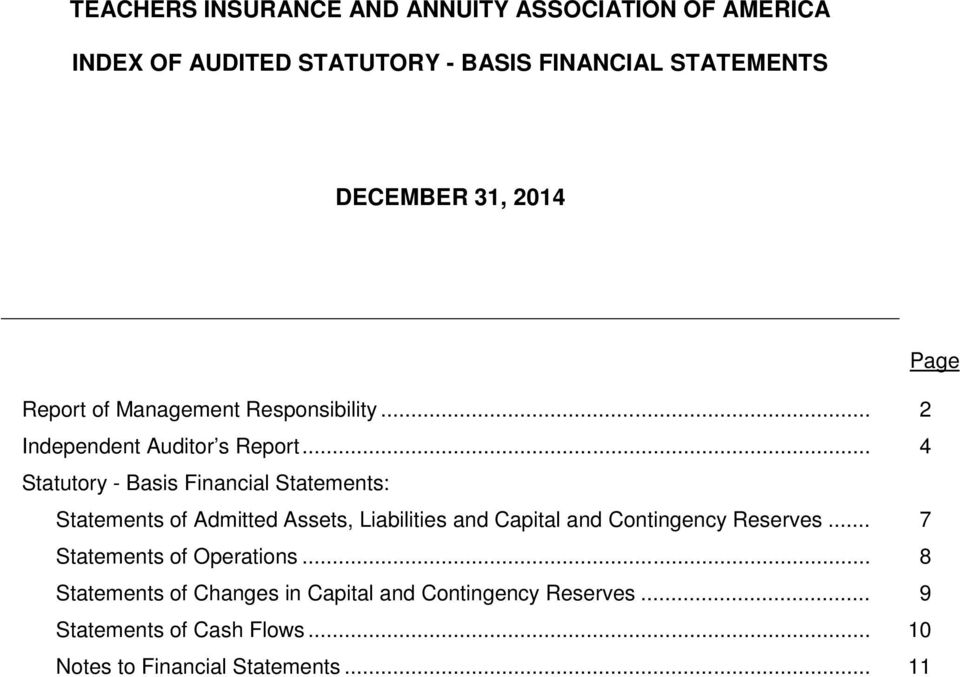
2 INDEX OF AUDITED STATUTORY - BASIS FINANCIAL STATEMENTS Page Report of Management Responsibility... 2 Independent Auditor s Report... 4 Statutory - Basis Financial Statements: Statements of Admitted Assets, Liabilities and Capital and Contingency Reserves... 7 Statements of Operations... 8 Statements of Changes in Capital and Contingency Reserves... 9 Statements of Cash Flows Notes to Financial Statements... 11
3 REPORT OF MANAGEMENT RESPONSIBILITY April 6, 2015 To the Policyholders of Teachers Insurance and Annuity Association of America: Financial Statements The accompanying statutory-basis financial statements of Teachers Insurance and Annuity Association of America ( TIAA ) are the responsibility of management. They have been prepared on the basis of statutory accounting principles, a comprehensive basis of accounting comprised of accounting principles prescribed or permitted by the New York State Department of Financial Services. The financial statements of TIAA have been presented fairly and objectively in accordance with such statutory accounting principles. In addition, TIAA s internal audit personnel provide regular reviews and assessments of the internal controls and operations of TIAA, and the Senior Managing Director, Chief Auditor regularly reports to the Audit Committee of the TIAA Board of Trustees. The independent auditors of PricewaterhouseCoopers LLP have audited the accompanying statutorybasis financial statements of TIAA for the years ended December 31, 2014, 2013 and To maintain auditor independence and avoid even the appearance of a conflict of interest, it continues to be TIAA s policy that any management advisory or consulting service, which is not in accordance with TIAA s specific auditor independence policies designed to avoid such conflicts, be obtained from a firm other than the independent auditor. The independent auditors report expresses an opinion in all material respects on the fairness of presentation of these statutory-basis financial statements. The Audit Committee of the TIAA Board of Trustees, comprised entirely of independent, nonmanagement trustees, meets regularly with management, representatives of the independent auditor and internal audit personnel to review matters relating to financial reporting, internal controls and auditing. In addition to the annual independent audit of the TIAA statutory-basis financial statements, the New York Department of Financial Services and other state insurance departments regularly examine the operations and financial statements of TIAA as part of their periodic corporate examinations. Internal Control over Financial Reporting TIAA s internal control over financial reporting is a process effected by those charged with governance, management and other personnel, designed to provide reasonable assurance regarding the preparation of reliable financial statements in accordance with statutory accounting principles. TIAA s internal control over financial reporting includes those policies and procedures that (1) pertain to the maintenance of records that, in reasonable detail, accurately and fairly reflect the transactions and dispositions of the assets of the entity; (2) provide reasonable assurance that transactions are recorded as necessary to permit preparation of financial statements in accordance with statutory accounting principles, and the receipts and expenditures of the entity are being made only in accordance with authorizations of management and those charged with governance; and (3) provide reasonable assurance regarding prevention, or timely detection and correction of unauthorized acquisition, use, or disposition of the entity s assets that could have a material effect on the financial statements. 2
4 Management is responsible for establishing and maintaining effective internal control over financial reporting. Management assessed the effectiveness of the entity s internal control over financial reporting as of December 31, 2014, based on the framework set forth by the Committee of Sponsoring Organizations of the Treadway Commission in Internal Control-Integrated Framework (2013 Framework). Based on that assessment, management concluded that, as of December 31, 2014, TIAA s internal control over financial reporting is effective based on the criteria established in Internal Control-Integrated Framework (2013 Framework). Management s assessment of the effectiveness of internal control over financial reporting as of December 31, 2014 has been audited by PricewaterhouseCoopers LLP, an independent public accounting firm, as stated in their report dated April 6, Roger W. Ferguson, Jr. President and Chief Executive Officer Virginia M. Wilson Executive Vice President and Chief Financial Officer 3
5 Independent Auditor s Report To the Board of Trustees of Teachers Insurance and Annuity Association of America We have audited the accompanying statutory-basis financial statements of Teachers Insurance and Annuity Association of America, which comprise the statutory-basis statements of admitted assets, liabilities, and capital and contingency reserves as of December 31, 2014 and 2013 and the related statutory-basis statements of operations, of changes in capital and contingency reserves and of cash flows for each of the three years in the period ended December 31, We also have audited Teachers Insurance and Annuity Association of America s internal control over financial reporting as of December 31, 2014, based on criteria established in Internal Control - Integrated Framework (2013) issued by the Committee of Sponsoring Organizations of the Treadway Commission ( COSO ). Management s Responsibility for the Financial Statements Management is responsible for the preparation and fair presentation of the statutory-basis financial statements in accordance with the accounting practices prescribed or permitted by the New York State Department of Financial Services; this includes the design, implementation, and maintenance of effective internal control over financial reporting relevant to the preparation and fair presentation of the statutorybasis financial statements that are free from material misstatement, whether due to error or fraud. Management is also responsible for its assertion about the effectiveness of internal control over financial reporting, included in the accompanying Report of Management Responsibility Internal Control over Financial Reporting. Auditor s Responsibility Our responsibility is to express an opinion on the statutory-basis financial statements and an opinion on the Company's internal control over financial reporting based on our audits. We conducted our audits of the statutory-basis financial statements in accordance with auditing standards generally accepted in the United States of America and our audit of internal control over financial reporting in accordance with attestation standards established by the American Institute of Certified Public Accountants. Those standards require that we plan and perform the audits to obtain reasonable assurance about whether the statutory-basis financial statements are free from material misstatement and whether effective internal control over financial reporting was maintained in all material respects. An audit of financial statements involves performing procedures to obtain audit evidence about the amounts and disclosures in the financial statements. The procedures selected depend on our judgment, including assessment of the risks of material misstatement of the financial statements, whether due to fraud or error. In making those risk assessments, we consider internal control relevant to the company's preparation and fair presentation of the financial statements in order to design audit procedures that are appropriate in the circumstances. An audit of financial statements also includes evaluating the appropriateness of accounting policies used and the reasonableness of significant accounting estimates made by management, as well as evaluating the overall presentation of the financial statements. An audit PricewaterhouseCoopers LLP, 300 Madison Avenue, New York, NY T: (646) , F: (813) ,

6 of internal control over financial reporting involves obtaining an understanding of internal control over financial reporting, assessing the risk that a material weakness exists, and testing and evaluating the design and operating effectiveness of internal control over financial reporting based on the assessed risk, and performing such other procedures as we considered necessary in the circumstances. We believe that the audit evidence we obtained is sufficient and appropriate to provide a basis for our opinions. Definitions and Inherent Limitations of Internal Control Over Financial Reporting A company s internal control over financial reporting is a process effected by those charged with governance, management, and other personnel, designed to provide reasonable assurance regarding the preparation of reliable statutory-basis financial statements in accordance with accounting practices prescribed or permitted by the New York State Department of Financial Services. A company s internal control over financial reporting includes those policies and procedures that (i) pertain to the maintenance of records that, in reasonable detail, accurately and fairly reflect the transactions and dispositions of the assets of the company; (ii) provide reasonable assurance that transactions are recorded as necessary to permit preparation of statutory-basis financial statements in accordance with accounting practices prescribed or permitted by the New York State Department of Financial Services, and that receipts and expenditures of the company are being made only in accordance with authorizations of management and those charged with governance; and (iii) provide reasonable assurance regarding prevention or timely detection and correction of unauthorized acquisition, use, or disposition of the company s assets that could have a material effect on the statutory-basis financial statements. Because of its inherent limitations, internal control over financial reporting may not prevent, or detect and correct misstatements. Also, projections of any evaluation of effectiveness to future periods are subject to the risk that controls may become inadequate because of changes in conditions, or that the degree of compliance with the policies or procedures may deteriorate. Basis for Adverse Opinion on U.S. Generally Accepted Accounting Principles As described in Note 2 to the statutory-basis financial statements, the statutory-basis financial statements are prepared by the Company on the basis of the accounting practices prescribed or permitted by the New York State Department of Financial Services, which is a basis of accounting other than accounting principles generally accepted in the United States of America. The effects on the statutory-basis financial statements of the variances between the statutory basis of accounting described in Note 2 and accounting principles generally accepted in the United States of America, although not reasonably determinable, are presumed to be material. Adverse Opinion on U.S. Generally Accepted Accounting Principles In our opinion, because of the significance of the matter discussed in the Basis for Adverse Opinion on U.S. Generally Accepted Accounting Principles section, the statutory-basis financial statements referred to above do not present fairly, in accordance with accounting principles generally accepted in the United States of America, the financial position of the Company as of December 31, 2014 and 2013, or the results of its operations or its cash flows thereof for each of the three years in the period ended December 31, 2014.

7 Opinions on Statutory-Basis of Accounting and Internal Control over Financial Reporting In our opinion, the statutory-basis financial statements referred to above present fairly, in all material respects, the admitted assets, liabilities, and capital and contingency reserves of Teachers Insurance and Annuity Association of America as of December 31, 2014 and 2013, and the results of its operations and its cash flows for each of the three years in the period ended December 31, 2014 in accordance with the accounting practices prescribed or permitted by the New York State Department of Financial Services described in Note 2. Also in our opinion, the Company maintained, in all material respects, effective internal control over financial reporting as of December 31, 2014, based on criteria established in Internal Control - Integrated Framework (2013) issued by COSO. New York, New York April 6, 2015

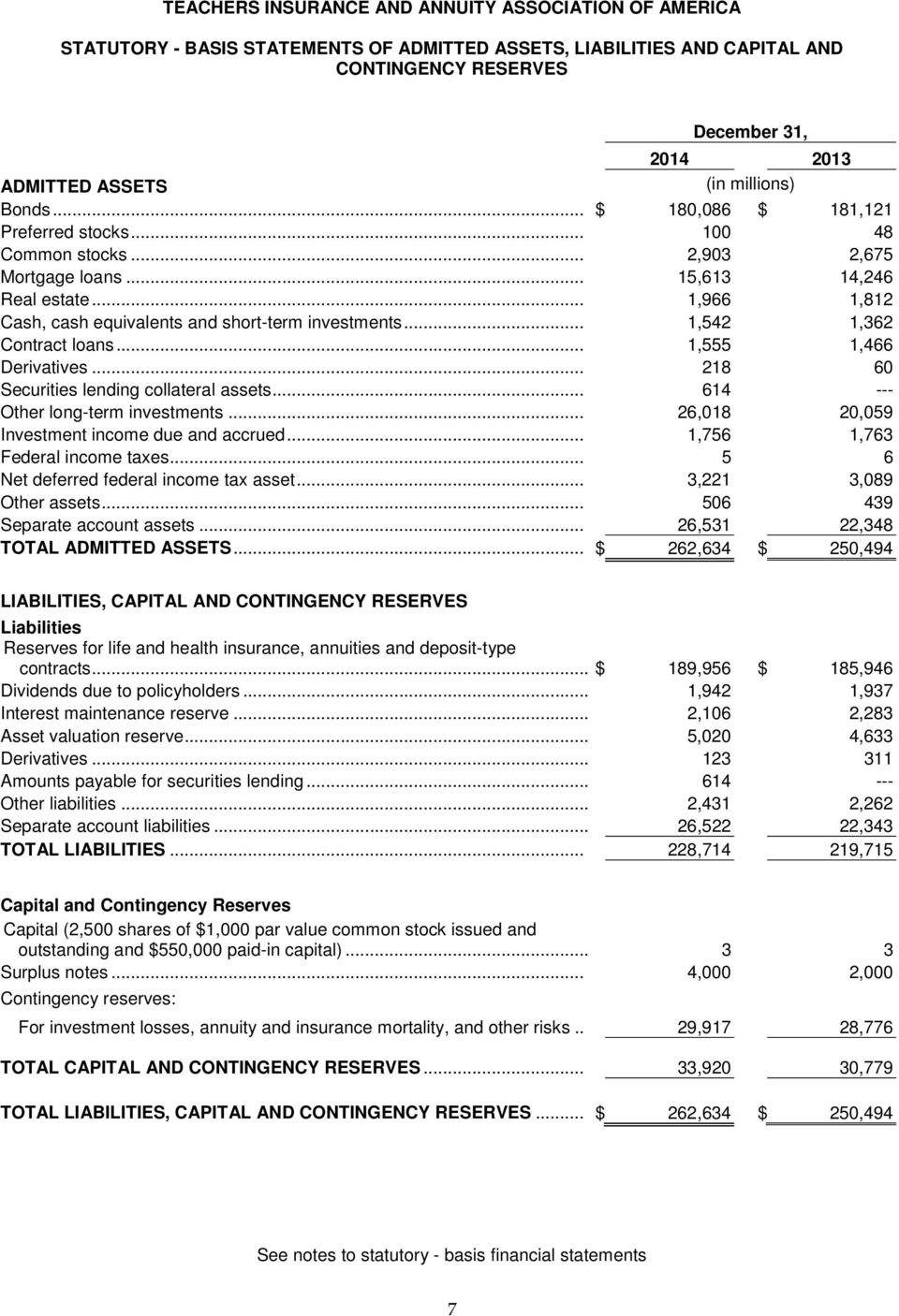
8 STATUTORY - BASIS STATEMENTS OF ADMITTED ASSETS, LIABILITIES AND CAPITAL AND CONTINGENCY RESERVES December 31, ADMITTED ASSETS (in millions) Bonds... $ 180,086 $ 181,121 Preferred stocks Common stocks... 2,903 2,675 Mortgage loans... 15,613 14,246 Real estate... 1,966 1,812 Cash, cash equivalents and short-term investments... 1,542 1,362 Contract loans... 1,555 1,466 Derivatives Securities lending collateral assets Other long-term investments... 26,018 20,059 Investment income due and accrued... 1,756 1,763 Federal income taxes Net deferred federal income tax asset... 3,221 3,089 Other assets Separate account assets... 26,531 22,348 TOTAL ADMITTED ASSETS... $ 262,634 $ 250,494 LIABILITIES, CAPITAL AND CONTINGENCY RESERVES Liabilities Reserves for life and health insurance, annuities and deposit-type contracts... $ 189,956 $ 185,946 Dividends due to policyholders... 1,942 1,937 Interest maintenance reserve... 2,106 2,283 Asset valuation reserve... 5,020 4,633 Derivatives Amounts payable for securities lending Other liabilities... 2,431 2,262 Separate account liabilities... 26,522 22,343 TOTAL LIABILITIES , ,715 Capital and Contingency Reserves Capital (2,500 shares of $1,000 par value common stock issued and outstanding and $550,000 paid-in capital) Surplus notes... 4,000 2,000 Contingency reserves: For investment losses, annuity and insurance mortality, and other risks.. 29,917 28,776 TOTAL CAPITAL AND CONTINGENCY RESERVES... 33,920 30,779 TOTAL LIABILITIES, CAPITAL AND CONTINGENCY RESERVES... $ 262,634 $ 250,494 See notes to statutory - basis financial statements 7
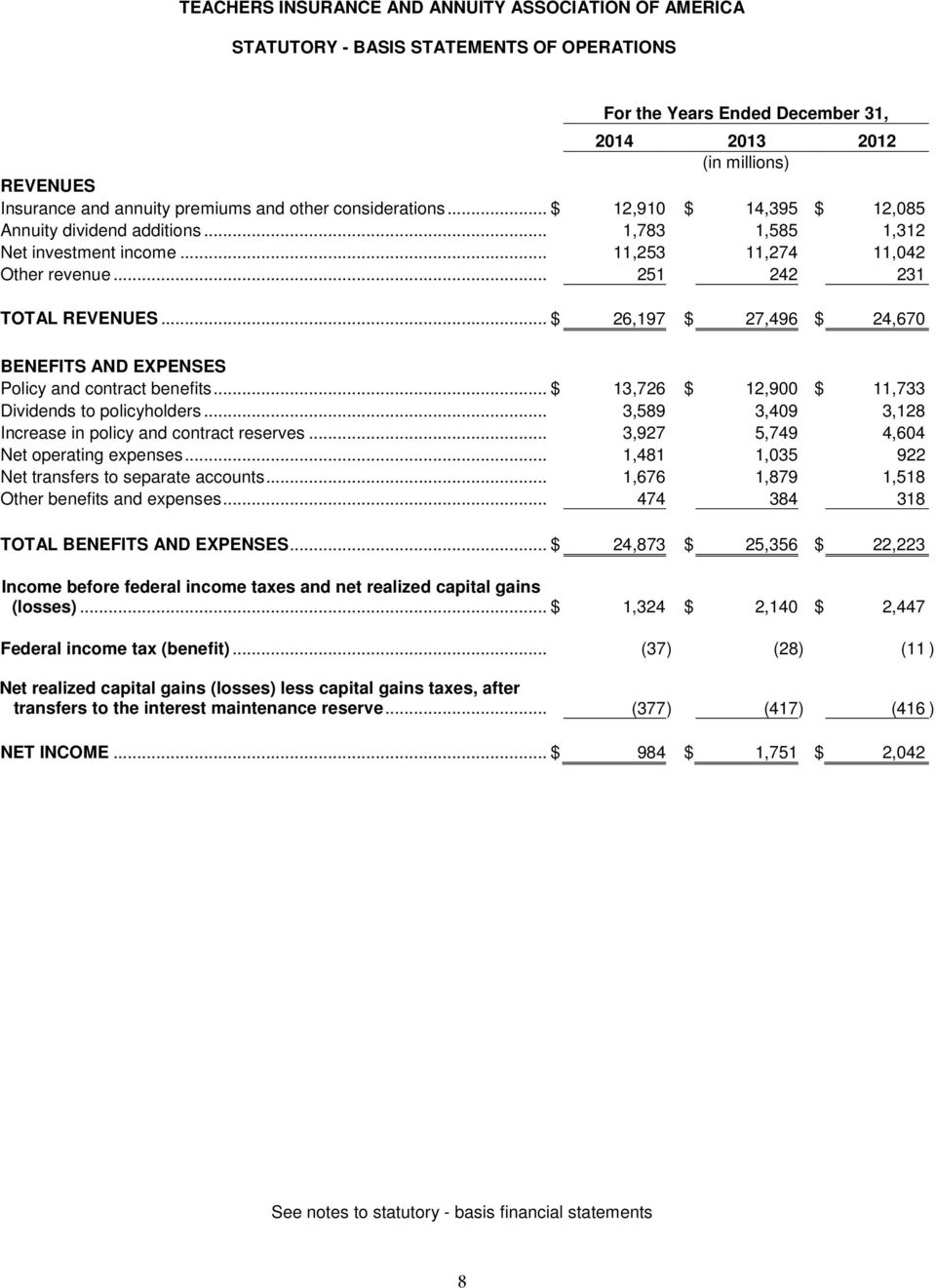
9 STATUTORY - BASIS STATEMENTS OF OPERATIONS For the Years Ended December 31, (in millions) REVENUES Insurance and annuity premiums and other considerations... $ 12,910 $ 14,395 $ 12,085 Annuity dividend additions... 1,783 1,585 1,312 Net investment income... 11,253 11,274 11,042 Other revenue TOTAL REVENUES... $ 26,197 $ 27,496 $ 24,670 BENEFITS AND EXPENSES Policy and contract benefits... $ 13,726 $ 12,900 $ 11,733 Dividends to policyholders... 3,589 3,409 3,128 Increase in policy and contract reserves... 3,927 5,749 4,604 Net operating expenses... 1,481 1, Net transfers to separate accounts... 1,676 1,879 1,518 Other benefits and expenses TOTAL BENEFITS AND EXPENSES... $ 24,873 $ 25,356 $ 22,223 Income before federal income taxes and net realized capital gains (losses)... $ 1,324 $ 2,140 $ 2,447 Federal income tax (benefit)... (37 ) (28 ) (11 ) Net realized capital gains (losses) less capital gains taxes, after transfers to the interest maintenance reserve... (377) (417) (416 ) NET INCOME... $ 984 $ 1,751 $ 2,042 See notes to statutory - basis financial statements 8
10 STATUTORY - BASIS STATEMENTS OF CHANGES IN CAPITAL AND CONTINGENCY RESERVES Capital Stock and Additional Paid-in Capital Contingency Reserves (in millions) Total Balance, December 31, $ 3 $ 27,128 $ 27,131 Net Income... 2,042 2,042 Net unrealized capital gains on investments Change in asset valuation reserve... (599 ) (599 ) Change in surplus of separate accounts Change in net deferred income tax... (1,119 ) (1,119 ) Prior year surplus adjustment... (5 ) (5 ) Change in non-admitted assets: Deferred federal income tax asset... 1,285 1,285 Other assets Balance, December 31, $ 3 $ 29,306 $ 29,309 Net Income... 1,751 1,751 Net unrealized capital gains on investments... 1,193 1,193 Change in asset valuation reserve... (1,209 ) (1,209 ) Change in surplus of separate accounts... (18 ) (18 ) Change in net deferred income tax... (1,083 ) (1,083 ) Change in post-retirement benefit liability... (11 ) (11 ) Change in non-admitted assets: Deferred federal income tax asset Other assets... (90 ) (90 ) Balance, December 31, $ 3 $ 30,776 $ 30,779 Net Income Net unrealized capital gains on investments Change in asset valuation reserve... (387 ) (387 ) Change in net deferred income tax... (447 ) (447 ) Change in post-retirement benefit liability Change in non-admitted assets: Deferred federal income tax asset Other assets Issuance of surplus notes... 2,000 2,000 Balance, December 31, $ 3 $ 33,917 $ 33,920 See notes to statutory - basis financial statements 9

11 STATUTORY - BASIS STATEMENTS OF CASH FLOWS CASH FROM OPERATIONS For the Years Ended December 31, (in millions) Insurance and annuity premiums and other considerations... $ 12,914 $ 14,398 $ 12,084 Net investment income... 10,742 10,770 10,590 Miscellaneous income Total Receipts... 23,905 25,387 22,873 Policy and contract benefits... 13,736 12,954 11,722 Operating expenses... 1,561 1,276 1,127 Dividends paid to policyholders... 1,801 1,741 1,693 Federal income tax expense (benefit)... (32 ) (13 ) (16) Net transfers to separate accounts... 1,673 1, Total Disbursements... 18,739 17,463 15,123 Net cash from operations... 5,166 7,924 7,750 CASH FROM INVESTMENTS Proceeds from investments sold, matured, or repaid: Bonds... 24,289 26,969 26,689 Stocks Mortgage loans and real estate... 2,434 2,131 2,954 Other invested assets... 2,473 3,293 2,184 Miscellaneous proceeds Cost of investments acquired: Bonds... 23,043 32,998 31,963 Stocks Mortgage loans and real estate... 4,016 3,753 2,784 Other invested assets... 8,665 3,482 3,472 Miscellaneous applications Net cash from investments... (7,133 ) (8,140 ) (6,365 ) CASH FROM FINANCING AND OTHER Issuance of surplus notes... 2, Borrowed money (51 ) (757 ) Net deposits on deposit-type contracts funds Other cash provided (applied) (122 ) 403 Net cash from financing and other... 2,147 (103 ) (301 ) NET CHANGE IN CASH, CASH EQUIVALENTS AND SHORT-TERM INVESTMENTS (319 ) 1,084 CASH, CASH EQUIVALENTS AND SHORT-TERM INVESTMENTS, BEGINNING OF YEAR... 1,362 1, CASH, CASH EQUIVALENTS AND SHORT-TERM INVESTMENTS, END OF YEAR... $ 1,542 $ 1,362 $ 1,681 See notes to statutory - basis financial statements 10

12 Note 1 Organization TEACHERS INSURANCE AND ANNUITY ASSOCIATION OF AMERICA NOTES TO STATUTORY - BASIS FINANCIAL STATEMENTS Teachers Insurance and Annuity Association of America ("TIAA" or the Company ) was established in 1918 as a legal reserve life insurance company under the insurance laws of the State of New York. All of the outstanding common stock of TIAA is held by the TIAA Board of Overseers ( Board of Overseers ), a not-for-profit corporation incorporated in the State of New York originally created for the purpose of holding the stock of TIAA. The Company s primary purpose is to aid and strengthen non-profit educational and research organizations, governmental entities and other non-profit institutions by providing retirement and insurance benefits for their employees and their families and by counseling such organizations and their employees on benefit plans and other measures of economic security. Note 2 Significant Accounting Policies Basis of Presentation: The accompanying financial statements have been prepared on the basis of statutory accounting principles prescribed or permitted by the New York State Department of Financial Services ( NYDFS or the Department ); a comprehensive basis of accounting that differs from accounting principles generally accepted in the United States ( GAAP ). The Department requires insurance companies domiciled in the State of New York to prepare their statutory-basis financial statements in accordance with the National Association of Insurance Commissioners ( NAIC ) Accounting Practices and Procedures Manual ( NAIC SAP ), subject to any deviation prescribed or permitted by the Department ( New York SAP ). The table below provides a reconciliation of the Company s net income and capital and contingency reserves between NAIC SAP and the New York SAP annual statement filed with the Department. The primary differences arise because the Company maintains more conservative reserves, as prescribed or permitted by New York SAP, under which annuity reserves are generally discounted on the basis of mortality tables and contractually guaranteed interest rates. The additional reserve for the term conversions results from the Department requiring in Regulation No. 147 (11NYCRR 98) Valuation of Life Insurance Reserves Section 98.4 that for any policy which guarantees renewal, or conversion to another policy, without evidence of insurability, additional reserves shall be held that account for excess mortality due to anti-selection with appropriate margins to cover expenses and risk of moderately adverse deviations in experience. For the Years Ended December 31, (in millions) Net Income, New York SAP... $ 984 $ 1,751 $ 2,042 New York SAP Prescribed Practices: Additional Reserves for: Term Conversions Deferred and Payout Annuities issued after Net Income, NAIC SAP... $ 1,078 $ 1,826 $ 2,107 Capital and Contingency Reserves, New York SAP... $ 33,920 $ 30,779 $ 29,309 New York SAP Prescribed Practices: Additional Reserves for: Term Conversions Deferred and Payout Annuities issued after ,084 3,990 3,917 Capital and Contingency Reserves, NAIC SAP... $ 38,024 $ 34,789 $ 33,244 11

13 Note 2 Significant Accounting Policies (continued) Accounting Principles Generally Accepted in the United States: The Financial Accounting Standards Board ("FASB") dictates the accounting principles for financial statements that are prepared in conformity with GAAP with applicable authoritative accounting pronouncements. As a result, the Company cannot refer to financial statements prepared in accordance with NAIC SAP and New York SAP as having been prepared in accordance with GAAP. The primary differences between GAAP and NAIC SAP can be summarized as follows: Under GAAP: Investments in bonds considered to be available for sale are carried at fair value under GAAP rather than at amortized cost; Impairments on securities (other than loan-backed and structured securities) due to credit losses are recorded as other-than-temporary impairments ( OTTI ) through earnings for the difference between amortized cost and discounted cash flows when a security is deemed impaired. Other declines in fair value related to factors other than credit are recorded as other comprehensive income, which is a separate component of stockholder s equity. Under NAIC SAP, an impairment for such securities is recorded through earnings for the difference between amortized cost and fair value; For loan-backed and structured securities that are other-than-temporarily impaired, declines in fair value related to factors other than credit are recorded as other comprehensive income, which is a separate component of stockholder s equity. Under NAIC SAP, such declines in fair value are not recorded until a credit loss occurs; Changes in the allowance for estimated uncollectible amounts related to mortgage loans are recorded through earnings under GAAP rather than as unrealized losses, which is a component of surplus under NAIC SAP; Changes in the value of certain other long-term investments accounted for under the equity method of accounting are recorded through earnings under GAAP rather than as unrealized gains (losses), which is a component of surplus under NAIC SAP; Investments in wholly-owned subsidiaries, other entities under the control of the parent, and certain variable interest entities are consolidated in the parent s financial statements rather than being carried at the parent s share of the underlying GAAP equity or statutory surplus of a domestic insurance subsidiary; Contracts that contain an embedded derivative are not bifurcated between components and are accounted for as part of the host contract, whereas under GAAP, the embedded derivative would be bifurcated from the host contract and accounted for separately; Certain assets designated as non-admitted assets and excluded from assets in the statutory balance sheet are included in the GAAP balance sheet; Surplus notes are reported as a liability rather than a component of capital and contingency reserves; The Asset Valuation Reserve ( AVR ) is eliminated as it is not recognized under GAAP. The AVR is established under NAIC SAP with changes recorded as a direct charge to surplus; The Interest Maintenance Reserve ( IMR ) is eliminated as it is not recognized under GAAP. The realized gains and losses resulting from changes in interest rates are reported as a component of net income under GAAP rather than being deferred and subsequently amortized into income over the remaining expected life of the investment sold; Dividends on participating policies are accrued when earned under GAAP rather than being recognized for the year when they are approved; Policy acquisition costs, such as commissions, and other costs incurred in connection with acquiring new business, are deferred and amortized over the expected lives of the policies issued under GAAP rather than being expensed when incurred; 12

14 Note 2 Significant Accounting Policies (continued) Policy and contract reserves are based on estimates of expected mortality, morbidity, persistency and interest under GAAP rather than being based on statutory mortality, morbidity and interest requirements; Deferred income taxes, subject to valuation allowance, include federal and state income taxes and changes in the deferred tax are reflected in earnings. Under NAIC SAP, deferred taxes exclude state income taxes and are admitted to the extent they can be realized within three years subject to a 15% limitation of capital and surplus with changes in the net deferred tax reflected as a component of surplus; Contracts that do not subject the Company to risks arising from policyholder mortality or morbidity are reported as a deposit liability. Under NAIC SAP, contracts that have any mortality and morbidity risk, regardless of significance, and contracts with life contingent annuity purchase rate guarantees are classified as insurance contracts and amounts received under these contracts are reported as revenue; Assets and liabilities are reported gross of reinsurance under GAAP and net of reinsurance under NAIC SAP. Certain reinsurance transactions are accounted for as financing transactions under GAAP and as reinsurance under NAIC SAP purposes. Transactions recorded as financing have no impact on premiums or losses incurred, while under NAIC SAP, premiums paid to the reinsurer are recorded as ceded premiums (a reduction in revenue) and expected reimbursement for losses from the reinsurer are recorded as a reduction in losses; When reserves ceded to an unauthorized reinsurer exceed the assets or letters of credit supporting the reserves no liability is established under GAAP. Under NAIC SAP, a liability is established and changes to these amounts are credited or charged directly to unassigned surplus (deficit). The effects of these differences, while not determined, are presumed to be material. Use of Estimates: The preparation of statutory-basis financial statements requires management to make estimates and assumptions that impact the reported amounts of assets and liabilities at the date of the financial statements. Management is also required to disclose contingent assets and liabilities at the date of the financial statements and the reported amounts of revenues and expenses during the reporting periods. Actual results may differ from those estimates. The most significant estimates include those used in the recognition of other-than-temporary impairments, reserves for life and health insurance, annuities and deposit-type contracts and the valuation of deferred tax assets. Accounting Policies: The following is a summary of the significant accounting policies followed by the Company: Investments: Publicly traded securities are accounted for as of the date the investments are purchased or sold (trade date). Other investments are recorded on the settlement date. Realized capital gains and losses on investment transactions are accounted for under the specific identification method. A realized loss is recorded when an impairment is considered to be other-than-temporary. Bonds: Bonds are stated at amortized cost using the current effective interest method. Bonds in or near default (rated NAIC 6) are stated at the lower of amortized cost or fair value. Bonds the Company intends to sell prior to maturity ( held for sale ) are stated at the lower of amortized cost or fair value. If it is determined that a decline in the fair value of a bond, excluding loan-backed and structured securities, is other-than-temporary, the cost basis of the bond is written down to fair value and the amount of the write down is accounted for as a realized loss. The new cost basis is not changed for subsequent recoveries in fair value. Future declines in fair value which are determined to be other-than-temporary are recorded as realized losses. 13

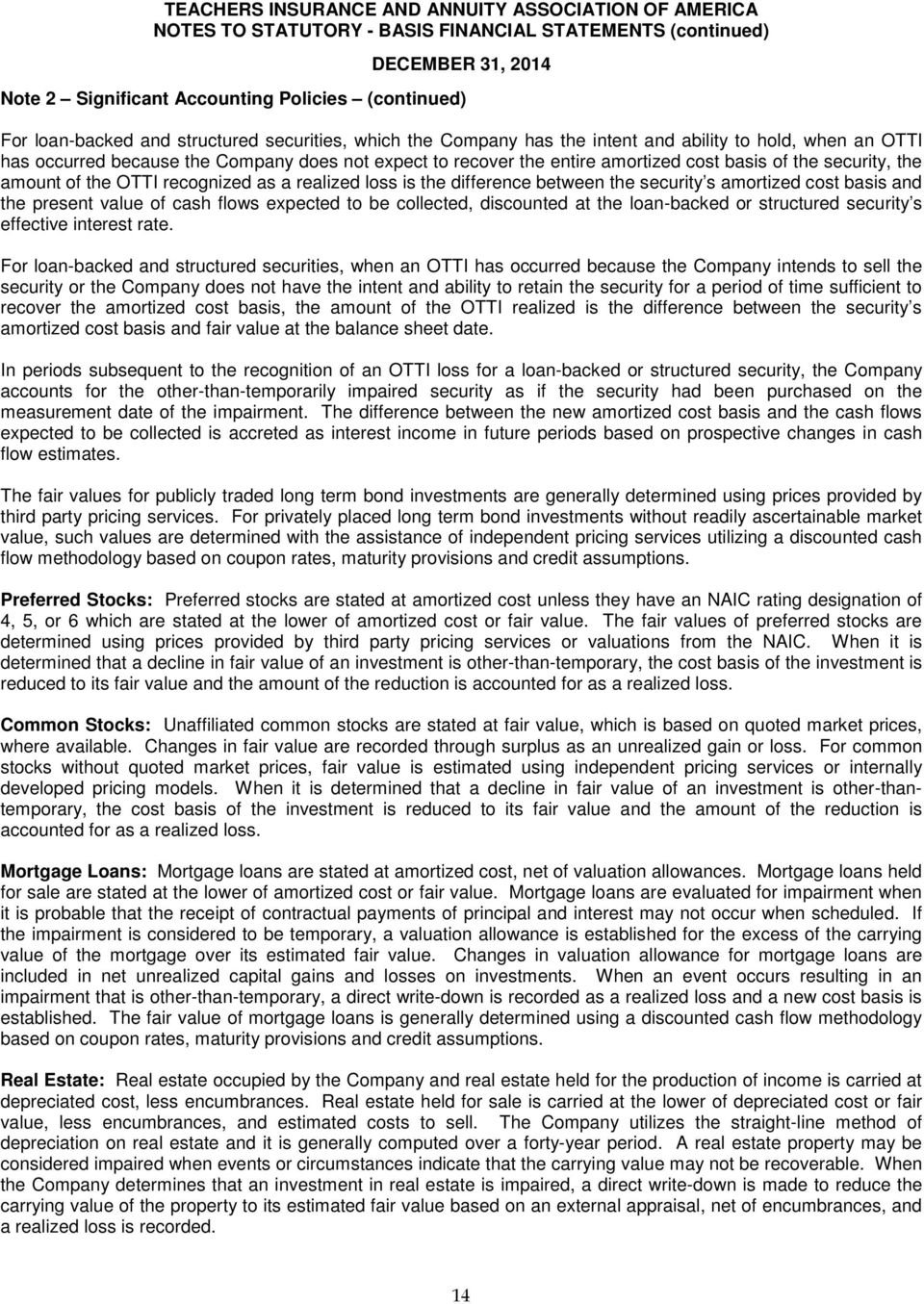
15 Note 2 Significant Accounting Policies (continued) For loan-backed and structured securities, which the Company has the intent and ability to hold, when an OTTI has occurred because the Company does not expect to recover the entire amortized cost basis of the security, the amount of the OTTI recognized as a realized loss is the difference between the security s amortized cost basis and the present value of cash flows expected to be collected, discounted at the loan-backed or structured security s effective interest rate. For loan-backed and structured securities, when an OTTI has occurred because the Company intends to sell the security or the Company does not have the intent and ability to retain the security for a period of time sufficient to recover the amortized cost basis, the amount of the OTTI realized is the difference between the security s amortized cost basis and fair value at the balance sheet date. In periods subsequent to the recognition of an OTTI loss for a loan-backed or structured security, the Company accounts for the other-than-temporarily impaired security as if the security had been purchased on the measurement date of the impairment. The difference between the new amortized cost basis and the cash flows expected to be collected is accreted as interest income in future periods based on prospective changes in cash flow estimates. The fair values for publicly traded long term bond investments are generally determined using prices provided by third party pricing services. For privately placed long term bond investments without readily ascertainable market value, such values are determined with the assistance of independent pricing services utilizing a discounted cash flow methodology based on coupon rates, maturity provisions and credit assumptions. Preferred Stocks: Preferred stocks are stated at amortized cost unless they have an NAIC rating designation of 4, 5, or 6 which are stated at the lower of amortized cost or fair value. The fair values of preferred stocks are determined using prices provided by third party pricing services or valuations from the NAIC. When it is determined that a decline in fair value of an investment is other-than-temporary, the cost basis of the investment is reduced to its fair value and the amount of the reduction is accounted for as a realized loss. Common Stocks: Unaffiliated common stocks are stated at fair value, which is based on quoted market prices, where available. Changes in fair value are recorded through surplus as an unrealized gain or loss. For common stocks without quoted market prices, fair value is estimated using independent pricing services or internally developed pricing models. When it is determined that a decline in fair value of an investment is other-thantemporary, the cost basis of the investment is reduced to its fair value and the amount of the reduction is accounted for as a realized loss. Mortgage Loans: Mortgage loans are stated at amortized cost, net of valuation allowances. Mortgage loans held for sale are stated at the lower of amortized cost or fair value. Mortgage loans are evaluated for impairment when it is probable that the receipt of contractual payments of principal and interest may not occur when scheduled. If the impairment is considered to be temporary, a valuation allowance is established for the excess of the carrying value of the mortgage over its estimated fair value. Changes in valuation allowance for mortgage loans are included in net unrealized capital gains and losses on investments. When an event occurs resulting in an impairment that is other-than-temporary, a direct write-down is recorded as a realized loss and a new cost basis is established. The fair value of mortgage loans is generally determined using a discounted cash flow methodology based on coupon rates, maturity provisions and credit assumptions. Real Estate: Real estate occupied by the Company and real estate held for the production of income is carried at depreciated cost, less encumbrances. Real estate held for sale is carried at the lower of depreciated cost or fair value, less encumbrances, and estimated costs to sell. The Company utilizes the straight-line method of depreciation on real estate and it is generally computed over a forty-year period. A real estate property may be considered impaired when events or circumstances indicate that the carrying value may not be recoverable. When the Company determines that an investment in real estate is impaired, a direct write-down is made to reduce the carrying value of the property to its estimated fair value based on an external appraisal, net of encumbrances, and a realized loss is recorded. 14
16 Note 2 Significant Accounting Policies (continued) The Company makes investments in commercial real estate directly, through wholly owned subsidiaries and through real estate limited partnerships. The Company monitors the effects of current and expected market conditions and other factors on its real estate investments to identify and quantify any impairment in value. The Company assesses assets to determine if events or changes in circumstances indicate that the carrying amount of the asset may not be recoverable. The Company evaluates the recoverability of income producing investments based on undiscounted cash flows and then reviews the results of an independent third party appraisal to determine the fair value and if an impairment is required. Other Long-term Investments: Other long-term investments primarily include investments in limited partnerships and limited liability companies which are stated at cost adjusted for the Company s percentage of the most recent available financial statements based on the underlying U.S. GAAP, International Financial Reporting Standards or U.S. Tax basis equity as reflected on the respective entity s financial statements. Any lag in reporting for these investments shall be consistent from period to period. The Company monitors the effects of current and expected market conditions and other factors on these investments to identify and quantify any impairment in value. The Company assesses the investments for potential impairment by performing analysis between the carrying value and the cost basis of the investments. The Company evaluates recoverability of the asset to determine if OTTI is warranted. When it is determined that a decline in fair value of an investment is other-than-temporary, the cost basis of the investment is reduced to its fair value and the amount of the reduction is accounted for as a realized loss. Investments in wholly-owned subsidiaries are stated at the value of their underlying net assets as follows: (1) domestic insurance subsidiaries are stated at the value of their underlying statutory surplus and (2) non-insurance subsidiaries are stated at the value of their underlying GAAP equity. Dividends and distributions from subsidiaries are recorded in investment income to the extent they are not in excess of the investee s undistributed accumulated earnings and changes in the equity of subsidiaries are recorded directly to surplus as unrealized gains or losses. Other long-term investments include the Company s investments in surplus notes, which are stated at amortized cost. All of the Company s investments in surplus notes have an NAIC 1 rating designation. The carrying amount of the Company s investments in surplus notes was $87 million and $91 million for the years ended December 31, 2014 and 2013, respectively. Cash and Cash Equivalents: Cash includes cash on deposit and cash equivalents. Cash equivalents are shortterm, highly liquid investments, with original maturities of three months or less at the date of purchase and are stated at amortized cost. Short-Term Investments: Short-term investments (investments with remaining maturities of one year or less at the time of acquisition, excluding those investments classified as cash equivalents) that are not impaired are stated at amortized cost using the straight line interest method. Short-term investments that are impaired are stated at the lower of amortized cost or fair value. Contract Loans: Contract loans are stated at outstanding principal balances. Derivative Instruments: The Company has filed a Derivatives Use Plan with the Department. This plan details the Company s derivative policy objectives, strategies, controls and any restrictions placed on various derivative types. The plan also specifies the procedures and systems that the Company has established to evaluate, monitor and report on the derivative portfolio in terms of valuation, hedge effectiveness and counterparty credit quality. The Company may use derivative instruments for hedging, income generation, and asset replication purposes. Derivatives used by the Company may include swaps, forwards, futures and options. 15

17 Note 2 Significant Accounting Policies (continued) The carrying value of a derivative position may be at cost or fair value, depending on the type of instrument and accounting status. Hedge accounting is applied for some foreign currency swaps that hedge fixed income investments carried at amortized cost. A currency translation adjustment computed at the spot rate is recorded for these foreign currency swaps as an unrealized gain or loss. The derivative component of a RSAT is carried at unamortized premiums received or paid, adjusted for any impairments. The cash component of a RSAT is classified as a bond on the Company s balance sheet. Derivatives used in hedging transactions where hedge accounting is not being utilized are carried at fair value. The Company does not offset the carrying value amounts recognized for derivatives executed with the same counterparty under a netting agreement. Investment Income Due and Accrued: Investment income due is investment income earned and legally due to be paid to the Company at the reporting date. Investment income accrued is investment income earned but not legally due to be paid to the Company until subsequent to the reporting date. The Company writes off amounts deemed uncollectible as a charge against investment income in the period such determination is made. Amounts deemed collectible, but over 90 days past due for any invested asset except mortgage loans in default are nonadmitted. Amounts deemed collectible, but over 180 days past due for mortgage loans in default are nonadmitted. The Company accrues interest income on impaired loans to the extent it is deemed collectible. Separate Accounts: Separate Accounts are established in conformity with insurance laws and are segregated from the Company's general account and are maintained for the benefit of separate account contract holders. Separate accounts are accounted for at fair value, except the TIAA Stable Value Separate Account ("TSV") products which are accounted for at book value in accordance with NYDFS guidance. Foreign Currency Transactions and Translation: Investments denominated in foreign currencies and foreign currency contracts are valued in U.S. dollars, based on exchange rates at the end of the relevant period. Investment transactions in foreign currencies are recorded at the exchange rates prevailing on the respective transaction dates. All other asset and liability accounts denominated in foreign currencies are adjusted to reflect exchange rates at the end of the relevant period. Realized and unrealized gains and losses due to foreign exchange transactions and translation adjustments are not separately reported but are collectively included in realized and unrealized capital gains and losses, respectively. Non-Admitted Assets: For statutory accounting purposes, certain assets are designated as non-admitted assets (principally a portion of deferred federal income tax ( DFIT ) assets, certain investments in other long-term investments, furniture and equipment, leasehold improvements, and prepaid expenses). The non-admitted portion of the DFIT asset was $7,448 million and $8,027 million at December 31, 2014 and 2013, respectively. Investment related non-admitted assets totaled $188 million and $187 million at December 31, 2014 and 2013, respectively. Other non-admitted assets were $780 million and $795 million at December 31, 2014 and 2013, respectively. Changes in non-admitted assets are charged or credited directly to surplus. Electronic Data Processing Equipment, Computer Software, Furniture and Equipment and Leasehold Improvements: Electronic data processing ( EDP ) equipment, computer software and furniture and equipment which qualify for capitalization are depreciated over the lesser of useful life or 3 years. Office alterations and leasehold tenant improvements which qualify for capitalization are depreciated over the lesser of useful life or 5 years or the remaining life of the lease, respectively. The accumulated depreciation on EDP equipment and computer software was $1,522 million and $1,246 million at December 31, 2014 and 2013, respectively. Related depreciation expenses incurred by TIAA were $122 million, $77 million and $51 million for the years ended December 31, 2014, 2013 and 2012, respectively. The accumulated depreciation on furniture and equipment and leasehold improvements was $481 million and $455 million at December 31, 2014, and 2013, respectively. Related depreciation expenses incurred by TIAA were $8 million, $10 million and $18 million for the years ended December 31, 2014, 2013 and 2012, respectively. 16

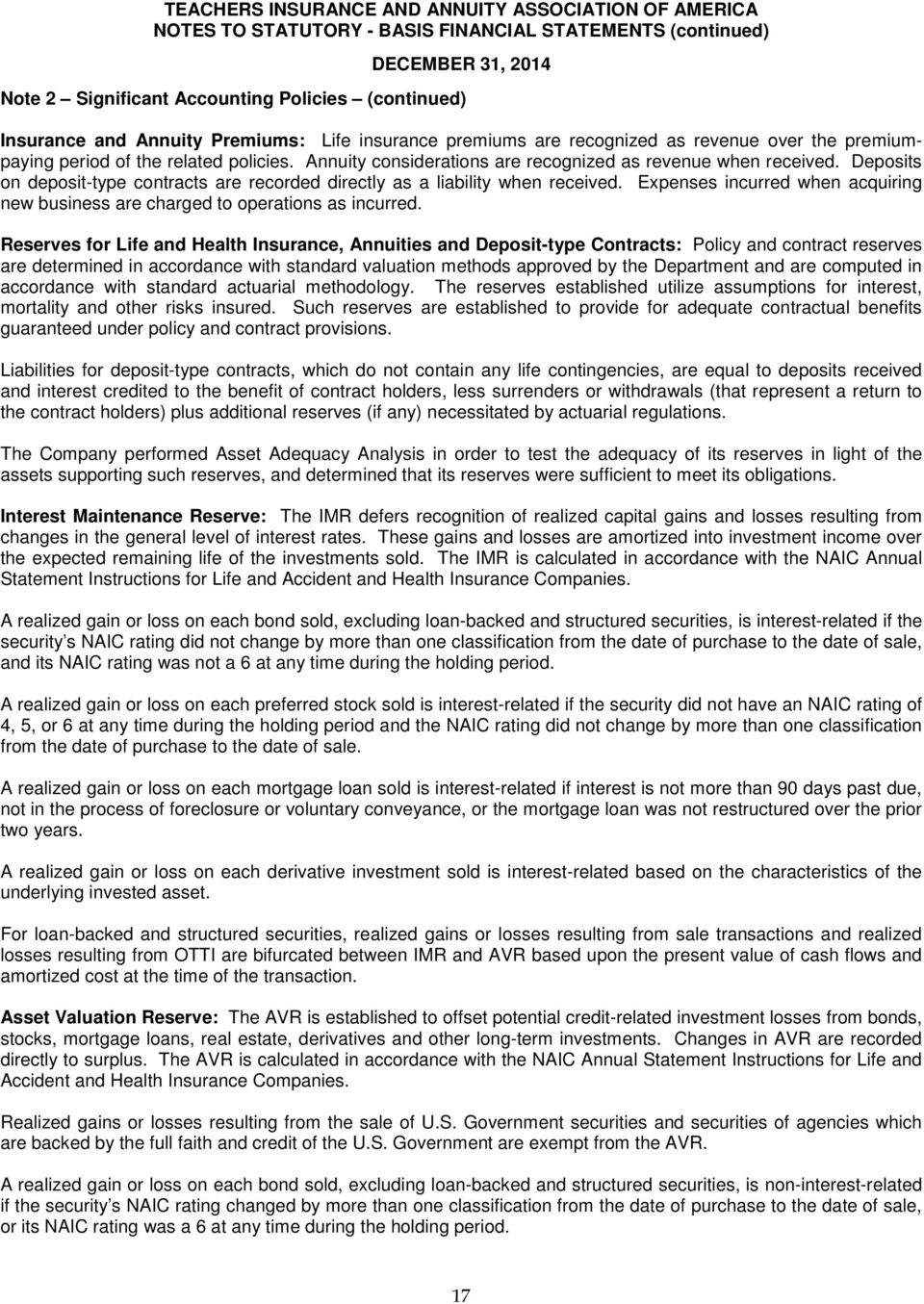
18 Note 2 Significant Accounting Policies (continued) Insurance and Annuity Premiums: Life insurance premiums are recognized as revenue over the premiumpaying period of the related policies. Annuity considerations are recognized as revenue when received. Deposits on deposit-type contracts are recorded directly as a liability when received. Expenses incurred when acquiring new business are charged to operations as incurred. Reserves for Life and Health Insurance, Annuities and Deposit-type Contracts: Policy and contract reserves are determined in accordance with standard valuation methods approved by the Department and are computed in accordance with standard actuarial methodology. The reserves established utilize assumptions for interest, mortality and other risks insured. Such reserves are established to provide for adequate contractual benefits guaranteed under policy and contract provisions. Liabilities for deposit-type contracts, which do not contain any life contingencies, are equal to deposits received and interest credited to the benefit of contract holders, less surrenders or withdrawals (that represent a return to the contract holders) plus additional reserves (if any) necessitated by actuarial regulations. The Company performed Asset Adequacy Analysis in order to test the adequacy of its reserves in light of the assets supporting such reserves, and determined that its reserves were sufficient to meet its obligations. Interest Maintenance Reserve: The IMR defers recognition of realized capital gains and losses resulting from changes in the general level of interest rates. These gains and losses are amortized into investment income over the expected remaining life of the investments sold. The IMR is calculated in accordance with the NAIC Annual Statement Instructions for Life and Accident and Health Insurance Companies. A realized gain or loss on each bond sold, excluding loan-backed and structured securities, is interest-related if the security s NAIC rating did not change by more than one classification from the date of purchase to the date of sale, and its NAIC rating was not a 6 at any time during the holding period. A realized gain or loss on each preferred stock sold is interest-related if the security did not have an NAIC rating of 4, 5, or 6 at any time during the holding period and the NAIC rating did not change by more than one classification from the date of purchase to the date of sale. A realized gain or loss on each mortgage loan sold is interest-related if interest is not more than 90 days past due, not in the process of foreclosure or voluntary conveyance, or the mortgage loan was not restructured over the prior two years. A realized gain or loss on each derivative investment sold is interest-related based on the characteristics of the underlying invested asset. For loan-backed and structured securities, realized gains or losses resulting from sale transactions and realized losses resulting from OTTI are bifurcated between IMR and AVR based upon the present value of cash flows and amortized cost at the time of the transaction. Asset Valuation Reserve: The AVR is established to offset potential credit-related investment losses from bonds, stocks, mortgage loans, real estate, derivatives and other long-term investments. Changes in AVR are recorded directly to surplus. The AVR is calculated in accordance with the NAIC Annual Statement Instructions for Life and Accident and Health Insurance Companies. Realized gains or losses resulting from the sale of U.S. Government securities and securities of agencies which are backed by the full faith and credit of the U.S. Government are exempt from the AVR. A realized gain or loss on each bond sold, excluding loan-backed and structured securities, is non-interest-related if the security s NAIC rating changed by more than one classification from the date of purchase to the date of sale, or its NAIC rating was a 6 at any time during the holding period. 17
19 Note 2 Significant Accounting Policies (continued) A realized gain or loss on each preferred stock sold is non-interest-related if the security had an NAIC rating of 4, 5 or 6 at any time during the holding period or the NAIC rating changed by more than one classification from the date of purchase to the date of sale. A realized gain or loss on each mortgage loan sold is non-interest-related if interest is more than 90 days past due, in the process of foreclosure or voluntary conveyance, or the mortgage loan was restructured over the prior two years. A realized gain or loss on each derivative investment sold is non-interest-related based on the characteristics of the underlying invested asset. For loan-backed and structured securities, realized gains or losses resulting from sale transactions and realized losses resulting from OTTI are bifurcated between IMR and AVR based upon the present value of cash flows and amortized cost at the time of the transaction. OTTI for non-loan-backed and structured securities, stocks, mortgage loans, real estate and other long-term investments are considered non-interest related realized losses and included in the AVR calculation. Repurchase Agreement: Repurchase agreements are agreements between a seller and a buyer, whereby the seller of securities sells and simultaneously agrees to repurchase the same or substantially the same securities from the buyer at a stated price on a specified date. Repurchase agreements are generally accounted for as secured borrowings. The assets transferred are not removed from the balance sheet; the cash collateral received is reported on the balance sheet with an offsetting liability reported in Other liabilities. Security Lending Program: The Company has a security lending program whereby it may lend securities to qualified institutional borrowers to earn additional income. The Company receives collateral (in the form of cash) against the loaned securities and maintains collateral in an amount not less than 102% of the market value of loaned securities during the period of the loan; any additional collateral required due to changes in security values is delivered to the Company the next business day. Cash collateral received by the Company will generally be invested in high-quality short-term instruments or bank deposits. The cash collateral received is reported in Securities lending collateral assets with an offsetting collateral liability included in Amounts payable for securities lending. Securities lending income and expense are recorded in the accompanying Statements of Operations as net investment income. Dividends Due to Policyholders: Dividends on insurance policies and pension annuity contracts in the payout phase are declared by the TIAA Board of Trustees (the "Board") in the fourth quarter of each year, and such dividends are credited to policyholders in the following calendar year. Dividends on pension annuity contracts in the accumulation phase are declared by the Board in February of each year, and such dividends on the various existing vintages of pension annuity contracts in the accumulation phase are credited to policyholders during the ensuing twelve month period beginning March 1. Application of New Accounting Pronouncements: Effective January 1, 2013, the Company adopted SSAP No Accounting for Postretirement Benefits Other Than Pensions, A Replacement of SSAP No. 14. SSAP No. 92 was effective for quarterly and annual reporting periods beginning on or after January 1, 2013 with early adoption permitted. This statement establishes financial accounting and reporting standards for an insurer that offers a defined benefit postretirement plan to its employees. Any unfunded defined benefit amounts, as determined when the projected benefit obligation exceeds the fair value of plan assets, is a liability under SSAP No. 5R and shall be reported in the first quarter statutory financial statements after the transition date with a corresponding entry to unassigned funds (surplus). Net periodic pension cost shall include a component for unrecognized prior service cost for non-vested employees beginning in The Company determined that SSAP No. 92 did not have a material impact. 18
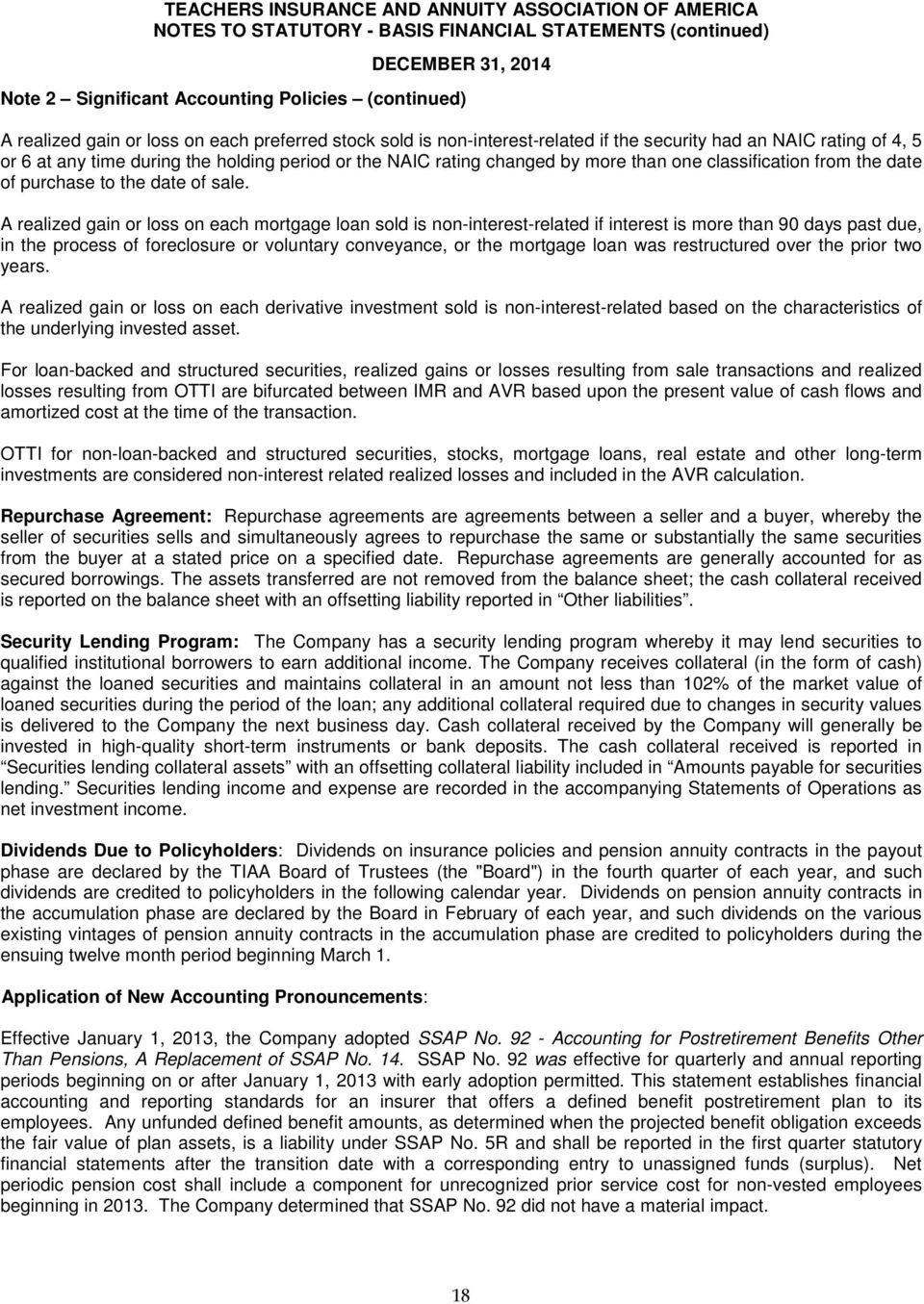
20 Note 2 Significant Accounting Policies (concluded) Effective January 1, 2013, the Company adopted SSAP No Accounting for Transfers and Servicing of Financial Assets and Extinguishments of Liabilities. SSAP No. 103 was effective for years beginning on and after January 1, 2013 and applied prospectively. Early application is prohibited. This statement must be applied to transfers occurring on or after the effective date. The concept of a qualifying special purpose entity is no longer relevant for statutory accounting purposes. The unit of account for sale treatment is defined to be an entire financial asset or a pro rata participating interest without subordination. The disclosure provisions of this statement are applied to transfers that occurred both before and after the effective date of this statement. SSAP No. 103 did not have an impact on the Company. Note 3 Long-Term Bonds, Preferred Stocks, and Common Stocks The book/adjusted carrying value, estimated fair value, excess of fair value over book/adjusted carrying value and excess of book/adjusted carrying value over fair value of long-term bonds and preferred stocks at December 31, are shown below (in millions): Book/ Adjusted Carrying Value Fair Value Over Book/Adjusted Carrying Value 2014 Excess of Book/Adjusted Carrying Value Over Fair Value Estimated Fair Value Bonds: U.S. governments... $ 39,309 $ 4,567 $ (63) $ 43,813 All other governments.... 4, (20) 4,907 States, territories and possessions (1) 786 Political subdivisions of states, territories, and possessions (5) 589 Special revenue and special assessment, non-guaranteed agencies and government. 18,372 1,532 (81) 19,823 Credit tenant loans... 6, (13) 7,007 Industrial and miscellaneous ,462 8,550 (607) 115,405 Hybrids (12) 984 Parent, subsidiaries and affiliates... 1, (1) 1,917 Total bonds ,086 15,948 (803) 195,231 Preferred stocks Total bonds and preferred stocks... $ 180,186 $ 15,969 $ (803) $ 195,352 19

21 Note 3 Long-Term Bonds, Preferred Stocks, and Common Stocks (continued) Book/ Adjusted Carrying Value Fair Value Over Book/Adjusted Carrying Value 2013 Excess of Book/Adjusted Carrying Value Over Fair Value Estimated Fair Value Bonds: (in millions) U.S. governments... $ 41,161 $ 1,841 $ (1,169) $ 41,833 All other governments.... 3, (76) 4,234 States, territories and possessions (15) 655 Political subdivisions of states, territories, and possessions (23) 476 Special revenue and special assessment, non-guaranteed agencies and government. 18,862 1,307 (652) 19,517 Credit tenant loans... 5, (92) 6,069 Industrial and miscellaneous ,416 6,447 (2,155) 111,708 Hybrids... 1, (16) 1,046 Parent, subsidiaries and affiliates... 1, ,871 Total bonds ,121 10,486 (4,198) 187,409 Preferred stocks Total bonds and preferred stocks... $ 181,169 $ 10,526 $ (4,198) $ 187,497 Impairment Review Process: All securities are subjected to the Company s process for identifying OTTI. The Company writes down securities it deems to have an OTTI in value during the period the securities are deemed to be impaired, based on management's case-by-case evaluation of the decline in value and prospects for recovery. Management considers a wide range of factors in the impairment evaluation process, including, but not limited to, the following: (a) the length of time the fair value has been below amortized cost; (b) the financial condition and near-term prospects of the issuer; (c) whether the debtor is current on contractually obligated interest and principal payments; (d) the intent and ability of the Company to retain the investment for a period of time sufficient to allow for any anticipated recovery in fair value or repayment; (e) information obtained from regulators and ratings agencies; (f) the potential for impairments in an entire industry sector or sub-sector; (g) the potential for impairments in certain economically-depressed geographic locations and (h) the potential for impairment based on an estimated discounted cash flow analysis for structured and loan-backed securities. Where impairment is considered to be other-than-temporary, the Company recognizes a write-down as a realized loss and adjusts the cost basis of the security accordingly. The Company does not change the revised cost basis for subsequent recoveries in value. Once an impairment write-down has been recorded, the Company continues to review the impaired security for appropriate valuation on an ongoing basis. 20
22 Note 3 Long-Term Bonds, Preferred Stocks, and Common Stocks (continued) Unrealized Losses on Bonds, Preferred Stocks and Unaffiliated Common Stocks: The gross unrealized losses and estimated fair values for securities by the length of time that individual securities had been in a continuous unrealized loss position are shown in the table below (in millions): December 31, 2014 Amortized Cost Less than twelve months Gross Unrealized Loss Estimated Fair Value Amortized Cost Twelve months or more Gross Unrealized Loss Estimated Fair Value Loan-backed and structured bonds... $ 1,796 $ (22) $ 1,774 $ 6,182 $ (256) $ 5,926 All other bonds... 7,657 (254) 7,403 8,691 (291) 8,400 Total bonds... $ 9,453 $ (276) $ 9,177 $ 14,873 $ (547) $ 14,326 Unaffiliated common stocks (4) Preferred stocks Total bonds and stocks... $ 9,493 $ (280) $ 9,213 $ 14,873 $ (547) $ 14,326 December 31, 2013 Amortized Cost Less than twelve months Gross Unrealized Loss Estimated Fair Value Amortized Cost Twelve months or more Gross Unrealized Loss Estimated Fair Value Loan-backed and structured bonds... $ 16,499 $ (1,026) $ 15,473 $ 5,111 $ (565) $ 4,546 All other bonds... 31,179 (1,995) 29,184 5,485 (702) 4,783 Total bonds... $ 47,678 $ (3,021) $ 44,657 $ 10,596 $ (1,267) $ 9,329 Unaffiliated common stocks (48) 58 Preferred stocks (1) 4 Total bonds and stocks... $ 47,680 $ (3,021) $ 44,659 $ 10,707 $ (1,316) $ 9,391 As of December 31, 2014, the major categories of securities where the estimated fair value declined and remained below cost for less than twelve months were diversified in oil and gas (42%), services (10%), and mining (9%). The preceding percentages were calculated as a percentage of the gross unrealized loss. As of December 31, 2014, the major categories of securities where the estimated fair value declined and remained below cost for twelve months or greater were diversified in residential mortgage-backed securities (28%), commercial mortgage-backed securities (13%), and oil and gas (10%). The preceding percentages were calculated as a percentage of the gross unrealized loss. As of December 31, 2013, the major categories of securities where the estimated fair value declined and remained below cost for less than twelve months were diversified in residential mortgage-backed securities (22%), U.S., Canada and other government (22%) and public utilities (8%). The preceding percentages were calculated as a percentage of the gross unrealized loss. As of December 31, 2013, the major categories of securities where the estimated fair value declined and remained below cost for twelve months or greater were diversified in commercial mortgage-backed securities (25%), U.S., Canada and other government (23%), and residential mortgage-backed securities (14%). The preceding percentages were calculated as a percentage of the gross unrealized loss. 21
23 Note 3 Long-Term Bonds, Preferred Stocks, and Common Stocks (continued) Based upon the Company s current evaluation of these securities in accordance with its impairment policy, the Company has concluded that these securities are not other than-temporarily impaired. Additionally, the Company currently intends and has the ability to hold the securities with unrealized losses for a period of time sufficient for them to recover. Scheduled Maturities of Bonds: The carrying value and estimated fair value of bonds, categorized by contractual maturity, are shown below. Bonds not due at a single maturity date have been included in the following table based on the year of final maturity. Actual maturities may differ from contractual maturities because borrowers may prepay obligations with or without call or prepayment penalties. Mortgage-backed and assetbacked securities are shown separately in the table below, as they are not due at a single maturity date (dollars in millions): Book/ Adjusted Carrying Value December 31, 2014 December 31, 2013 Book/ Adjusted % of Estimated Carrying % of Total Fair Value Value Total Estimated Fair Value Due in one year or less... $ 4, % $ 4,253 $ 4, % $ 4,819 Due after one year through five years... 17, ,152 20, ,126 Due after five years through ten years... 38, ,121 35, ,983 Due after ten years... 47, ,838 45, ,939 Subtotal , , , ,867 Residential mortgagebacked securities... 44, ,745 47, ,304 Commercial mortgagebacked securities... 10, ,191 10, ,821 Asset-backed securities... 16, ,931 17, ,417 Subtotal... 71, ,867 75, ,542 Total... $ 180, % $ 195,231 $ 181, % $ 187,409 For the year ended December 31, 2014, the preceding table includes sub-prime mortgage investments totaling $2,721 million under residential mortgage-backed securities. $2,552 million or 94% of the sub-prime securities were rated investment grade (NAIC 1 and 2). For the year ended December 31, 2013, the preceding table includes sub-prime mortgage investments totaling $2,988 million under residential mortgage-backed securities. $2,712 million or 91% of the sub-prime securities were rated investment grade (NAIC 1 and 2). Sub-prime securities are backed by loans that are in the riskiest category of loans and are typically sold in a separate market from prime loans. 22
24 Note 3 Long-Term Bonds, Preferred Stocks, and Common Stocks (continued) Bond Diversification: The carrying values of long-term bond investments were diversified by the following classification at December 31 as follows: Residential mortgage-backed securities % 26.0 % U.S. and other governments Manufacturing Asset-backed securities Public utilities Commercial mortgage-backed securities Finance and financial services Oil and gas Services Revenue and special obligations Communications Retail and wholesale trade Transportation Mining Other Real estate investment trusts Total % % At December 31, 2014 and 2013, 93.2% and 93.3%, respectively, of the long-term bond portfolio was comprised of investment grade securities (NAIC 1 and 2). The following table presents the Company s carrying value and estimated fair value for the residential mortgagebacked securities portfolio ( RMBS ) at December 31, (in millions): NAIC Designation Carrying Value Estimated Fair Value Carrying Value Estimated Fair Value 1 $ 43,699 $ 47,262 $ 46,273 $ 48, Total $ 44,187 $ 47,745 $ 47,094 $ 49,304 With respect to the RMBS in the above table, approximately 99% were rated investment grade (NAIC 1 and 2) at December 31, 2014 and 2013, respectively. The Company has continued to maintain its historical procedures surrounding the evaluation of fundamental underwriting and investment standards within its investment portfolios, including investments in RMBS. Additionally, the Company continues to manage the RMBS portfolio to appropriately support its contractual obligations and will recognize impairments when diminishments in fair value are determined to be other-than-temporary based on evaluations of projected discounted cash flows as prescribed under SSAP No. 43R - Loan-Backed and Structured Securities. Management continues to actively monitor the market, credit and liquidity risk of the RMBS portfolio as an integral component of its overall asset liability management program. 23
25 Note 3 Long-Term Bonds, Preferred Stocks, and Common Stocks (continued) The following table presents the Company s carrying value and estimated fair value for the commercial mortgagebacked securities ( CMBS ) portfolio at December 31, (in millions): NAIC Designation Carrying Value Estimated Fair Value Carrying Value Estimated Fair Value 1 $ 10,248 $ 10,623 $ 9,312 $ 9, Total $ 10,817 $ 11,191 $ 10,785 $ 10,821 With respect to the CMBS in the above table, approximately 96% and 89% were rated investment grade (NAIC 1 and 2) and approximately 24% and 38% were issued prior to 2006 (based on carrying value) at December 31, 2014 and 2013, respectively. The Company has continued to maintain its historical procedures surrounding the evaluation of fundamental underwriting and investment standards within its investment portfolios, including investments in CMBS. Additionally, the Company continues to manage the CMBS portfolio to appropriately support its contractual obligations and will recognize impairments when diminishments in fair value are determined to be other-than-temporary based on evaluations of projected discounted cash flows as prescribed under SSAP 43R. Management continues to actively monitor the market, credit and liquidity risk of the CMBS portfolio as an integral component of its overall asset liability management program. Included in the Company s long-term investments are bonds with a NAIC designation of 6. The statutory carrying value of these investments and related contractual maturity is listed in the following table at December 31, (in millions): Due in one year or less... $ 79 $ --- Due after one year through five years Due after five years through ten years Due after ten years Subtotal Residential mortgage-backed securities Commercial mortgage-backed securities Asset-backed securities Total... $ 271 $ 343 Troubled Debt Restructuring: During 2014, the Company recorded bonds with book values aggregating $48 million through troubled debt restructurings. When restructuring troubled debt, the Company generally accounts for assets at their fair value at the time of restructuring or at the book value of the assets given up if lower. If the fair value is less than the book value of the assets given up, the required write-down is recognized as a realized capital loss. There were no troubled debt restructurings during
26 Note 3 Long-Term Bonds, Preferred Stocks, and Common Stocks (continued) Exchanges: During 2014 and 2013, the Company also acquired bonds and stocks through exchanges aggregating $1,892 million and $2,623 million, of which approximately $27 million and $18 million were acquired through non-monetary transactions, respectively. When exchanging securities through non-monetary transactions, the Company generally accounts for assets at their fair value with any gains or losses realized at the date of the exchange, unless a SEC Rule 144A security is exchanged for an equivalent unrestricted security. In these instances, the unrestricted security is recorded at the carrying value of the original 144A security. Loan-backed and Structured Securities: The near-term prepayment assumptions for loan-backed and structured securities are based on historical averages drawing from performance experience for a particular transaction and may vary by security type. The long-term assumptions are adjusted based on expected performance. The following table represents OTTI on securities with the intent to sell or the inability to retain for the year ended December 31, 2014 (in millions): OTTI Recognized in Loss 2a 2b Interest Non-interest Amortized Cost Basis Before OTTI Fair Value 1-(2a+2b) OTTI recognized 1st Quarter a. Intent to sell. $ 370 $ 79 $ (20) $ 311 b. Inability to retain Total 1st Quarter $ 370 $ 79 $ (20) $ 311 OTTI recognized 2nd Quarter a. Intent to sell. $ 115 $ 16 $ 1 $ 98 b. Inability to retain Total 2nd Quarter $ 115 $ 16 $ 1 $ 98 OTTI recognized 3rd Quarter a. Intent to sell. $ 1,588 $ 40 $ 3 $ 1,545 b. Inability to retain Total 3rd Quarter $ 1,588 $ 40 $ 3 $ 1,545 OTTI recognized 4th Quarter a. Intent to sell. $ 40 $ --- $ ---* $ 40 b. Inability to retain Total 4th Quarter $ 40 $ --- $ ---* $ 40 Annual Aggregate Total $ 135 $ (16) *Aggregate total less than $1 million 25
27 Note 3 Long-Term Bonds, Preferred Stocks, and Common Stocks (continued) The following table represents OTTI on securities with the intent to sell or the inability to retain for the year ended December 31, 2013 (in millions): Amortized Cost Basis Before OTTI OTTI Recognized in Loss 2a 2b Interest Non-interest Fair Value 1-(2a+2b) OTTI recognized 1st Quarter a. Intent to sell. $ 39 $ (4) $ 8 $ 35 b. Inability to retain Total 1st Quarter $ 39 $ (4) $ 8 $ 35 OTTI recognized 2nd Quarter a. Intent to sell. $ 38 $ 5 $ 3 $ 30 b. Inability to retain Total 2nd Quarter $ 38 $ 5 $ 3 $ 30 OTTI recognized 3rd Quarter a. Intent to sell. $ 160 $ 19 $ (1) $ 142 b. Inability to retain Total 3rd Quarter $ 160 $ 19 $ (1) $ 142 OTTI recognized 4th Quarter a. Intent to sell. $ --- $ --- $ --- $ --- b. Inability to retain Total 4th Quarter $ --- $ --- $ --- $ --- Annual Aggregate Total $ 20 $ 10 At December 31, 2014, the Company held loan-backed and structured securities with an OTTI recognized during 2014 where the present value of cash flows expected to be collected is less than the amortized cost. The following table represents loan-backed and structured securities currently held by the Company that recognized OTTI for the year ended December 31, 2014, (in whole dollars): CUSIP Book/Adj. Carrying Value Amortized Cost Before Current Period OTTI Present Value of Projected Cash Flows Recognized Other-Than- Temporary Impairment Amortized Cost After Other-Than- Temporary Impairment Fair Value as of Impairment Date Date of Financial Statement Where Reported 03762AAB5 $ 2,734,082 $ 1,253,400 $ (1,480,682) $ 1,253,400 $ 3,519,000 12/31/ KC98 10,940,826 10,792,340 (148,486) 10,792,340 11,129,103 12/31/ AG3 17,072,799 16,968,425 (104,374) 16,968,425 20,000,943 12/31/ TW8 11,988,056 11,832,470 (155,586) 11,832,470 12,734,251 12/31/ W61 11,690,543 11,617,920 (72,623) 11,617,920 13,725,311 12/31/ EWY8 2,387,237 2,080,712 (306,525) 2,080,712 3,107,425 12/31/ TBJ1 5,494,134 5,385,163 (108,971) 5,385,163 6,790,243 12/31/ YAD9 14,072,641 13,357,782 (714,859) 13,357,782 14,080,741 12/31/ G2J3 21,150,834 21,036,846 (113,988) 21,036,846 21,362,460 12/31/ GDA0 3,337,908 3,285,886 (52,022) 3,285,886 3,598,186 12/31/ GN35 13,669,711 13,554,083 (115,628) 13,554,083 13,638,031 12/31/ GP41 14,092,595 13,974,165 (118,430) 13,974,165 14,046,468 12/31/ GUQ6 16,672,788 16,395,549 (277,239) 16,395,549 16,690,807 12/31/
28 Note 3 Long-Term Bonds, Preferred Stocks, and Common Stocks (continued) CUSIP Book/Adj. Carrying Value Amortized Cost Before Current Period OTTI Present Value of Projected Cash Flows Recognized Other-Than- Temporary Impairment Amortized Cost After Other-Than- Temporary Impairment Fair Value as of Impairment Date Date of Financial Statement Where Reported 32052RAM2 $ 6,849,206 $ 6,778,596 $ (70,610) $ 6,778,596 $ 7,422,021 12/31/ MAJ1 11,404,026 11,011,722 (392,304) 11,011,722 11,425,098 12/31/ NA91 208, ,690 (54,120) 154, ,321 12/31/ NE63 379, ,513 (71,304) 308, ,006 12/31/ NW55 338, ,920 (98,529) 239, ,107 12/31/ JM7 932, ,853 (471,694) 460, ,443 12/31/ MMH4 9,073,706 9,023,008 (50,698) 9,023,008 9,800,138 12/31/ WUM6 1,221,796 1,176,075 (45,721) 1,176,075 1,331,642 12/31/ XN90 3,465,113 3,404,157 (60,956) 3,404,157 4,517,192 12/31/ R73 176,454 73,842 (102,612) 73, ,003 12/31/ R65 1,764, ,520 (1,579,842) 184,520 1,284,783 12/31/ EM0 669, ,843 (492,415) 176, ,291 12/31/ DY5 372, ,017 (142,299) 230, ,585 12/31/ EAF3 276, ,016 (2,359) 274, ,550 12/31/ AD9 8,280,441 8,107,688 (172,753) 8,107,688 8,944,137 12/31/ JAF7 6,038,214 5,897,359 (140,855) 5,897,359 6,424,892 12/31/ WRW8 1,780,088 1,726,587 (53,501) 1,726,587 1,718,917 12/31/ GW2 8,051,708 7,917,453 (134,255) 7,917,453 7,783,105 12/31/ DX7 2,429,968 1,771,217 (658,751) 1,771,217 1,406,650 12/31/ GVK1 9,206,717 9,165,625 (41,092) 9,165,625 9,976,977 12/31/ WUL8 13,963,916 13,728,423 (235,493) 13,728,423 14,099,430 12/31/ AW2 976, ,706 (38,841) 937, ,635 12/31/ EL2 3,126,593 3,036,302 (90,291) 3,036,302 2,605,052 12/31/ PAF5 1,845,826 1,676,250 (169,576) 1,676, ,000 12/31/ JL9 9,543,859 9,218,243 (325,616) 9,218,243 9,320,853 12/31/ GU25 2,528,043 2,477,975 (50,068) 2,477,975 2,500,049 12/31/ HAL0 2,642,577 2,411,144 (231,433) 2,411,144 2,496,575 12/31/ FAH7 5,477,914 5,243,473 (234,441) 5,243,473 5,717,467 12/31/ NJ50 616, ,505 (155,329) 461, ,027 12/31/ PCY2 215, ,463 (36,552) 178, ,400 12/31/ F7D1 14,693,497 14,683,481 (10,016) 14,683,481 15,546,390 12/31/ GBA0 44,757,414 44,675,681 (81,733) 44,675,681 46,387,922 12/31/ WNB1 13,719,711 13,694,995 (24,716) 13,694,995 14,515,208 12/31/ GVL6 14,494,569 14,278,615 (215,954) 14,278,615 14,889,640 12/31/ YY41 10,102,779 9,764,726 (338,053) 9,764,726 7,963,052 12/31/ NW48 1,906,503 1,648,001 (258,502) 1,648,001 1,380,507 12/31/ ACW6 38,769,744-1 (64,428) 38,705,316 38,705,316 12/31/ EG3 6-1 (4) /31/ A6L7 13,770-1 (2,568) 11,202 11,202 12/31/ QEP3 5,803-1 (5,705) /31/ LBR9 1,265,646-1 (25,268) 1,240,378 1,240,378 12/31/ ER9 2,099-1 (2,080) /31/ DK3 37,586-1 (2,528) 35,058 35,058 12/31/ EY2 3,767-1 (3,714) /31/ WFH8 39,851-1 (5,894) 33,957 33,957 12/31/ WFP0 10,460-1 (10,439) /31/
29 Note 3 Long-Term Bonds, Preferred Stocks, and Common Stocks (continued) CUSIP Book/Adj. Carrying Value Amortized Cost Before Current Period OTTI Present Value of Projected Cash Flows Recognized Other-Than- Temporary Impairment Amortized Cost After Other-Than- Temporary Impairment Fair Value as of Impairment Date Date of Financial Statement Where Reported 46625MAJ8 $ 3,402 $ - 1 $ (50) $ 3,352 $ 3,352 12/31/ AAB5 4,529,078 2,734,082 (1,794,996) 2,734,082 5,569,000 9/30/ CAE5 3,165,341 2,489,288 (676,053) 2,489,288 7,102,000 9/30/ KC98 11,868,584 11,654,122 (214,462) 11,654,122 11,772,046 9/30/ BB2 6,724,904 6,104,318 (620,586) 6,104,318 6,454,970 9/30/ CGN0 8,191,602 7,963,979 (227,623) 7,963,979 8,281,758 9/30/ AG3 17,279,821 16,701,426 (578,395) 16,701,426 19,883,903 9/30/ TW8 13,144,623 12,855,033 (289,590) 12,855,033 13,961,843 9/30/ W61 12,826,370 12,429,355 (397,015) 12,429,355 14,293,972 9/30/ EWY8 3,917,083 2,638,220 (1,278,863) 2,638,220 3,304,113 9/30/ TBJ1 5,802,365 5,719,012 (83,353) 5,719,012 7,167,121 9/30/ YAD9 14,575,135 14,379,482 (195,653) 14,379,482 14,708,862 9/30/ SAD0 2,926,685 2,831,821 (94,864) 2,831,821 2,957,818 9/30/ LBM1 1,480,652 1,107,880 (372,772) 1,107,880 1,682,244 9/30/ G2J3 22,266,138 22,152,509 (113,629) 22,152,509 22,834,284 9/30/ GDA0 3,536,760 3,450,938 (85,822) 3,450,938 3,874,669 9/30/ GDH5 87,665 42,858 (44,807) 42, ,130 9/30/ GFL4 9,900,629 9,738,230 (162,399) 9,738,230 11,170,398 9/30/ GN35 14,622,561 14,406,701 (215,860) 14,406,701 14,762,032 9/30/ GP41 15,077,551 14,852,443 (225,108) 14,852,443 15,204,132 9/30/ GUQ6 17,433,290 17,310,485 (122,805) 17,310,485 17,706,503 9/30/ RAM2 7,442,465 7,346,863 (95,602) 7,346,863 7,677,093 9/30/ MAJ1 12,489,703 11,605,539 (884,164) 11,605,539 11,809,769 9/30/ NA91 329, ,545 (100,272) 229, ,347 9/30/ NE63 455, ,639 (43,653) 411, ,000 9/30/ NW55 483, ,222 (108,920) 374, ,897 9/30/ DYG2 19,880,329 18,961,793 (918,536) 18,961,793 22,477,436 9/30/ MEW9 3,549,216-1 (2,582,117) 967, ,099 9/30/ MEY5 1,865,094-1 (1,865,094) - - 9/30/ MFA6 1,275,342-1 (1,275,342) - - 9/30/ MFC2 908,463-1 (908,463) - - 9/30/ MFE8 959,644-1 (959,644) - - 9/30/ MFG3 1,015,275-1 (1,015,275) - - 9/30/ MFJ7 1,075,888-1 (1,075,888) - - 9/30/ FV1 1,338,640 1,276,562 (62,078) 1,276,562 1,527,435 9/30/ JM7 1,330, ,562 (385,577) 944, ,466 9/30/ LLC8 18,428,389 17,613,142 (815,247) 17,613,142 18,281,350 9/30/ MMH4 9,481,293 9,405,581 (75,712) 9,405,581 9,967,936 9/30/ VLY5 26,332,933 25,674,223 (658,710) 25,674,223 28,396,357 9/30/ WUM6 1,358,580 1,291,448 (67,132) 1,291,448 1,414,719 9/30/ XN90 3,816,441 3,589,496 (226,945) 3,589,496 4,868,561 9/30/ MZ3 6,042,550 5,305,554 (736,996) 5,305,554 6,104,226 9/30/ ACW6 98,979,334-1 (563,830) 98,415,504 98,415,504 9/30/ RAV6 10,452,964-1 (70,152) 10,382,812 10,382,812 9/30/ CL9 99,943,894-1 (3,026,694) 96,917,200 96,917,200 9/30/ EG3 7-1 (2) 5 5 9/30/
30 Note 3 Long-Term Bonds, Preferred Stocks, and Common Stocks (continued) CUSIP Book/Adj. Carrying Value Amortized Cost Before Current Period OTTI Present Value of Projected Cash Flows Recognized Other-Than- Temporary Impairment Amortized Cost After Other-Than- Temporary Impairment Fair Value as of Impairment Date Date of Financial Statement Where Reported 22540A6L7 $ 13,853 $ - 1 $ (531) $ 13,322 $ 13,322 9/30/ QEP3 7,497-1 (7,350) /30/ LBR9 1,468,656-1 (12,004) 1,456,652 1,456,652 9/30/ PF60 3,346-1 (2,674) /30/ TAC4 5,161,723-1 (57,960) 5,103,763 5,103,763 9/30/ QCJ1 149,984,706-1 (3,494,472) 146,490, ,490,234 9/30/ JCV1 149,968,133-1 (917,333) 149,050, ,050,800 9/30/ ER9 2,164-1 (2,138) /30/ RBN8 89,968,639-1 (1,304,509) 88,664,130 88,664,130 9/30/ HFC1 36,104-1 (158) 35,946 35,946 9/30/ DK3 44,769-1 (3,128) 41,641 41,641 9/30/ EY2 6,188-1 (5,941) /30/ M3Q4 5,223,968-1 (302,120) 4,921,848 4,921,848 9/30/ WFH8 42,866-1 (2,138) 40,728 40,728 9/30/ WFP0 17,950-1 (5,702) 12,248 12,248 9/30/ KC98 12,582,295 12,571,706 (10,589) 12,571,706 12,474,597 6/30/ AMP2 99,094 - (99,094) - 230,364 6/30/ AG3 6,440,482 6,346,434 (94,048) 6,346,434 7,428,517 6/30/ AH1 7,107,908 7,016,876 (91,032) 7,016,876 8,137,805 6/30/ R65 1,928,222 1,764,362 (163,860) 1,764,362 1,323,620 6/30/ AG3 18,412,171 16,894,385 (1,517,786) 16,894,385 19,694,981 6/30/ JS8 18,370,035 18,284,559 (85,476) 18,284,559 19,647,444 6/30/ EWY8 5,649,867 4,088,704 (1,561,163) 4,088,704 3,444,154 6/30/ LBM1 1,601,513 1,548,965 (52,548) 1,548,965 1,775,412 6/30/ DY5 468, ,713 (62,523) 405, ,915 6/30/ GDA0 3,838,339 3,652,315 (186,024) 3,652,315 4,043,836 6/30/ GFL4 5,306,039 5,304,901 (1,138) 5,304,901 5,422,700 6/30/ GN35 16,485,608 16,252,269 (233,339) 16,252,269 16,641,334 6/30/ GP41 17,066,960 16,756,964 (309,996) 16,756,964 17,021,626 6/30/ NW55 555, ,119 (44,817) 511, ,372 6/30/ AD9 8,836,448 8,656,129 (180,319) 8,656,129 9,401,629 6/30/ PAB2 802, ,037 (364,995) 437, ,547 6/30/ PAC0 284,557 62,995 (221,562) 62,995 82,513 6/30/ PCY2 269, ,110 (31,662) 238, ,746 6/30/ EAF3 288, ,050 (3,381) 285, ,216 6/30/ GW2 8,171,897 8,141,064 (30,833) 8,141,064 8,068,951 6/30/ XN90 4,086,665 3,980,226 (106,439) 3,980,226 5,002,848 6/30/ GAB4 2,107 1,124 (983) 1,124 1,246 6/30/ BFF3 7,932,124 7,748,549 (183,575) 7,748,549 5,838,646 6/30/ AAG5 8,078,314 8,059,133 (19,181) 8,059,133 9,037,380 6/30/ FV54 399,485-1 (123,918) 275, ,567 6/30/ DBD2 3,141,692-1 (161,585) 2,980,107 2,980,107 6/30/ NAK8 158,584-1 (32,294) 126, ,290 6/30/ EG3 3,482-1 (3,457) /30/ AJ7 101,123-1 (3,566) 97,557 97,557 6/30/ A6L7 18,888-1 (3,169) 15,719 15,719 6/30/
31 Note 3 Long-Term Bonds, Preferred Stocks, and Common Stocks (continued) CUSIP Book/Adj. Carrying Value Amortized Cost Before Current Period OTTI Present Value of Projected Cash Flows Recognized Other-Than- Temporary Impairment Amortized Cost After Other-Than- Temporary Impairment Fair Value as of Impairment Date Date of Financial Statement Where Reported 22545LBR9 $ 1,785,050 $ - 1 $ (23,172) $ 1,761,878 $ 1,761,878 6/30/ PF60 22,357-1 (5,521) 16,836 16,836 6/30/ ER9 11,341-1 (9,114) 2,227 2,227 6/30/ CTQ6 20,992-1 (607) 20,385 20,385 6/30/ QKZ8 568,168-1 (122,381) 445, ,787 6/30/ MAJ8 20,165-1 (14,434) 5,731 5,731 6/30/ MQ85 74,315-1 (58,455) 15,860 15,860 6/30/ HN67 95,141-1 (29,304) 65,837 65,837 6/30/ HEL2 192,010-1 (31,315) 160, ,695 6/30/ HFC1 144,336-1 (80,023) 64,313 64,313 6/30/ DK3 57,771-1 (9,452) 48,319 48,319 6/30/ EY2 52,396-1 (28,756) 23,640 23,640 6/30/ WHJ2 43,199-1 (18,004) 25,195 25,195 6/30/ U4M7 4,973,360-1 (15,541) 4,957,819 4,957,819 3/31/ U4N5 2,482,819-1 (159,203) 2,323,616 2,323,616 3/31/ U6C7 19,138,935-1 (3,078,699) 16,060,236 16,060,236 3/31/ U7R3 4,425,033-1 (80,272) 4,344,761 4,344,761 3/31/ U7S1 2,900,737-1 (243,381) 2,657,356 2,657,356 3/31/ UVU9 2,000,000-1 (102,832) 1,897,168 1,897,168 3/31/ BB2 7,703,536 6,851,430 (852,106) 6,851,430 7,509,875 3/31/ BFY4 9,897,276-1 (928,755) 8,968,521 8,968,521 3/31/ YAS1 14,665,285-1 (1,476,006) 13,189,279 13,189,279 3/31/ AL1 3,372,231-1 (218,243) 3,153,988 3,153,988 3/31/ RHAA5 1,829,015 1,605,061 (223,954) 1,605,061 1,908,298 3/31/ AQ0 2,922,289-1 (72,289) 2,850,000 2,850,000 3/31/ EWY8 5,783,207 5,696,546 (86,661) 5,696,546 5,446,870 3/31/ G4H8 1,125,217 1,024,603 (100,614) 1,024,603 1,274,713 3/31/ YAD9 15,065,673 15,027,436 (38,237) 15,027,436 14,042,824 3/31/ SL97 6,958,000-1 (9,800) 6,948,200 6,948,200 3/31/ SM21 2,000,000-1 (216,040) 1,783,960 1,783,960 3/31/ DT2 2,347,823 2,041,077 (306,746) 2,041,077 2,354,811 3/31/ LBM1 1,817,293 1,688,467 (128,826) 1,688,467 1,859,456 3/31/ BQ4 1,016, ,950 (202,995) 813, ,743 3/31/ BY7 1,690,612 1,431,997 (258,615) 1,431,997 1,802,805 3/31/ DY5 767, ,770 (283,925) 483, ,408 3/31/ NW55 700, ,979 (76,138) 623, ,632 3/31/ MC5 2,720,747 2,503,490 (217,257) 2,503,490 2,509,730 3/31/ M2N2 1,000,453-1 (87,769) 912, ,684 3/31/ MAC3 2,758,690 2,725,598 (33,092) 2,725,598 5,143,814 3/31/ HBT4 3,328,116-1 (383,982) 2,944,134 2,944,134 3/31/ GW2 8,387,599 8,215,136 (172,463) 8,215,136 8,025,985 3/31/ GAB4 24,499 3,730 (20,769) 3,730 13,564 3/31/ AAN8 12,061,177-1 (5,998,221) 6,062,956 6,062,956 3/31/ MZ3 6,301,000 6,098,624 (202,376) 6,098,624 3,780,600 3/31/2014 Total $ (66,350,930) ¹ Impairment based on fair value. 30
32 Note 3 Long-Term Bonds, Preferred Stocks, and Common Stocks (concluded) Other Disclosures: During 2014 and 2013, the Company acquired common stocks from other long term private equity fund investment distributions totaling $39 million and $51 million, respectively. At December 31, 2014 and 2013, the carrying amount of restricted unaffiliated common stock was $377 million and $494 million, respectively. At December 31, 2014 and 2013, the Company held restricted preferred stock of $0 and $5 million, respectively. The restrictions include share sales, private sales, general partner approval for sale, and contractual restrictions. At December 31, 2014 and 2013, the carrying amount of bonds and stocks denominated in a foreign currency was $3,247 million and $3,394 million, respectively. Of the total bonds denominated in foreign currency, $1,895 million and $1,817 million at December 31, 2014 and 2013, respectively, represent amounts due from related parties that are collateralized by real estate owned by the Company s investment subsidiaries and affiliates. The following table represents structured notes as of December 31, 2014 (in millions): CUSIP Identification Actual Cost Fair Value Book/Adjusted Carrying Value Mortgage- Referenced Security (YES/NO) KK3 $ 14 $ 14 $ 14 No 30256YAA No AA No X77765AA No Total $ 99 $ 102 $ 99 Note 4 Mortgage Loans The Company originates mortgage loans that are principally collateralized by commercial real estate. The coupon rates for non-mezzanine commercial mortgage loans originated during 2014 ranged from 3.00% to 5.20% and from 3.49% to 4.99% for The coupon rates for mezzanine mortgage loans originated during 2014 ranged from 5.25% to 5.38% and from 5.00% to 6.25% for The coupon rates for residential mortgage loans purchased during 2014 ranged from 3.75% to 4.50%. The maximum percentage of any one loan to the value of the property at the time of the loan, exclusive of insured, guaranteed or purchase money mortgages, was 99.40% and 70.00% for commercial loans for the years ended December 31, 2014 and 2013, respectively. In 2014, there was one loan issued with a loan to value of 99.40% with a value of $13 million at December 31, The loan is a full recourse construction loan. The maximum percentage for mezzanine loans during 2014 was 73.70% and for residential loans was 80.00%. Impairment Review Process: The Company monitors the effects of current and expected market conditions and other factors on the collectability of mortgage loans to identify and quantify any impairment in value. Impairments are classified as either temporary, for which a recovery is anticipated, or other-than-temporary. Mortgage loans held to maturity with other-than-temporarily impaired values at December 31, 2014 and 2013 have been written down to net realizable values based upon independent appraisals of the collateral while mortgage loans held for sale are written down to the current fair value of the loan. For impaired mortgage loans where the impairments were deemed to be temporary, an allowance for credit losses has been established. 31
33 Note 4 Mortgage Loans (continued) The following table provides information on impaired loans classified as Commercial All Other with or without allowance for credit losses as of December 31, (in millions): Commercial All Other With Allowance for Credit Losses... $ --- $ --- $ --- No Allowance for Credit Losses... $ 159 $ 202 $ 206 The following table provides information for investment in impaired loans classified as Commercial All Other as of December 31, (in millions): Commercial All Other Average Recorded Investment... $ 53 $ 34 $ 34 Interest Income Recognized... $ 10 $ 14 $ 14 Recorded Investments on Nonaccrual Status... Amount of Interest Income Recognized Using a Cash-Basis Method of Accounting... $ --- $ --- $ --- $ 10 $ 14 $ 14 The Company had no allowance for credit losses for the three years ended December 31, 2014, 2013 and 2012, respectively. For commercial mortgage loans, the primary credit quality indicator is the debt service coverage ratio, which compares a property s net operating income to amounts needed to service the principal and interest due under the loan. Generally, the lower the debt service coverage ratio, the higher the risk of experiencing a credit loss. The Company also reviews the loan-to-value ratio of its commercial mortgage loan portfolio. Loan to-value-ratios compare the unpaid principal balance of the loan to the estimated fair value of the underlying collateral. Generally, the higher the loan-to-value ratio, the higher the risk of experiencing a credit loss. The debt service coverage ratio and the loan-to-value ratio, as well as the values utilized in calculating these ratios, are updated quarterly, with a portion of the loan portfolio updated annually. For the agricultural mortgage loan, the Company s primary credit quality indicator is the loan-to-value ratio. The values utilized in calculating this ratio are updated quarterly. For the residential mortgage loans, the primary credit quality is defined by performance versus non-performance. The Company generally defines nonperforming residential mortgage loans as those that are 90 or more days past due and/or in non-accrual status. Generally, nonperforming residential loans have a higher risk of experiencing a credit loss. 32
34 Note 4 Mortgage Loans (continued) Credit Quality The credit quality of residential, commercial and agricultural mortgage loans held-for-investment, were as follows (dollars in millions): Residential Credit Quality Recorded Investment - Residential Performance Indicators December 31, 2014 % of Total December 31, 2013 % of Total Performing... $ % $ % Non-performing Total... $ % $ % Commercial and Agriculture Credit Quality Recorded Investment - Commercial Loan-to-value Ratios 81% - 90% 70% - 80% < 70% Total % of Total > 90% December 31, 2014 Debt Service Coverage Ratios: Greater than 1.20x... $ --- $ 20 $ 173 $ 14,109 $ 14, % 1.05x x Less than 1.05x Agriculture Construction Total... $ 40 $ 59 $ 409 $ 15,069 $ 15, % Recorded Investment - Commercial Loan-to-value Ratios 81% - 90% 70% - 80% < 70% Total % of Total > 90% December 31, 2013 Debt Service Coverage Ratios: Greater than 1.20x... $ 26 $ 20 $ 641 $ 11,955 $ 12, % 1.05x x Less than 1.05x Agriculture Construction Total... $ 256 $ 37 $ 965 $ 13,035 $ 14, % 33
35 Note 4 Mortgage Loans (continued) Mortgage Loan Age Analysis: The following table sets forth an age analysis of mortgage loans (dollars in millions): Residential Commercial December 31, 2014 Farm Insured All Other Insured All Other Mezzanine Total Recorded Investment Current... $ 265 $ --- $ 86 $ --- $ 14,652 $ 660 $ 15,663 Interest Accrued... $ --- $ --- $ --- $ --- $ --- $ --- $ --- Recorded Investment... $ --- $ --- $ --- $ --- $ --- $ --- $ --- Number of Loans Interest Accrued... $ --- $ --- $ --- $ --- $ --- $ --- $ --- Interest Reduced Recorded Investment... $ --- $ --- $ --- $ --- $ 38 $ --- $ 38 Number of Loans Percent Reduced % % Residential Commercial December 31, 2013 Farm Insured All Other Insured All Other Mezzanine Total Recorded Investment During $ 265 $ --- $ --- $ --- $ 13,543 $ 485 $ 14,293 Interest Accrued... $ --- $ --- $ --- $ --- $ --- $ --- $ --- Recorded Investment... $ --- $ --- $ --- $ --- $ --- $ --- $ --- Number of Loans Interest Accrued... $ --- $ --- $ --- $ --- $ --- $ --- $ --- Interest Reduced Recorded Investment... $ --- $ --- $ --- $ --- $ --- $ --- $ --- Number of Loans Percent Reduced Residential Commercial December 31, 2012 Farm Insured All Other Insured All Other Mezzanine Total Recorded Investment During $ 265 $ --- $ --- $ --- $ 12,511 $ 225 $ 13,001 Interest Accrued... $ --- $ --- $ --- $ --- $ --- $ --- $ --- Recorded Investment... $ --- $ --- $ --- $ --- $ --- $ --- $ --- Number of Loans Interest Accrued... $ --- $ --- $ --- $ --- $ --- $ --- $ --- Interest Reduced Recorded Investment... $ --- $ --- $ --- $ --- $ 363 $ --- $ 363 Number of Loans Percent Reduced % % 34
36 Note 4 Mortgage Loans (continued) Mortgage Loan Diversification: The following tables set forth the mortgage loan portfolio by property type and geographic distribution (dollars in millions): Mortgage Loans by Property Type (Commercial and Residential) December 31, 2014 December 31, 2013 Carrying Value % of Total Carrying Value % of Total Office buildings... $ 5, % $ 4, % Shopping centers... 4, , Apartments... 1, , Industrial buildings... 1, , Mixed use Land Hotel Other Residential Total... $ 15, % $ 14, % Residential Mortgage Loans by Geographic Distribution December 31, 2014 Pacific... Middle Atlantic... New England... South Atlantic... South Central... North Central... Mountain... Total... Carrying Value % of Total $ % $ % Commercial Mortgage Loans by Geographic Distribution December 31, 2014 December 31, 2013 Carrying Value % of Total Carrying Value % of Total Pacific... $ 3, % $ 3, % South Atlantic... 3, , South Central... 2, , Middle Atlantic... 2, , North Central... 1, , New England Other Mountain Total... $ 15, % $ 14, % 35
37 Note 4 Mortgage Loans (continued) Regional classification is based on American Council of Life Insurers regional chart. See below for details of regions. Pacific states are AK, CA, HI, OR and WA South Atlantic states are DE, DC, FL, GA, MD, NC, SC, VA and WV Middle Atlantic states are PA, NJ and NY South Central states are AL, AR, KY, LA, MS, OK, TN and TX North Central states are IA, IL, IN, KS, MI, MN, MO, NE, ND, OH, SD and WI New England states are CT, MA, ME, NH, RI and VT Mountain states are AZ, CO, ID, MT, NV, NM, UT and WY Other comprises investments in Australia, Canada and United Kingdom. At December 31, 2014 and 2013, approximately 14.2% and 16.9% of the mortgage loan portfolio, respectively, was invested in California and is included in the Pacific region shown above. At December 31, 2014 and 2013, approximately 16.4% and 15.9% of the mortgage loan portfolio, respectively, was invested in Texas and is included in the South Central region shown above. Scheduled Mortgage Loan Maturities: At December 31, contractual maturities for mortgage loans were as follows (dollars in millions): Carrying Value % of Total Carrying Value % of Total Due in one year or less... $ 1, % $ % Due after one year through five years... 3, , Due after five years through ten years... 7, , Due after ten years... 3, , Total... $ 15, % $ 14, % Actual maturities may differ from contractual maturities because borrowers may have the right to prepay mortgages, although prepayment premiums may be applicable. There were no mortgage troubled debt restructurings during the periods ended December 31, 2014 or When restructuring mortgage loans, the Company generally requires participation features, yield maintenance stipulations, and/or the establishment of property-specific escrow accounts funded by the borrowers. With respect to impaired loans, the Company accrues interest income to the extent it is deemed collectible. Cash received on impaired mortgage loans that are performing according to their contractual terms is applied in accordance with those terms. For mortgage loans in the process of foreclosure, cash received is initially held in suspense and applied as a return of principal at the time that the foreclosure process is completed, or the mortgage is otherwise disposed. There were no mortgage loans with interest more than 180 days past due at December 31, 2014 or During 2014, the Company reduced interest rates on one outstanding commercial loan. The loan modification occurred on May 23, The loan modification included a rate change from 5.64% to 4.00% and a maturity change from June 1, 2014 to June 1, The recorded investment excluding accrued interest of this loan was $38 million at December 31, During 2013, the Company did not reduce interest rates on any outstanding commercial loans. 36
38 Note 4 Mortgage Loans (concluded) The Company did not have any taxes, assessments or amounts advanced that were not included in the mortgage loan totals for the years ended December 31, 2014 and The Company has no reverse mortgages as of December 31, 2014 or Mortgage loans of $178 million and $182 million at December 31, 2014 and 2013, respectively, represent the carrying value of amounts due from related parties that are collateralized by real estate owned by the Company s investment subsidiaries and affiliates. For the years ended December 31, 2014 and 2013, the carrying values of mortgage loans denominated in foreign currency were $473 million and $313 million, respectively. The Company does not hold sub-prime mortgages in the commercial mortgage loan portfolio and does not have any material indirect exposure from sub-prime lenders who are tenants in buildings that are secured by commercial mortgages. Note 5 Real Estate At December 31, 2014 and 2013, the Company s directly owned real estate investments of $1,966 million and $1,812 million, respectively, were carried net of third party mortgage encumbrances. There were no third party mortgage encumbrances as of December 31, 2014 and The carrying values of the directly owned real estate portfolio were diversified by property type and geographic region at December 31 as follows (dollars in millions): Carrying Value Directly Owned Real Estate by Property Type % of Carrying Total Value % of Total Industrial buildings... $ % $ % Office buildings Mixed-use projects Apartments Retail Land under development Total... $ 1, % $ 1, % Directly Owned Real Estate by Geographic Region Carrying Value % of Total Carrying Value % of Total Pacific... $ 1, % $ % South Atlantic Middle Atlantic South Central North Central Total... $ 1, % $ 1, % 37
39 Note 5 Real Estate (concluded) TEACHERS INSURANCE AND ANNUITY ASSOCIATION OF AMERICA At December 31, 2014 and 2013, approximately 34.8% and 32.5% of the real estate portfolio, respectively, was invested in California and is included in the Pacific region shown above. At December 31, 2014 and 2013, approximately 15.0% and 16.4% of the real estate portfolio, respectively, was invested in Virginia and is included in the South Atlantic region shown above. The Company monitors the effects of current and expected market conditions and other factors on its real estate investments to identify and quantify any impairment in value. The Company assesses assets to determine if events or changes in circumstances indicate that the carrying amount of the asset may not be recoverable. The Company evaluates the recoverability of income producing investments based on undiscounted cash flows and then reviews the results of an independent third party appraisal to determine the fair value and if an adjustment is warranted. OTTI for directly owned real estate investments for the years ended December 31, 2014, 2013 and 2012 was $0, $0 and $17 million, respectively, and these amounts are included in the impairment table in Note 9. The OTTI during 2012 was for directly owned industrial properties in the states of Illinois and Texas and directly owned land in the State of Georgia. $13 million of OTTI during 2012 was a result of the Company s intent to sell. The impairments were a result of unfavorable market conditions. As of December 31, 2014 and 2013, the Company had no real estate investments classified as held for sale. For the year ended December 31, 2014, the Company recognized a net realized loss of $1 million on real estate sold in prior year. For the year ended December 31, 2013, the Company recognized a net realized gain on real estate sold of $30 million. The (losses) gains are included in net realized capital gains (losses) in the statutory-basis statements of operations. Depreciation expense on directly owned real estate investments for the years ended December 31, 2014, 2013 and 2012, was $50 million, $51 million and $53 million, respectively. The amount of accumulated depreciation at December 31, 2014, 2013 and 2012 was $412 million, $362 million and $337 million, respectively. There were no real estate properties acquired via the assumption or in satisfaction of debt during 2014, 2013 or The Company s real estate portfolio does not have any material exposure from sub-prime lenders who are tenants in the buildings that are directly owned. The Company does not engage in retail land sales operations. As of December 31, 2014, the Company does not have any low income housing tax credits. 38
40 Note 6 - Subsidiaries and Affiliates TEACHERS INSURANCE AND ANNUITY ASSOCIATION OF AMERICA The Company holds interests in certain subsidiaries and affiliates that are primarily involved in the ownership and management of investments for the Company. The carrying value, OTTI and net investment income of investment subsidiaries and affiliates at December 31 are shown below (in millions): Net carrying value of investment subsidiaries and affiliates Reported as common stock... $ 635 $ 633 $ 1,517 Reported as other long-term investments... 12,487 10,884 8,915 Total net carrying value... $ 13,122 $ 11,517 $ 10,432 OTTI... $ --- $ 7 $ 9 Net investment income (distributed from investment subsidiaries and affiliates)... $ 605 $ 589 $ 460 The larger investment subsidiaries and affiliates, included in the above table, are T-C GA RE Holdings, LLC, TIAA Global Public Investments, LLC, Covariance Capital Management Series, LLC, TIAA Oil & Gas Investments, LLC, Ceres Agricultural Properties, LLC, TIAA Super Regional Mall Member Sub LLC, Infra Alpha LLC and ND Properties, Inc. The carrying value, OTTI and net investment income of operating subsidiaries and affiliates at December 31 are shown below (in millions): Net carrying value of operating subsidiaries and affiliates Reported as common stock... $ 923 $ 814 $ 695 Reported as other long-term investments... 6,085 1, Total net carrying value... $ 7,008 $ 1,933 $ 1,503 OTTI... $ 290 $ 138 $ 75 Net investment income (distributed from operating subsidiaries and affiliates)... $ 3 $ 7 $ 1 The Company s operating subsidiaries and affiliates primarily consist of:, TIAA Asset Management, LLC, TIAA Global Ag Holdco, LLC, TIAA-CREF Life Insurance Company ( TIAA-CREF Life ), TCT Holdings, Inc., Oleum Holding Company, Inc., TIAA-CREF Individual & Institutional Services, LLC, TIAA Emerging Markets Debt Fund, and Active Extension Fund III, LLC. The 2014 and 2013 OTTI relates to a decline in the fair value of subsidiaries and affiliates for which the carrying value is not expected to recover. Fair value of subsidiaries and affiliates is generally determined using the net asset value of the underlying financial statements at the measurement date. The Company held bonds of affiliates at December 31, 2014 and 2013 for $1,895 million and $1,817 million, respectively. Of these affiliated bonds, 87% and 100% were issued by ND Properties, Inc. at December 31, 2014 and 2013, respectively. As of December 31, 2014 and 2013, no investment in a subsidiary or affiliate exceeded 10% of the Company s admitted assets and the Company does not have any investment in foreign insurance subsidiaries. For the years ended December 31, 2014, 2013 and 2012, the Company did not have any related party transactions which exceeded one-half of 1% of the Company s admitted assets. As of December 31, 2014 and December 31, 2013, the net amount due from subsidiaries and affiliates was $154 million and $235 million, respectively. The net amounts due are generally settled on a daily basis except for TIAA Realty, Inc., ND Properties, Inc., Teachers Advisors, Inc. ( Advisors ), TIAA-CREF Tuition Financing, Inc. ( TFI ), Teachers Personal Investors Services, Inc. ( TPIS ), TIAA-CREF Individual and Institutional Services, LLC ( Services ), and TIAA-CREF Asset Management LLC which are settled monthly. 39
41 Note 6 - Subsidiaries and Affiliates (continued) The Company discloses contingencies and guarantees related to subsidiaries and affiliates in Note 22. The Company holds investments in downstream non-insurance holding companies, which are valued by the Company utilizing the look-through approach. The financial statements for the downstream non-insurance holding companies listed in the table below are not audited and the Company has limited the value of its investment in these noninsurance holding companies to the value contained in the audited financial statements of the underlying investments and unamortized goodwill resulting from the statutory purchase method of accounting. All liabilities, commitments, contingencies, guarantees or obligations of these subsidiaries, which are required to be recorded as liabilities, commitments, contingencies, guarantees or obligations under applicable accounting guidance, are reflected in the Company s determination of the carrying value of the investment in these subsidiaries, if not already recorded in the subsidiaries financial statements. The following table summarizes the Company s carrying value in each such downstream non-insurance holding company as of December 31, (in millions): Subsidiary TIAA Asset Management, LLC*... $ 4,751 $ --- TIAA Oil & Gas Investments, LLC... 1, TIAA Global Ag Holdco, LLC TIAA Super Regional Mall Member Sub LLC Infra Alpha LLC Occator Agricultural Properties, LLC Dionysus Properties, LLC Mansilla Participacoes Ltda TIAA Infrastructure Investments, LLC T-C 685 Third Avenue Member LLC Broadleaf Timberland Investments, LLC T-C JK I LLC T-C HV Member LLC T-C JK II LLC TIAA-Stonepeak Investments I, LLC TIAA SynGas, LLC TIAA GTR Holdco, LLC New Fetter Lane Ltd T-C SMA II, LLC T-C SBMC Joint Venture, LLC Almond Processors, LLC T-C Europe, LP FCP-ASC Holdings, LLC T-C SMA III, LLC TIAA-CREF LPHC, LLC Texas Forest Holdings, Inc TIAA-CREF Asset Management LLC** TIAA-CREF Redwood, LLC Total... $ 10,050 $ 4,277 40
42 Note 6 - Subsidiaries and Affiliates (concluded) * TIAA Asset Management, LLC ( TAM ) was formed on July 17, 2014 and is a wholly-owned subsidiary of the Company. On October 1, 2014, a newly formed wholly-owned subsidiary of TAM, TIAA Asset Management Finance Company, LLC ( TAMF ), indirectly acquired 100% of the equity interests in Nuveen Investments Inc. ( Nuveen ) from an investor group led by Madison Dearborn Partners for an enterprise value of approximately $6.25 billion, inclusive of Nuveen s outstanding debt (the Acquisition ). In connection with the transaction, Nuveen s outstanding term loans, totaling approximately $3.1 billion, were repaid in full. Also, at the time of closing, Nuveen s senior secured notes, totaling approximately $1.4 billion in principal amount, remained outstanding. The Acquisition was financed using a combination of debt and equity. On September 18, 2014, the Company issued an aggregate of $2.0 billion in surplus notes, the proceeds of which were used to fund a portion of the acquisition price and for general corporate purposes. On October 30, 2014, TAMF issued senior unsecured notes in an aggregate principal amount of $2.0 billion. The proceeds of these notes were used, to redeem in full Nuveen s senior secured notes on November 7 and November 10, 2014, and to repay an intercompany advance equal to $382 million from TIAA to TAMF, which was advanced in connection with the Acquisition. ** TIAA-CREF Asset Management LLC on December 1, 2014 the subsidiary was contributed to TAM, becoming a directly owned subsidiary of TAM. Note 7 - Other Long-Term Investments The components of the Company s carrying value in other long-term investments at December 31 were (in millions): Unaffiliated other invested assets... $ 7,416 $ 7,966 Affiliated other invested assets... 18,573 12,003 Other long-term assets Total other long-term investments... $ 26,018 $ 20,059 As of December 31, 2014, unaffiliated other invested assets of $7,416 million includes $6,858 million of investments in joint ventures, partnerships and LLCs with interests in venture capital, leveraged buy-out funds and other equity investments. The remaining $558 million represents real estate related joint ventures, partnerships and LLCs. As of December 31, 2014, affiliated other invested assets of $18,573 million includes investments in securities related holdings of $3,733 million, investments in agriculture and timber related holdings of $3,415 million, investments in real estate related holdings of $4,104 million and investments in energy and infrastructure of $2,167 million. The remaining $5,154 million of affiliated other invested assets represents other operating subsidiaries and affiliates, $4,751 million is attributed to TIAA Asset Management, LLC which was formed on July 17, 2014 for the Company s acquisition of Nuveen Investments Inc. As of December 31, 2013, unaffiliated other invested assets of $7,966 million includes $7,403 million of investments in joint ventures, partnerships and LLCs with interests in venture capital, leveraged buy-out funds and other equity investments. The remaining $563 million represents real estate related joint ventures, partnerships and LLCs. As of December 31, 2013, affiliated other invested assets of $12,003 million includes investments in securities related holdings of $3,680 million, investments in agriculture and timber related holdings of $3,152 million, investments in real estate related holdings of $2,761 million and investments in energy and infrastructure of $1,891 million. The remaining $519 million of affiliated other invested assets represents other operating subsidiaries and affiliates. For the years ended December 31, 2014, 2013 and 2012, OTTI in other long-term investments for which the carrying value is not expected to be recovered were $302 million, $178 million and $129 million, respectively. For the years ended December 31, 2014 and 2013, other long-term investments denominated in foreign currency were $1,428 million and $1,700 million, respectively. 41
43 Note 8 - Investments Commitments The outstanding obligation for future investments at December 31, 2014, is shown below by asset category (in millions): In later years Total Commitments Bonds... $ 575 $ 9 $ 80 $ 664 Stocks Mortgage loans Real Estate Other long-term investments... 1,143 1,229 2,089 4,461 Total... $ 2,471 $ 1,397 $ 2,172 $ 6,040 The funding of bond commitments is contingent upon the continued favorable financial performance of the potential borrowers, funding of stock commitments is contingent upon their continued favorable financial performance and the funding of real estate commitments and commercial mortgage commitments is generally contingent upon the underlying properties meeting specified requirements, including construction, leasing and occupancy. The funding of residential mortgage loan commitments is contingent upon the loan meeting specified guidelines including property appraisal reviews and confirmation of borrower credit. For other long term investments, primarily fund investments, there are scheduled capital calls that extend into future years. Note 9 Investment Income and Capital Gains and Losses Net Investment Income: The components of net investment income for the years ended December 31 were as follows (in millions): Bonds... $ 9,050 $ 9,206 $ 9,391 Stocks Mortgage loans Real estate Derivatives (8) 23 Other long-term investments... 1,526 1, Cash, cash equivalents and short-term investments Total gross investment income... 11,628 11,671 11,499 Less investment expenses... (557) (542) (574) Net investment income before amortization of IMR... 11,071 11,129 10,925 Plus amortization of IMR Net investment income... $ 11,253 $ 11,274 $ 11,042 The total due and accrued income excluded from net income was $0 for the year ended December 31, 2014 and $1 million for the years ended December 31, 2013 and Future minimum rental income expected to be received over the next five years under existing real estate leases in effect as of December 31, 2014 (in millions): Future rental income Total $ 127 $ 118 $ 105 $ 89 $ 69 $
44 Note 9 Investment Income and Capital Gains and Losses (continued) Realized Capital Gains and Losses: The net realized capital gains (losses) on sales, redemptions and writedowns due to OTTI for the years ended December 31 were as follows (in millions): Bonds... $ 78 $ 604 $ 163 Stocks... (135) (50) 89 Mortgage loans Real estate... (1) Derivatives... (19) (24) (61) Other long-term investments... (291) (115) (122) Cash, cash equivalents and short-term investments... (26) (121) 9 Total before capital gains taxes and transfers to IMR... (372) Transfers to IMR... (5) (741) (575) Net realized capital losses less capital gains taxes, after transfers to IMR... $ (377) $ (417) $ (416) Gross gains on long-term bonds of $405 million, $948 million and $917 million and gross losses on long-term bonds, excluding impairments considered to be other-than-temporary, of $130 million, $74 million and $155 million were realized during 2014, 2013 and 2012, respectively. Write-downs of investments resulting from OTTI, included in the preceding table, were as follows for the years ended December 31, (in millions): Other-than-temporary impairments: Bonds... $ 223 $ 281 $ 643 Stocks Mortgage loans Real estate Derivatives Other long-term investments Total... $ 683 $ 536 $ 862 The Company generally holds its investments until maturity. The Company performs periodic reviews of its portfolio to identify investments which may have deteriorated in credit quality to determine if any are candidates for sale in order to maintain a quality portfolio of investments. Investments which are deemed candidates for sale are continually monitored until sold and carried at the lower of amortized cost or fair value. In accordance with the Company s valuation and impairment process, the investment will be monitored quarterly for further declines in fair value at which point an OTTI will be recorded until actual disposal of the investment. Proceeds from sales of long-term bond investments during 2014, 2013 and 2012 were $8,544 million, $8,949 million and $11,211 million, respectively. The Company has no contractual commitments to extend credit to debtors owing receivables whose terms have been modified in troubled debt restructurings. Wash Sales: The Company does not engage in the practice of wash sales, however, in isolated cases in the course of asset management activities, a security may be sold and repurchased in whole or in part within thirty days of the sale. There were no securities with a NAIC designation of 3 or below, or unrated, that were sold and reacquired within 30 days of the sale date during 2014, 2013 and
45 Note 9 Investment Income and Capital Gains and Losses (concluded) Unrealized Capital Gains and Losses: The net changes in unrealized capital gains (losses) in investments, resulting in a net increase (decrease) in the carrying value of investments for the years ended December 31 were as follows (in millions): Bonds... $ (245) $ 138 $ 172 Stocks Mortgage loans... (33) (21) (13) Derivatives (9) (109) Other long-term investments Total... $ 337 $ 1,193 $ 490 Note 10 Securitizations When the Company sells bonds and mortgages in a securitization transaction, it may retain interest-only strips, one or more subordinated tranches, residual interest, or servicing rights, all of which are retained interests in the securitized receivables. The Company s ownership of the related retained interests may be held directly by the Company or indirectly through an investment subsidiary. The retained interests are associated with Special Purpose Entities ( SPEs ) that issue equity and debt which is non-recourse to the Company. Fair value used to determine gain or loss on a securitization transaction is based on quoted market prices, if available; however, quotes are generally not available for retained interests, so the Company either obtains an estimated fair value from an independent pricing service or estimates fair value internally based on the present value of future expected cash flows using management s best estimates of future credit losses, forward yield curves, and discount rates that are commensurate with the risks involved. The Company has not initiated any securitization transactions in which it sold assets held on its balance sheet into SPEs during 2014 or Teachers Advisors, Inc. ( Advisors ), an indirect subsidiary of TIAA, provides investment advisory services for most assets previously securitized by the Company. The following sensitivity analysis represents changes in the fair value of the securitized assets. The following table as of December 31, 2014 summarizes the Company s retained interests in securitized financial assets from transactions originated since 2001 (in millions): Issue Year Type of Collateral Carrying Value Estimated Fair Value Sensitivity Analysis of Adverse Changes in Key Assumptions 10% 20% Adverse Adverse 2001 Bonds... $ 1 $ 4 (a) $ --- $ Mortgages (b) 1 3 Total... $ 14 $ 23 $ 1 $ 3 44
46 Note 10 Securitizations (concluded) The key assumptions applied to both the fair values and sensitivity analysis of the retained interests on December 31, 2014 was as follows: a) The retained interests securitized in 2001 were valued using an independent third-party pricing service. The third-party pricing levels imply a yield rate of 3.94%. To test valuation sensitivity, the fair values of the retained interests were recalculated using 10% and 20% adverse changes in the implied overall discount rate. b) The retained interests securitized in 2007 were valued using an independent third-party pricing service. The third-party pricing levels implied yields for the securities ranging from 7.09% to 36.54%. To test valuation sensitivity, the fair values of the retained interests were recalculated using 10% and 20% adverse changes in the implied overall discount rates. Note that the sensitivity analysis above does not give effect to any offsetting benefits of financial instruments which may hedge the risks inherent to these financial interests. Additionally, changes in particular assumptions, such as discount rates, may in practice change other valuation assumptions which may magnify or counteract the effect of these disclosed sensitivities. Note 11 Disclosures about Fair Value of Financial Instruments Fair Value of Financial Instruments Included in the Company s financial statements are certain financial instruments carried at fair value. Other financial instruments are periodically measured at fair value, such as when impaired, or, for certain bonds and preferred stock when carried at the lower of cost or fair value. Fair value is the price that would be received to sell an asset or paid to transfer a liability in an orderly transaction between market participants at the measurement date. Fair values of financial instruments are based on quoted market prices when available. When market prices are not available, fair values are primarily provided by a third party-pricing service for identical or comparable assets, or through the use of valuation methodologies using observable market inputs. These fair values are generally estimated using discounted cash flow analyses, incorporating current market inputs for similar financial instruments with comparable terms and credit quality. In instances where there is little or no market activity for the same or similar instruments, the Company estimates fair value using methods, models and assumptions that management believes market participants would use to determine a current transaction price. These valuation techniques involve management estimation and judgment for many factors including market bid/ask spreads, and such estimations may become significant with increasingly complex instruments or pricing models. 45
47 Note 11 Disclosures about Fair Value of Financial Instruments (continued) The following table provides information about the aggregate fair value for all financial instruments and the level within the fair value hierarchy at December 31, 2014 (in millions): Aggregate Fair Value Admitted Assets Level 1 Level 2 Level 3 Not Practicable (Carrying Value) Assets: Bonds... $ 195,231 $ 180,086 $ --- $ 191,214 $ 4,017 $ --- Common Stock... 1,345 1, Preferred Stock Mortgage Loans... 16,621 15, , Derivatives Contract Loans... 1,555 1, , Separate Accounts... 26,535 26,531 8,141 4,130 14, Cash, Cash Equivalents and Short Term Investments... 1,542 1,542 1, Total... $ 243,186 $ 226,990 $ 9,994 $ 196,129 $ 37,063 $ --- Aggregate Fair Value Statement Value Level 1 Level 2 Level 3 Not Practicable (Carrying Value) Liabilities: Deposit-type contracts... $ 949 $ 949 $ --- $ --- $ 949 $ --- Separate account... 26,522 26, , Derivatives Total... $ 27,614 $ 27,594 $ --- $ 143 $ 27,471 $ --- The following table provides information about the aggregate fair value for all financial instruments and the level within the fair value hierarchy at December 31, 2013 (in millions): Aggregate Fair Value Admitted Assets Level 1 Level 2 Level 3 Not Practicable (Carrying Value) Assets: Bonds... $ 187,409 $ 181,121 $ --- $ 182,835 $ 4,574 $ --- Common Stock... 1,228 1, Preferred Stock Mortgage Loans... 14,823 14, , Derivatives Contract Loans... 1,466 1, , Separate Accounts... 22,349 22,348 6,615 3,344 12, Cash, Cash Equivalents and Short Term Investments... 1,362 1,362 1, Total... $ 228,808 $ 221,879 $ 8,398 $ 186,587 $ 33,823 $
48 Note 11 Disclosures about Fair Value of Financial Instruments (continued) (in millions) Aggregate Fair Value Statement Value Level 1 Level 2 Level 3 Not Practicable (Carrying Value) Liabilities: Deposit-type contracts... $ 853 $ 853 $ --- $ --- $ 853 $ --- Separate account... 22,343 22, , Derivatives Total... $ 23,526 $ 23,507 $ --- $ 330 $ 23,196 $ --- The estimated fair values of the financial instruments presented above were determined by the Company using market information available as of December 31, 2014 and Considerable judgment is required to interpret market data in developing the estimates of fair value for financial instruments for which there are no available market value quotations. The estimates presented are not necessarily indicative of the amounts the Company could have realized in a market exchange. The use of different market assumptions and/or estimation methodologies may have a material effect on the estimated fair value amounts. Assets and Liabilities Measured and Reported at Fair Value The Company s financial assets and liabilities measured and reported at fair value have been classified, for disclosure purposes, based on a hierarchy defined by SSAP No. 100, Fair Value Measurements. The fair value hierarchy prioritizes the inputs to valuation techniques used to measure fair value into three broad levels. The hierarchy gives the highest ranking to fair values determined using unadjusted quoted prices in active markets for identical assets and liabilities (Level 1) and the lowest ranking to fair values determined using methodologies and models with unobservable inputs (Level 3). An asset s or a liability s classification is based on the lowest level input that is significant to its measurement. For example, a Level 3 fair value measurement may include inputs that are both observable (Levels 1 and Level 2) and unobservable (Level 3). The levels of the fair value hierarchy are as follows: Level 1 Inputs are unadjusted quoted prices in active markets for identical assets and liabilities that the Company has the ability to access at the measurement date. Level 2 Other than quoted prices within Level 1 inputs are observable for the asset or liability, either directly or indirectly. Level 2 inputs include: Quoted prices for similar assets or liabilities in active markets, Quoted prices for identical or similar assets or liabilities in markets that are not active, Inputs other than quoted prices that are observable for the asset or liability, Inputs that are derived principally from or corroborated by observable market data by correlation or other means. 47
49 Note 11 Disclosures about Fair Value of Financial Instruments (continued) Level 3 Inputs are unobservable inputs for the asset or liability supported by little or no market activity. Unobservable inputs reflect the Company s own assumptions about the assumptions that market participants would use in pricing the asset or liability. The Company s data used to develop unobservable inputs is adjusted if information is reasonably available without undue cost and effort that indicates that market participants would use different assumptions. The following table provides information about the Company s financial assets and liabilities measured and reported at fair value as of December 31, (in millions): Assets at fair value: Bonds Industrial and Miscellaneous... Total Bonds... Common Stock Industrial and Miscellaneous... Total Common Stocks... Total Preferred Stocks Level 1 Level 2 Level 3 Total $ --- $ 95 $ 15 $ 110 $ --- $ 95 $ 15 $ 110 $ 814 $ 4 $ 527 $ 1,345 $ 814 $ 4 $ 527 $ 1,345 $ --- $ --- $ --- $ --- Derivatives: Foreign Exchange Contracts... $ --- $ 199 $ --- $ 199 Interest Rate Contracts Credit Default Swaps Total Derivatives... $ --- $ 216 $ --- $ 216 Separate Accounts assets, net... Total assets at fair value... $ 8,124 $ 3,831 $ 14,264 $ 26,219 $ 8,938 $ 4,146 $ 14,806 $ 27,890 Liabilities at fair value: Derivatives Foreign Exchange Contracts... $ --- $ 51 $ --- $ 51 Interest Rate Contracts Credit Default Swaps Total liabilities at fair value... $ --- $ 73 $ --- $ 73 48
50 Note 11 Disclosures about Fair Value of Financial Instruments (continued) (in millions) Level 1 Level 2 Level 3 Total Assets at fair value: Bonds Industrial and Miscellaneous... $ --- $ 176 $ 116 $ 292 Total Bonds... $ --- $ 176 $ 116 $ Common Stock Industrial and Miscellaneous... Total Common Stocks... Total Preferred Stocks... $ 663 $ 33 $ 532 $ 1,228 $ 663 $ 33 $ 532 $ 1,228 $ --- $ --- $ 3 $ 3 Derivatives: Foreign Exchange Contracts... $ --- $ 36 $ --- $ 36 Interest Rate Contracts Credit Default Swaps Total Derivatives... $ --- $ 57 $ --- $ 57 Separate Accounts assets, net... Total assets at fair value... $ 6,605 $ 3,120 $ 12,390 $ 22,115 $ 7,268 $ 3,386 $ 13,041 $ 23,695 Liabilities at fair value: Derivatives Foreign Exchange Contracts... $ --- $ 200 $ --- $ 200 Interest Rate Contracts Credit Default Swaps Total liabilities at fair value... Level 1 financial instruments $ --- $ 231 $ --- $ 231 Unadjusted quoted prices for these securities are provided to the Company by independent pricing services. Common stock and separate account assets in Level 1 primarily include mutual fund investments valued by the respective mutual fund companies and exchange listed equities and public real estate investment trusts. Level 2 financial instruments Bonds included in Level 2 are valued principally by third party pricing services using market observable inputs. Because most bonds do not trade daily, independent pricing services regularly derive fair values using recent trades of securities with similar features. When recent trades are not available, pricing models are used to estimate the fair values of securities by discounting future cash flows at estimated market interest rates. Typical inputs to models used by independent pricing services include but are not limited to benchmark yields, reported trades, broker-dealer quotes, issuer spreads, benchmark securities, bids, offers, reference data, and industry and economic events. Additionally, for loan-backed and structured securities, valuation is based primarily on market inputs including benchmark yields, expected prepayment speeds, loss severity, delinquency rates, weighted average coupon, weighted average maturity and issuance specific information. Issuance specific information includes collateral type, payment terms of underlying assets, payment priority within the tranche, structure of the security, deal performance and vintage of loans. 49
51 Note 11 Disclosures about Fair Value of Financial Instruments (continued) Common stocks included in Level 2 include those which are traded in an inactive market or for which prices for identical securities are not available. Valuations are based principally on observable inputs including quoted prices in markets that are not considered active. Derivative assets and liabilities classified in Level 2 represent over-the-counter instruments that include, but are not limited to, fair value hedges using foreign currency swaps, foreign currency forwards, interest rate swaps and credit default swaps. Fair values for these instruments are determined internally using market observable inputs that include, but are not limited to, forward currency rates, interest rates, credit default rates and published observable market indices. Separate account assets in Level 2 consist principally of short term government agency notes and commercial paper. Level 3 financial instruments Valuation techniques for bonds included in Level 3 are generally the same as those described in Level 2 except that the techniques utilize inputs that are not readily observable in the market, including illiquidity premiums and spread adjustments to reflect industry trends or specific credit-related issues. The Company assesses the significance of unobservable inputs for each security and classifies that security in Level 3 as a result of the significance of unobservable inputs. Estimated fair value for privately traded equity securities are principally determined using valuation and discounted cash flow models that require a substantial level of judgment. Separate account assets classified as Level 3 primarily include directly owned real estate properties, real estate joint ventures and real estate limited partnerships. Directly owned real estate properties are valued on a quarterly basis based on independent third party appraisals. Real estate joint venture interests are valued based on the fair value of the underlying real estate, any related mortgage loans payable and other factors such as ownership percentage, ownership rights, buy/sell agreements, distribution provisions and capital call obligations. Real estate limited partnership interests are valued based on the most recent net asset value of the partnership. Transfers between Level 1 and Level 2 Periodically, the Company has transfers between Level 1 and Level 2 due to the availability of quoted prices for identical assets in active markets at the measurement date. The Company s policy is to recognize transfers between levels as of the actual date of the event or change in circumstances that caused the transfer. As of December 31, 2014, the Company transferred a small denomination of common stock from Level 2 to Level 1 due to changes in the availability of quoted prices in active markets for identical assets at the quarterly measurement dates throughout the year. There were no transfers of common stock between Level 1 and Level 2 during
52 Note 11 Disclosures about Fair Value of Financial Instruments (continued) Reconciliation of Level 3 assets and liabilities measured and reported at fair value: The following is a reconciliation of the beginning and ending balances for assets and liabilities measured and reported at fair value using Level 3 inputs at December 31, 2014 (in millions): Beginning Balance at 01/01/2014 Transfers into Level 3 Transfers out of Level 3 Total gains (losses) included in Net Income Total gains (losses) included in Surplus Purchases Issuances (Sales) Settlements Ending Balance at 12/31/2014 Bonds... $ 116 $ --- $ (96) a $ (14) $ 52 $ --- $ (37) $ (6) $ 15 Common Stock b --- (86) (14) 527 Preferred Stock (3) Separate Account.. 12, (18) 1,278 1,543 (976) 47 14,264 Total... $ 13,041 $ 41 $ (99) $ (118) $ 1,381 $ 1,546 $ (1,013) $ 27 $ 14,806 (a) The Company transferred bonds out of Level 3 that were not measured and reported at fair value as of December 31, (b) The Company transferred common stocks into Level 3 due to the significance of unobservable market data used in the valuation of these securities. The following is a reconciliation of the beginning and ending balances for assets and liabilities measured and reported at fair value using Level 3 inputs at December 31, 2013 (in millions): Beginning Balance at 01/01/2013 Transfers into Level 3 Transfers out of Level 3 Total gains (losses) included in Net Income Total gains (losses) included in Surplus Purchases Issuances (Sales) Settlements Ending Balance at 12/31/2013 Bonds... $ 322 $ 29 a $ (250) b $ (12) $ 32 $ 1 $ --- $ (6) $ 116 Common Stock c --- (36) (42) 38 (6) Preferred Stock (5) d Separate Account.. 11, (13) 1,065 (55) e (436) 707 e 12,390 Total... $ 12,011 $ 48 $ (255) $ (61) $ 1,055 $ (16) $ (442) $ 701 $ 13,041 (a) The Company transferred bonds which were not previously measured and reported at fair value into Level 3 primarily due to the Securities Valuation Office ( SVO ) valuation process related to Loan-Backed and Structured Securities. The pricing information used in the valuation of these securities was not readily observable in the market. (b) The Company transferred bonds out of Level 3 that were not measured and reported at fair value as of December 31, (c) The Company transferred common stocks into Level 3 due to the significance of unobservable market data used in the valuation of these securities. (d) The Company transferred preferred stocks out of Level 3 that were not measured and reported at fair value as of December 31, (e) Purchases and settlements include refinancing and loan settlement activity on mortgage loans for real estate purchased in prior periods. The Company s policy is to recognize transfers into and out of Level 3 at the actual date of the event or change in circumstances that caused the transfer. 51
53 Note 11 Disclosures about Fair Value of Financial Instruments (continued) Characteristics of items being measured for Level 2 and Level 3: Bonds Level 2 and Level 3: As of December 31, 2014, the reported fair value of bonds in Level 2 and Level 3 was $110 million, representing 20 individual bonds. The bonds are carried at fair value due to being rated NAIC 6. Of the 20 bonds reported at fair value, 18 are categorized as loan-backed and structured securities. Of the loanbacked and structured securities reported at fair value, 9 bonds with a fair value of $30 million are collateralized by commercial mortgage loans, 7 bonds with a fair value of $19 million are collateralized by residential mortgage loans, and 2 bonds with a fair value of $25 million are collateralized by other collateral. The loan-backed and structured securities reported at fair value have a weighted average coupon of 4.87%. The remaining 2 bonds reported at fair value are categorized as corporate securities and have a fair value of $36 million As of December 31, 2013, the reported fair value of bonds in Level 2 and Level 3 was $292 million, representing 65 individual bonds. The bonds are carried at fair value due to being rated NAIC 6. Of the 65 bonds reported at fair value, 63 are categorized as loan-backed and structured securities. Of the loanbacked and structured securities reported at fair value, 40 bonds with a fair value of $241 million are collateralized by commercial mortgage loans, 21 bonds with a fair value of $22 million are collateralized by residential mortgage loans, and 2 bonds with a fair value of $25 million are collateralized by other collateral. The loan-backed and structured securities reported at fair value have a weighted average coupon of 5.28%. The remaining 2 bonds reported at fair value are categorized as corporate securities and have a fair value of $4 million. Common Stocks Levels 2 and Levels 3: As of December 31, 2014, the reported fair value of common stocks in Level 2 and Level 3 was $531 million representing 50 individual common stocks. Common stocks are carried at fair value in accordance with SSAP No. 30 Investments in Common Stock. Of the 50 common stocks, 3 common stocks with a fair value of $4 million were in level 2, and 47 common stocks with a fair value of $527 million were reported in Level 3. Out of the 50 common stocks, 49 common stocks with a fair value of $530 million have a pricing method where the price per share is determined by the reporting entity; and 1 common stock with a fair value of $1 million has a pricing method where the price per share was determined by a pricing service. As of December 31, 2013, the reported fair value of common stocks in Level 2 and Level 3 was $565 million representing 22 individual common stocks. Common stocks are carried at fair value in accordance with SSAP No. 30 Investment in Common Stock. Of the 22 common stocks, 6 common stocks with a fair value of $33 million were in Level 2 and 16 common stocks with a fair value of $532 million were reported in Level 3. Out of the 22 common stocks, 19 common stocks with a fair value of $553 million have a pricing method where the rate was determined by the reporting entity, and 3 common stocks with a fair value of $12 million have a pricing method where the rate is determined by a stock exchange. 52
54 Note 11 Disclosures about Fair Value of Financial Instruments (continued) Preferred Stocks Level 3: As of December 31, 2014, there were no preferred stocks in Level 3 reported at fair value. In accordance with SSAP No. 32, redeemable preferred stocks and perpetual preferred stocks that are NAIC designated RP4-RP6 and P4 to P6 are reported at the lower of book value or fair value. As of December 31, 2013, the reported fair value of preferred stocks in Level 3 was $3 million, representing 1 individual preferred stock with a pricing method where the price per share is determined by the reporting entity. In accordance with SSAP No. 32, redeemable preferred stocks and perpetual preferred stocks that are NAIC designated RP4-RP6 and P4 to P6 are reported at the lower of book value or fair value. Quantitative Information Regarding Level 3 Fair Value Measurements The following table provides quantitative information on significant unobservable inputs (Level 3) used in the fair value measurement of assets that are measured and reported at fair value at December 31, 2014 (in millions): Financial Instrument Fixed Maturity Bonds: Fair Value Valuation Techniques Significant Unobservable Inputs Range of Inputs Weighted Average RMBS $ 2 Discounted Cash Flow Discount Rate 10.2% 10.2% CMBS $ 13 Market Comparable Credit Analysis/Market Comparable $ $ Equity Securities: Common Stock $ 527 Equity Method Book Value Multiple 1.0x 2.8x 1.2x Market Comparable EBITDA Multiple 7.4x 12.7x 9.6x Book Value Multiple 1.0x 1.0x Valuation Discount 0.4x 0.4x 53
55 Note 11 Disclosures about Fair Value of Financial Instruments (continued) Financial Instrument Separate Account Assets: Fair Value Real Estate Properties and Real Estate Joint Ventures $ 16,280 Office Properties Industrial Properties Residential Properties Retail Properties Valuation Techniques Significant Unobservable Inputs Range of Inputs Weighted Average Income Approach - Discounted cash flow Discount Rate 6.0% - 8.8% 6.7% Terminal Capitalization Rate 5.0% - 7.8% 5.7% Income Approach - Direct Capitalization Overall Capitalization Rate 4.0% - 7.5% 5.0% Income Approach - Discounted cash flow Discount Rate 6.0% % 7.1% Terminal Capitalization Rate 5.3% - 8.0% 6.0% Income Approach - Direct Capitalization Overall Capitalization Rate 4.3% - 8.3% 5.3% Income Approach - Discounted cash flow Discount Rate 5.3% - 7.8% 6.3% Terminal Capitalization Rate 4.0% - 5.8% 4.8% Income Approach - Direct Capitalization Overall Capitalization Rate 3.3% - 5.4% 4.2% Income Approach - Discounted cash flow Discount Rate 5.8% % 7.3% Terminal Capitalization Rate 5.0% - 9.5% 6.1% Income Approach - Direct Capitalization Overall Capitalization Rate 4.5% - 8.8% 5.6% Separate account real estate assets include the values of the related mortgage loans payable in the table below. Financial Instrument Fair Value Valuation Techniques Significant Unobservable Inputs Range of Inputs Weighted Average Mortgage Loans Payable $ (2,374) Office and Industrial Properties Discounted Cash Flow Loan to Value Ratio 35.0% % 43.1% Equivalency Rate 2.9% - 3.9% 3.6% Net Present Value Loan to Value Ratio 35.0% % 43.1% Weighted Average Cost of Capital Risk Premiums Multiple Residential Properties Discounted Cash Flow Loan to Value Ratio 32.9% % 45.3% Equivalency Rate 2.2% - 3.6% 3.2% Net Present Value Loan to Value Ratio 32.9% % 45.3% Weighted Average Cost of Capital Risk Premiums Multiple Retail Properties Discounted Cash Flow Loan to Value Ratio 24.8% % 55.4% Equivalency Rate 2.2% - 6.3% 3.5% Net Present Value Loan to Value Ratio 24.8% % 55.4% Weighted Average Cost of Capital Risk Premiums Multiple Limited Partnerships $ 358 Net Asset Value Net Asset Value (a) (a) The range has not been disclosed due to the wide range of possible values given the diverse nature of the underlying investments. 54
56 Note 11 Disclosures about Fair Value of Financial Instruments (concluded) Additional Qualitative Information on Fair Valuation Process The Company has various processes and controls in place to ensure that fair value is reasonably estimated. The Risk Management Valuation group, which reports to the Chief Credit Risk Officer, sets the valuation policies for fixed income and equity securities and is responsible for the determination of fair value. Risk Management Valuation (1) compares price changes between periods to current market conditions, (2) compares trade prices of securities to fair value estimates, (3) compares prices from multiple pricing sources, and (4) performs ongoing vendor due diligence to confirm that independent pricing services use market-based parameters for valuation. Internal and vendor valuation methodologies are reviewed on an ongoing basis and revised as necessary based on changing market conditions to ensure values represent a reasonable exit price. Markets in which the Company s fixed income securities trade are monitored by surveying the Company s traders. Risk Management Valuation determines if liquidity is active enough to support a Level 2 classification. Use of independent non-binding broker quotations may indicate a lack of liquidity or the general lack of transparency in the process to develop these price estimates, causing them to be considered Level 3. Level 3 equity investments generally include private equity co-investments along with general and limited partnership interests. Values are derived by the general partners. The partners generally fair value these instruments based on projected net earnings, earnings before interest, taxes depreciation and amortization, discounted cash flow, public or private market transactions, or valuations of comparable companies. When using market comparable, certain adjustments may be made for differences between the reference comparable and the investment, such as liquidity. Investments may also be valued at cost for a period of time after an acquisition, as the best indication of fair value. With respect to real property investments in TIAA s Real Estate Account, each property is appraised, and each mortgage loan is valued, at least once every calendar quarter. Each property is appraised by an independent, third party appraiser, reviewed by the Company s internal appraisal staff and as applicable, the Real Estate Account s independent fiduciary. Any differences in the conclusions of the Company s internal appraisal staff and the independent appraiser are reviewed by the independent fiduciary, who will make a final determination. The independent fiduciary was appointed by a special subcommittee of the Investment Committee of TIAA Board of Trustees to, among other things, oversee the appraisal process. The independent fiduciary must approve all independent appraisers used by the Real Estate Account. Mortgage loans payable are valued internally by the Company s internal valuation department, and reviewed by the Real Estate Account s independent fiduciary, at least quarterly based on market factors, such as market interest rates and spreads for comparable loans, the performance of the underlying collateral (such as the loan-tovalue ratio and the cash flow of the underlying collateral), the liquidity for mortgage loans of similar characteristics, the maturity date of the loan, the return demands of the market. 55
57 Note 12 Restricted Assets TEACHERS INSURANCE AND ANNUITY ASSOCIATION OF AMERICA The following table provides information on amounts and the nature of any assets pledged to others as collateral or otherwise restricted by the Company. Restricted Assets at December 31, 2014 (dollars in millions): Gross Restricted Restricted Asset Category 12/31/2014 Percentage Total General Account (G/A) G/A Supporting (S/A) Activity Total Separate Account (S/A) Restricted Assets S/A Assets Supporting G/A Activity Total (1 plus 3) Total From Prior Year Increase /(Decrease) (5 minus 6) Total Current Year Admitted Restricted Gross Restricted to Total Assets Admitted Restricted to Total Admitted Assets Subject to repurchase agreements... $ --- $ --- $ --- $ --- $ --- $ 471 $ (471) $ % 0.000% Collateral held under security lending agreements On deposit with states Pledged as collateral not captured in other categories (83) Total restricted assets... $ 651 $ --- $ --- $ --- $ 651 $ 591 $ 60 $ % 0.248% Detail of assets pledged as collateral not captured in other categories (contracts that share similar characteristics, such as reinsurance and derivatives, are reported in the aggregate) (dollars in millions). Description of Assets Gross Restricted 12/31/2014 Percentage Total General Account (G/A) G/A Supporting (S/A) Activity Total Separate Account (S/A) Restricted Assets S/A Assets Supporting G/A Activity Total (1 plus 3) Total From Prior Year Increase /(Decrease) (5 minus 6) Total Current Year Admitted Restricted Gross Restricted to Total Assets Admitted Restricted to Total Admitted Assets Derivative Collateral... $ 30 $ --- $ --- $ --- $ 30 $ 113 $ (83) $ % 0.011% Term Asset- Backed Securities Loan Facility Total... $ 30 $ --- $ --- $ --- $ 30 $ 113 $ (83) $ % 0.011% 56
58 Note 12 Restricted Assets (concluded) Restricted Assets at December 31, 2013 (dollars in millions): Gross Restricted 12/31/2013 Percentage Restricted Asset Category Total General Account (G/A) G/A Supporting (S/A) Activity Total Separate Account (S/A) Restricted Assets S/A Assets Supporting G/A Activity Total (1 plus 3) Total From Prior Year Increase /(Decrease) (5 minus 6) Total Current Year Admitted Restricted Gross Restricted to Total Assets Admitted Restricted to Total Admitted Assets Subject to repurchase agreements... $ 471 $ --- $ --- $ --- $ 471 $ 440 $ 31 $ % 0.188% On deposit with states Pledged as collateral not captured in other categories (37) Total restricted assets... $ 591 $ --- $ --- $ --- $ 591 $ 597 $ (6) $ % 0.236% Detail of assets pledged as collateral not captured in other categories (contracts that share similar characteristics, such as reinsurance and derivatives, are reported in the aggregate) (dollars in millions). Description of Assets Derivative Collateral... Gross Restricted 12/31/2013 Percentage Total General Account (G/A) G/A Supporting (S/A) Activity Total Separate Account (S/A) Restricted Assets S/A Assets Supporting G/A Activity Total (1 plus 3) Total From Prior Year Increase /(Decrease) (5 minus 6) Total Current Year Admitted Restricted Gross Restricted to Total Assets Admitted Restricted to Total Admitted Assets $ 113 $ --- $ --- $ --- $ 113 $ 92 $ 21 $ % 0.045% Term Asset- Backed Securities Loan Facility (58) Total... $ 113 $ --- $ --- $ --- $ 113 $ 150 $ (37) $ % 0.045% 57
59 Note 13 Derivative Financial Instruments The Company uses derivative instruments for economic hedging, income generation, and asset replication purposes. The Company does not engage in derivative financial instrument transactions for speculative purposes. Derivative financial instruments used by the Company may be exchange-traded or contracted in the over-thecounter market ( OTC ). The Company s OTC derivative transactions are cleared and settled through central clearing counterparties ( OTC-cleared ) or through bilateral contracts with other counterparties ( OTC-bilateral ). Should an OTC-bilateral counterparty fail to perform its obligations under contractual terms, the Company may be exposed to credit-related losses. The current credit exposure of the Company s derivatives is limited to the net positive fair value of derivatives at the reporting date, after taking into consideration the existence of netting agreements and any collateral received. All of the credit exposure for the Company from OTC-bilateral contracts is with investment grade counterparties. The Company also monitors its counterparty credit quality on an ongoing basis. Effective January 1, 2003 TIAA adopted SSAP 86, Accounting for Derivative Instruments and Hedging Activities, and has applied this statement to all derivative transactions entered into or modified on or after that date. The NAIC has also adopted disclosure requirements included within Accounting Standards Codification 815, Derivatives and Hedging ( ASC 815 ) and Accounting Standards Codification 460, Guarantees ( ASC 460 ), for annual audited statements in accordance with guidelines provided by the Statutory Accounting Principles Working Group. Additional information related to derivatives may also be found in Note 11, Disclosures about Fair Value of Financial Instruments. Collateral: The Company currently has International Swaps and Derivatives Association ( ISDA ) master swap agreements in place with each derivative counterparty relating to over-the-counter transactions. In addition to the ISDA agreement, Credit Support Annexes ( CSA ), which are bilateral collateral agreements, have been put in place with thirteen of the Company s seventeen derivative OTC-bilateral counterparties. The CSA s allow TIAA s mark-to-market exposure to a counterparty to be collateralized by the posting of cash or highly liquid U.S. government securities. The Company also exchanges cash and securities margin for derivatives traded through a central clearinghouse. As of December 31, 2014, TIAA held cash collateral of $156 million and securities collateral of $37 million from its counterparties. The Company must also post collateral or margin to the extent its net position with a given counterparty or clearinghouse is at a loss relative to the counterparty. As of December 31, 2014, the Company pledged cash collateral or margin of $27 million and securities collateral or margin of $3 million to its counterparties. Contingent Features: Certain of the Company s master swap agreements governing its derivative instruments contain provisions that require the Company to maintain a minimum credit rating from two of the major credit rating agencies. If the Company s credit rating were to fall below the specified minimum, each of the counterparties to agreements with such requirements could terminate all outstanding derivative transactions between such counterparty and the Company. The termination would require immediate payment of amounts expected to approximate the net liability positions of such transactions with such counterparty. The aggregate fair value of all derivative instruments with credit-risk-related contingent features that are in a liability position on December 31, 2014 is $96 million for which the Company has posted collateral of $26 million in the normal course of business. Foreign Currency Swap Contracts: The Company enters into foreign currency swap contracts to exchange fixed and variable amounts of foreign currency at specified future dates and at specified rates (in U.S. dollars) as a cash flow hedge to manage currency risks on investments denominated in foreign currencies. This type of derivative instrument is traded OTC-bilateral, and the Company is exposed to both market and counterparty risk. The changes in the carrying value of foreign currency exchange rates are recognized as unrealized gains or losses. Derivative instruments used in hedging transactions that do not qualify for hedge accounting treatment are accounted for at fair value. The net unrealized gain for the year ended December 31, 2014, from foreign currency swap contracts that do not qualify for hedge accounting treatment was $211 million. The net realized loss for the year ended December 31, 2014, from all foreign currency swap contracts was $35 million. 58
60 Note 13 Derivative Financial Instruments (continued) Foreign Currency Forward Contracts: The Company enters into foreign currency forward contracts to exchange foreign currency at specified future dates and at specified rates (in U.S. dollars) to manage currency risks on investments denominated in foreign currencies. This type of derivative instrument is traded OTC-bilateral, and the Company is exposed to both market and counterparty risk. The changes in the carrying value of foreign currency exchange rates are recognized as unrealized gains or losses. Derivative instruments used in hedging transactions that do not qualify for hedge accounting treatment are accounted for at fair value. The net unrealized gain for the year ended December 31, 2014, from foreign currency forward contracts that do not qualify for hedge accounting treatment was $102 million. The net realized gain for the year ended December 31, 2014, from all foreign currency forward contracts was $15 million. Interest Rate Swap Contracts: The Company enters into interest rate swap contracts to hedge against the effect of interest rate fluctuations on certain variable interest rate bonds. These contracts allow the Company to lock in a fixed interest rate and to transfer the risk of higher or lower interest rates. This type of derivative instrument may be traded OTC-cleared or OTC-bilateral, and the Company is exposed to both market and counterparty risk. Generally, no cash is exchanged at the outset of the contract and no principal payments are made by either party. These transactions are entered into pursuant to master agreements that provide for a single net payment to be made by one counterparty at each due date. Net payments received and net payments made or accrued under interest rate swap contracts are included in net investment income. Derivative instruments used in hedging transactions that do not qualify for hedge accounting treatment are accounted for at fair value. The net unrealized loss for the year ended December 31, 2014, from interest rate swap contracts that do not qualify for hedge accounting treatment was $1 million. There were no realized gains or losses on interest rate swap contracts for the year ended December 31, Purchased Credit Default Swap Contracts: The Company uses credit default swaps to hedge against unexpected credit events on selective investments in the Company s portfolio. This type of derivative is traded OTC-bilateral and is exposed to market, credit and counterparty risk. The premium payment to the counterparty on these contracts is expensed as incurred. Derivative instruments used in hedging transactions that do not qualify for hedge accounting treatment are accounted for at fair value. The net unrealized gain for the year ended December 31, 2014, from purchased credit default swap contracts that do not qualify for hedge accounting treatment was $5 million. The net realized gain for the year ended December 31, 2014 from all purchased credit default swap contracts was $0.4 million. Written Credit Default Swaps used in Replication Transactions: A replication synthetic asset transaction is a derivative transaction (the derivative component) established concurrently with another fixed income instrument (the cash component) in order to replicate the investment characteristics of another instrument (the reference entity). As part of a strategy to replicate desired credit exposure in conjunction with high-rated host securities, the Company writes or sells credit default swaps on either single name corporate credits or credit indices and provides credit default protection to the buyer. This type of derivative instrument is traded OTC-bilateral, and the Company is exposed to market, credit and counterparty risk. The carrying value of credit default swaps used in RSATs represents the unamortized premium received/(paid) for selling the default protection. This premium is amortized into investment income over the life of the swap. The Company has negligible counterparty credit risk with the buyer. The net realized gain for the year ended December 31, 2014 from all written credit default swap contracts was $0.2 million. Events or circumstances that would require the Company to perform under a written credit derivative position may include, but are not limited to, bankruptcy, failure to pay, debt moratorium, debt repudiation, restructuring of debt and acceleration, or default. The maximum potential amount of future payments (undiscounted) the Company could be required to make under the credit derivative is represented by the notional amount of the contract. Should a credit event occur, the amounts owed to a counterparty by the Company may be subject to recovery provisions that include, but are not limited to: 1. Notional amount payment by the Company to Counterparty and/or delivery of physical security by Counterparty to the Company. 2. Notional amount payment by the Company to Counterparty net of contractual recovery fee. 3. Notional amount payment by the Company to Counterparty net of auction determined recovery fee. 59
61 Note 13 Derivative Financial Instruments (continued) The following table contains information related to replication positions where credit default swaps have been sold by the Company on the Dow Jones North American Investment Grade Series of indexes (DJ.NA.IG). Each index is comprised of 125 liquid investment grade credits domiciled in North America and represents a broad exposure to the investment grade corporate market. The Company has written contracts on the Super Senior (60% to 100%) tranche of the Dow Jones North American Investment Grade Index Series 7 and 9 (DJ.NA.IG.7 and DJ.NA.IG.9, respectfully), whereby the Company is obligated to perform should the default rates of each index exceed 60%. The maximum potential amount of future payments (undiscounted) the Company could be required to make under these positions is represented by the notional amount of the contracts. The Company will record an impairment (realized loss) on a derivative position if an existing condition or set of circumstances indicates there is limited ability to recover an unrealized loss (dollars in millions): Average Annual Premium Received Fair Value 2014 Impairment Asset Class Term Notional DJ Investment Grade Index Series 7 & 9 Super Senior Tranche 60%-100% years $ 2, % $ The following table contains information related to Replication positions where Credit Default Swaps have been sold by the Company on individual debt obligations of corporations and sovereign nations. The maximum potential amount of future payments (undiscounted) the Company could be required to make under these positions is represented by the notional amount. TIAA will record an impairment (realized loss) on a derivative position if an existing condition or set of circumstances indicates there is limited ability to recover an unrealized loss (dollars in millions): Asset Class Term Notional Average Annual Premium Received Fair Value 2014 Impairment Corporate years $ % $ --- $ --- Corporate years % Corporate years % Sovereign years % Sovereign years % (1 ) --- Total... $ 355 $ 4 $
62 Note 13 Derivative Financial Instruments (continued) Information related to the credit quality of replication positions where credit default swaps have been sold by the Company on indexes, individual debt obligations of corporations and sovereign nations appears below. The values are listed in order of their NAIC Credit Designation, with a designation of 1 having the highest credit quality and designations of 4 or below having the lowest credit quality based on the underlying asset referenced by the credit default swap (in millions): RSAT NAIC Designation Reference Entity Asset Class RSAT Notional Amount Derivative Component Fair Value Cash Component Fair Value RSAT Fair Value 1 Tranche... $ 2,575 $ 11 $ 3,242 $ 3,253 Highest Corporate Quality Sovereign Subtotal... 2, ,372 3,383 2 Tranche High Corporate Quality Sovereign (1 ) Subtotal (1 ) Tranche Medium Corporate Quality Sovereign Subtotal Tranche Low Corporate Quality Sovereign Subtotal Total... $ 2,930 $ 15 $ 3,651 $ 3,666 61
63 Note 13 Derivative Financial Instruments (continued) A summary of derivative asset and liability positions by carrying value, held by the Company, including notional amounts, carrying values and estimated fair values, appears below (in millions): December 31, 2014 December 31, 2013 Carrying Estimated Carrying Estimated Notional Value FV Notional Value FV Foreign Currency Swap Contracts... Assets... $ 1,725 $ 103 $ 104 $ 354 $ 34 $ 34 Liabilities (97 ) (119 ) 2,403 (268) (291) Subtotal... 2,507 6 (15 ) 2,757 (234) (257) Foreign Currency Forward Contracts... Assets... 1, Liabilities (1 ) (1 ) 331 (7) (7) Subtotal... 1, (5) (5) Interest Rate Swap Contracts... Assets Liabilities (1 ) (1 ) Subtotal Credit Default Swap Contracts - RSAT... Assets... 2, , Liabilities (3 ) (1 ) 137 (5 ) (1 ) Subtotal... 2,930 (3 ) 15 3,427 (2 ) 25 Credit Default Swap Contracts (Purchased Default Protection)... Assets Liabilities (22 ) (22 ) 1,418 (30) (30) Subtotal (22 ) (22 ) 1,516 (28) (28) Total... Assets... 6, , Liabilities... 1,984 (123 ) (143 ) 4,344 (311) (330) Total... $ 8,280 $ 95 $ 92 $ 8,568 $ (251) $ (247) For the year ended December 31, 2014, there were no impairments of derivative positions. For the year ended December 31, 2014, the average fair value of derivatives used for other than hedging purposes, which is the derivative component of RSATs, was $22 million in assets. 62
64 Note 13 Derivative Financial Instruments (continued) The table below illustrates the Fair Values of Derivative Instruments in the Statements of Admitted Assets, Liabilities and Capital and Contingency Reserves. Instruments utilizing hedge accounting treatment are shown as Qualifying Hedge Relationships. Hedging instruments that utilize fair value accounting are shown as Nonqualifying Hedge Relationships. Derivatives used in Replication strategies are shown as Derivatives used for other than Hedging Purposes (in millions): Fair Value of Derivative Instruments Asset Derivatives Liability Derivatives December 31, 2014 December 31, 2013 December 31, 2014 December 31, 2013 Qualifying Hedge Relationships Balance Sheet Location Estimated FV Balance Sheet Location Estimated FV Balance Sheet Location Estimated FV Balance Sheet Location Estimated FV Foreign Currency Swaps... Derivatives $ 3 Derivatives $ --- Derivatives $ (69) Derivatives $ (98) Total Qualifying Hedge Relationships (69) (98) Non-qualifying Hedge Relationships Interest Rate Contracts... Derivatives 17 Derivatives 19 Derivatives --- Derivatives (1) Foreign Currency Swaps... Foreign Currency Forwards... Derivatives 101 Derivatives 34 Derivatives (50) Derivatives (193) Derivatives 98 Derivatives 2 Derivatives (1) Derivatives (7) Purchased Credit Default Swaps... Derivatives --- Derivatives 2 Derivatives (22) Derivatives (30) Total Nonqualifying Hedge Relationships (73) (231) Derivatives used for other than Hedging Purposes Written Credit Default Swaps... Derivatives 16 Derivatives 26 Derivatives (1) Derivatives (1) Total Derivatives used for other than Hedging Purposes (1) (1) Total Derivatives.. $ 235 $ 83 $ (143) $ (330) 63
65 Note 13 Derivative Financial Instruments (concluded) The table below illustrates the Effect of Derivative Instruments in the Statements of Operations. Instruments utilizing hedge accounting treatment are shown as Qualifying Hedge Relationships. Instruments that utilize fair value accounting are shown as Non-qualifying Hedge Relationships. Derivatives used in Replication strategies are shown as Derivatives used for other than Hedging Purposes (in millions): Qualifying Hedge Relationships Effect of Derivative Instruments December 31, 2014 December 31, 2013 Income Statement Location Realized Gain (Loss) Income Statement Location Realized Gain (Loss) Foreign Currency Swaps... Net Realized Capital Gain (Loss) $ (2) Amount of Gain or (Loss) Recognized in Income on Derivative (Ineffective Portion and Amount Excluded from Effectiveness Net Realized Capital Testing)... Gain (Loss) --- Net Realized Capital Gain (Loss) $ (3) Net Realized Capital Gain (Loss) --- Total Qualifying Hedge Relationships... (2) (3) Non-qualifying Hedge Relationships Interest Rate Contracts... Foreign Currency Swaps... Foreign Currency Forwards... Purchased Credit Default Swaps... Interest Rate Futures Contracts... Net Realized Capital Gain (Loss) --- Net Realized Capital Gain (Loss) (32) Net Realized Capital Gain (Loss) 15 Net Realized Capital Gain (Loss) --- Net Realized Capital Gain (Loss) --- Net Realized Capital Gain (Loss) --- Net Realized Capital Gain (Loss) (25) Net Realized Capital Gain (Loss) (11) Net Realized Capital Gain (Loss) --- Net Realized Capital Gain (Loss) 14 Total Non-qualifying Hedge Relationships... (17) (22) Derivatives used for other than Hedging Purposes Written Credit Default Swaps... Net Realized Capital Gain (Loss) --- Net Realized Capital Gain (Loss) 1 Total Derivatives used for other than Hedging Purposes... Net Realized Capital Gain (Loss) --- Net Realized Capital Gain (Loss) 1 Total Derivatives... $ (19) $ (24) Note 14 Separate Accounts Separate Accounts are established in conformity with insurance laws and are segregated from the Company's general account and are maintained for the benefit of separate account contract holders. Separate accounts are generally accounted for at fair value, except the Stable Value Separate Account ("TSV") products which are accounted for at book value in accordance with NYDFS guidance. The TIAA Separate Account VA-1 ("VA-1") is a segregated investment account and was established on February 16, 1994 under the insurance laws of the State of New York for the purpose of issuing and funding after-tax variable annuity contracts for employees of non-profit institutions organized in the United States, including governmental institutions. VA-1 was registered with the Securities and Exchange Commission, (the Commission ) effective at November 1, 1994 as an open-end, diversified management investment company under the Investment Company Act of VA-1 consists of a single investment portfolio, the Stock Index Account ( SIA ). The SIA was established on October 3, 1994 and invests in a diversified portfolio of equity securities selected to track the overall market for common stocks publicly traded in the United States. 64
66 Note 14 Separate Accounts (continued) The TIAA Real Estate Separate Account ( REA or VA-2 ) is a segregated investment account and was organized on February 22, 1995, under the insurance laws of the State of New York for the purpose of providing an investment option to TIAA s pension customers to direct investments to an investment vehicle that invests primarily in real estate. VA-2 was registered with the Commission under the Securities Act of 1933 effective at October 2, VA-2 s target is to invest between 75% and 85% of its assets directly in real estate or in real estate-related investments, with the remainder of its assets invested in publicly-traded securities and other instruments that are easily converted to cash to maintain adequate liquidity. The TIAA Separate Account VA-3 ( VA-3 ) is a segregated investment account and was organized on May 17, 2006 under the laws of the State of New York for the purposes of funding individual and group variable annuities for retirement plans of employees of colleges, universities, other educational and research organizations, and other governmental and non-profit institutions. VA-3 is registered with the Commission as an investment company under the Investment Company Act of 1940, effective at September 29, 2006, and operates as a unit investment trust. TIAA Stable Value ( TSV ) is an insulated, non-unitized separate account and was established on March 31, 2010 qualifying under New York Insurance Law 4240(a)(5)(ii). The Separate Account supports a flexible premium group deferred fixed annuity contract that is intended initially to be offered to employer sponsored retirement plans. The assets of this account are carried at book value as prescribed by the Department. In accordance with the domiciliary state procedures for approving items within the separate accounts, the separate accounts classification of the following items are supported by a specific state statute: Product Identification Product Classification State Statute Reference TIAA Separate Account VA-1 Variable Annuity Section 4240 of the New York Insurance Law TIAA Real Estate Separate Account Variable Annuity Section 4240 of the New York Insurance Law TIAA Separate Account VA-3 Variable Annuity Section 4240 of the New York Insurance Law TIAA Stable Value Group Deferred Fixed Annuity Section 4240(a)(5)(ii) of the New York Insurance Law The legal insulation of the separate account assets prevents such assets from being generally available to satisfy claims resulting from the general account. As of December 31, 2014 and 2013, the Company s separate account statement included legally insulated assets of $26,531 million and $22,348 million, respectively. The assets legally insulated from the general account as of December 31, 2014 are attributed to the following products (in millions): Product Legally Insulated Assets TIAA Separate Account VA-1... $ 1,020 TIAA Real Estate Separate Account... 19,955 TIAA Separate Account VA ,244 TIAA Stable Value Total... $ 26,531 65
67 Note 14 Separate Accounts (continued) In accordance with the products recorded within the separate account, some separate account liabilities are guaranteed by the general account. (In accordance with the guarantees provided, if the investment proceeds are insufficient to cover the rate of return guaranteed for the product, the policyholder proceeds will be remitted by the general account.) As of December 31, 2014 and 2013, the general account of the Company had a maximum guaranteed minimum death benefit for separate account liabilities of $0.3 million and $0.4 million, respectively. The amount paid for risk charges is not explicit, but rather embedded within the mortality and expense charge. As of December 31, 2014, the general account of the Company had paid (received) $1 million towards separate account guarantees. The total separate account guarantees paid (received) by the general account for the preceding four years ending at December 31, are as follows (in millions): 2013 $ $ $ $ 0.5 The general account provides the Real Estate Separate Account with a liquidity guarantee to ensure it has funds available to meet participant transfer or cash withdrawal requests. If the Real Estate Separate Account cannot fund participant requests, the general account will fund them by purchasing accumulation units in the Real Estate Separate Account. Under this agreement, the Company guarantees that participants will be able to redeem their accumulation units at their accumulation unit value next determined after the transfer or withdrawal request is received in good order. To compensate the general account for the risk taken, the separate account paid liquidity charges as follows for the past five (5) years (in millions): 2014 $ $ $ $ $ 13.1 During 2013, there were $325 million of accumulation units redeemed by the Real Estate Separate Account. As of December 31, 2013, there were no outstanding accumulation units. The Company engages in securities lending transactions through its VA-1 Separate Account. As of December 31, 2014 and 2013, the VA-1 Separate Account had loaned securities of $24.3 million and $25.3 million and collateral of $25.0 million and $25.8 million, respectively. The Company s VA-1 Separate Account may lend securities to qualified institutional borrowers to earn additional income. The VA-1 Separate Account receives collateral (in the form of cash, Treasury securities, or other collateral permitted by applicable law) against the loaned securities and maintains collateral in an amount not less than 100% of the market value of loaned securities during the period of the loan. Cash collateral received by the VA-1 Separate Account will generally be invested in high quality short-term instruments, or in one or more funds maintained by the securities lending agent for the purpose of investing cash collateral. The VA-1 Separate Account bears the market risk with respect to the collateral investment, securities loaned, and the risk that the counterparty may default on its obligations. 66
68 Note 14 Separate Accounts (continued) Additional information regarding separate accounts of the Company is as follows for the years ended December 31, (in millions): Premiums, considerations... $ 129 $ --- $ 3,562 $ 3,691 Reserves For accounts with assets at: Fair value... $ --- $ --- $ 26,065 $ 26,065 Amortized cost Total reserves... $ 302 $ --- $ 26,065 $ 26,367 By withdrawal characteristics: Subject to discretionary withdrawal... $ 302 $ --- $ --- $ 302 At fair value ,065 26,065 Not subject to discretionary withdrawal Total reserves... $ 302 $ --- $ 26,065 $ 26, Non-indexed Non-indexed Nonguaranteed Guarantee less Guarantee Separate than/equal to 4% more than 4% Accounts Total 2013 Non-indexed Non-indexed Nonguaranteed Guarantee less Guarantee Separate than/equal to 4% more than 4% Accounts Total Premiums, considerations... $ 121 $ --- $ 3,415 $ 3,536 Reserves For accounts with assets at: Fair value... $ --- $ --- $ 21,975 $ 21,975 Amortized cost Total reserves... $ 228 $ --- $ 21,975 $ 22,203 By withdrawal characteristics: Subject to discretionary withdrawal... $ 228 $ --- $ --- $ 228 At fair value ,975 21,975 Not subject to discretionary withdrawal Total reserves... $ 228 $ --- $ 21,975 $ 22,203 67
69 Note 14 Separate Accounts (concluded) 2012 Non-indexed Non-indexed Nonguaranteed Guarantee less Guarantee Separate (in millions) than/equal to 4% more than 4% Accounts Total Premiums, considerations.. $ 92 $ --- $ 2,545 $ 2,637 Reserves For accounts with assets at: Fair value... $ --- $ --- $ 17,777 $ 17,777 Amortized cost Total reserves... $ 113 $ --- $ 17,777 $ 17,890 By withdrawal characteristics: Subject to discretionary withdrawal... $ 7 $ --- $ --- $ 7 At fair value ,777 17,777 Not subject to discretionary withdrawal Total reserves... $ 113 $ --- $ 17,777 $ 17,890 The following is a reconciliation of transfers to (from) the Company to the Separate Accounts for the years ended December 31, (in millions): Transfers as reported in the Summary of Operations of the Separate Accounts Statement: Transfers to Separate Accounts... $ 3,944 $ 3,852 $ 2,935 Transfers from Separate Accounts... (2,268 ) (1,973 ) (1,417) Net transfers (from) or to Separate Accounts... 1,676 1,879 1,518 Reconciling Adjustments: Fund transfer exchange gain (loss) Transfers as reported in the Summary of Operations of the Life, Accident & Health Annual Statement... $ 1,676 $ 1,879 $ 1,518 Note 15 Management Agreements Under Cash Disbursement and Reimbursement Agreements, the Company serves as the common pay-agent for its operating and investment subsidiaries and affiliates. The Company has allocated expenses of $1,990 million, $1,719 million and $1,464 million to its various subsidiaries and affiliates for the years ended December 31, 2014, 2013 and 2012, respectively. In addition, under management agreements, the Company provides investment advisory and administrative services for TIAA-CREF Life and administrative services to the TIAA-CREF Trust Company FSB and VA-1. 68
70 Note 15 Management Agreements (concluded) The expense allocation process determines the portion of the total investment and operating expenses that is attributable to each legal entity and to each line of business within an entity. Every month the Company allocates incurred expenses to each line of business supported by the Company and its affiliated companies. As part of this allocation process, every department with personnel and every vendor related expense is allocated to lines of business based on defined allocation methodologies. These methodologies represent either shared or direct costs depending on the nature of the service provided. At the completion of the allocation process all expenses are assigned to a line of business and legal entity. Activities necessary for the operation of the College Retirement Equities Fund ( CREF ), a companion organization, are provided at-cost by the Company and two of its subsidiaries. Such services are provided in accordance with an Investment Management Services Agreement, dated as of January 2, 2008, between CREF and TIAA-CREF Investment Management, LLC ( Investment Management ), and in accordance with a Principal Underwriting and Distribution Services Agreement for CREF, dated as of January 1, 2009, between CREF and TIAA-CREF Individual and Institutional Services, LLC ( Services ). The Company also performs administrative services for CREF, on an at-cost basis. The management fees collected under these agreements and the equivalent allocated expenses, which amounted to approximately $981 million, $967 million and $878 million for the years ended December 31, 2014, 2013 and 2012, respectively, are not included in the statement of operations and had no effect on the Company's operations. Advisors provides investment advisory services for VA-1, certain proprietary funds and other separately managed portfolios in accordance with investment management agreements. Teachers Personal Investors Services, Inc. ( TPIS ) and Services distribute variable annuity contracts for VA-1, REA and VA-3 as well as registered securities for certain proprietary funds and non-proprietary mutual funds. All services necessary for the operation of REA are provided on an at cost basis by the Company and Services. The Company provides investment management and administrative services for REA. Distribution services for REA are provided in accordance with a Distribution Agreement among Services, the Company and REA. The Company and Services receive fee payments from REA on a daily basis according to formulae established on an annual basis and adjusted periodically. The daily fee is based on an estimate of the at cost expenses necessary to operate REA and is based on projected REA expense and asset levels, with the objective of keeping the fees as close as possible to actual expenses attributable to operating REA. At the end of each quarter, any differences between the daily fees paid during that quarter and actual expenses for that quarter are reconciled and any difference is added to or deducted from REA s fee in equal daily installments over the remaining days in the immediately following quarter. The following amounts receivable from or payable to subsidiaries and affiliates are included in the lines Other assets and Other liabilities on the Balance Sheet, as of December 31 (in millions): Subsidiary/Affiliate Receivable Payable CREF... $ 1 $ --- $ --- $ 16 Investment Management TIAA-CREF Life TPIS Covariance TAM Finance Company, LLC TIAA Henderson Real Estate Ltd TIAA-CREF Alternative Advisors Total... $ 42 $ 25 $ 1 $ 19 69
71 Note 16 Federal Income Taxes TEACHERS INSURANCE AND ANNUITY ASSOCIATION OF AMERICA By charter, the Company is a stock life insurance company that operates on a non-profit basis and through December 31, 1997 was exempt from federal income taxation under the Internal Revenue Code. Any non-pension income, however, was subject to federal income taxation as unrelated business income. Effective January 1, 1998, as a result of federal legislation, the Company is no longer exempt from federal income taxation and is taxed as a stock life insurance company. The Company has exceeded the highest RBC threshold level which allows the Company to apply the smallest limitations to admit deferred tax assets under SSAP 101. The application of SSAP No. 101 requires a company to evaluate the recoverability of deferred tax assets and to establish a valuation allowance if necessary to reduce the deferred tax asset to an amount which is more likely than not to be realized. Based on the weight of available evidence the Company has recorded a valuation allowance of $16.6 million on foreign tax credit carryforwards as of December 31, Components of the net deferred tax asset/(liability) are as follows (in millions): (1) Ordinary 12/31/ /31/2013 Change (2) (3) (4) (5) (6) (7) (8) (Col 1+2) (Col 4+5) (Col 1 4) (Col 2 5) Capital Total Ordinary Capital Total Ordinary Capital (9) (Col 7+8) Total a) Gross Deferred Tax Assets... $ 11,175 $ 1,177 $ 12,352 $ 11,491 $ 1,279 $ 12,770 $ (316) $ (102) $ (418) b) Statutory Valuation Allowance Adjustments c) Adjusted Gross Deferred Tax Assets (a b)... 11,158 1,177 12,335 11,481 1,279 12,760 (323) (102) (425) d) Deferred Tax Assets Nonadmitted... 7, ,449 8, ,027 (578) --- (578) e) Subtotal Net Admitted Deferred Tax Asset (c-d)... 3,709 1,177 4,886 3,454 1,279 4, (102) 153 f) Deferred Tax Liabilities ,417 1, ,370 1,644 (26) g) Net Admitted Deferred Tax Assets/(Net Deferred Tax Liability) (e f)... $ 3,461 $ (240) $ 3,221 $ 3,180 $ (91) $ 3,089 $ 281 $ (149) $
72 Note 16 Federal Income Taxes (continued) (1) Ordinary Admission Calculation Components Under SSAP No. 101 (in millions) 12/31/ /31/2013 Change (2) (3) (4) (5) (6) (7) (8) (Col 1+2) (Col 4+5) (Col 1 4) (Col 2 5) Capital Total Ordinary Capital Total Ordinary Capital (9) (Col 7+8) Total a) Federal Income Taxes Paid in Prior Years Recoverable Through Loss Carrybacks... $ --- $ --- $ --- $ --- $ --- $ --- $ --- $ --- $ --- b) Adjusted Gross DTA Expected To Be Realized (Excluding The Amount of DTA From (a) above After Application of the Threshold Limitation. (The Lesser of (b)1 and (b)2 below) $ 3,135 $ 86 $ 3,221 $ 3,008 $ 81 $ 3,089 $ 127 $ 5 $ Adjusted Gross DTA Expected to be Realized Following the Balance Sheet Date.... $ 3,135 $ 86 $ 3,221 $ 3,008 $ 81 $ 3,089 $ 127 $ 5 $ Adjusted Gross DTA Allowed per Limitation Threshold. xxx xxx $ 4,599 xxx xxx $ 4,149 xxx xxx $ 450 c) Adjusted Gross DTA (Excluding The Amount of DTA From (a) and (b) above) Offset by Gross DTL ,091 1, ,198 1, (107) 21 d) DTA Admitted as the result of application of SSAP No Total ((a)+(b)+(c))... $ 3,709 $ 1,177 $ 4,886 $ 3,454 $ 1,279 $ 4,733 $ 255 $ (102) $
73 Note 16 Federal Income Taxes (continued) (dollars in millions) Ratio Percentage Used to Determine Recovery Period and Threshold Limitation Amount % 1109% Amount Of Adjusted Capital And Surplus Used To Determine Recovery Period And Threshold Limitation In (b)2 Above... $ 36,691 $ 36,397 Impact of Tax Planning Strategies (dollars in millions): 12/31/ /31/2013 Change (1) Ordinary (2) Capital (3) Ordinary (4) Capital (5) (Col 1 3) Ordinary (6) (Col 2 4) Capital Determination Of Adjusted Gross Deferred Tax Assets and Net Admitted Deferred Tax Assets, By Tax Character as a Percentage. Adjusted Gross DTAs Amount From Note 9A1(c)... $ 11,158 $ 1,177 $ 11,481 $ 1,279 $ (323) $ (102) Percentage Of Adjusted Gross DTAs By Tax Character Attributable To The Impact of Tax Planning Strategies % % % --- Net Admitted Adjusted Gross DTAs Amount From Note 9A1(e)... $ 3,709 $ 1,177 $ 3,454 $ 1,279 $ 255 $ (102) Percentage Of Net Admitted Adjusted Gross DTAs By Tax Character Admitted Because Of The Impact Of Tax Planning Strategies % % % --- The Company does not have tax-planning strategies that include the use of reinsurance. The Company has no temporary differences for which deferred tax liabilities are not recognized. 72
74 Note 16 Federal Income Taxes (continued) Income taxes incurred consist of the following major components (in millions): 12/31/ /31/ /31/2012 Current Income Tax: Federal income tax (benefit) expense... $ (478 ) $ (307) $ (763 ) Foreign Taxes Subtotal... $ (478 ) $ (302) $ (763 ) Federal income taxes expense (benefit) on net capital gains (24 ) Generation/(Utilization) of loss carry-forwards (427) 776 Federal and foreign income taxes incurred... $ (37 ) $ (28 ) $ (11 ) Deferred Tax Assets: 12/31/ /31/2014 Change Ordinary: $ 311 $ 327 $ (16 ) Policyholder reserves... Investments Deferred acquisition costs (1 ) Policyholder dividends accrual Fixed assets Compensation and benefits accrual Receivables non-admitted (27 ) Net operating loss carry-forward... 1,728 1, Tax credit carry-forward Other (including items < 5% of total ordinary tax assets) (83 ) Intangible Assets Business in Force and Software... 6,220 6,658 (438 ) Subtotal... $ 11,175 $ 11,491 $ (316 ) Statutory valuation allowance adjustment Non-admitted... 7,449 8,027 (578 ) Admitted ordinary deferred tax assets... $ 3,709 $ 3,454 $ 255 Capital: $ 1,114 $ 1,198 $ (84 ) Real estate (18 ) Other (including items < 5% of total capital tax Investments... assets Subtotal... $ 1,177 $ 1,279 $ (102 ) Statutory valuation allowance adjustment Non-admitted Admitted capital deferred tax assets... 1,177 1,279 (102 ) Admitted deferred tax assets... $ 4,886 $ 4,733 $
75 Note 16 Federal Income Taxes (continued) Deferred Tax Liabilities: 12/31/ /31/2013 Change Ordinary: (in millions) Capital: Investments... Other (including items < 5% of total ordinary tax $ 243 $ 267 $ (24 ) liabilities) (2) Subtotal... $ 248 $ 274 $ (26) Investments... 1,417 1, Subtotal... $ 1,417 $ 1,370 $ 47 Deferred tax liabilities... $ 1,665 $ 1,644 $ 21 Net Admitted Deferred Tax: Assets/Liabilities... $ 3,221 $ 3,089 $ 132 The change in the net deferred income taxes is comprised of the following (this analysis is exclusive of nonadmitted assets as the Change in Non-admitted Assets is reported separately from the Change in Net Deferred Income Taxes in the surplus section of the Annual Statement) (in millions): 12/31/ /31/2013 Change Total deferred tax assets... $ 12,352 $ 12,770 $ (418 ) Total deferred tax liabilities... (1,665) (1,644 ) (21 ) Net deferred tax assets / liabilities... $ 10,687 $ 11,126 $ (439 ) Statutory valuation allowance ( SVA ) adjustment... (17) (10 ) (7 ) Net deferred tax assets / liabilities after SVA... $ 10,670 $ 11,116 $ (446 ) Tax effect of unrealized gains/(losses) Change in net deferred income tax (charge)/benefit from sources other than unrealized capital gains (losses)... $ (331 ) The provision for federal and foreign income taxes incurred is different from that which would be obtained by applying the statutory federal income tax rate to income before income taxes. The significant items causing this difference at December 31, 2014 are as follows (dollars in millions): Description Amount Tax Effect Effective Tax Rate Provision computed at statutory rate... $ 952 $ % Dividends received deduction Amortization of interest maintenance reserve... (182) (64) (6.69) Meal disallowance, spousal travel, non-deductible lobbying, fines & penalties, Acquisition Costs, and Other Permanent Differences Prior year true-ups... (28 ) (10) (1.02) Non-admitted assets Other Total... $ 843 $ % Federal and foreign income tax incurred (benefit) expense... $ (37) (3.88) % Change in net deferred income tax charge (benefit) Tax effect of unrealized capital (loss) gain... (115) (12.03) Total statutory income taxes... $ % 74
76 Note 16 Federal Income Taxes (continued) At December 31, 2014, the Company had net operating loss carry forwards expiring through the year 2029 (in millions): Year Incurred Operating Loss Year of Expiration 2001 $ , , Total... $ 4,938 At December 31, 2014, the Company had no capital loss carry forwards. At December 31, 2014, the Company had foreign tax credit carry forwards as follows (in millions): Year Incurred Foreign Tax Credit Year of Expiration 2005 $ Total... $ 37 At December 31, 2014, the Company had General Business Credit carry forwards as follows (in millions): Year Incurred General Business Credit Year of Expiration 2004 $ Total... $ 27 The Company did not incur federal income taxes expense for 2014 or the preceding years that would be available for recoupment in the event of future net losses. The Company does not have any protective tax deposits on deposit with the internal Revenue Service under IRC Section
77 Note 16 Federal Income Taxes (concluded) Beginning in 1998, the Company has filed a consolidated federal income tax return with its includable affiliates (the consolidating companies ). The consolidating companies participate in a tax-sharing agreement. Under the agreement, current federal income tax expense (benefit) is computed on a separate return basis and provides that members shall make payments or receive reimbursements to the extent that their income (loss) contributes to or reduces consolidated federal tax expense. The consolidating companies are reimbursed for net operating losses or other tax attributes they have generated when utilized in the consolidated return. Amounts receivable from / (payable to) the Company's subsidiaries for federal income taxes were $5 million and $6 million at December 31, 2014 and 2013, respectively. 1) TIAA-CREF Life Insurance Company 21) Westchester Group Asset Management, Inc. 2) Dan Properties, Inc. 22) Westchester Group Farm Management, Inc. 3) JV Georgia One, Inc. 23) Westchester Group Real Estate, Inc. 4) JWL Properties, Inc. 24) T-C Pepper Building GP,LLC 5) ND Properties, Inc. 25) T-C 1619 Walnut Street GP,LLC 6) TCT Holdings, Inc. 26) Nuveen Asia Investment, Inc. 7) Teachers Advisors, Inc. 27) Nuveen Holdings, Inc. 8) Teachers Personal Investors Service, Inc. 28) Nuveen Investment Solutions, Inc. 9) T-Investment Properties Corp. 29) Nuveen Investment Advisors Inc. 10) TIAA-CREF Tuition Financing, Inc. 30) Rittenhouse Asset Management, Inc. 11) TIAA-CREF Trust Company, FSB 31) Nuveen Investments Holdings, Inc. 12) 730 Texas Forest Holdings, Inc. 32) Nuveen Investments, Inc. 13) TC Sports Co., Inc. 33) Nuveen Securities, LLC 14) TIAA Board of Overseers 34) Nuveen Investments Institutional Services Group, LLC 15) TIAA Park Evanston, Inc. 35) TIAA Asset Management Finance Company, LLC 16) Oleum Holding Company, Inc. 36) T-C Europe Holding, Inc. 17) Covariance Capital Management, Inc. 37) T-C SP, Inc. 18) Westchester Group Investment Management, Inc. 38) Terra Land Company 19) GreenWood Resources, Inc. 20) Westchester Group Investment Management Holding Company Inc. The Company has no federal or foreign income tax loss contingencies as determined in accordance with SSAP No. 5R - Liabilities, Contingencies and Impairments of Assets, with the modifications provided in SSAP No. 101 and there is no reasonable possibility that the total liability will significantly increase within 12 months of the reporting date. The Company s tax years 2007 through 2014 are open to examination and the IRS is currently examining tax years 2007, 2008 and
78 Note 17 Pension Plan and Post-retirement Benefits The Company maintains a qualified, non-contributory defined contribution pension plan covering substantially all employees. All employee pension plan liabilities are fully funded through retirement annuity contracts. Contributions are made to each participant's contract based on a percentage of salary, with the applicable percentage varying by attained age. All contributions are fully vested after three years of service. Forfeitures arising from terminations prior to vesting are used to reduce future employer contributions. The statements of operations include contributions to the pension plan of approximately $47 million, $38 million and $36 million for the years ended December 31, 2014, 2013 and 2012, respectively. This includes supplemental contributions made to company-owned annuity contracts under a non-qualified deferred compensation plan. In addition to the pension plan, the Company provides certain other post-retirement life and health insurance benefits to eligible retired employees who meet prescribed age and service requirements. The status of this plan for retirees and eligible active employees is summarized below (in millions): Post-retirement Benefits Change in benefit obligation: Benefit obligation at beginning of year... $ 156 $ 167 $ 155 Service cost Interest cost Actuarial gain (loss) (34 ) 4 Benefits paid... (6 ) (7 ) (8 ) Plan amendments... (86 ) Benefit obligation at end of year... $ 105 $ 156 $ 167 Change in plan assets Employer contribution... $ 6 $ 7 $ 8 Benefits paid... (6 ) (7 ) (8 ) Fair value of plan assets at end of year... $ --- $ --- $ --- Funded status: Unamortized prior service cost... $ --- $ --- $ (1 ) Unrecognized net loss Accrued liabilities Liabilities for postretirement benefits... (49 ) Unfunded accumulated benefit obligation - vested employees... $ 105 $ 156 $ 167 Accumulated benefit obligation non-vested employees... $ --- $ --- $ 23 The Company allocates benefit expenses to certain subsidiaries based upon salaries. The cost of postretirement benefits reflected in the accompanying statements of operations was approximately $7 million, $12 million and $8 million for 2014, 2013 and 2012, respectively. The net periodic postretirement benefit cost for the years ended December 31, includes the following components (in millions): Post-retirement Benefits Components of net periodic benefit cost: Service cost... $ --- $ 1 $ 10 Interest cost Amount of recognized gains and losses Amount of prior service cost recognized Total net periodic benefit cost... $ 15 $ 25 $ 17 77
79 Note 17 Pension Plan and Post-retirement Benefits (continued) The assumptions used at December 31 by the Company to calculate the benefit obligations as of that date and to determine the benefit cost in the year are as follows: Weighted-average assumptions used to determine net periodic benefit cost as of December 31, Weighted-average discount rate... Rate of compensation increase... Weighted-average assumptions used to determine projected benefit obligations as of December 31, 4.75% 4.00% 4.50% N/A N/A N/A Weighted-average discount rate... Rate of compensation increase % 4.75% 4.00% N/A N/A N/A For measurement purposes, a 7.32% annual rate of increase in the per capita cost of covered health care benefits was assumed for The rate was assumed to decrease gradually to 5.98% for 2045 and remain at that level thereafter. A measurement date of December 31, 2014 was used to determine the above. The Company has multiple non-pension postretirement benefit plans. The health care plans are contributory, with participants contributions adjusted annually; the life insurance plans are noncontributory. Postretirement life insurance is offered only to those who retired prior to Company subsidies for the postretirement health care plans are offered to any who qualify for eligibility prior to 2015, after which newly qualifying retirees will pay the full cost of the health care plans. The accounting for health care plans anticipates future cost-sharing changes to the written plan consistent with the Company s express intent to reflect general health care trend rates in the employee premiums. For postretirement medical, this is consistent with pre-65 trend rate assumptions of 7.32% for 2015 gradually scaling down to 5.98% in For post-65 medical care, this is consistent with a trend rate assumption of 8.70% in 2015 scaling down to 5.96% in The Company will be making an additional change to the postretirement health care plan for qualifying Medicare eligible retirees, effective July 1, 2015, (this will not affect those on long term disability that are eligible for Medicare benefits). This will only apply to Medicare eligible retirees. The change will convert the program for Medicare eligible retirees to a defined contribution arrangement, in which the Company allocates a set amount for each retiree so that they can purchase Medicare coverage on a private insurance exchange. The Company commitment will be to the fixed, annual amount allocated to each retiree. At December 31, 2014 this change resulted in a surplus adjustment of $49.1 million to the unfunded accumulated benefit obligation. Assumed health care cost trend rates have a significant effect on the amounts reported for the health care plans. A one-percentage-point change in assumed health care cost trend rates would have the following effects (in millions): Post-retirement Benefits Effect of a 1% increase in benefit costs: Change in post-retirement benefit obligation... $ 2 $ 19 $ 23 Change in service cost and interest cost... $ 1 $ 1 $ 3 Effect of a 1% decrease in benefit costs: Change in post-retirement benefit obligation... $ (2 ) $ (16 ) $ (19 ) Change in service cost and interest cost... $ (1 ) $ (1 ) $ (2 ) 78
80 Note 17 Pension Plan and Post-retirement Benefits (continued) The Company also maintains a non-qualified deferred compensation plan for non-employee trustees and members of the TIAA Board of Overseers. The plan provides an award equal to 50% of the annual stipend that is invested annually in company-owned annuity contracts. Payout of accumulations is normally made in a lump sum following the trustees or member s separation from the Board. The Company previously provided an unfunded Supplemental Executive Retirement Plan ( SERP ) to certain select executives and any TIAA associate deemed eligible by the Board of Trustees. The SERP provided an annual retirement benefit payable at normal retirement calculated as 3.92% of the participant s 5-year average total compensation based on an average of the highest five of the last ten years multiplied by the number of years of service not in excess of 15 years. The accumulated benefit obligation totaled $47 million and $41 million as of December 31, 2014 and 2013, respectively. The Company had accrued pension cost of $37 million and $39 million and had no additional minimum liability accrued as of December 31, 2014 and 2013, respectively. The obligations of TIAA under the SERP are unfunded, unsecured promises to make future payments. As such, the plan has no assets and contributions for a given period are equal to the benefit payments for that period. The expected rate of return on plan assets is not applicable. The plan obligations were determined based upon a discount rate of 3.34%. Future benefits expected to be paid by the SERP are as follows (in millions): 2015 $ $ $ $ $ 3 Thereafter $ 16 The Company does not have any regulatory contribution requirements for Impact of Medicare Modernization Act on Postretirement Benefits The Company expects to receive a 28% federal subsidy for plan prescription benefits arising from the Medicare Prescription Drug, Improvement and Modernization Act of 2003 (the Act ) signed into law in December of The Act includes the following two new features to Medicare Part D that could affect the measurement of the accumulated postretirement benefit obligation ( APBO ) and net periodic postretirement cost for the plan. A federal subsidy (based on 28% of an individual beneficiary s annual prescription drug costs between $250 and $5,000), which is not taxable, to sponsors of retiree health care benefit plans that provide a prescription drug benefit that is at least actuarially equivalent to Medicare Part D, and The opportunity for a retiree to obtain a prescription drug benefit under Medicare. As of December 31, 2014, the effect of the Act was a $3.2 million reduction in the Company s net postretirement benefit cost for the subsidy related to benefits attributed to former employees. The Act also effected the net postretirement benefit cost which decreased the 2014 interest cost by $1.2 million. 79
81 Note 17 Pension Plan and Post-retirement Benefits (concluded) Estimated Future Benefit Payments The following benefit payments are expected to be paid and received relating to the Act (in millions): Note 18 Policy and Contract Reserves Gross Cash Flows (Before Medicare Part D Subsidy Receipts) 2015 $ $ $ $ $ 7 Thereafter $ 34 Policy and contract reserves are determined in accordance with standard valuation methods approved by the Department and are computed in accordance with standard actuarial methodology. The reserves are based on assumptions for interest, mortality and other risks insured. For annuities and supplementary contracts, policy and contract reserves are calculated using Commissioner s Annuity Reserve Valuation Method ( CARVM ) in accordance with New York State Regulation 151, Actuarial Guideline 43 for variable annuity products and Actuarial Guideline 33 for all other products. The Company performed Asset Adequacy Analysis in order to test the adequacy of its reserves in light of the assets supporting such reserves, and determined that its reserves were sufficient to meet its obligations. The Tabular Interest, Tabular Less Actual Reserve Released and Tabular Cost have all been determined by formulae as prescribed by the NAIC except for deferred annuities, for which tabular interest has been determined from the basic data. In aggregate, the reserves established for all life-contingent pension annuity and supplementary contracts utilize assumptions for interest at a weighted average rate of approximately 2.9%. The mortality valuation bases for about 95% of pension annuity and supplementary contract reserves are based on the 1983 Table with ages set back at least 9 years or the Annuity 2000 table with ages set back at least 4 years. Withdrawal characteristics of annuity actuarial reserves and deposit-type contract funds for the years ended December 31, are as follows (in millions): 2014 General Account Separate Account with Guarantees Separate Account Nonguaranteed Total % of Total Subject to discretionary withdrawal: At fair value... $ --- $ --- $ 26,065 $ 26, % Total with adjustment or at fair value... $ --- $ --- $ 26,065 $ 26, % At book value without adjustment (minimal or no charge or adjustment)... 47, , % Not subject to discretionary withdrawal. 141, , % Total (gross)... $ 188,859 $ 302 $ 26,065 $ 215, % Reinsurance ceded Total (net)... $ 188,859 $ 302 $ 26,065 $ 215,226 80
82 Note 18 Policy and Contract Reserves (concluded) (in millions) Subject to discretionary withdrawal: General Account Separate Account with Guarantees 2013 Separate Account Nonguaranteed Total % of Total At fair value... $ --- $ --- $ 21,975 $ 21, % Total with adjustment or at fair value... $ --- $ --- $ 21,975 $ 21, % At book value without adjustment (minimal or no charge or adjustment)... 46, , % Not subject to discretionary withdrawal. 138, , % Total (gross)... $ 184,839 $ 228 $ 21,975 $ 207, % Reinsurance ceded Total (net)... $ 184,839 $ 228 $ 21,975 $ 207,042 Annuity reserves and deposit-type contract funds for the years ended December 31 are as follows (in millions): General Account Annual Statement: Total annuities (excluding supplementary contracts with life contingencies)... $ 184,158 $ 180,517 Supplementary contracts with life contingencies... 3,752 3,469 Deposit-type contract funds Subtotal , ,839 Separate Accounts Annual Statement: Annuities... 26,153 22,029 Supplementary contracts with life contingencies Deposit-type contract funds Subtotal... 26,367 22,203 Total... $ 215,226 $ 207,042 For Ordinary and Collective Life Insurance, reserves for all policies are calculated in accordance with New York State Insurance Regulation 147. Reserves for regular life insurance policies are computed by the Net Level Premium method for issues prior to January 1, 1990, and by the Commissioner's Reserve Valuation Method for the vast majority of issues on and after such date. Five-year renewable term policies issued on or after January 1, 1994 uses the greater of unitary and segmented reserves, where each segment is equal to the term period. Annual Renewable Term policies and Cost of Living riders issued on and after January 1, 1994 uses the segmented reserves, where each segment is equal to one year in length. Reserves for the vast majority of permanent and term insurance policies use Commissioners' Standard Ordinary Mortality Tables with rates ranging from 2.5% to 5.0%. Term conversion reserves are based on TIAA term conversion mortality experience and 4.0% interest. Liabilities for incurred but not reported life insurance claims and disability waiver of premium claims are based on historical experience and set equal to a percentage of paid claims. Reserves for amounts not yet due for incurred but not reported disability waiver of premium claims are a percentage of the total Active Lives Disability Waiver of Premium Reserve. The Company waives deduction of deferred fractional premiums upon death of the insured and returns any portion of the final premium beyond the date of death. Surrender values of $0.3 million in excess of the legally computed reserves were held as an additional reserve liability at December 31, 2014, and $0.2 million at December 31, As of December 31, 2014 and 2013, the Company had $518.4 million and $530.2 million, respectively, of insurance in force for which the gross premiums were less than the net premiums according to the standard of valuation set by the Department. Deficiency Reserves associated with these insurance amounts totaled $2.0 million and $2.4 million at December 31, 2014 and 2013, respectively. 81
83 Note 19 Reinsurance TEACHERS INSURANCE AND ANNUITY ASSOCIATION OF AMERICA Reinsurance transactions included in the statutory - basis statements of operations Insurance and annuity premiums and other considerations are as follows (in millions): Years Ended December 31, Direct premiums... $ 12,925 $ 14,410 $ 12,099 Ceded premiums... (15) (15) (14) Net premiums... $ 12,910 $ 14,395 $ 12,085 The Company enters into reinsurance agreements in the normal course of its insurance business to reduce overall risk. The Company remains liable for reinsurance ceded if the reinsurer fails to meet its obligation on the business assumed. All reinsurance is placed with unaffiliated reinsurers. A liability is established for reserves ceded to unauthorized reinsurers which are not secured by or in excess of letters of credit or trust agreements. The Company does not have reinsurance agreements in effect under which the reinsurer may unilaterally cancel the agreement. Amounts shown in the financial statements are reported net of the impact of reinsurance. The major lines in the accompanying financial statements that were reduced by the effect of these reinsurance agreements at December 31 are as follows (in millions): Insurance and annuity premiums... $ 15 $ 15 $ 14 Policy and contract benefits... $ 49 $ 51 $ 55 Increase in policy and contract reserves... $ (11) $ (25) $ (20) Reserves for life and health insurance... $ 417 $ 429 $ 454 Note 20 - Repurchase Program and Securities Lending Program Repurchase Program The Company has a repurchase program to sell and repurchase securities for the purposes of providing additional liquidity. For repurchase agreements, the Company s policy requires a minimum of 95% of the fair value of securities transferred under repurchase agreements to be maintained as collateral. As of December 31, 2014, the Company had no outstanding repurchase agreements. As of December 31, 2013, the Company had repurchase agreements where the securities pledged and scheduled for repurchase had a carrying value and fair value of $471 million and $490 million, respectively. The securities pledged as collateral had a maturity of 17 years and an interest rate of 5.375%. The pledged securities were included in Bonds and the offsetting collateral liability is included in Other Liabilities in the accompanying Statutory - Basis Statements of Admitted Assets, Liabilities and Capital and Contingency Reserves. The Company received cash collateral of $500 million, which is in excess of the $490 million fair value of the securities lent. The cash collateral was not reinvested in other securities as of December 31, The Company s source of cash that it uses to return the cash collateral is dependent upon the liquidity of the current market conditions. The repurchase agreements outstanding at December 31, 2013 matured and were fully settled during January
84 Note 20 - Repurchase Program and Securities Lending Program - (continued) Securities Lending Program Beginning in 2014, the Company has a securities lending program whereby it may lend securities to qualified institutional borrowers to earn additional income. The Company receives collateral (in the form of cash) against the loaned securities and maintains collateral in an amount not less than 102% of the market value of loaned securities during the period of the loan; any additional collateral required due to changes in security values is delivered to the Company the next business day. Cash collateral received by the Company will generally be invested in high-quality short-term instruments or bank deposits. As of December 31, 2014, the estimated fair value of the Company s bonds on loan under the program was $599 million. The collateral held by the Company had an estimated fair value of $614 million and was not restricted. The fair value of cash collateral received is reported in Securities lending collateral assets with an offsetting collateral liability of $614 million included in Amounts payable for securities lending. As of December 31, 2014, the fair value of the collateral received for the securities lending program was $614 million. This collateral is cash and has not been re-pledged as of December 31, The fair value of the collateral by contractual obligation is as follows (in millions): Fair Value Securities Lending (a) Open... $ 614 (b) 30 Days or Less (c) 31 to 60 Days (d) 61 to 90 Days (e) Greater Than 90 Days (f) Sub - Total... $ 614 (g) Securities Received (h) Total Collateral Received... $ 614 Of cash collateral received from the securities lending program, $394 million was held as cash as of December 31, The remaining $220 million of cash collateral was invested in overnight Treasury reverse repurchase agreements. The amortized cost and fair value of the reinvested cash collateral by the maturity date of the invested asset is as follows (in millions): Amortized Cost Fair Value 2. Securities Lending (a) Open... $ 394 $ 394 (b) 30 Days or Less (c) 31 to 60 Days (d) 61 to 90 Days (e) 91 to 120 Days (f) 121 to 180 Days (g) 181 to 365 Days (h) 1 to 2 Years (i) 2 to 3 Years (j) Greater Than 3 Years (k) Sub - Total... $ 614 $ 614 (l) Securities Received (m) Total Collateral Reinvested... $ 614 $
85 Note 20 - Repurchase Program and Securities Lending Program - (concluded) The contracts for the securities lending transactions as of December 31, 2014, are open ended with no termination date specified. The collateral for the securities lending transactions as of December 31, 2014 was held as cash and overnight Treasury reverse repurchase agreements in the amount of $614 million. Thus, the collateral remains liquid and could be returned in the event of a collateral call. Note 21 Capital and Contingency Reserves and Shareholders Dividends Restrictions The portion of contingency reserves represented or reduced by each item below for the years ended December 31 are as follows (in millions): Net unrealized capital gains... $ 337 $ 1,193 Change in asset valuation reserve... $ (387 ) $ (1,209 ) Change in net deferred federal income tax. $ (447 ) $ (1,083 ) Change in non-admitted assets... $ 594 $ 846 Change in surplus of separate account... $ --- $ (18 ) Change in surplus notes... $ 2,000 $ --- Change in post-retirement benefit liability... $ 60 $ (11 ) Capital: The Company has 2,500 shares of Class A common stock authorized, issued and outstanding. All of the outstanding common stock of the Company is held by the TIAA Board of Overseers, a not-for-profit corporation created for the purpose of holding the common stock of the Company. By charter, the Company operates without profit to its sole shareholder. Surplus Notes: On December 16, 2009, the Company issued Surplus Notes ( Notes ) in an aggregate principal amount of $2 billion. The Notes bear interest at an annual rate of 6.850%, and have a maturity date of December 16, Proceeds from the issuance of the Notes were $1,997 million, net of issuance discount. The Notes were issued in a transaction pursuant to Rule 144A under the Securities Act of 1933, as amended, and the Notes are evidenced by one or more global notes deposited with a custodian for, and registered in the name of a nominee of, The Depository Trust Company. Interest on these Notes is scheduled to be paid semiannually on June 16 and December 16 of each year through the maturity date. During 2014, interest of $137 million was paid and since issuance $685 million has been paid. On September 15, 2014, the Company issued Surplus Notes ( Notes ) in an aggregate principal amount of $2 billion. The Notes were issued in two tranches; $1,650 million bears interest at an annual rate of 4.900%, and have a maturity date of September 15, 2044 and the second tranche for $350.0 million bears a 4.375% fixed-tofloating rate and has a maturity date of September 15, Proceeds from the issuance of the Notes were $1,648 million and $349 million, respectively, net of issuance discount. The Notes were issued in a transaction pursuant to Rule 144A under the Securities Act of 1933, as amended, and the Notes are evidenced by one or more global notes deposited with a custodian for, and registered in the name of a nominee of, The Depository Trust Company. Interest on these Notes is scheduled to be paid semiannually on March 15 and September 15 of each year through the maturity date. The following table provides information related to the Company s outstanding surplus notes as of December 31, 2014, (in millions): Date Issued Interest Rate Par Value (Face Amount of Notes) Carrying Value of Note Interest Paid Year to Date Total Principal and / or Interest Paid Date of Maturity 12/16/ % $ 2,000 $ 2,000 $ 137 $ /16/ /15/ % $ 1,650 $ 1,650 $ --- $ /15/ /15/ % $ 350 $ 350 $ --- $ /15/
86 Note 21 Capital and Contingency Reserves and Shareholders Dividends Restrictions (concluded) The instruments listed in the above table, are unsecured debt obligations of the type generally referred to as surplus notes and are issued in accordance with Section 1307 of the New York Insurance Law. The surplus notes are subordinated in right of payment to all present and future indebtedness, policy claims and other creditor claims of the Company and rank pari passu with any future surplus notes of the Company and with any other similarly subordinated obligations. The surplus notes have the following repayment conditions and restrictions on payment: Each payment of interest on or principal of, or any redemption payment with respect to the surplus notes may be made only with the prior approval of the Superintendent, and only out of surplus funds available for such payments under the New York Insurance Law. In addition, pursuant to applicable New York Law, any payment of principal or interest on the surplus notes may be only out of free and divisible surplus of the Company. No subsidiary or affiliate of the Company is an obligor or guarantor of the Notes, which are solely obligations of the Company. No affiliates of the Company hold any portion of the Notes. The Notes are unsecured and subordinated to all present and future indebtedness, policy claims and other creditor claims of the Company. Under New York Insurance Law, the Notes are not part of the legal liabilities of the Company. The Notes are not scheduled to repay any principal prior to maturity. Each payment of interest and principal may be made only with the prior approval of the Superintendent and only out of the Company s surplus funds, which the Superintendent of the Department determines to be available for such payments under New York Insurance Law. In addition, provided that approval is granted by the Superintendent of the Department, the Notes may be redeemed at the option of the Company at any time at the make-whole redemption price equal to the greater of the principal amount of the Notes to be redeemed, or the sum of the present values of the remaining scheduled interest and principal payments, excluding accrued interest as of the redemption date, discounted to the redemption date on a semi-annual basis at the adjusted Treasury rate plus 40 basis points, plus in each case, accrued and unpaid interest payments on the Notes to be redeemed to the redemption date. Dividend Restrictions: Under the New York Insurance Law, the Company is permitted without prior insurance regulatory clearance to pay a stockholder dividend as long as the aggregated amount of all such dividends in any calendar year does not exceed the lesser of (i) 10% of its surplus to policyholders as of the immediately preceding calendar year and (ii) its net gain from operations for the immediately preceding calendar year (excluding realized investment gains). The Company has not paid dividends to its shareholder. 85
87 Note 22 Contingencies and Guarantees Subsidiary and Affiliate Guarantees: At December 31, 2014, the Company was obligor under the following guarantees, indemnities and support obligations: Nature and circumstances of guarantee and key attributes, including date and duration of agreement. Financial support agreement with TIAA- CREF Life Insurance Company to have (i) capital and surplus of $250.0 million; (ii) the amount of capital and surplus necessary to maintain TIAA-CREF Life s capital and surplus at a level not less than 150% of the NAIC RBC model; or (iii) such other amounts as necessary to maintain TIAA-CREF Life s financial strength rating the same or better than the Company s rating at all times. Liability recognition of guarantee. (Include amount recognized at inception. If no initial recognition, document exception allowed under SSAP No. 5R.) Guarantee made to/or on behalf of a wholly-owned subsidiary and as such are excluded from recognition. Ultimate financial statement impact if action under the guarantee is required. Investment in Subsidiary, Controlled, or Affiliated Maximum potential amount of future payments (undiscounted) the guarantor could be required to make under the guarantee. If unable to develop an estimate, this should be specifically noted. Since this obligation is not subject to limitations, the Company does not believe that it is possible to determine the maximum potential amount that could become due under these guarantees in the future. Current status of payment or performance risk of guarantee. Also provide additional discussion as warranted. At December 31, 2014, the capital and surplus of TIAA-CREF Life Insurance Company was in excess of the minimum capital and surplus amount referenced, and its total adjusted capital was in excess of the referenced RBCbased amount calculated at December 31, The Company has agreed that it will cause TIAA-CREF Life to be sufficiently funded at all times in order to meet all its contractual obligations on a timely basis including, but not limited to, obligations to pay policy benefits and to provide policyholder services. This agreement is not an evidence of indebtedness or an obligation or liability of the Company and does not provide any creditor of TIAA-CREF Life with recourse to or against any of the assets of the Company. Related to the 2014 acquisition of Nuveen Investments, TAM Finance Company, LLC, the Acquirer and an indirectly owned subsidiary of TIAA, has recorded purchase related liabilities at a fair value of $302 million which could be payable according to facts and circumstances in The Company has agreed to fund these obligations in the event required payments to the Seller are not made by TAM Finance Company, LLC. The Company provides a $100.0 million unsecured 364-day revolving line of credit arrangement with TIAA-CREF Life. This line has an expiration date of July 13, As of December 31, 2014, $30.0 million of this facility was maintained on a committed basis for which TIAA-CREF Life paid a commitment fee of 6.0 basis points on the unused committed amount. During the period ending December 31, 2014, 56 draw-downs totaling $181.5 million were made under this line of credit arrangement of which none were outstanding as of December 31,
88 Note 22 Contingencies and Guarantees (continued) The Company also provides a $1.0 billion uncommitted line of credit to certain accounts of College Retirement Equities Funds ( CREF ) and certain TIAA-CREF Funds ( Funds ). Loans under this revolving credit facility are for a maximum of 60 days and are made solely at the discretion of the Company to fund shareholder redemption requests or other temporary or emergency needs of CREF and the Funds. It is the intent of the Company, CREF and the Funds to use this facility as a supplemental liquidity facility, which would only be used after CREF and the Funds have exhausted the availability of the current $1.5 billion committed credit facility maintained with a group of banks. The Company guarantees that CREF transfers to the Company for the immediate purchase of lifetime payout annuities will produce guaranteed payments that will never be less than the amounts calculated at the stipulated interest rate and mortality defined in the applicable CREF contract. The Company provides a $300.0 million unsecured 364-day revolving line of credit arrangement with TIAA-CREF Trust Company, FSB. This line has an expiration date of September 16, During the period ending December 31, 2014, there were no draw-downs made under this line of credit arrangement. Separate Account Guarantees: The Company provides mortality and expense guarantees to VA-1, for which it is compensated. The Company guarantees that, at death, the total death benefit payable from the fixed and variable accounts will be at least a return of total premiums paid less any previous withdrawals. The Company also guarantees that expense charges to VA-1 participants will never rise above the maximum amount stipulated in the contract. The Company provides mortality, expense and liquidity guarantees to REA and is compensated for these guarantees. The Company guarantees that once REA participants begin receiving lifetime annuity income benefits, monthly payments will never be reduced as a result of adverse mortality experience. The Company also guarantees that expense charges to REA participants will never rise above the maximum amount stipulated in the contract. The Company provides REA with a liquidity guarantee to ensure it has funds available to meet participant transfer or cash withdrawal requests. If REA cannot fund participant requests, TIAA s general account will fund them by purchasing accumulation units. Under this agreement, TIAA guarantees that participants will be able to redeem their accumulation units at the accumulation unit value next determined after the transfer or withdrawal request is received in good order. Under the Liquidity Guarantee agreement with the REA, on December 24, 2008, the TIAA general account purchased $156 million of accumulation units (measured based on the cost of such units) issued by REA. In 2009, the TIAA general account further purchased $1,059 million of accumulation units. The Company made no additional purchases in 2011 or During 2013, the Company redeemed the remaining accumulation units for $325 million. As of December 31, 2013 there were no outstanding liquidity units. The Company provides mortality and expense guarantees to VA-3 and is compensated for these guarantees. The Company guarantees that once VA-3 participants begin receiving lifetime annuity income benefits, monthly payments will never be reduced as a result of adverse mortality experience. The Company also guarantees that expense charges to VA-3 participants will never rise above the maximum amount stipulated in the contract. Leases: The Company occupies leased office space in many locations under various long-term leases. At December 31, 2014, the future minimum lease payments are estimated as follows (in millions): Year Thereafter Total Amount $ 59 $ 54 $ 49 $ 43 $ 18 $ 38 $ 261 Leased space expense is allocated among the Company and affiliated entities. Rental expense charged to the Company for the years ended December 31, 2014, 2013 and 2012 was approximately $42 million, $37 million and $37 million, respectively. 87
89 Note 22 Contingencies and Guarantees (concluded) Other Contingencies: In the ordinary conduct of certain of its investment activities, the Company provides standard indemnities covering a variety of potential exposures. For instance, the Company provides indemnifications in connection with site access agreements relating to due diligence review for real estate acquisitions, and the Company provides indemnification to underwriters in connection with the issuance of securities by or on behalf of the Company or its subsidiaries. It is the Company management s opinion that the fair value of such indemnifications are negligible and do not materially affect the Company's financial position, results of operations or liquidity. Other contingent liabilities arising from litigation and other matters over and above amounts already provided for in the financial statements or disclosed elsewhere in these notes are not considered material in relation to the Company s financial position or the results of its operations. The Company receives and responds to subpoenas or other inquiries from state regulators, including state insurance commissioners; state attorneys general and other state governmental authorities; Federal regulators, including the SEC; Federal governmental authorities; and the Financial Industry Regulatory Authority ( FINRA ) seeking a broad range of information. The Company cooperates in these inquiries. Note 23 Borrowed Money Effective March 2009, the Company was authorized to execute investment transactions under the Term Asset- Backed Securities Loan Facility ( TALF ) program. Under the TALF program, the Federal Reserve Bank of New York ( FRBNY ) would lend up to $200 billion on a non-recourse basis to holders of certain AAA-rated Asset Backed Securities ( ABS ) backed by newly and recently originated consumer and small business loans. The FRBNY lent an amount equal to the market value of the ABS less a haircut and were secured at all times by the ABS. Loan proceeds were disbursed to the borrower, contingent on receipt by the FRBNY custodian bank of the eligible collateral. As of December 31, 2013, the Company had fully settled all such loans with the FRBNY. Note 24 Subsequent Events In preparing these financial statements, the Company has evaluated events and transactions for potential recognition or disclosure through April 6, 2015, the date the financial statements were available to be issued. No such items were identified by the Company. 88
TIAA-CREF LIFE INSURANCE COMPANY
 Audited Statutory Basis Financial Statements as of December 31, 2014 and 2013 and for the three years ended December 31, 2014 December 31, 2014 INDEX TO STATUTORY - BASIS FINANCIAL STATEMENTS Page Report
TIAA-CREF LIFE INSURANCE COMPANY
 Audited Statutory Basis Financial Statements as of December 31, 2015 and 2014 and for the three years ended December 31, 2015 INDEX TO STATUTORY - BASIS FINANCIAL STATEMENTS Page Independent Auditor s
NEW YORK LIFE INSURANCE COMPANY FINANCIAL STATEMENTS (STATUTORY BASIS) DECEMBER 31, 2014 and 2013
 NEW YORK LIFE INSURANCE COMPANY FINANCIAL STATEMENTS (STATUTORY BASIS) DECEMBER 31, 2014 and 2013 Table of Contents Independent Auditor's Report 1 Statutory Statements of Financial Position 3 Statutory
NEW YORK LIFE INSURANCE AND ANNUITY CORPORATION (A wholly owned subsidiary of New York Life Insurance Company)
 NEW YORK LIFE INSURANCE AND ANNUITY CORPORATION (A wholly owned subsidiary of New York Life Insurance Company) FINANCIAL STATEMENTS (STATUTORY BASIS) DECEMBER 31, 2010 and 2009 J pwc To the Board of Directors
MASSACHUSETTS MUTUAL LIFE INSURANCE COMPANY AND SUBSIDIARIES
 MASSACHUSETTS MUTUAL LIFE INSURANCE COMPANY AND SUBSIDIARIES CONSOLIDATED STATUTORY FINANCIAL STATEMENTS As of and for the years ended December 31, 2005 and 2004 MASSACHUSETTS MUTUAL LIFE INSURANCE COMPANY
NEW YORK LIFE INSURANCE COMPANY FINANCIAL STATEMENTS. DECEMBER 31, 2013 and 2012
 NEW YORK LIFE INSURANCE COMPANY FINANCIAL STATEMENTS (STATUTORY BASIS) DECEMBER 31, 2013 and 2012 Table of Contents Independent Auditor's Report 1 Statutory Statements of Financial Position 3 Statutory
Report of Independent Registered Public Accounting Firm
 Report of Independent Registered Public Accounting Firm The Board of Directors of Massachusetts Mutual Life Insurance Company and Policy owners of Massachusetts Mutual Variable Life Separate Account II:
NEW YORK LIFE INSURANCE AND ANNUITY CORPORATION (A wholly owned subsidiary of New York Life Insurance Company)
 NEW YORK LIFE INSURANCE AND ANNUITY CORPORATION (A wholly owned subsidiary of New York Life Insurance Company) FINANCIAL STATEMENTS (STATUTORY BASIS) DECEMBER 31, 2011 and 2010 NEW YORK LIFE INSURANCE
Sentinel Security Life Insurance Company
 Sentinel Security Life Insurance Company STATUTORY FINANCIAL STATEMENTS AND INDEPENDENT AUDITOR S REPORT AND OTHER LEGAL AND REGULATORY INFORMATION C O N T E N T S Page Independent Auditor s Report...
Sentinel Security Life Insurance Company
 Sentinel Security Life Insurance Company STATUTORY FINANCIAL STATEMENTS AND INDEPENDENT AUDITOR S REPORT AND OTHER LEGAL AND REGULATORY INFORMATION For the Years Ended December 31, 2013 and 2012 C O N
MASSACHUSETTS MUTUAL LIFE INSURANCE COMPANY AND SUBSIDIARIES
 MASSACHUSETTS MUTUAL LIFE INSURANCE COMPANY AND SUBSIDIARIES CONSOLIDATED STATUTORY FINANCIAL STATEMENTS As of and for the years ended December 31, 2014 and 2013 CONSOLIDATED STATUTORY FINANCIAL STATEMENTS
Jackson National Life Global Funding U.S. $10,750,000,000
 BASE PROSPECTUS SUPPLEMENT Jackson National Life Global Funding U.S. $10,750,000,000 GLOBAL DEBT ISSUANCE PROGRAM This supplement (this Base Prospectus Supplement ) is supplemental to and must be read
ANNUAL REPORT PEKIN LIFE INSURANCE COMPANY 2013
 ANNUAL REPORT PEKIN LIFE INSURANCE COMPANY 2013 Table of Contents Letter to Shareholders....................................................1 Significant Figures.......................................................2
PRUCO LIFE INSURANCE COMPANY OF NEW JERSEY INDEX TO FINANCIAL STATEMENTS
 PRUCO LIFE INSURANCE COMPANY OF NEW JERSEY INDEX TO FINANCIAL STATEMENTS Statements of Financial Position - December 31, 2010 and 2009 B-1 Statements of Operations and Comprehensive Income Years ended
INDUSTRIAL-ALLIANCE LIFE INSURANCE COMPANY. FIRST QUARTER 2000 Consolidated Financial Statements (Non audited)
 INDUSTRIAL-ALLIANCE LIFE INSURANCE COMPANY FIRST QUARTER 2000 Consolidated Financial Statements (Non audited) March 31,2000 TABLE OF CONTENTS CONSOLIDATED INCOME 2 CONSOLIDATED CONTINUITY OF EQUITY 3 CONSOLIDATED
MINNESOTA LIFE INSURANCE COMPANY AND SUBSIDIARIES. Consolidated Financial Statements And Supplementary Schedules. December 31, 2015, 2014 and 2013
 MINNESOTA LIFE INSURANCE COMPANY AND SUBSIDIARIES Consolidated Financial Statements And Supplementary Schedules December 31, 2015, 2014 and 2013 KPMG LLP 4200 Wells Fargo Center 90 South Seventh Street
North Carolina Insurance Underwriting Association
 North Carolina Insurance Underwriting Association Statutory Financial Statements and Supplemental Schedules (With Independent Auditor s Report Thereon) December 31, 2014 and 2013 Contents Independent Auditor
Mutual of Omaha Insurance Company
 Mutual of Omaha Insurance Company Statutory Financial Statements as of and for the Years Ended December 31, 2014 and 2013, Supplemental Schedules as of and for the Year Ended December 31, 2014, and Independent
Jackson National Life Global Funding U.S. $9,000,000,000
 BASE PROSPECTUS SUPPLEMENT Jackson National Life Global Funding U.S. $9,000,000,000 GLOBAL DEBT ISSUANCE PROGRAM This supplement (this Base Prospectus Supplement ) is supplemental to and must be read in
MASSACHUSETTS MUTUAL LIFE INSURANCE COMPANY AND SUBSIDIARIES
 MASSACHUSETTS MUTUAL LIFE INSURANCE COMPANY AND SUBSIDIARIES CONDENSED CONSOLIDATED STATUTORY FINANCIAL STATEMENTS As of and for the years ended December 31, 2010 and 2009 Index to Condensed Consolidated
The Farmers Automobile Insurance Association
 The Farmers Automobile Insurance Association Report on Audits of Financial Statements - Statutory Basis For the Years Ended December 31, 2015 and 2014 Table of Contents Page(s) Independent Auditor s Report...
QUARTERLY STATEMENT OF THE. Athene Annuity & Life Assurance Company TO THE. Insurance Department OF THE STATE OF
 QUARTERLY STATEMENT OF THE Athene Annuity Life Assurance Company TO THE Insurance Department OF THE STATE OF FOR THE QUARTER ENDED SEPTEMBER 0, 204 LIFE AND ACCIDENT AND HEALTH 204 STATEMENT AS OF SEPTEMBER
QUARTERLY STATEMENT OF THE
 QUARTERLY STATEMENT OF THE Athene Annuity and Life Company TO THE Insurance Department OF THE STATE OF FOR THE QUARTER ENDED SEPTEMBER 30, 014 LIFE AND ACCIDENT AND HEALTH 014 STATEMENT AS OF SEPTEMBER
KENTUCKY EMPLOYERS' MUTUAL INSURANCE AUTHORITY dba KENTUCKY EMPLOYERS' MUTUAL INSURANCE
 KENTUCKY EMPLOYERS' MUTUAL INSURANCE AUTHORITY dba KENTUCKY EMPLOYERS' MUTUAL INSURANCE Statutory Basis Financial Statements and Supplementary Information Years Ended December 31, 2010 and 2009 with Independent
QUARTERLY STATEMENT OF THE
 QUARTERLY STATEMENT OF THE Athene Annuity & Life Assurance Company TO THE Insurance Department OF THE STATE OF FOR THE QUARTER ENDED MARCH 3, 205 LIFE AND ACCIDENT AND HEALTH 205 ASSETS Assets Current
!! "#$% &'&& "(%)*"+!,! - $./ -0/ 1#$02$.3#4*5 6.#.5"070(.5$.% 6 $7#.91#$02 99:&: ""$7*0$**,99:&: -..#$"+??@/ - 0.%4$.#. $.%#$;0 /
 #$% &'&& (%)*+, - $./ -0/ #$0$.#4*5 6.#.5070(.5$.% 6 $.%5070( 8 $7#.9#$0 99:&: $7*0$**,99:&:.#..% 507 8&: -..#$+/ - 0.%4$.#. $.%#$;0 / #0$0$0*.#.0< 507 = > -..#$+/ = 8&& ' - 0.%4$.#. $.%#$;0 / -# /-($+/
Consolidated Financial Statements. FUJIFILM Holdings Corporation and Subsidiaries. March 31, 2015 with Report of Independent Auditors
 Consolidated Financial Statements FUJIFILM Holdings Corporation and Subsidiaries March 31, 2015 with Report of Independent Auditors Consolidated Financial Statements March 31, 2015 Contents Report of Independent
CUNA Mutual Holding Company and Subsidiaries
 CUNA Mutual Holding Company and Subsidiaries Consolidated Financial Statements As of December 31, 2015 and 2014 and for the Three Years Ended December 31, 2015 And Independent Auditors Report Table of
NGM Insurance Company, Insurance Subsidiaries and Affiliate. Combined Statutory-Basis Financial Statements
 NGM INSURANCE COMPANY, INSURANCE SUBSIDIARIES AND AFFILIATE COMBINED STATUTORY-BASIS FINANCIAL STATEMENTS AS OF DECEMBER 31, 2011 AND 2010 TOGETHER WITH REPORT OF INDEPENDENT AUDITORS Ernst & Young LLP
PRICOA Global Funding I. $15,000,000,000 Global Medium Term Note Program
 Supplemental Offering Circular PRICOA Global Funding I $15,000,000,000 Global Medium Term Note Program This supplemental offering circular, including Annex 1 attached hereto (this "Supplemental Offering
MASSACHUSETTS MUTUAL LIFE INSURANCE COMPANY AND SUBSIDIARIES
 MASSACHUSETTS MUTUAL LIFE INSURANCE COMPANY AND SUBSIDIARIES CONDENSED CONSOLIDATED STATUTORY FINANCIAL STATEMENTS As of March 31, 2012 and December 31, 2011 and for the three months ended March 31, 2012
VII. Consolidated financial statements Credit Suisse (Bank) 281 Report of the Group Auditors. 283 Consolidated statements of income
 VII Consolidated financial statements Credit Suisse (Bank) 281 Report of the Group Auditors 283 Consolidated statements of income 284 Consolidated balance sheets 286 Statements of changes in shareholder
Basic Statutory Accounting P&C & Life
 Basic Statutory Accounting P&C & Life Brent Hammer & Jeff Siefker Grange Insurance Today s Agenda Economics of Insurance Types of Insurance Products Statutory Accounting Overview Accounting Topics: STAT
MASSACHUSETTS MUTUAL LIFE INSURANCE COMPANY AND SUBSIDIARIES
 MASSACHUSETTS MUTUAL LIFE INSURANCE COMPANY AND SUBSIDIARIES CONDENSED CONSOLIDATED STATUTORY FINANCIAL STATEMENTS As of June 30, 2012 and December 31, 2011 and for the six months ended June 30, 2012 and
PART III. Consolidated Financial Statements of Hitachi, Ltd. and Subsidiaries: Independent Auditors Report 47
 PART III Item 17. Financial Statements Consolidated Financial Statements of Hitachi, Ltd. and Subsidiaries: Schedule: Page Number Independent Auditors Report 47 Consolidated Balance Sheets as of March
MASSACHUSETTS MUTUAL LIFE INSURANCE COMPANY AND SUBSIDIARIES
 MASSACHUSETTS MUTUAL LIFE INSURANCE COMPANY AND SUBSIDIARIES CONDENSED CONSOLIDATED STATUTORY FINANCIAL STATEMENTS As of June 30, 2015 and December 31, 2014 and for the six months ended June 30, 2015 and
(Amounts in millions of Canadian dollars except for per share amounts and where otherwise stated. All amounts stated in US dollars are in millions.
 Notes to the Consolidated Financial Statements (Amounts in millions of Canadian dollars except for per share amounts and where otherwise stated. All amounts stated in US dollars are in millions.) 1. Significant
Starr Insurance & Reinsurance Limited and Subsidiaries
 Starr Insurance & Reinsurance Limited and Subsidiaries Consolidated Financial Statements December 31,2014 and 2013 Table of Contents December 31, 2014 and 2013 Page Independent Auditors' Report 1 Consolidated
GE Financial Assurance Holdings, Inc. (Exact name of registrant as specified in its charter)
 SECURITIES AND EXCHANGE COMMISSION WASHINGTON, D.C. 20549 FORM 8-K/A1 CURRENT REPORT Pursuant to Section 13 or 15(d) of the Securities Exchange Act of 1934 Date of report (Date of earliest event reported)
Starr Insurance & Reinsurance Limited and Subsidiaries
 Starr Insurance & Reinsurance Limited and Subsidiaries Financial Statements Table of Contents Page Independent Auditors Report 1 Financial Statements Consolidated Balance Sheet 2 Consolidated Statement
Independent Auditor s Report
 Independent Auditor s Report To the Members of the Board of Directors National Insurance Producer Registry Kansas City, Missouri Report on the Financial Statements We have audited the accompanying financial
SUMITOMO DENSETSU CO., LTD. AND SUBSIDIARIES. Consolidated Financial Statements
 SUMITOMO DENSETSU CO., LTD. AND SUBSIDIARIES Consolidated Financial Statements Report of Independent Public Accountants To the Board of Directors of Sumitomo Densetsu Co., Ltd. : We have audited the consolidated
Dumfries Mutual Insurance Company Financial Statements For the year ended December 31, 2010
 Dumfries Mutual Insurance Company Financial Statements For the year ended December 31, 2010 Contents Independent Auditors' Report 2 Financial Statements Balance Sheet 3 Statement of Operations and Unappropriated
Consolidated Balance Sheets March 31, 2001 and 2000
 Financial Statements SEIKAGAKU CORPORATION AND CONSOLIDATED SUBSIDIARIES Consolidated Balance Sheets March 31, 2001 and 2000 Assets Current assets: Cash and cash equivalents... Short-term investments (Note
OREGON HEALTH MANAGEMENT SERVICES AND SUBSIDIARY
 CONSOLIDATED FINANCIAL STATEMENTS AND SUPPLEMENTARY INFORMATION For the Years Ended December 31, 2014 and 2013 CONSOLIDATED FINANCIAL STATEMENTS AND SUPPLEMENTARY INFORMATION For the Years Ended December
Illustrative Financial Statements Prepared Using the Financial Reporting Framework for Small- and Medium-Entities
 Illustrative Financial Statements Prepared Using the Financial Reporting Framework for Small- and Medium-Entities Illustrative Financial Statements This component of the toolkit contains sample financial
The Wawanesa Life Insurance Company. Financial Statements December 31, 2011
 The Wawanesa Life Insurance Company Financial Statements February 21, 2012 Appointed Actuary s Report To the Shareholder and Policyholders of The Wawanesa Life Insurance Company I have valued the insurance
Statutory Financial Statements and Report of Independent Certified Public Accountants. Massachusetts Catholic Self-Insurance Group, Inc.
 Statutory Financial Statements and Report of Independent Certified Public Accountants Massachusetts Catholic Self-Insurance Group, Inc. Contents Page Report of Independent Certified Public Accountants
ANNUAL STATEMENT FOR THE YEAR 2014 OF THE Texas Life Insurance Company ASSETS
 ANNUAL STATEMENT FOR THE YEAR 04 OF THE Texas Life Insurance Company ASSETS Assets Current Year Nonadmitted Assets Net Admitted Assets (Cols. - ) Prior Year 4 Net Admitted Assets. Bonds (Schedule D). Stocks
Samsung Life Insurance Co., Ltd. Separate Financial Statements March 31, 2013 and 2012
 Separate Financial Statements Index Page(s) Report of Independent Auditors 1-2 Separate Financial Statements Statements of Financial Position 3 Statements of Comprehensive Income 4 5 Statements of Changes
American Automobile Association of Northern California, Nevada & Utah (AAA NCNU) Consolidated Financial Statements December 31, 2014 and 2013
 American Automobile Association of Northern California, Nevada & Utah (AAA NCNU) Consolidated Financial Statements Index Page(s) Independent Auditor s Report... 1 2 Consolidated Financial Statements Statements
Fonds - A Guide to Independent Valuation
 FINANCIAL STATEMENTS AS AT MAY 31, 2015 INDEPENDENT AUDITORS REPORT To the Shareholders of the Fonds de solidarité des travailleurs du Québec (F.T.Q.) We have audited the accompanying financial statements
Consolidated Financial Statements
 Consolidated Financial Statements Reports 111 Management s responsibility for financial reporting 111 Report of Independent Registered Chartered Accountants 112 Management s report on internal control
FINANCIAL STATEMENT 2010
 FINANCIAL STATEMENT 2010 CONTENTS Independent Auditors Report------------------------------ 2 Consolidated Balance Sheets ------------------------------ 3 Consolidated Statements of Operations ----------------
FINANCIAL STATEMENTS AS AT NOVEMBER 30, 2014
 FINANCIAL STATEMENTS AS AT NOVEMBER 30, 2014 INDEPENDENT AUDITORS REPORT To the Shareholders of the Fonds de solidarité des travailleurs du Québec (F.T.Q.) We have audited the accompanying financial statements
Minnesota Workers' Compensation Assigned Risk Plan. Financial Statements Together with Independent Auditors' Report
 Minnesota Workers' Compensation Assigned Risk Plan Financial Statements Together with Independent Auditors' Report December 31, 2012 CONTENTS Page INDEPENDENT AUDITORS' REPORT 1 FINANCIAL STATEMENTS: Balance
Antigonish Farmers Mutual Insurance Company. Consolidated financial statements. December 31, 2014
 Consolidated financial statements Contents Page Management s statement of responsibility for financial reporting 1 Independent auditor s report 2 Consolidated statement of financial position 3 Consolidated
ASSET VALUATION RESERVE. Enter amounts from Line 16 of the prior year s Reserve Calculation.
 ASSET VALUATION RESERVE This exhibit and its supporting calculations are designed to address the credit-related (default) and equity risks of the company s assets by calculating a basic contribution, a
S TATUTORY- B ASIS F INANCIAL S TATEMENTS Financial Guaranty Insurance Company March 31, 2015
 S TATUTORY- B ASIS F INANCIAL S TATEMENTS Financial Guaranty Insurance Company March 31, 2015 Statutory-Basis Financial Statements March 31, 2015 Statutory-Basis Financial Statements Contents Statutory-Basis
PRICOA Global Funding I. $15,000,000,000 Global Medium Term Note Program
 PRICOA Global Funding I $15,000,000,000 Global Medium Term Note Program This base prospectus supplement, including Annex 1 attached hereto (this "First Base Prospectus Supplement"), supplements and must
PROTECTIVE LIFE INSURANCE CO 10-Q. Quarterly report pursuant to sections 13 or 15(d) Filed on 11/14/2011 Filed Period 09/30/2011
 PROTECTIVE LIFE INSURANCE CO 10-Q Quarterly report pursuant to sections 13 or 15(d) Filed on 11/14/2011 Filed Period 09/30/2011 UNITED STATES SECURITIES AND EXCHANGE COMMISSION WASHINGTON, D. C. 20549
American International Group, Inc. Financial Supplement Fourth Quarter 2005
 Financial Supplement Fourth Quarter 2005 This report should be read in conjunction with AIG's Annual Report on Form 10-K for the year ended December 31, 2005 filed with the Securities and Exchange Commission.
Boston College Financial Statements May 31, 2007 and 2006
 Financial Statements Index Page(s) Report of Independent Auditors... 1 Financial Statements Statement of Financial Position... 2 Statement of Activities... 3 Statement of Cash Flows... 4...5-15 PricewaterhouseCoopers
GOLDMAN SACHS BANK USA AND SUBSIDIARIES
 Consolidated Financial Statements As of and for the years ended December 31, 2013 and December 31, 2012 Independent Auditor s Report To the Board of Directors and Shareholder of Goldman Sachs Bank USA:
ANNUAL STATEMENT INSURANCE DEPARTMENT
 ANNUAL STATEMENT OF THE MBIA INSURANCE CORPORATION OF ARMONK IN THE STATE OF NEW YORK TO THE INSURANCE DEPARTMENT OF THE STATE OF FOR THE YEAR ENDED DECEMBER 31, 2012 PROPERTY AND CASUALTY 2012 ASSETS
VANCOUVER COMMUNITY COLLEGE
 Financial Statements of VANCOUVER COMMUNITY COLLEGE KPMG Enterprise Metrotower II 4720 Kingsway, Suite 2400 Burnaby, BC V5H 4N2 Canada Telephone (604) 527-3600 Fax (604) 527-3636 Internet www.kpmg.ca/enterprise
Index to Financial Statements
 MoneyGram Payment Systems, Inc. and Subsidiaries (A Wholly Owned Subsidiary of MoneyGram Payment Systems Worldwide, Inc., a Wholly Owned Subsidiary of MoneyGram International, Inc.) Consolidated Financial
FINANCIAL STATEMENTS. Alberta Beverage Container Recycling Corporation. Contents
 1 FINANCIAL STATEMENTS Alberta Beverage Container Recycling Corporation Contents 2 Independent Auditor s Report 3 Statement of Operations and Changes in Net Assets 4 Statement of Financial Position 5 Statement
CALIFORNIA EARTHQUAKE AUTHORITY. Financial Statements. December 31, 2001 and 2000. (With Independent Auditors Report Thereon)
 Financial Statements (With Independent Auditors Report Thereon) Three Embarcadero Center San Francisco, CA 94111 Independent Auditors Report The Board of Directors California Earthquake Authority: We have
2013 NAIC ANNUAL STATEMENT INSTRUCTIONS HEALTH DEC 2013 REVISIONS
 2013 NAIC ANNUAL STATEMENT INSTRUCTIONS HEALTH DEC 2013 REVISIONS PAGE 45: LIABILITIES, CAPITAL AND SURPLUS Revision: Modify instruction for Details of Write-ins Aggregated at Line 23 for Liablities Reason:
MITSUI SUMITOMO INSURANCE COMPANY, LIMITED AND SUBSIDIARIES. CONSOLIDATED BALANCE SHEETS March 31, 2005 and 2006
 CONSOLIDATED BALANCE SHEETS March 31, 2005 and 2006 2005 2006 ASSETS Investments - other than investments in affiliates: Securities available for sale: Fixed maturities, at fair value 3,043,851 3,193,503
BRITISH COLUMBIA TRANSIT
 Audited Financial Statements of BRITISH COLUMBIA TRANSIT Years ended March 31, 2005 and 2004 AUDITOR S REPORT BC TRANSIT 41 REPORT OF MANAGEMENT Years ended March 31, 2005 and 2004 The financial statements
MASSACHUSETTS MUTUAL LIFE INSURANCE COMPANY AND SUBSIDIARIES
 MASSACHUSETTS MUTUAL LIFE INSURANCE COMPANY AND SUBSIDIARIES CONDENSED CONSOLIDATED STATUTORY FINANCIAL STATEMENTS As of September 30, 2015 and December 31, 2014 and for the nine months ended September
The Awa Bank, Ltd. Consolidated Financial Statements. The Awa Bank, Ltd. and its Consolidated Subsidiaries. Years ended March 31, 2011 and 2012
 The Awa Bank, Ltd. Consolidated Financial Statements Years ended March 31, 2011 and 2012 Consolidated Balance Sheets (Note 1) 2011 2012 2012 Assets Cash and due from banks (Notes 3 and 4) \ 230,831 \
TRANSAMERICA ADVISORS LIFE INSURANCE COMPANY
 UNITED STATES SECURITIES AND EXCHANGE COMMISSION Washington, D.C. 20549 FORM 10-Q QUARTERLY REPORT PURSUANT TO SECTION 13 OR 15(d) OF THE SECURITIES EXCHANGE ACT OF 1934 FOR THE QUARTERLY PERIOD ENDED
Cathay Life Insurance Co., Ltd. Financial Statements For The Three Months Ended March 31, 2012 and 2011 With Independent Auditors Review Report
 Financial Statements For The Three Months Ended March 31, 2012 and 2011 With Independent Auditors Review Report The reader is advised that these financial statements have been prepared originally in Chinese.
American International Group, Inc.
 Financial Supplement Fourth Quarter 2013 All financial information in this document is unaudited. This report should be read in conjunction with AIG s Annual Report on Form 10-K for the year ended December
FINANCIAL STATEMENTS. As at May 31, 2013 and 2012
 FINANCIAL STATEMENTS As at May 31, 2013 and 2012 INDEPENDENT AUDITORS REPORT To the Shareholders of the Fonds de solidarité des travailleurs du Québec (F.T.Q.) We have audited the accompanying financial
CNB CORPORATION. ANNUAL REPORT December 31, 2011, 2010 and 2009
 ANNUAL REPORT ANNUAL REPORT CONTENTS FINANCIAL HIGHLIGHTS... 1 CONSOLIDATED BALANCE SHEETS... 2 CONSOLIDATED STATEMENTS OF OPERATIONS... 3 CONSOLIDATED STATEMENTS OF CHANGES IN SHAREHOLDERS' EQUITY...
FUNDY MUTUAL INSURANCE COMPANY CONSOLIDATED FINANCIAL STATEMENTS
 CONSOLIDATED FINANCIAL STATEMENTS INDEX Page INDEPENDENT AUDITORS' REPORT 1-2 CONSOLIDATED FINANCIAL STATEMENTS Statement 1 - Consolidated Balance Sheet 3 Statement 2 - Consolidated General Reserve and
Independent Auditors Report
 Independent Auditors Report To the Board of Directors of We have audited the accompanying financial statements of Genome British Columbia, which comprise the statement of financial position as at March
The Wawanesa Mutual Insurance Company. Consolidated Financial Statements December 31, 2014
 The Wawanesa Mutual Insurance Company Consolidated Financial Statements February 19, 2015 Independent Auditor s Report To the Directors of The Wawanesa Mutual Insurance Company We have audited the accompanying
Consolidated Financial Statements
 Consolidated Financial Statements March 19, 2015 Independent Auditor s Report To the Members of Assiniboine Credit Union Limited We have audited the accompanying consolidated financial statements of Assiniboine
POLISH & SLAVIC FEDERAL CREDIT UNION Brooklyn, New York. FINANCIAL STATEMENTS September 30, 2014 and 2013
 POLISH & SLAVIC FEDERAL CREDIT UNION Brooklyn, New York FINANCIAL STATEMENTS September 30, 2014 and 2013 TABLE OF CONTENTS PAGE INDEPENDENT AUDITORS REPORT...1 FINANCIAL STATEMENTS...3 Statements of Financial
Oxford Health Plans (CT), Inc.
 Oxford Health Plans (CT), Inc. Statutory Basis Financial Statements as of and for the Years Ended December 31, 2014 and 2013, Supplemental Schedules as of and for the Year Ended December 31, 2014, Independent
2014-CFPB-0002 Document 108-61 Filed 04/22/2014 Page 1 of 23 EXHIBIT 61
 2014-CFPB-0002 Document 108-61 Filed 04/22/2014 Page 1 of 23 EXHIBIT 61 2014-CFPB-0002 Document 108-61 Filed 04/22/2014 Page 2 of 23 Atrium Insurance Corporation Statutory Financial Statements as of and