
Notes to Consolidated Financial Statements Note 1: Basis of Presentation
|
|
|
- Bethanie Pierce
- 10 years ago
- Views:
Transcription
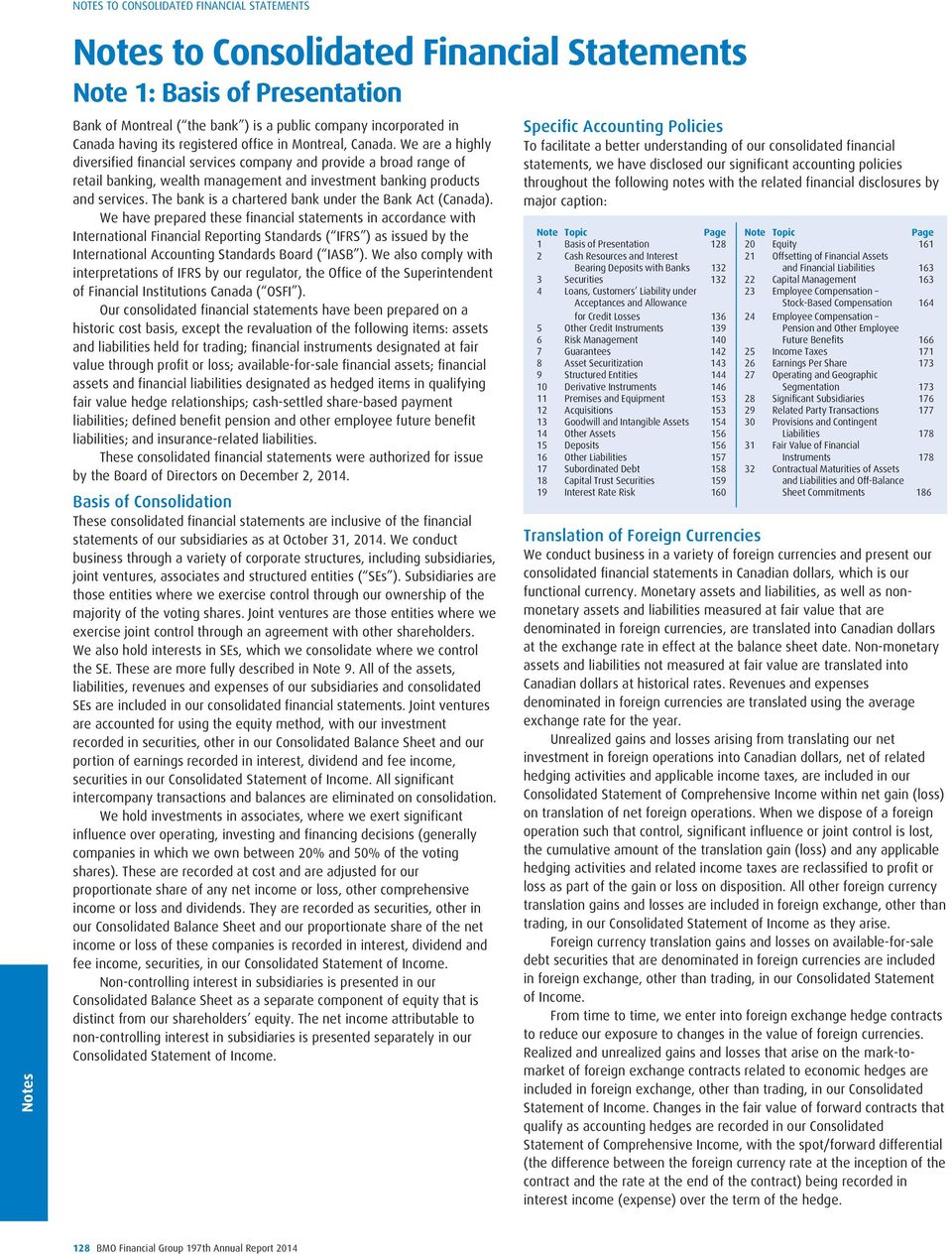
1 NOTES TO CONSOLIDATED FINANCIAL STATEMENTS to Consolidated Financial Statements Note 1: Basis of Presentation Bank of Montreal ( the bank ) is a public company incorporated in Canada having its registered office in Montreal, Canada. We are a highly diversified financial services company and provide a broad range of retail banking, wealth management and investment banking products and services. The bank is a chartered bank under the Bank Act (Canada). We have prepared these financial statements in accordance with International Financial Reporting Standards ( IFRS ) as issued by the International Accounting Standards Board ( IASB ). We also comply with interpretations of IFRS by our regulator, the Office of the Superintendent of Financial Institutions Canada ( OSFI ). Our consolidated financial statements have been prepared on a historic cost basis, except the revaluation of the following items: assets and liabilities held for trading; financial instruments designated at fair value through profit or loss; available-for-sale financial assets; financial assets and financial liabilities designated as hedged items in qualifying fair value hedge relationships; cash-settled share-based payment liabilities; defined benefit pension and other employee future benefit liabilities; and insurance-related liabilities. These consolidated financial statements were authorized for issue by the Board of Directors on December 2, Basis of Consolidation These consolidated financial statements are inclusive of the financial statements of our subsidiaries as at October 31, We conduct business through a variety of corporate structures, including subsidiaries, joint ventures, associates and structured entities ( SEs ). Subsidiaries are those entities where we exercise control through our ownership of the majority of the voting shares. Joint ventures are those entities where we exercise joint control through an agreement with other shareholders. We also hold interests in SEs, which we consolidate where we control the SE. These are more fully described in Note 9. All of the assets, liabilities, revenues and expenses of our subsidiaries and consolidated SEs are included in our consolidated financial statements. Joint ventures are accounted for using the equity method, with our investment recorded in securities, other in our Consolidated Balance Sheet and our portion of earnings recorded in interest, dividend and fee income, securities in our Consolidated Statement of Income. All significant intercompany transactions and balances are eliminated on consolidation. We hold investments in associates, where we exert significant influence over operating, investing and financing decisions (generally companies in which we own between 20% and 50% of the voting shares). These are recorded at cost and are adjusted for our proportionate share of any net income or loss, other comprehensive income or loss and dividends. They are recorded as securities, other in our Consolidated Balance Sheet and our proportionate share of the net income or loss of these companies is recorded in interest, dividend and fee income, securities, in our Consolidated Statement of Income. Non-controlling interest in subsidiaries is presented in our Consolidated Balance Sheet as a separate component of equity that is distinct from our shareholders equity. The net income attributable to non-controlling interest in subsidiaries is presented separately in our Consolidated Statement of Income. Specific Accounting Policies To facilitate a better understanding of our consolidated financial statements, we have disclosed our significant accounting policies throughout the following notes with the related financial disclosures by major caption: Note Topic Page Note Topic Page 1 Basis of Presentation Equity Cash Resources and Interest Bearing Deposits with Banks Offsetting of Financial Assets and Financial Liabilities Securities Capital Management Loans, Customers Liability under Acceptances and Allowance 23 Employee Compensation Stock-Based Compensation 164 for Credit Losses Employee Compensation 5 6 Other Credit Instruments Risk Management Pension and Other Employee Future Benefits Guarantees Income Taxes Asset Securitization Earnings Per Share Structured Entities Derivative Instruments Operating and Geographic Segmentation Premises and Equipment Acquisitions Significant Subsidiaries Related Party Transactions Goodwill and Intangible Assets Other Assets Provisions and Contingent Liabilities Deposits Other Liabilities Fair Value of Financial Instruments Subordinated Debt Capital Trust Securities Interest Rate Risk Contractual Maturities of Assets and Liabilities and Off-Balance Sheet Commitments 186 Translation of Foreign Currencies We conduct business in a variety of foreign currencies and present our consolidated financial statements in Canadian dollars, which is our functional currency. Monetary assets and liabilities, as well as nonmonetary assets and liabilities measured at fair value that are denominated in foreign currencies, are translated into Canadian dollars at the exchange rate in effect at the balance sheet date. Non-monetary assets and liabilities not measured at fair value are translated into Canadian dollars at historical rates. Revenues and expenses denominated in foreign currencies are translated using the average exchange rate for the year. Unrealized gains and losses arising from translating our net investment in foreign operations into Canadian dollars, net of related hedging activities and applicable income taxes, are included in our Consolidated Statement of Comprehensive Income within net gain (loss) on translation of net foreign operations. When we dispose of a foreign operation such that control, significant influence or joint control is lost, the cumulative amount of the translation gain (loss) and any applicable hedging activities and related income taxes are reclassified to profit or loss as part of the gain or loss on disposition. All other foreign currency translation gains and losses are included in foreign exchange, other than trading, in our Consolidated Statement of Income as they arise. Foreign currency translation gains and losses on available-for-sale debt securities that are denominated in foreign currencies are included in foreign exchange, other than trading, in our Consolidated Statement of Income. From time to time, we enter into foreign exchange hedge contracts to reduce our exposure to changes in the value of foreign currencies. Realized and unrealized gains and losses that arise on the mark-tomarket of foreign exchange contracts related to economic hedges are included in foreign exchange, other than trading, in our Consolidated Statement of Income. Changes in the fair value of forward contracts that qualify as accounting hedges are recorded in our Consolidated Statement of Comprehensive Income, with the spot/forward differential (the difference between the foreign currency rate at the inception of the contract and the rate at the end of the contract) being recorded in interest income (expense) over the term of the hedge. 128 BMO Financial Group 197th Annual Report 2014
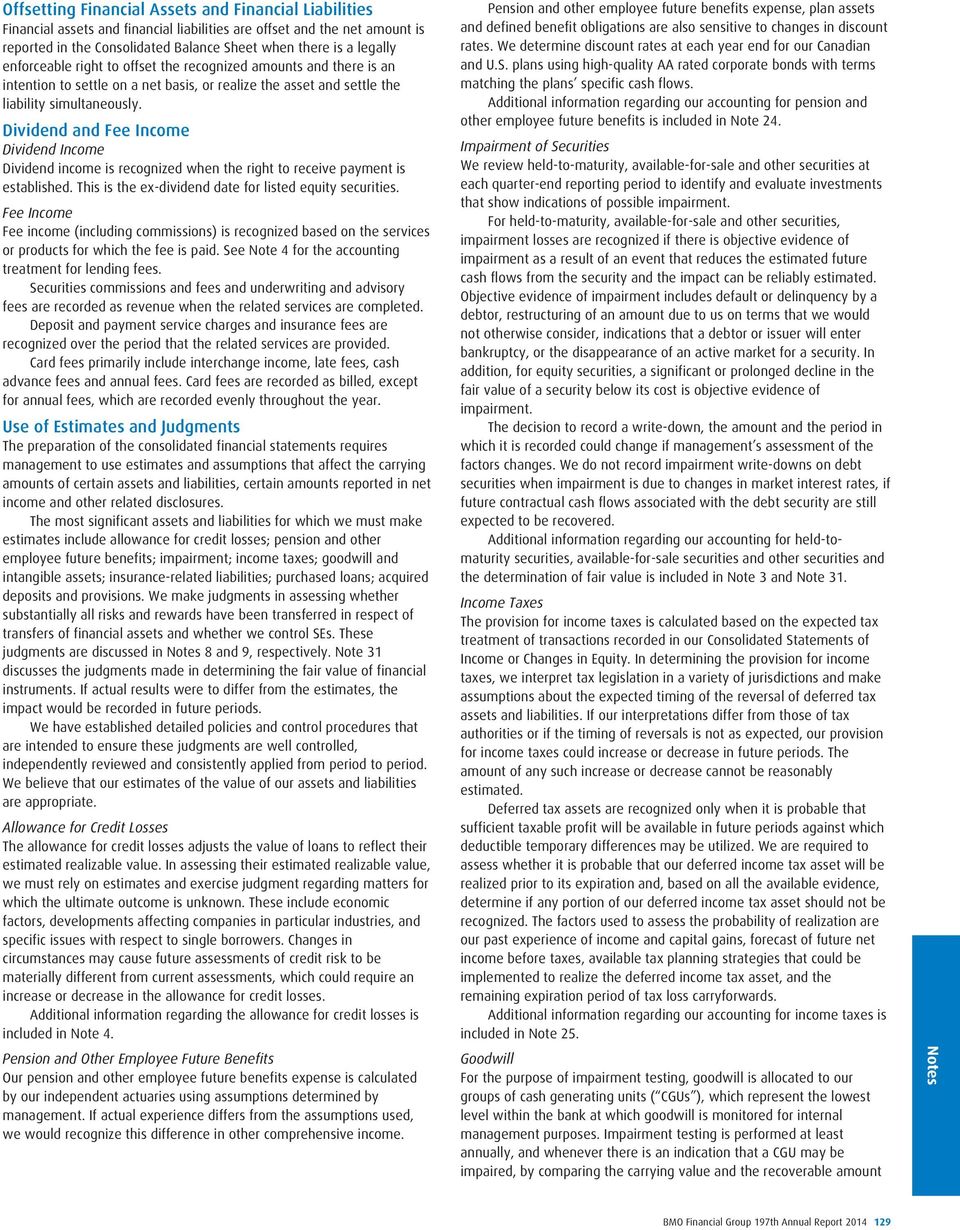
2 Offsetting Financial Assets and Financial Liabilities Financial assets and financial liabilities are offset and the net amount is reported in the Consolidated Balance Sheet when there is a legally enforceable right to offset the recognized amounts and there is an intention to settle on a net basis, or realize the asset and settle the liability simultaneously. Dividend and Fee Income Dividend Income Dividend income is recognized when the right to receive payment is established. This is the ex-dividend date for listed equity securities. Fee Income Fee income (including commissions) is recognized based on the services or products for which the fee is paid. See Note 4 for the accounting treatment for lending fees. Securities commissions and fees and underwriting and advisory fees are recorded as revenue when the related services are completed. Deposit and payment service charges and insurance fees are recognized over the period that the related services are provided. Card fees primarily include interchange income, late fees, cash advance fees and annual fees. Card fees are recorded as billed, except for annual fees, which are recorded evenly throughout the year. Use of Estimates and Judgments The preparation of the consolidated financial statements requires management to use estimates and assumptions that affect the carrying amounts of certain assets and liabilities, certain amounts reported in net income and other related disclosures. The most significant assets and liabilities for which we must make estimates include allowance for credit losses; pension and other employee future benefits; impairment; income taxes; goodwill and intangible assets; insurance-related liabilities; purchased loans; acquired deposits and provisions. We make judgments in assessing whether substantially all risks and rewards have been transferred in respect of transfers of financial assets and whether we control SEs. These judgments are discussed in 8 and 9, respectively. Note 31 discusses the judgments made in determining the fair value of financial instruments. If actual results were to differ from the estimates, the impact would be recorded in future periods. We have established detailed policies and control procedures that are intended to ensure these judgments are well controlled, independently reviewed and consistently applied from period to period. We believe that our estimates of the value of our assets and liabilities are appropriate. Allowance for Credit Losses The allowance for credit losses adjusts the value of loans to reflect their estimated realizable value. In assessing their estimated realizable value, we must rely on estimates and exercise judgment regarding matters for which the ultimate outcome is unknown. These include economic factors, developments affecting companies in particular industries, and specific issues with respect to single borrowers. Changes in circumstances may cause future assessments of credit risk to be materially different from current assessments, which could require an increase or decrease in the allowance for credit losses. Additional information regarding the allowance for credit losses is included in Note 4. Pension and Other Employee Future Benefits Our pension and other employee future benefits expense is calculated by our independent actuaries using assumptions determined by management. If actual experience differs from the assumptions used, we would recognize this difference in other comprehensive income. Pension and other employee future benefits expense, plan assets and defined benefit obligations are also sensitive to changes in discount rates. We determine discount rates at each year end for our Canadian and U.S. plans using high-quality AA rated corporate bonds with terms matching the plans specific cash flows. Additional information regarding our accounting for pension and other employee future benefits is included in Note 24. Impairment of Securities We review held-to-maturity, available-for-sale and other securities at each quarter-end reporting period to identify and evaluate investments that show indications of possible impairment. For held-to-maturity, available-for-sale and other securities, impairment losses are recognized if there is objective evidence of impairment as a result of an event that reduces the estimated future cash flows from the security and the impact can be reliably estimated. Objective evidence of impairment includes default or delinquency by a debtor, restructuring of an amount due to us on terms that we would not otherwise consider, indications that a debtor or issuer will enter bankruptcy, or the disappearance of an active market for a security. In addition, for equity securities, a significant or prolonged decline in the fair value of a security below its cost is objective evidence of impairment. The decision to record a write-down, the amount and the period in which it is recorded could change if management s assessment of the factors changes. We do not record impairment write-downs on debt securities when impairment is due to changes in market interest rates, if future contractual cash flows associated with the debt security are still expected to be recovered. Additional information regarding our accounting for held-tomaturity securities, available-for-sale securities and other securities and the determination of fair value is included in Note 3 and Note 31. Income Taxes The provision for income taxes is calculated based on the expected tax treatment of transactions recorded in our Consolidated Statements of Income or Changes in Equity. In determining the provision for income taxes, we interpret tax legislation in a variety of jurisdictions and make assumptions about the expected timing of the reversal of deferred tax assets and liabilities. If our interpretations differ from those of tax authorities or if the timing of reversals is not as expected, our provision for income taxes could increase or decrease in future periods. The amount of any such increase or decrease cannot be reasonably estimated. Deferred tax assets are recognized only when it is probable that sufficient taxable profit will be available in future periods against which deductible temporary differences may be utilized. We are required to assess whether it is probable that our deferred income tax asset will be realized prior to its expiration and, based on all the available evidence, determine if any portion of our deferred income tax asset should not be recognized. The factors used to assess the probability of realization are our past experience of income and capital gains, forecast of future net income before taxes, available tax planning strategies that could be implemented to realize the deferred income tax asset, and the remaining expiration period of tax loss carryforwards. Additional information regarding our accounting for income taxes is included in Note 25. Goodwill For the purpose of impairment testing, goodwill is allocated to our groups of cash generating units ( CGUs ), which represent the lowest level within the bank at which goodwill is monitored for internal management purposes. Impairment testing is performed at least annually, and whenever there is an indication that a CGU may be impaired, by comparing the carrying value and the recoverable amount BMO Financial Group 197th Annual Report
3 NOTES TO CONSOLIDATED FINANCIAL STATEMENTS of the CGU to which goodwill has been allocated to determine whether the recoverable amount of the group is greater than its carrying value. If the carrying value were to exceed the recoverable amount of the group, an impairment calculation would be performed. Fair value less costs to sell was used to perform the impairment test. In determining fair value less costs to sell, we employ a discounted cash flow model consistent with those used when we acquire businesses. This model is dependent on assumptions related to revenue growth, discount rates, synergies achieved on acquisition and the availability of comparable acquisition data. Changes in any of these assumptions would affect the determination of fair value for each of the CGUs in a different manner. Management must exercise its judgment and make assumptions in determining fair value less costs to sell, and differences in judgments and assumptions could affect the determination of fair value and any resulting impairment write-down. Additional information regarding goodwill is included in Note 13. Purchased Loans Significant judgments and assumptions were made in determining the fair value of the Marshall & Ilsley Corporation ( M&I ) loan portfolio. Loans were identified as either purchased performing loans or purchased credit impaired loans ( PCI loans ), both of which were recorded at fair value at the time of acquisition. Determining the fair value involved estimating the expected cash flows to be received and determining the discount rate to be applied to the cash flows from the loan portfolio. In determining the possible discount rates, we considered various factors, including our cost to raise funds in the current market, the risk premium associated with the loans and the cost to service the portfolios. PCI loans are those where the timely collection of interest and principal was no longer reasonably assured as at the date of acquisition. Subsequent to the acquisition date, we regularly re-evaluate what we expect to collect on PCI loans. Changes in expected cash flows could result in the recognition of impairment or a recovery in our provision for credit losses. Assessing the timing and amount of cash flows requires significant management judgment regarding key assumptions, including the probability of default, severity of loss and timing of payment receipts, as well as the valuation of collateral. All of these factors are inherently subjective and can result in significant changes in cash flow estimates over the life of a loan. Subsequent to the determination of the initial fair value, the purchased performing loans are subject to the credit review processes applied to loans we originate. Additional information regarding the accounting for purchased loans is included in Note 4. Acquired Deposits M&I deposit liabilities were recorded at fair value at acquisition. The determination of fair value involved estimating the expected cash flows to be paid and determining the discount rate applied to the cash flows. Assessing the timing and amount of cash flows requires significant management judgment regarding the likelihood of early redemption by us and the timing of withdrawal by the client. Discount rates were based on the prevailing rates we were paying on similar deposits at the date of acquisition. Insurance-Related Liabilities Insurance claims and policy benefit liabilities represent current claims and estimates of future insurance policy benefits. Liabilities for life insurance contracts are determined using the Canadian Asset Liability Method, which incorporates best-estimate assumptions for mortality, morbidity, policy lapses, surrenders, future investment yields, policy dividends, administration costs and margins for adverse deviation. These assumptions are reviewed at least annually and updated to reflect actual experience and market conditions. The most significant impact on the valuation of a liability would result from a change in the assumption for future investment yields. Additional information regarding insurance-related liabilities is included in Note 16. Provisions The bank and its subsidiaries are involved in various legal actions in the ordinary course of business. Provisions are recorded at the best estimate of the amounts required to settle any obligations related to these legal actions as at the balance sheet date, taking into account the risks and uncertainties associated with the obligation. Management and internal and external experts are involved in estimating any provisions. The actual costs of resolving these claims may be substantially higher or lower than the amounts of the provisions. Additional information regarding provisions is provided in Note 30. Significant Judgments Applied in Assessing Control For most of our subsidiaries, control is determined based on holding the majority of the voting rights. For certain investments in limited partnerships, we exercise judgment in determining if we control an entity. Based on an assessment of our interests and rights, we have determined that we do not control certain entities, even though we may have an ownership interest greater than 50%. This may be the case when we are not the general partner in an arrangement and the general partner s rights most significantly affect the returns of the entity. Additionally, we have determined that we control certain entities despite having an ownership interest less than 50%. This may be the case when we are the general partner in an arrangement and the general partner s rights most significantly affect the returns of the entity. We also exercise judgment in determining if we control structured entities. Structured entities are discussed in greater detail in Note 9. Changes In Accounting Policies Effective November 1, 2013, we adopted the following new and amended accounting pronouncements issued by the IASB. Employee Benefits On November 1, 2013, we adopted revisions to IAS 19 Employee Benefits ( IAS 19 ) that amend the measurement, presentation and disclosure requirements for employee benefit plans. The standard has been applied retroactively and the comparative periods in our Consolidated Balance Sheet, Statement of Income and Statement of Comprehensive Income have been restated. The amendments to IAS 19 require the full funded status of our pension and other employee future benefit plans to be reflected as the net defined benefit liability or asset in the Consolidated Balance Sheet. Actuarial gains and losses are recognized immediately in Other Comprehensive Income ( OCI ) and are no longer deferred and amortized into income. Past service costs resulting from plan amendments are immediately recognized in income when a plan is amended, without regard to vesting. Interest costs and expected return on plan assets under the previous version of IAS 19 have been replaced with a net interest cost or revenue calculated by applying the discount rate to the net defined benefit liability or asset. Further, these amendments also require enhanced disclosures about the characteristics of those plans and the risks to which the bank is exposed through participation in those plans. Additional disclosures are included in Note 24 to comply with these requirements. Presentation of Financial Statements Amendments to IAS 1 Presentation of Financial Statements require items within OCI to be presented separately based on whether or not the item will subsequently be reclassified into net income. The new presentation was adopted on a retroactive basis together with the amendments to IAS 19. Actuarial gains and losses that are recognized directly in OCI under IAS 19 remain in OCI and will never be reclassified to net income. 130 BMO Financial Group 197th Annual Report 2014

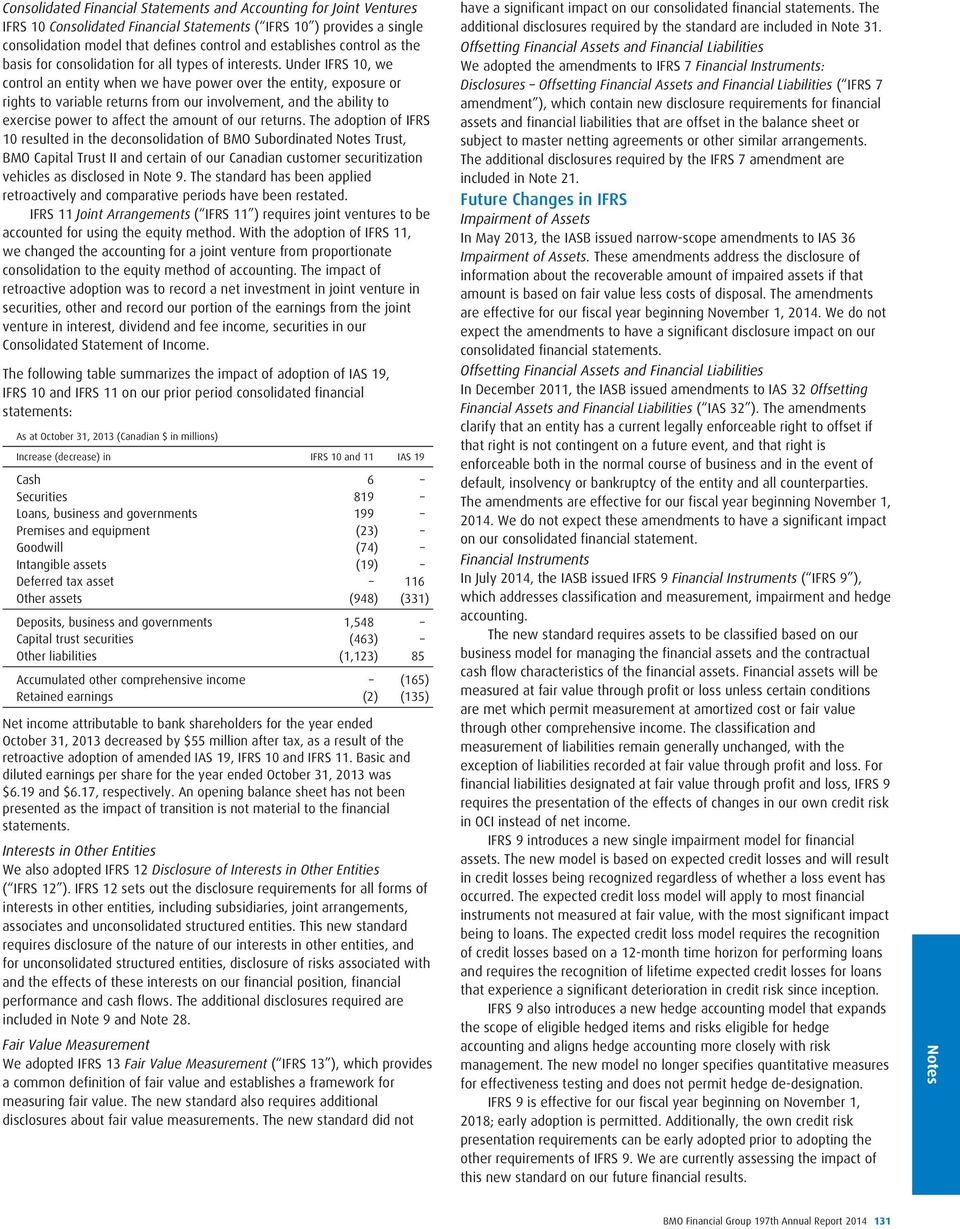
4 Consolidated Financial Statements and Accounting for Joint Ventures IFRS 10 Consolidated Financial Statements ( IFRS 10 ) provides a single consolidation model that defines control and establishes control as the basis for consolidation for all types of interests. Under IFRS 10, we control an entity when we have power over the entity, exposure or rights to variable returns from our involvement, and the ability to exercise power to affect the amount of our returns. The adoption of IFRS 10 resulted in the deconsolidation of BMO Subordinated Trust, BMO Capital Trust II and certain of our Canadian customer securitization vehicles as disclosed in Note 9. The standard has been applied retroactively and comparative periods have been restated. IFRS 11 Joint Arrangements ( IFRS 11 ) requires joint ventures to be accounted for using the equity method. With the adoption of IFRS 11, we changed the accounting for a joint venture from proportionate consolidation to the equity method of accounting. The impact of retroactive adoption was to record a net investment in joint venture in securities, other and record our portion of the earnings from the joint venture in interest, dividend and fee income, securities in our Consolidated Statement of Income. The following table summarizes the impact of adoption of IAS 19, IFRS 10 and IFRS 11 on our prior period consolidated financial statements: As at October 31, 2013 (Canadian $ in millions) Increase (decrease) in IFRS 10 and 11 IAS 19 Cash 6 Securities 819 Loans, business and governments 199 Premises and equipment (23) Goodwill (74) Intangible assets (19) Deferred tax asset 116 Other assets (948) (331) Deposits, business and governments 1,548 Capital trust securities (463) Other liabilities (1,123) 85 Accumulated other comprehensive income (165) Retained earnings (2) (135) Net income attributable to bank shareholders for the year ended October 31, 2013 decreased by $55 million after tax, as a result of the retroactive adoption of amended IAS 19, IFRS 10 and IFRS 11. Basic and diluted earnings per share for the year ended October 31, 2013 was $6.19 and $6.17, respectively. An opening balance sheet has not been presented as the impact of transition is not material to the financial statements. Interests in Other Entities We also adopted IFRS 12 Disclosure of Interests in Other Entities ( IFRS 12 ). IFRS 12 sets out the disclosure requirements for all forms of interests in other entities, including subsidiaries, joint arrangements, associates and unconsolidated structured entities. This new standard requires disclosure of the nature of our interests in other entities, and for unconsolidated structured entities, disclosure of risks associated with and the effects of these interests on our financial position, financial performance and cash flows. The additional disclosures required are included in Note 9 and Note 28. Fair Value Measurement We adopted IFRS 13 Fair Value Measurement ( IFRS 13 ), which provides a common definition of fair value and establishes a framework for measuring fair value. The new standard also requires additional disclosures about fair value measurements. The new standard did not have a significant impact on our consolidated financial statements. The additional disclosures required by the standard are included in Note 31. Offsetting Financial Assets and Financial Liabilities We adopted the amendments to IFRS 7 Financial Instruments: Disclosures Offsetting Financial Assets and Financial Liabilities ( IFRS 7 amendment ), which contain new disclosure requirements for financial assets and financial liabilities that are offset in the balance sheet or subject to master netting agreements or other similar arrangements. The additional disclosures required by the IFRS 7 amendment are included in Note 21. Future Changes in IFRS Impairment of Assets In May 2013, the IASB issued narrow-scope amendments to IAS 36 Impairment of Assets. These amendments address the disclosure of information about the recoverable amount of impaired assets if that amount is based on fair value less costs of disposal. The amendments are effective for our fiscal year beginning November 1, We do not expect the amendments to have a significant disclosure impact on our consolidated financial statements. Offsetting Financial Assets and Financial Liabilities In December 2011, the IASB issued amendments to IAS 32 Offsetting Financial Assets and Financial Liabilities ( IAS 32 ). The amendments clarify that an entity has a current legally enforceable right to offset if that right is not contingent on a future event, and that right is enforceable both in the normal course of business and in the event of default, insolvency or bankruptcy of the entity and all counterparties. The amendments are effective for our fiscal year beginning November 1, We do not expect these amendments to have a significant impact on our consolidated financial statement. Financial Instruments In July 2014, the IASB issued IFRS 9 Financial Instruments ( IFRS 9 ), which addresses classification and measurement, impairment and hedge accounting. The new standard requires assets to be classified based on our business model for managing the financial assets and the contractual cash flow characteristics of the financial assets. Financial assets will be measured at fair value through profit or loss unless certain conditions are met which permit measurement at amortized cost or fair value through other comprehensive income. The classification and measurement of liabilities remain generally unchanged, with the exception of liabilities recorded at fair value through profit and loss. For financial liabilities designated at fair value through profit and loss, IFRS 9 requires the presentation of the effects of changes in our own credit risk in OCI instead of net income. IFRS 9 introduces a new single impairment model for financial assets. The new model is based on expected credit losses and will result in credit losses being recognized regardless of whether a loss event has occurred. The expected credit loss model will apply to most financial instruments not measured at fair value, with the most significant impact being to loans. The expected credit loss model requires the recognition of credit losses based on a 12-month time horizon for performing loans and requires the recognition of lifetime expected credit losses for loans that experience a significant deterioration in credit risk since inception. IFRS 9 also introduces a new hedge accounting model that expands the scope of eligible hedged items and risks eligible for hedge accounting and aligns hedge accounting more closely with risk management. The new model no longer specifies quantitative measures for effectiveness testing and does not permit hedge de-designation. IFRS 9 is effective for our fiscal year beginning on November 1, 2018; early adoption is permitted. Additionally, the own credit risk presentation requirements can be early adopted prior to adopting the other requirements of IFRS 9. We are currently assessing the impact of this new standard on our future financial results. BMO Financial Group 197th Annual Report
5 NOTES TO CONSOLIDATED FINANCIAL STATEMENTS Investment Entities In October 2012, the IASB issued amendments to IFRS 10, IFRS 12 and IAS 27 Separate Financial Statements, which introduce an exception to the principle that all subsidiaries are to be consolidated. The amendments require a parent that is an investment entity to measure its investments in particular subsidiaries at fair value through profit or loss instead of consolidating all subsidiaries in its consolidated financial statements. The amendments are effective for our fiscal year beginning November 1, We do not expect these amendments to have a significant impact on our consolidated financial statements as we are not considered to be an investment entity. Levies In May 2013, the IFRS Interpretations Committee ( IFRIC ) issued IFRIC 21 Levies, which provides guidance on when to recognize a liability to pay a levy imposed by a government on an entity in accordance with legislation. IFRIC 21 is effective for our fiscal year beginning November 1, We do not expect this interpretation to have a significant impact on our consolidated financial statements. Revenue In May 2014, the IASB issued IFRS 15 Revenue from Contracts with Customers ( IFRS 15 ), which replaces the existing standards for revenue recognition. The new standard establishes a framework for the recognition and measurement of revenues generated from contracts with customers, except for items such as financial instruments, insurance contracts and leases. The new standard also requires additional disclosures about the nature, amount, timing and uncertainty of revenues and cash flows arising from transactions with our customers. IFRS 15 is effective for our fiscal year beginning November 1, We are currently assessing the impact of the standard on our future financial results. Note 2: Cash Resources and Interest Bearing Deposits with Banks (Canadian $ in millions) Cash and deposits with banks (1) 27,056 24,679 Cheques and other items in transit, net 1,330 1,410 Total cash and cash equivalents 28,386 26,089 (1) Deposits with banks include deposits with the Bank of Canada, the U.S. Federal Reserve and other banks. Cheques and Other Items in Transit, Net Cheques and other items in transit are recorded at cost and represent the net position of the uncleared cheques and other items in transit between us and other banks. Cash Restrictions Some of our foreign operations are required to maintain reserves or minimum balances with central banks in their respective countries of operation amounting to $1,638 million as at October 31, 2014 ($1,211 million in 2013). Interest Bearing Deposits with Banks Deposits with banks are recorded at amortized cost and include acceptances we have purchased that were issued by other banks. Interest income earned on these deposits is recorded on an accrual basis. Note 3: Securities Securities are divided into four types, each with a different purpose and accounting treatment. The types of securities we hold are as follows: Trading securities are securities that we purchase for resale over a short period of time. We report these securities at their fair value and record the fair value changes and transaction costs in our Consolidated Statement of Income in trading revenues. Securities Designated at Fair Value Securities designated at fair value through profit or loss are financial instruments that are accounted for at fair value, with changes in fair value recorded in income provided they meet certain criteria. Securities designated at fair value through profit or loss must have reliably measurable fair values and satisfy one of the following criteria: (1) accounting for them at fair value eliminates or significantly reduces an inconsistency in measurement or recognition that would otherwise arise from measuring assets or liabilities or recognizing the gains and losses on them on a different basis; (2) the securities are part of a group of financial assets, financial liabilities or both that is managed and has its performance evaluated on a fair value basis, in accordance with a documented risk management or investment strategy, and is reported to key management personnel on a fair value basis; or (3) the securities are hybrid financial instruments with one or more embedded derivatives that would otherwise have to be bifurcated and accounted for separately from the host contract. Financial instruments must be designated on initial recognition, and the designation is irrevocable. If these securities were not designated at fair value, they would be accounted for as available-for-sale securities with unrealized gains and losses recorded in other comprehensive income. We designate certain securities held by our insurance subsidiaries that support our insurance liabilities at fair value through profit or loss since the actuarial calculation of insurance liabilities is based on the fair value of the investments supporting them. This designation aligns the accounting result with the way the portfolio is managed on a fair value basis. The fair value of these investments as at October 31, 2014 of $6,599 million ($5,766 million in 2013) is recorded in securities, trading in our Consolidated Balance Sheet. The impact of recording these investments at fair value through profit or loss was an increase of $379 million in non-interest revenue, insurance income for the year ended October 31, 2014 (decrease of $178 million in 2013). Changes in the insurance liability balances are also recorded in non-interest revenue, insurance income. As at October 31, 2014, our credit protection vehicle held only cash and cash equivalents. During 2013, this vehicle held investments that were designated at fair value through profit or loss, which aligned the accounting result with the way the portfolio was managed on a fair value basis. The impact of recording these investments at fair value through profit or loss in 2013 was a decrease in non-interest revenue, trading revenue of $40 million. We recognized offsetting amounts for derivative contracts that were held to hedge changes in fair value of those instruments. Additional information relating to our credit protection vehicle is included in Note 9. We designate certain investments held in our merchant banking business at fair value through profit or loss, which aligns the accounting result with the way the portfolio is managed. The fair value of these investments as at October 31, 2014 of $467 million ($488 million in 2013) is recorded in securities, other in our Consolidated Balance Sheet. The impact of recording these investments at fair value through profit or loss was an increase in non-interest revenue, securities gains, other than trading of $28 million in our Consolidated Statement of Income for the year ended October 31, 2014 (decrease of $18 million in 2013). 132 BMO Financial Group 197th Annual Report 2014

6 Available-for-sale securities consist of debt and equity securities that may be sold in response to or in anticipation of changes in interest rates and resulting prepayment risk, changes in foreign currency risk, changes in funding sources or terms, or to meet liquidity needs. Available-for-sale securities are initially recorded at fair value plus transaction costs. They are subsequently re-measured at fair value with unrealized gains and losses recorded in unrealized gains (losses) on available-for-sale securities in our Consolidated Statement of Comprehensive Income until the security is sold. Gains and losses on disposal and impairment losses are recorded in our Consolidated Statement of Income in non-interest revenue, securities gains, other than trading. Interest income earned and dividends received on available-for-sale securities are recorded in our Consolidated Statement of Income in interest, dividend and fee income, securities. Investments held by our insurance operations are classified as available-for-sale securities, except for those investments that support the policy benefit liabilities on our insurance contracts, which are designated at fair value through profit or loss as discussed above. Interest and other fee income on the insurance available-for-sale securities is recognized when earned in our Consolidated Statement of Income in non-interest revenue, insurance income. Held-to-maturity securities are debt securities that we have the intention and ability to hold to maturity. These securities are initially recorded at fair value plus transaction costs and subsequently remeasured at amortized cost using the effective interest method. Gains and losses on disposal and impairment losses are recorded in our Consolidated Statement of Income in securities gains (losses), other than trading. Interest income earned and amortization of premiums or discounts on the debt securities are recorded in our Consolidated Statement of Income in interest, dividend and fee income, securities. Other securities are investments in companies where we exert significant influence over operating, investing and financing decisions (generally companies in which we own between 20% and 50% of the voting shares) and certain securities held by our merchant banking business. We account for all of our securities transactions using settlement date accounting in our Consolidated Balance Sheet. Changes in fair value between the trade date and settlement date are recorded in net income. For available-for-sale securities, changes in fair value between the trade date and settlement date are recorded in other comprehensive income. Impairment Review For available-for-sale, held-to-maturity and other securities, impairment losses are recognized if there is objective evidence of impairment as a result of an event that reduces the estimated future cash flows from the security and the impact can be reliably estimated. For equity securities, a significant or prolonged decline in the fair value of a security below its cost is considered to be objective evidence of impairment. The impairment loss on available-for-sale securities is the difference between the cost/amortized cost and current fair value, less any previously recognized impairment losses. The impairment loss on held-to-maturity securities is the difference between a security s carrying amount and the present value of estimated future cash flows discounted at the asset s original effective interest rate. If there is objective evidence of impairment, a write-down is recorded in our Consolidated Statement of Income in securities gains, other than trading. For debt securities, a previous impairment loss is reversed through net income if an event occurs after the impairment was recognized that can be objectively attributed to an increase in fair value, to a maximum of the original impairment charge. Reversals of impairment losses on held-to-maturity securities are recorded to a maximum of the amortized cost of the investment before the original impairment charge. For equity securities, previous impairment losses are not reversed through net income and any subsequent increases in fair value are recorded in other comprehensive income. As at October 31, 2014, we had 565 available-for-sale securities (979 in 2013) with unrealized losses totalling $35 million (unrealized losses of $96 million in 2013). Of these available-for-sale securities, 203 have been in an unrealized loss position continuously for more than one year (44 in 2013), amounting to an unrealized loss position of $20 million (unrealized loss position of $5 million in 2013). Unrealized losses on these instruments, excluding corporate equities, resulted from changes in interest rates and not from deterioration in the creditworthiness of the issuers. We expect full recovery of these available-for-sale instruments and have determined that there is no significant impairment. We did not own any securities issued by a single non-government entity where the book value, as at October 31, 2014 or 2013, was greater than 10% of our shareholders equity. Fair Value Measurement For traded securities, quoted market value is considered to be fair value. Quoted market value is based on bid prices. For securities where market quotes are not available, we use estimation techniques to determine fair value. Discussion of fair value measurement is included in Note 31. BMO Financial Group 197th Annual Report

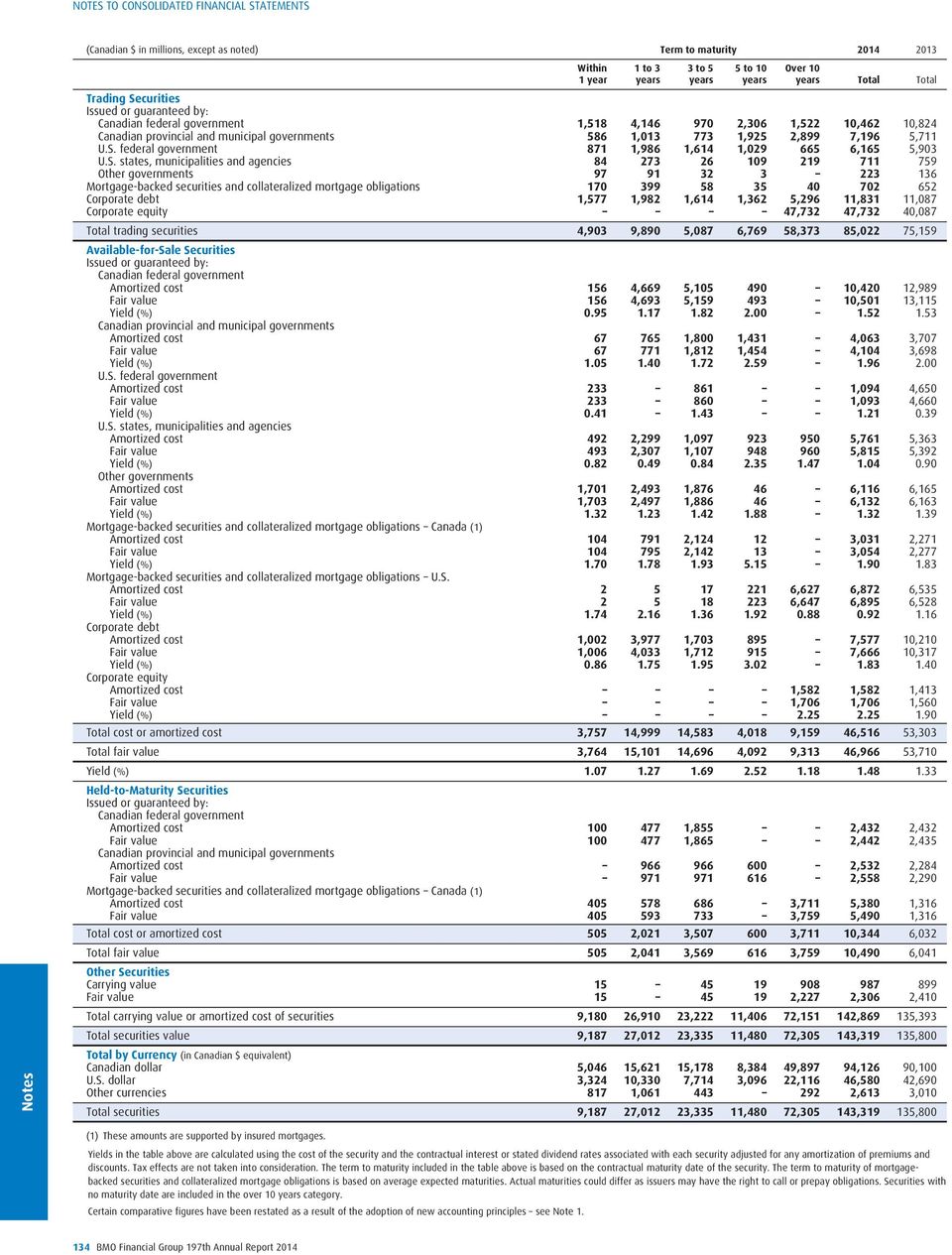
7 NOTES TO CONSOLIDATED FINANCIAL STATEMENTS (Canadian $ in millions, except as noted) Term to maturity Within 1 year 1to3 years 3to5 years 5to10 years Over 10 years Total Total Trading Securities Issued or guaranteed by: Canadian federal government 1,518 4, ,306 1,522 10,462 10,824 Canadian provincial and municipal governments 586 1, ,925 2,899 7,196 5,711 U.S. federal government 871 1,986 1,614 1, ,165 5,903 U.S. states, municipalities and agencies Other governments Mortgage-backed securities and collateralized mortgage obligations Corporate debt 1,577 1,982 1,614 1,362 5,296 11,831 11,087 Corporate equity 47,732 47,732 40,087 Total trading securities 4,903 9,890 5,087 6,769 58,373 85,022 75,159 Available-for-Sale Securities Issued or guaranteed by: Canadian federal government Amortized cost 156 4,669 5, ,420 12,989 Fair value 156 4,693 5, ,501 13,115 Yield (%) Canadian provincial and municipal governments Amortized cost ,800 1,431 4,063 3,707 Fair value ,812 1,454 4,104 3,698 Yield (%) U.S. federal government Amortized cost ,094 4,650 Fair value ,093 4,660 Yield (%) U.S. states, municipalities and agencies Amortized cost 492 2,299 1, ,761 5,363 Fair value 493 2,307 1, ,815 5,392 Yield (%) Other governments Amortized cost 1,701 2,493 1, ,116 6,165 Fair value 1,703 2,497 1, ,132 6,163 Yield (%) Mortgage-backed securities and collateralized mortgage obligations Canada (1) Amortized cost , ,031 2,271 Fair value , ,054 2,277 Yield (%) Mortgage-backed securities and collateralized mortgage obligations U.S. Amortized cost ,627 6,872 6,535 Fair value ,647 6,895 6,528 Yield (%) Corporate debt Amortized cost 1,002 3,977 1, ,577 10,210 Fair value 1,006 4,033 1, ,666 10,317 Yield (%) Corporate equity Amortized cost 1,582 1,582 1,413 Fair value 1,706 1,706 1,560 Yield (%) Total cost or amortized cost 3,757 14,999 14,583 4,018 9,159 46,516 53,303 Total fair value 3,764 15,101 14,696 4,092 9,313 46,966 53,710 Yield (%) Held-to-Maturity Securities Issued or guaranteed by: Canadian federal government Amortized cost ,855 2,432 2,432 Fair value ,865 2,442 2,435 Canadian provincial and municipal governments Amortized cost ,532 2,284 Fair value ,558 2,290 Mortgage-backed securities and collateralized mortgage obligations Canada (1) Amortized cost ,711 5,380 1,316 Fair value ,759 5,490 1,316 Total cost or amortized cost 505 2,021 3, ,711 10,344 6,032 Total fair value 505 2,041 3, ,759 10,490 6,041 Other Securities Carrying value Fair value ,227 2,306 2,410 Total carrying value or amortized cost of securities 9,180 26,910 23,222 11,406 72, , ,393 Total securities value 9,187 27,012 23,335 11,480 72, , ,800 Total by Currency (in Canadian $ equivalent) Canadian dollar 5,046 15,621 15,178 8,384 49,897 94,126 90,100 U.S. dollar 3,324 10,330 7,714 3,096 22,116 46,580 42,690 Other currencies 817 1, ,613 3,010 Total securities 9,187 27,012 23,335 11,480 72, , ,800 (1) These amounts are supported by insured mortgages. Yields in the table above are calculated using the cost of the security and the contractual interest or stated dividend rates associated with each security adjusted for any amortization of premiums and discounts. Tax effects are not taken into consideration. The term to maturity included in the table above is based on the contractual maturity date of the security. The term to maturity of mortgagebacked securities and collateralized mortgage obligations is based on average expected maturities. Actual maturities could differ as issuers may have the right to call or prepay obligations. Securities with no maturity date are included in the over 10 years category. Certain comparative figures have been restated as a result of the adoption of new accounting principles see Note BMO Financial Group 197th Annual Report 2014
8 Unrealized Gains and Losses (Canadian $ in millions) Amortized cost Gross unrealized gains Gross unrealized losses Fair value Amortized cost Gross unrealized gains Gross unrealized losses Issued or guaranteed by: Canadian federal government 10, ,501 12, ,115 Canadian provincial and municipal governments 4, ,104 3, ,698 U.S. federal government 1, ,093 4, ,660 U.S. states, municipalities and agencies 5, ,815 5, ,392 Other governments 6, ,132 6, ,163 Mortgage-backed securities and collateralized mortgage obligations Canada (1) 3, ,054 2, ,277 Mortgage-backed securities and collateralized mortgage obligations U.S. 6, ,895 6, ,528 Corporate debt 7, ,666 10, ,317 Corporate equity 1, ,706 1, ,560 Total 46, ,966 53, ,710 (1) These amounts are supported by insured mortgages. Certain comparative figures have been restated as a result of the adoption of new accounting principles see Note 1. Fair value Unrealized Losses (Canadian $ in millions) Available-for-sale securities in an unrealized loss position for 2014 Available-for-sale securities in an unrealized loss position for 2013 Less than 12 months 12 months or longer Total Less than 12 months 12 months or longer Total Gross unrealized losses Gross Fair unrealized value losses Fair value Gross unrealized losses Fair value Gross unrealized losses Gross Fair unrealized value losses Fair value Gross unrealized losses Issued or guaranteed by: Canadian federal government Canadian provincial and municipal governments , ,688 U.S. federal government U.S. states, municipalities and agencies , , ,702 Other governments , , , , ,458 Mortgage-backed securities and collateralized mortgage obligations Canada (1) Mortgage-backed securities and collateralized mortgage obligations U.S. 5 1, , , , ,148 Corporate debt , , ,790 Corporate equity Total 15 6, , , , , ,679 (1) These amounts are supported by insured mortgages. Income from securities has been included in our consolidated financial statements as follows: (Canadian $ in millions) Reported in Consolidated Statement of Income: Interest, Dividend and Fee Income (1) Trading securities (2) 1,086 1,409 1,621 Available-for-sale securities Held-to-maturity securities Other securities ,994 2,276 2,396 Non-Interest Revenue Available-for-sale securities Gross realized gains Gross realized losses (167) (3) (24) Unrealized gain on investment reclassified from equity to available-for-sale 191 Available-for-sale and other securities, net realized and unrealized gains (losses) Impairment write-downs (8) (17) (5) Securities gains (losses), other than trading (1) Trading securities, net realized and unrealized gains (losses) (1) (2) 340 (1,273) 374 Total income from securities 2,496 1,288 2,922 Fair value (1) The following amounts of income related to our insurance operations were included in non-interest revenue, insurance income in our Consolidated Statement of Income: Interest, dividend and fee income of $263 million for the year ended October 31, 2014 ($263 million in 2013 and $253 million in 2012). Securities gains (losses), other than trading of $5 million for the year ended October 31, 2014 ($1 million in 2013 and $nil in 2012). (2) Excluded from the table above are trading securities, net realized and unrealized gains (losses) related to our insurance operations of $379 million for the year ended October 31, 2014 ($(190) million in 2013 and $286 million in 2012). Certain comparative figures have been restated as a result of the adoption of new accounting principles see Note 1. BMO Financial Group 197th Annual Report

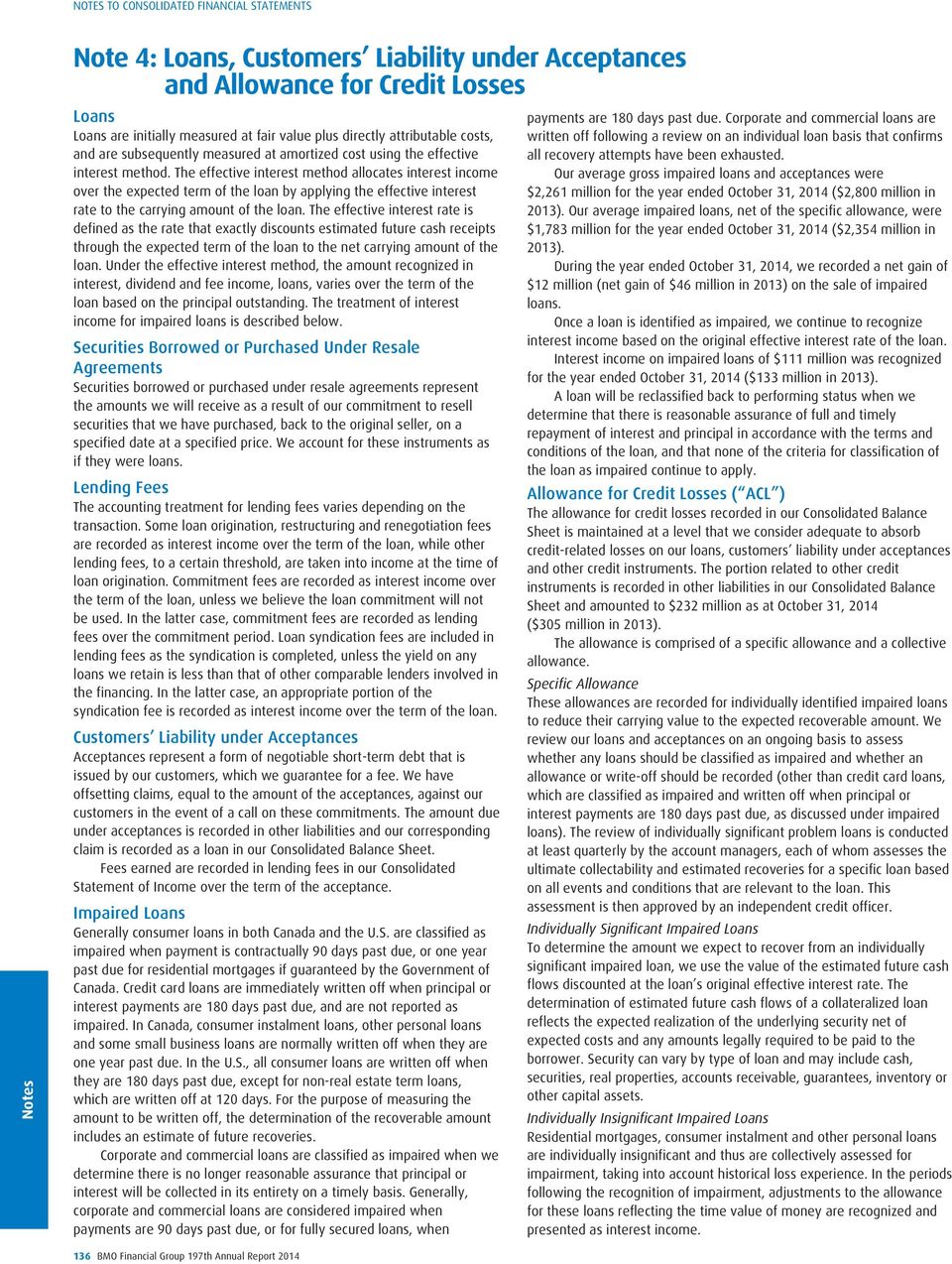
9 NOTES TO CONSOLIDATED FINANCIAL STATEMENTS Note 4: Loans, Customers Liability under Acceptances and Allowance for Credit Losses Loans Loans are initially measured at fair value plus directly attributable costs, and are subsequently measured at amortized cost using the effective interest method. The effective interest method allocates interest income over the expected term of the loan by applying the effective interest rate to the carrying amount of the loan. The effective interest rate is defined as the rate that exactly discounts estimated future cash receipts through the expected term of the loan to the net carrying amount of the loan. Under the effective interest method, the amount recognized in interest, dividend and fee income, loans, varies over the term of the loan based on the principal outstanding. The treatment of interest income for impaired loans is described below. Securities Borrowed or Purchased Under Resale Agreements Securities borrowed or purchased under resale agreements represent the amounts we will receive as a result of our commitment to resell securities that we have purchased, back to the original seller, on a specified date at a specified price. We account for these instruments as if they were loans. Lending Fees The accounting treatment for lending fees varies depending on the transaction. Some loan origination, restructuring and renegotiation fees are recorded as interest income over the term of the loan, while other lending fees, to a certain threshold, are taken into income at the time of loan origination. Commitment fees are recorded as interest income over the term of the loan, unless we believe the loan commitment will not be used. In the latter case, commitment fees are recorded as lending fees over the commitment period. Loan syndication fees are included in lending fees as the syndication is completed, unless the yield on any loans we retain is less than that of other comparable lenders involved in the financing. In the latter case, an appropriate portion of the syndication fee is recorded as interest income over the term of the loan. Customers Liability under Acceptances Acceptances represent a form of negotiable short-term debt that is issued by our customers, which we guarantee for a fee. We have offsetting claims, equal to the amount of the acceptances, against our customers in the event of a call on these commitments. The amount due under acceptances is recorded in other liabilities and our corresponding claim is recorded as a loan in our Consolidated Balance Sheet. Fees earned are recorded in lending fees in our Consolidated Statement of Income over the term of the acceptance. Impaired Loans Generally consumer loans in both Canada and the U.S. are classified as impaired when payment is contractually 90 days past due, or one year past due for residential mortgages if guaranteed by the Government of Canada. Credit card loans are immediately written off when principal or interest payments are 180 days past due, and are not reported as impaired. In Canada, consumer instalment loans, other personal loans and some small business loans are normally written off when they are one year past due. In the U.S., all consumer loans are written off when they are 180 days past due, except for non-real estate term loans, which are written off at 120 days. For the purpose of measuring the amount to be written off, the determination of the recoverable amount includes an estimate of future recoveries. Corporate and commercial loans are classified as impaired when we determine there is no longer reasonable assurance that principal or interest will be collected in its entirety on a timely basis. Generally, corporate and commercial loans are considered impaired when payments are 90 days past due, or for fully secured loans, when payments are 180 days past due. Corporate and commercial loans are written off following a review on an individual loan basis that confirms all recovery attempts have been exhausted. Our average gross impaired loans and acceptances were $2,261 million for the year ended October 31, 2014 ($2,800 million in 2013). Our average impaired loans, net of the specific allowance, were $1,783 million for the year ended October 31, 2014 ($2,354 million in 2013). During the year ended October 31, 2014, we recorded a net gain of $12 million (net gain of $46 million in 2013) on the sale of impaired loans. Once a loan is identified as impaired, we continue to recognize interest income based on the original effective interest rate of the loan. Interest income on impaired loans of $111 million was recognized for the year ended October 31, 2014 ($133 million in 2013). A loan will be reclassified back to performing status when we determine that there is reasonable assurance of full and timely repayment of interest and principal in accordance with the terms and conditions of the loan, and that none of the criteria for classification of the loan as impaired continue to apply. Allowance for Credit Losses ( ACL ) The allowance for credit losses recorded in our Consolidated Balance Sheet is maintained at a level that we consider adequate to absorb credit-related losses on our loans, customers liability under acceptances and other credit instruments. The portion related to other credit instruments is recorded in other liabilities in our Consolidated Balance Sheet and amounted to $232 million as at October 31, 2014 ($305 million in 2013). The allowance is comprised of a specific allowance and a collective allowance. Specific Allowance These allowances are recorded for individually identified impaired loans to reduce their carrying value to the expected recoverable amount. We review our loans and acceptances on an ongoing basis to assess whether any loans should be classified as impaired and whether an allowance or write-off should be recorded (other than credit card loans, which are classified as impaired and written off when principal or interest payments are 180 days past due, as discussed under impaired loans). The review of individually significant problem loans is conducted at least quarterly by the account managers, each of whom assesses the ultimate collectability and estimated recoveries for a specific loan based on all events and conditions that are relevant to the loan. This assessment is then approved by an independent credit officer. Individually Significant Impaired Loans To determine the amount we expect to recover from an individually significant impaired loan, we use the value of the estimated future cash flows discounted at the loan s original effective interest rate. The determination of estimated future cash flows of a collateralized loan reflects the expected realization of the underlying security net of expected costs and any amounts legally required to be paid to the borrower. Security can vary by type of loan and may include cash, securities, real properties, accounts receivable, guarantees, inventory or other capital assets. Individually Insignificant Impaired Loans Residential mortgages, consumer instalment and other personal loans are individually insignificant and thus are collectively assessed for impairment, taking into account historical loss experience. In the periods following the recognition of impairment, adjustments to the allowance for these loans reflecting the time value of money are recognized and presented as interest income. 136 BMO Financial Group 197th Annual Report 2014
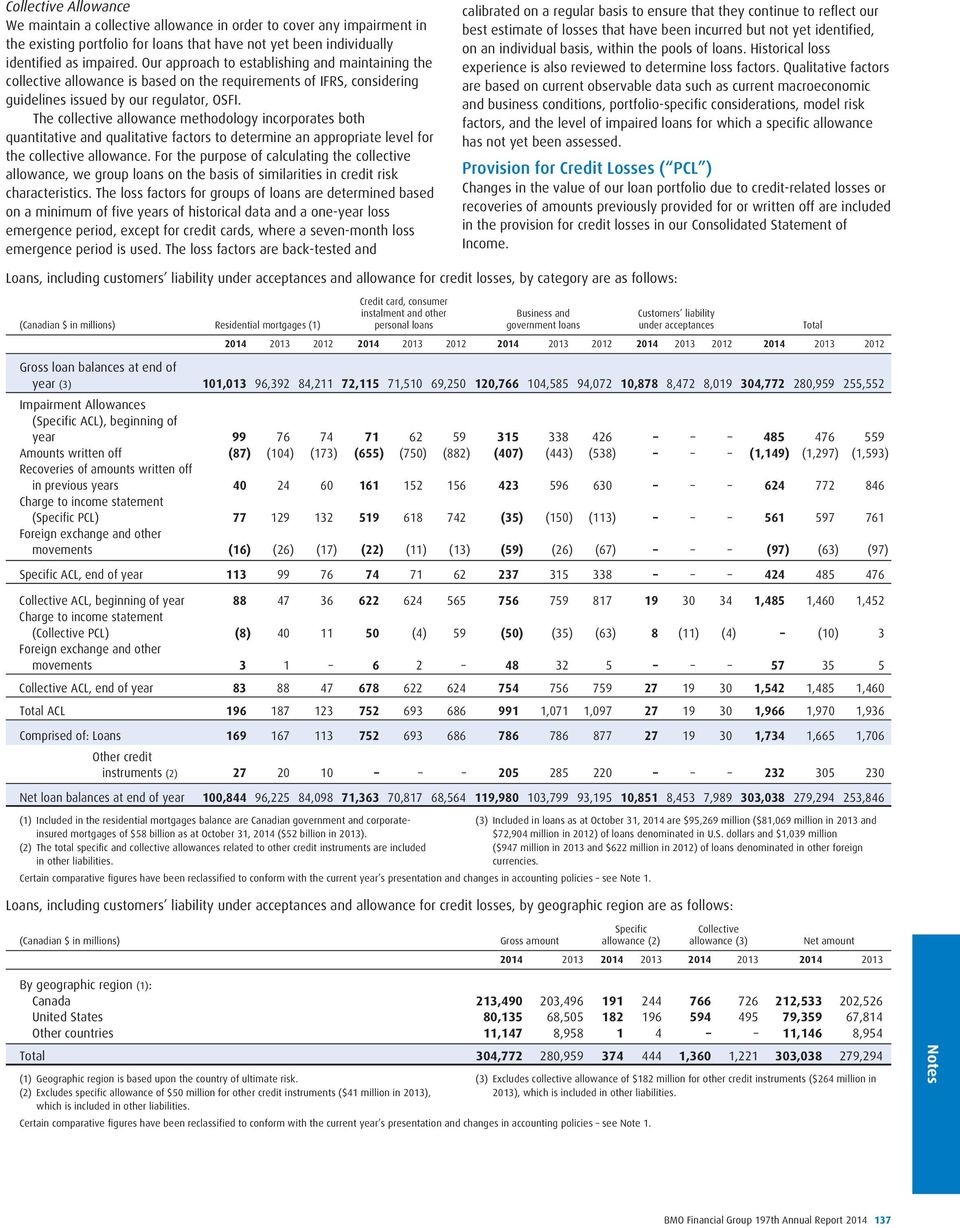
10 Collective Allowance We maintain a collective allowance in order to cover any impairment in the existing portfolio for loans that have not yet been individually identified as impaired. Our approach to establishing and maintaining the collective allowance is based on the requirements of IFRS, considering guidelines issued by our regulator, OSFI. The collective allowance methodology incorporates both quantitative and qualitative factors to determine an appropriate level for the collective allowance. For the purpose of calculating the collective allowance, we group loans on the basis of similarities in credit risk characteristics. The loss factors for groups of loans are determined based on a minimum of five years of historical data and a one-year loss emergence period, except for credit cards, where a seven-month loss emergence period is used. The loss factors are back-tested and calibrated on a regular basis to ensure that they continue to reflect our best estimate of losses that have been incurred but not yet identified, on an individual basis, within the pools of loans. Historical loss experience is also reviewed to determine loss factors. Qualitative factors are based on current observable data such as current macroeconomic and business conditions, portfolio-specific considerations, model risk factors, and the level of impaired loans for which a specific allowance has not yet been assessed. Provision for Credit Losses ( PCL ) Changes in the value of our loan portfolio due to credit-related losses or recoveries of amounts previously provided for or written off are included in the provision for credit losses in our Consolidated Statement of Income. Loans, including customers liability under acceptances and allowance for credit losses, by category are as follows: (Canadian $ in millions) Residential mortgages (1) Credit card, consumer instalment and other personal loans Business and government loans Customers liability under acceptances Total Gross loan balances at end of year (3) 101,013 96,392 84,211 72,115 71,510 69, , ,585 94,072 10,878 8,472 8, , , ,552 Impairment Allowances (Specific ACL), beginning of year Amounts written off (87) (104) (173) (655) (750) (882) (407) (443) (538) (1,149) (1,297) (1,593) Recoveries of amounts written off in previous years Charge to income statement (Specific PCL) (35) (150) (113) Foreign exchange and other movements (16) (26) (17) (22) (11) (13) (59) (26) (67) (97) (63) (97) Specific ACL, end of year Collective ACL, beginning of year ,485 1,460 1,452 Charge to income statement (Collective PCL) (8) (4) 59 (50) (35) (63) 8 (11) (4) (10) 3 Foreign exchange and other movements Collective ACL, end of year ,542 1,485 1,460 Total ACL ,071 1, ,966 1,970 1,936 Comprised of: Loans ,734 1,665 1,706 Other credit instruments (2) Net loan balances at end of year 100,844 96,225 84,098 71,363 70,817 68, , ,799 93,195 10,851 8,453 7, , , ,846 (1) Included in the residential mortgages balance are Canadian government and corporateinsured mortgages of $58 billion as at October 31, 2014 ($52 billion in 2013). (2) The total specific and collective allowances related to other credit instruments are included in other liabilities. Certain comparative figures have been reclassified to conform with the current year s presentation and changes in accounting policies see Note 1. (3) Included in loans as at October 31, 2014 are $95,269 million ($81,069 million in 2013 and $72,904 million in 2012) of loans denominated in U.S. dollars and $1,039 million ($947 million in 2013 and $622 million in 2012) of loans denominated in other foreign currencies. Loans, including customers liability under acceptances and allowance for credit losses, by geographic region are as follows: (Canadian $ in millions) Gross amount Specific allowance (2) Collective allowance (3) Net amount By geographic region (1): Canada 213, , , ,526 United States 80,135 68, ,359 67,814 Other countries 11,147 8, ,146 8,954 Total 304, , ,360 1, , ,294 (1) Geographic region is based upon the country of ultimate risk. (2) Excludes specific allowance of $50 million for other credit instruments ($41 million in 2013), which is included in other liabilities. Certain comparative figures have been reclassified to conform with the current year s presentation and changes in accounting policies see Note 1. (3) Excludes collective allowance of $182 million for other credit instruments ($264 million in 2013), which is included in other liabilities. BMO Financial Group 197th Annual Report
11 NOTES TO CONSOLIDATED FINANCIAL STATEMENTS Impaired loans, including the related allowances, are as follows: (Canadian $ in millions) Gross impaired amount Specific allowance (3) Net of specific allowance Residential mortgages Consumer instalment and other personal loans Business and government loans 972 1, ,200 Total (1) 2,048 2, ,674 2,100 By geographic region (2): Canada United States 1,301 1, ,119 1,587 Other countries Total 2,048 2, ,674 2,100 (1) Excludes purchased credit impaired loans. (2) Geographic region is based upon the country of ultimate risk. (3) Excludes specific allowance of $50 million for other credit instruments ($41 million in 2013), which is included in other liabilities. Fully secured loans with past due amounts between 90 and 180 days that we have not classified as impaired totalled $134 million and $256 million as at October 31, 2014 and 2013, respectively. Specific provisions for credit losses by geographic region are as follows: (Canadian $ in millions) Residential mortgages Credit card, consumer instalment and other personal loans Business and government loans (2) For the year ended October By geographic region (1): Canada United States (140) (281) Other countries (2) (2) (2) (2) Total (35) (150) (1) Geographic region is based upon the country of ultimate risk. (2) Includes provisions relating to customers liability under acceptances in the amount of $nil and $nil as at October 31, 2014 and 2013, respectively. Total Foreclosed Assets Property or other assets that we have received from borrowers to satisfy their loan commitments are classified as either held for use or held for sale according to management s intention and are recorded at the lower of carrying amount or fair value less costs to sell. Fair value is determined based on market prices where available. Otherwise, fair value is determined using other methods, such as analysis of discounted cash flows or market prices for similar assets. During the year ended October 31, 2014, we foreclosed on impaired loans and received $225 million of real estate properties that we classified as held for sale ($301 million in 2013). As at October 31, 2014, real estate properties held for sale totalled $199 million ($278 million in 2013). These properties are disposed of when considered appropriate. During the year ended October 31, 2014, we recorded an impairment loss of $34 million on real estate properties classified as held for sale ($36 million in 2013). Renegotiated Loans From time to time we modify the contractual terms of loans due to the poor financial condition of the borrower. We assess renegotiated loans for impairment consistent with our existing policies for impairment. When renegotiation leads to significant concessionary modifications to the contractual terms of the loan and the concessions are for economic or legal reasons related to the borrower s financial difficulty that we would not otherwise consider, the loan is classified as impaired. We consider one or a combination of the following to be significant concessions: (1) a reduction of the stated interest rate, (2) an extension of the maturity date or dates at a stated interest rate lower than the current market rate for a new loan with a similar term, or (3) forgiveness of principal or accrued interest. Renegotiated loans are permitted to remain in performing status if the modifications are not considered to be significant concessions or are returned to performing status when none of the criteria for classification as impaired continue to apply. The carrying value of our renegotiated loans was $728 million as at October 31, 2014 ($388 million in 2013). Renegotiated loans of $291 million were classified as performing during the year ended October 31, 2014 ($155 million in 2013). Renegotiated loans of $25 million and $59 million were written off in the years ended October 31, 2014 and 2013, respectively. Purchased Loans We record all loans that we purchase at fair value on the day that we acquire the loans. The fair value of the acquired loan portfolio includes an estimate of the interest rate premium or discount on the loans calculated as the difference between the contractual rate of interest on the loans and prevailing interest rates (the interest rate mark ). Also included in fair value is an estimate of expected credit losses (the credit mark ) as of the acquisition date. The credit mark consists of two components: an estimate of the amount of losses that exist in the acquired loan portfolio on the acquisition date but that haven t been specifically identified on that date (the incurred credit mark ) and an amount that represents future expected losses (the future credit mark ). Because we record the loans at fair value, no allowance for credit losses is recorded in our Consolidated Balance Sheet on the day we acquire the loans. Fair value is determined by estimating the principal and interest cash flows expected to be collected on the loans and discounting those cash flows at a market rate of interest. We estimate cash flows expected to be collected based on specific loan reviews for commercial loans. For retail loans, we use models that incorporate management s best estimate of current key assumptions such as default rates, loss severity and the timing of prepayments, as well as collateral. Acquired loans are classified into the following categories: those that on the acquisition date we expect to continue to make timely principal and interest payments (the purchased performing loans ) and those for which on the acquisition date the timely collection of interest and principal was no longer reasonably assured (the purchased credit impaired loans or PCI loans ). Because PCI loans are recorded at fair value at acquisition based on the amount expected to be collected, none of the PCI loans are considered to be impaired at acquisition. 138 BMO Financial Group 197th Annual Report 2014

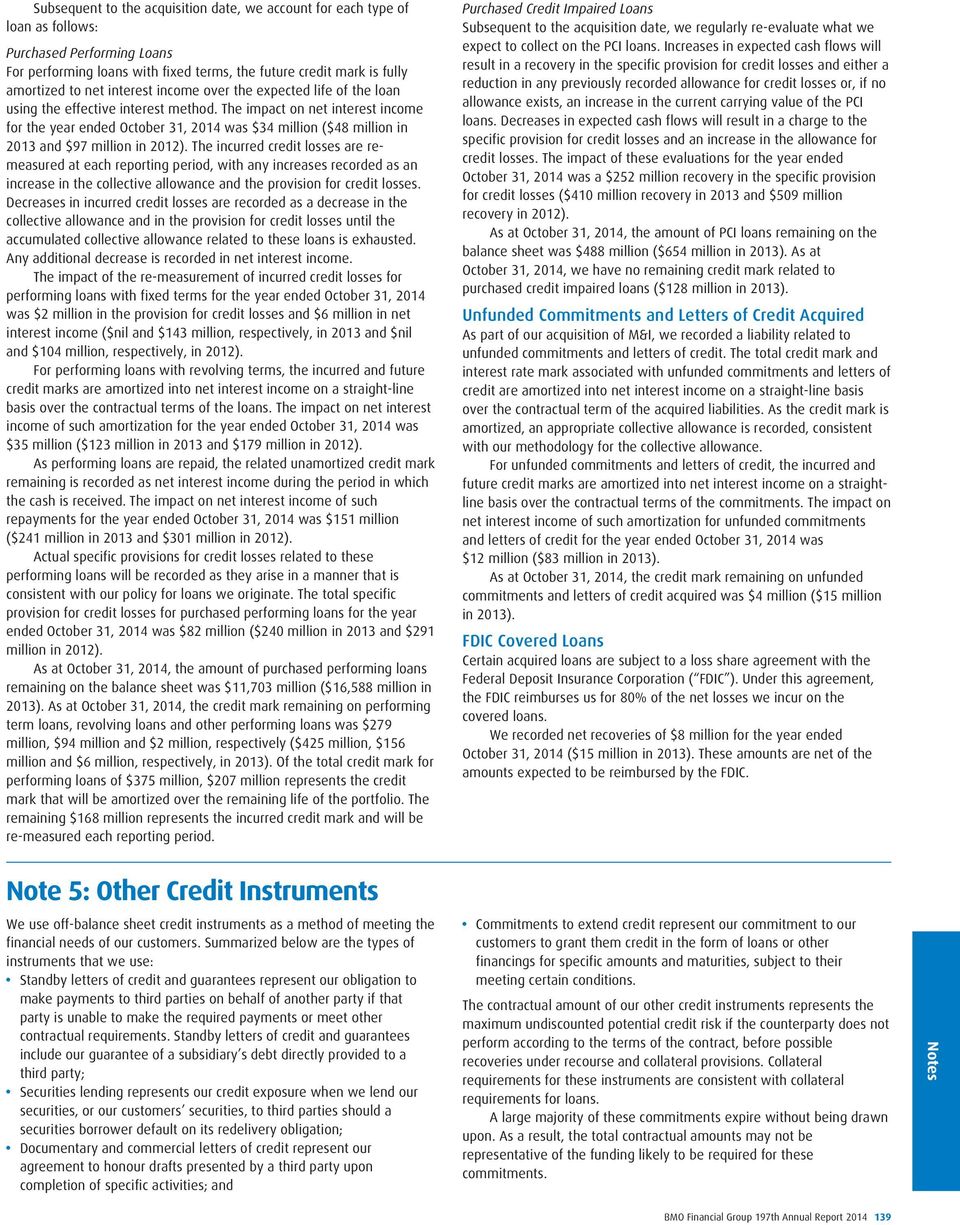
12 Subsequent to the acquisition date, we account for each type of loan as follows: Purchased Performing Loans For performing loans with fixed terms, the future credit mark is fully amortized to net interest income over the expected life of the loan using the effective interest method. The impact on net interest income for the year ended October 31, 2014 was $34 million ($48 million in 2013 and $97 million in 2012). The incurred credit losses are remeasured at each reporting period, with any increases recorded as an increase in the collective allowance and the provision for credit losses. Decreases in incurred credit losses are recorded as a decrease in the collective allowance and in the provision for credit losses until the accumulated collective allowance related to these loans is exhausted. Any additional decrease is recorded in net interest income. The impact of the re-measurement of incurred credit losses for performing loans with fixed terms for the year ended October 31, 2014 was $2 million in the provision for credit losses and $6 million in net interest income ($nil and $143 million, respectively, in 2013 and $nil and $104 million, respectively, in 2012). For performing loans with revolving terms, the incurred and future credit marks are amortized into net interest income on a straight-line basis over the contractual terms of the loans. The impact on net interest income of such amortization for the year ended October 31, 2014 was $35 million ($123 million in 2013 and $179 million in 2012). As performing loans are repaid, the related unamortized credit mark remaining is recorded as net interest income during the period in which the cash is received. The impact on net interest income of such repayments for the year ended October 31, 2014 was $151 million ($241 million in 2013 and $301 million in 2012). Actual specific provisions for credit losses related to these performing loans will be recorded as they arise in a manner that is consistent with our policy for loans we originate. The total specific provision for credit losses for purchased performing loans for the year ended October 31, 2014 was $82 million ($240 million in 2013 and $291 million in 2012). As at October 31, 2014, the amount of purchased performing loans remaining on the balance sheet was $11,703 million ($16,588 million in 2013). As at October 31, 2014, the credit mark remaining on performing term loans, revolving loans and other performing loans was $279 million, $94 million and $2 million, respectively ($425 million, $156 million and $6 million, respectively, in 2013). Of the total credit mark for performing loans of $375 million, $207 million represents the credit mark that will be amortized over the remaining life of the portfolio. The remaining $168 million represents the incurred credit mark and will be re-measured each reporting period. Purchased Credit Impaired Loans Subsequent to the acquisition date, we regularly re-evaluate what we expect to collect on the PCI loans. Increases in expected cash flows will result in a recovery in the specific provision for credit losses and either a reduction in any previously recorded allowance for credit losses or, if no allowance exists, an increase in the current carrying value of the PCI loans. Decreases in expected cash flows will result in a charge to the specific provision for credit losses and an increase in the allowance for credit losses. The impact of these evaluations for the year ended October 31, 2014 was a $252 million recovery in the specific provision for credit losses ($410 million recovery in 2013 and $509 million recovery in 2012). As at October 31, 2014, the amount of PCI loans remaining on the balance sheet was $488 million ($654 million in 2013). As at October 31, 2014, we have no remaining credit mark related to purchased credit impaired loans ($128 million in 2013). Unfunded Commitments and Letters of Credit Acquired As part of our acquisition of M&I, we recorded a liability related to unfunded commitments and letters of credit. The total credit mark and interest rate mark associated with unfunded commitments and letters of credit are amortized into net interest income on a straight-line basis over the contractual term of the acquired liabilities. As the credit mark is amortized, an appropriate collective allowance is recorded, consistent with our methodology for the collective allowance. For unfunded commitments and letters of credit, the incurred and future credit marks are amortized into net interest income on a straightline basis over the contractual terms of the commitments. The impact on net interest income of such amortization for unfunded commitments and letters of credit for the year ended October 31, 2014 was $12 million ($83 million in 2013). As at October 31, 2014, the credit mark remaining on unfunded commitments and letters of credit acquired was $4 million ($15 million in 2013). FDIC Covered Loans Certain acquired loans are subject to a loss share agreement with the Federal Deposit Insurance Corporation ( FDIC ). Under this agreement, the FDIC reimburses us for 80% of the net losses we incur on the covered loans. We recorded net recoveries of $8 million for the year ended October 31, 2014 ($15 million in 2013). These amounts are net of the amounts expected to be reimbursed by the FDIC. Note 5: Other Credit Instruments We use off-balance sheet credit instruments as a method of meeting the financial needs of our customers. Summarized below are the types of instruments that we use: Standby letters of credit and guarantees represent our obligation to make payments to third parties on behalf of another party if that party is unable to make the required payments or meet other contractual requirements. Standby letters of credit and guarantees include our guarantee of a subsidiary s debt directly provided to a third party; Securities lending represents our credit exposure when we lend our securities, or our customers securities, to third parties should a securities borrower default on its redelivery obligation; Documentary and commercial letters of credit represent our agreement to honour drafts presented by a third party upon completion of specific activities; and Commitments to extend credit represent our commitment to our customers to grant them credit in the form of loans or other financings for specific amounts and maturities, subject to their meeting certain conditions. The contractual amount of our other credit instruments represents the maximum undiscounted potential credit risk if the counterparty does not perform according to the terms of the contract, before possible recoveries under recourse and collateral provisions. Collateral requirements for these instruments are consistent with collateral requirements for loans. A large majority of these commitments expire without being drawn upon. As a result, the total contractual amounts may not be representative of the funding likely to be required for these commitments. BMO Financial Group 197th Annual Report
13 NOTES TO CONSOLIDATED FINANCIAL STATEMENTS We strive to limit credit risk by dealing only with counterparties that we believe are creditworthy, and we manage our credit risk for other credit instruments using the same credit risk process that is applied to loans and other credit assets. Summarized information related to various commitments is as follows: (Canadian $ in millions) Contractual amount Contractual amount Credit Instruments Standby letters of credit and guarantees 13,949 13,470 Securities lending 4,872 3,772 Documentary and commercial letters of credit 1,111 1,205 Commitments to extend credit (1) Original maturity of one year and under 16,752 13,616 Original maturity of over one year 68,507 58,244 Total 105,191 90,307 (1) Commitments to extend credit exclude personal lines of credit and credit card lines of credit that are unconditionally cancellable at our discretion. Note 6: Risk Management We have an enterprise-wide approach to the identification, measurement, monitoring and management of risks faced across the organization. The key risks related to our financial instruments are classified as credit and counterparty, market, and liquidity and funding risk. Credit and Counterparty Risk Credit and counterparty risk is the potential for loss due to the failure of a borrower, endorser, guarantor or counterparty to repay a loan or honour another predetermined financial obligation. Credit risk arises predominantly with respect to loans, over-the-counter derivatives and other credit instruments. This is the most significant measurable risk that we face. Our risk management practices and key measures are disclosed in the text and tables presented in a blue-tinted font in Management s Discussion and Analysis on pages 84 to 86 of this report. Additional information on loans and derivative-related credit risk is disclosed in 4 and 10, respectively. Concentrations of Credit and Counterparty Risk Concentrations of credit risk exist if a number of clients are engaged in similar activities, are located in the same geographic region or have similar economic characteristics such that their ability to meet contractual obligations could be similarly affected by changes in economic, political or other conditions. Concentrations of credit risk indicate a related sensitivity of our performance to developments affecting a particular counterparty, industry or geographic location. At year end, our credit assets consisted of a well-diversified portfolio representing millions of clients, the majority of them consumers and small to medium-sized businesses. From an industry viewpoint, our most significant exposure as at year end was to individual consumers, captured within the individual sector in the following table, comprising $169.0 billion ($181.6 billion in 2013). Additional information on the composition of our loans and derivatives exposure is disclosed in 4 and 10, respectively. Basel III Framework We use the Basel III Framework as our capital management framework. We use the Advanced Internal Ratings Based ( AIRB ) approach to determine credit risk-weighted assets in our portfolio except for acquired loans in our M&I and other select portfolios, for which we use the Standardized Approach. The framework uses exposure at default to assess credit and counterparty risk. Exposures are classified as follows: Drawn loans include loans, acceptances, deposits with regulated financial institutions, and certain securities. Exposure at default ( EAD ) represents an estimate of the outstanding amount of a credit exposure at the time a default may occur. For off-balance sheet amounts and undrawn amounts, EAD includes an estimate of any further amounts that may be drawn at the time of default. Undrawn commitments cover all unutilized authorizations, including those which are unconditionally cancellable. EAD for undrawn commitments is model generated based on internal empirical data. Over-the-counter ( OTC ) derivatives are those in our proprietary accounts that attract credit risk in addition to market risk. EAD for OTC derivatives is equal to the net gross replacement cost plus any potential credit exposure amount. Other off-balance sheet exposures include items such as guarantees, standby letters of credit and documentary credits. EAD for other offbalance sheet items is based on management s best estimate. Repo-style transactions include repos, reverse repos and securities lending transactions, which represent both asset and liability exposures. EAD for repo-style transactions is the total amount drawn, adding back any write-offs. Adjusted EAD represents exposures that have been redistributed to a more favourable probability of default band or a different Basel asset class as a result of applying credit risk mitigation. 140 BMO Financial Group 197th Annual Report 2014

14 Total non-trading exposure at default by industry sector, as at October 31, 2014 and 2013, based on the Basel III classifications is as follows: (Canadian $ in millions) Drawn Commitments (undrawn) OTC derivatives Other off-balance sheet items Repo-style transactions Total Financial institutions 69,174 60,448 15,164 12, ,825 2,978 40,362 27, , ,634 Governments 43,035 43,142 1,838 1,581 1,010 1,333 10,266 9,503 56,149 55,559 Manufacturing 13,678 11,617 9,499 9, ,189 1,061 24,406 21,817 Real estate 18,408 18,532 5,602 4,639 1,072 1,122 25,082 24,293 Retail trade 11,973 9,394 4,995 4, ,505 14,601 Service industries 21,944 22,999 8,873 8, ,748 3, ,573 34,713 Wholesale trade 8,260 7,465 4,253 3, ,974 11,757 Oil and gas 5,969 3,831 6,931 5, ,512 10,039 Individual 132, ,905 36,627 41, , ,548 Agriculture 9,016 8,077 1,905 2, ,957 10,365 Others (1) 38,090 24,951 12,692 11, ,303 3, ,483 39,306 Total exposure at default 371, , , , ,811 14,676 51,035 37, , ,632 (1) Includes industries having a total exposure of less than 2%. Additional information about our credit risk exposure by geographic region and product category for loans, including customers liability under acceptances, is provided in Note 4. Credit Quality We assign risk ratings based on probabilities as to whether counterparties will default on their financial obligations to us. Our process for assigning risk ratings is disclosed in the text presented in a blue-tinted font in the Enterprise-Wide Risk Management section of Management s Discussion and Analysis on pages 85 to 86 of this report. Based on the Basel III classifications, the following tables present our retail and wholesale credit exposure by risk rating on an adjusted exposure at default basis as at October 31, 2014 and Wholesale includes all loans that are not classified as retail. Wholesale Credit Exposure by Risk Rating (Canadian $ in millions) Drawn Undrawn (1) Bank Corporate Sovereign Bank Corporate Sovereign Total exposure Total exposure Investment grade 19,982 86, ,128 2,764 47,071 2, , ,658 Non-investment grade 3,465 40, , ,348 51,659 Watchlist 9 2, ,519 2,470 Default ,032 2,086 Total 23, , ,315 3,017 64,060 2, , ,873 (1) Included in the undrawn amounts are uncommitted exposures of $24,051 million in 2014 ($23,662 million in 2013). Retail Credit Drawn Exposure by Portfolio and Risk Rating (Canadian $ in millions) Residential mortgages and home equity lines of credit Qualifying revolving retail (1) Other retail and retail small and medium-sized enterprises Risk profile (probability of default): Exceptionally low ( 0.05%) 1, Very low (> 0.05% to 0.20%) 45,424 47, ,711 4,447 7,521 Low (> 0.20% to 0.75%) 9,649 11,216 2,913 2,578 6,680 7,995 Medium (> 0.75% to 7.00%) 11,011 8,925 2,504 2,073 6,147 7,255 High (> 7.00% to 99.99%) 3,521 3, Default (100%) Total 71,535 73,078 6,395 7,011 17,798 23,222 (1) Qualifying revolving retail includes exposures to individuals that are revolving, unsecured and uncommitted up to a maximum amount of $125,000 to a single individual. Loans Past Due Not Impaired Loans that are past due but not classified as impaired are loans where our customers have failed to make payments when contractually due, but for which we expect the full amount of principal and interest payments to be collected. The following table presents the loans that are past due but not classified as impaired as at October 31, 2014 and 2013: Loans Past Due Not Impaired (Canadian $ in millions) 1 to 29 days 30 to 89 days 90 days or more Total Residential mortgages (1) ,172 1,230 Credit card, consumer instalment and other personal loans 1,915 1, ,490 2,276 Business and government loans ,282 Customers liability under acceptances Total 2,996 3,193 1,089 1, ,395 4,847 (1) The percentage of loans 90 days or more past due but not impaired that were guaranteed by the Government of Canada is 5% for 2014 and 5% for BMO Financial Group 197th Annual Report
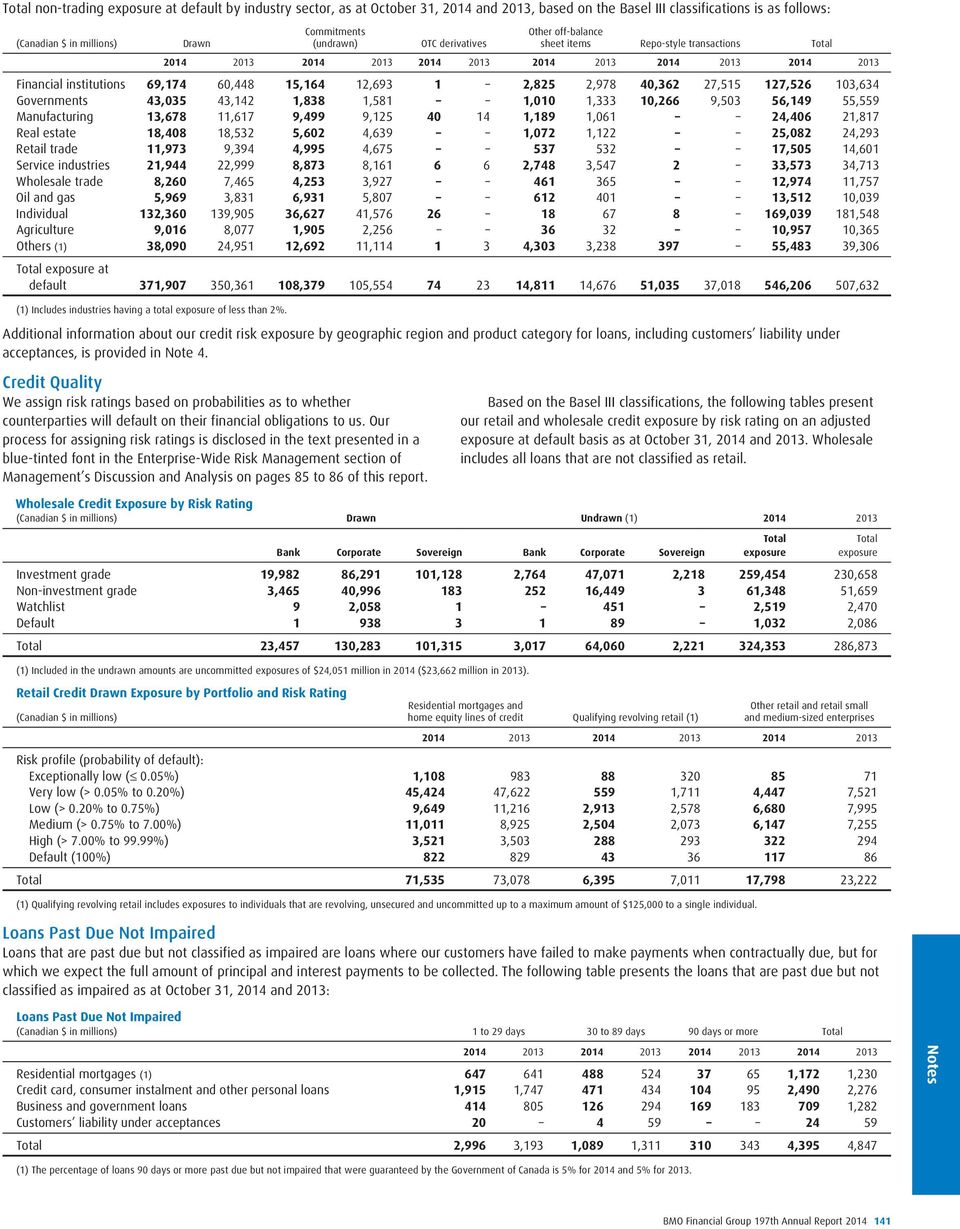
15 NOTES TO CONSOLIDATED FINANCIAL STATEMENTS Loan Maturities and Rate Sensitivity The following table presents gross loans and acceptances by contractual maturity and by country of ultimate risk: (Canadian $ in millions) 1 year or less Over 1 year Over 5 years Total Canada Consumer 50,026 45,847 93,486 92,543 5,984 6, , ,380 Commercial and corporate (excluding real estate) 41,608 37,435 10,981 8, ,472 52,730 47,393 Commercial real estate 4,506 5,405 5,331 4,540 1, ,264 10,723 United States 22,292 17,670 41,084 36,195 16,759 14,640 80,135 68,505 Other countries 10,632 8, ,147 8,958 Total 129, , , ,357 24,361 23, , ,959 Certain comparative figures have been reclassified to conform with the current year s presentation and for changes in accounting policies see Note 1. The following table analyzes net loans and acceptances by interest rate sensitivity: (Canadian $ in millions) Fixed rate 150, ,832 Floating rate 142, ,990 Non-interest sensitive (1) 10,878 8,472 Total 303, ,294 (1) Non-interest sensitive loans and acceptances include customers liability under acceptances. Certain comparative figures have been reclassified to conform with the current year s presentation and changes in accounting policies see Note 1. Market Risk Market risk is the potential for adverse changes in the value of our assets and liabilities resulting from changes in market variables such as interest rates, foreign exchange rates, equity and commodity prices and their implied volatilities, and credit spreads, as well as the risk of credit migration and default. We incur market risk in our trading and underwriting activities and in the management of structural market risk in our banking and insurance activities. Our market risk management practices and key measures are disclosed in the text and tables presented in a blue-tinted font in the Enterprise-Wide Risk Management section of Management s Discussion and Analysis on pages 91 to 95 of this report. Liquidity and Funding Risk Liquidity and funding risk is the potential for loss if we are unable to meet financial commitments in a timely manner at reasonable prices as they fall due. It is our policy to ensure that sufficient liquid assets and funding capacity are available to meet financial commitments, including liabilities to depositors and suppliers, and lending, investment and pledging commitments, even in times of stress. Managing liquidity and funding risk is essential to maintaining both depositor confidence and stability in earnings. Our liquidity and funding risk management practices and key measures are disclosed in the text presented in a blue-tinted font in the Enterprise-Wide Risk Management section of Management s Discussion and Analysis on pages 95 to 99 of this report. Note 7: Guarantees In the normal course of business, we enter into a variety of guarantees. Guarantees include contracts where we may be required to make payments to a counterparty, based on changes in the value of an asset, liability or equity security that the counterparty holds, due to changes in an underlying interest rate, foreign exchange rate or other variable. In addition, contracts under which we may be required to make payments to reimburse the counterparty for a loss if a third party does not perform according to the terms of a contract or does not make payments when due under the terms of a debt instrument, and contracts under which we provide indirect guarantees of the indebtedness of another party, are considered guarantees. Guarantees that qualify as derivatives are accounted for in accordance with the policy for derivative instruments (see Note 10). For guarantees that do not qualify as derivatives, the liability is initially recorded at fair value, which is generally the fee to be received. Subsequently, guarantees are recorded at the higher of the initial fair value, less amortization to recognize any fee income earned over the period, and the best estimate of the amount required to settle the obligation. Any increase in the liability is reported in our Consolidated Statement of Income. The most significant guarantees are as follows: Standby Letters of Credit and Guarantees Standby letters of credit and guarantees represent our obligation to make payments to third parties on behalf of another party if that party is unable to make the required payments or meet other contractual requirements. The maximum amount payable under standby letters of credit and guarantees totalled $13,949 million as at October 31, 2014 ($13,470 million in 2013). The majority have a term of one year or less. Collateral requirements for standby letters of credit and guarantees are consistent with our collateral requirements for loans. A large majority of these commitments expire without being drawn upon. As a result, the total contractual amounts may not be representative of the funding likely to be required for these commitments. As at October 31, 2014, $50 million ($41 million in 2013) was included in other liabilities related to guaranteed parties that were unable to meet their obligations to a third party (see Note 4). No other amount was included in our Consolidated Balance Sheet as at October 31, 2014 and 2013 related to these standby letters of credit and guarantees. Backstop and Other Liquidity Facilities Backstop liquidity facilities are provided to asset-backed commercial paper ( ABCP ) programs administered by either us or third parties as an alternative source of financing in the event that such programs are unable to access ABCP markets or when predetermined performance measures of the financial assets held by these programs are not met. The terms of the backstop liquidity facilities do not require us to advance money to these programs in the event of bankruptcy of the borrower. The facilities terms are generally no longer than one year, but can be several years. The maximum amount payable under these backstop and other liquidity facilities totalled $5,501 million as at October 31, 2014 ($4,512 million in 2013). As at October 31, 2014, $53 million was outstanding from facilities drawn in accordance with the terms of the backstop liquidity facilities ($145 million in 2013). 142 BMO Financial Group 197th Annual Report 2014
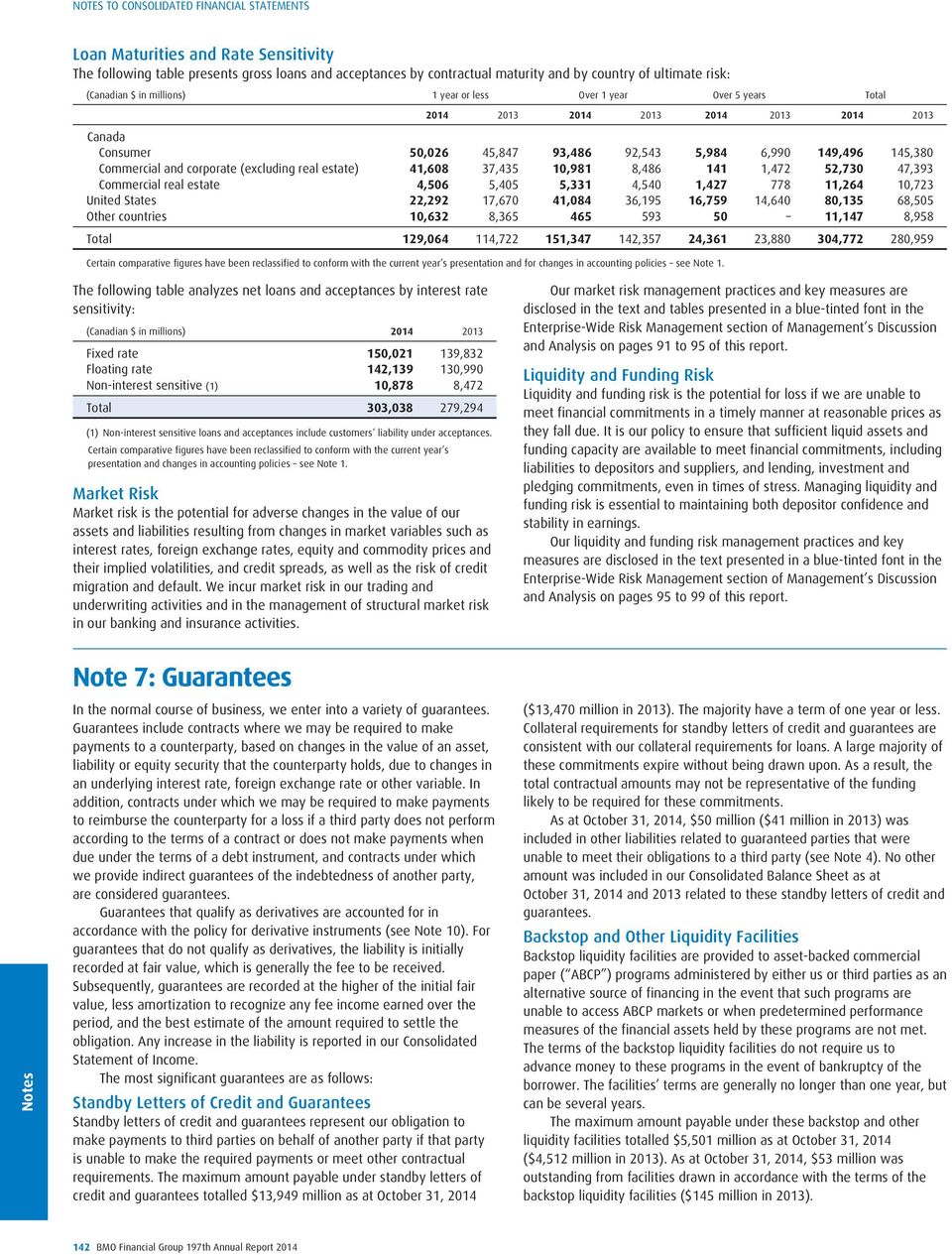
16 Credit Enhancement Facilities Where warranted, we provide partial credit enhancement facilities for transactions within ABCP programs administered by either us or third parties. Credit enhancement facilities are included in backstop liquidity facilities. Derivatives Certain of our derivative instruments meet the accounting definition of a guarantee when they require the issuer to make payments to reimburse the holder for a loss incurred because a debtor fails to make payment when due under the terms of a debt instrument. In order to reduce our exposure to these derivatives, we enter into contracts that hedge the related risks. Written credit default swaps require us to compensate a counterparty following the occurrence of a credit event in relation to a specified reference obligation, such as a bond or a loan. The maximum amount payable under credit default swaps is equal to their notional amount of $11,983 million as at October 31, 2014 ($13,288 million in 2013). The terms of these contracts range from less than one year to 10 years. The fair value of the related derivative liabilities included in derivative instruments in our Consolidated Balance Sheet was $124 million as at October 31, 2014 ($102 million in 2013). Exchange and Clearinghouse Guarantees We are a member of several securities and futures exchanges and clearinghouses. Membership in certain of these organizations may require us to pay a pro rata share of the losses incurred by the organization in the event of default of another member. Such Note 8: Asset Securitization Periodically, we securitize loans to obtain alternate sources of funding. Securitization involves selling loans to trusts ( securitization vehicles ), which buy the loans and then issue either interest bearing or discounted investor certificates. We use a bank securitization vehicle to securitize our Canadian credit card loans. We are required to consolidate this vehicle. See Note 9 for further information. We also sell Canadian mortgage loans to thirdparty Canadian securitization programs, including the Canadian Mortgage Bond program, and directly to third-party investors under the National Housing Act Mortgage-Backed Securities program. We assess whether the loans qualify for off-balance sheet treatment based on the transfer of the risks and rewards. Under these programs, we are entitled to the payment over time of the excess of the sum of interest and fees collected from customers, in connection with the loans that were sold, over the yield paid to investors in the securitization vehicle or third-party securitization program, less credit losses and other costs. The loans sold to third-party securitization programs or directly to third parties do not qualify for off-balance sheet recognition as we have obligations vary with different organizations. These obligations may be limited to members who dealt with the defaulting member, an amount related to our contribution to a member s guarantee fund, or an amount specified in the membership agreement. It is difficult to estimate our maximum exposure under these membership agreements, since this would require an assessment of future claims that may be made against us that have not yet occurred. Based on historical experience, we expect the risk of loss to be remote. Indemnification Agreements In the normal course of operations, we enter into various agreements that provide general indemnifications. These indemnifications typically occur in connection with sales of assets, securities offerings, service contracts, membership agreements, clearing arrangements, derivative contracts and leasing transactions. We also have a securities lending business that lends securities owned by clients to borrowers who have been evaluated for credit risk using the same credit risk process that is applied to loans and other credit assets. In connection with these activities, we provide an indemnification to lenders against losses resulting from the failure of the borrower to return loaned securities when due. All borrowings are fully collateralized with cash or marketable securities. As securities are loaned, we require borrowers to maintain collateral which is equal to or in excess of 100% of the fair value of the securities borrowed. The collateral is revalued on a daily basis. The amount of securities loaned subject to indemnification was $5,269 million as at October 31, 2014 ($4,778 million in 2013). No amount was included in our Consolidated Balance Sheet as at October 31, 2014 and 2013 related to these indemnifications. determined that the transfer of these loans has not resulted in the transfer of substantially all the risks and rewards, since we continue to be exposed to substantially all of the prepayment, interest rate and/or credit risk associated with the securitized loans. We continue to recognize the loans in our Consolidated Balance Sheet, and we recognize the instruments issued as a liability representing a secured financing. The carrying amount of assets in the table below reflects the value of the securitized mortgages, as well as payments received on securitized mortgages that are held in the vehicle or designated accounts. The interest and fees collected, net of the yield paid to investors, is recorded in net interest income using the effective interest method over the term of the securitization. Credit losses associated with the loans are recorded in the provision for credit losses. During the year ended October 31, 2014, we sold $5,564 million of loans to third-party securitization programs ($6,704 million in 2013), which does not include amounts that were transferred and repurchased during the year. The following table shows the carrying amounts related to securitization activities with third parties that are recorded in our Consolidated Balance Sheet, together with the associated liabilities, for each category of asset on the balance sheet: (Canadian $ in millions) 2014 (1) 2013 Carrying amount of assets Associated liabilities Carrying amount of assets Associated liabilities Residential mortgages 9,569 9,956 Other related assets (2) 8,382 8,660 Total 17,951 17,546 18,616 18,235 (1) The fair value of the securitized assets is $18,078 million and the fair value of the associated liabilities is $17,858 million, for a net position of $220 million. Securitized assets are those which we have transferred to third parties, including other related assets. (2) Other related assets represent payments received on account of loans pledged under securitization that have not been applied against the associated liabilities. The payments received are held on behalf of the investors in the securitization vehicles until principal payments are required to be made on the associated liabilities. In order to compare all assets supporting the associated liabilities, this amount is added to the carrying value of the securitized assets in the table above. BMO Financial Group 197th Annual Report
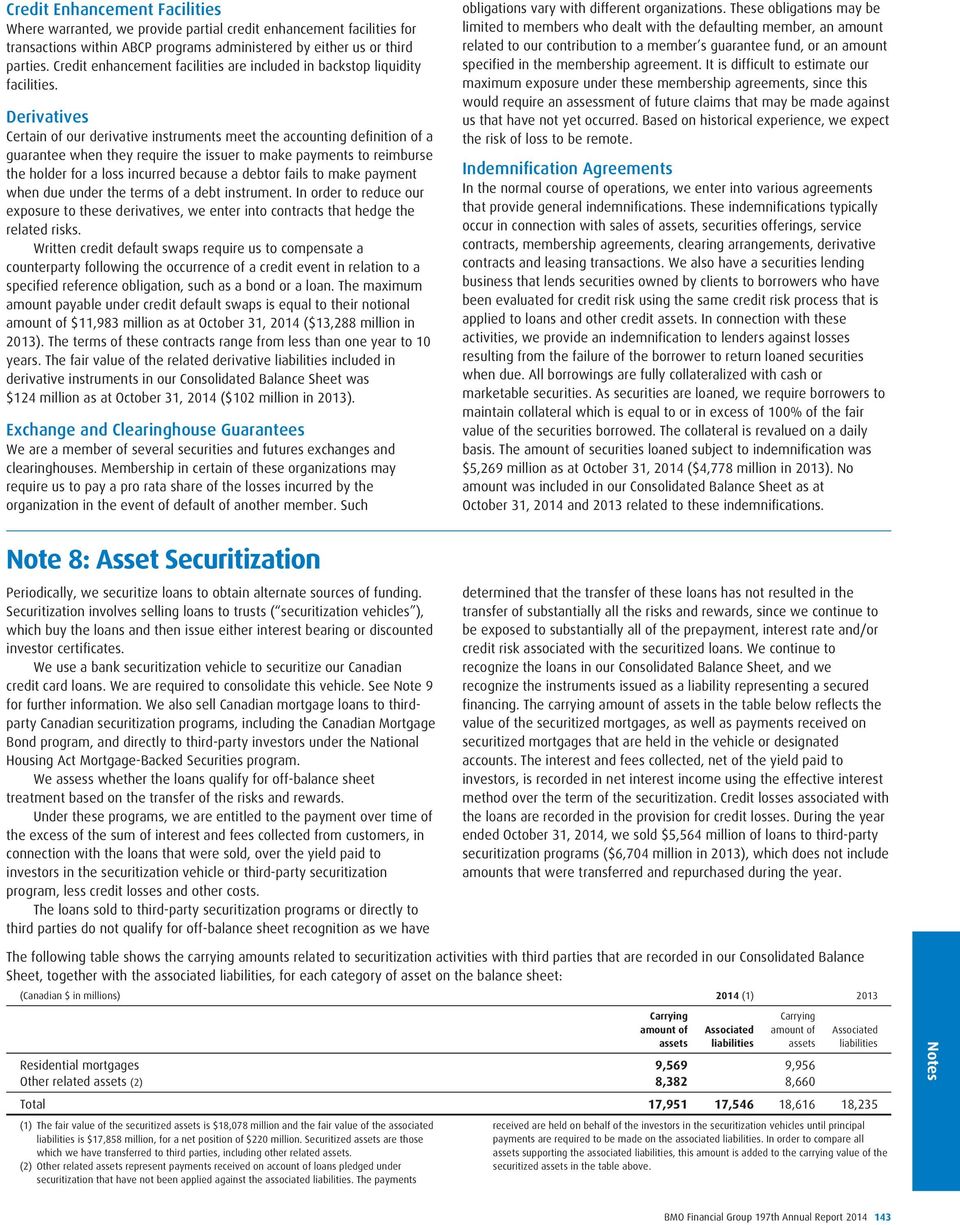
17 NOTES TO CONSOLIDATED FINANCIAL STATEMENTS Note 9: Structured Entities We enter into certain transactions in the ordinary course of business which involve the establishment of structured entities ( SEs ) to facilitate or secure customer transactions and to obtain alternative sources of funding. We are required to consolidate an SE if we control the entity. We control an SE when we have power over the SE, exposure to variable returns as a result of our involvement, and the ability to exercise power to affect the amount of our returns. In assessing whether we control an SE, we consider the entire arrangement to determine the purpose and design of the SE, the nature of any rights held through contractual arrangements and whether we are acting as a principal or agent. We perform a re-assessment of consolidation if facts and circumstances indicate that there have been changes to one or more of the elements of control over the SE. Consolidated Structured Entities Total assets and liabilities included in our Consolidated Balance Sheet related to our consolidated SEs and our exposure to losses are summarized in the following table: (Canadian $ in millions) Bank securitization vehicles U.S. customer securitization vehicle Credit protection vehicle Capital and funding vehicles (2) Bank securitization vehicles U.S. customer securitization vehicle Credit protection vehicle (1) Capital and funding vehicles (2) Cash and cash equivalents , Loans 7,266 3,036 16,435 7,190 3,537 20,717 Other 3 3 7,300 3, ,084 7,215 3,910 1,430 21,068 Deposits 2,926 3,578 Other 4, , ,998 2, ,328 3, Exposure to loss Securities held 2, , Drawn facilities , ,595 Undrawn facilities (1) 5,236 10,361 4,417 8,455 Derivative assets ,012 5, ,052 1,499 4, ,974 (1) During the year ended October 31, 2013, the senior funding facility provided to our credit protection vehicle was terminated. (2) The loans balance primarily consists of mortgages transferred to our covered bonds programs. Mortgages in excess of the amount of covered bonds outstanding plus the minimum required over-collateralization amounts under these programs are readily available to us. The undrawn facilities also primarily relate to our covered bond programs; we retain the authority to determine whether the facilities are utilized. Certain comparative figures have been restated as a result of the adoption of new accounting principles see Note 1. Bank Securitization Vehicles We use securitization vehicles to securitize our Canadian credit card loans in order to obtain alternate sources of funding. The structure of these vehicles limits the activities they can undertake and the types of assets they can hold, and the vehicles have limited decision-making authority. The vehicles issue term asset-backed securities to fund their activities. We control and consolidate these vehicles, as we have the key decision-making powers necessary to obtain the majority of the benefits of their activities. U.S. Customer Securitization Vehicle We sponsor a customer securitization vehicle (also referred to as a banksponsored multi-seller conduit) that provides our customers with alternate sources of funding through the securitization of their assets. This vehicle provides clients with access to financing in the asset-backed commercial paper ( ABCP ) markets by allowing them to sell their assets into the vehicle, which then issues ABCP to investors to fund the purchases. We do not sell assets to the customer securitization vehicle. We earn fees for providing services related to the securitizations, including liquidity, distribution and financial arrangement fees for supporting the ongoing operations of the vehicle. We have determined that we control and therefore consolidate this vehicle, as we are exposed to the variable returns of the entity and we have the key decision-making powers necessary to affect the amount of those returns in our capacity as liquidity provider and servicing agent. Credit Protection Vehicle We sponsor a credit protection vehicle which provides credit protection to investors on investments in corporate debt portfolios through credit default swaps. In May 2008, upon the restructuring of the vehicle, we entered into credit default swaps with swap counterparties and offsetting swaps with the vehicle. In 2014, the vehicle redeemed $1,049 million of its outstanding medium-term notes ($742 million in 2013), of which $678 million ($480 million in 2013) were held by us. We continue to hold $256 million of outstanding medium-term notes. As at October 31, 2014 and 2013, we have hedged our exposure to our holdings of notes issued by the vehicle. A third party holds its exposure to the vehicle through a total return swap with us on $109 million of notes. We control and therefore consolidate this vehicle. Capital and Funding Vehicles Capital and funding vehicles are created to issue notes or capital trust securities or to guarantee payments due to bondholders on bonds issued by us. These vehicles purchase notes from us, or we may sell assets to the vehicles in exchange for promissory notes. For those trusts that purchase assets from us, we have determined that, based on the rights of the arrangements, we have significant exposure to the variable returns of the entities as we are exposed to the variability of their underlying assets; therefore we have determined that we are operating as the principal in the entities, and that we control and therefore consolidate these vehicles. See Note 1 and Note 18 for further information related to capital trusts. 144 BMO Financial Group 197th Annual Report 2014
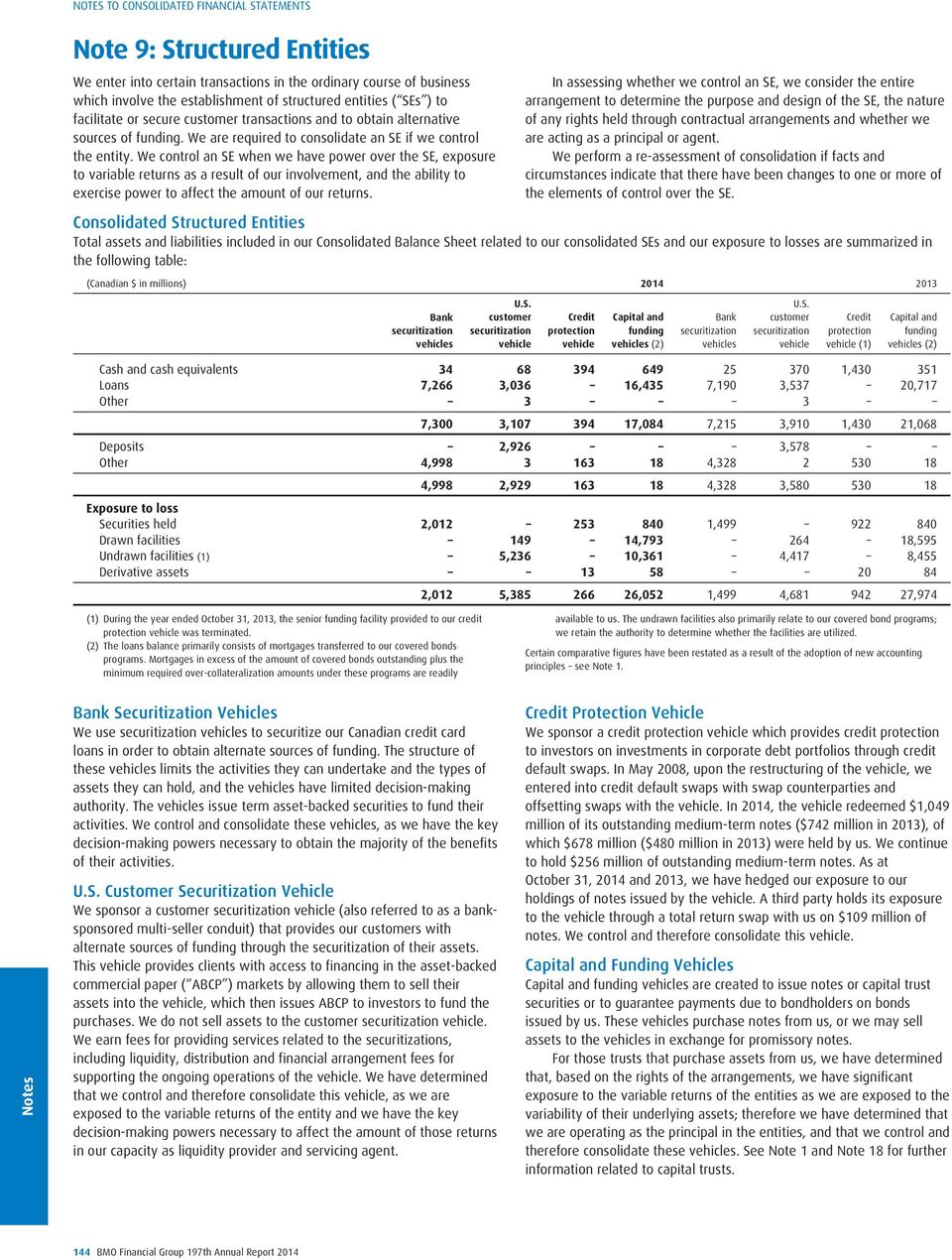
18 Unconsolidated Structured Entities The table below presents amounts related to our interests in unconsolidated SEs: (Canadian $ in millions) Capital and funding vehicles Canadian customer securitization vehicles (1) (2) Structured finance vehicles Capital and funding vehicles Canadian customer securitization vehicles (1) (2) Structured finance vehicles Interests recorded on the balance sheet Cash and cash equivalents Trading securities , ,120 Available-for-sale securities Other , ,239 Deposits 1, ,853 1, ,584 Derivatives 1, Other 21 3, ,582 1, ,415 1, ,151 Exposure to loss Securities held , ,120 Drawn facilities Undrawn facilities 43 4,565 na 43 3,866 na 57 5,227 10, ,600 12,120 Total assets of the entities 1,286 3,783 10,456 (1) These undrawn facilities represent backstop liquidity facilities. The majority of these facilities are not related to credit support as at October 31, 2014 and na - not applicable Certain comparative figures have been reclassified to conform with the current year s presentation and restated as a result of the adoption of new accounting principles see Note 1. (2) Securities held that are issued by our Canadian customer securitization vehicles are comprised of asset-backed commercial paper and are classified as trading securities and available-for-sale securities. All assets held by these vehicles relate to assets in Canada. Capital and Funding Vehicles Certain of our capital and funding vehicles purchase notes issued by us as their underlying assets. In these situations, we are not exposed to significant default or credit risk. Our remaining exposure to variable returns is less than that of the note holders, who are exposed to our default and credit risk. We have determined that we are operating in the capacity of an agent in these situations, and therefore we do not consolidate these vehicles. See Note 1 and Note 18 for further information related to capital trusts. Canadian Customer Securitization Vehicles For our Canadian customer securitization vehicles, we have determined that we do not have control of these entities as the key relevant activity, the servicing of program assets, does not reside with us. Structured Finance Vehicles We facilitate development of investment products by third parties, including mutual funds, unit investment trusts and other investment funds that are sold to retail investors. We enter into derivative contracts with these funds to provide the investors their desired exposure, and we hedge our exposure related to these derivative contracts by investing in other funds through SEs. We are not required to consolidate these vehicles. Compensation Trusts We have established trusts in order to administer our employee share ownership plan. Under this plan, employees can direct a portion of their gross salary towards the purchase of our common shares and we match 50% of employees contributions up to 6% of their individual gross salary. Our matching contributions are paid into trusts, which purchase our common shares on the open market for distribution to employees once employees are entitled to the shares under the terms of the plan. Total assets held by our compensation trusts amounted to $1,413 million as at October 31, 2014 ($1,343 million in 2013). We are not required to consolidate these compensation trusts. These trusts are not included in the table above as we have no interest in the trusts. BMO Managed Funds We have established a number of funds that we also manage. We assess whether or not we control these funds based on the economic interest we have in the funds, including investments in the funds and management fees, and any investors rights to remove us as investment manager. Based on our assessment, we have determined that we do not control these funds. Our total exposure to unconsolidated BMO managed funds was $513 million at October 31, Non-BMO Managed Funds We purchase and hold units of non-bmo managed funds for investment and other purposes. We are considered to have an interest in these funds through our holding of units, and because we may act as counterparty in certain derivative contracts or other interests. These activities do not constitute control, and as a result our interests in these funds are not consolidated. Our total exposure to non-bmo managed funds was $11,647 million at October 31, Other SEs We are involved with other entities that may potentially be SEs. This involvement can include, for example, acting as a derivatives counterparty, liquidity provider, investor, fund manager or trustee. These activities do not cause us to control the SEs. As a result, we are not required to consolidate these SEs. Transactions with these SEs are conducted at market rates, and individual creditor investment decisions are based upon an analysis of the specific SE, taking into consideration the quality of the underlying assets. We record and report these transactions in the same manner as other transactions. For example, derivative contracts are recorded in accordance with our derivatives accounting policy as outlined in Note 10. Liquidity facilities and indemnification agreements are described in Note 7. We are deemed to be the sponsor of an SE if we are involved in the design, legal set-up or marketing of the SE. We are also deemed to be the sponsor of an SE if market participants would reasonably associate the entity with us. We do not have an interest in certain SEs that we have sponsored. The amounts of revenue earned from and assets transferred to such entities are not significant. BMO Financial Group 197th Annual Report
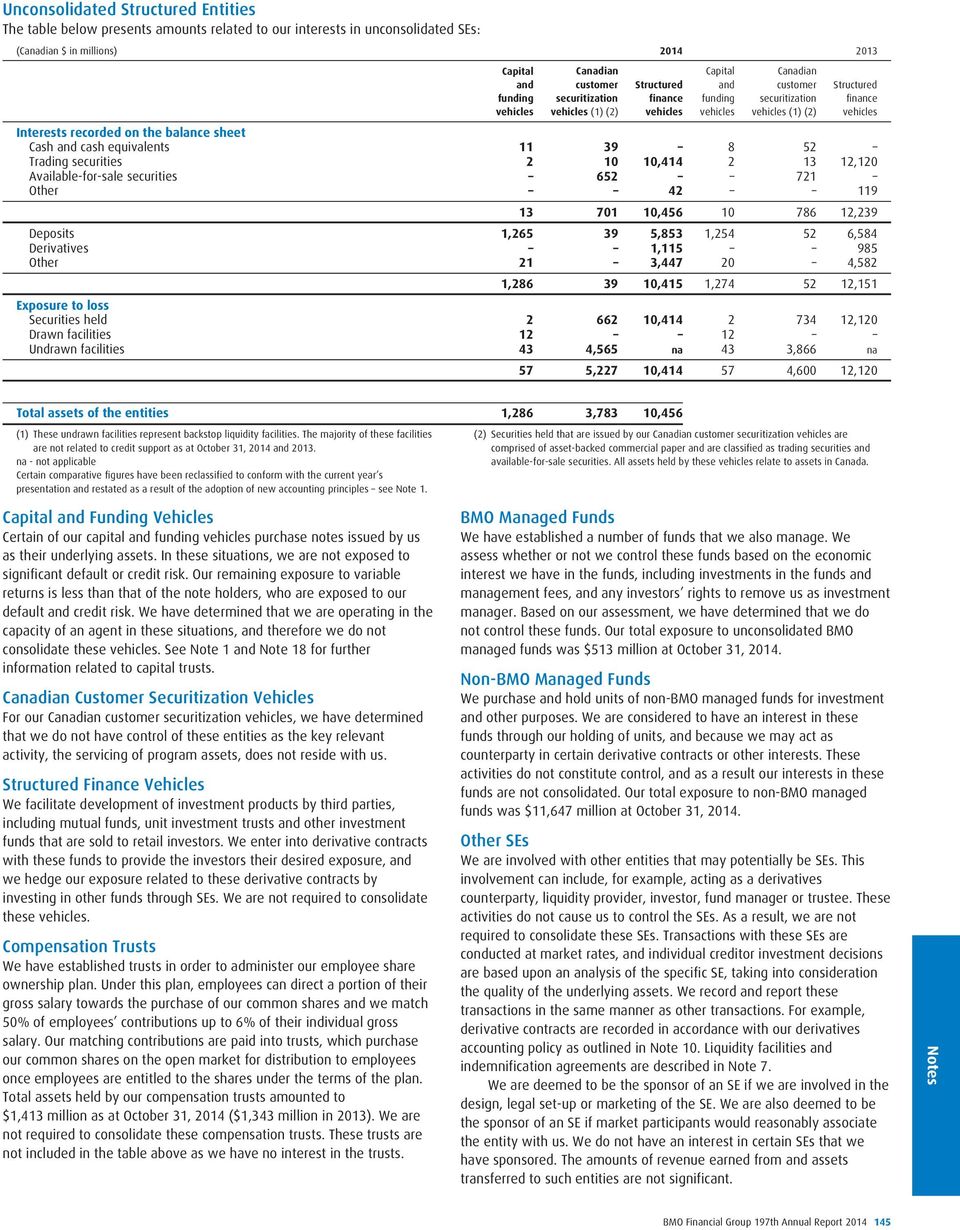
19 NOTES TO CONSOLIDATED FINANCIAL STATEMENTS Note 10: Derivative Instruments Derivative instruments are financial contracts that derive their value from underlying changes in interest rates, foreign exchange rates or other financial or commodity prices or indices. Derivative instruments are either regulated exchange-traded contracts or negotiated over-the-counter contracts. We use these instruments for trading purposes, as well as to manage our exposures, mainly to currency and interest rate fluctuations, as part of our asset/ liability management program. Types of Derivatives Swaps Swaps are contractual agreements between two parties to exchange a series of cash flows. The various swap agreements that we enter into are as follows: Interest rate swaps counterparties generally exchange fixed and floating rate interest payments based on a notional value in a single currency. Cross-currency swaps fixed rate interest payments and principal amounts are exchanged in different currencies. Cross-currency interest rate swaps fixed and/or floating rate interest payments and principal amounts are exchanged in different currencies. Commodity swaps counterparties generally exchange fixed and floating rate payments based on a notional value of a single commodity. Equity swaps counterparties exchange the return on an equity security or a group of equity securities for the return based on a fixed or floating interest rate or the return on another equity security or group of equity securities. Credit default swaps one counterparty pays the other a fee in exchange for that other counterparty agreeing to make a payment if a credit event occurs, such as bankruptcy or failure to pay. Total return swaps one counterparty agrees to pay or receive from the other cash amounts based on changes in the value of a reference asset or group of assets, including any returns such as interest earned on these assets, in exchange for amounts that are based on prevailing market funding rates. The main risks associated with these instruments are related to exposure to movements in interest rates, foreign exchange rates, credit quality, securities values or commodities prices, as applicable, and the possible inability of counterparties to meet the terms of the contracts. Forwards and Futures Forwards and futures are contractual agreements to either buy or sell a specified amount of a currency, commodity, interest-rate-sensitive financial instrument or security at a specified price and date in the future. Forwards are customized contracts transacted in the over-thecounter market. Futures are transacted in standardized amounts on regulated exchanges and are subject to daily cash margining. The main risks associated with these instruments arise from the possible inability of over-the-counter counterparties to meet the terms of the contracts and from movements in commodities prices, securities values, interest rates and foreign exchange rates, as applicable. Options Options are contractual agreements that convey to the purchaser the right but not the obligation to either buy or sell a specified amount of a currency, commodity, interest-rate-sensitive financial instrument or security at a fixed future date or at any time within a fixed future period. For options written by us, we receive a premium from the purchaser for accepting market risk. For options purchased by us, we pay a premium for the right to exercise the option. Since we have no obligation to exercise the option, our primary exposure to risk is the potential credit risk if the writer of an over-the-counter contract fails to meet the terms of the contract. Caps, collars and floors are specialized types of written and purchased options. They are contractual agreements in which the writer agrees to pay the purchaser, based on a specified notional amount, the difference between the market rate and the prescribed rate of the cap, collar or floor. The writer receives a premium for selling this instrument. A swaption is an option granting its owner the right but not the obligation to enter into an underlying swap. A future option is an option contract in which the underlying instrument is a single futures contract. Use of Derivatives Trading Derivatives Trading derivatives include derivatives entered into with customers to accommodate their risk management needs, market-making to facilitate customer-driven demand for derivatives, derivatives transacted on a limited basis to generate trading income from our principal trading positions and certain derivatives that are executed as part of our risk management strategy that do not qualify as hedges for accounting purposes ( economic hedges ). We structure and market derivative products to enable customers to transfer, modify or reduce current or expected risks. Principal trading activities include market-making and positioning activities. Market-making involves quoting bid and offer prices to other market participants with the intention of generating revenues based on spread and volume. Positioning activities involve managing market risk positions with the expectation of profiting from favourable movements in prices, rates or indices. We may also occasionally take principal trading positions in capital market instruments and derivatives that, taken together, are designed to profit from anticipated changes in market conditions. Trading derivatives are marked to fair value. Realized and unrealized gains and losses are recorded in trading revenues (losses) in our Consolidated Statement of Income. Unrealized gains on trading derivatives are recorded as derivative instrument assets and unrealized losses are recorded as derivative instrument liabilities in our Consolidated Balance Sheet. Hedging Derivatives In accordance with our risk management strategy, we enter into various derivative contracts to hedge our interest rate and foreign currency exposures. Risks Hedged Interest Rate Risk We manage interest rate risk through bonds, interest rate futures, interest rate swaps and options, which are linked to and adjust the interest rate sensitivity of a specific asset, liability, forecasted transaction or firm commitment, or a specific pool of transactions with similar risk characteristics. Foreign Currency Risk We manage foreign currency risk through currency futures, foreign currency options, cross-currency swaps and forward contracts. These derivatives are marked to market, with realized and unrealized gains and losses recorded in non-interest revenue, consistent with the accounting treatment for gains and losses on the economically hedged item. Changes in fair value on forward contracts that qualify as accounting hedges are recorded in other comprehensive income, with the spot/forward differential (the difference between the foreign currency exchange rate at inception of the contract and the rate at the end of the contract) being recorded in interest expense over the term of the hedge. 146 BMO Financial Group 197th Annual Report 2014
20 We also sometimes economically hedge U.S. dollar earnings through forward foreign exchange contracts to minimize fluctuations in our Canadian dollar earnings due to the translation of our U.S. dollar earnings. These contracts are marked to fair value, with gains and losses recorded as non-interest revenue in foreign exchange, other than trading. Accounting Hedges In order for a derivative to qualify as an accounting hedge, the hedging relationship must be designated and formally documented at its inception, detailing the particular risk management objective and strategy for the hedge and the specific asset, liability or cash flow being hedged, as well as how its effectiveness is being assessed. Changes in the fair value of the derivative must be highly effective in offsetting either changes in the fair value of on-balance sheet items resulting from the risk being hedged or changes in the amount of future cash flows. Hedge effectiveness is evaluated at the inception of the hedging relationship and on an ongoing basis, retrospectively and prospectively, primarily using quantitative statistical measures of correlation. Any ineffectiveness in the hedging relationship is recognized in non-interest revenue, other, in our Consolidated Statement of Income as it arises. Cash Flow Hedges Cash flow hedges modify exposure to variability in cash flows for variable rate interest bearing instruments and assets and liabilities denominated in foreign currencies. Our cash flow hedges, which have a maximum remaining term to maturity of ten years, are hedges of floating rate loans and deposits as well as assets and liabilities denominated in foreign currencies. We record interest that we pay or receive on these derivatives as an adjustment to net interest income in our Consolidated Statement of Income over the life of the hedge. To the extent that changes in the fair value of the derivative offset changes in the fair value of the hedged item, they are recorded in other comprehensive income. The excess of the change in fair value of the derivative that does not offset changes in the fair value of the hedged item (the ineffectiveness of the hedge ) is recorded directly in noninterest revenue, other, in our Consolidated Statement of Income. For cash flow hedges that are discontinued before the end of the original hedge term, the unrealized gain or loss recorded in other comprehensive income is amortized to net interest income in our Consolidated Statement of Income as the hedged item affects earnings. If the hedged item is sold or settled, the entire unrealized gain or loss is recognized in net interest income in our Consolidated Statement of Income. The amount of unrealized gain that we expect to reclassify to our Consolidated Statement of Income over the next 12 months is $96 million ($71 million after tax). This will adjust the interest recorded on assets and liabilities that were hedged. Fair Value Hedging Relationships The following table presents the impact of fair value hedges on our financial results. (Canadian $ in millions) Contract type Amount of gain/(loss) on hedging derivatives (1) Fair Value Hedges Fair value hedges modify exposure to changes in a fixed rate instrument s fair value caused by changes in interest rates. These hedges convert fixed rate assets and liabilities to floating rate. Our fair value hedges include hedges of fixed rate securities, deposits and subordinated debt. We record interest receivable or payable on these derivatives as an adjustment to net interest income in our Consolidated Statement of Income over the life of the hedge. For fair value hedges, not only is the hedging derivative recorded at fair value but fixed rate assets and liabilities that are part of a hedging relationship are adjusted for the changes in value of the risk being hedged ( quasi fair value ). To the extent that the change in the fair value of the derivative does not offset changes in the quasi fair value of the hedged item (the ineffectiveness of the hedge ), the net amount is recorded directly in non-interest revenue, other, in our Consolidated Statement of Income. For fair value hedges that are discontinued, we cease adjusting the hedged item to quasi fair value. The quasi fair value adjustment of the hedged item is then amortized as an adjustment to the net interest income on the hedged item over its remaining term to maturity. If the hedged item is sold or settled, any remaining quasi fair value adjustment is included in the determination of the gain or loss on sale or settlement. We did not hedge any commitments during the years ended October 31, 2014 and Net Investment Hedges Net investment hedges mitigate our exposure to foreign currency exchange rate fluctuations related to our net investment in foreign operations. Deposit liabilities denominated in foreign currencies are designated as hedges of this exposure. The foreign currency translation of our net investment in foreign operations and the corresponding hedging instrument is recorded in net gain (loss) on translation of net foreign operations in other comprehensive income. To the extent that the hedging instrument is not effective, amounts are included in the Consolidated Statement of Income in foreign exchange, other than trading. There was no hedge ineffectiveness associated with net investment hedges for the years ended October 31, 2014 and We use foreign currency deposits with a term to maturity of zero to three months as hedging instruments in net investment hedges, and the fair value of such deposits was $2,365 million as at October 31, 2014 ($7,547 million in 2013). Quasi fair value adjustment (2) Pre-tax gains/(losses) recorded in income Hedge ineffectiveness recorded in non-interest revenue other Interest rate contracts (39) (371) 360 (11) (44) (2) (1) Unrealized gains (losses) on hedging derivatives are recorded in Other Assets Derivative instruments or Other Liabilities Derivative instruments in the Consolidated Balance Sheet. (2) Unrealized gains (losses) on hedged items are recorded in Securities Available for sale, Subordinated Debt and Deposits. BMO Financial Group 197th Annual Report
21 NOTES TO CONSOLIDATED FINANCIAL STATEMENTS Cash Flow Hedging Relationships The following table presents the impact of cash flow hedges on our financial results. (Canadian $ in millions) Contract type Fair value change recorded in other comprehensive income Fair value change recorded in non-interest revenue other Pre-tax gains/(losses) recorded in income Reclassification of gains on designated hedges from other comprehensive income to net interest income Amortization of spot/forward differential on foreign exchange contracts to interest expense 2014 Interest rate Foreign exchange 102 (4) Total (4) 2013 Interest rate (86) 195 Foreign exchange 49 (25) Total (37) 195 (25) 2012 Interest rate (45) Foreign exchange (27) (32) Total (72) (32) Embedded Derivatives From time to time, we purchase or issue financial instruments containing embedded derivatives. The embedded derivative is separated from the host contract and carried at fair value if the economic characteristics of the derivative are not closely related to those of the host contract, the terms of the embedded derivative are the same as those of a stand-alone derivative, and the combined contract is not held for trading or designated at fair value. To the extent that we cannot reliably identify and measure the embedded derivative, the entire contract is carried at fair value, with changes in fair value reflected in income. Embedded derivatives in certain of our equity linked notes are accounted for separately from the host instrument. Contingent Features Certain over-the-counter derivative instruments contain provisions that link the amount of collateral we are required to post or payment requirements to our credit ratings (as determined by the major credit rating agencies). If our credit ratings were to be downgraded, certain counterparties to these derivative instruments could demand immediate and ongoing collateralization overnight on derivative liability positions or request immediate payment. The aggregate fair value of all derivative instruments with collateral posting requirements that were in a liability position on October 31, 2014 was $6.0 billion, for which we have posted collateral of $4.4 billion. If our credit rating had been downgraded to A and A- on October 31, 2014 (per Standard & Poor s Ratings Services), we would have been required to post collateral or meet payment demands of an additional $1.1 billion and $1.4 billion, respectively. Fair Value Fair value represents point-in-time estimates that may change in subsequent reporting periods due to market conditions or other factors. Discussion of the fair value measurement of derivatives is included in Note BMO Financial Group 197th Annual Report 2014
22 Fair values of our derivative instruments are as follows: (Canadian $ in millions) Gross assets Gross liabilities Net Gross assets Gross liabilities Trading Interest Rate Contracts Swaps 17,020 (15,986) 1,034 21,251 (20,327) 924 Forward rate agreements 4 (6) (2) 5 (5) Futures 17 (21) (4) 1 (3) (2) Purchased options Written options (616) (616) (672) (672) Foreign Exchange Contracts Cross-currency swaps 2,153 (1,182) 971 1,156 (897) 259 Cross-currency interest rate swaps 5,705 (6,682) (977) 3,459 (3,641) (182) Forward foreign exchange contracts 3,874 (2,856) 1,018 1,552 (1,549) 3 Purchased options Written options (465) (465) (88) (88) Commodity Contracts Swaps 376 (922) (546) 501 (543) (42) Purchased options Written options (412) (412) (290) (290) Equity Contracts 947 (3,040) (2,093) 536 (3,067) (2,531) Credit Default Swaps Purchased Written (124) (124) (102) (102) Total fair value trading derivatives 31,627 (32,312) (685) 29,484 (31,184) (1,700) Average fair value (1) 30,304 (31,092) (788) 38,016 (39,565) (1,549) Hedging Interest Rate Contracts Cash flow hedges swaps 196 (115) (169) (59) Fair value hedges swaps 330 (272) (348) (88) Total swaps 526 (387) (517) (147) Foreign Exchange Contracts Cash flow hedges forward foreign exchange contracts 502 (958) (456) 405 (273) 132 Total foreign exchange contracts 502 (958) (456) 405 (273) 132 Total fair value hedging derivatives (2) 1,028 (1,345) (317) 775 (790) (15) Average fair value (1) 916 (1,089) (173) 1,100 (674) 426 Total fair value trading and hedging derivatives 32,655 (33,657) (1,002) 30,259 (31,974) (1,715) Less: impact of master netting agreements (28,885) 28,885 (27,493) 27,493 Total 3,770 (4,772) (1,002) 2,766 (4,481) (1,715) (1) Average fair value amounts are calculated using a five-quarter rolling average. (2) The fair values of hedging derivatives wholly or partially offset the changes in fair values of the related on-balance sheet financial instruments or future cash flows. Assets are shown net of liabilities to customers where we have a legally enforceable right to offset amounts and we intend to settle contracts on a net basis. Net Derivative instruments recorded in our Consolidated Balance Sheet are as follows: (Canadian $ in millions) Assets Liabilities Fair value of trading derivatives 31,627 29,484 32,312 31,184 Fair value of hedging derivatives 1, , Total 32,655 30,259 33,657 31,974 BMO Financial Group 197th Annual Report
23 NOTES TO CONSOLIDATED FINANCIAL STATEMENTS Notional Amounts The notional amounts of our derivatives represent the amount to which a rate or price is applied in order to calculate the amount of cash that must be exchanged under the contract. Notional amounts do not represent assets or liabilities and therefore are not recorded in our Consolidated Balance Sheet. (Canadian $ in millions) Trading Hedging Cash flow Fair value Total Trading Interest Rate Contracts Over-the-counter Swaps 2,580,940 45,753 48,984 2,675,677 2,139,706 41,138 43,942 2,224,786 Forward rate agreements 361, , , ,751 Purchased options 19,267 19,267 18,283 18,283 Written options 22,955 22,955 23,020 23,020 2,984,646 45,753 48,984 3,079,383 2,580,760 41,138 43,942 2,665,840 Exchange-traded Futures 125, , , ,913 Purchased options 21,680 21,680 16,534 16,534 Written options 21,342 21,342 15,429 15, , , , ,876 Total interest rate contracts 3,152,940 45,753 48,984 3,247,677 2,724,636 41,138 43,942 2,809,716 Foreign Exchange Contracts Over-the-counter Cross-currency swaps 51, ,616 44, ,834 Cross-currency interest rate swaps 279, , , ,337 Forward foreign exchange contracts 283,196 16, , ,412 14, ,607 Purchased options 31,148 31,148 10,923 10,923 Written options 36,344 36,344 13,530 13, ,181 16, , ,809 14, ,231 Exchange-traded Futures Purchased options ,608 2,608 Written options ,475 1,475 3,845 3,845 Total foreign exchange contracts 682,656 16, , ,654 14, ,076 Commodity Contracts Over-the-counter Swaps 13,559 13,559 15,122 15,122 Purchased options 8,526 8,526 8,081 8,081 Written options 4,166 4,166 4,285 4,285 26,251 26,251 27,488 27,488 Exchange-traded Futures 22,586 22,586 24,037 24,037 Purchased options 6,733 6,733 8,044 8,044 Written options 8,499 8,499 9,894 9,894 37,818 37,818 41,975 41,975 Total commodity contracts 64,069 64,069 69,463 69,463 Equity Contracts Over-the-counter 48,702 48,702 39,360 39,360 Exchange-traded 7,314 7,314 5,851 5,851 Total equity contracts 56,016 56,016 45,211 45,211 Credit Default Swaps Over-the-counter purchased 8,801 8,801 8,835 8,835 Over-the-counter written 11,983 11,983 13,288 13,288 Total credit default swaps 20,784 20,784 22,123 22,123 Total 3,976,465 62,279 48,984 4,087,728 3,439,087 55,560 43,942 3,538,589 Cash flow Hedging Fair value Total Derivative-Related Market Risk Derivative instruments are subject to market risk. Market risk arises from the potential for a negative impact on the balance sheet and/or income statement resulting from adverse changes in the value of derivative instruments as a result of changes in certain market variables. These variables include interest rates, foreign exchange rates, equity and commodity prices and their implied volatilities, as well as credit spreads, credit migration and default. We strive to limit market risk by employing comprehensive governance and management processes for all market risk-taking activities. 150 BMO Financial Group 197th Annual Report 2014
24 Derivative-Related Credit Risk Over-the-counter derivative instruments are subject to credit risk arising from the possibility that counterparties may default on their obligations. The credit risk associated with derivatives is normally a small fraction of the notional amount of the derivative instrument. Derivative contracts generally expose us to potential credit loss if changes in market rates affect a counterparty s position unfavourably and the counterparty defaults on payment. The credit risk is represented by the positive fair value of the derivative instrument. We strive to limit credit risk by dealing with counterparties that we believe are creditworthy, and we manage our credit risk for derivatives using the same credit risk process that is applied to loans and other credit assets. We also pursue opportunities to reduce our exposure to credit losses on derivative instruments, including through collateral and by entering into master netting agreements with counterparties. The credit risk associated with favourable contracts is eliminated by master netting agreements to the extent that unfavourable contracts with the same counterparty cannot be settled before favourable contracts. Exchange-traded derivatives have limited potential for credit exposure as they are settled net daily with each exchange. Terms used in the credit risk table below are as follows: Replacement cost represents the cost of replacing all contracts that have a positive fair value, using current market rates. It represents in effect the unrealized gains on our derivative instruments. Replacement costs disclosed below represent the net of the asset and liability to a specific counterparty where we have a legally enforceable right to offset the amount owed to us with the amount owed by us and we intend either to settle on a net basis or to realize the asset and settle the liability simultaneously. Credit risk equivalent represents the total replacement cost plus an amount representing the potential future credit exposure, as outlined in OSFI s Capital Adequacy Guideline. Risk-weighted assets represent the credit risk equivalent, weighted based on the creditworthiness of the counterparty, as prescribed by OSFI. (Canadian $ in millions) Replacement cost Credit risk equivalent Riskweighted assets Replacement cost Credit risk equivalent Riskweighted assets Interest Rate Contracts Swaps 17,546 21,371 21,621 26,813 Forward rate agreements Purchased options Total interest rate contracts 18,241 22,121 1,393 22,215 27,510 1,758 Foreign Exchange Contracts Cross-currency swaps 2,153 5,039 1,156 4,091 Cross-currency interest rate swaps 5,705 11,219 3,459 15,671 Forward foreign exchange contracts 4,376 6,477 1,957 3,854 Purchased options Total foreign exchange contracts 12,649 23,572 1,656 6,662 23,843 2,448 Commodity Contracts Swaps 376 1, ,289 Purchased options 30 1, ,045 Total commodity contracts 406 3, , Equity Contracts 896 3, , Credit Default Swaps Total derivatives 32,272 52,522 3,771 30,054 58,189 5,250 Less: impact of master netting agreements (28,885) (35,585) (27,493) (38,607) Total 3,387 16,937 3,771 2,561 19,582 5,250 The total derivatives and the impact of master netting agreements for replacement cost do not include exchange-traded derivatives with a fair value of $383 million as at October 31, 2014 ($205 million in 2013). Transactions are conducted with counterparties in various geographic locations and industry sectors. Set out below is the replacement cost of contracts before and after the impact of master netting agreements with customers located in the following countries, based on country of ultimate risk. (Canadian $ in millions, except as noted) Before master netting agreements After master netting agreements Canada 14, , , , United States 7, , United Kingdom 3, , Other countries (1) 6, , Total 32, % 30, % 3, % 2, % (1) No other country represented 15% or more of our replacement cost in 2014 or BMO Financial Group 197th Annual Report
25 NOTES TO CONSOLIDATED FINANCIAL STATEMENTS Transactions are conducted with various counterparties. Set out below is the replacement cost of contracts (before the impact of master netting agreements) with customers in the following industries: As at October 31, 2014 (Canadian $ in millions) Interest rate contracts Foreign exchange contracts Commodity contracts Equity contracts Credit default swaps Total Financial institutions 13,997 8, ,783 Governments 2,262 2, ,603 Natural resources Energy Other 1,778 1, ,327 Total 18,241 12, ,272 As at October 31, 2013 (Canadian $ in millions) Interest rate contracts Foreign exchange contracts Commodity contracts Equity contracts Credit default swaps Total Financial institutions 18,212 4, ,809 Governments 2,094 1, ,747 Natural resources Energy Other 1, ,036 Total 22,215 6, ,054 Credit Derivatives Credit derivatives protection sold by ratings/maturity profile: Maximum payout/notional Fair value As at October 31, 2014 (Canadian $ in millions) Within 1 year 1 to 5 years Over 5 years Total Liability Credit default swaps Investment grade (1) 480 9,445 9, Non-investment grade (1) Non-rated 1, , Total (2) , , Maximum payout/notional As at October 31, 2013 (Canadian $ in millions) Within 1 year 1 to 5 years Over 5 years Total Liability Credit default swaps Investment grade (1) 2,714 9,751 12, Non-investment grade (1) Non-rated Total (2) 2,988 10, , Fair value (1) Credit ratings of AAA, AA, A and BBB represent investment grade ratings and ratings of BB or lower represent non-investment grade ratings. These credit ratings largely reflect those assigned by external rating agencies and represent the payment or performance risk of the underlying security or referenced asset. (2) As at October 31, 2014, the notional value and net carrying value of credit protection sold in which we held purchased protection with identical underlying assets was $4.5 billion and $47 million ($4.3 billion and $41 million in 2013). Term to Maturity Our derivative contracts have varying maturity dates. The remaining contractual terms to maturity for the notional amounts of our derivative contracts are set out below: (Canadian $ in millions) Term to maturity Within 1 year 1to3 years 3to5 years 5to10 years Over 10 years Total notional amounts Total notional amounts Interest Rate Contracts Swaps 936, , , ,458 51,600 2,675,677 2,224,786 Forward rate agreements, futures and options 457, ,482 4,594 4, , ,930 Total interest rate contracts 1,394, , , ,571 51,869 3,247,677 2,809,716 Foreign Exchange Contracts Cross-currency swaps 11,576 20,275 9,157 6,729 3,879 51,616 44,834 Cross-currency interest rate swaps 64,208 90,727 60,197 51,834 12, , ,337 Forward foreign exchange contracts, futures and options 361,285 6, , ,905 Total foreign exchange contracts 437, ,300 70,149 58,618 16, , ,076 Commodity Contracts Swaps 8,725 4, ,559 15,122 Futures and options 22,109 26,258 1, ,510 54,341 Total commodity contracts 30,834 30,461 2, ,069 69,463 Equity Contracts 47,116 6,134 1, ,180 56,016 45,211 Credit Contracts 1,553 13,267 3,922 1, ,784 22,123 Total notional amount 1,911, , , ,532 69,260 4,087,728 3,538, BMO Financial Group 197th Annual Report 2014
26 Note 11: Premises and Equipment We record all premises and equipment at cost less accumulated amortization, except land, which is recorded at cost. Buildings, computer equipment and operating system software, other equipment and leasehold improvements are amortized on a straight-line basis over their estimated useful lives. The maximum estimated useful lives we use to amortize our assets are as follows: Buildings 10 to 40 years Computer equipment and operating system software 15 years Other equipment 10 years Leasehold improvements Lease term to a maximum of 10 years Gains and losses on disposal are included in non-interest expense, premises and equipment in our Consolidated Statement of Income. Amortization methods, useful lives and the residual values of premises and equipment are reviewed annually for any change in circumstances and are adjusted if appropriate. At least annually, we review whether there are any indications that premises and equipment need to be tested for impairment. If there is an indication that an asset may be impaired, we test for impairment by comparing the asset s carrying value to its recoverable amount. The recoverable amount is calculated as the higher of the value in use and the fair value less costs to sell. Value in use is the present value of the future cash flows expected to be derived from the asset. An impairment charge is recorded when the recoverable amount is less than the carrying value. There were no significant write-downs of premises and equipment due to impairment during the years ended October 31, 2014 and When major components of buildings have different useful lives, they are accounted for separately and amortized over each component s useful life. Amortization expense for the years ended October 31, 2014, 2013 and 2012 amounted to $365 million, $348 million and $351 million, respectively. Lease Commitments We have entered into a number of non-cancellable leases for premises and equipment. Our computer and software leases are typically fixed for one term and our premises leases have various renewal options and rights. Our total contractual rental commitments as at October 31, 2014 were $1,857 million. The commitments for each of the next five years and thereafter are $308 million for 2015, $281 million for 2016, $247 million for 2017, $208 million for 2018, $175 million for 2019 and $638 million thereafter. Included in these amounts are the commitments related to 834 leased branch locations as at October 31, Net rent expense for premises and equipment reported in our Consolidated Statement of Income for the years ended October 31, 2014, 2013 and 2012 was $431 million, $434 million and $418 million, respectively. (Canadian $ in millions) Land Buildings Computer equipment Other equipment Leasehold improvements Total Land Buildings Computer equipment Other equipment Leasehold improvements Cost Balance at beginning of year 297 1,680 1, ,045 5, ,554 1, ,944 Additions (1) Disposals (1) (16) (44) (188) (22) (7) (277) (4) (34) (71) (63) (7) (179) Additions from acquisitions (2) Foreign exchange and other Balance at end of year 300 1,802 1, ,182 5, ,680 1, ,045 5,323 Accumulated Depreciation and Impairment Balance at beginning of year 900 1, , , ,850 Disposals (1) (28) (175) (19) (5) (227) (5) (48) (23) (4) (80) Amortization Foreign exchange and other (17) (33) 37 Balance at end of year 979 1, , , ,155 Net carrying value , ,168 (1) Includes fully depreciated assets written off. (2) Premises and equipment are recorded at their fair values at the date of acquisition. Certain comparative figures have been restated as a result of the adoption of new accounting principles see Note 1. Total Note 12: Acquisitions The cost of an acquisition is measured at the fair value of the consideration transferred, including contingent consideration. Acquisition-related costs are recognized as an expense in the period in which they are incurred. The identifiable assets acquired and liabilities assumed and contingent consideration are measured at their fair values at the date of acquisition. Goodwill is measured as the excess of the aggregate of the consideration transferred over the net of the amounts of identifiable assets acquired and liabilities assumed. The results of operations of acquired businesses are included in our consolidated financial statements beginning on the date of acquisition. F&C Asset Management plc ( F&C ) On May 7, 2014, we completed the acquisition of all the issued and outstanding share capital of F&C Asset Management plc, an investment manager based in the United Kingdom, for cash consideration of 712 million. The acquisition was accounted for as a business combination. The results of the acquired business are included in our Wealth Management reporting segment. As part of the acquisition, we acquired intangible assets comprised primarily of fund management contracts and customer relationships, including $178 million of intangible assets that have an indefinite life and $313 million that are being amortized over 2 to 10 years, primarily on a straight-line basis. This acquisition strengthens our position as a globally significant money manager, enhances our asset management platform capabilities and provides opportunities to service wealth markets in the United Kingdom and the rest of Europe. Goodwill of $1,268 million related to this acquisition was recorded and is not deductible for tax purposes. As part of the acquisition of F&C, we acquired a subsidiary of F&C, F&C REIT LLP, that is 30% owned by three other partners. We have BMO Financial Group 197th Annual Report
27 NOTES TO CONSOLIDATED FINANCIAL STATEMENTS recorded the ownership interests of the partners in F&C REIT LLP as noncontrolling interest in our Consolidated Balance Sheet based on the noncontrolling partners proportionate share of the net assets of F&C REIT LLP. F&C contributed approximately 5% to Wealth Management s revenues and expenses for the year. Included in non-interest expense in our Consolidated Statement of Income are acquisition costs of $16 million for the year ended October 31, Aver Media LP ( Aver ) On April 1, 2013, we completed the acquisition of the assets of Aver Media LP, a private Canadian-based film and TV media lending company, for cash consideration of $260 million, subject to a post-closing adjustment based on net assets, plus contingent consideration of approximately $10 million to be paid over eighteen months after the acquisition date. During the year ended October 31, 2014, we paid $9 million of the contingent consideration plus accrued interest. Acquisition-related costs of $1 million were expensed in non-interest expense, other in our Consolidated Statement of Income for the year ended October 31, This acquisition is predominantly of the Aver loan portfolio which provides us with additional opportunities to grow our commercial loan business by expanding our presence in the film and television production industry. Goodwill related to this acquisition is deductible for tax purposes. As part of this acquisition, we acquired a customer relationship intangible asset which is being amortized on an accelerated basis over 10 years. Aver is part of our Canadian P&C reporting segment. The acquisition was accounted for as a business combination. Asian Wealth Management Business ( AWMB ) On January 25, 2013, we completed the acquisition of an Asian-based wealth management business for cash consideration of $33 million. During the year ended October 31, 2013, the purchase price increased to $34 million due to a post-closing adjustment based upon working capital. Acquisition costs of $4 million were expensed in non-interest expense, other in our Consolidated Statement of Income. The business provides private banking services to high net worth individuals in the Asia-Pacific region and provides an important opportunity for us to expand our offering to high net worth individuals in this region. Goodwill related to this acquisition is deductible for tax purposes. As part of this acquisition, we acquired a customer relationship intangible asset which is being amortized on a straight-line basis over 15 years, and software intangible assets which are being amortized over their remaining useful lives. AWMB is part of our Wealth Management reporting segment. The estimated fair values of the assets acquired and the liabilities assumed at the date of acquisition are as follows: (Canadian $ in millions) F&C Aver AWMB Cash resources Loans Premises and equipment 9 1 Goodwill 1, Intangible assets Other assets Total assets 2, Deposits 746 Other liabilities 1, Total liabilities 1, Non-controlling interests 22 Purchase price 1, The allocation of the purchase price for F&C is subject to refinement as we complete the valuation of the assets acquired and liabilities assumed. Note 13: Goodwill and Intangible Assets Goodwill When we complete an acquisition, we allocate the purchase price paid to the assets acquired, including identifiable intangible assets and the liabilities assumed. Any excess of the consideration transferred over the fair value of those net assets is considered to be goodwill. Goodwill is not amortized and is instead tested for impairment annually. Fair value less costs to sell was the measurement we used to perform the impairment test for goodwill in 2014 and We determined the fair value less costs to sell for each group of cash generating units ( CGU ) by discounting cash flow projections. Cash flows were projected for the first 10 years based on actual operating results, expected future business performance and past experience. Beyond the first 10 years, cash flows were assumed to grow at perpetual annual rates of up to 3%, a rate that is consistent with longterm nominal GDP growth. The discount rates we applied in determining the recoverable amounts ranged from 6.9% to 12.8% (7.8% to 18.1% in 2013), and were based on our estimate of the cost of capital for each CGU. The cost of capital for each CGU was estimated using the Capital Asset Pricing Model, based on the historical betas of publicly traded peer companies that are comparable to the CGU. There were no write-downs of goodwill due to impairment during the years ended October 31, 2014 and The key assumptions described above may change as market and economic conditions change. However, we estimate that reasonably possible changes in these assumptions are not expected to cause recoverable amounts to decline below carrying amounts. 154 BMO Financial Group 197th Annual Report 2014
28 A continuity of our goodwill by group of CGUs for the years ended October 31, 2014 and 2013 is as follows: (Canadian $ in millions) Canadian P&C U.S. P&C Personal and Commercial Banking Total Wealth Management Traditional Wealth Management (7) Insurance Total BMO Capital Markets Corporate Services Technology and Operations Balance October 31, ,594 2, ,644 Acquisitions during the year Other (1) Balance October 31, ,702 2, (4) ,819 Acquisitions during the year 1,268 1,268 1,268 Other (1) (1) Balance October 31, (2) 2,922 (3) 2,990 2,150 (4) 2 (5) 2, (6) 5,353 (1) Other changes in goodwill included the effects of translating goodwill denominated in foreign currencies into Canadian dollars and purchase accounting adjustments related to prior-year purchases. (2) Relates primarily to bcpbank Canada, Diners Club and Aver Media LP. On November 1, 2013, we adopted IFRS 11. Goodwill of $73 million related to our joint venture is now included in the equity investment balance in other equity securities. (3) Relates primarily to New Lenox State Bank, First National Bank of Joliet, Household Bank branches, Mercantile Bancorp, Inc., Villa Park Trust Savings Bank, First National Bank & Trust, Ozaukee Bank, Merchants and Manufacturers Bancorporation, Inc., AMCORE and M&I. Certain comparative figures have been restated as a result of the adoption of new accounting principles see Note 1. (4) Relates to BMO Nesbitt Burns Inc., Guardian Group of Funds Ltd., Pyrford International plc, Integra GRS, Lloyd George Management, M&I, Harris mycfo, Inc., Stoker Ostler Wealth Advisors, Inc., CTC Consulting LLC, AWMB and F&C Asset Management plc. (5) Relates to AIG. (6) Relates to Gerard Klauer Mattison & Co., Inc., BMO Nesbitt Burns Inc., Griffin, Kubik, Stephens & Thompson, Inc., Paloma Securities L.L.C. and M&I. (7) During the current year, the grouping of cash generating units disclosed within our Wealth Management operating group was aligned with how we manage our business. Prior periods have been restated to reflect this change. Intangible Assets Intangible assets related to our acquisitions are recorded at their fair value at the acquisition date. Software is recorded at cost less accumulated amortization. The following table presents the change in the balance of the intangible assets: (Canadian $ in millions) Customer relationships Core deposits Branch distribution networks Purchased software amortizing Developed software amortizing Total Software under development Other Total Cost as at October 31, , ,429 Additions/disposals/other 10 (3) Acquisitions Foreign exchange Cost as at October 31, , ,719 Additions/disposals/other Acquisitions Foreign exchange (28) 24 4 (1) 139 Cost as at October 31, , ,728 Certain comparative figures have been restated as a result of the adoption of new accounting principles see Note 1. The following table presents the accumulated amortization of the intangible assets: (Canadian $ in millions) Customer relationships Core deposits Branch distribution networks Purchased software amortizing Developed software amortizing Software under development Other Total Accumulated amortization at October 31, ,891 Disposals/other 1 (5) (27) (40) (2) (73) Amortization Foreign exchange Accumulated amortization at October 31, , ,208 Disposals/other Amortization Foreign exchange (29) Accumulated amortization at October 31, , ,676 Carrying value at October 31, ,052 Carrying value at October 31, ,511 Certain comparative figures have been restated as a result of the adoption of new accounting principles see Note 1. Intangible assets are amortized to income over the period during which we believe the assets will benefit us on either a straight-line or an accelerated basis, over a period not to exceed 15 years. We have $178 million in intangible assets with indefinite lives that were acquired as part of the F&C acquisition. The useful lives of intangible assets are reviewed annually for any changes in circumstances. We test finite life intangible assets for impairment when events or changes in circumstances indicate that their carrying value may not be recoverable. Indefinite life intangible assets are tested annually for impairment. If any intangible assets are determined to be impaired, we write them down to their recoverable amount, the higher of value in use and fair value less costs to sell, when this is less than the carrying value. There were write-downs of intangible assets of $1 million in the year ended October 31, 2014 ($nil in 2013). BMO Financial Group 197th Annual Report
29 NOTES TO CONSOLIDATED FINANCIAL STATEMENTS Note 14: Other Assets (Canadian $ in millions) Accounts receivable, prepaid expenses and other items 6,104 5,681 Accrued interest receivable Due from clients, dealers and brokers Insurance-related assets (1) Pension asset (Note 24) Total 8,231 7,695 (1) Includes reinsurance assets related to our life insurance business in the amount of $215 million as at October 31, 2014 ($383 million in 2013). Certain comparative figures have been reclassified to conform with the current year s presentation and for changes in accounting policies see Note 1. Note 15: Deposits Payable on demand Payable Payable on (Canadian $ in millions) Interest bearing Non-interest bearing after notice a fixed date Total Deposits by: Banks ,412 4,076 13,841 14,908 18,243 20,591 Businesses and governments 14,958 13,947 28,001 23,535 57,165 54, , , , ,346 Individuals 2,524 2,579 12,900 11,448 75,529 69,853 44,753 41, , ,432 Total (1) (2) 18,479 17,205 41,894 35, , , , , , ,369 Booked in: Canada 16,753 15,440 28,832 25,601 77,232 76, , , , ,029 United States 1,191 1,153 12,972 10,211 57,314 51,262 66,664 59, , ,426 Other countries ,752 17,772 20,937 18,914 Total 18,479 17,205 41,894 35, , , , , , ,369 (1) Includes structured notes designated at fair value through profit or loss. (2) As at October 31, 2014 and 2013, total deposits payable on a fixed date included $18,183 million and $19,496 million, respectively, of federal funds purchased, commercial paper issued and other deposit liabilities. Included in deposits as at October 31, 2014 and Certain comparative figures have been restated as a result of the adoption of new accounting principles see Note are $191,155 million and $176,235 million, respectively, of deposits denominated in U.S. dollars, and $8,204 million and $4,822 million, respectively, of deposits denominated in other foreign currencies. Deposits Deposits payable on demand are comprised primarily of our customers chequing accounts, some of which we pay interest on. Our customers need not notify us prior to withdrawing money from their chequing accounts. Deposits payable after notice are comprised primarily of our customers savings accounts, on which we pay interest. Deposits payable on a fixed date are comprised of: Various investment instruments purchased by our customers to earn interest over a fixed period, such as term deposits and guaranteed investment certificates. The terms of these deposits can vary from one day to 10 years. Federal funds purchased, which are overnight borrowings of other banks excess reserve funds at a United States Federal Reserve Bank. As at October 31, 2014, we had borrowed $651 million of federal funds ($181 million in 2013). Commercial paper, which totalled $4,294 million as at October 31, 2014 ($4,753 million in 2013). Covered bonds, which totalled $7,683 million as at October 31, 2014 ($7,964 million in 2013). On May 7, 2014 we issued 1.0 billion of 1.0% Covered Bonds under our Global Registered Covered Bond Program. The issue, Series CBL1, is due May 7, During the years ended October 31, 2014 and 2013, Covered Bond Series 4, US$2.0 billion 1.3% and Covered Bond Series billion 4.25% matured, respectively. The following table presents the maturity schedule for our deposits payable on a fixed date: Payable on a fixed date (1) (Canadian $ in millions) Within 1 year 124, ,079 1 to 2 years 22,733 21,211 2 to 3 years 23,491 21,471 3 to 4 years 8,379 11,468 4 to 5 years 8,498 9,179 Over 5 years 9,726 9,738 Total 197, ,146 (1) Includes $174,612 million of deposits, each greater than one hundred thousand dollars, of which $92,668 million were booked in Canada, $62,193 million were booked in the United States and $19,751 million were booked in other countries ($161,942 million, $89,378 million, $54,791 million and $17,773 million, respectively, in 2013). Of the $92,668 million of deposits booked in Canada, $27,304 million mature in less than three months, $7,465 million mature in three to six months, $11,565 million mature in six to 12 months and $46,334 million mature after 12 months ($89,378 million, $31,304 million, $4,079 million, $6,861 million and $47,134 million, respectively, in 2013). We have unencumbered liquid assets of $170,981 million to support these and other deposit liabilities ($160,635 million in 2013). 156 BMO Financial Group 197th Annual Report 2014
30 The following table presents the average deposit balances and average rates of interest paid during 2014 and 2013: Average balances Average rate paid (%) (Canadian $ in millions) Deposits Booked in Canada Demand deposits interest bearing 16,469 16, Demand deposits non-interest bearing 26,702 24,400 Payable after notice 76,903 71, Payable on a fixed date 118, , Total deposits booked in Canada 238, , Deposits Booked in the United States and Other Countries Banks located in the United States and other countries 8,195 9, Governments and institutions in the United States and other countries 12,095 9, Other demand deposits 12,744 9, Other deposits payable after notice or on a fixed date 127, , Total deposits booked in the United States and other countries 160, , Total average deposits 398, , As at October 31, 2014 and 2013, deposits by foreign depositors in our Canadian bank offices amounted to $30,622 million and $19,248 million, respectively. Certain comparative figures have been restated as a result of the adoption of new accounting principles see Note 1. A portion of our structured note liabilities have been designated at fair value through profit or loss and are accounted for at fair value, which better aligns the accounting result with the way the portfolio is managed. The change in fair value of these structured notes was recorded as a decrease in non-interest revenue, trading revenues of $6 million for the year ended October 31, 2014 (increase of $5 million in 2013). This includes a decrease of $41 million attributable to changes in our credit spread (decrease of $53 million in 2013). We hold derivatives and other financial instrument contracts to partially hedge changes in the fair value of these structured notes. The change in fair value related to changes in our credit spread that has been recognized since the notes were designated at fair value through profit or loss to October 31, 2014 was an unrealized loss of approximately $76 million. We may enter into positions to manage the exposure to changes in our credit spread. The fair value and notional amount due at contractual maturity of these notes as at October 31, 2014 were $7,639 million and $7,733 million, respectively ($5,928 million and $6,028 million, respectively, in 2013). Note 16: Other Liabilities (Canadian $ in millions) Acceptances 10,878 8,472 Securities sold but not yet purchased 27,348 22,446 Securities lent or sold under repurchase agreements 39,695 28,884 77,921 59,802 Acceptances Acceptances represent a form of negotiable short-term debt that is issued by our customers and which we guarantee for a fee. We have an offsetting claim, equal to the amount of the acceptances, against our customers. The amount due under acceptances is recorded as a liability and our corresponding claim is recorded as a loan in our Consolidated Balance Sheet. Securities Lending and Borrowing Securities lending and borrowing transactions are generally collateralized by securities or cash. Cash advanced or received as collateral is recorded in other assets or other liabilities, respectively. The transfer of the securities to counterparties is only reflected in our Consolidated Balance Sheet if the risks and rewards of ownership have also been transferred. Securities borrowed are not recognized in our Consolidated Balance Sheet unless they are then sold to third parties, in which case the obligation to return the securities is recorded in Securities sold but not yet purchased. Securities Sold but not yet Purchased Securities sold but not yet purchased represent our obligations to deliver securities that we did not own at the time of sale. These obligations are recorded at their market value. Adjustments to the market value as at the balance sheet date and gains and losses on the settlement of these obligations are recorded in trading revenues in our Consolidated Statement of Income. Securities Lent or Sold Under Repurchase Agreements Securities lent or sold under repurchase agreements represent shortterm funding transactions in which we sell securities that we own and simultaneously commit to repurchase the same securities at a specified price on a specified date in the future. The obligation to repurchase these securities is recorded at the amount owing. The interest expense related to these liabilities is recorded on an accrual basis. Other Liabilities The components of the other liabilities balance were as follows: (Canadian $ in millions) Securitization and SE liabilities 22,465 22,361 Accounts payable, accrued expenses and other items 7,713 7,587 Accrued interest payable 1, Liabilities of subsidiaries, other than deposits 3,775 3,054 Insurance-related liabilities 6,827 6,115 Pension liability (Note 24) Other employee future benefits liability (Note 24) 1,204 1,079 Total 43,263 41,179 Certain comparative figures have been restated as a result of the adoption of new accounting principles see Note 1. Liabilities related to the notes issued by our credit protection vehicle have been designated at fair value through profit or loss and are accounted for at fair value. This eliminates a measurement inconsistency that would otherwise arise from measuring these note liabilities and offsetting changes in the fair value of the related investments and derivatives on a different basis. The fair value of these note liabilities as at October 31, 2014 of $139 million ($505 million in 2013) is recorded in other liabilities in our Consolidated Balance Sheet. The change in fair value of these note liabilities resulted in an increase of $0.4 million in non-interest revenue, trading revenues for the year ended October 31, 2014 (decrease of $24 million in 2013). BMO Financial Group 197th Annual Report
31 NOTES TO CONSOLIDATED FINANCIAL STATEMENTS We designate the obligations related to certain annuity contracts at fair value through profit or loss, which eliminates a measurement inconsistency that would otherwise arise from measuring the annuity liabilities and offsetting changes in the fair value of the investments supporting them on a different basis. The fair value of these annuity liabilities as at October 31, 2014 of $407 million ($329 million in 2013) is recorded in other liabilities in our Consolidated Balance Sheet. The change in fair value of these annuity liabilities resulted in a decrease of $37 million in non-interest revenue, insurance income for the year ended October 31, 2014 (increase of $7 million in 2013). Changes in the fair value of investments supporting these annuity liabilities are also recorded in non-interest revenue, insurance income. Insurance-Related Liabilities We are engaged in insurance businesses related to life and health insurance, annuities and reinsurance. Insurance claims and policy benefit liabilities represent current claims and estimates of future insurance policy benefits. Liabilities for life insurance contracts are determined using the Canadian Asset Liability Method, which incorporates best-estimate assumptions for mortality, morbidity, policy lapses, surrenders, investment yields, policy dividends, administration costs and margins for adverse deviation. These assumptions are reviewed at least annually and updated to reflect actual experience and market conditions. The Actuarial Standards Board ( ASB ) made changes to the Canadian actuarial standards of practice with respect to economic reinvestment assumptions used in the valuation of insurance contract liabilities. The changes, which took effect on October 15, 2014, resulted in an ultimate reinvestment rate of 3.3%, introduced credit spreads based on underlying investment mix and provided limits on the benefit of non-fixed income investments. The impact resulted in a decrease in our insurance-related liabilities with little to no increase in our reported sensitivity to changes in interest rates. Insurance claims and policy benefit liabilities are included in Other liabilities Insurance-related liabilities. A reconciliation of the change in insurance-related liabilities is as follows: (Canadian $ in millions) Insurance-related liabilities, beginning of year 6,115 6,040 Increase (decrease) in life insurance policy benefit liabilities from: New business In-force policies 346 (55) Changes in actuarial assumptions and methodology (291) (201) Foreign currency 2 1 Net increase in life insurance policy benefit liabilities Change in other insurance-related liabilities Insurance-related liabilities, end of year 6,827 6,115 Reinsurance In the ordinary course of business, our insurance subsidiaries reinsure risks to other insurance and reinsurance companies in order to provide greater diversification, limit loss exposure to large risks and provide additional capacity for future growth. These ceding reinsurance arrangements do not relieve our insurance subsidiaries from their direct obligation to the insureds. We evaluate the financial condition of the reinsurers and monitor their credit ratings to minimize our exposure to losses from reinsurer insolvency. Reinsurance assets related to our life insurance business are included in other assets, insurance-related assets. Reinsurance amounts included in non-interest revenue, insurance income in our Consolidated Statement of Income for the years ended October 31, 2014, 2013 and 2012 are shown in the table below. (Canadian $ in millions) Direct premium income 1,850 1,567 1,357 Ceded premiums (450) (434) (410) 1,400 1, Note 17: Subordinated Debt Subordinated debt represents our direct unsecured obligations, in the form of notes and debentures, to our debt holders and forms part of our Basel III regulatory capital. Subordinated debt is recorded at amortized cost using the effective interest rate method. The rights of the holders of our notes and debentures are subordinate to the claims of depositors and certain other creditors. We require approval from OSFI before we can redeem any part of our subordinated debt. Where appropriate, we enter into fair value hedges to hedge the risks caused by changes in interest rates (see Note 10). On September 19, 2014, we issued $1.0 billion of 3.12% subordinated debt under our Canadian Medium-Term Note Program. The issue, Series H Medium-Term, Tranche 1, is due September 19, The notes reset to a floating rate on September 19, The notes include a non-viability contingent capital provision, which is necessary for the notes to qualify as regulatory capital under Basel III. As such, the notes are convertible into a variable number of our common shares if OSFI publicly announces that the bank is or is about to become non-viable or a federal or provincial government in Canada publicly announces that the bank has accepted or agreed to accept a capital injection to avoid non-viability. During the year ended October 31, 2013, we did not issue any subordinated debt. During the years ended October 31, 2014 and 2013, we did not redeem any of our subordinated debt. 158 BMO Financial Group 197th Annual Report 2014
32 The term to maturity and repayments of our subordinated debt required over the next two years and thereafter are as follows: (Canadian $ in millions, except as noted) Face value Maturity date Interest rate (%) Redeemable at our option beginning in 2014 Total (8) Debentures Series February February 2012 (1) Debentures Series December 2025 to Not redeemable Series C Medium-Term Tranche April April 2015 (2) Series D Medium-Term Tranche April April 2016 (3) Series F Medium-Term Tranche March March 2018 (4) Series G Medium-Term Tranche 1 1,500 July July 2016 (5) 1,500 1,500 Series H Medium-Term Tranche 1 1,000 September September 2019 (6) 1,000 Total (7) 4,850 3, Total (1) Redeemable at the greater of par and the Canada Yield Price after their redemption date of February 20, 2012 until their maturity date of February 20, (2) Redeemable at the greater of par and the Canada Yield Price prior to April 22, 2015, and redeemable at par commencing April 22, (3) Redeemable at the greater of par and the Canada Yield Price prior to April 21, 2016, and redeemable at par commencing April 21, (4) Redeemable at the greater of par and the Canada Yield Price prior to March 28, 2018, and redeemable at par commencing March 28, (5) Interest on this issue is payable semi-annually at a fixed rate of 3.979% until July 8, 2016, and at a floating rate equal to the three-month Canadian Dealer Offered Rate ( CDOR ) plus 1.09%, paid quarterly, thereafter to maturity. This issue is redeemable at par commencing July 8, (6) Interest on this issue is payable semi-annually at a fixed rate of 3.12% until September 19, 2019, and at a floating rate equal to the three-month CDOR plus 1.08%, paid quarterly, thereafter to maturity. This issue is redeemable at par commencing September 19, (7) Certain subordinated debt amounts include fair value hedge adjustments that increased their carrying value as at October 31, 2014 by $63 million ($146 million in 2013); see Note 10 for further details. Subordinated debt that we repurchase is excluded from the carrying value. (8) All of our subordinated debt has a remaining term to maturity of two years or more. Please refer to the offering circular related to each of the above issues for further details on Canada Yield Price calculations and the definition of CDOR. Note 18: Capital Trust Securities We issue BMO Capital Trust Securities ( BMO BOaTS ) through our subsidiary BMO Capital Trust (the Trust ). The proceeds of BMO BOaTS are used for general corporate purposes. We consolidate the Trust, and the BMO BOaTS are reported in our Consolidated Balance Sheet as non-controlling interest in subsidiaries. During the years ended October 31, 2014 and 2013 we did not issue any BMO BOaTS. Holders of the BMO BOaTS are entitled to receive semi-annual noncumulative fixed cash distributions as long as we declare dividends on our preferred shares or, if no preferred shares are outstanding, on our common shares in accordance with our ordinary dividend practice. Redemption date Principal amount Distribution (Canadian $ in millions, except Distribution) Distribution dates per BOaTS (1) At the option of the Trust BMO BOaTS Series D June 30, December (2) December 31, Series E June 30, December (3) December 31, ,050 1,050 (1) Distribution paid on each trust security that has a par value of $1,000. (2) After December 31, 2014, the distribution will be at the Bankers Acceptance Rate plus 1.5%. Redemption by the Trust On or after the redemption dates indicated above, and subject to the prior approval of OSFI, the Trust may redeem the securities in whole without the consent of the holders. On November 28, 2014, we announced our intention to redeem all of our BMO BOaTS Series D on December 31, During the years ended October 31, 2014 and 2013, we did not redeem any of our BMO BOaTS. (3) After December 31, 2015, the distribution will be at the Bankers Acceptance Rate plus 1.5%. Conversion by the Holders BMO BOaTS Series D and E cannot be converted at the option of the holders. Automatic Exchange The BMO BOaTS Series D and E will each be automatically exchanged for 40 Class B non-cumulative preferred shares of the bank, Series 11 and 12, respectively, without the consent of the holders on the occurrence of specific events, such as a wind-up of the bank, a regulatory requirement to increase capital or violations of regulatory capital requirements. BMO Financial Group 197th Annual Report
33 NOTES TO CONSOLIDATED FINANCIAL STATEMENTS Note 19: Interest Rate Risk We earn interest on interest bearing assets and we pay interest on interest bearing liabilities. We also hold derivative instruments, such as interest rate swaps and interest rate options, with values that are sensitive to changes in interest rates. To the extent that we hold assets, liabilities and derivative instruments maturing or repricing at different points in time, we are exposed to interest rate risk. Interest Rate Gap Position The determination of the interest rate sensitivity or gap position by necessity entails numerous assumptions. It is based on the earlier of the repricing date or maturity date of assets, liabilities and derivatives used to manage interest rate risk. The gap position presented is as at October 31, 2014 and It represents the position outstanding at the close of the business day and may change significantly in subsequent periods based on customer behaviour and the application of our asset and liability management strategies. The assumptions for the years ended October 31, 2014 and 2013 were as follows: Assets Fixed rate, fixed term assets, such as residential mortgage loans and consumer loans, are reported based upon the scheduled repayments and estimated prepayments that reflect expected borrower behaviour. Trading and underwriting (mark-to-market) assets and interest bearing assets on which the customer interest rate changes with the prime rate or other short-term market rates are reported in the zero to three months category. Goodwill and intangible and fixed assets are reported as noninterest sensitive. Other fixed rate and non-interest bearing assets with no defined maturity are reported based upon an assumed maturity profile that considers historical and forecasted trends in balances. Liabilities Fixed rate, fixed term liabilities, such as investment certificates, are reported at scheduled maturity with estimated redemptions that reflect expected depositor behaviour. Interest bearing deposits on which the customer interest rate changes with the prime rate or other short-term market rates are reported in the zero to three months category. Fixed rate and non-interest bearing liabilities with no defined maturity are reported based upon an assumed maturity profile that considers historical and forecasted trends in balances. Capital Common shareholders equity is reported as non-interest sensitive. Yields Yields are based upon the effective interest rates for the assets or liabilities on October 31, 2014 and Interest Rate Gap Position (Canadian $ in millions, except as noted) As at October 31 0to3 months 4to6 months 7to12 months Total within 1 year Effective interest rate (%) 1to5 years Effective interest rate (%) Over 5 years Effective interest rate (%) Noninterest sensitive Assets Cash and cash equivalents 27, , , (27) (958) 28,386 Interest bearing deposits with banks 6,110 6, ,110 Securities 104,642 1,033 2, , , , , ,319 Securities borrowed or purchased under resale agreements 49,530 2,272 1,619 53, ,555 Loans 166,542 13,033 21, , , , , ,038 Other assets 33, ,021 35,385 na 8,511 na 351 na 10,004 54,251 Total assets 388,048 17,338 27, , ,860 16,115 20, ,659 Liabilities and Equity Deposits 215,909 21,861 20, , , , ,088 Securities sold but not yet purchased 27,348 27, ,348 Securities lent or sold under repurchase agreements 39,695 39, ,695 Other liabilities 46,873 1,899 2,175 50,947 na 15,615 na 9,603 na 12,046 88,211 Subordinated debt, capital trust securities and preferred share liability , ,913 Total equity ,167 2, ,290 35,404 Total liabilities and shareholders equity 330,655 24,660 22, , ,199 24,905 43, ,659 Asset/liability gap position 57,393 (7,322) 4,405 54,476 (23,339) (8,790) (22,347) Notional amounts of derivatives (51,285) (2,183) 1,687 (51,781) 44,786 6,995 Total interest rate gap position Canadian dollar 3,934 (5,433) 6,672 5,173 16,048 2,082 (23,303) Foreign currency 2,174 (4,072) (580) (2,478) 5,399 (3,877) 956 Total Gap 6,108 (9,505) 6,092 2,695 21,447 (1,795) (22,347) Total interest rate gap position Canadian dollar 3,165 (3,706) 4,876 4,335 15,636 1,442 (21,413) Foreign currency (2,189) (742) 15 (325) 1,052 Total Gap 976 (2,766) 5,383 3,593 15,651 1,117 (20,361) na - not applicable Total 160 BMO Financial Group 197th Annual Report 2014
34 Note 20: Equity Share Capital (Canadian $ in millions, except as noted) Number of shares Amount Dividends declared per share Number of shares Amount Dividends declared per share Number of shares Amount Dividends declared per share Preferred Shares Classified as Equity Class B Series 5 (1) ,000, Class B Series 13 14,000, ,000, ,000, Class B Series 14 10,000, ,000, ,000, Class B Series 15 10,000, ,000, ,000, Class B Series 16 6,267, ,267, ,000, Class B Series 17 5,732, ,732, Class B Series 18 (2) ,000, ,000, Class B Series 21 (3) ,000, ,000, Class B Series 23 16,000, ,000, ,000, Class B Series 25 11,600, ,600, ,600, Class B Series 27 20,000, Class B Series 29 16,000, Class B Series 31 12,000, ,040 2,265 2,465 Common Shares Balance at beginning of year 644,129,945 12, ,729,644 11, ,999,563 11,332 Issued under the Shareholder Dividend Reinvestment and Share Purchase Plan 2,786, ,069, ,738, Issued/cancelled under the Stock Option Plan and other stock-based compensation plans (Note 23) 2,133, ,068, ,763, Issued on the exchange of shares of a subsidiary corporation 227,850 2 Repurchased for cancellation (10,737,100) (200) Balance at End of Year 649,050,049 12, ,129,945 12, ,729,644 11, Share Capital 15,397 14,268 14,422 (1) During the year ended October 31, 2013, we redeemed all of our Class B Series 5 Preferred shares. Dividends declared for the year ended October 31, 2013 were $0.33 per share and 8,000,000 shares were outstanding at the time of dividend declaration. (2) During the year ended October 31, 2014, we redeemed all of our Class B Series 18 Preferred shares. Dividends declared for the year ended October 31, 2014 were $0.41 per share and 6,000,000 shares were outstanding at the time of the dividend declaration. (3) During the year ended October 31, 2014, we redeemed all of our Class B Series 21 Preferred shares. Dividends declared for the year ended October 31, 2014 were $0.81 per share and 11,000,000 shares were outstanding at the time of the dividend declaration. Preferred Shares We are authorized by our shareholders to issue an unlimited number of Class A Preferred shares and Class B Preferred shares without par value, in series, for unlimited consideration. Class B Preferred shares may be issued in a foreign currency. On April 23, 2014, we issued 20 million Non-Cumulative, 5-Year Rate Reset Class B Preferred Shares Series 27, at a price of $25.00 cash per share, for gross proceeds of $500 million. On June 6, 2014, we issued 16 million Non-Cumulative, 5-Year Rate Reset Class B Preferred Shares Series 29, at a price of $25.00 cash per share, for gross proceeds of $400 million. On July 30, 2014, we issued 12 million Non-Cumulative, 5-Year Rate Reset Class B Preferred Shares Series 31, at a price of $25.00 cash per share, for gross proceeds of $300 million. During the year ended October 31, 2014 we redeemed all of our Non-cumulative Class B Preferred shares, Series 18, and our Noncumulative Class B Preferred shares, Series 21, at a redemption price of $25.00 per share plus declared and unpaid dividends up to but excluding the dates fixed for redemption. During the year ended October 31, 2013 we redeemed all of our Non-Cumulative Class B Preferred Shares Series 5 at a redemption price of $25.00 per share plus declared and unpaid dividends up to but excluding the date fixed for redemption. During the year ended October 31, 2012, we redeemed all of our U.S. dollar-denominated Non-cumulative Class B Preferred shares, Series 10, at a price of US$25.00 per share plus all declared and unpaid dividends up to but excluding the date fixed for redemption. We recognized a gain of $96 million in contributed surplus related to foreign exchange upon redemption of these preferred shares. BMO Financial Group 197th Annual Report
35 NOTES TO CONSOLIDATED FINANCIAL STATEMENTS Preferred Share Rights and Privileges (Canadian $, except as noted) Redemption amount Quarterly noncumulative dividend (1) Reset premiums Date redeemable / convertible Convertible to Class B Series $ Current (2) na Class B Series $ Current (2) na Class B Series $ Current (2) na Class B Series $ (3) 1.65% August 25, 2018 (4)(5)(6) Class B Series 17 (7) Class B Series Floating (8) 1.65% August 25, 2018 (4)(5)(6) Class B Series 16 (7) Class B Series $ (3) 2.41% February 25, 2015 (5)(6) Class B Series 24 (7) Class B Series $ (3) 1.15% August 25, 2016 (5)(6) Class B Series 26 (7) Class B Series $ (3) 2.33% May 25, 2019 (5)(6) Class B Series 28 (7) Class B Series $ (3) 2.24% August 25, 2019 (5)(6) Class B Series 30 (7) Class B Series $ (3) 2.22% November 25, 2019 (5)(6) Class B Series 32 (7) (1) Non-cumulative dividends are payable quarterly as and when declared by the Board of Directors. (2) Subject to a redemption premium if redeemed prior to February 25, 2016 Series 13; November 25, 2016 Series 14; and May 25, 2017 Series 15. (3) The dividend rate will reset on the date redeemable and every five years thereafter at a rate equal to the 5-year Government of Canada bond yield plus the reset premium noted. If converted to a floating rate series, the rate will be set as and when declared to the 3-month Government of Canada treasury bill yield plus the reset premium noted. (4) On July 22, 2013, we announced that we did not intend to exercise our right to redeem the Non-cumulative 5-Year Rate Reset Class B Preferred shares, Series 16 on the initial redemption date. As a result, subject to certain conditions, the holders of Series 16 Preferred shares had the right, at their option, to elect to convert all or part of their Series 16 Preferred shares on a one-for-one basis into Non-cumulative Floating Rate Class B Preferred Shares, Series 17, effective August 26, (5) Redeemable on the date noted and every five years thereafter. (6) Convertible on the date convertible noted above and every five years thereafter if not redeemed. Series 17, 24, 26, 28, 30 and 32 are floating rate preferred shares. (7) If converted, the holders have the option to convert back to the original preferred shares on subsequent redemption dates. (8) Floating rate set as and when declared at the 3-month Government of Canada treasury bill yield plus reset premium of 1.65%. na not applicable Non-Viability Contingent Capital ClassB Series27,ClassB Series29andClassB Series31Preferred share issues include a non-viability contingent capital provision, which is necessary for the shares to qualify as regulatory capital under Basel III. As such, the shares are convertible into a variable number of our common shares if OSFI publicly announces that the bank is or is about to become non-viable or a federal or provincial government in Canada publicly announces that the bank has accepted or agreed to accept a capital injection to avoid non-viability. Common Shares We are authorized by our shareholders to issue an unlimited number of our common shares, without par value, for unlimited consideration. Our common shares are not redeemable or convertible. Dividends are declared by our Board of Directors on a quarterly basis and the amount can vary from quarter to quarter. During the year ended October 31, 2014, we issued 4,920,104 common shares primarily through our dividend reinvestment and share purchase plan and the exercise of stock options (4,137,401 in 2013). Normal Course Issuer Bid On February 1, 2014, we renewed our normal course issuer bid, effective for one year. Under this normal course issuer bid, we may repurchase for cancellation up to 15,000,000 of our common shares. The timing and amount of purchases under the program are subject to management discretion based on factors such as market conditions and capital adequacy. The bank will periodically consult with OSFI before making purchases under the bid. Our previous normal course issuer bid, which allowed us to repurchase for cancellation up to 15,000,000 of our common shares, expired on January 31, During the year ended October 31, 2014, we did not make any repurchases under the normal course issuer bid. During the year ended October 31, 2013, we repurchased 10,737,100 of our common shares at an average cost of $62.89 per share. Share Redemption and Dividend Restrictions OSFI must approve any plan to redeem any of our preferred share issues for cash. We are prohibited from declaring dividends on our preferred or common shares when we would be, as a result of paying such a dividend, in contravention of the capital adequacy, liquidity or any other regulatory directive issued under the Bank Act. In addition, common share dividends cannot be paid unless all dividends declared and payable on our preferred shares have been paid or sufficient funds have been set aside to do so. In addition, we have agreed that if either BMO Capital Trust, our subsidiary, or BMO Capital Trust II, an unconsolidated structured entity, (collectively, the Trusts ), fails to pay any required distribution on their capital trust securities, we will not declare dividends of any kind on any of our preferred or common shares for a period of time following such Trusts failure to pay the required distribution (as defined in the applicable prospectuses) unless such Trusts first pay such distribution to the holders of their capital trust securities (see Note 18). Shareholder Dividend Reinvestment and Share Purchase Plan We offer a dividend reinvestment and share purchase plan ( DRIP ) for our shareholders. Participation in the plan is optional. Under the terms of the DRIP, cash dividends on common shares are reinvested to purchase additional common shares. Shareholders also have the opportunity to make optional cash payments to acquire additional common shares. We may issue these common shares at an average of the closing price of our common shares on the Toronto Stock Exchange based on the five trading days prior to the last business day of the month or we may purchase them on the open market at market prices. Commencing with the dividend paid in the fourth quarter of 2013 and continuing through the dividend paid in the second quarter of 2014, common shares to supply the DRIP were purchased on the open market. For the dividend paid in the third quarter of 2014, common shares to supply the DRIP were issued from treasury without discount. For the dividend paid in the fourth quarter of 2014, common shares to supply the DRIP were issued from treasury with a 2% discount from the then-current market price. During the year ended October 31, 2014, we issued a total of 2,786,997 common shares from treasury (2,069,269 in 2013) and purchased 1,276,088 common shares in the open market (700,362 in 2013) under the DRIP. Potential Share Issuances As at October 31, 2014, we had reserved 6,533,403 common shares (9,320,400 in 2013) for potential issuance in respect of our Shareholder Dividend Reinvestment and Share Purchase Plan. We have also reserved 13,337,765 common shares (15,801,966 in 2013) for the potential exercise of stock options, as further described in Note BMO Financial Group 197th Annual Report 2014
36 Treasury Shares When we purchase our common shares as part of our trading business, we record the cost of those shares as a reduction in shareholders equity. If those shares are resold at a price higher than their cost, the premium is recorded as an increase in contributed surplus. If those shares are resold at a price below their cost, the discount is recorded as a reduction first to contributed surplus and then to retained earnings for any amounts in excess of total contributed surplus related to treasury shares. Non-Controlling Interest Included in non-controlling interest in subsidiaries as at October 31, 2014 were capital trust securities including accrued interest totalling $1,063 million ($1,068 million in 2013) related to non-controlling interest in subsidiaries and formed part of our Tier 1 regulatory capital, as further described in Note 18. During 2013, we redeemed the US$250 million, 7.375% preferred shares issued by Harris Preferred Capital Corporation, a U.S. subsidiary. Non-controlling interest in other subsidiaries was $22 million at October 31, 2014 resulting from our F&C acquisition. Note 21: Offsetting of Financial Assets and Financial Liabilities The following table presents the amounts that have been offset in our Consolidated Balance Sheet, as well as those amounts that are subject to enforceable master netting arrangements or similar agreements but do not qualify for netting. Amounts offset in the Consolidated Balance Sheet include securities purchased under resale agreements, securities sold under repurchase agreements and derivative instruments. Amounts not offset in the Consolidated Balance Sheet relate to transactions where a master netting arrangement or similar agreement is in place with a right of set off only in the event of default, insolvency or bankruptcy, or where the offset criteria are otherwise not met. (Canadian $ in millions) 2014 Gross amounts Amounts offset in the balance sheet Net amounts presented in the balance sheet Amounts not offset in the balance sheet Impact of master netting agreements Financial instruments received/ pledged as collateral Cash collateral Net amount Financial Assets Securities borrowed or purchased under resale agreements 57,119 3,564 53,555 10,004 41,042 2,509 Derivative instruments 38,338 5,683 32,655 24,398 1, ,756 95,457 9,247 86,210 34,402 42, ,265 Financial Liabilities Derivative instruments 39,340 5,683 33,657 24,398 3, ,888 Securities lent or sold under repurchase agreements 43,259 3,564 39,695 10,004 28, ,599 9,247 73,352 34,402 31, ,711 (Canadian $ in millions) 2013 Amounts not offset in the balance sheet Gross amounts Amounts offset in the balance sheet Net amounts presented in the balance sheet Impact of master netting agreements Financial instruments received/ pledged as collateral Cash collateral Net amount Financial Assets Securities borrowed or purchased under resale agreements 41,587 1,788 39,799 12,170 22,941 4,688 Derivative instruments 33,745 3,486 30,259 24,459 1, ,769 75,332 5,274 70,058 36,629 24, ,457 Financial Liabilities Derivative instruments 35,460 3,486 31,974 24,459 2,007 1,301 4,207 Securities lent or sold under repurchase agreements 30,672 1,788 28,884 12,170 15, ,132 5,274 60,858 36,629 17,827 1,301 5,101 Note 22: Capital Management Our objective is to maintain a strong capital position in a cost-effective structure that: considers our target regulatory capital ratios and internal assessment of required economic capital; is consistent with our targeted credit ratings; underpins our operating groups business strategies; and builds depositor confidence and long-term shareholder value. Our approach includes establishing limits, targets and performance measures for the management of balance sheet positions, risk levels and minimum capital amounts, as well as issuing and redeeming capital instruments to obtain a cost-effective capital structure. Regulatory capital requirements and risk-weighted assets for the consolidated entity are determined on a Basel III basis. Adjusted common shareholders equity, known as Common Equity Tier 1 capital under Basel III, is the most permanent form of capital. It is comprised of common shareholders equity less deductions for goodwill, intangible assets and certain other items under Basel III. Tier 1 capital is primarily comprised of regulatory common equity, preferred shares and innovative hybrid instruments net of Tier 1 capital deductions. Total capital includes Tier 1 and Tier 2 capital, net of certain deductions. Tier 2 capital is primarily comprised of subordinated debentures and the eligible portion of the collective allowance for credit losses, net of certain Tier 2 capital deductions. Details of the components of our capital position are presented in 13, 16, 17, 18 and 20. BMO Financial Group 197th Annual Report
37 NOTES TO CONSOLIDATED FINANCIAL STATEMENTS Our Common Equity Tier 1 Capital Ratio, Tier 1 Capital Ratio, Total Capital Ratio and Assets-to-Capital Multiple are the primary regulatory capital measures. The Common Equity Tier 1 Capital Ratio is defined as common shareholders equity, net of capital adjustments, divided by Common Equity Tier 1 capital risk-weighted assets. The Tier 1 Capital Ratio is defined as Tier 1 capital divided by Tier 1 capital risk-weighted assets. The Total Capital Ratio is defined as Total capital divided by Total capital risk-weighted assets. The Assets-to-Capital Multiple is calculated by dividing total assets and specified off-balance sheet items, net of other specified deductions, by Total capital calculated on a Basel III transitional basis. Regulatory Capital and Risk-Weighted Assets (Canadian $ in millions, except as noted) Basel III 2014 Basel III 2013 Common Equity Tier 1 Capital 22,421 21,227 Tier 1 Capital 26,602 24,599 Total Capital 31,927 29,500 Common Equity Tier 1 Capital Risk-Weighted Assets 222, ,094 Tier 1 Capital Risk-Weighted Assets 222, ,094 Total Capital Risk-Weighted Assets 222, ,094 Common Equity Tier 1 Capital Ratio 10.1% 9.9% Tier 1 Capital Ratio 12.0% 11.4% Total Capital Ratio 14.3% 13.7% Assets-to-Capital Multiple All 2014 and 2013 balances above are on a Basel III all-in basis. We have met OSFI s stated minimum capital ratio requirements as at October 31, Note 23: Employee Compensation Stock-Based Compensation Stock Option Plan We maintain a Stock Option Plan for designated officers and employees. Options are granted at an exercise price equal to the closing price of our common shares on the day before the grant date. Stock options granted on or after December 2013 vest in equal tranches of 50% on the third and fourth anniversaries of their grant date. Options granted prior to December 2013 vest in tranches over a four-year period starting from their grant date. Each tranche (i.e. the portion that vests each year) is treated as a separate award with a different vesting period. A portion of the options can only be exercised once certain performance targets are met. All options expire 10 years from their grant date. The following table summarizes information about our Stock Option Plan: We determine the fair value of stock options on their grant date and record this amount as compensation expense over the period that the stock options vest, with a corresponding increase to contributed surplus. When these stock options are exercised, we issue shares and record the amount of proceeds, together with the amount recorded in contributed surplus, in share capital. Amounts related to stock options granted to employees eligible to retire are expensed at the date of grant. (Canadian $, except as noted) Number of stock options Weightedaverage exercise price Number of stock options Weightedaverage exercise price Number of stock options Weightedaverage exercise price Outstanding at beginning of year 14,968, ,801, ,989, Granted 1,618, ,003, ,526, Exercised 2,133, ,069, ,766, Forfeited/cancelled 88, , , Expired 1,027, , ,892, Outstanding at end of year 13,337, ,968, ,801, Exercisable at end of year 6,607, ,283, ,900, Available for grant 4,222,722 5,201,062 6,879,964 Outstanding stock options as a percentage of outstanding shares 2.06% 2.32% 2.43% Employee compensation expense related to this plan for the years ended October 31, 2014, 2013 and 2012 was $11 million, $14 million and $17 million before tax, respectively ($11 million, $13 million and $16 million after tax, respectively). The intrinsic value of a stock option grant is the difference between the current market price of our common shares and the strike price of the option. The aggregate intrinsic value of stock options outstanding at October 31, 2014, 2013 and 2012 was $279 million, $215 million and $79 million, respectively. The aggregate intrinsic value of stock options exercisable at October 31, 2014, 2013 and 2012 was $145 million, $107 million and $47 million, respectively. Options outstanding and exercisable at October 31, 2014 and 2013 by range of exercise price were as follows: (Canadian $, except as noted) Options outstanding Options exercisable Options outstanding Options exercisable Range of exercise prices Number of stock options Weightedaverage remaining contractual life (years) Weightedaverage exercise price Number of stock options Weightedaverage remaining contractual life (years) Weightedaverage exercise price Number of stock options Weightedaverage remaining contractual life (years) Weightedaverage exercise price Number of stock options Weightedaverage remaining contractual life (years) Weightedaverage exercise price $30.01 to $ , , ,044, ,044, $40.01 to $ , , , , $50.01 to $ ,087, ,000, ,934, ,845, $60.01 to $ ,956, ,313, ,886, ,289, $70.01 and over (1) 1,367, ,367, ,840, ,840, (1) Issued as part of the acquisition of M&I. 164 BMO Financial Group 197th Annual Report 2014
38 The following table summarizes non-vested stock option activity for the years ended October 31, 2014 and 2013: (Canadian $, except as noted) Number of stock options Weightedaverage grant date fair value Number of stock options Weightedaverage grant date fair value Non-vested at beginning of year 7,685, ,901, Granted 1,618, ,003, Vested 1,971, ,974, Expired 559, , Forfeited/cancelled 42, , Non-vested at end of year 6,730, ,685, The following table summarizes further information about our Stock Option Plan: (Canadian $ in millions, except as noted) Unrecognized compensation cost for nonvested stock option awards Weighted-average period over which it will be recognized (in years) Total intrinsic value of stock options exercised Cash proceeds from stock options exercised Actual tax benefits realized on stock options exercised 1 4 Weighted-average share price for stock options exercised The fair value of options granted was estimated using a binomial option pricing model. The weighted-average fair value of options granted during the years ended October 31, 2014, 2013 and 2012 was $6.36, $5.29 and $5.54, respectively. To determine the fair value of the stock option tranches on the grant date, the following ranges of values were used for each option pricing assumption: Expected dividend yield 5.0% 6.0% 6.2% 6.8% 7.2% Expected share price volatility 16.40% 18.1% 18.6% 21.3% 22.3% Risk-free rate of return 2.5% 2.6% 1.7% 1.9% 1.5% 1.8% Expected period until exercise (in years) Changes to the input assumptions can result in different fair value estimates. Expected dividend yield is based on market expectations of future dividends on our common shares. Expected volatility is determined based on the market consensus implied volatility for traded options on our common shares. The risk-free rate is based on the yields of a Canadian swap curve with maturities similar to the expected period until exercise of the options. The weighted-average exercise price on the grant date for the years ended October 31, 2014, 2013 and 2012 was $68.60, $60.11 and $56.00, respectively. Stock-Based Compensation Share Purchase Plan We offer our employees the option of directing a portion of their gross salary toward the purchase of our common shares. We match 50% of employee contributions up to 6% of their individual gross salary. The shares held in the employee share purchase plan are purchased on the open market and are considered outstanding for purposes of computing earnings per share. The dividends earned on our common shares held by the plan are used to purchase additional common shares on the open market. We account for our contribution as employee compensation expense when it is contributed to the plan. Employee compensation expense related to this plan for the years ended October 31, 2014, 2013 and 2012 was $50 million, $50 million and $48 million, respectively. There were 18.7 million, 19.3 million and 19.3 million common shares held in this plan for the years ended October 31, 2014, 2013 and 2012, respectively. Mid-Term Incentive Plans We offer mid-term incentive plans for executives and certain senior employees. Depending on the plan, the recipient receives either a single cash payment at the end of the three-year period of the plan, or cash payments over the three years of the plan. The amount of the payment is adjusted to reflect reinvested dividends and changes in the market value of our common shares. Mid-term incentive plan units granted during the years ended October 31, 2014, 2013 and 2012 totalled 5.9 million, 5.8 million and 6.4 million, respectively. We entered into agreements with third parties to assume most of our obligations related to these plans in exchange for cash payments of $214 million, $292 million and $310 million in the years ended October 31, 2014, 2013 and 2012, respectively. Amounts paid under these agreements were recorded in our Consolidated Balance Sheet in other assets and are recorded as employee compensation expense evenly over the period prior to payment to employees. Amounts related to units granted to employees who are eligible to retire are expensed at the time of grant. We no longer have any liability for the obligations transferred to third parties because any future payments required will be the responsibility of the third parties. The amount deferred and recorded in other assets in our Consolidated Balance Sheet totalled $131 million and $172 million as at October 31, 2014 and 2013, respectively. The deferred amount as at October 31, 2014 is expected to be recognized over a weighted-average period of 1.7 years (1.8 years in 2013). Employee compensation expense related to these plans for the years ended October 31, 2014, 2013 and 2012 was $239 million, $279 million and $280 million before tax, respectively ($177 million, $206 million and $204 million after tax, respectively). For the remaining obligations related to plans for which we have not entered into agreements with third parties, the fair value of the amount of compensation expense is recognized as an expense and a liability over the period from the grant date to payment date to employees. This liability is re-measured to fair value each reporting period. Amounts related to employees who are eligible to retire are expensed at the time of grant. Of the total units granted, we had remaining obligations on 3.1 million, 1.0 million and 1.1 million units for the years ended October 31, 2014, 2013 and 2012, respectively. The weighted-average grant date fair value of the units granted during the years ended October 31, 2014, 2013 and 2012 was $228 million, $50 million and $65 million, respectively. Payments made under these plans for the years ended October 31, 2014, 2013 and 2012 were $57 million, $37 million and $44 million, respectively. The intrinsic value of the vested plan units recorded in other liabilities in our Consolidated Balance Sheet as at October 31, 2014, 2013 and 2012 was $288 million, $126 million and $85 million, respectively. Employee compensation expense related to plans for which we have not entered into agreements with third parties for the years ended October 31, 2014, 2013 and 2012 was $159 million, $63 million and $48 million before tax, respectively ($118 million, $47 million and $35 million after tax, respectively). We economically hedge the impact of the change in the market value of our common shares by entering into total return swaps. Hedging gains recognized for the years ended October 31, 2014, 2013 and 2012 were $55 million, $32 million and $3 million, respectively, resulting in net employee compensation expense of $104 million, $31 million and $45 million before tax, respectively ($77 million, $23 million and $33 million after tax, respectively). A total of 16.5 million, 15.3 million and 14.7 million mid-term incentive plan units were outstanding for the years ended October 31, 2014, 2013 and 2012, respectively. BMO Financial Group 197th Annual Report
39 NOTES TO CONSOLIDATED FINANCIAL STATEMENTS Deferred Incentive Plans We offer deferred incentive plans for members of our Board of Directors, executives and key employees in BMO Capital Markets and Wealth Management. Under these plans, fees, annual incentive payments and/or commissions can be deferred as stock units of our common shares. These stock units are either fully vested on the grant date or vest at the end of three years. The value of these stock units is adjusted to reflect reinvested dividends and changes in the market value of our common shares. Deferred incentive plan payments are paid upon the participant s departure from the bank. As a result of changes to the deferred share unit plan terms effective September 30, 2013, the deferred incentive plan payments can now only be made in cash. Employee compensation expense for these plans is recorded in the year the fees, incentive payments and/or commissions are earned. Changes in the amount of the incentive payments as a result of dividends and share price movements are recorded as increases or decreases in employee compensation expense in the period of the change. Deferred incentive plan units granted during the years ended October 31, 2014, 2013 and 2012 totalled 0.4 million, 0.4 million and 0.4 million, respectively. The weighted-average grant date fair value of the units granted during the years ended October 31, 2014, 2013 and 2012 was $26 million, $22 million and $21 million, respectively. Liabilities related to these plans are recorded in other liabilities in our Consolidated Balance Sheet and totalled $404 million and $349 million as at October 31, 2014 and 2013, respectively. Payments made under these plans for the years ended October 31, 2014, 2013 and 2012 were $18 million, $16 million and $19 million, respectively. Employee compensation expense related to these plans for the years ended October 31, 2014, 2013 and 2012 was $76 million, $85 million and $22 million before tax, respectively ($56 million, $63 million and $16 million after tax, respectively). We have entered into derivative instruments to hedge our exposure related to these plans. Changes in the fair value of these derivatives are recorded as employee compensation expense in the period in which they arise. Hedging gains for the years ended October 31, 2014, 2013 and 2012 of $56 million, $75 million and $9 million before tax, respectively, were also recognized, resulting in net employee compensation expense of $20 million, $10 million and $13 million before tax, respectively ($15 million, $7 million and $9 million after tax, respectively). A total of 4.7 million, 4.3 million and 4.0 million deferred incentive plan units were outstanding for the years ended October 31, 2014, 2013 and 2012, respectively. Note 24: Employee Compensation Pension and Other Employee Future Benefits Pension and Other Employee Future Benefit Plans We sponsor a number of arrangements in Canada and the United States that provide pension and other employee future benefits to our retired and current employees. The largest of these arrangements, by defined benefit obligation, are the primary defined benefit pension plans for employees in Canada and the United States and the primary other employee future benefit plan for employees in Canada. Pension arrangements include defined benefit pension plans, as well as supplementary arrangements that provide pension benefits in excess of statutory limits. Generally, under these plans we provide retirement benefits based on an employee s years of service and average annual earnings over a period of time prior to retirement. Our pension and other employee future benefit expenses, recorded in employee compensation expense, mainly comprise the current service cost plus or minus the interest on plan net defined benefit assets or liabilities. In addition, we provide defined contribution pension plans to employees in some of our subsidiaries. The costs of these plans, recorded in employee compensation expense, are equal to our contributions to the plans. We also provide other employee future benefits, including health and dental care benefits and life insurance, for current and retired employees. Short-term employee benefits, such as salaries, paid absences, bonuses and other benefits, are accounted for on an accrual basis over the period in which the employees provide the related services. Investment Policy The assets of the defined benefit pension plans are managed in accordance with all applicable laws and regulations. The plans are administered with a well-defined governance structure with the oversight and decision-making resting with the Board of Directors. The plans are managed under a risk management framework that considers both assets and liabilities in the development of an investment policy and in managing risk. The plans invest in asset classes that include equities, fixed income and alternative strategies, under established investment guidelines. Plan assets are diversified across asset classes and by geographic exposure. They are managed by asset management firms that are responsible for the selection of investment securities. Derivative instruments are permitted under policy guidelines and are generally used to hedge foreign currency exposures, manage interest rate exposures or replicate the return of an asset. Risk Management The plans are exposed to various risks, including market risk (interest rate, equity and foreign currency risks), credit risk, operational risk, surplus risk and longevity risk. We follow a number of approaches to monitor and actively manage these risks, including monitoring surplusat-risk, which measures a plan s risk in an asset-liability framework; stress testing and scenario analyses to evaluate the volatility of the plans financial positions and any potential impact on the bank; hedging of currency exposures and interest rate risk within policy limits; controls related to asset mix allocations, geographic allocations, portfolio duration, credit quality, liquidity, sector guidelines, issuer/counterparty limits, and others; and ongoing monitoring of exposures, performance and risk levels. Pension and Other Employee Future Benefit Liabilities Our actuaries perform valuations of our defined benefit obligations for pension and other employee future benefits as at October 31 of each year using the projected unit credit method based on management s assumptions about discount rates, rates of compensation increase, retirement age, mortality and health care cost trend rates. The discount rates for the primary Canadian and U.S. pension and other employee future benefit plans were selected using high-quality AA rated corporate bonds with terms matching the plans cash flows. The fair value of plan assets is deducted from the defined benefit obligation to determine the net defined benefit asset or liability. For defined benefit pension plans that are in a net defined benefit asset position, the recognized asset is limited to the present value of economic benefits available in the form of future refunds from the plan or reductions in future contributions to the plan (the asset ceiling ). Changes in the asset ceiling are recognized in OCI. 166 BMO Financial Group 197th Annual Report 2014
40 Components of the change in our net defined benefit assets or liabilities and our pension and other employee future benefit expense are as follows: Benefits earned by employees represent benefits earned in the current year. They are determined with reference to the current workforce and the amount of benefits to which employees will be entitled upon retirement, based on the provisions of our benefit plans. Interest on net defined benefit asset or liability represents the increase in the net defined benefit asset or liability that results from the passage of time and is determined by applying the discount rate to the net defined benefit asset or liability. Actuarial gains or losses may arise in two ways. First, each year our actuaries recalculate the defined benefit obligations and compare them to those estimated as at the previous year end. Any differences that result from changes in demographic and economic assumptions or from plan member experience being different from management s expectations at the previous year end are considered actuarial gains or losses. Secondly, actuarial gains and losses arise when there are differences between the discount rate and actual returns on plan assets. Actuarial gains and losses are recognized immediately in OCI as they occur and are not subsequently reclassified to income in future periods. Plan amendments are changes in our defined benefit obligations that result from changes to provisions of the plans. The effects of plan amendments are recognized immediately in income when a plan is amended. Settlements occur when defined benefit obligations for plan participants are settled, usually through lump sum cash payments, and as a result we no longer have any obligation to provide such participants with benefit payments in the future. Funding of Pension and Other Employee Future Benefit Plans Our defined benefit pension plans in Canada and the United States are funded by us in accordance with statutory requirements and the assets in these plans are used to pay benefits to retirees and other employees. Some groups of employees are also eligible to make voluntary contributions in order to receive enhanced benefits. Our supplementary pension plan in Canada is funded, while in the United States the supplementary pension plan is unfunded. Our other employee future benefit plans in Canada and the United States are either partially funded or unfunded. Benefit payments related to these plans are either paid through the respective plan or paid directly by us. We measure the fair value of plan assets for our plans in Canada and the United States as at October 31. In addition to actuarial valuations for accounting purposes, we are required to prepare valuations for determining our minimum funding requirements for our pension arrangements in accordance with the relevant statutory framework (our funding valuation ). The most recent funding valuation for our primary Canadian plan was performed as at October 31, The next funding valuation for this plan will be performed as at October 31, An annual funding valuation is required for our plan in the United States. The most recent valuation was performed as at January 1, Benefit payments for fiscal 2015 are estimated to be $386 million. Summarized information for the past three years is as follows: (Canadian $ in millions) Pension benefit plans Other employee future benefit plans Defined benefit obligation 7,504 6,181 6,011 1,317 1,174 1,175 Fair value of plan assets 7,536 6,267 5, Surplus (deficit) and net defined benefit asset (liability) (211) (1,204) (1,079) (1,094) Surplus (deficit) is comprised of: Funded or partially funded plans (137) (12) (9) (21) Unfunded plans (165) (106) (74) (1,192) (1,070) (1,073) Surplus (deficit) and net defined benefit asset (liability) (211) (1,204) (1,079) (1,094) Remeasurement of net defined benefit asset/liability recognized in OCI 108 (368) (56) 152 Comparative figures have been restated as a result of the adoption of new accounting principles see Note 1. Asset Allocations The investment policy for plan assets is to have a diversified mix of quality investments. Plan assets are rebalanced within ranges around target allocations. The asset allocation ranges and weighted-average actual asset allocations of our primary pension plans, based on the fair market values at October 31, are as follows: Pension benefit plans Equities 25% 50% 42% 43% Fixed income investments 35% 55% 45% 42% Other 10% 25% 13% 15% Range 2014 Actual 2014 Actual 2013 BMO Financial Group 197th Annual Report
41 NOTES TO CONSOLIDATED FINANCIAL STATEMENTS Pension and Other Employee Future Benefit Expenses Pension and other employee future benefit expenses are determined as follows: (Canadian $ in millions) Pension benefit plans Other employee future benefit plans Annual benefits expense Benefits earned by employees Net interest (income) expense on net defined benefit (asset) liability (11) 4 (18) Administrative expenses Remeasurement of other long-term benefits (5) (1) Benefits expense Canada and Quebec pension plan expense Defined contribution expense Total annual pension and other employee future benefit expenses recognized in the Consolidated Statement of Income Comparative figures have been restated as a result of the adoption of new accounting principles see Note 1. Weighted-average assumptions used to determine benefit expenses Pension benefit plans Other employee future benefit plans Discount rate at beginning of year 4.6% 4.2% 5.1% 4.7% 4.4% 5.6% Rate of compensation increase 2.9% 2.9% 3.3% 2.7% 3.2% 3.2% Assumed overall health care cost trend rate na na na 5.4% (1) 5.4% (1) 5.4% (1) (1) Trending to 4.5% in 2030 and remaining at that level thereafter. na not applicable Assumptions regarding future mortality are based on published statistics and mortality tables calibrated to plan experience, when applicable. The current life expectancies underlying the amounts of the defined benefit obligations for our primary plans are as follows: (Years) Canada United States Life expectancy for those currently age 65 Males Females Life expectancy at age 65 for those currently age 45 Males Females BMO Financial Group 197th Annual Report 2014
42 Changes in the estimated financial positions of our pension benefit plans and other employee future benefit plans are as follows: (Canadian $ in millions, except as noted) Pension benefit plans Other employee future benefit plans Defined benefit obligation Defined benefit obligation at beginning of year 6,181 6,011 1,174 1,175 Opening adjustment for acquisitions 455 Benefits earned by employees Interest cost on accrued benefit obligation Benefits paid to pensioners and employees (326) (286) (33) (30) Voluntary employee contributions Actuarial gains (losses) due to: Demographic assumption changes (15) 36 Financial assumption changes 532 (289) 98 (97) Plan member experience (14) 38 (3) 8 Other, primarily foreign exchange Defined benefit obligation at end of year 7,504 6,181 1,317 1,174 Wholly or partially funded defined benefit obligation 7,339 6, Unfunded defined benefit obligation ,192 1,070 Total defined benefit obligation 7,504 6,181 1,317 1,174 Weighted-average assumptions used to determine the defined benefit obligation Discount rate at end of year 4.1% 4.6% 4.2% 4.7% Rate of compensation increase 2.9% 2.9% 2.6% 2.7% Assumed overall health care cost trend rate na na 5.4% (1) 5.4% (1) Fair value of plan assets Fair value of plan assets at beginning of year 6,267 5, Opening adjustment for acquisitions 456 Interest income on plan assets Excess (shortfall) of actual returns over interest income Employer contributions Voluntary employee contributions Benefits paid to pensioners and employees (326) (286) (33) (30) Administrative expenses (5) (5) Other, primarily foreign exchange Fair value of plan assets at end of year 7,536 6, Surplus (deficit) and net defined benefit asset (liability) at the end of the year (1,204) (1,079) Recorded in: Other assets Other liabilities (229) (106) (1,204) (1,079) Surplus (deficit) and net defined benefit asset (liability) at end of year (1,204) (1,079) Comparative figures have been restated as a result of the adoption of new accounting principles see Note 1. (1) Trending to 4.5% in 2030 and remaining at that level thereafter. na not applicable BMO Financial Group 197th Annual Report
43 NOTES TO CONSOLIDATED FINANCIAL STATEMENTS The bank s pension and other employee future benefit plan assets are measured at fair value on a recurring basis. The fair value of plan assets as at October 31 are as follows: (Canadian $ in millions, except as noted) Canadian plans (1) U.S. plans (2) Cash and money market funds Securities issued or guaranteed by: Canadian federal government Canadian provincial and municipal governments U.S. federal government U.S. states, municipalities and agencies Other governments 5 4 Pooled funds 2,780 2, Derivative instruments (17) 6 1 Corporate debt Corporate equity ,364 4,781 1,165 1,022 (1) All of the Canadian plans assets have quoted prices in active markets, except securities issued or guaranteed by other governments, certain of the assets invested in corporate debt ($27 million as at October 31, 2014 and $nil as at October 31, 2013) and certain of the assets invested in pooled funds ($1,452 million as at October 31, 2014 and $1,186 million as at October 31, 2013). (2) All of the U.S. plans assets have quoted prices in active markets, except corporate debt and pooled funds. No plan assets are directly invested in the bank s or related parties securities as at October 31, 2014 and As at October 31, 2014, our primary Canadian plan indirectly held approximately $11 million ($8 million in 2013) of the bank s common shares. The plans do not hold any property occupied or other assets used by the bank. Sensitivity of Assumptions Key weighted-average assumptions used in measuring the defined benefit obligations for our primary plans are outlined in the following table. The sensitivity analysis provided in the table should be used with caution as it is hypothetical and the impact of changes in each key assumption may not be linear. The sensitivities to changes in each key variable have been calculated independently of the impact of changes in other key variables. Actual experience may result in simultaneous changes in a number of key assumptions. Changes in one factor may result in changes in another, which would amplify or reduce certain sensitivities. (Canadian $ in millions, except as noted) Defined benefit obligation Pension benefit plans Other employee future benefit plans Discount rate (%) Impact of: 1% increase ($) (790) (152) 1% decrease ($) Rate of compensation increase (%) Impact of: 0.25% increase ($) % decrease ($) (43) (1) Mortality Impact of: 1 year increase ($) (115) (28) 1 year decrease ($) Assumed overall health care cost trend rate (%) na 5.2 (1) Impact of: 1% increase ($) na 6 1% decrease ($) na (81) (1) Trending to 4.5% in 2030 and remaining at that level thereafter. na not applicable The plans paid $4 million in the year ended October 31, 2014 ($3 million in 2013) to us and certain of our subsidiaries for investment management, record-keeping, custodial and administrative services rendered. Disaggregation of Defined Benefit Obligation Disaggregation of the defined benefit obligation for our primary plans is as follows: Canadian pension plans Active members 46% 46% Inactive and retired members 54% 54% 100% 100% U.S. pension plans Active members 62% 62% Inactive and retired members 38% 38% 100% 100% Canadian other employee future benefit plans Active members 45% 45% Inactive and retired members 55% 55% 100% 100% Maturity Profile The duration of the defined benefit obligation for our primary plans is as follows: (In years) Canadian pension plans U.S. pension plans Canadian other employee future benefit plans BMO Financial Group 197th Annual Report 2014
44 Cash Flows Cash payments we made during the year in connection with our employee future benefit plans are as follows: (Canadian $ in millions) Pension benefit plans Other employee future benefit plans Contributions to defined benefit plans Contributions to defined contribution plans Benefits paid directly to pensioners Our best estimate of the amounts we expect to contribute for the year ending October 31, 2015 is approximately $182 million to our pension benefit plans and $40 million to our other employee future benefit plans. Note 25: Income Taxes We report our provision for income taxes in our Consolidated Statement of Income based upon transactions recorded in our consolidated financial statements regardless of when they are recognized for income tax purposes, with the exception of repatriation of retained earnings from our foreign subsidiaries, as noted below. In addition, we record an income tax expense or benefit directly in shareholders equity when the taxes relate to amounts recorded in shareholders equity. For example, income tax expense (recovery) on hedging gains (losses) related to our net investment in foreign operations is recorded in our Consolidated Statement of Comprehensive Income as part of net gain (loss) on translation of net foreign operations. Current tax is the amount of income tax recoverable (payable) in respect of the taxable loss (profit) for a period. Deferred income tax assets and liabilities are measured at the tax rates expected to apply when temporary differences reverse. Changes in deferred income tax assets and liabilities related to a change in tax rates are recorded in income in the period the tax rate is substantively enacted, except to the extent that the tax arises from a transaction or event which is recognized either in other comprehensive income or directly in equity. Included in deferred income tax assets is $77 million related to Canadian tax loss carryforwards that will expire in 2030 to 2034, $1,331 million related to U.S. tax loss carryforwards that will expire in various Components of Deferred Income Tax Balances (Canadian $ in millions) Allowance for credit losses amounts in U.S. taxation years from 2028 through 2033 and $10 million related to U.K. tax loss carryforwards that are available for use indefinitely against relevant profits generated in the U.K. On the evidence available, including management projections of income, we believe that there will be sufficient taxable income generated by our business operations to support these deferred tax assets. The amount of tax on temporary differences, unused tax losses and unused tax credits for which no deferred tax asset is recognized in our Consolidated Balance Sheet as at October 31, 2014 is $182 million. Deferred tax assets have not been recognized in respect of these items because it is not probable that realization of these assets will occur. Income that we earn in foreign countries through our branches or subsidiaries is generally subject to tax in those countries. We are also subject to Canadian taxation on the income earned in our foreign branches. Canada allows a credit for foreign taxes paid on this income. Upon repatriation of retained earnings from certain foreign subsidiaries, we would be required to pay tax on certain of these earnings. As repatriation of such earnings is not planned in the foreseeable future, we have not recorded the related deferred income tax liability. The amount of temporary differences associated with investments in subsidiaries, branches, associates and interests in joint ventures for which deferred tax liabilities have not been recognized is $23 billion as at October 31, 2014 ($20 billion in 2013). Employee future benefits Deferred compensation benefits Other comprehensive income Tax loss carryforwards Other Total Deferred Income Tax Assets (1) As at October 31, , (47) 1, ,607 Benefit (expense) to income statement (216) (35) (14) (189) Benefit (expense) to equity (13) 16 3 Translation and other As at October 31, (29) 1, ,504 Acquisitions Benefit (expense) to income statement (252) (180) 49 (310) Benefit (expense) to equity 3 (3) Translation and other As at October 31, (7) 1, ,546 (Canadian $ in millions) Premises and equipment Pension benefits Goodwill and intangible assets Securities Other Total Deferred Income Tax Liabilities (2) As at October 31, 2012 (320) 78 (232) (148) (28) (650) Acquisitions (2) (2) Benefit (expense) to income statement 6 8 (35) Expense to equity (113) (113) Translation and other (6) (4) (6) (3) (19) As at October 31, 2013 (320) (31) (275) (35) 77 (584) Acquisitions 5 (90) (85) Benefit (expense) to income statement (10) (35) (62) (47) Benefit to equity Translation and other (24) 2 (30) 2 1 (49) As at October 31, 2014 (349) (4) (367) (1) 16 (705) (1) Deferred tax assets of $3,019 million and $3,027 million as at October 31, 2014 and 2013, respectively, are presented on the balance sheet net by legal jurisdiction. (2) Deferred tax liabilities of $178 million and $107 million as at October 31, 2014 and 2013, respectively, are presented on the balance sheet net by legal jurisdiction. Certain comparative figures have been restated as a result of the adoption of new accounting principles see Note 1. BMO Financial Group 197th Annual Report
45 NOTES TO CONSOLIDATED FINANCIAL STATEMENTS Provision for Income Taxes (Canadian $ in millions) Consolidated Statement of Income Current Provision for income taxes for the current period 547 1, Adjustments in respect of current tax for prior periods (1) (29) (112) Deferred Origination and reversal of temporary differences 361 (10) 287 Effect of changes in tax rates (4) (1) (7) 903 1, Shareholders Equity Income tax expense (recovery) related to: Remeasurement of pension and other employee future benefit plans (63) 126 (177) Unrealized (losses) on available-for-sale securities, net of hedging activities (15) (31) (26) Gains (losses) on cash flow hedges 51 (57) (48) Hedging of unrealized (gains) on translation of net foreign operations (144) (146) (13) Total Components of Total Provision for Income Taxes (Canadian $ in millions) Canada: Current income taxes Federal Provincial Canada: Deferred income taxes Federal 33 (109) (56) Provincial 29 (76) (31) 62 (185) (87) Total Canadian Foreign: Current income taxes (58) Deferred income taxes Total foreign Total Certain comparative figures have been restated as a result of the adoption of new accounting principles see Note 1. Set out below is a reconciliation of our statutory tax rates and income taxes that would be payable at these rates to the effective income tax rates and provision for income taxes that we have recorded in our Consolidated Statement of Income: (Canadian $ in millions, except as noted) Combined Canadian federal and provincial income taxes at the statutory tax rate 1, % (1) 1, % (1) 1, % (1) Increase (decrease) resulting from: Tax-exempt income from securities (343) (6.5) (250) (4.7) (188) (3.7) Foreign operations subject to different tax rates (69) (1.3) (10) (0.2) (30) (0.7) Change in tax rate for deferred income taxes (4) (0.1) (1) (7) (0.1) Run-off of structured credit activities 1 (6) (0.1) (67) (1.3) Income attributable to non-controlling interests (33) (0.7) (35) (0.7) (35) (0.7) Adjustments in respect of current tax for prior periods (1) (29) (0.6) (112) (2.2) Other (30) (0.6) (25) (0.5) Provision for income taxes and effective tax rate % 1, % % (1) The combined statutory tax rate changed during the year as a result of legislation that became substantively enacted with respect to the year. Certain comparative figures have been restated as a result of the adoption of new accounting principles see Note BMO Financial Group 197th Annual Report 2014
46 Note 26: Earnings Per Share Basic Earnings per Share Our basic earnings per share is calculated by dividing our net income attributable to bank shareholders, after deducting total preferred share dividends, by the daily average number of fully paid common shares outstanding throughout the year. Basic Earnings per Share (Canadian $ in millions, except as noted) Net income attributable to bank shareholders 4,277 4,130 4,082 Dividends on preferred shares (120) (120) (136) Net income available to common shareholders 4,157 4,010 3,946 Average number of common shares outstanding (in thousands) 645, , ,407 Basic earnings per share (Canadian $) Certain comparative figures have been restated as a result of the adoption of new accounting principles see Note 1. Diluted Earnings per Share Diluted earnings per share represents what our earnings per share would have been if instruments convertible into common shares that would have had the impact of reducing our earnings per share had been converted, either at the beginning of the year for instruments that were outstanding at the beginning of the year or from the date of issue for instruments issued during the year. Convertible Shares In determining diluted earnings per share, we increase net income available to common shareholders by the aggregate amount of dividends paid on convertible preferred shares and interest on capital trust securities, as these distributions would not have been paid if the instruments had been converted at the beginning of the year. Similarly, we increase the average number of common shares outstanding by the number of shares that would have been issued had the conversion taken place at the beginning of the year or on the date of issue, if later. Employee Stock Options In determining diluted earnings per share, we increase the average number of common shares outstanding by the number of shares that would have been issued if all stock options with a strike price below the average share price for the year had been exercised. When performance targets have not been met, affected options are excluded from the calculation. We also decrease the average number of common shares outstanding by the number of our common shares that we could have repurchased if we had used the proceeds from the exercise of stock options to repurchase them on the open market at the average share price for the year. We do not adjust for stock options with a strike price above the average share price for the year because including them would increase our earnings per share, not dilute it. Diluted Earnings per Share (Canadian $ in millions, except as noted) Net income available to common shareholders 4,157 4,010 3,946 Average number of common shares outstanding (in thousands) 645, , ,407 Convertible shares 3,040 Stock options potentially exercisable (1) 10,832 10,656 6,353 Common shares potentially repurchased (8,217) (9,326) (5,185) Average diluted number of common shares outstanding (in thousands) 648, , ,615 Diluted earnings per share (Canadian $) (1) In computing diluted earnings per share, we excluded average stock options outstanding of 1,734,932, 2,677,737 and 6,226,858 with weighted-average exercise prices of $235.07, $ and $ for the years ended October 31, 2014, 2013 and 2012, respectively, as the average share price for the period did not exceed the exercise price. Note 27: Operating and Geographic Segmentation Operating Groups We conduct our business through three operating groups, each of which has a distinct mandate. We determine our operating groups based on our management structure and therefore these groups, and results attributed to them, may not be comparable with those of other financial services companies. We evaluate the performance of our groups using reported and adjusted measures such as net income, revenue growth, return on equity, and non-interest expense-to-revenue (productivity) ratio, as well as operating leverage. Personal and Commercial Banking Personal and Commercial Banking ( P&C ) is comprised of two operating segments: Canadian Personal and Commercial Banking and U.S. Personal and Commercial Banking. Canadian Personal and Commercial Banking Canadian Personal and Commercial Banking ( Canadian P&C ) provides a full range of financial products and services to more than seven million customers as they do business with us through their channel of choice: in our branches, on their mobile devices, online, over the telephone and through our automated banking machines. Personal Banking provides financial solutions for everyday banking, financing, investing, credit card and creditor insurance needs. Commercial banking provides our small business and commercial banking customers with a broad suite of integrated commercial and capital market products, as well as financial advisory services. U.S. Personal and Commercial Banking U.S. Personal and Commercial Banking ( U.S. P&C ) offers a broad range of products and services. Our retail and small and mid-sized business banking customers are served through our branches, contact centres, online and mobile banking platforms and ABMs across eight states. Wealth Management BMO s group of wealth management businesses serves a full range of client segments from mainstream to ultra high net worth and institutional, with a broad offering of wealth management products and services including insurance products. Wealth Management ( WM ) is a global business with an active presence in markets across Canada, the United States, Europe and Asia. BMO Capital Markets BMO Capital Markets ( BMO CM ) is a North American-based financial services provider offering a complete range of products and services to corporate, institutional and government clients. Through our Investment BMO Financial Group 197th Annual Report
47 NOTES TO CONSOLIDATED FINANCIAL STATEMENTS and Corporate Banking and Trading Products lines of business we operate in 29 locations around the world, including 16 offices in North America. Corporate Services Corporate Services consists of Corporate Units and Technology and Operations ( T&O ). Corporate Units provide enterprise-wide expertise and governance support in a variety of areas, including strategic planning, risk management, finance, legal and compliance, marketing, communications and human resources. T&O manages, maintains and provides governance over information technology, operations services, real estate and sourcing for BMO Financial Group. The costs of providing these Corporate Units and T&O services are largely transferred to the three client operating groups (P&C, WM and BMO CM), and only relatively minor amounts are retained in Corporate Services results. As such, Corporate Services adjusted operating results largely reflect the impact of certain asset-liability management activities, the elimination of taxable equivalent adjustments, the results from certain impaired real estate secured assets, purchased loan accounting impacts, certain acquisition integration costs, restructuring costs, run-off structured credit activities and adjustments to the collective allowance for credit losses. Basis of Presentation The results of these operating groups are based on our internal financial reporting systems. The accounting policies used in these segments are generally consistent with those followed in the preparation of our consolidated financial statements, as disclosed in Note 1 and throughout the consolidated financial statements. A notable accounting measurement difference is the taxable equivalent basis adjustment as described below. Periodically, certain business lines and units within the business lines are transferred between client and corporate support groups to more closely align the bank s organizational structure with its strategic priorities. In addition, revenue and expense allocations are updated to more accurately align with current experience. Results for prior periods are restated to conform to the current year s presentation. Taxable Equivalent Basis We analyze net interest income on a taxable equivalent basis ( teb ) at the operating group level. This basis includes an adjustment that increases reported revenues and the reported provision for income taxes by an amount that would raise revenues on certain tax-exempt items to a level that incurs tax at the statutory rate. The operating groups teb adjustments are eliminated in Corporate Services. Inter-Group Allocations Various estimates and allocation methodologies are used in the preparation of the operating groups financial information. We allocate expenses directly related to earning revenue to the groups that earned the related revenue. Expenses not directly related to earning revenue, such as overhead expenses, are allocated to operating groups using allocation formulas applied on a consistent basis. Operating group net interest income reflects internal funding charges and credits on the groups assets, liabilities and capital, at market rates, taking into account relevant terms and currency considerations. The offset of the net impact of these charges and credits is reflected in Corporate Services. Geographic Information We operate primarily in Canada and the United States but we also have operations in the United Kingdom, Europe, the Caribbean and Asia, which are grouped in Other countries. We allocate our results by geographic region based on the location of the unit responsible for managing the related assets, liabilities, revenues and expenses, except for the consolidated provision for credit losses, which is allocated based upon the country of ultimate risk. 174 BMO Financial Group 197th Annual Report 2014
48 Our results and average assets, grouped by operating segment and geographic region, are as follows: (Canadian $ in millions) Canadian P&C U.S. P&C Wealth Management BMO CM Corporate Services (1) Total Canada United States Other countries 2014 (2) Net interest income 4,772 2, ,179 (538) 8,461 5,476 2, Non-interest revenue 1, ,273 2, ,257 5,443 2, Total Revenue 6,495 3,057 3,833 3,724 (391) 16,718 10,919 5, Provision for credit losses (3) (18) (123) (2) Amortization Non-interest expense 3,111 1,832 2,715 2, ,174 6,023 3, Income before taxes and non-controlling interest in subsidiaries 2, ,002 1,389 (737) 5,236 3,939 1, Provision for income taxes (544) Reported net income 2, ,079 (193) 4,333 3, Non-controlling interest in subsidiaries Net Income attributable to bank shareholders 2, ,079 (246) 4,277 3, Average Assets 190,673 72,584 24, ,962 44, , , ,542 22,326 (Canadian $ in millions) Canadian P&C U.S. P&C Wealth Management BMO CM Corporate Services (1) Total Canada United States Other countries 2013 (2) Net interest income 4,526 2, , ,677 5,383 3, Non-interest revenue 1, ,890 2, ,386 4,901 2, Total Revenue 6,106 2,906 3,448 3, ,063 10,284 5, Provision for credit losses (36) (175) (65) (2) Amortization Non-interest expense 2,982 1,697 2,266 2, ,533 5,709 3, Income before taxes and non-controlling interest in subsidiaries 2, ,098 1,344 (414) 5,250 3,515 1, Provision for income taxes (342) 1, (5) Reported net income 1, ,044 (72) 4,195 2,889 1, Non-controlling interest in subsidiaries Net Income attributable to bank shareholders 1, ,044 (137) 4,130 2,835 1, Average Assets 177,623 64,277 22, ,609 43, , , ,839 20,252 (Canadian $ in millions) Canadian P&C U.S. P&C Wealth Management BMO CM Corporate Services (1) Total Canada United States Other countries 2012 (2) Net interest income 4,467 2, , ,937 5,392 3, Non-interest revenue 1, ,344 2, ,992 4,579 1, Total Revenue 5,984 2,994 2,900 3, ,929 9,971 5, Provision for credit losses (151) (3) Amortization Non-interest expense 2,908 1,727 2,147 1, ,452 5,587 3, Income before taxes and non-controlling interest in subsidiaries 2, ,257 (23) 5,030 3,367 1, Provision for income taxes (347) (8) Reported net income 1, ,156 2,844 1, Non-controlling interest in subsidiaries Net Income attributable to bank shareholders 1, ,082 2,789 1, Average Assets 161,985 61,534 20, ,562 48, , , ,748 20,581 (1) Corporate Services includes Technology and Operations. (2) Operating groups report on a taxable equivalent basis see Basis of Presentation section. Certain comparative figures have been restated as a result of the adoption of new accounting principles see Note 1. BMO Financial Group 197th Annual Report
49 NOTES TO CONSOLIDATED FINANCIAL STATEMENTS Note 28: Significant Subsidiaries As at October 31, 2014, the bank, either directly or indirectly through its subsidiaries, owned more than 50% of the issued and outstanding voting securities of each of the following significant operating subsidiaries. The bank also, either directly or indirectly through its subsidiaries, owned more than 50% of the issued and outstanding voting securities of various financing entities, non-operating subsidiaries, holding companies and SEs that are sponsored by the bank for various purposes. Neither these subsidiaries, nor entities in which the bank holds 50% or less of the issued and outstanding voting securities, are specifically referenced in the table below. Book value of shares owned by the bank Head or principal office (Canadian $ in millions) Bank of Montreal Assessoria e Serviços Ltda. Rio de Janeiro, Brazil Bank of Montreal Capital Markets (Holdings) Limited London, England 208 BMO Capital Markets Limited London, England Pyrford International Limited London, England Bank of Montreal (China) Co. Ltd. Beijing, China 371 Bank of Montreal Finance Ltd. Toronto, Canada 31 Bank of Montreal Holding Inc. and subsidiaries, including: Calgary, Canada 25,347 BMO Investments Limited Hamilton, Bermuda BMO Reinsurance Limited St. Michaels, Barbados BMO Nesbitt Burns Holdings Corporation Toronto, Canada BMO Nesbitt Burns Inc. Toronto, Canada BMO Harris Investment Management Inc. Toronto, Canada BMO Asset Management Inc. Toronto, Canada BMO Capital Markets Real Estate Inc. Toronto, Canada BMO Nesbitt Burns Securities Ltd. Toronto, Canada BMO Private Equity (Canada) Inc. and subsidiaries Toronto, Canada BMO Advisors Private Limited (India) Gurgaon, India BMO Nesbitt Burns Financial Services Inc. Toronto, Canada BMO Group Retirement Services Inc. Toronto, Canada BMO Holding Finance, LLC Wilmington, United States BMO Investments Inc. and subsidiary Toronto, Canada BMO InvestorLine Inc. Toronto, Canada BMO Service Inc. Toronto, Canada Bank of Montreal Ireland plc Dublin, Ireland 776 Bank of Montreal Mortgage Corporation Calgary, Canada 2,483 BMO Mortgage Corp. Vancouver, Canada BMRI Realty Investments Toronto, Canada Bay Street Holdings, LLC Chicago, United States 20 BMO Financial Corp. Chicago, United States 15,481 BMO Asset Management Corp. and subsidiaries Chicago, United States BMO Capital Markets Corp. New York, United States BMO Capital Markets GKST Inc. Chicago, United States BMO Delaware Trust Company Greenville, United States BMO Global Capital Solutions, Inc. Chicago, United States BMO Harris Bank National Association and subsidiaries Chicago, United States BMO Harris Central National Association Roselle, United States BMO Harris Financial Advisors, Inc. Chicago, United States BMO Harris Financing, Inc. and subsidiaries Chicago, United States BMO Investment Financing, Inc. Wilmington, United States BMO Private Equity (U.S.), Inc. and subsidiaries Chicago, United States CTC my CFO, LLC Palo Alto, United States Harris Trade Services Limited Hong Kong, China BMO Investment Distributors LLC (f.k.a M&I Distributors, LLC) Milwaukee, United States psps Holdings, LLC and subsidiary Chicago, United States Stoker Ostler Wealth Advisors, Inc. Scottsdale, United States Sullivan, Bruyette, Speros & Blayney, Inc. McLean, United States BMO Global Asset Management (Europe) Limited London, England 162 F&C Asset Management plc and subsidiaries, including: London, England F&C Asset Management Asia Ltd. Hong Kong, China F&C Management Luxembourg SA Luxembourg F&C Netherlands BV Amsterdam, Netherlands F&C Portugal SA Lisbon, Portugal F&C REIT Asset Management LLP and subsidiaries London, England BMO Life Insurance Company Toronto, Canada 799 BMO Life Holdings (Canada), ULC Halifax, Canada BMO Life Assurance Company Toronto, Canada BMO Trust Company Toronto, Canada 948 LGM (Bermuda) Limited Hamilton, Bermuda 50 Lloyd George Investment Management (Bermuda) Limited Hamilton, Bermuda BMO Global Asset Management (Asia) Limited Hong Kong, China LGM Investments Limited (f.k.a Lloyd George Management (Europe) Limited) London, England Lloyd George Management (Singapore) Pte Ltd. Singapore 176 BMO Financial Group 197th Annual Report 2014
50 Significant Restrictions Our ability to transfer funds between our subsidiaries may be restricted by statutory, contractual, capital and regulatory requirements. Restrictions include: Assets pledged as security for various liabilities we incur. Refer to Note 30 for details. Assets of our consolidated structured entities that are held for the benefit of the note holders. Refer to Note 9 for details. Assets held by our insurance subsidiaries. Refer to Note 14 for details. Regulatory and statutory requirements that reflect capital and liquidity requirements. Note 29: Related Party Transactions Related parties include subsidiaries, associates, joint ventures, key management personnel and employee future benefit plans. Key management personnel are defined as those persons having authority and responsibility for planning, directing and/or controlling the activities of an entity, being the directors and ten most senior executives in 2014 (nine in 2013). Key Management Personnel Compensation The following table presents the compensation of key management personnel. (Canadian $ in millions) Base salary and incentives Share-based payments (1) Total key management personnel compensation Excluded from the table above are post-employment benefits of $2 million in 2014 and Termination benefits and other long-term benefits were $nil in 2014 and (1) Amounts included in share-based payments are the fair values of awards granted in the year. We provide certain banking services and loans to our key management personnel at market terms and conditions. Loans to key management personnel totalled $5 million and $3 million as at October 31, 2014 and 2013, respectively. Interest on these loans was less than $1 million in the years ended October 31, 2014 and None of the loans to key management personnel are at preferred rates. Deferred Stock Units Members of our Board of Directors are required to take 100% of their annual retainers and other fees in the form of either our common shares (purchased on the open market) or deferred stock units until such time as the directors shareholdings (including deferred stock units) are greater than eight times their annual cash retainers as directors. Directors receive a specified amount of their annual director retainer fee in deferred stock units. They may elect to take all or part of the remainder of such retainer fee and other remuneration in cash, or in additional common shares or deferred stock units. Deferred stock units are adjusted to reflect reinvested dividends and changes in the market value of our common shares. The value of these deferred stock units is only paid after termination of service as a director. Liabilities related to these plans are recorded in other liabilities in our Consolidated Balance Sheet and totalled $44 million and $37 million as at October 31, 2014 and 2013, respectively. Members of the Board of Directors of our wholly owned subsidiary, BMO Financial Corp., are required to take a specified minimum amount of their annual retainers and other fees in the form of deferred stock units. Joint Ventures and Associates We provide banking services to our joint ventures and associates on the same terms that we offer to our customers for these services. Our investment in a joint venture of which we own 50% totalled $216 million as at October 31, 2014 ($177 million in 2013). Our investments in associates over which we exert significant influence totalled $286 million as at October 31, 2014 ($225 million in 2013). Employees A select suite of customer loan and mortgage products is offered to employees at rates normally accorded to preferred customers. We also offer employees a fee-based subsidy on annual credit card fees. BMO Financial Group 197th Annual Report
51 NOTES TO CONSOLIDATED FINANCIAL STATEMENTS Note 30: Provisions and Contingent Liabilities (a) Provisions Provisions are recognized when we have an obligation as a result of past events, such as contractual commitments, legal or other obligations. We recognize as a provision the best estimate of the amount required to settle the obligations as of the balance sheet date, taking into account the risks and uncertainties surrounding the obligations. Contingent liabilities are potential obligations that may arise from past events, the existence of which will only be confirmed by the occurrence or non-occurrence of one or more future events not wholly within our control. Contingent liabilities are disclosed below. Changes in the provision balance during the year were as follows: (Canadian $ in millions) Balance at beginning of year Additional provisions/increase in provisions Provisions utilized (77) (150) Amounts reversed (25) (15) Exchange differences and other movements (3) (1) Balance at end of year (b) Legal Proceedings BMO Nesbitt Burns Inc., an indirect subsidiary of the bank, has been named as a defendant in several individual actions and proposed class actions in Canada and the United States brought on behalf of shareholders of Bre-X Minerals Ltd. Many of the actions have been resolved as to BMO Nesbitt Burns Inc., including two during the year ended October 31, Management believes that there are strong defenses to the remaining claims and will vigorously defend them. The bank and its subsidiaries are party to other legal proceedings, including regulatory investigations, in the ordinary course of business. While there is inherent difficulty in predicting the outcome of these other proceedings, management does not expect the outcome of any of these proceedings, individually or in the aggregate, to have a material adverse effect on the consolidated financial position or the results of operations of the bank. (c) Collateral When entering into trading activities such as purchases under resale agreements, securities borrowing and lending activities or financing and derivative transactions, we require our counterparties to provide us with collateral that will protect us from losses in the event of the counterparty s default. The fair value of collateral that we are permitted to sell or repledge (in the absence of default by the owner of the collateral) was $52,602 million as at October 31, 2014 ($38,606 million in 2013). The fair value of collateral that we have sold or repledged was $35,451 million as at October 31, 2014 ($24,795 million in 2013). Collateral transactions (received or pledged) are typically conducted under terms that are usual and customary in standard trading activities. If there is no default, the securities or their equivalents must be returned to or returned by the counterparty at the end of the contract. (d) Pledged Assets In the normal course of business, we pledge assets as security for various liabilities that we incur. The following tables summarize our pledged assets, to whom they are pledged and in relation to what activity: (Canadian $ in millions) Cash and securities Issued or guaranteed by Canada 7,077 8,917 Issued or guaranteed by a Canadian province, municipality or school corporation 6,000 4,749 Other 40,162 28,421 Mortgages, securities borrowed or purchased under resale agreements and other 59,217 53,220 Total assets pledged (1) 112,456 95,307 Excludes restricted cash resources disclosed in Note 2. (Canadian $ in millions) Assets pledged to: Clearing systems, payment systems and depositories 540 1,033 Foreign governments and central banks 2 2 Assets pledged in relation to: Obligations related to securities sold under repurchase agreements 25,492 17,121 Securities borrowing and lending 32,792 23,819 Derivatives transactions 8,682 9,676 Securitization 26,031 26,435 Covered bonds 7,111 7,604 Other 11,806 9,617 Total assets pledged (1) 112,456 95,307 Excludes cash pledged with central banks disclosed as restricted cash in Note 2. Excludes collateral received that has been sold or repledged as disclosed in the Collateral section of this note. (1) Excludes rehypothecated assets of $4,382 million ($4,500 million in 2013) pledged in relation to securities borrowing transactions. (e) Other Commitments As a participant in merchant banking activities, we enter into commitments to fund external private equity funds and investments in equity and debt securities at market value at the time the commitments are drawn. In addition, we act as underwriter for certain new issuances under which we alone or together with a syndicate of financial institutions purchase the new issue for resale to investors. In connection with these activities, our related commitments were $2,261 million as at October 31, 2014 ($4,280 million in 2013). Note 31: Fair Value of Financial Instruments We record trading assets and liabilities, derivatives, available-for-sale securities and securities sold but not yet purchased at fair value, and other non-trading assets and liabilities at amortized cost less allowances or write-downs for impairment. The fair values presented in this note are based upon the amounts estimated for individual assets and liabilities and do not include an estimate of the fair value of any of the legal entities or underlying operations that comprise our business. Fair value represents the amount that would be received to sell an asset or paid to transfer a liability in an orderly transaction between willing market participants at the measurement date (i.e. an exit price). The fair value amounts disclosed represent point-in-time estimates that may change in subsequent reporting periods due to changes in market conditions or other factors. Some financial instruments are not typically exchangeable or exchanged and therefore it is difficult to determine 178 BMO Financial Group 197th Annual Report 2014
52 their fair value. Where there is no quoted market price, we determine fair value using management s best estimates based on a range of valuation techniques and assumptions; since these involve uncertainties, the fair values may not be realized in an actual sale or immediate settlement of the instruments. Governance Over the Determination of Fair Value Senior executive oversight of our valuation processes is provided through various valuation and risk committees. In order to ensure that all financial instruments carried at fair value are reasonably measured for risk management and financial reporting purposes, we have established governance structures and controls, such as model validation and approval, independent price verification (IPV) and profit and loss attribution analysis (PAA), consistent with industry practice. These controls are applied independently of the relevant operating groups. We establish and regularly update valuation methodologies for each financial instrument that is required to be measured at fair value. The application of valuation models for products or portfolios is subject to independent approval to ensure only validated models are used. The impact of known limitations of models and data inputs is also monitored on an ongoing basis. IPV is a process that regularly and independently verifies the accuracy and appropriateness of market prices or model inputs used in the valuation of financial instruments. This process assesses fair values using a variety of different approaches to verify and validate the valuations. PAA is a daily process used by management to identify and explain changes in fair value positions across all operating lines of business. This process works in concert with other processes to ensure that the fair values being reported are reasonable. Securities For traded securities, quoted market value is considered to be fair value. Quoted market value is based on bid prices. Securities for which no active market exists are valued using all reasonably available market information. Our fair value methodologies are described below. Government Securities The fair value of government issued or guaranteed debt securities in active markets is determined by reference to recent transaction prices, broker quotes or third-party vendor prices. The fair values of securities that are not traded in an active market are modelled using implied yields derived from the prices of similar actively traded government securities and observable spreads. Market inputs to the model include coupon, maturity and duration. Mortgage-Backed Securities and Collateralized Mortgage Obligations The fair value of mortgage-backed securities and collateralized mortgage obligations is determined by independent prices obtained from third-party vendors, broker quotes and relevant market indices, as applicable. If such prices are not available, fair value is determined using cash flow models that make maximum use of observable market inputs or benchmark prices for similar instruments. Mortgage-backed security and collateralized mortgage obligation valuation assumptions include discount rates, expected prepayments, credit spreads and recoveries. Corporate Debt Securities The fair value of corporate debt securities is determined using prices observed in the most recently executed transactions. When observable price quotations are not available, fair value is determined based on discounted cash flow models using discounting curves and spreads observed from independent dealers, brokers and multi-contributor pricing sources. Corporate Equity Securities The fair value of equity securities is based on quoted prices in active markets, where available. Where quoted prices in active markets are not readily available, fair value is determined based on quoted market prices for similar securities or through valuation techniques, including discounted cash flow analysis and multiples of earnings. Privately Issued Securities Privately issued debt and equity securities are valued using recent prices observed in market transactions, where available. Otherwise, fair value is derived from valuation models using a market or income approach. These models consider various factors, including projected cash flows, earnings, revenue and other third-party evidence, as available. The fair value of limited partnership investments is based upon net asset values published by third-party fund managers. Prices from brokers and multi-contributor pricing sources are corroborated as part of our independent review process, which may include using valuation techniques or obtaining consensus or composite prices from other pricing services. We validate the estimates of fair value by independently obtaining multiple quotes for external market prices and input values. We review the approach taken by third-party vendors to ensure that the vendor employs a valuation model which maximizes the use of observable inputs such as benchmark yields, bidask spreads, underlying collateral, weighted-average terms to maturity and prepayment rate assumptions. Fair value estimates from internal valuation techniques are verified, where possible, by reference to prices obtained from third-party vendors. Loans In determining the fair value of our fixed rate and floating rate performing loans, we discount the remaining contractual cash flows, adjusted for estimated prepayment, at market interest rates currently offered for loans with similar terms. The value of our loan balances determined using this approach is further adjusted by a credit mark that represents an estimate of the expected credit losses in our loan portfolio. Derivative Instruments A number of valuation techniques are employed to estimate fair value, including discounted cash flow analysis, the Black-Scholes model, Monte Carlo simulation and other accepted market models. These vetted models incorporate current market measures for interest rates, currency exchange rates, equity and commodity prices and indices, credit spreads, recovery rates, corresponding market volatility levels, spot prices, correlation levels and other market-based pricing factors. Option implied volatilities, an input into many valuation models, are either obtained directly from market sources or calculated from market prices. Multi-contributor pricing sources are used wherever possible. In determining the fair value of complex and customized derivatives, we consider all reasonably available information, including dealer and broker quotations, multi-contributor pricing sources and any relevant observable market inputs. Our model calculates fair value based on inputs specific to the type of contract, which may include stock prices, correlation for multiple assets, interest rates, foreign exchange rates, yield curves and volatilities. We calculate a credit valuation adjustment ( CVA ) to recognize the risk that any given derivative counterparty may not ultimately be able to fulfill its obligations. The CVA is derived from market-observed credit spreads or proxy credit spreads and our assessment of the net counterparty credit risk exposure, taking into account credit mitigants such as collateral, master netting agreements and settlements through clearing houses. We also calculate a funding valuation adjustment ( FVA ) to recognize the implicit funding costs associated with over the counter derivative positions. The FVA is determined based on reference to market funding spreads. BMO Financial Group 197th Annual Report
53 NOTES TO CONSOLIDATED FINANCIAL STATEMENTS Deposits In determining the fair value of our deposits, we incorporate the following assumptions: For fixed rate, fixed maturity deposits, we discount the remaining contractual cash flows for these deposits, adjusted for expected redemptions, at market interest rates currently offered for deposits with similar terms and risks. For fixed rate deposits with no defined maturities, we consider fair value to equal carrying value, based on carrying value being equivalent to the amount payable on the reporting date. For floating rate deposits, changes in interest rates have minimal impact on fair value since deposits re-price to market frequently. On that basis, fair value is assumed to equal carrying value. A portion of our structured note liabilities that have coupons or repayment terms linked to the performance of interest rates, foreign currencies, commodities or equity securities have been designated at fair value through profit or loss. The fair value of these structured notes is estimated using internally vetted valuation models and incorporates observable market prices for identical or comparable securities, and other inputs such as interest rate yield curves, option volatilities and foreign exchange rates, where appropriate. Where observable prices or inputs are not available, management judgment is required to determine the fair value by assessing other relevant sources of information, such as historical data and proxy information from similar transactions. Securities Sold But Not Yet Purchased The fair value of these obligations is based on the fair value of the underlying securities, which can include equity or debt securities. As these obligations are fully collateralized, the method used to determine fair value would be the same as that used for the relevant underlying equity or debt securities. Securities Purchased Under Resale Agreements and Securities Sold Under Repurchase Agreements The fair value of these agreements is determined using a standard discounted cash flow model. Inputs to the model include contractual cash flows and collateral funding spreads. Securitization Liabilities The determination of the fair value of securitization liabilities, recorded in other liabilities, is based on quoted market prices or quoted market prices for similar financial instruments, where available. Where quoted prices are not available, fair value is determined using valuation techniques that maximize the use of observable inputs, as well as assumptions such as discounted cash flows. Subordinated Debt and Capital Trust Securities The fair value of our subordinated debt and capital trust securities is determined by referring to current market prices for similar instruments. Financial Instruments with a Carrying Value Approximating Fair Value Short-term Financial Instruments Carrying value is a reasonable estimate of fair value for certain financial assets and liabilities due to their predominantly short-term nature, such as interest bearing deposits with banks, securities borrowed, customers liability under acceptances, other assets, acceptances, securities lent and certain other liabilities. Other Financial Instruments Carrying value is assumed to be a reasonable estimate of fair value for our cash and cash equivalents and certain other securities. Certain assets, including premises and equipment, goodwill and intangible assets as well as shareholders equity, are not considered financial instruments and therefore no fair value has been determined for these items. For longer-term financial instruments within other liabilities, fair value is determined as the present value of contractual cash flows using discount rates at which liabilities with similar remaining maturities could be issued as at the balance sheet date. Fair Value of Financial Instruments Not Carried at Fair Value on the Balance Sheet Set out in the following tables are the amounts that would be reported if all financial assets and liabilities not currently carried at fair value were reported at their fair values. For the year ended October 31, 2014 (Canadian $ in millions) 2014 Carrying value Fair value Valued using quoted market prices Valued using models (with observable inputs) Valued using models (without observable inputs) Securities Held to maturity 10,344 10, ,652 Other (1) 510 1,829 1,829 10,854 12, ,652 1,829 Securities purchased under resale agreements (2) 33,141 33,095 33,095 Loans Residential mortgages 101, , ,273 Consumer instalment and other personal 64,143 63,280 63,280 Credit cards 7,972 7,706 7,706 Businesses and governments 120, , , , , ,658 Deposits 393, , ,242 Securities sold under repurchase agreements (3) 25,485 25,505 25,505 Other liabilities (4) 23,546 23,927 23,927 Subordinated debt 4,913 5,192 5,192 This table excludes financial instruments with a carrying value approximating fair value such as cash and cash equivalents, interest bearing deposits with banks, securities borrowed, customers liabilities under acceptances, other assets, acceptances, securities lent and certain other liabilities. (1) Excluded from other securities is $477 million of securities related to our merchant banking business that are carried at fair value on the balance sheet. (2) Excludes $20,414 million of securities borrowed for which carrying value approximates fair value. (3) Excludes $14,210 million of securities lent for which carrying value approximates fair value. (4) Other liabilities include securitization and SE liabilities and certain other liabilities of subsidiaries, other than deposits. 180 BMO Financial Group 197th Annual Report 2014
54 For the year ended October 31, 2013 (Canadian $ in millions) 2013 Carrying value Fair value Valued using quoted market prices Valued using models (with observable inputs) Valued using models (without observable inputs) Securities Held to maturity 6,032 6, ,401 Other (1) 411 1,921 1,921 6,443 7, ,401 1,921 Securities purchased under resale agreements (2) 23,174 22,998 22,998 Loans Residential mortgages 96,392 95,944 95,944 Consumer instalment and other personal 63,640 62,770 62,770 Credit cards 7,870 7,619 7,619 Businesses and governments 104, , , , , ,601 Deposits 368, , ,521 Securities sold under repurchase agreements (3) 17,215 17,324 17,324 Other liabilities (4) 22,896 23,182 23,182 Subordinated debt 3,996 4,217 4,217 This table excludes financial instruments with a carrying value approximating fair value such as cash and cash equivalents, interest bearing deposits with banks, securities borrowed, customers liabilities under acceptances, other assets, acceptances, securities lent and certain other liabilities. (1) Excluded from other securities is $488 million of securities related to our merchant banking business that are carried at fair value on the balance sheet. (2) Excludes $16,625 million of securities borrowed for which carrying value approximates fair value. (3) Excludes $11,669 million of securities lent for which carrying value approximates fair value. (4) Other liabilities include securitization and SE liabilities and certain other liabilities of subsidiaries, other than deposits. BMO Financial Group 197th Annual Report
55 NOTES TO CONSOLIDATED FINANCIAL STATEMENTS Fair Value Hierarchy We use a fair value hierarchy to categorize financial instruments according to the inputs we use in valuation techniques to measure fair value. The extent of our use of actively quoted market prices (Level 1), internal models using observable market information as inputs (Level 2) and internal models without observable market information as inputs (Level 3) in the valuation of securities, fair value liabilities, derivative assets and derivative liabilities was as follows: (Canadian $ in millions) Valued using quoted market prices Valued using models (with observable inputs) Valued using models (without observable inputs) Valued using quoted market prices Valued using models (with observable inputs) Valued using models (without observable inputs) Trading Securities Issued or guaranteed by: Canadian federal government 8,737 1,725 8,569 2,255 Canadian provincial and municipal governments 3,134 4,062 1,578 4,133 U.S. federal government 5, ,903 U.S. states, municipalities and agencies Other governments Mortgage-backed securities and collateralized mortgage obligations Corporate debt 1,974 9, ,032 8, Corporate equity 37,221 10,511 28,073 12,014 56,915 27, ,287 27, Available-for-Sale Securities Issued or guaranteed by: Canadian federal government 4,946 5,555 8,260 4,855 Canadian provincial and municipal governments 1,679 2,425 1,881 1,817 U.S. federal government 1,093 4,660 U.S. states, municipalities and agencies 5, ,388 1 Other governments 2,136 3,996 1,697 4,466 Mortgage-backed securities and collateralized mortgage obligations 9,949 8,805 Corporate debt 5,687 1, ,283 6, Corporate equity , ,963 29,856 1,147 21,244 31, Other Securities Fair Value Liabilities Securities sold but not yet purchased 23,615 3,733 20,024 2,422 Structured note liabilities and other note liabilities 7,785 6,439 Annuity liabilities ,615 11,925 20,024 9,190 Derivative Assets Interest rate contracts 23 18, ,215 Foreign exchange contracts 32 12, ,663 Commodity contracts Equity contracts Credit default swaps , , Derivative Liabilities Interest rate contracts 33 16, ,516 Foreign exchange contracts 33 12, ,443 Commodity contracts 1, Equity contracts 38 3, ,997 Credit default swaps ,205 32, , Certain comparative figures have been reclassified to conform with the current year s presentation. Valuation Techniques and Significant Inputs We determine the fair value of publicly traded fixed maturity and equity securities using quoted prices in active markets (Level 1) when these are available. When quoted prices in active markets are not available, we determine the fair value of financial instruments using models such as discounted cash flows with observable market data for inputs such as yield and prepayment rates or broker quotes and other third-party vendor quotes (Level 2). Fair value may also be determined using models where significant market inputs are not observable due to inactive markets or minimal market activity (Level 3). We maximize the use of market inputs to the extent possible. Our Level 2 trading securities are primarily valued using discounted cash flow models with observable spreads or broker quotes. The fair value of Level 2 available-for-sale securities is determined using discounted cash flow models with observable spreads or third-party vendor quotes. Level 2 structured note liabilities are valued using models with observable market information. Level 2 derivative assets and liabilities are valued using industry-standard models and observable market information. 182 BMO Financial Group 197th Annual Report 2014
56 Quantitative Information about Level 3 Fair Value Measurements The table below presents the fair values of our significant Level 3 financial instruments, the valuation techniques used to determine their fair values and the value ranges of significant unobservable inputs used in the valuations. As at October 31, 2014 (Canadian $ in millions, except as noted) Fair value Range of input values (1) Reporting line in fair value hierarchy table Assets Liabilities Valuation techniques Significant unobservable inputs Low High Securities Private equity (2) Corporate equity 1,138 Net Asset Value EV/EBITDA Net Asset Value Multiple na 5.5x na 8.9x Collateralized loan obligations securities (3) Corporate debt 546 Discounted Cash Flow Model Yield/Discount Margin 1.15% 1.15% Merchant banking securities Other 467 Net Asset Value EV/EBITDA Net Asset Value Multiple na 4.4x na 9.2x (1) The low and high input values represent the actual highest and lowest level of inputs used to value a group of financial instruments in a particular product category. These input ranges do not reflect the level of input uncertainty, but are affected by the specific underlying instruments within the product category. The input ranges will therefore vary from period to period based on the characteristics of the underlying instruments held at each balance sheet date. (2) Included in private equity is $600 million of Federal Reserve Bank and U.S. Federal Home Loan Bank shares that we hold to meet regulatory requirements. These shares are carried at cost, which is deemed to approximate fair value as a result of these shares not being traded in the market. (3) Includes both trading and available-for-sale instruments. na not applicable Significant Unobservable Inputs in Level 3 Instrument Valuations Net Asset Value Net asset value represents the estimated value of a security based on valuations received from the investment or fund manager. The valuation of certain private equity securities is based on the economic benefit derived from our investment. EV/EBITDA Multiple The fair value of private equity and merchant banking investments is derived by calculating an enterprise value ( EV ) using the EV/EBITDA multiple and then proceeding through a waterfall of the company s capital structure to determine the value of the assets or securities we hold. The EV/EBITDA multiple is determined using judgment in considering factors such as multiples for comparable listed companies, recent transactions and company-specific factors, as well as liquidity discounts that account for the lack of active trading in these assets and securities. Yield/Discount Margin A financial instrument s yield is the interest rate used to discount future cash flows in a valuation model. An increase in the yield, in isolation, would result in a decrease in the related fair value measurement. The discount margin is the difference between a debt instrument s yield and a benchmark instrument s yield. Benchmark instruments have high credit quality ratings and similar maturities and are often government bonds. The discount margin for an instrument forms part of the yield used in a discounted cash flow calculation. Generally, an increase in the discount margin will result in a decrease in fair value. Sensitivity Analysis of Level 3 Instruments Sensitivity analysis at October 31, 2014 for significant Level 3 instruments, that is securities which represent greater than 10% of Level 3 instruments, is provided below. Within Level 3 trading securities is corporate debt of $538 million related to securities that are hedged with credit default swaps that are also considered to be Level 3 instruments. As at October 31, 2014, the derivative assets and derivative liabilities were valued at $12 million and $8 million, respectively. We have determined the valuation of these derivatives and the related securities based on market-standard models we use to model the specific collateral composition and cash flow structure of the related deal. As at October 31, 2014, the impact of assuming a 10 basis point increase or decrease in the discount margin would be a $1 million decrease or increase in fair value, respectively. We have not applied another reasonably possible alternative assumption to the significant Level 3 categories of private equity investments and merchant banking securities, as the net asset values are provided by the investment or fund managers. Significant Transfers Our policy is to record transfers of assets and liabilities between fair value hierarchy levels at their fair values as at the end of each reporting period, consistent with the date of the determination of fair value. Transfers are made between the various fair value hierarchy levels that result from changes in the availability of quoted market prices or observable market inputs that result from changing market conditions. The following is a discussion of the significant transfers between Level 1, Level 2 and Level 3 balances for the year ended October 31, During the year ended October 31, 2014, $584 million of trading securities and $8 million of available-for-sale securities were transferred from Level 1 to Level 2 due to reduced observability of the inputs used to value these securities. During the year ended October 31, 2014, $1,140 million of trading securities and $1,481 million of available-forsale securities were transferred from Level 2 to Level 1 due to increased availability of quoted prices in active markets. During the year ended October 31, 2014, $4 million of available-forsale securities were transferred from Level 2 to Level 3 as a result of fewer available prices for these securities during the year. During the year ended October 31, 2014, $15 million of trading securities and $12 million of available-for-sale securities were transferred from Level 3 to Level 2 as market information became available for certain corporate debt securities. BMO Financial Group 197th Annual Report
57 NOTES TO CONSOLIDATED FINANCIAL STATEMENTS Changes in Level 3 Fair Value Measurements The table below presents a reconciliation of all changes in Level 3 financial instruments during the year ended October 31, 2014, including realized and unrealized gains (losses) included in earnings and other comprehensive income. For the year ended October 31, 2014 (Canadian $ in millions) Balance October 31, 2013 Change in fair value Included in earnings Included in other comprehensive income Purchases Sales Maturities/ Settlement (1) Transfers into Level 3 Transfers out of Level 3 Fair value as at October 31, 2014 Unrealized gains (losses) (2) Trading Securities Issued or guaranteed by: U.S. states, municipalities and agencies Corporate debt (66) (268) (15) Total trading securities (66) (268) (15) Available-for-Sale Securities Issued or guaranteed by: U.S. states, municipalities and agencies 1 1 Corporate debt 30 (1) (21) 8 Corporate equity 949 (37) (53) 4 (12) 1, Total available-for-sale securities 980 (38) (74) 4 (12) 1, Other Securities (156) Derivative Assets Credit default swaps 28 (16) 12 (16) Derivative Liabilities Credit default swaps 19 (11) 8 (11) (1) Includes cash settlement of derivative assets and derivative liabilities. (2) Unrealized gains or losses on trading securities, derivative assets and derivative liabilities held on October 31, 2014 are included in earnings in the year. For available-for-sale securities, the unrealized gains or losses on securities held on October 31, 2014 are included in Accumulated Other Comprehensive Income. 184 BMO Financial Group 197th Annual Report 2014
58 The table below presents a reconciliation of all changes in Level 3 financial instruments during the year ended October 31, 2013, including realized and unrealized gains (losses) included in earnings and other comprehensive income. For the year ended October 31, 2013 (Canadian $ in millions) Balance October 31, 2012 Change in fair value Included in earnings Included in other comprehensive income Purchases Sales Maturities / Settlement (1) Transfers into Level 3 Transfers out of Level 3 Fair value as at October 31, 2013 Unrealized gains (losses) (2) Trading Securities Issued or guaranteed by: Canadian provincial and municipal governments 73 1 (46) (28) U.S. states, municipalities and agencies Mortgage-backed securities and collateralized mortgage obligations (378) (39) 17 Corporate debt 1, (227) (327) Total trading securities 1, (651) (366) 17 (28) Available-for-Sale Securities Issued or guaranteed by: U.S. states, municipalities and agencies 9 (8) 1 Corporate debt (10) (2) (29) 30 1 Corporate equity 942 (19) (135) (4) Total available-for-sale securities 993 (19) (153) (2) (33) Other Securities (138) Derivative Assets Interest rate contracts 3 (3) (3) Equity contracts 5 (1) (4) Credit default swaps 37 (9) 28 (9) Total derivative assets 45 (12) (1) (4) 28 (12) Derivative Liabilities Interest rate contracts 20 (20) (20) Equity contracts (3) 6 (62) Foreign exchange contracts 2 (2) Credit default swaps (17) Total derivative liabilities (3) 6 (64) 19 (37) (1) Includes cash settlement of derivative assets and derivative liabilities. (2) Unrealized gains or losses on trading securities, derivative assets and derivative liabilities held on October 31, 2013 are included in earnings in the year. For available-for-sale securities, the unrealized gains or losses on securities held on October 31, 2013 are included in Accumulated Other Comprehensive Income. BMO Financial Group 197th Annual Report
59 NOTES TO CONSOLIDATED FINANCIAL STATEMENTS Note 32: Contractual Maturities of Assets and Liabilities and Off-Balance Sheet Commitments The tables below show the remaining contractual maturity of on-balance sheet assets and liabilities and off-balance sheet commitments. The contractual maturity of financial assets and liabilities is an input to, but is not necessarily consistent with, the expected maturity of assets and liabilities that is used in the management of liquidity and funding risk. We forecast asset and liability cash flows both under normal market conditions and under a number of stress scenarios to manage liquidity and funding risk. Stress scenarios include assumptions for loan repayments, deposit withdrawals, and credit commitment and liquidity facility drawdowns by counterparty and product type. Stress scenarios also consider the time horizon over which liquid assets can be monetized and the related haircuts and potential collateral requirements that may result from both market volatility and credit rating downgrades, among other assumptions. For further details, see the Liquidity and Funding Risk section on pages 95 to 99 of our 2014 Management s Discussion and Analysis. (Canadian $ in millions) to1 month 1to3 months 3to6 months 6to9 months 9to12 months 1to2 years 2to5 years Over 5 years No maturity On-Balance Sheet Financial Instruments Assets Cash and cash equivalents 27, ,386 Interest bearing deposits with banks 4,124 1, ,110 Securities Trading securities 542 1, ,344 1,274 5,255 9,722 17,409 47,733 85,022 Available-for-sale securities 1, , ,750 21,047 11,699 1,706 46,966 Held-to-maturity securities ,356 4,172 4,311 10,344 Other securities Total securities 1,556 1,514 1,253 2,582 2,282 15,361 34,986 33,438 50, ,319 Securities borrowed or purchased under resale agreements 39,014 10,255 2, ,555 Loans Residential mortgages 1,284 1,528 3,763 4,725 4,470 20,497 55,659 9, ,013 Consumer instalment and other personal ,097 1,193 1,257 6,491 20,847 8,981 23,433 64,143 Credit cards 7,972 7,972 Businesses and governments 7,701 9,520 3,438 4,201 11,019 10,315 37,537 6,294 30, ,766 Customers liability under acceptances 8,871 1, ,878 Allowance for credit losses (1,734) (1,734) Total loans and acceptances, net of allowance 18,242 13,426 8,375 10,120 16,755 37, ,043 24,362 60, ,038 Other Assets Derivative instruments 2,703 2,348 1,387 1, ,436 8,955 11,284 32,655 Premises and equipment 2,276 2,276 Goodwill 5,353 5,353 Intangible assets 2,052 2,052 Current tax assets Deferred tax assets 3,019 3,019 Other 1, ,545 2,689 8,231 Total other assets 4,212 2,619 1,536 1, ,436 9,019 14,829 16,054 54,251 Total Assets 94,773 29,234 14,221 15,144 20,802 56, ,048 72, , ,659 Total 186 BMO Financial Group 197th Annual Report 2014
60 (Canadian $ in millions) to1 month 1to3 months 3to6 months 6to9 months 9to12 months 1to2 years 2to5 years Over 5 years No maturity Liabilities and Equity Deposits (1) Banks 7,495 4,680 1, ,402 18,243 Businesses and governments 26,644 25,061 20,255 10,157 8,439 16,347 23,914 8, , ,139 Individuals 2,039 3,290 5,472 4,296 5,288 6,386 16,454 1,528 90, ,706 Total deposits 36,178 33,031 26,794 15,050 13,729 22,733 40,368 9, , ,088 Other liabilities Derivative instruments 1,545 2,321 1,325 2,095 1,399 4,565 9,633 10,774 33,657 Acceptances 8,871 1, ,878 Securities sold but not yet purchased 27,348 27,348 Securities lent or sold under repurchase agreements 36,757 2, ,695 Current tax liabilities Deferred tax liabilities Securitization and liabilities related to structured entity , ,135 3,976 10,066 4,955 22,465 Other 7, ,577 1,723 7,565 20,798 Total other liabilities 81,750 7,436 3,127 2,862 2,639 8,734 23,276 17,452 7, ,254 Subordinated debt 100 4,813 4,913 Total Equity 35,404 35,404 Total Liabilities and Equity 117,928 40,467 29,921 17,912 16,368 31,467 63,744 31, , ,659 (1) Deposits payable on demand and payable after notice have been included under no maturity. (Canadian $ in millions) to1 month 1to3 months 3to6 months 6to9 months 9to12 months 1to2 years 2to5 years Over 5 years No maturity Off-Balance Sheet Commitments Commitments to extend credit (1) 1,313 1,717 3,844 6,048 3,830 15,872 51,086 1,549 85,259 Operating leases ,857 Financial guarantee contracts (1) 5,269 5,269 Purchase obligations ,256 (1) A large majority of these commitments expire without being drawn upon. As a result, the total contractual amounts may not be representative of the funding likely to be required for these commitments. Total Total BMO Financial Group 197th Annual Report
61 NOTES TO CONSOLIDATED FINANCIAL STATEMENTS (Canadian $ in millions) to1 month 1to3 months 3to6 months On-Balance Sheet Financial Instruments Assets Cash and cash equivalents 25, ,089 Interest bearing deposits with banks 4,592 1, ,518 Securities Trading securities 1,209 1, , ,781 10,593 14,762 40,087 75,159 Available-for-sale securities 2,026 3,628 1,439 2,076 2,820 6,729 22,170 11,262 1,560 53,710 Held-to-maturity securities 562 4, ,032 Other securities Total securities 3,235 4,912 1,937 3,597 3,262 12,075 37,661 26,647 42, ,800 Securities borrowed or purchased under resale agreements 26,421 9,627 2, ,799 Loans Residential mortgages 832 1,276 2,716 4,553 3,787 17,441 56,630 9,157 96,392 Consumer instalment and other personal ,730 23,285 9,636 23,005 63,640 Credit cards 7,870 7,870 Businesses and governments 7,965 7,555 3,400 3,955 8,850 9,697 30,574 5,087 27, ,585 Customers liability under acceptances 8, ,472 Allowance for credit losses (1,665) (1,665) Total loans and acceptances, net of allowance 17,487 9,228 6,760 9,399 13,471 31, ,489 23,880 56, ,294 Other Assets Derivative instruments ,281 10,374 11,557 30,259 Premises and equipment 2,168 2,168 Goodwill 3,819 3,819 Intangible assets 1,511 1,511 Current tax assets 1,065 1,065 Deferred tax assets 3,027 3,027 Other 1, ,320 2,515 7,695 Total other assets 2,435 1,073 1, ,281 10,388 14,877 14,105 49,544 Total Assets 79,493 26,135 13,223 14,401 17,569 48, ,538 65, , ,044 6to9 months 9to12 months 1to2 years 2to5 years Over 5 years No maturity Total 188 BMO Financial Group 197th Annual Report 2014
62 (Canadian $ in millions) to1 month 1to3 months Liabilities and Equity Deposits (1) Banks 10,241 3, ,683 20,591 Businesses and governments 26,276 29,246 10,524 6,186 5,591 13,983 30,668 8,212 91, ,346 Individuals 2,253 3,761 5,203 4,618 5,513 7,228 11,450 1,526 83, ,432 Total deposits 38,770 36,740 15,867 11,035 11,667 21,211 42,118 9, , ,369 Other liabilities Derivative instruments 703 1,308 1, ,928 10,828 11,451 31,974 Acceptances 8, ,472 Securities sold but not yet purchased 22,446 22,446 Securities lent or sold under repurchase agreements 24,483 2,953 1,448 28,884 Current tax liabilities Deferred tax liabilities Securitization and liabilities related to structured entity 1,221 1, ,295 10,395 4,653 22,361 Other 6, ,205 1,255 6,954 18,818 Total other liabilities 64,013 5,985 3, ,055 8,650 24,428 17,359 7, ,500 Subordinated debt 100 3,896 3,996 Total Equity 31,179 31,179 Total Liabilities and Equity 102,783 42,725 19,571 11,842 12,722 29,861 66,646 30, , ,044 (1) Deposits payable on demand and payable after notice have been included under no maturity. 3to6 months 6to9 months 9to12 months 1to2 years 2to5 years Over 5 years No maturity (Canadian $ in millions) to1 month 1to3 months Off-Balance Sheet Commitments Commitments to extend credit (1) 1, ,246 4,444 3,850 13,381 42,510 2,353 71,860 Operating leases ,798 Financial guarantee contracts (1) 4,778 4,778 Purchase obligations , ,965 3to6 months 6to9 months 9to12 months 1to2 years 2to5 years Over 5 years No maturity (1) A large majority of these commitments expire without being drawn upon. As a result, the total contractual amounts may not be representative of the funding likely to be required for these commitments. Total Total BMO Financial Group 197th Annual Report
(Amounts in millions of Canadian dollars except for per share amounts and where otherwise stated. All amounts stated in US dollars are in millions.
 Notes to the Consolidated Financial Statements (Amounts in millions of Canadian dollars except for per share amounts and where otherwise stated. All amounts stated in US dollars are in millions.) 1. Significant
Note 2 SIGNIFICANT ACCOUNTING
 Note 2 SIGNIFICANT ACCOUNTING POLICIES BASIS FOR THE PREPARATION OF THE FINANCIAL STATEMENTS The consolidated financial statements have been prepared in accordance with International Financial Reporting
Consolidated Financial Statements
 Consolidated Financial Statements Reports 111 Management s responsibility for financial reporting 111 Report of Independent Registered Chartered Accountants 112 Management s report on internal control
Residual carrying amounts and expected useful lives are reviewed at each reporting date and adjusted if necessary.
 87 Accounting Policies Intangible assets a) Goodwill Goodwill represents the excess of the cost of an acquisition over the fair value of identifiable net assets and liabilities of the acquired company
G8 Education Limited ABN: 95 123 828 553. Accounting Policies
 G8 Education Limited ABN: 95 123 828 553 Accounting Policies Table of Contents Note 1: Summary of significant accounting policies... 3 (a) Basis of preparation... 3 (b) Principles of consolidation... 3
INDUSTRIAL-ALLIANCE LIFE INSURANCE COMPANY. FIRST QUARTER 2000 Consolidated Financial Statements (Non audited)
 INDUSTRIAL-ALLIANCE LIFE INSURANCE COMPANY FIRST QUARTER 2000 Consolidated Financial Statements (Non audited) March 31,2000 TABLE OF CONTENTS CONSOLIDATED INCOME 2 CONSOLIDATED CONTINUITY OF EQUITY 3 CONSOLIDATED
The Wawanesa Life Insurance Company. Financial Statements December 31, 2011
 The Wawanesa Life Insurance Company Financial Statements February 21, 2012 Appointed Actuary s Report To the Shareholder and Policyholders of The Wawanesa Life Insurance Company I have valued the insurance
Consolidated financial statements
 Summary of significant accounting policies Basis of preparation DSM s consolidated financial statements have been prepared in accordance with International Financial Reporting Standards (IFRS) as adopted
NOTES TO THE FINANCIAL STATEMENTS
 1. Principal activities The Company is an investment holding company and its subsidiaries are principally engaged in the provision of banking and related financial services in Hong Kong. The Company is
Consolidated financial statements 2014. Zurich Insurance Group Annual Report 2014
 Consolidated financial statements 2014 Annual Report 2014 2 Annual results 2014 Consolidated financial statements Contents Consolidated income statements 3 Consolidated statements of comprehensive income
Shin Kong Investment Trust Co., Ltd. Financial Statements for the Years Ended December 31, 2014 and 2013 and Independent Auditors Report
 Shin Kong Investment Trust Co., Ltd. Financial Statements for the Years Ended, 2014 and 2013 and Independent Auditors Report INDEPENDENT AUDITORS REPORT The Board of Directors and stockholder Shin Kong
Samsung Life Insurance Co., Ltd. Separate Financial Statements March 31, 2013 and 2012
 Separate Financial Statements Index Page(s) Report of Independent Auditors 1-2 Separate Financial Statements Statements of Financial Position 3 Statements of Comprehensive Income 4 5 Statements of Changes
Consolidated Financial Statements
 Consolidated Financial Statements March 19, 2015 Independent Auditor s Report To the Members of Assiniboine Credit Union Limited We have audited the accompanying consolidated financial statements of Assiniboine
ENGHOUSE SYSTEMS LIMITED
 First Quarter Report January 31, 2012 March 6, 2012 To our Shareholders, First quarter revenue was $30.5 million, compared to $28.6 million in the first quarter last year. Results from operating activities
GENWORTH MI CANADA INC.
 Condensed Consolidated Interim Financial Statements (In Canadian dollars) GENWORTH MI CANADA INC. Three and six months ended June 30, 2015 and 2014 Condensed Consolidated Interim Statements of Financial
12.31.2014 CONSOLIDATED FINANCIAL STATEMENTS. (Unaudited figures)
 12.31.2014 CONSOLIDATED FINANCIAL STATEMENTS (Unaudited figures) CONTENTS Consolidated financial statements Consolidated balance sheet 1 Consolidated income statement 3 Statement of net income and unrealised
Notes to the Consolidated Financial Statements
 Deutsche Bank 2 Consolidated Financial Statements 289 Notes to the Consolidated Financial Statements 1 Significant Accounting Policies and Critical Accounting Estimates Notes to the Consolidated Financial
CONSOLIDATED BALANCE SHEETS
 CONSOLIDATED FINANCIAL STATEMENTS CONSOLIDATED BALANCE SHEETS DECEMBER 31, 2013 DECEMBER 31, 2012 JANUARY 1, 2012 [IN MILLIONS OF CANADIAN DOLLARS] [RESTATED NOTE 3] ASSETS Cash and cash equivalents [Note
ATS AUTOMATION TOOLING SYSTEMS INC. Annual Audited Consolidated Financial Statements
 Annual Audited Consolidated Financial Statements For the year ended March 31, 2014 MANAGEMENT S RESPONSIBILITY FOR FINANCIAL REPORTING The preparation and presentation of the Company s consolidated financial
FUBON LIFE INSURANCE CO., LTD. AND SUBSIDIARIES. CONDENSED CONSOLIDATED INTERIM FINANCIAL STATEMENTS JUNE 30, 2013 and 2012
 FUBON LIFE INSURANCE CO., LTD. AND SUBSIDIARIES CONDENSED CONSOLIDATED INTERIM FINANCIAL STATEMENTS JUNE 30, 2013 and 2012 (with Independent Auditors Report Thereon) Address: 14F, No. 108, Sec. 1, Tun
Controls and accounting policies
 Controls and accounting policies Controls and procedures Management s responsibility for financial information contained in this Annual Report is described on page 92. In addition, the Bank s Audit and
EKO FAKTORİNG A.Ş. FINANCIAL STATEMENTS AT 31 DECEMBER 2013 TOGETHER WITH INDEPENDENT AUDITOR S REPORT
 FINANCIAL STATEMENTS TOGETHER WITH INDEPENDENT AUDITOR S REPORT FINANCIAL STATEMENTS CONTENTS PAGES BALANCE SHEET (STATEMENT OF FINANCIAL POSITION)... 1 STATEMENT OF COMPREHENSIVE INCOME... 2 STATEMENT
Arab National Bank Saudi Joint Stock Company
 CONSOLIDATED STATEMENT OF FINANCIAL POSITION As at December 31, 2013 and 2012 ASSETS Note 2013 SAR 000 2012 SAR 000 Cash and balances with SAMA 4 14,971,749 20,334,429 Due from banks and other financial
Principal Accounting Policies
 1. Basis of Preparation The accounts have been prepared in accordance with Hong Kong Financial Reporting Standards ( HKFRS ). The accounts have been prepared under the historical cost convention as modified
FUNDY MUTUAL INSURANCE COMPANY CONSOLIDATED FINANCIAL STATEMENTS
 CONSOLIDATED FINANCIAL STATEMENTS INDEX Page INDEPENDENT AUDITORS' REPORT 1-2 CONSOLIDATED FINANCIAL STATEMENTS Statement 1 - Consolidated Balance Sheet 3 Statement 2 - Consolidated General Reserve and
SAMPLE MANUFACTURING COMPANY LIMITED CONSOLIDATED FINANCIAL STATEMENTS. Year ended December 31, 2011
 SAMPLE MANUFACTURING COMPANY LIMITED CONSOLIDATED FINANCIAL STATEMENTS Year ended SAMPLE MANUFACTURING COMPANY LIMITED CONSOLIDATED FINANCIAL STATEMENTS For the year ended The information contained in
Summary of Significant Accounting Policies FOR THE FINANCIAL YEAR ENDED 31 MARCH 2014
 46 Unless otherwise stated, the following accounting policies have been applied consistently in dealing with items which are considered material in relation to the financial statements. The Company and
DBS BANK LTD (Incorporated in Singapore. Registration Number: 196800306E) AND ITS SUBSIDIARIES
 DBS BANK LTD (Incorporated in Singapore. Registration Number: 196800306E) AND ITS SUBSIDIARIES FINANCIAL STATEMENTS For the financial year ended 31 December 2013 Financial Statements Table of Contents
QUINSAM CAPITAL CORPORATION INTERIM FINANCIAL STATEMENTS FOR THE THIRD QUARTER ENDED SEPTEMBER 30, 2015 (UNAUDITED AND EXPRESSED IN CANADIAN DOLLARS)
 INTERIM FINANCIAL STATEMENTS FOR THE THIRD QUARTER ENDED SEPTEMBER 30, (UNAUDITED AND EXPRESSED IN CANADIAN DOLLARS) NOTICE TO READER Under National Instrument 51-102, Part 4, subsection 4.3(3) (a), if
Consolidated Statement of Financial Position
 18 Consolidated Statement of Financial Position As at December 31, 2010 and 2009 Notes SAR 000 SAR 000 Assets Cash and balances with SAMA 4 11,997,395 10,457,455 Due from banks and other financial institutions
Summary of significant accounting policies
 1 (14) Summary of significant accounting policies The principal accounting policies applied in the preparation of Neste's consolidated financial statements are set out below. These policies have been consistently
Kilikia Universal Credit Organization LLC. Financial Statements for the year ended 31 December 2014
 Financial Statements for the year ended 31 December Contents Independent Auditors Report... 3 Statement of profit or loss and other comprehensive income... 4 Statement of financial position... 5 Statement
Consolidated financial statements 2011
 Consolidated financial statements 2011 Page 1 4.2 Consolidated financial statements 4.2.1 Consolidated income statement ( million) 2011 2010 Sales of goods and services 41,192 37,654 Sales financing revenues
Brussels, March 2014 Summary of significant accounting policies
 Brussels, March 2014 Summary of significant accounting policies Tessenderlo Chemie NV (hereafter referred to as the "company"), the parent company, is domiciled in Belgium. The consolidated financial statements
Türkiye İş Bankası A.Ş. Separate Financial Statements As at and for the Year Ended 31 December 2015
 Türkiye İş Bankası A.Ş. Separate Financial Statements As at and for the Year Ended 2015 29 April 2016 This report includes 93 pages of separate financial statements together with their explanatory notes.
TD Bank Group Provides Supplementary Disclosures Related to Fiscal 2011 IFRS Results and Segment Change
 TD Bank Group Provides Supplementary Disclosures Related to Fiscal IFRS Results and Segment Change TORONTO (January 26, 202) TD Bank Group (TD or the Bank) (TSX and NYSE: TD) today released a supplemental
Acal plc. Accounting policies March 2006
 Acal plc Accounting policies March 2006 Basis of preparation The consolidated financial statements of Acal plc and all its subsidiaries have been prepared in accordance with International Financial Reporting
OJSC PhosAgro. Consolidated Financial Statements for the year ended 31 December 2012
 Consolidated Financial Statements for the year ended 31 December 2012 Contents Auditors Report Consolidated Statement of Comprehensive Income 5 Consolidated Statement of Financial Position 6 Consolidated
Consolidated Statement of Financial Position Sumitomo Corporation and Subsidiaries As of March 31, 2016 and 2015. Millions of U.S.
 Consolidated Statement of Financial Position Sumitomo Corporation and Subsidiaries As of March 31, 2016 and 2015 ASSETS Current assets: Cash and cash equivalents 868,755 895,875 $ 7,757 Time deposits 11,930
Address: 296, Jen Ai Road, Sec. 4, Taipei, Taiwan, R.O.C. Telephone: 886-2-2755-1399
 Consolidated Statements For The Years Ended 2013 and With Independent Auditors Report The reader is advised that these financial statements have been prepared originally in Chinese. These financial statements
Interim report to the shareholders for the six months ended March 31, 2012
 Interim report to the shareholders for the six months ended March 31, 2012 CASTING AND EXTRUSION AUTOMOTIVE SOLUTIONS NOTICE TO READER The attached consolidated financial statements have been prepared
VII. Consolidated financial statements Credit Suisse (Bank) 281 Report of the Group Auditors. 283 Consolidated statements of income
 VII Consolidated financial statements Credit Suisse (Bank) 281 Report of the Group Auditors 283 Consolidated statements of income 284 Consolidated balance sheets 286 Statements of changes in shareholder
ACCOUNTING POLICY INVESTMENTS AND OTHER FINANCIAL ASSETS
 Responsible Officer ACCOUNTING POLICY INVESTMENTS AND OTHER FINANCIAL ASSETS Director, Shared Services and Corporate Finance & Advisory Services Contact Officer Senior Group Statutory Reporting Manager,
International Accounting Standard 39 Financial Instruments: Recognition and Measurement
 EC staff consolidated version as of 18 February 2011 FOR INFORMATION PURPOSES ONLY International Accounting Standard 39 Financial Instruments: Recognition and Measurement Objective 1 The objective of this
Antigonish Farmers Mutual Insurance Company. Consolidated financial statements. December 31, 2014
 Consolidated financial statements Contents Page Management s statement of responsibility for financial reporting 1 Independent auditor s report 2 Consolidated statement of financial position 3 Consolidated
In addition, Outokumpu has adopted the following amended standards as of January 1, 2009:
 1. Corporate information Outokumpu Oyj is a Finnish public limited liability company organised under the laws of Finland and domiciled in Espoo. The parent company, Outokumpu Oyj, has been listed on the
Note 8: Derivative Instruments
 Note 8: Derivative Instruments Derivative instruments are financial contracts that derive their value from underlying changes in interest rates, foreign exchange rates or other financial or commodity prices
Non-Banking Credit Organization Closed Joint-Stock Company National Settlement Depository
 Non-Banking Credit Organization Closed Joint-Stock Company National Settlement Depository Financial Statements for the year ended 31 December 2011 NON-BANKING CREDIT ORGANIZATION CLOSED JOINT-STOCK COMPANY
FUBON LIFE INSURANCE CO., LTD. AND SUBSIDIARIES. CONSOLIDATED INTERIM FINANCIAL STATEMENTS June 30, 2014 and 2013
 CONSOLIDATED INTERIM FINANCIAL STATEMENTS 2014 and (with Independent Accountants Report Thereon) Address: 14F, No. 108, Sec. 1, Tun Hua S. Road, Taipei, Taiwan Telephone: 886-2-8771-6699 - 1 - 2014 and
Cathay Life Insurance Co., Ltd. Financial Statements As of December 31, 2006 and 2007 With Independent Auditors Report
 Financial Statements With Independent Auditors Report The reader is advised that these financial statements have been prepared originally in Chinese. These financial statements do not include additional
Dumfries Mutual Insurance Company Financial Statements For the year ended December 31, 2010
 Dumfries Mutual Insurance Company Financial Statements For the year ended December 31, 2010 Contents Independent Auditors' Report 2 Financial Statements Balance Sheet 3 Statement of Operations and Unappropriated
BMO Mutual Funds 2015
 BMO Mutual Funds 2015 SEMI-ANNUAL FINANCIAL STATEMENTS BMO Select Trust Conservative Portfolio NOTICE OF NO AUDITOR REVIEW OF THE SEMI-ANNUAL FINANCIAL STATEMENTS BMO Investments Inc., the Manager of the
CSCBANK S.A.L. (FORMERLY CREDITCARD SERVICES COMPANY S.A.L.)
 CSCBANK S.A.L. (FORMERLY CREDITCARD SERVICES COMPANY S.A.L.) CONSOLIDATED FINANCIAL STATEMENTS AND INDEPENDENT AUDITORS REPORT YEAR ENDED DECEMBER 31, 2010 CSCBANK S.A.L. (FORMERLY CREDITCARD SERVICES
Accounting policies for the year ended 31 March 2009
 Accounting policies for the year ended 31 March 2009 A. Basis of preparation of consolidated financial statements under IFRS National Grid s principal activities involve the transmission and distribution
MATRIX IT LTD. AND ITS SUBSIDIARIES CONSOLIDATED FINANCIAL STATEMENTS
 CONSOLIDATED FINANCIAL STATEMENTS AS OF DECEMBER 31, 2013 CONSOLIDATED FINANCIAL STATEMENTS AS OF DECEMBER 31, 2013 NIS IN THOUSANDS INDEX Page Auditors' Reports 2-4 Consolidated Statements of Financial
The consolidated financial statements of
 Our 2014 financial statements The consolidated financial statements of plc and its subsidiaries (the Group) for the year ended 31 December 2014 have been prepared in accordance with International Financial
Summary of Significant Differences between Japanese GAAP and U.S. GAAP
 Summary of Significant Differences between Japanese GAAP and U.S. GAAP The consolidated financial statements of SMFG and its subsidiaries presented in this annual report conform with generally accepted
Financial Statements 2013. Rabobank Nederland
 Financial Statements 2013 Rabobank Nederland Contents Annual figures 2 Notes to the financial statements of Rabobank Nederland 5 1 General information 5 2 Accounting policies 5 3 Solvency and capital management
ASPE AT A GLANCE Section 3856 Financial Instruments
 ASPE AT A GLANCE Section 3856 Financial Instruments December 2014 Section 3856 Financial Instruments Effective Date Fiscal years beginning on or after January 1, 2011 1 SCOPE Applies to all financial instruments
Significant Accounting Policies
 Apart from the accounting policies presented within the corresponding notes to the financial statements, other significant accounting policies are set out below. These policies have been consistently applied
CLOSED JOINT-STOCK COMPANY Eurobank. Financial Statements For the Year Ended 31 December 2009
 CLOSED JOINT-STOCK COMPANY Eurobank Financial Statements For the Year Ended CLOSED JOINT-STOCK COMPANY EUROBANK TABLE OF CONTENTS Page STATEMENT OF MANAGEMENT S RESPONSIBILITIES FOR THE PREPARATION AND
THE YARMOUTH MUTUAL FIRE INSURANCE COMPANY Financial Statements For the year ended December 31, 2014
 Financial Statements For the year ended Financial Statements For the year ended Table of Contents Page Independent Auditor's Report 2 Statement of Financial Position 3 Statement of Comprehensive Income
CONSOLIDATED FINANCIAL INFORMATION
 www.legrand.com CONSOLIDATED FINANCIAL INFORMATION AS OF DECEMBER 31, LEGRAND STATUTORY AUDITORS REPORT ON THE CONSOLIDATED FINANCIAL STATEMENTS FOR THE YEAR ENDED DECEMBER 31, PricewaterhouseCoopers Audit
International Financial Reporting Standard 7. Financial Instruments: Disclosures
 International Financial Reporting Standard 7 Financial Instruments: Disclosures INTERNATIONAL FINANCIAL REPORTING STANDARD AUGUST 2005 International Financial Reporting Standard 7 Financial Instruments:
18 BUSINESS ACCOUNTING STANDARD FINANCIAL ASSETS AND FINANCIAL LIABILITIES I. GENERAL PROVISIONS
 APPROVED by Resolution No. 11 of 27 October 2004 of the Standards Board of the Public Establishment the Institute of Accounting of the Republic of Lithuania 18 BUSINESS ACCOUNTING STANDARD FINANCIAL ASSETS
Financial Results. 46 2013 Annual Report - Financial Review
 Financial Results Managements Statement of Responsibility for Financial Reporting Independent Auditors Report Consolidated Financial Statements Consolidated Statements of Earnings Consolidated Statements
ANNUAL FINANCIAL RESULTS FOR THE YEAR ENDED 31 JULY 2014 FONTERRA ANNUAL FINANCIAL RESULTS 2014 A
 ANNUAL FINANCIAL RESULTS FOR THE YEAR ENDED 31 JULY 2014 FONTERRA ANNUAL FINANCIAL RESULTS 2014 A CONTENTS DIRECTORS STATEMENT 1 INCOME STATEMENT 2 STATEMENT OF COMPREHENSIVE INCOME 3 STATEMENT OF FINANCIAL
BLACKHEATH RESOURCES INC. FINANCIAL STATEMENTS 31 DECEMBER 2011
 FINANCIAL STATEMENTS April 26, 2012 Independent Auditor s Report To the Shareholders of Blackheath Resources Inc. We have audited the accompanying financial statements of Blackheath Resources Inc., which
IFrS. Disclosure checklist. July 2011. kpmg.com/ifrs
 IFrS Disclosure checklist July 2011 kpmg.com/ifrs Contents What s new? 1 1. General presentation 2 1.1 Presentation of financial statements 2 1.2 Changes in equity 12 1.3 Statement of cash flows 13 1.4
Jollibee Foods Corporation and Subsidiaries
 Jollibee Foods Corporation and Subsidiaries Consolidated Financial Statements December 31, 2013 and 2012 and Years Ended December 31, 2013, 2012 and 2011 and Independent Auditors Report SyCip Gorres Velayo
FEDERATED CO-OPERATIVES LIMITED CONSOLIDATED STATEMENT OF COMPREHENSIVE INCOME year ended October 31, 2012
 CONSOLIDATED Financial Statements Federated Co-operatives Limited / OCTOBER 31, 2012 In Millions of CAD $ FEDERATED CO-OPERATIVES LIMITED CONSOLIDATED STATEMENT OF COMPREHENSIVE INCOME year ended October
FINCA International, Inc. Consolidated Financial Statements as of and for the Years Ended December 31, 2013 and 2012, and Independent Auditors Report
 FINCA International, Inc. Consolidated Financial Statements as of and for the Years Ended December 31, 2013 and 2012, and Independent Auditors Report FINCA INTERNATIONAL, INC. TABLE OF CONTENTS INDEPENDENT
Near East Bank Limited And its Subsidiary. Consolidated financial statements as at and for the year ended December 31, 2012
 Near East Bank Limited And its Subsidiary Consolidated financial statements as at and for the year ended 2012 Consolidated statement of income...1 Consolidated statement of comprehensive income......2
Management s Statement of Responsibility for Financial Reporting 41. Independent Auditors Report 42
 Financial Results Management s Statement of Responsibility for Financial Reporting 41 Independent Auditors Report 42 Consolidated Financial Statements Consolidated Statements of Earnings 43 Consolidated
UNITED STATES SECURITIES AND EXCHANGE COMMISSION Washington, D.C. 20549 FORM 10-Q
 UNITED STATES SECURITIES AND EXCHANGE COMMISSION Washington, D.C. 20549 FORM 10-Q È QUARTERLY REPORT PURSUANT TO SECTION 13 OR 15(d) OF THE SECURITIES EXCHANGE ACT OF 1934 For the quarterly period ended
Condensed Consolidated Statement of Operations and Comprehensive Income (Loss) 3. Condensed Consolidated Balance Sheet 4
 CONSOLIDATED FINANCIAL STATEMENTS For the fiscal year ended March 31, 2014 INDEX Page Condensed Consolidated Statement of Operations and Comprehensive Income (Loss) 3 Condensed Consolidated Balance Sheet
First Quarter Report January 31, 2015
 First Quarter Report January 31, 2015 PWC CAPITAL INC. ANNOUNCES RESULTS FOR ITS FIRST QUARTER ENDED JANUARY 31, 2015 FIRST QUARTER SUMMARY (1) (compared to the same periods in the prior year unless otherwise
SSAP 24 STATEMENT OF STANDARD ACCOUNTING PRACTICE 24 ACCOUNTING FOR INVESTMENTS IN SECURITIES
 SSAP 24 STATEMENT OF STANDARD ACCOUNTING PRACTICE 24 ACCOUNTING FOR INVESTMENTS IN SECURITIES (Issued April 1999) The standards, which have been set in bold italic type, should be read in the context of
ATS AUTOMATION TOOLING SYSTEMS INC.
 Interim Consolidated Financial Statements For the period ended June 29, 2014 (Unaudited) (Condensed) Interim Consolidated Statements of Financial Position (in thousands of Canadian dollars unaudited) June
The acquisition method of accounting is used to account for business combinations by the group.
 ABN 79 114 456 781 Summary of Significant Accounting Policies Basis of Preparation Huon produce general purpose financial statements which are been prepared in accordance with the Corporations Act 2001,
Preliminary Final report
 Appendix 4E Rule 4.3A Preliminary Final report AMCOR LIMITED ABN 62 000 017 372 1. Details of the reporting period and the previous corresponding period Reporting Period: Year Ended Previous Corresponding
CHAPTER 18 ASC TOPIC 320: INVESTMENTS DEBT AND EQUITY SECURITIES
 CCH brings you... CHAPTER 18 ASC TOPIC 320: INVESTMENTS DEBT AND EQUITY SECURITIES from the Special Edition GAAP Financial Statement Disclosures Manual Visit CCHGroup.com/AASolutions for an overview of
Financials. Ahold Annual Report 2014 63. Financials
 at a glance Financials Annual Report 2014 63 Financials Financial statements 64 Consolidated income statement 65 Consolidated statement of comprehensive income 66 Consolidated balance sheet 67 Consolidated
EXPLOREX RESOURCES INC.
 EXPLOREX RESOURCES INC. INTERIM FINANCIAL STATEMENTS (Expressed in Canadian Dollars) SEPTEMBER 30, 2015 (Unaudited Prepared by Management) NOTICE OF NO AUDITOR REVIEW OF CONSOLIDATED INTERIM FINANCIAL
Condensed Consolidated Interim Financial Statements Q4 2014. aegon.com
 Condensed Consolidated Interim Financial Statements Q4 2014 aegon.com The Hague, February 19, 2015 Table of contents Condensed consolidated income statement 2 Condensed consolidated statement of comprehensive
CONSOLIDATED FINANCIAL STATEMENTS
 Consolidated financial statements CONSOLIDATED FINANCIAL STATEMENTS Consolidated balance sheet ASSETS IFRS (In millions of euros) December 31, 2009 December 31, 2008 Cash, due from central banks Note 5
ANNUAL FINANCIAL RESULTS
 ANNUAL FINANCIAL RESULTS For the year ended 31 July 2013 ANNUAL FINANCIAL RESULTS 2013 FONTERRA CO-OPERATIVE GROUP LIMITED Contents: DIRECTORS STATEMENT... 1 INCOME STATEMENT... 2 STATEMENT OF COMPREHENSIVE
Financial Instruments: Recognition and Measurement
 STATUTORY BOARD FINANCIAL REPORTING STANDARD SB-FRS 39 Financial Instruments: Recognition and Measurement This version of the Statutory Board Financial Reporting Standard does not include amendments that
EXPLANATORY NOTES. 1. Summary of accounting policies
 1. Summary of accounting policies Reporting Entity Taranaki Regional Council is a regional local authority governed by the Local Government Act 2002. The Taranaki Regional Council group (TRC) consists
NOTES TO THE COMPANY FINANCIAL STATEMENTS
 FINANCIAL S 78 79 80 81 82 CONSOLIDATED INCOME CONSOLIDATED OF COMPREHENSIVE INCOME CONSOLIDATED OF FINANCIAL POSITION CONSOLIDATED OF CONSOLIDATED OF CHANGES IN EQUITY 83 NOTES TO THE CONSOLIDATED FINANCIAL