
Report of Independent Registered Public Accounting Firm
|
|
|
- Moris Bates
- 10 years ago
- Views:
Transcription
1 Report of Independent Registered Public Accounting Firm The Board of Directors of Massachusetts Mutual Life Insurance Company and Policy owners of Massachusetts Mutual Variable Life Separate Account II: We have audited the accompanying statement of assets and liabilities of Massachusetts Mutual Variable Life Separate Account II, (comprised of the divisions listed in Note 2) (collectively, the Separate Account ) as of December 31, 2014, the related statements of operations and changes in net assets for each of the years or periods in the two-year period then ended, and the financial highlights for each of the years or periods in the five-year period then ended. These financial statements and financial highlights are the responsibility of the Separate Account s management. Our responsibility is to express an opinion on these financial statements and financial highlights based on our audits. We conducted our audits in accordance with the standards of the Public Company Accounting Oversight Board (United States). Those standards require that we plan and perform the audit to obtain reasonable assurance about whether the financial statements and financial highlights are free of material misstatement. An audit includes examining, on a test basis, evidence supporting the amounts and disclosures in the financial statements. Our procedures included confirmation of securities owned as of December 31, 2014, by correspondence with the underlying mutual funds or their transfer agent. An audit also includes assessing the accounting principles used and significant estimates made by management, as well as evaluating the overall financial statement presentation. We believe that our audits provide a reasonable basis for our opinion. In our opinion, the financial statements and financial highlights referred to above present fairly, in all material respects, the financial position of Massachusetts Mutual Variable Life Separate Account II as of December 31, 2014, and the results of its operations and changes in its net assets for each of the years or periods in the two-year period then ended, and the financial highlights for each of the years or periods in the five-year period then ended, in conformity with U.S. generally accepted accounting principles. /s/ KPMG LLP Boston, MA March 3, 2015 LA2051 F-1

2 Massachusetts Mutual Variable Life Separate Account II STATEMENT OF ASSETS AND LIABILITIES December 31, 2014 MML Blend Division MML Equity Division MML Managed Bond Division MML Money Market Division ASSETS Investments Number of shares... 39,703 40, ,490 Identified cost... $717,554 $ 760,021 $10,843 $ 29,461 Value... $973,305 $1,237,896 $10,901 $ 29,460 Dividends receivable Receivable from Massachusetts Mutual Life Insurance Company... 11, Total assets ,743 1,237,896 10,901 29,460 LIABILITIES Payable to Massachusetts Mutual Life Insurance Company ,855 NET ASSETS (Note 3G)... $984,743 $1,237,736 $10,899 $ 26,605 See Notes to Financial Statements. F-2

3 Massachusetts Mutual Variable Life Separate Account II STATEMENTS OF OPERATIONS AND CHANGES IN NET ASSETS For The Years Ended December 31, 2014 and 2013 MML Blend Division MML Equity Division Investment income Dividends... $ 15,345 $ 18,390 $ 390 $ 7 $ 14,585 $ 23,649 $ 403 $ 5 Interest Income on Policy loans (Note 3F)... 29,659 4, ,812 3, ,932 Total income... 45,004 22, ,397 27, ,937 MML Managed Bond Division MML Money Market Division MML Blend Division MML Equity Division MML Managed Bond Division MML Money Market Division Expenses Mortality and expense risk fees... 1,878 3, ,778 3, Net investment income (loss)... 43,126 19, (476) 31,619 24, ,329 Net realized and unrealized gain (loss) on investments Realized gain (loss) on sale of fund shares... 31,534 28,249 (15) (6) 11,434 (21,964) 1 - Realized gain distribution... 7, Realized gain (loss)... 39,074 28,249 (15) (4) 11,434 (21,964) Change in net unrealized appreciation/depreciation of investments... 22,092 83, , ,109 (744) (4) Net gain (loss) on investments... 61, , (4) 116, ,145 (597) (4) Net increase (decrease) in net assets resulting from operations , , (480) 147, ,495 (190) 1,325 Capital transactions: Transfer of net premiums... 31,989 24, ,302 26,659 29, ,302 Transfers due to death benefits (3,708) Transfers due to withdrawal of funds... (147,774) (191,889) (17,408) (2,876) (1,335) (99,281) 181 (4,515) Transfers due to policy loans, net of repayments... 56,153 (56,246) 12,900 2,600 (27,362) (6,898) Transfers due to cost of insurance... (41,037) (25,859) (130) (3,045) (40,664) (25,613) (289) (2,952) Transfers between divisions and to/from General Account ,988 (500) 500 (219,988) Net increase (decrease) in net assets resulting from capital transactions ,319 (249,508) (3,322) (216,007) (46,410) (102,259) 1, Total increase (decrease) ,611 (117,873) (2,388) (216,487) 101, ,236 1,330 1,470 NET ASSETS, at beginning of the year ,132 1,355,609 13, , ,830 1,104,373 11, ,622 NET ASSETS, at end of the year... $ 984,743 $1,237,736 $ 10,899 $ 26,605 $761,132 $1,355,609 $13,287 $243,092 See Notes to Financial Statements. F-3

4 Massachusetts Mutual Variable Life Separate Account II Notes To Financial Statements 1. ORGANIZATION Massachusetts Mutual Variable Life Separate Account II ( the Separate Account ) is a separate investment account of Massachusetts Mutual Life Insurance Company ( MassMutual ). The Separate Account is registered as a unit investment trust under the Investment Company Act of 1940 ( the 1940 Act ). The Separate Account was originally established on May 16, 1984 under the name Mass Variable Life Separate Account I as a separate account of Mass Life Insurance Company of New York ( MLICO ), a wholly owned subsidiary of MassMutual, in accordance with the provisions of Section 227 of the New York Insurance Law. Pursuant to an Assumption Reinsurance Agreement and a Plan to Transfer Assets dated December 29, 1989, the Separate Account was transferred from MLICO to MassMutual. In order to receive this transfer, MassMutual established the Separate Account on October 8, 1988, in accordance with the provisions of Section 132G of Chapter 175 of the general laws of the Commonwealth of Massachusetts. The Separate Account continued its operation unchanged except for the identity of its sponsor. The transfer had no impact on the economic interests of the policy owners of the former Mass Variable Life Separate Account I. The net assets of each division of the Separate Account after the effective time of the reorganization were the same as the net assets of Mass Variable Life Separate Account I immediately prior to such time. The expenses of the transfer were borne by MLICO and MassMutual. MassMutual maintains one segment within the Separate Account for the use of the Variable Life product. The assets and liabilities of the Separate Account are clearly identified and distinguished from MassMutual s other assets and liabilities. The Separate Account assets are not chargeable with liabilities arising from any other MassMutual business. 2. INVESTMENT OF THE SEPARATE ACCOUNT S ASSETS As of December 31, 2014, the Separate Account consists of four divisions that invest in the following mutual funds: The division listed in the first column Divisions invests in the fund in this column MML Blend Division MML Blend Fund 1 MML Equity Division MML Equity Fund 1 MML Managed Bond Division MML Managed Bond Fund 1 MML Money Market Division MML Money Market Fund 1 1 MML Investment Advisers, LLC is the investment adviser to the listed MML II Trust Funds pursuant to an investment management agreement. 3. SIGNIFICANT ACCOUNTING POLICIES The following is a summary of significant accounting policies followed by the Separate Account in the preparation of the financial statements in conformity with generally accepted accounting principles. A. Investment Valuation Investments in the investment divisions are valued at the closing net asset value of each of the respective underlying funds, which value their investment securities at fair value. B. Accounting For Investments Investment transactions are accounted for on trade-date and identified cost is the basis followed in determining the cost of investments sold for financial statement purposes. Dividend income and gains from realized gain distributions are recorded on the ex-distribution date, and are reinvested in the underlying investment divisions. F-4

5 Notes To Financial Statements (Continued) C. Federal Income Taxes MassMutual is taxed under federal law as a life insurance company under the provisions of the 1986 Internal Revenue Code, as amended. Under existing federal law, no taxes are payable on net investment income and net realized capital gains attributable to policies, which depend on the Separate Account s investment performance. Accordingly, no provision for federal income tax has been made. MassMutual may, however, make such a charge in the future if an unanticipated change of current law results in a company tax liability attributable to the Separate Account. D. Policy Charges See Note 7B for charges associated with the policies. E. Estimates The preparation of financial statements in conformity with U.S. generally accepted accounting principles requires management to make estimates and assumptions that affect the reported amounts of assets and liabilities and disclosure of contingent assets and liabilities at the date of the financial statements and the reported amounts of revenues and expenses during the reporting period. Actual results could differ from those estimates. F. Policy Loans When a policy loan is made, the Separate Account transfers the amount of the loan to MassMutual, thereby decreasing both the investments and net assets of the Separate Account by an equal amount. The policy owner is charged an interest rate of 5% on the loan amount. The policy owner s cash surrender value is affected because the policy will be credited with a 4% annual return on any money put into the general investment account ( General Account ) rather than a rate of return reflecting the investment performance of the Separate Account. The loan interest rate expense charge represents the difference (cost) between the loan interest rate charged and the interest credited on loaned amounts. The General Account is not registered as an investment company under the 1940 Act. Interest income presented in the Statement of Operations represents interest credited by MassMutual to policyholders of the Variable Life product on their outstanding loan balance. This amount is not included in calculation of Investment Income Ratio as it does not impact overall performance of the division. G. Policy Owner s Share of Net Assets The policy owner s share of net assets in each division of the Separate Account is expressed in terms of dollars rather than shares or units of investments. Charges assessed by the Separate Account, as noted in 7B, are shown as a reduction in assets. H. Life Reserves Life reserves are developed by using accepted actuarial methods and are computed using the 1958 CSO mortality table. 4. FAIR VALUE OF FINANCIAL INSTRUMENTS The Separate Account defines fair value as the price that would be received to sell an asset or paid to transfer a liability in an orderly transaction between market participants at the measurement date. In determining fair value, the Separate Account generally uses the market approach as the valuation technique due to the nature of the mutual fund investments offered in the Separate Account. This technique maximizes the use of observable inputs and minimizes the use of unobservable inputs. Investments in mutual funds are valued at the mutual fund s closing net asset value per share on the day of valuation. Valuation Inputs: Various inputs are used to determine the value of the Separate Account s investments. These inputs are summarized in the three broad levels listed below: Level 1 quoted prices in active markets for identical securities Level 2 observable inputs other than Level 1 quoted prices (including, but not limited to, quoted prices for similar securities, interest rates, prepayment speeds and credit risk) Level 3 unobservable inputs The net assets of the Separate Account are measured at fair value. All the net assets are categorized as Level 1 as of December 31, There have been no transfers between levels for the year ended December 31, F-5

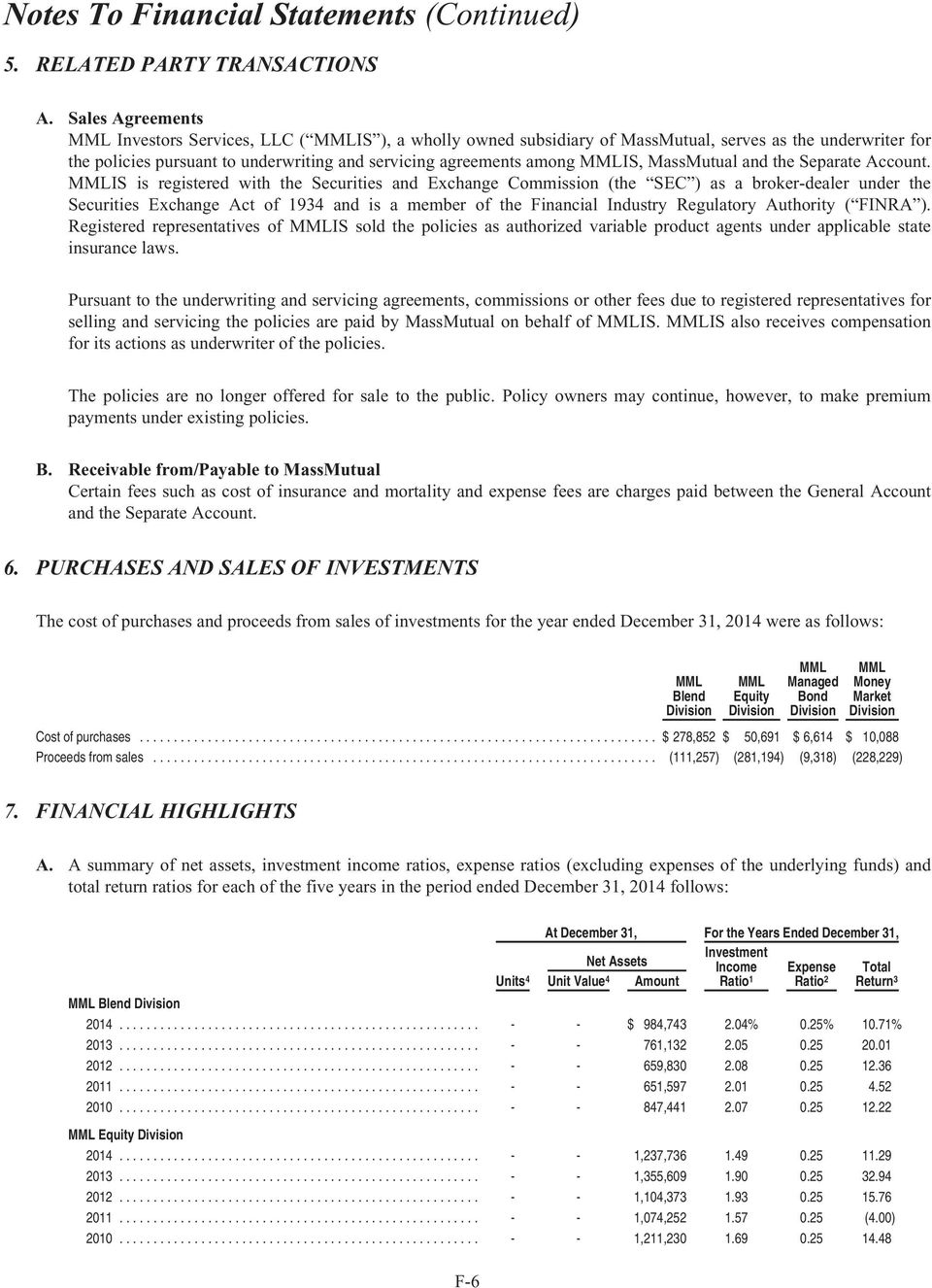
6 Notes To Financial Statements (Continued) 5. RELATED PARTY TRANSACTIONS A. Sales Agreements MML Investors Services, LLC ( MMLIS ), a wholly owned subsidiary of MassMutual, serves as the underwriter for the policies pursuant to underwriting and servicing agreements among MMLIS, MassMutual and the Separate Account. MMLIS is registered with the Securities and Exchange Commission (the SEC ) as a broker-dealer under the Securities Exchange Act of 1934 and is a member of the Financial Industry Regulatory Authority ( FINRA ). Registered representatives of MMLIS sold the policies as authorized variable product agents under applicable state insurance laws. Pursuant to the underwriting and servicing agreements, commissions or other fees due to registered representatives for selling and servicing the policies are paid by MassMutual on behalf of MMLIS. MMLIS also receives compensation for its actions as underwriter of the policies. The policies are no longer offered for sale to the public. Policy owners may continue, however, to make premium payments under existing policies. B. Receivable from/payable to MassMutual Certain fees such as cost of insurance and mortality and expense fees are charges paid between the General Account and the Separate Account. 6. PURCHASES AND SALES OF INVESTMENTS The cost of purchases and proceeds from sales of investments for the year ended December 31, 2014 were as follows: MML Blend Division MML Equity Division MML Managed Bond Division MML Money Market Division Cost of purchases... $ 278,852 $ 50,691 $ 6,614 $ 10,088 Proceeds from sales... (111,257) (281,194) (9,318) (228,229) 7. FINANCIAL HIGHLIGHTS A. A summary of net assets, investment income ratios, expense ratios (excluding expenses of the underlying funds) and total return ratios for each of the five years in the period ended December 31, 2014 follows: At December 31, For the Years Ended December 31, Net Assets Investment Income Expense Total Units 4 Unit Value 4 Amount Ratio 1 Ratio 2 Return 3 MML Blend Division $ 984, % 0.25% 10.71% , , , , MML Equity Division ,237, ,355, ,104, ,074, (4.00) ,211, F-6
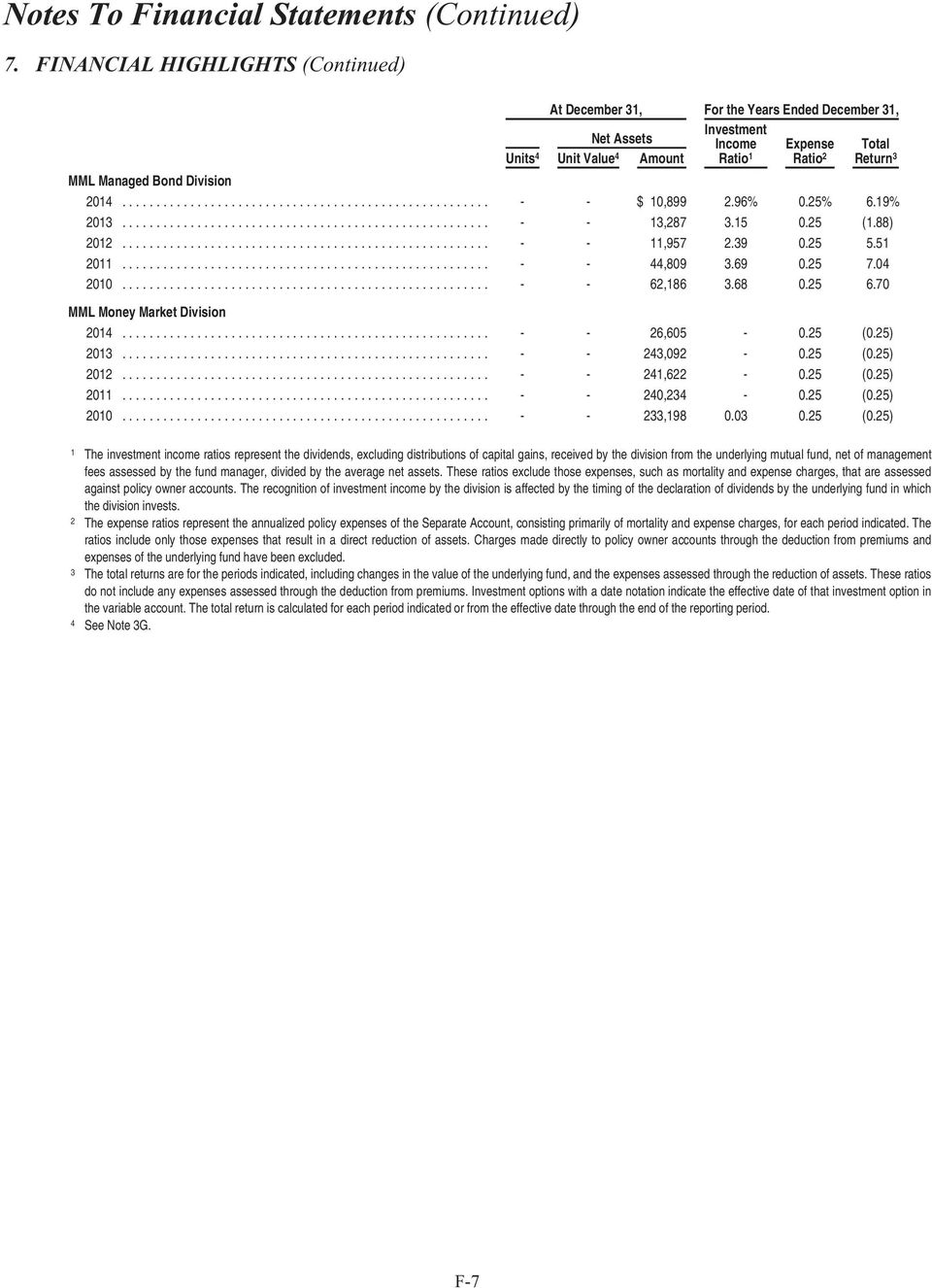
7 Notes To Financial Statements (Continued) 7. FINANCIAL HIGHLIGHTS (Continued) At December 31, For the Years Ended December 31, Net Assets Investment Income Expense Total Units 4 Unit Value 4 Amount Ratio 1 Ratio 2 Return 3 MML Managed Bond Division $ 10, % 0.25% 6.19% , (1.88) , , , MML Money Market Division , (0.25) , (0.25) , (0.25) , (0.25) , (0.25) 1 The investment income ratios represent the dividends, excluding distributions of capital gains, received by the division from the underlying mutual fund, net of management fees assessed by the fund manager, divided by the average net assets. These ratios exclude those expenses, such as mortality and expense charges, that are assessed against policy owner accounts. The recognition of investment income by the division is affected by the timing of the declaration of dividends by the underlying fund in which the division invests. 2 The expense ratios represent the annualized policy expenses of the Separate Account, consisting primarily of mortality and expense charges, for each period indicated. The ratios include only those expenses that result in a direct reduction of assets. Charges made directly to policy owner accounts through the deduction from premiums and expenses of the underlying fund have been excluded. 3 The total returns are for the periods indicated, including changes in the value of the underlying fund, and the expenses assessed through the reduction of assets. These ratios do not include any expenses assessed through the deduction from premiums. Investment options with a date notation indicate the effective date of that investment option in the variable account. The total return is calculated for each period indicated or from the effective date through the end of the reporting period. 4 See Note 3G. F-7
8 Notes To Financial Statements (Continued) 7. FINANCIAL HIGHLIGHTS (Continued) B. The Separate Account assesses current charges associated with each policy. These charges are assessed as a direct reduction in assets for all policies contained within the Separate Account (See note 3G). Charges shown below state charges assessed at a monthly rate unless otherwise specified. Administrative Charge This charge is assessed as a reduction of assets. Mortality and Expense Risk Charge This charge is assessed through reduction in assets. Loan Interest Rate Expense Charge This charge is assessed as a reduction in assets. $2.50 per month, or $30 per year Effective annual rate of 0.25% of the policy s average daily net assets. Effective annual rate of 1.00% of the loan amount Rider Charges: These charges are assessed as a reduction of assets. A. Accidental Death Benefit $0.79 to $1.42 per $1,000 of insurance risk B. Children s Term $5.00 per $1,000 of insurance risk C. Renewable Term $1.53 to $39.37 per $1,000 of insurance risk 8. SUBSEQUENT EVENTS The Separate Account s management has reviewed events occurring through March 3, 2015, the date the financial statements were issued and no subsequent events occurred requiring accrual or disclosure. LA2051 F-8

9 Independent Auditors Report The Board of Directors and Policyholders of Massachusetts Mutual Life Insurance Company: We have audited the accompanying financial statements of Massachusetts Mutual Life Insurance Company (the Company), which comprise the statutory statements of financial position as of December 31, 2014 and 2013, and the related statutory statements of operations, changes in surplus, and cash flows for the three-year period ended December 31, 2014, and the related notes to the statutory financial statements. Management s Responsibility for the Financial Statements Management is responsible for the preparation and fair presentation of these financial statements in accordance with statutory accounting practices prescribed or permitted by the Commonwealth of Massachusetts Division of Insurance. Management is also responsible for the design, implementation and maintenance of internal control relevant to the preparation and fair presentation of financial statements that are free from material misstatement, whether due to fraud or error. Auditors Responsibility Our responsibility is to express an opinion on these financial statements based on our audits. We conducted our audits in accordance with auditing standards generally accepted in the United States of America. Those standards require that we plan and perform the audit to obtain reasonable assurance about whether the financial statements are free from material misstatement. An audit involves performing procedures to obtain audit evidence about the amounts and disclosures in the financial statements. The procedures selected depend on the auditors judgment, including the assessment of the risks of material misstatement of the financial statements, whether due to fraud or error. In making those risk assessments, the auditor considers internal control relevant to the entity s preparation and fair presentation of the financial statements in order to design audit procedures that are appropriate in the circumstances, but not for the purpose of expressing an opinion on the effectiveness of the entity s internal control. Accordingly, we express no such opinion. An audit also includes evaluating the appropriateness of accounting policies used and the reasonableness of significant accounting estimates made by management, as well as evaluating the overall presentation of the financial statements. We believe that the audit evidence we have obtained is sufficient and appropriate to provide a basis for our audit opinions. Basis for Adverse Opinion on U.S. Generally Accepted Accounting Principles As described in Note 2 to the financial statements, the financial statements are prepared by the Company using statutory accounting practices prescribed or permitted by the Commonwealth of Massachusetts Division of Insurance, which is a basis of accounting other than U.S. generally accepted accounting principles. Accordingly, the financial statements are not intended to be presented in accordance with U.S. generally accepted accounting principles. LA2045 FF-1

10 The effects on the financial statements of the variances between the statutory accounting practices and U.S. generally accepted accounting principles also are described in Note 2. Adverse Opinion on U.S. Generally Accepted Accounting Principles In our opinion, because of the significance of the variances between statutory accounting principles and U.S. generally accepted accounting principles discussed in the Basis for Adverse Opinion on U.S. Generally Accepted Accounting Principles paragraph, the financial statements referred to above do not present fairly, in accordance with U.S. generally accepted accounting principles, the financial position of the Company as of December 31, 2014 and 2013, or the results of its operations or its cash flows for the three-year period ended December 31, Opinion on Statutory Basis of Accounting In our opinion, the financial statements referred to above present fairly, in all material respects, the financial position of the Company as of December 31, 2014 and 2013, and the results of its operations and its cash flows for the three-year period ended December 31, 2014, in accordance with statutory accounting practices prescribed or permitted by the Commonwealth of Massachusetts Division of Insurance described in Note 2. /s/ KPMG LLP Hartford, CT February 20, 2015 FF-2

11 STATUTORY STATEMENTS OF FINANCIAL POSITION December 31, Assets: Bonds $ 74,719 $ 67,196 Preferred stocks Common stocks - subsidiaries and affiliates 7,940 6,450 Common stocks - unaffiliated 1, Mortgage loans 19,357 16,465 Policy loans 11,155 10,585 Real estate Partnerships and limited liability companies 6,970 7,189 Derivatives 8,531 6,117 Cash, cash equivalents and short-term investments 1,880 4,198 Other invested assets 3 19 Total invested assets 133, ,490 Investment income due and accrued 1,711 1,514 Federal income taxes Deferred income taxes 959 1,166 Other than invested assets 1,091 1,050 Total assets excluding separate accounts 136, ,384 Separate account assets 60,384 58,392 Total assets $ 197,189 $ 182,776 Liabilities and Surplus: Policyholders' reserves $ 93,291 $ 86,154 Liabilities for deposit-type contracts 9,045 9,409 Contract claims and other benefits Policyholders' dividends 1,579 1,497 General expenses due or accrued Federal income taxes Asset valuation reserve 2,620 2,195 Repurchase agreements 4,658 3,487 Commercial paper and other borrowed money Collateral 1, Derivatives 5,424 4,418 Other liabilities 2,819 2,753 Total liabilities excluding separate accounts 122, ,870 Separate account liabilities 60,374 58,382 Total liabilities 182, ,252 Surplus 14,231 12,524 Total liabilities and surplus $ 197,189 $ 182,776 See notes to statutory financial statements FF-3

12 STATUTORY STATEMENTS OF OPERATIONS Revenue: Years Ended December 31, Premium income $ 18,383 $ 20,437 $ 20,327 Net investment income 6,332 5,471 4,928 Reserve adjustments on reinsurance ceded Fees and other income Total revenue 25,590 26,763 25,852 Benefits and expenses: Policyholders' benefits 16,511 18,368 10,921 Change in policyholders' reserves 5,803 5,892 10,827 Change in reserves due to the RPG reinsurance agreement (1,564) (2,050) - General insurance expenses 1,793 1,705 1,422 Ceding commission on the RPG reinsurance agreement Commissions State taxes, licenses and fees Total benefits and expenses 23,557 25,239 23,934 Net gain from operations before dividends and federal income taxes 2,033 1,524 1,918 Dividends to policyholders 1,553 1,475 1,379 Net gain from operations before federal income taxes Federal income tax expense (benefit) 23 (142) (108) Net gain from operations Net realized capital gains (losses) after tax and transfers to interest maintenance reserve 166 (477) 109 Net income (loss) $ 623 $ (286) $ 756 See notes to statutory financial statements FF-4

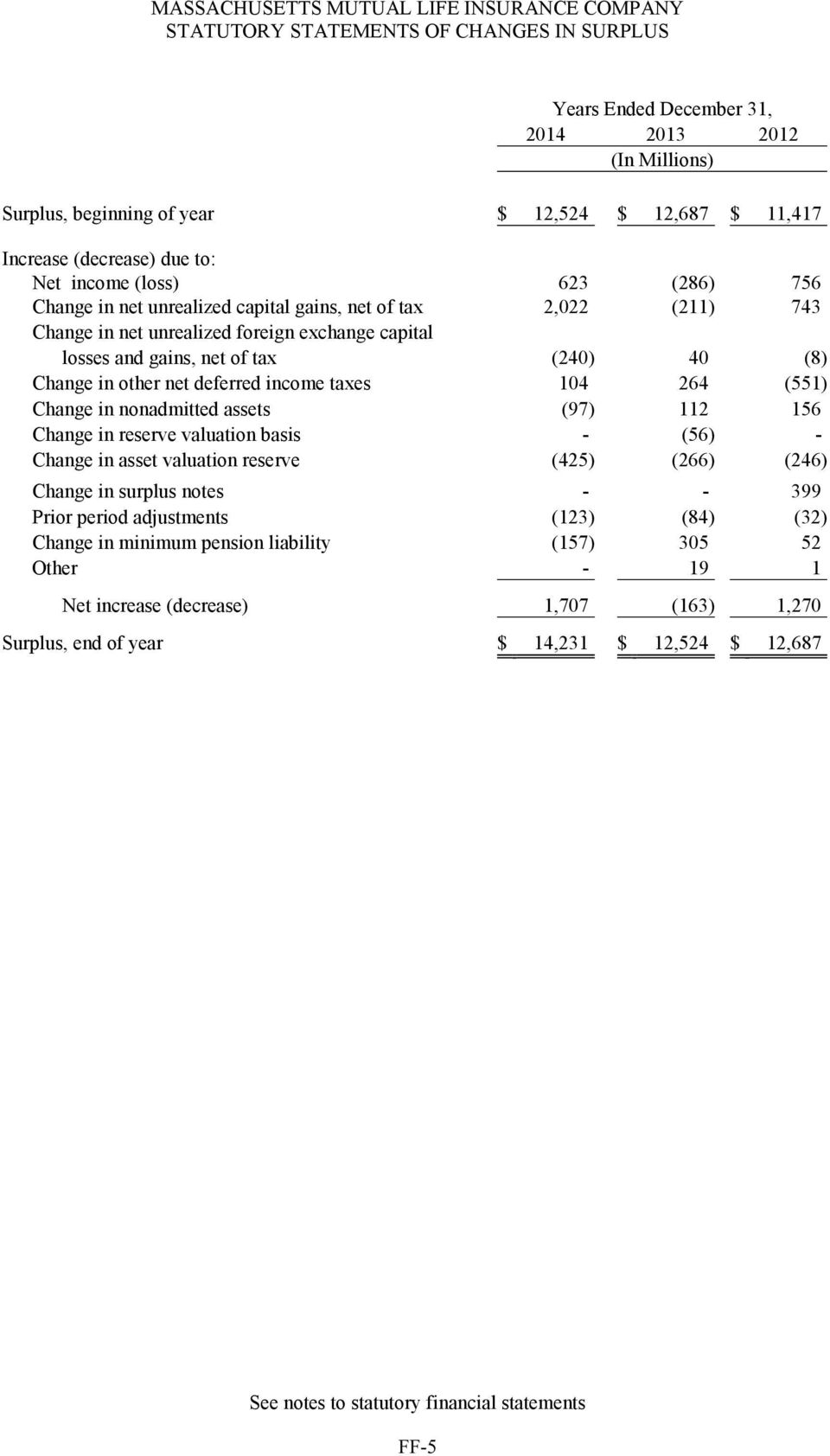
13 STATUTORY STATEMENTS OF CHANGES IN SURPLUS Years Ended December 31, Surplus, beginning of year $ 12,524 $ 12,687 $ 11,417 Increase (decrease) due to: Net income (loss) 623 (286) 756 Change in net unrealized capital gains, net of tax 2,022 (211) 743 Change in net unrealized foreign exchange capital losses and gains, net of tax (240) 40 (8) Change in other net deferred income taxes (551) Change in nonadmitted assets (97) Change in reserve valuation basis - (56) - Change in asset valuation reserve (425) (266) (246) Change in surplus notes Prior period adjustments (123) (84) (32) Change in minimum pension liability (157) Other Net increase (decrease) 1,707 (163) 1,270 Surplus, end of year $ 14,231 $ 12,524 $ 12,687 See notes to statutory financial statements FF-5
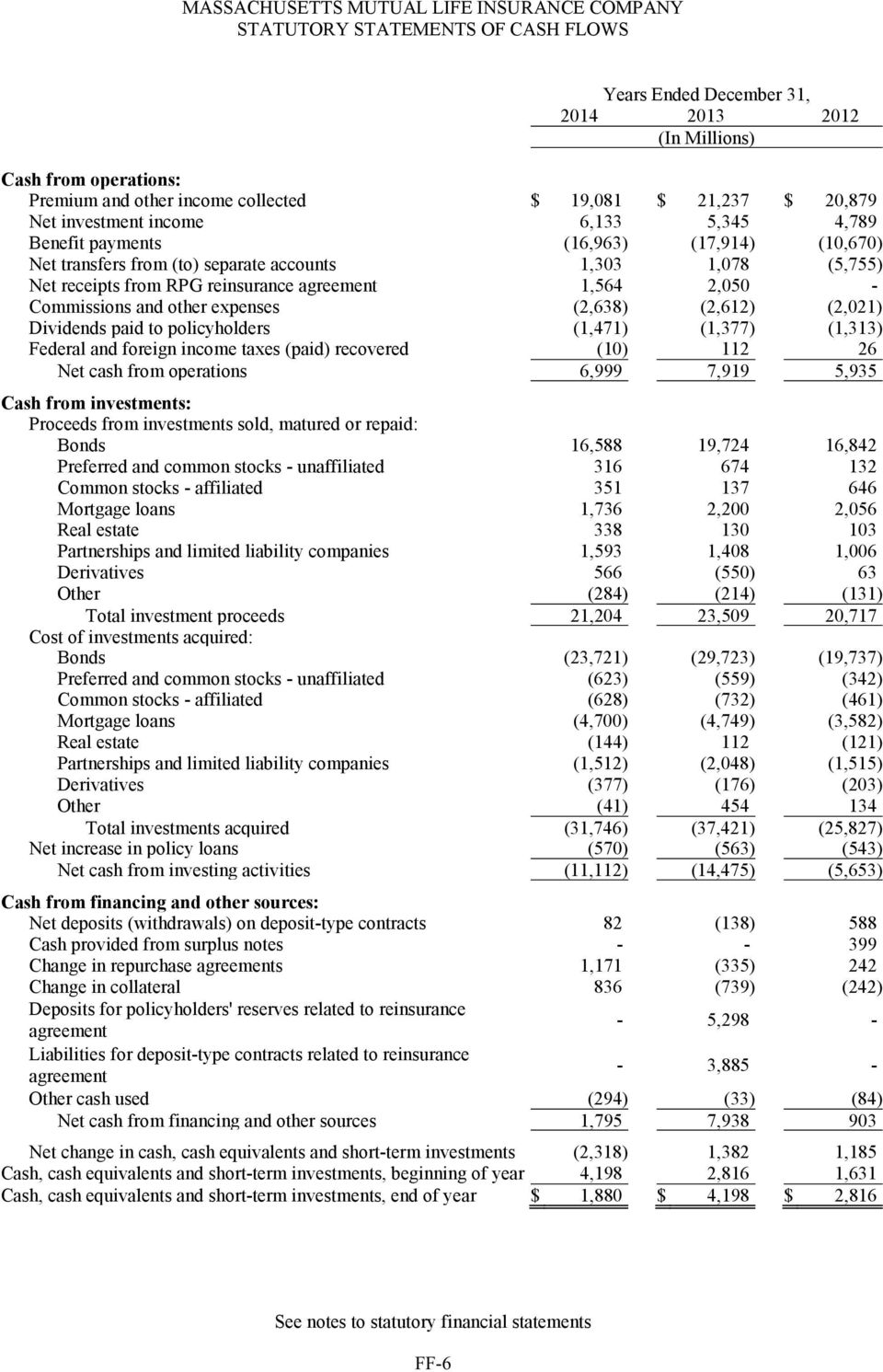
14 STATUTORY STATEMENTS OF CASH FLOWS Years Ended December 31, Cash from operations: Premium and other income collected $ 19,081 $ 21,237 $ 20,879 Net investment income 6,133 5,345 4,789 Benefit payments (16,963) (17,914) (10,670) Net transfers from (to) separate accounts 1,303 1,078 (5,755) Net receipts from RPG reinsurance agreement 1,564 2,050 - Commissions and other expenses (2,638) (2,612) (2,021) Dividends paid to policyholders (1,471) (1,377) (1,313) Federal and foreign income taxes (paid) recovered (10) Net cash from operations 6,999 7,919 5,935 Cash from investments: Proceeds from investments sold, matured or repaid: Bonds 16,588 19,724 16,842 Preferred and common stocks - unaffiliated Common stocks - affiliated Mortgage loans 1,736 2,200 2,056 Real estate Partnerships and limited liability companies 1,593 1,408 1,006 Derivatives 566 (550) 63 Other (284) (214) (131) Total investment proceeds 21,204 23,509 20,717 Cost of investments acquired: Bonds (23,721) (29,723) (19,737) Preferred and common stocks - unaffiliated (623) (559) (342) Common stocks - affiliated (628) (732) (461) Mortgage loans (4,700) (4,749) (3,582) Real estate (144) 112 (121) Partnerships and limited liability companies (1,512) (2,048) (1,515) Derivatives (377) (176) (203) Other (41) Total investments acquired (31,746) (37,421) (25,827) Net increase in policy loans (570) (563) (543) Net cash from investing activities (11,112) (14,475) (5,653) Cash from financing and other sources: Net deposits (withdrawals) on deposit-type contracts 82 (138) 588 Cash provided from surplus notes Change in repurchase agreements 1,171 (335) 242 Change in collateral 836 (739) (242) Deposits for policyholders' reserves related to reinsurance agreement - 5,298 - Liabilities for deposit-type contracts related to reinsurance agreement - 3,885 - Other cash used (294) (33) (84) Net cash from financing and other sources 1,795 7, Net change in cash, cash equivalents and short-term investments (2,318) 1,382 1,185 Cash, cash equivalents and short-term investments, beginning of year 4,198 2,816 1,631 Cash, cash equivalents and short-term investments, end of year $ 1,880 $ 4,198 $ 2,816 See notes to statutory financial statements FF-6
15 1. Nature of operations MASSACHUSETTS MUTUAL LIFE INSURANCE COMPANY NOTES TO STATUTORY FINANCIAL STATEMENTS These statutory financial statements include the accounts of Massachusetts Mutual Life Insurance Company (the Company), which is organized as a mutual life insurance company. The Company and its subsidiaries provide life insurance, disability income insurance, long-term care insurance, annuities, retirement products, investment management, mutual funds and trust services to individual and institutional customers. 2. Summary of significant accounting policies a. Basis of presentation The statutory financial statements have been prepared in conformity with the statutory accounting practices of the National Association of Insurance Commissioners (NAIC) and the accounting practices prescribed or permitted by the Commonwealth of Massachusetts Division of Insurance (the Division). Statutory accounting practices are different in some respects from financial statements prepared in accordance with U.S. generally accepted accounting principles (GAAP). The more significant differences between statutory accounting principles and U.S. GAAP are as follows: (a) bonds are generally carried at amortized cost, whereas U.S. GAAP generally reports bonds at fair value; (b) changes in the fair value of derivative financial instruments are recorded as changes in surplus, whereas U.S. GAAP generally reports these changes as revenue unless deemed an effective hedge; (c) interest rate swap replications are carried at amortized cost, whereas U.S. GAAP would carry them at fair value; (d) embedded derivatives are recorded as part of the underlying contract, whereas U.S. GAAP would identify and bifurcate certain embedded derivatives from the underlying contract or security and account for them separately at fair value; (e) income recognition on partnerships and limited liability companies (LLCs), which are accounted for under the equity method, is limited to the amount of cash distribution, whereas U.S. GAAP does not have this limitation; (f) majority-owned noninsurance subsidiaries, variable interest entities where the Company is the primary beneficiary, and certain other controlled entities are accounted for using the equity method, whereas U.S. GAAP would consolidate these entities; (g) changes in the balances of deferred income taxes, which provide for book versus tax temporary differences, are subject to limitation and are recorded in surplus, whereas U.S. GAAP would generally include the change in deferred taxes in net income; (h) assets and liabilities associated with certain group annuity and variable universal life contracts, which do not pass-through all investment gains to contract holders, are maintained in separate accounts and are presented on a single line in the statutory financial statements, whereas U.S. GAAP reports these contracts as general investments and liabilities of the Company; (i) assets are reported at admitted asset value and assets designated as nonadmitted are excluded through a charge against surplus, whereas U.S. GAAP recognizes all assets, subject to valuation allowances; (j) statutory policy reserves are based upon prescribed methods, such as the Commissioners Reserve Valuation Method, Commissioners Annuity Reserve Valuation Method or net level premium method, and prescribed statutory mortality, morbidity and interest assumptions at the time of issue, whereas U.S. GAAP policy reserves would generally be based upon the net level premium method or the estimated gross margin method with estimates, at time of issue, of future mortality, morbidity, persistency and interest; (k) policyholder reserves are presented net of reinsurance ceded, unearned ceded premium and unpaid ceded claims, whereas U.S. GAAP would report these reinsurance balances as an asset; (l) an asset valuation reserve (AVR) is reported as a contingency reserve to stabilize surplus against certain fluctuations in the statement value of common stocks, real estate, partnerships and LLCs as well as credit-related declines in the value of bonds, mortgage loans and certain derivatives, whereas U.S. GAAP does not record this reserve; (m) aftertax realized capital gains (losses) that result from changes in the overall level of interest rates for all types of fixedincome investments and interest-related hedging activities are deferred into the interest maintenance reserve (IMR) and amortized into revenue, whereas U.S. GAAP reports these gains and losses as revenue; (n) changes to the mortgage loan valuation allowance are recognized in net unrealized capital gains (losses), net of tax, in the Statutory Statements of Changes in Surplus, whereas U.S. GAAP reports these changes in net realized capital gains (losses); (o) the overfunded status of pension and other postretirement plans, which is the excess of the fair value of the plan assets over the projected benefit obligation, is a nonadmitted asset for statutory accounting whereas U.S. GAAP recognizes the overfunded status as an asset; (p) surplus notes are reported in surplus, whereas U.S. GAAP would report these notes as liabilities; (q) payments received for universal and variable life insurance products, certain FF-7

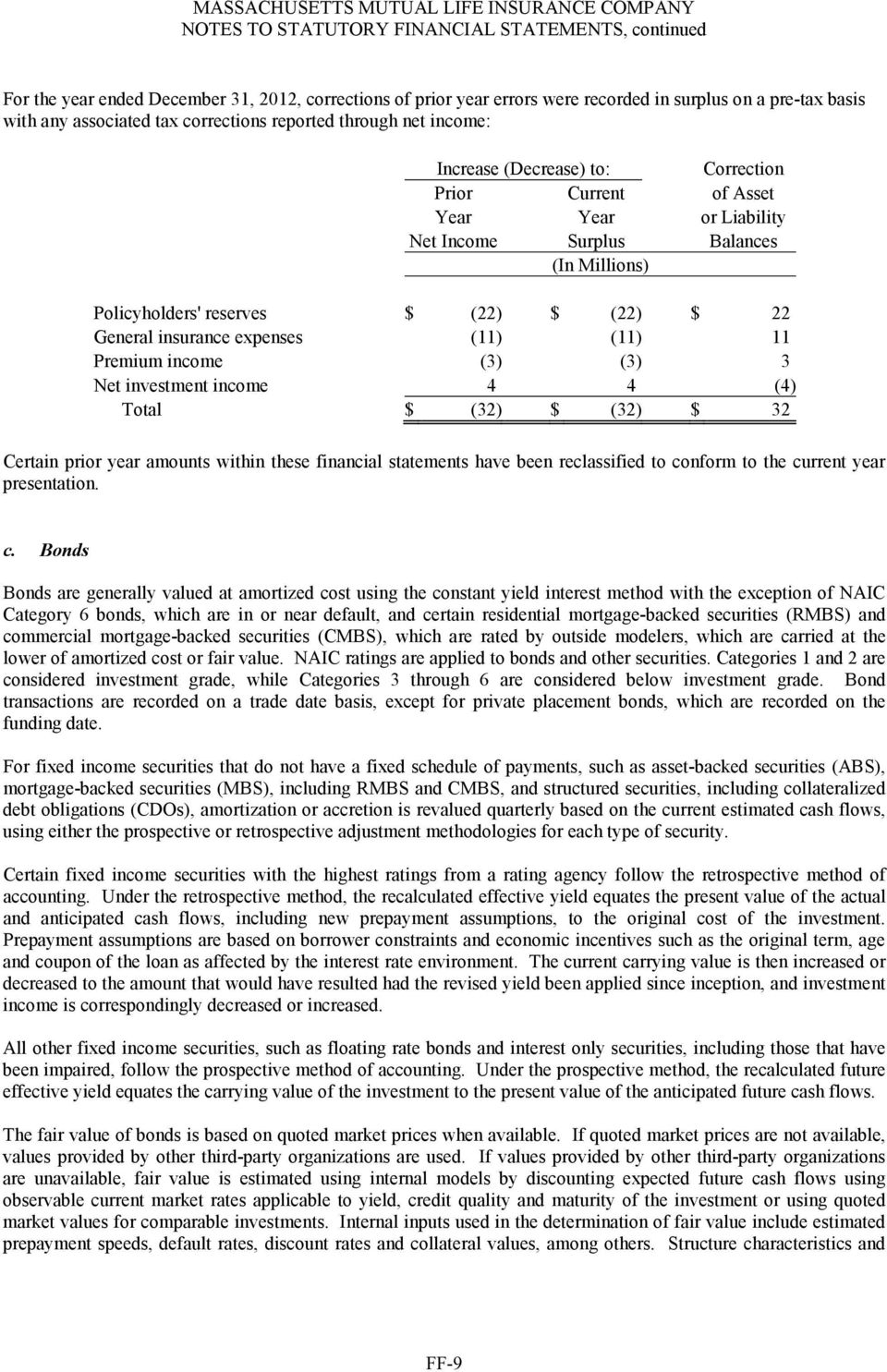
16 variable and fixed deferred annuities and group annuity contracts are reported as premium income and corresponding change in reserves, whereas U.S. GAAP would treat these payments as deposits to policyholders account balances; (r) certain acquisition costs, such as commissions and other variable costs, directly related to acquiring new business are charged to current operations as incurred, whereas U.S. GAAP would generally capitalize these expenses and amortize them based on profit emergence over the expected life of the policies or over the premium payment period; and (s) comprehensive income is not presented, whereas U.S. GAAP presents changes in unrealized capital gains (losses) and foreign currency translations as other comprehensive income. The preparation of financial statements requires management to make estimates and assumptions that impact the reported amounts of assets and liabilities, the disclosure of assets and liabilities as of the date of the statutory financial statements and the reported amounts of revenues and expenses during the reporting periods. The most significant estimates include those used in determining the carrying values of investments including the amount of mortgage loan investment valuation reserves, other-than-temporary impairment(s) (OTTI), the value of the investment in MassMutual Holding LLC (MMHLLC), the liabilities for policyholders reserves, the determination of admissible deferred tax assets (DTAs), the liability for taxes and the liability for litigation contingencies. Future events including, but not limited to, changes in the level of mortality, morbidity, interest rates, persistency, asset valuations and defaults could cause results to differ from the estimates used in the statutory financial statements. Although some variability is inherent in these estimates, management believes the amounts presented are appropriate. b. Corrections of errors and reclassifications For the year ended December 31, 2014, corrections of prior year errors were recorded in surplus: Decrease to: Correction Prior Current of Asset Year Year or Liability Net Income Surplus Balances Income tax payable $ (76) $ (76) $ 76 Policyholders' reserves, net of tax (36) (36) 36 Other liabilities (11) (11) 11 Asset valuation reserves - (14) 14 Total $ (123) $ (137) $ 137 For the year ended December 31, 2013, corrections of prior year errors were recorded in surplus on a pre-tax basis with any associated tax corrections reported through net income: Increase (Decrease) to: Correction Prior Current of Asset Year Year or Liability Net Income Surplus Balances Policyholders' reserves $ (74) $ (74) $ 74 Premium income (12) (12) 12 Other invested assets 2 2 (2) Total $ (84) $ (84) $ 84 FF-8

17 For the year ended December 31, 2012, corrections of prior year errors were recorded in surplus on a pre-tax basis with any associated tax corrections reported through net income: Increase (Decrease) to: Correction Prior Current of Asset Year Year or Liability Net Income Surplus Balances Policyholders' reserves $ (22) $ (22) $ 22 General insurance expenses (11) (11) 11 Premium income (3) (3) 3 Net investment income 4 4 (4) Total $ (32) $ (32) $ 32 Certain prior year amounts within these financial statements have been reclassified to conform to the current year presentation. c. Bonds Bonds are generally valued at amortized cost using the constant yield interest method with the exception of NAIC Category 6 bonds, which are in or near default, and certain residential mortgage-backed securities (RMBS) and commercial mortgage-backed securities (CMBS), which are rated by outside modelers, which are carried at the lower of amortized cost or fair value. NAIC ratings are applied to bonds and other securities. Categories 1 and 2 are considered investment grade, while Categories 3 through 6 are considered below investment grade. Bond transactions are recorded on a trade date basis, except for private placement bonds, which are recorded on the funding date. For fixed income securities that do not have a fixed schedule of payments, such as asset-backed securities (ABS), mortgage-backed securities (MBS), including RMBS and CMBS, and structured securities, including collateralized debt obligations (CDOs), amortization or accretion is revalued quarterly based on the current estimated cash flows, using either the prospective or retrospective adjustment methodologies for each type of security. Certain fixed income securities with the highest ratings from a rating agency follow the retrospective method of accounting. Under the retrospective method, the recalculated effective yield equates the present value of the actual and anticipated cash flows, including new prepayment assumptions, to the original cost of the investment. Prepayment assumptions are based on borrower constraints and economic incentives such as the original term, age and coupon of the loan as affected by the interest rate environment. The current carrying value is then increased or decreased to the amount that would have resulted had the revised yield been applied since inception, and investment income is correspondingly decreased or increased. All other fixed income securities, such as floating rate bonds and interest only securities, including those that have been impaired, follow the prospective method of accounting. Under the prospective method, the recalculated future effective yield equates the carrying value of the investment to the present value of the anticipated future cash flows. The fair value of bonds is based on quoted market prices when available. If quoted market prices are not available, values provided by other third-party organizations are used. If values provided by other third-party organizations are unavailable, fair value is estimated using internal models by discounting expected future cash flows using observable current market rates applicable to yield, credit quality and maturity of the investment or using quoted market values for comparable investments. Internal inputs used in the determination of fair value include estimated prepayment speeds, default rates, discount rates and collateral values, among others. Structure characteristics and FF-9
18 cash flow priority are also considered. Fair values resulting from internal models are those expected to be received in an orderly transaction between willing market participants at the financial statement date. Refer to Note 2bb. "Realized capital gains (losses) including other-than-temporary impairments and unrealized capital gains (losses)" for information on the Company s policy for determining OTTI. d. Preferred stocks Preferred stocks in good standing are generally valued at amortized cost. Preferred stocks not in good standing, those that are rated Categories 4 through 6 by the Securities Valuation Office (SVO) of the NAIC, are valued at the lower of amortized cost or fair value. Fair values are based on quoted market prices, when available. If quoted market prices are not available, values provided by other third-party organizations are used. If values provided by other third-party organizations are unavailable, fair value is estimated using internal models. These models use inputs not directly observable or correlated with observable market data. Typical inputs integrated into the Company s internal discounted expected earnings models include, but are not limited to, earnings before interest, taxes, depreciation and amortization estimates. Fair values resulting from internal models are those expected to be received in an orderly transaction between willing market participants at the financial statement date. Refer to Note 2bb. "Realized capital gains (losses) including other-than-temporary impairments and unrealized capital gains (losses)" for information on the Company s policy for determining OTTI. e. Common stocks - subsidiaries and affiliates Common stocks of unconsolidated subsidiaries, primarily C.M. Life Insurance Company (C.M. Life), MML Bay State Life Insurance Company (MML Bay State) and MMHLLC, are accounted for using the statutory equity method. The Company accounts for the value of MMHLLC, at its underlying U.S. GAAP equity value adjusted to remove certain nonadmitted and intangible assets, as well as a portion of its noncontrolling interests (NCI) and appropriated retained earnings (ARE), after consideration of MMHLLC s fair value and the Company s capital levels. The Division has affirmed the statutory recognition of the Company s application of the NCI guidelines in MMHLLC s statutory carrying value. However, the Company has limited this recognition to $2,409 million and $2,157 million as of December 31, 2014 and 2013, respectively. Operating results, less dividend distributions, for MMHLLC are reflected as net unrealized capital gains (losses) in the Statutory Statements of Changes in Surplus. Dividend distributions received from MMHLLC are recorded in net investment income and are limited to MMHLLC s U.S. GAAP retained earnings. The cost basis of common stocks - subsidiaries and affiliates is adjusted for impairments deemed to be other than temporary. Refer to Note 4d. "Common stocks - subsidiaries and affiliates" for further information on the valuation of MMHLLC. f. Common stocks - unaffiliated Unaffiliated common stocks are carried at fair value, which is based on quoted market prices when available. If quoted market prices are not available, values provided by other third-party organizations are used. If values from other third parties are unavailable, fair values are determined by management using estimates based upon internal models. The Company s internal models include estimates based upon comparable company analysis, review of financial statements, broker quotes and last traded price. Fair values resulting from internal models are those expected to be received in an orderly transaction between willing market participants at the financial statement date. Refer to Note 2bb. "Realized capital gains (losses) including other-than-temporary impairments and unrealized capital gains (losses)" for information on the Company s policy for determining OTTI. FF-10
19 g. Mortgage loans Mortgage loans are valued at the unpaid principal balance of the loan, net of unamortized premium, discount, mortgage origination fees and valuation allowances. Interest income earned on impaired loans is accrued on the outstanding principal balance of the loan based on the loan s contractual coupon rate. Interest is not accrued for impaired loans more than 60 days past due, for loans delinquent more than 90 days, or when collection of interest is improbable. The Company continually monitors mortgage loans where the accrual of interest has been discontinued, and will resume the accrual of interest on a mortgage loan when the facts and circumstances of the borrower and property indicate that the payments will continue to be received according to the terms of the original or modified mortgage loan agreement. Refer to Note 2bb. "Realized capital gains (losses) including other-than-temporary impairments and unrealized capital gains (losses)" for information on the Company s policy for determining OTTI. h. Policy loans Policy loans are carried at the outstanding loan balance less amounts unsecured by the cash surrender value of the policy. At issuance, policy loans are fully secured by the cash surrender value of the policy. Unsecured amounts can occur when subsequent charges are incurred on the underlying policy without the receipt of additional premium. If the premium is not paid during the contractual grace period, the policy will lapse. Unsecured nonadmitted amounts were less than $1 million as of December 31, 2014 and Policy loans earn interest calculated based upon either a fixed or a variable interest rate. Accrued investment income on policy loans more than 90 days past due is included in the unpaid balance of the policy loan not to exceed the cash surrender value of the underlying contract. i. Real estate Investment real estate, which the Company has the intent to hold for the production of income, and real estate occupied by the Company, are carried at depreciated cost, less encumbrances. Depreciation is calculated using the straight-line method over the estimated useful life of the real estate holding, not to exceed 40 years. Depreciation expense is included in net investment income. Real estate held for sale is initially carried at the lower of depreciated cost or fair value less estimated selling costs and is no longer depreciated. Adjustments to carrying value, including for further declines in fair value, are recorded in a valuation reserve, which is included in realized capital losses. Fair value is generally estimated using the present value of expected future cash flows discounted at a rate commensurate with the underlying risks. The Company also obtains external appraisals for a rotating selection of properties annually. If an external appraisal is not obtained, an internal appraisal is performed. Refer to Note 2bb. "Realized capital gains (losses) including other-than-temporary impairments and unrealized capital gains (losses)" for information on the Company s policy for determining OTTI. j. Partnerships and limited liability companies Partnerships and LLCs, except for partnerships that generate and realize low income housing tax credits (LIHTCs), are accounted for using the equity method with the change in the equity value of the underlying investment recorded in surplus. Distributions received are recognized as net investment income to the extent the distribution does not exceed previously recorded accumulated undistributed earnings. Investments in partnerships that generate LIHTCs are carried at amortized cost unless considered impaired. Under the amortized cost method, the excess of the carrying value of the investment over its estimated residual value is amortized into net investment income during the period in which tax benefits are recognized. FF-11

20 The equity method is suspended if the carrying value of the investment is reduced to zero due to losses from the investment. Once the equity method is suspended, losses are not recorded until the investment returns to profitability and the equity method is resumed. However, if the Company has guaranteed obligations of the investment or is otherwise committed to provide further financial support for the investment, losses will continue to be reported up to the amount of those guaranteed obligations or commitments. Refer to Note 2bb. "Realized capital gains (losses) including other-than-temporary impairments and unrealized capital gains (losses)" for information on the Company s policy for determining OTTI. k. Derivatives Interest rate swaps and credit default index swaps associated with replicated assets are valued at amortized cost and all other derivative types are carried at fair value, which is based primarily upon quotations obtained from counterparties and independent sources. The quotations from counterparties and independent sources are compared to internally derived prices and a price challenge is lodged with the counterparties and independent sources when a significant difference cannot be explained by appropriate adjustments to the internal model. When quotes from counterparties and independent sources are not available or are considered not reliable, the internally derived value is recorded. Changes in the fair value of these instruments other than interest rate swaps associated with replicated assets are recorded as unrealized capital gains (losses) in surplus. Gains and losses realized on settlement, termination, closing or assignment of contracts are recorded as realized capital gains (losses). Amounts receivable and payable are accrued as net investment income. l. Cash, cash equivalents and short-term investments The Company considers all highly liquid investments purchased with original maturities of three months or less to be cash and cash equivalents and carries them at amortized cost. Short-term investments, which are carried at amortized cost, consist of all highly liquid investments purchased with maturities of greater than three months and less than or equal to 12 months. Investments in short-term bonds and money market mutual funds are classified as short-term investments. The carrying value reported in the Statutory Statements of Financial Position for cash, cash equivalents and shortterm investment instruments approximates the fair value. m. Investment income due and accrued Accrued investment income consists primarily of interest and dividends. Interest is recognized on an accrual basis and dividends are recorded as earned on the ex-dividend date. n. Other than invested assets Other than invested assets primarily includes deferred and uncollected premium, reinsurance recoverables, fixed assets and other receivables. o. Nonadmitted assets Assets designated as nonadmitted by the NAIC primarily include pension plan assets, certain electronic data processing (EDP) equipment, advances and prepayments, certain investments in partnerships and LLCs for which qualifying audits are not performed, furniture and equipment, certain other receivables, uncollected premium greater than 90 days past due and certain intangible assets. Due and accrued income is nonadmitted on: (a) bonds delinquent more than 90 days or where collection of interest is improbable; (b) impaired bonds more than 60 days past due; (c) bonds in default; (d) mortgage loans in default where interest is 180 days past due; (e) rent in arrears for more than 90 days; and (f) policy loan interest due and accrued more than 90 days past due and included in the unpaid balance of the policy loan in excess of the cash surrender value of the underlying contract. Assets that are FF-12

21 designated as nonadmitted are excluded from the Statutory Statements of Financial Position through a charge against surplus. p. Separate accounts Separate accounts are segregated funds administered and invested by the Company. Selection of the separate account investments is directed by group and individual variable annuity, variable life and other insurance contract holders/policyholders. The returns produced by separate account assets increase or decrease separate account reserves. Separate account assets consist principally of marketable securities reported at fair value. Except for the Company s seed money and supplemental accounts, as noted below, and certain guaranteed separate accounts issued in Minnesota, separate account assets can only be used to satisfy separate account liabilities and are not available to satisfy the general obligations of the Company. Separate account administrative and investment advisory fees are included in fees and other income. Assets may be transferred from the general investments of the Company to seed the separate accounts. When assets are transferred to separate accounts, they are transferred at fair market value on the date the transaction occurs. Gains related to the transfer are deferred to the extent that the Company maintains a proportionate interest in the separate account. The deferred gain is recognized as the Company s ownership decreases or when the separate account sells the underlying asset during the normal course of business. Losses associated with these transfers are recognized immediately. Separate accounts reflect two categories of risk assumption: nonguaranteed separate accounts for which the contract holder/policyholder assumes the investment risk and guaranteed separate accounts for which the Company contractually guarantees either a minimum return or minimum account value to the contract holder/policyholder. For certain guaranteed separate account products such as interest rate guaranteed products and indexed separate account products, reserve adequacy is performed on a contract by contract basis using, as applicable, prescribed interest rates, mortality rates and asset risk deductions. If the outcome from this adequacy analysis produces a deficiency relative to the current account value, a liability is recorded in policyholders' reserves or liabilities for deposit-type contracts in the Statutory Statements of Financial Position with the corresponding change in the liability recorded as change in policyholders' reserves or policyholders' benefits in the Statutory Statements of Operations. Premium income, benefits and expenses of the separate accounts are included in the Statutory Statements of Operations with the offset recorded in policyholders reserves. Investment income and realized capital gains (losses) on the assets of separate accounts, other than seed money, accrue to contract holders/policyholders and are not recorded in the Statutory Statements of Operations. Unrealized capital gains (losses) on assets of separate accounts accrue to contract holders/policyholders and, accordingly, are reflected in the separate account liability to the contract holder/policyholder. q. Policyholders' reserves Policyholders reserves provide for the present value of estimated future obligations in excess of estimated future premium on policies in force. Reserves for individual life insurance contracts are developed using accepted actuarial methods computed principally on the net level premium or Commissioners Reserve Valuation Method bases using the American Experience or the 1941, 1958, 1980 or the 2001 Commissioners Standard Ordinary mortality tables with assumed interest rates. Reserves for disability riders associated with life contracts are calculated using morbidity rates from the 1952 Period 2 Intercompany Disability Table, modified to reflect the Company s morbidity experience. The Company waives deduction of deferred fractional premium at death and returns any portion of the final premium beyond the date of death. Reserves are computed using continuous functions to reflect these practices. FF-13
22 The Company charges a higher premium on certain contracts that cover substandard mortality risk. For these policies, the reserve calculations are based on a substandard mortality rate, which is a multiple of the standard mortality tables. Certain variable universal life and universal life contracts include features such as guaranteed minimum death benefits (GMDB) or other guarantees that ensure continued death benefit coverage when the policy would otherwise lapse. The value of the guarantee is only available to the beneficiary in the form of a death benefit. The liability for variable and universal life GMDBs and other guarantees is included in policyholders reserves and the related change in this liability is included in change in policyholders reserves. Reserves for individual and group payout annuities are developed using accepted actuarial methods computed principally under Commissioners Annuity Reserve Valuation Method (CARVM) using applicable interest rates and mortality tables. Individual payout annuities primarily use the 1971 and 1983 Individual Annuity Mortality and Annuity 2000 tables. Group payout annuities primarily use the 1983 Group Annuity Mortality and 1994 Group Annuity Reserving tables. Certain individual variable annuity products issued by the Company have offered or continue to offer a variety of additional guarantees such as GMDBs and variable annuity guaranteed living benefits (VAGLB). The primary types of VAGLBs include guaranteed minimum accumulation benefits (GMAB), guaranteed minimum income benefits (GMIB) including GMIB Basic and GMIB Plus and guaranteed minimum withdrawal benefits (GMWB). In general, these benefit guarantees require the contract owner or policyholder to adhere to a company-approved asset allocation strategy. The liabilities for individual variable annuity GMDBs and VAGLBs are included in policyholders reserves and the related changes in these liabilities are included in change in policyholders reserves. Variable annuity GMDBs provide a death benefit in excess of the contract value if the contract value is less than the guaranteed minimum amount. Some contracts provide that guarantee upon the contract owner s death and others provide it upon the annuitant s death. This amount may be based on a return of premium (the premium paid generally adjusted for withdrawals), a roll-up (an accumulation of premium at a specified interest rate adjusted for withdrawals), a reset (the contract value on a specified anniversary date adjusted for subsequent withdrawals, which is allowed to decrease when reset) or a ratchet (the contract value on a specified anniversary date adjusted for subsequent withdrawals, which is never allowed to decrease when reset). For a variable annuity contract, a decline in the stock market causing the contract value to fall below the guaranteed specified amount will increase the net amount at risk, which is the GMDBs in excess of the contract value. GMABs provide the annuity contract holder with a guaranteed minimum contract value at the end of the product s guarantee period. If the contract value is below that guarantee at the end of the period, the contract value is increased to the guaranteed minimum account benefit value and the contract continues from that point. Options for the guarantee period are ten, twenty and twenty-six years. GMWBs provide the annuity contract holder with a guarantee that a minimum amount will be available for withdrawal annually for life regardless of the contract value. GMIBs provide the annuity contract holder with a guaranteed minimum amount when the contract is annuitized. The GMIBs would be beneficial to the contract holder if the contract holder s contract value would otherwise not provide a higher annuitization value using currently offered rates at the time of annuitization. GMIBs generally anticipate payout between ages 60 and 90. The Company first issued GMIB Basic in 2002 and suspended issuing these contracts in August These GMIB Basic contracts cannot be annuitized within seven years of issuance and do not have access to the guarantee value other than through annuitization. GMIB Plus replaced GMIB Basic and was available from September 2007 through March GMIB Plus includes a product version, which provides a minimum floor amount that can be applied to an annuity option. The GMIB Plus value is equal to the initial purchase amount increased by a compound annual interest rate. If a contract owner takes a withdrawal, the GMIB Plus value is recalculated by making an adjustment for withdrawals. There are two types of adjustments for withdrawals: (1) Dollar for dollar adjustment during each contract year, the GMIB Plus value will be lower for each dollar that is withdrawn up to and equal to the current contract year interest credited on the GMIB Plus value; (2) Pro-rata adjustment during each contract year, for any amount withdrawn FF-14
23 that exceeds the current contract year interest credited on the GMIB Plus value, the GMIB Plus value will be further reduced by a pro-rata adjustment. Such a withdrawal will negatively impact the GMIB Plus value. GMIB Plus cannot be annuitized within ten years of contract issuance as the rider can only be exercised after a ten year waiting period has elapsed. This guarantee was only available upon contract issuance. Reserves for individual and group fixed deferred annuities are developed using accepted actuarial methods computed principally under CARVM using applicable interest rates and mortality tables. Individual deferred annuities primarily use the 1971 and 1983 Individual Annuity Mortality and Annuity 2000 tables. Group deferred annuities primarily use the 1983 Group Annuity Mortality and 1994 Group Annuity Reserving tables. Reserves for individual and group variable deferred annuities are developed using accepted actuarial methods computed principally under CARVM for variable annuities using applicable interest rates and mortality tables. Individual variable deferred annuities primarily use the 1994 Minimum Guaranteed Death Benefit or Annuity 2000 tables. The liability is evaluated under both a standard scenario and stochastic scenarios net of currently held applicable hedge asset cash flows. The Company holds the reserve liability valuation at the higher of the standard or stochastic scenario values. Based on the Company s currently held hedges, if market interest rates increase, the fair value of the Company hedges would decrease in value and reserves would decrease. Should market interest rates decrease, the fair value of the Company hedges would increase in value and reserves would increase. In addition, the Company elected to hold additional reserves above those indicated based on the stochastic or standard scenario in order to maintain a prudent level of reserve adequacy. The standard scenario is a prescriptive reserve with minimal company discretion. The primary driver of the standard scenario result is the composition of the in force policies, with the key factor being the extent to which the product guarantees are in the money. The value of the reserve guarantees under the standard scenario is driven primarily by equity markets. For the stochastic scenarios, the Company uses the American Academy of Actuaries scenarios. Prudent estimate assumptions are used for mortality, expenses and commissions, investment management fees, taxes and policyholder behavior including lapses, partial withdrawals, annuitization and additional premium. These assumptions are consistent with those used for asset adequacy testing and are based on Company experience. Stochastic reserves are driven by the degree that the variable annuity benefits are in the money at projected interest rates and equity market levels, expenses, discount rates, net derivative values, and policyholder behavior. Separate accounts include certain group annuity contracts used to fund retirement plans that offer a guarantee of a contract holder s principal, which can be withdrawn over a stated period of time. These contracts offer a stated rate of return backed by the Company. Contract payments are not contingent upon the life of the retirement plan participants. Disability income policy reserves are generally calculated using the two-year preliminary term method and actuarially accepted morbidity tables using the 1964 Commissioners Disability Table and the 1985 Commissioners Individual Disability Table A with assumed interest and mortality rates in accordance with applicable statutes and regulations. Disabled life claim reserves are generally calculated using actuarially accepted methodologies and actuarially accepted morbidity tables using the 1964 Commissioners Disability Table and 1985 Commissioners Individual Disability Tables A and C with assumed interest rates in accordance with applicable statutes and regulations. Long-term care policy reserves are generally calculated using the one-year preliminary term method and actuarially accepted morbidity, mortality and lapse tables with assumed interest rates in accordance with applicable statutes and regulations. Long-term care claim reserves are generally calculated using actuarially accepted methodologies and actuarially accepted morbidity tables with assumed interest rates in accordance with applicable statutes and regulations. FF-15
24 Unpaid claims and claim expense reserves are related to disability and long-term care claims. Unpaid disability claim liabilities are projected based on the average of the last three disability payments. Claim expense reserves are based on an analysis of the unit expenses related to the processing and examination of new and ongoing claims. Interest accrued on reserves is calculated by applying NAIC prescribed interest rates to the average reserves by incurral year. Tabular interest, tabular reserves less actual reserves released, and tabular cost for all life and annuity contracts and supplementary contracts involving life contingencies are determined in accordance with NAIC Annual Statement instructions. For tabular interest, whole life and term products use a formula that applies a weighted average interest rate determined from a seriatim valuation file to the mean average reserves. Universal life, variable life, group life, annuity and supplemental contracts use a formula that applies a weighted average credited rate to the mean account value. For contracts without an account value (e.g., a Single Premium Immediate Annuity) a weighted average statutory valuation rate is applied to the mean statutory reserve or accepted actuarial methods using applicable interest rates are applied. All policyholders reserves and accruals are presented net of reinsurance. Management believes that these liabilities and accruals represent management s best estimate and will be sufficient, in conjunction with future revenues, to meet future anticipated obligations of policies and contracts in force. In order to maintain a prudent level of reserve adequacy, the Company elected to hold additional insurance reserves over and above the amounts calculated by the methods described above. r. Liabilities for deposit-type contracts Liabilities for funding agreements, dividend accumulations, premium deposit funds, investment-type contracts such as supplementary contracts not involving life contingencies and certain structured settlement annuities are based on account value or accepted actuarial methods using applicable interest rates. s. Participating contracts Participating contracts are those that may be eligible to share in any dividends declared by the Company. Participating contracts issued by the Company represented 58% of the Company s policyholders reserves and liabilities for deposit-type contracts as of December 31, 2014 and t. Policyholders' dividends Dividends expected to be paid to policyholders in the following year are approved annually by MassMutual s Board of Directors and are recorded as an expense in the current year. The allocation of these dividends to policyholders reflects the relative contribution of each group of participating policies to surplus and considers, among other factors, investment returns, mortality and morbidity experience, expenses and taxes. The liability for policyholders dividends includes the estimated amount of annual dividends and settlement dividends. A settlement dividend is an extra dividend payable at termination of a policy upon maturity, death or surrender. u. Asset valuation reserve The Company maintains an AVR that is a contingency reserve to stabilize surplus against fluctuations in the statement value of common stocks, real estate, partnerships and LLCs as well as credit-related changes in the value of bonds, preferred stocks, mortgage loans, and certain derivatives. The AVR is reported as a liability and the change in AVR, net of tax, is reported in surplus. FF-16
25 v. Interest maintenance reserve The Company maintains an IMR that is used to stabilize net income against fluctuations in interest rates. After-tax realized capital gains (losses), which result from changes in interest rates for all types of fixed-income investments and interest-related hedging activities, are deferred into the IMR and amortized into revenue using the grouped amortization method. The IMR is included in other liabilities or if negative, is nonadmitted. w. Repurchase agreements The Company has entered into repurchase agreements whereby the Company sells securities and simultaneously agrees to repurchase the same or substantially the same securities. These repurchase agreements are accounted for as collateralized borrowings with the proceeds from the sale of the securities recorded as a liability and the underlying securities continue to be recorded as an investment by the Company. Earnings on these investments are recorded as investment income and the difference between the proceeds and the amount at which the securities will be subsequently reacquired is amortized as interest expense. Repurchase agreements are used as a tool for overall portfolio management to help ensure the Company maintains adequate assets in order to provide yield, spread and duration to support liabilities and other corporate needs. The Company provides collateral, as dictated by the repurchase agreements, to the counterparty in exchange for a loan. If the fair value of the securities sold becomes less than the loan, the counterparty may require additional collateral. The carrying value, which is at cost, reported in the Statutory Statements of Financial Position for repurchase agreements approximates the fair value. x. Commercial paper The Company issues commercial paper in the form of unsecured notes (Notes). Interest on the Notes is calculated using a 360-day year based on the actual number of days elapsed. Due to the short-term nature of the Notes, the carrying value approximates fair value. y. Other liabilities Other liabilities primarily consist of interest due on derivatives, the IMR, amounts held for agents, remittances and items not allocated, pending securities settlements and unearned income. z. Reinsurance The Company enters into reinsurance agreements with affiliated and unaffiliated insurers in the normal course of business to limit its insurance risk. The Company also assumed business associated with Retirement Plans Group (RPG). Refer to Note 10. Reinsurance for discussion of the RPG transaction. Premium income, benefits to policyholders and policyholders reserves are stated net of reinsurance. Premium, benefits and reserves related to reinsured business are accounted for on bases consistent with those used in accounting for the original policies issued and the terms of the reinsurance contracts. The Company records a receivable for reinsured benefits paid, but not yet reimbursed by the reinsurer and reduces policyholders reserves for the portion of insurance liabilities that are reinsured. Commissions and expense allowances on reinsurance ceded and modified coinsurance reserve adjustments on reinsurance ceded are recorded as revenue. FF-17
26 aa. Premium and related expense recognition Life insurance premium revenue is generally recognized annually on the anniversary date of the policy. However, premium for flexible products, primarily universal life and variable universal life contracts, is recognized as revenue when received. Annuity premium is recognized as revenue when received. Disability income and long-term care premium is recognized as revenue when due. Premium revenue is adjusted by the related deferred premium adjustment. Deferred premium adjusts for the overstatement created in the calculation of reserves as the reserve computation assumes the entire year s net premium is collected annually at the beginning of the policy year and does not take into account installment or modal payments. Commissions and other costs related to issuance of new policies and policy maintenance and settlement costs are charged to current operations when incurred. Surrender fee charges on certain life and annuity products are recorded as a reduction of benefits and expenses. bb. Realized capital gains (losses) including other-than-temporary impairments and unrealized capital gains (losses) Realized capital gains (losses), net of taxes, exclude gains (losses) deferred into the IMR and gains (losses) of the separate accounts. Realized capital gains (losses), including OTTI, are recognized in net income and are determined using the specific identification method. Bonds - general The Company employs a systematic methodology to evaluate OTTI by conducting a quarterly analysis of all bonds. The impairment review process provides a framework for deriving OTTI in a manner consistent with market participant assumptions. The Company considers the following factors, where applicable depending on the type of securities, in the evaluation of whether a decline in value is other than temporary: (a) the likelihood that the Company will be able to collect all amounts due according to the contractual terms of the debt security; (b) the present value of the expected future cash flows of the security; (c) the characteristics, quality and value of the underlying collateral or issuer securing the position; (d) collateral structure; (e) the length of time and extent to which the fair value has been below amortized cost; (f) the financial condition and near-term prospects of the issuer; (g) adverse conditions related to the security or industry; (h) the rating of the security; and (i) the Company s ability and intent to hold the investment for a period of time sufficient to allow for an anticipated recovery to amortized cost. The Company also considers other qualitative and quantitative factors in determining the existence of OTTI including, but not limited to, unrealized loss trend analysis and significant short-term changes in value. For corporate securities, if it is determined that a decline in the fair value of a bond is other than temporary, an OTTI is recognized in earnings as a realized loss equal to the difference between the investment s amortized cost basis and, generally, its fair value at the balance sheet date. For loan-backed and structured securities, if the present value of cash flows expected to be collected is less than the amortized cost basis of the security, an OTTI is recognized in earnings as a realized loss equal to the difference between the investment s amortized cost basis and the present value of cash flows expected to be collected. The expected cash flows are discounted at the security s effective interest rate. Internal inputs used in determining the amount of the OTTI on structured securities include collateral performance, prepayment speeds, default rates, and loss severity based on borrower and loan characteristics, as well as deal structure including subordination, over-collateralization and cash flow priority. In addition, if the Company has the intent to sell, or the inability, or lack of intent to retain the investment for a period sufficient to recover the amortized cost basis, an OTTI is recognized in earnings as a realized loss equal to the entire difference between the investment s amortized cost basis and its fair value at the balance sheet date. When a bond is other-than-temporarily impaired, a new cost basis is established. For loan-backed and structured securities, any difference between the new amortized cost basis and any increased present value of future cash flows expected to be collected is accreted into net investment income over the expected remaining life of the bond. FF-18
27 Bonds - structured and loan-backed securities ABS and MBS are evaluated for OTTI on a quarterly basis using scenarios customized by collateral type. Cash flow estimates are based on various assumptions and inputs obtained from external industry sources along with internal analysis and actual experience. Assumptions are based on the specifics of each security including collateral type, loan type, vintage and subordination level in the structure. Where applicable, assumptions include prepayment speeds, default rates and loss severity, weighted average maturity and changes in the collateral values. The Company has a review process for determining if CDOs are at risk for OTTI. For the senior, mezzanine and junior debt tranches, cash flows are modeled using five scenarios based on the current ratings and values of the underlying corporate credit risks and incorporating prepayment and default assumptions that vary according to collateral attributes of each CDO. The prepayment and default assumptions are varied within each model based upon rating (base case), historical expectations (default), rating change improvement (optimistic), rating change downgrade (pessimistic) and fair value (market). The default rates produced by these five scenarios are assigned an expectation weight according to current market and economic conditions and fed into a sixth scenario. OTTI is recorded if this sixth scenario results in the loss of any principal or interest payments due. For the most subordinated junior CDO tranches, the present value of the projected cash flows in the sixth scenario is measured using an effective yield. If the current book value of the security is greater than the present value measured using an effective yield, an OTTI is taken in an amount sufficient to produce its effective yield. Certain CDOs cannot be modeled using all six scenarios because of limitations on the data needed for all scenarios. The cash flows for these CDOs, including foreign currency denominated CDOs, are projected using a customized scenario management believes is reasonable for the applicable collateral pool. Common and preferred stock The cost basis of common and preferred stocks is adjusted for impairments deemed to be other than temporary. The Company considers the following factors in the evaluation of whether a decline in value is other than temporary: (a) the financial condition and near-term prospects of the issuer; (b) the Company s ability and intent to retain the investment for a period sufficient to allow for a near-term recovery in value; and (c) the period and degree to which the value has been below cost. The Company conducts a quarterly analysis of issuers whose common or preferred stock is not-in-good standing or valued below 80% of cost. The Company also considers other qualitative and quantitative factors in determining the existence of OTTI including, but not limited to, unrealized loss trend analysis and significant short-term changes. Mortgage loans The Company performs internal reviews at least annually to determine if individual mortgage loans are performing or nonperforming. The fair values of performing mortgage loans are estimated by discounting expected future cash flows using current interest rates for similar loans with similar credit risk. For nonperforming loans, the fair value is the estimated collateral value of the underlying real estate. If foreclosure is probable, the Company will obtain an external appraisal. Mortgage loans are considered to be impaired when, based upon current available information and events, it is probable that the Company will be unable to collect all amounts of principal and interest due according to the contractual terms of the mortgage loan agreement. A valuation allowance is established, and recorded in net unrealized capital losses, for the excess of the carrying value of the mortgage loan over the fair value of its underlying collateral. Such information or events could include property performance, capital budgets, future lease roll, a property inspection as well as payment trends. Collectability and estimated decreases in collateral values are assessed on a loan-by-loan basis considering all events and conditions relevant to the loan. This evaluation, which is done on an individual loan basis, is inherently subjective as it requires estimates that are susceptible to significant revisions as more information becomes available, as changes occur in the market or as negotiations with the borrowing entity evolve. If there is a change in the fair value of the underlying collateral or the estimated loss on the loan, the valuation allowance will be adjusted accordingly. An OTTI occurs upon the realization of a credit loss, typically through foreclosure or after a decision is made to accept a discounted payoff, and is recognized in realized FF-19
28 capital losses. The previously recorded valuation allowance is reversed from unrealized capital losses. When an OTTI is recorded, a new cost basis is established reflecting management s estimate of the fair value of the collateral. Real estate For real estate held for the production of income, depreciated cost is adjusted for impairments whenever events or changes in circumstances indicate the carrying amount of the asset may not be recoverable, with the impairment being included in realized capital losses. An impairment will be recorded if the property s estimated future net operating cash flows over ten years, undiscounted and without interest charges, is less than book value. Adjustments to the carrying value of real estate held for sale are recorded in a valuation reserve as realized capital losses when the fair value less estimated selling costs is less than the carrying value. Partnerships and LLCs When it is probable that the Company will be unable to recover the outstanding carrying value of an investment based on undiscounted cash flows, or there is evidence indicating an inability of the investee to sustain earnings to justify the carrying value of the investment, OTTI is recognized in realized capital losses reflecting the excess of the carrying value over the estimated fair value of the investment. The estimated fair value is determined by assessing the value of the partnership s or LLC s underlying assets, cash flow, current financial condition and other market factors. For determining impairments in partnerships that generate LIHTCs, the Company uses the present value of all future benefits, the majority of which are tax credits, discounted at a risk-free rate ranging from 0.3% for future benefits of two years to 2.8% for future benefits of ten or more years and compares the results to its current book values. Impairments are recognized in realized capital losses reflecting the excess of the carrying value over the estimated fair value of the investment. Unrealized capital gains (losses) Unrealized capital gains (losses) include changes in the fair value of derivatives, excluding interest rate swaps and credit default index swaps associated with replicated assets; currency translation adjustments on foreigndenominated bonds; changes in the fair value of unaffiliated common stocks; changes in the fair value of bonds and preferred stocks that are carried at fair value; and changes in the inflation adjustments on U.S. Treasury inflationindexed securities. Changes in the Company s equity investments in partnerships, LLCs and certain subsidiaries and affiliates are also reported as changes in unrealized capital gains (losses). Unrealized capital gains (losses) are recorded as a change in surplus net of tax. cc. Employee compensation plans The Company has a long-term incentive compensation plan, under which certain employees of the Company and its subsidiaries may be issued phantom share-based compensation awards. These awards include Phantom Stock Appreciation Rights (PSARs) and Phantom Restricted Stock (PRS). These awards do not grant an equity or ownership interest in the Company. PSARs provide the participant with the opportunity to share in the value created in the total enterprise. The PSAR value is the appreciation in the phantom stock price between the grant price and the share price at the time of exercise. Awards can only be settled in cash. PSARs cliff vest at the end of three years and expire five years after the date of grant. Vested PSARs may be exercised during quarterly two-week exercise periods prior to expiration. The compensation expense for an individual award is recognized over the service period. PRS provide the participant with the opportunity to share in the value created in the total enterprise. Participants receive the full phantom share value (grant price plus/minus any change in share price) over the award period. Awards can only be settled in cash. PRS vests on a graded basis over five years, one third per year after years three, four and five. On each vesting date, a lump sum cash settlement is paid to the participant based on the number of FF-20
29 shares vested multiplied by the most recent phantom stock price. Compensation expense is recognized on the accelerated attribution method. The accelerated attribution method recognizes compensation expense over the vesting period by which each separate payout year is treated as if it were, in substance, a separate award. All awards granted under the Company s plans are compensatory classified awards. Compensation costs are based on the most recent quarterly calculated intrinsic value of the PSARs (current share price less grant price per share not less than zero) and PRS (current share price per share), considering vesting provisions, net of forfeiture assumptions and are included in the Statutory Statements of Financial Position as a liability in general expenses due or accrued. The compensation expense for an individual award is recognized over the service period. The cumulative compensation expense for all outstanding awards in any period is equal to the change in calculated liability period over period. The requisite service period for the awards is the vesting period. At the time of retirement, death or disability awards contain vesting conditions, whereby employees unvested awards immediately vest. This occurs on a pro-rata basis with immediate settlement for PRS and on an accelerated basis with a one-year exercise period for PSARs. A formula serves as the basis for the phantom share price, based on the management basis core operating earnings of the Company and its subsidiaries. This phantom share price is calculated and communicated to all participants quarterly and is used in calculating the liability of the Company based on intrinsic value. dd. Federal income taxes Total federal income taxes are based upon the Company s best estimate of its current and deferred tax assets or liabilities. Current tax expense is reported in the Statutory Statements of Operations as federal income tax expense if resulting from operations and within net realized capital gains (losses) if resulting from capital transactions. Changes in the balances of deferred taxes, which provide for book versus tax temporary differences, are subject to limitations and are reported within various lines within surplus. Accordingly, the reporting of statutory to tax temporary differences, such as reserves and policy acquisition costs, and of statutory to tax permanent differences, such as tax-exempt interest and tax credits, results in effective tax rates in the Statutory Statements of Operations that differ from the federal statutory tax rate. FF-21
30 3. New accounting standards a. Adoption of new accounting standards In December 2013, the NAIC issued Statement of Statutory Accounting Principles (SSAP) No. 105, Working Capital Finance Investments, which establishes statutory accounting principles for working capital finance investments. This statement also amends SSAP No. 20, Nonadmitted Assets, to allow working capital finance investments as admitted assets to the extent they conform to the requirements of SSAP No This new guidance was effective January 1, 2014, and did not have an impact on the Company s financial statements. In December 2013, the NAIC adopted modifications to SSAP No. 26, Bonds, Excluding Loan-Backed and Structured Securities, to clarify the amortization requirements for bonds with make-whole call provisions and bonds that are continuously callable. These revisions do not allow insurers to consider make-whole call provisions in determining the timeframe for amortizing bond premium or discount unless information is known by the reporting entity indicating that the issuer is expected to invoke the provision. These clarifying changes were effective January 1, 2014, and did not have a significant impact on the Company s financial statements. b. Future adoption of new accounting standards In December 2014, the NAIC issued guidance addressing the accounting and reporting for single real estate property investments that are directly and wholly-owned through LLCs. Current statutory accounting guidance for real estate investments is in SSAP No. 40, Real Estate Investments (SSAP No. 40), and guidance for investments in joint ventures, partnerships, and LLCs is in SSAP No. 48, Joint Ventures, Partnerships and Limited Liability Companies (SSAP No. 48). The Company owns certain real estate investments through an LLC to provide it with a liability shield against the risks of directly holding the real estate. Single property real estate that is wholly-owned (100%) by a single reporting entity in an LLC is in substance a real estate investment. This guidance, issued as SSAP No. 40 Revised, Real Estate Investments (SSAP No. 40R), which is effective January 1, 2015, would require that single real estate property investments that are directly and wholly-owned through an LLC be accounted for and reported as directly owned real estate provided that certain criteria are met. Additionally, for investments meeting the criteria that were previously reported within SSAP No. 48, and owned as of the effective date, the reporting entity shall recognize a cumulative effect of a change in accounting principle as if the entity had followed the revisions of SSAP No. 40R since acquisition of the property. Any change that results from applying these revisions should be accounted for as a change in accounting principle in accordance with SSAP No. 3, Accounting Changes and Corrections of Errors. The Company does not expect the adoption of this guidance to have a significant impact on its financial statements. FF-22
31 4. Investments The Company maintains a diversified investment portfolio. Investment policies limit concentration in any asset class, geographic region, industry group, economic characteristic, investment quality or individual investment. a. Bonds The carrying value and fair value of bonds were as follows: December 31, 2014 Gross Gross Carrying Unrealized Unrealized Fair Value Gains Losses Value U.S. government and agencies $ 7,395 $ 814 $ 3 $ 8,206 All other governments States, territories and possessions 1, ,884 Political subdivisions Special revenue 4, ,384 Industrial and miscellaneous 54,482 3, ,323 Parent, subsidiaries and affiliates 5, ,779 Total $ 74,719 $ 5,447 $ 490 $ 79,676 Note: The unrealized losses exclude $22 million of losses embedded in the carrying value, which include $21 million from NAIC Category 6 bonds and $1 million from RMBS and CMBS whose ratings were obtained from outside modelers. December 31, 2013 Gross Gross Carrying Unrealized Unrealized Fair Value Gains Losses Value U.S. government and agencies $ 6,553 $ 461 $ 53 $ 6,961 All other governments States, territories and possessions 1, ,660 Political subdivisions Special revenue 4, ,875 Industrial and miscellaneous 48,652 2, ,068 Parent, subsidiaries and affiliates 5, ,723 Total $ 67,196 $ 3,619 $ 1,060 $ 69,755 Note: The unrealized losses exclude $37 million of losses embedded in the carrying value, which include $36 million from NAIC Category 6 bonds and $1 million from RMBS and CMBS whose ratings were obtained from outside modelers. FF-23
32 The quality of the bond portfolio is determined by the use of SVO ratings and the equivalent rating agency designations, except for RMBS and CMBS that use outside modelers. The following sets forth the NAIC class ratings for the bond portfolio including RMBS and CMBS: December 31, NAIC Equivalent Rating Carrying % of Carrying % of Class Agency Designation Value Total Value Total ($ In Millions) 1 Aaa/ Aa/ A $ 43, % $ 38, % 2 Baa 25, , Ba 2, , B 1, , Caa and lower In or near default Total $ 74, % $ 67, % The following summarizes NAIC designations for RMBS and CMBS subject to NAIC modeling: December 31, RMBS CMBS RMBS CMBS NAIC Carrying % of Carrying % of Carrying % of Carrying % of Class Value Total Value Total Value Total Value Total ($ In Millions) 1 $ 1, % $ 2, % $ 1, % $ 2, % $ 1, % $ 2, % $ 1, % $ 2, % FF-24
33 The following is a summary of the carrying value and fair value of bonds as of December 31, 2014 by contractual maturity. Expected maturities may differ from contractual maturities because issuers may have the right to call or prepay obligations with or without prepayment penalties. Securities not due on a single maturity date are included as of the final maturity date. Carrying Fair Value Value Due in one year or less $ 4,993 $ 5,067 Due after one year through five years 14,861 15,567 Due after five years through ten years 24,296 25,522 Due after ten years 30,569 33,520 Total $ 74,719 $ 79,676 Sales proceeds and related gross realized capital gains (losses) from bonds were as follows: Years Ended December 31, Proceeds from sales $ 5,429 $ 7,837 $ 5,104 Gross realized capital gains from sales Gross realized capital losses from sales (54) (195) (38) The following is a summary of the fair values and gross unrealized losses aggregated by bond category and length of time that the securities were in a continuous unrealized loss position: December 31, 2014 Less Than 12 Months 12 Months or Longer Number Number Fair Unrealized of Fair Unrealized of Value Losses Issuers Value Losses Issuers ($ In Millions) U.S. government and agencies $ - $ - - $ 153 $ 3 4 All other governments States, territories and possessions Political subdivisions Special revenue Industrial and miscellaneous 10, ,121 5, Parent, subsidiaries and affiliates Total $ 11,146 $ 306 1,156 $ 5,668 $ Note: The unrealized losses include $22 million of losses embedded in the carrying value, which include $21 million from NAIC Category 6 bonds and $1 million from RMBS and CMBS whose ratings were obtained from outside modelers. FF-25
34 December 31, 2013 Less Than 12 Months 12 Months or Longer Number Number Fair Unrealized of Fair Unrealized of Value Losses Issuers Value Losses Issuers ($ In Millions) U.S. government and agencies $ 1,820 $ 51 7 $ 52 $ 3 3 All other governments States, territories and possessions Political subdivisions Special revenue Industrial and miscellaneous 16, ,299 2, Parent, subsidiaries and affiliates Total $ 19,368 $ 828 1,557 $ 3,239 $ Note: The unrealized losses include $37 million of losses embedded in the carrying value, which include $36 million from NAIC Category 6 bonds and $1 million from RMBS and CMBS whose ratings were obtained from outside modelers. Based on the Company s policies, as of December 31, 2014 and 2013, the Company has not deemed these unrealized losses to be other than temporary because the investment s carrying value is expected to be realized based on the Company's impairment review process and the Company has the ability and intent not to sell these investments until recovery, which may be at maturity. As of December 31, 2014, investments in structured and loan-backed securities that had unrealized losses, which were not recognized in earnings, had a fair value of $7,163 million. Securities in an unrealized loss position for less than 12 months had a fair value of $5,055 million and unrealized losses of $81 million. Securities in an unrealized loss position for greater than 12 months had a fair value of $2,108 million and unrealized losses of $72 million. These securities were primarily categorized as industrial and miscellaneous or parent, subsidiaries and affiliates. As of December 31, 2013, investments in structured and loan-backed securities that had unrealized losses, which were not recognized in earnings, had a fair value of $4,642 million. Securities in an unrealized loss position for less than 12 months had a fair value of $3,446 million and unrealized losses of $70 million. Securities in an unrealized loss position for greater than 12 months had a fair value of $1,196 million and unrealized losses of $67 million. These securities were primarily categorized as industrial and miscellaneous or parent, subsidiaries and affiliates. In the course of the Company s investment management activities, securities may be sold and reacquired within 30 days of the sale date to enhance the Company s yield on its investment portfolio. The Company did not sell any securities with the NAIC Designation 3 or below for the years ended December 31, 2014 or 2013, that were reacquired within 30 days of the sale date. The Company had assets which were on deposit with government authorities or trustees as required by law in the amount of $9 million as of December 31, 2014 and Residential mortgage-backed exposure RMBS are included in the U.S. government, special revenue, and industrial and miscellaneous bond categories. The Alt-A category includes option adjustable rate mortgages and the subprime category includes 'scratch and dent' or reperforming pools, high loan-to-value pools, and pools where the borrowers have very impaired credit but the average loan-to-value is low, typically 70% or below. In identifying Alt-A and subprime exposure, management used a combination of qualitative and quantitative factors, including FICO scores and loan-to-value ratios. FF-26
35 As of December 31, 2014, RMBS had a total carrying value of $2,289 million and a fair value of $2,607 million, of which approximately 22%, based on carrying value, was classified as Alt-A. Alt-A and subprime RMBS had a total carrying value of $1,016 million and a fair value of $1,210 million. As of December 31, 2013, RMBS had a total carrying value of $2,792 million and a fair value of $3,110 million, of which approximately 25%, based on carrying value, was classified as Alt-A. Alt-A and subprime RMBS had a total carrying value of $1,298 million and a fair value of $1,494 million. During the year ended December 31, 2014, there were no significant credit downgrades for the securities held by the Company that were backed by residential mortgage pools. Leveraged loan exposure Leveraged loans are loans extended to companies that already have considerable amounts of debt. The Company reports leveraged loans as bonds. These leveraged loans have interest rates higher than typical loans, reflecting the additional risk of default from issuers with high debt-to-equity ratios. As of December 31, 2014, total leveraged loans and leveraged loan CDOs had a carrying value of $10,056 million and a fair value of $10,149 million, of which approximately 89%, based on carrying value, were domestic leveraged loans and CDOs. As of December 31, 2013, total leveraged loans and leveraged loan CDOs had a carrying value of $7,324 million and a fair value of $7,558 million, of which approximately 83%, based on carrying value, were domestic leveraged loans and CDOs. Commercial mortgage-backed exposure The Company holds bonds backed by pools of commercial mortgages. The mortgages in these pools have varying risk characteristics related to underlying collateral type, borrower's risk profile and ability to refinance, and the return provided to the borrower from the underlying collateral. These investments had a carrying value of $2,758 million and fair value of $2,880 million as of December 31, 2014 and a carrying value of $3,059 million and fair value of $3,164 million as of December 31, b. Preferred stocks The carrying value and fair value of preferred stocks were as follows: December 31, Carrying value $ 525 $ 494 Gross unrealized gains Gross unrealized losses (15) - Fair value $ 531 $ 510 FF-27
36 As of December 31, 2014, investments in preferred stocks in an unrealized loss position included holdings with a fair value of $112 million in 3 issuers, none of which were in an unrealized loss position more than 12 months. As of December 31, 2013, investments in preferred stocks in an unrealized loss position included holdings with a fair value of $14 million in 7 issuers, none of which were in an unrealized loss position more than 12 months. Based upon the Company s impairment review process discussed in Note 2bb. "Realized capital gains (losses) including other-than-temporary impairments and unrealized capital gains (losses)" the decline in value of these securities was not considered to be other than temporary as of December 31, 2014 or The Company held preferred stocks for which the transfer of ownership was restricted by contractual requirements with carrying values of $260 million as of December 31, 2014 and $412 million as of December 31, c. Common stocks - unaffiliated The adjusted cost basis and carrying value of unaffiliated common stocks were as follows: December 31, Adjusted cost basis $ 1,090 $ 886 Gross unrealized gains Gross unrealized losses (74) (82) Carrying value $ 1,188 $ 928 As of December 31, 2014, investments in unaffiliated common stocks in an unrealized loss position included holdings with a fair value of $426 million in 159 issuers, $55 million of which were in an unrealized loss position more than 12 months. As of December 31, 2013, investments in unaffiliated common stocks in an unrealized loss position included holdings with a fair value of $490 million in 102 issuers, $69 million of which were in an unrealized loss position more than 12 months. Based upon the Company s impairment review process discussed in Note 2bb. "Realized capital gains (losses) including other-than-temporary impairments and unrealized capital gains (losses)" the decline in value of these securities was not considered to be other than temporary as of December 31, 2014 or The Company held common stocks for which the transfer of ownership was restricted by contractual requirements with carrying values of $193 million as of December 31, 2014 and $262 million as of December 31, d. Common stocks - subsidiaries and affiliates The Company has two primary domestic life insurance subsidiaries, C.M. Life, which primarily provides fixed and variable annuities and universal life insurance business, and MML Bay State, a subsidiary of C.M. Life, which primarily issues variable life and bank-owned life insurance policies. FF-28
37 Summarized below is combined statutory financial information for the unconsolidated domestic life insurance subsidiaries: As of and for Years Ended December 31, (In Billions) Total revenue $ 0.8 $ 0.9 $ 0.9 Net income Assets Liabilities Shareholder's equity MMHLLC is the parent of subsidiaries that include OppenheimerFunds, Inc. (OFI), Babson Capital Management LLC (Babson Capital), Baring Asset Management Limited (Baring) and its investment in international life insurance operations in Japan and Hong Kong; these subsidiaries deal in markets that include retail and institutional asset management entities, registered broker dealers, and international life and annuity operations. Summarized below is U.S. GAAP financial information for MMHLLC: As of and for Years Ended December 31, (In Billions) Total revenue $ 7.3 $ 6.5 $ 6.2 Net income Assets Liabilities Member's equity The U.S. GAAP equity values in the preceding table consist of MMHLLC statutory carrying values of $5,549 million and $4,491 million as of December 31, 2014 and 2013, respectively, plus the carrying value of MMHLLC that is nonadmitted under statutory accounting principles. The current fair value of MMHLLC remains significantly greater than its statutory carrying value. The Company received $50 million, $175 million and $25 million of cash dividends, recorded in net investment income, from MMHLLC in 2014, 2013 and 2012, respectively. In 2014, the Company contributed capital of $85 million to MMHLLC. In 2013, the Company did not contribute capital to MMHLLC. MMHLLC s subsidiaries are involved in litigation and investigations arising in the ordinary course of their business, which seek both compensatory and punitive damages and equitable remedies. Although the Company is not aware of any actions or allegations that reasonably should give rise to a material adverse impact to the Company s financial position or liquidity, the outcome of litigation cannot be foreseen with certainty. It is the opinion of management that the ultimate resolution of these matters will not materially impact the Company s financial position or liquidity. However, the outcome of a particular proceeding may be material to the Company s Statutory Statements of Changes in Surplus for a particular period depending upon, among other factors, the size of the loss and the level of the Company s changes in surplus for the period. FF-29
38 The Company did not hold common stocks of subsidiaries and affiliates for which the transfer of ownership was restricted by contractual requirements as of December 31, The Company held common stocks of subsidiaries and affiliates for which the transfer of ownership was restricted by contractual requirements with a carrying value of $461 million as of December 31, The Company does not rely on dividends from its subsidiaries to meet its operating cash flow requirements. For the domestic life insurance subsidiaries, substantially all of their statutory shareholder s equity of approximately $1.3 billion as of December 31, 2014 was subject to dividend restrictions imposed by various state regulations. e. Mortgage loans Mortgage loans are comprised of commercial mortgage loans and residential mortgage loans. The Company s commercial mortgage loans primarily finance various types of real estate properties throughout the U.S., the United Kingdom and Canada. The Company holds commercial mortgage loans for which it is the primary lender and mezzanine loans that are subordinate to senior secured first liens. The Company has negotiated provisions, with the senior lender, within the loan documents to maximize influence with the objective of mitigating the Company s risks as the secondary lender for mezzanine loans. Commercial mortgage loans have varying risk characteristics including, among others, the borrower s liquidity, the underlying percentage of completion of a project, the returns generated by the collateral, the refinance risk associated with maturity of the loan and deteriorating collateral value. Residential mortgage loans are primarily seasoned pools of homogeneous residential mortgage loans substantially backed by Federal Housing Administration (FHA) and Veterans Administration (VA) guarantees. As of December 31, 2014 and 2013, the Company did not have any direct subprime exposure through the purchases of unsecuritized whole-loan pools. Geographical concentration is considered prior to the purchase of mortgage loans and residential mortgage loan pools. The mortgage loan portfolio is diverse with no significant concentrations in any particular geographic region as of December 31, 2014 or The carrying value and fair value of the Company's mortgage loans were as follows: December 31, Carrying Fair Carrying Fair Value Value Value Value Commercial mortgage loans: Primary lender $ 17,540 $ 18,157 $ 14,604 $ 14,749 Mezzanine loans Total commercial mortgage loans 17,585 18,204 14,647 14,794 Residential mortgage loans: FHA insured and VA guaranteed 1,763 1,729 1,806 1,751 Other residential loans Total residential mortgage loans 1,772 1,738 1,818 1,763 Total mortgage loans $ 19,357 $ 19,942 $ 16,465 $ 16,557 FF-30
39 As of December 31, 2014, scheduled mortgage loan maturities for commercial and residential loans were as follows (in millions): 2015 $ 1, , , , ,322 Thereafter 10,214 Commercial mortgage loans 17,585 Residential mortgage loans 1,772 Total $ 19,357 The Company uses an internal rating system as its primary method of monitoring credit quality. The following illustrates the Company s mortgage loan portfolio categorized by what it believes is the equivalent rating agency designation: December 31, 2014 CCC and AAA/AA/A BBB BB B Lower Total Commercial mortgage loans: Primary lender $ 8,428 $ 7,296 $ 1,636 $ 156 $ 24 $ 17,540 Mezzanine loans Total commercial mortgage loans 8,428 7,331 1, ,585 Residential mortgage loans: FHA insured and VA guaranteed 1, ,763 Other residential loans Total residential mortgage loans 1, ,772 Total mortgage loans $ 10,200 $ 7,331 $ 1,646 $ 156 $ 24 $ 19,357 December 31, 2013 CCC and AAA/AA/A BBB BB B Lower Total Commercial mortgage loans: Primary lender $ 6,982 $ 5,948 $ 1,026 $ 522 $ 126 $ 14,604 Mezzanine loans Total commercial mortgage loans 6,982 5,982 1, ,647 Residential mortgage loans: FHA insured and VA guaranteed 1, ,806 Other residential loans Total residential mortgage loans 1, ,818 Total mortgage loans $ 8,800 $ 5,982 $ 1,031 $ 522 $ 130 $ 16,465 FF-31
40 The loan-to-value ratios by property type of the Company's commercial mortgage loans were as follows: December 31, 2014 Less Than 81% to Above % of 80% 95% 95% Total Total ($ In Millions) Office $ 6,013 $ 105 $ 28 $ 6, % Apartments 4, , Industrial and other 3, , Retail 1, , Hotels 1, , Total $ 17,012 $ 501 $ 72 $ 17, % December 31, 2013 Less Than 81% to Above % of 80% 95% 95% Total Total ($ In Millions) Office $ 5,246 $ 151 $ 138 $ 5, % Apartments 3, , Industrial and other 2, , Retail 1, , Hotels 1, ,321 9 Total $ 13,825 $ 324 $ 498 $ 14, % The maximum percentage of any one commercial mortgage loan to the estimated value of secured collateral at the time the loan was originated, exclusive of mezzanine, insured, guaranteed or purchase money mortgages, was 93.0% as of December 31, 2014 and The maximum percentage of any one mezzanine loan to the estimated value of secured collateral at the time the loan was originated was 76.5% as of December 31, 2014 and 90.0% as of December 31, FF-32
41 The geographic distribution of commercial mortgage loans was as follows: December 31, 2014 Average Carrying Loan-to-Value Value Ratio ($ In Millions) California $ 4, % New York 2, % Illinois 1, % Texas 1, % Massachusetts 1, % District of Columbia % All other states 4, % United Kingdom % Canada % Total commercial mortgage loans $ 17, % Note: All other states consists of 35 states, with no individual state exposure exceeding $666 million. December 31, 2013 Average Carrying Loan-to-Value Value Ratio ($ In Millions) California $ 3, % New York 1, % Illinois 1, % Texas 1, % Massachusetts % District of Columbia % All other states 4, % United Kingdom % Canada % Total commercial mortgage loans $ 14, % Note: All other states consists of 35 states, with no individual state exposure exceeding $632 million. FF-33
42 Mortgage loan interest rates, including fixed and variable, on the Company's portfolio of mortgage loans were: December 31, Weighted Weighted Low High Average Low High Average Commercial mortgage loans 1.1 % 12.3 % 4.7 % 1.1 % 12.3 % 4.9 % Residential mortgage loans 2.5 % 11.9 % 5.4 % 2.5 % 12.5 % 5.7 % Mezzanine mortgage loans 5.9 % 7.2 % 6.2 % 5.9 % 17.0 % 7.1 % Mortgage loan interest rates, including fixed and variable, on new issues were: Years Ended December 31, Weighted Weighted Low High Average Low High Average Commercial mortgage loans 3.1 % 10.0 % 4.3 % 3.3 % 10.0 % 4.5 % Residential mortgage loans 4.5 % 4.7 % 4.6 % 4.8 % 5.1 % 4.9 % Mezzanine mortgage loans - % - % - % 5.9 % 7.2 % 6.0 % FF-34
43 As of December 31, 2014, the Company had no impaired mortgage loans with or without a valuation allowance. The following presents a summary of the Company's impaired mortgage loans: December 31, 2013 Average Unpaid Carrying Carrying Principal Valuation Interest Value Value Balance Allowance Income With allowance recorded: Commercial mortgage loans: Primary lender $ 49 $ 51 $ 68 $ (9) $ 4 December 31, 2012 Average Unpaid Carrying Carrying Principal Valuation Interest Value Value Balance Allowance Income With allowance recorded: Commercial mortgage loans: Primary lender $ 53 $ 53 $ 68 $ (5) $ 5 Mezzanine loans (9) - Total (14) 5 With no allowance recorded: Commercial mortgage loans: Mezzanine loans Total impaired commercial mortgage loans $ 55 $ 54 $ 92 $ (14) $ 5 The following presents changes in the valuation allowance recorded for the Company's commercial mortgage loans: Years Ended December 31, Primary Primary Primary Lender Mezzanine Total Lender Mezzanine Total Lender Mezzanine Total Beginning balance $ (9) $ - $ (9) $ (5) $ (9) $ (14) $ (19) $ (27) $ (46) Additions (2) - (2) (19) (7) (26) Decreases Write-downs Ending balance $ - $ - $ - $ (9) $ - $ (9) $ (5) $ (9) $ (14) The Company did not hold any restructured mortgage loans as of December 31, 2014 or 2013 or mortgage loans with principal or interest past due as of December 31, 2014, 2013 or The Company had no mortgage loans with suspended interest accruals as of December 31, 2014 and the carrying value of commercial mezzanine loans for which the Company had suspended interest accruals was $4 million as of December 31, FF-35
44 f. Real estate The carrying value of real estate was as follows: December 31, Held for the production of income $ 2,173 $ 2,169 Accumulated depreciation (1,008) (1,015) Encumbrances (558) (420) Held for the production of income, net Held for sale 1 1 Occupied by the Company Accumulated depreciation (154) (142) Occupied by the Company, net Total real estate $ 776 $ 849 Non-income producing properties that are held for investment consist of properties under construction. The carrying value of non-income producing real estate was $28 million as of December 31, 2014 and $10 million as of December 31, Depreciation expense on real estate was $90 million for the year ended December 31, 2014, $96 million for the year ended December 31, 2013 and $98 million for the year ended December 31, g. Partnerships and limited liability companies Partnership and LLC holdings, at carrying value, by annual statement category are: December 31, Joint venture interests: Common stocks $ 3,887 $ 3,322 Real estate 1,709 1,801 Fixed maturities/preferred stock 617 1,349 Other LIHTCs Mortgage loans Surplus notes Total $ 6,970 $ 7,189 There were no write-downs or reclassifications of LIHTC partnerships made during the years ended December 31, 2014 or 2013, due to forfeiture or ineligibility of tax credits or similar issues. In addition, there are no LIHTC properties currently subject to regulatory review. FF-36
45 h. Net investment income Net investment income was comprised of the following: Years Ended December 31, Bonds $ 3,287 $ 3,149 $ 2,854 Preferred stocks Common stocks - subsidiaries and affiliates Common stocks - unaffiliated Mortgage loans Policy loans Real estate Partnerships and LLCs (1) 1, Derivatives Cash, cash equivalents and short-term investments Other Subtotal investment income 6,707 5,810 5,282 Amortization of the IMR Investment expenses (567) (528) (484) Net investment income $ 6,332 $ 5,471 $ 4,928 (1) During 2014, the Company received additional distributions from certain affiliated partnerships that generated net investment income. These distributions were related to the partnerships' leasing and sale of properties. FF-37
46 i. Net realized capital gains (losses) after tax and transfers to interest maintenance reserves Net realized capital gains (losses) including OTTI were comprised of the following: Years Ended December 31, Bonds $ 359 $ 18 $ 106 Preferred stocks Common stocks - subsidiaries and affiliates Common stocks - unaffiliated (71) Mortgage loans (9) (20) 22 Real estate Partnerships and LLCs (18) (46) (40) Derivatives 368 (735) (67) Other (50) (39) (5) Net realized capital gains (losses) before federal and state taxes and deferral to the IMR 805 (672) 124 Net federal and state tax benefit (expense) (282) (147) 293 Net realized capital gains (losses) before deferral to the IMR 523 (819) 417 Net after tax (gains) losses deferred to the IMR (357) 342 (308) Net realized capital gains (losses) $ 166 $ (477) $ 109 The IMR liability balance was $628 million as of December 31, 2014 and $498 million as of December 31, 2013 and was included in other liabilities on the Statutory Statements of Financial Position. Refer to Note 2v. Interest maintenance reserve for information on the Company s policy for IMR. OTTI, included in the net realized capital gains (losses) above, consisted of the following: Years Ended December 31, Bonds $ (35) $ (32) $ (148) Common stocks (85) (16) (4) Mortgage loans (10) (22) (23) Partnerships and LLCs (56) (45) (97) Total OTTI $ (186) $ (115) $ (272) For the years ended December 31, 2014, 2013 and 2012, the Company recognized $14 million, $18 million and $98 million, respectively, of OTTI on structured and loan-backed securities, which are included in bonds, primarily due to the present value of expected cash flows being less than the amortized cost. For the year ended December 31, 2014, 6% of the $35 million of bond OTTI were determined using internally developed models. For the year ended December 31, 2013, 25% of the $32 million of bond OTTI were determined FF-38
47 using internally developed models. For the year ended December 31, 2012, 64% of the $148 million of bond OTTI were determined using internally developed models. The remaining OTTI amounts were determined using external inputs such as publicly observable fair values and credit ratings. Refer to Note 2bb. "Realized capital gains (losses) including other-than-temporary impairments and unrealized capital gains (losses)" for more information on assumptions and inputs used in the Company s OTTI models. Refer to Note 22. "Impairment listing for loan-backed and structured securities" for a CUSIP level list of impaired structured securities where the present value of cash flows expected to be collected is less than the amortized cost basis. j. Repurchase agreements The Company had repurchase agreements with carrying values of $4,658 million as of December 31, 2014 and $3,487 million as of December 31, As of December 31, 2014, the maturities of these agreements ranged from January 2, 2015 through February 5, 2015 and the interest rates ranged from 0.1% to 0.3%. The outstanding amounts were collateralized by bonds with a carrying value of $4,659 million as of December 31, 2014 and cash and bonds with a carrying value of $3,496 million as of December 31, k. Derivatives The Company uses derivative financial instruments in the normal course of business to manage risks, primarily to reduce currency, interest rate and duration imbalances determined in asset/liability analyses. The Company also uses a combination of derivatives and fixed income investments to create synthetic investments. These synthetic investments are created opportunistically when they are economically more attractive than the actual instrument or when similar instruments are unavailable. Synthetic investments can be created either to hedge and reduce the Company's credit exposure or to create an investment in a particular asset. The Company held synthetic investments with a net notional amount of $9,239 million as of December 31, 2014 and $4,152 million as of December 31, Of this amount, $8,354 million as of December 31, 2014 and $3,055 million as of December 31, 2013, were considered replicated asset transactions as defined under statutory accounting principles as the result of pairing of a long derivative contract with cash instruments held. The Company s derivative strategy employs a variety of derivative financial instruments, including interest rate swaps, currency swaps, equity and credit default swaps, options, interest rate caps and floors, forward contracts and financial futures. Investment risk is assessed on a portfolio basis and individual derivative financial instruments are not generally designated in hedging relationships; therefore, as allowed by statutory accounting principles, the Company intentionally has not applied hedge accounting. Under interest rate swaps, the Company agrees, at specified intervals, to an exchange of variable rate and fixed rate interest payments calculated by reference to an agreed upon notional principal amount. Typically, no cash is exchanged at the outset of the contract and no principal payments are made by either party. Cash is paid or received based on the terms of the swap agreement. Interest rate swaps are primarily used to more closely match the cash flows of assets and liabilities. Interest rate swaps are also used to mitigate changes in the value of assets anticipated to be purchased and other anticipated transactions and commitments. Under currency swaps, the Company agrees to an exchange of principal denominated in two different currencies at current rates, under an agreement to repay the principal at a specified future date and rate. The Company uses currency swaps for the purpose of managing currency exchange risks in its assets and liabilities. Credit default swaps involve a transfer of the credit risk of fixed income instruments from one party to another in exchange for periodic premium payments. The buyer of the credit default swap receives credit protection, whereas the seller of the swap provides protection for the credit worthiness of the underlying security. A credit default swap transfers the risk of default from the buyer of the swap to the seller. If a specified credit event occurs, as defined by FF-39
48 the agreement, the seller is obligated to pay the counterparty the contractually agreed upon amount and receives in return the underlying security in an amount equal to the notional value of the credit default swap. A credit event is generally defined as default on contractually obligated interest or principal payments or bankruptcy. The Company does not sell credit default swaps as a participant in the credit insurance market. The Company does, however, use credit default swaps as part of its investment management process. The Company buys credit default swaps as an efficient means to reduce credit exposure to particular issuers or sectors in the Company s investment portfolio. The Company sells credit default swaps in order to create synthetic investment positions that enhance the return on its investment portfolio by providing comparable exposure to fixed income securities that might not be available in the primary market. Options grant the purchaser the right to buy or sell a security or enter a derivative transaction at a stated price within a stated period. The Company s option contracts have terms of up to 15 years. A swaption is an option to enter an interest rate swap to either receive or pay a fixed rate at a future date. The Company purchases these options for the purpose of managing interest rate risks in its assets and liabilities. The Company adopted a clearly defined hedging strategy (CDHS) to enable the Company to incorporate currently held hedges in RBC calculations. The CDHS is used to significantly mitigate the impact that movements in capital markets have on the liabilities associated with annuity guarantees. The hedge portfolio is comprised mainly of interest rate swaps, equity swaps, interest rate swaptions and equity futures, and provides protection in the stress scenarios under which RBC is calculated. The hedge portfolio has offsetting impacts relative to the total asset requirement for RBC and surplus for GMDB and VAGLB. The Company utilizes certain other agreements including forward contracts and financial futures. Currency forwards are contracts in which the Company agrees with other parties to exchange specified amounts of identified currencies at a specified future date. Typically, the exchange rate is agreed upon at the time of the contract. In addition, the Company also uses to be announced forward contracts (TBAs) to hedge interest rate risk and participate in the mortgage-backed securities market in an efficient and cost effective way. Typically, the price is agreed upon at contract inception and payment is made at a specified future date. The Company usually does not purchase TBAs with settlement by the first possible delivery date and thus accounts for these TBAs as derivatives. TBAs that settle on the first possible delivery date are accounted for as bonds. The Company s futures contracts are exchange traded and have credit risk. Margin requirements are met with the deposit of securities. Futures contracts are generally settled with offsetting transactions. Forward contracts and financial futures are used by the Company to reduce exposures to various risks including interest rates and currency rates. The Company s principal derivative market risk exposures are interest rate risk, which includes the impact of inflation, and credit risk. Interest rate risk pertains to the change in fair value of the derivative instruments as market interest rates move. The Company is exposed to credit-related losses in the event of nonperformance by counterparties to derivative financial instruments. To minimize credit risk for bilateral transactions (a contract entered between the Company and the counterparty), the Company and its derivative counterparties generally enter into master netting agreements that allow the use of credit support annexes and require collateral to be posted in the amount owed under each transaction, subject to minimum transfer amounts. For over the counter (OTC) cleared derivative transactions between the Company and a counterparty, the parties enter into a series of master netting and other agreements that govern, among other things, clearing and collateral requirements. These transactions are cleared through a clearinghouse and each derivative counterparty is only exposed to the default of the clearinghouse. After June 10, 2013, certain interest rate swaps and credit default swaps that were entered into were considered cleared transactions. These cleared transactions require initial and daily variation margin collateral postings. These same agreements allow for contracts in a positive position, in which the Company is due amounts, to be offset by contracts in a negative position. This right of offset, combined with collateral obtained from counterparties, reduces the Company s exposure. Net collateral pledged by the counterparties was $2,766 million as of December 31, 2014 and $752 million as of December 31, In the event of default, the full market value exposure at risk in a net gain position, net of offsets and collateral, was $132 million as of December 31, 2014 and $53 million as of December 31, The statutory reporting rules define net amount at risk as net collateral pledged and statement values excluding accrued interest. The net amount at risk was $554 million as of December 31, 2014 and $338 million as of December 31, The Company regularly monitors counterparty credit ratings and exposures, FF-40
49 derivative positions and valuations and the value of collateral posted to ensure counterparties are credit-worthy and the concentration of exposure is minimized. The Company monitors this exposure as part of its management of the Company s overall credit exposures. The following summarizes the carrying values and notional amounts of the Company s derivative financial instruments: December 31, 2014 Assets Liabilities Carrying Notional Carrying Notional Value Amount Value Amount Interest rate swaps $ 7,688 $ 58,600 $ 5,359 $ 61,120 Options 524 9, Currency swaps 233 2, ,010 Forward contracts 70 3, Credit default swaps 16 1, Financial futures - 1, Total $ 8,531 $ 77,029 $ 5,424 $ 63,801 December 31, 2013 Assets Liabilities Carrying Notional Carrying Notional Value Amount Value Amount Interest rate swaps $ 5,804 $ 54,851 $ 4,235 $ 48,950 Options 200 8, Currency swaps ,120 Forward contracts ,332 Credit default swaps 13 1, Financial futures - 2, Total $ 6,117 $ 67,625 $ 4,418 $ 55,237 In most cases, the notional amounts are not a measure of the Company s credit exposure. The exceptions to this are credit default swaps that are in the form of a replicated asset and mortgage-backed forwards. In the event of default, the Company is fully exposed to their notional amounts of $2,385 million as of December 31, 2014 and $2,321 million as of December 31, The collateral amounts exchanged are calculated on the basis of the notional amounts and the other terms of the instruments, which relate to interest rates, exchange rates, security prices or financial or other indices. The weighted average fair value of outstanding derivative financial instrument assets was $6,785 million for the year ended December 31, 2014 and $6,008 million for the year ended December 31, The weighted average fair value of outstanding derivative financial instrument liabilities $4,536 million for the year ended December 31, 2014 and $3,752 million for the year ended December 31, FF-41
50 The following summarizes the notional amounts of the Company's credit default swaps by contractual maturity: December 31, Due in one year or less $ 338 $ 81 Due after one year through five years 1,408 1,594 Due after five years through ten years Total $ 2,046 $ 1,884 The following presents the Company s gross notional interest rate swap positions: December 31, Open interest rate swaps in a fixed pay position $ 55,474 $ 50,735 Open interest rate swaps in a fixed receive position 63,804 52,118 Other interest related swaps Total interest rate swaps $ 119,720 $ 103,801 The following summarizes the Company s net realized gains (losses) on closed contracts and change in net unrealized gains (losses) related to market fluctuations on open contracts by derivative type: Year ended December 31, 2014 Net Realized Change In Net Gains (Losses) Unrealized Gains on Closed (Losses) on Contracts Open Contracts Interest rate swaps $ (58) $ 760 Currency swaps (2) 231 Options (87) 141 Credit default swaps 14 2 Forward contracts Financial futures Total $ 368 $ 1,229 FF-42
51 Year Ended December 31, 2013 Net Realized Change In Net Gains (Losses) Unrealized Gains on Closed (Losses) on Contracts Open Contracts Interest rate swaps $ (137) $ (679) Currency swaps 35 (113) Options (49) (120) Credit default swaps (18) 7 Forward contracts (38) (44) Financial futures (528) - Total $ (735) $ (949) Year Ended December 31, 2012 Net Realized Change In Net Gains (Losses) Unrealized Gains on Closed on Open Contracts Contracts Interest rate swaps $ (58) $ (212) Currency swaps (41) 13 Options 17 (309) Credit default swaps 4 (28) Forward contracts 131 (32) Financial futures (120) - Total $ (67) $ (568) FF-43
52 The following summarizes gross and net information of derivative assets and liabilities, along with collateral posted in connection with master netting agreements: December 31, 2014 Gross Due & Amounts Net Collateral Gross Accrued Offset Asset Posted Net Derivative assets $ 8,531 $ 714 $ (4,159) $ 5,086 $ (3,146) $ 1,940 Derivative liabilities 5,424 1,391 (4,159) 2,656 (380) 2,276 Net $ 3,107 $ (677) $ - $ 2,430 $ (2,766) $ (336) December 31, 2013 Gross Due & Amounts Net Collateral Gross Accrued Offset Asset Posted Net Derivative assets $ 6,117 $ 603 $ (4,061) $ 2,659 $ (1,498) $ 1,161 Derivative liabilities 4,418 1,178 (4,061) 1,535 (746) 789 Net $ 1,699 $ (575) $ - $ 1,124 $ (752) $ 372 FF-44
53 5. Fair value of financial instruments The following presents a summary of the carrying values and fair values of the Company's financial instruments: December 31, 2014 Carrying Fair Value Value Level 1 Level 2 Level 3 Financial assets: Bonds: U. S. government and agencies $ 7,395 $ 8,206 $ - $ 8,199 $ 7 All other governments States, territories and possessions 1,735 1,884-1, Political subdivisions Special revenue 4,562 5,384-5, Industrial and miscellaneous 54,482 57,323-36,313 21,010 Parent, subsidiaries and affiliates 5,526 5, ,133 Preferred stocks Common stocks - unaffiliated 1,188 1, Common stocks - subsidiaries and affiliates (1) Mortgage loans - commercial 17,585 18, ,204 Mortgage loans - residential 1,772 1, ,738 Cash, cash equivalents and short-term investments 1,880 1, ,577 - Separate account assets 60,384 60,384 40,104 19, Derivatives: Interest rate swaps 7,688 8,136-8,136 - Options Currency swaps Forward contracts Credit default swaps Financial liabilities: Commercial paper and other borrowed money Repurchase agreements 4,658 4,658-4,658 - Guaranteed interest contracts 4,218 4, ,301 Group annuity contracts and other deposits 17,454 18, ,446 Individual annuity contracts 6,394 7, ,365 Supplementary contracts 1,040 1, ,041 Derivatives: Interest rate swaps 5,359 5,368-5,368 - Options Currency swaps Forward contracts Credit default swaps (1) Common stocks - subsidiaries and affiliates do not include MMHLLC, which had a statutory carrying value of $5,549 million, C.M. Life, which had a statutory carrying value of $1,304 million, MSC Holding Company, LLC, which had a statutory carrying value of $359 million, and MassMutual Trust Company, which had a statutory carrying value of $15 million. FF-45
54 December 31, 2013 Carrying Fair Value Value Level 1 Level 2 Level 3 Financial assets: Bonds: U. S. government and agencies $ 6,553 $ 6,961 $ - $ 6,952 $ 9 All other governments States, territories and possessions 1,667 1,660-1, Political subdivisions Special revenue 4,461 4,875-4,875 - Industrial and miscellaneous 48,652 50,068-33,183 16,885 Parent, subsidiaries and affiliates 5,425 5,723-1,519 4,204 Preferred stocks Common stocks - unaffiliated Common stocks - subsidiaries and affiliates (1) Mortgage loans - commercial 14,647 14, ,794 Mortgage loans - residential 1,818 1, ,763 Cash, cash equivalents and short-term investments 4,198 4, ,674 - Separate account assets 58,392 58,392 38,867 19, Derivatives: Interest rate swaps 5,804 5,804-5,804 - Options Currency swaps Forward contracts Credit default swaps Financial liabilities: Commercial paper Repurchase agreements 3,487 3,487-3,487 - Guaranteed interest contracts 4,028 4, ,067 Group annuity contracts and other deposits 17,267 18, ,603 Individual annuity contracts 6,109 6, ,911 Supplementary contracts 1,028 1, ,028 Derivatives: Interest rate swaps 4,235 4,632-4,632 - Options Currency swaps Forward contracts Credit default swaps (1) Common stocks - subsidiaries and affiliates do not include MMHLLC, which had a statutory carrying value of $4,491 million, C.M. Life, which had a statutory carrying value of $1,079 million, MSC Holding Company, LLC, which had a statutory carrying value of $318 million, and MassMutual Trust Company, which had a statutory carrying value of $14 million. FF-46
55 Fair value is defined as the price that would be received from selling an asset or paid to transfer a liability in an orderly transaction between market participants at the measurement date. The authoritative guidance around fair value establishes a measurement framework that includes a hierarchy used to classify the inputs used in measuring fair value. The hierarchy prioritizes the inputs to valuation techniques into three levels. Each level reflects a unique description of the inputs that are significant to the fair value measurements. The levels of the fair value hierarchy are as follows: Level 1 Observable inputs in the form of quoted prices for identical instruments in active markets. Level 2 Observable inputs other than Level 1 prices, such as quoted prices for similar assets or liabilities, quoted prices in markets that are not active or other inputs that are observable or can be derived from observable market data for substantially the full term of the assets or liabilities. Level 3 One or more unobservable inputs that are supported by little or no market activity and are significant to the fair value of the assets or liabilities. Level 3 assets and liabilities include financial instruments whose value is determined using internal models, as well as instruments for which the determination of fair value requires significant management judgment or estimation. When available, the Company generally uses unadjusted quoted market prices from independent sources to determine the fair value of investments, and classifies such items within Level 1 of the fair value hierarchy. If quoted prices are not available, prices are derived from observable market data for similar assets in an active market or obtained directly from brokers for identical assets traded in inactive markets. Investments that are priced using these inputs are classified within Level 2 of the fair value hierarchy. When some of the necessary observable inputs are unavailable, fair value is based upon internally developed models. These models use inputs not directly observable or correlated with observable market data. Typical inputs, which are integrated in the Company s internal discounted cash flow models and discounted earnings models include, but are not limited to, issuer spreads derived from internal credit ratings and benchmark yields such as London Inter-Bank Offered Rate (LIBOR), cash flow estimates and earnings before interest, taxes, depreciation and amortization estimates. Investments that are priced with such unobservable inputs are classified within Level 3 of the fair value hierarchy. The Company has established and maintains policies and guidelines that govern its valuation methodologies and their consistent application. These policies and guidelines address the use of inputs, price source hierarchies and provide controls around the valuation processes. These controls include appropriate review and analysis of prices against market activity or indicators for reasonableness, approval of price source changes, price overrides, methodology changes and classification of fair value hierarchy levels. The valuation policies and guidelines are reviewed and updated as appropriate. Annually, the Company reviews the primary pricing vendor to validate that the inputs used in that vendor s pricing process are deemed to be market observable as defined above. While the Company was not provided access to proprietary models of the vendor, the reviews have included on-site walk-throughs of the pricing process, methodologies and control procedures for each asset class and level for which prices are provided. The review also included an examination of the underlying inputs and assumptions for a sample of individual securities across asset classes. In addition, the Company and its pricing vendors have an established challenge process in place for all security valuations, which facilitates identification and resolution of prices that fall outside expected ranges. The Company believes that the prices received from the pricing vendors are representative of prices that would be received to sell the assets at the applicable measurement date (exit prices) and are classified appropriately in the hierarchy. The Company reviews the fair value hierarchy classifications at each reporting period. Overall, reclassifications between levels occur when there are changes in the observability of inputs and market activity used in the valuation of a financial asset or liability. Such reclassifications are reported as transfers between levels at the beginning fair value for the reporting period in which the changes occur. Given the types of assets classified as Level 1 (primarily equity securities including mutual fund investments), transfers between Level 1 and Level 2 measurement categories are expected to be infrequent. Transfers into and out of Level 3 are summarized in the schedule of changes in Level 3 assets and liabilities. FF-47
56 The fair value of group annuity contracts and other deposits is determined by multiplying the book value of the contract by an average market value adjustment factor. The market value adjustment factor is directly related to the difference between the book value of client liabilities and the present value of installment payments discounted at current market value yields. The market value yield is measured by the Barclay's Aggregate Bond Index, subject to certain adjustments, and the installment period is equivalent to the duration of the Company s invested asset portfolio. The fair value of individual annuity and supplementary contracts is determined using one of several methods based on the specific contract type. For short-term contracts, generally less than 30 days, the fair value is assumed to be the book value. For contracts with longer durations, guaranteed interest contracts and investment-type contracts, the fair value is determined by calculating the present value of future cash flows discounted at current market interest rates, the risk-free rate or a current pricing yield curve based on pricing assumptions using assets of a comparable corporate bond quality. Annuities receiving dividends are accumulated at the average minimum guaranteed rate and discounted at the risk-free rate. All others are valued using cash flow projections from the Company's asset-liability management analysis. The following presents the Company's fair value hierarchy for assets and liabilities that are carried at fair value: December 31, 2014 Level 1 Level 2 Level 3 Total Financial assets: Bonds: All other governments $ - $ 4 $ - $ 4 Industrial and miscellaneous Parent, subsidiaries and affiliates Preferred stocks Common stocks - unaffiliated ,188 Common stocks - subsidiaries and affiliates (1) Separate account assets 40,104 19, ,384 Derivatives: Interest rate swaps - 7,688-7,688 Options Currency swaps Forward contracts Total financial assets carried at fair value $ 41,206 $ 28,800 $ 1,032 $ 71,038 Financial liabilities: Derivatives: Interest rate swaps $ - $ 5,359 $ - $ 5,359 Options Currency swaps Forward contracts Credit default swaps Total financial liabilities carried at fair value $ - $ 5,421 $ - $ 5,421 FF-48
57 For the year ended December 31, 2014, there were no significant transfers between Level 1 and Level 2. The following presents the Company's fair value hierarchy for assets and liabilities that are carried at fair value: December 31, 2013 Level 1 Level 2 Level 3 Total Financial assets: Bonds: All other governments $ - $ 1 $ - $ 1 Industrial and miscellaneous Parent, subsidiaries and affiliates Preferred stocks Common stocks - unaffiliated Common stocks - subsidiaries and affiliates (1) Separate account assets 38,867 19, ,392 Derivatives: Interest rate swaps - 5,804-5,804 Options Currency swaps Forward contracts Credit default swaps Total financial assets carried at fair value $ 39,490 $ 25,952 $ 734 $ 66,176 Financial liabilities: Derivatives: Interest rate swaps $ - $ 4,235 $ - $ 4,235 Options Currency swaps Forward contracts Credit default swaps Total financial liabilities carried at fair value $ - $ 4,413 $ - $ 4,413 For the year ended December 31, 2013, $173 million of equity securities were transferred from Level 1 to Level 2 and $232 million were transferred from Level 2 to Level 1. Valuation Techniques and Inputs The Company determines the fair value of its investments using primarily the market approach or the income approach. The use of quoted prices for identical assets and matrix pricing or other similar techniques are examples of market approaches, while the use of discounted cash flow methodologies is an example of the income approach. The Company attempts to maximize the use of observable inputs and minimize the use of unobservable inputs in selecting whether the market or the income approach is used. A description of the significant valuation techniques and inputs to the determination of estimated fair value for the more significant asset and liability classes measured at fair value on a recurring basis and categorized within Level 2 and Level 3 of the fair value hierarchy is as follows: FF-49
58 Separate account assets - These assets primarily include bonds (industrial and miscellaneous; U.S. government and agencies), and derivatives. Their fair values are determined as follows: Bonds (Industrial and miscellaneous) - These securities are principally valued using the market or the income approaches. Level 2 valuations are based primarily on quoted prices in markets that are not active, broker quotes, matrix pricing or other similar techniques that use standard market observable inputs such as benchmark yields, spreads versus benchmark yields, new issuances, issuer ratings, duration, and trades of identical or comparable securities. Privately placed securities are valued using discounted cash flow models using standard market observable inputs, and inputs derived from, or corroborated by, market observable data including market yield curve, duration, call provisions, observable prices and spreads for similar publicly traded or privately traded issues that incorporate the credit quality and industry sector of the issuer. This level also includes securities priced by independent pricing services that use observable inputs. Valuations based on matrix pricing or other similar techniques that utilize significant unobservable inputs or inputs that cannot be derived principally from, or corroborated by, observable market data, including adjustments for illiquidity, delta spread adjustments or spreads to reflect industry trends or specific issues are classified as Level 3. In addition, inputs including quoted prices for identical or similar securities that are less liquid and based on lower levels of trading activity than securities classified in Level 2 are classified as Level 3. Bonds (U.S. government and agencies) - These securities are principally valued using the market approach. Level 2 valuations are based primarily on quoted prices in markets that are not active, or using matrix pricing or other similar techniques using standard market observable inputs such as the benchmark U.S. Treasury yield curve, the spreads versus the U.S. Treasury yield curve for the identical security and comparable securities that are actively traded. Derivative assets and liabilities - These financial instruments are primarily valued using the market approach. The estimated fair value of derivatives is based primarily upon quotations obtained from counterparties and independent sources, such as quoted market values received from brokers. These quotations are compared to internally derived prices and a price challenge is lodged with the counterparties and an independent source when a significant difference cannot be explained by appropriate adjustments to the internal model. When quoted market values are not reliable or available, the value is based upon an internal valuation process using market observable inputs that other market participants would use. Significant inputs to the valuation of derivative financial instruments include overnight index swaps (OIS) and LIBOR basis curves, interest rate volatility, swap yield curve, currency spot rates, cross currency basis curves and dividend yields. Due to the observability of the significant inputs to these fair value measurements, they are classified as Level 2. The use of different assumptions or valuation methodologies may have a material impact on the estimated fair value amounts. For the periods presented, there were no significant changes to the Company's valuation techniques. FF-50
59 The following presents changes in the Company's Level 3 assets carried at fair value: Years Ended December 31, 2014 Total Level 3 Bonds Parent, Separate Financial Assets Industrial and subsidiaries, Preferred Common Stock Account Carried at Miscellaneous and affiliates Stock Unaffiliated Affiliated Assets Fair Value Balance as of January 1, 2014 $ 23 $ - $ 1 $ 185 $ 35 $ 490 $ 734 Gains (losses) in net income (71) (1) Gains in surplus (13) (6) - 40 (3) - 18 Purchases Issuances Sales (4) (34) (320) (358) Settlements (1) (8) (84) - (6) (21) 110 (9) Transfers in (2) Other transfers (2) (13) - (1) (14) Balance as of December 31, 2014 $ 109 $ 79 $ 3 $ 160 $ 81 $ 600 $ 1,032 (1) The fair value of real estate separate accounts is carried net of encumbrances on the Statutory Statements of Financial Position and the change in encumbrances is included in the settlements within separate account assets. (2) This row identifies assets that are consistently carried at fair value but have had a level change. The parent, subsidiaries, and affiliates were transferred in to Level 3 from Level 2 due to a change in the observability of pricing inputs. Year Ended December 31, 2013 Total Level 3 Bonds Separate Financial Assets Industrial and Preferred Common Stock Account Carried at Miscellaneous Stock Unaffiliated Affiliated Assets Fair Value Balance as of January 1, 2013 $ 12 $ - $ 155 $ 20 $ 510 $ 697 Gains in net income (Losses) gains in surplus 1 - (14) 1 - (12) Purchases Issuances Sales - (14) (7) (1) (461) (483) Settlements (1) (38) - (1) (15) Other transfers (2) Balance as of December 31, 2013 $ 23 $ 1 $ 185 $ 35 $ 490 $ 734 (1) The fair value of real estate separate accounts is carried net of encumbrances on the Statutory Statements of Financial Position and the change in encumbrances is included in the settlements within separate account assets. (2) Other transfers include assets that are either no longer carried at fair value, or have just begun to be carried at fair value, such as assets with no level changes but change in lower of cost or market carrying basis. FF-51
60 6. Fixed assets Fixed assets are carried at cost less accumulated depreciation and amortization. Depreciation and amortization are determined using the straight-line method over the estimated useful lives of the assets and include both admitted and nonadmitted assets. Estimated lives range up to fifteen years for leasehold improvements and up to ten years for all other fixed assets. Within fixed assets, most unamortized software and office equipment are nonadmitted assets. The Company s admitted fixed assets, comprised of EDP equipment, were $32 million and $38 million, net of accumulated depreciation of $215 million and $195 million, as of December 31, 2014 and 2013, respectively. The depreciation expense on all fixed assets was $43 million, $53 million and $44 million for the years ended December 31, 2014, 2013 and 2012, respectively. Beginning January 1, 2014, the Company changed its capitalization threshold policy on fixed assets from $2,000 to $5,000. This change was made in conjunction with changes in tax regulation. 7. Deferred and uncollected life insurance premium Deferred and uncollected life insurance premium, net of loading and reinsurance, are included in other than invested assets in the Company s Statutory Statements of Financial Position. The following summarizes the deferred and uncollected life insurance premium on a gross basis, as well as, net of loading and reinsurance: December 31, Gross Net Gross Net Ordinary new business $ 103 $ 33 $ 89 $ 30 Ordinary renewal Group life Total $ 725 $ 714 $ 657 $ 654 Deferred premium is the portion of the annual premium not earned at the reporting date. Loading on deferred premium is an amount obtained by subtracting the valuation net deferred premium from the gross deferred premium and generally includes allowances for acquisition costs and other expenses. Refer to Note 2q. "Policyholders' reserves" for information on the Company s accounting policies regarding gross premium and net premium. Uncollected premium is gross premium net of reinsurance that is due and unpaid as of the reporting date, net of loading. Net premium is the amount used in the calculation of reserves. The change in deferred and uncollected life insurance premium is included in premium income. The change in loading is included as an expense and is not shown as a reduction to premium income. Ordinary new business and ordinary renewal business consist of the basic amount of premium required on the underlying life insurance policies. FF-52
61 8. Surplus notes The following table summarizes the surplus notes issued and outstanding as of December 31, 2014: Issue Face Carrying Interest Maturity Date Amount Value Rate Date ($ In Millions) 11/15/1993 $ 250 $ % 11/15/ /01/ % 03/01/ /12/ % 05/15/ /01/ % 06/01/ /17/ % 12/01/2041 Total $ 1,750 $ 1,740 These notes are unsecured and subordinate to all present and future indebtedness of the Company, all policy claims and all prior claims against the Company as provided by the Massachusetts General Laws. The surplus notes are all held by bank custodians for unaffiliated investors. All issuances were approved by the Division. Surplus notes are included in surplus on the Statutory Statements of Financial Position. All payments of interest and principal are subject to the prior approval of the Division. Anticipated sinking fund payments are due for the notes issued in 1993 and 1994 as follows: $62 million in 2021, $88 million in 2022, $150 million in 2023 and $50 million in There are no sinking fund requirements for the notes issued in 2003, 2009 or Scheduled interest on the notes issued in 1993 and 2003 is payable on May 15 and November 15 of each year to holders of record on the preceding May 1 or November 1, respectively. Scheduled interest on the note issued in 1994 is payable on March 1 and September 1 of each year to holders of record on the preceding February 15 or August 15, respectively. Scheduled interest on the notes issued in 2009 and 2012 is payable on June 1 and December 1 of each year to holders of record on the preceding May 15 and November 15, respectively. Interest expense is not recorded until approval for payment is received from the Division. As of December 31, 2014, the unapproved interest was $14 million. Through December 31, 2014, the Company paid cumulative interest of $1,144 million on surplus notes. Interest of $129 million, $129 million and $126 million was approved and paid during the years ended December 31, 2014, 2013 and 2012, respectively. 9. Related party transactions The Company has management and service contracts and cost-sharing arrangements with various subsidiaries and affiliates where the Company, for a fee, will furnish a subsidiary or affiliate, as required, operating facilities, human resources, computer software development and managerial services. Fees from C.M. Life accounted for $48 million in 2014, $51 million in 2013 and $56 million in The Company has agreements with its subsidiaries and affiliates, including OFI, MML Investment Advisers, LLC and Baring International Investment Limited, where the Company receives revenue for certain recordkeeping and other services that the Company provides to customers who select, as investment options, mutual funds managed by these affiliates. The Company has agreements with its subsidiaries, Babson Capital, Cornerstone Real Estate Advisers, LLC (CREA), OFI, Wood Creek Capital Management LLC and MML Investment Advisers LLC, which provide investment advisory services to the Company. FF-53
62 The following table summarizes the transactions between the Company and the related parties: Years Ended December 31, Fee income: Management and service contracts and cost-sharing arrangements $ 275 $ 214 $ 152 Recordkeeping and other services Investment advisory income Fee expense: Investment advisory services The Company reported $59 million and $63 million as amounts due from subsidiaries and affiliates as of December 31, 2014 and 2013, respectively. The Company reported $23 million and $46 million as amounts due to subsidiaries and affiliates as of December 31, 2014 and 2013, respectively. Terms generally require settlement of these amounts within 30 to 90 days. The Company s subsidiaries, Babson Capital and CREA, invest a portion of their nonqualified compensation plan in guaranteed interest contracts with the Company. Interest credited on deposits to the Babson Capital and CREA contracts was $5 million for the years ended December 31, 2014, 2013 and MassMutual provides revolving credit facilities to MassMutual Asset Finance LLC (MMAF) and Jefferies Finance LLC. During 2014, MMAF borrowed $1,417 million and repaid $812 million under the MMAF credit facility. During 2014, Jefferies Finance LLC borrowed $2,700 million and repaid $3,061 million under the Jefferies Finance LLC facility. Refer to Note 17f. Commitments for additional information regarding the credit facility. The Company held debt issued by MMHLLC that amounted to $2,068 million and $1,993 million as of December 31, 2014 and 2013, respectively. The Company recorded interest income on MMHLLC debt of $104 million in 2014 and $117 million in 2013 and The Company had two modified coinsurance (Modco) agreements with the Japanese subsidiary of MMHLLC, MassMutual Life Insurance Company, on certain life insurance products. Under these Modco agreements, the Company was the reinsurer and the Japanese subsidiary retained the reserve and associated assets on individual life insurance policies. The predominant contract types were whole life, endowments and term insurance. The Modco agreements allowed the Japanese subsidiary to keep control of the investment and management of the assets supporting the reserves. The Modco adjustment was the mechanism by which the Company funded the reserve on the reinsured portion of the risk. It was needed to adjust for the financial effect of the Japanese subsidiary holding the reserves on the ceded coverage rather than the Company. These two Modco agreements were recaptured, effective May 31, 2013, resulting in a $7 million increase to income due to the recapture fee paid to the Company from the Japanese subsidiary. FF-54
63 The following summarizes the related party reinsurance transactions between the Company and the Japanese subsidiary: Years Ended December 31, Premium assumed $ 8 $ 20 Modified coinsurance adjustments, included in fees and other income 7 18 Expense allowances on reinsurance assumed, included in commissions (1) (2) Policyholders' benefits (11) (25) Recapture fee 7 - The Company has reinsurance agreements with its subsidiary, C.M. Life, and its indirect subsidiary, MML Bay State, including stop-loss, coinsurance, Modco and yearly renewable term agreements on life insurance products. The Company also has coinsurance agreements with C.M. Life where the Company assumes substantially all of the premium on certain universal life policies. Effective January 1, 2014, C.M. Life recaptured certain life insurance policies that were previously assumed by the Company under a modified coinsurance (Modco) reinsurance arrangement, resulting in a $25 million gain for the Company. Prior to the recapture, the Company assumed 75% of the premium on certain universal life policies. The Company had funded C.M. Life a stipulated expense allowance, death and surrender benefits, and a Modco adjustment based on experience. As of December 31, 2014 and 2013, the net amounts due to C.M. Life and MML Bay State were $31 million and $32 million, respectively. These outstanding balances are due and payable with terms ranging from monthly to annually, depending on the agreement in effect. The following table summarizes the reinsurance transactions for these agreements: Years Ended December 31, Premium assumed $ 57 $ 68 $ 73 Modified coinsurance adjustments, included in fees and other income Expense allowance on reinsurance assumed, included in commissions (20) (24) (24) Policyholders' benefits (69) (107) (134) Experience refunds (paid) received - (1) 1 Recapture fee For further information on common stocks - subsidiaries and affiliates, refer to Note 4d. "Common stocks - subsidiaries and affiliates." The Company participates in variable annuity exchange programs with C.M. Life (including MML Bay State) where certain variable annuity contract holders of the Company, C.M. Life or MML Bay State can make nontaxable exchanges of their contracts for enhanced variable annuity contracts of the Company or C.M. Life. The Company FF-55
64 recorded premium income of $1 million, $2 million and $3 million in 2014, 2013 and 2012, respectively, and surrender benefits of $1 million in 2014, 2013 and 2012 related to these exchange programs. C.M. Life recorded premium income of $1 million in 2014, 2013 and 2012 and surrender benefits of $1 million in 2014 and $2 million in 2013 and 2012, respectively, related to these exchange programs. The Company has an agreement with C.M. Life to compensate them or to be compensated for the lost revenue associated with the exchange of contracts that are within the surrender charge period. As a result of these exchanges, the Company did not pay any net commissions to C.M. Life for the years ended December 31, 2014, 2013 or In the normal course of business, the Company provides specified guarantees and funding to MMHLLC and certain of its subsidiaries. Refer to Note 17f. "Commitments" for information on the Company s accounting policies regarding these related party commitments and Note 17g. "Guarantees" for information on the guarantees. 10. Reinsurance Insurance risk is the risk that the Company will inadequately price its insurance products to cover future benefits. In order to mitigate this insurance risk, the Company enters into reinsurance agreements with affiliated and unaffiliated insurers. Such transfers do not relieve the Company of its primary liability and, as such, failure of reinsurers to honor their obligations could result in losses. The Company reduces this risk by evaluating the financial condition of reinsurers and monitoring for possible concentrations of credit risk. The Company reinsures a portion of its life business under either a first dollar quota-share arrangement or an in excess of the retention limit arrangement. The Company also reinsures a portion of its disability and long-term care business. The amounts reinsured are on a yearly renewable term (YRT), coinsurance or modified coinsurance basis. The Company s retention limit per individual life insured is generally $15 million. Refer to Note 9. "Related party transactions" for information about the Company s affiliated assumed reinsurance transactions. The Company did not reinsure any policies with a company chartered in a country other than the U.S., excluding U.S. branches of these companies, which was owned in excess of 10% or controlled directly or indirectly by an insured, a beneficiary, a creditor or any other person not primarily engaged in the insurance business. There are no reinsurance agreements in effect under which the reinsurer may unilaterally cancel any reinsurance for reasons other than for nonpayment of premium or other similar credits. The Company has no reinsurance agreements in effect such that the amount of losses paid or accrued through the statement date may result in a payment to the reinsurer of amounts which, in aggregate and allowing for offset of mutual credits from other reinsurance agreements with the same reinsurer, exceed the total direct premium collected under the reinsured policies. If all reinsurance agreements were terminated by either party as of December 31, 2014, the resulting reduction in surplus due to loss of reinsurance reserve credits, net of unearned premium, would be approximately $3,013 million assuming no return of the assets (excluding assets in trust) backing these reserves from the reinsurer to the Company. FF-56
65 Reinsurance amounts included in the Statutory Statements of Operations were as follows: Years Ended December 31, Direct premium $ 17,337 $ 19,260 $ 20,944 Premium assumed 1,827 1, Premium ceded (781) (744) (711) Total net premium $ 18,383 $ 20,437 $ 20,327 Reinsurance recoveries Assumed $ (63) $ (76) $ (116) Ceded Direct premium includes $944 million and $64 million in 2014 and 2013, respectively, from MassMutual customers that converted from a contract that was previously assumed by MassMutual under the RPG reinsurance agreement. The reserve related to these contracts was $2.2 billion and $134 million as of December 2014 and 2013, respectively. Reinsurance amounts included in the Statutory Statements of Financial Position were as follows: December 31, Reinsurance reserves: Assumed $ 9,447 $ 10,294 Ceded (3,320) (3,023) Amounts recoverable from reinsurers Assumed (20) (24) Ceded Reinsurance reserves ceded to unaffiliated reinsurers as of December 31, 2014 include $2,174 million associated with life insurance policies, $1,086 million for long-term care, $46 million for disability and $14 million for group life and health. Reinsurance reserves ceded to unaffiliated reinsurers as of December 31, 2013 include $1,988 million associated with life insurance policies, $966 million for long-term care, $53 million for disability and $16 million for group life and health. As of December 31, 2014, one reinsurer accounted for 31% of the outstanding reinsurance recoverable and the next largest reinsurer had 16% of the balance. The reinsurance reserve ceded to unaffiliated reinsurers for long-term care is primarily with one reinsurer, which is mentioned above. The Company believes that exposures to a single reinsurer do not create an undue concentration of risk and the Company s business is not substantially dependent upon any single reinsurer. RPG reinsurance agreement On January 1, 2013, MassMutual entered into an indemnity reinsurance agreement with The Hartford Financial Services Group, Inc. (The Hartford) to assume 100% of its RPG business. The reinsurance agreement contains coinsurance and modified coinsurance components. Under the agreement, MassMutual indemnifies The Hartford for $9.2 billion of policyholders reserves and liabilities for deposit-type contracts, using coinsurance, and $26.3 FF-57
66 billion of separate account liabilities using modified coinsurance. In addition, MassMutual reinsured contracts written on The Hartford s policy forms by MassMutual s Retirement Services Division through June On execution of the coinsurance component, MassMutual received invested assets with a fair value of $9.4 billion and $383 million of other assets, net of a ceding commission of $355 million, and assumed $5.3 billion of group annuities within policyholders reserves, $3.9 billion of liabilities for deposit-type contracts and $879 million of other liabilities. Under the modified coinsurance component, the separate account assets and related reserves were not transferred to or held by MassMutual. The reduction of the expense on the Statutory Statements of Operations essentially offsets the impact of contract redemptions included in policyholders' benefits and contributions into reinsured accounts recorded as premium. Included in the above reinsurance tables are the following amounts related to the RPG transaction: December 31, Premium assumed $ 1,770 $ 1,845 Reserves assumed 8,647 9,509 Policyholders' benefits 3,825 4,048 Change in reserves due to RPG reinsurance agreement (1,564) (2,050) Change in reserves assumed (862) 324 Ceding commissions Under the coinsurance component of the agreement, the Company assumed liabilities of $8.6 billion and $9.5 billion, consisting of policyholders reserve of $5.1 billion and $5.4 billion and the liabilities for deposit-type contracts of $3.5 billion and $4.1 billion, as of December 31, 2014 and 2013, respectively. Under the modified coinsurance component of the agreement, the Company assumed separate account liabilities of $27.8 billion and $28.9 billion, consisting of reserves for annuity contracts of $11.1 billion and $12.0 billion and liabilities for deposit-type contracts of $16.7 billion and $16.9 billion, as of December 31, 2014 and 2013, respectively. 11. Policyholders liabilities a. Policyholders reserves The Company had life insurance in force of $478,773 million and $445,537 million as of December 31, 2014 and 2013, respectively. Of this amount, the Company had $24,722 million and $27,979 million of life insurance in force as of December 31, 2014 and 2013, respectively, for which the gross premium was less than the net premium according to the standard valuation set by the Division. The gross premium is less than the net premium needed to establish the reserves because the statutory reserves must use standard conservative valuation mortality tables, while the gross premium calculated in pricing uses mortality tables that reflect both the Company s experience and the transfer of mortality risk to reinsurers. FF-58
67 The following summarizes policyholders' reserves, net of reinsurance, and the range of interest rates by type of product: December 31, Amount Interest Rates Amount Interest Rates ($ In Millions) Individual life $ 41, % - 6.0% $ 39, % - 6.0% Group life 14, % - 4.5% 12, % - 4.5% Group annuities 17, % % 16, % % Individual annuities 11, % % 10, % % Individual universal and variable life 5, % - 6.0% 4, % - 6.0% Disabled life claim reserves 1, % - 6.0% 1, % - 6.0% Disability active life reserves % - 6.0% % - 6.0% Other % - 6.0% % - 6.0% Total $ 93,291 $ 86,154 Individual life includes whole life and term insurance. Group life includes corporate-owned life insurance, bankowned life insurance, group universal life, group variable universal life and private client group products. Individual annuities include individual annuity contracts and structured settlements. Group annuities include deferred annuities and single premium annuity contracts. Individual universal and variable life products include universal life and variable life products. Disabled life claim reserves include disability income and long-term care claims that have been incurred but not reported. Disability active life reserves include disability income and long-term care contracts issued. Other is comprised of disability life and accidental death insurance. b. Liabilities for deposit-type contracts The following summarizes liabilities for deposit-type contracts and the range of interest rates by type of product: December 31, Amount Interest Rates Amount Interest Rates ($ In Millions) Guaranteed interest contracts: Note programs $ 3, % - 6.2% $ 3, % - 6.2% Federal Home Loan Bank of Boston % - 3.0% % - 3.0% Other 2 8.3% - 9.7% 2 4.1% - 9.7% Supplementary contracts % - 7.0% % - 8.0% Dividend accumulations % - 4.1% % - 3.9% Other deposits 3, % - 8.0% 4, % - 9.5% Total $ 9,045 $ 9,409 Guaranteed interest contracts (GICs) include funding agreements. Funding agreements are investment contracts sold to domestic and international institutional investors. The terms of the funding agreements do not give the holder the right to terminate the contract prior to the contractually stated maturity date. No funding agreements have been issued with put provisions or ratings-sensitive triggers. Currency swaps are employed to eliminate foreign exchange risk from all funding agreements issued to back non-u.s. dollar denominated notes FF-59
68 Under most of the Company s funding agreement programs, the Company creates special purpose entities (SPEs), which are investment vehicles or trusts, for the purpose of issuing medium-term notes to investors. Proceeds from the sale of the medium-term notes issued by these SPEs are used to purchase funding agreements from the Company. The payment terms of any particular series of notes are matched by the payment terms of the funding agreement securing the series. Notes were issued from the Company s $2 billion European Medium-Term Note Program with approximately $119 million remaining in run-off. Notes are currently issued from its $17 billion Global Medium-Term Note Program. The Company uses funding agreements with Federal Home Loan Bank of Boston (FHLB Boston) in an investment spread strategy, consistent with its other investment spread operations. These funding agreements are collateralized by securities with estimated fair values of $855 million as of December 31, The Company s borrowing capacity with the FHLB Boston is subject to the lower of the limitation on the pledge of collateral for a loan set forth in New York Insurance Law Section 1411(C) and by the Company s internal limit. The Company s unused capacity was $1.2 billion as of December 31, As a member of the FHLB Boston, the Company holds common stock of the FHLB Boston at a statement value of $57 million and $52 million as of December 31, 2014 and 2013, respectively. All FHLB Boston funding agreement assets and liabilities are classified in the Company s general account. The Company accounts for these funds consistent with its other deposit-type contracts. Other deposits primarily consists of investment contracts assumed as part of the indemnity reinsurance agreement discussed in Note 10. "Reinsurance". These contracts are used to fund retirement plans. Contract payments are not contingent upon the life of the retirement plan participant. As of December 31, 2014, the Company's GICs by maturity year were as follows (in millions): 2015 $ Thereafter 1,029 Total $ 4,218 c. Unpaid claims and claim expense reserves The Company establishes unpaid claims and claim expense reserves to provide for the estimated costs of claims for individual disability and long-term care policies. These reserves include estimates for both claims that have been reported and those that have been incurred but not reported, and include estimates of all future expenses associated with the processing and settling of these claims. This estimation process is primarily based on the assumption that experience is an appropriate indicator of future events and involves a variety of actuarial techniques that analyze experience, trends and other relevant factors. The amounts recorded for unpaid claims and claim expense reserves represent the Company s best estimate based upon facts and actuarial guidelines. Accordingly, actual claim payouts may vary from these estimates. FF-60
69 The following summarizes the disabled life and long-term care unpaid claims and claim expense reserves: December 31, Claim reserves, beginning of year $ 2,031 $ 2,017 Less: Reinsurance recoverables Net claim reserves, beginning of year 1,897 1,889 Claims paid related to: Current year (15) (14) Prior years (320) (327) Total claims paid (335) (341) Incurred related to: Current year's incurred Current year's interest 5 5 Prior year's incurred Prior year's interest Total incurred Net claim reserves, end of year 1,901 1,897 Reinsurance recoverables Claim reserves, end of year $ 2,044 $ 2,031 The changes in reserves for incurred claims related to prior years are generally the result of recent loss development trends. The $17 million increase in the prior years incurred claims for 2014 and the $30 million increase in the prior years incurred claims for 2013 were generally the result of differences between actual termination experience and statutory termination tables. The following reconciles disabled life claim reserves to the net claim reserves at the end of the years presented in the previous table. Disabled life claim reserves are recorded in policyholders' reserves. Accrued claim liabilities are recorded in other liabilities. December 31, Disabled life claim reserves $ 1,877 $ 1,876 Accrued claim liabilities Net claim reserves, end of year $ 1,901 $ 1,897 FF-61
70 d. Additional liability for annuity contracts Certain variable annuity contracts include additional death or other insurance benefit features, such as GMDBs, GMIBs, GMABs and GMWBs. In general, these benefit guarantees require the contract holder or policyholder to adhere to a company-approved asset allocation strategy. Election of these benefits on certain annuity contracts is generally only available at contract issue. The following shows the liabilities for GMDBs, GMIBs, GMABs and GMWBs (in millions): Liability as of January 1, 2013 $ 557 Incurred guarantee benefits (281) Paid guarantee benefits (2) Liability as of December 31, Incurred guarantee benefits 214 Paid guarantee benefits (2) Liability as of December 31, 2014 $ 486 The Company held reserves in accordance with the stochastic scenarios as of December 31, 2014 and As of December 31, 2014 and 2013, the Company held additional reserves above those indicated based on the stochastic scenarios in order to maintain a prudent level of reserve adequacy. The following summarizes the account values, net amount at risk and weighted average attained age for variable annuity contracts with GMDBs, GMIBs, GMABs and GMWBs classified as policyholders reserves and separate account liabilities. The net amount at risk is defined as the minimum guarantee less the account value calculated on a policy-by-policy basis, but not less than zero. December 31, December 31, Net Weighted Net Weighted Account Amount Average Account Amount Average Value at Risk Attained Age Value at Risk Attained Age ($ In Millions) GMDB $ 19,391 $ $ 19,931 $ GMIB Basic 1, , GMIB Plus 3, , GMAB 2, , GMWB The GMDB account value above consists of $3,733 million within the general account and $15,658 million within separate accounts that includes $4,956 million of modified coinsurance. FF-62
71 Account values of variable annuity contracts with GMDBs, GMIBs, GMABs and GMWBs are summarized below: December 31, 2014 GMDB GMIB GMIB GMAB GMWB Basic Plus Separate account $ 15,658 $ 1,121 $ 3,373 $ 2,801 $ 232 General account 3, Total $ 19,391 $ 1,136 $ 3,373 $ 2,859 $ 232 December 31, 2013 GMDB GMIB GMIB GMAB GMWB Basic Plus Separate account $ 15,846 $ 1,283 $ 3,380 $ 2,427 $ 234 General account 4, Total $ 19,931 $ 1,298 $ 3,380 $ 2,493 $ 234 e. Additional liability for individual life contracts Certain universal life and variable universal life contracts include features such as GMDBs or other guarantees that ensure continued death benefit coverage when the policy would otherwise lapse. The value of the guarantee is only available to the beneficiary in the form of a death benefit. The liability, net of reinsurance, for guarantees on universal life and variable universal life type contracts was as follows: 12. Debt December 31, Beginning balance $ 2,257 $ 1,879 Net liability increase Ending balance $ 2,673 $ 2,257 The Company issues commercial paper in the form of Notes in minimum denominations of $250 thousand up to a total aggregation of $1 billion. These Notes have maturities up to a maximum of 270 days from the date of issue and are sold at par less a discount representing an interest factor or, if interest bearing, at par. The Notes are not redeemable or subject to voluntary prepayments by the Company. Commercial paper had a carrying value and face amount of $250 million as of December 31, 2014 and The commercial paper issued in 2014 had interest rates ranging from 0.10% to 0.20% with maturity dates ranging from 1 to 48 days. Interest expense for commercial paper was less than $1 million for the years ended December 31, 2014, 2013 and On September 26, 2014, the Company signed a $1 billion, five year credit facility, with a syndicate of lenders that can be used for general corporate purposes and to support commercial paper borrowings. The credit facility replaces an existing $1 billion credit facility, which was due to expire in The facility has an upsize option for an FF-63
72 additional $500 million. The terms of the credit facility provide for, among other provisions, covenants pertaining to liens, fundamental changes, transactions with affiliates and adjusted statutory surplus. As of and for the years ended December 31, 2014, 2013 and 2012, the Company was in compliance with all covenants under the credit facilities. For the years ended December 31, 2014, 2013 and 2012, there were no draws on the credit facilities. Credit facility fees were $1 million, less than $1 million and $3 million for the years ended December 31, 2014, 2013 and 2012, respectively. 13. Employee benefit plans The Company provides multiple benefit plans including retirement plans and life and health benefits to employees, certain employees of unconsolidated subsidiaries, agents and retirees. a. Pension plans The Company has funded and unfunded noncontributory defined benefit pension plans that cover substantially all employees, agents and retirees. The qualified defined benefit plan includes a defined benefit formula and a cash balance formula. Participants earn benefits under the plan based on the defined benefit formula, the cash balance formula, or a combination of both formulas as determined by their date of hire or rehire. Under the defined benefit formula, benefits are calculated based on final average earnings and length of service. Benefits under the cash balance formula are determined based on age, service and salary during the participants careers. The Company s policy is to fund qualified pension costs in accordance with the Employee Retirement Income Security Act of In 2014 and 2013, the Company contributed $20 million and $61 million, respectively, to its qualified defined benefit plan. b. Defined contribution plans The Company sponsors funded (qualified 401(k) thrift savings) and unfunded (nonqualified deferred compensation thrift savings) defined contribution plans for its employees, agents and retirees. The qualified 401(k) thrift savings plan s net assets available for benefits were $2,149 million and $1,974 million as of December 31, 2014 and 2013, respectively. The Company match for the qualified 401(k) thrift savings plan is limited to 5% of eligible W-2 compensation. The Company s total matching thrift savings contributions, included in general insurance expenses, was $44 million for the year ended December 31, 2014 and $36 million for the years ended December 31, 2013 and $28 million for The Company also maintains a defined contribution plan for agents, which was frozen in The net assets available for these benefits were $187 million and $189 million as of December 31, 2014 and 2013, respectively. c. Other postretirement and postemployment benefits The Company provides certain life insurance and health care benefits (other postretirement benefits) for its retired employees and agents, their beneficiaries and covered dependents. MMHLLC has the obligation to pay the Company s other postretirement benefits. The transfer of this obligation to MMHLLC does not relieve the Company of its primary liability. MMHLLC is allocated other postretirement expenses related to interest cost, amortization of actuarial gains (losses) and expected return on plan assets, whereas service cost, prior service cost and amortization of the transition obligation are recorded by the Company. The health care plan is contributory. A portion of the basic life insurance plan is noncontributory. Substantially all of the Company s U.S. employees and agents may become eligible to receive other postretirement benefits. These benefits are funded as the benefits are provided to the participants. The postretirement health care plans include a limit on the Company s share of costs for certain retirees. FF-64
73 The Company provides retiree life insurance coverage for home office employees who, as of January 1, 2010, were age 50 with at least 10 years of service or had attained 75 points, generally age plus service, with a minimum 10 years of service. Accrued Postemployment Benefits The Company provides severance-related postemployment benefits for home office employees. The net accumulated liability for these benefits was $35 million and $32 million as of December 31, 2014 and 2013, respectively. The Company accrues postemployment benefits for agents health benefits for those agents who qualify for longterm disability and are not retired. The net accumulated liability for these benefits was $10 million and $8 million as of December 31, 2014 and 2013, respectively. d. Benefit obligations Accumulated benefit obligations represent the present value of pension benefits earned as of a December 31 measurement date based on service and compensation and do not take into consideration future salary levels. Projected benefit obligations for pension benefits represent the present value of pension benefits earned as of a December 31 measurement date projected for estimated salary increases to an assumed date with respect to retirement, termination, disability or death. As of December 31, 2013, the unamortized additional liability due to the adoption of SSAP No. 102 was $29 million, which is being amortized through The additional liability upon adoption of $43 million consisted of $27 million for adding non-vested participants and $16 million for the difference between the accumulated benefit obligation and projected benefit obligation for vested participants. See Section f. of this Note, Amounts recognized in the Statutory Statements of Financial Position, for details on the Plan s funded status. Accumulated and projected postretirement benefit obligations for other postretirement benefits represent the present value of postretirement medical and life insurance benefits earned as of a December 31 measurement date projected for estimated salary and medical claim rate increases to an assumed date with respect to retirement, disability or death. Actuarial (gains) losses represent the difference between the expected results and the actual results used to determine the projected benefit obligation, accumulated benefit obligation and current year expense. A few of the major assumptions used in this calculation include: expected future compensation levels, healthcare cost trends, mortality and expected retirement age. The following presents the total pension and other postretirement accumulated benefit obligation: December 31, Pension Other Postretirement Benefits Benefits Accumulated benefit obligation $ 2,542 $ 2,236 $ 412 $ 401 FF-65
74 The following sets forth the change in projected benefit obligation of the defined benefit pension and other postretirement plans: December 31, Pension Other Postretirement Benefits Benefits Projected benefit obligation, beginning of year vested only $ 2,269 $ 2,355 $ 357 $ 363 SSAP No. 102 adoption to add non-vested Service cost Interest cost Contributions by plan participants Actuarial (gains) losses (63) 7 4 (19) Medicare prescription drug direct subsidy Benefits paid (101) (103) (29) (27) Change in discount rate 295 (184) 45 (43) Projected benefit obligation, end of year $ 2,581 $ 2,269 $ 412 $ 357 The determination of the discount rate is based upon rates commensurate with current yields on high quality corporate bonds as of a measurement date of December 31, A spot yield curve is developed from this data which is used to determine the present value for the obligation. The projected plan cash flows are discounted to the measurement date based on the spot yield curve. A single discount rate is utilized to ensure the present value of the benefits cash flow equals the present value computed using the spot yield curve. A 25 basis point change in the discount rate results in approximately a $75 million change in the projected pension benefit obligation. The methodology includes producing a cash flow of annual accrued benefits. See Section h. of this Note, Assumptions for details on the discount rate. e. Plan assets All investments of the qualified pension plan are invested through the Company s group annuity contract. This contract invests in the General Investment Account (GIA) of the Company, pooled separate accounts and nonpooled separate accounts. Pooled separate account assets support more than one group annuity contract and are managed by the Company. These assets are assigned for the purposes of allocating investment returns and asset gains and losses. Nonpooled separate accounts are managed by the Company and unaffiliated asset managers. FF-66
75 The Company's qualified pension plan assets managed by the Company are as follows: December 31, General Investment Account $ 215 $ 242 Alternative Investment Separate Account Babson Long Term Duration Bond Fund Oppenheimer Small Capitalization Core Fund MM Premier Core Bond Fund Oppenheimer International Growth Fund MM Select Growth Opportunities Fund MM Select Blue Chip Growth Fund Oppenheimer Large Core Fund Babson Enhanced Index Value Fund Oppenheimer Large Capitalization Value Fund MM Select Large Cap Value Fund MM Select Small Cap Value Fund MM Select Small Cap Growth Fund MM Premier Strategic Emerging Markets Fund Oppenheimer Real Estate Fund MM Premier Capital Appreciation Fund - 66 $ 1,603 $ 1,540 The approximate amount of annual benefits to plan participants covered by a group annuity contract issued by the employer or related parties is estimated at $66 million in The Company employs a total return investment approach whereby a mix of equities and fixed-income investments are used to maximize the long-term return of plan assets with a prudent level of risk. Risk tolerance is established through consideration of plan liabilities, plan funded status and corporate financial condition. The investment portfolio contains a diversified blend of equity and fixed-income investments. Alternative assets such as a private equity fund, an equity index exchange traded fund and a bond index exchange traded fund are used to improve portfolio diversification. Investment risk is measured and monitored on an ongoing basis through quarterly investment portfolio reviews, annual liability measurements, and periodic asset and liability studies. The target range allocations for the qualified pension plan assets are 25% to 35% domestic equity securities, 20% to 30% long duration bond securities, 15% to 25% GIA, 13% to 18% international equity securities and 5% to 15% alternative investments. Domestic equities primarily include investments in large capitalization (large-cap) companies and small capitalization (small-cap) companies. Long duration bond securities invest in several long duration bond exchange traded funds. International equities include investments in American Depository Receipts and limited partnerships that trade primarily in foreign markets in Europe, Latin America and Asia. The pension plan asset s GIA earns fixed interest, primarily comprised of an investment in an unallocated insurance contract, held by the Company. Approximately 10% and 12% of the assets of the Company s pension plan were invested in the Company s GIA through the unallocated group annuity insurance contract as of December 31, 2014 and 2013, respectively. FF-67
76 The change in plan assets represents a reconciliation of beginning and ending balances of the fair value of the plan assets used to fund future benefit payments. The following presents the change in plan assets: December 31, Pension Other Postretirement Benefits Benefits Fair value of plan assets, beginning of year $ 2,020 $ 1,801 $ 5 $ 5 Actual return on plan assets Employer contributions Contributions by plan participants Benefits paid (101) (103) (29) (27) Fair value of plan assets, end of year $ 2,139 $ 2,020 $ 5 $ 5 The General Investment Account is designed to provide stable, long-term investment growth. The account value is maintained at a stable value (generally referred to as book value ) regardless of financial market fluctuations, however, if the plan sponsor initiates a full or partial termination, the amount liquidated is subject to an adjustment that could result in an increase or decrease in the book value of the plan's investment. The stable value characteristic is supported by MassMutual's surplus and capital, and overall financial strength. The following presents the GIA allocation by type of investment: December 31, Bonds 60 % 60 % Mortgage loans Partnerships and LLCs 6 7 Other investments 9 6 Common stocks - subsidiaries and affiliates 6 6 Cash and cash equivalents 2 4 Real estate % 100 % The qualified pension plan invests in the following pooled and nonpooled separate account options: Alternative Investment Separate Account is a nonpooled separate account advised by Babson Capital. Babson Capital s strategy includes investing in holdings of private equity funds, hedge funds, a private real estate fund, and an equity index exchange traded fund. Babson Long Term Duration Bond Fund is a nonpooled separate account advised by Babson Capital with a long duration bond strategy that invests in a diversified portfolio of fixed-income securities, including, short-term, intermediate and long-term credit, government securities and cash. The specific performance objective is to outperform the total return of the Barclays U.S. Long Government/Credit Bond index. Oppenheimer Small Capitalization Core Fund is a pooled separate account advised by OFI Institutional Asset Management (OFI Institutional) that invests in domestic small and mid-cap, and international small and mid-cap securities. The fund aims to maintain a broadly diversified portfolio across all major economic sectors by applying FF-68
77 risk controls for both sector and position size. The fund s strategy uses separate fundamental research and quantitative models to select securities. MassMutual (MM) Premier Core Bond Fund is a pooled separate account investing in a mutual fund sub-advised by Babson Capital. The mutual fund primarily invests in high-quality, investment grade bonds with selective and prudent investments in high yield bonds, which are deemed to provide an attractive risk/reward trade off. Security selection is done through an in-depth, bottom-up credit research process seeking securities with attractive yields among the corporate, U.S. government (treasury and agency) and mortgage and asset backed sectors. Oppenheimer International Growth Fund is a pooled separate account investing in a mutual fund sub-advised by OFI Institutional that invests in international large-cap securities, primarily in the developed international markets. This international equity strategy focuses on well-positioned, well-managed businesses that have strong revenue growth, sustainable profit margins, capital efficiency and/or business integrity. MM Select Growth Opportunities Fund is a pooled separate account investing in a mutual fund sub-advised by Sands Capital Management, LLC (Sands) and Jackson Square Partners (JSP) with a large-cap growth equity focus. Sands uses bottom-up, fundamental research and employs six key investment criteria: sustainable, above average earnings growth, a leadership position, competitive advantages, a value-added focus with a clear mission, financial strength and rational valuation. JSP seeks to select large-cap equities that it believes are undervalued in relation to their intrinsic value, as indicated by multiple factors, including a return on capital above its cost of capital. MM Select Blue Chip Growth Fund is a pooled separate account investing in a mutual fund sub-advised by T. Rowe Price that seeks growth of capital over the long-term. The strategy seeks well-established large cap companies with the potential for above-average earnings growth. In selecting securities, T. Rowe Price generally seeks to identify companies with a leading market position, seasoned management and strong financial fundamentals. Oppenheimer Large Core Fund is a nonpooled separate account advised by OFI Institutional that invests in a diversified mix of domestic large company stocks for capital appreciation potential. The strategy is a large-cap core equity strategy, where the portfolio managers combine fundamental research and quantitative models to identify investment opportunities among large, competitively advantaged companies whose earnings are growing faster than average, or whose shares appear to be mispriced by the market. Babson Enhanced Index Value Fund is a nonpooled separate account advised by Babson Capital that invests in domestic small-cap, mid-cap, large-cap and other equity securities. The strategy uses a systematic process that exploits market inefficiencies and is designed to outperform the fund s benchmark index while maintaining risk characteristics similar to the benchmark. Oppenheimer Large Capitalization Value Fund is a nonpooled separate account advised by OFI Institutional that invests in domestic small-cap, mid-cap and large-cap common stocks. The fund can also buy other investments, including preferred stocks, rights and warrants and convertible debt securities. The strategy uses fundamental analyses to select securities that it believes are undervalued. MM Select Large Cap Value Fund is a pooled separate account investing in a mutual fund sub-advised by Barrow Hanley and Huber Capital (Huber). Barrow Hanley manages a dividend focused strategy with a high quality, conservative orientation. Huber employs a more concentrated, deeper value strategy using a dividend discount model (DDM) as the basis for determining intrinsic value opportunities. MM Select Small Cap Value Fund is a pooled separate account investing in a mutual fund sub-advised by Wellington and Barrow Hanley that seeks to maximize total return through investing primarily in small-cap equity securities. Wellington employs a bottom-up stock selection process that utilizes proprietary, fundamental research to identify companies it considers to be undervalued but have the potential for significant longer-term returns. Barrow Hanley typically seeks to exploit market inefficiencies by using proprietary research to identify small-cap companies considered to be undervalued but with the potential to generate superior returns at below average levels of risk. FF-69
78 MM Select Small Cap Growth Fund is a pooled separate account investing in a mutual fund sub-advised by Waddell & Reed, Wellington Management and Montibus Capital Management. The fund invests in domestic small-cap equity securities and seeks long-term capital appreciation. Each sub-adviser employs a growth-based investment approach and may perform a number of analyses in considering whether to buy or sell a security for the fund. Each of the sub-advisers uses a combination of fundamental and quantitative analyses to identify small-cap companies that it believes are experiencing or will experience rapid earnings or revenue growth. MM Premier Strategic Emerging Markets Fund is a pooled separate account investing in a mutual fund sub-advised by OFI Institutional seeking long-term growth of capital by investing primarily in international emerging markets. OFI Institutional determines the universe of emerging market countries in which to invest, based on OFI Institutional s assessment of a country s suitability for investment. Oppenheimer Real Estate Fund is a pooled separate account that invests in an Oppenheimer mutual fund subadvised by Cornerstone Real Estate Advisers. This real estate strategy seeks out exposure to the commercial real estate market and uses a fundamental research driven approach to search for what are believed to be high quality companies in the Real Estate Investment Trust (REIT) market. REITs are publicly-traded securities that sell like a stock on the major exchanges and which invest in real estate, or represent operating companies that are involved in the real estate market. Goldman Sachs Asset Management Long Duration Bond Fund is a nonpooled separate account advised by Goldman Sachs Asset Management that invests in a diversified portfolio of fixed-income securities, including short-term, intermediate and long-term credit, government securities and cash. The specific performance objective is to outperform the total return of the Barclays U.S. Long Government/Credit Bond index. Pacific Investment Management Company Long Duration Bond Fund is a nonpooled separate account advised by Pacific Investment Management Company that invests in a diversified portfolio of fixed-income securities, including short-term, intermediate and long-term credit, government securities and cash. The specific performance objective is to outperform the total return of the Barclays U.S. Long Government/Credit Bond index. Oakmark International Collective Fund is a non-pooled separate account advised by Harris Associates that invests primarily in developed market international large-cap equity securities, which may include common stocks, preferred stocks, securities that are convertible into common stocks, depositary receipts, and rights and warrants to buy common stocks. This international equity strategy seeks out companies that it believes to be trading in the market at significant discounts to their underlying values. FF-70
79 T. Rowe Price Emerging Markets Stock Fund is a pooled separate account advised by T. Rowe Price Associates, Inc. (T. Rowe Price) that seeks long-term growth of capital through investments primarily in the common stocks of companies located (or with primary operations) in the emerging markets of Latin America, Asia, Europe, Africa and the Middle East. Fair Value Measurements The Company s fair value hierarchy is defined in Note 5 Fair value of financial instruments. The following is a description of the valuation methodologies used to measure fair value for the investments in the qualified pension plan. Pooled Separate Accounts: Unit value calculated based on the net assets of the underlying pool of securities which value their investment securities at fair value. The separate accounts are valued daily based on the net asset value (NAV) of shares of the underlying funds and are therefore generally classified as Level 2. As of December 31, 2014 and 2013, the Plan had no specific plans or intentions to sell investments at amounts other than NAV. These investments can be redeemed on a daily basis and have no lockups or funding commitments. Nonpooled separate accounts: Valued primarily using the closing price reported on the active market on which the individual securities are traded. Cash: Is stated at cost, which is equal to fair value and held by an unaffiliated bank. The General Investment Account option: Liquidation value based on an actuarial formula as defined under the terms of the contract. The methods described above may produce a fair value calculation that may not be indicative of net realizable value or reflective of future values. Furthermore, while the Company believes its valuation methods are appropriate and consistent with other market participants, the use of different methodologies or assumptions to determine fair value of certain financial instruments could result in a different fair value measurement at the reporting date. FF-71
80 The following presents the fair value hierarchy of the Company s pension plan assets by asset class: December 31, 2014 Level 1 Level 2 Level 3 Total Investments in the qualified pension plan: Pooled separate accounts: Common stocks: U.S. large capitalization $ - $ 242 $ - $ 242 International large capitalization U.S. small capitalization value International emerging markets Real estate Bonds: Diversified fixed-income Registered investment companies: Emerging markets Total pooled separate accounts Nonpooled separate accounts: Common stocks: U.S. large capitalization U.S. small capitalization U.S. mid capitalization International large capitalization value International small/mid capitalization Corporate and other bonds Long duration bonds Short-term bonds Government securities Mortgage backed securities Registered investment companies: U.S. large capitalization Multi-strategy hedge funds Limited partnerships: International small/mid capitalization Multi-strategy hedge funds Private equity/venture capital Asset backed securities Real estate Cash and short-term cash equivalents Total nonpooled separate accounts ,241 Total general investment account Total $ 599 $ 1,092 $ 448 $ 2,139 FF-72
81 December 31, 2013 Level 1 Level 2 Level 3 Total Investments in the qualified pension plan: Pooled separate accounts: Common stocks: U.S. large capitalization $ - $ 225 $ - $ 225 International large capitalization value U.S. small capitalization value International emerging markets Real estate Bonds: Diversified fixed income Registered investment companies: Emerging markets Total pooled separate accounts Nonpooled separate accounts: Common stocks: U.S. large capitalization U.S. mid capitalization U.S. small capitalization International large capitalization value International small/mid capitalization Corporate and other bonds Long duration bonds Short term bonds Government securities Mortgage backed securities Registered investment companies: U.S. large capitalization Multi-strategy hedge funds Limited partnerships: International large capitalization value Multi-strategy hedge funds Private equity/venture capital Asset backed securities Real estate Cash and short-term cash equivalents Total nonpooled separate accounts ,116 Total general investment account Total $ 560 $ 1,001 $ 459 $ 2,020 FF-73
82 The following sets forth a summary of changes in the fair value of the Plan's Level 3 invested assets: Beginning Actual Ending Balance Return on Transfers to Balance 1/1/2014 Plan Assets Purchases Sales Level 3 12/31/2014 Limited partnerships: International large cap value $ 111 $ 3 $ - $ (114) $ - $ - International small/mid cap - (8) Multi-strategy hedge fund Private equity venture capital (3) - 28 Multi-strategy hedge fund Real estate General investment account (82) Total $ 459 $ 12 $ 176 $ (199) $ - $ 448 Beginning Actual Ending Balance Return on Transfers to Balance 1/1/2013 Plan Assets Purchases Sales Level 3 12/31/2013 Limited partnerships: International large cap value $ 96 $ 33 $ - $ (18) $ - $ 111 Multi-strategy hedge fund Private equity venture capital (2) - 13 Multi-strategy hedge fund Real estate General investment account (84) Total $ 413 $ 52 $ 98 $ (104) $ - $ 459 The Company evaluated the significance of transfers between levels based upon the nature of the financial instrument and size of the transfer relative to total net assets available for benefits. Based on this criteria, there were no significant transfers in or out of Level 1, 2, or 3 for the year ended December 31, Postretirement Investments The fair value of the postretirement benefits investments of $5 million as of December 31, 2014 and 2013 is categorized as Level 1 type investments and is invested in the domestic fixed-income fund. The fund is a money market mutual fund that seeks the maximum current income consistent with stability of principal. The fund seeks to achieve this objective by investing in money market securities meeting specific credit quality standards. The Company invests in cash, cash equivalents and liquid fixed-income securities to the extent necessary to satisfy reasonably anticipated routine current benefit liability amounts, with additional funds sufficient to satisfy reasonably unanticipated spikes in such liability activity. FF-74
83 f. Amounts recognized in the Statutory Statements of Financial Position Unrecognized prior service cost is the adjustment to the projected benefit obligation as a result of plan amendments. It represents the increase or decrease in benefits for service performed in prior periods. For pension benefits, this cost is amortized into net periodic benefit cost over the average remaining service-years of active employees at the time of the amendment. For other postretirement benefits, this cost is amortized into net periodic benefit cost over the average remaining lifetime of eligible employees and retirees at the time of the amendment. Unrecognized net actuarial (gains) losses are variances between assumptions used and actual experience. These assumptions include return on assets, demographics and mortality. The unrecognized net actuarial gains (losses) are amortized if they exceed 10% of the projected benefit obligation and are amortized starting in the period after they occur. These are amortized into net periodic benefit cost over the remaining service-years of active employees and over the average remaining lifetime of eligible employees and retirees for other postretirement benefits. The unrecognized net transition obligation represents the difference between the plan s funded status and the accrued cost on the Company s Statutory Statements of Financial Position when the Company first transitioned to current statutory guidance. This was amortized into net periodic benefit cost over a period of years from adoption through 2013 for pension benefits and through 2012 for other postretirement benefits. As of December 31, 2014, the unamortized liability due to the adoption of SSAP 102 was $24 million, which is being amortized through The prepaid pension asset is a cumulative balance of employer contributions made to the plan netted against the plan s accumulated net periodic benefit costs. The prepaid pension asset is a nonadmitted asset. The accrued benefit cost recognized is the funded status of the plan adjusted for the remaining balance of unrecognized prior service cost, unrecognized net actuarial loss, unrecognized net transition obligation and the nonadmitted prepaid pension asset. The following sets forth the amounts in unassigned funds (surplus) recognized as components of net periodic benefit cost in 2014 and 2013 and expected to be recognized in 2015: December 31, Pension Other Postretirement Benefits Benefits Net prior service cost $ 4 $ 8 $ 8 $ 4 $ 4 $ 4 Net recognized actuarial losses FF-75
84 The following sets forth the amounts in unassigned funds (surplus) that have not yet been recognized as components of net periodic benefit cost: December 31, Pension Other Postretirement Benefits Benefits Net prior service cost $ 13 $ 21 $ 42 $ 47 Net actuarial losses Unrecognized pension liability The following sets forth the projected benefit obligation funded status of the plans: December 31, Pension Other Postretirement Benefits Benefits Projected benefit obligation $ 2,581 $ 2,269 $ 412 $ 357 Less: Assets 2,139 2, Projected benefit obligation funded status $ (442) $ (249) $ (407) $ (352) The qualified pension plan was underfunded by $119 million as of December 31, 2014 and overfunded by $30 million as of December 31, The nonqualified pension plans are not funded and have total projected benefit obligations of $323 million and $279 million as of December 31, 2014 and 2013, respectively. The Company intends to fund $80 million to meet its expected obligations under its qualified and nonqualified pension plans and other postretirement benefit plans in FF-76
85 Net periodic cost The net periodic cost represents the annual accounting income or expense recognized by the Company and included in general insurance expenses. The net periodic cost in the Statutory Statements of Operations is as follows: Years Ended December 31, Pension Other Postretirement/ Benefits Postemployment Benefits Service cost $ 73 $ 73 $ 59 $ 12 $ 12 $ 7 Interest cost Expected return on plan assets (151) (136) (122) Amortization of unrecognized transition obligation Amortization of unrecognized prior service cost Amortization of unrecognized net actuarial and other losses (3) - Total net periodic cost $ 90 $ 132 $ 123 $ 33 $ 32 $ 25 The expected future pension and other postretirement benefit payments and Medicare prescription drug government subsidy receipts, which reflect expected future service, are as follows: Medicare Prescription Other Drug Pension Postretirement Government Benefits Benefits Subsidy 2015 $ 83 $ 22 $ (3) (3) (3) (3) (4) (22) FF-77
86 The net expense charged to operations for all employee and agent benefit plans is as follows: December 31, Pension $ 90 $ 132 $ 123 Health Thrift Postretirement Postemployment 5-1 Life Disability Other benefits Total $ 263 $ 291 $ 251 h. Assumptions The assumptions the Company used to calculate the benefit obligations and to determine the benefit costs are as follows: December 31, Pension Other Postretirement Benefits Benefits Weighted-average assumptions used to determine: Benefit obligations: Discount rate 3.90 % 4.85 % 4.00 % 3.75 % 4.70 % 3.80 % Expected rate of compensation increase 4.00 % 4.00 % 4.00 % 4.00 % 4.00 % 4.00 % Net periodic benefit cost: Discount rate 4.85 % 4.00 % 4.35 % 4.70 % 3.80 % 4.25 % Expected long-term rate of return on plan assets 7.50 % 7.50 % 7.75 % 3.00 % 3.00 % 3.00 % Expected rate of compensation increase 4.00 % 4.00 % 4.00 % 4.00 % 4.00 % 4.00 % Assumed health care cost trend rates: Health care cost trend rate % 7.00 % 7.00 % Ultimate health care cost trend rate after gradual decrease until 2023 for 2014; 2021 for 2013; 2020 for % 5.00 % 5.00 % In November 2014, the Society of Actuaries released updated mortality tables to be used for pension plans. The adoption of the new mortality tables is recommended but not required for fiscal years ending December 31, The Company is considering the financial impact of the tables along with other assumption changes, but does not expect the impact of adopting the new tables to be material to the Company s financial position at December 31, The discount rate used to determine the benefit obligations as of year-end is used to determine the expense in the next fiscal year. FF-78
87 The Company determines its assumptions for the expected rate of return on plan assets for its plans using a building block approach, which focuses on ranges of anticipated rates of return for each asset class. A weighted range of nominal rates is determined based on target allocations for each asset class. Assumed health care cost trend rates have a significant effect on the amounts reported for the health care plans. A one percentage point change in the assumed health care cost trend rate would have had the following effects in 2014: One Percentage One Percentage Point Increase Point Decrease Effect on total service and interest cost $ 3 $ (2) Effect on other postretirement benefit obligations 41 (33) 14. Employee compensation plans The Company has a long-term incentive compensation plan under which certain employees of the Company and its subsidiaries may be issued phantom stock-based compensation awards. These awards include Phantom Stock Appreciation Rights (PSARs) and Phantom Restricted Stock (PRS). These awards do not grant an equity or ownership interest in the Company. A summary of stock-based payment details representing the weighted average grant price of PSARs and PRS shares granted, the intrinsic value of PSARs shares exercised, the PRS liabilities paid and the fair value of shares vested during the year is as follows: Years Ended December 31, Weighted average grant date fair value: PSAR granted during the year $ $ $ PRS granted during the year Intrinsic value (in thousands): PSAR options exercised 29,125 21,919 55,146 PRS liabilities paid 30,757 27,927 15,461 Fair value of shares vested during the year 101,386 28,260 75,536 FF-79
88 A summary of PSARs and PRS vested and nonvested shares is as follows: PSARs PRS Weighted Average Weighted Average Number Remaining Number Remaining of Contract of Contract Share Units Price Terms Share Units Price Terms (In Thousands) (In Years) (In Thousands) (In Years) Outstanding as of December 31, ,652 $ ,360 $ Granted Exercised (788) (357) Forfeited (50) (33) Outstanding as of December 31, , , Granted Exercised (752) (395) Forfeited (58) (41) Outstanding as of December 31, , , Exercisable as of December 31, $ $ - - The PSARs compensation expense was $63 million, $6 million and $44 million for the years ended December 31, 2014, 2013 and 2012, respectively. The PSARs accrued compensation liability was $58 million and $23 million as of December 31, 2014 and 2013, respectively. Unrecognized compensation expense related to nonvested PSARs awards was $18 million, $3 million and $15 million for years ended December 31, 2014, 2013 and 2012, respectively. The PSARs unrecognized compensation expense represents the total intrinsic value of all shares issued if 100% vested at current stock price, minus current compensation liability. The PRS compensation expense was $38 million, $22 million and $33 million for the years ended December 31, 2014, 2013 and 2012, respectively. The PRS accrued compensation liability was $65 million and $57 million as of December 31, 2014 and 2013, respectively. Unrecognized compensation expense related to nonvested PRS awards for years ended December 31, 2014, 2013 and 2012 was $47 million, $38 million and $44 million, respectively. The PRS unrecognized compensation expense represents the total value of all shares issued if 100% vested at the current stock price, minus current compensation liability. FF-80
89 15. Federal income taxes The Company provides for DTAs in accordance with the NAIC issued guidance and has met the required threshold to utilize the 3 year reversal period and 15% of surplus limitation. The net DTA or net DTL recognized in the Company s assets, liabilities and surplus is as follows: December 31, 2014 Ordinary Capital Total Gross DTAs $ 2,719 $ 236 $ 2,955 Statutory valuation allowance adjustment Adjusted gross DTAs 2, ,955 DTAs nonadmitted Subtotal net admitted DTA 2, ,955 Total gross DTLs (1,613) (383) (1,996) Net admitted DTA(L) $ 1,106 $ (147) $ 959 December 31, 2013 Ordinary Capital Total Gross DTAs $ 2,701 $ 120 $ 2,821 Statutory valuation allowance adjustment Adjusted gross DTAs 2, ,821 DTAs nonadmitted Subtotal net admitted DTA 2, ,821 Total gross DTLs (1,291) (364) (1,655) Net admitted DTA(L) $ 1,410 $ (244) $ 1,166 Change Ordinary Capital Total Gross DTAs $ 18 $ 116 $ 134 Statutory valuation allowance adjustment Adjusted gross DTAs DTAs nonadmitted Subtotal net admitted DTA Total gross DTLs (322) (19) (341) Net admitted DTA(L) $ (304) $ 97 $ (207) FF-81
90 The amount of adjusted gross DTA admitted under each component of the guidance and the resulting change by tax character are as follows: December 31, 2014 Ordinary Capital Total Admitted DTA 3 years: Federal income taxes that can be recovered $ 6 $ 144 $ 150 Remaining adjusted gross DTAs expected to be realized within 3 years (lesser of 1 or 2): 1. Adjusted gross DTA to be realized 1,076-1, Adjusted gross DTA allowed per limitation threshold 1,940-1,940 Lesser of lines 1 or 2 1,076-1,076 Adjusted gross DTAs offset by existing DTLs 1, ,729 Total admitted DTA realized within 3 years $ 2,719 $ 236 $ 2,955 December 31, 2013 Ordinary Capital Total Admitted DTA 3 years: Federal income taxes that can be recovered $ 53 $ 26 $ 79 Remaining adjusted gross DTAs expected to be realized within 3 years 1. Adjusted gross DTA to be realized 1, , Adjusted gross DTA allowed per limitation threshold 1, ,708 Lesser of lines 1 or 2 1, ,157 Adjusted gross DTAs offset by existing DTLs 1,585-1,585 Total admitted DTA realized within 3 years $ 2,701 $ 120 $ 2,821 Change Ordinary Capital Total Admitted DTA 3 years: Federal income taxes that can be recovered $ (47) $ 118 $ 71 Remaining adjusted gross DTAs expected to be realized within 3 years 1. Adjusted gross DTA to be realized 13 (94) (81) 2. Adjusted gross DTA allowed per limitation threshold 352 (120) 232 Lesser of lines 1 or 2 13 (94) (81) Adjusted gross DTAs offset by existing DTLs Total admitted DTA realized within 3 years $ 18 $ 116 $ 134 FF-82
91 The Company's total realization threshold limitations are as follows: December 31, ($ In Millions) Ratio percentage used to determine recovery period and threshold limitation 932% 836% Amount of adjusted capital and surplus used to determine recovery period and threshold limitation above $ 12,932 $ 11,320 The ultimate realization of DTAs depends on the generation of future taxable income during the periods in which the temporary differences are deductible. Management considers the scheduled reversal of DTLs (including the impact of available carryback and carryforward periods), projected taxable income and tax-planning strategies in making this assessment. The impact of tax-planning strategies is as follows: December 31, 2014 Ordinary Capital Total (Percent) Impact of tax planning strategies: Adjusted gross DTAs (% of total adjusted gross DTAs) - % - % - % Net admitted adjusted gross DTAs (% of total net admitted adjusted gross DTAs) 68 % - % 68 % December 31, 2013 Ordinary Capital Total (Percent) Impact of tax planning strategies: Adjusted gross DTAs (% of total adjusted gross DTAs) - % - % - % Net admitted adjusted gross DTAs (% of total net admitted adjusted gross DTAs) 31 % - % 31 % Change Ordinary Capital Total (Percent) Impact of tax planning strategies: Adjusted gross DTAs (% of total adjusted gross DTAs) - % - % - % Net admitted adjusted gross DTAs (% of total net admitted adjusted gross DTAs) 37 % - % 37 % There are no reinsurance strategies included in the Company's tax-planning. FF-83
92 The provision for current tax expense on earnings is as follows: Years Ended December 31, Federal income tax expense (benefit) on operating earnings $ 20 $ (157) $ (124) Foreign income tax expense on operating earnings Total federal and foreign income tax expense (benefit) on operating earnings 23 (142) (108) Federal income tax expense (benefit) on net realized capital gains (losses) (293) Total federal and foreign income tax expense (benefit) $ 305 $ 5 $ (401) FF-84
93 The tax effects of temporary differences that give rise to significant portions of the DTAs and DTLs are as follows: December 31, Change DTAs: Ordinary Reserve items $ 873 $ 746 $ 127 Policy acquisition costs Nonadmitted assets Policyholders' dividends Pension and compensation related items Expense items Investment items (235) Tax credits - 61 (61) Unrealized investment losses 7 13 (6) Other Total ordinary DTAs 2,719 2, Nonadmitted DTAs Admitted ordinary DTAs 2,719 2, Capital Investment items Unrealized investment losses Total capital DTAs Admitted capital DTAs Admitted DTAs 2,955 2, DTLs: Ordinary Unrealized investment gains Pension items Deferred and uncollected premium Reserve for audits and settlements (21) Other Total ordinary DTLs 1,613 1, Capital Unrealized investment gains Investment items (67) Total capital DTLs Total DTLs 1,996 1, Net admitted DTA $ 959 $ 1,166 $ (207) FF-85
94 The change in net deferred income taxes is comprised of the following: Years Ended December 31, Net DTA(L) $ (207) $ 559 $ (451) Less: Items not recorded in the change in net deferred income taxes: Tax-effect of unrealized gains/(losses) 311 (291) (100) Tax-effect of change in accounting method for - (4) - pensions Change in net deferred income taxes $ 104 $ 264 $ (551) As of December 31, 2014, the Company had no net operating or capital loss carryforwards to include in deferred income taxes. The Company has no total tax credit carryforwards incurred in deferred taxes. The components of federal and foreign income tax on operating items is recorded on the Statutory Statement of Operations and the Statutory Statement of Changes in Surplus and is different from that which would be obtained by applying the prevailing federal income tax rate to net gain from operations before federal income taxes. The significant items causing this difference are as follows: Years Ended December 31, Provision computed at statutory rate $ 450 $ (218) $ 232 Investment items (117) (154) (91) Tax credits (47) (46) (40) Change in reserve valuation basis (20) (20) (9) Expense items Nonadmitted assets (34) Foreign governmental income taxes Other (37) 3 (11) Total statutory income tax (benefit) expense $ 201 $ (258) $ 150 Federal and foreign income tax expense (benefit) $ 305 $ 6 $ (401) Change in net deferred income taxes (104) (264) 551 Total statutory income tax (benefit) expense $ 201 $ (258) $ 150 During the year ended December 31, 2014, the Company paid federal income taxes in the amount of $10 million. For the years ended December 31, 2013 and 2012, the Company received refunds of federal income taxes in the amounts of $112 million and $26 million, respectively. FF-86
95 The Company and its eligible U.S. subsidiaries are included in a consolidated U.S. federal income tax return. The Company and its subsidiaries and affiliates also file income tax returns in various states and foreign jurisdictions. The Company and its eligible subsidiaries and certain affiliates (the Parties) have executed and are subject to a written tax allocation agreement (the Agreement). The Agreement sets forth the manner in which the total combined federal income tax is allocated among the Parties. The Agreement provides the Company with the enforceable right to recoup federal income taxes paid in prior years in the event of future net losses, which it may incur. Further, the Agreement provides the Company with the enforceable right to utilize its net losses carried forward as an offset to future net income subject to federal income taxes. Companies are required to disclose unrecognized tax benefits, which are the tax effect of positions taken on their tax returns, which may be challenged by the various taxing authorities, in order to provide users of financial statements more information regarding potential liabilities. The Company recognizes tax benefits and related reserves in accordance with existing statutory accounting guidance for liabilities, contingencies and impairments of assets. The following is a reconciliation of the beginning and ending liability for unrecognized tax benefits (in millions): Balance, January 1, 2014 $ 248 Gross change related to positions taken in prior years 13 Gross change related to settlements (106) Gross change related to positions taken in current year (11) Gross change related to lapse of statutes of limitations - Balance, December 31, 2014 $ 144 Included in the liability for unrecognized tax benefits as of December 31, 2014, are $136 million of tax positions for which the ultimate deductibility is highly certain but for which there is uncertainty about the timing of such deductibility. The liability for the unrecognized tax benefit balance as of December 31, 2014, includes $6 million of unrecognized tax benefits net of indirect tax benefits of $2 million that, if recognized, would impact the Company s effective tax rate. The Company recognizes accrued interest and penalties related to the liability for unrecognized tax benefits as a component of the provision for income taxes. The amount of net interest recognized in the Company s financial statements as of December 31, 2014 and 2013 was $17 million and $28 million, respectively. The Company has accrued no penalties related to the liability for unrecognized tax benefits. The Company does not anticipate the total amount of uncertain tax positions to significantly increase or decrease within the next twelve months. The Internal Revenue Service (IRS) has completed its examination of the years 2010 and prior. The IRS is currently auditing the years 2011 through The Company does not expect a material change in its financial position or liquidity as a result of these audits. The Company is currently in litigation with the federal government regarding the timing of the deduction for certain policyholder dividends for tax years 1995 through In January 2012, the Company prevailed in the U.S. Court of Federal Claims, subject to the government s right to appeal. The government appealed this decision to the United States Court of Appeals for the Federal Circuit. Oral arguments were held in October of 2014 but no decision had been issued prior to year end. The favorable effect of the decision in the U.S. Court of Federal Claims was reflected in the Company s financial statements in prior years. As of December 31, 2014 and 2013, the Company had no protective deposits recognized as admitted assets. The American Taxpayer Relief Act of 2012, signed into law on January 2, 2013, extended the 50% first year bonus depreciation to qualified property acquired and placed in service before January 1, On December 19, 2014, the Tax Increase Prevention Act of 2014 was enacted, and provided a one year extension through The extension of these tax provisions did not, nor are they expected to have a material effect on the Company s financial position or liquidity. FF-87
96 16. Transferable state tax credits The Company entered into a transfer credit contract in which Connecticut state tax credits were purchased in December The total unused transferable state credits, gross of any related state tax liabilities, had a carrying value of less than $1 million as of December 31, 2013, and are recorded in other than invested assets. There were no impairments with respect to these credits as of December 31, All transferable state tax credits were used in Business risks, commitments and contingencies a. Risks and uncertainties The Company operates in a business environment subject to various risks and uncertainties. Such risks and uncertainties include, but are not limited to, currency exchange risk, interest rate risk and credit risk. Interest rate risk is the potential for interest rates to change, which can cause fluctuations in the value of investments and amounts due to policyholders. To the extent that fluctuations in interest rates cause the duration of assets and liabilities to differ, the Company mitigates its exposure to this risk by, among other things, asset/liability management techniques that account for the cash flow characteristics of the assets and liabilities. Currency exchange risk The Company has currency risk due to its non-u.s. dollar investments and medium-term notes along with its indirect international operations. The Company mitigates currency risk through the use of cross-currency swaps and forward contracts. Cross-currency swaps are used to minimize currency risk for certain non-u.s. dollar assets and liabilities through a pre-specified exchange of interest and principal. Forward contracts are used to hedge movements in exchange rates. Investment and interest rate risks Investment earnings can be influenced by a number of factors including changes in interest rates, credit spreads, equity markets, portfolio asset allocation and general economic conditions. The Company employs a rigorous asset/liability management process to help mitigate the economic impacts of various investment risks, in particular interest rate risk. The levels of U.S. interest rates are influenced by U.S. monetary policies and by the relative attractiveness of U.S. markets to investors versus other global markets. As interest rates increase, certain debt securities may experience slower amortization or prepayment speeds than assumed at purchase, impacting the expected maturity of these securities and the ability to reinvest the proceeds at the higher yields. Rising interest rates may also result in a decrease in the fair value of the investment portfolio. As interest rates decline, certain debt securities may experience accelerated amortization and prepayment speeds than what was assumed at purchase. During such periods, the Company is at risk of lower net investment income as it may not be able to reinvest the proceeds at comparable yields. Declining interest rates may also increase the fair value of the investment portfolio. Interest rates also have an impact on the Company s products with guaranteed minimum payouts and on interest credited to account holders. As interest rates decrease, investment spreads may contract as crediting rates approach minimum guarantees, resulting in an increased liability. In periods of increasing interest rates, life insurance policy loans, surrenders and withdrawals may increase as policyholders seek investments with higher perceived returns. This could result in cash outflows requiring the Company to sell invested assets at a time when the prices of those assets are adversely affected by the increase in market interest rates, which could cause the Company to realize investment losses. FF-88
97 Credit and other market risks Credit risk is the risk that issuers of investments owned by the Company may default or that other parties may not be able to pay amounts due to the Company. The Company manages its investments to limit credit risk by diversifying its portfolio among various security types and industry sectors as well as purchasing credit default swaps to transfer some of the risk. Real estate markets are monitored continuously with attention on regional differences in price performance, absorption trends and supply and demand fundamentals that can impact the rate of foreclosures and delinquencies. Public sector strengths and weaknesses, job growth and macro-economic issues are factors that are closely monitored to identify any impact on the Company s real estate related investments. The Company has a review process for determining the nature and timing of OTTI on securities containing these risk characteristics. Cash flows are modeled for all bonds deemed to be at risk for impairment using prepayment, default, and loan loss severity assumptions that vary according to collateral attributes and housing price trends since origination. These assumptions are reviewed quarterly and changes are made as market conditions warrant. Internal models utilized in testing for impairment calculate the present value of cash flows expected to be received over the average life of the security, discounted at the purchase yield or discount margin. The RMBS sector is sensitive to evolving conditions that can impair the cash flows realized by investors and is subject to uncertainty. If defaults were to increase above the stresses imposed in the Company s analysis and/or default severities were to be worse than expected, management would need to reassess whether such credit events have changed the Company s assessment of OTTI in light of changes in the expected performance of these assets. Management s judgment regarding OTTI and estimated fair value depends upon the evolving investment sector and economic conditions that can alter the anticipated cash flows realized by investors. It can also be affected by the market liquidity, a lack of which can make it difficult to obtain accurate market prices for RMBS and other investments, including CMBS and leveraged loans. Any deterioration in economic fundamentals, especially related to the housing sector could affect management s judgment regarding OTTI. These factors could negatively impact the Company's results of operations, surplus and disclosed fair values. The Company has investments in structured products exposed primarily to the credit risk of corporate bank loans, corporate bonds or credit default swap contracts referencing corporate credit risk. Most of these structured investments are backed by corporate loans and are commonly known as collateralized loan obligations that are classified as CDOs. The portfolios backing these investments are actively managed and diversified by industry and individual issuer concentrations. Due to the complex nature of CDOs and the reduced level of transparency to the underlying collateral pools for many market participants, the recovery in CDO valuations generally lags the overall recovery in the underlying assets. Management believes its scenario analysis approach, based primarily on actual collateral data and forward looking assumptions, does capture the credit and most other risks in each pool. However, in a rapidly changing economic environment, the credit and other risks in each collateral pool will be more volatile and actual credit performance of CDOs may differ from the Company s assumptions. The Company has investments in European leveraged loans that have higher yields than investment grade debt instruments, reflecting additional risk of default. Underlying concerns over the macro-economic outlook and debt burden of certain parts of the Eurozone remain, but the Company s direct exposure on loans to companies in these countries is limited. Weaker borrowers continue to face maturities over the next three years and uncertainty over the sources of this refinancing together with a weaker economic outlook in certain parts of the Eurozone may lead to an increase in reported default rates going forward. Asset-based fees calculated as a percentage of the separate account assets are a source of revenue to the Company. Gains and losses in the equity markets may result in corresponding increases and decreases in the Company s separate account assets and related revenue. Market risk arises within the Company s employee benefit plans to the extent that the obligations of the plans are not fully matched by assets with determinable cash flows. Pension and postretirement obligations are subject to change due to fluctuations in the discount rates used to measure the liabilities as well as factors such as changes in FF-89
98 inflation, salary increases and participants living longer. The risks are that market fluctuations could result in assets that are insufficient over time to cover the level of projected benefit obligations. In addition, increases in inflation and members living longer could increase the pension and postretirement obligations. Management determines the level of this risk using reports prepared by independent actuaries and takes action, where appropriate, in terms of setting investment strategy and determining contribution levels. In the event that the pension obligations arising under the Company s employee benefit plans exceed the assets set aside to meet the obligations, the Company may be required to make additional contributions or increase its level of contributions to these plans. b. Leases The Company leases office space and equipment in the normal course of business under various noncancelable operating lease agreements. Additionally, the Company, as lessee, has entered various sublease agreements with affiliates for office space, such as OFI and Babson Capital. Total rental expense on net operating leases, recorded in general insurance expenses, was $117 million, $89 million and $79 million for the years ended December 31, 2014, 2013 and 2012, respectively. Net operating leases are net of $8 million, $13 million and $17 million of sublease receipts, for the years ended December 31, 2014, 2013 and 2012, respectively. In 2013, the Company entered into a sale-leaseback transaction with an unrelated party to sell and leaseback certain fixed assets with a book value of $120 million which resulted in no gain or loss. This lease has a five year term and annual lease payments of approximately $25 million. At the end of the lease, the Company has the option to purchase the underlying assets at fair value. Future minimum commitments for all lease obligations as of December 31, 2014 were as follows: Affiliated Gross Subleases Net 2015 $ 74 $ 8 $ Thereafter Total $ 355 $ 57 $ 298 As of December 31, 2014, nonaffiliated subleases were less than $1 million. c. Guaranty funds The Company is subject to insurance guaranty fund laws in the states in which it does business. These laws assess insurance companies amounts to be used to pay benefits to policyholders and policy claimants of insolvent insurance companies. Many states allow these assessments to be credited against future premium taxes. The Company believes such assessments in excess of amounts accrued will not materially impact its financial position, results of operations or liquidity. FF-90
99 d. Litigation The Company is involved in litigation arising in and out of the normal course of business, which seeks both compensatory and punitive damages and equitable remedies. Although the Company is not aware of any actions or allegations that reasonably should give rise to a material adverse impact to the Company s financial position or liquidity, the outcome of litigation cannot be foreseen with certainty. It is the opinion of management that the ultimate resolution of these matters will not materially impact the Company s financial position or liquidity. However, the outcome of a particular proceeding may be material to the Company s income for a particular period depending upon, among other factors, the size of the loss and the level of the Company s income for the period. Since 2008, the Company and MMHLLC have been defendants in a number of putative class action and individual lawsuits filed by investors seeking to recover losses from the Ponzi scheme run by Bernard L. Madoff through his company, Bernard L. Madoff Investment Securities, LLC (BLMIS). The plaintiffs allege a variety of state law and federal securities claims against the Company and/or MMHLLC, and certain of its subsidiaries, seeking to recover losses arising from their investments in several funds managed by Tremont Group Holdings, Inc. (Tremont) or Tremont Partners, Inc., including Rye Select Broad Market Prime Fund, L.P., Rye Select Broad Market Fund, L.P., American Masters Broad Market Prime Fund, L.P., American Masters Market Neutral Fund, L.P. and/or Tremont Market Neutral Fund, L.P. Both Tremont and its subsidiary, Tremont Partners, Inc., are indirect subsidiaries of MMHLLC. Certain of the lawsuits have been consolidated into three groups of suits in the U.S. District Court for the Southern District of New York. In February 2011, the parties in the consolidated federal litigation submitted to the court a proposed settlement agreement. In August 2011, the court entered an order and final judgment approving the settlement, which was affirmed in The settlement did not have a significant financial impact on the Company. Additionally, a number of other lawsuits were filed in state courts in Colorado, Massachusetts, New Mexico, New York and Washington by investors in Tremont funds against Tremont, and in certain cases against the Company, MMHLLC and other defendants, raising claims similar to those in the consolidated federal litigation. Those cases are in various stages of litigation. The Company believes it has substantial defenses and will continue to vigorously defend itself in these actions. No reasonable estimate can be made at this time regarding the potential liability, if any, or the amount or range of any loss that may result from these claims. In 2009, several lawsuits (the Rochester Suits) were filed as putative class actions in connection with the investment performance of certain municipal bond funds advised by OFI and distributed by its subsidiary, OppenheimerFunds Distributor, Inc. The Rochester Suits raise claims under federal securities laws alleging that, among other things, the disclosure documents of the funds contained misrepresentations and omissions, that the investment policies of the funds were not followed and that the funds and other defendants violated federal securities laws and regulations and certain state laws. The Rochester Suits have been consolidated into seven groups, one for each of the funds, in the U.S. District Court of Colorado. Amended complaints and motions to dismiss the suits were filed. In 2011, the court issued an order granting and denying in part defendants motion to dismiss the suits. In July 2013, the parties to six of the Rochester Suits reached an agreement to settle those suits and the parties executed a memorandum of understanding memorializing their terms. In July 2014, the court entered a final order approving the settlement. The settlement did not have a significant financial impact on the Company. The settlement did not resolve the seventh suit, relating to Oppenheimer Rochester California Municipal Fund. MassMutual believes it has substantial defenses and will continue to vigorously defend itself in this action. No reasonable estimate can be made at this time regarding the potential liability, if any, or the amount or range of any loss that may result from this remaining suit. In 2009, the Company was named as a defendant in a lawsuit related to certain losses in a bank owned life insurance (BOLI) policy issued by the Company. The plaintiff alleges, among other things, fraud, breach of contract and breach of fiduciary duty claims against the Company, and it seeks to recover losses arising from investments pursuant to the BOLI policy. The parties have completed discovery and are now preparing for trial, scheduled for May The Company believes it has substantial defenses and will continue to vigorously defend itself in this action. No reasonable estimate can be made at this time regarding the potential liability, if any, or the amount or range of any loss that may result from this claim. FF-91
100 In 2010, Christina Chavez (Chavez) filed a putative class action complaint against the Company. Chavez alleges that the Company breached its obligations to its term life policyholders in California by not paying dividends on those policies. The parties are engaged in active discovery. In June 2014, the parties participated in a mediation of their dispute, which did not result in a settlement. The Company believes it has substantial defenses and will continue to vigorously defend itself in this action. No reasonable estimate can be made at this time regarding the potential liability, if any, or the amount or range of any loss that may result from this claim. In 2011, Golden Star, Inc. (Golden Star), plan administrator of the Golden Star Administrative Associates 401(k) Plan and Golden Star Bargaining Associates 401(k) Plan, filed a putative class action lawsuit in the U.S. District Court for the District of Massachusetts against the Company. Golden Star alleges, among other things, that the Company breached its alleged fiduciary duties while performing services to 401(k) plans and that certain of its actions constituted Prohibited Transactions under the Employee Retirement Income Security Act of In June 2014, MassMutual recorded a liability for the estimated probable amount of the loss it expected to incur in connection with this lawsuit, which did not have a significant impact on MassMutual. In October 2014, the parties filed a motion for preliminary approval of a settlement, which the court granted in December In 2012, Karen Bacchi filed a putative class action complaint against the Company in federal court alleging that the Company breached its contracts by allegedly failing to distribute surplus in excess of the statutorily prescribed limit. The court denied the Company s motion to dismiss and the parties are engaged in active discovery. The Company believes that it has substantial defenses and will continue to vigorously defend itself in this action. No reasonable estimate can be made at this time regarding the potential liability, if any, or the amount or range of any loss that may result from this claim. In November 2013, seven participants in the MassMutual Thrift Plan (the Plan) filed a putative class action complaint in the U.S. District Court for the District of Massachusetts. The complaint alleges, among other things, that the Company, the Investment Fiduciary Committee, the Plan Administrative Committee and individually named "fiduciaries" breached their duties by allowing the Plan to pay excessive fees and by engaging in self-dealing by limiting investment options primarily to the Company proprietary products. All defendants filed a joint motion to dismiss in January 2014, which remains pending. The Company believes that it has substantial defenses and will continue to vigorously defend itself in this action. No reasonable estimate can be made at this time regarding the potential liability, if any, or the amount or range of any loss that may result from this claim. e. Regulatory matters The Company is subject to governmental and administrative proceedings and regulatory inquiries, examinations and investigations in the ordinary course of its business. In connection with regulatory inquiries, examinations and investigations, the Company has been contacted by various regulatory agencies including, among others, the Securities and Exchange Commission, the U.S. Department of Labor and various state insurance departments and state attorneys general. The Company has cooperated fully with these regulatory agencies with regard to their inquiries, examinations and investigations and has responded to information requests and comments. Market volatility in the financial services industry over the last several years has contributed to increased scrutiny of the entire financial services industry. Therefore, the Company believes that it is reasonable to expect that proceedings, regulatory inquiries, examinations and investigations into the insurance and financial services industries will continue for the foreseeable future. Additionally, new industry-wide legislation, rules and regulations could significantly affect the insurance and financial services industries as a whole. It is the opinion of management that the ultimate resolution of these regulatory inquiries, examinations, investigations, legislative and regulatory changes of which we are aware will not materially impact the Company s financial position or liquidity. However, the outcome of a particular matter may be material to the Company s operating results for a particular period depending upon, among other factors, the financial impact of the matter and the level of the Company s income for the period. FF-92
101 f. Commitments In the normal course of business, the Company provides specified guarantees and funding to MMHLLC and certain of its subsidiaries. As of December 31, 2014 and 2013, the Company had approximately $125 million of these unsecured funding commitments to its subsidiaries. The unsecured commitments are included in private placements in the table below. As of December 31, 2014 and 2013, the Company had not funded, nor had an outstanding balance due on these commitments. In the normal course of business, the Company enters into letter of credit arrangements. As of December 31, 2014 and 2013, the Company had approximately $63 million and $80 million, respectively, of outstanding letter of credit arrangements. As of December 31, 2014 and 2013, the Company did not have a funding request attributable to these letter of credit arrangements. As of December 31, 2014 and 2013, the Company approved financing of $3,013 million and $2,048 million, respectively, for MMAF that can be used to finance ongoing asset purchases and refinance existing Company provided lines of credit. Borrowings under the facility with the Company as of December 31, 2014 and 2013, were $2,280 million and $1,689 million, respectively, with interest of $37 million, $32 million and $31 million for the years ended December 31, 2014, 2013 and 2012, respectively. The unfunded amount of the facility, totaling $733 million as of December 31, 2014, is included in private placements in the table below. The interest of this facility adjusts monthly based on the 30-day LIBOR. As of December 31, 2014 and 2013, the Company approved financing of $315 million and $32 million, respectively, for Jefferies Finance LLC that can be used for the short-term financing of assets underwritten by Jefferies Finance LLC. There were no outstanding borrowings under the facility as of December 31, 2014 and all outstanding interest has been paid. The unfunded amount of the facility, totaling $315 million as of December 31, 2014, can be increased to $450 million at any time at the discretion of the borrower. The interest of this facility is calculated based on a full pass through of interest accrued on the underlying loans purchased. In the normal course of business, the Company enters into commitments to purchase certain investments. The majority of these commitments have funding periods that extend between one and five years. The Company is not required to fund commitments once the commitment period expires. As of December 31, 2014, the Company had the following commitments: Thereafter Total Private placements $ 1,662 $ 575 $ 5 $ 15 $ - $ 318 $ 2,575 Mortgage loans Partnerships and LLC ,323 LIHTCs (including equity contributions) Total $ 2,605 $ 1,268 $ 432 $ 769 $ 473 $ 625 $ 6,172 In the normal course of business the Company enters into commitments related to property lease arrangements, certain indemnities, investments and other business obligations. As of December 31, 2014 and 2013, the Company had no outstanding obligations attributable to these commitments. FF-93
102 g. Guarantees In the normal course of business the Company enters into guarantees related to employee and retirement benefits, the maintenance of subsidiary regulatory capital, surplus levels and liquidity sufficient to meet certain obligations, and other property lease arrangements. If the Company were to recognize a liability, the financial statement impact would be to recognize either an expense or an investment in a subsidiary, controlled, or affiliated entity. The Company has no expectations for recoveries from third parties should these guarantees be triggered. As of December 31, 2014 and 2013, the Company had no outstanding obligations to any obligor attributable to these guarantees. The following details contingent guarantees that are made on behalf of the Company s subsidiaries and affiliates as of December 31, Type of guarantee Nature of guarantee (including term) and events and circumstances that would require the guarantor to perform under guarantee Carrying amount of liability Maximum potential amount of future payments (undiscounted) required under the guarantee Employee and Retirement Benefits The Company guarantees the payment of certain employee and retirement benefits for specific wholly-owned subsidiaries (CREA and Babson Capital), if the subsidiary is unable to pay. - The liabilities for these plans of $157 million have been recorded on the subsidiaries' books and represent the Company's maximum obligation. Capital and Surplus Support of Subsidiaries Certain guarantees of the Company provide for the maintenance of a subsidiary's regulatory capital, surplus levels and liquidity sufficient to meet certain obligations. These unlimited guarantees are made on behalf of certain wholly-owned subsidiaries. (C.M. Life Insurance Company, MML Bay State Life Insurance Company and MassMutual Japan). - These guarantees are not limited and cannot be estimated. Other Property Lease Arrangements The Company guarantees the payment of various lease obligations on behalf of its subsidiaries and affiliates originating in 2004, 2007 and 2012 and some are in effect until The future maximum potential obligations are immaterial to the Company. FF-94
103 18. Withdrawal characteristics a. Annuity actuarial reserves and liabilities for deposit-type contracts The withdrawal characteristics of the Company's annuity actuarial reserves and deposit-type contracts as of December 31, 2014 are illustrated below: Separate Separate General Account w/ Account % of Account Guarantees Nonguaranteed Amount Total ($ In Millions) Subject to discretionary withdrawal: With fair value adjustment $ 12,853 $ - $ - $ 12, % At book value less current surrender charge of 5% or more 2, ,482 3 At fair value - 15,369 40,304 55, Subtotal 15,335 15,369 40,304 71, Subject to discretionary withdrawal: At book value without fair value adjustment 8, ,491 9 Not subject to discretionary withdrawal 14, , Total $ 37,453 $ 16,098 $ 40,304 $ 93, % The following is a summary of total annuity actuarial reserves and liabilities for deposit-type contracts as of December 31, 2014 (in millions): Statutory Statements of Financial Position: Policyholders' reserves - group annuities $ 17,579 Policyholders' reserves - individual annuities 10,829 Liabilities for deposit-type contracts 9,045 Subtotal 37,453 Separate Account Annual Statement: Annuities 55,906 Other annuity contract deposit-funds and guaranteed interest contracts 496 Subtotal 56,402 Total $ 93,855 b. Separate accounts The Company has guaranteed separate accounts classified as the following: (1) indexed, which are invested to outperform an established index based on the guarantee and (2) nonindexed, which fund a long-term interest guarantee in excess of a year that does not exceed 4%. The Company has nonguaranteed separate accounts which are variable accounts where the benefit is determined by the performance and/or market value of the investments held in the separate account with incidental risk, notional expense and minimum death benefit guarantees. FF-95
104 Information regarding the separate accounts of the Company as of and for the year ended December 31, 2014 is as follows: Guaranteed Nonindexed Less Than/ Non Indexed Equal to 4% Guaranteed Total Net premium, considerations or deposits for the year ended December 31, 2014 $ - $ - $ 5,922 $ 5,922 Reserves at December 31, 2014: For accounts with assets at: Fair value $ 250 $ 15,848 $ 43,114 $ 59,212 Subtotal ,848 43,114 59,212 Nonpolicy liabilities - - 1,162 1,162 Total $ 250 $ 15,848 $ 44,276 $ 60,374 Reserves by withdrawal characteristics: Subject to discretionary withdrawal: At fair value $ - $ 15,369 $ 43,114 $ 58,483 At book value without market value adjustment and current surrender charge of less than 5% Subtotal - 15,848 43,114 58,962 Not subject to discretionary withdrawal Nonpolicy liabilities - - 1,162 1,162 Total $ 250 $ 15,848 $ 44,276 $ 60,374 The Company does not have any reserves in separate accounts for asset default risk in lieu of AVR. The following is a summary of amounts reported as transfers (from) to separate accounts in the summary of operations of the Company s NAIC Separate Account Annual Statement with the amounts reported as net transfers (from) to separate accounts in change in policyholders reserves in the accompanying Statutory Statements of Operations: Years Ended December 31, From the Separate Account Annual Statement: Transfers to separate accounts $ 6,164 $ 7,941 $ 11,750 Transfers from separate accounts (7,201) (9,023) (6,097) Subtotal (1,037) (1,082) 5,653 Reconciling adjustments: Net withdrawals on deposit-type liabilities (242) 1 1 Net transfers (from) to separate accounts $ (1,279) $ (1,081) $ 5,654 Net deposits on deposit-type liabilities are not considered premium and therefore are excluded from the Statutory Statements of Operations. FF-96
105 19. Presentation of the Statutory Statements of Cash Flows The Company has included the following non-cash inflows (outflows) in the Statutory Statements of Cash Flows: Years Ended December 31, Bond conversions and refinancing $ 1,066 $ 658 $ 538 Bank loan rollovers (1) 625 1,924 2,347 Mortgage loan issued in sale of real estate Dividend reinvestment Stock conversions Other Other invested asset distributions to common stock Bond conversions to other invested assets Mortgages converted to other invested assets Related to RPG reinsurance agreement: Deposits for policyholders' reserves related to reinsurance agreement - 5,298 - Liabilities for deposit-type contracts related to reinsurance agreement - 3,885 - Other liabilities Bonds - (8,602) - Mortgage loans - (736) - Other assets - (383) - Preferred stock - (13) - (1) Bank loan rollovers are transactions processed as the result of rate resets on existing bank loans and are included in the proceeds from investments sold, matured or repaid on bonds. In 2013, bank loan rollovers that were a result of rate resets were presented on a gross basis. In 2014, bank loan rollovers that are a result of rate resets are presented on a net basis. Refer to Note 10. Reinsurance for information regarding the Company s RPG reinsurance agreement. 20. Subsequent events The Company has evaluated subsequent events through February 20, 2015, the date the financial statements were available to be issued. No events have occurred subsequent to the balance sheet date and before the date of evaluation that would require disclosure. FF-97
106 21. Subsidiaries and affiliated companies A summary of ownership and relationship of the Company and its subsidiaries and affiliated companies as of December 31, 2014 is illustrated below. Subsidiaries are wholly owned, except as noted. Subsidiaries of Massachusetts Mutual Life Insurance Company C.M. Life Insurance Company MML Distributors LLC 99% (remaining 1% owned by MassMutual Holding LLC) MassMutual Holding LLC The MassMutual Trust Company MML Private Placement Investment Company I, LLC MML Private Equity Fund Investor LLC MML Private Equity Intercontinental LLC MML Mezzanine Investor, LLC MML Mezzanine Investor II, LLC MMC Equipment Finance LLC Invicta Advisors LLC MML Mezzanine Investor L, LLC MML Re Finance LLC WP SC, LLC 81% (remaining 19% owned by C.M. Life Insurance Company) MSP SC, LLC Country Club Office Plaza LLC 88% (remaining 12% owned by C.M. Life Insurance Company) MML Mezzanine Investor III, LLC MassMutual External Benefits Group LLC Jefferies Finance LLC 45% (5% owned by Babson Capital Management LLC; remaining 50% owned by Jefferies Group, Inc.) MSC Holding Company, LLC Berkshire Way LLC MassMutual Retirement Services, LLC Fern Street LLC MML Strategic Distributors, LLC MML Investment Advisers, LLC Pioneers Gate LLC MML Special Situations Investor LLC Subsidiaries of C.M. Life Insurance Company MML Bay State Life Insurance Company CML Mezzanine Investor, LLC CML Mezzanine Investor L, LLC CML Mezzanine Investor III, LLC CML Re Finance LLC CML Special Situations Investor LLC Subsidiaries of MML Bay State Life Insurance Company (No subsidiaries) The MassMutual Trust Company (No subsidiaries) Subsidiaries of MassMutual Holding LLC MML Investors Services, LLC MML Management Corporation MassMutual International LLC MassMutual Assignment Company MassMutual Capital Partners LLC FF-98
107 First Mercantile Trust Company Society of Grownups, LLC MM Caerulus Holdco US LLC MassMutual Ventures LLC Haven Life Insurance Agency, Inc. MM Rothesay Holdco US LLC MM Asset Management Holding LLC Subsidiaries of Jefferies Finance LLC (No subsidiaries) Subsidiaries of MSC Holding Company, LLC MassMutual Holding MSC, Inc. Subsidiaries of MML Investment Advisers LLC (No subsidiaries) Subsidiaries of MM Asset Management Holding LLC Babson Capital Management LLC Oppenheimer Acquisition Corp. 96% MassMutual Baring Holding LLC Babson Capital Finance LLC Cornerstone Global Real Estate LP Cornerstone Hotel Income & Equity Fund II LP Subsidiaries of Babson Capital Management LLC Babson Capital Securities LLC Babson Capital Japan KK Babson Capital Asia Limited Babson Capital Australia Holding Company Pty Ltd. Babson Capital Guernsey Limited Cornerstone Real Estate Advisers LLC Wood Creek Capital Management LLC Babson Capital Cornerstone Asia Limited Babson Capital Finance LLC Subsidiaries of Cornerstone Real Estate Advisers LLC Cornerstone Real Estate Advisers Inc. Cornerstone Real Estate UK Holdings Limited Cornerstone Real Estate Advisers Japan K.K. Subsidiaries of Wood Creek Capital Management LLC Wood Creek Index Company, LLC Subsidiaries of MassMutual Asset Finance LLC (a subsidiary of MMC Equipment Finance LLC) Winmark Limited Funding LLC MMAF Equipment Finance LLC 2009-A MMAF Equipment Finance LLC 2011-A Subsidiaries of OppenheimerFunds, Inc. (a subsidiary of Oppenheimer Acquisition Corp.) OFI Global Asset Management, Inc. OppenheimerFunds Distributor, Inc. Oppenheimer Real Asset Management, Inc. OFI SteelPath, Inc. Shareholder Services, Inc. FF-99
108 OFI Private Investments, Inc. OFI Global Institutional Inc. Subsidiaries of OppenheimerFunds Distributor, Inc. (No subsidiaries) Subsidiaries of Tremont Group Holdings, Inc. (a subsidiary of Oppenheimer Acquisition Corp.) Tremont (Bermuda), Limited Tremont Partners, Inc. Tremont Capital Management (Ireland) Limited Tremont GP, Inc. Settlement Agent LLC Subsidiaries of HarbourView Asset Management Corporation. (a subsidiary of OFI Global Institutional Inc.) (No subsidiaries) Subsidiaries of Baring Asset Management Limited (an indirect subsidiary of MassMutual Baring Holding, LLC) Baring Fund Managers Limited Baring International Investment Limited Baring Pension Trustees Limited Baring Investment Services Limited Baring Investments UK Baring International Investment Management Holdings Subsidiaries of Baring International Investment Limited (No subsidiaries) FF-100
109 22. Impairment listing for loan-backed and structured securities The following are the total cumulative adjustments and impairments for loan-backed and structured securities since July 1, 2009: Period Ended Amortized Cost before Cumulative Adjustment Cumulative Adjustment Amortized Cost before OTTI Projected Cash Flow Recognized OTTI Amortized Cost after OTTI Fair Value December 31, 2014 $ 69,225, $ $ 69,225, $ 68,301, $ (924,451.70) $ 68,301, $ 79,410, September 30, , , , (41,283.71) 604, , June 30, ,012, ,012, ,422, (1,590,438.15) 55,422, ,253, March 31, ,702, ,702, ,744, (10,957,967.48) 80,744, ,672, December 31, ,707, ,707, ,815, (4,892,310.80) 108,815, ,783, September 30, ,945, ,945, ,589, (1,356,248.30) 80,589, ,049, June 30, ,215, ,215, ,140, (5,075,364.60) 142,140, ,973, March 31, ,772, ,772, ,372, (6,399,936.02) 188,372, ,678, December 31, ,096, ,096, ,323, (11,773,549.83) 366,323, ,086, September 30, ,573, ,573, ,350, (28,222,633.24) 788,350, ,683, June 30, ,025, ,025, ,494, (21,531,715.76) 890,494, ,872, March 31, ,095,018, ,095,018, ,058,132, (36,886,488.09) 1,058,132, ,095, December 31, ,090,904, ,090,904, ,056,761, (34,143,704.65) 1,056,761, ,310, September 30, ,320, ,320, ,510, (23,810,584.15) 738,510, ,494, June 30, ,130,732, ,130,732, ,078,535, (52,196,985.91) 1,078,535, ,143, March 31, ,097,705, ,097,705, ,068,852, (28,853,147.42) 1,068,852, ,688, December 31, ,742, ,742, ,111, (18,631,091.49) 950,111, ,895, September 30, ,728, ,728, ,896, (25,831,971.68) 889,896, ,462, June 30, ,362,887, ,362,887, ,335,628, (27,259,680.79) 1,335,628, ,241, March 31, ,471,905, ,471,905, ,391,337, (80,568,152.75) 1,391,337, ,015,645, December 31, ,349,124, ,349,124, ,290,817, (58,307,046.02) 1,290,817, ,088, September 30, ,953,442, (106,853,708.32) 2,846,588, ,700,948, (145,640,716.27) 2,700,948, ,692,409, Totals $ (106,853,708.32) $ (624,895,468.81) The following is the impairment listing for loan-backed and structured securities for the three months ended December 31, 2014: CUSIP Amortized Cost before Cumulative Adjustment Cumulative Adjustment Amortized Cost before OTTI Projected Cash Flow Recognized OTTI Amortized Cost after OTTI Fair Value 05948XR52 $ 16, $ - $ 16, $ 13, $ (3,695.67) $ 13, $ 54, F5R3 489, , , (1,094.12) 488, , LYW3 1,428, ,428, ,418, (9,334.69) 1,418, ,387, SAM3 432, , , (39,532.46) 392, , FC7 42, , , (1,230.83) 41, , N38 473, , , (12,132.25) 461, , UAA3 38, , , (660.35) 38, , GTL5 378, , , (47,124.46) 331, , LAF4 29,358, ,358, ,050, (307,852.83) 29,050, ,165, LAH0 1,468, ,468, ,453, (15,019.50) 1,453, ,484, LAJ6 20,799, ,799, ,587, (212,609.38) 20,587, ,757, FDK0 1,548, ,548, ,528, (20,033.65) 1,528, ,490, DMC8 10,958, ,958, ,723, (235,382.79) 10,723, ,630, KZ5 1,791, ,791, ,772, (18,748.72) 1,772, ,729, Totals $ 69,225, $ - $ 69,225, $ 68,301, $ (924,451.70) $ 68,301, $ 79,410, FF-101
110 The following is the impairment listing for loan-backed and structured securities for the three months ended September 30, 2014: CUSIP Amortized Cost before Cumulative Adjustment Cumulative Adjustment Amortized Cost before OTTI Projected Cash Flow Recognized OTTI Amortized Cost after OTTI Fair Value 76110GUG4 $ 645, $ - $ 645, $ 604, $ (41,283.71) $ 604, $ 627, The following is the impairment listing for loan-backed and structured securities for the three months ended June 30, 2014: CUSIP Amortized Cost before Cumulative Adjustment Cumulative Adjustment Amortized Cost before OTTI Projected Cash Flow Recognized OTTI Amortized Cost after OTTI Fair Value 07820QBL8 $ 1,781, $ - $ 1,781, $ 1,750, $ (30,736.25) $ 1,750, $ 1,729, CB1 97, , , (34,606.15) 62, , FU38 5, , (5,079.77) - 13, MAB1 11, , , (2,311.91) 9, , LAF4 30,227, ,227, ,358, (868,962.48) 29,358, ,423, LAH0 1,511, ,511, ,468, (42,388.38) 1,468, ,992, LAJ6 21,399, ,399, ,799, (600,123.04) 20,799, ,066, KZ5 1,978, ,978, ,972, (6,230.17) 1,972, ,922, Totals $ 57,012, $ - $ 57,012, $ 55,422, $ (1,590,438.15) $ 55,422, $ 75,253, The following is the impairment listing for loan-backed and structured securities for the three months ended March 31, 2014: CUSIP Amortized Cost before Cumulative Adjustment Cumulative Adjustment Amortized Cost before OTTI Projected Cash Flow Recognized OTTI Amortized Cost after OTTI Fair Value 05948JAA0 $ 258, $ - $ 258, $ 255, $ (3,762.15) $ 255, $ 258, QBL8 1,898, ,898, ,830, (68,204.24) 1,830, ,728, AA5 6,958, ,958, ,941, (16,793.31) 6,941, ,293, AK7 4,162, ,162, ,932, (230,354.01) 3,932, ,056, PAK3 1,655, ,655, (1,655,046.29) - 1,593, UAB7 710, , , (30,749.80) 680, , MAB1 17, , , (1,624.70) 15, , FAG7 77, , , (1,768.27) 75, , LAF4 35,319, ,319, ,227, (5,092,280.44) 30,227, ,146, LAH0 1,759, ,759, ,511, (248,176.66) 1,511, ,867, LAJ6 24,917, ,917, ,399, (3,517,153.53) 21,399, ,263, RZD2 2, , , (848.57) 1, , DMC8 11,952, ,952, ,865, (86,572.19) 11,865, ,686, KZ5 2,012, ,012, ,007, (4,633.32) 2,007, ,960, Totals $ 91,702, $ $ 91,702, $ 80,744, $ (10,957,967.48) $ 80,744, $ 97,672, FF-102
111 23. Structured Notes MASSACHUSETTS MUTUAL LIFE INSURANCE COMPANY A structured note is a direct debt issuance by a corporation, municipality, or government entity, ranking pari-passu with the issuer s other debt issuance of equal seniority where either: (a) the coupon and/or principal payments are linked, in whole or in part, to prices or payment streams from index or indices, or assets deriving their value from other than the issuer s credit quality, or (b) the coupon and/or principal payments are leveraged by a formula that is different from either a fixed coupon, or a non-leveraged floating rate coupon linked to an interest rate index, including but not limited to LIBOR or the prime rate. As structured notes are issuer obligations without a trust, they are within the scope of SSAP No. 26, Bonds, Excluding Loan-backed and Structured Securities (SSAP No. 26). Structured notes are different than the asset backed structured securities, which are accounted for under SSAP No. 43R, Revised - Loan-Backed and Structured Securities (SSAP No. 43R), as they lack either a trust or assets backing them. The disclosure below allows regulators to assess the volume of activity in structured notes and to determine whether additional accounting or reporting revisions, such as valuation and risk-based capital, are needed. To satisfy this request, the Company is required to separately identify structured notes, on a CUSIP basis and provide information by CUSIP for actual cost, fair value, book/adjusted carrying value, and whether the structured note is a mortgagereferenced security. The following sets forth the actual cost, fair value and carrying value of structured notes as of December 31, 2014: CUSIP Identification Actual Cost Fair Value Book / Adjusted Carrying Value Mortgage- Referenced Security (YES/NO) BZ9 $ 476,715 $ 456,488 $ 476,715 NO 30711XAN4 4,480,000 4,479,996 4,480,000 YES 37957TAG6 105, , ,000 NO FR4 5,425,539 6,240,790 4,890,139 NO PS1 2,216,777 2,677,238 1,882,821 NO RA8 320,560, ,252, ,560,254 NO RF7 1,144,384,974 1,175,317,578 1,127,813,409 NO GD6 2,221,019 2,346,932 1,926,737 NO GX2 2,061,868 2,149,208 1,858,399 NO P7794GAH5 1,265,746 1,284,254 1,265,746 NO Total $ 1,483,197,892 $ 1,552,307,013 $ 1,465,259,220 XXX FF-103
112 FF-104 LA2045
MASSACHUSETTS MUTUAL LIFE INSURANCE COMPANY AND SUBSIDIARIES
 MASSACHUSETTS MUTUAL LIFE INSURANCE COMPANY AND SUBSIDIARIES CONSOLIDATED STATUTORY FINANCIAL STATEMENTS As of and for the years ended December 31, 2014 and 2013 CONSOLIDATED STATUTORY FINANCIAL STATEMENTS
MASSACHUSETTS MUTUAL LIFE INSURANCE COMPANY AND SUBSIDIARIES
 MASSACHUSETTS MUTUAL LIFE INSURANCE COMPANY AND SUBSIDIARIES CONDENSED CONSOLIDATED STATUTORY FINANCIAL STATEMENTS As of and for the years ended December 31, 2010 and 2009 Index to Condensed Consolidated
MASSACHUSETTS MUTUAL LIFE INSURANCE COMPANY AND SUBSIDIARIES
 MASSACHUSETTS MUTUAL LIFE INSURANCE COMPANY AND SUBSIDIARIES CONSOLIDATED STATUTORY FINANCIAL STATEMENTS As of and for the years ended December 31, 2005 and 2004 MASSACHUSETTS MUTUAL LIFE INSURANCE COMPANY
NEW YORK LIFE INSURANCE COMPANY FINANCIAL STATEMENTS (STATUTORY BASIS) DECEMBER 31, 2014 and 2013
 NEW YORK LIFE INSURANCE COMPANY FINANCIAL STATEMENTS (STATUTORY BASIS) DECEMBER 31, 2014 and 2013 Table of Contents Independent Auditor's Report 1 Statutory Statements of Financial Position 3 Statutory
TEACHERS INSURANCE AND ANNUITY ASSOCIATION OF AMERICA
 TEACHERS INSURANCE AND ANNUITY ASSOCIATION OF AMERICA Audited Statutory Basis Financial Statements as of December 31, 2014 and 2013 and for the three years ended December 31, 2014 December 31, 2014 INDEX
TIAA-CREF LIFE INSURANCE COMPANY
 Audited Statutory Basis Financial Statements as of December 31, 2015 and 2014 and for the three years ended December 31, 2015 INDEX TO STATUTORY - BASIS FINANCIAL STATEMENTS Page Independent Auditor s
NEW YORK LIFE INSURANCE AND ANNUITY CORPORATION (A wholly owned subsidiary of New York Life Insurance Company)
 NEW YORK LIFE INSURANCE AND ANNUITY CORPORATION (A wholly owned subsidiary of New York Life Insurance Company) FINANCIAL STATEMENTS (STATUTORY BASIS) DECEMBER 31, 2011 and 2010 NEW YORK LIFE INSURANCE
MASSACHUSETTS MUTUAL LIFE INSURANCE COMPANY AND SUBSIDIARIES
 MASSACHUSETTS MUTUAL LIFE INSURANCE COMPANY AND SUBSIDIARIES CONDENSED CONSOLIDATED STATUTORY FINANCIAL STATEMENTS As of June 30, 2012 and December 31, 2011 and for the six months ended June 30, 2012 and
NEW YORK LIFE INSURANCE COMPANY FINANCIAL STATEMENTS. DECEMBER 31, 2013 and 2012
 NEW YORK LIFE INSURANCE COMPANY FINANCIAL STATEMENTS (STATUTORY BASIS) DECEMBER 31, 2013 and 2012 Table of Contents Independent Auditor's Report 1 Statutory Statements of Financial Position 3 Statutory
MASSACHUSETTS MUTUAL LIFE INSURANCE COMPANY AND SUBSIDIARIES
 MASSACHUSETTS MUTUAL LIFE INSURANCE COMPANY AND SUBSIDIARIES CONDENSED CONSOLIDATED STATUTORY FINANCIAL STATEMENTS As of June 30, 2015 and December 31, 2014 and for the six months ended June 30, 2015 and
NEW YORK LIFE INSURANCE AND ANNUITY CORPORATION (A wholly owned subsidiary of New York Life Insurance Company)
 NEW YORK LIFE INSURANCE AND ANNUITY CORPORATION (A wholly owned subsidiary of New York Life Insurance Company) FINANCIAL STATEMENTS (STATUTORY BASIS) DECEMBER 31, 2010 and 2009 J pwc To the Board of Directors
MASSACHUSETTS MUTUAL LIFE INSURANCE COMPANY AND SUBSIDIARIES
 MASSACHUSETTS MUTUAL LIFE INSURANCE COMPANY AND SUBSIDIARIES CONDENSED CONSOLIDATED STATUTORY FINANCIAL STATEMENTS As of March 31, 2012 and December 31, 2011 and for the three months ended March 31, 2012
CUNA Mutual Holding Company and Subsidiaries
 CUNA Mutual Holding Company and Subsidiaries Consolidated Financial Statements As of December 31, 2015 and 2014 and for the Three Years Ended December 31, 2015 And Independent Auditors Report Table of
Sentinel Security Life Insurance Company
 Sentinel Security Life Insurance Company STATUTORY FINANCIAL STATEMENTS AND INDEPENDENT AUDITOR S REPORT AND OTHER LEGAL AND REGULATORY INFORMATION C O N T E N T S Page Independent Auditor s Report...
MINNESOTA LIFE INSURANCE COMPANY AND SUBSIDIARIES. Consolidated Financial Statements And Supplementary Schedules. December 31, 2015, 2014 and 2013
 MINNESOTA LIFE INSURANCE COMPANY AND SUBSIDIARIES Consolidated Financial Statements And Supplementary Schedules December 31, 2015, 2014 and 2013 KPMG LLP 4200 Wells Fargo Center 90 South Seventh Street
TIAA-CREF LIFE INSURANCE COMPANY
 Audited Statutory Basis Financial Statements as of December 31, 2014 and 2013 and for the three years ended December 31, 2014 December 31, 2014 INDEX TO STATUTORY - BASIS FINANCIAL STATEMENTS Page Report
Sentinel Security Life Insurance Company
 Sentinel Security Life Insurance Company STATUTORY FINANCIAL STATEMENTS AND INDEPENDENT AUDITOR S REPORT AND OTHER LEGAL AND REGULATORY INFORMATION For the Years Ended December 31, 2013 and 2012 C O N
PRUCO LIFE INSURANCE COMPANY OF NEW JERSEY INDEX TO FINANCIAL STATEMENTS
 PRUCO LIFE INSURANCE COMPANY OF NEW JERSEY INDEX TO FINANCIAL STATEMENTS Statements of Financial Position - December 31, 2010 and 2009 B-1 Statements of Operations and Comprehensive Income Years ended
The Farmers Automobile Insurance Association
 The Farmers Automobile Insurance Association Report on Audits of Financial Statements - Statutory Basis For the Years Ended December 31, 2015 and 2014 Table of Contents Page(s) Independent Auditor s Report...
KENTUCKY EMPLOYERS' MUTUAL INSURANCE AUTHORITY dba KENTUCKY EMPLOYERS' MUTUAL INSURANCE
 KENTUCKY EMPLOYERS' MUTUAL INSURANCE AUTHORITY dba KENTUCKY EMPLOYERS' MUTUAL INSURANCE Statutory Basis Financial Statements and Supplementary Information Years Ended December 31, 2010 and 2009 with Independent
Jackson National Life Global Funding U.S. $10,750,000,000
 BASE PROSPECTUS SUPPLEMENT Jackson National Life Global Funding U.S. $10,750,000,000 GLOBAL DEBT ISSUANCE PROGRAM This supplement (this Base Prospectus Supplement ) is supplemental to and must be read
ANNUAL REPORT PEKIN LIFE INSURANCE COMPANY 2013
 ANNUAL REPORT PEKIN LIFE INSURANCE COMPANY 2013 Table of Contents Letter to Shareholders....................................................1 Significant Figures.......................................................2
MASSACHUSETTS MUTUAL LIFE INSURANCE COMPANY AND SUBSIDIARIES
 MASSACHUSETTS MUTUAL LIFE INSURANCE COMPANY AND SUBSIDIARIES CONDENSED CONSOLIDATED STATUTORY FINANCIAL STATEMENTS As of September 30, 2015 and December 31, 2014 and for the nine months ended September
Mutual of Omaha Insurance Company
 Mutual of Omaha Insurance Company Statutory Financial Statements as of and for the Years Ended December 31, 2014 and 2013, Supplemental Schedules as of and for the Year Ended December 31, 2014, and Independent
North Carolina Insurance Underwriting Association
 North Carolina Insurance Underwriting Association Statutory Financial Statements and Supplemental Schedules (With Independent Auditor s Report Thereon) December 31, 2014 and 2013 Contents Independent Auditor
INDUSTRIAL-ALLIANCE LIFE INSURANCE COMPANY. FIRST QUARTER 2000 Consolidated Financial Statements (Non audited)
 INDUSTRIAL-ALLIANCE LIFE INSURANCE COMPANY FIRST QUARTER 2000 Consolidated Financial Statements (Non audited) March 31,2000 TABLE OF CONTENTS CONSOLIDATED INCOME 2 CONSOLIDATED CONTINUITY OF EQUITY 3 CONSOLIDATED
NGM Insurance Company, Insurance Subsidiaries and Affiliate. Combined Statutory-Basis Financial Statements
 NGM INSURANCE COMPANY, INSURANCE SUBSIDIARIES AND AFFILIATE COMBINED STATUTORY-BASIS FINANCIAL STATEMENTS AS OF DECEMBER 31, 2011 AND 2010 TOGETHER WITH REPORT OF INDEPENDENT AUDITORS Ernst & Young LLP
Statutory Financial Statements and Report of Independent Certified Public Accountants. Massachusetts Catholic Self-Insurance Group, Inc.
 Statutory Financial Statements and Report of Independent Certified Public Accountants Massachusetts Catholic Self-Insurance Group, Inc. Contents Page Report of Independent Certified Public Accountants
Dumfries Mutual Insurance Company Financial Statements For the year ended December 31, 2010
 Dumfries Mutual Insurance Company Financial Statements For the year ended December 31, 2010 Contents Independent Auditors' Report 2 Financial Statements Balance Sheet 3 Statement of Operations and Unappropriated
PROTECTIVE LIFE INSURANCE CO 10-Q. Quarterly report pursuant to sections 13 or 15(d) Filed on 11/14/2011 Filed Period 09/30/2011
 PROTECTIVE LIFE INSURANCE CO 10-Q Quarterly report pursuant to sections 13 or 15(d) Filed on 11/14/2011 Filed Period 09/30/2011 UNITED STATES SECURITIES AND EXCHANGE COMMISSION WASHINGTON, D. C. 20549
Starr Insurance & Reinsurance Limited and Subsidiaries
 Starr Insurance & Reinsurance Limited and Subsidiaries Consolidated Financial Statements December 31,2014 and 2013 Table of Contents December 31, 2014 and 2013 Page Independent Auditors' Report 1 Consolidated
Forward Looking Statements 2. Condensed Consolidated Financial Statements
 Mutual of Omaha Insurance Company and Subsidiaries Executive Summary and Analysis of Financial Condition as of September 30, 2015 and December 31, 2014 and Results of Operations for the Nine Months Ended
!! "#$% &'&& "(%)*"+!,! - $./ -0/ 1#$02$.3#4*5 6.#.5"070(.5$.% 6 $7#.91#$02 99:&: ""$7*0$**,99:&: -..#$"+??@/ - 0.%4$.#. $.%#$;0 /
 #$% &'&& (%)*+, - $./ -0/ #$0$.#4*5 6.#.5070(.5$.% 6 $.%5070( 8 $7#.9#$0 99:&: $7*0$**,99:&:.#..% 507 8&: -..#$+/ - 0.%4$.#. $.%#$;0 / #0$0$0*.#.0< 507 = > -..#$+/ = 8&& ' - 0.%4$.#. $.%#$;0 / -# /-($+/
TRANSAMERICA ADVISORS LIFE INSURANCE COMPANY
 UNITED STATES SECURITIES AND EXCHANGE COMMISSION Washington, D.C. 20549 FORM 10-Q QUARTERLY REPORT PURSUANT TO SECTION 13 OR 15(d) OF THE SECURITIES EXCHANGE ACT OF 1934 FOR THE QUARTERLY PERIOD ENDED
Consolidated Financial Statements. FUJIFILM Holdings Corporation and Subsidiaries. March 31, 2015 with Report of Independent Auditors
 Consolidated Financial Statements FUJIFILM Holdings Corporation and Subsidiaries March 31, 2015 with Report of Independent Auditors Consolidated Financial Statements March 31, 2015 Contents Report of Independent
Jackson National Life Global Funding U.S. $9,000,000,000
 BASE PROSPECTUS SUPPLEMENT Jackson National Life Global Funding U.S. $9,000,000,000 GLOBAL DEBT ISSUANCE PROGRAM This supplement (this Base Prospectus Supplement ) is supplemental to and must be read in
American International Group, Inc.
 Financial Supplement Fourth Quarter 2013 All financial information in this document is unaudited. This report should be read in conjunction with AIG s Annual Report on Form 10-K for the year ended December
QUARTERLY STATEMENT OF THE
 QUARTERLY STATEMENT OF THE Athene Annuity and Life Company TO THE Insurance Department OF THE STATE OF FOR THE QUARTER ENDED SEPTEMBER 30, 014 LIFE AND ACCIDENT AND HEALTH 014 STATEMENT AS OF SEPTEMBER
INSTRUCTIONS FOR COMPLETING INSURANCE COMPANY FINANCIAL STATEMENTS
 INSTRUCTIONS FOR COMPLETING INSURANCE COMPANY "DRAFT VERSION FOR FIRST REVIEW ONLY" Submitted to: Minstry of Finance and Economy Head of Insurance Department Republic of Armenia Submitted by: BearingPoint
Minnesota Workers' Compensation Assigned Risk Plan. Financial Statements Together with Independent Auditors' Report
 Minnesota Workers' Compensation Assigned Risk Plan Financial Statements Together with Independent Auditors' Report December 31, 2012 CONTENTS Page INDEPENDENT AUDITORS' REPORT 1 FINANCIAL STATEMENTS: Balance
QUARTERLY STATEMENT OF THE
 QUARTERLY STATEMENT OF THE Athene Annuity & Life Assurance Company TO THE Insurance Department OF THE STATE OF FOR THE QUARTER ENDED MARCH 3, 205 LIFE AND ACCIDENT AND HEALTH 205 ASSETS Assets Current
QUARTERLY STATEMENT OF THE. Athene Annuity & Life Assurance Company TO THE. Insurance Department OF THE STATE OF
 QUARTERLY STATEMENT OF THE Athene Annuity Life Assurance Company TO THE Insurance Department OF THE STATE OF FOR THE QUARTER ENDED SEPTEMBER 0, 204 LIFE AND ACCIDENT AND HEALTH 204 STATEMENT AS OF SEPTEMBER
CONSOLIDATED BALANCE SHEETS
 CONSOLIDATED FINANCIAL STATEMENTS CONSOLIDATED BALANCE SHEETS DECEMBER 31, 2013 DECEMBER 31, 2012 JANUARY 1, 2012 [IN MILLIONS OF CANADIAN DOLLARS] [RESTATED NOTE 3] ASSETS Cash and cash equivalents [Note
Cathay Life Insurance Co., Ltd. Financial Statements For The Three Months Ended March 31, 2012 and 2011 With Independent Auditors Review Report
 Financial Statements For The Three Months Ended March 31, 2012 and 2011 With Independent Auditors Review Report The reader is advised that these financial statements have been prepared originally in Chinese.
Starr Insurance & Reinsurance Limited and Subsidiaries
 Starr Insurance & Reinsurance Limited and Subsidiaries Financial Statements Table of Contents Page Independent Auditors Report 1 Financial Statements Consolidated Balance Sheet 2 Consolidated Statement
American Automobile Association of Northern California, Nevada & Utah (AAA NCNU) Consolidated Financial Statements December 31, 2014 and 2013
 American Automobile Association of Northern California, Nevada & Utah (AAA NCNU) Consolidated Financial Statements Index Page(s) Independent Auditor s Report... 1 2 Consolidated Financial Statements Statements
Forward Looking Statements 2. Condensed Consolidated Financial Statements
 Mutual of Omaha Insurance Company and Subsidiaries Executive Summary and Analysis of Financial Condition as of March 31, 2016 and December 31, 2015 and Results of Operations for the Three Months Ended
PACIFIC MUTUAL HOLDING COMPANY AND SUBSIDIARIES
 PACIFIC MUTUAL HOLDING COMPANY AND SUBSIDIARIES Consolidated Financial Statements as of December 31, 2013 and 2012 and for the years ended December 31, 2013, 2012 and 2011 and Independent Auditors' Report
Cathay Life Insurance Co., Ltd. Financial Statements As of December 31, 2006 and 2007 With Independent Auditors Report
 Financial Statements With Independent Auditors Report The reader is advised that these financial statements have been prepared originally in Chinese. These financial statements do not include additional
PART III. Consolidated Financial Statements of Hitachi, Ltd. and Subsidiaries: Independent Auditors Report 47
 PART III Item 17. Financial Statements Consolidated Financial Statements of Hitachi, Ltd. and Subsidiaries: Schedule: Page Number Independent Auditors Report 47 Consolidated Balance Sheets as of March
Samsung Life Insurance Co., Ltd. Separate Financial Statements March 31, 2013 and 2012
 Separate Financial Statements Index Page(s) Report of Independent Auditors 1-2 Separate Financial Statements Statements of Financial Position 3 Statements of Comprehensive Income 4 5 Statements of Changes
GE Financial Assurance Holdings, Inc. (Exact name of registrant as specified in its charter)
 SECURITIES AND EXCHANGE COMMISSION WASHINGTON, D.C. 20549 FORM 8-K/A1 CURRENT REPORT Pursuant to Section 13 or 15(d) of the Securities Exchange Act of 1934 Date of report (Date of earliest event reported)
ALASKA USA FEDERAL CREDIT UNION AND SUBSIDIARIES Anchorage, Alaska. CONSOLIDATED FINANCIAL STATEMENTS December 31, 2014 and 2013
 ALASKA USA FEDERAL CREDIT UNION AND SUBSIDIARIES Anchorage, Alaska CONSOLIDATED FINANCIAL STATEMENTS Anchorage, Alaska CONSOLIDATED FINANCIAL STATEMENTS CONTENTS INDEPENDENT AUDITOR S REPORT... 1 CONSOLIDATED
UNITED STATES SECURITIES AND EXCHANGE COMMISSION Washington, D.C. 20549 FORM 10-Q
 UNITED STATES SECURITIES AND EXCHANGE COMMISSION Washington, D.C. 20549 FORM 10-Q È QUARTERLY REPORT PURSUANT TO SECTION 13 OR 15(d) OF THE SECURITIES EXCHANGE ACT OF 1934 For the quarterly period ended
(Amounts in millions of Canadian dollars except for per share amounts and where otherwise stated. All amounts stated in US dollars are in millions.
 Notes to the Consolidated Financial Statements (Amounts in millions of Canadian dollars except for per share amounts and where otherwise stated. All amounts stated in US dollars are in millions.) 1. Significant
Jackson National Life Insurance Company and Subsidiaries
 Jackson National Life Insurance Company and Subsidiaries Consolidated Financial Statements Index to Consolidated Financial Statements Report of Independent Registered Public Accounting Firm 1 Consolidated
FUNDY MUTUAL INSURANCE COMPANY CONSOLIDATED FINANCIAL STATEMENTS
 CONSOLIDATED FINANCIAL STATEMENTS INDEX Page INDEPENDENT AUDITORS' REPORT 1-2 CONSOLIDATED FINANCIAL STATEMENTS Statement 1 - Consolidated Balance Sheet 3 Statement 2 - Consolidated General Reserve and
2014 ANNUAL REPORT. Consolidated Financial Statements Interaudi Bank and Subsidiaries INTERPERSONAL INTERNATIONAL INTERACTIVE
 2014 ANNUAL REPORT Consolidated Financial Statements Interaudi Bank and Subsidiaries INTERPERSONAL INTERNATIONAL INTERACTIVE CONSOLIDATED FINANCIAL STATEMENTS New York, New York TABLE OF CONTENTS 2014
VII. Consolidated financial statements Credit Suisse (Bank) 281 Report of the Group Auditors. 283 Consolidated statements of income
 VII Consolidated financial statements Credit Suisse (Bank) 281 Report of the Group Auditors 283 Consolidated statements of income 284 Consolidated balance sheets 286 Statements of changes in shareholder
London Life Insurance Company ANNUAL REPORT
 London Life Insurance Company 2007 ANNUAL REPORT CAUTIONARY NOTE REGARDING FORWARD-LOOKING INFORMATION This report contains some forward-looking statements about the Company, including its business operations,
The Wawanesa Life Insurance Company. Financial Statements December 31, 2011
 The Wawanesa Life Insurance Company Financial Statements February 21, 2012 Appointed Actuary s Report To the Shareholder and Policyholders of The Wawanesa Life Insurance Company I have valued the insurance
MITSUI SUMITOMO INSURANCE COMPANY, LIMITED AND SUBSIDIARIES. CONSOLIDATED BALANCE SHEETS March 31, 2005 and 2006
 CONSOLIDATED BALANCE SHEETS March 31, 2005 and 2006 2005 2006 ASSETS Investments - other than investments in affiliates: Securities available for sale: Fixed maturities, at fair value 3,043,851 3,193,503
GOLDMAN SACHS EXECUTION & CLEARING, L.P. and SUBSIDIARIES
 CONSOLIDATED STATEMENT of FINANCIAL CONDITION PURSUANT to RULE 17a-5 of the SECURITIES and EXCHANGE COMMISSION As of June 30, 2010 30 HUDSON STREET JERSEY CITY, NJ 07302 CONSOLIDATED STATEMENT OF FINANCIAL
FIRST INVESTORS LIFE SEPARATE ACCOUNT E INDIVIDUAL VARIABLE LIFE INSURANCE POLICIES OFFERED BY FORESTERS LIFE INSURANCE AND ANNUITY COMPANY
 FIRST INVESTORS LIFE SEPARATE ACCOUNT E INDIVIDUAL VARIABLE LIFE INSURANCE POLICIES OFFERED BY FORESTERS LIFE INSURANCE AND ANNUITY COMPANY Statement of Additional Information dated May 1, 2016 This Statement
ANNUAL STATEMENT INSURANCE DEPARTMENT
 ANNUAL STATEMENT OF THE MBIA INSURANCE CORPORATION OF ARMONK IN THE STATE OF NEW YORK TO THE INSURANCE DEPARTMENT OF THE STATE OF FOR THE YEAR ENDED DECEMBER 31, 2012 PROPERTY AND CASUALTY 2012 ASSETS
PricewaterhouseCoopers, Chartered Accountants, P.O. Box HM 1171, Hamilton HM EX, Bermuda T: +1 (441) 295 2000, F: +1 (441) 295 1242, pwc.
 1 April 27, 2012 Report of Independent Auditors To the Shareholder of XL Re Ltd In our opinion, the accompanying consolidated balance sheets and the related consolidated statements of income, retained
KAISER FOUNDATION HEALTH PLAN, INC. AND SUBSIDIARIES AND KAISER FOUNDATION HOSPITALS AND SUBSIDIARIES. Combined Financial Statements.
 Combined Financial Statements (Unaudited) Table of Contents Financial Statements (Unaudited): Kaiser Foundation Health Plan, Inc. and Subsidiaries and Kaiser Foundation Hospitals and Subsidiaries: Combined
SUMITOMO DENSETSU CO., LTD. AND SUBSIDIARIES. Consolidated Financial Statements
 SUMITOMO DENSETSU CO., LTD. AND SUBSIDIARIES Consolidated Financial Statements Report of Independent Public Accountants To the Board of Directors of Sumitomo Densetsu Co., Ltd. : We have audited the consolidated
HEALTHCARE EMPLOYEES BENEFITS PLAN - MANITOBA - THE GROUP LIFE INSURANCE PLAN
 Financial Statements of HEALTHCARE EMPLOYEES BENEFITS PLAN - MANITOBA - THE GROUP LIFE INSURANCE PLAN KPMG LLP Telephone (204) 957-1770 Chartered Accountants Fax (204) 957-0808 Suite 2000 One Lombard Place
We believe that the audit evidence we have obtained is sufficient and appropriate to provide a basis for our audit opinion.
 Financial Statements MNP INDEPENDENT AUDITOR'S REPORT To the Policyholders of Grenville Mutual Insurance Company We have audited the accompanying financial statements of Grenville Mutual Insurance Company,
Incorporated/Organized 05/15/1851 Commenced Business 08/01/1851. (Street and Number) Springfield, MA, US 01111, 413-788-8411
 LIFE AND ACCIDENT AND HEALTH COMPANIES - ASSOCIATION EDITION ANNUAL STATEMENT FOR THE YEAR ENDED DECEMBER 1, 014 OF THE CONDITION AND AFFAIRS OF THE Massachusetts Mutual Life Insurance Company NAIC Group
COMMUNICATING ARTS CREDIT UNION, INC. FINANCIAL STATEMENTS YEARS ENDED DECEMBER 31, 2014 AND 2013 WITH INDEPENDENT AUDITORS REPORT
 FINANCIAL STATEMENTS YEARS ENDED WITH INDEPENDENT AUDITORS REPORT TABLE OF CONTENTS INDEPENDENT AUDITORS REPORT 1 FINANCIAL STATEMENTS Statements of Financial Condition 3 Statements of Income 4 Statements
Data Compilation Financial Data
 Data Compilation Financial Data CONTENTS 1. Transition of Significant Management Indicators, etc. Japan Post Group (Consolidated) 122 Japan Post Holdings Co., Ltd. (Non-consolidated) 122 Japan Post Co.,
(A Special Purpose Vehicle Consolidated by the Federal Reserve Bank of New York)
 (A Special Purpose Vehicle Consolidated by the Federal Reserve Bank of New York) Consolidated Financial Statements as of and for the Years Ended December 31, 2012 and 2011 and Independent Auditors Report
Oxford Health Plans (CT), Inc.
 Oxford Health Plans (CT), Inc. Statutory Basis Financial Statements as of and for the Years Ended December 31, 2014 and 2013, Supplemental Schedules as of and for the Year Ended December 31, 2014, Independent
S TATUTORY- B ASIS F INANCIAL S TATEMENTS Financial Guaranty Insurance Company March 31, 2015
 S TATUTORY- B ASIS F INANCIAL S TATEMENTS Financial Guaranty Insurance Company March 31, 2015 Statutory-Basis Financial Statements March 31, 2015 Statutory-Basis Financial Statements Contents Statutory-Basis
PRICOA Global Funding I. $15,000,000,000 Global Medium Term Note Program
 PRICOA Global Funding I $15,000,000,000 Global Medium Term Note Program This base prospectus supplement, including Annex 1 attached hereto (this "First Base Prospectus Supplement"), supplements and must
THE YARMOUTH MUTUAL FIRE INSURANCE COMPANY Financial Statements For the year ended December 31, 2014
 Financial Statements For the year ended Financial Statements For the year ended Table of Contents Page Independent Auditor's Report 2 Statement of Financial Position 3 Statement of Comprehensive Income
HARMONIC DRIVE SYSTEMS INC. AND CONSOLIDATED SUBSIDIARIES CONSOLIDATED FINANCIAL STATEMENTS MARCH 31, 2013
 HARMONIC DRIVE SYSTEMS INC. AND CONSOLIDATED SUBSIDIARIES CONSOLIDATED FINANCIAL STATEMENTS MARCH 31, 2013 HARMONIC DRIVE SYSTEMS INC. AND CONSOLIDATED SUBSIDIARIES CONSOLIDATED BALANCE SHEETS ASSETS
NATIONAL FINANCIAL SERVICES LLC STATEMENT OF FINANCIAL CONDITION AS OF DECEMBER 31, 2015 AND REPORT OF INDEPENDENT REGISTERED PUBLIC ACCOUNTING FIRM
 STATEMENT OF FINANCIAL CONDITION AS OF DECEMBER 31, 2015 AND REPORT OF INDEPENDENT REGISTERED PUBLIC ACCOUNTING FIRM Report of Independent Registered Public Accounting Firm To the Board of Directors of
Consolidated financial statements 2014. Zurich Insurance Group Annual Report 2014
 Consolidated financial statements 2014 Annual Report 2014 2 Annual results 2014 Consolidated financial statements Contents Consolidated income statements 3 Consolidated statements of comprehensive income
Credit Suisse Securities (USA) LLC and Subsidiaries (A wholly owned subsidiary of Credit Suisse (USA), Inc.)
 Credit Suisse Securities (USA) LLC and Subsidiaries Consolidated Statement of Financial Condition And Supplemental Schedules As of And Report of Independent Registered Public Accounting Firm PUBLIC DOCUMENT
CALIFORNIA EARTHQUAKE AUTHORITY. Financial Statements. December 31, 2001 and 2000. (With Independent Auditors Report Thereon)
 Financial Statements (With Independent Auditors Report Thereon) Three Embarcadero Center San Francisco, CA 94111 Independent Auditors Report The Board of Directors California Earthquake Authority: We have
F INANCIAL S TATEMENTS. Brazos Student Finance Corporation Year Ended June 30, 2014 With Independent Auditors Report
 F INANCIAL S TATEMENTS Brazos Student Finance Corporation Year Ended June 30, 2014 With Independent Auditors Report Financial Statements Year Ended June 30, 2014 Contents Independent Auditors Report...1
The Wawanesa Mutual Insurance Company. Consolidated Financial Statements December 31, 2014
 The Wawanesa Mutual Insurance Company Consolidated Financial Statements February 19, 2015 Independent Auditor s Report To the Directors of The Wawanesa Mutual Insurance Company We have audited the accompanying