
TRANSAMERICA ADVISORS LIFE INSURANCE COMPANY
|
|
|
- Todd Bond
- 10 years ago
- Views:
Transcription
1 UNITED STATES SECURITIES AND EXCHANGE COMMISSION Washington, D.C FORM 10-Q QUARTERLY REPORT PURSUANT TO SECTION 13 OR 15(d) OF THE SECURITIES EXCHANGE ACT OF 1934 FOR THE QUARTERLY PERIOD ENDED JUNE 30, 2010 COMMISSION FILE NUMBERS ; ; ; ; ; ; ; ; TRANSAMERICA ADVISORS LIFE INSURANCE COMPANY (Exact name of Registrant as specified in its charter) ARKANSAS (State or other jurisdiction (IRS Employer of incorporation or organization) Identification No.) 4333 Edgewood Road, NE Cedar Rapids, Iowa (Address of Principal Executive Offices) (800) (Registrant telephone number including area code) MERRILL LYNCH LIFE INSURANCE COMPANY (Former Name of Registrant) Indicate by check mark whether the Registrant (1) has filed all reports required to be filed by Section 13 or 15(d) of the Securities Exchange Act of 1934 during the preceding 12 months (or for such shorter period that the Registrant was required to file such reports), and (2) has been subject to such filing requirements for the past 90 days. Yes No Indicate by check mark whether the registrant has submitted electronically and posted on its corporate Web site, if any, every Interactive Data File required to be submitted and posted pursuant to Rule 405 of Regulation S-T ( of this chapter) during the preceding 12 months (or for such shorter period that the registrant was required to submit and post such files). Yes No Indicate by check mark whether the registrant is a large accelerated filer, an accelerated filer, a non-accelerated filer, or a smaller reporting company. See the definitions of large accelerated filer, accelerated filer and smaller reporting company in Rule 12b-2 of the Exchange Act. (Check one): Large accelerated filer Accelerated filer Non-accelerated filer Smaller reporting company (Do not check if a smaller reporting company) Indicate by check mark whether the Registrant is a shell company (as defined in Rule 12b-2 of the Exchange Act). Yes No APPLICABLE ONLY TO ISSUERS INVOLVED IN BANKRUPTCY PROCEEDINGS DURING THE PRECEDING FIVE YEARS: Indicate by check mark whether the Registrant has filed all documents and reports required to be filed by Sections 12, 13 or 15(d) of the Securities Exchange Act of 1934 subsequent to the distribution of securities under a plan confirmed by a court. Yes No APPLICABLE ONLY TO CORPORATE ISSUERS: Indicate the number of shares outstanding of each of the issuer s classes of common stock, as of the latest practicable date. COMMON 250,000 REGISTRANT MEETS THE CONDITIONS SET FORTH IN GENERAL INSTRUCTION H(1)(a) AND (b) OF FORM 10-Q AND IS THEREFORE FILING THIS FORM WITH THE REDUCED DISCLOSURE FORMAT.

2

3 PART 1. Financial Information Item 1. Financial Statements See Notes to Financial Statements TRANSAMERICA ADVISORS LIFE INSURANCE COMPANY (A WHOLLY OWNED SUBSIDIARY OF AEGON USA, LLC) BALANCE SHEETS June 30, December 31, (dollars in thousands, except share data) (unaudited) (audited) ASSETS Investments Fixed maturity available-for-sale securities, at estimated fair value (amortized cost: 2010 $1,632,702; 2009 $1,359,281) $ 1,686,167 $ 1,345,291 Equity available-for-sale securities, at estimated fair value (cost: 2010 $15,202; 2009 $15,202) 12,679 11,805 Limited partnerships 13,696 12,620 Mortgage loans on real estate 69,461 70,854 Policy loans 847, ,361 Total investments 2,629,909 2,307,931 Cash and cash equivalents 219, ,848 Accrued investment income 43,618 34,237 Deferred policy acquisition costs 40,609 26,730 Deferred sales inducements 9,454 6,296 Value of business acquired 371, ,737 Goodwill 2,800 2,800 Federal income taxes deferred Reinsurance receivables 22,573 35,806 Affiliated short term note receivable 40,000 40,000 Receivable for investments sold net 1,485 2,009 Other assets 35,114 38,835 Separate Accounts assets 7,501,896 Total Assets $10,919,363 8,313,833 $11,612,952 1

4 See Notes to Financial Statements TRANSAMERICA ADVISORS LIFE INSURANCE COMPANY (A WHOLLY OWNED SUBSIDIARY OF AEGON USA, LLC) BALANCE SHEETS Continued June 30, December 31, (dollars in thousands, except share data) (unaudited) (audited) LIABILITIES AND STOCKHOLDER S EQUITY Liabilities Policyholder liabilities and accruals Policyholder account balances $ 1,588,578 $ 1,626,415 Future policy benefits 498, ,634 Claims and claims settlement expenses 34,953 32,846 2,122,264 2,098,895 Other policyholder funds 4,389 10,346 Payables for collateral under securities loaned and reverse repurchase agreements 199, ,050 Federal income taxes current 991 4,191 Affiliated payables net 1,309 7,129 Other liabilities 4,657 8,459 Separate Accounts liabilities 7,501,896 Total Liabilities 9,834,511 8,313,833 10,591,903 Stockholder s Equity Common stock ($10 par value; authorized 1,000,000 shares; issued and outstanding: 250,000 shares) 2,500 2,500 Additional paid-in capital 1,366,636 1,366,636 Accumulated other comprehensive income (loss), net of taxes 24,489 (10,104) Retained deficit (308,773) (337,983) Total Stockholder s Equity 1,084,852 Total Liabilities and Stockholder s Equity $10,919,363 1,021,049 $11,612,952 2

5 See Notes to Financial Statements TRANSAMERICA ADVISORS LIFE INSURANCE COMPANY (A WHOLLY OWNED SUBSIDIARY OF AEGON USA, LLC) STATEMENTS OF INCOME Three Months Ended Six Months Ended June 30, June 30, (dollars in thousands) (unaudited) Revenues Policy charge revenue $ 51,495 $ 48,132 $104,187 $ 96,499 Net investment income 33,125 32,106 64,372 63,931 Net realized investment gains (losses) Other-than-temporary impairment losses on securities (3,310) (1,066) (3,310) (5,250) Portion of other-than-temporary impairment losses recognized in other comprehensive income 2, , Portion of other-than-temporary impairment losses previously recognized in other comprehensive income (423) Net other-than-temporary impairment losses on securities recognized in income (861) (1,052) (1,284) (5,236) Net realized investment gains (losses), excluding other-thantemporary impairment losses on securities 15,598 (33,851) 7,158 (12,349) Net realized investment gains (losses) 14,737 (34,903) 5,874 (17,585) Total Revenues 99,357 45, , ,845 Benefits and Expenses Interest credited to policyholder liabilities 19,762 19,776 39,639 40,783 Policy benefits, net of reinsurance recoveries: (2010 $1,598, $12,678; 2009 $1,056, $2,134) 92,221 (26,481) 109,421 42,325 Reinsurance premium ceded 2,754 2,765 7,461 5,441 Amortization (accretion) of deferred policy acquisition costs (9,149) 5,644 (13,375) 10,937 Amortization (accretion) and impairment of value of business acquired (8,769) 24,458 (11,244) 140,753 Insurance expenses and taxes 14,528 19,263 32,361 36,930 Total Benefits and Expenses 111,347 45, , ,169 Income (Loss) Before Taxes (11,990) (90) 10,170 (134,324) Federal Income Tax Expense (Benefit) Current (578) Deferred (18,462) (37,803) (19,040) 65,812 Federal Income Tax Expense (Benefit) (19,040) (37,803) (19,040) 65,812 Net Income (Loss) $ 7,050 $ 37,713 $ 29,210 $(200,136) 3

6 See Notes to Financial Statements TRANSAMERICA ADVISORS LIFE INSURANCE COMPANY (A WHOLLY OWNED SUBSIDIARY OF AEGON USA, LLC) STATEMENTS OF COMPREHENSIVE INCOME Three Months Ended Six Months Ended June 30, June 30, (dollars in thousands) (unaudited) Net Income (Loss) $ 7,050 $ 37,713 $ 29,210 $(200,136) Other Comprehensive Income (Loss) Net unrealized gains (losses) on available-for-sale securities Net unrealized holding gains (losses) arising during the period 39,127 55,209 65,637 43,904 Reclassification adjustment for (gains) losses included in net income 4, ,524 43,764 56,095 69,161 6,711 50,615 Net unrealized other-than-temporary impairment gains (losses) on securities Net unrealized other-than-temporary impairment losses arising during the period (2,449) (14) (2,449) (14) Change in previously recognized unrealized other-than-temporary impairments , Reclassification adjustment for other-than-temporary impairments included in net income 423 (2,099) 263 (833) 263 Adjustments Policyholder liabilities 26 3,720 (1,235) 5,552 Deferred policy acquisition costs (2,209) (1,480) Value of business acquired (5,450) (32,276) (13,459) (20,421) Deferred federal income taxes (12,866) (7,748) (19,041) (10,875) (18,290) (38,513) (33,735) (27,224) Total other comprehensive income, net of taxes 23,375 17,845 34,593 23,654 Comprehensive Income (Loss) $ 30,425 $ 55,558 $ 63,803 $(176,482) 4

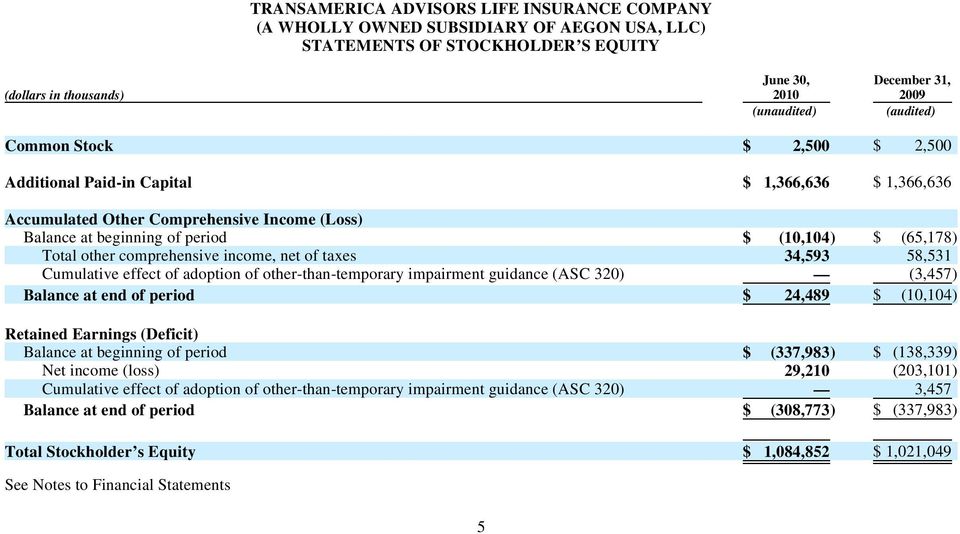
7 See Notes to Financial Statements TRANSAMERICA ADVISORS LIFE INSURANCE COMPANY (A WHOLLY OWNED SUBSIDIARY OF AEGON USA, LLC) STATEMENTS OF STOCKHOLDER S EQUITY June 30, December 31, (dollars in thousands) (unaudited) (audited) Common Stock $ 2,500 $ 2,500 Additional Paid-in Capital $ 1,366,636 $ 1,366,636 Accumulated Other Comprehensive Income (Loss) Balance at beginning of period $ (10,104) $ (65,178) Total other comprehensive income, net of taxes 34,593 58,531 Cumulative effect of adoption of other-than-temporary impairment guidance (ASC 320) (3,457) Balance at end of period $ 24,489 $ (10,104) Retained Earnings (Deficit) Balance at beginning of period $ (337,983) $ (138,339) Net income (loss) 29,210 (203,101) Cumulative effect of adoption of other-than-temporary impairment guidance (ASC 320) 3,457 Balance at end of period $ (308,773) $ (337,983) Total Stockholder s Equity $ 1,084,852 $ 1,021,049 5
8 TRANSAMERICA ADVISORS LIFE INSURANCE COMPANY (A WHOLLY OWNED SUBSIDIARY OF AEGON USA, LLC) STATEMENTS OF CASH FLOWS Six Months Ended June 30, (dollars in thousands) (unaudited) CASH FLOWS FROM OPERATING ACTIVITIES Net income (loss) $ 29,210 $(200,136) Adjustment to reconcile net income (loss) to net cash and cash equivalents provided by operating activities: Changes in: Deferred policy acquisition costs (13,879) 1,997 Deferred sales inducements (3,158) 1,908 Value of business acquired (11,244) 140,753 Benefit reserves 71,633 (4,211) Federal income tax accruals (22,240) 71,212 Claims and claims settlement expenses 2,108 (7,734) Other policyholder funds (5,957) 6,643 Other operating assets and liabilities, net (1,530) 9,147 Amortization (accretion) of investments 143 (3,393) Limited partnership asset distributions (62) Interest credited to policyholder liabilities 39,639 40,783 Net realized investment (gains) losses (5,874) Net cash and cash equivalents provided by operating activities 78,789 17,585 74,554 CASH FLOWS FROM INVESTING ACTIVITIES Sales of available-for-sale securities 302, ,391 Maturities of available-for-sale securities and mortgage loans 97,614 73,184 Purchases of available-for-sale securities (670,850) (127,310) Sales of limited partnerships Change in affiliated short term note receivable (40,000) Change in payable for collateral under securities loaned and reverse repurchase agreements 49,954 (23,299) Policy loans on insurance contracts, net 19,455 29,781 Net settlement on futures contracts 5,033 (11,628) Other (1,210) Net cash and cash equivalents provided by (used in) investing activities (196,567) 3, ,955 CASH FLOWS FROM FINANCING ACTIVITIES Policyholder deposits 20, ,346 Policyholder withdrawals (111,533) (297,432) Net cash and cash equivalents used in financing activities (91,244) (132,086) Net increase (decrease) in cash and cash equivalents (1) (209,022) 102,423 Cash and cash equivalents, beginning of year 428, ,904 Cash and cash equivalents, end of period $ 219,826 $ 531,327 (1) Included in net increase (decrease) in cash and cash equivalents is interest received (2010 $65; 2009 $0); interest paid (2010 $22; 2009 $16); Federal income taxes paid (2010 $3,200; 2009 $0); Federal income taxes received (2010 $0; 2009 $5,400) See Notes to Financial Statements 6

9 TRANSAMERICA ADVISORS LIFE INSURANCE COMPANY (A WHOLLY OWNED SUBSIDIARY OF AEGON USA, LLC) NOTES TO FINANCIAL STATEMENTS (unaudited) (Dollars in Thousands) Note 1. Summary of Significant Accounting Policies Basis of Presentation Transamerica Advisors Life Insurance Company ( TALIC or the Company ) is a wholly owned subsidiary of AEGON USA, LLC ( AUSA ). Prior to July 1, 2010, the Company was known as Merrill Lynch Life Insurance Company ( MLLIC ). AUSA is an indirect wholly owned subsidiary of AEGON N.V., a limited liability share company organized under Dutch law. During 2009, the Company, in addition to not issuing life insurance products, ceased issuing variable annuity and market value adjusted annuity products. The Company is domiciled in the State of Arkansas. For a complete discussion of the Company s 2009 Financial Statements and accounting policies, refer to the Company s Annual Report on Form 10-K for the year ended December 31, The interim Financial Statements for the three and six month periods are unaudited; however in the opinion of management, all adjustments (consisting of normal recurring accruals) necessary for a fair statement of the Financial Statements have been included. These unaudited Financial Statements should be read in conjunction with the audited Financial Statements included in the 2009 Annual Report on Form 10-K. The nature of the Company s business is such that results of any interim period are not necessarily indicative of results for a full year. Basis of Reporting The accompanying financial statements have been prepared in conformity with U.S. generally accepted accounting principles ( GAAP ). The Company also submits financial statements to insurance industry regulatory authorities, which are prepared on the basis of statutory accounting principles ( SAP ). The significant accounting policies and related judgments underlying the Company s financial statements are summarized below. Certain reclassifications and format changes have been made to prior period financial statements, where appropriate, to conform to the current period presentation. These reclassifications have no effect on net income or stockholder s equity of the prior periods. Accounting Estimates and Assumptions The preparation of financial statements requires management to make estimates and assumptions affecting the reported amounts of assets, liabilities, revenues and expenses and the disclosures of contingent assets and liabilities. Those estimates are inherently subject to change and actual results could differ from those estimates. Included among the material (or potentially material) reported amounts and disclosures that require extensive use of estimates are: fair value of certain invested assets, asset valuation allowances, deferred policy acquisition costs, deferred sales inducements, value of business acquired, goodwill, policyholder liabilities, income taxes, and potential effects of unresolved litigated matters. Reverse Repurchase Agreements The Company enters into dollar roll repurchase agreement transactions whereby the Company takes delivery of mortgage-backed securities ( MBS ) pools and sells them to a counterparty along with an agreement to repurchase substantially the same pools at some point in the future, typically one month forward. These transactions are accounted for as collateralized borrowings and the repurchase agreement liability is included in the Balance Sheet in payables for collateral under securities loaned and reverse repurchase agreements. Subsequent Events The financial statements are adjusted to reflect events that occurred between the balance sheet date and the date when the financial statements are issued, provided they give evidence of conditions that existed at the balance sheet date. Events that are indicative of conditions that arose after the balance sheet date are disclosed, but do not result in an adjustment of the financial statements themselves. 7
10 Recent Accounting Guidance Current Adoption of Recent Accounting Guidance Accounting Standards Codification ( ASC ) 820, Fair Value Measurements and Disclosures The Company adopted guidance (Accounting Standards Update ( ASU ) , Improving Disclosures about Fair Value Measurements) which includes new disclosures and clarifications of existing disclosures about fair value measurements as of the period ended March 31, The guidance requires disclosure of significant transfers in and out of Levels 1 and 2 of the fair value hierarchy and reasons for the transfers. Additionally, the ASU clarifies the level of disaggregation for fair value disclosures, requiring disclosures for each class of assets and liabilities. The guidance clarifies that a reporting entity should provide disclosures about the valuation techniques and inputs used to measure fair value for both recurring and nonrecurring fair value measurements that fall in either Level 2 or Level 3. The adoption required updates to the Company s financial statement disclosures, but did not impact the Company s results of operations or financial position. Accounting Guidance Adopted in 2009 ASC 105, Generally Accepted Accounting Principles The Company adopted guidance that established the Financial Accounting Standards Board ( FASB ) Accounting Standards Codification TM ( Codification ) as the source of authoritative GAAP recognized by the FASB to be applied by nongovernmental entities as of the period ended September 30, All guidance contained in the Codification carries an equal level of authority. The adoption required updates to the Company s financial statement disclosures, but did not impact the Company s results of operations or financial position. ASC 320, Investments Debt and Equity Securities The Company adopted guidance that made other-than-temporary impairment ( OTTI ) guidance for debt securities more operational and improved the presentation and disclosure of OTTI on debt and equity securities in the financial statements as of the period ended June 30, The adoption resulted in a net increase to retained earnings and decrease to accumulated other comprehensive income (loss) of $3,457 at June 30, ASC 820, Fair Value Measurements and Disclosures The Company adopted guidance on measuring the fair value of certain alternative investments (i.e., investments in hedge funds, private equity funds, venture capital funds, offshore fund vehicles, funds of funds, and real estate funds) as of the period ended December 31, 2009 (ASU , Investments in Certain Entities That Calculate Net Asset Value per Share (or Its Equivalent)). The adoption did not have a material impact on the Company s financial statements. The Company adopted guidance, as of the period ended December 31, 2009, which clarified that when a quoted price in an active market for an identical liability is not available, an entity should measure fair value using one of the following approaches that maximizes the use of relevant observable inputs and minimizes the use of unobservable inputs: a) a valuation technique that uses the quoted price of the identical liability when traded as an asset; b) a valuation technique that uses quoted prices for similar liabilities or similar liabilities when traded as assets; or c) another valuation technique that is consistent with fair value measurement guidance (e.g., income approach or a market approach) (ASU , Measuring Liabilities at Fair Value). The adoption did not have a material impact on the Company s financial statements. The Company adopted guidance for estimating fair value when the volume and level of activity for an asset or liability have significantly decreased as well as guidance on identifying circumstances that indicate a transaction is not orderly as of the period ended June 30, The guidance provides a list of factors that an entity should consider when determining whether there has been a significant decrease in the volume and level of activity for an asset or liability when compared to normal market activity for that asset or liability. The guidance also requires interim disclosures of the inputs and valuation techniques used to measure fair value and disclosure of any changes to those inputs and valuation techniques during the period. The adoption did not have a material impact on the Company s financial statements. The Company adopted guidance requiring disclosures about fair value of financial instruments in interim reporting periods as well as annual periods as of the period ended June 30, The guidance requires an entity to disclose the methods and significant assumptions used to estimate fair value of financial instruments and to describe changes, if any, to those methods and assumptions during the period. The adoption affected disclosures but did not impact the Company s results of operations or financial position. 8
11 ASC 855, Subsequent Events The Company adopted guidance that established general standards of accounting for and disclosure of events that occur after the balance sheet date but before financial statements are issued or are available to be issued as of the period ended June 30, The Company adopted revised guidance as of the period ended December 31, 2009, which eliminated the requirement for entities that file or furnish financial statements to the Securities Exchange Commission ( SEC ) to disclose the date through which subsequent events have been evaluated. The adoption did not impact the Company s results of operations or financial position. ASC 815, Derivatives and Hedging On January 1, 2009, the Company adopted guidance that amended and expanded the disclosure requirements related to derivative instruments and hedging activities to provide users of financial statements with an enhanced understanding of a) how and why an entity uses derivative instruments, b) how derivative instruments and related hedged items are accounted for, and c) how derivative instruments and related hedged items affect an entity s financial position, financial performance, and cash flows. The adoption did not impact the Company s results of operations or financial position. ASC 805, Business Combinations On January 1, 2009, the Company adopted guidance that established the principles and requirements for how the acquirer in a business combination: a) measures and recognizes the identifiable assets acquired, liabilities assumed, and any noncontrolling interests in the acquired entity, b) measures and recognizes positive goodwill acquired or a gain from bargain purchase (negative goodwill), and c) determines the disclosure information that is decision-useful to users of financial statements in evaluating the nature and financial effects of the business combination. The adoption did not have a material impact on the results of operation or financial position. ASC 350, Intangibles Goodwill and Other On January 1, 2009, the Company adopted guidance that amended the factors that should be considered in developing renewal or extension assumptions used to determine the useful life of a recognized intangible asset. The adoption did not impact the Company s results of operations or financial position. Future Adoption of Accounting Guidance ASC 820, Fair Value Measurements and Disclosures In January 2010, the FASB issued ASU , Improving Disclosures about Fair Value Measurements, which requires separate presentation of information about purchases, sales, issuances, and settlements in the Level 3 reconciliation for fair value measurements using significant unobservable inputs. This disclosure requirement is effective for fiscal years, and interim periods within those fiscal years, beginning after December 15, The Company will adopt the guidance on January 1, 2011, which affects disclosures and therefore will not impact the Company s results of operations or financial position. In April 2010, the FASB issued ASU , How Investments Held Through Separate Accounts Affect an Insurer s Consolidation Analysis of Those Investments. This guidance clarifies that an insurance entity should not consider any separate account interest held for the benefit of policyholders in an investment to be the insurer s interests and should not combine those interests with its general account interest in the same investment when assessing the investment for consolidation. The guidance is effective for fiscal years, and interim periods within those fiscal years, beginning January 1, 2011 with early adoption permitted with the guidance applied retrospectively to all prior periods upon the date of adoption. The Company will adopt the guidance on January 1, 2011 and does not expect this to have a material impact to its results of operations and financial position. Note 2. Fair Value of Financial Instruments Fair Value Measurements ASC 820 defines fair value, establishes a framework for measuring fair value, establishes a fair value hierarchy based on the quality of inputs used to measure fair value and enhances disclosure requirements for fair value measurements. Fair Value Hierarchy The Company has categorized its financial instruments into a three level hierarchy which is based on the priority of the inputs to the valuation technique. The fair value hierarchy gives the highest priority to quoted prices in active markets for identical assets or liabilities (Level 1) and the lowest priority to unobservable inputs (Level 3). If the inputs used to measure fair value fall within 9
12 different levels of the hierarchy, the category level is based on the lowest priority level input that is significant to the fair value measurement of the instrument. Assets and liabilities recorded at fair value on the Balance Sheets are categorized as follows: Level 1. Unadjusted quoted prices for identical assets or liabilities in an active market. Level 2. Quoted prices in markets that are not active or inputs that are observable either directly or indirectly for substantially the full term of the asset or liability. Level 2 inputs include the following: a) Quoted prices for similar assets or liabilities in active markets b) Quoted prices for identical or similar assets or liabilities in non-active markets c) Inputs other than quoted market prices that are observable d) Inputs that are derived principally from or corroborated by observable market data through correlation or other means Level 3. Prices or valuation techniques that require inputs that are both unobservable and significant to the overall fair value measurement. They reflect management s own assumptions about the assumptions a market participant would use in pricing the asset or liability. The Company recognizes transfers between levels as of the beginning of the period. The following table presents the Company s hierarchy for its assets and liabilities measured at fair value on a recurring basis: June 30, 2010 Level 1 Level 2 Level 3 Total Assets Fixed maturity securities Corporate securities $ $1,164,030 $ $1,164,030 Asset-backed securities 102,157 11, ,338 Commercial mortgage-backed securities 147,023 3, ,604 Residential mortgage-backed securities 102,180 23, ,500 Municipals 1,581 1,581 Government and government agencies United States 121, ,388 Foreign 3,660 6,066 9,726 Fixed maturity securities (a) 125,048 1,523,037 38,082 1,686,167 Equity securities Banking securities 7,051 7,051 Other financial services securities Industrial securities 5,200 5,200 Equity securities (a) 12,679 12,679 Cash equivalents (b) 225, ,082 Limited partnerships (c) 8,772 8,772 Separate Accounts assets (d) 7,501,896 7,501,896 Total assets $7,626,944 $1,760,798 $46,854 $9,434,596 Liabilities Future policy benefits (embedded derivatives only) (e) $ $ $31,884 $ 31,884 Total liabilities $ $ $31,884 $ 31,884 10

13 December 31, 2009 Level 1 Level 2 Level 3 Total Assets Fixed maturity securities Corporate securities $ $ 722,159 $ 11,440 $ 733,599 Asset-backed securities 89,281 22, ,691 Commercial mortgage-backed securities 152, ,173 Residential mortgage-backed securities 114,979 3, ,170 Municipals 1,488 1,488 Government and government agencies United States 215, ,828 Foreign 3,463 8,879 12,342 Fixed maturity securities (a) 219,291 1,088,959 37,041 1,345,291 Equity securities Banking securities 6,361 6,361 Other financial services securities Industrial securities 5,081 5,081 Equity securities (a) 11,805 11,805 Cash equivalents (b) 433, ,875 Limited partnerships (c) 7,604 7,604 Separate Accounts assets (d) 8,313,833 Total assets $8,533,124 $1,534,639 $ 44,645 8,313,833 $10,112,408 Liabilities Future policy benefits (embedded derivatives only) (e) $ $ $(12,759) $ (12,759) Total liabilities $ $ $(12,759) $ (12,759) (a) Securities are classified as Level 1 if the fair value is determined by observable inputs that reflect quoted prices for identical assets in active markets that the Company has the ability to access at the measurement date. Level 1 securities include highly liquid U.S. Treasury and U.S. Government Agency securities. Securities are classified as Level 2 if the fair value is determined by observable inputs, other than quoted prices included in Level 1, for the asset or prices for similar assets. Level 2 securities include fixed maturity securities and preferred stock for which the Company utilized pricing services and corroborated broker quotes. Securities are classified as Level 3 if the valuations are derived from techniques in which one or more of the significant inputs are unobservable. Level 3 consists principally of fixed maturity securities whose fair value is estimated based on non-binding broker quotes. (b) Cash equivalents are primarily valued at amortized cost, which approximates fair value. Operating cash is not included in the abovementioned table. (c) The Company has an investment in a limited partnership for which the fair value was derived from management s review of the underlying financial statements that were prepared on a GAAP basis. The remaining limited partnership is carried at cost and is not included in the abovementioned table. (d) Separate Accounts assets are carried at the net asset value provided by the fund managers. (e) The Company issued contracts containing guaranteed minimum withdrawal benefits riders ( GMWB ) and obtained reinsurance on guaranteed minimum income benefit riders ( GMIB reinsurance ). GMWB and GMIB reinsurance are treated as embedded derivatives and are required to be reported separately from the host variable annuity contract. The fair value of these guarantees are calculated as the present value of future expected payments to policyholders less the present value of assessed rider fees attributable to the guarantees. Given the complexity and long-term nature of these guarantees, their fair values are determined using stochastic techniques under a variety of market return, discount rates and actuarial assumptions. Since many of the assumptions are unobservable and are considered to be significant inputs to the liability valuation, the liability included in future policy benefits has been reflected within Level 3 of the fair value hierarchy. At June 30, 2010, there were no transfers between level 1 and 2, respectively. 11

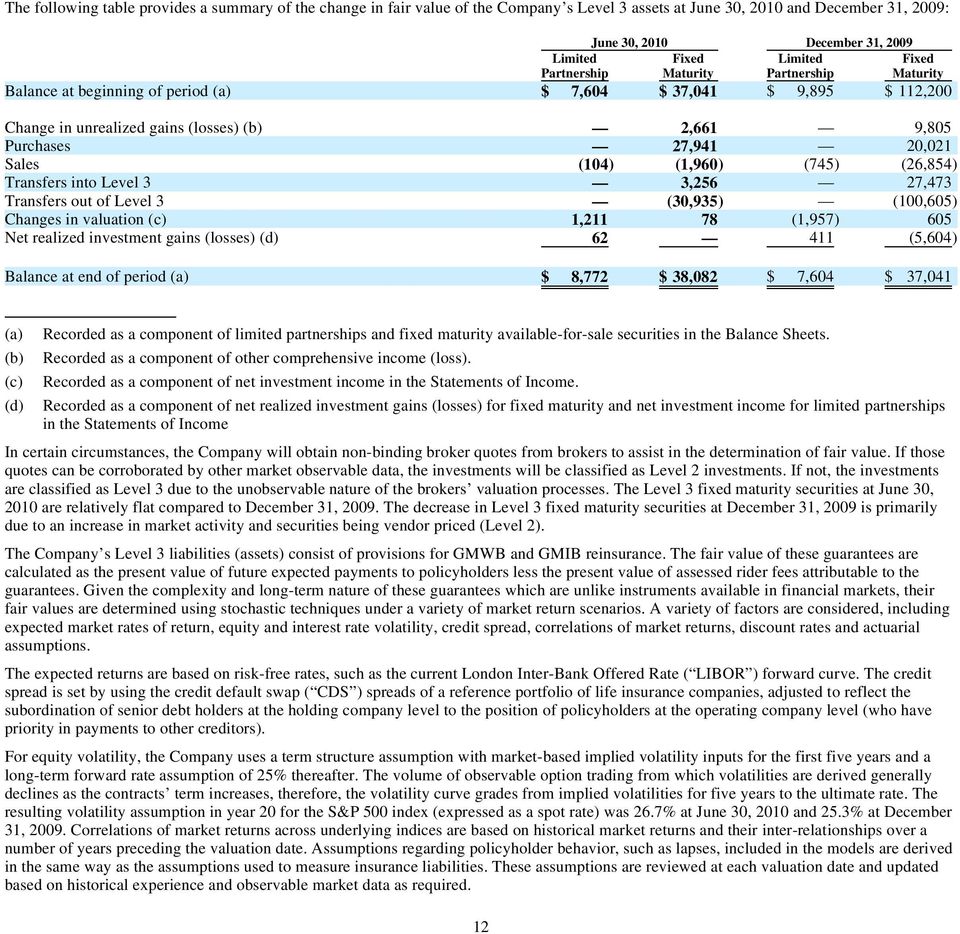
14 The following table provides a summary of the change in fair value of the Company s Level 3 assets at June 30, 2010 and December 31, 2009: June 30, 2010 December 31, 2009 Limited Fixed Limited Fixed Partnership Maturity Partnership Maturity Balance at beginning of period (a) $ 7,604 $ 37,041 $ 9,895 $ 112,200 Change in unrealized gains (losses) (b) 2,661 9,805 Purchases 27,941 20,021 Sales (104) (1,960) (745) (26,854) Transfers into Level 3 3,256 27,473 Transfers out of Level 3 (30,935) (100,605) Changes in valuation (c) 1, (1,957) 605 Net realized investment gains (losses) (d) (5,604) Balance at end of period (a) $ 8,772 $ 38,082 $ 7,604 $ 37,041 (a) Recorded as a component of limited partnerships and fixed maturity available-for-sale securities in the Balance Sheets. (b) Recorded as a component of other comprehensive income (loss). (c) Recorded as a component of net investment income in the Statements of Income. (d) Recorded as a component of net realized investment gains (losses) for fixed maturity and net investment income for limited partnerships in the Statements of Income In certain circumstances, the Company will obtain non-binding broker quotes from brokers to assist in the determination of fair value. If those quotes can be corroborated by other market observable data, the investments will be classified as Level 2 investments. If not, the investments are classified as Level 3 due to the unobservable nature of the brokers valuation processes. The Level 3 fixed maturity securities at June 30, 2010 are relatively flat compared to December 31, The decrease in Level 3 fixed maturity securities at December 31, 2009 is primarily due to an increase in market activity and securities being vendor priced (Level 2). The Company s Level 3 liabilities (assets) consist of provisions for GMWB and GMIB reinsurance. The fair value of these guarantees are calculated as the present value of future expected payments to policyholders less the present value of assessed rider fees attributable to the guarantees. Given the complexity and long-term nature of these guarantees which are unlike instruments available in financial markets, their fair values are determined using stochastic techniques under a variety of market return scenarios. A variety of factors are considered, including expected market rates of return, equity and interest rate volatility, credit spread, correlations of market returns, discount rates and actuarial assumptions. The expected returns are based on risk-free rates, such as the current London Inter-Bank Offered Rate ( LIBOR ) forward curve. The credit spread is set by using the credit default swap ( CDS ) spreads of a reference portfolio of life insurance companies, adjusted to reflect the subordination of senior debt holders at the holding company level to the position of policyholders at the operating company level (who have priority in payments to other creditors). For equity volatility, the Company uses a term structure assumption with market-based implied volatility inputs for the first five years and a long-term forward rate assumption of 25% thereafter. The volume of observable option trading from which volatilities are derived generally declines as the contracts term increases, therefore, the volatility curve grades from implied volatilities for five years to the ultimate rate. The resulting volatility assumption in year 20 for the S&P 500 index (expressed as a spot rate) was 26.7% at June 30, 2010 and 25.3% at December 31, Correlations of market returns across underlying indices are based on historical market returns and their inter-relationships over a number of years preceding the valuation date. Assumptions regarding policyholder behavior, such as lapses, included in the models are derived in the same way as the assumptions used to measure insurance liabilities. These assumptions are reviewed at each valuation date and updated based on historical experience and observable market data as required. 12
15 The following table provides a summary of the changes in fair value of the Company s Level 3 liabilities (assets) at June 30, 2010 and December 31, 2009: June 30, 2010 December 31, 2009 GMIB GMIB GMWB Reinsurance GMWB Reinsurance Balance at beginning of period (b) $ 45,987 $ (58,746) $114,457 $ (79,134) Changes in interest rates (a) 50,738 (19,074) (35,381) 12,922 Changes in equity markets (a) 22,552 (9,573) (24,462) 13,503 Other (a) (8,627) (6,037) Balance at end of period (b) $119,277 $ (87,393) $ 45,987 $ (58,746) (a) Recorded as a component of policy benefits in the Statements of Income. (b) Recorded as a component of future policy benefits in the Balance Sheets. At June 30, 2010, the increase in the GMWB reserves and GMIB Reinsurance was principally driven by the decline in the risk neutral rate and unfavorable equity markets during the quarter. In 2009, the change in GMWB reserves and GMIB insurance was driven by the increase in risk neutral rates, improved equity markets, and policyholder behavior assumption updates, slightly offset by a lower credit spread. Note 3. Investments Fixed Maturity and Equity Securities The amortized cost/cost and estimated fair value of investments in fixed maturity and equity securities at June 30, 2010 and December 31, 2009 were: June 30, 2010 Estimated Amortized Gross Unrealized Fair Cost/Cost Gains Losses OTTI (1) Value Fixed maturity securities Corporate securities $1,115,865 $58,129 $(10,185) $ 221 $1,164,030 Asset-backed securities 114,013 6,845 (5,036) (2,484) 113,338 Commercial mortgage-backed securities 149,976 7,537 (6,909) 150,604 Residential mortgage-backed securities 125,966 4,090 (1,377) (3,179) 125,500 Municipals 1, ,581 Government and government agencies United States 116,237 6,655 (1,504) 121,388 Foreign 9, Total fixed maturity securities $1,632,702 $83,918 $(25,011) $(5,442) 9,726 $1,686,167 Equity securities preferred stocks Banking securities $ 9,246 $ $ (2,195) $ $ 7,051 Other financial services securities Industrial securities 5,791 (591) 5,200 Total equity securities $ 15,202 $ 263 $ (2,786) $ $ 12,679 13

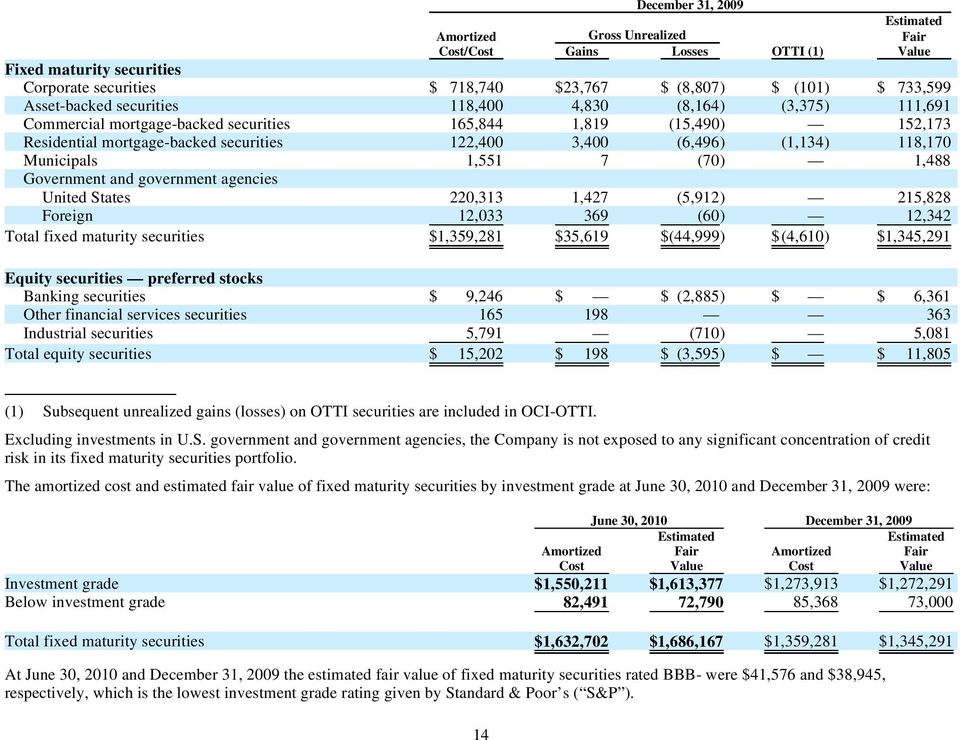
16 December 31, 2009 Estimated Amortized Gross Unrealized Fair Cost/Cost Gains Losses OTTI (1) Value Fixed maturity securities Corporate securities $ 718,740 $23,767 $ (8,807) $ (101) $ 733,599 Asset-backed securities 118,400 4,830 (8,164) (3,375) 111,691 Commercial mortgage-backed securities 165,844 1,819 (15,490) 152,173 Residential mortgage-backed securities 122,400 3,400 (6,496) (1,134) 118,170 Municipals 1,551 7 (70) 1,488 Government and government agencies United States 220,313 1,427 (5,912) 215,828 Foreign 12, (60) Total fixed maturity securities $1,359,281 $35,619 $(44,999) $(4,610) 12,342 $1,345,291 Equity securities preferred stocks Banking securities $ 9,246 $ $ (2,885) $ $ 6,361 Other financial services securities Industrial securities 5,791 (710) Total equity securities $ 15,202 $ 198 $ (3,595) $ $ 5,081 11,805 (1) Subsequent unrealized gains (losses) on OTTI securities are included in OCI-OTTI. Excluding investments in U.S. government and government agencies, the Company is not exposed to any significant concentration of credit risk in its fixed maturity securities portfolio. The amortized cost and estimated fair value of fixed maturity securities by investment grade at June 30, 2010 and December 31, 2009 were: June 30, 2010 December 31, 2009 Estimated Estimated Amortized Fair Amortized Fair Cost Value Cost Value Investment grade $1,550,211 $1,613,377 $1,273,913 $1,272,291 Below investment grade 82,491 72,790 85,368 73,000 Total fixed maturity securities $1,632,702 $1,686,167 $1,359,281 $1,345,291 At June 30, 2010 and December 31, 2009 the estimated fair value of fixed maturity securities rated BBB- were $41,576 and $38,945, respectively, which is the lowest investment grade rating given by Standard & Poor s ( S&P ). 14
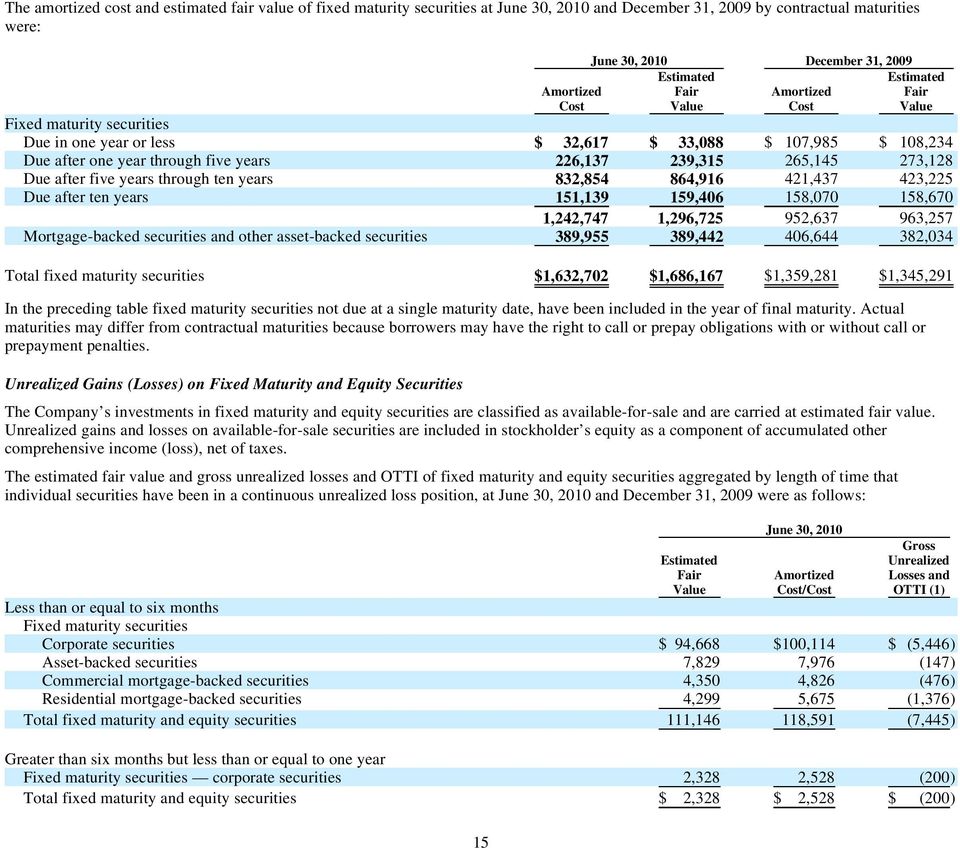
17 The amortized cost and estimated fair value of fixed maturity securities at June 30, 2010 and December 31, 2009 by contractual maturities were: June 30, 2010 December 31, 2009 Estimated Estimated Amortized Fair Amortized Fair Cost Value Cost Value Fixed maturity securities Due in one year or less $ 32,617 $ 33,088 $ 107,985 $ 108,234 Due after one year through five years 226, , , ,128 Due after five years through ten years 832, , , ,225 Due after ten years 151, , , ,670 1,242,747 1,296, , ,257 Mortgage-backed securities and other asset-backed securities 389, , , ,034 Total fixed maturity securities $1,632,702 $1,686,167 $1,359,281 $1,345,291 In the preceding table fixed maturity securities not due at a single maturity date, have been included in the year of final maturity. Actual maturities may differ from contractual maturities because borrowers may have the right to call or prepay obligations with or without call or prepayment penalties. Unrealized Gains (Losses) on Fixed Maturity and Equity Securities The Company s investments in fixed maturity and equity securities are classified as available-for-sale and are carried at estimated fair value. Unrealized gains and losses on available-for-sale securities are included in stockholder s equity as a component of accumulated other comprehensive income (loss), net of taxes. The estimated fair value and gross unrealized losses and OTTI of fixed maturity and equity securities aggregated by length of time that individual securities have been in a continuous unrealized loss position, at June 30, 2010 and December 31, 2009 were as follows: June 30, 2010 Gross Estimated Unrealized Fair Amortized Losses and Value Cost/Cost OTTI (1) Less than or equal to six months Fixed maturity securities Corporate securities $ 94,668 $100,114 $ (5,446) Asset-backed securities 7,829 7,976 (147) Commercial mortgage-backed securities 4,350 4,826 (476) Residential mortgage-backed securities 4,299 5,675 (1,376) Total fixed maturity and equity securities 111, ,591 (7,445) Greater than six months but less than or equal to one year Fixed maturity securities corporate securities 2,328 2,528 (200) Total fixed maturity and equity securities $ 2,328 $ 2,528 $ (200) 15
18 June 30, 2010 Gross Estimated Unrealized Fair Amortized Losses and (continued) Value Cost/Cost OTTI (1) Greater than one year Fixed maturity securities Corporate securities $ 37,705 $ 42,023 $ (4,318) Asset-backed securities 22,635 30,008 (7,373) Commercial mortgage-backed securities 22,540 28,973 (6,433) Residential mortgage-backed securities 16,288 19,468 (3,180) Government and government agencies United States 31,901 33,405 (1,504) Equity securities Banking securities 7,051 9,246 (2,195) Industrial securities 5,200 5,791 (591) Total fixed maturity and equity securities 143, ,914 (25,594) Total fixed maturity and equity securities $256,794 $290,033 $ (33,239) December 31, 2009 Gross Estimated Unrealized Fair Amortized Losses and Value Cost/Cost OTTI (1) Less than or equal to six months Fixed maturity securities Corporate securities $169,107 $171,407 $ (2,300) Asset-backed securities 3,690 3,767 (77) Commercial mortgage-backed securities 11,798 12,094 (296) Residential mortgage-backed securities 19,885 20,021 (136) Government and government agencies United States 25,969 26,201 (232) Foreign 3,563 3,623 (60) Total fixed maturity and equity securities 234, ,113 (3,101) Greater than six months but less than or equal to one year Fixed maturity securities Corporate securities 6,173 6,813 (640) Asset-backed securities 12,892 14,470 (1,578) Commercial mortgage-backed securities 5,046 5,770 (724) Residential mortgage-backed securities 4 4 Government and government agencies United States 83,657 89,337 (5,680) Total fixed maturity and equity securities 107, ,394 (8,622) Greater than one year Fixed maturity securities Corporate securities 81,631 87,599 (5,968) Asset-backed securities 22,950 32,834 (9,884) Commercial mortgage-backed securities 50,799 65,269 (14,470) Residential mortgage-backed securities 19,805 27,299 (7,494) Municipals (70) Equity securities Banking securities 6,361 9,246 (2,885) Industrial securities 5,081 5,791 (710) Total fixed maturity and equity securities 187, ,968 (41,481) Total fixed maturity and equity securities $529,271 $582,475 $ (53,204) (1) Subsequent unrealized gains (losses) on OTTI securities are included in OCI-OTTI. 16

19 The total number of securities in an unrealized loss position was 63 and 119 at June 30, 2010 and December 31, 2009, respectively. The estimated fair value, gross unrealized losses, OTTI and number of securities where the fair value had declined below amortized cost by greater than 20% and greater than 40% at June 30, 2010 and December 31, 2009 were as follows: June 30, 2010 Estimated Gross Fair Unrealized Number of Value Losses OTTI (1) Securities Decline > 20% Less than or equal to six months $ 15,924 $ (4,889) $ 2 Greater than one year 22,121 (9,655) (2,484) Total $ 38,045 $ (14,544) $ (2,484) 7 9 Decline > 40% Greater than one year $ 7,654 $ (5,581) $ 2 Total $ 7,654 $ (5,581) $ 2 December 31, 2009 Estimated Gross Fair Unrealized Number of Value Losses OTTI (1) Securities Decline > 20% Greater than one year $ 68,806 $ (28,168) $ (4,509) 17 Total $ 68,806 $ (28,168) $ (4,509) 17 Decline > 40% Greater than one year $ 12,943 $ (10,989) $ 4 Total $ 12,943 $ (10,989) $ 4 (1) Subsequent unrealized gains (losses) on OTTI securities are included in OCI-OTTI. Unrealized gains (losses) incurred during the first half of 2010 and 2009 were primarily due to price fluctuations resulting from changes in interest rates and credit spreads. As the Company does not have the intent to sell and the Company is not more likely than not required to sell these securities prior to the anticipated recovery of the amortized cost, the Company did not consider these securities to be other-thantemporarily impaired. The components of net unrealized gains (losses) and OTTI included in accumulated other comprehensive income (loss), net of taxes at June 30, 2010 and December 31, 2009 was as follows: June 30, December 31, Assets Fixed maturity securities $53,465 $ (13,990) Equity securities (2,523) (3,397) Value of business acquired (14,679) (1,219) 36,263 (18,606) Liabilities Policyholder account balances 1,827 3,062 Federal income taxes deferred (13,601) 5,440 (11,774) 8,502 Stockholder s equity Accumulated other comprehensive income (losses), net of taxes $ 24,489 $ (10,104) The Company records certain adjustments to policyholder account balances in conjunction with the unrealized holding gains or losses on investments classified as available-for-sale. The Company adjusts a portion of these liabilities as if the unrealized 17

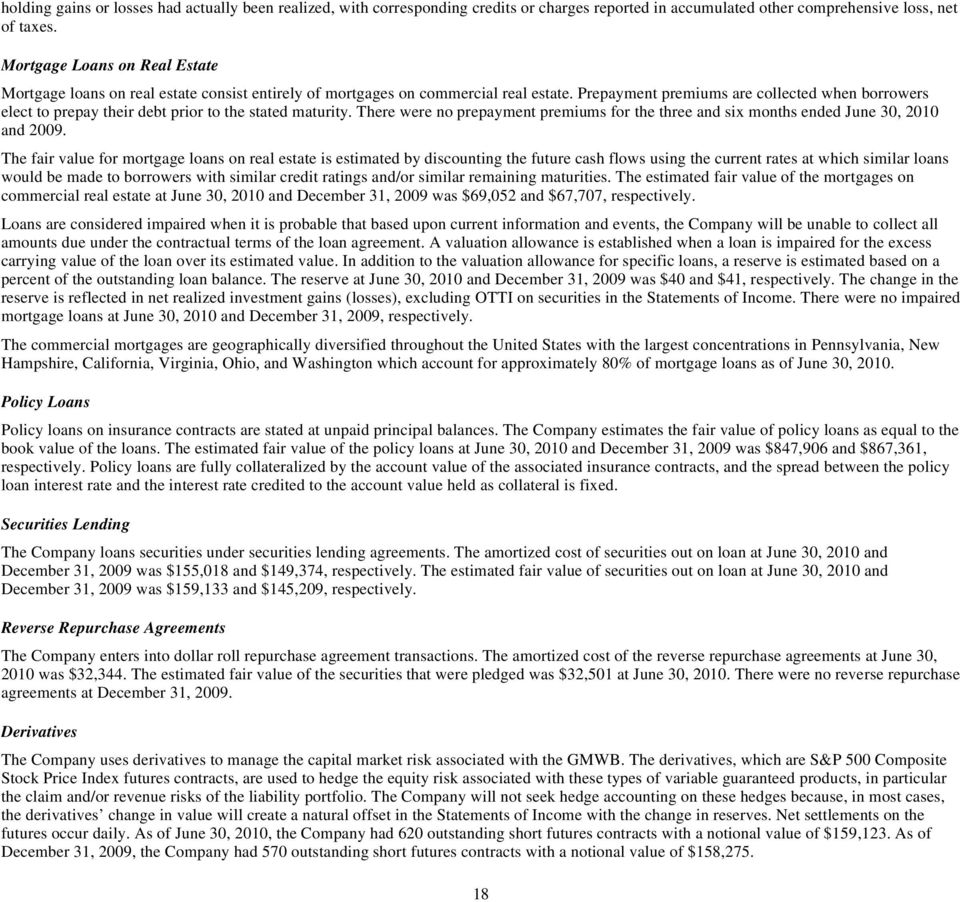
20 holding gains or losses had actually been realized, with corresponding credits or charges reported in accumulated other comprehensive loss, net of taxes. Mortgage Loans on Real Estate Mortgage loans on real estate consist entirely of mortgages on commercial real estate. Prepayment premiums are collected when borrowers elect to prepay their debt prior to the stated maturity. There were no prepayment premiums for the three and six months ended June 30, 2010 and The fair value for mortgage loans on real estate is estimated by discounting the future cash flows using the current rates at which similar loans would be made to borrowers with similar credit ratings and/or similar remaining maturities. The estimated fair value of the mortgages on commercial real estate at June 30, 2010 and December 31, 2009 was $69,052 and $67,707, respectively. Loans are considered impaired when it is probable that based upon current information and events, the Company will be unable to collect all amounts due under the contractual terms of the loan agreement. A valuation allowance is established when a loan is impaired for the excess carrying value of the loan over its estimated value. In addition to the valuation allowance for specific loans, a reserve is estimated based on a percent of the outstanding loan balance. The reserve at June 30, 2010 and December 31, 2009 was $40 and $41, respectively. The change in the reserve is reflected in net realized investment gains (losses), excluding OTTI on securities in the Statements of Income. There were no impaired mortgage loans at June 30, 2010 and December 31, 2009, respectively. The commercial mortgages are geographically diversified throughout the United States with the largest concentrations in Pennsylvania, New Hampshire, California, Virginia, Ohio, and Washington which account for approximately 80% of mortgage loans as of June 30, Policy Loans Policy loans on insurance contracts are stated at unpaid principal balances. The Company estimates the fair value of policy loans as equal to the book value of the loans. The estimated fair value of the policy loans at June 30, 2010 and December 31, 2009 was $847,906 and $867,361, respectively. Policy loans are fully collateralized by the account value of the associated insurance contracts, and the spread between the policy loan interest rate and the interest rate credited to the account value held as collateral is fixed. Securities Lending The Company loans securities under securities lending agreements. The amortized cost of securities out on loan at June 30, 2010 and December 31, 2009 was $155,018 and $149,374, respectively. The estimated fair value of securities out on loan at June 30, 2010 and December 31, 2009 was $159,133 and $145,209, respectively. Reverse Repurchase Agreements The Company enters into dollar roll repurchase agreement transactions. The amortized cost of the reverse repurchase agreements at June 30, 2010 was $32,344. The estimated fair value of the securities that were pledged was $32,501 at June 30, There were no reverse repurchase agreements at December 31, Derivatives The Company uses derivatives to manage the capital market risk associated with the GMWB. The derivatives, which are S&P 500 Composite Stock Price Index futures contracts, are used to hedge the equity risk associated with these types of variable guaranteed products, in particular the claim and/or revenue risks of the liability portfolio. The Company will not seek hedge accounting on these hedges because, in most cases, the derivatives change in value will create a natural offset in the Statements of Income with the change in reserves. Net settlements on the futures occur daily. As of June 30, 2010, the Company had 620 outstanding short futures contracts with a notional value of $159,123. As of December 31, 2009, the Company had 570 outstanding short futures contracts with a notional value of $158,
21 Realized Investment Gains (Losses) The Company considers fair value at the date of sale to be equal to proceeds received. Proceeds and gross realized investment gains (losses) from the sale of available-for-sale securities for the three and six months ended June 30 were as follows: Three Months Ended Six Months Ended June 30, June 30, Proceeds $212,467 $170,413 $302,580 $255,391 Gross realized investment gains 2,534 1,933 4,905 2,661 Gross realized investment losses (1,683) (2,689) (1,846) (3,757) Proceeds on available-for-sale securities sold at a realized loss 67,431 27,871 90,552 66,309 Net realized investment gains (losses) for the three and six months ended June 30 were as follows: Three Months Ended Six Months Ended June 30, June 30, Fixed maturity securities $ (272) $ (1,808) $ 1,514 $ (8,687) Equity securities (930) Limited partnerships Mortgages 5 (3) 6 Derivatives 14,417 (32,982) 5,033 (11,629) Adjustment related to value of business acquired (73) (110) (1,333) 3,184 Net realized investment gains (losses) $ 14,737 $(34,903) $ 5,874 $(17,585) OTTI If management determines that a decline in the value of an available-for-sale equity security is other-than-temporary, the cost basis is adjusted to estimated fair value and the decline in value is recorded as a net realized investment loss. For debt securities, the manner in which an OTTI is recorded depends on whether management intends to sell a security or it is more likely than not that it will be required to sell a security in an unrealized loss position before its anticipated recovery. If management intends to sell or more likely than not will be required to sell the debt security before recovery, the OTTI is recognized in earnings for the difference between amortized cost and fair value. If these criteria are not met, the OTTI is bifurcated into two pieces: a credit loss is recognized in earnings at an amount equal to the difference between the amortized cost of the debt security and the present value of the security s anticipated cash flows, and a non credit loss is recognized in OCI for any difference between the fair value and the net present value of the debt security at the impairment measurement date. The following tables sets forth the amount of credit loss impairments on fixed maturity securities held by the Company as of the dates indicated, for which a portion of the OTTI loss was recognized in OCI, and the corresponding changes in such amounts: Balance, December 31, 2009 $ 1,445 Credit loss impairment recognized in the current period on securities not previously impaired 722 Additional credit loss impairments recognized in the current period on securities previously impaired through other comprehensive income 423 Accretion of credit loss impairments previously recognized (199) Balance, June 30, 2010 $ 2,391 19
22 The components of OTTI reflected in the Statements of Income for the three and six months ended June 30 was as follows: Three Months Ended June 30, 2010 Six Months Ended June 30, 2010 Net Net OTTI Net Net OTTI OTTI OTTI Losses Losses OTTI OTTI Loss Losses Losses on Recognized Recognized Losses on Recognized Recognized Securities in OCI in Income Securities in OCI in Income Gross OTTI losses $ 3,568 $ 2,449 $ 1,119 $ 3,991 $ 2,449 $ 1,542 Deferred acquisition costs and value of business acquired (258) (258) (258) (258) Net OTTI losses $ 3,310 $ 2,449 $ 861 $ 3,733 $ 2,449 $ 1,284 Three Months Ended June 30, 2009 Six Months Ended June 30, 2009 Net Net OTTI Net Net OTTI OTTI OTTI Losses Losses OTTI OTTI Loss Losses Losses on Recognized Recognized Losses on Recognized Recognized Securities in OCI in Income Securities in OCI in Income Gross OTTI losses $ 1,066 $ 14 $ 1,052 $ 8,538 $ 14 $ 8,524 Deferred acquisition costs and value of business acquired (3,288) (3,288) Net OTTI losses $ 1,066 $ 14 $ 1,052 $ 5,250 $ 14 $ 5,236 For the three and six months ended June 30, 2010, the Company s impairment losses were $861 and $1,284, respectively, net of associated amortization of value of business acquired. The gross impairment losses were principally the result of the Company impairing its holding of a 2005 vintage residential mortgage-backed security for $722 due to an adverse change in cash flows. A corporate bond was also impaired for $397 due to the intent to sell or being more likely than not required to sell during the second quarter. During the first quarter 2010, the Company impaired its holding of a 2007 vintage subprime mortgage asset-backed security for $423. For the three and six months ended June 30, 2009, the Company s impairment losses were $1,052 and $5,236, respectively, net of value of business acquired amortization. The Company impaired its holding in Lear Corp to discounted cash flows in the first six months of 2009 for $1,052. Eighteen unique issuers accounted for the remaining gross impairment of $7,475. During the second quarter 2009, the Company adopted revised guidance for OTTI recognition, which resulted in a cumulative adjustment of $12,576 to retained earnings and amortized cost for fixed maturity securities and cost for equity securities for the non credit portion of previously recorded impairments on securities still in inventory upon adoption. Of this, $3,495 related to non credit impairments previously recorded in income during the first quarter of Note 4. Value of Business Acquired ( VOBA ), Deferred Acquisition Costs ( DAC ), and Deferred Sales Inducements ( DSI ) VOBA reflects the estimated fair value of in force contracts acquired and represents the portion of the purchase price that is allocated to the value of the right to receive future cash flows from the life insurance and annuity contracts in force at the acquisition date. VOBA is based on actuarially determined projections, for each block of business, of future policy and contract charges, premiums, mortality, Separate Account performance, surrenders, operating expenses, investment returns and other factors. Actual experience on the purchased business may vary from these projections. If estimated gross profits or premiums differ from expectations, the amortization of VOBA is adjusted to reflect actual experience. The short-term equity growth rate and the long-term growth rate for the amortization of VOBA, DAC and DSI were as follows: June 30, December 31, June 30, Gross short-term equity growth rate for five years 9.00% 7.25% 11.00% Gross long-term growth rate 9.00% 9.00% 9.00% 20
23 The change in carrying amount of VOBA for the three and six months ended June 30 was as follows: Three Months Ended Six Months Ended June 30, June 30, Accretion (amortization) expense $17,315 $(23,329) $ 12,850 $ 9,474 Unlocking (8,546) (1,130) (1,606) (86,334) Impairment charge (63,894) Adjustment related to realized (gains) losses on investments (73) (110) (1,333) 3,184 Adjustment related to unrealized gains and OTTI on investments (5,450) (39,533) (13,459) (27,677) Change in VOBA carrying amount $ 3,246 $(64,101) $ (3,548) $(165,247) Unfavorable equity market movement in the second quarter of 2010 resulted in negative future gross profits which caused unfavorable unlocking and accretion expense for the three and six months ended June 30, The six months ended June 30, 2009 were impacted by the negative economic outlook, principally during the first quarter 2009, which resulted in unfavorable unlocking and accretion expense. In addition, an impairment charge was taken at March 31, 2009, as estimated future gross profits were less than the unamortized balance. The change in the carrying amount of DAC and DSI for the three and six months ended June 30 was as follows: Three Months Ended Six Months Ended June 30, June 30, DAC Capitalization $ 230 $ 5,357 $ 504 $ 8,940 Accretion (amortization) expense 9,863 (5,125) 14,124 (10,563) Unlocking (714) (519) (749) (374) Adjustment related to unrealized gains and OTTI on investments (2,209) (1,481) Change in DAC carrying amount $ 9,379 $ (2,496) $ 13,879 $ (3,478) Three Months Ended Six Months Ended June 30, June 30, DSI Capitalization $ 3 $ 456 $ 9 $ 871 Accretion (amortization) expense 2,257 (1,495) 3,260 (3,225) Unlocking (116) 247 (111) 446 Change in DSI carrying amount $ 2,144 $ (792) $ 3,158 $(1,908) During the three and six months ended June 30, 2010, unfavorable equity market movements in the second quarter of 2010 resulted in negative future gross profits which resulted in accretion and negative unlocking in DAC and DSI. During the first half of 2009, the Company experienced lower than expected gross profits for amortization as a result of increases in reserves for guaranteed benefits. 21
24 Note 5. Variable Contracts Containing Guaranteed Benefits The Company records liabilities for contracts containing guaranteed minimum death benefits ( GMDB ) and guaranteed minimum income benefits ( GMIB ) as a component of future policy benefits in the Balance Sheets and changes in the liabilities are included as a component of policy benefits in the Statements of Income. The components of the change in the variable annuity GMDB and GMIB liabilities for the three and six months ended June 30 were as follows: Three Months Ended Six Months Ended June 30, June 30, GMDB Guaranteed benefits incurred $ 9,170 $ 11,335 $ 18,648 $ 20,038 Guaranteed benefits paid (13,401) (15,299) (23,297) (32,066) Unlocking 21,797 (7,576) 17,541 38,540 Total $17,566 $(11,540) $12,892 $26,512 Three Months Ended Six Months Ended June 30, June 30, GMIB Guaranteed benefits incurred $ 4,229 $ 4,610 $ 8,867 $ 7,725 Unlocking 7,236 (1,405) 5,641 6,659 Total $ 11,465 $ 3,205 $ 14,508 $ 14,384 Unfavorable unlocking for the three and six months ended June 30, 2010 was primarily due to unfavorable equity market performance resulting in higher estimates of future benefit amounts. The six months ended June 30, 2009 were impacted by the negative economic outlook during the first quarter 2009 which resulted in unfavorable unlocking. The variable annuity GMDB liability at June 30, 2010 and December 31, 2009 was $158,425 and $145,533, respectively. The variable annuity GMIB liability at June 30, 2010 and December 31, 2009 was $53,677 and $39,169, respectively. The Company has issued variable life contracts in which the Company contractually guarantees to the contract owner a GMDB. As of June 30, 2010 and 2009, an insignificant amount of variable life guaranteed benefits were recorded as a component of policy benefits in the Statements of Income as incurred or paid. Note 6. Federal Income Taxes The effective tax rate was (187%) and (49%) for the six months ended June 30, 2010 and 2009, respectively. Differences between the effective rate and the U.S. statutory rate of 35% during the first half of 2010 principally were the result of Separate Accounts dividends-received deduction ( DRD ) and the valuation allowance on net operating loss carryforward. The valuation allowance for deferred tax assets as of June 30, 2010 and December 31, 2009 was $128,067 and $145,504, respectively. The valuation allowance is related to a net operating loss carryforward and other deferred tax assets that, in the judgment of management, is not more likely than not to be realized. In assessing the realizability of deferred tax assets, management considers whether it is more likely than not that all or some of the deferred tax assets will not be realized. The ultimate realization of deferred tax assets depends on generation of further taxable income during the periods in which those temporary differences are deductible. Management considers the scheduled reversal of deferred tax liabilities, projected taxable income, and tax-planning strategies in making the assessment. The Company has analyzed all material tax positions under the guidance of ASC 740, Income Taxes, related to the accounting for uncertainty in income tax, and determined there were tax benefits of $3,623 that should not be recognized as of June 30, 2010 and December 31, 2009, respectively, which primarily relates to uncertainty regarding the sustainability of certain deductions taken on the 2008 U.S. Federal income tax return. There were no additions based on tax positions related to the current and prior year. To the extent these unrecognized tax benefits are ultimately recognized, they will not impact the effective tax rate in a future period. 22
25 It is not anticipated that the total amounts of unrecognized tax benefits will significantly increase within twelve months of the reporting date. At June 30, 2010 and December 31, 2009, the Company had an operating loss carryforward for federal income tax purposes of $309,556 (net of the ASC 740 reduction of $10,351) and $176,009 (net of the ASC 740 reduction of $10,351), respectively, with a carryforward period of fifteen years that expire at various dates up to In addition, at June 30, 2010 and December 31, 2009, the Company also has a capital loss carryforward for federal income tax purposes of $5,873 and $9,796, respectively, with a carryforward period of five years that will expire at various dates up to At June 30, 2010 and December 31, 2009, the Company had a foreign tax credit carryforward of $6,876 and $5,810, respectively, with a carryforward period of ten years that will expire at various dates up to Also, the Company has an Alternative Minimum Tax tax credit carryforward for federal income tax purposes of $3,668 at June 30, 2010 and December 31, 2009, respectively, with an indefinite carryforward period. The Company classifies interest and penalties related to income taxes as interest expense and penalty expense, respectively. The Company has recognized no material penalties in its financial statements at June 30, 2010 and December 31, 2009, respectively. The Company recognized interest expense of ($119) and $119 at June 30, 2010 and December 31, 2009, respectively. The accrued interest expense related to federal income tax was released at June 30, 2010 based on the expectation that the net operating loss will offset any taxable income generated by the uncertain tax position for the Company in future tax periods. The Company files a separate federal income tax return for the years 2008 through Beginning in 2013 and assuming no changes in ownership, the Company will join the affiliated consolidated tax group. A tax return has been filed for 2008, but no examination by the Internal Revenue Service has yet commenced. Note 7. Stockholder s Equity and Statutory Accounting Principles The Company s statutory financial statements are presented on the basis of accounting practices prescribed or permitted by the Insurance Department of the State of Arkansas. The State of Arkansas has adopted the National Association of Insurance Commissioners ( NAIC ) statutory accounting principles as the basis of its statutory accounting principles. The Company s statutory net income (loss) for the six months ended June 30, 2010 and 2009 was ($98,421) and $72,678, respectively. Statutory capital and surplus at June 30, 2010 and December 31, 2009 was $521,272 and $599,014, respectively. During the first half of 2010 and 2009, the Company did not pay any dividends to AUSA or receive any capital contribution from AUSA. Note 8. Reinsurance In the normal course of business, the Company seeks to limit its exposure to loss on any single insured life and to recover a portion of benefits paid by ceding mortality risk to other insurance enterprises or reinsurers under indemnity reinsurance agreements, primarily quota share coverage and coinsurance agreements. The maximum amount of mortality risk retained by the Company is approximately $1,000 on single and joint life policies. Effective second quarter of 2008, the Company began to recapture the majority of its life reinsurance, which is expected to be finalized in Indemnity reinsurance agreements do not relieve the Company from its obligations to contract owners. Failure of reinsurers to honor their obligations could result in losses to the Company. The Company regularly evaluates the financial condition of its reinsurers so as to minimize its exposure to significant losses from reinsurer insolvencies. At June 30, 2010 and December 31, 2009, reinsurance receivables were $22,573 and $35,806 respectively, primarily related to the recapture of life reinsurance and refined calculations in conjunction with system conversions ($15,199 and $29,682, respectively). At June 30, 2010 and December 31, 2009, these reinsurance receivables were primarily from Swiss Re, Lincoln National Life Insurance Company, Reinsurance Group of America ( RGA ), Employers Reassurance Corporation ( ERAC ), and Munich American Reassurance Company. The Company is party to an indemnity reinsurance agreement with an unaffiliated insurer whereby the Company coinsures, on a modified coinsurance basis, 50% of the unaffiliated insurer s variable annuity contracts sold from January 1, 1997 to June 30, In addition, the Company seeks to limit its exposure to guaranteed benefit features contained in certain variable annuity contracts. Specifically, the Company reinsures certain GMIB and GMDB provisions to the extent reinsurance capacity is available in the 23
26 marketplace. At June 30, 2010 and December 31, 2009, 45% and 12% of the account value for variable annuity contracts containing GMIB and GMDB provisions, respectively, were reinsured, respectively. Note 9. Related Party Transactions As of June 30, 2010, the Company had the following related party agreements in effect: The Company is party to a common cost allocation service agreement between AUSA companies in which various affiliated companies may perform specified administrative functions in connection with the operation of the Company, in consideration of reimbursement of actual costs of services rendered. During the three and six months ended June 30, 2010, the Company incurred $2,008 and $7,772, respectively, in expenses under this agreement. During the three and six months ended June 30, 2009, the Company incurred $6,699 and $12,621, respectively, in expenses under this agreement. Charges attributable to this agreement are included in insurance expenses and taxes, net of amounts capitalized. The Company is party to intercompany short-term note receivable arrangements with its parent and affiliates at various times during the year. On April 29, 2010, the Company had an intercompany short-term note receivable of $40,000 with an interest rate of 0.21% that is due April 29, On June 29, 2009, the Company had an intercompany short-term note receivable of $40,000 with an interest rate of 0.30% that was paid off in April During the three and six months ended June 30, 2010, the Company accrued and/or received $19 and $92 of interest, respectively. During the three and six months ended June 30, 2009, the Company accrued and/or received $34 and $34 of interest, respectively. Interest related to these arrangements is included in net investment income. AEGON USA Realty Advisors, Inc. acts as the manager and administrator for the Company s mortgage loans on real estate under an administrative and advisory agreement with the Company. Charges attributable to this agreement are included in net investment income. During the three and six months ended June 30, 2010, the Company incurred $38 and $76, respectively, under this agreement. During the three and six months ended June 30, 2009, the Company incurred $41 and $82, respectively, under this agreement. There were no mortgage loan origination fees during the three and six months ended June 30, 2010 and 2009, respectively. Mortgage loan origination fees are amortized into net investment income over the life of the mortgage loans. AEGON USA Investment Management, LLC acts as a discretionary investment manager under an investment management agreement with the Company. During the three and six months ended June 30, 2010, the Company incurred $641 and $1,057, respectively, in expenses under this agreement. During the three and six months ended June 30, 2010, the Company incurred $569 and $1,144, respectively, in expenses under this agreement. Charges attributable to this agreement are included in net investment income. Transamerica Capital, Inc. provides underwriting services for the Company under an underwriting agreement. During the three and six months ended June 30, 2010, the Company incurred $9,283 and $18,595, respectively, in expenses under this agreement. During the three and six months ended June 30, 2009, the Company incurred $12,617 and $23,029, respectively, in expenses under this agreement. Charges attributable to this agreement are included in insurance expenses and taxes, net of amounts capitalized. The Company has a participation agreement with Transamerica Series Trust to offer certain funds in the Company s Separate Accounts. Transamerica Capital, Inc. acts as the distributor for said related party funds. The Company has entered into a distribution and shareholder services agreement for certain of the said funds. During the three and six months ended June 30, 2010, the Company received $48 and $94, respectively, in revenue under this agreement. During the three and six months ended June 30, 2009, the Company received $1 and $1, respectively, in revenue under this agreement. Revenue attributable to this agreement is included in policy charge revenue. The Company has a reinsurance agreement with Transamerica Life Insurance Company. During the three and six months ended June 30, 2010, the Company incurred $30 and $40, respectively, in reinsurance premium ceded expense under this agreement and there were no reinsurance recoveries on death claims incurred. During the three and six months ended June 30, 2009, the Company incurred $79 and $150, respectively, in reinsurance premium ceded expense under this agreement and there were no reinsurance recoveries on death claims incurred. The Company is party to the purchasing and selling of investments between various affiliated companies. The investments are purchased and sold at fair value and are included in fixed maturity available-for-sale securities in the Balance Sheets. During the three months ended June 30, 2010, the Company did not sell any fixed maturity available-for-sale securities to affiliated companies During the six months ended June 30, 2010, the Company sold $48,177 of fixed maturity available-for-sale securities to affiliated companies. During the three and six months ended June 30, 2009, the Company sold $78,525 and $78,525, respectively, of fixed maturity available-for-sale securities to affiliated companies. 24
27 While management believes that the service agreements referenced above are calculated on a reasonable basis, they may not necessarily be indicative of the costs that would have been incurred with an unrelated third party. Affiliated agreements generally contain reciprocal indemnity provisions pertaining to each party s representations and contractual obligations thereunder. Note 10. Segment Information In reporting to management, the Company s operating results are categorized into two business segments: Annuity and Life Insurance. The Company s Annuity segment consists of variable annuities and interest-sensitive annuities. The Company s Life Insurance segment consists of variable life insurance products and interest-sensitive life insurance products. The accounting policies of the business segments are the same as those for the Company s financial statements included herein. All revenue and expense transactions are recorded at the product level and accumulated at the business segment level for review by management. The following tables summarize each business segment s contribution to net revenues and net income (loss): Three Months Ended June 30, Net revenues (a) Annuity $59,321 $ 3,107 Life Insurance 20,274 Net revenues (a) $79,595 22,452 $25,559 Net income Annuity $ 2,764 $20,246 Life Insurance 4,286 Net income $ 7,050 17,467 $37,713 Six Months Ended June 30, Net revenues (a) Annuity $ 94,978 $ 57,091 Life Insurance 39,816 Net revenues (a) $134,794 44,971 $ 102,062 Net income (loss) Annuity $ 18,396 $(168,974) Life Insurance 10,814 (31,162) Net income (loss) $ 29,210 $(200,136) (a) Net revenues include total revenues net of interest credited to policyholder liabilities. 25
28 Item 2. Management s Narrative Analysis of Results of Operations This Management s Narrative Analysis of Results of Operations should be read in conjunction with the Financial Statements and Notes to Financial Statements included herein. Forward Looking Statements Certain statements in this report may be considered forward-looking, including those about management expectations, strategic objectives, growth opportunities, business prospects, anticipated financial results and other similar matters. These forward-looking statements represent only management s beliefs regarding future performance, which is inherently uncertain. There are a variety of factors, many of which are beyond the Company s control, which affect its operations, performance, business strategy and results and could cause its actual results and experience to differ materially from the expectations and objectives expressed in any forward-looking statements. These factors include, but are not limited to, actions and initiatives taken by current and potential competitors, general economic conditions, the effects of current, pending and future legislation, regulation and regulatory actions, and the other risks and uncertainties detailed in this report. See Risk Factors in the 2009 Annual Report on Form 10-K. Accordingly, readers are cautioned not to place undue reliance on forward-looking statements, which speak only as of the dates on which they are made. The Company does not undertake to update forward-looking statements to reflect the impact of circumstances or events that arise after the dates they are made. The reader should, however, consult further disclosures the Company may make in future filings of its Annual Report on Form 10-K, Quarterly Reports on Form 10-Q and Current Reports on Form 8-K. Business Overview Transamerica Advisors Life Insurance Company ( TALIC, Registrant, the Company, we, our, or us ) is a wholly owned subsidiary of AEGON USA, LLC ( AUSA ). Prior to July 1, 2010, the Company was known as Merrill Lynch Life Insurance Company ( MLLIC ). AUSA is an indirect wholly owned subsidiary of AEGON N.V., a limited liability share company organized under Dutch law. The Company is domiciled in Arkansas. TALIC conducts its business primarily in the annuity markets and to a lesser extent in the life insurance markets of the financial services industry. During 2009, the Company, in addition to not issuing life insurance products, ceased issuing variable annuity and market value adjusted annuity products. The Company offered the following guaranteed benefits within its variable annuity product suite: guaranteed minimum death benefits ( GMDB ), guaranteed minimum income benefits ( GMIB ) and guaranteed minimum withdrawal benefits ( GMWB ). The Company s gross earnings are principally derived from two sources: the charges imposed on variable annuity and variable life insurance contracts, and the net earnings from investment of fixed rate life insurance and annuity contract owner deposits less interest credited to contract owners, commonly known as interest spread. The costs associated with acquiring contract owner deposits (deferred policy acquisition costs) are amortized over the period in which the Company anticipates holding those funds, as noted in the Critical Accounting Policies and Estimates section below. Insurance expenses and taxes reported in the Statements of Income are net of amounts deferred. In addition, the Company incurs expenses associated with the maintenance of in force contracts. Deposits Total direct deposits (including internal exchanges) were $10.5 million and $23.0 million, respectively, during the three and six months ended June 30, Total direct deposits (including internal exchanges) were $98.5 million and $171.5 million, respectively, during the three and six months ended June 30, The decrease in deposits was due to the Company ceasing to issue new variable annuity and market value adjusted annuity products in Internal exchanges during the three and six months ended June 30, 2010 were $1.8 million and $2.7 million, respectively. Internal exchanges during the three and six months ended June 30, 2009 were $3.5 million and $6.3 million, respectively. Financial Condition At June 30, 2010, the Company s assets were $10.9 billion or $693.6 million lower than the $11.6 billion in assets at December 31, Assets excluding Separate Accounts assets increased $118.3 million. Separate Accounts assets, which represent 69% of total assets, decreased $811.9 million to $7.5 billion. 26
29 Changes in Separate Accounts assets were as follows: Six Months Ended (dollars in millions) June 30, 2010 Investment performance $ (305.0) Deposits 22.5 Policy fees and charges (92.1) Surrenders, benefits and withdrawals (437.3) Net change $ (811.9) During the first half of 2010 and 2009, fixed contract owner deposits were $0.1 million and $1.5 million, respectively, and fixed contract owner withdrawals were $59.4 million and $99.4 million, respectively. Environment The Company s financial position and/or results of operations are primarily impacted by the following economic factors: equity market performance, fluctuations in medium term interest rates, and the corporate credit environment via credit quality and fluctuations in credit spreads. Equity Market Performance The investment performance of the underlying U.S. equity-based mutual funds supporting the Company s variable products do not replicate the returns of any specific U.S. equity market index. However, investment performance will generally increase or decrease with corresponding increases or decreases of the overall U.S. equity market. There are several standard indices published on a daily basis that measure performance of selected components of the U.S. equity market. Examples include the Dow Jones Industrial Average ( Dow ), the NASDAQ Composite Index ( NASDAQ ) and the Standard & Poor s 500 Composite Stock Price Index ( S&P ). The Dow, NASDAQ and S&P ended June 30, 2010 with decreases of 10%, 12% and 12%, respectively, from March 31, 2010 and decreases of 6%, 7% and 8%, respectively from December 31, Changes in the U.S. equity market directly affect the values of the underlying U.S. equity-based mutual funds supporting Separate Accounts assets and, accordingly, the values of variable contract owner account balances. Approximately 74% of Separate Accounts assets were invested in equity-based mutual funds at June 30, Since asset-based fees collected on in force variable contracts represent a significant source of revenue, the Company s financial condition will be impacted by fluctuations in investment performance of equity-based Separate Accounts assets. During the six months ended June 30, 2010, average variable account balances increased $1.0 billion (or 13%) to $8.1 billion as compared to the same period in The change in average variable account balances contributed $2.5 million and $7.7 million, respectively, to the increase in asset-based policy charge revenue during the three and six months ended June 30, 2010 as compared to the same period in Fluctuations in the U.S. equity market also directly impact the Company s exposure to guaranteed benefit provisions contained in the variable contracts it manufactures. Minimal or negative investment performance generally results in greater exposure to guarantee provisions. Prolonged periods of minimal or negative investment performance will result in greater guaranteed benefit costs as compared to assumptions. If the Company determines that it needs to increase its estimated long term cost of guaranteed benefits, it will result in establishing greater guaranteed benefit liabilities as compared to current practice. Medium Term Interest Rates, Corporate Credit and Credit Spreads Changes in interest rates affect the value of investments, primarily fixed maturity securities and preferred equity securities, as well as interestsensitive liabilities. Changes in interest rates have an inverse relationship to the value of investments and interest-sensitive liabilities. Also, since the Company has certain fixed products that contain guaranteed minimum crediting rates, decreases in interest rates can decrease the amount of interest spread earned. Changes in the corporate credit environment directly impact the value of the Company s investments, primarily fixed maturity securities. The Company primarily invests in investment-grade corporate debt to support its fixed rate product liabilities. 27
30 Credit spreads represent the credit risk premiums required by market participants for a given credit quality, i.e. the additional yield that a debt instrument issued by a AA-rated entity must produce over a risk-free alternative (e.g., U.S. Treasury instruments). Changes in credit spreads have an inverse relationship to the value of interest sensitive investments. The impact of changes in medium term interest rates, corporate credit and credit spreads on market valuations were as follows: Three Months Ended Six Months Ended June 30, June 30, Average medium term interest rate yield (a) 0.91% 1.40% 0.91% 1.40% Increase (decrease) in medium term interest rates (in basis points) (25) 39 (52) 51 Credit spreads (in basis points) (b) Expanding (contracting) of credit spreads (in basis points) 48 (306) 8 (387) Increase on market valuations (in millions) Available-for-sale investment securities $ 41.7 $ 56.3 $ 68.3 $ 50.8 Interest-sensitive policyholder liabilities 3.7 (1.2) 5.6 Net increase on market valuations $ 41.7 $ 60.0 $ 67.1 $ 56.3 (a) The Company defines medium term interest rates as the average interest rate on U.S. Treasury securities with terms of one to five years. (b) The Company defines credit spreads according to the Merrill Lynch U.S. Corporate Bond Index for BBB-A Rated bonds with three to five year maturities. Critical Accounting Policies and Estimates The preparation of financial statements in conformity with generally accepted accounting principles ( GAAP ) requires management to make estimates and assumptions that affect the reported amounts of assets and liabilities, and the reported amounts of revenues and expenses. Estimates, by their nature, are based on judgment and available information. Therefore, actual results could differ and could have a material impact on the financial statements, and it is possible that such changes could occur in the near term. The Company s critical accounting policies and estimates are discussed below. For a full description of these and other accounting policies see Note 1 of the 2009 Annual Report on Form 10-K. Valuation of Fixed Maturity and Equity Securities The Company s investments in fixed maturity and equity securities are classified as available-for-sale and reported at estimated fair value. The fair values of fixed maturity and equity securities are determined by management after taking into consideration several sources of data. The Company s valuation policy dictates that publicly available prices are initially sought from several third party pricing services. In the event that pricing is not available from these services, those securities are submitted to brokers to obtain quotes. Lastly, securities are priced using internal cash flow modeling techniques. These valuation methodologies commonly use reported trades, bids, offers, issuer spreads, benchmark yields, estimated prepayment speeds, and/or estimated cash flows. Each month, the Company performs an analysis of the information obtained from third party services and brokers to ensure that the information is reasonable and produces a reasonable estimate of fair value. The Company considers both qualitative and quantitative factors as part of this analysis, including but not limited to, recent transactional activity for similar fixed maturities, review of pricing statistics and trends, and consideration of recent relevant market events. The Company s portfolio of private placement securities is valued using a matrix pricing methodology. The pricing methodology is obtained from a third party service and indicates current spreads for securities based on weighted average life, credit rating and industry sector. Monthly the Company reviews the matrix to ensure the spreads are reasonable by comparing them to observed spreads for similar securities traded in the market. In order to account for the illiquid nature of these securities, illiquidity premiums are included in the valuation and are determined based upon the pricing of recent transactions in the private placement market as well as comparing the value of the privately offered security to a similar public security. The impact of the illiquidity premium to the overall valuation is less than 1% of the value. 28
31 At June 30, 2010 and December 31, 2009, approximately, $186.8 million (or 11%) and $161.4 million (or 12%), respectively, of the Company s fixed maturity and equity securities portfolio consisted of non-publicly traded securities. Since significant judgment is required for the valuation of non-publicly traded securities, the estimated fair value of these securities may differ from amounts realized upon an immediate sale. Changes in the fair value of fixed maturity and equity securities are reported as a component of accumulated other comprehensive income (loss), net of taxes on the Balance Sheets and are not reflected in the Statements of Income until a sale transaction occurs or when credit-related declines in estimated fair value are deemed other-than-temporary. Securities Lending Financial assets that are lent to a third party or that are transferred subject to a repurchase agreement at a fixed price are not derecognized as the Company retains substantially all the risks and rewards of asset ownership. The lent securities are included in fixed maturity available-for-sale securities in the Balance Sheets. A liability is recognized for cash collateral received, required initially at 102%, on which interest is accrued. If the fair value of the collateral is at any time less than 102% of the fair value of the loaned securities, the counterparty is mandated to deliver additional collateral, the fair value of which, together with the collateral already held in connection with the lending transaction, is at least equal to 102% of the fair value of the loaned securities. At June 30, 2010 and December 31, 2009, the payable for collateral under securities loaned was $166.7 million and $149.1 million, respectively. Reverse Repurchase Agreements The Company enters into dollar roll repurchase agreement transactions whereby the Company takes delivery of mortgage-backed securities ( MBS ) pools and sells them to a counterparty along with an agreement to repurchase substantially the same pools at some point in the future, typically one month forward. These transactions are accounted for as collateralized borrowings and the repurchase agreement liability is included in the Balance Sheet in payables for collateral under securities loaned and reverse repurchase agreements. At June 30, 2010 the amortized cost of the reverse repurchase agreements was $32.3 million. The estimated fair value of the securities that were pledged to the counterparty to support the initial dollar roll was $32.5 million at June 30, There was no reverse repurchase agreement payable at December 31, Derivative Instruments Derivatives are financial instruments in which the value changes in response to an underlying variable, that require little or no net initial investment and are settled at a future date. All derivatives recognized on the Balance Sheets are carried at fair value. All changes in fair value are recognized in the Statements of Income. The fair value for exchange traded derivatives, such as futures, are calculated net of the interest accrued to date and is based on quoted market prices. Net settlements on the futures occur daily. As of June 30, 2010, the Company had 620 outstanding short futures contracts with a notional amount of $159.1 million. As of December 31, 2009, the Company had 570 outstanding short futures contracts with a notional amount of $158.3 million. Mortgage Loans on Real Estate Mortgage loans on real estate are carried at unpaid principal balances adjusted for amortization of premiums and accretion of discounts and are net of valuation allowances. The fair value for mortgage loans on real estate is estimated by discounting the future cash flows using the current rates at which similar loans would be made to borrowers with similar credit ratings and/or similar remaining maturities. Interest income is accrued on the principal balance of the loan based on the loan s contractual interest rate. Premiums and discounts are amortized using the effective yield method over the life of the loan. Interest income and amortization of premiums and discounts are reported in net investment income along with mortgage loan fees, which are recorded as they are incurred. Loans are considered impaired when it is probable that based upon current information and events, the Company will be unable to collect all amounts due under the contractual terms of the loan agreement. When the Company determines that a loan is impaired, a valuation allowance is established for the excess carrying value of the loan over its estimated value. The Company does not accrue interest on impaired loans and loans ninety days past due. The Company also establishes a reserve based on a percentage of the outstanding loan balance. At June 30, 2010 and December 31, 2009, there was $69.5 million and $70.9 million, respectively, in mortgage loans on real estate recorded on the Balance Sheet. The reserve at June 30, 2010 and December 31, 2009 was less than $0.1 million. The change in the reserve is reflected in net realized investment gains (losses), excluding other-than-temporary impairment losses on securities in the Statements of Income. Other-Than-Temporary Impairment ( OTTI ) Losses on Investments The Company regularly reviews each investment in its fixed maturity and equity securities portfolio to evaluate the necessity of recording impairment losses for other-than-temporary declines in the fair value of investments. Management makes this determination through a series of discussions with the Company s portfolio managers and credit analysts, and information obtained from external sources (i.e. company announcements, ratings agency announcements, or news wire services). For equity securities, the Company also considers the ability and intent to hold the investments for a period of time sufficient for a forecasted market 29
32 price recovery up to or beyond the amortized cost of the investment. The factors that may give rise to a potential OTTI include, but are not limited to, i) certain credit-related events such as default of principal or interest payments by the issuer, ii) bankruptcy of issuer, iii) certain security restructurings, and iv) fair market value less than cost or amortized cost for an extended period of time. In the absence of a readily ascertainable market value, the estimated fair value on these securities represents management s best estimate and is based on comparable securities and other assumptions as appropriate. Management bases this determination on the most recent information available. For equity securities, once management determines a decline in the value of an available-for-sale security is other-than-temporary, the cost basis of the equity security is reduced to its fair value, with a corresponding charge to earnings. For debt securities, an OTTI must be recognized in earnings when an entity either: a) has the intent to sell the debt security or b) more likely than not will be required to sell the debt security before its anticipated recovery. If the Company meets either of these criteria, the OTTI is recognized in earnings in an amount equal to the entire difference between the security s amortized cost basis and its fair value at the balance sheet date. For debt securities in unrealized loss positions that do not meet these criteria, the Company must analyze its ability to recover the amortized cost by comparing the net present value of projected future cash flows with the amortized cost of the security. The net present value is calculated by discounting the Company s best estimate of projected future cash flows. If the net present value is less than the amortized cost of the investment, an OTTI is recorded. The OTTI is separated into two pieces: an amount representing the credit loss, where the present value of cash flows expected to be collected is less than the amortized cost basis of the security, and an amount related to all other factors (referred to as the non credit portion). The credit loss is recognized in earnings and the non credit loss is recognized in other comprehensive income ( OCI ), net of applicable taxes and value of business acquired. Management records subsequent changes in the estimated fair value (positive and negative) of available-for-sale debt securities for which non credit OTTI was previously recognized in OCI in OCI-OTTI. For the three and six months ended June 30, 2010 the Company recorded an OTTI in income of $1.1 million and $1.3 million, respectively, net of value of business acquired amortization. For the three and six months ended June 30, 2009, the Company recorded an OTTI in income, net of value of business acquired amortization of $1.1 million and $5.2 million, respectively. Value of Business Acquired ( VOBA ), Deferred Policy Acquisition Costs ( DAC ), and Deferred Sales Inducements ( DSI ) The short-term equity growth rate and the long-term growth rate for the amortization of VOBA, DAC and DSI were as follows: June 30, December 31, June 30, Gross short-term equity growth rate for five years 9.00% 7.25% 11.00% Gross long-term growth rate 9.00% 9.00% 9.00% VOBA VOBA represents the portion of the purchase price that is allocated to the value of the right to receive future cash flows from the insurance and annuity contracts in force at the acquisition date. VOBA is based on actuarially determined projections, for each block of business, of future policy and contract charges, premiums, mortality, policyholder behavior, Separate Account performance, operating expenses, investment returns, and other factors. Actual experience on the purchased business may vary from these projections. Revisions in estimates result in changes to the amounts expensed in the reporting period in which the revisions are made and could result in the impairment of the asset and a charge to income if estimated future gross profits are less than the unamortized balance. At June 30, 2010 and December 31, 2009, the Company s VOBA asset was $371.2 million and $374.7 million, respectively. For the three and six months ended June 30, 2010, the unfavorable impact to pre-tax income related to VOBA unlocking was $8.5 million and $1.6 million, respectively. For the three and six months ended June 30, 2009, the unfavorable impact to pre-tax income related to VOBA unlocking was $1.1 million and $86.3 million, respectively. In addition, during the first quarter of 2009, there was an impairment charge of $63.9 million. See Note 4 to the Financial Statements for a further discussion. DAC The costs of acquiring business, principally commissions, certain expenses related to policy issuance, and certain variable sales expenses that relate to and vary with the production of new and renewal business, are deferred and amortized based on the estimated future gross profits for a group of contracts. DAC are subject to recoverability testing at the time of policy issuance and loss recognition testing at the end of each reporting period. At June 30, 2010 and December 31, 2009, variable annuities accounted for the Company s entire DAC asset of $40.6 million and $26.7 million, respectively. 30
33 DAC for variable annuities is amortized with interest over the anticipated lives of the insurance contracts in relation to the present values of estimated future gross profits from asset-based fees, guaranteed benefit rider fees, contract fees, and surrender charges, less a provision for guaranteed death and living benefit expenses, policy maintenance expenses, and non-capitalized commissions. Future gross profit estimates are subject to periodic evaluation with necessary revisions applied against amortization to date. The impact of revisions and assumptions to estimates on cumulative amortization is recorded as a charge or credit to current operations, commonly referred to as unlocking. Changes in assumptions can have a significant impact on the amount of DAC reported and the related amortization patterns. In general, increases in the estimated Separate Accounts return and decreases in surrender or mortality assumptions increase the expected future profitability of the underlying business and may lower the rate of DAC amortization. Conversely, decreases in the estimated Separate Accounts returns and increases in surrender or mortality assumptions reduce the expected future profitability of the underlying business and may increase the rate of DAC amortization. For the three and six months ended June 30, 2010, there was a unfavorable impact to pre-tax income related to DAC unlocking of $0.7 million and $0.7 million, respectively. For the three and six months ended June 30, 2009, there was an unfavorable impact to pre-tax income related to DAC unlocking of $0.5 million and $0.4 million, respectively. See Note 4 to the Financial Statements for a further discussion. DSI The Company offers a sales inducement whereby the contract owner receives a bonus which increases the initial account balance by an amount equal to a specified percentage of the contract owner s deposit. This amount may be subject to recapture under certain circumstances. Consistent with DAC, sales inducements for variable annuity contracts are deferred and amortized based on the estimated future gross profits for each group of contracts. These future gross profit estimates are subject to periodic evaluation by the Company, with necessary revisions applied against amortization to date. The impact of these revisions on cumulative amortization is recorded as a charge or credit to current operations, commonly referred to as unlocking. It is reasonably possible that estimates of future gross profits could be reduced in the future, resulting in a material reduction in the carrying amount of the deferred sales inducement asset. The expense and the subsequent capitalization and amortization are recorded as a component of policy benefits in the Statements of Income. At June 30, 2010 and December 31, 2009, variable annuities accounted for the Company s entire DSI asset of $9.4 million and $6.3 million, respectively. See Note 4 to the Financial Statements for a further discussion. Policyholder Account Balances The Company s liability for policyholder account balances represents the contract value that has accrued to the benefit of policyholders as of the Balance Sheet date. The liability is generally equal to the accumulated account deposits plus interest credited less policyholders withdrawals and other charges assessed against the account balance. Policyholder account balances at June 30, 2010 and December 31, 2009 were $1.6 billion and $1.6 billion, respectively. Future Policy Benefits Future policy benefits are actuarially determined liabilities, which are calculated to meet future obligations and are generally payable over an extended period of time. Principal assumptions used in the establishment of liabilities for future policy benefits are mortality, surrender rates, policy expenses, equity returns, interest rates, and inflation. These estimates and assumptions are influenced by historical experience, current developments and anticipated market trends. At June 30, 2010 and December 31, 2009, future policy benefits were $498.7 million and $439.6 million, respectively. Included within future policy benefits are liabilities for GMDB and GMIB provisions contained in the variable products that the Company issues. At June 30, 2010 and December 31, 2009, GMDB and GMIB liabilities included within future policy benefits were as follows: June 30, December 31, (dollars in millions) GMDB liability $158.4 $145.5 GMIB liability The Company regularly evaluates the assumptions used to establish these liabilities, as well as actual experience and adjusts GMDB and GMIB liabilities with a related charge or credit to earnings ( unlocking ), if actual experience or evidence suggests that the assumptions should be revised. For the three and six months ended June 30, 2010, the unfavorable impact to pre-tax income related to GMDB and GMIB unlocking was $29.0 million and $23.2 million, respectively. For the three and six months ended June 30, 2009, the favorable (unfavorable) impact to pretax income related to GMDB and GMIB unlocking was $9.0 million and ($45.2) million, respectively. 31
34 Future policy benefits also include liabilities, which can be either positive or negative, for contracts containing GMWB provisions and for the reinsurance of GMIB provisions ( GMIB reinsurance ) for variable annuities based on the fair value of the underlying benefit. GMWB and GMIB reinsurance are treated as embedded derivatives and are required to be reported separately from the host variable annuity contract. The fair value of these guarantees are calculated as the present value of future expected payments to policyholders less the present value of assessed rider fees attributable to the guarantees. Given the complexity and long-term nature of these guarantees, which are unlike instruments available in financial markets, their fair values are determined using stochastic techniques under a variety of market return scenarios. A variety of factors are considered, including expected market rates of return, equity and interest rate volatility, credit spread, correlations of market returns, discount rates and actuarial assumptions. At June 30, 2010 and December 31, 2009, GMWB liability and GMIB reinsurance asset included within future policy benefits were as follows: June 30, December 31, (dollars in millions) GMWB liability $119.3 $46.0 GMIB reinsurance asset (87.4) (58.7) Federal Income Taxes The Company uses the asset and liability method in providing income taxes on all transactions that have been recognized in the financial statements. The asset and liability method requires that deferred taxes be adjusted to reflect the tax rates at which future taxable amounts will be settled or realized. The Company provides for federal income taxes based on amounts it believes it will ultimately owe. Inherent in the provision for federal income taxes are estimates regarding the realization of certain tax deductions and credits. Specific estimates include the realization of dividend-received deductions ( DRD ) and foreign tax credits ( FTC ). A portion of the Company s investment income related to Separate Accounts business qualifies for the DRD and FTC. Information necessary to calculate these tax adjustments is typically not available until the following year. However, within the current year s provision, management makes estimates regarding the future tax deductibility of these items. These estimates are primarily based on recent historic experience. See Note 6 to the Financial Statements for a further discussion. The valuation allowance for deferred tax assets at June 30, 2010 and December 31, 2009 was $128.1 million and $145.5 million, respectively. The valuation allowance is related to a net operating loss carryforward and other deferred tax assets that, in the judgment of management, is not more likely than not to be realized. In assessing the realizability of deferred tax assets, management considers whether it is more likely than not that all or some of the deferred tax assets will not be realized. The ultimate realization of deferred tax assets depends on generation of further taxable income during the periods in which those temporary differences are deductible. Management considers the scheduled reversal of deferred tax liabilities, projected taxable income, and tax-planning strategies in making the assessment. The Company files a return in the U.S. federal tax jurisdiction and various state tax jurisdictions. Recent Accounting Guidance The following outlines the adoption of recent accounting guidance in See Note 1 to the Financial Statements for a further discussion. Accounting Standards Codification ( ASC ) 820, Fair Value Measurements and Disclosure, ASU , Improving Disclosures about Fair Value Measurements guidance on new disclosures and clarifications of existing disclosures about fair value measurements adopted January 1, The following outlines the adoption of accounting guidance in See Note 1 to the Financial Statements for a further discussion. ASC 105, Generally Accepted Accounting Principles established the Financial Accounting Standards Board ( FASB ) Accounting Standards Codification TM ( Codification ) as the source of authoritative GAAP recognized by the FASB to be applied by nongovernmental entities adopted September 30, ASC 320, Investments Debt and Equity Securities guidance that makes OTTI guidance for debt securities more operational and improves the presentation and disclosure of OTTI on debt and equity securities in the financial 32
35 statements. The revised guidance resulted in a net increase to retained earnings and decrease to accumulated other comprehensive income (loss) of $3.5 million at time of adoption adopted June 30, ASC 820, Fair Value Measurements and Disclosures o ASU , Investments in Certain Entities That Calculate Net Asset Value per Share (or Its Equivalent guidance on measuring the fair value of certain alternative investments (i.e., investments in hedge funds, private equity funds, venture capital funds, offshore fund vehicles, funds of funds, and real estate funds) adopted December 31, o ASU , Measuring Liabilities at Fair Value guidance which clarified that when a quoted price in an active market for an identical liability is not available, an entity should measure fair value using one of the prescribed approaches that maximizes the use of relevant observable inputs and minimizes the use of unobservable inputs adopted December 31, o Guidance for estimating fair value when the volume and level of activity for an asset or liability have significantly decreased as well as guidance on identifying circumstances that indicate a transaction is not orderly adopted June 30, o Guidance required an entity to disclose the methods and significant assumptions used to estimate fair value of financial instruments and to describe changes, if any, to those methods and assumptions during the period adopted June 30, ASC 855, Subsequent Events o Guidance that establishes general standards of accounting for and disclosure of events that occur after the balance sheet date but before financial statements are issued or are available to be issued adopted June 30, o Revised guidance which eliminated the requirement for entities that file or furnish financial statements to the Securities Exchange Commission ( SEC ) to disclose the date through which subsequent events have been evaluated adopted December 31, ASC 815, Derivatives and Hedging guidance that amended and expanded the disclosure requirements related to derivative instruments and hedging activities to provide users of financial statements with an enhanced understanding of the instruments adopted January 1, ASC 805, Business Combinations guidance that established the principles and requirements for how the acquirer in a business combination: a) measures and recognizes the identifiable assets acquired, liabilities assumed, and any noncontrolling interests in the acquired entity, b) measures and recognizes positive goodwill acquired or a gain from bargain purchase (negative goodwill), and c) determines the disclosure information that is decision-useful to users of financial statements in evaluating the nature and financial effects of the business combination adopted January 1, ASC 350, Intangibles Goodwill and Other guidance that amended the factors that should be considered in developing renewal or extension assumptions used to determine the useful life of a recognized intangible asset adopted January 1, In addition, the following is accounting guidance that will be adopted in the future. See Note 1 to the Financial Statements for a further discussion. ASC 820, Fair Value Measurements and Disclosure, ASU , Improving Disclosures about Fair Value Measurement requires separate presentation of information about purchases, sales, issuances, and settlements in the Level 3 reconciliation for fair value measurements using significant unobservable inputs will be adopted January 1, ASC 944, Financial Services Insurance, ASU , How Investments Held Through Separate Accounts Affect an Insurer s Consolidation Analysis of Those Investments clarification that an insurance entity should not consider any separate account interest held for the benefit of policyholders in an investment to be the insurer s interest and should not combine those interests with its general account interest in the same investment when assessing the investment for consolidation will be adopted January 1,
36 Investments The Company maintains a conservative general account investment portfolio comprised primarily of investment grade fixed maturity securities, policy loans, cash and cash equivalents and mortgage loans on real estate. Fixed Maturities and Equity Securities The amortized cost/cost and estimated fair value of investments in fixed maturity and equity securities at June 30, 2010 and December 31, 2009 were: June 30, 2010 % of Amortized Gross Unrealized Estimated Estimated (dollars in millions) Cost/Cost Gains Losses OTTI(1) Fair Value Fair Value Fixed maturity securities Corporate bonds Financial services $ $ 10.0 $ (4.7) $ $ % Industrial (4.9) Utility (0.6) Asset-backed securities Housing related (5.0) (2.5) Credit cards Structured settlements Autos Student loan Timeshare Commercial mortgage-backed securities non agency backed (6.9) Residential mortgage-backed securities Agency backed Non agency backed 24.1 (1.4) (3.2) Municipals tax exempt Government and government agencies United States (1.5) Foreign Total fixed maturity securities 1, (25.0) (5.4) 1, Equity securities Banking securities 9.2 (2.2) Other financial services securities Industrial securities 5.8 (0.6) 5.2 Total equity securities (2.8) Total fixed maturity and equity securities $ 1,647.9 $ 84.2 $ (27.8) $ (5.4) $ 1, % 34
37 December 31, 2009 % of Amortized Gross Unrealized Estimated Estimated (dollars in millions) Cost/Cost Gains Losses OTTI (1) Fair Value Fair Value Fixed maturity securities Corporate bonds Financial services $ $ 5.1 $ (4.8) $ $ % Industrial (3.3) (0.1) Utility (0.6) Asset-backed securities Housing related (8.2) (3.4) Credit cards Autos Equipment lease Student loan Timeshare Commercial mortgage-backed securities non agency backed (15.5) Residential mortgage-backed securities Agency backed (0.1) Non agency backed 27.3 (6.4) (1.1) Municipals tax exempt 1.6 (0.1) 1.5 Government and government agencies United States (5.9) Foreign (0.1) Total fixed maturity securities 1, (45.0) (4.6) 1, Equity securities Banking securities 9.2 (2.9) Other financial services securities Industrial securities 5.8 (0.7) 5.1 Total equity securities (3.6) Total fixed maturity and equity securities $ 1,374.5 $ 35.8 $ (48.6) $ (4.6) $ 1, % (1) Subsequent unrealized gains/losses on OTTI securities are included in OCI-OTTI. The Company regularly monitors industry sectors and individual debt securities for evidence of impairment. This evidence may include one or more of the following: 1) deteriorating market to book ratio, 2) increasing industry risk factors, 3) deteriorating financial condition of the issuer, 4) covenant violations, 5) high probability of bankruptcy of the issuer, 6) nationally recognized credit rating agency downgrades, and/or 7) intent and ability to hold to recovery. Additionally, for asset-backed securities ( ABS ), cash flow trends and underlying levels of collateral are monitored. A security is impaired if there is objective evidence that a loss event has occurred after the initial recognition of the asset that has a negative impact on the estimated future cash flows. A specific security is considered to be impaired when it is determined that it is probable that not all amounts due (both principal and interest) will be collected as scheduled. For debt securities, an OTTI must be recognized in earnings when an entity either a) has the intent to sell the debt security or b) more likely than not will be required to sell the debt security before its anticipated recovery. If the Company meets either of these criteria, the OTTI is recognized in earnings in an amount equal to the entire difference between the security s amortized cost basis and its fair value at the balance sheet date. For debt securities in unrealized loss positions that do not meet these criteria, the Company must analyze its ability to recover the amortized cost by comparing the net present value of projected future cash flows with the amortized cost of the security. The Company has evaluated the near-term prospects of the issuers in relation to the severity and duration of the unrealized loss, and unless otherwise noted, does not consider these investments to be impaired at June 30, Seven issuers represent more than 5% of the total unrealized loss position, comprised of one commercial mortgage-backed security ( CMBS ) holding, three subprime ABS housing holdings, two corporate bonds and one residential mortgage-backed security ( RMBS ) holding. The Company s largest single issuer unrealized loss is $3.5 million and relates to British Petroleum ( BP ) an investment grade corporate nonconvertible security. The Company also owns an investment grade corporate non-convertible security that was issued by USB Capital and has an unrealized loss of $1.6 million. The Company s CMBS unrealized loss is $3.3 million and contains 2004 vintage fixed income positions where our holding is rated investment grade. The Company s ABS housing holdings unrealized loss is $6.3 million and contains three below investment grade deals whereby the collateral is comprised of fixed rate, first lien subprime mortgages. The Company s RMBS unrealized loss is $2.4 million and relates to a securitized portfolio of prime hybrid mortgages that contain fixed income positions where our holding is rated below investment grade. Due to an adverse change in cash flows, the security was impaired to discounted cash flows as of June 30, 2010.
38 35
39 At June 30, 2010 and December 31, 2009, approximately $105.9 million (or 38%) and $98.4 million (or 36%), respectively, of RMBS and CMBS holdings were fully collateralized by the Government National Mortgage Association, the Federal National Mortgage Association or the Federal Home Loan Mortgage Corporation. RMBS are securitizations of underlying pools of non-commercial mortgages on real estate. The underlying residential mortgages have varying credit ratings and are pooled together and sold in tranches. The Company s RMBS includes collateralized mortgage obligations ( CMOs ), government sponsored enterprise ( GSE ) guaranteed passthroughs, whole loan passthroughs, and negative amortization mortgage-backed securities. RMBS and CMBS securities are structured to allow the investor to determine, within certain limits, the amount of interest rate risk, prepayment risk and default risk that the investor is willing to accept. It is this level of risk that determines the degree to which the yields on RMBS and CMBS will exceed the yields that can be obtained from corporate securities with similar credit ratings. The following tables summarize the Company s CMBS exposure by rating and vintage at June 30, 2010 and December 31, 2009: June 30, 2010 Net Estimated Unrealized Amortized Fair Gains (Losses) (dollars in millions) Cost Value and OTTI AAA $ $ $ 5.8 AA (4.1) A (1.1) Total $ $ $ 0.6 December 31, 2009 Net Estimated Unrealized Amortized Fair Gains (Losses) (dollars in millions) Cost Value and OTTI AAA $ $ $ (3.8) AA (5.2) A (4.6) Total $ $ $ (13.6) June 30, 2010 Estimated Fair Value by Vintage (dollars in millions) AAA AA A Total 2004 & Prior $ 24.0 $ 9.5 $ 5.0 $ Total $ $ 14.7 $ $ December 31, 2009 Estimated Fair Value by Vintage (dollars in millions) AAA AA A Total 2004 & Prior $ 30.1 $ 8.7 $ 2.8 $ Total $ $ 13.5 $ $
40 The amortized cost and estimated fair value of fixed maturity securities at June 30, 2010 and December 31, 2009 by rating agency equivalent were: June 30, 2010 December 31, 2009 Estimated Estimated Amortized Fair Amortized Fair (dollars in millions) Cost Value Cost Value AAA $ $ $ $ AA A BBB Below investment grade Total fixed maturity securities $ 1,632.7 $ 1,686.2 $ 1,359.3 $ 1,345.3 Investment grade 95% 96% 94% 95% Below investment grade 5% 4% 6% 5% The Company defines investment grade securities as unsecured debt obligations that have a rating equivalent to S&P s BBB- or higher (or similar rating agency). At June 30, 2010 and December 31, 2009 approximately $41.6 million (or 2%) and $38.9 million (or 3%), respectively, of fixed maturity securities were rated BBB-, which is the lowest investment grade rating given by Standard and Poor s. Below investment grade securities are speculative and are subject to significantly greater risks related to the creditworthiness of the issuers and the liquidity of the market for such securities. The Company closely monitors such investments. Unrealized gains (losses) incurred during the first half of 2010 and 2009 were primarily due to price fluctuations resulting from changes in interest rates and credit spreads. As the Company does not have the intent to sell and the Company is not more likely than not required to sell these securities prior to the anticipated recovery of the amortized cost, the Company did not consider these securities to be other-thantemporarily impaired. Details underlying securities in a continuous gross unrealized loss and OTTI position for investment grade securities were as follows: June 30, 2010 Gross Estimated Unrealized Fair Amortized Losses and (dollars in millions) Value Cost/Cost OTTI (1) Investment Grade Securities Less than or equal to six months Corporate bonds Financial services $ 35.8 $ 36.6 $ (0.8) Industrial (4.5) Utility (0.2) Asset-backed securities Housing related (0.1) Credit cards Autos Commercial mortgage-backed securities non agency backed (0.4) Residential mortgage-backed securities agency backed Total fixed maturity and equity securities $ $ $ (6.0) 37
41 June 30, 2010 Gross Estimated Unrealized Fair Amortized Losses and (dollars in millions) Value Cost/Cost OTTI (1) Investment Grade Securities (continued) Greater than six months but less than or equal to one year Corporate bonds utility $ 0.5 $ 0.5 $ Total fixed maturity and equity securities Greater than one year Corporate bonds Financial services (3.9) Utility (0.1) Asset-backed securities housing related (0.3) Commercial mortgage-backed securities non agency backed (6.5) Government and government agencies United States (1.5) Equity securities Banking securities (0.3) Industrial securities (0.6) Total fixed maturity and equity securities (13.2) Total of all investment grade securities Corporate bonds Financial services (4.7) Industrial (4.5) Utility (0.3) Asset-backed securities Housing related (0.4) Credit cards Autos Commercial mortgage-backed securities non agency backed (6.9) Residential mortgage-backed securities agency backed Government and government agencies United States (1.5) Equity securities Banking securities (0.3) Industrial securities (0.6) Total fixed maturity and equity securities $ $ $ (19.2) Total number of securities in a continuous unrealized loss position 44 38
42 December 31, 2009 Gross Estimated Unrealized Fair Amortized Losses and (dollars in millions) Value Cost/Cost OTTI (1) Investment Grade Securities Less than or equal to six months Corporate bonds Financial services $ 10.5 $ 10.6 $ (0.1) Industrial (1.9) Utility (0.1) Asset-backed securities housing related (0.1) Commercial mortgage-backed securities non agency backed (0.3) Residential mortgage-backed securities agency backed (0.1) Government and government agencies United States (0.2) Foreign (0.1) Total fixed maturity and equity securities (2.9) Greater than six months but less than or equal to one year Corporate bonds Industrial (0.5) Utility Asset-backed securities housing related (1.6) Commercial mortgage-backed securities non agency backed (0.8) Government and government agencies United States (5.6) Total fixed maturity and equity securities (8.5) Greater than one year Corporate bonds Financial services (4.8) Industrial (0.1) Utility (0.4) Asset-backed securities housing related (1.0) Commercial mortgage-backed securities non agency backed (14.5) Residential mortgage-backed securities non agency backed (2.8) Municipals tax exempt (0.1) Equity securities Banking securities (0.4) Industrial securities (0.7) Total fixed maturity and equity securities $ $ $ (24.8) 39
43 December 31, 2009 Gross Estimated Unrealized Fair Amortized Losses and (dollars in millions) Value Cost/Cost OTTI (1) Investment Grade Securities (continued) Total of all investment grade securities Corporate bonds Financial services $ 68.2 $ 73.0 $ (4.8) Industrial (2.5) Utility (0.5) Asset-backed securities housing related (2.7) Commercial mortgage-backed securities non agency backed (15.6) Residential mortgage-backed securities Agency backed (0.1) Non agency backed (2.8) Municipals tax exempt (0.1) Government and government agencies United States (5.9) Foreign (0.1) Equity securities Banking securities (0.4) Industrial securities (0.7) Total fixed maturity and equity securities $ $ $ (36.2) Total number of securities in a continuous unrealized loss position 102 (1) Subsequent unrealized gains/losses on OTTI securities are included in OCI-OTTI. Details underlying securities in a continuous gross unrealized loss and OTTI position for below investment grade securities were as follows: June 30, 2010 Gross Estimated Unrealized Fair Amortized Losses and (dollars in millions) Value Cost/Cost OTTI (1) Below Investment Grade Securities Less than or equal to six months Corporate bonds industrial $ 2.9 $ 3.0 $ (0.1) Residential mortgage-backed securities non agency backed (1.4) Total fixed maturity and equity securities (1.5) Greater than six months but less than or equal to one year Corporate bonds industrial (0.2) Total fixed maturity and equity securities $ 1.8 $ 2.0 $ (0.2) 40
44 June 30, 2010 Gross Estimated Unrealized Fair Amortized Losses and (dollars in millions) Value Cost/Cost OTTI (1) Below Investment Grade Securities (continued) Greater than one year Corporate bonds Industrial $ 1.6 $ 1.6 $ Utility (0.2) Asset-backed securities housing related (7.1) Residential mortgage-backed securities non agency backed (3.2) Equity securities banking securities (1.8) Total fixed maturity and equity securities (12.3) Total of all below investment grade securities Corporate bonds Industrial (0.3) Utility (0.2) Asset-backed securities housing related (7.1) Residential mortgage-backed securities non agency backed (4.6) Equity securities banking securities (1.8) Total fixed maturity and equity securities $ 45.2 $ 59.2 $ (14.0) Total number of securities in a continuous unrealized loss position 19 December 31, 2009 Gross Estimated Unrealized Fair Amortized Losses and (dollars in millions) Value Cost/Cost OTTI (1) Below Investment Grade Securities Less than or equal to six months Corporate bonds industrial $ 1.9 $ 2.1 $ (0.2) Government and government agencies foreign Total fixed maturity and equity securities (0.2) Greater than six months but less than or equal to one year Corporate bonds industrial (0.1) Total fixed maturity and equity securities $ 1.1 $ 1.2 $ (0.1) 41
45 December 31, 2009 Gross Estimated Unrealized Fair Amortized Losses and (dollars in millions) Value Cost OTTI (1) Below Investment Grade Securities (continued) Greater than one year Corporate bonds Industrial $ 4.8 $ 5.4 $ (0.6) Utility (0.1) Asset-backed securities housing related (8.8) Residential mortgage-backed securities non agency backed (4.7) Equity securities banking securities (2.5) Total fixed maturity and equity securities (16.7) Total of all below investment grade securities Corporate bonds Industrial (0.9) Utility (0.1) Asset-backed securities housing related (8.8) Residential mortgage-backed securities non agency backed (4.7) Government and government agencies foreign Equity securities banking securities (2.5) Total fixed maturity and equity securities $ 44.4 $ 61.4 $ (17.0) Total number of securities in a continuous unrealized loss position 17 (1) Subsequent unrealized gains (losses) on OTTI securities are included in OCI-OTTI. Gross unrealized losses and OTTI on available-for-sale below investment grade securities represented 42% and 32% of total gross unrealized losses and OTTI on all available-for-sale securities at June 30, 2010 and December 31, 2009, respectively. Generally, below investment grade securities are more likely than investment grade securities to develop credit concerns. The ratios of estimated fair value to amortized cost reflected in the table below were not necessarily indicative of the market value to amortized cost relationships for the securities throughout the entire time that the securities have been in an unrealized loss position nor are they necessarily indicative of these ratios subsequent to June 30, Details underlying available-for-sale securities below investment grade and in an unrealized loss and OTTI position were as follows: June 30, 2010 Ratio of Gross Amortized Cost Estimated Unrealized to Estimated Fair Amortized Losses and (dollars in millions) Fair Value Value Cost/Cost OTTI (1) Less than or equal to six months 70% to 100% $ 6.2 $ 7.6 $ (1.4) (1.4) Greater than six months but less than or equal to one year 70% to 100% (0.2) (0.2) Greater than one year 70% to 100% (3.7) 40% to 70% (8.7) (12.4) Total $ 45.2 $ 59.2 $ (14.0) 42
46 December 31, 2009 Ratio of Gross Amortized Cost Estimated Unrealized to Estimated Fair Amortized Losses and (dollars in millions) Fair Value Value Cost/Cost OTTI (1) Less than or equal to six months 70% to 100% $ 4.1 $ 4.3 $ (0.2) (0.2) Greater than six months but less than or equal to one year 70% to 100% (0.1) (0.1) Greater than one year 70% to 100% (5.9) 40% to 70% (10.8) (16.7) Total $ 44.4 $ 61.4 $ (17.0) (1) Subsequent unrealized gains (losses) on OTTI securities are included in OCI-OTTI. The majority of assets depressed over 20% as well as over 40% and greater than one year are primarily related to subprime ABS housing related, CMBS and RMBS. As there has been no impact to expected future cash flows, the Company does not consider the underlying investments to be impaired at June 30, Subprime Mortgage Investments Subprime mortgages are loans to homebuyers who have weak or impaired credit histories. Through 2008, the market for these loans has expanded rapidly. During that time, however, lending practices and credit assessment standards grew steadily weaker. As a result, the market is experiencing a sharp increase in the number of loan defaults. Investors in subprime mortgage assets include not only mortgage lenders, but also brokers, hedge funds, and insurance companies. The Company does not currently invest in or originate whole loan residential mortgages. The Company categorizes ABS issued by a securitization trust as having subprime mortgage exposure when the average credit score of the underlying mortgage borrowers in a securitization trust is below 660 at issuance. The Company also categorizes ABS issued by a securitization trust with second lien mortgages as subprime mortgage exposure, even though a significant percentage of second lien mortgage borrowers may not necessarily have credit scores below 660 at issuance. The following tables provide the ABS subprime mortgage exposure by rating and estimated fair value by vintage at June 30, 2010 and December : June 30, 2010 Net Estimated Unrealized Amortized Fair Gains (Losses) (dollars in millions) Cost Value and OTTI First lien fixed AAA $ 23.3 $ 23.1 $ (0.2) Below BBB (7.1) Second lien (a) Below BBB Total $ 49.3 $ 42.7 $ (6.6) 43
47 December 31, 2009 Net Estimated Unrealized Amortized Fair Gains (Losses) (dollars in millions) Cost Value and OTTI First lien fixed AAA $ 25.7 $ 23.8 $ (1.9) Below BBB (8.8) Second lien (a) Below BBB Total $ 52.6 $ 42.3 $ (10.3) June 30, 2010 Estimated Fair Value by Vintage (dollars in millions) 2004&Prior Total First lien fixed AAA $ 17.0 $ 6.1 $ $ $ 23.1 Below BBB Second lien (a) Below BBB Total $ 17.0 $ 6.1 $ 9.3 $ 10.3 $ 42.7 December 31, 2009 Estimated Fair Value by Vintage (dollars in millions) 2004&Prior Total First lien fixed AAA $ 17.5 $ 6.3 $ $ $ 23.8 Below BBB Second lien (a) Below BBB Total $ 17.5 $ 6.3 $ 8.9 $ 9.6 $ 42.3 (a) Second lien collateral primarily composed of loans to prime and Alt A borrowers. OTTI For the three and six months ended June 30, 2010, the Company s impairment losses were $0.9 million and $1.3 million, respectively, net of VOBA amortization. The impairment losses were principally the result of the Company impairing its holding of a 2005 vintage RMBS security for $0.7 million in the second quarter due to an adverse change in cash flows. A corporate bond for $0.4 million due to the intent to sell or being more likely than not required to sell during the second quarter. During the first quarter 2010, the Company impaired its holding of a 2007 vintage subprime mortgage ABS for $0.4 million. For the three and six months ended June 30, 2009, the Company s impairment losses were $1.1 million and $5.2 million, respectively, net of VOBA amortization. The Company impaired its holding in Lear Corp to discounted cash flows in the first six months of 2009 for $1.1 million. Eighteen unique issuers accounted for the remaining gross impairment of $7.4 million. During the second quarter 2009, the Company adopted revised guidance related to OTTI recognition. The effect of this adoption resulted in a $12.6 million adjustment to retained earnings and amortized cost for fixed maturity securities and cost for equity securities for the non credit related portion of previously recorded impairments on securities still in inventory upon adoption. Of this, $3.5 million related to non credit impairments previously recorded in income during the first quarter of Mortgage Loans on Real Estate The fair value for mortgage loans on real estate is estimated by discounting the future cash flows using the current rates at which similar loans would be made to borrowers with similar credit ratings and/or similar remaining maturities. The estimated fair value of the mortgage loans on commercial real estate at June 30, 2010 and December 31, 2009 was $69.1 million and $67.7 million, respectively. 44
48 All mortgage loans that are impaired have an established allowance for loss. Changing economic conditions impact our valuation of mortgage loans. Changing vacancies and rents are incorporated into the discounted cash flow analysis that the Company performs for monitored loans and may contribute to the establishment of (or an increase or decrease in) an allowance for losses. In addition, the Company continues to monitor the entire commercial mortgage loan portfolio to identify risk. Areas of emphasis are properties that have deteriorating credits or have experienced debt coverage reduction. Where warranted, the Company has established or increased loss reserves based upon this analysis. There were no impaired mortgage loans at June 30, 2010 and December 31, At June 30, 2010 and December 31, 2009, there were no commercial mortgage loans that were two or more payments delinquent. See Note 3 to the Financial Statements for further discussion. Liquidity and Capital Resources Liquidity The Company s liquidity requirements include the payment of sales commissions and other underwriting expenses and the funding of its contractual obligations for the life insurance and annuity contracts it has in force. The Company has developed and utilizes a cash flow projection system and regularly performs asset/liability duration matching in the management of its asset and liability portfolios. The Company anticipates funding its cash requirements utilizing cash from operations, normal investment maturities and anticipated calls and repayments, consistent with prior years. As of June 30, 2010 and December 31, 2009, the Company s assets included $1.9 billion and $1.8 billion, respectively, of cash, short-term investments and investment grade publicly traded available-for-sale securities that could be liquidated if funds were required. Capital Resources During the first half of 2010 and 2009, the Company did not receive a capital contribution from AUSA nor did the Company pay a dividend to AUSA. Ratings Ratings are an important factor in establishing the competitive position in the insurance and financial services marketplace. Rating agencies rate insurance companies based on financial strength and the ability to pay claims, factors more relevant to contract holders than investors. The insurer financial strength rating scales of S&P, A.M. Best, and Fitch Ratings ( Fitch ) are characterized as follows: S&P AAA to R A.M. Best A++ to S Fitch AAA to C On June 29, 2010, A.M. Best upgraded the Company s insurance financial strength rating from A to A+. The rating outlook remains stable. On July 9, 2010, the Company, as the result of its decision to cease issuing variable annuity and market value adjusted annuity products in 2009, withdrew its rating with Moody s Investors Service. On July 26, 2010, Fitch downgraded the Company s insurance financial strength rating from AA to AA-. The rating outlook is stable. The following table summarizes the Company s ratings as of August 12, 2010: S&P AA- (4th out of 21) A.M. Best A+ (2nd out of 16) Fitch AA- (4th out of 19) A downgrade of our financial strength rating could affect our competitive position in the insurance industry and make it more difficult for us to market our products, as potential customers may select companies with higher financial strength ratings. These ratings are not a recommendation to buy or hold any of the Company s securities and they may be revised or revoked at any time at the sole discretion of the rating organization. 45
49 Commitments and Contingencies The following table summarizes the Company s policyholders obligations as of June 30, 2010: Less One To Four To More Than One Three Five Than Five (dollars in millions) Year Years Years Years Total General accounts (a) $ $ $ $1,426.7 $ 2,287.9 Separate Accounts (a) , , , ,887.8 $1,193.2 $2,101.3 $1,690.9 $6,190.3 $11,175.7 (a) The policyholder liabilities include benefit and claim liabilities of which a significant portion represents policies and contracts that do not have a stated contractual maturity. The projected cash benefit payments in the table above are based on management s best estimates of the expected gross benefits and expenses, partially offset by the expected gross premiums, fees and charges relating to the existing business in force. Estimated cash benefit payments are based on mortality and lapse assumptions comparable with the Company s historical experience, modified for recently observed trends. Actual payment obligations may differ if experience varies from these assumptions. The cash benefit payments are presented on an undiscounted basis and are before deduction of tax and before reinsurance. The liability amounts in the Company s financial statements reflect the discounting for interest as well as adjustments for the timing of other factors as described above. As a result, the sum of the cash benefit payments shown for all years in the table above exceeds the corresponding policyholder liability amounts. The Company has utilized public information to estimate the future assessments it will incur as a result of life insurance company insolvencies. At June 30, 2010 and December 31, 2009, the Company s estimated liability for future guaranty fund assessments was $5.1 million and $5.0 million, respectively, with an offsetting receivable for future premium tax deductions of $3.9 million and $4.0 million, respectively. The Company regularly monitors public information regarding insurer insolvencies and adjusts its estimated liability as appropriate. In the normal course of business, the Company is subject to various claims and assessments. Management believes the settlement of these matters would not have a material effect on the financial position, results of operations or cash flows of the Company. Results of Operations For the three months ended June 30, 2010 and 2009, the Company recorded net income of $7.1 million and $37.7 million, respectively. The decrease in income during the three months ended 2010 as compared to 2009 was primarily due to an increase in policy benefits in 2010 and the change in the tax valuation allowance partially offset by net realized investment gains in 2010 as compared to losses in 2009, accretion of DAC and VOBA in 2010 as compared to amortization in 2009 and a decrease in insurance expenses and taxes. For the six months ended June 30, 2010 and 2009, the Company recorded net income (loss) of $29.2 million and $(200.1) million, respectively. The increase in income during the first half of 2010 as compared to 2009 was primarily due to the 2009 impairment of VOBA, the 2009 tax valuation allowance, net realized investment gains in 2010 as compared to losses in 2009, accretion of DAC and VOBA in 2010 as compared to amortization in 2009 and a decrease in insurance expenses and taxes partially offset by an increase in policy benefits in Policy charge revenue increased $3.4 million (or 7%) to $51.5 million during the three months ended June 30, 2010, as compared to the same period in Policy charge revenue increased $7.7 million (or 8%) to $104.2 million during the six months ended June 30, 2010, as compared to the same period in
50 The following table provides the changes in policy charge revenue by type for each respective period: Three Months Six Months (dollars in millions) 2010 vs vs Asset-based policy charge revenue $ 2.6 $ 7.7 (a) Guaranteed benefit based policy charge revenue Non-asset based policy charge revenue 0.2 (0.7) Total policy charge revenue $ 3.4 $ 7.7 (a) Asset-based policy charge revenue was positively impacted by the increase in average variable account balances during late 2009 and early Net realized investment gains (losses) increased $49.6 million to $14.7 million during the three months ended June 30, 2010, as compared to the same period in Net realized investment gains (losses) increased $23.5 million to $5.9 million during the six months ended June 30, 2010, as compared to the same period in The following table provides the changes in net realized investment gains (losses) by type: Three Months Six Months (dollars in millions) 2010 vs vs Credit related gains (losses) $ 0.3 $ 4.1 (a) Interest related gains (losses) (a) Equity related gains (losses) (b) Associated amortization of VOBA (4.6) Total net realized investment gains (losses) $ 49.6 $ 23.5 Write-downs for OTTI included in net realized investment gains (losses) $ (0.1) $ 7.0 (a) (a) The change in credit and interest related gains (losses) as compared to 2009 are primarily due to the change in accounting principle for OTTI impairments in See the Critical Accounting Policies and Estimates section above for further discussion on OTTI recognition. (b) The change in equity related gains (losses) principally relates to net gains on futures contracts during 2010 as compared to net losses on futures contracts in Policy benefits increased $118.7 million and $67.1 million, respectively during the three and six months ended June 30, 2010 as compared to the same period in The following table provides the changes in policy benefits by type: Three Months Six Months (dollars in millions) 2010 vs vs Annuity benefit unlocking $ 38.0 $ (22.0) (a) Annuity benefit expense (b) Amortization of deferred sales inducements (3.4) (5.9) Life insurance mortality expense 3.1 (c) Total policy benefits $ $ 67.1 (a) See the Critical Accounting Policies and Estimates section above for further discussion of annuity benefit unlocking. (b) The increase in annuity benefit expense was primarily driven by the unfavorable equity market movement which resulted in higher guaranteed benefits. (c) Life insurance mortality expenses increased in 2010 primarily due to an increase in claims with a high net amount at risk. Reinsurance premiums ceded decreased less than $0.1 million and increased $2.1 million, respectively, during the three and six months ended June 30, 2010 as compared to the same period in 2009 principally due to refined calculations related to a system 47
51 conversion. Effective second quarter of 2008, the Company began to recapture the majority of its reinsurance, which is expected to be finalized in Accretion of DAC was $9.1 million and $13.4 million for the three and six months ended June 30, 2010, respectively, which included unfavorable unlocking of $0.7 million and $0.7 million, respectively. Amortization of DAC was $5.6 million and $10.9 million for the three and six months ended June 30, 2009, respectively, which included unfavorable unlocking of $0.5 million and $0.4 million, respectively. During the three and six months ended June 30, 2010, unfavorable equity market movements in the second quarter of 2010 resulted in negative future gross profits which resulted in accretion and negative unlocking. During the first half of 2009, the Company experienced lower than expected gross profits for amortization as a result of increases in reserves for guaranteed benefits. Accretion of VOBA was $8.8 million and $11.2 million for the three and six months ended June 30, 2010, respectively, which included unfavorable unlocking of $8.5 million and $1.6 million, respectively. Amortization of VOBA was $24.5 million and $140.8 million for the three and six months ended June 30, 2009, respectively, which included unfavorable unlocking of $1.1 million and $86.3 million, respectively. In addition, an impairment charge of $63.9 was taken in the first quarter Unfavorable equity market movement in the second quarter of 2010 resulted in negative future gross profits which caused unfavorable unlocking and accretion expense for the three and six months ended June 30, The six months ended June 30, 2009 were impacted by the negative economic outlook, principally during the first quarter 2009, which resulted in unfavorable unlocking. Insurance expenses and taxes decreased $4.7 million and $4.6 million in the three and six months ended June 30, 2010, respectively, as compared to the same period in The following table provides the changes in insurance expenses and taxes for each respective period: Three Months Six Months (dollars in millions) 2010 vs vs Commissions $ 1.1 $ 3.1 (a) General insurance expenses (6.3) (8.3) (b) Taxes, licenses, and fees Total insurance expenses and taxes $ (4.7) $ (4.6) (a) The increase in commissions is primarily due to an increase in the trail commissions paid as a result of increased average variable account balances in 2010 as compared to (b) The decrease in general insurance expenses is primarily due to lower system and transition related costs in Segment Information The products that comprise the Annuity and Life Insurance segments generally possess similar economic characteristics. As such, the financial condition and results of operations of each business segment are generally consistent with the Company s consolidated financial condition and results of operations presented herein. ITEM 4. Controls and Procedures The Company s Disclosure Committee assists with the monitoring and evaluation of its disclosure controls and procedures. The Company s President, Chief Financial Officer and Disclosure Committee have evaluated the effectiveness of the Company s disclosure controls and procedures (as defined in Rule 15d-15(e) under the Securities Exchange Act of 1934) as of the end of the period covered by this Report. Based on that evaluation, the Company s President and Chief Financial Officer have concluded that the Company s disclosure controls and procedures are effective. In addition, no change in the Company s internal control over financial reporting (as defined in Rule 15d-15(f) under the Securities Exchange Act of 1934) occurred during the second fiscal quarter of 2010 that has materially affected, or is reasonably likely to materially affect, the Company s internal control over financial reporting. 48
52 PART II Other Information Item 1. Legal Proceedings. Nothing to report. Item 1A. Risk Factors. In addition to the other information set forth in this report, you should carefully consider the factors discussed in Part 1. Item 1A. Risk Factors in the Annual Report on Form 10-K for the year ended December 31, 2009, which could materially affect the Company s business, financial condition or future results. The risks described in the Company s Annual Report on Form 10-K are not the only risks facing the Company. Additional risks and uncertainties not currently known to the Company or that the Company currently deems to be immaterial also may materially adversely affect the Company s business, financial condition, and/or operating results. Item 5. Other Information. (a) Nothing to report. (b) Nothing to report. 49
53 Item 6. Exhibits. 2.1 Merrill Lynch Life Insurance Company Board of Directors Resolution in Connection with the Merger between Merrill Lynch Life Insurance Company and Tandem Insurance Group, Inc. (Incorporated by reference to Exhibit 2.1, filed September 5, 1991, as part of Post-Effective Amendment No. 4 to the Registrant s registration statement on Form S-1, File No ) 2.2 Plan and Agreement of Merger between Merrill Lynch Life Insurance Company and Tandem Insurance Group, Inc. (Incorporated by reference to Exhibit 2.1a, filed September 5, 1991, as part of Post-Effective Amendment No. 4 to the Registrant s registration statement on Form S-1, File No ) 3.1 Articles of Amendment, Restatement and Redomestication of the Articles of Incorporation of Merrill Lynch Life Insurance Company. (Incorporated by reference to Exhibit 6(a) to Post-Effective Amendment No. 10 to Merrill Lynch Life Variable Annuity Separate Account A s registration statement on Form N-4, File No , filed December 10, 1996.) 3.2 Articles of Amendment of the Articles of Incorporation of Merrill Lynch Life Insurance Company. 3.3 Amended By-Laws of Transamerica Advisors Life Insurance Company. 4.1 Group Modified Guaranteed Annuity Contract, ML-AY-361. (Incorporated by reference to Exhibit 4.1, filed February 23, 1989, as part of Pre-Effective Amendment No. 1 to the Registrant s registration statement on Form S-1, File No ) 4.2 Individual Certificate, ML-AY-362. (Incorporated by reference to Exhibit 4.2, filed February 23, 1989, as part of Pre-Effective Amendment No. 1 to the Registrant s registration statement on Form S-1, File No ) 4.2a Individual Certificate, ML-AY-362 KS. (Incorporated by reference to Exhibit 4.2a, filed March 9, 1990, as part of Post-Effective Amendment No. 1 to the Registrant s registration statement on Form S-1, File No ) 4.2b Individual Certificate, ML-AY-378. (Incorporated by reference to Exhibit 4.2b, filed March 9, 1990, as part of Post-Effective Amendment No. 1 to the Registrant s registration statement on Form S-1, File No ) 4.2c Modified Guaranteed Annuity Contract. (Incorporated by reference to Exhibit 4(a), filed August 18, 1997, as part of the Registrant s registration statement on Form S-3, File No )
54 4.3 Individual Tax-Sheltered Annuity Certificate, ML-AY-372. (Incorporated by reference to Exhibit 4.3, filed February 23, 1989, as part of Pre-Effective Amendment No. 1 to the Registrant s registration statement on Form S-1, File No ) 4.3a Individual Tax-Sheltered Annuity Certificate, ML-AY-372 KS. (Incorporated by reference to Exhibit 4.3a, filed March 9, 1990, as part of Post-Effective Amendment No. 1 to the Registrant s registration statement on Form S-1, File No ) 4.4 Qualified Retirement Plan Certificate, ML-AY-373. (Incorporated by reference to Exhibit 4.4 to the Registrant s registration statement on Form S-1, File No , filed January 3, 1989.) 4.4a Qualified Retirement Plan Certificate, ML-AY-373 KS. (Incorporated by reference to Exhibit 4.4a, filed March 9, 1990, as part of Post-Effective Amendment No. 1 to the Registrant s registration statement on Form S-1, File No ) 4.5 Individual Retirement Annuity Certificate, ML-AY-374. (Incorporated by reference to Exhibit 4.5 to the Registrant s registration statement on Form S-1, File No , filed January 3, 1989.) 4.5a Individual Retirement Annuity Certificate, ML-AY-374 KS. (Incorporated by reference to Exhibit 4.5a, filed March 9, 1990, as part of Post-Effective Amendment No. 1 to the Registrant s registration statement on Form S-1, File No ) 4.5b Individual Retirement Annuity Certificate, ML-AY-375 KS. (Incorporated by reference to Exhibit 4.5b, filed March 9, 1990, as part of Post-Effective Amendment No. 1 to the Registrant s registration statement on Form S-1, File No ) 4.5c Individual Retirement Annuity Certificate, ML-AY-379. (Incorporated by reference to Exhibit 4.5c, filed March 9, 1990, as part of Post-Effective Amendment No. 1 to the Registrant s registration statement on Form S-1, File No ) 4.6 Individual Retirement Account Certificate, ML-AY-375. (Incorporated by reference to Exhibit 4.6, filed February 23, 1989, as part of Pre-Effective Amendment No. 1 to the Registrant s registration statement on Form S-1, File No ) 4.6a Individual Retirement Account Certificate, ML-AY-380. (Incorporated by reference to Exhibit 4.6a, filed March 9, 1990, as part of Post-Effective Amendment No. 1 to the Registrant s registration statement on Form S-1, File No ) 4.7 Section 457 Deferred Compensation Plan Certificate, ML-AY-376. (Incorporated by reference to Exhibit 4.7 to the Registrant s registration statement on Form S-1, File No , filed January 3, 1989.) 4.7a Section 457 Deferred Compensation Plan Certificate, ML-AY-376 KS. (Incorporated by reference to Exhibit 4.7a, filed March 9, 1990, as part of Post-Effective Amendment No. 1 to the Registrant s registration statement on Form S-1, File No ) 4.8 Tax-Sheltered Annuity Endorsement, ML-AY-366. (Incorporated by reference to Exhibit 4.8 to the Registrant s registration statement on Form S-1, File No , filed January 3, 1989.) 4.8a Tax-Sheltered Annuity Endorsement, ML-AY (Incorporated by reference to Exhibit 4.8a, filed March 9, 1990, as part of Post-Effective Amendment No. 1 to the Registrant s registration statement on Form S-1, File No ) 4.8b Tax-Sheltered Annuity Endorsement, ML-AY (Incorporated by reference to Exhibit 4(h)(3), filed March 27, 1997, as part of Post-Effective Amendment No. 2 to the Registrant s registration statement on Form S-1, File No ) 4.9 Qualified Retirement Plan Endorsement, ML-AY-364. (Incorporated by reference to Exhibit 4.9 to the Registrant s registration statement on Form S-1, File No , filed January 3, 1989.) 4.10 Individual Retirement Annuity Endorsement, ML-AY-368. (Incorporated by reference to Exhibit 4.10 to the Registrant s registration statement on Form S-1, File No , filed January 3, 1989.) 4.10a Individual Retirement Annuity Endorsement, ML-AY (Incorporated by reference to Exhibit 4.10a, filed March 9, 1990, as part of Post-Effective Amendment No. 1 to the Registrant s registration statement on Form S-1, File No ) 4.10b Individual Retirement Annuity Endorsement, ML009. (Incorporated by reference to Exhibit 4(j)(3) to Post-Effective Amendment No. 1 to the Registrant s registration statement on Form S-1, File No , filed March 31, 1994.) 4.10c Individual Retirement Annuity Endorsement. (Incorporated by reference to Exhibit 4(b) to Pre-Effective Amendment No. 1 to the Registrant s registration statement on Form S-3, File No , filed October 31, 1997.) 4.11 Individual Retirement Account Endorsement, ML-AY-365. (Incorporated by reference to Exhibit 4.11 to the Registrant s registration statement on Form S-1, File No , filed January 3, 1989.)
55 4.11a Individual Retirement Account Endorsement, ML- AY (Incorporated by reference to Exhibit 4.11a, filed March 9, 1990, as part of Post-Effective Amendment No. 1 to the Registrant s registration statement on Form S-1, File No ) 4.12 Section 457 Deferred Compensation Plan Endorsement, ML-AY-367. (Incorporated by reference to Exhibit 4.12 to the Registrant s registration statement on Form S-1, File No , filed January 3, 1989.) 4.12a Section 457 Deferred Compensation Plan Endorsement, ML-AY (Incorporated by reference to Exhibit 4.12a, filed March 9, 1990, as part of Post-Effective Amendment No. 1 to the Registrant s registration statement on Form S-1, File No ) 4.13 Qualified Plan Endorsement, ML-AY-369. (Incorporated by reference to Exhibit 4.13 to the Registrant s registration statement on Form S-1, File No , filed January 3, 1989.) 4.13a Qualified Plan Endorsement, ML-AY-448. (Incorporated by reference to Exhibit 4.13a, filed March 9, 1990, as part of Post-Effective Amendment No. 1 to the Registrant s registration statement on Form S-1, File No ) 4.13b Qualified Plan Endorsement. (Incorporated by reference to Exhibit 4(c), filed October 31, 1997, as part of Pre-Effective Amendment No. 1 to the Registrant s registration statement on Form S-3, File No ) 4.14 Application for Group Modified Guaranteed Annuity Contract. (Incorporated by reference to Exhibit 4.14 to the Registrant s registration statement on Form S-1, File No , filed January 3, 1989.) 4.15 Annuity Application for Individual Certificate Under Modified Guaranteed Annuity Contract. (Incorporated by reference to Exhibit 4.15 to the Registrant s registration statement on Form S-1, File No , filed January 3, 1989.) 4.15a Application for Modified Guaranteed Annuity Contract. (Incorporated by reference to Exhibit 4(d), filed August 18, 1997, as part of the Registrant s registration statement on Form S-3, File No ) 4.16 Form of Company Name Change Endorsement. (Incorporated by reference to Exhibit 4.16, filed September 5, 1991, as part of Post- Effective Amendment No. 4 to the Registrant s registration statement on Form S-1, File No ) 4.17 Group Modified Guaranteed Annuity Contract, ML-AY-361/94. (Incorporated by reference to Exhibit 4(a)(2), filed December 7, 1994, as part of Post-Effective Amendment No. 3 to the Registrant s registration statement on Form S-1, File No ) 4.18 Individual Certificate, ML-AY-362/94. (Incorporated by reference to Exhibit 4(b)(4), filed December 7, 1994, as part of Post- Effective Amendment No. 3 to the Registrant s registration statement on Form S-1, File No ) 4.19 Individual Tax-Sheltered Annuity Certificate, ML-AY-372/94. (Incorporated by reference to Exhibit 4(c)(3), filed December 7, 1994, as part of Post-Effective Amendment No. 3 to the Registrant s registration statement on Form S-1, File No ) 4.20 Qualified Retirement Plan Certificate, ML-AY-373/94. (Incorporated by reference to Exhibit 4(d)(3), filed December 7, 1994, as part of Post-Effective Amendment No. 3 to the Registrant s registration statement on Form S-1, File No ) 4.21 Individual Retirement Annuity Certificate, ML-AY-374/94. (Incorporated by reference to Exhibit 4(e)(5), filed December 7, 1994, as part of Post-Effective Amendment No. 3 to the Registrant s registration statement on Form S-1, File No ) 4.22 Individual Retirement Account Certificate, ML-AY-375/94. (Incorporated by reference to Exhibit 4(f)(3), filed December 7, 1994, as part of Post-Effective Amendment No. 3 to the Registrant s registration statement on Form S-1, File No ) 4.23 Section 457 Deferred Compensation Plan Certificate, ML-AY-376/94. (Incorporated by reference to Exhibit 4(g)(3), filed December 7, 1994, as part of Post-Effective Amendment No. 3 to the Registrant s registration statement on Form S-1, File No ) 4.24 Qualified Plan Endorsement, ML-AY-448/94. (Incorporated by reference to Exhibit 4(m)(3), filed December 7, 1994, as part of Post- Effective Amendment No. 3 to the Registrant s registration statement on Form S-1, File No ) 10.1 Management Services Agreement between Family Life Insurance Company and Merrill Lynch Life Insurance Company. (Incorporated by reference to Exhibit 10.1 to the Registrant s registration statement on Form S-1, File No , filed January 3, 1989.) 10.2 General Agency Agreement between Merrill Lynch Life Insurance Company and Merrill Lynch Life Agency, Inc. (Incorporated by reference to Exhibit 10.2, filed February 23, 1989, as part of Pre-Effective Amendment No. 1 to the Registrant s registration statement on Form S-1, File No ) 10.3 Service Agreement among Merrill Lynch Insurance Group, Inc., Family Life Insurance Company and Merrill Lynch Life Insurance Company. (Incorporated by reference to Exhibit 10.3, filed March 13, 1991, as part of Post-Effective Amendment No. 2 to the Registrant s registration statement on Form S-1, File No ) 10.3a Amendment to Service Agreement among Merrill Lynch Insurance Group, Inc., Family Life Insurance Company and Merrill Lynch Life Insurance Company. (Incorporated by reference to Exhibit 10(c)(2) to Post-Effective Amendment No. 1 to the Registrant s registration statement on Form S-1, File No , filed March 31, 1994.)
56 10.4 Indemnity Reinsurance Agreement between Merrill Lynch Life Insurance Company and Family Life Insurance Company. (Incorporated by reference to Exhibit 10.4, filed March 13, 1991, as part of Post-Effective Amendment No. 2 to the Registrant s registration statement on Form S-1, File No ) 10.5 Assumption Reinsurance Agreement between Merrill Lynch Life Insurance Company, Tandem Insurance Group, Inc. and Royal Tandem Life Insurance Company and Family Life Insurance Company. (Incorporated by reference to Exhibit 10.6, filed April 24, 1991, as part of Post-Effective Amendment No. 3 to the Registrant s registration statement on Form S-1, File No ) 10.6 Amended General Agency Agreement between Merrill Lynch Life Insurance Company and Merrill Lynch Life Agency, Inc. (Incorporated by reference to Exhibit 10(g) to the Registrant s registration statement on Form S-1, File No , filed March 30, 1992.) 10.7 Indemnity Agreement between Merrill Lynch Life Insurance Company and Merrill Lynch Life Agency, Inc. (Incorporated by reference to Exhibit 10(h) to the Registrant s registration statement on Form S-1, File No , filed March 30, 1992.) 10.8 Management Agreement between Merrill Lynch Life Insurance Company and Merrill Lynch Asset Management, Inc. (Incorporated by reference to Exhibit 10(i) to the Registrant s registration statement on Form S-1, File No , filed March 30, 1992.) 10.9 Amendment No. 1 to Indemnity Reinsurance Agreement between Family Life Insurance Company and Merrill Lynch Life Insurance Company. (Incorporated by reference to Exhibit 10.5, filed April 24, 1991, as part of Post-Effective Amendment No. 3 to the Registrant s registration statement on Form S-1, File No ) Insurance Administrative Services Agreement between Merrill Lynch Life Insurance Company and Liberty Insurance Services Corporation. (Incorporated by reference to Exhibit to the Registrant s Annual Report on Form 10-K, File Nos , , , , , , filed March 30, 2005.) Wholesaling Agreement between Merrill Lynch Life Insurance Company, Merrill Lynch, Pierce, Fenner & Smith Incorporated, and Transamerica Capital. (Incorporated by Reference to the Annual Report on Form 10-K of Merrill Lynch Life Insurance Company, File Nos , , , , , , filed March 27, 2008.) Selling Agreement between Merrill Lynch Life Insurance Company, Merrill Lynch, Pierce, Fenner & Smith Incorporated, and Merrill Lynch Life Agency, Inc. (Incorporated by Reference to the Annual Report on Form 10-K of Merrill Lynch Life Insurance Company, File Nos , , , , , , filed March 27, 2008.) Keep Well Agreement between AEGON USA, Inc. and Merrill Lynch Life Insurance Company. (Incorporated by Reference to the Annual Report on Form 10-K of Merrill Lynch Life Insurance Company, File Nos , , , , , , filed March 27, 2008.) Master Distribution Agreement between Merrill Lynch Insurance Group, Inc., Merrill Lynch & Co., Inc., and AEGON USA, Inc. (Incorporated by reference to Exhibit 10.2 to Merrill Lynch Life Insurance Company s Current Report on Form 8-K, File No , filed January 4, 2008.) Purchase Agreement between Merrill Lynch Insurance Group, Inc., Merrill Lynch & Co., Inc., and AEGON USA, Inc. (Incorporated by reference to Exhibit 10.1 to Merrill Lynch Life Insurance Company s Current Report on Form 8-K, File No , filed August 17, 2007.) First Amendment to Purchase Agreement between Merrill Lynch Insurance Group, Inc., Merrill Lynch & Co., Inc., and AEGON USA, Inc. (Incorporated by reference to Exhibit 10.1 to Merrill Lynch Life Insurance Company s Current Report on Form 8-K, File No , filed January 4, 2008.) Principal Underwriting Agreement between Transamerica Capital, Inc. and Merrill Lynch Life Insurance Company. (Incorporated by reference to the Annual Report on Form 10-K of Merrill Lynch Life Insurance Company, File Nos , , , , , , , , filed on March 26, 2009.) 31.1 Certification by the Chief Executive Officer pursuant to Rule 15d-14(a) Certification by the Chief Financial Officer pursuant to Rule 15d-14(a) Certification by the Chief Executive Officer pursuant to 18 U.S.C. Section 1350, as adopted pursuant to Section 906 of the Sarbanes- Oxley Act of Certification by the Chief Financial Officer pursuant to 18 U.S.C. Section 1350, as adopted pursuant to Section 906 of the Sarbanes- Oxley Act of 2002.
57 SIGNATURES Pursuant to the requirements of the Securities Exchange Act of 1934, the Registrant has duly caused this report to be signed on its behalf by the undersigned thereunto duly authorized. TRANSAMERICA ADVISORS LIFE INSURANCE COMPANY /s/ Eric J. Martin Eric J. Martin Vice President, Treasurer, Chief Financial Officer, and Controller Date: August 12, 2010
58 EXHIBIT INDEX 3.2 Articles of Amendment of the Articles of Incorporation of Merrill Lynch Life Insurance Company. 3.3 Amended By-Laws of Transamerica Advisors Life Insurance Company Certification by the Chief Executive Officer pursuant to Rule 15d-14(a) Certification by the Chief Financial Officer pursuant to Rule 15d-14(a) Certification by the Chief Executive Officer pursuant to 18 U.S.C. Section 1350, as adopted pursuant to Section 906 of the Sarbanes- Oxley Act of Certification by the Chief Financial Officer pursuant to 18 U.S.C. Section 1350, as adopted pursuant to Section 906 of the Sarbanes- Oxley Act of 2002.
59 Exhibit 3.2 ARTICLES OF AMENDMENT OF THE ARTICLES OF INCORPORATION OF MERRILL LYNCH LIFE INSURANCE COMPANY Merrill Lynch Life Insurance Company (the Corporation ), by its President and Secretary, does hereby certify that upon the written authorization of its sole shareholder on June 8, 2010, the Amended Articles of Incorporation set forth below were adopted in order to effect the name change of the Corporation from Merrill Lynch Life Insurance Company to Transamerica Advisors Life Insurance Company, thereby amending the original Articles of Incorporation of the Corporation which became effective on August 30, Such Amended Articles of Incorporation and name change shall have an effective date of July 1, 2010 and shall be effective on the date these Articles are endorsed with the approval of the Arkansas Insurance Commissioner and placed on file in his office. Article 1 of the Articles of Incorporation is amended and completely restated so as to provide as follows: ARTICLE I NAME The name of the Corporation shall be Transamerica Advisors Life Insurance Company.
60 IN WITNESS WHEREOF, the undersigned President and Secretary of Merrill Lynch Life Insurance Company do hereby declare and certify that the statements set forth hereinabove are true and have hereunto set their hands this 10 th day of June, MERRILL LYNCH LIFE INSURANCE COMPANY By: /s/ Lonny J. Olejniczak Lonny J. Olejniczak, President [SEAL] ATTEST: By: /s/ Frank A. Camp Frank A. Camp, Secretary
61 STATE OF IOWA ) ) ss: COUNTY OF LINN ) ACKNOWLEDGEMENT On this 10 th day of June, 2010, before me, the undersigned, a Notary Public, duly commissioned, qualified and acting, within and for said County and State, appeared in person the within named Lonny J. Olejniczak and Frank A. Camp, to me personally well known, who stated that they were the President and Secretary of the Merrill Lynch Life Insurance Company, and were duly authorized in their respective capacities to execute the foregoing instruments for and in the name and behalf of said Corporation, and further stated and acknowledged that they had so signed, executed and delivered said foregoing instrument for the consideration, uses and purposes therein mentioned and set forth. IN TESTIMONY WHEREOF, I have hereunto set my hand and official seal this 10 th day of June, /s/ Mary A. Craig Notary Public My Commission Expires: Aug 3, 2012
62 Exhibit 3.3 AMENDED BY-LAWS OF TRANSAMERICA ADVISORS LIFE INSURANCE COMPANY (formerly MERRILL LYNCH LIFE INSURANCE COMPANY) (EFFECTIVE JULY 1, 2010) (AN ARKANSAS CORPORATION) -1 -
63 TABLE OF CONTENTS ARTICLE I Page OFFICES Section 1. Registered Office 1 Section 2. Other Offices 1 MEETING OF STOCKHOLDERS ARTICLE II Section 1. Time and Place of Meetings 1 Section 2. Annual Meetings 1 Section 3. Notice of Annual Meetings 1 Section 4. Special Meetings 1 Section 5. Notice of Special Meetings 1 Section 6. Quorum 2 Section 7. Organization 2 Section 8 Order of Business 2 Section 9. Voting 2 Section 10. List of Stockholders 3 Section 11 Inspectors of Votes 3 Section 12. Actions without a Meeting 3 BOARD OF DIRECTORS ARTICLE III Section 1. Powers 4 Section 2. Number, Qualification, Election and Term of Office 4 Section 3. Resignations 4 Section 4. Removal of Directors 4 Section 5. Vacancies; Newly Created Dictatorships 4 MEETINGS OF THE BOARD OF DIRECTORS Section 6. Place of Meetings 5 Section 7. Annual Meetings 5 Section 8. Regular Meetings 5 Section 9. Special Meetings; Notice 5 Section 10. Quorum and Manner of Acting 5-2 -
64 TABLE OF CONTENTS - cont. COMMITTEES OF DIRECTORS Page Section 11. Executive Committee: How Constituted and Powers 5 Section 12. Organization 6 Section 13. Meetings 6 Section 14. Quorum and Manner of Acting 6 Section 15. Other Committees 6 Section 16. Minutes of Committees 7 GENERAL Section 17. Actions without a Meeting 7 Section 18. Presence at Meetings by Means of Communications Equipment 7 NOTICES ARTICLE IV Section 1. Type of Notice 7 Section 2. Waiver of Notice 7 OFFICERS ARTICLE V Section 1. Elected and Appointed Officers 8 Section 2. Time of Election or Appointment 8 Section 3. Term 8 Section 4. Duties of the Chairman of the Board 8 Section 5. Duties of the President 9 Section 6. Duties of the Vice Presidents 9 Section 7. Duties of the Secretary 9 Section 8. Duties of the Treasurer 9 Section 9. Duties of the Controller 10 INDEMNIFICATION ARTICLE VI Section 1. Actions Other Than by or in the Right of the Corporation
65 TABLE OF CONTENTS - cont. Page Section 2. Actions by or in the Right of the Corporation 10 Section 3. Right to Indemnification 11 Section 4. Determination of Right to Indemnification 11 Section 5. Advancement of Expenses 11 Section 6. Other Rights and Remedies 11 Section 7. Insurance 11 Section 8. Definition of Corporation 11 Section 9. Other Terms Defined 12 Section 10. Continuation of Indemnification 12 CERTIFICATES REPRESENTING STOCK ARTICLE VII Section 1. Right to Certificate 12 Section 2. Facsimile Signatures 13 Section 3. Lost, Stolen, or Destroyed Certificates 13 Section 4. Transfers 13 Section 5. Record Date 13 Section 6. Registered Stockholders 13 GENERAL PROVISIONS ARTICLE VIII Section 1. Dividends 14 Section 2. Signatures on Negotiable Instruments 14 Section 3. Fiscal Year 14 Section 4. Corporate Seal 14 ARTICLE IX AMENDMENTS
66 ARTICLE I OFFICES Section 1. Registered Office. The address of the registered office of the Corporations shall be such location in the State of Arkansas as may be determined by the Board of Directors from time to time. Section 2. Other Offices. The Corporation may also have offices at such other places, both within and without the State of Arkansas, as the Board of Directors may from time to time determine or the business of the Corporation may require. ARTICLE II MEETINGS OF THE STOCKHOLDERS Section 1. Time and Place of Meetings. All meetings of the stockholders for the election of directors shall be held at such time and place within the State of Arkansas, as shall be designated from time to time by the Board of Directors and stated in the notice of the meeting. Meetings of stockholders for any other purpose may be held at such time and place within the State of Arkansas as shall be stated in the notice of the meeting or in a duly executed waiver of notice thereof. Section 2. Annual Meetings. Annual Meetings of stockholders shall be held on such date and time as shall be designated from time to time by the Board of Directors and stated in the notice of the meeting, at which the stockholders shall elect by a plurality vote by written ballot a Board of Directors and transact such other business as may properly be brought before the meeting. Section 3. Notice of Annual Meetings. Written notice of the annual meeting, stating the place, date, and hour of the meeting, shall be given to each stockholder of record entitled to vote at such meeting not less than 10 or more than 60 days before the date of the meeting. Section 4. Special Meetings. Special meetings of the stockholders for any purpose or purposes, unless otherwise prescribed by statute of the Articles of Incorporation, may be called at any time by order of the Board of Directors and shall be called by the Chairman of the Board, the President, or the Secretary at the request in writing of a majority of the Board of Directors. Such request shall state the purpose or purposes of the proposed special meeting. Section 5. Notice of Special Meetings. Written notice of a special meeting, starting the place, date, and hour of the meeting and the purpose or purposes for which the meeting is called, shall be give to each stockholder of record entitled to vote at such meeting not less than 10 or more than 60 days before the date of the meeting
67 Section 6. Quorum. Except as otherwise provided by statute or the Articles of Incorporation, the holders of stock having a majority of the voting power of the stock entitled to be voted thereat, present in person or represented by proxy, shall constitute a quorum for the transaction of business at all meetings of the stockholders. If, however, such quorum shall not be present or represented at any meeting of the stockholders, the stockholders entitled to vote thereat, present in person or represented by proxy, shall have power to adjourn the meeting from time to time without notice (other than announcement at the meeting at which the adjournment is taken of the time and place of the adjourned meeting) until a quorum shall be present or represented. At such adjourned meeting at which a quorum shall be present or represented, any business may be transacted which might have been transacted at the meeting as originally notified. If the adjournment is for more than 30 days, or if after the adjournment a new record date is fixed for the adjourned meeting, notice of the adjourned meeting shall be given to each stockholder of record entitled to vote at the meeting. Section 7. Organization. At each meeting of the stockholders, the Chairman of the Board or the President, determined as provided in Article V of these By-Laws, or if those officers shall be absent therefrom, another officer of the Corporation chosen as chairman by those stockholders present in person or by proxy and entitled to vote thereat, or if all the officers of the Corporation shall be absent therefrom, a stockholder holding of record shares of stock of the Corporation so chosen, shall act as chairman of the meeting and preside thereat. The Secretary, or if he shall be absent from such meeting or shall be required pursuant to the provisions of this Section 7 to act as chairman of such meeting, the person (who shall be an Assistant Secretary, if an Assistant Secretary shall be present thereat) whom the chairman of such meeting shall appoint, shall act as secretary of such meeting and keep the minutes thereof. Section 8. Order of Business. The order of business at all meetings of stockholders shall be determined by the chairman of the meeting or as is otherwise determined by the vote of the holders of a majority of the shares of stock present in person or by proxy and entitled to vote without regard to class or series at the meeting. Section 9. Voting. Except as otherwise provided in the Articles of Incorporation, each stockholder shall, at each meeting of the stockholders, be entitled to one vote in person or by proxy for each share of stock of the Corporation held by him and registered in his name on the books of the Corporation on the date fixed pursuant to the provisions of Section 5 of Article VII of these By-Laws as the record date for the determination of stockholders who shall be entitled to notice of and to vote at such meeting. Shares of its own stock belonging to the Corporation or to another corporation, if a majority of the shares entitled to vote in the election or directors of such other corporation is held directly or indirectly by the Corporation, shall not be entitled to vote. Any vote by stock of the Corporation may be given at any meeting of the stockholders by the stockholder entitled thereto, in person or by his proxy appointed by an instrument in writing subscribed by such stockholder or by his attorney thereunto duly authorized and delivered to the Secretary of the Corporation or to the secretary of the meeting; provided, however, that no proxy shall be voted or acted upon after three years from its date, unless said proxy shall provide for a longer period. Each proxy shall be revocable at will and this provision cannot be waived unless expressly provided otherwise by statute. At all meetings of the stockholders all matters, except where other provision is made by law, the Articles of Incorporation, or these By-Laws, shall be decided by the vote of a majority of the votes cast by the stockholders present in person or by proxy and - 2 -
68 entitled to vote there at, a quorum being present. Unless demanded by the holders of a majority of the shares present in person or by proxy at any meeting of the stockholders and entitled to vote thereat, or so directed by the chairman of the meeting, the vote thereat on any question other than the election or removal of directors need not be by written ballot. Upon a demand of any such stockholder for a vote by written ballot on any question or at the direction of such chairman that a vote by written ballot be taken on any question, such vote shall be taken by written ballot. On a vote by written ballot, each ballot shall be signed by the stockholder voting, or by his proxy, if there be such proxy, and shall state the number of shares voted. Section 10. List of Stockholders. It shall be the duty of the Secretary or other officer of the Corporation who shall have charge of its stock ledger, either directly or through another officer of the Corporation designated by him or through a transfer agent appointed by the Board of Directors, to prepare and make, at least 10 days before every meeting of the stockholders, a complete list of the stockholders entitled to vote thereat, arranged in alphabetical order, and showing the address of each stockholder and the number of shares registered in the name of each stockholder. Such list shall be open to the examination of any stockholder, for any purpose germane to the meeting, during ordinary business hours, for a period of at least 10 days before said meeting, either at a place within the city where said meeting is to be held, which place shall be specified in the notice of said meeting, or, if not so specified, at the place where said meeting is to be held. The list shall also be produced and kept at the time and place of said meeting during the whole time thereof, and may be inspected by any stockholder of record who shall be present thereat. The stock ledger shall be the only evidence as to who are the stockholders entitled to examine the stock ledger, such list or the books of the Corporation, or to vote in person or by proxy at any meeting of stockholders. Section 11. Inspectors of Votes. At each meeting of the stockholders, the chairman of such meeting may appoint two inspectors of Votes to act thereat, unless the Board of Directors shall have theretofore made such appointments. Each Inspector of Votes so appointed shall first subscribe an oath or affirmation faithfully to execute the duties of an Inspector of Votes at such meeting with strict impartiality and according to the best of his ability. Such Inspectors of Votes, if any, shall take charge of the ballots, if any, at such meeting and, after the balloting thereat on any question, shall count the ballots cast thereon and shall make a report in writing to the secretary of such meeting of the results thereof. An Inspector of Votes need not be a stockholder of the Corporation, and any officer of the Corporation may be an Inspector of Votes on any question other than a vote for or against his election to any position with the Corporation or on any other question in which he may be directly interested. Section 12. Actions Without a Meeting. Any action required to be taken at any annual or special meeting of stockholders of the Corporation, or any action which may be taken at any annual or special meeting of stockholders, may be taken without a meeting, without prior notice, and without a vote if a consent in writing, setting forth the action so taken, shall be signed by the holders of outstanding stock having not less than the minimum number of votes that would be necessary to authorize or take such action at a meeting at which all shares entitled to vote thereat were present and voted. Prompt notice of the taking of the corporate action without a meeting by less than unanimous written consent shall be given to those stockholders who have not consented in writing. -3 -
69 ARTICLE III BOARD OF DIRECTORS Section 1. Powers. The business and affairs of the Corporation shall be managed by its Board of Directors, which shall have and may exercise all such powers of the Corporation and do all such lawful acts and things as are not by statute, the Articles of Incorporation, or these By-Laws directed or required to be exercised or done by the stockholders. Section 2. Number, Qualification, Election and Term of Office. The number of directors which shall constitute the whole Board of Directors shall not be less than three (3) nor more than twenty (20). Within the limits above specified, the number of directors that shall constitute the whole Board of Directors shall be determined by resolution of the Board of Directors or by the stockholders at any annual or special meeting or otherwise pursuant to action of the stockholders. Directors need not be stockholders. The directors shall be elected at the annual meeting of the stockholders, except as provided in Sections 4 and 5 of this Article III, and each director elected shall hold office until the next annual meeting of the stockholders or until his successor is duly elected and qualified, or until his death or retirement or until he resigns or is removed in the manner hereinafter provided. The Board of Directors or the stockholders may fix from time to time, such qualifications, if any, for elections as a director or the continued holding of such office as they deem appropriate in view of the Corporation s business. Section 3. Resignations. Any director may resign at any time by giving written notice of his resignation to the Corporation. Any such resignation shall take effect at the time specified therein, or if the time when it shall become effective shall not be specified therein, then it shall take effect immediately upon its receipt by the Secretary. Unless otherwise specified therein, the acceptance of such resignation shall not be necessary to make it effective. Section 4. Removal of Directors. Any director may be removed, either with or without cause, at any time, by the affirmative vote of a majority in voting interest of the stockholders of record of the Corporation entitled to vote, given at an annual meeting or at a special meeting of the stockholders called for that purpose. The vacancy in the Board of Directors caused by any such removal shall be filled by the stockholders at such meeting or, if not so filled, by the Board of Directors as provided in Section 5 of this Article III. Section 5. Vacancies: Newly Created Directorships. Any directorship created by an increase in the number of directors or any vacancy resulting from the removal or resignation of any director may be filled by a majority of the directors then in office though less than a quorum, or by a sole remaining director, or pursuant to the affirmative vote of a majority of the shares of capital stock of the Corporation entitled to vote thereon, either at an annual meeting of the stockholders or at a special meeting of such holders called for that purpose. The director so elected shall hold office until the next annual meeting of stockholders and until a successor is elected and qualified, unless sooner displaced. -4 -
70 MEETINGS OF THE BOARD OF DIRECTORS Section 6. Place of Meetings. The Board of Directors of the Corporation may hold meetings, both regular and special, either within or without the State of Arkansas. Section 7. Annual Meetings. The first meeting of each newly elected Board of Directors shall be held immediately following the annual meeting of stockholders, and no notice of such meeting to the newly elected directors shall be necessary in order legally to constitute the meeting, provided a quorum shall be present. In the event such meeting is not held immediately following the annual meeting of stockholders, or if the latter meeting is handled by written consent, the meeting may be held at such time and place as shall be specified in a notice given as hereinafter provided for special meetings of the Board of Directors, or as shall be specified in a written waiver signed by all of the directors. Section 8. Regular Meetings. Regular meetings of the Board of Directors may be held without notice at such time and at such place as shall from time to time be determined by the Board of Directors. Section 9. Special Meetings: Notice. Special meetings of the Board of Directors may be called by the Secretary at the request of the Chairman of the Board or the President on 24 hours notice to each director, either personally or by telephone or by mail, telegraph, telex, cable, wireless, or other form of recorded communication; special meetings shall be called by the Secretary in like manner and on like notice on the written request of any director. Notice of any such meeting need not be given to any director, however, if waived by him in writing or by telegraph, telex, cable, wireless, or other form of recorded communication, or if he shall be present at such meeting. Section 10. Quorum and Manner of Acting. At all meetings of the Board of Directors, a majority of the directors at the time in office (but not less than one-third of the whole Board of Directors, but in any event not less than two directors) shall constitute a quorum for the transaction of business, and the act of a majority of the directors present at any meeting at which a quorum is present shall be the act of the Board of Directors, except as may be otherwise specifically provided by statute or by the Articles of Incorporation. If a quorum shall not be present at any meeting of the Board of Directors, the directors present thereat may adjourn the meeting from time to time, without notice other than announcement at the meeting, until a quorum shall be present. COMMITTEES OF DIRECTORS Section 11. Executive Committee: How Constituted and Powers: The Board of Directors may in its discretion, by resolution passed by a majority of the whole Board of Directors, designated an Executive Committee consisting of two or more of the directors of the Corporation. Subject to any applicable statutes, the Articles of Incorporation, and these By-Laws, the Executive Committee shall have and may exercise, when the Board of Directors is not in session, all the powers and authority of the Board of Directors in the management of the business and affairs of the Corporation, and shall have the power to authorize the seal of the Corporation to be affixed to all papers which may require it; but the Executive Committee shall not have the power to fill - 5 -
71 vacancies in the Board of Directors, the Executive Committee, or any other committee of directors or to elect or approve officers of the Corporation. The Executive Committee shall have the power and authority to authorize the issuance of common stock and grant and authorize options and other rights with respect to such issuance. The Board of Directors shall have the power at any time, by resolution passed by a majority of the whole Board of Directors, to change the membership of the Executive Committee, to fill all vacancies in it, or to dissolve it, either with or without cause. Section 12. Organization. The Chairman of the Executive Committee, to be selected by the Board of Directors, shall act as chairman at all meetings of the Executive Committee and the Secretary shall act as secretary thereof. In case of the absence from any meeting of the Executive Committee of the Chairman of the Executive Committee or the Secretary, the Executive Committee may appoint a chairman or secretary, as the case may be, of the meeting. Section 13. Meetings. Regular meetings of the Executive Committee, of which no notice shall be necessary, may be held on such days and at such places, within or without the State of Arkansas, as shall be fixed by resolution adopted by a majority of the Executive Committee and communicated in writing to all its members. Special meetings of the Executive Committee shall be held whenever called by the Chairman of the Executive Committee or a majority of the members of the Executive Committee then in office. Notice of each special meeting of the Executive committee shall be given by mail, telegraph, telex, cable, wireless, or other form of recorded communication or be delivered personally or by telephone to each member of the Executive Committee not later than the day before the day on which such meeting is to be held. Notice of any such meeting need not be given to any member of the Executive Committee, however, if waived by him in writing or by telegraph, telex, cable, wireless, or other form of recorded communication, or if he shall be present at such meeting; and any meeting of the Executive Committee shall be a legal meeting without any notice thereof having been given, if all the members of the Executive Committee shall be present thereat. Subject to the provisions of this Article III, the Executive Committee, by resolution adopted by a majority of the whole Executive Committee, shall fix its own rules of procedure. Section 14. Quorum and Manner of Acting. One third of the members of the Executive Committee, but in no event less than two members, shall constitute a quorum for the transaction of business, and the act of a majority of those present at a meeting thereof at which a quorum is present shall be the act of the Executive Committee. Section 15. Other Committees. The Board of Directors may, by resolution or resolutions passed by a majority of the whole Board of Directors, designate one or more other committees, including an Investment Committee to be charged with the supervision and making of investments and loans of the Corporation, consisting of one or more directors of the Corporation, which, to the extent provided in said resolution or resolutions, shall have and may exercise, subject to any applicable statutes, the Articles of Incorporation, and these By-Laws, the powers and authority of the Board of Directors in the management of the business and affairs of the Corporation, and shall have the power to authorize the seal of the Corporation to be affixed to all papers which may require it; but no such committee shall have the power to fill vacancies in the Board of Directors, the Executive Committee, or any other committee or in their respective - 6 -
72 membership, to appoint or remove officers of the Corporation or to authorize the issuance of shares of the capital stock of the Corporation, except that such a committee may, to the extent provided in said resolutions, grant and authorize options and other rights with respect to the common stock of the Corporation pursuant to and in accordance with any plan approved by the Board of Directors. Such committee or committees shall have such name or names as may be determined from time to time by resolution adopted by the Board of Directors. A majority of all the members of any such committee may determine its action and fix the time and place of its meetings and specify what notice thereof, if any, shall be given, unless the Board of Directors shall otherwise provide. The Board of Directors shall have power to change the members of any such committee at any time to fill vacancies, and to discharge any such committee, either with or without cause, at any time. Section 16. Minutes of Committees. Each committee shall keep regular minutes of its meetings and proceedings and report the same to the Board of Directors at the next meeting thereof. GENERAL Section 17. Actions Without A Meeting. Unless otherwise restricted by the Articles of Incorporation or these By-Laws, any action required or permitted to be taken at any meeting of the Board of Directors or of any committee thereof may be taken without a meeting, if all members of the Board of Directors or committee, as the case may be, consent thereto in writing and the writing or writings are filed with the minutes of proceedings of the Board of Directors or the committee. Section 18. Presence at Meetings by Means of Communications Equipment. Members of the Board of Directors, or of any committee designated by the Board of Directors, may participate in a meeting of the Board of Directors or such committee by means of conference telephone or similar communications equipment by means of which all persons participating in the meeting can hear each other, and participation in a meeting conducted pursuant to this Section 20 shall constitute presence in person at such meeting. ARTICLE IV NOTICES Section 1. Type of Notice. Whenever, under the provisions of any applicable statute, the Articles of Incorporation, or these By- Laws, notice is required to be given to any director or stockholder, it shall not be construed to mean personal notice, but such notice may be given in writing, in person or by mail, addressed to such director or stockholder, at his address as it appears on the records of the Corporation, with postage thereon prepaid, and such notice shall be deemed to be given at the time when the same shall be deposited in the United States mail. Notice to directors may also be given in any manner permitted by Article III hereof and shall be deemed to be given at the time when first transmitted by the method of communication so permitted. Section 2. Waiver of Notice. Whenever any notice is required to be given under the provisions of any applicable statue, the Articles of Incorporation, or these By-Laws, a waiver thereof in writing, signed by the person or persons entitled to said notice, - 7 -
73 whether before or after the time stated therein, shall be deemed equivalent thereto, and transmission of a waiver of notice by a director of stockholder by mail, telegraph, telex, cable, wireless, or other form of recorded communication may constitute such a wavier. ARTICLE V OFFICERS Section 1. Elected and Appointed Officers. The elected officers of the Corporation shall be a President (who shall be a director), one or more Vice Presidents, with or with out such descriptive titles as the Board of Directors shall deem appropriate, a Secretary, and a Treasurer, and, if the Board of Directors so elects, a Chairman of the Board (who shall be a director) and a Controller. The Board of Directors of the Executive Committees of the Board of Directors by resolution also may appoint one or more Assistant Vice Presidents, Assistant Treasurers, Assistant Secretaries, Assistant Controllers, and such other officers and agents as from time to time may appear to be necessary or advisable in the conduct of the affairs of the Corporation. Section 2. Time of Election or Appointment. The Board of Directors at its annual meeting shall elect or appoint, as the case may be, the officers to fill the positions designated in or pursuant to Section 1 of this Article V. Officers of the Corporation may also be elected or appointed, as the case may be, at any other time. Section 3. Term. Each officer of the Corporation shall hold his office until his successor is duly elected or appointed and qualified or until his earlier resignation or removal. Any officer may resign at any time upon written notice to the Corporation. Any officer elected or appointed by the Board of Directors or the Executive Committee may be removed at any time by the affirmative vote of a majority of the whole Board of Directors. Any vacancy occurring in any office of the Corporation by death, resignation, removal, or otherwise may be filled by the Board of Directors or the appropriate committee thereof. Section 4. Duties of the Chairman of the Board. The Chairman of the Board, if so elected in accordance with Section 1 of Article V., shall be the Chief Executive Officer of the Corporation and, subject to the provisions of these By-Laws, shall have general supervision of the affairs of the Corporation and shall have general and active control of all its business. He shall preside, when present, at all meetings of shareholders and at all meetings of the Board of Directors. He shall see that all orders and resolutions of the Board of Directors and the shareholders are carried into effect. He shall have general authority to execute bonds, deeds, and contracts in the name of the Corporation and affix the corporate seal thereto; to sign stock certificates; to cause the employment or appointment of such officers, employees, and agents of the Corporation as the proper conduct of operations may require, and to fix their compensation, subject to the provisions of these By-Laws; to remove or suspend any employee or agent who was employed or appointed under his authority or under authority of an officer subordinate to him; to suspend for cause, pending final action by the authority that elected or appointed him, any officer subordinate to the Chairman of the Board; in coordination with the other officers and directors of the corporation, to develop the Corporation s basic strategic and long range plans, including marketing programs, expansion plans, and financial structure; and, in general, to exercise all of the -8 -
74 powers and authority usually appertaining to the chief executive officer of a corporation, except as otherwise provided in these By- Laws. Section 5. Duties of the President. In the absence of a Chairman of the Board, the President shall be the Chief Executive Officer of the Corporation, and shall have the duties and responsibilities and the authority and power of the Chairman of the Board. The President or a designated Vice President shall be the Chief Operating Officer of the Corporation and as such shall have, subject to review and approval of the Chairman of the Board, the responsibility for the day-to-day operations of the Corporation and long-range plans, including marketing programs, expansion plans, and financial structure; and, in general, to exercise all of the powers and authority usually appertaining to the chief executive officer of a corporation, except as otherwise provided in these By-Laws. Section 6. Duties of Vice Presidents. In the absence of the President or in the event of his inability or refusal to act, the Vice President (or in the event there be more than one Vice President, the Vice Presidents in the order or manner designated, or in the absence of any designation, then in the order of their election) shall perform the duties of the President and, when so acting, shall have all the powers of and be subject to all the restrictions upon the President. The Vice Presidents shall perform such other duties and have such other powers and designations as the Board of Directors or the President may from time to time prescribe. Section 7. Duties of the Secretary. The Secretary shall attend all meetings of the Board of Directors and all meetings of the stockholders and record all the proceedings of the meetings of the Corporation and of the Board of Directors in a book to be kept for that purpose and shall perform like duties for the Executive Committee or other standing committees when required. He shall give, or cause to be given, notice of all meetings of the stockholders and special meetings of the Board of Directors, and shall perform such other duties as may be prescribed by the Board of Directors or the President, under whose supervision he shall be. He shall have custody of the corporate seal of the Corporation, and he, or an Assistant Secretary, shall have authority to affix the same to any instrument requiring it, and when so affixed, it may be attested by his signature or by the signature of such Assistant Secretary. The Board of Directors may give general authority to any other officer to affix the seal of the Corporation and to attest the affixing by his signature. The Secretary shall keep and account for all books, documents, papers, and records of the Corporation, except those for which some other officer or agent is properly accountable. He shall have authority to sign stock certificates and shall generally perform all the duties usually appertaining to the office of the secretary of a corporation. Section 8. Duties of the Treasurer. The Treasurer shall have the custody of the corporate funds and securities and shall keep full and accurate accounts of receipts and disbursements in books belonging to the Corporation and shall deposit all moneys and other valuable effects in the name and to the credit of the Corporation in such depositories as may be designated by the Board of Directors. He shall disburse the funds of the Corporation as may be ordered by the Board of Directors, taking proper vouchers for such disbursements, and shall render to the President and the Board of Directors, at its regular meetings or when the Board of Directors so requires, an account of all his transactions as Treasurer and of the financial condition of the Corporation. If required by the Board of Directors, he shall give the Corporation a bond (which shall be - 9 -
75 renewed every six years) in such sum and with such surety or sureties as shall be satisfactory to the Board of Directors for the faithful performance of the duties of his office and for the restoration to the Corporation, in case of his death, resignation, retirement, or removal from office, of all books, papers, vouchers, money, and other property of whatever kind in his possession or under his control belonging to the Corporation. The Treasurer shall perform such other duties as may be prescribed by the Board of Directors, the President, or any such Vice President in charge of finance. Section 9. Duties of the Controller. The Controller, if one is appointed, shall have supervision of the accounting practices of the Corporation and shall prescribe the duties and powers of any other accounting personnel of the Corporation. He shall cause to be maintained an adequate system of financial control though a program of budgets and interpretive reports. He shall initiate and enforce measures and procedures whereby the business of the Corporation shall be conducted with the maximum efficiency and economy. If required, he shall prepare a monthly report covering the operating results of the Corporation. The Controller shall be under the supervision of the Vice President in charge of finance, if one is so designated, and he shall perform such other duties as may be prescribed by the Board of Directors, the President, or any such Vice President in charge of finance. ARTICLE VI INDEMNIFICATION Section 1. Actions Other Than by or in the Right of the Corporation. The Corporation shall indemnify any person who was or is a party or is threatened to be made a party to any threatened, pending or completed action, suit or proceeding, whether civil, criminal, administrative or investigative (other than an action by or in the right of the Corporation) by reason of the fact that he is or was a director, officer or employee of the Corporation, against expenses (including attorneys fees), judgments, fines and amounts paid in settlement actually and reasonably incurred by him in connection with such action, suit or proceeding if he acted in good faith and in a manner he reasonably believed to be in or not opposed to the best interests of the Corporation, and, with respect to any criminal action or proceeding, had no reasonable cause to believe his conduct was unlawful. The termination of any action, suit or proceeding by judgment, order, settlement, conviction, or upon a plea of nolo contendere or its equivalent, shall not, of itself, create a presumption that the person did not act in good faith and in a manner which he reasonably believed to be in or not opposed to the best interests of the Corporation, and, with respect to any criminal action or proceeding, had reasonable cause to believe that his conduct was unlawful. Section 2. Actions by or in the Right of the Corporation. The Corporation shall indemnify any person who was or is a party or is threatened to be made a party to any threatened, pending or completed action or suit by or in the right of the Corporation to procure a judgment in its favor by reason of the fact that he is or was a director, officer or employee of the Corporation, against expenses (including attorneys fees) actually and reasonably incurred by him in connection with the defense or settlement of such action or suit if he acted in good faith and in a manner he reasonably believed to be in or not opposed to the best interests of the Corporation and except that no indemnification shall be made in respect of any claim, issue or matter as to which such person shall have been adjudged to be liable to the Corporation unless and only to
76 the extent that the Court of Chancery or the Court in which such action or suit was brought shall determine upon application that, despite the adjudication of liability but in view of all the circumstances of the case, such person is fairly and reasonably entitled to indemnity for such expenses which the Court of Chancery or such other Court shall deem proper. Section 3. Right to Indemnification. To the extent that a director, officer of employee of the Corporation has been successful on the merits or otherwise in defense of any action, suit or proceeding referred to in Sections 1 and 2 of this Article, or in defense of any claim, issue or matter therein, he shall be indemnified against expenses (including attorneys fees) actually and reasonably incurred by him in connection therewith. Section 4. Determination of Right to Indemnification. Any indemnification under Sections 1 and 2 or this Article (unless ordered by a Court) shall be made by the Corporation only as authorized in the specific case upon a determination that indemnification of the director, officer, or employee is proper in the circumstances because he has met the applicable standard of conduct set forth in Sections 1 and 2 of this Article. Such determination shall be made (i) by the board of directors by a majority vote of a quorum consisting of directors who were not parties to such action, suit or proceeding, or (ii) if such a quorum is not obtainable, or, even if obtainable, a quorum of disinterested directors so directs, by independent legal counsel in a written opinion, or (iii) by the stockholders. Section 5. Advancement of Expenses. Expenses incurred by an officer or director in defending a civil or criminal action, suit or proceeding may be paid by the Corporation, in advance of the final disposition of such action, suit or proceeding upon receipt of an undertaking by or on behalf of such director or officer to repay such amount if it shall ultimately be determined that he is not entitled to be indemnified by the Corporation as authorized in this Article. Such expenses incurred by other employees and agents may be so paid upon such terms and conditions, if any, as the Board of Directors deems appropriate. Section 6. Other Rights and Remedies. The indemnification and advancement of expenses provided by or granted pursuant to the other Sections of this Article shall not be deemed exclusive of any other rights to which those seeking indemnification or advancement of expenses may be entitled under any bylaw, agreement, vote of stockholders or disinterested directors or otherwise, both as to action in his official capacity and as to action in another capacity while holding such office. Section 7. Insurance. The Corporation may purchase and maintain insurance on behalf of any person who is or was a director, officer, employee or agent of the Corporation or is or was servicing at the request of the Corporation as a director, officer, employee or agent of another corporation, partnership, joint venture, trust or other enterprise against any liability asserted against him and incurred by him in any such capacity, or arising out of his status as such, whether or not the Corporation would have the power to indemnify him against such liability under the provisions of this Article. Section 8. Definition of Corporation. For the purposes of this Article, references to the Corporation shall include, in addition to the resulting Corporation, any constituent corporation (including any constituent of a constituent) absorbed in a
77 consolidation or merger which, if its separate existence had continued, would have had power and authority to indemnify its directors, officers, and employees or agents, so that any person who is or was a director, officer, employee, or agent of such constituent corporation, or is or was servicing at the request of such constituent corporation as a director, officer, employee, or agent of another corporation, partnership, joint venture, trust or other enterprise, shall stand in the same position under the provisions of this Article with respect to such constituent corporation if its separate existence had continued. Section 9. Other Terms Defined. For purposes of this Article, references to other enterprises shall include employee benefit plans; references to fines shall include any excise taxes assessed on a person with respect to an employee benefit plan; and references to serving at the request of the Corporation shall include any service as a director, officer, employee, or agent of the Corporation which imposes duties on, or involves services by, such director, officer, employee, or agent with respect to an employee benefit plan, its participants, or beneficiaries; and a person who acted in good faith and in a manner he reasonably believed to be in the interest of the participants and beneficiaries of an employee benefit plan shall be deemed to have acted in a manner not opposed to the best interests of the Corporation as referred to in this Article. Section 10. Continuation of Indemnification. The indemnification and advancement of expenses provided by, or granted pursuant to, this Article shall continue as to a person who has ceased to be a director, officer, employee, or agent and shall inure to the benefit of the heirs, executors and administrators of such person. ARTICLE VII CERTIFICATES REPRESENTING STOCK Section 1. Right to Certificate. Every holder of stock in the Corporation shall be entitled to have a certificate, signed by, or in the name of the Corporation by, the Chairman of the Board, the President, or a Vice President and by the Secretary or an Assistant Secretary of the Corporation, certifying the number of shares owned by him in the Corporation. If the Corporation shall be authorized to issue more than one class of stock or more than one series of any class, the powers, designations, preferences, and relative, participating, optional, or other special rights of each class of stock or series thereof and the qualifications, limitations, or restrictions of such preferences or rights shall be set forth in full or summarized on the face or back of the certificate which the Corporation shall issue to represent such class or series of stock; provided, that, except as otherwise provided by an applicable statute, in lieu of the foregoing requirements, there may be set forth on the face or back of the certificate which the Corporation shall issue to represent such class or series of stock a statement that the Corporation will furnish without charge to each stockholder who so request the powers, designations, preferences, and relative, participating, optional, or other special rights of each class of stock or series thereof and the qualifications, limitations, or restrictions of such preferences or rights
78 Section 2. Facsimile Signatures. Any of or all the signatures on the certificate may be facsimile. In case any officer, transfer agent, or registrar who has signed or whose facsimile signature has been placed upon a certificate shall have ceased to be such officer, transfer agent, or registrar before such certificate is issued, it may be issued by the Corporation with the same effect as if he were such officer, transfer agent, or registrar at the date of issue. Section 3. Lost, Stolen, or Destroyed Certificates. The Board of Directors may direct a new certificate or certificates to be issued in place of any certificate or certificates theretofore issued by the Corporation and alleged to have been lost, stolen, or destroyed, upon the making of an affidavit of that fact by the person claiming the certificate of stock to be lost, stolen, or destroyed. When authorizing such issue of a new certificate or certificates, the Board of Directors may, in its discretion and as a condition precedent to the issuance thereof, require the owner of such lost, stolen, or destroyed certificate or certificates, or his legal representative, to advertise the same in such manner as it shall require or to give the Corporation a bond in such sum as it may direct as indemnity against any claim that may be made against the Corporation with respect to the certificate alleged to have been lost, stolen, or destroyed or the issuance of such new certificate. Section 4. Transfers. Upon surrender to the Corporation or the transfer agent of the Corporation of a certificate for shares duly endorsed or accompanied by proper evidence of succession, assignation, or authority to transfer, and with proof of authenticity of signature, it shall be the duty of the Corporation, subject to any proper restrictions on transfer, to issue a new certificate to the person entitled thereto, cancel the old certificate, and record the transaction upon its books. Section 5. Record Date. In order that the Corporation may determine the stockholders entitled to notice of or to vote at any meeting of stockholders or any adjournment thereof, or to express consent to corporate action in writing without a meeting, or entitled to receive payment of any dividend or other distribution or allotment of any rights, or entitled to exercise any rights in respect of any change, conversion or exchange of stock or for the purpose of any other lawful action, the Board of Directors may fix, in advance, a record date, which shall not be less than 10 or more than 40 days before the date of such meeting or any other action. A determination of stockholders of record entitled to notice of or to vote at a meeting of stockholders shall apply to any adjournment of the meeting; provided, however, that the Board of Directors may fix a new record date for the adjourned meeting. Section 6. Registered Stockholders. The Corporation shall be entitled to recognize the exclusive right of a person registered on its books as the owner of shares to receive dividends, and to vote as such owner, and to hold liable for calls and assessments a person registered on its books as the owner of shares, and shall not be bound to recognize any equitable or other claim to or interest in such share or shares on the part of any other person, whether or not provided by the laws of the State of Arkansas
79 ARTICLE VIII GENERAL PROVISIONS Section 1. Dividends. Dividends upon the capital stock of the Corporation, if any, subject to any applicable statutes and the provisions of the Articles of Incorporation, may be declared by the Board of Directors (but not any committee thereof) at any regular meeting, pursuant to law. Dividends may be paid in cash, in property, or in shares of the capital stock, subject to any applicable statutes and the provisions of the Articles of Incorporation. Section 2. Signatures on Negotiable Instruments. All bills, notes, checks or other instruments for the payment of money shall be signed or countersigned by such officers or agents and in such manner as, from time to time, may be prescribed by resolution (whether general or special of the Board of Directors, or may be prescribed by any officer or officers, or any officer and agent jointly, thereunto duly authorized by the Board of Directors. Section 3. Fiscal Year. The fiscal year of the Corporation shall end on the final Friday of December in each year and the succeeding fiscal year shall begin on the day next succeeding the last day of the preceding fiscal year. Section 4. Corporation Seal. The corporate seal shall have inscribed thereon the name of the Corporation, the year of incorporation of the Corporation, and the word, Arkansas. The seal may be used by causing it or a facsimile thereof to be impressed, affixed, reproduced, or otherwise
80 ARTICLE IX AMENDMENTS These By-Laws may be altered, amended, or repealed or new By-Laws may be adopted by the stockholders or by the Board of Directors at any regular meeting of the stockholders or the Board of Directors or at any special meeting of the stockholders or the Board of Directors if notice of such alteration, amendment, repeal, or adoption of new By-Laws be contained in the notice of such special meeting. Amended 7/1/
81 EXHIBIT 31.1 CERTIFICATION OF CHIEF EXECUTIVE OFFICER I, Lon J. Olejniczak, certify that: 1. I have reviewed this quarterly report on Form 10-Q of Transamerica Advisors Life Insurance Company; 2. Based on my knowledge, this report does not contain any untrue statement of a material fact or omit to state a material fact necessary to make the statements made, in light of the circumstances under which such statements were made, not misleading with respect to the period covered by this report; 3. Based on my knowledge, the financial statements, and other financial information included in this report, fairly present in all material respects the financial condition, results of operations and cash flows of the registrant as of, and for, the periods presented in this report; 4. The registrant s other certifying officer(s) and I are responsible for establishing and maintaining disclosure controls and procedures (as defined in Exchange Act Rules 13a-15(e) and 15d-15(e)) and internal control over financial reporting (as defined in Exchange Act Rules 13a-15(f) and 15d-15(f)) for the registrant and have: (a) Designed such disclosure controls and procedures, or caused such disclosure controls and procedures to be designed under our supervision, to ensure that material information relating to the registrant, including its consolidated subsidiaries, is made known to us by others within those entities, particularly during the period in which this report is being prepared; (b) Designed such internal control over financial reporting, or caused such internal control over financial reporting to be designed under our supervision, to provide reasonable assurance regarding the reliability of financial reporting and the preparation of financial statements for external purposes in accordance with generally accepted accounting principles; (c) Evaluated the effectiveness of the registrant s disclosure controls and procedures and presented in this report our conclusions about the effectiveness of the disclosure controls and procedures, as of the end of the period covered by this report based on such evaluation; and (d) Disclosed in this report any change in the registrant s internal control over financial reporting that occurred during the registrant s most recent fiscal quarter (the registrant s fourth fiscal quarter in the case of an annual report) that has materially affected, or is reasonably likely to materially affect, the registrant s internal control over financial reporting; and 5. The registrant s other certifying officer(s) and I have disclosed, based on our most recent evaluation of internal control over financial reporting, to the registrant s auditors and the audit committee of the registrant s board of directors (or persons performing the equivalent functions): (a) All significant deficiencies and material weaknesses in the design or operation of internal control over financial reporting which are reasonably likely to adversely affect the registrant s ability to record, process, summarize and report financial information; and (b) Any fraud, whether or not material, that involves management or other employees who have a significant role in the registrant s internal control over financial reporting. Dated: August 12, 2010 /s/ Lon J. Olejniczak Lon J. Olejniczak President
82 EXHIBIT 31.2 CERTIFICATION OF CHIEF FINANCIAL OFFICER I, Eric J. Martin, certify that: 1. I have reviewed this quarterly report on Form 10-Q of Transamerica Advisors Life Insurance Company; 2. Based on my knowledge, this report does not contain any untrue statement of a material fact or omit to state a material fact necessary to make the statements made, in light of the circumstances under which such statements were made, not misleading with respect to the period covered by this report; 3. Based on my knowledge, the financial statements, and other financial information included in this report, fairly present in all material respects the financial condition, results of operations and cash flows of the registrant as of, and for, the periods presented in this report; 4. The registrant s other certifying officer(s) and I are responsible for establishing and maintaining disclosure controls and procedures (as defined in Exchange Act Rules 13a-15(e) and 15d-15(e)) and internal control over financial reporting (as defined in Exchange Act Rules 13a- 15(f) and 15d-15(f)) for the registrant and have: (a) Designed such disclosure controls and procedures, or caused such disclosure controls and procedures to be designed under our supervision, to ensure that material information relating to the registrant, including its consolidated subsidiaries, is made known to us by others within those entities, particularly during the period in which this report is being prepared; (b) Designed such internal control over financial reporting, or caused such internal control over financial reporting to be designed under our supervision, to provide reasonable assurance regarding the reliability of financial reporting and the preparation of financial statements for external purposes in accordance with generally accepted accounting principles; (c) Evaluated the effectiveness of the registrant s disclosure controls and procedures and presented in this report our conclusions about the effectiveness of the disclosure controls and procedures, as of the end of the period covered by this report based on such evaluation; and (d) Disclosed in this report any change in the registrant s internal control over financial reporting that occurred during the registrant s most recent fiscal quarter (the registrant s fourth fiscal quarter in the case of an annual report) that has materially affected, or is reasonably likely to materially affect, the registrant s internal control over financial reporting; and 5. The registrant s other certifying officer(s) and I have disclosed, based on our most recent evaluation of internal control over financial reporting, to the registrant s auditors and the audit committee of the registrant s board of directors (or persons performing the equivalent functions): (a) All significant deficiencies and material weaknesses in the design or operation of internal control over financial reporting which are reasonably likely to adversely affect the registrant s ability to record, process, summarize and report financial information; and (b) Any fraud, whether or not material, that involves management or other employees who have a significant role in the registrant s internal control over financial reporting. Dated: August 12, 2010 /s/ Eric J. Martin Eric J. Martin Vice President, Treasurer, Chief Financial Officer, and Controller
83 EXHIBIT 32.1 CERTIFICATION PURSUANT TO 18 U.S.C. SECTION 1350, AS ADOPTED PURSUANT TO SECTION 906 OF THE SARBANES-OXLEY ACT OF 2002 In connection with the Quarterly Report of Transamerica Advisors Life Insurance Company (the Company ) on Form 10-Q for the period ended June 30, 2010 as filed with the Securities and Exchange Commission on the date hereof (the Report ), I, Lon J. Olejniczak, President of the Company, certify, pursuant to 18 U.S.C. section 1350, as adopted pursuant to Section 906 of the Sarbanes-Oxley Act of 2002, that: (1) The Report fully complies with the requirements of Section 13(a) or 15(d) of the Securities Exchange Act of 1934; and (2) The information contained in the Report fairly presents, in all material respects, the financial condition and results of operations of the Company. /s/ Lon J. Olejniczak Lon J. Olejniczak President Dated: August 12, 2010 A signed original of this written statement required by Section 906 has been provided to Transamerica Advisors Life Insurance Company and will be retained by Transamerica Advisors Life Insurance Company and furnished to the Securities and Exchange Commission or its staff upon request.
84 EXHIBIT 32.2 CERTIFICATION PURSUANT TO 18 U.S.C. SECTION 1350, AS ADOPTED PURSUANT TO SECTION 906 OF THE SARBANES-OXLEY ACT OF 2002 In connection with the Quarterly Report of Transamerica Advisors Life Insurance Company (the Company ) on Form 10-Q for the period ended June 30, 2010 as filed with the Securities and Exchange Commission on the date hereof (the Report ), I, Eric J. Martin, Vice President, Treasurer, Chief Financial Officer, and Controller of the Company, certify, pursuant to 18 U.S.C. section 1350, as adopted pursuant to Section 906 of the Sarbanes-Oxley Act of 2002, that: (1) The Report fully complies with the requirements of Section 13(a) or 15(d) of the Securities Exchange Act of 1934; and (2) The information contained in the Report fairly presents, in all material respects, the financial condition and results of operations of the Company. /s/ Eric J. Martin Eric J. Martin Vice President, Treasurer, Chief Financial Officer, and Controller Dated: August 12, 2010 A signed original of this written statement required by Section 906 has been provided to Transamerica Advisors Life Insurance Company and will be retained by Transamerica Advisors Life Insurance Company and furnished to the Securities and Exchange Commission or its staff upon request.
85 MARY THORNTON PAYNE DIRECT LINE: Internet: VIA EDGAR Securities and Exchange Commission 100 F Street, N.E. Washington, DC [SUTHERLAND LETTERHEAD] August 12, 2010 Re: Transamerica Advisors Life Insurance Company Quarterly Report on Form 10-Q File Nos ; ; ; ; ; ; ; ; Commissioners: On behalf of Transamerica Advisors Life Insurance Company (the Registrant ), transmitted for filing under EDGAR is the Registrant s Quarterly Report on Form 10-Q for the fiscal quarter ended June 30, Should you have any questions about this filing, please contact the undersigned at (202) Sincerely, /s/ Mary Thornton Payne Mary Thornton Payne Enclosures cc: Eric J. Martin
PROTECTIVE LIFE INSURANCE CO 10-Q. Quarterly report pursuant to sections 13 or 15(d) Filed on 11/14/2011 Filed Period 09/30/2011
 PROTECTIVE LIFE INSURANCE CO 10-Q Quarterly report pursuant to sections 13 or 15(d) Filed on 11/14/2011 Filed Period 09/30/2011 UNITED STATES SECURITIES AND EXCHANGE COMMISSION WASHINGTON, D. C. 20549
ADOBE SYSTEMS INCORPORATED (Exact name of registrant as specified in its charter)
 UNITED STATES SECURITIES AND EXCHANGE COMMISSION Washington, D.C. 20549 (Mark One) FORM 10-Q QUARTERLY REPORT PURSUANT TO SECTION 13 OR 15(d) OF THE SECURITIES EXCHANGE ACT OF 1934 For the quarterly period
UNITED STATES SECURITIES AND EXCHANGE COMMISSION Washington, D.C. 20549 FORM 10-Q
 UNITED STATES SECURITIES AND EXCHANGE COMMISSION Washington, D.C. 20549 FORM 10-Q È QUARTERLY REPORT PURSUANT TO SECTION 13 OR 15(d) OF THE SECURITIES EXCHANGE ACT OF 1934 For the quarterly period ended
UNITED STATES SECURITIES AND EXCHANGE COMMISSION WASHINGTON, DC 20549 FORM 10 - Q
 UNITED STATES SECURITIES AND EXCHANGE COMMISSION WASHINGTON, DC 20549 FORM 10 - Q QUARTERLY REPORT PURSUANT TO SECTION 13 or 15(d) OF THE SECURITIES EXCHANGE ACT OF 1934 FOR THE QUARTER ENDED JUNE 30,
PRUCO LIFE INSURANCE COMPANY OF NEW JERSEY INDEX TO FINANCIAL STATEMENTS
 PRUCO LIFE INSURANCE COMPANY OF NEW JERSEY INDEX TO FINANCIAL STATEMENTS Statements of Financial Position - December 31, 2010 and 2009 B-1 Statements of Operations and Comprehensive Income Years ended
UNITED STATES SECURITIES AND EXCHANGE COMMISSION Washington, D.C. 20549 FORM 10-Q
 UNITED STATES SECURITIES AND EXCHANGE COMMISSION Washington, D.C. 20549 FORM 10-Q (Mark One) QUARTERLY REPORT PURSUANT TO SECTION 13 OR 15(d) OF THE SECURITIES EXCHANGE ACT OF 1934 For the quarterly period
KINGSTONE COMPANIES, INC.
 SECURITIES & EXCHANGE COMMISSION EDGAR FILING KINGSTONE COMPANIES, INC. Form: 10-Q Date Filed: 2015-11-12 Corporate Issuer CIK: 33992 Copyright 2015, Issuer Direct Corporation. All Right Reserved. Distribution
UNITED STATES SECURITIES AND EXCHANGE COMMISSION Washington, DC 20549 FORM 10-Q
 0Q UNITED STATES SECURITIES AND EXCHANGE COMMISSION Washington, DC 20549 FORM 10-Q QUARTERLY REPORT PURSUANT TO SECTION 13 OR 15(d) OF THE SECURITIES EXCHANGE ACT OF 1934 For the quarterly period ended
EQUINIX, INC. (Exact name of registrant as specified in its charter)
 Table of Contents UNITED STATES SECURITIES AND EXCHANGE COMMISSION Washington, D.C. 20549 FORM 10-Q x QUARTERLY REPORT PURSUANT TO SECTION 13 OR 15(d) OF THE SECURITIES EXCHANGE ACT OF 1934 For the quarterly
YAHOO INC FORM 10-Q. (Quarterly Report) Filed 08/07/15 for the Period Ending 06/30/15
 YAHOO INC FORM 10-Q (Quarterly Report) Filed 08/07/15 for the Period Ending 06/30/15 Address YAHOO! INC. 701 FIRST AVENUE SUNNYVALE, CA 94089 Telephone 4083493300 CIK 0001011006 Symbol YHOO SIC Code 7373
FEDERAL DEPOSIT INSURANCE CORPORATION FORM 10-Q
 FEDERAL DEPOSIT INSURANCE CORPORATION Washington, D.C. 20429 FORM 10-Q QUARTERLY REPORT PURSUANT TO SECTION 13 OR 15(d) OF THE SECURITIES EXCHANGE ACT OF 1934 For the quarterly period ended March 31, 2016
UNITED COMMUNITY BANKS, INC. (Exact name of registrant as specified in its charter)
 [X] UNITED STATES SECURITIES AND EXCHANGE COMMISSION Washington, D.C. 20549 FORM 10-Q QUARTERLY REPORT PURSUANT TO SECTION 13 OR 15(d) OF THE SECURITIES EXCHANGE ACT OF 1934 For the Quarterly Period Ended
How To Calculate Cash Flow From Operating Activities
 Lawson Software, Inc. 10 Q Quarterly report pursuant to sections 13 or 15(d) Filed on 10/8/2009 Filed Period 8/31/2009 UNITED STATES SECURITIES AND EXCHANGE COMMISSION Washington, D.C. 20549 FORM 10 Q
HSBC FINANCE CORPORATION
 UNITED STATES SECURITIES AND EXCHANGE COMMISSION Washington, D.C. 20549 FORM 10-Q (Mark One) QUARTERLY REPORT PURSUANT TO SECTION 13 OR 15(d) OF THE SECURITIES EXCHANGE ACT OF 1934 For the quarterly period
SunGard Capital Corp. SunGard Capital Corp. II SunGard Data Systems Inc.
 United States Securities and Exchange Commission Washington, D.C. 20549 FORM 10-Q (Mark One) Quarterly report pursuant to section 13 or 15(d) of the Securities Exchange Act of 1934 For the quarterly period
ADOBE SYSTEMS INCORPORATED (Exact name of registrant as specified in its charter)
 (Mark One) UNITED STATES SECURITIES AND EXCHANGE COMMISSION Washington, D.C. 20549 FORM 10-Q QUARTERLY REPORT PURSUANT TO SECTION 13 OR 15(d) OF THE SECURITIES EXCHANGE ACT OF 1934 For the quarterly period
GOLDMAN SACHS BANK USA AND SUBSDIARIES
 GOLDMAN SACHS BANK USA AND SUBSDIARIES Consolidated Financial Statements As of and for the years ended December 31, 2014 and December 31, 2013 Financial Statements INDEX Page No. Consolidated Financial
STOCKCROSS FINANCIAL SERVICES, INC. REPORT ON AUDIT OF STATEMENT OF FINANCIAL CONDITION DECEMBER 31, 2012
 REPORT ON AUDIT OF STATEMENT OF FINANCIAL CONDITION Filed in accordance with Rule 17a-5(e)(3) as a PUBLIC DOCUMENT UNITED STATES SECURITIES AND EXCHANGE COMMISSION Washington, D.C. 20549 ANNUAL AUDITED
KAISER FOUNDATION HEALTH PLAN, INC. AND SUBSIDIARIES AND KAISER FOUNDATION HOSPITALS AND SUBSIDIARIES. Combined Financial Statements.
 Combined Financial Statements (Unaudited) Table of Contents Financial Statements (Unaudited): Kaiser Foundation Health Plan, Inc. and Subsidiaries and Kaiser Foundation Hospitals and Subsidiaries: Combined
CHAPTER 18 ASC TOPIC 320: INVESTMENTS DEBT AND EQUITY SECURITIES
 CCH brings you... CHAPTER 18 ASC TOPIC 320: INVESTMENTS DEBT AND EQUITY SECURITIES from the Special Edition GAAP Financial Statement Disclosures Manual Visit CCHGroup.com/AASolutions for an overview of
ODYSSEY RE HOLDINGS CORP. 10 Q Quarterly report pursuant to sections 13 or 15(d) Filed on 5/6/2010 Filed Period 3/31/2010
 ODYSSEY RE HOLDINGS CORP 10 Q Quarterly report pursuant to sections 13 or 15(d) Filed on 5/6/2010 Filed Period 3/31/2010 (Mark One) UNITED STATES SECURITIES AND EXCHANGE COMMISSION Washington, D.C. 20549
AAA PUBLIC ADJUSTING GROUP, INC. (EXACT NAME OF REGISTRANT AS SPECIFIED IN ITS CHARTER)
 UNITED STATES SECURITIES AND EXCHANGE COMMISSION WASHINGTON, D.C. 20549 FORM 10-Q [ X] QUARTERLY REPORT PURSUANT TO SECTION 13 OF 15(d) OF THE SECURITIES EXCHANGE ACT OF 1934 For the quarterly period ended
LendingClub Corporation (Exact name of registrant as specified in its charter)
 LC 10-Q 3/31/2016 Section 1: 10-Q (10-Q) UNITED STATES SECURITIES AND EXCHANGE COMMISSION Washington, D.C. 20549 FORM 10-Q x QUARTERLY REPORT PURSUANT TO SECTION 13 OR 15(d) OF THE SECURITIES EXCHANGE
MINNESOTA LIFE INSURANCE COMPANY AND SUBSIDIARIES. Consolidated Financial Statements And Supplementary Schedules. December 31, 2015, 2014 and 2013
 MINNESOTA LIFE INSURANCE COMPANY AND SUBSIDIARIES Consolidated Financial Statements And Supplementary Schedules December 31, 2015, 2014 and 2013 KPMG LLP 4200 Wells Fargo Center 90 South Seventh Street
Starr Insurance & Reinsurance Limited and Subsidiaries
 Starr Insurance & Reinsurance Limited and Subsidiaries Consolidated Financial Statements December 31,2014 and 2013 Table of Contents December 31, 2014 and 2013 Page Independent Auditors' Report 1 Consolidated
Starr Insurance & Reinsurance Limited and Subsidiaries
 Starr Insurance & Reinsurance Limited and Subsidiaries Financial Statements Table of Contents Page Independent Auditors Report 1 Financial Statements Consolidated Balance Sheet 2 Consolidated Statement
GOLDMAN SACHS EXECUTION & CLEARING, L.P. and SUBSIDIARIES
 CONSOLIDATED STATEMENT of FINANCIAL CONDITION PURSUANT to RULE 17a-5 of the SECURITIES and EXCHANGE COMMISSION As of June 30, 2010 30 HUDSON STREET JERSEY CITY, NJ 07302 CONSOLIDATED STATEMENT OF FINANCIAL
UNITED STATES SECURITIES AND EXCHANGE COMMISSION WASHINGTON, DC 20549 FORM 10 - Q
 UNITED STATES SECURITIES AND EXCHANGE COMMISSION WASHINGTON, DC 20549 FORM 10 - Q QUARTERLY REPORT PURSUANT TO SECTION 13 or 15(d) OF THE SECURITIES EXCHANGE ACT OF 1934 FOR THE QUARTER ENDED MARCH 31,
Forward Looking Statements 2. Condensed Consolidated Financial Statements
 Mutual of Omaha Insurance Company and Subsidiaries Executive Summary and Analysis of Financial Condition as of September 30, 2015 and December 31, 2014 and Results of Operations for the Nine Months Ended
GENWORTH MI CANADA INC.
 Condensed Consolidated Interim Financial Statements (In Canadian dollars) GENWORTH MI CANADA INC. Three and six months ended June 30, 2015 and 2014 Condensed Consolidated Interim Statements of Financial
TIAA-CREF LIFE INSURANCE COMPANY
 Audited Statutory Basis Financial Statements as of December 31, 2015 and 2014 and for the three years ended December 31, 2015 INDEX TO STATUTORY - BASIS FINANCIAL STATEMENTS Page Independent Auditor s
American International Group, Inc.
 UNITED STATES SECURITIES AND EXCHANGE COMMISSION Washington, D.C. 20549 Form 10-Q (Mark One) QUARTERLY REPORT PURSUANT TO SECTION 13 OR 15(d) OF THE SECURITIES EXCHANGE ACT OF 1934 For the quarterly period
(A Special Purpose Vehicle Consolidated by the Federal Reserve Bank of New York)
 (A Special Purpose Vehicle Consolidated by the Federal Reserve Bank of New York) Consolidated Financial Statements as of and for the Years Ended December 31, 2012 and 2011 and Independent Auditors Report
Yosemite Farm Credit. Quarterly Financial Report
 Yosemite Farm Credit Quarterly Financial Report June 2015 TABLE OF CONTENTS Message to Members 1 Statements of Condition 2 Statements of Comprehensive Income 3 Statements of Changes in Shareholders Equity
Dumfries Mutual Insurance Company Financial Statements For the year ended December 31, 2010
 Dumfries Mutual Insurance Company Financial Statements For the year ended December 31, 2010 Contents Independent Auditors' Report 2 Financial Statements Balance Sheet 3 Statement of Operations and Unappropriated
PricewaterhouseCoopers, Chartered Accountants, P.O. Box HM 1171, Hamilton HM EX, Bermuda T: +1 (441) 295 2000, F: +1 (441) 295 1242, pwc.
 1 April 27, 2012 Report of Independent Auditors To the Shareholder of XL Re Ltd In our opinion, the accompanying consolidated balance sheets and the related consolidated statements of income, retained
NEW YORK LIFE INSURANCE AND ANNUITY CORPORATION (A wholly owned subsidiary of New York Life Insurance Company)
 NEW YORK LIFE INSURANCE AND ANNUITY CORPORATION (A wholly owned subsidiary of New York Life Insurance Company) FINANCIAL STATEMENTS (STATUTORY BASIS) DECEMBER 31, 2011 and 2010 NEW YORK LIFE INSURANCE
GOLDMAN SACHS BANK USA AND SUBSIDIARIES
 Consolidated Financial Statements As of and for the years ended December 31, 2013 and December 31, 2012 Independent Auditor s Report To the Board of Directors and Shareholder of Goldman Sachs Bank USA:
Consolidated Financial Statements. FUJIFILM Holdings Corporation and Subsidiaries. March 31, 2015 with Report of Independent Auditors
 Consolidated Financial Statements FUJIFILM Holdings Corporation and Subsidiaries March 31, 2015 with Report of Independent Auditors Consolidated Financial Statements March 31, 2015 Contents Report of Independent
MASSACHUSETTS MUTUAL LIFE INSURANCE COMPANY AND SUBSIDIARIES
 MASSACHUSETTS MUTUAL LIFE INSURANCE COMPANY AND SUBSIDIARIES CONDENSED CONSOLIDATED STATUTORY FINANCIAL STATEMENTS As of June 30, 2015 and December 31, 2014 and for the six months ended June 30, 2015 and
Credit Suisse Securities (USA) LLC and Subsidiaries (A wholly owned subsidiary of Credit Suisse (USA), Inc.) Unaudited Consolidated Statement of
 Credit Suisse Securities (USA) LLC and Subsidiaries Unaudited Consolidated Statement of Financial Condition Index to Consolidated Statement of Financial Condition Page Consolidated Statement of Financial
NEW YORK LIFE INSURANCE COMPANY FINANCIAL STATEMENTS (STATUTORY BASIS) DECEMBER 31, 2014 and 2013
 NEW YORK LIFE INSURANCE COMPANY FINANCIAL STATEMENTS (STATUTORY BASIS) DECEMBER 31, 2014 and 2013 Table of Contents Independent Auditor's Report 1 Statutory Statements of Financial Position 3 Statutory
CISCO SYSTEMS, INC. FORM 10-Q. (Quarterly Report) Filed 02/18/15 for the Period Ending 01/24/15
 CISCO SYSTEMS, INC. FORM 10-Q (Quarterly Report) Filed 02/18/15 for the Period Ending 01/24/15 Address 170 WEST TASMAN DR SAN JOSE, CA 95134-1706 Telephone 4085264000 CIK 0000858877 Symbol CSCO SIC Code
Minnesota Workers' Compensation Assigned Risk Plan. Financial Statements Together with Independent Auditors' Report
 Minnesota Workers' Compensation Assigned Risk Plan Financial Statements Together with Independent Auditors' Report December 31, 2012 CONTENTS Page INDEPENDENT AUDITORS' REPORT 1 FINANCIAL STATEMENTS: Balance
GOLDMAN SACHS EXECUTION & CLEARING, L.P. STATEMENT of FINANCIAL CONDITION PURSUANT to RULE 17a-5 of the SECURITIES and EXCHANGE COMMISSION
 STATEMENT of FINANCIAL CONDITION PURSUANT to RULE 17a-5 of the SECURITIES and EXCHANGE COMMISSION As of June 30, 2012 200 WEST STREET NEW YORK, NY 10282 STATEMENT OF FINANCIAL CONDITION INDEX Page No.
NEW YORK LIFE INSURANCE AND ANNUITY CORPORATION (A wholly owned subsidiary of New York Life Insurance Company)
 NEW YORK LIFE INSURANCE AND ANNUITY CORPORATION (A wholly owned subsidiary of New York Life Insurance Company) FINANCIAL STATEMENTS (STATUTORY BASIS) DECEMBER 31, 2010 and 2009 J pwc To the Board of Directors
UNITED STATES SECURITIES AND EXCHANGE COMMISSION. Washington, D.C. 20549 FORM 10-Q. QUARTERLY REPORT PURSUANT TO SECTION 13 OR 15(d) OF THE
 UNITED STATES SECURITIES AND EXCHANGE COMMISSION Washington, D.C. 20549 FORM 10-Q QUARTERLY REPORT PURSUANT TO SECTION 13 OR 15(d) OF THE SECURITIES EXCHANGE ACT OF 1934 For the quarterly period ended:
TALF LLC (A Special Purpose Vehicle Consolidated by the Federal Reserve Bank of New York)
 (A Special Purpose Vehicle Consolidated by the Federal Reserve Bank of New York) Financial Statements for the Period February 4, 2009 to December 31, 2009 and Independent Auditors Report Table of Contents
Condensed Interim Consolidated Financial Statements of. Canada Pension Plan Investment Board
 Condensed Interim Consolidated Financial Statements of Canada Pension Plan Investment Board September 30, 2015 Condensed Interim Consolidated Balance Sheet As at September 30, 2015 As at September 30,
Fair Value Measurements and Disclosures (Topic 820)
 No. 2010-06 January 2010 Fair Value Measurements and Disclosures (Topic 820) Improving Disclosures about Fair Value Measurements The FASB Accounting Standards Codification is the source of authoritative
TRANSAMERICA ADVISORS LIFE INSURANCE COMPANY OF NEW YORK
 UNITED STATES SECURITIES AND EXCHANGE COMMISSION Washington, D.C. 20549 FORM 10-K ANNUAL REPORT PURSUANT TO SECTION 13 OR 15(d) OF THE SECURITIES EXCHANGE ACT OF 1934 For the fiscal year ended December
Credit Suisse Securities (USA) LLC and Subsidiaries (A wholly owned subsidiary of Credit Suisse (USA), Inc.)
 Credit Suisse Securities (USA) LLC and Subsidiaries Consolidated Statement of Financial Condition And Supplemental Schedules As of And Report of Independent Registered Public Accounting Firm PUBLIC DOCUMENT
NATIONAL FINANCIAL SERVICES LLC STATEMENT OF FINANCIAL CONDITION AS OF DECEMBER 31, 2015 AND REPORT OF INDEPENDENT REGISTERED PUBLIC ACCOUNTING FIRM
 STATEMENT OF FINANCIAL CONDITION AS OF DECEMBER 31, 2015 AND REPORT OF INDEPENDENT REGISTERED PUBLIC ACCOUNTING FIRM Report of Independent Registered Public Accounting Firm To the Board of Directors of
Condensed Consolidated Interim Financial Statements Q4 2014. aegon.com
 Condensed Consolidated Interim Financial Statements Q4 2014 aegon.com The Hague, February 19, 2015 Table of contents Condensed consolidated income statement 2 Condensed consolidated statement of comprehensive
PRIME DEALER SERVICES CORP. STATEMENT OF FINANCIAL CONDITION AS OF DECEMBER 31, 2014 AND REPORT OF INDEPENDENT REGISTERED PUBLIC ACCOUNTING FIRM
 PRIME DEALER SERVICES CORP. STATEMENT OF FINANCIAL CONDITION AS OF DECEMBER 31, 2014 AND REPORT OF INDEPENDENT REGISTERED PUBLIC ACCOUNTING FIRM ******** REPORT OF INDEPENDENT REGISTERED PUBLIC ACCOUNTING
S TATUTORY- B ASIS F INANCIAL S TATEMENTS Financial Guaranty Insurance Company March 31, 2015
 S TATUTORY- B ASIS F INANCIAL S TATEMENTS Financial Guaranty Insurance Company March 31, 2015 Statutory-Basis Financial Statements March 31, 2015 Statutory-Basis Financial Statements Contents Statutory-Basis
GE Financial Assurance Holdings, Inc. (Exact name of registrant as specified in its charter)
 UNITED STATES SECURITIES AND EXCHANGE COMMISSION WASHINGTON, D.C. 20549 FORM 10-Q QUARTERLY REPORT PURSUANT TO SECTION 13 OR 15(d) OF THE SECURITIES EXCHANGE ACT OF 1934 For the quarterly period ended
UNITED STATES SECURITIES AND EXCHANGE COMMISSION WASHINGTON, D.C. 20549 FORM 10-Q
 UNITED STATES SECURITIES AND EXCHANGE COMMISSION WASHINGTON, D.C. 20549 FORM 10-Q QUARTERLY REPORT PURSUANT TO SECTION 13 OR 15(d) OF THE SECURITIES EXCHANGE ACT OF 1934 FOR THE QUARTERLY PERIOD ENDED
SILVER SPRING NETWORKS INC
 SILVER SPRING NETWORKS INC FORM 10-Q (Quarterly Report) Filed 11/05/15 for the Period Ending 09/30/15 Address 555 BROADWAY ST. REDWOOD CITY, CA 94063 Telephone 650-298-4200 CIK 0001180079 Symbol SSNI SIC
Condensed Interim Consolidated Financial Statements of. Canada Pension Plan Investment Board
 Condensed Interim Consolidated Financial Statements of Canada Pension Plan Investment Board December 31, 2015 Condensed Interim Consolidated Balance Sheet As at December 31, 2015 (CAD millions) As at December
FLORIDA FUNDING I LLC. FINANCIAL STATEMENTS December 31, 2014 and 2013
 FINANCIAL STATEMENTS FINANCIAL STATEMENTS CONTENTS INDEPENDENT AUDITOR S REPORT... 1 FINANCIAL STATEMENTS BALANCE SHEETS... 3 STATEMENTS OF INCOME AND MEMBER S EQUITY... 4 STATEMENTS OF CASH FLOWS... 5
American International Group, Inc.
 Financial Supplement Fourth Quarter 2013 All financial information in this document is unaudited. This report should be read in conjunction with AIG s Annual Report on Form 10-K for the year ended December
GE Financial Assurance Holdings, Inc. (Exact name of registrant as specified in its charter)
 SECURITIES AND EXCHANGE COMMISSION WASHINGTON, D.C. 20549 FORM 8-K/A1 CURRENT REPORT Pursuant to Section 13 or 15(d) of the Securities Exchange Act of 1934 Date of report (Date of earliest event reported)
The Wawanesa Life Insurance Company. Financial Statements December 31, 2011
 The Wawanesa Life Insurance Company Financial Statements February 21, 2012 Appointed Actuary s Report To the Shareholder and Policyholders of The Wawanesa Life Insurance Company I have valued the insurance
TIAA-CREF LIFE INSURANCE COMPANY
 Audited Statutory Basis Financial Statements as of December 31, 2014 and 2013 and for the three years ended December 31, 2014 December 31, 2014 INDEX TO STATUTORY - BASIS FINANCIAL STATEMENTS Page Report
Apex Clearing Corporation
 Statement of Financial Condition (Unaudited) Apex Clearing Corporation is a member of FINRA, Securities Investor Protection Corporation (SIPC), NYSE MKT LLC, NYSE Arca, Inc., BATS Y Exchange, Inc., BATS
POLISH & SLAVIC FEDERAL CREDIT UNION Brooklyn, New York. FINANCIAL STATEMENTS September 30, 2014 and 2013
 POLISH & SLAVIC FEDERAL CREDIT UNION Brooklyn, New York FINANCIAL STATEMENTS September 30, 2014 and 2013 TABLE OF CONTENTS PAGE INDEPENDENT AUDITORS REPORT...1 FINANCIAL STATEMENTS...3 Statements of Financial
Half - Year Financial Report January June 2015
 Deutsche Bank Capital Finance Trust I (a statutory trust formed under the Delaware Statutory Trust Act with its principle place of business in New York/New York/U.S.A.) Half - Year Financial Report January
Forward Looking Statements 2. Condensed Consolidated Financial Statements
 Mutual of Omaha Insurance Company and Subsidiaries Executive Summary and Analysis of Financial Condition as of March 31, 2016 and December 31, 2015 and Results of Operations for the Three Months Ended
The Goldman Sachs Group, Inc.
 UNITED STATES SECURITIES AND EXCHANGE COMMISSION Washington, D.C. 20549 Form 10-Q È QUARTERLY REPORT PURSUANT TO SECTION 13 OR 15(d) OF THE SECURITIES EXCHANGE ACT OF 1934 For the quarterly period ended
TRANSAMERICA ADVISORS LIFE INSURANCE COMPANY
 UNITED STATES SECURITIES AND EXCHANGE COMMISSION Washington, D.C. 20549 FORM 10-K ANNUAL REPORT PURSUANT TO SECTION 13 OR 15(d) OF THE SECURITIES EXCHANGE ACT OF 1934 For the fiscal year ended December
UNITED STATES SECURITIES AND EXCHANGE COMMISSION Washington, D.C. 20549 FORM 10-Q
 UNITED STATES SECURITIES AND EXCHANGE COMMISSION Washington, D.C. 20549 FORM 10-Q QUARTERLY REPORT UNDER SECTION 13 OR 15(d) OF THE SECURITIES EXCHANGE ACT OF 1934 For the quarterly period ended June 30,
ADOBE SYSTEMS INCORPORATED (Exact name of registrant as specified in its charter)
 UNITED STATES SECURITIES AND EXCHANGE COMMISSION Washington, D.C. 20549 (Mark One) FORM 10-Q QUARTERLY REPORT PURSUANT TO SECTION 13 OR 15(d) OF THE SECURITIES EXCHANGE ACT OF 1934 For the quarterly period
(Amounts in millions of Canadian dollars except for per share amounts and where otherwise stated. All amounts stated in US dollars are in millions.
 Notes to the Consolidated Financial Statements (Amounts in millions of Canadian dollars except for per share amounts and where otherwise stated. All amounts stated in US dollars are in millions.) 1. Significant
CAPITAL ONE INVESTING, LLC (An Indirect Wholly Owned Subsidiary of Capital One Financial Corporation) Period Ended June 30, 2015.
 S T A T E M E N T O F F I N A N C I A L C O N D I T I O N Period Ended June 30, 2015 (Unaudited) Contents Statement of Financial Condition (Unaudited)...1 Notes to Statement of Financial Condition...2