
Consolidated financial statements Zurich Insurance Group Annual Report 2014
|
|
|
- Bartholomew Norris
- 10 years ago
- Views:
Transcription
1 Consolidated financial statements 2014 Annual Report 2014

2 2 Annual results 2014 Consolidated financial statements Contents Consolidated income statements 3 Consolidated statements of comprehensive income 4 Consolidated balance sheets 6 Consolidated statements of cash flows 8 Consolidated statements of changes in equity Basis of presentation New accounting standards and amendments to published accounting standards Summary of significant accounting policies Critical accounting judgments and estimates Acquisitions and divestments Group investments Group derivative financial instruments and hedge accounting Reserves for insurance contracts and reinsurers share of reserves for insurance contracts Liabilities for investment contracts Equity component relating to contracts with DPF Gross and ceded insurance revenues and expenses Deferred policy acquisition costs and deferred origination costs Expenses Property and equipment Goodwill and other intangible assets Receivables and other assets Other liabilities Income taxes Senior and subordinated debt Shareholders equity Employee benefits Share-based compensation and cash incentive plans Commitments and contingencies, legal proceedings and regulatory investigations Fair value measurement Related party transactions Relationship with the Farmers Exchanges Segment information Interest in subsidiaries Events after the balance sheet date 100 Report of the statutory auditor 102

3 Annual results 2014 Consolidated financial statements 3 Consolidated income statements in USD millions, for the years ended December 31 Notes Revenues Gross written premiums 52,069 51,965 Policy fees 2,712 2,884 Gross written premiums and policy fees 54,781 54,849 Less premiums ceded to reinsurers (6,101) (6,546) Net written premiums and policy fees 48,680 48,303 Net change in reserves for unearned premiums 11 (359) (1,025) Net earned premiums and policy fees 48,321 47,277 Farmers management fees and other related revenues 26 2,791 2,810 Net investment result on Group investments 6 9,209 7,398 Net investment income on Group investments 6,206 6,240 Net capital gains/(losses) and impairments on Group investments 3,002 1,157 Net investment result on unit-linked investments 10,784 12,805 Net gain/(loss) on divestments of businesses (259) (1) Other income 1,723 1,757 Total revenues 72,569 72,045 Benefits, losses and expenses Insurance benefits and losses, gross of reinsurance 11 37,452 35,256 Less ceded insurance benefits and losses 11 (3,088) (3,058) Insurance benefits and losses, net of reinsurance 11 34,364 32,198 Policyholder dividends and participation in profits, net of reinsurance 11 12,568 13,946 Underwriting and policy acquisition costs, net of reinsurance 11 9,835 10,041 Administrative and other operating expense 13 8,910 8,804 Interest expense on debt Interest credited to policyholders and other interest Total benefits, losses and expenses 66,725 66,086 Net income before income taxes 5,844 5,960 Income tax expense 18 (1,670) (1,701) attributable to policyholders 18 (106) (285) attributable to shareholders 18 (1,564) (1,415) Net income after taxes 4,174 4,259 attributable to non-controlling interests attributable to shareholders 3,895 4,028 in USD Basic earnings per share Diluted earnings per share in CHF Basic earnings per share Diluted earnings per share Financial information The notes to the Consolidated financial statements are an integral part of these Consolidated financial statements.

4 4 Annual results 2014 Consolidated financial statements continued Consolidated statements of comprehensive income in USD millions, for the years ended December 31 Net income attributable Net unrealized gains/(losses) on available- for-sale Cash flow to shareholders investments hedges 2013 Comprehensive income for the period 4,028 (2,794) (133) Details of movements during the period Change (before reclassification, tax and foreign currency translation effects and after allocation to policyholders) (1,684) (87) Reclassification to income statement (before tax and foreign currency translation effects and after allocation to policyholders) (1,692) (86) Reclassification to retained earnings Deferred income tax (before foreign currency translation effects) Foreign currency translation effects (13) Comprehensive income for the period 3,895 2, Details of movements during the period Change (before reclassification, tax and foreign currency translation effects and after allocation to policyholders) 5, Reclassification to income statement (before tax and foreign currency translation effects and after allocation to policyholders) (1,950) 163 Deferred income tax (before foreign currency translation effects) (704) (65) Foreign currency translation effects (305) (30) The notes to the Consolidated financial statements are an integral part of these Consolidated financial statements.

5 Annual results 2014 Consolidated financial statements 5 Cumulative foreign currency translation adjustment Total other comprehensive income recycled through profit or loss Revaluation reserve Net actuarial gains/(losses) on pension plans Total other comprehensive income not recycled through profit or loss Total other comprehensive income attributable to shareholders Total comprehensive income attributable to shareholders Total comprehensive income attributable to non-controlling interests Total comprehensive income (986) (3,912) 15 (367) (352) (4,265) (237) 122 (115) (1,065) (2,836) 24 (205) (181) (3,017) 79 (1,699) (1,699) (6) (6) (6) 635 (4) (76) (80) 555 (12) (86) (86) (98) (2,251) (407) (383) (95) 3, ,842 (2,507) 2, (855) (823) 2, (1,531) (1,531) (769) (8) (586) (335) (78) Financial information

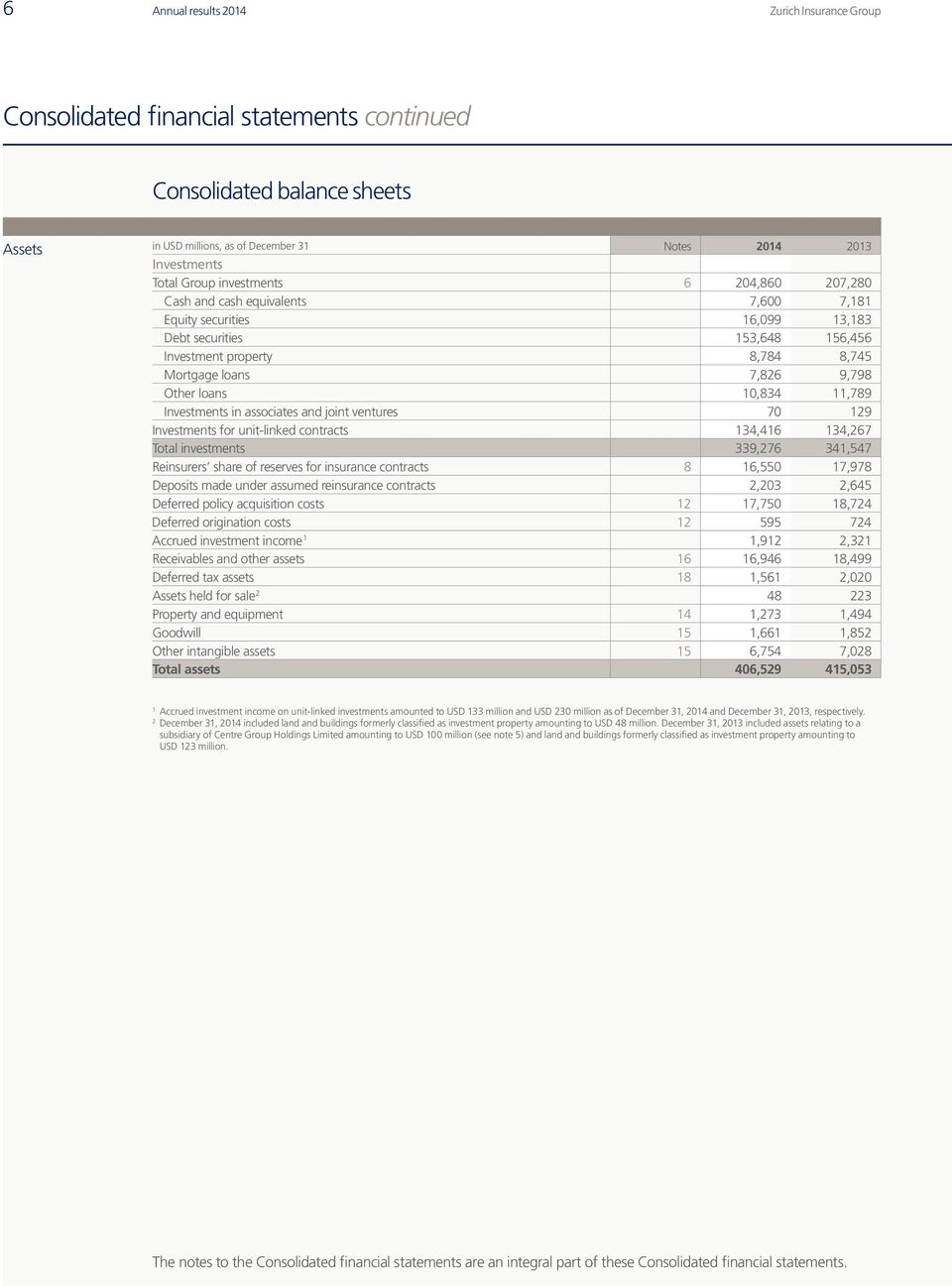
6 6 Annual results 2014 Consolidated financial statements continued Consolidated balance sheets Assets in USD millions, as of December 31 Notes Investments Total Group investments 6 204, ,280 Cash and cash equivalents 7,600 7,181 Equity securities 16,099 13,183 Debt securities 153, ,456 Investment property 8,784 8,745 Mortgage loans 7,826 9,798 Other loans 10,834 11,789 Investments in associates and joint ventures Investments for unit-linked contracts 134, ,267 Total investments 339, ,547 Reinsurers share of reserves for insurance contracts 8 16,550 17,978 Deposits made under assumed reinsurance contracts 2,203 2,645 Deferred policy acquisition costs 12 17,750 18,724 Deferred origination costs Accrued investment income 1 1,912 2,321 Receivables and other assets 16 16,946 18,499 Deferred tax assets 18 1,561 2,020 Assets held for sale Property and equipment 14 1,273 1,494 Goodwill 15 1,661 1,852 Other intangible assets 15 6,754 7,028 Total assets 406, ,053 1 Accrued investment income on unit-linked investments amounted to USD 133 million and USD 230 million as of December 31, 2014 and December 31, 2013, respectively. 2 December 31, 2014 included land and buildings formerly classified as investment property amounting to USD 48 million. December 31, 2013 included assets relating to a subsidiary of Centre Group Holdings Limited amounting to USD 100 million (see note 5) and land and buildings formerly classified as investment property amounting to USD 123 million. The notes to the Consolidated financial statements are an integral part of these Consolidated financial statements.
7 Annual results 2014 Consolidated financial statements 7 Liabilities and equity in USD millions, as of December 31 Notes Liabilities Reserve for premium refunds Liabilities for investment contracts 9 70,813 67,113 Deposits received under ceded reinsurance contracts 1,022 1,245 Deferred front-end fees 5,539 5,791 Reserves for insurance contracts 8 253, ,440 Obligations to repurchase securities 1,451 1,685 Accrued liabilities 3,065 3,023 Other liabilities 17 17,230 17,904 Deferred tax liabilities 18 5,020 5,110 Liabilities held for sale 1 49 Senior debt 19 5,379 6,044 Subordinated debt 19 5,857 6,342 Total liabilities 369, ,319 Equity Share capital Additional paid-in capital 20 4,843 6,395 Net unrealized gains/(losses) on available-for-sale investments 4,068 1,730 Cash flow hedges Cumulative foreign currency translation adjustment (6,259) (4,008) Revaluation reserve Retained earnings 31,548 28,075 Shareholders equity 34,735 32,503 Non-controlling interests 2,095 2,231 Total equity 36,830 34,734 Total liabilities and equity 406, ,053 1 December 31, 2013 included liabilities relating to a subsidiary of Centre Group Holdings Limited amounting to USD 49 million (see note 5). Financial information The notes to the Consolidated financial statements are an integral part of these Consolidated financial statements.

8 8 Annual results 2014 Consolidated financial statements continued Consolidated statements of cash flows in USD millions, for the years ended December Cash flows from operating activities Net income attributable to shareholders 3,895 4,028 Adjustments for: Net (gain)/loss on divestments of businesses (Income)/expense from equity method accounted investments (12) (11) Depreciation, amortization and impairments of fixed and intangible assets 1,012 1,198 Other non-cash items Underwriting activities: 14,532 8,144 Reserves for insurance contracts, gross 4,759 (727) Reinsurers share of reserves for insurance contracts 691 1,787 Liabilities for investment contracts 9,746 7,984 Deferred policy acquisition costs (1,014) (578) Deferred origination costs Deposits made under assumed reinsurance contracts 429 (58) Deposits received under ceded reinsurance contracts (134) (327) Investments: (15,265) (11,006) Net capital (gains)/losses on total investments and impairments (12,015) (12,245) Net change in derivatives 38 (75) Net change in money market investments 1, Sales and maturities Debt securities 108, ,173 Equity securities 57,048 49,223 Other 7,869 10,684 Purchases Debt securities (104,376) (113,258) Equity securities (67,124) (50,186) Other (7,418) (5,258) Net changes in sale and repurchase agreements (139) 117 Movements in receivables and payables 913 (1,260) Net changes in other operational assets and liabilities 425 (252) Deferred income tax, net Net cash provided by/(used in) operating activities 5,860 1,992 The notes to the Consolidated financial statements are an integral part of these Consolidated financial statements.

9 Annual results 2014 Consolidated financial statements 9 in USD millions, for the years ended December Cash flows from investing activities Disposals of tangible and intangible assets Additions to tangible and intangible assets (1,381) (831) (Acquisitions)/disposals of equity method accounted investments, net 95 (24) Acquisitions of companies, net of cash acquired (100) Divestments of companies, net of cash divested 67 Dividends from equity method accounted investments 1 1 Net cash provided by/(used in) investing activities (1,233) (788) Cash flows from financing activities Dividends paid (2,958) (2,889) Issuance of share capital Net movement in treasury shares Other acquisitions and divestments related cash flows (403) Issuance of debt 1,526 1,545 Repayment of debt (1,560) (1,948) Net cash provided by/(used in) financing activities (3,241) (3,233) Foreign currency translation effects on cash and cash equivalents (773) (17) Change in cash and cash equivalents 614 (2,046) Cash and cash equivalents as of January 1 8,162 10,208 Cash and cash equivalents as of December 31 8,776 8,162 of which: Group investments 7,600 7,181 Unit-linked 1, Other supplementary cash flow disclosures Other interest income received 6,261 6,437 Dividend income received 1,968 1,724 Other interest expense paid (1,124) (1,180) Income taxes paid (1,379) (1,186) Cash and cash equivalents in USD millions, as of December Cash and cash equivalents comprise the following: Cash at bank and in hand 6,592 5,746 Cash equivalents 2,184 2,416 Total 8,776 8,162 As of December 31, 2014 and 2013, cash and cash equivalents held to meet local regulatory requirements were USD 817 million and USD 1,284 million, respectively. Financial information The notes to the Consolidated financial statements are an integral part of these Consolidated financial statements.

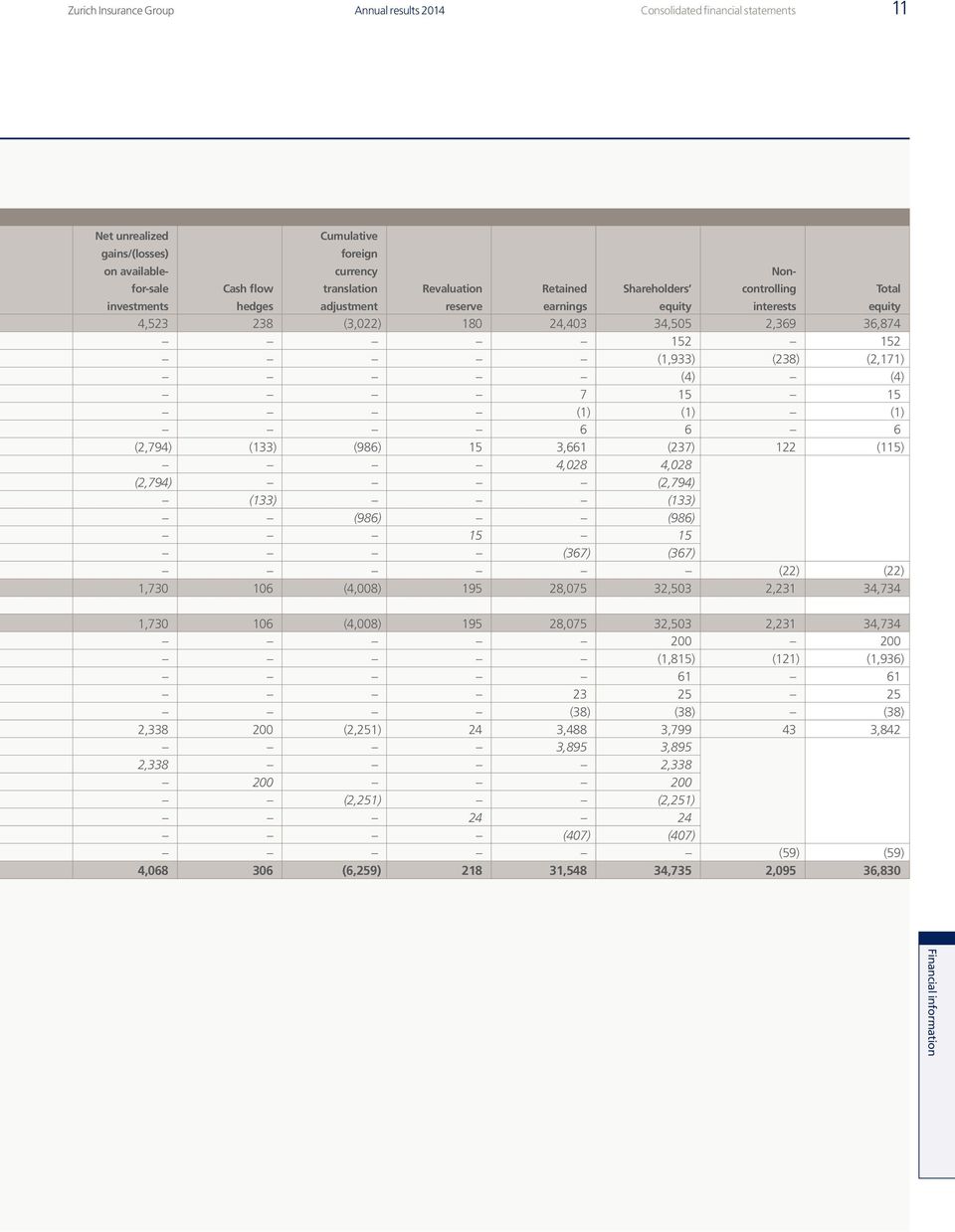
10 10 Annual results 2014 Consolidated financial statements continued Consolidated statements of changes in equity in USD millions Additional Share capital capital Balance as of December 31, ,172 Issuance of share capital Dividends to shareholders 2 (1,933) Share-based payment transactions (4) Treasury share transactions 4 8 Change in ownership interests with no loss of control Reclassification from revaluation reserves Total comprehensive income for the period, net of tax Net income Net unrealized gains/(losses) on available-for-sale investments Cash flow hedges Cumulative foreign currency translation adjustment Revaluation reserve Net actuarial gains/(losses) on pension plans Net changes in capitalization of non-controlling interests Balance as of December 31, ,395 paid-in Balance as of December 31, ,395 Issuance of share capital Dividends to shareholders 3 (1,815) Share-based payment transactions 61 Treasury share transactions 4 2 Change in ownership interests with no loss of control Total comprehensive income for the period, net of tax Net income Net unrealized gains/(losses) on available-for-sale investments Cash flow hedges Cumulative foreign currency translation adjustment Revaluation reserve Net actuarial gains/(losses) on pension plans Net changes in capitalization of non-controlling interests Balance as of December 31, ,843 1 The number of common shares issued as of December 31, 2014 was 149,636,836 (December 31, 2013: 148,903,222, December 31, 2012: 148,300,123). 2 As approved by the Annual General Meeting on April 4, 2013, the dividend of CHF 17 per share was paid out of the capital contribution reserve. The difference of USD 718 million between the dividend at transaction day exchange rates amounting to USD 2,651 million and the dividend at historical exchange rates amounting to USD 1,933 million is reflected in the cumulative foreign currency translation adjustment. 3 As approved by the Annual General Meeting on April 2, 2014, the dividend of CHF 17 per share was paid out of the capital contribution reserve. The difference of USD 1,022 million between the dividend at transaction day exchange rates amounting to USD 2,837 million and the dividend at historical exchange rates amounting to USD 1,815 million is reflected in the cumulative foreign currency translation adjustment. 4 The number of treasury shares deducted from equity as of December 31, 2014 amounted to 1,292,220 (December 31, 2013: 1,320,652, December 31, 2012: 1,348,395). The notes to the Consolidated financial statements are an integral part of these Consolidated financial statements.

11 Annual results 2014 Consolidated financial statements 11 Net unrealized gains/(losses) on available- for-sale Cash flow Cumulative foreign currency translation Revaluation Retained Shareholders investments hedges adjustment reserve earnings equity interests equity 4, (3,022) ,403 34,505 2,369 36, (1,933) (238) (2,171) (4) (4) (1) (1) (1) (2,794) (133) (986) 15 3,661 (237) 122 (115) 4,028 4,028 (2,794) (2,794) (133) (133) (986) (986) (367) (367) (22) (22) 1, (4,008) ,075 32,503 2,231 34,734 Non- controlling Total 1, (4,008) ,075 32,503 2,231 34, (1,815) (121) (1,936) (38) (38) (38) 2, (2,251) 24 3,488 3, ,842 3,895 3,895 2,338 2, (2,251) (2,251) (407) (407) (59) (59) 4, (6,259) ,548 34,735 2,095 36,830 Financial information
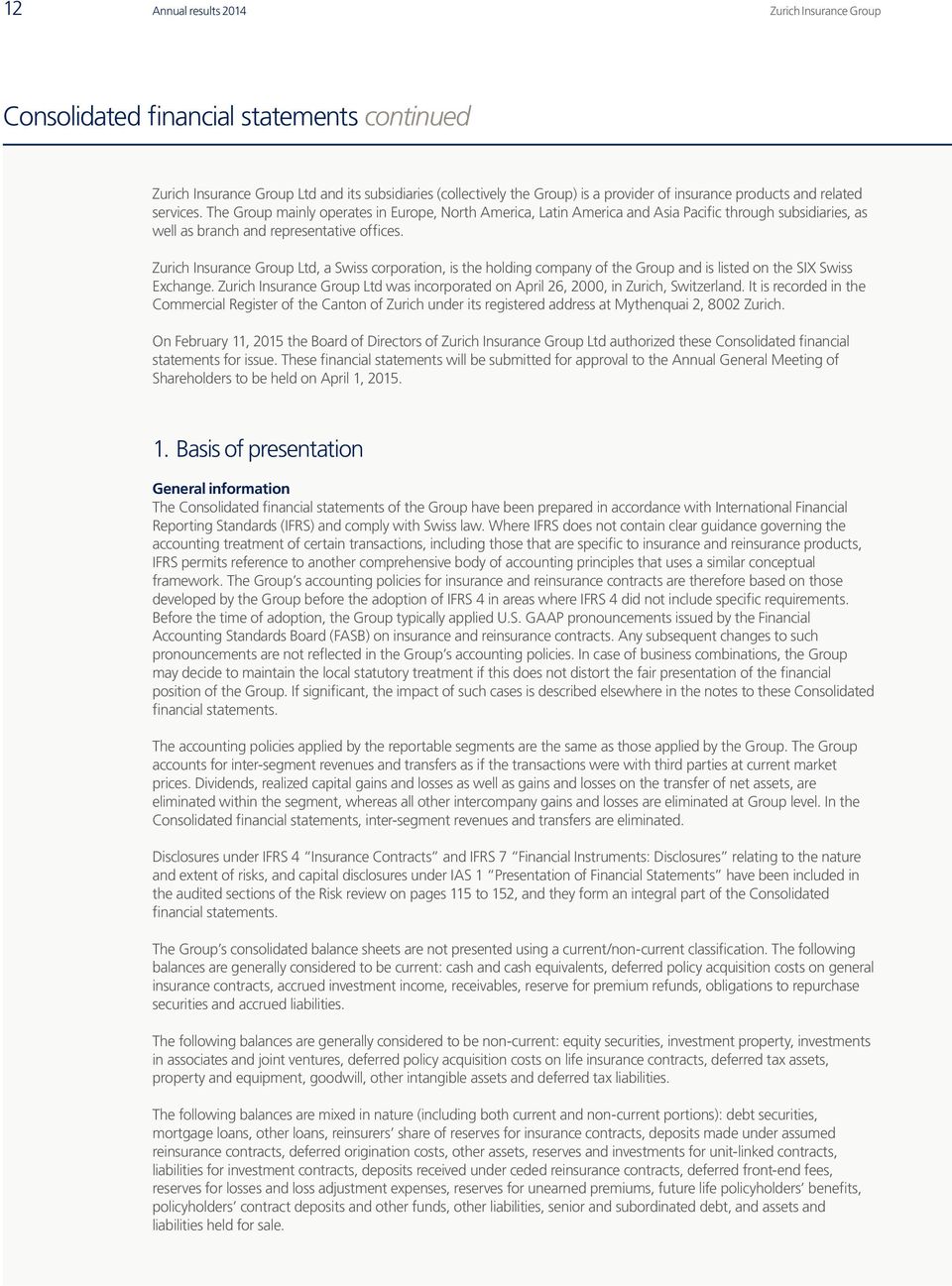
12 12 Annual results 2014 Consolidated financial statements continued Ltd and its subsidiaries (collectively the Group) is a provider of insurance products and related services. The Group mainly operates in Europe, North America, Latin America and Asia Pacific through subsidiaries, as well as branch and representative offices. Ltd, a Swiss corporation, is the holding company of the Group and is listed on the SIX Swiss Exchange. Ltd was incorporated on April 26, 2000, in Zurich, Switzerland. It is recorded in the Commercial Register of the Canton of Zurich under its registered address at Mythenquai 2, 8002 Zurich. On February 11, 2015 the Board of Directors of Ltd authorized these Consolidated financial statements for issue. These financial statements will be submitted for approval to the Annual General Meeting of Shareholders to be held on April 1, Basis of presentation General information The Consolidated financial statements of the Group have been prepared in accordance with International Financial Reporting Standards (IFRS) and comply with Swiss law. Where IFRS does not contain clear guidance governing the accounting treatment of certain transactions, including those that are specific to insurance and reinsurance products, IFRS permits reference to another comprehensive body of accounting principles that uses a similar conceptual framework. The Group s accounting policies for insurance and reinsurance contracts are therefore based on those developed by the Group before the adoption of IFRS 4 in areas where IFRS 4 did not include specific requirements. Before the time of adoption, the Group typically applied U.S. GAAP pronouncements issued by the Financial Accounting Standards Board (FASB) on insurance and reinsurance contracts. Any subsequent changes to such pronouncements are not reflected in the Group s accounting policies. In case of business combinations, the Group may decide to maintain the local statutory treatment if this does not distort the fair presentation of the financial position of the Group. If significant, the impact of such cases is described elsewhere in the notes to these Consolidated financial statements. The accounting policies applied by the reportable segments are the same as those applied by the Group. The Group accounts for inter-segment revenues and transfers as if the transactions were with third parties at current market prices. Dividends, realized capital gains and losses as well as gains and losses on the transfer of net assets, are eliminated within the segment, whereas all other intercompany gains and losses are eliminated at Group level. In the Consolidated financial statements, inter-segment revenues and transfers are eliminated. Disclosures under IFRS 4 Insurance Contracts and IFRS 7 Financial Instruments: Disclosures relating to the nature and extent of risks, and capital disclosures under IAS 1 Presentation of Financial Statements have been included in the audited sections of the Risk review on pages 115 to 152, and they form an integral part of the Consolidated financial statements. The Group s consolidated balance sheets are not presented using a current/non-current classification. The following balances are generally considered to be current: cash and cash equivalents, deferred policy acquisition costs on general insurance contracts, accrued investment income, receivables, reserve for premium refunds, obligations to repurchase securities and accrued liabilities. The following balances are generally considered to be non-current: equity securities, investment property, investments in associates and joint ventures, deferred policy acquisition costs on life insurance contracts, deferred tax assets, property and equipment, goodwill, other intangible assets and deferred tax liabilities. The following balances are mixed in nature (including both current and non-current portions): debt securities, mortgage loans, other loans, reinsurers share of reserves for insurance contracts, deposits made under assumed reinsurance contracts, deferred origination costs, other assets, reserves and investments for unit-linked contracts, liabilities for investment contracts, deposits received under ceded reinsurance contracts, deferred front-end fees, reserves for losses and loss adjustment expenses, reserves for unearned premiums, future life policyholders benefits, policyholders contract deposits and other funds, other liabilities, senior and subordinated debt, and assets and liabilities held for sale.
13 Annual results 2014 Consolidated financial statements 13 Maturity tables have been provided for the following balances: reserves for insurance contracts (tables 15.a and 15.b in the Risk review), liabilities for investment contracts (tables 16.a and 16.b in the Risk review), debt securities (table 6.4), derivative assets and derivative liabilities (tables 7.1 and 7.2), other financial liabilities (table 17.2) and outstanding debt (table 19.3). All amounts in the Consolidated financial statements, unless otherwise stated, are shown in U.S. dollars, rounded to the nearest million with the consequence that the rounded amounts may not add to the rounded total in all cases. All ratios and variances are calculated using the underlying amounts rather than the rounded amounts. Table 1.1 summarizes the principal exchange rates used for translation purposes. Net gains/(losses) on foreign currency transactions included in the consolidated income statements were USD 90 million and USD 37 million for the years ended December 31, 2014 and 2013, respectively. Foreign currency exchange forward and swap gains/(losses) included in these amounts were USD 138 million and USD (58) million for the years ended December 31, 2014 and 2013, respectively. Principal exchange rates Table 1.1 USD per foreign currency unit Consolidated Consolidated income statements balance sheets and cash flows 12/31/14 12/31/13 12/31/14 12/31/13 Euro Swiss franc British pound Brazilian real Restatements and reclassifications The Group has reviewed the classification of certain life insurance products, which resulted in the reclassification of a product for an amount of USD 50 million. The reclassification was prospectively recognized in 2014 with no impact on the Group s consolidated balance sheet or income statement. As a result of this change there was a reduction in future life policyholders benefits, and an increase in reserves for unit-linked contracts. The reduction in future life policyholders benefits is set out in note 8. The Group transferred certain liabilities between Reserves for losses and loss adjustment expenses and future life policyholders benefits for an amount of USD 47 million. The reclassification was prospectively recognized in 2014 as the reclassification has no impact on the Group s consolidated balance sheet or income statement. The reclassifications between reserves for losses and loss adjustment expenses and future life policyholders benefits are set out in note 8. The Group transferred certain unit-linked liabilities from liabilities for investment contracts to reserves for unit-linked liabilities for an amount of USD 425 million and from deferred origination costs to deferred policy acquisition costs for an amount of USD 19 million. The reclassification was prospectively recognized in 2014 as the reclassification has no impact on the Group s consolidated income statement. The reduction in liabilities for investment contracts is set out in note 9 and the transfer from deferred origination costs to deferred policy acquisition costs is set out in note 12. The Group has revised the consolidated statement of cash flows to present certain short term purchases and sales net, which were previously presented as gross purchases and gross sales. This resulted in no changes to net cash provided by operating activities. Prior periods have been revised to reflect this change. Further, the Group identified that cash disbursements for certain intangible assets amounting to USD 549 million for the year ended December 31, 2013 had been erroneously classified within operating activities. These have been reclassified to investing activities. Financial information

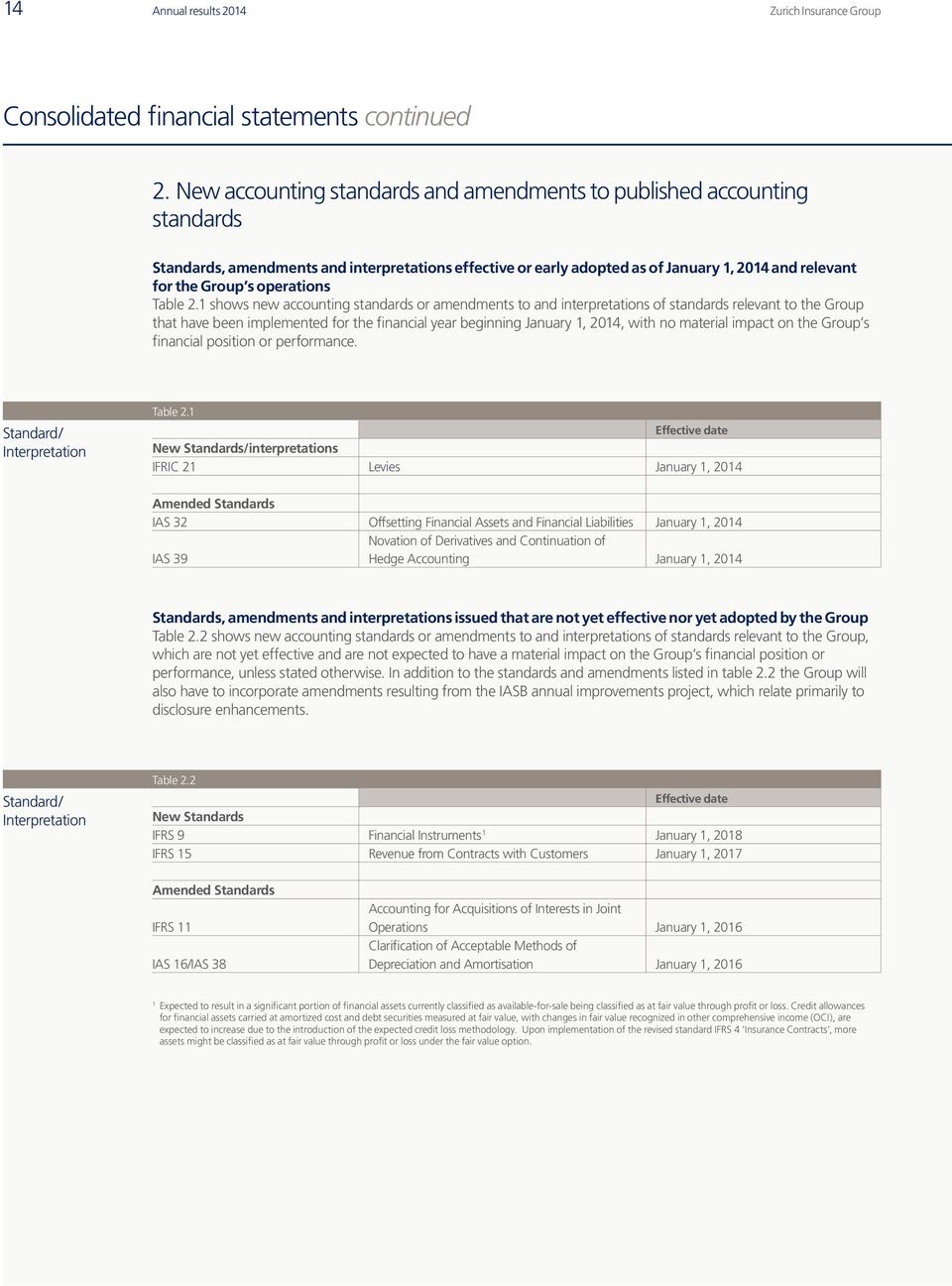
14 14 Annual results 2014 Consolidated financial statements continued 2. New accounting standards and amendments to published accounting standards Standards, amendments and interpretations effective or early adopted as of January 1, 2014 and relevant for the Group s operations Table 2.1 shows new accounting standards or amendments to and interpretations of standards relevant to the Group that have been implemented for the financial year beginning January 1, 2014, with no material impact on the Group s financial position or performance. Standard/ Interpretation Table 2.1 Effective date New Standards/interpretations IFRIC 21 Levies January 1, 2014 Amended Standards IAS 32 Offsetting Financial Assets and Financial Liabilities January 1, 2014 IAS 39 Novation of Derivatives and Continuation of Hedge Accounting January 1, 2014 Standards, amendments and interpretations issued that are not yet effective nor yet adopted by the Group Table 2.2 shows new accounting standards or amendments to and interpretations of standards relevant to the Group, which are not yet effective and are not expected to have a material impact on the Group s financial position or performance, unless stated otherwise. In addition to the standards and amendments listed in table 2.2 the Group will also have to incorporate amendments resulting from the IASB annual improvements project, which relate primarily to disclosure enhancements. Standard/ Interpretation Table 2.2 Effective date New Standards IFRS 9 Financial Instruments 1 January 1, 2018 IFRS 15 Revenue from Contracts with Customers January 1, 2017 Amended Standards IFRS 11 IAS 16/IAS 38 Accounting for Acquisitions of Interests in Joint Operations January 1, 2016 Clarification of Acceptable Methods of Depreciation and Amortisation January 1, Expected to result in a significant portion of financial assets currently classified as available-for-sale being classified as at fair value through profit or loss. Credit allowances for financial assets carried at amortized cost and debt securities measured at fair value, with changes in fair value recognized in other comprehensive income (OCI), are expected to increase due to the introduction of the expected credit loss methodology. Upon implementation of the revised standard IFRS 4 Insurance Contracts, more assets might be classified as at fair value through profit or loss under the fair value option.
15 Annual results 2014 Consolidated financial statements Summary of significant accounting policies The principal accounting policies applied in these Consolidated financial statements are set out below. These policies have been consistently applied to all years presented unless otherwise stated. a) Consolidation principles The Group s Consolidated financial statements include the assets, liabilities, equity, revenues, expenses and cash flows of Ltd and its subsidiaries. A subsidiary is an entity that Ltd either directly or indirectly controls. The results of subsidiaries acquired are included in the Consolidated financial statements from the date of acquisition. The results of subsidiaries that have been divested during the year are included up to the date control ceased. All significant intercompany balances, profits and transactions are eliminated in full. Acquisition transactions with non-controlling interests are recorded within equity if there is no change in control. The Consolidated financial statements are prepared as of December 31 based on individual company financial statements at the same date. In some cases information is included with a time lag of up to three months. The consequent effect on the Group s Consolidated financial statements is not material. b) Foreign currency translation and transactions Foreign currency translation Due to the Group s economic exposure to the U.S. dollar (USD), the presentation currency of the Group s Consolidated financial statements is USD. Many Group companies use a different functional currency, being that of the respective primary economic environment in which these companies operate. Assets and liabilities are translated into the presentation currency at end-of-period exchange rates, while income statements and statements of cash flows are translated at average exchange rates for the period. The resulting foreign currency translation differences are recorded directly in other comprehensive income (OCI) as cumulative foreign currency translation adjustment. Foreign currency transactions and balances Foreign currency transactions are translated into the functional currency using the spot exchange rate at the date of the transaction or, for practical reasons, a weighted average rate, if exchange rates do not fluctuate significantly. Foreign currency monetary items and foreign currency non-monetary items that are carried at fair value, are translated at end-of-period exchange rates. The resulting foreign currency translation differences are recorded in income, except for the following: Foreign currency translation differences that are recognized in OCI in conjunction with the recognition of unrealized gains or losses on available-for-sale investments; and Foreign currency translation differences arising on monetary items that form part of net investments in foreign operations are included directly in OCI as cumulative foreign currency translation adjustment. c) Insurance contracts and investment contracts with discretionary participating features (DPF) Classification Contracts issued under which the Group accepts significant insurance risk and obligations arising from investment contracts with DPF are accounted for as insurance contracts. The Group also issues products containing embedded options that entitle the policyholder to switch all or part of the current and future invested funds into another product issued by the Group. Where this results in the reclassification of an investment product to a product that meets the definition of an insurance contract, the previously held reserve and the related deferred origination costs are also reclassified and are accounted for in accordance with the accounting policy to be applied to the new product on a prospective basis. As a consequence, no gain or loss is recognized as a result of the reclassification of a contract from investment to insurance. Financial information Once a contract has been classified as an insurance contract, no reclassification can subsequently be made. Premiums General insurance Premiums from the sale of short-duration general insurance products are recorded when written and are normally recognized as revenue in relation to the insurance coverage provided. The unearned premium reserve represents the portion of the premiums written relating to the unexpired coverage period.
16 16 Annual results 2014 Consolidated financial statements continued Life insurance Premiums from traditional life insurance contracts, including participating contracts and annuity policies with life contingencies, are recognized as revenue when due from the policyholder. For single premium and limited pay contracts, premiums are recognized as revenue when due, with any excess profit deferred and recognized in income in a constant relationship to the insurance in-force or, for annuities, the amount of expected benefit payments. Amounts collected as premiums from investment type insurance contracts such as universal life, unit-linked and unitized with-profits contracts are reported as deposits. Revenue from these contracts consists of policy fees for the cost of insurance, administration and surrenders during the period. Front-end fees are deferred and recognized over the estimated life of the contracts. Cash flows from certain universal life-type contracts in the Group s Spanish operations are recognized as gross written premiums and insurance benefits and losses and not as deposits. Reserves for losses and loss adjustment expenses Losses and loss adjustment expenses are charged to income as incurred. Reserves for losses and loss adjustment expenses represent estimates of future payments of reported and unreported claims for losses and related expenses, with respect to insured events that have occurred. Any changes in estimates are reflected in the results of operations in the period in which estimates are changed. The Group does not discount its loss reserves, other than for settled claims with fixed payment terms. Reserves for life benefits Future life policyholders benefits represent the estimated future benefit liability for traditional life insurance policies and include the value of accumulated declared bonuses or dividends that have vested to policyholders. The reserves for life benefits for participating traditional life insurance policies are calculated using a net level premium valuation method based on actuarial assumptions taking into account guaranteed mortality benefits and interest rates. The reserves for life benefits for other traditional life insurance policies are calculated using a net level premium valuation method based on actuarial assumptions including mortality, persistency, expenses and investment return, plus a margin for adverse deviations. These assumptions are locked-in at inception and are regularly assessed as part of the liability adequacy testing over the period of the contract. Policyholders contract deposits represent the estimated policy benefits for investment type insurance contracts invested in non unit-linked funds. This liability comprises the accumulation of premiums received, less charges, plus declared policyholder dividends. Unrealized gains or losses arising on the revaluation of available-for-sale assets are recorded directly in OCI in accordance with the Group s accounting policy for such assets. Where these assets are related to life insurance, corresponding adjustments to the reserves for life benefits and related assets are also recognized directly in OCI. Reserves for unit-linked contracts are based on the fair value of the financial instruments backing those contracts less any fees and assessments charged to the policyholders. For products containing guarantees in respect of minimum death benefits (GMDB), retirement income benefits (GRIB) and/or annuitization options (GAO), additional liabilities are recorded in proportion to the receipt of the contracted revenues which are subject to a loss adequacy test taking into account policyholder behavior and current market conditions. For products managed on a dynamic basis, an option in IFRS 4 is used to measure the insurance liabilities using current financial and non-financial assumptions, to better reflect the way that these products are managed. Financial assets relating to these liabilities are designated at fair value through profit or loss. Deferred acquisition costs (DAC) Costs that vary with and are directly related to the acquisition of new and renewal business, including for example commissions and certain underwriting and policy issue expenses, are deferred and subsequently amortized over a defined period.
17 Annual results 2014 Consolidated financial statements 17 General insurance DAC for general insurance contracts is amortized over the period in which the related premiums written are earned. Life insurance DAC for traditional participating life insurance contracts is amortized based on estimated gross margins expected to be realized over the life of the contract. Estimated gross margins are updated for actual and anticipated future experience and discounted using the latest revised interest rate for the remaining benefit period. Resultant deviations are reflected in income. DAC for other traditional life insurance and annuity contracts is amortized over the life of the contracts based on expected premiums. Expected premiums are estimated at the date of policy issue for application throughout the life of the contract, unless a premium deficiency subsequently occurs. DAC for investment type insurance contracts such as universal life, unit-linked and unitized with-profits contracts is amortized based on estimated gross profits expected to be realized over the life of the contract. Estimated gross profits are updated for actual and anticipated future experience and discounted using either the interest rate in effect at the inception of the contracts or the latest revised interest rate for the remaining benefit period, depending on whether crediting is based on the policyholder s or on the reporting entity s investment performance. Resultant deviations are reflected in income. Unamortized DAC for life insurance contracts accrues interest at a rate consistent with the related assumptions for reserves. For traditional participating and investment type life insurance contracts, DAC is adjusted for the impact of unrealized gains/(losses) on allocated investments that are recorded in OCI. Liability adequacy tests Liability adequacy tests are performed annually for groupings of contracts determined in accordance with the Group s manner of acquiring, servicing and measuring the profitability of its insurance contracts. General insurance For general insurance contracts, unearned premiums are tested to determine whether they are sufficient to cover related expected losses, loss adjustment expenses, policyholder dividends, unamortized DAC and maintenance expenses, using current assumptions and considering anticipated investment returns. If a premium deficiency is identified, the DAC asset for the respective grouping of contracts is written down by the amount of the deficiency. If, after writing down the DAC asset to nil, a premium deficiency still exists for the respective grouping of contracts, then a premium deficiency reserve is established for the amount of the remaining deficiency. Life insurance For life insurance contracts, the carrying amount of the existing reserve for life benefits, including any deferred front-end fees, reduced by the unamortized balance of DAC or present value of future profits of acquired insurance contracts (PVFP), is compared with the reserve for life benefits, calculated using revised assumptions for actual and anticipated experience as of the valuation date. If a deficiency is identified, the DAC or PVFP for the respective grouping of contracts is written down by the amount of the deficiency. If, after writing down the DAC or PVFP to nil, a deficiency still exists for the respective grouping of contracts, the reserve for life benefits is increased by the amount of the remaining deficiency. Reinsurance The Group s insurance subsidiaries cede risk in the normal course of business in order to limit the potential for losses arising from certain exposures. Reinsurance does not relieve the originating insurer of its liability. Certain Group insurance companies assume reinsurance business incidental to their normal business. Financial information Reinsurance contracts that do not transfer significant insurance risk are accounted for using the deposit method.
18 18 Annual results 2014 Consolidated financial statements continued A deposit asset or liability is recognized based on the premium paid or received less any explicitly identified premiums or fees to be retained by the ceding company. Interest on deposits is accounted for using the effective interest rate method. Future cash flows are estimated to calculate the effective yield, and revenue and expense are recorded as interest income or expense. Reinsurance deposit assets or liabilities also include funds deposited or held by the Group, under assumed or ceded reinsurance contracts, respectively, when funds are retained by the reinsured under the terms of the contract. Reinsurance is recorded gross in the consolidated balance sheet. Reinsurance assets include balances expected to be recovered from reinsurance companies for ceded paid and unpaid losses and loss adjustment expenses, ceded unearned premiums and ceded future life policy benefits. Amounts recoverable from reinsurers are estimated in a manner consistent with the liability associated with the reinsured policy. Reinsurance assets are assessed for impairment on a regular basis and impairment losses, if any, are recorded in the same manner as for loans and receivables. d) Liabilities for investment contracts (without DPF) Investment contracts are those contracts that do not transfer significant insurance risk. The Group issues investment contracts without fixed terms (unit-linked) and investment contracts with fixed and guaranteed terms (fixed interest rate). Unit-linked investment contracts These represent portfolios maintained to meet the specific investment objectives of policyholders who bear the credit, market and liquidity risks related to the investments. The liabilities are carried at fair value, which is determined by reference to the underlying financial assets. Changes in fair value are recorded in income. The related assets for unit-linked investment contracts are designated at fair value through profit or loss in order to reduce measurement inconsistencies. The costs of policy administration, investment management, surrender charges and certain policyholder taxes assessed against the policyholders account balances are included in policy fee revenue. Investment contracts at amortized cost Liabilities for investment contracts with fixed and guaranteed terms are measured at amortized cost, using the effective interest rate method. Transaction costs are included in the calculation of the effective yield. As of each reporting date, the Group re-estimates the expected future cash flows and re-calculates the carrying amount of the financial liability by computing the present value of estimated future cash flows using the original effective interest rate for the financial liability. Any adjustment is immediately recognized in income. Deferred origination costs (DOC) The costs of acquiring new investment contracts with investment management services, such as commissions and other incremental expenses directly related to the issuance of each new contract, are capitalized and amortized in line with the revenue generated by providing investment management services. DOC is tested for recoverability annually. e) Investments excluding derivative financial instruments Investments include financial assets (excluding derivative financial instruments), investments in associates and joint ventures and investment property. Categories and measurement of investments (excluding derivative financial instruments) Financial assets are classified as available-for-sale, financial assets at fair value through profit or loss, held-to-maturity investments, or loans and receivables. The Group recognizes regular purchases and sales of financial assets on the trade date, which is the date on which the Group commits to purchase or sell the asset. Financial assets are recognized initially at fair value plus, in the case of a financial asset not measured at fair value through profit or loss, transaction costs that are directly attributable to the acquisition of the financial asset. Subsequently, financial assets are measured in accordance with the classification category.

19 Annual results 2014 Consolidated financial statements 19 Available-for-sale financial assets Available-for-sale financial assets are carried at fair value, with changes in fair value recognized in OCI, until the securities are either sold or impaired. The cumulative unrealized gains or losses recorded in OCI are net of cumulative deferred income taxes, certain related life policyholder liabilities and deferred acquisition costs. When available-for-sale financial assets are sold, impaired or otherwise disposed of, the cumulative gains or losses are reclassified from OCI to income as net capital gains/(losses) on investments and impairments. Financial assets at fair value through profit or loss Financial assets at fair value through profit or loss are mainly financial assets backing unit-linked insurance contracts, unit-linked investment contracts and certain life insurance contracts with participation features. The designation of these assets at fair value through profit or loss eliminates or significantly reduces a measurement inconsistency that would otherwise arise from measuring assets or recognizing the gains and losses on them on a different basis compared to the liabilities. Financial assets at fair value through profit or loss are carried at fair value. Realized and unrealized gains and losses arising from changes in the fair value are recognized in income within net capital gains/(losses) on investments and impairments, in the period in which they arise. Held-to-maturity investments Held-to-maturity investments are financial assets with fixed or determinable payments and fixed maturities other than those that meet the definition of loans and receivables, and for which the Group has the positive intention and ability to hold to maturity. Held-to-maturity investments are carried at amortized cost using the effective interest rate method, less any charges for impairment. Loans and receivables Loans and receivables are financial assets with fixed or determinable payments that are neither quoted in an active market nor classified in any of the other categories. They are carried at amortized cost using the effective interest rate method, less any charges for impairment. Other items Cash and cash equivalents comprise cash on hand, deposits held at call with banks and other short-term highly liquid investments that are readily convertible into cash and are subject to an insignificant risk of change in fair value, for example, short-term investments with maturities of three months or less from the date of acquisition. Cash and cash equivalents also include cash received as collateral for securities lending. Cash and cash equivalents are stated at face value. Investments in associates where the Group has the ability to exercise significant influence but not control, as well as joint ventures where there is joint control, are accounted for using the equity method. Significant influence is presumed to exist when the Group owns, directly or indirectly, between 20 percent and 50 percent of the voting rights. Under the equity method of accounting, these investments are initially recognized at cost, including attributable goodwill, and adjusted thereafter for post-acquisition changes in the Group s share of the net assets of the investment and impairment charges. Investment property is initially recorded at cost (including transaction costs) and subsequently measured at fair value with changes in fair value, as well as any realized gain or loss upon disposal, recognized in income. Impairment of financial assets General The Group assesses at each reporting date whether there is objective evidence that loss events have occurred that negatively affect the estimated future cash flows of a financial asset or a group of financial assets. Financial information Available-for-sale financial assets When there is objective evidence that an available-for-sale debt security is impaired, the cumulative loss that had been recognized in OCI is reclassified to income as an impairment loss. If the fair value of a debt security increases in a subsequent period, and the increase can be objectively related to an event occurring after the impairment loss was recognized, the impairment loss is reversed through income. The amount of reversal is limited so that it does not result in a carrying amount exceeding the amortized cost that would have been calculated at the date of reversal had an impairment loss not been previously recognized. Any further gains are recognized in OCI. Any subsequent losses, to the extent that they do not represent further impairment losses, are also recognized in OCI.
20 20 Annual results 2014 Consolidated financial statements continued When there is objective evidence that an available-for-sale equity security is impaired, the cumulative loss that had been recognized in OCI, including any portion attributable to foreign currency changes, is reclassified to income as an impairment loss. The impairment loss is the difference between the weighted-average acquisition cost (less any impairment loss on that security previously recognized in income) and the current fair value. Impairment losses on equity securities are not reversed through income, instead, when the fair value of a previously impaired equity security increases, the resulting unrealized gains are recognized in OCI. Any further decrease in fair value subsequent to recognition of an impairment loss is also recognized in income as an impairment loss, together with any portion attributable to foreign currency changes, until the equity security is derecognized. Held-to-maturity investments and loans and receivables Generally, significant financial assets are individually assessed to determine whether objective evidence of impairment exists. If no objective evidence of impairment exists, the asset is included in a group of financial assets with similar credit risk characteristics that are collectively assessed for impairment. Objective evidence of impairment exists if it is probable that the Group will not be able to collect principal and/or interest due according to the contractual terms of the instrument. When impairment is determined to have occurred, the carrying amount of held-to-maturity investments and loans and receivables is reduced through the use of an allowance account, and the movement in the impairment allowance is recognized in income as an impairment loss. The impairment allowance is measured as the difference between the carrying amount of the assets and the present value of estimated future cash flows, calculated using the original effective interest rate, for fixed rate financial assets, or current effective interest rate, for variable rate financial assets. If the amount of the impairment loss decreases and the decrease relates objectively to an event occurring after the impairment loss was recognized, the impairment loss is reversed through income. The amount of reversal is limited so that it does not result in a carrying amount exceeding the amortized cost that would have been calculated at the date of reversal had an impairment loss not been previously recognized. f) Derivative financial instruments and hedge accounting Derivative financial instruments, except those designated under a qualifying hedge relationship, are classified as held for trading assets or liabilities and carried at fair value on the balance sheet with changes in fair value recognized in income. Derivative financial instruments that qualify for hedge accounting Derivative financial instruments are used by the Group to economically hedge risks. In limited circumstances derivative financial instruments are designated as hedging instruments for accounting purposes in: Fair value hedges which are hedges of the exposure to changes in the fair value of a recognized asset or liability; Cash flow hedges, which are hedges of the exposure to variability in cash flows attributable to a particular risk as associated with a recognized asset or liability or a highly probable forecast transaction and could affect profit or loss; or Net investment hedges, which are hedges of a net investment in a foreign operation. All hedge relationships are formally documented, including the risk management objectives and strategy for undertaking the hedge. At inception of a hedge and on an ongoing basis, the hedge relationship is formally assessed in order to determine whether the hedging instruments are expected (prospective assessment) and have been (retrospective assessment) highly effective in offsetting changes in fair values or cash flows of hedged items attributable to the hedged risk. Where the hedge accounting criteria are fulfilled, the accounting treatment is as follows: Fair value hedges The hedged item is remeasured for fair value changes attributable to the risk being hedged and such fair value changes are recognized in the same line item of the consolidated income statement as the offsetting gains or losses from remeasuring the hedging derivatives at fair value through profit or loss. Cash flow hedges The effective portion of the gain or loss on the remeasurement of the cash flow hedging instrument is recognized in OCI. The ineffective portion is recognized immediately in income. The accumulated gains and losses on the hedged instrument in OCI are reclassified to income in the same period in which gains or losses on the hedged item are recognized in income.
21 Annual results 2014 Consolidated financial statements 21 Net investment hedges Measurement of hedge effectiveness is based on changes in forward rates. Gains and losses on the designated hedging derivative relating to the effective portion of the hedge are recognized in OCI, whereas the ineffective portion is immediately recognized in income. The Group also designates non-derivative financial instruments as hedging instruments in hedges of certain net investments in foreign operations. Foreign currency re-measurement gains and losses on the designated non-derivative financial instruments are reported in OCI together with the translation gains and losses on the hedged net investment. The accumulated gains and losses in OCI on the hedging instrument are reclassified to income on disposal or partial disposal of the foreign operation. If the qualifying criteria for the application of hedge accounting are no longer met, the hedge relationship is discontinued prospectively, in which case the hedging instrument and the hedged item are reported independently in accordance with the respective accounting policy. g) Borrowings Borrowings (debt issued) are recognized initially at fair value of the consideration received, net of transaction costs incurred. Borrowings are subsequently carried at amortized cost; any difference between the proceeds (net of transaction costs) and the redemption value is recognized in income over the period of the borrowing using the effective interest rate method. h) Derecognition of financial assets and liabilities Financial assets are derecognized when the right to receive cash flows from the assets has expired, or when the Group has transferred the financial asset and substantially all the risks and rewards of ownership. Financial liabilities are derecognized when they are extinguished, which is when the obligation is discharged, cancelled or has expired. Securities lending, repurchase and reverse repurchase transactions Certain entities within the Group participate in securities lending or repurchase arrangements whereby specific securities are transferred to other institutions, primarily banks and brokerage firms, for short periods of time. Under the terms of these agreements, the Group retains substantially all the risks and rewards of ownership of the transferred securities, and also retains contractual rights to the cash flows therefrom. These securities are therefore not derecognized from the Group s balance sheet. Cash received as collateral is recorded as an asset, and a corresponding liability is established. Interest expense is charged to income using the effective interest rate method over the life of the agreement. Under a reverse repurchase agreement, the securities received are not recognized on the balance sheet, as long as the risk and rewards of ownership have not been transferred to the Group. The cash delivered by the Group is derecognized and a corresponding receivable is recorded within receivables and other assets. Interest income is recognized in income using the effective interest rate method over the life of the agreement. i) Property and equipment Buildings held for own use and equipment are carried at cost less accumulated depreciation and any accumulated impairment loss. These assets are depreciated usually on a straight-line basis to income over the following estimated useful lives: Buildings 25 to 50 years; Furniture and fixtures five to ten years; and Computer equipment three to six years. Land held for own use is carried at cost less any accumulated impairment loss. Financial information j) Goodwill Goodwill arises on the acquisition of subsidiaries, associates and joint ventures and represents the excess of the cost of acquisition over the fair value of the Group s share of the net identifiable assets of the acquired entity at the acquisition date.
22 22 Annual results 2014 Consolidated financial statements continued Goodwill on the acquisition of subsidiaries is capitalized as a separate line and tested for impairment annually, or more frequently if impairment indicators are observed. For the purpose of impairment testing, goodwill is allocated to cash generating units (CGUs) based on the level at which management monitors operations and makes decisions relating to the continuation or disposal of assets and operations. If goodwill has been allocated to a CGU and an operation within that unit is disposed of, the carrying amount of the operation includes attributable goodwill when determining the gain or loss on disposal. k) Intangible assets Intangible assets with finite lives are carried at cost less accumulated amortization and impairments. Such assets are generally amortized using the straight-line method over their useful lives and reviewed for impairment at least annually or whenever events or changes in circumstances indicate that the carrying amount may not be recoverable. Intangible assets with indefinite lives are not subject to amortization but are tested for impairment annually and whenever events or changes in circumstances indicate that the carrying amount may not be recoverable. Present value of future profits from acquired insurance contracts (PVFP) An intangible asset representing the PVFP arises from the acquisition of life insurance businesses. Such an asset has a finite life and is amortized over the expected life of the acquired contracts, following the same rules as outlined for deferred acquisition costs. The carrying value of the PVFP asset is tested periodically for impairment as part of the liability adequacy test for insurance contracts. Attorney-in-fact relationships (AIF) The AIF reflects the ability of the Group to generate future revenues based on the Group s relationship with the Farmers Exchanges, which are managed but not owned by Farmers Group, Inc. (FGI), a wholly owned subsidiary of the Group. In determining that these relationships have an indefinite useful life, the Group considered the organizational structure of inter-insurance exchanges, under which subscribers exchange contracts with each other and appoint an attorney-in-fact to provide non-claims management services, and the historical AIF between FGI and the Farmers Exchanges. The AIF is tested for impairment at least annually. Distribution agreements Distribution agreements may have useful lives extending up to 30 years which are estimated based on the period of time over which they are expected to provide economic benefits, but no longer than the contractual term, after taking into account all economic and legal factors such as stability of the industry, competitive position and the period of control over the assets. Software Costs associated with research and maintenance of internally developed computer software are expensed as incurred. Costs incurred during the development phase are capitalized. Software under development is tested for impairment annually. Acquired computer software licenses are capitalized on the basis of the costs incurred to acquire and bring the specific software into use. The useful lives of computer software licenses and capitalized internal software development costs generally do not exceed five years. In limited circumstances, capitalized software development costs may be amortized over a period of up to ten years, taking into account the effects of obsolescence, technology, competition and other economic and legal factors. l) Provisions, contingent liabilities, commitments and financial guarantees Provisions, contingent liabilities, commitments and financial guarantees are recognized when the Group has a present obligation (legal or constructive) as a result of a past event, it is probable that an outflow of resources embodying economic benefits will be required to settle the obligation and a reliable estimate can be made of the amount of such an obligation. Provisions are discounted when the effect of the time value of money is considered material. Restructuring provisions for employee termination costs are recognized when the Group has a present obligation as a result of a detailed formal plan, which has been announced to those affected, and the amount can be reasonably estimated.
23 Annual results 2014 Consolidated financial statements 23 m) Treasury shares Ltd shares held by the Group are classified as treasury shares and are deducted from shareholders equity, net of transaction costs and tax. The nominal value of treasury shares is deducted from share capital. The difference between the nominal value and the amount paid to acquire the treasury shares, is allocated between additional paid-in capital and retained earnings. No gain or loss is recognized in income on purchase, sale, issue or cancellation of treasury shares. n) Other revenue recognition Farmers management fees FGI provides certain non-claims administrative and management services to the Farmers Exchanges, including risk selection, preparation and mailing of policy documents and invoices, premium collection, management of the investment portfolios and certain other administrative and managerial functions. Fees for these management services are primarily determined as a percentage of gross premiums earned by the Farmers Exchanges. Other fees and commission income Revenues from investment management and distribution fees are based on contractual fee arrangements applied to assets under management and recognized as earned when the service has been provided. For practical purposes, the Group recognizes these fees on a straight-line basis over the estimated life of the contract. The Group charges its customers for asset management and other related services using the following approaches: Front-end fees charged to the customer at inception are used particularly for single premium contracts. The consideration received is deferred as a liability and recognized over the life of the contract on a straight-line basis. Regular fees charged to the customer periodically (monthly, quarterly or annually) either directly or by making a deduction from invested funds are billed in advance and recognized on a straight-line basis over the period in which the service is rendered. Fees charged at the end of the period are accrued as a receivable and are offset against the financial liability when charged to the customer. o) Net investment income Net investment income includes investment income earned net of investment expenses incurred. Investment income Investment income primarily consists of interest income on debt securities, loans and receivables, dividend income on equity securities, rental income from investment property and income earned on equity method accounted investments. For Group investments, interest income is recognized using the effective interest method. Dividend income is recognized when the right to receive payment is established, which is usually the ex-dividend date. Rental income from investment property is recognized on a straight-line basis over the lease term. Investment expenses Investment expenses consist of costs relating to investment management services and operating expenses for investment property. These expenses are recognized on an accrual basis. p) Employee benefits Share-based compensation and cash incentive plans The Group operates long-term incentive plans that are accounted for as equity-settled share-based compensation plans. The fair value of these incentive plans is determined at the grant date and is recognized as an expense in income over the vesting period, with a corresponding increase recorded in additional paid-in capital. Subsequently, depending on the underlying performance metrics, the Group revises its estimates of the number of shares that are expected to be issued and recognizes the impact of the revision, if any, in income with a corresponding adjustment to additional paid-in capital. However, no subsequent adjustment to additional paid-in capital is made after the vesting date. Financial information Retirement benefits Contributions to defined contribution plans are recorded as an expense in the period in which the economic benefit from the employees service was received.
24 24 Annual results 2014 Consolidated financial statements continued Defined benefit plan obligations and contributions are determined annually by qualified actuaries using the projected unit credit method. The Group s expense relating to these plans is accrued over the employees service periods based on the actuarially determined cost for the period. Actuarial gains and losses are recognized, in full in the period in which they occur, in OCI. Past service costs, which result from plan amendments and curtailments, are recognized in income on the earlier of the date on which the plan amendment or curtailment occurs (which is the date from which the plan change is effective) and the date on which a constructive obligation arises. Settlement gains or losses are recognized in income when the settlement occurs. Other post-employment benefits Other post-employment benefits, such as medical care and life insurance, are also provided for certain employees and are primarily funded internally. Similar to retirement benefits, the cost of such benefits is accrued over the service period of the employees based on the actuarially determined cost for the period. q) Leases Payments made under operating leases (net of any incentives received from the lessor) are charged to income on a straight-line basis over the period of the lease. A termination penalty, if any, is recognized immediately as expense at the time the termination is made. r) Income taxes The Group provides current tax expense according to the tax laws of each jurisdiction in which it operates. Deferred income taxes are recorded for temporary differences, which are based on the difference between financial statement carrying amounts and income tax bases of assets and liabilities using enacted or substantively enacted tax rates applicable in the respective tax jurisdiction. Deferred tax assets on taxable losses carried forward are recognized to the extent it is probable that they can be utilized against future taxable profits in the respective jurisdictions. Taxes payable by either the holding company or its subsidiaries on expected distributions to the holding company of the profits of subsidiaries are not recognized as deferred income taxes unless a distribution of those profits is intended in the foreseeable future. Taxes paid by certain of the Group s life insurance businesses are based on the investment result less allowable expenses. To the extent these taxes exceed the amount that would have been payable in relation to the shareholders share of taxable profits, it is normal practice for certain of the Group s businesses to recover this portion from policyholders. While the relevant company has the contractual right to charge policyholders for the taxes attributable to their share of the investment result less expenses, the obligation to pay the tax authority rests with the company and therefore, the full amount of tax including the portion attributable to policyholders is accounted for as income tax. Income tax expense therefore includes an element attributable to policyholders. In addition, deferred tax on unrealized gains related to certain investment contracts with DPF is included as income tax expense recognized in OCI and an accrual for future policy fees to recover the tax charge is included in policy fee revenue.
25 Annual results 2014 Consolidated financial statements Critical accounting judgments and estimates The application of certain accounting policies necessitates critical accounting estimates that involve discretionary judgments and the use of assumptions which are susceptible to change due to inherent uncertainties. Because of the uncertainties involved, actual results could differ significantly from the assumptions and estimates made by management. Such critical accounting estimates are of significance to insurance reserves and deferred acquisition costs, the determination of fair value for financial assets and liabilities, impairment charges, deferred taxes and employee benefits. a) Reserves for insurance contracts and deferred acquisition costs General Insurance The Group is required to establish reserves for payment of losses and loss adjustment expenses that arise from the Group s general insurance products and the run-off of its former third party reinsurance operations. These reserves represent the expected ultimate cost to settle claims occurring prior to, but still outstanding as of, the balance sheet date. The Group establishes its reserves by product line, type and extent of coverage and year of occurrence. There are two categories of loss reserve: reserves for reported losses and reserves for incurred but not reported (IBNR) losses. Additionally, reserves are held for loss adjustment expenses, which contain the estimated legal and other expenses expected to be incurred to finalize the settlement of the losses. The Group s reserves for reported losses and loss adjustment expenses are based on estimates of future payments to settle reported claims. The Group bases such estimates on the facts available at the time the reserves are established. These reserves are generally established on an undiscounted basis to recognize the estimated costs of bringing pending claims to final settlement. The reserve calculation takes into account inflation, as well as other factors that can influence the amount of reserves required, some of which are subjective and some of which are dependent on future events. In determining the level of reserves, the Group considers historical trends and patterns of loss payments, pending levels of unpaid claims and types of coverage. In addition, court decisions, economic conditions and public attitudes may affect the ultimate cost of settlement and, as a result, the Group s estimation of reserves. Between the reporting and final settlement of a claim circumstances may change, which may result in changes to established reserves. Items such as changes in law and interpretations of relevant case law, results of litigation, changes in medical costs, as well as costs of vehicle and home repair materials and labor rates can substantially impact ultimate settlement costs. Accordingly, the Group reviews and re-evaluates claims and reserves on a regular basis. Amounts ultimately paid for losses and loss adjustment expenses can vary significantly from the level of reserves originally set. The Group establishes IBNR reserves, to recognize the estimated cost of losses for events which have already occurred but which have not yet been notified. These reserves are established to recognize the estimated costs required to bring such claims to final settlement. As these losses have not yet been reported, the Group relies upon historical information and statistical models, based on product line, type and extent of coverage, to estimate its IBNR liability. The Group also uses reported claim trends, claim severities, exposure growth, and other factors in estimating its IBNR reserves. These reserves are revised as additional information becomes available and as claims are actually reported. The time required to learn of and settle claims is an important consideration in establishing the Group s reserves. Short-tail claims, such as those for automobile and property damage, are normally reported soon after the incident and are generally settled within months of the incident. Long-tail claims, such as bodily injury, pollution, asbestos and product liability, can take years to develop and additional time to settle. For these claims, information concerning the event, such as the required medical treatment for bodily injury claims and the required measures to clean up pollution, may not be readily available. Accordingly, the reserving analysis of long-tail lines of business is generally more difficult and subject to greater uncertainties than for short-tail claims. Since the Group does not establish reserves for catastrophes in advance of the occurrence of such events, these events may cause volatility in the levels of its incurred losses and reserves, subject to the effects of reinsurance recoveries. This volatility may also be contingent upon political and legal developments after the occurrence of the event. Financial information The Group uses a number of accepted actuarial methods to estimate and evaluate the amount of reserves recorded. The nature of the claim being reserved for and the geographic location of the claim influence the techniques used by the Group s actuaries. Additionally, the Group s Corporate Center actuaries perform periodic reserve reviews of the Group s businesses throughout the world. Management considers the results of these reviews and adjusts its reserves for losses and loss adjustment expenses, where necessary.
26 26 Annual results 2014 Consolidated financial statements continued Life insurance The reserves for future life policyholders benefits and policyholders contract deposits and other funds contain a number of assumptions regarding mortality or longevity, lapses, surrenders, expenses, discount rates and investment returns. These assumptions can vary by country, year of policy issuance and product type and are determined with reference to past experience adjusted for new trends, current market conditions and future expectations. As such the liabilities for future life policyholders benefits and policyholders contract deposits may not represent the ultimate amounts paid out to policyholders. For example: The estimated number of deaths determines the value of the benefit payments. The main source of uncertainty arises because of the potential for pandemics and wide-ranging lifestyle changes, such as changes in eating, smoking and exercise habits, which could result in earlier deaths for age groups in which the Group has significant exposure to mortality risk. For contracts that insure the risk of longevity, such as annuity contracts, an appropriate allowance is made for people living longer. Continuing improvements in medical care and social conditions could result in further improvements in longevity in excess of those allowed for in the estimates used to determine the liability for contracts where the Group is exposed to longevity risk. Under certain contracts, the Group has offered product guarantees (or options to take up product guarantees), including fixed minimum interest rate or mortality rate returns. In determining the value of these options and/or benefits, estimates have been made as to the percentage of contract holders that may exercise them. Changes in investment conditions could result in significantly more contract holders exercising their options and/or benefits than has been assumed. Estimates are also made as to future investment income arising from the assets backing long-term insurance contracts. These estimates are based on current market returns as well as expectations about future economic and financial developments. Assumptions are determined with reference to current and historical client data, as well as industry data. Interest rate assumptions reflect expected earnings on the assets supporting the future policyholder benefits. The information used by the Group s qualified actuaries in setting such assumptions includes, but is not limited to, pricing assumptions, available experience studies and profitability analysis. Deferred policy acquisition costs and PVFP are deferred only to the extent that they are recoverable from future policy income which also depends on the above assumptions. Recoverability is tested at contract inception and subsequently on a regular basis with reference to current expectations of future profits or margins. See note 8 for further information on reserves for insurance contracts and note 12 for deferred policy acquisition costs. Also refer to the insurance risk section of the Risk review. b) Fair value measurement In determining the fair values of financial debt instruments and equity instruments traded in exchange and OTC markets, the Group makes extensive use of independent, reliable and reputable third party pricing providers and only in rare cases places reliance on prices that are derived from internal models. In addition, the Group s policy is to ensure that independently sourced prices are developed by making maximum use of current observable market inputs derived from orderly transactions and by employing widely accepted valuation techniques and models. When third party pricing providers are unable to obtain adequate observable information for a particular financial instrument, the fair value is determined either by requesting selective non-binding broker quotes or by using internal valuation models. Valuations can be subject to significant judgment especially when the fair value is determined based on at least one significant unobservable input parameter; such items are classified within Level 3 of the fair value hierarchy. See notes 6, 7 and 24 for further information regarding the estimate of fair value. c) Impairment of assets Financial assets A financial asset is considered impaired if there is objective evidence of impairment as a result of one or more occurred loss events that have an impact on the estimated future cash flows of the financial asset.
27 Annual results 2014 Consolidated financial statements 27 The evaluation of whether an available-for-sale debt security is impaired requires analysis of the credit standing of a particular issuer and involves management judgment. When assessing impairment of available-for-sale debt securities, the Group places emphasis on issuer specific factors, such as significant financial difficulty, default or delinquency on interest or principal payments. A credit rating downgrade, worsened liquidity or decline in fair value is not by itself considered a loss event, but rather incorporated in the impairment analysis along with other available information. The Group determines that there is objective evidence of impairment of an available-for-sale equity security, if at the reporting date: Its fair value is below the weighted-average cost by an amount significantly exceeding the volatility threshold determined quarterly for the respective equity market (such as North America, UK, Switzerland, other European countries and Asia-Pacific), or Its fair value has been below the weighted-average cost for a prolonged period of 24 consecutive months or longer. Goodwill and Attorney-in-fact relationships (AIF) Goodwill is allocated to the cash generating units (CGUs) as outlined in note 3. For the General Insurance segment, CGUs are aggregated predominantly at the segment level. Within the Global Life and Farmers segments, CGUs are identified at either business unit level or individual reporting entity level. For goodwill impairment testing, the recoverable amount is the higher of its fair value less costs to sell and its value-inuse. Fair value is determined, considering quoted market prices, current share values in the market place for similar publicly traded entities, and recent sale transactions of similar businesses. Value-in-use is determined using the present value of estimated future cash flows expected to be generated from the CGU. Cash flow projections are based on financial budgets, which are approved by management, typically covering a three-year period or, if appropriate and adequately justified, a longer period, which may be necessary to more accurately represent the nature of the cash flows used to test the goodwill. Cash flows beyond this period are extrapolated using, amongst others, estimated perpetual growth rates, which reflect the expected inflation of the geographical areas in which the cash flows supporting the goodwill are generated. If cash flows are generated in different geographical areas with different expected inflation rates, weighted averages are used. The discount rates applied reflect the respective risk free interest rate adjusted for the relevant risk factors to the extent they have not already been considered in the underlying cash flows. The discount rates used in the recoverable amount calculations for developed markets are based on the capital asset pricing model and consider government bond rates which are further adjusted for equity risk premium, appropriate beta and leverage ratio. In emerging markets, discount rates are based on the U.S. dollar discount rate taking into account inflation differential expectations and country risks. All input factors to the discount rates are based on observable market data. The recoverable amount of the intangible assets with an indefinite life related to the Farmers segment (i.e., attorney-infact (AIF) relationships and goodwill) is determined on the basis of value-in-use calculations. These calculations use cash flow projections based on business plans which are approved by management and typically cover a three-year period. The basis for determining the values assigned to the key assumptions are current market trends and earnings projections. Table 4.1 sets out, as of the date of valuation, the value of goodwill and AIF for the major CGUs, applied discount rates and the perpetual nominal growth rates beyond the projection period which are dependent on country specific growth rate and inflation expectations. Financial information
28 28 Annual results 2014 Consolidated financial statements continued Discount and perpetual growth rates for goodwill and AIF for major CGUs Table 4.1 as of the date of valuation Perpetual Perpetual nominal nominal Discount Discount growth growth in USD rates in % rates in % rate in % rate in % Segment millions Farmers Farmers 1, General General Insurance Insurance Global Life Germany Global Life Sensitivity tests have been performed on goodwill and AIF, and typically comprised of an analysis for either a decrease in cash flows of up to 30 percent, a decrease in the perpetual growth rate of up to 1.0 percentage point or an increase in the discount rate of up to 3.5 percentage points in order to capture potential future variations in market conditions. Applying the value-in-use methodology, an increase of approximately 1.1 percentage points in the discount rate or a decrease of approximately 1.2 percentage points in the perpetual growth rate of the Global Life Germany CGU would result in the recoverable amount being close to the carrying value. No such reasonably possible changes of key assumptions were identified for the remaining CGUs. Distribution agreements The recoverable amount for General Insurance intangible assets relating to distribution agreements is determined on the basis of value-in-use calculations. These calculations use cash flow projections in line with the terms and conditions of the underlying distribution agreements. For Global Life intangible assets relating to distribution agreements, the recoverable amount is determined based on projected cash flows derived from the new business calculation and discount rates consistent with the data used for actuarial valuations. The discount rates used in the recoverable amount calculations for developed markets are based on a capital asset pricing model and consider government bond rates, which are further adjusted for equity risk premium, appropriate beta and leverage ratio. In emerging markets, discount rates are based on the U.S. dollar discount rate taking into account inflation differential expectations and country risks. All input factors to the discount rates are based on observable market data. Table 4.2 sets out, as of the date of valuation, the applied discount rates and the perpetual growth rates beyond the projection period which are dependent on country specific growth rate and inflation expectations used for the major distribution agreements. Discount and perpetual growth rates by major distribution agreements Table 4.2 as of the date of valuation Perpetual Perpetual Range of Range of nominal nominal discount discount growth growth in USD rates in % rates in % rate in % rate in % millions Banco Sabadell S.A. entities in Spain 1, Banco Santander S.A. entities in Latin America 1, n / a n / a For impairment testing purposes, these distribution agreements are assessed as single assets by counterparty. Sensitivity tests have been performed on distribution agreements and typically comprised of an analysis for either a decrease in cash flows, a decrease in the perpetual growth rate or an increase in the discount rate, applying reasonably possible changes. No reasonably possible changes of key assumptions were identified which would result in the recoverable amount being close to the carrying value. See notes 3, 6, 14, 15 and 16 for further information on impairment of assets.
29 Annual results 2014 Consolidated financial statements 29 d) Deferred taxes Deferred tax assets are recognized if sufficient future taxable income, including income from the reversal of existing taxable temporary differences and available tax planning strategies, is available for realization. The utilization of deferred tax assets arising from temporary differences depends on the generation of sufficient taxable profits in the period in which the underlying asset or liability is recovered or settled. The utilization of deferred tax assets arising from unused tax losses or tax credits depends on the generation of sufficient taxable profits before the unused tax losses or tax credits expire. As of each balance sheet date, management evaluates the recoverability of deferred tax assets and if it is considered probable, that all or a portion of the deferred tax asset will not be utilized, then a valuation allowance is recognized. See note 18 for further information on deferred taxes. e) Employee benefits The Group provides defined benefit plans and other post-employment plans. In assessing the Group s liability for these plans, critical judgments include estimates of mortality rates, rates of employment turnover, disability, early retirement, discount rates, future salary and pension increases and increases in long-term healthcare costs. Discount rates for significant plans are based on a yield curve approach. The Group sets the discount rate by creating a hypothetical portfolio of high quality corporate bonds for which the timing and amount of cash outflows approximate the estimated payouts of the defined benefit plan. These assumptions may differ from actual results due to changing economic conditions, higher or lower withdrawal rates or longer or shorter life spans of participants. These differences may result in variability of pension income or expense recorded in future years. See note 21 for further information on employee benefits. Financial information
30 30 Annual results 2014 Consolidated financial statements continued 5. Acquisitions and divestments Transactions in 2014 Acquisitions On October 31, 2014, the Group completed the acquisition of an effective 50.0 percent stake in Mediterráneo Seguros Diversos, S.A. (MSD), a general insurance company incorporated in Spain and thus extended the existing cooperation with Banco Sabadell S.A. (Banco Sabadell) entered into during The Group obtained control over MSD by virtue of the existing shareholders agreement between the Group and Banco Sabadell. The initial consideration on a 50.0 percent basis amounted to approximately USD 50 million, subject to a purchase price adjustment. The Group is still in the process of finalizing the purchase price adjustment. In addition to the initial consideration, an uncapped contingent liability based on the future profitability over the term of the distribution agreement was agreed, for which the fair value was estimated to amount to USD 4 million on a 50.0 percent basis. Based on the preliminary purchase accounting, the fair value of net tangible assets acquired amounted to USD 33 million, identifiable intangible assets relating to the distribution agreement amounted to USD 76 million, net of deferred tax and the non-controlling interest amounted to USD 54 million. On May 28, 2014, the Group increased its shareholding in Deutscher Herold AG to 100 percent. This increase was the result of the non-controlling shareholder exercising its put option right over percent of the shares and the Group exercising its call option right over 5.0 percent. The total consideration amounted to USD 366 million, of which USD 275 million for percent was previously recorded on the balance sheet as a put option liability. Divestments On October 30, 2014, the Group closed the sale of its General Insurance retail business in Russia to OLMA Group. The contractually agreed sales price amounted to RUB 1 billion (approximately USD 23 million), subject to a purchase price adjustment. The Group is still in the process of finalizing any purchase price adjustment. A pre-tax loss of USD 247 million has been recorded within net gain/(loss) on divestments of businesses. Transactions in 2013 Assets/liabilities held for sale As of December 31, 2013, a subsidiary of Centre Group Holdings Limited, Centre Insurance Company, which is a general insurance and reinsurance company based in the United States of America, with total assets of USD 100 million and total liabilities of USD 49 million, was classified as held for sale. As of September , Centre Insurance Company was no longer classified as held for sale as the sale was not completed.
31 Annual results 2014 Consolidated financial statements Group investments Group investments are those for which the Group bears part or all of the investment risk. They also include investments related to investment contracts with discretionary participation features. Net investment result for Group investments Table 6.1 in USD millions, for the years ended December 31 Net investment income Net capital gains/(losses) and impairments Net investment result of which impairments Cash and cash equivalents Equity securities ,499 1,142 1,743 (37) (58) Debt securities 4,696 4,790 1, ,538 4,978 1 (2) Investment property Mortgage loans (48) (121) (48) (121) Other loans (20) Investments in associates and joint ventures (2) (1) Derivative financial instruments 1 97 (806) 97 (806) Investment result, gross, for Group investments 6,462 6,496 3,002 1,157 9,465 7,653 (86) (201) Investment expenses for Group investments 2 (256) (256) (256) (256) Investment result, net, for Group investments 6,206 6,240 3,002 1,157 9,209 7,398 (86) (201) 1 Net capital losses on derivative financial instruments attributable to cash flow hedge ineffectiveness amounted to USD 29 million and USD 9 million for the years ended December 31, 2014 and 2013, respectively. 2 Rental operating expenses for investment property included in investment expenses for Group investments amounted to USD 85 million and USD 119 million for the years ended December 31, 2014 and 2013, respectively. Details of Group investments by category Table 6.2 as of December USD millions % of total USD millions % of total Cash and cash equivalents 7, , Equity securities: Fair value through profit or loss 3, , Available-for-sale 12, , Total equity securities 16, , Debt securities: Fair value through profit or loss 7, , Available-for-sale 142, , Held-to-maturity 3, , Total debt securities 153, , Investment property 8, , Mortgage loans 7, , Other loans 10, , Investments in associates and joint ventures Total Group investments 204, , Financial information Investments (including cash and cash equivalents) with a carrying value of USD 6,214 million and USD 5,853 million were held to meet local regulatory requirements as of December 31, 2014 and 2013, respectively.
32 32 Annual results 2014 Consolidated financial statements continued Details of debt securities by category Table 6.3 in USD millions, as of December 31 Held-to-maturity Available-for-sale Fair value through profit or loss Debt securities: Government and supra-national bonds 3,665 4,245 60,937 64,081 3,751 3,801 Corporate securities ,744 61,380 2,663 2,641 Mortgage and asset-backed securities 18,868 19, Redeemable preferred stock 8 9 Total debt securities 3,971 4, , ,723 7,121 7,121 Debt securities maturity schedule Table 6.4 in USD millions, as of December 31 Held-to-maturity Available-for-sale Fair value through profit or loss Debt securities: < 1 year ,636 9, ,041 1 to 5 years 1,338 1,957 40,325 47,123 1,699 1,539 5 to 10 years ,829 35,632 1,148 1,256 > 10 years 1,295 1,328 37,900 32,971 2,625 2,606 Subtotal 3,971 4, , ,470 6,414 6,442 Mortgage and asset-backed securities: < 1 year to 5 years 3,719 4, to 10 years 3,559 2, > 10 years 11,028 11, Subtotal 18,868 19, Total 3,971 4, , ,723 7,121 7,121 The analysis in table 6.4 is provided by contractual maturity. Actual maturities may differ from contractual maturities because certain borrowers have the right to call or prepay certain obligations with or without call or prepayment penalties. Table 6.5 Investment property in USD millions Total As of January 1 8,745 8,561 Additions and improvements 1, Disposals (210) (706) Market value revaluation Transfer from assets held for own use Transfer to assets held for sale (28) (87) Foreign currency translation effects (1,032) 214 As of December 31 8,784 8,745 Investment property consists of investments in commercial, residential and mixed-use properties primarily located in Switzerland, Germany and the UK.
33 Annual results 2014 Consolidated financial statements 33 Net unrealized gains/(losses) on Group investments included in equity Table 6.6 in USD millions, as of December Equity securities: available-for-sale 1,575 1,427 Debt securities: available-for-sale 12,510 4,431 Other Gross unrealized gains/(losses) on Group investments 14,456 5,988 Less amount of unrealized gains/(losses) on investments attributable to: Life policyholder dividends and other policyholder liabilities (7,628) (2,948) Life deferred acquisition costs and present value of future profits (995) (460) Deferred income taxes (1,421) (738) Non-controlling interests (38) (6) Total 1 4,374 1,835 Total 1 Net unrealized gains/(losses) on Group investments include net gains arising on cash flow hedges of USD 306 million and USD 106 million as of December 31, 2014 and 2013, respectively. Table 6.7 Securities lending, in USD millions, as of December repurchase and reverse Securities lending agreements repurchase agreements Securities lent under securities lending agreements 1 7,668 9,947 Collateral received for securities lending 8,266 10,806 of which: Cash collateral of which: Non cash collateral 2 8,036 10,474 Liabilities for cash collateral received for securities lending Repurchase agreements Securities sold under repurchase agreements 3 1,455 1,694 Obligations to repurchase securities 1,451 1,685 Reverse repurchase agreements Securities purchased under reverse repurchase agreements Receivables under reverse repurchase agreements The Group s counterparties have the right to sell or repledge, in the absence of default, assets pledged as collateral with a fair value of USD 7,668 million and USD 9,947 million as of December 31, 2014 and December 31, 2013, respectively. The majority of these assets were debt securities. 2 The Group had the right to sell or repledge, in the absence of default by its counterparties, securities received as collateral with a fair value of USD 7,344 million and USD 9,725 million as of December 31, 2014 and December 31, 2013, respectively. 3 The Group s counterparties have the right to sell or repledge, in the absence of default, assets pledged as collateral with a fair value of USD 1,307 million and USD 1,508 million as of December 31, 2014 and December 31, 2013, respectively. The majority of these assets were debt securities. 4 The Group had the right to sell or repledge, in the absence of default by its counterparties, securities received as collateral with a fair value of nil and 187 million as of December 31, 2014 and December 31, 2013, respectively. Financial information
34 34 Annual results 2014 Consolidated financial statements continued 7. Group derivative financial instruments and hedge accounting The Group uses derivative financial instruments mainly for economic hedging purposes in order to mitigate risks. Such risks result from changes in interest rates, equity prices and exchange rates. Derivative financial instruments with a positive fair value are reported in other assets (see note 16) and those with a negative fair value are reported in other liabilities (see note 17). Table 7.1 shows the fair value and notional amounts for instruments which do not qualify for hedge accounting as of December 31, 2014 and Whilst these notional amounts express the extent of the Group s involvement in derivative transactions, they are not, however, representative of amounts at risk. Table 7.1 Maturity profile of notional amounts and fair values of Group derivative financial instruments in USD millions, as of December Maturity by notional amount Notional amounts Positive fair values Negative fair values Notional amounts Positive fair values Negative fair values 1 to 5 < 1 year years > 5 years Interest rate contracts: OTC Swaps ,207 4, (55) 4, (178) Swaptions 363 1,159 1,549 3, (35) 8, (234) Exchange traded Futures (1) Total interest rate contracts 1,579 1,857 4,755 8, (91) 14, (413) Equity contracts: OTC Swaps (1) Options 1,468 1,826 1,357 4, (93) 6, (133) Exchange traded Options Futures (17) 519 (22) Total equity contracts 2,068 1,826 1,357 5, (109) 7, (156) Foreign exchange contracts: OTC Swaps and forwards 15,098 15, (98) 17, (110) Total foreign exchange contracts 15,098 15, (98) 17, (110) Other contracts: OTC Swaps (8) 64 (3) Total other contracts (8) 64 (3) Total Group derivative financial instruments 18,746 3,682 6,172 28, (307) 38, (682) Interest rate contracts Interest rate contracts are used to hedge risks from changes in interest rates and to manage asset liability mismatches. Whenever possible the Group enters into exchange traded contracts, which are standardized and regulated. Furthermore, because of the structure of the exchanges, exchange traded contracts are not considered to carry counterparty risk. Over the counter (OTC) contracts are otherwise applied and comprise swaps and swaptions. Equity contracts Equity contracts are entered into, either on a portfolio or on a macro level to protect equity investments against a decline in equity market prices or to manage the risk return profile of equity exposures. The majority of positions are for economic hedging purposes. Short positions are always covered and sometimes used to mitigate hedging costs.
35 Annual results 2014 Consolidated financial statements 35 Foreign exchange contracts Swaps and forward contracts are used to hedge the Group s foreign currency exposures and to manage balance sheet mismatches. Other contracts Other contracts predominantly include stable value products (SVPs) issued to insurance company separate accounts in connection with certain life insurance policies (Bank Owned Life Insurance (BOLI) and Company Owned Life Insurance (COLI)) with an account value of USD 9.0 billion and USD 9.4 billion and market value of the underlying investments of USD 9.2 billion and USD 9.0 billion as of December 31, 2014 and 2013, respectively. The Group closely monitors the risk of surrender of these life insurance policies and includes the likelihood of surrender as one of the input parameters to determine the fair value of the SVPs which was nil as of December 31, 2014 and In certain circumstances derivative financial instruments may meet the requirements of an effective hedge for accounting purposes. Where this is the case, hedge accounting may be applied. Financial information for these instruments is set out in table 7.2. Table 7.2 Maturity profile of notional amounts and fair values of Group derivative financial instruments in USD millions, as of December Maturity by notional amount Notional Positive Negative Notional Positive Negative 1 to 5 principal fair fair principal fair fair < 1 year years > 5 years amounts values values amounts values values Fair value hedges: Cross currency interest rate swaps Cross currency swaps (49) 69 (39) Interest rate swaps 805 1,612 2, , (6) Total fair value hedges ,675 2, (49) 2, (45) Cash flow hedges: Interest rate swaptions 850 2,103 2, , Cross currency swaps (70) 1, Interest rate swaps Total cash flow hedges ,132 3, (70) 5, Net investment hedges: Forwards (4) 275 (2) Total net investment hedges (4) 275 (2) Fair value hedges Designated fair value hedges consist of interest rate swaps and cross currency interest rate swaps used to protect the Group against changes in interest rate exposure and foreign currency exposure of debt issued by the Group. Information on debt issuances designated as hedged items in fair value hedge relationships is set out in note 19. The Group also has fair value hedge relationships consisting of cross currency swaps to protect certain non eurodenominated fixed income securities from foreign currency fluctuation. Changes in the fair value of the derivative financial instruments designated as fair value hedges and changes in the fair value of the hedged item in relation to the risk being hedged are both recognized in income. Financial information Table 7.3 sets out gains and losses arising from fair value hedges:
36 36 Annual results 2014 Consolidated financial statements continued Gains/(losses) arising from fair value hedges Table 7.3 in USD millions, for the years ended December Gains/(losses) on hedging instruments 1 48 (57) on hedged items attributable to the hedged risk (35) 52 1 Excluding current interest income, which is recognized as an offset on the same line as the interest expense of the hedged debt. Cash flow hedges Designated cash flow hedges, such as interest rate swaptions are used to protect the Group against variability of future cash flows due to changes in interest rates associated with expected future purchases of debt securities (during the years 2016, 2021 and 2026) required for certain life insurance policies. The effective portion of the gains and losses on these swaptions are initially recognized in other comprehensive income. Subsequently the gains or losses will be recycled to income within net investment income on Group investments until December 31, The gains and losses relating to the ineffective portion of these hedges are recognized immediately in income within net capital gains/losses on investments and impairments. The Group also uses interest rate swaps and cross currency swaps for cash flow hedging to protect against the exposure to variability of cash flows attributable to interest rate and currency risk. The hedging instrument is measured at fair value, with the effective portion of changes in its fair value recognized in other comprehensive income. The effective portion, related to spot rate changes in the fair value of the hedging instrument, is reclassified to income within administrative and other operating expense as an offset to foreign currency revaluation on the underlying hedged debt. The ineffective portion of the change in fair value is recognized directly in income within administrative and other operating expense. Information on debt issuances designated as hedged items in cash flow hedge relationships is set out in note 19. The net gains/(losses) deferred in other comprehensive income on derivative financial instruments designated as cash flow hedges were USD 109 million and USD (94) million before tax for the years ended December 31, 2014 and 2013, respectively. The Group recognized gains of USD 13 million in the consolidated income statement within net investment income on Group investments for both the years ended December 31, 2014 and The Group also recognized net gains/ (losses) of USD (176) million and USD 73 million within administrative and other operating expense for the years ended December 31, 2014 and 2013, respectively, as an offset to the foreign currency revaluation on the underlying hedged items. A loss of USD 29 million and USD 9 million for the years ended December 31, 2014 and 2013, respectively, was recognized in net capital gains/(losses) and impairments due to hedge ineffectiveness. Net investment hedges The Group applies net investment hedge accounting in order to protect itself against the effects of changes in exchange rates in its net investments in foreign operations. A hedge relationship through a foreign exchange forward with a notional amount of USD 168 million and USD 275 million was in place as of December 31, 2014 and 2013, respectively. Net gains/(losses) deferred in other comprehensive income were USD (13) million and USD 4 million before tax for the years ended December 31, 2014 and 2013, respectively. In 2014, the Group also designated certain debt issuances as hedging instruments on a non-derivative net investment hedge relationship. As of December 31, 2014, the notional amount of these financial instruments was USD 1.5 billion and net gains/(losses) deferred in other comprehensive income were USD (35) million before tax. Information on debt issuances designated as hedging instruments in a net investment hedge relationship is set out in note 19. No ineffectiveness of net investment hedges was recognized in net capital gains/(losses) and impairments for the years ended December 31, 2014 and 2013.
37 Annual results 2014 Consolidated financial statements 37 Derivative financial instruments: offsetting of financial assets and liabilities Table 7.4 shows the net asset and liability position of Group derivative financial instruments subject to enforceable master netting arrangements and collateral agreements. Master netting arrangements are used by the Group to provide protection against loss in the event of bankruptcy or other circumstances that result in a counterparty being unable to meet its obligations. These arrangements commonly create a right of offset that becomes enforceable and affects the realization or settlement of individual financial assets and financial liabilities only following a specified event of default or other circumstances which would not be expected to arise in the normal course of business. Group derivative financial instruments subject to enforceable master netting arrangements and collateral agreements Table 7.4 in USD millions, as of December 31 Derivative assets Derivative liabilities Fair value 1,230 1,142 (429) (729) Related amounts not offset (186) (216) Cash collateral (received)/pledged (896) (845) Non cash collateral (received)/pledged (27) (9) 8 7 Net amount (153) (132) Financial information
38 38 Annual results 2014 Consolidated financial statements continued 8. Reserves for insurance contracts and reinsurers share of reserves for insurance contracts Reserves for insurance contracts Table 8.1 in USD millions, as of December 31 Gross Ceded Net Reserves for losses and loss adjustment expenses 64,472 68,312 (9,770) (10,993) 54,703 57,319 Reserves for unearned premiums 16,779 17,616 (2,446) (2,576) 14,333 15,040 Future life policyholders benefits 77,652 84,476 (2,441) (2,501) 75,211 81,975 Policyholders contract deposits and other funds 23,415 20,162 (1,994) (2,036) 21,421 18,126 Reserves for unit-linked contracts 71,400 74,873 71,400 74,873 Total reserves for insurance contracts 1 253, ,440 (16,650) (18,107) 237, ,333 1 Total reserves for insurance contracts ceded are gross of allowances for uncollectible amounts of USD 100 million and USD 129 million as of December 31, 2014 and December 31, 2013, respectively. Development of reserves for losses and loss adjustment expenses Table 8.2 in USD millions Gross Ceded Net As of January 1 68,312 69,986 (10,993) (12,601) 57,319 57,385 Losses and loss adjustment expenses incurred: Current year 26,033 26,936 (3,102) (3,050) 22,931 23,885 Prior years (673) (1,187) (59) (757) Total incurred 25,360 25,749 (2,488) (2,621) 22,871 23,128 Losses and loss adjustment expenses paid: Current year (9,983) (10,350) (9,235) (9,605) Prior years (15,894) (17,169) 2,593 3,370 (13,301) (13,799) Total paid (25,877) (27,519) 3,341 4,115 (22,536) (23,404) Acquisitions/(divestments) and transfers 1 73 (61) (11) (49) Foreign currency translation effects (3,395) (3,013) 258 As of December 31 64,472 68,312 (9,770) (10,993) 54,703 57,319 1 The 2014 net movement includes USD 47 million reclassified from future life policyholders benefits (see note 1), USD 49 million due to the reclassification of a subsidiary of Centre Group Holdings Limited from held for sale (see note 5), USD 6 million due to the acquisition of MSD (see note 5) and USD (40) million due to the sale of the Group s General Insurance retail business in Russia (see note 5). The 2013 net movement includes USD (49) million due to the reclassification of a subsidiary of Centre Group Holdings Limited to held for sale (see note 5). The Group establishes loss reserves, which are estimates of future payments of reported and unreported claims for losses and related expenses, with respect to insured events that have occurred. Reserving is a complex process dealing with uncertainty, requiring the use of informed estimates and judgments. Any changes in estimates or judgments are reflected in the results of operations in the period in which estimates and judgments are changed. Significant delays may occur in the notification and settlement of claims, and a substantial measure of experience and judgment is involved in assessing outstanding liabilities, the ultimate cost of which cannot be known with certainty as of the balance sheet date. The reserves for losses and loss adjustment expenses are determined on the basis of information currently available. However, it is inherent in the nature of the business written that the ultimate liabilities may vary as a result of subsequent developments. For the year ended December 31, 2014, the decrease of USD 2,616 million in net reserves for losses and loss adjustment expenses was mostly driven by the effect of foreign currency translation of USD 3,013 million. Excluding this effect, reserves for losses and loss adjustment expenses increased by USD 397 million. Underlying favorable reserve development arising from reserves established in prior years amounted to USD 59 million during the year ended December 31, 2014, and mainly relates to the following: The personal and commercial business in Europe reported favorable prior year development of USD 218 million, mostly driven by USD 96 million in motor third party liability in Switzerland and USD 75 million in property in the UK;
39 Annual results 2014 Consolidated financial statements 39 In Global Corporate, adverse prior year development of USD 56 million arising in North America, partially offset by favorable development in Europe; Adverse prior year development of USD 198 million relating to asbestos and other run-off businesses. For the year ended December 31, 2013, the decrease of USD 66 million (USD 324 million before the foreign currency translation impact) in net reserves for losses and loss adjustment expenses was mostly driven by payments on crop and storm Sandy losses in North America. Favorable reserve development arising from reserves established in prior years amounted to USD 757 million, and mainly related to the following movements by market-facing business, country and line of business: The personal and commercial business in Europe reported favorable prior year development of USD 412 million, mostly driven by USD 326 million in motor liability in Switzerland and a reduction of large property claims of USD 46 million in the UK; In Global Corporate, favorable development of USD 355 million was driven by lower estimates of large property claims in Switzerland, the UK and Global Energy and lower estimates for the Thai floods, which occurred in Financial information
40 40 Annual results 2014 Consolidated financial statements continued Development of insurance losses, net Table 8.3 in USD millions, as of December Gross reserves for losses and loss adjustment expenses 60,425 64,535 67,890 65,218 68,126 68,274 67,762 69,986 68,312 64,472 Reinsurance recoverable (14,231) (13,722) (13,179) (12,232) (12,182) (12,093) (12,421) (12,601) (10,993) (9,770) Initial net reserves for losses and loss adjustment expenses 46,194 50,814 54,712 52,986 55,944 56,180 55,341 57,385 57,319 54,703 Cumulative paid as of December 31: One year later (11,423) (11,237) (12,551) (13,047) (12,716) (13,092) (13,525) (13,799) (13,301) Two years later (18,044) (18,362) (19,660) (19,909) (19,821) (21,073) (21,245) (21,465) Three years later (23,077) (23,421) (24,428) (24,693) (25,623) (27,137) (26,871) Four years later (26,850) (26,839) (27,735) (28,808) (30,127) (31,375) Five years later (29,425) (29,224) (30,690) (32,170) (33,325) Six years later (31,189) (31,483) (33,310) (34,596) Seven years later (33,030) (33,665) (35,188) Eight years later (34,896) (35,215) Nine years later (36,162) Cumulative incurred as of December 31: One year later (218) (1,219) (1,271) (1,059) (1,378) (1,302) (571) (757) (59) Two years later (367) (2,171) (2,152) (2,350) (2,565) (1,819) (891) (652) Three years later (897) (2,686) (2,844) (3,048) (2,700) (2,028) (677) Four years later (945) (3,003) (3,533) (3,176) (2,770) (1,891) Five years later (1,044) (3,438) (3,580) (3,235) (2,587) Six years later (1,184) (3,279) (3,478) (2,958) Seven years later (841) (3,146) (3,215) Eight years later (681) (2,845) Nine years later (423) Net reserves re-estimated as of December 31: One year later 45,976 49,594 53,441 51,927 54,565 54,878 54,770 56,628 57,259 Two years later 45,827 48,642 52,559 50,637 53,379 54,361 54,450 56,734 Three years later 45,297 48,127 51,868 49,939 53,243 54,152 54,664 Four years later 45,249 47,811 51,179 49,810 53,173 54,289 Five years later 45,150 47,376 51,131 49,752 53,357 Six years later 45,010 47,535 51,234 50,028 Seven years later 45,353 47,668 51,497 Eight years later 45,513 47,969 Nine years later 45,771 Cumulative (deficiency)/ redundancy of net reserves 423 2,845 3,215 2,958 2,587 1, Cumulative (deficiency)/ redundancy as a percentage of initial net reserves 0.9% 5.6% 5.9% 5.6% 4.6% 3.4% 1.2% 1.1% 0.1% Gross reserves re-estimated as of December 31, ,440 60,939 63,356 60,877 63,763 65,082 65,984 68,041 67,639 Cumulative (deficiency)/ redundancy of gross reserves (15) 3,596 4,535 4,340 4,363 3,192 1,778 1, Cumulative (deficiency)/ redundancy as a percentage of initial gross reserves (0.0%) 5.6% 6.7% 6.7% 6.4% 4.7% 2.6% 2.8% 1.0%
41 Annual results 2014 Consolidated financial statements 41 Table 8.3 presents changes in the historical reserves for losses and loss adjustment expenses, net of reinsurance, that the Group established in 2005 and subsequent years. Reserves are presented by financial year, not by accident year. The reserves (and the development thereon) are for all accident years in that financial year. The top line of the table shows the estimated gross reserves for unpaid losses and loss adjustment expenses as of each balance sheet date, which represents the estimated amount of future payments for losses incurred in that year and in prior years. The cumulative paid portion of the table presents the cumulative amounts paid through each subsequent year in respect of the reserves established at each year end. Similarly, the cumulative incurred losses section details the sum of the cumulative paid amounts shown in the triangle above and the changes in loss reserves since the end of each financial year. The net reserves re-estimated portion of the table shows the re-estimation of the initially recorded reserve as of each succeeding year end. Reserve development is shown in each column. Changes to estimates are made as more information becomes known about the actual losses for which the initial reserves were established. The cumulative deficiency or redundancy is equal to the initial net reserves less the liability re-estimated as of December 31, It is the difference between the initial net reserve estimate and the last entry of the diagonal. Conditions and trends that have affected the development of reserves for losses and loss adjustment expenses in the past may or may not necessarily occur in the future, and accordingly, conclusions about future results cannot be derived from the information presented in table 8.3. Table 8.4 Development of reserves for losses and loss adjustment expenses for asbestos in USD millions Gross Net Gross Net Asbestos As of January 1 3,154 2,768 3,332 2,779 Losses and loss adjustment expenses incurred Losses and loss adjustment expenses paid (199) (175) (267) (104) Foreign currency translation effects (167) (146) As of December 31 2,882 2,540 3,154 2,768 The Group has considered asbestos, including latent injury, claims and claims expenses in establishing the reserves for losses and loss adjustment expenses. The Group continues to be advised of indemnity claims asserting injuries from asbestos. Coverage and claim settlement issues, such as determination that coverage exists and the definition of an occurrence, together with increased medical diagnostic capabilities and awareness have often caused actual loss development to exhibit more variation than in other lines. Such claims require specialized reserving techniques and the uncertainty of the ultimate cost of these types of claims has tended to be greater than the uncertainty relating to standard lines of business. Reserves for asbestos claims decreased by USD 272 million gross and USD 228 million net during The decrease in the gross reserve primarily relates to foreign currency translation effects of USD 167 million and USD 199 million due to payments, partially offset by adverse prior year development of USD 93 million in the UK and North America. Reserves for asbestos claims decreased by USD 178 million gross and USD 10 million net during The decrease in the gross reserve primarily related to the transfer of a general insurance portfolio to RiverStone Insurance (UK) Limited, amounting to USD 152 million. Financial information
42 42 Annual results 2014 Consolidated financial statements continued Development of future life policyholders benefits Table 8.5 in USD millions Gross Ceded Net As of January 1 84,476 83,807 (2,501) (2,507) 81,975 81,300 Premiums 1 12,179 8,972 (600) (580) 11,579 8,392 Claims (10,575) (10,334) (10,138) (9,880) Fee income and other expenses 1 (3,901) (1,898) (3,683) (1,722) Interest and bonuses credited to policyholders 3,259 2,017 (132) (8) 3,127 2,009 Changes in assumptions 14 (64) 9 14 (55) Acquisitions/(divestments) and transfers 2 (97) (97) (Decreases)/increases recorded in other comprehensive income 1,060 (122) 1,060 (122) Foreign currency translation effects (8,763) 2, (45) (8,625) 2,053 As of December 31 77,652 84,476 (2,441) (2,501) 75,211 81,975 1 In 2013, premiums were shown net of the change in reserves for unearned premiums. In 2014, premiums represent premiums received, while premiums earned on short-duration contracts are presented within fee income and other expenses. Following the same approach, 2013 net premiums would have been USD 10.4 billion and net fee income and other expenses would have been USD (3.7) billion. 2 The 2014 net movement relates to USD (50) million reclassified to reserves for unit-linked contracts and USD (47) million reclassified to reserves for losses and loss adjustment expenses (see note 1). Long-duration contract liabilities included in future life policyholders benefits result primarily from traditional participating and non-participating life insurance products. Short-duration contract liabilities are primarily accident and health insurance products. Future life policyholders benefits are generally calculated by a net premium valuation. In terms of USD, the weighted average discount rate used in the calculation of future life policyholders benefits is 3.0 percent and 3.2 percent as of December 31, 2014 and 2013, respectively. The amount of policyholder dividends to be paid is determined annually by each life insurance subsidiary. Policyholder dividends include life policyholders share of net income and unrealized appreciation of investments that are required to be allocated by the insurance contract or by local insurance regulations. Experience adjustments relating to future policyholders benefits and policyholders contract deposits vary according to the type of contract and the country. Investment, mortality and morbidity results may be passed through by experience credits or as an adjustment to the premium mechanism, subject to local regulatory provisions. The net impact of changes in assumptions on future life policyholders benefits by type of assumption is shown in table 8.6. Effect of changes in assumptions for future life policyholders benefits Table 8.6 in USD millions, for the years ended December Interest rates 111 (134) Investment return Changes in modeling 6 27 Expense (2) (5) Morbidity 1 Longevity (4) (5) Lapses 3 22 Other 1 (119) 2 Net impact of changes in assumptions 14 (55) includes USD (105) million relating to changes in assumptions for terminal bonus reserves in Germany.
43 Annual results 2014 Consolidated financial statements 43 Policyholders contract deposits and other funds gross Table 8.7 in USD millions, as of December Universal life and other contracts 12,626 12,833 Policyholder dividends 10,789 7,329 Total 23,415 20,162 Development of policyholders contract deposits and other funds Table 8.8 in USD millions Gross Ceded Net As of January 1 20,162 20,024 (2,036) (2,106) 18,126 17,917 Premiums 1,363 1,371 (55) (66) 1,308 1,305 Claims (1,403) (1,527) (1,222) (1,299) Fee income and other expenses (318) (285) (7) (12) (325) (297) Interest and bonuses credited to policyholders 1,593 1,217 (76) (80) 1,517 1,137 (Decrease)/increase recorded in other comprehensive income 3,925 (1,041) 3,925 (1,041) Foreign currency translation effects (1,907) 403 (1,907) 403 As of December 31 23,415 20,162 (1,994) (2,036) 21,421 18,126 Financial information
44 44 Annual results 2014 Consolidated financial statements continued 9. Liabilities for investment contracts Liabilities for investment contracts Table 9.1 in USD millions, as of December Unit-linked investment contracts 62,964 59,469 Investment contracts (amortized cost) 843 1,030 Investment contracts with DPF 7,006 6,614 Total 70,813 67,113 Unit-linked investment contracts issued by the Group are recorded at a value reflecting the returns on investment funds which include selected equities, debt securities and derivative financial instruments. Policyholders bear the full risk of the returns on these investments. The value of financial liabilities at amortized cost is based on a discounted cash flow valuation technique. The initial valuation of the discount rate is determined by the current market assessment of the time value of money and risk specific to the liability. Development of liabilities for investment contracts Table 9.2 in USD millions As of January 1 67,113 57,437 Premiums 11,488 8,276 Claims (6,649) (6,499) Fee income and other expenses (647) (594) Interest and bonuses credited to policyholders 5,554 6,800 Acquisitions/(divestments) and transfers 1 (425) Increase/(decrease) recorded in other comprehensive income Foreign currency translation effects (6,120) 1,598 As of December 31 70,813 67,113 1 The 2014 movement relates to USD (425) million reclassified to reserves for unit-linked contracts (see note 1). 10. Equity component relating to contracts with DPF Certain investment and insurance contracts sold by the Group contain benefit features for which the amount and timing of declaration and payment are at the discretion of the Group. Where that discretion has not been exercised, the total amount of undeclared funds surplus is included in equity. Mandated allocations related to unrealized results and earnings are included in policyholder liabilities and, upon declaration, discretionary bonuses are allocated to policyholders. The changes in table 10 represent the increase or decrease in unallocated gains and retained earnings after charging discretionary bonuses to policyholder liabilities. Development of the equity component relating to contracts with DPF Table 10 in USD millions As of January 1 2,338 2,560 Net unrealized gains/(losses) on investments 675 (196) Current period profit/(loss) 71 (96) Foreign currency translation effects (243) 70 As of December 31 2,840 2,338
45 Annual results 2014 Consolidated financial statements Gross and ceded insurance revenues and expenses Insurance benefits and losses Table 11.1 in USD millions, for the years ended December 31 Gross Ceded Net Losses and loss adjustment expenses 25,360 25,749 (2,488) (2,621) 22,871 23,128 Life insurance death and other benefits 12,093 9,507 (600) (437) 11,492 9,070 Total insurance benefits and losses 37,452 35,256 (3,088) (3,058) 34,364 32,198 Policyholder dividends and participation in profits Table 11.2 in USD millions, for the years ended December Change in policyholders contract deposits and other funds 1,624 1,185 Change in reserves for unit-linked products 5,537 6,290 Change in liabilities for investment contracts unit-linked 5,325 6,605 Change in liabilities for investment contracts other Change in unit-linked liabilities related to UK capital gains tax (157) (352) Total policyholder dividends and participation in profits 12,568 13,946 Underwriting and policy acquisition costs Table 11.3 in USD millions, for the years ended December 31 Gross Ceded Net Amortization of deferred acquisition costs 5,991 6,415 (473) (456) 5,518 5,959 Amortization of deferred origination costs Commissions and other underwriting and acquisition expenses 1 4,453 4,323 (249) (366) 4,204 3,957 Total underwriting and policy acquisition costs 10,557 10,863 (721) (822) 9,835 10,041 1 Net of additions related to deferred acquisition and origination costs. Table 11.4 in USD millions, for the years ended December 31 Gross Ceded Net Change in reserves for unearned premiums ,025 Financial information
46 46 Annual results 2014 Consolidated financial statements continued 12. Deferred policy acquisition costs and deferred origination costs Development of deferred policy acquisition costs Table 12.1 in USD millions General Insurance Global Life Other segments 1 Total As of January 1 3,794 3,543 14,606 14, ,724 18,346 Acquisition costs deferred 3,623 3,460 2,235 2, ,532 6,537 Amortization (3,192) (3,141) (1,506) (1,882) (816) (847) (5,514) (5,871) Impairments (4) (88) (4) (88) Amortization (charged)/ credited to other comprehensive income (579) 102 (579) 102 Acquisitions/(divestments) and transfers 2 (7) 19 (313) 12 (313) Foreign currency translation effects (234) (68) (1,186) 79 (1,420) 11 As of December 31 3,984 3,794 13,584 14, ,750 18,724 1 Net of eliminations from inter-segment transactions. 2 The 2014 General Insurance movement includes USD (11) million due to the sale of the Group s General Insurance retail business in Russia (see note 5) and USD 4 million due to the acquisition of MSD (see note 5). The 2014 Global Life movement relates to USD 19 million transferred from deferred origination costs (see note 1). The 2013 Global Life movement relates to a transfer to deferred front-end fees of USD (438) million and a transfer from receivables and other assets of USD 126 million (see note 1 of the Consolidated financial statements 2013). As of December 31, 2014 and 2013, deferred policy acquisition costs relating to non-controlling interests were USD 422 million and USD 614 million, respectively. In 2013, the decision to stop offering life products through tied agents in Hong Kong triggered a reassessment of the recoverability of deferred policy acquisition costs, resulting in a USD 54 million impairment. The net impact on the Group was USD 30 million, including an impairment of deferred origination costs and the acceleration of the recognition of deferred front-end fees of USD 4 million and USD 27 million, respectively. An additional impairment of USD 34 million resulted from a reassessment of deferred policy acquisition costs in the Global Life business in Germany. Development of deferred origination costs Table 12.2 in USD millions As of January Origination costs deferred Amortization (112) (121) Impairments (4) Acquisitions/(divestments) and transfers 1 (19) Foreign currency translation effects (55) 16 As of December The 2014 movement relates to USD (19) million transferred to deferred policy acquisition costs (see note 1).
47 Annual results 2014 Consolidated financial statements Expenses Table 13 shows expenses by functional area and by type of expense. Table 13 Expenses in USD millions, for the years ended December Administrative and other operating expense 8,910 8,804 Other underwriting and policy acquisition expenses 1,2 2,439 2,197 Unallocated loss adjustment expenses 3 1,690 1,725 Other investment expenses for Group investments Total 1 13,198 12,850 of which: Personnel and other related costs 1 6,132 5,900 Amortization and impairments of intangible assets 840 1,011 Depreciation and impairments of property and equipment Building and infrastructure Brand and marketing expenses Life recurring commission Asset and other non-income taxes IT expenses 1 1,487 1,367 Restructuring costs External professional services 1 1, Foreign currency translation 1 (30) 41 Other 1 1,779 1,750 Total 1 13,198 12,850 1 The presentation of 2013 has been modified, showing a change in other underwriting and policy acquisition expenses, with corresponding changes by type of expense. This has no impact on the Group s consolidated income statement. 2 Included within commissions and other underwriting and acquisition expenses (see table 11.3). 3 Included within losses and loss adjustment expenses (see table 11.1). 4 Excludes expenses arising from investment property within investment expenses for Group investments (see table 6.1). Financial information
48 48 Annual results 2014 Consolidated financial statements continued 14. Property and equipment Table 14.1 Property and equipment current period in USD millions Land Buildings Furniture held for own use held for own use and fixtures Computer equipment Other equipment Total Gross carrying value as of January 1, , ,986 Less: accumulated depreciation/impairments (7) (407) (258) (394) (426) (1,492) Net carrying value as of January 1, ,494 Additions and improvements Disposals (3) (18) (19) (28) (69) Transfers (83) (58) 3 (4) (142) Depreciation and impairments (28) (31) (33) (80) (173) Foreign currency translation effects (29) (58) (10) (4) (26) (127) Net carrying value as of December 31, ,273 Plus: accumulated depreciation/impairments ,369 Gross carrying value as of December 31, ,643 Table 14.2 Property and equipment prior period in USD millions Land Buildings Furniture held for own use held for own use and fixtures Computer equipment Other equipment Total Gross carrying value January 1, , ,050 Less: accumulated depreciation/impairments (7) (378) (348) (442) (346) (1,520) Net carrying value January 1, ,530 Additions and improvements Disposals (5) (14) (7) (2) (34) (62) Transfers (19) (63) (14) 1 14 (81) Depreciation and impairments (39) (33) (35) (79) (186) Foreign currency translation effects 5 11 (2) (3) 12 Net carrying value as of December 31, ,494 Plus: accumulated depreciation/impairments ,492 Gross carrying value as of December 31, , ,986 The fire insurance value of the Group s own-use property and equipment totaled USD 2,878 million and USD 2,918 million as of December 31, 2014 and 2013, respectively.
49 Annual results 2014 Consolidated financial statements Goodwill and other intangible assets Table 15.1 Intangible assets current period in USD millions Distribution Attorney- Goodwill PVFP agreements relationships Software Other Total Gross carrying value as of January 1, ,190 2,918 4,364 1,025 4, ,443 Less: accumulated amortization/impairments (338) (2,189) (811) (3,080) (145) (6,563) Net carrying value as of January 1, , ,553 1,025 1, ,880 Additions and transfers ,196 Divestments and transfers 1 (12) (8) (20) Amortization (67) (208) (387) (11) (672) Amortization charged to other comprehensive income (50) (50) Impairments (98) (1) (69) (167) Foreign currency translation effects (92) (56) (477) (114) (11) (750) Net carrying value as of December 31, , ,577 1,025 1, ,415 Plus: accumulated amortization/impairments 117 2, , ,344 Gross carrying value as of December 31, ,778 2,701 4,480 1,025 4, ,760 in-fact 1 Distribution agreements relate to cancelations at an agreed price. Other relates to the sale of the Group s General Insurance retail business in Russia (see note 5). As of December 31, 2014, intangible assets relating to non-controlling interests were USD 121 million for the present value of future profits (PVFP) of acquired insurance contracts, USD 1,531 million for distribution agreements and USD 16 million for software. The Group extended the long-term distribution agreements with Banco de Sabadell S.A. (Banco Sabadell) in Spain to sell life, pension and general insurance products across Banco Sabadell s extended network, resulting in an addition to distribution agreements of USD 314 million, of which 50 percent was funded by Banco Sabadell. There was a further addition to distribution agreements of USD 408 million, which mainly related to new distribution agreements entered into by General Insurance operations in Brazil, which includes USD 362 million relating to a distribution agreement with Via Varejo S.A. for the exclusive sale of extended warranty insurance. Following a review of subsidiaries in Global Life, the Group reassessed the recoverability of goodwill resulting in USD 98 million of impairments, mainly in the UK, Brazil and Malaysia. Intangible assets by segment current period Following a review, software was identified, primarily in Global Life and General Insurance, which was not utilized as originally expected, resulting in USD 69 million of impairments. Table 15.2 in USD millions, Attorneyas of December 31, 2014 Distribution in-fact Goodwill PVFP agreements relationships Software Other Total General Insurance ,182 Global Life , ,865 Farmers 819 1, ,173 Other Operating Businesses Net carrying value as of December 31, , ,577 1,025 1, ,415 Financial information
50 50 Annual results 2014 Consolidated financial statements continued Table 15.3 Intangible assets prior period in USD millions Distribution Attorney- Goodwill PVFP agreements relationships Software Other Total Gross carrying value as of January 1, ,239 2,890 4,435 1,025 4, ,226 Less: accumulated amortization/impairments (132) (2,047) (620) (2,747) (125) (5,671) Net carrying value as of January 1, , ,815 1,025 1, ,555 Additions and transfers Divestments and transfers (2) (3) Amortization (139) (188) (399) (10) (736) Amortization charged to other comprehensive income Impairments (209) (65) (2) (275) Foreign currency translation effects (46) 2 (111) 4 (1) (152) Net carrying value as of December 31, , ,553 1,025 1, ,880 Plus: accumulated amortization/impairments 338 2, , ,563 Gross carrying value as of December 31, ,190 2,918 4,364 1,025 4, ,443 in-fact As of December 31, 2013, intangible assets relating to non-controlling interests were USD 163 million for the present value of future profits (PVFP) of acquired insurance contracts, USD 1,660 million for distribution agreements and USD 12 million for software. In 2013, following a review of the Russian retail business, the Group decided to manage the retail business in Russia on a stand-alone basis and separately from the General Insurance CGU. On this basis, the Group reassessed the recoverability of the Russian goodwill of USD 209 million and concluded that it was fully impaired. Additions of USD 36 million related to new distribution agreements entered into by Global Life in the Middle East, and by General Insurance and Global Life in Brazil. Following the revised Global Life strategy, certain IT assets will no longer be required, and therefore resulted in an impairment of USD 37 million. Additionally, a review of existing IT platforms in General Insurance in Latin America identified software, which was not utilized as originally expected, resulting in a USD 21 million impairment. Table 15.4 Intangible assets by segment prior period in USD millions, as of December 31, 2013 Distribution Attorneyin-fact Goodwill PVFP agreements relationships Software Other Total General Insurance ,956 Global Life , ,468 Farmers 819 1, ,187 Other Operating Businesses Net carrying value as of December 31, , ,553 1,025 1, ,880
51 Annual results 2014 Consolidated financial statements Receivables and other assets Receivables and other assets Table 16 in USD millions, as of December Financial assets Group derivative assets 1,230 1,142 Unit-linked derivative assets Receivables from policyholders 3,561 3,711 Receivables from insurance companies, agents and intermediaries 5,227 5,506 Receivables arising from ceded reinsurance 872 1,094 Reverse repurchase agreements Amounts due from investment brokers Other receivables 2,211 2,238 Allowance for impairments 1 (266) (297) Other assets Non-financial assets Current tax receivables 737 1,084 Accrued premiums Prepaid expenses Prepaid insurance benefits Other assets Total receivables and other assets 16,946 18,499 1 December 31, 2014 and 2013 includes USD 35 million and USD 45 million, respectively, for receivables arising from ceded reinsurance. 2 December 31, 2014 and 2013 includes investments managed on a fiduciary and ring-fenced basis on behalf of Banco Santander S.A. amounting to USD 552 million and USD 603 million, respectively, carried at fair value through profit or loss. Receivables are carried at notional amounts, and are generally settled within one year. The notional and fair value amounts do not vary significantly. Financial information
52 52 Annual results 2014 Consolidated financial statements continued 17. Other liabilities Other liabilities Table 17.1 in USD millions, as of December Other financial liabilities Group derivative liabilities Unit-linked derivative liabilities 15 4 Amounts due to policyholders Amounts due to insurance companies, agents and intermediaries 1,322 1,437 Amounts due to reinsurers 1,118 1,226 Liabilities for cash collateral received for securities lending Amounts due to investment brokers 1,547 1,068 Deposits from banking activities Collateralized bank financing for structured lease vehicles Liabilities for defined benefit plans 1 4,046 3,665 Other liabilities for employee benefit plans Other liabilities 3,970 4,043 Other non-financial liabilities Current tax payables 925 1,246 Restructuring provisions Premium prepayments and other advances 1, Other liabilities Total other liabilities 17,230 17,904 1 See note 21 Table 17.2 shows the maturity schedule of other financial liabilities as of December 31, 2014 and Maturity schedule other financial liabilities 1 Table 17.2 in USD millions, as of December Carrying Undiscounted Carrying Undiscounted value 2 cash flows 3 value 2 cash flows 3 < 1 year 8,982 9,051 8,687 8,734 1 to 2 years to 3 years to 4 years to 5 years > 5 years 687 1,230 1,703 2,434 Total 10,489 11,261 11,026 12,005 1 Excluding liabilities for defined benefit plans. 2 Allocation to the time bands is based on the expected maturity date. 3 Allocation to the time bands is based on the earliest contractual maturity.
53 Annual results 2014 Consolidated financial statements 53 Restructuring provisions Table 17.3 in USD millions As of January Provisions made during the period Increase of provisions set up in prior years Provisions used during the period (150) (154) Provisions reversed during the period (24) (55) Foreign currency translation effects (10) 5 As of December During the year ended December 31, 2014, restructuring programs with estimated costs of USD 104 million for the current year impacted mainly Other Operating Businesses, Global Life in the UK as well as General Insurance in Ireland and the UK. This included USD 63 million relating to the Group s strategic initiative for organizational alignment to reduce complexity and cost while enhancing agility. USD (6) million related to net decreases of provisions for restructuring which were initiated in prior years. During the year ended December 31, 2013, restructuring programs with estimated costs of USD 62 million were announced and primarily impacted General Insurance in Middle East and Africa, Global Life in the UK and Ireland as well as Farmers. USD (21) million related to net decreases of provisions for restructuring which were initiated in prior years. In addition, the Group recorded USD 37 million of software impairments (see note 15), and USD 30 million for impairments of deferred policy acquisition costs and deferred origination costs, net of deferred front-end fees (see note 12), resulting from restructuring decisions. Financial information
54 54 Annual results 2014 Consolidated financial statements continued 18. Income taxes Income tax expense current/deferred split Table 18.1 in USD millions, for the years ended December Current 1,473 1,474 Deferred Total income tax expense 1,670 1,701 Expected and actual income tax expense Table 18.2 in USD millions, for the years ended December 31 Rate 2014 Rate 2013 Net income before income taxes 5,844 5,960 less: income tax (expense)/benefit attributable to policyholders (106) (285) Net income before income taxes attributable to shareholders 5,738 5,674 Expected income tax expense attributable to shareholders computed at the Swiss statutory tax rate 22.0% 1, % 1,248 Increase/(reduction) in taxes resulting from: Tax rate differential in foreign jurisdictions Tax exempt and lower taxed income (109) (107) Non-deductible expenses Tax losses previously unrecognized or no longer recognized Prior year adjustments and other (63) (2) Actual income tax expense attributable to shareholders 27.3% 1, % 1,415 plus: income tax expense/(benefit) attributable to policyholders Actual income tax expense 28.6% 1, % 1,701 Table 18.2 sets out the factors that cause the actual income tax expense to differ from the expected expense computed by applying the Swiss statutory tax rate of 22.0 percent, which is the rate applicable in the jurisdiction where the ultimate parent company is resident. The Group is required to record taxes on policyholder earnings for life insurance policyholders in certain jurisdictions. Accordingly, the income tax expense or benefit attributable to these life insurance policyholder earnings is included in income tax expense. In certain jurisdictions an accrual for future policy fees that will cover the tax charge is included in insurance benefits and losses.
55 Annual results 2014 Consolidated financial statements 55 Table 18.3 Deferred tax assets/(liabilities) analysis by source in USD millions, as of December Assets Liabilities Assets Liabilities Gross deferred tax Deferred acquisition and origination costs 20 (765) 20 (773) Depreciable and amortizable assets 33 (48) 49 (65) Life policyholders benefits and deposits (13) Unrealized (gains)/losses on available-for-sale investments and cash flow hedges 176 (467) 368 (443) Accruals and deferred income 168 (1) 185 (1) Reserves for losses and loss adjustment expenses 477 (196) 614 (192) Reserves for unearned premiums (37) Pensions and other employee benefits 632 (6) 604 Other assets/liabilities 352 (37) 620 (96) Tax loss carryforwards Gross deferred tax assets/(liabilities) before valuation allowance 3,282 (1,521) 3,791 (1,621) Valuation allowance (200) (150) Gross deferred tax assets/(liabilities) after valuation allowance 3,083 (1,521) 3,641 (1,621) Deferred tax assets 1,561 2,020 Gross deferred tax Deferred acquisition and origination costs 28 (2,447) 90 (2,560) Depreciable and amortizable assets 236 (2,215) 373 (2,566) Life policyholders benefits and deposits 1 1,392 (855) 1,229 (940) Unrealized (gains)/losses on available-for-sale investments and cash flow hedges 190 (1,367) 172 (888) Accruals and deferred income 118 (203) 112 (136) Reserves for losses and loss adjustment expenses 105 (95) 159 (111) Reserves for unearned premiums 40 (104) 46 (84) Deferred front-end fees Pensions and other employee benefits 498 (94) 369 (42) Other assets/liabilities 721 (1,544) 605 (1,549) Tax loss carryforwards Gross deferred tax assets/(liabilities) before valuation allowance 3,926 (8,924) 3,784 (8,876) Valuation allowance (22) (18) Gross deferred tax assets/(liabilities) after valuation allowance 3,904 (8,924) 3,766 (8,876) Deferred tax liabilities (5,020) (5,110) Net deferred tax liabilities (3,458) (3,090) 1 Includes reserves for unit-linked contracts The Group s deferred tax assets and liabilities are recorded by its tax paying entities throughout the world, which may include several legal entities within each tax jurisdiction. Legal entities are grouped as a single taxpayer only when permitted by local legislation and when deemed appropriate. The first part of table 18.3 includes single taxpayers with a net deferred tax asset position and the second part includes single taxpayers with a net deferred tax liability position. Financial information As of December 31, 2014 and 2013, the aggregate amount of temporary differences associated with investments in subsidiaries, branches and associates and interests in joint ventures, for which deferred tax liabilities have not been recognized amount to approximately USD 24 billion and USD 20 billion, respectively. In the remote scenario in which these temporary differences were to reverse simultaneously, the resulting tax liabilities would be very limited due to participation exemption rules.
56 56 Annual results 2014 Consolidated financial statements continued Development of net deferred tax liabilities Table 18.4 in USD millions As of January 1 (3,090) (3,390) Net change recognized in the income statement (196) (227) Net change recognized in equity (586) 555 Net changes due to acquisitions/(divestments) (26) Foreign currency translation effects 440 (28) As of December 31 (3,458) (3,090) attributable to policyholders (589) (586) attributable to shareholders (2,869) (2,504) The net deferred tax liabilities relating to non-controlling interests amounted to USD 431 million and USD 531 million as of December 31, 2014 and 2013, respectively. Development of deferred income taxes included in equity Table 18.5 in USD millions As of January (113) Net unrealized gains/(losses) on available-for-sale investments (704) 596 Cash flow hedges (65) 40 Revaluation reserve (8) (4) Net actuarial gains/(losses) on pension plans 190 (76) Foreign currency translation effects As of December 31 (98) 456 Tax loss carryforwards and tax credits Table 18.6 in USD millions, as of December For which deferred tax assets have been recognized, expiring < 5 years to 20 years > 20 years or with no time limitation 1,230 1,395 Subtotal 1,566 1,810 For which deferred tax assets have not been recognized, expiring < 5 years to 20 years > 20 years or with no time limitation Subtotal 1, Total 2,689 2,604 The tax rates applicable to tax losses for which a deferred tax asset has not been recognized are 19.2 percent and 18.3 percent for the years 2014 and 2013, respectively. The recoverability of the deferred tax asset for each taxpayer is based on the taxpayer s ability to utilize the deferred tax asset. This analysis considers the projected taxable income to be generated by the taxpayer, as well as its ability to offset the deferred tax asset against deferred tax liabilities. Management assesses the recoverability of the deferred tax asset carrying values based on future years taxable income projections and considers that the carrying values of the deferred tax assets as of December 31, 2014, are recoverable.
57 Annual results 2014 Consolidated financial statements Senior and subordinated debt Senior and subordinated debt Table 19.1 in USD millions, as of December Senior debt Zurich Insurance Company Ltd Floating rate CHF 200 million notes, due June % CHF 500 million notes, due July % CHF 525 million notes, due November % CHF 400 million notes, due June ,4, % CHF 400 million notes, due September ,4, % CHF 250 million notes, due July ,4, % CHF 250 million notes, due July % EUR 500 million notes, due June ,4, % CHF 100 million notes, due September ,4, % EUR 500 million notes, due September , % CHF 150 million notes, due July ,4,5 161 Zurich Finance (USA), Inc. Euro Commercial Paper Notes, due in less than 1 year % EUR 1 billion notes, due September , % EUR 600 million notes, due October ,4, Zurich Santander Insurance America S.L. 7.5% EUR 93 million loan, due December Other Various debt instruments Senior debt 5,379 6,044 Subordinated debt 12.0% EUR 143 million perpetual capital notes, first Zurich Insurance Company Ltd callable July % CHF 700 million perpetual notes, first callable May % USD 500 million perpetual capital notes, first callable January , % CHF 500 million perpetual notes, first callable May % EUR 425 million notes, due July 2039, first callable July % CHF 200 million perpetual capital notes, first callable September ,4, % EUR 1 billion notes, due October 2043, first callable October ,6 1,196 1, % GBP 450 million perpetual notes, first callable Zurich Finance (UK) plc October , % EUR 269 million notes, due June 2025, first Zurich Finance (USA), Inc. callable June ,4, Series II 6.45% USD 700 million Trust Preferred Securities ZFS Finance (USA) Trust II (ECAPS), due December 2065, first callable June Series V 6.5% USD 1 billion Trust Preferred Securities, ZFS Finance (USA) Trust V due May 2067, first callable May Other Various debt instruments Subordinated debt 5,857 6,342 Total senior and subordinated debt 11,236 12,386 1 The bond is part of a qualifying cash flow hedge (100 percent). 2 The holders of these notes benefit from the Replacement Capital Covenant which states that if Series V Fixed/Floating Trust Preferred Securities, issued by ZFS Finance (USA) Trust V, are called before 2047, the Group will issue a replacement debt instrument with terms and provisions that will be as or more equity-like than the replaced notes. 3 These bonds are part of qualifying fair value hedges (100 percent). 4 Issued under the Group s Euro Medium Term Note Programme (EMTN Programme). 5 The Group applied the cash flow hedge methodology to hedge the foreign currency exposure and deferred the attributable basis spreads in shareholders equity, whereas the fair value hedge methodology was used to hedge the interest rate exposure with changes in the fair value being recorded through the income statement. 6 These bonds are part of a qualifying net investment hedge (100 percent). Financial information None of the debt instruments listed in table 19.1 were in default as of December 31, 2014 or 2013.
58 58 Annual results 2014 Consolidated financial statements continued To facilitate the issuance of debt, the Group has in place a Euro Medium Term Note Programme (EMTN Programme) allowing for the issuance of senior and subordinated notes up to a maximum of USD 18 billion. All issuances under this programme are either issued or guaranteed by Zurich Insurance Company Ltd. The Group has also issued debt instruments outside this programme. Operational and financial debt Table 19.2 Indebtedness in USD millions, as of December 31 Senior debt Subordinated debt Total Operational debt Financial debt 5,379 5,972 5,857 6,314 11,236 12,286 Total 5,379 6,044 5,857 6,342 11,236 12,386 1 December 31, 2013 included operational senior and subordinated debt of USD 100 million for non-recourse debt, which was transferred to a third party as the underlying mortgaged property was sold in July Maturity schedule of outstanding debt Table 19.3 in USD millions, as of December Carrying Undiscounted Carrying Undiscounted value cash flows value cash flows < 1 year 1,137 1,608 1,796 2,411 1 to 2 years ,446 2 to 3 years to 4 years to 5 years 866 1, ,024 5 to 10 years 2,595 3,966 2,729 4,529 > 10 years 5,395 7,642 5,741 8,568 Total 11,236 16,803 12,386 19,422 Debt maturities reflect original contractual dates without taking early redemption options into account. For call/ redemption dates, see table The total notional amount of debt due in each period is not materially different from the total carrying value disclosed in table Undiscounted cash flows include interest and principal cash flows on debt outstanding as of December 31, 2014 and All debt is assumed to mature within 20 years of the balance sheet date without refinancing. Floating interest rates are assumed to remain constant as of December 31, 2014 and The aggregated cash flows are translated into U.S. dollars at end-of-period rates. Credit facilities The Group has access to a multi-currency revolving credit facility of USD 3.2 billion that terminates in It is guaranteed by Zurich Insurance Company Ltd. In addition, the Group has access to three other revolving credit facilities totaling USD 425 million, which will expire in 2019 at the latest. A fourth revolving credit facility of USD 16 million expired in July No borrowings were outstanding under any of these facilities as of December 31, 2014 or 2013.
59 Annual results 2014 Consolidated financial statements Shareholders equity Table 20.1 Share capital Share capital Number Par value in CHF of shares in CHF Issued share capital As of December 31, ,830, ,300, New shares issued from contingent capital in , , As of December 31, ,890, ,903, New shares issued from contingent capital in , , As of December 31, ,963, ,636, Authorized, contingent and issued share capital As of December 31, ,129, ,295, As of December 31, ,129, ,295, a) Authorized share capital Until April 2, 2016, the Board of Ltd is authorized to increase the share capital by an amount not exceeding CHF 1,000,000 by issuing up to 10,000,000 fully paid registered shares with a nominal value of CHF 0.10 each. An increase in partial amounts is permitted. The Board would determine the date of issue of any such new shares, the issue price, type of payment, conditions for exercising pre-emptive rights, and the commencement of entitlement to dividends. The Board may issue such new shares by means of a firm underwriting by a banking institution or syndicate with a subsequent offer of those shares to current shareholders. The Board may allow the expiry of pre-emptive rights which have not been exercised, or it may place these rights as well as shares, the pre-emptive rights of which have not been exercised, at market conditions. The Board is further authorized to restrict or withdraw the pre-emptive rights of shareholders and to allocate them to third parties if the shares are to be used for the take-over of an enterprise, or parts of an enterprise or of participations or if issuing shares for the financing including re-financing of such transactions, or for the purpose of expanding the scope of shareholders in connection with the quotation of shares on foreign stock exchanges. b) Contingent share capital Capital market instruments and option rights to shareholders The share capital of Ltd may be increased by an amount not exceeding CHF 1,000,000 by the issuance of up to 10,000,000 fully paid registered shares with a nominal value of CHF 0.10 each (i) by exercising conversion and/or option rights which are granted in connection with the issuance of bonds or similar debt instruments by Ltd or one of its subsidiaries in national or international capital markets; and/or (ii) by exercising option rights which are granted to current shareholders. When issuing bonds or similar debt instruments connected with conversion and/or option rights, the pre-emptive rights of the shareholders will be excluded. The current owners of conversion and/or option rights shall be entitled to subscribe for the new shares. The conversion and/or option conditions are to be determined by the Board. The Board is authorized, when issuing bonds or similar debt instruments connected with conversion and/or option rights, to restrict or withdraw the right of shareholders for advance subscription in cases where such bonds are issued for the financing or re-financing of a takeover of an enterprise, of parts of an enterprise, or of participations. If the right for advance subscription is withdrawn by the Board, the convertible bond or warrant issues are to be offered at market conditions (including standard dilution protection provisions in accordance with market practice) and the new shares are issued at the then current convertible bond or warrant issue conditions. Financial information The conversion rights are exercisable during a maximum period of ten years and option rights for a maximum period of seven years from the time of the respective issue. The conversion or option price or its calculation methodology shall be determined in accordance with market conditions whereby, for shares of Ltd, the quoted share price is to be used as a basis.
60 60 Annual results 2014 Consolidated financial statements continued Employee participation During 2014 and 2013, 733,614 shares and 603,099 shares, respectively, were issued to employees from contingent share capital as outlined in note 20. As a result, on December 31, 2014 and 2013, respectively, the remaining contingent share capital, which can be issued to employees of Ltd and its subsidiaries, amounted to CHF 165, and CHF 239, or 1,658,423 and 2,392,037 fully paid registered shares, respectively, with a nominal value of CHF 0.10 each. Pre-emptive rights of the shareholders, as well as the right for advance subscription, are excluded. The issuance of shares or respective option rights to employees is subject to one or more regulations to be issued by the Board and takes into account performance, functions, levels of responsibility and criteria of profitability. Shares or option rights may be issued to employees at a price lower than that quoted on the stock exchange. c) Additional paid-in capital This reserve is not ordinarily available for distribution. However, as of January 1, 2011 a Swiss tax regulation based on the Swiss Corporate Tax reform II became effective, allowing for payments free of Swiss withholding tax to shareholders out of the capital contribution reserve, created out of additional paid-in capital. Therefore, amounts qualifying under this regulation can be paid out of additional paid-in capital. d) Treasury shares Table 20.2 Treasury shares number of shares, as of December Treasury shares 1,292,220 1,320,652 Treasury shares comprise shares acquired in the market, primarily held to cover employee share and share option plans. e) Earnings per share Table 20.3 Earnings per share for the years ended December 31 Net income attributable to common shareholders (in USD millions) Weighted average number of shares Per share (USD) Per share (CHF) Basic earnings per share 3, ,032, Effect of potentially dilutive shares related to share-based compensation plans 1,317,728 (0.23) (0.21) Diluted earnings per share 3, ,350, Basic earnings per share 4, ,404, Effect of potentially dilutive shares related to share-based compensation plans 568,876 (0.11) (0.10) Diluted earnings per share 4, ,973, The translation from USD to CHF is shown for information purposes only and has been calculated at the Group s average exchange rates for the years ended December 31, 2014 and Basic earnings per share is computed by dividing net income attributable to shareholders by the weighted average number of shares outstanding for the year, excluding the weighted average number of shares held as treasury shares. Diluted earnings per share reflects the effect of potentially dilutive shares.
61 Annual results 2014 Consolidated financial statements Employee benefits The Group had 54,551 and 55,102 employees (full-time equivalents) as of December 31, 2014 and 2013, respectively. Personnel and other related costs incurred for the years ended December 31, 2014 and 2013, were USD 6,241 million and USD 5,937 million, including wages and salaries of USD 5,096 million and USD 4,686 million, respectively. The Group operates a number of retirement benefit arrangements for employees, with the majority of employees belonging to defined benefit pension plans. Other employees participate in defined contribution plans, which provide benefits equal to the amounts contributed by both the employer and the employee plus investment returns. Certain of the Group s operating companies also provide post-employment benefit plans covering medical care and life insurance, mainly in the U.S. Eligibility for these plans is generally based on completion of a specified period of eligible service and reaching a specified age. The plans typically pay a stated percentage of medical expenses subject to deductibles and other factors. The cost of post-employment benefits is accrued during the employees service periods. Governance of the Group s pension and post-employment benefit plans is the responsibility of the Group Pensions Committee. This committee is responsible for developing, reviewing and advising on the Group governance framework for matters relating to pension and benefit plans, including the relevant policies and processes. The committee provides oversight and guidance over the Group s principal pension and post-retirement benefit plans for benefit design, funding, investment purposes and accounting. This includes, but is not limited to: Oversight of the impact of the Group s principal defined benefit pension and post retirement benefit plans in terms of cash, expense, and balance sheet accounting impact and capital implications Development and maintenance of policies on funding, asset allocation and assumption setting. The Group Pensions Committee provides a point of focus and co-ordination on the topic of pensions and benefits at Group level for the supervision and exercise of company powers and obligations in relation to pension and benefit plans. The Group s policy on funding and asset allocation is subject to local legal and regulatory requirements and tax efficiency. a) Defined benefit pension plans Employees of the Group s companies are covered by various pension plans, the largest of which are in Switzerland, the UK, the U.S. and Germany, which together comprise over 90 percent of the Group s total defined benefit obligation. The remaining plans in other countries are not individually significant, therefore no separate disclosure is provided. Certain Group companies provide defined benefit pension plans, some of which provide benefits on retirement, death or disability related to employees service periods and pensionable earnings. Others provide cash balance plans where the participants receive the benefit of the accumulated employer and employee contributions (where paid) together with additional cash credits in line with the rules of the plan. Eligibility for participation in the various plans is either immediate on commencement of employment or based on completion of a specified period of continuous service. Most of the Group s defined benefit pension plans are funded through contributions by the Group and, in some cases also by employees, to investment vehicles managed by trusts or foundations independent of the Group s finances, or by management committees with fiduciary responsibilities. Where a trust or foundation exists, it is required by law or by articles of association to act in the interests of the fund and of all relevant beneficiaries to the plan, which can also include the sponsoring company, and is responsible for the investment policy with regard to the assets of the fund. The trust/foundation board or committee is usually composed of representatives from both employers and plan members. In these cases, the annual funding requirements are determined in accordance with the Group s overall funding policy and local regulation. Independent actuarial valuations for the plans are performed as required. It is the Group s general principle to ensure that the plans are appropriately funded in accordance with local pension regulations in each country. Financial information The pension plans typically expose the company to risks such as interest rate, price inflation, longevity and salary risks. To the extent the pension plans are funded, the assets held mitigate some of the liability risk but introduce investment risk.
62 62 Annual results 2014 Consolidated financial statements continued The overall investment policy and strategy for the Group s defined benefit pension plans is to achieve an investment return which, together with contributions, targets having sufficient assets to pay pension benefits as they fall due while also mitigating the various risks of the plans. The actual asset allocation is determined by reference to current and expected economic and market conditions and in consideration of specific asset class risk in the risk profile. The Group has a governance framework to ensure the trust/foundation board or committee considers how the asset investment strategy correlates with the maturity profile of the plan liabilities and the potential impact on the funding status of the plans, including short-term liquidity requirements. The investment strategies for each pension plan are independently determined by the governance body in each country, with oversight by the Group Pensions Committee. The pension assets are invested in diversified portfolios across geographical regions and asset classes to ensure diversified returns, also taking into account local pension laws. The investment strategies aim to mitigate asset-liability mismatches in the long run. For post-employment defined benefit plans, total contributions to funded plans and benefits paid directly by the Group were USD 572 million for 2014 compared with USD 491 million for The estimated total for 2015 is USD 540 million (actual amount may differ). Swiss pension plans The Group has two major pension plans in Switzerland both of which provide benefits that exceed the minimum benefit requirements under Swiss pension law. The plans provide a lifetime pension to members at the normal retirement age of 65 (age 62 for Executive Staff). Participants can draw retirement benefits early from age 60 (age 58 for Executive Staff). Alternatively, the benefit can be taken as a lump sum payment at retirement. Contributions to the plan are paid by the employees and the employer, both for retirement savings and to finance risk benefits paid out in the event of death and disability. The accumulated balance on the pension account is based on the employee and employer pension contributions and interest accrued. The interest rate credited is defined annually by the plans Board of Trustees which is responsible for the governance of the plans. The amount of pension payable on retirement is a result of the conversion rate applied on the accumulated balance of the individual participant s pension account at the retirement date. Although the Swiss plans operate like defined contribution plans under local regulations, they are accounted for as defined benefit pension plans under IAS 19 Employee Benefits, because of the need to accrue interest on the pension accounts and the payment of a lifetime pension at a fixed conversion rate under the plan rules. Actuarial valuations are completed regularly and if the plans become underfunded under local regulations, options for dealing with this include the Group paying additional contributions into the plan and/or reducing future benefits. At present, the plans are sufficiently funded, meaning that no additional contributions into the plans are expected to be required in the next year. The investment strategy of the Swiss plans is constrained by Swiss pension law including regulations relating to diversification of plan assets. Under IAS 19, volatility arises in the Swiss pension plan net liability because the fair value of the plan assets is not directly correlated to movements in the value of the plan s defined benefit obligation in the short-term. Effective January 1, 2014, following plan amendments, the fixed annuity conversion rates have been revised downwards to reflect the migration of the plans technical basis to a revised interest rate expectation and new mortality tables resulting in a one-off curtailment gain of USD 130 million which has been reflected as a reduction in expenses. This amendment results in a lower defined benefit obligation and therefore future service costs will be affected. This change will be phased in over a period of four years. It is also intended that the plans will be combined into a single legal entity in order to reduce complexity. UK pension plan The major UK pension plan is a final salary plan and accrued benefits increase in line with salary increases. Normal retirement age for the plan is 60. The plan is split into distinct sections and the two defined benefit sections are closed to new entrants, who instead can participate in a defined contribution section within the same trust. The notes that follow consider only the defined benefit sections. There is a UK Pension Trustee Board, which is responsible for the governance of the plan. The employer contributions are determined based on regular triennial actuarial valuations which are conducted using assumptions agreed by the Trustee Board and the sponsoring company. A valuation was carried out during 2013 and the results were finalized on August 28, The local statutory valuation revealed a funding deficit and an asset backed funding arrangement was agreed with the Trustee Board.
63 Annual results 2014 Consolidated financial statements 63 The ongoing funding of the plan is closely monitored by the Trustee Board and a dedicated funding committee is made up of representatives from the Trustee Board and the Group. The plan rules and UK pension legislation set out maximum levels of inflationary increases applied to plan benefits. The plan assets are invested in diversified classes of assets and a portion are invested in inflation-linked debt securities, to provide a partial hedge against inflation. The Trustees have also implemented an interest rate swap contract which will provide partial protection against volatility in interest rates. U.S. pension plans There are two major pension plans in the U.S., the Zurich North America (ZNA) plan and the Farmers Group, Inc. (FGI) pension plan. These are both cash balance pension plans funded entirely by the participating employers. The ZNA plan is entirely cash balance and the FGI pension plan provides benefits on a cash balance pension formula for benefits accruing after January 1, 2009, except with respect to certain grandfathered participants. A final average pay defined benefit formula applied for benefits accrued before 2009, and for the grandfathered participants. For both cash balance plans, an amount is credited to the cash balance plan each quarter, determined by an employee s age, service and their level of earnings up to and above the social security taxable wage base. The minimum annual interest earned on the account balance is 5 percent. The retirement account is available from age 65, or age 55 with five years service. The benefit can be taken as a monthly annuity or as a lump sum. Both the ZNA plan and the FGI pension plan have fiduciaries as required under local pension laws. The fiduciaries are responsible for the governance of the plans. Actuarial valuations are completed regularly and the Group has historically elected to make contributions to the plans to maintain a funding ratio of at least 90 percent as valued under local pension regulations. The annual employer contributions are equal to the present value of benefits accrued each year, plus a rolling amortization of any prior underfunding. German pension plans There are a number of legacy defined benefit plans in Germany, most of which were set up under works council agreements. In 2007, a contractual trust arrangement was set up to support all pension commitments of the employing companies in Germany. From this time, new contributions to the contractual trust arrangement relate to the pension payment refund of the employer companies. A separate arrangement was also established in 2010 to provide for retirement obligations that were in payment at that time. Consideration is given from time to time based on the fiscal efficiency of adding recent retirees to this arrangement and to adding assets to the contractual trust. There is currently no formal plan to pay any further contributions to the contractual trust arrangement or to transfer recent retirees. These defined benefit plans provide benefits on either a final salary, career average salary or a cash balance basis. These plans are now closed to new entrants, who instead participate in a new cash balance arrangement, which has the characteristics of a defined contribution arrangement with a capital guarantee on members balances, which mirrors the capital guarantee given in a conventional life insurance arrangement in Germany. Tables 21.1a and 21.1b set out the reconciliation of the defined benefit obligation and plan assets for the Group s post-employment defined benefit plans. Financial information
64 64 Annual results 2014 Consolidated financial statements continued Table 21.1a Movement in defined benefit obligation and fair value of assets current period in USD millions Defined Net defined benefit obligation Fair value of assets benefit asset/ (liability) As of January 1, 2014 (20,685) 17,020 (3,666) Net post-employment benefit (expense)/income: Current service cost (353) (353) Interest (expense)/income (777) 643 (134) Settlements 9 9 Past service (cost)/credit Net post-employment benefit (expense)/income (986) 643 (343) Remeasurement effects included in other comprehensive income: Return on plan assets excluding interest income 2,260 2,260 Experience gains/(losses) (45) (45) Actuarial gains/(losses) arising from changes in demographic assumptions (210) (210) Actuarial gains/(losses) arising from changes in financial assumptions (2,875) (2,875) Remeasurement effects included in other comprehensive income (3,130) 2,260 (870) Employer contributions Employer contributions paid to meet benefits directly Plan participants contributions (56) 56 Payments from the plan 645 (645) Foreign currency translation effects 1,669 (1,410) 260 As of December 31, 2014 (22,507) 18,461 (4,046) Table 21.1b Movement in defined benefit obligation and fair value of assets prior period in USD millions Defined Net defined benefit obligation Fair value of assets benefit asset/ (liability) As of January 1, 2013 (19,668) 16,268 (3,400) Net post-employment benefit (expense)/income: Current service cost (370) (370) Interest (expense)/income (701) 575 (126) Past service (cost)/credit Net post-employment benefit (expense)/income (1,052) 575 (477) Remeasurement effects included in other comprehensive income: Return on plan assets excluding interest income (31) (31) Experience gains/(losses) Actuarial gains/(losses) arising from changes in demographic assumptions (70) (70) Actuarial gains/(losses) arising from changes in financial assumptions (182) (182) Remeasurement effects included in other comprehensive income (151) (31) (182) Employer contributions Employer contributions paid to meet benefits directly Plan participants contributions (53) 53 Payments from the plan 648 (648) Foreign currency translation effects (450) 344 (105) As of December 31, 2013 (20,685) 17,020 (3,666) Net post-employment benefit (expense)/income is recognized in other employee benefits, which is included within administrative and other operating expense.
65 Annual results 2014 Consolidated financial statements 65 Post-employment benefits are long-term by nature. However, short-term variations between long-term actuarial assumptions and actual experience may be positive or negative, resulting in actuarial gains or losses, which are recognized in full in the period in which they occur, and are included within other comprehensive income. Table 21.2 provides a breakdown of plan assets by asset class. Fair value of assets held in funded defined benefit pension plans Table 21.2 in USD millions, as of December Quoted in Quoted in active % of active % of markets 1 Other 2 Total Total markets 1 Other 2 Total Total Cash and cash equivalents % % Equity securities 3, ,906 21% 3, ,787 22% Debt securities 12,717 12,717 69% 11,656 11,656 68% Investment property % % Mortgage loans % % Other assets Total 4,330 14,131 18, % 3,898 13,122 17, % 1 Level 1 assets (see note 24) 2 Level 2 and 3 assets (see note 24) 3 UK annuity policies As a matter of policy, pension plan investment guidelines do not permit investment in any assets in which the Group or its subsidiaries have an interest, including shares or other financial instruments issued and own use property. Exceptions to the policy require approval by the Group Pension Committee. Tables 21.3a and 21.3b provide a breakdown of the key information included in tables 21.1a and 21.1b for the main countries for the years ended December 31, 2014 and 2013 respectively. Key information by main country current period Table 21.3a in USD millions, as of December 31, 2014 United United Switzerland Kingdom States Germany Other Total Defined benefit obligation (5,033) (11,139) (3,638) (1,336) (1,362) (22,507) Fair value of plan assets 4,524 9,162 2,676 1,092 1,007 18,461 Net defined benefit asset/(liability) (509) (1,977) (962) (244) (355) (4,046) Net post-employment benefit (expense)/income 1 25 (195) (111) (37) (25) (343) 1 Following plan amendments in Switzerland a one-off curtailment gain of USD 130 million has been reflected as a reduction in expenses. Key information by main country prior period Table 21.3b in USD millions, as of December 31, 2013 United United Switzerland Kingdom States Germany Other Total Defined benefit obligation (4,935) (10,250) (3,047) (1,277) (1,177) (20,685) Fair value of plan assets 4,501 8,243 2,311 1, ,020 Net defined benefit asset/(liability) (433) (2,007) (736) (260) (229) (3,666) Net post-employment benefit (expense)/income (134) (150) (138) (25) (30) (477) Financial information
66 66 Annual results 2014 Consolidated financial statements continued Table 21.4 shows the key financial assumptions used to calculate the Group s post-employment defined benefit obligations and the Group s post-employment benefit expenses. Key financial assumptions used for major plans Table 21.4 as of December United United United United Switzerland Kingdom States Germany Switzerland Kingdom States Germany Discount rate 1 0.9% 3.7% 3.9% 2.0% 2.2% 4.5% 4.8% 3.4% Inflation rate (CPI) 1.2% 2.4% 2.0% 1.6% 1.4% 2.7% 2.7% 2.0% Salary increase rate 2.0% 3.4% 4.1% 2.9% 2.0% 3.7% 4.4% 3.3% Expected future pension increases 0.7% 3.5% n / a 1.6% 1.0% 3.7% n / a 2.0% Interest crediting rate 0.9% n / a 4.7% n / a 2.2% n / a 5.0% n / a 1 In the UK part of the liability is linked to the inflation measure of the Retail Price Index (RPI), which is assumed to be 1.0 percent higher than the Consumer Price Index (CPI) as of both December 31, 2014 and Tables 21.5a and 21.5b set out the life expectancies used in the valuation of the Group s major plans. The mortality assumptions in each country have been based on mortality tables in accordance with typical practice in that country. Mortality tables and life expectancies for major plans current period Table 21.5a in years, as of December 31, 2014 Life expectancy at age 65 Life expectancy at age 65 for a male currently for a female currently aged 65 aged 45 aged 65 aged 45 Country Mortality table for major plans Switzerland BVG 2010 Generational United Kingdom PNXA00 with CMI_2012 projection RP 2014 with MP-2014 Generational United States projection Germany Heubeck 2005G Mortality tables and life expectancies for major plans prior period Table 21.5b in years, as of December 31, 2013 Life expectancy at age 65 Life expectancy at age 65 for a male currently for a female currently aged 65 aged 45 aged 65 aged 45 Country Mortality table for major plans Switzerland BVG 2010 Generational United Kingdom PNXA00 with CMI_2012 projection RP 2000 Generational, United States partially with projection Germany Heubeck 2005G
67 Annual results 2014 Consolidated financial statements 67 Table 21.6 shows the expected benefits to be paid under the Group s major plans in the future. It should be noted that actual amounts may vary from expected amounts. Therefore future benefit payments may differ from the amounts shown. Table 21.6 Maturity profile of future benefit payments for major plans as of December Switzerland United Kingdom United States Germany Switzerland United Kingdom United States Germany Duration of the defined benefit obligation (in years) Maturity analysis of benefits expected to be paid (in USD millions): < 1 year to 5 years 643 1, , to 10 years 923 1,936 1, , Table 21.7 Sensitivity analysis of significant actuarial assumptions Defined benefit obligation 1 in USD millions, as of December Discount rate +50 bps 1,910 1,621 Discount rate 50 bps (2,161) (1,855) Salary increase rate +50 bps (172) (149) Salary decrease rate 50 bps Price inflation increase rate +50 bps (1,430) (1,001) Price inflation decrease rate 50 bps 1, Cash balance interest credit rate +50 bps (118) (112) Cash balance interest credit rate 50 bps Mortality 10% increase in life expectancy (1,617) (1,498) Mortality 10% decrease in life expectancy 1,635 1,419 1 A negative number indicates an increase and a positive number indicates a decrease in the defined benefit obligation. Table 21.7 sets out the sensitivity of the defined benefit obligation to changes in key actuarial assumptions. The effect on the defined benefit obligation shown allows for an alternative value for each assumption while the other actuarial assumptions remain unchanged. Whilst this table illustrates the overall impact on the defined benefit obligation of the changes shown, the significance of the impact and the range of reasonably possible alternative assumptions may differ between the different plans that comprise the overall defined benefit obligation. In particular, the plans differ in benefit design, currency and average term, meaning that different assumptions have different levels of significance for different plans. The sensitivity analysis is intended to illustrate the inherent uncertainty in the evaluation of the defined benefit obligation under market conditions at the measurement date. Its results cannot be extrapolated due to non-linear effects that changes in the key actuarial assumptions may have on the overall defined benefit obligation. Furthermore, the analysis does not indicate a probability of such changes occurring and it does not necessarily represent the Group s view of expected future changes in the defined benefit obligation. Any management actions that may be taken to mitigate the inherent risks in the post-employment defined benefit plans are not reflected in this analysis. Financial information b) Defined contribution pension plans Certain of the Group s companies sponsor defined contribution pension plans. Eligibility for participation in such plans is either immediate on commencement of employment or based on completion of a specified period of continuous service. The plans provide for voluntary contributions by employees and contributions by the employer which typically range from 2 percent to 10 percent of annual pensionable salary, depending on a number of factors. The Group s contributions under these plans amounted to USD 141 million and USD 143 million for the years ended December 31, 2014 and 2013, respectively.
68 68 Annual results 2014 Consolidated financial statements continued 22. Share-based compensation and cash incentive plans The Group has adopted various share-based compensation and cash incentive plans to attract, retain and motivate executives and employees. The plans are designed to reward employees for their contribution to the performance of the Group and to encourage employee share ownership. Share-based compensation plans include plans under which shares and options to purchase shares, based on the performance of the businesses, are awarded. Share-based compensation plans are based on the provision of the Ltd shares. a) Cash incentive plans Various businesses throughout the Group operate short-term incentive programs for executives, management and, in some cases, for employees of that business. Awards are made in cash, based on the accomplishment of both organizational and individual performance objectives. The expense recognized for these cash incentive plans amounted to USD 525 million and USD 472 million for the years ended December 31, 2014 and 2013, respectively. b) Share-based compensation plans for employees and executives The Group encourages employees to own shares in Ltd and has set up a framework based on the implementation of performance share programs. Actual plans are tailored to meet local market requirements. Expenses for share-based payments depend on various factors, including achievement of targets, and are subject to the discretion of the Remuneration Committee. The expenses may therefore vary significantly from year to year. The net amount of USD 202 million and USD 50 million for the years ended December 31, 2014 and 2013, respectively, reflects all aspects of share-based compensation, including adjustments made during the year. The explanations below provide a more detailed overview of the main plans of the Group. Employee share plans Share Incentive Plan for employees in the UK The Group established an Inland Revenue approved Share Incentive Plan and launched the Partnership Shares element of this plan in 2003, which enabled participating employees to make monthly purchases of Ltd shares at the prevailing market price out of their gross earnings. This plan was terminated in There were 112 and 138 participants in the plan as of December 31, 2014 and 2013, respectively. The Partnership Share Scheme was launched in March Participants benefit from making deductions from their gross salary up to a maximum of GBP 1,500 or 10 percent of their year to date earnings. There were 905 and 782 active participants in the plan as of December 31, 2014 and 2013, respectively. The Group also operates the profit-sharing element of the Share Incentive Plan (Reward Shares) which was launched in 2004 with annual share allocations being made in May each year subject to business performance. The awards are based on the business operating profit (BOP) after tax for the year, for the business unit of each participating employee. Individual awards are subject to a maximum of 5 percent of a participant s base salary (before any flexible benefit adjustments) with an overall maximum of GBP 3,000. The total number of participating employees in the Reward Share element of the plan as of December 31, 2014 and 2013 was 5,463 and 5,201, respectively. Share Incentive Plan for employees in Switzerland Under this plan, employees have the option to acquire sales-restricted shares at a 30 percent discount to the market value. The maximum permitted investment in shares is equivalent to CHF 3,500 per employee per annum. During 2014, 4,764 employees were eligible to participate in the share incentive plan, compared with 4,533 in For the years ended December 31, 2014 and 2013, 1,574 and 1,506 employees, respectively, purchased shares under the 2013 and 2012 share plans. The Group Long-Term Incentive Plan (LTIP) Participants in this plan are allocated a target number of performance shares as notional shares of Zurich Insurance Group Ltd in April each year (Target Shares). The number of Target Shares is calculated as a percentage of the annual base salary.
69 Annual results 2014 Consolidated financial statements 69 On February 12, 2014 the Board has given approval to modify the LTIP with effect from January 1, 2014 to make the transition to a three-year cliff-vesting and to further align the performance criteria with the strategy. Target Shares allocated in 2015 will vest after a period of three years following the year of the allocation, with the actual level of vesting between 0 percent and 200 percent of the Target Shares allocated, depending on the achievement of pre-defined performance criteria. The performance criteria used to determine the level of vesting are the Group s return on shareholders equity (ROE), the position of its relative total shareholder return (TSR) measured against an international peer group of insurance companies, and the achievement of cash remittance targets. All three predefined performance criteria are assessed over a period of three consecutive financial years starting in the year of allocation. One half of the shares that actually vest are sales-restricted for a further three year period. To further align the participants with the interests of the shareholders, effective from January 1, 2014, the Target Shares are credited dividend equivalents ( Dividend Equivalent Target Shares ) during the vesting period to compensate for any dividends paid to shareholders. As of December 31, 2014 and 2013 there were 1,256 and 1,138 participants in this plan, respectively. The transition to the three-year cliff-vesting required a smooth implementation and therefore the new vesting schedule and performance framework is being phased-in. Target Shares allocated in 2014 are assessed for vesting one-third after two years in 2016 and two-thirds after 3 years in Further, for LTIP participants who joined the plan prior to 2014, additional performance share grants were allocated in 2014 to allow these participants the possibility to maintain their cumulative target earning opportunity during the transition period (for further information on the transition arrangements, please see the Remuneration report). Due to potential volatility in any one year, the assessment of cash remittance performance can only be meaningfully assessed over a three-year period. Therefore the cash remittance measure is replaced by the business operating profit (after tax) return on shareholders equity (BOPAT ROE) for the vesting decisions of the Target Shares allocated before 2015 that are assessed for vesting in 2015 and The LTIP in 2013 and prior years included phased annual vesting of allocations in three equal tranches at the end of the first, second and third year after allocation, given the pre-defined performance criteria were met. One half of the vested shares were sales-restricted for a further three year period from each of the respective vesting dates. Shares allocated during the period Table 22.1 for the years ended December 31 Fair value at the Number allocation date (in CHF) Shares allocated during the period 973, , The shares allocated during the year are the target allocations made under the Group s LTIP. Whether these allocations vest or not will depend on whether the performance criteria are achieved. If the vesting level turns out to be different to the target, the actual expense is adjusted accordingly. Prior to 2011, for selected senior executives, performance shares and options in shares of Ltd were allocated. The last share options will expire in The number of shares allocated under option amount to 780,763 and 1,763,618 as of December 31, 2014 and 2013, respectively. For the years ended December 31, 2014 and 2013, 436,828 and 152,107 share options, respectively, have been exercised. Financial information
70 70 Annual results 2014 Consolidated financial statements continued 23. Commitments and contingencies, legal proceedings and regulatory investigations The Group has provided contractual commitments and financial guarantees to external parties, associates and joint ventures as well as partnerships. These arrangements include commitments under certain conditions to make liquidity advances to cover default principal and interest payments, make capital contributions or provide equity financing. Quantifiable commitments and contingencies Table 23.1 in USD millions, as of December Remaining commitments under investment agreements Guarantees and letters of credit 1 9,661 10,283 Future operating lease commitments 1, Undrawn loan commitments 3 8 Other commitments and contingent liabilities Guarantee features embedded in life insurance products are not included. 2 Increase relates to a future lease commitment for a building which has not yet been occupied. Commitments under investment agreements The Group has committed to contribute capital to third parties that engage in making investments in direct private equity and private equity funds. Commitments may be called by the counterparty over the term of the investment (generally three to five years) and must be funded by the Group on a timely basis. Guarantees and letters of credit USD 8,715 million of the USD 9,661 million and USD 9,270 million of the USD 10,283 million for financial guarantees and letters of credit as of December 31, 2014 and 2013, respectively, relate to guarantees in the aggregate amount of GBP 5,595 million provided to the directors of a wholly owned subsidiary in connection with the rationalization of the Group s top holding structure which resulted in the merger of Zurich Group Holding into Zurich Financial Services Ltd in December These guarantees will expire in August In 2014 and 2013, an additional USD 740 million and USD 787 million, respectively, relate to guarantees in the aggregate amount of GBP 475 million which were provided to the directors of a wholly owned subsidiary in connection with the repatriation of capital. These guarantees have no expiry date. The Group knows of no event of default that would require it to satisfy financial guarantees. Irrevocable letters of credit have been issued to secure certain reinsurance contracts. The Group is active in numerous countries where insurance guarantee funds exist. The design of such funds varies from jurisdiction to jurisdiction. In some, funding is based on premiums written, in others the Group may be called upon to contribute to such funds in case of a failure of another market participant. In addition, in some jurisdictions the amount of contribution may be limited, for example, to a percentage of the net underwriting reserve net of payments already made. The Group carries certain contingencies in the ordinary course of business in connection with the sale of its companies and businesses. These are primarily in the form of indemnification obligations provided to the acquirer in a transaction in which a Group company is the seller. They vary in scope and duration by counterparty and generally are intended to shift the potential risk of certain unquantifiable and unknown loss contingencies from the acquirer to the seller. Commitments under lease agreements The Group has entered into various non-cancelable operating leases as lessee for office space and certain computer and other equipment. Lease expenses totaled USD 123 million and USD 92 million for the years ended December 31, 2014 and 2013, respectively.
71 Annual results 2014 Consolidated financial statements 71 Future payments under non-cancelable operating leases with terms in excess of one year Table 23.2 in USD millions, as of December < 1 year to 2 years to 3 years to 4 years to 5 years > 5 years Total 1, Indemnity agreements The Group, through certain of its subsidiaries, has agreed to arrangements that cap Converium s (now Scor Holding (Switzerland) AG) and its successor companies net exposure for losses arising out of the September 11, 2001 World Trade Center event in New York. As of December 31, 2014 the Group has recorded provisions of USD 38 million, for losses in excess of USD 289 million. Other contingent liabilities The Group has received notices from various tax authorities asserting deficiencies in taxes for various years. The Group is of the view that the ultimate outcome of these reviews would not materially affect the Group s consolidated financial position. The Group has commitments to provide collateral on certain contracts in the event of a financial strength downgrading for Zurich Insurance Company Ltd from the current AA by Standard & Poor s. Should the rating by Standard & Poor s fall to A+, then the additional collateral based on information available as of December 31, 2014 and 2013 is estimated to amount to approximately nil and USD 88 million, respectively. In common with other insurance companies in Europe, the Group is faced with the continued trend towards enhanced consumer protection. Significant uncertainty exists regarding the ultimate cost of these consumer protection trends. The main areas of uncertainty concern court decisions as well as the volume of potential customer complaints related to sales activities and withdrawal rights, and their respective individual assessment. Pledged assets The majority of assets pledged to secure the Group s liabilities relate to debt securities pledged under short-term sale and repurchase agreements. The total amount of pledged financial assets including the securities under short-term sale and repurchase agreements amounted to USD 9,249 million and USD 11,814 million as of December 31, 2014 and 2013, respectively. Terms and conditions associated with the financial assets pledged to secure the Group s liabilities are usual and standard in the markets in which the underlying agreements were executed. Legal proceedings and regulatory investigations The Group s business is subject to extensive supervision, and the Group is in regular contact with various regulatory authorities. The Group is continuously involved in legal proceedings, claims and regulatory investigations arising, for the most part, in the ordinary course of its business operations. Specifically, certain companies within the Group are engaged in the following legal proceedings: Financial information
72 72 Annual results 2014 Consolidated financial statements continued An action entitled Fuller-Austin Asbestos Settlement Trust, et al. v. Zurich American Insurance Company (ZAIC), et al., was filed in May 2004 in the Superior Court for San Francisco County, California. Three other similar actions were filed in 2004 and 2005 and have been coordinated with the Fuller-Austin action (collectively, the Fuller-Austin Case). In addition to ZAIC and four of its insurance company subsidiaries, Zurich Insurance Company Ltd and Orange Stone Reinsurance Dublin (Orange Stone) are named as defendants. The plaintiffs, who are historical policyholders of the Home Insurance Company (Home), plead claims for, inter alia, fraudulent transfer, tortious interference, unfair competition, alter ego and agency liability relating to the recapitalization of Home, which occurred in 1995 following regulatory review and approval. The plaintiffs allege that pursuant to the recapitalization and subsequent transactions, various Zurich entities took assets of Home without giving adequate consideration in return, and contend that this forced Home into liquidation. The plaintiffs further allege that the defendants should be held responsible for Home s alleged obligations under their Home policies. The trial judge designated the plaintiffs claims for constructive fraudulent transfer for adjudication before all other claims; he subsequently ordered an initial bench trial on certain threshold elements of those fraudulent transfer claims and on certain of defendants affirmative defenses (Phase 1). The Phase 1 trial commenced on November 1, Closing arguments were heard on February 22 and 23, The court issued its Statement of Decision for Phase 1 on December 27, While the court found that the plaintiffs had established that Home transferred certain assets to one of the defendants in connection with the 1995 recapitalization transaction, it held that the plaintiffs fraudulent transfer claims, which all related to transfers allegedly made as part of the 1995 recapitalization, were time-barred. The court further held that Home s liquidator had exclusive standing to bring fraudulent transfer claims involving Home s assets. The effect of these holdings should be the dismissal of the plaintiffs fraudulent transfer claims. In addition, the court accepted the defendants arguments that the findings made by the regulators in approving the recapitalization transaction are binding on the plaintiffs in the Fuller-Austin Case. On March 6, 2014, the court held a hearing to consider the effect of the initial decision on the plaintiffs remaining claims. On July 21, 2014, the court issued a Tentative Statement of Decision for Phase 1A. The court ruled that all of the plaintiffs fraudulent transfer causes of action were barred, and asked the plaintiffs to confirm on the record their concession that their unfair competition claims were also barred. The court allowed the plaintiffs remaining claims to proceed, but held that the plaintiffs are bound by the insurance regulators determinations that the 1995 recapitalization was fair and in the best interests of Home s policyholders, including the plaintiffs. In early 2015, certain plaintiffs committed to voluntarily dismiss their claims with prejudice in exchange for an agreement that the defendants will not pursue them for litigation costs. The remaining parties have exchanged information concerning possible next steps in the litigation and will next appear before the court on February 26, The Group maintains that the Fuller-Austin Case is without merit and intends to continue to defend itself vigorously. While the Group believes that it is not a party to, nor are any of its subsidiaries the subject of, any unresolved current legal proceedings, claims, litigation and investigations that will have a material adverse effect on the Group s consolidated financial condition, proceedings are inherently unpredictable, and it is possible that the outcome of any proceeding could have a material impact on results of operations in the particular reporting period in which it is resolved.
73 Annual results 2014 Consolidated financial statements Fair value measurement To measure fair value, the Group gives the highest priority to quoted and unadjusted prices in active markets. In the absence of quoted prices, fair values are calculated through valuation techniques, making the maximum use of relevant observable market data inputs. Whenever observable parameters are not available, the inputs used to derive the fair value are based on common market assumptions that market participants would use when pricing assets and liabilities. Depending on the observability of prices and inputs to valuation techniques, the Group classifies instruments measured at fair value within the following three levels (the fair value hierarchy): Level 1 includes assets and liabilities for which fair values are determined directly from unadjusted current quoted prices resulting from orderly transactions in active markets for identical assets/liabilities. Level 2 includes assets and liabilities for which fair values are determined using significant inputs other than quoted prices included in level 1 that are observable for the asset or liability, either directly or indirectly. These inputs include quoted prices for similar assets or liabilities in active markets, quoted prices for identical or similar assets or liabilities in markets that are not active, and other observable market inputs. Level 3 includes assets and liabilities for which fair values are determined using valuation techniques with at least one significant input not being based on observable market data. This approach is used only in circumstances when there is little, if any, market activity for a certain instrument, and the Group is required to develop internal valuation inputs based on the best information available about the assumptions that market participants would use when pricing the asset or liability. The governance framework and oversight of the Group standards and procedures regarding the valuation of financial instruments measured at fair value is the responsibility of the Valuation Forum, an independent committee composed of representatives from Group Risk Management, Investment Management and Group Finance. The Valuation Forum ensures the adequacy of valuation models, approves methodologies and sources to derive model input parameters, provides oversight over the selection of third party pricing providers, and on a quarterly basis reviews the classification within the fair value hierarchy of the financial instruments in scope. The Group makes extensive use of third party pricing providers to determine the fair values of its available-for-sale and fair value through profit or loss financial instruments, and only in rare cases places reliance on prices that are derived from internal models. Investment accounting, operations and process functions, are independent from those responsible for buying and selling the assets, and are responsible for receiving, challenging and verifying values provided by third party pricing providers to ensure that fair values are reliable, as well as ensuring compliance with applicable accounting and valuation policies. The quality control procedures used depend on the nature and complexity of the invested assets. They include regular reviews of valuation techniques and inputs used by pricing providers (for example, default rates of collateral for asset-backed securities), variance and stale price analysis, and comparisons with fair values of similar instruments and with alternative values obtained from asset managers and brokers. Financial information
74 74 Annual results 2014 Consolidated financial statements continued Table 24.1 compares the fair value of financial assets and financial liabilities with their carrying value. Certain financial instruments are not included within this table as their carrying value is a reasonable approximation of their fair value. Such instruments include cash and cash equivalents, obligations to repurchase securities, deposits made under assumed reinsurance contracts and deposits received under ceded reinsurance contracts and other financial assets and liabilities. This table excludes financial assets and financial liabilities relating to unit-linked contracts. Table 24.1 Fair value and carrying value of financial assets and financial liabilities in USD millions, as of December 31 Total fair value Total carrying value Available-for-sale securities Equity securities 12,480 9,758 12,480 9,758 Debt securities 142, , , ,723 Total available-for-sale securities 155, , , ,481 Fair value through profit or loss securities Equity securities 3,619 3,425 3,619 3,425 Debt securities 7,121 7,121 7,121 7,121 Total fair value through profit or loss securities 10,740 10,546 10,740 10,546 Derivative assets 1,230 1,142 1,230 1,142 Held-to-maturity debt securities 4,747 5,172 3,971 4,613 Investments in associates and joint ventures Mortgage loans 8,452 10,326 7,826 9,798 Other loans 12,943 13,365 10,834 11,789 Total financial assets 193, , , ,496 Derivative liabilities (429) (729) (429) (729) Financial liabilities held at amortized cost Liabilities related to investment contracts (977) (1,163) (843) (1,030) Liabilities related to investment contracts with DPF (6,195) (6,241) (7,006) (6,614) Senior debt (5,626) (6,340) (5,379) (6,044) Subordinated debt (6,483) (6,821) (5,857) (6,342) Total financial liabilities held at amortized cost (19,282) (20,565) (19,084) (20,030) Total financial liabilities (19,710) (21,294) (19,513) (20,759) All of the Group s financial assets and financial liabilities are initially recorded at fair value. Subsequently, available-for sale financial assets, fair value through profit or loss financial assets and financial liabilities, and derivative financial instruments are carried at fair value as of the balance sheet date. All other financial instruments are carried at amortized cost and the valuation techniques used to determine their fair value measurement are described below. Fair values of held-to-maturity debt securities and senior and subordinated debt are obtained from third party pricing providers. The fair value received from these pricing providers may be based on quoted prices in an active market for identical assets, alternative pricing methods such as matrix pricing or an income approach employing discounted cash flow models. Such instruments are categorized within level 2. Discounted cash flow models are used for mortgage loans and other loans. The discount yields in these models use interest rates that reflect the return a market participant would expect to receive on instruments with similar remaining maturities, cash flow patterns, currencies, credit risk and collateral. Such instruments are categorized within level 3. Fair values of liabilities related to investment contracts and investment contracts with DPF are determined using discounted cash flow models. Such instruments are categorized within level 3 due to the unobservability of certain inputs used in the valuation.
75 Annual results 2014 Consolidated financial statements 75 Recurring fair value measurements of assets and liabilities Fair value hierarchy non unit-linked current period Table 24.2a in USD millions, as of December 31, 2014 Level 1 Level 2 Level 3 Total Available-for-sale securities Equity securities 11, ,480 Debt securities ,431 2, ,557 Total available-for-sale securities 11, ,691 3, ,037 Fair value through profit or loss securities Equity securities ,417 3,619 Debt securities 1 6, ,121 Total fair value through profit or loss securities 979 7,157 2,603 10,740 Derivative assets ,230 Investment property 1,965 6,818 8,784 Reinsurers share of reserves for insurance contracts fair value option Total 12, ,667 13, ,164 Derivative liabilities (18) (350) (61) (429) Reserves for insurance contracts fair value option 2 (3,594) (3,594) Total (18) (350) (3,655) (4,023) 1 Included within reinsurers share of reserves for insurance contracts 2 Included within reserves for insurance contracts Fair value hierarchy non unitlinked prior period Table 24.2b in USD millions, as of December 31, 2013 Level 1 Level 2 Level 3 Total Available-for-sale securities Equity securities 8, ,000 9,758 Debt securities ,827 2, ,723 Total available-for-sale securities 8, ,164 3, ,481 Fair value through profit or loss securities Equity securities 1, ,175 3,425 Debt securities 66 6, ,121 Total fair value through profit or loss securities 1,072 7,080 2,394 10,546 Derivative assets 1 1, ,142 Investment property 2,011 6,734 8,745 Reinsurers share of reserves for insurance contracts fair value option Total 9, ,301 13, ,260 Derivative liabilities (22) (637) (70) (729) Reserves for insurance contracts fair value option 2 (3,306) (3,306) Total (22) (637) (3,377) (4,035) 1 Included within reinsurers share of reserves for insurance contracts 2 Included within reserves for insurance contracts Financial information
76 76 Annual results 2014 Consolidated financial statements continued Fair value hierarchy unit-linked current period Table 24.3a in USD millions, as of December 31, 2014 Level 1 Level 2 Level 3 Total Fair value through profit or loss securities Equity securities 87,590 30, ,914 Debt securities 1,026 7, ,406 Other loans 392 2,427 2,819 Total fair value through profit or loss securities 89,008 39, ,139 Derivative assets Investment property 4,100 4,100 Total investments for unit-linked contracts 1 89,011 39,882 4, ,259 Financial liabilities at FV through profit or loss Liabilities related to unit-linked investment contracts (62,964) (62,964) Derivative liabilities (1) (14) (15) Total (1) (62,978) (62,979) 1 Excluding cash and cash equivalents Fair value hierarchy unit-linked prior period Table 24.3b in USD millions, as of December 31, 2013 Level 1 Level 2 Level 3 Total Fair value through profit or loss securities Equity securities 85,375 26, ,954 Debt securities 35 11, ,605 Other loans 6,066 6,066 Total fair value through profit or loss securities 85,411 44, ,624 Derivative assets Investment property 3,661 3,661 Total investments for unit-linked contracts 1 85,412 44,109 3, ,330 Financial liabilities at FV through profit or loss Liabilities related to unit-linked investment contracts (59,469) (59,469) Derivative liabilities (4) (4) Total (59,473) (59,473) 1 Excluding cash and cash equivalents Within level 1, the Group has classified common stocks, exchange traded derivative financial instruments, investments in unit trusts that are actively traded in an exchange market and other highly liquid financial instruments. Within level 2, the Group has classified government and corporate bonds, investments in unit trusts, agency mortgage-backed securities (MBS) and AAA rated non-agency MBS and other asset-backed securities (ABS) where valuations are obtained from independent pricing providers. The fair value received from these pricing providers may be based on quoted prices in an active market for similar assets, alternative pricing methods such as matrix pricing or an income approach employing discounted cash flow models. If such quoted prices are not available, then fair values are estimated on the basis of information from external pricing providers or internal pricing models (for example, discounted cash flow models or other recognized valuation techniques). Over the counter derivative financial instruments are valued using internal models. The fair values are determined using dealer price quotations, discounted cash flow models and option pricing models, which use various inputs including current market and contractual prices for underlying instruments, time to expiry, correlations, yield curves, prepayment rates and volatility of underlying instruments. Such instruments are classified within level 2 as the inputs used in pricing models are generally market observable or derived from market observable data. Fair values of liabilities related to unit-linked investment contracts are usually determined by reference to the fair value of the underlying assets backing these liabilities. Such instruments are classified within level 2. Within level 3, the Group has classified:
77 Annual results 2014 Consolidated financial statements 77 Unlisted stocks, private equity funds and certain hedge funds that are not actively traded. Such instruments are obtained from net asset value information and audited financial statements provided by the issuing hedge funds and private equity funds. Performance of these investments and determination of their fair value are monitored and reviewed closely by the Group s in-house investment professionals and may be adjusted based on their understanding of the circumstances of individual investments. Non-agency MBS and ABS rated below AAA that are valued by independent pricing providers using a variety of valuation techniques which may require use of significant unobservable input parameters such as asset prepayment rate, default rates and credit curves. Certain options and long-dated derivative financial instruments with fair values determined using significant unobservable inputs such as historical volatilities, implied volatilities from the counterparty valuations or using extrapolation techniques. Certain investment properties for which fair value is based on valuations performed annually by internal valuation specialists and generally on a rotation basis at least once every three years by an independent qualified appraiser. The valuation methods applied are income capitalization, discounted cash flow analysis, and market comparables taking into account the actual letting status and observable market data. The majority of such investments have been categorized within level 3 because the valuation techniques used include significant adjustments to observable data of similar properties. Some of these investments have been categorized within level 2, where there are active and transparent markets and no significant adjustments to the observable data are required. Reinsurers share of reserves and reserves for insurance contracts fair value option. The fair values are determined using discounted cash flow models. The discount factors used are based on derived rates for LIBOR swap forwards, spreads to U.S. Treasuries and spreads to U.S. Corporate A or higher rated bond segments for Financials, Industrials and Utilities. The liability projected cash flows use contractual information for premiums, benefits and agent commissions, administrative expenses under third party administrative service agreements and best estimate parameters for policy decrements. The primary unobservable inputs are the policy decrement assumptions used in projecting cash flows. These include disability claim parameters for incidence and termination (whether for recovery or death) and lapse rates. The fair value hierarchy is reviewed at the end of each reporting period to determine whether significant transfers between levels have occurred. Transfers between levels mainly arise as a result of changes in market activity and observability of the inputs to the valuation techniques used to determine the fair value of certain instruments. No material transfers between level 1 and level 2 occurred for the years ended December 31, 2014 and Development of assets and liabilities classified within level 3 non unit-linked current period Table 24.4a in USD millions Available-for-sale securities Equity Debt securities securities Fair value through profit or loss securities Equity Debt securities securities Derivative assets Derivative liabilities Investment property As of January 1, ,000 2,775 2, (70) 6,734 Realized gains/(losses) recognized in income (33) 1 Unrealized gains/(losses) recognized in income 1,2 (6) (29) (5) Unrealized gains/(losses) recognized in other comprehensive income Purchases (1) 732 Settlements/sales/redemptions (301) (649) (382) (43) 33 (157) Transfer from assets held for own use 72 Transfer to assets held for sale (28) Transfers into level (16) Transfers out of level 3 (108) Foreign currency translation effects (48) (67) (44) (9) (27) 3 (708) As of December 31, ,764 2, (61) 6,818 Financial information 1 Presented as net capital gains/(losses) and impairments on Group investments in the consolidated income statements. 2 Unrealized gains/(losses) recognized in income for available-for-sale securities relate to impairments. Unrealized gains/(losses) recognized in income for fair value through profit or loss securities relate to net capital gains/(losses) and impairments.
78 78 Annual results 2014 Consolidated financial statements continued For the year ended December 31, 2014, the Group transferred derivatives with a market value of USD 297 million out of level 2 into level 3. The transfers resulted from certain significant input parameters used to derive the fair value (such as volatility) becoming unobservable. Development of assets and liabilities classified within level 3 non unit-linked prior period Table 24.4b in USD millions Available-for-sale securities Equity Debt securities securities Fair value through profit or loss securities Equity Debt securities securities Derivative assets Derivative liabilities Investment property As of January 1, ,789 1, (110) 6,926 Realized gains/(losses) recognized in income (18) (2) (37) 99 Unrealized gains/(losses) recognized in income 1,2 (5) (18) (78) Unrealized gains/(losses) recognized in other comprehensive income 53 (23) 15 Purchases Settlements/sales/redemptions (240) (1,001) (435) (32) 37 (750) Transfer from assets held for own use 10 Transfer to assets held for sale (42) Transfers into level Transfers out of level 3 (20) Foreign currency translation effects (2) 106 As of December 31, ,000 2,775 2, (70) 6,734 1 Presented as net capital gains/(losses) and impairments on Group investments in the consolidated income statements. 2 Unrealized gains/(losses) recognized in income for available-for-sale securities relate to impairments. Unrealized gains/(losses) recognized in income for fair value through profit or loss securities relate to net capital gains/(losses) and impairments. Development of reserves for insurance contracts fair value option classified within level 3 current period Table 24.5a in USD millions Gross Ceded Net As of January 1, ,306 (346) 2,960 Premiums 99 (8) 91 Claims (314) 31 (283) Fee income and other expenses (15) 2 (12) Interest and bonuses credited to policyholders 522 (53) 468 Changes in assumptions (4) (4) As of December 31, ,594 (375) 3,219 Development of reserves for insurance contracts fair value option classified within level 3 prior period Table 24.5b in USD millions Gross Ceded Net As of January 1, ,183 (456) 3,728 Premiums 101 (8) 93 Claims (312) 31 (281) Fee income and other expenses 3 (1) 2 Interest and bonuses credited to policyholders (501) 75 (426) Changes in assumptions (167) 13 (155) As of December 31, ,306 (346) 2,960
79 Annual results 2014 Consolidated financial statements 79 Table 24.6a Development assets and liabilities classified within level 3 unit-linked current period in USD millions Fair value through profit or loss Equity securities securities Debt securities Investment property As of January 1, ,661 Realized gains/(losses) recognized in income 1 3 (46) Unrealized gains/(losses) recognized in income Purchases Sales/redemptions (17) (21) (74) Transfers into Level Transfers out of Level 3 Foreign currency translation effects (7) (5) (257) As of December 31, ,100 1 Presented as net investment result on unit-linked investments in the consolidated income statements. No material transfers between level 2 and level 3 occurred for the year ended December 31, Table 24.6b Development assets and liabilities classified within level 3 unit-linked prior period in USD millions Fair value through profit or loss Equity securities securities Debt securities Investment property As of January 1, , ,401 Realized gains/(losses) recognized in income 1 35 (1) (4) Unrealized gains/(losses) recognized in income 1 (70) (4) 90 Purchases Sales/redemptions (144) (24) (82) Transfers into Level Transfers out of Level 3 (2,489) Foreign currency translation effects 2 74 As of December 31, ,661 1 Presented as net investment result on unit-linked investments in the consolidated income statements. For the year ended December 31, 2013, the Group transferred USD 2,489 million of fair value through profit or loss equity securities out of level 3 into level 2. The transfers were the result of using observable inputs for the price valuation of the underlying assets of certain mutual funds. Non-recurring fair value measurements of assets and liabilities In particular circumstances, the Group may measure certain assets or liabilities at fair value on a non-recurring basis when an impairment charge is recognized. The Group has valued USD 477 million and USD 691 million of mortgage loans at fair value on a non-recurring basis as of December 31, 2014 and 2013, respectively. These are classified within level 3 as the fair value measurement is based on internal pricing models, using significant unobservable inputs. Sensitivity of fair values reported for level 3 instruments to changes to key assumptions Within level 3, the Group classified ABS amounting to USD 2,950 million and USD 2,993 million for Group investments and USD 67 million and USD 84 million for investments for unit-linked contracts as of December 31, 2014 and 2013, respectively. Financial information
80 80 Annual results 2014 Consolidated financial statements continued Within level 3, the Group also classified investments in private equity funds, certain hedge funds and other securities which are not quoted on an exchange amounting to USD 3,347 million and USD 3,175 million for Group investments and USD 198 million and USD 64 million for investments for unit-linked contracts as of December 31, 2014 and 2013, respectively. These investments are valued based on regular reports from the issuing funds, and their fair values are reviewed by a team of in-house investment professionals and may be adjusted based on their understanding of the circumstances of individual investments. The key assumptions driving the valuation of these investments include equity levels, discount rates, credit spread rates and prepayment rates. The effect on reported fair values of using reasonably possible alternative values for each of these assumptions, while the other key assumptions remain unchanged, is disclosed in tables 24.7a and 24.7b. While these tables illustrate the overall effect of changing the values of unobservable inputs by a set percentage, the significance of the impact and the range of reasonably possible alternative assumptions may differ significantly between investments, given their different terms and circumstances. Inter-relationships between those unobservable inputs are disclosed in tables 24.8a and 24.8b. The correlation is based on the historical correlation matrix derived from the risk factors which are assigned to each of the level 3 exposures (equity and debt securities). The main market drivers are equity markets and rate indicators and the impact of such changes on the other factors. The spread scenario has been added to analyze the impact of an increase of borrowing cost for entities. The sensitivity analysis is intended to reflect the uncertainty inherent in the valuation of these investments under current market conditions, and its results cannot be extrapolated due to non-linear effects that changes in valuation assumptions may have on the fair value of these investments. Furthermore, the analysis does not indicate a probability of such changes occurring and it does not necessarily represent the Group s view of expected future changes in the fair value of these investments. Any management actions that may be taken to mitigate the inherent risks are not reflected in this analysis. Table 24.7a Sensitivity analysis of level 3 investments to changes in key assumptions current period as of December 31, 2014 Decrease in reported More favorable Increase in reported Less favorable values (relative change) fair value (in USD millions) values (relative change) fair value (in USD millions) Key assumptions Equity levels 20% (709) +20% 709 Discount rates +20% (71) 20% 75 Spread rates +20% (51) 20% 53 Prepayment rates 20% (1) +20% 3 Table 24.7b Sensitivity analysis of level 3 investments to changes in key assumptions prior period as of December 31, 2013 Decrease in reported More favorable Increase in reported Less favorable values (relative change) fair value (in USD millions) values (relative change) fair value (in USD millions) Key assumptions Equity levels 20% (647) +20% 647 Discount rates +20% (85) 20% 87 Spread rates +20% (70) 20% 70 Prepayment rates 20% (3) +20% 2
81 Annual results 2014 Consolidated financial statements 81 Inter-relationship analysis of level 3 investments to changes in key assumptions current period Table 24.8a as of December 31, 2014 Key assumptions Increase/decrease in Prepayment reported fair value Equity Levels Discount Rates Spread rates rates (in USD millions) Scenarios Equity levels +10% +10.0% +1.3% +1.3% +1.3% 338 Equity levels 10% 10.0% 1.0% 1.0% 1.0% (340) Discount rates +10% +0.2% +10.0% +15.0% 2.0% (68) Discount rates 10% 0.2% 10.0% 7.5% +2.0% 58 Spread rates +10% +0.2% +7.0% +10.0% +0.2% (47) Inter-relationship analysis of level 3 investments to changes in key assumptions prior period Table 24.8b as of December 31, 2013 Key assumptions Increase/decrease in Prepayment reported fair value Equity Levels Discount Rates Spread rates rates (in USD millions) Scenarios Equity levels +10% +10.0% +1.2% +1.2% +1.2% 311 Equity levels 10% 10.0% 1.2% 1.3% 1.3% (312) Discount rates +10% 1.0% +10.0% +12.2% 2.0% (69) Discount rates 10% +1.0% 10.0% 6.9% +2.0% 60 Spread rates +10% +0.1% +7.0% +10.0% +0.2% (68) Financial information
82 82 Annual results 2014 Consolidated financial statements continued Within level 3, the Group also classified: Investment property amounting to USD 6,818 million and 6,734 million for Group investments and USD 4,100 million and USD 3,661 million for investments for unit-linked contracts as of December 31, 2014 and 2013, respectively. A large portion of this portfolio is valued using an internal income capitalization model. The model is asset specific and capitalizes the sustainable investment income of a property with its risk specific cap rate. This cap rate is an all risk yield with components such as asset class yield for core assets (lowest risk) plus additional premiums for additional risks, for example second tier location or deterioration risk. All cap rate components (risk premiums) are reviewed and, if necessary, adjusted annually before revaluations are performed. The model takes into consideration external factors such as interest rate, market rent and vacancy rate. The significant unobservable inputs which are outside this model, are estimated rental value, rental growth, long term vacancy rate and discount rate. Significant increases/(decreases) in rental value and rental growth, in isolation, would result in a significantly higher/(lower) fair value measurement. Significant increases/(decreases) in the long term vacancy rate and discount rate, in isolation, would result in a significantly lower/(higher) fair value measurement. USD 375 million and USD 346 million for reinsurers share of reserves fair value option and, USD 3,594 million and USD 3,306 million reserves for insurance contracts fair value option as of December 31, 2014 and 2013, respectively. The significant unobservable inputs used in the fair value measurement are the policy decrement assumptions used in projecting cash flows. Significant increases/(decreases) in claim incidence rates and significant decreases/ (increases) in claim termination rates would result in a significantly higher(lower) fair value measurement.
83 Annual results 2014 Consolidated financial statements Related party transactions In the normal course of business, the Group enters into various transactions with related companies, including various reinsurance and cost-sharing arrangements. These transactions are not considered material to the Group, either individually or in aggregate. Parties are considered to be related if one party has the ability to control or exercise significant influence over the other party in making financial or operational decisions. Table 25 summarizes related party transactions with key personnel reflected in the Consolidated financial statements. Key personnel includes members of the Board of Directors of Ltd and Zurich Insurance Company Ltd and members of the Group Executive Committee. Related party transactions key personnel Table 25 in USD millions, for the years ended December Remuneration of key personnel of the Group Cash compensation, current benefits and fees Post-employment benefits 4 3 Share-based compensation Other remuneration 5 3 Total remuneration of key personnel As of December 31, 2014 and 2013 there were no loans, advances or credits outstanding from members of the Group Executive Committee. Outstanding loans and guarantees granted to members of the Board of Directors amounted to nil and USD 3 million for the years ended December 31, 2014 and 2013, respectively. The terms members of the Board of Directors and members of the Group Executive Committee in this context include the individual as well as members of their respective households. The figures in table 25 include the fees paid to members of the Board of Directors of Ltd and Zurich Insurance Company Ltd, which were USD 4 million and USD 5 million for the years ended December 31, 2014 and 2013, respectively. Information required by art. 663b bis and art. 663c paragraph 3 of the Swiss Code of Obligations is disclosed in the Remuneration report. The cash compensation, current benefits and fees are short term in nature. Financial information
84 84 Annual results 2014 Consolidated financial statements continued 26. Relationship with the Farmers Exchanges Farmers Group, Inc. and its subsidiaries (FGI) provide certain non-claims administrative and management services to the Farmers Exchanges, which are managed by Farmers Group, Inc. a wholly owned subsidiary of the Group. The finances and operations of the Farmers Exchanges are governed by independent Boards of Governors. In addition, the Group has the following relationships with the Farmers Exchanges. a) Certificates of contribution issued by the Farmers Exchanges As of December 31, 2014 and 2013, FGI and other Group companies held the following certificates of contribution issued by the Farmers Exchanges. Originally these were purchased by FGI in order to supplement the policyholders surplus of the Farmers Exchanges. Table 26.1 Surplus Notes in USD millions, as of December % certificate of contribution, due June % certificate of contribution, due June % certificate of contribution, due June Various other certificates of contribution Total Conditions governing payment of interest and repayment of principal are outlined in the certificates of contribution. Generally, repayment of principal and payment of interest may be made only when the issuer has an appropriate amount of surplus, and then only after approval is granted by the appropriate state insurance regulatory department in the U.S. Additionally, the approval by the issuer s governing board is needed for repayment of principal. b) Quota share reinsurance treaties with the Farmers Exchanges The Farmers Exchanges ceded risk through quota share reinsurance treaties to Farmers Reinsurance Company (Farmers Re Co), a wholly owned subsidiary of FGI, and to Zurich Insurance Company Ltd (ZIC). These treaties can be terminated after 90 days notice by any of the parties. The Auto Physical Damage (APD) Quota Share reinsurance agreement (APD agreement) with the Farmers Exchanges provides for annual ceded premiums of USD 1 billion. In addition, Farmers Re Co and ZIC assume a quota share percentage of ultimate net losses sustained by the Farmers Exchanges in their APD lines of business. Certain of the Farmers Exchanges participate in an All Lines Quota Share reinsurance agreement (All Lines agreement) with Farmers Re Co and ZIC. The All Lines agreement provides for a cession of a quota share of the premiums written and the ultimate net losses sustained in all lines of business written by the Farmers Exchanges after the APD agreement has been applied.
85 Annual results 2014 Consolidated financial statements 85 Quota share reinsurance treaties Table 26.2 in USD millions, for the years ended December 31 APD agreement All Lines agreement Total Net earned premiums and policy fees ,056 3,174 3,956 4,099 Insurance benefits and losses, net 5 (646) (650) (2,004) (2,173) (2,650) (2,823) Total net technical expenses 6 (262) (269) (978) (1,016) (1,240) (1,285) Net underwriting result (8) 6 74 (15) 66 (9) 1 Farmers Re Co assumed 10 percent and ZIC assumed 80 percent. The remaining 10 percent was assumed by a third party on the same terms as Farmers Re Co and ZIC. 2 Farmers Re Co assumed 12.5 percent and ZIC assumed 80 percent. The remaining 7.5 percent was assumed by a third party on the same terms as Farmers Re Co and ZIC. 3 From January 1, 2014, Farmers Re Co and ZIC assumed a 2.0 percent and 16.0 percent respective quota share. Another 2.0 percent was assumed by a third party on the same terms as Farmers Re Co and ZIC. Subject to the approval of the California Department of Insurance, effective December , Farmers Re Co and ZIC assumed a 1.0 percent and 9.0 percent respective quota share. Another 4.0 percent is assumed by a third party on the same terms as Farmers Re Co and ZIC. 4 From January 1, 2013, Farmers Re Co and ZIC assumed a 2.5 percent and 16.0 percent respective quota share. Another 1.5 percent was assumed by a third party on the same terms as Farmers Re Co and ZIC. Effective December , Farmers Re Co and ZIC assumed a 2.0 percent and 16.0 percent respective quota share. Another 2.0 percent was assumed by a third party on the same terms as Farmers Re Co and ZIC. 5 Under the All Lines agreement the Farmers Exchanges catastrophe losses are subject to a maximum of USD 1.2 billion. 6 Under the APD agreement the ceding commission for acquisition expenses range between 27.1 percent and 29.1 percent and the ceding commission for unallocated loss adjustment expenses range between 8 percent and 10 percent, both based on a previous 5 year average experience. Under the All Lines agreement, the Farmers Exchanges receive a ceding commission of 26.7 percent, 8.4 percent (9 percent in 2013) of premiums for unallocated loss adjustment expenses and 5.3 percent of premiums for other expenses. c) Farmers management fees and other related revenues Farmers Group, Inc. and its subsidiaries (FGI) through its attorney-in-fact (AIF) relationship with the Farmers Exchanges, which are managed but not owned by Farmers Group, Inc., a wholly owned subsidiary of the Group, is permitted by policyholders to receive a management fee of 20 percent (25 percent in the case of the Fire Insurance Exchange) of the gross premiums earned by the Farmers Exchanges. FGI has historically charged a lower management fee than the amount allowed by policyholders. The range of fees has varied by line of business over time and from year to year. The gross earned premiums of the Farmers Exchanges were USD 18,545 million and USD 18,757 million for the years ended December 31, 2014 and 2013, respectively. Financial information
86 86 Annual results 2014 Consolidated financial statements continued 27. Segment information The Group pursues a customer-centric strategy and is managed on a matrix basis, reflecting both businesses and geography. The Group s operating segments have been identified on the basis of the businesses operated by the Group and how these are strategically managed to offer different products and services to specific customer groups. Segment information is presented accordingly. The Group s segments are as follows: General Insurance provides a variety of motor, home and commercial products and services for individuals, as well as small and large businesses. Global Life pursues a strategy of providing market-leading unit-linked, protection and corporate propositions through global distribution and proposition pillars to develop leadership positions in its chosen segments. Farmers, through Farmers Group, Inc. and its subsidiaries (FGI), provides certain non-claims administrative and management services to the Farmers Exchanges. FGI receives fee income for the provision of services to the Farmers Exchanges, which are owned by their policyholders and managed by Farmers Group, Inc., a wholly owned subsidiary of the Group. This segment also includes all reinsurance assumed from the Farmers Exchanges by the Group. Farmers Exchanges are prominent writers of personal and small commercial lines of business in the U.S.. For the purpose of discussing financial performance the Group considers General Insurance, Global Life and Farmers to be its core business segments. Other Operating Businesses predominantly consist of the Group s Holding and Financing and Headquarters activities. Certain alternative investment positions not allocated to business operating segments are included within Holding and Financing. Non-Core Businesses include insurance and reinsurance businesses that the Group does not consider core to its operations and that are therefore mostly managed to achieve a beneficial run-off. In addition, Non-Core Businesses includes the Group s management of property loans and banking activities. Non-core businesses are mainly situated in the U.S., Bermuda, the UK and Ireland. The Group also manages two of the three core segments on a secondary level. General Insurance is managed based on market-facing businesses, including: Global Corporate North America Commercial Europe, Middle East & Africa (EMEA) Latin America Asia-Pacific For external reporting purposes Latin America and Asia-Pacific are aggregated into International Markets. From January 1, 2014, the General Insurance business manages Middle East and Africa together with Europe to form a single market-facing business called Europe, Middle East & Africa (EMEA). This change had no impact on total General Insurance or the Group. Global Life is managed on a regional-based structure within a global framework, including: North America Latin America Europe Asia-Pacific and Middle East From January 1, 2015, the Global Life business will change its regional structure by establishing the regions Europe, Middle East & Africa (EMEA) and Asia Pacific. EMEA will include the current European business units, Zurich International Life and Luxembourg. This change has no impact on total Global Life or the Group.
87 Annual results 2014 Consolidated financial statements 87 Business operating profit The segment information includes the Group s internal performance measure, business operating profit (BOP). This measure is the basis on which the Group manages all of its business units. It indicates the underlying performance of the Group s business units, after non-controlling interests, by eliminating the impact of financial market volatility and other non-operational variables. BOP reflects adjustments for shareholders taxes, net capital gains/(losses) and impairments on investments (except for the capital markets and property lending/banking operations included in Non-Core Businesses, investments in hedge funds, certain securities held for specific economic hedging purposes and policyholders share of investment results for the life businesses) and non-operational foreign exchange movements. Significant items arising from special circumstances, including restructuring charges, charges for litigation outside the ordinary course of business, gains and losses on divestments of businesses, impairments of goodwill and the change in estimates of earn-out liabilities (with the exception of experience adjustments, which remain in BOP) are also excluded from BOP. Financial information
88 88 Annual results 2014 Consolidated financial statements continued Table 27.1 Business operating profit by business segment in USD millions, for the years ended December 31 General Insurance Global Life Revenues Direct written premiums 1 34,351 34,240 12,001 11,143 Assumed written premiums 1,981 2, Gross Written Premiums 36,333 36,438 12,185 11,352 Policy fees 2,409 2,564 Gross written premiums and policy fees 36,333 36,438 14,594 13,916 Less premiums ceded to reinsurers (5,473) (5,959) (675) (693) Net written premiums and policy fees 30,859 30,479 13,919 13,223 Net change in reserves for unearned premiums (837) (710) (53) (371) Net earned premiums and policy fees 30,023 29,769 13,866 12,852 Farmers management fees and other related revenues Net investment result on Group investments 2,288 2,384 4,988 4,489 Net investment income on Group investments 2,199 2,217 3,815 3,895 Net capital gains/(losses) and impairments on Group investments , Net investment result on unit-linked investments 10,457 12,731 Other income ,207 1,156 Total BOP revenues 33,110 32,983 30,519 31,229 of which: inter-segment revenues (356) (389) (450) (362) Benefits, losses and expenses Insurance benefits and losses, net 1 20,048 20,321 10,685 9,167 Losses and loss adjustment expenses, net 20,051 20,323 Life insurance death and other benefits, net 1 (3) (1) 10,684 9,167 Policyholder dividends and participation in profits, net ,097 13,820 Income tax expense/(benefit) attributable to policyholders Underwriting and policy acquisition costs, net 5,946 5,756 2,654 3,003 Administrative and other operating expense (excl. depreciation/amortization) 3,791 3,604 2,711 2,653 Interest credited to policyholders and other interest Restructuring provisions and other items not included in BOP (146) (276) (174) (88) Total BOP benefits, losses and expenses (before interest, depreciation and amortization) 29,706 29,429 28,478 29,261 Business operating profit (before interest, depreciation and amortization) 3,404 3,554 2,042 1,968 Depreciation and impairments of property and equipment Amortization and impairments of intangible assets Interest expense on debt Business operating profit before non-controlling interests 2,988 2,932 1,512 1,504 Non-controlling interests Business operating profit 2,894 2,859 1,273 1,272 1 Global Life included approximately USD 1,551 million and USD 521 million of gross written premiums and future life policyholders benefits for certain universal life-type contracts in the Group s Spanish operations for the years ended December 31, 2014 and 2013, respectively (see note 3).
89 Annual results 2014 Consolidated financial statements 89 Farmers Other Operating Businesses Non-Core Businesses Eliminations Total ,448 45,496 3,428 4, (110) (194) 5,621 6,469 3,428 4, (110) (194) 52,069 51, ,712 2,884 3,428 4, (110) (194) 54,781 54,849 (47) (55) (16) (33) (6,101) (6,546) 3,428 4,045 (2) ,680 48, (359) (1,025) 3,956 4,099 (2) ,321 47,277 2,791 2,810 2,791 2, (439) (628) (602) 7,816 6, (628) (602) 6,206 6, (748) 1, ,784 12, (1,276) (1,183) 1,723 1,757 6,914 7,095 1,233 1,099 1, (1,904) (1,785) 71,435 70,903 (30) (64) (1,022) (919) (46) (51) 1,904 1,785 2,650 2,823 (7) (162) 34,364 32,198 2,650 2,823 (1) 171 (18) 22,871 23,128 (6) (144) 11,492 9, ,568 13, ,240 1, (10) (10) 9,835 10,041 1,315 1,343 1, (1,198) (1,119) 7,897 7, (68) (23) (12) (38) (63) 2 (355) (437) 5,208 5,440 1, , (1,275) (1,151) 64,938 64,151 1,706 1, (130) 93 (629) (634) 6,497 6, , , (629) (634) ,573 1,516 (973) (1,056) (141) 72 4,959 4,968 (13) (16) ,573 1,516 (960) (1,039) (142) 73 4,638 4,680 Financial information
90 90 Annual results 2014 Consolidated financial statements continued Reconciliation of BOP to net income after income taxes Table 27.2 in USD millions, for the years ended December 31 General Insurance Global Life Business operating profit 2,894 2,859 1,273 1,272 Revenues/(expenses) not included in BOP: Net capital gains/(losses) on investments and impairments, net of policyholder allocation Net gain/(loss) on divestments of businesses 1 (245) Restructuring provisions (36) 8 (29) (36) Net income/(expense) on intercompany loans (16) (12) (6) (2) Impairments of goodwill (209) (98) Change in estimates of earn-out liabilities (19) (50) (31) 35 Other adjustments 2 (75) (13) (10) (84) Add back: Business operating profit attributable to non-controlling interests Net income before shareholders taxes 3,469 3,135 1,822 1,417 Income tax expense/(benefit) attributable to policyholders Net income before income taxes 3,469 3,135 1,929 1,702 Income tax expense attributable to policyholders attributable to shareholders Net income after taxes attributable to non-controlling interests attributable to shareholders 1 General Insurance and Other Operating Businesses relate to the sale of the Group s General Insurance retail business in Russia (see note 5). 2 For the year ended December 31, 2014, General Insurance includes property transfer tax of USD 40 million relating to the acquisition of non-controlling interests of Deutscher Herold AG (see note 5). For the year ended December 31, 2013, Global Life includes USD 37 million of software impairments relating to a restructuring program (see notes 16 and 18 of the Consolidated financial statements 2013) and Other Operating Businesses includes USD 75 million of foreign exchange movements relating to operations which were liquidated or substantially liquidated.
91 Annual results 2014 Consolidated financial statements 91 Farmers Other Operating Businesses Non-Core Businesses Total ,573 1,516 (960) (1,039) (142) 73 4,638 4, (1) ,393 1,144 (2) (1) (13) (259) (1) 2 (12) (34) (2) 1 (97) (41) (98) (209) (50) (16) 1 (26) (74) (110) (172) (13) (16) ,611 1,510 (1,015) (474) (150) 86 5,738 5, ,611 1,510 (1,015) (474) (150) 86 5,844 5,960 (1,670) (1,701) (106) (285) (1,564) (1,415) 4,174 4, ,895 4,028 Financial information
92 92 Annual results 2014 Consolidated financial statements continued Table 27.3 Assets and liabilities by business segment General Insurance Global Life in USD millions, as of December Assets Total Group Investments 88,545 90, , ,864 Cash and cash equivalents 10,169 10,125 3,568 3,181 Equity securities 8,953 6,733 6,408 5,132 Debt securities 61,822 65,408 79,817 80,715 Investment property 3,193 3,159 5,054 5,239 Mortgage loans 1,369 1,470 5,880 7,463 Other loans 3,035 3,467 11,158 12,069 Investments in associates and joint ventures Investments for unit-linked contracts 122, ,423 Total investments 88,545 90, , ,287 Reinsurers share of reserves for insurance contracts 11,664 13,008 1,979 2,068 Deposits made under assumed reinsurance contracts Deferred policy acquisition costs 3,984 3,794 13,584 14,606 Deferred origination costs Goodwill Other intangible assets 1,649 1,369 3,556 4,023 Other assets 15,147 15,492 7,104 7,291 Total assets (after cons. of investments in subsidiaries) 121, , , ,493 Liabilities Liabilities for investment contracts 70,581 67,113 Reserves for insurance contracts, gross 77,271 82, , ,131 Reserves for losses and loss adjustment expenses, gross 61,094 65,629 Reserves for unearned premiums, gross 16,101 16,409 Future life policyholders benefits, gross ,783 80,302 Policyholders contract deposits and other funds, gross ,120 17,801 Reserves for unit-linked contracts, gross 59,431 63,028 Senior debt 1,148 7, Subordinated debt 1, Other liabilities 19,906 14,611 17,529 17,147 Total liabilities 99, , , ,943 Equity Shareholders equity Non-controlling interests Total equity Total liabilities and equity Supplementary information Additions and capital improvements to property, equipment and intangible assets Farmers includes property, equipment and intangible assets of USD 2,314 million and USD 2,412 million as of December 31, 2014 and 2013, respectively.
93 Annual results 2014 Consolidated financial statements 93 Farmers 1 Other Operating Businesses Non-Core Businesses Eliminations Total ,096 3,769 19,510 17,834 10,297 9,856 (29,486) (28,412) 204, , ,525 9,023 1,613 1,676 (16,755) (17,242) 7,600 7, , ,099 13,183 1,163 1,190 6,261 5,925 5,810 5,012 (1,224) (1,794) 153, , ,784 8, ,826 9,798 2,317 1,995 3,887 1,733 1,943 1,901 (11,507) (9,376) 10,834 11, ,970 11, , ,267 4,096 3,769 19,510 17,834 22,267 21,701 (29,486) (28,412) 339, ,547 3,011 3,013 (103) (111) 16,550 17,978 1,952 2, (2) (2) 2,203 2, ,750 18, ,661 1,852 1,354 1, ,754 7, ,021 1,662 1,864 1,324 (3,995) (2,198) 21,740 24,556 9,002 9,640 20,726 19,765 27,284 26,203 (33,586) (30,723) 406, , ,813 67,113 2,231 2, ,957 19,416 (104) (111) 253, ,440 1,551 1, ,886 1,119 (84) (75) 64,472 68, , (19) (21) 16,779 17, ,823 4,107 (14) 77,652 84,476 2,265 2,328 (1) 23,415 20,162 11,970 11,844 71,400 74, ,257 24, ,668 (9,631) (27,612) 5,379 6,044 6,615 6, (2,803) (149) 5,857 6,342 1,427 1,175 11,998 1,830 4,120 3,467 (21,048) (2,850) 33,932 35,380 3,658 4,167 31,900 32,385 25,846 24,574 (33,586) (30,723) 369, ,319 34,735 32,503 2,095 2,231 36,830 34, , , , Financial information
94 94 Annual results 2014 Consolidated financial statements continued Table 27.4 General Insurance in USD millions Revenues and noncurrent assets by region Gross written premiums and policy fees from external customers Property, equipment and intangible assets of which Total Global Corporate for the years ended December 31 for the years ended December 31 as of December North America United States 12,671 12, Canada Bermuda North America 13,550 13,651 3,661 3, Europe United Kingdom 4,199 3, Germany 3,213 3, Switzerland 3,344 3, Italy 1,839 1, Spain 1,408 1, Austria Ireland Portugal France Rest of Europe 959 1, Europe 16,673 16,477 4,565 4,555 1,706 1,787 Latin America Argentina Brazil 1,112 1, Chile Mexico Venezuela Rest of Latin America Latin America 1 2,829 2, Asia-Pacific Australia 1,030 1, Hong Kong Japan Taiwan Malaysia Rest of Asia-Pacific Asia-Pacific 2,586 2, Middle East Africa South Africa Morocco Africa Total 36,330 36,436 9,384 8,965 2,941 2,787 1 Global Corporate previously not separately disclosed.
95 Annual results 2014 Consolidated financial statements 95 Table 27.5 Global Life in USD millions Revenues and noncurrent assets by region Gross written premiums and policy fees from external customers Life insurance deposits Property, equipment and intangible assets for the years ended December 31 for the years ended December 31 as of December North America United States North America Latin America Chile 718 1, Argentina Mexico Venezuela Brazil 1,427 1,624 2,058 1, Uruguay 7 6 Latin America 2,729 3,307 2,203 1,937 1,234 1,510 Europe United Kingdom 1,532 1,883 6,557 2, Germany 3,252 2,837 1,874 1, Switzerland 1,594 1, Ireland ,998 2, Spain 1, ,632 1,741 Italy , Portugal Austria Europe 9,644 8,542 12,854 8,520 2,738 3,091 Asia-Pacific and Middle East Hong Kong Taiwan 3 4 Indonesia Australia Japan Singapore Malaysia Zurich International Life ,396 1, Asia-Pacific and Middle East 1, ,547 1, Other Luxembourg International Group Risk Solutions Other Total 14,532 13,842 17,289 13,180 4,188 4,849 1 Includes business written under freedom of services and freedom of establishment in Europe, and the related assets. 2 Includes business written through licenses, mainly into Asia-Pacific and Middle East, and the related assets. 3 Includes business written through licenses into all regions. Financial information
96 96 Annual results 2014 Consolidated financial statements continued 28. Interest in subsidiaries Significant subsidiaries are defined as those subsidiaries, which either individually or in aggregate, contribute significantly to gross written premiums, shareholder s equity, total assets or net income attributable to shareholders. Table 28.1 Significant as of December 31, 2014 subsidiaries non-listed Registered Voting office Segment 1 rights % Ownership interest % Nominal value of share capital (in local currency millions) Australia Zurich Australia Limited Sydney Global Life AUD 0.5 Zurich Australian Insurance Limited Sydney General Insurance AUD 6.6 Austria Zürich Versicherungs-Aktiengesellschaft Vienna General Insurance/ Global Life EUR 12.0 Bermuda Centre Group Holdings Limited Hamilton Non-Core Businesses USD 0.3 CMSH Limited Hamilton Non-Core Businesses USD 0.3 Zurich International (Bermuda) Ltd. Hamilton General Insurance USD 9.9 Brazil Zurich Santander Brasil Seguros e Previdência S.A. Sao Paulo Global Life BRL 1,659.2 Zurich Minas Brasil Seguros S.A. Belo Horizonte General Insurance/ Global Life BRL 2,289.3 Chile Chilena Consolidada Seguros de Vida S.A. Santiago Global Life CLP 24,484.0 Zurich Santander Seguros de Vida Chile S.A. Santiago Global Life CLP 36,252.9 Germany Deutscher Herold Aktiengesellschaft Bonn Global Life EUR 18.4 Zürich Beteiligungs-Aktiengesellschaft (Deutschland) Frankfurt General Insurance EUR Zurich Deutscher Herold Lebensversicherung Aktiengesellschaft Bonn Global Life EUR 68.5 Zurich GI Management Aktiengesellschaft (Deutschland) Frankfurt General Insurance EUR 10.0 Ireland Zurich Life Assurance plc Dublin Global Life EUR 17.5 Zurich Financial Services EUB Holdings Limited Dublin Non-Core Businesses GBP Zurich Insurance plc Dublin General Insurance EUR 8.2 Zurich Holding Ireland Limited Dublin Other Operating Businesses EUR 0.1 Italy Zurich Investments Life S.p.A. Milan Global Life EUR Luxembourg Zurich Eurolife S.A. Bertrange Global Life EUR 16.5 Malaysia Zurich Insurance Malaysia Berhad Kuala Lumpur General Insurance/ Global Life MYR Mexico Zurich Santander Seguros México, S.A. Mexico City General Insurance/ Global Life MXN 190.0
97 Annual results 2014 Consolidated financial statements 97 Table 28.1 Significant as of December 31, 2014 Nominal value subsidiaries non-listed (continued) of share capital (in Registered office Segment 1 rights % interest % millions) Voting Ownership local currency Spain Bansabadell Pensiones, E.G.F.P, S.A. 2 Barcelona Global Life EUR 7.8 Bansabadell Seguros Generales, S.A. 2 de Seguros y Reaseguros Barcelona General Insurance EUR 10.0 Bansabadell Vida S.A. de Seguros 2 y Reaseguros Barcelona Global Life EUR 43.9 Zurich Latin America Holding S.L. - Sociedad Unipersonal Barcelona Other Operating Businesses EUR 43.0 Zurich Santander Holding (Spain), S.L. Madrid Global Life EUR 94.3 Zurich Santander Holding Dos (Spain), S.L. Madrid Global Life EUR 40.0 Zurich Santander Insurance America, S.L. Madrid Global Life EUR Zurich Vida, Compañía de Seguros y Reaseguros, S.A. - Sociedad Unipersonal Madrid Global Life EUR 56.4 Switzerland Genevoise Real Estate Company Ltd Geneva Global Life CHF 20.4 Zurich Insurance Company Ltd 3 Zurich Other Operating Businesses CHF Zurich Life Insurance Company Ltd 4 Zurich Other Operating Businesses CHF 60.0 Zurich Investment Management AG Zurich Other Operating Businesses CHF 10.0 Taiwan Zurich Insurance (Taiwan) Ltd. Taipei General Insurance TWD 2,000.0 Turkey Zurich Sigorta A.S. Istanbul General Insurance TRY United Kingdom Allied Zurich Holdings Limited Jersey, Channel Islands Other Operating Businesses GBP 90.7 Zurich Assurance Ltd Cheltenham, England Global Life GBP Zurich Employment Services Limited Cheltenham, England Global Life GBP 96.9 Zurich Financial Services (UKISA) Limited Cheltenham, England Other Operating Businesses GBP 1,652.1 Zurich Holdings (UK) Limited Fareham, England Other Operating Businesses GBP Zurich International Life Limited Douglas, Isle of Man Global Life GBP Cheltenham, Other Operating Zurich Project Finance (UK) Limited England Businesses GBP Other Operating Zurich UK General Services Limited Fareham, England Businesses GBP Financial information
98 98 Annual results 2014 Consolidated financial statements continued Voting Table 28.1 Significant subsidiaries non-listed as of December 31, 2014 Nominal value of share capital (in (continued) Registered Ownership local currency office Segment 1 rights % interest % millions) United States of America Farmers Group, Inc. 5 Reno, NV Farmers USD Farmers New World Life Insurance Company 5 Mercer Island, WA Global Life USD 6.6 Farmers Reinsurance Company 5 Los Angeles, CA Farmers USD 58.8 Farmers Services LLC 6 Wilmington, DE Farmers USD Zurich American Corporation Wilmington, DE Non-Core Businesses USD Zurich American Life Insurance Company Schaumburg, IL Global Life/Non-Core Businesses USD 2.5 ZFS Finance (USA) LLC V 6 Wilmington, DE Other Operating Businesses USD Zurich American Insurance Company (and subsidiaries) New York, NY General Insurance USD 5.0 Zurich Finance (USA), Inc. Wilmington, DE Other Operating Businesses USD Zurich Holding Company of America, Inc. 7 Wilmington, DE Other Operating Businesses USD 1 The segments are defined in note Relates to Bansabadell insurance entities which are controlled by the Group. 3 The results of the operating activities are included in the General Insurance, Global Life and Farmers segments, whereas the headquarter s activities are included in Other Operating Businesses. 4 The results of the operating activities are included in the Global Life segment, whereas the headquarter s activities are included in Other Operating Businesses. 5 The ownership percentages in Farmers Group, Inc. and its fully owned subsidiaries have been calculated based on the participation rights of in a situation of liquidation, dissolution or winding up of Farmers Group, Inc. 6 These entities are LLCs and have no share capital. 7 Shares have no nominal value in accordance with the company s articles of incorporation and local legislation. Significant subsidiaries listed Table 28.2 as of December 31, 2014 Nominal value of share capital (in Registered Voting Ownership local currency office Segment 1 rights % interest % millions) South Africa Zurich Insurance Company South Africa Limited 2 Johannesburg General Insurance ZAR The segments are defined in note Listed on the Johannesburg Stock Exchange. On December 31, 2014, the company had a market capitalization of ZAR 3.2 billion (ISIN Number ZAE ).
99 Annual results 2014 Consolidated financial statements 99 Due to the nature of the insurance industry, the Group s business is subject to extensive regulatory supervision, and companies in the Group are subject to numerous legal restrictions and regulations. These restrictions may refer to minimum capital requirements or the ability of the Group s subsidiaries to pay dividends imposed by regulators in the countries in which the subsidiaries operate. These are considered industry norms, generally applicable to insurers who operate in the same markets. For Zurich Santander Insurance America, S.L. and its subsidiaries, and the Bansabadell insurance entities, certain protective rights exist, amongst others around liquidation, material sale of assets, transactions impacting the legal ownership structure, dividend distribution and capital increase, distribution channel partnerships and governance, which are not quantifiable. For details on the Group s capital restrictions, see the capital management section in the Risk review, which forms an integral part of the Consolidated financial statements. Table 28.3 shows the summarized financial information for each subsidiary that has non-controlling interests that are material to the Group. Non-controlling interests Table 28.3 in USD millions, as of December 31 Zurich Santander Insurance America, S.L. and its subsidiaries Bansabadell insurance entities Non-controlling interests percentage 49% 49% 50% 50% Total Investments 11,486 11,527 6,967 7,749 Other assets 4,052 4,460 2,183 2,750 Insurance and investment contract liabilities 1 12,136 12,256 6,735 7,944 Other liabilities 1,549 1, Net assets 1,854 1,979 1,871 1,929 Non-controlling interests in net assets Gross written premiums and policy fees 3,239 2,643 2,127 1,197 Net income after taxes Other comprehensive income (159) (328) (187) 93 Total comprehensive income (48) 126 Non-controlling interests in total comprehensive income (24) 63 Dividends paid to non-controlling interests Includes reserves for premium refunds, liabilities for investment contracts, deposits received under ceded reinsurance contracts, deferred front-end fees and reserves for insurance contracts. Financial information
100 100 Annual results 2014 Consolidated financial statements continued 29. Events after the balance sheet date On January 15, 2015, the Swiss National Bank ceased to enforce its temporary commitment to maintain the EUR/CHF exchange rate at or above CHF 1.20 to the EUR. As a result, the CHF appreciated against the EUR and other currencies. The Group presents its Consolidated financial statements and related footnotes in USD. The impacts of the currency movements on shareholders equity were not material.
101 Annual results 2014 Consolidated financial statements 101 THIS PAGE HAS INTENTIONALLY BEEN LEFT BLANK Financial information
102 102 Annual results 2014 Report of the statutory auditor Report of the statutory auditor To the General Meeting of Ltd Report of the statutory auditor on the Consolidated financial statements As statutory auditor, we have audited the Consolidated financial statements of Ltd, which comprise the consolidated income statement, consolidated statement of comprehensive income, consolidated balance sheet, consolidated statement of cash flows, consolidated statement of changes in equity, and notes (pages 157 to 255 and the audited sections of the Risk review on pages 115 to 152), for the year ended December 31, Board of Directors responsibility The Board of Directors is responsible for the preparation and fair presentation of the Consolidated financial statements in accordance with the International Financial Reporting Standards (IFRS) and the requirements of Swiss law. This responsibility includes designing, implementing and maintaining an internal control system relevant to the preparation and fair presentation of Consolidated financial statements that are free from material misstatement, whether due to fraud or error. The Board of Directors is further responsible for selecting and applying appropriate accounting policies and making accounting estimates that are reasonable in the circumstances. Auditor s responsibility Our responsibility is to express an opinion on these Consolidated financial statements based on our audit. We conducted our audit in accordance with Swiss law and Swiss Auditing Standards as well as the International Standards on Auditing. Those standards require that we plan and perform the audit to obtain reasonable assurance whether the Consolidated financial statements are free from material misstatement. An audit involves performing procedures to obtain audit evidence about the amounts and disclosures in the Consolidated financial statements. The procedures selected depend on the auditor s judgment, including the assessment of the risks of material misstatement of the Consolidated financial statements, whether due to fraud or error. In making those risk assessments, the auditor considers the internal control system relevant to the entity s preparation and fair presentation of the Consolidated financial statements in order to design audit procedures that are appropriate in the circumstances, but not for the purpose of expressing an opinion on the effectiveness of the entity s internal control system. An audit also includes evaluating the appropriateness of the accounting policies used and the reasonableness of accounting estimates made, as well as evaluating the overall presentation of the Consolidated financial statements. We believe that the audit evidence we have obtained is sufficient and appropriate to provide a basis for our audit opinion. Opinion In our opinion, the Consolidated financial statements for the year ended December 31, 2014 give a true and fair view of the financial position, the results of operations and the cash flows in accordance with the International Financial Reporting Standards (IFRS) and comply with Swiss law.
103 Annual results 2014 Consolidated financial statements 103 Report on other legal requirements We confirm that we meet the legal requirements on licensing according to the Auditor Oversight Act (AOA) and independence (article 728 CO and article 11 AOA) and that there are no circumstances incompatible with our independence. In accordance with article 728a paragraph 1 item 3 CO and Swiss Auditing Standard 890, we confirm that an internal control system exists which has been designed for the preparation of Consolidated financial statements according to the instructions of the Board of Directors. We recommend that the Consolidated financial statements submitted to you be approved. PricewaterhouseCoopers AG Mark Humphreys Audit expert Auditor in charge Stephen O Hearn Global relationship partner Zurich, February 11, 2015 Financial information
104 104 Annual results 2014 Disclaimer and Cautionary Statements Certain statements in this document are forward-looking statements, including, but not limited to, statements that are predictions of or indicate future events, trends, plans or objectives of Ltd or the (the Group). Forward-looking statements include statements regarding the Group s targeted profit, return on equity targets, expenses, pricing conditions, dividend policy and underwriting and claims results, as well as statements regarding the Group s understanding of general economic, financial and insurance market conditions and expected developments. Undue reliance should not be placed on such statements because, by their nature, they are subject to known and unknown risks and uncertainties and can be affected by other factors that could cause actual results and plans and objectives of Ltd or the Group to differ materially from those expressed or implied in the forward-looking statements (or from past results). Factors such as (i) general economic conditions and competitive factors, particularly in key markets; (ii) the risk of a global economic downturn; (iii) performance of financial markets; (iv) levels of interest rates and currency exchange rates; (v) frequency, severity and development of insured claims events; (vi) mortality and morbidity experience; (vii) policy renewal and lapse rates; and (viii) changes in laws and regulations and in the policies of regulators may have a direct bearing on the results of operations of Ltd and its Group and on whether the targets will be achieved. Ltd undertakes no obligation to publicly update or revise any of these forward-looking statements, whether to reflect new information, future events or circumstances or otherwise. All references to Farmers Exchanges mean Farmers Insurance Exchange, Fire Insurance Exchange, Truck Insurance Exchange and their subsidiaries and affiliates. The three Exchanges are California domiciled interinsurance exchanges owned by their policyholders with governance oversight by their Boards of Governors. Farmers Group, Inc. and its subsidiaries are appointed as the attorneys-in-fact for the Farmers Exchanges and in that capacity provide certain non-claims administrative and management services to the Farmers Exchanges. Neither Farmers Group, Inc., nor its parent companies, Zurich Insurance Company Ltd and Ltd, have any ownership interest in the Farmers Exchanges. Financial information about the Farmers Exchanges is proprietary to the Farmers Exchanges, but is provided to support an understanding of the performance of Farmers Group, Inc. and Farmers Reinsurance Company. It should be noted that past performance is not a guide to future performance. Persons requiring advice should consult an independent advisor. This communication does not constitute an offer or an invitation for the sale or purchase of securities in any jurisdiction. THIS COMMUNICATION DOES NOT CONTAIN AN OFFER OF SECURITIES FOR SALE IN THE UNITED STATES; SECURITIES MAY NOT BE OFFERED OR SOLD IN THE UNITED STATES ABSENT REGISTRATION OR EXEMPTION FROM REGISTRATION, AND ANY PUBLIC OFFERING OF SECURITIES TO BE MADE IN THE UNITED STATES WILL BE MADE BY MEANS OF A PROSPECTUS THAT MAY BE OBTAINED FROM THE ISSUER AND THAT WILL CONTAIN DETAILED INFORMATION ABOUT THE COMPANY AND MANAGEMENT, AS WELL AS FINANCIAL STATEMENTS.
(Amounts in millions of Canadian dollars except for per share amounts and where otherwise stated. All amounts stated in US dollars are in millions.
 Notes to the Consolidated Financial Statements (Amounts in millions of Canadian dollars except for per share amounts and where otherwise stated. All amounts stated in US dollars are in millions.) 1. Significant
Samsung Life Insurance Co., Ltd. Separate Financial Statements March 31, 2013 and 2012
 Separate Financial Statements Index Page(s) Report of Independent Auditors 1-2 Separate Financial Statements Statements of Financial Position 3 Statements of Comprehensive Income 4 5 Statements of Changes
Consolidated Financial Statements
 30 Consolidated Financial Statements Zurich Financial Services Group Half Year Report 2007 31 Consolidated income statements (unaudited) in USD millions, for the six months ended June 30 Notes 2007 2006
Notes to Consolidated Financial Statements Note 1: Basis of Presentation
 NOTES TO CONSOLIDATED FINANCIAL STATEMENTS to Consolidated Financial Statements Note 1: Basis of Presentation Bank of Montreal ( the bank ) is a public company incorporated in Canada having its registered
Financial supplement 2013. Zurich Insurance Group Annual Report 2013
 Financial supplement 2013 Zurich Insurance Group Annual Report 2013 2 Contents Results for the Year ended December 31, 2013 Financial supplement (unaudited) Financial highlights (unaudited) Business operating
Condensed Consolidated Interim Financial Statements Q4 2014. aegon.com
 Condensed Consolidated Interim Financial Statements Q4 2014 aegon.com The Hague, February 19, 2015 Table of contents Condensed consolidated income statement 2 Condensed consolidated statement of comprehensive
OMAN INSURANCE COMPANY P.S.C. AND SUBSIDIARIES. Consolidated financial statements and independent auditor s report for the year ended 31 December 2013
 OMAN INSURANCE COMPANY P.S.C. AND SUBSIDIARIES Consolidated financial statements and independent auditor s report for the year ended 31 December 2013 OMAN INSURANCE COMPANY P.S.C. AND SUBSIDIARIES Contents
G8 Education Limited ABN: 95 123 828 553. Accounting Policies
 G8 Education Limited ABN: 95 123 828 553 Accounting Policies Table of Contents Note 1: Summary of significant accounting policies... 3 (a) Basis of preparation... 3 (b) Principles of consolidation... 3
Cathay Life Insurance Co., Ltd. Financial Statements For The Three Months Ended March 31, 2012 and 2011 With Independent Auditors Review Report
 Financial Statements For The Three Months Ended March 31, 2012 and 2011 With Independent Auditors Review Report The reader is advised that these financial statements have been prepared originally in Chinese.
FUBON LIFE INSURANCE CO., LTD. AND SUBSIDIARIES. CONDENSED CONSOLIDATED INTERIM FINANCIAL STATEMENTS JUNE 30, 2013 and 2012
 FUBON LIFE INSURANCE CO., LTD. AND SUBSIDIARIES CONDENSED CONSOLIDATED INTERIM FINANCIAL STATEMENTS JUNE 30, 2013 and 2012 (with Independent Auditors Report Thereon) Address: 14F, No. 108, Sec. 1, Tun
Consolidated financial statements
 Summary of significant accounting policies Basis of preparation DSM s consolidated financial statements have been prepared in accordance with International Financial Reporting Standards (IFRS) as adopted
Cathay Life Insurance Co., Ltd. Financial Statements As of December 31, 2006 and 2007 With Independent Auditors Report
 Financial Statements With Independent Auditors Report The reader is advised that these financial statements have been prepared originally in Chinese. These financial statements do not include additional
SAGICOR FINANCIAL CORPORATION
 Interim Financial Statements Nine-months ended September 30, 2015 FINANCIAL RESULTS FOR THE CHAIRMAN S REVIEW The Sagicor Group recorded net income from continuing operations of US $60.4 million for the
EKO FAKTORİNG A.Ş. FINANCIAL STATEMENTS AT 31 DECEMBER 2013 TOGETHER WITH INDEPENDENT AUDITOR S REPORT
 FINANCIAL STATEMENTS TOGETHER WITH INDEPENDENT AUDITOR S REPORT FINANCIAL STATEMENTS CONTENTS PAGES BALANCE SHEET (STATEMENT OF FINANCIAL POSITION)... 1 STATEMENT OF COMPREHENSIVE INCOME... 2 STATEMENT
MITSUI SUMITOMO INSURANCE COMPANY, LIMITED AND SUBSIDIARIES. CONSOLIDATED BALANCE SHEETS March 31, 2005 and 2006
 CONSOLIDATED BALANCE SHEETS March 31, 2005 and 2006 2005 2006 ASSETS Investments - other than investments in affiliates: Securities available for sale: Fixed maturities, at fair value 3,043,851 3,193,503
Acal plc. Accounting policies March 2006
 Acal plc Accounting policies March 2006 Basis of preparation The consolidated financial statements of Acal plc and all its subsidiaries have been prepared in accordance with International Financial Reporting
PRUCO LIFE INSURANCE COMPANY OF NEW JERSEY INDEX TO FINANCIAL STATEMENTS
 PRUCO LIFE INSURANCE COMPANY OF NEW JERSEY INDEX TO FINANCIAL STATEMENTS Statements of Financial Position - December 31, 2010 and 2009 B-1 Statements of Operations and Comprehensive Income Years ended
Statutory Financial Statements
 Statutory Financial Statements for the year ended December 31, 2007 by Kardan NV, Amsterdam, the Netherlands Consolidated IFRS Financial Statements Consolidated IFRS Balance Sheet 54 Consolidated IFRS
VII. Consolidated financial statements Credit Suisse (Bank) 281 Report of the Group Auditors. 283 Consolidated statements of income
 VII Consolidated financial statements Credit Suisse (Bank) 281 Report of the Group Auditors 283 Consolidated statements of income 284 Consolidated balance sheets 286 Statements of changes in shareholder
Note 2 SIGNIFICANT ACCOUNTING
 Note 2 SIGNIFICANT ACCOUNTING POLICIES BASIS FOR THE PREPARATION OF THE FINANCIAL STATEMENTS The consolidated financial statements have been prepared in accordance with International Financial Reporting
FUBON LIFE INSURANCE CO., LTD. AND SUBSIDIARIES. CONSOLIDATED INTERIM FINANCIAL STATEMENTS June 30, 2014 and 2013
 CONSOLIDATED INTERIM FINANCIAL STATEMENTS 2014 and (with Independent Accountants Report Thereon) Address: 14F, No. 108, Sec. 1, Tun Hua S. Road, Taipei, Taiwan Telephone: 886-2-8771-6699 - 1 - 2014 and
Consolidated Financial Statements. FUJIFILM Holdings Corporation and Subsidiaries. March 31, 2015 with Report of Independent Auditors
 Consolidated Financial Statements FUJIFILM Holdings Corporation and Subsidiaries March 31, 2015 with Report of Independent Auditors Consolidated Financial Statements March 31, 2015 Contents Report of Independent
Basis of Preparation and Significant Accounting Policies (note 1)
 Basis of Preparation and Significant Accounting Policies (note 1) Statutory basis (IFRS) results Section Basis of Preparation 1 Basis of presentation of results / supplemental earnings information 2 Policies
Shin Kong Investment Trust Co., Ltd. Financial Statements for the Years Ended December 31, 2014 and 2013 and Independent Auditors Report
 Shin Kong Investment Trust Co., Ltd. Financial Statements for the Years Ended, 2014 and 2013 and Independent Auditors Report INDEPENDENT AUDITORS REPORT The Board of Directors and stockholder Shin Kong
12.31.2014 CONSOLIDATED FINANCIAL STATEMENTS. (Unaudited figures)
 12.31.2014 CONSOLIDATED FINANCIAL STATEMENTS (Unaudited figures) CONTENTS Consolidated financial statements Consolidated balance sheet 1 Consolidated income statement 3 Statement of net income and unrealised
$ 2,035,512 98,790 6,974,247 2,304,324 848,884 173,207 321,487 239,138 (117,125) 658,103
 FINANCIAL SECTION CONSOLIDATED BALANCE SHEETS Aioi Insurance Company, Limited (Formerly The Dai-Tokyo Fire and Marine Insurance Company, Limited) and March 31, and ASSETS Cash and cash equivalents... Money
INDUSTRIAL-ALLIANCE LIFE INSURANCE COMPANY. FIRST QUARTER 2000 Consolidated Financial Statements (Non audited)
 INDUSTRIAL-ALLIANCE LIFE INSURANCE COMPANY FIRST QUARTER 2000 Consolidated Financial Statements (Non audited) March 31,2000 TABLE OF CONTENTS CONSOLIDATED INCOME 2 CONSOLIDATED CONTINUITY OF EQUITY 3 CONSOLIDATED
ATS AUTOMATION TOOLING SYSTEMS INC. Annual Audited Consolidated Financial Statements
 Annual Audited Consolidated Financial Statements For the year ended March 31, 2014 MANAGEMENT S RESPONSIBILITY FOR FINANCIAL REPORTING The preparation and presentation of the Company s consolidated financial
Dumfries Mutual Insurance Company Financial Statements For the year ended December 31, 2010
 Dumfries Mutual Insurance Company Financial Statements For the year ended December 31, 2010 Contents Independent Auditors' Report 2 Financial Statements Balance Sheet 3 Statement of Operations and Unappropriated
Brussels, March 2014 Summary of significant accounting policies
 Brussels, March 2014 Summary of significant accounting policies Tessenderlo Chemie NV (hereafter referred to as the "company"), the parent company, is domiciled in Belgium. The consolidated financial statements
Fortis Financial Statements 2006
 Fortis Financial Statements 2006 Fortis Financial Statements 2006 Fortis Consolidated Financial Statements Report of the Board of Directors of Fortis SA/NV and Fortis N.V. Fortis SA/NV Financial Statements
Notes to the Consolidated Financial Statements
 Deutsche Bank 2 Consolidated Financial Statements 289 Notes to the Consolidated Financial Statements 1 Significant Accounting Policies and Critical Accounting Estimates Notes to the Consolidated Financial
INGENICO GROUP Consolidated Financial Statements
 INGENICO GROUP Consolidated Financial Statements December 31, 2014 Ingenico Consolidated Financial Statements December 31, 2014 I. CONSOLIDATED INCOME STATEMENTS For the years ended December 31, 2014 and
The Kings Mutual Insurance Company Consolidated Financial Statements December 31, 2014
 Consolidated Financial Statements Contents Page Independent Auditor s Report 3 Consolidated Statement of Operations 5 Consolidated Statement of Comprehensive Income and Accumulated Other Comprehensive
KOREAN AIR LINES CO., LTD. AND SUBSIDIARIES. Consolidated Financial Statements
 Consolidated Financial Statements December 31, 2015 (With Independent Auditors Report Thereon) Contents Page Independent Auditors Report 1 Consolidated Statements of Financial Position 3 Consolidated Statements
CONSOLIDATED BALANCE SHEETS
 CONSOLIDATED FINANCIAL STATEMENTS CONSOLIDATED BALANCE SHEETS DECEMBER 31, 2013 DECEMBER 31, 2012 JANUARY 1, 2012 [IN MILLIONS OF CANADIAN DOLLARS] [RESTATED NOTE 3] ASSETS Cash and cash equivalents [Note
Jollibee Foods Corporation and Subsidiaries
 Jollibee Foods Corporation and Subsidiaries Consolidated Financial Statements December 31, 2013 and 2012 and Years Ended December 31, 2013, 2012 and 2011 and Independent Auditors Report SyCip Gorres Velayo
ARABIAN SCANDINAVIAN INSURANCE COMPANY P.L.C.
 ARABIAN SCANDINAVIAN INSURANCE COMPANY P.L.C. Financial statements and independent auditor s report for the year ended 31 December 2012 ARABIAN SCANDINAVIAN INSURANCE COMPANY P.L.C. Contents Pages Independent
Grenville Strategic Royalty Corp (formally Troon Ventures Ltd.) Consolidated Financial Statements For the Year Ended December 31, 2014
 Grenville Strategic Royalty Corp (formally Troon Ventures Ltd.) Consolidated Financial Statements For the Year Ended Contents Independent Auditors Report... 2 Consolidated Statements of Financial Position...
Consolidated Financial Statements
 Consolidated Financial Statements Reports 111 Management s responsibility for financial reporting 111 Report of Independent Registered Chartered Accountants 112 Management s report on internal control
Antigonish Farmers Mutual Insurance Company. Consolidated financial statements. December 31, 2014
 Consolidated financial statements Contents Page Management s statement of responsibility for financial reporting 1 Independent auditor s report 2 Consolidated statement of financial position 3 Consolidated
ATS AUTOMATION TOOLING SYSTEMS INC.
 Interim Consolidated Financial Statements For the period ended June 29, 2014 (Unaudited) (Condensed) Interim Consolidated Statements of Financial Position (in thousands of Canadian dollars unaudited) June
Principal Accounting Policies
 1. Basis of Preparation The accounts have been prepared in accordance with Hong Kong Financial Reporting Standards ( HKFRS ). The accounts have been prepared under the historical cost convention as modified
Preliminary Final report
 Appendix 4E Rule 4.3A Preliminary Final report AMCOR LIMITED ABN 62 000 017 372 1. Details of the reporting period and the previous corresponding period Reporting Period: Year Ended Previous Corresponding
NOTES TO THE FINANCIAL STATEMENTS
 1. Principal activities The Company is an investment holding company and its subsidiaries are principally engaged in the provision of banking and related financial services in Hong Kong. The Company is
Transition to International Financial Reporting Standards
 Transition to International Financial Reporting Standards Topps Tiles Plc In accordance with IFRS 1, First-time adoption of International Financial Reporting Standards ( IFRS ), Topps Tiles Plc, ( Topps
TURKISH BANK A.Ş. CONSOLIDATED FINANCIAL STATEMENTS FOR THE YEAR ENDED 31 DECEMBER 2008
 CONSOLIDATED FINANCIAL STATEMENTS FOR THE YEAR ENDED 31 DECEMBER 2008 To the Board of Directors of Turkish Bank A.Ş. Đstanbul INDEPENDENT AUDITOR S REPORT We have audited the accompanying consolidated
IFrS. Disclosure checklist. July 2011. kpmg.com/ifrs
 IFrS Disclosure checklist July 2011 kpmg.com/ifrs Contents What s new? 1 1. General presentation 2 1.1 Presentation of financial statements 2 1.2 Changes in equity 12 1.3 Statement of cash flows 13 1.4
Türkiye İş Bankası A.Ş. Separate Financial Statements As at and for the Year Ended 31 December 2015
 Türkiye İş Bankası A.Ş. Separate Financial Statements As at and for the Year Ended 2015 29 April 2016 This report includes 93 pages of separate financial statements together with their explanatory notes.
QUINSAM CAPITAL CORPORATION INTERIM FINANCIAL STATEMENTS FOR THE THIRD QUARTER ENDED SEPTEMBER 30, 2015 (UNAUDITED AND EXPRESSED IN CANADIAN DOLLARS)
 INTERIM FINANCIAL STATEMENTS FOR THE THIRD QUARTER ENDED SEPTEMBER 30, (UNAUDITED AND EXPRESSED IN CANADIAN DOLLARS) NOTICE TO READER Under National Instrument 51-102, Part 4, subsection 4.3(3) (a), if
Summary of significant accounting policies
 1 (14) Summary of significant accounting policies The principal accounting policies applied in the preparation of Neste's consolidated financial statements are set out below. These policies have been consistently
Financial supplement (unaudited) 2014. Zurich Insurance Group Annual Report 2014
 Financial supplement (unaudited) 204 Zurich Insurance Group Annual Report 204 2 Contents Results for the year ended December 3, 204 Financial supplement (unaudited) Financial highlights (unaudited) Business
ANNUAL FINANCIAL RESULTS
 ANNUAL FINANCIAL RESULTS For the year ended 31 July 2013 ANNUAL FINANCIAL RESULTS 2013 FONTERRA CO-OPERATIVE GROUP LIMITED Contents: DIRECTORS STATEMENT... 1 INCOME STATEMENT... 2 STATEMENT OF COMPREHENSIVE
136 ST ENGINEERING / ABOVE & BEYOND
 136 ST ENGINEERING / ABOVE & BEYOND Independent auditors report Members of the Company Singapore Technologies Engineering Ltd Report on the financial STATEMENTS We have audited the accompanying financial
The Wawanesa Life Insurance Company. Financial Statements December 31, 2011
 The Wawanesa Life Insurance Company Financial Statements February 21, 2012 Appointed Actuary s Report To the Shareholder and Policyholders of The Wawanesa Life Insurance Company I have valued the insurance
Consolidated Balance Sheets
 Consolidated Balance Sheets March 31 2015 2014 2015 Assets: Current assets Cash and cash equivalents 726,888 604,571 $ 6,057,400 Marketable securities 19,033 16,635 158,608 Notes and accounts receivable:
Address: 296, Jen Ai Road, Sec. 4, Taipei, Taiwan, R.O.C. Telephone: 886-2-2755-1399
 Consolidated Statements For The Years Ended 2013 and With Independent Auditors Report The reader is advised that these financial statements have been prepared originally in Chinese. These financial statements
Annual Report 2009 Financial Information
 Annual Report 2009 Financial Information Financial Information 2009 Contents 01 Chief Executive Officer and Chief Financial Officer s Responsibility Statement 02 2009 Consolidated Financial Statements
CONSOLIDATED STATEMENTS OF OPERATIONS
 CONSOLIDATED STATEMENTS OF OPERATIONS For the years ended December 31, (in millions of Canadian dollars except for per share amounts) 2015 2014 Revenue Premiums Gross $ 16,824 $ 15,499 Less: Ceded 6,429
eqube Gaming Limited Condensed Interim Consolidated Financial Statements For the Three and Nine Months Ended November 30, 2015 (Unaudited)
 Condensed Interim Consolidated Financial Statements For the Three and Nine Months Ended November 30, 2015 Notice to Reader The following interim consolidated financial statements and notes have not been
Tax accounting services: Foreign currency tax accounting. October 2012
 Tax accounting services: Foreign currency tax accounting October 2012 The globalization of commerce and capital markets has resulted in business, investment and capital formation transactions increasingly
SUMITOMO DENSETSU CO., LTD. AND SUBSIDIARIES. Consolidated Financial Statements
 SUMITOMO DENSETSU CO., LTD. AND SUBSIDIARIES Consolidated Financial Statements Report of Independent Public Accountants To the Board of Directors of Sumitomo Densetsu Co., Ltd. : We have audited the consolidated
THE YARMOUTH MUTUAL FIRE INSURANCE COMPANY Financial Statements For the year ended December 31, 2014
 Financial Statements For the year ended Financial Statements For the year ended Table of Contents Page Independent Auditor's Report 2 Statement of Financial Position 3 Statement of Comprehensive Income
AL FUJAIRAH NATIONAL INSURANCE COMPANY P.S.C. Independent auditor s report and financial statements for the year ended 31 December 2013
 AL FUJAIRAH NATIONAL INSURANCE COMPANY P.S.C. Independent auditor s report and financial statements for the year ended 31 December 2013 Al Fujairah National Insurance Company P.S.C. Independent auditor
ACER INCORPORATED AND SUBSIDIARIES. Consolidated Balance Sheets
 Consolidated Balance Sheets June 30, 2015, December 31, 2014, and (June 30, 2015 and 2014 are reviewed, not audited) Assets 2015.6.30 2014.12.31 2014.6.30 Current assets: Cash and cash equivalents $ 36,400,657
DBS BANK LTD (Incorporated in Singapore. Registration Number: 196800306E) AND ITS SUBSIDIARIES
 DBS BANK LTD (Incorporated in Singapore. Registration Number: 196800306E) AND ITS SUBSIDIARIES FINANCIAL STATEMENTS For the financial year ended 31 December 2013 Financial Statements Table of Contents
Financial Statements 2013. Rabobank Nederland
 Financial Statements 2013 Rabobank Nederland Contents Annual figures 2 Notes to the financial statements of Rabobank Nederland 5 1 General information 5 2 Accounting policies 5 3 Solvency and capital management
EXPLANATORY NOTES. 1. Summary of accounting policies
 1. Summary of accounting policies Reporting Entity Taranaki Regional Council is a regional local authority governed by the Local Government Act 2002. The Taranaki Regional Council group (TRC) consists
THE EMPIRE LIFE INSURANCE COMPANY
 THE EMPIRE LIFE INSURANCE COMPANY Condensed Interim Consolidated Financial Statements For the nine months ended September 30, 2013 Unaudited Issue Date: November 6, 2013 These condensed interim consolidated
HARMONIC DRIVE SYSTEMS INC. AND CONSOLIDATED SUBSIDIARIES CONSOLIDATED FINANCIAL STATEMENTS MARCH 31, 2013
 HARMONIC DRIVE SYSTEMS INC. AND CONSOLIDATED SUBSIDIARIES CONSOLIDATED FINANCIAL STATEMENTS MARCH 31, 2013 HARMONIC DRIVE SYSTEMS INC. AND CONSOLIDATED SUBSIDIARIES CONSOLIDATED BALANCE SHEETS ASSETS
ANNUAL FINANCIAL RESULTS FOR THE YEAR ENDED 31 JULY 2014 FONTERRA ANNUAL FINANCIAL RESULTS 2014 A
 ANNUAL FINANCIAL RESULTS FOR THE YEAR ENDED 31 JULY 2014 FONTERRA ANNUAL FINANCIAL RESULTS 2014 A CONTENTS DIRECTORS STATEMENT 1 INCOME STATEMENT 2 STATEMENT OF COMPREHENSIVE INCOME 3 STATEMENT OF FINANCIAL
In addition, Outokumpu has adopted the following amended standards as of January 1, 2009:
 1. Corporate information Outokumpu Oyj is a Finnish public limited liability company organised under the laws of Finland and domiciled in Espoo. The parent company, Outokumpu Oyj, has been listed on the
International Accounting Standard 21 The Effects of Changes in Foreign Exchange Rates
 International Accounting Standard 21 The Effects of Changes in Foreign Exchange Rates Objective 1 An entity may carry on foreign activities in two ways. It may have transactions in foreign currencies or
Fiat Group Consolidated Financial Statements
 Fiat Group 120 Income Statement 121 Statement of Comprehensive Income 122 Statement of Position 124 Statement of Cash Flows 125 Statement of Changes in Equity 126 Income Statement pursuant to Consob Resolution
The consolidated financial statements of
 Our 2014 financial statements The consolidated financial statements of plc and its subsidiaries (the Group) for the year ended 31 December 2014 have been prepared in accordance with International Financial
CONSOLIDATED FINANCIAL STATEMENTS AND NOTES
 CONSOLIDATED FINANCIAL STATEMENTS AND NOTES Consolidated Income Statements p.2 Statements of profit or loss and other comprehensive Income p.3 Statements of financial position p.4 Consolidated Cash Flow
Consolidated Financial Statements (In Canadian dollars) ACUITYADS INC. Years ended December 31, 2013, 2012 and 2011
 Consolidated Financial Statements ACUITYADS INC. KPMG LLP Telephone (416) 228-7000 Yonge Corporate Centre Fax (416) 228-7123 4100 Yonge Street Suite 200 Internet www.kpmg.ca Toronto ON M2P 2H3 Canada To
CONSOLIDATED FINANCIAL STATEMENTS
 CONSOLIDATED FINANCIAL STATEMENTS Consolidated Statement of Financial Position Consolidated Statement of Income Consolidated Statement of Comprehensive Income Consolidated Statement of Cash Flows Consolidated
BANCO COOPERATIVO ESPAÑOL, S.A. AND SUBSIDIARIES. Consolidated Annual Accounts and Directors Report. 31 December 2010. (With Auditors Report Thereon)
 BANCO COOPERATIVO ESPAÑOL, S.A. AND SUBSIDIARIES Consolidated Annual Accounts and Directors Report 31 December 2010 (With Auditors Report Thereon) (Free translation from the original in Spanish. In the
Content. 3 Group Financial Statements. 68 Financial Statements of Schindler Holding Ltd. 86 Compensation Report. 102 Corporate Governance
 Each day Schindler moves one billion people. Financial Statements 2013 Content 3 Group Financial Statements 68 Financial Statements of Schindler Holding Ltd. 86 Compensation Report 102 Corporate Governance
THE EMPIRE LIFE INSURANCE COMPANY
 THE EMPIRE LIFE INSURANCE COMPANY Condensed Interim Consolidated Financial Statements For the six months ended June 30, 2013 Unaudited Issue Date: August 9, 2013 These condensed interim consolidated financial
Management information
 Management Information Management information The same consolidation rules are applied for the management information as for the segment reports. This means that, in line with IFRS requirements, group-internal
Recent years have seen considerable changes to the reporting regime for insurers. The pattern has continued in light of the current economic
 Illustrative financial statements and selected disclosures for the year ended 31 December 2008 Recent years have seen considerable changes to the reporting regime for insurers. The pattern has continued
OMAN INSURANCE COMPANY P.S.C. AND SUBSIDIARY. Consolidated financial statements and independent auditor s report for the year ended 31 December 2011
 OMAN INSURANCE COMPANY P.S.C. AND SUBSIDIARY Consolidated financial statements and independent auditor s report for the year ended 31 December 2011 OMAN INSURANCE COMPANY P.S.C. AND SUBSIDIARY Contents
UNITED STATES SECURITIES AND EXCHANGE COMMISSION WASHINGTON, DC 20549 FORM 10 - Q
 UNITED STATES SECURITIES AND EXCHANGE COMMISSION WASHINGTON, DC 20549 FORM 10 - Q QUARTERLY REPORT PURSUANT TO SECTION 13 or 15(d) OF THE SECURITIES EXCHANGE ACT OF 1934 FOR THE QUARTER ENDED JUNE 30,
Financials. Ahold Annual Report 2014 63. Financials
 at a glance Financials Annual Report 2014 63 Financials Financial statements 64 Consolidated income statement 65 Consolidated statement of comprehensive income 66 Consolidated balance sheet 67 Consolidated
Acerinox, S.A. and Subsidiaries. Consolidated Annual Accounts 31 December 2014. Consolidated Directors' Report 2014. (With Auditors Report Thereon)
 Acerinox, S.A. and Subsidiaries Consolidated Annual Accounts 31 December 2014 Consolidated Directors' Report 2014 (With Auditors Report Thereon) (Free translation from the original in Spanish. In the event
Japan Vilene Company, Ltd. and Subsidiaries
 - 27 - Japan Vilene Company, Ltd. and Subsidiaries Notes to Consolidated Financial Statements Year Ended March 31, 2015 1. BASIS OF PRESENTATION OF CONSOLIDATED FINANCIAL STATEMENTS The accompanying consolidated
Arab National Bank Saudi Joint Stock Company
 CONSOLIDATED STATEMENT OF FINANCIAL POSITION As at December 31, 2013 and 2012 ASSETS Note 2013 SAR 000 2012 SAR 000 Cash and balances with SAMA 4 14,971,749 20,334,429 Due from banks and other financial
FOR THE YEARS ENDED 31 DECEMBER 2010 AND 2009
 IFRS CONSOLIDATED FINANCIAL STATEMENTS AND INDEPENDENT AUDITOR S REPORT FOR THE YEARS ENDED 31 DECEMBER 2010 AND 2009 CONTENTS Page Independent Auditor s Report 3 Consolidated Statement of Financial Position