
KOREAN AIR LINES CO., LTD. AND SUBSIDIARIES. Consolidated Financial Statements
|
|
|
- Samson Wilcox
- 9 years ago
- Views:
Transcription
1 Consolidated Financial Statements December 31, 2015 (With Independent Auditors Report Thereon)
2 Contents Page Independent Auditors Report 1 Consolidated Statements of Financial Position 3 Consolidated Statements of Comprehensive Loss 6 Consolidated Statements of Changes in Equity 9 Consolidated Statements of Cash Flows 11 15

3 Independent Auditors Report Based on a report originally issued in Korean The Board of Directors and Stockholders Korean Air Lines Co., Ltd.: We have audited the accompanying consolidated financial statements of Korean Air Lines Co., Ltd. and its subsidiaries (the Group ), expressed in Korean won, which comprise the consolidated statements of financial position as at, the consolidated statements of income and comprehensive income, changes in equity and cash flows for the years then ended, and notes, comprising a summary of significant accounting policies and other explanatory information. Management s Responsibility for the Consolidated Financial Statements Management is responsible for the preparation and fair presentation of these consolidated financial statements in accordance with Korean International Financial Reporting Standards, and for such internal control as management determines is necessary to enable the preparation of consolidated financial statements that are free from material misstatement, whether due to fraud or error. Auditors responsibility Our responsibility is to express an opinion on these consolidated financial statements based on our audits. We conducted our audits in accordance with Korean Standards on Auditing. Those standards require that we comply with ethical requirements and plan and perform the audit to obtain reasonable assurance about whether the consolidated financial statements are free from material misstatement. An audit involves performing procedures to obtain audit evidence about the amounts and disclosures in the consolidated financial statements. The procedures selected depend on our judgment, including the assessment of the risks of material misstatement of the consolidated financial statements, whether due to fraud or error. In making those risk assessments, we consider internal control relevant to the entity s preparation and fair presentation of the consolidated financial statements in order to design audit procedures that are appropriate in the circumstances, but not for the purpose of expressing an opinion on the effectiveness of the entity s internal control. An audit also includes evaluating the appropriateness of accounting policies used and the reasonableness of accounting estimates made by management, as well as evaluating the overall presentation of the consolidated financial statements. We believe that the audit evidence we have obtained is sufficient and appropriate to provide a basis for our audit opinion. Opinion In our opinion, the consolidated financial statements present fairly, in all material respects, the consolidated financial position of the Group as at and its consolidated financial performance and its consolidated cash flows for the years then ended in accordance with Korean International Financial Reporting Standards.
4 Emphasis of matter The following matters may be helpful to the readers in their understanding of the consolidated financial statements. (1) Financial Restatements As discussed in Note 51 of the consolidated financial statements, the Group has corrected an accounting error regarding oil-price derivatives contract, and has restated its financial statements of the year ended December 31, As a result of these restatements, unappropriated retained earnings of the year ended December 31, 2014 has decreased by W155,099 million, and the net loss for the year ended December 31, 2014 has increased by W155,099 million. (2) Material Uncertainty As of December 31, 2015, the Group's current liabilities exceed its current assets by W5,161,254 million which, combined with matters explained in Note 47, indicates the existence of a material uncertainty with respect to the Group s business results. Other Matter The consolidated statement of financial position of the Group as of December 31, 2014, and the related consolidated statements of comprehensive income (loss), changes in equity and cash flows for the year then ended, which are not accompanying this report, were audited by other auditors in accordance with Korean Standards on Auditing, whose report thereon dated March 19, 2015, expressed an unqualified opinion. The restatements detailed in Note 51 are not reflected on the financial statements audited by previous auditors, whereas the accompanying consolidated financial statements of the Group as of and for the year ended December 31, 2014, presented for comparative purposes, has such restatements reflected. Seoul, Korea March 10, 2016 This report is effective as of March 10, 2016, the audit report date. Certain subsequent events or circumstances, which may occur between the audit report date and the time of reading this report, could have a material impact on the accompanying consolidated financial statements and notes thereto. Accordingly, the readers of the audit report should understand that the above audit report has not been updated to reflect the impact of such subsequent events or circumstances, if any. 2
5 Consolidated Statements of Financial Position For the years ended Assets Note Cash and cash equivalents 6,7,42 W 967, ,604 $ 825,496 Short-term financial instruments 7,42 111,988 59,018 95,553 Current portion of finance lease receivables 12,42 7,474 13,014 6,377 Trade and other receivables 8,42,44 951,421 1,012, ,792 Account receivables due from customers for contracts in progress , , ,016 Current portion of held-to-maturity investments 7,10, Inventories , , ,641 Income tax receivables 39 5,987 5,415 5,108 Other current assets 21,24 550, , ,519 Assets held for sale 17,49 45,543 2,025,419 38,859 Total current assets 3,289,127 4,948,040 2,806,422 Long-term financial instruments 7,24,42 115,255 60,090 98,341 Long-term trade and other receivables 8,42, Available-for-sale financial assets 7,9,42,43 172, , ,906 Held-to-maturity investments 7,10, Finance lease receivables 12,42 26,365 72,341 22,496 14,15,19,2 Investments in associates 4 519, , ,664 Property, aircraft and equipment, net 17,19 17,850,703 15,778,074 15,230,974 Investment property, net 16,19 309, , ,096 Intangible assets, net 18,19 294, , ,488 Financial derivative assets 29,42,43-5,446 - Other financial assets 20,24,42 330, , ,146 Deferred income tax assets , , ,317 Other non-current assets 21,24 330, , ,044 Total non-current assets 20,891,224 18,517,684 17,825,277 Total assets W 24,180,351 23,465,724 $ 20,631,699 See accompanying notes to the consolidated financial statements. 3

6 Consolidated Statements of Financial Position, Continued For the years ended Liabilities Note Trade and other payables 22,42,44 W 870, ,246 $ 742,395 Short-term borrowings 19,23,42 869,438 1,634, ,842 Current portion of long-term liabilities 24,42 3,926,166 2,760,824 3,349,972 Current portion of finance lease obligations 25,42 1,234, ,218 1,053,303 Current portion of financial derivative liabilities 29,42 35, ,204 30,485 Current portion of provisions 27,48 16,795-14,330 Income tax payables 39 4,052 7,113 3,457 Deferred revenue due to customers for contracts in progress 48 94, ,134 80,458 Other current liabilities 30 1,399,346 1,030,621 1,193,981 Total current liabilities 8,450,381 7,441,886 7,210,223 Long-term trade and other payables 22,24,42,44 41, ,277 35,071 Long-term borrowings 19,24,42 1,095,490 1,602, ,718 Debentures 24,42,52 693,001 2,415, ,298 Asset-backed securitization loans 24,42 1,181,066 1,388,447 1,007,736 Guaranteed loans 7,19,24,42,44 13,030 24,896 11,118 Finance lease obligations 25,42 7,155,363 5,547,251 6,105,258 Defined benefit obligations 26 1,027, , ,861 Provisions 27,45,47 171, , ,064 Deferred revenue 28 1,701,781 1,633,782 1,452,030 Financial derivative liabilities 29,42,43 34, ,055 Deferred income tax liabilities 39 56,989 52,120 48,626 Other non-current liabilities 30 60,191 37,971 51,358 Total non-current liabilities 13,230,935 13,822,680 11,289,193 Total liabilities 21,681,316 21,264,566 18,499,416 See accompanying notes to the consolidated financial statements. 4

7 Consolidated Statements of Financial Position, Continued For the years ended Note Equity Capital stock 1,31 W 369, ,931 $ 315,489 Other capital surplus ,783 52, ,767 Other capital components , , ,829 Retained earnings ,265 1,389, ,700 Amounts recognized in other comprehensive income and accumulated in equity relating to assets held for sale 49 - (61,364) - Equity attributable to owners of the Parent Company 2,387,112 2,090,944 2,036,785 Non-controlling interests 111, ,214 95,498 Total equity 2,499,035 2,201,158 2,132,283 Total liabilities and equity W 24,180,351 23,465,724 $ 20,631,699 See accompanying notes to the consolidated financial statements. 5

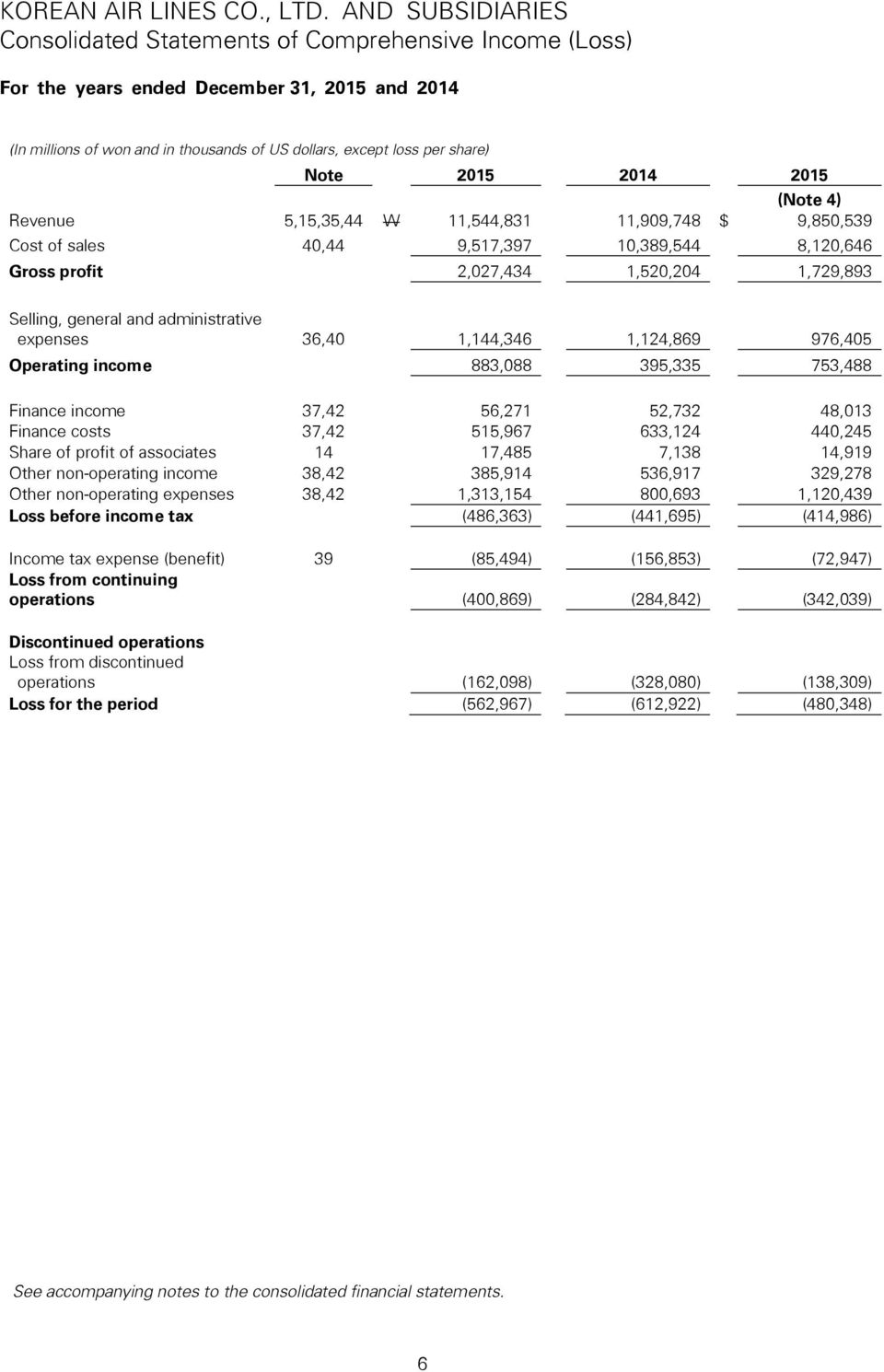
8 Consolidated Statements of Comprehensive Income (Loss) For the years ended (In millions of won and in thousands of US dollars, except loss per share) Note Revenue 5,15,35,44 W 11,544,831 11,909,748 $ 9,850,539 Cost of sales 40,44 9,517,397 10,389,544 8,120,646 Gross profit 2,027,434 1,520,204 1,729,893 Selling, general and administrative expenses 36,40 1,144,346 1,124, ,405 Operating income 883, , ,488 Finance income 37,42 56,271 52,732 48,013 Finance costs 37,42 515, , ,245 Share of profit of associates 14 17,485 7,138 14,919 Other non-operating income 38,42 385, , ,278 Other non-operating expenses 38,42 1,313, ,693 1,120,439 Loss before income tax (486,363) (441,695) (414,986) Income tax expense (benefit) 39 (85,494) (156,853) (72,947) Loss from continuing operations (400,869) (284,842) (342,039) Discontinued operations Loss from discontinued operations (162,098) (328,080) (138,309) Loss for the period (562,967) (612,922) (480,348) See accompanying notes to the consolidated financial statements. 6
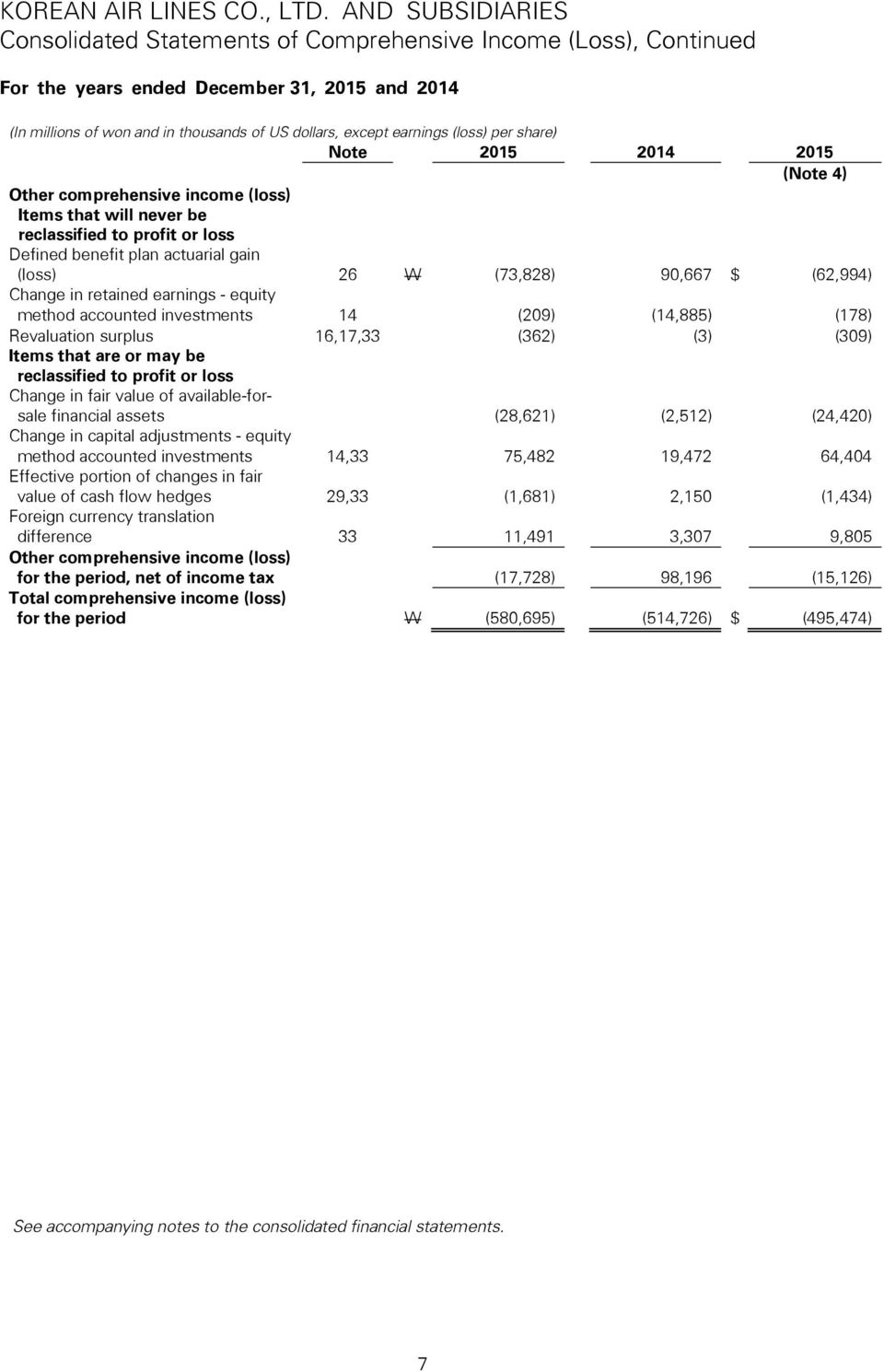
9 Consolidated Statements of Comprehensive Income (Loss), Continued For the years ended (In millions of won and in thousands of US dollars, except earnings (loss) per share) Note Other comprehensive income (loss) Items that will never be reclassified to profit or loss Defined benefit plan actuarial gain (loss) 26 W (73,828) 90,667 $ (62,994) Change in retained earnings - equity method accounted investments 14 (209) (14,885) (178) Revaluation surplus 16,17,33 (362) (3) (309) Items that are or may be reclassified to profit or loss Change in fair value of available-forsale financial assets (28,621) (2,512) (24,420) Change in capital adjustments - equity method accounted investments 14,33 75,482 19,472 64,404 Effective portion of changes in fair value of cash flow hedges 29,33 (1,681) 2,150 (1,434) Foreign currency translation difference 33 11,491 3,307 9,805 Other comprehensive income (loss) for the period, net of income tax (17,728) 98,196 (15,126) Total comprehensive income (loss) for the period W (580,695) (514,726) $ (495,474) See accompanying notes to the consolidated financial statements. 7
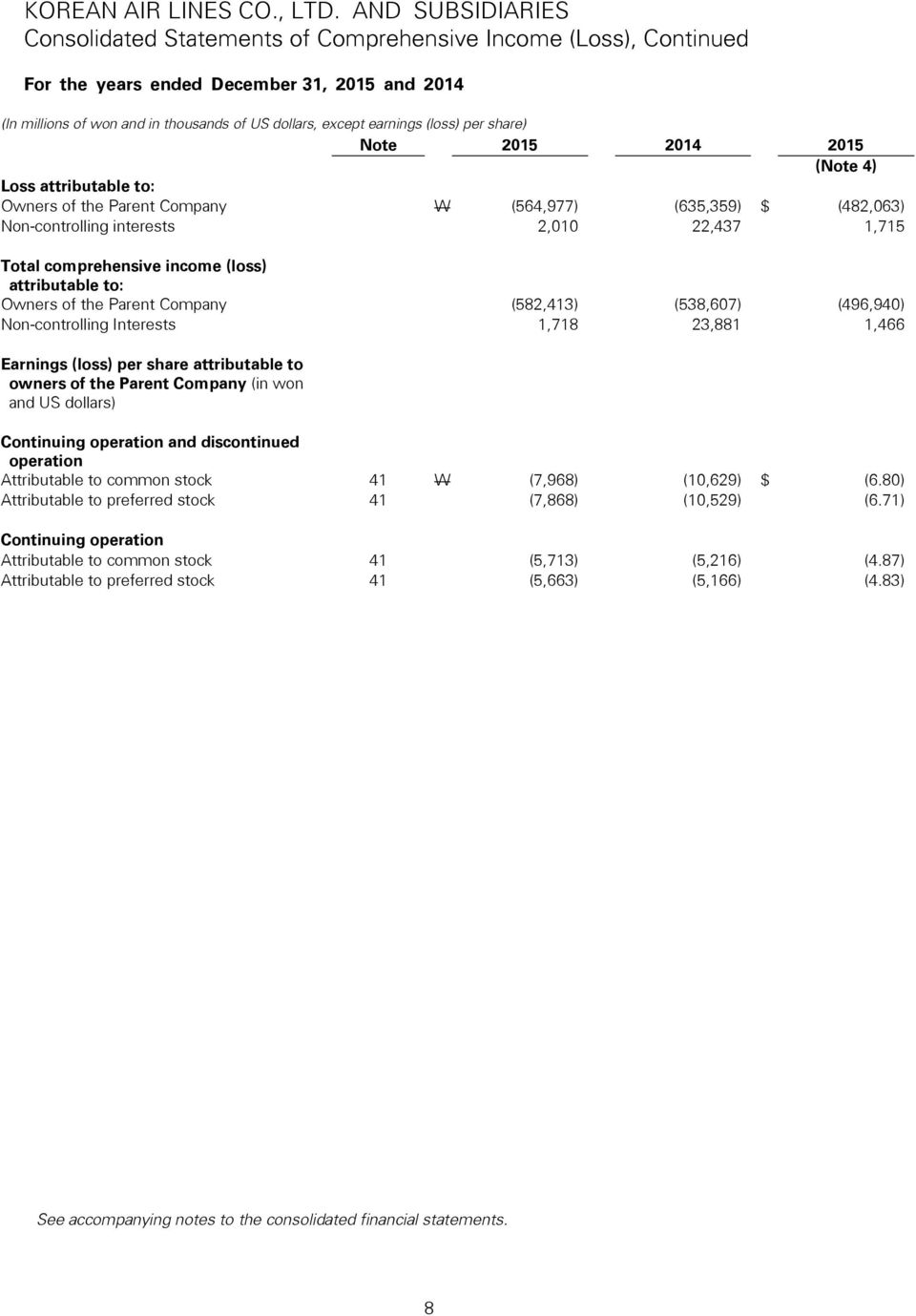
10 Consolidated Statements of Comprehensive Income (Loss), Continued For the years ended (In millions of won and in thousands of US dollars, except earnings (loss) per share) Note Loss attributable to: Owners of the Parent Company W (564,977) (635,359) $ (482,063) Non-controlling interests 2,010 22,437 1,715 Total comprehensive income (loss) attributable to: Owners of the Parent Company (582,413) (538,607) (496,940) Non-controlling Interests 1,718 23,881 1,466 Earnings (loss) per share attributable to owners of the Parent Company (in won and US dollars) Continuing operation and discontinued operation Attributable to common stock 41 W (7,968) (10,629) $ (6.80) Attributable to preferred stock 41 (7,868) (10,529) (6.71) Continuing operation Attributable to common stock 41 (5,713) (5,216) (4.87) Attributable to preferred stock 41 (5,663) (5,166) (4.83) See accompanying notes to the consolidated financial statements. 8
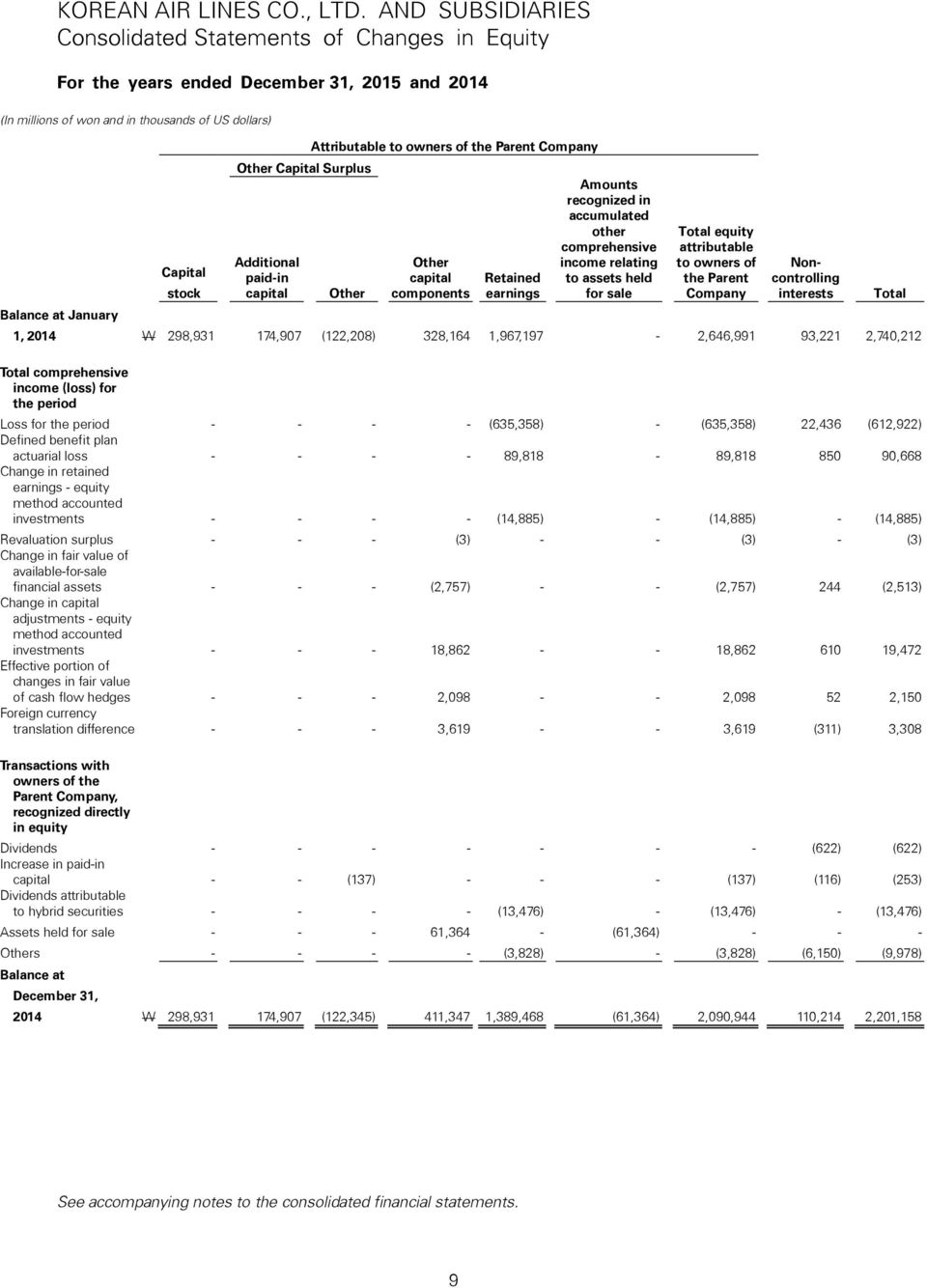
11 Consolidated Statements of Changes in Equity For the years ended Balance at January Capital stock Other Capital Surplus Additional paid-in capital Attributable to owners of the Parent Company Other Other capital components Retained earnings Amounts recognized in accumulated other comprehensive income relating to assets held for sale Total equity attributable to owners of the Parent Company Noncontrolling interests 1, 2014 W 298, ,907 (122,208) 328,164 1,967,197-2,646,991 93,221 2,740,212 Total comprehensive income (loss) for the period Loss for the period (635,358) - (635,358) 22,436 (612,922) Defined benefit plan actuarial loss ,818-89, ,668 Change in retained earnings - equity method accounted investments (14,885) - (14,885) - (14,885) Revaluation surplus (3) - - (3) - (3) Change in fair value of available-for-sale financial assets (2,757) - - (2,757) 244 (2,513) Change in capital adjustments - equity method accounted investments , , ,472 Effective portion of changes in fair value of cash flow hedges , , ,150 Foreign currency translation difference , ,619 (311) 3,308 Transactions with owners of the Parent Company, recognized directly in equity Dividends (622) (622) Increase in paid-in capital - - (137) (137) (116) (253) Dividends attributable to hybrid securities (13,476) - (13,476) - (13,476) Assets held for sale ,364 - (61,364) Others (3,828) - (3,828) (6,150) (9,978) Balance at December 31, 2014 W 298, ,907 (122,345) 411,347 1,389,468 (61,364) 2,090, ,214 2,201,158 Total See accompanying notes to the consolidated financial statements. 9
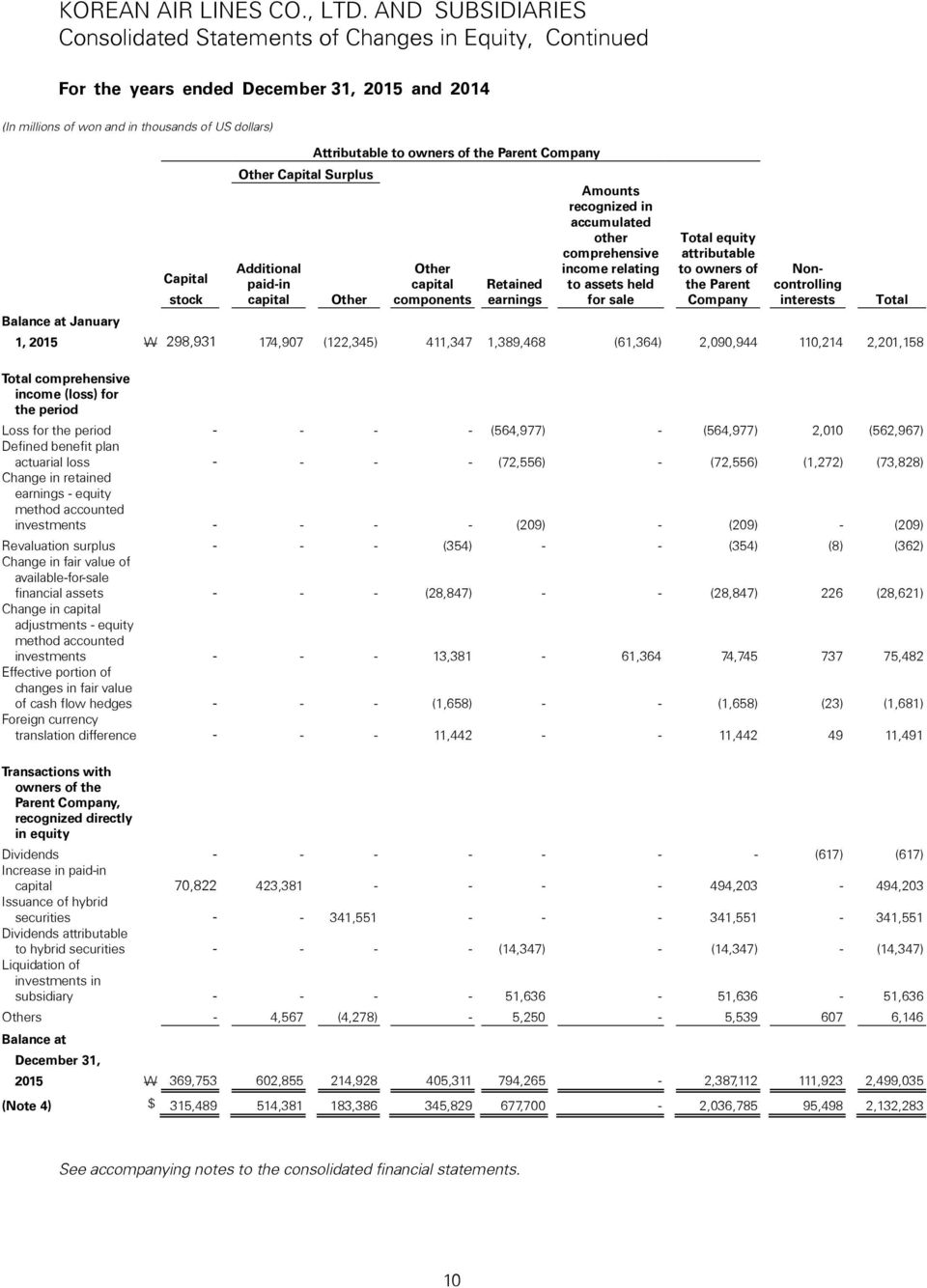
12 Consolidated Statements of Changes in Equity, Continued For the years ended Balance at January Capital stock Other Capital Surplus Additional paid-in capital Attributable to owners of the Parent Company Other Other capital components Retained earnings Amounts recognized in accumulated other comprehensive income relating to assets held for sale Total equity attributable to owners of the Parent Company Noncontrolling interests 1, 2015 W 298, ,907 (122,345) 411,347 1,389,468 (61,364) 2,090, ,214 2,201,158 Total comprehensive income (loss) for the period Loss for the period (564,977) - (564,977) 2,010 (562,967) Defined benefit plan actuarial loss (72,556) - (72,556) (1,272) (73,828) Change in retained earnings - equity method accounted investments (209) - (209) - (209) Revaluation surplus (354) - - (354) (8) (362) Change in fair value of available-for-sale financial assets (28,847) - - (28,847) 226 (28,621) Change in capital adjustments - equity method accounted investments ,381-61,364 74, ,482 Effective portion of changes in fair value of cash flow hedges (1,658) - - (1,658) (23) (1,681) Foreign currency translation difference , , ,491 Transactions with owners of the Parent Company, recognized directly in equity Dividends (617) (617) Increase in paid-in capital 70, , , ,203 Issuance of hybrid securities , , ,551 Dividends attributable to hybrid securities (14,347) - (14,347) - (14,347) Liquidation of investments in subsidiary ,636-51,636-51,636 Others - 4,567 (4,278) - 5,250-5, ,146 Balance at December 31, 2015 W 369, , , , ,265-2,387, ,923 2,499,035 $ 315, , , , ,700-2,036,785 95,498 2,132,283 Total See accompanying notes to the consolidated financial statements. 10
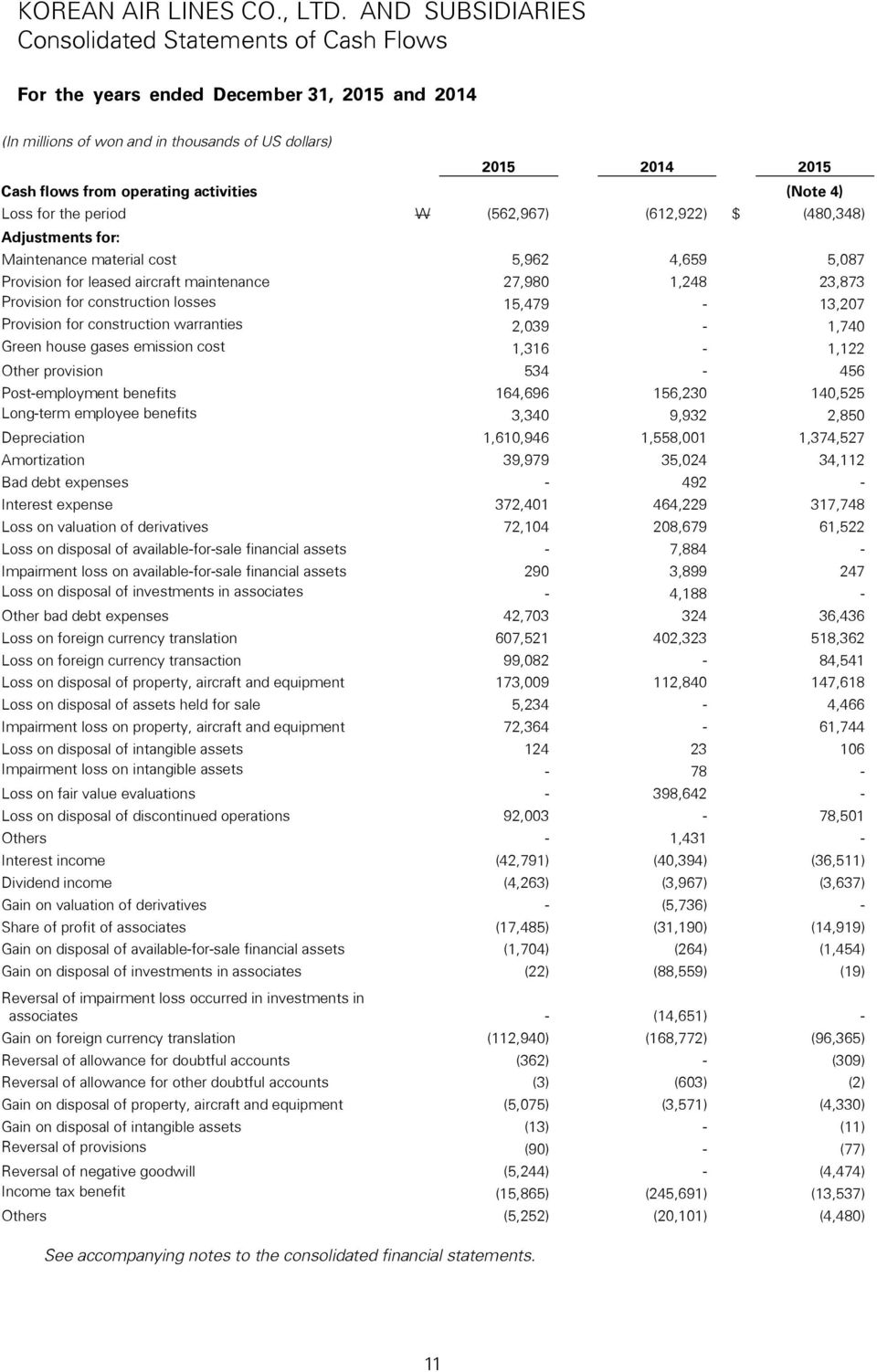
13 Consolidated Statements of Cash Flows For the years ended Cash flows from operating activities Loss for the period W (562,967) (612,922) $ (480,348) Adjustments for: Maintenance material cost 5,962 4,659 5,087 Provision for leased aircraft maintenance 27,980 1,248 23,873 Provision for construction losses 15,479-13,207 Provision for construction warranties 2,039-1,740 Green house gases emission cost 1,316-1,122 Other provision Post-employment benefits 164, , ,525 Long-term employee benefits 3,340 9,932 2,850 Depreciation 1,610,946 1,558,001 1,374,527 Amortization 39,979 35,024 34,112 Bad debt expenses Interest expense 372, , ,748 Loss on valuation of derivatives 72, ,679 61,522 Loss on disposal of available-for-sale financial assets - 7,884 - Impairment loss on available-for-sale financial assets 290 3, Loss on disposal of investments in associates - 4,188 - Other bad debt expenses 42, ,436 Loss on foreign currency translation 607, , ,362 Loss on foreign currency transaction 99,082-84,541 Loss on disposal of property, aircraft and equipment 173, , ,618 Loss on disposal of assets held for sale 5,234-4,466 Impairment loss on property, aircraft and equipment 72,364-61,744 Loss on disposal of intangible assets Impairment loss on intangible assets Loss on fair value evaluations - 398,642 - Loss on disposal of discontinued operations 92,003-78,501 Others - 1,431 - Interest income (42,791) (40,394) (36,511) Dividend income (4,263) (3,967) (3,637) Gain on valuation of derivatives - (5,736) - Share of profit of associates (17,485) (31,190) (14,919) Gain on disposal of available-for-sale financial assets (1,704) (264) (1,454) Gain on disposal of investments in associates (22) (88,559) (19) Reversal of impairment loss occurred in investments in associates - (14,651) - Gain on foreign currency translation (112,940) (168,772) (96,365) Reversal of allowance for doubtful accounts (362) - (309) Reversal of allowance for other doubtful accounts (3) (603) (2) Gain on disposal of property, aircraft and equipment (5,075) (3,571) (4,330) Gain on disposal of intangible assets (13) - (11) Reversal of provisions (90) - (77) Reversal of negative goodwill (5,244) - (4,474) Income tax benefit (15,865) (245,691) (13,537) Others (5,252) (20,101) (4,480) See accompanying notes to the consolidated financial statements. 11
14 Consolidated Statements of Cash Flows, Continued For the years ended Changes in: Trade receivables W (34,076) 29,081 $ (29,075) Non-trade receivables (3,917) (53,311) (3,342) Accrued revenues (10,136) (8,996) (8,648) Account receivables due from customers for contracts in progress (28,029) 15,535 (23,916) Inventories (58,651) 34,184 (50,043) Financial derivative assets 5,736 4,234 4,894 Advance payments (35,507) (136,207) (30,296) Prepaid expenses (4,488) (9,566) (3,829) Other current assets (3,014) 5,293 (2,571) Other non-current assets 41,974-35,814 Lease deposit (757) - (646) Long-term advance payments Long-term prepaid expenses Trade payables 12,260 (83,031) 10,460 Other payables (88,584) (94,917) (75,584) Accrued expenses 187,095 (77,288) 159,637 Advances 73,184 (50,029) 62,444 Unearned revenues 242, ,532 Deferred revenue due to customers for contracts in progress (53,837) 23,659 (45,936) Financial derivative liabilities (208,846) (29,412) (178,196) Withholdings 25,891-22,091 Other current liabilities - 71,774 - Plan assets 3,586 6,101 3,060 Payment of retirement benefits (90,961) (76,085) (77,612) Succession of defined benefit obligation Provision (1,770) - (1,510) Deferred revenue 67,998 74,995 58,019 Other non-current liabilities 14,732 7,015 12,570 Others (66) 282 (55) Cash generated from operations 2,687,419 1,788,007 2,293,020 Interest received 46,473 40,580 39,652 Dividend received 6,639 40,202 5,665 Income taxes paid (12,508) (5,225) (10,672) Net cash provided by operating activities 2,728,023 1,863,564 2,327,665 See accompanying notes to the consolidated financial statements. 12

15 Consolidated Statements of Cash Flows, Continued For the years ended Cash flows from investing activities (note 4) Decrease in short-term financial instruments W 128,564 65,834 $ 109,696 Decrease in long-term financial instruments 1,429-1,220 Recovery of finance lease receivables 13,750 12,886 11,732 Decrease in current portion of available-for-sale financial assets - 3,000 - Decrease in current portion of held-to-maturity investments - 9,356 - Decrease in short-term loans 15 29, Decrease in long-term financial instruments - 1,590 - Proceeds from disposal of available-for-sale financial assets 6,966 15,529 5,944 Decrease in held-to-maturity investments Proceeds from disposal of associates - 64,401 - Proceeds from disposal of investments in subsidiaries 1,184-1,010 Proceeds from disposal of property, aircraft and equipment 318, , ,601 Proceeds from disposal of assets held for sale 10,003-8,535 Proceeds from disposal of intangible assets Decrease in guarantee deposits 37, ,127 32,244 Increase in short-term loans (13) - (11) Decrease in other non-current assets 2-2 Increase in rent deposits Proceeds from disposal of business segment 1,982,982-1,691,964 Increase in short-term financial instruments (181,393) (68,633) (154,773) Increase in long-term financial instruments (52,512) (57,911) (44,806) Acquisition of available-for-sale financial assets (3,000) (5,090) (2,560) Acquisition of held-to-maturity investments (27) (25) (23) Acquisition of investments in associates - (400,000) - Acquisition of investments in subsidiaries (6,267) (1,971) (5,347) Acquisition of property, aircraft and equipment and investment property (1,742,725) (1,120,619) (1,486,966) Acquisition of intangible assets (32) (1) (28) Increase in guarantee deposits (96,664) (117,480) (82,478) Inflow of cash from other investing activities Net cash provided by (used in) investing activities 418,729 (1,064,949) 357,277 See accompanying notes to the consolidated financial statements. 13

16 Consolidated Statements of Cash Flows, Continued For the years ended Cash flows from financing activities (note 4) Proceeds from short-term borrowings W 1,572,576 2,050,927 $ 1,341,789 Proceeds from issuance of bonds 286, , ,428 Proceeds from long-term borrowings 570,094 2,012, ,429 Proceeds from issuance of asset-backed securitization loans 600,000 1,271, ,945 Issuance of hybrid securities 341, ,426 Proceeds from disposal of investments in subsidiaries Increase in paid-in capital 494, ,674 Repayment of short-term borrowings (2,367,142) (1,245,366) (2,019,746) Repayment of current portion of long-term liabilities (2,997,644) (4,214,645) (2,557,717) Repayment of current portion of finance leases obligations (1,093,376) (984,903) (932,914) Interest paid (385,736) (465,889) (329,126) Payment of dividends attributable to hybrid securities (13,440) (13,440) (11,468) Payment of dividends (617) (622) (527) Outflow of cash from other financing activities (3,850) 1,737 (3,285) Net cash used in financing activities (2,996,599) (1,137,933) (2,556,825) Net increase (decrease) in cash and cash equivalents 150,153 (339,318) 128,117 Cash and cash equivalents at January 1 796,604 1,126, ,696 Effect of exchange rate fluctuations on cash held 19,005 9,097 16,217 Increase in cash and cash equivalent due to changes in scope of consolidation 1,719-1,466 Cash and cash equivalents at December 31 W 967, ,604 $ 825,496 See accompanying notes to the consolidated financial statements. 14

17 1. General Description of the Parent Company Korean Air Lines Co., Ltd. (the Parent Company ) was established on June 19, 1962 under the Investment Promotion Law of the Republic of Korea and is engaged in the business of domestic and international airline services, manufacture of aircraft parts, maintenance of aircraft and catering of inflight meals. The Parent Company has been a publicly traded company upon listing its common stock on the Korea Exchange since Total capital stock of the Parent Company as of December 31, 2015 amounts to W369,753 million in par value (including W5,554 million of preferred stock). The principal shareholders of the Parent Company s common stocks are Hanjin KAL Co., Ltd. (31.46%) and its affiliates (4.14%). 2. Basis of Preparation The consolidated financial statements have been prepared in accordance with Korean International Financial Reporting Standards ( K-IFRS ), as prescribed in the Act on External Audit of Corporations in the Republic of Korea. The Group s accounting policies applied for the accompanying consolidated financial statements are the same as the policies applied for the preparation of consolidated financial statements for the year ended December 31, 2014, except for the effects from the introduction of new and revised accounting standards of interpretation described in Note 3. The accompanying consolidated financial statements have been prepared on the historical cost basis except for certain non-current assets and financial instruments that are measured at revalued amounts or fair values. Historical cost is generally based on the fair value of the consideration given. (a) Basis of measurement The consolidated financial statements have been prepared on the historical cost basis, except for the following material items in the consolidated statements of financial position: Derivative financial instruments are measured at fair value Financial instruments at fair value through profit or loss are measured at fair value Available-for-sale financial assets are measured at fair value Property, aircraft and equipment, and investment property measured at fair value Liabilities for defined benefit plans are recognized at the net of total present value of defined benefit obligations less the fair value of plan assets (b) Functional and presentation currency The Group s consolidated financial statements are presented in the currency of the primary economic environment in which the Group operates (its functional currency). For the purpose of the consolidated financial statements, the results and financial position of the Group are expressed in Korean won, which is the functional currency of the Parent Company and the presentation currency for the consolidated financial statements. (c) Use of estimates and judgments The preparation of the consolidated financial statements in conformity with K-IFRS requires management to make judgments, estimates and assumptions that affect the application of 15
18 accounting policies and the reported amounts of assets, liabilities, income and expenses. Actual results may differ from these estimates. Estimates and underlying assumptions are reviewed on an ongoing basis. Revisions to accounting estimates are recognized prospectively. In the application of the Group accounting policies, management is required to make judgments, estimates and assumptions about the carrying amounts of assets and liabilities that are not readily apparent from other sources. Actual results may differ from these estimates. The estimates and underlying assumptions are reviewed on an ongoing basis. Revisions to accounting estimates are recognized in the period in which the estimate is revised if the revision affects only that period or in the period of the revision and future periods if the revision affects both current and future periods. 1) Critical judgments in applying accounting policies The followings are the critical judgments, apart from those involving estimations, that the management has made in the process of applying the Group s accounting policies and that have the most significant effect on the amounts recognized in the consolidated financial statements. Management has reviewed the Group s held-to-maturity financial assets in the light of its capital maintenance and liquidity requirements and has confirmed the Group s positive intention and ability to hold those assets to maturity. The carrying amount of the held-to-maturity financial assets is W 971 million ($829 thousand). Details of these assets are set out in Note 10. 2) Key sources of estimation uncertainty The followings are the key assumptions concerning the future, and other key sources of estimation uncertainty at the end of the reporting period, that have a significant risk of causing a material adjustment to the carrying amounts of assets and liabilities within the next financial year. A. Defined benefit plan The Group s defined benefit obligation is determined based on the actuarial valuation carried out at the end of each annual reporting period. Actuarial assumptions are the Group s best estimates of the variables in determining the cost of providing postretirement benefits, such as discount rates, rates of expected future salary increases and mortality rates. Significant estimation uncertainty is likely to persist in making such assumptions due to the long-term nature of postretirement benefit plan. At the end of this year, net defined benefit obligation of the plan is W1,027,681 million ($876,861thousand) (prior year W851,071 million), as detailed in Note 26. B. Valuation of financial instruments As described in Notes 42 and 43, the Group uses valuation techniques that include inputs that are not based on observable market data to estimate the fair value of certain type of financial instruments. Notes 42 and 43 provide detailed information about key assumptions used in the determination of the fair value of financial instruments, as well as the detailed sensitivity analysis for these assumptions. The management believes that the chosen valuation techniques and assumptions used are appropriate in determining the fair value of financial instruments. 16
19 C. Probability on the realization of unused deferred tax assets In consideration of operating performance of the Group and estimate of the future operating performance, the Group recognizes deferred tax asset in relation to unused tax loss carryforward. 3. Significant Accounting Policies (a) Basis of consolidation The consolidated financial statements incorporate the financial statements of the Parent Company and entities (including structured entities) controlled by the Parent Company (and its subsidiaries). Control is achieved where the Parent Company 1) has the power over the investee; 2) is exposed, or has rights, to variable returns from its involvement with the investee; and 3) has the ability to use its power to affect its returns. The Parent Company reassesses whether or not it controls an investee if facts and circumstances indicate that there are changes to one or more of the three elements of control listed above. Income and expenses of subsidiaries acquired or disposed of during the year are included in the consolidated statement of comprehensive loss from the date the Parent Company gains control until the date when the Parent Company ceases to control the subsidiary. Profit or loss and each component of other comprehensive income are attributed to the owners of the Parent Company and to the non-controlling interests. Total comprehensive income of subsidiaries is attributed to the owners of the Parent Company and to the non-controlling interests even if this results in the noncontrolling interests having a deficit balance When necessary, adjustments are made to the financial statements of subsidiaries to bring their accounting policies in line with the Group s accounting policies. All intragroup transactions and related assets, liabilities, income and expenses are eliminated in full on consolidation. Changes in the Group s ownership interests in subsidiaries that do not result in the Group losing control over the subsidiaries are accounted for as equity transactions. The carrying amounts of the Group s interests and the non-controlling interests are adjusted to reflect the changes in their relative interests in the subsidiaries. Any difference between the amount by which the non-controlling interests are adjusted and the fair value of the consideration paid or received is recognized directly in equity and attributed to owners of the Parent Company. When the Group loses control of a subsidiary, a gain or loss on disposal is calculated as the difference between (i) the aggregate of the fair value of the consideration received and the fair value of any retained interest and (ii) the previous carrying amount of the assets (including goodwill) and liabilities of the subsidiary and any non-controlling interests. When assets of the subsidiary are carried at revalued amounts or fair values and the related cumulative gain or loss has been recognized in other comprehensive income and accumulated in equity, the amounts previously recognized in other comprehensive income and accumulated in equity are accounted for as if the Group had directly disposed of the relevant assets (i.e., reclassified to profit or loss or transferred directly to retained earnings). The fair value of any investment retained in the former subsidiary at the date when control is lost is recognized as the fair value on initial recognition for subsequent accounting under K-IFRS 1039 or, when applicable, the cost on initial recognition of an investment in an associate or a joint venture. 17

20 (b) Business combination Acquisitions of businesses are accounted for using the acquisition method. The consideration transferred in a business combination is measured at fair value, which is calculated as the sum of the fair values of the assets transferred by the Group, liabilities incurred by the Group to the former owners of the acquiree and the equity interests issued by the Group in exchange for control of the acquiree. Acquisition-related costs are recognized in profit or loss as incurred. At the acquisition date, the identifiable assets acquired and the liabilities assumed are recognized at their fair value at the acquisition date, except that: deferred tax assets or liabilities and liabilities or assets related to employee benefit arrangements are recognized and measured in accordance with K-IFRS 1012, Income Taxes, and K-IFRS 1019, respectively; liabilities or equity instruments related to share-based payment arrangements of the acquiree or share-based payment arrangements of the Group entered into to replace share-based payment arrangements of the acquiree are measured in accordance with K-IFRS 1102, Share-Based Payment, at the acquisition date; and assets (or disposal groups) that are classified as held for sale in accordance with K-IFRS 1105, Noncurrent Assets Held for Sale and Discontinued Operations, are measured in accordance with that standard. Goodwill is measured as the excess of the sum of a) the consideration transferred, b) the amount of any non-controlling interests in the acquiree and c) the fair value of the acquirer's previously held equity interest in the acquiree (if any), over the net of the acquisition-date amounts of the identifiable assets acquired and the liabilities assumed. If, after reassessment, the net of the acquisition-date amounts of the identifiable assets acquired and liabilities assumed exceeds the sum of a) the consideration transferred, b) the amount of any non-controlling interests in the acquiree and c) the fair value of the acquirer's previously held interest in the acquiree (if any), the excess is recognized immediately in profit or loss as a bargain purchase gain. Non-controlling interests that are present ownership interests and entitle their holders to a proportionate share of the entity's net assets in the event of liquidation may be initially measured either at fair value or at the non-controlling interests' proportionate share of the recognized amounts of the acquiree's identifiable net assets. The choice of measurement basis is made on a transactionby-transaction basis. Other types of non-controlling interests are measured at fair value or, when applicable, on the basis specified in another K-IFRS. When the consideration transferred by the Group in a business combination includes assets or liabilities resulting from a contingent consideration arrangement, the contingent consideration is measured at its acquisition-date fair value and included as part of the consideration transferred in a business combination. Changes in the fair value of the contingent consideration that qualify as measurement-period adjustments are adjusted retrospectively, with corresponding adjustments against goodwill. Measurement-period adjustments are adjustments that arise from additional information obtained during the measurement period (which cannot exceed one year from the acquisition date) about facts and circumstances that existed at the acquisition date. The subsequent accounting for changes in the fair value of the contingent consideration that do not qualify as measurement-period adjustments depends on how the contingent consideration is classified. Contingent consideration that is classified as equity is not remeasured at subsequent reporting dates and its subsequent settlement is accounted for within equity. Contingent consideration that is classified as an asset or a liability is remeasured at subsequent reporting dates 18
21 in accordance with K-IFRS 1039 or K-IFRS 1037, Provisions, Contingent Liabilities and Contingent Assets, as appropriate, with the corresponding gain or loss being recognized in profit or loss. When a business combination is achieved in stages, the Group's previously held equity interest in the acquiree is remeasured to fair value at the acquisition date and the resulting gain or loss, if any, is recognized in profit or loss. Amounts arising from interests in the acquiree prior to the acquisition date that have previously been recognized in other comprehensive income are reclassified to profit or loss where such treatment would be appropriate if that interest was disposed of. If the initial accounting for a business combination is incomplete by the end of the reporting period in which the combination occurs, the Group reports provisional amounts for the items for which the accounting is incomplete. Those provisional amounts are adjusted during the measurement period (see above), or additional assets or liabilities are recognized, to reflect new information obtained about facts and circumstances that existed at the acquisition date that, if known, would have affected the amounts recognized at that date. (c) Investments in subsidiaries, jointly controlled entities and associates An associate is an entity over which the Group has significant influence. Significant influence is the power to participate in the financial and operating policy decisions of the investee, but is not control or joint control over those policies. A joint venture is a joint arrangement whereby the parties that have joint control of the arrangement have rights to the net assets of the joint arrangement. Joint control is the contractually agreed sharing of control of an arrangement, which exists only when decisions about the relevant activities require unanimous consent of the parties sharing control. The results and assets and liabilities of associates or joint ventures are incorporated in these consolidated financial statements using the equity method of accounting, except when the investment is classified as held for sale, in which case it is accounted for in accordance with K-IFRS Under the equity method, an investment in an associate or a joint venture is initially recognized in the consolidated statement of financial position at cost and adjusted thereafter to recognize the Group's share of the profit or loss and other comprehensive income of the associate or joint venture. When the Group's share of losses of an associate or a joint venture exceeds the Group's interest in that associate or joint venture (which includes any long-term interests that, in substance, form part of the Group's net investment in the associate or joint venture), the Group discontinues recognizing its share of further losses. Additional losses are recognized only to the extent that the Group has incurred legal or constructive obligations or made payments on behalf of the associate or joint venture. Any excess of the cost of acquisition over the Group's share of the net fair value of the identifiable assets, liabilities and contingent liabilities of an associate or a joint venture recognized at the date of acquisition is recognized as goodwill, which is included within the carrying amount of the investment and is reviewed for impairment as part of investment. Any excess of the Group s share of the net fair value of the identifiable assets, liabilities and contingent liabilities over the cost of acquisition, after reassessment, is recognized immediately in profit or loss. Upon disposal of an associate or a joint venture that results in the Group losing significant influence over that associate or joint venture, any retained investment is measured at fair value at that date and the fair value is regarded as its fair value on initial recognition as a financial asset in accordance with K-IFRS The difference between the previous carrying amount of the associate or joint venture attributable to the retained interest and its fair value is included in the determination of the gain or loss on disposal of the associate or joint venture. In addition, the Group accounts for all amounts 19
22 previously recognized in other comprehensive income in relation to that associate or joint venture on the same basis it would be required if that associate or joint venture had directly disposed of the related assets or liabilities. Therefore, if a gain or loss previously recognized in other comprehensive income by that associate or joint venture would be reclassified to profit or loss on the disposal of the related assets or liabilities, the Group reclassifies the gain or loss from equity to profit or loss (as reclassification adjustment) when it loses significant influence over that associate or joint venture. When the Group reduces its ownership interest in an associate or a joint venture, but the Group continues to use the equity method, the Group reclassifies to profit or loss the proportion of the gain or loss that had previously been recognized in other comprehensive income relating to that reduction in ownership interest if that gain or loss would be reclassified to profit or loss on the disposal of the related assets or liabilities. In addition, the Group applies K-IFRS 1105 to a portion of investment in an associate or a joint venture that meets the criteria to be classified as held for sale. The requirements of K-IFRS 1039 are applied to determine whether it is necessary to recognize any impairment loss with respect to the Group s investment in an associate or a joint venture. When necessary, the entire carrying amount of the investment (including goodwill) is tested for impairment in accordance with K-IFRS 1036 by comparing its recoverable amount (higher of value in use or fair value, less costs to sell) with its carrying amount, any impairment loss recognized forms part of the carrying amount of the investment. Any reversal of that impairment loss is recognized in accordance with K-IFRS 1036 to the extent that the recoverable amount of the investment subsequently increases. The Group continues to use the equity method when an investment in an associate becomes an investment in a joint venture or an investment in a joint venture becomes an investment in an associate. There is no remeasurement to fair value upon such changes in ownership interests. When a Group entity transacts with an associate or a joint venture of the Group, profits and losses resulting from the transactions with the associate or joint venture are recognized in the Group's consolidated financial statements only to the extent of interests in the associate or joint venture that are not related to the Group. (d) Interests in joint operations A joint operation is a joint arrangement whereby the parties that have joint control of the arrangement have rights to the assets, and obligations for the liabilities, relating to the arrangement. Joint control is the contractually agreed sharing of control of an arrangement, which exists only when decisions about the relevant activities require unanimous consent of the parties sharing control. When the Group undertakes its activities under joint operations, the Group as a joint operator recognizes in relation to its interest in a joint operation: its assets, including its share of any assets held jointly; its liabilities, including its share of any liabilities incurred jointly; its revenue from the sale of its share of the output arising from the joint operation; its share of the revenue from the sale of the output by the joint operation; and its expenses, including its share of any expenses incurred jointly. The Group accounts for the assets, liabilities, revenues and expenses relating to its interest in a joint operation in accordance with the K-IFRS applicable to the particular assets, liabilities, revenues and expenses. 20
23 When the Group transacts in a joint operation in which the Group is a joint operator (such as a sale or contribution of assets), the Group is considered to be conducting the transaction with the other parties to the joint operation, and gains and losses resulting from the transactions are recognized in the Group's consolidated financial statements only to the extent of other parties' interests in the joint operation. When the Group transacts in a joint operation in which the Group is a joint operator (such as a purchase of assets), the Group does not recognize its share of the gains and losses until it resells those assets to a third party. (e) Goodwill Goodwill arising on the acquisition of a business is carried at cost, as established at the date of acquisition of the business, less accumulated impairment losses, if any. For the purpose of impairment testing, goodwill is allocated to each of the Group s cash-generating units (or groups of cash-generating units) that is expected to benefit from the synergies of the combination. A cash-generating unit to which goodwill has been allocated is tested for impairment annually or more frequently when there is indication that the unit may be impaired. If the recoverable amount of the cash-generating unit is less than its carrying amount, the impairment loss is allocated first to reduce the carrying amount of any goodwill allocated to the unit and then to the other assets of the unit on a pro rata basis based on the carrying amount of each asset in the unit. Any impairment loss for goodwill is recognized directly in profit or loss. An impairment loss recognized for goodwill is not reversed in subsequent periods. On disposal of the relevant cash-generating unit, the attributable amount of goodwill is included in the determination of the profit or loss on disposal. The Group s policy for goodwill arising on the acquisition of an associate is described in Note 3. (c). (f) Non-current assets held for sale Non-current assets and disposal groups are classified as held for sale if their carrying amount will be recovered principally through a sale transaction rather than through continued use. This condition is regarded as met only when the sale is highly probable and the non-current asset (or disposal group) is available for immediate sale in its present condition. Management must be committed to the sale, which should be expected to qualify for recognition as a completed sale within one year from the date of classification. When the Group is committed to a sale plan involving loss of control over a subsidiary, all of the assets and liabilities of that subsidiary are classified as held for sale when the criteria described above are met, regardless of whether the Group will retain a non-controlling interest in its former subsidiary after the sale. When the Group is committed to a sale plan involving disposal of an investment, or a portion of an investment, in an associate or joint venture, the investment, or the portion of the investment, that will be disposed of is classified as held for sale when the criteria described above are met, and the Group discontinues the use of the equity method in relation to the portion that is classified a held for sale. Any retained portion of an investment in an associate or a joint venture that has not been classified as held for sale continues to be accounted for using the equity method. The Group 21
24 discontinues the use of the equity method at the time of disposal when the disposal results in the Group losing significant influence over the associate or joint venture. After the disposal takes place, the Group accounts for any retained interest in the associate or joint venture in accordance with K-IFRS 1039, Financial Instruments: Recognition and Measurement, unless the retained interest continues to be an associate or a joint venture, in which case the Group uses the equity method. Non-current assets (and disposal groups) classified as held for sale are measured at the lower of their previous carrying amount and fair value, less costs to sell. A non-current asset that is classified as held for sale or part of a disposal group classified as held for sale is not depreciated or amortized. (g) Revenue Recognition Revenue is measured at the fair value of the consideration received or receivable. Revenue is reduced for estimated customer returns, rebates and other similar allowances. The Group recognizes revenue when the amount of revenue can be reliably measured; when it is probable that future economic benefits will flow to the entity; and when specific criteria have been met for each of the Group s activities, as described below. 1) Sale of goods Revenue is recognized when persuasive evidence exists that the significant risks and rewards of ownership have been transferred to the buyer, recovery of the consideration is probable, the associated costs and possible return of goods can be estimated reliably, there is no continuing management involvement with the goods, and the amount of revenue can be measured reliably. 2) Rendering of services Revenue from airline services is recognized upon completion of the services, and revenue from a contract to provide other services is recognized by reference to stage of completion of the contract. Depending on the nature of the transaction, the Group determines the stage of completion by reference to surveys of work performed; services performed to date as a percentage of total services to be performed; or the proportion that costs incurred to date bear to the estimated total costs of the transaction, as applicable. Rendering of services that result in award credits for customers, under the Group s Maxi-Points Scheme, is accounted for as multiple-element revenue transactions, and the fair value of the consideration received or receivable is allocated between the goods supplied and the award credits granted. The consideration allocated to the award credits is measured by reference to their fair value the amount for which the award credits could be sold separately. Such consideration is not recognized as revenue at the time of the initial sale transaction, but is deferred and recognized as revenue when the award credits are redeemed and the Group s obligations have been fulfilled. 3) Dividend and interest income Dividend income from investments is recognized when the Group s right to receive payment has been established. Interest income is accrued on a time basis, by reference to the principal outstanding and at the effective interest rate applicable, which is the rate that exactly discounts estimated future cash receipts through the expected life of the financial asset to that asset s net carrying amount on initial recognition. 22
25 4) Rental income The Group s policy for recognition of revenue from operating leases is described in Note 3 (i). 5) Customer loyalty program The Group operates customer loyalty program to provide customers with incentives to buy their goods or services. If a customer buys goods or services, the Group grants the customer award credits. The customer can redeem the award credits for awards, such as free or discounted goods or services. The award credits are accounted separately as identifiable component of the sales transaction(s) in which they are granted (the initial sales ). The fair value of the consideration received or receivable in respect of the initial sale shall be allocated between the award credits and the other components of the sale. If the Group supplies the awards itself, it shall recognize the consideration allocated to award credits as revenue when award credits are redeemed and it fulfills its obligation to supply awards. The amount of revenue recognized shall be based on the number of award credits that have been redeemed in exchange for awards related to the total number expected to be redeemed. If the third party supplies the awards, the Group shall assess whether it is collecting the consideration allocated to the award credits on its own account (as the principal in the transaction ) or on behalf of the third party (as agent for the third party). The amount of revenue recognized shall be net amount retained on its own account. (h) Construction contracts Where the outcome of a construction contract can be estimated reliably, revenue and costs are recognized by reference to the stage of completion of the contract activity at the end of the reporting period, measured based on the proportion of contract costs incurred for work performed to date relative to the estimated total contract costs, except where this would not be representative of the stage of completion. Variations in contract work, claims and incentive payments are included to the extent that the amount can be measured reliably and its receipt is considered probable. Where the outcome of a construction contract cannot be estimated reliably, contract revenue is recognized to the extent of contract costs incurred that it is probable will be recoverable. When it is probable that total contract costs will exceed total contract revenue, the expected loss is recognized as an expense immediately. When contract costs incurred to date, plus recognized profits, less recognized losses, exceed progress billing, the surplus is shown as amounts due from customers for contract work. For contracts where progress billings exceed contract costs incurred to date, plus recognized profits, less recognized losses, the surplus is shown as the amounts due to customers for contract work. Amounts received before the related work is performed are included in the consolidated statement of financial position, as a liability, as advances received. Amounts billed for work performed, but not yet paid by the customer are included in the consolidated statement of financial position under trade and other receivables. (i) Leases Leases are classified as finance leases whenever the terms of the lease transfer substantially all the risks and rewards of ownership to the lessee. All other leases are classified as operating leases. 1) The Group as lessor Amounts due from lessees under finance leases are recognized as receivables at the amount of the Group s net investment in the leases. Finance lease income is allocated to accounting periods so as 23
26 to reflect a constant periodic rate of return on the Group s net investment outstanding in respect of the leases. Rental income from operating leases is recognized on a straight-line basis over the term of the relevant lease. Initial direct costs incurred in negotiating and arranging an operating lease are added to the carrying amount of the leased asset and recognized on a straight-line basis over the lease term. 2) The Group as lessee Assets held under finance leases are initially recognized as assets of the Group at their fair value at the inception of the lease or, if lower, at the present value of the minimum lease payments. The corresponding liability to the lessor is included in the consolidated statement of financial position as a finance lease obligation. Lease payments are apportioned between finance expenses and reduction of the lease obligation so as to achieve a constant rate of interest on the remaining balance of the liability. Finance expenses are recognized immediately in profit or loss, unless they are directly attributable to qualifying assets, in which case they are capitalized in accordance with the Group s general policy on borrowing costs (Note 3. (k)). Contingent rentals are recognized as expenses in the periods in which they are incurred. Operating lease payments are recognized as an expense on a straight-line basis over the lease term, except where another systematic basis is more representative of the time pattern in which economic benefits from the leased asset are consumed. Contingent rentals arising under operating leases are recognized as an expense in the period in which they are incurred. In the event that lease incentives are received to enter into operating leases, such incentives are recognized as a liability. The aggregate benefit of incentives is recognized as a reduction of rental expense on a straight-line basis, except where another systematic basis is more representative of the time pattern in which economic benefits from the leased asset are consumed. (j) Foreign currencies The Group s consolidated financial statements are presented in the currency of the primary economic environment in which the Group operates (its functional currency). For the purpose of the consolidated financial statements, the results and financial position of the Group are expressed in Korean won, which is the functional currency of the Group and the presentation currency for the consolidated financial statements. In preparing the consolidated financial statements of the individual entities, transactions in currencies other than the entity s functional currency (foreign currencies) are recognized at the rates of exchange prevailing at the dates of the transactions. At the end of each reporting period, monetary items denominated in foreign currencies are retranslated at the rates prevailing at that date. Non-monetary items carried at fair value that are denominated in foreign currencies are retranslated at the rates prevailing at the date when the fair value was determined. Non-monetary items that are measured in terms of historical cost in a foreign currency are not retranslated. Exchange differences are recognized in profit or loss in the period in which they arise, except for: exchange differences on foreign currency borrowings relating to assets under construction for future productive use, which are included in the cost of those assets when they are regarded as an adjustment to interest costs on those foreign currency borrowings; exchange differences on monetary items receivable from or payable to a foreign operation for which settlement is neither planned nor likely to occur (therefore forming part of the net investment in the 24
27 foreign operation), which are recognized initially in other comprehensive income and reclassified from equity to profit or loss on disposal or partial disposal of the net investment. For the purpose of presenting consolidated financial statements, the assets and liabilities of the Group s foreign operations are expressed in Korean won using exchange rates prevailing at the end of the reporting period. Income and expense items are translated at the average exchange rates for the period, unless exchange rates fluctuated significantly during that period, in which case the exchange rates at the dates of the transactions are used. Exchange differences arising, if any, are recognized in other comprehensive income and accumulated in equity (attributed to non-controlling interests as appropriate). On the disposal of a foreign operation (i.e., a disposal of the Group s entire interest in a foreign operation, a disposal involving loss of control over a subsidiary that includes a foreign operation or partial disposal of an interest in a joint arrangement or an associate that includes a foreign operation where the retained interest becomes a financial asset), all of the accumulated exchange differences in respect of that operation attributable to the owners of the Group are reclassified to profit or loss. Any exchange differences that have previously been attributed to non-controlling interests are derecognized, but they are not reclassified to profit or loss. In the case of a partial disposal (i.e., no loss of control) of a subsidiary that includes a foreign operation, the proportionate share of accumulated exchange differences are reattributed to non-controlling interests in equity and are not recognized in profit or loss. For all other partial disposals (i.e., partial disposals of associates or joint arrangements that do not result in the Group losing significant influence or joint control), the proportionate share of the accumulated exchange differences is reclassified to profit or loss. Goodwill and fair value adjustments arising on the acquisition of a foreign operation are treated as assets and liabilities of the foreign operation and translated at the closing rate. Exchange differences arising are recognized in other comprehensive income. (k) Borrowing costs Borrowing costs directly attributable to the acquisition, construction or production of qualifying assets, which are assets that necessarily take a substantial period of time to get ready for their intended use or sale, are added to the cost of those assets, until such time as the assets are substantially ready for their intended use or sale. Investment income earned on the temporary investment of specific borrowings, pending their expenditure on qualifying assets, is deducted from the borrowing costs eligible for capitalization. All other borrowing costs are recognized in profit or loss in the period in which they are incurred. (l) Government grants Government grants are not recognized until there is reasonable assurance that the Group will comply with the conditions attached to them and that the grants will be received. The benefit of a government loan at a below-market rate of interest is treated as a government grant, measured as the difference between proceeds received and the fair value of the loan based on prevailing market interest rates. 25
28 Government grants related to assets are presented in the consolidated statement of financial position by deducting the grant from the carrying amount of the asset. The related grant is recognized in profit or loss over the life of a depreciable asset as a reduced depreciation expense. Government grants related to income are deducted from the related expenses. Government grants that are receivable as compensation for expenses or losses already incurred or for the purpose of giving immediate financial support to the Group with no future related costs are recognized in profit or loss in the period in which they become receivable. (m) Employee benefits 1) Short-term employee benefits Short-term employee benefits are employee benefits that are due to be settled within 12 months after the end of the period in which the employees render the related service. When an employee has rendered service to the Group during an accounting period, the Group recognizes the undiscounted amount of short-term employee benefits expected to be paid in exchange for that service. 2) Other long-term employee benefits Other long-term employee benefits include employee benefits that are settled beyond 12 months after the end of the period in which the employees render the related service, and are calculated at the present value of the amount of future benefit that employees have earned in return for their service in the current and prior periods. Any actuarial gains and losses are recognized in profit or loss in the period in which they arise. 3) Retirement benefit costs For defined benefit retirement benefit plans, the cost of providing benefits is determined by an independent actuarial company using the projected unit credit method, with actuarial valuations being carried out at the end of each reporting period. Remeasurement, comprising actuarial gains and losses, the effect of the changes to the asset ceiling (if applicable) and the return on plan assets (excluding interest), is reflected immediately in the consolidated statement of financial position, with a charge or credit recognized in other comprehensive income in the period in which it occurs. Remeasurement recognized in other comprehensive income is reflected immediately in retained earnings and will not be reclassified to profit or loss. Past service cost is recognized in profit or loss in the period of a plan amendment. Net interest is calculated by applying the discount rate at the beginning of the period to the net defined benefit liability or asset. Defined benefit costs are composed of service cost (including current service cost and past service cost, as well as gains and losses on curtailments and settlements), net interest expense (income) and remeasurement. The Group presents the service cost and net interest expense (income) components in profit or loss and the remeasurement component in other comprehensive income. Curtailment gains and losses are accounted for as past service costs. The retirement benefit obligation recognized in the consolidated statement of financial position represents the actual deficit or surplus in the Group s defined benefit plans. Any surplus resulting from this calculation is limited to the present value of any economic benefits available in the form of refunds from the plans or reductions in future contributions to the plans. 26
29 A liability for a termination benefit is recognized at the earlier of when the entity can no longer withdraw the offer of the termination benefit and when the entity recognizes any related restructuring costs. (n) Income taxes Income tax expense comprises current and deferred tax. Current tax and deferred tax are recognized in profit or loss except to the extent that it relates to a business combination, or items recognized directly in equity or in other comprehensive income. 1) Current tax The tax is the expected tax payable or receivable on taxable profit or loss for the year. Taxable profit differs from profit as reported in the consolidated statement of profit or loss and comprehensive income because of items of income or expense that are taxable or deductible in other years and items that are never taxable or deductible. The Group s liability for current tax is calculated using tax rates that have been enacted or substantively enacted by the end of the reporting period. 2) Deferred tax Deferred tax is recognized on temporary differences between the carrying amounts of assets and liabilities in the consolidated financial statements and the corresponding tax bases used in the computation of taxable profit. Deferred tax liabilities are generally recognized for all taxable temporary differences. Deferred tax assets are generally recognized for all deductible temporary differences to the extent that it is probable that taxable profits will be available against which those deductible temporary differences can be utilized. Such deferred tax assets are not recognized if the temporary difference arises from the initial recognition (other than in a business combination) of other assets and liabilities in a transaction that affects neither the taxable profit nor the accounting profit. Deferred tax liabilities are recognized for taxable temporary differences associated with investments in subsidiaries and associates and interests in joint ventures, except where the Group is able to control the reversal of the temporary difference and it is probable that the temporary difference will not reverse in the foreseeable future. Deferred tax assets arising from deductible temporary differences associated with such investments and interests are only recognized to the extent it is probable that there will be sufficient taxable profits against which the benefits of the temporary differences can be utilized and they are expected to reverse in the foreseeable future. The carrying amount of deferred tax assets is reviewed at the end of each reporting period and reduced to the extent it is no longer probable that sufficient taxable profits will be available to allow all or part of the asset to be recovered. Deferred tax assets and liabilities are measured at the tax rates that are expected to apply in the period in which the liability is settled or the asset realized, based on tax rates (and tax laws) that have been enacted or substantively enacted by the end of the reporting period. The measurement of deferred tax liabilities and assets reflects the tax consequences that would follow from the manner in which the Group expects, at the end of the reporting period, to recover or settle the carrying amount of its assets and liabilities. Deferred tax assets and liabilities are offset if, and only if, the Group has a legally enforceable right to set off current tax assets against current tax liabilities, and the deferred tax assets and liabilities relate to income taxes levied by the same taxation authority on either the same taxable entity or different taxable entities that intend either to settle current tax liabilities and assets on a net basis, or to realize the assets and settle the liabilities simultaneously, in each future period in which significant amounts of deferred tax liabilities or assets are expected to be settled or recovered. 27
30 For the purpose of measuring deferred tax liabilities and deferred tax assets for investment properties that are measured using the fair value model, the carrying amounts of such properties are presumed to be recovered entirely through sale, unless the presumption is rebutted. Therefore, as long as the presumption is not rebutted, measurement of deferred tax asset or liability reflects the tax effect of sale of investment property at its book value. 3) Current tax and deferred tax for the year Current and deferred tax are recognized in profit or loss, except when they relate to items that are recognized in other comprehensive income or directly in equity, in which case the current tax and deferred tax are also recognized in other comprehensive income or directly in equity, respectively. Where current tax or deferred tax arises from the initial accounting for a business combination, the tax effect is included in the accounting for the business combination. (o) Property, aircraft and equipment Property, aircraft and equipment except land are stated at cost less subsequent accumulated depreciation and accumulated impairment losses. Land shall be carried at a revalued amount, being its fair value at the date of the revaluation less any subsequent accumulated impairment losses. Revaluation shall be made with sufficient regularity to ensure that the carrying amount does not differ materially from that which would be determined using fair value at the end of the reporting period. The cost of an item of property, aircraft and equipment is directly attributable to their purchase or construction, which includes any costs directly attributable to bringing the asset to the location and condition necessary for it to be capable of operating in the manner intended by management. It also includes the initial estimate of the costs of dismantling and removing the item and restoring the site on which it is located. Subsequent costs are recognized in carrying amount of an asset or as a separate asset if it is probable that future economic benefits associated with the assets will flow into the Group and the cost of an asset can be measured reliably. Routine maintenance and repairs are expensed as incurred. The Group does not depreciate land and leased land. Depreciation expense is computed using the straight-line method based on the estimated useful lives of the assets as follows: Useful lives (years) Buildings, structures 20 ~ 40 Machinery 4 ~ 15 Aircraft, leased aircraft Fuselage, etc. 6 ~ 15 Overhaul 3.6 ~ 12 Engines, leased engines Engine 15 Overhaul 3.3 ~ 8.8 Aircraft parts 15 Others 2 ~15 If each part of an item of property, aircraft and equipment has a cost that is significant in relation to the total cost of the item, it is depreciated separately. The Group reviews the depreciation method, the estimated useful lives and residual values of property, aircraft and equipment at the end of each annual reporting period. If expectations differ from previous estimates, the changes are accounted for as a change in an accounting estimate. 28
31 An item of property, aircraft and equipment is derecognized upon disposal or when no future economic benefits are expected to arise from the continued use of the asset. Any gain or loss arising on derecognition of the property (calculated as the difference between the net disposal proceeds and the carrying amount of the asset) is included in profit or loss in the period in which the property is derecognized. The revaluation surplus included in equity in respect of an item of property, aircraft and equipment may be transferred directly to retained earnings when the asset is derecognized. (p) Investment properties Investment properties are properties held to earn rentals or for capital appreciation. Investment properties are measured initially at cost, including transaction costs. Subsequent to initial recognition, investment properties are reported at cost, less accumulated depreciation and accumulated impairment losses. Subsequent costs are recognized in the carrying amount of an asset or as a separate asset if it is probable that future economic benefits associated with the assets will flow into the Group and the cost of an asset can be measured reliably. Routine maintenance and repairs are expensed as incurred. While land is not depreciated, all other investment property is depreciated based on the respective asset s estimated useful lives of 40 years using the straight-line method. The estimated useful lives, residual values and depreciation method are reviewed at the end of each reporting period, with the effect of any change being treated as change in the accounting estimate. An investment property is derecognized upon disposal or when the investment property is permanently withdrawn from use and no future economic benefits are expected from the disposal. Any gain or loss arising on derecognition of the property (calculated as the difference between the net disposal proceeds and the carrying amount of the asset) is included in profit or loss in the period in which the property is derecognized. (q) Intangible assets 1) Intangible assets acquired separately Intangible assets with finite useful lives that are acquired separately are carried at cost, less accumulated amortization and accumulated impairment losses. Amortization is recognized on a straight-line basis over their estimated useful lives. The estimated useful life and amortization method are reviewed at the end of each reporting period, with the effect of any changes being treated as change in accounting estimate Intangible assets with indefinite useful lives that are acquired separately are carried at cost, less accumulated impairment losses. 2) Internally generated intangible assets - research and development expenditure Expenditure on research activities is recognized as an expense in the period in which it is incurred. Expenditure arising from development (or from the development phase of an internal project) is recognized as an intangible asset if, and only if, the development project is designed to produce new or substantially improved products, and the Group can demonstrate the technical and economic feasibility and measure reliably the resources attributable to the intangible asset during its development. The amount initially recognized for internally generated intangible assets is the sum of the expenditure incurred from the date when the intangible asset first meets the recognition criteria. 29
32 Where no internally generated intangible asset can be recognized, development expenditure is recognized as loss in the period in which it is incurred. Subsequent to initial recognition, internally generated intangible assets are reported at cost, less accumulated amortization and accumulated impairment losses. 3) Intangible assets acquired in a business combination Intangible assets that are acquired in a business combination are recognized separately from goodwill and are initially recognized at their fair value at the acquisition date (which is regarded as their cost). Subsequent to initial recognition, intangible assets acquired in a business combination are reported at cost, less accumulated amortization and accumulated impairment losses. 4) Derecognition of intangible assets An intangible asset is derecognized on disposal or when no future economic benefits are expected from its use or disposal. Gains or losses arising from derecognition of an intangible asset, measured as the difference between the net disposal proceeds and the carrying amount of the asset, is recognized in profit or loss when the asset is derecognized. Intangible assets with finite useful lives are amortized based on the estimated useful lives of the assets as follows: Estimated useful lives (years) Facility usage rights 19 ~ 30 Development costs 2.2 ~ 15.3 Other intangible assets 5 ~ 20 Among the Group s intangible assets, useful life of a membership is estimated to be infinite as the usable period is not limited in accordance with the terms of the contract and the economic benefits are expected to be continuously generated from the asset during the holding period. (r) Impairment of non-financial assets other than goodwill At the end of each reporting period, the Group reviews the carrying amounts of its non-financial assets to determine whether there is any indication that those assets have suffered an impairment loss. If any such indication exists, the recoverable amount of the asset is estimated in order to determine the extent of the impairment loss (if any). When it is not possible to estimate the recoverable amount of an individual asset, the Group estimates the recoverable amount of the cashgenerating unit to which the asset belongs. Where a reasonable and consistent basis of allocation can be identified, corporate assets are also allocated to individual cash-generating units, or otherwise, they are allocated to the smallest group of cash-generating units for which a reasonable and consistent allocation basis can be identified. Intangible assets with indefinite useful lives and intangible assets not yet available for use are tested for impairment annually whether there is an indication of impairment. Recoverable amount is the higher of fair value, less costs to sell, or value in use. If the recoverable amount of an asset (or a cash-generating unit) is estimated to be less than its carrying amount, the carrying amount of the asset (or the cash-generating unit) is reduced to its recoverable amount and the reduced amount is recognized in profit or loss. 30
33 Where an impairment loss subsequently reverses, the carrying amount of the asset (or a cashgenerating unit) is increased to the lesser of 1) revised estimate of its recoverable amount, or the carrying amount that would have been had no impairment loss been recognized. A reversal of an impairment loss is recognized immediately in profit or loss. (s) Inventories Inventories are stated at the lower of cost and net realizable value. The cost of inventories is measured by the following evaluation method: Evaluation method Merchandise First-in-first-out method Products Total average method and others Raw materials Aerospace Moving average method In-flight meals First-in-first-out method Supplies Air transport, Aerospace Moving average method In-flight meals First-in-first-out method Others First-in-first-out method and others Materials in transit Specific identification method Cost of inventories consists of the purchase price, cost of conversion and other costs incurred in bringing the inventories to ready for use state. Net realizable value represents the estimated selling price for inventories, less all estimated costs of completion and costs necessary to make the sale. When inventories are sold, the carrying amount of those inventories is recognized as an expense (cost of sales) in the period in which the related revenue is recognized. The amount of any writedown of inventories to net realizable value and all losses of inventories are recognized as an expense in the period the write-down or loss occurs. The amount of any reversal of any write-down of inventories, arising from an increase in net realizable value, is recognized as a reduction in the amount of inventories recognized as an expense in the period in which the reversal occurs. (t) Provisions Provisions are recognized when the Group has a present obligation (legal or constructive) as a result of a past event, it is probable that the Group will be required to settle the obligation and a reliable estimate can be made of the amount of the obligation. The amount recognized as a provision is the best estimate of the consideration required to settle the present obligation at the end of the reporting period, taking into account the risks and uncertainties surrounding the obligation. When a provision is measured using the cash flows estimated to settle the present obligation, its carrying amount is the present value of those cash flows (where the effect of the time value of money is material). The discount rate used is a pretax rate that reflects current market assessments of the time value of money and the risks specific to the liability. Where discounting is used, the increase in the provision due to the passage is recognized in profit or loss as borrowing cost. When some or all of the economic benefits required to settle a provision are expected to be recovered from a third party, a receivable is recognized as an asset if it is virtually certain that reimbursement will be received and the amount of the receivable can be measured reliably. At the end of each reporting period, the remaining provision balance is reviewed and assessed to determine if the current best estimate is being recognized. If the existence of an obligation to transfer economic benefit is no longer probable, the related provision is reversed during the period. 31
34 (u) Financial Instruments Financial assets are recognized when the Group becomes a party to the contractual provisions of the instruments. Financial assets are initially measured at fair value. Transaction costs that are directly attributable to the acquisition of financial assets are added to or deducted from the fair value of the financial assets, as appropriate, on initial recognition. Transaction costs directly attributable to the acquisition of financial assets at fair value through profit or loss ( FVTPL ) are recognized immediately in profit or loss. All regular-way purchases or sales of financial assets are recognized and derecognized on a tradedate basis. Regular-way purchases or sales are purchases or sales of financial assets that require delivery of assets within the time frame established by regulation or convention in the marketplace. Financial assets are classified into the following specified categories: financial assets at FVTPL, heldto-maturity investments, available-for-sale ( AFS ) financial assets and loans and receivables. The classification depends on the nature and purpose of the financial assets and is determined at the time of initial recognition. 1) Effective interest method The effective interest method is a method of calculating the amortized cost of a debt instrument, and of allocating interest income over the relevant period. The effective interest rate is the rate that exactly discounts estimated future cash receipts (including all fees and points paid or received that form an integral part of the effective interest rate, transaction costs and other premiums or discounts) through the expected life of the debt instrument, or (where appropriate) a shorter period, to the net carrying amount on initial recognition. Income is recognized on an effective interest basis for debt instruments other than financial assets classified as at FVTPL. 2) Financial assets at FVTPL Financial assets are classified as at FVTPL when the financial asset is either held for trading or it is designated as at FVTPL. Financial assets acquired for short-term holding are classified as held for trading, and all derivative financial instruments except for those that are effective and designated as hedging instrument are measured in fair value, with the associated change in fair value being recognized as gain or loss in the reporting period A financial asset is classified as held for trading if: it has been acquired principally for the purpose of selling in the near term; on initial recognition, it is part of a portfolio of identified financial instruments that the Group manages together and has a recent actual pattern of short-term profit taking; or it is a derivative that is not designated and effective as a hedging instrument. A financial asset other than a financial asset held for trading may be designated as at FVTPL upon initial recognition if: such designation eliminates or significantly reduces a measurement or recognition inconsistency that would otherwise arise; the financial asset forms part of a group of financial assets or financial liabilities, or both, which is managed, and its performance is evaluated on a fair value basis, in accordance with the Group's documented risk management or investment strategy, and information about the grouping is provided internally on that basis; or it forms part of a contract containing one or more embedded derivatives, and K-IFRS 1039 permits the entire combined contract (asset or liability) to be designated as at FVTPL. 32
35 Financial assets at FVTPL are stated at fair value, with any gains or losses arising on remeasurement recognized in profit or loss. The net gain or loss recognized in profit or loss incorporates any dividend or interest earned on the financial asset and is included in the Other non-operating income and expense line item in the consolidated statement of comprehensive loss. 3) Held-to-maturity investments Non-derivatives financial assets with fixed or determinable payments and fixed maturity dates that the Group has the positive intent and ability to hold to maturity are classified as held-to-maturity investments. Held-to-maturity investments are measured at amortized cost using the effective interest method, less any impairment, with revenue recognized on an effective yield basis. 4) AFS financial assets AFS financial assets are non-derivatives that are either designated as AFS or are not classified as (a) loans and receivables, (b) held-to-maturity investments or (c) financial assets at FVTPL. They are subsequently measured at fair value at the end of each reporting period. Changes in the carrying amount of AFS monetary financial assets relating to changes in foreign currency rates (see below), interest income calculated using the effective interest method and dividends on AFS equity investments are recognized in profit or loss. Other changes in the carrying amount of AFS financial assets are recognized in other comprehensive income (as gain (loss) on AFS financial assets, net). When the investment is disposed of or is determined to be impaired, the cumulative gain or loss previously accumulated in other comprehensive income is reclassified to profit or loss. Dividends on AFS equity instruments are recognized in profit or loss when the Group s right to receive the dividends is established. The fair value of AFS monetary financial assets denominated in a foreign currency is determined in that foreign currency and translated at the spot rate prevailing at the end of the reporting period. The foreign exchange gains and losses that are recognized in profit or loss are determined based on the amortized cost of the monetary asset. Other foreign exchange gains and losses are recognized in other comprehensive income. AFS equity investments that do not have a quoted market price in an active market and whose fair value cannot be reliably measured and derivatives that are linked to, and must be settled by, delivery of such unquoted equity investments are measured at cost, less any identified impairment losses, at the end of each reporting period. 5) Loans and receivables Trade receivables, loans and other receivables that have fixed or determinable payments that are not quoted in an active market are classified as loans and receivables. Loans and receivables are measured at amortized cost using the effective interest method, less any impairment. Interest income is recognized by applying the effective interest rate, except for short-term receivables when the effect of discounting is immaterial. 6) Impairment of financial assets Financial assets, other than those at FVTPL, are assessed for indicators of impairment at the end of each reporting period. Financial assets are considered to be impaired when there is objective evidence that more events have occurred after the initial recognition of the financial asset and the estimated future cash flows of the investment have been affected. For AFS equity investments, a significant or prolonged decline in the fair value of the security below its cost is considered to be objective evidence of impairment. 33
36 For all other financial assets, objective evidence of impairment includes: significant financial difficulty of the issuer or counterparty, default or delinquency in interest or principal payments, it becoming probable that the borrower will enter bankruptcy or financial reorganization or the disappearance of an active market for that financial asset because of financial difficulties. For certain categories of financial asset, such as trade receivables, assets that are assessed not to be impaired individually are, in addition, assessed for impairment on a collective basis. Objective evidence of impairment for a portfolio of receivables could include the Group s past experience of collecting payments and an increase in the number of delayed payments, as well as observable changes in national or local economic conditions that correlate with default on receivables. For financial assets carried at amortized cost, the amount of the impairment loss recognized is the difference between the asset s carrying amount and the present value of estimated future cash flows, discounted at the financial asset s original effective interest rate. For financial assets that are carried at cost, the amount of the impairment loss recognized is the difference between the asset s carrying amount and the present value of estimated future cash flows, discounted at the current market rate of return for a similar financial asset. Such impairment loss will not be reversed in subsequent periods. Carrying amount of impaired financial assets classified as loans or trade receivables is reduced through the use of an allowance account; when a trade receivable is considered uncollectible, it is also written off against the allowance account. Subsequent recoveries of amounts previously written off are credited against the allowance account. Changes in the carrying amount of the allowance account are recognized in profit or loss. When an AFS financial asset is considered to be impaired, cumulative gains or losses previously recognized in other comprehensive income are reclassified to profit or loss in the period. For financial assets measured at amortized cost, if, in a subsequent period, the amount of the impairment loss decreases and the decrease can be related objectively to an event occurring after the impairment was recognized, the previously recognized impairment loss is reversed through profit or loss to the extent that the carrying amount of the investment at the date the impairment is reversed does not exceed what the amortized cost would have been had the impairment not been recognized. In respect of AFS equity securities, impairment losses previously recognized in profit or loss are not reversed through profit or loss. Any increase in fair value subsequent to an impairment loss is recognized in other comprehensive income. In respect of AFS debt securities, impairment losses are subsequently reversed through profit or loss if an increase in the fair value of the investment can be objectively related to an event occurring after the recognition of the impairment loss. 7) Derecognition of financial assets The Group derecognizes a financial asset only when the contractual rights to the cash flows from the asset expire, or when it transfers the financial asset and substantially all the risks and rewards of ownership of the asset to another entity. If the Group neither transfers nor retains substantially all the risks and rewards of ownership and continues to control the transferred asset, the Group recognizes its retained interest in the asset and an associated liability for amounts it may have to pay. If the Group retains substantially all the risks and rewards of ownership of a transferred financial asset, the Group continues to recognize the financial asset and also recognizes a collateralized borrowing for the proceeds received. 34
37 On derecognition of financial assets in its entirety, the difference between the assets carrying amount and the sum of the consideration received and receivable and the cumulated gain or loss that had been recognized in other comprehensive income and accumulated in equity is recognized in profit or loss. On derecognition of financial assets other than in its entirety (e.g., when the Group retains an option to repurchase part of a transferred asset or it retains a residual interest and such an retained interest indicates that the transferor has neither transferred nor retained substantially all the risks and rewards of ownership and has retained control of the transferred asset), the Group allocates the previous carrying amount of the financial asset between the part it continues to recognize under continuing involvement and the part it no longer recognizes on the basis of the relative fair value of those parts on the date of the transfer. The difference between the carrying amount allocated to the part that is no longer recognized and the sum of the consideration received for the part that is no longer recognized and any cumulative gain or loss allocated to it that had been recognized in other comprehensive income is recognized in profit or loss. A cumulative gain or loss that had been recognized in other comprehensive income is allocated between the part that continues to be recognized and the part that is no longer recognized on the basis of the relative fair value of those parts. (v) Financial liabilities and equity instruments 1) Classification as debt or equity Debt and equity instruments are classified as either financial liabilities or as equity in accordance with the substance of the contractual arrangement and the definitions of financial liability and an equity instrument. 2) Equity instruments An equity instrument is any contract that evidences a residual interest in the assets of an entity after deducting all of its liabilities. Equity instruments issued by the Group are recognized as the proceeds are received, net of direct issue costs. Repurchase of the Group s own equity instruments is recognized and deducted directly in equity. No gain or loss is recognized in profit or loss on the purchase, sale, issue or cancellation of the Group s own equity instruments. 3) Financial liabilities Financial liabilities are recognized when the Group becomes a party to the contractual provisions of the instruments. Financial liabilities are initially measured at fair value. Transaction costs that are directly attributable to the issue of financial liabilities are deducted from the fair value of the financial liabilities on initial recognition. Transaction costs directly attributable to acquisition of financial liabilities at FVTPL are recognized immediately in profit or loss. Financial liabilities are classified as either financial liabilities at FVTPL or other financial liabilities. 4) Financial liabilities at FVTPL Financial liabilities are classified as at FVTPL when the financial liability is either held for trading or it is designated as FVTPL. A financial liability is classified as held for trading if: it has been acquired principally for the purpose of repurchasing in the near term; on initial recognition, it is part of a portfolio of identified financial instruments that the Group manages together and has a recent actual pattern of short-term profit taking; or 35
38 A financial liability other than a financial liability held for trading may be designated as at FVTPL upon initial recognition if: such designation eliminates or significantly reduces a measurement or recognition inconsistency that would otherwise arise; the financial liability forms part of a group of financial assets or financial liabilities, or both, which is managed, and its performance is evaluated on a fair value basis, in accordance with the Group's documented risk management or investment strategy, and information about the grouping is provided internally on that basis; or it forms part of a contract containing one or more embedded derivatives, and K-IFRS 1039 permits the entire combined contract (asset or liability) to be designated as at FVTPL. Financial liabilities at FVTPL are stated at fair value, with any gains or losses arising on remeasurement recognized in profit or loss. The net gain or loss recognized in profit or loss incorporates any interest paid on the financial liability. 5) Other financial liabilities Other financial liabilities are subsequently measured at amortized cost using the effective interest method, with interest expense recognized on an effective yield basis. The effective interest method is a method of calculating the amortized cost of a financial liability, and of allocating interest expense over the relevant period. The effective interest rate is the rate that exactly discounts estimated future cash payments, including all fees and points paid or received (that form an integral part of the effective interest rate) and transaction costs and other premiums or discounts through the expected life of the financial liability, or (where appropriate) a shorter period, to the net carrying amount on initial recognition. 6) Financial guarantee contracts A financial guarantee contract is a contract that requires the issuer to make specified payments to reimburse the holder for a loss he/she incurs because a specified debtor fails to make payments when due in accordance with the terms of a debt instruments. Financial guarantee contract liabilities are initially measured at their fair values and, if not designated as at FVTPL, are subsequently measured at the higher of: the amount of the obligation under the contract, determined in accordance with K-IFRS 1037, and the amount initially recognized, less cumulative amortization recognized in accordance with the K- IFRS 1018, Revenue 7) Derecognition of financial liabilities The Group derecognize financial liabilities when the Group s obligation are discharged or canceled or they expire. The difference between the carrying amount of the financial liability derecognized and the consideration paid and payable is recognized in profit or loss. (w) Derivative financial instruments The Group enters into a variety of derivative financial instruments to manage its exposure to interest rate, foreign exchange rate and oil price risk, including currency option, oil price option and interest rate swaps. Derivatives are initially recognized at fair value at the date the derivative contract is entered into and are subsequently remeasured to their fair value at the end of each reporting period. The resulting gain or loss is recognized in profit or loss immediately, unless the derivative is designated and effective as 36
39 a hedging instrument, in which case the timing of the recognition in profit or loss depends on the nature of the hedge relationship. All derivative financial instruments except for those that are effective and designated as hedging instrument are measured in fair value; associated change in fair value is recognized as gain or loss in the reporting period. A derivative with a positive fair value is recognized as a financial asset, and a derivative with a negative fair value is recognized as a financial liability. A derivative is presented as a non-current asset or a noncurrent liability if the remaining maturity of the instrument is more than 12 months and it is not expected to be realized or settled within 12 months. Other derivatives are presented as current assets or current liabilities. (x) Fair value Fair value is the price that would be received to sell an asset or paid to transfer a liability in an orderly transaction between market participants at the measurement date, regardless of whether that price is directly observable or estimated using another valuation technique. In estimating the fair value of an asset or a liability, the Group takes into account the characteristics of the asset or liability if market participants would take those characteristics into account when pricing the asset or liability at the measurement date. Fair value for measurement and/or disclosure purposes in these consolidated financial statements is determined on such a basis, except for share-based payment transactions that are within the scope of K-IFRS 1102; leasing transactions that are within the scope of K-IFRS 1017, Leases; and measurements that have some similarities to fair value, but are not fair value, such as net realizable value in K-IFRS 1002, Inventories, or value in use in K-IFRS In addition, for financial reporting purposes, fair value measurements are categorized into Level 1, 2 or 3 based on the degree to which the inputs to the fair value measurements are observable and the significance of the inputs to the fair value measurement in its entirety, which are described as follows: (Level 1) inputs are quoted prices (unadjusted) in active markets for identical assets or liabilities that the entity can access at the measurement date; (Level 2) inputs are inputs, other than quoted prices included within Level 1, that are observable for the asset or liability, either directly or indirectly; and (Level 3) inputs are unobservable inputs for the asset or liability. (y) Greenhouse gases emission right The Group accounts for greenhouse gases emission right and the relevant liability pursuant to the Act on Allocation and Trading of Greenhouse Gas Emission which became effective in Emission liability is recognized when it is probable that outflows of resources will be required to settle the obligation and the costs required to perform the obligation are reliably estimable. Emission liability is an amount of estimated obligations for emission rights to be submitted to the government for the performing period. The emission liability is measured based on the expected quantity of emission for the performing period in excess of emission allowance in possession and the unit price for such emission rights in the market at the end of the reporting period. The Group derecognizes an emission right liability when the emission allowance is submitted to government. (z) Approval of the consolidated financial statements The accompanying consolidated financial statements were approved by the board of directors on February 24, 2016, and it will be finally approved by the general meeting of shareholders on March 18,
40 (aa) New standards and interpretations not yet adopted The following new standards, interpretations and amendments to existing standards have been published and are mandatory for the Group for annual periods beginning after January 1, 2015, and the Group has not early adopted them. Management believes the impact of the amendments on the Group s consolidated financial statements is not significant. (i) K-IFRS No. 1115, Revenue from Contracts with Customers K-IFRS 1115, published in January 2016, establishes a single new revenue recognition standard for contracts with customers and introduces a five-step model for determining whether, how much and when revenue is recognized. It replaces risk-and-reward based model with control-based model. K- IFRS 1115 is effective for annual reporting periods beginning on or after January 1, 2018, with early adoption permitted. 4. Convenience Translation of Financial Statements The consolidated financial statements as of December 31, 2015 and for the year ended December 31, 2015 are expressed in Korean won and have been translated into US dollars at the rate of W1, to $1, the basic exchange rate on December 31, 2015 posted by Seoul Money Brokerage Services, solely for the convenience of the reader. These translations do not comply with K-IFRS and also should not be construed as a representation that any or all of the amounts shown could be converted into US dollars at this or any other rate. 38
41 5. Segment Information (a) The Group s reportable segments are summarized as follows: Segment Type of Goods and Services Customer s information Air transport Passenger and cargo transportation Individual, enterprises, government, etc. Aerospace Maintenance of aircraft and Department of defense, etc. manufacture of aircraft parts In-flight meals Catering of in-flight meals Overseas airlines, etc. Hotel/limousine and others Hotel services and limousine transportation Individual, etc. (b) Segment results, assets and liabilities as of and for the year ended December 31, 2015 are summarized as follows: (In millions of won) Air transport Aerospace In-flight meals Hotel/ limousine Others Adjustment for consolidation Total Total revenue W 10,628, ,533 93,795 42, ,066 (434,832) 11,544,831 Internal revenue (270,354) - (25) (3,500) (160,953) 434,832 - Net revenue 10,358, ,533 93,770 39, ,113-11,544,831 Operating income (loss) 708, ,476 31,080 (600) 24,563 (93) 883,088 Depreciation and amortization (1,583,556) (42,783) (5,702) (1,288) (17,367) (229) (1,650,925) Total assets 21,795,847 1,191,650 61,443 1,096, ,565 (694,783) 24,180,351 Total liabilities 21,681,316 (In thousands of US dollars) Air transport Aerospace In-flight meals Hotel/ limousine Others Adjustment for consolidation Total Total revenue $ 9,068, ,465 80,030 36, ,883 (371,017) 9,850,539 Internal revenue (230,678) - (21) (2,986) (137,332) 371,017 - Net revenue 8,838, ,465 80,009 33, ,551-9,850,539 Operating income (loss) 604, ,941 26,519 (512) 20,958 (79) 753,488 Depreciation and amortization (1,351,157) (36,505) (4,865) (1,099) (14,817) (196) (1,408,639) Total assets 18,597,139 1,016,766 52, , ,497 (592,818) 20,631,699 Total liabilities 18,499,416 39
42 5. Segment Information, continued (c) Geographical entity wide information as of and for the year ended December 31, 2015 are summarized as follows: (In millions of won) Local Overseas Domestic International Americas Asia Adjustment for consolidation Total Total revenue W 1,988,158 9,959,487 6,884 25,134 (434,832) 11,544,831 Internal revenue (407,547) (6,858) (20,427) 434,832 - Net revenue 11,540, ,707-11,544,831 Operating income (loss) 884,079 (1,984) 1,086 (93) 883,088 Total assets 23,781,716 1,070,746 22,672 (694,783) 24,180,351 Total liabilities 21,681,316 (In thousands of US dollars) Local Overseas Domestic International Americas Asia Adjustment for consolidation Total Total revenue $ 1,696,381 8,497,855 5,874 21,446 (371,017) 9,850,539 Internal revenue (347,736) (5,852) (17,429) 371,017 - Net revenue 9,846, ,017-9,850,539 Operating income (loss) 754,334 (1,693) 926 (79) 753,488 Total assets 20,291, ,605 19,345 (592,818) 20,631,699 Total liabilities 18,499,416 (d) No single customer accounted for more than 10% of the Group s revenue for the years ended December 31, 2015 and
43 6. Cash and Cash Equivalents Cash and cash equivalents as of are summarized as follows: Cash on hand W $ 136 Bank deposits 967, , ,360 W 967, ,604 $ 825, Restricted Deposits and Pledged Financial Instruments Restricted deposits and pledged financial instruments as of are summarized as follows: Currency Remark Cash and cash equivalents Held-to-maturity investments Available-forsale financial assets Short-term and long-term financial instruments KRW - 1,800 Pledged for Hanjin Shipping Co., Ltd. s guaranteed loans Pledged for Grandstar Cargo International Airlines Co., KRW - 7,547 Ltd. s borrowings USD 100,000 - Restricted by use of specific purpose KRW - 5,130 Performance guarantee deposit on the mail delivery contract with Korea Post Performance guarantee deposit on the mail delivery KRW contract with Korea Post KRW 78, ,182 Pledged for HIC s loans KRW KRW KRW KRW ,522 3,722 4,000-1,200 1,000 Performance guarantee for Korea Software Financial Cooperative and others Pledged for Hanjin Shipping Co., Ltd. s guaranteed loans The Export-Import Bank of Korea collateral on joint security Rental guarantee for Incheon International Airport terminal Performance guarantee deposit on the mail delivery KRW 10,080 - contract with Korea Post USD 50,000 50,000 Pledged HIC s loans USD 35,000 - Pledged for hybrid securities KRW Bank account deposit KRW Performance guarantee deposit for the U.S. Air Force delivery service KRW Accident compensation for employees and guarantee 1, for X-Ray of Incheon International Airport KRW Receivables attachment for employees USD Guarantee deposit on newly opened North america L/C KRW 2,400 - Government project deposits 41
44 8. Trade and Other Receivables (a) Trade and other receivables as of are summarized as follows: Current trade receivables: Trade receivables W 576, ,908 $ 491,844 Allowance for doubtful accounts (5,383) (5,997) (4,593) Present value discounts (1) (30) (1) 571, , ,250 Non-current trade receivables: Trade receivables Allowance for doubtful accounts - (2) - Present value discounts - (24) , , ,258 Current other receivables: Short-term loans (*) 220, , ,731 Non-trade receivables 140, , ,821 Allowance for doubtful accounts (43,153) (766) (36,820) Accrued income 63,691 52,761 54,344 Allowance for doubtful accounts (626) (520) (534) 380, , ,542 Non-current other receivables: Long-term loans , , ,571 W 951,464 1,012,552 $ 811,829 (*) Short term loans consist of W220,000 million of loans provided to Hanjin Shipping Co., Ltd. as of.(note 44) (b) Credit risk and details of allowance for doubtful accounts as of are as follows: The trade and other receivables are classified as loans and receivables and are measured at amortized cost. The Group estimates the allowance for doubtful accounts based on the each receivable analysis because the credit offering period for the sales of the Group varies with the sales categories and customers. 42
45 8. Trade and Other Receivables, continued (i) Aging analysis of the trade receivables that are overdue, but are not impaired as of December 31, 2015 and 2014 are as follows: December 31, 2015 Within 6 months 6~12 months 1~3 years More than 3 years Total Total Trade receivables W 26, ,964 $ 23,860 Allowance for doubtful accounts (249) (2) (5) (6) (262) (223) W 26, ,702 $ 23,637 (In millions of won) December 31, 2014 Within 6 months 6~12 months 1~3 years More than 3 years Total Trade receivables W 20, ,373 Allowance for doubtful accounts (218) (10) (6) (3) (237) W 20, ,136 (ii) Trade receivables are not impaired as of. 43
46 8. Trade and Other Receivables, continued (iii) Changes in allowance for trade and other receivables for the years ended December 31, 2015 and 2014 are as follows: Recognition (Reversal) of allowance Beginning for doubtful balance accounts Write -off Decrease due to contribution in kind Increase due to changes in scope of consolidation Ending balance Ending balance December 31, 2015 Trade receivable W 5,999 (398) (219) (1) 2 5,383 $ 4,593 Non-trade Receivables ,593 (207) (2) 3 43,153 36,820 Accrued income (5) (In millions of won) Beginning balance Recognition (Reversal) of allowance for doubtful accounts Ending balance December 31, 2014 Trade receivable W 6,400 (401) 5,999 Non-trade Receivables Accrued income The Group has judged the recoverability of the trade receivables by considering the changes in credit rating from the beginning date of credit offering to the end of the reporting period. The concentration of credit risk is limited because there are lots of customers and no interconnection between them. 44
47 9. Available-for-Sale Financial Assets Available-for-sale financial assets as of are summarized as follows: Marketable securities recorded at fair value W 108, ,360 $ 92,581 Non-marketable securities 51,917 59,603 44,297 Beneficiary certificate - 5,000 - Debt securities Investments in other equity securities(*) 11,746 8,523 10,023 W 172, ,492 $ 146,906 (*)The Group provides available for sale financial assets as collateral as of December 31, 2015 (Note 7). Impairment losses of W290,038 thousand and W3,898,716 thousand was recognized from availablefor-sale financial assets for the years ended. 10. Held-to-Maturity Investments Held-to-maturity investments as of are summarized as follows: Current W $ 61 Non-current W $ 829 Government and public bonds worth W808,875 thousand are pledged as performance guarantee as of (Note 7). Held-to-maturity investments are neither overdue nor impaired as of. 45
48 11. Inventories Inventories as of are summarized as follows: Merchandises W 20,096 21,490 $ 17,147 Finished goods 10,372 8,903 8,850 Raw materials 88,934 74,197 75,882 Supplies 327, , ,557 Materials-in-transit 43,604 15,913 37,205 W 490, ,180 $ 418, Finance Lease Receivables The Group has provided finance leases on aircrafts. The minimum lease payment and present value of the finance leases as of are summarized as follows: Less than one year W 10,479 22,879 $ 8,941 One year to five years 28,996 82,418 24,740 39, ,297 33,681 Present value discounts (5,636) (19,942) (4,808) 33,839 85,355 28,873 Less: current portion of finance lease receivables (7,474) (13,014) (6,377) W 26,365 72,341 $ 22,496 Finance lease receivables were not impaired as of. 46
49 13. Consolidated Subsidiaries (a) Consolidated subsidiaries as of are summarized as follows: Percentage of ownership Company Principal Business Location Korean Airport Service Co., Ltd. Airport support service Korea 59.54% 59.54% Hanjin Information Systems & Software development Telecommunication Co., Ltd. and supply Korea 99.35% 99.35% Air Total Service Co., Ltd. Labor supply Korea % % Hanjin Energy Co., Ltd. Business support service Korea % Hanjin International Corp. Hotel and rental service USA % % Hanjin Central Asia MChJ. Construction operating Uzbekistan % % Incheon Aviation Tech Co., Ltd. Aircraft engine repair service Korea 90.00% 90.00% Wangsan Leisure Development Co., Ltd. Sports and leisure service Korea % % Korea Global Logistics System Co., Ltd. Telecommunication service Korea 95.00% 95.00% Air Korea Co., Ltd. Airport support service Korea % % Hanjin Int'l Japan Co., Ltd. Airport support service Japan 50.00% 55.00% TAS Seconding personnel service USA % % Cyber Sky Co., Ltd. Online sales Korea % - KAL 4 Asset Securitization Specialty Company(*) Issuance and repayment of asset-backed securitization ( ABS ) loans Korea % KAL 7 Asset Securitization Specialty Company(*) Issuance and repayment of ABS loans Korea 0.50% 0.50% KAL 8 Asset Securitization Specialty Company(*) Issuance and repayment of ABS loans Korea % KAL 9 Asset Securitization Specialty Company(*) Issuance and repayment of ABS loans Korea 0.50% 0.50% KAL 10 Asset Securitization Specialty Company(*) Issuance and repayment o ABS loans Korea 0.50% 0.50% KAL 11 Asset Securitization Specialty Company(*) Issuance and repayment of ABS loans Korea 0.50% 0.50% KAL 11B Asset Securitization Specialty Company(*) Issuance and repayment of ABS loans Korea 0.50% 0.50% KAL 11C Asset Securitization Specialty Company(*) Issuance and repayment of ABS loans Korea 0.50% 0.50% KAL 12 Asset Securitization Specialty Company(*) Issuance and repayment of ABS loans Korea 0.50% 0.50% KAL 13 Asset Securitization Specialty Company(*) Issuance and repayment of ABS loans Korea 0.50% 0.50% KAL 14 Asset Securitization Specialty Company(*) Issuance and repayment of ABS loans Korea 0.50% 0.50% KAL 15 Asset Securitization Specialty Company(*) Issuance and repayment of ABS loans Korea 0.50% 0.50% KAL 16 Asset Securitization Specialty Company(*) Issuance and repayment of ABS loans Korea 0.50% 0.50% (*) The Parent Company classified KAL Asset Securitization Specialty Companies as investments in subsidiaries because the Parent Company controls investees when it is exposed, or has rights, to variable returns from its involvement with the investees and has the ability to affect those returns through its power over the investees. 47
50 13. Consolidated Subsidiaries, continued (b) Financial positions of the Group s major subsidiaries as of December 31, 2015 are summarized as follows: (In millions of won) Korea Airport Service Co., Ltd. Hanjin Information Systems & Telecommunication Co., Ltd. Korea Global Logistics System Co., Ltd. Hanjin International Corp. Current assets W 176,262 68,275 9, ,779 Non-current assets 196,173 14, ,967 W 372,435 83,058 9,316 1,070,746 Current liabilities W 53,287 16, ,283 Non-current Liabilities 54,593 3, ,749 W 107,880 20, ,032 Owners of the Company W 264,555 62,803 8, ,714 Non-controlling Interests W 264,555 62,803 8, ,714 (c) Summary of financial performances of the Group s major subsidiaries for the year ended December 31, 2015 are as follows: (In millions of won) Korea Airport Service Co., Ltd. Hanjin Information Systems & Telecommunication Co., Ltd. Korea Global Logistics System Co., Ltd. Hanjin International Corp. Revenue W 429, ,611 3,107 6,884 Operating income (loss) 13,951 8,071 1,361 (1,984) Net income (loss) 7,611 9,563 1,205 (19,174) 48
51 13. Consolidated Subsidiaries, Continued (d) Cash flows of the Group s major subsidiaries for the year ended December 31, 2015 are summarized as follows: (In millions of won) Korea Airport Service Co., Ltd. Hanjin Information Systems & Telecommunication Co., Ltd. Korea Global Logistics System Co., Ltd. Hanjin International Corp. Cash flows from operating activities W 32,766 (1,864) 1,319 34,229 Cash flows from Investing activities (30,139) (1,002) (1,032) (434,011) Cash flows from financing activities (12,150) (350) - 282,872 Net changes in cash and cash equivalents (9,523) (3,216) 287 (116,910) Changes in cash and cash equivalents due to foreign currency translation ,848 Beginning balance 28,439 4, ,588 Ending balance W 18,949 1,707 1, ,526 Cash flows, as disclosed above, are based on each company s separate financial statements and include the intercompany transactions prior to elimination. (e) The ownership ratio of the non-controlling interests, financial position, financial performance and the dividend paid to non-controlling interests of major subsidiaries as of December 31, 2015 are as follows: (In millions of won) Korea Airport Service Co., Ltd. Hanjin Information Systems & Telecommunication Co., Ltd. Korea Global Logistics System Co., Ltd. Ownership ratio(*) 40.46% 0.65% 5.00% Non-controlling interests W 107, Net Income (loss) Attributable to noncontrolling interests 3, Dividend paid to non-controlling interests (*)The ownership ratio of the non-controlling interest represents the shares that do not belong to the Parent Company s owners either directly or indirectly. Therefore, the above ownership ratio may differ from the ownership ratio calculated by simply subtracting the shares directly owned by companies that compose the Group from 100%. 49
52 14. Investments in Associates (a) Investments in associates as of are summarized as follows: Location Percentage of ownership Grandstar Cargo International Airlines Co., Ltd.(*1) China - W - - $ - Hanjin Shipping Co., Ltd. (*2) Korea 33.23% 519, , ,664 EIGHTCITY Co., Ltd.(*3) Korea 23.81% Czech Airlines j.s.c.(*3) Czech 44.00% W 519, ,574 $ 443,664 (*1) Investment in Grandstar Cargo Int l Airlines Co., Ltd. was fully impaired prior to The investment was disposed in May (*2) Investments in Hanjin Shipping Co., Ltd. are pledged as collateral for Hanjin Int l Corp s guaranteed loans. (Note 19). (*3) Investments in EIGHTCITY Co., Ltd. and Czech Airlines j.s.c. were fully impaired prior to (b) Fair values of the marketable securities under investments in associates as of December 31, 2015 and 2014 are as follows: Hanjin Shipping Co., Ltd. (*1) W 296, ,607 $ 252,763 (*1) The Group performed evaluation of the estimated recoverable amount of the investment in Hanjin Shipping Co., Ltd due to existing indication of impairment as of December 31, However, impairment loss was not recognized because the recoverable amount exceeded the carrying value of the investment. 50
53 14. Investments in Associates, continued (c) Changes in investment in associates for the year ended December 31, 2015 are as follows: Balance at Jan.1, 2015 Acquisition Share of profit Net change in interests of equity method Others (*) Balance at Dec. 31, 2015 Balance at Dec. 31, 2015 Hanjin Shipping Co., Ltd. W 467,574-17,485 35,570 (654) 519,975 $ 443,664 (*) Other changes are mainly due to the share exchange of Hanjin Shipping Co., Ltd. and the reversal of negative goodwill arising from exercise of bonds with warrants. (d) Changes in investment in associates for the year ended December 31, 2014 are as follows: (In millions of won) Balance at Jan. 1, 2014 Acquisition Disposal Dividend Share of profit Net change in interests of equity method Others Balance at Dec. 31, 2014 Hanjin Shipping Co., Ltd.(*1) W - 400,000 (29,635) - 8,501 20,185 68, ,574 Eusu Holdings Co., Ltd. (formerly, Hanjin Shipping Holdings Co., Ltd.)(*1,2) - - (27,989) - 10,600 5,178 12,211 - Hanjin- Jungseok Investment 2,566 - (2,591) S-Oil Co., Ltd.(*3) 2,392, (28,146) 24,053 (6,787) (2,381,530) - Czech Airlines j.s.c.(*2) 10, (12,542) (747) 2,441 - Air Korea Co., Ltd.(*4) 1, (35) (2,191) - W 2,407, ,000 (60,215) (28,181) 31,191 17,829 (2,300,546) 467,574 (*1) Hanjin Shipping Co., Ltd. merged with the shipping holdings segment and the trademark management segment of Eusu Holdings Co., Ltd. (formerly, Hanjin Shipping Holdings Co., Ltd.) that was spun-off during the year ended December 31, As a result, 8,431,450 shares of Hanjin Shipping Holdings Co., Ltd. were exchanged for 12,174,256 shares of Hanjin Shipping Co., Ltd. (*2) The Group recognized W12,210 million and W2,441 million as reversal of impairment loss on the shares of Eusu Holdings Co., Ltd. (formerly, Hanjin Shipping Holdings Co., Ltd.) and Czech Airlines j.s.c. respectively for the period ended December 31, (*3) The investment was reclassified to assets held for sale during the year ended December 31, (*4) The investment was reclassified from an associate to a subsidiary during the year ended December 31,
54 14. Investments in Associates, continued (e) Financial information of the Group s associates as of is as follows: (In millions of won and in thousands of US dollars ) Hanjin Shipping Co., Ltd. Current assets W 1,039,650 1,678,773 $ 887,074 Non-current assets 6,383,852 6,836,526 5,446,973 W 7,423,502 8,515,299 $ 6,334,047 Current liabilities W 4,071,635 5,058,842 $ 3,474,092 Non-current liabilities 2,568,606 2,678,916 2,191,643 W 6,640,241 7,737,758 $ 5,665,735 Owners of the Parent Company W 778, ,831 $ 664,158 Non-controlling interests 4,868 50,710 4,154 W 783, ,541 $ 668,312 Revenue W 7,735,467 8,654,833 $ 6,600,228 Operating income 36,934 82,145 31,514 Net loss attributable to owners of the Parent Company (24,246) (447,687) (20,688) Net income attributable to noncontrolling interests 27,288 24,353 23,283 The financial information of the investments in associates summarized above reflects the adjustments for fair value due to acquisition of equity and the adjustments arising from difference in accounting policies with the Group. However, intercompany transactions and goodwill recognized by the Group are not reflected in the above financial information. 52
55 14. Investments in Associates, continued (f) Adjustments from equity of associates to book value of shares owned as of December 31, 2015 and 2014 are as follows: Hanjin Shipping Co., Ltd. Net assets (A)(*1) W 622, ,301 $ 531,119 Ownership ratio (B)(*2) 41.77% 43.22% 41.77% (A) X (B) 260, , ,855 Investment difference 259, , ,809 Book value W 519, ,574 $ 443,664 (*1) Hanjin Shipping Co., Ltd. s hybrid securities were excluded from net assets. (*2) Hanjin Shipping Co., Ltd. s treasury stocks were excluded in the calculation of ownership ratio. 15. Interests in Joint Operations The Group owns a building for joint investment purpose pursuant to a joint arrangement. Under the joint arrangement, the Group has 70% ownership of the building, INHA International Medical Center, which is located at Jung-gu, Incheon, and invested in the building for the purpose of leasing. The Group has the right to rental income and the obligation to incurred expenses in proportion to its ownership interest. 53
56 16. Investment Property (a) Investment property as of are summarized as follows: (In millions of won) Acquisition cost Accumulated depreciation Book value December 31, 2015 Land W 63,173-63,173 Buildings 32,114 (12,531) 19,583 Construction-in-progress 226, ,764 W 322,051 (12,531) 309,520 December 31, 2014 Land W 60,973-60,973 Buildings 31,279 (11,348) 19,931 Construction-in-progress 94,666-94,666 W 186,918 (11,348) 175,570 (b) Changes in the carrying amount of investment property for the year ended December 31, 2015 are summarized as follows: Balance at Acqui- Jan. 1, 2015 sition Depreciation Others (*) Balance at Dec. 31, 2015 Balance at Dec. 31, 2015 Land W 60, ,200 63,173 $ 53,902 Buildings 19,931 - (850) ,583 16,709 Construction-inprogress 94, ,828-6, , ,485 W 175, ,828 (850) 8, ,520 $ 264,096 (*) Other increases or decreases were mainly due to the transfer of property, aircraft and equipment to investment properties, and exchange rate fluctuations. 54
57 16. Investment Property, continued (c) Changes in the carrying amount of investment property for the year ended December 31, 2014 are summarized as follows: (In millions of won) Balance at Jan. 1, 2014 Acquisition Depreciation Others(*) Balance at Dec. 31, 2014 Land W 44, ,566 60,973 Buildings 24,157 - (691) (3,535) 19,931 Constructionin-progress ,666 94,666 W 68,564 - (691) 107, ,570 (*) Other increases or decreases were mainly due to the transfer of property, aircraft and equipment to investment properties, and exchange rate fluctuations. (d) Revenue and cost related to investment property for the years ended December 31, 2015 and 2014 are summarized as follows: Rental income W 2,119 2,064 $ 1,808 Cost (depreciation, etc.) (e) Fair values of investment properties as of December 31, 2015 are as follows: (In millions of won) Book value Fair value Land W 63,173 63,200 Buildings 19,583 35,101 W 82,756 98,301 As of June 30, 2013, the Group appraised land by an independent and professional appraiser, Hana Appraisal & Consulting Co., Ltd. (f) Fair value measurements of investment properties by fair value hierarchy levels as of December 31, 2015 are as follows: Level 1 Level 2 Level 3 Total Total Land W - 63,200-63,200 $ 53,926 Buildings - 35,101-35,101 29,949 W - 98,301-98,301 $ 83,875 55
58 17. Property, Aircraft and Equipment (a) Property, aircraft and equipment as of are summarized as follows: (In millions of won) Acquisition cost Accumulated depreciation Accumulated impairment Book value December 31, 2015 Land(*) W 1,957, ,957,074 Leased land(*) 21, ,460 Buildings 837,432 (318,154) - 519,278 Structures 166,285 (88,290) - 77,995 Machinery 361,095 (272,138) - 88,957 Aircraft 6,232,727 (4,036,440) (9,300) 2,186,987 Engines 1,975,212 (1,153,325) - 821,887 Leased aircraft 10,075,357 (2,267,858) - 7,807,499 Leased engines 2,824,991 (863,621) - 1,961,370 Aircraft parts 251,100 (131,847) - 119,253 Others 520,774 (394,150) - 126,624 Construction-in-progress 2,162, ,162,319 W 27,385,826 (9,525,823) (9,300) 17,850,703 December 31, 2014 Land(*) W 1,955, ,955,231 Leased land(*) 21, ,460 Buildings 790,751 (297,737) - 493,014 Structures 165,984 (83,763) - 82,221 Machinery 348,295 (257,428) - 90,867 Aircraft 6,614,869 (4,313,487) - 2,301,382 Engines 2,071,034 (1,222,542) - 848,492 Leased aircraft 8,817,585 (2,181,010) - 6,636,575 Leased engines 2,371,227 (791,659) - 1,579,568 Aircraft parts 233,871 (125,329) - 108,542 Others 508,744 (382,752) - 125,992 Construction-in-progress 1,534, ,534,730 W 25,433,781 (9,655,707) - 15,778,074 (*) Acquisition cost as of December 31, 2015 includes the increase of W370,378 million from land revaluation before
59 17. Property, Aircraft and Equipment, continued (b) Changes in the carrying amount of property, aircraft and equipment for the year ended December 31, 2015 are as follows: Balance at Jan. 1, 2015 Disposal Acquisition Depreciation Others (*) Changes in scope of consolida -tion Balance at Dec. 31, 2015 Balance at Dec. 31, 2015 Land W 1,955, (48) - 1,860-1,957,074 $ 1,669,858 Leased land 21, ,460 18,311 Buildings 493,014 4,177 (4) (21,104) 43, , ,070 Structures 82, (4,645) ,995 66,548 Machinery 90,867 4,013 (17) (15,844) 9,938-88,957 75,902 Aircraft 2,301,382 67,156 (283,783) (326,153) 428,385-2,186,987 1,866,030 Engines 848,492 5,357 (188,132) (251,009) 407, , ,269 Leased aircraft 6,636, ,124 - (610,458) 1,562,258-7,807,499 6,661,689 Leased engines 1,579, ,209 - (335,216) 582,809-1,961,370 1,673,524 Aircraft parts 108,542 29,819 (770) (12,376) (5,962) - 119, ,751 Others 125,992 31,836 (204) (33,291) 2, , ,041 Construction-inprogress 1,534,730 3,711, (3,083,867) - 2,162,319 1,844,981 W 15,778,074 4,207,256 (472,958) (1,610,096) (51,579) 6 17,850,703 $ 15,230,974 (*) Other changes were mainly due to the transfer of construction-in-progress to property, aircraft and equipment, reclassification of aircraft and engines to assets held for sale, reclassification of real property to investment property, occurrence of contribution-in-kind, and foreign currency effects on overseas property. (Note 49) 57
60 17. Property, Aircraft and Equipment, continued (c) Changes in the carrying amount of property, aircraft and equipment for the year ended December 31, 2014 are as follows: (In millions of won) Balance at Jan. 1, 2014 Acquisition Disposal Depreciation Others (*) Balance at Dec. 31, 2014 Land W 1,965,606 - (70) - (10,305) 1,955,231 Leased land 21, ,460 Buildings 514, (20,376) (846) 493,014 Structures 85, (11) (4,670) ,221 Machinery 98,578 8,257 (2,365) (15,898) 2,295 90,867 Aircraft 1,992,461 30,227 (240,821) (317,573) 837,088 2,301,382 Engines 991,934 9,108 (356,015) (253,554) 457, ,492 Leased aircraft 6,753, ,737 (11,733) (581,092) 346,742 6,636,575 Leased engines 1,502, ,207 (9,531) (318,444) 185,684 1,579,568 Aircraft parts 105,426 20,946 (10) (12,141) (5,679) 108,542 Others 117,350 32,287 (4,839) (33,562) 14, ,992 Construction-inprogress 1,354,330 2,127, (1,947,043) 1,534,730 W 15,503,889 2,576,232 (625,395) (1,557,310) (119,342) 15,778,074 (*) Other changes were mainly due to the transfer of construction-in-progress to property, aircraft and equipment, intangible assets and investment properties. (d) The Group capitalized borrowing costs of W34,163 million as construction-in-progress for the year ended December 31, The weighted average capitalization rates for specific loans and general loans are 4.18% and 4.17% respectively. In addition, the subsidiaries used interest rates of 3M LIBOR %~3.30% and 4.14%~5.20% on borrowings specifically for the purpose of obtaining qualifying assets for the year ended December 31, (e) The Group accounts for land and leased land using the revaluation model. As of June 30, 2013, the Group revaluated land through an independent and professional appraiser, Hana Appraisal & Consulting Co., Ltd. Land was revaluated based on land-basis method, which uses price of land nearby and similar of utility value, and further applies the effect of land price change rate from the date of public land value announcement, producer price index, location, shape, environment, usage, and other factors. The book value of land using revaluation model and cost model as of December 31, 2015 are as follows: Revaluation model Cost model Revaluation model Cost model Land W 1,957,074 1,594,771 $ 1,669,858 1,360,726 Leased land 21,460 13,385 18,311 11,421 W 1,978,534 1,608,156 $ 1,688,169 1,372,147 58
61 17. Property, Aircraft and Equipment, Continued The Group recognized revaluation surplus of W422,781 million (before income tax), which is credited to equity as other comprehensive income and recognized accumulated revaluation loss of W52,403 million as of December 31, (f) Fair value measurements of land and leased land by fair value hierarchy levels as of December 31, 2015 are as follows: (In millions of won and in thousands of US dollars ) Level 1 Level 2 Level 3 Total Total Land W - 1,957,074-1,957,074 $ 1,669,858 Leased land - 21,460-21,460 18,311 W - 1,978,534-1,978,534 $ 1,688, Intangible Assets (a) Intangible assets as of are summarized as follows: (In millions of won) Acquisition cost Accumulated amortization Book value December 31, 2015 Goodwill W 4,320-4,320 Facility usage rights 228,894 (134,436) 94,458 Development costs 136,109 (68,768) 67,341 Other intangible assets 180,509 (51,884) 128,625 W 549,832 (255,088) 294,744 December 31, 2014 Goodwill W 4,890-4,890 Facility usage rights 228,895 (124,395) 104,500 Development costs 131,777 (47,388) 84,389 Other intangible assets 181,411 (43,962) 137,449 W 546,973 (215,745) 331,228 59
62 18. Intangible Assets, continued (b) Changes in the carrying amount of intangible assets for the year ended December 31, 2015 are as follows: Balance at Jan. 1, 2015 Acquisition Disposal Amortization Others (*) Changes in scope of consolidation Balance at Dec. 31, 2015 Balance at Dec. 31, 2015 Goodwill W 4, (570) - 4,320 $ 3,686 Facility usage rights 104, (10,042) ,458 80,596 Development costs 84, (21,380) 4,332-67,341 57,458 Other intangible assets 137, (425) (8,557) , ,748 W 331, (425) (39,979) 3, ,744 $ 251,488 (*) Other increases or decreases were mainly due to the transfers from construction-in-progress. (c) Changes in the carrying amount of intangible assets for the year ended December 31, 2014 are as follows: (In millions of won) Balance at Jan. 1, 2014 Acquisition Disposal Amortization Others (*) Balance at Dec. 31, 2014 Goodwill W 2, ,588 4,890 Facility usage rights 114, (10,074) - 104,500 Development costs 87, (16,637) 13,481 84,389 Other intangible assets 144,801 1 (100) (8,313) 1, ,449 W 349,222 1 (100) (35,024) 17, ,228 (*) Other increases or decreases were mainly due to the transfers from construction-in progress. 60
63 19. Pledged Assets (Non-financial Assets) Pledged assets provided as collateral and guarantees as of December 31, 2015 are summarized as follows: (In millions of won, except share data) Pledged assets Book value Collateralized amount (*4) /shares Provided to In relation to Land and buildings(*1) W 1,880,233 1,875,954 Korea Aircraft and engines(*2) 2,645,422 3,619,460 Development Bank and Machinery 15,567 12,930 others Facility usage rights Investment in associates - Hanjin Shipping Co., Ltd Hanjin International Corp. s shares(*3) 72, , ,974 81,496,169 shares - 54,140,000 shares The Export- Import Bank of Korea and others Industrial Bank of Korea and others Short-term, long-term borrowings and borrowings of Hanjin International Corp., etc. Long-term borrowings and borrowings of Hanjin International Corp., etc. Borrowings of Hanjin International Corp., etc. (*1) The land and buildings provided as collateral consist of property and investment property. (*2) The aircrafts and engines provided as collateral are composed of tangible assets and assets held for sale. (*3) Investment in associates (Hanjin Int l Corp.) provided as collateral are part of the Group, and therefore carry no book value on the financial statements. (*4) The collateralized amounts of the pledged assets provided as collateral and guarantees in foreign currency are translated into Korean won at the exchange rate on December 31, In addition, the Group has provided leased aircraft, engines and land as collateral to the lessors for finance lease obligations. The Group has also provided property such as land, buildings, machinery, and mining rights worth of W24,460 million as collateral for borrowings of W4,518 million from Korea Resources Corporation (Note 24). 61
64 20. Other Financial Assets Other financial assets as of are summarized as follows: Guarantee deposits W 330, ,024 $ 282,146 The Group provided JPY 7,722,972 thousand, $20,833 thousand and HKD 44,158 thousand as guarantee deposits for ABS loans (Note 24). Other financial assets are not impaired or overdue as of. 21. Other Assets Other assets as of are summarized as follows: Other current assets: Advanced payments(*) W 384, ,522 $ 328,165 Prepaid expenses 157, , ,454 Others 8,086 5,009 6, , ,862 $ 469,519 Other non-current assets: Advanced payments(*) $ 49 Prepaid expenses 327, , ,298 Others 3,161 3,162 2, , ,857 $ 282,044 W 880, ,719 $ 751,563 (*) The Group provided W104,531 million, JPY 1,527,309 thousand, $13,244 thousand and HKD 22,134 thousand as advanced payments for ABS loans (Note 24). 62
65 22. Trade and Other Payables Trade and other payables as of are summarized as follows: Current trade and other payables: Trade payables W 123, ,696 $ 105,588 Non-trade payables 233, , ,959 Accrued expenses 512, , ,009 Dividends payable W 870, ,246 $ 742,395 Non-current trade and other payables: Non-trade payables W 28, ,147 $ 24,576 Accrued expenses 12,300 16,130 10,495 W 41, ,277 $ 35, Short-term Borrowings Short-term borrowings as of are summarized as follows: Annual interest rate Korea Development Bank - W - 130,000 $ - Hana Bank and others 3M CD % 30,000 1,066,211 25,597 NongHyup Bank 3M CD %, 3.1% 220, , ,714 Hongkong and Shanghai 3M CD % Banking Cor. 20,000-17,065 Shinhan Bank 2.84% 7,000 5,000 5,973 Woori Bank 3M LIBOR % 58,600 54,960 50,000 Hana Bank (formerly Korea 3M LIBOR % Exchange Bank) 35,160-30,000 Hana Bank 3M LIBOR %~2.50% 90,991 66,558 77,637 Kookmin Bank 3M LIBOR %~3.60% 136,297 61, ,294 NongHyup Bank 3M LIBOR % 56,073 25,282 47,844 Korea Development Bank 3M LIBOR % 57,641-49,182 Shinhan Bank 1.64% 40,476-34,536 Korea Development Bank 3M LIBOR % - Singapore 58,600 54,960 50,000 Bank of China 3M LIBOR % 58,600-50,000 W 869,438 1,634,526 $ 741,842 63
66 24. Long-term Debt (a) Debentures Debentures issued and outstanding as of are summarized as follows: Annual Series Issue date Maturity interest rate nd W - 200,000 $ nd % 297, , , st , nd % 150, , , rd ,014-45th , st , nd % 250, , , nd % 250, , , rd % 170, , ,051 50th(*1) M JPY LIBOR % 82,621 78,212 70,496 51th M JPY LIBOR % 97,201 92,014 82,936 52th ,014-53th ,212-54th(*2) M LIBOR % 117, , ,000 55th M LIBOR % 117, , , st % 100, ,000 85, nd % 100, ,000 85, st % 80,000 80,000 68, nd % 70,000 70,000 59,727 58th(*3) M JPY LIBOR % 97,201-82,936 59th(*4) % 200, ,648 Arirang bond M LIBOR % 246, , ,046 Kexim(*5) M LIBOR % 351, , ,000 2,776,668 3,324,962 2,369,170 Present value discounts (4,798) (5,600) (4,093) 2,771,870 3,319,362 2,365,077 Less: current portion of debentures, net of present value discounts (2,078,869) (903,873) (1,773,779) W 693,001 2,415,489 $ 591,298 (*1) Kookmin Bank has provided payment guarantee of up to JPY 8,969,623 thousand for the 50th guaranteed debentures. (*2) Shinhan Bank has provided payment guarantee of up to $100,000 thousand for the 54th guaranteed debenture. (*3) Kookmin Bank has provided payment guarantee of up to JPY 10,639 million for 58th guaranteed debentures. 64
67 24. Long-term Debt, continued (*4) The book value of the debentures were reclassified to current liability during the year ended December 31, 2015 because the Group exceeded the required debt ratio of 1,000% per the debentures contract terms. (As of December 31, 2015, the Group has debt ratio below 1,000% in compliance with the contract requirement.) (*5) The Export-Import Bank of Korea provides up to $300,000 thousand as payment guarantee associated with the debenture. (b) Long-term borrowings Long-term borrowings as of are summarized as follows: Annual interest rate Korea Development Bank Fiscal Financing Special Account Rate % W 600 2,800 $ , ~4.59% 87,600 88,700 74,744 Industrial Bank of Korea 4.35% 3,200 3,600 2,730 Kookmin Bank 2.50% 8,442 10,517 7, Korea Resources Corporation 2.60%~3.10% 4,507 7,616 3,845 NongHyup Bank - - 4,167 - Hana Bank - - 4,580 - Tongyang Life Insurance Co., - Ltd. - 34,000 - Standard Chartered Bank - Korea Limited - 34,000 - Korea Development Bank 3M LIBOR %~3.05% 813, , ,213 3M JPY LIBOR % 72, ,420 62,202 The Export-Import Bank of 3M LIBOR %~2.51% Korea 200, , ,873 NongHyup Bank 3M LIBOR %~3.25% 9,962 30,584 8,500 Hana Bank 3M LIBOR %~2.75% 109, ,496 93,732 Woori Bank 1.50% 148,223 48, ,470 National Federation of 3M LIBOR % Fisheries Cooperatives 58,600 54,960 50,000 Hana Bank (formerly Korea 3M LIBOR % Exchange Bank) 26,370 70,139 22,500 Bank of Communications 3M LIBOR % 245, , ,473 KDB Capital 3M LIBOR % 5,977-5,100 DVB BANK 3M LIBOR %~2.40% 175, , ,500 Industrial Bank of Korea and others 3M LIBOR % 117, ,000 2,088,044 2,737,543 1,781,607 Less: current portion of long-term borrowings (992,554) (1,135,093) (846,889) W 1,095,490 1,602,450 $ 934,718 65
68 24. Long-term Debt, continued (c) Asset-backed securitization loans The Group s asset-backed securitization ( ABS ) loans are obtained from various special purpose entities, and entails the sales of rights to receive certain amount of cash flows from the future receivables of the Group to several financial institutions. Details of the ABS loans as of December 31, 2015 and 2014 are summarized as follows: Annual Series Maturity interest rate KAL-7th ABS % W 110, ,000 $ 93,857 KAL-9th ABS % 300, , ,973 KAL-10th ABS % 123, , ,561 KAL-11th ABS % 350, , ,636 KAL-12th ABS % 105, ,000 89,590 KAL-13th ABS % 63,375 97,903 54,074 KAL-14th ABS M HIBOR % 99, ,360 85,152 KAL-15th ABS M LIBOR % 269, , ,000 KAL-16th ABS % 600, ,945 2,021,451 2,095,710 1,724,788 Less current portion of ABS loans (840,385) (707,263) (717,052) W 1,181,066 1,388,447 $ 1,007,736 In association with above ABS loans, the Group provides guarantee deposit of JPY 7,722,972 thousand, $20,833 thousand and HKD 44,158 thousand. The Group also provides advanced payments of W104,531 million, JPY 1,527,309 thousand, $13,244 thousand and HKD 22,134 thousand. (Note 20, 21) 66
69 24. Long-term Debt, continued (d) The Group has agreed to assume certain guaranteed liabilities of Hanjin Shipping Co., Ltd., with Korea Exchange Bank and other financial institutions ( Guaranteed loans ), pursuant to the Government Guidelines for the Rationalization of the Marine Industry. The guaranteed loans accrue no interest and are payable in equal installments over 20 years. In accordance with the repayment schedule, the Group made its first installment payment in 2003 and the final installment will be due in Guaranteed loans as of are summarized as follows: Korea Development Bank W 7,845 11,770 $ 6,694 Woori Bank 5,156 7,725 4,399 Triumph II Investments (Ireland) Limited Hanshin Mutual Savings & Finance Co., Ltd Kookmin Bank Shinhan Bank 1,030 1, Daegu Bank 971 1, Hana Bank (formerly, Korea Exchange Bank) 12,777 19,168 10,902 Tongyang Life Insurance Co., Ltd. 1,755 2,827 1,497 Lotte Insurance Co., Ltd ,802 46,471 26,282 Present value discounts (3,414) (6,979) (2,913) 27,388 39,492 23,369 Less: current portion of liabilities (15,414) (15,669) (13,152) Present value discounts, current portion 1,056 1, W 13,030 24,896 $ 11, ,436 shares of Hanjin Shipping Co., Ltd. and W 5,522 million of long-term financial assets were provided as collateral for the guaranteed loans to Hana Bank (formerly, Korea Exchange Bank) as of December 31, 2015 (Note 7, 19). 67
70 25. Finance Lease Obligations (a) Finance lease obligations as of are summarized as follows: Annual interest rate Arirang Ltd. 5.55% W 36,147 46,567 $ 30,842 AWMS (Celtic) Ltd. 3.88% 29,178 35,562 24,896 Begin Again Ltd. 3M LIBOR % 40,238-34,333 Boeing Capital Leasing Ltd. 4.43% 17,846 37,768 15,227 Boeing Training Service Korea LLC 7.75% 12,171 12,171 10,385 Castle Ireland Ltd. 3.26% 8,627 10,481 7,361 CIT Aerospace International 3.68%~3.69% 66,633 69,180 56,854 Constitution Aircraft Leasing (Ireland) 4 Ltd. 3.53% 38,434 42,780 32,794 DOOLEY Aviation Ltd. 3M LIBOR % 127, , ,582 ECA-2014B Ltd. 3M EURIBOR %, 3M LIBOR % 230, , ,290 ECA-2014C Ltd. 3M LIBOR % 140, , ,652 ECA-2015A Ltd. 3M EURIBOR %, 3M LIBOR %~3.00% 282, ,615 ECA-2015B Ltd. 3M JPY LIBOR %, 3M LIBOR % 147, ,768 Export Leasing (2015) LLC 3M LIBOR % 179, ,386 EXPORT LEASING(2015-B) 3M LIBOR % 222, ,939 EXPORT LEASING (2015-A) LLC 3M LIBOR %~0.76% 432, ,425 EXPORT LEASING (2015-B) LLC 3M LIBOR % 217, ,490 EXPORT LEASING(2015-C) 3M LIBOR % 224, ,239 Fly Aircraft Holdings Four Ltd. 5.73% 1,535 5,602 1,310 GECAS Technical Services Ltd. 3.78%~4.30% 81,068 91,740 69,171 GKL Aircraft Ireland One Ltd. 9.57% 14,044 15,774 11,983 Hanmaum / Aeguk 3M LIBOR % 108, ,912 92,980 Ji Yoo Aviation Ltd. 3M LIBOR %~3.50% 180, , ,695 Jin An Ireland Company Ltd. 3M LIBOR % 38,096 39,921 32,505 KALECA03 Aviation 3M JPY LIBOR % - 7,848 - KALECA10 Aviation Ltd. 3M LIBOR % 112, ,985 96,287 KALECA11 Aviation Ltd. 3M LIBOR %~1.04% 667, , ,753 KALECA11-2 Aviation Ltd. 3M LIBOR % 170, , ,152 KALECA12 Aviation Ltd. 3M JPY LIBOR %, 3M LIBOR % 162, , ,720 KALECA13 Aviation Ltd. 3M EURIBOR %, 3M LIBOR % 207, , ,647 KALEDC (2011) Ltd. 3M LIBOR % 28,481 31,137 24,301 KE 2013B 739-A 3M LIBOR % 38,726 40,575 33,043 KE Atomos Ltd. 3M LIBOR % - 30,228-68
71 25. Finance Lease Obligations, continued (a) Finance lease obligations as of are summarized as follows, continued: Annual interest rate KE Augustus Ltd. 4.55% W 25,782 36,924 $ 21,999 KE Cayman Leasing (2012) 3M JPY LIBOR % Ltd. - 41,986 - KE Export Leasing (2003) Ltd. 4.55% 4,065 50,672 3,469 KE Export Leasing (2009) Ltd. 3M LIBOR % 170, , ,381 KE Export Leasing (2010) Ltd. 3M LIBOR % 296, , ,157 KE Export Leasing (2011) Ltd. 3M LIBOR %~0.43% 351, , ,081 KE Export Leasing (2011-II) 3M LIBOR %~0.52% Ltd. 251, , ,210 KE Export Leasing (2012) Ltd. 3M LIBOR %~1.31% 391, , ,924 KE Export Leasing (2013-A) 3M LIBOR % 143, , ,297 KE Export Leasing (2013-B) 3M LIBOR % 149, , ,501 KE Export Leasing (2013-C) 3M LIBOR % 160, , ,029 KE Export Leasing (2013-D) 3M LIBOR %~0.68% LLC 342, , ,204 KE Export Leasing 2005-A 5.35% 26,572 38,149 22,672 KE Export Leasing 2005-B 4.99%~5.10% 75, ,471 64,590 KE Export Leasing 2014 LLC 3M LIBOR %~1.08% 483, , ,886 KE Jumbos V Ltd. 5.38% 38,204 49,009 32,598 KE Octavius Ltd. 4.76% 57,311 78,586 48,900 KE WINNER Leasing, Ltd. 3M LIBOR % 86,189 91,050 73,540 KE WITH leasing Ltd. 3M LIBOR % 63,579 66,910 54,248 KE2013 B777 3M LIBOR % 143, , ,125 KEXPORT LEASING M LIBOR %~1.24% 380, ,507 KOSMO / SKYTEAM 2010 Ltd. 3M LIBOR % 18,752 26,381 16,000 Kosmo Suites / Yun Aviation 3M LIBOR % Limited 187, ,000 KUBAEK 3M LIBOR % 68,668 77,069 58,590 Yian Limited 3M LIBOR % 208, ,029 8,389,834 6,504,469 7,158,562 Less: current portion of finance lease obligations, net of present value discounts (1,234,471) (957,218) (1,053,303) W 7,155,363 5,547,251 $ 6,105,259 The Export-Import Bank of the United States and others have provided payment guarantees of $5,134 million for the above finance lease obligations as of December 31, Meanwhile, the Group has provided a payment guarantee of $148 million to Bank of China, the beneficiary of the financial lease obligations due to Yian Limited, as of December 31,
72 25. Finance Lease Obligations, continued (b) Minimum lease payments and present values of long-term finance lease obligations as of December 31, 2015 are summarized as follows: Less than one year W 1,358,049 $ 1,158,745 One year to five years 4,309,481 3,677,032 More than five years 3,182,421 2,715,376 8,849,951 7,551,153 Present value discounts (460,117) (392,591) W 8,389,834 $ 7,158,562 70
73 26. Employee Benefits (a) Details of defined benefit plan liabilities as of are summarized as follows: Present value of defined benefit obligations W 1,367,582 1,188,148 $ 1,166,878 Fair value of plan assets (339,901) (337,077) (290,017) W 1,027, ,071 $ 876,861 (b) Changes in the carrying amount of the defined benefit obligations for the years ended December 31, 2015 and 2014 are summarized as follows: Beginning balance W 1,188,148 1,210,888 $ 1,013,778 Current service costs 138, , ,455 Interest expense 34,827 45,594 29,716 Re-measurement of the net defined benefit obligations 95,772 (121,784) 81,716 Benefits paid by the plan (90,961) (76,085) (77,612) Retirement benefits paid Succession of defined benefit obligations Others - 6,168 - Changes in scope of consolidation Ending balance W 1,367,582 1,188,148 $ 1,166,878 (c) Changes in the carrying amount of the plan assets for the years ended are summarized as follows: Beginning balance W 337, ,958 $ 287,608 Interest income 7,963 12,333 6,795 Re-measurement of the net defined benefit obligations (1,853) (4,362) (1,581) Benefits paid by the plan (26,259) (21,146) (22,406) Retirement benefits paid 22,673 15,045 19,346 Others - 4,249 - Changes in scope of consolidation Ending balance W 339, ,077 $ 290,018 71
74 26. Employee Benefits, continued (d) The principal assumption used for actuarial valuation as of is as follows: Discount rate (%) 2.18 ~ ~ 2.99 Future salary growth (%) 1.80 ~ ~ 4.84 (e) The fair values of plan assets as of are as follows: Bank deposits and others W 175, ,122 $ 149,897 Equity instruments 51,589 54,893 44,018 Debt instruments 73,910 86,053 63,063 others 38,723 41,009 33,040 W 339, ,077 $ 290,018 Policy and investment strategy about plan assets pursue the balance between reducing risk and creating profit. Fundamentally, it is accomplished by diversified investment, partially matching strategy of assets and liabilities, and hedging strategy to minimize flexibility of assets related to liabilities. The Group extensively diversifies investment to broadly based assets to reduce overall flexibility of assets related to liabilities (risk adjustment), and achieve a target profit. It is similar to bonds and partially responds to a long maturity pension liability to allocation of assets for earning static profit. The actual return of plan assets for the years ended are 6,110 million ($5,214thousand) and 7,971 million, respectively. (f) The sensitivity analyses below have been determined based on reasonably possible changes of the respective assumptions occurring as of, while holding all other assumptions constant. (In millions of won) Increase Decrease Increase Decrease Discount rate (1% movement) W (112,683) 131,256 (88,640) 117,081 Future salary growth (1% movement) 130,777 (114,368) 118,599 (91,728) Since there is correlation among actuarial assumptions, changes of assumptions will not occur in isolation and above sensitivity analyses will not show the actual change of defined benefit obligations. Also, in the above sensitivity analyses, present value of defined benefit obligations are measured by using the projected unit credit method that is applied to measure the amount of defined benefit obligations in the consolidated statements of financial position 72
75 27. Provision (a) Provisions as of are summarized as follows: Current portion of provisions Provision for construction loss (*1) W 15,479 - $ 13,208 Liabilities of greenhouse gas emissions (*2) 1,316-1,122 16,795-14,330 Non-current portion of provisions Provision for leased aircraft maintenance (*3) 135, , ,293 Provision for passenger flight ticket coupon (*4) 27,521 27,522 23,482 Provision for construction warranties (*5) 2,038-1,740 Others(*6) 6,504 6,015 5, , , ,064 W 187, ,450 $ 160,394 (*1) The Parent Company includes expected future construction loss of Aerospace segment as provision for construction loss (Note 48). (*2) The Group has recognized provisions for Greenhouse gases emission cost by measuring the expected quantity of emission for the performing period in excess of emission allowance in possession at the end of the reporting period. (*3) The Group has maintenance obligations related to the operating leases. In order to fulfill the obligations, the Group has recognized a provision for leased aircraft maintenance by estimating future maintenance costs since it is probable that an outflow of resources embodying economic benefits will be required to settle the obligations (Note 45). (*4) The Group has recognized $26,000 thousand as a provision for passenger flight tickets coupons agreed to be distributed to the plaintiff in relation to the United States court class action on airline ticket price collusion of flights to Americas (Note 47). (*5) The Group has recognized provisions for the maintenance expenses expected to incur from Aerospace segment s sales. (*6) The Group has recognized W6,460 million as a provision for the restoration of forest due to the production of limestone, and is provided with performance guarantees by Seoul Guarantee Insurance Company (Note 47). 73
76 27. Provision, continued (b) Changes in the carrying amount of the provision for leased aircraft maintenance for the years ended are as follows: Beginning balance W 108, ,666 $ 92,930 Charged to profit or loss 27,980 22,772 23,873 Utilization (1,769) (21,525) (1,510) Ending balance W 135, ,913 $ 115,293 (c) Changes in the carrying amount of the other provision for the years ended December 31, 2015 and 2014 are as follows: Beginning balance W 6,015 5,499 $ 5,133 Charged to profit or loss Reversal of provisions (90) - (77) Utilization - (17) - Changes in scope of consolidation Ending balance W 6,504 6,015 $ 5, Deferred Revenue The Group manages "SKYPASS", a customer loyalty program, which provides incentives to frequent flyers through accrued mileage such as bonus flight tickets, seat class upgrades, and other benefits to customers of the Group and Group s alliance companies. The Group allocates fair value of the consideration received from sales to award credits and service revenue. The award credit portion of sales price is measured at the fair value, but is not recognized as revenue until obligations are performed. The Group s deferred income associated with the SKYPASS system in the consolidated statement of financial position as of December 31, 2015 amounts W1,746,085 million, including W44,304 million of advance receipts from customers and W1,701,781 million of deferred revenue. 74
77 29. Derivative Instruments and Hedge Accounting (a) As of December 31, 2015, the Group entered into a variety of derivative agreements with Korea Development Bank and 9 other financial institutions to manage its exposure to interest risk, oil price risk, and exchange risks. Derivatives as of December 31, 2015 are summarized as follows: Accounting Type of transactions policy Maturity Contract amount Oil price option Trading BBL 4,700 thousand Interest rate swaps Trading KRW 15,000 million Cross-currency interest rate Trading JPY 25,917,175 thousand swaps Trading KRW 230,000 million TRS(*) Trading KRW 157,100 million (*)As of December 31, 2015, the Group has entered into a TRS (Total return swap) agreement for the price differences of Hanjin shipping Co., Ltd.'s 30 years permanent exchangeable bond arising within the term of the agreement. The value of the agreement is calculated by discounting the difference between the settlement basis price and the value of the exchangeable bond to present value. (b) Impact on the consolidated financial statements in relation to derivatives as of and for the year ended December 31, 2015 is summarized as follows: (In millions of won) Derivative instruments Financial derivative assets Consolidated statement of financial position Financial derivative liabilities Other capital components Valuation gain Consolidated statement of income (loss) Valuation loss Transaction gain Transaction loss Oil price option W - 35, ,476 11,619 72,989 Interest rate swaps Cross-currency interest rate swaps - 22, , TRS - 11, , W - 69, ,104 12,009 73,203 (in thousands of US dollars) Derivative instruments Financial derivative assets Consolidated statement of financial position Financial derivative liabilities Other capital components Valuation gain Consolidated statement of income (loss) Valuation loss Transaction gain Transaction loss Oil price option $ - 30, ,270 9,915 62,277 Interest rate swaps Cross-currency interest rate swaps - 19, , TRS - 9, , $ - 59, ,522 10,247 62,460 75
78 30. Other Liabilities Other liabilities as of are summarized as follows: Other current liabilities: Advances W 919, ,581 $ 784,243 Withholdings 111,564 85,327 95,191 Unearned revenues 367,624 99, ,672 Others 1, ,399,346 1,030,621 1,193,981 Other non-current liabilities: Long-term withholdings 53,357 37,079 45,527 Others 6, ,831 60,191 37,971 51,358 W 1,459,537 1,068,592 $ 1,245, Capital Stock (a) As of December 31, 2015, the number of shares authorized to issue, the number of shares issued, and the share par value of the Parent Company are 250,000,000 shares, 73,950,538 shares (including 1,110,794 shares of preferred shares) and W5,000, respectively. (b) Changes in the number of shares issued for the years ended are summarized as follows: (The number of shares) Common share Preferred Common share(*) share Preferred share(*) Beginning balance 58,675,438 1,110,794 58,675,438 1,110,794 Issuance of common shares 14,164, Ending balance 72,839,744 1,110,794 58,675,438 1,110,794 (*) In case the Parent Company is not able to pay the agreed additional dividends (dividend rate for common share + 1%) on preferred share, the preferred shareholders are given voting right from the date of the general shareholders meeting which approves the suspension of dividends to preferred share, to the date of the general shareholders meeting which approves the resumption of the dividends to preferred share. 76
79 32. Other Capital Surplus (a) Other capital surplus as of are summarized as follows: Additional paid-in capital W 602, ,907 $ 514,381 Other capital 214,928 (122,345) 183,386 W 817,783 52,562 $ 697,767 (b) Changes in additional paid-in capital for the years ended are summarized as follows: Beginning balance W 174, ,907 $ 149,238 Issuance of common shares (*) 423, ,246 Others 4,567-3,897 Ending balance W 602, ,907 $ 514,381 (*) 14,164,306 common shares were issued for the year ended December 31, (c) Changes in other capital for the years ended are summarized as follows: Beginning balance W (122,345) (122,208) $ (104,390) Decrease due to issuance of common shares - (137) - Issuance of hybrid securities 341, ,426 Others (4,278) - (3,650) Ending balance W 214,928 (122,345) $ 183,386 77
80 32. Other Capital Surplus, continued (d) Hybrid securities as of are summarized as follows: Date of issue Maturity Interest rate Unsecured bearer debenture (*1) % W 208, ,860 $ 178,208 Registered guaranteed debenture (*2) % 341, ,426 W 550, ,860 $ 469,634 (*1) The interest rate is 6.40% for five years after issuance, and the increased interest rate (6.40% % + (benchmark yield after five years from the date of issue -3.32%)) is applied after the five years. The Parent Company can exercise the right of early repayment every year after five years of the hybrid securities issuance. If notice of willingness to extend maturity is given one month prior to the maturity date, maturity can be extended for 30 years under the same condition. In addition, the Parent Company can choose not to pay the interest on hybrid securities based on the decision to extend maturity. However, the Parent Company cannot suspend payment of the interest if the decision on stock dividend, purchase and redemption of stocks, and profit retirement occurred in the last 12 months. (*2) The interest rate is 2.5% for three years after issuance, and 4.0% from three to five years after issuance. After the five years, the increased interest rate (6.5% + 3.0%) is applied. The Parent Company can exercise the right of early repayment every six months after three years of the securities issuance. If notice of willingness to extend maturity is given one month prior to the maturity date, maturity can be extended for 30 years under the same condition. In addition, the Parent Company can choose not to pay the interest on securities based on the decision to extend maturity. However, the Parent Company cannot suspend payment of the interest if the decision on stock dividend, purchase and redemption of stocks, and profit retirement occurred in the last 12 months. 78
81 33. Other Capital Components (a) Other capital components as of are summarized as follows: Gain on valuation of available-for-sale financial assets, net W 46,383 75,230 $ 39,576 Change in capital adjustments - equity method accounted investments 42,229 28,848 36,032 Gain on valuation of derivatives, net - 1,658 - Cumulative effects of foreign currency translation 2,888 (8,555) 2,464 Revaluation surplus 313, , ,757 W 405, ,347 $ 345,829 (b) Changes in other capital components for the years ended are summarized as follows: Beginning balance W 411, ,164 $ 350,979 Gain (loss) on valuation of available-for-sale financial assets, net (28,847) (2,757) (24,613) Change in capital adjustments - equity method accounted investments 13,381 18,862 11,417 Gain (loss) on valuation of derivatives, net (1,658) 2,098 (1,415) Cumulative effects of foreign currency translation 11,442 3,619 9,763 Revaluation surplus (354) (3) (302) Assets held for sale - 61,364 - Ending balance W 405, ,347 $ 345,829 79
82 34. Retained Earnings (a) Details of retained earnings as of are summarized as follows: Legal reserve(*) W 3,452 3,452 $ 2,945 Voluntary reserve 200, , ,648 Unappropriated retained earnings 590,813 1,186, ,107 W 794,265 1,389,468 $ 677,700 (*) The Korean Commercial Code requires the Parent Company to appropriate as legal reserve an amount equal to at least 10% of cash dividends for each accounting period until the reserve equals 50% of stated capital. The legal reserve may be used to reduce a deficit or may be transferred to common shares in connection with a free issue of new shares. (b) Changes in unappropriated retained earnings for the years ended are summarized as follows: Beginning balance W 1,389,468 1,967,197 $ 1,185,553 Loss for the period (564,977) (635,358) (482,062) Other comprehensive income (loss) (72,765) 74,933 (62,087) Dividend attributable to hybrid securities (14,347) (13,476) (12,242) Liquidation of Subsidiary 51,636-44,058 Change of retained earnings of associates and subsidiaries - (4,161) - Others 5, ,480 Ending balance W 794,265 1,389,468 $ 677,700 (c) There was no dividend payment (except for the dividend attributable to hybrid securities) for the years ended. 80
83 35. Revenue Revenue from the Group s continuing operations for the years ended are summarized as follows: Air transport revenue W 10,358,259 10,813,188 $ 8,838,106 Other revenue 1,186,572 1,096,560 1,012,433 W 11,544,831 11,909,748 $ 9,850, Selling, General and Administrative Expenses Details of selling, general and administrative expenses for the years ended December 31, 2015 and 2014 are summarized as follows: Salary W 289, ,893 $ 246,755 Retirement benefit costs 31,735 30,394 27,078 Depreciation 11,195 10,676 9,552 amortization 25,584 20,651 21,829 Rental 18,967 18,289 16,183 Sales commission 298, , ,295 Advertising 105, ,910 89,799 Welfare 63,313 56,318 54,021 Training 8,499 7,020 7,252 Communications 24,124 40,783 20,584 Taxes & dues 21,414 17,985 18,272 Facility maintenance 8,915 7,362 7,607 Service fees 160, , ,130 Others 77,409 79,377 66,048 W 1,144,346 1,124,869 $ 976,405 81
84 37. Finance Income and Costs Finance income and costs for the years ended are summarized as follows: Finance income: Interest income W 39,999 40,394 $ 34,129 Dividend income 4,263 2,441 3,637 Gains on valuation of financial derivatives - 5,736 - Gains on transactions of financial derivatives 12,009 4,161 10,247 56,271 52,732 48,013 Finance costs: Interest expense W 370, ,362 $ 316,263 Losses on valuation of financial derivatives 72, ,679 61,522 Losses on transactions of financial derivatives 73,203 12,083 62, , , ,245 Net finance costs W (459,696) (580,392) $ (392,232) 82
85 38. Other Non-operating Income and Expenses Other non-operating income and expenses for the years ended are summarized as follows: Other non-operating income: Gain on foreign currency transactions W 247, ,420 $ 211,079 Gain on foreign currency translation 112, ,772 96,365 Reversal of allowance for other doubtful accounts Gain on disposal of available-for-sale financial assets 1, ,454 Gain on disposal of investments in associates 22 88, Reversal of impairment loss occurred in investments in associates - 14,652 - Gain on disposal of property, aircraft and equipment 5,070 3,571 4,326 Gain on disposal of intangible assets Miscellaneous gain 13,533 43,076 11,548 Reversal of allowance for negative goodwill 5,244-4, , , ,278 Other non-operating expenses: Other bad debt expenses 42, ,436 Loss on foreign currency transactions 365, , ,981 Loss on foreign currency translation 607, , ,362 Loss on disposal of available-for-sale financial assets - 7,884 - Impairment loss occurred in available-for-sale financial assets 290 3, Loss on disposal of subsidiaries - 4,188 - Loss on disposal of property, aircraft and equipment 173, , ,618 Loss on disposal of assets held for sale 5,234-4,466 Impairment loss on property, aircraft and equipment 72,364-61,744 Loss on disposal of intangible assets Impairment loss occurred in intangible assets Donations 22,138 17,291 18,889 Miscellaneous loss 24,129 1,990 20,590 1,313, ,693 1,120,439 Net other non-operating income (expenses) W (927,240) (263,776) $ (791,161) 83
86 39. Income Tax Expense (a) The components of the income tax expense (benefit) for the years ended December 31, 2015 and 2014 are summarized as follows: Current income tax expense W 9,697 34,862 $ 8,274 Changes in temporary difference (39,692) (87,391) (33,867) Changes in deferred taxes related to tax loss carryforward (80,973) (64,828) (69,090) Items recorded directly in equity 25,474 (39,496) 21,736 Income tax benefit W (85,494) (156,853) $ (72,947) (b) The income tax expense (benefit) calculated by applying statutory tax rates to the Group s profit (loss) before income taxes differs from the actual tax expense (benefit) in the consolidated statements of comprehensive income (loss) for the years ended for the following reasons: Loss before income taxes W (486,363) (441,694) $ (414,986) Income tax benefit computed at statutory rate(*1) (117,700) (106,890) (100,426) Adjustments: Non-deductible expense (19,576) (15,744) (16,703) Additional payment tax credits 17,299 (18,634) 14,760 Others 34,483 (15,585) 29,422 Income tax benefit W (85,494) (156,853) $ (72,947) Effective tax rate(*2) (*1) The statutory rates used to calculate income tax expense for the years ended December 31, 2015 and 2014 are the tax rates of Republic of Korea (24.2%) in which the Group operates in. (*2) Effective tax rate has not been determined, because income tax expense is negative. 84
87 40. Classification of Expenses by Nature Details of expenses by nature for the years ended are summarized as follows: Employee benefits W 1,768,158 1,636,372 $ 1,508,667 Welfare 322, , ,496 Depreciation and amortization 1,650,925 1,593,026 1,408,639 Rent 229, , ,703 Fuel & oil charges(*) 2,667,106 4,018,839 2,275,687 Airport related costs 1,024, , ,889 Sales commission 298, , ,295 Others 2,701,078 2,510,102 2,304,675 W 10,661,743 11,514,413 $ 9,097,051 (*) 10% increase (decrease) of fuel & oil prices would have decreased (increased) operating income by W266,711 million and W401,884 million for the years ended, respectively (excluding the effect of operating income caused by fuel surcharge). Fluctuation of fuel & oil prices has significant impact on operating results and cash flows of the Group. These expenses are the sum of cost of sales and selling, general and administrative expenses. 41. Loss per Share (a) Basic loss per share attributable to common shares for the years ended December 31, 2015 and 2014 are summarized as follows: (In millions of won and in thousands of US dollars, except share data and earnings (loss) per share) Loss attributable to owners of the Parent Company W (564,977) (635,359) $ (482,062) Continuing operation (405,115) (311,808) (345,661) Discontinued operation (159,862) (323,551) (136,401) Loss attributable to common shares (556,238) (623,663) (474,606) Continuing operation (398,825) (306,069) (340,295) Discontinued operation (157,413) (317,594) (134,311) Weighted average number of common shares 69,812,851 58,675,438 69,812,851 Basic loss per share in won and US dollars W (7,968) (10,629) $ (6.80) Continuing operation (5,713) (5,216) (4.87) Discontinued operation (2,255) (5,413) (1.93) 85
88 41. Loss per Share, Continued The contents of weighted-average common shares for the years ended are as follows: (Number of shares) Cumulative number of weighted-average common shares 25,481,690,692 21,416,534,870 Number of days W 365 days 365 days Weighted-average number of common shares outstanding 69,812,851 58,675,438 As the Group does not have any outstanding potentially dilutive common shares, there is no effect from dilution and thus the basic loss per share and the diluted loss per share is equal. (b) Basic loss per share attributable to preferred shares for the years ended December 31, 2015 and 2014 are summarized as follows: (In millions of won and in thousands of US dollars, except share data and earnings (loss) per share) Loss attributable to owners of the Parent Company W (8,739) (11,696) $ (7,457) Continuing operation (6,290) (5,739) (5,367) Discontinued operation (2,449) (5,957) (2,090) Weighted-average number of preferred shares outstanding 1,110,794 1,110,794 1,110,794 Basic loss per share in won and US dollars W (7,868) (10,529) $ (6.71) Continuing operation (5,663) (5,166) (4.83) Discontinued operation (2,205) (5,363) (1.88) 86
89 42. Financial Instruments (a) Capital risk management: The Group manages its capital in order to maintain the ability to continuously provide profits to its shareholders and interest parties and optimum capital structure to reduce capital expenses. In order to maintain such optimum, the Group adjusts dividend payments, redeems paid-in capital to shareholders and issues stocks to reduce liabilities or sell assets. Like other entities in the field in which the Group operates in, the Group manages its capital based on the ratio of net debt to total equity. Net debt refers to total borrowings (including obligation under finance leases as presented in the separate statement of financial position) less cash and cash equivalents and short-term financial assets, and total equity refers to capital presented in the statement of financial position, plus net debt. The Group s net debt to total equity ratio as of is as follows: Total borrowings W 16,168,026 16,331,101 $ 13,795,244 Less: cash and cash equivalents and shortterm financial instruments 1,079, , ,049 Net debt 15,088,557 15,475,479 12,874,195 Capital 2,499,035 2,201,158 2,132,283 Total equity W 17,587,592 17,676,637 15,006,478 Net debt to total equity ratio 85.79% 87.55% 85.79% (b) Significant accounting policies and methods (recognition criteria, measurement standards, including recognition criteria for revenue and expenses) adopted by the Group regarding financial assets, financial liabilities and shareholders equity are disclosed in detail in Note 2 and 3. 87
90 42. Financial Instruments, continued (c) The carrying amounts on category of the financial assets as of are as follows: Loans and receivables Held-tomaturity financial assets Availablefor-sale financial assets Total Total December 31, 2015 Cash and cash equivalents W 967, ,482 $ 825,496 Short and long-term financial instruments 227, , ,893 Held-to-maturity financial assets Available-for-sale financial assets , , ,906 Trade and other receivables 951, , ,829 Finance lease receivables 33, ,839 28,873 Other financial assets 330, , ,146 W 2,510, ,173 2,683,847 $ 2,289,972 (In millions of won) Loans and receivables Financial assets at fair value through profit or loss Held-tomaturity financial assets Availablefor-sale financial assets Total December 31, 2014 Cash and cash equivalents W 796, ,604 Short and long-term financial instruments 119, ,108 Held-to-maturity financial assets Available-for-sale financial assets , ,492 Trade and other receivables 1,012, ,012,552 Financial derivative assets - 5, ,446 Finance lease receivables 85, ,355 Other financial assets 256, ,024 W 2,269, ,492 2,483,554 88
91 42. Financial Instruments, continued (d) The carrying amounts on category of the financial liabilities as of are as follows: Financial liabilities at fair value through profit or loss Financial liabilities recognized at amortized cost Total Total December 31, 2015 Trade and other payables W - 898, ,891 $ 766,972 Borrowings - 5,006,321 5,006,321 4,271,605 Debentures - 2,771,870 2,771,870 2,365,077 Financial derivative liabilities 69,781-69,781 59,540 Finance lease obligations - 8,389,834 8,389,834 7,158,562 W 69,781 17,066,916 17,136,697 $ 14,621,756 (In millions of won) Financial liabilities at fair value through profit or loss Financial liabilities recognized at amortized cost Total December 31, 2014 Trade and other payables W - 808, ,393 Borrowings - 6,507,271 6,507,271 Debentures - 3,319,362 3,319,362 Financial derivative liabilities 205, ,681 Finance lease obligations - 6,504,468 6,504,468 W 205,681 17,139,494 17,345,175 89
92 42. Financial Instruments, continued (e) Income or loss by category of financial assets for the years ended are as follows: Loans and receivables Financial asset at fair value through profit or loss Held-tomaturity financial assets Available -for-sale financial assets Total Total December 31, 2015 Interest income W 42, ,791 $ 36,511 Dividend income ,263 4,263 3,637 Reversal of allowance for doubtful accounts Gain on foreign currency translation 34, ,437 29,384 Gain on valuation of available-for-sale financial assets (28,621) (28,621) (24,421) Impairment loss on available-for-sale financial assets (290) (290) (247) Loss on disposal of available-for-sale financial assets ,704 1,704 1,454 W 77, (22,783) 54,287 $ 46,320 (In millions of won) Loans and receivables Financial asset at fair value through profit or loss Held-tomaturity financial assets Availablefor-sale financial assets Total December 31, 2014 Interest income W 39, ,394 Dividend income ,441 2,441 Bad debt expenses (214) (214) Loss on foreign currency translation (372,989) (372,989) Gain on valuation of financial derivatives - 5, ,736 Loss on valuation of availablefor-sale financial assets (2,513) (2,513) Loss on disposal of availablefor-sale financial assets (7,620) (7,620) Impairment loss on availablefor-sale financial assets (3,899) (3,899) W (333,886) 6, (11,413) (338,664) 90
93 42. Financial Instruments, continued (f) Income or loss by category of financial liabilities for the years ended are as follows: (In millions of won and in thousands of US dollars Financial liabilities at fair value through profit or loss Financial liabilities recognized at amortized cost Total Total December 31, 2015 Interest expense W - (372,441) (372,441) $ (317,782) Loss on foreign currency translation (743) (533,869) (534,612) (456,154) Loss on valuation of financial derivatives (72,103) - (72,103) (61,522) Loss on transactions of financial derivatives (61,194) - (61,194) (52,213) W (134,040) (906,310) (1,040,350) $ (887,671) (In millions of won) Financial liability at fair value through profit or loss Financial liabilities recognized at amortized cost Total December 31, 2014 Interest expense W (2,300) (458,426) (460,726) Gain on foreign currency translation , ,439 Loss on valuation of financial derivatives (208,679) - (208,679) Loss on transactions of financial derivatives (7,922) - (7,922) W (218,847) (319,041) (537,888) 91
94 42. Financial Instruments, continued (g) Financial risk management 1) Financial risk The financial sector manages the Group s business and organizes the approach to the domestic and international financial markets. Furthermore, it monitors and manages the financial risk related to the Group s business through internal risk reports, which analyze the scope and scale of each risk. These risks include the market risk (including currency risk, interest rate risk, including oil price fluctuation risk and price risk), credit risk, liquidity risk and cash flow interest rate risk. The Group tries to minimize the impact of these risks by using derivative instruments for risk aversion. Use of derivatives is determined on the basis of the policy of the Group approved by the Board of Directors, but, by this, documented principles about foreign exchange risk, interest rate risk, credit risk, use of non-derivative financial instruments and derivative financial instruments, and the investment of excess liquidity is provided. Internal auditor reviews the compliance with the policy and limitations of risk consistently. The Group does not make and transact the financial instrument contract, including derivatives, for speculative purposes. Finance sector is reporting on a quarterly basis to the Risk Management Committee, an independent organization to monitor the risk and policy in order to reduce the degree of risk. 2) Market risk The Group is mainly exposed to financial risks, such as foreign exchange rate risk, interest rate risk and oil price risk. Therefore, the Group made a contract for derivative instruments. a) Foreign exchange risk management The Group is exposed to various foreign currency risks since it makes transactions in foreign currencies. By using the currency option contracts, the Group manages the degree of risk exposure due to the changes in exchange rates within the limit decided in the policy that has been approved. The carrying amounts of the Group s foreign currency denominated monetary assets and monetary liabilities as of are as follows: Assets denominated in foreign currency: USD W 968, ,076 $ 826,230 JPY 155, , ,392 Others 266, , ,147 W 1,389,721 1,108,425 $ 1,185,769 Liabilities denominated in foreign currency: USD W 10,811,335 9,623,776 $ 9,224,689 JPY 809,684 1,202, ,857 Others 768, , ,988 W 12,389,837 11,411,640 $ 10,571,534 92
95 42. Financial Instruments, continued a-1) Foreign currency sensitivity analysis The Group is mainly exposed to the risk on USD, JPY, and other currencies (EUR, CNY, and others). The Group s sensitivity to a 10% increase or decrease and in KRW (functional currency of the Parent Company) against the foreign currencies as of is presented in the table below. The sensitivity rate used in reporting foreign currency risk internally to key management personnel is 10% and it represents management s assessment of the reasonably possible change in foreign exchange rates. The sensitivity analysis includes only outstanding foreign currency denominated monetary items and adjusts their translation at the period-end for a 10% change in foreign currency rates. A positive number below indicates an increase in income (loss) before income tax expense and other equity where the KRW is strengthening 10% against the relevant currency. For a 10% weakness of KRW against the relevant currency, there would be an equal and opposite impact on the income (loss) before income tax expense and other equity. Currency Profit (loss) before income tax(*) USD W 984, ,270 $ 839,846 JPY 65, ,412 55,846 Others 50,260 32,640 42,884 (*) Increase (decrease) is mainly due to exchange rate fluctuations of USD, JPY currency receivables and payables as of b) Interest risk management The Group has borrowed funds in fixed and floating interest rate; therefore, the Group is exposed to interest rate risk. In order to manage interest rate risk, the Group maintains the proper balance between floating rate borrowings and fixed-rate borrowings, or the Group has entered into interest rate swap contracts. In order to appropriately adjust to situation of interest and the defined tendency of risk, the risk aversion activity is evaluated periodically, and optimal hedging strategy is applied. The exposure degree of interest rate risk for financial assets and liabilities is described in more detail in the footnotes of liquidity risk management. b-1) Interest sensitivity analysis The sensitivity analyses above have been determined based on the exposure to interest rates for both derivatives and non-derivative instruments at the end of the reporting period. For floating rate financial assets and liabilities, the analysis is prepared assuming the amount of the financial assets and liabilities outstanding at the end of the reporting period was outstanding for whole year. A 50 basis point (bp) increase or decrease is used when reporting interest rate risk internally to key management personnel and represents management s assessment of the reasonably possible change in interest rates. The Group s sensitivity to a 50 bp change in interest rates on net income when all other variables are fixed, as of is as follows: - The Group s net loss will decrease (increase) to W 53,637 million ($45,765 thousand) (prior year W 47,069 million), and it is mainly due to the interest rate risk of floating rate borrowings. 93
96 42. Financial Instruments, continued b-2) Interest rate swap contracts On the basis of the interest rate swap agreement, the Group will exchange the balance that is calculated by applying the difference between fixed-rate and floating rate interest of the nominal principal that is determined in advance. These contracts will reduce the risk of changes in fair value of the fixed-rate liabilities and cash flows of floating rate liabilities with the Group attributable to changes in interest rates. The fair value of the interest rate swap is determined by discounting the future cash flows estimated using the credit risk that is inherent in the contract with the yield curve as of December 31, 2015 and it is disclosed in the following table. The average interest rate is determined based on the outstanding balance as of December 31, The interest rate swaps outstanding as of are as follows: (In millions of won and in thousands of Yen) Average contracted fixed rate Contract amount Fair value December 31, 2015 For trading Within one year 3.90% W 15,000 (252) 1~2 years 3M LIBOR % 230,000 (15,763) More than two years 2.70% JPY 25,917,175 (6,704) December 31, 2014 For trading 1~2 years 3.90% W 15,000 (476) More than two years 3M LIBOR % 230,000 (290) c) Risk of changes in oil prices Market prices of oil products, such as jet fuel, have fluctuated greatly due to various factors that affect to determine the supply and demand of crude oil in the world market. These factors will affect the cash flow and performance of air transportation business, which is the largest business segment of the Group. The effects of 10% change in oil price on income (loss) for the years ended December 31, 2015 and 2014 are as follows: (In millions of won) % Up 10% Down 10% Up 10% Down Income or loss W (266,711) 266,711 (401,884) 401,884 d) Other price risk The Group is exposed to price risk arising from equity instruments. The Group held equity instruments for a strategic purpose and not for trading, and have not actively traded the investment assets. 94
97 42. Financial Instruments, continued d-1) Stock price sensitivity analysis The following sensitivity analysis is based on the current stock price fluctuation risk as of December 31, The effect of 5% fall in stock price is as follows: - The Group s other comprehensive income will increase (decrease) to W 5,425 million ($4,629 thousand) (prior year W 6,705 million increase and W 6,700 million decrease), and it is due to the change of the fair value of AFS financial assets. 3) Credit risk management The credit risk refers to risk of financial losses to the Group when the counterpart defaults on the obligations of the contract. As a means to reduce the economic losses due to default, the Group trades with the customers whose credit ratings are above a certain level, and the Group has adopted a policy to receive adequate collateral. The Group has traded only with companies that received a credit rating that is applicable to investment grade and above. This credit information is provided by independent credit-rating agencies. If the Group is not able to use information that credit rating agency provided, the Group uses the another financial information and trading performance, which officially announces for the purpose of the Group to determine the credit rating of major customers. The Group has reviewed the exposure of credit risk and credit rating of customers consistently, and transaction amounts are distributed to the approved customers. Credit risk is controlled by the approved transaction limits that are reviewed annually by the Risk Management Committee. The trade receivables consist of many suppliers and distribute in various regions. The credit evaluation about the trade receivables has been carried out consistently. The maximum amount of exposure to credit risk as of is as follows: Financial guarantee contract W 207,469 $ 177,021 4) Liquidity risk management The board of directors to formulate the basic policy for financing the Group s short-term and longterm funds and managing liquidity management regulations has ultimate responsibility for liquidity risk management. The Group manages liquidity risk by maintaining the sufficient reserves and borrowing limit, observing the predicted and actual cash flows, and matching the maturity structure of financial assets and financial liabilities. 95
98 42. Financial Instruments, continued a) Details related to liquidity and interest rate risk The following table shows the contractual maturity of the Group s non-derivative financial liabilities. The table is formed based on the earliest maturity date on which the Group has to pay on the basis of the cash flows of the financial liabilities that are not discounted, and the cash flows include both the principal and interest. If the interest cash flows are based on a floating interest rate, cash flows that are not discounted have been derived based on the yield curve at the end of the reporting period. The maturity analysis is based on the earliest maturity date on which the Group can be required to pay. Within 1 year 1 ~ 5 years Over 5 years Total Total December 31, 2015 Trade and other payables W 870,087 28, ,891 $ 766,972 Obligation under finance leases 1,358,049 4,309,481 3,182,421 8,849,951 7,551,152 Borrowings 2,875,950 2,140, ,859 5,335,320 4,552,321 Debentures 2,169, ,491-2,896,060 2,471,041 W 7,273,655 7,205,287 3,501,280 17,980,222 $ 15,341,486 (In millions of won) Within 1 year 1 ~ 5 years Over 5 years Total December 31, 2014 Trade and other payables W 692, , ,393 Obligation under finance leases 1,063,083 3,327,933 2,502,326 6,893,342 Borrowings 3,678,646 2,863, ,154 6,855,768 Debentures 1,030,061 2,610,482-3,640,543 W 6,463,889 8,918,677 2,815,480 18,198,046 96
99 42. Financial Instruments, Continued The following table shows the expected maturity of the Group s non-derivative financial assets, and the table is formed based on the contractual maturity amount of the financial assets that are not discounted. In order to understand the liquidity risk management of the Group, the information about the non-derivative financial assets has to be included because the Group manages the liquidity based on the net assets and net liabilities. Within 1 year 1 ~ 5 years Over 5 years Total Total December 31, 2015 Cash and cash equivalents W 967, ,481 $ 825,496 Short and long-term financial instruments 111, ,112 3, , ,893 Finance lease receivables 10,479 28,996-39,475 33,681 Trade and other receivables 951, , ,830 Available-for-sale financial assets Held-to-maturity financial assets Other financial assets - 106, , , ,432 W 2,041, , ,996 2,517,650 $ 2,148,166 (In millions of won) Within 1 year 1 ~ 5 years Over 5 years Total December 31, 2014 Cash and cash equivalents W 796, ,604 Short and long-term financial instruments 59,018-60, ,108 Finance lease receivables 22,879 88, ,017 Trade and other receivables 1,012, ,012,552 Available-for-sale financial assets Held-to-maturity financial assets Other financial assets , ,024 W 1,890,819 89, ,232 2,296,284 The amount of the floating rate instruments (non-derivative financial assets and liabilities) contained in the table above may be changed if the changes in floating interest rates are different from the determined estimate rate at the end of the reporting period. 97
100 42. Financial Instruments, Continued The table below shows in detail the breakdown of the liquidity analysis of derivative financial instruments. The amount of the derivative instruments that are settled in net amounts is based on undiscounted net cash inflows and outflows in accordance with the terms of the contract, and that of the derivative instruments that are settled in gross amounts is based on undiscounted total cash inflows and outflows. In case the amounts to be received or paid are not settled, an interest rate estimated based on the yield curve at the end of the reporting period is used. (In millions of won) Within 1 year 1 ~ 2 years Over 2 years December 31, 2015 Net settlement: Oil price option W (35,477) - - TRS - - (11,589) Gross settlement: Cross-currency/Interest rate swaps Inflows 87, , ,071 Outflows (84,209) (312,393) (148,731) W (32,542) (12,723) (6,249) December 31, 2014 Net settlement: Oil price option W (205,204) - - TRS - - 5,736 Gross settlement: Cross-currency/Interest rate swaps Inflows 9,784 24, ,897 Outflows (7,498) (22,353) (236,643) W (202,918) 2,354 6,990 (h) Reclassification of financial assets There are no financial assets that have been reclassified due to the change of use or purpose of them during the current period. 98
101 43. Fair Value of Financial Instruments (a) Fair value The Group classifies fair value measurements using a fair value hierarchy that reflects the significance of the inputs used in making the measurements. Current levels of financial instruments measured at fair value as of are summarized as follows: Level 1 Level 2 Level 3 Significance of the inputs Quoted prices in active markets for identical assets or liabilities Inputs other than quoted prices included within Level 1 that are observable for the asset or liability, either directly or indirectly Inputs for the asset or liability that are not based on observable market data Current levels of financial instruments measured at fair value as of are summarized as follows: Level 1 Level 2 Level 3 Total Total December 31, 2015 Listed securities W 108, ,505 $ 92,581 Unlisted securities ,113 21,113 18,015 Derivative instrument liabilities - 69,781-69,781 59,540 December 31, 2014 Listed securities W 134, ,360 $ 114,642 Unlisted securities ,534 20,534 17,521 Beneficiary certificates - 5,000-5,000 4,266 Derivative instrument assets - 5,446-5,446 4,647 Derivative instrument liabilities - 205, , ,495 There is no significant movement between the Level 1 and Level 2 for the years ended December 31, 2015 and (b) The management of the Group considers that the carrying amounts of financial assets and financial liabilities recognized at amortized cost in the consolidated financial statements approximate their fair values. 99
102 43. Fair Value of Financial Instruments, Continued (c) The following table gives information about how the fair values of financial instruments categorized into Levels 2 and 3 are determined, in particular the valuation techniques and relationship of significant unobservable inputs to fair value. (In millions of won) Fair value Valuation techniques Significant unobservable inputs Description of relationships Derivative instrument W assets - Derivative instrument liabilities 69,781 Unlisted securities 20, Discounted Cash Flow Net Asset Valuation Method N/A Sales growth rate Pretax operating income ratio Weightedaverage cost of capital N/A N/A Fair value of non-listed shares will increase if the weighted-average cost of capital is reduced along with the increase of pretax operating margin and sales growth rate N/A (d) The changes in financial instruments that are measured at fair value on a recurring basis and classified as Level 3 for the year ended December 31, 2015 are as follows. Beginning balance Income or loss Other comprehensive income Purchase (Sale) Ending balance Ending balance Available-for-sale financial assets Unlisted securities (*) W 20, ,113 $ 18,015 (*) the amount recognized as other comprehensive income is the change in gain or loss due to evaluations of held for sale financial assets. (e) The Group recognizes transfers between levels of the fair value hierarchy at the time of the event or change in circumstances that caused the transfer. In addition, there is no change of the valuation techniques that have been used to measure the fair value of financial instruments classified as Level 2 and Level 3 for the year ended December 31, (f) As of, available-for-sale financial assets that do not have a quoted market price in an active market and whose fair value cannot be reliably measured are amount of W 42,555 million and W 47,597 million, respectively. AFS financial assets are issued by non-listed companies in early stages of business. They are measured at cost because it is hard to obtain reliable financial information required for the measurement of fair value, or even if the financial information is obtained, the range of fair value measurements is significant and it is impossible to reliably evaluate the occurrence probability of various estimates. 100
103 44. Transactions and Balances with Related Parties (a) Details of relationships as of December 31, 2015 are as follows: Relationship Significant influence over the Parent Company Associates Other related parties Related parties Hanjin KAL Co., Ltd.(*1) Grandstar Cargo International Airlines Co., Ltd.(*2), EIGHTCITY Co., Ltd., Czech Airlines j.s.c., Hanjin Shipping Co., Ltd. and etc. Hanjin Transportation Co., Ltd., Topas Co., Ltd., KAL Hotel Network Co., Ltd., Hanjin Travel Service Co., Ltd., Jungseok Enterprise Co., Ltd., Jedong Leisure Co., Ltd., Jin Air Co., Ltd., Uniconverse Co., Ltd., Jungseok-Inha School's Foundation, Terminal One Management Inc., S-Oil Corp.(*3), and etc. (*1) Hanjin KAL Co., Ltd. was classified as entities having significant influence over the Group during the year ended December 31, (*2) Grandstar Cargo International Airlines Co., Ltd. was disposed and therefore excluded from the Group s list of associates during the year ended December 31, (*3) S-Oil Corp. was classified as assets held for sale during the year ended December 31, 2014 and disposed during the year ended December 31,
104 44. Transactions and Balances with Related Parties, continued (b) Significant transactions which occurred in the normal course of business with related parties for the year ended December 31, 2015 are summarized as follows: Significant influence over the Parent Company Sales and others Purchase and others Sales and others Purchase and others Hanjin KAL Co., Ltd. W ,731 $ ,368 Associates Czech Airlines j.s.c. 24,079 25,487 20,546 21,747 Others 2, , Other related parties Jin Air Co., Ltd. 165,808 3, ,475 3,281 Topas Co., Ltd. 6,395 2,392 5,457 2,041 KAL Hotel Network Co., Ltd. 26,257 34,560 22,403 29,488 Hanjin Travel Service Co., Ltd. 1,117 6, ,218 Jungseok Enterprise Co., Ltd , ,599 Hanjin Transportation Co., Ltd. 15,474 42,392 13,203 36,171 Cyber Sky Co., Ltd.(*1) 326 4, ,594 Jungseok-Inha School's Foundation 8 6, ,722 Uniconverse Co., Ltd. 1,613 22,132 1,376 18,884 S-Oil Corp.(*2) - 14,758-12,592 Others 3,221 3,866 2,748 3,299 (*1) Although Cyber Sky Co., Ltd. was reclassified to the Group s subsidiary during the year ended December 31, 2015, it was still included in the list of other related parties because transactions occurred between Cyber Sky Co., Ltd. and the Group during the current financial year. (*2) The Group s investment in S-Oil Corp. was disposed on January 19, The amount disclosed represents transaction amounts up to the disposal date. 102
105 44. Transactions and Balances with Related Parties, continued (c) Significant transactions which occurred in the normal course of business with related parties for the year ended December 31, 2014 are summarized as follows: (In millions of won) 2014 Sales and others Significant influence over the Parent Company Purchase and others Hanjin KAL Co., Ltd. (*) W 90 31,073 Associates S-Oil Corp ,283 Czech Airlines j.s.c. 31,125 21,401 Air Korea Co., Ltd ,299 Others Other related parties Jin Air Co., Ltd. 113,653 1,067 Topas Co., Ltd. 26,514 23,362 KAL Hotel Network Co., Ltd. 27,268 30,436 Hanjin Travel Service Co., Ltd. 1,091 5,560 Jungseok Enterprise Co., Ltd ,979 Hanjin Transportation Co., Ltd. 12,381 41,300 Cyber Sky Co., Ltd ,801 Jungseok-Inha School's Foundation 7 6,302 Uniconverse Co., Ltd. 1,557 19,264 Others 1,662 4,266 (*) All transaction between Hanjin KAL Co., Ltd. and the Group was disclosed in the above table because Hanjin KAL Co., Ltd. has been reclassified from other related parties to an entity having significant influence over the Group. 103
106 44. Transactions and Balances with Related Parties, continued (d) Account balances with related parties as of December 31, 2015 are summarized as follows: Significant influence over the Parent Company Receivables Payables Receivables Payables Hanjin KAL Co., Ltd. W 2,485 6,445 $ 2,120 5,499 Associates Czech Airlines j.s.c. 1,607 11,998 1,371 10,237 Others Other related parties Jin Air Co., Ltd. 25,972 33,317 22,161 28,428 Topas Co., Ltd KAL Hotel Network Co., Ltd. 4,223 6,192 3,603 5,283 Hanjin Travel Service Co., Ltd. 90 1, ,405 Jungseok Enterprise Co., Ltd Hanjin Transportation Co., Ltd. 2,590 8,889 2,210 7,585 Uniconverse Co., Ltd , ,805 Others
107 44. Transactions and Balances with Related Parties, continued (e) Account balances with related parties as of December 31, 2014 are summarized as follows: (In millions of won) 2014 Significant influence over a company Receivables Payables Hanjin KAL Co., Ltd. W 2,214 6,682 Associates S-Oil Corp. - 32,020 Czech Airlines j.s.c ,530 Hanjin Shipping Co., Ltd Other related parties Jin Air Co., Ltd. 20,860 17,235 Topas Co., Ltd. 4,344 3,125 KAL Hotel Network Co., Ltd. 3,982 2,948 Hanjin Travel Service Co., Ltd ,437 Jungseok Enterprise Co., Ltd Hanjin Transportation Co., Ltd. 1,870 6,291 Cyber Sky Co., Ltd Uniconverse Co., Ltd ,239 Others (f) Loan and borrowing transactions with related parties for the year ended December 31, 2015 are as follows: Balance at Account Jan.1,2015 Increase Decrease Balance at Dec.31, 2015 Balance at Dec.31,2015 Associates Hanjin Shipping Co., Ltd.(*) Short-term loans W 220, ,000 $ 187,713 (*) The Group has received 13,800,000 treasury shares of Hanjin Shipping Co., Ltd., trademark held by Hanjin Shipping Co., Ltd., 526,316 shares of H-Line Co., Ltd. and overseas property (appraised value of W 40 billion) as collateral as of December 31, In relation to the above short-term loans, the Group recognized interest income amounting to W 13,212 million for the year ended December 31, 2015 and accrued income amounting to W 2,291 million as of December 31, Meanwhile, on 24th of February, 2016 (past the reporting period), above loans were converted to unregistered unguaranteed debentures (hybrid securities) issued by Hanjin Shipping Co., Ltd. (Note 52). 105
108 44. Transactions and Balances with Related Parties, continued (g) Loan and borrowing transactions with related parties for the year ended December 31, 2014 are as follows: (In millions of won) Account Balance at Jan. 1, 2014 Increase Decrease Balance at Dec. 31, 2014 Associates Hanjin Shipping Co., Ltd.(*) Other related parties Eusu Holdings Co., Ltd. (formerly, Hanjin Shipping Holdings Co., Ltd.)(*) Short-term loans - 250,000 (30,000) 220,000 Short-term loans 250,000 - (250,000) - (*) Hanjin Shipping Co., Ltd. merged trademark management segment and shipping holdings segment of Eusu Holdings Co., Ltd. (formerly, Hanjin Shipping Holdings Co., Ltd.), which was spun off for the year ended December 31, As a result, Hanjin Shipping Co., Ltd. took over borrowings of W250 billion that Eusu Holdings Co., Ltd. (formerly, Hanjin Shipping Holdings Co., Ltd.) had charged before the spin-off and the merger, and repaid W30 billion on December 16, The Group has received 13,800,000 treasury shares of Hanjin Shipping Co., Ltd., four ships, 2,336,316 shares of H-Line Co., Ltd. and overseas property (appraised value of W40 billion) as collateral as of December 31, In relation to the above short-term loans, the Group recognized interest income amounting to W5,585 million from Eusu Holdings Co., Ltd. (formerly, Hanjin Shipping Holdings Co., Ltd.) and W8,091 million from Hanjin Shipping Co., Ltd. for the year ended December 31, 2014, respectively, and accrued income from Hanjin Shipping Co., Ltd. amounting to W2,242 million as of December 31, (h) Capital transactions with the related parties for the year ended December 31, 2015 are as follows: Significant influence over a company Hanjin KAL Co., Ltd. Other related parties Hanjin Transportation Co., Ltd. (*) Transaction Increase in paid-in capital W 128,588 $ 109,717 Disposal of Hanjin Int'l Japan stocks Uniconverse Co., Ltd Disposal of stocks 1,658 1,415 Key management personnel Purchase of Cyber Sky Co., Ltd. stocks 6,267 5,347 (*) The Group has sold part of its shares in Hanjin Int l Japan to Hanjin Transporation Co., Ltd for W313 million. 106
109 44. Transactions and Balances with Related Parties, continued (i) Capital transactions with the related parties for the year ended December 31, 2014 are as follows: (In millions of won) Transaction 2014 Associates Hanjin Shipping Co., Ltd. Increase in paid-in capital W 400,000 Other related parties Eusu Holdings Co., Ltd. (formerly, Hanjin Shipping Holdings Co., Ltd.) Jungseok Enterprise Co., Ltd. Hanjin Transportation Co., Ltd. Relatives of Key management Increase due to merger division(*) 73,533 Decrease due to merger division(*) - Disposal of Hanjin Transportation Co., Ltd. stocks (12,310) Disposal of Jungseok Enterprise Co., Ltd. stocks (1,566) Purchase of Air Korea Co., Ltd. stocks 2,023 Purchase of Air Korea Co., Ltd. stocks 2,023 Disposal of Eusu Holdings Co., Ltd. stocks (13,913) (*) Hanjin Shipping Co., Ltd. merged a trademark management segment and a shipping holdings segment of Eusu Holdings Co., Ltd. (formerly, Hanjin Shipping Holdings Co., Ltd.) that was spun off for the year ended December 31, As a result, 8,431,450 shares of Eusu Holdings Co., Ltd. (formerly, Hanjin Shipping Holdings Co., Ltd.) have been replaced with 12,174,256 shares of Hanjin Shipping Co., Ltd. (j) Key management personnel compensation in total for the years ended December 31, 2015 and 2014 are as follows: Short-term employee benefits W 4,122 4,385 $ 3,517 Retirement benefit cost 19,137 2,605 16,
110 44. Transactions and Balances with Related Parties, continued (k) Details of guarantees which the Group has provided with related parties as of December 31, 2015 are as follows: Currency Guaranteed amounts Financial institutions Jungseok Enterprise Co., Ltd. KRW 6,752 Hanjin Transportation Co., Ltd. KRW 10,075 Hanjin Heavy Industries & Construction Holdings Co., Ltd. KRW 4,316 Hana Bank( formerly, Korea Exchange Bank) Korea Development Bank and others (*) Each company jointly provides a guarantee with the other companies. (l) Details of guarantees which have been provided with the Group by related parties as of December 31, 2015 are summarized as follows: (In millions of won) Guaranteed amounts Financial institutions Jungseok Enterprise Co., Ltd. W 10,199 Korea Development Bank 16,610 Hana Bank (formerly, Korea Exchange Bank) 12,292 Woori Bank and Others Hanjin Transportation Co., Ltd. 10,199 Korea Development Bank 16,610 Hana Bank (formerly, Korea Exchange Bank) 12,292 Woori Bank and Others Hanjin Shipping Co., Ltd.(*) 10,199 Korea Development Bank 16,610 Hana Bank (formerly, Korea Exchange Bank) 12,472 Woori Bank and Others Hanjin Heavy Industries & 10,199 Korea Development Bank Construction holdings Co., Ltd. 16,610 Hana Bank(formerly, Korea Exchange Bank) 12,292 Woori Bank and Others (*) As Hanjin Shipping Co., Ltd. (the new company) was spun off from Eusu Holdings Co., Ltd. (formerly, Hanjin Shipping Holdings Co., Ltd.) (the surviving company) on December 1, 2009, Eusu Holdings Co., Ltd. (formerly, Hanjin Shipping Holdings Co., Ltd) jointly provides a guarantee for the long-term liabilities that were assumed by the companies above. (m) As of December 31, 2015, the Group has an obligation to take over the outstanding balance related to Asset-Backed Loan / Asset-Backed Bond issued with an underlying asset (hybrid bond issued by Hanjin Shipping Co., Ltd.) three years and one month from the date of issue, and the Parent Company and the investors are obliged to settle the differences between the transaction price of the underlying assets and the settlement basis price. The agreement is structured so that if the value of the exchangeable bond is higher than the settlement basis price, the differential gain is delivered to the Parent Company, and if the value of the exchangeable bond is lower than the settlement basis price, the Parent Company is obligated to compensate for the differential loss. 108
111 44. Transactions and Balances with Related Parties, continued Terms Details Basic asset Hanjin Shopping Co., Ltd. s exchangeable bond Interim settlement When basic asset s sales price on interest payment date exceeds 120% of basic asset s face value Final settlement Three years and one month from the date of issuance Settlement basis Face value of basic asset + interest at rate of 6.2% applied from the price last interest payment date to settlement date Settlement price Sales price Settlement basis price Settlement terms i) If settlement basis price is higher than the sales price: the difference is paid by the Parent Company to the investors ii) If settlement basis price is lower than the sales price: In the case of interim settlement, the investors pay 20% of the difference to the Parent Company; for the case of final settlement, the investors pay the difference in value to the Parent Company 109
112 45. Operating Lease (a) As of December 31, 2015, the Parent Company has entered into operating lease agreements to lease 25 aircraft and certain aircraft parts from International Lease Finance Corporation and other lessors. The Parent Company has also entered into an operating lease agreement to use the cargo terminal at JFK International Airport located in the United States with the New York City Industrial Development Agency ( IDA ). The schedule of lease payments of December 31, 2015 is summarized as follows: ~ W 174,845 $ 149, ~ , , ~ , , ~ , , ~ ,489 86,594 Thereafter 325, ,476 W 1,011,787 $ 863,299 Korea Development Bank has provided a guarantee of $27 million for the aircraft operating lease agreements and Kookmin Bank has provided a guarantee up to $52 million for opening letters of credit in accordance with the IDA operating lease contract with the Parent Company. Also, the Group has entered into operating lease agreements to lease business computing equipment from Macquarie Finance Korea Ltd. The schedule of lease payments as of December 31, 2015 is as follows: ~ W 792 $ ~ ~ W 1,074 $
113 45. Operating Lease, continued (b) The Parent Company has entered into operating lease agreements to lease 16 aircraft and certain aircraft parts to Jin Air Co., Ltd and others. The schedule of lease collection on this agreement is summarized as follows: ~ W 81,557 $ 69, ~ ,409 42, ~ ,742 35, ~ ,979 34, ~ ,757 27,096 Thereafter 65,126 55,569 W 309,570 $ 264,139 (c) Furthermore, the Parent Company has entered into operating lease agreements to lease data processing equipment to LG Sports Ltd. and KAL Hotel Network Co., Ltd. The schedule of lease collection on this agreement is summarized as follows: ~ W 20 $ ~ ~ W 32 $
114 46. Non-cash Transactions Investing and financing activities of non-cash transactions for the years ended December 31, 2015 and 2014 are as follows: Transfer of long-term borrowings to current portion of long-term liabilities W 2,024,468 2,193,557 $ 1,727,362 Transfer of debentures to current portion of long-term liabilities 2,081, ,529 1,776,189 Transfer of finance lease obligation to current portion of finance lease obligation 1,344,609 1,070,673 1,147,277 Transfer of construction-in-progress to property, aircraft and equipment, etc. 3,111,660 1,864,617 2,655,000 Transfer of property, aircraft and equipment to investment property - 94,930 - Increase in finance lease liabilities 2,593,028 1,388,034 2,212,482 Transfer of property, aircraft and equipment to non-trade payables (1,159) 37,416 (989) Transfer of finance lease obligation to finance lease receivables - 12,175 - Increase in investment in subsidiary 3,034-2,
115 47. Commitments and Contingencies (a) The guarantees provided as of December 31, 2015 are as follows: Financial institution 2015 Details Seoul Guarantee Insurance Co., Ltd. W 2,523 Korea Defense Industry Association 976,886 HSBC Bank Australia Limited and others 16,013 Engineering Financial Cooperative 31,158 Korea Software Financial Cooperative 16,727 Information & Communication Financial Cooperative 90 BBCN BANK $ 5,364 Bids, performance, maintenance and others As of December 31, 2015, the Group is provided with guarantees amounting to W15,702 million by Seoul Guarantee Insurance Co., Ltd. in relation to the restoration of forest due to the production of limestone and amounting to $3,000 thousand by Hana Bank in connection with the purchase of equipment, respectively. (b) The Parent Company provides a joint guarantee of W12,269 million in relation to the personal loan of flight training center trainees. The Parent Company also provides a payment guarantee of $10,981 thousand to Bank of China for Grandstar Cargo International Airlines Co., Ltd. (c) The credit line and details of credit agreements as of December 31, 2015 are as follows: Financial institutions Currency Limit Credit line agreement Hana Bank (formerly Korea USD 80,000 Exchange Bank) and others KRW 170,000 Letter of credit Korea Development Bank and others USD 79,623 Ordinary loan Shinhan Bank KRW 10,000 Line of credit NongHyup Bank KRW 10,000 (d) As of December 31, 2015, the Parent Company has one outstanding promissory note pledged as collateral to the Korea Defense Industry Association. (e) With regard to the alleged antitrust violation relating to the Parent Company and other parties colluding on price fixing of air cargo services, the Parent Company made a plea to the United States Department of Justice on August, 2007 for the payment of fines totaling $300,000 thousand to be paid in annual installments. Accordingly, the Parent Company made fine payments of $250,000 thousand since 2007 and the rest will be paid through 2016 under an agreement with the U.S. court. With regard to the remaining balance to be paid, $50,000 thousand is included in other payables as of December 31,
116 47. Commitments and Contingencies, continued The Parent Company settled with the plaintiff to pay $115,000 thousand in the class action lawsuit filed with the U.S. court. The Parent Company made payments of $97,500 thousand since 2014 and the residual payment of $17,500 thousand is included in other payables. In addition, as the Parent Company has agreed with the plaintiff to settle the lawsuit with compensation of $ 39,000 in cash and $ 26,000 in passenger flight ticket coupons, the Parent Company recognizes the coupon of passenger flight tickets amounting to $26,000 thousand (W 27,521 million) in a provision for coupon for passenger flight ticket. The Parent Company settled with the plaintiff to pay CAD 4,100 thousand in the class action lawsuit on Canada cargo route price-fixing collusion. As a result, the Parent Company disbursed CAD 3,000 thousand for the year ended December 31, 2015; CAD 1,100 thousand expected to be paid by the first half of 2016 is included in other payables. As of December 31, 2015, various claims, lawsuits and complaints arising from airline service operations are pending against the Parent Company and ultimate outcome of these cases is unpredictable. Management believes that the ultimate outcome of these cases will not have any material adverse effect on the financial performance and position of the Parent Company. (f) The Parent Company has signed various contracts with manufacturers, such as the Boeing Company to purchase aircrafts. The amount of such contracts is $5,337 million as of December 31, The Parent Company has also signed MOUs with Airbus S.A.S., the Boeing Company, and others regarding the purchase of aircrafts from (g) The Parent Company and three other airlines including Air France entered into a joint use agreement of the JFK Airport in New York and established Terminal One Group Association ( TOGA ) to cooperate the Terminal One of JFK Airport. They have provided TOGA with a joint guarantee up to $238 million for each terminal usage fee. (h) Material Uncertainty and Financial Structural Reform Agreement i) Material Uncertainty: Profitability of airline industry is by nature sensitive to the changes in external conditions such as oil price, exchange rates, and global politics. Recently, competition has been worsened as low-price airline companies started expanding service areas to accommodate more customers. Such changes in the environmental and external factors can have a direct impact on the Parent Company's sales and profitability. Hanjin Shipping Co., Ltd. is going under a banking structural reform to improve its financial structure, and the Parent Company is holding Hanjin Shipping Co., Ltd.'s shares worth W519,974 million as investment in associate and W220,000 million of short term receivables. In addition, the Parent Company has entered into a TRS contract based on the future value of Hanjin Shipping Co., Ltd.'s exchangeable bond (Note 29, 44). Furthermore, 81,019,733 shares of Hanjin Shipping Co., Ltd. held by the Parent Company is provided as a collateral for Hanjin Int l Corp s long-term debt of W714,973 million (Note 19). 114
117 47. Commitments and Contingencies, continued Finally, the Parent Company has W5,161,254 million of current liability over its current assets, and the Parent Company accordingly developed financing plans utilizing methods such as extension of existing loans and entering of new loans to manage liquidity issues. Such details imply that a material uncertainty exists in the Parent Company s business results or performance. The consolidated financial statements do not include any adjustments that might result from the outcome of this uncertainty. ii) Financial Structural Reform Agreement: The Parent Company is part of a group of conglomerates selected by the Financial Supervisory Service for special supervision on its financial stability as the Parent Company accounts for more than 0.1% of total credit provided by the financial sector. As the Parent Company is under close supervision, it has signed an agreement with its main bank, the Korea Development Bank, to improve its financial structure by going under a financial structural reform on May Per the agreement, the Parent Company pronounced plans to liquidate the shares of S-OIL Corp. held by its subsidiary (Hanjin Energy Co., Ltd.), used airplanes, and other properties to secure W3.49 trillion; by December 31, 2015, the Parent Company prepared approximately W 3.55 trillion for financial structural reform. The Parent Company plans to further develop and implement plans to improve its business results in the future. (i) Main agreements entered by the Group are summarized as follows: 1) Korea Airport Service Co., Ltd. contributed certain ground handling facilities constructed by KAS at the Incheon International Airport, in accordance with the agreement with the Ministry of Construction and Transportation dated March 9, 2001, in exchange for usage rights to the contributed facilities for 20 years. Korea Airport Service Co., Ltd. owns a building for joint investment purpose pursuant to a joint arrangement. Under the joint arrangement, Korea Airport Service Co., Ltd. has 20% ownership of the building, INHA International Medical Center, which is located at Jung-gu, Incheon, and invested in the building for the purpose of leasing. Korea Airport Service Co., Ltd. has the right to rental income and the obligation to incurred expenses in proportion to its ownership interest. 2) On March 30, 2011, Wangsan Leisure Development Co., Ltd. entered into an agreement on Wang San Marina Business with Incheon Metropolitan City and Yongyu-muui Project Management Co., Ltd. Details of the agreement are summarized as follows: - Location : San 143 Eulwang-dong, Jung-gu, Incheon, Korea - Business content : Construction of yacht tournament course scheduled to be held in 2014 Incheon Asian Game. - Total amount of investment : Approx. W170 billion - Government subsidy : Incheon Metropolitan City government agreed to provide total of W16.7 billion as financial subsidy depending on the construction progress. Wangsan Leisure Development Co., Ltd. accomplished timely development of Wang San Marina Business including construction of 2014 Incheon Asian Games yacht tournament course, cooperated for successful host and operation of yacht tournament at 2014 Incheon Asian Games, and invested rest of the amount after excluding Wang San Marina Business operating expenses 115
118 47. Commitments and Contingencies, continued granted by the government, construction costs of access road, and other infrastructure costs. Wangsan Leisure Development Co., Ltd. is entitled to acquire business reclamation sites excluding public sites at composition cost or below, and is granted at least 30 years of operating rights after completion of construction of Wangsan Marina facilities. Incheon Free Economic Zone Authority provided W167 billion as subsidy for Wang San Marina Business project to Wangsan Leisure Development Co., Ltd. However, Incheon Metropolitan City has raised claims on legal validity of the subsidy, and the claim is in progress as of December 31, The Group believes that the ultimate outcome of this case and estimated impacts on the financial statements are unpredictable. Meanwhile, the Parent Company made a commitment with Korea Development Bank to participate in paid-in-capital increase of Wangsan Leisure Development Co., Ltd. if Wangsan Leisure Development Co., Ltd. is short of financial resources to repay the borrowings provided by Korea Development Bank. The outstanding balance of borrowings is W 79,900 million as of December 31, The deposits, land, buildings acquired under the purpose of Wang San Marina Business are pledged to Korea Development Co., Ltd. as collateral. 3) On June 30, 2011, Incheon Aviation Tech Co., Ltd. entered into an agreement with Incheon Metropolitan City, Korea Land & Housing Corporation and Inchon Development & Tourism Corporation for a project related to Attraction of Incheon Free Economic Zone, Yeongjong Sky City Airways Airplane Engine Maintenance Centre. Major terms of the agreement include Incheon Aviation Tech Co., Ltd.'s investment of W 120 billion for construction of Airplane Engine Maintenance Centre and acquisition of related land, located at , Unbuk-dong, Jung-gu, Incheon, Korea. Meanwhile, Incheon Aviation Tech Co., Ltd. is prohibited from providing land as collateral or guarantee for five years from the date of first purchase agreement of land (July 2011), which is recognized under land as of December 31, Incheon Aviation Tech Co., Ltd. is also prohibited from leasing or selling the land to third parties for five years from the date of ownership transfer. Lastly, Incheon Aviation Tech Co., Ltd. is to maintain ratio of its foreign investors ownership higher than 10% for at least five years from July 2011, under the Act of Foreigner Investment Promotion. As of December 31, 2015, preferred shares of Incheon Aviation Tech Co., Ltd. are cumulative and non-participative preferred shares and will be converted proportionately for one common stock per one preferred stock at the time after five years and six months (conversion date) from the date that Aviation Tech Co., Ltd. acquired land for its business purpose. In addition, 6% of dividend is guaranteed for preferred shareholders until the conversion date, and, in the case of dividend in arrears, preferred shareholders have a right to refuse conversion until the dividend in arrears is paid. Accordingly, the Group classifies the preferred shares as finance liability, net of discount. Meanwhile, for the period of last six months out of five years and six months, the Parent Company has a call option to purchase the preferred shares held by United Technologies International Corporation-Asia Private Ltd., a preferred shareholder, while the preferred shareholder also has a put option to sell the preferred shares to the Parent Company. 116
119 48. Account Receivables Due from and Deferred Revenue Due to Customers for Contracts in Progress (a) Changes in contract work for the years ended are summarized as follows: Revenues incurred to date W 627,714 $ 535,592 Costs incurred to date 573, ,687 Recognized profits to date W 53,800 $ 45,905 Ending balance of Construction contracts (*) W 1,285,602 $ 1,096,930 (*) The balance as of December 31, 2015 does not include amounts for contracts that do not have the specific details (quantity, amount, and others) confirmed despite being signed. The Group estimates above amount to be W 2,530,875 million. (b) Accounts receivables due from and deferred revenue due to customers for contracts in progress as of are summarized as follows: Account receivables due from customers for contracts in progress W 158, ,209 $ 135,016 Deferred revenue due to customers for contracts in progress (94,297) (148,134) (80,458) 117
120 49. Assets held for sale (a) Assets held for sale as of are summarized as follows: Current assets Aircraft W 19,621 - $ 16,742 Engine 25,922-22,117 Investments in associates - 1,982,982 - Deferred tax asset - 42,437 - W 45,543 2,025,419 $ 38,859 Amounts recognized in other comprehensive income and accumulated in equity relating to assets held for sale Change in capital adjustment - equity method accounted investments W - (61,364) $ - W - (61,364) $ - (b) The Parent Company reclassified a portion of aircraft and engines to assets held for sale and disposed of it according to the aircraft sales plan. The Parent Company accordingly recognized a sales loss of W 5,234 million and an impairment loss of W 63,063 million. 118
121 50. Discontinued Operations (a) On August 11, 2014, Hanjin Energy Co., Ltd. entered into a sales agreement with Aramco Overseas Company B.V. to dispose 31,983,586 shares of S-Oil Corporation to repay borrowings and improve financial structure of the Parent Company, by the decision made by the Board of Directors on July 2, Hanjin Energy Co., Ltd. disposed S-Oil Corporation shares for the year ended December 31, Incurred revenue and costs, and recognized profit and loss until the liquidation of Hanjin Energy Co., Ltd. is classified as a discontinued operation in the consolidated statements of comprehensive income (loss). Comparative amounts have been re-represented as a result of the discontinued operation during the current year. In addition, the cash flows from discontinued operations are stated separately as below. (b) The discontinued operation included in the consolidated statements of comprehensive income (loss) for the years ended are summarized as follows: (note4) Revenue W - - $ - Cost of sales Gross profit Selling and administrative expenses Operating loss (554) (288) (473) Financial income 2,792 6,323 2,382 Financial costs 2,704 48,364 2,307 Share of profit of associates - 24,053 - Other non-operating income Other non-operating expenses 92, ,642 78,501 Loss before income tax (92,469) (416,918) (78,899) Income tax expense (benefit) 69,629 (88,838) 59,410 Loss from discontinued operations W (162,098) (328,080) $ (138,309) (c) The cash flows from discontinued operations for the years ended are summarized as follows: Cash flows from operating activities W (11,724) 32,285 $ (10,004) Cash flows from investing activities 1,985,777-1,694,349 Cash flows from financing activities (1,974,054) (32,287) (1,684,346) Net cash flows W (1) (2) $ (1) 119
122 51. Restated Prior Period Financial Statements The Group has corrected an accounting error regarding oil-price derivatives contract and has restated its financial statements of the year ended December 31, Effects of the restatement are described below. Before restatement Adjustments After restatement After restatement <Prior Period> - Consolidated Statements of Financial Position Total assets W 23,465,724-23,465,724 $ 20,021,949 Total liabilities 21,264,566-21,264,566 18,143,827 Total equity 2,201,158-2,201,158 1,878,122 Capital stock 298, , ,061 Other capital surplus 52,562-52,562 44,849 Other capital components 256, , , ,979 Retained earnings 1,544,566 (155,099) 1,389,467 1,185,552 Amounts recognized in other comprehensive income and accumulated in equity relating to assets held for sale (61,364) - (61,364) (52,359) Non-controlling Interests 110, ,215 94,
123 51. Restated Prior Period Financial Statements, Continued Before restatement Adjustments After restatement After restatement <Prior Period> - Consolidated Statements of Comprehensive Income (Loss) Revenue W 11,909,748-11,909,748 $ 10,161,902 Cost of sales 10,389,544-10,389,544 8,864,799 Gross profit 1,520,204-1,520,204 1,297,103 Selling, general and administrative expenses 1,124,869-1,124, ,786 Operating income 395, , ,317 Finance income 52,732-52,732 44,993 Finance costs 427, , , ,208 Share of profit of associates 7,138-7,138 6,090 Other non-operating income 536, , ,120 Other non-operating expenses 800, , ,184 Loss before income tax (236,490) (205,205) (441,695) (376,872) Income tax benefit (106,747) (50,106) (156,853) (133,833) Loss from continuing operations (129,743) (155,099) (284,842) (243,039) Loss from Discontinued Operations (328,080) - (328,080) (279,932) Loss for the Period (457,823) (155,099) (612,922) (522,971) Other comprehensive income (loss) for the period, net of income tax (56,903) 155,099 98,196 83,784 Total comprehensive loss for the period (514,726) - (514,726) (439,187) Loss attributable to: Owners of the Parent Company (480,260) (155,099) (635,359) (542,115) Non-controlling interests 22,437-22,437 19,144 Total comprehensive income (loss) attributable to: Owners of the Parent Company (538,607) - (538,607) (459,563) Non-controlling Interests 23,881-23,881 20,
124 52. Subsequent Events (a) Purchase of Debentures from Related Parties: The Parent Company acquired W 220,000 million of unregistered debentures (hybrid securities) issued by Hanjin Shipping Co., Ltd. on February 24 th, (b) Issuance of Debentures: The Parent Company issued 60 th unregistered unguaranteed debentures amounted to W 150,000 million. 122
Consolidated Financial Statements. FUJIFILM Holdings Corporation and Subsidiaries. March 31, 2015 with Report of Independent Auditors
 Consolidated Financial Statements FUJIFILM Holdings Corporation and Subsidiaries March 31, 2015 with Report of Independent Auditors Consolidated Financial Statements March 31, 2015 Contents Report of Independent
Cathay Life Insurance Co., Ltd. Financial Statements As of December 31, 2006 and 2007 With Independent Auditors Report
 Financial Statements With Independent Auditors Report The reader is advised that these financial statements have been prepared originally in Chinese. These financial statements do not include additional
ACER INCORPORATED AND SUBSIDIARIES. Consolidated Balance Sheets
 Consolidated Balance Sheets June 30, 2015, December 31, 2014, and (June 30, 2015 and 2014 are reviewed, not audited) Assets 2015.6.30 2014.12.31 2014.6.30 Current assets: Cash and cash equivalents $ 36,400,657
MATRIX IT LTD. AND ITS SUBSIDIARIES CONSOLIDATED FINANCIAL STATEMENTS
 CONSOLIDATED FINANCIAL STATEMENTS AS OF DECEMBER 31, 2013 CONSOLIDATED FINANCIAL STATEMENTS AS OF DECEMBER 31, 2013 NIS IN THOUSANDS INDEX Page Auditors' Reports 2-4 Consolidated Statements of Financial
Consolidated financial statements of MTY Food Group Inc. November 30, 2015 and 2014
 Consolidated financial statements of MTY Food Group Inc. Independent auditor s report...1 2 Consolidated statements of income... 3 Consolidated statements of comprehensive income... 4 Consolidated statements
Notes to the Consolidated Financial Statements
 1. General The Company is a public limited company incorporated in Hong Kong and its shares are listed on The Stock Exchange of Hong Kong Limited (the Stock Exchange ). The address of the registered office
Note 2 SIGNIFICANT ACCOUNTING
 Note 2 SIGNIFICANT ACCOUNTING POLICIES BASIS FOR THE PREPARATION OF THE FINANCIAL STATEMENTS The consolidated financial statements have been prepared in accordance with International Financial Reporting
PART III. Consolidated Financial Statements of Hitachi, Ltd. and Subsidiaries: Independent Auditors Report 47
 PART III Item 17. Financial Statements Consolidated Financial Statements of Hitachi, Ltd. and Subsidiaries: Schedule: Page Number Independent Auditors Report 47 Consolidated Balance Sheets as of March
NOTES TO THE FINANCIAL STATEMENTS
 NOTES TO THE FINANCIAL STATEMENTS 1 SIGNIFICANT ACCOUNTING POLICIES (a) Statement of compliance These financial statements have been prepared in accordance with all applicable Hong Kong Financial Reporting
FUBON LIFE INSURANCE CO., LTD. AND SUBSIDIARIES. CONDENSED CONSOLIDATED INTERIM FINANCIAL STATEMENTS JUNE 30, 2013 and 2012
 FUBON LIFE INSURANCE CO., LTD. AND SUBSIDIARIES CONDENSED CONSOLIDATED INTERIM FINANCIAL STATEMENTS JUNE 30, 2013 and 2012 (with Independent Auditors Report Thereon) Address: 14F, No. 108, Sec. 1, Tun
Financial Statements
 Financial Statements Years ended March 31,2002 and 2003 Contents Consolidated Financial Statements...1 Report of Independent Auditors on Consolidated Financial Statements...2 Consolidated Balance Sheets...3
Acal plc. Accounting policies March 2006
 Acal plc Accounting policies March 2006 Basis of preparation The consolidated financial statements of Acal plc and all its subsidiaries have been prepared in accordance with International Financial Reporting
INGENICO GROUP Consolidated Financial Statements
 INGENICO GROUP Consolidated Financial Statements December 31, 2014 Ingenico Consolidated Financial Statements December 31, 2014 I. CONSOLIDATED INCOME STATEMENTS For the years ended December 31, 2014 and
IFRS Illustrative Consolidated Financial Statements 2014
 IFRS Illustrative Consolidated Financial Statements 2014 1 PKF International Limited administers a network of legally independent member firms which carry on separate businesses under the PKF Name. PKF
Cathay Life Insurance Co., Ltd. Financial Statements For The Three Months Ended March 31, 2012 and 2011 With Independent Auditors Review Report
 Financial Statements For The Three Months Ended March 31, 2012 and 2011 With Independent Auditors Review Report The reader is advised that these financial statements have been prepared originally in Chinese.
 3 4 5 6 FINANCIAL SECTION Five-Year Summary (Consolidated) TSUKISHIMA KIKAI CO., LTD. and its consolidated subsidiaries Years ended March 31 (Note 1) 2005 2004 2003 2002 2001 2005 For the year: Net sales...
OMAN INSURANCE COMPANY P.S.C. AND SUBSIDIARIES. Consolidated financial statements and independent auditor s report for the year ended 31 December 2013
 OMAN INSURANCE COMPANY P.S.C. AND SUBSIDIARIES Consolidated financial statements and independent auditor s report for the year ended 31 December 2013 OMAN INSURANCE COMPANY P.S.C. AND SUBSIDIARIES Contents
Samsung Electro-Mechanics Co., Ltd. Consolidated financial statements Years ended December 31, 2009 and 2008 with independent auditors report
 Consolidated financial statements Years ended with independent auditors report Consolidated financial statements Years ended with independent auditors report Contents Page Independent auditors report 1-2
Shin Kong Investment Trust Co., Ltd. Financial Statements for the Years Ended December 31, 2014 and 2013 and Independent Auditors Report
 Shin Kong Investment Trust Co., Ltd. Financial Statements for the Years Ended, 2014 and 2013 and Independent Auditors Report INDEPENDENT AUDITORS REPORT The Board of Directors and stockholder Shin Kong
136 ST ENGINEERING / ABOVE & BEYOND
 136 ST ENGINEERING / ABOVE & BEYOND Independent auditors report Members of the Company Singapore Technologies Engineering Ltd Report on the financial STATEMENTS We have audited the accompanying financial
Preliminary Final report
 Appendix 4E Rule 4.3A Preliminary Final report AMCOR LIMITED ABN 62 000 017 372 1. Details of the reporting period and the previous corresponding period Reporting Period: Year Ended Previous Corresponding
2 This Standard shall be applied by all entities that are investors with joint control of, or significant influence over, an investee.
 International Accounting Standard 28 Investments in Associates and Joint Ventures Objective 1 The objective of this Standard is to prescribe the accounting for investments in associates and to set out
Jollibee Foods Corporation and Subsidiaries
 Jollibee Foods Corporation and Subsidiaries Consolidated Financial Statements December 31, 2013 and 2012 and Years Ended December 31, 2013, 2012 and 2011 and Independent Auditors Report SyCip Gorres Velayo
ASPE at a Glance. Standards Included in Topic
 ASPE AT A GLANCE ASPE AT A GLANCE This publication has been compiled to assist users in gaining a high level overview of Accounting Standards for Private Enterprises (ASPE) included in Part II of the CPA
Consolidated Balance Sheets March 31, 2001 and 2000
 Financial Statements SEIKAGAKU CORPORATION AND CONSOLIDATED SUBSIDIARIES Consolidated Balance Sheets March 31, 2001 and 2000 Assets Current assets: Cash and cash equivalents... Short-term investments (Note
Samsung Life Insurance Co., Ltd. Separate Financial Statements March 31, 2013 and 2012
 Separate Financial Statements Index Page(s) Report of Independent Auditors 1-2 Separate Financial Statements Statements of Financial Position 3 Statements of Comprehensive Income 4 5 Statements of Changes
ANNUAL FINANCIAL RESULTS
 ANNUAL FINANCIAL RESULTS For the year ended 31 July 2013 ANNUAL FINANCIAL RESULTS 2013 FONTERRA CO-OPERATIVE GROUP LIMITED Contents: DIRECTORS STATEMENT... 1 INCOME STATEMENT... 2 STATEMENT OF COMPREHENSIVE
EXPLANATORY NOTES. 1. Summary of accounting policies
 1. Summary of accounting policies Reporting Entity Taranaki Regional Council is a regional local authority governed by the Local Government Act 2002. The Taranaki Regional Council group (TRC) consists
NOTES TO CONSOLIDATED FINANCIAL STATEMENTS
 NOTES TO CONSOLIDATED FINANCIAL STATEMENTS Japan Airlines Corporation and Consolidated Subsidiaries Japan Airlines System Corporation, the holding company of the JAL group, was renamed Japan Airlines Corporation
Consolidated Balance Sheets
 Consolidated Balance Sheets March 31 2015 2014 2015 Assets: Current assets Cash and cash equivalents 726,888 604,571 $ 6,057,400 Marketable securities 19,033 16,635 158,608 Notes and accounts receivable:
Notes to the financial statements Year ended 31 December 2011
 These notes form an integral part of the financial statements. The financial statements were authorised for issue by the Board of Directors on 12 March 2012. 1 Domicile and activities City Developments
ANNUAL FINANCIAL RESULTS FOR THE YEAR ENDED 31 JULY 2014 FONTERRA ANNUAL FINANCIAL RESULTS 2014 A
 ANNUAL FINANCIAL RESULTS FOR THE YEAR ENDED 31 JULY 2014 FONTERRA ANNUAL FINANCIAL RESULTS 2014 A CONTENTS DIRECTORS STATEMENT 1 INCOME STATEMENT 2 STATEMENT OF COMPREHENSIVE INCOME 3 STATEMENT OF FINANCIAL
IFRS. Disclosure checklist. August 2012. kpmg.com/ifrs
 IFRS Disclosure checklist August 2012 kpmg.com/ifrs Contents About this publication 1 What s new? 2 The Checklist 3 1. General presentation 3 1.1 Presentation of financial statements 3 1.2 Changes in equity
Open Joint Stock Company HALOPOLYMER. Consolidated Financial Statements for the Year Ended 31 December 2011
 Open Joint Stock Company HALOPOLYMER Consolidated Financial Statements for the Year Ended TABLE OF CONTENTS Page STATEMENT OF MANAGEMENT S RESPONSIBILITIES FOR THE PREPARATION AND APPROVAL OF THE CONSOLIDATED
Address: 296, Jen Ai Road, Sec. 4, Taipei, Taiwan, R.O.C. Telephone: 886-2-2755-1399
 Consolidated Statements For The Years Ended 2013 and With Independent Auditors Report The reader is advised that these financial statements have been prepared originally in Chinese. These financial statements
Consolidated Statement of Financial Position Sumitomo Corporation and Subsidiaries As of March 31, 2016 and 2015. Millions of U.S.
 Consolidated Statement of Financial Position Sumitomo Corporation and Subsidiaries As of March 31, 2016 and 2015 ASSETS Current assets: Cash and cash equivalents 868,755 895,875 $ 7,757 Time deposits 11,930
Principal Accounting Policies
 1. Basis of Preparation The accounts have been prepared in accordance with Hong Kong Financial Reporting Standards ( HKFRS ). The accounts have been prepared under the historical cost convention as modified
Empire Company Limited Consolidated Financial Statements May 7, 2016
 Consolidated Financial Statements CONTENTS Independent Auditor s Report... 1-2 Consolidated Balance Sheets... 3 Consolidated Statements of (Loss) Earnings... 4 Consolidated Statements of Comprehensive
ATS AUTOMATION TOOLING SYSTEMS INC. Annual Audited Consolidated Financial Statements
 Annual Audited Consolidated Financial Statements For the year ended March 31, 2014 MANAGEMENT S RESPONSIBILITY FOR FINANCIAL REPORTING The preparation and presentation of the Company s consolidated financial
Japan Vilene Company, Ltd. and Subsidiaries
 - 27 - Japan Vilene Company, Ltd. and Subsidiaries Notes to Consolidated Financial Statements Year Ended March 31, 2015 1. BASIS OF PRESENTATION OF CONSOLIDATED FINANCIAL STATEMENTS The accompanying consolidated
WWW.SIEMENS.COM/AR/CONSOLIDATED- FINANCIAL-STATEMENTS
 The Consolidated Financial Statements are prepared in accordance with International Financial Reporting Standards (IFRS) as adopted by the European Union (EU), the supplementary requirements of German
International Accounting Standard 28 Investments in Associates
 International Accounting Standard 28 Investments in Associates Scope 1 This Standard shall be applied in accounting for investments in associates. However, it does not apply to investments in associates
IFrS. Disclosure checklist. July 2011. kpmg.com/ifrs
 IFrS Disclosure checklist July 2011 kpmg.com/ifrs Contents What s new? 1 1. General presentation 2 1.1 Presentation of financial statements 2 1.2 Changes in equity 12 1.3 Statement of cash flows 13 1.4
Consolidated financial statements
 Summary of significant accounting policies Basis of preparation DSM s consolidated financial statements have been prepared in accordance with International Financial Reporting Standards (IFRS) as adopted
SAMPLE MANUFACTURING COMPANY LIMITED CONSOLIDATED FINANCIAL STATEMENTS. Year ended December 31, 2011
 SAMPLE MANUFACTURING COMPANY LIMITED CONSOLIDATED FINANCIAL STATEMENTS Year ended SAMPLE MANUFACTURING COMPANY LIMITED CONSOLIDATED FINANCIAL STATEMENTS For the year ended The information contained in
Investments in Associates and Joint Ventures
 STATUTORY BOARD FINANCIAL REPORTING STANDARD SB-FRS 28 Investments in Associates and Joint Ventures This standard applies for annual periods beginning on or after 1 January 2013. Earlier application is
ACCOUNTING POLICIES. for the year ended 30 June 2014
 ACCOUNTING POLICIES REPORTING ENTITIES City Lodge Hotels Limited (the company) is a company domiciled in South Africa. The group financial statements of the company as at and comprise the company and its
Fiat Group Consolidated Financial Statements
 Fiat Group 120 Income Statement 121 Statement of Comprehensive Income 122 Statement of Position 124 Statement of Cash Flows 125 Statement of Changes in Equity 126 Income Statement pursuant to Consob Resolution
FUBON LIFE INSURANCE CO., LTD. AND SUBSIDIARIES. CONSOLIDATED INTERIM FINANCIAL STATEMENTS June 30, 2014 and 2013
 CONSOLIDATED INTERIM FINANCIAL STATEMENTS 2014 and (with Independent Accountants Report Thereon) Address: 14F, No. 108, Sec. 1, Tun Hua S. Road, Taipei, Taiwan Telephone: 886-2-8771-6699 - 1 - 2014 and
SAMPLE MANUFACTURING COMPANY LIMITED CONSOLIDATED FINANCIAL STATEMENTS. Year ended December 31, 2012
 SAMPLE MANUFACTURING COMPANY LIMITED CONSOLIDATED FINANCIAL STATEMENTS Year ended SAMPLE MANUFACTURING COMPANY LIMITED CONSOLIDATED FINANCIAL STATEMENTS For the year ended The information contained in
Investments in Associates and Joint Ventures
 International Accounting Standard 28 Investments in Associates and Joint Ventures In April 2001 the International Accounting Standards Board (IASB) adopted IAS 28 Accounting for Investments in Associates,
CEZ GROUP CONSOLIDATED FINANCIAL STATEMENTS PREPARED IN ACCORDANCE WITH INTERNATIONAL FINANCIAL REPORTING STANDARDS AS OF DECEMBER 31, 2015
 CEZ GROUP CONSOLIDATED FINANCIAL STATEMENTS PREPARED IN ACCORDANCE WITH INTERNATIONAL FINANCIAL REPORTING STANDARDS AS OF DECEMBER 31, 2015 PRELIMINARY UNAUDITED ACCOUNTS Prepared as of March 14, 2016
Sri Lanka Accounting Standard LKAS 28. Investments in Associates
 Sri Lanka Accounting Standard LKAS 28 Investments in Associates CONTENTS SRI LANKA ACCOUNTING STANDARD LKAS 28 INVESTMENTS IN ASSOCIATES paragraphs SCOPE 1 DEFINITIONS 2 12 Significant influence 6 10 Equity
CEZ GROUP CONSOLIDATED FINANCIAL STATEMENTS PREPARED IN ACCORDANCE WITH INTERNATIONAL FINANCIAL REPORTING STANDARDS AS OF DECEMBER 31, 2010
 CEZ GROUP CONSOLIDATED FINANCIAL STATEMENTS PREPARED IN ACCORDANCE WITH INTERNATIONAL FINANCIAL REPORTING STANDARDS AS OF DECEMBER 31, 2010 TOGETHER WITH INDEPENDENT AUDITOR S REPORT INDEPENDENT AUDITOR'S
CONSOLIDATED PROFIT AND LOSS ACCOUNT For the six months ended June 30, 2002
 CONSOLIDATED PROFIT AND LOSS ACCOUNT For the six months ended June 30, 2002 Unaudited Unaudited Note Turnover 2 5,576 5,803 Other net losses (1) (39) 5,575 5,764 Direct costs and operating expenses (1,910)
Consolidated Statement of Profit or Loss (in million Euro)
 Consolidated Statement of Profit or Loss (in million Euro) Q3 2013 Q3 2014 % change 9m 2013 9m 2014 % change Revenue 689 636-7.7% 2,126 1,909-10.2% Cost of sales (497) (440) -11.5% (1,520) (1,324) -12.9%
Ahold Annual Report 2012 73 Ahold at a glance Our strategy Our performance Governance Financials Investors
 Ahold Annual Report 73 Ahold at a glance Our strategy Our performance Governance Financials Investors Consolidated income statement Consolidated statement of comprehensive income Consolidated balance sheet
Summary of Certain Differences between SFRS and US GAAP
 Summary of Certain Differences between and SUMMARY OF CERTAIN DIFFERENCES BETWEEN AND The combined financial statements and the pro forma consolidated financial information of our Group included in this
Example Consolidated Financial Statements. International Financial Reporting Standards (IFRS) Illustrative Corporation Group 31 December 2010
 Example Consolidated Financial Statements International Financial Reporting Standards (IFRS) Illustrative Corporation Group 1 Introduction 2010 The preparation of financial statements in accordance with
EVERGREEN MARINE CORPORATION FINANCIAL STATEMENTS WITH REPORT OF INDEPENDENT AUDITORS FOR THE YEARS ENDED DECEMBER 31, 2006 AND 2005
 EVERGREEN MARINE CORPORATION FINANCIAL STATEMENTS WITH REPORT OF INDEPENDENT AUDITORS FOR THE YEARS ENDED DECEMBER 31, 2006 AND 2005 The reader is advised that the accompanying financial statements have
$ 2,035,512 98,790 6,974,247 2,304,324 848,884 173,207 321,487 239,138 (117,125) 658,103
 FINANCIAL SECTION CONSOLIDATED BALANCE SHEETS Aioi Insurance Company, Limited (Formerly The Dai-Tokyo Fire and Marine Insurance Company, Limited) and March 31, and ASSETS Cash and cash equivalents... Money
Statutory Financial Statements
 Statutory Financial Statements for the year ended December 31, 2007 by Kardan NV, Amsterdam, the Netherlands Consolidated IFRS Financial Statements Consolidated IFRS Balance Sheet 54 Consolidated IFRS
International Accounting Standard 12 Income Taxes
 EC staff consolidated version as of 21 June 2012, EN IAS 12 FOR INFORMATION PURPOSES ONLY International Accounting Standard 12 Income Taxes Objective The objective of this Standard is to prescribe the
Statement of Financial Accounting Standards No. 7. Consolidated Financial Statements
 Statement of Financial Accounting Standards No. 7 Statement of Financial Accounting Standards No. 7 Consolidated Financial Statements 30 November 2004 Translated by Wei-heng Lin, Associate Professor (Chung
FINCA International, Inc. Consolidated Financial Statements as of and for the Years Ended December 31, 2013 and 2012, and Independent Auditors Report
 FINCA International, Inc. Consolidated Financial Statements as of and for the Years Ended December 31, 2013 and 2012, and Independent Auditors Report FINCA INTERNATIONAL, INC. TABLE OF CONTENTS INDEPENDENT
(Amounts in millions of Canadian dollars except for per share amounts and where otherwise stated. All amounts stated in US dollars are in millions.
 Notes to the Consolidated Financial Statements (Amounts in millions of Canadian dollars except for per share amounts and where otherwise stated. All amounts stated in US dollars are in millions.) 1. Significant
KARDAN N.V. AMSTERDAM, THE NETHERLANDS. IFRS Financial Statements. For the year ended December 31, 2007
 KARDAN N.V. AMSTERDAM, THE NETHERLANDS IFRS Financial Statements For the year ended December 31, 2007 CONTENTS Consolidated financial statements Consolidated balance sheet 1-2 Consolidated profit and loss
A&W Food Services of Canada Inc. Consolidated Financial Statements December 30, 2012 and January 1, 2012 (in thousands of dollars)
 A&W Food Services of Canada Inc. Consolidated Financial Statements December 30, and January 1, (in thousands of dollars) February 12, 2013 Independent Auditor s Report To the Shareholders of A&W Food Services
Investments in Associates
 Indian Accounting Standard (Ind AS) 28 Investments in Associates Investments in Associates Contents Paragraphs SCOPE 1 DEFINITIONS 2-12 Significant Influence 6-10 Equity Method 11-12 APPLICATION OF THE
Interim Consolidated Financial Statements (Unaudited)
 Interim Consolidated Financial Statements (Unaudited) For the Six Months Ended, NTT FINANCE CORPORATION This document has been translated and reclassified from a part of the Japanese
International Financial Reporting Standard 3 Business Combinations
 International Financial Reporting Standard 3 Business Combinations Objective 1 The objective of this IFRS is to improve the relevance, reliability and comparability of the information that a reporting
Sri Lanka Accounting Standard LKAS 12. Income Taxes
 Sri Lanka Accounting Standard LKAS 12 Income Taxes CONTENTS paragraphs SRI LANKA ACCOUNTING STANDARD-LKAS 12 INCOME TAXES OBJECTIVE SCOPE 1 4 DEFINITIONS 5 11 Tax base 7 11 RECOGNITION OF CURRENT TAX LIABILITIES
Dhanamitr Factoring Public Company Limited (Formerly: Dhanamitr Factoring Company Limited)
 Annual financial statements and Audit report of Certified Public Accountant For the years ended 31 December 2005 and 2004 DHANA MITR FACTORING COMPANY LIMITED Notes to Financial Statements (Continued)
FORM 6-K UNITED STATES SECURITIES AND EXCHANGE COMMISSION KYOCERA CORPORATION
 FORM 6-K UNITED STATES SECURITIES AND EXCHANGE COMMISSION Washington, D. C. 20549 Report of Foreign Private Issuer Pursuant to Rule 13a-16 or 15d-16 under the Securities Exchange Act of 1934 For the month
Roche Capital Market Ltd Financial Statements 2009
 R Roche Capital Market Ltd Financial Statements 2009 1 Roche Capital Market Ltd, Financial Statements Reference numbers indicate corresponding Notes to the Financial Statements. Roche Capital Market Ltd,
CSCBANK S.A.L. (FORMERLY CREDITCARD SERVICES COMPANY S.A.L.)
 CSCBANK S.A.L. (FORMERLY CREDITCARD SERVICES COMPANY S.A.L.) CONSOLIDATED FINANCIAL STATEMENTS AND INDEPENDENT AUDITORS REPORT YEAR ENDED DECEMBER 31, 2010 CSCBANK S.A.L. (FORMERLY CREDITCARD SERVICES
GAZIT-GLOBE (1982) LTD. FINANCIAL STATEMENTS AS OF DECEMBER 31, 2002 ADJUSTED TO THE NIS OF DECEMBER 2002 INDEX. Auditors' Report 2
 FINANCIAL STATEMENTS AS OF DECEMBER 31, 2002 ADJUSTED TO THE NIS OF DECEMBER 2002 INDEX Page Auditors' Report 2 Balance Sheets - Consolidated and the Company 3-6 Statements of Income - Consolidated and
SUMITOMO DENSETSU CO., LTD. AND SUBSIDIARIES. Consolidated Financial Statements
 SUMITOMO DENSETSU CO., LTD. AND SUBSIDIARIES Consolidated Financial Statements Report of Independent Public Accountants To the Board of Directors of Sumitomo Densetsu Co., Ltd. : We have audited the consolidated
Historical cost is generally based on the fair value of the consideration given in exchange for goods and services.
 Overview business review sustainability and governance performance financials additional information 123 ANNUAL REPORT For the financial year ended 31 March These notes form an integral part of and should
Audit Report of Independent Certified Public Accountants
 Audit Report of Independent Certified Public Accountants The Board of Directors Acer Incorporated: We have audited the non-consolidated balance sheets of Acer Incorporated (the Company ) as of June 30,
Indian Accounting Standard (Ind AS) 12. Income Taxes
 Indian Accounting Standard (Ind AS) 12 Contents Income Taxes Paragraphs Objective Scope 1 4 Definitions 5 11 Tax base 7 11 Recognition of current tax liabilities and current tax assets 12 14 Recognition
Brussels, March 2014 Summary of significant accounting policies
 Brussels, March 2014 Summary of significant accounting policies Tessenderlo Chemie NV (hereafter referred to as the "company"), the parent company, is domiciled in Belgium. The consolidated financial statements
Financials. Ahold Annual Report 2014 63. Financials
 at a glance Financials Annual Report 2014 63 Financials Financial statements 64 Consolidated income statement 65 Consolidated statement of comprehensive income 66 Consolidated balance sheet 67 Consolidated
How To Calculate Financial Position Of Korean Motor Company
 SSANGYONG MOTOR COMPANY AND ITS SUBSIDIARIES CONSOLIDATED FINANCIAL STATEMENTS AS OF MARCH 31, 2015, AND DECEMBER 31, 2014, AND FOR THE THREE MONTHS ENDED MARCH 31, 2015 AND 2014 ATTACHMENT: INDEPENDENT
Consolidated Statement of Profit or Loss (in million Euro)
 Consolidated Statement of Profit or Loss (in million Euro) Q3 2014 Q3 2015 % change 9m 2014 9m 2015 % change Revenue 636 661 3.9% 1,909 1,974 3.4% Cost of sales (440) (453) 3.0% (1,324) (1,340) 1.2% Gross
SinoPac Financial Holdings Company Limited and Subsidiaries
 SinoPac Financial Holdings Company Limited and Subsidiaries Consolidated Financial Statements for the Years Ended December 31, 2010 and 2009 and Independent Auditors Report INDEPENDENT AUDITORS REPORT
18 BUSINESS ACCOUNTING STANDARD FINANCIAL ASSETS AND FINANCIAL LIABILITIES I. GENERAL PROVISIONS
 APPROVED by Resolution No. 11 of 27 October 2004 of the Standards Board of the Public Establishment the Institute of Accounting of the Republic of Lithuania 18 BUSINESS ACCOUNTING STANDARD FINANCIAL ASSETS
Residual carrying amounts and expected useful lives are reviewed at each reporting date and adjusted if necessary.
 87 Accounting Policies Intangible assets a) Goodwill Goodwill represents the excess of the cost of an acquisition over the fair value of identifiable net assets and liabilities of the acquired company
The statements are presented in pounds sterling and have been prepared under IFRS using the historical cost convention.
 Note 1 to the financial information Basis of accounting ITE Group Plc is a UK listed company and together with its subsidiary operations is hereafter referred to as the Company. The Company is required
Walsin Technology Corporation. Financial Statements for the Years Ended December 31, 2011 and 2010 and Independent Auditors Report
 Walsin Technology Corporation Financial Statements for the Years Ended December 31, 2011 and 2010 and Independent Auditors Report INDEPENDENT AUDITORS REPORT The Board of Directors and Stockholders Walsin
Annual Report 2009 Financial Information
 Annual Report 2009 Financial Information Financial Information 2009 Contents 01 Chief Executive Officer and Chief Financial Officer s Responsibility Statement 02 2009 Consolidated Financial Statements
Indian Accounting Standard (Ind AS) 7 Statement of Cash Flows
 Contents Indian Accounting Standard (Ind AS) 7 Statement of Cash Flows Paragraphs OBJECTIVE SCOPE 1 3 BENEFITS OF CASH FLOW INFORMATION 4 5 DEFINITIONS 6 9 Cash and cash equivalents 7 9 PRESENTATION OF
eqube Gaming Limited Condensed Interim Consolidated Financial Statements For the Three and Nine Months Ended November 30, 2015 (Unaudited)
 Condensed Interim Consolidated Financial Statements For the Three and Nine Months Ended November 30, 2015 Notice to Reader The following interim consolidated financial statements and notes have not been
QUINSAM CAPITAL CORPORATION INTERIM FINANCIAL STATEMENTS FOR THE THIRD QUARTER ENDED SEPTEMBER 30, 2015 (UNAUDITED AND EXPRESSED IN CANADIAN DOLLARS)
 INTERIM FINANCIAL STATEMENTS FOR THE THIRD QUARTER ENDED SEPTEMBER 30, (UNAUDITED AND EXPRESSED IN CANADIAN DOLLARS) NOTICE TO READER Under National Instrument 51-102, Part 4, subsection 4.3(3) (a), if
CONSOLIDATED STATEMENTS OF OPERATIONS
 CONSOLIDATED STATEMENTS OF OPERATIONS For the years ended December 31, (in millions of Canadian dollars except for per share amounts) 2015 2014 Revenue Premiums Gross $ 16,824 $ 15,499 Less: Ceded 6,429
Suruhanjaya Syarikat Malaysia Taxonomy Tagging List Templates ssmt_20131231
 Suruhanjaya Syarikat Malaysia Taxonomy Tagging List Templates ssmt_20131231 A view of financial and non financial elements as may be presented in set of financial statements. Content Page [010000] Filing