
Piston Ring. Problem:
|
|
|
- Hilda Cummings
- 9 years ago
- Views:
Transcription
1 Problem: A cast-iron piston ring has a mean diameter of 81 mm, a radial height of h 6 mm, and a thickness b 4 mm. The ring is assembled using an expansion tool which separates the split ends a distance delta by applying a force F shown. Determine the deflection, delta, as a function of the force, F. Use E 131 GPa. Joseph Shigley and Charles Mischke. Mechanical Engineering Design 5thed. New York: McGraw Hill, May 2002.

2 Overview Anticipated time to complete this tutorial: 1 hour Tutorial Overview This tutorial is divided into six parts: 1) Tutorial Basics 2) Starting Ansys 3) Preprocessing 4) Solution 5) Post-Processing 6) Hand Calculations Audience This tutorial assumes minimal knowledge of ANSYS 8.0; therefore, it goes into moderate detail to explain each step. More advanced ANSYS 8.0 users should be able to complete this tutorial fairly quickly. Prerequisites 1) ANSYS 8.0 in house Structural Tutorial Objectives 1) Learn how to define keypoints, lines, and elements 2) Learn how to apply structural constraints and loads 3) Learn how to find and interpret nodal solutions 4) Use parameters in the modeling process. Outcomes 1) Learn how to start Ansys 8.0 2) Gain familiarity with the graphical user interface (GUI) 3) Learn how to create and mesh a simple geometry 4) Learn how to apply boundary constraints and solve problems 2

3 In this tutorial: Instructions appear on the left. Piston Ring Visual aids corresponding to the text appear on the right. Tutorial Basics All commands on the toolbars are labeled. However, only operations applicable to the tutorial are explained. The instructions should be used as follows: Bold > Example: Italics MB1 MB2 MB3 Text in bold are buttons, options, or selections that the user needs to click on Preprocessor > Element Type > Add/Edit/DeleteFile would mean to follow the options as shown to the right to get you to the Element Types window Text in italics are hints and notes Click on the left mouse button Click on the middle mouse button Click on the right mouse button Some Basic ANSYS functions are: To rotate the models use Ctrl and MB3. To zoom use Ctrl and MB2 and move the mouse up and down. To translate the models use Ctrl and MB1. 3

4 Starting Ansys For this tutorial the windows version of ANSYS 8.0 will be demonstrated. The path below is one example of how to access ANSYS; however, this path will not be the same on all computers. For Windows XP start ANSYS by either using: > Start > All Programs > ANSYS 8.0 > ANSYS or the desktop icon (right) if present. Note: The path to start ANSYS 8.0 may be different for each computer. Check with your local network manager to find out how to start ANSYS

5 Starting Ansys Once ANSYS 8.0 is loaded, two separate windows appear: the main ANSYS Advanced Utility window and the ANSYS Output window. The ANSYS Advanced Utility window, also known as the Graphical User Interface (GUI), is the location where all the user interface takes place. Graphical User Interface Output Window The Output Window documents all actions taken, displays errors, and solver status. 5

6 Starting Ansys The main utility window can be broken up into three areas. A short explanation of each will be given. First is the Utility Toolbar: From this toolbar you can use the command line approach to ANSYS and access multiple menus that you can t get to from the main menu. Note: It would be beneficial to take some time and explore these pull down menus and familiarize yourself with them. Second, is the ANSYS Main Menu, as shown to the right. This menu is designed to use a top down approach and contains all the steps and options necessary to properly preprocess, solve, and postprocess a model. Third is the Graphical Interface window where all geometry, boundary conditions, and results are displayed. The tool bar located on the right hand side has all the visual orientation tools that are needed to manipulate your model. 6

7 Starting Ansys With ANSYS 8.0 open select > File > Change Jobname and enter a new job name in the blank field of the change jobname window. Enter the problem title for this tutorial. > OK In order to know where all the output files from ANSYS will be placed, the working directory must be set, in order to avoid using the default folder C:\Documents and Settings. > File > Change Directory > then select the location that you want all of the ANSYS files to be saved. Be sure to change the working directory at the beginning of every problem. With the jobname and directory set, the ANSYS database (.db) file can be given a title. Following the same steps as you did to change the jobname and the directory, give the model a title. 7

8 Preprocessing To begin the analysis, a preference needs to be set. Preferences allow you to apply filtering to the menu choices; Ansys will remove or gray out functions that are not needed. A structural analysis, for example, will not need all the options available for a thermal, electromagnetic, or fluid dynamic analysis. > Main Menu > Preferences Place a check mark next to the Structural box. > OK Look at the ANSYS Main Menu. Click once on the + sign next to Preprocessor. > Main Menu > Preprocessor The Preprocessor options currently available are displayed in the expansion of the Main Menu tree as shown to the right. The most important preprocessing functions are defining the element type, defining real constraints and material properties, and modeling and meshing the geometry. 8

9 Preprocessing The ANSYS Main Menu is designed in such a way that you should start at the beginning and work towards the bottom of the menu in preparing, solving, and analyzing your model. Note: This procedure will be shown throughout the tutorial. Select the + next to Element Type or click on Element Type. The extension of the menu is shown to the right. > Element Type Select Add/Edit/Delete and the Element Type window appears. Select add and the Library of Element Types window appears. > Add/Edit/Delete > Add In this window, select the types of elements to be defined and used for the problem. For a pictorial description of what each element can be used for, click on the Help button. For this model 3D Elastic Beam elements will be used. > Beam > 3D Elastic 4 > OK In the Element Types window Type 1 Beam4 should be visible signaling that the element type has been chosen. Close the Element Types window. > Close 9

10 Preprocessing The properties for the Beam4 element need to be chosen. This is done by adding Real Constants. > Preprocessor > Real Constants > Add/Edit/Delete The Real Constants window should appear. Select add to create a new set. > Add The Element Type for Real Constants window should appear. From this window, select Beam 4 as the element type. > Type 1 Beam4 > OK The Real Constant Set for Beam4 window will appear. From this window you can interactively customize the element type. From the problem statement the cross-sectional area is 24, the Area moment of inertia IZZ is 72 and the Area moment of inertia IYY is 32. The thickness along the z and y axis also need to be specified. Enter the values into the table as shown at the right. > OK Close the Real Constants window. > Close 10

11 Preprocessing The material properties for the Beam4 element need to be defined. > Preprocessor > Material Props > Material Models The Define Material Models Behavior window should now be open. We will use isotropic, linearly, elastic, structural properties. Select the following from the Material Models Available window: > Structural > Linear > Elastic > Isotropic The window titled Linear Isotropic Properties for Material Number 1 now appears. Enter 131e3 for EX (Young's Modulus) and for PRXY (Poission s Ratio). > OK Close the Define Material Model Behavior window. > Material > Exit 11

12 The next step is to create an arc of 180 degrees. > Preprocessor > Modeling > Create > Lines > Arcs > By Cent & Radius Piston Ring Preprocessing The Arc by Center & Radius window should appear. You will enter two WP location. In the white box below Global Cartesian, enter 0 and press enter on the keyboard. Then enter 40.5 and press enter on the keyboard. Enter 180 into the Arc length in degrees field. > OK The arc should appear similar as shown below. 12

13 Preprocessing Now that the model has been created, it needs to be meshed. Models must be meshed before they can be solved. Models are meshed with elements. First, the element size needs to be specified. > Preprocessing > Meshing > Size Cntrls > Manual Size > Lines > All Lines The Element Sizes on All Selected Lines window should appear. From this window, the number of divisions per element can be defined and also the element edge length. Enter 50 into the Number of element divisions field. > OK Note: you could change the number of element division after completing the tutorial to a different value and rerun the solution to see how it affects the results. With the mesh parameters complete, the lines representing the beam can now be meshed. Select: > Preprocessing > Meshing > Mesh > Lines From the Mesh Lines window select Pick All. > Pick all Selecting Pick all will mesh all of the line segments that have been created. The meshed line should appear similar to the one shown below. This completes the preprocessing phase. 13

14 We will now move into the solution phase. Piston Ring Solution Before applying the loads and constraints to the beam, we will select to start a new analysis: > Solution > Analysis Type > New Analysis For type of analysis select static and select OK. The constraints and forces will now be added. It will be easier to do so if the keypoint numbers are turned on. To turn on keypoint numbers, from the main menu select: > PlotCtrls > Numbering > Check the box to turn the keypoint numbers on > OK However, the current view probably shows just the elements and not the keypoints. You can see both the elements and the keypoints on the screen by selecting: > Plot > Multiplots To see just the keypoints; > Plot > Keypoints > Keypoints Use the plot menu to view your model in the way that will make it easier to complete each step in tutorial. 14

15 Solution For this problem, the left end of the beam is constrained from moving in the X and Y directions and from rotating about the Z axis. There is an additional constraint restricting motion in the Y direction at keypoint 3. To apply constraints select: > Solution > Define Loads > Apply > Structural > Displacement > On Keypoints The Apply U, ROT on KP s window now appears. With the Apply U, ROT on KP s window open select KP 3 from the ANSYS graphics window. > Apply The Apply U, ROT on KP s large window should appear. From this window the degrees of freedom can be specified. To the right of DOFs to be constrained select All DOF. > OK. The constraints now appear at the location of keypoint 3. 15

16 The load will now be applied to the ring. > Solutions > Define Loads > Apply > Structural > Force/Moment > On Keypoints The Apply F/M on KP s window should appear. Select KP 1 (far right) in the graphics window. > Apply Piston Ring Solution The expanded Apply F/M on KP s window should appear. From this window the direction of the force and its magnitude can be specified. Pick FY for the direction of the force. Enter 1 in the Force/moment value field which will apply a 1 lb force upward. Verify that all the fields match those of the figure shown to the right. > OK The fully loaded and constrained model should appear similar to the picture shown below. 16

17 If you wish to view a 3D picture of your model select: > Plot Controls > Style > Size and Shape Piston Ring Solution The Size and Shape window opens. Click the check box next to Display of element to turn on the 3D image. Now when you rotate your model using CTRL + MB3, the model should appear to be 3D. You should see something similar to the image below. You are now ready to solve the model. 17

18 The next step is to solve the current load step that has been created. Select: Solution > Solve > Current LS Piston Ring Solution The Solve Current Load Step window will appear. To begin the analysis select OK. If a Verify window appears telling that the load data produced 1 warning, just select Yes to proceed with the solution. The analysis should begin and when complete a Note window should appear that states the analysis is done. Close both the Note window and /STA- TUS Command window. If your model is still in the 3-D view use the view icons on the right of the screen to bring the model to a front view again. 18

19 From the ANSYS Main Menu select: > General Postproc > Results Viewer Piston Ring Post Processing The maximum displacement where the force is applied will be estimated as requested in the problem statement. To obtain the vertical displacement, select Nodal solution, DOF Solution and Displacement vector sum. > Nodal solution > DOF Solution > Displacement vector sum Select the contour from the drop menu and then select the plot results button to plot the contours. If you did not do it already, turn on the elements shapes. > PlotCtrls > Style > Size and Shape Select the Display of element box On > On 19

20 Post Processing The contour results should appear as shown below. Select the Query result icon (right by the plot results button) and select the inner edge of the far bottom right element. The answer will appear near the point selected. In this case,

21 To finish the problem we need to interpret the result. Piston Ring Post Processing If there were two open ends (for this tutorial), the displacement of the two open ends would be approximately and Sum both displacements and then divide by the applied force of 1 N using kn / mm. Compare this to the answer to the hand calculations shown on the next page. Therefore for every 1 kn of force applied to the ring the ends will displace about 66.8 mm. 21
22 Hand Calculations 22 mm kn F Fmm F mm R mm bh I EI FR d FR EI d F M MR EI F U R F M FR M h R U EI Rd M U (72) (40.5) (6) 12 3 ) cos (1 2 2 ) cos (1 ) cos (1 10 / > δ π δ π δ θ θ θ δ θ θ θ π π π
Tutorial for Assignment #2 Gantry Crane Analysis By ANSYS (Mechanical APDL) V.13.0
 Tutorial for Assignment #2 Gantry Crane Analysis By ANSYS (Mechanical APDL) V.13.0 1 Problem Description Design a gantry crane meeting the geometry presented in Figure 1 on page #325 of the course textbook
Begin creating the geometry by defining two Circles for the spherical endcap, and Subtract Areas to create the vessel wall.
 ME 477 Pressure Vessel Example 1 ANSYS Example: Axisymmetric Analysis of a Pressure Vessel The pressure vessel shown below is made of cast iron (E = 14.5 Msi, ν = 0.21) and contains an internal pressure
AN INTRODUCTORY ANSYS TUTORIAL: SOLVING A STATIC TRUSS PROBLEM
 AN INTRODUCTORY ANSYS TUTORIAL: SOLVING A STATIC TRUSS PROBLEM Rajesh Bhaskaran Cornell University E-mail: [email protected] This is a quick-and-dirty introductory tutorial to the ANSYS software package
Tutorial for Assignment #3 Heat Transfer Analysis By ANSYS (Mechanical APDL) V.13.0
 Tutorial for Assignment #3 Heat Transfer Analysis By ANSYS (Mechanical APDL) V.13.0 1 Problem Description This exercise consists of an analysis of an electronics component cooling design using fins: All
ANSYS TUTORIAL ANSYS 8.1 Analysis of a Spring System. John R. Baker; phone: 270-534-3114; email: [email protected]
 Copyright 2001-2005, John R. Baker ANSYS TUTORIAL ANSYS 8.1 Analysis of a Spring System John R. Baker; phone: 270-534-3114; email: [email protected] This exercise is intended only as an educational tool
University of Alberta ANSYS Tutorials - www.mece.ualberta.ca/tutorials/ansys/bt/bike/bike.html. Space Frame Example
 Space Frame Example Introduction This tutorial was created using ANSYS 7.0 to solve a simple 3D space frame problem. Problem Description The problem to be solved in this example is the analysis of a bicycle
ANSYS Example: Transient Thermal Analysis of a Pipe Support Bracket
 ME 477 Transient Thermal Example 1 ANSYS Example: Transient Thermal Analysis of a Pipe Support Bracket The section of pipe shown below is a representative section of a longer pipe carrying a hot fluid
Chapter 1. Creating Sketches in. the Sketch Mode-I. Evaluation chapter. Logon to www.cadcim.com for more details. Learning Objectives
 Chapter 1 Creating Sketches in Learning Objectives the Sketch Mode-I After completing this chapter you will be able to: Use various tools to create a geometry. Dimension a sketch. Apply constraints to
ABAQUS/CAE Tutorial: Analysis of an Aluminum Bracket
 H. Kim FEA Tutorial 1 ABAQUS/CAE Tutorial: Analysis of an Aluminum Bracket Hyonny Kim last updated: August 2004 In this tutorial, you ll learn how to: 1. Sketch 2D geometry & define part. 2. Define material
Getting Started with ANSYS ANSYS Workbench Environment
 Getting Started with ANSYS ANSYS Workbench Environment Overview The purpose of this tutorial is to get you started with the ANSYS Workbench environment. We will use a simple, static analysis of a single
CATIA Basic Concepts TABLE OF CONTENTS
 TABLE OF CONTENTS Introduction...1 Manual Format...2 Log on/off procedures for Windows...3 To log on...3 To logoff...7 Assembly Design Screen...8 Part Design Screen...9 Pull-down Menus...10 Start...10
Pro/ENGINEER Wildfire 4.0 Basic Design
 Introduction Datum features are non-solid features used during the construction of other features. The most common datum features include planes, axes, coordinate systems, and curves. Datum features do
PRO-MECHANICA. Lesson One < Structural > Beam Cantilever Beam
 PRO-MECHANICA Pro-Mechanica is a product of PTC. It works with Creo Pro/E in integrated mode to allow users to perform structural and thermal analyses. This tutorial was originally written for UNIX platform,
Introduction to Solid Modeling Using SolidWorks 2012 SolidWorks Simulation Tutorial Page 1
 Introduction to Solid Modeling Using SolidWorks 2012 SolidWorks Simulation Tutorial Page 1 In this tutorial, we will use the SolidWorks Simulation finite element analysis (FEA) program to analyze the response
Generative Drafting. Page 1 1997 2001 DASSAULT SYSTEMES. IBM Product Lifecycle Management Solutions / Dassault Systemes
 Generative Drafting Page 1 Tutorial Objectives Description This Tutorial is an introduction to Generative Drafting. Message To show how CATIA V5 allows the user to automatically generate associative drafting
Introduction to Autodesk Inventor for F1 in Schools
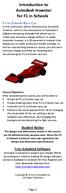 Introduction to Autodesk Inventor for F1 in Schools F1 in Schools Race Car In this course you will be introduced to Autodesk Inventor, which is the centerpiece of Autodesk s digital prototyping strategy
Applying a circular load. Immediate and consolidation settlement. Deformed contours. Query points and query lines. Graph query.
 Quick Start Tutorial 1-1 Quick Start Tutorial This quick start tutorial will cover some of the basic features of Settle3D. A circular load is applied to a single soil layer and settlements are examined.
Steady Flow: Laminar and Turbulent in an S-Bend
 STAR-CCM+ User Guide 6663 Steady Flow: Laminar and Turbulent in an S-Bend This tutorial demonstrates the flow of an incompressible gas through an s-bend of constant diameter (2 cm), for both laminar and
Linear Static Analysis of a Cantilever Beam Using Beam Library (SI Units)
 APPENDIX A Linear Static Analysis of a Cantilever Beam Using Beam Library (SI Units) Objectives: Create a geometric representation of a cantilever beam. Use the geometry model to define an MSC.Nastran
Customer Training Material. ANSYS Mechanical Basics. Mechanical. ANSYS, Inc. Proprietary 2010 ANSYS, Inc. All rights reserved. WS2.
 Workshop 2.1 ANSYS Mechanical Basics Introduction to ANSYS Mechanical WS2.1-1 Notes on Workshop 2.1 The first workshop is extensively documented. As this course progresses, students will become more familiar
CATIA V5 Tutorials. Mechanism Design & Animation. Release 18. Nader G. Zamani. University of Windsor. Jonathan M. Weaver. University of Detroit Mercy
 CATIA V5 Tutorials Mechanism Design & Animation Release 18 Nader G. Zamani University of Windsor Jonathan M. Weaver University of Detroit Mercy SDC PUBLICATIONS Schroff Development Corporation www.schroff.com
ABAQUS Tutorial. 3D Modeling
 Spring 2011 01/21/11 ABAQUS Tutorial 3D Modeling This exercise intends to demonstrate the steps you would follow in creating and analyzing a simple solid model using ABAQUS CAE. Introduction A solid undergoes
Introduction to Autodesk Inventor for F1 in Schools
 F1 in Schools race car Introduction to Autodesk Inventor for F1 in Schools In this course you will be introduced to Autodesk Inventor, which is the centerpiece of Autodesk s Digital Prototyping strategy
Understand the Sketcher workbench of CATIA V5.
 Chapter 1 Drawing Sketches in Learning Objectives the Sketcher Workbench-I After completing this chapter you will be able to: Understand the Sketcher workbench of CATIA V5. Start a new file in the Part
Workshop. Tennis Racket Simulation using Abaqus
 Introduction Workshop Tennis Racket Simulation using Abaqus In this workshop you will become familiar with the process of creating a model interactively by using Abaqus/CAE. You will create the tennis
Introduction to CATIA V5
 Introduction to CATIA V5 Release 16 (A Hands-On Tutorial Approach) Kirstie Plantenberg University of Detroit Mercy SDC PUBLICATIONS Schroff Development Corporation www.schroff.com www.schroff-europe.com
SpaceClaim Introduction Training Session. A SpaceClaim Support Document
 SpaceClaim Introduction Training Session A SpaceClaim Support Document In this class we will walk through the basic tools used to create and modify models in SpaceClaim. Introduction We will focus on:
Sample Table. Columns. Column 1 Column 2 Column 3 Row 1 Cell 1 Cell 2 Cell 3 Row 2 Cell 4 Cell 5 Cell 6 Row 3 Cell 7 Cell 8 Cell 9.
 Working with Tables in Microsoft Word The purpose of this document is to lead you through the steps of creating, editing and deleting tables and parts of tables. This document follows a tutorial format
CATIA Electrical Harness Design TABLE OF CONTENTS
 TABLE OF CONTENTS Introduction...1 Electrical Harness Design...2 Electrical Harness Assembly Workbench...4 Bottom Toolbar...5 Measure...5 Electrical Harness Design...7 Defining Geometric Bundles...7 Installing
ADMINISTRATORS GUIDE EPISUITE 6
 ADMINISTRATORS GUIDE EPISUITE 6 A quick tutorial on how to set up and implement Episuite Software created by IDentiphoto Specialists in IDentification 1810 Joseph Lloyd Pkwy. Willoughby, OH 44094 Phone:
FEMM 4.2 Magnetostatic Tutorial 1. David Meeker [email protected]. January 25, 2006. 1. Introduction
 FEMM 4.2 Magnetostatic Tutorial 1 David Meeker [email protected] January 25, 2006 1. Introduction Finite Element Method Magnetics (FEMM) is a finite element package for solving 2D planar and axisymmetric
CATIA V5 FEA Tutorials Releases 12 & 13
 CATIA V5 FEA Tutorials Releases 12 & 13 Nader G. Zamani University of Windsor SDC PUBLICATIONS Schroff Development Corporation www.schroff.com www.schroff-europe.com Visit our website to learn more about
SDC. Schroff Development Corporation WWW.SDCACAD.COM PUBLICATIONS. MultiMedia CD by Jack Zecher
 MultiMedia CD by Jack Zecher An audioi/visual presentation of the tutorial exercises SDC PUBLICATIONS Schroff Development Corporation WWW.SDCACAD.COM AutoCAD 2002 Tutorial 2-1 Lesson 2 Geometric Construction
Part Design. Page 1 1997 2001 DASSAULT SYSTEMES. IBM Product Lifecycle Management Solutions / Dassault Systemes
 Part Design Page 1 Tutorial Objectives Description This tutorial is an introduction to Part Design. Message This tutorial illustrates how CATIA can Design precise 3D mechanical parts with an intuitive
Autodesk Fusion 360: Assemblies. Overview
 Overview In this module you will learn how different components can be put together to create an assembly. We will use several tools in Fusion 360 to make sure that these assemblies are constrained appropriately
Pro/ENGINEER Wildfire 5.0 Introduction to Surface Modeling
 Introduction Several advanced surface types are available as listed below. Variable Section Sweep Boundary Blend Section to Surfaces Blend Surface to Surface Blend A surface is created by sweeping a single
TABLE OF CONTENTS. INTRODUCTION... 5 Advance Concrete... 5 Where to find information?... 6 INSTALLATION... 7 STARTING ADVANCE CONCRETE...
 Starting Guide TABLE OF CONTENTS INTRODUCTION... 5 Advance Concrete... 5 Where to find information?... 6 INSTALLATION... 7 STARTING ADVANCE CONCRETE... 7 ADVANCE CONCRETE USER INTERFACE... 7 Other important
Tutorial for laboratory project #2 Using ANSYS Workbench. For Double Pipe Heat Exchanger
 Tutorial for laboratory project #2 Using ANSYS Workbench For Double Pipe Heat Exchanger 1. Preparing ANSYS Workbench Go to Start Menu/All Programs/Simulation/ANSYS 12.1/Workbench. In the toolbox menu in
Learning Module 4 - Thermal Fluid Analysis Note: LM4 is still in progress. This version contains only 3 tutorials.
 Learning Module 4 - Thermal Fluid Analysis Note: LM4 is still in progress. This version contains only 3 tutorials. Attachment C1. SolidWorks-Specific FEM Tutorial 1... 2 Attachment C2. SolidWorks-Specific
The following is an overview of lessons included in the tutorial.
 Chapter 2 Tutorial Tutorial Introduction This tutorial is designed to introduce you to some of Surfer's basic features. After you have completed the tutorial, you should be able to begin creating your
Wireframe and Surface
 Wireframe and Surface Preface What's New Getting Started Basic Tasks Workbench Description Glossary Index Dassault Systèmes 1994-99. All rights reserved. Preface CATIA Version 5 Wireframe and Surface allows
MET 306. Activity 8a. Mechanism Design Creo 2.0 Level 7 POINT A GROUND LINK LINK 1 LINK 2 LINK 3 POINT B 10/15/2010 1
 Mechanism Design Creo 2.0 Level 7 POINT A LINK 1 GROUND LINK LINK 2 LINK 3 POINT B 10/15/2010 1 Download parts ground, key, link_1, link_2, link_3 and pulley from the V:/MET_306/Activity_8_Creo drive.
3D-GIS in the Cloud USER MANUAL. August, 2014
 3D-GIS in the Cloud USER MANUAL August, 2014 3D GIS in the Cloud User Manual August, 2014 Table of Contents 1. Quick Reference: Navigating and Exploring in the 3D GIS in the Cloud... 2 1.1 Using the Mouse...
Creating a Poster in PowerPoint 2010. A. Set Up Your Poster
 View the Best Practices in Poster Design located at http://www.emich.edu/training/poster before you begin creating a poster. Then in PowerPoint: (A) set up the poster size and orientation, (B) add and
10. THERM DRAWING TIPS
 10. THERM DRAWING TIPS 10.1. Drawing Tips The THERM User's Manual describes in detail how to draw cross-sections in THERM. This section of the NFRC Simualation Training Manual presents some additional
Essay 5 Tutorial for a Three-Dimensional Heat Conduction Problem Using ANSYS Workbench
 Essay 5 Tutorial for a Three-Dimensional Heat Conduction Problem Using ANSYS Workbench 5.1 Introduction The problem selected to illustrate the use of ANSYS software for a three-dimensional steadystate
Excel 2007 Basic knowledge
 Ribbon menu The Ribbon menu system with tabs for various Excel commands. This Ribbon system replaces the traditional menus used with Excel 2003. Above the Ribbon in the upper-left corner is the Microsoft
Personal Call Manager User Guide. BCM Business Communications Manager
 Personal Call Manager User Guide BCM Business Communications Manager Document Status: Standard Document Version: 04.01 Document Number: NN40010-104 Date: August 2008 Copyright Nortel Networks 2005 2008
Learning Module 6 Linear Dynamic Analysis
 Learning Module 6 Linear Dynamic Analysis What is a Learning Module? Title Page Guide A Learning Module (LM) is a structured, concise, and self-sufficient learning resource. An LM provides the learner
AutoDWG DWGSee DWG Viewer. DWGSee User Guide
 DWGSee User Guide DWGSee is comprehensive software for viewing, printing, marking and sharing DWG files. It is fast, powerful and easy-to-use for every expert and beginners. Starting DWGSee After you install
Tutorial: 3D Pipe Junction Using Hexa Meshing
 Tutorial: 3D Pipe Junction Using Hexa Meshing Introduction In this tutorial, you will generate a mesh for a three-dimensional pipe junction. After checking the quality of the first mesh, you will create
Composite Surfaces Tutorial
 Composite Surfaces Tutorial 4-1 Composite Surfaces Tutorial This tutorial will use the same model as the Materials & Loading Tutorial (with some modifications), to demonstrate how to perform a circular
Chapter 9. Editing Features. Learning Objectives
 Chapter 9 Editing Features Learning Objectives After completing this chapter, you will be able to: Edit features. Edit sketches of the sketch based features. Edit the sketch plane of the sketch based features.
ME 24-688 Week 11 Introduction to Dynamic Simulation
 The purpose of this introduction to dynamic simulation project is to explorer the dynamic simulation environment of Autodesk Inventor Professional. This environment allows you to perform rigid body dynamic
Tutorial for Tracker and Supporting Software By David Chandler
 Tutorial for Tracker and Supporting Software By David Chandler I use a number of free, open source programs to do video analysis. 1. Avidemux, to exerpt the video clip, read the video properties, and save
Introduction to the TI-Nspire CX
 Introduction to the TI-Nspire CX Activity Overview: In this activity, you will become familiar with the layout of the TI-Nspire CX. Step 1: Locate the Touchpad. The Touchpad is used to navigate the cursor
Welcome to Corel DESIGNER, a comprehensive vector-based drawing application for creating technical graphics.
 Importing 3D models Welcome to Corel DESIGNER, a comprehensive vector-based drawing application for creating technical graphics. In this tutorial, you will modify a three-dimensional model of a transmission
A Guide to the free mesh program Discretizer with OpenFOAM for CFD (Computational Fluid Dynamics)
 Discretizer Manual Release date 09/01/10 Side 1 of 13 A Guide to the free mesh program Discretizer with OpenFOAM for CFD (Computational Fluid Dynamics) Homepage: http://www.discretizer.org/ Creator of
CosmosWorks Centrifugal Loads
 CosmosWorks Centrifugal Loads (Draft 4, May 28, 2006) Introduction This example will look at essentially planar objects subjected to centrifugal loads. That is, loads due to angular velocity and/or angular
Creating a Poster Presentation using PowerPoint
 Creating a Poster Presentation using PowerPoint Course Description: This course is designed to assist you in creating eye-catching effective posters for presentation of research findings at scientific
Quickstart for Desktop Version
 Quickstart for Desktop Version What is GeoGebra? Dynamic Mathematics Software in one easy-to-use package For learning and teaching at all levels of education Joins interactive 2D and 3D geometry, algebra,
First Level: 2D Fundamentals. by Randy H. Shih Oregon Institute of Technology
 AutoCAD 2008 Tutorial First Level: 2D Fundamentals by Randy H. Shih Oregon Institute of Technology MultiMedia CD by Jack Zecher Indiana University Purdue University Indianapolis SDC PUBLICATIONS Schroff
Creating Custom Crystal Reports Tutorial
 Creating Custom Crystal Reports Tutorial 020812 2012 Blackbaud, Inc. This publication, or any part thereof, may not be reproduced or transmitted in any form or by any means, electronic, or mechanical,
This tutorial assumes that Visual3D has been installed and that a model has been created as described in Tutorial #1.
 C-Motion Online Documentation Visual3D : Tutorial : Data Visualization Objectives (# 1318) This tutorial assumes that Visual3D has been installed and that a model has been created as described in Tutorial
The number of parameters required for authoring an ipart depends on the type of the part you are publishing.
 Publishing and Styles In This Exercise This Skill Builder demonstrates how to create a tube and pipe ipart, publish it into a custom Tube & Pipe Library, create a style using published parts, and then
CATIA Functional Tolerancing & Annotation TABLE OF CONTENTS
 TABLE OF CONTENTS Introduction...1 Functional Tolerancing and Annotation...2 Pull-down Menus...3 Insert...3 Functional Tolerancing and Annotation Workbench...4 Bottom Toolbar Changes...5 3D Grid Toolbar...5
The elements used in commercial codes can be classified in two basic categories:
 CHAPTER 3 Truss Element 3.1 Introduction The single most important concept in understanding FEA, is the basic understanding of various finite elements that we employ in an analysis. Elements are used for
Project Setup and Data Management Tutorial
 Project Setup and Heavy Construction Edition Version 1.20 Corporate Office Trimble Navigation Limited Engineering and Construction Division 5475 Kellenburger Road Dayton, Ohio 45424-1099 U.S.A. Phone:
DWGSee Professional User Guide
 DWGSee Professional User Guide DWGSee is comprehensive software for viewing, printing, marking and sharing DWG files. It is fast, powerful and easy-to-use for every expert and beginners. Starting DWGSee
Visual Tutorial Basic Edition 1. Visual. Basic Edition Tutorial. www.visuallightingsoftware.com
 Visual Tutorial Basic Edition 1 Visual Basic Edition Tutorial www.visuallightingsoftware.com Visual Tutorial Basic Edition 2 Basic Edition Tutorial Introduction In this tutorial, you will use the Visual
Figure 1 - Delta Theta Input Selection
 Creating Cams in Pro/Engineer Wildfire Using DYNACAM Mechanical Engineering Mechanical Design Created by: David E. Yamartino M.S. Mechanical Engineering May 2004 April 12, 2004 Objective: The objective
LESSON 7: IMPORTING AND VECTORIZING A BITMAP IMAGE
 LESSON 7: IMPORTING AND VECTORIZING A BITMAP IMAGE In this lesson we ll learn how to import a bitmap logo, transform it into a vector and perform some editing on the vector to clean it up. The concepts
Solved with COMSOL Multiphysics 4.3
 Vibrating String Introduction In the following example you compute the natural frequencies of a pre-tensioned string using the 2D Truss interface. This is an example of stress stiffening ; in fact the
Real Time Rendering. Preface What's New Getting Started Basic Tasks Advanced Tasks Workbench Description Index
 Real Time Rendering Preface What's New Getting Started Basic Tasks Advanced Tasks Workbench Description Index Dassault Systèmes 1994-99. All rights reserved. Preface CATIA Version 5 Real Time Rendering
SolidWorks: Mirror, Revolve, and. Introduction to Robotics
 SolidWorks: Mirror, Revolve, and Circular Pattern Introduction to Robotics Let s Review At this point we have learned the following: Extrude Boss/Base Extruded Cut Adding Relations and Dimensions Linear
GAMBIT Demo Tutorial
 GAMBIT Demo Tutorial Wake of a Cylinder. 1.1 Problem Description The problem to be considered is schematically in fig. 1. We consider flow across a cylinder and look at the wake behind the cylinder. Air
Structure Design. Preface What's New? Getting Started Basic Tasks Advanced Tasks Workbench Description Customizing Glossary Index
 Structure Design Preface What's New? Getting Started Basic Tasks Advanced Tasks Workbench Description Customizing Glossary Index Dassault Systèmes 1994-2000. All rights reserved. Preface CATIA Version
Visualization of 2D Domains
 Visualization of 2D Domains This part of the visualization package is intended to supply a simple graphical interface for 2- dimensional finite element data structures. Furthermore, it is used as the low
PowerPoint 2007 Basics Website: http://etc.usf.edu/te/
 Website: http://etc.usf.edu/te/ PowerPoint is the presentation program included in the Microsoft Office suite. With PowerPoint, you can create engaging presentations that can be presented in person, online,
Tutorial Plate Concrete
 Tutorial Plate Concrete Release: SCIA Engineer 2008.0 Req. Module: ESA.00 Base Modeller ESA.01 ESAS.00 ESA.08.x 2D Surfaces Linear Statics 2D a language module Manual: SCIA Engineer Tutorial Plate Concrete
ABOUT THIS DOCUMENT ABOUT CHARTS/COMMON TERMINOLOGY
 A. Introduction B. Common Terminology C. Introduction to Chart Types D. Creating a Chart in FileMaker E. About Quick Charts 1. Quick Chart Behavior When Based on Sort Order F. Chart Examples 1. Charting
Migrating to Excel 2010 from Excel 2003 - Excel - Microsoft Office 1 of 1
 Migrating to Excel 2010 - Excel - Microsoft Office 1 of 1 In This Guide Microsoft Excel 2010 looks very different, so we created this guide to help you minimize the learning curve. Read on to learn key
Ohio University Computer Services Center August, 2002 Crystal Reports Introduction Quick Reference Guide
 Open Crystal Reports From the Windows Start menu choose Programs and then Crystal Reports. Creating a Blank Report Ohio University Computer Services Center August, 2002 Crystal Reports Introduction Quick
Presentations and PowerPoint
 V-1.1 PART V Presentations and PowerPoint V-1.2 Computer Fundamentals V-1.3 LESSON 1 Creating a Presentation After completing this lesson, you will be able to: Start Microsoft PowerPoint. Explore the PowerPoint
Mastercam X6 Basic 3D Design
 Basic 3D Design mastercam x getting started tutorials Mastercam X6 Basic 3D Design December 2011 Be sure you have the latest information! Information might have been changed or added since this document
How To Use Spss
 1: Introduction to SPSS Objectives Learn about SPSS Open SPSS Review the layout of SPSS Become familiar with Menus and Icons Exit SPSS What is SPSS? SPSS is a Windows based program that can be used to
DataPA OpenAnalytics End User Training
 DataPA OpenAnalytics End User Training DataPA End User Training Lesson 1 Course Overview DataPA Chapter 1 Course Overview Introduction This course covers the skills required to use DataPA OpenAnalytics
An introduction to 3D draughting & solid modelling using AutoCAD
 An introduction to 3D draughting & solid modelling using AutoCAD Faculty of Technology University of Plymouth Drake Circus Plymouth PL4 8AA These notes are to be used in conjunction with the AutoCAD software
Getting Started with CATIA Version 5
 WB Getting Started with CATIA Version 5 Page 1 CATIA User Interface Let s review the following key features: Multi-document support Standard and specific menus & toolbars (File, Edit, Insert, ) Standard
NATIONAL TECHNICAL UNIVERSITY OF ATHENS (N.T.U.A.)
 NATIONAL TECHNICAL UNIVERSITY OF ATHENS (N.T.U.A.) MECHANICAL ENGINEERING DEPARTMENT LABORATORY OF MACHINES ELEMENTS Ansys Multiphysics (v. 12) tutorial for electrostatic finite element analysis on spur
10.0-2. Finite Element Modeling
 What s New in FEMAP FEMAP 10.0 and 10.0.1 include enhancements and new features in: User Interface on page 3 Meshing on page 23 Mesh Associativity on page 33 Properties on page 33 Functions on page 35
Interactive Drafting
 Interactive Drafting Preface What's New Getting Started Basic Tasks Advanced Tasks Workbench Description Customizing Glossary Index Dassault Systèmes 1994-99. All rights reserved. Preface CATIA Version
Petrel TIPS&TRICKS from SCM
 Petrel TIPS&TRICKS from SCM Knowledge Worth Sharing Import and Digitize from a Bitmap Using Petrel Often a map with culture lines, contours or well spots is provided in paper form and must be entered into
Produced by Flinders University Centre for Educational ICT. PivotTables Excel 2010
 Produced by Flinders University Centre for Educational ICT PivotTables Excel 2010 CONTENTS Layout... 1 The Ribbon Bar... 2 Minimising the Ribbon Bar... 2 The File Tab... 3 What the Commands and Buttons
PowerPoint 2013: Basic Skills
 PowerPoint 2013: Basic Skills Information Technology September 1, 2014 1 P a g e Getting Started There are a variety of ways to start using PowerPoint software. You can click on a shortcut on your desktop
Chapter 4: Website Basics
 1 Chapter 4: In its most basic form, a website is a group of files stored in folders on a hard drive that is connected directly to the internet. These files include all of the items that you see on your
Learning Module 5 Buckling Analysis
 Learning Module 5 Buckling Analysis Title Page Guide What is a Learning Module? A Learning Module (LM) is a structured, concise, and self-sufficient learning resource. An LM provides the learner with the
ICEM CFD Tutorial. Simple Duct Grid
 ICEM CFD Tutorial Simple Duct Grid Scott J. Ormiston Gavin Joyce Department of Mechanical Engineering Winnipeg, Manitoba Canada V1.01 17 January 2013 Department of Mechanical Engineering Page 1 of 22 1.