
Technical Application Notes
|
|
|
- Gyles McBride
- 9 years ago
- Views:
Transcription
1 Technical Application Notes Applying the Autotune Feature to SERCOS Drives Applications Purpose of this Document: This document serves as a guide to (a) manually adjusting system gains after a successful, albeit, sub-optimal auto-tune, or (b) manually tuning an axis that cannot be auto-tuned when coupled to the load. The following are general recommendations. Since each machine application is unique, special consideration should be made on a per machine basis. Application Description: SERCOS configuration using RS Logix 5000 has been simplified, because when setting up a program, we know drive and motor parameters. Armed with that information a default out of the box set of gains can be established for the combination of drive amplifier, and motor selected. These gains assume a 1:1 inertia match, and add no integral gain into the system, providing a stable set of gains for commissioning a system. These gains, while adequate, may not provide the positioning accuracy required for the application. What is not known about the application is the inertia of the mechanical system connected to the servo shaft, and the stiffness of any couplings connected to the shaft. Nor do we know the performance requirements of the system. These are the big questions that must be answered to set up a stable system that performs as required. It would be an atypical system where the user has calculated all of the mechanical torques of the system (and calculated them precisely). But most mechanical designers know their positioning accuracy (requirements) and general system inertia. Using this information, we will demonstrate how auto tuning takes these values into consideration and how we can use the auto tuned values to serve as a baseline tune or possibly used as the final values. Most systems can be auto-tuned with the load attached. However, some applications require manual adjustment of multiple parameters to achieve optimal performance while other applications cannot be autotuned with the load attached. Control System Description the following block diagram depicts the control hardware used in this application, and shows the interaction between the CLX controller and the servo (loop).

2 Logix Controller Motion Planner ControlBus Coarse Update: 1-32 msec 1756M08SE 2nd-order Fine Interpolation SERCOS SERCOS Update: 1-2 msec SERCOS Drive Servo Loop Kinetix Drive Servo Update: 250 usec Control challenges and decisions that must be made before proceeding. Tight follower (Gearing/Camming) Smooth motion Zero Overshoot. (Point to Point ing) After a successful auto-tune procedure is run, you must decide which performance is desirable: (a) decreasing position error or (b) one that moves smartly to a position without jerking the load. If you decide in favor of low position error, then your system is subject to fast Maximum Acceleration and Deceleration, and will posses high jerk rates. If you opt for smoother moves, then you have lower Maximum Acceleration and Deceleration values and less jerk, but increased position error. Just as several new model cars permit the driver to modify transmission shift points to run in Sport Mode for optimal driving conditions, Winter Mode for harsh conditions, or Normal Mode for balanced operation, you should strive for a balance between all-out performance and smoothness in tuning your system. Tuning a digital system (Sercos) is a little different than an analog system ( M02AE) because the servo loops are closed at the drive with Sercos. On the Analog module(m02ae) the loop is closed at the M02AE module and a +-10v analog signal is generated at the M02AE module. Also with sercos there are a number of loop types that are available. The M02AE supports servo drive interfacing with a torque servo drive, in which case both the velocity and position loops are closed within the M02AE. When interfacing with a velocity servo drive, only the position loop is closed in the M02AE. The velocity loop is closed in the drive With SERCOS you have 7 different loop types to consider. Yikes! Let s explore each one and determine which is the right choice for your application. 2

3 Figure 2: Less positioning accuracy, but smoother motion. The red pen in the trend is, notice it has much greater magnitude if smoother motion is required. Control Solution. Servo is the most common and the default configuration. This is similar to the servo drive configuration for the M02AE module. Unlike the M02AE, the M08SE does none of the fine interpolation. It is essentially a communications card to the drive, with the drive performing the fine interpolation. If you look at the diagram below, you can see that the motion group and coarse update performs the same as always, i.e. the Processor does the coarse loop calculations and then sends that information out at a regular schedule, which the Coarse Update Rate. The amount of time varies by the processor type, number of axes, and the types of moves each axis is performing, because it takes time to calculate the move and update the position and velocity command for each axis, then send it out as a command to the M08SE modules. The next layer is the M08SE to the drive SERCOS Interface. This is either 1ms or 2ms based on axis count (1ms <=4 axes). This is also referred to as the Ring Rate. The drive also sends back axis and drive information each ring cycle. As seen in this diagram you will have 8 ring cycles per coarse update on the M08SE 1 network, and 4 ring cycles on the M08SE 2 network, with this information being less than 1ms old when the coarse update comes through to pick up the new data. Servo The default loop configuration, smoothest and most stable because it uses motor mounted feedback for position and velocity feedback. iliary Servo (Not applicable to Ultra 3000 drives) Tight position control, uses auxiliary(load) mounted feedback for position and velocity feedback. Could prove troublesome if mechanics are not tight. Dual Servo (Not applicable to Ultra 3000 drives) Tight position control, uses the auxiliary (load) mounted feedback device for position feedback and the motor mounted feedback device to provide velocity feedback. Could prove troublesome if mechanics are not tight. 3

4 Logix 5563 Processo MOTION GROUP Coarse Update 4ms12 Axes M08SE 1 M16SE SERCOS RING 1 1 MS UPDATE 4 Axes SERCOS RING 2 2 MS UPDATE 8 Axes usec. Servo Update 250usec. Servo Update 250usec. Servo Update 250usec. Servo Update Dual Servo - Provides full position servo control using only the motor-mounted feedback device to provide position and velocity feedback. Unlike the Servo configuration, both command position and command velocity are applied to the loop. iliary Dual Servo - Uses only the auxiliary mounted feedback device to provide position and velocity feedback. Unlike the Servo configuration, both command position and command velocity are applied to the loop Servo Pure velocity control. Provides velocity servo control using the motor-mounted feedback device. Servo Pure torque control. Provides torque servo control using only the motor-mounted feedback device for commutation. This does not consider position at all, and can be adjusted with the value. 4

5 Servo The Servo configuration provides full position servo control using only the motor mounted feedback device to provide position and velocity feedback. This servo configuration is a good choice in applications where smoothness and stability are more important that positioning accuracy. ing accuracy is limited due to the fact that the controller has no way of compensating for nonlinearity in the mechanics external to the motor. Note that the motor mounted feedback device also provides motor position information necessary for commutation. Synchronous input data to the servo loop includes,, and. These values are updated at the coarse update rate of the associated motion group. The value is derived directly from the output of the motion planner, while the and values are derived from the current value of the corresponding attributes. These offset attributes may be changed programmatically via SSV instructions or direct Tag access which, when used in conjunction with future Function Block programs, provides custom outer control loop capability. Servo Config = Servo d 2 /dt Acc d/dt Vel Pos/Neg Fine Interpolator Pos P Accel Vel P Scaling Frict. Comp Amplifier Pos I Vel I Polarity ulator 5

6 iliary Servo The iliary Servo configuration provides full position servo control using an auxiliary (i.e., external to the motor) feedback device to provide position and velocity feedback. This servo configuration is a good choice in applications where positioning accuracy is important. The smoothness and stability may be limited, however, due to the mechanical non-linearity external to the motor. Note, that the motor mounted feedback device is still required to provide motor position information necessary for commutation. Synchronous input data to the servo loop includes,, and. These values are updated at the coarse update rate of the associated motion group. The value is derived directly from the output of the motion planner, while the and values are derived from the current value of the corresponding attributes. These offset attributes may be changed programmatically via SSV instructions or direct Tag access which, when used in conjunction with future Function Block programs, provides custom outer control loop capability. Servo Config = Servo d 2 /dt Acc d/dt Vel Pos/Neg Fine Interpolator Pos P Vel P Accel Scaling Frict. Comp Amplifier Pos I Vel I Polarity ulator 6

7 Dual Servo This configuration provides full position servo control using the auxiliary feedback device for position feedback and the motor mounted feedback device to provide velocity feedback. This servo configuration combines the advantages of accurate positioning associated with the auxiliary position servo with the smoothness and stability of the motor position servo configuration. Note that the motor mounted feedback device also provides motor position information necessary for commutation. Synchronous input data to the servo loop includes,, and. These values are updated at the coarse update rate of the associated motion group. The value is derived directly from the output of the motion planner, while the and values are derived from the current value of the corresponding attributes. These offset attributes may be changed programmatically via SSV instructions or direct Tag access which, when used in conjunction with future Function Block programs, provides custom outer control loop capability. Servo Config = Dual Velocit d 2 /dt Acc d/dt Vel P Pos/Ne Positio Comman d(coarse ) Fine Interpolato Positio Comman d Positio k Velocit Comman Positio d Pos P Accu Pos I Positio Integrato Velocit k Accu Velocit Vel I Velocit Integrato Accel Comman d Vel P Scaling Frict. Comp kpolarit Comman Amplifie Hardwar kpositio kchanne k Positio k(coarse Positio ulator Hardwar kpositio kchanne l 7

8 Dual Servo The Dual Servo configuration provides full position servo control using only the motor mounted feedback device to provide position and velocity feedback. Unlike the Servo configuration, however, both command position and command velocity are applied to the loop to provide smoother feedforward behavior. This servo configuration is a good choice in applications where smoothness and stability are important. ing accuracy is limited due to the fact that the controller has no way of compensating for non-linearity in the mechanics external to the motor. Note that the motor mounted feedback device also provides motor position information necessary for commutation. Synchronous input data to the servo loop includes,, and. These values are updated at the coarse update rate of the associated motion group. The and values are derived directly from the output of the motion planner, while the value is derived from the current value of the corresponding attributes. The velocity offset attribute may be changed programmatically via SSV instructions or direct Tag access which, when used in conjunction with future Function Block programs, provides custom outer control loop capability. Servo Config = Dual d/dt Acc Fine Interpolator Vel Pos/Neg Fine Interpolator Pos P Vel P Accel Scaling Frict. Comp Amplifier Pos I Vel I Polarity ulator 8

9 iliary Dual Servo The iliary Dual Servo configuration provides full position servo control using only the auxiliary mounted feedback device to provide position and velocity feedback. Unlike the Servo configuration, however, both command position and command velocity are applied to the loop to provide smoother feedforward behavior. This servo configuration is a good choice in applications where smoothness and stability are important as well as positioning accuracy. Note, that the motor mounted feedback device is still required to provide motor position information necessary for commutation. Synchronous input data to the servo loop includes,, and. These values are updated at the coarse update rate of the associated motion group. The and values are derived directly from the output of the motion planner, while the value is derived from the current value of the corresponding attributes. The velocity offset attribute may be changed programmatically via SSV instructions or direct Tag access which, when used in conjunction with future Function Block programs, provides custom outer control loop capability. Servo Config = Dual d/dt Acc Fine Interpolator Vel Pos/Neg Fine Interpolator Pos P Vel P Accel Scaling Frict. Comp Amplifier Pos I Vel I Polarity ulator 9

10 Servo The Servo configuration provides velocity servo control using the motor mounted feedback device. Synchronous input data to the servo loop includes,, and. These values are updated at the coarse update rate of the associated motion group. The value is derived directly from the output of the motion planner, while the and values are derived from the current value of the corresponding attributes. These offset attributes may be changed programmatically via SSV instructions or direct Tag access which, when used in conjunction with future Function Block programs, provides custom outer control loop capability. Servo Config = Servo d/dt Acc Pos/Neg Vel Pos/Neg Accel Pos/Neg Fine Interpolator Vel Accel Accel Vel P Scaling Frict. Comp Amplifier Vel I Polarity ulator Servo The Servo configuration provides torque servo control using only the motor mounted feedback device for commutation. Synchronous input data to the servo loop includes only the. These values are updated at the coarse update rate of the associated motion group. The value is derived from the current value of the corresponding attribute. This offset attribute may be changed programmatically via SSV instructions or direct Tag access which, when used in conjunction with future Function Block programs, provides custom outer control loop capability. Servo Config = Servo Pos/Neg 0 Frict. Comp Amplifier Polarity ulator 10

11 Now that we have determined the correct loop type, the next major considerations are: Calculating the inertia of the system: Determine the peak motor torque required to accelerate the load. If the motor must accelerate within a specified time, determine the system inertia using the formula sheets for your specific power train configuration, otherwise go to step 5. Use the time (Time) to achieve peak rpm, change in rpm (Drpm), power train inertia (System Inertia) and load torque (Tl) in one of the two formulas that follow: Where: Peak = total motor torque required to accelerate the load in lb.-ft. System Inertia = total system inertia (including motor) in lb.-ft.2 Time = acceleration time (in seconds) Tl = load torque present at the motor shaft during accel in lb.-ft. Drpm = change in motor velocity during acceleration time. System Inertia in lb.-in.-s2 If the motor s total time to accelerate/decelerate (t1 + t3) exceeds 20% of the total cycle time (t1+t2+t3+t4), determine the motor s average torque with the formula shown. Where: Trms: The motor s RMS or average torque over the duty cycle. (Expressed in lb.-in. or lb.-ft. The same units must be used throughout the formula.) Tpa: peak torque to accelerate to maximum speed. (Expressed in lb.-in. or lb.-ft. The same units must be used throughout the formula.) Tss: torque present at the motor shaft during constant speed segment. (Expressed in lb.-in. or lb.-ft. The same units must be used throughout the formula.) Tpd: peak torque to decelerate to zero speed. (Expressed in lb.-in. or lb.-ft. The same units must be used throughout the formula.) Tr : when motor is at zero speed (typically is Tss). 11

12 This is a system with no load attached. Notice that the velocity feedback tightly follows the velocity command. This is a system with a large inertia mismatch attached. With high inertia load attached, notice how much the velocity feedback lags the command. 12

13 Issue Definition: Case 1: The axis can be auto-tuned coupled to the load, but the performance is not optimal. You can configure the M08SE to interface with any of the 7 loop types but remember that Servo is a good choice in most cases. With the SERCOS Interface, all of the loop types are closed in the drive, so there is no concern about tuning the drive separately. Therefore, in all cases the drive tuning method identical. In most cases you can connect the load and perform the auto-tune function, and the system should automatically set gains that result in acceptable servo operation. However, this is not always the case. For example, the motor could be coupled to a load that has a high inertia mismatch (motor sizing problem) or lots of compliance (poor choices in coupling to load). Such systems frequently require manual adjustment to achieve optimal performance. With newer motor technology, greater resolution is available, and this has been extremely beneficial in compensating for inertia mismatch. There are two cases to consider where the auto-tune is sub-optimal: Auto-tuned axis is too sluggish. Need to squeeze more bandwidth out of the system. Auto-tuned axis is tuned too hot. Need to back off the servo bandwidth to achieve a more damped response. The manual tuning procedure is the same for either case. In this procedure we use the Scaling gain as a convenient real-time handle to adjust the bandwidth of the servo loop. If your axis can be moved back and forth, a good method to determine the performance of the system is a battery box (Step Response type) program. Some use an oscilloscope to watch the velocity profiles, but we have found that the Trending function included in RSLogix 5000 works well to provide a visual reference. 13

14 This trend profile shows, and. This axis has a high inertia mismatch, and shows some overshoot and unsteadiness. Two of the more critical values to trend are: and. You may also wish to trend and. The Knobs and Adjustments (The fun stuff): By clicking Manual Adjust, you can tweak the gains wh the system is moving to view the results with RS Trend. Integral : The higher the I gain value, the faster the axis is driven to the zero condition. Unfortunately, I control is intrinsically unstable. Too much I results in axis oscillation and servo instability. You can add I gain to the loop or the loop. If you add I gain in both loops they tend to fight each other. Therefore, we typically recommend adding I gain in the loop only. The software allows you to add it into both, but you will most likely see that doing so will cause instability in positioning performance. Feedforward : This gain scales the current and adds it as an offset to the velocity servo command input. Hence, the Feedforward allows the following error of the servo system to be reduced to nearly zero when running at a constant speed 14

15 Acceleration Feedforward : This gain scales the current Acceleration and adds it as an offset to the Servo generated by the servo loop. Hence, the Acceleration Feedforward allows the following error of the servo system to be reduced to nearly zero when running at a constant acceleration. Servo Drive Tuning Method: a. Tune system coupled b. Note Scaling value after tuning. c. Note and P gains At this point if low position error is the goal, try adding Feedforward gain. This value is typically 100%, but you can manually crank it up or down to suit your application. If the system is a little sluggish getting off the line, add Acceleration Feedforward. This value is typically 100%, but you can manually crank it up or down to suit your application. Hint for changing overall gains performance: During the autotune function, one of the popup dialog boxes reports the position and velocity bandwidth. Change both of these by the same factor to maintain parity between the loops. Note: and I gains should be considered mutually exclusive. Do not add I gain if you are using I gain at the drive. Issue Definition: Case 2 - The axis cannot be auto-tuned coupled: This usually happens in an application that has high inertia. We will discuss a method of determining the percentage of measured inertia mismatch and attempt to apply that to the system. It must be noted that motor-to-load sizing should have been done beforehand to select a suitable motor and drive combination for the application. Method: Servo Drive method of determining needed bandwidth adjustment: Using auto tune in RSLogix 5000 tune the motor uncoupled. Take note of the () Scaling value after tuning. Observing all safety precautions, connect the load to the motor and enable the axis. Exercise the axis to determine overall system performance. Leaving the gains as they are, crank up (or down) the Scaling. Increasing this value has the effect of stiffening position performance. By increasing the Scaling value, the system bandwidth is increased, and conversely lowering the Scaling value decreases the bandwidth of the system. Note the Scaling value after cranking it. Use the formula: Initial Scaling / Cranked Scaling = Percent of Bandwidth Change. The next step is critical to proper scaling and system performance! Set the Scaling to the Initial Scaling value. With this in mind, applications using MP-Series s with high resolution encoders can push the envelope and go beyond the old inertia mismatch rule of thumb of 10:1. They have proven to be stable, in this type of high inertia mismatch application up to 30:1.Greater inertia mismatches are possible depending on the mechanical compliance of the application and the desired acceleration. At some point the servo system will eventually reach the drive or motor peak current limitation as the inertial load increases, and a larger drive and/or motor will be required. For more information on High Resolution see Appnote Pub# 2098-AT002A-EN-P February 2002 GMC-AT001A-EN-P October

16 Important User Information Solid state equipment has operational characteristics differing from those of electromechanical equipment. Safety Guidelines for the Application, Installation and Maintenance of Solid State Controls (Publication SGI-1.1 available from your local Rockwell Automation sales office or online at describes some important differences between solid state equipment and hard-wired electromechanical devices. Because of this difference, and also because of the wide variety of uses for solid state equipment, all persons responsible for applying this equipment must satisfy themselves that each intended application of this equipment is acceptable. In no event will Rockwell Automation, Inc. be responsible or liable for indirect or consequential damages resulting from the use or application of this equipment. The examples and diagrams in this document are included solely for illustrative purposes. Because of the many variables and requirements associated with any particular installation, Rockwell Automation, Inc. cannot assume responsibility or liability for actual use based on the examples and diagrams. No patent liability is assumed by Rockwell Automation, Inc. with respect to use of information, circuits, equipment, or software described in this document. Corporate Headquarters Rockwell Automation, 777 East Wisconsin Avenue, Suite 1400, Milwaukee, WI, USA, Tel: (1) , Fax: (1) Headquarters for Allen-Bradley Products, Rockwell Software Products and Global Manufacturing Solutions Americas: Rockwell Automation, 1201 South Second Street, Milwaukee, WI USA, Tel: (1) , Fax: (1) Europe/Middle East/Africa: Rockwell Automation SA/NV, Vorstlaan/Boulevard du Souverain 36, 1170 Brussels, Belgium, Tel: (32) , Fax: (32) Asia Pacific: Rockwell Automation, 27/F Citicorp Centre, 18 Whitfield Road, Causeway Bay, Hong Kong, Tel: (852) , Fax: (852) Headquarters for Dodge and Reliance Electric Products Americas: Rockwell Automation, 6040 Ponders Court, Greenville, SC USA, Tel: (1) , Fax: (1) Europe/Middle East/Africa: Rockwell Automation, Brühlstraße 22, D Elztal-Dallau, Germany, Tel: (49) , Fax: (49) Asia Pacific: Rockwell Automation, 55 Newton Road, #11-01/02 Revenue House, Singapore , Tel: (65) , Fax: (65) Publication RA-AP009A-EN-P September, 2003 Copyright 2003 Rockwell Automation, Inc. All rights reserved. Printed in USA. 16

Technical Application Notes
 Technical Application Notes Programming ControlLogix-Based Systems to Perform Product Tracking Purpose of this document: To provide the OEM machine designer with a guide to programming/implementing product
Accuracy and Tuning in CNC Machine Tools
 FAMA Technical Article/001 Accuracy and Tuning in CNC Machine Tools Introduction: This article explains how it is possible to achieve a better performance on High Speed CNC Machine Tools. Performance is
Application Note AN-SERV-006
 THIS INFORMATION PROVIDED BY AUTOMATIONDIRECT.COM TECHNICAL SUPPORT IS SUPPLIED "AS IS", WITHOUT ANY GUARANTEE OF ANY KIND. These documents are provided by our technical support department to assist others.
Integrated Motion on the EtherNet/IP Network: Configuration and Startup
 User Manual Original Instructions Integrated Motion on the EtherNet/IP Network: Configuration and Startup ControlLogix, CompactLogix, Kinetix 350, Kinetix 5500, Kinetix 5700, Kinetix 6500, PowerFlex 527,
Active Vibration Isolation of an Unbalanced Machine Spindle
 UCRL-CONF-206108 Active Vibration Isolation of an Unbalanced Machine Spindle D. J. Hopkins, P. Geraghty August 18, 2004 American Society of Precision Engineering Annual Conference Orlando, FL, United States
TwinCAT NC Configuration
 TwinCAT NC Configuration NC Tasks The NC-System (Numeric Control) has 2 tasks 1 is the SVB task and the SAF task. The SVB task is the setpoint generator and generates the velocity and position control
Drive Software Wizards v2.4
 Release Notes Drive Software Wizards v2.4 This release notes describes major revision 2, minor revision 4 of drive software wizards for DriveExplorer (v5.02 and higher), DriveTools SP (v4.01 and higher)
Current Loop Tuning Procedure. Servo Drive Current Loop Tuning Procedure (intended for Analog input PWM output servo drives) General Procedure AN-015
 Servo Drive Current Loop Tuning Procedure (intended for Analog input PWM output servo drives) The standard tuning values used in ADVANCED Motion Controls drives are conservative and work well in over 90%
APPENDIX. SureSERVO QUICK START GUIDE. In This Appendix... Quick Start for SureServo Drives...A 2. Tuning Quick Start for SureServo Drives...
 SureSERVO QUICK START GUIDE APPENDIX BA In This Appendix... Quick Start for SureServo Drives.............A 2 Spin the Motor......................................A 2 Position Mode Quick Start (Pt & Pr)......................A
Advantages of Auto-tuning for Servo-motors
 Advantages of for Servo-motors Executive summary The same way that 2 years ago computer science introduced plug and play, where devices would selfadjust to existing system hardware, industrial motion control
FlexPak 3000 Digital DC Drive Software Reference Manual Version 4.3
 FlexPak 3000 Digital DC Drive Software Reference Manual Version 4.3 Instruction Manual D2-3405-2 The information in this manual is subject to change without notice. Throughout this manual, the following
Ultra3000 Digital Servo Drives
 Ultra3000 Digital Servo Drives Catalog Numbers 2098-DSD-005, -010, and -020 2098-DSD-xxxX 2098-DSD-xxx-SE 2098-DSD-xxx-DN 2098-DSD-xxxX-DN 2098-DSD-030, -075, and -150 2098-DSD-xxxX 2098-DSD-xxx-SE 2098-DSD-xxx-DN
Outline Servo Control
 Outline Servo Control Servo-Motor Drivers Control Modes orque Capability Servo-control Systems Direct/Indirect Control System Control Algorithm Implementation Controller Design by Emulation Discretization
Motor Selection and Sizing
 Motor Selection and Sizing Motor Selection With each application, the drive system requirements greatly vary. In order to accommodate this variety of needs, Aerotech offers five types of motors. Motors
Integrated Motion on SERCOS and EtherNet/IP Systems - Analysis and Comparison
 Integrated Motion on SERCOS and EtherNet/IP Systems - Analysis and Comparison The purpose of this document is to compare and contrast Integrated Motion systems using SERCOS and EtherNet/IP with a ControlLogix
Technical Guide No. 100. High Performance Drives -- speed and torque regulation
 Technical Guide No. 100 High Performance Drives -- speed and torque regulation Process Regulator Speed Regulator Torque Regulator Process Technical Guide: The illustrations, charts and examples given in
Fiber Optic Cable Installation
 Quick Guide Fiber Optic Cable Installation Introduction Fiber optic cables can be easily damaged if they are improperly handled or installed. It is imperative that certain procedures be followed in the
CNC Machine Control Unit
 NC Hardware a NC Hardware CNC Machine Control Unit Servo Drive Control Hydraulic Servo Drive Hydraulic power supply unit Servo valve Servo amplifiers Hydraulic motor Hydraulic Servo Valve Hydraulic Servo
EE 402 RECITATION #13 REPORT
 MIDDLE EAST TECHNICAL UNIVERSITY EE 402 RECITATION #13 REPORT LEAD-LAG COMPENSATOR DESIGN F. Kağan İPEK Utku KIRAN Ç. Berkan Şahin 5/16/2013 Contents INTRODUCTION... 3 MODELLING... 3 OBTAINING PTF of OPEN
10 tips for servos and steppers a simple guide
 10 tips for servos and steppers a simple guide What are the basic application differences between servos and steppers? Where would you choose one over the other? This short 10 point guide, offers a simple
SLC 5/05 Processors Firmware/Operating System ControlFLASH Upgrade
 Installation Instructions SLC 5/05 Processors Firmware/Operating System ControlFLASH Upgrade Catalog Numbers 1747-DU501 Topic Page System Requirements 3 Install ControlFLASH 3 Prior to Running ControlFLASH
PowerFlex 700S and 700H Frame 12 DC Bus Connector Kit
 PowerFlex 700S and 700H Frame 12 DC Bus Connector Kit Installation Instructions This document provides instructions for the installation of a DC bus connector kit for PowerFlex 700S and 700H frame 12 drives
Linear Motion and Assembly Technologies Pneumatics Service. Industrial Ethernet: The key advantages of SERCOS III
 Electric Drives and Controls Hydraulics Linear Motion and Assembly Technologies Pneumatics Service profile Drive & Control Industrial Ethernet: The key advantages of SERCOS III SERCOS III is the open,
Speed Control Methods of Various Types of Speed Control Motors. Kazuya SHIRAHATA
 Speed Control Methods of Various Types of Speed Control Motors Kazuya SHIRAHATA Oriental Motor Co., Ltd. offers a wide variety of speed control motors. Our speed control motor packages include the motor,
Pulse Width Modulated (PWM)
 Control Technologies Manual PWM AC Drives Revision 1.0 Pulse Width Modulated (PWM) Figure 1.8 shows a block diagram of the power conversion unit in a PWM drive. In this type of drive, a diode bridge rectifier
EasyC. Programming Tips
 EasyC Programming Tips PART 1: EASYC PROGRAMMING ENVIRONMENT The EasyC package is an integrated development environment for creating C Programs and loading them to run on the Vex Control System. Its Opening
Pulse Width Modulated (PWM) Drives. AC Drives Using PWM Techniques
 Drives AC Drives Using PWM Techniques Power Conversion Unit The block diagram below shows the power conversion unit in Pulse Width Modulated (PWM) drives. In this type of drive, a diode bridge rectifier
A1000 Cheat Sheet (Open Loop Vector)
 A1000 Cheat Sheet (Open Loop Vector) The following procedure is a supplement to supplied with this equipment and will guide the user in properly wiring the A1000 and. It will also show the user how to
HITACHI INVERTER SJ/L100/300 SERIES PID CONTROL USERS GUIDE
 HITACHI INVERTER SJ/L1/3 SERIES PID CONTROL USERS GUIDE After reading this manual, keep it for future reference Hitachi America, Ltd. HAL1PID CONTENTS 1. OVERVIEW 3 2. PID CONTROL ON SJ1/L1 INVERTERS 3
Stratix 5700 Network Address Translation. Quick Start
 Stratix 5700 Network Address Translation Quick Start Important User Information Solid state equipment has operational characteristics differing from those of electromechanical equipment. Safety Guidelines
Slide 10.1. Basic system Models
 Slide 10.1 Basic system Models Objectives: Devise Models from basic building blocks of mechanical, electrical, fluid and thermal systems Recognize analogies between mechanical, electrical, fluid and thermal
dspace DSP DS-1104 based State Observer Design for Position Control of DC Servo Motor
 dspace DSP DS-1104 based State Observer Design for Position Control of DC Servo Motor Jaswandi Sawant, Divyesh Ginoya Department of Instrumentation and control, College of Engineering, Pune. ABSTRACT This
Micro800 Programmable Controllers. Bulletin 2080 Selection Guide
 Micro800 Programmable Controllers Bulletin 2080 Selection Guide Important User Information Solid state equipment has operational characteristics differing from those of electromechanical equipment. Safety
Analog Servo Drive 25A8
 Description Power Range NOTE: This product has been replaced by the AxCent family of servo drives. Please visit our website at www.a-m-c.com or contact us for replacement model information and retrofit
PowerFlex Dynamic Braking Resistor Calculator
 Application Technique PowerFlex Dynamic Braking Resistor Calculator Catalog Numbers 20A, 20B, 20F, 20G, 22A, 22B Important User Information Solid-state equipment has operational characteristics differing
Data Sheet. Adaptive Design ltd. Arduino Dual L6470 Stepper Motor Shield V1.0. 20 th November 2012. L6470 Stepper Motor Shield
 Arduino Dual L6470 Stepper Motor Shield Data Sheet Adaptive Design ltd V1.0 20 th November 2012 Adaptive Design ltd. Page 1 General Description The Arduino stepper motor shield is based on L6470 microstepping
Positive Feedback and Oscillators
 Physics 3330 Experiment #6 Fall 1999 Positive Feedback and Oscillators Purpose In this experiment we will study how spontaneous oscillations may be caused by positive feedback. You will construct an active
BIODEX ADDENDUM BIODEX EMG/ANALOG SIGNAL ACCESS CONFIGURATION UTILITY SOFTWARE FOR SYSTEM 3 REVISION 2 AND SYSTEM 4 DYNAMOMETERS
 ADDENDUM BIODEX EMG/ANALOG SIGNAL ACCESS CONFIGURATION UTILITY SOFTWARE FOR SYSTEM 3 REVISION 2 AND SYSTEM 4 DYNAMOMETERS 830-000 835-000 840-000 850-000 BIODEX Biodex Medical Systems, Inc. 20 Ramsey Road,
Considerations When Specifying a DC Power Supply
 Programming Circuit White Paper Considerations When Specifying a DC Power Supply By Bill Martin, Sales/Applications Engineer Every automated test system that tests electronic circuit boards, modules or
Motion Control for Newbies. Featuring maxon EPOS2 P.
 Urs Kafader Motion Control for Newbies. Featuring maxon EPOS2 P. First Edition 2014 2014, maxon academy, Sachseln This work is protected by copyright. All rights reserved, including but not limited to
Introduction to Kinetix Integrated Motion with CompactLogix and the Kinetix 2000 Drive
 Introduction to Kinetix Integrated Motion with CompactLogix and the Kinetix 2000 Drive Introduction to Kinetix Integrated Motion with CompactLogix and the Kinetix 2000 Drive: Hands-On Lab Traiiniing Lab
KINETIC ENERGY RECOVERY SYSTEM BY MEANS OF FLYWHEEL ENERGY STORAGE
 ADVANCED ENGINEERING 3(2009)1, ISSN 1846-5900 KINETIC ENERGY RECOVERY SYSTEM BY MEANS OF FLYWHEEL ENERGY STORAGE Cibulka, J. Abstract: This paper deals with the design of Kinetic Energy Recovery Systems
Controlled Start transmission
 Controlled Start transmission TM What CSt does The DODGE CST (Controlled Start Transmission) is a 2 in 1 gearbox which combines a planetary gear reducer with an integral wet clutch system. When coupled
Drivetech, Inc. Innovations in Motor Control, Drives, and Power Electronics
 Drivetech, Inc. Innovations in Motor Control, Drives, and Power Electronics Dal Y. Ohm, Ph.D. - President 25492 Carrington Drive, South Riding, Virginia 20152 Ph: (703) 327-2797 Fax: (703) 327-2747 [email protected]
UNIT 1 INTRODUCTION TO NC MACHINE TOOLS
 UNIT 1 INTRODUCTION TO NC MACHINE TOOLS Structure 1.1 Introduction Objectives 1.2 NC Machines 1.2.1 Types of NC Machine 1.2.2 Controlled Axes 1.2.3 Basic Components of NC Machines 1.2.4 Problems with Conventional
PowerFlex 700H and 700S AC Drives Frame 11 Main Fan Capacitor Replacement Kit
 Installation Instructions PowerFlex 700H and 700S AC Drives Frame 11 Main Fan Capacitor Replacement Kit ATTENTION: The sheet metal cover and mounting screws on the ASIC Board located on the power structure
Servo Info and Centering
 Info and Centering A servo is a mechanical motorized device that can be instructed to move the output shaft attached to a servo wheel or arm to a specified position. Inside the servo box is a DC motor
Setting up the DeskCNC controller.
 1) Determine the steps to linear motion ratios for each axis. 2 2) Determine Maximum velocity (speed). 3 3) Setting up the software Machine Tab 4 4) Setting up the software DeskCNC Setup Tab 5 5) Setting
Gating in SKF @ptitude Observer 9.1
 Application Note Gating in SKF @ptitude Observer 9.1 Introduction In some applications, it is important to collect vibration data only at a specific operating condition of the machine. This way of collecting
User Manual. Motion Analyzer Software Version 7.00
 User Manual Motion Analyzer Software Version 7.00 Important User Information Solid-state equipment has operational characteristics differing from those of electromechanical equipment. Safety Guidelines
Rotation: Moment of Inertia and Torque
 Rotation: Moment of Inertia and Torque Every time we push a door open or tighten a bolt using a wrench, we apply a force that results in a rotational motion about a fixed axis. Through experience we learn
Safety Function: Door Monitoring
 Application Technique Safety Function: Door Monitoring Products: Trojan 5 Switch, GuardLogix Controller Safety Rating: CAT. 3, PLd to ISO 13849-1: 2008 Topic Page Important User Information 2 General Safety
Dr. Yeffry Handoko Putra, S.T., M.T
 Tuning Methods of PID Controller Dr. Yeffry Handoko Putra, S.T., M.T [email protected] 1 Session Outlines & Objectives Outlines Tuning methods of PID controller: Ziegler-Nichols Open-loop Coon-Cohen
Siemens AG 2011 SINAMICS V60. The perfect solution for basic servo applications. Brochure May 2011 SINAMICS. Answers for industry.
 The perfect solution for basic servo applications Brochure May 2011 SINAMICS Answers for industry. with 1FL5 servomotors The solution for basic servo applications There is a requirement to automate motion
Series 6000 Torque measured metal bellow coupling
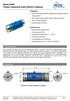 Properties Free of float metal bellow coupling with integrated torque measurement Non-contact measurement system, high robustness High torsional stiffness Limited torque of inertia Performance Measurement
User Manual. DeviceNet Network Configuration
 User Manual DeviceNet Network Configuration Important User Information Solid-state equipment has operational characteristics differing from those of electromechanical equipment. Safety Guidelines for the
Development of the Induction Motor for Machine Tool Spindles and Servo Amplifier SANMOTION S
 New Products Introduction Development of the Induction Motor for Machine Tool Spindles and Servo Amplifier SANMOTION S Takashi Sekiguchi Masahiro Kidou Yuusuke Shimura Yuji Ide Masahisa Koyama Michio Kitahara
PUSH BUTTON START INSTALLATION MANUAL
 PUSH BUTTON START INSTALLATION MANUAL ALTHOUGH THIS PRODUCT HAS BEEN THOROUGHLY TESTED KPIERSON TECHNOLOGIES ASSUMES NO RESPONSIBILITY FOR ANY DAMAGE THAT MAY RESULT BY THE INSTALLATION OF THIS PRODUCT.
PCI/PC Bus Operation ACR8020. ACR8020 Exclusives. ACR8020 (1- to 8-Axes) Ordering. 11 Parker Hannifin Corporation. Catalog 8180/USA Motion Controllers
 ACR8020 PCI/PC Bus Operation The ACR8020 is Compumotor s premier controller for PCI bus operation. It has the ability to run eight servo loops (16 with expansion board), DAC or Stepper outputs and 10 encoders
Application Note. EtherCAT Master Architecture. Applicable Products: Yaskawa Servodrives with CANopen over EtherCAT
 Application Note EtherCAT Master Architecture Applicable Products: Yaskawa Servodrives with CANopen over EtherCAT Yaskawa America, Inc. Drives & Motion Division 2014 March 5, 2015 Page 1 of 18 Table of
Tamura Closed Loop Hall Effect Current Sensors
 Tamura Closed Loop Hall Effect Current Sensors AC, DC, & Complex Currents Galvanic Isolation Fast Response Wide Frequency Bandwidth Quality & Reliability RoHs Compliance Closed Loop Hall Effect Sensors
PSA-G Precision Gearheads
 Zero Backlash High Torque PSA-G Precision Gearheads High Precision When your applications require accurate positioning and precise motion control, Harmonic Drive Technologies offers the perfect solution.
PID Control. Proportional Integral Derivative (PID) Control. Matrix Multimedia 2011 MX009 - PID Control. by Ben Rowland, April 2011
 PID Control by Ben Rowland, April 2011 Abstract PID control is used extensively in industry to control machinery and maintain working environments etc. The fundamentals of PID control are fairly straightforward
Evaluation of the Automatic Transmission Model in HVE Version 7.1
 HVE-WP-2010-3 Evaluation of the Automatic Transmission Model in HVE Version 7.1 Copyright 2010 Engineering Dynamic Corporation Eric S. Deyerl, P.E., Michael J. Fitch Dial Engineering ABSTRACT The Automatic
Basics of Web Tension Control Summary Presenter: Darrell Whiteside, Sales Channel Manager Tension Control Maxcess International
 Basics of Web Tension Control Summary Presenter: Darrell Whiteside, Sales Channel Manager Tension Control Maxcess International This presentation is intended to take the mystery out of web tension control.
AC generator theory. Resources and methods for learning about these subjects (list a few here, in preparation for your research):
 AC generator theory This worksheet and all related files are licensed under the Creative Commons Attribution License, version 1.0. To view a copy of this license, visit http://creativecommons.org/licenses/by/1.0/,
Encoders for Linear Motors in the Electronics Industry
 Technical Information Encoders for Linear Motors in the Electronics Industry The semiconductor industry and automation technology increasingly require more precise and faster machines in order to satisfy
Load to Motor Inertia Mismatch: Unveiling The Truth
 oad to otor Inertia ismatch: Unveiling The Truth Richard W. Armstrong Jr. Training anager Kollmorgen otion Technologies USA Presented at DRIVES AND CONTROS CONFERENCE 1998, Telford England Introduction
An internal gyroscope minimizes the influence of dynamic linear acceleration on slope sensor readings.
 TECHNICAL DATASHEET #TDAX06070X Triaxial Inclinometer with Gyro ±180⁰ Pitch/Roll Angle Pitch Angle Rate Acceleration SAE J1939, Analog Output or RS-232 Options 2 M12 Connectors, IP67 with Electronic Assistant
Series: IDAM Servo Drive E Digital Motor Drive - DMD-078.12
 Series: IDAM Servo Drive E Digital Motor Drive - DMD-078.12 inside Integrated amplifiers for 8 single-phase motors, 4 two-phases motors or 4 three-phases motors or combinations of them in one device Position
A Design of a PID Self-Tuning Controller Using LabVIEW
 Journal of Software Engineering and Applications, 2011, 4, 161-171 doi:10.4236/jsea.2011.43018 Published Online March 2011 (http://www.scirp.org/journal/jsea) 161 A Design of a PID Self-Tuning Controller
HIPERFACE DSL The digital evolution. The new digital interface for servo motors
 HIPERFACE DSL The digital evolution The new digital interface for servo motors Continuing the tradition of world class excellence in interface communication technology Introducing HIPERFACE DSL. With SSI
SOLID MECHANICS TUTORIAL MECHANISMS KINEMATICS - VELOCITY AND ACCELERATION DIAGRAMS
 SOLID MECHANICS TUTORIAL MECHANISMS KINEMATICS - VELOCITY AND ACCELERATION DIAGRAMS This work covers elements of the syllabus for the Engineering Council exams C105 Mechanical and Structural Engineering
How To Control Gimbal
 Tarot 2-Axis Brushless Gimbal for Gopro User Manual V1.0 1. Introduction Tarot T-2D gimbal is designed for the Gopro Hero3, which is widely used in film, television productions, advertising aerial photography,
Technical Application Notes
 Technical Application Notes Creating a Plastics Injection Molding Machine Control Solution Using the Logix Platform, DeviceNet and Bosch-Rexroth High-Speed Closed-Loop Controllers Purpose of this Document:
Machine Tool Control. Besides these TNCs, HEIDENHAIN also supplies controls for other areas of application, such as lathes.
 Machine Tool Control Contouring controls for milling, drilling, boring machines and machining centers TNC contouring controls from HEIDENHAIN for milling, drilling, boring machines and machining centers
AKD EtherNet/IP Communication
 AKD EtherNet/IP Communication Edition August 2012, Revision C Valid for firmware version 1.7 Patents Pending Part Number 903-200008-00 Keep all manuals as a product component during the life span of the
Servo Motor Selection Flow Chart
 Servo otor Selection Flow Chart START Selection Has the machine Been Selected? YES NO Explanation References etermine the size, mass, coefficient of friction, and external forces of all the moving part
Configuring Allen-Brandly ControlLogix PLC with Moxa MGate 5105-MB-EIP. 1 Application Description... 3. 1.1 Objective... 3 1.2 Goals...
 Moxa MGate 5105-MB-EIP Contents Moxa Technical Support Team [email protected] 1 Application Description... 3 1.1 Objective... 3 1.2 Goals... 3 2 System Topology... 3 3 Hardware and Software Requirements...
Application Note 58 Crystal Considerations with Dallas Real Time Clocks
 www.dalsemi.com Application Note 58 Crystal Considerations with Dallas Real Time Clocks Dallas Semiconductor offers a variety of real time clocks (RTCs). The majority of these are available either as integrated
Alternative Linear Motion Systems. Iron Core Linear Motors
 Alternative Linear Motion Systems ME EN 7960 Precision Machine Design Topic 5 ME EN 7960 Precision Machine Design Alternative Linear Motion Systems 5-1 Iron Core Linear Motors Provide actuation forces
BLWR23MDA Series. 24V, 15A Brushless Controller / Motor. User s Guide. 910 East Orangefair Lane, Anaheim, CA 92801 e-mail: info@anaheimautomation.
 BLWR23MDA Series 24V, 15A Brushless Controller / Motor User s Guide A N A H E I M A U T O M A T I O N 910 East Orangefair Lane, Anaheim, CA 92801 e-mail: [email protected] (714) 992-6990 fax:
Optimizing Tension Control in Center-Driven Winders
 Optimizing Tension Control in Center-rien Winders enis Morozo Siemens Industry, Inc rie Technologies Motion Control 5300 Triangle Parkway Norcross, GA 30092 Tel: 1 (770) 871-3846 E-mail: [email protected]
The Waves Dorrough Meter Collection. User Guide
 TABLE OF CONTENTS CHAPTER 1 INTRODUCTION...3 1.1 WELCOME...3 1.2 PRODUCT OVERVIEW...3 1.3 ABOUT THE MODELING...4 1.4 MONO AND STEREO COMPONENTS...4 1.5 SURROUND COMPONENTS...4 CHAPTER 2 QUICKSTART GUIDE...5
5. Tutorial. Starting FlashCut CNC
 FlashCut CNC Section 5 Tutorial 259 5. Tutorial Starting FlashCut CNC To start FlashCut CNC, click on the Start button, select Programs, select FlashCut CNC 4, then select the FlashCut CNC 4 icon. A dialog
Note. OCXO: Oven Controlled Crystal Oscillator. Differential Amplifer
 Helping Customers Innovate, Improve & Grow Note OCXO: Oven Controlled Crystal Oscillator Application Note Introduction If stability requirements are too stringent to be met by a basic crystal oscillator
Σ _. Feedback Amplifiers: One and Two Pole cases. Negative Feedback:
 Feedback Amplifiers: One and Two Pole cases Negative Feedback: Σ _ a f There must be 180 o phase shift somewhere in the loop. This is often provided by an inverting amplifier or by use of a differential
PowerFlex 20-HIM-A3/-A5/-C3S/-C5S Series C HIM Firmware 6.001
 Release Note PowerFlex 20-HIM-A3/-A5/-C3S/-C5S Series C HIM Firmware 6.001 This release note describes major revision 6, minor revision 1 of firmware for the PowerFlex 20-HIM-A3/-A5/-C3S/-C5S Series C
Harmonics and Noise in Photovoltaic (PV) Inverter and the Mitigation Strategies
 Soonwook Hong, Ph. D. Michael Zuercher Martinson Harmonics and Noise in Photovoltaic (PV) Inverter and the Mitigation Strategies 1. Introduction PV inverters use semiconductor devices to transform the
CompactLogix Power Supplies Specifications
 Technical Data CompactLogix Power Supplies Specifications 1768 CompactLogix Power Supplies Catalog Numbers 1768-PA3, 1768-PB3 1769 Compact I/O Power Supplies Catalog Numbers 1769-PA2, 1769-PB2, 1769-PA4,
Chapter 10. Control Design: Intuition or Analysis?
 Chapter 10 Control Design: Intuition or Analysis? Dan P. Dumdie 10.1 Introduction In previous chapters, we discussed some of the many different types of control methods available and typically used in
ABB drives. Automation solutions Drives, PLC, motion, motors and safety
 ABB drives Automation solutions Drives, PLC, motion, motors and safety Motion control solutions ADVANCED MOTION CONTROL Real-time motion bus systems Multi-axis coordinated motion Distributed motion control
3FBD DC Motor Drive User Manual
 3FBD DC Motor Drive User Manual Via I. Alpi 6 - zona industriale - Lonato (BS) Tel. +39 30 9913491 r.a. Fax. +39 30 9913504 http://www.re-elettronica.it [email protected] Pag. 1 Index Index... pag.1
STEPPER MOTOR SPEED AND POSITION CONTROL
 STEPPER MOTOR SPEED AND POSITION CONTROL Group 8: Subash Anigandla Hemanth Rachakonda Bala Subramanyam Yannam Sri Divya Krovvidi Instructor: Dr. Jens - Peter Kaps ECE 511 Microprocessors Fall Semester
Logix5000 Controllers Nonvolatile Memory Card
 Programming Manual Logix5000 Controllers Nonvolatile Memory Card Catalog Numbers 1756 ControlLogix, 1756 GuardLogix, 1768 CompactLogix, 1768 Compact GuardLogix, 1769 CompactLogix, 1789 SoftLogix, PowerFlex
The Design of DSP controller based DC Servo Motor Control System
 International Conference on Advances in Energy and Environmental Science (ICAEES 2015) The Design of DSP controller based DC Servo Motor Control System Haiyan Hu *, Hong Gu, Chunguang Li, Xiaowei Cai and
1756 ControlLogix Integrated Motion Modules Specifications
 Technical Data 1756 ControlLogix Integrated Motion Modules Specifications SERCOS Motion Catalog Numbers 1756-M03SE, 1756-M08SE, 1756-M16SE, 1756-M08SEG Analog Motion Catalog Numbers 1756-M02AE, 1756-M02AS,