
ALGEBRA 1 SKILL BUILDERS
|
|
|
- Ginger Robertson
- 9 years ago
- Views:
Transcription
1 ALGEBRA 1 SKILL BUILDERS (Etra Practice) Introduction to Students and Their Teachers Learning is an individual endeavor. Some ideas come easil; others take time--sometimes lots of time- -to grasp. In addition, individual students learn the same idea in different was and at different rates. The authors of this tetbook designed the classroom lessons and homework to give students time-- often weeks and months--to practice an idea and to use it in various settings. This section of the tetbook offers students a brief review of 7 topics followed b additional practice with answers. Not all students will need etra practice. Some will need to do a few topics, while others will need to do man of the sections to help develop their understanding of the ideas. This section of the tet ma also be useful to prepare for tests, especiall final eaminations. How these problems are used will be up to our teacher, our parents, and ourself. In classes where a topic needs additional work b most students, our teacher ma assign work from one of the skill builders that follow. In most cases, though, the authors epect that these resources will be used b individual students who need to do more than the tetbook offers to learn an idea. This will mean that ou are going to need to do some etra work outside of class. In the case where additional practice is necessar for ou individuall or for a few students in our class, ou should not epect our teacher to spend time in class going over the solutions to the skill builder problems. After reading the eamples and tring the problems, if ou still are not successful, talk to our teacher about getting a tutor or etra help outside of class time. Warning! Looking is not the same as doing. You will never become good at an sport just b watching it. In the same wa, reading through the worked out eamples and understanding the steps are not the same as being able to do the problems ourself. An athlete onl gets good with practice. The same is true of developing our algebra skills. How man of the etra practice problems do ou need to tr? That is reall up to ou. Remember that our goal is to be able to do problems of the tpe ou are practicing on our own, confidentl and accuratel. Another source for help with the topics in this course is the Parent's Guide with Review to Math 1 (Algebra 1). Information about ordering this resource can be found inside the front page of the student tet. It is also available free on the Internet at Skill Builder Topics 1. Arithmetic operations with numbers 1. Zero Product Propert and quadratics. Combining like terms 16. Pthagorean Theorem. Order of operations 17. Solving equations containing algebraic fractions. Distributive Propert 18. Laws of eponents. Substitution and evaluation 19. Simplifing radicals 6. Tables, equations, and graphs 0. The quadratic formula 7. Solving linear equations 1. Simplifing rational epressions 8. Writing equations. Multiplication and division of rational epressions 9. Solving proportions. Absolute value equations 10. Ratio applications. Intersection of lines: elimination method 11. Intersection of lines: substitution method. Solving inequalities 1. Multipling polnomials 6. Addition and subtraction of rational epressions 1. Writing and graphing linear equations 7. Solving mied equations and inequalities 1. Factoring polnomials Algebra 1 7

2 ARITHMETIC OPERATIONS WITH NUMBERS #1 Adding integers: If the signs are the same, add the numbers and keep the same sign. If the signs are different, ignore the signs (that is, use the absolute value of each number) and find the difference of the two numbers. The sign of the answer is determined b the number farthest from zero, that is, the number with the greater absolute value. same signs different signs a) + = or + = c) + = 1 or + ( ) = 1 b) + ( ) = or + ( ) = d) + = 1 or + ( ) = 1 Subtracting integers: To find the difference of two values, change the subtraction sign to addition, change the sign of the number being subtracted, then follow the rules for addition. a) + ( ) = 1 c) + ( ) = b) ( ) + (+) = 1 d) ( ) + (+) = Multipling and dividing integers: If the signs are the same, the product will be positive. If the signs are different, the product will be negative. a) = 6 or = 6 b) ( ) = 6 or ( +) ( +) = 6 c) = or = d) ( ) ( ) = or ( ) ( ) = e) ( ) = 6 or ( ) = 6 f) ( ) = or ( ) = g) 9 ( 7) = 6 or 7 9 = 6 h) 6 9 = 7 or 9 ( 6) = 1 7 Follow the same rules for fractions and decimals. Remember to appl the correct order of operations when ou are working with more than one operation. Simplif the following epressions using integer operations WITHOUT USING A CALCULATOR ( ) ( ). 6. ( ) ( ) ( ) ( ) ( ) 1. ( ) ( 16) ( 18) ( 1) ( 1) ( 1) ( 10) ( 1) 1. ( ) SKILL BUILDERS

3 Simplif the following epressions without a calculator. Rational numbers (fractions or decimals) follow the same rules as integers.. (16 + ( 1)). ( 6 7) + ( ). 1 + ( 1 ) ( 1 1 ) 8. ( ( ))( + ( )) 9. 1 ( + ( 7)) ( + ) 0. ( ) (6 + ( 0.)) 1. ( ). ( ) ( ) 6. ( + )( ) 7. ( ) ( 1 + ( )) 8. ( (. )) 0.( 0. + ) Answers or 1 or. 1. or 1 or or - 1 or or - 1 or = Algebra 1 9

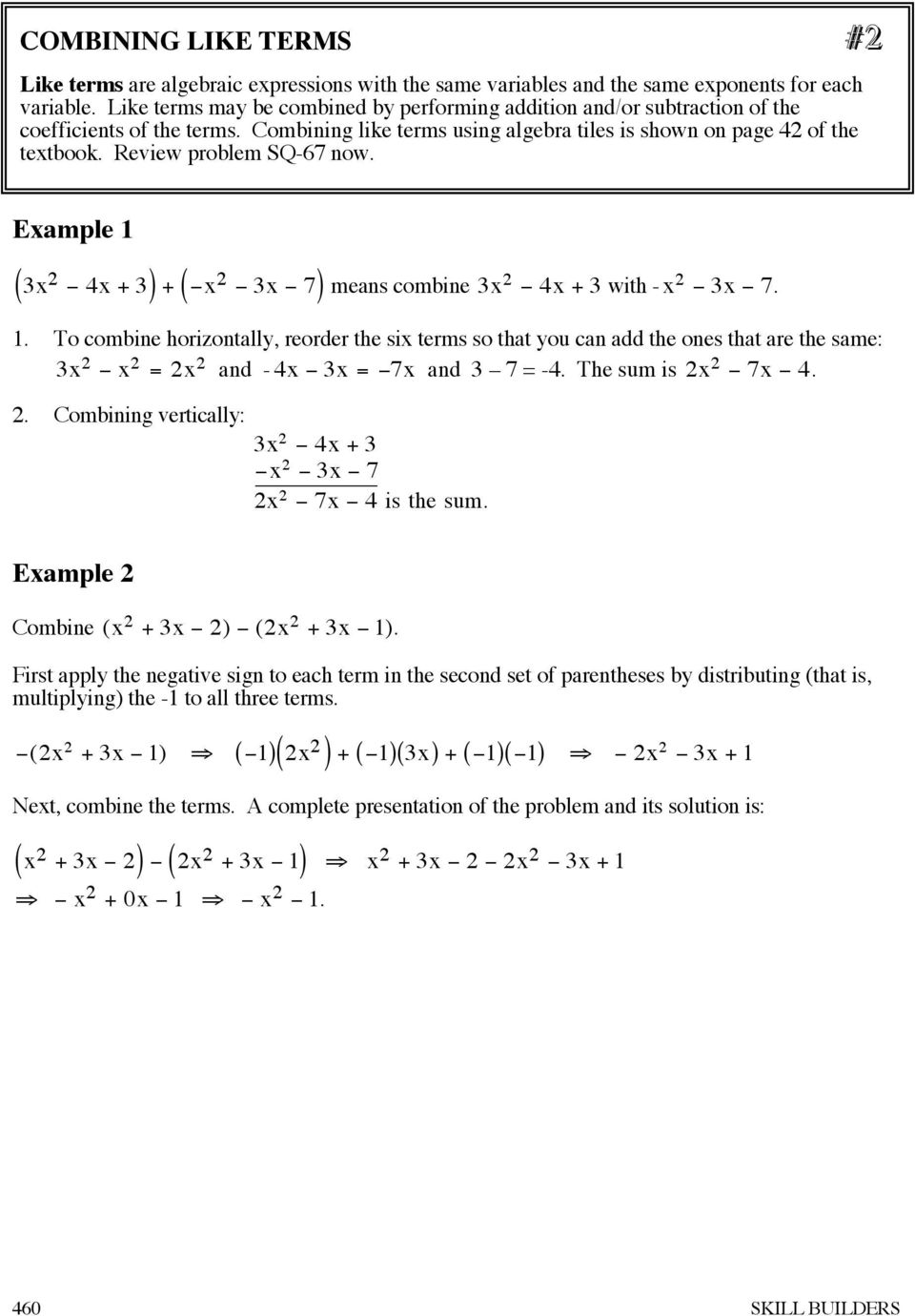
4 COMBINING LIKE TERMS # Like terms are algebraic epressions with the same variables and the same eponents for each variable. Like terms ma be combined b performing addition and/or subtraction of the coefficients of the terms. Combining like terms using algebra tiles is shown on page of the tetbook. Review problem SQ-67 now. Eample 1 ( + ) + ( 7) means combine + with To combine horizontall, reorder the si terms so that ou can add the ones that are the same: = and - = 7 and 7 = -. The sum is 7.. Combining verticall: isthe sum. Eample Combine ( + ) ( + 1). First appl the negative sign to each term in the second set of parentheses b distributing (that is, multipling) the -1 to all three terms. ( + 1) ( 1) ( ) + ( 1) ( ) + ( 1) ( 1) + 1 Net, combine the terms. A complete presentation of the problem and its solution is: ( + ) ( + 1) SKILL BUILDERS
5 Combine like terms for each epression below. 1. ( + + ) + ( + + ). ( + + ) + ( + + 7). ( + + ) + ( + ). ( + 7) + ( + + 9). ( + ) + ( + ) 6. ( + ) + ( + 1) 7. ( ) + ( + 6) 8. ( 6 + 7) + ( + 7) 9. (9 + 7) ( + + ) 10. ( + + ) ( + + 1) 11. ( + + ) ( + 1) 1. ( + 7) ( + 8) 1. ( 6) (7 + 7) 1. ( + 6) ( 7) 1. ( + ) (6 + ) 16. ( + 9) ( 6 1) 17. ( + ) + ( + ) 18. ( + + ) ( + ) 19. ( + ) ( + ) 0. ( + + ) + ( + ) Answers Algebra 1 61

6 ORDER OF OPERATIONS # The order of operations establishes the necessar rules so that epressions are evaluated in a consistent wa b everone. The rules, in order, are: When grouping smbols such as parentheses are present, do the operations within them first. Net, perform all operations with eponents. Then do multiplication and division in order from left to right. Finall, do addition and subtraction in order from left to right. Eample Simplif the numerical epression at right: 1 + (1 + ) Start b simplifing the parentheses: (1 + ) = () so 1 + () Then perform the eponent operation: = and = 7 so 1 + (7) Net, multipl and divide left to right: 1 = and (7) = 81 so + 81 Finall, add and subtract left to right: = -1 so = 80 Simplif the following numerical epressions ( 1) 8. 1 ( 6 ). 1+ [ ( ) + 8 ] 6. ( 8 + 1) ( 9) ( 6) 1. + ( ) 1. 8 ( ) ( 8 1 9) ( 19 1) ( ) ( ) Answers SKILL BUILDERS

7 DISTRIBUTIVE PROPERTY # The Distributive Propert is used to regroup a numerical epression or a polnomial with two or more terms b multipling each value or term of the polnomial. The resulting sum is an equivalent numerical or algebraic epression. See page 7 in the tetbook for more information. In general, the Distributive Propert is epressed as: a(b + c) = ab + ac and ( b + c)a = ba + ca Eample 1 ( + ) = ( ) + ( ) = + 8 Eample ( + + 1) = ( ) + ( ) + (1) = + + Simplif each epression below b appling the Distributive Propert. Follow the correct order of operations in problems 18 through. 1. (1+ ). ( + ). ( + 6). ( + ). ( ) 6. 6( 6) 7. ( + ) 8. ( + ) 9. ( 1) 10. ( 1) 11. ( z) 1. a(b c) 1. ( + + ) 1. ( + + ) 1. ( + ) 16. ( + ) 17. ( + ) 18. ( + + ) 19. ( 7) 0. ( a + b c)d 1. a 1 ( + ( ) b ). b ( ( ) ab ) Answers 1. ( 1)+ ( ) = + 1 = 18. ( )+ ( ) = = = z 1. ab ac = ad + bd cd 1. a ab. 7b ab Algebra 1 6

8 SUBSTITUTION AND EVALUATION # Substitution is replacing one smbol with another (a number, a variable, or an epression). One application of the substitution propert is replacing a variable name with a number in an epression or equation. In general, if a = b, then a ma replace b and b ma replace a. A variable is a letter used to represent one or more numbers (or other algebraic epression). The numbers are the values of the variable. A variable epression has numbers and variables and operations performed on it. Eamples Evaluate each variable epression for =. a) ( ) 10 b) + 10 () c) () 9 d) 1 e) ( ) 6 1 f) + ( ) + ( ) Evaluate each of the variable epressions below for the values = - and =. Be sure to follow the order of operations as ou simplif each epression Evaluate the epressions below using the values of the variables in each problem. These problems ask ou to evaluate each epression twice, once with each of the values for = and = for = and = for = and = for = and = Evaluate the variable epressions for = - and =. 17. ( + ) 18. ( + ) 19. ( + )+ + ( ) ( ) ( ) ( )( + ) Answers a) 18 b) 9 1. a) -8 b) a) 1 b) a) -6 b) SKILL BUILDERS

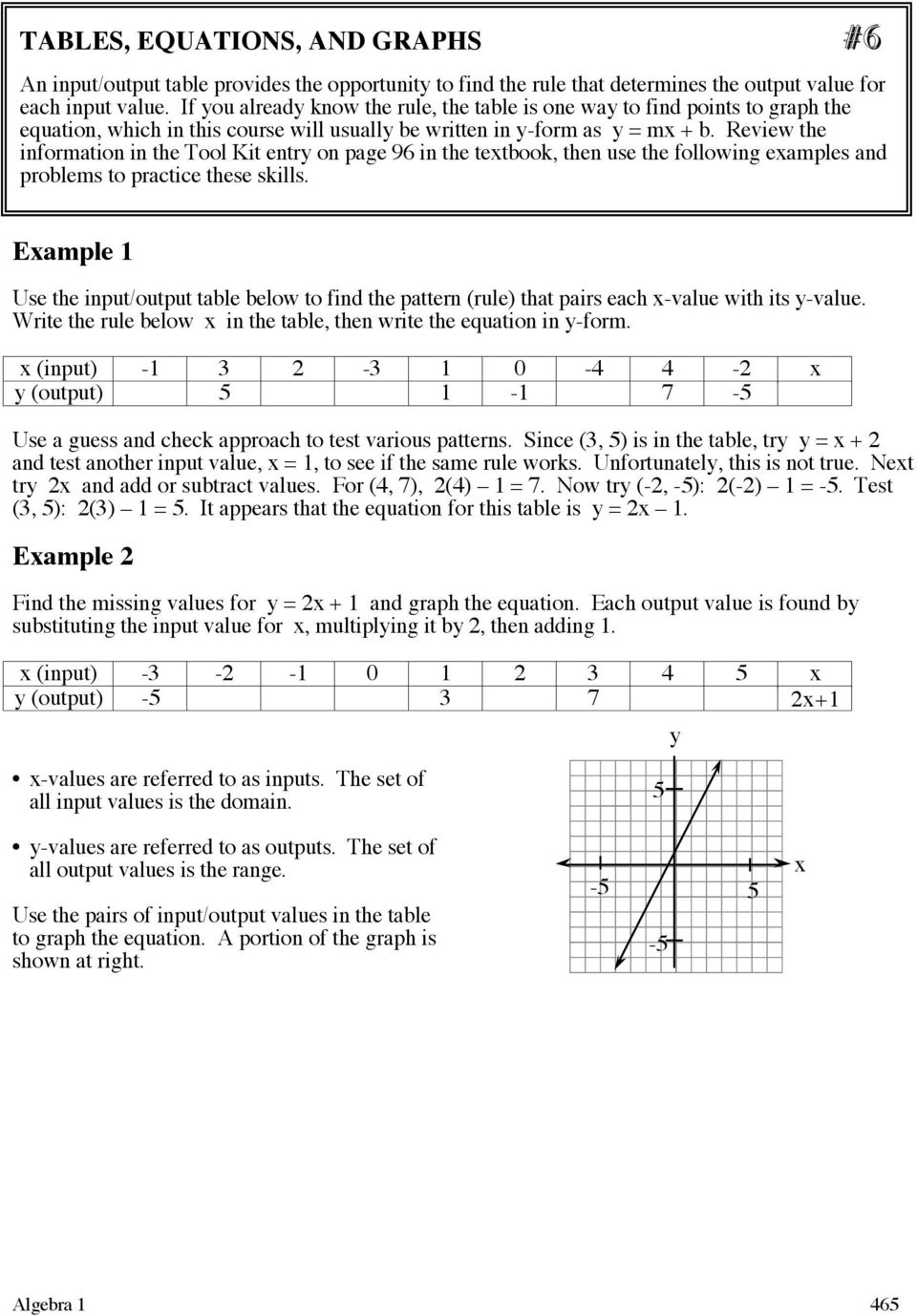
9 TABLES, EQUATIONS, AND GRAPHS #6 An input/output table provides the opportunit to find the rule that determines the output value for each input value. If ou alread know the rule, the table is one wa to find points to graph the equation, which in this course will usuall be written in -form as = m + b. Review the information in the Tool Kit entr on page 96 in the tetbook, then use the following eamples and problems to practice these skills. Eample 1 Use the input/output table below to find the pattern (rule) that pairs each -value with its -value. Write the rule below in the table, then write the equation in -form. (input) (output) Use a guess and check approach to test various patterns. Since (, ) is in the table, tr = + and test another input value, = 1, to see if the same rule works. Unfortunatel, this is not true. Net tr and add or subtract values. For (, 7), () 1 = 7. Now tr (-, -): (-) 1 = -. Test (, ): () 1 =. It appears that the equation for this table is = 1. Eample Find the missing values for = + 1 and graph the equation. Each output value is found b substituting the input value for, multipling it b, then adding 1. (input) (output) values are referred to as inputs. The set of all input values is the domain. -values are referred to as outputs. The set of all output values is the range. Use the pairs of input/output values in the table to graph the equation. A portion of the graph is shown at right. - - Algebra 1 6
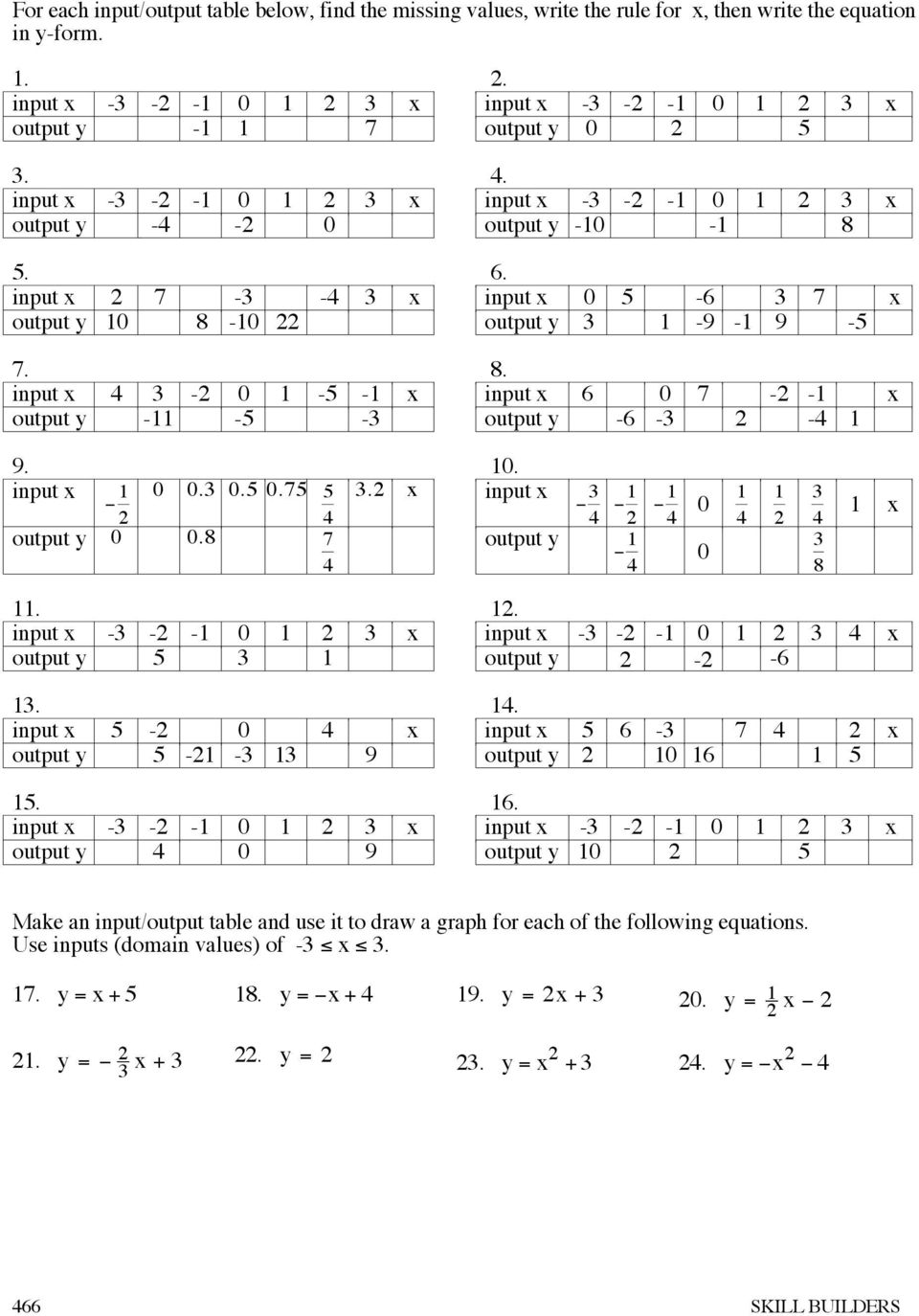
10 For each input/output table below, find the missing values, write the rule for, then write the equation in -form. 1.. input input output output 0.. input input output output input input output output input input output output input input output output input input output 1 output input - 0 input 6-7 output output input input output 0 9 output 10 Make an input/output table and use it to draw a graph for each of the following equations. Use inputs (domain values) of = = = + 0. = 1 1. = +. =. = +. = 66 SKILL BUILDERS
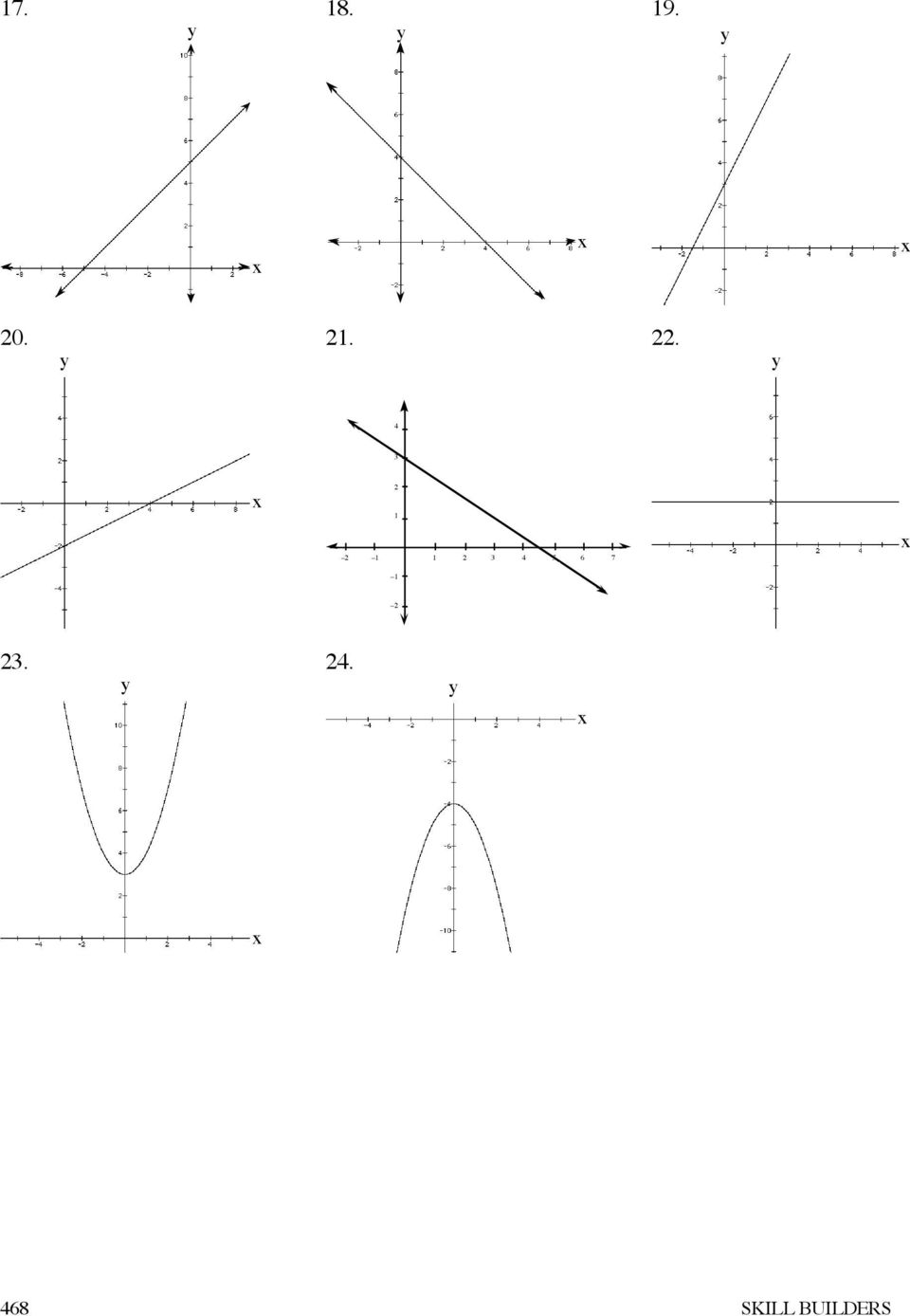
11 Answers 1. = + 1. = + input input output output =. = 1 input input output output = + 6. = + input input output output = 8. = input input output output = = 1 input input output output input input output output input input output output input input output output input input output output input input output output input input output output.. input input output output Algebra 1 67

12 SKILL BUILDERS
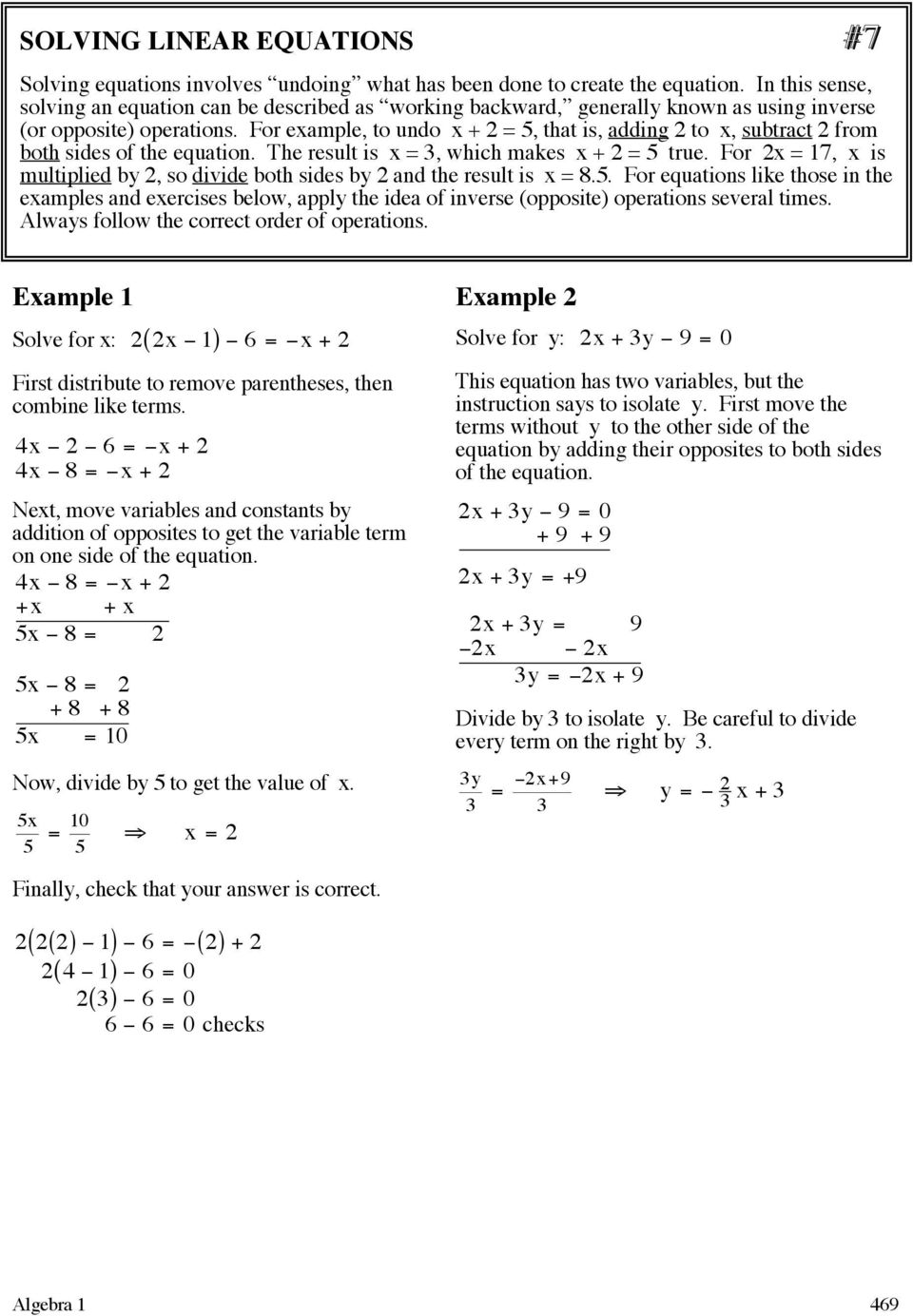
13 SOLVING LINEAR EQUATIONS #7 Solving equations involves undoing what has been done to create the equation. In this sense, solving an equation can be described as working backward, generall known as using inverse (or opposite) operations. For eample, to undo + =, that is, adding to, subtract from both sides of the equation. The result is =, which makes + = true. For = 17, is multiplied b, so divide both sides b and the result is = 8.. For equations like those in the eamples and eercises below, appl the idea of inverse (opposite) operations several times. Alwas follow the correct order of operations. Eample 1 Solve for : ( 1) 6 = + First distribute to remove parentheses, then combine like terms. 6 = + 8 = + Net, move variables and constants b addition of opposites to get the variable term on one side of the equation. 8 = = 8 = = 10 Now, divide b to get the value of. = 10 = Eample Solve for : + 9 = 0 This equation has two variables, but the instruction sas to isolate. First move the terms without to the other side of the equation b adding their opposites to both sides of the equation. + 9 = =+9 + = 9 = + 9 Divide b to isolate. Be careful to divide ever term on the right b. = +9 = + Finall, check that our answer is correct. ( ) 6 = ( ) 1 ( ) + ( 1) 6 = 0 ( ) 6 = = 0 checks Algebra 1 69
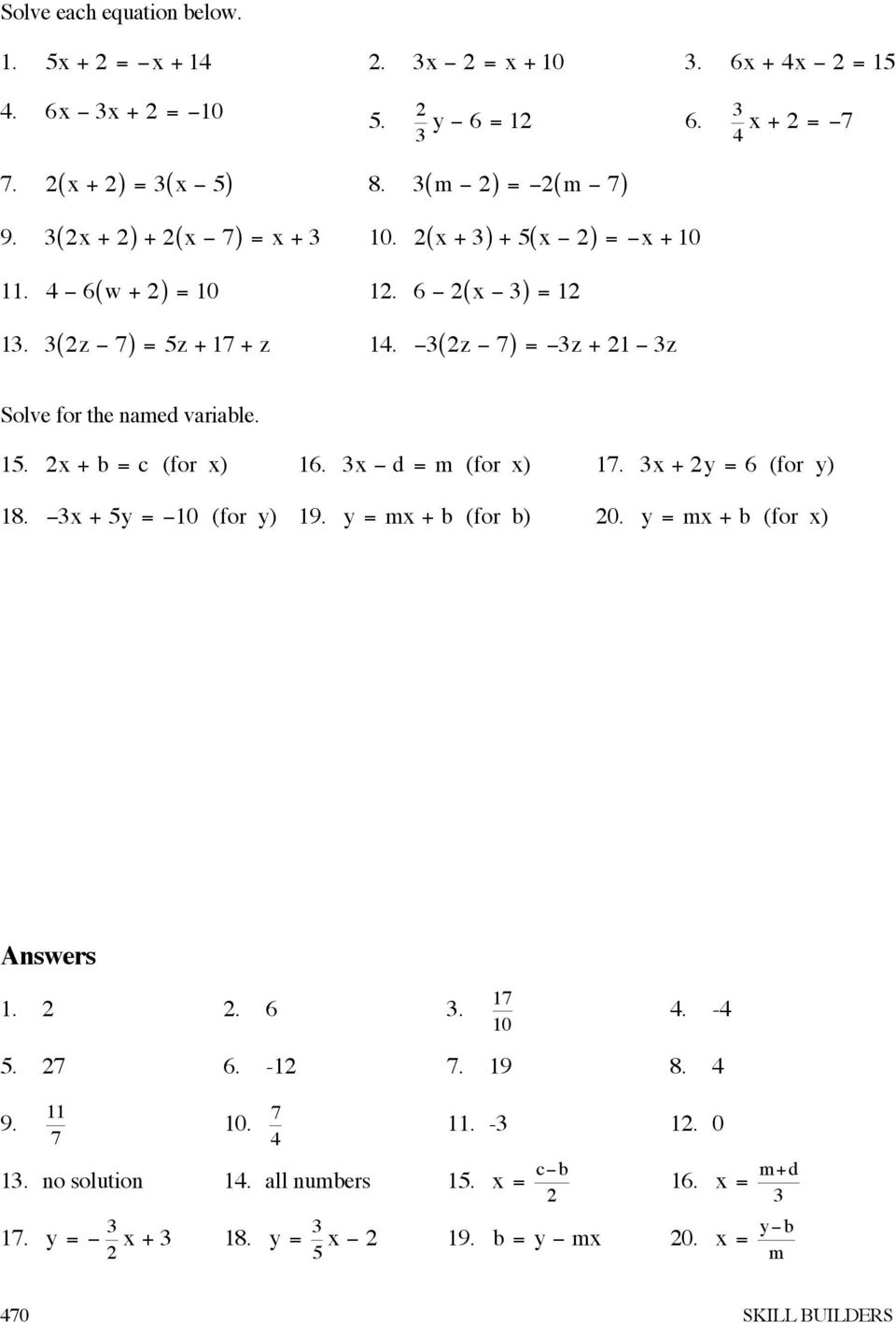
14 Solve each equation below = + 1. = = = = = 7 7. ( + ) = ( ) 8. ( m ) = ( m 7) 9. ( + ) + ( 7) = ( + ) + ( ) = w+ ( ) = ( ) = 1 1. ( z 7) = z z 1. ( z 7) = z + 1 z Solve for the named variable b = c (for ) 16. d = m (for ) = 6 (for ) = 10 (for ) 19. = m + b (for b) 0. = m + b (for ) Answers no solution 1. all numbers 1. = c b 17. = = = m+d 19. b = m 0. = b m 70 SKILL BUILDERS
15 WRITING EQUATIONS #8 You have used Guess and Check tables to solve problems. The patterns and organization of a Guess and Check table will also help to write equations. You will eventuall be able to solve a problem b setting up the table headings, writing the equation, and solving it with few or no guesses and checks. Eample 1 The perimeter of a triangle is 1 centimeters. The longest side is twice the length of the shortest side. The third side is three centimeters longer than the shortest side. How long is each side? Write an equation that represents the problem. First set up a table (with headings) for this problem and, if necessar, fill in numbers to see the pattern. guess short side long side third side perimeter check 1? 10 1 (10) = 0 (1) = = = = = 6 too low too high 1 1 (1) = 6 (1) = 1 + = = = = 1 too high correct The lengths of the sides are 1 cm, cm, and 1 cm. Since we could guess an number for the short side, use to represent it and continue the pattern. guess short side long side third side perimeter check 1? A possible equation is = 1 (simplified, + = 1). Solving the equation gives the same solution as the guess and check table. Eample Darren sold 7 tickets worth $6.0 for the school pla. He charged $7.0 for adults and $.0 for students. How man of each kind of ticket did he sell? First set up a table with columns and headings for number of tickets and their value. guess number of adult tickets sold value of adult tickets sold number of student tickets sold value of student tickets sold total value 0 0(7.0) = =.0() = =.0 check 6.0? too low B guessing different (and in this case, larger) numbers of adult tickets, the answer can be found. The pattern from the table can be generalized as an equation. number of adult tickets sold value of adult tickets sold number of student tickets sold value of student tickets sold total value (7 ) (7 ) check 6.0? 6.0 Algebra 1 71

16 A possible equation is ( 7 ) = 6.0. Solving the equation gives the solution-- 0 adult tickets and student tickets--without guessing and checking ( 7 ) = = 6. 0 = 00 = 0 adult tickets 7 = 7 0 = student tickets Find the solution and write a possible equation. You ma make a Guess and Check table, solve it, then write the equation or use one or two guesses to establish a pattern, write an equation, and solve it to find the solution. 1. A bo of fruit has four more apples than oranges. Together there are pieces of fruit. How man of each tpe of fruit are there?. Thu and Cleo are sharing the driving on a 0 mile trip. If Thu drives 60 miles more than Cleo, how far did each of them drive?. Aimee cut a string that was originall 16 centimeters long into two pieces so that one piece is twice as long as the other. How long is each piece?. A full bucket of water weighs eight kilograms. If the water weighs five times as much as the bucket empt, how much does the water weigh?. The perimeter of a rectangle is 100 feet. If the length is five feet more than twice the width, find the length and width. 6. The perimeter of a rectangular cit is 9 miles. If the length is one mile less than three times the width, find the length and width of the cit. 7. Find three consecutive numbers whose sum is Find three consecutive even numbers whose sum is The perimeter of a triangle is 7. The first side is twice the length of the second side. The third side is seven more than the second side. What is the length of each side? 10. The perimeter of a triangle is 86 inches. The largest side is four inches less than twice the smallest side. The third side is 10 inches longer than the smallest side. What is the length of each side? 11. Thirt more student tickets than adult tickets were sold for the game. Student tickets cost $, adult tickets cost $, and $160 was collected. How man of each kind of ticket were sold? 1. Fift more couples tickets than singles tickets were sold for the dance. Singles tickets cost $10 and couples tickets cost $1. If $000 was collected, how man of each kind of ticket was sold? 1. Helen has twice as man dimes as nickels and five more quarters than nickels. The value of her coins is $.7. How man dimes does she have? 1. L has three more dimes than nickels and twice as man quarters as dimes. The value of his coins is $9.60. How man of each kind of coin does he have? 1. Enrique put his mone in the credit union for one ear. His mone earned 8% simple interest and at the end of the ear his account was worth $10. How much was originall invested? 7 SKILL BUILDERS

17 16. Juli's bank pas 7.% simple interest. At the end of the ear, her college fund was worth $10,96. How much was it worth at the start of the ear? 17. Elisa sold 110 tickets for the football game. Adult tickets cost $.0 and student tickets cost $1.10. If she collected $1, how man of each kind of ticket did she sell? 18. The first performance of the school pla sold out all 000 tickets. The ticket sales receipts totaled $800. If adults paid $ and students paid $ for their tickets, how man of each kind of ticket was sold? 19. Leon and Jason leave Los Angeles going in opposite directions. Leon travels five miles per hour faster than Jason. In four hours the are miles apart. How fast is each person traveling? 0. Keri and Yuki leave New York Cit going in opposite directions. Keri travels three miles per hour slower than Yuki. In si hours the are miles apart. How fast is each person traveling? Answers (equations ma var) 1. oranges, 8 apples; + ( + ) =. Cleo 0 miles, Thu 90 miles; + ( + 60) = 0., 8; + = kg.; + = 8. 1, ; + + ( ) = , ; + ( 1) = 9 7., 6, 7; + ( + 1) + ( + ) = , 16, 18; + ( + ) + ( + ) = 68 9., 1., 19.; + + ( + 7)= , 6, 0; + ( ) + ( + 10) = adult, 0 students; + + ( 0) = single, 180 couple; ( + 0) = nickels, 1 dimes, 1 quarters; ( ) + 0.( + ) = nickels, 1 dimes, 0 quarters; ( + ) + 0.( + 6) = $10; = ,00; = 10, adult, student; ( 110 ) = adults, 70 students; ( 000 ) = Jason 6, Leon 68; + + ( ) = 0. Yuki, Keri ; ( ) = Algebra 1 7

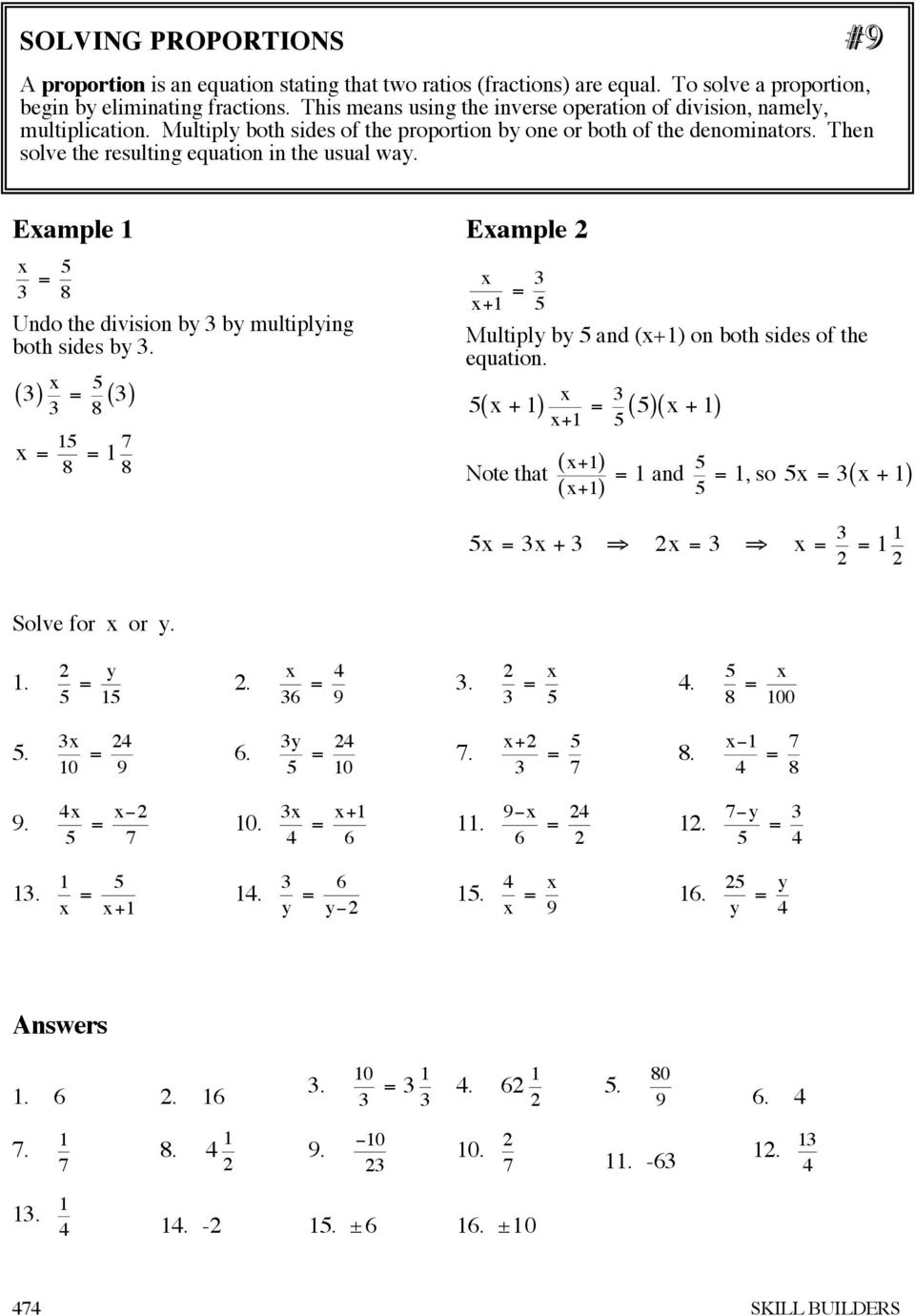
18 SOLVING PROPORTIONS #9 A proportion is an equation stating that two ratios (fractions) are equal. To solve a proportion, begin b eliminating fractions. This means using the inverse operation of division, namel, multiplication. Multipl both sides of the proportion b one or both of the denominators. Then solve the resulting equation in the usual wa. Eample 1 = 8 Undo the division b b multipling both sides b. ( ) = ( 8 ) Eample +1 = Multipl b and (+1) on both sides of the equation. + ( 1) +1 = ( ) ( + 1) = 1 8 = Note that ( +1) ( +1) = 1 and = 1, so = + ( 1 ) = + = = = 1 1 Solve for or. 1. = 1. 6 = 9. =. 8 = = 9 6. = = = = = = 1. 7 = 1. 1 = = 6 1. = = Answers = ± ±10 7 SKILL BUILDERS
19 RATIO APPLICATIONS #10 Ratios and proportions are used to solve problems involving similar figures, percents, and relationships that var directl. Eample 1 ABC is similar to DEF. Use ratios to find. F B 8 1 A C E Since the triangles are similar, the ratios of the corresponding sides are equal. 8 1 = 8 = 6 = 7 D Eample a) What percent of 60 is? b) Fort percent of what number is? In percent problems use the following part proportion: whole = percent 100. a) 60 = = 00 = 7 (7%) b) = 0 = 00 = 11 Eample Am usuall swims 0 laps in 0 minutes. How long will it take to swim 0 laps at the same rate? Since two units are being compared, set up a ratio using the unit words consistentl. In this case, laps is on top (the numerator) and minutes is on the bottom (the denominator) in both ratios. Then solve as shown in Skill Builder #9. laps minutes : 0 0 = 0 0 = 100 = 7minutes Each pair of figures is similar. Solve for the variable m. 7 m. w Algebra 1 7

20 m Write and solve a proportion to find the missing part is % of what? is 0% of what? 11. % of 00 is what? 1. % of 10 is what? is what percent of? 1. What percent of 00 is 0? 1. What is % of $1.0? 16. What is 7.% of $.7? Use ratios to solve each problem. 17. A rectangle has length 10 feet and width si feet. It is enlarged to a similar rectangle with length 18 feet. What is the new width? 18. If 00 vitamins cost $.7, what should 00 vitamins cost? 19. The ta on a $00 painting is $. What should the ta be on a $700 painting? 0. If a basketball plaer made 7 of 8 shots, how man shots could she epect to make in 00 shots? 1. A cookie recipe uses 1 teaspoon of vanilla with used with five cups of flour? cup of flour. How much vanilla should be. M brother grew 1 inches in 1 months. At that rate, how much would he grow in one ear?. The length of a rectangle is four centimeters more than the width. If the ratio of the length to width is seven to five, find the dimensions of the rectangle.. A class has three fewer girls than bos. If the ratio of girls to bos is four to five, how man students are in the class? 76 SKILL BUILDERS

21 Answers 1. 0 = = = = % % 1. $ 16. $ ft. 18. $ $ About 169 shots 1. 1 teaspoons. 8 inches. 10 cm 1 cm. 7 students Algebra 1 77
22 USING SUBSTITUTION TO FIND THE POINT #11 OF INTERSECTION OF TWO LINES To find where two lines intersect we could graph them, but there is a faster, more accurate algebraic method called the substitution method. This method ma also be used to solve sstems of equations in word problems. Eample 1 Start with two linear equations in -form. = + and = 1 Substitute the equal parts. + = 1 Solve for. 6 = = The -coordinate of the point of intersection is =. To find the -coordinate, substitute the value of into either original equation. Solve for, then write the solution as an ordered pair. Check that the point works in both equations. = -() + = 1 and = 1 = 1, so (, 1) is where the lines intersect. Check: 1 = ( ) + and 1 = 1. Eample The sales of Gizmo Sports Drink at the local supermarket are currentl 6,00 bottles per month. Since New Age Refreshers were introduced, sales of Gizmo have been declining b bottles per month. New Age currentl sells,00 bottles per month and its sales are increasing b 0 bottles per month. If these rates of change remain the same, in about how man months will the sales for both companies be the same? How man bottles will each compan be selling at that time? Let = months from now and = total monthl sales. For Gizmo: = 600 ; for New Age: = Substituting equal parts: 600 = = Use either equation to find : = ( 10. 8) 90 and = 600 (10.8) 90. The solution is (10.8, 90). This means that in about 11 months, both drink companies will be selling,90 bottles of the sports drinks. 78 SKILL BUILDERS
23 Find the point of intersection (, ) for each pair of lines b using the substitution method. 1. = + = 1. = + = + 8. = 11 = +. = = 1 +. = 6. = = = 1 7. =. = = = + 1 For each problem, define our variables, write a sstem of equations, and solve them b using substitution. 9. Janelle has $0 and is saving $6 per week. April has $10 and is spending $ per week. When will the both have the same amount of mone? 10. Sam and Hector are gaining weight for football season. Sam weighs 0 pounds and is gaining two pounds per week. Hector weighs 19 pounds but is gaining three pounds per week. In how man weeks will the both weigh the same amount? 11. PhotosFast charges a fee of $.0 plus $0.0 for each picture developed. PhotosQuick charges a fee of $.70 plus $0.0 for each picture developed. For how man pictures will the total cost be the same at each shop? 1. Plaland Park charges $7 admission plus 7 per ride. Funland Park charges $1.0 admission plus 0 per ride. For what number of rides is the total cost the same at both parks? Change one or both equations to -form and solve b the substitution method. 1. = + = 1 1. = = 1. + = = = 10 = = = = = = + = 6 0. = 6 + = Answers 1. (, ). (-, -). (, ).. (., 9.) 6. (6, 0) 7. (1., ) 8. 1 (, ) ( ) 1, 9. 1 weeks, $ weeks, pounds pictures, $.0 1. rides, $.0 1. (6, 9) 1. (-, ) 1. (, 1) 16. (, ) 17. (-, ) 18. (7, 11) 19. none 0. infinite Algebra 1 79
24 MULTIPLYING POLYNOMIALS #1 We can use generic rectangles as area models to find the products of polnomials. A generic rectangle helps us organize the problem. It does not have to be drawn accuratel or to scale. Eample 1 Multipl ( + ) ( + ) ( + )( + ) = area as a product area as a sum Eample Multipl ( + 9) ( ) Therefore ( + 9) ( + ) = = Another approach to multipling binomials is to use the mnemonic "F.O.I.L." F.O.I.L. is an acronm for First, Outside, Inside, Last in reference to the positions of the terms in the two binomials. Eample Multipl ( ) ( + ) using the F.O.I.L. method. F. O. multipl the FIRST terms of each binomial multipl the OUTSIDE terms ()() = 1 ()() = 1 I. multipl the INSIDE terms (-)() = -8 L. multipl the LAST terms of each binomial (-)() = -10 Finall, we combine like terms: = SKILL BUILDERS
25 Multipl, then simplif each epression. 1. ( ). ( ). ( + ). ( + ). ( + ) ( + 7) 6. ( ) ( 9) 7. ( ) ( + 7) 8. ( + 8) ( 7) 9. ( + 1) ( ) 10. ( m ) ( m + 1) 11. ( m + 1) ( m 1) 1. ( ) ( + ) 1. ( + 7) 1. ( ) 1. ( + ) ( + ) 16. ( ) ( + ) 17. ( + ) ( 1) 18. ( ) ( + 1) 19. ( ) ( + ) 0. ( 1) ( + ) Answers m m 11. m Algebra 1 81
26 WRITING AND GRAPHING LINEAR EQUATIONS ON A FLAT SURFACE #1 SLOPE is a number that indicates the steepness (or flatness) of a line, as well as its direction (up or down) left to right. SLOPE is determined b the ratio: vertical change horizontal change between an two points on a line. For lines that go up (from left to right), the sign of the slope is positive. For lines that go down (left to right), the sign of the slope is negative. An linear equation written as = m + b, where m and b are an real numbers, is said to be in SLOPE-INTERCEPT FORM. m is the SLOPE of the line. b is the Y-INTERCEPT, that is, the point (0, b) where the line intersects (crosses) the -ais. If two lines have the same slope, then the are parallel. Likewise, PARALLEL LINES have the same slope. Two lines are PERPENDICULAR if the slope of one line is the negative reciprocal of the slope of the other line, that is, m and 1 m. Note that m 1 ( m ) = 1. Eamples: and 1, and, and Two distinct lines that are not parallel intersect in a single point. See "Solving Linear Sstems" to review how to find the point of intersection. Eample 1 Write the slope of the line containing the points (-1, ) and (, ). First graph the two points and draw the line through them. (,) Look for and draw a slope triangle using the two given points. Write the ratio vertical change in horizontal change in using the legs of the right (-1,) triangle:. Assign a positive or negative value to the slope (this one is positive) depending on whether the line goes up (+) or down ( ) from left to right. If the points are inconvenient to graph, use a "Generic Slope Triangle", visualizing where the points lie with respect to each other. 8 SKILL BUILDERS
27 Eample Graph the linear equation = 7 + Using = m + b, the slope in = 7 + is and the 7 -intercept is the point (0, ). To graph, begin at the vertical change -intercept (0, ). Remember that slope is so go horizontal change up units (since is positive) from (0, ) and then move right 7 units. This gives a second point on the graph. To create the graph, draw a straight line through the two points. Eample A line has a slope of and passes through (, ). What is the equation of the line? Using = m + b, write = + b. Since (, ) represents a point (, ) on the line, substitute for and for, = ( ) + b, and solve for b. = 9 + b 9 = b 1 = b. The equation is = 1. Eample Decide whether the two lines at right are parallel, perpendicular, or neither (i.e., intersecting). First find the slope of each equation. Then compare the slopes. = -6 and - + =. = -6 - = - 6 = = + The slope of this line is. - + = = + = + = + The slope of this line is. These two slopes are not equal, so the are not parallel. The product of the two slopes is 1, not -1, so the are not perpendicular. These two lines are neither parallel nor perpendicular, but do intersect. Eample Find two equations of the line through the given point, one parallel and one perpendicular to the given line: = + and (-, ). For the parallel line, use = m + b with the same slope to write = + b. Substitute the point (, ) for and and solve for b. = ( ) + b = 0 + b = b Therefore the parallel line through (-, ) is =. For the perpendicular line, use = m + b where m is the negative reciprocal of the slope of the original equation to write = + b. Substitute the point (, ) and solve for b. = ( ) + b = b Therefore the perpendicular line through (-, ) is = +. Algebra 1 8
28 Write the slope of the line containing each pair of points. 1. (, ) and (, 7). (, ) and (9, ). (1, -) and (-, 7). (-, 1) and (, -). (-, ) and (, ) 6. (8, ) and (, ) Use a Generic Slope Triangle to write the slope of the line containing each pair of points: 7. (1, 0) and (, 7) 8. (0, 9) and (, 90) 9. (10, -1) and (-61, 0) Identif the -intercept in each equation. 10. = = 1. + = 1 1. = = 1 1. = 1 Write the equation of the line with: 16. slope = 1 and passing through (, ). 17. slope = and passing through (-, -). 18. slope = - 1 and passing through (, -1). 19. slope = - and passing through (-, ). Determine the slope of each line using the highlighted points Using the slope and -intercept, determine the equation of the line SKILL BUILDERS
29 Graph the following linear equations on graph paper. 7. = = = 0. = = 1 State whether each pair of lines is parallel, perpendicular, or intersecting.. = and = +. = 1 + and = -. = and + =. = -1 and + = 6. + = 6 and = = 6 and + = 6 8. = and = + 9. = 1 and = + 7 Find an equation of the line through the given point and parallel to the given line. 0. = and (-, ) 1. = 1 + and (-, ). = and (-, ). = -1 and (-, 1). + = 6 and (-1, 1). + = 6 and (, -1) 6. = and (1, -1) 7. = 1 and (, -) Find an equation of the line through the given point and perpendicular to the given line. 8. = and (-, ) 9. = 1 + and (-, ) 0. = and (-, ) 1. = -1 and (-, 1). + = 6 and (-1, 1). + = 6 and (, -1). = and (1, -1). = 1 and (, -) Write an equation of the line parallel to each line below through the given point (-,) - (,8) (-8,6) (-,) - (7,) - (-,-7) - Algebra 1 8
30 Answers ( ) 1. (0, 6) (0, ) 11. 0, (0, 1) 1. (0, ) 1. (0, ) 16. = = 18. = = =. = +. = = + 7. line with slope 1 and -intercept (0, ) 8. line with slope and -intercept (0, 1) 9. line with slope and -intercept (0, 0) 0. line with slope 6 and -intercept 0, 1 1. line with slope and -intercept (0, 6). parallel. perpendicular. perpendicular. perpendicular 6. parallel 7. intersecting 8. intersecting 9. parallel 0. = = 1 +. = +. = +. = = = 9 7. = 8. = = = = - 1. = +. = 7 6. = = = = SKILL BUILDERS
31 FACTORING POLYNOMIALS #1 Often we want to un-multipl or factor a polnomial P(). This process involves finding a constant and/or another polnomial that evenl divides the given polnomial. In formal mathematical terms, this means P( ) = q ( ) r ( ), where q and r are also polnomials. For elementar algebra there are three general tpes of factoring. 1) Common term (finding the largest common factor): = 6( + ) where 6 is a common factor of both terms = ( 1) + 7 ( 1) = ( 1) + 7 ) Special products ( ) where is the common factor. ( ) where 1 is the common factor. a b = ( a + b) ( a b) = ( + ) ( ) + + = + = 9 = ( + ) ( ) ( + ) = ( + ) ( ) = ( ) a) Trinomials in the form + b + c where the coefficient of is 1. Consider + ( d + e) + d e = ( + d) ( + e), where the coefficient of is the sum of two numbers d and e AND the constant is the product of the same two numbers, d and e. A quick wa to determine all of the possible pairs of integers d and e is to factor the constant in the original trinomial. For eample, 1 is 1 1, 6, and. The signs of the two numbers are determined b the combination ou need to get the sum. The "sum and product" approach to factoring trinomials is the same as solving a "Diamond Problem" in CPM's Algebra 1 course (see below) = ( + ) ( + ); + = 8, = 1 1 = ( ) ( + ); + =, = = ( ) ( ); + ( ) = 7, ( ) ( ) = 1 The sum and product approach can be shown visuall using rectangles for an area model. The figure at far left below shows the "Diamond Problem" format for finding a sum and product. Here is how to use this method to factor product # # sum ( + )( + ) >> Eplanation and eamples continue on the net page. >> Algebra 1 87
32 b) Trinomials in the form a + b + c where a 1. Note that the upper value in the diamond is no longer the constant. Rather, it is the product of a and c, that is, the coefficient of and the constant multipl 6?? ( + 1)( + ) Below is the process to factor ?? 0? -10?? -1? ( - )( - ) Polnomials with four or more terms are generall factored b grouping the terms and using one or more of the three procedures shown above. Note that polnomials are usuall factored completel. In the second eample in part (1) above, the trinomial also needs to be factored. Thus, the complete factorization of 8 10 = ( ). ( ) = ( ) + 1 Factor each polnomial completel Factor completel SKILL BUILDERS
33 Factor each of the following completel. Use the modified diamond approach Answers 1. ( + 6) ( 7). ( 9). ( + ) ( + ). ( + ) ( + ). ( + ) ( ) 6. ( ) ( + ) 7. ( 1) 8. 7( 11) ( + 11) 9. ( + 9) 10. ( + 7) ( ) 11. ( + 7) 1. ( 8) ( + ) 1. ( ) ( + ) 1. ( + ) 1. ( ) ( ) 16. ( + ) ( 1) 17. ( + 9) 18. ( 6) 19. ( 9) ( + 6) 0. ( 7) 1. ( + ) ( + 6). ( + 1) ( 1). ( 7). ( + ) ( + ). ( 1) 6. ( + 8) 7. ( + 8) 8. ( ) ( + ) 9. ( 6) ( + ) 0. ( 7) ( ) 1. ( + ) ( ). ( ) ( + 1). ( + 1) ( ). ( ) ( + ). ( ) ( + ) 6. ( ) ( + ) ( + ) 7. ( + 7) ( 1) 8. ( 1) ( ) 9. ( + ) ( + ) 0. ( 1) ( ) 1. ( + ) ( + 1). ( 6 + 1) ( + ). ( 8 + 1). ( 7 + ) ( ). ( ) ( + ) Algebra 1 89
34 ZERO PRODUCT PROPERTY AND QUADRATICS #1 If a b = 0, then either a = 0 or b = 0. Note that this propert states that at least one of the factors MUST be zero. It is also possible that all of the factors are zero. This simple statement gives us a powerful result which is most often used with equations involving the products of binomials. For eample, solve ( + )( ) = 0. B the Zero Product Propert, since ( + )( ) = 0, either + = 0 or = 0. Thus, = or =. The Zero Product Propert can be used to find where a quadratic crosses the -ais. These points are the -intercepts. In the eample above, the would be (-, 0) and (, 0). Here are two more eamples. Solve each quadratic equation and check each solution. Eample 1 ( + ) ( 7) = 0 B the Zero Product Propert, either + = 0 or 7 = 0 Solving, = or = 7. Checking, ( + ) ( 7)=? 0 ( 0) ( 11) = 0 ( 7 + ) ( 7 7)=? 0 ( 11) ( 0) = 0 Eample + 10 = 0 First factor + 10 = 0 into ( + ) ( ) = 0 then + = 0 or = 0, so = or = Checking, ( + ) ( )=? 0 ( 0) ( 7) = 0 ( + ) ( )=? 0 ( 7) ( 0) = 0 90 SKILL BUILDERS
35 Solve each of the following quadratic equations. 1. ( + 7) ( + 1) = 0. ( + ) ( + ) = 0. ( ) = 0. ( 7) = 0. ( ) ( + ) = 0 6. ( + ) ( ) = = = = = = 6 1. = = = 8 Without graphing, find where each parabola crosses the -ais. 1. = 16. = = = = + 0. = 10 + Answers 1. = -7 and = -1. = - and = -. = 0 and =. = 0 and = 7. = 1 and = 1 6. = and = 7. = -1 and = - 8. = -1 and = - 9. = and = 10. = and = 11. = - and = 1. = and = - 1. = and = 8 1. = and = 7 1. (-1, 0) and (, 0) 16. (-, 0) and (, 0) 17. (6, 0) and (-, 0) 18. (-, 0) and (1, 0) 19. (1, 0) and (-, 0) 0. (, 0) and (-, 0) Algebra 1 91
36 PYTHAGOREAN THEOREM #16 c An triangle that has a right angle is called a right triangle. The a two sides that form the right angle, a and b, are called legs, and the side opposite (that is, across the triangle from) the right angle, c, is called the hpotenuse. b For an right triangle, the sum of the squares of the legs of the triangle is equal to the square of the hpotenuse, that is, a + b = c. This relationship is known as the Pthagorean Theorem. In words, the theorem states that: (leg) + (leg) = (hpotenuse). Eample Draw a diagram, then use the Pthagorean Theorem to write an equation or use area pictures (as shown on page, problem RC-1) on each side of the triangle to solve each problem. a) Solve for the missing side. b) Find to the nearest tenth: 1 17 c c + 1 = 17 c = 89 c = 10 c = 10 c = 0 c () + =0 + = 00 6 = c) One end of a ten foot ladder is four feet from the base of a wall. How high on the wall does the top of the ladder touch? + = = 100 = 8 9. The ladder touches the wall about 9. feet above the ground. 10 d) Could, 6 and 8 represent the lengths of the sides of a right triangle? Eplain. + 6? = 8? 9+ 6 = 6 6 Since the Pthagorean Theorem relationship is not true for these lengths, the cannot be the side lengths of a right triangle. 9 SKILL BUILDERS
37 Write an equation and solve for each unknown side. Round to the nearest hundredth Be careful! Remember to square the whole side. For eample, ( ) = ( ) ( ) = For each of the following problems draw and label a diagram. Then write an equation using the Pthagorean Theorem and solve for the unknown. Round answers to the nearest hundredth. 1. In a right triangle, the length of the hpotenuse is four inches. The length of one leg is two inches. Find the length of the other leg.. The length of the hpotenuse of a right triangle is si cm. The length of one leg is four cm. Find the length of the other leg.. Find the diagonal length of a television screen 0 inches wide b 0 inches long.. Find the length of a path that runs diagonall across a ard b 100 ard field.. A mover must put a circular mirror two meters in diameter through a one meter b 1.8 meter doorwa. Find the length of the diagonal of the doorwa. Will the mirror fit? Algebra
38 6. A surveor walked eight miles north, then three miles west. How far was she from her starting point? 7. A four meter ladder is one meter from the base of a building. How high up the building will the ladder reach? 8. A 1-meter loading ramp rises to the edge of a warehouse doorwa. The bottom of the ramp is nine meters from the base of the warehouse wall. How high above the base of the wall is the doorwa? 9. What is the longest line ou can draw on a paper that is 1 cm b cm? 0. How long an umbrella will fit in the bottom of a suitcase that is. feet b feet? 1. How long a gu wire is needed to support a 10 meter tall tower if it is fastened five meters from the foot of the tower?. Find the diagonal distance from one corner of a 0 foot square classroom floor to the other corner of the floor.. Harr drove 10 miles west, then five miles north, then three miles west. How far was he from his starting point?. Linda can turn off her car alarm from 0 ards awa. Will she be able to do it from the far corner of a 1 ard b 1 ard parking lot?. The hpotenuse of a right triangle is twice as long as one of its legs. The other leg is nine inches long. Find the length of the hpotenuse. 6. One leg of a right triangle is three times as long as the other. The hpotenuse is 100 cm. Find the length of the shorter leg. Answers 1. = 10. = 0. = 1. = 1. = 1 6. = 0 7. = = = 16. = inches..7 cm inches ards. The diagonal is.06 meters, so es miles meters meters cm feet meters.. feet. 1.9 miles. The corner is 19.1 ards awa so es! inches cm 9 SKILL BUILDERS
39 SOLVING EQUATIONS CONTAINING ALGEBRAIC FRACTIONS #17 Fractions that appear in algebraic equations can usuall be eliminated in one step b multipling each term on both sides of the equation b the common denominator for all of the fractions. If ou cannot determine the common denominator, use the product of all the denominators. Multipl, simplif each term as usual, then solve the remaining equation. For more information, read the Tool Kit information on page 1 (problem BP-6) in the tetbook. In this course we call this method for eliminating fractions in equations "fraction busting." Eample 1 Solve for : 9 + = ( 9 + ) = () ( 9 ) + ( ) = = 1 = 1 = 1 Eample Solve for : = 8 6( ) = 6(8) 6( ) + 6(1 6 ) = = 8 1 = 7 = 1 7 Solve the following equations using the fraction busters method =. + = = 1. + = 1. = 9 6. = 7. = 8. 8 = = 10. = = 1 1. = 1. + = = = = = = = = 1 Answers 1. = 6. = 6. = 6. = 6. = 0 6. = 7. = 8. = 8 9. = 10. = = 0 1. = = 6 1. = = 16. = 17. = = 19. = - 0. = 1 Algebra 1 9
40 LAWS OF EXPONENTS #18 BASE, EXPONENT, AND VALUE In the epression, is the base, is the eponent, and the value is. means = means LAWS OF EXPONENTS Here are the basic patterns with eamples: 1) a. b = a + b eamples:. = + = 7 ; 7 = 11 ) a b = a - b eamples: 10 = 10 - = 6 ; 7 = - or 1 ) ( a ) b = ab eamples: ( ) = = 1 ; ( ) = 1 = 16 1 ) a = 1 a and 1 b = b eamples: = ; = ) o = 1 eamples: o = 1; ( ) o = 1 Eample 1 Simplif: ( )( ) Multipl the coefficients: = 10 Add the eponents of, then : = 10 7 Eample Simplif: Divide the coefficients: ( 1 7) 1 7 = 1 7 Subtract the eponents: 1 7 = OR Eample Simplif: ( ) Cube each factor: ( ) ( ) = 7( ) ( ) Multipl the eponents: SKILL BUILDERS
41 Eample Simplif: z z Simplif each epression: b b b ( ). ( a) ( ) ( ) ( )( ) ( a ) ( a ) 18. m 8 m ( ) ( c )( ac )( a c) 1. ( 7 ) ( ) ( a 7 )( a ) 16. 6a Write the following epressions without negative eponents m n m. ( ) Note: More practice with negative eponents is available in Skill Builder #1. ( ) ( ) Answers b a 6. m a a 6 c a n m Algebra 1 97
42 SIMPLIFYING RADICALS #19 Sometimes it is convenient to leave square roots in radical form instead of using a calculator to find approimations (decimal values). Look for perfect squares (i.e.,, 9, 16,, 6, 9,...) as factors of the number that is inside the radical sign (radicand) and take the square root of an perfect square factor. Multipl the root of the perfect square times the reduced radical. When there is an eisting value that multiplies the radical, multipl an root(s) times that value. For eample: 9 = 9 = = 1 18 = 9 = 9 = 98 = 9 = 7 = 1 80 = 16 = 16 = + 0 = 9 + = + = 11 When there are no more perfect square factors inside the radical sign, the product of the whole number (or fraction) and the remaining radical is said to be in simple radical form. Simple radical form does not allow radicals in the denominator of a fraction. If there is a radical in the denominator, rationalize the denominator b multipling the numerator and denominator of the fraction b the radical in the original denominator. Then simplif the remaining fraction. Eamples: = = = 6 = = 0 6 = 0 In the first eample, = = and = 1. In the second eample, 6 6 = 6 = 6 and 6 =. The rules for radicals used in the above eamples are shown below. Assume that the variables represent non-negative numbers. (1) = () = () () = ( ) = () a + b = (a + b) = 98 SKILL BUILDERS
43 Write each epression in simple radical (square root) form Answers Algebra 1 99
44 THE QUADRATIC FORMULA #0 You have used factoring and the Zero Product Propert to solve quadratic equations. You can solve an quadratic equation b using the quadratic formula. If a -b ± b - ac + b + c = 0, then = a. For eample, suppose = 0. Here a =, b = 7, and c = -6. Substituting these values into the formula results in: -(7) ± 7 - ( )(- 6) -7 ± 11-7 ± 11 = () = 6 = 6 Remember that non-negative numbers have both a positive and negative square root. The sign ± represents this fact for the square root in the formula and allows us to write the equation once (representing two possible solutions) until later in the solution process. Split the numerator into the two values: = or = Thus the solution for the quadratic equation is: = or -. Eample 1 Eample Solve: = 0 First make sure the equation is in standard form with zero on one side of the equation. This equation is alread in standard form. Second, list the numerical values of the coefficients a, b, and c. Since a + b + c = 0, then a = 1, b = 7, and c = for the equation = 0. Write out the quadratic formula (see above). Substitute the numerical values of the coefficients a, b, and c in the quadratic formula, = 7± 7 (1)() (1) Simplif to get the eact solutions. = 7± so = = or ± 9, Use a calculator to get approimate solutions Solve: = 8 First make sure the equation is in standard form with zero on one side of the equation = = 0 Second, list the numerical values of the coefficients a, b, and c: a = 6, b = -8, and c = 1 for this equation. Write out the quadratic formula, then substitute the values in the formula. = ( 8)± ( 8) (6)(1) (6) Simplif to get the eact solutions. = 8± so = = or ± 0 1 8± 10 1 Use a calculator with the original answer to get approimate solutions SKILL BUILDERS
45 Use the quadratic formula to solve the following equations = = 0. 0 = 0. = 0. 7 = = 7. = = = = = = = = = = = = = = 0 Answers and and and and and and and and and and and and and and and and and and and and -9.7 Algebra 1 01
46 SIMPLIFYING RATIONAL EXPRESSIONS #1 Rational epressions are fractions that have algebraic epressions in their numerators and/or denominators. To simplif rational epressions find factors in the numerator and denominator that are the same and then write them as fractions equal to 1. For eample, 6 6 = 1 = 1 ( + ) ( + ) = 1 ( - ) ( - ) = 1 Notice that the last two eamples involved binomial sums and differences. Onl when sums or differences are eactl the same does the fraction equal 1. Rational epressions such as the eamples below cannot be simplified: (6 + ) Most problems that involve rational epressions will require that ou factor the numerator and denominator. For eample: 1 = = 9 Notice that and each equal = = Notice that,, and = = ( + )( ) ( )( ) = + where = 1. All three eamples demonstrate that all parts of the numerator and denominator--whether constants, monomials, binomials, or factorable trinomials--must be written as products before ou can look for factors that equal 1. One special situation is shown in the following eamples: = 1 = 1 + = ( + ) + = 1 Note that in all cases we assume the denominator does not equal zero. = ( ) = 1 0 SKILL BUILDERS
47 Eample 1 Simplif: (a b ) a Rewrite the numerator and denominator without negative eponents and parentheses. (a b ) a a 6 b a a 6 a b Then look for the same pairs of factors that equal one (1) when divided. Writing out all of the factors can be helpful. a a a a a a a a a a b b b b = a a b b b b Write the simplified epression with eponents. (a b ) a = a b, b 0. Note that a a = 1. Eample Simplif: To simplif some rational epressions, the numerator and/or denominator ma need to be factored before ou ma simplif the epression (+1)( 7) ( 7)(+) Then look for the same pairs of factors that equal one (1) when divided. (+1)( 7) (+)( 7) Note that for - or 7. ( 7) ( 7) = 1. Simplif the following epressions. Assume that the denominator is not equal to zero a 6 b 8 0a b. ( ) ( 8 ) Answers ( ) 1 (a ) b (a ) b ab a 8 b 1 6() a b 6. a 10 a 1 b 6 = 1 a b a a 8 b 6 = a 7 b = (+)(+1) = ( 1)(+) ( )(+) (a ) a 1 b 6 8 ( 1)(+) (+7)( 1) = 8 = 6 6. a 1 b 7a 1 b 10 = 8 ( )(+ ) 9. = = a 9b 9 = 6 18 ( ) ( )(+6) = ( )(+1) ( ) = ( )(+) (+ )(+) = (+8)( 8) (+8)(+8) = ( 1) ( 1)(+) = (+)( ) 8( )(+1) = (+) (+1) = + + Algebra 1 0
48 MULTIPLICATION AND DIVISION OF RATIONAL EXPRESSIONS # To multipl or divide rational epressions, follow the same procedures used with numerical fractions. However, it is often necessar to factor the polnomials in order to simplif the rational epression. Eample Multipl and simplif the result. + 6 ( ) 1 After factoring, the epression becomes: After multipling, reorder the factors: Since ( + 6) ( + 6 ) = 1 and ( + 1) ( + 1 ) = 1, simplif: 1 1 Eample Divide 1 and simplif the result First, change to a multiplication epression b inverting (flipping) the second fraction: After factoring, the epression is: Reorder the factors (if ou need to): Since ( ) ( ) ( + 6) ( + )( + ) ( + 6) ( + 1) 6 6 ( + 1) ( 1) ( + 6). ( + 6) ( + 6) ( + 6).. ( + 1) ( - 1) ( + 1) => - 1. Note: -6, -1, or ( ) + ( 1) ( )( ) ( + 6) ( ) ( ) ( ) = 1 and ( ) ( ) = 1, simplif: ( + 1) ( + 6) ( ) ( + ) Thus, 1 = ( + 1) ( + 6) ( ) ( + ) or ( ) + ( ) ( ) ( ) ( + 1) ( ) ( + 6) ( + ) Note: -,, or. + 6 Multipl or divide each epression below and simplif the result. Assume the denominator is not equal to zero ( ) 18. 8a a 16 a SKILL BUILDERS
49 a+6 a a + a Answers 1. (+ ) = +1. a a. (+1) = (+) ( ) 6. (+ )( ) ( ) = (+) ( ) 8. (+) ( ) a 11. (+ ) = 1. 17( 1) 9 1 = ( 8) = 1. 1 (+) 1. (+1) (+1) 16. (+) ( ) = ( ) ( ) ( ) = ( 9)(+ ) = ( ) 1 = 10 6 Algebra 1 0
50 ABSOLUTE VALUE EQUATIONS # Absolute value means the distance from a reference point. In the simplest case, the absolute value of a number is its distance from zero on the number line. Since absolute value is a distance, the result of finding an absolute value is zero or a positive number. All distances are positive. Eample 1 Solve + = 7. Because the result of ( + ) can be 7 or -7, we can write and solve two different equations. (Remember that the absolute value of 7 and -7 will be 7.) + = 7 or + = 7 = or = 10 = or = Eample Solve + 1 = 10. First the equation must have the absolute value isolated on one side of the equation. + 1 = = Because the result of + 1 can be or -, we can write and solve two different equations. + 1 = or + 1 = = 8 or = 18 = or = 9 Note that while some -values of the solution are negative, the goal is to find values that make the original absolute value statement true. For = - in eample 1, ( ) + = = 7 7 = 7, which is true. Verif that the two negative values of in eample make the original absolute value equation true. Solve for =. = 7. =. 8 =. = 6. = 7. + = = = = 11. = 1. = = = = = = = = = 7 06 SKILL BUILDERS
51 Answers 1. =, -6. = 9, -9. = 7,. = 10, 6. = 10, = -, 7. =, = 1, 0 9. = 17, = 6, =, - 1. =, - 1. = 8, =, = 6, =, = -, = 11, = 1, =, - Algebra 1 07
52 USING ELIMINATION (ADDITION) TO FIND # THE POINT OF INTERSECTION OF TWO LINES The elimination method can be used to solve a sstem of linear equations. B adding or subtracting the two linear equations in a wa that eliminates one of the variables, a single variable equation is left. Eample 1 Eample Solve: + = 16 + = Solve: + = 10 = First decide whether to add or subtract the equations. Remember that the addition or subtraction should eliminate one variable. In the sstem above, the in each equation is positive, so we need to subtract, that is, change all the signs of the terms in the second equation. + = 16 ( + = ) + = 16 = = 1 Substitute the solution for into either of the original equations to solve for the other variable,. + 1 ( ) = 16 = 1 Check our solution (-1, 1) in the second equation. You could also use the first equation to check our solution. Sometimes the equations need to be adjusted b multiplication before the can be added or subtracted to eliminate a variable. Multipl one or both equations to set them up for elimination. Multipl the first equation b : + ( ) = 0 ( ) = 10 Multipl the second equation b -: ( ) = ( ) = Decide whether to add or subtract the equations to eliminate one variable. Since the -terms are additive opposites, add these equations = = 17 = so = = = Substitute the solution for into either of the original equations to solve for the other variable. + ( ) = 10 = = Check the solution (, ) in the second equation. ( ) ( ) = 6 8 = = 08 SKILL BUILDERS
53 Solve each sstem of linear equations using the Elimination Method = = 1. + = 1 + = = = = 0 6 = = + = = 16 = = 9 + = -. = =. = 1 = 8. + = = = 7 = 1 1. = = = 1 = = 1 = = 1 = = - = = 7 9 = 1. = 10 = 6 1. = = = 10 = Answers 1. (-7, ). (, 8). (8, -). (-, ). (6, 1) 6. (6, 10) 7. (8, ) 8. (, 9) 9. (, -) 10. (-, ) 11. (1, -10) 1. (, 0) 1. (-, -1) 1. (, -) 1. (10, -10) 16. (, 1) 17. (8, -) 18. (, ) 19. (, -) 0. (0, ) Algebra 1 09
54 SOLVING INEQUALITIES # When an equation has a solution, depending on the tpe of equation, the solution can be represented as a point on a line or a point, line, or curve in the coordinate plane. Dividing points, lines, and curves are used to solve inequalities. If the inequalit has one variable, the solution can be represented on a line. To solve an tpe of inequalit, first solve it as ou would if it were an equation. Use the solution(s) as dividing point(s) of the line. Then test a value from each region on the number line. If the test value makes the inequalit true, then that region is part of the solution. If it is false then the value and thus that region is not part of the solution. In addition, if the inequalit is or then the dividing point is part of the solution and is indicated b a solid dot. If the inequalit is > or <, then the dividing point is not part of the solution and is indicated b an open dot. Eample 1 Solve + 6 Solve the equation = + 6 = + 9 = 9 = Draw a number line and put a solid dot at =, which is the dividing point. - Test a value from each region. Here we test - and 0. Be sure to use the original inequalit. True - = ( ) +6 > True False = 0 () >0+6 0 > 6 False The region(s) that are true represent the solution. The solution is and all numbers in the left region, written:. Eample Solve + < Solve the equation + = = 0 ( ) ( + 1) = 0 = or = 1 Draw a number line and put open dots at = and = 1, the dividing points. -1 Test a value from each region in the original inequalit. Here we test -, 0, and. False True -1 = = 0 ( ) ( )+< () 0 ()+< 0 17 < False < True False = () ()+< 10 < False The region(s) that are true represent the solution. The solution is the set of all numbers greater than 1 but less than, written: 1 < <. If the inequalit has two variables, then the solution is represented b a graph in the -coordinate plane. The graph of the inequalit written as an equation (a line or curve) divides the coordinate plane into regions which are tested in the same manner described above using an ordered pair for a point on a side of the dividing line or curve. If the inequalit is > or <, then the boundar line or curve is dashed. If the inequalit is or, then the boundar line or curve is solid. 10 SKILL BUILDERS
55 Eample Graph and shade the solution to this sstem of inequalities > Graph each equation. For = the slope of the solid line is and -intercept is 0. For = the slope of the dashed line is 1 and the -intercept is. Test a point from each region in both of the original inequalities. (0, ) (, 0) (, ) (, 1) False in both True in first, False in first, True in both False in second True in second The region that makes both statements (inequalities) true is the solution. The solution is the region below the solid line = and above the dashed line =. Solve and graph each inequalit > ( ) 9. 1 < > < > > 1. < > and > and < and 1 +. and < > Answers > < < > or < 1 Algebra 1 11
56 or < 1 or > < < < or > SKILL BUILDERS
57 ADDITION AND SUBTRACTION OF RATIONAL EXPRESSIONS #6 Addition and subtraction of rational epressions is done the same wa as addition and subtraction of numerical fractions. Change to a common denominator (if necessar), combine the numerators, and then simplif. Eample 1 The Least Common Multiple (lowest common denominator) of ( + )( + ) and ( + ) is ( + )( + ). The denominator of the first fraction alread is the Least Common Multiple. To get a common denominator in the second fraction, multipl the fraction b +, a form of one (1). + Multipl the numerator and denominator of the second term: Distribute in the second numerator. Add, factor, and simplif. Note: - or -. (+)(+) + + = = = (+)(+) + + (+) (+) (+)(+) + (+) (+)(+) (+)(+) + +6 (+)(+) = +6+ (+)(+) = (+1)(+) (+)(+) = (+1) (+) Eample Subtract 1 and simplif the result. Find the lowest common denominator of ( 1) and ( ). It is ( 1)( ). In order to change each denominator into the lowest common denominator, we need to multipl each fraction b factors that are equal to one. Multipl the denominators. Multipl and distribute the numerators. When adding fractions, the denominator does not change. The numerators need to be added or subtracted and like terms combined. Check that both the numerator and denominator are completel factored. If the answer can be simplified, simplif it. This answer is alread simplified. Note: 1 or. ( ) ( ) 1 ( ) ( 1) ( 1) ( ) ( )( 1) 6 ( )( 1) 6 ( ) ( )( 1) ( )( 1) = ( 1) ( )( 1) ( )( 1) 6 + ( )( 1) + ( )( 1) Algebra 1 1
58 Add or subtract the epressions and simplif the result. 1. (+)(+) + (+)(+). b b +b + 9 b +b a a +a+1 + a +a a +b a + b + a+ b a + b a a +a a 1 a +a (+) ( 7) a a +6a a ( ) Answers b b 1. a a ( 7) = (a+6) ( ) = (+) ( )(+1) = (+7)( 7) = (+6) ( )(+ ) 0. + ( )( ) = SKILL BUILDERS
59 SOLVING MIXED EQUATIONS AND INEQUALITIES #7 Solve these various tpes of equations. 1. ( - ) + = = = 0. 0 = -. = - + = 1 6. a - b = 0 (solve for ) 7. 0 = ( - )( + ) 8. ( - 1) = = = = = 0 (solve for ) = 0 1. = 100 = 1. - = 7 = = = = 0. = + + = + = = = = =. + = - = = = 8 7. = 8 8. = = = 1. + = 1 (solve for ). () + = 1. = 11 = ( + )( + )( - ) = = 8 6. ( + ) = + + = = 1 - = = = = =. 1+ = = 7. ( + ) = = + 1 Algebra 1 1
60 Solve these various tpes of inequalities ( + ) > 7 9. ( + ) < 6 1. < -. > > ( - 1) > - - Answers (6, 9) 6. = b 7. a, ± = , - 1. (±10, 100) 1. (-6, -1) 16. 0, ± (-1, ) , -. ± 0... (, -7) 6. (1, -) 7. 0, 8 8. ± , = - +. ±.7. (,11) and,11 7. (-1, ) ( ). -, -,., (1, 6) 1± 7, , 0. ±. 7., , > > below. >, <-.. > or < or 6. below 7. below below 16 SKILL BUILDERS
61 = - + = - 6 = + 16 = - 6 Algebra 1 17
62 18 SKILL BUILDERS
Review of Intermediate Algebra Content
 Review of Intermediate Algebra Content Table of Contents Page Factoring GCF and Trinomials of the Form + b + c... Factoring Trinomials of the Form a + b + c... Factoring Perfect Square Trinomials... 6
INVESTIGATIONS AND FUNCTIONS 1.1.1 1.1.4. Example 1
 Chapter 1 INVESTIGATIONS AND FUNCTIONS 1.1.1 1.1.4 This opening section introduces the students to man of the big ideas of Algebra 2, as well as different was of thinking and various problem solving strategies.
Quadratic Equations and Functions
 Quadratic Equations and Functions. Square Root Propert and Completing the Square. Quadratic Formula. Equations in Quadratic Form. Graphs of Quadratic Functions. Verte of a Parabola and Applications In
In this this review we turn our attention to the square root function, the function defined by the equation. f(x) = x. (5.1)
 Section 5.2 The Square Root 1 5.2 The Square Root In this this review we turn our attention to the square root function, the function defined b the equation f() =. (5.1) We can determine the domain and
A Quick Algebra Review
 1. Simplifying Epressions. Solving Equations 3. Problem Solving 4. Inequalities 5. Absolute Values 6. Linear Equations 7. Systems of Equations 8. Laws of Eponents 9. Quadratics 10. Rationals 11. Radicals
Solving Quadratic Equations by Graphing. Consider an equation of the form. y ax 2 bx c a 0. In an equation of the form
 SECTION 11.3 Solving Quadratic Equations b Graphing 11.3 OBJECTIVES 1. Find an ais of smmetr 2. Find a verte 3. Graph a parabola 4. Solve quadratic equations b graphing 5. Solve an application involving
POLYNOMIAL FUNCTIONS
 POLYNOMIAL FUNCTIONS Polynomial Division.. 314 The Rational Zero Test.....317 Descarte s Rule of Signs... 319 The Remainder Theorem.....31 Finding all Zeros of a Polynomial Function.......33 Writing a
MATH REVIEW SHEETS BEGINNING ALGEBRA MATH 60
 MATH REVIEW SHEETS BEGINNING ALGEBRA MATH 60 A Summar of Concepts Needed to be Successful in Mathematics The following sheets list the ke concepts which are taught in the specified math course. The sheets
SUNY ECC. ACCUPLACER Preparation Workshop. Algebra Skills
 SUNY ECC ACCUPLACER Preparation Workshop Algebra Skills Gail A. Butler Ph.D. Evaluating Algebraic Epressions Substitute the value (#) in place of the letter (variable). Follow order of operations!!! E)
Use order of operations to simplify. Show all steps in the space provided below each problem. INTEGER OPERATIONS
 ORDER OF OPERATIONS In the following order: 1) Work inside the grouping smbols such as parenthesis and brackets. ) Evaluate the powers. 3) Do the multiplication and/or division in order from left to right.
Summer Math Exercises. For students who are entering. Pre-Calculus
 Summer Math Eercises For students who are entering Pre-Calculus It has been discovered that idle students lose learning over the summer months. To help you succeed net fall and perhaps to help you learn
Math 0980 Chapter Objectives. Chapter 1: Introduction to Algebra: The Integers.
 Math 0980 Chapter Objectives Chapter 1: Introduction to Algebra: The Integers. 1. Identify the place value of a digit. 2. Write a number in words or digits. 3. Write positive and negative numbers used
6. The given function is only drawn for x > 0. Complete the function for x < 0 with the following conditions:
 Precalculus Worksheet 1. Da 1 1. The relation described b the set of points {(-, 5 ),( 0, 5 ),(,8 ),(, 9) } is NOT a function. Eplain wh. For questions - 4, use the graph at the right.. Eplain wh the graph
MATH 21. College Algebra 1 Lecture Notes
 MATH 21 College Algebra 1 Lecture Notes MATH 21 3.6 Factoring Review College Algebra 1 Factoring and Foiling 1. (a + b) 2 = a 2 + 2ab + b 2. 2. (a b) 2 = a 2 2ab + b 2. 3. (a + b)(a b) = a 2 b 2. 4. (a
North Carolina Community College System Diagnostic and Placement Test Sample Questions
 North Carolina Communit College Sstem Diagnostic and Placement Test Sample Questions 0 The College Board. College Board, ACCUPLACER, WritePlacer and the acorn logo are registered trademarks of the College
Florida Algebra I EOC Online Practice Test
 Florida Algebra I EOC Online Practice Test Directions: This practice test contains 65 multiple-choice questions. Choose the best answer for each question. Detailed answer eplanations appear at the end
Big Bend Community College. Beginning Algebra MPC 095. Lab Notebook
 Big Bend Community College Beginning Algebra MPC 095 Lab Notebook Beginning Algebra Lab Notebook by Tyler Wallace is licensed under a Creative Commons Attribution 3.0 Unported License. Permissions beyond
ACT Math Vocabulary. Altitude The height of a triangle that makes a 90-degree angle with the base of the triangle. Altitude
 ACT Math Vocabular Acute When referring to an angle acute means less than 90 degrees. When referring to a triangle, acute means that all angles are less than 90 degrees. For eample: Altitude The height
We start with the basic operations on polynomials, that is adding, subtracting, and multiplying.
 R. Polnomials In this section we want to review all that we know about polnomials. We start with the basic operations on polnomials, that is adding, subtracting, and multipling. Recall, to add subtract
TSI College Level Math Practice Test
 TSI College Level Math Practice Test Tutorial Services Mission del Paso Campus. Factor the Following Polynomials 4 a. 6 8 b. c. 7 d. ab + a + b + 6 e. 9 f. 6 9. Perform the indicated operation a. ( +7y)
Higher Education Math Placement
 Higher Education Math Placement Placement Assessment Problem Types 1. Whole Numbers, Fractions, and Decimals 1.1 Operations with Whole Numbers Addition with carry Subtraction with borrowing Multiplication
10.1. Solving Quadratic Equations. Investigation: Rocket Science CONDENSED
 CONDENSED L E S S O N 10.1 Solving Quadratic Equations In this lesson you will look at quadratic functions that model projectile motion use tables and graphs to approimate solutions to quadratic equations
Solving Quadratic Equations
 9.3 Solving Quadratic Equations by Using the Quadratic Formula 9.3 OBJECTIVES 1. Solve a quadratic equation by using the quadratic formula 2. Determine the nature of the solutions of a quadratic equation
( ) ( ) Math 0310 Final Exam Review. # Problem Section Answer. 1. Factor completely: 2. 2. Factor completely: 3. Factor completely:
 Math 00 Final Eam Review # Problem Section Answer. Factor completely: 6y+. ( y+ ). Factor completely: y+ + y+ ( ) ( ). ( + )( y+ ). Factor completely: a b 6ay + by. ( a b)( y). Factor completely: 6. (
Vocabulary Words and Definitions for Algebra
 Name: Period: Vocabulary Words and s for Algebra Absolute Value Additive Inverse Algebraic Expression Ascending Order Associative Property Axis of Symmetry Base Binomial Coefficient Combine Like Terms
Chapter 3 & 8.1-8.3. Determine whether the pair of equations represents parallel lines. Work must be shown. 2) 3x - 4y = 10 16x + 8y = 10
 Chapter 3 & 8.1-8.3 These are meant for practice. The actual test is different. Determine whether the pair of equations represents parallel lines. 1) 9 + 3 = 12 27 + 9 = 39 1) Determine whether the pair
Lesson 9.1 Solving Quadratic Equations
 Lesson 9.1 Solving Quadratic Equations 1. Sketch the graph of a quadratic equation with a. One -intercept and all nonnegative y-values. b. The verte in the third quadrant and no -intercepts. c. The verte
1. a. standard form of a parabola with. 2 b 1 2 horizontal axis of symmetry 2. x 2 y 2 r 2 o. standard form of an ellipse centered
 Conic Sections. Distance Formula and Circles. More on the Parabola. The Ellipse and Hperbola. Nonlinear Sstems of Equations in Two Variables. Nonlinear Inequalities and Sstems of Inequalities In Chapter,
FACTORING QUADRATICS 8.1.1 through 8.1.4
 Chapter 8 FACTORING QUADRATICS 8.. through 8..4 Chapter 8 introduces students to rewriting quadratic epressions and solving quadratic equations. Quadratic functions are any function which can be rewritten
How many of these intersection points lie in the interior of the shaded region? If 1. then what is the value of
 NOVEMBER A stack of 00 nickels has a height of 6 inches What is the value, in dollars, of an 8-foot-high stack of nickels? Epress our answer to the nearest hundredth A cube is sliced b a plane that goes
Polynomial Degree and Finite Differences
 CONDENSED LESSON 7.1 Polynomial Degree and Finite Differences In this lesson you will learn the terminology associated with polynomials use the finite differences method to determine the degree of a polynomial
Factoring Polynomials
 UNIT 11 Factoring Polynomials You can use polynomials to describe framing for art. 396 Unit 11 factoring polynomials A polynomial is an expression that has variables that represent numbers. A number can
MTH 092 College Algebra Essex County College Division of Mathematics Sample Review Questions 1 Created January 17, 2006
 MTH 092 College Algebra Essex County College Division of Mathematics Sample Review Questions Created January 7, 2006 Math 092, Elementary Algebra, covers the mathematical content listed below. In order
Geometry and Measurement
 The student will be able to: Geometry and Measurement 1. Demonstrate an understanding of the principles of geometry and measurement and operations using measurements Use the US system of measurement for
FSCJ PERT. Florida State College at Jacksonville. assessment. and Certification Centers
 FSCJ Florida State College at Jacksonville Assessment and Certification Centers PERT Postsecondary Education Readiness Test Study Guide for Mathematics Note: Pages through are a basic review. Pages forward
Systems of Linear Equations: Solving by Substitution
 8.3 Sstems of Linear Equations: Solving b Substitution 8.3 OBJECTIVES 1. Solve sstems using the substitution method 2. Solve applications of sstems of equations In Sections 8.1 and 8.2, we looked at graphing
CPM Educational Program
 CPM Educational Program A California, Non-Profit Corporation Chris Mikles, National Director (888) 808-4276 e-mail: mikles @cpm.org CPM Courses and Their Core Threads Each course is built around a few
1.1 Practice Worksheet
 Math 1 MPS Instructor: Cheryl Jaeger Balm 1 1.1 Practice Worksheet 1. Write each English phrase as a mathematical expression. (a) Three less than twice a number (b) Four more than half of a number (c)
MATH 095, College Prep Mathematics: Unit Coverage Pre-algebra topics (arithmetic skills) offered through BSE (Basic Skills Education)
 MATH 095, College Prep Mathematics: Unit Coverage Pre-algebra topics (arithmetic skills) offered through BSE (Basic Skills Education) Accurately add, subtract, multiply, and divide whole numbers, integers,
Higher. Polynomials and Quadratics 64
 hsn.uk.net Higher Mathematics UNIT OUTCOME 1 Polnomials and Quadratics Contents Polnomials and Quadratics 64 1 Quadratics 64 The Discriminant 66 3 Completing the Square 67 4 Sketching Parabolas 70 5 Determining
SECTION P.5 Factoring Polynomials
 BLITMCPB.QXP.0599_48-74 /0/0 0:4 AM Page 48 48 Chapter P Prerequisites: Fundamental Concepts of Algebra Technology Eercises Critical Thinking Eercises 98. The common cold is caused by a rhinovirus. The
9.3 OPERATIONS WITH RADICALS
 9. Operations with Radicals (9 1) 87 9. OPERATIONS WITH RADICALS In this section Adding and Subtracting Radicals Multiplying Radicals Conjugates In this section we will use the ideas of Section 9.1 in
Algebra I. In this technological age, mathematics is more important than ever. When students
 In this technological age, mathematics is more important than ever. When students leave school, they are more and more likely to use mathematics in their work and everyday lives operating computer equipment,
Parallel and Perpendicular. We show a small box in one of the angles to show that the lines are perpendicular.
 CONDENSED L E S S O N. Parallel and Perpendicular In this lesson you will learn the meaning of parallel and perpendicular discover how the slopes of parallel and perpendicular lines are related use slopes
Expression. Variable Equation Polynomial Monomial Add. Area. Volume Surface Space Length Width. Probability. Chance Random Likely Possibility Odds
 Isosceles Triangle Congruent Leg Side Expression Equation Polynomial Monomial Radical Square Root Check Times Itself Function Relation One Domain Range Area Volume Surface Space Length Width Quantitative
A.3. Polynomials and Factoring. Polynomials. What you should learn. Definition of a Polynomial in x. Why you should learn it
 Appendi A.3 Polynomials and Factoring A23 A.3 Polynomials and Factoring What you should learn Write polynomials in standard form. Add,subtract,and multiply polynomials. Use special products to multiply
CRLS Mathematics Department Algebra I Curriculum Map/Pacing Guide
 Curriculum Map/Pacing Guide page 1 of 14 Quarter I start (CP & HN) 170 96 Unit 1: Number Sense and Operations 24 11 Totals Always Include 2 blocks for Review & Test Operating with Real Numbers: How are
Indiana University Purdue University Indianapolis. Marvin L. Bittinger. Indiana University Purdue University Indianapolis. Judith A.
 STUDENT S SOLUTIONS MANUAL JUDITH A. PENNA Indiana Universit Purdue Universit Indianapolis COLLEGE ALGEBRA: GRAPHS AND MODELS FIFTH EDITION Marvin L. Bittinger Indiana Universit Purdue Universit Indianapolis
American Diploma Project
 Student Name: American Diploma Project ALGEBRA l End-of-Course Eam PRACTICE TEST General Directions Today you will be taking an ADP Algebra I End-of-Course Practice Test. To complete this test, you will
Blue Pelican Alg II First Semester
 Blue Pelican Alg II First Semester Teacher Version 1.01 Copyright 2009 by Charles E. Cook; Refugio, Tx (All rights reserved) Alg II Syllabus (First Semester) Unit 1: Solving linear equations and inequalities
MATH 100 PRACTICE FINAL EXAM
 MATH 100 PRACTICE FINAL EXAM Lecture Version Name: ID Number: Instructor: Section: Do not open this booklet until told to do so! On the separate answer sheet, fill in your name and identification number
The Slope-Intercept Form
 7.1 The Slope-Intercept Form 7.1 OBJECTIVES 1. Find the slope and intercept from the equation of a line. Given the slope and intercept, write the equation of a line. Use the slope and intercept to graph
Graphing Linear Equations
 6.3 Graphing Linear Equations 6.3 OBJECTIVES 1. Graph a linear equation b plotting points 2. Graph a linear equation b the intercept method 3. Graph a linear equation b solving the equation for We are
FINAL EXAM REVIEW MULTIPLE CHOICE. Choose the one alternative that best completes the statement or answers the question.
 FINAL EXAM REVIEW MULTIPLE CHOICE. Choose the one alternative that best completes the statement or answers the question. Determine whether or not the relationship shown in the table is a function. 1) -
COMPETENCY TEST SAMPLE TEST. A scientific, non-graphing calculator is required for this test. C = pd or. A = pr 2. A = 1 2 bh
 BASIC MATHEMATICS COMPETENCY TEST SAMPLE TEST 2004 A scientific, non-graphing calculator is required for this test. The following formulas may be used on this test: Circumference of a circle: C = pd or
1) (-3) + (-6) = 2) (2) + (-5) = 3) (-7) + (-1) = 4) (-3) - (-6) = 5) (+2) - (+5) = 6) (-7) - (-4) = 7) (5)(-4) = 8) (-3)(-6) = 9) (-1)(2) =
 Extra Practice for Lesson Add or subtract. ) (-3) + (-6) = 2) (2) + (-5) = 3) (-7) + (-) = 4) (-3) - (-6) = 5) (+2) - (+5) = 6) (-7) - (-4) = Multiply. 7) (5)(-4) = 8) (-3)(-6) = 9) (-)(2) = Division is
Section 5.0A Factoring Part 1
 Section 5.0A Factoring Part 1 I. Work Together A. Multiply the following binomials into trinomials. (Write the final result in descending order, i.e., a + b + c ). ( 7)( + 5) ( + 7)( + ) ( + 7)( + 5) (
Zeros of Polynomial Functions. The Fundamental Theorem of Algebra. The Fundamental Theorem of Algebra. zero in the complex number system.
 _.qd /7/ 9:6 AM Page 69 Section. Zeros of Polnomial Functions 69. Zeros of Polnomial Functions What ou should learn Use the Fundamental Theorem of Algebra to determine the number of zeros of polnomial
Algebra I Vocabulary Cards
 Algebra I Vocabulary Cards Table of Contents Expressions and Operations Natural Numbers Whole Numbers Integers Rational Numbers Irrational Numbers Real Numbers Absolute Value Order of Operations Expression
Algebra EOC Practice Test #4
 Class: Date: Algebra EOC Practice Test #4 Multiple Choice Identify the choice that best completes the statement or answers the question. 1. For f(x) = 3x + 4, find f(2) and find x such that f(x) = 17.
1.6. Piecewise Functions. LEARN ABOUT the Math. Representing the problem using a graphical model
 . Piecewise Functions YOU WILL NEED graph paper graphing calculator GOAL Understand, interpret, and graph situations that are described b piecewise functions. LEARN ABOUT the Math A cit parking lot uses
Answer Key for California State Standards: Algebra I
 Algebra I: Symbolic reasoning and calculations with symbols are central in algebra. Through the study of algebra, a student develops an understanding of the symbolic language of mathematics and the sciences.
Lesson 18 Pythagorean Triples & Special Right Triangles
 Student Name: Date: Contact Person Name: Phone Number: Teas Assessment of Knowledge and Skills Eit Level Math Review Lesson 18 Pythagorean Triples & Special Right Triangles TAKS Objective 6 Demonstrate
Direct Variation. COMPUTERS Use the graph at the right that shows the output of a color printer.
 9-5 Direct Variation MAIN IDEA Use direct variation to solve problems. New Vocabular direct variation constant of variation Math nline glencoe.com Etra Eamples Personal Tutor Self-Check Quiz CMPUTERS Use
of surface, 569-571, 576-577, 578-581 of triangle, 548 Associative Property of addition, 12, 331 of multiplication, 18, 433
 Absolute Value and arithmetic, 730-733 defined, 730 Acute angle, 477 Acute triangle, 497 Addend, 12 Addition associative property of, (see Commutative Property) carrying in, 11, 92 commutative property
Florida Math 0028. Correlation of the ALEKS course Florida Math 0028 to the Florida Mathematics Competencies - Upper
 Florida Math 0028 Correlation of the ALEKS course Florida Math 0028 to the Florida Mathematics Competencies - Upper Exponents & Polynomials MDECU1: Applies the order of operations to evaluate algebraic
What are the place values to the left of the decimal point and their associated powers of ten?
 The verbal answers to all of the following questions should be memorized before completion of algebra. Answers that are not memorized will hinder your ability to succeed in geometry and algebra. (Everything
Mathematics Placement
 Mathematics Placement The ACT COMPASS math test is a self-adaptive test, which potentially tests students within four different levels of math including pre-algebra, algebra, college algebra, and trigonometry.
PERT Computerized Placement Test
 PERT Computerized Placement Test REVIEW BOOKLET FOR MATHEMATICS Valencia College Orlando, Florida Prepared by Valencia College Math Department Revised April 0 of 0 // : AM Contents of this PERT Review
1.3 Algebraic Expressions
 1.3 Algebraic Expressions A polynomial is an expression of the form: a n x n + a n 1 x n 1 +... + a 2 x 2 + a 1 x + a 0 The numbers a 1, a 2,..., a n are called coefficients. Each of the separate parts,
Linear Equations in Two Variables
 Section. Sets of Numbers and Interval Notation 0 Linear Equations in Two Variables. The Rectangular Coordinate Sstem and Midpoint Formula. Linear Equations in Two Variables. Slope of a Line. Equations
SECTION 1-6 Quadratic Equations and Applications
 58 Equations and Inequalities Supply the reasons in the proofs for the theorems stated in Problems 65 and 66. 65. Theorem: The complex numbers are commutative under addition. Proof: Let a bi and c di be
Students will be able to simplify and evaluate numerical and variable expressions using appropriate properties and order of operations.
 Outcome 1: (Introduction to Algebra) Skills/Content 1. Simplify numerical expressions: a). Use order of operations b). Use exponents Students will be able to simplify and evaluate numerical and variable
Florida Algebra 1 End-of-Course Assessment Item Bank, Polk County School District
 Benchmark: MA.912.A.2.3; Describe the concept of a function, use function notation, determine whether a given relation is a function, and link equations to functions. Also assesses MA.912.A.2.13; Solve
Zero and Negative Exponents and Scientific Notation. a a n a m n. Now, suppose that we allow m to equal n. We then have. a am m a 0 (1) a m
 0. E a m p l e 666SECTION 0. OBJECTIVES. Define the zero eponent. Simplif epressions with negative eponents. Write a number in scientific notation. Solve an application of scientific notation We must have
THE POWER RULES. Raising an Exponential Expression to a Power
 8 (5-) Chapter 5 Eponents and Polnomials 5. THE POWER RULES In this section Raising an Eponential Epression to a Power Raising a Product to a Power Raising a Quotient to a Power Variable Eponents Summar
Applications of the Pythagorean Theorem
 9.5 Applications of the Pythagorean Theorem 9.5 OBJECTIVE 1. Apply the Pythagorean theorem in solving problems Perhaps the most famous theorem in all of mathematics is the Pythagorean theorem. The theorem
SLOPE OF A LINE 3.2. section. helpful. hint. Slope Using Coordinates to Find 6% GRADE 6 100 SLOW VEHICLES KEEP RIGHT
 . Slope of a Line (-) 67. 600 68. 00. SLOPE OF A LINE In this section In Section. we saw some equations whose graphs were straight lines. In this section we look at graphs of straight lines in more detail
Mathematics 31 Pre-calculus and Limits
 Mathematics 31 Pre-calculus and Limits Overview After completing this section, students will be epected to have acquired reliability and fluency in the algebraic skills of factoring, operations with radicals
Using the Area Model to Teach Multiplying, Factoring and Division of Polynomials
 visit us at www.cpm.org Using the Area Model to Teach Multiplying, Factoring and Division of Polynomials For more information about the materials presented, contact Chris Mikles [email protected] From CCA
Five 5. Rational Expressions and Equations C H A P T E R
 Five C H A P T E R Rational Epressions and Equations. Rational Epressions and Functions. Multiplication and Division of Rational Epressions. Addition and Subtraction of Rational Epressions.4 Comple Fractions.
LESSON EIII.E EXPONENTS AND LOGARITHMS
 LESSON EIII.E EXPONENTS AND LOGARITHMS LESSON EIII.E EXPONENTS AND LOGARITHMS OVERVIEW Here s what ou ll learn in this lesson: Eponential Functions a. Graphing eponential functions b. Applications of eponential
MATH 60 NOTEBOOK CERTIFICATIONS
 MATH 60 NOTEBOOK CERTIFICATIONS Chapter #1: Integers and Real Numbers 1.1a 1.1b 1.2 1.3 1.4 1.8 Chapter #2: Algebraic Expressions, Linear Equations, and Applications 2.1a 2.1b 2.1c 2.2 2.3a 2.3b 2.4 2.5
Algebra 1 Course Title
 Algebra 1 Course Title Course- wide 1. What patterns and methods are being used? Course- wide 1. Students will be adept at solving and graphing linear and quadratic equations 2. Students will be adept
NAME DATE PERIOD. 11. Is the relation (year, percent of women) a function? Explain. Yes; each year is
 - NAME DATE PERID Functions Determine whether each relation is a function. Eplain.. {(, ), (0, 9), (, 0), (7, 0)} Yes; each value is paired with onl one value.. {(, ), (, ), (, ), (, ), (, )}. No; in the
D.2. The Cartesian Plane. The Cartesian Plane The Distance and Midpoint Formulas Equations of Circles. D10 APPENDIX D Precalculus Review
 D0 APPENDIX D Precalculus Review SECTION D. The Cartesian Plane The Cartesian Plane The Distance and Midpoint Formulas Equations of Circles The Cartesian Plane An ordered pair, of real numbers has as its
Free Pre-Algebra Lesson 55! page 1
 Free Pre-Algebra Lesson 55! page 1 Lesson 55 Perimeter Problems with Related Variables Take your skill at word problems to a new level in this section. All the problems are the same type, so that you can
Veterans Upward Bound Algebra I Concepts - Honors
 Veterans Upward Bound Algebra I Concepts - Honors Brenda Meery Kaitlyn Spong Say Thanks to the Authors Click http://www.ck12.org/saythanks (No sign in required) www.ck12.org Chapter 6. Factoring CHAPTER
SQUARE-SQUARE ROOT AND CUBE-CUBE ROOT
 UNIT 3 SQUAREQUARE AND CUBEUBE (A) Main Concepts and Results A natural number is called a perfect square if it is the square of some natural number. i.e., if m = n 2, then m is a perfect square where m
SECTION 5-1 Exponential Functions
 354 5 Eponential and Logarithmic Functions Most of the functions we have considered so far have been polnomial and rational functions, with a few others involving roots or powers of polnomial or rational
Florida Math for College Readiness
 Core Florida Math for College Readiness Florida Math for College Readiness provides a fourth-year math curriculum focused on developing the mastery of skills identified as critical to postsecondary readiness
Midterm 2 Review Problems (the first 7 pages) Math 123-5116 Intermediate Algebra Online Spring 2013
 Midterm Review Problems (the first 7 pages) Math 1-5116 Intermediate Algebra Online Spring 01 Please note that these review problems are due on the day of the midterm, Friday, April 1, 01 at 6 p.m. in
Polynomials and Factoring
 7.6 Polynomials and Factoring Basic Terminology A term, or monomial, is defined to be a number, a variable, or a product of numbers and variables. A polynomial is a term or a finite sum or difference of
Complex Numbers. (x 1) (4x 8) n 2 4 x 1 2 23 No real-number solutions. From the definition, it follows that i 2 1.
 7_Ch09_online 7// 0:7 AM Page 9-9. Comple Numbers 9- SECTION 9. OBJECTIVES Epress square roots of negative numbers in terms of i. Write comple numbers in a bi form. Add and subtract comple numbers. Multipl
Answers to Basic Algebra Review
 Answers to Basic Algebra Review 1. -1.1 Follow the sign rules when adding and subtracting: If the numbers have the same sign, add them together and keep the sign. If the numbers have different signs, subtract
DISTANCE, CIRCLES, AND QUADRATIC EQUATIONS
 a p p e n d i g DISTANCE, CIRCLES, AND QUADRATIC EQUATIONS DISTANCE BETWEEN TWO POINTS IN THE PLANE Suppose that we are interested in finding the distance d between two points P (, ) and P (, ) in the
SECTION 2.2. Distance and Midpoint Formulas; Circles
 SECTION. Objectives. Find the distance between two points.. Find the midpoint of a line segment.. Write the standard form of a circle s equation.. Give the center and radius of a circle whose equation
Sect 6.7 - Solving Equations Using the Zero Product Rule
 Sect 6.7 - Solving Equations Using the Zero Product Rule 116 Concept #1: Definition of a Quadratic Equation A quadratic equation is an equation that can be written in the form ax 2 + bx + c = 0 (referred