
Name Score /225. (Make sure you identify each key concept by identifying the section [1.1, 1.2, etc.].]
|
|
|
- Diane Gray
- 9 years ago
- Views:
Transcription
1 Name Score /225 Changing Earth Chapter 1 Worksheet Before reading Chapter 1 (pages 9 37). On a separate sheet of paper, make two columns. Title the first column Before I Read. Title the second column After I Read. Across the columns, you will need to include the following information for each section: key concept (found at the beginning of each section); major concepts (blue headings); supporting concepts (red headings). It will look something like this: Before Reading After Reading 1.1 Earth has several layers. Earth is made up of materials with different densities. (Make sure you identify each key concept by identifying the section [1.1, 1.2, et].] Before you read each section, write what you think you know about each concept (Before Reading column). Read the section and then write what you learned about that concept (After Reading column). When done, staple the assignment to this worksheet. Once that assignment is completed, answer the following questions. Section List the three MAIN layers of the Earth. (3 points) 1

2 2. What does the Greek prefix litho- mean? 3. What does the Greek prefix asthenés- mean? 4. The lithosphere is broken up into large and small slabs of rock. What are these called? 5. Describe the properties of the core (include both the inner and outer core). (4 points) Inner Outer 6. Describe how the Earth s main layers formed. (3 points) 7. Compare the lithosphere and the asthenosphere. (3 points) 8. Explain why the inner core is solid while the outer core is liquid. (3 points) 9. Based on what you have read, explain how the structure of the lithosphere helps scientists solve the mystery of the moving continents. (5 points) 2

3 10. Explain how the movement of plates could affect you in Brigham City. (Use the information from your text as well as what you learned from the video Our Earth Pushing and Shoving.) (5 points) Section What is the movement of the continents called? 12. List three evidences for continental drift. (3 points) 13. What was the huge supercontinent called? 14. List three evidences for the theory of plate tectonics found on the sea floor. (3 points) 15. Explain how fossils support continental drift. (3 points) 3
4 16. Describe how the continents have drifted apart. (Hint: use the map on page 16.) (3 points) 17. Look at the map on pg. 19. Using the information on the map, identify where the continents are: (6 points) moving apart pushing together scraping past each other 18. Based on what you have read, explain the theory of plate tectonics. (5 points) 19. Explain how temperature changes create convection currents. (3 points) Section Look at the diagram on pg. 28. Which island or land form was formed first? How do you know? (5 points) 4
5 21. Describe the three types of boundaries. (6 points) 22. Describe how a rift valley is formed. (3 points) 23. Look at the diagram on pg. 23. Explain what happens to the old crust as the new crust forms. (3 points) 24. Explain how records of magnetic reversals show that plates move apart. (3 points) 25. What happens when the floor of a rift valley sinks below sea level? (3 points) 26. What is a spot where heated rock from the mantle rises in plumes? 27. What are the longest chains of mountains on the Earth called? 28. (5 points) Divergent boundary features at se Divergent boundary features on land. 5

6 Section Describe what happens when convergent boundaries push together. (3 points) 30. When one plate sinks beneath another, what is it called? 31. Describe what happens with a continental-continental collision occurs. (3 points) 32. List the three oceanic-oceanic subductions. (3 points) 33. Explain why deep-ocean trenches form at both types of subduction. (3 points) 34. Look at the diagram on pg. 35. Where else on the map can you find a transform, divergent, and convergent boundaries? (6 points) 35. What future events can scientists predict using the theory of plate tectonics? Give two examples. (5 points) 6
7 36. Complete the Venn diagram. Compare and contrast (how are they alike and different) oceanic-oceanic and oceanic-continental subduction boundaries. (10 points) Oceanic-Oceanic Oceanic-Continental 37. Scientists made these observations about a region known for the movements of two major tectonic plates. (25 points) (See pg. 37) The region is on the coast of a landmass. Along the coast is a deep-ocean trench. The mountains on the coast are volcani d. The mountains are getting higher. e. The mountains are getting higher. f. Far out at sea, a mid-ocean ridge is forming. Here are three possible conclusions about the movement of tectonic plates in the region. One plate is pulling away from the other. One plate is sinking under the other. One plate is scraping past the other. 7
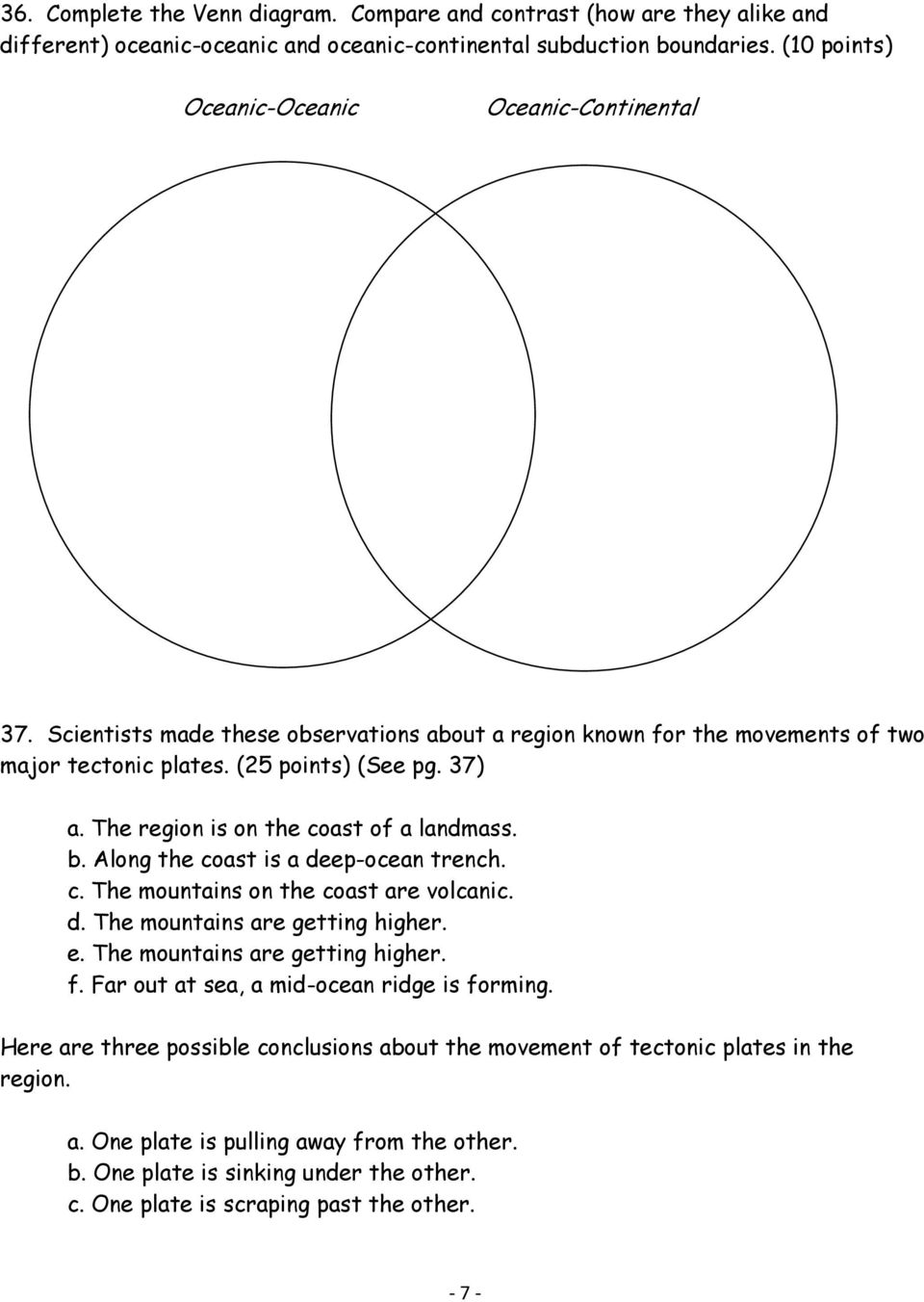
8 Decide how well the observations support each conclusion. Note any observations that indicate that a conclusion is not justified. 8
ES Chapter 10 Review. Name: Class: Date: Multiple Choice Identify the choice that best completes the statement or answers the question.
 Name: Class: Date: ES Chapter 10 Review Multiple Choice Identify the choice that best completes the statement or answers the question. 1. Scientists used the pattern of alternating normal and reversed
Tectonic plates push together at convergent boundaries.
 KEY CONCEPT Plates converge or scrape past each other. BEFORE, you learned Plates move apart at divergent boundaries In the oceans, divergent boundaries mark where the sea floor spreads apart On land,
Name: Period: # Plate Tectonics. Journey to the center of the Earth
 Plate Tectonics Journey to the center of the Earth Use pages 124 129 to answer the following questions. Exploring Inside Earth (p. 125-126) 1. What are the two main types of evidence that Geologist use
Unit 4 Lesson 2 Plate Tectonics. Copyright Houghton Mifflin Harcourt Publishing Company
 Puzzling Evidence What evidence suggests that continents move? In the late 1800s, Alfred Wegener proposed his hypothesis of continental drift. According to this hypothesis, the continents once formed a
Interactive Plate Tectonics
 Interactive Plate Tectonics Directions: Go to the following website and complete the questions below. http://www.learner.org/interactives/dynamicearth/index.html How do scientists learn about the interior
Georgia Performance Standards Framework for Science Grade 6. Unit Organizer: Geology: Inside the Earth (Approximate Time: 7 Weeks)
 The following instructional plan is part of a GaDOE collection of Unit Frameworks, Performance Tasks, examples of Student Work, and Teacher Commentary. Many more GaDOE approved instructional plans are
Plate tectonics states that the Earth's crust and upper mantle are broken into sections, called plates.
 Notes on Plate Tectonics Plate tectonics states that the Earth's crust and upper mantle are broken into sections, called plates. These plates move around the mantle. Plates are composed of the crust and
Chapter 8: Plate Tectonics -- Multi-format Test
 Name: Class: Date: ID: A Chapter 8: Plate Tectonics -- Multi-format Test Modified True/False Indicate whether the statement is true or false. If false, change the identified word or phrase to make the
Rocks and Plate Tectonics
 Name: Class: _ Date: _ Rocks and Plate Tectonics Multiple Choice Identify the choice that best completes the statement or answers the question. 1. What is a naturally occurring, solid mass of mineral or
Tectonic plates have different boundaries.
 KEY CONCEPT Plates move apart. BEFORE, you learned The continents join and break apart The sea floor provides evidence that tectonic plates move The theory of plate tectonics helps explain how the plates
Plate Tectonics Short Study Guide
 Name: Class: Date: Plate Tectonics Short Study Guide Multiple Choice Identify the letter of the choice that best completes the statement or answers the question. 1. The existence of coal beds in Antarctica
II. Earth Science (Geology) Section (9/18/2013)
 EAPS 100 Planet Earth Lecture Topics Brief Outlines II. Earth Science (Geology) Section (9/18/2013) 1. Interior of the Earth Learning objectives: Understand the structure of the Earth s interior crust,
Plate Tectonics Web-Quest
 Plate Tectonics Web-Quest Part I: Earth s Structure. Use the following link to find these answers: http://www.learner.org/interactives/dynamicearth/structure.html 1. Label the layers of Earth in the diagram
Plate Tectonics Chapter 2
 Plate Tectonics Chapter 2 Does not include complete lecture notes. Continental drift: An idea before its time Alfred Wegener First proposed his continental drift hypothesis in 1915 Published The Origin
Plate Tectonics. Plate Tectonics The unifying concept of the Earth sciences. Continental Drift
 Plate Tectonics The unifying concept of the Earth sciences. The outer portion of the Earth is made up of about 20 distinct plates (~ 100 km thick), which move relative to each other This motion is what
4. Plate Tectonics II (p. 46-67)
 4. Plate Tectonics II (p. 46-67) Seafloor Spreading In the early 1960s, samples of basaltic ocean crust were dredged up from various locations across the ocean basins. The samples were then analyzed to
6.E.2.2 Plate Tectonics, Earthquakes and Volcanoes
 Name: Date: 1. The road shown below was suddenly broken by a natural event. 3. The convergence of two continental plates would produce Which natural event most likely caused the crack in the road? island
DYNAMIC CRUST: Unit 4 Exam Plate Tectonics and Earthquakes
 DYNAMIC CRUST: Unit 4 Exam Plate Tectonics and Earthquakes NAME: BLOCK: DATE: 1. Base your answer to the following question on The block diagram below shows the boundary between two tectonic plates. Which
TECTONICS ASSESSMENT
 Tectonics Assessment / 1 TECTONICS ASSESSMENT 1. Movement along plate boundaries produces A. tides. B. fronts. C. hurricanes. D. earthquakes. 2. Which of the following is TRUE about the movement of continents?
Plate Tectonics: Big Ideas. Plate Tectonics. Plate Tectonics. The unifying concept of the Earth sciences.
 Plate Tectonics: Big Ideas Our understanding of Earth is continuously refined. Earth s systems are dynamic; they continually react to changing influences from geological, hydrological, physical, chemical,
Plate Tectonics. Earth, 9 th edition Chapter 2
 1 Plate Tectonics Earth, 9 th edition Chapter 2 2 3 4 5 6 7 8 9 10 11 12 13 14 15 16 Plate Tectonics: summary in haiku form Alfred Wegener gave us Continental Drift. Fifty years later... Continental Drift
Plate Tectonics Practice Questions and Answers Revised August 2007
 Plate Tectonics Practice Questions and Answers Revised August 2007 1. Please fill in the missing labels. 2. Please fill in the missing labels. 3. How many large plates form the outer shell of the earth?
Geol 101: Physical Geology PAST EXAM QUESTIONS LECTURE 4: PLATE TECTONICS II
 Geol 101: Physical Geology PAST EXAM QUESTIONS LECTURE 4: PLATE TECTONICS II 4. Which of the following statements about paleomagnetism at spreading ridges is FALSE? A. there is a clear pattern of paleomagnetic
Continents join together and split apart.
 KEY CONCEPT Continents change position over time. BEFORE, you learned Earth s main layers are the core, the mantle, and the crust The lithosphere and asthenosphere are the topmost layers of Earth The lithosphere
SECOND GRADE PLATE TECTONICS 1 WEEK LESSON PLANS AND ACTIVITIES
 SECOND GRADE PLATE TECTONICS 1 WEEK LESSON PLANS AND ACTIVITIES PLATE TECTONIC CYCLE OVERVIEW OF SECOND GRADE VOLCANOES WEEK 1. PRE: Investigating the parts of a volcano. LAB: Comparing the parts of a
The Dynamic Crust 2) EVIDENCE FOR CRUSTAL MOVEMENT
 The Dynamic Crust 1) Virtually everything you need to know about the interior of the earth can be found on page 10 of your reference tables. Take the time to become familiar with page 10 and everything
Continental Drift. Alfred Wegener (1880-1930) Proposed that all of the continents were once part of a large supercontinent - Pangaea Based on:
 Plate Tectonics and Continental Drift Continental Drift Alfred Wegener (1880-1930) Proposed that all of the continents were once part of a large supercontinent - Pangaea Based on: Similarities in shorelines
FOURTH GRADE PLATE TECTONICS 1 WEEK LESSON PLANS AND ACTIVITIES
 FOURTH GRADE PLATE TECTONICS 1 WEEK LESSON PLANS AND ACTIVITIES PLATE TECTONIC CYCLE OVERVIEW OF FOURTH GRADE VOLCANOES WEEK 1. PRE: Comparing different structures of volcanoes. LAB: Modeling three types
Plate Tectonics. Hi, I am Zed and I am going to take you on a trip learning about Plate Tectonics. And I am Buddy Zed s mascot
 Plate Tectonics Hi, I am Zed and I am going to take you on a trip learning about Plate Tectonics And I am Buddy Zed s mascot Continental Drift Alfred Wegener proposed that continents were not always where
11A Plate Tectonics. What is plate tectonics? Setting up. Materials
 11A Plate Tectonics What is plate tectonics? Earth s crust plus the upper mantle forms the lithosphere. Earth s lithosphere is broken in a number of different pieces. How these pieces move and interact
Chapter 2. Plate Tectonics. Plate Tectonics: Learning Goals
 Plate Tectonics Chapter 2 Interactions at depend on the direction of relative plate motion and the type of crust. Which kind of plate boundary is associated with Earthquake activity? A. Divergent Boundary
Regents Questions: Plate Tectonics
 Earth Science Regents Questions: Plate Tectonics Name: Date: Period: August 2013 Due Date: 17 Compared to the oceanic crust, the continental crust is (1) less dense and more basaltic (3) more dense and
1. You are about to begin a unit on geology. Can anyone tell me what geology is? The study of the physical earth I.
 PLATE TECTONICS ACTIVITY The purpose of this lab is to introduce the concept of plate tectonics and the formation of mountains. Students will discuss the properties of the earth s crust and plate tectonics.
Georgia Performance Standards Framework for Shaky Ground 6 th Grade
 The following instructional plan is part of a GaDOE collection of Unit Frameworks, Performance Tasks, examples of Student Work, and Teacher Commentary. Many more GaDOE approved instructional plans are
Chapter 16: Plate Tectonics
 Chapter 16: Plate Tectonics Chapter Summary In the early 1900s Alfred Wegener set forth the continental drift hypothesis. One of its major tenets was that a supercontinent called Pangaea began breaking
Plate Tectonics. Learning Guide. Pacific Plate. Pacific Ocean. Divergent boundaries
 Plate Tectonics Learning Guide North American Plate Eurasian Plate Arabian Plate Pacific Plate Atlantic Ocean Pacific Ocean Cocos Plate Nazca Plate South American Plate African Plate Convergent boundary
Continental Drift, Sea Floor Spreading and Plate Tectonics
 Page 1 of 13 EENS 1110 Tulane University Physical Geology Prof. Stephen A. Nelson Continental Drift, Sea Floor Spreading and Plate Tectonics This page last updated on 26-Aug-2015 Plate Tectonics is a theory
Plate Tectonics. Introduction. Boundaries between crustal plates
 Plate Tectonics KEY WORDS: continental drift, seafloor spreading, plate tectonics, mid ocean ridge (MOR) system, spreading center, rise, divergent plate boundary, subduction zone, convergent plate boundary,
Chapter 9 Plate Tectonics
 Chapter 9 Plate Tectonics Section 1 Continental Drift Key Concepts What is the hypothesis of continental drift? What evidence supported continental drift? Vocabulary continental drift Pangaea An Idea Before
Plate Tectonics Lab. Continental Drift. The Birth of Plate Tectonics
 Plate Tectonics Lab Continental Drift Take a look at a globe sometime and observe the remarkable fit between South America and Africa. Could they have, in fact, been connected? During the 19th and early
1. The diagram below shows a cross section of sedimentary rock layers.
 1. The diagram below shows a cross section of sedimentary rock layers. Which statement about the deposition of the sediments best explains why these layers have the curved shape shown? 1) Sediments were
[Geology Layers of the Earth] [Basic: Grade 2-3] [Advanced: Grade 5: Introduction to Plate Tectonics}
![[Geology Layers of the Earth] [Basic: Grade 2-3] [Advanced: Grade 5: Introduction to Plate Tectonics}](/thumbs/40/21755359.jpg "[Geology Layers of the Earth] [Basic: Grade 2-3] [Advanced: Grade 5: Introduction to Plate Tectonics}") [Geology Layers of the Earth] [Basic: Grade 2-3] [Advanced: Grade 5: Introduction to Plate Tectonics} BACKGROUND Scientists and geologists have been able to do some drilling on Earth. They are also able
[Geology Layers of the Earth] [Basic: Grade 2-3] [Advanced: Grade 5: Introduction to Plate Tectonics} BACKGROUND Scientists and geologists have been able to do some drilling on Earth. They are also able
The interior of the Earth is divided into layers based on chemical and physical properties.
 Plate Tectonics Lecture Notes: Slide 1. Title Slide Slide 2. The interior of the Earth is divided into layers based on chemical and physical properties. The Earth has an outer silica-rich, solid crust,
How Did These Ocean Features and Continental Margins Form?
 298 10.14 INVESTIGATION How Did These Ocean Features and Continental Margins Form? The terrain below contains various features on the seafloor, as well as parts of three continents. Some general observations
SIXTH GRADE PLATE TECTONICS 1 WEEK LESSON PLANS AND ACTIVITIES
 SIXTH GRADE PLATE TECTONICS 1 WEEK LESSON PLANS AND ACTIVITIES PLATE TECTONIC CYCLE OVERVIEW OF SIXTH GRADE VOLCANOES WEEK 1. PRE: Comparing the structure of different types of volcanoes. LAB: Plotting
FIRST GRADE PLATE TECTONICS 1 WEEK LESSON PLANS AND ACTIVITIES
 FIRST GRADE PLATE TECTONICS 1 WEEK LESSON PLANS AND ACTIVITIES PLATE TECTONIC CYCLE OVERVIEW OF FIRST GRADE VOLCANOES WEEK 1. PRE: Learning the shapes of volcanoes. LAB: Experimenting with "lava." POST:
Earth Science Chapter 14 Section 2 Review
 Name: Class: Date: Earth Science Chapter 14 Section Review Multiple Choice Identify the choice that best completes the statement or answers the question. 1. Which of the following is NOT one of the three
FIFTH GRADE PLATE TECTONICS 1 WEEK LESSON PLANS AND ACTIVITIES
 FIFTH GRADE PLATE TECTONICS 1 WEEK LESSON PLANS AND ACTIVITIES PLATE TECTONIC CYCLE OVERVIEW OF FIFTH GRADE VOLCANOES WEEK 1. PRE: Exploring the rocks produced by volcanoes. LAB: Comparing igneous rocks.
1 Exploring Earth s Interior
 1 Exploring Earth s Interior Crust Mantle Outer Core Crust-to-Mantle Inner Core Cross Section From Surface to Center SCIENCE EXPLORER Focus on Earth Science Prentice-Hall, Inc. 2 Evidence for Continental
Students explore the mechanism behind plate motion as they investigate convection currents. KEY CONCEPTS AND PROCESS SKILLS
 Convection Currents 40- to 1 50-minute session ACTIVITY OVERVIEW 46 L A B O R AT O R Y Students explore the mechanism behind plate motion as they investigate convection currents. KEY CONCEPTS AND PROCESS
Study Guide Questions Earth Structure and Plate Tectonics
 Study Guide Questions Earth Structure and Plate Tectonics What evidence did Alfred Wegener present in 1912 to support the idea of continental drift? Why did most geologists at the time dismiss Wegener
Essential Question: How did the theory of Plate Tectonics evolve?
 Essential Question: How did the theory of Plate Tectonics evolve? 1. Look at a globe or a map of the Earth. Name the continents. (7 points) 2. How many continents are there? (3 points) 3. On a sheet of
Transform Boundaries
 Lecture 7 Plates and Mantle Plumes Transform Boundaries Transform boundaries occur where one segment of rigid lithosphere slides horizontally past another in response to stresses in the lithosphere. The
Step 2: Learn where the nearest divergent boundaries are located.
 What happens when plates diverge? Plates spread apart, or diverge, from each other at divergent boundaries. At these boundaries new ocean crust is added to the Earth s surface and ocean basins are created.
Earthquakes and Plate Boundaries Deborah Jordan and Samuel Spiegel
 Earthquakes and Plate Boundaries Deborah Jordan and Samuel Spiegel Jordan, Deborah and Spiegel, Samuel: Learning Research Development Center, University of Pittsburgh. Earthquakes and Plate Boundaries.
Layers of the Earth s Interior
 Layers of the Earth s Interior 1 Focus Question How is the Earth like an ogre? 2 Objectives Explain how geologists have learned about the interior of the Earth. Describe the layers of the Earth s interior.
Chapter 6 Plate Tectonics and Earthquakes
 Chapter 6 Plate Tectonics and Earthquakes Day Activity Homework 1 Notes I, II Gondwanaland Take-Home Continental Drift* 2 Notes III- V B Edible Tectonics* 3 Notes V C- VI Article- One Boy s Experience
Glossary. continental crust: the sections of crust, the outermost layer of the earth, that include the continents
 aftershock: an earthquake that follows a larger earthquake or main shock and originates in or near the rupture zone of the larger earthquake. Generally, major earthquakes are followed by a number of aftershocks
Engaging Students Through Interactive Activities In General Education Classes
 Engaging Students Through Interactive Activities In General Education Classes On the Cutting Edge: Early Career Geoscience Faculty Workshop 14-18 June 2009 Presented by Randy Richardson Department of Geosciences,
A Collection of Curricula for the STARLAB Plate Tectonics Cylinder
 A Collection of Curricula for the STARLAB Plate Tectonics Cylinder Including: The Changing Earth by Gerald L. Mallon, Ed.D. v. 616-2008 by Science First /STARLAB, 86475 Gene Lasserre Blvd., Yulee, FL.
Investigation 6: What happens when plates collide?
 Tectonics Investigation 6: Teacher Guide Investigation 6: What happens when plates collide? In this activity, students will use the distribution of earthquakes and volcanoes in a Web GIS to learn about
Geodynamics Lecture 2 Kinematics of plate tectonics
 Geodynamics Lecture 2 Kinematics of plate tectonics Lecturer: David Whipp [email protected]! 4.9.2013 Geodynamics www.helsinki.fi/yliopisto 1 Goals of this lecture Present the three types of plate
Earth Science Module 21. Plate Tectonics: The Earth in Motion. Plate Tectonics Module Study Notes and Outline. Creationist Model
 Earth Science Module 21 Plate Tectonics: The Earth in Motion Plate Tectonics Module Study Notes and Outline Creationist Model I. Scientists shift their paradigm A. When the data supporting plate tectonics
Earth Egg Model Teacher Notes
 Ancient Greeks tried to explain earthquakes and volcanic activity by saying that a massive bull lay underground and the land shook when it became angry. Modern theories rely on an understanding of what
PLATE TECTONICS. Teacher Guide including Lesson Plans, Student Readers, and More Information
 PLATE TECTONICS Teacher Guide including Lesson Plans, Student Readers, and More Information Lesson 1 - Evidence of Plate Tectonics Lesson 2 - Plotting Earthquakes and Volcanoes Lesson 3 - Case History
Plate Tectonics: Ridges, Transform Faults and Subduction Zones
 Plate Tectonics: Ridges, Transform Faults and Subduction Zones Goals of this exercise: 1. review the major physiographic features of the ocean basins 2. investigate the creation of oceanic crust at mid-ocean
KINDERGARTEN PLATE TECTONICS 1 WEEK LESSON PLANS AND ACTIVITIES
 KINDERGARTEN PLATE TECTONICS 1 WEEK LESSON PLANS AND ACTIVITIES PLATE TECTONIC CYCLE OVERVIEW OF KINDERGARTEN VOLCANOES WEEK 1. PRE: Learning that all mountains are not volcanoes. LAB: Investigating rocks
Layers of the Earth and Plate Tectonics
 Layers of the Earth and Plate Tectonics Objectives: explain various ways the earth can be changed by natural forces define the term Geology define the terms Crust, Mantle, Outer Core and Inner Core classify
Unit Plan: Plate Tectonics Shannon B. Carpenter TE 804 1/25/02
 Unit Plan: Plate Tectonics Shannon B. Carpenter TE 804 1/25/02 This unit plan is intended to cover about seven weeks and would be appropriate for a middle school general science class or an introductory
There are numerous seams on the surface of the Earth
 Plate Tectonics and Continental Drift There are numerous seams on the surface of the Earth Questions and Topics 1. What are the theories of Plate Tectonics and Continental Drift? 2. What is the evidence
Lesson 13: Plate Tectonics I
 Standards Addressed Lesson 13: Plate Tectonics I Overview Lesson 13 introduces students to geological oceanography by presenting the basic structure of the Earth and the properties of Earth s primary layers.
Section 1 The Earth System
 Section 1 The Earth System Key Concept Earth is a complex system made up of many smaller systems through which matter and energy are continuously cycled. What You Will Learn Energy and matter flow through
Student Exploration: Plate Tectonics
 Name: Date: Student Exploration: Plate Tectonics Vocabulary: collisional boundary, convergent boundary, crust, divergent boundary, earthquake, lithosphere, mantle, plate, plate tectonics, transform boundary,
UNIT 10 HOMEWORK WEB HIT HOMEWORK - 1: ONE WRITTEN PARAGRAPH
 UNIT 10 Plate Tectonics Study Guide Chapters 1, 2, 9, and most of book (Revised 7/12) UNIT 10 HOMEWORK WEB HIT HOMEWORK - part 1: ONE WRITTEN PARAGRAPH from any selected unit web hit site VIDEO WEB HIT
Exploring Our World with GIS Lesson Plans Engage
 Exploring Our World with GIS Lesson Plans Engage Title: Exploring Our Nation 20 minutes *Have students complete group work prior to going to the computer lab. 2.List of themes 3. Computer lab 4. Student
Plate Tectonics Lab Assignment
 Plate Tectonics Lab Assignment After reading the introduction to the Plate Tectonics exercises in the lab manual, complete the questions on a hard copy of this Lab Assignment. When finished, transfer your
Hot Spots & Plate Tectonics
 Hot Spots & Plate Tectonics Activity I: Hawaiian Islands Procedures: Use the map and the following information to determine the rate of motion of the Pacific Plate over the Hawaiian hot spot. The volcano
www.amnh.org Continental Drift is the movement of the Earth s continents in relation to one another.
 A Plate Tectonic Puzzle Introduction The Earth s crust is not a solid shell. It is made up of thick, interconnecting pieces called tectonic plates that fit together like a puzzle. They move atop the underlying
Igneous Rocks. Geology 200 Geology for Environmental Scientists
 Igneous Rocks Geology 200 Geology for Environmental Scientists Magma Compositions Ultramafic - composition of mantle Mafic - composition of basalt, e.g. oceanic crust. 900-1200 o C, 50% SiO 2 Intermediate
Grade 10 Informational Mini-Assessment
 Grade 10 Informational Mini-Assessment The Force This grade 10 mini-assessment is based on the text The Force, an excerpt from Furious Earth: The Science and Nature of Earthquakes, Volcanoes, and Tsunamis
Earth Science Grade 4 Minerals
 Earth Science Grade 4 Minerals Standards: Identifies the physical properties of minerals Teacher Background Minerals are pure substances and mix together to make rocks. Rocks have a cycle and different
Using Google Earth to Explore Plate Tectonics
 Using Google Earth to Explore Plate Tectonics Laurel Goodell, Department of Geosciences, Princeton University, Princeton, NJ 08544 [email protected] Inspired by, and borrows from, the GIS-based Exploring
Chapter Overview. Bathymetry. Measuring Bathymetry. Echo Sounding Record. Measuring Bathymetry. CHAPTER 3 Marine Provinces
 Chapter Overview CHAPTER 3 Marine Provinces The study of bathymetry charts ocean depths and ocean floor topography. Echo sounding and satellites are efficient bathymetric tools. Most ocean floor features
DISTRIBUTION OF OCEANS
 CHAPTER DISTRIBUTION OF OCEANS AND CONTINENTS In the previous chapter, you have studied the interior of the earth. You are already familiar with the world map. You know that continents cover 29 per cent
PLATE TECTONICS EXERCISE (Modified from North Seattle Community College online exercise)
 PLATE TECTONICS EXERCISE (Modified from North Seattle Community College online exercise) Introduction: As discussed in our textbook, the speed at which tectonic plates move has been calculated in several
Volcanoes Erupt Grade 6
 TEACHING LEARNING COLLABORATIVE (TLC) EARTH SCIENCE Volcanoes Erupt Grade 6 Created by: Debra McKey (Mountain Vista Middle School); Valerie Duncan (Upper Lake Middle School); and Lynn Chick (Coyote Valley
Lesson 3: The formation of mountains Factsheet for teachers
 Lesson 3: The formation of mountains Factsheet for teachers Vocabulary This lesson uses the following geographical terms. These should be used and explained to pupils as the lesson is taught. Core, mantle,
Alfred Wegener s Theory of Continental Drift Became Modern Plate Tectonics. Wegener in Greenland about 1912. He froze to death there in 1930.
 Alfred Wegener s Theory of Continental Drift Became Modern Plate Tectonics Wegener in Greenland about 1912. He froze to death there in 1930. Science is self correcting. The Scientific Method The history
GENERAL SCIENCE LABORATORY 1110L Lab Experiment 9B: Tracking the Hawaiian Islands: How Fast Does the Pacific Plate Move?
 GENERAL SCIENCE LABORATORY 1110L Lab Experiment 9B: Tracking the Hawaiian Islands: How Fast Does the Pacific Plate Move? Background You know that the Earth s crustal plates are always moving, but how fast?
Rapid Changes in Earth s Surface
 TEKS investigate rapid changes in Earth s surface such as volcanic eruptions, earthquakes, and landslides Rapid Changes in Earth s Surface Constant Changes Earth s surface is constantly changing. Wind,
Assignment #3: Plate Tectonics
 Assignment #3: Plate Tectonics Overview: In this assignment we will examine the ideas of continental drift and of sea-floor spreading that lead to the Theory of Plate Tectonics. This assignment is in two
Unit 4: The Rock Cycle
 Unit 4: The Rock Cycle Objective: E 3.1A Discriminate between igneous, metamorphic, and sedimentary rocks and describe the processes that change one kind of rock into another. E 3.1B Explain the relationship
Suggested Activities Processes that Shape the Earth: Earth s Structure and Plate Tectonics
 Suggested Activities Processes that Shape the Earth: Earth s Structure and Plate Tectonics From Harcourt Science Teacher Ed. Source (Grade Level) Title Pages Concept Harcourt Science (4) The Layers of
Exploring Plate Tectonics
 Unit 2 Exploring Plate Tectonics In this unit, you will Calculate the rate of spreading of the Atlantic Ocean. Investigate whether plate spreading rates change with time or vary across the globe. Predict
Chesapeake Bay Governor School for Marine and Environmental Science
 Choose the best answer and write on the answer sheet provided. 1. Which of the following is LEAST likely to be an effect of global warming? (a) Loss of fertile delta regions for agriculture (b) Change
UNCORRECTED PAGE PROOFS
 5Plate tectonics Earthquakes in Christchurch and northern Japan in 2011 and the Haiti earthquake in 2010 caused massive destruction and loss of life. What caused these and other earthquakes and volcanic
THE STRUCTURE OF THE EARTH
 THE STRUCTURE OF THE EARTH Contents 1. Main Objectives 2. Useful Websites 3. Pupil Vocabulary Cards 4. Word Wall Cards 5. Glossary 6. Key Question Cards 7. Prior Learning Diagram 8. Hands-on Activities
Foundations of Earth Science (Lutgens and Tarbuck, 5 th edition, 2008)
 EAS 100 Study Guide to Textbook Foundations of Earth Science (Lutgens and Tarbuck, 5 th edition, 2008) STUDY GUIDE 1/08 The textbook for EAS 100, Foundations of Earth Science, by Lutgens and Tarbuck is
Exploring Plate Tectonics
 Unit 2 Exploring Plate Tectonics In this unit, you will Calculate the rate of spreading of the Atlantic Ocean. Investigate whether plate spreading rates change with time or vary across the globe. Predict
Plate Tectonics. CE3A8 SMJ Geology for Engineers 1
 CE3A8 SMJ Geology for Engineers 1 Plate Tectonics The significance of plate tectonics in geological science can be likened to the significance of the theory of evolution in biological science. In both