
@AIRBUS A380 AIRCRAFT CHARACTERISTICS AIRPORT AND MAINTENANCE PLANNING
|
|
|
- Diane Poole
- 9 years ago
- Views:
Transcription
1 @IRBUS 380 IRCRFT CHRCTERISTICS IRPORT ND MINTENNCE PLNNING C The content of this document is the property of irbus. It is supplied in confidence and commercial security on its contents must be maintained. It must not be used for any purpose other than that for which it is supplied, nor may information contained in it be disclosed to unauthorized persons. It must not be reproduced in whole or in part without permission in writing from the owners of the copyright. Requests for reproduction of any data in this document and the media authorized for it must be addressed to irbus. IRBUS S..S ll rights reserved. IRBUS S..S. Customer Services Technical Data Support and Services Blagnac Cedex FRNCE Issue: Mar 30/05 Rev:

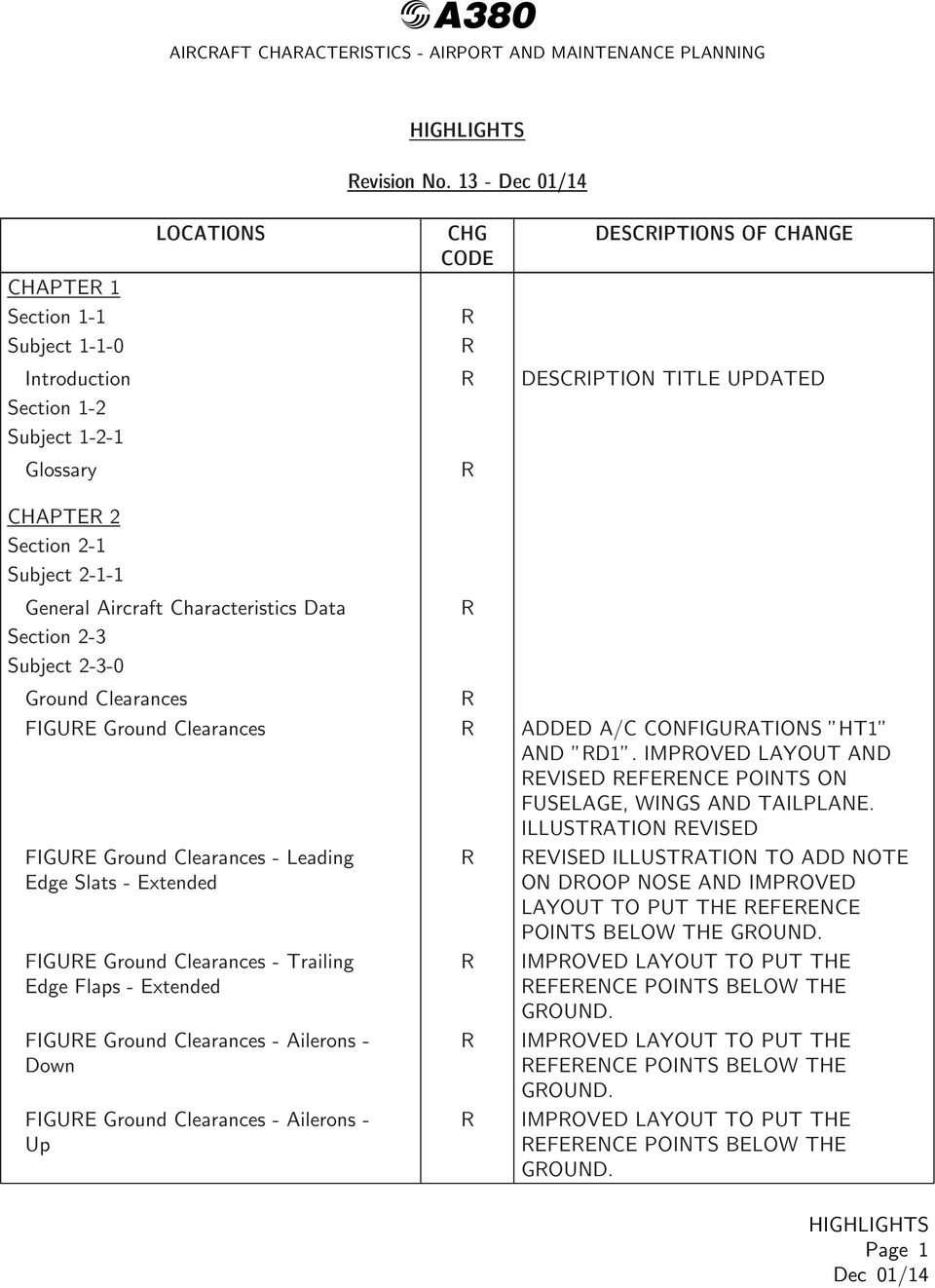
2 HIGHLIGHTS Revision No LOCTIONS CHG DESCRIPTIONS OF CHNGE CODE CHPTER 1 Section 1-1 R Subject R Introduction R DESCRIPTION TITLE UPDTED Section 1-2 Subject Glossary R CHPTER 2 Section 2-1 Subject General ircraft Characteristics Data R Section 2-3 Subject Ground Clearances R FIGURE Ground Clearances R DDED /C CONFIGURTIONS HT1 ND RD1. IMPROVED LYOUT ND REVISED REFERENCE POINTS ON FUSELGE, WINGS ND TILPLNE. ILLUSTRTION REVISED FIGURE Ground Clearances - Leading Edge Slats - Extended FIGURE Ground Clearances - Trailing EdgeFlaps-Extended FIGURE Ground Clearances - ilerons - Down FIGURE Ground Clearances - ilerons - Up R R R R REVISED ILLUSTRTION TO DD NOTE ON DROOP NOSE ND IMPROVED LYOUT TO PUT THE REFERENCE POINTS BELOW THE GROUND. IMPROVED LYOUT TO PUT THE REFERENCE POINTS BELOW THE GROUND. IMPROVED LYOUT TO PUT THE REFERENCE POINTS BELOW THE GROUND. IMPROVED LYOUT TO PUT THE REFERENCE POINTS BELOW THE GROUND. HIGHLIGHTS Page 1
3 LOCTIONS FIGURE Ground Clearances - Flap Tracks - Extended FIGURE Ground Clearances - Trimmable Horizontal Stabilizer and Elevators - Down Section 2-7 Subject Door Clearances FIGURE Door Clearances - Forward Passenger Doors FIGURE Door Clearances - Main and Upper Deck Passenger Doors FIGURE Door Clearances - ft Passenger Doors FIGURE Door Clearances - Forward Cargo Compartment Door FIGURE Door Clearances - ft Cargo Compartment Doors FIGURE Door Clearances - Forward Nose Landing Gear Doors FIGURE Door Clearances - Wing Landing Gears - Main Doors FIGURE Door Clearances - Body Landing Gears - Outer Doors CHG CODE R N R R N N N N N N N N DESCRIPTIONS OF CHNGE IMPROVED LYOUT TO PUT THE REFERENCE POINTS BELOW THE GROUND. DDED ILLUSTRTION TO SHOW THE MINIMUM GROUND CLERNCE WHEN THS ND ELEVTORS RE IN FULLY DOWN POSITION. ILLUSTRTION DDED ILLUSTRTION MOVED FROM SECTION ND DDED COVER PLTE DT. ILLUSTRTION DDED ILLUSTRTION MOVED FROM SECTION ND DDED COVER PLTE DT. ILLUSTRTION DDED ILLUSTRTION MOVED FROM SECTION ND DDED COVER PLTE DT. ILLUSTRTION DDED ILLUSTRTION MOVED FROM SECTION ILLUSTRTION DDED ILLUSTRTION MOVED FROM SECTION ILLUSTRTION DDED ILLUSTRTION MOVED FROM SECTION ILLUSTRTION DDED ILLUSTRTION MOVED FROM SECTION ILLUSTRTION DDED ILLUSTRTION MOVED FROM SECTION ILLUSTRTION DDED HIGHLIGHTS Page 2

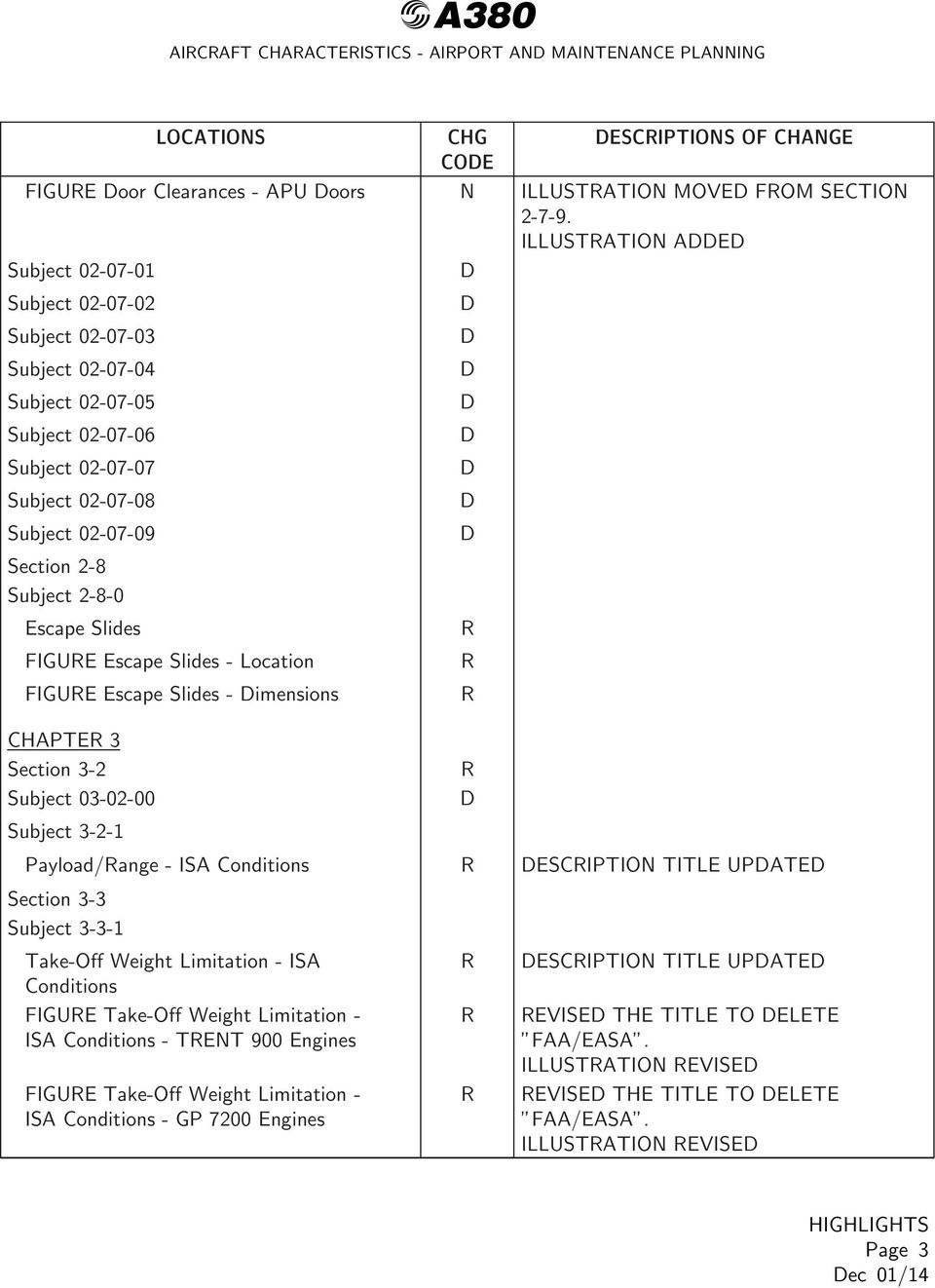
4 LOCTIONS CHG DESCRIPTIONS OF CHNGE CODE FIGURE Door Clearances - PU Doors N ILLUSTRTION MOVED FROM SECTION ILLUSTRTION DDED Subject D Subject D Subject D Subject D Subject D Subject D Subject D Subject D Subject D Section 2-8 Subject Escape Slides R FIGURE Escape Slides - Location R FIGURE Escape Slides - Dimensions R CHPTER 3 Section 3-2 R Subject D Subject Payload/Range - IS Conditions R DESCRIPTION TITLE UPDTED Section 3-3 Subject Take-Off Weight Limitation - IS R DESCRIPTION TITLE UPDTED Conditions FIGURE Take-Off Weight Limitation - IS Conditions - TRENT 900 Engines R REVISED THE TITLE TO DELETE F/ES. ILLUSTRTION REVISED FIGURE Take-Off Weight Limitation - IS Conditions - GP 7200 Engines R REVISED THE TITLE TO DELETE F/ES. ILLUSTRTION REVISED HIGHLIGHTS Page 3
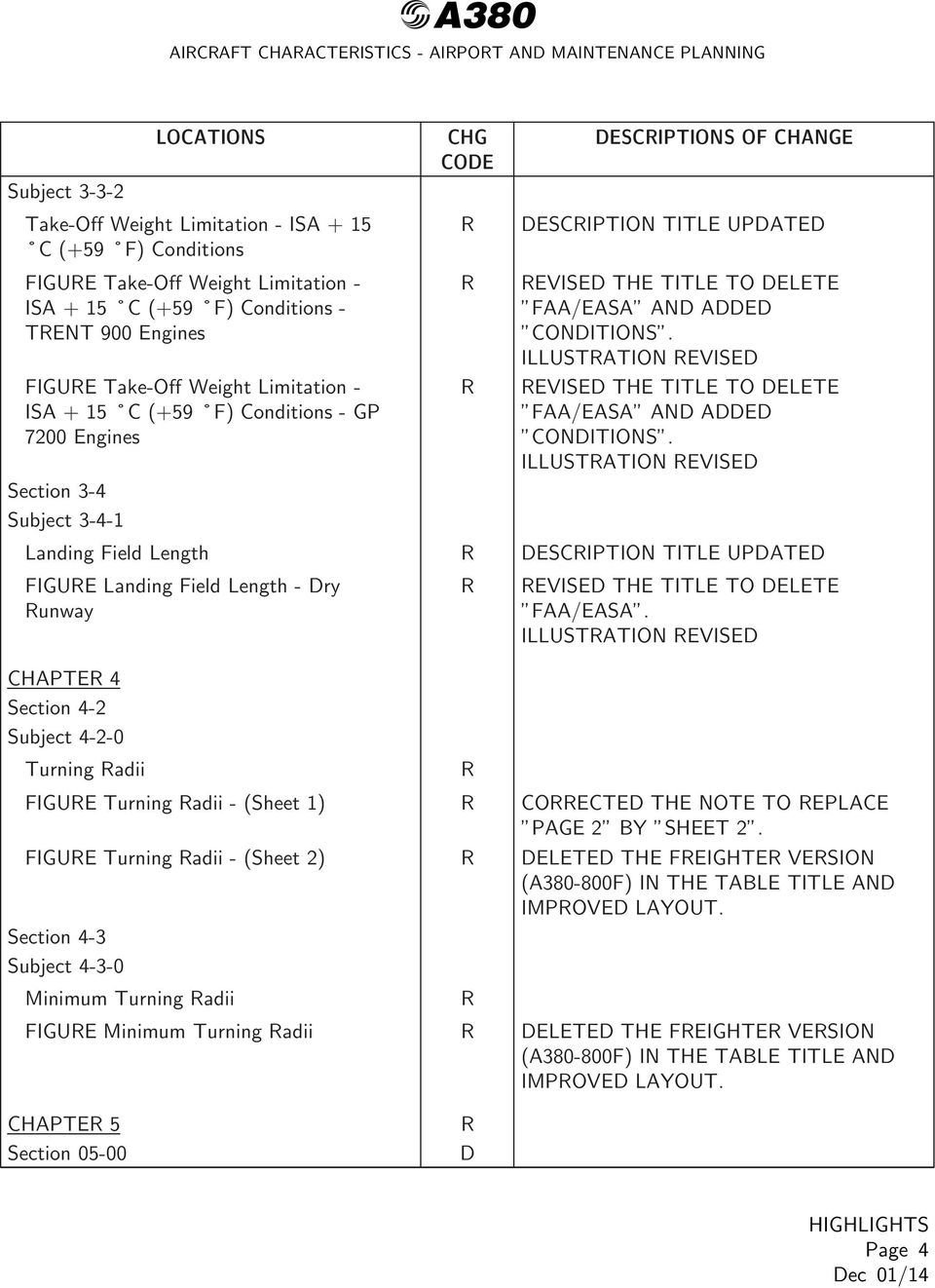
5 LOCTIONS Subject Take-Off Weight Limitation - IS + 15 C (+59 F) Conditions FIGURE Take-Off Weight Limitation - IS + 15 C (+59 F) Conditions - TRENT 900 Engines FIGURE Take-Off Weight Limitation - IS + 15 C (+59 F) Conditions - GP 7200 Engines CHG CODE R R R DESCRIPTIONS OF CHNGE DESCRIPTION TITLE UPDTED REVISED THE TITLE TO DELETE F/ES ND DDED CONDITIONS. ILLUSTRTION REVISED REVISED THE TITLE TO DELETE F/ES ND DDED CONDITIONS. ILLUSTRTION REVISED Section 3-4 Subject Landing Field Length R DESCRIPTION TITLE UPDTED FIGURE Landing Field Length - Dry Runway R REVISED THE TITLE TO DELETE F/ES. ILLUSTRTION REVISED CHPTER 4 Section 4-2 Subject Turning Radii R FIGURE Turning Radii - (Sheet 1) R CORRECTED THE NOTE TO REPLCE PGE 2 BY SHEET 2. FIGURE Turning Radii - (Sheet 2) R DELETED THE FREIGHTER VERSION ( F) IN THE TBLE TITLE ND IMPROVED LYOUT. Section 4-3 Subject Minimum Turning Radii R FIGURE Minimum Turning Radii R DELETED THE FREIGHTER VERSION ( F) IN THE TBLE TITLE ND IMPROVED LYOUT. CHPTER 5 Section R D HIGHLIGHTS Page 4
6 LOCTIONS CHG DESCRIPTIONS OF CHNGE CODE Section 5-1 Subject ircraft Servicing rrangements R DESCRIPTION TITLE UPDTED Section 5-2 Subject Typical Turn-Round Time - Standard Servicing Via Main Deck and Upper Deck R FIGURE Typical Turn-Round Time - Servicing Via Main and Upper Deck Subject Typical Turn-Round Time - Servicing Via Main Deck FIGURE Typical Turn-Round Time - Servicing Via Main Deck R R R REPLCED THE WORD DEBORDING BY DEPLNING ND TOILET BY WSTE WTER. REPLCED THE WORD DEBORDING BY DEPLNING ND TOILET BY WSTE WTER. Section 5-4 R Subject R Grounding (Earthing) Points R DESCRIPTION TITLE UPDTED FIGURE Grounding (Earthing) Point - NLG FIGURE Grounding (Earthing) Points - WLG FIGURE Grounding (Earthing) Points - BLG Subject Hydraulic System FIGURE Ground Service Connections - Hydraulic Reservoir Servicing Panel R R R R R REVISED THE TITLE ND ILLUSTRTION TO DD THE WORD ERTHING TO THE TERM GROUNDING. ILLUSTRTION REVISED REVISED THE TITLE ND ILLUSTRTION TO DD THE WORD ERTHING TO THE TERM GROUNDING. ILLUSTRTION REVISED REVISED THE TITLE ND ILLUSTRTION TO DD THE WORD ERTHING TO THE TERM GROUNDING. ILLUSTRTION REVISED REVISED ILLUSTRTION TO SHOW THE DEPRESSURIZTION SWITCHES. HIGHLIGHTS Page 5

7 LOCTIONS CHG DESCRIPTIONS OF CHNGE CODE Subject Electrical System R NOTE MENDED FIGURE Ground Service Connections - R Ram ir Turbine Retracted FIGURE Ground Service Connections - R Ram ir Turbine Extended Subject Oxygen System R Subject Fuel System R FIGURE Ground Service Connections - R Overpressure Protector and NC Flame rrestor - Wing FIGURE Ground Service Connections - Overpressure Protector and NC Flame rrestor - Trim Tank N DDED ILLUSTRTION TO SHOW OVERPRESSURE PROTECTOR ND NC FLME RRESTOR ON TRIM TNK. ILLUSTRTION DDED Subject Pneumatic System R Subject R Engine Oil Servicing R DESCRIPTION TITLE UPDTED NOTE MENDED FIGURE Ground Service Connections - Engine Oil Servicing - TRENT 900 Engines FIGURE Ground Service Connections - Engine Oil Servicing - GP7200 Engines VFG Oil Servicing FIGURE Ground Service Connections - VFG Oil Servicing - TRENT 900 Engines N N N N MIGRTED THE SECTION ENGINE OIL SERVICING FROM TO ILLUSTRTION DDED MIGRTED THE SECTION ENGINE OIL SERVICING FROM TO ILLUSTRTION DDED MIGRTED THE SECTION VFG OIL SERVICING FROM TO ILLUSTRTION DDED HIGHLIGHTS Page 6

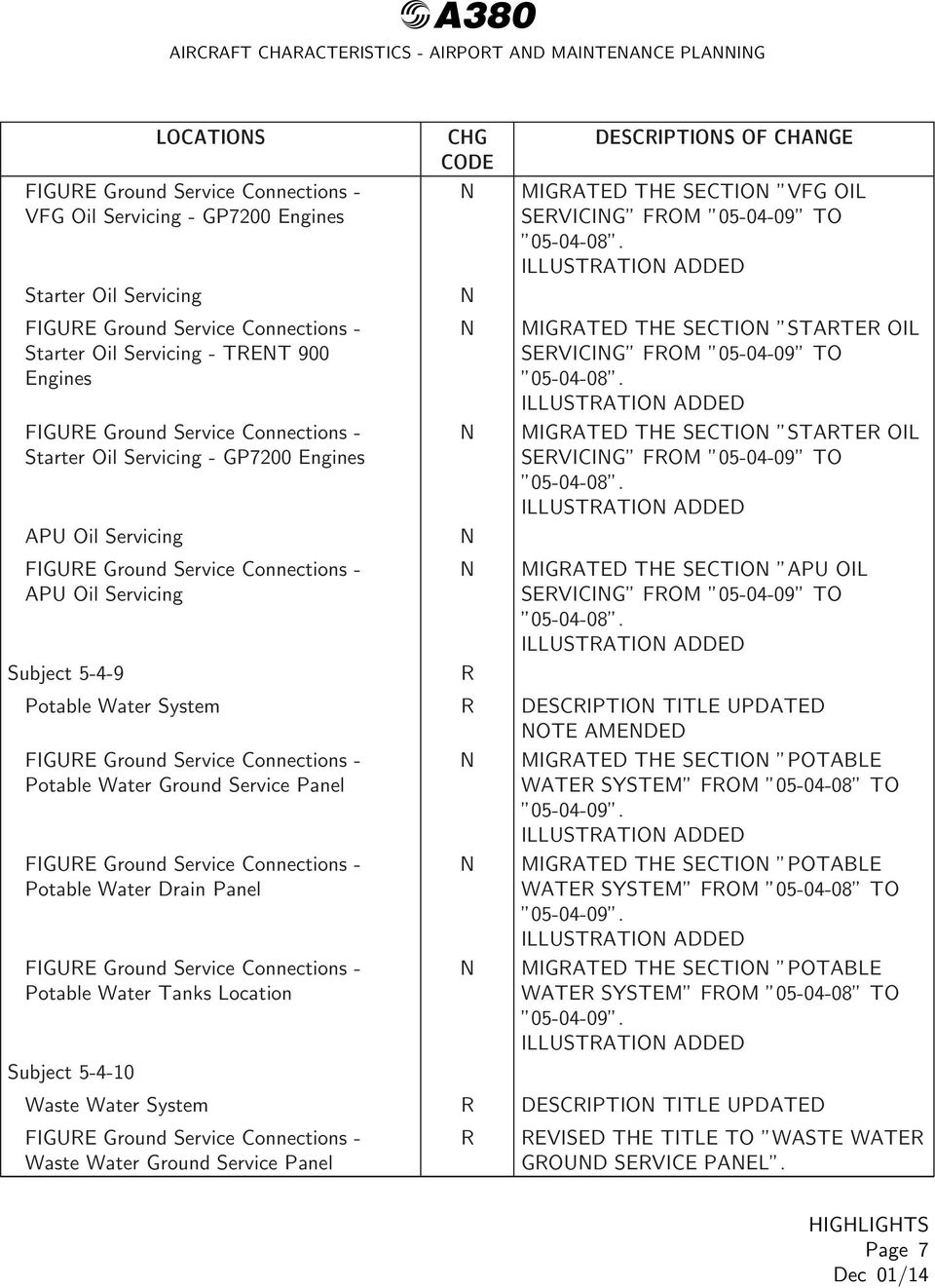
8 LOCTIONS FIGURE Ground Service Connections - VFG Oil Servicing - GP7200 Engines Starter Oil Servicing FIGURE Ground Service Connections - Starter Oil Servicing - TRENT 900 Engines FIGURE Ground Service Connections - Starter Oil Servicing - GP7200 Engines PU Oil Servicing FIGURE Ground Service Connections - PU Oil Servicing CHG CODE N N N N N N DESCRIPTIONS OF CHNGE MIGRTED THE SECTION VFG OIL SERVICING FROM TO ILLUSTRTION DDED MIGRTED THE SECTION STRTER OIL SERVICING FROM TO ILLUSTRTION DDED MIGRTED THE SECTION STRTER OIL SERVICING FROM TO ILLUSTRTION DDED MIGRTED THE SECTION PU OIL SERVICING FROM TO ILLUSTRTION DDED Subject R Potable Water System R DESCRIPTION TITLE UPDTED NOTE MENDED FIGURE Ground Service Connections - Potable Water Ground Service Panel N MIGRTED THE SECTION POTBLE WTER SYSTEM FROM TO ILLUSTRTION DDED FIGURE Ground Service Connections - Potable Water Drain Panel FIGURE Ground Service Connections - Potable Water Tanks Location N N MIGRTED THE SECTION POTBLE WTER SYSTEM FROM TO ILLUSTRTION DDED MIGRTED THE SECTION POTBLE WTER SYSTEM FROM TO ILLUSTRTION DDED Subject Waste Water System R DESCRIPTION TITLE UPDTED FIGURE Ground Service Connections - Waste Water Ground Service Panel R REVISED THE TITLE TO WSTE WTER GROUND SERVICE PNEL. HIGHLIGHTS Page 7
9 LOCTIONS CHG DESCRIPTIONS OF CHNGE CODE Subject N Cargo Control Panels N FIGURE Forward Cargo Control Panels N DDED NEW ILLUSTRTION FOR FORWRD CRGO CONTROL PNELS. ILLUSTRTION DDED FIGURE ft Cargo Control Panels N DDED NEW ILLUSTRTION FOR FT CRGO CONTROL PNELS. ILLUSTRTION DDED CHPTER 6 Section 6-1 Subject Engine Exhaust Velocities and Temperatures Section Section 6-4 Subject Subject PU Exhaust Velocities and Temperatures - ECS Conditions R R D R D R DESCRIPTION TITLE UPDTED CHPTER 7 Section 7-2 Subject Landing Gear Footprint R FIGURE Landing Gear Footprint R REVISED THE LNDING GER FOOTPRINT DT FOR WV009. Section 7-3 Subject Maximum Pavement Loads R FIGURE Maximum Pavement Loads R REVISED THE MXIMUM PVEMENT LODS FOR WV009. Section 7-6 Subject HIGHLIGHTS Page 8

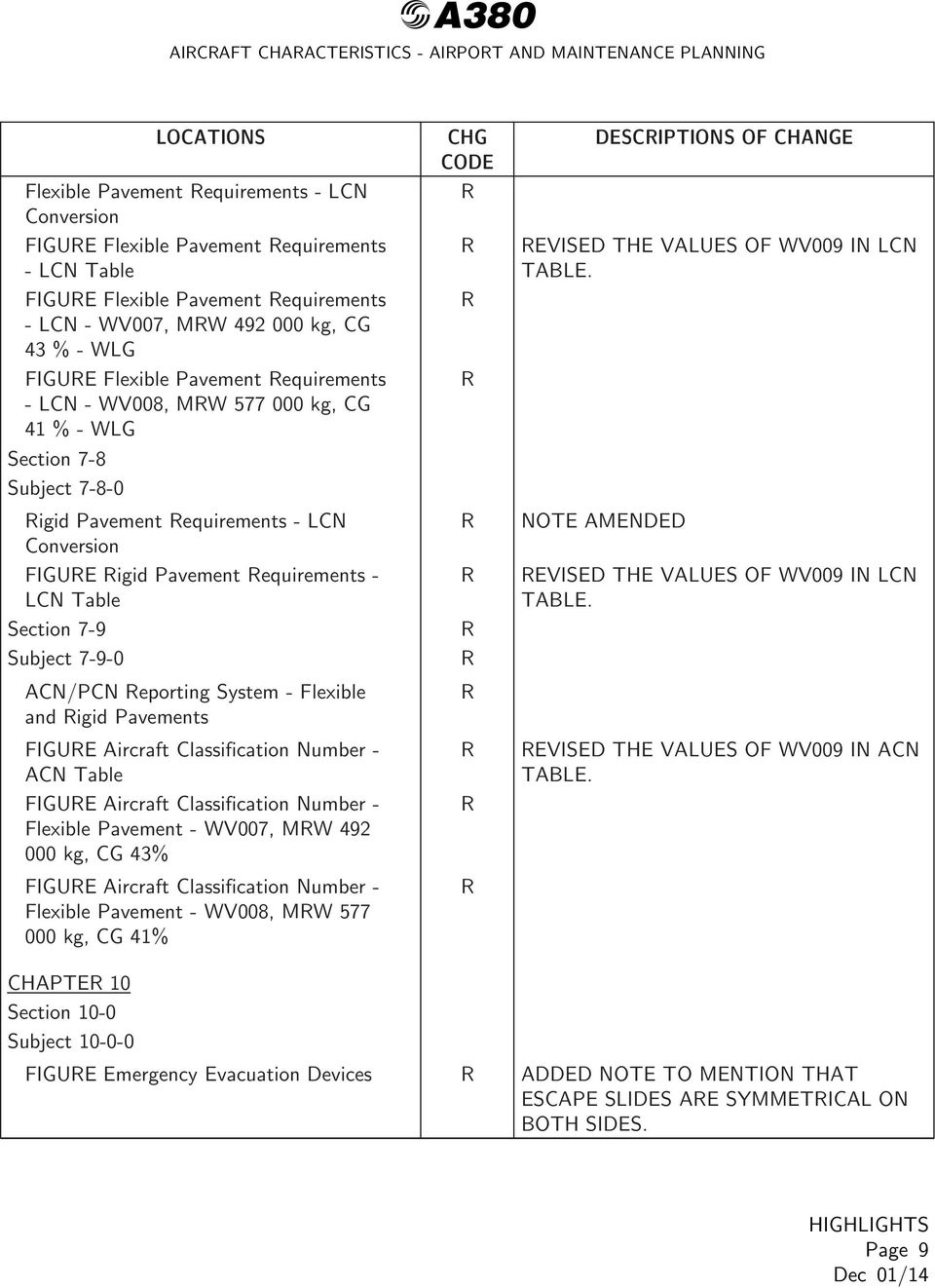
10 LOCTIONS Flexible Pavement Requirements - LCN Conversion FIGURE Flexible Pavement Requirements - LCN Table FIGURE Flexible Pavement Requirements - LCN - WV007, MRW kg, CG 43 % - WLG FIGURE Flexible Pavement Requirements - LCN - WV008, MRW kg, CG 41 % - WLG Section 7-8 Subject Rigid Pavement Requirements - LCN Conversion FIGURE Rigid Pavement Requirements - LCN Table Section 7-9 Subject CN/PCN Reporting System - Flexible and Rigid Pavements FIGURE ircraft Classification Number - CN Table FIGURE ircraft Classification Number - Flexible Pavement - WV007, MRW kg, CG 43% FIGURE ircraft Classification Number - Flexible Pavement - WV008, MRW kg, CG 41% CHG CODE R R R R R R R R R R R R DESCRIPTIONS OF CHNGE REVISED THE VLUES OF WV009 IN LCN TBLE. NOTE MENDED REVISED THE VLUES OF WV009 IN LCN TBLE. REVISED THE VLUES OF WV009 IN CN TBLE. CHPTER 10 Section 10-0 Subject FIGURE Emergency Evacuation Devices R DDED NOTE TO MENTION THT ESCPE SLIDES RE SYMMETRICL ON BOTH SIDES. HIGHLIGHTS Page 9
11 LIST OF EFFECTIVE CONTENT CONTENT Revision No CHG CODE LST REVISION DTE CHPTER 1 Subject Introduction R Subject Glossary R CHPTER 2 Subject General ircraft Characteristics Data R Subject General ircraft Dimensions Dec 01/13 FIGURE General ircraft Dimensions Dec 01/13 Subject Ground Clearances R FIGURE Ground Clearances R FIGURE Ground Clearances - Leading Edge Slats - Extended R FIGURE Ground Clearances - Trailing Edge Flaps - Extended R FIGURE Ground Clearances - Spoilers - Extended Dec 01/13 FIGURE Ground Clearances - ilerons - Down R FIGURE Ground Clearances - ilerons - Up R FIGURE Ground Clearances - Flap Tracks - Extended R FIGURE Ground Clearances - Trimmable Horizontal Stabilizer and N Elevators - Down Subject Interior rrangement - Plan View Dec 01/13 Subject Standard Configuration - Pax Dec 01/13 L.E.C. Page 1

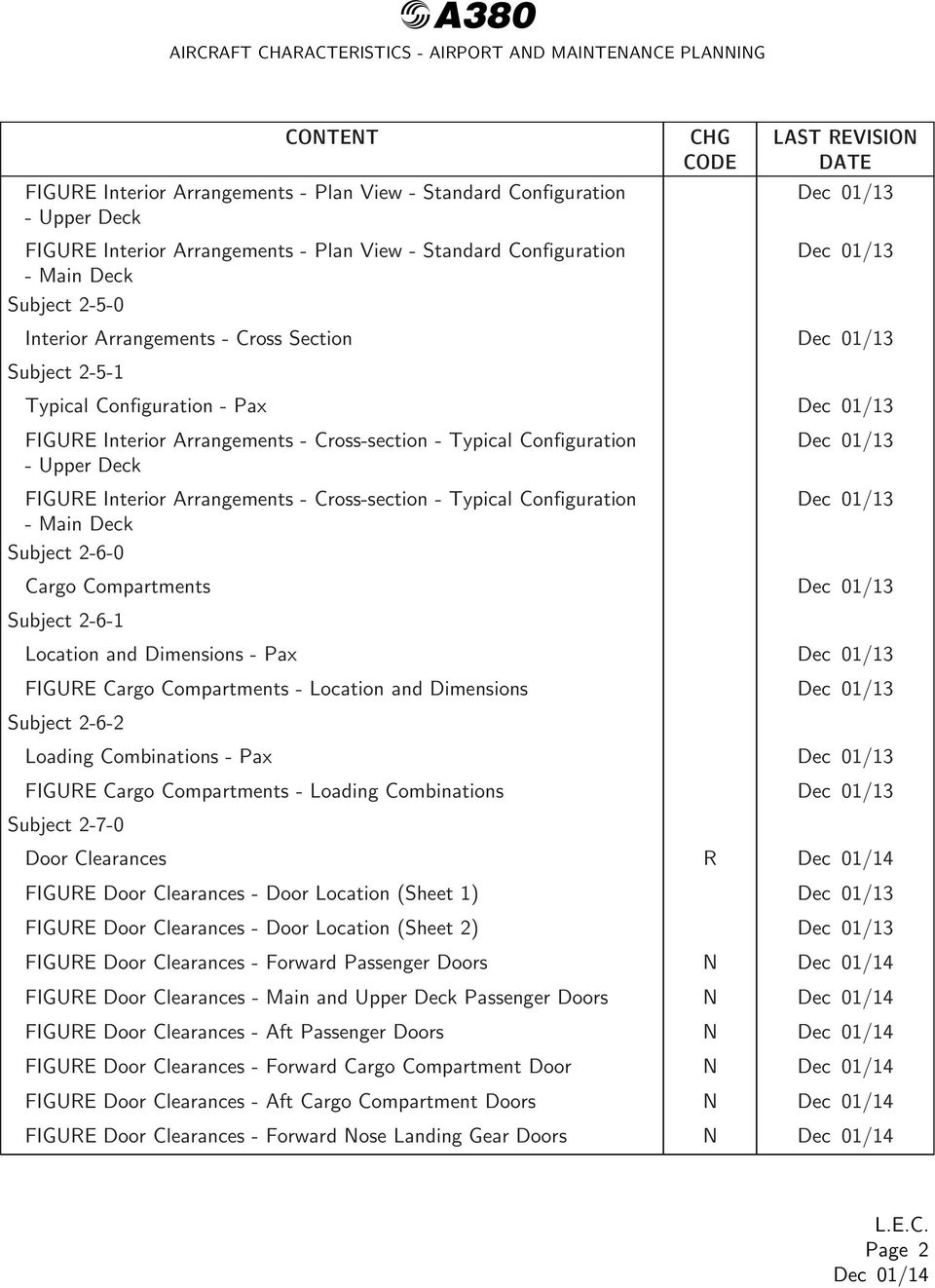
12 CONTENT FIGURE Interior rrangements - Plan View - Standard Configuration - Upper Deck FIGURE Interior rrangements - Plan View - Standard Configuration - Main Deck Subject CHG CODE LST REVISION DTE Dec 01/13 Dec 01/13 Interior rrangements - Cross Section Dec 01/13 Subject Typical Configuration - Pax Dec 01/13 FIGURE Interior rrangements - Cross-section - Typical Configuration Dec 01/13 - Upper Deck FIGURE Interior rrangements - Cross-section - Typical Configuration Dec 01/13 - Main Deck Subject Cargo Compartments Dec 01/13 Subject Location and Dimensions - Pax Dec 01/13 FIGURE Cargo Compartments - Location and Dimensions Dec 01/13 Subject Loading Combinations - Pax Dec 01/13 FIGURE Cargo Compartments - Loading Combinations Dec 01/13 Subject Door Clearances R FIGURE Door Clearances - Door Location (Sheet 1) Dec 01/13 FIGURE Door Clearances - Door Location (Sheet 2) Dec 01/13 FIGURE Door Clearances - Forward Passenger Doors N FIGURE Door Clearances - Main and Upper Deck Passenger Doors N FIGURE Door Clearances - ft Passenger Doors N FIGURE Door Clearances - Forward Cargo Compartment Door N FIGURE Door Clearances - ft Cargo Compartment Doors N FIGURE Door Clearances - Forward Nose Landing Gear Doors N L.E.C. Page 2
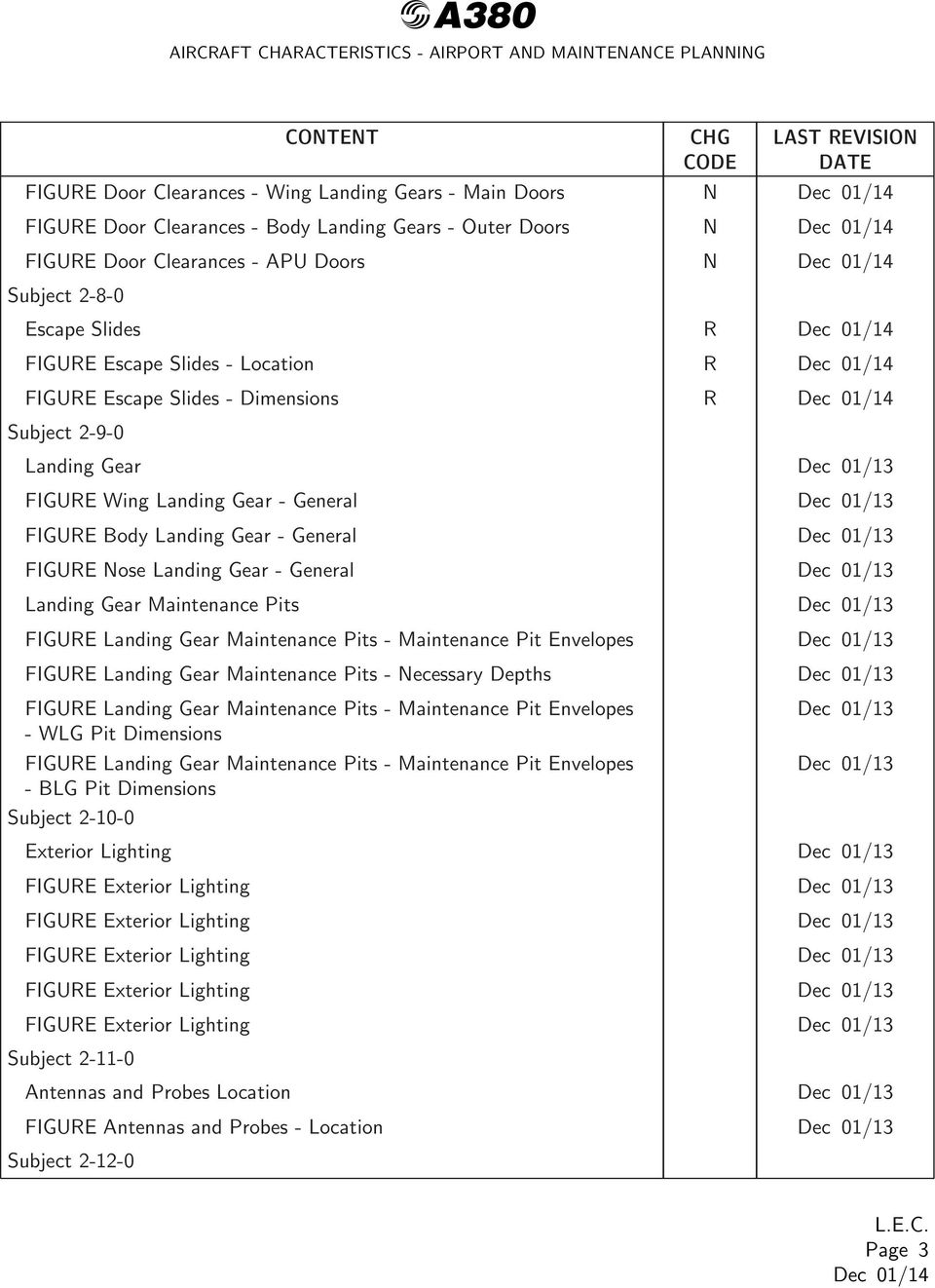
13 CONTENT CHG CODE LST REVISION DTE FIGURE Door Clearances - Wing Landing Gears - Main Doors N FIGURE Door Clearances - Body Landing Gears - Outer Doors N FIGURE Door Clearances - PU Doors N Subject Escape Slides R FIGURE Escape Slides - Location R FIGURE Escape Slides - Dimensions R Subject Landing Gear Dec 01/13 FIGURE Wing Landing Gear - General Dec 01/13 FIGURE Body Landing Gear - General Dec 01/13 FIGURE Nose Landing Gear - General Dec 01/13 Landing Gear Maintenance Pits Dec 01/13 FIGURE Landing Gear Maintenance Pits - Maintenance Pit Envelopes Dec 01/13 FIGURE Landing Gear Maintenance Pits - Necessary Depths Dec 01/13 FIGURE Landing Gear Maintenance Pits - Maintenance Pit Envelopes - WLG Pit Dimensions FIGURE Landing Gear Maintenance Pits - Maintenance Pit Envelopes - BLG Pit Dimensions Subject Dec 01/13 Dec 01/13 Exterior Lighting Dec 01/13 FIGURE Exterior Lighting Dec 01/13 FIGURE Exterior Lighting Dec 01/13 FIGURE Exterior Lighting Dec 01/13 FIGURE Exterior Lighting Dec 01/13 FIGURE Exterior Lighting Dec 01/13 Subject ntennas and Probes Location Dec 01/13 FIGURE ntennas and Probes - Location Dec 01/13 Subject L.E.C. Page 3
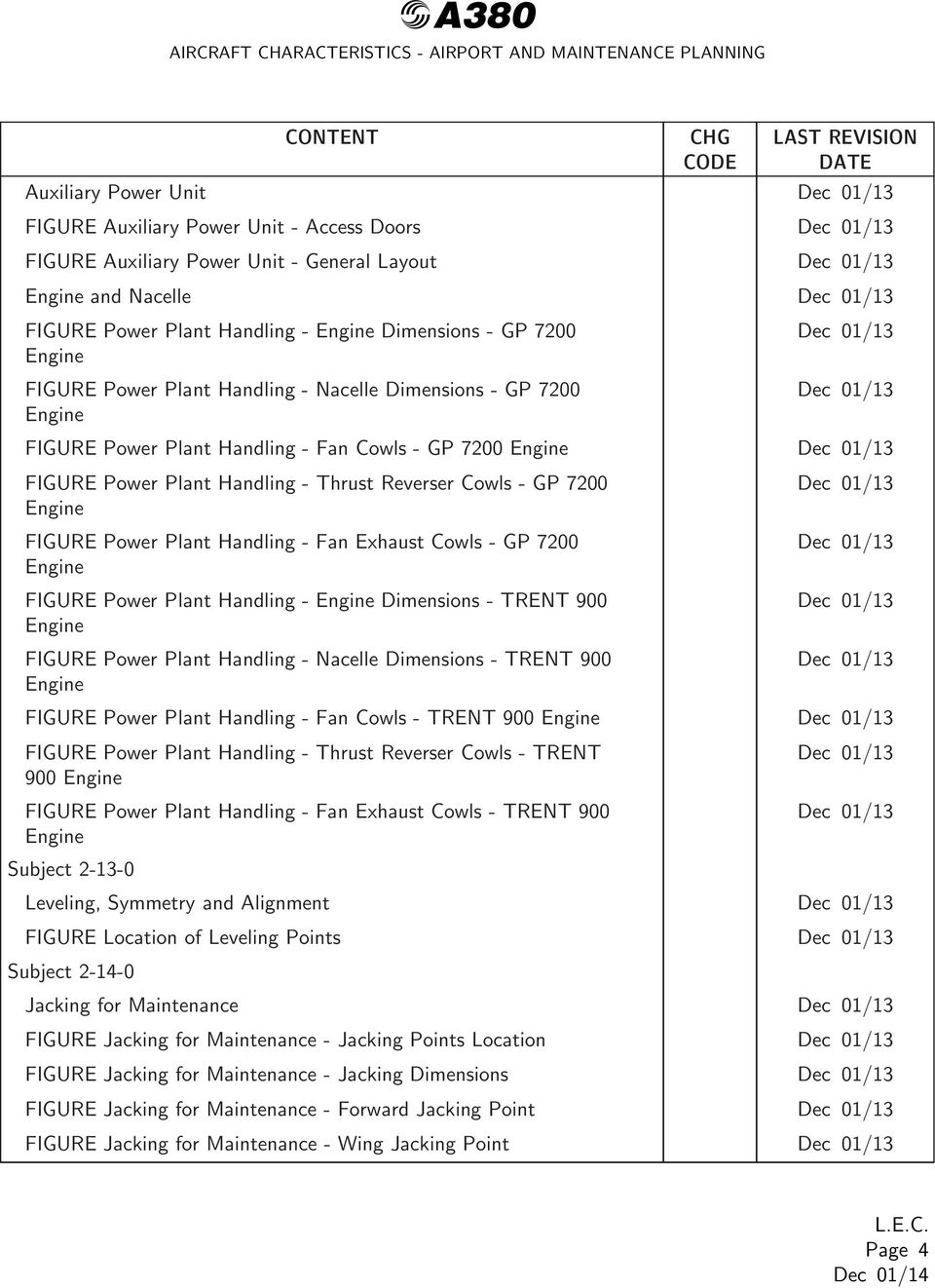
14 CONTENT CHG CODE LST REVISION DTE uxiliary Power Unit Dec 01/13 FIGURE uxiliary Power Unit - ccess Doors Dec 01/13 FIGURE uxiliary Power Unit - General Layout Dec 01/13 Engine and Nacelle Dec 01/13 FIGURE Power Plant Handling - Engine Dimensions - GP 7200 Engine FIGURE Power Plant Handling - Nacelle Dimensions - GP 7200 Engine Dec 01/13 Dec 01/13 FIGURE Power Plant Handling - Fan Cowls - GP 7200 Engine Dec 01/13 FIGURE Power Plant Handling - Thrust Reverser Cowls - GP 7200 Engine FIGURE Power Plant Handling - Fan Exhaust Cowls - GP 7200 Engine FIGURE Power Plant Handling - Engine Dimensions - TRENT 900 Engine FIGURE Power Plant Handling - Nacelle Dimensions - TRENT 900 Engine Dec 01/13 Dec 01/13 Dec 01/13 Dec 01/13 FIGURE Power Plant Handling - Fan Cowls - TRENT 900 Engine Dec 01/13 FIGURE Power Plant Handling - Thrust Reverser Cowls - TRENT 900 Engine FIGURE Power Plant Handling - Fan Exhaust Cowls - TRENT 900 Engine Dec 01/13 Dec 01/13 Subject Leveling, Symmetry and lignment Dec 01/13 FIGURE Location of Leveling Points Dec 01/13 Subject Jacking for Maintenance Dec 01/13 FIGURE Jacking for Maintenance - Jacking Points Location Dec 01/13 FIGURE Jacking for Maintenance - Jacking Dimensions Dec 01/13 FIGURE Jacking for Maintenance - Forward Jacking Point Dec 01/13 FIGURE Jacking for Maintenance - Wing Jacking Point Dec 01/13 L.E.C. Page 4
15 CONTENT FIGURE Jacking for Maintenance - uxiliary Jacking Point - Safety Stay CHG CODE LST REVISION DTE Dec 01/13 Jacking for Wheel Change Dec 01/13 FIGURE Nose Landing Gear Jacking Point Heights Dec 01/13 FIGURE Wing Landing Gear Jacking Point Heights Dec 01/13 FIGURE Body Landing Gear Jacking Point Heights Dec 01/13 FIGURE Nose Landing Gear Jacking Point Loads Dec 01/13 FIGURE Wing Landing Gear Jacking Point Loads Dec 01/13 FIGURE Body Landing Gear Jacking Point Loads Dec 01/13 CHPTER 3 Subject General Information Dec 01/13 Subject Payload/Range - IS Conditions R FIGURE Payload/Range - IS Conditions - TRENT 900 Engines Dec 01/13 FIGURE Payload/Range - IS Conditions - GP 7200 Engines Dec 01/13 Subject Take-Off Weight Limitation - IS Conditions R FIGURE Take-Off Weight Limitation - IS Conditions - TRENT 900 Engines FIGURE Take-Off Weight Limitation - IS Conditions - GP 7200 Engines R R Subject Take-Off Weight Limitation - IS + 15 C (+59 F) Conditions R FIGURE Take-Off Weight Limitation - IS + 15 C (+59 F) Conditions - TRENT 900 Engines FIGURE Take-Off Weight Limitation - IS + 15 C (+59 F) Conditions - GP 7200 Engines R R Subject Landing Field Length R L.E.C. Page 5

16 CONTENT CHG CODE LST REVISION DTE FIGURE Landing Field Length - Dry Runway R Subject Final pproach Speed Dec 01/13 CHPTER 4 Subject General Dec 01/13 Subject Turning Radii R FIGURE Turning Radii - (Sheet 1) R FIGURE Turning Radii - (Sheet 2) R Subject Minimum Turning Radii R FIGURE Minimum Turning Radii R Subject Visibility from Cockpit in Static Position Dec 01/13 FIGURE Visibility from Cockpit in Static Position Dec 01/13 FIGURE Binocular Visibility Through Windows from Captain Eye Dec 01/13 Position Subject Runway and Taxiway Turn Paths Dec 01/13 Subject Turn - Runway to Taxiway Dec 01/13 FIGURE 135 Turn -- Runway to Taxiway - Judgemental Oversteer Dec 01/13 Method FIGURE 135 Turn -- Runway to Taxiway - Cockpit Tracks Dec 01/13 Centreline Method Subject Turn - Runway to Taxiway Dec 01/13 FIGURE 90 Turn -- Runway to Taxiway - Judgemental Oversteer Method Dec 01/13 L.E.C. Page 6

17 CONTENT CHG CODE LST REVISION DTE Dec 01/13 FIGURE 90 Turn -- Runway to Taxiway - Cockpit Tracks Centreline Method Subject Turn on a Runway Dec 01/13 FIGURE 180 Turn on a Runway Dec 01/13 Subject Turn - Taxiway to Taxiway Dec 01/13 FIGURE 90 Turn -- Taxiway to Taxiway - Judgemental Oversteer Dec 01/13 Method FIGURE 90 Turn -- Taxiway to Taxiway - Cockpit Tracks Centreline Dec 01/13 Method Subject Turn - Taxiway to Taxiway Dec 01/13 FIGURE 135 Turn -- Taxiway to Taxiway - Judgemental Oversteer Dec 01/13 Method FIGURE 135 Turn -- Taxiway to Taxiway - Cockpit Tracks Dec 01/13 Centerline Method Subject Runway Holding Bay (pron) Dec 01/13 FIGURE Runway Holding Bay (pron) Dec 01/13 Subject Minimum Line-Up Distance Corrections Dec 01/13 FIGURE Minimum Line-Up Distance Corrections - 90 Turn on Dec 01/13 Runway Entry FIGURE Minimum Line-Up Distance Corrections Turn on Dec 01/13 Runway Turn Pad FIGURE Minimum Line-Up Distance Corrections Turn on Dec 01/13 Runway Width Subject ircraft Mooring Dec 01/13 FIGURE ircraft Mooring Dec 01/13 CHPTER 5 L.E.C. Page 7

18 CONTENT CHG CODE LST REVISION DTE Subject ircraft Servicing rrangements R Subject Typical Ramp Layout (Open pron) Dec 01/13 FIGURE Typical Ramp Layout - Open pron Dec 01/13 Subject Typical Ramp Layout (Gate) Dec 01/13 FIGURE Typical Ramp Layout - Gate Dec 01/13 Subject Typical Turn-Round Time - Standard Servicing Via Main Deck and R Upper Deck FIGURE Typical Turn-Round Time - Servicing Via Main and Upper R Deck Subject Typical Turn-Round Time - Servicing Via Main Deck R FIGURE Typical Turn-Round Time - Servicing Via Main Deck R Subject Ground Service Connections Layout Dec 01/13 FIGURE Ground Service Connections Layout Dec 01/13 Subject Grounding (Earthing) Points R FIGURE Grounding (Earthing) Point - NLG R FIGURE Grounding (Earthing) Points - WLG R FIGURE Grounding (Earthing) Points - BLG R Subject Hydraulic System R FIGURE Ground Service Connections - Hydraulic Reservoir Servicing R Panel FIGURE Ground Service Connections - Hydraulic Ground Connections Dec 01/13 Subject L.E.C. Page 8

19 CONTENT CHG CODE LST REVISION DTE Electrical System R FIGURE Ground Service Connections - Electrical Service Panel Dec 01/13 FIGURE Ground Service Connections - Ram ir Turbine Retracted R FIGURE Ground Service Connections - Ram ir Turbine Extended R Subject Oxygen System R FIGURE Ground Service Connections - Oxygen System Dec 01/13 Subject Fuel System R FIGURE Ground Service Connections - Refuel/Defuel Control Panel Dec 01/13 FIGURE Ground Service Connections - Pressure Refuel Connections Dec 01/13 FIGURE Ground Service Connections - Overpressure Protector and R NC Flame rrestor - Wing FIGURE Ground Service Connections - Overpressure Protector and N NC Flame rrestor - Trim Tank Subject Pneumatic System R FIGURE Ground Service Connections - Low Pressure Preconditioned Dec 01/13 ir FIGURE Ground Service Connections - High Pressure Preconditioned Dec 01/13 ir Subject Engine Oil Servicing R FIGURE Ground Service Connections - Engine Oil Servicing - TRENT N 900 Engines FIGURE Ground Service Connections - Engine Oil Servicing - GP7200 N Engines VFG Oil Servicing N FIGURE Ground Service Connections - VFG Oil Servicing - TRENT 900 Engines FIGURE Ground Service Connections - VFG Oil Servicing - GP7200 Engines N N L.E.C. Page 9

20 CONTENT CHG CODE LST REVISION DTE Starter Oil Servicing N FIGURE Ground Service Connections - Starter Oil Servicing - TRENT 900 Engines FIGURE Ground Service Connections - Starter Oil Servicing - GP7200 Engines N N PU Oil Servicing N FIGURE Ground Service Connections - PU Oil Servicing N Subject Potable Water System R FIGURE Ground Service Connections - Potable Water Ground Service N Panel FIGURE Ground Service Connections - Potable Water Drain Panel N FIGURE Ground Service Connections - Potable Water Tanks Location N Subject Waste Water System R FIGURE Ground Service Connections - Waste Water Ground Service R Panel FIGURE Ground Service Connections - Waste Tanks Location Dec 01/13 Subject Cargo Control Panels N FIGURE Forward Cargo Control Panels N FIGURE ft Cargo Control Panels N Subject Engine Starting Pneumatic Requirements Dec 01/13 FIGURE Example for Use of the Charts Dec 01/13 FIGURE Engine Starting Pneumatic Requirements - Engine lliance - Dec 01/13 GP 7200 FIGURE Engine Starting Pneumatic Requirements - Rolls Royce - Dec 01/13 Trent 900 Engine Subject Ground Pneumatic Power Requirements Dec 01/13 L.E.C. Page 10
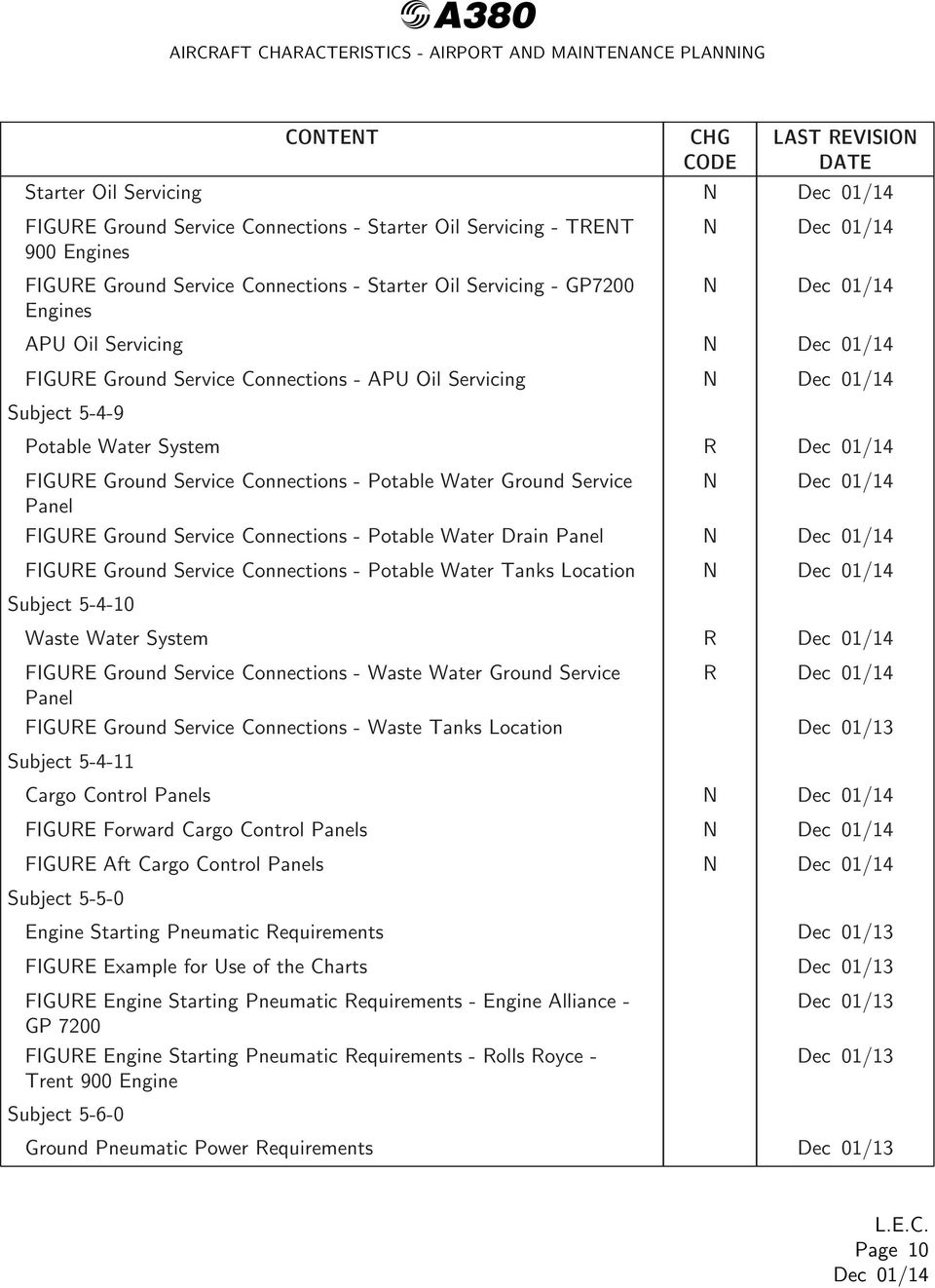
21 CONTENT CHG CODE LST REVISION DTE FIGURE Ground Pneumatic Power Requirements - Heating Dec 01/13 FIGURE Ground Pneumatic Power Requirements - Cooling Dec 01/13 Subject Preconditioned irflow Requirements Dec 01/13 FIGURE Preconditioned irflow Requirements Dec 01/13 Subject Ground Towing Requirements Dec 01/13 FIGURE Ground Towing Requirements Dec 01/13 FIGURE Ground Towing Requirements - Nose Gear Towing Fittings Dec 01/13 Subject De-Icing and External Cleaning Dec 01/13 CHPTER 6 Subject Engine Exhaust Velocities and Temperatures R Subject Engine Exhaust Velocities - Ground Idle Power Dec 01/13 FIGURE Engine Exhaust Velocities - Ground Idle Power - TRENT 900 Engines FIGURE Engine Exhaust Velocities - Ground Idle Power - GP 7200 Engines Dec 01/13 Dec 01/13 Subject Engine Exhaust Temperatures - Ground Idle Power Dec 01/13 FIGURE Engine Exhaust Temperatures - Ground Idle Power - TRENT 900 Engines FIGURE Engine Exhaust Temperatures - Ground Idle Power - GP 7200 Engines Dec 01/13 Dec 01/13 Subject Engine Exhaust Velocities - Breakaway Power Dec 01/13 FIGURE Engine Exhaust Velocities - Breakaway Power - TRENT 900 Engines Dec 01/13 L.E.C. Page 11
22 CONTENT FIGURE Engine Exhaust Velocities - Breakaway Power - GP 7200 Engines Subject CHG CODE LST REVISION DTE Dec 01/13 Engine Exhaust Temperatures - Breakaway Power Dec 01/13 FIGURE Engine Exhaust Temperatures - Breakaway Power - TRENT 900 Engines FIGURE Engine Exhaust Temperatures - Breakaway Power - GP 7200 Engines Dec 01/13 Dec 01/13 Subject Engine Exhaust Velocities - Max Take-off Power Dec 01/13 FIGURE Engine Exhaust Velocities - Max. Take-Off Power - TRENT 900 Engines FIGURE Engine Exhaust Velocities - Max. Take-Off Power - GP 7200 Engines Dec 01/13 Dec 01/13 Subject Engine Exhaust Temperatures - Max Take-off Power Dec 01/13 FIGURE Engine Exhaust Temperatures - Max Take-Off Power - TRENT 900 Engines FIGURE Engine Exhaust Temperatures - Max Take-Off Power - GP 7200 Engines Dec 01/13 Dec 01/13 Subject Danger reas of the Engines Dec 01/13 Subject Danger reas of the Engines - Ground Idle Power Dec 01/13 FIGURE Danger reas of the Engines - Ground Idle Power - TRENT 900 Engines FIGURE Danger reas of the Engines - Ground Idle Power - GP 7200 Engines Dec 01/13 Dec 01/13 Subject Danger reas of the Engines - Max. Take-Off Power Dec 01/13 FIGURE Danger reas of the Engines - Max Take-Off Power - TRENT 900 Engines Dec 01/13 L.E.C. Page 12
23 CONTENT FIGURE Danger reas of the Engines - Max Take-Off Power - GP 7200 Engines Subject CHG CODE LST REVISION DTE Dec 01/13 Danger reas of the Engines - Breakaway Power Dec 01/13 FIGURE Danger reas of the Engines - Breakaway Power - TRENT 900 Engines FIGURE Danger reas of the Engines - Breakaway Power - GP 7200 Engines Dec 01/13 Dec 01/13 Subject PU Exhaust Velocities and Temperatures - ECS Conditions R FIGURE PU Exhaust Velocities and Temperatures - Max. ECS Conditions Subject Dec 01/13 PU Exhaust Velocities and Temperatures - MES Conditions Dec 01/13 FIGURE PU Exhaust Velocities and Temperatures - MES Conditions Dec 01/13 CHPTER 7 Subject General Information Dec 01/13 Subject Landing Gear Footprint R FIGURE Landing Gear Footprint R Subject Maximum Pavement Loads R FIGURE Maximum Pavement Loads R Subject Landing Gear Loading on Pavement Dec 01/13 FIGURE Landing Gear Loading on Pavement - WV007, MRW kg, CG 43% (Sheet 1 of 2) FIGURE Landing Gear Loading on Pavement - WV008, MRW kg CG 41% (Sheet 1 of 2) Dec 01/13 Dec 01/13 Subject L.E.C. Page 13
24 CONTENT Flexible Pavement Requirements - US rmy Corps of Engineers Design Method FIGURE Flexible Pavement Requirements - WV007, MRW kg, CG 43 % - Wing Landing Gear (Sheet 1 of 2) FIGURE Flexible Pavement Requirements - WV008, MRW kg, CG 41 % - Wing Landing Gear (Sheet 1 of 2) Subject CHG CODE LST REVISION DTE Dec 01/13 Dec 01/13 Dec 01/13 Flexible Pavement Requirements - LCN Conversion R FIGURE Flexible Pavement Requirements - LCN Table R FIGURE Flexible Pavement Requirements - LCN - WV007, MRW kg, CG 43 % - WLG FIGURE Flexible Pavement Requirements - LCN - WV008, MRW kg, CG 41 % - WLG R R Subject Rigid Pavement Requirements - Portland Cement ssociation Design Dec 01/13 Method FIGURE Rigid Pavement Requirements - WV007, MRW kg, Dec 01/13 CG 43 % - WLG FIGURE Rigid Pavement Requirements - WV008, MRW kg, Dec 01/13 CG 41 % - WLG Subject Rigid Pavement Requirements - LCN Conversion R FIGURE Rigid Pavement Requirements - LCN Table R FIGURE Radius of Relative Stiffness (L) Dec 01/13 FIGURE Rigid Pavement Requirements - LCN - WV007, MRW kg, CG 43% - WLG FIGURE Rigid Pavement Requirements - LCN - WV008, MRW kg, CG 41% - WLG Dec 01/13 Dec 01/13 FIGURE Radius of Relative Stiffness (Effect E and µ on L values) Dec 01/13 Subject CN/PCN Reporting System - Flexible and Rigid Pavements R FIGURE ircraft Classification Number - CN Table R L.E.C. Page 14
25 CONTENT FIGURE ircraft Classification Number - Flexible Pavement - WV007, MRW kg, CG 43% FIGURE ircraft Classification Number - Flexible Pavement - WV008, MRW kg, CG 41% CHG CODE LST REVISION DTE R R CHPTER 8 Subject Scaled Drawings Dec 01/13 FIGURE Scaled Drawing Dec 01/13 CHPTER 10 Subject ircraft Rescue and Fire Fighting Dec 01/13 FIGURE Front Page Dec 01/13 FIGURE Highly Flammable and Hazardous Materials and Components Dec 01/13 FIGURE Batteries Location and ccess Dec 01/13 FIGURE Crew Rest Compartments Location Dec 01/13 FIGURE Wheel/Brake Overheat - Wheel Safety rea Dec 01/13 FIGURE Composite Materials Location Dec 01/13 FIGURE Landing Gear - Ground Lock Safety Devices Dec 01/13 FIGURE Emergency Evacuation Devices R FIGURE Pax/Crew Doors and Emergency Exits Dec 01/13 FIGURE Cargo Doors - FWD and FT Lower Deck Cargo Doors Dec 01/13 FIGURE Control Panels Dec 01/13 FIGURE PU Compartment ccess Dec 01/13 FIGURE ircraft Ground Clearances Dec 01/13 FIGURE Structural Break-in Points Dec 01/13 L.E.C. Page 15
26 TBLE OF CONTENTS 1 SCOPE Introduction Glossary 2 IRCRFT DESCRIPTION General ircraft Characteristics Data General ircraft Dimensions Ground Clearances Interior rrangement - Plan View Standard Configuration Interior rrangements - Cross Section Typical Configuration Cargo Compartments Location and Dimensions Loading Combinations Door Clearances Escape Slides Landing Gear Exterior Lighting ntennas and Probes Location Power Plant Leveling, Symmetry and lignment Jacking 3 IRCRFT PERFORMNCE General Information IS Conditions Take Off Weight Limitation - IS Conditions Take Off Weight Limitation - IS + 15 C (59 F) Landing Field Length Final pproach Speed 4 GROUND MNEUVERING General Information Turning Radii T.O.C. Page 1
27 4-3-0 Minimum Turning Radii Visibility from Cockpit in Static Position Runway and Taxiway Turn Paths Turn - Runway to Taxiway Turn - Runway to Taxiway Turn on a Runway Turn - Taxiway to Taxiway Turn - Taxiway to Taxiway Runway Holding Bay (pron) Minimum Line-Up Distance Corrections ircraft Mooring 5 TERMINL SERVICING ircraft Servicing rrangements Typical Ramp Layout (Open pron) Typical Ramp Layout (Gate) Typical Turn-Round Time - Standard Servicing Via Main Deck and Upper Deck Typical Turn-Round Time - Servicing Via Main Deck Ground Service Connections Layout Grounding (Earthing) Points Hydraulic System Electrical System Oxygen System Fuel System Pneumatic System Oil System Potable Water System Vacuum Toilet System Cargo Control Panels Engine Starting Pneumatic Requirements Ground Pneumatic Power Requirements Preconditioned irflow Requirements Ground Towing Requirements De-Icing and External Cleaning 6 OPERTING CONDITIONS Engine Exhaust Velocities and Temperatures Engine Exhaust Velocities - Ground Idle Power T.O.C. Page 2
28 6-1-2 Engine Exhaust Temperatures - Ground Idle Power Engine Exhaust Velocities - Breakaway Power Engine Exhaust Temperatures - Breakaway Power Engine Exhaust Velocities - Max Take-off Power Engine Exhaust Temperatures - Max Take-off Power Danger reas of the Engines Danger reas of the Engines - Ground Idle Power Danger reas of the Engines - Max. Take-Off Power Danger reas of the Engines - Breakaway Power PU Exhaust Velocities and Temperatures PU Exhaust Velocities and Temperatures - MES Conditions 7 PVEMENT DT General Information Landing Gear Footprint Maximum Pavement Loads Landing Gear Loading on Pavement Flexible Pavement Requirements - US rmy Corps of Engineers Design Method Flexible Pavement Requirements - LCN Conversion Rigid Pavement Requirements - Portland Cement ssociation Design Method Rigid Pavement Requirements - LCN Conversion CN/PCN Reporting System - Flexible and Rigid Pavements 8 SCLED DRWINGS SCLED DRWINGS 10 IRCRFT RESCUE ND FIRE FIGHTING IRCRFT RESCUE ND FIRE FIGHTING T.O.C. Page 3
29 1-1-0 Introduction SCOPE Introduction 1. General The 380 (C) manual is issued for the 380 series aircraft to provide necessary data to airport operators, airlines and Maintenance/Repair Organizations (MRO) for airport and maintenance facilities planning. This document is not customized and must not be used for training purposes. No information within may constitute a contractual commitment. The is a subsonic, very long range and very high capacity civil transport aircraft. The offers several payload capabilities ranging from 400 passengers in a very comfortable multiclass configuration, up to 853 passengers in an all economy class configuration. Designed in close collaboration with major airlines, airports and airworthiness authorities, the 380 is the most advanced, spacious and productive aircraft in service setting a new standard in air travel and environmental efficiency. The 380 Family starts from a baseline passenger aircraft - the higher capacity version, the could be developed when required by the market. Two engine types are currently offered, the Engine lliance GP7200 series and the Rolls-Royce Trent 900 series. Both engines use state of the art technology for better performance, maintainability, lower fuel consumption and environmental impact. The was designed to be compatible with current airport infrastructure and equipment, as proven in service. Bigger, quieter and capable of achieving quick turn around times, the provides an efficient solution for airports and airlines to grow in a sustainable manner. Correspondence concerning this publication should be directed to: IRBUS S..S. Customer Services Technical Data Support and Services 1, Rond Point Maurice BELLONTE BLGNC CEDEX FRNCE Page 1
30 1-2-1 Glossary Glossary 1. List of bbreviations /C CN MM PU B/C BLG CBR CC CG C/L E ECS ELEC ESWL F F/C FDL FR FSTE FWD GPU GSE ICO IS L L LCN LD LD LH LPS MC MX ircraft ircraft Classification Number ircraft Maintenance Manual uxiliary Power Unit Business Class Body Landing Gear California Bearing Ratio Cargo Compartment Center of Gravity Center Line Young s Modulus Environmental Control System Electric, Electrical, Electricity Equivalent Single Wheel Load Federal viation dministration First Class Fuselage Datum Line Frame Full Size Trolley Equivalent Forward Ground Power Unit Ground Support Equipment International Civil viation Organisation International Standard tmosphere Left Radius of relative stiffness Load Classification Number Load Device Lower Deck Left Hand Last Pax Seating Mean erodynamic Chord Maximum Page 1
31 MD MIN NLG OT PX PBB PB/D PC PCN PRM R RH UD ULD US VFG WLG WV Y/C Main Deck Minimum Nose Landing Gear Outside ir Temperature Passenger Passenger Boarding Bridge Passenger Boarding/Deplaning Portland Cement ssociation Pavement Classification Number Passenger with Reduced Mobility Right Right Hand Upper Deck Unit Load Device United States Variable Frequency Generator Wing Landing Gear Weight Variant Tourist Class 2. Design Weight Terminology - Maximum Design Ramp Weight (MRW): Maximum weight for ground maneuver (including weight of taxi and run-up fuel) as limited by aircraft strength and airworthiness requirements. It is also called Maximum Design Taxi Weight (MTW). - Maximum Design Landing Weight (MLW): Maximum weight for landing as limited by aircraft strength and airworthiness requirements. - Maximum Design Take-Off Weight (MTOW): Maximum weight for take-off as limited by aircraft strength and airworthiness requirements. (This is the maximum weight at start of the take-off run). - Maximum Design Zero Fuel Weight (MZFW): Maximum permissible weight of the aircraft without usable fuel. - Maximum Seating Capacity: Maximum number of passengers specifically certified or anticipated for certification. - Usable Volume: Usable volume available for cargo, pressurized fuselage, passenger compartment and cockpit. - Water Volume: Maximum volume of cargo compartment. - Usable Fuel: Fuel available for aircraft propulsion Page 2
32 2-1-1 General ircraft Characteristics Data IRCRFT DESCRIPTION General ircraft Characteristics Data 1. The following table provides characteristics of Models, these data are specific to each Weight Variant: Maximum Ramp Weight (MRW) Maximum Taxi Weight (MTW) Maximum Take-Off Weight (MTOW) Maximum Landing Weight (MLW) Maximum Zero Fuel Weight (MZFW) ircraft Characteristics WV000 WV001 WV002 WV003 WV kg ( lb) kg ( lb) kg ( lb) kg ( lb) kg ( lb) kg ( lb) kg ( lb) kg ( lb) kg ( lb) kg ( lb) kg ( lb) kg ( lb) kg ( lb) kg ( lb) kg ( lb) kg ( lb) kg ( lb) kg ( lb) kg ( lb) kg ( lb) Maximum Ramp Weight (MRW) Maximum Taxi Weight (MTW) Maximum Take-Off Weight (MTOW) Maximum Landing Weight (MLW) Maximum Zero Fuel Weight (MZFW) ircraft Characteristics WV005 WV006 WV007 WV008 WV kg ( lb) kg ( lb) kg ( lb) kg ( lb) kg ( lb) kg ( lb) kg ( lb) kg ( lb) kg ( lb) kg ( lb) kg ( lb) kg ( lb) kg ( lb) kg ( lb) kg ( lb) kg ( lb) kg ( lb) kg ( lb) kg ( lb) kg ( lb) Page 1
33 2. The following table provides characteristics of Models, these data are common to each Weight Variant: Standard Seating Capacity Usable Fuel Capacity (density = kg/l) Pressurized Fuselage Volume (/C non equipped, main and upper deck) Passenger Compartment Volume (main deck) Passenger Compartment Volume (upper deck) Cockpit Volume Usable Volume, FWD CC (Based on LD3) Usable Volume, FT CC (Based on LD3) Usable Volume, Bulk CC Water Volume, FWD CC Water Volume, FT CC Water Volume, Bulk CC ircraft Characteristics l ( US gal) kg ( lb) m 3 ( ft 3 ) 775 m 3 ( ft 3 ) 530 m 3 ( ft 3 ) 12 m 3 (424 ft 3 ) 89.4 m 3 (3 157 ft 3 ) 71.5 m 3 (2 525 ft 3 ) 14.3 m 3 (505 ft 3 ) 131 m 3 (4 626 ft 3 ) m 3 (3 807 ft 3 ) 17.3 m 3 (611 ft 3 ) Page 2
34 2-2-0 General ircraft Dimensions General ircraft Dimensions 1. This section provides General ircraft Dimensions Page 1
35 72.73 m ( ft) 70.4 m ( ft) m ( ft) m (46.19 ft) 4.7 m (15.42 ft) m (39.57 ft) 8.41 m (27.59 ft) 8.56 m (28.08 ft) m (47.87 ft) 4.97 m (16.31 ft) m WLG ( ft) m BLG (120.9 ft) m (99.64 ft) m ( ft) 7.14 m (23.43 ft) m (40.88 ft) m (47.05 ft) 29.6 m (97.11 ft) 51.4 m ( ft) 5.26 m (17.26 ft) NOTE: RELTED TO IRCRFT TTITUDE ND WEIGHT. L_C_020200_1_ _01_02 General ircraft Dimensions (Sheet 1 of 2) FIGURE Page 2
36 72.57 m ( ft) m ( ft) m 3.98 m (154.1 ft) (13.06 ft) m ( ft) m (98.23 ft) m (72.93 ft) m (37.96 ft) 3.72 m (12.2 ft) m (57.97 ft) 9.36 m (30.71 ft) m (44.26 ft) m (57.91 ft) m (71.75 ft) m (85.2 ft) NOTE: RELTED TO IRCRFT TTITUDE ND WEIGHT. L_C_020200_1_ _01_00 General ircraft Dimensions (Sheet 2 of 2) FIGURE Page 3
37 2-3-0 Ground Clearances Ground Clearances 1. This section provides the heights of various points of the aircraft, above the ground, for different aircraft configurations. Dimensions in the tables are approximate and will vary with tire type, weight and balance and other special conditions. The dimensions are given for: - light weight, for an aircraft in maintenance configuration with a FWD CG and an FT CG, - n aircraft at Maximum Ramp Weight with a FWD CG and an FT CG, - ircraft on jacks, FDL at 7.20 m (23.62 ft). NOTE : Passenger and cargo door ground clearances are measured from the center of the door sill and from floor level Page 1
38 M1 M2 U1 M3 U2 M4 U3 F2 F3 M5 HT1 HT VT W1 W2 C3 C2 C1 BF2 N2 BF1 N1 F1 RD1 CP1 /C CONFIGURTION DOORS FUSELGE WINGS TILPLNE ENGINE/ NCELLE M1 M2 M3 M4 M5 U1 U2 U3 C1 C2 C3 F1 F2 F3 BF1 BF2 CP1 RD1 W1 W2 HT HT1 VT N1 N2 MRW 300 t FWD CG (37.8%) FT CG (41%) FWD CG (29%) FT CG (44%) m ft m ft m ft m ft m ft NOTE: PSSENGER ND CRGO DOOR GROUND CLERNCES RE MESURED FROM THE CENTER OF THE DOOR SILL ND FROM FLOOR LEVEL. MXIMUM JCKING WEIGHT = kg ( lb). /C JCKED FDL = 7.20 m (23.6 ft) Ground Clearances (Sheet 1 of 2) FIGURE L_C_020300_1_ _01_ Page 2
39 B C D E F G H J K L LEDING EDGE SLTS EXTENDED DESCRIPTION MRW FWD CG MRW FT CG 300 t MID CG m ft m ft m ft DN1* INBD END DN1/DN2* B DN2* OUTBD END C SLT 2 INBD END D SLT 2/3 E SLT 3/4 F SLT 4 OUTBD END G SLT 5 INBD END H SLT 5/6 J SLT 6/7 K SLT 7 OUTBD END L NOTE: * DN DROOP NOSE L_C_020300_1_ _01_01 Ground Clearances Leading Edge Slats - Extended FIGURE Page 3
40 D C B FLPS EXTENDED DESCRIPTION MRW FWD CG MRW FT CG 300 t MID CG INNER END INNER/MID MID OUTER OUTER END B C D m ft m ft m ft L_C_020300_1_ _01_01 Ground Clearances Trailing Edge Flaps - Extended FIGURE Page 4
41 K J H G F E D C B SPOILERS EXTENDED DESCRIPTION MRW FWD CG MRW FT CG 300 t MID CG SPOILER 1 INBD SPOILER 1/2 SPOILER 2 OUTBD END SPOILER 3 SPOILER 3/4 SPOILER 4/5 SPOILER 5/6 SPOILER 6/7 SPOILER 7/8 SPOILER 8 OUTBD END B C D E F G H J K m ft m ft m ft L_C_020300_1_ _01_00 Ground Clearances Spoilers - Extended FIGURE Page 5
42 D C B ILERONS DOWN DESCRIPTION MRW FWD CG MRW FT CG 300 t MID CG INNER END INNER/MID MID OUTER OUTER END B C D m ft m ft m ft L_C_020300_1_ _01_01 Ground Clearances ilerons - Down FIGURE Page 6
43 D C B ILERONS UP DESCRIPTION MRW FWD CG MRW FT CG 300 t MID CG INNER END INNER/MID MID OUTER OUTER END B C D m ft m ft m ft L_C_020300_1_ _01_01 Ground Clearances ilerons - Up FIGURE Page 7
44 E D C B FLP TRCKS EXTENDED DESCRIPTION MRW FWD CG MRW FT CG 300 t MID CG TRCK 2 TRCK 3 TRCK 4 TRCK 5 TRCK 6 B C D E m ft m ft m ft L_C_020300_1_ _01_01 Ground Clearances Flap Tracks - Extended FIGURE Page 8
45 6.55 m (21.49 ft) NOTE: TRIMMBLE HORIZONTL STBILIZER ND ELEVTORS RE IN FULLY DOWN POSITION. L_C_020300_1_ _01_00 Ground Clearances Trimmable Horizontal Stabilizer and Elevators - Down FIGURE Page 9
46 2-4-0 Interior rrangement - Plan View Interior rrangement - Plan View 1. Interior rrangement - Plan View Page 1
47 2-4-1 Standard Configuration Standard Configuration - Pax 1. This section gives the standard configuration of models Page 1
48 UPPER DECK PSSENGER SETS UPPER DECK (199 TOTL) BUSINESS CLSS 96 SETS TOURIST CLSS 103 SETS TTENDNT SETS 8 COT STOWGE 6 GLLEYS 8 LVTORIES 7 STOWGES 1 LIFT 2 STIRS 2 CREW REST BUNKS 5 Interior rrangements - Plan View Standard Configuration - Upper Deck FIGURE L_C_020401_1_ _01_ Page 2
49 MIN DECK PSSENGER SETS MIN DECK (356 TOTL) FIRST CLSS 22 SETS TOURIST CLSS 334 SETS TTENDNT SETS 12 COT STOWGE 1 GLLEYS 9 LVTORIES 10 STOWGES 1 LIFT 2 STIRS 2 Interior rrangements - Plan View Standard Configuration - Main Deck FIGURE L_C_020401_1_ _01_ Page 3
50 2-5-0 Interior rrangements - Cross Section Interior rrangements - Cross Section 1. Interior rrangements - Cross Section Page 1
51 2-5-1 Typical Configuration Typical Configuration - Pax 1. This section gives the typical configuration of models Page 1
52 UPPER DECK TOURIST CLSS 8 BREST 1.07 m (42 in) 0.51 m (20 in) 1.07 m 1.07 m (42 in) (42 in) 1.07 m (42 in) UPPER DECK BUSINESS CLSS 6 BREST 1.37 m (54 in) 0.58 m (23 in) 1.37 m (54 in) 1.37 m (54 in) L_C_020501_1_ _01_00 Interior rrangements - Cross-section Typical Configuration - Upper Deck FIGURE Page 2
53 MIN DECK TOURIST CLSS 10 BREST 1.57 m 1.07 m 1.07 m 1.57 m (62 in) (42 in) (42 in) (62 in) 0.51 m (20 in) MIN DECK FIRST CLSS 6 BREST 1.45 m (57 in) 0.97 m (38 in) 1.45 m (57 in) 1.45 m (57 in) L_C_020501_1_ _01_00 Interior rrangements - Cross-section Typical Configuration - Main Deck FIGURE Page 3
54 2-6-0 Cargo Compartments Cargo Compartments 1. Cargo Compartments Page 1
55 2-6-1 Location and Dimensions Location and Dimensions - Pax 1. This section gives the cargo compartments location and dimensions of models Page 1
56 FR17 FR44 FR57 FR86 FR90 LOWER DECK BULK CRGO COMPRTMENT LOWER DECK RER FT CRGO COMPRTMENT LOWER DECK FORWRD FT CRGO COMPRTMENT (T SHPED LOWER DECK FORWRD CRGO COMPRTMENT COMPRTMENT) 1.1 m (43.3 in) 2.8 m (110.2 in) 3.1 m (122.8 in) 2.8 m (110.2 in) 8.2 m (322.8 in) 9.7 m (381.9 in) 17.4 m ( in) L_C_020601_1_ _01_00 Cargo Compartments Location and Dimensions FIGURE Page 2
57 2-6-2 Loading Combinations Loading Combinations - Pax 1. This section gives cargo compartments loading combinations Page 1
58 STNDRD: 20 LD 3 OR 7 PLLETS 88 in / 96 in X 125 in OPTION: 22 LD 3 OR 7 PLLETS 88 in / 96 in X 125 in STNDRD: 16 LD 3 OR 6 LD 3 3 PLLETS 88 in / 96 in X 125 in OPTION: 6 PLLETS 88 in / 96 in X 125 in Cargo Compartments Loading Combinations FIGURE L_C_020602_1_ _01_ Page 2
59 2-7-0 Door Clearances Door Clearances 1. This section provides door clearances and location Page 1
60 DOOR U1L EMERGENCY EXIT DOOR M3L DOOR U2L DOOR U3L DOOR M1L DOOR M2L DOOR M4L DOOR M5L DOOR U3R DOOR U2R EMERGENCY EXIT DOOR M3R DOOR U1R DOOR M5R BULK CRGO DOOR DOOR M4R FT CRGO DOOR DOOR M2R FWD CRGO DOOR DOOR M1R L_C_020700_1_ _01_01 Door Clearances Door Location (Sheet 1) FIGURE Page 2
61 20.94 m (68.7 ft) 16.5 m (54.13 ft) 6.32 m (20.73 ft) m ( ft) m ( ft) m ( ft) m ( ft) 40.3 m ( ft) m (38.48 ft) m ( ft) m ( ft) L_C_020700_1_ _01_01 Door Clearances Door Location (Sheet 2) FIGURE Page 3
62 MIN DECK DOOR M1L, M1R 2.13 m (6.99 ft) 1.90 m (6.23 ft) 0.05 m (0.16 ft) SEE CHPTER 2 3 FWD 0.04 m (0.13 ft) 1.26 m (4.13 ft) 0.04 m (0.13 ft) 1.07 m (3.51 ft) 0.86 m (2.82 ft) m (8.23 ft) FWD 0.72 m (2.36 ft) 01 NOTE: 01 MESURED FROM THE EXTERNL POINT OF THE SCUFF PLTE ND THE MOST EXTERNL POINT OF THE DOOR SKIN. L_C_020700_1_ _01_00 Door Clearances Forward Passenger Doors FIGURE Page 4
63 2.11 m (6.92 ft) UPPER DECK DOOR U1L, U2L, U3L, U1R, U2R, U3R MIN DECK DOOR M2L, M3L, M4L, M2R, M3R, M4R 1.92 m (6.30 ft) 1.90 m (6.23 ft) 0.08 m (0.26 ft) FWD 2.13 m (6.99 ft) 0.05 m (0.16 ft) SEE CHPTER 2 3 SEE CHPTER m (0.13 ft) 0.52 m (1.71 ft) m (2.36 ft) m (0.13 ft) FWD 1.07 m (3.51 ft) 1.07 m (3.51 ft) 0.89 m (2.92 ft) 01 ON M3L/M3R 0.70 m (2.30 ft) m (3.35 ft) 01 ON M3L/M3R 0.84 m (2.76 ft) 02 NOTE: m (8.23 ft) 0.04 m (0.13 ft) 0.04 m (0.13 ft) 1.26 m (4.13 ft) 2.51 m (8.23 ft) MESURED FROM THE EXTERNL POINT OF THE SCUFF PLTE ND THE MOST EXTERNL POINT OF THE DOOR SKIN. 02 ON DOOR M3L/M3R MESURED FROM THE EXTERNL POINT OF THE CUTOUT IN THE BELLY FIRING ND THE MOST EXTERNL POINT OF THE BELLY FIRING FROM THE DOOR. L_C_020700_1_ _01_00 Door Clearances Main and Upper Deck Passenger Doors FIGURE Page 5
64 MIN DECK DOOR M5L, M5R 1.90 m (6.23 ft) 2.13 m (6.99 ft) 0.05 m (0.16 ft) FWD SEE CHPTER m (0.13 ft) 1.26 m (4.13 ft) 0.04 m (0.13 ft) 1.07 m (3.51 ft) 0.96 m (3.15 ft) m (8.23 ft) FWD 1.09 m (3.58 ft) NOTE: 01 MESURED FROM THE EXTERNL POINT OF THE SCUFF PLTE ND THE MOST EXTERNL POINT OF THE DOOR SKIN. 01 L_C_020700_1_ _01_00 Door Clearances ft Passenger Doors FIGURE Page 6
65 FWD 3.11 m (10.20 ft) SEE CHPTER m (5.74 ft) 2.12 m (6.96 ft) R 2.99 m (9.81 ft) 2.09 m (6.86 ft) GROUND LINE 6.34 m (20.80 ft) L_C_020700_1_ _01_00 Door Clearances Forward Cargo Compartment Door FIGURE Page 7
66 B SEE CHPTER m (3.71 ft) B 2.79 m (9.15 ft) SEE CHPTER 2 3 FWD 6.42 m (21.06 ft) 1.75 m (5.74 ft) 2.09 m (6.86 ft) 2.01 m (6.59 ft) R 3.07 m (10.07 ft) T FR81 R 2.95 m (9..68ft) T FR85 R 1.40 m (4.59 ft) GROUND LINE 0.99 m (3.25 ft) B B L_C_020700_1_ _01_00 Door Clearances ft Cargo Compartment Doors FIGURE Page 8
67 B IRCRFT C/L 1.36 m (4.46 ft) R 1.89 m (6.20 ft) 62 FORWRD NOSE LNDING GER DOOR 2.50 m (8.20 ft) GROUND LINE 0.94 m (3.08 ft) LH SHOWN RH SYMMETRICL L_C_020700_1_ _01_00 Door Clearances Forward Nose Landing Gear Doors (Sheet 1 of 2) FIGURE Page 9
68 0.75 m (2.46 ft) IRCRFT C/L R 1.89 m (6.20 ft) 0.50 m (1.64 ft) 69.2 B LH SHOWN RH SYMMETRICL FT NOSE LNDING GER DOOR Door Clearances ft Nose Landing Gear Doors (Sheet 2of2) FIGURE L_C_020700_1_ _01_ Page 10
69 30.91 m ( ft) 1.71 m (5.61 ft) 4.28 m (14.04 ft) 3.95 m (12.96 ft) IRCRFT MX 79 R 2.30 m (7.55 ft) WING LNDING GER MIN DOOR MX m (0.82 ft) MIN m (0.33 ft) 01 GROUND LINE 3.23 m (10.60 ft) LH SHOWN RH SYMMETRICL NOTE: 01 DEPENDING ON CG POSITION ND IRCRFT WEIGHT. L_C_020700_1_ _01_00 Door Clearances Wing Landing Gears - Main Doors FIGURE Page 11
70 35.67 m ( ft) B 5.17 m (16.96 ft) 5.02 m (16.47 ft) 2.25 m (7.38 ft) MX 99 R 2.90 m (9.51 ft) IRCRFT BODY LNDING GER OUTER DOOR MX m (1.15 ft) MIN m (0.82 ft) m (15.49 ft) GROUND LINE LH SHOWN RH SYMMETRICL NOTE: 01 DEPENDING ON CG POSITION ND IRCRFT WEIGHT. L_C_020700_1_ _01_00 Door Clearances Body Landing Gears - Outer Doors (Sheet 1of2) FIGURE Page 12
71 2.25 m (7.38 ft) BODY LNDING GER INNER DOOR R 1.32 m (4.33 ft) MX 94 IRCRFT GROUND LINE MX m (3.12 ft) MIN m (2.30 ft) m (3.87 ft) 1.23 m (4.04 ft) B LH SHOWN RH SYMMETRICL NOTE: 01 DEPENDING ON CG POSITION ND IRCRFT WEIGHT. L_C_020700_1_ _01_00 Door Clearances Body Landing Gears - Inner Doors (Sheet 2of2) FIGURE Page 13
72 FR112 FR117 PU DOOR FUSELGE DTUM LINE 01 MX m (18.11 ft) MIN m (18.01 ft) MX m (21.85 ft) MIN m (21.75 ft) 01 GROUND LINE NOTE: 01 DEPENDING ON CG POSITION ND IRCRFT WEIGHT. L_C_020700_1_ _01_00 Door Clearances PU Doors FIGURE Page 14
73 2-8-0 Escape Slides Escape Slides 1. General This section provides the location of cabin escape facilities and related clearances. 2. Location. Escape facilities are provided at the following locations: (1) Upper deck evacuation: - One slide-raft at each passenger/crew door (total six). (2) Main deck evacuation: - One slide-raft at each passenger/crew door (total eight) - One slide for each emergency exit door (total two). The slides are housed in the belly fairing for off-the-wing evacuation Page 1
74 MIN DECK DUL LNE SLIDE/RFT UPPER DECK DUL LNE SLIDE/RFT MIN DECK DUL LNE SLIDE/RFT COCKPIT ESCPE ROPE MIN DECK DUL LNE SLIDE/RFT UPPER DECK DUL LNE SLIDE/RFT OFFWING DUL LNE SLIDE/RFT UPPER DECK DUL LNE SLIDE/RFT NOTE: LH SHOWN, RH SYMMETRICL L_C_020800_1_ _01_01 Escape Slides Location FIGURE Page 2
75 EMERGENCY DESCENT DEVICE THROUGH WINDOW OPENING GRID EQULS 1 m (3.28 ft) IN RELITY NOTE: LH SHOWN, RH SYMMETRICL L_C_020800_1_ _01_01 Escape Slides Dimensions FIGURE Page 3
76 2-9-0 Landing Gear Landing Gear 1. General The aircraft has: - Two Wing Landing Gears (WLG) with four wheel bogie assembly and related doors - Two Body Landing Gears (BLG) with six wheel bogie assembly and related doors - Nose Landing Gear (NLG) with twin wheel assembly and related doors. The Wing Landing Gears are located under the wing and retract sideways towards the fuselage centerline. The Body Landing Gears are located on the belly and retract rearward into a bay in the fuselage. The Nose Landing Gear retracts forward into a fuselage compartment below the cockpit. The landing gear and landing gear doors operation are controlled electrically and are hydraulically and mechanically operated. In abnormal operation, the landing gear can be extended by gravity. For landing gear footprint and tire size, refer to Wing Landing Gear Each wing landing gear has a leg assembly and a four-wheel bogie beam. The WLG leg includes a Bogie Trim ctuator (BT) and an oleo-pneumatic shock absorber. two-piece side-stay assembly holds the WLG in the extended position. lock-stay keeps the sidestay assembly stable in the locked down position. 3. Body Landing Gear The two body landing gears have a six-wheel bogie beam and a leg assembly that includes an oleopneumatic shock absorber. two-piece drag-stay assembly mechanically locks the leg in the extended position. 4. Nose Landing Gear The nose landing gear includes a single-stage direct acting oleo-pneumatic shock absorber. twopiece drag-stay assembly with a lock-stay, mechanically locks the leg in the extended position. 5. Steering The wheel steering control system has two parts: - Nose wheel Steering (NWS) - Body Wheel Steering (BWS) Steering is controlled by two hand wheels in the cockpit. For steering angle controlled by the hand wheels, refer to MM (NWS) and refer to MM (BWS). For steering angle limitation, refer to MM Page 1
77 steering disconnection box installed on the nose landing gear to allow steering deactivation for towing purpose. 6. Landing Gear Servicing Points. General Filling of the landing gear shock absorbers is through MS28889 standard valves. Charging of the landing gear shock absorbers is accomplished with nitrogen through MS28889 standard valves. B. Charging Pressure For charging of the landing gear shock absorbers, refer to MM Braking. General Carbon brakes are installed on each wheel of the WLG and on the wheels of the front and center axles of the BLG. The braking system is electrically controlled and hydraulically operated. The braking system has four braking modes plus autobrake and anti-skid systems: - Normal braking with anti-skid capability - lternative braking with anti-skid capability - Emergency Braking (with Ultimate Braking) - Emergency braking without anti-skid protection is also available as an alternative function of the alternate braking system. - park brake system that is manually set is available for the BLG only. This system can also be used to supply emergency braking. B. In-Flight Wheel Braking Braking occurs automatically during the retraction of the landing gear. This stops the rotation of the BLG and WLG wheels (except the wheels on the aft axle of each BLG) before the landing gears go into their related bays. 8. Tire Pressure Indicating System (TPIS) The TPIS automatically monitors the tire pressures and shows these values on Test Equipment (BITE) and also supplies other data and warnings on the WHEEL page of the System Display (SD). The TPIS includes Built In Test Equipment. 9. Built In Test Equipment (BITE) The BITE has these functions, it: - Continuously monitors its systems for failures - Sends failure data (maintenance and warnings) to other systems in the aircraft - Keeps a record of the failures - utomatically does specified tests of the system, or part of the system, at specified times - Lets specified tests to be done during the maintenance procedures. The BITE for the following systems is described in these chapters: - The Brakes and Steering Page 2
78 - The TPIS - The Landing Gear Page 3
79 FIRING DOOR HINGED DOOR B UXILIRY DOOR MIN DOOR (HYDRULICLLY OPERTED) E F WLG LEG SSEMBLY D BOGIE TRIM CTUTOR SHOCK BSORBER SLVE LINKS G TORQUE LINKS FT XLE BRKE ROD SSEMBLY BOGIE BEM SSEMBLY FWD XLE TIRE INFLTION DPTER (EXMPLE) L_C_020900_1_ _01_00 Wing Landing Gear General (Sheet 1 of 3) FIGURE Page 4
80 WLG DOOR CTUTOR QUICK RELESE PIN C B WRNING FLG SFETY COLLR C LOCK LINK UNLOCK CTUTOR DOWNLOCK SPRINGS GROUND LOCK PIN SIDE STY SSEMBLY D L_C_020900_1_ _01_00 Wing Landing Gear Safety Devices (Sheet 2 of 3) FIGURE Page 5
81 GROUND POINT E CHRGE VLVE (NITROGEN) CHECK/FILL VLVE (OIL) F SEL CHNGEOVER VLVE (COV) G L_C_020900_1_ _01_00 Wing Landing Gear Servicing (Sheet 3 of 3) FIGURE Page 6
82 D CENTER DOOR CTUTOR DRG BRCE SSEMBLY OUTER DOOR CTUTOR B BLG LEG SSEMBLY CENTER DOOR OUTER DOOR J INNER DOOR PINTLE FRME F BOGIE TRIM CTUTOR OUTER CYLINDER G STEERING CTUTOR H SLVE LINKS G SHOCK BSORBER BOGIE/XLE SSEMBLY TORQUE LINKS BRKE ROD TIRE INFLTION DPTOR (EXMPLE) L_C_020900_1_ _01_00 Body Landing Gear General (Sheet 1 of 4) FIGURE Page 7
83 INNER DOOR CTUTOR C SFETY COLLR B QUICK RELESE PIN WRNING FLG C L_C_020900_1_ _01_00 Body Landing Gear Door Safety Devices (Sheet 2 of 4) FIGURE Page 8
84 BLG OUTER DOOR CTUTOR SFETY COLLR E QUICK RELESE PIN QUICK RELESE PIN WRNING FLG CENTER DOOR FITTING D QUICK RELESE PIN LOCKING PIN LOCKING PIN TTCHMENT PIN SFETY STRUT SOLID PIN TTCHMENT PIN E L_C_020900_1_ _01_00 Body Landing Gear Door Safety Devices (Sheet 3 of 4) FIGURE Page 9
85 CHRGING VLVE (NITROGEN) DRIN VLVE F G TYPICL GROUNDING POINTS LOCK LINKS SEL CHNGEOVER VLVE (COV) LOCK SPRINGS GROUND LOCK PIN H J L_C_020900_1_ _01_00 Body Landing Gear Servicing and Safety Device (Sheet 4 of 4) FIGURE Page 10
86 B FORWRD DOOR DRG STY SSEMBLY RETRCTION CTUTOR DOOR CTUTOR RER DOOR STEERING MECHNISM NWS CTUTOR C L MIN FITTING STEERING DISCONNECT PNEL E TOWING DPTER MINTENNCE SERVICE PNEL H SHOCK BSORBER J TORQUE LINKS XLE TIRE INFLTION DPTER JCKING POINT L_C_020900_1_ _01_00 Nose Landing Gear General (Sheet 1 of 4) FIGURE Page 11
87 D NLG DOOR CTUTOR LOCK STY UNLOCK CTUTOR GROUND LOCK PIN C B SFETY COLLR WRNING FLG QUICK RELESE PIN D L_C_020900_1_ _01_00 Nose Landing Gear Safety Devices (Sheet 2 of 4) FIGURE Page 12
88 F G E GROUND TOWING SWITCH SFETY PIN F 24GC STEERING DISCONNECT PNEL Nose Landing Gear Steering Disconnect Panel (Sheet 3 of 4) FIGURE G L_C_020900_1_ _01_ Page 13
89 K GROUND POINT SEL CHNGEOVER VLVE (COV) H J DRIN VLVE K CHRGE VLVE (NITROGEN) L Nose Landing Gear Servicing (Sheet 4 of 4) FIGURE L_C_020900_1_ _01_ Page 14
90 Landing Gear Maintenance Pits 1. General The maintenance pit envelopes for the landing gear shock absorber maintenance are shown in Figures 1-4. The three envelopes show the minimum dimensions for these maintenance operations: - Extension and retraction - Gear removal - Piston removal. ll dimensions shown are minimum dimensions with zero clearances. The dimensions for the pits have been determined as follows: - The length and width of the pits allow the gear to rotate as the weight is taken off the landing gear - The landing gear is in the maximum grown condition - The WLG and BLG bogie beams are removed before the piston is removed - The NLG wheels are removed before the piston is removed - ll pistons are removed vertically. Dimensions for elevators and associated mechanisms must be added to those in Figures Elevators These can be either mechanical or hydraulic. They are used to: (1) Permit easy movement of persons and equipment around the landing gears. (2) To lift and remove landing gear assemblies out of the pits. B. Jacking The aircraft must be in position over the pits to put the gear on the elevators. Jacks must be installed and engaged with all the jacking points, Ref. Section 2-14 for aircraft maintenance jacking. Jacks must support the total aircraft weight, i.e. when the landing gears do not touch the elevators on retraction/extension tests. When tripod support jacks are used the tripod-base circle radius must be limited because the locations required for positioning the columns are close to the sides of the pits Page 15
91 1 526 (60.1) 763 (30) NLG EXTENSION/RETRCTION PIT OUTLINE FWD JCKING POINT (102.3) (65.5) IRCRFT CENTER LINE ( ) (221.5) DIMENSIONS IN mm (INCHES IN BRCKETS) MINIMUM DIMENSIONS, ZERO CLERNCES SHOWN LH SHOWN RH SYMMETRICL (177.4) WING JCKING POINT BLG REMOVL PIT OUTLINE BLG PISTON REMOVL PIT OUTLINE BLG EXTENSION/RETRCTION PIT OUTLINE WLG REMOVL PIT OUTLINE WLG EXTENSION/RETRCTION PIT OUTLINE WLG PISTON REMOVL PIT OUTLINE FRONT OF NOSE RDOME L_C_020900_1_ _01_00 Landing Gear Maintenance Pits Maintenance Pit Envelopes FIGURE Page 16
92 DIMENSIONS IN mm (INCHES IN BRCKETS) MINIMUM DIMENSIONS, ZERO CLERNCES SHOWN 576 (22.7) NLG EXTENSION/RETRCTION NLG REMOVL/INSTLLTION 709 (27.9) (67.9) NLG PISTON REMOVL/INSTLLTION 802 (31.6) WLG EXTENSION/RETRCTION WLG PISTON REMOVL/INSTLLTION (48.9) (78.3) WLG REMOVL/INSTLLTION BLG EXTENSION/RETRCTION BLG PISTON REMOVL/INSTLLTION 804 (31.7) (44.4) (77.8) BLG REMOVL/INSTLLTION L_C_020900_1_ _01_00 Landing Gear Maintenance Pits Necessary Depths FIGURE Page 17
93 IRCRFT CENTER LINE WLG EXTENSION/RETRCTION PIT OUTLINE (245.2) (101.8) (140.2) (109.9) (42) 513 (20.2) WLG REMOVL PIT OUTLINE WLG PISTON REMOVL PIT OUTLINE (124.3) (146.1) (280.9) DIMENSIONS IN mm (INCHES IN BRCKETS) MINIMUM DIMENSIONS, ZERO CLERNCES SHOWN 972 (38.3) BLG REMOVL PIT OUTLINE (93.2) 952 (37.5) (58.7) (75.9) (162.4) L_C_020900_1_ _01_00 Landing Gear Maintenance Pits Maintenance Pit Envelopes - WLG Pit Dimensions FIGURE Page 18
94 IRCRFT CENTER LINE (103.6) (280.9) (125.5) (191.2) (46) BLG EXTENSION/RETRCTION PIT OUTLINE BLG REMOVL PIT OUTLINE DIMENSIONS IN mm (INCHES IN BRCKETS) MINIMUM DIMENSIONS, ZERO CLERNCES SHOWN (41.4) (58.7) (82.9) (66.1) 133 (5.2) BLG PISTON REMOVL PIT OUTLINE WLG REMOVL PIT OUTLINE WLG EXTENSION/RETRCTION PIT OUTLINE L_C_020900_1_ _01_00 Landing Gear Maintenance Pits Maintenance Pit Envelopes - BLG Pit Dimensions FIGURE Page 19
95 Exterior Lighting Exterior Lighting 1. General This section gives the location of the aircraft exterior lighting. EXTERIOR LIGHTING ITEM DESCRIPTION 1 RIGHT NVIGTION LIGHT (GREEN) 2 LEFT NVIGTION LIGHT (RED) 3 TIL NVIGTION LIGHT (WHITE) 4 OBSTRUCTION LIGHT UPPER NTI-COLLISION LIGHTS/BECONS 5 (RED) LOWER NTI-COLLISION LIGHT/BECON 6 (RED) 7 LOGO LIGHTS 8 ENGINE SCN LIGHTS 9 WING SCN LIGHTS WING STROBE LIGHT (HIGH INTENSITY, 10 WHITE) TIL STROBE LIGHT (HIGH INTENSITY, 11 WHITE) 12 TXI CMER LIGHTS (NLG) 13 TXI CMER LIGHTS (MLG) 14 LNDING LIGHTS 15 RUNWY TURN-OFF LIGHTS 16 TXI LIGHTS 17 TKE-OFF LIGHTS 18 CRGO COMPRTMENT FLOOD LIGHTS 19 LNDING GER BY/WELL LIGHTS (DOME) Page 1
96 RH LH L_C_021000_1_ _01_00 Exterior Lighting FIGURE Page 2
97 L_C_021000_1_ _01_00 Exterior Lighting FIGURE Page 3
98 L_C_021000_1_ _01_00 Exterior Lighting FIGURE Page 4
99 L_C_021000_1_ _01_00 Exterior Lighting FIGURE Page 5
100 EXMPLE FOR LIGHT N 18 CEILING LIGHT SPOT LIGHT GROUND L_C_021000_1_ _01_00 Exterior Lighting FIGURE Page 6
101 ntennas and Probes Location ntennas and Probes Location 1. This section gives the location of antennas and probes Page 1
102 WETHER RDR SS(1) GPS(2) GPS(1) ISP(1 1) MFP(1) TCS TOP(1) TCS TOP(2) VHF(1) STCOM(1) VHF(3) ELT HF ISP(2 1) ISP(3 1) ICE DETECTOR PROBE LH GLIDE TRCK STBY PITOT STBY STTIC PROBE(1) GLIDE CPTURE LOC MRKER VHF(2) RDIO LTIMETRE(1) RDIO LTIMETRE(2) RDIO LTIMETRE(3) VOR DF(2) DF(1) SS(2/3) STBY STTIC PROBE(2) ISP(1 2) ISP(2 2) MFP(2) DME(2) BOTTOM TCS BOTTOM(1) DME(1) BOTTOM ISP(3 2) TCS BOTTOM(2) ICE DETECTOR PROBE RH MFP(3) L_C_021100_1_ _01_00 ntennas and Probes Location FIGURE Page 2
103 Power Plant uxiliary Power Unit 1. General - The PU is installed in the tail cone, at the rear part of the fuselage (Section 19.1), inside a fireproof compartment (between frames 112 and 117). - The ir Intake System is located on top of the PU and crosses the space between the PU plenum chamber and the aircraft outside (upper right side position). The ir Intake Housing is located between frames 111 and 113 and the ir Intake Duct is located in the space between frames 113 and The Exhaust Muffler is located at the end of the tail cone, aligned with the PU and crosses three different zones, from frame 116 to the rear fairing. - The Electronic Control Box (ECB) is installed in an electronic cooled rack, closed to frame 95, within the pressurized fuselage. 2. Controls and Indication Primary PU controls and indications are installed in the cockpit, mainly in the overhead panel, center pedestal panel and forward center panel. dditionally, two external emergency shutoff controls are installed on the Nose Landing Gear panel and on the Refuel/Defuel panel Page 1
104 Z310 B ST75622 / FR Z ST72922 /FR112 ST72320/FR B 315BL 315R 315L 313B NOTE: THE DISTNCE FROM FR94, FR98, FR100 BOTTOM CENTERLINE TO FUSELGE DTUM (FD) S FOLLOWS: FR112 TO FD = mm (38.38 in) FR117 TO FD = mm (69.78 in) FR120 TO FD = mm (88.18 in). L_C_021200_1_ _01_00 uxiliary Power Unit ccess Doors FIGURE Page 2
105 COOLING IR DUCT IR INTKE DUCT SSEMBLY EXHUST MUFFLER FIREWLL ST75622 /FR117 BLEED LINE FIRE EXTINGUISHER BOTTLE ST72922 / FR112 FIREWLL ST72320 / FR110 B L_C_021200_1_ _01_00 uxiliary Power Unit General Layout FIGURE Page 3
106 Engine and Nacelle 1. Engine and Nacelle - GP 7200 Engine. Engine The engine is a high by-pass ratio, two-rotor, axial flow turbofan engine with a high compression ratio. The Engine has Four Major Sections as Follows: - compressor section - combustion section - turbine section - accessory drive section. The compressor section supplies High Pressure (HP) compressed air to the diffuser/burner for core engine thrust, aircraft service bleed systems, and by-pass air for thrust. five-stage Low Pressure (LP) compressor rotor assembly is located to the rear of the fan rotor. n acoustic splitter fairing directs the primary airstream into the nine-stage HP compressor rotor assembly. The HP compressor has three stages of variable Inlet Guide Vanes (IGVs) and external bleeds from stages four, seven, and nine, with an internal bleed from stage six. The combustion section receives compressed heated air from the HP compressor and fuel from the fuel nozzles. The mixture of hot air and fuel is ignited and burned in the single-annular combustion chamber to generate a HP stream of hot gas to turn the HP turbine and LP turbine. The turbine section consists of HP turbine and LP turbine. The two-stage HP turbine rotor assembly receives the hot gas from the diffuser/burner. The HP turbine supplies the power to turn the HP compressor. The six-stage LP turbine has an active clearance control system for more efficient engine operation. The LP turbine provides the power to turn the LP compressor and fan rotor. The Turbine Exhaust Case (TEC) assembly supplies the structural support for the rear of the engine. The TEC straightens the exhaust gas flow as it exits the engine. The accessory drive section consists of Main Gearbox (MGB) and ngle Gearbox (GB). The MGB supplies the power to turn the attached engine and aircraft accessories. The GB transmits the power from the engine rotor to the MGB. During engine start, the GB transmits the power from the MGB to turn the engine rotor. The LP rotor system is independent of the HP rotor system. The LP rotor system consists of the LP compressor and the LP turbine. The HP rotor system consists of the HP compressor and the HP turbine. B. Nacelle The Nacelle gives an aerodynamic shape to the engine and supports the thrust reverser system. Each engine is housed in a nacelle suspended from a pylon attached below the wing. The nacelle consists of the following major components: (1) ir Intake Cowl ssembly The air intake cowl is an interchangeable aerodynamic cowl installed on the forward face of the engine fan case with bolts. It is designed to provide contour for airflow entering the engine and attenuates the fan noise Page 4
107 (2) Fan Cowl ssembly The fan-cowl doors are an assembly of aerodynamic cowls attached to the aircraft pylon structure through its hinges. It is installed between the air intake cowl and the fan exhaust cowl/thrust reverser, around the engine fan case. It is composed of two semicircular panels, the left and the right fan cowl door. (3) Thrust Reverser The thrust reverser assembly is installed at the aft part of the nacelle. The thrust reverser cowls are installed on the aircraft inboard engines. It is attached to the wing pylon by hinges. The thrust reverser assembly is a standard fixed cascade, translating cowl and blocker door type thrust reverser. It is only installed on the aircraft inboard position nacelles. It is made of two halves that make a duct around the engine. Each half consists of a fixed structure, which gives support for the cascades and actuation system and a translating cowl. The thrust reverser assembly encloses the engine core with an aerodynamic flow path and uses the outer translating cowl to give a fan exhaust duct and nozzle exit. In stow mode, the thrust reverser is an aerodynamic structure that adds to the engine thrust generation. In reverse mode, it is used to turn and direct the fan exhaust air in the forward direction using blocker door through the cascades. The thrust reverser increases the aircraft braking function in order to reduce the landing or aborted take-off distance, especially on a contaminated runway. (4) Fan Exhaust Cowl ssembly The fan exhaust cowls is a component of the aircraft propulsion system nacelle. It is installed at the aft part of the nacelle. The fan exhaust cowls are installed on the aircraft outboard engines. The fan exhaust cowls are attached to the wing pylon by hinges. The two halves of the fan exhaust cowl close the engine core with an aerodynamic flow path. The fan exhaust structure has two half-cowls hinged at the top to the wing pylon and latched together at the bottom centerline. Its forward end is secured on the aft of the fan case and aft of the intermediate engine case. (5) Exhaust System The primary air flow is the part of the air absorbed by the engine that enters into the engine combustor and that is exhausted to atmosphere through the turbine exhaust system. The turbine exhaust flow path is formed by the inner wall of the exhaust nozzle and the outer wall of the exhaust plug. The secondary air flow is the part of the air absorbed by the fan that bypasses the core engine and flows through the thrust reverser and fan exhaust cowl directly to the atmosphere Page 5
108 2. Engine and Nacelle -TRENT 900 Engine. Engine The RB211-TRENT 900 engine is a high by-pass ratio, triple spool turbo-fan. The principal modules of the engine are: - Low Pressure Compressor (LPC) rotor - Intermediate Pressure (IP) compressor - Intermediate case - HP system (this includes the High Pressure Compressor (HPC), the combustion system and the High Pressure Turbine (HPT)) - IP turbine - external gearbox - LPC case - Low Pressure Turbine (LPT) The Intermediate Pressure (IP) and Low Pressure Compressor (LPC)/Low Pressure Turbine (LPT) assemblies turn in a counter clockwise direction and the High Pressure Compressor (HPC)/ High Pressure Turbine (HPT) assembly turns in a clockwise direction (when seen from the rear of the engine) during engine operation. The compressors increase the pressure of the air, which flows through the engine. The necessary power to turn the compressors is supplied by turbines. The LP system has a one-stage compressor installed at the front of the engine. shaft connects the single-stage LPC to a five-stage axial flow turbine at the rear of the gas generator. The gas generator also includes an eight-stage IP compressor, a six-stage HPC and a combustion system. Each of the compressors in the gas generator is connected to, and turned by, a different turbine. Between the HPC and the HPT is the annular combustion system which burns a mixture of fuel and air to supply energy as heat. Behind the LPT there is a collector nozzle assembly through which the hot gas exhaust flows. B. Nacelle nacelle gives the engine an aerodynamic shape and supports the thrust reverser system. Each engine is housed in a nacelle suspended from a pylon attached below the wing. The nacelle consists of the following major components: (1) ir Intake Cowl ssembly The air intake cowl is an interchangeable aerodynamic cowl installed at the front of the engine. It ducts the airflow to the fan and the engine core. The cowl has panels for easy access to the components. coustic materials are used in the manufacture of the cowl to help decrease the engine noise. (2) Fan Cowl ssembly The fan cowl assembly has two semicircular panels, the left fan cowl door and the right fan cowl door. The installation of the fan cowl doors is around the engine fan case between the air intake cowl and the thrust reverser cowl Page 6
109 The fan Cowl Opening System (COS) have two electrical actuators which open or close the fan cowls. Personnel operate the actuators from the ground only during engine maintenance operations. The personnel use a switch box located on the air intake cowl. (3) Thrust Reverser The thrust reverser assembly is installed at the aft part of the nacelle. The thrust reversers are installed on the aircraft inboard engines. It is attached to the wing pylon by hinges. The thrust reverser assembly is a standard fixed cascade, translating cowl and blocker door type thrust-reverser. It is only installed on the aircraft inboard engine nacelles. It is made of two halves that make a duct around the engine. Each half has a fixed structure that holds the cascades, the actuation system and a translating cowl. The thrust reverser assembly closes the engine core with an aerodynamic flow path and uses the outer translating cowl to make a fan exhaust duct and nozzle exit. In stow mode, the thrust reverser is an aerodynamic structure that makes the engine thrust. In reverse mode, it changes the direction of the fan exhaust air in the forward direction by use of the blocker doors through the cascades. The thrust reverser increases the aircraft braking and speed braking function in order to decrease the landing or aborted take-off distance, especially on a dirty runway. (4) Fan Exhaust Cowl ssembly The fan exhaust cowl is a component of the aircraft engine nacelle. It is installed at the aft part of the nacelle. The fan exhaust structures are installed on the aircraft outboard engines. They are attached to the wing pylon by hinges. The left and right fan exhaust structures closed the engine core with an aerodynamic flow path. The structure gives a fire protection and a support for the aerodynamic, inertial and engine loads. The fan exhaust structure has left and right cowls hinged at the top to the wing pylon and latched together at the bottom centerline. Its forward end is attached at the aft of the fan case. (5) Exhaust System Primary air is the part of the air absorbed by the fan that enters the engine near the fan blade platform, continues through the Low Pressure (LP) and High Pressure (HP) compressors, the combustor, and the HP and LP turbines, and is accelerated and exhausted to the atmosphere through the turbine exhaust system. The turbine exhaust flow path is formed by the inner surface of the exhaust nozzle and the outer surface of the exhaust plug. Secondary air is the part of the air absorbed by the fan that is directly discharged from the outer portion of the fan, by-passes the core engine and flows through the fan exhaust to the atmosphere Page 7
110 LP COMPRESSOR 4.93 m (16.17 ft) 4.72 m (15.49 ft) 2.77 m (9.09 ft) HP COMPRESSOR LP TURBINE COMBUSTOR SECTION TURBINE EXHUST CSE 3.15 m (10.33 ft) 1.93 m (6.33 ft) NGLE GERBOX MIN GERBOX TURBINE CENTER FRME HP TURBINE CCESSORY DRIVE SECTION L_C_021200_1_ _01_00 Power Plant Handling Engine Dimensions - GP 7200 Engine FIGURE Page 8
111 1.5 m (4.92 ft) NOSE COWL FN COWL THRUST REVERSER PRIMRY NOZZLE PLUG 1.17 m (3.84 ft) 2.18 m (7.15 ft) 2.52 m (8.27 ft) 2.11 m (6.92 ft) 3.8 m (12.47 ft) 3.9 m (12.8 ft) 1.31 m (4.3 ft) 2.33 m (7.64 ft) INBORD POSITION OUTBORD POSITION L_C_021200_1_ _01_00 Power Plant Handling Nacelle Dimensions - GP 7200 Engine FIGURE Page 9
112 C B 1: FN COWL OPEN POSITION 45 LL ENGINES 6.8 m (22.31 ft) ENGINE 1 4 MIN m (8.66 ft) MX m (10.3 ft) B ENGINE 2 3 MIN m (6.1 ft) MX m (7.09 ft) C SEE C SECTION NOTE: B ND C DEPENDING ON IRCRFT CONFIGURTION. L_C_021200_1_ _01_00 Power Plant Handling Fan Cowls - GP 7200 Engine FIGURE Page 10
113 C B 45 C B 1: THRUST REVERSER OPEN POSITION MIN. B MX. C m (19.03 ft) 6.32 m (20.73 ft) 1.52 m (4.99 ft) 1.86 m (6.1 ft) 1.82 m (5.97 ft) 2.16 m (7.09 ft) SEE C SECTION NOTE: B ND C DEPENDING ON IRCRFT CONFIGURTION. L_C_021200_1_ _01_00 Power Plant Handling Thrust Reverser Cowls - GP 7200 Engine FIGURE Page 11
114 C B 45 C B 1: FN EXHUST COWL OPEN POSITION m (19.03 ft) 6.32 m (20.73 ft) MIN. 2.3 m (7.55 ft) 2.64 m (8.66 ft) B MX. 2.8 m (9.19 ft) 3.14 m (10.3 ft) C SEE C SECTION NOTE: B ND C DEPENDING ON IRCRFT CONFIGURTION. L_C_021200_1_ _01_00 Power Plant Handling Fan Exhaust Cowls - GP 7200 Engine FIGURE Page 12
115 0.79 m (2.59 ft) LP COMPRESSOR 1.88 m (6.17 ft) 5.14 m (16.86 ft) IP COMPRESSOR COMBUSTOR SECTION LP TURBINE 1.5 m (4.92 ft) TURBINE EXHUST NOZZLE 3.11 m (10.2 ft) 1.84 m (6.04 ft) IP TURBINE HP TURBINE PLUG 8.07 m (26.48 ft) 1.66 m (5.45 ft) HP COMPRESSOR CCESSORY DRIVE SECTION L_C_021200_1_ _01_00 Power Plant Handling Engine Dimensions - TRENT 900 Engine FIGURE Page 13
116 NOSE COWL FN COWL THRUST REVERSER PRIMRY NOZZLE PLUG 1.3 m (4.27 ft) 1.63 m (5.35 ft) 2.18 m (7.15 ft) FWD 2.39 m (7.84 ft) 2.19 m (7.19 ft) 3.88 m (12.73 ft) 3.9 m (12.8 ft) 1.18 m (3.87 ft) 2.38 m (7.81 ft) INBORD INSTLLTION OUTBORD INSTLLTION L_C_021200_1_ _01_00 Power Plant Handling Nacelle Dimensions - TRENT 900 Engine FIGURE Page 14
117 C B OPEN POSITIONS: INITIL: 40 FULL: 50 1: FN COWL OPEN POSITION LL ENG m (22.8 ft) 7.3 m (23.95 ft) B INBORD ENG. OUTBORD ENG. INBORD ENG. OUTBORD ENG. 2 m 3 m 1.3 m 2.27 m (6.56 ft) (9.84 ft) (4.27 ft) (7.45 ft) 2.4 m 3.4 m 1.3 m 2.27 m (7.87 ft) (11.15 ft) (4.27 ft) (7.45 ft) L_C_021200_1_ _01_00 Power Plant Handling Fan Cowls - TRENT 900 Engine FIGURE C Page 15
118 C B 45 C B 1: THRUST REVERSER OPEN POSITION MIN. B MX. C m (19.03 ft) 6.32 m (20.73 ft) 1.52 m (4.99 ft) 1.86 m (6.1 ft) 1.82 m (5.97 ft) 2.16 m (7.09 ft) SEE C SECTION NOTE: B ND C DEPENDING ON IRCRFT CONFIGURTION. L_C_021200_1_ _01_00 Power Plant Handling Thrust Reverser Cowls - TRENT 900 Engine FIGURE Page 16
119 C B 45 C B 1: FN EXHUST COWL OPEN POSITION m (19.03 ft) 6.32 m (20.73 ft) MIN. 2.3 m (7.55 ft) 2.64 m (8.66 ft) B MX. 2.8 m (9.19 ft) 3.14 m (10.3 ft) C SEE C SECTION NOTE: B ND C DEPENDING ON IRCRFT CONFIGURTION. L_C_021200_1_ _01_00 Power Plant Handling Fan Exhaust Cowls - TRENT 900 Engine FIGURE Page 17
120 Leveling, Symmetry and lignment Leveling, Symmetry and lignment 1. Quick Leveling There are three alternative procedures to level the aircraft: - Quick leveling procedure with ir Data/Inertial Reference System (DIRS). - Quick leveling procedure with a spirit level in the upper or main deck passenger compartment. - Quick leveling procedure with a spirit level in the FWD cargo compartment. 2. Precise Leveling For precise leveling, it is necessary to install sighting rods in the receptacles located under the fuselage (points 11 and 16 for longitudinal leveling) and under the wings (points 1L and 1R for lateral leveling) and use a sighting tube. With the aircraft on jacks, adjust the jacks until the reference marks on the sighting rods are aligned in the sighting plane (aircraft level). 3. Symmetry and lignment Check Possible deformation of the aircraft is measured by photogrammetry Page 1
121 FR36 FR35 1R RIB6 11 RIB6 1L FR88 FR89 16 L_C_021300_1_ _01_00 Location of Leveling Points FIGURE Page 2
122 Jacking Jacking for Maintenance 1. ircraft Jacking Points for Maintenance. General (1) The can be jacked: - t not more than kg ( lb) - Within the limits of the permissible wind speed when the aircraft is jacked outside a closed environment. B. Primary Jacking Points (1) The aircraft is provided with three primary jacking points: - One located under the forward fuselage - Two located under the wings (one under each wing). (2) Three jack adapters (ground equipment) are used as intermediary parts between the aircraft jacking points and the jacks: - One male spherical jack adapter at the forward fuselage - Two female spherical jack pad adapters at the wings (one at each wing). C. uxiliary Jacking Point (Safety Stay) (1) When the aircraft is on jacks, a safety stay is installed under the FT fuselage (Ref. Fig. Jacking Point Location) to prevent tail tipping caused by accidental displacement of the aircraft center of gravity. (2) The safety point must not be used for lifting the aircraft. (3) One male spherical stay adapter (ground equipment) is used as an intermediary part between the aircraft safety point and the stay. 2. Jacks and Safety Stay. Jack Design (1) The maximum eligible loads given in the table (Ref. Fig. Jacking Point Location) are the maximum loads applicable on jack fittings. (2) In fully retracted position (jack stroke at minimum), the height of the jacks is such that the jack may be placed beneath the aircraft under the most adverse conditions, namely, tires deflated and shock absorbers depressurized, with sufficient clearance between the aircraft jacking point and the jack upper end. (3) The jacks stroke enables the aircraft to be jacked up so that the Fuselage Datum Line (FDL) may be positioned up to mm ( in) from the ground to allow all required maintenance procedures and in particular, the removal/installation of the landinggear shock absorbers Page 1
123 B. Safety Stay (1) The stay stroke enables the aircraft tail to be supported up to the Fuselage Datum Line (FDL) positioned mm ( in) from the ground Page 2
124 X B WING JCKING POINT C Y FWD JCKING POINT B SFETY STY WING JCKING POINT X MXIMUM LOD ELIGIBLE m ft m ft dan Y FORWRD FUSELGE JCKING POINT WING JCKING POINT B B SFETY STY C NOTE: SFETY STY IS NOT USED FOR JCKING. L_C_021400_1_ _01_00 Jacking for Maintenance Jacking Points Location FIGURE Page 3
125 FUSELGE DTUM LINE L N M L M N IRCRFT ON WHEELS WITH STNDRD TIRES, MX. JCK WEIGHT kg ( lb) IRCRFT ON WHEELS, SHOCK BSORBERS DEFLTED ND TIRES FLT mm (97.32 in) mm (88.94 in) mm ( in) mm (188.5 in) mm ( in) mm ( in) IRCRFT ON WHEELS, NOSE LNDING GER SHOCK BSORBERS DEFLTED ND TIRES FLT mm (90.39 in) mm ( in) mm ( in) IRCRFT ON WHEELS, LEFT WING ND BODY LNDING GERS SHOCK BORBERS DEFLTED ND TIRES FLT (SME DT FOR RIGHT SIDE CONDITIONS) IRCRFT ON WHEELS, WING ND BODY LNDING GERS SHOCK BSORBERS DEFLTED ND TIRES FLT mm (97.4 in) 2 391mm (94.13 in) mm ( in) mm ( in) mm (167.6 in) mm ( in) IRCRFT ON JCKS, FUSELGE DTUM LINE PRLLEL TO GROUND T mm (250 in) FOR LNDING GERS EXTENSION/RETRCTION mm ( in) mm ( in) mm ( in) IRCRFT ON JCKS, FUSELGE DTUM LINE PRLLEL TO GROUND T mm ( in) FOR LNDING GERS REMOVL/INSTLLTION mm ( in) mm ( in) mm ( in) IRCRFT JCKED T FORWRD JCKING POINT, WING ND BODY LNDING GERS WHEELS ON THE GROUND, FOR NOSE LNDING GER EXTENSION/RETRCTION TEST mm ( in) N/ mm ( in) L_C_021400_1_ _01_01 Jacking for Maintenance Jacking Dimensions FIGURE Page 4
126 FR20 Z B DPTOR JCK NOSE B L_C_021400_1_ _01_00 Jacking for Maintenance Forward Jacking Point FIGURE Page 5
127 RIB16 RIB16 LOWER SURFCE B RIB16 EXMPLE Z 147 OUTER SKIN JCKING PD SET WING B L_C_021400_1_ _01_00 Jacking for Maintenance Wing Jacking Point FIGURE Page 6
128 FR101 FR101 Z DPT SUPP, FT JCK FWD L_C_021400_1_ _01_00 Jacking for Maintenance uxiliary Jacking Point - Safety Stay FIGURE Page 7
129 Jacking for Wheel Change 1. To replace a wheel or wheel brake assembly on any of the landing gears it is necessary to lift the landing gear with a jack. The landing gear can be lifted by a pillar jack or with a cantilever jack. NOTE : You can lift the aircraft at Maximum Ramp Weight (MRW).. Nose Landing Gear (NLG) The nose gear can be lifted with a pillar jack or a cantilever jack. The NLG has a dome shaped jacking adaptor at the base of the shock absorber strut. The adapter is mm (1.25 in) in diameter. Important dimensions of the NLG when lifted are shown in Fig The reaction loads at the jacking position are shown in Fig NOTE : The load at each jacking position is the load required to give a 25.5 mm (1 in) clearance between the ground and the tire. B. Wing Landing Gear (WLG) n adapter at the front and rear of each bogie is fitted to make sure that the jack is located correctly. The adapter is mm (1.25 in) in diameter. The wheels and brake units can be replaced on the end of the bogie beam that is lifted. The FWD and FT ends of the bogie can be lifted at the same time. When lifting both ends at the same time the bogie beam must always be kept level to prevent damage. If a WLG has all four tires deflated or shredded, replace the wheel assemblies in this sequence: - Replace the wheel assemblies on the FT axle - Replace the wheel assemblies on the FWD axle. Important dimensions of the WLG when lifted are shown in Fig The reaction loads at the jacking position are shown in Fig NOTE : The load at each jacking position is the load required to give a 25.5 mm (1 in) clearance between the ground and the tire. C. Body Landing Gear (BLG) n adapter at the front and at the rear of each bogie is fitted to make sure that the jack is located correctly. The adapter is mm (1.25 in) in diameter. Both wheels and brake units can be replaced on the end of the bogie beam that is lifted. For a center wheel change only, the FWD and FT ends of the bogie can be lifted at the same time. When lifting both ends at the same time the bogie beam must always be kept level to prevent damage. If a BLG has all six tires deflated or shredded, replace the wheel assemblies in this sequence: - Replace the wheel assemblies on the FT axle - Replace the wheel assemblies on the center axle - Replace the wheel assemblies on the FWD axle Page 8
130 Important dimensions of the BLG when lifted are shown in Fig The reaction loads at the jacking position are shown in Fig NOTE : The load at each jacking position is the load required to give a 25.5 mm (1 in) clearance between the ground and the tire Page 9
131 VIEW LOOKING INBORD LHS (LH WHEEL NOT SHOWN) B DT FOR x 455 R22 TIRES CONFIGURTION WEIGHT CG% DIM. DIM. B 2 INFLTED TIRES MRW (15.75) 541 (21.3) 1 INFLTED TIRE MRW (13.9) 530 (20.87) 2 DEFLTED TIRES +50% RIM DMGE 2 DEFLTED TIRES +50% RIM DMGE 2 DEFLTED TIRES NO RIM DMGE 2 DEFLTED TIRES NO RIM DMGE 20 DEFLTED TIRES +50% RIM DMGE 20 DEFLTED TIRES NO RIM DMGE MXIMUM JCKING HEIGHT TO CHNGE WHEELS MLW PX MLW PX MLW PX MLW PX N/ N/ N/ (5.28) 519 (20.43) (5.35) 519 (20.43) (6.46) 519 (20.43) (6.54) 519 (20.43) N/ 137 (5.39) 519 (20.43) N/ 168 (6.61) 519 (20.43) N/ 506 (19.92) N/ NOTE: DIMENSIONS IN MILLIMETERS (INCHES IN BRCKETS) MRW = kg ( lb) MLW = kg ( lb) Nose Landing Gear Jacking Point Heights FIGURE L_C_021400_1_ _01_ Page 10
132 C B DT FOR x 530 R23 TIRES CONFIGURTION WEIGHT CG% DIM. FWD DIM. FT DIM. B DIM. C LL 4 TIRES SERVICEBLE 1 FWD TIRE DEFLTED 1 FT TIRE DEFLTED 2 DEFLTED FWD TIRES +50% RIM DMGE 2 DEFLTED FT TIRES +50% RIM DMGE 4 TIRES DEFLTED +50% RIM DMGE FWD TIRE CHNGE MX. GROWN TIRE FT TIRE CHNGE MX. GROWN TIRE 20 FLT TIRES +50% RIM DMGE MRW (13.66) 347 (13.66) 750 (29.53) MRW (10.39) 353 (13.9) 718 (28.27) MRW (13.9) 264 (10.39) 718 (28.27) MLW PX MLW PX MLW PX (3.66) 406 (15.98) 686 (27.01) (15.98) 93 (3.66) 93 (3.66) 93 (3.66) 686 (27.01) 686 (27.01) MRW (20.2) 331 (13.03) 795 (31.3) MRW (13.03) 513 (20.2) 795 (31.3) N/ N/ 83 (3.27) 83 (3.27) 686 (27.01) 364 (14.33) 364 (14.33) 364 (14.33) 364 (14.33) 364 (14.33) 364 (14.33) 364 (14.33) 364 (14.33) 364 (14.33) NOTE: DIMENSIONS IN MILLIMETERS (INCHES IN BRCKETS) MRW = kg ( lb) MLW = kg ( lb) L_C_021400_1_ _01_00 Wing Landing Gear Jacking Point Heights FIGURE Page 11
133 DT FOR x 530 R23 TIRES CONFIGURTION WEIGHT CG% LL 6 TIRES SERVICEBLE 1 FWD TIRE UNSERVICEBLE 1 CENTER TIRE UNSERVICEBLE 1 FT TIRE UNSERVICEBLE 2 FWD TIRES DEFLTED +50% RIM DMGE 2 CENTER TIRES DEFLTED 2 FT TIRES DEFLTED +50% RIM DMGE MRW 43 MRW 43 MRW 43 DIM. FWD DIM. FT DIM. B C B DIM. C FWD DIM. C FT 347 (13.66) 312 (12.28) 930 (36.61) 460 (18.11) 432 (17.01) 295 (11.61) 328 (12.91) 898 (35.35) MRW (13.15) 299 (11.77) MLW PX MLW PX MLW PX 363 (14.29) 260 (10.24) (2.91) 505 (19.88) 866 (34.09) (14.09) 323 (12.72) (21.26) 40 (1.57) 898 (35.35) 898 (35.35) 866 (34.09) 866 (34.09) 460 (18.11) 432 (17.01) 460 (18.11) 432 (17.01) 460 (18.11) 432 (17.01) 460 (18.11) 432 (17.01) 460 (18.11) 432 (17.01) 460 (18.11) 432 (17.01) 6 TIRES DEFLTED +50% RIM DMGE MLW PX (2.91) 39 (1.54) 866 (34.09) 460 (18.11) 432 (17.01) FWD TIRE CHNGE MX. GROWN TIRE MRW (19.53) 264 (10.39) 975 (38.39) 460 (18.11) 432 (17.01) CTR TIRE CHNGE POSITION MX. GROWN TIRE MRW (19.53) 461 (18.15) 975 (38.39) 460 (18.11) 432 (17.01) FT TIRE CHNGE MX. GROWN TIRE MRW (11.77) 461 (18.15) 975 (38.39) 460 (18.11) 432 (17.01) 20 DEFLTED TIRES +50% RIM DMGE N/ N/ 102 (4.02) 67 (2.64) 866 (34.09) 460 (18.11) 432 (17.01) NOTE: DIMENSIONS IN MILLIMETERS (INCHES IN BRCKETS) MRW = kg ( lb) MLW = kg ( lb) L_C_021400_1_ _01_00 Body Landing Gear Jacking Point Heights FIGURE Page 12
134 LOD T JCKING POINT (x kg) CG POSITION 29% MC 33% MC 37.5% MC 41% MC 43% MC LOD T JCKING POINT (x lb) (x kg) (x lb) IRCRFT GROSS WEIGHT L_C_021400_1_ _01_00 Nose Landing Gear Jacking Point Loads FIGURE Page 13
135 CG POSITION 29% MC 33% MC 37.5% MC 41% MC 43% MC LOD T JCKING POINT (x kg) LOD T JCKING POINT (x lb) (x kg) (x lb) IRCRFT GROSS WEIGHT L_C_021400_1_ _01_00 Wing Landing Gear Jacking Point Loads FIGURE Page 14
136 CG POSITION 29% MC 33% MC 37.5% MC 41% MC 43% MC LOD T JCKING POINT (x kg) LOD T JCKING POINT (x lb) (x kg) (x lb) IRCRFT GROSS WEIGHT L_C_021400_1_ _01_00 Body Landing Gear Jacking Point Loads FIGURE Page 15
137 3-1-0 General Information IRCRFT PERFORMNCE General Information 1. Standard day temperatures for the altitudes shown are tabulated below : Standard day temperatures for the altitudes ltitude Standard Day Temperature FEET METERS F C Page 1
138 3-2-1 IS Conditions Payload/Range - IS Conditions 1. This section provides the payload/range at IS conditions Page 1
139 NOTE: THESE CURVES RE GIVEN FOR INFORMTION ONLY. THE PPROVED VLUES RE STTED IN THE "OPERTING MNULS" SPECIFIC TO THE IRLINE OPERTING THE IRCRFT. PYLOD (t) MXIMUM STRUCTURL PYLOD MXIMUM PSSENGER PYLOD TYPICL INTERNTIONL FLIGHT PROFILE IS / NO WIND 5% TRIP FUEL LLOWNCE, 30 min HOLDING 200 nm DIVERSION RNGE (km) RNGE (nm) PYLOD (x 1000 lb) Payload/Range IS Conditions - TRENT 900 Engines FIGURE L_C_030201_1_ _01_ Page 2
140 NOTE: THESE CURVES RE GIVEN FOR INFORMTION ONLY. THE PPROVED VLUES RE STTED IN THE "OPERTING MNULS" SPECIFIC TO THE IRLINE OPERTING THE IRCRFT. PYLOD (t) MXIMUM STRUCTURL PYLOD MXIMUM PSSENGER PYLOD TYPICL INTERNTIONL FLIGHT PROFILE IS / NO WIND 5% TRIP FUEL LLOWNCE, 30 min HOLDING 200 nm DIVERSION RNGE (km) RNGE (nm) PYLOD (x 1000 lb) Payload/Range IS Conditions - GP 7200 Engines FIGURE L_C_030201_1_ _01_ Page 3
141 3-3-1 Take Off Weight Limitation - IS Conditions Take-Off Weight Limitation - IS Conditions 1. This section provides the take-off weight limitation at IS conditions Page 1
142 NOTE: THESE CURVES RE GIVEN FOR INFORMTION ONLY. THE PPROVED VLUES RE STTED IN THE "OPERTING MNULS" SPECIFIC TO THE IRLINE OPERTING THE IRCRFT. RUNWY LENGTH (ft) TKE OFF WEIGHT (t) IRFIELD PRESSURE LTITUDE (ft) TKE OFF WEIGHT (x 1000 lb) RUNWY LENGTH (m) Take-Off Weight Limitation IS Conditions - TRENT 900 Engines FIGURE L_C_030301_1_ _01_ Page 2
143 NOTE: THESE CURVES RE GIVEN FOR INFORMTION ONLY. THE PPROVED VLUES RE STTED IN THE "OPERTING MNULS" SPECIFIC TO THE IRLINE OPERTING THE IRCRFT. TKE OFF WEIGHT (t) RUNWY LENGTH (ft) IRFIELD PRESSURE LTITUDE (ft) TKE OFF WEIGHT (x 1000 lb) RUNWY LENGTH (m) Take-Off Weight Limitation IS Conditions - GP 7200 Engines FIGURE L_C_030301_1_ _01_ Page 3
144 3-3-2 Take Off Weight Limitation - IS + 15 C (59 F) Take-Off Weight Limitation - IS + 15 C (+59 F) Conditions 1. This section provides the take-off weight limitation at IS + 15 C (+59 F) conditions Page 1
145 NOTE: THESE CURVES RE GIVEN FOR INFORMTION ONLY. THE PPROVED VLUES RE STTED IN THE "OPERTING MNULS" SPECIFIC TO THE IRLINE OPERTING THE IRCRFT. RUNWY LENGTH (ft) TKE OFF WEIGHT (t) IRFIELD PRESSURE LTITUDE (ft) TKE OFF WEIGHT (x 1000 lb) RUNWY LENGTH (m) Take-Off Weight Limitation IS + 15 C (+59 F) Conditions - TRENT 900 Engines FIGURE L_C_030302_1_ _01_ Page 2
146 NOTE: THESE CURVES RE GIVEN FOR INFORMTION ONLY. THE PPROVED VLUES RE STTED IN THE "OPERTING MNULS" SPECIFIC TO THE IRLINE OPERTING THE IRCRFT. RUNWY LENGTH (ft) TKE OFF WEIGHT (t) IRFIELD PRESSURE LTITUDE (ft) TKE OFF WEIGHT (x 1000 lb) RUNWY LENGTH (m) Take-Off Weight Limitation IS + 15 C (+59 F) Conditions - GP 7200 Engines FIGURE L_C_030302_1_ _01_ Page 3
147 3-4-1 Landing Field Length Landing Field Length 1. This section provides the landing field length on a dry runway Page 1
148 NOTE: THESE CURVES RE GIVEN FOR INFORMTION ONLY. THE PPROVED VLUES RE STTED IN THE "OPERTING MNULS" SPECIFIC TO THE IRLINE OPERTING THE IRCRFT. LNDING FIELD LENGTH (m) IRFIELD ELEVTION (ft) GROSS WEIGHT (x 1000 lb) 4000 VLID FOR LL TEMPERTURES GROSS WEIGHT (t) LNDING FIELD LENGTH (ft) Landing Field Length Dry Runway FIGURE L_C_030401_1_ _01_ Page 2
149 3-5-0 Final pproach Speed Final pproach Speed 1. This section gives the final approach speed which is the indicated airspeed at threshold in the landing configuration at the certificated maximum flap setting and maximum landing weight at standard atmospheric conditions. The approach speed is used to classify the aircraft into ircraft pproach Category, a grouping of aircraft based on the indicated airspeed at threshold. 2. The final approach speed is 138 kt at a Maximum Landing Weight (MLW) of kg ( lb) and classifies the aircraft into the ircraft pproach Category C. NOTE : This value is given for information only Page 1
150 4-1-0 General Information GROUND MNEUVERING General 1. This section provides aircraft turning capability and maneuvering characteristics. For ease of presentation, this data has been determined from the theoretical limits imposed by the geometry of the aircraft, and where noted, provides for a normal allowance for tire slippage. s such, it reflects the turning capability of the aircraft in favorable operating circumstances. This data should only be used as a guidelines for the method of determination of such parameters and for the maneuvering characteristics of this aircraft type. In ground operating mode, varying airline practices may demand that more conservative turning procedures be adopted to avoid excessive tire wear and reduce possible maintenance problems. irline operating techniques will vary in the level of performance, over a wide range of operating circumstances throughout the world. Variations from standard aircraft operating patterns may be necessary to satisfy physical constraints within the maneuvering area, such as adverse grades, limited area or a high risk of jet blast damage. For these reasons, ground maneuvering requirements should be coordinated with the airlines in question prior to layout planning Page 1
151 4-2-0 Turning Radii Turning Radii 1. This section provides the turning radii Page 1
152 m (97.9 ft) R3 R5 R6 R4 NOTE: FOR TURNING RDII VLUES, REFER TO SHEET 2. L_C_040200_1_ _01_01 Turning Radii (Sheet 1) FIGURE Page 2
153 TYPE OF TURN STEERING NGLE 20 EFFECTIVE STEERING NGLE TURNING RDII m ft m ft m ft m ft m ft m ft m ft m ft m ft m ft m ft R3 R4 R5 R6 NLG WING NOSE THS NOTE: TYPE 1 TURNS USE : SYMMETRIC THRUST BOTH ENGINES ON THE INSIDE OF THE TURN TO BE T IDLE THRUST. DIFFERENTIL BRKING BRKING PPLIED TO THE WING GER WHEELS ON THE INSIDE OF THE TURN. TYPE 2 TURNS USE : SYMMETRIC THRUST ND NO BRKING. Turning Radii (Sheet 2) FIGURE L_C_040200_1_ _01_ Page 3
154 4-3-0 Minimum Turning Radii Minimum Turning Radii 1. This section provides the minimum turning radii Page 1
155 29.83 m (97.9 ft) R (MINIMUM TURNING WIDTH) R5 Y OUTSIDE FCE OF TIRE R6 R4 TYPE OF TURN STEERING NGLE EFFECTIVE STEERING NGLE MINIMUM TURNING RDIUS m ft NOTE: TURN PERFORMED WITH SYMMETRIC THRUST ND DIFFERENTIL BRKING. Minimum Turning Radii FIGURE Y R3 R4 R5 R6 NLG WING NOSE THS L_C_040300_1_ _01_ Page 2
156 4-4-0 Visibility from Cockpit in Static Position Visibility from Cockpit in Static Position 1. This section gives the visibility from cockpit in static position Page 1
157 NOT TO BE USED FOR LNDING PPROCH VISIBILITY DIMENSIONS RE PPROXIMTE VISUL NGLES IN VERTICL PLNE THROUGH PILOT EYE POSITION m (23.52 ft) 2.92 m (9.58 ft) m (56.96 ft) 4.97 m (16.31 ft) FIRST OFFICER FIELD OF VIEW CPTIN FIELD OF VIEW MX FT VISION WITH HED TURNED ROUND SPINL COLUMN. WING TIP CN BE SEEN WHEN HED IS MOVED TO THE SIDE. VISUL NGLES IN HORIZONTL PLNE THROUGH PILOT EYE POSITION. VISUL NGLES IN PLNE PERPENDICULR TO LONGITUDINL XIS NOTE: PILOT EYE POSITION WHEN PILOT S EYES RE IN LINE WITH THE RED ND WHITE BLLS. ZONE THT CNNOT BE SEEN L_C_040400_1_ _01_01 Visibility from Cockpit in Static Position FIGURE Page 2
158 CPTIN SLIDING WINDOW CPTIN WINDSHIELD FIRST OFFICER SLIDING WINDOW CPTIN FIXED WINDOW PILOT EYE POSITION (CPTIN POSITION) FIRST OFFICER WINDSHIELD FIRST OFFICER FIXED WINDOW RP CPTIN FIELD OF VIEW SHOWN. FIRST OFFICER FIELD OF VIEW SYMMETRICL. EXMPLE: WHEN CPTIN TURNS HIS HED BY 90 LEFT, VISIBILITY WILL BE 30 UP ND 24 DOWN THROUGH THE SLIDING WINDOW FRME. 150 Binocular Visibility Through Windows from Captain Eye Position FIGURE L_C_040400_1_ _01_ Page 3
159 4-5-0 Runway and Taxiway Turn Paths Runway and Taxiway Turn Paths 1. Runway and Taxiway Turn Paths Page 1
160 Turn - Runway to Taxiway 135 Turn - Runway to Taxiway 1. This section gives the 135 turn -- runway to taxiway Page 1
161 TURN R = 45 m (150 ft) NOMINL OFFSET 7 m (23 ft) PPROX 4.9 m (16 ft) F LED IN FILLET L = 75 m (250 ft) PPROX 6.6 m (22 ft) FILLET R = 25.5 m (85 ft) RUNWY CENTERLINE TXIWY CENTERLINE 23 m (75 ft) 45 m (150 ft) NLG PTH WLG PTH COCKPIT PTH NOTE: F GROUP V FCILITIES. L_C_040501_1_ _01_ Turn -- Runway to Taxiway Judgemental Oversteer Method FIGURE Page 2
162 TURN R = 51 m (167 ft) F LED IN FILLET L = 75 m (250 ft) PPROX 5.8 m (19 ft) FILLET R = 25.5 m (85 ft) TXIWY CENTERLINE RUNWY CENTERLINE 30 m (100 ft) 60 m (200 ft) NLG PTH WLG PTH NOTE: F GROUP VI FCILITIES. L_C_040501_1_ _01_ Turn -- Runway to Taxiway Cockpit Tracks Centreline Method FIGURE Page 3
163 Turn - Runway to Taxiway 90 Turn - Runway to Taxiway 1. This section gives the 90 turn -- runway to taxiway Page 1
164 PPROX 7 m (23 ft) PPROX 10 m (33 ft) F LED IN FILLET L = 75 m (250 ft) PPROX 9.2 m (30 ft) FILLET R = 25.5 m (85 ft) TURN R = 45 m (150 ft) TXIWY CENTERLINE 23 m (75 ft) RUNWY CENTERLINE 45 m (150 ft) NLG PTH WLG PTH COCKPIT PTH NOTE: F GROUP V FCILITIES. L_C_040502_1_ _01_01 90 Turn -- Runway to Taxiway Judgemental Oversteer Method FIGURE Page 2
165 TURN R = 51 m (167 ft) F LED IN FILLET L = 75 m (250 ft) 30 m (100 ft) PPROX 10.2 m (33 ft) FILLET R = 25.5 m (85 ft) TXIWY CENTERLINE RUNWY CENTERLINE 60 m (200 ft) NLG PTH WLG PTH NOTE: F GROUP VI FCILITIES. L_C_040502_1_ _01_01 90 Turn -- Runway to Taxiway Cockpit Tracks Centreline Method FIGURE Page 3
166 Turn on a Runway 180 Turn on a Runway 1. This section gives the 180 turn on a runway Page 1
167 60 m (200 ft) R4 = 54 m (177 ft) RUNWY CENTERLINE R5 = 36.6 m (120 ft) R3 = 32.7 m (107 ft) R6 = 46 m (151 ft) NOTE: 23.2 m (76 ft) 31.2 m (102 ft) 4.5 m (15 ft) 51 m (167 ft) 70 NOSE GER STEERING SYMMETRIC THRUST ND BRKING ON 60 m (200 ft) WIDE RUNWY. 0.7 m (2 ft) 16.8 m (55 ft) 4.5 m (15 ft) NLG PTH WLG PTH NOSE TIP PTH WING TIP PTH TIL TIP PTH NLG WHEEL OUTER FCE PTH L_C_040503_1_ _01_ Turn on a Runway FIGURE Page 2
168 Turn - Taxiway to Taxiway 90 Turn - Taxiway to Taxiway 1. This section gives the 90 turn - taxiway to taxiway Page 1
169 NOMINL OFFSET 7 m (23 ft) F LED IN FILLET L = 75 m (250 ft) PPROX 10 m (33 ft) 23 m (75 ft) PPROX 8.9 m (29 ft) FILLET R = 25.5 m (85 ft) TURN R = 45 m (150 ft) TXIWY CENTERLINE TXIWY CENTERLINE 23 m (75 ft) NLG PTH WLG PTH COCKPIT PTH NOTE: F GROUP V FCILITIES. L_C_040504_1_ _01_01 90 Turn -- Taxiway to Taxiway Judgemental Oversteer Method FIGURE Page 2
170 TURN R = 51 m (167 ft) F LED IN FILLET L = 75 m (250 ft) 30 m (100 ft) PPROX 8.7 m (29 ft) TXIWY CENTERLINE FILLET R = 25.5 m (85 ft) TXIWY CENTERLINE 30 m (100 ft) NLG PTH WLG PTH NOTE: F GROUP VI FCILITIES. L_C_040504_1_ _01_01 90 Turn -- Taxiway to Taxiway Cockpit Tracks Centreline Method FIGURE Page 3
171 Turn - Taxiway to Taxiway 135 Turn - Taxiway to Taxiway 1. This section gives the 135 turn - taxiway to taxiway Page 1
172 TURN R = 45 m (150 ft) PPROX 7 m (23 ft) F LED IN FILLET L = 75 m (250 ft) PPROX 4.9 m (16 ft) PPROX 8.5 m (28 ft) FILLET R = 25.5 m (85 ft) TXIWY CENTERLINE TXIWY CENTERLINE 23 m (75 ft) 23 m (75 ft) NLG PTH WLG PTH COCKPIT PTH NOTE: F GROUP V FCILITIES. L_C_040505_1_ _01_ Turn -- Taxiway to Taxiway Judgemental Oversteer Method FIGURE Page 2
173 TURN R = 51 m (167 ft) F LED IN FILLET L = 75 m (250 ft) PPROX 7.4 m (24 ft) FILLET R = 25.5 m (85 ft) TXIWY CENTERLINE TXIWY CENTERLINE 30 m (100 ft) 30 m (100 ft) NLG PTH WLG PTH NOTE: F GROUP VI FCILITIES. L_C_040505_1_ _01_ Turn -- Taxiway to Taxiway Cockpit Tracks Centerline Method FIGURE Page 3
174 4-6-0 Runway Holding Bay (pron) Runway Holding Bay (pron) 1. This section gives the runway holding bay (pron) Page 1
175 6.1 m (20 ft) 110 m (360 ft) 90 m (300 ft) 12.2 m (40 ft) HOLDING POINT 6.1 m (20 ft) 190 m (625 ft) TXIWY CENTERLINE RUNWY CENTERLINE 30 m (100 ft) 60 m (200 ft) NOTE: COORDINTE WITH USING IRLINE FOR SPECIFIC PLNNED OPERTING PROCEDURE. Runway Holding Bay (pron) FIGURE L_C_040600_1_ _01_ Page 2
176 4-7-0 Minimum Line-Up Distance Corrections Minimum Line-Up Distance Corrections 1. The ground manoeuvres were performed using asymmetric thrust and differential only braking to initiate the turn. TOD: Take-Off vailable Distance SD: cceleration-stop Distance vailable Turn on Runway Entry This section gives the minimum line-up distance correction for a 90 turn on runway entry. This manoeuvre consists in a 90 turn at minimum turn radius starting with the edge of the WLG at a distance of 4.5 m (15 ft) from taxiway edge, and finishing with the aircraft aligned on the centerline of the runway, see FIGURE During the turn, all the clearances must meet the minimum value of 4.5 m (15 ft) for this category of aircraft as recommended in ICO nnex Turn on Runway Turn Pad This section gives the minimum line-up distance correction for a 180 turn on runway turn pad. This manoeuvre consists in a 180 turn at minimum turn radius on a standard ICO runway turn pad geometry,. It starts with the edge of the WLG at 4.5 m (15 ft) from pavement edge, and it finishes with the aircraft aligned on the centerline of the runway, see FIGURE During the turn, all the clearances must meet the minimum value of 4.5 m (15 ft) for this category of aircraft as recommended in ICO nnex Turn on Runway Width This section gives the minimum line-up distance correction for a 180 turn on runway width. For this manoeuvre, the pavement width is considered to be the runway width, which is a frozen parameter (45 m (150 ft) and 60 m (200 ft)). s per the 180 turn on runway standard operating procedures described in the Flight Crew Operating Manual, the aircraft is initially angled with respect to runway centerline when starting the 180 turn, see FIGURE During the turn, all the clearances must meet the minimum value of 4.5 m (15 ft) for this category of aircraft as recommended in ICO nnex Page 1
177 4.5 m (15 ft) TOD TXIWY CENTERLINE SD > 4.5 m (15 ft) RUNWY CENTERLINE IRCRFT TYPE MX STEERING NGLE TURN ON RUNWY ENTRY 45 m (150 ft) WIDE RUNWY (STNDRD WIDTH) 60 m (200 ft) WIDE RUNWY MINIMUM LINE UP DISTNCE CORRECTION MINIMUM LINE UP DISTNCE CORRECTION ON TOD ON SD ON TOD ON SD 28.6 m 94 ft 58.5 m 192 ft 22.8 m 75 ft 52.7 m 173 ft NOTE: SD: CCELERTION STOP DISTNCE VILBLE TOD: TKE OFF DISTNCE VILBLE L_C_040700_1_ _01_00 Minimum Line-Up Distance Corrections 90 Turn on Runway Entry FIGURE Page 2
178 MINIMUM PVEMENT WIDTH 4.5 m (15 ft) TOD > 4.5 m (15 ft) 4.5 m (15 ft) SD RUNWY CENTERLINE IRCRFT TYPE MX STEERING NGLE TURN ON RUNWY TURNPD 45 m (150 ft) WIDE RUNWY (STNDRD WIDTH) MINIMUM LINE UP REQUIRED DISTNCE MINIMUM PVEMENT CORRECTION WIDTH ON TOD 39.5 m 130 ft ON SD 69.3 m 227 ft 68.1 m 224 ft MINIMUM LINE UP DISTNCE CORRECTION ON TOD 37.1 m 122 ft 60 m (200 ft) WIDE RUNWY ON SD 66.9 m 219 ft REQUIRED MINIMUM PVEMENT WIDTH 64 m ft NOTE: SD: CCELERTION STOP DISTNCE VILBLE TOD: TKE OFF DISTNCE VILBLE L_C_040700_1_ _01_00 Minimum Line-Up Distance Corrections 180 Turn on Runway Turn Pad FIGURE Page 3
179 4.5 m (15 ft) 4.5 m (15 ft) TOD SD >4.5 m (15 ft) 15 RUNWY CENTERLINE IRCRFT TYPE MX STEERING NGLE 180 TURN ON RUNWY WIDTH 45 m (150 ft) WIDE RUNWY (STNDRD WIDTH) MINIMUM LINE UP DISTNCE CORRECTION MINIMUM LINE UP DISTNCE CORRECTION ON TOD ON SD ON TOD ON SD NOT POSSIBLE NOT POSSIBLE NOTE: SD: CCELERTION STOP DISTNCE VILBLE TOD: TKE OFF DISTNCE VILBLE 60 m (200 ft) WIDE RUNWY IN THE 380 FCOM, THERE IS N OPERTIONL PROCEDURE THT DESCRIBES HOW TO PERFORM 180 TURN ON 60 m (200 ft) RUNWY WIDTH, BUT THE RECOMMENDED 4.5 m (15 ft) MRGINS CNNOT BE MET. L_C_040700_1_ _01_00 Minimum Line-Up Distance Corrections 180 Turn on Runway Width FIGURE Page 4
180 4-8-0 ircraft Mooring ircraft Mooring 1. This section provides information on aircraft mooring Page 1
181 SLING TOWING FITTING LOCKING SCREW MOVBLE PIN MOORING POINT FWD HOOK PIN HOOK L_C_040800_1_ _01_00 ircraft Mooring FIGURE Page 2
182 5-1-0 ircraft Servicing rrangements ircraft Servicing rrangements 1. This section provides typical ramp layouts, showing the various GSE items in position during typical turn-round scenarios. These ramp layouts show typical arrangements only. Each operator will have its own specific requirements/regulations for positioning and operation on the ramp. This table gives the symbols used on servicing diagrams. GROUND SUPPORT EQUIPMENT C IR CONDITIONING UNIT S IR STRT UNIT BULK BULK TRIN CT CTERING TRUCK CB CONVEYOR BELT CLEN CLENING TRUCK FUEL FUEL HYDRNT DISPENSER or TNKER GPU GROUND POWER UNIT LDCL LOWER DECK CRGO LODER LV LVTORY VEHICLE PBB PSSENGER BORDING BRIDGE PS PSSENGER STIRS TOW TOW TRCTOR UDCT UPPER DECK CTERING TRUCK ULD ULD TRIN WV POTBLE WTER VEHICLE Page 1
183 5-1-1 Typical Ramp Layout (Open pron) Typical Ramp Layout (Open pron) 1. This section gives the typical ramp layout (Open pron). The Stand Safety Line delimits the ircraft Safety rea (minimum distance of 7.5 m (24.61 ft) from the aircraft). No vehicle must be parked in this area before complete stop of the aircraft (wheel chocks in position on landing gears) Page 1
184 0 FEET METERS PS PS TOW LD CL ULD CT GPU GPU CLEN S C UDCT FUEL CT PS WV LD CL CT CB ULD LV BULK STND SFETY LINE L_C_050101_1_ _01_02 Typical Ramp Layout Open pron FIGURE Page 2
185 5-1-2 Typical Ramp Layout (Gate) Typical Ramp Layout (Gate) 1. This section gives the baseline ramp layout (Gate). The Stand Safety Line delimits the ircraft Safety rea (minimum distance of 7.5 m (24.61 ft) from the aircraft). No vehicle must be parked in this area before complete stop of the aircraft (wheel chocks in position on landing gears) Page 1
186 0 FEET METERS 48 TOW PBB PBB GPU GPU CLEN S LD CL ULD CT C UDCT FUEL FUEL CT WV LD CL ULD CT LV CB BULK STND SFETY LINE L_C_050102_1_ _01_02 Typical Ramp Layout Gate FIGURE Page 2
187 5-2-1 Typical Turn-Round Time - Standard Servicing Via Main Deck and Upper Deck Typical Turn-Round Time - Standard Servicing Via Main Deck and Upper Deck 1. This section provides a typical turn-round time chart showing the typical time for ramp activities during aircraft turn-round. ctual times may vary due to each operator s specific practices, resources, equipment and operating conditions. 2. ssumptions used for standard servicing via main and upper deck during typical turn-round time. PSSENGER HNDLING 555 pax (22 F/C + 96 B/C Y/C). ll passengers deplane and board the aircraft. 2 Passenger Boarding Bridges (PBB) used at doors M2L and U1L. Equipment positioning main deck + opening door = +3 min. Closing door + equipment removal main deck = +3 min. Equipment positioning upper deck + opening door = +4 min. Closing door + equipment removal upper deck = +4 min. No Passenger with Reduced Mobility (PRM) on board. Deplaning: pax at door M2L (22 F/C Y/C) pax at door U1L (96 B/C Y/C) - Deplaning rate = 25 pax/min per door - Priority deplaning for premium passengers. Boarding: pax at door M2L (22 F/C Y/C) pax at door U1L (96 B/C Y/C) - Boarding rate = 15 pax/min per door - Last Pax Seating allowance (LPS) + headcounting = +4 min. B. CRGO 2 cargo loaders + 1 belt loader. Opening door + equipment positioning = +2.5 min. Equipment removal + closing door = +2.5 min. 100% cargo exchange: - FWD cargo compartment: 20 containers - FT cargo compartment: 16 containers - Bulk cargo compartment: kg (2 205 lb). Container unloading/loading times: Page 1
188 - Unloading = 1.2 min/container - Loading = 1.4 min/container. Bulk unloading/loading times: - Unloading = 110 kg/min (243 lb/min) - Loading = 95 kg/min (209 lb/min). C. REFUELING l ( US gal) at 40 psig. Dispenser positioning + connection = +8 min. Disconnection + dispenser removal = +8 min. D. CLENING Cleaning is performed in available time. E. CTERING 3 main deck catering trucks + 1 upper deck catering truck. Main deck equipment positioning + door opening = +5 min. Main deck closing door + equipment removal = 3 min. Upper deck equipment positioning + door opening = +9 min. Upper deck closing door + equipment removal = 4 min. Full Size Trolley Equivalent (FSTE) to unload and load: 78 FSTE - 28 FSTE at door M2R - 16 FSTE at door M4R - 23 FSTE at door U1R - 11 FSTE at door M5L. Time for trolley exchange = 1.5 min per FSTE. Time for trolley exchange via lift = 2 min per FSTE. F. GROUND HNDLING/SERVICING Start of operations: - Bridges/stairs: t0 = 0 - Other equipment: t = t0 + 1 min. Ground Power Unit (GPU): up to 4 x 90 kv. ir conditioning: up to 4 hoses. Potable water servicing: 100% uplift, l (449 US gal). Waste water servicing: draining + rinsing Page 2
189 TRT: 90 min 0 DEPLNING/BORDING T M2L DEPLNING/BORDING T U1L HEDCOUNTING & LPS CTERING T M2R CTERING T M4R CTERING T U1R CTERING T M5L CLENING T M1R CRGO FWD CC CRGO FT CC BULK REFUELING POTBLE WTER SERVICING WSTE WTER SERVICING VILBLE TIME GSE POSITIONING/REMOVL CTIVITY CRITICL PTH Typical Turn-Round Time Servicing Via Main and Upper Deck FIGURE L_C_050201_1_ _01_ Page 3
190 5-2-2 Typical Turn-Round Time - Servicing Via Main Deck Typical Turn-Round Time - Servicing Via Main Deck 1. This section provides a typical turn-round time chart showing the typical time for ramp activities during aircraft turn-round. ctual times may vary due to each operator s specific practices, resources, equipment and operating conditions. 2. ssumptions used for standard servicing via main deck only during typical turn-round time. PSSENGER HNDLING 555 pax (22 F/C + 96 B/C Y/C). ll passengers deplane and board the aircraft. 2 Passenger Boarding Bridges (PBB) used at doors M1L and M2L. Equipment positioning main deck + opening door = +3 min. Closing door + equipment removal main deck = +3 min. No Passenger with Reduced Mobility (PRM) on board. Deplaning: pax at door M1L (22 F/C + 96 B/C Y/C) pax at door M2L (334 Y/C) - Deplaning rate = 25 pax/min per door - Priority deplaning for premium passengers. Boarding: pax at door M1L (22 F/C + 96 B/C Y/C) pax at door M2L (334 Y/C) - Boarding rate = 15 pax/min per door - Last Pax Seating allowance (LPS) + headcounting = +4 min. B. CRGO 2 cargo loaders + 1 belt loader. Opening door + equipment positioning = +2.5 min. Equipment removal + closing door = +2.5 min. 100% cargo exchange: - FWD cargo compartment: 20 containers - FT cargo compartment: 16 containers - Bulk compartment: kg (2 205 lb). Container unloading/loading times: - Unloading = 1.2 min/container - Loading = 1.4 min/container Page 1
191 Bulk unloading/loading times: - Unloading = 110 kg/min (243 lb/min) - Loading = 95 kg/min (209 lb/min). C. REFUELING l ( US gal) at 40 psig. Dispenser positioning + connection = +8 min. Disconnection + dispenser removal = +8 min. D. CLENING Cleaning is performed in available time. E. CTERING 3 main deck catering trucks. Main deck equipment positioning + door opening = +5 min. Main deck closing door + equipment removal = +3 min. Full Size Trolley Equivalent (FSTE) to unload and load: 78 FSTE FSTE at door M2R - 16 FSTE at door M4R - 23 FSTE at door U1R - 11 FSTE at door M5L. Time for trolley exchange = 1.5 min per FSTE. Time for trolley exchange via lift = 2 min per FSTE. F. GROUND HNDLING/SERVICING Start of operations: - Bridges/stairs: t0 = 0 - Other equipment: t = t0 + 1 min. Ground Power Unit (GPU): up to 4 x 90 kv. ir conditioning: up to 4 hoses. Potable water servicing: 100% uplift, l (449 US gal). Waste water servicing: draining + rinsing Page 2
192 TRT: 140 min 0 DEPLNING/BORDING T M1L DEPLNING/BORDING T M2L HEDCOUNTING & LPS CTERING T M2R CTERING T M4R CTERING T M5L CLENING T M1R CRGO FWD CC CRGO FT CC BULK REFUELING POTBLE WTER SERVICING WSTE WTER SERVICING VILBLE TIME GSE POSITIONING/REMOVL CTIVITY CRITICL PTH Typical Turn-Round Time Servicing Via Main Deck FIGURE L_C_050202_1_ _01_ Page 3
193 5-4-1 Ground Service Connections Layout Ground Service Connections Layout 1. This section gives the ground service connections layout Page 1
194 GROUNDING POINT NLG 2 GROUND ELECTRICL POWER CONNECTORS 3 POTBLE WTER DRIN PNEL 4 OXYGEN SYSTEM 5 LOW PRESSURE PRECONDITIONED IR 6 HIGH PRESSURE IR ENGINE STRT 7 VFG ND STRTER OIL FILLING 8 ENGINE OIL FILLING* 9 HYDRULIC RESERVOIR SERVICING PNEL 10 YELLOW HYDRULIC GROUND CONNECTOR 11 GREEN HYDRULIC GROUND CONNECTOR 12 PRESSURE REFUEL CONNECTORS 13 GROUNDING POINT WLG 14 GROUNDING POINT BLG 15 NC FLME RRESTOR 16 OVERPRESSURE PROTECTOR 17 REFUEL/DEFUEL CONTROL PNEL 18 POTBLE WTER SERVICE PNEL 19 TOILET ND WSTE SERVICE PNEL 20 PU OIL FILLING NOTE: * THE ENGINE OIL SERVICING POINTS (8) RE SHOWN FOR THE RR TRENT 900 ENGINE. FOR THE GP 7200 ENGINE, THE ENGINE OIL SERVICING POINTS (8) RE LOCTED SYMMETRICLLY ON THE LH SIDE OF ECH ENGINE. L_C_050401_1_ _01_03 Ground Service Connections Layout FIGURE Page 2
195 5-4-2 Grounding (Earthing) Points Grounding (Earthing) Points 1. Grounding (Earthing) Points CCESS On Nose Landing Gear leg On Wing Gear leg (Inboard) On Body Gear leg (Outboard) On Body Gear leg (Inboard) FT OF NOSE 5.71 m (18.73 ft) m ( ft) m ( ft) m ( ft) DISTNCE FROM IRCRFT CENTERLINE LH SIDE RH SIDE 0.18 m (0.59 ft) 5.95 m (19.52 ft) 2.85 m (9.35 ft) 2.41 m (7.91 ft) 5.95 m (19.52 ft) 2.85 m (9.35 ft) 2.41 m (7.91 ft) MEN HEIGHT FROM GROUND 1.39 m (4.56 ft) 1.24 m (4.07 ft) 1.38 m (4.53 ft) 1.38 m (4.53 ft). The grounding (earthing) stud on each landing gear is designed for use with a clip-on connector, such as an ppleton TGR. B. The grounding (earthing) studs are used to connect the aircraft to approved ground (earth) connection on the ramp or in the hangar for: - Refuel/defuel operations - Maintenance operations - Bad weather conditions Page 1
196 GROUNDING (ERTHING) POINT Grounding (Earthing) Point - NLG FIGURE L_C_050402_1_ _01_ Page 2
197 GROUNDING (ERTHING) POINT Grounding (Earthing) Points - WLG FIGURE L_C_050402_1_ _01_ Page 3
198 GROUNDING (ERTHING) POINT (RIGHT ONE SHOWN LEFT ONE SIMILR) Grounding (Earthing) Points - BLG FIGURE L_C_050402_1_ _01_ Page 4
199 5-4-3 Hydraulic System Hydraulic System 1. Ground Service Panel CCESS Hydraulic Reservoir Servicing Panel: ccess Door 197CB FT OF NOSE m ( ft) DISTNCE FROM IRCRFT CENTERLINE LH SIDE RH SIDE 2.34 m (7.68 ft) MEN HEIGHT FROM GROUND 1.71 m (5.61 ft). Connectors (1) Reservoir Filling: - One (2) Reservoir Pressurization/Depressurization: - One (pressurization) - One pressure-switch (green hydraulic reservoir depressurization) - One pressure-switch (yellow hydraulic reservoir depressurization). 2. Ground Test CCESS Green Hydraulic Ground Connectors: Behind Engine 2 ccess Door 469FL Yellow Hydraulic Ground Connectors: Behind Engine 3 ccess Door 479FL FT OF NOSE m ( ft) m ( ft) DISTNCE FROM IRCRFT CENTERLINE LH SIDE RH SIDE m (48.88 ft) m (48.88 ft) MEN HEIGHT FROM GROUND 5.08 m (16.67 ft) 5.08 m (16.67 ft). Connectors - One D (Suction) - One D (Delivery) Page 1
200 Z190 B GREEN HYD RESERVOIR DEPRESSURIZTION SWITCH RESERVOIR PRESSURIZTION CONNECTOR RESERVOIR FILLING CONNECTOR YELLOW HYD RESERVOIR DEPRESSURIZTION SWITCH FWD B L_C_050403_1_ _01_01 Ground Service Connections Hydraulic Reservoir Servicing Panel FIGURE Page 2
201 Z470 B C Z460 GREEN HP SELF SELING GND CONNECTOR YELLOW HP SELF SELING GND CONNECTOR GREEN SUCTION SELF SELING GND CONNECTOR YELLOW SUCTION SELF SELING GND CONNECTOR B C FOR LH PYLON FOR RH PYLON L_C_050403_1_ _01_00 Ground Service Connections Hydraulic Ground Connections FIGURE Page 3
202 5-4-4 Electrical System Electrical System 1. C External Power CCESS Right Side ccess Door: 134R Left Side ccess Door: 133L FT OF NOSE 5.99 m (19.65 ft) 5.99 m (19.65 ft) DISTNCE FROM IRCRFT CENTERLINE LH SIDE 0.45 m (1.48 ft) RH SIDE 0.45 m (1.48 ft) MEN HEIGHT FROM GROUND 2.59 m (8.50 ft) 2.59 m (8.50 ft) 2. Technical Specifications. External Power Receptacles: - Four receptacles according to MS (without shield MS ) - 90 kv. NOTE : Make sure that for connectors featuring micro switches, the connectors are chamfered to properly engage in the receptacles. B. Power Supply: - Three-phase, 115V, 400 Hz. C. Electrical Connectors: - C outlets: HUBBELL DC outlets: HUBBELL C Emergency Generation CCESS RT Safety-Pin Installation ccess Panel: 531DL FT OF NOSE m ( ft) DISTNCE FROM IRCRFT CENTERLINE LH SIDE 9.50 m (31.17 ft) RH SIDE MEN HEIGHT FROM GROUND 3.20 m (10.5 ft) Page 1
203 FR17 EXTERNL POWER RECEPTCLES FR18 FR17 FR18 134R B 133L FWD FR17 EXTERNL POWER RECEPTCLES FR18 B FWD L_C_050404_1_ _01_01 Ground Service Connections Electrical Service Panel FIGURE Page 2
204 Z DL B B C RT UPLOCK SFETY PIN RM IR TURBINE (RT) C NOTE: LWYS KEEP THE WRNING FLG OUT OF THE RT FIRING HND HOLE. L_C_050404_1_ _01_00 Ground Service Connections Ram ir Turbine Retracted FIGURE Page 3
205 531KL Z531 B 531KR RM IR TURBINE (RT) 1.65 m (5.41 ft) GROUND B FWD L_C_050404_1_ _01_00 Ground Service Connections Ram ir Turbine Extended FIGURE Page 4
206 5-4-5 Oxygen System Oxygen System 1. Oxygen System CCESS ccess Panels: 132JW 132EJW FT OF NOSE m (43.70 ft) DISTNCE FROM IRCRFT CENTERLINE LH SIDE RH SIDE 2.23 m (7.32 ft) MEN HEIGHT FROM GROUND 3.25 m (10.66 ft). ccess: Get access to the forward lower-deck cargo-compartment. The access panel to the crew oxygen servicing point is located on the rear triangular area of the FWD cargo door. B. Technical Specifications: - MIL-DTL-7891 standard service connection - Zero, one or two service connections (external charging in the FWD cargo compartment) Page 1
207 Z130 FR34 FR29 FR17 B PSSENGER OXYGEN FILLING POINT B CREW OXYGEN FILLING POINT FR29 Ground Service Connections Oxygen System FIGURE L_C_050405_1_ _01_ Page 2
208 5-4-6 Fuel System Fuel System 1. Refuel/Defuel Control Panel CCESS Refuel/Defuel Control Panel ccess Door 199KB FT OF NOSE 48 m ( ft) DISTNCE FROM IRCRFT CENTERLINE LH SIDE RH SIDE 0.68 m (2.23 ft) MEN HEIGHT FROM GROUND 1.98 m (6.50 ft) 2. Refuel/Defuel Connectors CCESS Refuel/Defuel Coupling ccess Door: 522GB (LH) 622GB (RH) FT OF NOSE m ( ft) DISTNCE FROM IRCRFT CENTERLINE LH SIDE RH SIDE m (58.96 ft) m (58.96 ft) MEN HEIGHT FROM GROUND 5.94 m (19.49 ft). Refuel/Defuel couplings: - Four standard 2.5 in. ISO 45 connections. B. Refuel pressure: - Maximum pressure: 50 psi (3.45 bar). 3. Overpressure Protector and NC Flame rrestor DISTNCE CCESS FROM IRCRFT CENTERLINE FT OF NOSE LH SIDE RH SIDE Overpressure Protector (Wing) ccess Panel: 550CB (LH) 650CB (RH) NC Flame rrestor (Wing) ccess Panel: 550BB (LH) 650BB (RH) m ( ft) m ( ft) m ( ft) m ( ft) m ( ft) m ( ft) MEN HEIGHT FROM GROUND 7.51 m (24.64 ft) 7.44 m (24.41 ft) Page 1
209 CCESS Overpressure Protector (Trim Tank) ccess Panel 344B NC Flame rrestor (Trim Tank) ccess Panel 344B FT OF NOSE m ( ft) m ( ft) DISTNCE FROM IRCRFT CENTERLINE LH SIDE RH SIDE 5.19 m (17.03 ft) 4.64 m (15.22 ft) MEN HEIGHT FROM GROUND 7.68 m (25.20 ft) 7.55 m (24.77 ft) Page 2
210 Z190 B POWER SUPPLY BTTERY SHUTOFF TEST L OUTR FEED 1 FEED 2 FEED 3 FEED 4 R OUTR OPEN NORML L OUTR FEED 1 FEED 2 HI LVL FEED 3 FEED 4 R OUTR SHUT CTUL (FOB) kg FULT OVERFLOW L MID L INR TRIM HI LVL R INR R MID OPEN MN REFUEL OFF PRESELECT (PFQ) UTO REFUEL INCRESE STTUS PU EMERGENCY SHUTDOWN L MID L INR TRIM R INR REFUEL/DEFUEL VLVES R MID SHUT DEFUEL XFR MODE SELECT DECRESE PRESELECT 42QU B L_C_050406_1_ _01_00 Ground Service Connections Refuel/Defuel Control Panel FIGURE Page 3
211 Z500 B Z600 LH SIDE SHOWN RH SIDE SYMETRICL REFUEL / DEFUEL COUPLINGS REFUEL PRESSURE B L_C_050406_1_ _01_00 Ground Service Connections Pressure Refuel Connections FIGURE Page 4
212 550CB (650CB) 550BB (650BB) C B FWD LH SIDE SHOWN RH SIDE SYMMETRICL NC FLME RRESTOR B OVERPRESSURE PROTECTOR C Ground Service Connections Overpressure Protector and NC Flame rrestor - Wing FIGURE L_C_050406_1_ _01_ Page 5
213 RIB8 RIB9 Z344 B 344B F W D OVERPRESSURE PROTECTOR NC INTKE BOTTOM SKIN B Ground Service Connections Overpressure Protector and NC Flame rrestor - Trim Tank FIGURE L_C_050406_1_ _01_ Page 6
214 5-4-7 Pneumatic System Pneumatic System 1. Low Pressure Connectors CCESS FT OF NOSE ccess Door 191GB m (71.69 ft) ccess Door 191JB m (73.36 ft) ccess Door 191HB m (71.69 ft) ccess Door 191KB m (73.36 ft) DISTNCE FROM IRCRFT CENTERLINE LH SIDE RH SIDE 1.24 m (4.07 ft) 1.76 m (5.77 ft) 1.24 m (4.07 ft) 1.76 m (5.77 ft) MEN HEIGHT FROM GROUND 2.08 m (6.82 ft) 2.08 m (6.82 ft) 2.08 m (6.82 ft) 2.08 m (6.82 ft). Connectors: (1) Four standard 8 in. SE S4262 type B connections. 2. High Pressure Connectors DISTNCE CCESS FROM IRCRFT CENTERLINE FT OF NOSE LH SIDE RH SIDE ccess Door 193BB m 0.2 m (83.23 ft) (0.66 ft) MEN HEIGHT FROM GROUND 1.78 m (5.84 ft). Connectors: (1) Three standard 3 in. ISO 2026 connections Page 1
215 B B Z190 B B LOW PRESSURE IR CONNECTOR B L_C_050407_1_ _01_00 Ground Service Connections Low Pressure Preconditioned ir FIGURE Page 2
216 Z190 B HIGH PRESSURE IR CONNECTORS B L_C_050407_1_ _01_00 Ground Service Connections High Pressure Preconditioned ir FIGURE Page 3
217 5-4-8 Oil System Engine Oil Servicing 1. Engine Oil Servicing (TRENT 900 Engines) CCESS Engine 1: ccess Door 416BR Engine 2: ccess Door 426BR Engine 3: ccess Door 436BR Engine 4: ccess Door 446BR FT OF NOSE m ( ft) m (81.96 ft) m (81.96 ft) m ( ft) DISTNCE FROM IRCRFT CENTERLINE LH SIDE m (77.36 ft) m (41.80 ft) RH SIDE m (54.49 ft) m (90.06 ft) MEN HEIGHT FROM GROUND 4.24 m (13.91 ft) 3.08 m (10.10 ft) 3.08 m (10.10 ft) 4.24 m (13.91 ft) 2. Engine Oil Servicing (GP7200 Engines) CCESS Engine 1: ccess Door 415CL Engine 2: ccess Door 425CL Engine 3: ccess Door 435CL Engine 4: ccess Door 445CL FT OF NOSE m ( ft) m (83.17 ft) m (83.17 ft) m ( ft) DISTNCE FROM IRCRFT CENTERLINE LH SIDE m (89.96 ft) m (54.53 ft) RH SIDE m (41.93 ft) m (77.49 ft) MEN HEIGHT FROM GROUND 4.40 m (14.44 ft) 3.13 m (10.27 ft) 3.13 m (10.27 ft) 4.40 m (14.44 ft) Page 1
218 Ground Service Connections Engine Oil Servicing - TRENT 900 Engines FIGURE L_C_050408_1_ _01_ Page 2
219 FWD B B "T" HNDLE OIL TNK FILLER CP PIN ENGGEMENT E (1007) PW V OIL TNK SIGHT GGE L_C_050408_1_ _01_00 Ground Service Connections Engine Oil Servicing - GP7200 Engines FIGURE Page 3
220 VFG Oil Servicing 1. VFG Oil Servicing (TRENT 900 Engines) CCESS Engine 1 ccess Door: 415L Engine 2 ccess Door: 425L Engine 3 ccess Door: 435L Engine 4 ccess Door: 445L FT OF NOSE m ( ft) m (83.89 ft) m (83.89 ft) m ( ft) DISTNCE FROM IRCRFT CENTERLINE LH SIDE RH SIDE m (85.76 ft) m (50.23 ft) m (45.70 ft) m (81.69 ft) MEN HEIGHT FROM GROUND 2.56 m (8.40 ft) 1.33 m (4.36 ft) 1.33 m (4.36 ft) 2.56 m (8.40 ft) For VFG oil servicing (TRENT 900 Engines), open: - Left Fan Exhaust Cowl. 2. VFG Oil Servicing (GP7200 Engines) DISTNCE CCESS FROM IRCRFT CENTERLINE FT OF NOSE LH SIDE RH SIDE Engine m m ccess Doors: ( ft) (83.43 ft) 415L and 417L Engine 2 ccess Doors: 425L and 427L Engine 3 ccess Doors: 435L and 437L Engine 4 ccess Doors: 445L and 447L m (87.96 ft) m (87.96 ft) m ( ft) m (48.00 ft) m (48.00 ft) m (83.43 ft) MEN HEIGHT FROM GROUND 2.63 m (8.63 ft) 1.36 m (4.46 ft) 1.36 m (4.46 ft) 2.63 m (8.63 ft) For VFG oil servicing (GP7200 Engines), open: - Left Fan Exhaust Cowl - Left Thrust Reverser Cowl Page 4
221 B PRESSURE FILL VLVE CSE DRIN PLUG VFG OVERFLOW DRIN VLVE OIL LEVEL B L_C_050408_1_ _01_00 Ground Service Connections VFG Oil Servicing - TRENT 900 Engines FIGURE Page 5
222 VFG B CSE DRIN PLUG C OIL LEVEL OVERFLOW DRIN VLVE PRESSURE FILL VLVE B C L_C_050408_1_ _01_00 Ground Service Connections VFG Oil Servicing - GP7200 Engines FIGURE Page 6
223 Starter Oil Servicing 1. Starter Oil Servicing (TRENT 900 Engines) Engine 1 Engine 2 Engine 3 Engine 4 CCESS FT OF NOSE m ( ft) m ( ft) m ( ft) m ( ft) DISTNCE FROM IRCRFT CENTERLINE LH SIDE RH SIDE m (84.57 ft) m (49.01 ft) m (47.30 ft) m (82.84 ft) MEN HEIGHT FROM GROUND 2.59 m (8.49 ft) 1.39 m (4.56 ft) 1.39 m (4.56 ft) 2.59 m (8.49 ft) 2. Starter Oil Servicing (GP7200 Engines) DISTNCE CCESS FROM IRCRFT CENTERLINE FT OF NOSE LH SIDE RH SIDE m m Engine 1 ( ft) (89.70 ft) Engine 2 Engine 3 Engine m ( ft) m ( ft) m ( ft) m (54.30 ft) m (41.70 ft) m (77.20 ft) MEN HEIGHT FROM GROUND 3.35 m (10.99 ft) 2.47 m (8.10 ft) 2.47 m (8.10 ft) 3.35 m (10.99 ft) For access to Starter Oil Servicing, open Fan Cowl Page 7
224 OIL FILL PLUG OILSIGHT GLSS L_C_050408_1_ _01_00 Ground Service Connections Starter Oil Servicing - TRENT 900 Engines FIGURE Page 8
225 PNEUMTIC STRTER 5000ES STRTER CONTROL VLVE 4005KS V BND CLMP ND QD DPTER FILL PORT MGNETIC CHIP DETECTOR E (0308) PW V L_C_050408_1_ _01_00 Ground Service Connections Starter Oil Servicing - GP7200 Engines FIGURE Page 9
226 PU Oil Servicing 1. PU Oil Servicing CCESS ccess Doors: 315L, 315R FT OF NOSE m ( ft) DISTNCE FROM IRCRFT CENTERLINE LH SIDE RH SIDE 0.44 m (1.44 ft) MEN HEIGHT FROM GROUND 6.83 m (22.41 ft). Capacity: l (4.79 US gal) Page 10
227 B Z310 FWD FILL CP FR117 C FR112 FULL MRK B VISUL SIGHT GLSS C L_C_050408_1_ _01_00 Ground Service Connections PU Oil Servicing FIGURE Page 11
228 5-4-9 Potable Water System Potable Water System 1. Potable Water System This section provides data related to the location of the ground service connections. DISTNCE FROM IRCRFT CCESS CENTERLINE FT OF NOSE LH SIDE RH SIDE Potable Water Ground Service Panel: ccess Door 199NB Potable Water Drain Panel: ccess Door 133BL m ( ft) 9.83 m (32.25 ft) 0.37 m (1.21 ft) 0.30 m (0.98 ft) MEN HEIGHT FROM GROUND 2.13 m (6.99 ft) 2.74 m (8.99 ft) NOTE : Distances are approximate.. Connections Fill and drain port - ISO 17775, 3/4 in. B. Capacity: (1) Total Capacity - Standard configuration (six tanks): 1700 l (449 US gal) - Optional configuration (seven tanks): 1998 l (528 US gal) - Optional configuration (eight tanks): 2267 l (599 US gal). C. Filling Pressure: (1) Max Filling Pressure: 8.6 bar (125 psi) Page 1
229 FR76 Z190 B 199NB LWL PRE / 50 0 PRESS UP OR DOWN TO PRESET DOWN PRESET WTER UP MENU SELECT DRIN FILL FILL/DRIN PORT NORML B FWD L_C_050409_1_ _01_00 Ground Service Connections Potable Water Ground Service Panel FIGURE Page 2
230 FR23 Z130 FR24 B DRIN VLVE CONTROL HNDLE DRIN PORT B CCESS DOOR 133BL L_C_050409_1_ _01_00 Ground Service Connections Potable Water Drain Panel FIGURE Page 3
231 Z140 OPTIONL FR55 FR57 FR59 OPTIONL POTBLE WTER TNKS (STNDRD: 6 TNKS, OPTION: 7 OR 8 TNKS) L_C_050409_1_ _01_00 Ground Service Connections Potable Water Tanks Location FIGURE Page 4
232 Vacuum Toilet System Waste Water System 1. Waste Water System This section provides data related to the location of the ground service connections. DISTNCES CCESS FROM IRCRFT CENTERLINE FT OF NOSE LH SIDE RH SIDE Waste Water Ground m 0.26 m Service Panel: ( ft) (0.85 ft) ccess door 171L MEN HEIGHT FROM GROUND 3.40 m (11.15 ft) NOTE : Distances are approximate. 2. Technical Specifications. Connectors (1) Waste water drain-connection - ISO 17775, 4 in. (2) Waste water rinse/fill port - ISO 17775, 1 in. B. Capacity There are four waste tanks, two upper deck tanks and two main deck tanks, see FIGURE (1) Upper Deck Waste Tanks - Two tanks (373 l (99 US gal) each). Each tank is precharged with 35 l (9 US gal) of chemical fluid. (2) Main Deck Waste Tanks - Two tanks (675 l (178 US gal) each). Each tank is precharged with 35 l (9 US gal) of chemical fluid. (3) Total Waste Tank Capacity l (554 US gal). C. Pressure Maximum pressure for rinsing and precharge to the rinse/fill port is 3.45 bar (50 psi) Page 1
233 UPPER DECK OPEN MIN DECK RH LH RH LH Z160 FR86 FR91 B WSTE DRIN CONNECTION FILL ND RINSE CONNECTION CONTROL LEVER WSTE TNK DRIN VLVE B FWD L_C_050410_1_ _01_00 Ground Service Connections WasteWaterGroundServicePanel FIGURE Page 2
234 Z170 WSTE TNK (STNDRD: 4 TNKS) FR95 FR94 FR93 FR92 FR91 L_C_050410_1_ _01_01 Ground Service Connections Waste Tanks Location FIGURE Page 3
235 Cargo Control Panels Cargo Control Panels 1. Cargo Control Panels CCESS FWD CLS* Panel: ccess Door 132R FWD Cargo Door Panel: ccess Door 132BR FT CLS* Panel: ccess Door 152R FT Cargo Door Panel: ccess Door 199DR FT OF NOSE 9.83 m (32.25 ft) 9.85 m (32.32 ft) m ( ft) m ( ft) DISTNCE FROM IRCRFT CENTERLINE LH SIDE RH SIDE 3.08 m (10.10 ft) 2.42 m (7.94 ft) 3.11 m (10.20 ft) 2.45 m (8.04 ft) MEN HEIGHT FROM GROUND 4.40 m (14.44 ft) 3.40 m (11.15 ft) 4.38 m (14.37 ft) 3.08 m (10.10 ft) NOTE : * CLS - CRGO LODING SYSTEMS Page 1
236 FWD CRGO DOOR B Z130 C FR23 FR24 SYST ON LMP JOYSTICK INDICTOR LIGHT "CRGO DOOR FULLY OPEN ND RRESTED" 132BR PWR ON/OFF SWITCH B 132R TOGGLE SWITCH OPEN OR CLOSE CRGO DOOR PROTECTION COVER OUTSIDE CRGO LODING SYSTEM CONTROL PNEL MNUL OPERTING DEVICE C CRGO DOOR CONTROL PNEL L_C_050411_1_ _01_00 Forward Cargo Control Panels FIGURE Page 2
237 Z190 FR79 FR80 FR81 B Z150 C FT CRGO DOOR SYST ON LMP JOYSTICK INDICTOR LIGHT "CRGO DOOR FULLY OPEN ND RRESTED" MNUL OPERTING DEVICE 199DR 152R PWR ON/OFF SWITCH B OUTSIDE CRGO LODING SYSTEM CONTROL PNEL PROTECTION COVER TOGGLE SWITCH OPEN OR CLOSE CRGO DOOR C CRGO DOOR CONTROL PNEL L_C_050411_1_ _01_00 ft Cargo Control Panels FIGURE Page 3
238 5-5-0 Engine Starting Pneumatic Requirements Engine Starting Pneumatic Requirements 1. The purpose of this section is to provide the air data at the aircraft connection, needed to start the engine within no more than 90 seconds, at sea level (0 ft), for a set of Outside ir Temperatures (OT). BBREVITION DEFINITION /C ircraft SU ir Start Unit HPGC High Pressure Ground Connection OT Outside ir Temperature. ir data (discharge temperature, absolute discharge pressure) are given at the HPGC. B. For the requirements below, the configuration with two HPGC is used. Using more than two connectors (for a given mass flow rate and discharge pressure from the SU) will lower the pressure loss in the ducts of the bleed system and therefore increase the performances at the engine starter. C. For a given OT the following charts are used to determine an acceptable combination for air data: discharge temperature, absolute discharge pressure and mass flow rate at the HPGC. D. This section addresses requirements for the SU only, and is not representative of the start performance of the aircraft using the PU or engine cross bleed procedure. E. To protect the /C, the charts feature, if necessary: - The maximum discharge pressure at the HPGC - The maximum discharge temperature at the HPGC Page 1
239 IRFLOW (kg/min) BSOLUTE PRESSURE (psia) ENGINE LLINCE GP 7200/SE LEVEL STRTING TIME: LESS THN 90 s IR DT T IRCRFT CONNECTION (TWO CONNECTORS) BSOLUTE PRESSURE (psia) OUTSIDE IR TEMPERTURE OT ( C) IRFLOW (lb/min) OUTSIDE IR TEMPERTURE OT ( F) SU DISCHRGE TEMPERTURE: 60 C (140 F) 135 C (275 F) EXMPLE: 265 C (509 F) MX. FOR N OT OF 15 C (59 F) ND N SU PROVIDING DISCHRGE TEMPERTURE OF 135 C (275 F) T HPGC: THE REQUIRED PRESSURE T HPGC IS 42.8 psia THE REQUIRED IRFLOW T /C CONNECTION IS 96 kg/min. NOTE: IN CSE THE CTUL DISCHRGE TEMPERTURE OF THE SU DIFFERS SUBSTNTILLY FROM THE ONES GIVEN IN THE CHRTS, SIMPLE INTERPOLTION (LINER) IS SUFFICIENT TO DETERMINE THE REQUIRED IR DT. EXMPLE: FOR N OT OF 15 C (59 F) ND N SU PROVIDING DISCHRGE TEMPERTURE OF 195 C (383 F) T HPGC, INTERPOLTING BETWEEN THE LINES 135 C (275 F) ND 265 C (509 F) RESULTS IN: REQUIRED PRESSURE T HPGC OF 41.8 psia REQUIRED IRFLOW T /C CONNECTION OF 88 kg/min. L_C_050500_1_ _01_02 ExampleforUseoftheCharts FIGURE Page 2
240 140 ENGINE LLINCE GP 7200/SE LEVEL STRTING TIME: LESS THN 90 s IR DT T IRCRFT CONNECTION (TWO CONNECTORS) IRFLOW (kg/min) IRFLOW (lb/min) BSOLUTE PRESSURE (psia) 150 BSOLUTE PRESSURE (psia) OUTSIDE IR TEMPERTURE OT ( C) OUTSIDE IR TEMPERTURE OT ( F) SU DISCHRGE TEMPERTURE: 60 C (140 F) 135 C (275 F) 265 C (509 F) MX. L_C_050500_1_ _01_01 Engine Starting Pneumatic Requirements Engine lliance - GP 7200 FIGURE Page 3
241 160 ROLLS ROYCE TRENT 900/SE LEVEL STRTING TIME: LESS THN 90 s IR DT T IRCRFT CONNECTION (TWO CONNECTORS) IRFLOW (kg/min) IRFLOW (lb/min) BSOLUTE PRESSURE (psia) BSOLUTE PRESSURE (psia) OUTSIDE IR TEMPERTURE OT ( C) OUTSIDE IR TEMPERTURE OT ( F) SU DISCHRGE TEMPERTURE: 55 C (131 F) 130 C (266 F) 255 C (491 F) MX. L_C_050500_1_ _01_01 Engine Starting Pneumatic Requirements Rolls Royce - Trent 900 Engine FIGURE Page 4
242 5-6-0 Ground Pneumatic Power Requirements Ground Pneumatic Power Requirements 1. General This section describes the required performance for the ground equipment to maintain the cabin temperature at 27 C (80.6 F) after boarding (Section steady state), and provides the time needed to cool down or heat up the aircraft cabin to the required temperature (Section dynamic cases with aircraft empty). BBREVITION DEFINITION /C ircraft HM ircraft Handling Manual MM ircraft Maintenance Manual GC Ground Connection GSE Ground Service Equipment IFE In-Flight Entertainment LPGC Low Pressure Ground Connection OT Outside ir Temperature PC Pre-Conditioned ir. The air flow rates and temperature requirements for the GSE, provided in Sections 5.6 and 5.7, are given at /C ground connection. NOTE : The cooling capacity of the equipment (kw) is only indicative and is not sufficient by itself to ensure the performance (outlet temperature and flow rate combinations are the requirements needed for ground power). n example of cooling capacity calculation is given in Section 5.7. B. The air flow rates and temperature requirements for the GSE are given for the /C in the configuration 4 LP ducts connected. NOTE : The maximum air flow is driven by pressure limitation at LPGC. C. For temperatures at ground connection below +2 C (+35.6 F) (Subfreezing), the ground equipment shall be compliant with the irbus document Subfreezing PC Carts - Compliance Document for Suppliers (contact irbus to obtain this document) defining all the requirements with which Subfreezing Pre-Conditioning ir equipment must comply to allow its use on irbus aircraft. These requirements are in addition to the functional specifications included in the IT HM Ground Pneumatic Power Requirements This section provides the ground pneumatic power requirements for: Page 1
243 - Heating (pull up) the cabin, initially at OT, up to 21 C (69.8 F) (see FIGURE ) - Cooling (pull down) the cabin, initially at OT, down to 27 C (80.6 F) (see FIGURE ) Page 2
244 7 6.5 PULL UP PERFORMNCE MXIMUM IR FLOW IR FLOW T GC (kg/s) TIME TO HET CBIN TO +21 C (+69.8 F) ON GROUND (min) IR FLOW T GC (lb/s) OT IS 38 C ( 36.4 F); GC OUTLET +70 C (+158 F); EMPTY CBIN; IFE OFF; NO SOLR LOD; LIGHTS ON; RECIRCULTION FNS ON Ground Pneumatic Power Requirements Heating FIGURE L_C_050600_1_ _01_ Page 3
245 7 6 PULL DOWN PERFORMNCE MXIMUM IR FLOW IR FLOW T GC (kg/s) IR FLOW T GC (lb/s) TIME TO COOL CBIN TO +27 C (+80.6 F) ON GROUND (min) OT IS +23 C (+73.4 F); GC OUTLET +2 C (+35.6 F); EMPTY CBIN; IFE OFF; SOLR LOD; LIGHTS ON; RECIRCULTION FNS ON OT IS +23 C (+73.4 F); GC OUTLET 10 C (+14 F); EMPTY CBIN; IFE OFF; SOLR LOD; LIGHTS ON; RECIRCULTION FNS ON L_C_050600_1_ _01_00 Ground Pneumatic Power Requirements Cooling FIGURE Page 4
246 5-7-0 Preconditioned irflow Requirements Preconditioned irflow Requirements 1. This section provides the preconditioned airflow rate and temperature needed to maintain the cabin temperature at 27 C (80.6 F). These settings are not intended to be used for operation (they are not a substitute for the settings given in the MM). They are based on theoretical simulations and give the picture of a real steady state. For the air conditioning operation, the MM details the procedure and the preconditioned airflow settings to maintain the cabin temperature below 27 C (80.6 F) during boarding (therefore it is not a steady state) Page 1
247 COOLING/HETING PERFORMNCE MXIMUM IRFLOW IRFLOW T GC (lb/s) H C2 C3 SETTINGS NOT INTENDED TO BE USED FOR OPERTION C IRFLOW T GC (kg/s) INLET TEMPERTURE T GC ( C) INLET TEMPERTURE T GC ( F) OT IS +30 C (86 F); 723 PSSENGERS ND CREW; IFE ON; LIGHTS ON; SOLR LOD; RECIRCULTION FNS ON OT IS +23 C (73.4 F); 723 PSSENGERS ND CREW; IFE ON; LIGHTS ON; SOLR LOD; RECIRCULTION FNS ON OT IS; 723 PSSENGERS ND CREW; IFE ON; LIGHTS ON; SOLR LOD; RECIRCULTION FNS ON OT IS 38 C ( 36.4 F); EMPTY CBIN; IFE OFF; LIGHTS ON; NO SOLR LOD; RECIRCULTION FNS ON EXMPLE: COOLING CPCITY CLCULTION: FOR THE CONDITIONS C3, THE COOLING CPCITY OF 4 kg/s x 1 kj/(kg. C) x [27 ( 13)] = 152 kw (OR 45 TONS COOLING CPCITY) IS NEEDED TO MINTIN THE CBIN TEMPERTURE T 27 C (80.6 F) [4 kg/s T 13 C (8.6 F) FOR IR T GC INLET]. L_C_050700_1_ _01_05 Preconditioned irflow Requirements FIGURE Page 2
248 5-8-0 Ground Towing Requirements Ground Towing Requirements 1. This section provides information on aircraft Towing. The is designed with means for conventional towing or towbarless towing. Information on towbarless towing can be found in SIL and chapter 9 of the ircraft Maintenance Manual. It is possible to tow or push the aircraft, at maximum ramp weight with engines at zero or up to idle thrust, using a towbar attached to the nose gear leg. The towbar fitting is installed at the front of the leg (optional towing fitting for towing from the rear of the NLG available). The body gears have attachment points for towing or debogging (for details refer to chapter 7 of the ircraft Recovery Manual). NOTE : Information on aircraft towing procedures and corresponding aircraft limitations are given in chapter 9 of the ircraft Maintenance Manual. Ground Towing Requirements Models shows the chart to determine the towbar pull and tow tractor mass requirements as function of the following physical characteristics, see FIGURE : - ircraft weight, - Slope, - Number of engines at idle. The chart is based on the engine type with the highest idle thrust. The chart is therefore valid for all models. 2. Towbar design guidelines The aircraft towbar shall respect the following norms: - SE S 1614, Main Line ircraft TowBar ttach Fitting Interface, - SE RP1915, ircraft TowBar, - ISO , ircraft - Towbar attachment fitting - Interface requirements - Part 1: Main line aircraft, - ISO 9667, ircraft ground support equipment - Towbars, - IT irport Handling Manual HM 958, Functional Specification for an ircraft Towbar. standard type towbar should be equipped with a damping system to protect the nose gear against jerks and with towing shear pins: - traction shear pin calibrated at dan ( lbf), - torsion pin calibrated at 4800 m.dan ( lbf.in). The towing head is designed according to SE/S 1614 cat. V Page 1
249 DRWBR PULL [ t ] 50 BREKWY RESISTNCE 4% # OF ENGINES ON FOR PB:2 45 ENGINE THRUST dan DRY CONCRETE = 0.8 WET CONCRETE = 0.57 HRD SNOW = 0.2 ICE = ENGINES ON 1.5% SLOPE /C WEIGHT [ t ] TRCTOR WEIGHT [ t ] NO OF ENGINES T IDLE SLOPE [ % ] EXMPLE HOW TO DETERMINE THE MSS REQUIREMENT TO TOW 380 T 560 t, T 1.5% SLOPE, 2 ENGINES T IDLE ND FOR WET TRMC CONDITIONS: ON THE RIGHT HND SIDE OF THE GRPH, CHOOSE THE RELEVNT IRCRFT WEIGHT (560 t), FROM THIS POINT DRW PRLLEL LINE TO THE REQUIRED SLOPE PERCENTGE (1.5%), FROM THE POINT OBTINED DRW STRIGHT HORIZONTL LINE UNTIL No. OF ENGINES T IDLE = 4, FROM THIS POINT DRW PRLLEL LINE TO THE REQUESTED NUMBER OF ENGINES (2), FROM THIS POINT DRW STRIGHT HORIZONTL LINE TO THE DRWBR PULL XIS, THE Y COORDINTE OBTINED IS THE NECESSRY DRWBR PULL FOR THE TRCTOR (34.4 t), SERCH THE INTERSECTION WITH THE "WET CONCRETE" LINE. THE OBTINED X COORDINTE IS THE RECOMMENDED MINIMUM TRCTOR WEIGHT (60.4 t). Ground Towing Requirements FIGURE L_C_050800_1_ _01_ Page 2
250 0.200 m (7.9 in) m (21.85 in) Ground Towing Requirements Nose Gear Towing Fittings FIGURE L_C_050800_1_ _01_ Page 3
251 5-9-0 De-Icing and External Cleaning De-Icing and External Cleaning 1. De-Icing and External Cleaning on Ground The mobile equipment for aircraft de-icing and external cleaning must be capable of reaching heights up to approximately 24 m (79 ft). 2. De-Icing IRCRFT TYPE Wing Top Surface (Both Sides) Wingtip Devices (Both Inside and Outside Surfaces) (Both Sides) HTP Top Surface (Both Sides) VTP (Both Sides) m 2 ft 2 m 2 ft 2 m 2 ft 2 m 2 ft IRCRFT TYPE Fuselage Top Surface (Top Third rc) Nacelle and Pylon (Top Third rc) (ll Engines) Total De-Iced rea m 2 ft 2 m 2 ft 2 m 2 ft NOTE : Dimensions are approximate. 3. External Cleaning IRCRFT TYPE Wing Top Surface (Both Sides) Wing Lower Surface (Including Flap Track Fairing) (Both Sides) Wingtip Devices (Both Inside and Outside Surfaces) (Both Sides) HTP Top Surface (Both Sides) HTP Lower Surface (Both Sides) m 2 ft 2 m 2 ft 2 m 2 ft 2 m 2 ft 2 m 2 ft VTP (Both Sides) Fuselage and Belly Fairing Nacelle and Pylon (ll Engines) Total Cleaned rea IRCRFT TYPE m 2 ft 2 m 2 ft 2 m 2 ft 2 m 2 ft NOTE : Dimensions are approximate Page 1
252 OPERTING CONDITIONS Engine Exhaust Velocities and Temperatures Engine Exhaust Velocities and Temperatures 1. General This section provides the estimated engine exhaust efflux velocity and temperature contours for Maximum Take-off, Breakaway and Idle conditions for the 380 engine. Contours are available for both Rolls-Royce s Trent 900 engine and the Engine lliance s GP7200 engine. The Maximum Take-off data are presented at the maximum thrust rating for all the 380 engine. The Breakaway data are presented at a rating corresponding to the minimum thrust level required to initiate movement of an at its maximum ramp weight from static position and on uphill ground. The Idle data are directly provided by the engine manufacturers. In the charts, longitudinal distances are measured from the inboard engine core nozzle exit station, while lateral distances are measured from the aircraft fuselage centerline.. Data from Rolls-Royce s Trent 900: The estimated efflux data are presented at IS +15 C (+59 F), Sea Level Static and negligible wind conditions. The analysis assumes that the core and bypass streams are fully mixed and calculates the jet behaviour in free, still air and therefore does not take into account effects such as on-wing installation, ground entrainment and ambient wind conditions. Velocity contours are presented at 50 ft/s (15 m/s), 100 ft/s (30 m/s) and 150 ft/s (46 m/s), while temperature contours are presented at 104 F (40 C), 122 F (50 C) and 140 F (60 C). B. Data from Engine lliance s GP7200: Page 1
253 The estimated efflux data are presented at IS +15 C (+59 F), Sea Level Static with 20 kt headwind. It also assumed ground plane and proximity effects. Velocity contours are presented at 35 mph (16 m/s), 65 mph (29 m/s) and 105 mph (47 m/s), while temperature contours are presented at 122 F (50 C), 212 F (100 C) and 392 F (200 C). Engine lliance strongly recommends that jet blast studies using their contours include the effect of a 20 kt headwind Page 2
254 6-1-1 Engine Exhaust Velocities - Ground Idle Power Engine Exhaust Velocities - Ground Idle Power 1. This section gives engine exhaust velocities at ground idle power Page 1
255 m 15 ft ft/sec (46 m/sec) 100 ft/sec (30 m/sec) 50 ft/sec (15 m/sec) ELEVTION METERS FEET m ft ft/sec (46 m/sec) 100 ft/sec (30 m/sec) 50 ft/sec (15 m/sec) deh PLN L_C_060101_1_ _01_00 Engine Exhaust Velocities Ground Idle Power - TRENT 900 Engines FIGURE Page 2
256 FEET (METERS) 140 (43) 70 (21) 105 MPH (169 km/h) 65 MPH (105 km/h) 35 MPH (56 km/h) 0 ELEVTION GROUND PLNE FEET FEET (METERS) (METERS) (46) (91) 105 MPH (169 km/h) 65 MPH (105 km/h) 35 MPH (56 km/h) 70 (21) 0 PLN C L IRPLNE E (0207) PW V NOTE: LL VELOCITY VLUES RE IN STTUE MILES PER HOUR. CONVERSION FCTOR 1 MPH = 1.6 km/h DNGER (KEEP OUT) ZONES 35 MPH L_C_060101_1_ _01_01 Engine Exhaust Velocities Ground Idle Power - GP 7200 Engines FIGURE Page 3
257 6-1-2 Engine Exhaust Temperatures - Ground Idle Power Engine Exhaust Temperatures - Ground Idle Power 1. This section gives engine exhaust temperatures at ground idle power Page 1
258 m 15 ft 60 GROUND IDLE POWER 140 F (60 C) 122 F (50 C) 104 F (40 C) ELEVTION METERS FEET m 35 ft F (60 C) 122 F (50 C) 104 F (40 C) deh PLN Engine Exhaust Temperatures Ground Idle Power - TRENT 900 Engines FIGURE L_C_060102_1_ _01_ Page 2
259 FEET (METERS) 105 (32) 70 (21) 392 F (200 C) 212 F (100 C) 35 (11) 122 F (50 C) 0 ELEVTION FEET GROUND PLNE (23) (46) (69) (METERS) 105 (32) 392 F (200 C) 212 F (100 C) 70 (21) 122 F (50 C) 35 (11) 0 PLN C L IRPLNE E (0207) PW V NOTE: LL TEMPERTURES RE IN FHRENHEIT (CELSIUS). L_C_060102_1_ _01_01 Engine Exhaust Temperatures Ground Idle Power - GP 7200 Engines FIGURE Page 3
260 6-1-3 Engine Exhaust Velocities - Breakaway Power Engine Exhaust Velocities - Breakaway Power 1. This section gives engine exhaust velocities at breakaway power Page 1
261 m ft ft/sec (46 m/sec) 100 ft/sec (30 m/sec) 50 ft/sec (15 m/sec) METERS 0 ELEVTION FEET m 35 ft ft/sec (46 m/sec) 100 ft/sec (30 m/sec) 50 ft/sec (15 m/sec) PLN deh L_C_060103_1_ _01_00 Engine Exhaust Velocities Breakaway Power - TRENT 900 Engines FIGURE Page 2
262 FEET (METERS) 140 (43) 70 (21) 105 MPH (169 km/h) 65 MPH (105 km/h) 35 MPH (56 km/h) 0 ELEVTION GROUND PLNE FEET (46) (91) (137) (METERS) FEET 140 (43) 105 MPH (169 km/h) 65 MPH (105 km/h) 35 MPH (56 km/h) 70 (21) 0 PLN C L IRPLNE E (0207) PW V NOTE: LL VELOCITY VLUES RE IN STTUE MILES PER HOUR. CONVERSION FCTOR 1 MPH = 1.6 km/h DNGER (KEEP OUT) ZONES 35 MPH L_C_060103_1_ _01_01 Engine Exhaust Velocities Breakaway Power - GP 7200 Engines FIGURE Page 3
263 6-1-4 Engine Exhaust Temperatures - Breakaway Power Engine Exhaust Temperatures - Breakaway Power 1. This section gives engine exhaust temperatures at breakaway power Page 1
264 m ft BREKWY POWER (11% MX TKE OFF THRUST) 140 F (60 C) 122 F (50 C) 104 F (40 C) ELEVTION METERS FEET m 35 ft F (60 C) 122 F (50 C) 104 F (40 C) deh PLN L_C_060104_1_ _01_01 Engine Exhaust Temperatures Breakaway Power - TRENT 900 Engines FIGURE Page 2
265 E (0805) PW V FEET (METERS) 105 (32) 392 F (200 C) 212 F (100 C) 70 (21) 122 F (50 C) 35 (11) 0 ELEVTION FEET GROUND PLNE (23) (46) (69) (METERS) 392 F (200 C) 105 (32) 212 F (100 C) 70 (21) 122 F (50 C) 35 (11) 0 PLN C L IRPLNE NOTE : LL TEMPERTURES RE IN FHRENHEIT (CELSIUS). L_C_060104_1_ _01_00 Engine Exhaust Temperatures Breakaway Power - GP 7200 Engines FIGURE Page 3
266 6-1-5 Engine Exhaust Velocities - Max Take-off Power Engine Exhaust Velocities - Max Take-off Power 1. This section gives engine exhaust velocities at max take-off power Page 1
267 m ft ft/sec (46 m/sec) 100 ft/sec (30 m/sec) 50 ft/sec (15 m/sec) TO 1800 ft (540 m) 0 METERS 0 FEET ELEVTION m ft ft/sec (46 m/sec) 100 ft/sec (30 m/sec) 50 ft/sec (15 m/sec) TO 1800 ft (540 m) 0 PLN deh L_C_060105_1_ _01_00 Engine Exhaust Velocities Max. Take-Off Power - TRENT 900 Engines FIGURE Page 2
268 FEET (METERS) 140 (43) 105 MPH OUT TO 724 ft (221 m) 65 MPH OUT TO 1090 ft (332 m) 35 MPH OUT TO 1553 ft (473 m) 70 (21) 0 ELEVTION FEET GROUND PLNE FEET (METERS) 140 (43) 0 (46) (METERS) (91) (137) (183) 105 MPH OUT TO 724 ft (221 m) 65 MPH OUT TO 1090 ft (332 m) 35 MPH OUT TO 1553 ft (473 m) 70 (21) 0 PLN C L IRPLNE E (0207) PW V NOTE: LL VELOCITY VLUES RE IN STTUE MILES PER HOUR. CONVERSION FCTOR 1 MPH = 1.6 km/h DNGER (KEEP OUT) ZONES 35 MPH L_C_060105_1_ _01_01 Engine Exhaust Velocities Max. Take-Off Power - GP 7200 Engines FIGURE Page 3
269 6-1-6 Engine Exhaust Temperatures - Max Take-off Power Engine Exhaust Temperatures - Max Take-off Power 1. This section gives engine exhaust temperatures at max take-off power Page 1
270 MX TKE OFF POWER m ft METERS 0 20 FEET F (60 C) ELEVTION 122 F (50 C) 104 F (40 C) TO 540 ft (162 m) m 35 ft F (60 C) 122 F (50 C) 104 F (40 C) TO 540 ft (162 m) PLN deh L_C_060106_1_ _01_01 Engine Exhaust Temperatures Max Take-Off Power - TRENT 900 Engines FIGURE Page 2
271 E (0704) PW V FEET (METERS) 105 (32) 392 F (200 C) 212 F (100 C) 70 (21) 122 F (50 C) 35 (11) 0 ELEVTION FEET 0 75 GROUND PLNE (METERS) (23) (46) (69) 105 (32) 392 F (200 C) 212 F (100 C) 122 F (50 C) 70 (21) 35 (11) 0 PLN C L IRPLNE NOTE : LL TEMPERTURES RE IN FHRENHEIT (CELSIUS). L_C_060106_1_ _01_00 Engine Exhaust Temperatures Max Take-Off Power - GP 7200 Engines FIGURE Page 3
272 6-3-0 Danger reas of the Engines Danger reas of the Engines 1. Danger reas of the Engines The intake suction danger areas, which are plotted in this chapter, correspond to very low suction velocities in order to prevent very low density objects (hat, handkerchief) from ingestion by engines. The primary aim of those danger areas is to protect the people working around the engines. The 380 outer engines are high enough above ground to prevent the ingestion of typical loose objects, which can be found on ground at the edge of runways/taxiways paved areas (loose gravels for example), in the following conditions: - at usual taxiway thrust (i.e. up to the breakaway power setting), even if the loose objects are below the 380 outer engines. - at usual take-off thrust (i.e. up to the maximum take-off power setting), if the loose objects are beyond 3 meters from the 380 outer engines centreline Page 1
273 6-3-1 Danger reas of the Engines - Ground Idle Power Danger reas of the Engines - Ground Idle Power 1. This section gives danger areas of the engines at ground idle power conditions Page 1
274 1.3 m (4 ft 3 in) 4.5 m (15 ft) 30 TO 70 m (230 ft) FT OF EXHUST NOZZLES INTKE SUCTION DNGER RE MINIMUM IDLE POWER deh EXHUST DNGER RE ENTRY CORRIDOR L_C_060301_1_ _01_00 Danger reas of the Engines Ground Idle Power - TRENT 900 Engines FIGURE Page 2
275 15 ft (4.6 m) 5 ft (1.5 m) B B C C C C 33 RE INTKE SUCTION DNGER RE E (0207) PW V RE B ENTRY CORRIDOR RE C EXHUST DNGER RE (FT OF EXHUST NOZZLE) 277 ft (84 m) GROUND IDLE (20 kt HEDWIND) L_C_060301_1_ _01_01 Danger reas of the Engines Ground Idle Power - GP 7200 Engines FIGURE Page 3
276 6-3-2 Danger reas of the Engines - Max. Take-Off Power Danger reas of the Engines - Max. Take-Off Power 1. This section gives danger areas of the engines at max take-off power conditions Page 1
277 8.9 m (29 ft) 30 TO m (1800 ft) FT OF EXHUST NOZZLES INTKE SUCTION DNGER RE MX TKE OFF POWER deh EXHUST DNGER RE L_C_060302_1_ _01_00 Danger reas of the Engines Max Take-Off Power - TRENT 900 Engines FIGURE Page 2
278 32 ft (9.8 m) 11 ft (3.4 m) B B C C 41 RE INTKE SUCTION DNGER RE E (0207) PW V RE B ENTRY CORRIDOR RE C EXHUST DNGER RE (FT OF EXHUST NOZZLE) 1553 ft (473 m) MXIMUM TKEOFF (20 kt HEDWIND) L_C_060302_1_ _01_01 Danger reas of the Engines Max Take-Off Power - GP 7200 Engines FIGURE Page 3
279 6-3-3 Danger reas of the Engines - Breakaway Power Danger reas of the Engines - Breakaway Power 1. This section gives danger areas of the engines at breakaway power Page 1
280 6.0 m 4 ENGINE BREKWY (20 ft) 30 TO m (405 ft) FT OF EXHUST NOZZLES INTKE SUCTION DNGER RE BREKWY POWER deh EXHUST DNGER RE L_C_060303_1_ _01_00 Danger reas of the Engines Breakaway Power - TRENT 900 Engines FIGURE Page 2
281 20 ft (6.10 m) 6.5 ft (1.98 m) B B C C 38 RE INTKE SUCTION DNGER RE E (0207) PW V RE B ENTRY CORRIDOR RE C EXHUST DNGER RE (FT OF EXHUST NOZZLE) 415 ft (126 m) BREKWY (20 kt HEDWIND) L_C_060303_1_ _01_01 Danger reas of the Engines Breakaway Power - GP 7200 Engines FIGURE Page 3
282 6-4-1 PU Exhaust Velocities and Temperatures PU Exhaust Velocities and Temperatures - ECS Conditions 1. This section provides PU exhaust velocities and temperatures in max. ECS conditions Page 1
283 FEET 20 DISTNCE FROM IRCRFT CENTERLINE C (1065 F) 260 C (500 F) 149 C (300 F) 93 C (200 F) 204 C (400 F) 316 C (600 F) METERS DISTNCE DOWNSTREM FROM NOZZLE FEET 20 DISTNCE FROM IRCRFT CENTERLINE m/s (223 ft/s) 37 m/s (120 ft/s) 18 m/s (60 ft/s) 9 m/s (30 ft/s) 27 m/s (90 ft/s) 46 m/s (150 ft/s) METERS DISTNCE DOWNSTREM FROM NOZZLE NOTE: THE DT GIVEN IS BSED ON THE FOLLOWING SSUMPTIONS: SE LEVEL STTIC CONDITIONS IS + 23 C (73 F) NO WIND PU Exhaust Velocities and Temperatures Max. ECS Conditions FIGURE L_C_060401_1_ _01_ Page 2
284 6-4-2 PU Exhaust Velocities and Temperatures - MES Conditions PU Exhaust Velocities and Temperatures - MES Conditions 1. This section gives the PU exhaust velocities and temperatures in MES conditions Page 1
285 FEET 6 20 DISTNCE FROM IRCRFT CENTERLINE C (857 F) 260 C (500 F) 149 C (300 F) 204 C (400 F) 316 C (600 F) 93 C (200 F) METERS DISTNCE DOWNSTREM FROM NOZZLE FEET 20 DISTNCE FROM IRCRFT CENTERLINE m/s (263 ft/s) 37 m/s (120 ft/s) 18 m/s (60 ft/s) 27 m/s (90 ft/s) 46 m/s (150 ft/s) 9 m/s (30 ft/s) METERS NOTE: THE DT GIVEN IS BSED ON THE FOLLOWING SSUMPTIONS: SE LEVEL STTIC CONDITIONS IS + 23 C (73 F) NO WIND DISTNCE DOWNSTREM FROM NOZZLE PU Exhaust Velocities and Temperatures MES Conditions FIGURE L_C_060402_1_ _01_00 L_C_060402_0_M0_01_ Page 2
286 7-1-0 General Information PVEMENT DT General Information 1. General brief description of the pavement charts that follow will help in airport planning. To aid in the interpolation between the discrete values shown, each aircraft configuration is shown with a minimum range of five loads on the Main Landing Gear (MLG). ll curves on the charts represent data at a constant specified tire pressure with: - The aircraft loaded to the Maximum Ramp Weight (MRW), - The CG at its maximum permissible aft position. Pavement requirements for commercial aircraft are derived from the static analysis of loads imposed on the MLG struts. Landing Gear Footprint: Section presents basic data on the landing gear footprint configuration, MRW and tire sizes and pressures. Maximum Pavement Loads: Section shows maximum vertical and horizontal pavement loads for certain critical conditions at the tire-ground interfaces. Landing Gear Loading on Pavement: Section contains charts to find these loads throughout the stability limits of the aircraft at rest on the pavement. These MLG loads are used as the point of entry to the pavement design charts which follow, interpolating load values where necessary. Flexible Pavement Requirements - US rmy Corps of Engineers Design Method: Section uses procedures in Instruction Report No. S-77-1 Procedures for Development of CBR Design Curves, dated June 1977 and as modified according to the methods described in ICO erodrome Design Manual, Part 3. Pavements, 2nd Edition, 1983, Section 1.1 (The CN-PCN Method), and utilizing the alpha factors approved by ICO in October The report was prepared by the U.S. rmy Corps Engineers Waterways Experiment Station, Soils and Pavement Laboratory, Vicksburg, Mississippi. The line showing coverages is used to calculate the ircraft Classification Number (CN) Page 1
287 Flexible Pavement Requirements - LCN Conversion Method: The flexible pavement charts in Section show Load Classification Number (LCN) against Equivalent Single Wheel Load (ESWL), and ESWL against pavement thickness. ll the LCN curves shown in the Flexible Pavement Requirements were developed from a computer program based on data in International Civil viation Organization (ICO) document N/865/2, erodrome Manual, Part 2, erodrome Physical Characteristics, Second Edition, Rigid Pavement Requirements - PC (Portland Cement ssociation) Design Method: Section gives the rigid pavement design curves that have been prepared with the use of the Westergaard Equation. This is in general accordance with the procedures outlined in the Portland Cement ssociation publications, Design of Concrete irport Pavement, 1973 and Computer Program for irport Pavement Design (Program PDILB), 1967 both by Robert G. Packard. Rigid Pavement Requirements - LCN Conversion: Section gives data about the rigid pavement requirements for the LCN conversion: - For the radius of relative stiffness, - For the radius of relative stiffness (other values of E and µ). ll the LCN curves shown in Rigid Pavement Requirements - LCN conversion were developed from a computer program based on data in International Civil viation Organization (ICO) document N/865/2, erodrome Manual, Part 2, erodrome Physical Characteristics, Second Edition, Rigid Pavement Requirements - LCN Conversion - Radius of Relative Stiffness: The rigid pavement charts show LCN against ESWL, and ESWL against radius of relative stiffness. Rigid Pavement Requirements - LCN Conversion - Radius of Relative Stiffness (other values of E and µ): The rigid pavement charts show LCN against ESWL, and ESWL against radius of relative stiffness affected by the other values of E and µ. CN/PCN Reporting System: Section provides CN data prepared according to the CN/PCN system as referenced in ICO nnex 14, erodromes, Volume 1 erodrome Design and Operations Fourth Edition, July 2004, incorporating mendments 1 to 6. The CN/PCN system provides a standardized international aircraft/pavement rating system replacing the various S, T, TT, LCN, UW, ISWL, etc., rating systems used throughout the world. CN is the ircraft Classification Number and PCN is the corresponding Pavement Classification Number. n aircraft having an CN less than or equal to the PCN can operate without restriction on the pavement. Numerically the CN is two times the derived single wheel load expressed in thousands of kilograms. The derived single wheel load is defined as the load on a single tire inflated to 1.25 MPa (181 psi) that would have the same pavement requirements as the aircraft Page 2
288 Computationally the CN/PCN system uses PC program PDILB for rigid pavements and S-77-1 for flexible pavements to calculate CN values. The irport uthority must decide on the method of pavement analysis and the results of their evaluation shown as follows: PCN PVEMENT TYPE SUBGRDE CTEGORY TIRE PRESSURE CTEGORY EVLUTION METHOD R - Rigid -High W - No pressure limit T - Technical F - Flexible B - Medium X - High pressure limited U - Using ircraft to 1.75 MPa (254 psi) C-Low Y - Medium pressure limited to 1.25 MPa (181 psi) D-UltraLow Z - Low pressure limited to0.5mpa(73psi) For flexible pavements, the four subgrade categories are: -. High Strength CBR 15 - B. Medium Strength CBR 10 -C.LowStrength CBR6 - D. Ultra Low Strength CBR 3 For rigid pavements, the four subgrade categories are: -. High Strength Subgrade k = 150 MN/m 3 (550 pci) - B. Medium Strength Subgrade k =80MN/m 3 (300 pci) - C. Low Strength Subgrade k =40MN/m 3 (150 pci) - D. Ultra Low Strength Subgrade =20MN/m 3 (75 pci) k Page 3
289 7-2-0 Landing Gear Footprint Landing Gear Footprint 1. This section provides data about the landing gear footprint in relation with the aircraft Maximum Ramp Weight (MRW) and tire sizes and pressures. The landing gear footprint information is given for all the aircraft operational weight variants Page 1
290 NOSE LNDING GER m (3.445 ft) m ( ft) m (5.577 ft) m ( ft) m ( ft) WING LNDING GER m (5.577 ft) m (5.020 ft) m (4.429 ft) BODY LNDING GER m (5.577 ft) m ( ft) m (5.085 ft) m (5.020 ft) L_C_070200_1_ _01_01 Landing Gear Footprint (Sheet 1 of 2) FIGURE Page 2
291 WEIGHT VRINT WV000 WV001 WV002 MXIMUM RMP WEIGHT kg ( lb) kg ( lb) kg ( lb) kg ( lb) kg ( lb) kg ( lb) kg ( lb) kg ( lb) kg ( lb) kg ( lb) PERCENTGE OF WEIGHT ON MIN GER GROUP 95.1% 95.1% 94.3% 95.1% 95.1% 95.1% 94.3% 95.1% 94.3% 95.1% NOSE GER TIRE SIZE NOSE GER TIRE PRESSURE 1 270x455 R22 32PR OR 50x20 R22 34PR 1 270x455 R22 32PR OR 50x20 R22 34PR 1 270x455 R22 32PR OR 50x20 R22 34PR 1 270x455 R22 32PR OR 50x20 R22 34PR 1 270x455 R22 32PR OR 50x20 R22 34PR 1 270x455 R22 32PR OR 50x20 R22 34PR 1270x455 R22 32PR OR 50x20 R22 34PR 1 270x455 R22 32PR OR 50x20 R22 34PR 1 270x455 R22 32PR OR 50x20 R22 34PR 1 270x455 R22 32PR OR 50x20 R22 34PR 14.1 bar (205 psi) 14.1 bar (205 psi) 14.1 bar (205 psi) 14.1 bar (205 psi) 14.1 bar (205 psi) 14.1 bar (205 psi) 14.1 bar (205 psi) 14.1 bar (205 psi) 14.1 bar (205 psi) 14.1 bar (205 psi) WING GER TIRE SIZE 1 400x530 R23 40PR 1 400x530 R23 40PR 1 400x530 R23 40PR 1 400x530 R23 40PR 1 400x530 R23 40PR 1 400x530 R23 40PR 1 400x530 R23 40PR 1 400x530 R23 40PR 1 400x530 R23 40PR 1 400x530 R23 40PR WING GER TIRE PRESSURE 15 bar (218 psi) 14 bar (203 psi) 15 bar (218 psi) 14 bar (203 psi) 15 bar (218 psi) 15 bar (218 psi) 15 bar (218 psi) 14 bar (203 psi) 15 bar (218 psi) 14 bar (203 psi) BODY GER TIRE SIZE 1 400x530 R23 40PR 1 400x530 R23 40PR 1 400x530 R23 40PR 1 400x530 R23 40PR 1 400x530 R23 40PR 1 400x530 R23 40PR 1 400x530 R23 40PR 1 400x530 R23 40PR 1 400x530 R23 40PR WV x530 R23 40PR WV004 WV005 BODY GER TIRE PRESSURE 15 bar (218 psi) 14 bar (203 psi) 15 bar (218 psi) 14 bar (203 psi) 15 bar (218 psi) 15 bar (218 psi) 15 bar (218 psi) 14 bar (203 psi) 15 bar (218 psi) 14 bar (203 psi) WV006 WV007 WV008 WV009 L_C_070200_1_ _01_01 Landing Gear Footprint (Sheet 2 of 2) FIGURE Page 3
292 7-3-0 Maximum Pavement Loads Maximum Pavement Loads 1. This section provides maximum vertical and horizontal pavement loads for some critical conditions at the tire-ground interfaces. The maximum pavement loads are given for all the operational weight variants of the aircraft Page 1
293 H V (NG) V (WG) V (BG) V (NG) MXIMUM VERTICL NOSE GER GROUND LOD T MOST FWD CG V (WG) MXIMUM VERTICL WING GER GROUND LOD T MX FT CG V (BG) H MXIMUM VERTICL BODY GER GROUND LOD T MX FT CG MXIMUM HORIZONTL GROUND LOD FROM BRKING (WG) V (BG) V (NG) V H (PER STRUT) (PER STRUT) (PER STRUT) STTIC T BRKING INSTNTNEOUS BRKING COEFFICIENT = 0.8 STEDY BRKING T 10 ft/s² DECELERTION STTIC LOD T MX FT CG STTIC LOD T MX FT CG T 10 ft/s² DECELERTION STTIC LOD T MOST FWD CG MXIMUM RMP WEIGHT WEIGHT VRINT (b) kg ( lb) kg ( lb) (b) kg ( lb) 43 % MC (a) kg ( lb) 37.5 % MC (a) kg ( lb) WV000 (c) (c) kg ( lb) kg ( lb) 43 % MC (a) kg ( lb) kg ( lb) (b) kg ( lb) kg ( lb) (b) 43 % MC (a) kg ( lb) 43 % MC (a) kg ( lb) kg ( lb) % MC (a) kg ( lb) kg ( lb) WV001 (c) (c) kg ( lb) kg ( lb) (b) kg ( lb) kg ( lb) (b) kg ( lb) kg 41 % MC (a) kg ( lb) 41 % MC (a) kg ( lb) kg ( lb) 37.8 % MC (a) kg ( lb) kg ( lb) WV002 (c) (c) ( lb) (b) kg ( lb) kg ( lb) (b) kg ( lb) kg 43 % MC (a) kg ( lb) 43 % MC (a) kg ( lb) kg ( lb) % MC (a) kg ( lb) kg ( lb) WV003 (c) (c) ( lb) NOTE: (a) LODS CLCULTED USING IRCRFT T MRW (b) BRKED WING GER (c) BRKED BODY GER L_C_070300_1_ _01_00 Maximum Pavement Loads (Sheet 1 of 2) FIGURE Page 2
294 WEIGHT VRINT WV004 WV005 WV006 WV007 WV008 WV (WG) V (BG) V (NG) V H (PER STRUT) (PER STRUT) (PER STRUT) MXIMUM RMP WEIGHT kg ( lb) kg ( lb) kg ( lb) kg ( lb) kg ( lb) kg ( lb) STTIC LOD T MOST FWD CG kg ( lb) kg ( lb) kg ( lb) kg ( lb) kg ( lb) kg ( lb) 37.5 % MC (a) 37.5 % MC (a) 37.8 % MC (a) % MC (a) 37.8 % MC (a) % MC (a) STTIC T BRKING INSTNTNEOUS T 10 ft/s² DECELERTION kg ( lb) kg ( lb) kg ( lb) kg ( lb) kg ( lb) kg ( lb) STTIC LOD T MX FT CG kg ( lb) kg ( lb) kg ( lb) kg ( lb) kg ( lb) kg ( lb) 43 % MC (a) 43 % MC (a) 41 % MC (a) 43 % MC (a) 41 % MC (a) 43 % MC (a) STTIC LOD T MX FT CG kg ( lb) kg ( lb) kg ( lb) kg ( lb) kg ( lb) kg ( lb) 43 % MC (a) 43 % MC (a) 41 % MC (a) 43 % MC (a) 41 % MC (a) 43 % MC (a) STEDY BRKING T 10 ft/s² DECELERTION kg ( lb) kg ( lb) kg ( lb) kg ( lb) kg ( lb) kg ( lb) kg ( lb) kg ( lb) kg ( lb) kg ( lb) kg ( lb) kg ( lb) (b) (c) (b) (c) (b) (c) (b) (c) (b) (c) (b) (c) BRKING COEFFICIENT = kg ( lb) kg ( lb) kg ( lb) kg ( lb) kg ( lb) kg ( lb) kg ( lb) kg ( lb) kg ( lb) kg ( lb) kg ( lb) kg ( lb) (b) (c) (b) (c) (b) (c) (b) (c) (b) (c) (b) (c) NOTE: (a) LODS CLCULTED USING IRCRFT T MRW (b) BRKED WING GER (c) BRKED BODY GER L_C_070300_1_ _01_01 Maximum Pavement Loads (Sheet 2 of 2) FIGURE Page 3
295 7-4-0 Landing Gear Loading on Pavement Landing Gear Loading on Pavement 1. This section gives data about landing gear loading on pavement. The MLG loading on pavement graphs are given for the weight variants that produce (at the MRW and max aft CG) the lowest MLG load and the highest MLG load for each type of aircraft. 2. MLG Loading on Pavement Example, see FIGURE (sheet 1), calculation of the total weight on the MLG for: - n aircraft with a MRW of kg ( lb), - The aircraft gross weight is kg ( lb). - percentage of weight on the MLG of 95.1% (percentage of weight on the MLG at MRW and max aft CG). The total weight on the MLG group is kg ( lb). 3. Wing Gear and Body Gear Loading on Pavement The MLG group consists of two wing gears (4-wheel bogies) plus two body gears (6-wheel bogies). Example, see FIGURE (sheet 2), calculation of the total weight on the MLG for: - n aircraft with a MRW of kg ( lb), - The aircraft gross weight is kg ( lb). The load on the two wing gears is kg ( lb) and the load on the two body gears is kg ( lb). The total weight on the MLG group is kg ( lb). NOTE : The CG in the figure title is the CG used for CN/LCN calculation Page 1
296 PERCENTGE MC WEIGHT ON MIN LNDING GER (x kg) CG FOR CN/LCN CLCULTION % MC 510 MTOW kg % MC MLW MZFW TKE OFF LNDING PERCENTGE OF WEIGHT ON MIN GER (x kg) (x lb) IRCRFT GROSS WEIGHT L_C_070400_1_ _01_00 Landing Gear Loading on Pavement WV007, MRW kg, CG 43% (Sheet 1 of 2) (Sheet 1 of 2) FIGURE Page 2
297 (x lb) (x lb) BODY GERS WING GERS IRCRFT GROSS WEIGHT (x kg) LOD ON CENTER GERS OR LOD ON WING GERS (x kg) Landing Gear Loading on Pavement WV007, MRW kg, CG 43 % (Sheet 2 of 2) (Sheet 2 of 2) FIGURE L_C_070400_1_ _01_ Page 3
298 PERCENTGE MC WEIGHT ON MIN LNDING GER (x kg) CG FOR CN/LCN 590 MTOW kg CLCULTION % MC % MC MLW MZFW 310 TKE OFF LNDING PERCENTGE OF WEIGHT ON MIN GER (x kg) (x lb) IRCRFT GROSS WEIGHT L_C_070400_1_ _01_00 Landing Gear Loading on Pavement WV008, MRW kg CG 41% (Sheet 1 of 2) (Sheet 1 of 2) FIGURE Page 4
299 (x lb) (x lb) BODY GERS WING GERS IRCRFT GROSS WEIGHT (x kg) LOD ON CENTER GERS OR LOD ON WING GERS (x kg) Landing Gear Loading on Pavement WV008, MRW kg, CG 41% (Sheet 2 of 2) (Sheet 2 of 2) FIGURE L_C_070400_1_ _01_ Page 5
300 7-5-0 Flexible Pavement Requirements - US rmy Corps of Engineers Design Method Flexible Pavement Requirements - US rmy Corps of Engineers Design Method 1. This section gives data about the flexible pavement requirements. The flexible pavement requirements graphs are given at standard tire pressure for the weight variants that produce (at the MRW and max aft CG) the lowest MLG and the highest MLG load of each type of aircraft. They are calculated with the US rmy Corps of Engineers Design Method. To find a flexible pavement thickness, you must know the Subgrade Strength (CBR), the annual departure level and the weight on one MLG. The line that shows coverages is used to calculate the ircraft Classification Number (CN). The procedure that follows is used to develop flexible pavement design curves: - With the scale for pavement thickness at the bottom and the scale for CBR at the top, a random line is made to show coverages, - plot is then made of the incremental values of the weight on the MLG, - nnual departure lines are made based on the load lines of the weight on the MLG that is shown on the graph. Example, see FIGURE (Sheet 1), calculation of the thickness of the flexible pavement for Wing Landing Gear: - n aircraft with a MRW of kg ( lb), - CBR value of 10, - n annual departure level of 3 000, - The load on one WLG of kg ( lb). The required flexible pavement thickness is 58.5 cm (23 in). Example, see FIGURE (Sheet 2), calculation of the thickness of the flexible pavement for Body Landing Gear: - n aircraft with a Maximum Ramp Weight (MRW) of kg ( lb), - CBR value of 10, - n annual departure level of 3 000, - The load on one BLG of kg ( lb). The required flexible pavement thickness is 61.1 cm (24 in). NOTE : The CG in the figure title is the CG used for CN calculation Page 1
301 SUBGRDE STRENGTH CBR WEIGHT ON ONE WING LNDING GER kg ( lb) kg ( lb) kg ( lb) kg ( lb) kg ( lb) MXIMUM POSSIBLE WING LNDING GER LOD T MXIMUM RMP WEIGHT ND FT CG COVERGES USED FOR CN CLCULTIONS LPH FCTOR = 0.8 NNUL DEPRTURES* *20 YER PVEMENT LIFE (in) (cm) FLEXIBLE PVEMENT THICKNESS x 530 R23 40PR TIRES TIRE PRESSURE CONSTNT T 14 bar (203 psi) L_C_070500_1_ _01_00 Flexible Pavement Requirements WV007, MRW kg, CG 43 % - Wing Landing Gear (Sheet 1 of 2) (Sheet 1 of 2) FIGURE Page 2
302 SUBGRDE STRENGTH CBR WEIGHT ON ONE BODY LNDING GER kg ( lb) kg ( lb) kg ( lb) kg ( lb) kg ( lb) MXIMUM POSSIBLE BODY LNDING GER LOD T MXIMUM RMP WEIGHT ND FT CG COVERGES USED FOR CN CLCULTIONS LPH FCTOR = 0.72 NNUL DEPRTURES* *20 YER PVEMENT LIFE (in) (cm) FLEXIBLE PVEMENT THICKNESS x 530 R23 40PR TIRES TIRE PRESSURE CONSTNT T 14 bar (203 psi) L_C_070500_1_ _01_00 Flexible Pavement Requirements WV007, MRW kg, CG 43 % - Body Landing Gear (Sheet 2 of 2) (Sheet 2 of 2) FIGURE Page 3
303 SUBGRDE STRENGTH CBR WEIGHT ON ONE WING LNDING GER kg ( lb) kg ( lb) kg ( lb) kg ( lb) kg ( lb) MXIMUM POSSIBLE WING LNDING GER LOD T MXIMUM RMP WEIGHT ND FT CG COVERGES USED FOR CN CLCULTIONS LPH FCTOR = 0.8 NNUL DEPRTURES* *20 YER PVEMENT LIFE (in) (cm) FLEXIBLE PVEMENT THICKNESS x 530 R23 40PR TIRES TIRE PRESSURE CONSTNT T 15 bar (218 psi) L_C_070500_1_ _01_00 Flexible Pavement Requirements WV008, MRW kg, CG 41 % - Wing Landing Gear (Sheet 1 of 2) (Sheet 1 of 2) FIGURE Page 4
304 SUBGRDE STRENGTH CBR WEIGHT ON ONE BODY LNDING GER kg ( lb) kg ( lb) kg ( lb) kg ( lb) kg ( lb) MXIMUM POSSIBLE BODY LNDING GER LOD T MXIMUM RMP WEIGHT ND FT CG COVERGES USED FOR CN CLCULTIONS LPH FCTOR = 0.72 NNUL DEPRTURES* *20 YER PVEMENT LIFE (in) (cm) FLEXIBLE PVEMENT THICKNESS x 530 R23 40PR TIRES TIRE PRESSURE CONSTNT T 15 bar (218 psi) L_C_070500_1_ _01_00 Flexible Pavement Requirements WV008, MRW kg, CG 41 % - Body Landing Gear (Sheet 2 of 2) (Sheet 2 of 2) FIGURE Page 5
305 7-6-0 Flexible Pavement Requirements - LCN Conversion Flexible Pavement Requirements - LCN Conversion 1. This section provides data about the flexible pavement requirements for Load Classification Number (LCN) conversion. The flexible pavement requirements graphs are given at standard tire pressure for the weight variants producing (at the MRW and maximum aft CG) the lowest MLG load and the highest MLG load for each type of aircraft. They are calculated with the LCN conversion method. To find the aircraft weight that a flexible pavement can support, you must know the LCN of the pavement and the thickness. Example, see FIGURE (sheet 1), calculation of the weight on one WLG for flexible pavement: - n aircraft with a MRW of kg ( lb), - The flexible pavement thickness is mm (50 in) with a related LCN of 112. The weight on one WLG is kg ( lb). Example, see FIGURE (sheet 2), calculation of the weight on one BLG for flexible pavement: - n aircraft with a MRW of kg ( lb), - The flexible pavement thickness is mm (50 in) with a related LCN of 104. The weight on one BLG is kg ( lb). 2. Flexible Pavement Requirements - LCN Table The table in FIGURE provides LCN data in a tabular format similar to the one used by ICO in the erodrome Design Manual Part 3, Pavements - Edition In order to use the system accurately you should know the total pavement thickness for flexible pavement. However, the pavement thickness for particular runways is not frequently published in the standard airport information sources (Jeppesen, ERD, DOD, etc.). Therefore it is common practice to use a standard thickness (20 in) when determining the LCN and the ESWL of the aircraft. If the LCN for an intermediate weight between the MRW and the empty weight of the aircraft is required or if the real thickness is known, refer to the figures that follow. NOTE : The CG in the figure title is the CG used for LCN calculation Page 1
306 WEIGHT VRINT WV000 WV001 WV002 WV003 WV004 WV005 WV006 WV007 WV008 WV009 LL UP MSS (kg) LOD ON ONE MIN GER LEG (%) 19 (WLG) 28.5 (BLG) 19 (WLG) 28.5 (BLG) 19 (WLG) 28.5 (BLG) 19 (WLG) 28.5 (BLG) 18.9 (WLG) 28.3 (BLG) 18.9 (WLG) 28.3 (BLG) 19 (WLG) 28.5 (BLG) 19 (WLG) 28.5 (BLG) 19 (WLG) 28.5 (BLG) 19 (WLG) 28.5 (BLG) 19 (WLG) 28.5 (BLG) 19 (WLG) 28.5 (BLG) 18.9 (WLG) 28.3 (BLG) 18.9 (WLG) 28.3 (BLG) 19 (WLG) 28.5 (BLG) 19 (WLG) 28.5 (BLG) 18.9 (WLG) 28.3 (BLG) 18.9 (WLG) 28.3 (BLG) 19 (WLG) 28.5 (BLG) 19 (WLG) 28.5 (BLG) TIRE PRESSURE (MPa) FLEXIBLE PVEMENT ESWL x kg x lb LCN h = 510 mm (20 in) L_C_070600_1_ _01_01 Flexible Pavement Requirements LCN Table FIGURE Page 2
307 EQUIVLENT SINGLE WHEEL LOD (x kg) x 530 R23 40PR TIRES FLEXIBLE PVEMENT THICKNESS (mm) TIRE PRESSURE CONSTNT T 14 bar (203 psi) WEIGHT ON ONE WING LNDING GER kg ( lb) kg ( lb) kg ( lb) kg ( lb) kg ( lb) MXIMUM POSSIBLE WING GER LOD T MXIMUM RMP WEIGHT ND FT CG FLEXIBLE PVEMENT THICKNESS (in) LOD CLSSIFICTION NUMBER (LCN) NOTE: EQUIVLENT SINGLE WHEEL LODS RE DERIVED BY METHODS SHOWN IN ICO ERODROME MNUL PRT 2 PR SECOND EDITION EQUIVLENT SINGLE WHEEL LOD (x lb) Flexible Pavement Requirements - LCN WV007, MRW kg, CG 43 % - WLG (Sheet 1 of 2) FIGURE L_C_070600_1_ _01_ Page 3
308 EQUIVLENT SINGLE WHEEL LOD (x kg) x 530 R23 40PR TIRES FLEXIBLE PVEMENT THICKNESS (mm) TIRE PRESSURE CONSTNT T 14 bar (203 psi) WEIGHT ON ONE BODY LNDING GER kg ( lb) kg ( lb) kg ( lb) kg ( lb) kg ( lb) MXIMUM POSSIBLE BODY GER LOD T MXIMUM RMP WEIGHT ND FT CG FLEXIBLE PVEMENT THICKNESS (in) LOD CLSSIFICTION NUMBER (LCN) NOTE: EQUIVLENT SINGLE WHEEL LODS RE DERIVED BY METHODS SHOWN IN ICO ERODROME MNUL PRT 2 PR SECOND EDITION EQUIVLENT SINGLE WHEEL LOD (x lb) Flexible Pavement Requirements - LCN WV007, MRW kg, CG 43 % - BLG (Sheet 2 of 2) FIGURE L_C_070600_1_ _01_ Page 4
309 EQUIVLENT SINGLE WHEEL LOD (x kg) x 530 R23 40PR TIRES FLEXIBLE PVEMENT THICKNESS (mm) TIRE PRESSURE CONSTNT T 15 bar (218 psi) WEIGHT ON ONE WING LNDING GER kg ( lb) kg ( lb) kg ( lb) kg ( lb) kg ( lb) MXIMUM POSSIBLE WING GER LOD T MXIMUM RMP WEIGHT ND FT CG FLEXIBLE PVEMENT THICKNESS (in) LOD CLSSIFICTION NUMBER (LCN) NOTE: EQUIVLENT SINGLE WHEEL LODS RE DERIVED BY METHODS SHOWN IN ICO ERODROME MNUL PRT 2 PR SECOND EDITION EQUIVLENT SINGLE WHEEL LOD (x lb) Flexible Pavement Requirements - LCN WV008, MRW kg, CG 41 % - WLG (Sheet 1 of 2) FIGURE L_C_070600_1_ _01_ Page 5
310 EQUIVLENT SINGLE WHEEL LOD (x kg) x 530 R23 40PR TIRES FLEXIBLE PVEMENT THICKNESS (mm) TIRE PRESSURE CONSTNT T 15 bar (218 psi) WEIGHT ON ONE BODY LNDING GER kg ( lb) kg ( lb) kg ( lb) kg ( lb) kg ( lb) MXIMUM POSSIBLE BODY GER LOD T MXIMUM RMP WEIGHT ND FT CG FLEXIBLE PVEMENT THICKNESS (in) LOD CLSSIFICTION NUMBER (LCN) NOTE: EQUIVLENT SINGLE WHEEL LODS RE DERIVED BY METHODS SHOWN IN ICO ERODROME MNUL PRT 2 PR SECOND EDITION EQUIVLENT SINGLE WHEEL LOD (x lb) Flexible Pavement Requirements - LCN WV008, MRW kg, CG 41 % - BLG (Sheet 2 of 2) FIGURE L_C_070600_1_ _01_ Page 6
311 7-7-0 Rigid Pavement Requirements - Portland Cement ssociation Design Method Rigid Pavement Requirements - Portland Cement ssociation Design Method 1. This section gives data about the rigid pavement requirements for the PC (Portland Cement ssociation) design method. The rigid pavement requirement graphs are given at standard tire pressure for the weight variants producing (at the MRW and max aft CG) the lowest MLG load and the highest MLG load for each /C type. To find a rigid pavement thickness, you must know the Subgrade Modulus (k), the permitted working stress and the weight on one MLG. The procedure that follows is used to develop rigid pavement design curves: - With the scale for pavement thickness on the left and the scale for permitted working stress on the right, a random load line is made. This represents the MLG maximum weight to be shown, - plot is then made of all values of the subgrade modulus (k values), - More load lines for the incremental values of the weight on the MLG are made based on the curve for k = 80 MN/m 3, which is already shown on the graph. Example, see FIGURE (sheet 1), calculation of the thickness of the rigid pavement for the WLG: - n aircraft with a MRW of kg ( lb), - k value of 80 MN/m 3 (300 lbf/in 3 ), - permitted working stress of kg/cm 2 (550 lb/in 2 ), - The load on one MLG is kg ( lb). The required rigid pavement thickness is 224 mm (9 in). Example, see FIGURE (sheet 2), calculation of the thickness of the rigid pavement for the BLG: - n aircraft with a MRW of kg ( lb), - k value of 80 MN/m 3 (300 lbf/in 3 ), - permitted working stress of kg/cm 2 (550 lb/in 2 ), - The load on one MLG is kg ( lb). The required rigid pavement thickness is 239 mm (9 in). NOTE : The CG in the figure title is the CG used for CN calculation Page 1
312 1 400 x 530 R23 40PR TIRES TIRE PRESSURE CONSTNT T 14 bar (203 psi) k = 20 MN/m³ k = 40 MN/m³ k = 80 MN/m³ k = 150 MN/m³ MXIMUM POSSIBLE WING GER LOD T MXIMUM RMP WEIGHT ND FT CG RIGID PVEMENT THICKNESS (cm) (in) (lb/in²) (kg/cm²) LLOWBLE WORKING STRESS WEIGHT ON ONE WING LNDING GER kg ( lb) kg ( lb) kg ( lb) kg ( lb) kg ( lb) NOTE: THE VLUES OBTINED BY USING THE MXIMUM LOD REFERENCE LINE ND NY VLUES FOR k RE EXCT. FOR LODS LESS THN MXIMUM, THE CURVES RE EXCT FOR k = 80 MN/m³ BUT DEVITE SLIGHTLY FOR NY OTHER VLUES OF k. REFERENCE: "DESIGN OF CONCRETE IRPORT PVEMENTS" ND "COMPUTER PROGRM FOR IRPORT PVEMENT DESIGN PROGRM PDILB" PORTLND CEMENT SSOCITION. Rigid Pavement Requirements WV007, MRW kg, CG 43 % - WLG (Sheet 1 of 2) FIGURE L_C_070700_1_ _01_ Page 2
313 1 400 x 530 R23 40PR TIRES TIRE PRESSURE CONSTNT T 14 bar (203 psi) k = 20 MN/m³ k = 40 MN/m³ k = 80 MN/m³ k = 150 MN/m³ MXIMUM POSSIBLE BODY GER LOD T MXIMUM RMP WEIGHT ND FT CG RIGID PVEMENT THICKNESS (cm) (in) (lb/in²) (kg/cm²) LLOWBLE WORKING STRESS WEIGHT ON ONE BODY LNDING GER kg ( lb) kg ( lb) kg ( lb) kg ( lb) kg ( lb) NOTE: THE VLUES OBTINED BY USING THE MXIMUM LOD REFERENCE LINE ND NY VLUES FOR k RE EXCT. FOR LODS LESS THN MXIMUM, THE CURVES RE EXCT FOR k = 80 MN/m³ BUT DEVITE SLIGHTLY FOR NY OTHER VLUES OF k. REFERENCE: "DESIGN OF CONCRETE IRPORT PVEMENTS" ND "COMPUTER PROGRM FOR IRPORT PVEMENT DESIGN PROGRM PDILB" PORTLND CEMENT SSOCITION. Rigid Pavement Requirements WV007, MRW kg, CG 43 % - BLG (Sheet 2 of 2) FIGURE L_C_070700_1_ _01_ Page 3
314 1 400 x 530 R23 40PR TIRES TIRE PRESSURE CONSTNT T 15 bar (218 psi) k = 20 MN/m³ k = 40 MN/m³ k = 80 MN/m³ k = 150 MN/m³ MXIMUM POSSIBLE WING GER LOD T MXIMUM RMP WEIGHT ND FT CG RIGID PVEMENT THICKNESS (cm) (in) (lb/in²) (kg/cm²) LLOWBLE WORKING STRESS WEIGHT ON ONE WING LNDING GER kg ( lb) kg ( lb) kg ( lb) kg ( lb) kg ( lb) NOTE: THE VLUES OBTINED BY USING THE MXIMUM LOD REFERENCE LINE ND NY VLUES FOR k RE EXCT. FOR LODS LESS THN MXIMUM, THE CURVES RE EXCT FOR k = 80 MN/m³ BUT DEVITE SLIGHTLY FOR NY OTHER VLUES OF k. REFERENCE: "DESIGN OF CONCRETE IRPORT PVEMENTS" ND "COMPUTER PROGRM FOR IRPORT PVEMENT DESIGN PROGRM PDILB" PORTLND CEMENT SSOCITION. Rigid Pavement Requirements WV008, MRW kg, CG 41 % - WLG (Sheet 1 of 2) FIGURE L_C_070700_1_ _01_ Page 4
315 1 400 x 530 R23 40PR TIRES TIRE PRESSURE CONSTNT T 15 bar (218 psi) k = 20 MN/m³ k = 40 MN/m³ k = 80 MN/m³ k = 150 MN/m³ MXIMUM POSSIBLE BODY GER LOD T MXIMUM RMP WEIGHT ND FT CG RIGID PVEMENT THICKNESS (cm) (in) (lb/in²) (kg/cm²) LLOWBLE WORKING STRESS WEIGHT ON ONE BODY LNDING GER kg ( lb) kg ( lb) kg ( lb) kg ( lb) kg ( lb) NOTE: THE VLUES OBTINED BY USING THE MXIMUM LOD REFERENCE LINE ND NY VLUES FOR k RE EXCT. FOR LODS LESS THN MXIMUM, THE CURVES RE EXCT FOR k = 80 MN/m³ BUT DEVITE SLIGHTLY FOR NY OTHER VLUES OF k. REFERENCE: "DESIGN OF CONCRETE IRPORT PVEMENTS" ND "COMPUTER PROGRM FOR IRPORT PVEMENT DESIGN PROGRM PDILB" PORTLND CEMENT SSOCITION. Rigid Pavement Requirements WV008, MRW kg, CG 41 % - BLG (Sheet 2 of 2) FIGURE L_C_070700_1_ _01_ Page 5
316 7-8-0 Rigid Pavement Requirements - LCN Conversion Rigid Pavement Requirements - LCN Conversion 1. This section provides data about the rigid pavement requirements for the Load Classification Number (LCN) conversion (radius of relative stiffness). The rigid pavement requirement graphs are given at standard tire pressure for the weight variants producing (at the MRW and maximum aft CG) the lowest MLG load and the highest MLG load for each type of aircraft. To find the aircraft weight that a rigid pavement can support, you must know the LCN of the pavement and the radius of relative stiffness (L). The calculation of the radius of relative stiffness (L) is done with the formula and the table given in Radius of Relative Stiffness (L values based on Young s Modulus (E) of psi and Poisson s Ratio (µ) of 0.15), see FIGURE Example, see FIGURE (Sheet 1), calculation of the aircraft weight through the radius of relative stiffness (L) of the rigid pavement for the Wing Landing Gear (WLG): - n aircraft with a MRW of kg ( lb), - The radius of relative stiffness is shown at mm (50 in) with a related LCN of 86. The weight on one WLG is kg ( lb). Example, see FIGURE (Sheet 2), calculation of the aircraft weight through the radius of relative stiffness (L) of the rigid pavement for the Body Landing Gear (BLG): - n aircraft with a MRW of kg ( lb), - The radius of relative stiffness is shown at mm (50 in) with a related LCN of 81. The weight on one BLG is kg ( lb). The following table provides LCN data in a tabular format similar to the one used by ICO in the erodrome Design Manual Part 3, Pavements - Edition In order to use the system accurately you should know the total pavement radius of relative stiffness (L-value) for rigid pavement. However, the pavement radius of relative stiffness for a particular runway are not frequently published in the standard airport information sources (Jeppesen, ERD, DOD, etc.). Therefore it is common practice to use a standard radius of relative stiffness (30 inches) when determining the LCN and the ESWL of the aircraft. If the LCN for an intermediate weight between the maximum ramp weight and the empty weight of the aircraft is required or if the real thickness is known, refer to the figures that follow. 2. Radius of Relative Stiffness (Other values of E and µ) This section provides data about the rigid pavement requirements for the Load Classification Number (LCN) conversion (radius of relative stiffness) with other values of E (Young s modulus) and µ (Poisson s ratio). The other values of E and µ have an effect on the radius of relative stiffness (L-value) Page 1
317 The effect of E and µ on the radius of relative stiffness (L-value) is shown in the graphs in FIGURE The table in FIGURE shows L-values based on a Young s modulus (E) of psi and a Poisson s ratio (µ) of To find the L-value, you must know the values of E and µ. Example, see FIGURE , calculation of the L-values of the rigid pavement for an E of psi. The E factor is The radius of relative stiffness (L-value) is the value found in the table (see FIGURE ) multiplied by NOTE : The CG in the figure title is the CG used for LCN calculation Page 2
318 WEIGHT VRINT WV000 WV001 WV002 WV003 WV004 WV005 WV006 WV007 WV008 WV009 LL UP MSS (kg) LOD ON ONE MIN GER LEG (%) 19 (WLG) 28.5 (BLG) 19 (WLG) 28.5 (BLG) 19 (WLG) 28.5 (BLG) 19 (WLG) 28.5 (BLG) 18.9 (WLG) 28.3 (BLG) 18.9 (WLG) 28.3 (BLG) 19 (WLG) 28.5 (BLG) 19 (WLG) 28.5 (BLG) 19 (WLG) 28.5 (BLG) 19 (WLG) 28.5 (BLG) 19 (WLG) 28.5 (BLG) 19 (WLG) 28.5 (BLG) 18.9 (WLG) 28.3 (BLG) 18.9 (WLG) 28.3 (BLG) 19 (WLG) 28.5 (BLG) 19 (WLG) 28.5 (BLG) 18.9 (WLG) 28.3 (BLG) 18.9 (WLG) 28.3 (BLG) 19 (WLG) 28.5 (BLG) 19 (WLG) 28.5 (BLG) TIRE PRESSURE (MPa) RIGID PVEMENT ESWL x kg x lb LCN L = 760 mm (30 in) L_C_070800_1_ _01_01 Rigid Pavement Requirements LCN Table FIGURE Page 3
319 RDIUS OF RELTIVE STIFFNESS VLUES IN INCHES ( L) L = 4 Ed = d 12 (1 ) k k WHERE E k d = YOUNG S MODULUS = 4 x 10 psi = SUBGRDE MODULUS, lb/in = RIGID PVEMENT THICKNESS, (in) = POISSON S RTIO = 0.15 d k = 75 k = 100 k = 150 k = 200 k = 250 k = 300 k = 350 k = 400 k = REFERENCE: PORTLND CEMENT SSOCITION. L_C_070800_1_ _01_00 Radius of Relative Stiffness (L) FIGURE Page 4
320 EQUIVLENT SINGLE WHEEL LOD (x kg) x 530 R23 40PR TIRES RDIUS OF RELTIVE STIFFNESS (mm) TIRE PRESSURE CONSTNT T 14 bar (203 psi) RDIUS OF RELTIVE STIFFNESS (in) LOD CLSSIFICTION NUMBER (LCN) WEIGHT ON ONE WING LNDING GER kg ( lb) kg ( lb) kg ( lb) kg ( lb) kg ( lb) MXIMUM POSSIBLE WING GER LOD T MXIMUM RMP WEIGHT ND FT CG NOTE: EQUIVLENT SINGLE WHEEL LODS RE DERIVED BY METHODS SHOWN IN ICO ERODROME MNUL PRT 2 PR SECOND EDITION EQUIVLENT SINGLE WHEEL LOD (x lb) Rigid Pavement Requirements - LCN WV007, MRW kg, CG 43% - WLG (Sheet 1 of 2) FIGURE L_C_070800_1_ _01_ Page 5
321 EQUIVLENT SINGLE WHEEL LOD (x kg) x 530 R23 40PR TIRES RDIUS OF RELTIVE STIFFNESS (mm) TIRE PRESSURE CONSTNT T 14 bar (203 psi) RDIUS OF RELTIVE STIFFNESS (in) LOD CLSSIFICTION NUMBER (LCN) WEIGHT ON ONE BODY LNDING GER kg ( lb) kg ( lb) kg ( lb) kg ( lb) kg ( lb) MXIMUM POSSIBLE BODY GER LOD T MXIMUM RMP WEIGHT ND FT CG NOTE: EQUIVLENT SINGLE WHEEL LODS RE DERIVED BY METHODS SHOWN IN ICO ERODROME MNUL PRT 2 PR SECOND EDITION EQUIVLENT SINGLE WHEEL LOD (x lb) Rigid Pavement Requirements - LCN WV007, MRW kg, CG 43% - BLG (Sheet 2 of 2) FIGURE L_C_070800_1_ _01_ Page 6
322 EQUIVLENT SINGLE WHEEL LOD (x kg) x 530 R23 40PR TIRES RDIUS OF RELTIVE STIFFNESS (mm) TIRE PRESSURE CONSTNT T 15 bar (218 psi) RDIUS OF RELTIVE STIFFNESS (in) LOD CLSSIFICTION NUMBER (LCN) WEIGHT ON ONE WING LNDING GER kg ( lb) kg ( lb) kg ( lb) kg ( lb) kg ( lb) MXIMUM POSSIBLE WING GER LOD T MXIMUM RMP WEIGHT ND FT CG NOTE: EQUIVLENT SINGLE WHEEL LODS RE DERIVED BY METHODS SHOWN IN ICO ERODROME MNUL PRT 2 PR SECOND EDITION EQUIVLENT SINGLE WHEEL LOD (x lb) Rigid Pavement Requirements - LCN WV008, MRW kg, CG 41% - WLG (Sheet 1 of 2) FIGURE L_C_070800_1_ _01_ Page 7
323 EQUIVLENT SINGLE WHEEL LOD (x kg) x 530 R23 40PR TIRES RDIUS OF RELTIVE STIFFNESS (mm) TIRE PRESSURE CONSTNT T 15 bar (218 psi) RDIUS OF RELTIVE STIFFNESS (in) LOD CLSSIFICTION NUMBER (LCN) WEIGHT ON ONE BODY LNDING GER kg ( lb) kg ( lb) kg ( lb) kg ( lb) kg ( lb) MXIMUM POSSIBLE BODY GER LOD T MXIMUM RMP WEIGHT ND FT CG NOTE: EQUIVLENT SINGLE WHEEL LODS RE DERIVED BY METHODS SHOWN IN ICO ERODROME MNUL PRT 2 PR SECOND EDITION EQUIVLENT SINGLE WHEEL LOD (x lb) Rigid Pavement Requirements - LCN WV008, MRW kg, CG 41% - BLG (Sheet 2 of 2) FIGURE L_C_070800_1_ _01_ Page 8
324 1.10 EFFECT OF E ON L VLUES E FCTOR E, YOUNG S MODULUS (10 psi) EFFECT OF ON L VLUES FCTOR , POISSON S RTIO NOTE: BOTH CURVES ON THIS PGE RE USED TO DJUST THE L VLUES OF RDIUS OF RELTIVE STIFFNESS ( L) TBLE. L_C_070800_1_ _01_00 Radius of Relative Stiffness (Effect E and µ on L values) FIGURE Page 9
325 7-9-0 CN/PCN Reporting System - Flexible and Rigid Pavements CN/PCN Reporting System - Flexible and Rigid Pavements 1. This section provides data about the ircraft Classification Number (CN) for an aircraft gross weight in relation with a subgrade strength value for flexible and rigid pavement. The flexible and rigid pavement requirement graphs are given at standard tire pressure for the weight variants producing (at the MRW and max aft CG) the lowest MLG load and the highest MLG load for each type of aircraft. To find the CN of an aircraft on flexible and rigid pavement, you must know the aircraft gross weight and the subgrade strength. NOTE : n aircraft with an CN equal to or less than the reported PCN can operate on that pavement, subject to any limitation on the tire pressure. (Ref: ICO erodrome Design Manual, Part 3, Chapter 1, Second Edition 1983). Example, see FIGURE (sheet 1), calculation of the CN for flexible pavement for: - n aircraft with a MRW of kg ( lb), - n aircraft gross weight of kg ( lb), - medium subgrade strength (code B). The CN for flexible pavement is 43. Example, see FIGURE (sheet 2), calculation of the CN for rigid pavement for: - n aircraft with a MRW of kg ( lb), - n aircraft gross weight of kg ( lb), - medium subgrade strength (code B). The CN for rigid pavement is ircraft Classification Number - CN table The table in FIGURE provides CN data in tabular format similar to the one used by ICO in the erodrome Design Manual Part 3, Pavements - Edition If the CN for an intermediate weight between MRW and the minimum weight of the aircraft is required, refer to the figures that follow. NOTE : The CG in the figure title is the CG used for CN calculation Page 1
326 WEIGHT VRINT LL UP MSS (kg) LOD ON ONE MIN GER LEG (%) TIRE PRESSURE (MPa) HIGH 150 CN FOR RIGID PVEMENT SUBGRDES MN/m³ MEDIUM 80 LOW 40 ULTR LOW 20 HIGH 15 CN FOR FLEXIBLE PVEMENT SUBGRDES CBR MEDIUM 10 LOW 6 ULTR LOW 3 WV000 WV001 WV002 WV003 WV004 WV005 WV006 WV007 WV008 WV (WLG) 28.5 (BLG) 19 (WLG) 28.5 (BLG) 19 (WLG) 28.5 (BLG) 19 (WLG) 28.5 (BLG) 18.9 (WLG) 28.3 (BLG) 18.9 (WLG) 28.3 (BLG) 19 (WLG) 28.5 (BLG) 19 (WLG) 28.5 (BLG) 19 (WLG) 28.5 (BLG) 19 (WLG) 28.5 (BLG) 19 (WLG) 28.5 (BLG) 19 (WLG) 28.5 (BLG) 18.9 (WLG) 28.3 (BLG) 18.9 (WLG) 28.3 (BLG) 19 (WLG) 28.5 (BLG) 19 (WLG) 28.5 (BLG) 18.9 (WLG) 28.3 (BLG) 18.9 (WLG) 28.3 (BLG) 19 (WLG) 28.5 (BLG) 19 (WLG) 28.5 (BLG) L_C_070900_1_ _01_01 ircraft Classification Number CN Table FIGURE Page 2
327 1 400 x 530 R23 40PR TIRES TIRE PRESSURE CONSTNT T 14 bar (203 psi) (x lb) CN WS DETERMINED S REFERENCED IN ICO ERODROME DESIGN MNUL PRT 3 CHPTER 1. SECOND EDITION SEE SECTION LPH FCTOR = 0.8 FOR WLG LPH FCTOR = 0.72 FOR BLG SUBGRDE STRENGTH D CBR 3 (ULTR LOW) C CBR 6 (LOW) B CBR 10 (MEDIUM) CBR 15 (HIGH) (x kg) IRCRFT GROSS WEIGHT IRCRFT CLSSIFICTION NUMBER (CN) 20 L_C_070900_1_ _01_00 ircraft Classification Number Flexible Pavement - WV007, MRW kg, CG 43% (Sheet 1 of 2) FIGURE Page 3
328 x 530 R23 40PR TIRES TIRE PRESSURE CONSTNT T 14 bar (203 psi) (x lb) CN WS DETERMINED S REFERENCED IN ICO ERODROME DESIGN MNUL PRT 3 CHPTER 1. SECOND EDITION SEE SECTION SUBGRDE STRENGTH D k = 20 MN/m³ (ULTR LOW) C k = 40 MN/m³ (LOW) B k = 80 MN/m³ (MEDIUM) k = 150 MN/m³ (HIGH) (x kg) IRCRFT GROSS WEIGHT IRCRFT CLSSIFICTION NUMBER (CN) ircraft Classification Number Rigid Pavement - WV007, MRW kg, CG 43% (Sheet 2 of 2) FIGURE L_C_070900_1_ _01_ Page 4
329 1 400 x 530 R23 40PR TIRES TIRE PRESSURE CONSTNT T 15 bar (218 psi) (x lb) CN WS DETERMINED S REFERENCED IN ICO ERODROME DESIGN MNUL PRT 3 CHPTER 1. SECOND EDITION SEE SECTION LPH FCTOR = 0.8 FOR WLG LPH FCTOR = 0.72 FOR BLG SUBGRDE STRENGTH D CBR 3 (ULTR LOW) C CBR 6 (LOW) B CBR 10 (MEDIUM) CBR 15 (HIGH) (x kg) IRCRFT GROSS WEIGHT IRCRFT CLSSIFICTION NUMBER (CN) 20 L_C_070900_1_ _01_00 ircraft Classification Number Flexible Pavement - WV008, MRW kg, CG 41% (Sheet 1 of 2) FIGURE Page 5
330 x 530 R23 40PR TIRES TIRE PRESSURE CONSTNT T 15 bar (218 psi) (x lb) CN WS DETERMINED S REFERENCED IN ICO ERODROME DESIGN MNUL PRT 3 CHPTER 1. SECOND EDITION SEE SECTION SUBGRDE STRENGTH D k = 20 MN/m³ (ULTR LOW) C k = 40 MN/m³ (LOW) B k = 80 MN/m³ (MEDIUM) k = 150 MN/m³ (HIGH) (x kg) IRCRFT GROSS WEIGHT IRCRFT CLSSIFICTION NUMBER (CN) ircraft Classification Number Rigid Pavement - WV008, MRW kg, CG 41% (Sheet 2 of 2) FIGURE L_C_070900_1_ _01_ Page 6
331 SCLED DRWINGS SCLED DRWINGS Scaled Drawings 1. This section provides the scaled drawings. NOTE : When printing this drawing, make sure to adjust for proper scaling Page 1
332 FEET METERS FEET METERS NOTE: WHEN PRINTING THIS DRWING, MKE SURE TO DJUST FOR PROPER SCLING. DB1 Scaled Drawing FIGURE L_C_080000_1_ _01_ Page 2
333 IRCRFT RESCUE ND FIRE FIGHTING IRCRFT RESCUE ND FIRE FIGHTING ircraft Rescue and Fire Fighting 1. ircraft Rescue and Fire Fighting Charts This section gives data related to aircraft rescue and fire fighting. The figures contained in this section are the figures that are in the ircraft Rescue and Fire Fighting Charts poster available on IRBUSWorld and the irbus website Page 1
334 Front Page FIGURE L_C_100000_1_ _01_ Page 2
335 Highly Flammable and Hazardous Materials and Components FIGURE L_C_100000_1_ _01_ Page 3
336 BT ESS BT 1 FR91 FR86 B FR21 FR17 FR5 BT PU CCESS VI BULK CRGO DOOR 823 C CCESS DOOR 272FZ VI UPPER DECK CCESS VI CCESS DOOR 811 DIVIDER NET CCESS VI FT CRGO DOOR CCESS DOOR 131CFZ VI FWD CRGO DOOR BT 2 CCESS DOOR 132CFZ VI FWD CRGO DOOR B C L_C_100000_1_ _01_00 Batteries Location and ccess FIGURE Page 4
337 Crew Rest Compartments Location FIGURE L_C_100000_1_ _01_ Page 5
338 Wheel/Brake Overheat Wheel Safety rea (Sheet 1 of 2) FIGURE L_C_100000_1_ _01_ Page 6
339 Wheel/Brake Overheat Recommendations (Sheet 2 of 2) FIGURE L_C_100000_1_ _01_ Page 7
340 Composite Materials Location FIGURE L_C_100000_1_ _01_ Page 8
341 B B C C L_C_100000_1_ _01_01 Landing Gear Ground Lock Safety Devices FIGURE Page 9
342 UPPER DECK DUL LNE SLIDE/RFT COCKPIT ESCPE ROPE EMERGENCY DESCENT THROUGH THE WINDOW OPENING WITH THE ESCPE ROPE OFFWING DUL LNE SLIDE/RFT MIN DECK DUL LNE SLIDE/RFT NOTE: LH SHOWN, RH SYMMETRICL MIN DECK DUL LNE SLIDE/RFT UPPER DECK DUL LNE SLIDE/RFT MIN DECK DUL LNE SLIDE/RFT UPPER DECK DUL LNE SLIDE/RFT GRID EQULS 1 m (3.28 ft) IN RELITY L_C_100000_1_ _01_03 Emergency Evacuation Devices FIGURE Page 10
343 Pax/Crew Doors and Emergency Exits FIGURE L_C_100000_1_ _01_ Page 11
344 197CB / 132BR 199DR 6336MJ 5070JE1 L_C_100000_1_ _01_02 Cargo Doors FWD and FT Lower Deck Cargo Doors FIGURE Page 12
345 F I R E E L E C D C B E ELT VNCS VENT PU FIRE LIGHT TEST HORN RESET PU COCKPIT SHUT CLL OFF SVCE INT FLT INT 1245VM ENG 1 ENG 2 ENG3 ENG 4 SQUIB FIRE PUSH SQUIB SQUIB FIRE FIRE FIRE PUSH PUSH PUSH GENT 1 GENT 1 GENT 2 GENT 2 GENT 1 GENT 2 TEST GENT 1 GENT 2 SQUIB SQUIB SQUIB SQUIB SQUIB F I R E PRIM 2 FULT F/CTL 1212VM SEC 2 FULT L OUTR FEED 1 FEED 2 FEED 3 FEED 4 R OUTR OPEN POWER SUPPLY BTTERY DISCH DISCH DISCH DISCH DISCH DISCH DISCH DISCH OFF OFF NORML SHUT HI LVL CRGO IR COND L OUTR FEED 1 FEED 2 FEED 3 FEED 4 R OUTR CTUL (FOB) FWD FT BULK kg ISOL VLVES ISOL VLVES ISOL VLVES FULT FULT FULT OFF OFF OFF L MID L INR TRIM R INR R MID PRESELECT (PFQ) HI LVL TEMP REGUL TEMP REGUL OPEN MN OFF UTO INCRESE REFUEL REFUEL BT 1 ESS BT BT 2 PU BT ELMU PX SYS GLLEY C ESS FEED FULT FULT FULT FULT FULT OFF OFF OFF OFF OFF FULT OFF OFF C ESS BUS BUS TIE C BUS 1 C BUS 2 EXT 1 EXT 2 VIL VIL OFF ON ON LTN C BUS 3 C BUS 4 EXT 3 EXT 4 VIL VIL ON ON DEFUEL SHUT DECRESE L MID L INR TRIM R INR R MID XFR 1225VM OFF REFUEL/DEFUEL VLVES MODE SELECT PRESELECT COMMERCIL HETER 1 2 FULT OFF OFF OFF E L E C CRGO SMOKE GENT TO FWD GENT TO FT BTL 1 SMOKE SMOKE BTL 2 DISCH DISCH DRIVE 1 GEN DRIVE 2 GEN PU GEN FULT PU GEN B FULT DRIVE 3GEN DRIVE 4 GEN TEST PU 1221VM FULT FULT FULT FULT OFF OFF FULT FULT FULT FULT GENT FIRE SQUIB PUSH DISCH IR1 IR2 DIRS FULT FULT IR3 OFF OFF FULT NV OFF NV OFF TT OFF TT NV OFF TT DR1 DR2 3 DISC OFF DISC OFF DISC OFF DISC OFF VNCS VENT VNCS EXTRCT CB FNS COOLG UTO MODE 1215VM NTI ICE ENG STRT CBIN PRESS SMOKE FULT FULT FULT CBIN LT CBIN V/S OVRD OFF OFF NORM OFF ENG IGN TRGT MODE MODE TRGT 2 3 CRNK STRT DEC INC WING UP MN ENG FULT FULT 2 STRT 3 FULT FULT FULT MN MN ON ON ON ON ON DN EXT LT INT LT DITCHING ON ON PU STBY STROBE BECON NV LOGO MSTER SW COMPSS STORM NN LT ON ON ON ON ON ON FULT ON TEST ON ICE UTO UTO ON BRT IND OFF OFF OFF OFF OFF OFF DIM WIPER RIN RPLNT OFF SIGNS SLOW RWY TURN OFF FULT FULT WING & CMER LND NOSE STRT SET BELTS NO SMOKING EMER EXIT LT DR3 OFF OFF ON ON ON T.O ON ON ON FST VIL FULT TXI UTO UTO RM ON OFF OFF PROBE/WINDOW OFF OFF OFF OFF OFF OFF OFF HET ON TO G FLX CL ON OFF FIRE FULT 1 2 ON OFF FIRE ENG MSTER FULT B C D E SHUTOFF TEST FULT OVERFLOW STTUS PU EMERGENCY SHUTDOWN TO G FLX CL VU ON ON FIRE OFF FIRE OFF FULT FULT 1 4 UT O U T O U T O UT O 1 U T O 4 U T O U T O 1 M C T T H R M C T T H R 0 4 L_C_100000_1_ _01_01 Control Panels FIGURE Page 13
346 FR R FR L L_C_100000_1_ _01_01 PU Compartment ccess FIGURE Page 14
347 ircraft Ground Clearances FIGURE L_C_100000_1_ _01_ Page 15
348 Structural Break-in Points FIGURE L_C_100000_1_ _01_ Page 16
@AIRBUS A380 AIRCRAFT CHARACTERISTICS AIRPORT AND MAINTENANCE PLANNING
 @IRBUS 380 IRCRFT CHRCTERISTICS IRPORT ND MINTENNCE PLNNING C The content of this document is the property of irbus. It is supplied in confidence and commercial security on its contents must be maintained.
@AIRBUS A321 AIRCRAFT CHARACTERISTICS AIRPORT AND MAINTENANCE PLANNING
 @AIRBUS A321 AIRCRAFT CHARACTERISTICS AIRPORT AND MAINTENANCE PLANNING AC The content of this document is the property of Airbus. It is supplied in confidence and commercial security on its contents must
@AIRBUS A320 AIRCRAFT CHARACTERISTICS AIRPORT AND MAINTENANCE PLANNING
 @AIRBUS A320 AIRCRAFT CHARACTERISTICS AIRPORT AND MAINTENANCE PLANNING AC The content of this document is the property of Airbus. It is supplied in confidence and commercial security on its contents must
A310 AIRPLANE CHARACTERISTICS FOR AIRPORT PLANNING HIGHLIGHTS REVISION 21 DEC 01/09
 HIGHLIGHTS REVISION 21 DEC 01/09 This revision concerns introduction of new pages and corrections of pages. Description of change. SECTION PAGE(s) REASON FOR CHANGE 1.1.0 p 1 Update Mail address. 1.2.0
European Aviation Safety Agency
 TCDS EASA.A.151 AIRBUS A350 Page 1/14 European Aviation Safety Agency EASA TYPE-CERTIFICATE DATA SHEET No. EASA.A.151 AIRBUS A350 Type Certificate Holder: AIRBUS S.A.S. 1 Rond-point Maurice Bellonte 31707
European Aviation Safety Agency
 TCDS No.: EASA.IM.A.348 Gulfstream G280 Page 1 of 14 European Aviation Safety Agency EASA TYPE-CERTIFICATE DATA SHEET No. EASA.IM.A.348 for Gulfstream G280 Type Certificate Holder: GULFSTREAM AEROSPACE
AIRCRAFT RESCUE AND FIRE FIGHTING GUIDE REVISION 0. AA Flight Safety Department.4601 Hwy 360; MD 849 GSWFA.Fort Worth Texas 76155. Phone 817-967-1829
 AIRCRAFT RESCUE AND FIRE FIGHTING GUIDE REVISION 0 AA Flight Safety Department.4601 Hwy 360; MD 849 GSWFA.Fort Worth Texas 76155. Phone 817-967-1829 Copyright 2013 by American Airlines Book design by Ted
TYPE CERTIFICATE DATA SHEET Nº EA-2011T03 Type Certificate Holder: COSTRUZIONI AERONAUTICHE TECNAM S.r.l. Via Tasso, 478 80127 - Napoli Italy
 TYPE CERTIFICATE DATA SHEET Nº EA-2011T03 Type Certificate Holder: COSTRUZIONI AERONAUTICHE TECNAM S.r.l. Via Tasso, 478 80127 - Napoli Italy EA-2011T03-02 Sheet 01 TECNAM P2006T 04 May 2012 This data
GROUND OPERATIONS MANUAL
 1 05/03 1.0. Airbus A320/A321 Contents 1. Aircraft Dimensions and Vertical Clearances 3 2. Airplane Servicing Arrangement A320/A321 4 3. Service Points A320/A321 5 4. Description of Cargo Compartments
Multi Engine Oral Exam Questions
 Multi Engine Oral Exam Questions 1. What are the requirements for a multi-engine rating? 2. What is the max rated horse power at sea level? At 12,000 msl? 3. What is the rated engine speed? 4. What is
PRELIMINARY INVENTORY K0567 (KA1706, KA2285) DAN REX CORNWELL (1930- ) PAPERS [TWA]
![PRELIMINARY INVENTORY K0567 (KA1706, KA2285) DAN REX CORNWELL (1930- ) PAPERS [TWA]](/thumbs/33/15981195.jpg "PRELIMINARY INVENTORY K0567 (KA1706, KA2285) DAN REX CORNWELL (1930- ) PAPERS [TWA]") PRELIMINARY INVENTORY K0567 (KA1706, KA2285) DAN REX CORNWELL (1930- ) PAPERS [TWA] This collection is available at The State Historical Society of Missouri Research Center- Kansas City. If you would like
PRELIMINARY INVENTORY K0567 (KA1706, KA2285) DAN REX CORNWELL (1930- ) PAPERS [TWA] This collection is available at The State Historical Society of Missouri Research Center- Kansas City. If you would like
ATR. freighter versions
 ATR freighter versions ATR freighter versions ATR AND CARGO MARKET ATR Freighter Fleet In service (Dec 21) 31 4 5 3 5 2 2 Photo: Ron Baak, Netherlands. First ATR 72 Freighter delivery took place in July
A380-800 SERVICE CHECK (SV3)
 AIRCRAFT REGN: DATE : STN : FLT No : Page No 1 of 9 1 PRELIMINARY ITEMS 1A WARNING: Make sure that the ground safety-locks are correctly installed on the landing gear. This prevents unwanted movement of
Chapter 2. Basic Airplane Anatomy. 2008 Delmar, Cengage Learning
 Chapter 2 Basic Airplane Anatomy Objectives Identify components of basic aircraft anatomy Understand aircraft size and weight categories List different types and examples of General aviation aircraft Military
General Characteristics
 This is the third of a series of Atlantic Sun Airways CAT C pilot procedures and checklists for our fleet. Use them with good judgment. Note, the start procedures may vary from FS9 Panel to Panel. However
AIRCRAFT GENERAL www.theaviatornetwork.com GTM 1.1 2005 1-30-05 CONTENTS
 www.theaviatornetwork.com GTM 1.1 CONTENTS INTRODUCTION... 1.2 GENERAL AIRPLANE... 1.2 Fuselage... 1.2 Wing... 1.2 Tail... 1.2 PROPELLER TIP CLEARANCE... 1.2 LANDING GEAR STRUT EXTENSION (NORMAL)... 1.2
European Aviation Safety Agency
 TCDS.IM.A.S.00632 Page 1/7 European Aviation Safety Agency EASA SUPPLEMENTAL TYPE-CERTIFICATE DATA SHEET IAI/Bedek Aviation Group Boeing 767-200 Special Freighter Conversion (EASA STC: EASA.IM.A.S.00632,
MULTI-ENGINE PISTON AEROPLANE ENDORSEMENT
 MULTI-ENGINE PISTON AEROPLANE ENDORSEMENT ENGINEERING, DATA AND PERFORMANCE QUESTIONNAIRE FOR---------------------------------------------------------------------------------------------------------- (Aeroplane
MODULE 11B. PISTON AEROPLANE AERODYNAMICS, STRUCTURES AND SYSTEMS
 MODULE 11B. PISTON AEROPLANE AERODYNAMICS, STRUCTURES AND SYSTEMS Note: The scope of this Module should reflect the technology of aeroplanes pertinent to the A2 and B1.2 subcategory. 11.1 Theory of Flight
MULTI-ENGINE TURBO-PROP AEROPLANE ENDORSEMENT
 MULTI-ENGINE TURBO-PROP AEROPLANE ENDORSEMENT ENGINEERING, DATA AND PERFORMANCE QUESTIONNAIRE FOR (Aeroplane make & model) Version 1 -August 1996 Name: ARN. Endorser: ARN: (Signature/Name) 1 The endorsement
MULTI-ENGINE PISTON AEROPLANE ENDORSEMENT ENGINEERING, DATA AND PERFORMANCE QUESTIONNAIRE
 CAAP 5.23-1(1): Multi-engine Aeroplane Operations and Training 117 APPENDIX D TO CAAP 5.23-1(1) MULTI-ENGINE PISTON AEROPLANE ENDORSEMENT ENGINEERING, DATA AND PERFORMANCE QUESTIONNAIRE FOR (Aeroplane
This is the third of a series of Atlantic Sun Airways CAT B pilot procedures and checklists for our fleet. Use them with good judgment.
 This is the third of a series of Atlantic Sun Airways CAT B pilot procedures and checklists for our fleet. Use them with good judgment. Dimensions: Span 107 ft 10 in Length 147 ft 10 in Height 29ft 7 in
This is the fourth of a series of Atlantic Sun Airways CAT B pilot procedures and checklists for our fleet. Use them with good judgment.
 This is the fourth of a series of Atlantic Sun Airways CAT B pilot procedures and checklists for our fleet. Use them with good judgment. Dimensions: Wing Span: 112 ft 7 in Length: 129 ft 6 in Height: 41
Page 1 of 12. Tecnam P2002 EASAA. Via Tasso, 478 80127 Napoli ITALIA P20022
 TCDS A.006 Tecnam P2002 Page 1 of 12 European Aviation Safety Agency EASAA TYPE-CERTIFICATE DATA SHEET EASA.A..006 P20022 Type Certificate Holder: Costruzioni Aeronautiche TECNAM S.r.l. Via Tasso, 478
RECYCLING OLD WEIGHT ASSESSMENT METHODS AND GIVING THEM NEW LIFE IN AIRCRAFT CONCEPTUAL DESIGN
 28 TH INTERNATIONAL CONGRESS OF THE AERONAUTICAL SCIENCES Abstract RECYCLING OLD WEIGHT ASSESSMENT METHODS AND GIVING THEM NEW LIFE IN AIRCRAFT CONCEPTUAL DESIGN Aircraft conceptual design is an iterative
SINGLE ENGINE TURBO-PROP AEROPLANE ENDORSEMENT
 SINGLE ENGINE TURBO-PROP AEROPLANE ENDORSEMENT ENGINEERING, DATA AND PERFORMANCE QUESTIONNAIRE FOR (Aeroplane make & model) Version 1-31 August 1996 Name: Endorser: (Signature/Name) Satisfactorily Completed
MULTI-ENGINE TURBO-PROP AEROLANE ENDORSEMENT
 CAAP 5.23-1(1): Multi-engine Aeroplane Operations and Training 133 Appendix E to CAAP 5.23-1(1) MULTI-ENGINE TURBO-PROP AEROLANE ENDORSEMENT ENGINEERING, DATA AND PERFORMANCE QUESTIONNAIRE FOR (Aeroplane
SINGLE ENGINE PISTON AEROPLANE ENDORSEMENT
 SINGLE ENGINE PISTON AEROPLANE ENDORSEMENT ENGINEERING, DATA AND PERFORMANCE QUESTIONNAIRE FOR (Aeroplane make and model) Version 1 August 1996 Name: Endorsed by: (Signature/Name) ARN: ARN Satisfactorily
Nomad WINGS FLAP OPERATING LIMITATIONS
 WINGS FLAP OPERATING LIMITATIONS 1. PLANNING INFORMATION A. Effectivity (1) Aircraft affected: N22 Series line sequence numbers 1 to 9, 11 to 29, 31, 33, 35, 37, 39 to 41, 43, 45, 47 to 59, 63, 65 to 70,
Compiled by Matt Zagoren
 The information provided in this document is to be used during simulated flight only and is not intended to be used in real life. Attention VA's - you may post this file on your site for download. Please
Incubator with mechanical convection
 BF series 400 Incubators and cooling incubators Incubator with mechanical convection The BINDER incubator of the BF series with mechanical convection is suitable for all gentle incubation applications,
DEPARTMENT OF TRANSPORTATION FEDERAL AVIATION ADMINISTRATION
 DEPARTMENT OF TRANSPORTATION FEDERAL AVIATION ADMINISTRATION TYPE CERTIFICATE DATA SHEET A16WE A16WE Revision 44 BOEING 737-100 Series 737-200 Series 737-200C Series 737-300 Series 737-400 Series 737-500
European Aviation Safety Agency: Ottoplatz 1, D-50679 Cologne, Germany - easa.europa.eu
 EASA.A.527 Description: Language: TCDS: Product type: Manufacturer/TC Holder: A.527 AQUILA AT01 English EASA.A.527 Aircraft (CS-25, CS-22, CS-23, CS-VLA, CS-LSA) AQUILA Aviation GmbH European Aviation
SD3-60 AIRCRAFT MAINTENANCE MANUAL AND MOORING - GENERAL
 AMM 10-00-00 1.0.0.0PARKING AND MOORING - GENERAL 1. General Information on parking and mooring the aircraft in normal conditions is given in the following sections: - Parking (Refer to 10-11-00, pb201.)
06 HYDRAULICS, FLIGHT CONTROLS, LANDING GEAR, BRAKES
 Course overview N E X T G E N E R A T I O N Airplane General Air Systems Warning Systems, Communications, Ice & Rain Protection Electrical Engines, APU, Fuel System Hydraulics, Flight Controls, Landing
BOMBARDIER CRJ700. Bombardier CRJ700 Aircraft Reference
 Bombardier CRJ700 Aircraft Reference V 1 Takeoff Decision Speed, dry runway 50,000 lbs, (flaps 8) 144 KIAS 50,000 lbs, (flaps 20) 134 KIAS V R Rotation Speed, dry runway 50,000 lbs, (flaps 8) 144 KIAS
301.7D. Mini Hydraulic Excavator
 301.7D Mini Hydraulic Excavator Engine Weights Gross Power (ISO 14396) 17.9 kw 24.3 hp Operating Weight with Canopy 1610 kg 3,550 lb Net Power 13.2 kw 17.7 hp Operating Weight with Cab 1720 kg 3,792 lb
European Aviation Safety Agency
 TCDS No.: R.010 MBBBK117 Page 1 of 53 European Aviation Safety Agency EASA TYPECERTIFICATE DATA SHEET No. R.010 for MBBBK117 Type Certificate Holder AIRBUS HELICOPTERS DEUTSCHLAND GmbH Industriestrasse
Aircraft (CS-25, CS-22, CS-23, CS-VLA, CS-LSA) AERO AT Sp.z.o.o
 EASA.A.021 Description: Language: TCDS: Product type: Manufacturer/TC Holder: A.021 Aero AT-3 R100 English EASA.A.021 Aircraft (CS-25, CS-22, CS-23, CS-VLA, CS-LSA) AERO AT Sp.z.o.o European Aviation Safety
RT100 ROUGH TERRAIN CRANE DATASHEET - IMPERIAL. Features:
 ROUGH TERRAIN CRANE DATASHEET - IMPERIAL Features: Rated capacity: 100 ton @ 10 ft working radius Maximum boom length: 174 ft Maximum tip height: 183 ft Maximum hook height: 174.5 ft CONTENTS Key............................................................................................
European Aviation Safety Agency: Ottoplatz 1, D-50679 Cologne, Germany - easa.europa.eu
 EASA.A.412 Description: Language: TCDS: Product type: Manufacturer/TC Holder: A.412 Tecnam P92 English EASA.A.412 Aircraft (CS-25, CS-22, CS-23, CS-VLA, CS-LSA) TECNAM Costruzioni Aeronautiche European
DEPARTMENT OF TRANSPORTATION FEDERAL AVIATION ADMINISTRATION
 DEPARTMENT OF TRANSPORTATION FEDERAL AVIATION ADMINISTRATION A20WE BOEING Revision 49 747-100 Series 747-200B Series 747-200F Series 747-200C Series 747SR Series 747SP Series 747-100B Series 747-300 Series
BRAKE SYSTEM DESIGN AND THEORY
 RAKE SYSTEM DESIGN AND THEORY Aircraft brake systems perform multiple functions. They must be able to hold the aircraft back at full static engine run-up, provide adequate control during ground taxi operations,
European Aviation Safety Agency
 TCDS No.: EASA.A.096 Dornier 328 Series Page 1 of 20 European Aviation Safety Agency EASA TYPE-CERTIFICATE DATA SHEET No.: EASA.A.096 for DORNIER 328 SERIES Type Certificate Holder: 328 SUPPORT SERVICES
Lancair Legacy Annual Condition Inspection Checklist
 Lancair Legacy Annual Condition Inspection Checklist Performed by: Completion Date: Complete Maintenance/Inspection Item Comments Pre-Inspection Research AD and Service bulletins Inspect entire airframe
Airglas, Inc. MANUAL NO. GLH3000-105-AHSA. MODEL GLH3000 Ski Kit Actuated by Wipaire, Inc. Amphibious Float Hydraulic System
 Airglas, Inc. Amphibious hydraulic system addendum to Instructions for Continued Airworthiness Including Installation, Maintenance and Service Instructions MANUAL NO. GLH3000-105-AHSA MODEL GLH3000 Ski
3.1 Aerodrome information to be provided for a certified aerodrome
 CHAPTER 3:AERODROME DATA 3.1 Aerodrome information to be provided for a certified aerodrome 3.1.1 Aerodrome chart. An aerodrome chart will contain the following information: a) layout of runways, taxiways
Test of. Boeing B707 Captain. Produced by Captain Sim
 Test of Boeing B707 Captain Produced by Captain Sim Boeing B707 is a 4-engine, narrow body, mid size jet airliner built by Boeing Commercial Airplanes since the late 1950 ies. It has the capacity to carry
031 AIRCRAFT MASS & BALANCE. G LONGHURST 1999 All Rights Reserved Worldwide
 031 AIRCRAFT MASS & BALANCE G LONGHURST 1999 All Rights Reserved Worldwide COPYRIGHT All rights reserved. No part of this publication may be reproduced, stored in a retrieval system, or transmitted, in
Airport Charges and Handling Fees. AIRPORT DEBRECEN Kft.
 Airport Charges and Handling Fees AIRPORT DEBRECEN Kft. Valid between 01 MAY, 2014 and 30 SEPTEMBER, 2014 Approved by Mr Tamás Sápi, Managing Director OLDAL: 1 / 22 LIST OF MODIFICATIONS Line number of
Introduction to Aircraft Design and Aviation Systems (ENG3005)
 Chapter 3 Emergency power generation 1. Power distribution 1.1 The power source for many civil aircraft: a.main aircraft generator : through a Generator Control Breaker (GCB). Controlled by Generator Control
European Aviation Safety Agency
 TCDS No.: IM.R.133 Restricted Page 1 of 12 European Aviation Safety Agency EASA TYPE-CERTIFICATE DATA SHEET No. IM.R.133 for Kamov Ka-32A11BC Type Certificate Holder Kamov Company Moscow Russian Federation
European Aviation Safety Agency EASA TYPE CERTIFICATE DATA SHEET EASA.A.062 MF50, MF900, F900EX
 TCDS EASA.A.062 Page 1/46 European Aviation Safety Agency EASA TYPE CERTIFICATE DATA SHEET EASA.A.062 MF50, MF900, F900EX Manufacturer: DASSAULT AVIATION 9 Rond Point Marcel Dassault 75008 PARIS For models:
Municipal Airport 1410 Arizona Place S.W. Orange City, IA 51041-7453. www.angelaircraft.com [email protected] 712.737.3344
 Municipal Airport 1410 Arizona Place S.W. Orange City, IA 51041-7453 www.angelaircraft.com [email protected] 712.737.3344 PERFORMANCE SPECIFICATIONS POWERPLANT PROPELLER Lycoming IO-540 300 HP @2700
Aircraft (CS-25, CS-22, CS-23, CS-VLA, CS-LSA) ALENIA AERMACCHI
 EASA.A.586 Description: Language: TCDS: Product type: Manufacturer/TC Holder: A.586 Alenia English EASA.A.586 Aircraft (CS-25, CS-22, CS-23, CS-VLA, CS-LSA) ALENIA AERMACCHI European Aviation Safety Agency:
King Air C90A. Speeds (KIAS)
 King Air C90A Speeds (KIAS) V MCA 90 V SSE 97 V X 101 V Y 111 V XSE 100 V YSE 107 V A 169 V REF 100 V MO 208 V FE 178 35% 137 100% V LE 156 129 Retraction only Other 95 Balked landing climb 125 Glide 161
TAXI, TAKEOFF, CLIMB, CRUISE, DESCENT & LANDING
 OPERATIONS MANUAL FLT CREW TRAINING COMMERCIAL LEVEL SIMULATIONS TAXI, TAKEOFF, CLIMB, CRUISE, DESCENT & LANDING Commercial Level Simulations www.commerciallevel.com 1 Disclaimer This manual is not provided
AIR CONDITIONING & PRESSURIZATION
 Smartcockpit.com BOEING 737 SYSTEMS REVIEW Page 1 AIR CONDITIONING & PRESSURIZATION 1. GENERAL Conditioned air comes from either the aircraft air-conditioning system or a preconditioned ground source.
Preface. This handbook supersedes Advisory Circular (AC) 91-23A, Pilot s Weight and Balance Handbook, revised in 1977. iii
 i ii Preface FAA-H-8083-1, Aircraft Weight and Balance Handbook, has been prepared in recognition of the importance of weight and balance technology in conducting safe and efficient flight. The objective
SEE FURTHER. GO ANYWHERE
 SEE FURTHER. GO ANYWHERE IT S ABOUT YOUR BUSINESS The GrandNew is the top-of-the-range light twin-engine helicopter, with a digital glass cockpit and a composite material fuselage. The Chelton FlightLogic
SPEEDROC D30. Surface Drill Rig for marble, granite, sandstone and limestone in the dimension stone industry.
 SPEEDROC D0 Surface Drill Rig for marble, granite, sandstone and limestone in the dimension stone industry. SPEED UP YOUR PROFITS SPEEDROC D0 IS A VERSATILE AND FLEXIBLE DRILL RIG, TAILORMADE FOR THE DIMENSION
PC18MR-3 PC20MR-3 PC27MR-3 PC30MR-3 PC35MR-3 PC45MR-3 PC55MR-3
 PCMR-3 PC45MR-3 PC55MR-3 MR-3 SERIES COMPACT H YDRAULIC E XCAVATOR WALK-AROUND Photo may include optional equipment Performance and Versatility Komatsu HydrauMind hydraulic system Automatic load sensing
CONSUMER INFORMATION TRUCK-CAMPER LOADING
 2015 MODEL YEAR GENERAL MOTORS INFORMATION REGARDING CONSUMER INFORMATION TRUCK-CAMPER LOADING PUBLISHED JANUARY 2014 Page 1 2015 MODEL YEAR GENERAL MOTORS TRUCKS CONSUMER INFORMATION TRUCK-CAMPER LOADING
European Aviation Safety Agency
 TCDS No.: EASA.IM.A.035 Boeing 767 Page 1 of 36 European Aviation Safety Agency EASA TYPE-CERTIFICATE DATA SHEET No. EASA.IM.A.035 for Boeing 767 Type Certificate Holder: The Boeing Company 1301 Second
AIRCRAFT PERFORMANCE Pressure Altitude And Density Altitude
 Performance- Page 67 AIRCRAFT PERFORMANCE Pressure Altitude And Density Altitude Pressure altitude is indicated altitude corrected for nonstandard pressure. It is determined by setting 29.92 in the altimeter
Entered into Service: November 2013 Serial Number: 4291 Total Time Since New: 998 Hours Cycles: 398 Hours
 Entered into Service: November 2013 Serial Number: 4291 Total Time Since New: 998 Hours Cycles: 398 Hours AIRFRAME Total Time Since New: 998 Cycles: 398 EU-OPS 1 Compliance FLOORPLAN SELECTION G450 Forward
European Aviation Safety Agency: Ottoplatz 1, D-50679 Cologne, Germany - easa.europa.eu
 EASA.E.018 Description: Language: TCDS: Product type: Manufacturer/TC Holder: E.018 Rolls-Royce Deutschland BR700-710 Series engines English EASA.E.018 Engine (CS-E) Rolls-Royce Deutschland Ltd & Co KG
The rear lights with the traditional C-shaped illumination will catch your eye.
 SIMPLY CLEVER The New ŠKODA Octavia Combi The feeling of being amazed is as rare as it is joyful. To keep being surprised by things we don t have to change everything. Sometimes it s enough just to change
AIR - PNEUMATIC, AIR CONDITIONING, PRESSURIZATION
 AIR - PNEUMATIC, AIR CONDITIONING, PRESSURIZATION PNEUMATIC SYSTEM The Pneumatic System is normally supplied by the Engine's compressor sections. The Pneumatic System may also be supplied by APU bleed
FLYBLOCKTIME PA-28-140/160 Aircraft Type Checkout and Currency Quiz. NOTE: There may be one or more correct answers to each question.
 FLYBLOCKTIME PA-28-140/160 Aircraft Type Checkout and Currency Quiz Pilot s Name Date NOTE: There may be one or more correct answers to each question. 1 ) The engine in a PA-28-140/160 is a A. Continental
Adult Family Home (AFH) LOCAL BUILDING INSPECTION CHECKLIST Code References: 2012 IRC Section R325 (WAC 51-51) APPLICATION NUMBER:
 Adult Family Home (AFH) LOCAL BUILDING INSPECTION CHECKLIST Code References: 2012 IRC Section R325 (WAC 51-51) APPLICATION NUMBER: SECTIONS 1, 2, 3, AND 4 MUST BE COMPLETED BY APPLICANT BEFORE INSPECTION
Planning Information. Passenger and Freight Elevators.
 A company of ThyssenKrupp Elevator Thyssen Aufzüge tk This planning information will give you an overview of the most important planning criteria of passenger and freight elevators. However you should
Doc Ref: 2015.06.01.002. 602.783.1112 baselayer.com 2015 BASELAYER TECHNOLOGY, LLC
 TM 602.783.1112 baselayer.com 2015 BASELAYER TECHNOLOGY, LLC TM D400E Data Module (60Hz) The EDGE D400E is designed to meet high power density requirements for both the HPC and Web Scale environments while
Accident Bulletin 1/2010. Date and time of accident: 13 April 2010 at 1343 hours local time (0543 UTC)
 Chief Inspector of Accidents Accident Investigation Division Civil Aviation Department 46 th Floor Queensway Government Offices 66 Queensway Hong Kong Accident Bulletin 1/2010 Aircraft type: Airbus A330-342
2012 DODGE GRAND CARAVAN CANADIAN SPECIFICATIONS
 2012 DODGE GRAND CARAVAN CANADIAN SPECIFICATIONS NOTE: Information shown is correct at time of publication and is subject to change. The information shown is preliminary and based on data available at
Cessna Grand Caravan Pilot s Technical Examination
 Cessna Grand Caravan Pilot s Technical Examination Version 1.0 2003-05-13 Candidate Name Licence class Private/Commercial/ATP Examiner Licence number Name Licence number Capacity Centre Date 200 -- --
P 602. This generator set has been designed to meet ISO 8528 regulation. This generator set is manufactured in facilities certified to ISO 9001.
 This generator set has been designed to meet ISO 88 regulation. This generator set is manufactured in facilities certified to ISO 900. This generator set is available with CE certification. Enclosed product
European Aviation Safety Agency
 European Aviation Safety Agency EASA TYPE CERTIFICATE DATA SHEET Number : IM.E.026 Issue : 04 Date : 04 April 2014 Type : Engine Alliance LLC GP7200 series engines Models: GP7270 GP7272 GP7277 List of
Date: 30 January 2013. Minor damage to aircraft
 Bundesstelle für Flugunfalluntersuchung German Federal Bureau of Aircraft Accident Investigation Interim Report Identification Type of Occurrence: Serious incident Date: 30 January 2013 Location: Aircraft:
European Aviation Safety Agency. Engine Type Certificate Data Sheet EASA.IM.E.002
 European Aviation Safety Agency Engine Type Certificate Data Sheet EASA.IM.E.002 Issue: 2 Date: 16 March 2004 Type: GE Aircraft Engines GE90 Series Engines Section 1, page 3 Section 2, page 9 GE90-76B
Emergency Response Guide
 Emergency Response Guide Honda CNG Vehicle Prepared for Fire Service, Law Enforcement, Emergency Medical, and Professional Towing Personnel by American Honda Motor Co., Inc. Contents Key Components 1
RH 12.5 RH 16.5. Crawler Excavator Specifications
 Crawler Excavator Specifications RH 12.5 RH 16.5 RH 12.5 RH 16.5 Service weight t 34.1-38.1 39.9-43.6 Engine output kw 195 195 Trenching buckets (SAE) up to m 3 2.2 2.6 PMS three-pump hydraulics Electronic
Micro. Pitts Special for the RFFS-100 by Chris O Riley
 Micro Pitts Special for the RFFS-100 by Chris O Riley F1 F2 F3 F4 1 2 3 4 All wood 1/32 inch sheet unless otherwise stated. F1 F2 F3 F4 Small balsa blocks for LG reinforcement Small balsa blocks for LG
ENGINE FIRE / SEVERE DAMAGE / SEPARATION ON TAKEOFF
 ENGINE FIRE / SEVERE DAMAGE / SEPARATION ON TAKEOFF According to RYANAIR Procedures PF PM REMARKS Control the aircraft (FULL T/O thrust can be manually selected) Announce «ENGINE FAILURE» or «ENGINE FIRE»
CIVIL AVIATION AUTHORITY OF THE CZECH REPUBLIC
 CIVIL AVIATION AUTHORITY OF THE CZECH REPUBLIC 62 001 - L 200 D Revision 3 Aircraft Industries, a.s. L 200 D 05.09.2005 TYPE CERTIFICATE DATA SHEET No. 62 001 - L 200 D This data sheet which is a part
(2) Various fire sections enclosed by various classes of fire divisions; (3) Arrangement of fire detectors and manual fire alarm stations;
 (1979) (Rev.1 1990) (Rev.2 1996) (Rev.3 Jan 2012) Safety features.1 Fire protection and extinction.1.1 General Fire protection arrangements and fire extinguishing systems are to be in accordance with the
CIRRUS AIRPLANE MAINTENANCE MANUAL
 UNSCHEDULED MAINTENANCE CHECKS 1. DESCRIPTION The following describes those maintenance checks and inspections on the aircraft which are dictated by special or unusual conditions which are not related
TYPE CERTIFICATE DATA SHEET
 No Revision Aircraft Date VA502 7 SB7L-235 SB7L-360 SB7L-360A SB7L-360A2 5 May 2016 TYPE CERTIFICATE DATA SHEET This data sheet, which is part of Type Certificate No. VA502, Issue 4, lists the conditions
MEMO AIRBUS A319/A320/A321. SOP / Flow Pattern
 MEMO AIRBUS A319/A320/A321 SOP / Flow Pattern F/O side only ( or ) A320 Flow Pattern SOP Visual Pattern Engine Out Memory Items Emergency procedures Laurent ALAPHILIPPE Page 1/18 Année 2011 Summary Memo
Heating oven with mechanical convection
 FD series 53 Drying ovens / Heating ovens Heating oven with mechanical convection A BINDER FD series heating oven is always used when fast drying and sterilization is required. Thanks to its fully homogeneous
767-300 Boeing Converted Freighter
 767-300 Boeing Converted Freighter ~ ST Aerospace s role ~ Presented by Lim Serh Ghee (Executive Vice President, AMM, ST Aerospace) Our Passenger-to-Freighter experience Our strategic relationship with
C18 ACERT Fire Pump Tier 3 448 bkw/600 bhp @ 1750 rpm
 CATERPILLAR ENGINE SPECIFICATIONS I-6, 4-Stroke-Cycle Diesel Bore...145.0 mm (5.71 in) Stroke...183.0 mm (7.2 in) Displacement... 18.1 L (1,104.53 in3) Aspiration...Turbocharged Aftercooled Compression
Oral Preparation Questions
 Oral Preparation Questions The oral section of the practical test is the time when you need to demonstrate your understanding of the various tasks listed in the practical test standards and the factors
VOLVO WHEEL LOADERS BLOCK HANDLING
 VOLVO WHEEL LOADERS BLOCK HANDLING VOLVO S BEEN AROUND THE BLOCK With Volvo on the job, moving large, heavy blocks quickly and effi ciently is easily done. That s because Volvo block handlers are specially
European Aviation Safety Agency
 European Aviation Safety Agency EASA TYPE-CERTIFICATE DATA SHEET Number: E.073 Issue: 02 Date: Type: TURBOMECA Arriel 1 series engines Variants Arriel 1A Arriel 1A1 Arriel 1A2 Arriel 1B Arriel 1C Arriel
DCF Optimized Rack System
 Integrated Cabinet Solutions For Business-Critical Continuity DCF Optimized Rack System User Manual IMPORTANT SAFETY GUIDELINES SAVE THESE INSTRUCTIONS This manual contains important instructions that
42U/45U 28" Wide Rack Installation & Service Guide
 42U/45U 28" Wide Rack Installation & Service Guide 96-00171-005 Rev B Important Information Information in this document is subject to change without notice and does not represent a commitment on the part
Advanced Medical Transport
 Sometimes, Intensive Care needs to be mobile Advanced Medical Transport 1 AMT Solutions Flexible and cost effective lightweight medical interiors for a wide range of aircrafts, helicopters and road vehicles
Material test chamber with mechanical convection
 FP series 400 Material test chambers Material test chamber with mechanical convection A BINDER material test chamber with mechanical convection of the FP series provides reliably short drying times and