
FRACTIONS TANGRAMS WITH. Larry Ecklund
|
|
|
- Rudolph McDowell
- 9 years ago
- Views:
Transcription
1 FRACTIONS WITH TANGRAMS Larry Ecklund

2 Table Contents Getting Started 5 Tangram Pieces 9 Tangram Puzzles 10 Geometric Tangram Puzzles 17 Tangram Investigations 23 Parts One 29 More Investigations 37 Problem Solving 39 One 48 Solutions 54 Didax Educational Resources 3

3 Getting Started Legend tells us that in ancient times a Chinese scholar possessed a very fine ceramic tile. One day, as he was taking it to show to the emperor, he slipped and dropped the tile, breaking it into seven pieces. He spent the rest his life attempting to put it back together. This may be a well-designed story to excite the imagination, to cause speculation, or to search for further credibility. The classic Tangram Puzzle (rebuilding the square tile) is one the oldest and most enduring geometric puzzles. The square tile is made up seven geometric shapes that are referred to as the seven tangram pieces: 2 large congruent triangles, 1 medium sized triangle, 2 small congruent triangles, 1 parallelogram and 1 square. Tangrams have been a constant curiosity and challenge to students as they attempt to solve the classic seven-piece problem. We have included reproducible activities for you to use in the classroom with your students. Please encourage your students to solve the seven-piece tangram puzzles and make drawings their solutions. Tangram Shape Symbols: Large triangle Medium triangle Small triangle Square Parallelogram Didax Educational Resources 5

4 As students work with and manipulate the tangram pieces, they learn concepts geometry and fractions. Concepts congruence, similarity, angles, area, shape, measurement, spatial awareness, fractional relationships, equivalence and problem solving are all valid topics to explore with these tangram puzzle pieces. This book has been designed to help students build an understanding fractional number concepts as they complete the various exercises and manipulate the seven tangram pieces to illustrate halves, fourths, eighths, sixteenths, thirds, sixths and their equivalents. You will want to have several sets tangrams for your class. You may construct tangram sets from the backline master that is included in this book, or you may purchase tangrams from your school-supply store. Eight or more sets tangrams are recommended for each classroom or two sets for each learning center. One or more tangram pieces will cover other tangram shapes. Covering shapes with other shapes is a basic activity that students do as they work their way through these activities. This process is a prerequisite for developing an understanding fractional concepts with tangrams. Please encourage students to use the tangram pieces to explore and cover the various patterns, shapes and designs that are presented in these pages. Example: This picture a parallelogram may be covered with the parallelogram shape itself or with two small triangles. Each small triangle is 1 2 the parallelogram. or Throughout this book, students will be challenged to place tangram shapes on the various illustrations other tangram shapes and identify the fractions. In the case the parallelogram shown above, two small congruent (equal sides, equal angles, equal areas) triangles were required to cover the ONE shape. 6 Didax Educational Resources

5 To help students understand, it is essential that they know what the terms the fraction mean. It is at this point that problems understanding arise for many students. The illustration above records that four small triangles will cover the large triangle. Each the small triangles is the same size and shape (congruent). If we pick up one the small triangles, it represents one the four congruent triangles; it is written as 1 4.The 1 above the fraction bar is called the numerator,which tells us how many pieces we are considering (one the four small triangles). The 4 below the fraction bar is called the denominator,which tells us that four congruent small triangles will cover the one large triangle. The denominator functions as the namer the number congruent triangles that cover the one large triangle. Terms the Fraction Fraction: 1 Numerator Fraction Bar 4 Denominator 1 4 Table Relationships: 1 large triangle = 4 small triangles; each small triangle = 1 4 the large triangles. 1 large triangle = 2 medium triangles; each the medium triangles = 1 2 the triangles. 1 medium triangle = 2 small triangles; each small triangle = 1 parallelogram = 2 small triangles; each small triangle = 1 square = 2 small triangles; each small triangle = 1 2 the medium triangle. 1 2 the parallelogram. 1 2 the square. Didax Educational Resources 7

6 Tangram Investigation: 1 Use your tangram pieces to complete these problems. Didax Educational Resources 23

7 Tangram Investigation: 2 Use your tangram pieces to identify these fractions. 24 Didax Educational Resources

8 Tangram Investigation: 3 Fill each shape with two tangram pieces, name each 1 2 and color one the halves. Didax Educational Resources 25

9 Tangram Investigation: 4 Fill each shape with four tangram pieces, name each 1 4 and color one the fourths. 26 Didax Educational Resources

Fractions In Action! Dawn Jesse
 Fractions In Action! Dawn Jesse Fractions In Action Dawn Jesse Fractions In Action is an interactive activity that consists of direct instruction, cooperative learning and is inquire based. As the students
Lesson #13 Congruence, Symmetry and Transformations: Translations, Reflections, and Rotations
 Math Buddies -Grade 4 13-1 Lesson #13 Congruence, Symmetry and Transformations: Translations, Reflections, and Rotations Goal: Identify congruent and noncongruent figures Recognize the congruence of plane
10-20 minutes Display a map of the world. Where is China?
 Subject: Topical Resources Chinese New Year Duration: 5 lessons Broad Aims This selection of Chinese New Year themed activities comprises 5, hour long lessons. The lessons start with an introduction to
Grade 1 Geometric Shapes Conceptual Lessons Unit Outline Type of Knowledge & SBAC Claim Prerequisite Knowledge:
 Grade 1 Geometric Shapes Conceptual Lessons Unit Outline Type of Knowledge & SBAC Claim Prerequisite Knowledge: Standards: Lesson Title and Objective/Description Shape names: square, rectangle, triangle,
1 ST GRADE COMMON CORE STANDARDS FOR SAXON MATH
 1 ST GRADE COMMON CORE STANDARDS FOR SAXON MATH Calendar The following tables show the CCSS focus of The Meeting activities, which appear at the beginning of each numbered lesson and are taught daily,
Grade 5 Math Content 1
 Grade 5 Math Content 1 Number and Operations: Whole Numbers Multiplication and Division In Grade 5, students consolidate their understanding of the computational strategies they use for multiplication.
Grade 3 Geometry and Spatial Sense. Name:
 Grade 3 Geometry and Spatial Sense Name: Ontario Mathematics Curriculum Grades 1 to 8, 1997 Strand: Geometry and Spatial Sense Grade: 3 All rights reserved Developed by T. Tasker May be photocopied for
Grade 3 Core Standard III Assessment
 Grade 3 Core Standard III Assessment Geometry and Measurement Name: Date: 3.3.1 Identify right angles in two-dimensional shapes and determine if angles are greater than or less than a right angle (obtuse
Elizabeth Evans Riverside Elementary 6 th Grade. Teaching Objectives To use tangrams to build figures that have symmetry. To identify line symmetry.
 Elizabeth Evans Riverside Elementary 6 th Grade Teaching Objectives To use tangrams to build figures that have symmetry. To identify line symmetry. Instructional Activities (designed for groups of 4) 1.
Activities Grades K 2 THE FOUR-SQUARE QUILT. Put triangles together to make patterns.
 Activities Grades K 2 www.exploratorium.edu/geometryplayground/activities THE FOUR-SQUARE QUILT Put triangles together to make patterns. [45 minutes] Materials: Four-Square Quilt Template (attached) Triangle
Third Grade Shapes Up! Grade Level: Third Grade Written by: Jill Pisman, St. Mary s School East Moline, Illinois Length of Unit: Eight Lessons
 Third Grade Shapes Up! Grade Level: Third Grade Written by: Jill Pisman, St. Mary s School East Moline, Illinois Length of Unit: Eight Lessons I. ABSTRACT This unit contains lessons that focus on geometric
Mercer County Schools
 Mercer County Schools PRIORITIZED CURRICULUM Mathematics Content Maps Second Grade Mercer County Schools PRIORITIZED CURRICULUM The Mercer County Schools Prioritized Curriculum is composed of West Virginia
Dear Grade 4 Families,
 Dear Grade 4 Families, During the next few weeks, our class will be exploring geometry. Through daily activities, we will explore the relationship between flat, two-dimensional figures and solid, three-dimensional
1A: Understand numbers, ways of representing numbers, relationships among numbers, and number systems.
 NCTM STANDARD 1: Numbers and Operations Kindergarten Grade 2 1A: Understand numbers, ways of representing numbers, relationships among numbers, and number systems. Kindergarten Grade One Grade Two 1. Count
1st Grade Math Standard I Rubric. Number Sense. Score 4 Students show proficiency with numbers beyond 100.
 1st Grade Math Standard I Rubric Number Sense Students show proficiency with numbers beyond 100. Students will demonstrate an understanding of number sense by: --counting, reading, and writing whole numbers
Exploring Tangrams. Goal. You will need scissors and a ruler. At-Home Help. 1. Trace and cut out the 7 tans.
 HPTER 7 1 Exploring Tangrams Solve tangram puzzles. You will need scissors and a ruler. 1. Trace and cut out the 7 tans. t-home Help tangram is an ancient hinese puzzle. It has the 7 shapes, or tans, shown
Students are able to represent and solve problems involving multiplication and division.
 Grade 3 Learning Targets and I Can Statements Operations and Algebraic Thinking Students are able to represent and solve problems involving multiplication and division. o I understand the product of multiplication
Scope and Sequence KA KB 1A 1B 2A 2B 3A 3B 4A 4B 5A 5B 6A 6B
 Scope and Sequence Earlybird Kindergarten, Standards Edition Primary Mathematics, Standards Edition Copyright 2008 [SingaporeMath.com Inc.] The check mark indicates where the topic is first introduced
-- Martensdale-St. Marys Community School Math Curriculum
 -- Martensdale-St. Marys Community School Standard 1: Students can understand and apply a variety of math concepts. Benchmark; The student will: A. Understand and apply number properties and operations.
Fraction Five ~ Third Grade. Laying the Foundation for a Conceptual Understanding of Fractions. Third Grade CCSS 3.NF
 Fraction Five ~ Third Grade Laying the Foundation for a Conceptual Understanding of Fractions Third Grade FRACTION FIVE RATIONAL Fractions present a considerable challenge to most kids. The lack of developmental
CBA Fractions Student Sheet 1
 Student Sheet 1 1. If 3 people share 12 cookies equally, how many cookies does each person get? 2. Four people want to share 5 cakes equally. Show how much each person gets. Student Sheet 2 1. The candy
Parts and Wholes. In a tangram. 2 small triangles (S) cover a medium triangle (M) 2 small triangles (S) cover a square (SQ)
 Parts and Wholes. L P S SQ M In a tangram small triangles (S) cover a medium triangle (M) small triangles (S) cover a square (SQ) L S small triangles (S) cover a parallelogram (P) small triangles (S) cover
Scaffolding Task: Angle Tangle
 Fourth Grade Mathematics Unit Scaffolding Task: Angle Tangle STANDARDS FOR MATHEMATICAL CONTENT MCC4.MD.5. Recognize angles as geometric shapes that are formed wherever two rays share a common endpoint,
Grade 1. M3: Ordering and Expressing Length Measurements as Numbers
 Grade 1 Key Areas of Focus for Grades K-2: Addition and subtraction-concepts, skills and problem solving Expected Fluency: Add and Subtract within 10 Module M1: Addition and Subtraction of Numbers to 10
Tennessee Mathematics Standards 2009-2010 Implementation. Grade Six Mathematics. Standard 1 Mathematical Processes
 Tennessee Mathematics Standards 2009-2010 Implementation Grade Six Mathematics Standard 1 Mathematical Processes GLE 0606.1.1 Use mathematical language, symbols, and definitions while developing mathematical
Fractions as Numbers INTENSIVE INTERVENTION. National Center on. at American Institutes for Research
 National Center on INTENSIVE INTERVENTION at American Institutes for Research Fractions as Numbers 000 Thomas Jefferson Street, NW Washington, DC 0007 E-mail: [email protected] While permission to reprint this
FIRST GRADE MATH Summer 2011
 Standards Summer 2011 1 OA.1 Use addition and subtraction within 20 to solve word problems involving situations of adding to, taking from, putting together, taking apart, and comparing, with unknowns in
Fractions. If the top and bottom numbers of a fraction are the same then you have a whole one.
 What do fractions mean? Fractions Academic Skills Advice Look at the bottom of the fraction first this tells you how many pieces the shape (or number) has been cut into. Then look at the top of the fraction
Subtracting Mixed Numbers
 Subtracting Mixed Numbers Objective To develop subtraction concepts related to mixed numbers. www.everydaymathonline.com epresentations etoolkit Algorithms Practice EM Facts Workshop Game Family Letters
Such As Statements, Kindergarten Grade 8
 Such As Statements, Kindergarten Grade 8 This document contains the such as statements that were included in the review committees final recommendations for revisions to the mathematics Texas Essential
a. Look under the menu item Introduction to see how the standards are organized by Standards, Clusters and Domains.
 Chapter One Section 1.1 1. Go to the Common Core State Standards website (http://www.corestandards.org/math). This is the main site for further questions about the Common Core Standards for Mathematics.
Fourth Grade Fractions
 Fourth Grade Fractions http://upload.wikimedia.org/wikibooks/en/9/92/fractions_of_a_square.jpg North Carolina Department of Public Instruction www.ncdpi.wikispaces.net Overview The implementation of the
Cut out a design. Do not cut down the fold line.
 Symmetry esson 8 Fold a piece of paper in half. ut out a design. o not cut down the fold line. Unfold the cut out design. You have just made a symmetric figure. symmetric figure can be folded so that both
Teaching Guidelines. Knowledge and Skills: Can specify defining characteristics of common polygons
 CIRCLE FOLDING Teaching Guidelines Subject: Mathematics Topics: Geometry (Circles, Polygons) Grades: 4-6 Concepts: Property Diameter Radius Chord Perimeter Area Knowledge and Skills: Can specify defining
Number Sense and Operations
 Number Sense and Operations representing as they: 6.N.1 6.N.2 6.N.3 6.N.4 6.N.5 6.N.6 6.N.7 6.N.8 6.N.9 6.N.10 6.N.11 6.N.12 6.N.13. 6.N.14 6.N.15 Demonstrate an understanding of positive integer exponents
Investigating Quadrilaterals Grade Four
 Ohio Standards Connection Geometry and Spatial Sense Benchmark A Provide rationale for groupings and comparisons of two-dimensional figures and three-dimensional objects. Indicator 3 Identify similarities
Problem of the Month: Cutting a Cube
 Problem of the Month: The Problems of the Month (POM) are used in a variety of ways to promote problem solving and to foster the first standard of mathematical practice from the Common Core State Standards:
FRACTIONS, DECIMALS AND PERCENTAGES
 Fractions Fractions Part FRACTIONS, DECIMALS AND PERCENTAGES Fractions, decimals and percentages are all ways of expressing parts of a whole. Each one of these forms can be renamed using the other two
Number, Operation, and Quantitative Reasoning
 2 nd Grade Math TEKS I Can Statements Website Resources Number, Operation, and Quantitative Reasoning 2.1A I can use models to make a number that has hundreds, tens,and ones 2.1B I can read and write whole
Geometry of 2D Shapes
 Name: Geometry of 2D Shapes Answer these questions in your class workbook: 1. Give the definitions of each of the following shapes and draw an example of each one: a) equilateral triangle b) isosceles
Performance Based Learning and Assessment Task Triangles in Parallelograms I. ASSESSSMENT TASK OVERVIEW & PURPOSE: In this task, students will
 Performance Based Learning and Assessment Task Triangles in Parallelograms I. ASSESSSMENT TASK OVERVIEW & PURPOSE: In this task, students will discover and prove the relationship between the triangles
Mathematics Scope and Sequence, K-8
 Standard 1: Number and Operation Goal 1.1: Understands and uses numbers (number sense) Mathematics Scope and Sequence, K-8 Grade Counting Read, Write, Order, Compare Place Value Money Number Theory K Count
Objective To guide exploration of the connection between reflections and line symmetry. Assessment Management
 Line Symmetry Objective To guide exploration of the connection between reflections and line symmetry. www.everydaymathonline.com epresentations etoolkit Algorithms Practice EM Facts Workshop Game Family
Standard 1: Students can understand and apply a variety of math concepts.
 Grade Level: 4th Teacher: Pelzer/Reynolds Math Standard/Benchmark: A. understand and apply number properties and operations. Grade Level Objective: 1.A.4.1: develop an understanding of addition, subtraction,
Grade 3 FCAT 2.0 Mathematics Sample Answers
 Grade FCAT 2.0 Mathematics Sample Answers This booklet contains the answers to the FCAT 2.0 Mathematics sample questions, as well as explanations for the answers. It also gives the Next Generation Sunshine
Making tessellations combines the creativity of an art project with the challenge of solving a puzzle.
 Activities Grades 6 8 www.exploratorium.edu/geometryplayground/activities EXPLORING TESSELLATIONS Background: What is a tessellation? A tessellation is any pattern made of repeating shapes that covers
Everyday Mathematics CCSS EDITION CCSS EDITION. Content Strand: Number and Numeration
 CCSS EDITION Overview of -6 Grade-Level Goals CCSS EDITION Content Strand: Number and Numeration Program Goal: Understand the Meanings, Uses, and Representations of Numbers Content Thread: Rote Counting
angle attribute Figure 1 4 right angles opposite sides parallel Lesson 14 5 Lesson 14 4 Vocab
 Vocab angle attribute 006_055_G4_VisV_101741.indd Page F46 2/13/10 11:27:36 PM u-s014 /Volumes/114/GO00403/GO00403_Natl_Visual_Voca_Cards_G4%0 Figure 1 4 right angles opposite sides parallel endpoint hexagon
Everyday Mathematics GOALS
 Copyright Wright Group/McGraw-Hill GOALS The following tables list the Grade-Level Goals organized by Content Strand and Program Goal. Content Strand: NUMBER AND NUMERATION Program Goal: Understand the
Indicator 2: Use a variety of algebraic concepts and methods to solve equations and inequalities.
 3 rd Grade Math Learning Targets Algebra: Indicator 1: Use procedures to transform algebraic expressions. 3.A.1.1. Students are able to explain the relationship between repeated addition and multiplication.
1 st Grade Math Do-Anytime Activities
 1 st Grade Have your child help create a number line (0-15) outside with sidewalk chalk. Call out a number and have your child jump on that number. Make up directions such as Hop to the number that is
Everyday Mathematics. Grade 4 Grade-Level Goals. 3rd Edition. Content Strand: Number and Numeration. Program Goal Content Thread Grade-Level Goals
 Content Strand: Number and Numeration Understand the Meanings, Uses, and Representations of Numbers Understand Equivalent Names for Numbers Understand Common Numerical Relations Place value and notation
Grade 8 Mathematics Geometry: Lesson 2
 Grade 8 Mathematics Geometry: Lesson 2 Read aloud to the students the material that is printed in boldface type inside the boxes. Information in regular type inside the boxes and all information outside
Session 5 Dissections and Proof
 Key Terms for This Session Session 5 Dissections and Proof Previously Introduced midline parallelogram quadrilateral rectangle side-angle-side (SAS) congruence square trapezoid vertex New in This Session
Mathematics Instructional Cycle Guide
 Mathematics Instructional Cycle Guide Fractions on the number line 3NF2a Created by Kelly Palaia, 2014 Connecticut Dream Team teacher 1 CT CORE STANDARDS This Instructional Cycle Guide relates to the following
CCSS Mathematics Implementation Guide Grade 5 2012 2013. First Nine Weeks
 First Nine Weeks s The value of a digit is based on its place value. What changes the value of a digit? 5.NBT.1 RECOGNIZE that in a multi-digit number, a digit in one place represents 10 times as much
Perimeter, Area and Volume What Do Units Tell You About What Is Being Measured? Overview
 Perimeter, Area and Volume What Do Units Tell You About What Is Being Measured? Overview Summary of Lessons: This set of lessons was designed to develop conceptual understanding of the unique attributes
Glencoe. correlated to SOUTH CAROLINA MATH CURRICULUM STANDARDS GRADE 6 3-3, 5-8 8-4, 8-7 1-6, 4-9
 Glencoe correlated to SOUTH CAROLINA MATH CURRICULUM STANDARDS GRADE 6 STANDARDS 6-8 Number and Operations (NO) Standard I. Understand numbers, ways of representing numbers, relationships among numbers,
Prentice Hall Mathematics: Course 1 2008 Correlated to: Arizona Academic Standards for Mathematics (Grades 6)
 PO 1. Express fractions as ratios, comparing two whole numbers (e.g., ¾ is equivalent to 3:4 and 3 to 4). Strand 1: Number Sense and Operations Every student should understand and use all concepts and
Fractions as Parts of a Group
 1 Fractions as Parts of a Group Use fractions to describe parts of a group. 1. 5 of the squares are white. a) What fraction of the group are people? b) What fraction of the group are dogs? 8 or 1 2 8 is
3. Relationship between this Unit and the Principles and Standards for School Mathematics (NCTM 2000). This Unit
 4 th Grade Mathematics Lesson Plan April 16-18, 2002 Brewer Island School, San Mateo, CA Instructor: Akihiko Takahashi 1. Title of Unit: Finding the Area of Shapes 2. Goal: a. To deepen students understanding
Rational Number Project
 Rational Number Project Initial Fraction Ideas Lesson : Overview Students observe with circles that as the unit is divided into more and more equal parts, the unit parts become smaller. Materials Fraction
MATHEMATICS. Standard Course of Study and Grade Level Competencies
 MATHEMATICS Standard Course of Study and Grade Level Competencies K-12 Public Schools of North Carolina State Board of Education Department of Public Instruction TABLE OF CONTENTS ACKNOWLEDGMENTS...1
Similar Triangles Grade Seven
 Ohio Standards Connection Geometry and Spatial Sense Benchmark E Use proportions to express relationships among corresponding parts of similar figures. Indicator 1 Use proportional reasoning to describe
Chapter 17. Geometric Thinking and Geometric Concepts. T he geometry curriculum in grades K 8 should provide an
 Chapter 17 Geometric Thinking and Geometric Concepts T he geometry curriculum in grades K 8 should provide an opportunity to experience shapes in as many different forms as possible. These should include
Copyright 2013 The National Council of Teachers of Mathematics, Inc. www.nctm.org. All rights reserved. This material may not be copied or
 A W weet Copyright 203 The National Council of Teachers of Mathematics, Inc. www.nctm.org. All rights reserved. This material may not be copied or distributed electronically or in any other format without
Classifying Quadrilaterals
 1 lassifying Quadrilaterals Identify and sort quadrilaterals. 1. Which of these are parallelograms?,, quadrilateral is a closed shape with 4 straight sides. trapezoid has exactly 1 pair of parallel sides.
Questions. Strategies August/September Number Theory. What is meant by a number being evenly divisible by another number?
 Content Skills Essential August/September Number Theory Identify factors List multiples of whole numbers Classify prime and composite numbers Analyze the rules of divisibility What is meant by a number
MISSOURI S Early Learning Standards
 Alignment of MISSOURI S Early Learning Standards with Assessment, Evaluation, and Programming System for Infants and Children (AEPS ) A product of 1-800-638-3775 www.aepsinteractive.com Represents feelings
THE BLASTER METHOD: MATH GAMES TO MAKE YOU MATH SMART
 THE BLASTER METHOD: MATH GAMES TO MAKE YOU MATH SMART Math fundamentals for a technological age: What makes students math smart? What makes a student math smart? What kind of mathematical competencies
37 Basic Geometric Shapes and Figures
 37 Basic Geometric Shapes and Figures In this section we discuss basic geometric shapes and figures such as points, lines, line segments, planes, angles, triangles, and quadrilaterals. The three pillars
STRAND: Number and Operations Algebra Geometry Measurement Data Analysis and Probability STANDARD:
 how August/September Demonstrate an understanding of the place-value structure of the base-ten number system by; (a) counting with understanding and recognizing how many in sets of objects up to 50, (b)
Minnesota Academic Standards
 A Correlation of to the Minnesota Academic Standards Grades K-6 G/M-204 Introduction This document demonstrates the high degree of success students will achieve when using Scott Foresman Addison Wesley
Activity 1 Find lines of symmetry.
 Name Find and Draw Lines of Symmetry Essential Question How do you find lines of symmetry? Lesson 10.6 Geometry 4.G.A.3 MATHEMATICAL PRACTICES MP1, MP7, MP8 Unlock the Problem How many lines of symmetry
Republic of the Philippines Department of Education DepEd Complex, Meralco Avenue Pasig City. K to 12 Curriculum Guide MATHEMATICS
 Republic of the Philippines Department of Education DepEd Complex, Meralco Avenue Pasig City K to 12 Curriculum Guide MATHEMATICS (Grade 1 to Grade 10) January 31, 2012 CONCEPTUAL FRAMEWORK Mathematics
Performance Assessment Task Which Shape? Grade 3. Common Core State Standards Math - Content Standards
 Performance Assessment Task Which Shape? Grade 3 This task challenges a student to use knowledge of geometrical attributes (such as angle size, number of angles, number of sides, and parallel sides) to
Rational Number Project
 Rational Number Project Fraction Operations and Initial Decimal Ideas Lesson : Overview Students estimate sums and differences using mental images of the 0 x 0 grid. Students develop strategies for adding
1. I have 4 sides. My opposite sides are equal. I have 4 right angles. Which shape am I?
 Which Shape? This problem gives you the chance to: identify and describe shapes use clues to solve riddles Use shapes A, B, or C to solve the riddles. A B C 1. I have 4 sides. My opposite sides are equal.
Assessment For The California Mathematics Standards Grade 4
 Introduction: Summary of Goals GRADE FOUR By the end of grade four, students understand large numbers and addition, subtraction, multiplication, and division of whole numbers. They describe and compare
numerical place value additional topics rounding off numbers power of numbers negative numbers addition with materials fundamentals
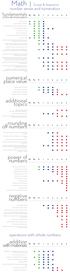 Math Scope & Sequence fundamentals number sense and numeration of the decimal system Count to 10 by units Associate number to numeral (1-10) KN 1 KN 1 KN 2 KN 2 Identify odd and even numbers/numerals and
Explorations with Shapes Kindergarten
 Ohio Standards Connections Geometry and Spatial Sense Benchmark C Sort and compare twodimensional figures and threedimensional objects according to their characteristics and properties. Indicator 1 Identify
To Evaluate an Algebraic Expression
 1.5 Evaluating Algebraic Expressions 1.5 OBJECTIVES 1. Evaluate algebraic expressions given any signed number value for the variables 2. Use a calculator to evaluate algebraic expressions 3. Find the sum
Parking Lot Mathematics
 Parking Lot Mathematics Jayson Rigsby Pike High School Introduction Each year, mathematics teachers across the nation plan their lessons for the school year. As teachers progress in their careers, they
High School. High School. Page 1 Columbus Public Schools 8/11/04. Grids and Graphics
 Page Columbus Public Schools 8//04 Table of Contents 0 by 0 Grids p. 3 20 by 20 Grids p. 4 Algebra Tiles Template p. 5 Bingo Card p. 6 Blank Geoboards p. 7 Blank Circle Graph p. 8 Blank Number Lines p.
Lesson 15 Teacher Page A
 Lesson 5 Teacher Page A Overview Students explore fraction equivalence using chips. Materials Chips for students Display chips for teacher Student Pages A-E Teaching Actions. Tell the students this story:
Everyday Mathematics. Grade 4 Grade-Level Goals CCSS EDITION. Content Strand: Number and Numeration. Program Goal Content Thread Grade-Level Goal
 Content Strand: Number and Numeration Understand the Meanings, Uses, and Representations of Numbers Understand Equivalent Names for Numbers Understand Common Numerical Relations Place value and notation
Models for Dividing Fractions Grade Six
 Ohio Standards Connection Number, Number Sense and Operations Benchmark H Use and analyze the steps in standard and nonstandard algorithms for computing with fractions, decimals and integers. Indicator
Chapter 111. Texas Essential Knowledge and Skills for Mathematics. Subchapter A. Elementary
 Elementary 111.A. Chapter 111. Texas Essential Knowledge and Skills for Mathematics Subchapter A. Elementary Statutory Authority: The provisions of this Subchapter A issued under the Texas Education Code,
Illinois State Standards Alignments Grades Three through Eleven
 Illinois State Standards Alignments Grades Three through Eleven Trademark of Renaissance Learning, Inc., and its subsidiaries, registered, common law, or pending registration in the United States and other
Investigating Relationships of Area and Perimeter in Similar Polygons
 Investigating Relationships of Area and Perimeter in Similar Polygons Lesson Summary: This lesson investigates the relationships between the area and perimeter of similar polygons using geometry software.
Pocantico Hills School District Grade 1 Math Curriculum Draft
 Pocantico Hills School District Grade 1 Math Curriculum Draft Patterns /Number Sense/Statistics Content Strands: Performance Indicators 1.A.1 Determine and discuss patterns in arithmetic (what comes next
Theme: Water animals Day 1
 Theme: Water animals Day 1 First ring Concept: Fish Ages: 3 6 y Language discussion and Beginning knowledge Participates in discussions and asks questions Listens and responds to simple questions Talks
Grade 4 Mathematics Patterns, Relations, and Functions: Lesson 1
 Grade 4 Mathematics Patterns, Relations, and Functions: Lesson 1 Read aloud to the students the material that is printed in boldface type inside the boxes. Information in regular type inside the boxes
1. A plane passes through the apex (top point) of a cone and then through its base. What geometric figure will be formed from this intersection?
 Student Name: Teacher: Date: District: Description: Miami-Dade County Public Schools Geometry Topic 7: 3-Dimensional Shapes 1. A plane passes through the apex (top point) of a cone and then through its
Materials: Student-paper, pencil, circle manipulatives, white boards, markers Teacher- paper, pencil, circle manipulatives, worksheet
 Topic: Creating Mixed Numbers and Improper Fractions SOL: 5.7- The student will add and subtract with fractions and mixed numbers, with and without regrouping, and express answers in simplest form. Problems
Problem of the Month: William s Polygons
 Problem of the Month: William s Polygons The Problems of the Month (POM) are used in a variety of ways to promote problem solving and to foster the first standard of mathematical practice from the Common
MATHEMATICS GRADE 2 Extension Projects
 MATHEMATICS GRADE 2 Extension Projects WITH INVESTIGATIONS 2009 These projects are optional and are meant to be a springboard for ideas to enhance the Investigations curriculum. Use them to help your students
Functional Math II. Information CourseTitle. Types of Instruction
 Functional Math II Course Outcome Summary Riverdale School District Information CourseTitle Functional Math II Credits 0 Contact Hours 135 Instructional Area Middle School Instructional Level 8th Grade