
Synco Central Communication Unit OZW771 Basic Documentation
|
|
|
- Kristian Patrick
- 9 years ago
- Views:
Transcription
1 Synco Central Communication Unit OZW771 Basic Documentation Edition 1.10 Version OZW CE1P3117en Building Technologies HVAC Products
2 Siemens Switzerland Ltd Building Technologies Group International Headquarters HVAC Products Gubelstrasse 22 CH Zug Tel Fax / Siemens Switzerland Ltd Subject to alteration HVAC Products

3 Contents 1 Summary Product range Accessories Synco topology Equipment combinations Synco devices Plant operating software ACS Konnex bus Product documentation Functions Important notes Introduction Communication links General Communication via Konnex bus Communication via RS-232 port Communication via the telephone network Operating elements of the central communication unit Terms and symbols Local commissioning of the central communication unit Prerequisites Preparations Creating the device list Restoring the default state Commissioning the central communication unit with ACS7 software Commissioning Introduction Prerequisites Preparations Starting the ACS Central communication unit Communication Konnex Clock function Modem Fundamentals of modem entries Device list...27 HVAC Products Contents /76
4 4.4.1 General information about the device list Generating the device list Updating device information Editing the device list Device 1, device 2, etc Message receivers Fundamentals Modem connection Receiver type Faults Fault inputs Central communication unit Konnex System report Text Replacement of central communication unit Completing commissioning Central communication unit and connections Wiring the fault inputs Plant operation Fault indication on the central communication unit Faults and messages Faults on the plant and their messages System report of plant Representation of messages Fault status messages to ACS Alarm Fault status messages to mobile phone (SMS) Fault status messages to pager Fault status messages to other receivers System report to the ACS System report to mobile phone (SMS) System report to pager System report to other receivers Plant operation with ACS Creating a new plant with ACS Operation Updating an existing plant Inputs Time of day / date System time fault Faults Fault inputs Central communication unit Konnex Device 1, device 2, etc /76 HVAC Products Contents

5 6.7.5 Fault handling through the central communication unit Message receivers Functions Modem connection Substitution of characters in text messages Device information Central communication unit Konnex Behavior when turning power on and off Sequence of functions when turning power on Data storage when turning power off Quick onsite checks...69 HVAC Products Contents /76

6 6/76 HVAC Products Contents

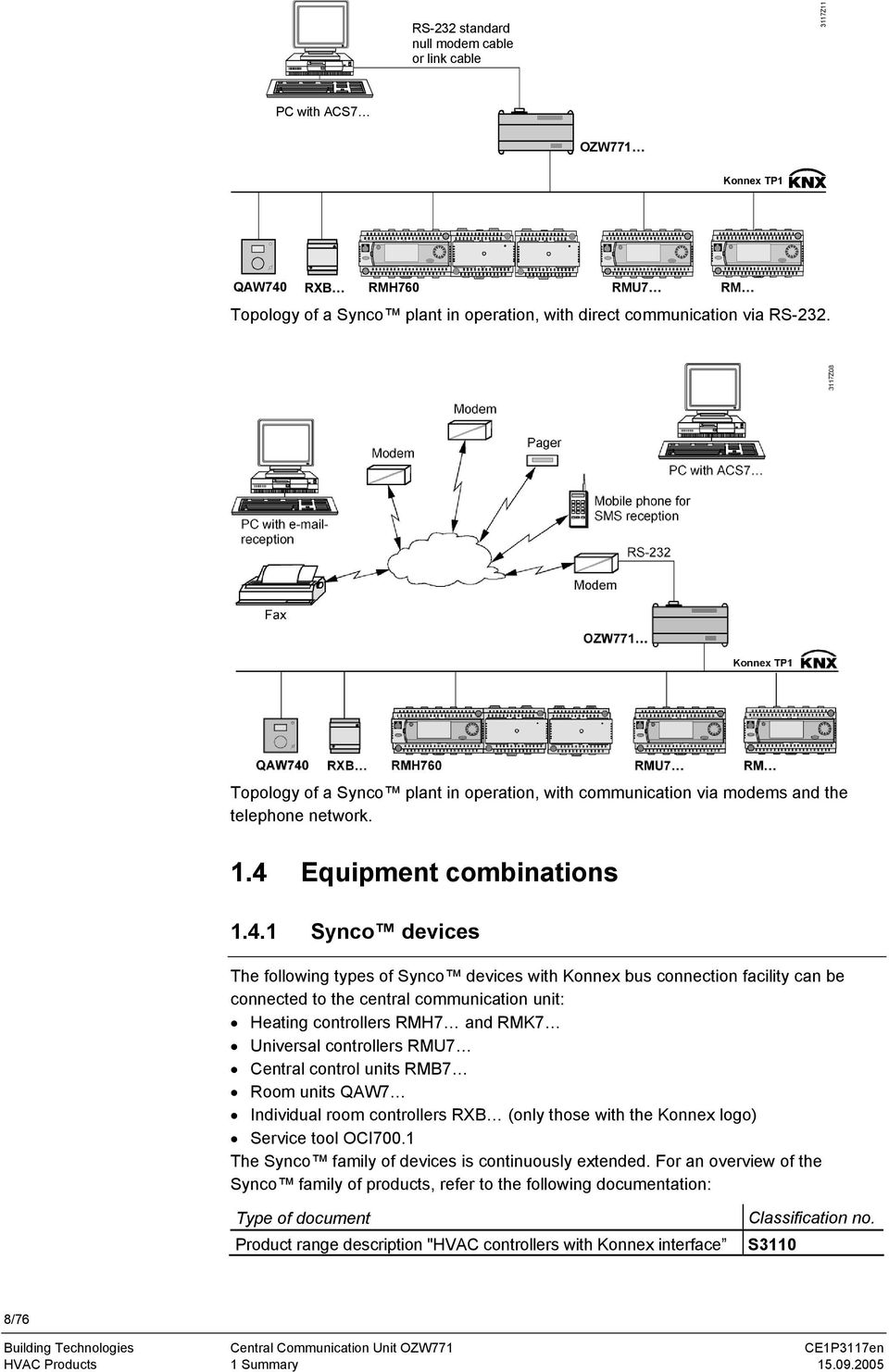
7 1 Summary 1.1 Product range Name Type reference Data Sheet no. Central communication unit for 4 Synco devices OZW N3117 Central communication unit for 10 Synco devices OZW N3117 Central communication unit for 64 Synco devices OZW N Accessories Name Ordering no. Data Sheet no. Terminal covers N3117 The terminal covers are mandatory if the device is mounted outside the control panel or cabinet. Supply of the terminal covers includes the covers for the mains and the low-voltage side as well as the cable ties for fixing. 1.3 Synco topology For the topologies depicted below, following applies: Several central communication units can be connected to the Konnex bus in parallel The central communication unit can and should be put into operation with the help of the OCI700.1 service tool 3117Z10 OZW771 Konnex TP1 QAW740 RXB RMH760 RMU7 RM USB OCI700 PC with ACS7 Topology of a Synco plant including the central communication unit at the time of commissioning with the OCI700 service interface. HVAC Products 1 Summary /76

8 RS-232 standard null modem cable or link cable 3117Z11 PC with ACS7 OZW771 Konnex TP1 QAW740 RXB RMH760 RMU7 RM Topology of a Synco plant in operation, with direct communication via RS-232. Topology of a Synco plant in operation, with communication via modems and the telephone network. 1.4 Equipment combinations Synco devices The following types of Synco devices with Konnex bus connection facility can be connected to the central communication unit: Heating controllers RMH7 and RMK7 Universal controllers RMU7 Central control units RMB7 Room units QAW7 Individual room controllers RXB (only those with the Konnex logo) Service tool OCI700.1 The Synco family of devices is continuously extended. For an overview of the Synco family of products, refer to the following documentation: Type of document Product range description "HVAC controllers with Konnex interface Classification no. S3110 8/76 HVAC Products 1 Summary
9 1.4.2 Plant operating software ACS7 With the ACS7 plant operating software installed, a PC can be used as an operator station: Connected to the Konnex bus interface via the OCI700 service interface Connected to the RS-232 port, either directly or via modem For detailed descriptions of the ACS7 plant operating software, refer to the following pieces of documentation: Type of document Data Sheet Plant operating software ACS7 Operating Instructions Operating software, service software Operating Instructions Alarm software Operating Instructions Batchjob software Classification no. N5640 U5640 U5641 U Konnex bus For detailed information about the Konnex bus, refer to the following pieces of documentation: Type of document "Konnex bus KNX" Data Sheet "Konnex bus KNX" Engineering Instructions Konnex S-mode datapoints Classification no. P3127 N3127 Y Product documentation Type of document Data Sheet no. Basic Documentation Installation Instructions Environmental Declaration Declaration of Conformity (CE) Classification no. N3117 P3117 G3117 E3117 T Functions The central communication unit: Identifies connected Synco devices via the automated search run Facilitates direct access to the Synco devices with the help of an operator station connected either directly or via modem Monitors the Synco devices and 2 fault inputs for potential-free contacts Signals faults to a PC, either directly or via modem Signals faults to SMS receivers, fax machines*, pagers and receivers* via modem Provides a clock function for signaling faults Supports the function of a system clock and that of a clock time master * Only possible with GSM modem, depending on the telephone provider HVAC Products 1 Summary /76

10 1.7 Important notes This symbol draws your attention to special safety notes and warnings. If such notes are not observed, personal injury and / or considerable damage to property can occur. Field of use Correct use Electrical installation Commissioning Operation Wiring Storage and transport Maintenance Faults Synco products may only be used for the control and supervision of heating, ventilation, air conditioning and chilled water plant. Prerequisites for flawless and safe operation of Synco products are proper transport, installation and commissioning, as well as correct operation. Fuses, switches, wiring and earthing must be in compliance with local safety regulations for electrical installations. Preparation for use and commissioning of Synco products must be undertaken by qualified staff who have been appropriately trained by Siemens Building Technologies. Synco products may only be operated by staff who have been instructed by Siemens Building Technologies or their delegates and whose attention has been drawn to potential risks. When wiring the system, the AC 230 V section must be strictly segregated from the AC 24 V safety extra low-voltage (SELV) section in order to ensure protection against electric shock hazard! For storage and transport, the limits given in the relevant Data Sheets must always be observed. If in doubt, contact your supplier or Siemens Building Technologies. Synco products are maintenance-free, apart from cleaning at regular intervals. System sections accommodated in the control panel should be freed from dust and dirt whenever normal service visits are due. Should system faults occur and you are not authorized to make diagnostics and to rectify faults, call the service staff of Siemens Building Technologies. Only authorized staff are permitted to make diagnostics, to rectify faults and to restart the plant. This also applies to work carried out within the control panel (e.g. safety checks or changing fuses). Disposal The products contain electrical and electronic components and must not be disposed of together with domestic waste. Current local legislation must be observed. 10/76 HVAC Products 1 Summary

11 2 Introduction Synco devices may only be operated by staff who have been instructed by Siemens Building Technologies or their delegates and whose attention has been drawn to potential risks. The OZW771 central communication unit can be operated via the ACS7 plant operating software, either locally or with a PC. 2.1 Communication links General Parameterization of the central communication unit and its operation can take place from a PC which is used as a central operator station. For that purpose, the ACS7 plant operating software must be installed on the PC. The central communication unit can communicate with the PC as follows: Via Konnex with the help of the OCI700 service interface Directly via the RS-232 port. In that case, a standard null modem cable or link cable between PC and central communication unit is required With a modem via the public telephone network Communication via Konnex bus The service or operating software facilitates direct data exchange with the Konnex bus users (Synco devices) via the PC s USB port and the service interface. We recommend to commission the central communication unit using this type of data exchange. 3117Z10 OZW771 Konnex TP1 QAW740 RXB RMH760 RMU7 RM USB OCI700 PC with ACS7 HVAC Products 2 Introduction /76

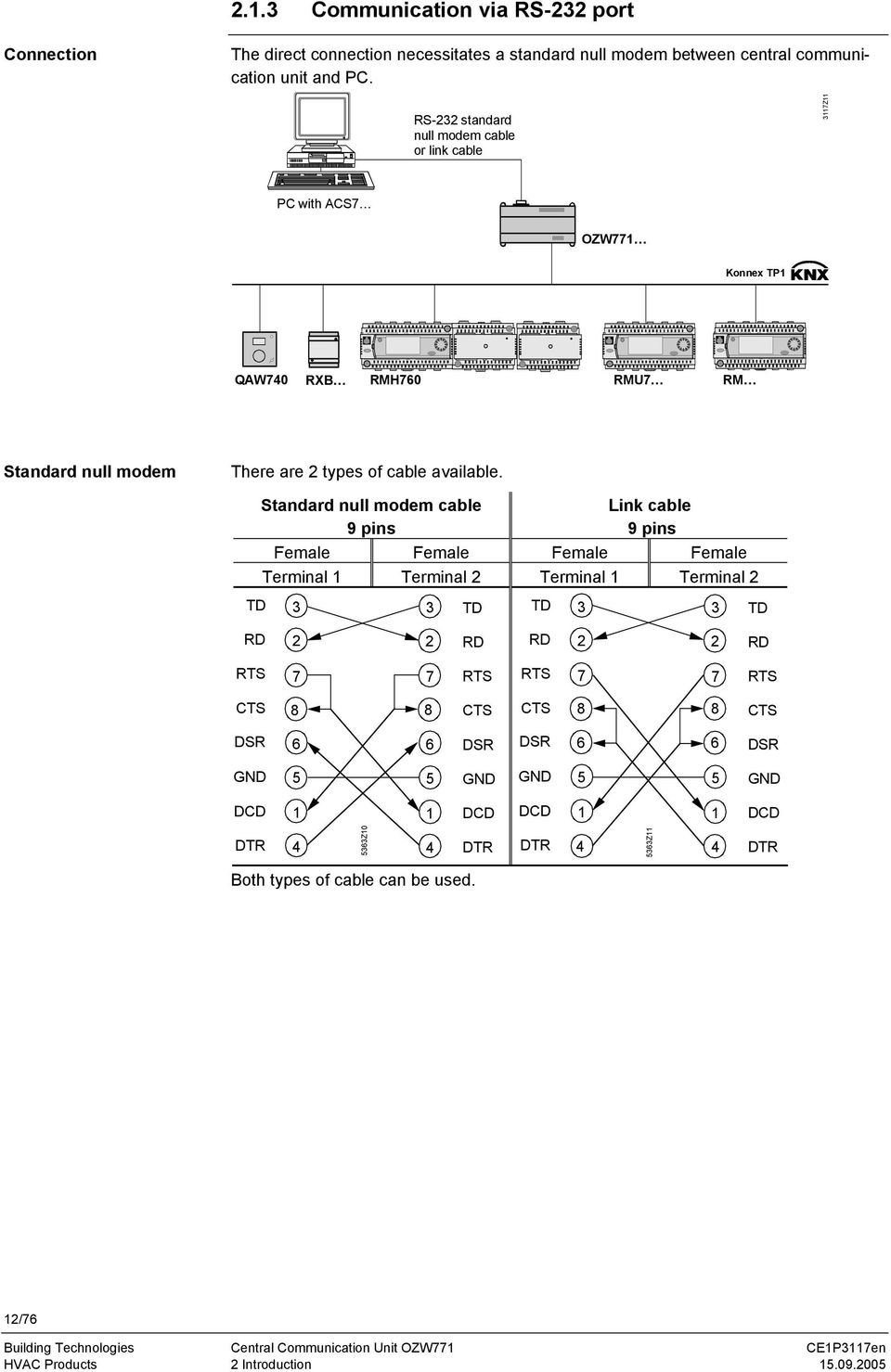
12 2.1.3 Communication via RS-232 port Connection The direct connection necessitates a standard null modem between central communication unit and PC. RS-232 standard null modem cable or link cable 3117Z11 PC with ACS7 OZW771 Konnex TP1 QAW740 RXB RMH760 RMU7 RM Standard null modem There are 2 types of cable available. Standard null modem cable 9 pins Link cable 9 pins Female Female Female Female Terminal 1 Terminal 2 Terminal 1 Terminal 2 TD 3 3 TD TD 3 3 TD RD 2 2 RD RD 2 2 RD RTS 7 7 RTS RTS 7 7 RTS CTS 8 8 CTS CTS 8 8 CTS DSR 6 6 DSR DSR 6 6 DSR GND 5 5 GND GND 5 5 GND DCD 1 1 DCD DCD 1 1 DCD DTR Z10 4 DTR DTR Z11 4 DTR Both types of cable can be used. 12/76 HVAC Products 2 Introduction
13 2.1.4 Communication via the telephone network Connection In the case of communication via the telephone network, the combinations contained in the following table must be taken into consideration. Modem and protocol support Message receiver PC with ACS SMS receiver Pager SMS receiver Fax machines Pager receiver Protocol support of the telephone provider No special requirements Fixed network provider which supports the UCP or the TAP protocol Fixed network provider which supports the TAP protocol GSM telephone provider GSM telephone provider which supports the redirection of short messages to fax machines GSM telephone provider which supports the redirection of short messages to pagers GSM telephone provider which supports the redirection of short messages to receivers Type of modem required Hayes-compatible analog, ISDN or GSM modem GSM modem (e.g. Siemens TC35) 13/76 HVAC Products 2 Introduction

14 2.2 Operating elements of the central communication unit In contrast to the Synco 700 controllers, the OZW771 central communication unit has no clear-text display. It features the following indicating and operating elements: 1 DIP switch 3 LEDs 2 buttons ON Z09 1 RS-232 selector S1: Modem / PC Message selector S2 Alarm : On / Off 2 Modem reset button Reset Modem 3 Konnex bus button Install 4 Program LED Prog (red) 5 Operation LED On (green) 6 Fault LED Alarm (red) 5 6 RS-232 selector S1 Message selector S2 Modem reset button Konnex bus button The RS-232 selector has 2 positions: Modem and PC. It is used to select the way the central communication unit s RS-232 port will be connected: Modem = connection via modem PC = direct connection to a PC The unit s message selector is marked Alarm and has 2 positions: On and Off. It is used to select whether or not pending faults or system reports shall be delivered to the message receiver. On = deliver Off = do not deliver The modem reset button Reset Modem is used to reinitialize the modem. Initialization takes place by pressing the button for more than 6 seconds. After initialization, the central communication unit opens a connection to all parameterized message receivers and delivers a system report. This system report is always delivered to all parameterized message receivers, independent of the current parameterization of the system report. The Konnex bus button is marked Install. The device list is generated by pressing the button for more than 6 seconds The change from normal mode to programming mode for adopting the device address from the ETS is made by pressing the button for less than 2 seconds The central communication unit changes to programming mode only if power is available on the Konnex bus. This way, the correct functioning of the Konnex bus can be checked. 14/76 HVAC Products 2 Introduction
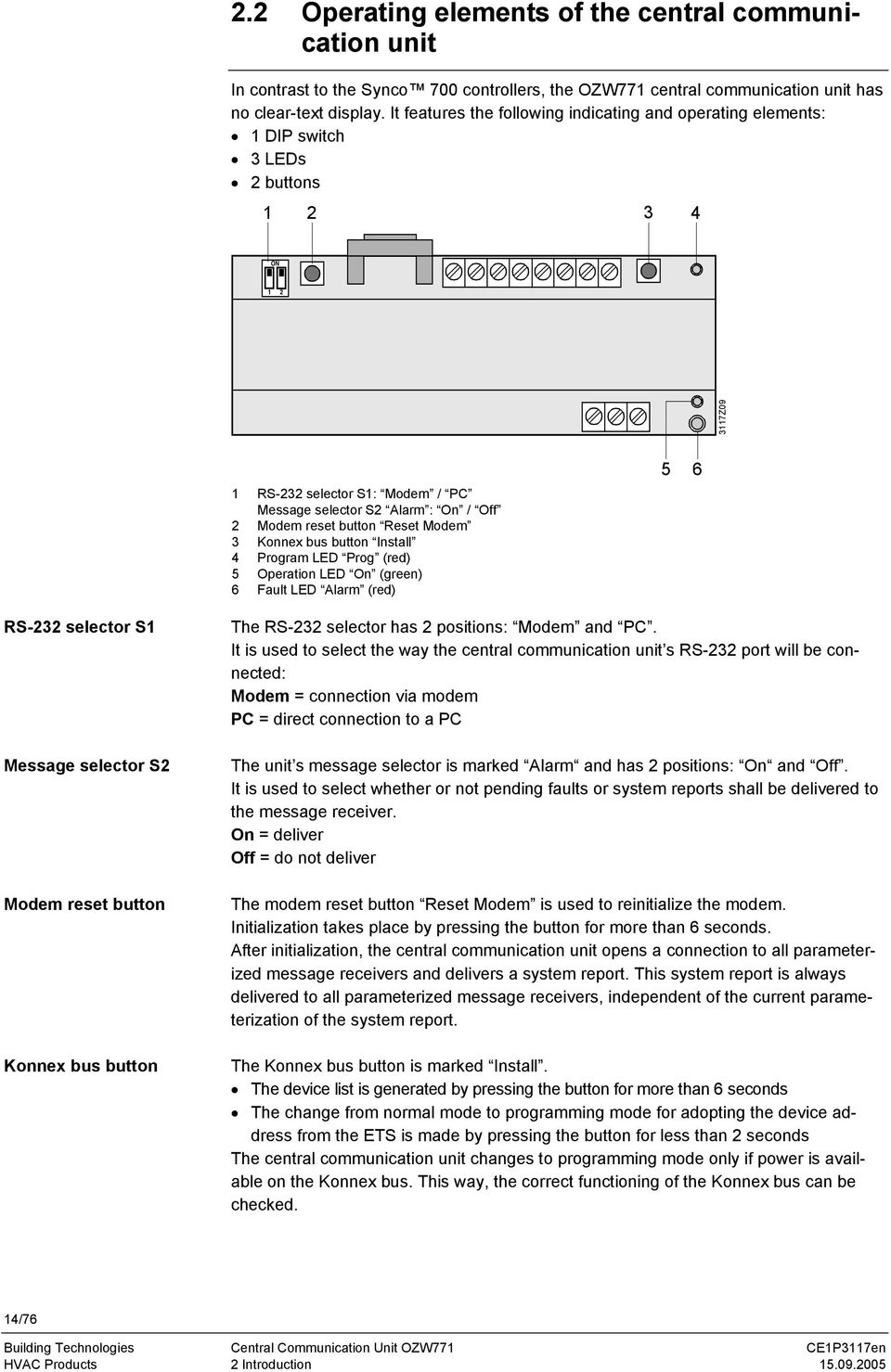
15 Programming LED Operation LED Fault LED The red programming LED, marked Prog, indicates whether the central communication unit is in programming mode: LED dark: Normal mode LED lit: Programming mode The LED extinguishes when the device address from the ETS (EIB Tool Software) has been adopted. The green operation LED is marked On and indicates the relevant operating state of the central communication unit: LED dark: No mains voltage LED lit: Mains voltage present LED flashes: Communication via RS-232 port The red fault LED is marked Alarm and indicates faults in the plant: LED dark: No fault LED lit: 1 or several Synco devices on the Konnex bus faulty LED flashes: Fault at the fault inputs or internal fault of the central communication unit 2.3 Terms and symbols Device view In addition to the central communication unit, the device view shows the Synco devices entered on the device list as device 1, device 2, etc. On the device view, these devices (device addresses 107 and 56 in the example) follow the central communication unit (device address 253 in the example). Representation of the central communication unit and the Synco devices in the form of a menu tree. Menu tree For each device, the datapoints are shown on different operating pages of a menu tree. To simplify operation, the operating pages are assigned to different operating levels. Each operating page can contain several datapoints. HVAC Products 2 Introduction /76

16 1. First operating level per device 2. Second operating level per device 3. Third operating level per device Device 252 (central communication unit) Definition of datapoint Datapoint in this document is referred to as a value that can be displayed and / or readjusted with the ACS7 plant operating software. Datapoint 3117o02 User levels The datapoints can be viewed and adjusted depending on the user level selected with the ACS7 software. The following user levels are available: Administrator Service Enduser Example Service level Service level (ACS view, menu tree, central communication unit). The service engineer can access 5 datapoints 4 of which can be changed. 16/76 HVAC Products 2 Introduction
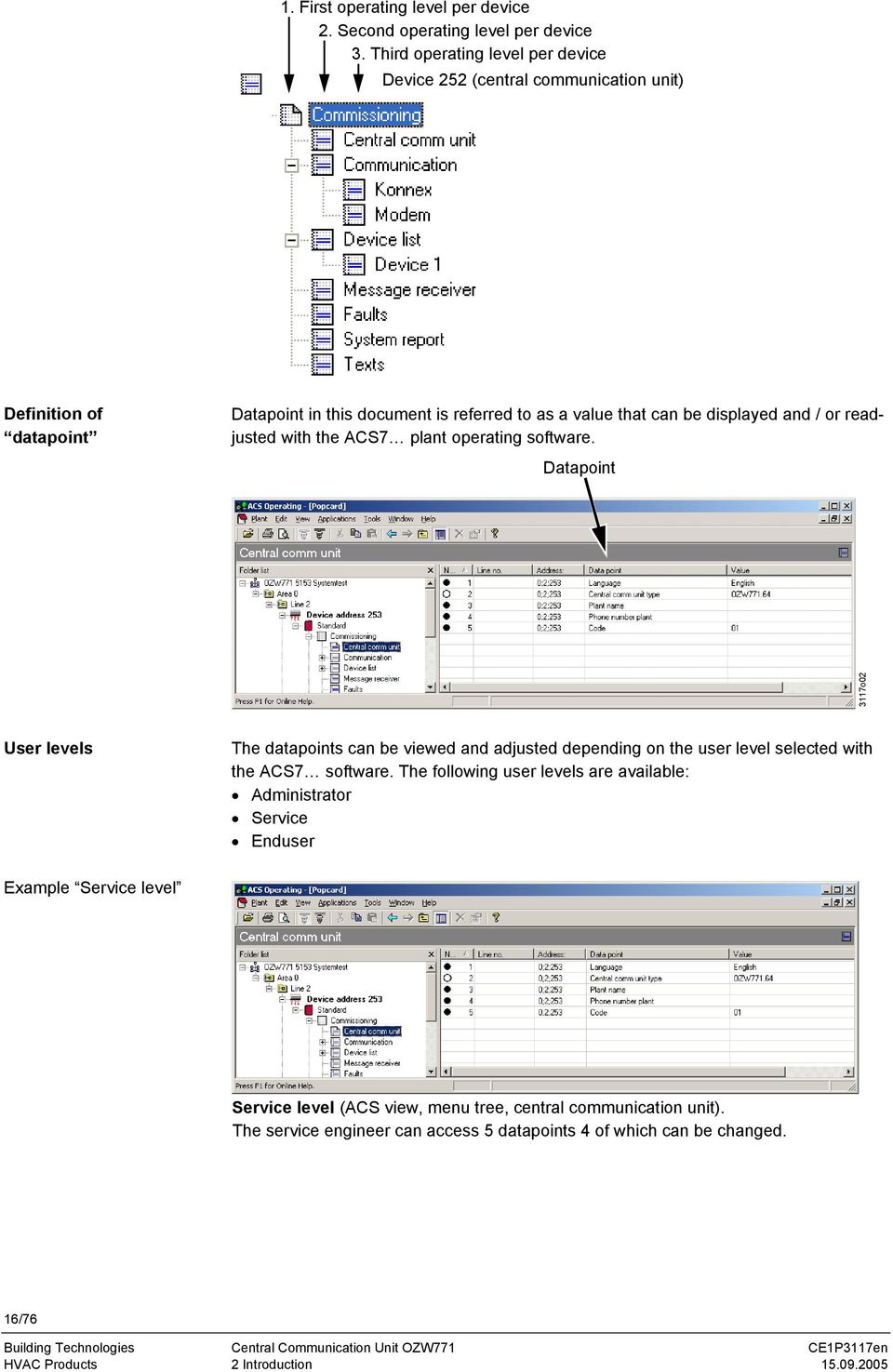
17 Example Enduser level Enduser level (ACS view, menu tree, central communication unit) The enduser can access 3 datapoints; none of them can be changed. Symbols Information about datapoints The symbols used with the datapoints have the following meaning: = datapoint on the service level = datapoint on the enduser level = write-and-read datapoint; setting can be changed = reference write-and-read datapoint; setting can be changed; other datapoints are displayed depending on this setting = read only datapoint; setting cannot be changed = reference read only datapoint; other datapoints are displayed depending on this value = operating page of the unit s first operating level = operating page of the unit s second and third operating level Datapoint designations, inputs and displays are represented as follows in current text: Update device list Information about paths Paths are shown as follows: In the menu tree: Commissioning > Device list > Create device list On the ACS main menu: Plant > Update device list Buttons Buttons are represented as follows: Finish HVAC Products 2 Introduction /76

18 3 Local commissioning of the central communication unit Important Local commissioning of the central communication unit must take place prior to commissioning the plant with the help of the ACS software. 3.1 Prerequisites All Synco devices on the Konnex bus have been put into operation The Konnex network addresses of the Synco devices are already assigned Plant is in operation, or is ready to operate (power is supplied to all devices, etc.) Neither the central communication unit nor the OCI700 service interface powers the bus. To facilitate communication, either the necessary number of Synco devices or central bus power supply must be available on the bus For topology, refer to section 1.3 Synco topology 3.2 Preparations 1. Do NOT turn on power yet. 2. Remove terminal covers, if fitted. 3. Check wiring according to the plant connection diagram; the Konnex bus must be connected! Also refer to Installation Instructions G For the modem connection according to subsection Communication via the telephone network, connect the modem to the central communication unit s RS- 232 port. Connection to the telephone network must be ensured. For direct connections according to subsection Communication via RS-232 port, the PC must be connected 5. For commissioning, RS-232 selector S1 must be set to PC (direct communication with PC via RS-232 port). 6. For commissioning, message selector S2 must be set to Off (no delivery of messages via RS-232 port). 7. Replace terminal cover on the mains voltage side, if required. 8. Turn on power. 3.3 Creating the device list When pressing the Konnex bus button for at least 6 seconds, the central communication unit will create the device list. All the devices acquired are on the same line. During the time this function is performed, the operation LED is dark (item 5 in the illustration in section 2.2 Operating elements of the central communication unit ). The central communication unit shows the end of the device search run only when all other data have been queried also. Then, the operation LED flashes 3 times If the device address of the central communication unit is still in the default state, the unit will choose function Identify device address automatically (refer to subsection Konnex ) Then, the central communication unit queries all users on the Konnex bus together, each of them responds. During the search run, the Synco devices identified are only those connected to the same line as the central communication unit and responding correctly. Thirdparty devices including line couplers do not respond. The device list is generated based on the responses received from the users If the central communication unit does not yet contain a device list, it will be created in the order the responses are received 18/76 HVAC Products 3 Local commissioning of the central communication unit

19 If a device list already exists in the central communication unit, the responses are compared with the device addresses of the existing entries and overwritten if they agree. In case there is no agreement, the device will be newly added to the device list. New devices are first inserted in the gaps (devices having the not checked state; refer to subsection Device 1, device 2, etc. ) and only then added at the end if there is sufficient space The device search run is active for: At least 15 seconds A maximum of 5 seconds after reception of the last response to the query. The time of the last response depends on the current bus load When the device list is generated, the remaining data of the device list will automatically be updated. For details, refer to subsection Updating device information. Devices contained on the device list that do not respond to the query made by the central communication unit will be given the not present state. The number of devices that can be entered are limited (also refer to subsection Generating the device list ). When the maximum number is reached, responses from bus users that have not yet been handled will not be considered. Pressing the Konnex bus button again for 6 seconds during the time a search run is active (operation LED dark) has no impact; the command will be ignored. 3.4 Restoring the default state The default (as supplied) state of the central communication unit can be restored. When simultaneously pressing the modem reset button and the Konnex button for 6 seconds, all adjustable values will be reset to their default values. This also applies to S-mode datapoints. The green LED extinguishes and the central communication unit will be restarted. After a successful fresh start, the green LED will be lit again. HVAC Products 3 Local commissioning of the central communication unit /76

20 4 Commissioning the central communication unit with ACS7 software 4.1 Commissioning Introduction Commissioning by the heating engineer including the relevant parameter settings and plant operation by the enduser are made possible via the ACS menu (Applications > Popcard ). A detailed description of commissioning and operation of the Synco plant with the OZW771 central communication unit via ACS7 is given in the following subsections. For other functions provided by the ACS (e.g. Trend), refer to the relevant ACS documentation. Note on Parameter settings menu The ACS menu (Applications > Parameter settings ) is used for loading and reading entire parameter sets of the central communication unit and of the Synco devices connected to the Konnex bus Prerequisites Local commissioning of the central communication carried out according to chapter 3 Local commissioning of the central communication unit It is assumed that the user is more or less familiar with the ACS7 plant operating software Preparations Commissioning is made with a PC which must have the ACS7 plant operating software installed. Detailed information about the installation is given in the relevant pieces of documentation For commissioning the central communication unit, the user must have logged in on the Service user level The PC with the installed ACS7 plant operating software is to be connected to the Konnex bus via the OCI700 service interface (connected via USB, refer to subsection Communication via Konnex bus ) The OCI700 service interface must be connected to the same line as the central communication unit 20/76 HVAC Products 4 Commissioning the central communication unit with ACS7 software

21 4.1.4 Starting the ACS 1. Start ACS Service and log on with the service password. 2. Plant > New > Plant 3. The Save As dialog opens. Enter the file name (e.g. Building WEST) 4. Select Save : The General dialog opens. 5. Select Next > : The Communication dialog opens HVAC Products 4 Commissioning the central communication unit with ACS7 software /76
22 6. Select the type of central unit: OCI700 - KNX 7. Adopt the remaining settings (as supplied). Select Finish 8. Plant > Connect (or on the menu bar). 9. Plant > Update device list. What follows are the displays Read plant information and Update reference data points. If an address is used several times, this problem must be solved first. For details, refer to section 3.1 Prerequisites and subsection Prerequisites. 10. Choose Applications > Popcard 11. Extend view of tree structure until OZW771 appears. 12. Extend view of Standard and Commissioning, enabling the relevant application pages to appear. From here, commissioning follows the menu tree in ACS. The menu tree is made up such that when commissioning the plant, every branch or datapoint on the tree can be retrieved and parameterized in a practical way from top to bottom. 4.2 Central communication unit Datapoints The following settings can be made on the central communication unit: Datapoint Explanation, example Language Type of central communication unit Plant name Phone number plant Code Refer to paragraph Selecting the language below Here, the complete type reference is shown: OZW = max. 4 Synco devices on the bus OZW = max. 10 Synco devices on the bus OZW = max. 64 Synco devices on the bus Maximum 20 digits. Example: Main street 22 This entry is made for information purposes and contained in a number of messages delivered by the central communication unit. Observe the notes! Maximum 20 characters. This number is used for information purposes and sent out as text in messages. Therefore, any kind of text can be entered here. If messages are sent to numerical pagers, only digits are permitted here. Observe the notes! Maximum 20 digits. For more details, refer to paragraph Code below. 22/76 HVAC Products 4 Commissioning the central communication unit with ACS7 software
23 Notes on datapoints Plant name and Phone number plant Selecting the language User-defined text Exercise caution when using pagers; pay attention to the relevant notes given under Receiver type = pager in subsection Receiver type A detailed description of the entries is given in section 6.3 Representation of messages On the central communication unit, Text is available in several languages. The required language is to be entered when commissioning the plant. It is recommended to select the same language as that used with the Synco devices on the Konnex bus. The language can also be changed later during operation. At present, the central communication unit supports the following languages: English German French Italian Dutch Polish Czech Hungarian Spanish Danish Norwegian Swedish Finnish Slovakian If a new language is selected, all user-defined text in the previous language will be lost. In that case, the words of the newly selected language available in the default state will be used. This applies to the following datapoints: Datapoint Text fault input 1 Text for: No fault Text for: Fault Text fault input 2 Text for: No fault Text for: Fault Device Inputs No fault Faults System report Device failure Path in ACS menu tree Commissioning > Faults Commissioning > Faults Commissioning > Faults Commissioning > Faults Commissioning > Faults Commissioning > Faults Commissioning > Texts > Text for Commissioning > Texts > Text for Commissioning > Texts > Text for Commissioning > Texts > Text for Commissioning > Texts > Text for Commissioning > Texts > Text for Code The central communication unit is supplied with the code preset to 01. The code entered here must agree with that of the ACS plant. The setting can only be made after the ACS plant has been created, either via modem or a direct connection (refer to section 6.4 Plant operation with ACS7, step 7). The setting is made either directly in the dialog or via the ACS menu at a later stage. Caution If the 2 codes do not agree, the central communication unit refuses to open the connection. If the connection cannot be opened and the code of the central communication unit is not known, the following procedure is recommended: 1. Connect the ACS via OCI Set the OZW771 code to the required value. 3. Disconnect the ACS via OCI Build up the connection again with the ACS. HVAC Products 4 Commissioning the central communication unit with ACS7 software /76
24 4.3 Communication Konnex Datapoints Datapoint Explanation, example Identify network address automatically If local commissioning has been made correctly (device search run by a long press of the Konnex button Install ), the central communication unit has already performed this function! To ensure that ACS can still address the central communication unit correctly, the Popcard must be closed and, on the ACS main menu, command Plant > Update device list must be chosen after function Identify device address automatically has been performed. If Yes is entered here, the central communication unit will identify a free network address. If available, both area and line will be adopted from the overriding line coupler. Then, the central communication unit searches for the next free device address from 253 downward. When a free device address is found, the datapoint will be set to No. Datapoint Area Line Device address Explanation, example The area is part of the network address; it is automatically adopted from the overriding line coupler The line is part of the network address; it is automatically adopted from the overriding line coupler The device address is part of the network address and, if local commissioning has been made correctly, has already been assigned by function Create device list or Identify device address automatically Clock function Datapoints Datapoint Explanation, example Clock time operation Remote setting clock slave The following entries can be made: Autonomous Slave Master If Slave is selected, Remote setting clock slave must be configured (Yes / No) To be set if clock time operation = slave Configuration: Remote setting Yes / No Clock time operation The clock function of the central communication unit offers 3 choices for clock time operation: Configuration as a master: The clock in the central communication unit works as a system clock and acts on all devices on the Konnex bus where the clock has been configured as a slave. If, in addition to the central communication unit, there is another master on the Konnex bus, it generates fault 5002 (>1 clock time master) and no longer delivers its system time. If the time of day cannot be changed on the central communication unit, there is another master with a higher priority (lower device address) in the system 24/76 HVAC Products 4 Commissioning the central communication unit with ACS7 software
25 Remote setting clock slave Time data Configuration as a slave: The clock in the central communication unit will be synchronized with the master s clock. If there is no master, fault 5001 (system time failure) will be generated Configuration as Autonomous: The time of day is neither adopted by a master nor sent to other devices on the Konnex bus In the case of clock time operation as a slave on the central communication unit, function Remote setting clock slave enables the operator to set the master s time of day and date from a remote location. For that purpose, datapoint Remote setting clock slave must be set to Yes. If the central communication unit is configured as Clock time master or Autonomous, the setting of time data is mandatory. These settings are made on the Time of day/date menu. Weekday, month, day of month and year, as well as start and end of summertime, are set with the help of a calendar Modem If the telephone network shall be used for the connection between ACS and central communication unit, the settings for the type of modem used must be made. Datapoints Datapoint Explanation, example Modem type Baud rate RS-232 Reset command Initialization command Following choices are available: Analog (as supplied) ISDN GSM The RS-232 port offers default rates from 1.2 kbd to kbd. Default state in modem operation: 9.6 kbd. If RS-232 selector S1 is set to PC, the Baud rate is always 9.6 kbd The default setting is ATZ^M, independent of the type of modem selected The default setting is ATE0V0L1&C1&D2S0=2^M, independent of the type of modem selected Command opening connection Command abortion connection Command closure When selecting the type of modem, this value will be overwritten with the following values: Analog: ATDT (as supplied) ISDN: ATD GSM: ATD When selecting the type of modem, this value will be overwritten with the following values: Analog: ~~~+++~~~ATH0^M (as supplied) ISDN: ~~~+++~~~ATH^M GSM: ~~~+++~~~ATH^M The default setting is ^M, independent of the type of modem selected 25/76 HVAC Products 4 Commissioning the central communication unit with ACS7 software
26 If the modem does not respond to a command, or if it gives a negative response, the central communication unit will return to the ready state after a certain waiting time has elapsed. In that case, fault status message No modem communication will be delivered. The manual of the modem used contains the relevant specification (also refer to subsection Fundamentals of modem entries ). The majority of the default entries are set by the selected modem type and are suited for most types of modem. They can be reset to the default settings at any time. Doubleclick on the line of the datapoint and select the Default button. When changing the selected modem type, the datapoints will be reset to their default values. Note When using a GSM modem, RS-232 selector S1 must be set to Modem now (prior to commissioning the message receivers) Fundamentals of modem entries AT command sets Command set AT M Purpose of command Informs the modem that modem commands will follow. This is how each command line must begin Sends the command closure to the modem. This is a control code which the modem usually interprets as carriage return +++ Quits the data transfer mode and changes to the command mode (Escape Code) Typical AT commands Command Purpose of command D Dialing the phone number (followed by the phone number) DT Dialing the phone number with tone dialing (followed by the phone number) DP Dialing the phone number with pulse selection (followed by the phone number) E0 No command echo. Required for OZW771 E1 Echo command character H Disconnect, hang up (ISDN, GSM) H0 Disconnect, hang up (analog) L1 Loudspeaker soft Q0 Result code sent. Required for OZW771 Q1 Silent (no result codes) S0=2 Pick up the phone after ringing twice V0 Numerical replies (e.g. 0). Required for OZW771 V1 Replies in text format (e.g. OK) Z Resetting the modem to the supply state ~ (Tilde) Causes the modem to pause for half a second. It is possible to set several ~ in a row. Example ~~~~ causes the modem to pause for 2 seconds &C0 CD (Carrier Detect) is always on &C1 Modem controls CD. Required for OZW771 &D0 Ignore DTR (Data Terminal Ready) D1 Online command mode D2 If DTR is set to zero, the modem will abort the connection. Required for OZW771 F Loading the supply state Commands in bold letters are mandatory for operation with the OZW /76 HVAC Products 4 Commissioning the central communication unit with ACS7 software
27 Typical AT command sequences Modem Purpose and time of command command Reset command Resetting the modem: At midnight When RS-232 selector S1 is set to Modem When modem reset button is pressed Before each message When turning power on Initialization Initialization of modem: command At midnight When RS-232 selector S1 is set to Modem When modem reset button is pressed Before each message When turning power on Command opening connection Before each Calling: message Command abortion connection Hanging up: After message has been delivered Without feedback from telephone provider within: min. 10 s nominal 60 s max. 180 s Entry on the central communication unit ATZ^M ATE0V0L1&C1&D2DS0=2^M ATDP ^M +++~~~ATH0~~~^M 4.4 Device list General information about the device list On the device list, a process image of devices and fault status information of devices monitored by the central communication unit is generated. Generation of the device list is initialized and triggered in the ACS menu tree Commissioning > Device list > Create device list. Please note the following: The central communication unit itself does not appear on the device list A fault status message received by a Synco device is passed on only if the relevant device is entered on the device list of the central communication unit The device search run is made on the line on which the central communication unit is installed If the number of Konnex devices installed exceeds the number permitted by the central communication unit, the device list must be entered manually (for details, refer to subsection Editing the device list ) Generating the device list Datapoints Datapoint Create device list Explanation, example This function must be performed only if: The device list has not yet been created locally Other devices have been connected The device addresses on Konnex devices have been changed 27/76 HVAC Products 4 Commissioning the central communication unit with ACS7 software
28 Datapoint Update device information Number of devices current Number of devices maximum Explanation, example The central communication unit or the devices were assigned to some other line To generate the device list, enter Yes. Prior to generating the device list, the central communication unit performs function Identify device address automatically (refer to subsection Konnex ). When the device list has been generated, the device information will automatically be updated. Then, the ACS Popcard and all other applications must be closed and command Plant > Update device list must be chosen on the ACS main menu. Only then does the ACS register the final address of the central communication unit. During the time the function is performed, ACS can no longer update the datapoints. The device information of all devices will be updated on the device list. During the time the function is performed, ACS can no longer update the datapoints. The number of active Konnex devices on the device list will be displayed. The maximum possible number of Konnex devices on the device list will be displayed (depending on the type of central communication unit) Device 1 The state (active / inactive) will be displayed for Device 2 each device. Active / inactive means: The device will be monitored / not monitored. Device 3 When entering the device list manually, free Device 4 entries on the device list can be preselected Device 5 here, or devices can be removed from the device Device 6 list. This setting is in accordance with the user s preselection whether or not a device shall appear etc. on the device list and thus in the menu tree. If a device is set to Inactive, the network address on the device list will be reset to (0.0.0). Creating the device list Sequence of creation Datapoint Create device list = Yes starts the device search run. This enables the central communication unit to create or extend its device list. Indication is made with the operation LED (item 5 in the illustration in section 2.2 Operating elements of the central communication unit ). The operation LED remains dark during the time the device list is created; it flashes briefly 3 times when the list is completed. If, after the functional start, the device address of the central communication unit is still the same as that supplied, the central communication unit performs function Identify device address automatically (refer to subsection Clock function ). Then, the central communication unit queries all Konnex bus users together; each of them gives the following replies: Network address (area, line and device address) Serial number Information required to load the correct ACS device description in ACS The device search run only identifies Synco devices that give correct responses. Third-party devices including line couplers do not respond. 28/76 HVAC Products 4 Commissioning the central communication unit with ACS7 software
29 The device list is created based on the responses given by the users. On completion of the device search run, all device information will be updated (for details, refer to subsection Updating device information ). Order on the device list Triggering the device search run If the central communication unit does not yet contain a device list, it will be created in the order the replies are given If the central communication unit already contains a device list, the replies will be compared with the device addresses of the existing entries and, if there is agreement, they will be overwritten. If there is no agreement, the device will be newly added to the device list. New devices will first be inserted in the gaps (devices having the Not checked state) and only then be added at the end, if space is still available. The device search run can be triggered via a datapoint, or locally on the central communication unit. The device search run is active for: A minimum of 15 seconds A maximum of 5 seconds after the last reply to the query is received. The point in time the last reply is received is dependent on the current bus load The central communication unit indicates the end of the device search run only when all other data have been queried also. Then, the operation LED flashes quickly 3 times. During the time a device search run is performed, repeated activation of Create device list has no effect; the command will be ignored Updating device information Datapoint Update device information in Commissioning > Device list adapts the data of all devices on the device list of the central communication unit. A device that is contained on the device list but that does not respond to the central communication unit s query remains entered and its device state will be marked as Not present. In that case, fault status message 5011 (Commissioning: Device not found) will be delivered. This fault can be rectified by checking the relevant device and then activating datapoint Update device information. This function can be used after a faulty device has been replaced and the new device has been commissioned, for example Editing the device list The device list can be edited via the ACS Popcard. The following choices are available: Adding devices: This is made by setting the relevant device to Active and by entering its address manually Removing devices: This is made by setting the relevant device to Inactive Reasons for editing the device list manually can be the following: The number of devices connected within a line exceeds the number of spaces available on the device list (e.g. after a plant extension in case a second central communication unit is required) The enduser wants to structure his plant (e.g. devices are located in building 1; devices in building 2, devices in building 3, etc.) A device is connected to a line other than the OZW771 Due to current Konnex bus overload, a device could not be found Adding a device On the device list, there are still inactive device storage spaces available. By activating a Device datapoint, the space on the device list will be preselected for the new device. HVAC Products 4 Commissioning the central communication unit with ACS7 software /76
30 This does not mean however that the device is completely contained on the device list. Its device state is Not checked. The device address must be manually entered on the ACS Popcard of the activated device (refer to subsection Device 1, device 2, etc. ) and the device information must be updated. During the updating process, the device will be checked and if present the device state will change to Present. Then, the device information, device name, device type, fault information and fault text will be updated. If the check is negative (device not identified), the device state will change to Not present. Removing a device Note To delete a device via the Popcard, it must be deactivated. This is made by setting its datapoint on the device list to Inactive. As a result, the device state changes to Not checked and the remaining fields will be set to their initial state. In any case, it is recommended to generate the device list with the help of the device search run. If the number of Synco devices exceeds the maximum number of devices that can be connected (4, 10 or 64, depending on the type of central communication unit), the device list must subsequently be edited Device 1, device 2, etc. For each device on the device list, information can be retrieved and partly edited. If the device list shall be generated manually, the network addresses of the Synco devices to be read in and administered must be entered here. By making the entry manually, the entry on the device list will be adapted to the new device address. Datapoints Datapoint Network address Area Line Device address Device information Update device information Device name Device state Device type Explanation, example Here, the area of the network address of the device to be monitored must be entered. It can be selected between 0 and 15 Here, the line of the network address of the device to be monitored must be entered. It can be selected between 0 and 15 Here, the device address of the network address of the device to be monitored must be entered. It can be selected between 1 and 254 Entry Yes updates the following device information of the respective device. This function must always be performed after a change of line or area setting, or device address The name is to be entered on the Konnex device The current states are shown in the illustration on page 31 Indication of type reference. Example: QAW740 (Synco room unit) 30/76 HVAC Products 4 Commissioning the central communication unit with ACS7 software
31 Datapoint Fault information Fault text Explanation, example This information includes the date, the time of day the fault occurred, and the Synco fault number. Example: ; 15:14; 5001 This is the Synco fault text; it is assigned to the Synco fault number. Example 5001 = System time failure The central communication unit reads the fault text based on the reported fault number from the relevant device. For this reason, the text is dependent on the text selection of that device These datapoints repeat themselves for each Synco device connected to Konnex. After making changes to the device list, the ACS Popcard and all other applications must be closed and command Plant > Update device list on the ACS main menu must be chosen. Device list state On the device list, each device connected to the Konnex bus is identified by the Device state. ACS uses this state in the menu tree representation. The following states are defined: State Not checked Checking Present Not present Description The entry on the device list is inactive or the device information has not yet been updated after the Active setting Temporary state during the time the device is checked The device is available on Konnex and communicates with the central communication unit The device is not available or is not a Synco device Available choices Not checked Not present B02 Checking Present Action Procedure Fault status message 1 Update device information 2 Device does not respond 5011 Commissioning: Device not found 3 Device responds For a detailed description of failure supervision of devices and of the impact device states have on faults, refer to subsection Device 1, device 2, etc.. HVAC Products 4 Commissioning the central communication unit with ACS7 software /76
32 4.5 Message receivers Fundamentals The central communication unit supports all types of message receivers: PC with ACS Alarm SMS receivers Pager Fax For the transmission of messages to the different types of receivers, the central communication unit uses different types of transmission protocols, which are not supported by all telephone providers. For this reason, providers for all types of protocols cannot be found in all countries. For more information, contact your closest telephone provider or the closest Siemens Building Technologies sales office Modem connection Datapoints Modem message interval Modem message repetition If the connection to the message receivers are made via modems, they need to be configured. Datapoint Explanation, example Modem message interval The interval can be set in the range between 2 and 30 minutes. Refer to Modem message interval below Modem message repetition The number of repetitions can be set: None, 1, 2, 3, unlimited. Refer to Modem message repetition below Position message selector Messages are delivered by the central communication unit only if message switch S2 is set to On (item 1 in the illustration in section 2.2 Operating elements of the central communication unit ). The position of message selector S2 can be read The message interval ensures that the central communication unit can be contacted between 2 message stops. It can be set in the range between 2 and 30 minutes. For detailed information, refer to subsection Modem connection. A maximum number of dial repetitions can be defined for each message receiver and each message. This reduces phone costs if the partner station is not ready for opening the connection and receiving the message. For detailed information, refer to subsection Modem connection Receiver type Fundamentals If the receiver type is the ACS, the central communication unit will send the message directly to the receiver s phone number. If the receiver type is a mobile phone, pager, fax or , the central communication unit sends the message to the telephone provider which will then pass it on to the message receiver. The protocol to be used for transmitting the message must be selected on the central communication unit, independent of the selected telephone provider and modem. To make certain the telephone provider knows where the message is to be sent, the central communication unit passes appropriate information to the telephone provider. Depending on the type of modem selected (refer to subsection Modem ), messages can be sent to the following receiver types: 32/76 HVAC Products 4 Commissioning the central communication unit with ACS7 software
33 Type of modem Receiver type Analog GSM ISDN ACS* SMS (GSM) SMS (UCP) ** ** ** SMS (TAP) ** ** ** Fax (GSM) ** (GSM) ** Pager (GSM) ** Pager (TAP) ** ** ** * With ACS7 versions 4.0 and 4.01: PC ** Depending on the telephone provider Notes There is a large number of different receiver types available to make certain that in addition to ACS at least one more receiver type can be addressed in each country. Datapoints Separate settings can be made for message receiver 1 and message receiver 2. The explanations given also apply analogously to message receiver 2. Datapoint Explanation, example Receiver type The following types of receivers can be used: ACS* SMS GSM SMS UCP SMS TAP Fax GSM GSM Pager GSM Pager TAP The receiver types shown are only those that can be used after selecting the type of modem (refer to subsection Modem ) * With ACS7 versions 4.0 and 4.01: PC Handling special characters Special characters are filtered when entering the phone number. To avoid incorrect parameterization, only the following characters will be accepted with numerical values (phone numbers and codes): Character Usual meaning of modem command Digits 0 9, (comma) Delay 0 8 s (default setting = 2 s) w Waiting until exchange line is available = Delay 3 s < Delay 1 s + International area code with GSM Other characters will be ignored. To improve readability, phone numbers can include blanks, slashes, etc. Depending on the receiver type, these are filtered as follows, if required: Phone number Receiver type Filtering is ensured by: Receiver s phone number ACS* Modem Receiver s phone number All except ACS* Central communication unit Service provider s phone number All Modem * With ACS7 versions 4.0 and 4.01: PC For example, entry 041/ will be accepted as HVAC Products 4 Commissioning the central communication unit with ACS7 software /76
34 Phone number of provider with GSM modem read from SIM card Preliminary remarks: With a GSM modem, the telephone provider s phone number stored on the SIM card will be adopted. It is not possible to use the phone number of some other telephone provider RS-232 selector S1 must be set to Modem When selecting a GSM protocol (Commissioning > Message receiver > Receiver type) + is written in datapoint Commissioning > Message receiver > Phone number provider If this + in ACS is deleted, the GSM modem will read the GSM provider number from the SIM card to write it to datapoint Phone number provider. For safety reasons, the SMS provider number continues to be dialable for all types of receivers; normally, however, the number should be adopted from the SIM card. In normal plant operation, each time an SMS is sent, the central communication unit overwrites the provider number of the SIM card when making the entry in datapoint Phone number provider. This offers the opportunity to add a missing provider number to the SIM card. Caution Caution Dependency of receiver data Example Function Read phone number provider with GSM modem from SIM card can only be performed 60 seconds after starting the central communication unit (e.g. fresh start after a power failure). The GSM modem must be connected. Procedure: 1. For datapoint Commissioning > Modem > Modem type, select: GSM 2. For datapoint Commissioning > Message receiver > Receiver type, select: GSM 3. Datapoint Phone number provider: Delete entry 4. The provider number is read from the SIM card and written to the datapoint. If not: Readjust datapoint Baud rate RS-232 in steps and repeat step 4 until the provider number is read out. Each time the Baud rate is readjusted, wait about 10 seconds. The provider number on the SIM card will be overwritten when sending an SMS, independent of the entry made in datapoint Phone number provider. If messages shall be sent to a receiver type SMS GSM, all information from section Receiver type = SMS and section Communication protocol GSM is decisive. During the time message selector S2 is in the Off position, the sending of SMS will be suppressed and thus overwriting of the provider number also (exception: Pressing on the modem reset button for 6 seconds). Depending on the type of receiver, the following types of communication protocols are supported: Communication Type of message receiver protocol ACS* SMS Fax Pager ACS GSM UCP TAP * With ACS7 versions 4.0 and 4.01: PC The receiver data are dependent on: The communication protocol and The type of message receiver In the following, all types of communication protocols and message receivers are covered. With receiver type ACS, communication protocol and message receiver are identical. If a message shall be sent to a receiver type SMS GSM, all information given in paragraphs Message receiver type = SMS and Communication protocol = GMS) applies. 34/76 HVAC Products 4 Commissioning the central communication unit with ACS7 software
35 Communication protocol and message receiver type = ACS* Datapoint Explanation, example Phone number receiver In modem operation, the phone number to be dialed is the phone number of the modem to which the PC with ACS is connected. For international calls, the area code is 00 Example: 0041 In direct operation, no phone number is required * With ACS7 versions 4.0 and 4.01: PC ACS in modem operation is the only setting with which several fault status messages can be delivered in consecutive order, with no intermediate abortion of the connection and new dialing. Communication protocol = GSM Datapoint Explanation, example Phone number provider This number should always be read from the SIM card of the GSM modem: Refer to section Read phone number provider with GSM modem from SIM card. The only number that can be used is the business number of the provider which supplied the SIM card in the GSM modem. International calls must be started with +. Example: Phone number receiver For international calls, the area code is 00. Example: 0041 Communication protocol = UCP Datapoint Explanation, example Phone number provider For international calls, the area code is 00. Example: Phone number receiver For international calls, the area code is 00. Example: 0041 Note With the UCP protocol, the central communication unit operates with the definition Call Input Operation = 51. Communication protocol = UCP via GSM network Datapoint Explanation, example Phone number provider For international calls, the area code is 00. Example: Phone number receiver For international calls, the area code is 00. Example: 0041 Communication protocol = TAP Datapoint Explanation, example Phone number provider For international calls, the area code is 00. Example: Phone number receiver Hardware settings (RIC number) 8N1 or 7E1 (as supplied), depending on the telephone provider. Meaning: (for 8N1) 8 = number of data bits N = parity (N = non, E = even) 1 = number of stop bits 35/76 HVAC Products 4 Commissioning the central communication unit with ACS7 software
36 Receiver type = SMS With SMS telegrams, the message is considered delivered as soon as there is a positive reply from the provider. Only 1 SMS at a time can be delivered per connection. Delivery of several SMS per connection is dependent on the provider and, for this reason, not supported by us. Receiver type = fax Directing messages and system reports to a fax machine with OZW771 is only possible via the GSM network and necessitates a GSM modem. The telephone provider must support GSM connections and the required redirecting function. Datapoint Explanation, example Prefix *fax# Receiver type = Directing messages and system reports via with OZW771 is only possible via the GSM network and necessitates a GSM modem. The telephone provider must support GSM connections and the required redirecting function. Datapoint Explanation, example Prefix With the prefix, the telephone provider s address must be entered; make certain an * is used in place of Correct: name*provider.com Wrong: [email protected] Receiver type = pager With pager telegrams, the message is considered delivered as soon as there is a positive reply from the provider. Only 1 pager message at a time can be delivered per connection buildup. Delivery of several pager messages per connection is dependent on the provider and, for this reason, not supported by us. Datapoint Explanation, example Display format For information, refer to the following section For historical reasons, messages on pagers use the following display formats: 20 characters, numeric: Only numbers are sent 40 characters, alphanumeric: Text with a maximum length of 40 characters is sent 80 characters, alphanumeric: Text with a maximum length of 80 characters is sent 160 characters or more, alphanumeric: Text with a maximum length of 160 characters is sent On the central communication unit, the display format must be selected because if, for example, 80 alphanumeric characters are sent to a 20- or 40-character pager, the receiver often shows no message. The central communication unit automatically limits the total length of the message to the maximum of the selected value. Numeric Alphanumeric Serves for the transmission of pure numbers, such as phone numbers, fault numbers, etc. The central communication unit ensures that the message only contains numbers. In the case of phone numbers, this does not take place automatically. For this reason, when setting the parameters of the central communication unit, it must be made certain that only numbers are used for phone numbers. Serves for the transmission of text, such as fault status messages, designations, etc. The messages must not contain any special characters or vowels. The characters permitted are the following: a z and A Z 0 9 Blanks! $ % & ( ) * + ` -. / : ; < = >? When sending messages, invalid characters are converted to? (question marks). 36/76 HVAC Products 4 Commissioning the central communication unit with ACS7 software
37 Pager with 20 characters Pager with 40 characters The Phone number plant must not comprise more than 15 numbers to ensure that the fault number will not be cut off. For datapoints Plant name and Phone number plant, a total of 34 characters is permitted. 4.6 Faults The central communication unit differentiates between 3 types of faults: Faults with signals delivered to the central communication unit s fault input Internal faults Faults with signals delivered to the central communication unit via Konnex bus The fault status messages are passed on to the parameterized message receiver. The most urgent of all faults (internal faults and faults at the fault inputs) is sent to the Konnex bus users (for display) Fault inputs General Typical input signals Parameter settings Datapoints The central communication unit has 2 fault inputs for the connection of potential-free contacts. The normal position of the contacts (fault / no fault) and the fault priority can be parameterized. Typical input signals at the fault inputs are the following: Common messages from external plant (e.g. burner lockout) Fault signals from pumps Thermal switches Level switches (e.g. oil level) Parameters are set via the ACS menu: Applications > Popcard, menu tree: Commissioning > Faults. Datapoint Explanation, example Fault input 1 A contact of an external device (e.g. thermostat) connected to the fault input opens or closes, thereby signaling fault / no fault. For more information, refer to subsection Fault inputs Normal position The normal position of the contact (open / closed) at the fault input must be entered; the opposite state will generate a fault status message Text fault input 1 A user-defined text can be entered describing the plant component monitored by the contact (e.g. fuel oil level). A maximum of 20 characters are available Text for: No fault* For the No fault state, a user-defined text can be entered. Example: Normal for the fuel oil level. A maximum of 20 characters are available Text for: Fault* For the Fault state, a user-defined text can be entered. Example: Too low for the fuel oil level. A maximum of 20 characters are available Fault priority The priority can be selected***: Nonurgent or Urgent HVAC Products 4 Commissioning the central communication unit with ACS7 software /76
38 Datapoint Message receiver Message triggering Explanation, example No messages** No messages are delivered to the message receivers 1 Messages are delivered to message receiver 1 2 Messages are delivered to message receiver Messages are delivered to message receivers 1 and 2 If messages are delivered to message receivers, message triggering need to be parameterized: Coming: Fault is signaled when it occurs Coming and Going: Fault is signaled when it occurs and when it disappears * With ACS7 versions 4.0 and 4.01: No fault or Fault ** With ACS7 versions 4.0 and 4.01: Alarming off *** The central communication unit only sends the most urgent fault signal to the Konnex bus For fault input 2, the same settings apply analogously as for fault input 1. Selecting another language Fault as a message If another language is selected (Commissioning > Central communication unit > Language), the user-defined texts will be replaced by the default texts of the selected language. The following examples Oil level and Water filter show that a fault input can be used not only for generating fault status messages but also for other messages. Fault input Normal position Text fault input Text for: Fault* Text for: No fault* 1 Closed Oil level Low o.k. 2 Open Water filter Maintenance o.k. due * With ACS7 versions 4.0 and 4.01: No fault or Fault Wiring test Indication To check wiring, the aggregates connected to the fault inputs can be manually controlled in order to simulate faults. The red fault LED must flash. For a description of the display of faults of fault inputs, refer to subsection Fault inputs Central communication unit Brief description Central communication unit The central communication unit monitors itself and detects internal faults. Parameterization of the central communication unit s internal faults includes both the message receiver and message triggering (message when occurring and disappearing or when occurring only). These parameters are to be set on menu: Applications > Popcard, menu tree: Commissioning > Faults. Here, it is specified how the fault status messages that the central communication unit detects in itself shall be handled. Datapoint Explanation, example Message receiver No messages* No messages are delivered to the message receivers 1 Messages are delivered to message receiver 1 2 Messages are delivered to message receiver Messages are delivered to message receivers 1 and 2 38/76 HVAC Products 4 Commissioning the central communication unit with ACS7 software
39 Datapoint Explanation, example Message triggering If messages are delivered to message receivers, message triggering must be parameterized: Coming: Fault is signaled when it occurs Coming and Going: Fault is signaled when it occurs and when it disappears * With ACS7 versions 4.0 and 4.01: Alarming off Interrogation For a description of the indication of faults of fault inputs, refer to subsection Central communication unit Konnex Brief description Konnex Interrogation From each Synco device connected to the Konnex bus, the central communication unit receives the fault status messages with the highest priority. For the devices entered on the device list for monitoring, the central communication unit displays the relevant messages. Parameterization of the Synco device faults transmitted via Konnex includes the message receiver (phone number of the receivers) and the triggering of messages (message when occurring and disappearing or when occurring only). This parameterization is made on menu Applications > Popcard, menu tree: Commissioning > Faults. Here, it is to be specified how fault status messages transmitted to the central communication unit via Konnex shall be handled. Datapoint Explanation, example Message receiver No messages* No messages are delivered to the message receivers 1 Messages are delivered to message receiver 1 2 Messages are delivered to message receiver Messages are delivered to message receivers 1 and 2 Message triggering If messages are delivered to message receivers, message triggering must be parameterized: Coming: Fault is signaled when it occurs Coming and Going: Fault is signaled when it occurs and when it disappears * With ACS7 versions 4.0 and 4.01: Alarming off For a description of indication of faults transmitted via Konnex, refer to subsection Konnex. 4.7 System report It is possible to generate a system report, which informs about the current plant state at regular intervals. The following configurations are required: Datapoint Explanation, example Message receiver No messages* No system report is delivered to the message receivers 1 System report is delivered to message receiver 1 HVAC Products 4 Commissioning the central communication unit with ACS7 software /76
40 Datapoint Explanation, example 2 System report is delivered to message receiver System report is delivered to message receivers 1 and 2 Signal time If a system report is parameterized at one of the message receivers (1 / 2 / 1+2), the signal time need to be defined. The format is hh:min; the resolution is 1 minute Message cycle If a system report is parameterized at one of the message receivers (1 / 2 / 1+2), the message cycle must be defined. It can be selected in the range from 1 to 255 days. The system report is delivered for the first time on completion of the set message cycle * With ACS7 versions 4.0 and 4.01: Alarming off Contents and representation of the system report are ready configured. In addition to general information about the plant (plant name, etc.), the system report contains the message OK or N.OK. For more detailed information, refer to subsection System report to the ACS. 4.8 Text Here, any Text for individual datapoints can be entered during commissioning or during normal plant operation, e.g. adjustments to local conditions such as language of the plant operator. These texts are used in the SMS telegrams and in the pager messages. For more detailed information, refer to section 6.3 Representation of messages and following. Datapoints Datapoint Explanation, example Text for: Device Maximum 20 characters permitted Inputs Maximum 20 characters permitted No fault Maximum 20 characters permitted Faults Maximum 20 characters permitted System report Maximum 20 characters permitted Device failure Maximum 20 characters permitted This text is used with all types of message receivers, except with ACS, to signal device failures: E.g. Device failure With the ACS message receiver, the fault text from subsection Central communication unit is used: E.g. Device failure. In this case, the address of the faulty device is transferred to some other field of the fault status message. Selecting another language For these datapoints, the central communication unit contains default texts. If another language is selected (Commissioning > Central communication unit > Language), the userdefined text will be replaced by the default Text of the selected language. 40/76 HVAC Products 4 Commissioning the central communication unit with ACS7 software
41 4.9 Replacement of central communication unit When replacing a central communication unit, it is recommended to observe the following procedure: 1. Use the ACS to read the parameter set of the central communication unit (ACS menu Application > Parameter settings ) and export it. 2. Replace the central communication unit. 3. Import the parameter set and write it to the new communication unit. 4. Update the device information on the central communication unit (refer to subsection Generating the device list ). 5. Update the device list on ACS menu Plant > Update device list. 6. Check the settings of the central communication unit and the device list. HVAC Products 4 Commissioning the central communication unit with ACS7 software /76
42 5 Completing commissioning 5.1 Central communication unit and connections 1. If the central communication unit is in addressing mode (programming LED lit), it must now be switched to normal mode. To do this, press the Konnex bus button for a short moment (<2 seconds). 2. Set message selector S2 Alarm to On (On = messages and system reports delivered to message receivers). 3. Set RS-232 selector S1 to the correct position, if not already done: When using the modem connection: Set selector S1 to Modem. Refer to subsection Communication via the telephone network. When using the direct connection: Set selector S1 to PC. Refer to subsection Communication via RS-232 port. 4. Keep modem reset button depressed for 6 seconds. 5. Now, the central communication unit builds up the connection to the message receivers and sends a system report (a fault during communication buildup is indicated by the red fault LED; it flashes). 6. Check to see if the message receivers have received the system report. Important After commissioning, the connections to the message receivers must be checked to avoid unnecessary service visits due to nonworking modem communication. To make the connection test to ACS, ACS Alarm must be started on the receiving PC. 5.2 Wiring the fault inputs To check wiring, the devices connected to the fault inputs of the central communication unit can be manually controlled to simulate faults. The red fault LED must flash and the central communication unit must deliver a fault status message to the message receiver. 42/76 HVAC Products 5 Completing commissioning
43 6 Plant operation 6.1 Fault indication on the central communication unit Section 2.2 Operating elements of the central communication unit gives a description of all choices available on the central communication unit itself. 6.2 Faults and messages Faults on the plant and their messages During plant operation, the collection of faults from the plant and passing them on to the message receivers is the major task of the central communication unit. Sources of faults and messages: The 2 fault inputs of the central communication unit The central communication unit itself All Synco devices on the Konnex bus that are contained on the device list The central communication unit handles faults (e.g. indication by fault LED, storage) and passes them on as messages to the parameterized message receivers (e.g. ACS or mobile phone). A detailed description of the relevant parameter settings is given in chapter 4 Commissioning the central communication unit with ACS7 software System report of plant The System report function checks the plant at regular intervals and signals periodically its correct functioning or, if necessary, pending faults. The receiver choices are the same as those available with the passing on of faults and messages. The representation of the system report parameterized for passing on to a mobile phone is ready configured. 6.3 Representation of messages Fault status messages to ACS Alarm General Alarm popup The central communication unit sends the fault status messages and system reports to ACS Alarm. ACS Alarm uses 3 types of representation for fault status messages: Alarm popup Main alarm view; all pending alarms are shown Detailed alarm view The alarm popup appears right after an alarm has been received. The most important information about the alarm is displayed for the enduser. HVAC Products 6 Plant operation /76
44 3117o Explanation, origin of indication, path of relevant entry 1 Indication will automatically be generated*** 2 According to entry Commissioning > Central communication unit > Plant name 3 Fault status message at the fault input: According to entry Commissioning > Faults > Text for: Fault* or According to entry Commissioning > Faults > Text for: No fault* Internal OZW771 fault status message: Synco fault text (see list in subsection Central communication unit ) or No fault (Commissioning > Texts > Text for No fault) Fault status message on Konnex bus**: Synco fault text (see list in the of the respective device), or User-defined text for the relevant fault of the respective device (entry on that device), or Device failure (detected by the central communication unit; Commissioning > Texts > Text for Device failure) or No fault (Commissioning > Texts > Text for No fault) 4 Display is automatically generated by the central communication unit 5 Display is automatically generated by the fault source 6 According to entry Commissioning > Central communication unit > Phone number plant * With ACS7 versions 4.0 and 4.01: Fault or No fault ** Depending on the language of the respective device *** According to Commissioning > Central communication unit > Type 44/76 HVAC Products 6 Plant operation
45 Main alarm view The main alarm view is the default view of ACS Alarm. 3117o Explanation, origin of display, path of the relevant entry 1 6 Like alarm popup in the previous section Fault status message at the fault input: According to entry Commissioning > Faults > Fault input 1 (or 2) According to entry Commissioning > Texts > Text for Input Number of input (will be generated automatically) Network address (will be generated automatically) OZW771 internal fault status message: 7 According to entry Commissioning > Central communication unit > Plant name Network address (will be generated automatically) Fault status message on Konnex bus: Device name (entered on this device)* According to entry Commissioning > Texts > Text for Device Network address (will be generated automatically) * If not entered: User-defined text for device and device number according to the device list, according to Commissioning > Texts > Text for device HVAC Products 6 Plant operation /76
46 Detailed alarm view By clicking on one of the alarm lines in the main view, all transmitted alarm data of this alarm will be displayed. The detailed alarm view includes: 3117o Explanation, origin of display, path of the relevant entry 1 8 Like alarm popup and main alarm view in the preceding sections 9 Device name will be entered on the Konnex device 10 Automatic generation (the respective device sends its type reference) 11 Network address, will automatically be generated 12 Synco fault number, will automatically be generated 13 With fault inputs according to entry Commissioning > Faults > Fault priority, otherwise automatically 14 ACS internal fields for alarm administration Fault status messages to mobile phone (SMS) The display of fault status messages parameterized to be passed on to a mobile phone is ready configured. In the central communication unit, the fields of the SMS message are separated by blanks. The provider s phone number (including that of the SMS receiver) is to be entered in datapoint Commissioning > Message receiver > Phone number provider. Message at the central communication unit s fault input Datapoint, information Path in ACS menu tree Example 1* Occurrence time :55:21 2 Plant name Commissioning > School building East Central communication unit > Plant name 3 Phone number plant Commissioning > Central communication unit > Phone number plant /76 HVAC Products 6 Plant operation
47 Datapoint, information Path in ACS menu tree Example 4 User-defined text for the fault input and user-defined text for the input and the number of fault Commissioning > Faults > Text Burner fault input 1 (or 2) (Input 1) input 1 or 2 5 User-defined text for fault Commissioning > Faults > Faults Text for: Fault** User-defined text for no fault Commissioning > Faults > Text No fault for: No fault** * Depending on the modem s SIM card setting, additional information that is not delivered by the central unit can be inserted as the first line: No information (suppression of own phone number is dependent on the modem s SIM card settings) Name from the mobile phone s dialing list Phone number (plant phone number not contained on the mobile phone s dialing list) ** With ACS7 versions 4.0 and 4.01: Fault or No fault OZW771 internal fault status message Device fault (fault at the fault input of a Synco device) Datapoint, information Path in ACS menu tree Example 1* Occurrence time :55:21 2 Plant name Commissioning > Central School building East communication unit > Plant name 3 Phone number plant Commissioning > Central communication unit > Phone number plant 4 Type of central communication Commissioning > Central OZW unit** communication unit > Type 5 Synco fault text*** >1 clock time master User-defined text for no fault Commissioning > Texts > Text No fault for No fault * Depending on the modem s SIM card setting, additional information that is not delivered by the central unit can be inserted as the first line: No information (suppression of own phone number is dependent on the modem s SIM card settings) Name from the mobile phone s dialing list Phone number (plant phone number not contained on the mobile phone s dialing list) ** Automatic generation according to the path *** According to Synco fault number list (refer to the of the relevant device) Datapoint, information Path in ACS menu tree Example 1* Occurrence time :55:21 2 Plant name Commissioning > Central communication unit > Plant name 3 Phone number plant Commissioning > Central communication unit > Phone number plant 4 Name of Synco device* and user-defined text for the device and device number according to the device list 5 User-defined text for the relevant fault of the respective device** User-defined text for no fault Setting on the relevant device Commissioning > Texts > Text for Device E.g. with the RMU720 universal controller: Settings > Faults > Fault input 1 > Fault input 1 Commissioning > Texts > Text for No fault School building East Zone South ( Device 5) Aux 1 No fault * Depending on the modem s SIM card setting, additional information that is not delivered by the central unit can be inserted as the first line: No information (suppression of own phone number is dependent on the modem s SIM card settings) Name from the mobile phone s dialing list Phone number (plant phone number not contained on the mobile phone s dialing list) ** To be entered on the respective Synco device; path dependent on the device type HVAC Products 6 Plant operation /76
48 Device fault (internal fault of a Synco device) Datapoint, information Path in ACS menu tree Example 1* Occurrence time :55:21 2 Plant name Commissioning > Central School building East communication unit > Plant name 3 Phone number plant Commissioning > Central communication unit > Phone number plant 4 Name of Synco device** and Setting on the relevant Zone South user-defined text for the device and the device number according device to the device list Commissioning > Texts > Text (Device 5) for Device 5 Synco fault text*** >1 clock time master Device failure**** Commissioning > Texts > Text Dev fail for Device failure No fault Commissioning > Texts > Text No fault for No fault * Depending on the modem s SIM card setting, additional information that is not delivered by the central unit can be inserted as the first line: No information (suppression of own phone number is dependent on the modem s SIM card settings) Name from the mobile phone s dialing list Phone number (plant phone number not contained on the mobile phone s dialing list) ** To be entered on the respective Synco device; path dependent on the device type *** Depending on the language of the relevant device **** Device failure will be detected by OZW Fault status messages to pager Pager message with 20 characters The display of fault status messages parameterized to be forwarded to a pager is ready configured. The number of character fields and the maximum number of characters per field are dependent on the pager s format. There is a blank between 2 fields. For more detailed information, refer to subsection Receiver type, paragraph Receiver type = pager. Field Datapoint, information Path in ACS menu tree Example 1 Phone number plant Commissioning > Central communication unit > Phone number plant digit Synco fault number* (= no fault) 0000 * According to the Synco fault code list (refer to the relevant device) Pager message with 40 characters Field Datapoint, information Path in ACS menu tree Example 1 Plant name Commissioning > Central communication unit > Plant name School building East 2 Phone number plant Commissioning > Central communication unit > Phone number plant 3 4-digit Synco fault number* (= no fault) 0000 * According to the Synco fault code list (refer to the relevant device) 48/76 HVAC Products 6 Plant operation
49 Pager message with 80 characters Message at OZW771 fault input Field Datapoint, information Path in ACS menu tree Example 1 Plant name Commissioning > Central communication unit > Plant name School building East 2 Phone number plant Commissioning > Central communication unit > Phone number plant 3 User-defined text for the Commissioning > Faults > Text fault Burner fault input and user-defined input 1 (or 2) text for the input and Commissioning > Texts > Text for (Input 1) its numbers (1 or 2) Input 4 User-defined text for fault Commissioning > Faults > Text for: Fault* Fault User-defined text for no fault * With ACS7 versions 4.0 and 4.01: Fault or No fault Commissioning > Faults > Text for: No fault* No fault OZW771 internal fault status message Field Datapoint, information Path in ACS menu tree Example 1 Plant name Commissioning > Central communication unit > Plant name School building East 2 Phone number plant Commissioning > Central communication unit > Phone number plant 3 Type of central communication Commissioning > Central communica- OZW unit* tion unit > Type 4 Synco fault text** >1 clock time master User-defined text for no fault Commissioning > Faults > Text for No fault No fault * Automatic generation according to the path ** According to the Synco fault code list (refer to the relevant device) Device fault (at the fault inputs of a Synco device) Field Datapoint, information Path in ACS menu tree Example 1 Plant name Commissioning > Central communication unit > Plant name School building East 2 Phone number plant Commissioning > Central communication unit > Phone number plant User-defined text for the device and device number according to the device list Device 8 and name of the Synco device* Commissioning > Texts > Text for Device Controller South zone 4 If available, Synco fault text** of the relevant Aux 1 Synco device, otherwise user-defined text for the Commissioning > Texts > Text for Fault fault or Fault User-defined text for no Commissioning > Texts > Text for No No fault fault fault * To be entered on the respective Synco device; path dependent on the device type ** According to the Synco fault code list (refer to the relevant device), depending on the language of the relevant device HVAC Products 6 Plant operation /76
50 Device fault (Synco device internally) Pager message with 160 characters Message at OZW771 fault input Field Datapoint, information Path in ACS menu tree Example 1 Plant name Commissioning > Central communication unit > Plant name School building East 2 Phone number plant Commissioning > Central communication unit > Phone number plant 3 User-defined text for device Commissioning > Texts > Text for Device and device number according to the device list, and name of Synco device* Device 8 Controller South zone 4 If available, Synco fault text** of the relevant Synco device, otherwise user-defined text for the fault or Commissioning > Texts > Text for Fault > 1 clock time master Fault No fault User-defined text for no Commissioning > Texts > Text for No fault fault * To be entered on the respective Synco device; path dependent on the device type ** According to the Synco fault code list (refer to the relevant device), depending on the language of the relevant device Field Datapoint, information Path in ACS menu tree Example 1 Occurrence time :55:21 2 Plant name Commissioning > Central communication unit > Plant name School building East 3 Phone number plant Commissioning > Central communication unit > Phone number plant 4 User-defined text for the Commissioning > Faults > Text fault Burner fault input, and user-defined input 1 (or 2) text for the input, and Commissioning > Texts > Text for (Input 1) its number (1 or 2) Input 5 User-defined text for fault Commissioning > Faults > Text for: Fault Fault* User-defined text for no Commissioning > Faults > Text for: No fault fault No fault* * With ACS7 versions 4.0 and 4.01: Fault or No fault OZW771 internal fault status message Field Datapoint, information Path in ACS menu tree Example 1 Occurrence time :55:21 2 Plant name Commissioning > Central communication unit > Plant name School building East 3 Phone number plant Commissioning > Central communication unit > Phone number plant 4 Type of central communication Commissioning > Central communica- OZW unit* tion unit > Type 5 Synco fault text** >1 clock time master User-defined text for no Commissioning > Texts > Text for No fault fault No fault * Automatic generation according to the path ** According to the Synco fault code list (refer to the relevant device) 50/76 HVAC Products 6 Plant operation
51 Device fault (at the fault inputs of a Synco device) Field Datapoint, information Path in ACS menu tree Example 1 Occurrence time :55:21 2 Plant name Commissioning > Central communication unit > Plant name 3 Phone number plant Commissioning > Central communication unit > Phone number plant 4 User-defined text for the device and device number according to the device list and name of the Synco device* 5 If available, Synco -fault text** of the relevant Synco device, otherwise user-defined text of fault, or User-defined text for no fault Commissioning > Texts > Text for Device Commissioning > Texts > Text for Fault Commissioning > Texts > Text for No fault School building East Device 8 Controller South zone Aux 1 Fault No fault * To be entered on the respective Synco device; path dependent on the device type ** According to the Synco fault code list (refer to the relevant device), depending on the language of the relevant device Device fault (Synco device internally) Field Datapoint, information Path in ACS menu tree Example 1 Occurrence time :55:21 2 Plant name Commissioning > Central communication unit > Plant name 3 Phone number plant Commissioning > Central communication unit > Phone number plant 4 User-defined text for the device and device number according to the device list and name of the Synco device* Commissioning > Texts > Text for Device 5 If available, Synco -fault text** of the relevant Synco device, otherwise user-defined text of fault, or Commissioning > Texts > Text for Fault User-defined text for no fault Commissioning > Texts > Text for No fault School building East Device 8 Controller South zone > 1 clock time mast Fault No fault * To be entered on the respective Synco device; path dependent on the device type ** According to the Synco fault code list (refer to the relevant device), depending on the language of the relevant device Fault status messages to other receivers Other types of fault status message receivers are: Fax Contents and representation correspond to an SMS with 160 characters. The prefix is sent along to control the relevant provider service. HVAC Products 6 Plant operation /76
52 6.3.5 System report to the ACS The representation of the system report to the ACS is similar to that of the fault status messages. The system report informs periodically (depending on the parameter settings) about the 2 plant states, that is, OK (plant OK) or N.OK (plant not OK). The display of the ACS includes: Column Datapoint, information Path in ACS menu tree 1 Type of central communication unit, automatically generated 2 Transmission time 3 Phone number plant Commissioning > Central communication unit > Phone number plant 4 Plant name Commissioning > Central communication unit > Plant name 3117o Display example of a system report Detail view, plant OK Detail view, plant not OK 52/76 HVAC Products 6 Plant operation
53 6.3.6 System report to mobile phone (SMS) The representation of the system report as SMS is pretty much the same as that of the fault status messages. The system report informs periodically (depending on the parameter settings) about the plant state, that is, fault-free or not fault-free. Datapoint, information Path in ACS menu tree Example 1 Date and time of day of :55:21 central communication unit 2 Plant name Commissioning > Central School building East communication unit > Plant name 3 Phone number plant Commissioning > Central communication unit > Phone number plant 4 User-defined name of Commissioning > Texts > System report system report Text for System report 5 Plant state: OK Fault-free Not fault-free N.OK System report to pager The representation of the system report at the pager is very similar to that of fault status messages, but is dependent on the number of available fields. Note on the number of characters Pager messages with max. 20 characters For limitation of the number of characters per field, the restrictions are basically the same as those that apply for the fault status messages at the pager. If the system report is due, the plant sends its phone number to the pager. The enduser must then make contact with the plant (starting the ACS, establishing a connection, etc.). Field Datapoint, information Path in ACS menu tree Example 1 Phone number plant Commissioning > Central communication unit > Phone number plant Pager messages with max. 40 characters If the system report is due, the plant sends its phone number and the keyword for system report to the pager. The enduser must then make contact with the plant (starting the ACS, establishing a connection, etc.). Field Datapoint, information Path in ACS menu tree Example 1 Phone number plant Commissioning > Central communication unit > Phone number plant 2 User-defined text of system report Commissioning > Texts > Text for System report System report Pager messages with max. 80 characters In addition to that with 40 characters, the system report includes the plant name and the plant state (fault-free or not fault-free). To learn about the cause of the fault, the enduser must make contact with the plant (starting the ACS, establishing a connection, etc.). HVAC Products 6 Plant operation /76
54 Field Datapoint, information Path in ACS menu tree Example 1 Plant name Commissioning > Central communication School building East unit > Plant name 2 Phone number plant Commissioning > Central communication unit > Phone number plant 3 User-defined text of Commissioning > Texts > System report system report Text for System report 4 Plant state: Fault-free OK Not fault-free N.OK Pager message with 160 characters In addition to that with 80 characters, the system report includes the occurrence time. To learn about the cause of the fault, the enduser must make contact with the plant (starting the ACS, establishing a connection, etc.). Field Datapoint, information Path in ACS menu tree Example 1 Occurrence time :55:21 2 Plant name Commissioning > Central communication School building East unit > Plant name 3 Phone number plant Commissioning > Central communication unit > Phone number plant User-defined text of system report 5 Plant state: Fault-free Not fault-free Commissioning > Texts > Text for System report System report OK N.OK System report to other receivers The system report can also be routed to the following types of message receivers: Fax Contents and representation correspond to an SMS with 160 characters. The prefix is sent along to control the relevant provider service. 6.4 Plant operation with ACS7 Introduction In operation, the enduser can access all datapoints covered by this section, that is, datapoints with read and (if applicable) write access. It is assumed that the enduser is more or less familiar with the ACS plant operating software. 54/76 HVAC Products 6 Plant operation
55 6.4.1 Creating a new plant with ACS Operation 1. Start ACS Operation and log on with the service password. 2. Plant > New > Plant 3. Dialog Save As opens. Enter the file name, e.g. Building WEST. 4. Select Save : The General dialog opens. 5. Select Next > : The Communication dialog opens HVAC Products 6 Plant operation /76
56 6. Select Type of central unit: OZW The illustration shows the as supplied state. Select Finish : The ACS window opens Code: Select in accordance with the setting made when the central communication unit was commissioned (refer to section 4.2 Central communication unit ) Connection: Select the connection used on the PC 8. Plant > Connect (or on the menu bar) 9. Plant > Update device list. Read plant information and Update reference datapoints will appear. 10. Choose Applications > Popcard 11. Extend view of tree structure until OZW771 appears. 12. Extend view of Standard so that the relevant Popcards appear Updating an existing plant 1. Start ACS Operation and log on with the service password. 2. Plant > Open 3. The Open plant dialog appears. Click on the file name, e.g. Building WEST. 4. Select Open : The plant is opened. 5. Plant > Connect (or on the menu bar). 6. Plant > Update device list. Read plant information and Update reference datapoints will appear. 7. Choose Applications > Popcard. 8. Extend view of tree structure until OZW771 appears. 9. Extend view of Standard so that the relevant Popcards appear. 56/76 HVAC Products 6 Plant operation
57 6.5 Inputs Datapoints For each of the 2 fault inputs, the current state is displayed. Datapoint Fault input 1 Explanation, example The fault can be signaled by an open or closed contact at fault input 1. The relevant parameter settings are explained in subsection Fault inputs. For both states, user-defined Text can be entered: Commissioning > Faults > Text for: Fault* or Commissioning > Faults > Text for: No fault* * With ACS7 versions 4.0 and 4.01: Fault or No fault The statements made about fault input 1 also apply to fault input Time of day / date Datapoints Function Time of day / date includes 3 datapoints: Datapoint Time of day / date Summer time start Winter time start Explanation, example Here, the date and the time of day can be set. Entry is made via a calendar. Setting the date for the change to summertime means that on the first Sunday after that date the time of day will be set forward from 02:00 (wintertime) to 03:00 (summertime) Setting the date for the change to wintertime means that on the first Sunday after that date the time of day will be set back from 03:00 (summertime) to 02:00 (wintertime) Summertime and wintertime Backup of time switch The change from summertime to wintertime, and vice versa, is made automatically. The dates are in accordance with international standards; they can be readjusted should the standards change. The central communication unit has a yearly clock with a reserve of maximum 12 hours. The reserve is provided by a capacitor with a lifetime of more than 10 years. On completion of the reserve, the clock starts with , 00:00: System time fault Detection and fault handling Configuration as master Configuration autonomous Configuration as slave On power restoration, the central communication unit determines whether the reserve has elapsed. If the central communication unit is configured as the master and the reserve has elapsed, the central communication unit will generate fault 5003 (invalid time of day). If the clock of the central communication unit is configured as autonomous and the reserve has elapsed, the central communication unit will generate fault 5003 (invalid time of day). If no system time is received for at least 21 minutes, the central communication unit will generate fault 5001 (system time failure). The time-dependent functions of the central communication unit (e.g. the system report) continue to be executed on the basis of the local time. HVAC Products 6 Plant operation /76
58 6.7 Faults The faults at the fault inputs of the central communication unit are displayed on the ACS menu: Applications > Popcard, menu tree: Faults Fault inputs Datapoints Here, all information about the fault status messages is given the central communication unit collects at its fault inputs. Datapoint Explanation, example Text fault input 1 Here, a description of the plant element monitored with the contact is given. Associated text (optional) was entered in menu tree Commissioning > Faults during commissioning. The enduser can change this text at any time (refer to subsection Fault inputs ; maximum 20 characters) State fault input 1 A contact of an external device (e.g. thermostat) connected to the fault input opens or closes, thereby indicating a fault. For more information, refer to subsection Fault inputs For both states, user-defined text can be entered: Commissioning > Faults > Text for: Fault* or Commissioning > Faults > Text for: No fault* Last change The time given is identical with the occurrence time transmitted to the message receivers * With ACS7 versions 4.0 and 4.01: Fault or No fault The statements made about fault input 1 also apply analogously to fault input 2. Faults of the fault inputs Fault central communication unit Fault number For information, refer to subsection Fault input 1 (Aux1) , 6.7.1, Fault input 2 (Aux2) , 6.7.1, Central communication unit Datapoints Here, information about faults is given the central communication unit detects in itself. Datapoint Explanation, example Fault information Fault text The information provided includes the date on which the fault occurred, the time of day and the fault number. Example: ; 10:24; 5001 This datapoint is the Synco fault text; it is assigned to the fault number. Example: 5001 = System time failure Internal fault Self-supervision displays the following internally detected faults: Fault central communication unit* Fault number For information, refer to subsection No fault No bus power supply System time failure** , >1 clock time master , /76 HVAC Products 6 Plant operation
59 Fault central communication unit* Fault number For information, refer to subsection Invalid time of day , Commiss: Device not found , 4.4.5, Device failure , 6.7.4, No modem communication , 6.7.5, Message receiver not reached*** , >1 id bus address * Depending on the language selection made on the central communication unit ** As clock time slave *** With ACS7 versions 4.0 and 4.01: Alarm receiver not reached Every internal fault of self-supervision is handled individually and generates a message. If there are several internal faults, all faults are delivered to the message receivers. Special handling If no device is entered on the device list (as supplied, all devices are inactive; also refer to subsection Generating the device list ), fault 5000 (no bus power supply) will not be generated. This way, the central communication unit can be used for the exclusive supervision of the fault inputs Konnex Faults reported to the Konnex bus originate from the Synco devices entered on the device list or from the central communication unit itself. For details, refer to the menu tree under Device 1 and Device 2 (see following subsection). Datapoints Datapoint Fault information Fault text Area Line Device address Device Explanation, example The information provided includes the date on which the fault occurred, the time of day and the fault number. Example: ; 10:24; 5001 This datapoint is the Synco fault text; it is assigned to the fault number. Example: 5001 = System time failure Part of the network address of the Synco device causing the fault This is the number of the entry of the relevant device on the device list or the central communication unit itself Synco devices Special handling Querying faults of Synco devices For each Synco device, faults 5012 (device failure) and 5011 (device not found during commissioning) are individually generated on the device list (for details, refer to subsection Device 1, device 2, etc. ). On the central communication unit, fault status messages are only stored from those Synco devices that are entered on the device list and are then delivered to the message receivers. In the event of a system time failure, all time-of-day slaves report the fault at the same time. Without special handling, this would lead to a strong concentration of fault status messages vis-à-vis the message receivers. For this reason, a system time failure is reported only once. In that case, the reporting device is always the central unit. The faults from Synco devices in the plant passed on via Konnex bus appear on the ACS menu Application > Popcard, menu tree: Faults > Device 1 (Device 2 etc.) >. For each Synco device connected to the Konnex, ACS opens a specific window. HVAC Products 6 Plant operation /76
60 Every fault status message of a Synco device entered on the device list is stored with the following information: Time of occurrence Synco fault number Alarm priority Fault text Device name Network address If the fault status message does not state the time of occurrence, the central communication unit will set the current time. The transmission time used is the point in time the transmission is made. Of all bus users the Konnex bus only transmits the oldest fault with the highest priority. The central communication unit receives it and passes it on. There is no automatic acknowledgement of fault status messages via the Konnex bus. Fault number list Lists of the Synco fault numbers are contained in the documentation of the relevant devices Device 1, device 2, etc. The Synco devices connected to the Konnex bus report their faults to the central communication unit via the Konnex bus. Datapoints per device Datapoint Device name Device state Device type Fault information Fault text Area Line Device address Explanation, example User-defined name of the device monitored. Entry of the device itself or via ACS Display: Not checked Checking Present Not present Failed For details, refer to subsection Representation of the various choices Stated is the type reference of a Synco room units, e.g. QAW740 The information provided includes the date on which the fault occurred, the time of day and the Synco fault number Example: ; 10:24; 5001 This datapoint is the Synco fault text; it is assigned to the Synco fault number. Example: 5001 = System time failure Part of the network address of the Synco device causing the fault These datapoints repeat themselves for every Synco device connected to the Konnex bus. Device list state On the device list, each device connected to the Konnex bus is identified by the Device state. ACS uses this state in the menu tree representation. The following states are defined: State Not checked Description The entry on the device list is inactive or the device information has not yet been updated after the Active setting 60/76 HVAC Products 6 Plant operation
61 Checking Present Failed Not present Temporary state during the time the device is checked The device is available on Konnex and communicates with the central communication unit The device does not respond anymore (refer to subsection Device 1, device 2, etc. ) The device is not available or is not a Synco device Available choices Not checked Not present B03 Checking Present 6 5 Failed The states are described in subsection under Device list state. Action Procedure Fault status message 1 Update the device information or None apply power 2 Device replies None 3 Device does not reply* No fault 5011 Commissioning: Device not found 4 Device does not reply** No fault 5012 Device failure 5 If the device does not call with the No fault 5012 Device failure regular fault status message at 30-minute intervals, or If the device does not call after 3 unsuccessful queries when the check is made every 61 minutes 6 If a lost device calls spontaneously by sending a fault status message Device failure No fault * At Update device information (refer to subsection Updating device information ) ** After applying power The temporary Checking state is active during the time the device list is created. Monitoring the device list Many Konnex devices deliver a sign of life every 30 minutes in the form of the fault status message or some other message. This message is used to monitor the Synco devices contained on the device list. But there are also Synco devices that do not deliver signs of life, such as the QAW740 room unit. If there is no sign of life, the central communication unit waits 61 minutes. Then, the central unit interrogates the device identification. If a reply is received, the device will be registered as Present and the waiting time starts again. However, if the central communication unit does not receive a reply, it makes 2 more interrogations. If there is still no reply, the device state of the relevant device is set to Failed and fault status message 5012 (device failure) will be generated. HVAC Products 6 Plant operation /76
62 The device state will change back to Present only if: A sign of life is received from the relevant device The device calls after choosing Create device list or Update device information When power is restored after a power failure, monitoring of the Synco devices on the device list will start after 61 minutes. If fault 5000 (no bus power supply) occurred, monitoring is stopped and fault 5012 (device failure) will not be generated Fault handling through the central communication unit Acknowledging and deleting faults Storing fault status messages Indicating fault status messages Using the ACS, the fault states of the central communication unit, the fault inputs and the fault states of the Synco devices can be queried. Successful querying of the current state does not change the fault s state and does not delete a message; also, the fault is not considered acknowledged. The central communication unit does not use a fault history. Internal faults and the messages of the fault inputs are stored in a queue until delivered to the message receivers. 10 faults per message receiver can be stored. External faults (faults of devices connected to the Konnex bus) are not included in the queue. If the fault state of an external device connected to the Konnex bus changes before it was reported, only the new state will be signaled. If the central communication unit receives the same fault status message several times before it can deliver the message, it will generate exactly 1 message. The central communication unit has a fault LED. It is used to indicate pending system faults, independent of whether they shall be or have already been delivered via the RS- 232 port. The fault LED extinguishes only when there are no more faults in the system. Fault central communication unit and Fault number Fault LED Konnex devices No fault* 0000 Dark Fault of an external device contained on the device list xxxx** Lit No bus power supply 5000 Lit System time failure (as slave) 5001 Flashing >1 clock time master 5002 Flashing Local system time not set (or not correctly set) 5003 Flashing Device not found during commissioning 5011 Flashing Device failure 5012 Lit No modem communication 5021 Flashing Message receiver not reached*** 5022 Flashing Device with identical network address 6001 Flashing Fault input Flashing Fault input Flashing * Neither in the central communication unit nor at an external Konnex device ** Any 4-digit number 0 *** With ACS7 versions 4.0 and 4.01: Alarm receiver not reached Faults 5000 (no bus power supply), 5012 (device failure) and faults of external devices that are contained on the device list are of external origin; for this reason, the fault LED lights up when they are detected. With all other faults, the fault LED flashes. Bus power supply supervision inactive Fault on Konnex bus Fault 5000 (no bus power supply) is generated only when the device list contains activated devices. The central communication unit always delivers the most severe of all internal faults and faults of the fault inputs via Konnex bus. 62/76 HVAC Products 6 Plant operation
63 6.8 Message receivers Functions When detected, the central communication unit sends fault status messages immediately to the message receivers. However, after communication via the telephone network, the central communication unit observes a message interval of at least 2 minutes, which can be parameterized If there were several state changes, all of them are buffered in a queue. The messages are delivered according to the settings made on the message receiver (message triggering) For each of the 2 message receivers, the central communication unit stores 10 faults If the central communication unit cannot deliver a fault status message, it repeats the message using the parameterized message interval until delivery is successful, or until the number of parameterized repetitions is reached The 2 internal faults 5021 (no modem communication) and 5022 (message receiver not reached*) are not transmitted to the message receivers via the RS-232 port because transmission can take place only when the problem is rectified * With ACS7 versions 4.0 and 4.01: Alarm receiver not reached Modem connection Message interval Example Message repetition Each time a communication is built up from the central communication unit via RS-232 and the modem (irrespective of successful or not and independent of the message receiver or the phone number), the central communication unit waits for the message interval to elapse. This ensures that the central communication unit can be called from externally between 2 messages (for setting, refer to subsection Modem connection ). If messages for phone number 1 or 2 occur in greater intervals than the parameterized message interval, they are delivered immediately If there is only 1 message e.g. for phone number 1 and it was not possible to deliver it, an attempt is made to send a message to that phone number until the maximum number of calls is reached while observing the message interval If there are messages for phone numbers 1 and 2, and it was not possible to deliver them, an attempt is made to call both numbers while observing the message interval One exception is the modem reset button. When pressed, the lock by the message interval will not be observed. If there are 3 messages for SMS message receivers for phone number 1 and if all of them can be successfully delivered, phone number 2 has to wait until 3 message intervals have elapsed. If the setting is 2 minutes (as supplied), that time will be 6 minutes. However, as soon as an attempt to reach phone number 1 is unsuccessful, it is the turn of phone number 2 after the message interval has elapsed. For each message receiver and individual message, a maximum number of dialing repetitions has been defined (for setting, refer to subsection Modem connection ). This helps reduce phone charges if the partner station is not ready for building up the connection and for reception. If, in the case of setting None, 1, 2 or 3, the message could not be successfully delivered, fault 5022 (message receiver not reached*) is generated and the message in the waiting queue will be canceled. This fault will be reset when: One of the next messages to the same message receiver was successfully delivered Actuating the RS-232 selector S1 (triggers a reset of RS-232 communication) HVAC Products 6 Plant operation /76
64 Fault 5022 (message receiver not reached*) is not generated when fault 5021 (no modem communication) has already been generated The counter for the maximum number of dialing repetitions is reset to 0 each time a new message is sent. * With ACS7 versions 4.0 and 4.01: Alarm receiver not reached Order The central communication unit sends pending, undelivered fault status messages to the message receivers and establishes a connection, if necessary. The order of the fault status messages to be delivered is in accordance with their chronological occurrence. In the case of messages to ACS as a message receiver, all pending messages are sent in successive order when the telephone connection is made. Only then will the connection be aborted and the message interval be awaited. In the case of messages to all other message receivers, the message interval between 2 messages is always observed (refer to section Modem connection ). Representation of order: Fault input P1, P2 Aux 1 P1, P2 Message 3117Z13 OZW771 Tel. 1 Internal fault OZW771 Device failure Time All message receivers = 1 Telephone network Aux 1 t mi Device failure t mi Device 4: Frost* Time Konnex fault status message Device 4: Frost* Time Konnex < t mi < t mi Time * From all monitored Synco devices on the Konnex bus, only the most severe fault is signaled and indicated. When removed, the most severe of the remaining faults is signaled and indicated. This applies especially to the freely programmable inputs. t mi Message interval For all fault sources and the system report, it is to be parameterized which of the 2 message receivers shall receive the message, or if both shall receive them (for more details, refer to section 6.7 Faults and subsection System report to the ACS and following). Alternating the message receivers If, simultaneously, there are undelivered messages / fault status messages to both message receivers, the central communication unit delivers alternately all messages intended for message receiver 1 (phone number 1), and then those intended for message receiver 2 (phone number 2). It cannot be predicted which of the message receivers will receive the messages first. 64/76 HVAC Products 6 Plant operation
65 Alternating the message receivers Fault inputs P1, P2 Internal fault OZW771 Konnex fault status message Aux 1 Device failure Device 4: Frost* Aux 2 Time Time P1, P2 Konnex OZW771 Tel. 1 Message receiver: Fault input P1 = 1 Fault input P2 = 1 OZW771 = Konnex = 2 Telephone network Tel. 2 Message Message Aux 1 t mi Device failure t mi Aux 2 t mi Time Device failure Device 4: Frost* 3117Z14 < t mi Time t mi Time * From all monitored Synco devices on the Konnex bus, only the most severe fault is signaled and indicated. When removed, the most severe of the remaining faults is signaled and indicated. This applies especially to the freely programmable inputs. t mi Message interval Delay and number of messages delivered The central communication unit delivers messages to message receiver type ACS* immediately, provided there is a direct connection to ACS. Messages to all other types of message receivers are sent exclusively via modem. If ACS accesses the central communication unit via modem, the central communication unit may not deliver any messages. To deliver messages via modem, it is always the central communication unit itself that calls. This ensures that it is always the parameterized operator station receiving the messages, and not any of the other stations that has made an accidental call. After abortion of the connection by ACS, it may take a period of time up to the parameterized message interval for a pending message to be delivered. There is no general delay time that would delay the delivery of messages. * With ACS7 versions 4.0 and 4.01: PC Substitution of characters in text messages Since not all characters are permitted for transmission to all types of message receivers, character substitution tables must be used, depending on the type of communication protocol: Fault inputs* TAP character substitution TAP message Internal faults Fault handling OZW771 UCP and GSM character substitution UCP message GSM message Konnex fault status messages* ACS message Texts fault entries** Texts internal faults*** 3117B01 * These sources can contain special characters! ** Refer to subsection Fault inputs *** Refer to section 4.8 Text The text fields support all ASCII characters up to 127 in the fault texts used up to now. HVAC Products 6 Plant operation /76
66 For communication via the telephone networks, restrictions must be applied since the ASCII character set and the extended character set in the fault texts do not fully agree with the character sets used by the telephone networks. For the characters in the fault text, substitution characters for message text are used, if possible (refer to the following table). All ASCII characters smaller than ASCII-32 in the fault text are replaced by? (question mark). Brackets [ ] are replaced by parentheses ( ) by an * (asterisk). It is recommended to always use * in place the telephone providers presently operating support the *. The characters that, in the telephone network, do not correspond to the ASCII table are replaced by?. Also, for UCP and GSM, the ASCII-$ is replaced by the $ sign used in telephone networks. All numbers that are not listed will not be replaced. ASCII value Character in fault text Replaced by character in message text UCP and GSM TAP 35 # #?? 36 $ $ GSM-$? 92 \ \?? 94 ^ ^?? 95?? 96 \ \?? 123 { {?? 124?? 125 } }?? 126 ~ ~?? 127 DEL DEL?? 129 space space space? 130.? 138 Š Š S? 139 <? 142 Ž Ž Z? 144 space space space? 146? 147? 148? 158 ž ž z? 193 Á Á A? 194 Â Â Ä? 195 Ă Ã Ä? 196 Ä Ä Ä? 199 Ç Ç C? 201 É É É? 202 Ę Ê E? 203 Ë Ë E? 205 Í Í I? 206 Î Î I? 209 Ń Ñ N? 211 Ó Ó O? 212 Ô Ô Ö? 213 Ő Õ Ö? 214 Ö Ö Ö? 217 Ů Ù U? 218 Ú Ú U? 219 Ű Û U? 220 Ü Ü Ü? 66/76 HVAC Products 6 Plant operation
67 ASCII value Character in fault text Replaced by character in message text UCP and GSM TAP 221 Ý Ý Y? 225 á á a? 226 â â a? 227 ă ã ä? 228 ä ä ä? 231 ç ç ç? 233 é é é? 234 ę ê e? 235 ë ë e? 237 í í i)? 238 î î i)? 241 ń ñ n? 243 ó ó o? 244 ô ô o? 245 ő õ ö? 246 ö ö ö? 249 ů ù u? 250 ú ú u? 251 ű û ü? 252 ü ü ü? 253 ý ý Y? 6.9 Device information Here, the most important data of the central communication unit, the Konnex bus and all Synco devices connected to the bus are listed. The plant operator can enter the phone number of the modem as the plant s phone number; all other datapoints will be generated automatically Central communication unit The following data inform the user about the central communication unit: Datapoints Datapoint Type of central communication unit Phone number plant Serial number Production number Software version Operating hours Explanation, example The type reference appears, e.g. OZW (will be generated automatically) Using this phone number, the plant operator can retrieve plant data. This phone number can be changed by the enduser The serial number refers to the Konnex bus. It is an unambiguous number worldwide This is the central communication unit s consecutive production number ex works; it can be useful for service purposes Can be useful for service purposes The central communication unit acquires its number of operating hours via mains voltage and indicates them here Hours run counter The central communication unit has a nonresettable hours run counter. The counter reading is read into EEPROM every night at 00:00 and whenever there is an AC 230 V power failure. HVAC Products 6 Plant operation /76
68 The user can retrieve the current counter reading in menu tree Device information > Central communication unit Konnex The following data inform the user about the Konnex bus: The most important data of the Konnex plant The most important data of the Synco devices connected to the Konnex bus (device 1, device 2, etc.). These datapoints repeat themselves for every Synco device connected to the Konnex bus Datapoints Konnex data Datapoint Number of devices current Number of devices maximum Explanation, example This is the number of Synco devices connected to the Konnex bus that are acquired by the central communication unit This number depends on the type of central communication unit Device data Datapoint Device name Device state Device type Fault information Fault text Area Line Device address Explanation, example Commissioning > Central communication unit > Plant name E.g. Present Type reference, e.g. QAW740 for a Synco room unit The information includes the date on which the fault occurred, the time of day and the fault number. Example: ;10:24; 5001 This datapoint is the Synco fault text; it is assigned to the Synco fault number. Example: 5001 = System time failure The area relates to the network address and can assume values from 0 to 15 The line relates to the network address and can assume values from 0 to15 The device address relates to the network address and can assume values from 1 to Behavior when turning power on and off Sequence of functions when turning power on When turning power on, the central communication unit puts itself into operation in a controlled way. It is operational after 10 seconds at the latest. The central communication unit initializes the connected modem, if parameterized. Also, with the GSM modem setting, an AT+-command at 19,200 Baud is delivered, setting the modem to the Baud rate of 9,600. If internal faults exist, the central communication unit will detect them. If there is a fault, a message will only be generated after a delay of 60 seconds, and delivered via the RS-232 port to the defined message receiver(s). 68/76 HVAC Products 6 Plant operation
69 When turning power on, the central communication unit queries the device data of all devices contained on the device list. Then, failure supervision of the Synco devices on the device list starts after a waiting time of 61 minutes. The entire switch-on process is signaled as follows: The green LED lights up (item 5 in the illustration in section 2.2 Operating elements of the central communication unit ) The red LEDs remain dark (items 4 and 6 in the illustration in section 2.2 Operating elements of the central communication unit ) The central communication unit operates on AC 230 V mains voltage Data storage when turning power off If mains voltage fails for more than 0.1 seconds, all relevant data will be stored in nonvolatile memory. Relevant data: Complete device list with all fault information and the device address, area and line (network address) Operating hours Information about the messages already delivered Messages about internal faults and about faults at the fault inputs in the order they occurred (queue) The parameterization data are stored in nonvolatile memory. The other data are stored in volatile memory and must be retrieved from the Synco devices via the Konnex bus on restoration of power Quick onsite checks If there seems to be a fault in the plant, the following checks must be made on the central communication unit: 1. Is the green operation LED lit? 2. Are both red LEDs dark (fault LED and programming LED)? 3. Is RS-232 selector S1 set to position? 4. Is message selector S2 set to position? For a detailed description of the individual selector positions and LED functions, refer to section 2.2 Operating elements of the central communication unit. HVAC Products 6 Plant operation /76
70 70/76 HVAC Products 6 Plant operation
71 Index A acknowledge faults...66 ACS Alarm...45 ACS alarm as message receiver...33 ACS device description...29 ACS7...9 activating devices...30 adding devices...30 alarm detail view...48 alarm indication...14 alarm main view...47 alarm popup...45 alternating the message receivers...69 ascertain network address...24 autonomous (system time fault)...61 autonomous clock...24 B backup...61 Baud rate...25 C central communication unit (settings)...22 central communication unit internal faults...62 check device list...66 checking...32, 65, 66 clock function...24 clock time master...24 code...23 code number...22 command set...26 commands (modem)...26 commissioning with ACS communication via Konnex bus...11 communication via RS-232 port...12 communication via the telephone network...13 create device list...18 current state fault inputs...61 D data storage...74 datapoint (general)...15 date...61 default state...19 delay of alarms delivered...70 delete faults...66 description missing...65 device 1, device 2, etc device address...18, 24 device description...29 device information...72 device list...28 device list state...32, 65 device search run...19, 29, 30 device state...31 display and operating elements...14 display internal faults...40 documentation...9 E editing the device list as message receiver...35 enduser level...15 F failed...32, 65 fault handling...66 fault inputs (central communication unit)...39 fault inputs wiring test...44 fault inputs, current state...61 fault inputs, fault status messages...62 fault LED...15 fault number list...64 fault status message as fault status messages...28, 62 fault status messages as SMS...48 fault status messages Konnex devices...41 fault status messages to fax...55 fault status messages to mobile phone...48 fault status messages to pager...51 fault text...32 faults...39 faults central communication unit...40 faults in plant operation...45 faults Konnex bus / devices...63 faults Synco devices...64 faults, delete...66 fax...55 fax as message receiver...35, 55 functions...9 G generating the device list...28 GSM message receiver...34 GSM protocol...13, 35 H hours run counter...72 HVAC Products Index /76
72 I indicating fault status messages...67 initialization command...25 input signals fault inputs...39 internal faults central communication unit...62 K Konnex bus...20, 28 Konnex bus button...14 Konnex data...73 L language...23, 40 line...24 line couplers...18 local commissioning...18 M mail as message receiver...55 master...24 master (system time fault)...61 maximum number of devices...30 message cycle system report...42 message interval...33 message receiver...34, 68 message receiver ACS alarm...33 message repetition...33 message selector...14, 33 message triggering...39 mobile phone as message receiver...48 modem commands...26 modem connection (commissioning)...33 modem connection in plant operation...68 modem entries (fundamentals)...26 modem reset button...14 N not checked...32, 65 not present...32 null modem...12 number of alarms delivered...70 number of devices...28 O opening a connection...25 operating elements...14 operating level...15 operation LED...15 order of SMS messages...69 P pager...51 pager as message receiver...35, 51 parameter set...43 plant name plant operating software... 9 plant operation plant operation with ACS present... 32, 65 process image product documentation... 9 production number programming LED protocol = GSM provider number Q quick onsite checks R range receiver type ACS receiver type receiver type fax receiver type pager receiver type SMS remote setting clock slave removing devices replacement of central communication unit representation of fault status messages reset command RS-232 port RS-232 selector S selecting the language serial number... 29, 72 service interface... 7, 20 service level signal time system report SIM card slave slave (clock) slave (system time fault) SMS SMS as message receiver software version standard null modem starting the ACS state fault inputs storing fault status messages substitution of characters in text messages summer time start supply state switching power off system report... 42, 45, 55 system report as /76 Siemens HVAC Products Index
73 system report to fax...58 system report to mobile phone...56 system report to pager...57 system time fault...61 T TAP message receiver...34 TAP protocol...13, 22, 35, 37 telephone provider number...35 third-party devices...18 time of day...61 topology...7 turning power on...74 type of central communication unit...22 type of modem...25 U UCP message receiver...34 UCP protocol...13, 22, 35, 37 update device information...28 USB...20 USB interface...11 user-defined text...23, 42 W winter time start...61 wiring test...40, 44 HVAC Products Index /76
74 74/76 Siemens HVAC Products Index
75 Revision history The following changes have been made against edition 1.0: Section/ Change subsection types of products added Operating Instructions Alarm software U5641 added screenshots replaced screenshots relocated, previous step 8 removed 4.2 New procedure if both code numbers do not agree Paragraph Datapoints : searches for the next free device address Datapoint Baud rate RS-232 : Default setting is 9.6 kbd Initialization command corrected: &D2S0= Datapoint Generating the device list : The central communication unit added Datapoint Generating the device list : Sentence During the time added Datapoint Update device information : Sentence During the time added Datapoint Device 1, etc.: Sentence If a device is set to Inactive added Paragraph Triggering the device search run : Sentence The datapoint deleted Several sentences removed Indication of path with datapoint Update device information removed Paragraph Adding a device : effectively replaced by completely Datapoint Device state : Text changed Paragraph Device list state : 1 line in table deleted Table Communication protocol = TAP: At item 8 note (as supplied) deleted Datapoint Message receiver : No messages are delivered 4.7 Datapoint Message cycle : Last sentence changed 4.7 Cross reference to subsection now more precise 4.9 New paragraph 5.1 Step 3 corrected ACS in place of ACS Examples for making contact changed Screenshot moved from step 6 to step 5 Screenshot moved from step 7 to step 6 Step 7: Text added Step 8: Text deleted New paragraph Faults of fault inputs, taken from table in subsection Sentence If there are several. : All faults are delivered Paragraph Special handling added Network address in place of Device address Sentence If the fault status message added Paragraph Device list state added (taken from subsection 4.4.5) Paragraph Available choices : Action 1: Text changed Both footnotes corrected Paragraph Fault on Konnex bus added Datapoints Area, Line and Device address : New text: can assume values Building Technologies Basic Documentation OZW771 CE1P3117en HVAC Products Revision history /76
76 Siemens Switzerland Ltd Building Technologies Group International Headquarters HVAC Products Gubelstrasse 22 CH Zug Tel Fax Siemens Switzerland Ltd Subject to alteration 76/76 HVAC Products
OZW30. Central Unit SYNERGYR
 2 841 SYNERGYR Central Unit OZW30 Collects billing data from the apartments. Generates an image of each apartment's heat consumption and makes it available for readout. Acts on room temperature control
Engineering and service software For KNX and LPB plants
 5 649 Engineering and service software For KNX and LPB plants As of V9.00 ACS790 The engineering and service software ACS790 is for KNX and LPB plants equipped with the appropriate bus devices. The software
KNX. Siemens Building Technologies HVAC Products. Synco Konnex bus. For devices of the Synco 700 / RXB ranges
 7 7Z0 Synco Konnex bus For devices of the Synco 700 / RXB ranges KNX The Konnex bus (short KNX) unites the three existing bus technologies EIB (European Installation Bus also called Instabus), BatiBUS,
Operating Software Service Tool
 385 Operating Software Service Tool for M-bus central units OZW10 / OZW111 ACS11 ACT110 Software for the remote operation and supervision of one or several plants equipped with an M-bus central unit OZW10
A L ERT. Quick Start With
 A L ERT Quick Start With I NSTAL L ATION To launch the installation of Micromedia Solution, insert the installation CD-ROM in the CD/DVD drive. If the installation program does not start automatically
OZW772... V2.0. Web server. Synco TM, Synco TM living
 s 5 701 Web server Synco TM, Synco TM living OZW772... V2.0 The OZW772 web server allows for remote operation and monitoring of plants via the web and send faults and system reports to e-mail recipients.
RRV934. Multi-controller. Synco living
 s 2 709 Synco living Multi-controller RRV934 RF-based multi-controller For precontrol of up to 2 room groups For control of ventilation plant with up to 3 stages RF communication based on KNX standard
Synco 700 Central Control Unit RMB795 for use with RXB... room controllers
 Synco 700 Central Control Unit RMB795 for use with RXB... room controllers Basic Documentation Edition 1.0 CE1P3121en 20.12.2004 Siemens Building Technologies HVAC Products Siemens Switzerland Ltd Building
Synco, Synco living Web server OZW772... V5.2 Commissioning instructions
 s Synco, Synco living Web server OZW772... V5.2 Commissioning instructions OZW772.01 OZW772.04 OZW772.16 OZW772.250 CE1C5701en 2014-10-15 Building Technologies Siemens Switzerland Ltd Building Technologies
Heating Controller. Building Technologies HVAC Products
 2 474 Heating Controller RVP300 Multifunctional heating controller for use in residential and non-residential buildings; suitable for weather-dependent flow temperature control of heating zones with or
DESIGO PX PXM10 operator unit User's guide Version 2.3. Siemens Building Technologies Building Automation
 s DESIGO PX PXM10 operator unit User's guide Version 2.3 CM110397en 31.08.2004 Siemens Building Technologies Building Automation 2/34 Building Automation 31.08.2004 Contents 1 About this manual... 5 1.1
VAV compact controller KNX / PL-Link
 s 3 547 OpenAir VAV compact controller KNX / PL-Link Series E GDB181.1E/KN GLB181.1E/KN Networked compact controller featuring KNX (S-mode / LTE-mode) and PL- Link capability for plants with variable air
RVL470. Heating Controller. Building Technologies HVAC Products. Series B
 2 522 Heating Controller Series B RVL470 Multifunctional heating controller for use in residential and non-residential buildings; suitable for weather-dependent flow temperature control of heating zones
Memcom Emergency Telephone
 Memcom Emergency Telephone Installation Guide Ref No. 450 900 (GB) Version 2 + + Simple wiring for quick installation + + Integrated LCD display shows you what you have programmed + + All code based programming
Data Bulletin. Communications Wiring for POWERLINK G3 Systems Class 1210 ABOUT THIS BULLETIN APPLICATION INTRODUCTION.
 Data Bulletin 1210DB0002R3/05 03/2005 LaVergne, TN, USA Communications Wiring for POWERLINK G3 Systems Class 1210 Retain for future use. ABOUT THIS BULLETIN This data bulletin describes the proper wiring
How To Set Up An Inverter
 MAKING MODERN LIVING POSSIBLE SOLAR INVERTERS Installation Guide GSM Option Kit FLX series www.danfoss.com/solar Safety Safety Safety Message Types WARNING Safety information important for human safety.
Teleservice via RS232 interface XC100/XC200
 User Manual 10/10 MN0500005Z-EN replaces 07/04 AWB74-1490GB Teleservice via RS interface XC100/XC00 All brand and product names are trademarks or registered trademarks of the owner concerned. Emergency
PCMCIA 1 Port RS232 2.1 EDITION OCTOBER 1999
 232 232232 PCMCIA 1 Port RS232 2.1 EDITION OCTOBER 1999 Guarantee. FULL 36 MONTHS GUARANTEE. We guarantee your interface card for a full 36 months from purchase, parts and labour, provided it has been
PM1122 INT DIGITAL INTERFACE REMOTE
 PM1122 INT DIGITAL INTERFACE REMOTE PM1122 INT front panel description: 1. Clear wireless remotes knob: push this button for more than 2 seconds to clear the list of all assigned wireless remote settings
RTU-COM with GSM. User Notes and Short Form AT Commond Survey
 1 RTU-COM with GSM User Notes and Short Form AT Commond Survey V. 1.00 / Feb 2006 / Doc 40143 2 1. Introduction This document is a guide for using GSM communication and GSM data accounts, and changing
Web server OZW672 V3.0 Commissioning instructions
 s LPB and BSB plants Web server OZW672 V3.0 Commissioning instructions OZW672.01 OZW672.04 OZW672.16 CE1C5712en 06.06.2011 Building Technologies Siemens Switzerland Ltd Building Technologies Division International
Web-Server OZW772... V5.2
 s 5 701 Web-Server OZW772... V5.2 For Synco TM, Synco TM living Web server OZW772 allows for remote plant control and monitoring via the web and Smartphone App. Four versions of the web server OZW772...
RouteFinder SOHO. Quick Start Guide. SOHO Security Appliance. EDGE Models RF825-E, RF825-E-AP CDMA Models RF825-C-Nx, RF825-C-Nx-AP
 RouteFinder SOHO SOHO Security Appliance EDGE Models RF825-E, RF825-E-AP CDMA Models RF825-C-Nx, RF825-C-Nx-AP Quick Start Guide RouteFinder RF825 Series Quick Start Guide RouteFinder SOHO Security Appliance
ABUS WIRELESS ALARM SYSTEM
 ABUS WIRELESS ALARM SYSTEM These installation instructions are published by Security-Center GmbH & Co. KG, Linker Kreuthweg 5, D-86444 Affing/Mühlhausen. All rights including translation reserved. Reproductions
1. Make sure that no client accounts are open. 2. Click on Setup, then click Modem. The Modem Setup window will appear.
 SECURITY SYSTEM MANAGEMENT SOFTWARE FOR WINDOWS WINLOAD MODEM SETUP The modem setup is a very important step in the connection process. If the modem setup is not properly completed communication between
Configuring the Siemens TC35 modems for use with the MI2292
 Configuring the Siemens TC35 modems for use with the MI2292 The following instruction describe how to set up GSM communication between an MI2292 Power Quality Analyser Plus and a computer 1. Equipment
How to setup a serial Bluetooth adapter Master Guide
 How to setup a serial Bluetooth adapter Master Guide Nordfield.com Our serial Bluetooth adapters part UCBT232B and UCBT232EXA can be setup and paired using a Bluetooth management software called BlueSoleil
Application Unit, MDRC AB/S 1.1, GH Q631 0030 R0111
 , GH Q631 0030 R0111 SK 0010 B 98 The application unit is a DIN rail mounted device for insertion in the distribution board. The connection to the EIB is established via a bus connecting terminal at the
Installation Instructions For Controllers with MS/TP Automatic MAC Addressing. Patent Pending 000-019-01
 Installation Instructions For Controllers with MS/TP Automatic MAC Addressing Patent Pending 000-019-01 KMC Controls Important notices Disclaimer 2009, KMC Controls, Inc. TotalControl, BACstage and FullBAC
VAV compact controller KNX / PL-Link
 s 3 547 OpenAir VAV compact controller KNX / PL-Link Series E GDB181.1E/KN GLB181.1E/KN Networked compact controller featuring KNX (S-mode / LTE-mode) and PL- Link capability for plants with variable air
Programming and Using the Courier V.Everything Modem for Remote Operation of DDF6000
 Programming and Using the Courier V.Everything Modem for Remote Operation of DDF6000 1.0 Introduction A Technical Application Note from Doppler System July 5, 1999 Version 3.x of the DDF6000, running version
Configuration Programme
 Configuration Programme Handbook Version 4.0 Index Introduction...3 Software Installation...4 The Configuration Programme...6 Options Menu...6 The Configurator... 8 General Settings...8 Telephone book...10
SNMP Web Management. User s Manual For SNMP Web Card/Box
 SNMP Web Management User s Manual For SNMP Web Card/Box Management Software for Off-Grid Inverter Version: 1.2 Table of Contents 1. Overview... 1 1.1 Introduction... 1 1.2 Features... 1 1.3 Overlook...
Keep it Simple Timing
 Keep it Simple Timing Support... 1 Introduction... 2 Turn On and Go... 3 Start Clock for Orienteering... 3 Pre Start Clock for Orienteering... 3 Real Time / Finish Clock... 3 Timer Clock... 4 Configuring
Web server OZW672... V5.2 Commissioning instructions
 s LPB and BSB plants Web server OZW672... V5.2 Commissioning instructions OZW672.01 OZW672.04 OZW672.16 CE1C5712en 2014-10-15 Building Technologies Siemens Switzerland Ltd Building Technologies Division
GSM ATT Modules Simply effective remote control
 GSM ATT Modules Simply effective remote control To control electrical loads via mobile phone The benefits Remote management of electrical devices is an increasingly widespread requirement in residential
Quick Start Guide. Cisco SPA232D Mobility Enhanced ATA
 Quick Start Guide Cisco SPA232D Mobility Enhanced ATA Package Contents Analog Telephone Adapter Ethernet Cable Phone Cable Power Adapter Quick Start Guide Product CD-ROM Welcome Thank you for choosing
OZW772... V4.0. Web server. For Synco TM, Synco TM living
 s 5 701 Web server For Synco TM, Synco TM living OZW772... V4.0 Web server OZW772 allows for remote plant control and monitoring via the web and Smartphone-App. Four versions of the web server are available:
KPN SMS mail. Send SMS as fast as e-mail!
 KPN SMS mail Send SMS as fast as e-mail! Quick start Start using KPN SMS mail in 5 steps If you want to install and use KPN SMS mail quickly, without reading the user guide, follow the next five steps.
Building Technologies
 Building Technologies RXB room automation system System overview Contents Comfort and well-being in every room...5 Range overview...6 Coordinated room controllers...7 The room units: the key to individual
INSTALLATION MANUAL XM3 Reader
 INSTALLATION MANUAL XM3 Reader Conditions Transactions, deliveries et cetera will be according to the general terms of delivery as deposited at the Chamber of Commerce at Meppel, The Netherlands. Registration
Manual Serial PCI Cards
 Manual Serial PCI Cards W&T Models 13011, 13410 13411, 13610 13611, 13812 Version 1.4 Subject to error and alteration 37 01/2005 by Wiesemann & Theis GmbH Subject to errors and changes: Since we can make
LS-101 LAN to Serial Device server. User s Manual
 LS-101 LAN to Serial Device server User s Manual Revision History Revision No Date Author Remarks 0.1 August 29, 2001 IDC Initial document INTRODUCTION Overview Almost all instruments and most industrial
Alert ALARM MANAGEMENT
 by Alert ALARM MANAGEMENT Alert To inform and to alert Alert is able to treat alarms or intervention demand coming from different sources: Supervisor software (SCADA), via DDE, OPC or dedicated interface
RS-232 Communications Using BobCAD-CAM. RS-232 Introduction
 RS-232 Introduction Rs-232 is a method used for transferring programs to and from the CNC machine controller using a serial cable. BobCAD-CAM includes software for both sending and receiving and running
SMS Alarm Messenger. Setup Software Guide. SMSPro_Setup. Revision 090210 [Version 2.2]
![SMS Alarm Messenger. Setup Software Guide. SMSPro_Setup. Revision 090210 [Version 2.2]](/thumbs/29/13662687.jpg "SMS Alarm Messenger. Setup Software Guide. SMSPro_Setup. Revision 090210 [Version 2.2]") SMS Alarm Messenger SMSPro_Setup Revision 090210 [Version 2.2] ~ 1 ~ Contents 1. How to setup SMS Alarm Messenger?... 3 2. Install the SMSPro_Setup software... 5 3. Connection Type... 6 4. Connection Port
SMS Alarm Messenger SMSPro_Setup Revision 090210 [Version 2.2] ~ 1 ~ Contents 1. How to setup SMS Alarm Messenger?... 3 2. Install the SMSPro_Setup software... 5 3. Connection Type... 6 4. Connection Port
GSM Autodialer Professional GJD700 Speech & Text Autodialer
 Text Edit message GSM Autodialer Professional GJD700 Speech & Text Autodialer Introduction The GSM Autodialer Professional works in conjunction with standard alarm systems and makes use of your preferred
NPort s Ethernet Modem Mode
 Tom Lu, Senior Engineer, Moxa Technical Support Dept. [email protected] This Tech Note applies to the following NPort models: NPort DE-211 NPort DE-311 NPort DE-311M NPort 5100 series NPort IA5150 NPort
TCP/IP MODULE CA-ETHR-A INSTALLATION MANUAL
 TCP/IP MODULE CA-ETHR-A INSTALLATION MANUAL w w w. c d v g r o u p. c o m CA-ETHR-A: TCP/IP Module Installation Manual Page Table of Contents Introduction...5 Hardware Components... 6 Technical Specifications...
TX3 Series TELEPHONE ACCESS SYSTEMS. Configurator Quick Start. Version 2.2 Mircom Copyright 2014 LT-973
 TX3 Series TELEPHONE ACCESS SYSTEMS Configurator Quick Start Version 2.2 Mircom Copyright 2014 LT-973 Copyright 2014 Mircom Inc. All rights reserved. Mircom Configurator Software Guide v.2.2 for Windows
AUTODIALLER / QUICKDIALLER - SA132
 AUTODIALLER / QUICKDIALLER - SA132 INSTRUCTION LEAFLET ENGLISH www.thermomax-group.com CONTENTS 1 SETUP AT A GLANCE... 2 2 FOREWORD....... 3 3 INSTALLATION...... 4 4 KEYPAD AND INDICATORS...... 5 SETTING
New GSM Alarm System. User s Manual. Profile For a better understanding of this product, please read this user manual thoroughly before using it.
 New GSM Alarm System User s Manual Profile For a better understanding of this product, please read this user manual thoroughly before using it. Chapter 1. Features Chapter 2. Alarm Host Introduction Chapter
Section 8 Scheduler. Alcatel-Lucent OmniVista 4760 Network Management System
 Alcatel-Lucent OmniVista 4760 Network Management System Section 8 Scheduler Alcatel-Lucent OmniVista 4760 Network Management System All Rights Reserved Alcatel-Lucent 2011 Legal notice: Alcatel, Lucent,
ETS4 Diagnostics. KNX Association
 ETS4 Diagnostics Table of Contents 1 Diagnostics and fault location... 3 2 Diagnostics: Individual addresses...... 4 2.1 Devices in Programming Mode... 4 2.2 Checking if an address exists and locating
SEZ220. Signal Converter. Synco 200. With preprogrammed standard applications Freely programmable Menu-driven operation. Use
 s 5 146 Synco 200 Signal Converter SEZ220 With preprogrammed standard applications Freely programmable enu-driven operation Use The signal converter is for use in HVAC plant to provide minimum / maximum
WA Manager Alarming System Management Software Windows 98, NT, XP, 2000 User Guide
 WA Manager Alarming System Management Software Windows 98, NT, XP, 2000 User Guide Version 2.1, 4/2010 Disclaimer While every effort has been made to ensure that the information in this guide is accurate
PRT3 Printer Module: ASCII Protocol Programming Instructions
 PRT3 Printer Module: ASCII Protocol Programming Instructions We hope this product performs to your complete satisfaction. Should you have any questions or comments, please visit www.paradox.com and send
Product Release LPB Web server V3.0. Infrastructure & Cities
 s Infrastructure & Cities Product Release LPB Web server OZW672 V3.0 The LPB web server is now available and has basically the same functionality as the KNX web server: 3 Type for 1 BSB- or up to 16 LPB-Controller
VIVA 4G LTE Mini Router. Quick Start Guide
 VIVA 4G LTE Mini Router Quick Start Guide Thank you for choosing the VIVA 4G LTE Mini Router (hereinafter referred to as the E57) The supported functions and actual appearance are subject to the product
NortechCommander Software Operating Manual MAN-00004 R6
 NortechCommander Software Operating Manual MAN-00004 R6 If the equipment described herein bears the symbol, the said equipment complies with the applicable European Union Directive and Standards mentioned
Remote Monitoring of Woodward easygen-3000
 Remote Monitoring of Woodward easygen-3000 HMS Industrial Networks AB Page 1 (22) About this Document HMS application notes are not binding and do not claim to be complete in regard to configuration and
PTPhoneManager II. User guide
 COMMUNICATION AT ITS BEST PTPhoneManager II User guide Communications A member of PEIKER group DOCUMENT PEI TEL Communications GmbH - PTPhoneManager II - 2 - T ABLE OF CONTENTS Table of contents Table
Date Rev. Details Author
 Jtech engineering ltd J - Te c h E n g i n e e ring, L t d. 11080 Bond Boulevard Delta BC V4E 1M7 Canada Tel: 604 543 6272 Fax: 604 543 6476 http://www.jtecheng.com AUTODIALER USER S MANUAL REVISION HISTORY
B890 4G LTE Smart Hub Getting Started Guide
 B890 4G LTE Smart Hub Getting Started Guide HUAWEI TECHNOLOGIES CO., LTD. Thank You for Purchasing the B890 4G LTE Smart Hub! Before You Begin What s in the Box : 1. B890 4G LTE Smart Hub 2. Power adapter
Operating Instructions
 Operating Instructions Kühn Controls AG, Gräfenhäuser Str. 14, D-75305 Neuenbürg, Germany Tel. +49 (0)7082-94 00 00 www.kuehn-controls.de [email protected] Fax +49 (0)7082-94 00 01 Content 1. SMS
Fleet Manager II. Operator Manual
 Fleet Manager II Operator Manual Table of Contents Table of Contents Table of Contents 2 About this Publication 4 Trademarks 5 About Fleet Manager II 6 Contact BW Technologies by Honeywell 7 Getting Started
COMSPHERE 6700 SERIES NETWORK MANAGEMENT SYSTEM
 COMSPHERE 6700 SERIES NETWORK MANAGEMENT SYSTEM SECURITY MANAGER FEATURE SUPPLEMENT Document No. 6700-A2-GB41-30 February 1998 Copyright 1998 Paradyne Corporation. All rights reserved. Printed in U.S.A.
Firmware version: 1.10 Issue: 7 AUTODIALER GD30.2. Instruction Manual
 Firmware version: 1.10 Issue: 7 AUTODIALER GD30.2 Instruction Manual Firmware version: 2.0.1 Issue: 0.6 Version of the GPRS transmitters configurator: 1.3.6.3 Date of issue: 07.03.2012 TABLE OF CONTENTS
Workshop 7 PC Software - Tracker
 Workshop 7 PC Software - Tracker Goal: You will startup and perform advanced setup functions using Tracker PC software. You will also setup equations to control MP503 binary outputs. The Binary Output
SCORPION. micron security products
 SCORPION 4120 6020 & 8020 USER INSTRUCTIONS Thank you for purchasing a Quality Micron Security Alarm Controller. Micron product is manufactured to exacting quality standards. We understand the importance
Getting Started with IntelleView POS Administrator Software
 Getting Started with IntelleView POS Administrator Software Administrator s Guide for Software Version 1.2 About this Guide This administrator s guide explains how to start using your IntelleView POS (IntelleView)
VOICE RECORDING SYSTEM ISDN PRI / BRI
 Sense Box VOICE RECORDING SYSTEM ISDN PRI / BRI / Analog SUB-SYSTEM ISDN2, ISDN30 Sense Box USER MANUAL TABLE OF CONTENTS 1. STATUTORY INFORMATION... 3 1.1 SAFETY WARNING... 3 1.2 SAFETY EXTRA LOW VOLTAGE
How To Connect A Directsofl To A Powerpoint With An Acd With An Ctel With An Dm-Tel Modem On A Pc Or Ipad Or Ipa (Powerpoint) With A Powerline 2 (Powerline
 Application Note Last reviewed: 03/17/2008 AN-KEP-003.doc Page 1 of 23 Introduction... 1 Recommended s and ports to use... 1 Cable Wiring... 2 MDM-TEL Configuration ( Wizard)... 3 Direct Logic Communications
BLUETOOTH SERIAL PORT PROFILE. iwrap APPLICATION NOTE
 BLUETOOTH SERIAL PORT PROFILE iwrap APPLICATION NOTE Thursday, 19 April 2012 Version 1.2 Copyright 2000-2012 Bluegiga Technologies All rights reserved. Bluegiga Technologies assumes no responsibility for
PROFINET IO Diagnostics 1
 PROFINET IO is a very cost effective and reliable technology. However, extensive installations can have thousands of PROFINET IO devices operating on many networks. The reliable operation of these networks
Technical Manual. FAN COIL CONTROLLER COOLING or HEATING ANALOG or PWM Art. 119914 631001A
 COOLING or HEATING ANALOG or PWM Art. 119914 631001A TOTAL AUTOMATION GENERAL TRADING CO. LLC SUITE NO.506, LE SOLARIUM OFFICE TOWER, SILICON OASIS, DUBAI. UAE. Tel. +971 4 392 6860, Fax. +971 4 392 6850
User Manual. Interface Adapter IA1 / Computer Interface EFOY 600 / EFOY 900 / EFOY 1200 / EFOY 1600
 User Manual Interface Adapter IA1 / Computer Interface EFOY 600 / EFOY 900 / EFOY 1200 / EFOY 1600 2 1. Introduction 1. Introduction 1.1 Introduction Thank you for choosing an EFOY product. Please read
PC Software for VAV compact and modular controllers
 s 5 854 OpenAir PC Software for VAV compact and modular controllers ACS941 for use with GDB/GLB/ASV181 For Version 3.02 The ACS941 software is used for setting and displaying the parameter values with
32 Transferring Projects and Data
 32 Transferring Projects and Data This Chapter explains how to transfer GP-Pro EX project files to the GP and how to transfer the project files stored on the GP to your PC. Please start by reading 32.1
Brief instructions COMBOX basic and pro for fixed network and mobile.
 Brief instructions COMBOX basic and pro for fixed network and mobile. Contents COMBOX your answering machine COMBOX registration Switching COMBOX on and off Recording greeting messages Listening to messages
Thank you for choosing Huwei E589 4G Mobile WiFi
 Thank you for choosing Huwei E589 4G Mobile WiFi This guide briefly describes the functions of your Huawei E589 4G Mobile WiFi. For more details, see help on the web management page. See Accessing the
Thank you for choosing HUAWEI Mobile WiFi
 Thank you for choosing HUAWEI Mobile WiFi Supported functions and actual appearance depend on the specific models you purchased. The illustrations are provided for your reference only. For details about
PLC Control Unit for a CSM-C Steam Compact Clean Steam Generator
 3.635.5275.251 IM-P486-19 CH Issue 2 PLC Control Unit for a CSM-C Steam Compact Clean Steam Generator Installation, Start-up and Operation Manual 1. Safety information 2. General product information 3.
Automatic Telephone Dialer TD-101(W)
 Automatic Telephone Dialer TD-101(W) The TD-101 is an automatic dialing device which can transmit prerecorded information via the telephone line. The dialer can send two different 10 second voice messages
USER MANUAL. Issue 3 - December 2003. Manual Stock No. 73-700 - 00 Software Version 3.0 Zero 88 Lighting Ltd. 2003
 USER MANUAL USER MANUAL If a portable or temporary three phase mains supply is used to power this desk, we recommend that the power supply is unplugged from the mains supply before connecting or disconnecting
PCS0100en 02.2008. Persy Control Services B.V. Netherlands
 P-Bus Gateway PBGW2.128 Universal gateway between the P-bus protocol and open standard protocols. The variety of available electrical interfaces on the gateway offers a wide range of possibilities for
IDDERO HOME SERVER. Quick start guide. www.iddero.com 150302-02
 IDDERO HOME SERVER Quick start guide www.iddero.com 150302-02 TABLE OF CONTENTS 1 INTRODUCTION... 3 2 IDDERO CONFIGURATION SOFTWARE... 3 2.1 Installation and First Steps...3 3 IDDERO HOME SERVER CONFIGURATION...
USER GUIDE. Ethernet Configuration Guide (Lantronix) P/N: 2900-300321 Rev 6
 KRAMER ELECTRONICS LTD. USER GUIDE Ethernet Configuration Guide (Lantronix) P/N: 2900-300321 Rev 6 Contents 1 Connecting to the Kramer Device via the Ethernet Port 1 1.1 Connecting the Ethernet Port Directly
Vroom Hardware manual ver. 1.00 Code 114VROOHWE00. Vroom CANBUS USER INTERFACE WITH LCD GRAPHIC DISPLAY AND WITH TEMPERATURE AND HUMIDITY SENSOR
 Vroom CANBUS USER INTERFACE WITH LCD GRAPHIC DISPLAY AND WITH TEMPERATURE AND HUMIDITY SENSOR ENGLISH HARDWARE MANUAL ver. 1.00 CODE 114VROOHWE00 page 1 of 22 Important Important Read these instructions
ESPA 4.4.4 Nov 1984 PROPOSAL FOR SERIAL DATA INTERFACE FOR PAGING EQUIPMENT CONTENTS 1. INTRODUCTION 2. CHARACTER DESCRIPTION
 PROPOSAL FOR SERIAL DATA INTERFACE FOR PAGING EQUIPMENT CONTENTS 1. INTRODUCTION 2. CHARACTER DESCRIPTION 2.1 CHARACTER STRUCTURE 2.2 THE CHARACTER SET 2.3 CONTROL CHARACTERS 2.3.1 Transmission control
Modem and Local Area Networks. Document Part Number: 383057-002
 and Local Area Networks Document Part Number: 383057-002 October 2005 Contents 1 Modem Using the modem cable............................ 2 Using a country-specific modem cable adapter.......... 3 Modem
AGRI-ALERT 800T / AGRI-ALERT 800 ALARM SYSTEM USER MANUAL
 AGRI-ALERT 800T / AGRI-ALERT 800 ALARM SYSTEM USER MANUAL Manufacturer: Viatron Electronics 3514 1st Street, St-Hubert (Quebec) Canada J3Y 8Y5 WARNING: the warranty can be void if the Agri-Alert 800T or
R&S AFQ100A, R&S AFQ100B I/Q Modulation Generator Supplement
 I/Q Modulation Generator Supplement The following description relates to the Operating Manuals, version 03 of R&S AFQ100A, and version 01 of R&S AFQ100B. It encloses the following topics: LXI features,
RS232C < - > RS485 CONVERTER S MANUAL. Model: LD15U. Phone: 91-79-4002 4896 / 97 / 98 (M) 0-98253-50221 www.interfaceproducts.info
 RS232C < - > RS485 CONVERTER S MANUAL Model: LD15U INTRODUCTION Milestone s model LD-15U is a RS232 to RS 485 converter is designed for highspeed data transmission between computer system and or peripherals
CelluLine CGW-TS GSM Cellular Gateway. Installation and Programming Manual
 CelluLine CGW-TS GSM Cellular Gateway Installation and Programming Manual CelluLine CGW-TS GSM Cellular Gateway Installation and Programming Manual CGWTS-M001A Version 1, Release 1, December 2004 NOTICE
User s Manual for Fingerprint Door Control Software
 User s Manual for Fingerprint Door Control Software Foreword The naissance of F7 indicated that fingerprint reader enters into professional door control domain. That s why we developed this software to
PRODUCTIVITY THROUGH INNOVATION 600 CONTROL DIRECT DRIVE TECHNICAL/OPERATION MANUAL
 Rev. D PRODUCTIVITY THROUGH INNOVATION 600 CONTROL DIRECT DRIVE TECHNICAL/OPERATION MANUAL 10 BORIGHT AVENUE, KENILWORTH NEW JERSEY 07033 TELEPHONE: 800-524-0273 FAX: 908-686-9317 TABLE OF CONTENTS Page
Andover Continuum Remote Communication Configuration Guide
 Andover Continuum Remote Communication Configuration Guide 2010, Schneider Electric All Rights Reserved No part of this publication may be reproduced, read or stored in a retrieval system, or transmitted,
GSM Alarm System User Manual
 GSM Alarm System User Manual For a better understanding of this product, please read this user manual thoroughly before using it. Quick Guider After getting this alarm system, you need to do the following