
Improving Productivity Using IT Level 2. Guidance for Centres
|
|
|
- Adrian Mills
- 9 years ago
- Views:
Transcription
1 Improving Productivity Using IT Level 2 Guidance for Centres Version 1.1 May 2009
2 Contents 1. Introduction Overview of the Unit Assessment Approach Number of Streams/Scenarios Unit Content - Knowledge Section Unit Content - Performance Section Assessment - General Assessment - Manual Test Version Marking - Manual Test Version... 7 Improving Productivity Using IT Level 2 Guidance v1.1.doc Page 2 of 8
3 1. Introduction This document has been produced to provide an overall guide for the Improving Productivity Using IT unit at level 2. This unit has been taken from the revised national occupational standards (NOS) for IT Users as defined by e-skills UK. This unit will form a major part of BCS enhanced IT User offering for September 2009 which will incorporate ECDL v Overview of the Unit The summary of this unit as defined within the e-skills UK NOS is as follows: Improving Productivity Using IT This is the ability to plan, evaluate and improve procedures involving the use of IT tools and systems in order to improve the productivity and efficiency of work activities. Level 2 Summary An intermediate user can plan and review their use of predefined or commonly used IT tools for work activities that are at times non-routine or unfamiliar. As a result of reviewing their work, they will be able to devise solutions in the use of IT tools in order to improve work productivity. Any aspect that is unfamiliar will require support and advice from other people. A work activity will typically be non-routine or unfamiliar because: the task or context is likely to require some preparation, clarification or research (to separate the components and to identify what factors need to be considered, for example, time available, audience needs, accessibility of source, types of content, message and meaning) before an approach can be planned; and the techniques required will involve a number of steps and at times be nonroutine or unfamiliar. A full breakdown of the content of this unit is included within this document. 3. Assessment Approach The nature of this unit and the assessment methodology as defined by e-skills UK means that the undertaking of this unit is different in its approach to a standard ECDL test. The unit is focussed on learners being able to use IT productively and therefore a less prescriptive approach is required. The required assessment approach as defined in the ITQ assessment strategy published by e-skills UK reads: In order to reflect the standards of competence expected by employers, assessment of the mandatory unit (Improving Productivity using IT) within Certificates and Diplomas must demonstrate that candidates can apply their relevant skills and knowledge to develop a specified outcome, product or solution. The candidate must independently determine, select and apply the necessary IT tools and techniques to achieve their goal. The assessment design must cover the following aspects: Improving Productivity Using IT Level 2 Guidance v1.1.doc Page 3 of 8
4 Objectives for using IT understanding the context in which IT is to be used or the conditions that may affect the way IT is to be used; understanding what outcome needs to be developed, and the expectations and requirements that the outcome must meet; Application of IT skills and knowledge understanding what is involved in a piece of work and the best way to get it done; Evaluation of the use of IT being able to evaluate the strengths and weaknesses of the use of IT, including identifying improvements to inform future work. The key to the assessment of this unit is therefore learners making choices about applications and tools independently. BCS will be providing a set of scenarios based on common software applications that centres will use for the assessment of this unit. Within this scenario the learner will be expected to display the necessary skills to evidence the NOS requirements. For each scenario the outcome has been specified but the application or tools they should use to produce it have not. This must be retained as the ethos of the assessment of this unit. There are also a number of knowledge items to be covered within this unit. The approach for these will be multiple choice questioning. For assessment purposes this unit will therefore be broken down into two sections; Knowledge and Performance. Learners will be required to pass both sections of the assessment in order to achieve this unit. Both sections must be completed during the same assessment session. Therefore learners who may have passed the knowledge section in a previously taken assessment but failed the unit overall will not be able to use this towards a future attempt. Both components must therefore be successfully completed within the same assessment session in order to successfully achieve the unit. The duration of the assessment for this unit is 1 hour. 4. Number of Streams/Scenarios The Improving Productivity Using IT unit is a standalone unit and therefore cannot presume which of the IT User units a learner may have taken previously. Assignments/scenarios have therefore been created for each of the following common software applications: Word Processing Spreadsheets Presentations Whilst a specific application should not be prescribed for the learner an output using one of these key applications will be the expected outcome. For example, a scenario may require the learner to produce a newsletter. The expected outcome would be some form of word processed document. Likewise, for a scenario that requires a learner to appropriately format a set of accounts some form of spreadsheet would be the expected outcome. There will be scenarios for each of the above applications in order to support the assessment of this unit. Centre personnel are expected to select an assignment subject (word processing, spreadsheets or presentations) for a learner to take. The learner will then be presented with one of two scenarios specific to that subject. The learner should not be informed of which application their scenario will cover as choosing the appropriate application to use is part of the assessment criteria. Improving Productivity Using IT Level 2 Guidance v1.1.doc Page 4 of 8
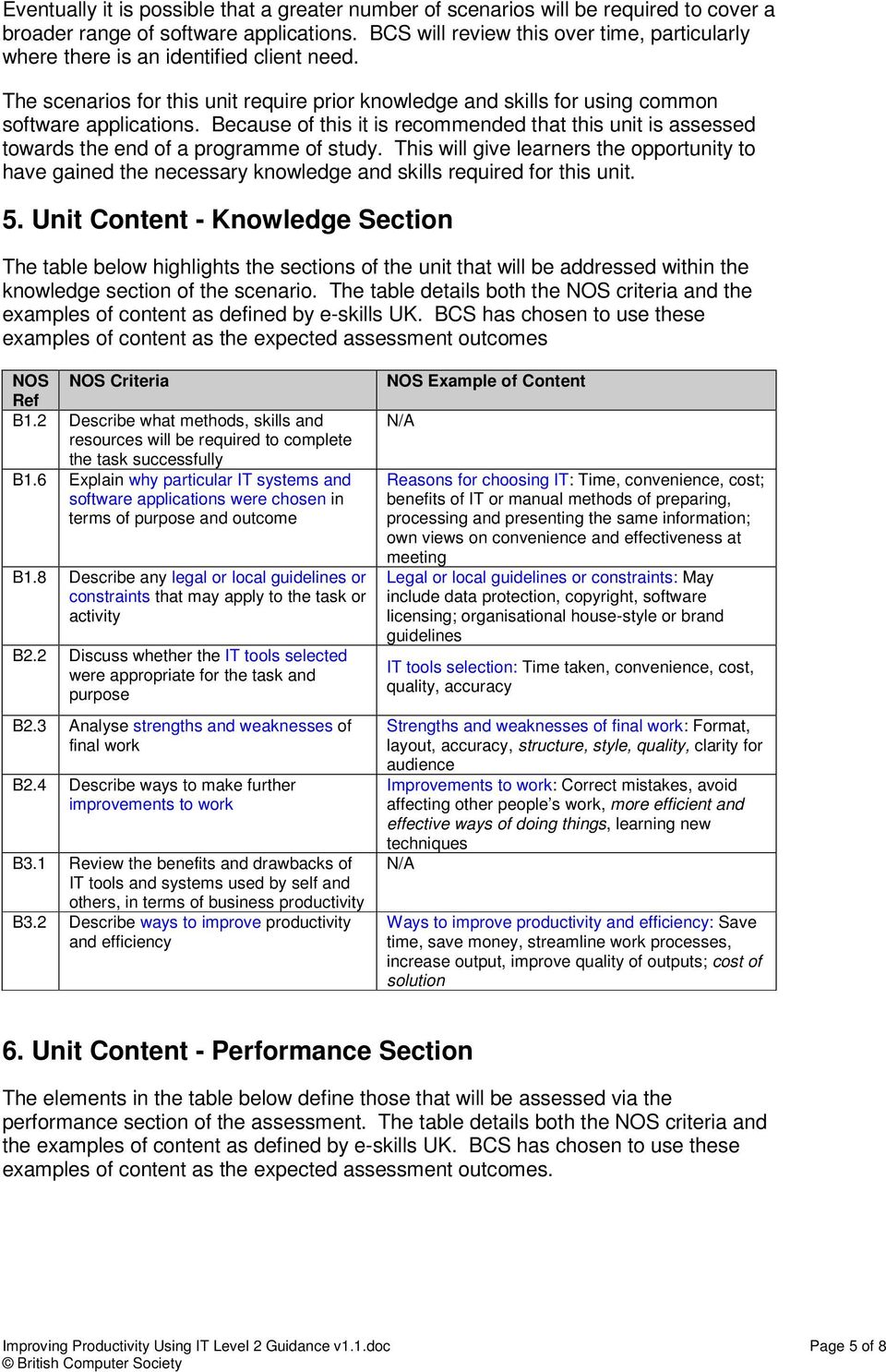
5 Eventually it is possible that a greater number of scenarios will be required to cover a broader range of software applications. BCS will review this over time, particularly where there is an identified client need. The scenarios for this unit require prior knowledge and skills for using common software applications. Because of this it is recommended that this unit is assessed towards the end of a programme of study. This will give learners the opportunity to have gained the necessary knowledge and skills required for this unit. 5. Unit Content - Knowledge Section The table below highlights the sections of the unit that will be addressed within the knowledge section of the scenario. The table details both the NOS criteria and the examples of content as defined by e-skills UK. BCS has chosen to use these examples of content as the expected assessment outcomes NOS NOS Criteria Ref B1.2 Describe what methods, skills and resources will be required to complete the task successfully B1.6 Explain why particular IT systems and software applications were chosen in terms of purpose and outcome B1.8 Describe any legal or local guidelines or constraints that may apply to the task or activity B2.2 Discuss whether the IT tools selected were appropriate for the task and purpose B2.3 Analyse strengths and weaknesses of final work B2.4 Describe ways to make further improvements to work B3.1 Review the benefits and drawbacks of IT tools and systems used by self and others, in terms of business productivity B3.2 Describe ways to improve productivity and efficiency NOS Example of Content Reasons for choosing IT: Time, convenience, cost; benefits of IT or manual methods of preparing, processing and presenting the same information; own views on convenience and effectiveness at meeting Legal or local guidelines or constraints: May include data protection, copyright, software licensing; organisational house-style or brand guidelines IT tools selection: Time taken, convenience, cost, quality, accuracy Strengths and weaknesses of final work: Format, layout, accuracy, structure, style, quality, clarity for audience Improvements to work: Correct mistakes, avoid affecting other people s work, more efficient and effective ways of doing things, learning new techniques Ways to improve productivity and efficiency: Save time, save money, streamline work processes, increase output, improve quality of outputs; cost of solution 6. Unit Content - Performance Section The elements in the table below define those that will be assessed via the performance section of the assessment. The table details both the NOS criteria and the examples of content as defined by e-skills UK. BCS has chosen to use these examples of content as the expected assessment outcomes. Improving Productivity Using IT Level 2 Guidance v1.1.doc Page 5 of 8
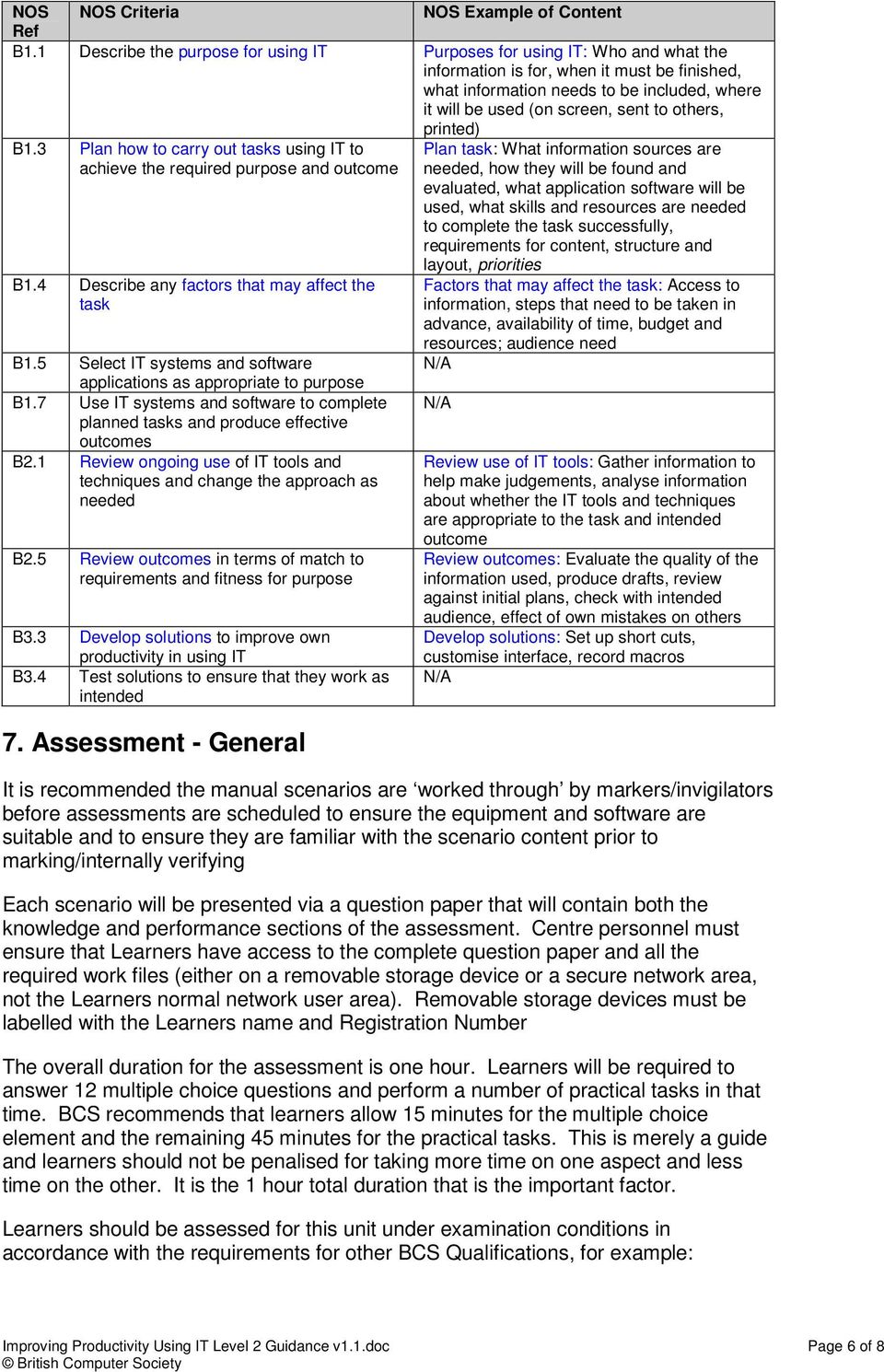
6 NOS NOS Criteria NOS Example of Content Ref B1.1 Describe the purpose for using IT Purposes for using IT: Who and what the information is for, when it must be finished, what information needs to be included, where it will be used (on screen, sent to others, printed) B1.3 Plan how to carry out tasks using IT to achieve the required purpose and outcome Plan task: What information sources are needed, how they will be found and evaluated, what application software will be used, what skills and resources are needed to complete the task successfully, requirements for content, structure and B1.4 Describe any factors that may affect the task B1.5 Select IT systems and software applications as appropriate to purpose B1.7 Use IT systems and software to complete planned tasks and produce effective outcomes B2.1 Review ongoing use of IT tools and techniques and change the approach as needed B2.5 Review outcomes in terms of match to requirements and fitness for purpose B3.3 Develop solutions to improve own productivity in using IT B3.4 Test solutions to ensure that they work as intended 7. Assessment - General layout, priorities Factors that may affect the task: Access to information, steps that need to be taken in advance, availability of time, budget and resources; audience need Review use of IT tools: Gather information to help make judgements, analyse information about whether the IT tools and techniques are appropriate to the task and intended outcome Review outcomes: Evaluate the quality of the information used, produce drafts, review against initial plans, check with intended audience, effect of own mistakes on others Develop solutions: Set up short cuts, customise interface, record macros It is recommended the manual scenarios are worked through by markers/invigilators before assessments are scheduled to ensure the equipment and software are suitable and to ensure they are familiar with the scenario content prior to marking/internally verifying Each scenario will be presented via a question paper that will contain both the knowledge and performance sections of the assessment. Centre personnel must ensure that Learners have access to the complete question paper and all the required work files (either on a removable storage device or a secure network area, not the Learners normal network user area). Removable storage devices must be labelled with the Learners name and Registration Number The overall duration for the assessment is one hour. Learners will be required to answer 12 multiple choice questions and perform a number of practical tasks in that time. BCS recommends that learners allow 15 minutes for the multiple choice element and the remaining 45 minutes for the practical tasks. This is merely a guide and learners should not be penalised for taking more time on one aspect and less time on the other. It is the 1 hour total duration that is the important factor. Learners should be assessed for this unit under examination conditions in accordance with the requirements for other BCS Qualifications, for example: Improving Productivity Using IT Level 2 Guidance v1.1.doc Page 6 of 8
7 Assessment can only take place within an environment that meets the standard requirements Invigilator registered with BCS must be present throughout Assessment sessions must be fully monitored to ensure it is performed in the required manner At the start of each assessment Learners must be made aware of the assessment regulations No part of the assessment materials are taken from an assessment room by a Learner. Learners must hand all materials to the Invigilator before leaving the room All completed assessment files must be collated and provided for marking, internal verification and centralised recording If a Learner has failed an assessment make sure that the re-sit is scheduled for another appropriate day and ensure a different assessment stream is allocated Store all assessment papers securely for marking and remove files from PCs where necessary. BCS recommend that all files are write-protected The Learner assessment data files must be retained and will be required for the annual audit of the Approved Centre For full details on BCS requirements regarding assessment conditions please refer to the latest version of the Centre Operations Manual. Learners are required to achieve at least 75% of the knowledge section in order to pass this assessment. In addition to this, learners are also required to achieve at least 75% of the tasks within the performance section. 8. Assessment - Manual Test Version For the knowledge section learners will be provided with an answer file to record their answers for the multiple choice questions. Learners will be required to save this file using the conventions stipulated within the scenario question paper. For the performance section learners will be provided with a number of source/work files. These will be the files that the learner will need to use to address the tasks defined in the scenario question paper. In most cases learners will be asked to manipulate these files, extract information from them or incorporate them into other documents. Learners will be required to save the relevant files using the conventions stipulated within the scenario question paper. 9. Marking - Manual Test Version Centre personnel will be expected to mark the outputs from the learner for the manual test versions. This will include both the knowledge and performance sections. BCS will provide full marking guides for each scenario assessment. Marking/internal verification must be undertaken by markers registered with BCS. A marking guide must be fully completed for all assessments marked and internally verified. Centres will be required to retain full records of all manual test outputs and marking guides in line with the requirements for the manual tests for ECDL. All manually marked assessments will be subject to internal verification within centres in line with the requirements stipulated for ECDL manual Improving Productivity Using IT Level 2 Guidance v1.1.doc Page 7 of 8

8 tests for example, 2nd marking must cover 10% of all assessments across the range of Approved Centre representatives regardless of location or units. IV s must randomly select the 10% sampling, which must also include: All cases of borderline achievement (+/- 1 of the pass mark). All papers from new assessment Markers until their standard is consistent. For full details on BCS requirements regarding marking and internal verification please refer to the latest version of the Centre Operations Manual. All manually marked assessments must be retained and are subject to sampling by a BCS External Verifier as part of a centre s audit/external verification visit. For full details on BCS requirements for retention of work, audit and external verification please refer to the latest version of the Centre Operations Manual. Improving Productivity Using IT Level 2 Guidance v1.1.doc Page 8 of 8

B. An intermediate user can plan and review their use of
 This is the ability to plan, evaluate and improve procedures involving the use of IT tools and systems to improve the productivity and efficiency of tasks and activities. A. A foundation user can plan
ESKIPU1 Improving productivity using IT
 Overview This is the ability to plan, evaluate and improve procedures involving the use of IT tools and systems in order to improve the productivity and efficiency of tasks and activities. ESKIPU1 1 Performance
Qualification Specification
 BCS Level 2 ECDL Certificate in IT Application Skills (QCF) 600/6943/0 Version 1.4 March 2016. Contents 1. About BCS 3 2. Equal Opportunities 3 3. Introduction to the qualification 4 3.1 Qualification
Qualification Specification
 BCS Level 2 Certificate in IT User Skills (ECDL Core) Version 1.0 December 2015. Contents 1. About BCS 3 2. Equal Opportunities 3 3. Introduction to the qualification 4 3.1 Qualification summary 4 3.2
QUALIFICATION HANDBOOK
 QUALIFICATION HANDBOOK Level 2 Extended Certificate in Health Informatics (7450-12) February 2012 Version 1.0 Qualification at a glance Subject area City & Guilds number 7450 Health Informatics Age group
Improving Productivity Using IT
 This unit has 3 learning outcomes. LEARNING OUTCOMES The learner will: 1. Plan, select and use appropriate IT systems and software for different purposes. 2. Evaluate the selection and use of IT tools
ESKIPM2(SQA Unit Code- F9CX 04) Project management software
 Overview This is the ability to use a software application that plans, organises and monitors completion of the component tasks within a project in logical sequence, given constraints of people and resource
BS: Bespoke or specialist software
 This is the ability to select and use a suitable bespoke or specialist software application to carry out an appropriate data processing task. It includes understanding the capabilities of the software
Word processing software
 Unit 244 Word processing software UAN: Level: 2 Credit value: 4 GLH: 30 Assessment type: Relationship to NOS: Assessment requirements specified by a sector or regulatory body: Aim: R/502/4628 Portfolio
Credit Value: 4 GLH: 30 NOCN Unit Code: CQ1/2/QQ/007 QCA Unit Reference
 This unit has 3 learning outcomes. LEARNING OUTCOMES The learner will: 1. Enter and combine text and other information accurately within word processing documents. 2. Create and modify layout and structures
Information for learners Statement of purpose
 Information for learners Statement of purpose Qualification Title Qualification Number 601/1237/2 BCS Level 2 Certificate in IT User Skills (QCF) What does this qualification cover? This qualification
ESKIBS2 Bespoke or specialist software
 Overview This is the ability to select and use a suitable specialist or bespoke software application to carry out an appropriate data processing task. It includes understanding the capabilities of the
ESKITP5023 Software Development Level 3 Role
 Overview This sub discipline covers the core competencies required to create software to address the needs of business problems and opportunities, resulting in a variety of software solutions, ranging
National Occupational Standards for IT Users v3 March 2009
 National Occupational Standards for IT Users v3 March 2009 Copyright e-skills UK Sector Skills Council Ltd 2009 Final version approved March 2009 Pages 1 of 141 National Occupational Standards for IT Users
Level 2 and 3 Award/Certificate/Diploma in Business Administration/Support (4475-02/03/12/13/22/23)
 Level 2 and 3 Award/Certificate/Diploma in Business Administration/Support (4475-02/03/12/13/22/23) Qualification handbook for centres 600/1648/6 600/1646/2 501/0159/6 501/0093/2 600/8254/9 600/8120/X
PS: Presentation software
 This is the ability to use software applications to produce effective s, which include a combination of media (eg images, animation and sound) for education, entertainment or information sharing. A. A
QAA Recognition Scheme for Access to Higher Education. The Access to Higher Education Diploma specification 2013
 QAA Recognition Scheme for Access to Higher Education The Access to Higher Education Diploma specification 2013 Contents Preface 1 Using this document 1 The Access to HE Diploma 2 Qualification characteristics
Level 2 Certificate in Accounting (7437-02)
 Level 2 Certificate in Accounting (7437-02) Qualification handbook for centres 501/0004/X www.cityandguilds.com October 2010 Version 1.0 About City & Guilds City & Guilds is the UK s leading provider of
Assessment Guidance Evidence may be supplied by: product expert witness testimony
 Unit 327 Bespoke software UAN: Level: 3 Credit value: 4 GLH: 30 Relationship to NOS: Assessment requirements specified by a sector or regulatory body: Aim: J/502/4397 This unit is linked to the Level 3
IAM Level 2. NVQ Certificate in Business and Administration. Qualification handbook. 2012 edition
 IAM Level 2 NVQ Certificate in Business and Administration Qualification handbook 2012 edition Published by the IAM IAM 2012 Registered charity number 254807 Published 2012 All rights reserved. This publication
This is the ability to use a software application designed for planning, designing and building websites.
 Unit Title: Website software OCR unit number: 81 Level: 2 Credit value: 4 Guided learning hours: 30 Unit reference number: R/502/4631 Unit purpose and aim This is the ability to use a software application
2. Roles and responsibilities
 2. Roles and responsibilities 2.1 Organising for e-assessment 8 2.2 Key areas of responsibility 8 2.3 Generic skills and knowledge in e-assessment 9 2.4 Roles and responsibilities related to e-testing
Specification. Edexcel NVQ qualification. Edexcel Level 3 NVQ Certificate in Management (QCF)
 Specification Edexcel NVQ qualification Edexcel Level 3 NVQ Certificate in Management (QCF) For first registration August 2010 Edexcel, a Pearson company, is the UK s largest awarding organisation offering
Qualification Specification
 Qualification Specification Digital Skills Version 1.3 July 2014. Contents 1. About BCS 3 2. Equal Opportunities 3 3. Introduction to the qualification 3 3.1 Qualification summary 3 3.2 Structure of the
Cork Education and Training Board. Programme Module for. Graphic Design Skills. leading to. Level 4 FETAC. Graphic Design 4N1117
 Cork Education and Training Board Programme Module for Graphic Design Skills leading to Level 4 FETAC February 2013 1 Introduction this programme module may be delivered as a standalone module leading
CMI Level 5 Professional Consulting Top Up Document June 2015 Version 3
 CMI Level 5 Professional Consulting Top Up Document June 2015 Version 3 Contents Introduction 3 Top Up Summary 3 Certificate in Management Consultancy Essentials 3 Top Up requirements for the CMI Level
ILM Level 3 Certificate in Using Active Operations Management in the Workplace (QCF)
 PAGE 1 ILM Level 3 Certificate in Using Active Operations Management in the Workplace (QCF) CONTENTS Qualification Overview: ILM Level 5 Award, Certificate and Diploma in Management APPENDICES Appendix
ESKITP5022 Software Development Level 2 Role
 Overview This sub discipline covers the core competencies required to create software to address the needs of business problems and opportunities, resulting in a variety of software solutions, ranging
Contents Page. Introduction 1. About Core Skills 1 Recent changes 1. The new workplace-assessed Core Skills Units for 2008 2
 Contents Page Introduction 1 About Core Skills 1 Recent changes 1 The new workplace-assessed Core Skills Units for 2008 2 Levels 3 Communication 4 Numeracy 5 Information and Communication Technology 6
Certification criteria for. Internal QMS Auditor Training Course
 Certification criteria for Internal QMS Auditor Training Course CONTENTS 1. INTRODUCTION 2. LEARNING OBJECTIVES 3. ENABLING OBJECTIVES KNOWLEDGE & SKILLS 4. TRAINING METHODS 5. COURSE CONTENT 6. COURSE
CHARTERED ACCOUNTANTS and ASSOCIATE CHARTERED ACCOUNTANTS TRAINING LOG
 CHARTERED ACCOUNTANTS and ASSOCIATE CHARTERED ACCOUNTANTS TRAINING LOG 2007 Institute of Chartered Accountants of New Zealand This book is copyright. Apart from any fair dealing for the purposes of private
Live Assessment Material Model Assignment 1
 Live Assessment Material Model Assignment 1 OCR Level 1/2 Cambridge National Award in Creative imedia OCR Level 1/2 Cambridge National Certificate in Creative imedia OCR Level 1/2 Cambridge National Diploma
Employability Skills Summary
 s Summary Monday, 22 November 2010 10:55 AM Version 1.2 s Summary Page 2 Table of Contents BSB10107 Certificate I in Business... 3 BSB20107 Certificate II in Business... 4 BSB30107 Certificate III in Business...
Level 3 Advanced Technical Diploma in Business Travel (450) (4782-32)
 Level 3 Advanced Technical Diploma in Business Travel (450) (4782-32) September 2015 Version 1.0 Qualification Handbook Qualification at a glance Industry area City & Guilds qualification number Travel
Level 2 IVQ Diploma in Training Skills (1106-02)
 Level 2 IVQ Diploma in Training Skills (1106-02) Qualification handbook for centres 500/5784/4 www.cityandguilds.com October 2007 Version 3.0 ( May 2009) About City & Guilds City & Guilds is the UK s leading
BSB40507 Certificate IV in Business Administration
 BSB40507 Certificate IV in Business Administration Course information and vocational outcomes This nationally accredited qualification reflects the role of individuals who use well-developed administrative
PERSONAL DEVELOPMENT PLAN (PDP)
 Date of PDP: Review Date of PDP: PERSONAL DEVELOPMENT PLAN (PDP) PERSONAL DETAILS Name.. Current Address.. Telephone Numbers Work.... Mobile E-mail Address... Qualifications (with dates)... Dental School/University.
Spreadsheet Modelling
 Unit 42: Spreadsheet Modelling Unit code: QCF Level 3: Credit value: 10 Guided learning hours: 60 Aim and purpose Y/601/6637 BTEC Nationals This unit aims to enable learners to use complex spreadsheet
Level 3 Advanced Technical Diploma in Leisure, Travel and Tourism (450) (4782-31)
 Level 3 Advanced Technical Diploma in Leisure, Travel and Tourism (450) (4782-31) September 2015 Version 1.0 Qualification Handbook Qualification at a glance Industry area City & Guilds qualification number
EDI Level 3 Assessing Qualifications. EDI Level 4 Internal Quality Assurance Qualifications. EDI Level 4 External Quality Assurance Qualifications
 Vocational Qualifications EDI Level 3 Assessing Qualifications EDI Level 4 Internal Quality Assurance Qualifications EDI Level 4 External Quality Assurance Qualifications Candidate Pack Effective from:
Level 5 NVQ in Occupational Health and Safety Practice (3644) Candidate logbook
 Level 5 NVQ in Occupational Health and Safety Practice (3644) Candidate logbook Publications and enquiries The publications listed below are available free of charge from Publications Sales City & Guilds
Achieve. Performance objectives
 Achieve Performance objectives Performance objectives are benchmarks of effective performance that describe the types of work activities students and affiliates will be involved in as trainee accountants.
ESKIWP1 Word processing software
 Overview This is the ability to use a software application designed for the creation, editing and production of largely text-based documents ESKIWP1 1 Performance criteria You must be able to: Input and
BUSINESS OCR LEVEL 3 CAMBRIDGE TECHNICAL. Cambridge TECHNICALS BUSINESS PROJECT MANAGEMENT CERTIFICATE/DIPLOMA IN K/502/5459 LEVEL 3 UNIT 18
 Cambridge TECHNICALS OCR LEVEL 3 CAMBRIDGE TECHNICAL CERTIFICATE/DIPLOMA IN BUSINESS BUSINESS PROJECT MANAGEMENT K/502/5459 LEVEL 3 UNIT 18 GUIDED LEARNING HOURS: 60 UNIT CREDIT VALUE: 10 BUSINESS PROJECT
Job Description. Information Assurance Manager Band 8A TBC Associate Director of Technology Parklands and other sites as required
 Job Description Job Title: Grade: Accountable to: Base: 1. JOB PURPOSE Information Assurance Manager Band 8A TBC Associate Director of Technology Parklands and other sites as required The purpose of the
ESKIPM3 Project management software
 Overview This is the ability to use a software application that plans, organises and monitors completion of the component tasks within a project in logical sequence, given constraints of people and resource
Consultancy L&D. TAP Diploma ENABLING QUALITY-ASSURED LEARNING & DEVELOPMENT
 L&D Consultancy ENABLING QUALITY-ASSURED LEARNING & DEVELOPMENT 0 0 TAP Diploma 2 c o r e m o d u les + 2 elective m o d u l e s + o n l ine self - s t u d y Introduction The Diploma in L&D Consultancy
Digital Industries Apprenticeship: Assessment Plan. Cyber Security Technologist. April 2016
 Digital Industries Apprenticeship: Assessment Plan Cyber Security Technologist April 2016 1 Digital Industries Apprenticeships: Assessment Plan 1. General Introduction and Overview The apprenticeship Standard
Bring Your Own Device (BYOD): Introduction (SCQF level 7)
 Higher National Unit specification General information Unit code: H6D0 34 Superclass: CC Publication date: January 2014 Source: Scottish Qualifications Authority Version: 01 Unit purpose The content of
POSTGRADUATE PROGRAMME SPECIFICATION
 POSTGRADUATE PROGRAMME SPECIFICATION Programme Title: Awarding Body: Teaching Institution: Final Awards: MSc International Accounting and Financial Management Staffordshire University Staffordshire University
IQ Level 3 NVQ Diploma in Management (QCF) Specification
 IQ Level 3 NVQ Diploma in Management (QCF) Specification Regulation No: 600/6699/4 Page 1 of 94 IQB/0.2/115 Version 1.0 10/10/2012 Author CZ Contents Page Introduction... 4 About this Qualification (Description,
Assistant Director - Engineering and Construction
 Assistant Director - Engineering and Construction Job Description Area : Faculty of Humanities, English and STEM Salary : M1 Hours of Work (Full-time/Part-time) : Full-time Line Manager : Director of Faculty
Entry 3 Award, Certificate and Diploma in Employability and Personal Development (7546) Candidate logbook
 Entry 3 Award, Certificate and Diploma in Employability and Personal Development (7546) Candi logbook www.cityandguilds.com January 2011 Version 4.0 (November 2013) About City & Guilds City & Guilds is
F9D7 04 (ESKWP2): Word Processing Software 2
 F9D7 04 (ESKWP2): Word Processing Software 2 4 SCQF credit points at SCQF level 5 Description: This is the ability to use a software application designed for the creation, editing and production of largely
ESKITP2034.03 Assist in the preparation of change management plans and assignments for IT enabled systems 1
 Assist in the preparation of change management plans and assignments for IT Overview This sub-discipline, Change Management (203) is concerned with the competencies required to manage the introduction
Marketing for Hospitality
 Unit 18: Marketing for Hospitality Unit code: T/601/0487 QCF Level 3: BTEC National Credit value: 10 Guided learning hours: 60 Aim and purpose The aim of this unit is to enable learners to gain knowledge
Level 3 Certificate in Community Justice (7499-01)
 Level 3 Certificate in Community Justice (7499-01) Qualification handbook QCA Number 500/1868/1 www.cityandguilds.com February 2008 Version 1.0 About City & Guilds City & Guilds is the UK s leading provider
Business, Administration and IT Qualifications
 Business, Administration and IT Qualifications For further information contact us: Tel. +44 (0) 8707 202909 Email. [email protected] www.lcci.org.uk London Chamber of Commerce and Industry (LCCI) International
ICT Qualifications Mandatory Review
 ICT Qualifications Mandatory Review Draft ICT Qualifications: Companion to consultation document 25 September 16 October 2013 Draft ICT Qualifications for consultation Sept 2013.docx 0 Table of Contents
Level 2 Certificate in Warehousing and Storage Skills (QCF)
 Level 2 Certificate in Warehousing and Storage Skills (QCF) Qualification Handbook www.cityandguilds.com September 2010 Version 1.1 Level 2 Certificate 1016-02 QAN 501/1082/2 About City & Guilds City &
CRITICAL PATH ANALYSIS AND GANTT CHARTS
 CRITICAL PATH ANALYSIS AND GANTT CHARTS 1. An engineering project is modelled by the activity network shown in the figure above. The activities are represented by the arcs. The number in brackets on each
VPQ Level 6 Business, Management and Enterprise
 VPQ Level 6 Business, Management and Enterprise VPQ Level 6 Certificate in Business, Management and Enterprise The VPQ Level 6 Certificate in Business, Management and Enterprise is a 30 credit qualification.
Level 3 Certificate in assessing candidates using a range of methods (7317)
 Level 3 Certificate in assessing candidates using a range of methods (7317) Candidate guide A1 Assess candidates using a range of methods www.cityandguilds.com November 2004 About City & Guilds City &
AAT Level 2 Diploma in Accounting and Business
 AAT Diploma in Accounting and Business Qualification specification Version date: July 2014 Ofqual qualification number: 60100229 1 Purpose statement Who is this qualification for? The purpose of this qualification
Quality Management Review
 Quality Management Review Introduction New this year In order to maintain the integrity and currency of our annual review visits to BTEC centres, this process has undergone revision for 2015/16. This revision
Examination Guidance for the Advanced Certificate in PPSO Examinations. Version 1.0
 Examination Guidance for the Advanced Certificate in PPSO Examinations Version 1.0 May 2010 Contents Introduction...3 Examination Objectives...3 Entry Requirements for the Examination...3 Preparation for
Level 2 and 3 Diploma in Business Support (4475-12/13)
 Level 2 and 3 Diploma in Business Support (4475-12/13) Qualification handbook for centres 600/1648/6 600/1646/2 www.cityandguilds.com September 2011 Version 1.0 About City & Guilds As the UK s leading
Edexcel Level 3 Awards and Certificate in Assessing the Quality of Assessment (QCF)
 Edexcel Level 3 Awards and Certificate in Assessing the Quality of Assessment (QCF) Specification Edexcel specialist qualification First teaching September 2010 Issue 2 Pearson Education Ltd is one of
M a r k e t i n g. About managing the doing of marketing for management roles
 Professional Diploma in M a r k e t i n g About managing the doing of marketing for management roles Fully sponsored by the HRD Fund for Banking & Financial Sector employees only Professional Diploma in
Level 3 Certificate in Fitting Protective Horse Rider Equipment (BETA 10) Qualification handbook Version 2 September 2011
 Level 3 Certificate in Fitting Protective Horse Rider Equipment (In association with the British Equestrian Trade Association) (BETA 10) www.nptc.org.uk Qualification handbook Version 2 September 2011
QTC Training & Education. Certificate IV of Project Management BSB41507 Study by Correspondence
 Certificate IV of Project Management BSB41507 Study by Correspondence Career-relevant, Accredited and Industry Endorsed Because QTC vocational courses are developed in consultation with relevant industry
Business Administration. Level 3 Diploma in Business Administration (QCF) 2014 Skills CFA Level 3 Diploma in Business Administration (QCF) Page 1
 Business Administration Level 3 Diploma in Business Administration (QCF) 2014 Level 3 Diploma in Business Administration (QCF) Page 1 Level 3 Diploma in Business Administration (combined qualification)
2 HN Credits at SCQF level 8: (16 SCQF credit points at SCQF level 8)
 Higher National Unit specification General information Unit code: H91M 35 Superclass: BA Publication date: April 2015 Source: Scottish Qualifications Authority Version: 02 Unit purpose This Unit is designed
Role Activity Grade 5 PAS Professional Officer
 Role Activity Grade 5 PAS Generic Post Job Title: Market Insight Officer Title: Reporting to: Head of Market Insight School/ External & Community Relations Department: Job Family: Professional and Administrative
BTEC International Quality Assurance Handbook 2015-16
 BTEC International Quality Assurance Handbook 2015-16 1. Introduction Contents How to use this handbook... 2 Introduction... 2 WHAT IS QUALITY ASSURANCE?... 2 WHICH QUALIFICATIONS DOES THIS HANDBOOK COVER?...
Level 2 Award in Principles of Manual Handling
 Level 2 Award in Principles of Manual Handling Qualification specification 2014 For examinations in 2014 Version 1 Accredited by the Qualifications Regulators at Level 2 in the Qualifications and Credit
Level 5 Diploma in Compliance Risk Management. Meeting your professional development needs
 Level 5 Diploma in Compliance Risk Management Meeting your professional development needs Contents Introduction Qualification overview About this qualification Assessment methods The Legal and Regulatory
Unit title: Web Apps: Word Processing (SCQF level 4)
 National Unit specification General information Unit code: HA6M 44 Superclass: CD Publication date: May 2016 Source: Scottish Qualifications Authority Version: 02 Unit purpose This Unit is designed for
ILM Level 5 QS/L5QSES/0510
 QUALIFICATION SPECIFICATIONS ILM Level 5 Qualifications in Social Enterprise Support QS/L5QSES/0510 Circulation of Qualification Specifications These Qualification Specifications are provided to centres
Level 3 IVQs in Teaching, Training and Assessing Learning (1106)
 Level 3 IVQs in Teaching, Training and Assessing Learning (1106) Level 3 IVQ Advanced Diploma in Teaching, Training and Assessing Learning (1106-21) (500/5753/4) www.cityandguilds.com September 2006 Version
QUALITY ASSESSMENT & IMPROVEMENT. Workforce ACUTE HOSPITAL SERVICES. Supporting services to deliver quality healthcare JUNE 2013
 QUALITY ASSESSMENT & IMPROVEMENT ACUTE HOSPITAL SERVICES JUNE 2013 Workforce Supporting services to deliver quality healthcare Effective Care and Support Safe Care and Support Person Centred Care and
Unit 351: Website Software Level 3
 Oxford Cambridge and RSA Unit 351: Website Software Level 3 Level: 3 Credit value: 5 Guided learning hours: 40 Learning Outcomes Assessment Criteria Examples The learner will: The learner can: 1. Create
ECDL / ICDL Project Planning Project Management Software Level 2. Syllabus Version 1.0 (UK)
 ECDL / ICDL Project Planning Project Management Software Level 2 Syllabus Version 1.0 (UK) Purpose This document details the syllabus for ECDL / ICDL Project Planning. The syllabus describes, through learning
Level 3 Certificate in Printing and Graphic Communications (5261)
 Level 3 Certificate in Printing and Graphic Communications (5261) Scheme handbook www.city-and-guilds.co.uk Publications and enquiries City & Guilds publications are available from Publications Sales City
Business Communication
 Unit 4: Business Communication Unit code: QCF Level 3: Credit value: 10 Guided learning hours: 60 Aim and purpose H/502/5413 BTEC National The aim of this unit is to show learners that the collection and
Higher National Unit specification: general information. Graded Unit 2
 Higher National Unit specification: general information This Graded Unit has been validated as part of the HND Computing: Software Development. Centres are required to develop the assessment instrument
IAM Level 2 Certificate in Principles of Business and Administration
 IAM Level 2 Certificate in Principles of Business and Administration Qualification aim The IAM Level 2 Certificate in Principles of Business and Administration aims to develop learners knowledge and understanding
Higher National Unit specification. General information. Software Development: Analysis and Design (SCQF level 7) Unit code: HA4C 34.
 Higher National Unit specification General information Unit code: HA4C 34 Superclass: CB Publication date: January 2016 Source: Scottish Qualifications Authority Version: 02 Unit purpose The purpose of
Advanced Certificate in Professional Business and Enterprise Support Services. Qualification and Unit Specification
 Advanced Certificate in Professional Business and Enterprise Support Services Qualification and Unit Specification Contents Page Qualification Overview.............................................. 3 Unit
Level: 3 Credit value: 5 GLH: 40 Assessment type:
 Unit 352 Website software UAN: Level: 3 Credit value: 5 GLH: 40 Assessment type: Relationship to NOS: Assessment requirements specified by a sector or regulatory body: Aim: Y/502/4632 Portfolio of Evidence
Guide to CQI Qualifications for learners
 Guide to CQI Qualifications for learners CQI Qualifications and Professional Recognition Quality management is about improving organisational performance in delivering product and service that meet customer
Guide. Minister s Guide to Auditing for Building Surveyors. April 2014
 Guide Minister s Guide to Auditing for Building Surveyors April 2014 Guide Minister s Guide to Auditing for Building Surveyors April 2014 Department of Planning, Transport and Infrastructure 136 North
Developing a Project. Management System. Using Project Agency Template. Approach. - the Process and the Benefits
 Developing a Project Management System Using Project Agency Template Approach - the Process and the Benefits Project Agency June 2008 Developing your own Project Management System. Project Agency has worked