
Assessment Service Bulletin Number 5
|
|
|
- Sharon Cox
- 9 years ago
- Views:
Transcription
1 Assessment Service Bulletin Number 5 Overview of the WJ IV Interpretation and Instructional Interventions Program Barbara J. Wendling, MA Fredrick A. Schrank, PhD, ABPP The authors of the WJ IV Interpretation and Instructional Interventions Program (WIIIP ; Schrank & Wendling, 2015b) discuss the features of the WIIIP, a web-based program that helps examiners interpret WJ IV assessment results and link test and cluster scores from any of the Woodcock-Johnson IV (Schrank, McGrew, & Mather, 2014a) batteries to associated instructional interventions. In addition, the WIIIP includes a number of qualitative checklists that, when completed, provide context to an individual s WJ IV scores and result in a more comprehensive WJ IV evaluation. Example excerpts as well as a complete sample report are provided to illustrate options, checklist options, and ways in which the WIIIP links WJ IV assessment results to intervention.

2 Copyright 2015 by The Riverside Publishing Company. No part of this work may be reproduced or transmitted in any form or by any means, electronic or mechanical, including photocopying and recording or by any information storage or retrieval system, without the prior written permission of Riverside, unless such copying is expressly permitted by federal copyright law. Requests for permission to make copies of any part of the work should be addressed to Houghton Mifflin Harcourt Publishing Company, 9400 Southpark Center Loop, Orlando, FL ; /Permissions.html Printed in the United States of America. Woodcock-Johnson is a registered trademark of Houghton Mifflin Harcourt Publishing Company. WIIIP, the WIIIP logo, WJ IV, and the WJ IV Interpretation and Instructional Interventions Program are trademarks of Houghton Mifflin Harcourt Publishing Company. Reference Citation To cite this document, use: Wendling, B. J., & Schrank, F. A. (2015). Overview of the WJ IV Interpretation and Instructional Interventions Program (Woodcock-Johnson IV Assessment Service Bulletin No. 5). Rolling Meadows, IL: Riverside. For technical information, please visit or call Riverside Customer Service at

3 Overview of the WJ IV Interpretation and Instructional Interventions Program The WJ IV Interpretation and Instructional Interventions Program (WIIIP ; Schrank & Wendling, 2015b) represents a best-practice approach to linking WJ IV assessment results to individualized instructional interventions. The idea for an expert system that would link WJ IV test and cluster scores to instructional interventions emerged in response to pressing practice needs articulated by many professional examiners. Those needs resonated with the authors philosophy that assessment is most valuable when it results in suggestions for instruction and underscored their fundamental belief that a quality evaluation should make a difference in the educational program of a student. To transform those practice needs and guiding philosophy into a practical tool for assessment practice, a database of evidence-based interventions was derived from the studies and recommendations of hundreds of researchers and scholars whose efforts spanned at least four decades of research and were based on data from thousands of research participants. The WIIIP generates a streamlined that includes an interpretive, narrative overview; the Table of Scores; and, if selected, interventions and/or checklist information. Additionally, a detailed description of the individual s performance on all WJ IV tests and clusters can be appended to the report. The The WIIIP offers an interpretive, narrative overview of an individual s performance on the tests and clusters administered from any or all of the WJ IV batteries (Woodcock-Johnson IV Tests of Cognitive Abilities [WJ IV COG; Schrank, McGrew, & Mather, 2014b], Woodcock-Johnson IV Tests of Oral Language [WJ IV OL; Schrank, Mather, & McGrew, 2014b], Woodcock-Johnson IV Tests Achievement [WJ IV ACH; Schrank, Mather, & McGrew, 2014a]), including all available variation and comparison procedures. Narrative statements are derived from the WJ IV interpretive model articulated in the three WJ IV examiner s manuals (Mather & Wendling, 2014a; 2014b; 2014c) and the Woodcock-Johnson IV Technical Manual (McGrew, LaForte, & Schrank, 2014). Examiners may base the generated narrative on either standard score or proficiency range descriptors by selecting a preferred option. If desired, any of the program s checklists may be included in the resulting report, and a detailed description of the individual s performance on all WJ IV tests and clusters can be appended at the end of the. Examiners also can include targeted evidence-based and formative interventions in the report. Reports can be exported into a word processing program for editing and integration of additional (e.g., background) information. To obtain any of the features available in the WIIIP, the examiner must select from the Report Type menu in the WJ IV online scoring and reporting program. The automatically includes the following information: Assessment Service Bulletin Number 5 1

4 Examinee identification information Interpretive overview List of evidence-based interventions (examiner may select any or all, or choose to exclude these) Table of Scores Additional options that the examiner may choose to include in the Comprehensive Report are: Checklists (information from any completed checklists) Formative interventions (requires entry of item-level data) Language of instruction statements (if completed on WJ IV OL) Appendix A: Detailed Interpretation of Clusters and Tests Interpretive Overview The streamlined interpretive overview of WJ IV results presents a summary of information about the individual s performance on tests and clusters, as well as any available variation and/or comparison procedures for each battery administered. If all three batteries are administered, results from the WJ IV COG are presented first, followed by results from the WJ IV OL, and then results from the WJ IV ACH. Any available comparison procedures are reported last. The narrative summarizes performance on tests and clusters, then reports any relative strengths or weaknesses noted in the variation procedure. Any completed comparison procedures are summarized by identifying tests or clusters on which the individual scored significantly higher or lower than predicted. The interpretive overview is brief one or two pages in length depending on which batteries are administered. Examiners choose whether to base the interpretive overview on standard score or proficiency descriptors. A description of each option follows. Standard Score Option The standard score option describes the individual s position within a normal distribution of age or grade peers. Table 1 illustrates the classifications utilized by the WIIIP to describe the range in which the obtained standard score falls. Examiners can select a confidence level (68%, 90%, or 95%), which generates a statement about the range of scores surrounding the obtained standard score. An example of the narrative that appears when using the standard score option and the 68% confidence level follows: Samantha s overall intellectual ability, as measured by the WJ IV General Intellectual Ability (GIA) standard score (124), is in the superior range of others her grade. There is a 68% probability that her true GIA score would be included in the range of standard scores from 121 to Assessment Service Bulletin Number 5
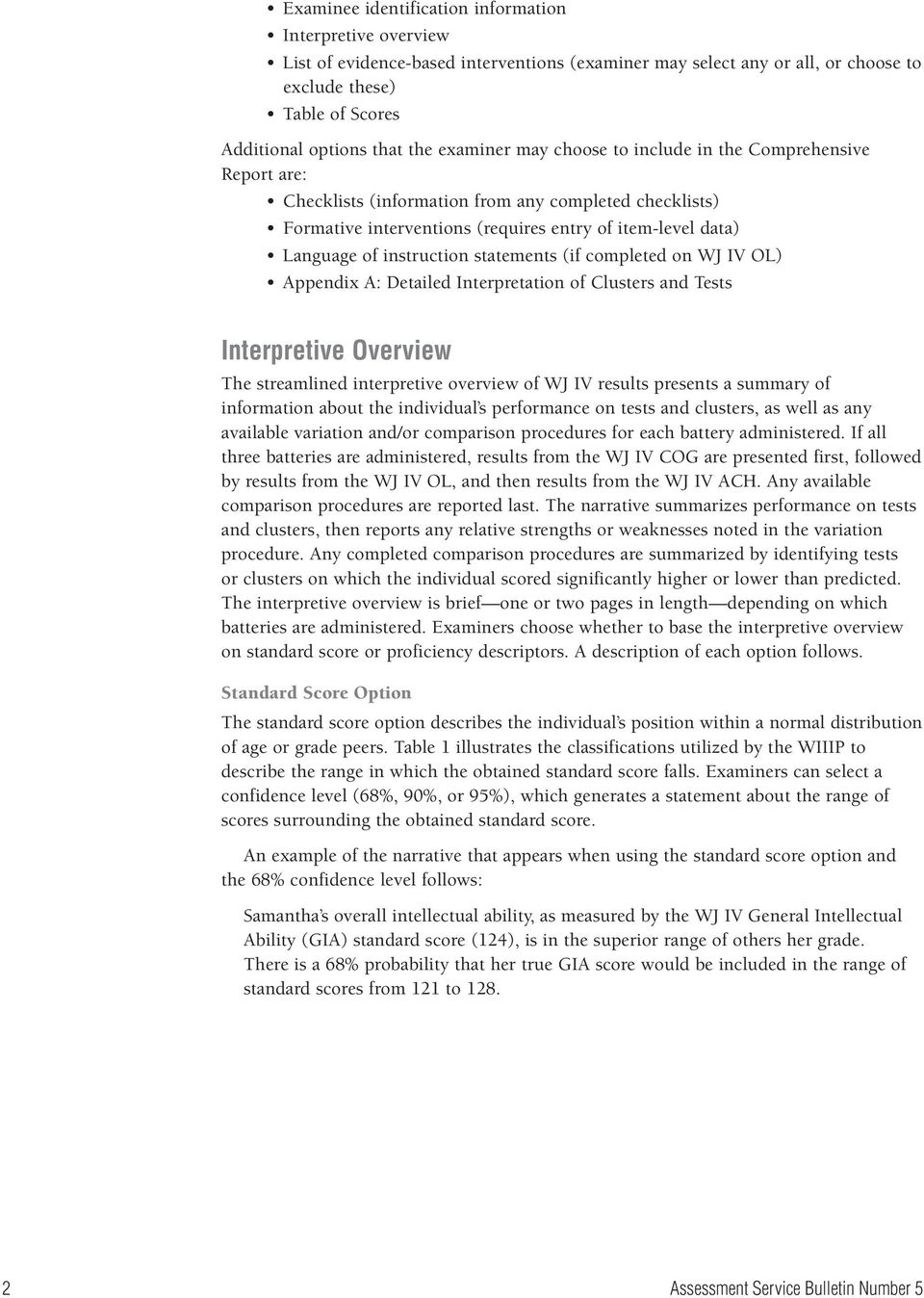
5 Table 1. WJ IV Classification for Obtained Standard Score Obtained Standard Score Range WJ IV Classification 131 and above Very Superior 121 to 130 Superior 111 to 120 High Average 90 to 110 Average 80 to 89 Low Average 70 to 79 Low 69 and below Very Low Proficiency Option The proficiency option, based on the individual s W Difference score (W DIFF), describes the examinee s functionality on the test or cluster. The W DIFF is the distance between the examinee s ability and the ability of average age or grade mates on the same task. The W DIFF documents how far from average (above or below) the individual s performance is, and the W DIFF label describes proficiency on the task rather than relative standing in a group. Table 2 illustrates the classifications, also referred to as proficiency levels, utilized by the WIIIP to describe the range in which the W DIFF falls. Examiners can elect to include the W DIFF in the Table of Scores. The proficiency option may be particularly helpful when one goal of the evaluation is instructional planning. The W DIFF is used to generate a list of interventions in the WIIIP and is discussed in the subsequent section on Evidence-Based Interventions and Accommodations. Consult the WJ IV Interpretation and Instructional Interventions Program Manual and Checklists (Schrank & Wendling, 2015a), located as a PDF on the Resource tab of the WJ IV online scoring and reporting program, for detailed information about the W scale and the W DIFF. An example of the narrative that appears when using the proficiency option follows: Samantha s overall intellectual ability, as measured by the WJ IV General Intellectual Ability cluster, is advanced when compared to others in her grade. Table 2. WJ IV Proficiency Levels for W DIFF Value Ranges W DIFF Range WJ IV Proficiency Level +31 and above Very Advanced +14 to +30 Advanced +7 to +13 Average to Advanced 6 to +6 Average 13 to 7 Limited to Average 30 to 14 Limited 50 to 31 Very Limited 51 and below Extremely Limited At times the proficiency information provides insights into performance that are not revealed by standard scores or percentile ranks. For instance, if considering just the standard score in the following example, important information about the individual s functioning is missed. We may conclude that a standard score of 87 is low average and, therefore, not problematic. However, the proficiency information indicates that the Assessment Service Bulletin Number 5 3

6 individual s performance is limited and that age-level tasks involving inductive reasoning will be very difficult. It is recommended that examiners consider the different levels of information provided in the WJ IV to fully understand the examinee s performance on the test. Standard score statement: Her Concept Formation standard score is in the low average range (percentile rank of 20; standard score of 87). Proficiency statement: Her inductive reasoning is limited (RPI of 66/90); she will probably find it very difficult to succeed on age-level tasks involving rule-based categorization. When using the WIIIP, the selection of which option to use for the basis of the interpretive overview is made in the Report Style menu entry. The examiner can click on the Report Style box to reveal the choices. The default is set to Standard Scores, so if Proficiency is the desired option, the examiner must select it. This menu also provides the following additional options: exclude instructional recommendations, exclude language of instruction statements, and include the detailed test appendix. If for some reason an examiner does not want available interventions or language of instruction statements to be included, he or she must choose to exclude them. Conversely, if an examiner wishes to include the detailed test and cluster interpretation, he or she must choose to include the appendix. Optional Detailed Interpretation of Clusters and Tests The automatically provides a concise interpretive overview and analysis of an individual s performance on the WJ IV. As previously noted, examiners may elect to append a detailed test and cluster interpretation to the report. The appendix, which appears at the end of the, provides information about each ability measured, including a description of the examinee s developmental level, a comparison to age or grade peers using a standard score range classification, and a description of his or her proficiency level. Paragraphs also may include information about how the examinee will likely respond to similar tasks presented at his or her age or grade level. Sometimes a paragraph will draw attention to critical information obtained from the examinee s developmental band or instructional zone to describe a level at which instruction with similar tasks will be too easy or too difficult for him or her. Other paragraphs provide additional information about performance within a cluster when the examinee s scores on the tests that compose that cluster vary significantly. Following is an example of a cluster description followed by a test description, both obtained from the WJ IV COG (Schrank, McGrew, & Mather, 2014b). This type of information is included in the appendix for each test and cluster administered. Cluster description: Comprehension-Knowledge (Gc) is a language-based measure of Samantha s declarative knowledge. It includes semantic memory and the ability to communicate her knowledge and understanding verbally. Samantha s verbal knowledge and comprehension are above those of the average individual at age 30. Her Comprehension-Knowledge standard score is in the very superior range (percentile rank of 99.6; standard score of 140). Her verbal ability is very advanced (RPI of 100/90); she will probably find it extremely easy to succeed on age-level verbal knowledge and comprehension tasks. 4 Assessment Service Bulletin Number 5

7 Test description: Concept Formation is a test of fluid reasoning. This test required Samantha to use inductive reasoning in categorical thinking. Samantha s performance on Concept Formation is comparable to that of the average individual at age 8-1. Her Concept Formation standard score is in the low average range (percentile rank of 20; standard score of 87). Her inductive reasoning is limited (RPI of 66/90); she will probably find it very difficult to succeed on age-level tasks involving rule-based categorization. Table of Scores The Table of Scores is included in all WIIIP or WJ IV score reports and is most likely familiar to examiners who use the WJ IV. The Table of Scores lists the Woodcock- Johnson IV clusters and tests administered and the various scores requested when the report was generated. The default template for the Table of Scores includes the obtained W score for the test or cluster, the age equivalent (if age norms are selected) or grade equivalent (if grade norms are selected), the relative proficiency index (RPI), and the standard score with the 68% confidence band. However, the examiner may customize the Table of Scores by selecting from the following score types: percentile rank (with or without confidence band), cognitive-academic language proficiency (CALP), age equivalent (AE), grade equivalent (GE), RPI, standard score (with or without confidence band), proficiency descriptor, normal curve equivalent (NCE), stanine, T score, z score, W score, W DIFF, and developmental zone (age or grade). Not every score available can be selected at the same time due to page width constraints. In addition to the administered tests and clusters, the user may select any of the available variations and/or comparisons to include in the table. Checklists The importance of qualitative information is recognized and reinforced throughout the WJ IV and the WIIIP. In the WJ IV, each Test Record has a Test Session Observations Checklist. Additionally, the WJ IV ACH (Schrank, Mather, & McGrew, 2014a) Test Record includes qualitative observations for the 11 tests in the ACH Standard Battery. The WIIIP also includes six reproducible checklists designed to help organize and integrate information about the examinee. When a checklist is completed, that information can be entered into the web-based program and it then appears in the. The six checklists are: Reason for Referral Checklist Parent s Checklist: School Age Teacher s Checklist: School Age Classroom Behavior Observation Form Self-Report Checklist: Adolescent/Adult Writing Evaluation Scale Detailed information about each checklist is found in Chapter 3 of the WIIIP Manual and Checklists (Schrank & Wendling, 2015a), and the reproducible checklists are located in Appendices A through F of the manual (PDF), which is located on the Resource tab of the WJ IV online scoring and reporting program. Examiners with access to the WIIIP may download the manual and print the checklists as needed. Assessment Service Bulletin Number 5 5

8 Reason for Referral Checklist This checklist is used to document who made the referral; what that person s relationship is to the examinee; the primary reason for the referral, which may include specific details; and common questions that should be addressed in the evaluation. The Reason for Referral Checklist can be completed in advance, or the information may be entered directly into the web-based program. When completed, the reason for referral information appears in a narrative format as a brief introductory section of the. Parent s Checklist: School Age A parent, grandparent, guardian, or other parent-surrogate may complete this checklist. Reports from two parents or guardians may be included if desired. Parts I though V pertain to the referred individual s developmental history, and Parts VI through VIII describe the individual s current personality and behaviors. The information collected appears in a narrative format in a section of the titled Parent s Report. Teacher s Checklist: School Age There are six parts to this checklist, which is completed by the examinee s teacher. In Part I, the teacher rates the examinee s oral language ability and achievement. This section corresponds to nine clusters available in the WJ IV. In Part II, the teacher indicates the grade level at which the student is receiving instruction. In Part III, the teacher chooses up to three words from a list of 37 words that best describe the student s temperament and mood. In Part IV, the teacher rates the student s classroom behavior in several areas based on observations over the past month. The teacher s primary concern about the student is identified in Part V. Any problem behaviors noted in the classroom are indicated in Part VI and rated as to how those behaviors impede the student s opportunity to learn as well as how disruptive the behavior is to others. Classroom Behavior Observation Form The Classroom Behavior Observation Form consists of three parts. Part I is a time sampling of behavior. Direct observations of the referred student and a comparison student are documented over a 15-minute time period at 30-second intervals. Any offtask behavior exhibited by the referred student is categorized by selecting one of eight listed behaviors. Part II is used to provide more information about any categories of problem behaviors noted during the time sampling of behavior. This would include a description of the behavior and how the behavior impedes the student s learning or disrupts other students. In Part III, the evaluator is asked to identify the primary problem behavior and provide an additional description about what was observed before, during, and after the behavior was exhibited. Self-Report Checklist: Adolescent/Adult If a referred adolescent or adult is capable of reading and understanding the checklist, he or she should be asked to complete it independently. There are five sections to complete. Part I reviews current home and health status. Part II includes questions on attitudes toward school, self, and others. Part III instructs the individual to rate his or her cognitive abilities and academic skills compared to others of the same age. The areas listed correspond to the seven CHC abilities (based on contemporary Cattell- Horn-Carroll theory) and nine language or academic areas. Part IV considers school history such as whether the student has ever repeated a grade or received special 6 Assessment Service Bulletin Number 5
9 education services. The final section, Part V, asks the individual to document his or her recollections of early schooling. Writing Evaluation Scale The Writing Evaluation Scale is an informal evaluation of the individual s writing competence, which can supplement the results of the WJ IV writing tests. The examiner selects one or more samples of the individual s writing, such as an essay or report written in class, and judges the sample by completing the ratings on the Writing Evaluation Scale. The scale can be used to evaluate narrative or expository writing. Additional Qualitative Information In addition to the six reproducible checklists, the WIIIP integrates information from the Test Session Observations Checklist (on the first page of each Test Record) and the qualitative observations for the 11 achievement tests in the WJ IV ACH Standard Battery. When an examiner completes any of these checklists and enters the information into the WIIIP, it appears in a section of the titled Test Session Observations. Evidence-Based Interventions and Accommodations Over 500 evidence-based interventions are available in the WIIIP database. Multiple sources were reviewed in the process of choosing interventions that have researchbased evidence of their effectiveness. Contemporary Cattell-Horn-Carroll (CHC) theory (McGrew et al., 2014; Schneider & McGrew, 2012) and an analysis of the cognitive processes required for test performance served as the basis for linking the WJ IV tests and clusters to associated interventions. The WIIIP compilation puts the interventions in one convenient location and eliminates the need for the examiner to try to find appropriate interventions in myriad sources. In addition, the interventions in the WIIIP are linked to the examinee s age and level of performance on the WJ IV and are generated when a score falls within a targeted range. The examiner simply selects the most appropriate interventions from the generated list to include in the in a section titled Instructional Recommendations and Interventions. The W DIFF is used to generate a list of applicable interventions. When an examinee s performance falls within the limited-to-average or lower range ( 7 or lower), one or more associated interventions are triggered for that test or cluster. See Table 2 for the W DIFF ranges and proficiency levels. Cognitive Interventions The WIIIP links WJ IV COG (Schrank, McGrew, & Mather, 2014b) results to evidence-based interventions, recommendations, or accommodations that can help multidisciplinary teams address limitations identified from tests that measure specific cognitive abilities. The Cattell-Horn-Carroll (CHC) theory served as a bridge for linking limitations in cognitive abilities to interventions that can make a relevant contribution to a student s educational plan. To be relevant, cognitive assessment should result in evidence-based interventions or practical suggestions recommendations that may not have surfaced if a comprehensive cognitive evaluation were not conducted. In the example that follows, Samantha s performance on WJ IV COG Test 12: Nonword Repetition triggered an intervention because her W DIFF was 26, falling in the limited range. Test 12: Nonword Repetition measures phonological short-term memory. The task requires remembering and repeating increasingly complex nonwords. Assessment Service Bulletin Number 5 7
10 CLUSTER/Test W AE RPI WDiff SS (68% Band) Nonword Repetition / (70 79) Teach Samantha to use a vocalization strategy to enhance the quality of Samantha s phonological representations when learning new words. Tell Samantha that when she encounters a new word, she should orally repeat (utter) the word. Rehearsing the utterance will solidify the connection between the phonological input and the output of the word. Sometimes an accommodation may be recommended. In this example, Robert s performance on the WJ IV COG Short-Term Working Memory cluster triggered an intervention because his W DIFF was 20 on the cluster. CLUSTER/Test W AE RPI WDiff SS (68% Band) S-T WORK MEM (Gwm) / (81 89) Accommodations may be useful in compensating for Robert s limitations in short-term working memory. Some examples include keeping oral directions short and simple, asking Robert to paraphrase directions to ensure understanding, and providing visual cues for directions or steps to be followed. Oral Language Interventions The WJ IV OL (Schrank, Mather, & McGrew, 2014b) and the WIIIP provide a focus on the importance of oral language abilities for learning. Oral language development deficits, when identified, are particularly responsive to improvement through intervention. Evidence-based interventions for vocabulary development, phonological awareness, sound blending, word segmentation, speed of lexical access, and language expression are included in the WIIIP. Additionally, the WIIIP provides links to the latest evidence-based interventions that have been shown to increase both language competency and academic learning for English language learners (ELLs). Because Tito s performance was limited on WJ IV OL Test 6: Understanding Directions (W DIFF = 13) in the following example, an intervention was triggered to address this area of concern. CLUSTER/Test W AE RPI WDiff SS (68% Band) Understanding Directions / (78 88) Oral elaboration is an intervention that may facilitate Tito s encoding ability, storage, and recall of information over time. Elaborative rehearsal should go beyond simple recitation of information to focus on meaning and association of the new information with other knowledge. A deeper processing of information may result when Tito interacts with the material by thinking about it, associating it with prior knowledge, and talking about the association. Achievement Interventions The WIIIP links WJ IV ACH (Schrank, Mather, & McGrew, 2014a) results to evidencebased interventions for the key areas of reading, writing, mathematics, and academic knowledge. In the area of reading, interventions for tests and clusters that measure the alphabetic principle (phonics, vocabulary, comprehension, and fluency) are available. Phonemic awareness, a fifth area of effective reading instruction, is covered by the WJ IV OL tests measuring phonetic coding. In writing, interventions are available for the tests and clusters measuring the key areas of spelling, automaticity of writing, written expression, and editing. Interventions for the tests and clusters measuring the key 8 Assessment Service Bulletin Number 5

11 mathematics areas of computation, automaticity, concepts, and problem solving are included. In the area of academic knowledge, measured by WJ IV ACH Test 18: Science, Test 19: Social Studies, and Test 20: Humanities, various interventions are included to build content knowledge. An example of interventions linked to WJ IV ACH results is presented below. CLUSTER/Test W AE RPI WDiff SS (68% Band) READING FLUENCY / (66 75) The phrase-drill error-correction procedure may be helpful for developing Abby s reading fluency. In this procedure, combine immediate corrective feedback with rehearsal of the corrected error. When Abby makes an error on a word, model the correct word immediately. Then ask Abby to reread the phrase (where the error occurred) three times. The age of the examinee is also considered in the process of triggering an intervention. The first example below for WJ IV ACH Test 3: Spelling illustrates the results for a young child, Chas, who is 6 years, 3 months of age. The second example shows the results for a secondary student, Tara, who is 17 years, 1 month of age. Example 1: Chas, Age 6-3 CLUSTER/Test W AE RPI WDiff SS (68% Band) Spelling / (84 94) Multisensory techniques involving repeated tracing and verbalization of letters and words may be especially helpful, particularly when introducing irregular words. Emphasize activities that involve writing or using letter tiles to spell words, rather than oral spelling, as it is important for Chas to construct and then see the correctly printed word. Example 2: Tara, Age 17-1 CLUSTER/Test W AE RPI WDiff SS (68% Band) Spelling / (62 71) Direct instruction in the rules that govern spelling is an important way to help Tara improve her spelling. Teaching spelling rules, such as adding endings to words with a silent e (e.g., take, taking), or adding a suffix to closed syllables ending in a single consonant (e.g., fit, fitting), as well as building knowledge about root words and affixes, gives Tara a means to spell words without relying solely on memorizing how words look. Formative Interventions In addition to the evidence-based interventions, there are over 400 formative interventions in the WIIIP database. The formative interventions target specific skills that may need to be specifically taught or reviewed with the examinee. Unlike the evidence-based interventions, the formative interventions are simply suggestions for follow-through with one or more mini-skill development lessons that are based on errors observed during the assessment. Specific skill development activities (or formative interventions) are suggested when item-level data are entered for five tests from the standard achievement battery: Test 1: Letter-Word Identification, Test 2: Applied Problems, Test 3: Spelling, Test 5: Calculation, and Test 7: Word Attack. The WIIIP Assessment Service Bulletin Number 5 9

12 links a sixth achievement test, Test 8: Oral Reading, to suggestions for oral reading skill development when the examiner enters a tally of error types the student made when reading aloud. Experienced clinicians have learned to home in on the pattern of correct and incorrect responses to glean insights into needs for specific skill development and program planning. Entry of item-level data allows the WIIIP to determine which items can provide examiners and teachers with cues to individualize skill development. In the probabilistic model underlying the WJ IV batteries, test items that are answered incorrectly and are below the individual s age or grade level can be considered unexpectedly incorrect. An incorrect response to these items may mean that something about the test item was misunderstood or unknown. Other items that are answered incorrectly below the ceiling level can provide cues to the next level of skill development that is within reach for learning if the student is provided with the guidance of a teacher or more capable peer. Vygotsky called this the zone of proximal development (Chaiklin, 2003). When data are entered from the five WJ IV ACH tests mentioned above, a formative intervention is triggered for items an individual missed after the basal was established and before the ceiling was reached. Figure 1 illustrates this concept. The basal was established when the examinee answered Items 30 through 35 correctly. The error on Item 36 was unexpected because Items 37 and 38 were correct. Also, Items 39 and 42 through 45 were incorrect and were followed by correct responses, so these items can be flags for underlying skills that are within reach for learning if the individual is provided with appropriate guidance. The ceiling was reached when Items 48 through 53 were answered incorrectly. None of the incorrect items used to establish the ceiling trigger a formative intervention because they are not unexpected errors and/or may be at a level that is too difficult for the individual at this time. Figure 1. Item-level data for WJ IV ACH Test 1: Letter- Word Identification used for obtaining formative interventions. Formative interventions are not designed to teach the actual test items, and they should not be used to try to improve an individual s performance on a subsequent evaluation using the same form of the WJ IV ACH. The formative interventions provide teachers or instructional specialists with guidance to help examinees develop an underlying skill or concept related to the test item that was answered incorrectly. As 10 Assessment Service Bulletin Number 5

13 shown in Figure 1, Item 36 is an unexpected error and triggers the following formative intervention: Samantha will benefit from learning about types of syllables. Review closed and open syllables with Samantha. Explain that a closed syllable ends in a consonant and has a short vowel sound, whereas an open syllable ends in a vowel and has a long vowel sound. Present different two-syllable words, some with closed syllables and some with open syllables. Write each word on the board and ask Samantha to read each word aloud and draw lines or slash marks (/) between the syllables to divide it. Then ask Samantha to underline the first syllable and tell you whether it is closed (ends on a consonant and has a short vowel sound) or open (ends on a long vowel sound). Example of a Following is an example of the generated from the WIIIP. This example report includes information from three completed checklists (Reason for Referral Checklist, Parent s Checklist, and Teacher s Checklist), qualitative observations, interventions selected from the list of suggested interventions, and the appendix, which provides detailed information about all tests and clusters administered. Additionally, the Interpretive Overview of Scores and Table of Scores sections are automatically included in all s. The can be edited in a word-processing program, allowing the examiner to maintain control over the content. This example shows the basic interpretive overview, without additional information an examiner might choose to add. Summary of Features in Example Page 1 Page 2 Page 3 Examinee identification information This is automatically included from the Test Record information entered. Reason for Referral The optional Reason for Referral Checklist was completed. Tests Administered Lists the WJ IV batteries that were administered; these are automatically included based on the Test Records entered. Background Information The optional Parent s Checklist was completed. Background Information The optional Teacher s Checklist was completed. Test Session Observations This optional information appears because one or more Test Session Observations Checklists were completed. It also includes information from the qualitative observations in the WJ IV ACH, as well as information on the tally of errors from WJ IV ACH Test 8: Oral Reading. Test Session Observations (continued) Interpretive Overview of Scores This is automatically included. Note the standard score option is selected in this example. Assessment Service Bulletin Number 5 11
14 Page 4 Page 5 Interpretive Overview of Scores (continued) Interpretive Overview of Scores (continued) Instructional Recommendations and Interventions These were selected from a suggested list of interventions automatically generated based on the examinee s scores. Pages 6 7 Instructional Recommendations and Interventions (continued) Pages 8 13 Table of Scores This is automatically included. Pages Appendix A: Detailed Interpretation of Clusters and Tests This option was selected for inclusion. 12 Assessment Service Bulletin Number 5

15 Name: Tanner, Oliver Date of Birth: 03/17/2005 Age: 10 years, 1 month Sex: Male Date of Testing: 04/05/2015 (COG) 04/07/2015 (OL) 04/06/2015 (ACHA) REASON FOR REFERRAL School: Teacher: Grade: 4.7 (COG) 4.7 (ACHA) ID: Examiners: Mrs. Jessica Tanner, Oliver s mother, referred him for an evaluation of a suspected difficulty in achieving. Specifically, he doesn't understand his homework, has difficulty finishing, and is beginning to dislike school. This evaluation is intended to address the following questions: What cognitive, language, and/or academic strengths and weaknesses exist? Is there evidence of an ability/achievement discrepancy? TESTS ADMINISTERED Woodcock-Johnson IV Tests of Cognitive Abilities Woodcock-Johnson IV Tests of Oral Language Woodcock-Johnson IV Tests of Achievement Form A BACKGROUND INFORMATION PARENT'S REPORT Mrs. Jessica Tanner, Oliver's mother, provided the following information. Oliver lives with both of his parents. One other child, aged 7, lives in the same home. There have been no significant changes in his family life recently. Oliver is usually in good health and is physically fit. Mrs. Tanner reported that e has normal vision and had a recent vision test. Mrs. Tanner reported that Oliver's hearing is normal, but he has not had a recent hearing test. At night, he typically sleeps soundly for 8 or 9 hours. Another member of Oliver's family has recently experienced personal, social, or learning problems (Father had difficulty with reading and spelling). During pregnancy, Oliver's mother had no significant health problems. Oliver's delivery was normal. Immediately after birth, he was healthy. Oliver's mother remembers Oliver as being an active but a colicky infant and toddler. His early motor skills, such as sitting up, crawling, and learning to walk, developed normally. His early language skills, such as speaking first words, asking simple questions, and talking in sentences, developed earlier than for most other children. Oliver did not attend preschool. He seemed to learn things later, or with more difficulty, than other children did. His social skills developed at about the same rate as other children's. No atypical behavior management problems were recalled from Oliver's preschool years. Mrs. Tanner believes that Oliver might have learning problems and has been concerned about this for about a year. 1 of 22 Assessment Service Bulletin Number 5 13

16 At the time of this assessment, Oliver's mother described Oliver as unhappy regarding school. His mood is typical of boys his age, with normal variations. His activity level and style of motor activity are similar to other boys his age. Oliver can play quietly when asked to do so. Oliver's social interaction skills are typical; he takes turns appropriately and usually talks about as much as other boys his age. Oliver's mother said that Oliver's level of effort toward schoolwork varies. He dislikes school and does not want to go. Oliver usually attends to details, concentrates while working, maintains attention during tasks and play activities, listens when spoken to directly, and organizes personal tasks and activities similar to other boys his age. He usually reacts normally to distractions and adapts to them, keeps personal belongings in order, and remembers what he is supposed to do. Some things that Mrs. Tanner reported may be significant. He often does not seem to listen when spoken to directly. Oliver often avoids, dislikes, or is reluctant to engage in difficult tasks. Mrs. Tanner reported that Oliver demonstrates slightly serious problem behaviors at home. These include uncooperative behavior (related to his homework involving reading) and anxiousness (regarding school and reading). TEACHER'S REPORT Mr. Hector Santos, Oliver's teacher, responded to a checklist on 03/20/2015 to provide information based on recent direct observations of, and typical experience with, Oliver. Mr. Santos described Oliver as intelligent and serious. At school, his mood is typical of others of his age, with normal variations. He needs more one-to-one attention and completes less schoolwork than most boys his age. Oliver usually attends to details in schoolwork and concentrates while working. He generally persists with difficult tasks. He usually maintains attention during tasks and play activities, listens when spoken to directly, and organizes his tasks and activities. Oliver's oral responses to questions are prompt but careful. He usually keeps assignments and school supplies in order and remembers what he is supposed to do. He reacts normally to distractions and adapts to them. One reported behavior may be inhibiting classroom performance. Oliver often does not follow through on instructions and fails to finish his homework. He usually remains seated when expected to. His activity level and style of motor activity are similar to other boys his age. Oliver's social interaction skills are typical; he takes turns appropriately and usually talks about as much as other boys his age. Mr. Santos is most concerned about the amount of one-to-one attention he requires in the classroom. This behavior interferes with his classroom performance from time to time. Mr. Santos rated Oliver's levels of oral language ability and academic achievement based on observations of him in the classroom. Mr. Santos rated his levels of oral expression and math reasoning as within the advanced range of others at his grade placement. Oliver's levels of listening comprehension, math calculation skills, and basic writing skills were rated as average. Additionally, his levels of basic reading skills, reading comprehension, reading fluency, and written expression were rated as limited. Oliver is being instructed at the grade 5 level in oral language and mathematics. His instruction is at the grade 4 level in writing. He is being instructed in reading at the grade 3 level. TEST SESSION OBSERVATIONS Observations of Oliver s behavior were made during the Tests of Oral Language. His conversational proficiency seemed very advanced for his age level. He was cooperative throughout the examination; his activity level seemed typical for his age. He appeared confident, self-assured, and unusually absorbed by the tasks throughout the examination. He responded promptly, but carefully, to test questions, generally persisting with difficult tasks. 2 of Assessment Service Bulletin Number 5

17 Further observations of Oliver s behavior were made during the Tests of Achievement. His conversational proficiency seemed advanced for his age level. He was cooperative throughout the examination; his activity level seemed typical for his age. During the examination, he seemed attentive to the tasks, but at times he appeared tense or worried. He responded very slowly and hesitantly to test questions, and he gave up easily after attempting difficult tasks. Oliver s performance on Passage Comprehension tasks appeared to be typical for his age. On word identification tasks, he required increased time and greater attention to phoneme-grapheme relationships to determine the correct response. On a word attack (phonics) test, Oliver appeared to have limited ability to apply phoneme-grapheme relationships. The examiner listened to Oliver read aloud from a story with sentences of increasing difficulty. When the sentences were at an easy to moderate reading level for him, two reading fluency errors (omission and repetition) w observed. When the reading material was at his frustration level a few errors were observed: mispronunciation(2), hesitation(1), and repetition(2). On applied mathematics tasks, he solved problems with no observed difficulties. On math calculation tasks, Oliver solved many problems quickly with no observed difficulties. Oliver appeared to spell words in a manner typical for others of his age. On a writing samples test, Oliver s sentences were observed to be typical (simple, but adequate). INTERPRETIVE OVERVIEW OF SCORES The scores derived from this administration can be interpreted at different levels. Interpretation of Oliver's performance can be based upon single tests and/or upon logical-empirical combinations of tests called clusters. Variations within groups of scores are evaluated to determine if any relative strengths and weaknesses exist. Oliver s overall intellectual ability, as measured by the WJ IV General Intellectual Ability (GIA) standard score (99), is in the average range of others his age. There is a 68% probability that his true GIA score would be included in the range of standard scores from 95 to 102. By comparison, a composite index of Oliver s fluid reasoning and comprehension-knowledge intellectual abilities (118) is in the high average range of standard scores (115 to 122). However, the scores on two of the component tests are significantly different, making it problematic to interpret Oliver's Gf-Gc Composite score as a single measure of intellectual level. Among the WJ IV cognitive measures, Oliver s standard scores are within the very superior range for one test (Oral Vocabulary); within the superior range for three clusters (Comprehension-Knowledge, Comprehension-Knowledge, and Short-Term Working Memory) and two tests (General Information and Numbers Reversed); and within the high average range for one test (Verbal Attention). His scores are within the average range for four clusters (Fluid Reasoning, Number Facility, Cognitive Efficiency, and Cognitive Efficiency--Extended) and three tests (Number Series, Visualization, and Concept Formation). His scores are within the low average range for two tests (Story Recall and Number-Pattern Matching); within the low range for two clusters (Long-Term Retrieval and Perceptual Speed) and four tests (Letter-Pattern Matching, Phonological Processing, Nonword Repetition, and Visual-Auditory Learning); and within the very low range for one cluster (Auditory Processing). 3 of 22 Assessment Service Bulletin Number 5 15

18 An analysis of variations among Oliver s cognitive scores (including some cognitive-linguistic scores) suggests that Oral Vocabulary, General Information, Picture Vocabulary, Comprehension-Knowledge, Comprehension- Knowledge, Oral Language, Vocabulary, Numbers Reversed, and Short-Term Working Memory are relative strengths for him. He demonstrated relative weaknesses in Letter-Pattern Matching, Phonological Processing, Understanding Directions, Rapid Picture Naming, Retrieval Fluency, Perceptual Speed, Speed of Lexical Access, Nonword Repetition, Segmentation, Sound Blending, Auditory Processing, Phonetic Coding, Visual-Auditory Learning, and Long-Term Retrieval. Among the WJ IV oral language measures, Oliver s standard scores are within the superior range for one cluster (Vocabulary); and within the high average range for one cluster (Oral Language) and one test (Picture Vocabulary). His scores are within the average range for three clusters (Broad Oral Language, Oral Expression, and Listening Comprehension) and two tests (Oral Comprehension and Sentence Repetition). His scores are within the low range for one cluster (Phonetic Coding) and four tests (Segmentation, Rapid Picture Naming, Understanding Directions, and Sound Blending); and within the very low range for one cluster (Speed of Lexical Access) and one test (Retrieval Fluency). An analysis of variations among Oliver s oral language scores (including some cognitive-linguistic scores) suggests that Picture Vocabulary, Oral Vocabulary, Oral Expression, and Vocabulary are relative strengths for him. He demonstrated relative weaknesses in Rapid Picture Naming, Sound Blending, Phonological Processing, Nonword Repetition, Phonetic Coding, Auditory Processing, Retrieval Fluency, and Speed of Lexical Access. Oliver s overall academic achievement, as measured by the WJ IV Broad Achievement standard score, is in the low average range of others his age. Among the WJ IV achievement measures, Oliver s standard scores are within the high average range for one cluster (Mathematics) and one test (Applied Problems). His scores are within the average range for four clusters (Broad Mathematics, Math Calculation Skills, Written Expression, and Academic Applications) and four tests (Calculation, Writing Samples, Math Facts Fluency, and Sentence Writing Fluency). His scores are within the low average range for three clusters (Written Language, Broad Written Language, and Academic Fluency) and one test (Passage Comprehension); within the low range for four clusters (Reading, Broad Reading, Basic Reading Skills, and Academic Skills) and two tests (Word Attack and Sentence Reading Fluency); and within the very low range for one cluster (Reading Fluency) and three tests (Letter-Word Identification, Spelling, and Oral Reading). An analysis of variations among Oliver s achievement scores in broad curricular areas suggests that Applied Problems, Calculation, and Math Calculation Skills are relative strengths for him. He demonstrated relative weaknesses in Letter-Word Identification, Spelling, Word Attack, Oral Reading, Basic Reading Skills, Reading Fluency, and Sentence Reading Fluency. In a cross-domain analysis of variations among Oliver s achievement cluster scores (and including some cognitive cluster scores), Oliver demonstrated a relative strength in Academic Applications. He demonstrated a relative weakness in Academic Skills. When compared to a measure of intellectual ability comprised solely of fluid reasoning and comprehensionknowledge abilities, Auditory Processing, Long-Term Retrieval, Perceptual Speed, Phonetic Coding, Speed of Lexical Access, Brief Achievement, Broad Achievement, Reading, Broad Reading, Basic Reading Skills, Reading Fluency, Written Language, Broad Written Language, Academic Skills, and Academic Fluency were relative weaknesses (significantly lower than predicted) for Oliver. 4 of Assessment Service Bulletin Number 5

19 Comparisons were made between Oliver s overall intellectual ability and his performance on several achievement and oral language clusters. When compared to his overall intellectual ability, Oliver s performance was significantly lower than predicted in the areas of Brief Achievement, Reading, Broad Reading, Basic Reading Skills, Reading Fluency, and Academic Skills. Comparisons were also made between a measure of Oliver s English oral language ability and his performance on several achievement and cognitive-linguistic clusters. When compared to his English oral language ability, Oliver s performance was significantly lower than predicted in the areas of Reading, Broad Reading, Basic Reading Skills, Reading Fluency, Academic Skills, Phonetic Coding, and Speed of Lexical Access. Based on comparisons to measures of scholastic aptitude in specific curricular areas, Oliver s performance was significantly lower than predicted in the areas of Reading, Broad Reading, Reading Fluency, and Basic Reading Skills. INSTRUCTIONAL RECOMMENDATIONS AND INTERVENTIONS Oliver may gain the most from reading instruction presented within the late first grade to early second grade range. In addition, Oliver may benefit from a program of supplemental reading interventions. The interventions should be explicit (skills should be taught directly), intensive (a concentrated number of related learning opportunities should be provided), delivered in small groups of 2-7 students when possible, and should employ scaffold learning principles with emotional support. Audio-recorded books are an effective way to demonstrate and practice fluent reading. Select an appropriate recording and matching text for Oliver. When Oliver first uses the audio recording, it would be best to break the recording into small, manageable passages. Have Oliver listen to the recording while following along in the text. The first time through, suggest that he listen and follow along in the text by moving his finger under each word as it is read. Then, the next time through the text, have Oliver try reading along, keeping pace with the recording. Repeat until the desired level of fluency is achieved. Use a phrase-cued reading technique to increase Oliver s reading fluency. Demonstrate how to group words together to create meaningful phrases when reading sentences. Give Oliver a copy of the sentences and show him how to draw a scoop under the phrases or put a slash between the phrases as you read. This technique builds a bridge between word-by-word reading and connected reading. It also may enhance Oliver s reading comprehension and expression. Oliver may benefit from intensive phonics interventions that use an explicit approach to teaching phoneme-grapheme relationships, including (1) matching sounds with letters, (2) blending the sounds to create words, and (3) segmenting words into separate sounds. Word recognition strategies may help Oliver build automatic sight-word recognition. These strategies include word walls, flow lists, word banks, flash cards, and games. Use high-frequency words when implementing these strategies, because this may enhance Oliver s ability to read independently. For example, a word wall might present five highfrequency words that Oliver needs to learn. Engage him in activities, both planned and unplanned, that use the words on the wall. Word walls help build word recognition, analysis skills, and vocabulary, and they serve as a spelling reference. 5 of 22 Assessment Service Bulletin Number 5 17

20 Linking new facts to Oliver s prior knowledge about the topic may increase inferential comprehension. Using a series of questions, activate Oliver s prior knowledge and then model how to make predictions using a think-aloud approach. The KWLS strategy uses a chart to help students organize information into four categories: (1) Know (what they already know about the topic), (2) Want to know (what they want or need to learn from reading), (3) Learned (what they learned from reading), and (4) Still need to learn (what additional information they still need to learn about the topic). Incorporating self-monitoring strategies may help Oliver recognize and resolve his comprehension errors as they arise. Click or Clunk is one example of a self-monitoring strategy that teaches students to monitor their performance while reading. If Oliver understands a word, a point, a sentence, etc., he says, Click. If he doesn t understand, Oliver says, Clunk. Students are taught strategies to address clunks, including rereading the passage; using a glossary, dictionary, or reading checklist; or discussion with a peer. Oliver will benefit from learning about types of syllables. Review closed and open syllables with Oliver. Explain that a closed syllable ends in a consonant and has a short vowel sound, whereas an open syllable ends in a vowel and has a long vowel sound. Present different, two-syllable words, some with closed syllables and some with open syllables. Examples of words with at least one closed syllable include catnip, pancake, little, family, rabbit, picnic, ribbon, and pumpkin. Examples of words with at least one open syllable include before, program, basic, unit, label, library, spider, table, and paper. Write each word on the board and ask Oliver to read each word aloud and draw lines or slash marks (/) between the syllables to divide it. Then ask Oliver to underline the first syllable and tell you whether it is closed (ends on a consonant and has a short vowel sound) or open (ends on a long vowel sound). Help Oliver understand how to pronounce ci when he encounters this letter combination in multisyllabic words. Present the word social and ask Oliver to read it aloud. Ask him to tell you the sound the ci is making in that word. If needed, indicate it is the /sh/ sound. Write the following words on the board: facial, financial, efficient, and special. Ask Oliver to underline the ci and read each word aloud. Next, write the word city on the board and ask Oliver to read it aloud. Then ask whether the ci in this word sounds the same as the ci in the other words. Remind Oliver about the rule of the soft c. The letter c sounds like /s/ when followed by e, i, or y. Write several more words, including cider, cinder, acid, and cinnamon. Now ask Oliver to try to figure out why the ci in the first set of words had the /sh/ sound while it has the /s/ sound in these words. If necessary, point out that when ci sounds like /sh/, it is followed by another vowel and when the ci sounds like /s/, it is followed by a consonant. Math instruction presented within the early fifth grade to middle sixth grade range may produce the greatest gains for Oliver. Writing instruction that is presented within the middle second grade to middle third grade level may be appropriate for Oliver. Computer technology may make the writing process easier and more motivating for Oliver. For example, word processing eliminates the tedious task of recopying during revision. Other technology tools help with spelling, grammar, outlining, and semantic mapping and facilitate collaboration with peers. He should be able to understand classroom vocabulary that falls within the late third grade to middle sixth grade range. Repeated reading may help Oliver develop accuracy and automaticity in retrieval of lexical representations. In this intervention, ask Oliver to orally read a passage multiple times, each time faster than the last time. As Oliver s oral reading becomes more automatic, his word retrieval will require less conscious effort. 6 of Assessment Service Bulletin Number 5

21 Based on noted limitations in Oliver's cognitive performance: Accommodations that may help compensate for Oliver s limitations in perceptual speed might include providing extended time, reducing the quantity of work required (breaking large assignments into two or more component assignments), eliminating or limiting copying activities, and increasing wait times after questions are asked as well as after responses are given. 7 of 22 Assessment Service Bulletin Number 5 19
22 TABLE OF SCORES Woodcock-Johnson IV Tests of Cognitive Abilities (Norms based on age 10-1) CLUSTER/Test W AE RPI WDiff SS (68% Band) Proficiency GEN INTELLECTUAL ABIL / (95-102) Average Gf-Gc COMPOSITE / ( ) Average to Advanced COMP-KNOWLEDGE (Gc) / ( ) Advanced COMP-KNOWLEDGE (Ext) / ( ) Advanced FLUID REASONING (Gf) / (99-108) Average S-TERM WORK MEM (Gwm) / ( ) Advanced AUDITORY PROCESS (Ga) / (64-72) Limited L-TERM RETRIEVAL (Glr) / (71-79) Limited NUMBER FACILITY / (93-106) Average PERCEPTUAL SPEED / (72-84) Very Limited VOCABULARY / ( ) Advanced COGNITIVE EFFICIENCY / (91-103) Average COG EFFICIENCY (Ext) / (89-99) Limited to Average Oral Vocabulary / ( ) Advanced Number Series / ( ) Average Verbal Attention / ( ) Average to Advanced Letter-Pattern Matching / (70-84) Very Limited Phonological Processing / (72-83) Limited Story Recall / (76-89) Limited to Average Visualization / ( ) Average General Information / ( ) Advanced Concept Formation / (96-107) Average Numbers Reversed 528 >30 100/ ( ) Advanced Number-Pattern Matching / (75-91) Very Limited Nonword Repetition / (67-76) Limited Visual-Auditory Learning / (74-80) Limited Woodcock-Johnson IV Tests of Oral Language (Norms based on age 10-1) CLUSTER/Test W AE RPI WDiff SS (68% Band) Proficiency ORAL LANGUAGE / ( ) Average to Advanced BROAD ORAL LANGUAGE / (97-106) Average ORAL EXPRESSION / ( ) Average to Advanced LISTENING COMP / (86-95) Limited to Average PHONETIC CODING / (68-77) Limited SPEED of LEXICAL ACCESS / (60-72) Limited VOCABULARY / ( ) Advanced Picture Vocabulary / ( ) Advanced Oral Comprehension / (98-111) Average Segmentation / (75-84) Limited 8 of Assessment Service Bulletin Number 5
23 CLUSTER/Test W AE RPI WDiff SS (68% Band) Proficiency Rapid Picture Naming / (66-78) Very Limited Sentence Repetition / (95-106) Average Understanding Directions / (73-83) Limited Sound Blending / (69-80) Limited Retrieval Fluency / (61-76) Limited Woodcock-Johnson IV Tests of Achievement Form A (Norms based on age 10-1) CLUSTER/Test W AE RPI WDiff SS (68% Band) Proficiency READING / (72-78) Very Limited BROAD READING / (69-74) Very Limited BASIC READING SKILLS / (68-74) Very Limited READING FLUENCY / (62-69) Extremely Limited MATHEMATICS / ( ) Average to Advanced BROAD MATHEMATICS / ( ) Average to Advanced MATH CALCULATION SKILLS / ( ) Average to Advanced WRITTEN LANGUAGE / (81-87) Limited BROAD WRITTEN LANGUAGE / (84-89) Limited WRITTEN EXPRESSION / (96-105) Average ACADEMIC SKILLS / (76-80) Limited ACADEMIC FLUENCY / (81-87) Limited ACADEMIC APPLICATIONS / (98-105) Average BRIEF ACHIEVEMENT / (77-82) Limited BROAD ACHIEVEMENT / (84-87) Limited Letter-Word Identification / (66-72) Extremely Limited Applied Problems / ( ) Average to Advanced Spelling / (65-73) Very Limited Passage Comprehension / (84-93) Limited Calculation / ( ) Average to Advanced Writing Samples / (99-109) Average Word Attack / (71-81) Limited Oral Reading / (62-70) Very Limited Sentence Reading Fluency / (65-74) Extremely Limited Math Facts Fluency / (98-107) Average Sentence Writing Fluency / (90-102) Average STANDARD SCORES DISCREPANCY Interpretation at VARIATIONS Actual Predicted Difference PR SD + or SD (SEE) Intra-Cognitive [Extended] Variations COMP-KNOWLEDGE (Gc) Strength COMP-KNOWLEDGE (Ext) Strength FLUID REASONING (Gf) S-TERM WORK MEM (Gwm) Strength 9 of 22 Assessment Service Bulletin Number 5 21
24 STANDARD SCORES DISCREPANCY Interpretation at VARIATIONS Actual Predicted Difference PR SD + or SD (SEE) Intra-Cognitive [Extended] Variations AUDITORY PROCESS (Ga) Weakness L-TERM RETRIEVAL (Glr) Weakness PERCEPTUAL SPEED Weakness VOCABULARY Strength ORAL LANGUAGE Strength PHONETIC CODING Weakness SPEED of LEXICAL ACCESS Weakness Oral Vocabulary > Strength Number Series Verbal Attention Letter-Pattern Matching Weakness Phonological Processing Weakness Story Recall Visualization General Information Strength Concept Formation Numbers Reversed Strength Number-Pattern Matching Nonword Repetition Weakness Visual-Auditory Learning Weakness Picture Vocabulary Strength Oral Comprehension Segmentation Weakness Rapid Picture Naming Weakness Sentence Repetition Understanding Directions Weakness Sound Blending Weakness Retrieval Fluency Weakness STANDARD SCORES DISCREPANCY Interpretation at VARIATIONS Actual Predicted Difference PR SD + or SD (SEE) Intra-Oral Language [Extended] Variations ORAL EXPRESSION Strength LISTENING COMP PHONETIC CODING Weakness SPEED of LEXICAL ACCESS Weakness VOCABULARY > Strength AUDITORY PROCESS (Ga) Weakness Picture Vocabulary Strength Oral Comprehension Segmentation of Assessment Service Bulletin Number 5
25 STANDARD SCORES DISCREPANCY Interpretation at VARIATIONS Actual Predicted Difference PR SD + or SD (SEE) Intra-Oral Language [Extended] Variations Rapid Picture Naming Weakness Sentence Repetition Understanding Directions Sound Blending Weakness Retrieval Fluency Weakness Oral Vocabulary > Strength Phonological Processing Weakness Nonword Repetition Weakness STANDARD SCORES DISCREPANCY Interpretation at VARIATIONS Actual Predicted Difference PR SD + or SD (SEE) Intra-Achievement [Extended] Variations BASIC READING SKILLS Weakness READING FLUENCY < Weakness MATH CALCULATION SKILLS Strength WRITTEN EXPRESSION Letter-Word Identification < Weakness Applied Problems Strength Spelling Weakness Passage Comprehension Calculation Strength Writing Samples Word Attack Weakness Oral Reading Weakness Sentence Reading Fluency Weakness Math Facts Fluency Sentence Writing Fluency STANDARD SCORES DISCREPANCY Interpretation at VARIATIONS Actual Predicted Difference PR SD + or SD (SEE) Academic Skills/Academic Fluency/Academic Applications [Extended] Variations ACADEMIC SKILLS Weakness ACADEMIC FLUENCY ACADEMIC APPLICATIONS Strength PERCEPTUAL SPEED STANDARD SCORES DISCREPANCY Interpretation at COMPARISONS Actual Predicted Difference PR SD + or SD (SEE) Gf-Gc Composite/Other Ability Comparisons S-TERM WORK MEM (Gwm) PERCEPTUAL SPEED Weakness 11 of 22 Assessment Service Bulletin Number 5 23
26 STANDARD SCORES DISCREPANCY Interpretation at COMPARISONS Actual Predicted Difference PR SD + or SD (SEE) Gf-Gc Composite/Other Ability Comparisons SPEED of LEXICAL ACCESS Weakness AUDITORY PROCESS (Ga) < Weakness PHONETIC CODING Weakness L-TERM RETRIEVAL (Glr) Weakness NUMBER FACILITY COGNITIVE EFFICIENCY COG EFFICIENCY (Ext) BRIEF ACHIEVEMENT < Weakness BROAD ACHIEVEMENT Weakness READING < Weakness BROAD READING < Weakness BASIC READING SKILLS < Weakness READING FLUENCY < Weakness MATHEMATICS BROAD MATHEMATICS MATH CALCULATION SKILLS WRITTEN LANGUAGE Weakness BROAD WRITTEN LANGUAGE Weakness WRITTEN EXPRESSION ACADEMIC SKILLS < Weakness ACADEMIC FLUENCY Weakness ACADEMIC APPLICATIONS STANDARD SCORES DISCREPANCY Significant at COMPARISONS Actual Predicted Difference PR SD + or SD (SEE) GIA/Achievement Discrepancy Procedure BRIEF ACHIEVEMENT Yes (-) BROAD ACHIEVEMENT No READING Yes (-) BROAD READING Yes (-) BASIC READING SKILLS Yes (-) READING FLUENCY Yes (-) MATHEMATICS No BROAD MATHEMATICS No MATH CALCULATION SKILLS No WRITTEN LANGUAGE No BROAD WRITTEN LANGUAGE No WRITTEN EXPRESSION No 12 of Assessment Service Bulletin Number 5
27 STANDARD SCORES DISCREPANCY Significant at COMPARISONS Actual Predicted Difference PR SD + or SD (SEE) GIA/Achievement Discrepancy Procedure ACADEMIC SKILLS Yes (-) ACADEMIC FLUENCY No ACADEMIC APPLICATIONS No ORAL LANGUAGE No BROAD ORAL LANGUAGE No ORAL EXPRESSION No LISTENING COMP No STANDARD SCORES DISCREPANCY Significant at COMPARISONS Actual Predicted Difference PR SD + or SD (SEE) Oral Language/Achievement Comparisons READING Yes (-) BROAD READING Yes (-) BASIC READING SKILLS Yes (-) READING FLUENCY Yes (-) MATHEMATICS No BROAD MATHEMATICS No MATH CALCULATION SKILLS No WRITTEN LANGUAGE No BROAD WRITTEN LANGUAGE No WRITTEN EXPRESSION No ACADEMIC SKILLS Yes (-) ACADEMIC FLUENCY No ACADEMIC APPLICATIONS No PHONETIC CODING Yes (-) SPEED of LEXICAL ACCESS Yes (-) STANDARD SCORES DISCREPANCY Significant at COMPARISONS Actual SAPT Predicted Difference PR SD + or SD (SEE) Scholastic Aptitude/Achievement Comparisons READING Yes (-) BROAD READING Yes (-) BASIC READING SKILLS Yes (-) READING FLUENCY Yes (-) WRITTEN LANGUAGE No BROAD WRITTEN LANGUAGE No WRITTEN EXPRESSION No 13 of 22 Assessment Service Bulletin Number 5 25
28 Appendix A: Detailed Interpretation of Clusters and Tests This appendix provides information about each ability measure, including a description of Oliver s developmental level, a comparison to age peers using a standard score range classification, and a description of his proficiency level. WJ IV Tests of Cognitive Abilities Intellectual Ability General Intellectual Ability represents a measure of Oliver s overall intelligence. Oliver's performance on General Intellectual Ability is comparable to that of the average individual at age His eneral ntellectual bility standard score is in the average range (percentile rank of 47; standard score of 99). His overall intellectual ability is average (RPI of 89/90). The Gf-Gc Composite is a combined measure of Oliver s lexical (word) knowledge; general cultural knowledge; and quantitative, deductive, and inductive reasoning. Although Oliver's composite standard score is within the high average range, his performance varied on two different types of tasks requiring fluid and crystallized cognitive abilities. Oliver's performance is advanced on oral vocabulary tasks. His performance is average on inductive reasoning tasks. Cognitive Clusters Comprehension-Knowledge (Gc) is a language-based measure of Oliver s declarative knowledge. It includes semantic memory and the ability to communicate his knowledge and understanding verbally. Oliver's verbal knowledge and comprehension are comparable to those of the average individual at age His omprehension- nowledge standard score is in the superior range (percentile rank of 96; standard score of 127). His verbal ability is advanced (RPI of 99/90); he will probably find it very easy to succeed on age-level verbal knowledge and comprehension tasks. Comprehension-Knowledge Extended is a broad, language-based measure of Oliver s declarative knowledge. It includes semantic memory and the ability to communicate his knowledge and understanding verbally. Oliver's verbal knowledge and comprehension is comparable to that of the average individual at age His omprehension- nowledge standard score is in the superior range (percentile rank of 96; standard score of 126). His broad verbal ability is advanced (RPI of 99/90); he will probably find it very easy to succeed on age-level verbal knowledge and comprehension tasks. Fluid Reasoning (Gf) is a measure of Oliver s ability to use inductive, deductive, and quantitative reasoning to form concepts and solve problems. Oliver's fluid reasoning ability is comparable to that of the average individual at age His luid easoning standard score is in the average range (percentile rank of 60; standard score of 104). Short-Term Working Memory (Gwm) measured Oliver s ability to attend to, hold, and manipulate information in working memory. Oliver's working memory capacity is comparable to that of the average individual at age His hort- erm orking emory standard score is in the superior range (percentile rank of 94; standard score of 123). His short-term working memory capacity is advanced (RPI of 99/90); he will probably find it very easy to succeed on age-level tasks such as attending to and manipulating information in working memory. 14 of Assessment Service Bulletin Number 5
29 Auditory Processing (Ga) includes the ability to encode, synthesize, and discriminate auditory stimuli, including the ability to employ phonological processes in task performance. Oliver's auditory processing ability is comparable to that of the average individual at age 6-2. His uditory rocessing standard score is in the very low range (percentile rank of 2; standard score of 68). His ability to effectively employ phonological processes is limited (RPI of 43/90); he will probably find it very difficult to succeed on age-level tasks requiring auditory processing. Long-Term Retrieval (Glr) is the ability to encode and retrieve (reconstruct) information. Oliver's long-term storage and retrieval abilities are comparable to those of the average individual at age 6-6. His ong- erm etrieval standard score is in the low range (percentile rank of 5; standard score of 75). His ability to store and fluently retrieve information is limited (RPI of 67/90); he will probably find it very difficult to succeed on age-level tasks involving storage and retrieval of information. Number Facility represents fluency with numbers, including number-pattern comparisons and the ability to manipulate numbers in working memory. Although Oliver's umber acility standard score is within the average range, his performance varied on two different types of number facility tasks. Oliver's performance is advanced on working memory capacity tasks. His performance is very limited on numeric pattern recognition tasks. Perceptual Speed measured Oliver s ability to recognize and match orthographic and numeric patterns quickly and accurately under time constraints. Oliver's perceptual speed is comparable to that of the average individual at age 7-8. His erceptual peed standard score is in the low range (percentile rank of 7; standard score of 78). His ability to rapidly compare visual patterns that use alpha or numeric symbols is very limited (RPI of 17/90); he will probably find it extremely difficult to succeed on age-level tasks requiring visual perceptual speed. Cognitive Efficiency is a combined index of Oliver s ability to perform visual-perceptual matching tasks rapidly and accurately and his level of working memory capacity, both of which are foundational for complex cognitive functioning. Although Oliver's ognitive fficiency standard score is within the average range, his performance varied on two different types of cognitive efficiency tasks. Oliver's performance is advanced on working memory capacity tasks. His performance is very limited on orthographic pattern recognition tasks. Cognitive Efficiency Extended is a broad, combined index of Oliver s ability to perform visual-perceptual matching tasks rapidly and accurately and his level of working memory capacity, both of which are foundational for complex cognitive functioning. Although Oliver's ognitive fficiency standard score is within the average range, his performance varied on two different types of cognitive efficiency tasks. Oliver's performance is advanced on working memory capacity tasks. His performance is very limited on orthographic pattern recognition tasks. Cognitive Tests Oral Vocabulary is a measure of Oliver s comprehension of words. This test had two parts, requiring him to listen to a word and provide an accurate antonym and then listen to a word and provide an accurate synonym. Oliver's oral vocabulary ability is comparable to that of the average individual at age 20. His Oral Vocabulary standard score is in the very superior range (percentile rank of 99; standard score of 133). His knowledge of words and their meanings is advanced (RPI of 99/90); he will probably find it very easy to succeed on age-level oral vocabulary tasks. Number Series is a test of quantitative, deductive, and inductive reasoning. This test required Oliver to supply the missing number from a sequence of numbers following a mathematical pattern. Oliver's performance on Number Series is comparable to that of the average individual at age His Number Series standard score is in the average range (percentile rank of 64; standard score of 105). 15 of 22 Assessment Service Bulletin Number 5 27
30 Verbal Attention is a test of short term working memory that required Oliver to listen to a list of animals and numbers and then answer a question based on the sequence of information. Oliver's verbal working memory is comparable to that of the average individual at age His Verbal Attention standard score is in the high average range (percentile rank of 79; standard score of 112). His ability to retain information in working memory and then answer questions based on the information is average to advanced (RPI of 97/90); he will probably find it easy to succeed on age-level verbal working memory tasks. Letter-Pattern Matching measured the speed at which Oliver was able to make visual symbol discriminations among a series of letter patterns. Oliver's orthographic processing speed is comparable to that of the average individual at age 7-3. His Letter-Pattern Matching standard score is in the low range (percentile rank of 6; standard score of 77). His speed of orthographic processing is very limited (RPI of 13/90); he will probably find it extremely difficult to succeed on age-level tasks requiring rapid discrimination among letter patterns. Phonological Processing assessed Oliver s word retrieval abilities using phonological cues. Oliver's ability to access words based on phonology is comparable to that of the average individual at age His Phonological Processing standard score is in the low range (percentile rank of 7; standard score of 77). His ability to access words based on phonology is limited (RPI of 60/90); he will probably find it very difficult to succeed on age-level phonologicallymediated word access tasks. Story Recall measured Oliver s listening ability and reconstructive memory. The task required him to recall details of increasingly complex stories. Oliver's performance on Story Recall is comparable to that of the average individual at age 7-2. His Story Recall standard score is in the low average range (percentile rank of 12; standard score of 82). His ability to recall details of complex stories is limited to average (RPI of 73/90); he will probably find it difficult to succeed on age-level story listening and retelling tasks. Visualization measured two aspects of visual-spatial processing involving visual feature detection and mental rotation of objects. One part of the test required Oliver to identify the two or three pieces that form a completed target shape. The other part required him to identify rotated block configurations that correspond to a target configuration. Oliver's ability to visualize is comparable to that of the average individual at age His Visualization standard score is in the average range (percentile rank of 66; standard score of 106). His ability to employ visual-spatial manipulation in working memory is average (RPI of 94/90). General Information measured Oliver s general verbal knowledge. This test required Oliver to tell where specific objects might be found, and to tell what might be the purpose of other specific objects. Oliver's performance on General Information is comparable to that of the average individual at age His General Information standard score is in the superior range (percentile rank of 93; standard score of 122). His general verbal knowledge is advanced (RPI of 99/90); he will probably find it very easy to succeed on age-level tasks requiring verbal expression of general knowledge. Concept Formation is a test of fluid reasoning. This test required Oliver to use inductive reasoning in categorical thinking. Oliver's performance on Concept Formation is comparable to that of the average individual at age His Concept Formation standard score is in the average range (percentile rank of 53; standard score of 101). Numbers Reversed is a test of working memory capacity. This test required Oliver to hold a sequence of numbers in immediate awareness and then reverse the sequence. Oliver s performance on Numbers Reversed is above that of the average individual at age 30. His Numbers Reversed standard score is in the superior range (percentile rank of 96; standard score of 126). His span of apprehension and recoding in working memory is advanced (RPI of 100/90); he will probably find it very easy to succeed on age-level working memory capacity tasks. 16 of Assessment Service Bulletin Number 5
31 Number-Pattern Matching is a test of perceptual speed. This test measured the speed at which Oliver was able to make visual discriminations among groups of numbers. Oliver's performance on Number-Pattern Matching is comparable to that of the average individual at age 8-0. His Number-Pattern Matching standard score is in the low average range (percentile rank of 13; standard score of 83). His perceptual speed with number patterns is very limited (RPI of 22/90); he will probably find it extremely difficult to succeed on similar age-level tasks requiring speeded discrimination among number patterns. Nonword Repetition measured Oliver s phonological short-term memory. Oliver's performance on Nonword Repetition is comparable to that of the average individual at age 5-1. His Nonword Repetition standard score is in the low range (percentile rank of 3; standard score of 71). His ability to remember and repeat increasingly complex nonwords is limited (RPI of 28/90); he will probably find it very difficult to succeed on similar age-level phonological short-term storage tasks. Visual-Auditory Learning is a measure of the ability to learn, store, and retrieve a series of visual-auditory associations. In this test, Oliver was required to learn and recall the names of rebuses (pictographic representations of words). Oliver's performance on Visual-Auditory Learning is comparable to that of the average individual at age His Visual-Auditory Learning standard score is in the low range (percentile rank of 6; standard score of 77). His visual-auditory learning and retrieval ability are limited (RPI of 60/90); he will probably find it very difficult to succeed on age-level tasks requiring paired-associate learning, storage, and retrieval. WJ IV Tests of Oral Language Oral Language Clusters Oral Language is a measure of Oliver s English language development and comprehension, including lexical (word knowledge) and listening ability. Oliver's oral language skills are comparable to those of the average individual at age His ral anguage standard score is in the high average range (percentile rank of 82; standard score of 114). His verbal ability is average to advanced (RPI of 96/90); he will probably find it easy to succeed on age-level tasks requiring listening skills and vocabulary. Broad Oral Language is a measure of Oliver s receptive and expressive oral language abilities in English, including listening ability, verbal comprehension, verbal working memory capacity, and lexical (word) knowledge. Although Oliver's ral anguage standard score is within the average range, his performance varied on two different types of tasks requiring oral language ability. Oliver's performance is advanced on tasks involving identifying pictured objects. His performance is limited on verbal working memory tasks. Oral Expression measured Oliver s expressive English language competency, including lexical (word) knowledge and sentence repetition ability. Oliver's oral expression ability is comparable to that of the average individual at age His ral xpression standard score is near the higher end of the average range (percentile rank of 73; standard score of 109). His ability to express verbal information is average to advanced (RPI of 96/90); he will probably find it easy to succeed on age-level tasks requiring expression of words and sentences. Listening Comprehension is a measure of Oliver s receptive language competency in English, including listening ability, verbal comprehension, and verbal working memory capacity. Although Oliver's istening omprehension standard score is within the average range, his performance varied on two different types of tasks requiring listening and oral comprehension abilities. Oliver's performance is average on tasks requiring comprehension of oral discourse. His performance is limited on verbal working memory tasks. 17 of 22 Assessment Service Bulletin Number 5 29
32 Phonetic Coding is a measure of phonology, including the ability to blend speech sounds into words and break words into component segments. Oliver's word segmentation and sound blending skills are comparable to those of the average individual at age 6-2. His honetic oding standard score is in the low range (percentile rank of 3; standard score of 73). His ability to blend and segment sounds in words is limited (RPI of 36/90); he will probably find it very difficult to succeed on age-level phonological coding tasks. Speed of Lexical Access is a measure of Oliver s speed and fluency in retrieving words and names from semantic memory. Oliver's speed of word access is comparable to that of the average individual at age His peed of exical ccess standard score is in the very low range (percentile rank of 1; standard score of 66). His efficiency and quickness of word retrieval are limited (RPI of 28/90); he will probably find it very difficult to succeed on agelevel speeded word retrieval tasks. Vocabulary is a measure of Oliver s lexical (word) knowledge, including picture naming vocabulary and knowledge of words and their meanings. Oliver's vocabulary knowledge is comparable to that of the average individual at age His ocabulary standard score is in the superior range (percentile rank of 97; standard score of 128). His lexical knowledge is advanced (RPI of 99/90); he will probably find it very easy to succeed on age-level tasks requiring vocabulary knowledge. Oral Language Tests Picture Vocabulary is a test of Oliver s expressive vocabulary that required him to provide names of objects. Oliver's performance on Picture Vocabulary is comparable to that of the average individual at age His Picture Vocabulary standard score is in the high average range (percentile rank of 90; standard score of 119). His ability to demonstrate lexical knowledge by identifying pictured objects is advanced (RPI of 98/90); he will probably find it very easy to succeed on age-level tasks involving identifying names for pictured objects. Oral Comprehension measured Oliver s ability to comprehend a short passage and then supply the missing word using syntactic and semantic cues. Oliver's performance on Oral Comprehension is comparable to that of the average individual at age His Oral Comprehension standard score is in the average range (percentile rank of 61; standard score of 104). Segmentation measured Oliver s skill in breaking apart the speech sounds in words. Oliver's word segmentation skill is comparable to that of the average individual at age 6-7. His Segmentation standard score is in the low range (percentile rank of 8; standard score of 79). His skill in segmenting words into parts or sounds is limited (RPI of 34/90); he will probably find it very difficult to succeed on age-level tasks involving breaking words into parts. Rapid Picture Naming measured Oliver s fluency of word access or speed of direct recall of object names from acquired knowledge. Oliver's performance on Rapid Picture Naming is comparable to that of the average individual at age His Rapid Picture Naming standard score is in the low range (percentile rank of 3; standard score of 72). His speed of direct recall of simple vocabulary is very limited (RPI of 14/90); he will probably find it extremely difficult to succeed on age-level tasks involving rapid naming of objects. Sentence Repetition is a test of short-term memory span. This test required Oliver to remember and repeat sentences presented orally. Oliver's performance on Sentence Repetition is comparable to that of the average individual at age His Sentence Repetition standard score is in the average range (percentile rank of 51; standard score of 100). 18 of Assessment Service Bulletin Number 5
33 Understanding Directions is a measure of verbal working memory. This test required Oliver to listen to a sequence of instructions and then follow the directions by pointing to various objects in a picture. Oliver's performance on Understanding Directions is comparable to that of the average individual at age 7-0. His Understanding Directions standard score is in the low range (percentile rank of 7; standard score of 78). His ability to listen to and follow instructions is limited (RPI of 59/90); he will probably find it very difficult to succeed on age-level verbal working memory tasks. Sound Blending is a test of phonological processing. This test measured Oliver s skill in blending phonemes or syllables into words. Oliver's performance on Sound Blending is comparable to that of the average individual at age 5-9. His Sound Blending standard score is in the low range (percentile rank of 5; standard score of 75). His skill in synthesizing language sounds into words is limited (RPI of 37/90); he will probably find it very difficult to succeed on age-level tasks involving blending sounds into words. Retrieval Fluency is a word access test that required Oliver to name as many examples as possible from a given category within a short time limit. Oliver's performance on Retrieval Fluency is comparable to that of the average individual at age 5-9. His Retrieval Fluency standard score is in the very low range (percentile rank of 2; standard score of 69). His fluency of word retrieval is limited (RPI of 49/90); he will probably find it very difficult to succeed on age-level tasks involving fluent production of words or names. WJ IV Tests of Achievement Overall Achievement Broad Achievement represents Oliver s overall performance across reading, mathematics, and written language. Oliver's general achievement is comparable to that of the average individual at age 8-6. His chievement standard score is in the low average range (percentile rank of 17; standard score of 86). His overall achievement is limited (RPI of 56/90). Brief Achievement is sample of Oliver s academic skills in reading, writing, and math. Although Oliver's rief chievement standard score is within the low range, his performance varied on two different types of academic tasks. Oliver's performance is average to advanced on tasks requiring the ability to analyze and solve applied mathematics problems. His performance is extremely limited on tasks requiring reading decoding and the ability to identify words. Achievement Clusters Reading measured Oliver s reading decoding skills and his ability to comprehend text while reading. Although Oliver's eading standard score is within the low range, his performance varied on two different types of reading tasks. Oliver's performance is limited on tasks requiring the ability to use syntactic and semantic cues in comprehending written discourse. His performance is extremely limited on tasks requiring reading decoding and the ability to identify words. Broad Reading is a combined measure of reading decoding, reading speed, and the ability to comprehend connected text while reading. Although Oliver's eading standard score is within the low range, his performance varied on two different types of reading tasks. Oliver's performance is limited on tasks requiring the ability to use syntactic and semantic cues in comprehending written discourse. His performance is extremely limited on tasks requiring reading decoding and the ability to identify words. 19 of 22 Assessment Service Bulletin Number 5 31
34 Basic Reading Skills measured Oliver s word reading and phonics skills. Oliver's basic reading skills are comparable to those of the average individual at age 7-0. His asic eading kills standard score is in the low range (percentile rank of 3; standard score of 71). His sight word reading ability and skill in applying phonic and structural analysis skills in reading are very limited (RPI of 11/90); tasks requiring reading skills above the age 7-6 level will be quite difficult for him. Reading Fluency assessed how quickly, accurately, and expressively Oliver reads. Oliver's oral and silent reading fluency are comparable to those of the average individual at age His eading luency standard score is in the very low range (percentile rank of 1; standard score of 65). His oral and silent sentence reading fluency are extremely limited (RPI of 1/90); reading fluency above the age 7-2 level will be quite difficult for him. Mathematics is a measure of calculation skills and math problem solving ability. Oliver's mathematics ability is comparable to that of the average individual at age His athematics standard score is in the high average range (percentile rank of 77; standard score of 111). His calculation skills and ability to solve practical problems in mathematics are average to advanced (RPI of 97/90); math tasks below the age 10-3 level will be quite easy for him. Broad Mathematics is a measure of calculation skills, mathematics problem solving ability, number facility, and fluency with math facts. Oliver's overall mathematics ability is comparable to that of the average individual at age 11- athematics standard score is near the higher end of the average range (percentile rank of 71; standard of 108 His calculation skills, math facts fluency, and ability to solve practical problems in mathematics are average to advanced (RPI of 96/90); he will probably find it easy to succeed on age-level tasks requiring problem solving, number facility, automaticity, and reasoning. Math Calculation Skills measured Oliver s computational skills and automaticity with basic math facts. Oliver's mathematics calculation skills are comparable to those of the average individual at age His athematics alculation kills standard score is near the higher end of the average range (percentile rank of 65; standard score of 106). His computational skills and automaticity with basic math facts are average to advanced (RPI of 95/90); he will probably find it easy to succeed on age-level tasks requiring computational skills and fluency with basic math facts. Written Language measured Oliver s spelling and quality of written expression. Although Oliver's ritten anguage standard score is within the low average range, his performance varied on two different types of writing tasks. Oliver's performance is average on tasks requiring the ability to convey ideas in writing. His performance is very limited on spelling tasks. Broad Written Language assessed Oliver s production of written text, including his spelling ability, writing fluency, and quality of written expression. Although Oliver's ritten anguage standard score is within the low average range, his performance varied on two different types of writing tasks. Oliver's performance is average on tasks requiring the ability to convey ideas in writing. His performance is very limited on spelling tasks. Written Expression measured Oliver s fluency of production and quality of expression in writing. Oliver's written expression ability is comparable to that of the average individual at age His ritten xpression standard score is in the average range (percentile rank of 51; standard score of 101). Academic Skills is an aggregate measure of basic achievement skills in sight-word reading, math calculation, and spelling. Although Oliver's cademic kills standard score is within the low range, his performance varied on two different types of tasks requiring cademic kills. Oliver's performance is average to advanced on tasks requiring knowledge of how to perform mathematical computations (when there are no time limits). His performance is extremely limited on tasks requiring reading decoding and the ability to identify words. 20 of Assessment Service Bulletin Number 5
35 Academic Applications is an aggregate measure of reading, writing, and math tasks that requires application of academic skills to typical academic problems. Although Oliver's cademic pplications standard score is within the average range, his performance varied on two different types of tasks requiring academic applications. Oliver's performance is average to advanced on tasks requiring the ability to analyze and solve applied mathematics problems. His performance is limited on tasks requiring the ability to use syntactic and semantic cues in comprehending written discourse. Academic Fluency is an overall index of academic fluency with reading, math, and writing tasks. Although Oliver's cademic luency standard score is within the low average range, his performance varied on two different types of tasks requiring academic fluency. Oliver's performance is average on tasks requiring speed and accuracy when performing basic arithmetic operations. His performance is extremely limited on tasks requiring sentence reading speed and comprehension. Achievement Tests Letter-Word Identification measured Oliver s ability to read isolated words aloud. Oliver's performance on Letter-Word Identification is comparable to that of the average individual at age 7-0. His Letter-Word Identification standard score is in the very low range (percentile rank of 2; standard score of 69). His ability to recognize or decode words in isolation is extremely limited (RPI of 3/90); word identification skills above the age 7-4 level will be quite difficult for him. Applied Problems is a test of mathematics achievement that required Oliver to analyze and solve practical problems in mathematics. Oliver's performance on Applied Problems is comparable to that of the average individual at age His Applied Problems standard score is in the high average range (percentile rank of 79; standard score of 112). His ability to solve applied mathematics problems is average to advanced (RPI of 97/90); tasks requiring finding solutions to practical math problems below the age 10-6 level will be quite easy for him. Spelling measured Oliver s ability to write orally-presented words correctly. Oliver's performance on Spelling is comparable to that of the average individual at age 7-0. His Spelling standard score is in the very low range (percentile rank of 2; standard score of 69). His spelling ability is very limited (RPI of 6/90); spelling tasks above the age 7-6 level will be quite difficult for him. Passage Comprehension measured Oliver s ability to understand written discourse. The items required Oliver to read a short passage and identify a missing key word that made sense in the context of the passage. Oliver's performance on Passage Comprehension is comparable to that of the average individual at age 8-3. His Passage Comprehension standard score is in the low average range (percentile rank of 22; standard score of 88). His ability to understand written discourse is limited (RPI of 67/90); tasks requiring comprehension when reading above the age 9-6 level will be quite difficult for him. Calculation measured Oliver s ability to perform mathematical computations. Oliver's performance on Calculation is comparable to that of the average individual at age His Calculation standard score is near the higher end of the average range (percentile rank of 72; standard score of 109). His computational skill is average to advanced (RPI of 96/90); he will probably find it easy to succeed on age-level math calculation tasks. Writing Samples provided a rating of Oliver s quality of written expression in sentence construction. Oliver's performance on Writing Samples is comparable to that of the average individual at age His Writing Samples standard score is in the average range (percentile rank of 60; standard score of 104). 21 of 22 Assessment Service Bulletin Number 5 33
36 Word Attack measured Oliver s skill in applying phonic and structural analysis skills to the pronunciation of unfamiliar nonwords. Oliver's performance on Word Attack is comparable to that of the average individual at age 7-1. His Word Attack standard score is in the low range (percentile rank of 6; standard score of 76). His ability to read phonically regular nonwords is limited (RPI of 34/90); tasks requiring accurate pronunciation of unknown words above the age 7-9 level will be quite difficult for him. Oral Reading is a measure of oral sentence reading fluency. Oliver's oral reading skills are comparable to those of the average individual at age 6-8. His Oral Reading standard score is in the very low range (percentile rank of 1; standard score of 66). His ability to read connected text orally is very limited (RPI of 9/90); tasks requiring reading connected text aloud above the age 7-0 level will be quite difficult for him. Sentence Reading Fluency measured Oliver s ability to quickly read and comprehend sentences. In this timed test, Oliver was required to indicate whether each sentence was true or false. Oliver's performance on Sentence Reading Fluency is comparable to that of the average individual at age His Sentence Reading Fluency standard score is in the low range (percentile rank of 2; standard score of 70). His ability to quickly read and comprehend sentences is extremely limited (RPI of 0/90); tasks requiring sentence reading speed and comprehension above the age 7-3 level will be quite difficult for him. Math Facts Fluency measured Oliver s ability to quickly solve simple addition, subtraction, and multiplication problems. Oliver's performance on Math Facts Fluency is comparable to that of the average individual at age His Math Facts Fluency standard score is in the average range (percentile rank of 58; standard score of 103). Sentence Writing Fluency measured Oliver s fluency for quickly formulating and writing simple sentences. Oliver's performance on Sentence Writing Fluency is comparable to that of the average individual at age 9-7. His Sentence Writing Fluency standard score is in the average range (percentile rank of 40; standard score of 96). 22 of Assessment Service Bulletin Number 5
37 Summary The WJ IV Interpretation and Instructional Interventions Program (WIIIP ) is a comprehensive web-based system designed to assist examiners with interpreting WJ IV results, identifying appropriate instructional interventions and accommodations, and integrating important information from completed checklists and qualitative observations. The WIIIP provides a best-practice approach for linking WJ IV assessment results to interventions: Each examinee s test results are used to generate a customized list of appropriate interventions and recommendations drawn from a database of hundreds of interventions. Six reproducible checklists are included in the WIIIP, providing a framework for collecting and organizing important background information about the examinee. Assessment professionals strive to make their evaluations more instructionally relevant. They want to make a real difference in the learning outcomes of the individuals they evaluate. The WIIIP facilitates this process by providing an expert system that links WJ IV test results to instructional interventions. Assessment Service Bulletin Number 5 35
38 References Chaiklin, S. (2003). The zone of proximal development in Vygotsky s analysis of learning and instruction. In A. Kozulin, B. Gindis, V. Ageyev, & S. Miller (Eds.), Vygotsky s educational theory in cultural context (pp ). Cambridge: Cambridge University Press. Mather, N., & Wendling, B. J. (2014a). Examiner s Manual. Woodcock-Johnson IV Tests of Achievement. Rolling Meadows, IL: Riverside. Mather, N., & Wendling, B. J. (2014b). Examiner s Manual. Woodcock-Johnson IV Tests of Cognitive Abilities. Rolling Meadows, IL: Riverside. Mather, N., & Wendling, B. J. (2014c). Examiner s Manual. Woodcock-Johnson IV Tests of Oral Language. Rolling Meadows, IL: Riverside. McGrew, K. S., LaForte, E. M., & Schrank, F. A. (2014). Technical Manual. Woodcock- Johnson IV. Rolling Meadows, IL: Riverside. Schneider, W. J., & McGrew, K. S. (2012). The Cattell-Horn-Carroll model of intelligence. In D. P. Flanagan & P. L. Harrison (Eds.), Contemporary intellectual assessment: Theories, tests, and issues (3rd ed.; pp ). New York, NY: Guilford Press. Schrank, F. A., Mather, N., & McGrew, K. S. (2014a). Woodcock-Johnson IV Tests of Achievement. Rolling Meadows, IL: Riverside. Schrank, F. A., Mather, N., & McGrew, K. S. (2014b). Woodcock-Johnson IV Tests of Oral Language. Rolling Meadows, IL: Riverside. Schrank, F. A., McGrew, K. S., & Mather, N. (2014a). Woodcock-Johnson IV. Rolling Meadows, IL: Riverside. Schrank, F. A., McGrew, K. S., & Mather, N. (2014b). Woodcock-Johnson IV Tests of Cognitive Abilities. Rolling Meadows, IL: Riverside. Schrank, F. A., & Wendling, B. J. (2015a). Manual and Checklists. WJ IV Interpretation and Instructional Interventions Program. Rolling Meadows, IL: Riverside. Schrank, F. A., & Wendling, B. J. (2015b). WJ IV Interpretation and Instructional Interventions Program. Rolling Meadows, IL: Riverside. 36 Assessment Service Bulletin Number 5
39
40 3800 Golf Road, Suite 200 Rolling Meadows, IL
Comprehensive Report
 Comprehensive Report Name: Grade: 4.1 Date of Birth: 07/23/2005 Examiner: Miriam Smart Age: 9 years, 3 months Sex: Male Dates of Testing: 10/09/2014 (COG) 10/10/2014 (OL) 10/08/2014 (ACH) REASON FOR REFERRAL
Introducing the Woodcock-Johnson IV:
 hmhco.com 800.323.9540 Introducing the Woodcock-Johnson IV: The most comprehensive system for evaluating strengths and weaknesses among contemporary measures of achievement, oral language, and cognitive
SAMPLE EDUCATIONAL EVALUATION
 SAMPLE EDUCATIONAL EVALUATION Name: School: Home School Date of Birth: 08/26/2002 Teacher: Mother Doe Age: 7 years, 8 months Grade: 1.8 Sex: Male ID: 123-456-7890 Date of Testing: 04/20/2010 Examiner:
There are many reasons why reading can be hard. This handout describes
 Understand the problems a child may be having with reading, and target what you can do to help! Look inside for practical, research-based information for parents and teachers about: Phonological and Phonemic
Overview: Part 1 Adam Scheller, Ph.D. Senior Educational Consultant
 Overview: Part 1 Adam Scheller, Ph.D. Senior Educational Consultant 1 Objectives discuss the changes from the KTEA-II to the KTEA-3; describe how the changes impact assessment of achievement. 3 Copyright
ALBUQUERQUE PUBLIC SCHOOLS
 ALBUQUERQUE PUBLIC SCHOOLS Speech and Language Initial Evaluation Name: Larry Language School: ABC Elementary Date of Birth: 8-15-1999 Student #: 123456 Age: 8-8 Grade:6 Gender: male Referral Date: 4-18-2008
Interpretive Report of WISC-IV and WIAT-II Testing - (United Kingdom)
 EXAMINEE: Abigail Sample REPORT DATE: 17/11/2005 AGE: 8 years 4 months DATE OF BIRTH: 27/06/1997 ETHNICITY: EXAMINEE ID: 1353 EXAMINER: Ann Other GENDER: Female Tests Administered: WISC-IV
Modifying Curriculum and Instruction
 Modifying Curriculum and Instruction Purpose of Modification: The purpose of modification is to enable an individual to compensate for intellectual, behavioral, or physical disabi1ities. Modifications
Reading Specialist (151)
 Purpose Reading Specialist (151) The purpose of the Reading Specialist test is to measure the requisite knowledge and skills that an entry-level educator in this field in Texas public schools must possess.
SPECIFIC LEARNING DISABILITY
 I. DEFINITION "Specific learning disability" means a disorder in one or more of the basic psychological processes involved in understanding or in using language, spoken or written, that may manifest itself
INCREASE YOUR PRODUCTIVITY WITH CELF 4 SOFTWARE! SAMPLE REPORTS. To order, call 1-800-211-8378, or visit our Web site at www.pearsonassess.
 INCREASE YOUR PRODUCTIVITY WITH CELF 4 SOFTWARE! Report Assistant SAMPLE REPORTS To order, call 1-800-211-8378, or visit our Web site at www.pearsonassess.com In Canada, call 1-800-387-7278 In United Kingdom,
Reading Competencies
 Reading Competencies The Third Grade Reading Guarantee legislation within Senate Bill 21 requires reading competencies to be adopted by the State Board no later than January 31, 2014. Reading competencies
Woodcock-Johnson WJ III
 Woodcock-Johnson III Assessment Service Bulletin Number 2 WJ III Technical Abstract Fredrick A. Schrank, PhD Kevin S. McGrew, PhD Richard W. Woodcock, EdD This abstract outlines the procedures followed
Identifying dyslexia and other learning problems using LASS
 Identifying dyslexia and other learning problems using LASS 1 Outline of presentation What is LASS? What is dyslexia? Indicators of dyslexia Components and features of LASS Uses of LASS for screening and
Year 1 reading expectations (New Curriculum) Year 1 writing expectations (New Curriculum)
 Year 1 reading expectations Year 1 writing expectations Responds speedily with the correct sound to graphemes (letters or groups of letters) for all 40+ phonemes, including, where applicable, alternative
Technical Report. Overview. Revisions in this Edition. Four-Level Assessment Process
 Technical Report Overview The Clinical Evaluation of Language Fundamentals Fourth Edition (CELF 4) is an individually administered test for determining if a student (ages 5 through 21 years) has a language
Virtual Child Written Project Assignment. Four-Assignment Version of Reflective Questions
 Virtual Child Written Project Assignment Four-Assignment Version of Reflective Questions Virtual Child Report (Assignment) 1: Infants and Toddlers (20 points) Choose 7 or 8 questions whose total point
Interpretive Report of WMS IV Testing
 Interpretive Report of WMS IV Testing Examinee and Testing Information Examinee Name Date of Report 7/1/2009 Examinee ID 12345 Years of Education 11 Date of Birth 3/24/1988 Home Language English Gender
SPEECH AND LANGUAGE EVALUATION CLIENT : RESP. PARTY : ADDRESS : INFORMANT : REFERRAL SOURCE : BIRTH DATE : EVALUATION DATE : PHONE : REPORT DATE :
 (Leave room for letterhead) SPEECH AND LANGUAGE EVALUATION CLIENT : RESP. PARTY : ADDRESS : INFORMANT : REFERRAL SOURCE : BIRTH DATE : EVALUATION DATE : PHONE : REPORT DATE : All pages following the letterhead
St. Petersburg College. RED 4335/Reading in the Content Area. Florida Reading Endorsement Competencies 1 & 2. Reading Alignment Matrix
 Course Credit In-service points St. Petersburg College RED 4335/Reading in the Content Area Florida Reading Endorsement Competencies 1 & 2 Reading Alignment Matrix Text Rule 6A 4.0292 Specialization Requirements
Patterns of Strengths and Weaknesses in L.D. Identification
 Patterns of Strengths and Weaknesses in L.D. Identification October 3, 2013 Jody Conrad, M.S., N.C.S.P School Psychologist, SOESD Definitions of SLD Federal and State A disorder in one or more basic psychological
Learning Today Smart Tutor Supports English Language Learners
 Learning Today Smart Tutor Supports English Language Learners By Paolo Martin M.A. Ed Literacy Specialist UC Berkley 1 Introduction Across the nation, the numbers of students with limited English proficiency
Woodcock-Johnson. Use of the WJ III TM
 TM Woodcock-Johnson III Assessment Service Bulletin Number 3 Use of the WJ III TM Discrepancy Procedures for Learning Disabilities Identification and Diagnosis Nancy Mather, PhD Fredrick A. Schrank, PhD
WiggleWorks Aligns to Title I, Part A
 WiggleWorks Aligns to Title I, Part A The purpose of Title I, Part A Improving Basic Programs is to ensure that children in high-poverty schools meet challenging State academic content and student achievement
Which WJ-III Subtests Should I Administer?
 Which WJ-III Subtests Should I Administer? P R E S E N T E D B Y : J U D D F R E D S T R O M A R E A S P E C I A L E D U C A T I O N C O O P A S E C. N E T Woodcock-Johnson III tests of Achievement Eligibility
READING SPECIALIST STANDARDS
 READING SPECIALIST STANDARDS Standard I. Standard II. Standard III. Standard IV. Components of Reading: The Reading Specialist applies knowledge of the interrelated components of reading across all developmental
English as a Second Language Supplemental (ESL) (154)
 Purpose English as a Second Language Supplemental (ESL) (154) The purpose of the English as a Second Language Supplemental (ESL) test is to measure the requisite knowledge and skills that an entry-level
PRE AND POST TEST TO SEE THE DIFFERENCE BETWEEN YEARS OF ANIMATED LITERACY AND KNOWLEDGE OF LETTERS STEPHANIE, BUCK. Submitted to
 Animated Literacy 1 RUNNING HEAD: Years of Animated Literacy Letters PRE AND POST TEST TO SEE THE DIFFERENCE BETWEEN YEARS OF ANIMATED LITERACY AND KNOWLEDGE OF LETTERS By STEPHANIE, BUCK Submitted to
Psychoeducational Assessment How to Read, Understand, and Use Psychoeducational Reports
 Psychoeducational Assessment How to Read, Understand, and Use Psychoeducational Reports by Dr. Sherry Mee Bell Psychoeducational assessment is designed to answer these questions: Does the client have a
TExES English as a Second Language Supplemental (154) Test at a Glance
 TExES English as a Second Language Supplemental (154) Test at a Glance See the test preparation manual for complete information about the test along with sample questions, study tips and preparation resources.
TEXAS RISING STAR WEBINAR SERIES: CURRICULUM AND EARLY LEARNING GUIDELINES RECORDED OCTOBER 29, 2015 NOTES
 TEXAS RISING STAR WEBINAR SERIES: CURRICULUM AND EARLY LEARNING GUIDELINES RECORDED OCTOBER 29, 2015 NOTES The topics that will be addressed during these webinars include: 1. The General Overview: Curriculum
READING WITH. Reading with Pennsylvania Reading Specialist Certificate
 READING WITH PENNSYLVANIA READING SPECIALIST CERTIFICATE Reading with Pennsylvania Reading Specialist Certificate Program Coordinator: Ms. Anne Butler The Master of Science degree in Education with a concentration
Information Provided by the Qualitative Reading Inventory-5
 3 Information Information Provided by the Qualitative Reading Inventory-5 Finding Reading Levels Identifying Reading Levels The Independent Level The Instructional Level The Frustration Level Level Variety
SPECIFIC LEARNING DISABILITY
 SPECIFIC LEARNING DISABILITY 24:05:24.01:18. Specific learning disability defined. Specific learning disability is a disorder in one or more of the basic psychological processes involved in understanding
Reading Assessment BTSD. Topic: Reading Assessment Teaching Skill: Understanding formal and informal assessment
 Reading Assessment BTSD Topic: Reading Assessment Teaching Skill: Understanding formal and informal assessment Learning Outcome 1: Identify the key principles of reading assessment. Standard 3: Assessment,
Measurable Annual Goals
 Measurable Annual Goals This document was developed to help special education teachers begin transitioning from standards based IEP goals to measurable annual goals that are specific to individual student
Pre-Requisites EDAM-5001 Early Literacy Guiding Principles and Language
 . EDAM EDAM-5001. EARLY LITERACY: GUIDING PRINCIPLES AND LANGUAGE DEVELOPMENT This course is the prerequisite for all other courses in the Early Childhood Literacy program. It outlines the philosophical
& Sample Lesson. Before Reading. Sight Word Review (1 minute)
 Planning Support & Sample Lesson TIP The Early Guided Reading Lesson Plan found on page 190 in the Appendix is a template you can use to plan your lessons. Each component of the lesson is described in
The National Reading Panel: Five Components of Reading Instruction Frequently Asked Questions
 The National Reading Panel: Five Components of Reading Instruction Frequently Asked Questions Phonemic Awareness What is a phoneme? A phoneme is the smallest unit of sound in a word. For example, the word
Form: Filled in table. Method: Peer assessment. Tool: Checklist. Form: Completed table. Method: Peer assessment. Tool: Checklist
 Lesson Plan English First Additional Language Grade 5 Content in context: Text from other Learning Area - Whether Los and ASs Learning Activities Details of Assessment Barriers to Learning LO 1 Listening
Correlation Map of LEARNING-FOCUSED to Marzano s Evaluation Model
 Correlation Map of LEARNING-FOCUSED to Marzano s Evaluation Model Correlation Map of LEARNING-FOCUSED to Marzano s Evaluation Model LEARNING-FOCUSED provides schools and districts with the best solutions
Selecting Research Based Instructional Programs
 Selecting Research Based Instructional Programs Marcia L. Grek, Ph.D. Florida Center for Reading Research Georgia March, 2004 1 Goals for Today 1. Learn about the purpose, content, and process, for reviews
Requirements EDAM-5002. WORD STUDY K-3: PRINT AWARENESS, LETTER KNOWLEDGE, PHONICS, AND HIGH FREQUENCY WORDS
 LETTER OF ENDORSEMENT: TEACHER LEADERSHIP AND INSTRUCTIONAL COACHING Requirements Dr. Grace Surdovel, Director of Master's Programs/Faculty of Practice The Letter of Endorsement in Teacher Leadership and
ELL Considerations for Common Core-Aligned Tasks in English Language Arts
 ELL Considerations for Common Core-Aligned Tasks in English Language Arts A substantial body of research clearly indicates that utilizing specific instructional modifications as well as targeted pedagogical
COMPUTER TECHNOLOGY IN TEACHING READING
 Лю Пэн COMPUTER TECHNOLOGY IN TEACHING READING Effective Elementary Reading Program Effective approach must contain the following five components: 1. Phonemic awareness instruction to help children learn
The test uses age norms (national) and grade norms (national) to calculate scores and compare students of the same age or grade.
 Reading the CogAT Report for Parents The CogAT Test measures the level and pattern of cognitive development of a student compared to age mates and grade mates. These general reasoning abilities, which
Opportunity Document for STEP Literacy Assessment
 Opportunity Document for STEP Literacy Assessment Introduction Children, particularly in urban settings, begin school with a variety of strengths and challenges that impact their learning. Some arrive
SPECIFIC LEARNING DISABILITIES (SLD)
 Together, We Can Make A Difference Office 770-577-7771 Toll Free1-800-322-7065 www.peppinc.org SPECIFIC LEARNING DISABILITIES (SLD) Definition (1) Specific learning disability is defined as a disorder
CHC theory is derived from the concept that there are three strata of human cognitive abilities that differ in breadth and generality.
 Introduction 2011 Insight is a group-administered test of cognitive abilities for students, based upon the Cattell-Horn-Carroll (CHC) theory of cognitive abilities. Probably the best known and most widely
A SAMPLE INDIVIDUALIZED EDUCATION PROGRAM (IEP)
 A SAMPLE INDIVIDUALIZED EDUCATION PROGRAM (IEP) -INDIVIDUALIZED EDUCATION PROGRAM (IEP) Format **************************************************************** School Age IEP Team Meeting Date: November
Guided Reading with Emergent Readers by Jeanne Clidas, Ph.D.
 Bebop Books Guided Reading with Emergent Readers by Jeanne Clidas, Ph.D. What Is Guided Reading? Guided reading involves a small group of children thinking, talking, and reading through a new text with
SAMPLE REPORT. To order, call 1-800-211-8378, or visit our Web site at www.psychcorp.com
 Scoring Assistant with Report Writer SAMPLE REPORT To order, call 1-800-211-8378, or visit our Web site at www.psychcorp.com In Canada, call 1-800-387-7278 In United Kingdom, call +44 (0) 1865 888188 In
Behavior Rating Inventory of Executive Function - Adult Version BRIEF-A. Interpretive Report. Developed by
 Behavior Rating Inventory of Executive Function - Adult Version BRIEF-A Interpretive Report Developed by Peter K. Isquith, PhD, Robert M. Roth, PhD, Gerard A. Gioia, PhD, and PAR Staff Client Information
Office of Disability Support Service 0106 Shoemaker 301.314.7682 Fax: 301.405.0813 www.counseling.umd.edu/dss. A Guide to Services for Students with a
 Office of Disability Support Service 0106 Shoemaker 301.314.7682 Fax: 301.405.0813 www.counseling.umd.edu/dss A Guide to Services for Students with a Learning Disability (Revised 4.28.14) Do I Have A Learning
Instructional Design: Objectives, Curriculum and Lesson Plans for Reading Sylvia Linan-Thompson, The University of Texas at Austin Haitham Taha,
 Instructional Design: Objectives, Curriculum and Lesson Plans for Reading Sylvia Linan-Thompson, The University of Texas at Austin Haitham Taha, Sakhnin College December xx, 2013 Topics The importance
Phonics and Word Work
 Phonics and Word Work Introduction Foundational Skills This guide explores how explicit and systematic phonics and word work instruction is included in the ReadyGEN program. It looks at the resources that
Requirements & Guidelines for the Preparation of the New Mexico Online Portfolio for Alternative Licensure
 Requirements & Guidelines for the Preparation of the New Mexico Online Portfolio for Alternative Licensure Prepared for the New Mexico Public Education Department Educator Quality Division http://www.ped.state.nm.us/
Administering and Scoring of the Oral Reading Fluency and Maze Tests
 Administering and Scoring of the Oral Reading Fluency and Maze Tests Path Driver for Reading uses two forms of curriculum-based measurements (CBMs) to monitor student reading development oral reading fluency
Designing Lessons for Diverse Learners by Natalie Olinghouse 2008
 Designing Lessons for Diverse Learners by Natalie Olinghouse 2008 Who deserves accommodations? Everyone! Instructional accommodations are not just for students who are struggling. When accommodations are
Standard Two: Knowledge of Mathematics: The teacher shall be knowledgeable about mathematics and mathematics instruction.
 Performance-Based Standards for Colorado Teachers The following shall serve as standards for the licensing of all teacher education candidates in Colorado and reflect the knowledge and skills required
APPENDIX B CHECKLISTS
 APPENDIX B CHECKLISTS Kindergarten First Grade Second Grade Third Grade 69 70 Teacher Visit 1 By: Date / / Time - WG SG Visit 2 By: Date / / Time - WG SG Visit 3 By: Date / / Time - WG SG VISITS 1 2 3
Cecil R. Reynolds, PhD, and Randy W. Kamphaus, PhD. Additional Information
 RIAS Report Cecil R. Reynolds, PhD, and Randy W. Kamphaus, PhD Name: Client Sample Gender: Female Year Month Day Ethnicity: Caucasian/White Grade/education: 11 th Grade Date Tested 2007 1 9 ID#: SC 123
How To Teach Reading
 Florida Reading Endorsement Alignment Matrix Competency 1 The * designates which of the reading endorsement competencies are specific to the competencies for English to Speakers of Languages (ESOL). The
Contents. A Word About This Guide... 3. Why Is It Important for My Child to Read?... 4. How Will My Child Learn to Read?... 4
 Contents A Word About This Guide............................... 3 Why Is It Important for My Child to Read?................ 4 How Will My Child Learn to Read?....................... 4 How Can I Help My
Areas of Processing Deficit and Their Link to Areas of Academic Achievement
 Areas of Processing Deficit and Their Link to Areas of Academic Achievement Phonological Processing Model Wagner, R.K., Torgesen, J.K., & Rashotte, C.A. (1999). Comprehensive Test of Phonological Processing.
DRA2 Word Analysis. correlated to. Virginia Learning Standards Grade 1
 DRA2 Word Analysis correlated to Virginia Learning Standards Grade 1 Quickly identify and generate words that rhyme with given words. Quickly identify and generate words that begin with the same sound.
3030. Eligibility Criteria.
 3030. Eligibility Criteria. 5 CA ADC 3030BARCLAYS OFFICIAL CALIFORNIA CODE OF REGULATIONS Barclays Official California Code of Regulations Currentness Title 5. Education Division 1. California Department
Using Direct Instruction Programs as Intervention Programs in Grades K 3
 Using Direct Instruction Programs as Intervention Programs in Grades K 3 Direct Instruction News Volume 5, Number 2 Summer 2005 Introduction This article is about the use of Direct Instruction as an intervention
Revised Publishers Criteria for the Common Core State Standards in English Language Arts and Literacy, Grades K 2
 Revised Publishers Criteria for the Common Core State Standards in English Language Arts and Literacy, Grades K 2 David Coleman Susan Pimentel INTRODUCTION Developed by two of the lead authors of the Common
Parent s Guide to STAR Assessments. Questions and Answers
 Parent s Guide to STAR Assessments Questions and Answers Your child will be taking a STAR assessment during this school year. This guide will explain what a STAR assessment is. If you have any questions,
Indiana Department of Education
 GRADE 1 READING Guiding Principle: Students read a wide range of fiction, nonfiction, classic, and contemporary works, to build an understanding of texts, of themselves, and of the cultures of the United
There are basically three options available for overcoming barriers to learning:
 COGNITIVE SKILLS DEVELOPMENT Teacher Introduction Determining Your Students Weaknesses (Excerpts from article by Dr. Ken Gibson, Founder and CEO of LearningRx) Do you have students who struggle to understand
Muhammad Ali Presents Go the Distance! Aligns to Title I, Part A. June 2007 1
 11 Muhammad Ali Presents Go the Distance! Aligns to Title I, Part A The purpose of Title I, Part A Improving Basic Programs is to ensure that children in high-poverty schools meet challenging State academic
The Clinical Evaluation of Language Fundamentals, fourth edition (CELF-4;
 The Clinical Evaluation of Language Fundamentals, Fourth Edition (CELF-4) A Review Teresa Paslawski University of Saskatchewan Canadian Journal of School Psychology Volume 20 Number 1/2 December 2005 129-134
7. HOW TO TEACH A DYSLEXIC PUPIL TO READ
 7. HOW TO TEACH A DYSLEXIC PUPIL TO READ OVERVIEW Extract In this module, we will cover the following topics: Introduction Reading ages How to choose appropriate reading materials Teaching a dyslexic child
THE FRAMEWORK FOR SPECIAL EDUCATION GRADES PRE K- 8 & 7-12 PROGRAM GUIDELINES PENNSYLVANIA DEPARTMENT OF EDUCATION
 THE FRAMEWORK FOR SPECIAL EDUCATION GRADES PRE K- 8 & 7-12 PROGRAM GUIDELINES PENNSYLVANIA DEPARTMENT OF EDUCATION TABLE OF CONTENTS Why Quality Teacher Preparation Programs Are Important...3 Philosophy
Principles of Data-Driven Instruction
 Education in our times must try to find whatever there is in students that might yearn for completion, and to reconstruct the learning that would enable them autonomously to seek that completion. Allan
Jack s Dyslexia Index indicates he has dyslexic difficulties that are mild in extent.
 Dyslexia Portfolio Report for Jack Jones Assessed by Sue Thompson on 05/08/2009 Report for parents When a child is identified as dyslexic, additional support will be needed from both school and home to
DR. PAT MOSSMAN Tutoring
 DR. PAT MOSSMAN Tutoring INDIVIDUAL INSTRuction Reading Writing Math Language Development Tsawwassen and ladner pat.moss10.com - 236.993.5943 [email protected] Testing in each academic subject is
The University of North Carolina at Pembroke 2015-2016 Academic Catalog
 338 The University of North Carolina at Pembroke 2015-2016 Academic Catalog COURSES BIRTH TO KINDERGARTEN (ECE) ECE 2020. Foundations of Early Childhood (3 credits) This course is designed to introduce
Intervention Strategies for Struggling Readers
 PROGRAM OVERVIEW Intervention Appropriate K 6 Intervention Strategies for Struggling Readers M BA SE G IL LI NG M ORT N- HA O D PRO G RA What is Recipe for Reading? Recipe for Reading is a research-based,
Scientifically Based Reading Programs. Marcia L. Kosanovich, Ph.D. Florida Center for Reading Research SLP Academy Fall, 2005
 Scientifically Based Reading Programs Marcia L. Kosanovich, Ph.D. Florida Center for Reading Research SLP Academy Fall, 2005 Goals for Today 1. Understand the big picture of an effective reading program.
Academic Standards for Reading, Writing, Speaking, and Listening
 Academic Standards for Reading, Writing, Speaking, and Listening Pre-K - 3 REVISED May 18, 2010 Pennsylvania Department of Education These standards are offered as a voluntary resource for Pennsylvania
French Language and Culture. Curriculum Framework 2011 2012
 AP French Language and Culture Curriculum Framework 2011 2012 Contents (click on a topic to jump to that page) Introduction... 3 Structure of the Curriculum Framework...4 Learning Objectives and Achievement
Eligibility / Staffing Determination EMOTIONAL DISTURBANCE. Date of Meeting:
 Eligibility / Staffing Determination EMOTIONAL DISTURBANCE Date of Meeting: Student Name: DOB: Soc. Sec.#: The basis for making the determination of whether the student has a disability which meets the
Sample goals and objectives, page 1 of 8
 Sample Academic Goals and Objectives Sample goals and objectives, page 1 of 8 (Remember that objectives must also all have a date of initiation/projected mastery, criteria for success and as measured by
Harry stood up and welcomed the visitors, two women and an-eight-year-old boy.
 Activity THE Objective Learn about and discuss some of the issues related to cultural and linguistic diversity, student assessment, and placement decisions. Scenario Serge Romanich, a third-grade student
Patterns of Strengths and Weaknesses Standards and Procedures. for. Identification of Students with Suspected Specific Learning Disabilities
 Patterns of Strengths and Weaknesses Standards and Procedures for Identification of Students with Suspected Specific Learning Disabilities March, 2010 Table of Contents Patterns of Strengths and Weaknesses
20 by Renaissance Learning, Inc. All rights reserved. Printed in the United States of America.
 R4 Advanced Technology for, Renaissance, Renaissance Learning, Renaissance Place, STAR Early Literacy, STAR Math, and STAR Reading, are trademarks of Renaissance Learning, Inc., and its subsidiaries, registered,
62 Hearing Impaired MI-SG-FLD062-02
 62 Hearing Impaired MI-SG-FLD062-02 TABLE OF CONTENTS PART 1: General Information About the MTTC Program and Test Preparation OVERVIEW OF THE TESTING PROGRAM... 1-1 Contact Information Test Development
mclass: Reading 3D Reminders
 mclass: Reading 3D By: Carlos Mattlock Vass Jonesville Elementary School mclass: Reading 3D By: Carlos Mattlock Vass Jonesville Elementary School Hold the device so the child cannot see it Say each word,
Gifted & Talented Program Description
 Gifted & Talented Program Description The purpose of Cedar Unified School District s gifted and talented program is to nurture academic excellence and improve student achievement among all students. To
TExMaT I Texas Examinations for Master Teachers. Preparation Manual. 085 Master Reading Teacher
 TExMaT I Texas Examinations for Master Teachers Preparation Manual 085 Master Reading Teacher Copyright 2006 by the Texas Education Agency (TEA). All rights reserved. The Texas Education Agency logo and
Parent Education Activities
 PART III: PARENT EDUCATION Parent education sessions need to be planned and should follow a similar sequence each time. The suggested sequence is listed here and is explained later in this article. Also,
Teaching Young Children How to Read: Phonics vs. Whole Language. Introduction and Background
 Kelly Waldo Senior Capstone Paper Paoze Thao, PhD California State University Monterey Bay Teaching Young Children How to Read: Phonics vs. Whole Language Introduction and Background I am interested in
Language Skills in a Multilingual Society Syed Mohamed Singapore Examinations and Assessment Board
 Language Skills in a Multilingual Society Syed Mohamed Singapore Examinations and Assessment Board Abstract Singapore is a multilingual and multicultural society where English Language is predominantly
ENGLISH LANGUAGE ARTS
 ENGLISH LANGUAGE ARTS INTRODUCTION Clear student learning outcomes and high learning standards in the program of studies are designed to prepare students for present and future language requirements. Changes
Foundations of the Montessori Method (3 credits)
 MO 634 Foundations of the Montessori Method This course offers an overview of human development through adulthood, with an in-depth focus on childhood development from birth to age six. Specific topics
Strand: Reading Literature Topics Standard I can statements Vocabulary Key Ideas and Details
 Strand: Reading Literature Key Ideas and Details Craft and Structure RL.3.1 Ask and answer questions to demonstrate understanding of a text, referring explicitly to the text as the basis for the answers.
Teacher Questionnaire
 PCAP Main Administration (2010) Teacher Questionnaire Council of Ministers of Education, Canada Funds for the Pan Canadian Assessment Program are provided by participating jurisdictions through the Council