
Interpretive Report of WISC-IV and WIAT-II Testing - (United Kingdom)
|
|
|
- Mervyn Freeman
- 10 years ago
- Views:
Transcription
1 EXAMINEE: Abigail Sample REPORT DATE: 17/11/2005 AGE: 8 years 4 months DATE OF BIRTH: 27/06/1997 ETHNICITY: <Not Specified> EXAMINEE ID: 1353 EXAMINER: Ann Other GENDER: Female Tests Administered: WISC-IV (21/05/2004) WIAT-II (09/02/2004) Age at Testing: WISC-IV (6 years 10 months) WIAT-II (6 years 7 months) Is this a retest? No SCORES SUMMARY WISC-IV COMPOSITE SCORE WIAT-II COMPOSITE SCORE Verbal Comprehension Index (VCI) 96 Reading 98 Perceptual Reasoning Index (PRI) 92 Mathematics 108 Working Memory Index (WMI) 99 Written Language 128 Processing Speed Index (PSI) 91 Oral Language 78 Full Scale IQ (FSIQ) 92 Reason for Referral Referral information for Abigail is unknown at this time. Home Abigail is a 6-year-old child who currently lives with her Mother. It is not known how many children live in the home with Abigail. The number of times her custodial arrangements have changed in the last 3 years is not known. Abigail has been living in her present living arrangment less than one year. Abigail comes from an educated family. Her mother and father both completed Secondary education. Her guardian completed A Level/Equivalent. Recently, there has been an event that has caused stress in her family. Specifically, the family has experienced parental separation. Language Abigail's dominant language is English. She has been exposed to English since birth. She has been speaking English since talking. Abigail's speech during testing was typically clear, but slurred or mumbled at times. Abigail demonstrated English proficiency. Development According to her mother, Abigail was born with no apparent complications. Abigail's mother also reports that she reached the following milestones within the expected age ranges: sitting alone, standing alone, speaking first words, and speaking short sentences. She reached the following milestones later than expected: walking alone, using toilet when awake, and staying dry at night. It is unknown whether the following milestones were accomplished early, typical, or late: crawling. Health According to her mother, Abigail's vision screen results are unknown at this time. The results of her hearing screen are unknown at this time. Abigail's mother reports that she has no sensory or motor difficulties. During testing, Abigail had no apparent sensory or motor difficulties. Abigail's mother reports that she has no major medical or psychiatric diagnoses. According to Abigail's mother, she had no signs of neurological concerns in the past. Currently, she has no signs of neurological concerns. During the assessment, it was observed that Abigail appeared to be in good health. According to Abigail s Page 1

2 mother, she has not used prescription medication. Currently, she is not taking any prescription medications. Her mother also reports that she has no known substance abuse. Currently, she has no known substance abuse. No behavioural observations were recorded regarding Abigail's medication/substance use. School According to Abigail's mother, her pre-kindergarten experience includes Preschool service. Abigail has been assigned to the same school since her initial enrollment. She currently attends mainstream. In the past, Abigail had no significant attendance problems. Currently, she has no significant attendance problems. In the past, Abigail had no disciplinary problems. Currently, Abigail has no disciplinary problems. In the past, Abigail had no serious academic difficulties. Currently, Abigail is performing well. Abigail's past and recent performance on standardised achievement tests is unknown at this time. Behavioural Observations Abigail appeared shy. It was observed that Abigail appeared to put forth best effort and appeared concerned about performance. Interpretation of WISC-IV Results Abigail was administered ten subtests of the Wechsler Intelligence Scale for Children Fourth Edition (WISC-IV) from which her composite scores are derived. The Full Scale IQ (FSIQ) is derived from a combination of ten subtest scores and is considered the most representative estimate of global intellectual functioning. Abigail s general cognitive ability is within the Average range of intellectual functioning, as measured by the FSIQ. Her overall thinking and reasoning abilities exceed those of approximately 30% of children her age (FSIQ = 92; 95% confidence interval = 87-97). Her ability to think with words is comparable to her ability to reason without the use of words. Both Abigail's verbal and nonverbal reasoning abilities are in the Average range. Abigail s verbal reasoning abilities as measured by the Verbal Comprehension Index are in the Average range and above those of approximately 39% of her peers (VCI = 96; 95% confidence interval = ). The Verbal Comprehension Index is designed to measure verbal reasoning and concept formation. Abigail performed comparably on the verbal subtests contributing to the VCI, suggesting that these verbal cognitive abilities are similarly developed. Abigail s nonverbal reasoning abilities as measured by the Perceptual Reasoning Index are in the Average range and above those of approximately 30% of her peers (PRI = 92; 95% confidence interval = ). The Perceptual Reasoning Index is designed to measure fluid reasoning in the perceptual domain with tasks that assess nonverbal concept formation, visual perception and organisation, simultaneous processing, visual-motor coordination, learning, and the ability to separate figure and ground in visual stimuli. Abigail performed comparably on the perceptual reasoning subtests contributing to the PRI, suggesting that her visual-spatial reasoning and perceptual-organisational skills are similarly developed. Abigail performed much better on the Block Design subtest when speed of performance is considered (Block Design = 8; Block Design No Time Bonus = 1). This variability is quite unusual in general, and worthy of further investigation. Abigail's ability to sustain attention, concentrate, and exert mental control is in the Average range. She performed better than approximately 47% of her age-mates in this area (Working Memory Index = 99; 95% confidence interval ). Page 2

3 Abigail's ability in processing simple or routine visual material without making errors is in the Average range when compared to her peers. She performed better than approximately 27% of her peers on the processing speed tasks (Processing Speed Index = 91; 95% confidence interval ). Interpretation of WIAT-II Results Reading Abigail presents a diverse set of skills on different aspects of reading. She performed much better on tasks that assessed her capability to match words with pictures, read sentences and paragraphs and answer questions about what was read ( Reading Comprehension standard score = 110) than on tasks that required her to name alphabet letters, identify and generate letter sounds and rhyming words, and match and read a series of printed words ( Word Reading standard score = 101). Her performance in these areas is greater than her ability to correctly apply phonetic decoding rules when reading a series of nonsense words ( Pseudoword Decoding standard score = 92). Given the disparity in subtest performance, the Reading Composite standard score (98) may not be the most accurate manner in which to summarise her reading skills. Mathematics In overall mathematics skills Abigail performed in the Average range, as indicated by her Mathematics Composite standard score (108). Her skills in this area exceed that of approximately 70% of students her age. Abigail's performance on tasks that required her to add and subtract numbers up to three digits (Numerical Operations standard score = 110) is comparable to her performance on tasks that requires her to understand basic number concepts, including unit and geometric measurement, and solve one-step word problems (Mathematical Reasoning standard score = 105). Oral Language Abigail presents a diverse set of skills on different aspects of language. She performed much better on tasks that assessed her capability to identify the picture that best represents an orally presented descriptor or generate a word that matches the picture (Listening Comprehension standard score = 94) than on tasks that required her to repeat sentences, generate words within a category, describe scenes, and give directions (Oral Expression standard score = 67). For this reason, the Oral Language Composite standard score (78) may not be the most accurate manner in which to summarise her language skills. Her Oral Expression subtest score is higher than only approximately 1% of her peers, placing these skills in the Extremely Low range. Abigail's skills in Listening Comprehension are within the Average range and exceeded those of approximately 34% of children her age. Written Language In overall written language skills, Abigail performed in the Superior range, as indicated by her Written Language Composite standard score (128). Her achievement in this area is better than of approximately 97% of students her age. Abigail's performance on tasks that required her to write the alphabet from memory, generate words within a category, generate sentences to describe visual cues, and combine sentences (Written Expression standard score = 125) is comparable to her performance on tasks that required her to write one's name and print letters that correspond to sounds and words (Spelling standard score = 121). Strengths And Weaknesses Page 3
4 Written Expression and Spelling are areas of relative strength for Abigail. She performed significantly higher than her mean WIAT-II score on each of these subtests. Her skills in these areas are also considered strengths in relation to those of other children her age. Abigail performed better than 95% and approximately 92% of her peers on Written Expression and Spelling, respectively. Ability-Achievement Discrepancy Analysis Predicted Method Abigail's scores on the WIAT-II were compared to the levels of achievement predicted for a student with her general cognitive ability, as indicated by her Verbal Comprehension score of 96 on the WISC-IV administered 21/05/2004. Significant differences between actual and predicted achievement scores are reported in this section. She performed particularly well on tasks involving Reading Comprehension. Abigail achieved a much higher score on this subtest (actual score = 110 ) than expected, based on her overall cognitive ability (predicted score = 97 ). This significant difference indicates a specific strength in tasks that required her to match words with pictures, read sentences and paragraphs and answer questions about what was read. She performed particularly well on tasks involving Numerical Operations. Abigail achieved a much higher score on this subtest (actual score = 110 ) than expected, based on her overall cognitive ability (predicted score = 98). This significant difference indicates a specific strength in tasks that required her to add and subtract numbers up to three digits. Abigail achieved better than anticipated in writing. Her Written Language Composite score (128) is much higher than anticipated for a child with her general cognitive ability (predicted score = 98). The difference is significant suggesting that this is an area of considerable strength for Abigail. She performed particularly well on tasks that required her to write the alphabet from memory, generate words within a category, generate sentences to describe visual cues, and combine sentences as well as on tasks that assessed her ability towrite one's name and print letters that correspond to sounds and words. Abigail achieved a much higher score on the Written Expression subtest (actual score = 125) than expected, based on her overall cognitive ability (predicted score = 98). Similarly, she obtained a higher score onspelling subtest (actual score = 121) than anticipated (predicted score = 98). These significant differences indicate specific strengths in these skill areas as compared to her overall cognitive ability. Abigail displays difficulty with achievement in oral language. She scored much lower on the Oral Language Composite (actual score = 78) than expected for a child with her general cognitive ability (predicted score = 97). The difference between her actual and predicted scores is significant and highly unusual. Thus, this is an area in which Abigail may benefit from assistance in helping her further develop her skills. Oral Expression is a particular area of difficulty for Abigail. Specifically, there is a noteworthy difference between her Oral Expression subtest score (67) and the level of achievement anticipated for a student with her cognitive ability (predicted score = 98). This significant and highly unusual difference indicates a specific weakness on tasks that required her to repeat sentences, generate words within a category, describe scenes, and give directions. Abigail's weakness in Oral Expression combined with her much better performance on the WISC-IV verbal subtests (VCI = Average range) indicates that while functional use of language may be difficult for her, she can answer challenging verbal reasoning problems adequately when not unduly penalised for ineloquence of expression. Page 4

5 Summary Abigail is a 6-year-old child who completed the WISC-IV and the WIAT-II. Her general cognitive ability, as estimated by the WISC-IV, is in the Average range. Abigail's verbal comprehension and perceptual reasoning abilities were also both in the Average range (VCI = 96, PRI = 92). Abigail's general working memory abilities are in the Average range (WMI = 99), and general processing speed abilities in the Average range (PSI = 91). Abigail demonstrated personal strengths in Numerical Operations, Reading Comprehension, Spelling, and Written Expression on the WIAT-II. She demonstrated relatively weak skills in Oral Expression on the WIAT-II. Composite Scores Summary Sum of Scores 95% Confidence Interval Composite Percentile Qualitative Scale Score Rank Description Verbal Comprehension (VCI) Average Perceptual Reasoning (PRI) Average Working Memory (WMI) Average Processing Speed (PSI) Average Full Scale (FSIQ) Average Page 5

6 Vertical bar represents the Standard Error of Measurement. Composite Score SEM Composite Score SEM VCI PSI PRI FSIQ 92 3 WMI Page 6

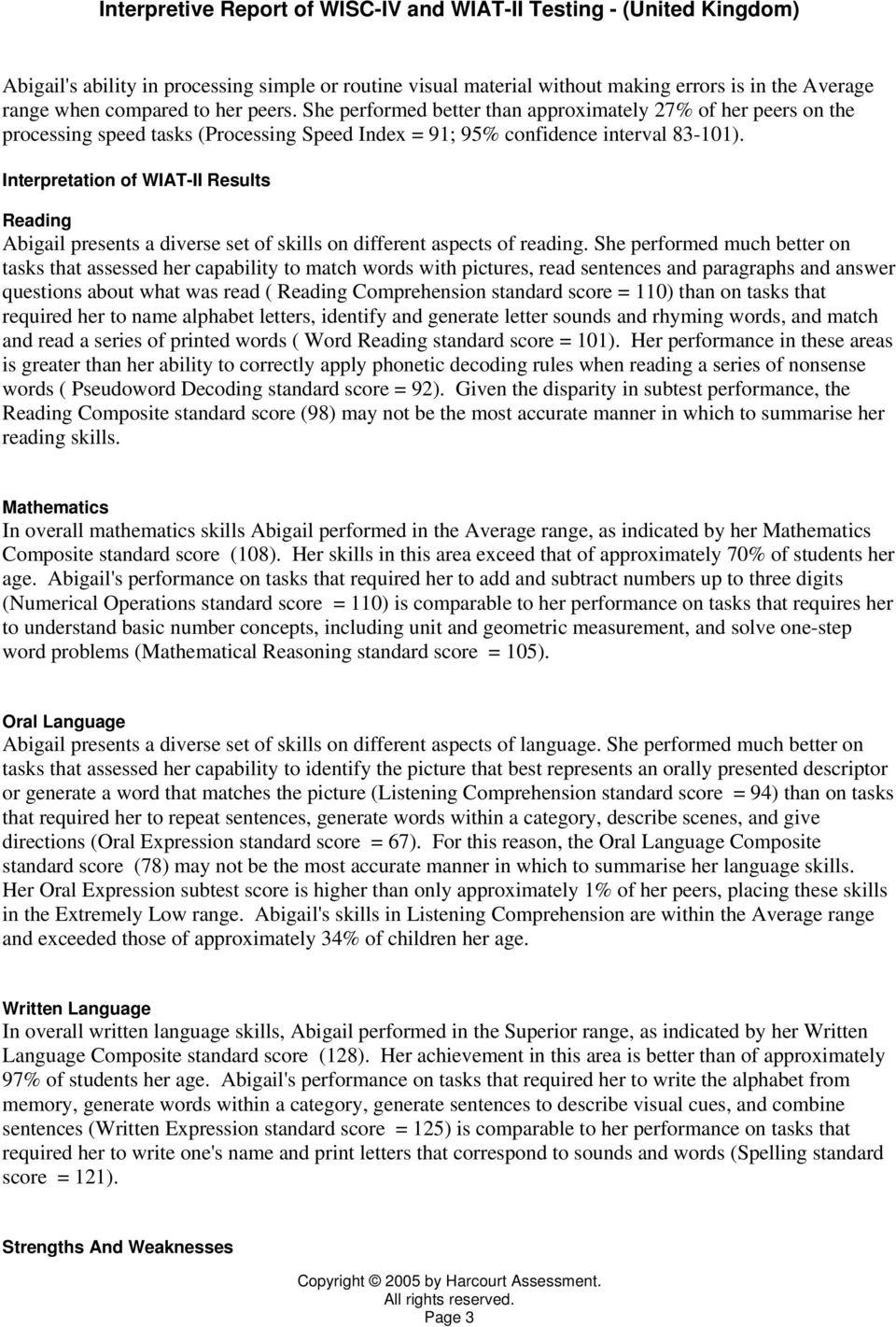
7 Index Level Discrepancy Comparisons Index Comparisons Score 1 Score 2 Diff. Critical Value Sig. Diff. Y/N Base Rate VCI - PRI N 38.2% VCI - WMI N 43% VCI - PSI N 37.3% PRI - WMI N 30.9% PRI - PSI N 49.3% WMI - PSI N 30.8% Base Rate by Overall Sample Statistical Significance (Critical Values) at the.05 level Differences between Subtest and Mean of Subtest Scores Subtest Subtest Score Mean Score Diff. from Mean Critical Value S/W Base Rate Block Design >25% Similarities >25% Digit Span >25% Picture Concepts >25% Coding >25% Vocabulary >25% Letter-Number Sequencing >25% Matrix Reasoning >25% Comprehension >25% Symbol Search >25% Overall Mean = 9.1, Scatter = 3, Base Rate = 99.6% Statistical Significance (Critical Values) at the.05 level Subtest Level Discrepancy Comparison Discrepancy Comparisons Score 1 Score 2 Diff. Critical Value Sig. Diff. Y/N Base Rate Digit Span - Letter-Number Sequencing N 32.5% Coding - Symbol Search N 40.2% Similarities - Picture Concepts N Statistical Significance (Critical Values) at the.05 level Page 7
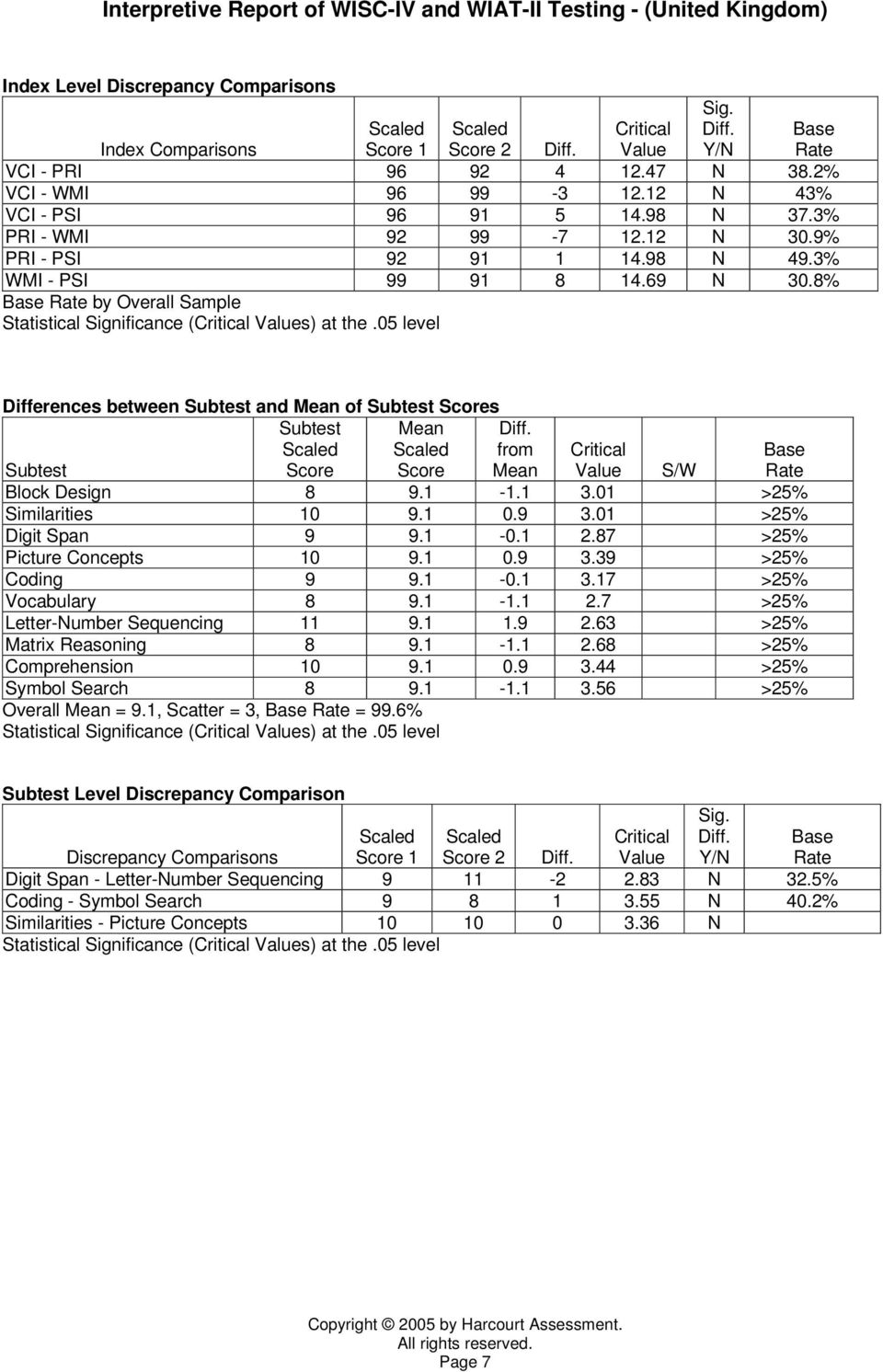
8 Verbal Comprehension Subtest Score Summary (Total Raw Score to Score Conversions) Percentile Subtests Raw Score Score Rank Similarities Vocabulary Comprehension Perceptual Reasoning Subtest Score Summary (Total Raw Score to Score Conversions) Percentile Subtests Raw Score Score Rank Block Design Picture Concepts Matrix Reasoning Working Memory Subtest Score Summary (Total Raw Score to Score Conversions) Percentile Subtests Raw Score Score Rank Digit Span Letter-Number Sequencing Processing Speed Subtest Scores Summary (Total Raw Score to Score Conversions) Percentile Subtests Raw Score Score Rank Coding (CD) Symbol Search (SS) Page 8
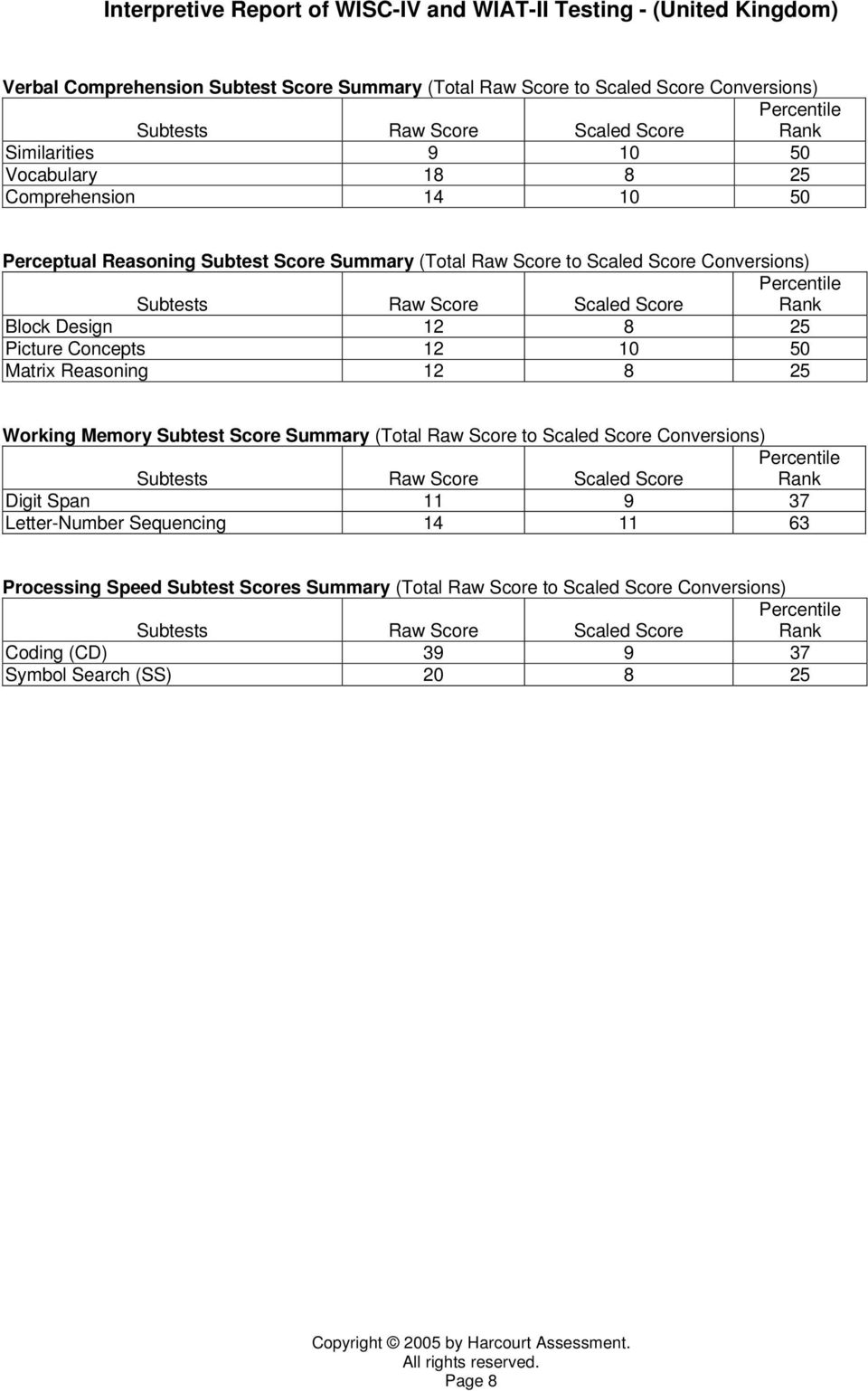
9 Vertical bar represents the Standard Error of Measurement. Subtest Score SEM Subtest Score SEM Similarities (SI) Picture Completion (PCm) Vocabulary (VC) Digit Span (DS) Comprehension (CO) Letter-Number Sequencing (LN) Information (IN) Arithmetic (AR) Word Reasoning (WR) Coding (CD) Block Design (BD) Symbol Search (SS) Picture Concepts (PCn) Cancellation (CA) Matrix Reasoning (MR) Page 9

10 Process Summary and Discrepancy Analysis Process Score Raw Score Score Block Design No Time Bonus 0 1 Digit Span Forwards 6 8 Digit Span Backwards 5 9 Process Score Raw Score Base Rate Longest Digit Span Forwards (LDSF) 5 55% Longest Digit Span Backwards (LDSB) 5 0.5% Process Discrepancy Comparisons Process Score Raw Score 1 Raw Score 2 Difference Base Rate LDSF - LDSB % Base Rate by All Ages Subtest/Process Score Score 1 Score 2 Diff. Critical Value Sig. Diff. Y/N Base Rate Block Design - Block Design No Time Bonus Y 0% Digit Span Forwards - Digit Span Backwards N 45.4% Statistical Significance (Critical Values) at the.05 level Page 10

11 WISC-IV Total Raw Scores Subtest Score Range Raw Score Block Design 0 to Similarities 0 to 44 9 Digit Span 0 to Picture Concepts 0 to Coding 0 to Vocabulary 0 to Letter-Number Sequencing 0 to Matrix Reasoning 0 to Comprehension 0 to Symbol Search 0 to Picture Completion 0 to 38 Cancellation 0 to 136 Information 0 to 33 Arithmetic 0 to 34 Word Reasoning 0 to 24 Process Score Score Range Raw Score Block Design No Time Bonus 0 to 50 0 Digit Span Forwards 0 to 16 6 Digit Span Backwards 0 to 16 5 Cancellation Random 0 to 68 Cancellation Structured 0 to 68 Longest Digit Span Forwards 0,2 to 9 5 Longest Digit Span Backwards 0,2 to 8 5 Summary of WIAT-II Subtest Scores SUBTESTS RAW STD 95% INTERVAL PR NCE S9 AGE EQU Word Reading :04 Reading Comprehension 97** :04 Pseudoword Decoding :08 Numerical Operations :00 Mathematical Reasoning :08 Spelling :04 Written Expression :08 Listening Comprehension :00 Oral Expression :00 ** Represents Reading Comprehension weighted raw score. Page 11

12 Summary of WIAT-II Composite and Total Scores COMPOSITES RAW STD 95% INTERVAL PR NCE S9 Reading Mathematics Written Language Oral Language Total Differences Between Subtest Scores and Mean of Subtest Scores SUBTESTS STD SCORE DIFF. FROM MEAN SIGNIF. FREQ S/W Word Reading ns >25% Reading Comprehension ns >25% Pseudoword Decoding * >25% W Numerical Operations ns >25% Mathematical Reasoning ns >25% Spelling * 5% S Written Expression * 5% S Listening Comprehension ns >25% Oral Expression * <1% W Mean of Subtest Standard Scores = * significant at the.05 level Differences Between Composite Standard Scores COMPOSITES DIFFERENCE SIGNIF. FREQUENCY Reading/Mathematics * 24.1% Reading/Oral Language 20.05* 7.8% Reading/Written Language * 0.2% Mathematics/Oral Language 30.05* 2% Mathematics/Written Language * 5.4% Oral Language/Written Language * 0.3% * significant at the.05 level Page 12

13 Subtest SS SEM Subtest SS SEM Word Reading (WR) Spelling (SP) Reading Comprehension (RC) Written Expression (WE) Pseudoword Decoding (PD) 92 2 Listening Comprehension (LC) 94 6 Numerical Operations (NO) Oral Expression (OE) 67 4 Mathematical Reasoning (MR) Page 13

14 WIAT-II Total Raw Scores Subtest Total Raw Score Word Reading 64 Numerical Operations 12 Reading Comprehension 97 Item Set (Age 6) 33 Target Words Total 24 Reading Speed Total 195 Spelling 24 Pseudoword Decoding 10 Mathematical Reasoning 25 Written Expression 12 Alphabet Writing 9 Word Fluency Subtotal 3 Sentences Subtotal 1 Listening Comprehension 15 Receptive Vocabulary Subtotal 6 Sentence Comprehension Subtotal 5 Expressive Vocabulary Subtotal 4 Oral Expression 12 Sentence Repetition Subtotal 4 Visual Passage Retell 4 Word Fluency Subtotal 15 Giving Directions 0 Page 14

15 Ability-Achievement Discrepancy Analysis Date of Ability Testing: 21/05/2004 Ability Score Type: VCI Ability Score: 96 Predicted-Difference Method Predicted Score Actual Score Expected Diff. Critical Value Sig. Diff. Y/N Base Rate WIAT-II SUBTEST Word Reading N Reading Comprehension Y Pseudoword Decoding N >25% Numerical Operations Y Mathematical Reasoning N Spelling Y Written Expression Y Listening Comprehension N >25% Oral Expression Y 3-4% COMPOSITES Reading N Mathematics N Written Language Y Oral Language Y 5-10% Total N Statistical Significance (Critical Values) at the.01 level Base Rates are not reported when the achievement score equals or exceeds the ability score. This report is valid only if signed by a qualified professional: Ann Other Page 15

Interpretive Report of WAIS IV Testing. Test Administered WAIS-IV (9/1/2008) Age at Testing 40 years 8 months Retest? No
 Interpretive Report of WAIS IV Testing Examinee and Testing Information Examinee Name Date of Report 9/4/2011 Examinee ID Years of Education 18 Date of Birth 12/7/1967 Home Language English Gender Female
Introducing the WAIS IV. Copyright 2008 Pearson Education, inc. or its affiliates. All rights reserved.
 Introducing the WAIS IV Overview Introduction Revision Goals Test Structure Normative / Validity / Clinical Information Wechsler s View of Intelligence "The global capacity of a person to act purposefully,
EDUCATIONAL APPLICATIONS OF THE WISC-IV WPS TEST REPORT
 EDUCATIONAL APPLICATIONS OF THE WISC-IV WPS TEST REPORT by Charles L. Nicholson, Ph.D., and Bradley T. Erford, Ph.D. Copyright 2006 by Western Psychological Services www.wpspublish.com Version 1.210 ID
WISC-V Interpretive Considerations for Laurie Jones (6/1/2015)
 WISC-V Interpretive Considerations for Laurie Jones (6/1/2015) Interpretive considerations provide additional information to assist you, the examiner, in interpreting Laurie's performance. This section
Early Childhood Measurement and Evaluation Tool Review
 Early Childhood Measurement and Evaluation Tool Review Early Childhood Measurement and Evaluation (ECME), a portfolio within CUP, produces Early Childhood Measurement Tool Reviews as a resource for those
General Ability Index January 2005
 TECHNICAL REPORT #4 General Ability Index January 2005 Susan E. Raiford, Ph.D. Lawrence G. Weiss, Ph.D. Eric Rolfhus, Ph.D. Diane Coalson, Ph.D. OVERVIEW This technical report is the fourth in a series
Interpretive Report of WMS IV Testing
 Interpretive Report of WMS IV Testing Examinee and Testing Information Examinee Name Date of Report 7/1/2009 Examinee ID 12345 Years of Education 11 Date of Birth 3/24/1988 Home Language English Gender
The child is given oral, "trivia"- style. general information questions. Scoring is pass/fail.
 WISC Subscales (WISC-IV shown at bottom with differences noted) Verbal Subscales What is Asked or Done What it Means or Measures Information (Supplemental in WISC-IV) The child is given oral, "trivia"-
Advanced Clinical Solutions. Serial Assessment Case Studies
 Advanced Clinical Solutions Serial Assessment Case Studies Advanced Clinical Solutions Serial Assessment Case Studies Case Study 1 Client C is a 62-year-old White male who was referred by his family physician
INCREASE YOUR PRODUCTIVITY WITH CELF 4 SOFTWARE! SAMPLE REPORTS. To order, call 1-800-211-8378, or visit our Web site at www.pearsonassess.
 INCREASE YOUR PRODUCTIVITY WITH CELF 4 SOFTWARE! Report Assistant SAMPLE REPORTS To order, call 1-800-211-8378, or visit our Web site at www.pearsonassess.com In Canada, call 1-800-387-7278 In United Kingdom,
G e n e ra l A b i l i t y I n d ex January 2005
 G e n e ra l A b i l i t y I n d ex January 2005 Susan E. Raiford, Ph.D. Lawrence G.Weiss, Ph.D. Eric Rolfhus, Ph.D. Diane Coalson, Ph.D. OVERVIEW T E C H N I C A L R E P O R T # 4 Updated December 2008:
Essentials of WAIS-IV Assessment
 Question from chapter 1 Essentials of WAIS-IV Assessment 1) The Binet-Simon Scale was the first to include age levels. a) 1878 b) 1898 c) 1908 d) 1928 2) The Wechsler-Bellevue Intelligence Scale had as
The Scoop on Understanding Psych Testing: What do all those numbers really mean???
 The Scoop on Understanding Psych Testing: What do all those numbers really mean??? Caley Schwartz, Ph.D. Caley Schwartz Psychological Services, LLC (203)464-9053! Clinical Instructor Yale Child Study Center
It s WISC-IV and more!
 It s WISC-IV and more! Integrate the power of process! Unleash the diagnostic power of WISC IV Integrated and unlock the potential of the child insight. intervene. integrated. Author: David Wechsler WISC
Patterns of Strengths and Weaknesses in L.D. Identification
 Patterns of Strengths and Weaknesses in L.D. Identification October 3, 2013 Jody Conrad, M.S., N.C.S.P School Psychologist, SOESD Definitions of SLD Federal and State A disorder in one or more basic psychological
Adaptive Behavior Assessment System-Second Edition Interpretive Report
 Examinee Information Name: Jane Smith Age: 9 years, 7 months Date of Birth: 4/5/1998 Age at Testing: 9 years, 7 months Gender: Female Grade: 3rd Ethnicity: School/Daycare: Wiman Elementary
SPECIFIC LEARNING DISABILITY
 SPECIFIC LEARNING DISABILITY 24:05:24.01:18. Specific learning disability defined. Specific learning disability is a disorder in one or more of the basic psychological processes involved in understanding
Standardized Tests, Intelligence & IQ, and Standardized Scores
 Standardized Tests, Intelligence & IQ, and Standardized Scores Alphabet Soup!! ACT s SAT s ITBS GRE s WISC-IV WAIS-IV WRAT MCAT LSAT IMA RAT Uses/Functions of Standardized Tests Selection and Placement
Overview of the Wechsler Preschool and Primary Scale of Intelligence-Fourth Edition
 Overview John A. Hanson Ph.D. LP Assessment Consultant Objectives discuss the fundamental changes from the WPPSI-III to the WPPSI-IV; describe how the changes impact assessment of young children and interpretation
Cecil R. Reynolds, PhD, and Randy W. Kamphaus, PhD. Additional Information
 RIAS Report Cecil R. Reynolds, PhD, and Randy W. Kamphaus, PhD Name: Client Sample Gender: Female Year Month Day Ethnicity: Caucasian/White Grade/education: 11 th Grade Date Tested 2007 1 9 ID#: SC 123
Overview: Part 1 Adam Scheller, Ph.D. Senior Educational Consultant
 Overview: Part 1 Adam Scheller, Ph.D. Senior Educational Consultant 1 Objectives discuss the changes from the KTEA-II to the KTEA-3; describe how the changes impact assessment of achievement. 3 Copyright
Using the WASI II with the WISC IV: Substituting WASI II Subtest Scores When Deriving WISC IV Composite Scores
 Introduction Using the WASI II with the WISC IV: Substituting WASI II Subtest s When Deriving WISC IV Composite s Technical Report #1 November 2011 Xiaobin Zhou, PhD Susan Engi Raiford, PhD This technical
ALBUQUERQUE PUBLIC SCHOOLS
 ALBUQUERQUE PUBLIC SCHOOLS Speech and Language Initial Evaluation Name: Larry Language School: ABC Elementary Date of Birth: 8-15-1999 Student #: 123456 Age: 8-8 Grade:6 Gender: male Referral Date: 4-18-2008
Common Educational Tests used for Assessments for Special Education
 Cognition/Intelligence Ability to reason, to think abstractly, and to solve problems. Wechsler tests: WISC-III, WAIS-R, WPPSI-R Stanford-Binet: Fourth Edition Differential Ability Scales (DAS) Verbal Intelligence
PSYCHOLOGICAL ASSESSMENT I PCO 6316C
 PSYCHOLOGICAL ASSESSMENT I PCO 6316C Instructor: Michael J. Herkov, Ph.D. Office: 4001SW 13 th Street Suite 613 Phone: (352) 265-5516 352 678-0010 (c) Email: [email protected] Office Hours: Monday: 1:00-5:00
Validity of the WISC IV Spanish for a Clinically Referred Sample of Hispanic Children
 Psychological Assessment 2010 American Psychological Association 2010, Vol. 22, No. 2, 465 469 1040-3590/10/$12.00 DOI: 10.1037/a0018895 Validity of the WISC IV Spanish for a Clinically Referred Sample
Association of Specialists in Assessment of Intellectual Functioning ASAIF. http://www.asaif.net
 Association of Specialists in Assessment of Intellectual Functioning ASAIF http://www.asaif.net 1 Friday 12 December 2014 Nackey S. Loeb School of Communications 749 East Industrial Park Drive Manchester,
Categories of Exceptionality and Definitions
 7. CATEGORIES and DEFINITIONS of EXCEPTIONALITIES Purpose of the standard To provide the ministry with details of the categories and definitions of exceptionalities available to the public, including parents
SPECIFIC LEARNING DISABILITIES (SLD)
 Together, We Can Make A Difference Office 770-577-7771 Toll Free1-800-322-7065 www.peppinc.org SPECIFIC LEARNING DISABILITIES (SLD) Definition (1) Specific learning disability is defined as a disorder
Technical Report #2 Testing Children Who Are Deaf or Hard of Hearing
 Technical Report #2 Testing Children Who Are Deaf or Hard of Hearing September 4, 2015 Lori A. Day, PhD 1, Elizabeth B. Adams Costa, PhD 2, and Susan Engi Raiford, PhD 3 1 Gallaudet University 2 The River
2 The Use of WAIS-III in HFA and Asperger Syndrome
 2 The Use of WAIS-III in HFA and Asperger Syndrome Published in: Journal of Autism and Developmental Disorders, 2008, 38 (4), 782-787. Chapter 2 Abstract The WAIS III was administered to 16 adults with
3030. Eligibility Criteria.
 3030. Eligibility Criteria. 5 CA ADC 3030BARCLAYS OFFICIAL CALIFORNIA CODE OF REGULATIONS Barclays Official California Code of Regulations Currentness Title 5. Education Division 1. California Department
Patterns of Strengths and Weaknesses Standards and Procedures. for. Identification of Students with Suspected Specific Learning Disabilities
 Patterns of Strengths and Weaknesses Standards and Procedures for Identification of Students with Suspected Specific Learning Disabilities March, 2010 Table of Contents Patterns of Strengths and Weaknesses
WISC IV Technical Report #1 Theoretical Model and Test Blueprint. Overview
 WISC IV Technical Report #1 Theoretical Model and Test Blueprint June 1, 2003 Paul E. Williams, Psy.D. Lawrence G. Weiss, Ph.D. Eric Rolfhus, Ph.D. Overview This technical report is the first in a series
SPECIFIC LEARNING DISABILITY
 I. DEFINITION "Specific learning disability" means a disorder in one or more of the basic psychological processes involved in understanding or in using language, spoken or written, that may manifest itself
Oklahoma Subject Area Tests
 Certification Examinations for Oklahoma Educators Oklahoma Subject Area Tests STUDY GUIDE 033 School Psychologist Oklahoma Commission for Teacher Preparation OK-SG-FLD033-04 TABLE OF CONTENTS STUDY GUIDE
Wide Range Achievement Test 4 (WRAT4)
 Wide Range Achievement Test 4 (WRAT4) Description of the WRAT4 The WRAT4 is a norm-referenced test that measures the basic academic skills of word reading, sentence comprehension, spelling, and math computation.
Documentation Requirements ADHD
 Documentation Requirements ADHD Attention Deficit Hyperactivity Disorder (ADHD) is considered a neurobiological disability that interferes with a person s ability to sustain attention, focus on a task
The test uses age norms (national) and grade norms (national) to calculate scores and compare students of the same age or grade.
 Reading the CogAT Report for Parents The CogAT Test measures the level and pattern of cognitive development of a student compared to age mates and grade mates. These general reasoning abilities, which
Parents Guide Cognitive Abilities Test (CogAT)
 Grades 3 and 5 Parents Guide Cognitive Abilities Test (CogAT) The CogAT is a measure of a student s potential to succeed in school-related tasks. It is NOT a tool for measuring a student s intelligence
Psychoeducational Assessment How to Read, Understand, and Use Psychoeducational Reports
 Psychoeducational Assessment How to Read, Understand, and Use Psychoeducational Reports by Dr. Sherry Mee Bell Psychoeducational assessment is designed to answer these questions: Does the client have a
Gifted & Talented Program Description
 Gifted & Talented Program Description The purpose of Cedar Unified School District s gifted and talented program is to nurture academic excellence and improve student achievement among all students. To
Any Town Public Schools Specific School Address, City State ZIP
 Any Town Public Schools Specific School Address, City State ZIP XXXXXXXX Supertindent XXXXXXXX Principal Speech and Language Evaluation Name: School: Evaluator: D.O.B. Age: D.O.E. Reason for Referral:
The Relationship between the WISC-IV GAI and the KABC-II
 Marshall University Marshall Digital Scholar Theses, Dissertations and Capstones 1-1-2010 The Relationship between the WISC-IV GAI and the KABC-II Nancy R. Oliver [email protected] Follow this and additional
Efficacy Report WISC V. March 23, 2016
 Efficacy Report WISC V March 23, 2016 1 Product Summary Intended Outcomes Foundational Research Intended Product Implementation Product Research Future Research Plans 2 Product Summary The Wechsler Intelligence
Conducting Geriatric Evaluations: Using Data from WAIS-IV, WMS-IV, and ACSW4W4 Gloria Maccow, Ph.D., Assessment Training Consultant
 Conducting Geriatric Evaluations: Using Data from WAIS-IV, WMS-IV, and ACSW4W4 Gloria Maccow, Ph.D. Assessment Training Consultant Objectives Select components of Advanced Clinical Solutions for WAIS-IV
WISC IV and Children s Memory Scale
 TECHNICAL REPORT #5 WISC IV and Children s Memory Scale Lisa W. Drozdick James Holdnack Eric Rolfhus Larry Weiss Assessment of declarative memory functions is an important component of neuropsychological,
Revision of Rule 46 of the "Rules and Programme for Secondary Schools" in relation to exemption from Irish
 Brainse an Iarbhunoideachais An Roinn Oideachais agus Eolaíochta, Corn a Madadh, Baile Atha Luain Co. na hiarmhí Fón: 09064-83692 Post-Primary Administration, Department of Education and Science Cornamaddy,
Intellectual Disability-DSM5
 Intellectual Disability-DSM5 DR. CHARMAINE MIRANDA Clinical Director, Compass Clinic Clinical Instructor, UBC Psychiatry Clinical Associate, SFU DR. ADRIENNE ROMBOUGH Psychological Consultant, Compass
Technical Report. Overview. Revisions in this Edition. Four-Level Assessment Process
 Technical Report Overview The Clinical Evaluation of Language Fundamentals Fourth Edition (CELF 4) is an individually administered test for determining if a student (ages 5 through 21 years) has a language
standardized tests used to assess mental ability & development, in an educational setting.
 Psychological Testing & Intelligence the most important aspect of knowledge about genetic variability is that it gives us respect for people s individual differences. We are not all balls of clay that
Practice Test for Special Education EC-12
 Practice Test for Special Education EC-12 1. The Individualized Educational Program (IEP) includes: A. Written evaluation B. Assessment tests C. Interviews 2. Learning disabilities include: A. Cerebral
SPEECH OR LANGUAGE IMPAIRMENT EARLY CHILDHOOD SPECIAL EDUCATION
 I. DEFINITION Speech or language impairment means a communication disorder, such as stuttering, impaired articulation, a language impairment (comprehension and/or expression), or a voice impairment, that
ETS Policy Statement for Documentation of Intellectual Disabilities in Adolescents and Adults
 ETS Policy Statement for Documentation of Intellectual Disabilities in Adolescents and Adults First Edition 2013 Office of Disability Policy Educational Testing Service Princeton, NJ 08541 2013 ETS All
WISC-IV Integrated Interpretive Report - (United States)
 EXAMINEE: Hayley Keller REPORT DATE: 2/15/2005 AGE: 12 years 11 months GRADE: 6th DATE OF BIRTH: 2/18/1992 ETHNICITY: White not Hispanic Origin EXAMINEE ID: 9494949 EXAMINER: Emily Martinez GENDER: Female
The Comprehensive Test of Nonverbal Intelligence (Hammill, Pearson, & Wiederholt,
 Comprehensive Test of Nonverbal Intelligence The Comprehensive Test of Nonverbal Intelligence (Hammill, Pearson, & Wiederholt, 1997) is designed to measure those intellectual abilities that exist independent
Please complete this form and return it ASAP by fax to (519)675-7772, attn: Rebecca Warder
 Child Welfare Assessment Screening Information Form Please complete this form and return it ASAP by fax to (519)675-7772, attn: Rebecca Warder Today s Date: Case Name: Referring Agency: Worker s Name:
Frequently Asked Questions about Making Specific Learning Disability (SLD) Eligibility Decisions
 Frequently Asked Questions about Making Specific Learning Disability (SLD) Eligibility Decisions This document is part of the department s guidance on implementing Wisconsin SLD criteria. It provides answers
Overview of Kaufman Brief Intelligence Test-2 Gloria Maccow, Ph.D., Assessment Training Consultant
 Overview of Kaufman Brief Intelligence Test-Second Edition Webinar Presented by: Gloria Maccow, Ph.D. Assessment Training Consultant (2004) 2 Copyright 2011 09/28/2011 Agenda Describe the KBIT-2. Describe
The Clinical Evaluation of Language Fundamentals, fourth edition (CELF-4;
 The Clinical Evaluation of Language Fundamentals, Fourth Edition (CELF-4) A Review Teresa Paslawski University of Saskatchewan Canadian Journal of School Psychology Volume 20 Number 1/2 December 2005 129-134
FLORIDA EARLY LEARNING AND DEVELOPMENTAL STANDARDS: Birth to Five
 FLORIDA EARLY LEARNING AND DEVELOPMENTAL STANDARDS: Birth to Five The Florida Early Learning and Developmental Standards were created by using multiple resources, of which, one was the Alaska Guidelines.
Child Development. Caseworker Core Training Module VII: Child Development: Implications for Family-Centered Child Protective Services
 Child Development P R E - T R A I N I N G A S S I G N M E N T Caseworker Core Training Module VII: Child Development: Implications for Family-Centered Child Protective Services Developed by the Institute
School Psychologist PK 12 Section 36
 School Psychologist PK 12 Section 36 1 Knowledge of measurement theory, test construction, research, and statistics 1. Identify theories of measurement and test construction. 2. Demonstrate knowledge of
Department of Education Learners first, connected and inspired
 Department of Education Learners first, connected and inspired Frequently Asked Questions about Early Entry to Kindergarten (Cross Sectoral Information for Parents) Frequently Asked Questions about Early
Preschool Development Assessment
 Preschool Development Assessment Child s Name: DOB: Completed by: Date began: This document may be copied for classroom use only. Not to be sold or used on any other website. Property of www.re-teach.com.
The University of Memphis Guidelines for Documentation of a Learning Disability in Adolescents and Adults
 The University of Memphis Guidelines for Documentation of a Learning Disability in Adolescents and Adults Introduction The prevailing legal climate surrounding higher education and disability issues, combined
Guidelines for Documentation of a A. Learning Disability
 Guidelines for Documentation of a Learning Disability A. Learning Disability B. Attention Deficit Disorder C. Psychiatric Disabilities D. Chronic Health Disabilities A. Learning Disability Students who
Demystifying the SLD Category, Assessment and Diagnosis
 The Ever Increasing Conundrum of the Specific Learning Disability (SLD) Category for School Based Teams: Demystifying the SLD Category, Assessment and Diagnosis Beverly M. Conte, Ed.D., CCC-SLP Administrator
National Psychology Examination - Assessment Domain Additional Resources
 National Psychology Examination - Assessment Domain Additional Resources May 2014 This document provides additional resources and assistance for candidates preparing for the National Psychology Examination.
Running head: WISC-IV AND INTELLECTUAL DISABILITY 1. The WISC-IV and Children and Adolescents with Intellectual Disability:
 Running head: WISC-IV AND INTELLECTUAL DISABILITY 1 The WISC-IV and Children and Adolescents with Intellectual Disability: Evaluating for Hidden Floor Effects in the US Version Allyssa Lanza M.S., Antioch
ETR. Evaluation Team Report TYPE OF EVALUATION: CHILD'S INFORMATION: DATES PARENTS'/GUARDIAN INFORMATION ETR FORM STATUS CHILD'S NAME:
 CHILD'S INFORMATION: TYPE OF EVALUATION: STREET: GENDER: CITY: STATE: OH ZIP: DISTRICT OF RESIDENCE: DISTRICT OF SERVICE: GRADE: INITIAL EVALUATION DATES DATE OF MEETING: DATE OF LAST ETR: REFERRAL DATE:
STAFF DEVELOPMENT in SPECIAL EDUCATION
 STAFF DEVELOPMENT in SPECIAL EDUCATION Learning Disabilities AASEP s Staff Development Course LEARNING DISABILITIES Copyright AASEP (2006) 1 of 7 Objectives To understand what is a learning disability
Components of an Effective Evaluation for Autism Spectrum Disorder
 Components of an Effective Evaluation for Autism Spectrum Disorder Lara M. Mattox, Ph.D. Clinical Psychologist Tulsa Developmental Pediatrics & Center for Family Psychology Why is Evaluation Important??
Woodcock-Johnson WJ III
 Woodcock-Johnson III Assessment Service Bulletin Number 2 WJ III Technical Abstract Fredrick A. Schrank, PhD Kevin S. McGrew, PhD Richard W. Woodcock, EdD This abstract outlines the procedures followed
Office of Disability Support Service 0106 Shoemaker 301.314.7682 Fax: 301.405.0813 www.counseling.umd.edu/dss. A Guide to Services for Students with a
 Office of Disability Support Service 0106 Shoemaker 301.314.7682 Fax: 301.405.0813 www.counseling.umd.edu/dss A Guide to Services for Students with a Learning Disability (Revised 4.28.14) Do I Have A Learning
PRIMARY TREATMENT CENTERS AND DETENTION
 SECTION SIX PRIMARY TREATMENT CENTERS AND DETENTION I. PRIMARY TREATMENT CENTER A. General Characteristics 1. Children referred to Primary Treatment Centers (PTC) may be children in their initial state
Frequently Asked Questions
 Frequently Asked Questions Business Office: 598 Airport Boulevard Suite 1400 Morrisville NC 27560 Contact: [email protected] Phone: 888.750.6941 Fax: 888.650.6795 www.cognitrax.com Diseases of the
Learning Disabilities: 101
 Learning Disabilities: 101 Website: www.ldayr.org E-mail: [email protected] 905-844-7933 x 23 By: Kelli Cote, Principal, Parent, LDAYR Director Shelley Henderson, Parent and LDAYR Director April 9, 2014 Learning
SAMPLE EDUCATIONAL EVALUATION
 SAMPLE EDUCATIONAL EVALUATION Name: School: Home School Date of Birth: 08/26/2002 Teacher: Mother Doe Age: 7 years, 8 months Grade: 1.8 Sex: Male ID: 123-456-7890 Date of Testing: 04/20/2010 Examiner:
Published online: 29 Jul 2014.
 This article was downloaded by: [Wayne State University] On: 30 July 2014, At: 10:36 Publisher: Routledge Informa Ltd Registered in England and Wales Registered Number: 1072954 Registered office: Mortimer
Areas of Processing Deficit and Their Link to Areas of Academic Achievement
 Areas of Processing Deficit and Their Link to Areas of Academic Achievement Phonological Processing Model Wagner, R.K., Torgesen, J.K., & Rashotte, C.A. (1999). Comprehensive Test of Phonological Processing.
Dr. Astrid Kopp-Duller (1985)
 A dyslexic person, of good or average intelligence, perceives his environment in a different way, his attention diminishes when confronted with symbols such as letters and numbers. Due to a deficiency
Accommodations STUDENTS WITH DISABILTITES SERVICES
 Accommodations Otis College of Art and Design is committed to providing equality of education opportunity to all students. To assist in increasing the student s learning outcome, Students with Disabilities
Glen Davis PhD Maine Child Psychology 2 Elm Street, Waterville, ME 04901 Telephone: (207) 221-2631 Fax: (207) 221-3368 MaineChildPsych.
 Dear Parent, Glen Davis PhD Maine Child Psychology 2 Elm Street, Waterville, ME 04901 Telephone: (207) 221-2631 Fax: (207) 221-3368 MaineChildPsych.com Thank you for your interest in psychological services
Measurable Annual Goals
 Measurable Annual Goals This document was developed to help special education teachers begin transitioning from standards based IEP goals to measurable annual goals that are specific to individual student
The Creative Curriculum for Preschool: Objectives for Development & Learning
 Curriculum Alignment of The Creative Curriculum for Preschool: Objectives for Development & Learning with Alignment of The Creative Curriculum for Preschool: Objectives for Development & Learning With
Special Education Coding Criteria 2012/2013. ECS to Grade 12 Mild/Moderate (including Gifted and Talented) Severe
 Special Education Coding Criteria 2012/2013 ECS to Grade 12 Mild/Moderate (including Gifted and Talented) Severe Special Education Coding Criteria 2012/2013 ISSN 1911-4311 Additional copies of this handbook
Gf - FLUID INTELLIGENCE
 Gf - FLUID INTELLIGENCE Novel reasoning and problem solving Ability to reason, form concepts, and solve problems that often include novel information or procedures Basic reasoning processes that depend
Stationary (St)--This subtest measures a child's ability to sustain control of the body within its center of gravity and retain equilibrium.
 Peabody Developmental Motor Scales Second Edition (PDMS-2) Summary Report Section I. Identifying Information Name: Jane Doe Date of Testing: 9/13/2006 Date of Birth: 4/8/2003 Prematurity Adjustment: 0
Recommended Practices For Assessment, Diagnosis and Documentation of Learning Disabilities
 LEARNING DISABILITIES ASSOCIATION OF ONTARIO Recommended Practices For Assessment, Diagnosis and Documentation of Learning Disabilities Diagnosis of Learning Disabilities Accurate diagnosis of learning
WISC IV Technical Report #2 Psychometric Properties. Overview
 Technical Report #2 Psychometric Properties June 15, 2003 Paul E. Williams, Psy.D. Lawrence G. Weiss, Ph.D. Eric L. Rolfhus, Ph.D. Figure 1. Demographic Characteristics of the Standardization Sample Compared
Learning Disability Documentation Instructions Updated December, 2015
 Learning Disability Documentation Instructions Updated December, 2015 The Office of Accessibility Services establishes academic and/or housing accommodations for students with a documented disability.
The Thirteen Special Education Classifications. Part 200 Regulations of the Commissioner of Education, Section 4401(1)
 The Thirteen Special Education Classifications Part 200 Regulations of the Commissioner of Education, Section 4401(1) Student With a Disability: A student as defined in section 4401(1), who has not attained
Meeting the Needs of Students with Special. Educational Needs through Individualised. Planning (Post- Primary) Case Study 1: Peter
 Special Education Support Service Meeting the Needs of Students with Special Educational Needs through Individualised Planning (Post- Primary) Case Study 1: Peter Special Education Support Service, Cork
How To Teach A Deaf Person
 Appendix F. New Hampshire Certification Requirements for Educational Interpreters/Transliterators and for Special Education Teachers in the Area of Deaf and Hearing Disabilities Educational Interpreter/Transliterator
Immediate Post-Concussion Assessment and Cognitive Testing (ImPACT) Normative Data
 Immediate Post-Concussion Assessment and Cognitive Testing (ImPACT) Normative Data Version 2.0 Only 2003 Grant L. Iverson, Ph.D. University of British Columbia & Riverview Hospital Mark R. Lovell, Ph.D.