
Jack s Dyslexia Index indicates he has dyslexic difficulties that are mild in extent.
|
|
|
- Shanon Barker
- 9 years ago
- Views:
Transcription


1 Dyslexia Portfolio Report for Jack Jones Assessed by Sue Thompson on 05/08/2009 Report for parents When a child is identified as dyslexic, additional support will be needed from both school and home to make sure that the difficulties associated with dyslexia are minimised, particularly those with reading, writing and information processing (remembering facts and recalling them efficiently). This report gives broad guidance to parents on ways that their child can be helped at home in everyday activities and situations. The school will want to work very closely with parents on specific areas that need reinforcement at home support with homework, course work, additional reading and more structured activities that focus on improving literacy. Parents can sometimes be reluctant to pressure children into practising reading. However, it should be borne in mind that the more a child reads, the better he will become at it and the more able he will be to learn and achieve. For primary school children much of what the parent can do reinforces and practises learning at school helping with reading, spelling and writing tasks. For secondary school students who have not acquired some of the basics in literacy during the primary stage, it is inevitable that some relearning and reinforcement of what they may consider skills for younger children will be needed. If taught at school they may be practised at home. If cooperation can be established with such students, gains will be made. Jack s Dyslexia Index indicates he has dyslexic difficulties that are mild in extent. Why the Portfolio has been used What the Portfolio measures The Dyslexia Portfolio is made up of a series of nine short assessments that together provide a balance of information that may allow an individual to be identified as dyslexic and the extent of their dyslexia to be measured. To identify a student as dyslexic a general ability score (from another assessment) needs to be included as part of the assessment process. This is because the model of dyslexia used in this assessment is one of discrepancy. That is, it looks for an unusual mismatch between the student s level of general ability and their progress in acquiring literacy skills. The short assessments in the Portfolio are divided into four pairs or clusters plus a single test for writing. What the clusters measure Reading and spelling of single words form the word literacy cluster Timed reading of sentences and naming of pictures at speed form the processing speed cluster Saying words with certain sounds omitted and reading made-up words form the phonological processing cluster Repeating lists of numbers in forward and reverse order (two separate assessments) form the working memory cluster Writing is a stand-alone assessment based on the number of words a student can write in a given time (rather than the quality of language or ideas) GL Assessment 2009 Page 1 of 5 Jack Jones 13/08/2009

2 Types of score The scores from the individual assessments and the cluster scores are given as standard scores. A standard score is one that can be placed on a standard scale and can therefore be compared meaningfully to the national average. 100 is the average score whatever the difficulty of the test and approximately 50% will score between 90 and 109. Scores can be compared to a nationally representative sample and are adjusted to take account of the child s age. Interpreting scores No assessment is entirely accurate and scores may vary from one assessment session to the next. An individual s performance may be affected by tiredness, minor illness or some level of discomfort (feeling too warm or too cold). To allow for a margin of error the scores from the Dyslexia Portfolio are provided in a range which is indicated by the bar (or confidence band ) either side of the diamond in the chart below. As the Dyslexia Portfolio is an individual assessment, the assessor has the opportunity to observe the student during the session and assess their attitude and approach to the assessments. Such observations can then be considered alongside the scores the assessments yield. Summary GL Assessment 2009 Page 2 of 5 Jack Jones 13/08/2009
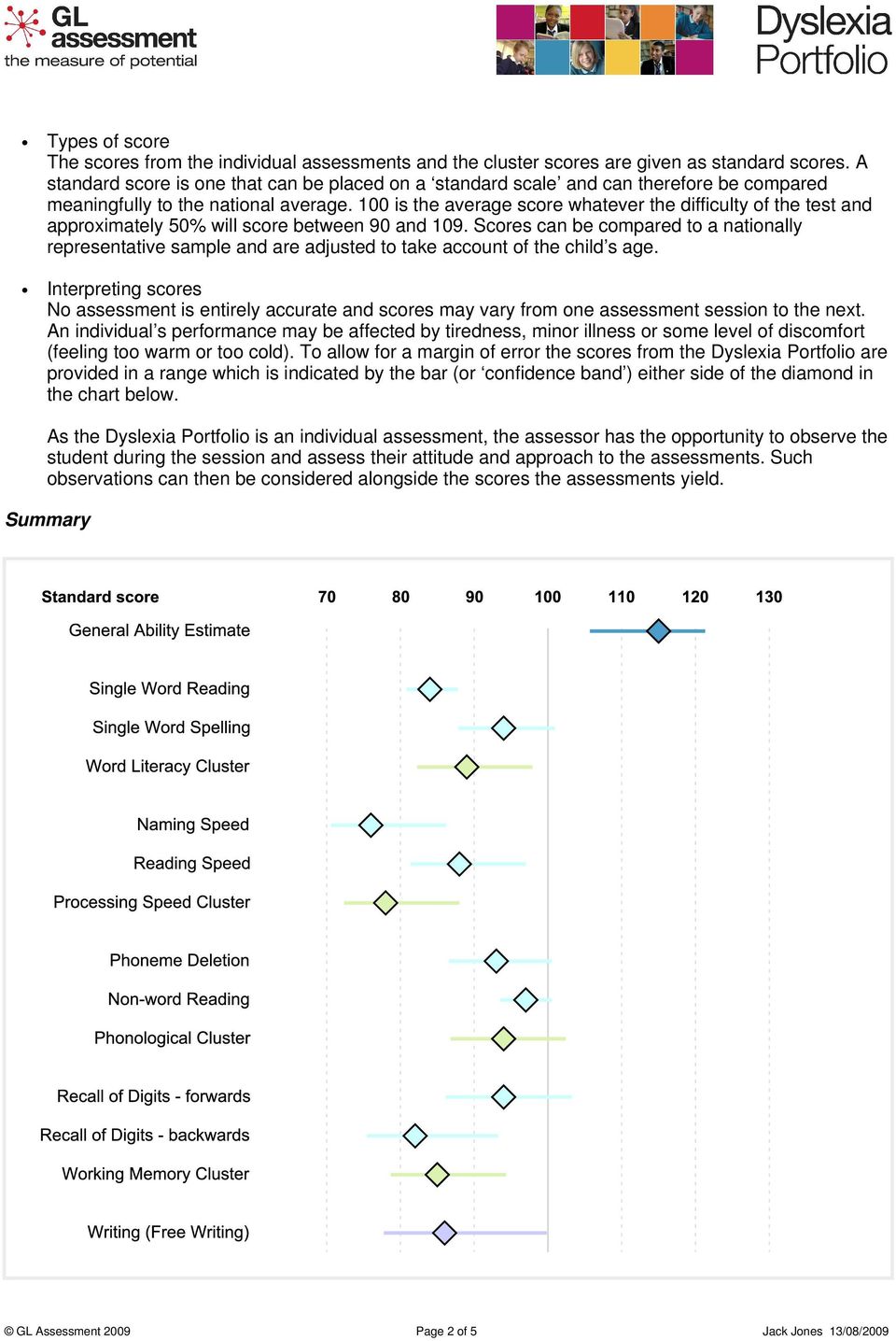
3 Summary Word Literacy This cluster is an estimate of the student s literacy at the word level, as shown in tests of single word reading and spelling. Whatever may be added later in terms of comprehension and enjoyment, word-level skills are the entry point into literacy and the engine that continues to drive progress even in the more sophisticated reader. Jack s skills in reading and spelling words are currently below average. It will be important to encourage Jack to ensure school-set reading and writing exercises are completed as requested. Such tasks may need to be supervised and broken down into manageable amounts of time to allow Jack to concentrate well. It will also be important to encourage Jack to read and write for pleasure. To this end, books and other reading matter such as magazines of interest to Jack should be made available to him. He should be supported in reading in a way that maximises enjoyment and minimises frustration. For instance, times for pleasure reading should be set aside when he is not tired or wanting to do other things. Let Jack choose the book he wants you to read. Sometimes he will want to read silently. If he is reading aloud to a parent, however, help should be given readily when he falters over difficult words or passages, even if the school reading homework requires Jack to try to read such words or passages himself. For information about choosing books see: Processing Speed This cluster comprises two tests: Naming Speed and Reading Speed. The latter, of course, is critical to the performance of older students in examinations. The former corresponds to what are sometimes described as word-finding skills, the ability to think of words and recall quickly the right name for an object. Jack s speed at processing information is slow. Because students sometimes make a great effort to race through their work, with resulting poor quality, at home: Speed should not be encouraged at the expense of accuracy. It may be valuable for Jack to slow down and achieve better confidence through greater accuracy. Subsequently, greater automation (when the processing of information becomes less strained and more automatic) and confidence will result in improved speed. Phonological Processing Alphabetical skills are at the heart of the literacy-learning process in the early stages. Moreover, skill with the written word closely corresponds with spoken language skills; a reader needs to be able to hear the sounds within a word to read and write it accurately Jack s skills in processing spoken words and phonemes are currently average. Jack is likely to be able to cope with the phonological elements of the literacy tasks that are appropriate to his age group. Working Memory The ability to hold verbal material in short-term memory seems to be central to learning the highly GL Assessment 2009 Page 3 of 5 Jack Jones 13/08/2009
4 sequenced procedures of reading and spelling. While Recall of Digits Forwards is a fairly straightforward measure of how well a student can do this, Recall of Digits Backwards requires that the student hold the material in memory while transforming it in some way (reversing it). Jack s ability to keep verbal information in his short-term memory while performing some mental task with it is below average. Jack should be given information a bit at a time and should be encouraged to jot down notes or diagrams to help him retain crucial details. He could also be encouraged to use visual imagery as an aid to remembering information that is initially provided in verbal form. For example, he can picture items in a to do list as if they were situated around his home, so that he only has to imagine himself walking around the house to see the things he must deal with. It helps to group information numbers and letters into chunks, which are easier to remember and may be more meaningful. A mobile phone number may begin (five digits), followed by six more; words occur in families (cover, recover, recoverable); and so on. Overloading Jack with too much verbal information or instruction will result in failure to achieve what may seem straightforward tasks. For example, a general request to tidy your room may result in only partial success: better to break down requests pick up your clothes, put away your toys, etc. - even if some repetition is involved. Involving Jack in everyday tasks that can be done in a sequence setting the table, following a simple recipe (with help) can reinforce organisational skills. Writing This test primarily samples productivity, that is, the amount of writing a student can complete in a given time. Younger children perform a copying task, while older children engage in an open-ended but straightforward exercise in free writing. Jack is currently below average at writing. Jack should be encouraged to practise writing whenever the opportunity arises, such as completing a daily diary entry, writing birthday cards and messages to friends or family, designing displays of photographs and labelling these, creating home-made cards and so on. Older children can participate in Facebook or an online blog. Many children with dyslexia have the ability to create stories but not to write them down: parents can help by doing this for them and, if handwriting practice is required, the child can copy these into a writing journal. One effect of handwriting training can be a renewed pride in producing attractive written work, so this should be praised. General It will be helpful not to overload Jack with too much verbal information at once, so he has time to absorb one thing before having to register and comprehend or remember another. It will also be very beneficial to remember that speaking and listening are only one route to conveying information. It may help Jack to have information presented to him in visual form and to experience new material by touch and movement if possible. So, for example, if he is studying a particular period of history, he might gain more from a museum visit or being allowed to handle artefacts and watch a video of key events, rather than being given a long description. Similarly, Jack may benefit from being allowed to present his thoughts and ideas in formats other than speech or writing. Using mind maps or drawing a flow diagram may help to get a sequence of tasks in GL Assessment 2009 Page 4 of 5 Jack Jones 13/08/2009
5 the right order before doing them. Here are some other suggestions for creating a positive working relationship with your child: Do not use but when talking to your child: Your essay is great, but there are a lot of spelling mistakes. Use and : Your story is very funny and creative, and maybe next time we can work on some of the spelling mistakes. Ask for what you want, rather than what you don t want, when speaking to your child s teacher. Encourage your child to draw a cartoon character, who can help combat the nagging negative voice in the child s head. Use praise frequently, especially with precise reference to actual work ( You remembered all of this from last week, Well done, you ve been concentrating for fifteen minutes, Fantastic! I ve never seen you manage such a long sentence before and so on). With all children, whose development proceeds at a giddying rate, a little play-acting is necessary to being a supportive parent. The aim is to be always agreeably surprised. It is necessary to emphasise and praise growth change, development, progress. It may feel like watching the grass grow sometimes: nothing much happens in an hour... but a week or two can make a huge difference. GL Assessment 2009 Page 5 of 5 Jack Jones 13/08/2009

7. HOW TO TEACH A DYSLEXIC PUPIL TO READ
 7. HOW TO TEACH A DYSLEXIC PUPIL TO READ OVERVIEW Extract In this module, we will cover the following topics: Introduction Reading ages How to choose appropriate reading materials Teaching a dyslexic child
Identifying dyslexia and other learning problems using LASS
 Identifying dyslexia and other learning problems using LASS 1 Outline of presentation What is LASS? What is dyslexia? Indicators of dyslexia Components and features of LASS Uses of LASS for screening and
Contents. A Word About This Guide... 3. Why Is It Important for My Child to Read?... 4. How Will My Child Learn to Read?... 4
 Contents A Word About This Guide............................... 3 Why Is It Important for My Child to Read?................ 4 How Will My Child Learn to Read?....................... 4 How Can I Help My
VAK Learning Styles. Whether you realise it or not, we all have preferences for how we absorb information, analyse it and make decisions:
 What is Your Learning Preference? VAK Learning Styles Whether you realise it or not, we all have preferences for how we absorb information, analyse it and make decisions: Some people like to see what you
AR State PIRC/ Center for Effective Parenting
 Helping Young Children Learn to Read What Parents Can Do Reading is one of the basic building blocks for your child s learning and school success. It is a skill on which most other learning is built. Children
There are basically three options available for overcoming barriers to learning:
 COGNITIVE SKILLS DEVELOPMENT Teacher Introduction Determining Your Students Weaknesses (Excerpts from article by Dr. Ken Gibson, Founder and CEO of LearningRx) Do you have students who struggle to understand
Cambridge English: Advanced Speaking Sample test with examiner s comments
 Speaking Sample test with examiner s comments This document will help you familiarise yourself with the Speaking test for Cambridge English: Advanced, also known as Certificate in Advanced English (CAE).
Arkansas State PIRC/ Center for Effective Parenting
 Strengthening Your Child s Home STUDY SKILLS In addition to participating in class, success in school will require your child to use good work and study habits at home. Your child will need to spend time
Guided Reading with Emergent Readers by Jeanne Clidas, Ph.D.
 Bebop Books Guided Reading with Emergent Readers by Jeanne Clidas, Ph.D. What Is Guided Reading? Guided reading involves a small group of children thinking, talking, and reading through a new text with
There are many reasons why reading can be hard. This handout describes
 Understand the problems a child may be having with reading, and target what you can do to help! Look inside for practical, research-based information for parents and teachers about: Phonological and Phonemic
This article is adapted from a previous article Bad Language or Good, first published in the Dyslexia Yearbook in 1999.
 FOREIGN LANGUAGE LEARNING AND DYSLEXIA Margaret Crombie This article is adapted from a previous article Bad Language or Good, first published in the Dyslexia Yearbook in 1999. Foreign language learning
COMPUTER TECHNOLOGY IN TEACHING READING
 Лю Пэн COMPUTER TECHNOLOGY IN TEACHING READING Effective Elementary Reading Program Effective approach must contain the following five components: 1. Phonemic awareness instruction to help children learn
Compiled By: Pat Elliott, Resource Teacher & Dale Mays, Grade 4 Teacher Simcoe County District School Board Ontario Canada
 Compiled By: Pat Elliott, Resource Teacher & Dale Mays, Grade 4 Teacher Simcoe County District School Board Ontario Canada Literacy Circles There is no one right way to conduct literacy circles. The manner
How to Take Running Records
 Running Records are taken to: guide teaching match readers to appropriate texts document growth overtime note strategies used group and regroup children for instruction How to Take Running Records (adapted
Debbie Hepplewhite s suggestions for effective and supportive phonics provision and practice
 Debbie Hepplewhite s suggestions for effective and supportive phonics provision and practice Are the following suggestions features of your phonics provision and practice? You may find this information
English Syllabus for Grades 1-4. Desktop/ Files Returned by Experts August 2008 / English cover, content & introduction Grades 1-4 cv2
 Desktop/ Files Returned by Experts August 2008 / English cover, content & introduction Grades 1-4 cv2 Table of Contents Rationale... Topic flow charts for Grades 1-4... Minimum Learning Competencies for
Year 1 reading expectations (New Curriculum) Year 1 writing expectations (New Curriculum)
 Year 1 reading expectations Year 1 writing expectations Responds speedily with the correct sound to graphemes (letters or groups of letters) for all 40+ phonemes, including, where applicable, alternative
Chapter One Love Is the Foundation. For Group Discussion. Notes
 Group Study Guide How can you learn to speak each of the fi ve love languages with your children and fi ll their love tank? This interactive guide includes study questions and exercises for you, for your
Reading and Taking Notes on Scholarly Journal Articles
 Reading and Taking Notes on Scholarly Journal Articles Set aside enough time in your schedule to read material thoroughly and repeatedly, until you understand what the author is studying, arguing, or discussing.
Hints and tips on how to get the most out of the performance. Book 4. Acting tips
 Hints and tips on how to get the most out of the performance. Book 4 Acting tips Tips on how to introduce the show to the group, run workshops, explore the text, cast and organise the show. Before the
A Guide to Cambridge English: Preliminary
 Cambridge English: Preliminary, also known as the Preliminary English Test (PET), is part of a comprehensive range of exams developed by Cambridge English Language Assessment. Cambridge English exams have
The Crescent Primary School Calculation Policy
 The Crescent Primary School Calculation Policy Examples of calculation methods for each year group and the progression between each method. January 2015 Our Calculation Policy This calculation policy has
Five daily lessons. Pages 24, 28. Page 32. Page 60. Year 2
 Unit 4 Addition and subtraction Five daily lessons Year 1 Autumn term Unit Objectives Understand the operation of ition and of subtraction (as take away, difference and how many more to make ), and use
Welcome to the Reading Workshop. Learning, Loving and Laughing Together
 Welcome to the Reading Workshop Aims for the workshop to encourage reading to be a regular and enjoyable activity to explore the best ways to read with your child to try an activity with your child(ren)
Writing Simple Stories Grade One
 Ohio Standards Connections Writing Applications Benchmark A Compose writings that convey a clear message and include well-chosen details. Indicator 1 Write simple stories with a beginning, middle and end
xxx Lesson 11 1. Comprehend the writing process 2. Respond positively to the writing process
 xxx Lesson 11 The Writing Process Overview: This lesson will focus on the writing process and how it relates to communication. Learners will be taught what the writing process is, its parts, and how they
Literacy Policy. Status: Advisory. Member of Staff responsible: Principal. Associated Policies and documentation: SEND, Teaching of English
 Literacy Policy Status: Advisory Member of Staff responsible: Principal Associated Policies and documentation: SEND, Teaching of English Implementation Date: September 2014 Review Date: September 2015
The National Reading Panel: Five Components of Reading Instruction Frequently Asked Questions
 The National Reading Panel: Five Components of Reading Instruction Frequently Asked Questions Phonemic Awareness What is a phoneme? A phoneme is the smallest unit of sound in a word. For example, the word
VAK Learning Styles Self-Assessment Questionnaire
 Student Services Study Skills Student Development and Counselling VAK Learning Styles Self-Assessment Questionnaire Circle or tick the answer that most represents how you generally behave. (It s best to
CURSIVE HANDWRITING. Why teach Cursive Handwriting? There are a number of advantages for teaching a cursive handwriting style:
 CURSIVE HANDWRITING What is Cursive Handwriting? Cursive simply means joined so cursive writing is a style of handwriting that uses continuous strokes to form words. Are there different types of Cursive
Section 15 Revision Techniques
 Section 15 Revision Techniques Introduction This section in your Study Skills manual will consolidate information relating to revision techniques. This section will consider how to prepare for examinations
Form: Filled in table. Method: Peer assessment. Tool: Checklist. Form: Completed table. Method: Peer assessment. Tool: Checklist
 Lesson Plan English First Additional Language Grade 5 Content in context: Text from other Learning Area - Whether Los and ASs Learning Activities Details of Assessment Barriers to Learning LO 1 Listening
There s a Boy in the Girls Bathroom by Louis Sachar
 There s a Boy in the Girls Bathroom by Louis Sachar This unit lasts three weeks This book has as its main character Bradley Chalkers, a bad boy who is always in trouble. In this story, we are allowed to
Share books and talk together
 Share books and talk together Babies love to communicate. They are born sociable and come into the world with a willingness to communicate and learn. Their experiences in their early years shape their
Mathematics Policy. Mathematics Policy
 Mathematics Policy 1. Aims 1.1 Mathematics teaches children to make sense of the world around them through developing their ability to calculate, reason and solve problems. It enables children to understand
Aim To help students prepare for the Academic Reading component of the IELTS exam.
 IELTS Reading Test 1 Teacher s notes Written by Sam McCarter Aim To help students prepare for the Academic Reading component of the IELTS exam. Objectives To help students to: Practise doing an academic
Language Arts Core, First Grade, Standard 8 Writing-Students write daily to communicate effectively for a variety of purposes and audiences.
 Genre Unit Reading and Writing Fables by Amy Kinney Language Arts Core, First Grade, Standard 7 Comprehension-Students understand, interpret, and analyze narrative and informational grade level text. Objective
Modern foreign languages
 Modern foreign languages Programme of study for key stage 3 and attainment targets (This is an extract from The National Curriculum 2007) Crown copyright 2007 Qualifications and Curriculum Authority 2007
Parent Education Activities
 PART III: PARENT EDUCATION Parent education sessions need to be planned and should follow a similar sequence each time. The suggested sequence is listed here and is explained later in this article. Also,
Create stories, songs, plays, and rhymes in play activities. Act out familiar stories, songs, rhymes, plays in play activities
 PRESCHOOL Language Arts Literacy Expectation 1 Children listen and respond to environmental sounds, directions, and conversations. NJCCC K-12 Standard 3.4 Listening Strand A: Active Listening Strand B:
Circle or tick the answer that most represents how you generally behave.
 VAK Learning Styles Self-Assessment Questionnaire Circle or tick the answer that most represents how you generally behave. (It s best to complete the questionnaire before reading the accompanying explanation.)
USING LANGUAGES TO LEARN AND LEARNING TO USE LANGUAGES
 1 USING LANGUAGES TO LEARN AND LEARNING TO USE LANGUAGES David Marsh The future doesn t just happen, it is shaped and modelled by our actions. 2 An Introduction to CLIL for Parents and Young People This
Literacy across learning Principles and practice
 Literacy across learning Principles and practice Language and literacy are of personal, social and economic importance. Our ability to use language lies at the centre of the development and expression
Working memory in practice: Identifying and helping children with working memory problems
 Working memory in practice: Identifying and helping children with working memory problems Susan Gathercole MRC Cognition and Brain Sciences Unit, Cambridge UK Memory and Learning: What Works?, 1 st September
Speaking for IELTS. About Speaking for IELTS. Vocabulary. Grammar. Pronunciation. Exam technique. English for Exams.
 About Collins series has been designed to be easy to use, whether by learners studying at home on their own or in a classroom with a teacher: Instructions are easy to follow Exercises are carefully arranged
Arkansas State PIRC/ Center for Effective Parenting
 Increasing Your Child s Motivation to Learn In order to be successful in school and to learn, students must stay involved in the learning process. This requires students to do many different activities
EMILY WANTS SIX STARS. EMMA DREW SEVEN FOOTBALLS. MATHEW BOUGHT EIGHT BOTTLES. ANDREW HAS NINE BANANAS.
 SENTENCE MATRIX INTRODUCTION Matrix One EMILY WANTS SIX STARS. EMMA DREW SEVEN FOOTBALLS. MATHEW BOUGHT EIGHT BOTTLES. ANDREW HAS NINE BANANAS. The table above is a 4 x 4 matrix to be used for presenting
Directions for Administering the Graded Passages
 Directions for Administering the Graded Passages The versions (A D for grades 9 12; A and B for adult literacy students at grades 1 8) of Graded Passages are about different topics but similar in length
Reading Strategies by Level. Early Emergent Readers
 The charts below were created as a common language for teachers and students in the Wallingford Public Schools in kindergarten through eighth grade. The level of the chart selected for use in the classroom
Fun for all the Family 3- Quite a few games for articles and determiners
 Fun for all the Family 3- Quite a few games for articles and determiners Articles in English is one of those grammar points that are fairly easy to explain the fundamentals of, but even Advanced learners
Cambridge English: Preliminary (PET) Frequently Asked Questions (FAQs)
 Cambridge English: Preliminary (PET) Frequently Asked Questions (FAQs) Is there a wordlist for Cambridge English: Preliminary exams? Yes. There is a Cambridge English: Preliminary (PET) vocabulary list
Ten Tips for Parents. To Help Their Children Avoid Teen Pregnancy
 Ten Tips for Parents To Help Their Children Avoid Teen Pregnancy Ten Tips for Parents To Help Their Children Avoid Teen Pregnancy The National Campaign to Prevent Teen Pregnancy has reviewed research
INTRODUCTION TO COACHING TEACHING SKILLS TEACHING/LEARNING. September 2007 Page 1
 TEACHING SKILLS September 2007 Page 1 TEACHING SKILLS Being a teacher is one of the main roles a coach fulfils for their players. The ability to teach effectively, especially the technical skills of ice
Fun Learning Activities for Mentors and Tutors
 Fun Learning Activities for Mentors and Tutors Mentors can best support children s academic development by having fun learning activities prepared to engage in if the child needs a change in academic/tutoring
SEMINOLE COUNTY PUBLIC SCHOOLS ESOL Strategies For Mainstream Teachers 2011-2012
 SEMINOLE COUNTY PUBLIC SCHOOLS ESOL Strategies For Mainstream Teachers 2011-2012 ESOL/World Languages Department For additional resources and strategies, visit the ESOL/ World Languages Department website
FRENCH IMMERSION GRADE ONE
 FRENCH IMMERSION GRADE ONE Welcome to the French Immersion Experience! The curriculum for the French Immersion Program is based on the guidelines of the Milton Public School Curriculum, the Curriculum
Tools to Use in Assessment
 Tools to Use in Assessment II. Observations and Checklists Teachers have always watched and observed students in the classroom and they have made instructional decisions based on these observations. Too
xxx Lesson 19 how memory works and techniques to improve it, and (2) appreciate the importance of memory skills in education and in his or her life.
 xxx Lesson 19 Memory Skills! Overview: This lesson provides a basic look at how our memory works and how it can be improved by using some simple techniques. Objectives: The objective of this lesson is
Reading and Writing for a Range of
 Module Area: LITERACY / Module 1 [ GHANA ] : Reading and Writing for a Range of Purposes Section 2: Stimulating interest in reading stories Key Focus Question: How can you stimulate pupils to want to read
Addition Methods. Methods Jottings Expanded Compact Examples 8 + 7 = 15
 Addition Methods Methods Jottings Expanded Compact Examples 8 + 7 = 15 48 + 36 = 84 or: Write the numbers in columns. Adding the tens first: 47 + 76 110 13 123 Adding the units first: 47 + 76 13 110 123
Assessment Policy. 1 Introduction. 2 Background
 Assessment Policy 1 Introduction This document has been written by the National Foundation for Educational Research (NFER) to provide policy makers, researchers, teacher educators and practitioners with
Strategies to Support Literacy Development in Second-Language Learners through Project Work
 Strategies to Support Literacy Development in through Project Work Rebecca A. Wilson Introduction The purpose of this article is to provide teachers of young second-language learners with strategies to
ELPS TELPAS. Proficiency Level Descriptors
 ELPS TELPAS Proficiency Level Descriptors Permission to copy the ELPS TELPAS Proficiency Level Descriptors is hereby extended to Texas school officials and their agents for their exclusive use in determining
Grade 7: Module 3A: Unit 2: Lesson 1 Introducing the Narrative Arc: The Last Day of Slavery
 Grade 7: Module 3A: Unit 2: Lesson 1 The Last Day of Slavery This work is licensed under a Creative Commons Attribution-NonCommercial-ShareAlike 3.0 Unported License. Exempt third-party content is indicated
Reading Aloud with Children of All Ages
 with Children of All Ages Derry Koralek THE SINGLE MOST IMPORTANT ACTIVITY for building knowledge for their eventual success in reading is reading aloud to children, stressed Becoming a Nation of Readers,
Choral Reading Type: Strategy Literacy Skill: Reading Domain:
 Choral Reading Strategy Literacy Skill: Reading Fluency Grade Level Uses: K-20 Special Population: N/A; Need to modify the reading for ELL and Special Needs with accommodations Cognitive Process: Comprehension
Dragon Poster and Story (Literacy Time Number 2) Week 1 Day 1 setting adjective. Day 2 adjective Day 3 The Princess and the Dragon Week 2 Day 1
 Dragon Poster and Story (Literacy Time Number 2) Week 1 Day 1 What do you know about dragons in stories? What other mythical creatures can you think of? Write ideas up Why is DRAGON! in capitals with exclamation
Section 2: Differentiation in practice in the curriculum
 Section 2: Differentiation in practice in the curriculum Using differentiation to achieve pace and variety Differentiation is about teaching and learning styles and teachers should be using all three types
DR. PAT MOSSMAN Tutoring
 DR. PAT MOSSMAN Tutoring INDIVIDUAL INSTRuction Reading Writing Math Language Development Tsawwassen and ladner pat.moss10.com - 236.993.5943 [email protected] Testing in each academic subject is
Big picture ( diamond) lesson plan
 promoting learning www.collegenet.co.uk Big picture ( diamond) lesson plan Bradley Lightbody Big picture lesson plan www.collegenet.co.uk The Diamond lesson Plan is described in-depth in my textbook, Outstanding
STEP 5: Giving Feedback
 STEP 5: Giving Feedback Introduction You are now aware of the responsibilities of workplace mentoring, the six step approach to teaching skills, the importance of identifying the point of the lesson, and
For parents and carers of children with autism
 For parents and carers of children with autism The NSPCC helps parents and carers talk to their children about staying safe. It s part of our work to prevent abuse from happening to any child. And it
Behavior Impedes Learning
 Behavior Impedes Learning ARSD 24:05:27:01.02. (1) In the case of a student whose behavior impedes his or her learning or that of others, consider the use of positive behavioral interventions and supports
Learning Disabilities. Strategies for the classroom
 Learning Disabilities Strategies for the classroom A learning disability is a neurological condition that interferes with a person s ability to store, process or produce information. Common Disabilities
Introduction to Interactive Journaling Facilitation Notes
 Introduction to Interactive Journaling Facilitation Notes SESSION ONE Learning Objectives - Address common questions about the design and application of Interactive Journals - Review some of the evidence-based
Language Arts Literacy Areas of Focus: Grade 5
 Language Arts Literacy : Grade 5 Mission: Learning to read, write, speak, listen, and view critically, strategically and creatively enables students to discover personal and shared meaning throughout their
This document has been produced to support the development of effective questioning and dialogue between teacher and pupils.
 QUESTIONING Assessing and Developing Children s Understanding and Thinking in Literacy through Effective Introduction This document has been produced to support the development of effective questioning
Examples of IEP Goals and Objectives
 AUTISM SPECTRUM DISORDER SERIES Examples of IEP Goals and Objectives Introduction Suggestions for Students with Autism When writing goals for children with Autism it is crucial to be as specific as possible.
textthing MFL KS2 Content Evaluation (by Suzanne Ford)
 Topologika Software Ltd commissioned TEEM (Teachers Evaluating Educational Software, (http://www.teemeducation.org.uk/) to produce a 'classroom evaluation' and a 'content evaluation'. Here we have combined
BBC Learning English Talk about English Academic Listening Part 1 - English for Academic Purposes: Introduction
 BBC Learning English Academic Listening Part 1 - English for Academic Purposes: Introduction This programme was first broadcast in 2001. This is not an accurate word-for-word transcript of the programme.
The new portfolio will not be assessed by examiners but will be used as a tool for students to develop their writing skills at each level.
 A Teachers guide to the Trinity portfolio toolkit What is a portfolio? It s a file or folder that contains a collection of your students work. Each portfolio should include at least one example of each
Numeracy across learning Principles and practice
 Numeracy across learning Principles and practice All teachers have responsibility for promoting the development of numeracy. With an increased emphasis upon numeracy for all young people, teachers will
Mindset: The New Psychology of Success Carol S. Dweck, Ph.D.
 Mindset: The New Psychology of Success Carol S. Dweck, Ph.D. Chapter 1: The Mindsets Chapter 1 presents the two different mindsets fixed and growth. Ms. Dweck reveals that she came upon the idea of researching
101 IELTS Speaking Part Two Topic cards about sports, hobbies and free time A- Z
 101 IELTS Speaking Part Two Topic cards about sports, hobbies and free time A- Z As the topics of sports, hobbies and free time are easy ones that tie in with IELTS Speaking Part One and students like
Asset 1.6 What are speech, language and communication needs?
 1 of 5 The National Strategies Asset 1.6 What are speech, language and needs? a) Summary of key points Taken from the Primary and Secondary Inclusion Development Programme (IDP): Dyslexia and speech, language
JAMES Week 1: Persevere in Your Faith 1. LEADER PREPARATION
 JAMES Week 1: Persevere in Your Faith This includes: 1. Leader Preparation 2. Lesson Guide 1. LEADER PREPARATION LESSON OVERVIEW In his letter, James quickly begins with a teaching that s counterintuitive:
Communication Process
 Welcome and Introductions Lesson 7 Communication Process Overview: This lesson teaches learners to define the elements of effective communication and its process. It will focus on communication as the
ADHD: Information for Teachers and Parents
 Educational Psychology Service What is ADHD? ADHD: Information for Teachers and Parents All children may experience attention difficulties at one time or another. This can be more noticeable if a child
Arkansas State PIRC/ Center for Effective Parenting
 How to Effectively COMMUNICATE With Your Child Talk between parents and children is very important, if for no other reason than it is relatively rare when compared to the other activities that today s
Grade 5: Module 3A: Unit 2: Lesson 13 Developing an Opinion Based on the Textual Evidence:
 Grade 5: Module 3A: Unit 2: Lesson 13 Developing an Opinion Based on the Textual Evidence: Jackie Robinson s Role in the Civil Rights Movement This work is licensed under a Creative Commons Attribution-NonCommercial-ShareAlike
Students with Reading Problems Their Characteristics and Needs
 Students with Reading Problems Their Characteristics and Needs Roxanne Hudson, Ph.D. Florida Center for Reading Research Florida State University [email protected] We want all students to read grade level
Home Reading Program Infant through Preschool
 Home Reading Program Infant through Preschool Alphabet Flashcards Upper and Lower-Case Letters Why teach the alphabet or sing the ABC Song? Music helps the infant ear to develop like nothing else does!
Guidance on assessing the attainment of young children with Special Educational Needs in the Early Years Foundation Stage (EYFS).
 Guidance on assessing the attainment of young children with Special Educational Needs in the Early Years Foundation Stage (EYFS). Meeting the individual needs of all children lies at the heart of the EYFS
LECTURE AND NOTE TAKING
 LECTURE AND NOTE TAKING Goals of Note Taking Taking notes helps with classroom concentration, test preparation and for clues as to what the instructor feels is most important. Prepare to take effective
Haberdashers Adams Federation Schools
 Haberdashers Adams Federation Schools Abraham Darby Academy Reading Policy Developing reading skills Reading is arguably the most crucial literacy skill for cross-curricular success in secondary schools.
Concepts of print are found to be effective when looking at comprehension strategies. These may include strategies such as:
 Appendix 1: Literacy Strategies Word Attack & Comprehension Strategies Word Attack Strategies These strategies, to which children should refer, can be displayed on a classroom wall and made into a bookmark
Early Years Foundation Stage Framework 2012 An overview with recommendations for music-making
 Early Years Foundation Stage Framework 2012 An overview with recommendations for music-making Commissioned by Sound Connections in June 2012 from Linda Bance (MA Music Ed) for the London Early Years Music
Teacher notes and activities
 Teacher notes and activities This resource provides teachers in the early years with a versatile classroom resource that can be used on the Internet or printed out and presented as a booklet or worksheets.
Year 1 Parents Literacy Workshop. Please write on a post-it note any specific difficulties you have reading with your child.
 Year 1 Parents Literacy Workshop Please write on a post-it note any specific difficulties you have reading with your child. What are your memories of learning how to read and write? If parents engage with
GESE Initial steps. Guide for teachers, Grades 1 3. GESE Grade 1 Introduction
 GESE Initial steps Guide for teachers, Grades 1 3 GESE Grade 1 Introduction cover photos: left and right Martin Dalton, middle Speak! Learning Centre Contents Contents What is Trinity College London?...3