
Information Provided by the Qualitative Reading Inventory-5
|
|
|
- Randolf Lawson
- 9 years ago
- Views:
Transcription
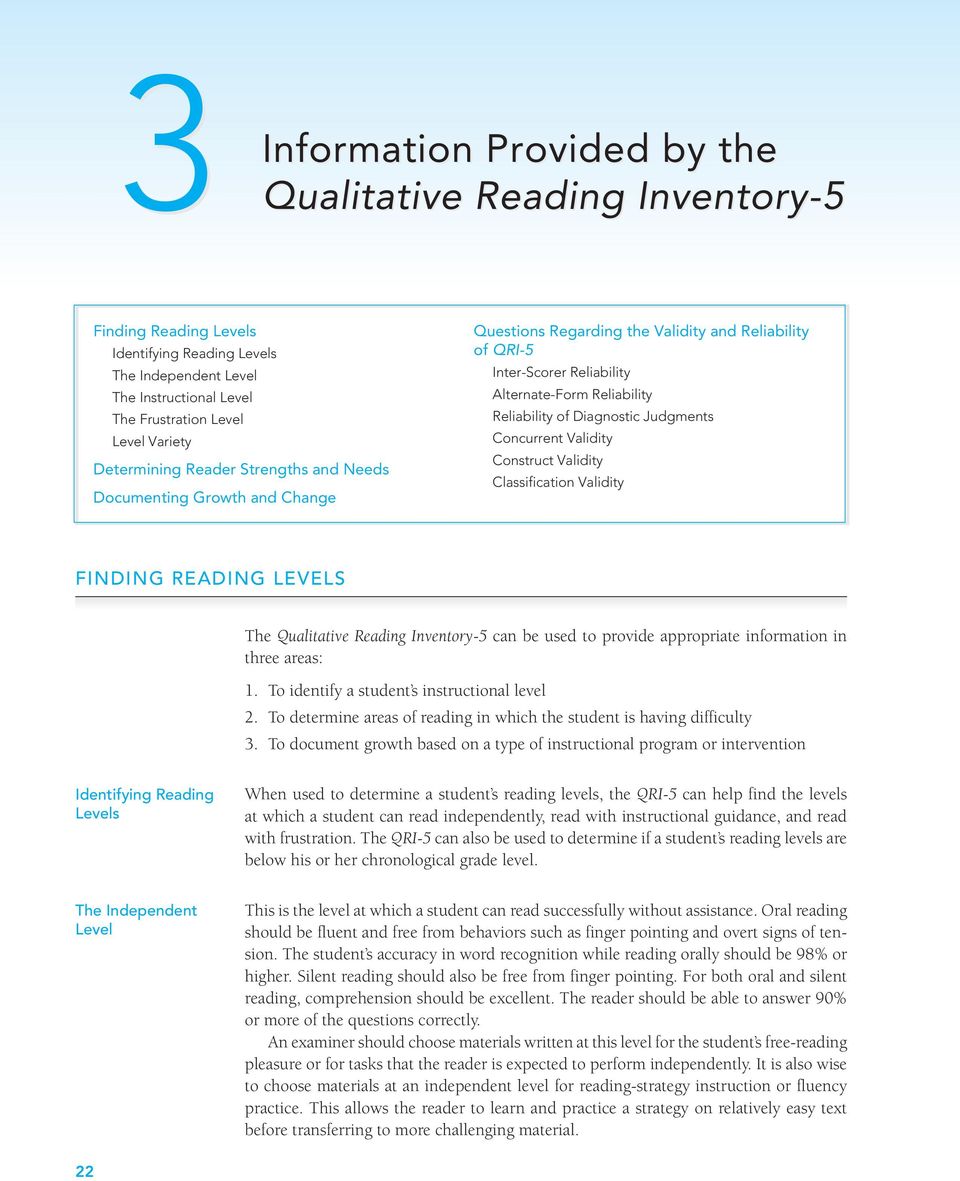
1 3 Information Information Provided by the Qualitative Reading Inventory-5 Finding Reading Levels Identifying Reading Levels The Independent Level The Instructional Level The Frustration Level Level Variety Determining Reader Strengths and Needs Documenting Growth and Change Questions Regarding the Validity and Reliability of QRI-5 Inter-Scorer Reliability Alternate-Form Reliability Reliability of Diagnostic Judgments Concurrent Validity Construct Validity Classification Validity FINDING READING LEVELS The Qualitative Reading Inventory-5 can be used to provide appropriate information in three areas: 1. To identify a student s instructional level 2. To determine areas of reading in which the student is having difficulty 3. To document growth based on a type of instructional program or intervention Identifying Reading Levels When used to determine a student s reading levels, the QRI-5 can help find the levels at which a student can read independently, read with instructional guidance, and read with frustration. The QRI-5 can also be used to determine if a student s reading levels are below his or her chronological grade level. The Independent Level This is the level at which a student can read successfully without assistance. Oral reading should be fluent and free from behaviors such as finger pointing and overt signs of tension. The student s accuracy in word recognition while reading orally should be 98% or higher. Silent reading should also be free from finger pointing. For both oral and silent reading, comprehension should be excellent. The reader should be able to answer 90% or more of the questions correctly. An examiner should choose materials written at this level for the student s free-reading pleasure or for tasks that the reader is expected to perform independently. It is also wise to choose materials at an independent level for reading-strategy instruction or fluency practice. This allows the reader to learn and practice a strategy on relatively easy text before transferring to more challenging material. 22
2 The Instructional Level This is the level at which a student can read with assistance from a teacher. Both oral and silent reading should be free from behaviors that often indicate serious difficulty, such as finger pointing or tension. Although oral reading may be less fluent at this level than at the independent level, it should retain some sense of rhythm and expression. The examiner should use a criterion of 95% accuracy when counting only those miscues that changed the meaning of the passage. Our pilot data revealed that 95% Acceptable Accuracy best predicts comprehension at the instructional level. The examiner who is counting all miscues should use a criterion of 90% accuracy, and the student should correctly answer 70% of the questions asked. Materials written at this level should be chosen for reading and content-area instruction. This placement assumes that the teacher will introduce words and concepts that are likely to be unfamiliar to the readers. She or he presents the identification and meaning of these concepts and provides appropriate background knowledge necessary for understanding the material. Obviously, when students are placed at the instructional level, the teacher should not say, Read Chapter 5 and we ll have a test tomorrow. A student s instructional level, once determined, can be compared to the student s chronological grade placement. Is it below the level of materials that are appropriate for that grade level? Such information will allow the examiner to estimate the severity of a reading problem. Assessment specialists once believed that a student had a reading problem if there was a substantial difference between expectancy level or reading potential and instructional level with familiar material. Expectancy level or reading potential was generally based on IQ; however, this practice has been seriously questioned (Aaron, 1997). The reauthorization of the Individuals with Disabilities Education Act (2004) conceptualizes reading problems in terms of lack of response to instruction and it may be more appropriate to talk of serious reading problems in terms of a discrepancy between the student s reading level and his or her chronological grade level. Spache (1981) described severe reading problems as follows: The problem is severe if a first, second, or third grader is a year or more behind or if a fourth, fifth, or sixth grader is two or more years behind. For students in seventh grade and above, a severe problem means three or more years behind their grade level. The Frustration Level At this level, the student is completely unable to read the material with adequate word identification or comprehension. Signs of difficulty and tension are evident. Oral reading lacks fluency and expression; a word-for-word, halting style is common. Accuracy of word recognition is less than 90%, and less than 70% of the questions are answered correctly. Teachers should avoid materials at this level. Level Variety Although once common, it is now simplistic to talk about a single independent, instructional, or frustration level for an individual. The act of reading is highly complex and contextual. When students possess extensive prior knowledge about a topic, they can read and comprehend at a higher level than when dealing with unfamiliar material. This is well illustrated by the difficulty that mature readers often have with an income tax form or the language of an insurance policy. Text structure also affects a student s reading ability. The diverse structure and concept density of expository material makes it more difficult to comprehend than narrative text. Whether a student reads orally or silently can affect comprehension, depending on the age of the student. Younger, less-fluent readers generally do better in oral reading, whereas older readers are often constrained Finding Reading Levels 23

3 by the performance aspect of oral reading, and their comprehension suffers accordingly. The variety of passages in the Qualitative Reading Inventory-5 allows the examiner to evaluate the effects of background knowledge, text structure, and reading mode on the independent, instructional, and frustration levels of the reader. It is not inconceivable that a single reader may have different levels for familiar and unfamiliar text, for narrative and expository material, and for oral and silent reading modes. The presence or absence of pictures may affect performance. Levels may also vary depending on whether the examiner is assessing comprehension with or without look-backs. A student may be at a frustration level for answering questions without referring to the text but may achieve an instructional level when allowed to utilize the look-back strategy. Which reading level is most important? Given the constraints of time, few examiners would be able to determine all possible reading levels that a student might have. Based on individual purposes and needs, each examiner will have to choose which reading level to isolate for a given student. Which level best estimates the overall reading ability of the student? Determination of the familiar narrative reading level seems most essential. Because reading familiar narrative text is generally easier than dealing with expository and unfamiliar material, the familiar narrative level probably represents a reader s best effort. However, in unfamiliar, concept-dense, and lengthy texts, the level attained after look-backs may represent the reader s best effort. DETERMINING READER STRENGTHS AND NEEDS Another purpose of the QRI-5 is to indicate the conditions under which a student would perform successfully or unsuccessfully in reading. For most readers with serious problems, strengths and needs in reading are evident. The QRI-5 is designed to identify these strengths and needs by providing more information about why a student is not reading well. Table 3.1 lists questions that the QRI-5 is designed to answer. The table also provides suggestions for intervention strategies. DOCUMENTING GROWTH AND CHANGE The QRI-5 can be used to assess a student s growth in the level of materials that he or she can read with at least 90% accuracy, 95% acceptable accuracy, and 70% comprehension. That is, the QRI-5 can be used to determine a change in the student s instructional reading level as long as the pre-test and post-test use the same genre. Beginning readers are more often exposed to narrative text, and the differences in their comprehension of narrative and expository text are apparent. Students reading at pre-primer, primer, first grade, and second grade levels reliably comprehend narrative text better than expository texts (Leslie & Caldwell, 1989). Students above those reading levels reliably retell stories better than exposition. It is recommended that when materials are used to judge growth or change in a student s reading level, the same genre should be used at pre-test and post-test. A number of published studies have used the QRI to document growth in reading based on a type of instructional program or intervention. These studies are found in the References and are marked with an asterisk. 24 Section 3 / Information Provided by the Qualitative Reading Inventory-5

4 Table 3.1 Determining Reader Strengths and Needs and Providing Intervention Student Strengths and Needs as Indicated by QRI-5 identify words accurately? identify words automatically? What is the depth of the student s prior knowledge? comprehend successfully? answer questions? use look-backs to locate answers in the text? What is the quality of the student s think-alouds during reading? Suggested Intervention Strategies* Chapter 4: Phonological Awareness Chapter 5: Word Identification Instruction: Phonics and More Chapter 6: Word Identification Instruction: Fluency Chapter 7: Prior Knowledge and Concept Development Chapter 12: General Interactive Strategies Chapter 8: Vocabulary Learning Chapter 11: Instruction: Answering Questions Chapter 12: Instruction: General Interactive Strategies Sample lesson: Rhyming Sample lesson: Onset-rime awareness Elkonin boxes Sample lesson connecting letters and sounds Guidelines for exemplary phonics instruction Teaching consonant sounds using shared reading Teaching vowel sounds: Using spelling patterns to read by analogy Cross-checking Teaching high-frequency words by sight Practicing sight words in isolation Word cards and word sorts Guided reading General principles for developing fluency Reading aloud to students Fostering wide reading Providing modeling: Assisted reading; echo reading; paired reading; partner reading; structured repeated reading Performance reading: Choral reading; reader s theater; radio reading Lesson procedures for developing fluency: Fluency development lesson; supported oral reading; fluency-oriented reading instruction Determining critical concepts Building a knowledge base Directed reading-thinking activity Visual imagery KWL Reciprocal teaching Thinking aloud Discussion cards General principles for developing vocabulary learning Personalizing word learning Clustering word learning Building words Comparing word meaning General principles for helping students to answer questions Question answer relationships Content-free questions Thinking aloud continued Documenting Growth and Change 25

5 Table 3.1 (continued) Student Strengths and Needs as Indicated by QRI-5 Does the student organize recall? Suggested Intervention Strategies* Chapter 9: Instruction: Retelling Narrative Text Chapter 10: Instruction: Expository Retelling General principles for developing narrative retelling The importance of modeling General principles for developing effective expository retellings Expository expectation grid Expository idea map Main idea map *From Caldwell, J. S., & Leslie, L. (2009). Intervention strategies to follow informal reading inventory assessment: So what do I do now? Boston: Allyn & Bacon. QUESTIONS REGARDING THE VALIDITY AND RELIABILITY OF QRI-5 Because QRI-5 is an informal assessment instrument, questions may arise about the validity and reliability of the information provided. Although Chapter 15 addresses these issues in detail, a few comments are appropriate at this point. Inter-Scorer Reliability The QRI-5 results are scored by different individuals. Analysis of prior-knowledge scores, oral reading miscues, and answers to comprehension questions all require judgment on the part of the examiner. Therefore, inter-scorer reliability becomes an issue. Can two independent examiners score the same answers in the same way? We believe that they can if they are trained using QRI-5 guidelines. On prior knowledge scores of over 300 concepts, the agreement reached between two independent scorers was 98% (QRI-3, p. 436). Agreement between independent examiners on identifying oral reading miscues and miscues that change meaning was 99%. Finally, the reliability of scoring answers to comprehensions questions was 98% for both explicit and implicit items (Leslie & Caldwell, 1989). Alternate-Form Reliability This measure is used to determine the consistency with which an instructional level would be the same if two passages of the same genre were used. We examined the reliability of comprehension scores on two passages at the same readability level by asking how close the two scores were to the instructional-level cutoff score of 70%. The degree of consistency in comprehension scores on two passages of the same readability was always above.80, and 75% were above.90. Over 70% of the time the same instructional level would be obtained independent of the passage chosen, as long as the same genre was used. It should be noted, however, that some of the pre-primer passages include pictures and others do not. For the beginning reader, one cannot assume that the same instructional level would be obtained if pictured and non-pictured passages are compared, because beginning readers rely heavily on picture clues. Reliability of Diagnostic Judgments Two judges independently scored data from 108 children to determine the reliability of diagnostic judgments. The following data were available for all students: current grade placement, percent accuracy on word lists, percent oral reading accuracy on all passages 26 Section 3 / Information Provided by the Qualitative Reading Inventory-5

6 read orally, and comprehension on all passages read. Judgments were made within type of text (i.e., narrative or expository). The judges classified the students difficulties in reading as word recognition or comprehension within text types. The judges agreed on the diagnostic category of the students abilities 87% of the time. Concurrent Validity What is the relationship between two scores on assessments that are given close to each other in time? For example, how do scores on the QRI compare to scores on normreferenced achievement tests? Correlations between the two measures were all positive and statistically significant. Section 15 presents data illustrating that scores on the QRI are correlated with standardized norm-referenced tests to a significant degree. Positive correlations between the QRI and measures such as the Wisconsin Knowledge and Concepts Evaluation, the Iowa Test of Basic Skills, the Woodcock Reading Test, and the Measures of Academic Progress were all positive and statistically significant. Construct Validity Construct validity is determined by correlations between various types of data. We examined correlations between word identification on the word lists, oral reading accuracy on passages, semantic acceptability of oral reading miscues, and reading rate (in words per minute). For students with instructional reading levels at or below second grade, these variables were highly correlated. Word identification in a story was also significantly correlated with comprehension through the first grade instructional reading level. Beyond first grade there appear to be factors other than word identification at work, such as prior knowledge and text structure. That is, students could read a passage accurately enough to meet the oral reading accuracy criteria for instructional reading level but not meet the criteria for comprehension. Classification Validity We analyzed whether the comprehension scores of students whose word-list score were higher or lower than their instructional reading levels (good word identifiers vs. poor word identifiers) could be predicted by similar or different variables. The comprehension scores of good word identifiers with second and third grade instructional levels were predicted by text type (narrative vs. expository). The comprehension scores of good word identifiers with fourth through sixth grade instructional levels were predicted by prior-knowledge scores. Therefore, there appears to be developmental and individual differences in the factors that influence students comprehension scores. Questions Regarding the Validity and Reliability of QRI-5 27
Description of the Qualitative Reading Inventory-5
 1 Description Description of the Qualitative Reading Inventory-5 General Description of the Qualitative Reading Inventory-5 The Word Lists The Pre-Primer, Primer, First Grade, and Second Grade Third Grade
Suggested Components for 90-Minute Wave 1 Literacy Blocks throughout Primary years
 Suggested s for 90-Minute Wave 1 Literacy Blocks throughout Primary years Notes 1. These are suggestions only but reflect the need to include components of each of the Big Six in each Literacy Block. 2.
Reading Competencies
 Reading Competencies The Third Grade Reading Guarantee legislation within Senate Bill 21 requires reading competencies to be adopted by the State Board no later than January 31, 2014. Reading competencies
Reading Specialist (151)
 Purpose Reading Specialist (151) The purpose of the Reading Specialist test is to measure the requisite knowledge and skills that an entry-level educator in this field in Texas public schools must possess.
READING SPECIALIST STANDARDS
 READING SPECIALIST STANDARDS Standard I. Standard II. Standard III. Standard IV. Components of Reading: The Reading Specialist applies knowledge of the interrelated components of reading across all developmental
Reading Assessment BTSD. Topic: Reading Assessment Teaching Skill: Understanding formal and informal assessment
 Reading Assessment BTSD Topic: Reading Assessment Teaching Skill: Understanding formal and informal assessment Learning Outcome 1: Identify the key principles of reading assessment. Standard 3: Assessment,
240Tutoring Reading Comprehension Study Material
 240Tutoring Reading Comprehension Study Material This information is a sample of the instructional content and practice questions found on the 240Tutoring PRAXIS II Middle School English Language Arts
Massachusetts Tests for Educator Licensure
 Massachusetts Tests for Educator Licensure FIELD 90: FOUNDATIONS OF READING TEST OBJECTIVES Subarea Multiple-Choice Range of Objectives Approximate Test Weighting I. Foundations of Reading Development
Choral Reading Type: Strategy Literacy Skill: Reading Domain:
 Choral Reading Strategy Literacy Skill: Reading Fluency Grade Level Uses: K-20 Special Population: N/A; Need to modify the reading for ELL and Special Needs with accommodations Cognitive Process: Comprehension
Exceptional Student Education K 12
 Exceptional Student Education K 12 Section 61 1 Knowledge of foundations of exceptional student education 1. Identify state and federal legislation and case law that have affected the education of students
Assessing Children s Reading Comprehension in K-5. Scott Paris University of Michigan/CIERA
 Assessing Children s Reading Comprehension in K-5 Scott Paris University of Michigan/CIERA With the collaboration of Rob Carpenter, Ali Paris, Ingham ISD and many colleagues at With SPECIAL Thanks to Bill
DRA2 Word Analysis. correlated to. Virginia Learning Standards Grade 1
 DRA2 Word Analysis correlated to Virginia Learning Standards Grade 1 Quickly identify and generate words that rhyme with given words. Quickly identify and generate words that begin with the same sound.
KINDGERGARTEN. Listen to a story for a particular reason
 KINDGERGARTEN READING FOUNDATIONAL SKILLS Print Concepts Follow words from left to right in a text Follow words from top to bottom in a text Know when to turn the page in a book Show spaces between words
St. Petersburg College. RED 4335/Reading in the Content Area. Florida Reading Endorsement Competencies 1 & 2. Reading Alignment Matrix
 Course Credit In-service points St. Petersburg College RED 4335/Reading in the Content Area Florida Reading Endorsement Competencies 1 & 2 Reading Alignment Matrix Text Rule 6A 4.0292 Specialization Requirements
Indiana Department of Education
 GRADE 1 READING Guiding Principle: Students read a wide range of fiction, nonfiction, classic, and contemporary works, to build an understanding of texts, of themselves, and of the cultures of the United
There are basically three options available for overcoming barriers to learning:
 COGNITIVE SKILLS DEVELOPMENT Teacher Introduction Determining Your Students Weaknesses (Excerpts from article by Dr. Ken Gibson, Founder and CEO of LearningRx) Do you have students who struggle to understand
Phonics and Word Work
 Phonics and Word Work Introduction Foundational Skills This guide explores how explicit and systematic phonics and word work instruction is included in the ReadyGEN program. It looks at the resources that
How To Teach Reading
 Florida Reading Endorsement Alignment Matrix Competency 1 The * designates which of the reading endorsement competencies are specific to the competencies for English to Speakers of Languages (ESOL). The
Using Leveled Text to Teach and Support Reading Strategies
 Using Leveled Text to Teach and Support Reading Strategies The text structures of leveled text support the teaching of strategies along a developmental continuum. As the levels increase, the demands on
20 by Renaissance Learning, Inc. All rights reserved. Printed in the United States of America.
 R4 Advanced Technology for, Renaissance, Renaissance Learning, Renaissance Place, STAR Early Literacy, STAR Math, and STAR Reading, are trademarks of Renaissance Learning, Inc., and its subsidiaries, registered,
Reading K 12 Section 35
 Reading K 12 Section 35 * *Competencies and skills incorporate the scientifically based reading research (SBRR) and the components of Florida's formula for reading success addressing improved reading outcomes
Unit 2 Title: Word Work Grade Level: 1 st Grade Timeframe: 6 Weeks
 Unit 2 Title: Grade Level: 1 st Grade Timeframe: 6 Weeks Unit Overview: This unit of word work will focus on the student s ability to identify and pronounce the initial, medial vowel, and final sounds.
Preparation Manual. Texas Examinations of Educator Standards (TExES ) Program. Reading Specialist (151)
 Texas Examinations of Educator Standards (TExES ) Program Preparation Manual Reading Specialist (151) Copyright 2012 by Texas Education Agency (TEA). All rights reserved. The Texas Education Agency logo
3rd Grade Reading Standard Exceeds (4) Secure (3) Developing (2) Beginning (1)
 3rd Grade Reading Standard Exceeds (4) Secure (3) Developing (2) Beginning (1) based on the Refer to details and examples in a text when explaining what the text says explicitly and when drawing inferences
& Sample Lesson. Before Reading. Sight Word Review (1 minute)
 Planning Support & Sample Lesson TIP The Early Guided Reading Lesson Plan found on page 190 in the Appendix is a template you can use to plan your lessons. Each component of the lesson is described in
The National Reading Panel: Five Components of Reading Instruction Frequently Asked Questions
 The National Reading Panel: Five Components of Reading Instruction Frequently Asked Questions Phonemic Awareness What is a phoneme? A phoneme is the smallest unit of sound in a word. For example, the word
OCPS Curriculum, Instruction, Assessment Alignment
 OCPS Curriculum, Instruction, Assessment Alignment Subject Area: Grade: Strand 1: Standard 1: Reading and Language Arts Kindergarten Reading Process The student demonstrates knowledge of the concept of
Reading/Fluency Standards Based Annual Goals
 Reading/Fluency First grade (1.5.1) The student will establish letter-naming fluency at a rate of 40-plus letters per minute by the First grade (1.5.3) When given a first grade passage, the student will
Strategies to improve reading fluency skills. Nancy B. Swigert, M.A., CCC/SLP The Reading Center Lexington, KY 40503 Thereadingcenter@aol.
 Strategies to improve reading fluency skills Nancy B. Swigert, M.A., CCC/SLP The Reading Center Lexington, KY 40503 [email protected] Goals for this session 1. Discuss the areas of skill (e.g. letter
Reading Specialist Certification
 tlac.tamu.edu Reading Specialist Certification Purpose The purpose of the Reading Specialist test is to measure the requisite knowledge and skills that an entry-level educator in this field in Texas public
A SAMPLE INDIVIDUALIZED EDUCATION PROGRAM (IEP)
 A SAMPLE INDIVIDUALIZED EDUCATION PROGRAM (IEP) -INDIVIDUALIZED EDUCATION PROGRAM (IEP) Format **************************************************************** School Age IEP Team Meeting Date: November
TRAINGING GUIDE. To Log in type the web address www.readinga-z.com into your browser. This will open the Reading A-Z home page.
 TRAINGING GUIDE Getting Started To Log in type the web address www.readinga-z.com into your browser. This will open the Reading A-Z home page. Click Members at top right hand corner of the screen. Type
ENGLISH LANGUAGE ARTS
 ENGLISH LANGUAGE ARTS INTRODUCTION Clear student learning outcomes and high learning standards in the program of studies are designed to prepare students for present and future language requirements. Changes
Academic Standards for Reading, Writing, Speaking, and Listening
 Academic Standards for Reading, Writing, Speaking, and Listening Pre-K - 3 REVISED May 18, 2010 Pennsylvania Department of Education These standards are offered as a voluntary resource for Pennsylvania
Reading Strategies by Level. Early Emergent Readers
 The charts below were created as a common language for teachers and students in the Wallingford Public Schools in kindergarten through eighth grade. The level of the chart selected for use in the classroom
APPENDIX B CHECKLISTS
 APPENDIX B CHECKLISTS Kindergarten First Grade Second Grade Third Grade 69 70 Teacher Visit 1 By: Date / / Time - WG SG Visit 2 By: Date / / Time - WG SG Visit 3 By: Date / / Time - WG SG VISITS 1 2 3
2016 CLS Summer Schedule and Tuition. Academic Program:
 Providing direct support to students through tutoring, testing, providing enrichment activities, emphasizing critical thinking activities, mentoring, and supporting our students to increase personal academic
Grading Benchmarks FIRST GRADE. Trimester 4 3 2 1 1 st Student has achieved reading success at. Trimester 4 3 2 1 1st In above grade-level books, the
 READING 1.) Reads at grade level. 1 st Student has achieved reading success at Level 14-H or above. Student has achieved reading success at Level 10-F or 12-G. Student has achieved reading success at Level
ELL Considerations for Common Core-Aligned Tasks in English Language Arts
 ELL Considerations for Common Core-Aligned Tasks in English Language Arts A substantial body of research clearly indicates that utilizing specific instructional modifications as well as targeted pedagogical
Unit 2 Title: Word Work Grade Level: Kindergarten Timeframe: 6 Weeks
 Unit 2 Title: Grade Level: Kindergarten Timeframe: 6 Weeks Unit Overview: This unit of word work will focus on the student s ability to produce the primary letter sounds of consonants and some vowels;
Sitton Spelling & Word Skills Program Overview Grades K 8
 Sitton Spelling & Word Skills Program Overview Grades K 8 Spelling instruction that transfers to everyday writing Sitton Kindergarten Literacy and Word Skills Aligned to the ommon Core STATE STANDARDS
TExMaT I Texas Examinations for Master Teachers. Preparation Manual. 085 Master Reading Teacher
 TExMaT I Texas Examinations for Master Teachers Preparation Manual 085 Master Reading Teacher Copyright 2006 by the Texas Education Agency (TEA). All rights reserved. The Texas Education Agency logo and
A Consumer s Guide to Evaluating a Core Reading Program Grades K-3: A Critical Elements Analysis
 A Consumer s Guide to Evaluating a Core Reading Program Grades K-3: A Critical Elements Analysis National Center to Improve thetools of Educators Deborah C. Simmons, Ph. D. Edward J. Kame enui, Ph. D.
Understanding Types of Assessment Within an RTI Framework
 Understanding Types of Assessment Within an RTI Framework Slide 1: Welcome to the webinar Understanding Types of Assessment Within an RTI Framework. This is one of 11 webinars that we have developed at
Making Reading Content Comprehensible for Intermediate Language Learners. Colin Dalton. University of Houston-Downtown, United States
 Making Reading Content Comprehensible for Intermediate Language Learners Colin Dalton University of Houston-Downtown, United States 0135 The European Conference on Language Learning 2013 Official Conference
Oral Fluency Assessment
 Fluency Formula: Oral Fluency Assessment IMPACT STUDY Fluency Formula: Oral Fluency Assessment A Successful Plan for Raising Reading Achievement 1 Table of Contents The Challenge: To Have 90% of Students
Unit 1 Title: Word Work Grade Level: 1 st Grade Timeframe: 6 Weeks
 Unit 1 Title: Grade Level: 1 st Grade Timeframe: 6 Weeks Unit Overview: This unit of word work will focus on the student s ability to distinguish long and short vowel sounds in single syllable Students
ASSESSING WORD RECOGNITION IN ISOLATION
 ASSESSING WORD RECOGNITION IN ISOLATION Rationale Accurate, automatic recognition of printed words drives the reading process (Adams, 1990; Rayner, Foorman, Perfetti, Pesetsky, & Seidenberg, 2001). Word
Requirements EDAM-5002. WORD STUDY K-3: PRINT AWARENESS, LETTER KNOWLEDGE, PHONICS, AND HIGH FREQUENCY WORDS
 LETTER OF ENDORSEMENT: TEACHER LEADERSHIP AND INSTRUCTIONAL COACHING Requirements Dr. Grace Surdovel, Director of Master's Programs/Faculty of Practice The Letter of Endorsement in Teacher Leadership and
READING WITH. Reading with Pennsylvania Reading Specialist Certificate
 READING WITH PENNSYLVANIA READING SPECIALIST CERTIFICATE Reading with Pennsylvania Reading Specialist Certificate Program Coordinator: Ms. Anne Butler The Master of Science degree in Education with a concentration
Best Practices. Using Lexia Software to Drive Reading Achievement
 Best Practices Using Lexia Software to Drive Reading Achievement An overview of Implementation Principles to apply in your school for using Lexia Reading Skills Software to Close the Reading Achievement
Grade 3 Reading Comprehension Sample Selections and Items Test Information Document
 Grade 3 Reading Comprehension Sample Selections and Items Test Information Document Copyright 2005 by the North Carolina Department of Public Instruction This publication and the information contained
What Does Research Tell Us About Teaching Reading to English Language Learners?
 Jan/Feb 2007 What Does Research Tell Us About Teaching Reading to English Language Learners? By Suzanne Irujo, ELL Outlook Contributing Writer As a classroom teacher, I was largely ignorant of, and definitely
Using Direct Instruction Programs as Intervention Programs in Grades K 3
 Using Direct Instruction Programs as Intervention Programs in Grades K 3 Direct Instruction News Volume 5, Number 2 Summer 2005 Introduction This article is about the use of Direct Instruction as an intervention
Directions for Administering the Graded Passages
 Directions for Administering the Graded Passages The versions (A D for grades 9 12; A and B for adult literacy students at grades 1 8) of Graded Passages are about different topics but similar in length
Selecting Research Based Instructional Programs
 Selecting Research Based Instructional Programs Marcia L. Grek, Ph.D. Florida Center for Reading Research Georgia March, 2004 1 Goals for Today 1. Learn about the purpose, content, and process, for reviews
INTEGRATING THE COMMON CORE STANDARDS INTO INTERACTIVE, ONLINE EARLY LITERACY PROGRAMS
 INTEGRATING THE COMMON CORE STANDARDS INTO INTERACTIVE, ONLINE EARLY LITERACY PROGRAMS By Dr. Kay MacPhee President/Founder Ooka Island, Inc. 1 Integrating the Common Core Standards into Interactive, Online
Strand: Reading Literature Topics Standard I can statements Vocabulary Key Ideas and Details
 Strand: Reading Literature Key Ideas and Craft and Structure Integration of Knowledge and Ideas RL.K.1. With prompting and support, ask and answer questions about key details in a text RL.K.2. With prompting
Virginia English Standards of Learning Grade 8
 A Correlation of Prentice Hall Writing Coach 2012 To the Virginia English Standards of Learning A Correlation of, 2012, Introduction This document demonstrates how, 2012, meets the objectives of the. Correlation
Guided Reading with Emergent Readers by Jeanne Clidas, Ph.D.
 Bebop Books Guided Reading with Emergent Readers by Jeanne Clidas, Ph.D. What Is Guided Reading? Guided reading involves a small group of children thinking, talking, and reading through a new text with
Woodcock Reading Mastery Tests Revised, Normative Update (WRMT-Rnu) The normative update of the Woodcock Reading Mastery Tests Revised (Woodcock,
 Woodcock Reading Mastery Tests Revised, Normative Update (WRMT-Rnu) The normative update of the Woodcock Reading Mastery Tests Revised (Woodcock, 1998) is a battery of six individually administered tests
There are many reasons why reading can be hard. This handout describes
 Understand the problems a child may be having with reading, and target what you can do to help! Look inside for practical, research-based information for parents and teachers about: Phonological and Phonemic
Students with Reading Problems Their Characteristics and Needs
 Students with Reading Problems Their Characteristics and Needs Roxanne Hudson, Ph.D. Florida Center for Reading Research Florida State University [email protected] We want all students to read grade level
DR. PAT MOSSMAN Tutoring
 DR. PAT MOSSMAN Tutoring INDIVIDUAL INSTRuction Reading Writing Math Language Development Tsawwassen and ladner pat.moss10.com - 236.993.5943 [email protected] Testing in each academic subject is
Words Their Way TM. Word Study in Action. Correlated to: North Carolina STANDARD COURSE OF STUDY Language Arts for Third Grade
 TM Word Study in Action Correlated to: North Carolina STANDARD COURSE OF STUDY Language Arts for Third Grade For More Information Contact Debbie Owens, Sales Representative 1-800-435-3499 Ext. 8092 www.pearsonlearning.com
1. PROGRAM TITLE 2. PROGRAM RATIONALE AND PURPOSE
 1. PROGRAM TITLE Add-on Certification Program: Reading Endorsement 2. PROGRAM RATIONALE AND PURPOSE Mastery of reading skills is basic to successful learning in every school subject. There are teachers
Florida Center for Reading Research RAVE-O
 1 Florida Center for Reading Research RAVE-O What is RAVE-O? RAVE-O (Retrieval, Automaticity, Vocabulary, Engagement-Orthography) is a comprehensive, fluency reading and comprehension intervention program
Pre-Requisites EDAM-5001 Early Literacy Guiding Principles and Language
 . EDAM EDAM-5001. EARLY LITERACY: GUIDING PRINCIPLES AND LANGUAGE DEVELOPMENT This course is the prerequisite for all other courses in the Early Childhood Literacy program. It outlines the philosophical
What Is Leveled Reading? Learn how teachers are helping kids become better readers by matching them to the right books at the right time.
 What Is Leveled Reading? Learn how teachers are helping kids become better readers by matching them to the right books at the right time. By Deborah Wilburn-Scholastic & Jennifer Smith The Importance of
Elementary Reading Assessment Framework and Guide April 2008
 Hastings and Prince Edward District School Board Elementary Reading Framework and Guide April 2008 Students, parents, and teachers can build a community where learning is supported by assessment only when
cvbnmqwertyuiopasdfghjklzxcvbnmq wertyuiopasdfghjklzxcvbnmqwertyui opasdfghjklzxcvbnmqwertyuiopasdfg hjklzxcvbnmqwertyuiopasdfghjklzxc
 qwertyuiopasdfghjklzxcvbnmqwerty uiopasdfghjklzxcvbnmqwertyuiopasd fghjklzxcvbnmqwertyuiopasdfghjklzx A LITERACY PRACTICES GUIDE cvbnmqwertyuiopasdfghjklzxcvbnmq Prep to Year 1 This guide provides a means
FAQ about Reading Workshop
 FAQ about Reading Workshop My child is in Level M. What does that mean as far as a grade level that I can understand? Several different systems exist today for organizing reading levels. The one used in
Diagnostic Assessments of Reading. Second Edition Form A
 Diagnostic Assessments of Reading Second Edition Form A A Snapshot Diagnostic Reading Assessments Ages 5 Adult Reading Levels from Early Reading through High School Nine Tests of Components of Reading
CRCT Content Descriptions based on the Georgia Performance Standards. Reading Grades 1-8
 CRCT Content Descriptions based on the Georgia Performance Standards Reading Grades 1-8 Kathy Cox State Superintendent of Schools June 2007 Criterion-Referenced Competency Tests (CRCT) Content Descriptions
Minnesota K-12 Academic Standards in Language Arts Curriculum and Assessment Alignment Form Rewards Intermediate Grades 4-6
 Minnesota K-12 Academic Standards in Language Arts Curriculum and Assessment Alignment Form Rewards Intermediate Grades 4-6 4 I. READING AND LITERATURE A. Word Recognition, Analysis, and Fluency The student
Florida Center for Reading Research
 1 Florida Center for Reading Research Reading Recovery What is Reading Recovery? Reading Recovery is a short term, early reading intervention for the lowest performing students in first grade. Descubriendo
Reading K 10 Grade Level Expectations: A New Level of Specificity
 Reading K 10 Grade Level Expectations: A New Level of Specificity Washington State s Essential Academic Learning Requirements Introduction Contents Introduction................................... 1 Overview..................................
Develop Struggling Readers Skills, Grades 3 Adult
 Develop Struggling Readers Skills, Grades 3 Adult Corrective Reading Comprehension and Decoding Grades 3 Adult 2 Corrective Reading Comprehension and Decoding Grades 3 Adult For struggling students, the
The Three Cueing Systems
 Hastings and Prince Edward District School Board C.O.D.E Project, 2007 The Three Cueing Systems Sample Questions, Instructional Strategies and Examples of MSV Cues Written and developed by: Cassandra Bellwood,
Running head: EFFECTS OF PEER TUTORING ON STUDENT ACHIEVEMENT 1. Effects of Peer Tutoring on Student Achievement
 Running head: EFFECTS OF PEER TUTORING ON STUDENT ACHIEVEMENT 1 Effects of Peer Tutoring on Student Achievement A Master s Research Project Presented to The Faculty of the Patton College of Education and
Domain I: Organizing Reading Instruction Based On Ongoing Assessment
 Domain I: Organizing Reading Instruction Based On Ongoing Assessment There are approximately 65-70 multiple choice questions on the RICA exam. These include both content questions, in which knowledge about
LevelSet: Online Lexile Assessment
 LevelSet: Online Lexile Assessment Accurately match students to instructional text without taking time away from instruction Achieve3000 s LevelSet, an online assessment that utilizes the Lexile Framework,
Jack s Dyslexia Index indicates he has dyslexic difficulties that are mild in extent.
 Dyslexia Portfolio Report for Jack Jones Assessed by Sue Thompson on 05/08/2009 Report for parents When a child is identified as dyslexic, additional support will be needed from both school and home to
Mendham Township School District Reading Curriculum Kindergarten
 Mendham Township School District Reading Curriculum Kindergarten Kindergarten Unit 1: We Are Readers Exploring the Exciting World of Books Reading Level Benchmark: Emergent Story Books & Shared Reading
Reading VIII Grade Level 8
 Reading VIII Reading VIII introduces students to a variety of topics to enrich their reading experience including: understanding common misspellings using prefixes, suffixes, root words, and forming compounds
Reading: Text level guide
 Reading: Text level guide Text level guide for seen text and accompanying background information. As teachers we provide the range of experiences and the instruction necessary to help children become good
Grade 1 LA. 1. 1. 1. 1. Subject Grade Strand Standard Benchmark. Florida K-12 Reading and Language Arts Standards 27
 Grade 1 LA. 1. 1. 1. 1 Subject Grade Strand Standard Benchmark Florida K-12 Reading and Language Arts Standards 27 Grade 1: Reading Process Concepts of Print Standard: The student demonstrates knowledge
EFFECTIVE INSTRUCTIONAL STRATEGIES TO ENHANCE VOCABULARY DEVELOPMENT IN ELEMENTARY CLASSROOMS. Dara L. Iwankovitsch
 EFFECTIVE VOCABULARY INSTRUCTION 1 EFFECTIVE INSTRUCTIONAL STRATEGIES TO ENHANCE VOCABULARY DEVELOPMENT IN ELEMENTARY CLASSROOMS By Dara L. Iwankovitsch SUBMITTED IN PARTIAL FULFILLMENT OF THE REQUIREMENTS
READING KINDERGARTEN
 READING KINDERGARTEN Concepts about print Identify the front cover, back cover, and title page of a book. Follow words from left to right and from top to bottom on the printed page. Understand that printed
Fluency and Reader s Theater. Jennifer Haws Virginia Beach City Public Schools
 Fluency and Reader s Theater Jennifer Haws Virginia Beach City Public Schools December 12, 2008 2 Introduction As a reading specialist, I have always been surprised by the way students read aloud. While
Reading for Virginia Educators: Elementary and Special Education
 The Praxis Study Companion Reading for Virginia Educators: Elementary and Special Education 5306 www.ets.org/praxis Welcome to the Praxis Study Companion Welcome to the Praxis Study Companion Prepare to
Background to the new Staffordshire Grids
 Background to the new Staffordshire Grids The removal of levels for most pupils in 2014-15 and all pupils in 2015-16, has posed a problem for schools in how to assess children s progress in the New National
Present Level statements must: Goals and Objectives Progress Reporting. How Progress will be determined: Goals must be: 12/3/2013
 Present Level statements must: Goals and Objectives Progress Reporting Establish a baseline (snapshot) of measurable information that serves as the starting point for developing goals and objectives. Include
Mini-Lessons for FLUENCY
 Mini-Lessons for FLUENCY Rate 1. Fast finger: Guided Reading levels A-D) Prompt the child to Read it with a fast finger. Demonstrate this by having the students read it with their finger while you read
WiggleWorks Aligns to Title I, Part A
 WiggleWorks Aligns to Title I, Part A The purpose of Title I, Part A Improving Basic Programs is to ensure that children in high-poverty schools meet challenging State academic content and student achievement
Common Core State Standards English Language Arts. IEP Goals and Objectives Guidance: Basic Format
 Current Academic Achievement Common Core State Standards English Language Arts IEP Goals and Objectives Guidance: Basic Format Just as you have, address a deficit by stating what the student can do relative