
Digital to Analog Converter. Raghu Tumati
|
|
|
- Ross West
- 9 years ago
- Views:
Transcription
1 Digital to Analog Converter Raghu Tumati May 11, 2006

2 Contents 1) Introduction ) DAC types ) DAC Presented ) Blocks of the DAC ) Binary weighted ladder ) OP-AMP ) Open Loop Gain ) Gain Bandwidth ) Circuit Design ) Biasing Circuit ) First Stage ) Second Stage ) DAC ) Simulation Results ) Layout Design ) Final simulation result ) References

3 1) INTRODUCTION A digital-to-analog converter (DAC or D-to-A) is a device for converting a digital (usually binary) code to an analog signal (current, voltage or charges). Digital-to- Analog Converters are the interface between the abstract digital world and the analog real life. Simple switches, a network of resistors, current sources or capacitors may implement this conversion. A DAC inputs a binary number and outputs an analog voltage or current signal. In block diagram form, it looks like this:

4 2) DAC types The most common types of electronic DAC s are: The Pulse Width Modulator the simplest DAC type. A stable current (electricity) or voltage is switched into a low pass analog filter with a duration determined by the digital input code. This technique is often used for electric motor speed control, and is now becoming common in high-fidelity audio. Oversampling DACs such as the Delta-Sigma DAC, a pulse density conversion technique. The oversampling technique allows for the use of a lower resolution DAC internally. A simple 1-bit DAC is often chosen, as it is inherently linear. The DAC is driven with a pulse density modulated signal, created through negative feedback. The negative feedback will act as a highpass filter for the quantization (signal processing) noise, thus pushing this noise out of the pass-band. Most very high resolution DACs (greater than 16 bits) are of this type due to its high linearity and low cost. Speeds of greater than 100 thousand samples per second and resolutions of 24 bits are attainable with Delta-Sigma DACs. Simple first order Delta-Sigma modulators or higher order topologies such as MASH - 'Multi stage' noise Shaping can be used to generate the pulse density signal. Higher oversampling rates relax the specifications of the output Low-pass filter and enable further suppression of quantization noise. The Binary Weighted DAC, which contains one resistor or current source for each bit of the DAC connected to a summing point. These precise voltages or currents sum to the correct output value. This is one of the fastest conversion methods but suffers from poor accuracy because of the high precision required for each individual voltage or current. Such high-precision resistors and currentsources are expensive, so this type of converter is usually limited to 8-bit resolution or less. The R2R Ladder DAC, which is a binary weighted DAC that creates each value with a repeating structure of 2 resistor values, R and R times two. This improves DAC precision due to the ease of producing many equal matched values of resistors or current sources, but lowers conversion speed due to parasitic capacitance. The Segmented DAC, which contains an equal resistor or current source segment for each possible value of DAC output. An 8-bit binary-segmented DAC would have 255 segments, and a 16-bit binary-segmented DAC would have 65,535 segments. This is perhaps the fastest and highest precision DAC architecture but at the expense of high cost. Conversion speeds of >1 billion samples per second have been reached with this type of DAC. Hybrid DACs, which use a combination of the above techniques in a single converter. Most DAC integrated circuits are of this type due to the difficulty of getting low cost, high speed and high precision in one device.

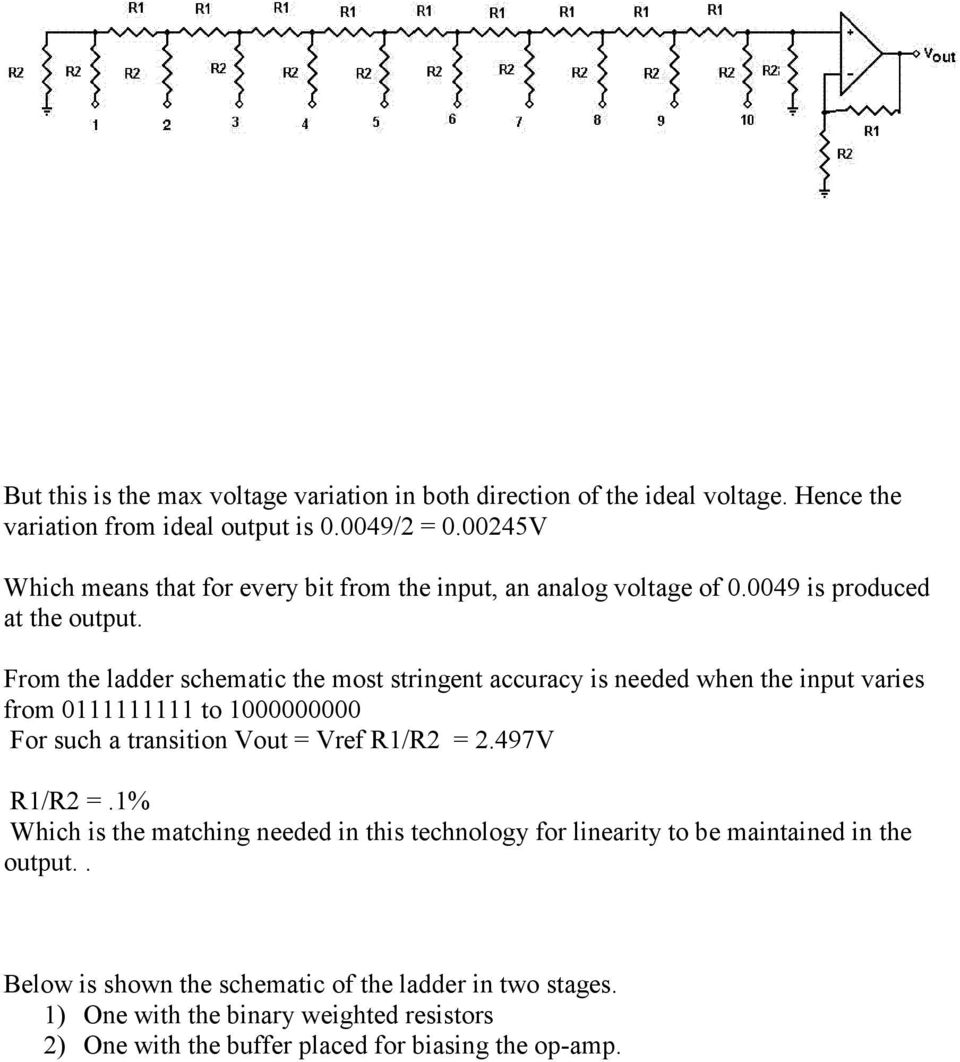
5 3) DAC Presented This paper will present the 12 bit binary weighted DAC. The DAC operates at a maximum frequency of 25MHz using.6um technology to drive a load of 20pF. 3.1) Blocks of the DACs The DAC consists of the following blocks 1) Binary weighted ladder. 2) Op-amp 3.2) Binary Weighted Ladder The binary weighted ladder consists of 30K and 15K resistors placed in a configuration as shown in fig. The inputs to the ladder are fed from a 12 bit ROM. The input voltages range from 0V to 5V. The output of the ladder in fed to an OP-AMP. It only supplies a voltage from 3.1V to 4.1 V as an output. Biasing for such an output range was decided by the characteristics of the OP-AMP. Biasing was implemented using a buffer placed with the ladder network as shown in figure to maintain linearity in the DAC output. So when all inputs are low, the ladder supplied a voltage of 3.1 V to the OP-AMP and when all the inputs are high a voltage of 4.1V was supplied. For a 10 bit ladder and 0-5V rails The accuracy needed is 5/1025 = V,

6 But this is the max voltage variation in both direction of the ideal voltage. Hence the variation from ideal output is /2 = V Which means that for every bit from the input, an analog voltage of is produced at the output. From the ladder schematic the most stringent accuracy is needed when the input varies from to For such a transition Vout = Vref R1/R2 = 2.497V R1/R2 =.1% Which is the matching needed in this technology for linearity to be maintained in the output.. Below is shown the schematic of the ladder in two stages. 1) One with the binary weighted resistors 2) One with the buffer placed for biasing the op-amp.
7

8 Figure of buffer for bias to op-amp

9 The complete schematic of the ladder including the biasing for the op-amp

10 3.3) OP-AMP The design of the op-amp was based on the following design parameters- 1) 10 input bits 2) 0-5V rail voltages 3) 50Mhz clock frequency or 25Mhz frequency for DAC 3.4) OPEN LOOP GAIN The op-amp in this DAC is used in unity feedback configuration. The closed loop gain for an op-amp is given by A/(A+1), where A is the open loop gain The error Vout/Vin is highest at the highest possible V which is Vref=5V Hence A was calculated to be a minimum ) GAIN BANDWITH For a maximum operating frequency of 25Mhz, the output needs to be settled in 40ns Again as in the calculation of the open-loop gain, the maximum speed is needed when the output voltage is the highest i.e. 5V =5(1-e^(-t/RC)) RC=5.2ns Or the gain bandwidth comes out to be 20Mhz

11 4) CIRCUIT DESIGN The op-amp was designed to work in 2 stages 1) A differential first stage which works as an input for the binary ladder 2) Final gain stage for an output load of 20pF 4.1) BIASING CIRCUIT The biasing circuit for the op-amp was implemented using p-mos current mirrors and n-mos current sources for both the stages. To avoid the affect of slew rate on the op-amp the current to be delivered in the first stage was calculated to be 600uA The current in the 2 nd stage was calculated from the 1 st stage to be about 2.3mA. Schematics of the biasing stages are shown in fig

12 Bias circuit schematic of 1 st stage of op-amp

13 Bias circuit schematic of 2 nd stage of op-amp

14 4.2) FIRST STAGE The first stage of the op-amp as shown in the fig gives a gain of about from a common mode range of 3-4V. Sizes of the transistors are given in fig. The lengths of transistors had to be increased to provide high small signal output impedance for a high gain.

15 4.3) SECOND STAGE The second stage of the op-amp is acts as a gain stage and to provide enough current to drive a load of 20pF. The compensation capacitor was placed to improve the bandwidth of the amplifier. Taking parasitic and load capacitance in to account, the maximum frequency of the second pole was calculated to be 1/RC = gm2/(c1+c2) where C1 and C2 are given from the figure as below C1= Cgd1 +Cgd3 + Cdb1 + Cdb3 + Cgs5 C2= Cc+ Cdb5 Cl= Cc+Cgd5 gm2= gm5 c1+ c2 can be taken as 20pf as parasitics are negligible as compared to load capacitor Hence gm2 comes out to be 6.2 ma/v And from the formula gm = 2I/(Vgs-Vt) I= bias current in second stage is calculated to be 2.3 ma The 1 st pole is arbitrarily chosen to lie at 16Khz And the 2 nd pole is calculated to be 50Mhz A resistor is placed in series with the capacitor so that the zero does not interfere in the transfer function of the gain. The compensation capacitor is calculated to be 6.44 pf And the zero resistor is calculated from the formula Rz = (Cl+Cc)/gm5*Cc

16 Schematic of the 2 nd stage

17

18 4.4) DAC The complete blocks for the DAC is shown in fig below with test circuit to see the DAC works with linearly increasing signal before testing it with the ROM output

19 5) SIMULATION RESULTS Schematic simulations were performed on all circuits to verify functionality. Simulations with parasitic capacitors extracted from the layout were performed on circuits whose performance was expected to be highly dependent. All A.C simulations were taken for a frequency range of 100Mhz The gain of the 1 st stage

20 2 nd stage gain

21 DC bias current of 1 st stage
22 DC bias current of 2 nd stage
23 Gain of OP-AMP
24 DAC output simulated for a sine wave of 25Mhz
25 6) LAYOUT DESIGN The layout for the DAC is shown in the images below in.6um AMI technology. Guard rings of grounded metal 1 to substrate contacts are used to isolate logic components. Supply decoupling capacitors are built in any space not occupied by circuitry. Layout of resistors was done with elec or poly layer.
26 Layout of ladder with buffer shown
27 Layout of op-amp with compensating capacitor
28 Complete layout of DAC, with 10 inputs fed from ROM
29 7) FINAL SIMULATION RESULT OF DDS WITH EXTRACTED PARASICTICS The final output simulation with all parasitics extracted and with the output of the ROM connected to the DAC is also shown in the fig below.
30 REFERENCES 1) Design of Analog CMOS Integrated circuits by Behzad Razavi 2)
MAS.836 HOW TO BIAS AN OP-AMP
 MAS.836 HOW TO BIAS AN OP-AMP Op-Amp Circuits: Bias, in an electronic circuit, describes the steady state operating characteristics with no signal being applied. In an op-amp circuit, the operating characteristic
DIGITAL-TO-ANALOGUE AND ANALOGUE-TO-DIGITAL CONVERSION
 DIGITAL-TO-ANALOGUE AND ANALOGUE-TO-DIGITAL CONVERSION Introduction The outputs from sensors and communications receivers are analogue signals that have continuously varying amplitudes. In many systems
Analog Signal Conditioning
 Analog Signal Conditioning Analog and Digital Electronics Electronics Digital Electronics Analog Electronics 2 Analog Electronics Analog Electronics Operational Amplifiers Transistors TRIAC 741 LF351 TL084
Chapter 6: From Digital-to-Analog and Back Again
 Chapter 6: From Digital-to-Analog and Back Again Overview Often the information you want to capture in an experiment originates in the laboratory as an analog voltage or a current. Sometimes you want to
Conversion Between Analog and Digital Signals
 ELET 3156 DL - Laboratory #6 Conversion Between Analog and Digital Signals There is no pre-lab work required for this experiment. However, be sure to read through the assignment completely prior to starting
Chapter 12: The Operational Amplifier
 Chapter 12: The Operational Amplifier 12.1: Introduction to Operational Amplifier (Op-Amp) Operational amplifiers (op-amps) are very high gain dc coupled amplifiers with differential inputs; they are used
Op-Amp Simulation EE/CS 5720/6720. Read Chapter 5 in Johns & Martin before you begin this assignment.
 Op-Amp Simulation EE/CS 5720/6720 Read Chapter 5 in Johns & Martin before you begin this assignment. This assignment will take you through the simulation and basic characterization of a simple operational
Fully Differential CMOS Amplifier
 ECE 511 Analog Electronics Term Project Fully Differential CMOS Amplifier Saket Vora 6 December 2006 Dr. Kevin Gard NC State University 1 Introduction In this project, a fully differential CMOS operational
Section 3. Sensor to ADC Design Example
 Section 3 Sensor to ADC Design Example 3-1 This section describes the design of a sensor to ADC system. The sensor measures temperature, and the measurement is interfaced into an ADC selected by the systems
Analysis and Design of High gain Low Power Fully Differential Gain- Boosted Folded-Cascode Op-amp with Settling time optimization
 Analysis and Design of High gain Low Power Fully Differential Gain- Boosted Folded-Cascode Op-amp with Settling time optimization Shubhara Yewale * and R. S. Gamad ** * (Department of Electronics & Instrumentation
LM 358 Op Amp. If you have small signals and need a more useful reading we could amplify it using the op amp, this is commonly used in sensors.
 LM 358 Op Amp S k i l l L e v e l : I n t e r m e d i a t e OVERVIEW The LM 358 is a duel single supply operational amplifier. As it is a single supply it eliminates the need for a duel power supply, thus
Evaluating AC Current Sensor Options for Power Delivery Systems
 Evaluating AC Current Sensor Options for Power Delivery Systems State-of-the-art isolated ac current sensors based on CMOS technology can increase efficiency, performance and reliability compared to legacy
Cancellation of Load-Regulation in Low Drop-Out Regulators
 Cancellation of Load-Regulation in Low Drop-Out Regulators Rajeev K. Dokania, Student Member, IEE and Gabriel A. Rincόn-Mora, Senior Member, IEEE Georgia Tech Analog Consortium Georgia Institute of Technology
LM118/LM218/LM318 Operational Amplifiers
 LM118/LM218/LM318 Operational Amplifiers General Description The LM118 series are precision high speed operational amplifiers designed for applications requiring wide bandwidth and high slew rate. They
Operational Amplifier - IC 741
 Operational Amplifier - IC 741 Tabish December 2005 Aim: To study the working of an 741 operational amplifier by conducting the following experiments: (a) Input bias current measurement (b) Input offset
Transistor Amplifiers
 Physics 3330 Experiment #7 Fall 1999 Transistor Amplifiers Purpose The aim of this experiment is to develop a bipolar transistor amplifier with a voltage gain of minus 25. The amplifier must accept input
Design of a Fully Differential Two-Stage CMOS Op-Amp for High Gain, High Bandwidth Applications
 Design of a Fully Differential Two-Stage CMOS Op-Amp for High Gain, High Bandwidth Applications Rajkumar S. Parihar Microchip Technology Inc. [email protected] Anu Gupta Birla Institute of
Transistor Characteristics and Single Transistor Amplifier Sept. 8, 1997
 Physics 623 Transistor Characteristics and Single Transistor Amplifier Sept. 8, 1997 1 Purpose To measure and understand the common emitter transistor characteristic curves. To use the base current gain
Design of a TL431-Based Controller for a Flyback Converter
 Design of a TL431-Based Controller for a Flyback Converter Dr. John Schönberger Plexim GmbH Technoparkstrasse 1 8005 Zürich 1 Introduction The TL431 is a reference voltage source that is commonly used
Laboratory 4: Feedback and Compensation
 Laboratory 4: Feedback and Compensation To be performed during Week 9 (Oct. 20-24) and Week 10 (Oct. 27-31) Due Week 11 (Nov. 3-7) 1 Pre-Lab This Pre-Lab should be completed before attending your regular
Bipolar Transistor Amplifiers
 Physics 3330 Experiment #7 Fall 2005 Bipolar Transistor Amplifiers Purpose The aim of this experiment is to construct a bipolar transistor amplifier with a voltage gain of minus 25. The amplifier must
W a d i a D i g i t a l
 Wadia Decoding Computer Overview A Definition What is a Decoding Computer? The Wadia Decoding Computer is a small form factor digital-to-analog converter with digital pre-amplifier capabilities. It is
Physics 623 Transistor Characteristics and Single Transistor Amplifier Sept. 13, 2006
 Physics 623 Transistor Characteristics and Single Transistor Amplifier Sept. 13, 2006 1 Purpose To measure and understand the common emitter transistor characteristic curves. To use the base current gain
Current vs. Voltage Feedback Amplifiers
 Current vs. ltage Feedback Amplifiers One question continuously troubles the analog design engineer: Which amplifier topology is better for my application, current feedback or voltage feedback? In most
Digital to Analog and Analog to Digital Conversion
 Real world (lab) is Computer (binary) is digital Digital to Analog and Analog to Digital Conversion V t V t D/A or DAC and A/D or ADC D/A Conversion Computer DAC A/D Conversion Computer DAC Digital to
www.jameco.com 1-800-831-4242
 Distributed by: www.jameco.com 1-800-831-4242 The content and copyrights of the attached material are the property of its owner. LF411 Low Offset, Low Drift JFET Input Operational Amplifier General Description
Lab 7: Operational Amplifiers Part I
 Lab 7: Operational Amplifiers Part I Objectives The objective of this lab is to study operational amplifier (op amp) and its applications. We will be simulating and building some basic op amp circuits,
CHAPTER 10 OPERATIONAL-AMPLIFIER CIRCUITS
 CHAPTER 10 OPERATIONAL-AMPLIFIER CIRCUITS Chapter Outline 10.1 The Two-Stage CMOS Op Amp 10.2 The Folded-Cascode CMOS Op Amp 10.3 The 741 Op-Amp Circuit 10.4 DC Analysis of the 741 10.5 Small-Signal Analysis
Interfacing Analog to Digital Data Converters
 Converters In most of the cases, the PIO 8255 is used for interfacing the analog to digital converters with microprocessor. We have already studied 8255 interfacing with 8086 as an I/O port, in previous
Use and Application of Output Limiting Amplifiers (HFA1115, HFA1130, HFA1135)
 Use and Application of Output Limiting Amplifiers (HFA111, HFA110, HFA11) Application Note November 1996 AN96 Introduction Amplifiers with internal voltage clamps, also known as limiting amplifiers, have
24-Bit, 96kHz BiCMOS Sign-Magnitude DIGITAL-TO-ANALOG CONVERTER
 49% FPO 24-Bit, 96kHz BiCMOS Sign-Magnitude DIGITAL-TO-ANALOG CONVERTER TM FEATURES SAMPLING FREQUEY (f S ): 16kHz to 96kHz 8X OVERSAMPLING AT 96kHz INPUT AUDIO WORD: 20-, 24-Bit HIGH PERFORMAE: Dynamic
NTE2053 Integrated Circuit 8 Bit MPU Compatible A/D Converter
 NTE2053 Integrated Circuit 8 Bit MPU Compatible A/D Converter Description: The NTE2053 is a CMOS 8 bit successive approximation Analog to Digital converter in a 20 Lead DIP type package which uses a differential
Chapter 19 Operational Amplifiers
 Chapter 19 Operational Amplifiers The operational amplifier, or op-amp, is a basic building block of modern electronics. Op-amps date back to the early days of vacuum tubes, but they only became common
PCM Encoding and Decoding:
 PCM Encoding and Decoding: Aim: Introduction to PCM encoding and decoding. Introduction: PCM Encoding: The input to the PCM ENCODER module is an analog message. This must be constrained to a defined bandwidth
Precision Diode Rectifiers
 by Kenneth A. Kuhn March 21, 2013 Precision half-wave rectifiers An operational amplifier can be used to linearize a non-linear function such as the transfer function of a semiconductor diode. The classic
Micro-Step Driving for Stepper Motors: A Case Study
 Micro-Step Driving for Stepper Motors: A Case Study N. Sedaghati-Mokhtari Graduate Student, School of ECE, University of Tehran, Tehran, Iran n.sedaghati @ece.ut.ac.ir Abstract: In this paper, a case study
Reading: HH Sections 4.11 4.13, 4.19 4.20 (pgs. 189-212, 222 224)
 6 OP AMPS II 6 Op Amps II In the previous lab, you explored several applications of op amps. In this exercise, you will look at some of their limitations. You will also examine the op amp integrator and
OPERATIONAL AMPLIFIER
 MODULE3 OPERATIONAL AMPLIFIER Contents 1. INTRODUCTION... 3 2. Operational Amplifier Block Diagram... 3 3. Operational Amplifier Characteristics... 3 4. Operational Amplifier Package... 4 4.1 Op Amp Pins
*For stability of the feedback loop, the differential gain must vary as
 ECE137a Lab project 3 You will first be designing and building an op-amp. The op-amp will then be configured as a narrow-band amplifier for amplification of voice signals in a public address system. Part
Single Supply Op Amp Circuits Dr. Lynn Fuller
 ROCHESTER INSTITUTE OF TECHNOLOGY MICROELECTRONIC ENGINEERING Single Supply Op Amp Circuits Dr. Lynn Fuller Webpage: http://people.rit.edu/lffeee 82 Lomb Memorial Drive Rochester, NY 146235604 Tel (585)
Constant Current Control for DC-DC Converters
 Constant Current Control for DC-DC Converters Introduction... Theory of Operation... Power Limitations... Voltage Loop Stability...2 Current Loop Compensation...3 Current Control Example...5 Battery Charger
Analog/Digital Conversion. Analog Signals. Digital Signals. Analog vs. Digital. Interfacing a microprocessor-based system to the real world.
 Analog/Digital Conversion Analog Signals Interacing a microprocessor-based system to the real world. continuous range x(t) Analog and digital signals he bridge: Sampling heorem Conversion concepts Conversion
A Differential Op-Amp Circuit Collection
 Application Report SLOA0 July 00 Bruce Carter A Differential OpAmp Circuit Collection High Performance Linear Products ABSTRACT All opamps are differential input devices. Designers are accustomed to working
LINEAR INTEGRATED-CIRCUIT FUNCTION GENERATOR
 ~. c EXPERIMENT 9 Name: LINEAR INTEGRATED-CIRCUIT FUNCTION GENERATOR OBJECTIVES: INTRODUCTION: 1. To observe the operation of a linear integrated-circuit function generator. 2. To observe the frequency-versus-timing
6.101 Final Project Report Class G Audio Amplifier
 6.101 Final Project Report Class G Audio Amplifier Mark Spatz 4/3/2014 1 1 Introduction For my final project, I designed and built a 150 Watt audio amplifier to replace the underpowered and unreliable
Programmable Single-/Dual-/Triple- Tone Gong SAE 800
 Programmable Single-/Dual-/Triple- Tone Gong Preliminary Data SAE 800 Bipolar IC Features Supply voltage range 2.8 V to 18 V Few external components (no electrolytic capacitor) 1 tone, 2 tones, 3 tones
AP-1 Application Note on Remote Control of UltraVolt HVPS
 Basics Of UltraVolt HVPS Output Voltage Control Application Note on Remote Control of UltraVolt HVPS By varying the voltage at the Remote Adjust Input terminal (pin 6) between 0 and +5V, the UV highvoltage
Application Note SAW-Components
 Application Note SAW-Components Principles of SAWR-stabilized oscillators and transmitters. App: Note #1 This application note describes the physical principle of SAW-stabilized oscillator. Oscillator
Analog signals are those which are naturally occurring. Any analog signal can be converted to a digital signal.
 3.3 Analog to Digital Conversion (ADC) Analog signals are those which are naturally occurring. Any analog signal can be converted to a digital signal. 1 3.3 Analog to Digital Conversion (ADC) WCB/McGraw-Hill
A Differential Op-Amp Circuit Collection
 Application Report SLOA0A April 00 A Differential OpAmp Circuit Collection Bruce Carter High Performance Linear Products ABSTRACT All opamps are differential input devices. Designers are accustomed to
High Speed, Low Power Monolithic Op Amp AD847
 a FEATURES Superior Performance High Unity Gain BW: MHz Low Supply Current:.3 ma High Slew Rate: 3 V/ s Excellent Video Specifications.% Differential Gain (NTSC and PAL).9 Differential Phase (NTSC and
Physics 120 Lab 6: Field Effect Transistors - Ohmic region
 Physics 120 Lab 6: Field Effect Transistors - Ohmic region The FET can be used in two extreme ways. One is as a voltage controlled resistance, in the so called "Ohmic" region, for which V DS < V GS - V
DATA SHEET. TDA1543 Dual 16-bit DAC (economy version) (I 2 S input format) INTEGRATED CIRCUITS
 INTEGRATED CIRCUITS DATA SHEET File under Integrated Circuits, IC01 February 1991 FEATURES Low distortion 16-bit dynamic range 4 oversampling possible Single 5 V power supply No external components required
Op Amp Circuit Collection
 Op Amp Circuit Collection Note: National Semiconductor recommends replacing 2N2920 and 2N3728 matched pairs with LM394 in all application circuits. Section 1 Basic Circuits Inverting Amplifier Difference
Kit 106. 50 Watt Audio Amplifier
 Kit 106 50 Watt Audio Amplifier T his kit is based on an amazing IC amplifier module from ST Electronics, the TDA7294 It is intended for use as a high quality audio class AB amplifier in hi-fi applications
Frequency Response of Filters
 School of Engineering Department of Electrical and Computer Engineering 332:224 Principles of Electrical Engineering II Laboratory Experiment 2 Frequency Response of Filters 1 Introduction Objectives To
Fig. 1 :Block diagram symbol of the operational amplifier. Characteristics ideal op-amp real op-amp
 Experiment: General Description An operational amplifier (op-amp) is defined to be a high gain differential amplifier. When using the op-amp with other mainly passive elements, op-amp circuits with various
AN-837 APPLICATION NOTE
 APPLICATION NOTE One Technology Way P.O. Box 916 Norwood, MA 262-916, U.S.A. Tel: 781.329.47 Fax: 781.461.3113 www.analog.com DDS-Based Clock Jitter Performance vs. DAC Reconstruction Filter Performance
LABORATORY 2 THE DIFFERENTIAL AMPLIFIER
 LABORATORY 2 THE DIFFERENTIAL AMPLIFIER OBJECTIVES 1. To understand how to amplify weak (small) signals in the presence of noise. 1. To understand how a differential amplifier rejects noise and common
A Digital Timer Implementation using 7 Segment Displays
 A Digital Timer Implementation using 7 Segment Displays Group Members: Tiffany Sham u2548168 Michael Couchman u4111670 Simon Oseineks u2566139 Caitlyn Young u4233209 Subject: ENGN3227 - Analogue Electronics
LAB 12: ACTIVE FILTERS
 A. INTRODUCTION LAB 12: ACTIVE FILTERS After last week s encounter with op- amps we will use them to build active filters. B. ABOUT FILTERS An electric filter is a frequency-selecting circuit designed
Rail-to-Rail, High Output Current Amplifier AD8397
 Rail-to-Rail, High Output Current Amplifier AD8397 FEATURES Dual operational amplifier Voltage feedback Wide supply range from 3 V to 24 V Rail-to-rail output Output swing to within.5 V of supply rails
TDA4605 CONTROL CIRCUIT FOR SWITCH MODE POWER SUPPLIES USING MOS TRANSISTORS
 CONTROL CIRCUIT FOR SWITCH MODE POWER SUPPLIES USING MOS TRANSISTORS Fold-Back Characteristic provides Overload Protection for External Diodes Burst Operation under Short-Circuit and no Load Conditions
LM101A LM201A LM301A Operational Amplifiers
 LM101A LM201A LM301A Operational Amplifiers General Description The LM101A series are general purpose operational amplifiers which feature improved performance over industry standards like the LM709 Advanced
US-SPI New generation of High performances Ultrasonic device
 US-SPI New generation of High performances Ultrasonic device Lecoeur Electronique - 19, Rue de Courtenay - 45220 CHUELLES - Tel. : +33 ( 0)2 38 94 28 30 - Fax : +33 (0)2 38 94 29 67 US-SPI Ultrasound device
TDA2040. 20W Hi-Fi AUDIO POWER AMPLIFIER
 20W Hi-Fi AUDIO POWER AMPLIFIER DESCRIPTION The TDA2040 is a monolithic integrated circuit in Pentawatt package, intended for use as an audio class AB amplifier. Typically it provides 22W output power
Precision Analog Designs Demand Good PCB Layouts. John Wu
 Precision Analog Designs Demand Good PCB Layouts John Wu Outline Enemies of Precision: Hidden components Noise Crosstalk Analog-to-Analog Digital-to-Analog EMI/RFI Poor Grounds Thermal Instability Leakage
Supply voltage Supervisor TL77xx Series. Author: Eilhard Haseloff
 Supply voltage Supervisor TL77xx Series Author: Eilhard Haseloff Literature Number: SLVAE04 March 1997 i IMPORTANT NOTICE Texas Instruments (TI) reserves the right to make changes to its products or to
LEVERAGING FPGA AND CPLD DIGITAL LOGIC TO IMPLEMENT ANALOG TO DIGITAL CONVERTERS
 LEVERAGING FPGA AND CPLD DIGITAL LOGIC TO IMPLEMENT ANALOG TO DIGITAL CONVERTERS March 2010 Lattice Semiconductor 5555 Northeast Moore Ct. Hillsboro, Oregon 97124 USA Telephone: (503) 268-8000 www.latticesemi.com
Operational Amplifiers
 Module 6 Amplifiers Operational Amplifiers The Ideal Amplifier What you ll learn in Module 6. Section 6.0. Introduction to Operational Amplifiers. Understand Concept of the Ideal Amplifier and the Need
Chapter 8 Differential and Multistage Amplifiers. EE 3120 Microelectronics II
 1 Chapter 8 Differential and Multistage Amplifiers Operational Amplifier Circuit Components 2 1. Ch 7: Current Mirrors and Biasing 2. Ch 9: Frequency Response 3. Ch 8: Active-Loaded Differential Pair 4.
Description. 5k (10k) - + 5k (10k)
 THAT Corporation Low Noise, High Performance Microphone Preamplifier IC FEATURES Excellent noise performance through the entire gain range Exceptionally low THD+N over the full audio bandwidth Low power
AN1991. Audio decibel level detector with meter driver
 Rev. 2.1 20 March 2015 Application note Document information Info Keywords Abstract Content SA604A, LM358, RSSI, cellular radio The SA604A can provide a logarithmic response proportional to the input signal
Phase-Locked Loop Based Clock Generators
 Phase-Locked Loop Based Clock Generators INTRODUCTION As system clock frequencies reach 100 MHz and beyond maintaining control over clock becomes very important In addition to generating the various clocks
1ED Compact A new high performance, cost efficient, high voltage gate driver IC family
 1ED Compact A new high performance, cost efficient, high voltage gate driver IC family Heiko Rettinger, Infineon Technologies AG, Am Campeon 1-12, 85579 Neubiberg, Germany, [email protected]
Understanding Power Impedance Supply for Optimum Decoupling
 Introduction Noise in power supplies is not only caused by the power supply itself, but also the load s interaction with the power supply (i.e. dynamic loads, switching, etc.). To lower load induced noise,
Basic Op Amp Circuits
 Basic Op Amp ircuits Manuel Toledo INEL 5205 Instrumentation August 3, 2008 Introduction The operational amplifier (op amp or OA for short) is perhaps the most important building block for the design of
Simplifying System Design Using the CS4350 PLL DAC
 Simplifying System Design Using the CS4350 PLL 1. INTRODUCTION Typical Digital to Analog Converters (s) require a high-speed Master Clock to clock their digital filters and modulators, as well as some
Programmable-Gain Transimpedance Amplifiers Maximize Dynamic Range in Spectroscopy Systems
 Programmable-Gain Transimpedance Amplifiers Maximize Dynamic Range in Spectroscopy Systems PHOTODIODE VOLTAGE SHORT-CIRCUIT PHOTODIODE SHORT- CIRCUIT VOLTAGE 0mV DARK ark By Luis Orozco Introduction Precision
Application of Rail-to-Rail Operational Amplifiers
 Application Report SLOA039A - December 1999 Application of Rail-to-Rail Operational Amplifiers Andreas Hahn Mixed Signal Products ABSTRACT This application report assists design engineers to understand
Ultrasound Distance Measurement
 Final Project Report E3390 Electronic Circuits Design Lab Ultrasound Distance Measurement Yiting Feng Izel Niyage Asif Quyyum Submitted in partial fulfillment of the requirements for the Bachelor of Science
Module 7 : I/O PADs Lecture 33 : I/O PADs
 Module 7 : I/O PADs Lecture 33 : I/O PADs Objectives In this lecture you will learn the following Introduction Electrostatic Discharge Output Buffer Tri-state Output Circuit Latch-Up Prevention of Latch-Up
High Voltage Power Supplies for Analytical Instrumentation
 ABSTRACT High Voltage Power Supplies for Analytical Instrumentation by Cliff Scapellati Power supply requirements for Analytical Instrumentation are as varied as the applications themselves. Power supply
High Speed, Low Cost, Triple Op Amp ADA4861-3
 High Speed, Low Cost, Triple Op Amp ADA486-3 FEATURES High speed 73 MHz, 3 db bandwidth 625 V/μs slew rate 3 ns settling time to.5% Wide supply range: 5 V to 2 V Low power: 6 ma/amplifier. db flatness:
AN48. Application Note DESIGNNOTESFORA2-POLEFILTERWITH DIFFERENTIAL INPUT. by Steven Green. 1. Introduction AIN- AIN+ C2
 Application Note DESIGNNOTESFORA2-POLEFILTERWITH DIFFERENTIAL INPUT by Steven Green C5 AIN- R3 C2 AIN C2 R3 C5 Figure 1. 2-Pole Low-Pass Filter with Differential Input 1. Introduction Many of today s Digital-to-Analog
Tire pressure monitoring
 Application Note AN601 Tire pressure monitoring 1 Purpose This document is intended to give hints on how to use the Intersema pressure sensors in a low cost tire pressure monitoring system (TPMS). 2 Introduction
5B5BBasic RC Oscillator Circuit
 5B5BBasic RC Oscillator Circuit The RC Oscillator which is also called a Phase Shift Oscillator, produces a sine wave output signal using regenerative feedback from the resistor-capacitor combination.
Electronics. Discrete assembly of an operational amplifier as a transistor circuit. LD Physics Leaflets P4.2.1.1
 Electronics Operational Amplifier Internal design of an operational amplifier LD Physics Leaflets Discrete assembly of an operational amplifier as a transistor circuit P4.2.1.1 Objects of the experiment
Design of op amp sine wave oscillators
 Design of op amp sine wave oscillators By on Mancini Senior Application Specialist, Operational Amplifiers riteria for oscillation The canonical form of a feedback system is shown in Figure, and Equation
Audio Tone Control Using The TLC074 Operational Amplifier
 Application Report SLOA42 - JANUARY Audio Tone Control Using The TLC74 Operational Amplifier Dee Harris Mixed-Signal Products ABSTRACT This application report describes the design and function of a stereo
DDX 7000 & 8003. Digital Partial Discharge Detectors FEATURES APPLICATIONS
 DDX 7000 & 8003 Digital Partial Discharge Detectors The HAEFELY HIPOTRONICS DDX Digital Partial Discharge Detector offers the high accuracy and flexibility of digital technology, plus the real-time display
LC2 MOS Quad 8-Bit D/A Converter AD7226
 a FEATURES Four 8-Bit DACs with Output Amplifiers Skinny 20-Pin DIP, SOIC and 20-Terminal Surface Mount Packages Microprocessor Compatible TTL/CMOS Compatible No User Trims Extended Temperature Range Operation
6.101 Final Project Proposal Class G Audio Amplifier. Mark Spatz
 6.101 Final Project Proposal Class G Audio Amplifier Mark Spatz 1 1 Introduction For my final project, I will be constructing a 30V audio amplifier capable of delivering about 150 watts into a network
ARRL Morse Code Oscillator, How It Works By: Mark Spencer, WA8SME
 The national association for AMATEUR RADIO ARRL Morse Code Oscillator, How It Works By: Mark Spencer, WA8SME This supplement is intended for use with the ARRL Morse Code Oscillator kit, sold separately.
UNDERSTANDING AND CONTROLLING COMMON-MODE EMISSIONS IN HIGH-POWER ELECTRONICS
 Page 1 UNDERSTANDING AND CONTROLLING COMMON-MODE EMISSIONS IN HIGH-POWER ELECTRONICS By Henry Ott Consultants Livingston, NJ 07039 (973) 992-1793 www.hottconsultants.com [email protected] Page 2 THE BASIC
How To Calculate The Power Gain Of An Opamp
 A. M. Niknejad University of California, Berkeley EE 100 / 42 Lecture 8 p. 1/23 EE 42/100 Lecture 8: Op-Amps ELECTRONICS Rev C 2/8/2012 (9:54 AM) Prof. Ali M. Niknejad University of California, Berkeley
Application Note AN:005. FPA Printed Circuit Board Layout Guidelines. Introduction Contents. The Importance of Board Layout
 FPA Printed Circuit Board Layout Guidelines By Paul Yeaman Principal Product Line Engineer V I Chip Strategic Accounts Introduction Contents Page Introduction 1 The Importance of 1 Board Layout Low DC
Title: Low EMI Spread Spectrum Clock Oscillators
 Title: Low EMI oscillators Date: March 3, 24 TN No.: TN-2 Page 1 of 1 Background Title: Low EMI Spread Spectrum Clock Oscillators Traditional ways of dealing with EMI (Electronic Magnetic Interference)
Precision, Unity-Gain Differential Amplifier AMP03
 a FEATURES High CMRR: db Typ Low Nonlinearity:.% Max Low Distortion:.% Typ Wide Bandwidth: MHz Typ Fast Slew Rate: 9.5 V/ s Typ Fast Settling (.%): s Typ Low Cost APPLICATIONS Summing Amplifiers Instrumentation
TL082 Wide Bandwidth Dual JFET Input Operational Amplifier
 TL082 Wide Bandwidth Dual JFET Input Operational Amplifier General Description These devices are low cost high speed dual JFET input operational amplifiers with an internally trimmed input offset voltage