
Modern Physics Laboratory e/m with Teltron Deflection Tube
|
|
|
- Sherilyn Wilkins
- 9 years ago
- Views:
Transcription
1 Modern Physics Laboratory e/m with Teltron Deflection Tube Josh Diamond & John Cummings Fall 2010 Abstract The deflection of an electron beam by electric and magnetic fields is observed, and the charge to mass ratio e/m for the electron is determined. 1 Theory A charged particle with charge q in an electric field E experiences a force given by: F E = q E (1) If the particle moves with velocity v in a magnetic field B, the force on the particle is: F B = q v B (2) For an electron, the charge q = e, where e = Coulombs is the fundamental unit of positive charge. The mass m of the electron is m = kg. In this experiment, the electrons are accelerated through a voltage V a before entering the region containing the fields under study. Due to the accelerating voltage, the electrons acquire a kinetic energy equal to the loss of potential energy ev a, i.e.: 1.1 Deflection In a Magnetic Field 1 2 mv2 = ev a (3) We shall study the motion of an electron in a uniform magnetic field. Newton s second law states that F = m a. Let us apply this to a beam of electrons traveling perpendicular to the magnetic field at speed v. Since the magnetic force on an electron is perpendicular to its velocity, the electron speed stays constant and the electron travels in a circular path. 1
2 The magnitude of the magnetic force in Eq. 2 then simplifies to F B = evb, and the acceleration of the electron in its circular path becomes a = v 2 /r, where r is the radius of the circle. Substituting into Newton s second law, we get: F = ma evb = m v2 r Equations 3 and 4 may be combined to eliminate the electron speed v, and solved for the charge to mass ratio, e/m. One then finds: (4) e/m = 2V a B 2 r 2 (5) In this experiment, the magnetic field is produced by a pair of identical coils carrying the same current. The coils are separated with spacing equal to the coil radius. A pair of such coils are known as Helmholtz coils, and produce a rather uniform magnetic field in the vicinity of the midpoint between the coils along the coil axis. It can be shown that the magnetic field in this region is given approximately by: B = 8µ 0NI a 125 (6) where µ 0 = 4π 10 7 Tm/A, N is the number of turns in each coil, I is the current through the coils, and a is the radius of each coil. For the Teltron Helmholtz coils, N = 320 and a = 6.8 cm = m. Using the Teltron tube, the electron beam is accelerated horizontally into the region where the magnetic field is present. Using the coordinate grid built into the apparatus, one can determine points through which the electron beam passes. If the circle formed by the electron path passes horizontally through the origin, and also passes through the point (x,y), see Figure 1, one can easily show that the radius of the circle is given by: r = x2 + y 2 2y (7) 2 Preliminary Questions 1. Obtain Eq. 5 from Eqs. 3 and Derive Eq Using the given numerical data, write Eq. 6 in the form B = CI, where C is a numerical constant that you can evaluate from Eq. 6. What are the units of B and I? 2
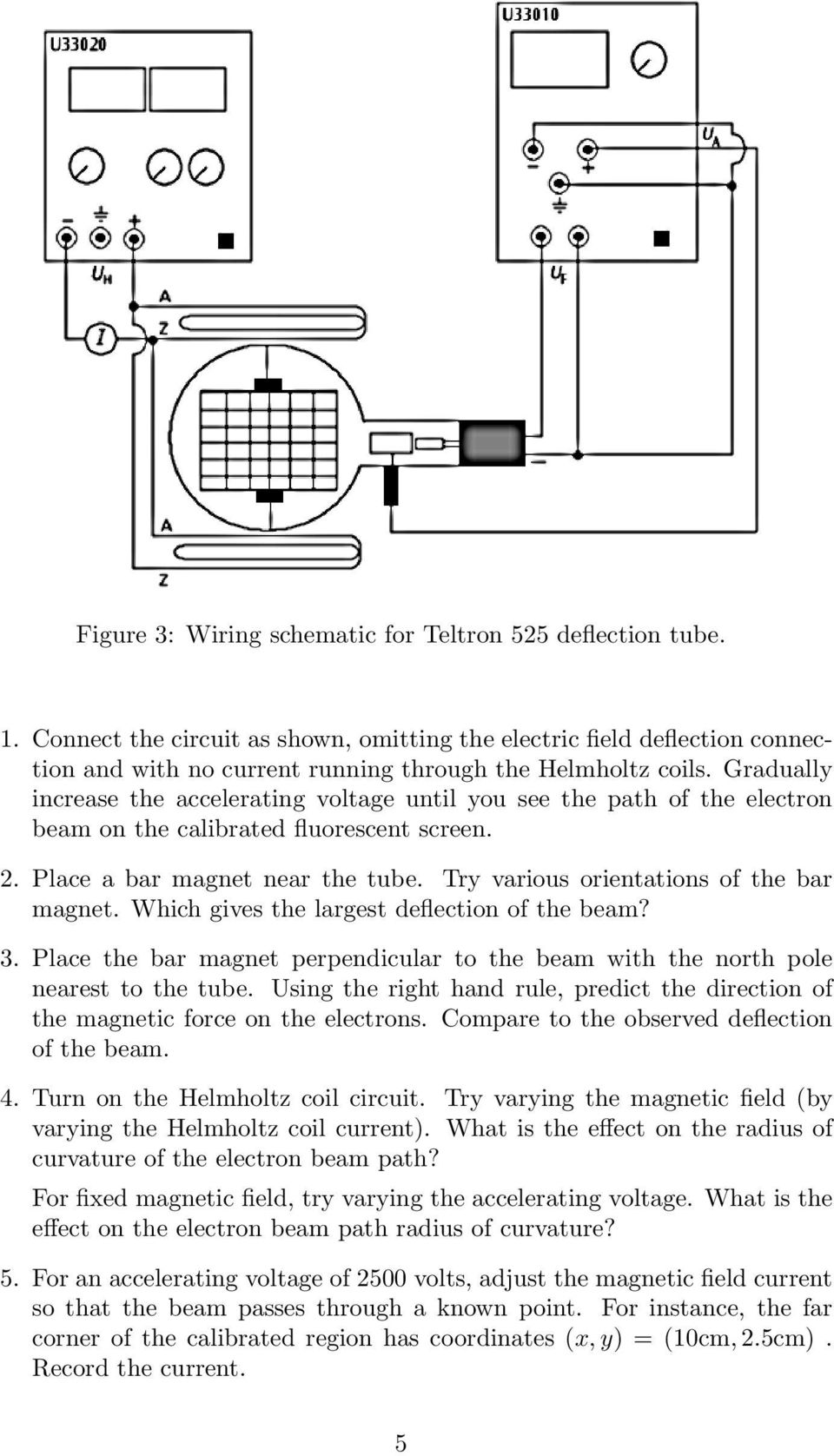
3 Figure 1: Geometry of electron s circular path through magnetic field. 3 Apparatus The e/m deflection tube (see Figure 2) relevant the following features: 1. Fluorescent screen 2. Lower deflection plate (not used) 3. Boss with 4 mm plug for connecting deflection plate (not used) 4. Electron gun 5. 4 mm sockets for connecting heater supply and cathode 6. 4 mm plug for connecting anode (accelerating voltage) 7. Upper deflection plate (not used) The power supply has 6.3 volt terminals for the filament heating current and high voltage terminals for the accelerating voltage. The Helmholtz coils have a separate power supply. The circuit diagram is shown in Figure 3. 4 Procedure CAUTION: High voltages are used in this experiment. Always slide the high voltage control on the power supply to its lowest setting before making any changes in the circuit. Have the instructor check your circuit when you change it before increasing the voltage. 3

4 Figure 2: Location of terminals on Teltron 525 deflection tube. 4

5 Figure 3: Wiring schematic for Teltron 525 deflection tube. 1. Connect the circuit as shown, omitting the electric field deflection connection and with no current running through the Helmholtz coils. Gradually increase the accelerating voltage until you see the path of the electron beam on the calibrated fluorescent screen. 2. Place a bar magnet near the tube. Try various orientations of the bar magnet. Which gives the largest deflection of the beam? 3. Place the bar magnet perpendicular to the beam with the north pole nearest to the tube. Using the right hand rule, predict the direction of the magnetic force on the electrons. Compare to the observed deflection of the beam. 4. Turn on the Helmholtz coil circuit. Try varying the magnetic field (by varying the Helmholtz coil current). What is the effect on the radius of curvature of the electron beam path? For fixed magnetic field, try varying the accelerating voltage. What is the effect on the electron beam path radius of curvature? 5. For an accelerating voltage of 2500 volts, adjust the magnetic field current so that the beam passes through a known point. For instance, the far corner of the calibrated region has coordinates (x, y) = (10cm, 2.5cm). Record the current. 5
6 6. Repeat step 5 for larger voltages, incrementing in steps of 500 volts up to a maximum of 4500 volts. 5 Analysis 1. Explain the results obtained in Procedure steps 1-4 qualitatively in terms of the appropriate relationships. Hint: for 2 & 3, consider the magnetic force law, Eq. 2; for step 4, Eq. 5 will be helpful. 2. For each set of V and B data taken in Procedure step 5, compute e/m for the electron. Use SI units throughout. 3. Find the mean value of e/m and the uncertainty (standard deviation of the mean). Compare your results (including the uncertainty) to e/m as obtained from standard values of e and m. 6 References Thornton and Rex, Modern Physics, 3 rd ed., pp Equipment instructions: Teltron 525 Deflection Tube Tipler and Llewellan, Modern Physics,5 th ed., pp

E/M Experiment: Electrons in a Magnetic Field.
 E/M Experiment: Electrons in a Magnetic Field. PRE-LAB You will be doing this experiment before we cover the relevant material in class. But there are only two fundamental concepts that you need to understand.
Measurement of Charge-to-Mass (e/m) Ratio for the Electron
 Measurement of Charge-to-Mass (e/m) Ratio for the Electron Experiment objectives: measure the ratio of the electron charge-to-mass ratio e/m by studying the electron trajectories in a uniform magnetic
6/2016 E&M forces-1/8 ELECTRIC AND MAGNETIC FORCES. PURPOSE: To study the deflection of a beam of electrons by electric and magnetic fields.
 6/016 E&M forces-1/8 ELECTRIC AND MAGNETIC FORCES PURPOSE: To study the deflection of a beam of electrons by electric and magnetic fields. APPARATUS: Electron beam tube, stand with coils, power supply,
Motion of Charges in Combined Electric and Magnetic Fields; Measurement of the Ratio of the Electron Charge to the Electron Mass
 Motion of Charges in Combined Electric and Magnetic Fields; Measurement of the Ratio of the Electron Charge to the Electron Mass Object: Understand the laws of force from electric and magnetic fields.
Lab 4: Magnetic Force on Electrons
 Lab 4: Magnetic Force on Electrons Introduction: Forces on particles are not limited to gravity and electricity. Magnetic forces also exist. This magnetic force is known as the Lorentz force and it is
Physics 221 Experiment 5: Magnetic Fields
 Physics 221 Experiment 5: Magnetic Fields August 25, 2007 ntroduction This experiment will examine the properties of magnetic fields. Magnetic fields can be created in a variety of ways, and are also found
1. Units of a magnetic field might be: A. C m/s B. C s/m C. C/kg D. kg/c s E. N/C m ans: D
 Chapter 28: MAGNETIC FIELDS 1 Units of a magnetic field might be: A C m/s B C s/m C C/kg D kg/c s E N/C m 2 In the formula F = q v B: A F must be perpendicular to v but not necessarily to B B F must be
Conceptual: 1, 3, 5, 6, 8, 16, 18, 19. Problems: 4, 6, 8, 11, 16, 20, 23, 27, 34, 41, 45, 56, 60, 65. Conceptual Questions
 Conceptual: 1, 3, 5, 6, 8, 16, 18, 19 Problems: 4, 6, 8, 11, 16, 20, 23, 27, 34, 41, 45, 56, 60, 65 Conceptual Questions 1. The magnetic field cannot be described as the magnetic force per unit charge
Physics 42 Lab 4 Fall 2012 Cathode Ray Tube (CRT)
 Physics 42 Lab 4 Fall 202 Cathode Ray Tube (CRT) PRE-LAB Read the background information in the lab below and then derive this formula for the deflection. D = LPV defl 2 SV accel () Redraw the diagram
Electron Charge to Mass Ratio Matthew Norton, Chris Bush, Brian Atinaja, Becker Steven. Norton 0
 Electron Charge to Mass Ratio Matthew Norton, Chris Bush, Brian Atinaja, Becker Steven Norton 0 Norton 1 Abstract The electron charge to mass ratio was an experiment that was used to calculate the ratio
Physics 30 Worksheet #10 : Magnetism From Electricity
 Physics 30 Worksheet #10 : Magnetism From Electricity 1. Draw the magnetic field surrounding the wire showing electron current below. x 2. Draw the magnetic field surrounding the wire showing electron
Candidate Number. General Certificate of Education Advanced Level Examination June 2010
 entre Number andidate Number Surname Other Names andidate Signature General ertificate of Education dvanced Level Examination June 1 Physics PHY4/1 Unit 4 Fields and Further Mechanics Section Friday 18
Phys222 Winter 2012 Quiz 4 Chapters 29-31. Name
 Name If you think that no correct answer is provided, give your answer, state your reasoning briefly; append additional sheet of paper if necessary. 1. A particle (q = 5.0 nc, m = 3.0 µg) moves in a region
Chapter 21. Magnetic Forces and Magnetic Fields
 Chapter 21 Magnetic Forces and Magnetic Fields 21.1 Magnetic Fields The needle of a compass is permanent magnet that has a north magnetic pole (N) at one end and a south magnetic pole (S) at the other.
Review Questions PHYS 2426 Exam 2
 Review Questions PHYS 2426 Exam 2 1. If 4.7 x 10 16 electrons pass a particular point in a wire every second, what is the current in the wire? A) 4.7 ma B) 7.5 A C) 2.9 A D) 7.5 ma E) 0.29 A Ans: D 2.
Force on Moving Charges in a Magnetic Field
 [ Assignment View ] [ Eðlisfræði 2, vor 2007 27. Magnetic Field and Magnetic Forces Assignment is due at 2:00am on Wednesday, February 28, 2007 Credit for problems submitted late will decrease to 0% after
Chapter 19 Magnetic Forces and Fields
 Chapter 19 Magnetic Forces and Fields Student: 3. The magnetism of the Earth acts approximately as if it originates from a huge bar magnet within the Earth. Which of the following statements are true?
LABORATORY V MAGNETIC FIELDS AND FORCES
 LABORATORY V MAGNETIC FIELDS AND FORCES Magnetism plays a large part in our modern world's technology. Magnets are used today to image parts of the body, to explore the mysteries of the human brain, and
Physics 41, Winter 1998 Lab 1 - The Current Balance. Theory
 Physics 41, Winter 1998 Lab 1 - The Current Balance Theory Consider a point at a perpendicular distance d from a long straight wire carrying a current I as shown in figure 1. If the wire is very long compared
Cathode Ray Tube. Introduction. Functional principle
 Introduction The Cathode Ray Tube or Braun s Tube was invented by the German physicist Karl Ferdinand Braun in 897 and is today used in computer monitors, TV sets and oscilloscope tubes. The path of the
FORCE ON A CURRENT IN A MAGNETIC FIELD
 7/16 Force current 1/8 FORCE ON A CURRENT IN A MAGNETIC FIELD PURPOSE: To study the force exerted on an electric current by a magnetic field. BACKGROUND: When an electric charge moves with a velocity v
1. The diagram below represents magnetic lines of force within a region of space.
 1. The diagram below represents magnetic lines of force within a region of space. 4. In which diagram below is the magnetic flux density at point P greatest? (1) (3) (2) (4) The magnetic field is strongest
Physics 121 Sample Common Exam 3 NOTE: ANSWERS ARE ON PAGE 6. Instructions: 1. In the formula F = qvxb:
 Physics 121 Sample Common Exam 3 NOTE: ANSWERS ARE ON PAGE 6 Signature Name (Print): 4 Digit ID: Section: Instructions: Answer all questions 24 multiple choice questions. You may need to do some calculation.
Chapter 22 Magnetism
 22.6 Electric Current, Magnetic Fields, and Ampere s Law Chapter 22 Magnetism 22.1 The Magnetic Field 22.2 The Magnetic Force on Moving Charges 22.3 The Motion of Charged particles in a Magnetic Field
Magnetism. d. gives the direction of the force on a charge moving in a magnetic field. b. results in negative charges moving. clockwise.
 Magnetism 1. An electron which moves with a speed of 3.0 10 4 m/s parallel to a uniform magnetic field of 0.40 T experiences a force of what magnitude? (e = 1.6 10 19 C) a. 4.8 10 14 N c. 2.2 10 24 N b.
Three-dimensional figure showing the operation of the CRT. The dotted line shows the path traversed by an example electron.
 Physics 241 Lab: Cathode Ray Tube http://bohr.physics.arizona.edu/~leone/ua/ua_spring_2010/phys241lab.html NAME: Section 1: 1.1. A cathode ray tube works by boiling electrons off a cathode heating element
Magnetic Fields and Forces. AP Physics B
 Magnetic ields and orces AP Physics acts about Magnetism Magnets have 2 poles (north and south) Like poles repel Unlike poles attract Magnets create a MAGNETIC IELD around them Magnetic ield A bar magnet
AP2 Magnetism. (c) Explain why the magnetic field does no work on the particle as it moves in its circular path.
 A charged particle is projected from point P with velocity v at a right angle to a uniform magnetic field directed out of the plane of the page as shown. The particle moves along a circle of radius R.
Experiment 7: Forces and Torques on Magnetic Dipoles
 MASSACHUSETTS INSTITUTE OF TECHNOLOY Department of Physics 8. Spring 5 OBJECTIVES Experiment 7: Forces and Torques on Magnetic Dipoles 1. To measure the magnetic fields due to a pair of current-carrying
How To Understand The Physics Of A Charge Charge
 MFF 3a: Charged Particle and a Straight Current-Carrying Wire... 2 MFF3a RT1: Charged Particle and a Straight Current-Carrying Wire... 3 MFF3a RT2: Charged Particle and a Straight Current-Carrying Wire...
CHARGED PARTICLES & MAGNETIC FIELDS - WebAssign
 Name: Period: Due Date: Lab Partners: CHARGED PARTICLES & MAGNETIC FIELDS - WebAssign Purpose: Use the CP program from Vernier to simulate the motion of charged particles in Magnetic and Electric Fields
physics 112N magnetic fields and forces
 physics 112N magnetic fields and forces bar magnet & iron filings physics 112N 2 bar magnets physics 112N 3 the Earth s magnetic field physics 112N 4 electro -magnetism! is there a connection between electricity
Physics 112 Homework 5 (solutions) (2004 Fall) Solutions to Homework Questions 5
 Solutions to Homework Questions 5 Chapt19, Problem-2: (a) Find the direction of the force on a proton (a positively charged particle) moving through the magnetic fields in Figure P19.2, as shown. (b) Repeat
Chapter 27 Magnetic Field and Magnetic Forces
 Chapter 27 Magnetic Field and Magnetic Forces - Magnetism - Magnetic Field - Magnetic Field Lines and Magnetic Flux - Motion of Charged Particles in a Magnetic Field - Applications of Motion of Charged
Chapter 23 Electric Potential. Copyright 2009 Pearson Education, Inc.
 Chapter 23 Electric Potential 23-1 Electrostatic Potential Energy and Potential Difference The electrostatic force is conservative potential energy can be defined. Change in electric potential energy is
Candidate Number. General Certificate of Education Advanced Level Examination June 2012
 entre Number andidate Number Surname Other Names andidate Signature General ertificate of Education dvanced Level Examination June 212 Physics PHY4/1 Unit 4 Fields and Further Mechanics Section Monday
Charged Particle in a Magnetic Field
 Charged Particle in a Magnetic Field Consider a particle moving in an external magnetic field with its velocity perpendicular to the field The force is always directed toward the center of the circular
Electromagnetism Extra Study Questions Short Answer
 Electromagnetism Extra Study Questions Short Answer 1. The electrostatic force between two small charged objects is 5.0 10 5 N. What effect would each of the following changes have on the magnitude of
EXPERIMENT III EXPERIMENTS WITH AN ELECTRON BEAM
 EXPERIMENT III EXPERIMENTS WITH AN ELECTRON BEAM An electron beam is a collection of free electrons, all traveling in approximately the same direction with the approximately the same velocity. While it
Centripetal Force. This result is independent of the size of r. A full circle has 2π rad, and 360 deg = 2π rad.
 Centripetal Force 1 Introduction In classical mechanics, the dynamics of a point particle are described by Newton s 2nd law, F = m a, where F is the net force, m is the mass, and a is the acceleration.
Magnetic Field and Magnetic Forces
 Chapter 27 Magnetic Field and Magnetic Forces PowerPoint Lectures for University Physics, Thirteenth Edition Hugh D. Young and Roger A. Freedman Lectures by Wayne Anderson Goals for Chapter 27 Magnets
Pre-lab Quiz/PHYS 224 Magnetic Force and Current Balance. Your name Lab section
 Pre-lab Quiz/PHYS 224 Magnetic Force and Current Balance Your name Lab section 1. What do you investigate in this lab? 2. Two straight wires are in parallel and carry electric currents in opposite directions
The purposes of this experiment are to test Faraday's Law qualitatively and to test Lenz's Law.
 260 17-1 I. THEORY EXPERIMENT 17 QUALITATIVE STUDY OF INDUCED EMF Along the extended central axis of a bar magnet, the magnetic field vector B r, on the side nearer the North pole, points away from this
F B = ilbsin(f), L x B because we take current i to be a positive quantity. The force FB. L and. B as shown in the Figure below.
 PHYSICS 176 UNIVERSITY PHYSICS LAB II Experiment 9 Magnetic Force on a Current Carrying Wire Equipment: Supplies: Unit. Electronic balance, Power supply, Ammeter, Lab stand Current Loop PC Boards, Magnet
Chapter 4. Forces and Newton s Laws of Motion. continued
 Chapter 4 Forces and Newton s Laws of Motion continued 4.9 Static and Kinetic Frictional Forces When an object is in contact with a surface forces can act on the objects. The component of this force acting
VELOCITY, ACCELERATION, FORCE
 VELOCITY, ACCELERATION, FORCE velocity Velocity v is a vector, with units of meters per second ( m s ). Velocity indicates the rate of change of the object s position ( r ); i.e., velocity tells you how
Chapter 19: Magnetic Forces and Fields
 Chapter 19: Magnetic Forces and Fields Magnetic Fields Magnetic Force on a Point Charge Motion of a Charged Particle in a Magnetic Field Crossed E and B fields Magnetic Forces on Current Carrying Wires
Physics 2B. Lecture 29B
 Physics 2B Lecture 29B "There is a magnet in your heart that will attract true friends. That magnet is unselfishness, thinking of others first. When you learn to live for others, they will live for you."
Candidate Number. General Certificate of Education Advanced Level Examination June 2014
 entre Number andidate Number Surname Other Names andidate Signature General ertificate of Education dvanced Level Examination June 214 Physics PHY4/1 Unit 4 Fields and Further Mechanics Section Wednesday
MFF 2a: Charged Particle and a Uniform Magnetic Field... 2
 MFF 2a: Charged Particle and a Uniform Magnetic Field... 2 MFF2a RT1: Charged Particle and a Uniform Magnetic Field... 3 MFF2a RT2: Charged Particle and a Uniform Magnetic Field... 4 MFF2a RT3: Charged
Exam 2 Practice Problems Part 2 Solutions
 Problem 1: Short Questions MASSACHUSETTS INSTITUTE OF TECHNOLOGY Department of Physics 8. Exam Practice Problems Part Solutions (a) Can a constant magnetic field set into motion an electron, which is initially
Experiment #8: Magnetic Forces
 Experiment #8: Magnetic Forces Purpose: To study the nature of magnetic forces exerted on currents. Equipment: Magnet Assembly and Stand Set of Current Loop PC oards Triple-Arm Pan alance 0 15 V dc Variable
PY106 Class13. Permanent Magnets. Magnetic Fields and Forces on Moving Charges. Interactions between magnetic north and south poles.
 Permanent Magnets Magnetic ields and orces on Moing Charges 1 We encounter magnetic fields frequently in daily life from those due to a permanent magnet. Each permanent magnet has a north pole and a south
UNIVERSITY OF SASKATCHEWAN Department of Physics and Engineering Physics
 UNIVERSITY OF SASKATCHEWAN Department of Physics and Engineering Physics Physics 111.6 MIDTERM TEST #4 March 15, 2007 Time: 90 minutes NAME: (Last) Please Print (Given) STUDENT NO.: LECTURE SECTION (please
LABORATORY VI MAGNETIC FIELDS AND FORCES
 LABORATORY VI MAGETIC FIELD AD FORCE Magnetism plays a large role in our world s modern technology. ome uses of magnets today are imaging parts of the body, exploring the mysteries of the human brain,
ELECTRON SPIN RESONANCE Last Revised: July 2007
 QUESTION TO BE INVESTIGATED ELECTRON SPIN RESONANCE Last Revised: July 2007 How can we measure the Landé g factor for the free electron in DPPH as predicted by quantum mechanics? INTRODUCTION Electron
Hand Held Centripetal Force Kit
 Hand Held Centripetal Force Kit PH110152 Experiment Guide Hand Held Centripetal Force Kit INTRODUCTION: This elegantly simple kit provides the necessary tools to discover properties of rotational dynamics.
Chapter 3.8 & 6 Solutions
 Chapter 3.8 & 6 Solutions P3.37. Prepare: We are asked to find period, speed and acceleration. Period and frequency are inverses according to Equation 3.26. To find speed we need to know the distance traveled
Halliday, Resnick & Walker Chapter 13. Gravitation. Physics 1A PHYS1121 Professor Michael Burton
 Halliday, Resnick & Walker Chapter 13 Gravitation Physics 1A PHYS1121 Professor Michael Burton II_A2: Planetary Orbits in the Solar System + Galaxy Interactions (You Tube) 21 seconds 13-1 Newton's Law
www.mathsbox.org.uk Displacement (x) Velocity (v) Acceleration (a) x = f(t) differentiate v = dx Acceleration Velocity (v) Displacement x
 Mechanics 2 : Revision Notes 1. Kinematics and variable acceleration Displacement (x) Velocity (v) Acceleration (a) x = f(t) differentiate v = dx differentiate a = dv = d2 x dt dt dt 2 Acceleration Velocity
Experiment 3: Magnetic Fields of a Bar Magnet and Helmholtz Coil
 MASSACHUSETTS INSTITUTE OF TECHNOLOGY Department of Physics 8.02 Spring 2006 Experiment 3: Magnetic Fields of a Bar Magnet and Helmholtz Coil OBJECTIVES 1. To learn how to visualize magnetic field lines
Experiment: Static and Kinetic Friction
 PHY 201: General Physics I Lab page 1 of 6 OBJECTIVES Experiment: Static and Kinetic Friction Use a Force Sensor to measure the force of static friction. Determine the relationship between force of static
Examples of magnetic field calculations and applications. 1 Example of a magnetic moment calculation
 Examples of magnetic field calculations and applications Lecture 12 1 Example of a magnetic moment calculation We consider the vector potential and magnetic field due to the magnetic moment created by
Ampere's Law. Introduction. times the current enclosed in that loop: Ampere's Law states that the line integral of B and dl over a closed path is 0
 1 Ampere's Law Purpose: To investigate Ampere's Law by measuring how magnetic field varies over a closed path; to examine how magnetic field depends upon current. Apparatus: Solenoid and path integral
1.7. formulae and transposition. Introduction. Prerequisites. Learning Outcomes. Learning Style
 formulae and transposition 1.7 Introduction formulae are used frequently in almost all aspects of engineering in order to relate a physical quantity to one or more others. Many well-known physical laws
Kinetic Friction. Experiment #13
 Kinetic Friction Experiment #13 Joe Solution E00123456 Partner - Jane Answers PHY 221 Lab Instructor Chuck Borener Thursday, 11 AM 1 PM Lecture Instructor Dr. Jacobs Abstract In this experiment, we test
Electromagnetism Laws and Equations
 Electromagnetism Laws and Equations Andrew McHutchon Michaelmas 203 Contents Electrostatics. Electric E- and D-fields............................................. Electrostatic Force............................................2
Magnetic Field of a Circular Coil Lab 12
 HB 11-26-07 Magnetic Field of a Circular Coil Lab 12 1 Magnetic Field of a Circular Coil Lab 12 Equipment- coil apparatus, BK Precision 2120B oscilloscope, Fluke multimeter, Wavetek FG3C function generator,
Q27.1 When a charged particle moves near a bar magnet, the magnetic force on the particle at a certain point depends
 Q27.1 When a charged particle moves near a bar magnet, the magnetic force on the particle at a certain point depends A. on the direction of the magnetic field at that point only. B. on the magnetic field
Monday 11 June 2012 Afternoon
 Monday 11 June 2012 Afternoon A2 GCE PHYSICS B (ADVANCING PHYSICS) G495 Field and Particle Pictures *G412090612* Candidates answer on the Question Paper. OCR supplied materials: Data, Formulae and Relationships
A Determination of g, the Acceleration Due to Gravity, from Newton's Laws of Motion
 A Determination of g, the Acceleration Due to Gravity, from Newton's Laws of Motion Objective In the experiment you will determine the cart acceleration, a, and the friction force, f, experimentally for
F N A) 330 N 0.31 B) 310 N 0.33 C) 250 N 0.27 D) 290 N 0.30 E) 370 N 0.26
 Physics 23 Exam 2 Spring 2010 Dr. Alward Page 1 1. A 250-N force is directed horizontally as shown to push a 29-kg box up an inclined plane at a constant speed. Determine the magnitude of the normal force,
Use the following information to deduce that the gravitational field strength at the surface of the Earth is approximately 10 N kg 1.
 IB PHYSICS: Gravitational Forces Review 1. This question is about gravitation and ocean tides. (b) State Newton s law of universal gravitation. Use the following information to deduce that the gravitational
General Physics (PHY 2140)
 General Physics (PHY 2140) Lecture 12 Electricity and Magnetism Magnetism Magnetic fields and force Application of magnetic forces http://www.physics.wayne.edu/~apetrov/phy2140/ Chapter 19 1 Department
45. The peak value of an alternating current in a 1500-W device is 5.4 A. What is the rms voltage across?
 PHYS Practice Problems hapters 8- hapter 8. 45. The peak value of an alternating current in a 5-W device is 5.4 A. What is the rms voltage across? The power and current can be used to find the peak voltage,
ELECTRIC FIELD LINES AND EQUIPOTENTIAL SURFACES
 ELECTRIC FIELD LINES AND EQUIPOTENTIAL SURFACES The purpose of this lab session is to experimentally investigate the relation between electric field lines of force and equipotential surfaces in two dimensions.
PHYS 222 Spring 2012 Final Exam. Closed books, notes, etc. No electronic device except a calculator.
 PHYS 222 Spring 2012 Final Exam Closed books, notes, etc. No electronic device except a calculator. NAME: (all questions with equal weight) 1. If the distance between two point charges is tripled, the
Kinetic Friction. Experiment #13
 Kinetic Friction Experiment #13 Joe Solution E01234567 Partner- Jane Answers PHY 221 Lab Instructor- Nathaniel Franklin Wednesday, 11 AM-1 PM Lecture Instructor Dr. Jacobs Abstract The purpose of this
The DC Motor. Physics 1051 Laboratory #5 The DC Motor
 The DC Motor Physics 1051 Laboratory #5 The DC Motor Contents Part I: Objective Part II: Introduction Magnetic Force Right Hand Rule Force on a Loop Magnetic Dipole Moment Torque Part II: Predictions Force
Magnetic Fields and Their Effects
 Name Date Time to Complete h m Partner Course/ Section / Grade Magnetic Fields and Their Effects This experiment is intended to give you some hands-on experience with the effects of, and in some cases
Chapter 5 Using Newton s Laws: Friction, Circular Motion, Drag Forces. Copyright 2009 Pearson Education, Inc.
 Chapter 5 Using Newton s Laws: Friction, Circular Motion, Drag Forces Units of Chapter 5 Applications of Newton s Laws Involving Friction Uniform Circular Motion Kinematics Dynamics of Uniform Circular
PS-6.2 Explain the factors that determine potential and kinetic energy and the transformation of one to the other.
 PS-6.1 Explain how the law of conservation of energy applies to the transformation of various forms of energy (including mechanical energy, electrical energy, chemical energy, light energy, sound energy,
( )( 10!12 ( 0.01) 2 2 = 624 ( ) Exam 1 Solutions. Phy 2049 Fall 2011
 Phy 49 Fall 11 Solutions 1. Three charges form an equilateral triangle of side length d = 1 cm. The top charge is q = - 4 μc, while the bottom two are q1 = q = +1 μc. What is the magnitude of the net force
STATICS. Introduction VECTOR MECHANICS FOR ENGINEERS: Eighth Edition CHAPTER. Ferdinand P. Beer E. Russell Johnston, Jr.
 Eighth E CHAPTER VECTOR MECHANICS FOR ENGINEERS: STATICS Ferdinand P. Beer E. Russell Johnston, Jr. Introduction Lecture Notes: J. Walt Oler Texas Tech University Contents What is Mechanics? Fundamental
Millikan Oil Drop Experiment Matthew Norton, Jurasits Christopher, Heyduck William, Nick Chumbley. Norton 0
 Millikan Oil Drop Experiment Matthew Norton, Jurasits Christopher, Heyduck William, Nick Chumbley Norton 0 Norton 1 Abstract The charge of an electron can be experimentally measured by observing an oil
A2 Physics Unit 7 Magnetic Fields. Mr D Powell
 A Physics Unit 7 Magnetic Fields Mr D Powell Chapter Map Circumference circle = r Distance trav = ¼ * r WD = Fd = d*mv /r Sub in eq to give B B 7.1 Current-carrying conductors in a magnetic field Specification
Physics 111: Lecture 4: Chapter 4 - Forces and Newton s Laws of Motion. Physics is about forces and how the world around us reacts to these forces.
 Physics 111: Lecture 4: Chapter 4 - Forces and Newton s Laws of Motion Physics is about forces and how the world around us reacts to these forces. Whats a force? Contact and non-contact forces. Whats a
Physics 211 Lecture 4
 Physics 211 Lecture 4 Today's Concepts: Newton s Laws a) Acceleration is caused by forces b) Force changes momentum c) Forces always come in pairs d) Good reference frames Mechanics Lecture 4, Slide 1
Torque Analyses of a Sliding Ladder
 Torque Analyses of a Sliding Ladder 1 Problem Kirk T. McDonald Joseph Henry Laboratories, Princeton University, Princeton, NJ 08544 (May 6, 2007) The problem of a ladder that slides without friction while
MULTIPLE CHOICE. Choose the one alternative that best completes the statement or answers the question.
 MULTIPLE CHOICE. Choose the one alternative that best completes the statement or answers the question. 1) If the voltage at a point in space is zero, then the electric field must be A) zero. B) positive.
Objectives. Capacitors 262 CHAPTER 5 ENERGY
 Objectives Describe a capacitor. Explain how a capacitor stores energy. Define capacitance. Calculate the electrical energy stored in a capacitor. Describe an inductor. Explain how an inductor stores energy.
Use Square Roots to Solve Quadratic Equations
 10.4 Use Square Roots to Solve Quadratic Equations Before You solved a quadratic equation by graphing. Now You will solve a quadratic equation by finding square roots. Why? So you can solve a problem about
Series and Parallel Circuits
 Series and Parallel Circuits Components in a circuit can be connected in series or parallel. A series arrangement of components is where they are inline with each other, i.e. connected end-to-end. A parallel
Eðlisfræði 2, vor 2007
 [ Assignment View ] [ Pri Eðlisfræði 2, vor 2007 28. Sources of Magnetic Field Assignment is due at 2:00am on Wednesday, March 7, 2007 Credit for problems submitted late will decrease to 0% after the deadline
Problem Set 5 Work and Kinetic Energy Solutions
 MASSACHUSETTS INSTITUTE OF TECHNOLOGY Department o Physics Physics 8.1 Fall 1 Problem Set 5 Work and Kinetic Energy Solutions Problem 1: Work Done by Forces a) Two people push in opposite directions on
Quiz: Work and Energy
 Quiz: Work and Energy A charged particle enters a uniform magnetic field. What happens to the kinetic energy of the particle? (1) it increases (2) it decreases (3) it stays the same (4) it changes with
Solution Derivations for Capa #11
 Solution Derivations for Capa #11 1) A horizontal circular platform (M = 128.1 kg, r = 3.11 m) rotates about a frictionless vertical axle. A student (m = 68.3 kg) walks slowly from the rim of the platform
AP1 Electricity. 1. A student wearing shoes stands on a tile floor. The students shoes do not fall into the tile floor due to
 1. A student wearing shoes stands on a tile floor. The students shoes do not fall into the tile floor due to (A) a force of repulsion between the shoes and the floor due to macroscopic gravitational forces.
Rotational Inertia Demonstrator
 WWW.ARBORSCI.COM Rotational Inertia Demonstrator P3-3545 BACKGROUND: The Rotational Inertia Demonstrator provides an engaging way to investigate many of the principles of angular motion and is intended