
Kalman Filter Face-Off
|
|
|
- Belinda Blake
- 9 years ago
- Views:
Transcription
1 Kalman Filter Face-Off Extended vs. Unscented Kalman Filters for Integrated GPS and MEMS Inertial Copyright istock.com/peeter Viisimaa GPS and micro-electro-mechanical (MEMS) inertial systems have complementary qualities that make integrated navigation systems more robust. GPS maintains good accuracy but is subject to signal blockages; low-cost MEMS are unaffected by satellite signal outages but their accuracy degrades rapidly over time. Kalman filter techniques can help bring these two technologies together synergistically. But which Kalman filtering design works best? A group of Canadian researchers tackles the question. Naser El-Sheimy, Eun-Hwan Shin, Xiaoji Niu Mobile Multi-Sensor Systems Research Group, Department of Geomatics Engineering, The University of Calgary, Canada Today, most vehicle navigation systems rely mainly on Global Positioning System (GPS) receivers as the primary source of information to provide the vehicle position for an unlimited number of users anywhere on the planet. Since its advent, the number of applications using GPS has increased dramatically and include tracking the location and speed of people, truck fleets, trains, ships, or planes; directing emergency vehicles to the scene of an accident; mapping where a city s assets are located; and providing precise timing for endeavors that require large-scale co-ordination. GPS, however, can reliably provide these types of information only under ideal conditions, that is, in open areas in which GPS satellite signals can be received. In other words, the system doesn t work very well in urban canyons, canopy areas, and similar environments due to signal blockage and attenuation deteriorating the obtainable positioning accuracy. For the moment, any sophisticated urban application that demands essentially continuous position determination, cannot depend on GPS as a standalone system those who have tried are still trying! Cost and space constraints are currently driving manufacturers of vehicles to investigate and develop the next generation of low-cost and smallsize navigation and guidance systems to meet the fast growing demand for in the location-based services and telematics markets. Advances in microelectro-mechanical systems (MEMS) technology have shed promising light on the development of such systems. But such sensors high noise and drift rate remain a problem, which may be alleviated in combination with GPS. Solutions that integrate navigation data have been recognized as the most challenging aspects that remain to turn MEMS-based inertial systems into robust, accurate navigation systems. Introducing MEMS The last two decades have shown an increasing demand for low-cost and miniature inertial sensors for many navigation applications. MEMS-based inertial sensors efficiently meet this demand. However, due to their lightweight and fabrication process, MEMS sensors still have some performance limitations, which consequently affect their obtainable accuracy and sensitivity. 48 InsideGNSS MARCH 26

2 One of the main problems of MEMS sensors is that the remaining uncertainties of the sensor errors (bias, scale factor, and noise) are very large and sensitive to surrounding environmental changes. Therefore, navigation algorithms (i.e., estimators) should be able to deal with these uncertainties. Traditionally the linearized Kalman filter (LKF) or the extended Kalman filter (EKF) have been used in the area of navigation, and recently the unscented Kalman filter (UKF) has been proposed for low-cost inertial navigation. The UKF approach offers several benefits. Because we do not need to develop a space navigator error model for a UKF, the system development time can be reduced. Moreover, because UKF is a second order filter, higher-order errors neglected by the EKF can be considered. As discussed in the paper by Naser El-Sheimy and Eun-Hwan Shin (24) cited in the Additional Resources section at the end of this article, a UKF can handle large attitude errors. Hence, we can use the UKF in navigation systems based on crude inertial measurement units (IMUs) In this article, we will compare the EKF with the UKF in terms of the state model equations and structure of the filters. Then we compare the performance of both filters by testing integrated GPS and MEMS-based IMU systems in land vehicle environments. The testing process includes three MEMS-based IMUs. The first two IMUs are currently available in the market, while the third one is a custom-built IMU developed by the Mobile Multi-Sensor Systems Research Group at the University of Calgary. The custom-built IMU integrates three accelerometers and three gyroscopes. In this article, we pay special attention to the filters performance during the in-motion alignment and to the obtained positioning errors during GPS outages. We begin by reviewing implementation of the EKF and the UKF for the integration of low-cost INS (see Table 1 for a comparison of the performance and cost of different INS grades) and GPS. Next, we will compare the performance of the two filters using three different MEMS-based IMUs and then draw conclusions from the test results. A Profile: the EKF Traditionally, error state Kalman filters either the LKF or the EKF were used in the field of navigation. If an INS error control loop (feedback) exists, then the LKF can be considered as the EKF. A low-cost INS cannot operate for a long time without the feedback loop. Hence, this article will only discuss EKF implementation. In developing the EKF, the system Grade Navigation Tactical Automotive Consumer Position Error 1.9 (km/hr) (km/hr) 2 (km/min) 3-5 (km/min) Gyros Bias (deg/hr) Scale factor (ppm) Noise (deg/hr/ Hz) Accel Bias (mg) Scale factor (ppm) Noise (mg/hr/ Hz) Price (US$) 1K 1K 6K 1K 5K 1 3 Mass Production No No Yes Yes Table 1. Comparison of Different INS Grades process model and the measurement model have to be linearized. In an aided inertial navigation system, the system process model comprises the INS mechanization, a description of the evolution of the navigation parameters (position, velocity and attitude), and the inertial sensor error models. Linearization of the system model can be done through perturbation analysis, a classical approach to INS error analysis. In the perturbation analysis, the navigation parameters are perturbed with respect to the true navigation frame (n-frame). Alternatively, we can also analyze the INS error with respect to the computer frame (c-frame), the frame that the INS computer assumes to be the true navigation frame. The choice of an appropriate INS error model depends upon the given navigation scenario and is an important part of the navigation software design. Regardless of the choice of the INS error model, the linearized system model can be described in discrete time as (1) where is the error state vector at time ; is the state transition matrix, and is the driven response at due to the presence of the input white noise during the time interval. Because a white sequence is a sequence of a zero-mean random variable that is uncorrelated time-wise, the covariance matrix associated with wk is given as (2) The linearized measurement equation can be written as follows: (3) where is the measurement vector; is a design matrix; and is the measurement noise vector. The measurement covariance matrix is written as MARCH 26 InsideGNSS 49

3 KALMAN FILTER FACE-OFF (4) The system noise and measurement noise are assumed to be uncorrelated, i.e. for all i, k. Another Profile: the UKF In the UKF, system noises are generated and are passed through the system process model. So, the state vector, x, and the system noise vector, w, are augmented to create the augmented state vector, x a : (5) The UKF is based on transforming a set of deterministically chosen points, called the sigma points, through the nonlinear system process and measurement models. The unscented transformation (UT) refers to the procedure of obtaining a set of the sigma points (SPs),, and the associated weights,, from the given mean,, and covariance,, satisfying (6) where p is the number of sigma points. Of several proposals for the UT, the scaled spherical simplex UT was applied in this paper because it generates minimal number of SPs. Scaling the sigma points is an important step in attitude estimation. The UKF is a straightforward extension of the UT to the recursive estimation. First, we initialize the augmented states and covariance as follows: (7) where and. Then, the scaled simplex SPs are generated. During the prediction stage, the SPs go through the nonlinear system process model (8) where the superscript + and - denote the updated and predicted states, respectively; is the rotation rate of the body frame with respect to the inertial frame; and f b is the specific force measurement. (The article by Shin (24) cited in the Additional Resources section describes the system process model m[ ]well.) Then, the predicted mean and covariance are computed using the transformed sigma points as follows: (9) (1) where and are weights for the mean and covariance computation, respectively. During the update state, the sigma points are transformed through the measurement model: (11) The predicted measurement is computed as: (12) Then, the rest of the update equations can be written as follows: (13) Unscented Kalman filters have a number of clear advantages. The mean and covariance of the state estimate is calculated to second order or better, as opposed to first order in the EKF. This leads to a more accurate implementation of the optimal recursive estimation equations, which is the basis for both the EKF and UKF No explicit Jacobian or Hessian calculations are necessary for the UKF. This is especially valuable in situations where the system is a black box model in which the internal dynamic equations are unavailable. (14) (15) (16) (17) (18) where z k and R k are the measurement and its noise covariance, respectively; and K k is the Kalman gain matrix. We summarize the implementation steps of the EKF and UKF in Table 2. Feedback of the biases can also be implemented to deal with the situation in which short-term correlated biases are superimposed on large long-term biases (See Figure 1 for details on the data flow.) Tests and Results This section compares the performance of the EKF and the UKF using datasets collected in land vehicles with three different MEMS-based IMUs. The same set of GPS receivers and postprocessing software were used in all of the tests. We use several IMUs 5 InsideGNSS MARCH 26

4 Gaussian random variables (GRV) propagation EKF Propagated analytically through the first-order linearization of the nonlinear system. UKF Represented using a minimal set of carefully chosen sample points (Sigma Points or SPs). The SP completely captures the true mean and covariance of the GRV, and when propagated through the true nonlinear system, captures the posterior mean and covariance accurately to the 2nd order (Taylor series expansion) for any nonlinearity. Initialization 1. Initialize the error state and its covariance 1. Initialize the state and its covariance 2. Generate sigma points (SPs) for the initial states and covariance Prediction Update Feedback Position, velocity, attitude and bias Bias Table 2. Implementation of the EKF and the UKF 1. Transform SPs through the INS mechanization 2. Compute mean and covariance from the transformed SPs 3. Generate sigma points for the predicted states and covariance 1. Transform SPs through the measurement model 2. Compute predicted measurement,, 3. from the transformed SPs 4. Compute covariance between the state and the measurement, 5. Compute covariance of the innovation sequence, Generate sigma points for the updated states and covariance Inertial Measurement Unit Sensors biases error estimates GPS Receiver Inertial Measurement Unit GPS Receiver Specific forces & Angular rates Sensors biases corrections GPS-derived position & velocity estimates Specific forces & Angular rates INS Mechanization GPS-derived position & velocity estimates Figure 1 EKF Versus UKF Data Flow attitude corrections INS-derived position, velocity & attitude + - Unscented Transformation for Prediction (Include INS Mechanization) Predicted state and Variances Extended Kalman Filter (EKF) + - KF Update using Unscented Transformation attitude estimates attitude error estimates Position, velocity, attitude, & their Variances attitude estimates built IMU sensor triads will be shown in detail as an example. The first dataset used a prototype MEMS IMU manufactured through a in different field tests so as to be able to draw general conclusions about the two estimation algorithms. In this article, only the results of the customsurface-micromachining process and well calibrated including cross-axis misalignment and thermal drift compensation. The test was conducted by Applanix Corporation in Toronto on March 5, 23. The reference for the position, velocity and attitude are the smoothed best estimates (SBET) provided by Applanix Corporation using postprocessing software and data from a tactical-grade IMU. The attitude accuracy of the reference solution is known to be.2 for roll and pitch, and.5 for heading, when there are no GPS outages. The vehicle used in the test was a van, which was driven with both low dynamics (small loops) and typical high-way condition (large rectangular loops). For most of the time, horizontal and vertical position accuracies of the DGPS solution were about 2 3 centimeters and 4 9 centimeters, respectively. In the second dataset, the IMU used quartz tuning-fork gyroscopes. The field test was conducted in the MARCH 26 InsideGNSS 51

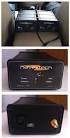
5 KALMAN FILTER FACE-OFF Figure 2 The sensor triads developed by the Mobile Multi-Sensor Systems Research Group, the Universityof Calgary (The dimension of the unit is 9.2x7.4x4. cm) Research Park of the University of Calgary on March 4, 23, operating a passenger vehicle and driven with relatively low speed in a small area. Because no other higher grade IMU was used, we used the smoothed solution from the unscented Kalman smoother (UKS) as the reference for this dataset. The prototype MEMS IMU developed by the Mobile Multi-Sensor Systems Research Group at the University of Calgary and is shown in Figure 2. We refer to this IMU as the sensor triads. Since the original bias errors of the triad s sensors are as large as 2 deg/s for gyroscopes and 2 g for accelerom- eters, we performed laboratory calibrations to obtain values for the biases, scale factors, and cross-axis misalignments. As a result, the biases of the gyroscopes and accelerometers have been reduced to.5 deg/s and 6 mg, respectively. The third dataset was collected using the sensor triads mostly on a highway near the Calgary International Airport in a joint test with NovAtel, Inc. using a test van. A smoothed DGPS/INS solution from a navigation-grade IMU served as the reference. Figures 3 and 4 show the trajectory and the accuracy of the DGPS solution, respectively. Although the sky was open for most of the time, buildings and bridges resulted in frequent GPS outages and significant DGPS solution degradation. All three datasets were processed by the EKF and the UKF using parameters specifically tuned for each of the IMUs. Three processing scenarios for land vehicle navigations were considered to compare these two algorithms. Position (m) Attitude (deg) EKF UKF North.81.8 East Height Roll Pitch Heading Table 3. Overall Performance (Sensor triads) Scenario 1: Results with Continuous GPS Updates The first scenario ran the algorithm with regular GPS updates. Our purpose was mainly to check whether the algorithms worked correctly or not. With continuous GPS measurements, the trajectory will generally follow that of the DGPS solution, while attitude errors will somehow reflect the quality of the integrated systems. The results from the three MEMS systems show that the attitude accuracies can reach.1.4 degrees for pitch and roll, degrees for heading. Table 3 lists the performance of the sensor triads as an example. For all three datasets, the EKF and the UKF showed similar performance. Scenario 2: Results with Simulated GPS Outages In the second scenario we processed the datasets with simulated GPS outages, which covered typical driving North (m) East (m) North (m) East (m) Height (m) Time (minute) Figure 3 Trajectory of the third dataset Figure 4 DGPS position accuracy of the third dataset 52 InsideGNSS MARCH 26

6 Outage Direction EKF UKF 1 North (m) East (m) Height (m) North (m) East (m) Height (m) North (m) East (m) Height (m) North (m) East (m) Height (m) North (m) East (m) Height (m) North (m) East (m) Height (m) Table 4. Maximum errors during 3s GPS outages (ADI Sensor triads) Time Roll Pitch Heading 1 3 s s Table 5. RMS of the attitude errors for large initial atitude uncertainties (degrees) Attitude Errors (degrees) Time (s) Figure 5 Attitude errors of the UKF under large initial attitude uncertainty (prototype IMU, first dataset). conditions of land vehicles. It is a challenge for a low-cost INS to achieve high accuracy during GPS outages and also is a popular criterion for evaluating the performance of an integrated navigation system. Table 4 lists the maximum position errors during intentional 3-second GPS outages for the sensor triads. Again, the EKF and the UKF showed similar performance for each GPS outage in each direction. Generally, the average position drift after 3 seconds of GPS signal outages were from 1 to 3 meters for the tested MEMS IMUs. Scenario 3: Results with Large Initial Attitude Errors Typically, coarse alignment of an INS is done in stationary mode using leveling (by accelerometers) followed by gyro-compassing or, alternatively by using an analytical method that solves the gravity and the Earth rotation measurements in one step. For MEMSbased IMUs, however, the gyroscopes are not accurate enough to sense the Earth s rotation rate. Further, if the IMU is installed in a consumer vehicle, we cannot expect the user to wait until the alignment is finished. Hence, inmotion alignment is typically used. The GPS-derived velocity can be used for coarse in-motion alignment if the vehicle s forward axis is parallel to the velocity vector. In airborne or shipborne applications, the vehicle may have lateral velocity components. In such cases, the initial heading derived from the GPS velocity can have large errors. Initial tilt errors may also be large if the vehicle is in high-dynamic motion. All these issues will cause large initial attitude errors, which was our third scenario. The test has been done by intentionally adding large initial attitude errors (3 degrees) for roll, pitch and heading. Under these serious initial conditions, the assumption of linear error behavior for the EKF could be violated. Because the EKF described in this article used a standard computer frame error model, the EKF could not deal with large attitude errors and generated computational failure. On the other hand, the UKF converged as shown in Figure 5. The convergence has been made within 5 seconds, and the RMS of attitude errors after the convergence is listed in Table 5. For the EKF to cope with large attitude errors, a special INS error model must be developed. However, the UKF can deal with large attitude errors without devising a special model, and the transition from the large to small attitude errors is seamless Conclusions This article has reviewed the implementation of the EKF and the UKF and compared their performance for integrated low-cost inertial navigation systems. Both the EKF and the UKF work well for the integration of typical MEMS-based IMU and GPS. Performance of the EKF and the UKF is generally similar (in both cases when GPS signals are available and when GPS signals are blocked). The EKF requires a special navigator error model to handle large initial attitude errors. However, the UKF can deal with such errors without additional effort, and the transition from the large to small attitude uncertainties is seamless. Therefore, the UKF will be beneficial in the applications where inmotion alignment is required. Acknowledgements This study was funded by research grants from Natural Science and Engineering Research Council of Canada (NSERC) and Geomatics for Informed Decisions (GEOIDE), Network Centers of Excellence (NCE) awarded to Dr. Naser El-Sheimy. The authors would like to thank Dr. Bruno M. Scherzing- MARCH 26 InsideGNSS 53

7 KALMAN FILTER FACE-OFF er, Applanix Corporation, for providing a dataset for the ISIS IMU test. Manufacturers OEM4 and MiLLennium from NovAtel Inc., Calgary, Alberta, Canada, were used in the tests. The post-processed DGPS position solutions from GrafNav software from Waypoint Consulting, Inc., Calgary, were used as the measurement updates for the EKF and UKF in all datasets. The custom-built IMU integrates three accelerometers (ADXL15) and three gyroscopes (ADXRS15), both from Analog Devices Inc., Norwood, Massachusetts, USA. The first dataset used a prototype IMU (ISIS IMU) made by Inertial Science, Inc., Newbury Park, California, USA. The ISIS IMU used MEMS gyroscopes from Analog Devices, Inc. The reference for the position, velocity and attitude are the smoothed best estimates (SBET) using POSPac software from Applanix Corporation (a Trimble company), Richmond Hill, Ontario, Canada. to process the data using a tactical-grade IMU the LN-2 from Northrop Grumman, Navigation Systems Division, Woodland Hills, California. The second dataset used a MotionPak II IMU from BEI Systron Donner, Inertial Division, Concord, California. The third dataset was collected using the sensor triads and The smoothed DGPS/INS solution from a navigation-grade C-IMU, Honeywell Inc., Phoenix, Arizona, USA. All the three data were processed using AINS (Aided Inertial Navigation System (AINS ) software developed by by the Mobile Multi-Sensor Systems Research Group at the University of Calgary. Additional Resources BEI Technologies, Inc. (22). MotionPak II Operating Manual. Systron Donner Inertial Division, BEI Technologies, Inc. Benson Jr., D. O. (1975). A Comparison of Two Approaches to Pure-Inertial and Doppler-Inertial Error Analysis. IEEE Transactions on Aerospace and Electronic Systems, AES- 11(4): Britting, K. R. (1971). Inertial Navigation Systems Analysis. John Wiley & Sons, Inc. Brown, R. G. and Hwang, P. Y. C. (1992). Introduction to Random Signals and Applied Kalman Filtering. John Wiley & Sons, Inc., second edition El-Sheimy, N. and Niu, X. (24). The Development of Low-Cost MEMS-Based IMU for Land Vehicle Navigation Applications. Presentation in GEOIDE Annual Meeting, Gatineau, Qu ebec, Canada (CD) Farrell, J. A. and Barth, M. (1998). The Global Positioning System & Inertial Navigation. McGraw Hill Hou, H. and El-Sheimy, N. (23). Inertial Sensors Errors Modeling Using Allan Variance. In Proceedings of ION GPS/GNSS, pages , Portland, Oregon Julier, S. J. (23). The Spherical Simplex Unscented Transformation. In Proceedings of the IEEE American Control Conference, pages , Denver, Colorado Julier, S. J. and Uhlmann, J. K. (1996). A General Method for Approximating Nonlinear Transformations of Probability Distributions. Technical report, Department of Engineering Science, University of Oxford, Oxford, OX1 3PJ, UK Julier, S. J. and Uhlmann, J. K. (22). The Scaled Unscented Transformation. In Proceedings of the IEEE American Control Conference, pages , Anchorage AK, USA Rogers, R. M. (1997). IMU In-Motion Alignment Without Benefit of Attitude Initialization. Navigation: Journal of The Institute of Navigation, 44(3): Scherzinger, B. M. (1996). Inertial Navigator Error Models for Large Heading Uncertainty. In IEEE Position Location and Navigation Symposium, pages Scherzinger, B. M. and Reid, D. B. (1994). Modified Strapdown Inertial Navigator Error Models. In IEEE Position Location and Navigation Symposium, pages , Las Vegas, Nevada Schwarz, K.-P. and Wei, M. (2). INS/GPS Integration for Geodetic Applications: Lecture Notes ENGO 623. Dept. of Geomatics Eng., The University of Calgary, Calgary, Canada Shin, E.-H. (21). Accuracy Improvement of Low Cost INS/GPS for Land Applications. UCGE Reports Number 2156, The University of Calgary, Calgary, Alberta, Canada Shin, E.-H. (24). A Quaternion-Based Unscented Kalman Filter for the Integration of GPS and MEMS INS. In Proceedings of ION GNSS, pages , Long Beach, California, USA Shin, E.-H. and El-Sheimy, N. (24). An Unscented Kalman Filter for In-Motion Alignment of Low-Cost IMUs. In Proceedings of IEEE Position, Location, and Navigation Symposium, pages , Monterey, CA. Wan, E. A. and van der Merwe, R. (21). Kalman Filtering and Neural Networks, Haykin, S. (Ed.), chapter 7. John Wiley & Sons, New York Authors Naser El-Sheimy is a professor and the leader of the Mobile Multi-sensor Research Group at the University of Calgary, Canada. He holds a Canada Research Chair (CRC) in Mobile Multi-Sensors Geomatics Systems. El-Sheimy¹s area of expertise is in the integration of GPS/INS/imaging sensors for mapping and GIS applications with special emphasis on the use ofmulti-sensors in mobile mapping systems. He acheived a B.Sc. (Honor) degree in civil engineering and an M.Sc. Degree in surveying engineering from Ain Shams University, Egypt, and a Ph.D. in geomatics engineering from the University of Calgary, Alberta, Canada. Currently, El-Sheimy is the chair of the International Society for Photogrammetry and Remote Sensing Working Group on Integrated Mobile Mapping Systems, the vice-chair of the special study group for mobile multi-sensor systems of the International Association of Geodesy and the chairman of the International Federation of Surveyors (FIG) working group C5.3 on Integrated Positioning, Navigation and Mapping Systems. Eun-Hwan Shin is currently a navigation analyst for Applanix Corportion, in Toronto, Canada. He obtained his Ph.D. from the Department of Geomatics Engineering at the University of Calgary. He holds a B.Sc. and an M.Sc. from the Seoul National University in Korea and an M.Sc. in geomatics engineering from the University of Calgary. Shin has developed a MatLab INS toolbox during his Ph.D. program at U of C. His research interest is on developing estimation methods for low-cost inertial navigation systems. Xiaoji Niu is a post doctoral fellow and a member of the mobile multi-sensor research group in the Department of Geomatics Engineering at the University of Calgary. He has a Ph.D. in the Department of Precision Instruments & Mechanology at Tsinghua University. Niu received the B.S. degrees (with honors) in both mechanical engineering and electrical engineering from Tsinghua University in His research interest focuses on the low-cost GPS/INS integration technologies and micromachined (that is, MEMS) inertial sensors and systems. 54 InsideGNSS MARCH 26

Performance Test Results of an Integrated GPS/MEMS Inertial Navigation Package
 Performance Test Results of an Integrated GPS/MEMS Inertial Navigation Package Alison K. Brown and Yan Lu, NAVSYS Corporation BIOGRAPHY Alison Brown is the President and Chief Executive Officer of NAVSYS
GPS/INS Integration with the imar-fsas IMU
 Sandy KENNEDY, Canada Jason HAMILTON, Canada Hugh MARTELL, Canada Key words: GPS, INS, integrated navigation, inertial navigation SUMMARY This paper discusses NovAtel's approach to GPS/INS system architecture
Mathieu St-Pierre. Denis Gingras Dr. Ing.
 Comparison between the unscented Kalman filter and the extended Kalman filter for the position estimation module of an integrated navigation information system Mathieu St-Pierre Electrical engineering
Application of Street Tracking Algorithm to Improve Performance of a Low-Cost INS/GPS System
 Application of Street Tracking Algorithm to Improve Performance of a Low-Cost INS/GPS System Thang Nguyen Van Broadcasting College 1, Phuly City, Hanam Province, Vietnam Email: [email protected]
Performance of a Deeply Coupled Commercial Grade GPS/INS System from KVH and NovAtel Inc.
 Performance of a Deeply Coupled Commercial Grade GPS/INS System from KVH and NovAtel Inc. Sandy Kennedy 1 and Jim Rossi 2 1 NovAtel Inc., 112 68 th Ave. N.E. Calgary, Alberta, T2E 8S5, Canada 2 KVH Industries,
Integration of Inertial Measurements with GNSS -NovAtel SPAN Architecture-
 Integration of Inertial Measurements with GNSS -NovAtel SPAN Architecture- Sandy Kennedy, Jason Hamilton NovAtel Inc., Canada Edgar v. Hinueber imar GmbH, Germany Symposium Gyro Technology, Stuttgart 9/25
The Performance Analysis of a Real-Time Integrated INS/GPS Vehicle Navigation System with Abnormal GPS Measurement Elimination
 Sensors 2013, 13, 10599-10622; doi:10.3390/s130810599 Article OPEN ACCESS sensors ISSN 1424-8220 www.mdpi.com/journal/sensors The Performance Analysis of a Real-Time Integrated INS/GPS Vehicle Navigation
Basic Principles of Inertial Navigation. Seminar on inertial navigation systems Tampere University of Technology
 Basic Principles of Inertial Navigation Seminar on inertial navigation systems Tampere University of Technology 1 The five basic forms of navigation Pilotage, which essentially relies on recognizing landmarks
If you want to use an inertial measurement system...
 If you want to use an inertial measurement system...... which technical data you should analyse and compare before making your decision by Dr.-Ing. Edgar v. Hinueber, CEO imar Navigation GmbH Keywords:
Enhancing the SNR of the Fiber Optic Rotation Sensor using the LMS Algorithm
 1 Enhancing the SNR of the Fiber Optic Rotation Sensor using the LMS Algorithm Hani Mehrpouyan, Student Member, IEEE, Department of Electrical and Computer Engineering Queen s University, Kingston, Ontario,
GPS-FREE TERRAIN-BASED VEHICLE TRACKING PERFORMANCE AS A FUNCTION OF INERTIAL SENSOR CHARACTERISTICS
 GPS-FREE TERRAIN-BASED VEHICLE TRACKING PERFORMANCE AS A FUNCTION OF INERTIAL SENSOR CHARACTERISTICS Kshitij Jerath and Sean N. Brennan Department of Mechanical and Nuclear Engineering The Pennsylvania
An Introduction to the Kalman Filter
 An Introduction to the Kalman Filter Greg Welch 1 and Gary Bishop 2 TR 95041 Department of Computer Science University of North Carolina at Chapel Hill Chapel Hill, NC 275993175 Updated: Monday, July 24,
AP Series Autopilot System. AP-202 Data Sheet. March,2015. Chengdu Jouav Automation Tech Co.,L.t.d
 AP Series Autopilot System AP-202 Data Sheet March,2015 Chengdu Jouav Automation Tech Co.,L.t.d AP-202 autopilot,from Chengdu Jouav Automation Tech Co., Ltd, provides complete professional-level flight
DIRECT POSITIONING AND ORIENTATION SYSTEMS HOW DO THEY WORK? WHAT IS THE ATTAINABLE ACCURACY? ABSTRACT INTRODUCTION
 DIRECT OSITIONING AND ORIENTATION SYSTEMS HOW DO THEY WORK? WHAT IS THE ATTAINABLE ACCURACY? Mohamed M.R. Mostafa, R&D Airborne Applications Joseph Hutton, roduct Manager Airborne Applications ALANIX Corporation,
Prof. Ludovico Biagi. Satellite Navigation and Monitoring
 Prof. Ludovico Biagi Satellite Navigation and Monitoring Navigation: trajectories control positions estimations in real time, at high frequency popular applications: low accuracy (10 m) required specific
Technical Report. An introduction to inertial navigation. Oliver J. Woodman. Number 696. August 2007. Computer Laboratory
 Technical Report UCAM-CL-TR-696 ISSN 1476-2986 Number 696 Computer Laboratory An introduction to inertial navigation Oliver J. Woodman August 27 15 JJ Thomson Avenue Cambridge CB3 FD United Kingdom phone
Waypoint. Best-in-Class GNSS and GNSS+INS Processing Software
 Waypoint Best-in-Class GNSS and GNSS+INS Processing Software Waypoint Exceptional Post-Processing Software Enhance your GNSS Position, Velocity and Attitude Accuracy For applications requiring highly
Apogee Series. > > Motion Compensation and Data Georeferencing. > > Smooth Workflow. Mobile Mapping. > > Precise Trajectory and Direct Georeferencing
 Ultimate accuracy MEMS Apogee Series Inertial Navigation System Motion Sensing and Georeferencing > INS > MRU > AHRS ITAR free 0,005 RMS Apogee Series High quality, high accuracy Hydrography > > Motion
Deterministic Sampling-based Switching Kalman Filtering for Vehicle Tracking
 Proceedings of the IEEE ITSC 2006 2006 IEEE Intelligent Transportation Systems Conference Toronto, Canada, September 17-20, 2006 WA4.1 Deterministic Sampling-based Switching Kalman Filtering for Vehicle
Error Estimation in Positioning and Orientation Systems
 Error Estimation in Positioning and Orientation Systems Peter Canter Director, Applanix Marine Systems 85 Leek Crescent Richmond Hill, Ontario L4B 3B3 Telephone 905-709-4600 [email protected] Co-Author:
APPLANIX POSITION AND ORIENTATION SYSTEMS FOR LAND VEHICLES (POS LV)
 APPLANIX POSITION AND ORIENTATION SYSTEMS FOR LAND VEHICLES (POS LV) POS LV powers any application where vehicle positioning and orientation is required. capture everything. precisely. APPLANIX POSITION
Fundamental to determining
 GNSS Solutions: Carrierto-Noise Algorithms GNSS Solutions is a regular column featuring questions and answers about technical aspects of GNSS. Readers are invited to send their questions to the columnist,
The accelerometer designed and realized so far is intended for an. aerospace application. Detailed testing and analysis needs to be
 86 Chapter 4 Accelerometer Testing 4.1 Introduction The accelerometer designed and realized so far is intended for an aerospace application. Detailed testing and analysis needs to be conducted to qualify
Mobile Robot FastSLAM with Xbox Kinect
 Mobile Robot FastSLAM with Xbox Kinect Design Team Taylor Apgar, Sean Suri, Xiangdong Xi Design Advisor Prof. Greg Kowalski Abstract Mapping is an interesting and difficult problem in robotics. In order
Course 8. An Introduction to the Kalman Filter
 Course 8 An Introduction to the Kalman Filter Speakers Greg Welch Gary Bishop Kalman Filters in 2 hours? Hah! No magic. Pretty simple to apply. Tolerant of abuse. Notes are a standalone reference. These
Capturing Road Network Data Using Mobile Mapping Technology
 Capturing Road Network Data Using Mobile Mapping Technology Guangping He, Greg Orvets Lambda Tech International, Inc. Waukesha, WI-53186, USA [email protected] KEY WORDS: DATA CAPTURE, MOBILE MAPPING,
Engineers from Geodetics select KVH for versatile high-performance inertial sensors. White Paper. kvh.com
 White Paper Overcoming GNSS Vulnerability by Applying Inertial Data Integration in Multi-Sensor Systems for High Accuracy Navigation, Pointing, and Timing Solutions Engineers from Geodetics select KVH
CONTRIBUTIONS TO THE AUTOMATIC CONTROL OF AERIAL VEHICLES
 1 / 23 CONTRIBUTIONS TO THE AUTOMATIC CONTROL OF AERIAL VEHICLES MINH DUC HUA 1 1 INRIA Sophia Antipolis, AROBAS team I3S-CNRS Sophia Antipolis, CONDOR team Project ANR SCUAV Supervisors: Pascal MORIN,
Time Domain and Frequency Domain Techniques For Multi Shaker Time Waveform Replication
 Time Domain and Frequency Domain Techniques For Multi Shaker Time Waveform Replication Thomas Reilly Data Physics Corporation 1741 Technology Drive, Suite 260 San Jose, CA 95110 (408) 216-8440 This paper
A Reliability Point and Kalman Filter-based Vehicle Tracking Technique
 A Reliability Point and Kalman Filter-based Vehicle Tracing Technique Soo Siang Teoh and Thomas Bräunl Abstract This paper introduces a technique for tracing the movement of vehicles in consecutive video
EE 570: Location and Navigation
 EE 570: Location and Navigation On-Line Bayesian Tracking Aly El-Osery 1 Stephen Bruder 2 1 Electrical Engineering Department, New Mexico Tech Socorro, New Mexico, USA 2 Electrical and Computer Engineering
An Experimental Investigation into the Performance of GPS-based Vehicle Positioning in Very Dense Urban Areas
 An Experimental Investigation into the Performance of GPS-based Vehicle Positioning in Very Dense Urban Areas Jason CHAO 1,2, Yong-qi CHEN 1, Wu CHEN 1, Xiaoli DING 1, Zhilin LI 1, Nganying WONG 1 and
IP-S2 Compact+ 3D Mobile Mapping System
 IP-S2 Compact+ 3D Mobile Mapping System 3D scanning of road and roadside features Delivers high density point clouds and 360 spherical imagery High accuracy IMU options without export control Simple Map,
Research on Inertial Surveying System Instrumentation for Geodetic Applications in Brazil
 Univ.-Prof. Dr.-Ing. Prof. h.c. Günter Seeber anlässlich seines 65. Geburtstages und der Verabschiedung in den Ruhestand. Wissenschaftliche Arbeiten der Fachrichtung Geodäsie und Geoinformatik der Universität
K.Prasanna NIT Rourkela,India Summer Internship NUS
 K.Prasanna NIT Rourkela,India Summer Internship NUS LOCALIZATION Vehicle localization is an important topic as it finds its application in a multitude of fields like autonomous navigation and tracking
SIMA Raw Data Simulation Software for the Development and Validation of Algorithms for GNSS and MEMS based Multi-Sensor Navigation Platforms
 SIMA Raw Data Simulation Software for the Development and Validation of Algorithms for GNSS and MEMS Reiner JÄGER, Julia DIEKERT, Andreas HOSCISLAWSKI and Jan ZWIENER, Germany Key words: Low-cost GNSS,
CHAPTER 1 INTRODUCTION
 CHAPTER 1 INTRODUCTION 1.1 Background of the Research Agile and precise maneuverability of helicopters makes them useful for many critical tasks ranging from rescue and law enforcement task to inspection
Automatic Labeling of Lane Markings for Autonomous Vehicles
 Automatic Labeling of Lane Markings for Autonomous Vehicles Jeffrey Kiske Stanford University 450 Serra Mall, Stanford, CA 94305 [email protected] 1. Introduction As autonomous vehicles become more popular,
Improving Quality of GNSS Vehicle Localization
 Improving Quality of GNSS Vehicle Localization Roman Srp ITS&S FP7 Easy OBU project Telematika, Legislativa, Strategie, 11.4.2014, Praha Contents EasyOBU Research in a Nutshell Signal Loss in GNSS Applications
VEHICLE TRACKING USING MOBILE WIRELESS SENSOR NETWORKS DURING DYNAMIC LOAD TESTING OF HIGHWAY BRIDGES
 SOURCE: Proceedings of the 5th European Workshop on Structural Health Monitoring, Sorrento, Italy, June 28-July 4, 2010. VEHICLE TRACKING USING MOBILE WIRELESS SENSOR NETWORKS DURING DYNAMIC LOAD TESTING
The Practical Design of In-vehicle Telematics Device with GPS and MEMS Accelerometers
 18 Telfor Journal, Vol. 4, No., 1. The Practical Design of In-vehicle Telematics Device with GPS and MEMS Accelerometers Milan B. Vukajlović, Srdjan Tadić, and Dejan M. Dramićanin Abstract The latest generation
Kuaternion srl. Advanced Geomatics solutions: from Academy to Industry. Let s measure your World
 Kuaternion srl Let s measure your World Advanced Geomatics solutions: from Academy to Industry Co-founders and employers: Dr Andrea Nascetti, Eng PhD CEO Dr Roberta Ravanelli, Eng CTO Dr Elisa Benedetti,
Modeling and Simulation Design for Load Testing a Large Space High Accuracy Catalog. Barry S. Graham 46 Test Squadron (Tybrin Corporation)
 Modeling and Simulation Design for Load Testing a Large Space High Accuracy Catalog Barry S. Graham 46 Test Squadron (Tybrin Corporation) ABSTRACT A large High Accuracy Catalog (HAC) of space objects is
Heave Compensation Using Time-Differenced Carrier Observations from Low Cost GPS Receivers
 Institute of Engineering, Surveying and Space Geodesy Heave Compensation Using Time-Differenced Carrier Observations from Low Cost GPS Receivers By Stephen J. Blake BEng Thesis submitted to the University
The Design and Implementation of a Quadrotor Flight Controller Using the QUEST Algorithm
 The Design and Implementation of a Quadrotor Flight Controller Using the QUEST Algorithm Jacob Oursland Department of Mathematics and Computer Science South Dakota School of Mines and Technology Rapid
Understanding and Applying Kalman Filtering
 Understanding and Applying Kalman Filtering Lindsay Kleeman Department of Electrical and Computer Systems Engineering Monash University, Clayton 1 Introduction Objectives: 1. Provide a basic understanding
A GPS Digital Phased Array Antenna and Receiver
 A GPS Digital Phased Array Antenna and Receiver Dr. Alison Brown, Randy Silva; NAVSYS Corporation ABSTRACT NAVSYS High Gain Advanced GPS Receiver (HAGR) uses a digital beam-steering antenna array to enable
Lidar 101: Intro to Lidar. Jason Stoker USGS EROS / SAIC
 Lidar 101: Intro to Lidar Jason Stoker USGS EROS / SAIC Lidar Light Detection and Ranging Laser altimetry ALTM (Airborne laser terrain mapping) Airborne laser scanning Lidar Laser IMU (INS) GPS Scanning
CHARACTERISTICS OF DEEP GPS SIGNAL FADING DUE TO IONOSPHERIC SCINTILLATION FOR AVIATION RECEIVER DESIGN
 CHARACTERISTICS OF DEEP GPS SIGNAL FADING DUE TO IONOSPHERIC SCINTILLATION FOR AVIATION RECEIVER DESIGN Jiwon Seo, Todd Walter, Tsung-Yu Chiou, and Per Enge Stanford University ABSTRACT Aircraft navigation
Joint parameter and state estimation algorithms for real-time traffic monitoring
 USDOT Region V Regional University Transportation Center Final Report NEXTRANS Project No 097IY04. Joint parameter and state estimation algorithms for real-time traffic monitoring By Ren Wang PhD Candidate
Land-Vehicle Navigation Using GPS
 Land-Vehicle Navigation Using GPS ERIC ABBOTT AND DAVID POWELL Invited Paper The Global Positioning System (GPS) has made navigation systems practical for a number of land-vehicle navigation applications.
IP-S3 HD1. Compact, High-Density 3D Mobile Mapping System
 IP-S3 HD1 Compact, High-Density 3D Mobile Mapping System Integrated, turnkey solution Ultra-compact design Multiple lasers minimize scanning shades Unparalleled ease-of-use No user calibration required
Content. Professur für Steuerung, Regelung und Systemdynamik. Lecture: Vehicle Dynamics Tutor: T. Wey Date: 01.01.08, 20:11:52
 1 Content Overview 1. Basics on Signal Analysis 2. System Theory 3. Vehicle Dynamics Modeling 4. Active Chassis Control Systems 5. Signals & Systems 6. Statistical System Analysis 7. Filtering 8. Modeling,
Kristine L. Bell and Harry L. Van Trees. Center of Excellence in C 3 I George Mason University Fairfax, VA 22030-4444, USA [email protected], hlv@gmu.
 POSERIOR CRAMÉR-RAO BOUND FOR RACKING ARGE BEARING Kristine L. Bell and Harry L. Van rees Center of Excellence in C 3 I George Mason University Fairfax, VA 22030-4444, USA [email protected], [email protected] ABSRAC
THE NEED TO IMPLEMENT CONSTRUCTION DEFORMATION SPATIAL MONITORING SYSTEMS IN ROMANIA
 THE NEED TO IMPLEMENT CONSTRUCTION DEFORMATION SPATIAL MONITORING SYSTEMS IN ROMANIA Cristian ONU, Lecturer PhD. Eng., Technical University Gheorghe Asachi of Iasi, Romania, e-mail: [email protected]
How To Fuse A Point Cloud With A Laser And Image Data From A Pointcloud
 REAL TIME 3D FUSION OF IMAGERY AND MOBILE LIDAR Paul Mrstik, Vice President Technology Kresimir Kusevic, R&D Engineer Terrapoint Inc. 140-1 Antares Dr. Ottawa, Ontario K2E 8C4 Canada [email protected]
Applanix POS AV TM and POSTrack TM : Frequently Asked Questions
 Applanix POS AV TM and POSTrack TM : Frequently Asked Questions 1) What is a Direct Georeferencing System? A direct georeferencing (DG) system provides the ability to directly relate the data collected
Onboard electronics of UAVs
 AARMS Vol. 5, No. 2 (2006) 237 243 TECHNOLOGY Onboard electronics of UAVs ANTAL TURÓCZI, IMRE MAKKAY Department of Electronic Warfare, Miklós Zrínyi National Defence University, Budapest, Hungary Recent
A REVIEW ON KALMAN FILTER FOR GPS TRACKING
 A REVIEW ON KALMAN FILTER FOR GPS TRACKING Ms. SONAL(Student, M.Tech ), Dr. AJIT SINGH (Professor in CSE & IT) Computer Science & Engg. (Network Security) BPS Mahila Vishwavidyalaya Khanpur Kalan, Haryana
Magnetometer Realignment: Theory and Implementation
 Magnetometer Realignment: heory and Implementation William Premerlani, Octoer 16, 011 Prolem A magnetometer that is separately mounted from its IMU partner needs to e carefully aligned with the IMU in
Design-Simulation-Optimization Package for a Generic 6-DOF Manipulator with a Spherical Wrist
 Design-Simulation-Optimization Package for a Generic 6-DOF Manipulator with a Spherical Wrist MHER GRIGORIAN, TAREK SOBH Department of Computer Science and Engineering, U. of Bridgeport, USA ABSTRACT Robot
A NON-LINEAR, TWO-STEP ESTIMATION ALGORITHM FOR CALIBRATING SOLID-STATE STRAPDOWN MAGNETOMETERS
 A NON-LINEAR, TWO-STEP ESTIMATION ALGORITHM FOR CALIBRATING SOLID-STATE STRAPDOWN MAGNETOMETERS D. Gebre-Egziabher, G. H. Elkaim Ý, J. D. Powell Þ and B. W. Parkinson Ü Department of Aeronautics and Astronautics,
A Test of the Applanix POS LS Inertial Positioning System for the Collection of Terrestrial Coordinates under a Heavy Forest Canopy
 A Test of the Applanix POS LS Inertial Positioning System for the Collection of Terrestrial Coordinates under a Heavy Forest Canopy Stephen E. Reutebuch Ward W. Carson Kamal M. Ahmed Abstract The Applanix
Force/position control of a robotic system for transcranial magnetic stimulation
 Force/position control of a robotic system for transcranial magnetic stimulation W.N. Wan Zakaria School of Mechanical and System Engineering Newcastle University Abstract To develop a force control scheme
Parameter identification of a linear single track vehicle model
 Parameter identification of a linear single track vehicle model Edouard Davin D&C 2011.004 Traineeship report Coach: dr. Ir. I.J.M. Besselink Supervisors: prof. dr. H. Nijmeijer Eindhoven University of
Active Vibration Isolation of an Unbalanced Machine Spindle
 UCRL-CONF-206108 Active Vibration Isolation of an Unbalanced Machine Spindle D. J. Hopkins, P. Geraghty August 18, 2004 American Society of Precision Engineering Annual Conference Orlando, FL, United States
Dynamic data processing
 Dynamic data processing recursive least-squares P.J.G. Teunissen Series on Mathematical Geodesy and Positioning Dynamic data processing recursive least-squares Dynamic data processing recursive least-squares
Static Environment Recognition Using Omni-camera from a Moving Vehicle
 Static Environment Recognition Using Omni-camera from a Moving Vehicle Teruko Yata, Chuck Thorpe Frank Dellaert The Robotics Institute Carnegie Mellon University Pittsburgh, PA 15213 USA College of Computing
UNIVERSITY OF CALGARY. Reliability Improvement of Sensors Used in Personal Navigation Devices. Anup Dhital A THESIS
 UNIVERSITY OF CALGARY Reliability Improvement of Sensors Used in Personal Navigation Devices by Anup Dhital A THESIS SUBMITTED TO THE FACULTY OF GRADUATE STUDIES IN PARTIAL FULFILMENT OF THE REQUIREMENTS
Information regarding the Lockheed F-104 Starfighter F-104 LN-3. An article published in the Zipper Magazine #48. December-2001. Theo N.M.M.
 Information regarding the Lockheed F-104 Starfighter F-104 LN-3 An article published in the Zipper Magazine #48 December-2001 Author: Country: Website: Email: Theo N.M.M. Stoelinga The Netherlands http://www.xs4all.nl/~chair
Overzicht (Low-Cost) Micro-Electro-Mechanical Systems (MEMS) Sensoren
 Workshop Integrated Navigation Delft 29 oktober 1993 Amsterdam 15 december 2006 Overzicht (Low-Cost) Micro-Electro-Mechanical Systems (MEMS) Sensoren Sam Storm van Leeuwen Vliegproef ingenieur [email protected]
Robotics. Lecture 3: Sensors. See course website http://www.doc.ic.ac.uk/~ajd/robotics/ for up to date information.
 Robotics Lecture 3: Sensors See course website http://www.doc.ic.ac.uk/~ajd/robotics/ for up to date information. Andrew Davison Department of Computing Imperial College London Review: Locomotion Practical
Global Positioning System
 B. Hofmann-Wellenhof, H. Lichtenegger, and J. Collins Global Positioning System Theory and Practice Third, revised edition Springer-Verlag Wien New York Contents Abbreviations Numerical constants xix xxiii
Jean François Aumont (1), Bastien Mancini (2). (1) Image processing manager, Delair-Tech, (2) Managing director, Delair-Tech. Project : Authors:
 Jean François Aumont (1), Bastien Mancini (2). (1) Image processing manager, Delair-Tech, (2) Managing director, Delair-Tech. White paper DT26X DT-3BANDS XL APXL Project : Authors: Date:
Tracking Vehicles with GPS:
 Zheng, Wang, and Nihan Page 1 Tracking Vehicles with GPS: Is it a Feasible Solution? Jianyang Zheng Box 352700 Department of Civil and Environmental Engineering University of Washington Seattle, WA 98195-2700
Helicopter Ship Board Landing System
 Helicopter Ship Board Landing System Tom Ford, NovAtel Inc. Mark Hardesty, Boeing Co. Mike Bobye, NovAtel Inc. BIOGRAPHY Tom Ford is a GPS specialist at NovAtel Inc.. He has a BMath degree from the University
Robot Perception Continued
 Robot Perception Continued 1 Visual Perception Visual Odometry Reconstruction Recognition CS 685 11 Range Sensing strategies Active range sensors Ultrasound Laser range sensor Slides adopted from Siegwart
POTENTIAL OF STATE-FEEDBACK CONTROL FOR MACHINE TOOLS DRIVES
 POTENTIAL OF STATE-FEEDBACK CONTROL FOR MACHINE TOOLS DRIVES L. Novotny 1, P. Strakos 1, J. Vesely 1, A. Dietmair 2 1 Research Center of Manufacturing Technology, CTU in Prague, Czech Republic 2 SW, Universität
Kalman Filter Applied to a Active Queue Management Problem
 IOSR Journal of Electrical and Electronics Engineering (IOSR-JEEE) e-issn: 2278-1676,p-ISSN: 2320-3331, Volume 9, Issue 4 Ver. III (Jul Aug. 2014), PP 23-27 Jyoti Pandey 1 and Prof. Aashih Hiradhar 2 Department
CONTROL SYSTEMS, ROBOTICS AND AUTOMATION Vol. XVI - Fault Accomodation Using Model Predictive Methods - Jovan D. Bošković and Raman K.
 FAULT ACCOMMODATION USING MODEL PREDICTIVE METHODS Scientific Systems Company, Inc., Woburn, Massachusetts, USA. Keywords: Fault accommodation, Model Predictive Control (MPC), Failure Detection, Identification
Modelling, Extraction and Description of Intrinsic Cues of High Resolution Satellite Images: Independent Component Analysis based approaches
 Modelling, Extraction and Description of Intrinsic Cues of High Resolution Satellite Images: Independent Component Analysis based approaches PhD Thesis by Payam Birjandi Director: Prof. Mihai Datcu Problematic
TexPoint fonts used in EMF. Read the TexPoint manual before you delete this box.: AAAAA
 2015 School of Information Technology and Electrical Engineering at the University of Queensland TexPoint fonts used in EMF. Read the TexPoint manual before you delete this box.: AAAAA Schedule Week Date
sensors ISSN 1424-8220 www.mdpi.com/journal/sensors
 Sensors 2014, 14, 13324-13347; doi:10.3390/s140813324 Article OPEN ACCESS sensors ISSN 1424-8220 www.mdpi.com/journal/sensors A Sensor Fusion Method for Tracking Vertical Velocity and Height Based on Inertial
Nonlinear Error Modeling of Reduced GPS/INS Vehicular Tracking Systems Using Fast Orthogonal Search
 VEHICULAR 2014 : The Third International Conference on Advances in Vehicular Systes, Technologies and Applications Nonlinear Error Modeling of Reduced GPS/INS Vehicular Tracing Systes Using Fast Orthogonal
STUDY OF DAM-RESERVOIR DYNAMIC INTERACTION USING VIBRATION TESTS ON A PHYSICAL MODEL
 STUDY OF DAM-RESERVOIR DYNAMIC INTERACTION USING VIBRATION TESTS ON A PHYSICAL MODEL Paulo Mendes, Instituto Superior de Engenharia de Lisboa, Portugal Sérgio Oliveira, Laboratório Nacional de Engenharia
PRODUCT DATASHEET. J1939 Vehicle Inertia Monitor. Advanced Vehicle Inertial Measurement and Vibration Monitoring Device. fleet-genius.
 PRODUCT DATASHEET fleet-genius.com J1939 Vehicle Inertia Monitor Advanced Vehicle Inertial Measurement and Vibration Monitoring Device Prova s J1939 Vehicle Inertia Monitor (VIM) formulates moving vehicle
Advanced Signal Processing and Digital Noise Reduction
 Advanced Signal Processing and Digital Noise Reduction Saeed V. Vaseghi Queen's University of Belfast UK WILEY HTEUBNER A Partnership between John Wiley & Sons and B. G. Teubner Publishers Chichester New
VEHICLE TRACKING USING ACOUSTIC AND VIDEO SENSORS
 VEHICLE TRACKING USING ACOUSTIC AND VIDEO SENSORS Aswin C Sankaranayanan, Qinfen Zheng, Rama Chellappa University of Maryland College Park, MD - 277 {aswch, qinfen, rama}@cfar.umd.edu Volkan Cevher, James
Surveying in Hostile and Non Accessible Areas with the Bathymetric HydroBall TM Buoy
 Surveying in Hostile and Non Accessible Areas with the Bathymetric HydroBall TM Buoy RONDEAU Mathieu, SEUBE Nicolas and Le DEUNF Julian Abstract This paper describes the performance analysis of an autonomous
Stock Option Pricing Using Bayes Filters
 Stock Option Pricing Using Bayes Filters Lin Liao [email protected] Abstract When using Black-Scholes formula to price options, the key is the estimation of the stochastic return variance. In this
INTRUSION PREVENTION AND EXPERT SYSTEMS
 INTRUSION PREVENTION AND EXPERT SYSTEMS By Avi Chesla [email protected] Introduction Over the past few years, the market has developed new expectations from the security industry, especially from the intrusion
Initial Analysis of the Accuracy of Position Determination Using ASG-EUPOS NAVGEO (RTK VRS) Service
 GEOMATICS AND ENVIRONMENTAL ENGINEERING Volume 4 Number 4 2010 Marcin Uradziñski*, Adam Doskocz* Initial Analysis of the Accuracy of Position Determination Using ASG-EUPOS NAVGEO (RTK VRS) Service 1. Introduction
Tracking of Small Unmanned Aerial Vehicles
 Tracking of Small Unmanned Aerial Vehicles Steven Krukowski Adrien Perkins Aeronautics and Astronautics Stanford University Stanford, CA 94305 Email: [email protected] Aeronautics and Astronautics Stanford