
Application of Street Tracking Algorithm to Improve Performance of a Low-Cost INS/GPS System
|
|
|
- Adelia Ray
- 9 years ago
- Views:
Transcription
1 Application of Street Tracking Algorithm to Improve Performance of a Low-Cost INS/GPS System Thang Nguyen Van Broadcasting College 1, Phuly City, Hanam Province, Vietnam [email protected] Trinh Chu Duc and Tan Tran Duc VNU University of Engineering and Technology, Hanoi, Vietnam {trinhcd, tantd}@vnu.edu.vn Abstract This paper presents a novel algorithm named Street Tracking Algorithm (STA) for performance improving of a low-cost INS/GPS integrated System. Instead of the open-loop output position calculating method in the developed INS/GPS integrated systems, this STA calculates position based on three parameters of INS position output, IMU velocity increment within a time slot and the trajectory s digital map database. The position error of this STA reaches ± 2.5 meters within a considered period time slot of 28 seconds. This error is much improved up to 80 times when compare with the original INS/GPS integrated system. Index Terms inertial navigation system, global positioning system, kalman filter, street tracking algorithm. I. INTRODUCTION Up to now, Global Positioning System is still one of the most popular used systems in the vehicle positioning and navigation applications because it can provide exactly positioning information to an unlimited number of vehicles mounted this device everywhere on the world. As a result, the number of applications utilizing GPS is more and more beyond most people s imagination and the applications consist of tracking of places where people, a fleet of trucks, cars, trains are and how fast they are moving. However, GPS only provides these types of information in the open-sky condition (see at least four satellites). But when GPS works in areas having many buildings, ancient trees; in bad weather condition or under overpasses, freeways, underground trench then GPS signal will be reflected, blockage or outage lead to positioning information is lost or no accuracy. So, GPS needs to combine with other systems, sensors, devices in order to provide continuous navigation information. Contrary to GPS, Inertial Navigation System (INS) can be self-contained positioning and measures attitudes (pitch, roll and yaw) of vehicle thanks to accelerometers and gyroscopes. In other words, it can work in all Manuscript received Oct. 29, 2012; revised Jan 28, environments. The primary advantage of utilizing an INS for the land vehicle navigation applications is that velocity and position of vehicle can be provided with abundant dynamic information and excellent short term performance. In addition, it has high update rates compare with update rates of GPS (1/64 sec with INS and 1 sec with GPS). However, in case we only use INS to navigate in a long term, drift errors are large because these errors accumulate with time. The cause of these errors is due to errors of gyroscope, accelerometer and errors of integration between them [1]. With above analysis, each positioning system has the advantages and disadvantages. Thus, a lot of students and scientists on the world have been interested in combining two systems into an INS/GPS integrated system to make use of advantages and limit disadvantages of them. The fact has demonstrated that studied results succeeded in actual applications and used widely in different areas. An INS/GPS integrated system can provide continuous update positioning information without being interrupted. However, low-cost INS/GPS integrated system still has large drift errors that need to be overcome; especially errors exist in a long term. With a view to limiting drift errors in the low-cost INS/GPS integrated system there is a series of methods as using the neuron-fuzzy model or the fuzzy logic expert system [2], [3]. In the previous study [4], we proposed a new algorithm named Street Return Algorithm (SRA) to embed into a low-cost INS/GPS integrated system. The experimental and simulated results proved that this algorithm is simple but efficient. In that experimental test, GPS signal was lost within 100 seconds. The maximum deviation of the INS/GPS system is about 40 meters without SRA and around one meter compare with transverse locations by using SRA. However, beside some constraints, this system still exists some limitations that could not be resolved yet such as incorrect locations along the lane. The vehicle can be monitored that it is still on the lane but in fact, it is somewhere in the road. In this paper, we propose a new algorithm called Street Tracking Algorithm (STA) in order to embed in 2013 Engineering and Technology Publishing doi: /joace


2 a low-cost INS/GPS integrated system that can overcome the disadvantage of our previous study. Its working principle is based on the velocity constraint of 2D navigation for land vehicles and digital map database. The paper is arranged as following sections: Section 2 presents the working principles of conventional INS/GPS integration system; the INS/GPS/SRA system has also reviewed in this section for the completeness. The proposed method is described in the Section 3. The simulation and results have been presented in the Section 4. Finally, some conclusions and future works are shown in Section 5. II. WORKING PRINCIPLE A. INS/GPS Integration To integrate INS and GPS, it can be used two architectures: Loosely-coupled INS/GPS integration architecture and Tightly-coupled INS/GPS integration architecture (see Fig. 1 and Fig. 2) [5]. Figure 1. Loosely-coupled architecture. where position P INS, velocity V INS, and attitude A INS are calculated by INS. Position P GPS and velocity V GPS are calculated by GPS. Figure 3. Error calibration methods. Kalman Filter, shown in Fig. 3, is used as the navigation processor block. When GPS signal is available, performance of system will be better if utilizing feedback aiding. However, the integrated system will become more complex. Moreover, drift errors will be worse during GPS outage. In this case, feed forward aiding can be utilized to replace feedback aiding due to structure of system is simpler and performance is better. The disadvantage of feed forward aiding is large drift errors because these errors are accumulated with time. So, they need to be improved while GPS outage. Beside some methods listed in term Introduction, there are still other methods. B. INS/GPS/SRA Integrated System In our previous study, we proposed the Street Return Algorithm (SRA) to limit transverse drift errors in a lowcost INS/GPS integrated system (see Fig. 4). In this figure, continuous line illustrates working mode of system during GPS signal is available and broken line is for the mode of GPS outage. Figure 2. Tightly-coupled architecture. where ө, v are angular increment, velocity increment respectively. P, V, A are position, velocity, attitude of objects, respectively. The fundamental of two architectures is quite the same, but there is a small difference in output of GPS receiver in which data is output from the navigation processor block in loosely-coupled architecture where as it is output from the measurement processor block in tightly-coupled architecture. Each integration architecture can again use two error calibration methods: the feed forward (or open loop) method and the feedback (or closed loop) method (as shown in Fig. 3). Figure 4. INS/GPS/SRA integrated system The SRA only works when GPS signal is not available. Digital map database block implements two functions: determining joints based on digital map database and drawing serial line segments from those joints. Output of the second adder includes three parameters P INS, V INS, A INS. SRA block receives data from digital map database block and P INS of the second adder to correct positions 182


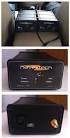
3 calculated by INS. Output of SRA block is P SRA. In this case, P SRA, V INS, A INS play a role in replacing corrected P, V and A parameters when GPS is available. This algorithm can push the vehicle back to the street in the perpendicular direction very well. However, it cannot determine exactly the vehicle positions along the lane. It really needs a more powerful algorithm for this task. III. INS/GPS/STA PROSPOSED INTEGRATION SYSTEM In order to overcome the disadvantages of SRA, we propose a new algorithm named the Street Tracking Algorithm (as shown in Fig. 5). In this figure, the STA block has three inputs and an output. The first input is obtained from the IMU. In STA, the velocity constraint has been applied to the navigation system when the GPS signal is lost. It is obvious that the land vehicle does not slip and jump of the ground. Then, velocities in directions of axes X, Z in body frame (B) are zeros: B VX ( t) 0 (1) B V ( t) 0 Z The information of accelerometers in IMU is then provided directly to the STA block in order to calculate the real distance of the vehicle from the moment the GPS signal is lost. Figure 5. INS/GPS/STA integrated system The second input is obtained from digital map database. It is assumed that the moving trajectory of land vehicle is certain roads. In this system, digital map database block implements two functions. The first function is to determine key points (including joints) based on map database and the second one is to find out some interpolated points from key points. It means that the number of points on the trajectory of land vehicle will be increased. The third input of STA is the position information P INS. It is obvious that when GPS signal is lost, this input would offer wrong locations of the vehicle that need to be corrected by STA. Note that the third input of STA is provided by output of the low-cost INS/GPS integration system. It consists of three parameters P INS, V INS, A INS where V INS, A INS are used to represent corrected V, A and the remaining input P INS is put into STA block to obtain the corrected position P STA. When GPS signal is lost, STA stores the last reliable location of the system denoted by d 0 (before the GPS signal is lost). The distance of vehicle at the time t k is calculated by: d = d 0 + d b (t k ) (2) where d b (t k ) is the distance of the vehicle from the moment the GPS signal is lost to the epoch t k. Note that this distance is computed by integrating the velocity provided directly from the IMU in the body frame. The corrected position would be determined by comparison of d with d ref which determined from the reference points from map database (the second input of STA). The vehicle will be pulled back to certain position determined in the database as following equation: d d ref < ε (3) It can be seen that the performance would be improved if the number of the reference points is increased. However, it would be a tradeoff between the performance and the system complexity. By using this algorithm, the vehicle can always track the real the road on the map in real-time scenario. By integrating the velocity in Y direction from the moment that GPS signal is lost; this algorithm can avoid the accumulated errors caused by MEMS based sensors. We neither need to transform this distance from body frame to navigation frame. It will also avoid the transformation errors caused by velocity constraints. IV. SIMULATED RESULTS In this section, the data was obtained by experiment using a vehicle equipped by IMU BP3010 and GPS HI- COM as shown in Fig. 6 [6]. The vehicle completed a trajectory in about 25 minutes. The referenced trajectory is obtained by the GPS in a good condition (i.e. GPS signal is always available). Of course that we can improve the correctness of this referenced trajectory by using some kinds of facilities such as DGPS, high cost INS/GPS integration system, etc. Figure 6. The INS/GPS system in outdoor experimentation In this scenario, the GPS would be lost from 728 th to 756 th seconds. The Fig. 7 shows the position comparison between the reference and the conventional INS/GPS 183

4 without STA. The solid curve is the reference trajectory and the dotted curve is the INS/GPS one without STA. The Fig. 8 is the closer look of the trajectory that the GPS signal was assumed to be lost. The results show that the position error is more than 200 m Figure 7. Comparisons of the reference trajectory with the INS/GPS without STA INS/GPS without STA V. CONCLUSION In this paper, we have proposed a Street Tracking Algorithm in order to track a vehicle on the road when the GPS signal losing. This algorithm calculates position based on parameters of INS position output, IMU velocity increment within a time slot with referencing to the trajectory s digital map database. The performance of the proposed system has been examined with experimented data. The position error of the novel systems is about ± 2.5 meters within 28 seconds. It is much improved when comparing with the original ING/GPS system error of ± 200 meters. This STA considers both longitudinal and transverse position errors when comparing with the developed SRA system which can only improve the trajectory transverse error parameter. However, the accuracy of the SRA on the transverse error can reach ± 1 meter within 100 seconds time period, where STA one is ± 2.5 meters within only 28 seconds. In the future work, the output of STA would be feed backed to INS/GPS block to improve the information of attitude and velocity. This STA system can be applied in city vehicle navigation, railway transportation navigation, and so on INS/GPS without STA ACKNOWLEDGMENT This work is partly supported by the project QG-B Figure 8. A closer look of the comparison of the reference trajectory with the INS/GPS without STA Applied STA to the INS/GPS system INS/GPS with STA Figure 9. Comparisons of the reference trajectory with the INS/GPS with STA Fig. 9 shows the position comparison between the reference and the conventional INS/GPS with STA. The error of this STA proposed INS/GPS system reaches ± 2.5 m. It shows that the STA s position error is much improved up to 80 times when compare with the original INS/GPS system error of ± 200 m. However, this STA requires more complexly computation due to number of integration calculations. Therefore, the number of key points cannot be too large. This number is depended on the used processor performance and required time resolution. REFERENCES [1] Kai-Wei Chang, INS/GPS Integration using neural networks for the land vehicular, Ph.D. dissertation, Dept. Geo. Eng., Calgary, Alberta, Canada, NO, [2] N. El-Sheimy, A-H. Walid, and G. Lachapelle, An adaptive neuro-fuzzy model for bridging GPS outages in MEMS-IMU/GPS land vehicle navigation, in Proc. ION GNSS, Long Beach, CA, USA, September 2004, pp [3] J-H. Wang, The aiding of a low-cost MEMS INS for land vehicle navigation using fuzzy logic expert system, in Proc. ION GNSS, Long Beach, California, USA, September 2004, pp [4] Nguyen Van Thang, Pham Manh Thang, and Tran Duc Tan, The performance improvement of a low-cost INS/GPS integration system using the street return algorithm, Vietnam Journal of Mechanics, Special Issue: Microelectromechanical System, vol. 34, pp , December [5] Christopher L. Goodall, Improving usability of low-cost INS/GPS navigation systems using intelligent techniques, Ph.D. dissertation, Dept. Geo. Eng., Calgary, Alberta, Canada, NO, [6] Tran Duc Tan, Luu Manh Ha, N. T. Long, H. H. Tue, and N. P. Thuy, Novel MEMS INS/GPS integration scheme using parallel kalman filters, in Proc. IEEE International Symposium on System Integration, Japan, December 2008, pp Tan Tran Duc was born in He received his B.Sc., M.Sc., and Ph.D. degrees respectively in 2002, 2005, and 2010 at the University of Engineering and Technology (UET), Vietnam National University Hanoi, Vietnam (VNUH), where he has been a lecturer since He is author and coauthor of several papers on MEMS based sensors and their application. His present research interest is in DSP applications. 184

5 Thang Nguyen Van was born in He received his B.Sc., degree in Electronics and Telecommunication at the Hanoi University of Transport and Communications, Hanoi, Vietnam, in 2002 and his M.Sc. degree in Information Engineering from Le Quy Don University, Hanoi, Vietnam, in He has been a lecturer of Broadcasting College 1, Radio the voice of Vietnam since He becomes vice leader of training department of Broadcasting College I since Now, he is PhD students of the University of Engineering and Technology (UET), Vietnam National University Hanoi, Vietnam (VNUH). Until now, He is author and coauthor of several papers on MEMS based sensors and their application. Trinh Chu Duc received the B.S. degree in physics from Hanoi University of Science, Hanoi, Vietnam, in 1998, the M.Sc. degree in electrical engineering from Vietnam National University, Hanoi, in2002, and the Ph.D. degree from Delft University of Technology, Delft, The Netherlands, in His doctoral research concerned piezoresistive sensors, polymeric actuators, sensing microgrippers for microparticle handling, and microsystems technology. He is currently an Associate Professor with the Faculty of Electronics and Telecommunications, University of Engineering and Technology, Vietnam National University, Hanoi, Vietnam. Since 2008, he has been the Vice-Dean of the Faculty of Electronics and Telecommunications. He has been chair of Microelectromechanical Systems and Microsystems Department, since He has authored or coauthored more than 50 journal and conference papers. He was the recipient of the Vietnam National University, Hanoi, Vietnam Young Scientific Award in 2010, the 20th anniversary of DIMES, Delft University of Technology, The Netherlands Best Poster Award in 2007 and the 17th European Workshop on Micromechanics Best Poster Award in He is guest editor of the Special Issue of Microelectromechanical systems Vietnam journal of Mechanics, in

Performance Test Results of an Integrated GPS/MEMS Inertial Navigation Package
 Performance Test Results of an Integrated GPS/MEMS Inertial Navigation Package Alison K. Brown and Yan Lu, NAVSYS Corporation BIOGRAPHY Alison Brown is the President and Chief Executive Officer of NAVSYS
K.Prasanna NIT Rourkela,India Summer Internship NUS
 K.Prasanna NIT Rourkela,India Summer Internship NUS LOCALIZATION Vehicle localization is an important topic as it finds its application in a multitude of fields like autonomous navigation and tracking
IP-S2 Compact+ 3D Mobile Mapping System
 IP-S2 Compact+ 3D Mobile Mapping System 3D scanning of road and roadside features Delivers high density point clouds and 360 spherical imagery High accuracy IMU options without export control Simple Map,
The Performance Analysis of a Real-Time Integrated INS/GPS Vehicle Navigation System with Abnormal GPS Measurement Elimination
 Sensors 2013, 13, 10599-10622; doi:10.3390/s130810599 Article OPEN ACCESS sensors ISSN 1424-8220 www.mdpi.com/journal/sensors The Performance Analysis of a Real-Time Integrated INS/GPS Vehicle Navigation
VEHICLE TRACKING USING ACOUSTIC AND VIDEO SENSORS
 VEHICLE TRACKING USING ACOUSTIC AND VIDEO SENSORS Aswin C Sankaranayanan, Qinfen Zheng, Rama Chellappa University of Maryland College Park, MD - 277 {aswch, qinfen, rama}@cfar.umd.edu Volkan Cevher, James
Integration of Inertial Measurements with GNSS -NovAtel SPAN Architecture-
 Integration of Inertial Measurements with GNSS -NovAtel SPAN Architecture- Sandy Kennedy, Jason Hamilton NovAtel Inc., Canada Edgar v. Hinueber imar GmbH, Germany Symposium Gyro Technology, Stuttgart 9/25
Basic Principles of Inertial Navigation. Seminar on inertial navigation systems Tampere University of Technology
 Basic Principles of Inertial Navigation Seminar on inertial navigation systems Tampere University of Technology 1 The five basic forms of navigation Pilotage, which essentially relies on recognizing landmarks
Engineers from Geodetics select KVH for versatile high-performance inertial sensors. White Paper. kvh.com
 White Paper Overcoming GNSS Vulnerability by Applying Inertial Data Integration in Multi-Sensor Systems for High Accuracy Navigation, Pointing, and Timing Solutions Engineers from Geodetics select KVH
An Experimental Investigation into the Performance of GPS-based Vehicle Positioning in Very Dense Urban Areas
 An Experimental Investigation into the Performance of GPS-based Vehicle Positioning in Very Dense Urban Areas Jason CHAO 1,2, Yong-qi CHEN 1, Wu CHEN 1, Xiaoli DING 1, Zhilin LI 1, Nganying WONG 1 and
Improving Quality of GNSS Vehicle Localization
 Improving Quality of GNSS Vehicle Localization Roman Srp ITS&S FP7 Easy OBU project Telematika, Legislativa, Strategie, 11.4.2014, Praha Contents EasyOBU Research in a Nutshell Signal Loss in GNSS Applications
Tracking Vehicles with GPS:
 Zheng, Wang, and Nihan Page 1 Tracking Vehicles with GPS: Is it a Feasible Solution? Jianyang Zheng Box 352700 Department of Civil and Environmental Engineering University of Washington Seattle, WA 98195-2700
Path Tracking for a Miniature Robot
 Path Tracking for a Miniature Robot By Martin Lundgren Excerpt from Master s thesis 003 Supervisor: Thomas Hellström Department of Computing Science Umeå University Sweden 1 Path Tracking Path tracking
Method of Combining the Degrees of Similarity in Handwritten Signature Authentication Using Neural Networks
 Method of Combining the Degrees of Similarity in Handwritten Signature Authentication Using Neural Networks Ph. D. Student, Eng. Eusebiu Marcu Abstract This paper introduces a new method of combining the
A New Active Phased Array Antenna for Mobile Direct Broadcasting Satellite Reception
 34 IEEE TRANSACTIONS ON BROADCASTING, VOL. 46, NO. 1, MARCH 2000 A New Active Phased Array Antenna for Mobile Direct Broadcasting Satellite Reception Soon-Ik Jeon, Young-Wan Kim, and Deog-Gil Oh Abstract
GPS/INS Integration with the imar-fsas IMU
 Sandy KENNEDY, Canada Jason HAMILTON, Canada Hugh MARTELL, Canada Key words: GPS, INS, integrated navigation, inertial navigation SUMMARY This paper discusses NovAtel's approach to GPS/INS system architecture
If you want to use an inertial measurement system...
 If you want to use an inertial measurement system...... which technical data you should analyse and compare before making your decision by Dr.-Ing. Edgar v. Hinueber, CEO imar Navigation GmbH Keywords:
An inertial haptic interface for robotic applications
 An inertial haptic interface for robotic applications Students: Andrea Cirillo Pasquale Cirillo Advisor: Ing. Salvatore Pirozzi Altera Innovate Italy Design Contest 2012 Objective Build a Low Cost Interface
Performance of a Deeply Coupled Commercial Grade GPS/INS System from KVH and NovAtel Inc.
 Performance of a Deeply Coupled Commercial Grade GPS/INS System from KVH and NovAtel Inc. Sandy Kennedy 1 and Jim Rossi 2 1 NovAtel Inc., 112 68 th Ave. N.E. Calgary, Alberta, T2E 8S5, Canada 2 KVH Industries,
Automatic Labeling of Lane Markings for Autonomous Vehicles
 Automatic Labeling of Lane Markings for Autonomous Vehicles Jeffrey Kiske Stanford University 450 Serra Mall, Stanford, CA 94305 [email protected] 1. Introduction As autonomous vehicles become more popular,
Quality of Map-Matching Procedures Based on DGPS and Stand-Alone GPS Positioning in an Urban Area
 Quality of Map-Matching Procedures Based on DGPS and Stand-Alone GPS Positioning in an Urban Area Konstantinos LAKAKIS, Paraskevas SAVVAIDIS, Ioannis M. IFADIS and Ioannis D. DOUKAS, Greece Key words:
Intelligent Submersible Manipulator-Robot, Design, Modeling, Simulation and Motion Optimization for Maritime Robotic Research
 20th International Congress on Modelling and Simulation, Adelaide, Australia, 1 6 December 2013 www.mssanz.org.au/modsim2013 Intelligent Submersible Manipulator-Robot, Design, Modeling, Simulation and
Automated Process for Generating Digitised Maps through GPS Data Compression
 Automated Process for Generating Digitised Maps through GPS Data Compression Stewart Worrall and Eduardo Nebot University of Sydney, Australia {s.worrall, e.nebot}@acfr.usyd.edu.au Abstract This paper
Apogee Series. > > Motion Compensation and Data Georeferencing. > > Smooth Workflow. Mobile Mapping. > > Precise Trajectory and Direct Georeferencing
 Ultimate accuracy MEMS Apogee Series Inertial Navigation System Motion Sensing and Georeferencing > INS > MRU > AHRS ITAR free 0,005 RMS Apogee Series High quality, high accuracy Hydrography > > Motion
Vehicle and Object Tracking Based on GPS and GSM
 Vehicle and Object Tracking Based on GPS and GSM 1 Sonali Kumari, 2 Simran Ghai, 3 Bharti Kushwaha 1,2,3 Department of Computer Science, Dronacharya Group of Institutions, Greater Noida (U.P), India Abstract:
Automatic Train Control based on the Multi-Agent Control of Cooperative Systems
 The Journal of Mathematics and Computer Science Available online at http://www.tjmcs.com The Journal of Mathematics and Computer Science Vol.1 No.4 (2010) 247-257 Automatic Train Control based on the Multi-Agent
GPS-FREE TERRAIN-BASED VEHICLE TRACKING PERFORMANCE AS A FUNCTION OF INERTIAL SENSOR CHARACTERISTICS
 GPS-FREE TERRAIN-BASED VEHICLE TRACKING PERFORMANCE AS A FUNCTION OF INERTIAL SENSOR CHARACTERISTICS Kshitij Jerath and Sean N. Brennan Department of Mechanical and Nuclear Engineering The Pennsylvania
Mathieu St-Pierre. Denis Gingras Dr. Ing.
 Comparison between the unscented Kalman filter and the extended Kalman filter for the position estimation module of an integrated navigation information system Mathieu St-Pierre Electrical engineering
Fundamental to determining
 GNSS Solutions: Carrierto-Noise Algorithms GNSS Solutions is a regular column featuring questions and answers about technical aspects of GNSS. Readers are invited to send their questions to the columnist,
CHAPTER 1 INTRODUCTION
 CHAPTER 1 INTRODUCTION 1.1 Background of the Research Agile and precise maneuverability of helicopters makes them useful for many critical tasks ranging from rescue and law enforcement task to inspection
Synchronization of sampling in distributed signal processing systems
 Synchronization of sampling in distributed signal processing systems Károly Molnár, László Sujbert, Gábor Péceli Department of Measurement and Information Systems, Budapest University of Technology and
A method of generating free-route walk-through animation using vehicle-borne video image
 A method of generating free-route walk-through animation using vehicle-borne video image Jun KUMAGAI* Ryosuke SHIBASAKI* *Graduate School of Frontier Sciences, Shibasaki lab. University of Tokyo 4-6-1
Use of modern telephone network for time transfer: An innovation
 Indian Journal of Pure & Applied Physics Vol. 48, September 2010, pp. 676-680 Use of modern telephone network for time transfer: An innovation Pranalee P Thorat* & P Banerjee** National Physical Laboratory,
GENERAL INFORMATION ON GNSS AUGMENTATION SYSTEMS
 GENERAL INFORMATION ON GNSS AUGMENTATION SYSTEMS 1. INTRODUCTION Navigation technologies with precision approach and landing systems, for civilian and military purposes, enable aircrafts to perform their
A Real-Time Position, Velocity, and Physiological Monitoring and Tracking Device for Equestrian Training
 A Real-Time Position, Velocity, and Physiological Monitoring and Tracking Device for Equestrian Training Kyle Green, Adam Hill, Jade Morton, Mikel Miller, Jacob Campbell Miami University BIOGRAPHIES Kyle
A Reliability Point and Kalman Filter-based Vehicle Tracking Technique
 A Reliability Point and Kalman Filter-based Vehicle Tracing Technique Soo Siang Teoh and Thomas Bräunl Abstract This paper introduces a technique for tracing the movement of vehicles in consecutive video
A Control Scheme for Industrial Robots Using Artificial Neural Networks
 A Control Scheme for Industrial Robots Using Artificial Neural Networks M. Dinary, Abou-Hashema M. El-Sayed, Abdel Badie Sharkawy, and G. Abouelmagd unknown dynamical plant is investigated. A layered neural
Onboard electronics of UAVs
 AARMS Vol. 5, No. 2 (2006) 237 243 TECHNOLOGY Onboard electronics of UAVs ANTAL TURÓCZI, IMRE MAKKAY Department of Electronic Warfare, Miklós Zrínyi National Defence University, Budapest, Hungary Recent
Forced Low latency Handoff in Mobile Cellular Data Networks
 Forced Low latency Handoff in Mobile Cellular Data Networks N. Moayedian, Faramarz Hendessi Department of Electrical and Computer Engineering Isfahan University of Technology, Isfahan, IRAN [email protected]
VEHICLE TRACKING SYSTEM USING GPS. 1 Student, ME (IT) Pursuing, SCOE, Vadgaon, Pune. 2 Asst. Professor, SCOE, Vadgaon, Pune
 VEHICLE TRACKING SYSTEM USING GPS Pooja P. Dehankar 1, 1 Student, ME (IT) Pursuing, SCOE, Vadgaon, Pune Prof. S. P. Potdar 2 2 Asst. Professor, SCOE, Vadgaon, Pune Abstract- Global Positioning System is
Force/position control of a robotic system for transcranial magnetic stimulation
 Force/position control of a robotic system for transcranial magnetic stimulation W.N. Wan Zakaria School of Mechanical and System Engineering Newcastle University Abstract To develop a force control scheme
Open Architecture Design for GPS Applications Yves Théroux, BAE Systems Canada
 Open Architecture Design for GPS Applications Yves Théroux, BAE Systems Canada BIOGRAPHY Yves Théroux, a Project Engineer with BAE Systems Canada (BSC) has eight years of experience in the design, qualification,
Adaptive Cruise Control of a Passenger Car Using Hybrid of Sliding Mode Control and Fuzzy Logic Control
 Adaptive Cruise Control of a assenger Car Using Hybrid of Sliding Mode Control and Fuzzy Logic Control Somphong Thanok, Manukid arnichkun School of Engineering and Technology, Asian Institute of Technology,
GPS Based Low Cost Intelligent Vehicle Tracking System (IVTS)
 2012 International Conference on Traffic and Transportation Engineering (ICTTE 2012) IPCSIT vol. 26 (2012) (2012) IACSIT Press, Singapore GPS Based Low Cost Intelligent Vehicle Tracking System (IVTS) Dr.
Ziegler-Nichols-Based Intelligent Fuzzy PID Controller Design for Antenna Tracking System
 Ziegler-Nichols-Based Intelligent Fuzzy PID Controller Design for Antenna Tracking System Po-Kuang Chang, Jium-Ming Lin Member, IAENG, and Kun-Tai Cho Abstract This research is to augment the intelligent
Developing Safety Management Systems for Track Workers Using Smart Phone GPS
 , pp.137-148 http://dx.doi.org/10.14257/ijca.2013.6.5.13 Developing Safety Management Systems for Track Workers Using Smart Phone GPS Jin-Hee Ku 1 and Duk-Kyu Park 2 1 Dept of Liberal Education and 2 Dept
Error Estimation in Positioning and Orientation Systems
 Error Estimation in Positioning and Orientation Systems Peter Canter Director, Applanix Marine Systems 85 Leek Crescent Richmond Hill, Ontario L4B 3B3 Telephone 905-709-4600 [email protected] Co-Author:
IMPLEMENTING VEHICLE LOCATION SYSTEM FOR PUBLIC BUSES IN SINGAPORE
 IMPLEMENTING VEHICLE LOCATION SYSTEM FOR PUBLIC BUSES IN SINGAPORE Silvester Prakasam 1 and Adeline Wang 1 ABSTRACT A Vehicle Location System will be implemented in Singapore in conjunction with the contactless
SIX DEGREE-OF-FREEDOM MODELING OF AN UNINHABITED AERIAL VEHICLE. A thesis presented to. the faculty of
 SIX DEGREE-OF-FREEDOM MODELING OF AN UNINHABITED AERIAL VEHICLE A thesis presented to the faculty of the Russ College of Engineering and Technology of Ohio University In partial fulfillment of the requirement
Efficient DNS based Load Balancing for Bursty Web Application Traffic
 ISSN Volume 1, No.1, September October 2012 International Journal of Science the and Internet. Applied However, Information this trend leads Technology to sudden burst of Available Online at http://warse.org/pdfs/ijmcis01112012.pdf
Visual Servoing using Fuzzy Controllers on an Unmanned Aerial Vehicle
 Visual Servoing using Fuzzy Controllers on an Unmanned Aerial Vehicle Miguel A. Olivares-Méndez mig [email protected] Pascual Campoy Cervera [email protected] Iván Mondragón [email protected] Carol
CELL PHONE TRACKING. Index. Purpose. Description. Relevance for Large Scale Events. Options. Technologies. Impacts. Integration potential
 CELL PHONE TRACKING Index Purpose Description Relevance for Large Scale Events Options Technologies Impacts Integration potential Implementation Best Cases and Examples 1 of 10 Purpose Cell phone tracking
RESEARCH INTERESTS Modeling and Simulation, Complex Systems, Biofabrication, Bioinformatics
 FENG GU Assistant Professor of Computer Science College of Staten Island, City University of New York 2800 Victory Boulevard, Staten Island, NY 10314 Doctoral Faculty of Computer Science Graduate Center
REAL TIME TRAFFIC MONITORING SYSTEM AND DRIVER ASSISTANCE
 REAL TIME TRAFFIC MONITORING SYSTEM AND DRIVER ASSISTANCE 1 CHAITHRA M H, 2 KANTHARAJU V, 3 ANIL KUMAR B N 1.2 Assistant Professor, KNSIT, Bangalore 3 Assistant Professor, BRCE, Bangalore E-mail: [email protected],
1.1 OVERVIEW OF THE DOCUMENT 1.2 BACKGROUND TO THE PROJECT
 CHAPTER 1 INTRODUCTION 1.1 OVERVIEW OF THE DOCUMENT This project thesis examines the task of learning to develop a cost-effective vehicle movement tracking system for companies to track their vehicles.
MobileMapper 6 White Paper
 MobileMapper 6 White Paper Meter-Level Mapping Accuracy With Post-Processing Introduction Since its introduction in February 2008, the Magellan MobileMapper 6 has been welcomed by the market as the only
An Energy-Based Vehicle Tracking System using Principal Component Analysis and Unsupervised ART Network
 Proceedings of the 8th WSEAS Int. Conf. on ARTIFICIAL INTELLIGENCE, KNOWLEDGE ENGINEERING & DATA BASES (AIKED '9) ISSN: 179-519 435 ISBN: 978-96-474-51-2 An Energy-Based Vehicle Tracking System using Principal
CONTROL SYSTEMS, ROBOTICS AND AUTOMATION Vol. XVI - Fault Accomodation Using Model Predictive Methods - Jovan D. Bošković and Raman K.
 FAULT ACCOMMODATION USING MODEL PREDICTIVE METHODS Scientific Systems Company, Inc., Woburn, Massachusetts, USA. Keywords: Fault accommodation, Model Predictive Control (MPC), Failure Detection, Identification
CE801: Intelligent Systems and Robotics Lecture 3: Actuators and Localisation. Prof. Dr. Hani Hagras
 1 CE801: Intelligent Systems and Robotics Lecture 3: Actuators and Localisation Prof. Dr. Hani Hagras Robot Locomotion Robots might want to move in water, in the air, on land, in space.. 2 Most of the
IP-S3 HD1. Compact, High-Density 3D Mobile Mapping System
 IP-S3 HD1 Compact, High-Density 3D Mobile Mapping System Integrated, turnkey solution Ultra-compact design Multiple lasers minimize scanning shades Unparalleled ease-of-use No user calibration required
APPLANIX POSITION AND ORIENTATION SYSTEMS FOR LAND VEHICLES (POS LV)
 APPLANIX POSITION AND ORIENTATION SYSTEMS FOR LAND VEHICLES (POS LV) POS LV powers any application where vehicle positioning and orientation is required. capture everything. precisely. APPLANIX POSITION
Introduction into Real-Time Network Adjustment with Geo++ GNSMART
 Introduction into Real-Time Network Adjustment with Geo++ GNSMART Andreas Bagge Gerhard Wübbena, Martin Schmitz Geo++ GmbH D-30827 Garbsen, Germany www.geopp.de GeoInformation Workshop 2004, Istanbul Kultur
Software implementation of multiple model neural filter for radar target tracking
 Scientific Journals Maritime University of Szczecin Zeszyty Naukowe Akademia Morska w Szczecinie 2012, 32(104) z. 2 pp. 88 93 2012, 32(104) z. 2 s. 88 93 Software implementation of multiple model neural
Capturing Road Network Data Using Mobile Mapping Technology
 Capturing Road Network Data Using Mobile Mapping Technology Guangping He, Greg Orvets Lambda Tech International, Inc. Waukesha, WI-53186, USA [email protected] KEY WORDS: DATA CAPTURE, MOBILE MAPPING,
IP-S2 HD. High Definition 3D Mobile Mapping System
 IP-S2 HD High Definition 3D Mobile Mapping System Integrated, turnkey solution High Density, Long Range LiDAR sensor for ultimate in visual detail High Accuracy IMU and DMI Odometry for positional accuracy
A Multipurpose Vehicle Tracking System Based on ARM CORTEX-M3 STM32, HMC5883L, MPU-6050, GSM and GPS
 Journal of Traffic and Logistics Engineering Vol. 4, No. 1, June 2016 A Multipurpose Vehicle Tracking System Based on ARM CORTEX-M3 STM32, HMC5883L, MPU-6050, GSM and GPS Muhammad Husnain Ul Abdeen, Umar
PRODUCT DATASHEET. J1939 Vehicle Inertia Monitor. Advanced Vehicle Inertial Measurement and Vibration Monitoring Device. fleet-genius.
 PRODUCT DATASHEET fleet-genius.com J1939 Vehicle Inertia Monitor Advanced Vehicle Inertial Measurement and Vibration Monitoring Device Prova s J1939 Vehicle Inertia Monitor (VIM) formulates moving vehicle
Computation of Forward and Inverse MDCT Using Clenshaw s Recurrence Formula
 IEEE TRANSACTIONS ON SIGNAL PROCESSING, VOL. 51, NO. 5, MAY 2003 1439 Computation of Forward Inverse MDCT Using Clenshaw s Recurrence Formula Vladimir Nikolajevic, Student Member, IEEE, Gerhard Fettweis,
Measurement of Multi-Port S-Parameters using Four-Port Network Analyzer
 JOURNAL OF SEMICONDUCTOR TECHNOLOGY AND SCIENCE, VOL.13, NO.6, DECEMBER, 2013 http://dx.doi.org/10.5573/jsts.2013.13.6.589 Measurement of Multi-Port S-Parameters using Four-Port Network Analyzer Jongmin
Active Vibration Isolation of an Unbalanced Machine Spindle
 UCRL-CONF-206108 Active Vibration Isolation of an Unbalanced Machine Spindle D. J. Hopkins, P. Geraghty August 18, 2004 American Society of Precision Engineering Annual Conference Orlando, FL, United States
ge (PhD) Education CURRICULUM VITAE Office Address: Department of CPRSG Kahawathaa Rathanapura Sri Lanka. gmail.com enhanced the study
 CURRICULUM VITAE Thilanthaa Lakmal Dammalag ge (PhD) Office Address: Department of CPRSG Faculty of Geomatics Sabaragamuwa University of Sri Lanka Belihuloya Sri Lanka. Permanent Address: No:29, Main Street
Online Tuning of Artificial Neural Networks for Induction Motor Control
 Online Tuning of Artificial Neural Networks for Induction Motor Control A THESIS Submitted by RAMA KRISHNA MAYIRI (M060156EE) In partial fulfillment of the requirements for the award of the Degree of MASTER
STATOR FLUX OPTIMIZATION ON DIRECT TORQUE CONTROL WITH FUZZY LOGIC
 STATOR FLUX OPTIMIZATION ON DIRECT TORQUE CONTROL WITH FUZZY LOGIC Fatih Korkmaz1, M. Faruk Çakır1, Yılmaz Korkmaz2, İsmail Topaloğlu1 1 Technical and Business Collage, Çankırı Karatekin University, 18200,
The Big Data methodology in computer vision systems
 The Big Data methodology in computer vision systems Popov S.B. Samara State Aerospace University, Image Processing Systems Institute, Russian Academy of Sciences Abstract. I consider the advantages of
Mobile Phone Tracking & Positioning Techniques
 Mobile Phone Tracking & Positioning Techniques Laxmana Siridhara Arigela #1, Putta Aditya Veerendra *2, Simhadri Anvesh *2, Kolisetty Sandeep Satya Hanuman #3 1 Assistant Professor, Department of ECE,
Mapping Linear Networks Based on Cellular Phone Tracking
 Ronen RYBOWSKI, Aaron BELLER and Yerach DOYTSHER, Israel Key words: Cellular Phones, Cellular Network, Linear Networks, Mapping. ABSTRACT The paper investigates the ability of accurately mapping linear
Internet-Based Satellite Navigation Receivers using EGNOS: the ESA SISNET Project
 Internet-Based Satellite Navigation Receivers using EGNOS: the ESA SISNET Project Félix Torán-Martí (1), Javier Ventura-Traveset (1), Juan Carlos de Mateo (2) (1) European Space Agency (ESA) GNSS-1 Project
LINEAR MOTOR CONTROL IN ACTIVE SUSPENSION SYSTEMS
 LINEAR MOTOR CONTROL IN ACTIVE SUSPENSION SYSTEMS HONCŮ JAROSLAV, HYNIOVÁ KATEŘINA, STŘÍBRSKÝ ANTONÍN Department of Control Engineering, Faculty of Electrical Engineering, Czech Technical University Karlovo
RESUME. Rashid Alammari, Ph.D Associate Professor
 RESUME Date: November 2010 Personal Data Name & Mailing Address Rashid Alammari, Ph.D Associate Professor Department of Electrical Engineering College of Engineering Qatar University P.O. Box 2713 Doha,
Zukang Shen Home Address: Work: 214-480-3198 707 Kindred Lane Cell: 512-619-7927
 Zukang Shen Home Address: Work: 214-480-3198 707 Kindred Lane Cell: 512-619-7927 Richardson, TX 75080 Email: [email protected] Education: The University of Texas, Austin, TX, USA Jun. 2003 May 2006 Ph.D.,
Electric Power Steering Automation for Autonomous Driving
 Electric Power Steering Automation for Autonomous Driving J. E. Naranjo, C. González, R. García, T. de Pedro Instituto de Automática Industrial (CSIC) Ctra. Campo Real Km.,2, La Poveda, Arganda del Rey,
A Robust Method for Solving Transcendental Equations
 www.ijcsi.org 413 A Robust Method for Solving Transcendental Equations Md. Golam Moazzam, Amita Chakraborty and Md. Al-Amin Bhuiyan Department of Computer Science and Engineering, Jahangirnagar University,
How To Fuse A Point Cloud With A Laser And Image Data From A Pointcloud
 REAL TIME 3D FUSION OF IMAGERY AND MOBILE LIDAR Paul Mrstik, Vice President Technology Kresimir Kusevic, R&D Engineer Terrapoint Inc. 140-1 Antares Dr. Ottawa, Ontario K2E 8C4 Canada [email protected]
Characteristics of Ship Movements in a Fairway
 International Journal of Fuzzy Logic and Intelligent Systems, vol. 1, no. 4, December 1, pp. 85-89 http:// dx.doi.org/ 1.5391/IJFIS.1.1.4.85 PISSN 1598-645 eissn 93-744X Characteristics of Ship Movemen
Phase coherency of CDMA caller location processing based on TCXO frequency reference with intermittent GPS correction
 Phase coherency of CDMA caller location processing based on TCXO frequency reference with intermittent GPS correction Dingchen Lu, Alfredo Lopez, Surendran K. Shanmugam, John Nielsen and Gerard Lachapelle
State of the art in mobile terrestrial laser scanning systems in Romania and at an international level
 UN/Moldova/USA Workshop on the Applications of GNSS Chisinau, 17-21 May 2010 State of the art in mobile terrestrial laser scanning systems in Romania and at an international level V.G. Olteanu, A. Badea,
EUTERPE - EUROPEAN TEST CENTRE FOR RECEIVER PERFORMANCE EVALUATION
 ABSTRACT EUTERPE - EUROPEAN TEST CENTRE FOR RECEIVER PERFORMANCE EVALUATION David Jiménez-Baños (1), Michel Tossaint (1), Jean-Luc Gerner (1), Rafael Lucas-Rodríguez (2) (1) Radio Navigation Systems and
Enhancing the SNR of the Fiber Optic Rotation Sensor using the LMS Algorithm
 1 Enhancing the SNR of the Fiber Optic Rotation Sensor using the LMS Algorithm Hani Mehrpouyan, Student Member, IEEE, Department of Electrical and Computer Engineering Queen s University, Kingston, Ontario,
AP Series Autopilot System. AP-202 Data Sheet. March,2015. Chengdu Jouav Automation Tech Co.,L.t.d
 AP Series Autopilot System AP-202 Data Sheet March,2015 Chengdu Jouav Automation Tech Co.,L.t.d AP-202 autopilot,from Chengdu Jouav Automation Tech Co., Ltd, provides complete professional-level flight
Online Farsi Handwritten Character Recognition Using Hidden Markov Model
 Online Farsi Handwritten Character Recognition Using Hidden Markov Model Vahid Ghods*, Mohammad Karim Sohrabi Department of Electrical and Computer Engineering, Semnan Branch, Islamic Azad University,
Simulation-based traffic management for autonomous and connected vehicles
 Simulation-based traffic management for autonomous and connected vehicles Paweł Gora Faculty of Mathematics, Informatics and Mechanics University of Warsaw ITS Kraków, 3-4.12.2015 Axioms Vehicles may communicate
Prof. Ludovico Biagi. Satellite Navigation and Monitoring
 Prof. Ludovico Biagi Satellite Navigation and Monitoring Navigation: trajectories control positions estimations in real time, at high frequency popular applications: low accuracy (10 m) required specific
Self-organized Multi-agent System for Service Management in the Next Generation Networks
 PROCEEDINGS OF THE WORKSHOP ON APPLICATIONS OF SOFTWARE AGENTS ISBN 978-86-7031-188-6, pp. 18-24, 2011 Self-organized Multi-agent System for Service Management in the Next Generation Networks Mario Kusek
Mechanics lecture 7 Moment of a force, torque, equilibrium of a body
 G.1 EE1.el3 (EEE1023): Electronics III Mechanics lecture 7 Moment of a force, torque, equilibrium of a body Dr Philip Jackson http://www.ee.surrey.ac.uk/teaching/courses/ee1.el3/ G.2 Moments, torque and
A Routing Algorithm Designed for Wireless Sensor Networks: Balanced Load-Latency Convergecast Tree with Dynamic Modification
 A Routing Algorithm Designed for Wireless Sensor Networks: Balanced Load-Latency Convergecast Tree with Dynamic Modification Sheng-Cong Hu [email protected] Jen-Hou Liu [email protected] Min-Sheng