
TRAIN DETECTION BONDING AND CABLES
|
|
|
- Dustin Hunter
- 9 years ago
- Views:
Transcription
1 Ref No: TC11 Issue No: 1.0 Issue date: March 2013 INSTITUTION OF RAILWAY SIGNAL ENGINEERS MINOR RAILWAYS SECTION GUIDELINE ON TRAIN DETECTION BONDING AND CABLES

2 March 2013 Page 2 of 17 Issue Date Amendments 1.0 March 2013 Original Issue Record of Amendments Anyone who wishes to contribute additional items or correct / amend any of the entries or wants further information may contact the IRSE Minor Railways Section Guideline co-ordinator at [email protected] or via the IRSE Headquarters. Any railway seeking to follow the guidelines in this document should ensure that it is suitable for their particular railway concern. Duty holders are reminded that they must be satisfied that they are doing all that is needed under health and safety duties to control risks. Compliance with this guideline issued by the IRSE is not mandatory as it provides advice on how an issue may be addressed.

3 March 2013 Page 3 of 17 TABLE OF CONTENTS 1 INTRODUCTION DEFINITIONS SAFETY CONSIDERATIONS Before Starting Work Risk Assessments Electric Shock Risk BASIC REQUIREMENTS General Operation of a Basic Track Circuit CABLES AND RAIL TERMINATIONS General Cables Rail Terminations Rail Drilling Cable Connections BONDING Rail Joint Bonds Bonding of Points and Crossings Jumper Cables TRACK CIRCUIT INTERRUPTERS TRACK CIRCUIT DESIGN General Plain Line Points and Crossings MAINTENANCE REQUIREMENTS Before Starting Work Details Visual Examination Maintenance Standards Maintenance Intervals Maintenance Records REFERENCES APPENDICES TABLE OF FIGURES Figure 1 - Basic Track Circuit... 6 Figure 2 - Cable Terminations... 7 Figure 3 M6 Taper Pin... 8 Figure 4 - Cable Secured in Orange Pipe... 8 Figure 5 - Cable with preformed rail connection... 9 Figure 6 - "L" Plate Connector... 9 Figure 7 - Termination 50/0.25mm Cable to an "L" Plate Figure 8 - "D Link" termination Figure 9 - Channel Pin Figure 10 - Rail Joint Bond Figure 11 - Switch to Stock Rail Bonding Figure 12 - Fabricated Crossing Figure 13 - Examples of Jumper Cable Identification Figure 14 - Track Circuit Interrupter Figure 15 - Typical Plain Line Track Circuits Figure 16 - Typical Bonding for a Single Point Figure 17 - Typical Bonding for a Crossover... 16

4 March 2013 Page 4 of 17 1 INTRODUCTION This document provides information on track circuit bonding for non-electrified lines. It includes information on cables, cable terminations and track circuit interrupters. This document does not include details about any form of train detection such as track circuits, axle counters, treadles or position detectors. It is not intended to be a definitive document on how to design, install, test and maintain DC track circuits, but to disseminate information on best practice. The IRSE Minor Railways Section has used its best endeavours to ensure that the contents of this document are factually and technically correct and is suitable for its stated purpose but the IRSE Minor Railways Section cannot be liable for any subsequent use to which the document may be put. 2 DEFINITIONS The following is a list of the more common definitions, a fuller description may be found in subsequent sections. In this document terms relating to gender equally apply to the opposite. Any reference made to Signal Engineer is a generic term and can relate to; Maintenance person in charge of Signal Engineering for the Railway Design Responsible Design Engineer for the design authority Installation Person in charge of Installation New Works Testing Tester in Charge Any reference made to Signalman is a generic term and applies to the person in charge of regulating trains on the section of line where work is required. Any reference made to Railway is a generic term and applies to the owner and/or operator of the relevant infrastructure. Track Circuit Polarity Feed End Relay End Insulated Rail Joint (IRJ) A means of proving the absence of a train on a section of track. The two rails are used to connect a power source to a detector (usually a relay). The normal state with no train present is that the detector is energised. When a train occupies the section of track, the wheels short-circuit the two rails together, which causes the current to by-pass the detector, which therefore de-energises (i.e. drops away). B is the positive side. N is the negative side. Note: The polarity of the voltage on the rails can be made to change within the length of the track circuit by using insulated rail joints and jumper cables. The end of the track circuit where power is fed into the rails. On diagrams, the feed end rail connections may be designated TN or TB according to the polarity. The end of the track circuit where the relay is connected to the rails (even if the relay is connected to the rails through an intermediate device). On diagrams, the relay end rail connections may be designated RN or RB according to the polarity. A joint between two lengths of rail, designed to isolate electrically one length of rail from another. The shape and construction of the IRJ varies according to the type of rail each side of it. The traditional joint is bolted to the rails by using an insulated fishplate. This joint is also known as an Insulated Block Joint (IBJ). They are used to: 1. limit how far a track circuit extends. 2. allow a changeover in rail polarity within a track circuit. 3. divide up lengths of rail so that they can be connected together in a manner to make train detection more effective.

5 March 2013 Page 5 of 17 Staggered Polarities Fouling Point Transposition IRJs Staggered IRJs Bonds Jumpers Ballast Resistance Drop Shunt Prevent Shunt Pick-Up Shunt Shunt Box Cut Section Single Rail Double Rail Common Rail TR Track circuits are designed so that the polarity of the voltage on the rail on one side of an IRJ is the opposite of that on the other side. This is done so that if an insulated joint fails, the two polarities will oppose each other and cancel each other out. The resulting reduced voltage will cause the track relay to drop. This is safer than allowing the track relay to become energised from a supply from which it should be insulated. The position on a converging, diverging or crossing line beyond which the encroachment of any part of a vehicle would infringe the required passing clearance for a vehicle on the other line. IRJs within a track circuit specially put to permit a changeover of polarities. This may be necessary to create staggered polarities at the IRJs between two neighbouring track circuits, or they may be used to extend the track circuit through point and crossing rails. Two IRJs in a pair of rails that are not exactly opposite each other. The length of maximum stagger must not exceed the requirements of the Railway. Where sections of rail are bolted together with fishplates, the electrical continuity between them may not be adequate. To ensure there is a good electrical connection, lengths of wire or cable known as bonds are connected from one rail to the other. Lengths of cable connecting together rails which are separate or deliberately insulated from each other. Usually, this is so that the rails are connected in series within the same track circuit through points and crossings. Each rail has a leakage to other rails and to earth through the sleepers and the ballast. The leakage resistance, effectively connected across the rails (and hence across the track circuit) is termed ballast resistance. It may be given as a value of ohms for the whole of a track circuit or as ohms/unit length for a given length of track. The highest value of resistance which, when connected across the track circuit as a test, will cause the track relay to fully drop away from its energised position. The exact position of the resistance and how far the relay has to drop will be defined in the test conditions for the track circuit. The highest value of resistance which, when connected across the track circuit as a test, will prevent the track relay from picking up from its fully de-energised position. The exact position of the resistance will be defined in the test conditions for the track circuit. The lowest value of resistance which, when connected across the track circuit as a test, will cause the track relay to pick up from its de-energised position. The exact position of the resistance and how far the relay has to pick will be defined in the test conditions for the track circuit. In reality, the Prevent Shunt and the Pick-Up Shunt values will be very nearly the same. A device that is placed across the track to simulate the presence of a train. It is used to provide readings for the drop shunt, prevent shunt and pick-up shunt testing. It consists of a variable resistor and two wires which are clipped to the rail connections. A method of reducing the continuous length of a track circuit by the use of shorter individual track circuits, each one controlling the same final TPR. They are normally indicated as a single track circuit on the signalman s indication. A track circuit where only one of its rails is insulated by IRJs from the adjacent track circuits. A track circuit where both rails are insulated by IRJs from the adjacent track circuits. On a single rail track circuit, the rail without the IRJs, or the rail wired in parallel through points and crossings. Track Relay. The relay that is connected across the rails.

6 March 2013 Page 6 of 17 TPR TSS Track Repeating Relay. The relay used within the signal box or interlocking that is controlled by the operation of the TR(s). Track Service Set. A track circuit feed unit that also charges a standby battery, which is used when there is a failure of the main power supply. 3 SAFETY CONSIDERATIONS 3.1 Before Starting Work Before working on any track circuit, inform the signalman and come to an understanding as to the work to be done. Any work which involves disconnecting a track circuit may lock signals and points and prevent train movements. 3.2 Risk Assessments When prosing to install a new track circuit, consideration should be given to what type should be used in relation to limits of operation (track circuit length, type of rolling stock etc.), track layout (points, level crossings etc.), restrictions on available power supply and other local conditions (more than normal wet ballast). 3.3 Electric Shock Risk Most track circuits are low voltage; however it should be established what type of track circuit and any potential electric shock risk before commencing work. 4 BASIC REQUIREMENTS 4.1 General The bonding of any track circuit, regardless of the type of track circuit used, must ensure that, as far as practical, the train will be continuously detected within the overall parameters of the track circuit. This will be achieved by ensuring that, as far as practical, all rails are bonded in series within the track circuit (see section 8.1). A track circuit should also be designed to ensure that, as far as practical, any disconnection of a cable or other bonding will cause the track circuit to show occupied. 4.2 Operation of a Basic Track Circuit Figure 1 - Basic Track Circuit A feed is applied to the rails at one end, with each rail being of opposite polarity. At the other end a relay is connected across the rails. The current passes down one rail to energise the relay and returns through the other rail. When clear of all vehicles, the track relay (TR) is energised. When a vehicle wheelset is placed across the rails, it causes a short circuit across the feed which drops the TR.

7 March 2013 Page 7 of 17 To ensure correct operation, the feed end voltage is regulated, usually by a varable resistor that is wired in series with the feed. This resistor also acts as a load to the feed when the track has a short circuit from the wheelset. It is safer to use a circuit that is normally energised as, under a fault condition such as a loss of power, the relay will drop and indicate occupied to the signalman. If a track circuit relied on a relay to pick, a power failure would not operate the circuit and a train would not be detected. The basic track circuit uses DC voltage; however, other types of track circuit using AC voltages at various frequencies have also been developed. Unless stated otherwise, the information contained within this document is applicable to all types of track circuit. The type of track circuit used will be decided at the design stage. 5 CABLES AND RAIL TERMINATIONS 5.1 General All cables must be as per the signalling diagrams. If it is required to change the cable type, length or termination arrangement, advice must be obtained from the Signal Engineer. 5.2 Cables The standard track circuit cable is a single core of size 2.5 sq mm, compromising of 50 strands of 0.25 sq mm conductors, insulated with EPR (Ethylene Polypropylene Rubber), and with HDPCP (Heavy Duty PolyChloroprene) outer sheathing. The EPR insulation shall conform with type GP4 properties as shown in BS 7655: Section1.2. This cable is considered as best practice for standard gauge railways. This cable is sufficiently flexible to be able to be bent down to a radius of about three times its overall diameter if required, but a larger radius is preferred if space permits. It is possible to use any cable for track circuits, however the following must be considered; a) Cable resistance. Most track circuits operate at relatively low voltages and any in-line resistance may affect the correct operation and make it difficult to set up the track circuit correctly. b) Environment. Track circuit cables are normally on the ballast at rail level. The cable should be robust enough to ensure that normal use (people walking, ballast movement, oil spills etc.) does not cause any damage to the cable. 5.3 Rail Terminations All cables must be securely terminated to the rails. Where possible, two termination points should be used so that a single disconnection will not cause the track circuit to show occupied. In some circumstances, the feed and relay end cables may be duplicated. Figure 2 - Cable Terminations

8 March 2013 Page 8 of 17 Figures 2 and 4 shows rail cables terminated towards the IRJ. Where possible there should be an empty sleeper bed between the IRJ and the cable termination. This will allow the civil engineer s department to pack the rail joint without damaging the cable. If duplicate cables are to be used, these should be terminated, where possible, two sleeper beds from the first cable. 5.4 Rail Drilling Only the correct type of rail drilling machine MUST be used for drilling holes. A normal hand held drill MUST NOT be used, even if it mounted in a stand. Rail drills of all types are considered as an obstruction to the line and must be protected in accordance with the Railway s Rule Book. Rail drills can be worked by or powered and can be mounted over the rail or under the rail. The hand-operated drill will drill one hole at a time; the second hole must be measured. The easiest way to do this is to use an L plate (see section 5.5.2) as a template. The power operated rail drill can drill two holes at a time at the correct distance apart. Before using this machine, staff must acquaint themselves with its operation and safety requirements. Both types of rail drill are designed to take only one size of drill for drilling rails. DO NOT use them for any other purpose. 5.5 Cable Connections Drill holes in the rails with a 9 /32 drill, 3 (76mm) apart. A correct type rail-drilling machine should be used that either clips over or under the rail. When using a machine that is fitted with two drills, the holes are correctly spaced. The holes should be offset from the centre of the sleeper bed towards the IRJ; this will allow the cable to curve into its final position. Firmly hammer the M6 taper pins into the holes. Do not damage the threads. Fit a washer and nut to each pin and tighten the nuts. Figure 3 M6 Taper Pin Cables placed under the rails should be secured so that so that they cannot move or be damaged when work is carried out on the permanent way. The cables can be secured to the sleepers with suitable clips (see figure 2) or run through a suitable pipe (see figure 4). Figure 4 - Cable Secured in Orange Pipe

9 March 2013 Page 9 of Preformed Cables Where possible, it is preferred to use track circuit cables with a preformed flexible rail connection (two holes, 76mm apart) on one end. The cable is 50/0.25mm (2.5 sq mm) as described in section 5.2 and can be supplied in various lengths L Plate Connector Figure 5 - Cable with preformed rail connection If preformed cables are not available, this method of connection should be considered. It is designed for use with single core cable of size 50/0.25mm (2.5 sq mm) as described in section 5.2. Method of Assembly Figure 6 - "L" Plate Connector a) Strip back the cable as shown in figure 6. Fit the correct size crimp terminal and crimp it firmly. b) Slide the heat shrink sleeve onto the L plate and thread the cable through the sleeve. c) Place the whole assembly on to the taper pins and fit the remaining washers and nuts. If self-locking nuts are not used fit a second nut on top. The cable should be run so that it faces into the IRJ. d) Move the heat shrink so that it covers the entire stripped length of the cable. Apply heat to the sleeve; the preferred method is to use a hot air blower. If a naked flame is to be used it should be directed at the rail so that the heat is reflected onto the sleeve. A naked flame MUST NOT be used directly on the sleeve as it liable to burn and split. e) On flat bottom rails only, fit a flange clip over the cable and push onto the foot of the rail (see figure 4).

10 March 2013 Page 10 of Other Cable Terminations Figure 7 - Termination 50/0.25mm Cable to an "L" Plate Other methods of cable terminations can be used, particularly with regard to narrow gauge railways using smaller section rail. Figure 8 - "D Link" termination Figure 7 shows a termination method which is sometimes known as a D link. The connector is formed of ¼ (6.35mm) diameter copper wire, which is pre-formed into a loop at each end. The track circuit cable is stripped of sufficient insulation to enable the bare wire to be soldered to the copper wire. If this method is required to be used and it is not possible to obtain the correct item, the connector can be formed from half a track circuit bond with the loops formed by wrapping around a round object of suitable diameter. This method is generally not used for new work but can be found on existing track circuits.

11 March 2013 Page 11 of 17 6 BONDING 6.1 Rail Joint Bonds To ensure electrical continuity across rail joints within a track circuit, the rails on each side of the joint must be bonded together. Rail joint bonds are ¼ (6.35mm) diameter and 1670mm long bare galvanised steel wire, secured to the rail by tapered channel pins. Two bonds are fitted across each joint. Any temporary bonding that is required across rail joints that are later to be welded or removed shall be to the same standard as permanent bonding. To install the bonds drill two 9/32 holes in the web of the rail, 3 (76mm) apart in the first sleeper bay each side of the joint. When using an approved power drill designed for rail drilling, both holes are drilled at the same time at the correct distance. All rail-drilling machines are regarded as an obstruction to the line and must be protected in accordance with the Railway s Rules. Bond wire is supplied in lengths which are correct for standard rail joints. Each bond should be fitted between two corresponding holes on each side of the joint (i.e., from nearer hole on one side of the joint to the far hole on the other side); all bonds are thus the same length. The bonds are held in place by a tapered channel pin that is hammered in place. Figure 9 - Channel Pin Figure 10 - Rail Joint Bond All new bonds should normally be fitted on the inside of the rail, and run close to the base of the rail. They MUST NOT be threaded through the fishplates, rail fastenings or under the rails. In areas that are prone to vandalism, instructions will be issued by the Signal Engineer if an alternative arrangement is required. Pass one end of the bond wire through the appropriate hole in the rail from the inside with about one inch protruding through on the outside. Insert the tapered end of the channel pin into the hole from the outside, and ensure that the bond wire is lying in the channel of the pin. Hammer the pin into the rail. Check that the pin and the bond are securely held in the rail. Lay the bond along the rail, bending it gently as required around rail fittings. Pass the other end of the bond through the appropriate hole in the other rail and secure as described above.

12 March 2013 Page 12 of Bonding of Points and Crossings Adjacent rails in points and crossings should be bonded together in a similar manner to bonding of rail joints as described above. Examples are shown below. Figure 11 - Switch to Stock Rail Bonding Figure 12 - Fabricated Crossing Hardened steel rail is sometimes used for points and crossings; special drills are available for these. Do not attempt to drill a hardened rail with a normal drill. Where parallel rails that are to be bonded are close together (e.g., switch rail to stock rail bonding), the bond should be cut in half and coiled so that it lies neatly in the gap. Alternatively, for greater flexibility through point fittings, 7 strand galvanised signal wire may be used. This is terminated in the same manner as a rail bond. Where longer than standard bonding is required, it should be done with 50/0.25mm track circuit cable. All bonds must be well clear of areas where they might be hit by flanges or other parts of passing vehicles. 6.3 Jumper Cables Jumper cables are provided to maintain continuity of track circuits through points, crossings and across polarity changing IRJs. It is important that all sections of track are connected in series; if this is not done, there is a possibility of a wrong side failure in that a train may not be detected if a bond or rail is broken. It is therefore important that all jumper cables are connected to the positions shown on the bonding plan. When installing jumper cables (either new or replacements) follow the arrangements shown on the IRJ plan. Where possible, jumper cables should be placed in a convenient secure cable route. Standard jumpers should be of 50/0.25mm track circuit cable. If preformed cables are not used, then the rail connections should be made as shown in section Where a jumper has to cross tracks, ensure that it is protected by running it through a pipe or cable route. A non-preferred method is to clip the cable to the sleepers using suitable clips.

13 March 2013 Page 13 of 17 Jumper cables may be fitted with a unique identification label. An example could be; Cable Name AB JB1 where AB is the track circuit name J indicates that is a jumper cable B identifies it as a positive jumper (use N if negative) 1 identifies it as the first positive jumper within that track circuit counting from the feed end to the relay end. The first negative jumper in the same track circuit will be: AB JN1. If the cable may be confused with another cable with a similar name, the prefix TC may be used in the cable name. For a jumper connecting the common rail of two track circuits, the cable name should refer to them both (eg AA AB JB1). Figure 13 - Examples of Jumper Cable Identification 7 TRACK CIRCUIT INTERRUPTERS Track circuit interrupters are provided to detect vehicles becoming derailed at open catch or trap points. The interrupter is mounted on the stock rail in the throw off direction and as near as possible to the switch toe while maintaining a gap of at least 70mm (2¾ ) between the interrupter and the switch rail when the switch is closed. There are two types of interrupter. Older ones are electrically bonded to the rail on one side and to a jumper cable at a suitable point in the track circuit on the other side. When the interrupter is broken, it cuts the feed to the TR. The problem with this arrangement is that it may touch the stock rail to which it would normally be bonded and make up the circuit. All new interrupters are electrically insulated from the rail on which they are mounted. They are wired within a suitable jumper cable or a feed end cable. The rail on which they are mounted must be of the opposite polarity to the current though the cable. This is so that if a broken interrupter touches the stock rail, it will cause a short circuit and keep the TR down.

14 March 2013 Page 14 of 17 Figure 14 - Track Circuit Interrupter 8 TRACK CIRCUIT DESIGN 8.1 General A track circuit should be designed so that as much of the rails as possible are wired in series. Wiring through points and crossings should be designed with the following consideration; a) Parallel bonding should be kept to a minimum and should not exceed one rail length. b) All IRJs must maintain opposite polarities on either side. c) Opposite polarity must be maintained on each rail as far as possible (see paragraph d below). d) The stagger (displacement) of IRJs on opposite rails must not exceed the requirements of the Railway. e) The total length of the track circuit, including feed, relay and jumper cables, must not exceed the maximum length of the particular track circuit to be used. Bonding through points and crossings can be either single rail or double rail, depending on the requirements of the Railway. Single rail is normally, but not exclusively, used on electrified lines where one rail is used for traction return. 8.2 Plain Line A plain line double rail track circuit is shown in figure 1. Both rails are electrically isolated from any other track circuit or non track circuit area.

15 March 2013 Page 15 of 17 Figure 15 - Typical Plain Line Track Circuits Installing bonds across the rails on the non-track circuit side of an IRJ will help to detect an IRJ failure, particularly on a single rail track circuit. 8.3 Points and Crossings Bonding through points and crossings should follow as far as practical, the requirements of section 8.1. Double rail track circuits are not generally suitable for use through points and crossings.. It is usually necessary for one or more adjacent track circuit to share one common rail. This is generally the case for a crossover, or more complex S&C, where it is not practicable to fit IRJs opposite each other in the six foot area of the turnout between the running lines. However, through simple layouts (such as a single point), fully jointed double rail track circuits can be achieved, provided that standard double rail IRJ and bonding arrangements can be applied. Figures 15 and 16 show typical bonding through points and crossings. Figure 16 - Typical Bonding for a Single Point In figure 15, the cable terminations shown as #1 maybe transposed so as to reduce the jumper cable length.

16 March 2013 Page 16 of 17 Figure 17 - Typical Bonding for a Crossover 9 MAINTENANCE REQUIREMENTS From October 1 st 2010 maintenance is subject to the ROGS requirements on minor railways. 9.1 Before Starting Work Before working on any track circuit, inform the signalman and come to an understanding as to the work to be done. Any work which involves disconnecting a track circuit may lock signals and points and prevent train movements. 9.2 Details The track circuit must be maintained so that it is able to detect the presence of trains under all conditions. Therefore all cables and bonds should be intact and maintained with secure terminations. Cable terminations which are damaged should be re-terminated. Pre-formed cables should be replaced. Wire bonds which are broken at the rail should be re-terminated if possible. If bonds are broken away from the rail then they should be replaced. 9.3 Visual Examination 1. Check all bonding and jumper cables to ensure they are secure and not broken. 2. Check all feed and relay cable terminations on the track and in the location. 3. If provided, check any disconnection boxes are secured with a cover and padlocked. 4. Check that signal wires, point rodding and other metal services are clear of the rails. 5. Check the insulation of all IRJs. 6. Check any insulation of point stretcher bars. 7. Check any track circuit interrupters are secure and are not broken or cracked 9.4 Maintenance Standards Each Railway should establish a maintenance standard, based on the type of equipment used and other prevailing factors listed in section Maintenance Intervals Track circuit cables and bonding must be inspected at regular intervals. Details of the inspection should be recorded. The frequency of maintenance will be different for each Railway, based on the following factors, this list is not exhaustive: Usage.

17 March 2013 Page 17 of 17 Weather and/or exposure to salt spray or other corrosives. Liability to vandalism. Operational periods of the railway. 9.6 Maintenance Records It is recommended that every inspection is recorded in a logbook, record card or database. Generally the following items are recorded: Date of inspection Who undertook the inspection What was replaced Development of Maintenance Plan The use of the detailed maintenance records will enable the development of a maintenance plan, which will make the best use of the available staff or volunteers. 10 REFERENCES RSSB Railway Group Standards see RSPGs and RSPs Issued by the Office of Rail Regulation see Railway safety principles and guidance Part 1 (1996) (HSE 1996) RSPG Part 2B - Guidance on stations (1996) RSPG Part 2D - Guidance on signalling (1996) Railway Safety Publication No 3; Safe movement of trains Railway Safety Publication 4; Safety critical tasks - Clarification of ROGS regulations requirements Railway Safety Publication 5; Guidance on minor railways Department for Transport Railways and Other Guided Transport Systems (Safety) Regulations 2006; Statutory Instrument No 2006/ APPENDICES None.

 Ref No: PO 01 Issue No: 1.0 Issue date: March 2013 INSTITUTION OF RAILWAY SIGNAL ENGINEERS MINOR RAILWAYS SECTION GUIDELINE ON THE BASICS OF KEEPING AND MAINTAINING S & T RECORDS ON MINOR RAILWAYS March
THE BASICS OF SCHEDULING S & T MAINTENANCE FOR MINOR RAILWAYS
 Ref No: PO 03 Issue No: 1.0 Issue date March 2013 INSTITUTION OF RAILWAY SIGNAL ENGINEERS MINOR RAILWAYS SECTION GUIDELINE ON THE BASICS OF SCHEDULING S & T MAINTENANCE FOR MINOR RAILWAYS March 2013 Page
STEADYfast Stabilizer Installation Notes Fifth Wheel and Travel Trailers 11/23/13
 STEADYfast Stabilizer Installation Notes Fifth Wheel and Travel Trailers 11/23/13 (See Supplemental Instructions for trailers with heavy duty round footplates and/or Power Leveling Systems) PHONE SUPPORT
R O A D M A S T E R, I N C.
 R O A D M A S T E R, I N C. ROADMASTER, Inc. 6110 NE 127th Ave. Vancouver, WA 98682 6 13 11 MOUNTING BRACKET KIT Cable Tab 14 12 7 15 9 Cable Tab 360-896-0407 fax 360-735-9300 www.roadmasterinc.com ITEM
Single Channel Loop Detector
 Single Channel Loop Detector Model - LD100 Series The LD100 is a single channel inductive loop detector designed for parking and access control applications. The detector is connected to an inductive loop
Unit 24: Applications of Pneumatics and Hydraulics
 Unit 24: Applications of Pneumatics and Hydraulics Unit code: J/601/1496 QCF level: 4 Credit value: 15 OUTCOME 2 TUTORIAL 4 DIRECTIONAL CONTROL VALVES The material needed for outcome 2 is very extensive
INSTALLATION AND OPERATING INSTRUCTIONS For Model GL1 Gate Locks
 Securitron Magnalock Corp. www.securitron.com ASSA ABLOY, the global leader Tel 800.624.5625 [email protected] in door opening solutions INSTALLATION AND OPERATING INSTRUCTIONS For Model GL1 Gate
Universal Vehicle Power Supply 9007AX01. Installation Instructions
 Universal Vehicle Power Supply 9007AX01 Installation Instructions Disclaimer Honeywell International Inc. ( HII ) reserves the right to make changes in specifications and other information contained in
EARTHING AND BONDING AT SECONDARY SUBSTATIONS
 DISTRIBUTION CONSTRUCTION MANUAL SECTION 4 - SUBSTATIONS ISSUE B SEPT 1996 4.4.4 EARTHING AND BONDING AT SECONDARY SUBSTATIONS 1 SCOPE This section of the Distribution Construction Manual lays down the
R O A D M A S T E R, I N C.
 R O A D M A S T E R, I N C. ROADMASTER, Inc. 6110 NE 127th Ave. Vancouver, WA 98682 12 10 3 11 4 5 13 7 8 360-896-0407 fax 360-735-9300 www.roadmasterinc.com ITEM QTY NAME MATERIAL 1... 4...1/2 x 1 1/2
INSTALLATION MANUAL MODEL RP-100
 INSTALLATION MANUAL FOR 24 VALVE 5.9L CUMMINS POWERED DODGE TRUCKS 2003 THROUGH 2004.5 MODEL RP-100 READ THESE INSTRUCTIONS THOROUGHLY BEFORE BEGINNING INSTALLATION 5400 BUSINESS 50 WEST SUITE 8 573 635-0555
BUILDINGA 1/10 SCALE FLATBED TRAILER
 VOLUME 1, ISSUE 1 BUILDINGA 1/10 SCALE FLATBED TRAILER BUILT, DESIGNED & WRITTEN BY NATHAN MYERS MATERIALS: FEATURES: While the design was kept simple to allow anyone to be able to build their own trailer,
Odyssey of the Mind Technology Fair. Simple Electronics
 Simple Electronics 1. Terms volts, amps, ohms, watts, positive, negative, AC, DC 2. Matching voltages a. Series vs. parallel 3. Battery capacity 4. Simple electronic circuit light bulb 5. Chose the right
ECEN 1400, Introduction to Analog and Digital Electronics
 ECEN 1400, Introduction to Analog and Digital Electronics Lab 4: Power supply 1 INTRODUCTION This lab will span two lab periods. In this lab, you will create the power supply that transforms the AC wall
INSTALLATION MANUAL MODEL RP-150
 INSTALLATION MANUAL FOR 24 VALVE 5.9L CUMMINS POWERED DODGE TRUCKS 2003 THROUGH 2004.5 MODEL RP-150 READ THESE INSTRUCTIONS THOROUGHLY BEFORE BEGINNING INSTALLATION 5400 BUSINESS 50 WEST SUITE 8 573 635-0555
OEM Manual MODEL 2350 ELECTRONIC DUAL CYLINDER SCALE
 OEM Manual MODEL 2350 ELECTRONIC DUAL CYLINDER SCALE Scaletron Industries, Ltd. Bedminster Industrial Park 53 Apple Tree Lane P.O. Box 365 Plumsteadville, PA 18949 USA Toll Free: 1-800-257-5911 (USA &
It's large enough to handle most welding job shop projects, yet small enough to make it a worth while home-workshop tool
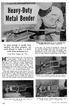 It's large enough to handle most welding job shop projects, yet small enough to make it a worth while home-workshop tool H Craft Print Project No. 272 ERE'S a metal bender that will enable you to bend
Part Name/Description Part Number Quantity. Power Cable 4000950-5 1
 Note: Indented items indicate parts included in an assembly listed above Part Name/Description Part Number Quantity Power Cable 4000950-5 1 Raven Harness Adapter Kit 4100525 1 Installation Instructions
Digital TV Coat Hanger Antenna
 Rabbit ears are for rabbits, not digital televisions. In this project, we ll show you how to build your own digital TV antenna from wire hangers, a piece of wood and some pipe. Television antennas are
EVC40 EMERGENCY VOICE COMMUNICATION SYSTEM
 EVC40 EMERGENCY VOICE COMMUNICATION SYSTEM INSTALLATION MANUAL Protec Fire Detection PLC, Protec House, Churchill Way, Nelson, Lancashire, BB9 6RT. Telephone: +44 (0) 1282 717171 Fax: +44 (0) 1282 717273
Build Your Own Solar Car Teach build learn renewable Energy! Page 1 of 1
 Solar Car Teach build learn renewable Energy! Page 1 of 1 Background Not only is the sun a source of heat and light, it s a source of electricity too! Solar cells, also called photovoltaic cells, are used
AMPSEAL* Automotive Plug Connector and Header Assembly
 AMPSEAL* Automotive Plug Connector and Header Assembly Application Specification 24 SEP 97 Rev E All dimensions are given in millimeters unless otherwise specified. All dimensional tolerances are +0.2
Check for deteriorated, shifting or missing tie-down pads. Replace if needed.
 C C 0 5 C H A S S I S F R A M E Chassis Frame Overview The Blue Bird Vision s chassis frame consists of two main C-channel rails which run the entire length of the bus, and several different kinds of cross
CHECKING AND TESTING ELECTRICAL INSTALLING WORK
 CHECKING AND TESTING ELECTRICAL INSTALLING WORK Department of Consumer and Employment Protection Energy Safety Preface It is a requirement of the Electricity (Licensing) Regulations 1991 that all electrical
PRE COMMISSIONING TESTS ON EQUIPMENT AT 33/11 KV SUB STATIONS
 PRE COMMISSIONING TESTS ON EQUIPMENT AT 33/11 KV SUB STATIONS TESTS ON TRANSFORMERS 1. IR Values a) For 33/11 KV Power Transformer 2500 V megger is to be need. b) Power Transformer neutral Earthing is
POWER LOCK KIT GENERAL INSTALLATION -J04427 REV. 2007-12-04. Kit Number. Models. Additional Parts Required. Kit Contents
 -J0 REV. 00--0 POWER LOCK KIT GENERAL Kit Number -0, 0-0 Models For model fitment information, please see the P&A Retail Catalog or the Parts and Accessories section of www.harleydavidson.com (English
R O A D M A S T E R, I N C.
 R O A D M A S T E R, I N C. 11 10 20 12 4 18 19 1 2 13 16 ITEM QTY NAME MATERIAL 1...2... 1/2" x 3 1/2" BOLT... 350103-00 2...2... 1/2" x 2" BOLT... 350097-00 3...6... 1/2" x 1 1/2" BOLT... 350095-00 4...2...
WIRE, TERMINAL AND CONNECTOR REPAIR CONDUCTORS
 CONDUCTORS Conductors are needed to complete the path for electrical current to flow from the power source to the working devices and back to the power source. Special wiring is needed for battery cables
12-Volt Negative Ground Installation Instructions
 12-Volt Negative Ground Installation Instructions For Part Number: 1141, 1164, 1165, 1181 CAUTION!!! Before installing, please read the following important information... 1. The Ignitor is designed for
Video Camera Installation Guide
 Video Camera Installation Guide The intent of this guide is to provide the information needed to complete or modify a video camera installation to avoid lightning and induced power surge damage. This guide
LocoNet, the Digitrax Difference
 LocoNet, the Digitrax Difference LocoNet is Digitrax's method of communication between LocoNet compatible devices on a model railroad layout. LocoNet Compatible devices are designed to work together on
RAY-MAX Integrated Solar Power Strip
 RAY-MAX Integrated Solar Power Strip 600008, 600009, 600010, 600208, 600209, 600210 Owner s Manual NEXTRONEX, INC. Revision Date: 10/27/14 Contents 1. Safety Instructions... 3 2. General Equipment Warnings...
R O A D M A S T E R, I N C.
 R O A D M A S T E R, I N C. MOUNTING BRACKET KIT 14 8 7 4 13 5 6 ITEM QTY NAME MATERIAL 1...6...1/2" x 2 1/2" BOLT... 350099-00 2...2...1/2" x 1 1/2" BOLT... 350095-00 3...8...1/2" LOCK WASHER... 350309-00
Directory chapter 02 - DIN Power (to 6 A) Types D, E, F, FM, 2F, F9, interface connectors I/U 02. 01. Technical characteristics types D and E... 02.
 Directory chapter 02 - () Types D, E, F, FM, 2F, F9, interface connectors I/U Page Technical characteristics types D and E.............................. 02.10 Type D connectors.................... 02.11
PUMP JACK SYSTEM AND ACCESSORIES
 Pump Jack Model # 2200 A low cost, easy to operate, safe, portable scaffolding built of rugged steel. It's perfect for shingling, siding, sheathing, insulating, painting, building, roofing, home repair
Using and Wiring Light Emitting Diodes (LEDs) for Model Railroads
 Using and Wiring Light Emitting Diodes (LEDs) for Model Railroads LEDs have many useful applications in Model railroading, including: Locomotive headlights Rear-end warning lights for cabooses and passenger
Sample. What Electricity Can Do LESSON 2. Overview and Objectives. Background
 What Electricity Can Do Overview and Objectives Background Light bulbs are such an integral part of everyday life that most people can t imagine being without them. Because people tend to take light bulbs
Rebuild Instructions for 70001 and 70010 Transmission
 Rebuild Instructions for 70001 and 70010 Transmission Brinn, Incorporated 1615 Tech Drive Bay City, MI 48706 Telephone 989.686.8920 Fax 989.686.6520 www.brinninc.com Notice Read all instructions before
Installation Guide for Artic Air 24 Volt R134A Air Conditioner
 Installation Guide for Artic Air 24 Volt R134A Air Conditioner Rev 004 April 20, 2014 There are five objectives to installing the Artic Air unit: 1) The primary wiring from the battery, 2) The controller
Class 5 to 7 Truck and Bus Hydraulic Brake System
 Class 5 to 7 Truck and Bus Hydraulic Brake System Diagnostic Guide 1st Edition * 5+0 Important Service tes The information in this publication was current at the time of printing. The information presented
Industry Track Inspection
 Industry Track Inspection Track Supervisor Phone Number 1 TABLE OF CONTENTS INTRODUCTION 3 GAUGE 4 ALINEMENT 6 TRACK SURFACE 8 BALLAST 11 CROSSTIES 13 DEFECTIVE RAILS 16 RAIL JOINTS 17 TURNOUTS 18 OTHER
Electrical Grounding. Appendix C
 Appendix C Electrical Grounding Low-Voltage Equipment Grounding The most frequently cited Office of Safety and Health Administration (OSHA) electrical violation is improper occupational grounding of equipment
In-Track Repair of Concrete Ties. Deland Humpherys, Director Track Mtce
 In-Track Repair of Concrete Ties Deland Humpherys, Director Track Mtce Concrete tie repairs: Shoulder repair process Normally the result of a derailment Lag removal and replacement process Broken lags
AWS and TPWS Interface Requirements
 Railway Group Standard AWS and TPWS Interface Synopsis This document defines the track / train and driver / machine interface requirements for the Automatic Warning System (AWS) and the Train Protection
User Manual. Instructions for installing the Sure Stitch on the Next Generation Quilting Frame. Parts Included:
 User Manual Instructions for installing the Sure Stitch on the Next Generation Quilting Frame. Parts Included: 1: Display Console 1: Control Box 2: Encoder (Wires attached) (Not Shown) 1: 5v Power Supply
+ _ + _ + _. Circuit Diagram (wired operation) "*" "*" Page - 1. Gate latch solenoid. Terminal strip inside GSM controller box "B1"
 Circuit Diagram (wired operation) The GSM controller must be switched to MODE0 #PWD123456#MODE0 Also change the time to 500ms #PWD123456#GOT500 "B1" 12V, 20W solar panel 12 Volt DC "Vr-1" The GSM controller
Lathe Milling Attachment
 Lathe Milling Attachment By L C. MASON BY CLEVERLY stacking cold-rolled flat stock together, T-slots and slide for this lathe milling attachment are made without costly machinery. In fact, only two tools,
INSTALLATION INSTRUCTIONS HUSTLER 4-BTV, 5-BTV TRAP VERTICAL WARNING INSTALLATION OF THIS PRODUCT NEAR POWER LINES IS DANGEROUS
 INSTALLATION INSTRUCTIONS HUSTLER 4-BTV, 5-BTV TRAP VERTICAL WARNING INSTALLATION OF THIS PRODUCT NEAR POWER LINES IS DANGEROUS FOR YOUR SAFETY, FOLLOW THE INSTALLATION DIRECTIONS GENERAL DESCRIPTION:
Installation Instructions
 520 Installation Instructions Thank you very much for purchasing PIAA product. Please read this entire manual before installation and use of this product. For Installers Please give this Installation Manual
How To Power A 12 Volt Relay On A Car Or Truck
 Relay modification for older bikes Please read this in conjunction with the schematics at the end. All the options are shown, but you can opt to do any one or more as you wish. The electrical connections
SELECTION, APPLICATION AND MAINTENANCE
 DIESEL PROTECTION SYSTEMS Automatic Diesel Engine Shut Down System for Safe Area Applications SELECTION, APPLICATION AND MAINTENANCE Series 300 Series 310 SYSTEM DESCRIPTION Suitable for attended engine
Directory chapter 04
 M Directory chapter 04 D-Sub Mixed subminiature D connectors New Page D-Sub mixed connector system general information................... 04.02 Contact arrangements............................................
ELECTRIC METERING COMMERCIAL & INDUSTRIAL
 ELECTRIC METERING COMMERCIAL & 1.0 INDEX 1.0 INDEX 2.0 SCOPE 3.0 GENERAL REQUIREMENTS 4.0 METER LOCATIONS 5.0 UNDERGROUND TERMINATIONS 6.0 METERING TRANSFORMER ENCLOSURES 7.0 SINGLE CUSTOMER METER INSTALLATIONS
DTM04 TANK MONITOR DTM08 TANK MONITOR Dtm12 TANK MONITOR. Installation and Operation Manual
 DTM04 TANK MONITOR DTM08 TANK MONITOR Dtm12 TANK MONITOR Installation and Operation Manual 1 ENGLISH Safety Instructions 2 Features 2-3 Specifications 3 Installation 4-5 Wiring Diagrams 6-7 Warranty 8
Hand Crank Generator (9 May 05) Converting a Portable Cordless Drill to a Hand Crank DC Generator
 Converting a Portable Cordless Drill to a Hand Crank DC Generator The unit is light weight (2.5 lb), portable, low cost ($10-$20) and can be used to recharge single cell batteries at from 1-3.5 amps. It
Q1-750 Q1-1200.2 Q1-2200.2 Q1-4500 Q2-200 Q4-90 Q4-120 HIGH PERFORMANCE AMPLIFIER
 Owner s Manual Q1-750 Q1-1200.2 Q1-2200.2 Q1-4500 Q2-200 Q4-90 Q4-120 HIGH PERFORMANCE AMPLIFIER INTRODUCTION Thanks you for purchasing SoundQubed amplifiers for your car audio systems and competitions
CHAPTER VIII LINE PLANT SYSTEM COMMUNICATION THROUGH RE CABLE
 CHAPTER VIII LINE PLANT SYSTEM COMMUNICATION THROUGH RE CABLE 8.1 SYSTEM 8.1.1 Armoured, screened underground cables are used for control communication in electrified areas to limit induction effect. 8.2
INSTALLATION INSTRUCTIONS
 Rear Vision System Tailgate Handle Camera Mirror Display 2004-2014 Ford F-150 and 2008-2015 Ford Super Duty (Kit part numbers 9002-9521) Kit Contents: Mirror Tailgate Handle with camera and harness Interior
Post Mount Light Installation*
 Post Mount Light Installation* *For the general installation of most Post Mount Spotlights, many vehicles may need slight modifications to these instructions. You will need the following tools: High torque
3.1.1 Full Type Tests & Routine Tests according to Clause 8 2 & 8 3. 4.0 Instructions For Installation, Operation & Maintenance
 SPECIFICATION FOR LOW VOLTAGE SWITCHBOARD SEN I N D E X Description 10 STANDARD TECHNICAL REQUIREMENTS 11 Standards 12 General Operating Conditions 13 General Description Of Switchboard 131 Structure 132
www.the Floor Heating Warehouse.co.uk
 www.the Floor Heating Warehouse.co.uk Underfloor Heating Installation Guide (Grundfoss Pump System) General Overview: Our water based underfloor heating system can be installed by your own plumber or heating
MGB Chrome Bumper Conversion
 MGB Chrome Bumper Conversion Installation Instructions For 1974 1/2-1980 MGB This kit requires cutting, welding, and painting. Professional installation recommended. Note: Every MGB body is slightly different
Toroidal Conductivity Sensor
 Instruction Sheet PN 51A-/rev.C June 2012 Toroidal Conductivity Sensor For additional information, please visit our website at www.emersonprocess.com/rosemountanalytical.com SPECIFICATIONS Wetted Materials:
Walbro 255lph Inline Fuel Pump Install Procedure
 Walbro 255lph Inline Fuel Pump Install Procedure Note: Instructions are based on a single in tank pump with under car OEM VW filter. Total install time for a qualified technician is approximately 2 hrs.
REDI-LINE ELECTRIC GENERATORS USER'S GUIDE. Rugged, Reliable, DC to AC Power Conversion
 REDI-LINE ELECTRIC GENERATORS USER'S GUIDE Rugged, Reliable, DC to AC Power Conversion REDI-LINE ELECTRIC GENERATOR MODEL INPUT ACTUAL OUTPUT ACTUAL OUTPUT WATTS SERIAL NO. PACIFIC SCIENTIFIC MOTOR PRODUCTS
When any of the following symbols appear, read the associated information carefully. Symbol Meaning Description
 Samba OPLC SM35-J-R20 Installation Guide The Unitronics SM35-J-R20 offers the following onboard I/Os: 12 Digital Inputs, configurable via wiring to include: 1 HSC/Shaft-encoder Input, 2 Analog inputs (only
12 Appendix 12 Earth Electrodes And Earth Electrode
 12 Appendix 12 Earth Electrodes And Earth Electrode Testing 12.1 Introduction This appendix provides guidance and background information an earth electrode testing and some limited information on earth
Figure 1 (end) Updated document to corporate requirements Added text to Paragraph 2.4
 This specification covers the requirements for application of ELCON Drawer Series Connectors: True Hot Plug, Blind Mating Mixed Signal and Power Connectors. These connectors are designed for use in pluggable
Installation Instructions Avalanche XUV Cap IMPORTANT! IMPORTANT!
 Installation Instructions Avalanche XUV Cap IMPORTANT! Read all instructions carefully before commencing any work. Always wear safety equipment. Some installation steps will require two or more installers.
SMD Rework Station TABLE OF CONTENTS
 SMD Rework Station Thank you for purchasing the Hakko 50B SMD Rework Station. The Hakko 50B is designed to solder and desolder surface mounted devices with hot air. Please read this manual before operating
1. Lay out 2 pieces of 7/8" tubing and mark for bending as shown. Remember that the bend is in the shaded area as shown below in Figure 1.
 MINI BIKE PLANS Page 1 INTRODUCTION Before starting to build your Mini-Bike, be sure that you have all the parts shown on the material list. You will note that tubing has been used in the construction.
Canopy Surge. User Manual
 Canopy Surge Suppressor User Manual SS00-UM-en Issue 2 May 2003 2003 Motorola, Inc. All rights reserved. Printed in the U.S.A Notices Safety Precautions: Before beginning your installation, please read
TRANS-05, Torque Tube Removal, Rebuilding, and Installation
 TRANS-05, Torque Tube Removal, Rebuilding, and Installation Tools Metric Wrench Set Metric Socket Set Jack Stands (6 minimum) Floor Jack 8mm Cheesehead socket (also referred to as 12 point internal socket
270526-TC Grounding and Bonding for Telecommunications Systems
 270526-TC Grounding and Bonding for Telecommunications Systems Part 1 - General Related Documents The following related sections of the OT standards shall also be applicable to this section. OT Engineer
System Tel 0845 121 4008 (Telephones) Ltd Fax 0845 121 4009 Email [email protected] Web www.bellsystem.co.uk
 Troubleshooting Guide Audio Door Entry Systems (single entrance) (9nn, VRKn or BLn series) Most systems use the 801 phone, 801P on systems above 20 flats. Twisted-pair cable must be used (CW1308 telephone
Before installation it is important to know what parts you have and what the capabilities of these parts are.
 INSTALLATION GUIDE Before installation it is important to know what parts you have and what the capabilities of these parts are. The Recon XZT is the smallest and most powerful gauge of its kind. With
VOYAGER 570G. 744A Sprayer Control
 VOYAGER 570G 744A Sprayer Control U S E R M A N U A L U S E R M A N U A L Table of Contents CHAPTER 1 - INTRODUCTION...1 SYSTEM CONFIGURATIONS...1 KIT CONTENTS...3 CONTROL HOUSING ASSEMBLY...5 CHAPTER
VW Caddy W21-760-3503 INSTALLATION INSTRUCTIONS
 Unit 626 Kilshane Avenue, North West Business Park, Ballycoolin, Dublin 15, Ireland Telephone: +353 1 8612 632, Fax: +353 1 8612 647, email: [email protected] www.driveriteltd.com VW Caddy W21-760-3503
I BEAM TRACK INSTALLATION
 PDQ 0/700 FESTOON SYSTEM INSTALLATION AND MAINTENANCE INSTRUCTIONS INTRODUCTION The PDQ Festoon System was designed to run on one of three sizes of I-beams: S x., S8 x 8. and S x.. System trolleys must
758 Heavy-duty Ratchet Guy Wire Cutter
 INSTRUCTION MANUAL 758 Heavy-duty Ratchet Guy Wire Cutter Read and understand all of the instructions and safety information in this manual before operating or servicing this tool. Register this product
The Basics of Loop Vehicle Detection
 The Basics of Loop Vehicle Detection There are a number of ways to detect vehicles, ranging from hose style detection to ultra-sonic, to inductive loop. For traffic control or drive-thru, inductive loop
INSTALLATION INSTRUCTIONS: Viewline 52 mm
 -5 Safety information The product was developed, manufactured and inspected according to the basic safety requirements of EC Guidelines and state-of-the-art technology. The instrument is designed for use
2. Remove rear cover of head lamp if bulbs are covered/sealed within the housings, and remove halogen bulb carefully.
 These instructions are designed to address most general installation procedures across vehicles and should not be considered vehicle make, model or year specific. Please contact the vendor directly for
Advantium 2 Plus Alarm
 ADI 9510-B Advantium 2 Plus Alarm INSTALLATION AND OPERATING INSTRUCTIONS Carefully Read These Instructions Before Operating Carefully Read These Controls Corporation of America 1501 Harpers Road Virginia
Generator Transfer Switch Model # HTS15-AUTO
 Generator Transfer Switch Model # HTS15-AUTO Congratulations on your purchase of our Single Circuit Generator Transfer Switch, We hope this meets and exceeds your expectations. If at anytime you have any
INSTALLATION INSTRUCTIONS. 6108 Air Spring Kit 2011+ Ford F250 Single Wheel 4WD 2011+ Ford F350 Dually 4WD (2011 F350 Single Wheel 4WD use p/n 6113)
 INSTALLATION INSTRUCTIONS 6108 Air Spring Kit 2011+ Ford F250 Single Wheel 4WD 2011+ Ford F350 Dually 4WD (2011 F350 Single Wheel 4WD use p/n 6113) Thank you for purchasing a quality Hellwig Product. PLEASE
R O A D M A S T E R, I N C.
 R O A D M A S T E R, I N C. ROADMASTER, Inc. 6110 NE 127th Ave. Vancouver, WA 98682 4 MOUNTING BRACKET KIT 1 2 3 360-896-0407 fax 360-735-9300 www.roadmasterinc.com ITEM QTY NAME PART # 1...2... #10 x
SELF-STEERING AXLE TABLE OF CONTENTS
 SELF-STEERING AXLE TABLE OF CONTENTS Section 1 - Introduction Section 2 - Pre-Installation Check List Section 3 - Ride Height Adjustments Section 4 - Suspension Mount Section 5 - Axle Mount Section 6 -
Front axle components, overview
 just a test. Front axle components, overview 40-1 General Information Load bearing components and parts of the suspension must not be welded or straightened. Vehicles without drive axle must not be moved,
DSM http://www.dsmmfg.com 1 (800) 886-6376
 DESIGN GUIDE FOR BENT SHEET METAL This guide discusses how the bends are made, what thicknesses of sheet metal are commonly used, recommended bend radius to use when modeling the part, some practical limits
Guidelines for Earthquake Bracing of Residential Water Heaters
 Guidelines for Earthquake Bracing of Residential Water Heaters Department of General Services Division of the State Architect 1102 Q Street, Suite 5100 Sacramento, CA 95814 Phone: (916) 324-7099 Fax: (916)
Guidelines for Earthquake Bracing Residential Water Heaters
 Guidelines for Earthquake Bracing Residential Water Heaters Department of General Services Division of the State Architect In accordance with the Health and Safety Code Section 19215, the Division of the
3.0 CHARACTERISTICS. AR Auxiliary Relay High Speed, High Threshold 41-759.3C
 41-759.3C the magnetic core upon energizing of the switch. When the switch closes, the moving contacts bridge two stationary contacts, completing the trip circuit. Also during this operation two fingers
INSTRUCTIONS FOR CHAIN LINK INSTALLATION Chain Link fence & Posts Meshdirect.co.uk
 INSTRUCTIONS FOR CHAIN LINK INSTALLATION Chain Link fence & Posts Meshdirect.co.uk This guide explains how to correctly install our chain link fencing and post system. The guide provides details of the
INSTALLATION & OPERATION MANUAL LED
 INSTALLATION & OPERATION MANUAL LED Duo Beam TM Introduction... 2 Lightbar Unpacking & Pre-Installation... 2 Installation & Mounting... 3 Wiring Instructions... 4 Maintenance... 4 Flash Pattern Selection...
ADDING AN ELECTRIC AUXILIARY FAN TO RADIATOR STACK ON 03 ALPINE COACH
 ADDING AN ELECTRIC AUXILIARY FAN TO RADIATOR STACK ON 03 ALPINE COACH The original design of the 03 Alpine Coaches (and perhaps other years as well) did not include any kind of engine fan engage mechanism
Installation instructions, accessories - Handsfree for cellular phone, system B, entry level
 XC90 Section Group Weight(Kg/Pounds) Year Month 3 39 0.5/1.1 2006 07 XC90 2003, XC90 2004 IMG-249663 Page 1 of 18 Required tools A0000162 A0000163 IMG-239664 M0000232 IMG-253123 IMG-252223 Page 2 of 18
Acceptability of Printed Circuit Board Assemblies
 Section No.: 12I.2.3, Sheet 1 of 9 Rev Level: 16 Additional Distribution: PCB Assembly Subcontractors 1.0 Purpose 2.0 Scope Acceptability of Printed Circuit Board Assemblies 1.1 The purpose of this standard
LG G5 Chassis Brace Gen 5 Camaro THE MOST POWERFUL HEADERS ON THE PLANET Brought to you by LG Motorsports 972-429-1963
 LG G5 Chassis Brace Gen 5 Camaro THE MOST POWERFUL HEADERS ON THE PLANET Brought to you by LG Motorsports 972-429-1963 Thank you for purchasing LG Motorsports products for your Gen 5 Camaro. Parts Inventory: