
Organelle Name: Nucleus
|
|
|
- Molly Thomas
- 9 years ago
- Views:
Transcription
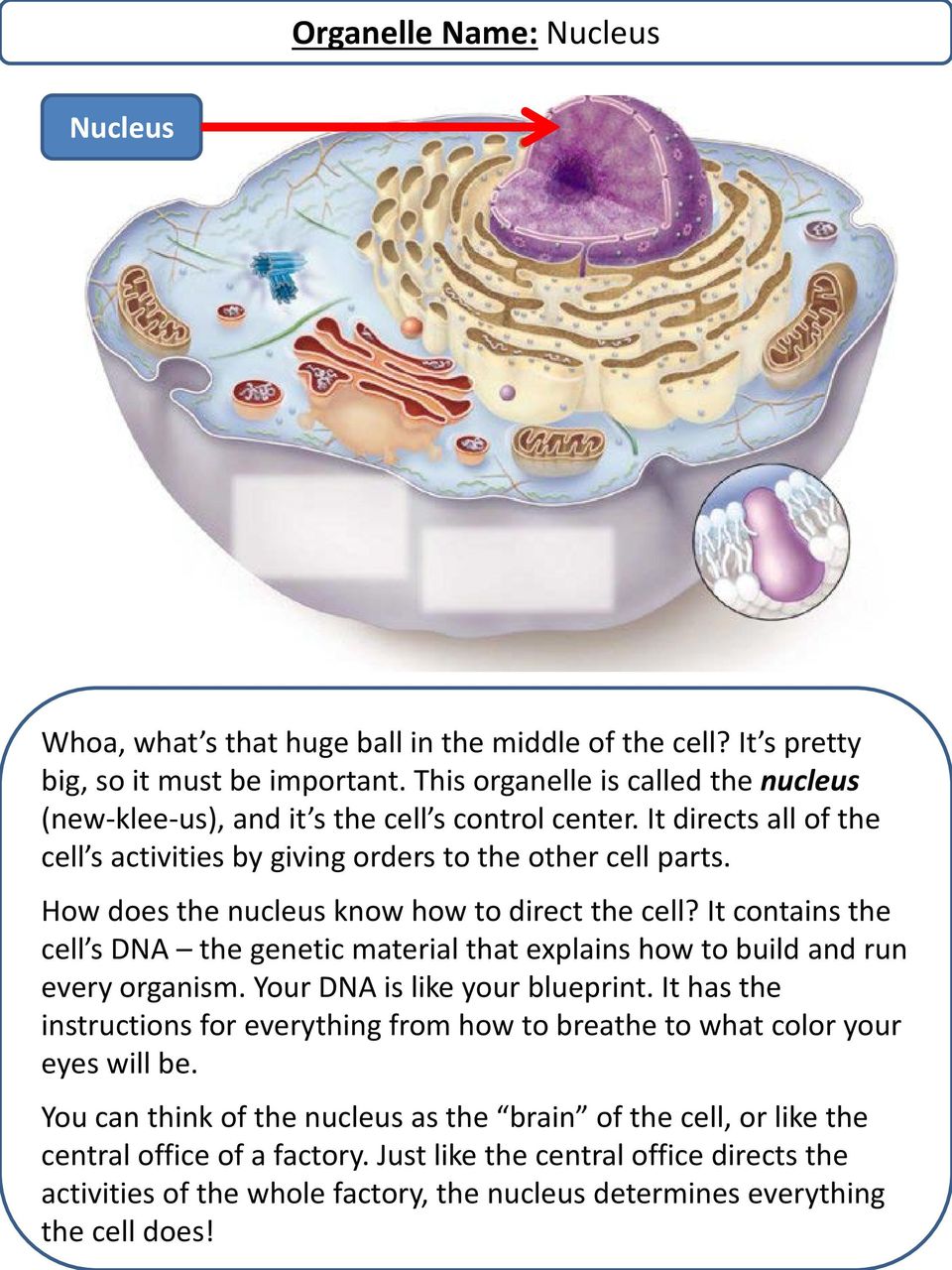
1 Organelle Name: Nucleus Nucleus Whoa, what s that huge ball in the middle of the cell? It s pretty big, so it must be important. This organelle is called the nucleus (new-klee-us), and it s the cell s control center. It directs all of the cell s activities by giving orders to the other cell parts. How does the nucleus know how to direct the cell? It contains the cell s DNA the genetic material that explains how to build and run every organism. Your DNA is like your blueprint. It has the instructions for everything from how to breathe to what color your eyes will be. You can think of the nucleus as the brain of the cell, or like the central office of a factory. Just like the central office directs the activities of the whole factory, the nucleus determines everything the cell does!
2 Organelle Name: Cell Membrane Cell Membrane Before you even start your journey, you have to make it inside the cell. And that s easier said than done you have to get through the cell membrane! The cell membrane is the boundary that separates the cell from the outside environment. It controls what substances come into and out of a cell. Everything the cell needs, such as food and oxygen, comes in through the cell membrane. Items the cell has to send out, such as waste and proteins for the rest of the body, leave through the cell membrane. Harmful materials that could hurt our bodies can t make it through. You can think of the cell membrane as like the door and security guard of a factory. Just like the door and security guard determine what gets in and what gets out, the cell membrane determines what enters and exits a cell.

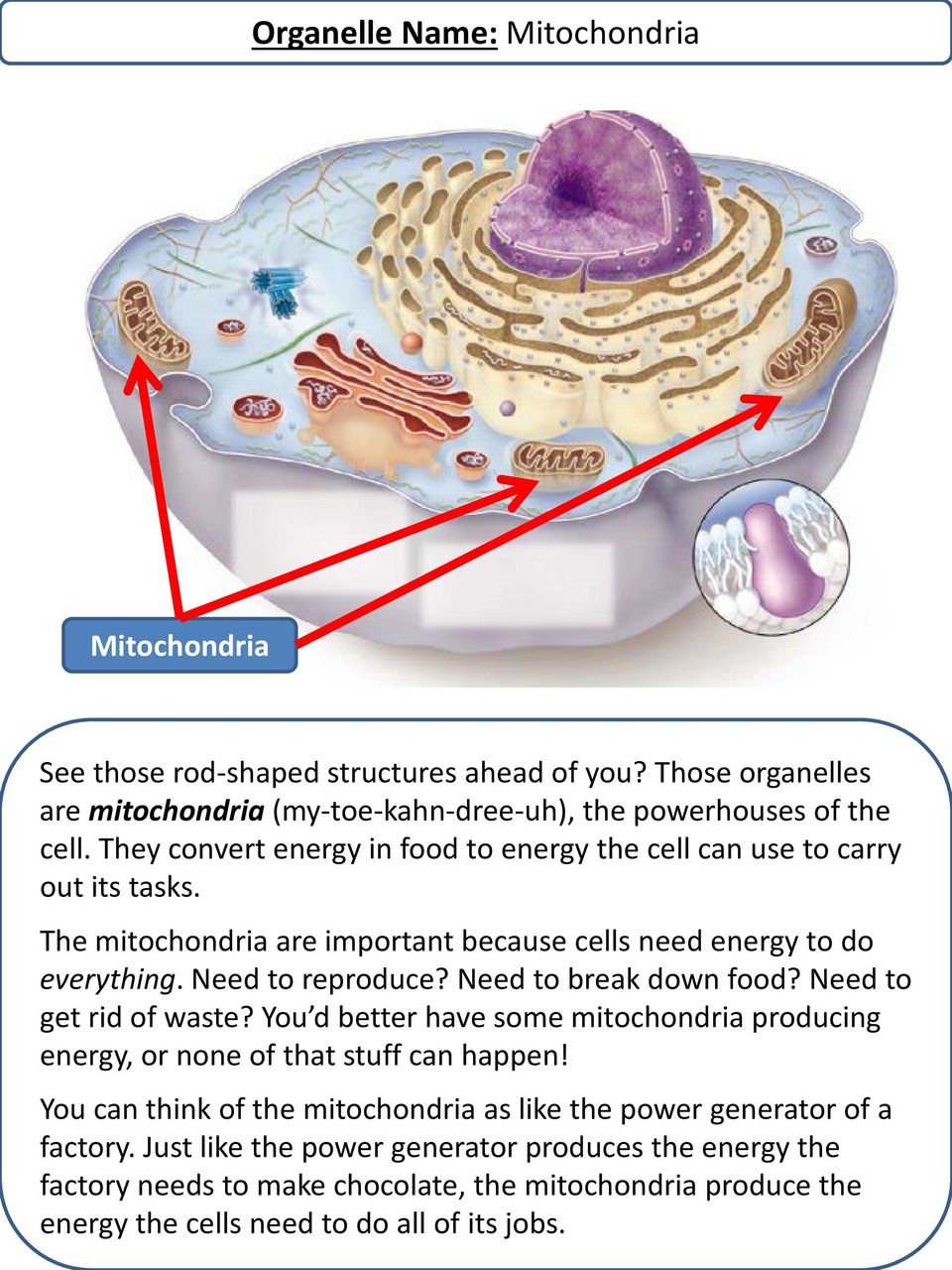
3 Organelle Name: Mitochondria Mitochondria See those rod-shaped structures ahead of you? Those organelles are mitochondria (my-toe-kahn-dree-uh), the powerhouses of the cell. They convert energy in food to energy the cell can use to carry out its tasks. The mitochondria are important because cells need energy to do everything. Need to reproduce? Need to break down food? Need to get rid of waste? You d better have some mitochondria producing energy, or none of that stuff can happen! You can think of the mitochondria as like the power generator of a factory. Just like the power generator produces the energy the factory needs to make chocolate, the mitochondria produce the energy the cells need to do all of its jobs.
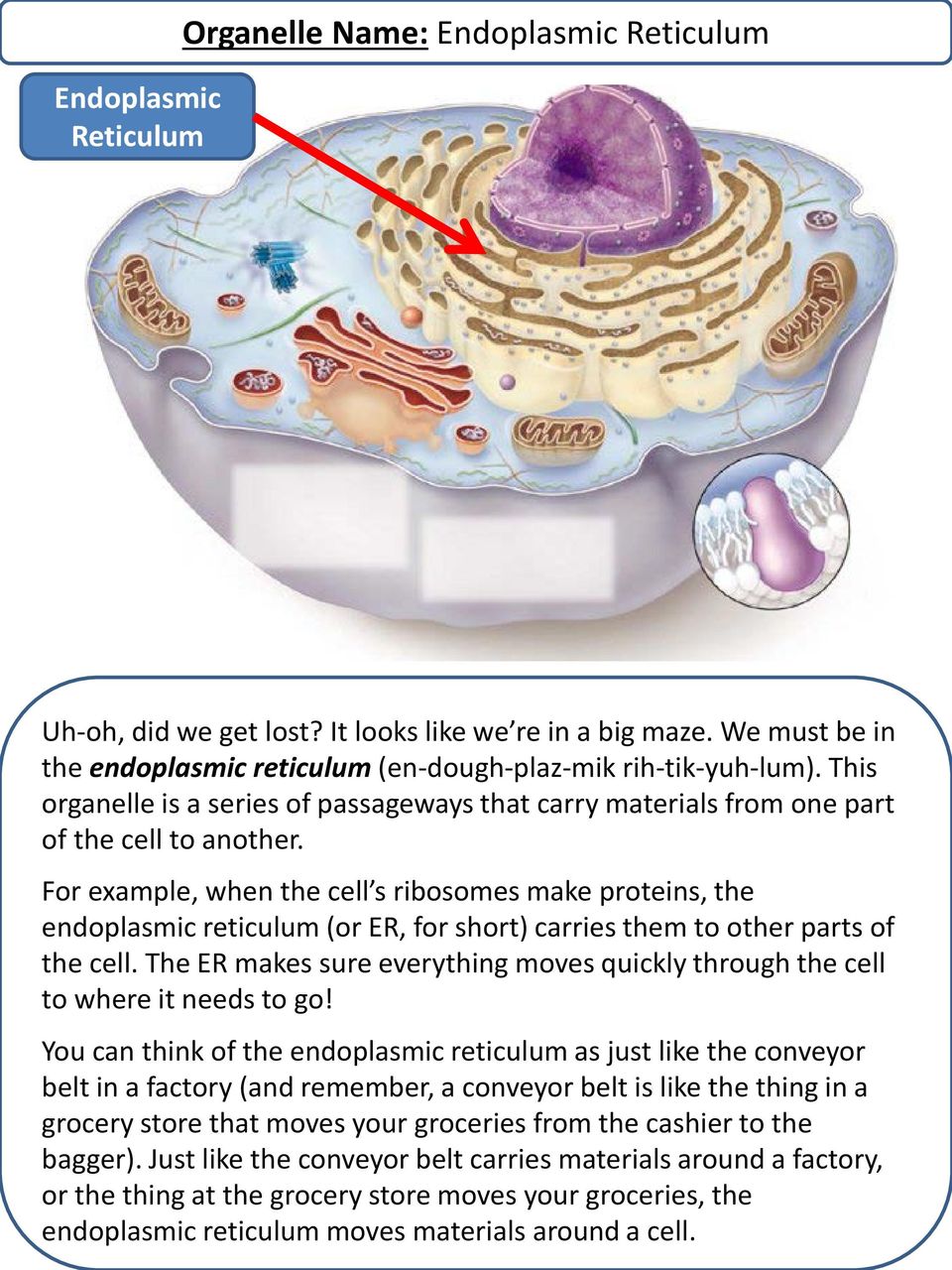
4 Organelle Name: Endoplasmic Reticulum Endoplasmic Reticulum Uh-oh, did we get lost? It looks like we re in a big maze. We must be in the endoplasmic reticulum (en-dough-plaz-mik rih-tik-yuh-lum). This organelle is a series of passageways that carry materials from one part of the cell to another. For example, when the cell s ribosomes make proteins, the endoplasmic reticulum (or ER, for short) carries them to other parts of the cell. The ER makes sure everything moves quickly through the cell to where it needs to go! You can think of the endoplasmic reticulum as just like the conveyor belt in a factory (and remember, a conveyor belt is like the thing in a grocery store that moves your groceries from the cashier to the bagger). Just like the conveyor belt carries materials around a factory, or the thing at the grocery store moves your groceries, the endoplasmic reticulum moves materials around a cell.
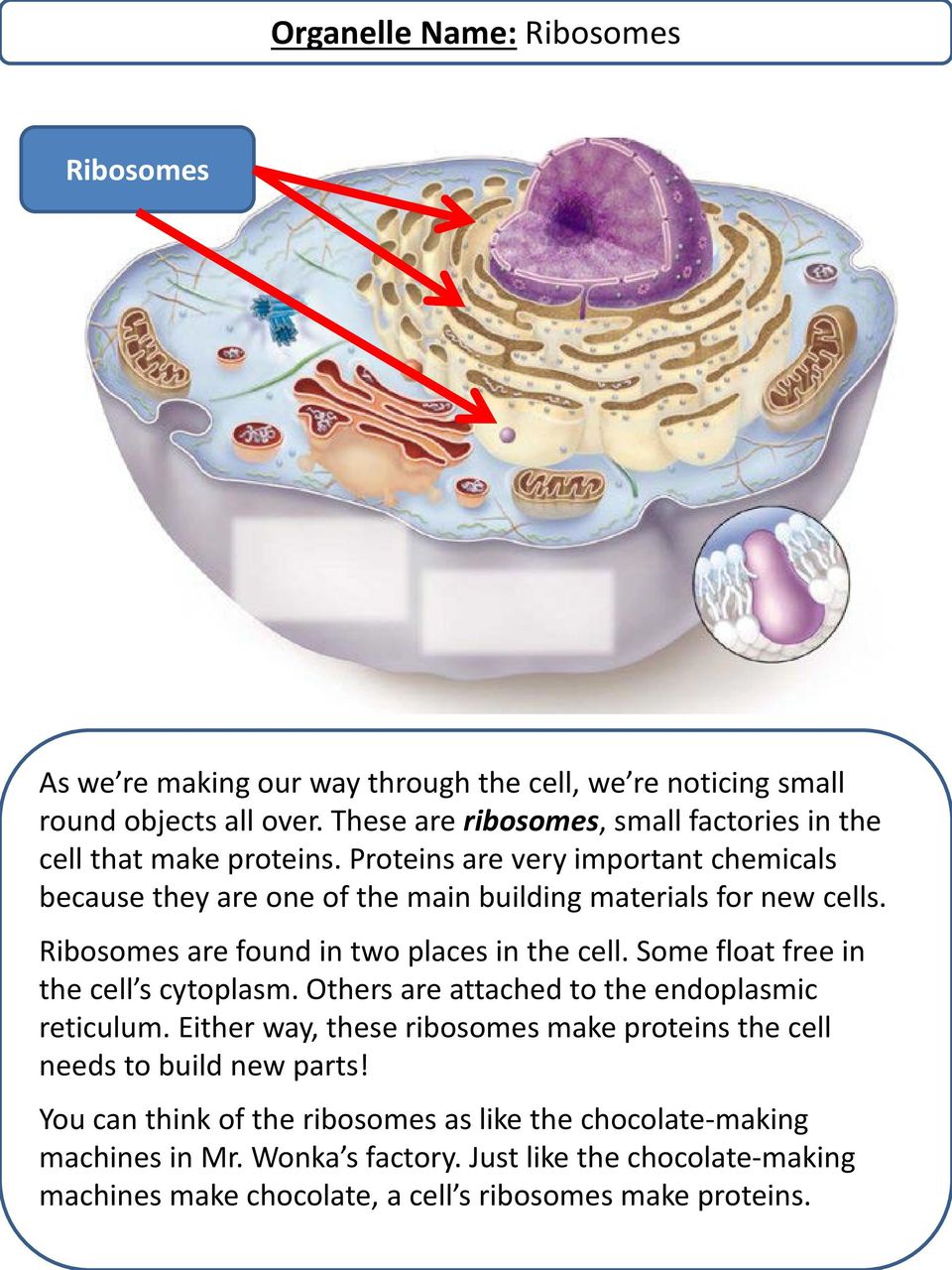
5 Organelle Name: Ribosomes Ribosomes As we re making our way through the cell, we re noticing small round objects all over. These are ribosomes, small factories in the cell that make proteins. Proteins are very important chemicals because they are one of the main building materials for new cells. Ribosomes are found in two places in the cell. Some float free in the cell s cytoplasm. Others are attached to the endoplasmic reticulum. Either way, these ribosomes make proteins the cell needs to build new parts! You can think of the ribosomes as like the chocolate-making machines in Mr. Wonka s factory. Just like the chocolate-making machines make chocolate, a cell s ribosomes make proteins.
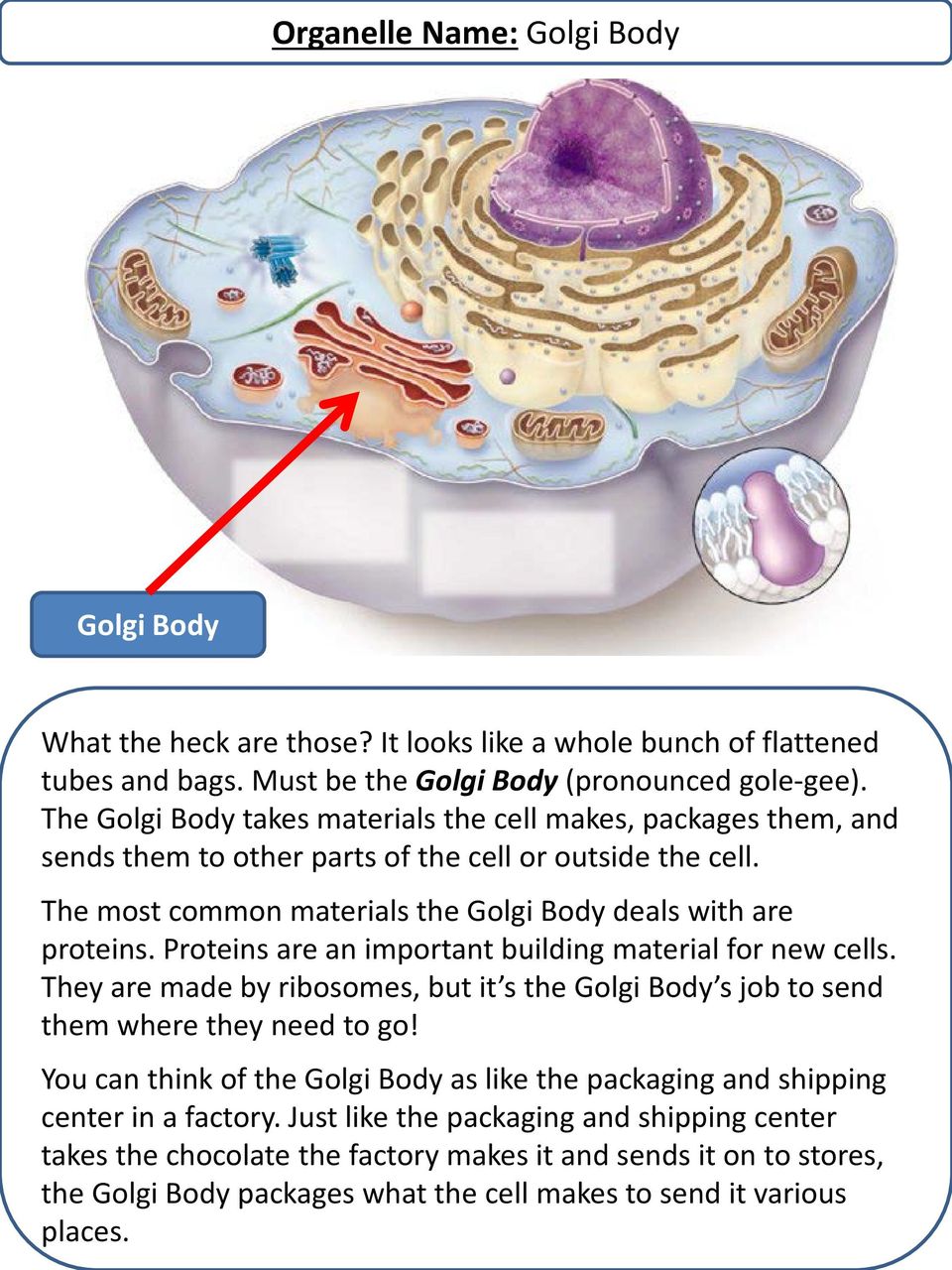
6 Organelle Name: Golgi Body Golgi Body What the heck are those? It looks like a whole bunch of flattened tubes and bags. Must be the Golgi Body (pronounced gole-gee). The Golgi Body takes materials the cell makes, packages them, and sends them to other parts of the cell or outside the cell. The most common materials the Golgi Body deals with are proteins. Proteins are an important building material for new cells. They are made by ribosomes, but it s the Golgi Body s job to send them where they need to go! You can think of the Golgi Body as like the packaging and shipping center in a factory. Just like the packaging and shipping center takes the chocolate the factory makes it and sends it on to stores, the Golgi Body packages what the cell makes to send it various places.
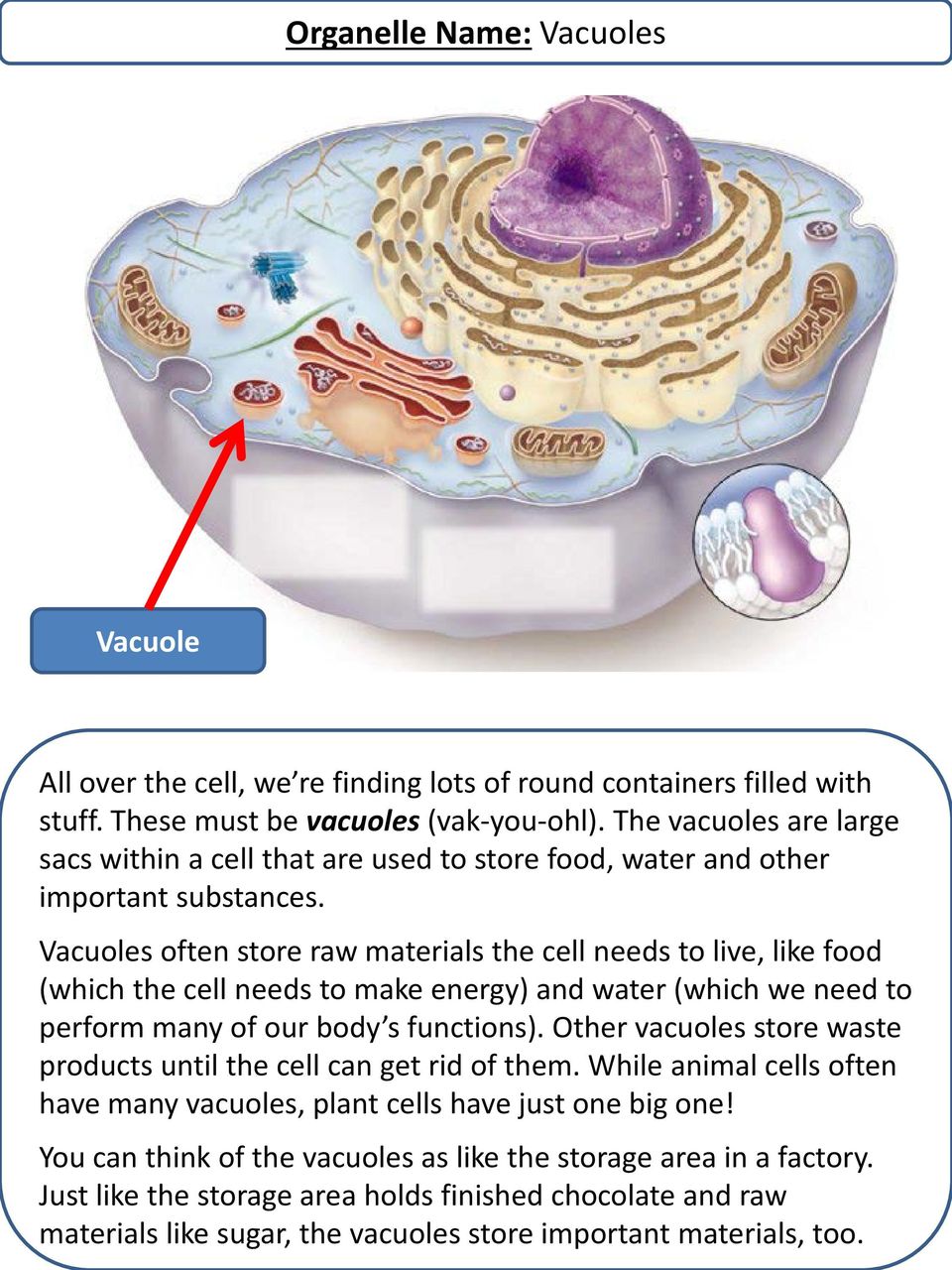
7 Organelle Name: Vacuoles Vacuole All over the cell, we re finding lots of round containers filled with stuff. These must be vacuoles (vak-you-ohl). The vacuoles are large sacs within a cell that are used to store food, water and other important substances. Vacuoles often store raw materials the cell needs to live, like food (which the cell needs to make energy) and water (which we need to perform many of our body s functions). Other vacuoles store waste products until the cell can get rid of them. While animal cells often have many vacuoles, plant cells have just one big one! You can think of the vacuoles as like the storage area in a factory. Just like the storage area holds finished chocolate and raw materials like sugar, the vacuoles store important materials, too.
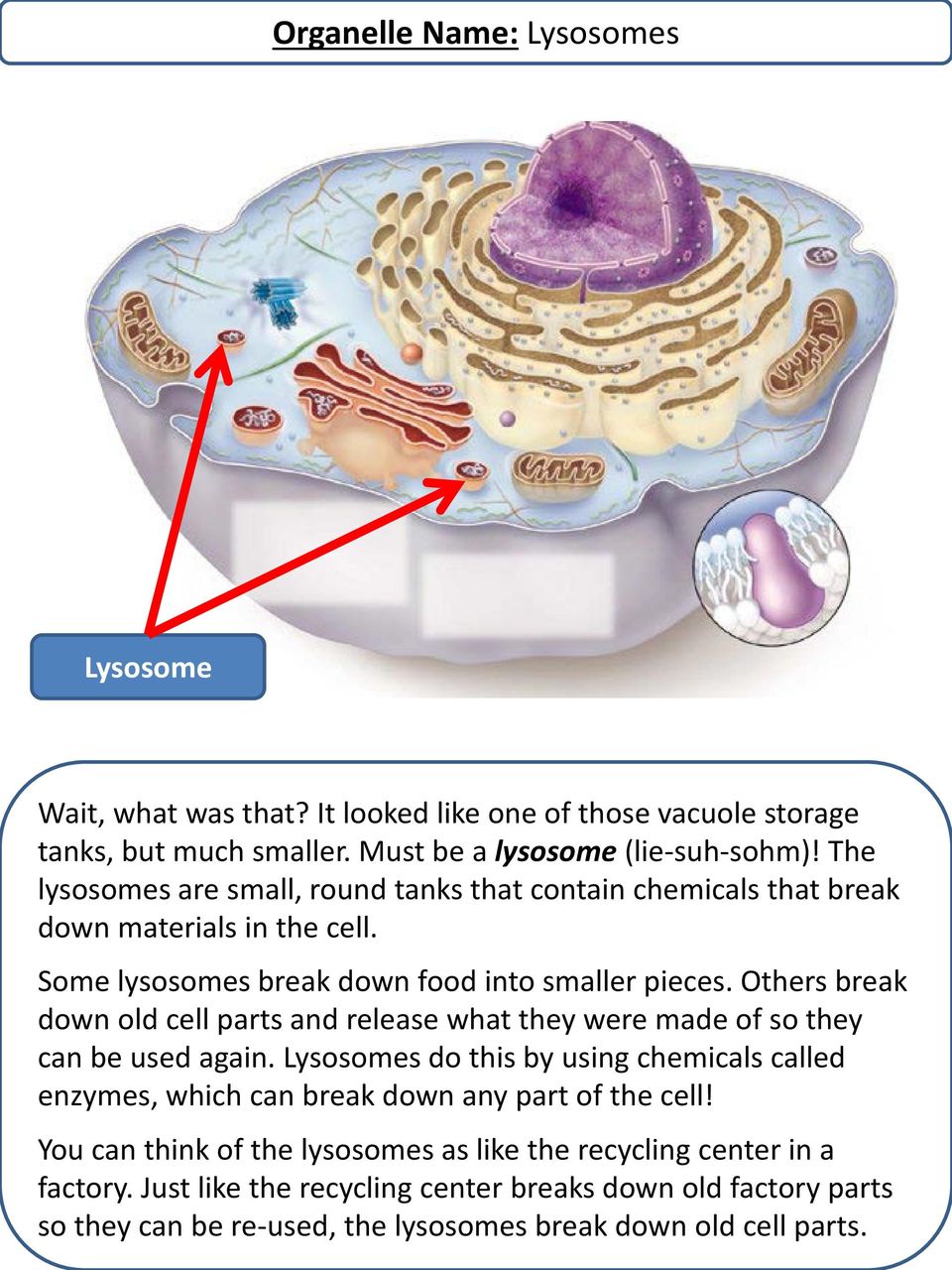
8 Organelle Name: Lysosomes Lysosome Wait, what was that? It looked like one of those vacuole storage tanks, but much smaller. Must be a lysosome (lie-suh-sohm)! The lysosomes are small, round tanks that contain chemicals that break down materials in the cell. Some lysosomes break down food into smaller pieces. Others break down old cell parts and release what they were made of so they can be used again. Lysosomes do this by using chemicals called enzymes, which can break down any part of the cell! You can think of the lysosomes as like the recycling center in a factory. Just like the recycling center breaks down old factory parts so they can be re-used, the lysosomes break down old cell parts.
9 Cell Part: Cytoplasm Cytoplasm As soon as we enter the cell, it feels like we re moving through jello. This must be the cytoplasm (sigh-toe-plah-zim). Cytoplasm is the thick, jello-like fluid that fills a cell. The cytoplasm flows around the cell carrying the cell s parts all of the organelles. The cytoplasm is about 80 percent water and 20 percent chemicals. Because it s mostly water, the cytoplasm is usually clear. And since the cytoplasm contains the organelles, it s where most of the cell s activities take place! You could say cytoplasm is like air, because it fills the whole factory. Another way you could think of cytoplasm is that it s like a fruit jello cup. The jello itself is the cytoplasm, and the fruit it holds in it are all of the cell s organelles.

7.2 Cells: A Look Inside
 CHAPTER 7 CELL STRUCTURE AND FUNCTION 7.2 Cells: A Look Inside Imagine a factory that makes thousands of cookies a day. Ingredients come into the factory, get mixed and baked, then the cookies are packaged.
7.2 Cell Structure. Lesson Objectives. Lesson Summary. Cell Organization Eukaryotic cells contain a nucleus and many specialized structures.
 7.2 Cell Structure Lesson Objectives Describe the structure and function of the cell nucleus. Describe the role of vacuoles, lysosomes, and the cytoskeleton. Identify the role of ribosomes, endoplasmic
Chapter 5 Organelles. Lesson Objectives List the organelles of the cell and their functions. Distinguish between plant and animal cells.
 Chapter 5 Organelles Lesson Objectives List the organelles of the cell and their functions. Distinguish between plant and animal cells. Check Your Understanding What is a cell? How do we visualize cells?
Do Not Write on this Quiz Paper (südamlik aitäh)
 1. This makes ribosomes. Cell Organelle Quiz Do Not Write on this Quiz Paper (südamlik aitäh) a. Rough ER c. Golgi apparatus (body) b. Nucleolus d. Mitochondria 2. This is an energy producing organelle.
Cells & Cell Organelles
 Cells & Cell Organelles The Building Blocks of Life H Biology Types of cells bacteria cells Prokaryote - no organelles Eukaryotes - organelles animal cells plant cells Cell size comparison Animal cell
But what about the prokaryotic cells?
 Chapter 32: Page 318 In the past two chapters, you have explored the organelles that can be found in both plant and animal s. You have also learned that plant s contain an organelle that is not found in
City Part Function Cell Part Controls what goes in and
 Answer key: CELL CITY INTRODUCTION! Floating around in the cytoplasm are small structures called organelles. Like the organs in your own body, each one carries out a specific function necessary for the
1. When you come to a station, attempt to answer each question for that station.
 Name: Block: Steps for completing this study guide 1. When you come to a station, attempt to answer each question for that station. 2. Once you are done answering the questions, or if you can t answer
C E L L O. Recommended Age: 6 years-8 years Time: 45 minutes prep, additional 3 hours for Jello to set
 C E L L O Recommended Age: 6 years-8 years Time: 45 minutes prep, additional 3 hours for Jello to set The smallest and simplest unit of life is called a cell. Cells are divided into two types of cells
COMPARISON OF PLANT AND ANIMAL CELLS SIMILARITIES IN PLANT & ANIMAL CELLS
 COMPARISON OF PLANT AND ANIMAL CELLS Cells vary widely in structure and function, even within the same organism. The human body, for example, has more than 200 different types of cells, each with a specialized
Introduction to the Cell: Plant and Animal Cells
 Introduction to the Cell: Plant and Animal Cells Tissues, Organs, and Systems of Living Things Cells, Cell Division, and Animal Systems and Plant Systems Cell Specialization Human Systems All organisms
Chapter 2: Cell Structure and Function pg. 70-107
 UNIT 1: Biochemistry Chapter 2: Cell Structure and Function pg. 70-107 Organelles are internal structures that carry out specialized functions, interacting and complementing each other. Animal and plant
Comparing Plant And Animal Cells
 Comparing Plant And Animal Cells http://khanacademy.org/video?v=hmwvj9x4gny Plant Cells shape - most plant cells are squarish or rectangular in shape. amyloplast (starch storage organelle)- an organelle
Objective: On a team of no more than (2). Build to illustrate a 3D model of a PLANT or ANIMAL cell. 10 pts.
 THE CELL model: Activity 4.1 Science / Biology Objective: On a team of no more than (2). Build to illustrate a 3D model of a PLANT or ANIMAL cell. - Your models should clearly demonstrate the following
Fifth Grade Cells: Structures and Processes Assessment
 Fifth Grade Cells: Structures and Processes Assessment 1a. All living things are made up of. a. cells b. tissues c. organisms d. systems 1b. All living things are made up of. 1c. Explain what cells are
Plant and Animal Cells
 Plant and Animal Cells a. Explain that cells take in nutrients in order to grow, divide and to make needed materials. S7L2a b. Relate cell structures (cell membrane, nucleus, cytoplasm, chloroplasts, and
Eukaryotic Cells Organelles Cell Wall cell wall
 Eukaryotic Cells Think back to Schwann and Schleiden. It wasn t until that fateful lunch that Schwann realized he was seeing cells. After that moment cell biology knowledge exploded (just a saying; it
Comparing Plant and Animal Cells
 1.2 Comparing Plant and Animal Cells Here is a summary of what you will learn in this section: Plant and animal cell structures are called organelles. Plant and animal cells perform some similar functions,
The Cell. Grade 8 Activity Plan
 The Cell Grade 8 Activity Plan Plant Cell Project Objectives: 1. To identify cell organelles and their functions. 2. To demonstrate the difference between plant and animal cells. Keywords/concepts: cells,
Eukaryotic Cell Structure: Organelles in Animal & Plant Cells Why are organelles important and how are plants and animals different?
 Why? Eukaryotic Cell Structure: Organelles in Animal & Plant Cells Why are organelles important and how are plants and animals different? The cell is the basic unit and building block of all living things.
The microscope is an important tool.
 KEY CONCEPT Microscopes allow us to see inside the cell. BEFORE, you learned Some organisms are unicellular and some are multicellular A microscope is necessary to study most cells The cell theory describes
CELL ANALOGY: AIRPORT. By: Joe Behrmann and Isaac Thompson
 CELL ANALOGY: AIRPORT By: Joe Behrmann and Isaac Thompson MITOCHONDRIA Location: The Mitochondria of a cell is located in both plant and animal cells. They are found floating throughout the cell. Function:
Look for these related items from Learning Resources :
 Look for these related items from Learning Resources : LER 1901 Cross Section Plant Cell LER 1902 Cross Section Heart Model LER 1903 Cross Section Brain Model LER 2437 Cross Section Earth Model For a dealer
The Cell Teaching Notes and Answer Keys
 The Cell Teaching Notes and Answer Keys Subject area: Science / Biology Topic focus: The Cell: components, types of cells, organelles, levels of organization Learning Aims: describe similarities and differences
Review of the Cell and Its Organelles
 Biology Learning Centre Review of the Cell and Its Organelles Tips for most effective learning of this material: Memorize the names and structures over several days. This will help you retain what you
Lecture 4 Cell Membranes & Organelles
 Lecture 4 Cell Membranes & Organelles Structure of Animal Cells The Phospholipid Structure Phospholipid structure Encases all living cells Its basic structure is represented by the fluidmosaic model Phospholipid
AP BIOLOGY 2006 SCORING GUIDELINES. Question 1
 AP BIOLOGY 2006 SCORING GUIDELINES Question 1 A major distinction between prokaryotes and eukaryotes is the presence of membrane-bound organelles in eukaryotes. (a) Describe the structure and function
Make your whiteboard come alive with science!
 LER 6038 Grades 4+ Ages 9+ Make your whiteboard come alive with science! Explore a plant cell through handson investigation! A. Cell Wall A rigid and strong wall that protects and maintains the shape of
Video Links: Differences Between Plant and Animal Cells http://www.youtube.com/watch?v=mwz4ptp_qeu
 Comparing Animal and Plant Cells by Annie Plant and animal cells are known as Eukaryotic cells which contain a nucleus and other genetic material enclosed within membranes. (Science Daily, n.d.) The primary
The Cell Interior and Function
 The Cell Interior and Function 5 5.0 CHAPTER PREVIEW Investigate and understand the organization and function of the cell interior. Define the differences between eukaryotic and prokaryotic cell structure.
UNIT 1 - Living Organisms and the Environment Situations. Cells
 Lesson Summaries HUMAN AND SOCIAL BIOLOGY UNIT 1 - Living Organisms and the Environment Situations Lesson 2 Cells OBJECTIVES At the end of this lesson you will be able to: a) Describe the structure of
Biology 101 Chapter 4 Cells as the Basic Unit of Life. The Cell Theory Major Contributors: Galileo = first observations made with a microscope
 Biology 101 Chapter 4 Cells as the Basic Unit of Life The Cell Theory Major Contributors: Galileo = first observations made with a microscope Robert Hooke = first to observe small compartments in dead
Partnerships Implementing Engineering Education Worcester Polytechnic Institute Worcester Public Schools Supported by: National Science Foundation
 Cells & Heredity: 6.C.2 Design a Cell Travel Brochure Grade Level 6 Sessions Seasonality Instructional Mode(s) Team Size WPS Benchmarks MA Frameworks Key Words 15-50 minutes N/A Individual N/A 06.SC.LS.05
Cells. Structure, Function and Homeostasis
 Cells Structure, Function and Homeostasis Characteristics of Cells Basic unit of life anything alive is made of cells Plasma membrane (skin) that separates them from the environment. Skeletonsfor protection
How Well Do You Know Your Cells?
 How Well Do You Know Your Cells? Complete each sentence below with words from the box. One word will not be used. cells cell membrane cell walls chloroplasts cytoplasm Hooke Leeuwenhoek mitochondria nucleus
The Living Cell from the Biology: The Science of Life Series. Pre-Test
 1 Pre-Test Directions: Answer each question TRUE OR FALSE. 1. The instructions for making proteins are stored in molecules of DNA. 2. Proteins are made in the nucleus. 3. All cells are surrounded by a
Chapter 4: A Tour of the Cell. 1. Cell Basics. Limits to Cell Size. 1. Cell Basics. 2. Prokaryotic Cells. 3. Eukaryotic Cells
 Chapter 4: A Tour of the Cell 1. Cell Basics 2. Prokaryotic Cells 3. Eukaryotic Cells 1. Cell Basics Limits to Cell Size There are 2 main reasons why cells are so small: If cells get too large: 1) there
Cell Structure & Function!
 Cell Structure & Function! Chapter 3! The most exciting phrase to hear in science, the one that heralds new discoveries, is not 'Eureka!' but 'That's funny.! -- Isaac Asimov Animal Cell Plant Cell Cell
Quick Hit Activity Using UIL Science Contests For Formative and Summative Assessments of Pre-AP and AP Biology Students
 Quick Hit Activity Using UIL Science Contests For Formative and Summative Assessments of Pre-AP and AP Biology Students Activity Title: Quick Hit Goal of Activity: To perform formative and summative assessments
Biology Chapter 7 Practice Test
 Biology Chapter 7 Practice Test Multiple Choice Write the letter that best answers the question or completes the statement on the line provided. 1. The work of Schleiden and Schwann can be summarized by
Multiple Choice Questions
 Chapter 5 THE FUNDAMENTAL UNIT OF LIFE Multiple Choice Questions 1. Which of the following can be made into crystal? (a) A Bacterium (b) An Amoeba (c) A Virus (d) A Sperm 2. A cell will swell up if (a)
Cell Unit Practice Test #1
 ell Unit Practice Test #1 Name: ate: 1. Which organelle is primarily concerned with the conversion of potential energy of organic compounds into suitable form for immediate use by the cell?. mitochondria.
Lesson 4.10: Life Science Plant & Animal Cell Functions
 Weekly Focus: Reading Comprehension Weekly Skill: Compare & Contrast Lesson Summary: This week students will continue with lessons in Life Science. The work contains foundational knowledge about plant
Plant and Animal Cells
 Plant and Animal Cells Cell Scientists Hans and Zacharias Janssen Dutch lens grinders, father and son produced first compound microscope (2 lenses) Robert Hooke (1665) English Scientist looked at a thin
Chapter 3. Cellular Structure and Function Worksheets. 39 www.ck12.org
 Chapter 3 Cellular Structure and Function Worksheets (Opening image copyright by Sebastian Kaulitzki, 2010. Used under license from Shutterstock.com.) Lesson 3.1: Introduction to Cells Lesson 3.2: Cell
Cells, tissues and organs
 Chapter 8: Cells, tissues and organs Cells: building blocks of life Living things are made of cells. Many of the chemical reactions that keep organisms alive (metabolic functions) take place in cells.
Date: Student Name: Teacher Name: Jared George. Score: 1) A cell with 1% solute concentration is placed in a beaker with a 5% solute concentration.
 Biology Keystone (PA Core) Quiz Homeostasis and Transport - (BIO.A.4.1.1 ) Plasma Membrane, (BIO.A.4.1.2 ) Transport Mechanisms, (BIO.A.4.1.3 ) Transport Facilitation Student Name: Teacher Name: Jared
Drexel-SDP GK-12 ACTIVITY
 Drexel-SDP GK-12 ACTIVITY Subject Area(s): Biology Associated Unit: None Associated Lesson: None Activity Title : Plant or Animal Cell? Grade Level: 7 and 8 (7-9) Activity Dependency: None Time Required:
Structure of the Cell B 2 Workbook
 Name Structure of the Cell B 2 Workbook Source: Clipart ETC, Florida Center for Instructional Technology (FCIT) at USF To complete this set of assignments and, move on to the next set of assignments, you
Organelles and Their Functions
 Organelles and Their Functions The study of cell organelles and their functions is a fascinating part of biology. The current article provides a brief description of the structure of organelles and their
Cytology. Living organisms are made up of cells. Either PROKARYOTIC or EUKARYOTIC cells.
 CYTOLOGY Cytology Living organisms are made up of cells. Either PROKARYOTIC or EUKARYOTIC cells. A. two major cell types B. distinguished by structural organization See table on handout for differences.
Given these characteristics of life, which of the following objects is considered a living organism? W. X. Y. Z.
 Cell Structure and Organization 1. All living things must possess certain characteristics. They are all composed of one or more cells. They can grow, reproduce, and pass their genes on to their offspring.
Prokaryotic and Eukaryotic Cells
 Why? Prokaryotic and Eukaryotic Cells Do all cells have the same structure? An efficiency apartment is a one-room apartment. This one room is where you sleep, eat, shower, and entertain your guests. It
Fifth Grade, Cells: Structures and Processes 2005 Colorado Summer Writing Institute 1
 Cells: Structures and Processes Grade Level or Special Area: Fifth Grade Written by: Ellie Luyombya, The Academy, Denver, CO Length of Unit: Nine lessons (approximately nine to eleven days 45 minutes each
Lesson Aim To explain the human body at a microscopic level, including the structure and function of cells, tissues and membranes.
 LESSON 1. CELLS & TISSUES Lesson Aim To explain the human body at a microscopic level, including the structure and function of cells, tissues and membranes. THE CELL All living matter is composed of functional
Anatomy PHL 212. By Dr Tajdar Husain Khan
 Anatomy PHL 212 By Dr Tajdar Husain Khan Overview of Anatomy Anatomy(from the Greek word anatome,"dissection") is a branch of natural science dealing with the structural organization of living things The
Cells Vocabulary List & Definitions
 Cells Vocabulary List & Definitions cytoplasm mitochondrion nucleolus nucleus organ tissue vacuole cell membrane cell wall chlorophyll chloroplast chromosome inherited genetic material in a cell not specified
Plasma Membrane hydrophilic polar heads
 The Parts of the Cell 3 main parts in ALL cells: plasma membrane, cytoplasm, genetic material this is about the parts of a generic eukaryotic cell Plasma Membrane -is a fluid mosaic model membrane is fluid
Parts of the Nerve Cell and Their Functions
 Parts of the Nerve Cell and Their Functions Silvia Helena Cardoso, PhD [ 1. Cell body] [2. Neuronal membrane] [3. Dendrites] [4. Axon] [5. Nerve ending] 1. Cell body The cell body (soma) is the factory
tissues are made of cells that work together, organs are )
 Study Guide Cells Unit Test Matching. Write the letter of the correct response on the line. You may use the responses more than once. A. proteins B. simple carbohydrates C. complex carbohydrates D. lipids
Biological cell membranes
 Unit 14: Cell biology. 14 2 Biological cell membranes The cell surface membrane surrounds the cell and acts as a barrier between the cell s contents and the environment. The cell membrane has multiple
CELL/ PHOTOSYNTHESIS/ CELLULAR RESPIRATION Test 2011 ANSWER 250 POINTS ANY WAY IN WHICH YOU WANT
 CELL/ PHOTOSYNTHESIS/ CELLULAR RESPIRATION Test 2011 ANSWER 250 POINTS ANY WAY IN WHICH YOU WANT Completion: complete each statement. (1 point each) 1. All cells arise from. 2. The basic unit of structure
called a cell wall. The cell wall protects against mechanical stress and keeps the cell from becoming over-filled with water.
 What are Cells? By: Byron Norelius About Cells A cell is the basic unit of life. All living organisms are composed of one (unicellular) or more (multicellular) cells. In unicellular organisms, like many
IIn our high tech world, one of the hottest areas of development
 Topic 1.1 Why are cells important? Key Concepts Studying cells helps us understand how organisms function. Cellular organelles work together to carry out life functions. Cellular processes enable organisms
Animal & Plant Cell Slides
 Animal & Plant Cell Slides Category: Biology Type: Class Experiment, 60 min class Materials: 2 Glass Slides 2 Cover Slips 1 Bottle of methylene blue (optional) 1 Plastic tray 1 Bottle of iodine 1 Plastic
Keystone Review Practice Test Module A Cells and Cell Processes. 1. Which characteristic is shared by all prokaryotes and eukaryotes?
 Keystone Review Practice Test Module A Cells and Cell Processes 1. Which characteristic is shared by all prokaryotes and eukaryotes? a. Ability to store hereditary information b. Use of organelles to control
CORAL REEF ECOLOGY. Objectives Students will learn that coral is an animal. Students will learn the differences between plant and animal cells.
 CORAL REEF ECOLOGY Concepts Scientific method Difference between plants and animals cells HCPS III Benchmarks SC 4.1.2 SC 4.4.1 Duration 2 hours Source Material PRISM Vocabulary Cell Cell Membrane Cytosol
Compartmentalization of the Cell. Objectives. Recommended Reading. Professor Alfred Cuschieri. Department of Anatomy University of Malta
 Compartmentalization of the Cell Professor Alfred Cuschieri Department of Anatomy University of Malta Objectives By the end of this session the student should be able to: 1. Identify the different organelles
Biology 13A Lab #3: Cells and Tissues
 Biology 13A Lab #3: Cells and Tissues Lab #3 Table of Contents: Expected Learning Outcomes.... 28 Introduction...... 28 Activity 1: Eukaryotic Cell Structure... 29 Activity 2: Perspectives on Tissue Preparations.
Bacterial (Prokaryotic) Cell. Common features of all cells. Tour of the Cell. Eukaryotic Cell. Plasma Membrane defines inside from outside
 www.denniskunkel.com Tour of the Cell www.denniskunkel.com Today s Topics Properties of all cells Prokaryotes and Eukaryotes Functions of Major Cellular Organelles Information, Synthesis&Transport,, Vesicles
CELLS: PLANT CELLS 20 FEBRUARY 2013
 CELLS: PLANT CELLS 20 FEBRUARY 2013 Lesson Description In this lesson we will discuss the following: The Cell Theory Terminology Parts of Plant Cells: Organelles Difference between plant and animal cells
ISTEP+: Biology I End-of-Course Assessment Released Items and Scoring Notes
 ISTEP+: Biology I End-of-Course Assessment Released Items and Scoring Notes Page 1 of 22 Introduction Indiana students enrolled in Biology I participated in the ISTEP+: Biology I Graduation Examination
Cell and Membrane Practice. A. chromosome B. gene C. mitochondrion D. vacuole
 Name: ate: 1. Which structure is outside the nucleus of a cell and contains N?. chromosome. gene. mitochondrion. vacuole 2. potato core was placed in a beaker of water as shown in the figure below. Which
The Cell: Organelle Diagrams
 The Cell: Organelle Diagrams Fig 7-4. A prokaryotic cell. Lacking a true nucleus and the other membrane-enclosed organelles of the eukaryotic cell, the prokaryotic cell is much simpler in structure. Only
Name Date Period. 2. When a molecule of double-stranded DNA undergoes replication, it results in
 DNA, RNA, Protein Synthesis Keystone 1. During the process shown above, the two strands of one DNA molecule are unwound. Then, DNA polymerases add complementary nucleotides to each strand which results
Draw one line from each structure in List A to the correct information about the structure in List B.
 Q. The drawing shows the cell of a bacterium. (a) List A gives the four structures labelled on the diagram. List B includes information about each structure. Draw one line from each structure in List A
DIFFUSION (HYPERTONIC, HYPOTONIC, & ISOTONIC SOLUTIONS) THE GUMMY BEAR LAB PASS
 DIFFUSION (HYPERTONIC, HYPOTONIC, & ISOTONIC SOLUTIONS) THE GUMMY BEAR LAB PASS Have you ever wondered why your fingers have wrinkles after soaking in a bath tub? Your students have probably wondered the
Biology I. Chapter 7
 Biology I Chapter 7 Interest Grabber NOTEBOOK #1 Are All Cells Alike? All living things are made up of cells. Some organisms are composed of only one cell. Other organisms are made up of many cells. 1.
2. Which type of macromolecule contains high-energy bonds and is used for long-term energy storage?
 Energy Transport Study Island 1. During the process of photosynthesis, plants use energy from the Sun to convert carbon dioxide and water into glucose and oxygen. These products are, in turn, used by the
Cellular Energy. 1. Photosynthesis is carried out by which of the following?
 Cellular Energy 1. Photosynthesis is carried out by which of the following? A. plants, but not animals B. animals, but not plants C. bacteria, but neither animals nor plants D. all living organisms 2.
Cells in Biology. Lesson 1.
 Lesson 1. Cells in Biology. Jump-Start Your Learning. Before you begin reading, take a piece of paper and write ''Cells'' across the top. Then, as fast as you can, jot down any notes, facts, opinions or
MCAS Biology. Review Packet
 MCAS Biology Review Packet 1 Name Class Date 1. Define organic. THE CHEMISTRY OF LIFE 2. All living things are made up of 6 essential elements: SPONCH. Name the six elements of life. S N P C O H 3. Elements
Week 1 EOC Review Cell Theory, Cell Structure, Cell Transport
 Week 1 EOC Review Cell Theory, Cell Structure, Cell Transport Benchmarks: SC.912.L.14.1 Describe the scientific theory of cells (cell theory) and relate the history of its discovery to the processes of
THE LIVING CELL. Cells also have variety of shapes. Plant cells are often rectangular or polygonal, while egg cells are usually spherical.
 THE LIVING CELL A Tour of the cell The cell is the smallest and the basic unit of structure of all organisms. There are two main types or categories of cells: prokaryotic cells and eukaryotic cells. Prokaryotic
Cell Structure and Function. Eukaryotic Cell: Neuron
 Cell Structure and Function Eukaryotic Cell: Neuron Cell Structure and Function Eukaryotic Cells: Blood Cells Cell Structure and Function Prokaryotic Cells: Bacteria Cell Structure and Function All living
Cellular Structure and Function
 Chapter Test A CHAPTER 7 Cellular Structure and Function Part A: Multiple Choice In the space at the left, write the letter of the term or phrase that best answers each question. 1. Which defines a cell?
Homeostasis and Transport Module A Anchor 4
 Homeostasis and Transport Module A Anchor 4 Key Concepts: - Buffers play an important role in maintaining homeostasis in organisms. - To maintain homeostasis, unicellular organisms grow, respond to the
CLIL lesson for TKT CLIL Chiara Cappa Liceo Scientifico Respighi - Piacenza. CLIL lesson on cells
 CLIL lesson on cells Time: 1 hour Number of students: 20 Age: 14-15 Level: Pre-intermediate (B1) Subject: Biology Learning outcomes: at the end of the lesson students should be able to: o describe the
The Steps. 1. Transcription. 2. Transferal. 3. Translation
 Protein Synthesis Protein synthesis is simply the "making of proteins." Although the term itself is easy to understand, the multiple steps that a cell in a plant or animal must go through are not. In order
4a. A Busy Factory. Cell Structure: An Overview
 4a. A Busy Factory Imagine a bustling factory manufacturing the latest must-have gadget. Whether they make bicycles, cell phones, or hot air balloons, most factories are set up in essentially the same
Cell Structure and Function
 CHAPTER 3 CELL STRUCTURE AND FUNCTION Vocabulary Practice cell theory vacuole concentration gradient cytoplasm lysosome osmosis organelle centriole isotonic prokaryotic cell cell wall hypertonic eukaryotic
OBJECTIVES PROCEDURE. Lab 2- Bio 160. Name:
 Lab 2- Bio 160 Name: Prokaryotic and Eukaryotic Cells OBJECTIVES To explore cell structure and morphology in prokaryotes and eukaryotes. To gain more experience using the microscope. To obtain a better
Lesson Plans for the Animal Cell
 Andrew Dahlby Lesson Plans for the Animal Cell Subject: life science Grade: 7 Class or period 1 2 3 4 5 6 7 8 Content Standard: Minnesota Science Standard GRADE 7 Strand-IV. LIFE SCIENCE Sub strand - A.
PLANT AND ANIMAL CELLS GRADE 5. All living things are made up of cells. The structures of different types of cells are related to their functions.
 PLANT AND ANIMAL CELLS GRADE 5 BACKGROUND In order for students to understand life science they must understand the most basic form of life, which is the cell. They must understand what it is made of and
PRESTWICK ACADEMY NATIONAL 5 BIOLOGY CELL BIOLOGY SUMMARY
 Name PRESTWICK ACADEMY NATIONAL 5 BIOLOGY CELL BIOLOGY SUMMARY Cell Structure Identify animal, plant, fungal and bacterial cell ultrastructure and know the structures functions. Plant cell Animal cell
Eukaryotes. www.njctl.org PSI Biology Eukaryotes & Gene Expression
 Eukaryotes The Eukaryotic Cell Classwork 1. Identify two characteristics that are shared by all cells. 2. Suppose you are investigating a cell that contains a nucleus. Would you categorize this cell as
Anatomy and Physiology Placement Exam 2 Practice with Answers at End!
 Anatomy and Physiology Placement Exam 2 Practice with Answers at End! General Chemical Principles 1. bonds are characterized by the sharing of electrons between the participating atoms. a. hydrogen b.
Regents Biology REGENTS REVIEW: PROTEIN SYNTHESIS
 Period Date REGENTS REVIEW: PROTEIN SYNTHESIS 1. The diagram at the right represents a portion of a type of organic molecule present in the cells of organisms. What will most likely happen if there is
cells - relatively simple cells - lack nuclear membrane and many organelles - bacteria and their relatives are all prokaryotic
 Cell Biology A cell is chemical system that is able to maintain its structure and reproduce. Cells are the fundamental unit of life. All living things are cells or composed of cells. 1 The interior contents