
Lesson 4.10: Life Science Plant & Animal Cell Functions
|
|
|
- Dominick Fox
- 10 years ago
- Views:
Transcription
1 Weekly Focus: Reading Comprehension Weekly Skill: Compare & Contrast Lesson Summary: This week students will continue with lessons in Life Science. The work contains foundational knowledge about plant and animal cell structure. The vocabulary used incorporates content form previous lessons. Students will then compare and contrast plant and animal cells with a Venn diagram (graphic organizer). You may wish to remind students that the 2014 GED test modules may ask them to compare and contrast different texts, passages, graphs, and charts. Materials Needed: Comprehension Reading Unit 4.10 Handout 1 Plant & Animal Cell Diagrams and Graphic Organizer Unit 4.10 Handout 2 Extra Work/Homework Unit 4.10 Handout 3 (6-way Paragraphs, Introductory Level, #35, pages 70 71) Objectives: Students will be able to Read comprehension passages with vocabulary related to basic cell functions Compare and contrast animal and plant cells College and Career Readiness Standards: RI, RST, WHST ACES Skills Addressed: EC, LS, ALS, CT, SM Notes: Please review and be familiar with classroom routine notes for: reading for fluency strategies (Routine 2), summarizing techniques (Routine 4), self-management skills (Routine 1). The notes for the different activities will help with making a smooth transition to each activity. GED 2014 Science Test Overview For Teachers and Students The GED Science Test will be 90 minutes long and include approximately 34 questions with a total score value of 40. The questions will have focus on three content areas: life science (~40%), physical science (~40%), and Earth and space science (~20%). Students may be asked to read, analyze, understand, and extract information from a scientific reading, a news brief, a diagram, graph, table, or other material with scientific data and concepts or ideas. The online test may consist of multiple choice, drop down menu, and fill-in-the-blank questions. There will also be two short answer questions (suggested 10 minutes each) where students may have to summarize, find evidence (supporting details), and reason or make a conclusion from the information (data) presented. The work students are doing in class will help them with the GED Science Test. They are also learning skills that will help in many other areas of their lives. H. Turngren, Minnesota Literacy Council, 2014 p.1 GED Science Curriculum
2 Activities: Warm-Up: KWL Chart Time: minutes As students enter the class, have the following written on the board or overhead: Plant cells and animal cells look different and yet have many similarities. What do you know about the similarities and differences between the two basic types of cells? Have students create a KWL chart on a piece of notebook paper (below). This helps to activate students prior knowledge by asking them what they already Know (column 1); students (collaborating as a classroom unit or within small groups) set goals specifying what they Want to learn (column 2); and after reading students discuss what they have Learned (column 3). Students apply higher-order thinking strategies which help them construct meaning from what they read and help them monitor their progress toward their goals. KWL Chart: K - What (else) do I KNOW? W - What do I WANT to know? L - What did I LEARN?. Activity 1: Reading Comprehension (Unit 4.10 Handout 1) Time: minutes 1) Hand out Unit 4.10 Handout 1 to students. 2) Explain to students they will read about the basic functions of animal and plant cells. This information is important foundational knowledge for questions that may be on the 2014 GED Science module. 3) Discuss with students that when reading for comprehension, there are many strategies to use: read the title to predict what the reading is about; look at the sub headings to get an idea of the topic of each section or paragraph; if there are images, look at them to get a better understanding; while reading remember to ask What is this all about? 4) Have students read the passages independently. When they are finished, they can work on the questions. 5) Circulate class while they are reading to make sure they understand the information presented and see if there are any questions. 6) Review answers as a whole class. Ask students to point to the evidence from the reading passage that helped them determine the answer. 7) If there is time, students can summarize the reading or write a main idea. 8) Students can fill in the L portion of the KWL chart. Break: 10 minutes H. Turngren, Minnesota Literacy Council, 2014 p.2 GED Science Curriculum

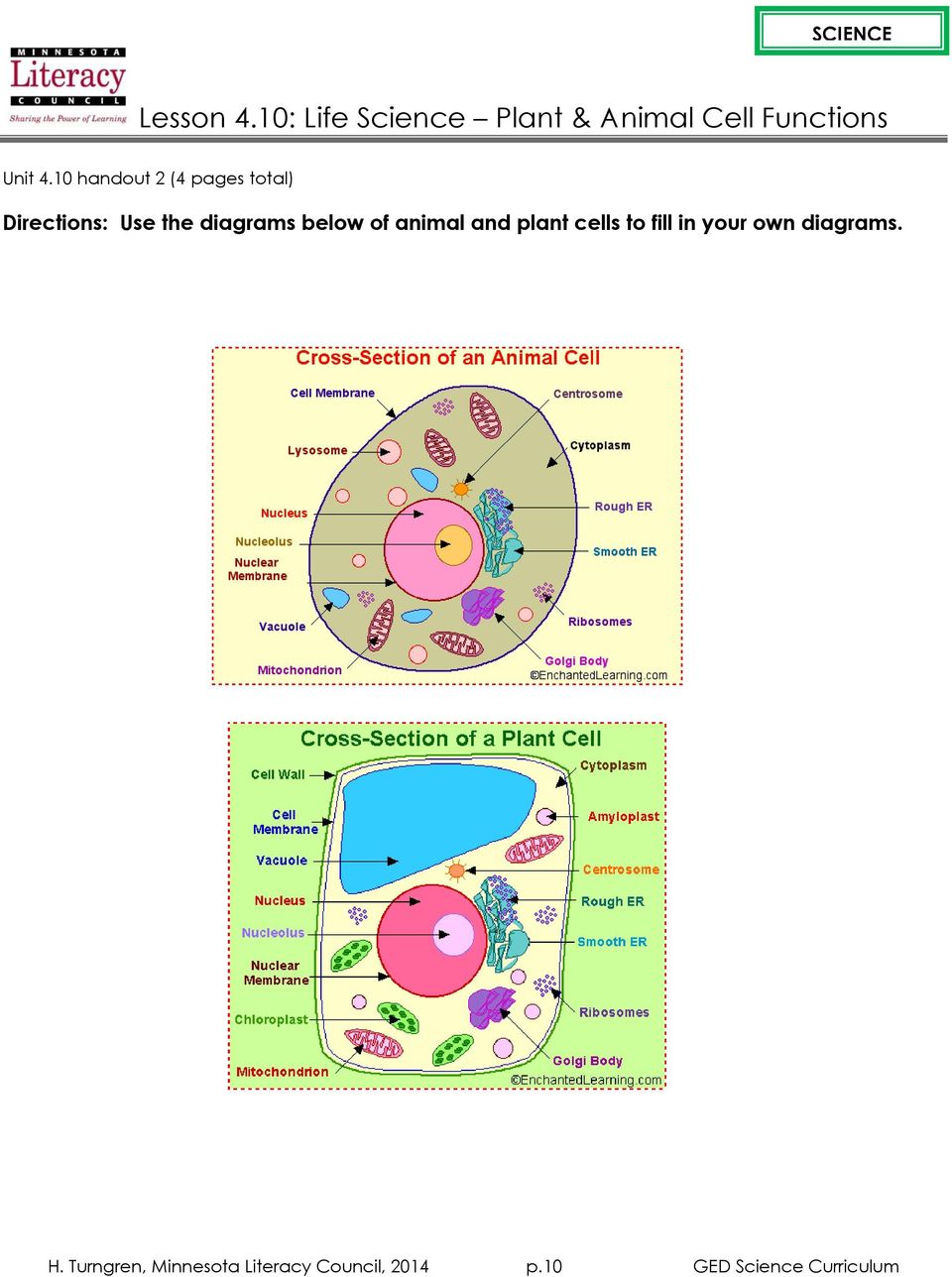
3 Activity 2: Compare and Contrast (Unit 4.8 Handout 2) Time: minutes 1) Hand out Unit 4.10 Handout 2 to students. 2) Explain to students they will continue to examine the similarities and differences between plant and animal cells, only with diagrams. 3) Point out to students that the first page of the handout has the information needed for them to fill in the diagrams on pages 2 and 3. Page 4 is a graphic organizer (Venn diagram) that will have them compare and contrast information from the diagrams. They can also use information from the reading in Activity 1 (Unit 4.10 Handout 1). 4) If you have an overhead projector, it may be best to project the color diagram on a screen to point out the similarities and differences. 5) Circulate class while students are working on filling in the diagram. (Note: the diagrams on pages 2 & 3 are not exact replicas of the one on page 1. This was done intentionally to give students the experience of looking carefully at the information presented and interpreting it in a modified manner.) 6) Review answers as a whole class. Ask students to point to the evidence from the diagram on page 1 that helped them determine the answer. 7) If there is time, students can summarize the diagrams or write up a main idea. This is something they may have to do on the 2014 GED test. Wrap-Up: Summarize Time: 5 minutes Have students turn to a partner (or write in their journals) about what they have learned today about comparing and contrasting animal and plant cells. Ask them to tell a partner one thing they learned today in one or two sentences. Note: Use Routine 4 Handout Extra Work/Homework: Unit 4.10 handout 3 Time: 30 minutes outside of class Students can continue work with another reading passage from 6-way Paragraphs, Introductory Level, #35 (pages 70 71). Differentiated Instruction/ELL Accommodation Suggestions If some students finish early, they can turn their paper over and summarize the reading passage and the diagrams. Also, if they finish early, students can help newer students with the work. Teachers should be aware that ELLs could have some difficult time with some of the vocabulary encountered in the handouts for Activity 1 & 2. Encourage them to look for context clues in the reading that will help them with interpreting the main idea of the reading passage. They may have to use a dictionary for the vocabulary in the diagrams. Activity Activity 1 and Activity 2 Activity 1 & 2 H. Turngren, Minnesota Literacy Council, 2014 p.3 GED Science Curriculum
4 Online Resources: If students have Internet connection, they can try their hands at an interactive animal and plant cell animation. If at all possible, try to show this to the entire class to allow students to see parts of cells and their functions. This resource contains a quiz about animal and plant cells. It allows students to monitor what they have learned. Suggested Teacher Readings: GED Testing Service GED Science Item Sample (to get an idea of what the test may be like) Assessment Guide for Educators: A guide to the 2014 assessment content from GED Testing Service: Minnesota is getting ready for the 2014 GED test! website with updated information on the professional development in Minnesota regarding the 2014 GED. Essential Education s 2014 GED Test Curriculum Blueprint (PDF) H. Turngren, Minnesota Literacy Council, 2014 p.4 GED Science Curriculum
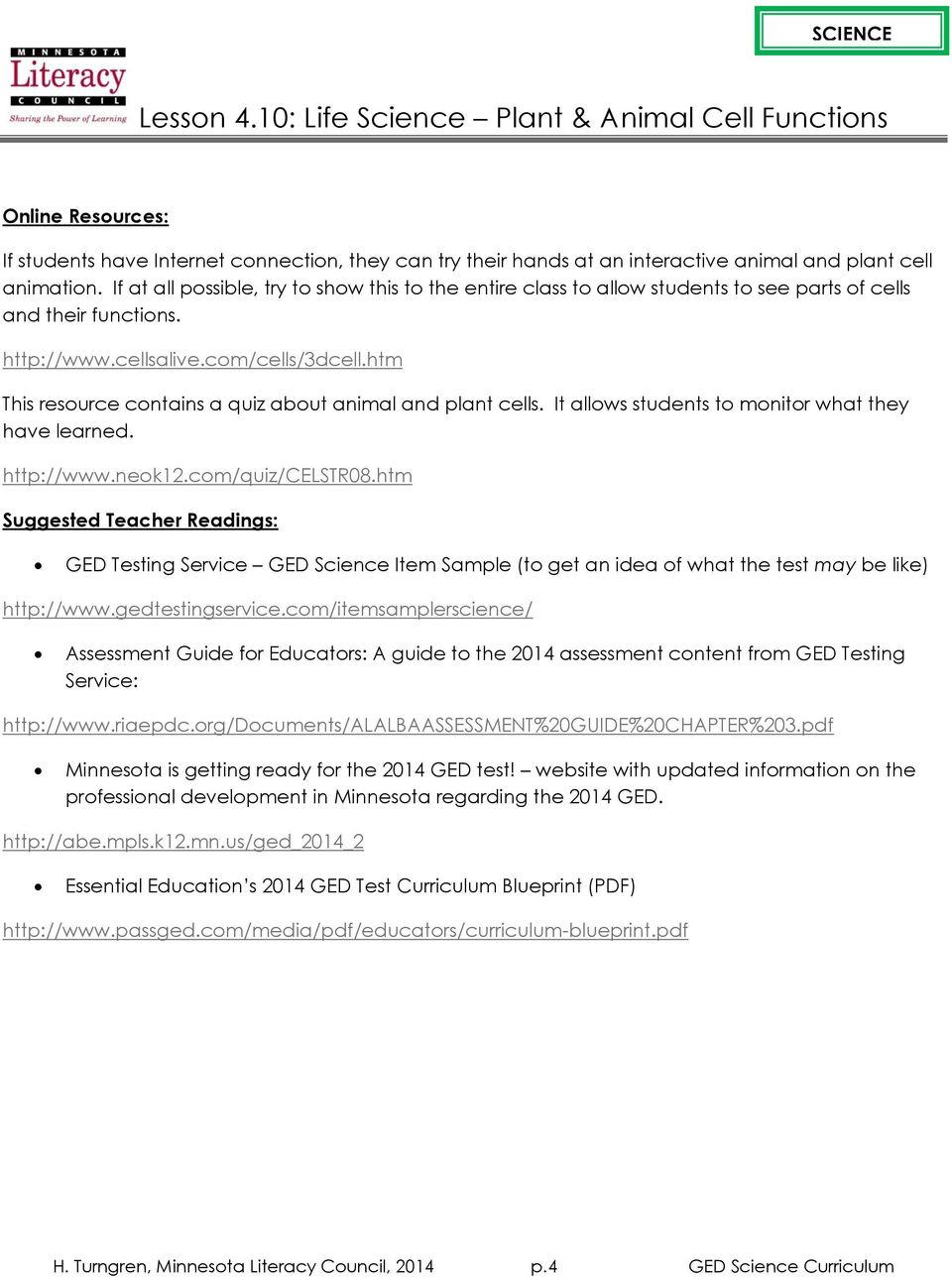
5 Unit 4.10 Handout 1 (4 pages total) H. Turngren, Minnesota Literacy Council, 2014 p.5 GED Science Curriculum
6 H. Turngren, Minnesota Literacy Council, 2014 p.6 GED Science Curriculum

7 H. Turngren, Minnesota Literacy Council, 2014 p.7 GED Science Curriculum
8 H. Turngren, Minnesota Literacy Council, 2014 p.8 GED Science Curriculum

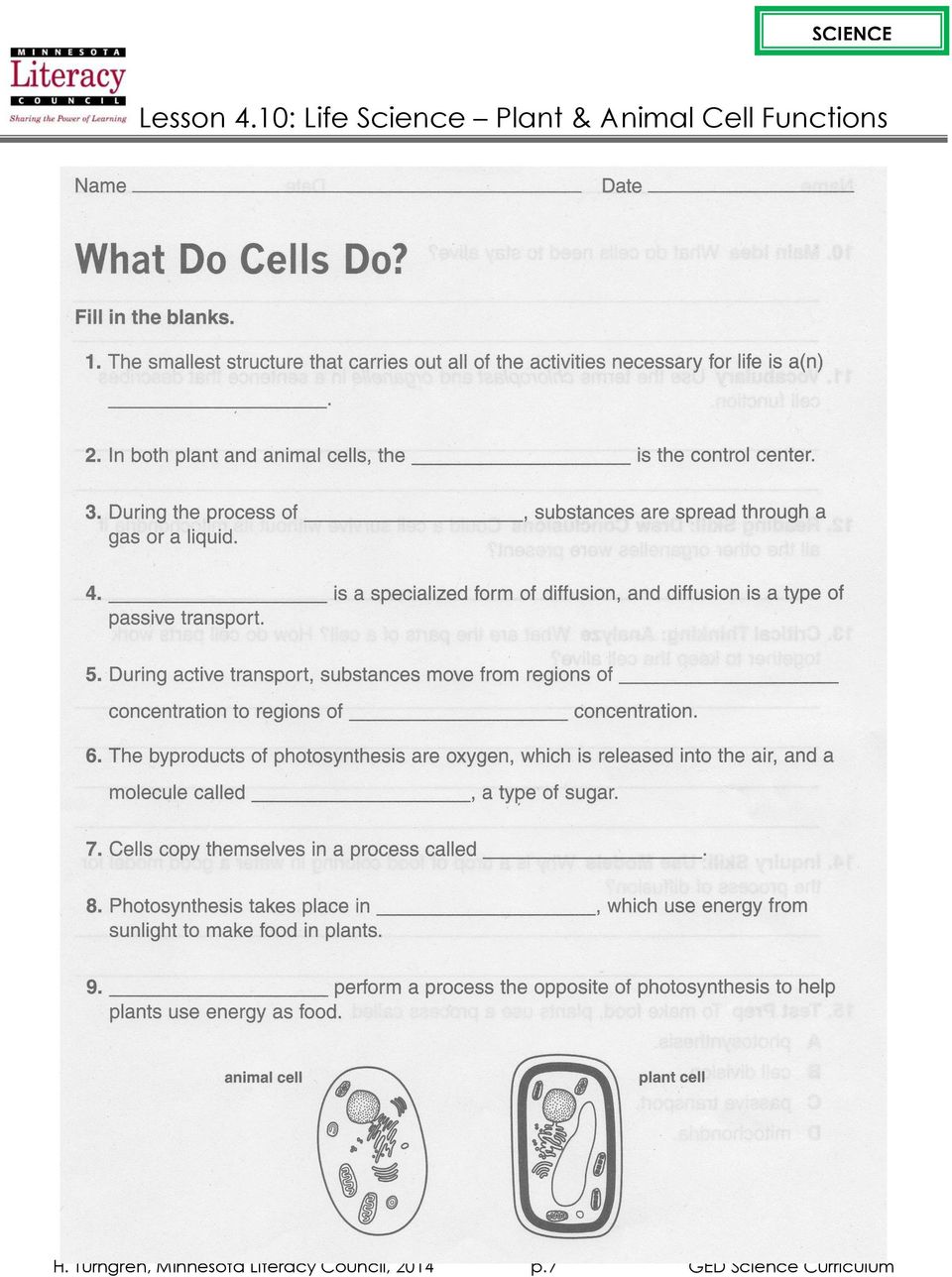
9 Unit 4.10 handout 1 1. cell 2. nucleus 3. diffusion 4. osmosis 5. low, high 6. glucose 7. cell division 8. chloroplasts. 9. mitochondria TEACHER ANSWER KEY 10. Answer will vary, suggested answer: Cells need food, water, and a way to eliminate wastes. 11. Answer will vary, suggested answer: A chloroplast is an organelle in plant cells that makes food for the plant. 12. Answer will vary, suggested answer: No, it could not survive because the mitochondria provides energy to the cell. 13. Answer will vary, suggested answer: Cell membrane lets material in and out and keeps the cell together. The nucleus directs all cell activities. The cytoplasm surrounds the nucleus and organelles. 14. Answer will vary, suggested answer: Diffusion spreads substances through a gas or liquid, so the substance, food coloring, is being spread though the liquid, water. 15. A H. Turngren, Minnesota Literacy Council, 2014 p.9 GED Science Curriculum


10 Unit 4.10 handout 2 (4 pages total) Directions: Use the diagrams below of animal and plant cells to fill in your own diagrams. H. Turngren, Minnesota Literacy Council, 2014 p.10 GED Science Curriculum
11 H. Turngren, Minnesota Literacy Council, 2014 p.11 GED Science Curriculum

12 H. Turngren, Minnesota Literacy Council, 2014 p.12 GED Science Curriculum


13 Compare and Contrast Animal and Plant Cells Directions: Fill in the Venn diagram with information from the reading and diagrams. Plant Cell Animal Cell H. Turngren, Minnesota Literacy Council, 2014 p.13 GED Science Curriculum

14 Unit 4.10 handout 2 TEACHER ANSWER KEY Page 2 A Typical Plant Cell 1. nucleus 2. mitochondrion 3. cell wall 4. Cell membrane 5. chloroplast 6. ribosomes 7. endoplasmic reticulum 8. cytoplasm 9. vacuole Page 3 A Typical Animal Cell 1. cytoplasm 2. nucleolus 3. mitochondrion 4. Cell membrane 5. endoplasmic reticulum 6. nucleus 7. vacuole 8. ribosomes 9. lysosome Plant/Animal Cell Venn Diagram Plant Cells - Have a rigid cell wall outside of the cell membrane that provides structure and support - Have chloroplast that contain chlorophyll, which capture the Sun s energy to help the plant make food - Have one large central vacuole that stores water and wastes. - No vesicles Both Types of Cells - Have a cell membrane - Have cytoplasm the material that all the cell parts float in - Have a nucleus the brain of the cell - Have organelles ribosomes, endoplasmic reticulum, mitochondria, & Golgi apparati Animal Cells - No cell wall - No chloroplasts - Have many small vacuoles that store water, food, and wastes. - Have vesicles that digest materials in the cell. Answers may vary Possible Venn diagram H. Turngren, Minnesota Literacy Council, 2014 p.14 GED Science Curriculum

Lesson 2.11: Physical Science Energy
 Weekly Focus: Reading for Comprehension Weekly Skill: Introduction to Energy Lesson Summary: This week students will continue reading for comprehension and get an introduction to various forms of energy.
Lesson 1.1: Earth and Space Science - Introduction
 Weekly Focus: Main Idea Weekly Skill: Introduction Lesson Summary: This week students will take a pre- self-evaluation to determine their background knowledge in Earth and space science. They will also
Lesson 2.15: Physical Science Speed, Velocity & Acceleration
 Weekly Focus: Reading for Comprehension Weekly Skill: Numeracy Skills in Science Lesson Summary: This week students will continue reading for comprehension with reading passages on speed, velocity, and
COMPARISON OF PLANT AND ANIMAL CELLS SIMILARITIES IN PLANT & ANIMAL CELLS
 COMPARISON OF PLANT AND ANIMAL CELLS Cells vary widely in structure and function, even within the same organism. The human body, for example, has more than 200 different types of cells, each with a specialized
Plant and Animal Cells
 Plant and Animal Cells Strand Topic Life Systems Investigating organelles and their functions in cells of living things Primary SOL LS.2 The student will investigate and understand that all living things
Biology Chapter 7 Practice Test
 Biology Chapter 7 Practice Test Multiple Choice Write the letter that best answers the question or completes the statement on the line provided. 1. The work of Schleiden and Schwann can be summarized by
Unit 1.7: Earth and Space Science The Structure of the Cosmos
 Lesson Summary: This week students will search for evidence provided in passages that lend support about the structure and organization of the Cosmos. Then students will summarize a passage. Materials
Comparing Plant And Animal Cells
 Comparing Plant And Animal Cells http://khanacademy.org/video?v=hmwvj9x4gny Plant Cells shape - most plant cells are squarish or rectangular in shape. amyloplast (starch storage organelle)- an organelle
Chapter 5 Organelles. Lesson Objectives List the organelles of the cell and their functions. Distinguish between plant and animal cells.
 Chapter 5 Organelles Lesson Objectives List the organelles of the cell and their functions. Distinguish between plant and animal cells. Check Your Understanding What is a cell? How do we visualize cells?
Video Links: Differences Between Plant and Animal Cells http://www.youtube.com/watch?v=mwz4ptp_qeu
 Comparing Animal and Plant Cells by Annie Plant and animal cells are known as Eukaryotic cells which contain a nucleus and other genetic material enclosed within membranes. (Science Daily, n.d.) The primary
C E L L O. Recommended Age: 6 years-8 years Time: 45 minutes prep, additional 3 hours for Jello to set
 C E L L O Recommended Age: 6 years-8 years Time: 45 minutes prep, additional 3 hours for Jello to set The smallest and simplest unit of life is called a cell. Cells are divided into two types of cells
Partnerships Implementing Engineering Education Worcester Polytechnic Institute Worcester Public Schools Supported by: National Science Foundation
 Cells & Heredity: 6.C.2 Design a Cell Travel Brochure Grade Level 6 Sessions Seasonality Instructional Mode(s) Team Size WPS Benchmarks MA Frameworks Key Words 15-50 minutes N/A Individual N/A 06.SC.LS.05
Drexel-SDP GK-12 ACTIVITY
 Drexel-SDP GK-12 ACTIVITY Subject Area(s): Biology Associated Unit: None Associated Lesson: None Activity Title : Plant or Animal Cell? Grade Level: 7 and 8 (7-9) Activity Dependency: None Time Required:
7.2 Cells: A Look Inside
 CHAPTER 7 CELL STRUCTURE AND FUNCTION 7.2 Cells: A Look Inside Imagine a factory that makes thousands of cookies a day. Ingredients come into the factory, get mixed and baked, then the cookies are packaged.
UNIT 1 - Living Organisms and the Environment Situations. Cells
 Lesson Summaries HUMAN AND SOCIAL BIOLOGY UNIT 1 - Living Organisms and the Environment Situations Lesson 2 Cells OBJECTIVES At the end of this lesson you will be able to: a) Describe the structure of
Look for these related items from Learning Resources :
 Look for these related items from Learning Resources : LER 1901 Cross Section Plant Cell LER 1902 Cross Section Heart Model LER 1903 Cross Section Brain Model LER 2437 Cross Section Earth Model For a dealer
1. When you come to a station, attempt to answer each question for that station.
 Name: Block: Steps for completing this study guide 1. When you come to a station, attempt to answer each question for that station. 2. Once you are done answering the questions, or if you can t answer
CORAL REEF ECOLOGY. Objectives Students will learn that coral is an animal. Students will learn the differences between plant and animal cells.
 CORAL REEF ECOLOGY Concepts Scientific method Difference between plants and animals cells HCPS III Benchmarks SC 4.1.2 SC 4.4.1 Duration 2 hours Source Material PRISM Vocabulary Cell Cell Membrane Cytosol
IIn our high tech world, one of the hottest areas of development
 Topic 1.1 Why are cells important? Key Concepts Studying cells helps us understand how organisms function. Cellular organelles work together to carry out life functions. Cellular processes enable organisms
City Part Function Cell Part Controls what goes in and
 Answer key: CELL CITY INTRODUCTION! Floating around in the cytoplasm are small structures called organelles. Like the organs in your own body, each one carries out a specific function necessary for the
CELLS: PLANT CELLS 20 FEBRUARY 2013
 CELLS: PLANT CELLS 20 FEBRUARY 2013 Lesson Description In this lesson we will discuss the following: The Cell Theory Terminology Parts of Plant Cells: Organelles Difference between plant and animal cells
Eukaryotic Cells Organelles Cell Wall cell wall
 Eukaryotic Cells Think back to Schwann and Schleiden. It wasn t until that fateful lunch that Schwann realized he was seeing cells. After that moment cell biology knowledge exploded (just a saying; it
Do Not Write on this Quiz Paper (südamlik aitäh)
 1. This makes ribosomes. Cell Organelle Quiz Do Not Write on this Quiz Paper (südamlik aitäh) a. Rough ER c. Golgi apparatus (body) b. Nucleolus d. Mitochondria 2. This is an energy producing organelle.
7.2 Cell Structure. Lesson Objectives. Lesson Summary. Cell Organization Eukaryotic cells contain a nucleus and many specialized structures.
 7.2 Cell Structure Lesson Objectives Describe the structure and function of the cell nucleus. Describe the role of vacuoles, lysosomes, and the cytoskeleton. Identify the role of ribosomes, endoplasmic
Plant and Animal Cells
 Plant and Animal Cells a. Explain that cells take in nutrients in order to grow, divide and to make needed materials. S7L2a b. Relate cell structures (cell membrane, nucleus, cytoplasm, chloroplasts, and
Review of the Cell and Its Organelles
 Biology Learning Centre Review of the Cell and Its Organelles Tips for most effective learning of this material: Memorize the names and structures over several days. This will help you retain what you
The microscope is an important tool.
 KEY CONCEPT Microscopes allow us to see inside the cell. BEFORE, you learned Some organisms are unicellular and some are multicellular A microscope is necessary to study most cells The cell theory describes
Life Systems: Animals vs. Plants
 Life Systems: Animals vs. Plants Overview: Plants and animals are a part of everyday life. It is important for students to understand the basic fundamental differences between the two. Procedures: -Have
Animal and Plant Cells Grade(s): 5 Subject(s): Science
 Title: Animal and Plant Cells Grade(s): 5 Subject(s): Science Author: ICAC Team Overview: Content Standards: Local/National Standards: Primary Learning Objectives: Additional Learning Objectives: Approximate
The Cell Teaching Notes and Answer Keys
 The Cell Teaching Notes and Answer Keys Subject area: Science / Biology Topic focus: The Cell: components, types of cells, organelles, levels of organization Learning Aims: describe similarities and differences
Introduction to the Cell: Plant and Animal Cells
 Introduction to the Cell: Plant and Animal Cells Tissues, Organs, and Systems of Living Things Cells, Cell Division, and Animal Systems and Plant Systems Cell Specialization Human Systems All organisms
called a cell wall. The cell wall protects against mechanical stress and keeps the cell from becoming over-filled with water.
 What are Cells? By: Byron Norelius About Cells A cell is the basic unit of life. All living organisms are composed of one (unicellular) or more (multicellular) cells. In unicellular organisms, like many
Eukaryotic Cell Structure: Organelles in Animal & Plant Cells Why are organelles important and how are plants and animals different?
 Why? Eukaryotic Cell Structure: Organelles in Animal & Plant Cells Why are organelles important and how are plants and animals different? The cell is the basic unit and building block of all living things.
Cellular Structure and Function
 Chapter Test A CHAPTER 7 Cellular Structure and Function Part A: Multiple Choice In the space at the left, write the letter of the term or phrase that best answers each question. 1. Which defines a cell?
Objective: On a team of no more than (2). Build to illustrate a 3D model of a PLANT or ANIMAL cell. 10 pts.
 THE CELL model: Activity 4.1 Science / Biology Objective: On a team of no more than (2). Build to illustrate a 3D model of a PLANT or ANIMAL cell. - Your models should clearly demonstrate the following
Cells Vocabulary List & Definitions
 Cells Vocabulary List & Definitions cytoplasm mitochondrion nucleolus nucleus organ tissue vacuole cell membrane cell wall chlorophyll chloroplast chromosome inherited genetic material in a cell not specified
But what about the prokaryotic cells?
 Chapter 32: Page 318 In the past two chapters, you have explored the organelles that can be found in both plant and animal s. You have also learned that plant s contain an organelle that is not found in
Biology I. Chapter 7
 Biology I Chapter 7 Interest Grabber NOTEBOOK #1 Are All Cells Alike? All living things are made up of cells. Some organisms are composed of only one cell. Other organisms are made up of many cells. 1.
Cell Unit Practice Test #1
 ell Unit Practice Test #1 Name: ate: 1. Which organelle is primarily concerned with the conversion of potential energy of organic compounds into suitable form for immediate use by the cell?. mitochondria.
tissues are made of cells that work together, organs are )
 Study Guide Cells Unit Test Matching. Write the letter of the correct response on the line. You may use the responses more than once. A. proteins B. simple carbohydrates C. complex carbohydrates D. lipids
DIFFUSION (HYPERTONIC, HYPOTONIC, & ISOTONIC SOLUTIONS) THE GUMMY BEAR LAB PASS
 DIFFUSION (HYPERTONIC, HYPOTONIC, & ISOTONIC SOLUTIONS) THE GUMMY BEAR LAB PASS Have you ever wondered why your fingers have wrinkles after soaking in a bath tub? Your students have probably wondered the
Chapter 4: A Tour of the Cell. 1. Cell Basics. Limits to Cell Size. 1. Cell Basics. 2. Prokaryotic Cells. 3. Eukaryotic Cells
 Chapter 4: A Tour of the Cell 1. Cell Basics 2. Prokaryotic Cells 3. Eukaryotic Cells 1. Cell Basics Limits to Cell Size There are 2 main reasons why cells are so small: If cells get too large: 1) there
Cell and Membrane Practice. A. chromosome B. gene C. mitochondrion D. vacuole
 Name: ate: 1. Which structure is outside the nucleus of a cell and contains N?. chromosome. gene. mitochondrion. vacuole 2. potato core was placed in a beaker of water as shown in the figure below. Which
PLANT AND ANIMAL CELL ORGANELLES
 reflect The heart is an example of an organ. Think for a minute about your body. It s organized into parts that perform specific functions. For example, your heart functions to help transport materials
Animal & Plant Cell Slides
 Animal & Plant Cell Slides Category: Biology Type: Class Experiment, 60 min class Materials: 2 Glass Slides 2 Cover Slips 1 Bottle of methylene blue (optional) 1 Plastic tray 1 Bottle of iodine 1 Plastic
Comparing Plant and Animal Cells
 1.2 Comparing Plant and Animal Cells Here is a summary of what you will learn in this section: Plant and animal cell structures are called organelles. Plant and animal cells perform some similar functions,
Make your whiteboard come alive with science!
 LER 6038 Grades 4+ Ages 9+ Make your whiteboard come alive with science! Explore a plant cell through handson investigation! A. Cell Wall A rigid and strong wall that protects and maintains the shape of
The Cell. Grade 8 Activity Plan
 The Cell Grade 8 Activity Plan Plant Cell Project Objectives: 1. To identify cell organelles and their functions. 2. To demonstrate the difference between plant and animal cells. Keywords/concepts: cells,
Chapter 2: Cell Structure and Function pg. 70-107
 UNIT 1: Biochemistry Chapter 2: Cell Structure and Function pg. 70-107 Organelles are internal structures that carry out specialized functions, interacting and complementing each other. Animal and plant
Unit 1.8: Earth and Space Science Planets & Stars
 Weekly Focus: Reading for Comprehension Weekly Skill: Compare and Contrast Lesson Summary: This week students will continue to learn about the makeup of the Cosmos, specifically the solar system. Students
Cells in Biology. Lesson 1.
 Lesson 1. Cells in Biology. Jump-Start Your Learning. Before you begin reading, take a piece of paper and write ''Cells'' across the top. Then, as fast as you can, jot down any notes, facts, opinions or
PLANT AND ANIMAL CELLS GRADE 5. All living things are made up of cells. The structures of different types of cells are related to their functions.
 PLANT AND ANIMAL CELLS GRADE 5 BACKGROUND In order for students to understand life science they must understand the most basic form of life, which is the cell. They must understand what it is made of and
Chapter 3. Cellular Structure and Function Worksheets. 39 www.ck12.org
 Chapter 3 Cellular Structure and Function Worksheets (Opening image copyright by Sebastian Kaulitzki, 2010. Used under license from Shutterstock.com.) Lesson 3.1: Introduction to Cells Lesson 3.2: Cell
Quick Hit Activity Using UIL Science Contests For Formative and Summative Assessments of Pre-AP and AP Biology Students
 Quick Hit Activity Using UIL Science Contests For Formative and Summative Assessments of Pre-AP and AP Biology Students Activity Title: Quick Hit Goal of Activity: To perform formative and summative assessments
Prokaryotic and Eukaryotic Cells
 Why? Prokaryotic and Eukaryotic Cells Do all cells have the same structure? An efficiency apartment is a one-room apartment. This one room is where you sleep, eat, shower, and entertain your guests. It
Cell Structure & Function!
 Cell Structure & Function! Chapter 3! The most exciting phrase to hear in science, the one that heralds new discoveries, is not 'Eureka!' but 'That's funny.! -- Isaac Asimov Animal Cell Plant Cell Cell
Journal of Virginia Science Education. Exposing Student Misconceptions about Cellular Structure: A Curriculum Topic Study. Abbie Martin, M.Ed.
 Exposing Student Misconceptions about Cellular Structure: A Curriculum Topic Study Introduction Abbie Martin, M.Ed. Curriculum topic study allows teachers to investigate a specific concept in math or science
2013-2014. 7 th Grade Science. Curriculum Framework Third Six Weeks. Updated
 2013-2014 7 th Grade Science Curriculum Framework Third Six Weeks Updated Week #1 TEKS RC ELPS CCRS Concepts Resources Recognize levels of organization in plants and animals. VI.A.1 Monday 7.12C 4 4J,
Organelle Name: Nucleus
 Organelle Name: Nucleus Nucleus Whoa, what s that huge ball in the middle of the cell? It s pretty big, so it must be important. This organelle is called the nucleus (new-klee-us), and it s the cell s
Cells & Cell Organelles
 Cells & Cell Organelles The Building Blocks of Life H Biology Types of cells bacteria cells Prokaryote - no organelles Eukaryotes - organelles animal cells plant cells Cell size comparison Animal cell
Cell Structure and Function. Eukaryotic Cell: Neuron
 Cell Structure and Function Eukaryotic Cell: Neuron Cell Structure and Function Eukaryotic Cells: Blood Cells Cell Structure and Function Prokaryotic Cells: Bacteria Cell Structure and Function All living
Cellular Respiration
 Cellular Respiration Cellular Respiration Text, Diagrams, Assessments, and Link to Standards Focus Questions 1) What is cellular respiration? 2) How is cellular respiration connected to breathing? 3) If
Borrowing & Saving: Week 1
 The Minnesota Literacy Council created this curriculum with funding from the MN Department of Education. We invite you to adapt it for your own classrooms. Intermediate Level (CASAS reading scores of 201-220)
PLANT CELLS AND ANIMAL CELLS
 PLANT CELLS AND ANIMAL CELLS General Science, Biology, Anatomy, Physiology Grades 6 12 OBJECTIVES CONTENT THINKING SKILL/PROCESS Students will learn the role of cells as building blocks of all living structures.
All About Cells Literacy Foundations Science: Biology
 Version 01 All About Cells Literacy Foundations Science: Biology 2012 by Open School BC This work is licensed under the Creative Commons Attribution-NonCommercial 4.0 International License. To view a copy
Gymnázium, Brno, Slovanské nám. 7, WORKBOOK - Biology WORKBOOK. www.gymnaslo.agb.cz
 WORKBOOK www.gymnaslo.agb.cz Subjekt: Biology Teacher: Iva Kubištová Student:.. School year:../. This material was prepared with using http://biologygmh.com/ Topics: 1. 2. 3. Cell Structure and Function
The Cell Grade Ten. Estimated Duration: Three hours
 Ohio Standards Connection: Life Sciences Benchmark A Explain that cells are the basic unit of structure and function of living organisms, that once life originated all cells come from pre-existing cells,
Plasma Membrane hydrophilic polar heads
 The Parts of the Cell 3 main parts in ALL cells: plasma membrane, cytoplasm, genetic material this is about the parts of a generic eukaryotic cell Plasma Membrane -is a fluid mosaic model membrane is fluid
How Well Do You Know Your Cells?
 How Well Do You Know Your Cells? Complete each sentence below with words from the box. One word will not be used. cells cell membrane cell walls chloroplasts cytoplasm Hooke Leeuwenhoek mitochondria nucleus
Date: Student Name: Teacher Name: Jared George. Score: 1) A cell with 1% solute concentration is placed in a beaker with a 5% solute concentration.
 Biology Keystone (PA Core) Quiz Homeostasis and Transport - (BIO.A.4.1.1 ) Plasma Membrane, (BIO.A.4.1.2 ) Transport Mechanisms, (BIO.A.4.1.3 ) Transport Facilitation Student Name: Teacher Name: Jared
Cells. Cell Theory. plant cell. Cytoplasm and Organelles. animal cell
 Cells Have you ever seen a cell? Cells are the smallest unit of life. They are called the building blocks of life. We cannot see single cells with just our eyes. We must use a microscope to see them. Cell
CLIL lesson for TKT CLIL Chiara Cappa Liceo Scientifico Respighi - Piacenza. CLIL lesson on cells
 CLIL lesson on cells Time: 1 hour Number of students: 20 Age: 14-15 Level: Pre-intermediate (B1) Subject: Biology Learning outcomes: at the end of the lesson students should be able to: o describe the
BROWARD COUNTY ELEMENTARY SCIENCE BENCHMARK PLAN
 activity 10 Plant and Animal Cells BROWARD COUNTY ELEMENTARY SCIENCE BENCHMARK PLAN Grade 5 Quarter 1 Activity 10 SC.A.2.2.1 The student knows that materials may be made of parts too small to be seen without
An Adventure into Cells and Their Parts
 Learner Paper-based Material An Adventure into Cells and Their Parts Halla Publishing Company Myonghee Kim Nari Kim Ray Martinez Index How to use... 1 Introduction 7 What are cells?... 9 Comic strips.
CELL ANALOGY: AIRPORT. By: Joe Behrmann and Isaac Thompson
 CELL ANALOGY: AIRPORT By: Joe Behrmann and Isaac Thompson MITOCHONDRIA Location: The Mitochondria of a cell is located in both plant and animal cells. They are found floating throughout the cell. Function:
Draw one line from each structure in List A to the correct information about the structure in List B.
 Q. The drawing shows the cell of a bacterium. (a) List A gives the four structures labelled on the diagram. List B includes information about each structure. Draw one line from each structure in List A
ISTEP+: Biology I End-of-Course Assessment Released Items and Scoring Notes
 ISTEP+: Biology I End-of-Course Assessment Released Items and Scoring Notes Page 1 of 22 Introduction Indiana students enrolled in Biology I participated in the ISTEP+: Biology I Graduation Examination
Fifth Grade, Cells: Structures and Processes 2005 Colorado Summer Writing Institute 1
 Cells: Structures and Processes Grade Level or Special Area: Fifth Grade Written by: Ellie Luyombya, The Academy, Denver, CO Length of Unit: Nine lessons (approximately nine to eleven days 45 minutes each
Name Date Period. 2. When a molecule of double-stranded DNA undergoes replication, it results in
 DNA, RNA, Protein Synthesis Keystone 1. During the process shown above, the two strands of one DNA molecule are unwound. Then, DNA polymerases add complementary nucleotides to each strand which results
B2 1 Cells, Tissues and Organs
 B2 Cells, Tissues and Organs 5 minutes 5 marks Page of 7 Q. The diagram shows a bacterium. On the drawing, name the structures labelled A, B, C and D. (Total 4 marks) Q2. (a) The diagrams show cells containing
Cell. (1) This is the most basic unit of life inside of our bodies.
 Cytology Overview Cell (1) This is the most basic unit of life inside of our bodies. ATP (2) Each of our cell s requires energy in order to carry out its day to day func>ons. This is the energy all cells
Multiple Choice Questions
 Chapter 5 THE FUNDAMENTAL UNIT OF LIFE Multiple Choice Questions 1. Which of the following can be made into crystal? (a) A Bacterium (b) An Amoeba (c) A Virus (d) A Sperm 2. A cell will swell up if (a)
Plant and Animal Cells
 Plant and Animal Cells Cell Scientists Hans and Zacharias Janssen Dutch lens grinders, father and son produced first compound microscope (2 lenses) Robert Hooke (1665) English Scientist looked at a thin
Anatomy and Physiology Placement Exam 2 Practice with Answers at End!
 Anatomy and Physiology Placement Exam 2 Practice with Answers at End! General Chemical Principles 1. bonds are characterized by the sharing of electrons between the participating atoms. a. hydrogen b.
pathway that involves taking in heat from the environment at each step. C.
 Study Island Cell Energy Keystone Review 1. Cells obtain energy by either capturing light energy through photosynthesis or by breaking down carbohydrates through cellular respiration. In both photosynthesis
7 TH GRADE FINAL EXAM PRACTICE TEST. Part I: Cells. 1. The cell grows to its mature size during. a. mitosis b. prophase c. telophase d.
 7 TH GRADE FINAL EXAM PRACTICE TEST Part I: Cells 1. The cell grows to its mature size during a. mitosis b. prophase c. telophase d. interphase 2. The final stage of the cell cycle is called a. interphase
Cells, tissues and organs
 Chapter 8: Cells, tissues and organs Cells: building blocks of life Living things are made of cells. Many of the chemical reactions that keep organisms alive (metabolic functions) take place in cells.
27 Before, During, and After Reading Activities with Graphic Organizers to be used with nonfiction passages for students in Grades 2 5!
 1 27 Before, During, and After Reading Activities with Graphic Organizers to be used with nonfiction passages for students in Grades 2 5! - These activities and graphic organizers can be: - used by teachers
Lesson 1: Review of Decimals: Addition, Subtraction, Multiplication
 LESSON 1: REVIEW OF DECIMALS: ADDITION AND SUBTRACTION Weekly Focus: whole numbers and decimals Weekly Skill: place value, add, subtract, multiply Lesson Summary: In the warm up, students will solve a
3.1 Cells and cell function
 BTEC s own resources 3.1 Cells and cell function In this section: P1 How you are made Key terms Tissue a group of similar cells acting together to perform a particular function. Epithelial cells one of
Cells are tiny building blocks that make up all living things. Cells are so small that you need a microscope to see them.
 FC01 CELLS s are tiny building blocks that make up all living things. s are so small that you need a microscope to see them. ANIMAL CELL PLANT CELL This is the control centre of the cell. It contains chromosomes
AP BIOLOGY 2006 SCORING GUIDELINES. Question 1
 AP BIOLOGY 2006 SCORING GUIDELINES Question 1 A major distinction between prokaryotes and eukaryotes is the presence of membrane-bound organelles in eukaryotes. (a) Describe the structure and function
Biology 101 Chapter 4 Cells as the Basic Unit of Life. The Cell Theory Major Contributors: Galileo = first observations made with a microscope
 Biology 101 Chapter 4 Cells as the Basic Unit of Life The Cell Theory Major Contributors: Galileo = first observations made with a microscope Robert Hooke = first to observe small compartments in dead
Cytology. Living organisms are made up of cells. Either PROKARYOTIC or EUKARYOTIC cells.
 CYTOLOGY Cytology Living organisms are made up of cells. Either PROKARYOTIC or EUKARYOTIC cells. A. two major cell types B. distinguished by structural organization See table on handout for differences.
MOLECULAR BIOLOGY AND GENETICS- English 2015/2016 Fall Term 1 st year program
 MOLECULAR BIOLOGY AND GENETICS- English 2015/2016 Fall Term 1 st year program 14/09 Monday 15/09 Tuesday 16/09 Wednesday 17/09 Thursday 18/09 Friday Atatürk İlkeleri ve 10:00-11:00 Faculty of Law lecture
Investigating cells. Cells are the basic units of living things (this means that all living things are made up of one or more cells).
 SG Biology Summary notes Investigating cells Sub-topic a: Investigating living cells Cells are the basic units of living things (this means that all living things are made up of one or more cells). Cells
the plant & animal cell
 6.1 Basic unit of life Biology Biology Structure & functions of 06 the plant & animal cell In 1665, Robert Hooke observed a section of a cork using a microscope prepared by him. He discovered a structure
Given these characteristics of life, which of the following objects is considered a living organism? W. X. Y. Z.
 Cell Structure and Organization 1. All living things must possess certain characteristics. They are all composed of one or more cells. They can grow, reproduce, and pass their genes on to their offspring.
MStM Reading/Language Arts Curriculum Lesson Plan Template
 Grade Level: 6 th grade Standard 1: Students will use multiple strategies to read a variety of texts. Grade Level Objective: 1. A.6.1: compare/contrast the differences in fiction and non-fiction text.
High School Science Lesson Plan: Biology
 High School Science Lesson Plan: Biology Introduction Each lesson in the Adolescent Literacy Toolkit is designed to support students through the reading/learning process by providing instruction before,