
Lesson 18: Introduction to Algebra: Expressions and Variables
|
|
|
- Luke Harmon
- 9 years ago
- Views:
Transcription
1 LESSON 18: Algebra Expressions and Variables Weekly Focus: expressions Weekly Skill: write and evaluate Lesson Summary: For the Warm Up, students will solve a problem about movie tickets sold. In Activity 1, they will learn some basic algebra vocabulary. In Activity 2, students will write expressions. In Activity 3, students will do word problems in the workbook. In Activity 4, they will evaluate expressions. For the Application Activity, there are two options from which to choose depending on the time you have left and/or student needs. There is a Group Exit Ticket to end the class. Estimated time for the lesson is 2 hours. Materials Needed for Lesson 18: Video (length 8:50) on variables and expressions. The video is required for teachers and recommended for students. 2 worksheets (18.1, 18.2) with answers (attached) Mathematical Reasoning Test Preparation for the 2014 GED Test Student Book (pages 50-51) Mathematical Reasoning Test Preparation for the 2014 GED Test Workbook (pages 58-61) Tell students about this website for algebra practice, notes, and videos: Objectives: Students will be able to: Understand vocabulary related to algebraic expressions Translate verbal phrases into algebraic expressions Evaluate expressions for different values of the variables ACES Skills Addressed: N, CT, ALS CCRS Mathematical Practices Addressed: Model with Math, Reason Abstractly and Quantitatively Levels of Knowing Math Addressed: Intuitive, Concrete, Abstract, and Application Notes: You can add more examples if you feel students need them before they work. Any ideas that concretely relates to their lives make good examples. For more practice as a class, feel free to choose some of the easier problems from the worksheets to do together. The easier problems are not necessarily at the beginning of each worksheet. Also, you may decide to have students complete only part of the worksheets in class and assign the rest as homework or extra practice. The GED Math test is 115 minutes long and includes approximately 46 questions. The questions have a focus on quantitative problem solving (45%) and algebraic problem solving (55%). Students must be able to understand math concepts and apply them to new situations, use logical reasoning to explain their answers, evaluate and further the reasoning of others, represent real world problems algebraically and visually, and manipulate and solve algebraic expressions. This computer-based test includes questions that may be multiple-choice, fill-in-the-blank, choose from a drop-down menu, or drag-and-drop the response from one place to another. The purpose of the GED test is to provide students with the skills necessary to either further their education or be ready for the demands of today s careers. D. Legault, Minnesota Literacy Council,



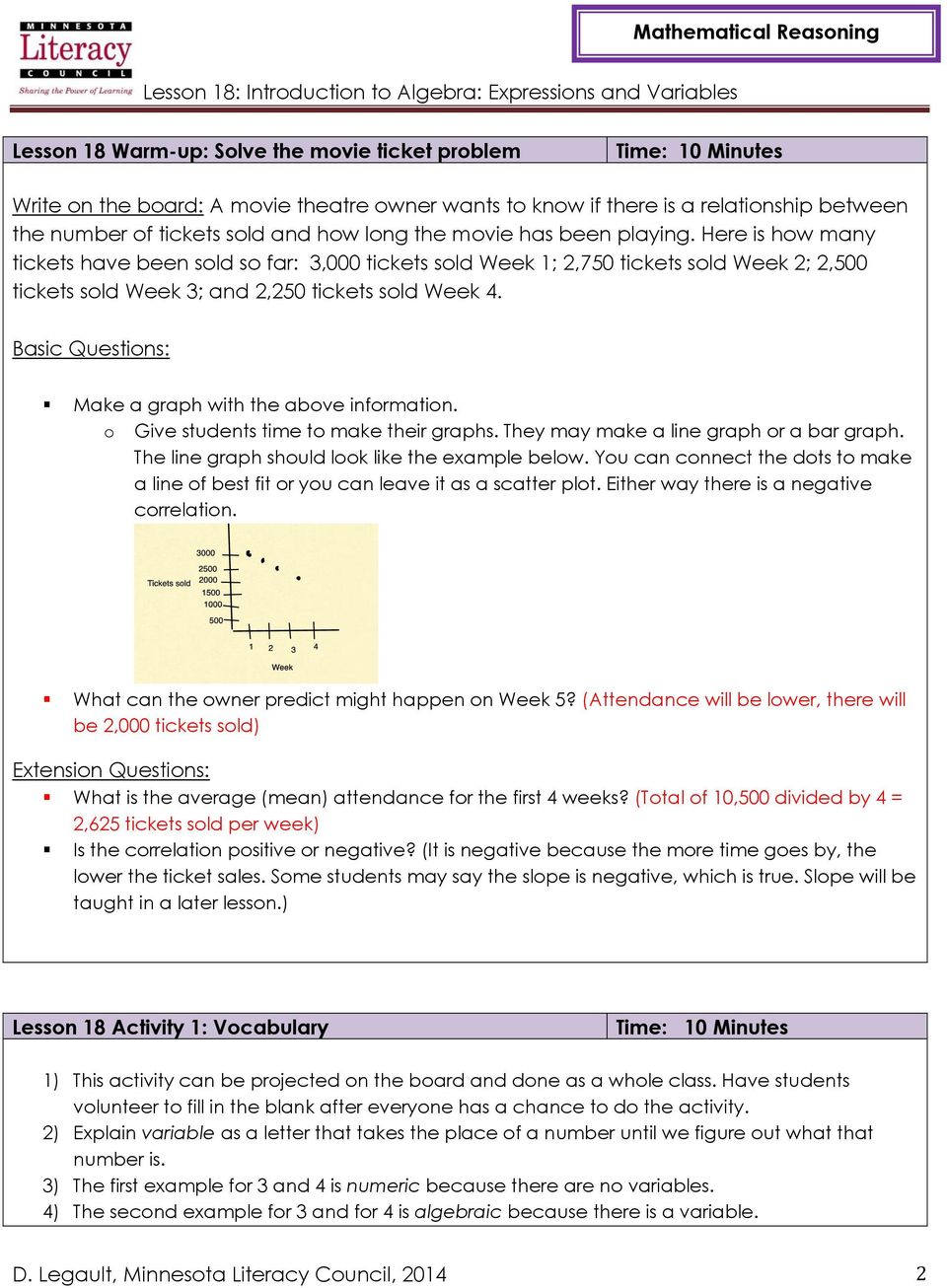
2 Lesson 18 Warm-up: Solve the movie ticket problem Time: 10 Minutes Write on the board: A movie theatre owner wants to know if there is a relationship between the number of tickets sold and how long the movie has been playing. Here is how many tickets have been sold so far: 3,000 tickets sold Week 1; 2,750 tickets sold Week 2; 2,500 tickets sold Week 3; and 2,250 tickets sold Week 4. Basic Questions: Make a graph with the above information. o Give students time to make their graphs. They may make a line graph or a bar graph. The line graph should look like the example below. You can connect the dots to make a line of best fit or you can leave it as a scatter plot. Either way there is a negative correlation. What can the owner predict might happen on Week 5? (Attendance will be lower, there will be 2,000 tickets sold) Extension Questions: What is the average (mean) attendance for the first 4 weeks? (Total of 10,500 divided by 4 = 2,625 tickets sold per week) Is the correlation positive or negative? (It is negative because the more time goes by, the lower the ticket sales. Some students may say the slope is negative, which is true. Slope will be taught in a later lesson.) Lesson 18 Activity 1: Vocabulary Time: 10 Minutes 1) This activity can be projected on the board and done as a whole class. Have students volunteer to fill in the blank after everyone has a chance to do the activity. 2) Explain variable as a letter that takes the place of a number until we figure out what that number is. 3) The first example for 3 and 4 is numeric because there are no variables. 4) The second example for 3 and for 4 is algebraic because there is a variable. D. Legault, Minnesota Literacy Council,
3 5) Solicit more examples of each from students. Answers: 1. A variable is a letter or symbol used to write a value (number) that can change. 2. A constant is a value that does not change. 3. An equation is a math statement that shows the two sides are equal or balanced. 4. An expression is a combination of numbers and operations. constant expression variable equation 1. A is a letter or symbol used to write a value (a number) that can change. Some examples are x, y, a, c. 2. A is a value that does not change. Some examples are 56, 47, ½, An is a math statement that shows the two sides are equal. Some example are = 9 and 4 + x = 9 4. An is a combination of numbers and operations. Some examples are and 4 + x. Lesson 18 Activity 2: Write Expressions Time: Minutes 1) Write on the board: a b 5 x D. Legault, Minnesota Literacy Council,

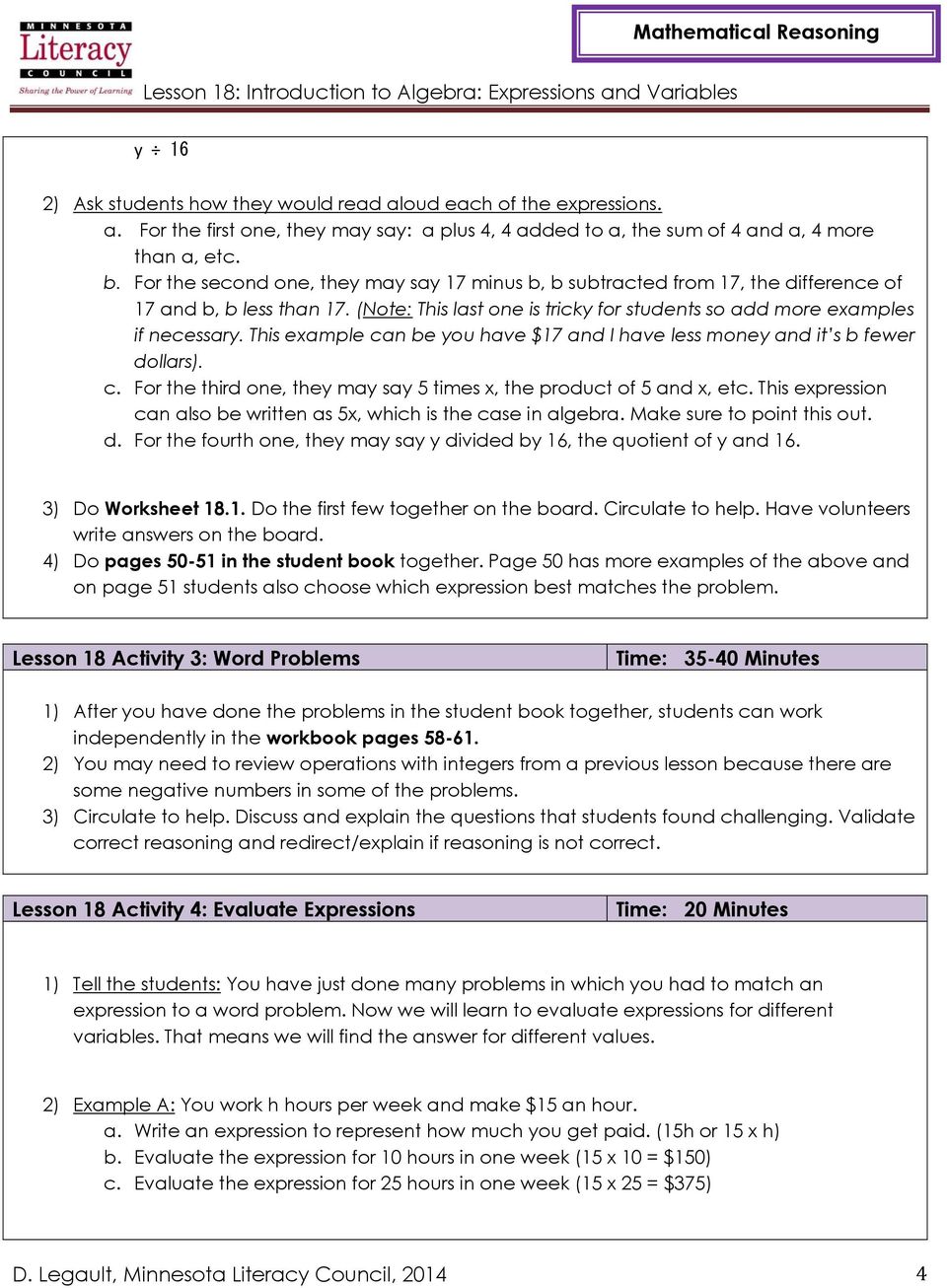
4 y 16 2) Ask students how they would read aloud each of the expressions. a. For the first one, they may say: a plus 4, 4 added to a, the sum of 4 and a, 4 more than a, etc. b. For the second one, they may say 17 minus b, b subtracted from 17, the difference of 17 and b, b less than 17. (Note: This last one is tricky for students so add more examples if necessary. This example can be you have $17 and I have less money and it s b fewer dollars). c. For the third one, they may say 5 times x, the product of 5 and x, etc. This expression can also be written as 5x, which is the case in algebra. Make sure to point this out. d. For the fourth one, they may say y divided by 16, the quotient of y and 16. 3) Do Worksheet Do the first few together on the board. Circulate to help. Have volunteers write answers on the board. 4) Do pages in the student book together. Page 50 has more examples of the above and on page 51 students also choose which expression best matches the problem. Lesson 18 Activity 3: Word Problems Time: Minutes 1) After you have done the problems in the student book together, students can work independently in the workbook pages ) You may need to review operations with integers from a previous lesson because there are some negative numbers in some of the problems. 3) Circulate to help. Discuss and explain the questions that students found challenging. Validate correct reasoning and redirect/explain if reasoning is not correct. Lesson 18 Activity 4: Evaluate Expressions Time: 20 Minutes 1) Tell the students: You have just done many problems in which you had to match an expression to a word problem. Now we will learn to evaluate expressions for different variables. That means we will find the answer for different values. 2) Example A: You work h hours per week and make $15 an hour. a. Write an expression to represent how much you get paid. (15h or 15 x h) b. Evaluate the expression for 10 hours in one week (15 x 10 = $150) c. Evaluate the expression for 25 hours in one week (15 x 25 = $375) D. Legault, Minnesota Literacy Council,
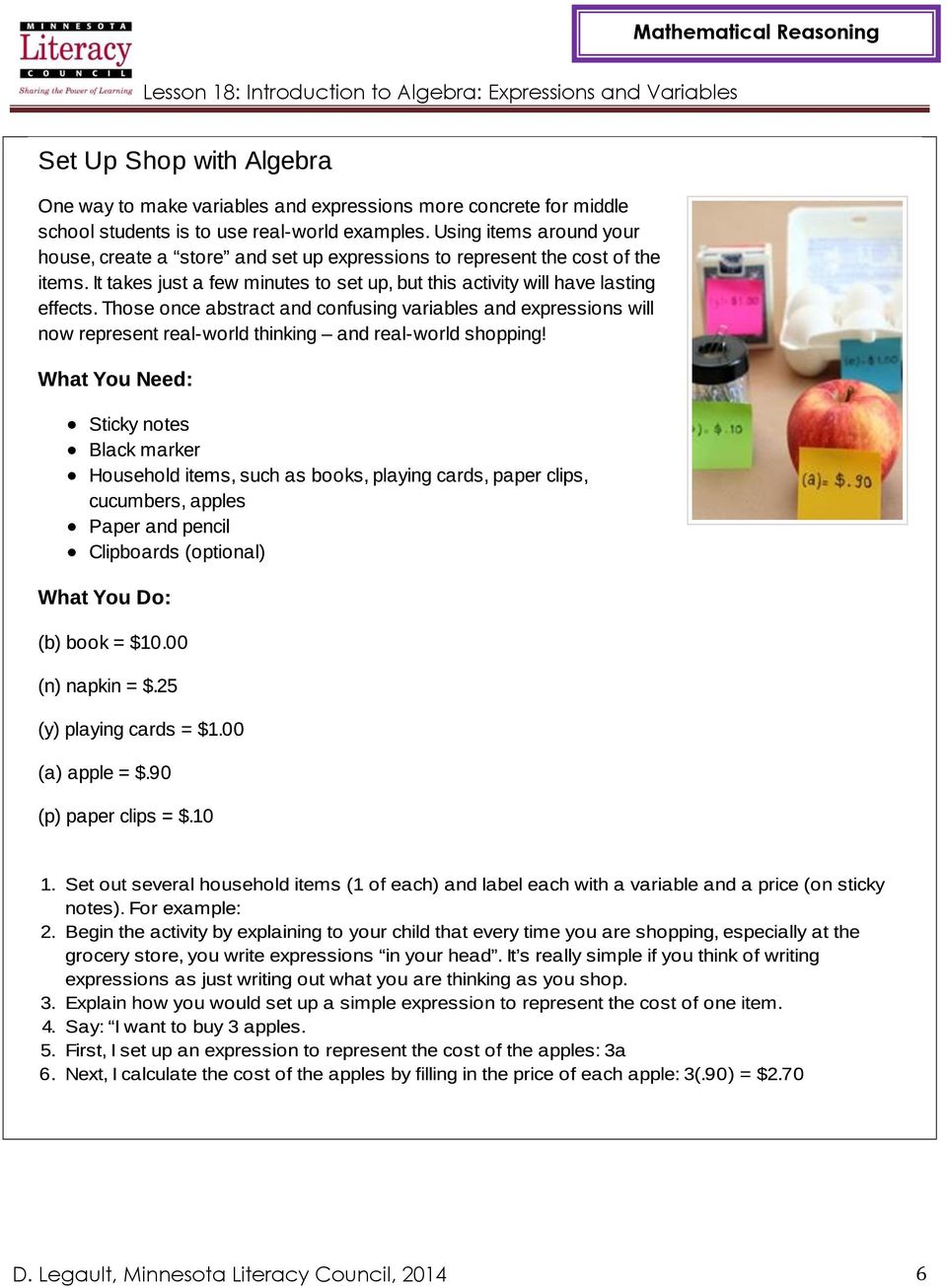
5 3) Example B: In the warm up activity about the movie ticket sales, the owner wants to know how much money she will make if the tickets are sold at $11.25 each. a. Write an expression with t for tickets. ($11.25t ) b. Evaluate the expression for the first week when 3,000 tickets were sold. (3,000 x $11.25 = $33,750) c. Evaluate the expression for the second week when 2,750 tickets were sold. (2,750 x $11.25 = $30,937.50) 4) Practice evaluating expressions with Worksheet Do the first few together. Application Option A: Make Algebra Concrete Time: 15 Minutes This activity may be useful to make algebraic more concrete for students. Use the following as a guideline. I wasn t able to change the words (document is a pdf) so choose items in the classroom and ignore the reference to child. Also, you can make the activity more interesting by saying a few examples yourself and then having students work in pairs to create an expression and dictate it to the rest of the class. D. Legault, Minnesota Literacy Council,

6 D. Legault, Minnesota Literacy Council,
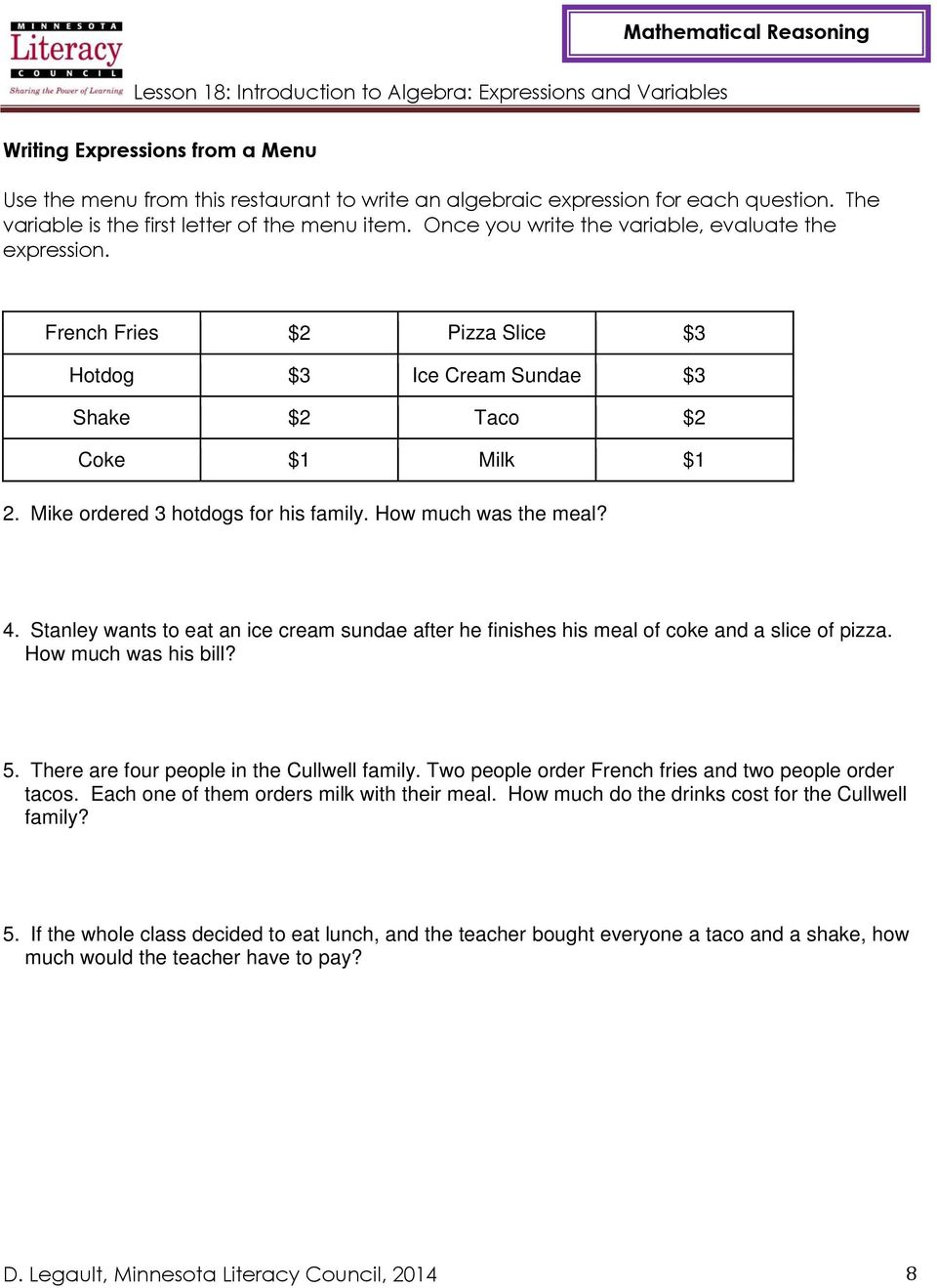
7 Application Option B: Write Expressions from a Menu Time: 10 Minutes (See printable handout on the next page.) Use the menu from this restaurant to write an algebraic expression for each question. The variable is the first letter of the menu item. Once you write the variable, evaluate the expression. French Fries $2 Pizza Slice $3 Hotdog $3 Ice Cream Sundae $3 Shake $2 Taco $2 Coke $1 Milk $1 1. Mike ordered 3 hotdogs for his family. How much was the meal? 2. Stanley wants to eat an ice cream sundae after he finishes his meal of coke and a slice of pizza. How much was his bill? 3. There are four people in the Cullwell family. Two people order French fries and two people order tacos. Each one of them orders milk with their meal. How much do the drinks cost for the Cullwell family? 4. If the whole class decided to eat lunch, and the teacher bought everyone a taco and a shake, how much would the teacher have to pay? Answers: 1. 3h, 3($3)= $9 2. c + p + i, $1+$3+$3=$7 3. 2f + 2t + 4m, 2($2) + 2($2) + 4($1) = $12 4. Answer will vary D. Legault, Minnesota Literacy Council,

8 Writing Expressions from a Menu Use the menu from this restaurant to write an algebraic expression for each question. The variable is the first letter of the menu item. Once you write the variable, evaluate the expression. French Fries $2 Pizza Slice $3 Hotdog $3 Ice Cream Sundae $3 Shake $2 Taco $2 Coke $1 Milk $1 2. Mike ordered 3 hotdogs for his family. How much was the meal? 4. Stanley wants to eat an ice cream sundae after he finishes his meal of coke and a slice of pizza. How much was his bill? 5. There are four people in the Cullwell family. Two people order French fries and two people order tacos. Each one of them orders milk with their meal. How much do the drinks cost for the Cullwell family? 5. If the whole class decided to eat lunch, and the teacher bought everyone a taco and a shake, how much would the teacher have to pay? D. Legault, Minnesota Literacy Council,
9 Lesson 18: Group Exit Ticket Time: 5 Minutes Do expression dictation. For example, say 15 less than n. Have students write the answer on a piece of paper (n 15). You may continue with more dictations yourself or students can take turns saying the dictation problems for the whole class to write down. As each problem is said, students should write down the expression individually. D. Legault, Minnesota Literacy Council,
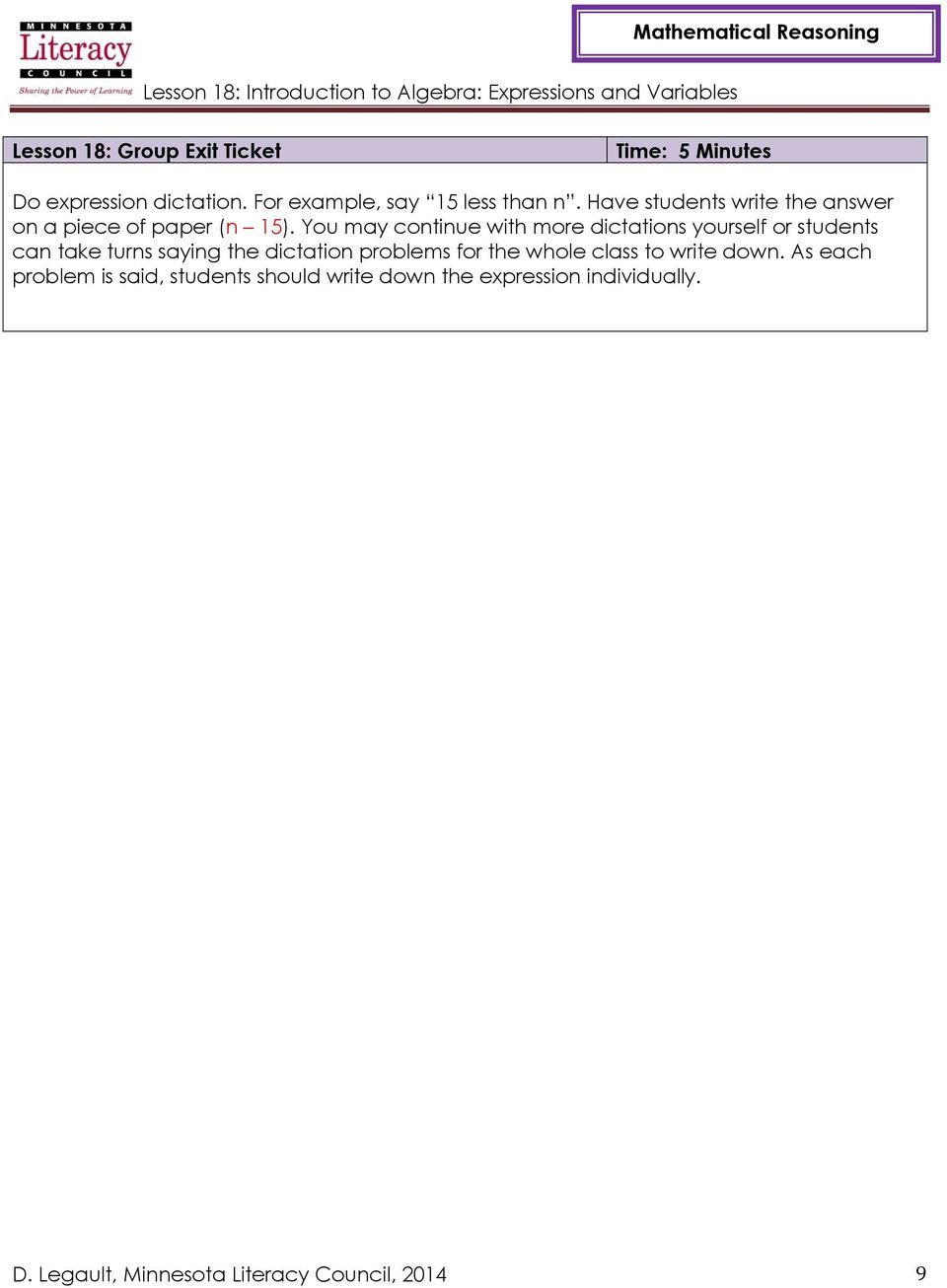
10 Kuta Software Lesson - Infinite 18: Algebra Introduction 1 to Algebra: Expressions Name and Variables Variable and Verbal Expressions Worksheet 18.1 Write Expressions Write each as an algebraic expression. 1) the difference of 10 and 5 2) the quotient of 14 and 7 Date Period 3) u decreased by 17 4) half of 14 5) x increased by 6 6) the product of x and 7 7) the sum of q and 8 8) 6 squared 9) twice q 10) the product of 8 and 12 11) the quotient of 18 and n 12) n cubed Write each as a verbal expression. 13) x 2 14) a ) ) 5n D. Legault, Minnesota Literacy Council,
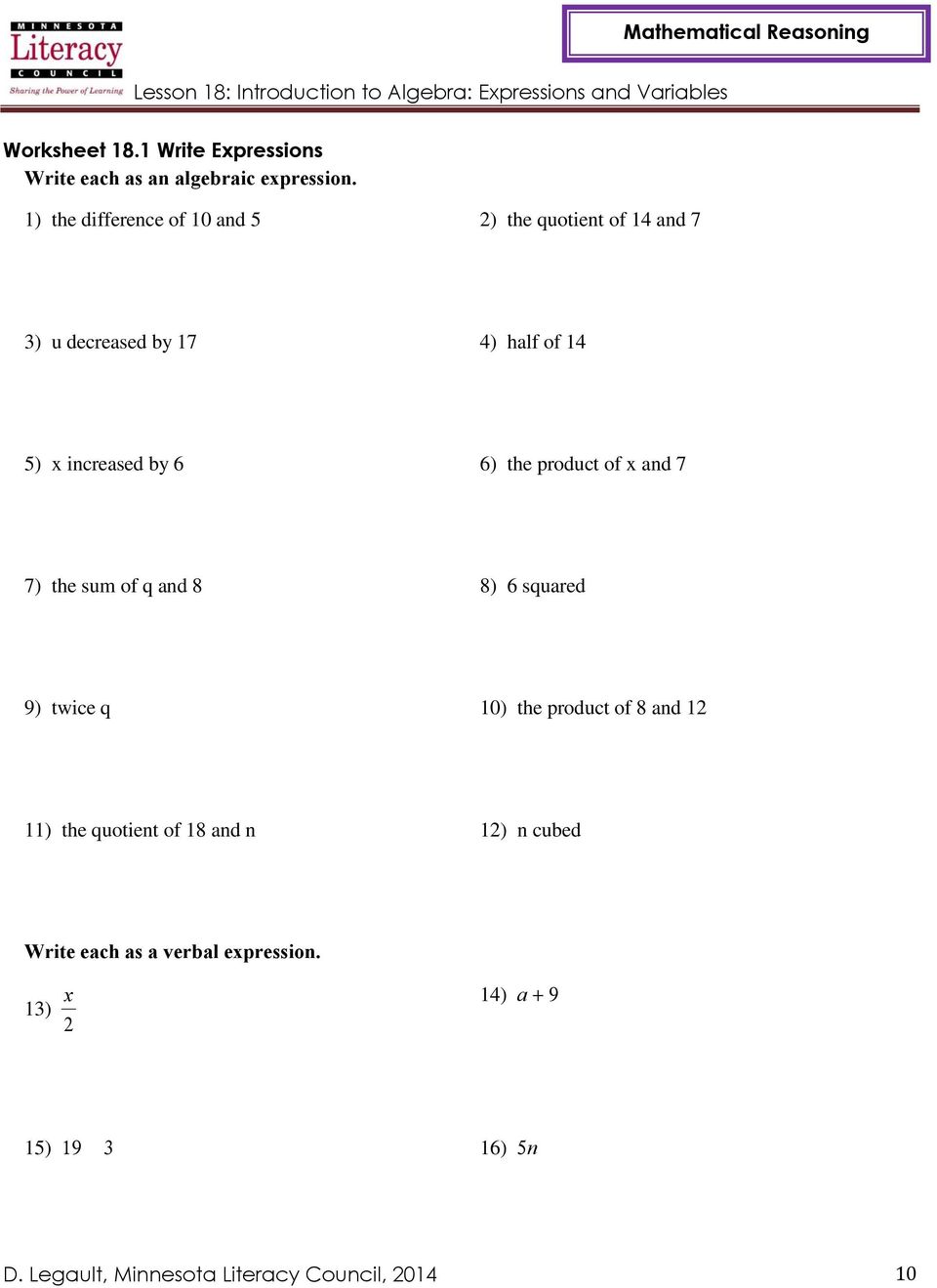
11 Kuta Software Lesson - Infinite 18: Algebra Introduction 1 to Algebra: Expressions Name and Variables Variable and Verbal Expressions Worksheet 18.1 Answers Write each as an algebraic expression. Date Period 1) the difference of 10 and ) u decreased by 17 u ) x increased by 6 x + 6 2) the quotient of 14 and ) half of ) the product of x and 7 x 7 7) the sum of q and 8 q + 8 8) 6 squared 6 2 9) twice q 2q 10) the product of 8 and ) the quotient of 18 and n 18 n 12) n cubed n 3 Write each as a verbal expression. 13) x 2 half of x 14) a + 9 a increased by 9 15) 19-3 the difference of 19 and 3 16) 5n 5 times a number D. Legault, Minnesota Literacy Council,

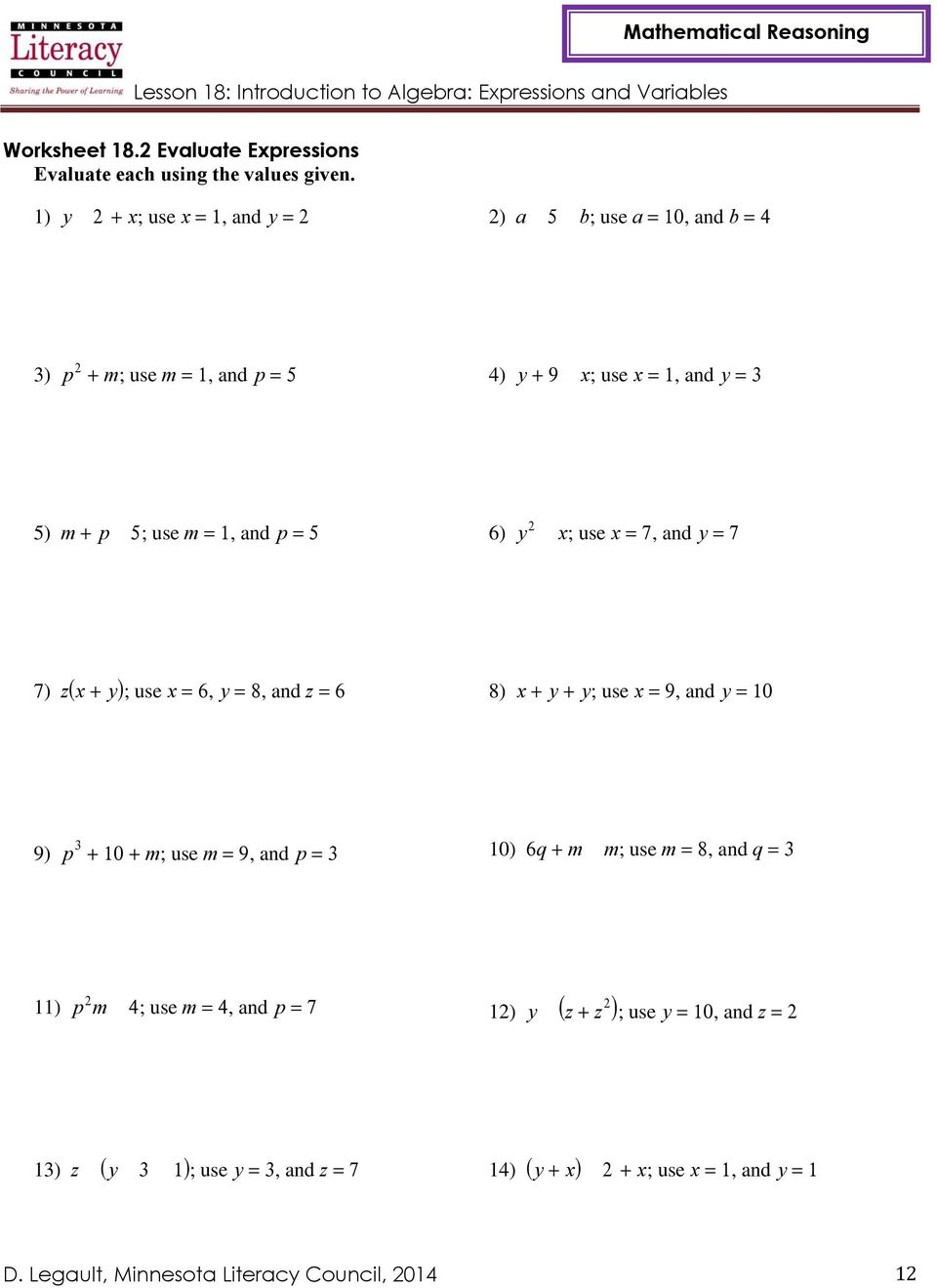
12 Kuta Software Lesson - Infinite 18: Algebra Introduction 1 to Algebra: Expressions Name and Variables Evaluating Expressions Worksheet 18.2 Evaluate Expressions Evaluate each using the values given. 1) y 2 + x; use x = 1, and y = 2 2) a b; use a = 10, and b = 4 Date Period 3) p 2 + m; use m = 1, and p = 5 4) y x; use x = 1, and y = 3 5) m + p 5; use m = 1, and p = 5 6) y 2 - x; use x = 7, and y = 7 7) z(x + y); use x = 6, y = 8, and z = 6 8) x + y + y; use x = 9, and y = 10 9) p m; use m = 9, and p = 3 10) 6q + m - m; use m = 8, and q = 3 11) p 2 m 4; use m = 4, and p = 7 12) y - (z + z 2 ); use y = 10, and z = 2 13) z - (y 3-1); use y = 3, and z = 7 14) (y + x) 2 + x; use x = 1, and y = 1 D. Legault, Minnesota Literacy Council,
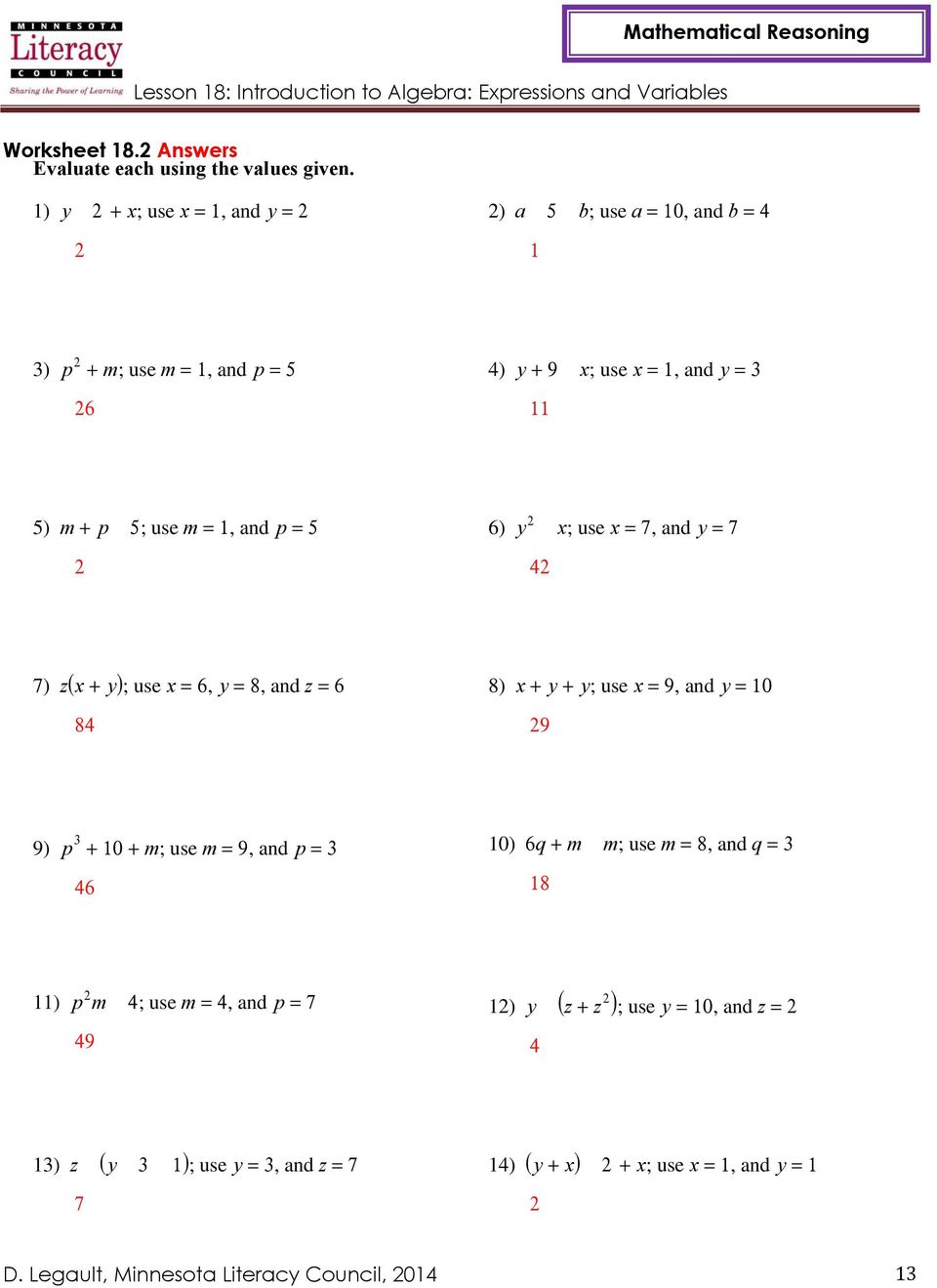
13 Kuta Software - Infinite Algebra 1 Name Evaluating Expressions Worksheet 18.2 Answers Evaluate each using the values given. Date Period 1) y 2 + x; use x = 1, and y = 2 2 2) a b; use a = 10, and b = 4 1 3) p 2 + m; use m = 1, and p = ) y x; use x = 1, and y = ) m + p 5; use m = 1, and p = 5 2 6) y 2 - x; use x = 7, and y = ) z(x + y); use x = 6, y = 8, and z = ) x + y + y; use x = 9, and y = ) p m; use m = 9, and p = ) 6q + m - m; use m = 8, and q = ) p 2 m 4; use m = 4, and p = ) y - (z + z 2 ); use y = 10, and z = ) z - (y 3-1); use y = 3, and z = ) (y + x) 2 + x; use x = 1, and y = 1 2 D. Legault, Minnesota Literacy Council,
Lesson 1: Review of Decimals: Addition, Subtraction, Multiplication
 LESSON 1: REVIEW OF DECIMALS: ADDITION AND SUBTRACTION Weekly Focus: whole numbers and decimals Weekly Skill: place value, add, subtract, multiply Lesson Summary: In the warm up, students will solve a
Lesson 4: Convert Fractions, Review Order of Operations
 Lesson 4: Convert Fractions, Review Order of Operations LESSON 4: Convert Fractions, Do Order of Operations Weekly Focus: fractions, decimals, percent, order of operations Weekly Skill: convert, compute
Direct Translation is the process of translating English words and phrases into numbers, mathematical symbols, expressions, and equations.
 Section 1 Mathematics has a language all its own. In order to be able to solve many types of word problems, we need to be able to translate the English Language into Math Language. is the process of translating
Current California Math Standards Balanced Equations
 Balanced Equations Current California Math Standards Balanced Equations Grade Three Number Sense 1.0 Students understand the place value of whole numbers: 1.1 Count, read, and write whole numbers to 10,000.
4 Mathematics Curriculum
 New York State Common Core 4 Mathematics Curriculum G R A D E GRADE 4 MODULE 1 Topic F Addition and Subtraction Word Problems 4.OA.3, 4.NBT.1, 4.NBT.2, 4.NBT.4 Focus Standard: 4.OA.3 Solve multistep word
Curriculum Alignment Project
 Curriculum Alignment Project Math Unit Date: Unit Details Title: Solving Linear Equations Level: Developmental Algebra Team Members: Michael Guy Mathematics, Queensborough Community College, CUNY Jonathan
Acquisition Lesson Plan for the Concept, Topic or Skill---Not for the Day
 Acquisition Lesson Plan Concept: Linear Systems Author Name(s): High-School Delaware Math Cadre Committee Grade: Ninth Grade Time Frame: Two 45 minute periods Pre-requisite(s): Write algebraic expressions
Lesson 3: Using Inequalities to Problem Solve
 Lesson 3: Using Inequalities to Problem Solve Selected Content Standards Benchmarks Addressed: N-1-M Demonstrating that a rational number can be expressed in many forms, and selecting an appropriate form
Name of Lesson: Properties of Equality A Review. Mathematical Topic: The Four Properties of Equality. Course: Algebra I
 Name of Lesson: Properties of Equality A Review Mathematical Topic: The Four Properties of Equality Course: Algebra I Time Allocation: One (1) 56 minute period Pre-requisite Knowledge: The students will
Accommodated Lesson Plan on Solving Systems of Equations by Elimination for Diego
 Accommodated Lesson Plan on Solving Systems of Equations by Elimination for Diego Courtney O Donovan Class: Algebra 1 Day #: 6-7 Grade: 8th Number of Students: 25 Date: May 12-13, 2011 Goal: Students will
Using Proportions to Solve Percent Problems I
 RP7-1 Using Proportions to Solve Percent Problems I Pages 46 48 Standards: 7.RP.A. Goals: Students will write equivalent statements for proportions by keeping track of the part and the whole, and by solving
Counting Change and Changing Coins
 Grade Two Counting Change and Changing Coins Content Standards Overview Students share the book The Penny Pot, by Stuart J. Murphy, to learn about choices, producers and consumers, and counting money.
Kindergarten Math Curriculum Course Description and Philosophy Text Reference:
 Kindergarten Math Curriculum Course Description and Philosophy How do numbers and math affect our daily lives? What types of problems can be solved by understanding numbers and math concepts? Through inquiry,
Materials: Student-paper, pencil, circle manipulatives, white boards, markers Teacher- paper, pencil, circle manipulatives, worksheet
 Topic: Creating Mixed Numbers and Improper Fractions SOL: 5.7- The student will add and subtract with fractions and mixed numbers, with and without regrouping, and express answers in simplest form. Problems
Understanding Income and Expenses EPISODE # 123
 Understanding Income and Expenses EPISODE # 123 LESSON LEVEL Grades 4-6 KEY TOPICS Entrepreneurship Income and expenses Cash flow LEARNING OBJECTIVES 1. Understand what your income and expenses are. 2.
Algebra Unit Plans. Grade 7. April 2012. Created By: Danielle Brown; Rosanna Gaudio; Lori Marano; Melissa Pino; Beth Orlando & Sherri Viotto
 Algebra Unit Plans Grade 7 April 2012 Created By: Danielle Brown; Rosanna Gaudio; Lori Marano; Melissa Pino; Beth Orlando & Sherri Viotto Unit Planning Sheet for Algebra Big Ideas for Algebra (Dr. Small)
OA3-10 Patterns in Addition Tables
 OA3-10 Patterns in Addition Tables Pages 60 63 Standards: 3.OA.D.9 Goals: Students will identify and describe various patterns in addition tables. Prior Knowledge Required: Can add two numbers within 20
HFCC Math Lab Beginning Algebra 13 TRANSLATING ENGLISH INTO ALGEBRA: WORDS, PHRASE, SENTENCES
 HFCC Math Lab Beginning Algebra 1 TRANSLATING ENGLISH INTO ALGEBRA: WORDS, PHRASE, SENTENCES Before being able to solve word problems in algebra, you must be able to change words, phrases, and sentences
Lesson 4: Solving and Graphing Linear Equations
 Lesson 4: Solving and Graphing Linear Equations Selected Content Standards Benchmarks Addressed: A-2-M Modeling and developing methods for solving equations and inequalities (e.g., using charts, graphs,
Verbal Phrases to Algebraic Expressions
 Student Name: Date: Contact Person Name: Phone Number: Lesson 13 Verbal Phrases to s Objectives Translate verbal phrases into algebraic expressions Solve word problems by translating sentences into equations
3.2 Methods of Addition
 .2 Methods of Addition Objectives Relate addition stories to number bonds. Write two addition facts for a given number bond. Solve picture problems using addition. Learn addition facts through, and the
Solving Rational Equations
 Lesson M Lesson : Student Outcomes Students solve rational equations, monitoring for the creation of extraneous solutions. Lesson Notes In the preceding lessons, students learned to add, subtract, multiply,
Tickets, Please Using Substitution to Solve a Linear System, Part 2
 Problem 1 Students write linear systems of equations representing several situations. Using substitution, they will solve each linear system and interpret the solution of the system in terms of each problem
Summer Assignment for incoming Fairhope Middle School 7 th grade Advanced Math Students
 Summer Assignment for incoming Fairhope Middle School 7 th grade Advanced Math Students Studies show that most students lose about two months of math abilities over the summer when they do not engage in
Money: Week 1 of 2. Beginning Level (CASAS reading scores of 181-200)
 The Minnesota Literacy Council created this curriculum with funding from the MN Department of Education. We invite you to adapt it for your own classrooms. Beginning Level (CASAS reading scores of 181-200)
Contents. Sample worksheet from www.mathmammoth.com
 Contents Introduction... 4 Warmup: Mental Math 1... 8 Warmup: Mental Math 2... 10 Review: Addition and Subtraction... 12 Review: Multiplication and Division... 15 Balance Problems and Equations... 19 More
Wants and Needs. Grade One. Overview. Prerequisite Skills. Lesson Objectives. Materials List
 Grade One Wants and Needs Overview Students share the book Something Good, by Robert Munsch, to learn about unlimited wants, limited resources, choice, and counting money. They complete worksheets on determining
FINAL SIOP LESSON PLAN. Preparation
 Name: Stephanie Hart DOMINICAN UNIVERSITY OF CALIFORNIA FINAL SIOP LESSON PLAN Content Area: Mathematics, Solving Inequalities Grade Level: 8 English Learners: This is a sheltered class within a mainstream
Saving and Creating a Personal Budget
 Grade Five Saving and Creating a Personal Budget Overview Students share several chapters of the book From the Mixed-Up Files of Mrs. Basil E. Frankweiler, by E.L. Konigsburg, to learn about the role of
Comparing Simple and Compound Interest
 Comparing Simple and Compound Interest GRADE 11 In this lesson, students compare various savings and investment vehicles by calculating simple and compound interest. Prerequisite knowledge: Students should
The Crescent Primary School Calculation Policy
 The Crescent Primary School Calculation Policy Examples of calculation methods for each year group and the progression between each method. January 2015 Our Calculation Policy This calculation policy has
Performance Assessment Task Bikes and Trikes Grade 4. Common Core State Standards Math - Content Standards
 Performance Assessment Task Bikes and Trikes Grade 4 The task challenges a student to demonstrate understanding of concepts involved in multiplication. A student must make sense of equal sized groups of
Lesson 1.1: Earth and Space Science - Introduction
 Weekly Focus: Main Idea Weekly Skill: Introduction Lesson Summary: This week students will take a pre- self-evaluation to determine their background knowledge in Earth and space science. They will also
Using Algebra Tiles for Adding/Subtracting Integers and to Solve 2-step Equations Grade 7 By Rich Butera
 Using Algebra Tiles for Adding/Subtracting Integers and to Solve 2-step Equations Grade 7 By Rich Butera 1 Overall Unit Objective I am currently student teaching Seventh grade at Springville Griffith Middle
Unit 7 The Number System: Multiplying and Dividing Integers
 Unit 7 The Number System: Multiplying and Dividing Integers Introduction In this unit, students will multiply and divide integers, and multiply positive and negative fractions by integers. Students will
Clifton High School Mathematics Summer Workbook Algebra 1
 1 Clifton High School Mathematics Summer Workbook Algebra 1 Completion of this summer work is required on the first day of the school year. Date Received: Date Completed: Student Signature: Parent Signature:
Commutative Property Grade One
 Ohio Standards Connection Patterns, Functions and Algebra Benchmark E Solve open sentences and explain strategies. Indicator 4 Solve open sentences by representing an expression in more than one way using
A Concrete Introduction. to the Abstract Concepts. of Integers and Algebra using Algebra Tiles
 A Concrete Introduction to the Abstract Concepts of Integers and Algebra using Algebra Tiles Table of Contents Introduction... 1 page Integers 1: Introduction to Integers... 3 2: Working with Algebra Tiles...
Unit 1 Equations, Inequalities, Functions
 Unit 1 Equations, Inequalities, Functions Algebra 2, Pages 1-100 Overview: This unit models real-world situations by using one- and two-variable linear equations. This unit will further expand upon pervious
CAHSEE on Target UC Davis, School and University Partnerships
 UC Davis, School and University Partnerships CAHSEE on Target Mathematics Curriculum Published by The University of California, Davis, School/University Partnerships Program 006 Director Sarah R. Martinez,
All the examples in this worksheet and all the answers to questions are available as answer sheets or videos.
 BIRKBECK MATHS SUPPORT www.mathsupport.wordpress.com Numbers 3 In this section we will look at - improper fractions and mixed fractions - multiplying and dividing fractions - what decimals mean and exponents
Counting Money and Making Change Grade Two
 Ohio Standards Connection Number, Number Sense and Operations Benchmark D Determine the value of a collection of coins and dollar bills. Indicator 4 Represent and write the value of money using the sign
EXTRA ACTIVITy pages
 EXTRA FUN ACTIVITIES This booklet contains extra activity pages for the student as well as the tests. See the next page for information about the activity pages. Go to page 7 to find the Alpha tests. EXTRA
F.IF.7b: Graph Root, Piecewise, Step, & Absolute Value Functions
 F.IF.7b: Graph Root, Piecewise, Step, & Absolute Value Functions F.IF.7b: Graph Root, Piecewise, Step, & Absolute Value Functions Analyze functions using different representations. 7. Graph functions expressed
Discovering Math: Data and Graphs Teacher s Guide
 Teacher s Guide Grade Level: K 2 Curriculum Focus: Mathematics Lesson Duration: Two class periods Program Description Discovering Math: Data and Graphs From simple graphs to sampling to determining what
Rational Number Project
 Rational Number Project Fraction Operations and Initial Decimal Ideas Lesson : Overview Students estimate sums and differences using mental images of the 0 x 0 grid. Students develop strategies for adding
Sample Fraction Addition and Subtraction Concepts Activities 1 3
 Sample Fraction Addition and Subtraction Concepts Activities 1 3 College- and Career-Ready Standard Addressed: Build fractions from unit fractions by applying and extending previous understandings of operations
Sneaking up on Slope
 Sneaking up on Slope After the warm- up, the lesson starts with a handout where the students will be graphing points and looking at the pattern it creates to find the next point in the line. The handout
In A Heartbeat (Algebra)
 The Middle School Math Project In A Heartbeat (Algebra) Objective Students will apply their knowledge of scatter plots to discover the correlation between heartbeats per minute before and after aerobic
POLYNOMIAL FUNCTIONS
 POLYNOMIAL FUNCTIONS Polynomial Division.. 314 The Rational Zero Test.....317 Descarte s Rule of Signs... 319 The Remainder Theorem.....31 Finding all Zeros of a Polynomial Function.......33 Writing a
Unit 1 Number Sense. In this unit, students will study repeating decimals, percents, fractions, decimals, and proportions.
 Unit 1 Number Sense In this unit, students will study repeating decimals, percents, fractions, decimals, and proportions. BLM Three Types of Percent Problems (p L-34) is a summary BLM for the material
NS6-50 Dividing Whole Numbers by Unit Fractions Pages 16 17
 NS6-0 Dividing Whole Numbers by Unit Fractions Pages 6 STANDARDS 6.NS.A. Goals Students will divide whole numbers by unit fractions. Vocabulary division fraction unit fraction whole number PRIOR KNOWLEDGE
Solving Systems of Linear Equations Elimination (Addition)
 Solving Systems of Linear Equations Elimination (Addition) Outcome (lesson objective) Students will accurately solve systems of equations using elimination/addition method. Student/Class Goal Students
Lesson 2.15: Physical Science Speed, Velocity & Acceleration
 Weekly Focus: Reading for Comprehension Weekly Skill: Numeracy Skills in Science Lesson Summary: This week students will continue reading for comprehension with reading passages on speed, velocity, and
Barter vs. Money. Grade One. Overview. Prerequisite Skills. Lesson Objectives. Materials List
 Grade One Barter vs. Money Overview Students share the book Sheep in a Shop, by Nancy Shaw, to learn about choice, making decisions, trade, and the barter system. They complete worksheets on comparing
Transportation: Week 2 of 2
 The Minnesota Literacy Council created this curriculum with funding from the MN Department of Education. We invite you to adapt it for your own classrooms. Beginning Level (CASAS reading scores of 181-200)
Problem of the Month: Perfect Pair
 Problem of the Month: The Problems of the Month (POM) are used in a variety of ways to promote problem solving and to foster the first standard of mathematical practice from the Common Core State Standards:
Measurement with Ratios
 Grade 6 Mathematics, Quarter 2, Unit 2.1 Measurement with Ratios Overview Number of instructional days: 15 (1 day = 45 minutes) Content to be learned Use ratio reasoning to solve real-world and mathematical
1 ST GRADE COMMON CORE STANDARDS FOR SAXON MATH
 1 ST GRADE COMMON CORE STANDARDS FOR SAXON MATH Calendar The following tables show the CCSS focus of The Meeting activities, which appear at the beginning of each numbered lesson and are taught daily,
Solving Systems of Linear Equations Putting it All Together
 Solving Systems of Linear Equations Putting it All Together Outcome (lesson objective) Students will determine the best method to use when solving systems of equation as they solve problems using graphing,
Shopping. Grade One. Overview. Prerequisite Skills. Lesson Objectives. Materials List
 Grade One Shopping Overview Students share the book Just Shopping with Mom, by Mercer Mayer, to learn about shopping and counting money. They complete activities on examining coupons and shopping for bicycle
VISUAL ALGEBRA FOR COLLEGE STUDENTS. Laurie J. Burton Western Oregon University
 VISUAL ALGEBRA FOR COLLEGE STUDENTS Laurie J. Burton Western Oregon University VISUAL ALGEBRA FOR COLLEGE STUDENTS TABLE OF CONTENTS Welcome and Introduction 1 Chapter 1: INTEGERS AND INTEGER OPERATIONS
7.S.8 Interpret data to provide the basis for predictions and to establish
 7 th Grade Probability Unit 7.S.8 Interpret data to provide the basis for predictions and to establish experimental probabilities. 7.S.10 Predict the outcome of experiment 7.S.11 Design and conduct an
Overview. Essential Questions. Grade 4 Mathematics, Quarter 4, Unit 4.1 Dividing Whole Numbers With Remainders
 Dividing Whole Numbers With Remainders Overview Number of instruction days: 7 9 (1 day = 90 minutes) Content to Be Learned Solve for whole-number quotients with remainders of up to four-digit dividends
2. System of linear equations can be solved by graphing, substitution, or eliminating a variable.
 1 Subject: Algebra 1 Grade Level: 9 th Unit Plan #: 6 UNIT BACKGROUND Unit Title: Systems of Equations and Inequalities Grade Level: 9 Subject/Topic: Algebra 1 Key Words: Graphing, Substitution, Elimination
FIDDLIN WITH FRACTIONS
 FIDDLIN WITH FRACTIONS Special Area: Connections (Fourth and Fifth Grade) Written by: (Dawn Ramos, Joan Johnson, Mindy Wilshusen, St. Mary s School) Length of Unit: (6 Lessons) I. ABSTRACT The purpose
Consumers face constraints on their choices because they have limited incomes.
 Consumer Choice: the Demand Side of the Market Consumers face constraints on their choices because they have limited incomes. Wealthy and poor individuals have limited budgets relative to their desires.
Use order of operations to simplify. Show all steps in the space provided below each problem. INTEGER OPERATIONS
 ORDER OF OPERATIONS In the following order: 1) Work inside the grouping smbols such as parenthesis and brackets. ) Evaluate the powers. 3) Do the multiplication and/or division in order from left to right.
lesson three budgeting your money teacher s guide
 lesson three budgeting your money teacher s guide budgeting your money lesson outline lesson 3 overview I m all out of money, and I won t get paid again until the end of next week! This is a common dilemma
Solving Systems of Linear Equations Substitutions
 Solving Systems of Linear Equations Substitutions Outcome (lesson objective) Students will accurately solve a system of equations algebraically using substitution. Student/Class Goal Students thinking
What qualities are employers looking for in teen workers? How can you prove your own skills?
 Sell Yourself 4 Finding a job The BIG Idea What qualities are employers looking for in teen workers? How can you prove your own skills? AGENDA Approx. 45 minutes I. Warm Up: Employer Survey Review (15
Lesson 17 Teacher Page A
 Overview Students name fractions greater than with fraction circles. Students name fractions using both mixed numbers and improper fractions. Materials Fraction Circles for students and teacher Transparency
Module 3: Correlation and Covariance
 Using Statistical Data to Make Decisions Module 3: Correlation and Covariance Tom Ilvento Dr. Mugdim Pašiƒ University of Delaware Sarajevo Graduate School of Business O ften our interest in data analysis
MATH 60 NOTEBOOK CERTIFICATIONS
 MATH 60 NOTEBOOK CERTIFICATIONS Chapter #1: Integers and Real Numbers 1.1a 1.1b 1.2 1.3 1.4 1.8 Chapter #2: Algebraic Expressions, Linear Equations, and Applications 2.1a 2.1b 2.1c 2.2 2.3a 2.3b 2.4 2.5
Decimal Notations for Fractions Number and Operations Fractions /4.NF
 Decimal Notations for Fractions Number and Operations Fractions /4.NF Domain: Cluster: Standard: 4.NF Number and Operations Fractions Understand decimal notation for fractions, and compare decimal fractions.
Multiplying Integers. Lesson Plan
 Lesson Plan Video: 12 minutes Lesson: 38 minutes Pre-viewing :00 Warm up: Write 5 + 5 + 5 + 5 = on the board. Ask students for the answer. Then write 5 x 4 = on the board. Ask the students for the answer.
1.6 The Order of Operations
 1.6 The Order of Operations Contents: Operations Grouping Symbols The Order of Operations Exponents and Negative Numbers Negative Square Roots Square Root of a Negative Number Order of Operations and Negative
Saving Money. Grade One. Overview. Prerequisite Skills. Lesson Objectives. Materials List
 Grade One Saving Money Overview Students share the book A Chair for My Mother, by Vera B. Williams, to learn about counting and saving money. They complete worksheets on coin counting and saving. Prerequisite
PLANNING A BUDGET. Income, needs vs. wants, budgets, simple interest, savings accounts, paying yourself first
 Grades 6-8 Lesson 3 PLANNING A BUDGET Key concepts: Income, needs vs. wants, budgets, simple interest, savings accounts, paying yourself first Summary: This lesson reviews trade-offs and priorities in
HOW MUCH WILL I SPEND ON GAS?
 HOW MUCH WILL I SPEND ON GAS? Outcome (lesson objective) The students will use the current and future price of gasoline to construct T-charts, write algebraic equations, and plot the equations on a graph.
Microeconomics Sept. 16, 2010 NOTES ON CALCULUS AND UTILITY FUNCTIONS
 DUSP 11.203 Frank Levy Microeconomics Sept. 16, 2010 NOTES ON CALCULUS AND UTILITY FUNCTIONS These notes have three purposes: 1) To explain why some simple calculus formulae are useful in understanding
Decomposing Numbers (Operations and Algebraic Thinking)
 Decomposing Numbers (Operations and Algebraic Thinking) Kindergarten Formative Assessment Lesson Designed and revised by Kentucky Department of Education Mathematics Specialists Field-tested by Kentucky
A bigger family, a better future.
 A bigger family, a better future. Child sponsorship is changing for the better Sponsors like you are a vital part of our big, supportive family. Like us, you want the very best for your sponsored child.
Communication Process
 Welcome and Introductions Lesson 7 Communication Process Overview: This lesson teaches learners to define the elements of effective communication and its process. It will focus on communication as the
Creating, Solving, and Graphing Systems of Linear Equations and Linear Inequalities
 Algebra 1, Quarter 2, Unit 2.1 Creating, Solving, and Graphing Systems of Linear Equations and Linear Inequalities Overview Number of instructional days: 15 (1 day = 45 60 minutes) Content to be learned
Curriculum Design for Mathematic Lesson Probability
 Curriculum Design for Mathematic Lesson Probability This curriculum design is for the 8th grade students who are going to learn Probability and trying to show the easiest way for them to go into this class.
Models of a Vending Machine Business
 Math Models: Sample lesson Tom Hughes, 1999 Models of a Vending Machine Business Lesson Overview Students take on different roles in simulating starting a vending machine business in their school that
Day One: Least Common Multiple
 Grade Level/Course: 5 th /6 th Grade Math Lesson/Unit Plan Name: Using Prime Factors to find LCM and GCF. Rationale/Lesson Abstract: The objective of this two- part lesson is to give students a clear understanding
Rational Number Project
 Rational Number Project Fraction Operations and Initial Decimal Ideas Lesson 2: Overview Students review equivalence ideas with paper folding. Students develop a symbolic rule for finding equivalent fractions.
Lesson 2.11: Physical Science Energy
 Weekly Focus: Reading for Comprehension Weekly Skill: Introduction to Energy Lesson Summary: This week students will continue reading for comprehension and get an introduction to various forms of energy.
Fractions as Numbers INTENSIVE INTERVENTION. National Center on. at American Institutes for Research
 National Center on INTENSIVE INTERVENTION at American Institutes for Research Fractions as Numbers 000 Thomas Jefferson Street, NW Washington, DC 0007 E-mail: [email protected] While permission to reprint this
NF5-12 Flexibility with Equivalent Fractions and Pages 110 112
 NF5- Flexibility with Equivalent Fractions and Pages 0 Lowest Terms STANDARDS preparation for 5.NF.A., 5.NF.A. Goals Students will equivalent fractions using division and reduce fractions to lowest terms.
Math and FUNDRAISING. Ex. 73, p. 111 1.3 0. 7
 Standards Preparation Connect 2.7 KEY VOCABULARY leading digit compatible numbers For an interactive example of multiplying decimals go to classzone.com. Multiplying and Dividing Decimals Gr. 5 NS 2.1
Algebra 1. Practice Workbook with Examples. McDougal Littell. Concepts and Skills
 McDougal Littell Algebra 1 Concepts and Skills Larson Boswell Kanold Stiff Practice Workbook with Examples The Practice Workbook provides additional practice with worked-out examples for every lesson.
Common Core State Standards for Mathematics Accelerated 7th Grade
 A Correlation of 2013 To the to the Introduction This document demonstrates how Mathematics Accelerated Grade 7, 2013, meets the. Correlation references are to the pages within the Student Edition. Meeting
Graphs of Proportional Relationships
 Graphs of Proportional Relationships Student Probe Susan runs three laps at the track in 12 minutes. A graph of this proportional relationship is shown below. Explain the meaning of points A (0,0), B (1,),
Unit 5: Analyze, Solve, and Graph Linear Inequalities
 Unit 5 Table of Contents Unit 5: Analyze, Solve, and Graph Linear Inequalities Video Overview Learning Objectives 5.2 Media Run Times 5.3 Instructor Notes 5.4 The Mathematics of Linear Inequalities Writing,
Linear Equations. 5- Day Lesson Plan Unit: Linear Equations Grade Level: Grade 9 Time Span: 50 minute class periods By: Richard Weber
 Linear Equations 5- Day Lesson Plan Unit: Linear Equations Grade Level: Grade 9 Time Span: 50 minute class periods By: Richard Weber Tools: Geometer s Sketchpad Software Overhead projector with TI- 83
PIZZA! PIZZA! TEACHER S GUIDE and ANSWER KEY
 PIZZA! PIZZA! TEACHER S GUIDE and ANSWER KEY The Student Handout is page 11. Give this page to students as a separate sheet. Area of Circles and Squares Circumference and Perimeters Volume of Cylinders
Division of whole numbers is defined in terms of multiplication using the idea of a missing factor.
 32 CHAPTER 1. PLACE VALUE AND MODELS FOR ARITHMETIC 1.6 Division Division of whole numbers is defined in terms of multiplication using the idea of a missing factor. Definition 6.1. Division is defined