
McDonald s Corporate Responsibility and Sustainability Report
|
|
|
- June Hudson
- 10 years ago
- Views:
Transcription
1 2012 McDonald s Corporate Responsibility and Sustainability Report

2 CONTENTS 1. Message from the Managing Director and Chief Executive Officer 2. Our business 3. Food and nutrition 4. Sustainable supply chain 5. Environmental responsibility 6. Employment and training 7. Community contribution 8. External initiatives 9. GRI Index Message from the Managing Director and Chief Executive Officer In 2011 we celebrated 40 years of McDonald s in Australia. This milestone has given us the opportunity to reflect on our achievements over that time and marvel at the changes in our business and in our customers expectations and attitudes. With lattes, wraps, salads and muffins now popular menu items, the food range Australians enjoy at McDonald s has changed significantly in the last forty years. Traditional favourites such as the Big Mac and Cheeseburger remain as popular as ever but Australians appetite for variety continues to grow. This year we introduced lamb to the menu to offer even more options for our customers. In recent years the community has increasingly come to expect transparency and open, two-way communication from businesses. We ve learned that without it myths and rumours have the potential to abound. Today we are focused on being transparent and asking for feedback. This Corporate Responsibility and Sustainability Report is one of the ways in which we regularly do this. This year we were also excited to take a new approach to opening up our business to public scrutiny. We commissioned an independent production company to produce a behind the scenes television documentary about our operations. McDonald s Get s Grilled screened to over a million viewers in April and I think it quashed some of the popular myths about our food supply and cooking procedures. We are proud of our business, and confident that giving our customers and other stakeholders a greater insight into our operations can only improve our relationship with them. Our commitment to giving back to the community has not changed over the past 40 years. Giving back by business to the community was rare in the seventies and community groups were often surprised by our desire to help. Now, quite rightly, customers expect their favourite brands to be contributing to our society and giving something back to the communities in which they operate. Between our franchisees and the corporate business, hundreds of millions of dollars have been donated to sporting groups, charities and community organisations over the past 40 years. McDonald s was a founding partner of Ian Kiernan s Clean up Australia Day in the eighties, but even with this interest in looking after our environment I don t think the business back then would have ever expected our current focus on operating sustainably. So much has changed - our packaging, our use of electricity and water, our building materials and our waste disposal - and we keep on improving. Our current focus is on recycling waste and building our restaurants from sustainable materials. They are exciting new developments and I know that there are more to come. This continues to be an area of opportunity and focus for us. McDonald s success over the past 40 years is entirely due to our people our crew, restaurant managers, franchisees and corporate employees. Some of these people have been part of the McDonald s team for a good portion of these 40 y ears myself included and for many others McDonald s has been a platform from which to launch their careers in all types of industries. Our 40th anniversary provided the impetus to look up people who began their careers with us and see how their McDonald s training helped launch their careers. We ve been proud to see the range of people who can attribute some of their career success to the start they received in a McDonald s restaurant. Thank you for your interest in McDonald s and we look forward to the next 40 years. Catriona Noble Managing Director and Chief Executive Officer 1

3 McDonald s and its franchisees employ 90,000 Australians which is equivalent to 7% of workers in the Australian café, restaurants and takeaway food services sector. Some 3,000 new jobs were created in 2012 as a result of new restaurant development. There are 869 McDonald s restaurants across Australia. More than 1.7 million customers visit McDonald s restaurants in Australia every day. The economic contribution of McDonald s Australia to the national economy is equivalent to 0.2 per cent of Australia s GDP. 2 Our business 2 3

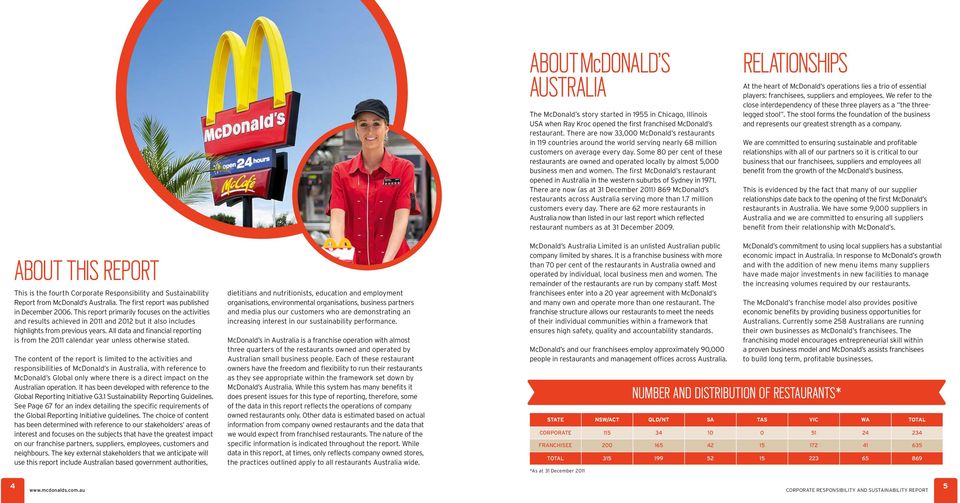
4 About McDonald s Australia The McDonald s story started in 1955 in Chicago, Illinois USA when Ray Kroc opened the first franchised McDonald s restaurant. There are now 33,000 McDonald s restaurants in 119 countries around the world serving nearly 68 million customers on average every day. Some 80 per cent of these restaurants are owned and operated locally by almost 5,000 business men and women. The first McDonald s restaurant opened in Australia in the western suburbs of Sydney in There are now (as at 31 December 2011) 869 McDonald s restaurants across Australia serving more than 1.7 million customers every day. There are 62 more restaurants in Australia now than listed in our last report which reflected restaurant numbers as at 31 December relationships At the heart of McDonald s operations lies a trio of essential players: franchisees, suppliers and employees. We refer to the close interdependency of these three players as a the threelegged stool. The stool forms the foundation of the business and represents our greatest strength as a company. We are committed to ensuring sustainable and profitable relationships with all of our partners so it is critical to our business that our franchisees, suppliers and employees all benefit from the growth of the McDonald s business. This is evidenced by the fact that many of our supplier relationships date back to the opening of the first McDonald s restaurants in Australia. We have some 9,000 suppliers in Australia and we are committed to ensuring all suppliers benefit from their relationship with McDonald s. About this report This is the fourth Corporate Responsibility and Sustainability Report from McDonald s Australia. The first report was published in December This report primarily focuses on the activities and results achieved in 2011 and 2012 but it also includes highlights from previous years. All data and financial reporting is from the 2011 calendar year unless otherwise stated. The content of the report is limited to the activities and responsibilities of McDonald s in Australia, with reference to McDonald s Global only where there is a direct impact on the Australian operation. It has been developed with reference to the Global Reporting Initiative G3.1 Sustainability Reporting Guidelines. See Page 67 for an index detailing the specific requirements of the Global Reporting Initiative guidelines. The choice of content has been determined with reference to our stakeholders areas of interest and focuses on the subjects that have the greatest impact on our franchise partners, suppliers, employees, customers and neighbours. The key external stakeholders that we anticipate will use this report include Australian based government authorities, dietitians and nutritionists, education and employment organisations, environmental organisations, business partners and media plus our customers who are demonstrating an increasing interest in our sustainability performance. McDonald s in Australia is a franchise operation with almost three quarters of the restaurants owned and operated by Australian small business people. Each of these restaurant owners have the freedom and flexibility to run their restaurants as they see appropriate within the framework set down by McDonald s Australia. While this system has many benefits it does present issues for this type of reporting, therefore, some of the data in this report reflects the operations of company owned restaurants only. Other data is estimated based on actual information from company owned restaurants and the data that we would expect from franchised restaurants. The nature of the specific information is indicated throughout the report. While data in this report, at times, only reflects company owned stores, the practices outlined apply to all restaurants Australia wide. McDonald s Australia Limited is an unlisted Australian public company limited by shares. It is a franchise business with more than 70 per cent of the restaurants in Australia owned and operated by individual, local business men and women. The remainder of the restaurants are run by company staff. Most franchisees enter into a 20 year agreement with McDonald s and many own and operate more than one restaurant. The franchise structure allows our restaurants to meet the needs of their individual communities within a framework that ensures high safety, quality and accountability standards. McDonald s and our franchisees employ approximately 90,000 people in restaurants and management offices across Australia. STATE NSW/act qld/nt sa TAS vic WA total corporate franchisee total *As at 31 December 2011 number and distribution of restaurants* McDonald s commitment to using local suppliers has a substantial economic impact in Australia. In response to McDonald s growth and with the addition of new menu items many suppliers have made major investments in new facilities to manage the increasing volumes required by our restaurants. The McDonald s franchise model also provides positive economic benefits by providing business opportunities for Australians. Currently some 258 Australians are running their own businesses as McDonald s franchisees. The franchising model encourages entrepreneurial skill within a proven business model and McDonald s assists franchisees to build long term, profitable businesses. 4 5
5 Economic contribution Corporate governance As a significant employer, purchaser, retailer and franchisor in Australia, we know we have a responsibility to add value and contribute to the local economy and to the communities in which we operate. To quantify the contribution McDonald s restaurants make at a national, state and local level, in 2011 we commissioned AECOM, an independent provider of economic modelling, to assess our contribution. Their report found that the economic contribution of McDonald s Australia is equivalent to 0.2 per cent of Australia s gross domestic product. The outcomes of the modelling also highlighted McDonald s contribution to a broad range of industries. McDonald s most significant expenditure is in the following areas: $1.1 billion annually on the manufacturing of food, paper products, utilities, and business support services. $1 billion on wages annually across 90,000 full time, part time and casual staff members. $112 million annually on construction due to the building of new restaurants, remodelling of existing restaurants, including the cost of furniture and equipment. The key results of the modelling demonstrated that for every $1 of McDonald s output, 79 cents of value is added in other industries. In addition for every $1 million in sales, 11.1 persons will be employed across all industries. The report also looked at the difference between metropolitan and regional restaurants and their individual contribution. AECOM found that depending on the location and size of the restaurant, each McDonald s restaurant contributes between $1.2 million and $4.9 million to their metropolitan or regional economy. Each new restaurant brings with it local employment and training for approximately 100 to 120 people in full time, part time and casual positions but the effect of the restaurant on employment is broader than just those employed to work in the restaurant. According to the AECOM report, each restaurant creates between 21 and 88 full time equivalent jobs depending on the size and location of the restaurant. This includes people employed by the restaurant as well as those employed by suppliers and other service providers. Many of our restaurants are located in country towns and regional centres creating employment opportunities where they are often most needed and the wages bill for an average restaurant is in the vicinity of $1 million. This income enters the local economy as employees make purchases and pay taxes. New restaurants and 24/ 7 trading We conduct extensive and continuous customer research and convenience is something Australians tell us is increasingly important to them. They tell us convenience is about having a restaurant close by and knowing that it will always be open. As a result of ongoing business growth and this consumer insight, we are expanding our development program. During 2012 and 2013 we anticipate opening 70 new restaurants across Australia amounting to a capital investment value of approximately $210 million. We are also moving more of our restaurants to 24 hour trading, seven days a week. McDonald s is committed to conducting business ethically and in compliance with the letter and spirit of the law. This commitment is reflected in our values. Inherent in each value is our commitment to be ethical, truthful and dependable and this is reflected through our Standards of Business Conduct which serves as a guide to making good decisions and conducting business ethically. McDonald s success is built on a foundation of personal and professional integrity and these guidelines apply to all salaried employees worldwide, including restaurant managers. The complete Standards of Business Conduct for Australian employees can be read at Our values We place the customer experience at the core of all we do. Our customers are the reason for our existence. We demonstrate our appreciation by providing them with high quality food and superior service, in a clean, welcoming environment, at great value. Our goal is outstanding quality, service, cleanliness and value (QSC&V) for each customer every time. We are committed to our people. We provide opportunity, recognise talent and develop leaders. We believe that a diverse team of well-trained individuals working together in an environment that fosters respect and drives high levels of engagement is essential to our continued success. We believe in the McDonald s system. The McDonald s business model, depicted by the three-legged stool of franchisees, suppliers and company employees, is our foundation, and the balance of interests among the three groups is key. When employees start work at McDonald s Australia they receive a copy of the Standards of Business Conduct and they are asked to sign a form certifying that they have read and agree to abide by them. They are subsequently asked to recertify on an annual basis. Behaving ethically is the responsibility, and our expectation, of all McDonald s Australia employees and is a fundamental aspect of our organisation s culture. This is guided by the policies, direction and behaviour set by the leadership team as well as the written Standards document. We operate our business ethically. Sound ethics is good business. At McDonald s, we hold ourselves and conduct our business to the highest possible standards of fairness, honesty and integrity. We are individually accountable and collectively responsible. We give back to our communities. We take seriously the responsibilities that come with being a leader. We help our customers build better communities, support Ronald McDonald House Charities (RMHC), and leverage our size, scope and resources to help make the world a better place. We are committed to sustainable business practices and are determined to conduct our operations in a manner that does not compromise the ability of future generations to meet their needs. We grow our business profitably. Our stakeholders support our ability to serve our customers. In return, we work to provide sustained, profitable growth for all members of our System and our investors. We strive continually to improve. We consider ourselves a learning organisation that is green and growing and that anticipates and responds to changing customer, employee, System and community needs through constant evolution and innovation. 6 7

6 to maximise the positive impact we can have on society. We work hard to understand the complex issues that confront our business and industry, and how we can make a significant difference. include surveys and research, one on one communication and meetings and our participation in forums, conferences and exhibitions. Local leadership Catriona Noble continues as Managing Director and Chief Executive Officer of McDonald s Australia. Catriona has worked for McDonald s Australia for over 28 years after starting as a casual crew member when she was 14 years old. The McDonald s Australia Board consists of the following McDonald s Australia employees: Catriona Noble, Managing Director and Chief Executive Officer Helen Nash, Chief Operating Officer Joanne Taylor, Chief Restaurant Support Officer Craig Cawood, General Counsel Andrew Gregory, Chief Financial Officer The McDonald s Australia Board works hand in hand with a body of elected franchisees from across the country. As at 2012 the McDonald s Australia National Business Group of franchisees includes: NSW Ian Garton, Craig Evans, Hani Sidaros, Kerry Gordon VIC Ken Turner, Tony Kitto, Chris Carroll QLD Adam Dando, Steve Flook, Tony Ward SA Mark Dutschke, Graham Delbridge WA Richard Hill, Nick Agostino The Board reports to the President Asia Pacific, Middle East and Africa, McDonald s Corporation who in turns reports into McDonald s Australia National Business Group 2012 with McDonald s Australia Board members. McDonald s Corporation senior management in the US. In this way, the operation of McDonald s Australia is governed by the global McDonald s System. This System is decentralised providing great freedom for individual countries to operate the business to best suit the needs of their customers within a framework that ensures each market adheres to the same core values, principles and standards. Our responsibility From the beginning, we ve been a company committed to doing the right thing. Corporate responsibility and sustainability is part of our heritage and dates back to our founder, Ray Kroc. Long before the terms became popular, Ray Kroc saw the importance of making a positive contribution to the community. Operating responsibly is also an integral part of our business strategy as it just makes good sense. Our customers trust is a precious asset and one that we strive to build and preserve every day. We know that we must have that trust to achieve our vision of being our customers first choice. As a result, we are committed to being a brand that our customers will trust to do the right thing. Corporate responsibility challenges are always evolving and we are focused on learning from experts and adapting our operations As our business grows, we are becoming increasingly focused on building our business sustainably so that our impact on the environment is minimised and our contribution to the communities within which we operate is positive. Being a responsible company is a journey and there is always room for improvement but we are striving towards a sustainable future for our company, franchise partners, suppliers, employees and the communities in which we operate. We are determined to work with our stakeholders to continuously improve our performance. Our stakeholders Stakeholders are those individuals, organisations and groups whom we affect and who affect us. Our stakeholders are diverse and include: Customers more than 1.7 million Australians who visit us every day. These are a wide range of people from families to senior citizens who come to our restaurants in cities, suburbs, regional centres and small towns all over Australia. Business partners our 258 franchisees and all of our 9,000 suppliers. Employees more than 90,000 people employed in our restaurants and offices all over the country. Opinion leaders and experts government, health professionals, environmental groups, media and more. These are the people we learn from and consult with on a range of issues affecting our business. Stakeholder consultation We use various tools and resources to engage with our stakeholders on the issues that matter to them. These Each year we initiate numerous meetings with stakeholder organisations to listen to their feedback, update them on our business plans and discuss solutions which meet the needs of both parties. We have conducted personal meetings with government departments, health and nutrition bodies, emergency services, law enforcement agencies, employee unions, industry associations, local councils, other quick service restaurants, environmental groups, animal welfare organisations and other special interest groups. Details of some of these alliances and relationships are outlined further in this report. Understanding our customers and their expectations and attitudes is also very important to us and as a result we conduct continual, comparative research on a quarterly basis. This research addresses all areas of our business. Based on this research, other feedback from stakeholders, public debate and our own understanding of the impacts of our business we have identified and prioritised the corporate responsibility issues that are currently of most importance to our stakeholders and have focused on these in this report. These priorities are: Our menu choices and food quality; Our marketing practices, particularly in relation to children; The sustainability of our supply chain; The impact of our operations on the environment and the actions we are taking to minimise them; Our employee practices and training opportunities; Our contribution to the community on a local and national basis. Some of these areas present ongoing challenges for us and in others we are very proud of our standards and achievements. We are consulting with experts and working hard to develop strategies to deal with those priorities that currently present a challenge. At the same time we are continuing to innovate and lead the way in other areas of responsible business practice. 8 9

7 Kilojoule labelling on menu boards was introduced nationally in Salad or Fries became a standard option with every Extra Value Meal in The sodium content in our cheese will be reduced by 20% in 2012, impacting 14 menu items. Today, 1 in 3 Happy Meals sold include either a Seared Chicken Snack Wrap, apple slices, low-fat flavoured milk, fruit juice or water. In 2012 we introduced lamb to our menu for the first time. 3 FOOD AND NUTRITION 10 11

8 Maintaining customer trust Our customers choose McDonald s because they love our food and trust us to serve safe, hot and fresh food to them every time they visit. Over the past decade McDonald s has been on a journey to address community concerns around the nutritional value of our menu items and we have made many positive changes. Some of these include introducing healthier options for both adults and kids, ensuring nutrition information is easily accessible so customers can make informed choices and taking significant steps to address community concern regarding the marketing of our food, specifically to children. We actively communicate with experts and informed third parties to help guide our menu decisions. We have a close, ongoing working relationship with The Food Group Australia Accredited Practising Dietitians and we turn to them regularly for advice and information about nutrition. We also consult regularly with government departments, health and nutrition bodies, research groups and nutritionists. Likewise, we regularly ask our customers what they want from us. Amongst other forms of research, our ongoing customer satisfaction survey tracks customer perceptions of their most recent visit to McDonald s. Customers are asked to rate their overall satisfaction with their visit plus provide detailed views on the following attributes: value for money; speed of service; friendly staff; taste of food; cleanliness; hot food and order filled correctly. In addition we operate a customer service phone line and system to answer questions and receive feedback from the public. In 2011, the customer service department received 88,163 s, phone calls and letters from the public. Of these contacts, 36,706 were complaints with the remaining 51,457 contacts being questions, compliments or comments. Food safety We are proud of McDonald s food safety record in Australia but will never be complacent. We continue to be vigilant about food safety standards and collaborate with government, industry bodies and other experts to support innovation and improvement in food safety practices. To ensure the integrity of our food we have stringent food safety procedures in place at every stage of the food preparation process. Our food safety plan is based on the Hazard Analysis Critical Control Point (HACCP) approach. A HACCP plan identifies hazards to which products might be exposed and the critical points where control measures must be in place. It then establishes a system for monitoring them as well as plans for corrective action. Every restaurant has a HACCP-based plan in place and every supplier is required to have a written and externally-verified HACCP plan for every food and packaging product supplied to the McDonald s Australia system. As part of our comprehensive HACCP plans hundreds of different safety and quality inspections and checks are in place to monitor food as it moves through our supply chain to our customers over our restaurant counters. As an example, a meat patty undergoes 52 quality checks before it arrives in a restaurant. The results of these checks are recorded which means it is easy to verify that procedures have been followed. Healthier menu options Research tells us that many of our customers view our healthier menu options as a critical element of our corporate responsibility. McDonald s Australia is committed to providing appealing, healthier menu items for our customers and as a result our menu is regularly reviewed and changes made. Working closely with Accredited Practising Dietitians at The Food Group Australia a number of menu changes have been made over the past decade to improve the nutritional value of our food. We will continue to review and update our menu based on customer and stakeholder feedback. In a world first, early in 2007 nine McDonald s meals earned the Heart Foundation Tick indicating that these menu options had been independently tested to ensure they met the Heart Foundation s strict nutrition and promotion standards. Our aim was to help our customers more confidently make healthier choices when visiting our restaurants. In 2011 the National Heart Foundation ended its Tick licensing program in the quick service restaurant sector. This unfortunately meant that McDonald s was no longer able to participate in the Heart Foundation Tick program. However our positive relationship with the National Heart Foundation continues and a range of healthier options remains on the menu. Our current Happy Meal menu means parents and children can choose the meal components that best suit their nutrition requirements and taste preferences. The Happy Meal menu includes the Seared Chicken Snack Wrap, Fruit Bag, CalciYum low-fat flavoured milk, juice and water as well as traditional favourites such as Chicken McNuggets, small Fries and Cheeseburger. McDonald s gets grilled In a first for the quick service restaurant industry, in 2012 McDonald s Australia gave independent production company WTFN the opportunity to access-all-areas, inviting cameras to capture a complete and candid look at McDonald s food supply chain and create a television documentary. The documentary reviewed and revealed the journey the food takes, from the Australian farmers who supply to McDonald s, through to the final menu items available in the restaurant. Filmed over a period of one week in January, the documentary invited six everyday Australians, from across the country, behind-the-scenes and asked for their honest opinions. The final documentary called McDonald s Gets Grilled aired on Channel Seven on 2nd April to over one million viewers and was an important step towards dispelling some of the myths and misconceptions about our food. The documentary can be seen in full on the McDonald s Australia YouTube channel at McDonaldsAustralia. To continue our focus on being transparent and open with our customers, we re also planning to open our kitchen doors to the public in the near future. Customers will be able to take a tour behind the counter at McDonald s and see how Big Macs, Fries and Bacon and Egg McMuffins are made

9 Our food and nutrition journey over a decade ( ) McDonald s CEO Guy Russo starts attending obesity forums and meetings with key organisations such as Diabetes Australia and the Obesity Taskforce. A range of core menu improvements are launched including: A reduction in the sugar content of our buns. Our buns contain no more than 5 per cent sugar which is similar to the sugar content of hamburger buns found in a supermarket. New white meat chicken nuggets. McDonald s vegetable oil blend is improved so that it is virtually free of trans fatty acids and meets standards for healthier oils. A range of sodium reduction projects are begun across a range of products including dressings, sauces, bread and chicken. Seared chicken launches in a range of salads and burgers. A range of menu enhancements are launched including wraps fortified with fibre. A new healthier choice Happy Meal item is added to the menu the seared chicken Snack Wrap. McDonald s and other quick service restaurants introduced the Quick Service Restaurant Initiative for Responsible Advertising and Marketing Communications to Children. As a member of the Australian Food and Grocery Council Quick Service Restaurant Forum McDonald s is an active participant in the Australian Government s Food and Health Dialogue. The Dialogue s primary activity is action on food innovation, including a voluntary reformulation program across a range of commonly consumed foods. The reformulation program aims to reduce the saturated fat, added sugar, sodium and energy, and increase the fibre, wholegrain, fruit and vegetable content across nominated food categories. The sodium content in our cheese is reduced by 20%, impacting 14 menu items Salads Plus menu is launched including salads, fruit parfait, Chicken Foldover and a Lean Beef Burger. An alternative Happy Meal is introduced, consisting of a toasted cheese and tomato sandwich, sultanas and orange juice with less than 6 grams of fat per serve. McDonald s begins to consult with Accredited Practising Dietitians at The Food Group Australia. The Quickstart breakfast menu is introduced and includes breakfast cereals, yoghurts, juices and fruit cups. New warm chicken salads are added to the menu. Deli Choices menu launches. Three out of seven products contain less than 10g fat. McDonald s participates in the DAA (Dietitians Association of Australia) conference. McDonald s Australia is the first national restaurant chain to earn the Heart Foundation Tick on a range of meals. McDonald s wins best stand at Dietitians Association of Australia conference. Happy Meal Choices introduced and includes fruit bag, apple juice and water. A choice of Garden Salad or Fries with any Extra Value Meal is introduced. A healthier option for breakfast is added to the menu Uncle Tobys Oats with Apple and Sultanas. The sodium content of Crispy Chicken Strips is reduced by over 40 per cent

10 Nutrition information Sustainable coffee that tastes good too With 687 McCafés (as at 31 December 2011) in Australia, McDonald s is the biggest coffee shop chain in the country. As such, we believe it is important to offer our customers a great tasting coffee which also supports coffee workers, their communities and the environment. To do this we continue to ensure all coffee is sourced from Rainforest Alliance certified farms. In just one year McDonald s Australia has sourced approximately 1.5 million kilograms of coffee beans from Rainforest Alliance Certified farms. 16 McDonald s is committed to helping our customers make informed decisions about their food choices. In 2012 we introduced menu board labelling which provides clear kilojoule content information for customers prior to their purchase decision. In 2004 we introduced nutrition labelling on our packaging. This was enhanced in 2006 to include percentage Daily Intake figures. Nutrition information for all of our products has also been available on the McDonald s corporate website since it was developed. adding lamb to the menu Responding to the popularity of lamb in Australia, The Serious Lamb Burger and The Serious Lamb Taster were introduced to the menu in The Serious Lamb Burger included a lamb pattie, tomato, beetroot, aioli, tomato sauce, onion and an egg. The Serious Lamb Taster incorporated some of the flavours from The Serious Lamb Burger, in a wrap. The new menu items were developed after 18 months of planning. The process began with customer research and included working with local Australian lamb suppliers to ensure the continuous supply of meat and significant testing to develop the right flavour profile. The lamb products were on the menu for 12 weeks in 2012 and the success of the innovation means that lamb is likely to return to the menu at a later date. The lamb was being sourced from farmers in New South Wales, Victoria and South Australia and provided another positive opportunity for McDonald s to work with Australian producers. The Rainforest Alliance is an independent, non profit environmental organisation with over 20 years experience in the development and promotion of standards in sustainable forestry, farming and tourism. To learn more about the Rainforest Alliance go to After listening to feedback from our customers, our focus continues to be improving the taste and quality of our coffee. To do this we introduced a richer, darker coffee blend more suitable for the Australian palate, embarked on a national program to make selected crew into dedicated baristas and standardised equipment maintenance across every McCafé. Consumer research has already indicated this improvement program has been a success with a Canstar Blue survey conducted in September 2011 indicating that McCafé now has the most satisfied customers of all the major coffee chains in Australia. 17

11 Toys and McDonald s We have always used toys and characters with our foods as a response to the desire of parents for their child s McDonald s experience to be a fun and special occasion. However we recognise there is some community concern around the use of our toys in our promotions and so we have reduced our toy advertising on television by 80 per cent since Our toy advertising now represents only three per cent of the total McDonald s Australia media budget. This is down from 11.3 per cent in As a participant of the Quick Service Restaurant Initiative for Responsible Advertising and Marketing Communications to Children, when using these characters, toys and personalities as part of a promotion for food or beverages to children under 14 years, the food or beverage used will be one of our healthier options. Children s sponsorships Since our first restaurant opened McDonald s and its franchisees have always given back to the communities in which we operate and we are proud to be providing much needed support to various grassroots organisations. The main purpose of our support is to add value to the community, and to encourage kids to be active and embrace balanced lifestyles. From the very outset, all sponsorships are defined by agreed parameters by both organisations involved. We have a policy in place regarding the types of vouchers made available to children as part of our sponsorship agreements. The policy states that all children s vouchers must offer a healthier choice and that a carer or parent must be present if a child under 14 years wants to redeem the voucher. Responsible marketing Being a favourite place for children, we know we have a responsibility to communicate appropriately with families and young people. Due to increased stakeholder and community concern around marketing practices to children, in 2009, McDonald s Australia instigated the introduction of the self-regulatory Quick Service Restaurant Initiative for Responsible Advertising and Marketing Communications to Children. Along with other quick service restaurants, the Australian Association of National Advertisers and Australian Food and Grocery Council this initiative provides industry standards and guidelines for advertising to children. All members of the Initiative agree to abide by these guidelines. The key to this agreement is that when we are promoting food and beverages primarily to children under 14 years we will only use foods that are healthier options. For a meal to be considered a healthier choice it should reflect general principles of healthy eating as defined by credible nutrition authorities and must comply with defined criteria for energy, saturated fat, sugar and sodium. These criteria were developed by a team of Accredited Practising Dietitians in consultation with national guidelines and authorities on children s nutrition. As part of the joint initiative, a complaints mechanism has been established whereby consumers can make a complaint directly to the Advertising Standards Bureau providing a single speedy source for complaint resolution. As part of the Initiative, an independent organisation Healthy Kids was contracted to monitor company compliance with the Initiative. At the end of 2011 Healthy Kids published its first analysis and the report found widespread compliance with the Initiative

12 Over 90 per cent of McDonald s food and packaging is sourced or manufactured in Australia. Animal health and welfare standards meet or exceed all Australian requirements and 69 animal health and welfare audits of suppliers were conducted in 2010 and A new McFlurry Cup design has reduced plastic use by more than 47 tonnes per annum. A new napkin dispenser will reduce napkin wastage by 40 per cent and reduce outer carton packaging by 42 tonnes per year. Used cooking oil from McDonald s restaurants is now being converted to biodiesel to fuel delivery trucks in Victoria. 4 SUSTAINABLE SUPPLY CHAIN 20 21

13 Sustainable supply chain McDonald s supply chain is unique. Our model is based on a culture of partnership and collaboration which makes it possible for us to serve consistently safe and high quality food. It is important to McDonald s that our suppliers operate sustainable and profitable businesses and benefit from their partnership with us. It is equally important to us that we source our products in a responsible and ethical manner that contributes to the development of sustainable agriculture and food manufacturing processes. The scale and complexity of the McDonald s supply chain presents some unique challenges and as a result there is a global governance structure in place that guides McDonald s work towards its sustainable supply vision. For more information about our global supply chain policies and programs please go to Vision We envision a supply chain that profitably yields high-quality, safe products without supply interruption while leveraging our leadership position to create a net benefit by improving economic, ethical and environmental outcomes. Economic - We envision delivering affordable food, engaging in equitable trade practices, limiting the spread of agricultural diseases, and positively impacting the communities that our suppliers operate in. Ethical We envision purchasing from suppliers that follow practices that ensure the health and safety of their employees and the welfare and humane treatment of animals in our supply chain. Environmental - We envision influencing the sourcing of our materials and ensuring the design of our products, their manufacture, distribution and use to minimise lifecycle impacts on the environment. Viewing our responsibilities in this type of holistic manner, we consider our priorities for food safety, quality and affordability in conjunction with our ethical, environmental, and economic responsibilities, as we make purchasing decisions and evaluate supplier performance. Economic responsibility McDonald s is committed to supporting Australian producers and manufacturers and our first preference is always to source produce from within Australia whenever it is viable and appropriate to do so. We use a very high proportion of Australian sourced food with over 90 per cent of our food and packaging needs manufactured in Australia. In 2011 McDonald s Australia spent more than $669 million on Australian produce. This included purchasing: More than 381 million hamburger buns; More than 86 million English muffins; Almost 84 million kilos of potatoes; 26 million kilos of beef; 720,000 kilos of sliced and diced apples; 18 million kilos of chicken; More than 91 million eggs; More than 10 million kilos of Australian grown fresh produce, primarily tomatoes and lettuce; and 43 million litres of milk (including shake and sundae mix). The standard of McDonald s products in Australia has been recognised internationally resulting in exporting success. For example, we export more than 49 million kilos of Australian beef each year which is used in McDonald s restaurants in South East Asia, Japan and the United States. McDonald s does not own any businesses that supply to McDonald s, however there are suppliers that have facilities dedicated to McDonald s production. We also have long term relationships in place with many of our Australian suppliers, for example, we have been working with Ingham for 25 years and Quality Bakers for 40 years. Several of our egg suppliers have been providing us with fresh eggs for many years including Pace Farms in NSW (22 years), Farm Pride in Victoria (23 years), Sunny Queen in Queensland (31 years) and Novo in three states (22 years). Some 10 per cent of our suppliers supply 82 per cent of our product needs in Australia, and some of our most significant supply partners are: OSI beef, chicken and fish; Keystone Foods beef; Ingham Enterprises chicken products; Simplot fries and hash browns; McCain fries and hash browns; Fresh Start Bakeries buns and muffins; Fonterra cheese, milk, shake and sundae mix and yoghurt; and Martin Brower distribution. There are five key characteristics that shape our relationship with these strategic suppliers. 1. We strongly believe that long term partnerships outperform a short term transactional approach. 2. Transparency, inclusion and trust are critical components of these relationships. 3. We choose the long term benefit of the entire System first, rather than short term gains for any single part of the System. 4. Financial implications for all parties are taken into account in every decision, with the goal of achieving a win-win result wherever possible. 5. Rather than focus on crisis management, we anticipate potential issues and take proactive action to prevent them. In this way, the three legged stool of the McDonald s System franchisees, suppliers and corporate employees work effectively together to achieve the ultimate goal of supplying safe, quality food to the restaurants, whilst also enabling us to deliver on the value component of our customer promise

14 McDonald s, Martin Brower and Foodbank In 2011 McDonald s and our distribution partner Martin Brower joined forces with Foodbank Australia to help eliminate hunger by providing charities and community groups with fresh food. McDonald s donates surplus ingredients such as lettuce, tomatoes, onions and sauces and Martin Brower puts its full logistic capabilities to the task of ensuring that all food which could be of use to Foodbank makes it to their warehouses in plenty of time for distribution. The donated food is used by hostels, shelters and drop-in centres for preparing meals for people in need. From the beginning of the relationship in November 2011 until July 2012, McDonald s and Martin Brower have worked together to donate 29,968 kilos of fresh food to Foodbank. We are really pleased to have McDonald s and Martin Brower on board, said Foodbank Australia s CEO Jon Webster. This relationship helps us with our goal of providing more fresh food to welfare agencies and is another step towards achieving our vision of an Australia without hunger. Ethical responsibility We know that our influence in the marketplace brings with it a responsibility to ask for more than quality and price. Our progress in relation to an ethically responsible supply system is motivated by our commitment to our customers, leadership on sustainability issues and our desire to do the right thing. Supplier workplace accountability The foundation of our program is our global Code of Conduct for Suppliers which outlines McDonald s minimum requirements in the areas of employment and workplace practices, including health and safety. Supplier workplace accountability audits are conducted regularly with our core suppliers to ensure they are meeting our social responsibility expectations. The primary aim of the program is to protect the health, safety, and human rights of workers. In 2010 and 2011, 77 supplier workplace accountability audits were conducted with suppliers in Australia. Animal health and welfare We consider animal health and welfare to be of great importance and recognise that our responsibility as a purchaser of food products includes working with our suppliers to ensure high standards of animal handling. Our animal health and welfare expectations currently meet or exceed all minimum standards in Australia. We adhere to McDonald s global guiding principles in relation to animal health and welfare which express our commitment to ensuring animals are free from cruelty, abuse and neglect. Our animal health and welfare guidelines are based on technical standards and a comprehensive audit program which was developed using the knowledge and assistance of third party experts. To ensure supplier compliance with our animal health and welfare principles, our beef, poultry and pork suppliers processing plants are regularly audited by independent third party auditors from Ausmeat. In 2010 and 2011, 69 animal welfare audits of our suppliers were conducted. The audits use a standard protocol based on a methodology developed by McDonald s Global Animal Welfare Council with the assistance of Dr. Temple Grandin, a leader in innovative animal welfare research and handling practices. While we are a significant purchaser of beef, chicken and eggs in Australia, in most cases we only purchase a small percentage of the overall market. As a result, it is often most effective if we work more broadly with the relevant industry associations, as well as directly with our suppliers, to encourage and support animal welfare initiatives in individual industry sectors. Roundtable for Sustainable Beef Australia McDonald s is a founding member of the Roundtable for Sustainable Beef Australia (RSBA) which is a multistakeholder industry group focused on advancing continuous improvements in the sustainability of beef production in Australia. Other members of the RSBA include the World Wildlife Fund, the Cattle Council of Australia, Merck, JBS and Teys Australia. RSBA is working towards creating an Australian beef industry in which all aspects of the beef supply chain are environmentally responsible, socially equitable and economically viable. We believe that participating in a whole of industry approach is the most effective way to make a difference. The group is taking a leadership role in the industry and will champion the adoption of best practices across the entire beef supply chain. RSBA is a part of the larger Global Roundtable of Sustainable Beef which includes the world s largest processors, food service companies, retailers, environment NGOs and animal health companies

15 Environmental responsibility Our environmental guidelines for suppliers can be viewed at Packaging initiatives Our responsibility to the environment starts with the fresh ingredients at the farm and the design of our food packaging, and extends through food manufacture, to our restaurants, customers, and waste disposal. We aim to work with our suppliers to assist them to provide us with an uninterrupted, long term supply of quality food and packaging in a way that minimises our impact on the natural environment. We also aim to encourage the protection of resources that our suppliers share with the communities in which they operate. We use a scorecard to measure supplier environmental performance for water, energy, waste and emissions related to the manufacture of McDonald s product. Our suppliers of beef, poultry, potato and bakery products have been reporting on these parameters since 2005 and we have recently expanded this to incorporate packaging and Happy Meal toy manufacture. Reporting is conducted annually and significant improvements have been tracked by many of our suppliers. The scorecard is a global tool to monitor supplier performance and manage their environmental impacts and Australia was one of the first McDonald s markets to implement the program. In Australia we also have specific issues relevant to our country and climate that we are working with our suppliers to address. The challenges of extreme weather and climate events present real issues for farming in Australia and we work with our suppliers to support strategies for sustainable supply of produce. We also engage with peak bodies and industry associations to explore issues of concern, discuss innovations and offer our support to industry-wide improvements in agriculture and food manufacture. Sustainable packaging and waste management When it comes to packaging and waste we are continuing to explore options to decrease our environmental impact. Our first priority is to reduce the resources and materials being used wherever possible. Where we can t reduce our materials, our aim is to reduce waste to landfill. We continue to seek ways to incorporate reuse and recycling into our restaurants and we see this as one of our greatest opportunities for improvement. Packaging McDonald s is a signatory to the Australian Packaging Covenant which is an agreement to reduce the environmental impacts of consumer packaging through: designing packaging that is more resource efficient and more recyclable; increasing the recovery and recycling of used packaging from households and away from home sources; and taking action to reduce the incidence and impacts of litter. As part of our commitment to the Australian Packaging Covenant, McDonald s Australia reports regularly and publicly on our progress against our formal action plan. Our action plan and reports can be viewed at and is also available on our website. Our choice of packaging is an important part of ensuring our customers receive their food and beverages at the right temperature and in an easy manner to consume. Our aim is to maintain the highest standards of safety and quality whilst reducing source materials used and increasing recycled content. We continue to make headway. Environmental impact is one of five criteria incorporated into McDonald s process of developing food and beverage packaging. The other four criteria are functionality, cost, availability of materials and impact on operations. From an environmental perspective, we aim to make our packaging sustainable from the outset. We continued to use recycled raw materials in our consumer packaging, where possible. In ,824,885 kg of recycled raw materials were used. A new four flap McFlurry Cup has been developed which eliminates the need for a lid on the cup and will reduce plastic use by tonnes per annum. The new Xpressnap napkin and napkin dispenser was recently introduced into restaurants and is expected to decrease napkin wastage by 8000 tonnes or approximately 40 per cent per annum. The SCA Xpresssnap has an independent environmental certification from Environmental Choice North America. The added benefits include reduction in use of outer cartons by 42 tonnes per annum and fuel savings with fewer cartons transported and stored. Total weight of consumer packaging sold into the Australian market Description 2011 Paper and cardboard Plastics (incl non-recyclable) Total 22,251,794 kg 4,101,406 kg 26,353,200 kg We are committed to promoting the efficient and responsible use of wood and wood-based products, ensuring the fibre for our packaging comes from legal and acceptable sources. As part of this commitment, continuous assessment of our packaging suppliers is being conducted to examine their sourcing practices. Based on the results of the assessment we work with them to outline action plans for improvement as applicable. Our packaging suppliers purchase paper and paperboard primarily from New Zealand, Australian and European suppliers. 77 per cent of the fibre in our paper packaging is now covered by CoC certification (71 per cent FSC CoC). The combined total 26 27

16 of virgin fibre covered by CoC certification and recycled fibre is 93 per cent of our paper packaging (percentage based on 2010 data). CoC certification tracks material through the production process from the forest to the consumer, including all successive stages of processing, manufacturing and distribution. Waste Management Waste reduction and management is a key priority for the business but continues to be a challenge. We have just completed a Back of House recycling trial in 25 restaurants aiming to divert more than 60 per cent of waste from landfill. As part of the recycling initiative, the restaurants separated organics (food and liquid), cardboard and general waste on site. The organics were then transported to a compost facility, the cardboard recycled and the general waste is separated into recyclable waste streams at the waste collector s facility. The trial has been successful in increasing landfill diversion rates over a short space of time however there were issues with waste contamination. Based on these learnings, we will continue to trial Back of House recycling in the restaurants and expand into the market when this issue is resolved. Achieving effective packaging recycling is an important priority for us and reaching an effective solution is currently a focus for the business. Transport and distribution McDonald s Australia s distribution partner, Martin Brower, is dedicated to the distribution of McDonald s restaurant supplies and to ensuring every restaurant is equipped with the required amount of produce and packaging. The timing of each delivery and the quantities delivered is obviously critical to ensure uninterrupted supply for our restaurants and therefore, customers. Across Australia 1,612,456km of transport was avoided in 2011 as a result of inventory optimisation at restaurants. This accounts for a reduction in fuel usage of 12 per cent or 599,429 litres. In 2011 McDonald s Australia started using The Sustainability Footprint Assessment (SFA) which is a web-based tool which gathers data from Distribution Centres operations across the McDonald s Asia Pacific, Middle East and Africa logistics supply chain. The reports produced by the SFA show the energy usage and carbon emissions of Distribution Centres and their truck fleets in a way that identifies opportunities for improvement. A baseline from 2010/11 has been established which has enabled the setting of energy reduction targets and in the future we will be able to measure and report on results. Converting used cooking oil to biodiesel In an innovative move, used cooking oil from McDonald s restaurants is now being converted to biodiesel and used to fuel restaurant delivery trucks across Victoria. This closed loop recycling scheme works by collecting used cooking oil from the restaurants, the oil is then delivered by McDonald s transport partner, Martin Brower, to a Neutral Fuels processing plant and at the same time the delivery truck is re-fuelled with 100 per cent biodiesel. The conversion of used cooking oil to biodiesel is a great fit with our sustainability strategy offering both environmental and economic benefits. Implementing this scheme in Victoria alone looks set to reduce carbon emissions by 730 tonnes per year which is the equivalent of flying from Sydney to London 260 times. As production facilities become available, this recycling scheme will be rolled-out to McDonald s restaurants all over Australia. The roll-out will make a significant difference to our transport carbon footprint and is an excellent example of our restaurants and supply partners working together. Converting used cooking oil to biodiesel brings many environmental benefits including: the ozone forming potential of biodiesel combustion is approximately 50 per cent less than that of fossil diesel; compared to fossil diesel, biodiesel exhaust emissions of sulfur oxides and sulfates are virtually non-existent; the well to wheel life cycle analysis of converting used cooking oil to biodiesel shows that the amount of carbon dioxide and equivalents emitted is reduced by nearly 80 per cent compared to fossil diesel. Biodiesel provides significant sustainability advantages over non-renewable fuels and this model of biodiesel does not impact food security as it uses a by-product (ie. used cooking oil) rather than virgin grains or seeds

17 In 2011 McDonald s opened the first Green Star quick service restaurant in Australia accredited by the Green Building Council of Australia. An employee booklet of 40 sustainability tips for home and office was launched to celebrate 40 years of McDonald s in Australia. New environmental best practice guidelines make it easier to choose and implement sustainability initiatives in the restaurant. New landscape guidelines for restaurants focus on water conservation, the use of native and drought resistant plants and advanced storm water retention methods. 5 Environmental responsibility 30 31

18 Working towards environmental sustainability McDonald s has always strived to be an environmentally responsible business and we have made significant changes throughout the history of our operations as our understanding of environmental impacts has improved. Pillar 1: corporate operations Aspiration: Leading by example Pillar 2: restaurant operations Aspiration: Making it real in our restaurants Sustainability framework Pillar 3: sustainable operations Aspiration: Long term profitable growth through sustainable supply Pillar 4: advocacy & partnerships Aspiration: Working together to achieve mutual outcomes Pillar 5: culture & communications Aspiration: Walk the talk Now more than ever we consult with experts and third party environment organisations to learn and gain their views on how we can do better. Continual improvement is an important part of McDonald s overall business culture and this attitude also directs our journey towards environmental sustainability. We know that our position as the leading quick service restaurant in Australia brings with it significant responsibility and considerable opportunity to make changes and implement improved business practices. These responsibilities extend from the kitchens of our restaurants to the fields of our produce suppliers and beyond. We have an environment policy in place that underpins all of our decisions and actions. The McDonald s Australia environment policy can be viewed at au. In addition to this policy we operate within a sustainability framework which is designed to assist the entire McDonald s business to define and deliver appropriate initiatives against the major environmental themes of five identified sustainability pillars. To ensure the implementation of initiatives across the business, an environmental sustainability cross functional team has been formalised. The team includes senior staff from multiple areas of the business including restaurant design and construction, supply chain, operations, marketing, legal, IT, finance and more. The team also comprises franchisee representatives from each state. The team meets regularly and is responsible for the progress of our sustainability efforts. Environmental themes Office supplies/materials Energy use direct & indirect Water source, use & reuse Emissions, effluents & waste Our priorities Environmental themes Building/equipment materials Energy use direct & indirect Water source, use & reuse Emissions, effluents & waste All of the pillars in our sustainability framework are important but to date our primary focus and the areas in which we can make the most significant difference are in restaurant operations and sustainable supply. The impact of the McDonald s system on the environment is most significant in our restaurant operations in the areas of energy use and greenhouse gas emissions, water consumption and waste generation. We therefore continue to concentrate on these key areas in performance management and improvement targets. Environmental themes Climate change Biodiversity Soli, Water, Air Waste Environmental themes Water Waste Energy Product stewardship Environmental themes Governance framework, Corporate, licensee, manager and crew engagement, Business case criteria, KPIs, measurement & reporting Recent customer research (Globescan 2012) supported these priorities and told us that customers want us to focus on waste and recycling, the environmental practices of our suppliers, packaging materials and design, and energy efficiency and climate change. For more information about the environmental practices of our suppliers please see page 22 and for more information about waste, packaging and recycling please see page

19 Saving energy and reducing greenhouse gas emissions At McDonald s we are committed to ongoing action to improve the environmental performance of our business. We are working to ensure we stay informed and educated about ways to measure and reduce greenhouse gas emissions, what our own impacts are and what the perspectives and expectations are from all of our stakeholders. We are also sharing information within McDonald s globally so that we can learn from each other and collectively find opportunities to use resources such as energy and water more efficiently. In our operations, energy use accounts for the bulk of carbon dioxide emissions so our focus in this area is primarily on reducing electricity consumption. McDonald s participates in the federal government s Energy Efficiencies Opportunities (EEO) Program which obligates corporations that use an amount of energy over a specified threshold to undertake assessment of energy efficiency opportunities and report on the outcome of those assessments. Our public report for this program can be found at /about-us/responsibility. We are also required to report our greenhouse gas emissions under the federal government s National Greenhouse Gas Emissions Reporting (NGER) Act and the reports are published online by the Department of Climate Change at Restaurant energy use Current energy use (2010/2011): 4.04 GJ per 1000 transaction counts As we build new restaurants and update our older restaurants, we are installing more efficient fittings and equipment and these are making a significant difference to our energy use. Standard practices to reduce energy use introduced to the McDonald s System now include: New McDonald s restaurants now use Low Oil Volume (LOV) Fry Vats. LOV Fry Vats have a reduced size frying area, therefore using less oil and energy to heat oil. LOV fryers improve cooking efficiency, and provide environmental benefits as they use approximately four per cent less energy than previous models and due to the automated filtration system, reduce the amount of oil used by approximately 40 per cent. McDonald s restaurants now use a three platen cooking grill. The three platen grill has reduced the conventional cooking platform size, delivering improved energy efficiency. Energy savings are estimated at approximately 25 per cent compared to previous models of cooking grills. LED carpark lights are now standard in all new restaurants. These lights use 50 to 70 per cent less energy than traditional metal halide lamps. Over 50 Golden Arches pylons have changed to LED lighting and the remaining restaurants are expected to change in coming years. Lighting controls are now standard in new and remodelled restaurants. These link to the internal or external lighting systems and dim the lights according to the level of daylight available. A trial of internal light level sensors showed a 29 per cent energy saving on the dining room lighting. The installation of Power Factor Correction (PFC) equipment was identified as an energy efficiency opportunity across our existing restaurants as it ensures every kilowatt of energy consumed produces useful work and also reduces transmission losses and reduces greenhouse gas emissions. The equipment has been trialed in 25 restaurants and is now recommended for implementation in all appropriate restaurants. A new energy saving system called Capture Jet is being installed in new restaurants. It is an air curtain for our fry vats and grills that prevents cold conditioned air from being removed through the exhausts above the vats and grills. Company owned restaurants are currently changing over to more energy efficient Heating Ventilation Air Conditioning units which is expected to reduce energy use. Water usage Water is essential to the operation of our restaurants. It is a requirement for maintaining our quality, service and cleanliness (QSC) standards and in the preparation of our products. Water is also a by-product of our operations and so we place considerable focus on water quantity and quality for both water supply and waste water. We are participating in the Sydney Water Every Drop Counts business program which involves entering into a voluntary business arrangement with Sydney Water designed to improve water management practices and implement water saving measures. The 95 restaurants participating in the Sydney Water program use an average of 746 kilolitres of water per day. The water used in this selection of restaurants is indicative of water used in restaurants nationally. The reduction of water use has been a key focus for our restaurants for several years now and a number of initiatives are in place which have reduced water use significantly since we began our focus on this area. These include: Rainwater tanks have been installed in many restaurants to harvest stormwater for use in irrigation and toilet flushing and reduce the demand on town water supplies. All new restaurants use water efficient tapware and sanitaryware as required by the federal government s Water Efficient Labelling and Standard (WELS) Scheme, with water flows selected to optimise water efficiency to each task. A water efficient spray rinse gun has become a standard item for wash up sink use. The Enware spray rinse gun has a reduced flow rate of four litres per minute (six star WELS water efficiency rating) saving approximately 60 per cent of spray gun water usage which is equivalent to 300 to 800 litres of water per day depending on the previous spray gun used. The new spray gun also provides hot water electricity savings. Crew and managers are also trained to consider their water usage as they undertake tasks in the restaurant and are encouraged to use water efficiently. We believe that wide community awareness of the importance of saving water has also encouraged our employees to use water more responsibly. A recent focus has been on improving our landscaping policies for all restaurants and new guidelines were introduced in These guidelines educate contractors and field personnel on issues such as water conservation, the use of native and drought resistant plants and advanced storm water retention methods. The guidelines are detailed and include requirements such as the: Planting of shade trees in car parks. Retention of existing trees on the site when a new restaurant is being built. Draining of hard surfaces into bio-retention areas. Capture of roof water and rainwater harvesting, and Minimal use of irrigation. 34 McDONALD S AUSTRALIA CORPORATE CORPORATE RESPONSIBILITY SOCIAL RESPONSIBILITY and sustainability REPORT REPORT

20 Some of the features of the new restaurant that helped it acquire a Green Star rating include: First Australian Green Star Restaurant McDonald s has opened the first quick service restaurant in Australia to be recognised with Green star certification. The new restaurant in Kilsyth, Victoria has a Four Star Green Star Custom Design rating from the Green Building Council of Australia (GBCA). The new restaurant opened at the end of 2011 and the Green Star certification recognises that this restaurant is Australian best practice for quick service restaurant design. While McDonald s already has green components in our existing restaurant building standards, we strive for continuous improvement and so we partnered with the GBCA to produce the McDonald s Custom Tool. The tool provides the basis for the evaluation of the environmental design and construction of our freestanding restaurants. The Tool assesses the attributes of a building through nine categories: Management Indoor environment quality Energy Transport Water Materials Land use and ecology Emissions Innovation An Energy Management System to monitor control, and optimise the performance of the electrical equipment within the restaurant. Estimated energy savings from this new system are expected to be between 20 and 25 per cent on the current system. Rain water harvesting to collect rain water for plant irrigation and the flushing of toilets. Solar panels that produce 14,888 kilowatt hours of energy per annum. A heat recovery system to remove heat from the air conditioning system and generate hot water for washing. Evaporative air conditioning system to supplement fresh air into the kitchen area, therefore decreasing the loss of conditioned air through the exhaust system. LED lighting throughout the restaurant with occupancy sensors. High performance external LED lighting including the capacity to dim selected pole lights to reduce external energy use by approximately 11 per cent. Recycled building materials were used including recycled concrete aggregate, recycled steel and recycled content floor tiles. Low VOC paint, sealants and adhesives and floor coverings. Several monitoring systems have been installed in the restaurant which will provide data on energy and water use. This information will be analysed enabling further enhanced commissioning procedures or operational changes and to assess the viability of the new features in the long term. green building council australia Custom Design 2012 GBCA Chief Executive, Romily Madew said: This is the first time we have worked with a brand in the food and beverage industry to create a custom-built Green Star rating tool and we congratulate McDonald s for being the leader in this industry

21 Keeping the streets clean We know that our packaging litter is a concern for the neighbours of some of our restaurants. It is a fundamental environmental issue and is one that we have had programs in place to manage for many years. Like our customers and neighbours we want our surroundings to be clean and free from litter. Our Clean Streets program includes initiatives designed to keep the area around our restaurants tidy and clean. The key to this is the Litter Patrol program which is a structured and regular task for crew members who pick up litter from within the restaurant grounds and in neighbouring streets. The crew remove any litter from the area, including McDonald s packaging, and are provided with all the appropriate tools to do this safely. Adherence to the Litter Patrol program is ensured by including this activity in the regular assessments conducted at each restaurant. Earth Hour Held for the first time in 2007, Earth Hour is designed to clearly connect energy use with climate change and to show that small actions can make a real difference to global warming. McDonald s Australia has been a supporter of the World Wildlife Fund s Earth Hour since its inception in 2007 and in 2010 we were named a Friend of Earth Hour in recognition of our ongoing commitment. We have continued our support each year since by asking all restaurants across the country to turn off their pylon or outdoor signage and any other non-essential lighting for Earth Hour. All lights and equipment in our offices are also turned off. We also produce an Earth Hour traymat and other print materials for use in our restaurants which help raise awareness of the initiative amongst our customers and employees. Education and awareness Top 40 Sustainability Tips for Home and Office To celebrate 40 years of McDonald s in Australia, we compiled 40 top sustainability tips to help employees to save energy and water and reduce waste at work and at home. The simple initiatives in the booklet are all beneficial for the environment but also help our employees and the business save money. The publication was circulated to all corporate staff and was well received. Environmental Best Practice Guidelines To assist restaurants to evaluate and prioritise environmental initiatives an Environmental Best Practice Guidelines booklet was produced for all restaurants in The booklet consolidates and communicates best practice initiatives in the areas of energy, water, waste, landscaping and litter. The guidelines are based on a Silver, Gold and Platinum ratings system and reflect our commitment to making environmental improvements though practical and cost effective measures. Down to Earth In 2010 an internal publication called Down to Earth was launched for corporate staff and franchisees. The publication keeps staff and franchisees informed about sustainability trials in restaurants, provides energy and water saving ideas, outlines the environmental benefits of new equipment and provides updates on the regulatory environment. This communication tool helps to keep McDonald s sustainability strategy top of mind for all franchisees and staff, and help align the organisation behind the sustainability focus. Within the Clean Streets program we also use packaging, restaurant traymats and car park signage to remind our customers not to litter
22 McDonald s Australia has been a nationally recognised Registered Training Organisation for over 15 years. More than $40 million is spent annually on training crew, managers and corporate employees. McDonald s obtained a 2012 EOWA Employer of Choice for Women citation. Some 56% of the McDonald s Leadership Team is female and 55% of restaurant managers are female. More than 5,000 employees participated in the McDonald s Traineeship Program in weeks paid parental leave is provided to corporate and company restaurant employees. 6 Employment and training 40 41
23 Valuing our people A diverse workplace Each McDonald s restaurant employs on average 80 to 100 crew and managers. Many of our restaurants (63 per cent as at December 2011) trade for 24 hours a day while others trade for 18 hours or less a day. Within this broad span of hours, sales volumes fluctuate significantly and this sales pattern calls for a workforce seeking flexible hours. This is often ideal for people balancing work with family or study commitments. Breakdown of male and female employees (McDonald s Australia) *As at 31 December 2011 At McDonald s we know it is our people who determine our success. We work to provide an employment experience that our employees will always value, one that is flexible, complements their lifestyles and provides opportunities for the development of life-long skills. We provide many Australians with their first job and this brings with it a special responsibility. We strive to provide all our people with a job in a respectful, safe and friendly environment with the opportunity to learn. We are one of the largest employers and trainers in Australia with some 90,000 people employed by the company and its franchisees across the country. McDonald s is a major employer of youth. In fact, the majority (67 per cent) of our crew are between 14 and 18 years old and another 20 per cent are aged between 19 and 21. Over 90 per cent of our restaurant managers started with McDonald s as crew and the majority (86 per cent) of restaurant managers are aged between 18 and 30. The following employment data represents only those people employed by McDonald s Australia either in management offices or in the 234 company owned restaurants Australia wide. Franchisees are responsible for employing their own people and their employee data is not available for central collection or review. overall employees department heads female 49% female 59% Male 51% Male 41% leadership team female 56% Male 44% restaurant managers female 55% Male 45% Breakdown of employment type for restaurant employees (McDonald s Australia) *As at 31 December 2011 Breakdown of employment type for corporate employees *As at 31 December 2011 casual 79% part time 11% Full time 9% casual 9% part time 10% Full time 80% 42 43
24 A fair and equal workplace McDonald s strives to create a work environment where everyone can expect to be treated equally with dignity and respect. We actively encourage all team members to promote a friendly, respectful workplace and to discourage any behaviour that might cause hurt or embarrassment to others. Likewise when it comes to development opportunities, individuals are evaluated on their performance and promotion is based on merit. Employment, promotions and training are not determined by age, race, colour, sex, appearance, religion, marital or parental status, sexual preference, disability, impairment or national origin. Everyone is evaluated on their performance. A comprehensive Diversity and Inclusion Policy, which incorporates Equal Employment Opportunity principles, is in place at McDonald s and a summary of this is presented in an easy to understand format to all employees during their online or face to face orientation. Information about the policy In the 2011 National Management and Crew Opinion Surveys, 91 per cent of both crew and managers agreed that they are treated with dignity and respect regardless of race, sex, religion or age. is made available to employees on the intranet and in the employee handbook. This policy outlines our aim to ensure that employees enjoy a harmonious work environment that is free from discrimination or harassment and the expectations we have of all our employees. The policy information also provides guidelines to assist employees if they do feel they have been discriminated against or harassed at work. There are a number of communication channels available to employees to raise concern or provide feedback in relation to issues such as harassment and discrimination. These include formal crew and manager communication sessions, performance reviews, our Open Door Policy and a Personal Action Letter (PAL). The PAL program provides a pro-forma letter and envelope addressed to the Human Resources Department and is a confidential way for employees to seek advice and have problems solved within the organisation. An employer of choice for women McDonald s Australia has been successful in obtaining an Equal Opportunity in the Workplace Agency (EOWA) Employer of Choice for Women 2012 citation. This acknowledges McDonald s commitment to providing pay equity for women, offering flexible careers and development opportunities for women and creating a culture which supports the advancement of female employees. There is strong female representation in place at McDonald s Australia including: Our Work Life Family policy is a formal agreement to provide a family friendly workplace for all of our people. As part of this policy we provide support for employees with carer responsibilities by enabling them to work part-time. In 2011 McDonald s introduced 18 weeks paid parental leave for permanent corporate and company restaurant employees. Many franchisees have also introduced this policy for their permanent employees. Having provided employees with a standard eight weeks paid parental leave for over 10 years, a minimum 18 weeks of full pay is now provided to the primary parental carer on the birth or adoption of a child. In addition, the following policies and resources are in place to assist parents in returning to work and managing their work and life balance: Discount childcare scheme. Designated breast feeding rooms. Fifth week leave policy allows restaurant managers and corporate staff who use their full leave entitlement each year to take a fifth week of paid leave in that year. Ability to salary sacrifice to purchase up to four weeks additional annual leave per year. A work from home policy allows for flexibility in work arrangements. During Summer months corporate employees can commence work 30 minutes early or work 30 minutes later Monday to Thursday in order to finish at 1pm on Friday. We also recognise that ongoing training for our restaurant management is an effective way to prevent problems at a restaurant level and promote a harmonious workplace. As part of their initial management training, all managers participate in a class entitled People Practices which addresses communication, diversity and equal employment. As managers progress their career each subsequent development program includes a component on people management and creating a fair, effective and enjoyable workplace. A female Managing Director / Chief Executive Officer; 56 per cent of the senior leadership team are female; 44 per cent of executive management positions are held by women; A People s Scorecard provides statistics on women s participation at all levels within the organisation. Senior management are then held accountable for equitable results or for taking action on any shift in male/female ratios. An Australian chapter of the McDonald s Women s Leadership Network was formed in The aim of the Women s Leadership Network is to ensure a supportive culture for women in the organisation. This includes female franchisees, corporate employees, restaurant managers and suppliers. The Network mentors and develops women and brings together women from all different areas of the business with regular newsletters, functions and development opportunities
25 A responsible employer of students McDonald s is the largest employer of young people in Australia and many teenagers gain their first job experience in a McDonald s restaurant at the same time as undertaking full-time studies. Approximately 70 per cent of our crew are secondary school students. This gives us a significant responsibility to ensure a positive first employment experience for our crew and to ensure an appropriate balance between schooling and employment. Our Responsible Student Employment Policy ensures that young full time students will usually work no more than two shifts per week during term time and in the case of students 17 years of age or younger they will not work beyond 11pm or before 5am on a school day. Furthermore our current workplace agreement stipulates a minimum ten hour break between shifts to ensure that employees have adequate time to rest. On an ongoing basis, for all students our flexible rostering system accommodates examination periods and other important school, extracurricular and family commitments. In addition, we offer several programs to assist students with their study. For example, we offer a Charlie Bell Scholarship for Future Leaders worth $15,000 to an employee each year. This scholarship recognises leadership aspirations and contributes to the cost of tertiary education. New e*smartclock in restaurants Scheduling and shift management is key to our employees overall employment satisfaction. It is important that they receive breaks in a timely way; that they have enough time after work to rest, study and pursue personal interests, and to be confident in the management team s ability to manage their restaurant effectively. To help proactively and intelligently manage labour rules at the restaurant level, the e*smartclock, a software based time-clock system, was introduced in The e*smartclock was designed to assist with making sure that crew receive adequate breaks during and between shifts, and also assists restaurants with complying with youth employment legislation. The cost of implementing e*smartclock in all restaurants will be in excess of $2.6 million. This is a significant investment by McDonald s and our franchisees in the continuous improvement of our compliance measures and people practices. Employment for people with disabilities Since the lodgement of our first Disability Action Plan in 1998 we have progressively worked towards ensuring that McDonald s operates at best practice level in relation to customers and employees with a disability. Through the employment of hundreds of individuals with disabilities, we are part of an extensive network of community organisations, groups and citizens, proactive in supporting people with disabilities. Arrangements are in place so that employees with a disability can achieve competency based training outcomes and can access other career development opportunities. We partner on an individual basis with disability employment services nationally. Through those partnerships, McDonald s has been able to effectively employ people with disability, and have consequently enhanced our welcoming approach to an even more diverse range of customers. The success has been very encouraging and, in fact, a McDonald s employee in NSW who was employed through Jobsupport Inc will celebrate his 25th anniversary of employment with McDonald s in In 2012 we appointed a National Disability Recruitment Coordinator; WorkFocus. WorkFocus has been partnering with McDonald s since 2010 and their appointment further enables us to ensure a common approach to employment of people with disability is adopted nationally. Benefits of long term employment Russell has been employed as a Dining Room Attendant at McDonald s for over 24 years. He was supported into employment at McDonald s by JobSupport, a not for profit disability employment service, that specialises in finding jobs for people with intellectual disability. Russell s long term employment at McDonald s has had many benefits. Russell benefits through the development of confidence and selfesteem, and having the opportunity to interact with his team members and regular customers. McDonald s benefits by having an extremely dedicated employee, who is an active and enthusiastic member of the team. Other employees, particularly Russell s supervisors, gain valuable experience in working with people with disabilities. Encouraging Indigenous employment McDonald s is committed to providing real jobs for Indigenous Australians who meet our hiring requirements and training standards. We have demonstrated this by signing up to the Australian Employment Covenant (AEC) and by taking part in a program called P-Plate. The Australian Employment Covenant (AEC) is a national industry-led initiative which brings all Australians together to help close the gap between Indigenous and non-indigenous Australians in relation to employment opportunities. P-Plate works with public schools to help prepare Indigenous students for their first job. As part of McDonald s involvement in the program P-Plate representatives will also help mentor Indigenous students who already have a job at McDonald s
26 Payand reward In 2010 the McDonald s National Enterprise Agreement was implemented. This Agreement meant that, for the first time, one document regulates employment terms and conditions nationally for McDonald s employees Australia-wide. When implemented, it was also one of the largest enterprise agreements in Australian labour history. The Agreement is the result of extensive negotiations with the Shop, Distributive and Allied Employees Association, which is the relevant trade union, and was based upon detailed economic modelling and consultation with a franchisee working party. Once negotiated with the union, the Agreement was presented to restaurant crew and managers for voting. The vast majority of employees voted in favour of the Agreement. All corporate employees and restaurant managers receive an annual performance and salary review and this determines their pay increases and possible bonuses. All crew can participate in an annual review and many do, however, this Agreement (and the previous Awards and Agreements) ensures that their pay is increased annually irrespective of whether a review takes place. Listening to our employees For many years McDonald s has conducted annual surveys to receive feedback from crew, managers and corporate employees. In 2011 we began to improve the way in which we measure how much our people enjoy working at McDonald s and we will be asking for that feedback on a more regular basis and in different formats in the future. In addition to the annual surveys other measures are in the place to receive employee feedback and track our people performance including: A quarterly People scorecard which includes a range of metrics such as proportion of female employees, annual leave balances, turnover and number of unscheduled absences. Brown Bag Lunches which are hosted by a member of the leadership team each month. A random selection of corporate employees is invited to have lunch with a member of the leadership team, who facilitates a small group discussion. Feedback and actions are shared with attendees. Anonymous exit surveys. Announced and unannounced audits of restaurant compliance with employment legislation, policies and procedures. In the 2011 National Manager Opinion Survey, 81 per cent of managers believed that the person they report to supports their training and development by providing coaching, discussing development plans and making training available. 90 per cent of managers believe they have access to materials needed to support their development. In the 2011 National Crew Opinion Survey, 92 per cent of crew agreed that they received the training and information required to do a good job. National Crew Opinion Survey In 2011 a National Crew Opinion Survey was conducted as it has been annually since This survey provides valuable feedback to management and is an important tool for developing policies and practices. Some of the feedback received included: 93 per cent of crew said they enjoy the friendships they have at work. 87 per cent of crew agreed that rules and policies are applied fairly and consistently. 85 per cent of crew believe they receive recognition or praise for good work. This was a nine per cent increase on the 2009 survey results. 85 per cent of crew feel valued as an employee of their restaurant. 80 per cent of crew are proud to work at McDonald s. 76 per cent believe they receive a similar rate of pay to friends doing similar jobs for comparable organisations. This is a 13 per cent increase on the 2009 survey results. National Manager Opinion Survey In 2011 managers from both franchised and company owned restaurants participated in the National Manager Opinion Survey. Some of the feedback received included: 94 per cent of managers enjoy the friendships they have at work. 87 per cent of managers agreed that they have a clear understanding of their goals and objectives. 80 per cent of managers said that overall they would recommend working at their McDonald s restaurant. 75 per cent of managers feel valued as employees at their restaurant. 72 per cent of managers believe there is good communication between managers and crew. 70 per cent of managers believe that their remuneration package is competitive compared to people working in similar positions in other quick service restaurants. This is a 10 per cent increase from National Corporate Engagement Survey In 2011 corporate employees participated in an engagement survey which, for the first time, was conducted by AON Hewitt. This allowed McDonald s results to be compared to other employers across Australia. Overall the survey results told us that most corporate employees say positive things about working at McDonald s and strive to do their best. An opportunity to improve employees intention to stay with McDonald s was identified. Some of the feedback received included: 84 per cent of corporate staff understand how they contribute to the organisation s goals and objectives. 80 per cent of corporate staff agreed that McDonald s objectives and goals are meaningful to them. 79 per cent of corporate staff agreed that the organisation inspires them to do their best work every day. 82 per cent of corporate staff agreed they feel encouraged to take initiative and suggest improvements to better serve customers. 82 per cent of corporate staff said they get a sense of accomplishment from their work. The results from these three surveys are distributed to the senior leadership team and help drive departmental strategies and processes for the following year
27 Training and development McDonald s has been a Registered Training Organisation for over 15 years and each year we invest more than $40 million in training our crew, managers and corporate employees. We recognise that a team of well trained, motivated individuals will drive the success of our brand and business and so we believe that, not only is people development our responsibility, it is also a smart investment. McDonald s training is well recognised for developing skills that form the basis of any career. Testament to the effectiveness of our training is the fact that many of our senior executives, including current MD and CEO Catriona Noble, started their working lives as crew. There are five main McDonald s training centres in Australia in Sydney, Melbourne, Brisbane, Adelaide and Perth. These purpose built centres contain state of the art lecture theatres and classrooms and are used to conduct training course for McDonald s crew, management and corporate employees. Nationally, over 5,000 McDonald s students attended courses in our training centres in Kim Wilson : from management trainee to Editor-in-Chief, New Idea Kim Wilson joined the McDonald s Nunawading, Victoria restaurant in 1996 as a management trainee after travelling extensively overseas. Kim would recommend working at McDonald s to anybody as it offers a fantastic training ground for any sort of business. The basic rules of business that she was taught at McDonald s continue to influence Kim s career and work ethic today. If I had to choose one skill I was taught at McDonald s it would be that a negative experience is an opportunity. It was a great mantra for life if you can take a problem and turn it into something positive you are going to have a pretty good life, says Kim. Kim also says that if she sees someone has worked at McDonald s for over 12 months she knows she can trust that person will be professional, punctual, appreciative of hard work and can be counted on to do a job properly from beginning to end. Training expenditure McDonald s Australia annually spends more than $40 million on training. This includes the cost of training crew, managers and the development programs offered to corporate employees. Approximately $21 million is spent annually on the training of crew including the time of both the trainer and trainee. More than $16 million is spent annually on training managers including both on the job and classroom based training programs. The cost to McDonald s Australia for the head office provision of training services exceeds $3.5 million annually. Over $1 million is budgeted annually for corporate employees development programs. Offering externally accredited qualifications National Traineeships Traineeships are structured, self-paced training programs for crew that lead to nationally recognised qualifications. They are a mix of theory and practical workplace experience. Traineeships provide a strong foundation for a management career at McDonald s or with another organisation within the retail, hospitality or business sector. In some states, traineeships can form part of a student s school assessment work. Traineeship participants 2011 McDonald s offers the Certificate II in Retail as recognition to crew people who show potential in their work performance and the Certificate III in Retail is offered to those crew people who wish to move into a supervisory role. It develops the skills and knowledge of senior crew people, crew trainers and individuals who show leadership potential. These qualifications are nationally recognised outside of McDonald s and transferable to many other industries. Traineeships are offered at no cost to the employees and, in fact, the crew person is paid for their training time. We see being offered a traineeship as a reward to a crew person for a job well done. To ensure traineeships are executed successfully, each restaurant has a workplace coach who meets regularly with each trainee and supports them through the program. region COMMENCED AND/OR COMPLETED CERTIFICATE II OR III IN RETAIL IN 2011 Corporate Restaurants Franchisee Restaurants NSW/ACT 690 1,016 VIC 505 1,020 SA TAS 0* (No corporate owned restaurants in TAS) 117 QLD 333 1,022 WA TOTAL 1,774 3,
28 region Management Development Program As McDonald s employees progress through our internal Management Development Program they participate in our national training courses and combine this theory based learning with practical experience at the restaurant. Successful completion of this program coupled with the required amount of experience in the restaurant automatically qualifies managers for nationally recognised qualifications. Qualifications that can be earned for completion of the Management Development Programs at various stages include a Certificate IV in Retail Management, Diploma of Retail Management and an Advanced Diploma in Management. Management development program participants 2011 SSC- Shift Supervisors Course ASM- Advanced Shift Management EMP- Effective Management Practices RLP- Restaurant Leadership Practices BLP- Business Leadership Practices NSW/ACT VIC/TAS SA WA QLD/NT Total 2,220 1, Workplace safety and injury management At McDonald s, the health and safety of our people is of paramount importance. Our goal is to ensure every McDonald s place of work is safe and inviting for workers and customers by optimising and continually improving our health and safety management system. We aim to protect our employees, our customers, our contractors, our visitors and our brand. This means that we strive for continuous improvement in the areas of safety, security and injury management; and that we set objectives to find innovative solutions and achieve better safety results year on year. We aim to: Prevent incidents and injuries. Comply with applicable laws and regulations. Provide a safe working environment, work methods, equipment and substances. Identify, assess and manage risks to health and safety; applying the hierarchy of risk controls. Provide injury management advice and support to workers. Monitor, review and investigate incidents to drive continuous improvement of standards and procedures. Deliver effective safety information, training and resources at all levels. Provide capable people to work in and manage the business. Encourage communication, consultation, co-ordination and co-operation about safety issues. Establish measurable objectives, targets and key performance indicators. In 2012, a new system of harmonised work health and safety legislation was introduced, providing one consistent set of laws and regulations across all jurisdictions. Accordingly, a major focus for McDonald s is reviewing and updating our current Occupational Health and Safety Management System to reflect the updated terminology and approach of the harmonised laws. As a national business we welcome the harmonised approach to work health and safety and we look forward to leveraging the efficiencies of a national system of legislation to further drive continuous improvement in the area of work health and safety. In 2012 we introduced four strategic pillars that underpin our commitment to safety leadership and our business plan for Workplace Safety & Injury Management: 1. Comply with the letter and the spirit of the law, be the leader of the pack. 2. Up skill and engage our people at every level. 3. Promote effective governance and a top-down safety culture. 4. Provide transparent, easy-to-navigate systems that deliver on our priority areas
29 Safety Leadership -> Safety Culture We understand that the key to building a strong safety culture and promoting safe working environments is through leadership. We aim to engage our people at every level when it comes to safety, from corporate leaders to crew members working their first shift. The execution of our commitment to safety at a senior leadership level comes through involvement of the Executive Safety Team, a cross-functional group including managers from a range of corporate departments, operations and franchisee representatives. The focus of the Executive Safety Team is to assist in providing a cohesive approach to management, to provide an opportunity to coordinate, cooperate and consult on safety matters, and to drive continuous improvement of safety and security within the organisation. Consultation with crew and managers is essential to create a safe workplace, and ensure they are engaged. We believe that employee involvement in developing and updating workplace safety systems is crucial. As a result every McDonald s restaurant has a safety team made up of six to eight crew members and a manager. The safety team represents a cross section of all crew working in the restaurant and is actively involved in the site s safety program by reviewing incidents, trends and hazards in their restaurant and making recommendations on safety. This team is also consulted on major changes planned for the restaurant and proposed new equipment or operational procedures. Around 10 per cent of crew are actively involved in these teams and they represent all the crew members working in the restaurants. Keeping our restaurants safe The main risks to our staff continue to be from slips, trips and falls; hot oils and surfaces; manual handling; security and electrical hazards. We target these key areas by reviewing current processes and designs, and with new initiatives to reduce the risk and drive down incident rates. The Executive Safety Team maintains a focus on these priority areas at every meeting, tracking various projects that aim to improve on priority areas and reduce the risk of incidents. Safety Targets & Results The Lost Time Injury Frequency Rates (LTIFR) is the number of lost-time injuries per million hours worked. It is a measurement used to benchmark safety results. We set aggressive targets for to reduce LTIFRs in each region, and we re tracking well against those targets. Since 2009 we have seen our national rate drop each year, and our current goal is to reduce it to at least 17.4 by the end of LTIFR* end of LTIFR* end of GOAL FOR LTIFR* END OF In the 2011 National Management and Crew Opinion Surveys, 96 per cent of managers and 89 per cent of crew agreed that they are trained in workplace safety. In the 2011 corporate engagement survey 90 per cent of corporate staff said they believe that workplace safety and security are considered important at McDonald s. LTIFR* end of *Lost Time Injury Frequency Rates 2010 injury management statistics Number of lost time injuries (as at end 2010): 306 Average days lost: injury management statistics Number of lost time injuries (as at end 2011): 258 Average days lost: 10.8 McDonald s Australia is self insured in NSW and completed a WorkCover audit at the end of The audit closely examined the McDonald s Occupational Health and Safety Management System (OHSMS). The OHSMS audit reviewed two elements; Management Responsibility and Process Control. McDonald s was successful in both elements and scored at the comprehensive level result for testing and inspection. Our next OHSMS audit is due at the end of
30 McDonald s has a responsibility to add value to the communities in which we operate and we are proud to play an active role in neighbourhoods all over Australia. In 2011 we celebrated the 20th anniversary of McHappy Day and raised a record $3.1 million for Ronald McDonald House Charities. The first Australian Ronald McDonald Care Mobile was launched in 2011 to provide specialist health services to children in rural and remote communities in NSW. Some 1,000 corporate McDonald s employees are active volunteers for RMHC. 7 community contribution Six Australian children met their sporting heroes at the London Olympic Games as part of the McDonald s global Champions of Play program
31 Ronald McDonald House Charities RMHC was established in Australia in 1985 by McDonald s and the business continues to have a long term, ongoing and significant commitment to the charity. have nowhere else to stay when their child is in hospital. Some families stay for just one night, others may stay at the House for several months or even years. GIVING BACK Every McDonald s restaurant in the country is committed to contributing to the community within which it operates whether this is by joining with other restaurants to fund a major sponsorship, individually supporting their local youth sporting team or raising funds for Ronald McDonald House Charities (RMHC). Giving back to the community is a fundamental part of our business philosophy dating back to McDonald s founder, Ray Kroc, and is carried on today by the company and our franchisees. At the heart of McDonald s commitment to giving back to the community is RMHC. RMHC is one of Australia s major children s charities and helps thousands of families and children across Australia every year. McDonald s is absolutely committed to the ongoing growth of the charity and provides significant financial support every year. More importantly, however, it is the sustained interest and involvement of McDonald s employees, franchisees and suppliers that makes the relationship a success. Beyond RMHC, we support other programs that are important to our community and, where appropriate, we look to engage in long term relationships with commitment from all parties. To this end, we support programs that encourage physical activity and leverage our sponsorship of sporting teams and events to encourage more people, especially children, to participate in sport. On top of this we have long term, national partnerships in place with organisations across diverse fields from the environment to the performing arts. These include Clean Up Australia, Camp Quality and the Sydney Eisteddfod, and it is our belief that each of these organisations play a significant role in the fabric of life in Australia. In addition, we make one-off donations to not for profit groups and endeavour to meet requests that meet the following criteria: Projects that align with McDonald s giving values and that have a measurable impact on the health and wellbeing of Australian children. Organisations that provide direct-impact programming delivered to the end-user. Charitable organisations in which McDonald s employees are involved. It is impossible for us to measure the total financial value of the charity and community activities McDonald s contributes to each year as much of it comes from individual franchisees providing monetary and in-kind support locally. However, we know that collectively we contribute millions of dollars each year. All administration and management expenses of RMHC are met by McDonald s Australia so that 100 per cent of all funds donated can be used for programs to benefit seriously ill children and their families. The support provided by McDonald s Australia extends far beyond this financial assistance. Every member of the organisation, from the CEO to franchisees and crew, is educated in the vital work RMHC carries out and encouraged to help out in any way they can. Many franchisees and employees are actively involved in RMHC by volunteering their time, sitting on Boards, initiating fundraising ideas and managing development projects. RMHC is managed by an independent board of volunteer directors which includes McDonald s Australia management, RMHC management, McDonald s franchisees and community and medical representatives. The Charity s mission is to create, find and support programs that help seriously ill children and their families. There are six key programs run by RMHC in Australia. 1. Ronald McDonald House The cornerstone program of RMHC is the Ronald McDonald House program. Ronald McDonald House provides a home-away-fromhome for families of seriously ill children being treated at nearby hospitals. Rather than spend the night in a hospital waiting room, family members can stay in the comfort of a Ronald McDonald House and receive support from staff, volunteers or other families who are sharing similar experiences. Houses contain private bedrooms and family units and common kitchens, lounges, quiet rooms and play areas. Families who stay at Ronald McDonald House have usually travelled from rural areas and would often The first Ronald McDonald House opened in Philadelphia, USA in 1974 when a National Football League team, a children s hospital and a group of McDonald s franchisees joined forces to provide a home-away-from-home near the hospital for families of seriously ill children. There are now (as at 31 December 2011) 309 Ronald McDonald Houses in 30 countries worldwide. The first Ronald McDonald House opened in Australia in 1981 at the Royal Alexandra Hospital for Children in Camperdown NSW. There are currently (as at November 2012) 14 Ronald McDonald Houses across Australia accommodating around 284 families every night or over 6,500 families each year. Our newest Ronald McDonald House opened in Canberra in 2012 and the development of the 15th Ronald McDonald House is underway in Orange, NSW. New Houses are also currently being considered for the new Gold Coast University Hospital and the Queensland Children s Hospital. Continued investment in existing Houses is also a current priority for RMHC with recent extensions completed at Ronald McDonald House Adelaide and Ronald McDonald House Townsville. 2. Ronald McDonald Family Room The Ronald McDonald Family Room Program gives local and regional families the opportunity to take a break and experience a little bit of home within the hospital, only footsteps from their child s bedside. There are currently (as at November 2012) six Family Rooms around Australia with seventeen more in planning
32 3. Ronald McDonald Learning Program The Ronald McDonald Learning Program is helping more than 800 children each week catch up on missed education due to illness. The Learning Program provides comprehensive assessment to determine each child s strengths and learning needs. From the results, an individual education plan is developed with includes tuition and speech or occupational therapy if required. Results have been outstanding with parents and teachers reporting improved academic performance, self esteem and confidence in the children returning back to school. 4. Ronald McDonald Family Retreat The Ronald McDonald Family Retreat Program provides families with the opportunity to take a break when they need it most but can least afford it through the provision of free holiday accommodation. The six Family Retreats across Australia are located in coastal towns and riverside holiday areas and provide a break from the stress of hospital treatment and an opportunity for families to reconnect. 5. Ronald McDonald Care Mobile The first Australian Ronald McDonald Care Mobile was launched in 2011 to provide specialist health services and education to children and families living in rural and remote NSW. The Ronald McDonald Care Mobile is a purpose built, 12 metre long vehicle with two consulting rooms which are utilised by a team of Royal Far West clinicians. The services available through the Care Mobile include speech therapy, occupational therapy and psychology. 6. Ronald McDonald Grants The Ronald McDonald Grants Program allows RMHC to support programs that enhance the quality of care and support for seriously ill children and their families. This can be in the form of one-off contributions or more ongoing assistance and since 1987, more than $11 million has been provided to a variety of projects through the Grants Program. One such program is the RMHC Charlie Bell Scholarship which provides financial assistance towards vocational or tertiary studies at accredited undergraduate institutions to students who have experienced serious illness. McHappy Day McHappy Day has been a popular community event and a successful fundraiser since its inception in In 2011 we celebrated the 20th anniversary of McHappy Day and raised a record $3.1 million for Ronald McDonald House Charities. Over the past 20 years more than $18 million dollars has been raised for RMHC through McHappy Day. On McHappy Day in 2011 two dollars from every Big Mac sold was donated to RMHC. Crazy Straws and Helping Hands were also sold with all profits being donated to the Charity. McHappy Day is an annual event and everyone in the McDonald s system franchisees, crew, managers, head office staff and suppliers participates in some way. A festival atmosphere is created at each restaurant and celebrities and local personalities generously donate their time to work in the restaurants on McHappy Day, creating excitement for customers and crew alike. McDonald s Australia s contribution to Ronald McDonald House Charities in 2011 Description McDonald s Australia Ltd McDonald s Australia Ltd Franchisees Total McDonald s direct support for RMHC 1,242,569 $594,415 $1,836,984 McHappy Day ($2 from every Big Mac sold) 281,629 $772,955 $1,054,584 1,524,197 $1,367,370 $2,891,568 Funds raised from the public by McDonald s McHappy Day (Public donations, Crazy Straws, Helping Hands & Happy Meals) 571,848 $1,569,487 $2,141,335 Moneybox donations collected in McDonald s restaurants 939,117 $2,577,489 $3,516,606 Total McDonald s Australia Limited / franchisee support 3,035,163 $5,514,346 $8,549,509 McDonald s financial contribution to RMHC McDonald s Australia covers all of RMHC s operating costs so that every cent of every dollar donated to RMHC goes directly to the programs it runs across Australia. The financial support McDonald s Australia, franchisees and customers (through McDonald s programs such as McHappy Day) provided to RMHC in 2011 totalled more than $8.5 million. Franchisees and suppliers make a difference to RMHC In 2010 franchisee Tony Aichinger initiated a fundraiser for RMHC which sees beef producers donating cattle, which are tagged with a Herds of Hope ear tag and when sold the proceeds are donated to RMHC. The program focused around cattle sales in the first half of 2011 but donations are still being realised as cattle are sold. We were overwhelmed by the enthusiasm and strong uptake of the Herds of Hope initiative by the Australian red meat industry. We were pleased that our key industry partners are on board to help raise as much as $20,000 to expand RMHC programs for seriously ill children and their families over the next few years, says Tony Aichinger, Chairman of Ronald McDonald House Wagga Wagga and McDonald s Wagga Wagga Franchisee. Proudly supporting RONALD MCDONALD HOUSE CHARITIES 60 61
33 Contributing to the community Giving back to the community is an essential part of McDonald s heritage and values. The flexibility of the McDonald s system means that each franchisee can contribute locally in a way that is most relevant and appropriate for themselves and their community. For many restaurants this means contributing in a small but meaningful way to several community groups and activities and, sometimes, local individuals with particular needs. In addition to the thousands of contributions made by individual McDonald s restaurants to their local community, the company and franchisees join together to support more than 50 larger activities, either state wide or across a geographical region. Many of these programs are focused on promoting physical activity and encouraging children to be active while others provide support and assistance to individuals or groups with special needs such as our sponsorship of the annual Salvation Army Youth Camp in Western Australia. In developing a partnership with a community group, McDonald s goal is to provide more than financial support. McDonald s contribution can include marketing activities to raise the profile of the organisation and the opportunity for the group to use McDonald s restaurants as a means of communicating with the public, whether through traymats, noticeboards or events. Supporting active lifestyles Our focus is on activities that improve the health and well being of children. We encourage children to never stop playing by contributing to sporting organisations that develop kids sports skills and provide opportunities for them to play, plus we support some elite sporting teams to help encourage a love of sport in Australia. Thousands of sporting clubs benefit from the support of their local McDonald s restaurant. From supporting grassroots football in South Australia and footy clinics with AFL s elite players to providing sponsorship to Basketball Victoria and Swimming Queensland, all our sporting commitments are designed to help keep kids active. Rugby union, rugby league, soccer, AFL, netball, swimming and basketball are all supported somewhere in Australia by McDonald s. In 2011, McDonald s invested more than $2 million into children s sporting related partnerships (this does not include in-kind support or what franchisees contribute themselves). As part of these sponsorships we support some 650,000 children per year to lead active lifestyles. Encouraging little athletes McDonald s restaurants are a major supporter of Little Athletics in New South Wales, Queensland, Victoria, Tasmania, Western Australia and South Australia. The relationship is designed to encourage more children to participate in Little Athletics and has helped develop this fun, family oriented sport. McDonald s support has included funding television commercials and using traymats to encourage children to register, and providing certificates rewarding children for participation and improvement. In Queensland the partnership with Little Athletics has continued for 32 years and in other states, the relationships have been in place for several years. McDonald s Hoop Time in Victoria McDonald s has been involved in developing junior basketball talent in Victoria since 1984 through its partnership with Basketball Victoria. The duration of this sponsorship, and the programs involved, have allowed us to encourage participation in basketball across Victoria. A cornerstone program of the sponsorship is McDonald s Hoop Time, a series of oneday basketball round robins held at local basketball stadiums across Victoria. With three different playing divisions, the program is designed for children of all abilities and levels of experience. Since its inception in 1992, more than one million Victorian children have been involved in McDonald s Hoop Time and over 34,000 children participate annually, making it one of the biggest primary school programs in the state. Creating sports loving kids in WA The McDonald s GWN7 Junior Sports Trust (MGJST) has been developed to provide regional schools, junior sporting teams, junior sporting clubs and junior sporting associations with funding to increase participation in a chosen sport. The MGJST aims to increase participation in junior sports and thereby encourage the habit of a healthy lifestyle amongst young Australians living in regional Western Australia. In the last five years, $345,548 in grants has been awarded to groups throughout regional WA. The MGJST provides grants or equipment to schools or groups within regional Western Australia to provide basic sporting infrastructure; provide funding for the development and promotion of a sporting event or series and provide funding for a school or sporting group for an activity which is likely to encourage others to participate in the sport
34 Fun days with Newcastle Knights McDonald s restaurants in the Hunter region join together to support the football team that unites Novocastrians and inspires pride in the Hunter community the Newcastle Knights. As part of the sponsorship we encourage and support the values of competition, leadership and good sportsmanship. Newcastle Knights Fun Days are held in restaurants so that the community can meet the players and, at home games, McDonald s entertains young fans at the McDonald s Family Hill at the stadium. Several Newcastle Knights players are now Ronald McDonald House ambassadors and regularly show their support for the Ronald McDonald House at John Hunter Hospital. Taking Aussie kids to the London Olympic Games McDonald s has been a global sponsor of the Olympic Games for 35 years. We believe in the spirit of the Games and their unique ability to engage the world in a way that is constructive, positive and inspirational. In August 2012 we took six Australian children and their guardians to the Olympic Games in London as part of the global Champions of Play program. For the first time ever, McDonald s Champions of Play children had the opportunity to meet athletes at actual Olympic venues. The children also attended Olympic events, visited cultural sights and served as youth correspondents, sharing their stories and experiences with their local communities. The London 2012 Olympic Games marked McDonald s eighth Olympic Games as a Worldwide Partner and ninth as the Official Restaurant of the Olympic Games. Long term commitments Where appropriate and possible, McDonald s will commit to supporting programs for the long term. Some major sponsorship arrangements that have been in place for several years include the following. Clean Up Australia McDonald s Australia is a Founding Partner of Clean Up Australia, the organisation behind Clean Up Australia Day, and we have partnered with the event for 23 years. Since the first Clean Up Sydney Harbour event in 1989, McDonald s support has helped this initiative to grow and flourish. Clean Up Australia Day is now a community icon and the country s biggest annual volunteer event. In 2011 McDonald s Australia had the most successful Clean Up Australia Day ever with restaurant registration numbers increasing by 45 per cent. McDonald s restaurant crew - both those rostered on and those volunteering - worked alongside community members cleaning up sites around the country including local sporting fields, parks, beaches and bushlands. McDonald s Sydney Eisteddfod McDonald s has sponsored the McDonald s Sydney Eisteddfod for the past 24 years. The Eisteddfod is believed to be the largest, competitive performing arts festival in the world. As well as the overall sponsorship of the event, McDonald s funds two of the Eisteddfod s major scholarship events providing young artists the chance to pursue performance careers. McDonald s began sponsoring the major vocal event in the Eisteddfod the McDonald s Operatic Aria in 1989 and took up sponsorship of the Ballet Scholarships in McDonald s Camp Quality Puppets McDonald s Australia has been supporting the McDonald s Camp Quality Puppet Program since The puppet program educates primary school aged children throughout Australia about childhood cancers and the effects of treatment. It was originally created to facilitate a smooth return to school for children who had received cancer treatment. The puppet program has made more than 10,000 visits to schools, restaurants and hospitals nationally reaching in excess of three million children Australia wide
35 Participation in external initiatives In 2012 McDonald s Australia participated in the following organisations: Australian Institute of Management (AIM) Australian Industry Group American Chamber of Commerce of Australia (AmCham) Australian Corporate Lawyers Association (ACLA) Australian Association of National Advertisers (AANA) Australian Employers Network on Disability Australian Food and Grocery Council (AFGC) Australian National Retailers Association (ANRA) Brisbane City Council Eat Safe Business Council of Australia CEO Circle Corporate Taxpayers Association Diversity Council Australia Limited Enterprise Registered Training Organisation Association Franchise Council of Australia Griffith University Franchising Program International CFO Forum Logan City Council Eat Safe Master Builders Association National Packaging Covenant National Packaging Covenant Industry Association NSW Business Chamber NSW Food Authority Scores on Doors NSW WorkCover Industry Reference Group NSW WRAPS Australian Wholesale, Retail and Personal Service Industry Body Packaging Council of Australia Payroll Association Property Council of Australia Quick Service Restaurant Chains Association Roundtable for Sustainable Beef Australia (RSBA) Security and Allied Industries Federation Service Skills Australia Industry Advisory Committee Small Business Working Group Talkpoint Taxation Institute of Australia Item Indicators Page 1.1 Statement from CEO Organisational profile Report parameters Contact point for questions about the report 3.5 Process for defining report content 4, Boundary of the report GRI Content Index Governance Values Membership in associations Stakeholder groups 9 Item Environmental Page EN1 Materials used by weight or volume 27 EN2 EN3 EN5 EN7 Percentage of materials that are recycled input materials Direct energy consumption by primary energy source Energy saved and initiatives to reduce energy used EN8 Total water withdrawal by source 35 EN26 Initiatives to mitigate environmental impacts of products and services, and extent of impact mitigation Global Reporting Initiative index This report has been prepared with reference to the Global Reporting Initiative G3.1 Sustainability Reporting Guidelines and the following Index indicates the location of key disclosures and performance indicators included in this report , 25 29, EN29 Transport 28, 29 Item Human rights Page HR2 Significant suppliers and contractors that have undergone screening on human rights 24 Item Labour practices and decent work Page LA1 Total workforce by employment type 43 LA4 LA6 LA7 LA11 LA12 LA13 Percentage of employees covered by collective bargaining agreements Percentage of total workforce represented in formal joint management - worker health and safety committees Rates of injury, occupational diseases, lost days and absenteeism Programs for skills management and lifelong learning Percentage of employees receiving regular performance and career development reviews Composition of governance bodies and breakdown of employees per category according to gender , 43, 45 Item Product responsibility Page PR1 Life cycle in which health and safety impacts of products are assessed for improvement PR5 Practices related to customer satisfaction 12 PR6 Programs for adherence to laws, standards and voluntary codes related to marketing communications, including advertising, promotion and sponsorship Item Economic Page EC1 Economic value generated and distributed 6 EC6 EC8 EC9 Policy, practices and proportion of spending on locally based suppliers Development and impact of infrastructure investments and services provided primarily for public benefit through commercial, in-kind, or pro bono engagement Understanding and describing significant indirect economic impacts, including the extent of impacts
36 Contact details Thank you for taking the time to read the McDonald s Australia Corporate Responsibility and Sustainability 2012 Report. If you would like further information please go to. To learn more about McDonald s global commitment to responsible business practices please go to We welcome your feedback on this report. To contact us please: Phone and ask to speak to a member of the Corporate Communications team. Write to Corporate Communications Department, McDonald s Australia, Central Ave. Thornleigh NSW 2120 Use the contact form at. Environmental information This report is printed on: FSC Certified: 100% recycled. 100% recycled post consumer waste. Carbon neutral to KWD warehouses nationally. Manufactured using elemental chlorine free (ECF) pulps. Printed with New Cervo 8 ink which is vegetable oil based and formulated with aromatic free solvent. The McDonald s Australia Corporate Responsibility and Sustainability 2012 Report issued in December 2012 presents information relating to our programs and activities as at November Forward looking statements included in this report represent management s expectations regarding future events as at November McDonald s continues to launch new initiatives and make changes to our business. These developments, along with uncertainties inherent in forward looking statements, means that programs and results may differ from those described when this report was issued. The following are registered trademarks of McDonald s Corporation and its affiliates: McDonald s, Chicken McNuggets, Happy Meal, Deli Choices, Salads Plus, Cleanstreets, McCafe, McHappy, McFlurry, Seared Chicken Snack Wrap, The Serious Lamb Burger, The Serious Lamb Taster, Made to Order, Ronald McDonald House, Ronald McDonald House Charities, Ronald McDonald Learning Program, Ronald McDonald Family Room and Ronald McDonald Family Retreat. McDonald s Australia
37
McDonald s - Addressing changing food values through market research
 McDonald s - Addressing changing food values through market research This Case Study focuses on the affect of society's changing food values on the quick service restaurant industry. It outlines McDonald's
Corporate Social Responsibility Report 2015
 Corporate Social Responsibility Report 2015 1 COMMUNITY AND SUSTAINABILITY Our vision is to be the leading operator of enduring and innovative QSR brands in New Zealand. Underpinning that is a commitment
You can eat healthy on any budget
 You can eat healthy on any budget Is eating healthy food going to cost me more money? Eating healthy meals and snacks does not have to cost you more money. In fact, eating healthy can even save you money.
How To Manage Stock At Mcdonalds
 at McDonald s Careers at McDonald s All businesses face challenges on a daily basis. One of the major challenges facing McDonald s is managing stock. Stock management involves creating a balance between
Selection and Preparation of Foods Management of the Food Budget*
 Selection and Preparation of Foods Management of the Food Budget* Healthy meals on a limited budget! How can you serve healthy meals on a limited budget? It takes some time and planning, but you and your
Analysis of through-chain pricing of food products (Summary version) Freshlogic 24 August 2012
 Analysis of through-chain pricing of food products (Summary version) Freshlogic August 0 Introduction Objective This document has been prepared by Freshlogic as an internal briefing paper for Coles on
Serving the UK. McDonald s at 40 THE ECONOMIC CONTRIBUTION OF MCDONALD S TO THE UK ECONOMY
 Serving the UK McDonald s at 40 THE ECONOMIC CONTRIBUTION OF MCDONALD S TO THE UK ECONOMY 3 TABLE OF CONTENTS 1 Foreword 5 2 Executive summary 7 40 years serving the UK 8 Customer-led since 1974 8 A unique
Healthy Foods for my School
 yum, yum, yum, yum, yum, yum, yum, yum, yum, yum, yum, yum, yum, yum, yum, yum, yum, yum, yum, yum, yum, Healthy Foods for my School Nutrition Standards for Saskatchewan Schools Schools are an ideal place
Gold has always been a great investment. McDonald s Franchise Overview
 Gold has always been a great investment. McDonald s Franchise Overview To be successful, we need common sense, dedication to principles and a love of hard work. The harder you work and the more pride of
Save Time and Money at the Grocery Store
 Save Time and Money at the Grocery Store Plan a Grocery List Making a list helps you recall items you need and also saves you time. Organize your list according to the layout of the grocery store. For
McDonald's USA Nutrition Facts for Popular Menu Items
 McDonald's USA Nutrition Facts for Popular Menu Items We provide a nutrition analysis of our menu items to help you balance your McDonald's meal with other foods you eat. Our goal is to provide you with
McDonald s Economic Footprint in Europe: Did you know that...
 McDonald s Economic Footprint in Europe: Did you know that... 1 Introduction Introducing our report McDonald s salaries Salaries and wages paid by McDonald s Europe and its franchisees are partly reinvested
Build your fortune with us.
 Build your fortune with us. Franchise Information Pack Welcome. Thank you for downloading our franchise information pack, and considering the Wokinabox brand. Wokinabox is synonymous with great-tasting
Welcome to the convenience of online grocery shopping we hope you are as excited as we are!
 Welcome to the convenience of online grocery shopping we hope you are as excited as we are! At SPUD, we are committed to providing you with quality certified organic and local, sustainably produced foods.
Complete a Super Star Chef activity for knife safety.
 Ideas for Objectives and Assessment of Cooking to Save Money Cooking to save money may target participants with little or no cooking skills, who lack a vocabulary of cooking terms, are on a budget or using
Making Healthy Food Choices. Section 2: Module 5
 Making Healthy Food Choices Section 2: Module 5 1 Nutrition For Health What is healthy Tips on planning meals Making a shopping list/ Bulk orders Using WIC foods Cook and freeze What foods to choose How
1. Deciding on the Food Budget and Which Foods to Spend Most Money on.
 Ideas Meal and planning tips for to fit eating your budget together Here is a plan to help you make the most of your food budget to promote health and well being for you and your family. Try working through
ro INTROduct ioninint
 ro INTROduct ioninint Chapter 6: Menu Planning and Sample Menus For some participants, the food they eat at the CACFP adult day care program will be the tastiest and healthiest food they will have all
Eat More, Weigh Less?
 Eat More, Weigh Less? How to manage your weight without being hungry 607 calories 293 calories Department of Health and Human Services Centers for Disease Control and Prevention Can you weigh less without
Hospitality manager apprenticeship standard
 Hospitality s work across a huge variety of organisations including bars, restaurants, cafés, conference centres, banqueting venues, hotels and contract caterers. These s generally specialise in a particular
Provider Guide Many families may find it difficult to pay for or get
 introduction Hello! Provider Guide Many families may find it difficult to pay for or get access to nutritious foods. In such situations, they may find it especially hard to make healthy choices. As a provider
1983, 1993, 2003 Mars, Incorporated Printed on environmentally friendly paper, 100% chlorine free in manufacture
 1983, 1993, 2003 Mars, Incorporated Printed on environmentally friendly paper, 100% chlorine free in manufacture Mars, Incorporated The Five Principles of Mars Quality Responsibility Mutuality Efficiency
Diabetes 101. Lifestyle Recommendations to Manage Diabetes. Cassie Vanderwall. Licensed, Registered Dietitian Certified Personal Trainer
 Diabetes 101 Lifestyle Recommendations to Manage Diabetes Cassie Vanderwall Licensed, Registered Dietitian Certified Personal Trainer Diabetes 101- Outline What is Diabetes? What can I do to control Diabetes?
Macca s prospectus. Meet our people and find out more about where a job at Macca s can take you
 Macca s prospectus Meet our people and find out more about where a job at Macca s can take you contents A word ANDREW GREGORY Stats about us Enjoyment, not just employment journey to the top Crew Member
Eating Well with Diabetes. Cassie Vanderwall UW Health Nutrition Registered Dietitian Certified Personal Trainer Certified Diabetes Educator
 Eating Well with Diabetes Cassie Vanderwall UW Health Nutrition Registered Dietitian Certified Personal Trainer Certified Diabetes Educator Outline What is Diabetes? Diabetes Self-Management Eating Well
Living LOHAS Lifestyles of Health and Sustainability in Australia
 Living LOHAS Lifestyles of Health and Sustainability in Australia OVERVIEW Consumer Trends Report Published: August 2007 In this Report is Thorough background on LOHAS from both a consumer and organisational
Signatory Name: Ferring Pharmaceuticals Pty Ltd
 Signatory Name: Ferring Pharmaceuticals Pty Ltd The question numbers in this report refer to the numbers in the report template. t all questions are displayed in this report. Status: Complete The content
It is important to know that some types of fats, like saturated and trans fat, can raise blood cholesterol levels.
 Healthy Eating You are what you eat! So before you even shop for food, it is important to become a well informed, smart food consumer and have a basic understanding of what a heart healthy diet looks like.
LARGE GROUP PRESENTATION: PRESENTER S NOTES
 LARGE GROUP PRESENTATION: PRESENTER S NOTES Introduce yourself. Welcome! We are so glad you are here to learn about fruits and vegetables. Icebreaker Handout: Fruit or Vegetable: Parts of Many Words Read
FRANCHISE PARTNER INFORMATION PACK
 FRANCHISE PARTNER INFORMATION PACK Burgers Made Good. Grill d has a simple mission to make burgers good. We want our burgers to taste good and do you good. We challenge the idea of burgers being low in
CONNECTICUT STATE BOARD OF EDUCATION Hartford
 III.A. CONNECTICUT STATE BOARD OF EDUCATION Hartford TO BE PROPOSED: April 6, 2015 RESOLVED, That the State Board of Education, pursuant to Section 10-215f of the Connecticut General Statutes, approves
Policy/Program Memorandum No. 150
 Ministry of Education Policy/Program Date of Issue: October 4, 2010 Effective: Until revoked or modified Subject: Application: SCHOOL FOOD AND BEVERAGE POLICY Directors of Education Supervisory Officers
Become a key ingredient in our success. McDonald s Australia Franchising Overview
 Become a key ingredient in our success McDonald s Australia Franchising Overview Information current at July 2014 Thank you......for your interest in McDonald s and the franchising opportunities we offer.
Presentation Prepared By: Jessica Rivers, BASc., PTS
 Presentation Prepared By: Jessica Rivers, BASc., PTS Presentation Outline Why should we care about our eating habits? Why is nutrition so important as we age? How do we know if we are eating healthy? What
Diet, activity and your risk of prostate cancer
 Diet, activity and your risk of prostate cancer Prostate cancer is the most common cancer in men in the UK. About one in eight men (12.5 per cent) will get prostate cancer at some point in their lives.
Creating Healthy Menus with USDA Foods SNA ANC 2013
 Creating Healthy Menus with USDA Foods SNA ANC 2013 Overview USDA Foods Background Christina Riley, MS, RD Nutritionist, Food and Nutrition Service School Meals Recipe Resources Scott Richardson, MBA Director
Reading Food Labels. Nutritional values The ingredients of the item The percentage of the Recommended Daily Intake (RDI) of particular nutrients
 Eating well involves choosing a variety of foods that are low in saturated and trans fats, low in salt and high in dietary fibre. Food labels carry useful information to help you make choices about the
A GUIDE TO HELP PLAN, PURCHASE & PREPARE YOUR OWN HEALTHY FOOD. FOOD SENSE HEALTHY MEALS ON A BUDGET
 A GUIDE TO HELP PLAN, PURCHASE & PREPARE YOUR OWN HEALTHY FOOD. FOOD SENSE HEALTHY MEALS ON A BUDGET You ll be surprised at how affordable, delicious & convenient your own meals can be! the Great Plate:
How to run a Nutrition Education & Cooking Program
 How to run a Nutrition Education & Cooking Program The goal of this program was to increase people s awareness and use of healthier foods. This was done through a series of educational and fun interactive
BETTER PRACTICE IN FOOD AND NUTRITION SERVICES - MENU PLANNING AND MENU DESIGN TO DELIVER OPTIMAL NUTRITION TO RESIDENTIAL AGED CARE
 BETTER PRACTICE IN FOOD AND NUTRITION SERVICES - MENU PLANNING AND MENU DESIGN TO DELIVER OPTIMAL NUTRITION TO RESIDENTIAL AGED CARE Karen Abbey Dietitian/Manager Residents Support Services Nambucca Valley
The Five Food Groups and Nutrition Facts
 session 4 The Five Food Groups and Nutrition Facts (Note to the presenter: Comments in parentheses are instructions to follow while giving the presentation. Do not read the comments to participants. This
Three week. Supporting Healthy Lifestyles. Inspiring Futures
 Three week Supporting Healthy Lifestyles Inspiring Futures Food for Life Catering Mark Our menu, April to October 2015 offers freshly prepared meals with a salad selection and a choice of drinks plus a
Healthy Eating for Diabetes
 Healthy Eating for Diabetes What is diabetes and why is it important to manage it? Diabetes occurs when there is too much glucose in the blood. Learning how to manage your diabetes will help you feel better
We look forward to seeing you in our dining room soon and hearing your feedback. Come in and dig in! Healthfully, Michael, Alkis & Dino The Founders
 To Our Valued Guests, From our humble beginnings in 1994, EVOS has been on a mission to provide America with healthier All-American favorites. Our optimism grows daily on the future of the Brand and the
Off to the right start WORLD DIABETES DAY 2014
 Off to the right start WORLD DIABETES DAY 2014 Guidebook 2014 1 World Diabetes Day (WDD) is celebrated annually on November 14. Led by the International Diabetes Federation (IDF), World Diabetes Day was
NIT 5: Food I like. Debbie: Do you want some chocolate, Leo?
 NIT 5: Food I like UNIT L e s s o n 1 1.vv vvlisten and read Debbie: Do you want some chocolate, Leo? Leo: No, thank you. I love chocolate but I can t eat it. I want to be a football player and sport men
Franchise Introduction
 Franchise Introduction Handmade Daily is a unique chain of healthy Grab and Go Sandwich bars conceived by founder Sam Nash in January 2002. 01 Welcome to The Modern Sandwich Bar Combining the demand for
The Basics of Nutrition: Understanding Nutrition Facts, Servings Sizes, & Adequate Portions
 The Basics of Nutrition: Understanding Nutrition Facts, Servings Sizes, & Adequate Portions K AT I E L. H O W E H E A LT H E D U C AT O R D I V I S I O N O F S T U D E N T A F FA I R S U S C U P S TAT
5 Day Low-Fat Diet Menu
 5 Day Low-Fat Diet Menu Meals in the following menu have fewer than 25 percent of calories from fat. Choose one of each meal and two snacks every day. Breakfasts Food (s) Cal. Fat Fat Carbs Special Instructions
ChildcareNashville.com
 ChildcareNashville.com childcare nashville/cooks academy We started with 12 child care centers... We have grown to 27 Cooks Academy participants and over 90 Childcare Nashville providers. The following
DIABETES & HEALTHY EATING
 DIABETES & HEALTHY EATING Food gives you the energy you need for healthy living. Your body changes most of the food you eat into a sugar called glucose. (glucose) Insulin helps your cells get the sugar
The Millennium Café At Chicago State University Campus Dining Services Program
 The Millennium Café At Chicago State University Campus Dining Services Program Our Commitment: The Perkins Promises Perkins Management Services Promises to: Work cooperatively and collaboratively with
made of McDonald s Corporation we re what Nutrition and Well-Being Worldwide Corporate Social Responsibility 2010 Report Environmental Responsibility
 McDonald s Corporation Worldwide Corporate Social Responsibility 2010 Report Nutrition and Well-Being sustainable supply chain Environmental Responsibility E M P L O Y EE EXPE RIE NCE Community what we
HUNGER IN THE CLASSROOM
 HUNGER IN THE CLASSROOM Foodbank Report 2015 Hunger in the Classroom highlights the issue of children in Australia going to school on empty stomachs and the far reaching impact this has on them, their
Your Cholesterol Lowering Guide
 1 Your Cholesterol Lowering Guide Cholesterol plays a vital role in the day-to-day functioning of your body. However, too much cholesterol in the blood can affect your heart health. The good news is that
Where do I begin? Shopping at the. Start with a Plan. Find the Deals
 Shopping at the Grocery by Sarah Muntel, RD Where do I begin? S hopping for groceries can be a daunting task. Many people feel overwhelmed the minute they pull up to the store. For some, the goal is to
Healthy Eating for Diabetes
 Healthy Eating for Diabetes What is diabetes? Diabetes is when your blood sugar (glucose) levels are higher than normal. For some people, this is because the insulin in their body doesn t work as well
healthy eating for gestational diabetes
 Talking diabetes No.19 healthy eating for gestational diabetes Gestational diabetes occurs in 5 8% of Australian women during pregnancy. It happens because the changing hormone levels in the body have
Canada s Organic Market National Highlights, 2013
 Canada s Organic Market National Highlights, 2013 IN LATE 2012, THE CANADA ORGANIC TRADE ASSOCIATION LAUNCHED THE ORGANIC MARKET RESEARCH PROGRAM, THE MOST COMPREHENSIVE STUDY OF CANADA S ORGANIC MARKETPLACE
IKEA case study SWOT analysis and sustainable business planning
 IKEA case study SWOT analysis and sustainable business planning Page 1: Introduction IKEA is an internationally known home furnishing retailer. It has grown rapidly since it was founded in 1943. Today
Ready, Set, Start Counting!
 Ready, Set, Start Counting! Carbohydrate Counting a Tool to Help Manage Your Blood Glucose When you have diabetes, keeping your blood glucose in a healthy range will help you feel your best today and in
Principles Mandatory June 2010. The Nestlé Corporate Business Principles
 Principles Mandatory June 2010 The Nestlé Corporate Business Principles Nestlé principles and policies map The ten principles of business operations Consumers Human rights and labour practices Our people
Welcome to the webinar!
 Welcome to the webinar! Michigan Public School Employees Retirement System Today s topics: Care Management Programs Presented by Noreen Gurney Protein Power Presented by Sarah Micallef Medicare Plus Blue
Healthy Grocery Shopping On A Budget
 Healthy Grocery Shopping On A Budget 1 Click Understanding to edit Master Grocery title style Stores Over 50,000 products Strategically placed items and traffic flow Lighting, music, color used strategically
100 Gram Fat Diet for 72 hour Fecal Fat Collection
 100 Gram Fat Diet for 72 hour Fecal Fat Collection The fecal fat test will help find out if you have steatorrhea (that is, excess fat in bowel movements due to the body not being able to absorb fat). To
phasing out ARTIFICIAL TRANS FAT How to Comply: What Restaurants, Caterers, Mobile Food Vendors, and Others Need to Know
 phasing out ARTIFICIAL TRANS FAT in Cambridge Food Service Establishments How to Comply: What Restaurants, Caterers, Mobile Food Vendors, and Others Need to Know SUMMARY OF REGULATION In 2009, the City
gestational diabetes my pregnancy, my baby, and me
 gestational diabetes my pregnancy, my baby, and me What is Gestational Diabetes? Gestational diabetes occurs when your body cannot make adequate use of sugar in the blood. It is first found during pregnancy.
Healthy Eating During Pregnancy
 Healthy Eating During Pregnancy Pregnancy is a time of great change. Your body is changing to allow your baby to grow and develop. Good nutrition will help you meet the extra demands of pregnancy while
Packaging: Is It a Waste?
 Packaging: Is It a Waste? Most recycling and waste reduction programs focus on packaging since it is a very large and visible portion of the waste stream. Consumers have the opportunity to significantly
Canada s Food Guide Jeopardy
 Canada s Food Guide Jeopardy Drafted: July 2008 Revised: December 2012 Eating Well with Canada s Food Guide Veg & Fruit Grain Products Milk & Alternatives Meat & Alternatives Physical Activity Miscellaneous
Try pancakes, waffles, french toast, bagels, cereal, English muffins, fruit or juice. These foods are all high in carbohydrates.
 Healthy Meals for Swimmers on the Go Notes on BREAKFAST - Start your day off right! Try pancakes, waffles, french toast, bagels, cereal, English muffins, fruit or juice. These foods are all high in carbohydrates.
Let s Talk Oils and Fats!
 Lesson Overview Lesson Participants: School Nutrition Assistants/Technicians, School Nutrition Managers, Child and Adult Care Food Program Staff, Teachers Type of Lesson: Short, face-to-face training session
My Diabetic Meal Plan during Pregnancy
 My Diabetic Meal Plan during Pregnancy When you have diabetes and are pregnant, you need to eat small meals and snacks throughout the day to help control your blood sugar. This also helps you get in enough
Maintaining Nutrition as We Age
 SS-207-06 For more information, visit the Ohio Department of Aging web site at: http://www.goldenbuckeye.com and Ohio State University Extension s Aging in Ohio web site at: http://www.hec.ohio-state.edu/famlife/aging
What it examines. Business Working Responsibly CR/Sustainability Governance Section
 Business Working Responsibly CR/Sustainability Governance Section 1. Corporate Responsibility/ Sustainability Governance What it examines The Corporate Responsibility (CR)/Sustainability Governance area
Questions About Carbohydrate Counting
 Questions About Carbohydrate Counting What is carbohydrate counting? Carbohydrate counting simply means keeping track of the amount of carbohydrate you eat at each meal and snack. The amount of carbohydrate
How To Work At Compass Group
 Are you ready to take the next big step in your career? Join Compass Group USA The Power of Compass Group Who We Are Compass Group is the leading foodservice management and support services company in
Mr. Israel O Quinn Director of Strategic Initiatives K VA T Stores, Inc., Abingdon, VA
 INTRODUCTION Mr. Israel O Quinn Director of Strategic Initiatives K VA T Stores, Inc., Abingdon, VA On Behalf of Food Marketing Institute & National Grocers Association Examining H.R. 2017, the Common
Carbohydrate Counting for Patients with Diabetes. Lauren Dorman, MS RD CDE Registered Dietitian & Certified Diabetes Educator
 Carbohydrate Counting for Patients with Diabetes Lauren Dorman, MS RD CDE Registered Dietitian & Certified Diabetes Educator Program Purpose To increase knowledge of carbohydrate counting skills for nurses
Heart Healthy Diet: Tips for Lowering Cholesterol and Fat in Your Diet
 Heart Healthy Diet: Tips for Lowering Cholesterol and Fat in Your Diet Cholesterol Saturated Fats Polyunsaturated and Mono-unsaturated Fats This fat-like substance is needed for good health. However, high
Take Control of Your Health and Reduce Your Cancer Risk
 Take Control of Your Health and Reduce Your Cancer Risk Creation of this material was made possible in part by a pioneering grant from CBCC-USA. Distributed by India Cancer Initiative Take Control of
Nuts, Oils, Dressings, and Spreads
 Nuts, Oils, Session 1 Background Information Tips Goals Background Information Nuts, Oils, Eating Fats There are three types of fat we ll focus on in this program: Healthy fats (polyunsaturated fats),
Advertising and What We Eat
 Chapter 10 Advertising and What We Eat The Case of Dairy Products Noel Blisard Two national programs for dairy advertising, authorized by Congress, have concentrated on advertising for fluid milk and cheese.
Making Healthy Choices in Restaurants
 Making Healthy Choices in Restaurants Objectives 1. Students will understand that although restaurant food is typically unhealthy, there are healthy food options at your favorite fast food restaurants.
Marketing ideas for healthy food
 Marketing ideas for healthy food in remote community stores A resource developed as part of the Remote Indigenous Stores and Takeaways Project January 2008 Acknowledgements: Mai Wiru Handbook, Food Part
Food and Beverage Marketing to Children. July 1, 2015
 Food and Beverage Marketing to Children July 1, 2015 2 Objectives and Method Methodology Composition and Recruitment A total of eight in-person focus groups were conducted: four with White moms, two with
Food safety in non-profit organisations
 Food safety in non-profit organisations April 2015 Food safety in non-profit organisations Published by the State of Queensland (Queensland Health), April 2015 This document is licensed under a Creative
MINTO PREVENTION & REHABILITATION CENTRE CENTRE DE PREVENTION ET DE READAPTATION MINTO. Counting Fat Grams. About This Kit
 MINTO PREVENTION & REHABILITATION CENTRE CENTRE DE PREVENTION ET DE READAPTATION MINTO Counting Fat Grams About This Kit In previous kits you have learned Foods to Choose and Foods to Decrease/Avoid for
SUSTAINABILITY CHARTER. May 2012. 1 R&CA Sustainability Charter V1
 SUSTAINABILITY CHARTER May 2012 1 R&CA Sustainability Charter V1 Introduction By their very nature, restaurant and catering businesses are significant users of energy, water and raw materials. Cooking
How To Become An Executive Assistant At Neami National
 Position Description December 2014 Position description Executive Assistant Section A: Position details Position title: Employment Status Classification and Salary Location: Hours: Contract details: Executive
C.A.L.M. 20 Unscheduled. Unit 5
 C.A.L.M. 20 Unscheduled Unit 5 Independent Living Name: Unit 5 Independent Living Complete all parts of this unit on the assignment sheets provided. Assignment 1 Values and guiding principles for independent
WEEK 10: CASE STUDY. MIS 3537: Internet and Supply Chains
 WEEK 10: CASE STUDY MIS 3537: Internet and Supply Chains 2005 - PRESENT Jeff Bezos Napkin sketch outlining Amazon s Strategy 2003 - PRESENT Catch the US in Five Years 2002 US: $2,764 MM Int l: $1,168.9
BISCUITS SANDWICHES SALADS. Carbohydrates (g) Saturated Fat (g) Cholesterol (mg) Calories from fat. Dietary Fiber. Sodium (mg) Sugar (g) Trans Fat (g)
 Saturated Trans BISCUITS 2 Sausage Biscuits 2 840 486 54 24 0 50 66 1780 8 22 0 x x x x Bacon, & Cheese 1 550 333 37 21 0 203 35 1280 6 20 0 x x x x x Cajun Filet Biscuit 1 515 252 28 12 0 30 45 1000 9