
Let s Talk Oils and Fats!
|
|
|
- Rosamund Alexander
- 9 years ago
- Views:
Transcription
1 Lesson Overview Lesson Participants: School Nutrition Assistants/Technicians, School Nutrition Managers, Child and Adult Care Food Program Staff, Teachers Type of Lesson: Short, face-to-face training session Time Needed to Conduct the Lesson: 15 minutes Lesson Description: This lesson explains the recommendations for oils and fats found on the MyPlate website. Participants will learn why oils and fats are an important part of the daily diet. Nutrition professionals will be able to apply the information presented in this lesson to school menu planning. MyPlate and related resources developed by USDA are helpful tools for child nutrition program staff to use when providing nutrition education to children of all ages. Lesson Objectives: At the end of this lesson, the participant will be able to: 1. Discuss why oils and fats in limited amounts are important to the diet. 2. Identify oil and fat food sources. Get Ready to Train Note: This lesson should be taught following the No Time to Train lessons on the Dietary Guidelines for Americans 2010 and MyPlate The New Generation Food Icon. The format for the No Time to Train lessons includes an overview, preparation checklist, lesson at a glance with a timeline for conducting the lesson, references, handouts, and an instructor s script. The manager/instructor will use the script to present the lesson to the participants. The script gives directions to the manager/instructor DO, SAY, ASK, LISTEN, AND ACTIVITY for delivering the lesson. No special audiovisual or electronic equipment is needed to conduct the lesson. The lesson can be presented in the cafeteria, media center, or classroom. Teachers and others in the school or child care setting may wish to participate. This lesson also could be used to integrate nutrition education into the classroom. With some modifications, the lesson could be used with middle and secondary students. 1

2 Preparation Checklist Directions: Use the Preparation Checklist to prepare for the training session. Track your progress by checking off tasks as they are completed. Done Lesson Tasks Gather Materials Materials Needed: Instructor s Script Handout 1: How Do I Count the Oils I Eat? (one for each participant; accessible at Handout 2: Oils and Fats (one for each participant) Pencils (one for each participant) Session Evaluation form (one for each participant) Prepare for Lesson Before the Training: Make copies of Handouts 1 and 2 (one for each participant). Make copies of Session Evaluation form (one for each participant). On Training Day: Place pencils on tables (one for each participant). Distribute Handouts 1 and 2 to each participant. On the Instructor s Table: Instructor s Script Handout 1: How Do I Count the Oils I Eat? Handout 2: Oils and Fats Session Evaluation forms. 2

3 Lesson at a Glance (15 minutes) Time Topic Task Materials 2 minutes Introduction and Overview Introduce topic and relate to the Dietary Guidelines for Americans 2010 and MyPlate The New Generation Food Instructor s Script 4 minutes Objective 1: Discuss why oils and fats in limited amounts are important to the diet. 5 minutes Objective 2: Identify oil and fat food sources. Icon No Time to Train Lessons. Use Handout 1 to relate the importance of limiting oils and fats in a healthy diet. Use Handouts 1 and 2 to identify foods containing oils and fats. Participants complete activity and brainstorm ways to encourage students to know the limits on oils and fats in foods. 2 minutes Wrap Up and Review Instructor encourages participants to ask questions and to make comments. 2 minutes Session Evaluation Conduct a short evaluation of the lesson. Handout 1: How Do I Count the Oils I Eat? Handout1: How Do I Count the Oils I Eat? Handout 2: Oils and Fats Handout 1: How Do I Count the Oils I Eat? Handout 2: Oils and Fats Session Evaluation form Note to Instructor: Answer questions to the best of your ability. If there are questions you can t answer, tell the participants you will find out the answer and let them know later. If you need assistance in finding answers, please call the National Food Service Management Institute at References: National Food Service Management Institute. (2005, Rev. 2011). Nutrition 101: A taste of food and fitness. University, MS: Author. U.S. Department of Agriculture. (2011). ChooseMyPlate.gov Website. Washington, DC. News and Media. Accessed July 14, U.S. Department of Agriculture, Food and Nutrition Service. (2011). Nutrition Assistance Programs Website. Accessed July 14, U.S. Department of Agriculture, Food and Nutrition Service. (2011). Team Nutrition: Resources A-Z Website. Accessed July 14,

4 U.S. Department of Agriculture and U.S. Department of Health and Human Services (2011). Dietary Guidelines for Americans th Edition, Washington, D.C., U.S. Government Printing Office, December Accessed July 14, U.S. Department of Health and Human Services. (2011). Healthfinder.gov Website. Accessed July 14,

5 Instructor s Script SAY: In previous lessons, we learned about the Dietary Guidelines for Americans, 2010 and MyPlate The New Generation Food Icon. Medical research shows that we all need to learn more about basic nutrition so that we all can make healthier food choices and live longer lives. Today, we will continue our discussion about basic nutrition. This lesson will focus on limiting fats and oils. We are going to discuss why fats and oils are important in our diet and what foods are high in fats and oils. DO: Distribute copies of Handout 1: How Do I Count the Oils I Eat? SAY: The MyPlate.gov website includes information on oils, and the website provides links to other information on oils. DO: Refer participants to the Handout 1 and discuss the recommendations in the Dietary Guidelines for Americans, 2010 regarding fats and oils. Consume less than 10 percent of calories from saturated fatty acids by replacing them with monounsaturated and polyunsaturated fatty acids. Keep trans fatty acid consumption as low as possible, especially by limiting foods that contain synthetic sources of trans fats, such as partially hydrogenated oils, and by limiting other solid fats. Replace protein foods that are higher in solid fats with choices that are lower in solid fats and calories and/or are sources of oils. Use oils to replace solid fats where possible. ASK: Why do you think fats and oils should be consumed in limited amounts but are an important part of our diet? LISTEN: Listen to individual responses. SAY: Oils and fats are essential in the overall functioning of the body by helping in digestion, energy metabolism, and absorption of fat soluble vitamins (A, D, E, and K). Oils and fats are a part of a healthful diet, but the type, amounts, and mixture of fatty acids makes a difference in good health. The major kinds of fats in the foods we eat are saturated, polyunsaturated, monounsaturated, and trans fatty acids. 5

6 Saturated fats typically are solid at room temperature because they contain higher amounts of hydrogen. The main sources of saturated fat in the typical American diet are foods from animals (whole milk, cream, ice cream, whole milk cheeses, butter, lard, visible fat on meats) and some plant oils (palm, palm kernel and coconut oils, cocoa butter). Oils are a liquid form of fat and contain larger amounts of unsaturated fatty acids, which are liquid at room temperature. Some examples are cooking oils such as canola, corn, and soybean oil. Polyunsaturated fats are found in plant foods such as corn, safflower, sunflower, sesame oils, nuts, and seeds, as well as fish and seafood. Monounsaturated fats are found in plant foods such as canola, peanut, and olive oils, nuts, and avocados. The fat in meats (beef, pork, and poultry) is made of monounsaturated and saturated fatty acids. Trans fats are common in a wide range of foods made with partially hydrogenated oils, such as baked goods, fried foods, and some margarine products. Through the process of hydrogenation, unsaturated fatty acids can be made more saturated. This process converts a liquid fat into a stable liquid or semisolid form. Trans fats can be found naturally in low amounts in meats and dairy products. ASK: Why do we need to know the limits on fats and oils? LISTEN: Listen to individual responses. SAY: In order to maintain a healthful diet, it is important to know that limiting saturated and trans fats are essential. Saturated fats and trans fats raise blood cholesterol. A high level of cholesterol increases unhealthy blood lipids (low-density lipoproteins, or LDL cholesterol). A high level of LDL and total cholesterol in the blood is a major risk factor for coronary heart disease (heart attacks, stroke). It is important to check nutrition facts labels and ingredient lists on similar foods. Schools should serve meals with little or no trans fats and saturated fats to reduce risks of heart disease. The Dietary Guidelines for Americans 2010 recommendation is to limit fats not to exceed 30% of the total daily caloric intake. Only 10% of those calories should be from saturated fat and the other 20% should be divided between monounsaturated and polyunsaturated fat. Child nutrition programs follow the dietary guidelines in menu planning. When averaged over a week, school meals must provide not more than 10% of calories from saturated fats (no more than 6-8 grams at lunch). The grams of fat will vary depending on the calorie level of the appropriate age group. 6

7 Aim for less than 100 mg of cholesterol at lunch and less than 75 mg at breakfast averaged over a week. Schools can meet these recommendations by serving lean meats (skinless chicken, low-fat hamburgers); encouraging more fruits, vegetables, dry beans, and whole grains; and serving only fat-free or low-fat (1%) milk. DO: Distribute Handout 2: Oils and Fats. ASK AND SAY: What are the oils and fats we serve at mealtime? Acknowledge responses. Take a few minutes to complete the activity on Handout 2 and think about what oils and fats we add to our school menus. How will you encourage the students to maintain a healthy diet by limiting oils and fats? ACTIVITY: Participants will complete Handout 2 and brainstorm what oils and fats are added at mealtime and how they can encourage students to limit or choose more healthy oils or fats. Some suggestions could be to: Use an olive oil dressing on salads. Snack on nuts (Note: some nuts may be a choking hazard for younger children.). Limit use of solid fats (butter, mayonnaise, shortening). Prepare more fish. Use steam, broil or bake cooking methods SAY: Thank you for all of these great ideas! I ll schedule some time for us to make a plan to implement some of these ideas. Today we ve talked about the importance of limiting oils and fats. Know the limits to make the most of oils and fats that provide essential fatty acids and vitamins. It is important that we serve our customers oils and fats in limited amounts for maintaining a healthy diet. ASK: Do you have any questions about oils and fats? LISTEN: Listen to responses. Answer questions to the best of your ability. If there are questions you can t answer, tell the participants you will find out the answer and let them know later. If you need assistance in finding answers, please call the National Food Service Management Institute at DO: Distribute the Session Evaluation form. SAY: Thank you for participating in the lesson today. Please take a couple of minutes to complete the Session Evaluation form. Thank you for your input. 7

8 Handout 1: How Do I Count the Oils I Eat? This chart gives a quick guide to the amount of oils in some common foods: Oils: Vegetable oils (such as canola, corn, cottonseed, olive, peanut, safflower, soybean, and sunflower) Amount of Food Amount of Oil (teaspoons/grams) Calories from Oil (approximate) Total Calories (approximate) 1 Tablespoon 3 teaspoons/14 grams Foods rich in oils: Margarine, soft 1 Tablespoon 2 ½ teaspoons/11 grams Mayonnaise 1 Tablespoon 2 ½ teaspoons/11 grams Mayonnaise-type salad dressing 1 Tablespoon 1 teaspoon/5 grams Italian dressing 2 Tablespoons 2 teaspoons/8 grams Thousand Island dressing 2 Tablespoons 2 ½ teaspoons/11 grams Olives*, ripe, canned 4 large ½ teaspoon/2 grams Avocado* ½ medium 3 teaspoons/15 grams Peanut butter* 2 Tablespoons 4 teaspoons/16 grams Peanuts, dry roasted* 1 ounce 3 teaspoons/14 grams Mixed nuts, dry roasted* 1 ounce 3 teaspoons/15 grams Cashews, dry roasted* 1 ounce 3 teaspoons/13 grams Almonds, dry roasted* 1 ounce 3 teaspoons/15 grams Hazelnuts* 1 ounce 4 teaspoons/18 grams Sunflower seeds* 1 ounce 3 teaspoons/14 grams *Avocados and olives are part of the Vegetable Group; nuts and seeds are part of the Protein Goods Group. These foods are also high in oils. Soft margarine, mayonnaise, and salad dressings are mainly oil and are not considered to be part of any food group. Source: U.S. Department of Agriculture (2011). ChooseMyPlate.gov.Website. Washington, DC. How do I count the oils I eat? Retrieved from Last modified: June 04, Accessed July 25,

9 Handout 2: Oils and Fats Oils and fats are essential in the overall functioning of the body by helping in digestion, energy metabolism, and absorption of fat soluble vitamins (A, D, E, and K). Oils and fats are a part of a healthful diet, but the type, amounts, and mixture of fatty acids makes a difference in good health. How can you encourage customers to recognize ingredient sources of oils and fats to limit? Vegetable Oils Canola oil Corn oil Cottonseed oil Olive oil Peanut oil Safflower oil Soybean oil Sunflower oil Foods Naturally High in Oils (Fats) Nuts Peanuts Mixed nuts Cashews Almonds Hazelnuts Sunflower seeds Olives Some fish (salmon, tuna) Avocados Solid Fats Butter Beef fat (tallow, suet) Chicken fat Mayonnaise Pork fat (lard) Stick margarine Shortening Source: U.S. Department of Agriculture (2011). ChooseMyPlate.gov.Website. Washington, DC. What are oils? Retrieved from Last modified: June 04, Accessed July 25,

10 Ingredient Sources of Oils and Fats to Limit Activity Match the food items on the column to the major kinds of oils and fats in the foods we eat. There may be more than one correct match: a. saturated (sat) fat c. monounsaturated (mono) fat b. polyunsaturated (poly) fat d. trans fat 1. Shortening or partially hydrogenated vegetable oil 2. Cheese (regular) 3. Nuts 4. Olive oil 5. Butter 6. Avocados 7. Tuna, salmon 8. Pork fat (lard) 9. Corn, safflower, sunflower, or sesame oils 10. Margarine, soft or stick 11. Palm and coconut oils, or cocoa butter 12. Whole or reduced-fat (2%) milk 13. Sunflower seeds 14. Seafood 15. Canola oil 10

11 Ingredient Sources of Oils and Fats to Limit Activity (Answers) Match the food items on the column to the major kinds of oils and fats in the foods we eat. There may be more than one correct match: a. saturated (sat) fat c. monounsaturated (mono) fat b. polyunsaturated (poly) fat d. trans fat saturated & trans fat saturated fat polyunsaturated fat monounsaturated fat saturated fat monounsaturated fat polyunsaturated fat saturated fat polyunsaturated fat trans fat saturated fat saturated fat polyunsaturated fat polyunsaturated fat monounsaturated fat 1. Shortening or partially hydrogenated vegetable oil 2. Cheese (regular) 3. Nuts 4. Olive oil 5. Butter 6. Avocados 7. Tuna, salmon 8. Pork fat (lard) 9. Corn, safflower, sunflower, or sesame oils 10. Margarine, soft or stick 11. Palm and coconut oils, or cocoa butter 12. Whole or reduced-fat (2%) milk 13. Sunflower seeds 14. Seafood 15. Canola oil 11

12 12

MINTO PREVENTION & REHABILITATION CENTRE CENTRE DE PREVENTION ET DE READAPTATION MINTO. Counting Fat Grams. About This Kit
 MINTO PREVENTION & REHABILITATION CENTRE CENTRE DE PREVENTION ET DE READAPTATION MINTO Counting Fat Grams About This Kit In previous kits you have learned Foods to Choose and Foods to Decrease/Avoid for
Nuts, Oils, Dressings, and Spreads
 Nuts, Oils, Session 1 Background Information Tips Goals Background Information Nuts, Oils, Eating Fats There are three types of fat we ll focus on in this program: Healthy fats (polyunsaturated fats),
Types of Cooking Fats and Oils - Smoking Points of Fats and Oils
 Types of Cooking Fats and s - Smoking Points of Fats and s Not all fats are the same. Following are some basics on the various types of fats to help you make sense of what is best for your own body. Saturated
Recommended Daily Fat Intake
 Recommended Daily Fat Intake Total calories per day Saturated fat in grams Total fat in grams 1,600 18 or less 53 2,000 1 20 or less 65 2,200 24 or less 73 2,500 1 25 or less 80 2,800 31 or less 93 Read
Health Maintenance: Controlling Cholesterol
 Sacramento Heart & Vascular Medical Associates February 18, 2012 500 University Ave. Sacramento, CA 95825 Page 1 What is cholesterol? Cholesterol is a fatty substance. It has both good and bad effects
It is important to know that some types of fats, like saturated and trans fat, can raise blood cholesterol levels.
 Healthy Eating You are what you eat! So before you even shop for food, it is important to become a well informed, smart food consumer and have a basic understanding of what a heart healthy diet looks like.
Heart Healthy Diet: Tips for Lowering Cholesterol and Fat in Your Diet
 Heart Healthy Diet: Tips for Lowering Cholesterol and Fat in Your Diet Cholesterol Saturated Fats Polyunsaturated and Mono-unsaturated Fats This fat-like substance is needed for good health. However, high
Fat Facts That Can Help Your Heart. Most Common Risk Factors for Heart Disease
 Fat Facts That Can Help Your Heart Sally Barclay, MS RD LD Nutrition Clinic for Employee Wellness Most Common Risk Factors for Heart Disease High LDL (bad) cholesterol Smoking Low HDL (good) cholesterol
Town of Needham Trans Fat Ban
 Town of Needham Trans Fat Ban Presented by: Jen Tuttelman, MS, RD, LDN Tara Gurge, R.S., C.E.H.T., M.S. The Needham Health Department June 5, 2009 9:00-10:00 am Agenda Welcome and Introductions Trans Fat
Using the Nutrition Facts Label
 Using the Nutrition Facts Label A How-To Guide for Older Adults Inside Why Nutrition Matters For You...1 At-A-Glance: The Nutrition Facts Label...2 3 Key Areas of Importance...4 Your Guide To a Healthy
Nutritional Guidelines for Roux-en-Y, Sleeve Gastrectomy and Duodenal Switch. Gastric Restrictive Procedures. Phase III Regular Consistency
 Nutritional Guidelines for Roux-en-Y, Sleeve Gastrectomy and Duodenal Switch Gastric Restrictive Procedures Phase III Regular Consistency The University of Chicago Hospitals Center for the Surgical Treatment
Eat Well, Live Well Lesson 9: The Lowdown on Cholesterol
 Getting Started 1. Review lesson plan before each session 2. Copy handouts. 3. Gather supplies Eat Well, Live Well Lesson 9: The Lowdown on Cholesterol Supplies Needed 1. Handouts 2. Supplies for activity:
Will the cholesterol in my diet raise my blood cholesterol?
 Healthy eating for your heart What does heart healthy eating mean to me? Heart healthy eating is an important part of a healthy lifestyle. Heart healthy eating, along with regular physical activity and
Dietetics. Advice on. Healthy Eating for Lowering Cholesterol
 Dietetics Advice on Healthy Eating for Lowering Cholesterol 41 What is blood cholesterol? A waxy, fat-like substance in the blood Made by the liver and also comes from food Important for building and maintenance
Foods with a high fat quality are essential for healthy diets. Dr. H. Zevenbergen Unilever Research&Development
 Foods with a high fat quality are essential for healthy diets Dr. H. Zevenbergen Unilever Research&Development Agenda Main dietary sources of fat Basic technology and production of oils, margarines and
Nutrition Information from My Plate Guidelines
 Nutrition Information from My Plate Guidelines Note: This information was compiled from the website: http://www.choosemyplate.gov/ for participants in the 4-H Food Prep Contest 1/12/16. The information
SOLID FATS AND ADDED SUGARS (SoFAS) Know the Limits
 COOPERATIVE EXTENSION SERVICE UNIVERSITY OF KENTUCKY COLLEGE OF AGRICULTURE, LEXINGTON, KY, 40546 NEP-207B SOLID FATS AND ADDED SUGARS (SoFAS) Know the Limits The U.S. Department of Agriculture s Dietary
Heart healthy diet: 8 steps to prevent heart disease
 Heart healthy diet: 8 steps to prevent heart disease Changing your eating habits can be tough. Start with these eight strategies to kick start your way toward a heart healthy diet. By Mayo Clinic Staff
Eating Well with Diabetes. Cassie Vanderwall UW Health Nutrition Registered Dietitian Certified Personal Trainer Certified Diabetes Educator
 Eating Well with Diabetes Cassie Vanderwall UW Health Nutrition Registered Dietitian Certified Personal Trainer Certified Diabetes Educator Outline What is Diabetes? Diabetes Self-Management Eating Well
Sinclair Community College, Division of Allied Health Technologies
 Sinclair Community College, Division of Allied Health Technologies Health Promotion for Community Health Workers Cardiovascular disease, stroke, and cancer Class #5 High Blood Cholesterol (date) Course
DIABETES & HEALTHY EATING
 DIABETES & HEALTHY EATING Food gives you the energy you need for healthy living. Your body changes most of the food you eat into a sugar called glucose. (glucose) Insulin helps your cells get the sugar
Managing your cholesterol
 Managing your cholesterol Understanding and managing your cholesterol is one of the keys to leading a healthy lifestyle. If your cholesterol is high, you re at a greater risk for heart disease and stroke.
Nutrients: Carbohydrates, Proteins, and Fats. Chapter 5 Lesson 2
 Nutrients: Carbohydrates, Proteins, and Fats Chapter 5 Lesson 2 Carbohydrates Definition- the starches and sugars found in foods. Carbohydrates are the body s preferred source of energy providing four
Maintaining Nutrition as We Age
 SS-207-06 For more information, visit the Ohio Department of Aging web site at: http://www.goldenbuckeye.com and Ohio State University Extension s Aging in Ohio web site at: http://www.hec.ohio-state.edu/famlife/aging
NEW YORK CITY DEPARTMENT OF HEALTH AND MENTAL HYGIENE. Control Your Cholesterol: Keep Your Heart Healthy
 V O L U M E 5, N U M B E R 8 V O L U M E 5, N U M B E R 8 Health Bulletin NEW YORK CITY DEPARTMENT OF HEALTH AND MENTAL HYGIENE #42 in a series of Health Bulletins on issues of pressing interest to all
My Diabetic Meal Plan during Pregnancy
 My Diabetic Meal Plan during Pregnancy When you have diabetes and are pregnant, you need to eat small meals and snacks throughout the day to help control your blood sugar. This also helps you get in enough
CORPORATE HEALTH LOWERING YOUR CHOLESTEROL & BLOOD PRESSURE
 CORPORATE HEALTH LOWERING YOUR CHOLESTEROL & BLOOD PRESSURE What is Cholesterol? What s wrong with having high cholesterol? Major risk factor for cardiovascular disease Higher the cholesterol higher the
Making Healthy Food Choices. Section 2: Module 5
 Making Healthy Food Choices Section 2: Module 5 1 Nutrition For Health What is healthy Tips on planning meals Making a shopping list/ Bulk orders Using WIC foods Cook and freeze What foods to choose How
Mediterranean diet: Choose this hearthealthy
 MayoClinic.com reprints This single copy is for your personal, noncommercial use only. For permission to reprint multiple copies or to order presentation-ready copies for distribution, use the reprints
Carbohydrate Counting for Patients with Diabetes. Lauren Dorman, MS RD CDE Registered Dietitian & Certified Diabetes Educator
 Carbohydrate Counting for Patients with Diabetes Lauren Dorman, MS RD CDE Registered Dietitian & Certified Diabetes Educator Program Purpose To increase knowledge of carbohydrate counting skills for nurses
Eating Healthy for Your Heart. Kelly Cardamone, MS, RD, CDE, CDN
 Eating Healthy for Your Heart Kelly Cardamone, MS, RD, CDE, CDN Do You Know? According to the Centers for Disease Control and Prevention, 70% of all deaths in the United States are due to chronic diseases.
The Mediterranean Diet (Monterey Style)
 The Mediterranean Diet (Monterey Style) The use of the typical American Heart Association-recommended low-fat, highcarbohydrate diet did not adequately meet the needs of our lipid clinic. Problems and
Save Time and Money at the Grocery Store
 Save Time and Money at the Grocery Store Plan a Grocery List Making a list helps you recall items you need and also saves you time. Organize your list according to the layout of the grocery store. For
A Guide to Reducing Dietary Sodium Intake
 Salt and High Blood Pressure A Guide to Reducing Dietary Sodium Intake A Look at the DASH eating plan My Plate Basics Sodium is a mineral element most commonly found in salt (sodium chloride) Sodium occurs
Nutritional Glossary. Index of Contents
 Nutritional Glossary This glossary provides nutrition information about the nutrients commonly found in fruits, vegetables, and other plant foods Each glossary definition has a long and a short version.
CARBS, FATS, FIBER & FADS FAD DIETS
 CARBS, FATS, FIBER & FADS FAD DIETS Carbohydrates The national recommendation for carbohydrate intake is 40% to 65% of our daily intake. Our requirements change depending on how active we are, our current
When you have diabetes be careful about what you eat to help you control your blood sugar.
 PART 5 INTRO TO EATING WITH DIABETES When you have diabetes be careful about what you eat to help you control your blood sugar. Foods are in three main groups: Carbohydrates (Carbs) Higher Carbohydrates
Fertile Food Can you eat your way to pregnancy? Tracy Cherry, RD, CDN University of Rochester Women s Lifestyle Center
 Fertile Food Can you eat your way to pregnancy? Tracy Cherry, RD, CDN University of Rochester Women s Lifestyle Center Fertility Food Folklore Almonds a fertility symbol throughout the ages. The aroma
Healthy Eating for Diabetes
 Healthy Eating for Diabetes What is diabetes and why is it important to manage it? Diabetes occurs when there is too much glucose in the blood. Learning how to manage your diabetes will help you feel better
FLORA PRO-ACTIV SPREAD ACTIVELY LOWERS CHOLESTEROL ABSORPTION
 FLORA PRO-ACTIV SPREAD ACTIVELY LOWERS CHOLESTEROL ABSORPTION A STEP TOWARDS A HEALTHIER HEART Flora pro-activ contains plant sterols, which are designed to be consumed as part of a healthy diet and lifestyle,
The Skinny on Visceral Fat
 The Skinny on Visceral Fat Fat stored deep in the belly is the most harmful kind. Find out how to cut it down to size. People can carry their extra weight in different places on the body: All over On the
High Cholesterol and Heart Failure
 High Cholesterol and Heart Failure What Is Cholesterol? Cholesterol is a waxy substance that comes from your liver and from the food you eat. Your body needs it to function properly. There are two main
phasing out ARTIFICIAL TRANS FAT How to Comply: What Restaurants, Caterers, Mobile Food Vendors, and Others Need to Know
 phasing out ARTIFICIAL TRANS FAT in Cambridge Food Service Establishments How to Comply: What Restaurants, Caterers, Mobile Food Vendors, and Others Need to Know SUMMARY OF REGULATION In 2009, the City
I The THREE types of LIPIDS
 LECTURE OUTLINE Chapter 5 The Lipids: Fats, Oils, Phospholipids and Sterols I The THREE types of LIPIDS A. Triglycerides (fats & oils)- the MAJOR type of lipid in food and humans. 1. 2 parts of triglyceridesa)
Take Control Nutrition Tools for Diabetes. 50/50 plate Portions Servings
 Take Control Nutrition Tools for Diabetes 50/50 plate Portions Servings Eat more Vegetables Especially non starchy vegetables Choosing Foods to manage blood glucose Select a variety of colors and types
Low Fat Diet after Cardiac Surgery With or Without Chyle Leak
 Low Fat Diet after Cardiac Surgery With or Without Chyle Leak What is chyle? Chyle (sounds like kyle) is a milky white fluid that contains protein, fat, cholesterol, lymphocytes, and electrolytes. It is
Diane Giambruno, R.D. Central Minnesota Heart Center
 Diane Giambruno, R.D. Central Minnesota Heart Center Eating well doesn t have to be confusing! Total Cholesterol Recommended to be
Nonalcoholic Fatty Liver Disease. Dietary and Lifestyle Guidelines
 Nonalcoholic Fatty Liver Disease Dietary and Lifestyle Guidelines Risk factors for NAFLD Typically, but not always seen in patients who are overweight. May have Diabetes and or insulin resistance high
Trans Fats Lessons Learned
 Trans Fats Lessons Learned Karen Omichinski, B.H.Ec.,., RD, CDE North Eastman Health Association CDEN Workshop February 9, 2007 Trans Fats: Outline Chemistry History Health Risks of Industrial Trans Fats
Complying with the Philadelphia Trans Fat Ban
 Complying with the Philadelphia Trans Fat Ban A Guide for Restaurants, Caterers, Mobile Food-Vending Units and Other Food Service Establishments `` The Philadelphia City Council passed legislation in February
Reading Food Labels. Nutritional values The ingredients of the item The percentage of the Recommended Daily Intake (RDI) of particular nutrients
 Eating well involves choosing a variety of foods that are low in saturated and trans fats, low in salt and high in dietary fibre. Food labels carry useful information to help you make choices about the
A healthy cholesterol. for a happy heart
 A healthy cholesterol for a happy heart cholesterol A healthy cholesterol for a happy heart You probably already know that cholesterol has something to do with heart disease. But like many people, you
Nutrition Recommendations and Interventions for Diabetes
 Nutrition Recommendations and Interventions for Diabetes S U P P L E M E N T Medical nutrition therapy (MNT) is important in preventing diabetes, managing existing diabetes, and preventing, or at least
Your Cholesterol Lowering Guide
 1 Your Cholesterol Lowering Guide Cholesterol plays a vital role in the day-to-day functioning of your body. However, too much cholesterol in the blood can affect your heart health. The good news is that
Nutrition Requirements for Foods and Beverages Sold During the Regular School Day throughout the School Campus
 Nutrition s for Foods and Beverages Sold During the Regular School Day throughout the School Campus THIS RULE PERTAINS TO ALL SCHOOLS THAT PARTICIPATE IN THE NATIONAL SCHOOL LUNCH PROGRAM (NSLP) In June
Cholesterol and Triglycerides What You Should Know
 Cholesterol and Triglycerides What You Should Know Michael T. McDermott MD Professor of Medicine Endocrinology Practice Director Division of Endocrinology, Metabolism and Diabetes University of Colorado
Eat More, Weigh Less?
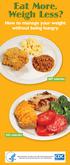 Eat More, Weigh Less? How to manage your weight without being hungry 607 calories 293 calories Department of Health and Human Services Centers for Disease Control and Prevention Can you weigh less without
Triglycerides: Frequently Asked Questions
 Triglycerides: Frequently Asked Questions Why are triglycerides important? The amount of triglycerides (or blood fats) in blood are one important barometer of metabolic health; high levels are associated
Beating insulin resistance through lifestyle changes
 Beating insulin resistance through lifestyle changes This information is relevant to people at risk for type 2 diabetes, those who already have type 2 diabetes, pre- diabetes, polycystic ovary syndrome
Diabetes 101. Lifestyle Recommendations to Manage Diabetes. Cassie Vanderwall. Licensed, Registered Dietitian Certified Personal Trainer
 Diabetes 101 Lifestyle Recommendations to Manage Diabetes Cassie Vanderwall Licensed, Registered Dietitian Certified Personal Trainer Diabetes 101- Outline What is Diabetes? What can I do to control Diabetes?
Healthy Eating During Pregnancy
 Healthy Eating During Pregnancy Pregnancy is a time of great change. Your body is changing to allow your baby to grow and develop. Good nutrition will help you meet the extra demands of pregnancy while
CHOLESTEROL 101: WHAT YOU NEED TO KNOW TO KEEP YOUR HEART HEALTHY. By: Camille Quiles, PharmD., RPh.
 CHOLESTEROL 101: WHAT YOU NEED TO KNOW TO KEEP YOUR HEART HEALTHY By: Camille Quiles, PharmD., RPh. WHAT IS CHOLESTEROL? CHOLESTEROL Waxy, fat-like substance found in all cells of the body Your body uses
Phase Out Artificial Trans Fat In New York City Food Service Establishments
 The Regulation to Phase Out Artificial Trans Fat In New York City Food Service Establishments (Section 81.08 of the New York City Health Code) How to Comply: What Restaurants, Caterers, Mobile Food-Vending
A HEALTHY CHOLESTEROL
 www.irishheart.ie A HEALTHY CHOLESTEROL to reduce your risk of heart disease and stroke A healthy cholesterol You probably already know that cholesterol has something to do with heart disease and stroke.
Pediatrics. Specialty Courses for Medical Assistants
 Pediatrics Specialty Courses for Medical Assistants 7007 College Boulevard, Suite 385 Overland Park, Kansas 66211 www.ncctinc.com t: 800.875.4404 f: 913.498.1243 Pediatrics Specialty Certificate Course
Heart Healthy Living
 Heart Healthy Living Objectives Understand basic functioning of the heart Understand cardiac risk factors Learn how to keep your heart healthy 2 How the Heart Works Muscular organ that pumps blood to your
Section C. Diet, Food Production, and Public Health
 This work is licensed under a Creative Commons Attribution-NonCommercial-ShareAlike License. Your use of this material constitutes acceptance of that license and the conditions of use of materials on this
Nutrition and Chronic Kidney Disease
 Nutrition and Chronic Kidney Disease I have been told I have early kidney failure. What does this mean? What can I expect? This means that your kidneys are not doing as good a job as they should to help
30 % The Food Guide Pyramid T F A O F T O C A L
 The Food Guide Pyramid L I M I T F A O F 30 % S T O T C A L O R I E United States Center for Home and Department of Nutrition Policy Garden Bulletin Agriculture and Promotion Number 252 What s in this
Ready, Set, Start Counting!
 Ready, Set, Start Counting! Carbohydrate Counting a Tool to Help Manage Your Blood Glucose When you have diabetes, keeping your blood glucose in a healthy range will help you feel your best today and in
# Starch # Fat # Fruit # Free Foods. # Other Carbohydrates # Fast Foods # Vegetable. # Meat and Meat Substitutes
 FCS8750 Healthy Meal lans 1 Linda B. Bobroff 2 What Is a Meal lan? A meal plan is a guide to help you plan daily meals and snacks. It allows you to eat foods that you enjoy and that provide a good balance
100 Gram Fat Diet for 72 hour Fecal Fat Collection
 100 Gram Fat Diet for 72 hour Fecal Fat Collection The fecal fat test will help find out if you have steatorrhea (that is, excess fat in bowel movements due to the body not being able to absorb fat). To
Lesson 3 Assessing My Eating Habits
 Lesson 3 Assessing My Eating Habits Overview This lesson introduces the federal guidelines for healthy eating. Students assess their eating habits against these guidelines and make suggestions for improvement.
EMBRACE Your Journey Nutrition During Treatment
 Nutrition is an important part of your cancer treatment. As you prepare for treatment, it is important to focus on eating a well-balanced diet so that your body is as healthy as it can be. When your body
What Does A Healthy Body Need
 What Does A Healthy Body Need Michelle Brezinski Michelle Brezinski has studied Fitness and Nutrition at Simon Fraser University and has received a Herbology Diploma from Dominion College. As a Health
Healthy Eating After 50
 National Institute on Aging AgePage Healthy Eating After 50 Food just doesn t taste the same anymore. I can t get out to go shopping. I m just not that hungry. Sound familiar? These are a few common reasons
20th ANNUAL. About Nutrition INSIGHTS INTO NUTRITION, HEALTH AND SOYFOODS UNITED SOYBEAN BOARD
 20th ANNUAL About Nutrition INSIGHTS INTO NUTRITION, HEALTH AND SOYFOODS UNITED SOYBEAN BOARD 20th Annual Survey Consumer Attitudes about Nutrition 2013 Healthcare professionals can utilize this study
Phase Out Artificial Trans Fat In King County Food Service Establishments
 The Regulation to Phase Out Artificial Trans Fat In King County Food Service Establishments (Chapter 5.10 of the Code of the King County Board of Health) How to Comply: What Restaurants, Delis, Bakeries,
A GUIDE TO HELP PLAN, PURCHASE & PREPARE YOUR OWN HEALTHY FOOD. FOOD SENSE HEALTHY MEALS ON A BUDGET
 A GUIDE TO HELP PLAN, PURCHASE & PREPARE YOUR OWN HEALTHY FOOD. FOOD SENSE HEALTHY MEALS ON A BUDGET You ll be surprised at how affordable, delicious & convenient your own meals can be! the Great Plate:
We want you to have the best results possible while doing our detox. If your goal is weight loss, then eating the right foods and exercising
 Detox Menu Guide We want you to have the best results possible while doing our detox. If your goal is weight loss, then eating the right foods and exercising moderately will help boost your results and
February 2006. 23 Best Foods for Athletes
 23 Best Foods for Athletes February 2006 1. Beans Legumes a. Excellent source of fiber (important for keeping blood sugar and cholesterol levels under control). b. High in protein and a good source of
Cholesterol made simple!
 Cholesterol made simple! Cholesterol is the biggest risk factor for heart disease and also increases your risk of stroke and circulatory disease - Heart UK The Cholesterol Charity What is Cholesterol and
Heart Healthy Diet: Low Fat, Low Cholesterol, Low Sodium Diet
 Heart Healthy Diet: Low Fat, Low Cholesterol, Low Sodium Diet Purpose of the diet Control and / or decrease levels of cholesterol in your blood. Control and / or decrease blood pressure and / or fluid
Richard E. Collins, MD Susan Buckley, RDN, CDE South Denver Cardiology
 Richard E. Collins, MD Susan Buckley, RDN, CDE South Denver Cardiology There is a lot of disagreement in nutrition. But one of the few things people actually agree on is the unhealthy nature of trans fats.
Margarines and Heart Disease. Do they protect?
 Margarines and Heart Disease Do they protect? Heart disease Several studies, including our own link margarine consumption with heart disease. Probably related to trans fatty acids elevate LDL cholesterol
UW MEDICINE PATIENT EDUCATION. PCOS Nutrition. Eat a Balanced Diet
 UW MEDICINE PATIENT EDUCATION PCOS Nutrition Eating for health when you have polycystic ovarian syndrome Eating to treat PCOS is not much different than how many people are advised to eat to be their healthiest.
Wellness Child Care Assessment Tool (WellCCAT)
 Wellness Child Care Assessment Tool (WellCCAT) Developed by: Jennifer Falbe, MPH; Kathryn Henderson, PhD; and Marlene Schwartz, PhD. Acknowledgements: Susan Fiore, MS, RD; Gabrielle Grode, MPH; Erica Kenney,
1. (U4C1L4:G9) T or F: The human body is composed of 60 to 70 percent water. 2. (U4C1L4:G13) Another name for fiber in a diet is.
 Cadet Name: Date: 1. (U4C1L4:G9) T or F: The human body is composed of 60 to 70 percent water. A) True B) False 2. (U4C1L4:G13) Another name for fiber in a diet is. A) vegetables B) laxative C) fruit D)
Carbohydrate Counting for Patients With Diabetes. Review Date 4/08 D-0503
 Carbohydrate Counting for Patients With Diabetes Review Date 4/08 D-0503 Program Objectives At the end of the session you will know how to: Define carbohydrate counting Identify the relationship between
Gaining Weight for Athletes
 Gaining Weight for Athletes Prepared by Jenn Van Ness, ATC June 2008 Gain Weight the Healthy Way To gain one pound, you need to eat approximately 500 more calories a day. Approximately one pound of fat
Carbohydrate Counting for Pediatric Patients With Type 1 Diabetes. Review Date 4/08 K-0591
 Carbohydrate Counting for Pediatric Patients With Type 1 Diabetes Review Date 4/08 K-0591 Program Purpose To increase knowledge of carbohydrate counting and insulin management skills for those caring for
Lap-Band Instructions Post-op Diet
 Lap-Band Instructions Post-op Diet Now That I ve Had Surgery, What Do I Eat Liquid Diet *(1-2 weeks post-op) The goal during this phase is to protect the small stomach pouch. Only liquids can be tolerated
FATS AND OILS: CHOOSE SENSIBLY
 FATS AND OILS: CHOOSE SENSIBLY The information explosion in the science of nutrition very often creates the impression that available information is contradictory. Consequently, it is no longer easy to