
Level 3 Diploma for Residential Childcare (England) ( /81)
|
|
|
- Dale Jacobs
- 9 years ago
- Views:
Transcription
1 Level 3 Diploma for Residential Childcare (England) ( /81) [November 2014] Version 1.0 Qualification Handbook
2 Qualification at a glance Age group approved 18+ Entry requirements Assessment types Approvals Support materials Registration and certification There are no entry requirements Portfolio of evidence Automatic approval is available for centres offering the Level 3 Diploma for the Children and Young People's Workforce: Social Care Pathway (England) ( ) Qualification handbook Consult the Walled Garden/Online Catalogue for last dates Title and level Level 3 Diploma for Residential Childcare City & Guilds number /5268/0 Accreditation number 2

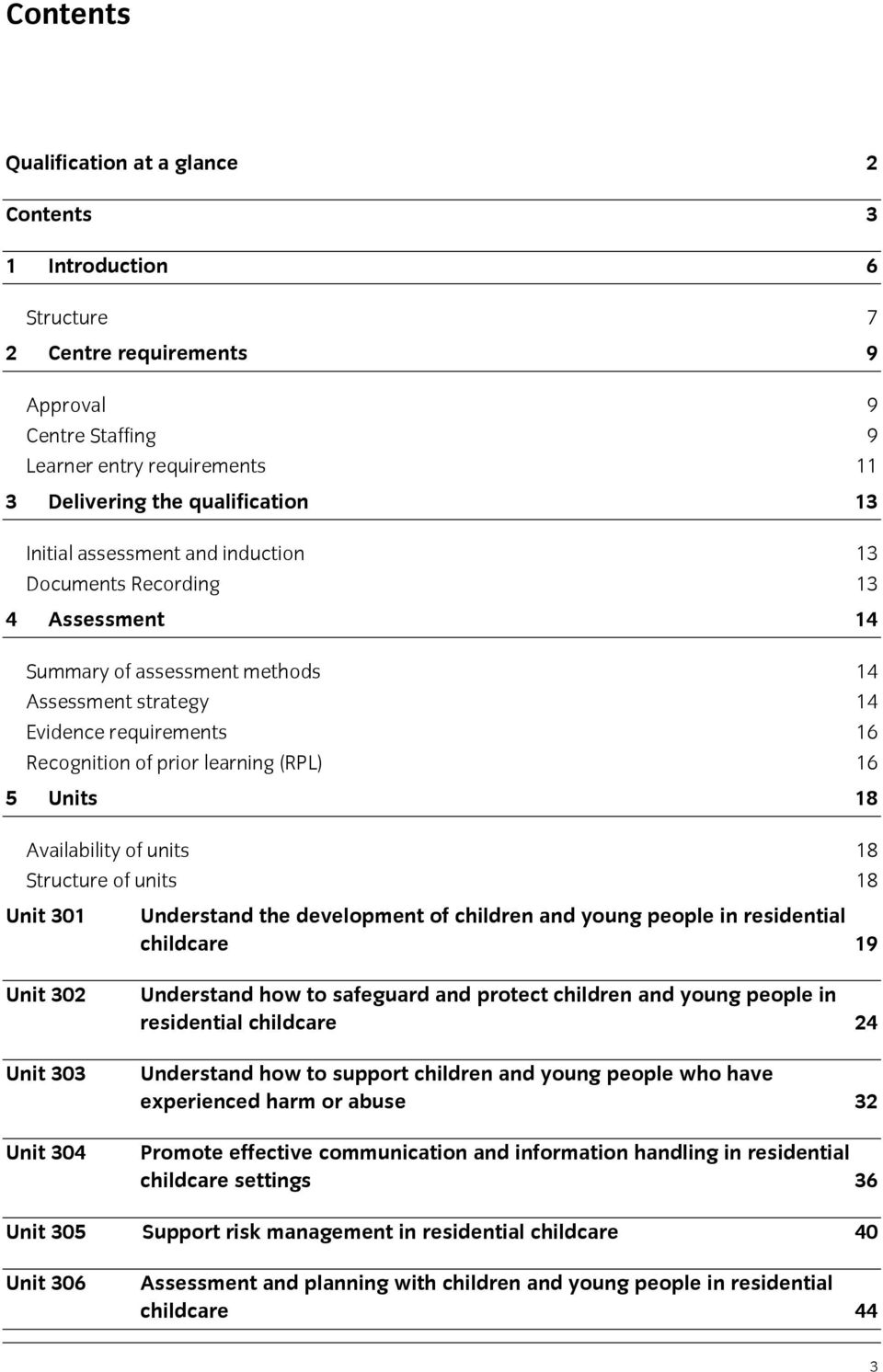
3 Contents Qualification at a glance 2 Contents 3 1 Introduction 6 Structure 7 2 Centre requirements 9 Approval 9 Centre Staffing 9 Learner entry requirements 11 3 Delivering the qualification 13 Initial assessment and induction 13 Documents Recording 13 4 Assessment 14 Summary of assessment methods 14 Assessment strategy 14 Evidence requirements 16 Recognition of prior learning (RPL) 16 5 Units 18 Availability of units 18 Structure of units 18 Unit 301 Unit 302 Unit 303 Unit 304 Understand the development of children and young people in residential childcare 19 Understand how to safeguard and protect children and young people in residential childcare 24 Understand how to support children and young people who have experienced harm or abuse 32 Promote effective communication and information handling in residential childcare settings 36 Unit 305 Support risk management in residential childcare 40 Unit 306 Assessment and planning with children and young people in residential childcare 44 3
4 Unit 307 Support group living in residential childcare 49 Unit 308 Unit 309 Unit 310 Unit 311 Unit 312 Unit 313 Understand how to support positive outcomes for children and young people in residential childcare 53 Support attachment and positive relationships for children and young people in residential childcare 57 Support the well-being and resilience of children and young people in residential childcare 62 Support children and young people in residential childcare to achieve their learning potential 66 Support children and young people in residential childcare to manage their health 70 Support the development of socially aware behaviour with children and young people in residential childcare 74 Unit 314 Engage in professional development in residential childcare settings 79 Unit 315 Unit 316 Support the rights, diversity and equality of children and young people in residential childcare 83 Participate in teams to benefit children and young people in residential childcare 88 Unit 317 Understand the care system and its impact on children and young people 92 Unit 318 Understand the youth justice system as it relates to residential childcare 97 Unit 319 Support young people leaving care 102 Unit 320 Unit 321 Unit 322 Understand residential childcare for children and young people with complex disabilities or conditions 109 Understand support for young people with complex disabilities or conditions making the transition into adulthood 114 Work with the families of children and young people in residential childcare 119 Unit 323 Support use of medication in social care settings 123 Appendix 1 Relationships to other qualifications 128 Appendix 2 Sources of general information 129 Appendix 3 Useful contacts 130 4

5 Dummy Front Matter Cha pter Title - please do not include in out put 5

6 1 Introduction Area Who are the qualifications for? What do the qualifications cover? What opportunities for progression are there? Description The Level 3 Diploma for Residential Childcare (England) is specifically designed for learners wanting to work in residential care with children in a care role. The qualification covers a range of topics. Please see units for details. Learners may progress onto the Level 5 Diploma in Leadership and Management for Residential Childcare (England) ( ). New residential care workers will need to achieve the qualification within two years from employment. This qualification will be the accepted qualification for registration and regulation where appropriate and can demonstrate continuing professional development. Who did we develop the qualification with? This qualification has been developed as the result of a review of the existing residential childcare qualifications and provision driven by the Secretary of State for Children and Families in light of the recent reports highlighting the shortfalls in residential childcare. It has been developed by the Department for Education, Skills for Care and Development and the employers in the industry. Is it part of an apprenticeship framework or initiative? This qualification will form part of the Children and Young People's Workforce Social Care Pathway (England) Apprenticeship available from January

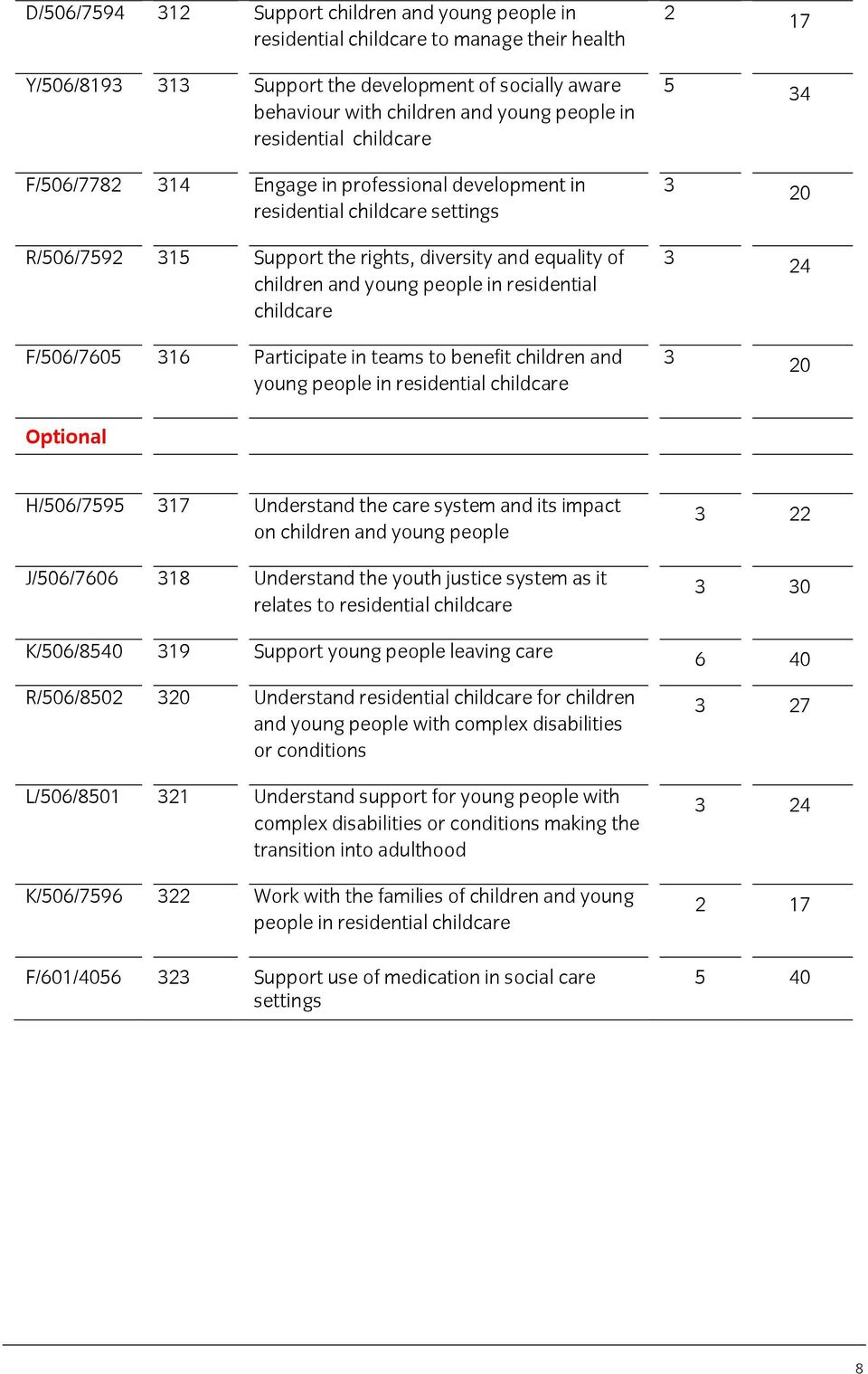
7 Structure To achieve the City & Guilds Level 3 Diploma for Residential Childcare (England), learners must achieve a minimum of 61 credits overall. 53 credits must be achieved from ( ). Learners must also complete a minimum of 3 units from ( ) to achieve a minimum of 8 credits. UAN City & Guilds unit number Unit title Credit value GLH Mandatory F/506/ Understand the development of children and young people in residential childcare T/506/ Understand how to safeguard and protect children and young people in residential childcare A/506/ Understand how to support children and young people who have experienced harm or abuse A/506/ Promote effective communication and information handling in residential childcare settings J/506/ Support risk management in residential childcare A/506/ Assessment and planning with children and young people in residential childcare L/506/ Support group living in residential childcare 3 A/506/ Understand how to support positive outcomes for children and young people in residential childcare M/506/ Support attachment and positive relationships for children and young people in residential childcare T/506/ Support the well-being and resilience of children and young people in residential childcare L/506/ Support children and young people in residential childcare to achieve their learning potential

8 D/506/ Support children and young people in residential childcare to manage their health Y/506/ Support the development of socially aware behaviour with children and young people in residential childcare F/506/ Engage in professional development in residential childcare settings R/506/ Support the rights, diversity and equality of children and young people in residential childcare F/506/ Participate in teams to benefit children and young people in residential childcare Optional H/506/ Understand the care system and its impact on children and young people J/506/ Understand the youth justice system as it relates to residential childcare K/506/ Support young people leaving care R/506/ Understand residential childcare for children and young people with complex disabilities or conditions L/506/ Understand support for young people with complex disabilities or conditions making the transition into adulthood K/506/ Work with the families of children and young people in residential childcare F/601/ Support use of medication in social care settings
9 2 Centre requirements Approval Automatic approval is available for centres offering the Level 3 Diploma for the Children and Young People's Workforce: Social Care Pathway (England) ( and -93). To offer these qualifications, new centres will need to gain both centre and qualification approval. Please refer to the Centre Manual - Supporting Customer Excellence for further information. Centre staff should familiarise themselves with the structure, content and assessment requirements of the qualifications before designing a course programme. Centre Staffing This section outlines the approval processes for centres to offer this qualification and any resources that centres will need in place to offer the qualifications including qualification-specific requirements for centre staff. Existing City & Guilds Centres not currently offering qualifications in this area will need to obtain qualification approval. Human resources To meet the quality assurance criteria for these qualifications, the centre must ensure that the following internal roles are undertaken: Quality Assurance Coordinator Trainer/Tutor Assessor (occupationally competent and occupationally knowledgeable) Internal Quality Assurer Centre staff may undertake more than one role, eg tutor and assessor or an Internal Quality Assurer, but must never internally quality assure their own assessments. Continuing professional development Centres are expected to support their staff in ensuring that their knowledge remains current of the occupational area and of best practice in delivery, mentoring, training, assessment and verification, and that it takes account of any national or legislative developments. Assessor requirements The Assessors of competence based units must: be occupationally competent - this means that each assessor must be able to carry out the full requirements within the competency units that they are assessing. Occupational competence means that they are also occupationally knowledgeable maintain their occupational competence through clearly demonstrable continuing learning and professional development 9

10 hold D32/33 or A1 or be working towards A1 OR be working towards the A1 replacements e.g. the City & Guilds 6317 such as: the Level 3 Award in Assessing Competence in the Work Environment or the Level 3 Certificate in Assessing Vocational Achievement or another suitable qualification equivalent/alternative in the assessment of work based performance. This must be agreed in advance with the centre s Qualification Consultant. Assessors of competence based units may also make assessment decisions on knowledge based units and learning outcomes. Assessors of knowledge based units and knowledge based learning outcomes must: be occupationally knowledgeable. This means that each assessor should possess relevant knowledge and understanding to assess units designed to test specific knowledge and understanding or units where knowledge and understanding are components of competency. maintain their occupational knowledge through clearly demonstrable continuing learning and professional development hold D32/D33 or A1 or be working towards one of the following: the A1 replacement qualifications i.e. the City & Guilds 6317 such as Level 3 Award in Assessing Vocational Competence or Level 3 Award in Assessing Vocationally Related Achievement or Level 3 Certificate in Assessing Vocational Achievement or another suitable qualification in the assessment of knowledge. This must be agreed in advance with the External Verifier. Teachers, Trainers and Tutors Teachers, trainers and tutors must: comply with the ITT Regulations 2007(QTLS/ATLS) where they are delivering qualifications in England using public funding. For further information visit have occupational expertise relevant to the units they are teaching be occupationally knowledgeable in the areas for which they are teaching/delivering training have experience of providing training and assessment or be in the process of acquiring this experience. Internal verifiers/internal quality assurers Internal quality assurance is key to ensuring that the assessment of evidence for units is of a consistent and appropriate quality. Those performing the internal quality assurance role must be occupationally knowledgeable and possess the skills necessary to make quality assurance decisions. Although it is not a requirement to hold a qualification to quality assure this qualification, City & Guilds recommends that it is best practice to hold an internal verification qualification. These include: D34 or V1 the V1 replacements e.g. the City & Guilds 6317 such as the: Level 4 Award in the Internal Quality Assurance of Assessment Processes and Practice OR 10

11 Level 4 Certificate in Leading the Internal Quality Assurance of Assessment Processes and Practice If the Internal Verifier does not hold a qualification they must be able to demonstrate evidence of working to their own organisation s QA or IV standards which clearly link to V1 or other equivalent standards for Internal Quality Assurance Expert witness An expert witness must: have a working knowledge of the QCF units on which their expertise is based be occupationally competent in their area of expertise have EITHER any qualification in assessment of workplace performance AND/OR a professional work role which involves evaluating the every day practice of staff. The use of an expert witness testimony should be determined and agreed by the assessor. Assessment decisions Assessment decisions for criteria that must be assessed in the workplace, as identified in unit assessment requirements, must be made in a real work environment by an occupationally competent assessor. Competence based assessment must include direct observation as the main source of evidence. Simulation may only be utilised as an assessment method for competence based assessment criteria where this is specified in the assessment requirements of the unit. Assessment of knowledge based Learning Outcomes (eg those beginning with know or understand ) may take place in or outside of a real work environment. See - Skills for Care and Development QCF Assessment Principles Learner entry requirements City & Guilds does not set entry requirements for these qualifications. However, centres must ensure that learners have the potential and opportunity to gain the qualifications successfully. Age restrictions The City & Guilds Level 3 Diploma for Residential Childcare is not approved for learners under 18 years of age. City & Guilds cannot accept any registrations for learners below this age group. Other legal considerations Learners working within care services may be legally required to undergo criminal record checks prior to taking up or continuing in employment. Centres and employers will need to liaise closely with one another to ensure that any requirements for the particular area of work are fully met. As the requirements vary between work contexts, checks should be made with the appropriate regulatory body and/or government departments if centres or employers are uncertain of these requirements. These are usually the responsibility of the employer. The appropriate service regulator identifies any fit person criteria, not the Awarding Body. Centres are advised that fit persons criteria and work function job specification limitations may impact the learner/learner s ability to generate sufficient and appropriate evidence that meets the 11

12 learning outcome and assessment criteria in some of the units within this qualification. The completion of a robust initial assessment should aim to highlight any possible issues that will impact on the learner s ability to complete a full qualification. 12

13 3 Delivering the qualification Initial assessment and induction An initial assessment of each learner should be made before the start of their programme to identify: if the learner has any specific training or learning needs support and guidance they may need when working towards their qualification any units they have already completed, or credit they have accumulated which is relevant to the qualification and may be used as part of the RPL process the appropriate type and level of qualification. We recommend that centres provide an induction programme so the learner fully understands the requirements of the qualifications, their responsibilities as a learner, and the responsibilities of the centre. This information can be recorded on a learning contract, a personalised learning plan or a similar document. Documents Recording Learners and centres may decide to use a paper-based or electronic method of recording evidence. City & Guilds endorses several e-portfolio systems, including our own, Learning Assistant, an easyto-use and secure online tool to support and evidence learners progress towards achieving qualifications. Further details are available at: Recording forms are available on the City & Guilds website Although new centres are expected to use these forms, centres may devise or customise alternative forms, which must be approved for use by the external quality assessor/external verifier, before they are used by learners and assessors at the centre. Amendable (MS Word) versions of the forms are available on the City & Guilds website. 13
14 4 Assessment Summary of assessment methods This competence-based qualification is designed to be assessed in the learner s workplace as they undertake their normal work role. The evidence must at all times reflect the policies and procedures of the workplace as informed by current legislation, the relevant service standards and codes of practice for the sector. It is advisable that the majority of assessment for this competence-based qualification will take place in the workplace under real work conditions, using observations by a qualified assessor and/or testimony from an expert witness, work products etc. All the identified assessment criteria must be evidenced and a holistic approach to assessment is encouraged. The learner must be working with a minimum of two service users in order to complete this qualification. The qualification/units need to be assessed in line with the Skills for Care and Development QCF Assessment Principles. Competence based units There will be a combination of assessment methods for this qualification. Direct observation of learners performance by a qualified occupationally competent assessor, and the assessor's judgement on testimony from an Expert Witness Testimony are the main methods of assessment and main source of evidence for this qualification. Knowledge based units Knowledge based units can be assessed in line with this qualification s assessment methods, eg centre devised/internally verified assignments, professional discussion and projects. Within the competence and knowledge-based units, keywords or phrases within the assessment criteria are highlighted in bold to reflect the range. This enables tutors/assessors to teach the areas listed in the range. Assessment strategy External verification This qualification is internally assessed, internally verified and externally verified. Assessment is achieved via robust external and internal quality assurance processes, supported by City & Guilds reporting systems, which identifies areas of best practice and areas for development or risk for each centre. Observation requirements The prime source of evidence for competency based learning outcomes within this qualification is assessor observation. Where assessor observation would be difficult because of intrusion into areas of privacy and/or because activities occur rarely, expert witnesses can provide testimony for the occupationally specific units. 14
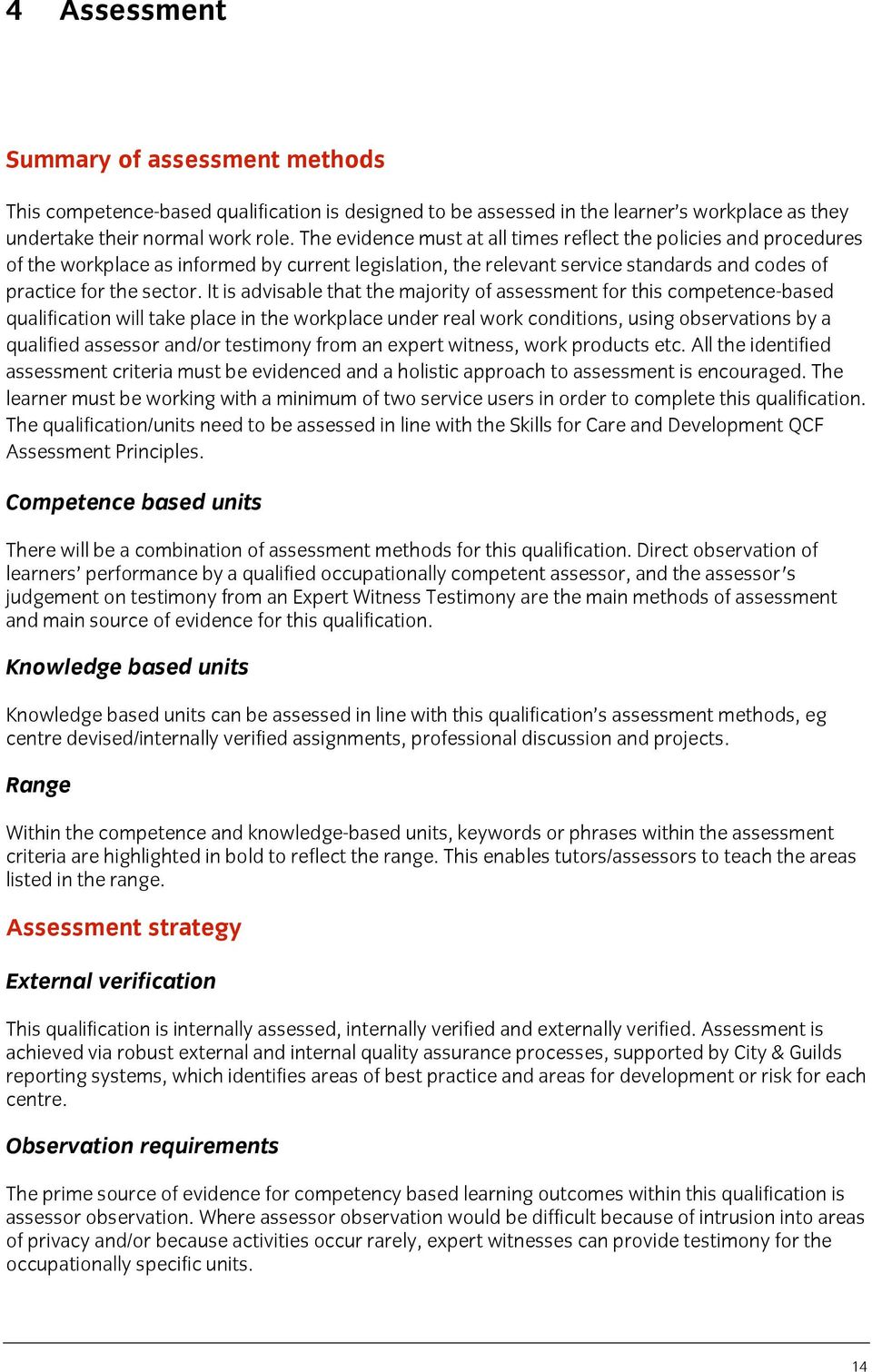
15 Additional assessment method or evidence sources In addition to observation, assessors should identify an appropriate mix of other assessment methods below, to ensure that all the assessment criteria are sufficiently evidenced to allow them to make the consistency of the learner s practice for each unit: Expert witnesses Work products Professional discussion Learner/reflective accounts Questions Witness testimonies Projects/Assignments Case studies Expert witnesses may observe learner practice and provide testimony for competence based units which will have parity with assessor observation for all competence based units across the qualification. If an assessor is unable to observe their learner she/he will identify an expert witness in the workplace, who will provide testimony of the learners work based performance. Work products can be any relevant products of learners own work, or to which they have made a significant contribution, which demonstrate use and application within their practice. Professional discussion should be in the form of a planned and structured review of learners practice, based on evidence and with outcomes captured by means of audio/visual or written records. The recorded outcomes are particularly useful as evidence that learners can evaluate their knowledge and practice across the qualification. Learner/reflective accounts describe learners actions in particular situations and/or reflect on the reasons for practicing in the ways selected. Reflective accounts also provide evidence that learners can evaluate their knowledge and practice across the activities embedded in this qualification. Questions asked by assessors and answered by learners can be used to supplement evidence generated by observations and any other evidence type used. Assessors may be able to infer some knowledge and understanding from observing learner practice. They may ask questions to confirm understanding and/or cover any outstanding areas. Questions may be asked orally or in writing but, in both cases, a record must be kept of the questions and responses. Witness testimonies should come from people who are in a position to provide evidence of learner competence. Where testimony is sought from individuals who are service users, care should be taken to ensure the purpose of the testimony is understood and no pressure is felt to provide it and confidentiality is maintained at all times. Learners may have already completed a relevant project or assignment which can be mapped to the relevant standards and therefore provide evidence. Evidence can also be obtained from previous training courses and/or learning programmes which they have completed and which demonstrate their professional development may also be used (see section on Recognition of Prior Learning). Case studies must be based on real work practice and experiences and will need to be authenticated by an assessor if used as evidence of performance competence. Theoretical or simulated exercises would only be admissible as evidence of knowledge and understanding. NB Confidential records must not to be included in learners portfolios but must be referred to in the assessment records. 15
16 Evidence requirements Competence evidence requirements The structure of this qualification makes it unlikely that any one assessor will have the necessary vocational competence to be able to assess every unit. Therefore the use of a range of occupationally competent assessors and/or experts who are able to contribute to a learner s assessment, will be of considerable assistance to centres in providing learners with access to those who can testify to their competence in the workplace. It may also ensure that privacy and confidentiality are not infringed. Evidence of learner performance will be derived from assessor observation and/or testimony from an expert witness of the learner carrying out real work activities in the workplace. Assessor observation is not required for the knowledge units although knowledge can be inferred from performance. The unit qualified and occupationally competent assessor or the learner s overall qualification coordinating assessor will decide on the appropriateness of all evidence including expert witness testimony and on whether or not it should be included in a learners portfolios. Legal requirements and best practice in relation to maintaining the confidentiality and the rights to dignity and privacy of the people participating and contributing to the evidence must be upheld. This is regardless of the evidence source, assessment method and means used for recording such evidence. Knowledge evidence requirements If the assessor cannot positively infer the knowledge and understanding from learners work practice they should question the learner or, if appropriate, use professional discussion to elicit the required knowledge. Assessors must retain records of questions and answers on the focus and outcomes of professional discussion. Centre-designed assignments may also be used and must comply with the City & Guilds centre assessment guidance criteria as provided (document Assessor Guidance, available on Professional discussion, where used, must be conducted with learners by a qualified occupationally knowledgeable assessor. Professional discussion is most appropriately used in the qualification to elicit underpinning knowledge to explain how to deal with contingencies and clarify or expand on evidence presented in portfolios. Professional discussion must be included in learners assessment plans and thereby agreed in advance with learners. The assessor could use professional discussion to ask a set of prescribed knowledge questions if required. Recognition of prior learning (RPL) Recognition of Prior Learning (RPL) is a process of using an individual s previous achievements to demonstrate competence within QCF. This is not a new process but expands on previously used processes such as the Accreditation of Prior Learning (APL), the recognition of experimental learning and the validation of informal learning by incorporating all types of prior learning and training. The regulatory arrangements for the Qualifications and Credit Framework define RPL as a method of assessment that considers whether a learner can demonstrate that they can meet the assessment requirements for a unit through knowledge, understanding or skills they already possess and do not need to develop through a course of learning. In the context of the QCF, the definition of RPL is quite specific and relates to assessment leading to the award of credit. 16

17 Assessment for RPL is conducted against the learning outcomes and assessment criteria of a unit and is subject to exactly the same quality assurance requirements as any other kind of assessment within the QCF. The RPL process is relevant where an individual has previously learnt something but may never have received formal recognition for this learning through a qualification or other form of certification. Within the QCF an individual is able to claim that he or she knows or can do something already and does not need to attend a course to learn it again. If he or she can prove this claim (through assessment of relevant evidence), then credit can be awarded for that achievement in the same way as any other credits. RPL refers to an opportunity for learners to present competence or knowledge evidence which comes from a period prior to their registration for a particular qualification. The evidence presented - e.g. certificates, witness testimonies etc. - will need to provide sufficient detail to allow the assessor to apply the RPL assessment process. Assessment staff work through Learning Outcomes and Assessment Criteria ensuring that all are covered, using relevant methods for RPL such as: witness testimony, reflective accounts, professional discussion, etc. In considering the appropriateness of any single piece of evidence the following should be considered: Content the degree to which the content of any previous learning meets the requirements of the National Occupational Standards against which it is being presented as evidence. Comprehensiveness of Assessment ensure that all the learning derived from the content has been assessed. If only a proportion has been assessed, then the learning for the non-tested areas cannot be assumed. Level the degree to which the level of learning offered and tested relates to that required by the Level 3 Diploma for Residential Childcare (England) s and the degree to which the previous learning covered both. Some learning will only have offered and tested the latter, in which case the Recognition of Prior Learning can only cover the knowledge aspect. Performance will require further assessment. Although unlikely, the reverse (performance tested but not knowledge) could be true in which case knowledge and understanding would need further assessment. Model of learning difficulties can arise in mapping learning gained from non-competence based learning programmes into competence-based models. Relevance of Context the degree to which the context of the learning gained and assessed relates to the current context of learners work roles. If the context was different, assessors will need to satisfy themselves of learners ability to transfer the learning gained into the current setting. 17

18 5 Units Availability of units The following units can also be obtained from the City & Guilds website. They are also on the Register of Regulated qualifications: Structure of units These units each have the following: City & Guilds reference number Title Unit accreditation number (UAN) Level Credit value Guided learning hours Relationship to NOS, other qualifications and frameworks Assessment requirements Unit aim s Supporting information 18
19 Unit 301 Understand the development of children and young people in residential childcare UAN: F/506/7653 Unit level: 3 Credit value: 3 GLH: 25 Unit aim: Relationship to NOS: Endorsed by This unit provides the knowledge and understanding required in residential childcare settings about the development of children and young people SCDCCLD0303 Skills for Care and Development and Department for Education Assessment type: Portfolio of evidence 1 Understand the expected pattern of development for children and young people from birth to19 years 1.1 Explain the sequence and rate of each aspect of development from birth to 19 years 1.2 Explain the difference between sequence of development and rate of development 1.3 Explain the impact of adolescent development on a young person s thoughts, feelings and behaviours (AC1.1) Aspects of development includes: Physical Language and communication Intellectual / cognitive Social, emotional and behavioural Moral 19

20 2 Understand the factors that influence children and young people s development and how these affect practice 2.1 Explain how children and young people s development is influenced by personal factors 2.2 Explain how children and young people s development is influenced by external factors 2.3 Explain how theories of development and frameworks to support development influence practice in a residential childcare setting (AC2.1) Personal factors includes: Health status Disability Sensory impairment Learning difficulties (AC2.2) External factors includes: Poverty and deprivation Family environment and background Neglect Trauma Grief and loss Personal choices Looked after/ care status Education (AC2.3) Theories of development includes: Cognitive (eg Piaget) Psychoanalytic (eg Freud) Humanist (eg Maslow) Social Learning (eg Bandura) Operant conditioning (eg Skinner) Behaviourist (eg Watson) (AC2.3) Frameworks to support development: Social pedagogy 20

21 3 Understand the cycle of monitoring, assessment and intervention for children and young people s development 3.1 Explain how to monitor children and young people s development using different methods 3.2 Explain the importance of observation within the monitoring and assessment process 3.3 Explain how interventions can promote positive outcomes for children and young people where development is not following the expected pattern 3.4 Explain how multi agency teams work together to address a child or young person s development needs 3.5 Describe ways to ensure that day to day activities support the development of children and young people (AC3.1) Methods of assessing development include: Assessment Framework(s) Observation Standard measurements Information from carers and colleagues Listening to the child or young person s own account of their development (AC3.3) Interventions include: social worker speech and language therapist psychologist psychiatrist youth justice physiotherapist nurse specialist additional learning support assistive technology health visitor 4 Understand the importance of early intervention to support development needs of children and young people 21
22 4.1 Explain the importance of early identification of development issues 4.2 Explain the particular significance of early identification of speech, language and communication delays and disorders 5 Understand the effects of transitions on children and young people s development 5.1 Explain how times of transition can affect children and young people s development 5.2 Evaluate the effect on children and young people of having positive relationships during periods of transition (AC5.1) Times of transition include: Emotional, affected by personal experience eg bereavement, entering/leaving care physical, eg moving to a new educational establishment, a new home/locality, from one activity to another, between a range of care givers on a regular basis Physiological eg puberty, long term medical conditions Intellectual eg moving from pre-school to primary to post primary. 22
23 Unit 301 Supporting Information Understand the development of children and young people in residential childcare Assessment requirements This unit must be assessed in line with the Skills for Care & Development QCF Assessment Principles. 23
24 Unit 302 Understand how to safeguard and protect children and young people in residential childcare UAN: A/506/8363 Unit level: 3 Credit value: 7 GLH: 63 Unit aim: Relationship to NOS: Endorsed by This unit provides the knowledge and understanding required to safeguard and protect children and young people in residential childcare settings SCDHSC0034 Skills for Care and Development and Department for Education Assessment type: Portfolio of evidence 1 Understand the context of safeguarding and protection of children and young people 1.1 Define the term safeguarding in relation to children and young people 1.2 Explain how child protection relates to safeguarding 1.3 Outline current legislation, national guidelines and policies affecting the safeguarding and protection of children and young people 2 Understand policies and practices for the protection of children and young people and the adults who work with them 24
25 2.1 Explain why it is important to ensure children and young people are protected from harm and abuse 2.2 Explain how findings from official inquiries and serious case reviews are used to inform practice 2.3 Identify policies and procedures that are in place to protect children and young people and the adults who work with them 2.4 Analyse how working practices with children and young people reflect national and local guidelines, policies and procedures for safeguarding 2.5 Explain how following procedures helps protect team members from allegations and complaints as well as protecting children and young people from harm and abuse 2.6 Explain the importance of building positive, trusting and consistent relationships with children and young people who are vulnerable to harm or abuse 2.7 Describe systems and practices to ensure children and young people can voice allegations, concerns and complaints and be confident these will be addressed (AC2.3) Policies and procedures for safe working, eg those relating to: Working in an open and transparent way Listening to children and young people Duty of care Whistleblowing Power and positions of trust Propriety and behaviour Physical contact Intimate personal care Off site visits Photography and video Use of social media Sharing concerns and recording/ reporting incidents Child sexual exploitation (AC2.4) Working practices, eg: Ensuring the voice of the child or young person is heard (eg providing advocacy services) Supporting children and young people and others who may be expressing concerns Risk assessment 3 Understand the nature of abuse that can affect children and young people in residential childcare 25
26 3.1 Describe types of abuse that a child or young person may experience 3.2 Describe signs and indicators associated with each type of abuse 3.3 Describe factors which increase the vulnerability of children and young people in residential childcare 3.4 Summarise common myths about people who harm and abuse children and young people 3.5 Describe known characteristics of perpetrators and their behaviours that can make it difficult for children and young people to report harm or abuse and for others to recognise and address abusive activity (AC3.1) Types of abuse may be: Physical Emotional Sexual Financial Bullying Self harm Neglect Exploitation by gangs and groups (AC3.5) Perpetrators and their behaviours eg: Position of power in the community or organisation Celebrity status Fellow resident/peer Grooming (of the child or young person and those around them) Threats of reprisals Promises of rewards Denial of behaviour as abusive Targeting boys and young men (in relation to sexual abuse) 4 Understand how to address concerns about abuse 4.1 Outline the actions to be taken in line with policies and procedures if abuse is suspected 4.2 Explain the importance of early identification of abuse 4.3 Explain why warning signs may be mis-interpreted or ignored 4.4 Explain reasons why a child or young person may not recognise that they are being abused or exploited 26
27 4.5 Explain reasons why a child or young person may not disclose that they are being abused or exploited 5 Understand policies, procedures and practices to address bullying 5.1 Explain the effects of different types of bullying on children and young people 5.2 Outline the policies and procedures that should be followed in response to concerns or evidence of bullying 5.3 Explain why policies and procedures regarding bullying are necessary 5.4 Explain how to support a child or young person when bullying is suspected or alleged (AC5.1) Bullying Physical (Pushing, kicking, hitting, pinching and other forms of violence or threats) Verbal (Name-calling, insults, sarcasm, spreading rumors, persistent teasing) Emotional (tormenting, ridicule, humiliation, excluding) Cyberbullying (the use of technology, particularly mobile phones and the internet, deliberately to upset someone else) Child on child/child on adult/adult on child Specific types of bullying which can relate to all the above such as homophobic or gender based, racist, relating to special educational needs and disabilities. 6 Understand principles for e-safety 6.1 Explain the risks and possible consequences for children and young people from a social networking b internet use c buying and selling online d electronic communication devices 6.2 Describe ways of reducing risk to children and young people from: a social networking b internet use c buying and selling online d electronic communication devices 27
28 7 Understand how to minimise risk of harm to a child or young person who goes missing from care 7.1 Describe the risks to a child or young person who goes missing from care 7.2 Outline actions to be taken in line with policies and procedures when a child or young person goes missing 7.3 Explain the importance of prompt and persistent action when a child or young person goes missing 8 Understand child sexual exploitation 8.1 Define child sexual exploitation and its relationship to human trafficking 8.2 Describe how child sexual exploitation differs from non-abusive sexual activity 8.3 Outline different patterns of child sexual exploitation in relation to a b c Gangs Groups Solo perpetrators 8.4 Describe typical behaviour patterns of those who sexually exploit children and young people 8.5 Describe the support that should be offered to a child or young person who has been the victim of child sexual exploitation 8.6 Explain the role of key partners in protecting children and young people from sexual exploitation (AC8.6) Key partners includes: Sexual Health Services Police, Crown Prosecution Service Youth Offending Services Probation Services Housing Services Drug and Alcohol Services Mental Health Services, including Child and Adolescent Mental Health (CAMHS) Community Health Services, including GPs 28
29 Hospital Trusts Education Services, Voluntary and Community sector Family and carers 9 Understand the concept of multi-agency working to safeguard children and young people 9.1 Explain what is meant by multi-agency working in the context of safeguarding 9.2 Identify multi agency forums which coordinate the safeguarding of children and young people locally 9.3 Describe the roles and responsibilities of the different organisations that may be involved in situations where a b c harm or abuse is suspected or disclosed a child or young person has been abused or harmed a child or young person has gone missing from care (AC9.2) Multi agency forums eg Local Safeguarding Children's Boards Multi Agency Safeguarding Hubs 10 Understand how to empower children and young people to develop strategies to protect their own safety and well being 10.1 Explain the importance of building children and young people s resilience, self-confidence and self-esteem 10.2 Describe ways to work with children and young people to enable them to develop protective strategies 10.3 Describe ways of empowering children and young people to make informed choices that support their safety 29
30 11 Understand process and procedures when there are concerns about practice 11.1 Explain how to report concerns about practice in the work setting 11.2 Describe ways in which whistle blowers are protected in the work setting 11.3 Explain why those whose practice is being questioned are also protected and how this is achieved 11.4 Explain the process of escalating concerns about practice if they are not being addressed 30
31 Unit 302 Supporting Information Understand how to safeguard and protect children and young people in residential childcare Assessment requirements This unit must be assessed in line with the Skills for Care & Development QCF Assessment Principles. 31
32 Unit 303 Understand how to support children and young people who have experienced harm or abuse UAN: A/506/8364 Unit level: 3 Credit value: 3 GLH: 22 Unit aim: Relationship to NOS: Endorsed by This unit provides the knowledge and understanding required to support children and young people who have experienced harm or abuse SCDHSC0325 Skills for Care and Development and Department for Education Assessment type: Portfolio of evidence 1 Understand the role and responsibilities of the practitioner and others when supporting children and young people who have experienced harm or abuse 1.1 Explain the role and responsibilities of the practitioner with regard to children or young people who have experienced harm or abuse 1.2 Explain the roles and responsibilities of others with regard to children or young people who have experienced harm or abuse 1.3 Explain the importance of establishing trusting relationships with children or young people who have experienced harm or abuse (AC1.1) Harm or abuse may be: Physical Emotional 32
33 Sexual Financial Bullying Self harm Neglect Exploitation by gangs, groups or solo perpetrators (AC1.2) Others may include Team members Families or carers Advocates Social workers Others in the local network for safeguarding and protection 2 Understand how to support children and young people who disclose harm or abuse 2.1 Explain why it is important to take full account of a child or young person s level of understanding when responding to a disclosure of harm or abuse 2.2 Explain how to avoid actions or statements that could adversely affect the use of evidence in future investigations or in court 2.3 Explain the importance of supporting a child or young person to understand: a b with whom the information they disclose will be shared the reasons for sharing information they disclose 2.4 Describe ways to support a child or young person to disclose, at their own pace, the harm or abuse they have experienced 2.5 Explain why it is important to respond calmly to disclosures of harm or abuse 2.6 Explain why records about disclosures of harm or abuse must be detailed, accurate, timed, dated and signed 2.7 Explain how to access support in situations that are outside the expertise, experience, role and responsibility of the practitioner (AC2.2) Actions could include avoiding leading questions or putting pressure on the child or young person to disclose information. 3 Understand how to support children or young people who have experienced harm or abuse 33
34 3.1 Identify sources of information and guidance about how to support a child or young person who has experienced harm or abuse 3.2 Describe ways to support a child or young person to deal with distress, fear and anxieties caused by harm or abuse 3.3 Explain why a child or young person may need support to understand the implications of harm and abuse they have experienced 3.4 Describe positive coping strategies that a child or young person can be supported to develop following harm or abuse 3.5 Describe behaviour that a child or young person may exhibit that might give cause for concern following harm or abuse, and the steps to take if these are observed 4 Understand restrictions on the involvement of key people with children or young people who have experienced harm or abuse 4.1 Explain circumstances when restrictions need to be imposed on the involvement of key people following harm or abuse 4.2 Describe ways of supporting a child or young person to understand why safe and consistent boundaries for themselves and key people must be set and maintained (AC4.1) Key people are those who are important to the child or young person and who can make a difference to his or her well-being. Key people include family, friends, carers and others with whom the individual has an important relationship 5 Understand how to address the practitioners support needs in relation to harm or abuse 5.1 Describe how to make effective use of supervision to reflect on own emotional response about harm or abuse experienced by a child or young person 5.2 Explain when additional support might be needed for dealing with own thoughts and feelings about harm or abuse 34
35 Unit 303 Supporting Information Understand how to support children and young people who have experienced harm or abuse Assessment requirements This unit must be assessed in line with the Skills for Care & Development QCF Assessment Principles. 35
36 Unit 304 Promote effective communication and information handling in residential childcare settings UAN: A/506/8526 Unit level: 3 Credit value: 3 GLH: 21 Unit aim: Relationship to NOS: Endorsed by This unit provides the knowledge and skills required to promote effective communication and information handling in residential childcare settings SCDHSC0031 Skills for Care and Development and Department for Education Assessment type: Portfolio of evidence 1 Understand effective communication in the work setting 1.1 Explain the reasons why people communicate 1.2 Describe factors to consider for effective communication 1.3 Analyse reasons why in a particular situation a child or young person may be unable to use verbal communication 1.4 Explain how communication affects relationships and effective practice in own work 2 Be able to meet the communication and language needs, wishes and preferences of individual children and young people 36
37 2.1 Establish the communication and language needs, wishes and preferences of a child or young person 2.2 Use communication methods and aids to meet the individual needs of children or young people 2.3 Explain how children and young people use communication methods in different ways 2.4 Respond to children or young people s reactions while communicating with them (AC2.2) Communication methods and aids may include: Verbal Non-verbal Sign Pictorial Written Electronic/technological Assisted 3 Be able to reduce barriers to communication in residential childcare settings 3.1 Describe barriers to communication and their impact 3.2 Reduce barriers to communication 3.3 Adapt communication to resolve misunderstandings 3.4 Explain how to access support or services to enable a child or young person to communicate effectively (AC3.4) Services may include: translation services interpreting services speech and language services advocacy services 4 Be able to use communication skills to de-escalate situations of tension or conflict 37
38 4.1 Use verbal and non-verbal communication skills to de-escalate a situation of tension or conflict 4.2 Use reflective practice to review the impact of own communication in situations of tension or conflict 5 Understand principles and practices relating to confidentiality in own work 5.1 Explain the term confidentiality 5.2 Explain the conflict between maintaining confidentiality and disclosing concerns 5.3 Explain the boundaries of own role and responsibilities in relation to confidentiality and disclosure 6 Be able to implement organisational processes and procedures for recording, storing and sharing information 6.1 Contribute to the implementation of organisational processes and procedures for recording, storing and sharing information 6.2 Apply confidentiality in day to day communication, in line with policies and procedures 6.3 Maintain data in line with policies and procedures that underpin integrated and multiagency working 38
39 Unit 304 Promote effective communication and information handling in residential childcare settings Supporting Information Assessment requirements This unit must be assessed in line with the Skills for Care & Development QCF Assessment Principles. s 2, 4 and 6 must be assessed in a real work environment. 39
40 Unit 305 Support risk management in residential childcare UAN: J/506/7587 Unit level: 3 Credit value: 2 GLH: 18 Unit aim: This unit provides the knowledge and skills required to support risk management in residential childcare Relationship to NOS: SCDHSC 0032 Endorsed by Skills for Care and Development and Department for Education Assessment type: Portfolio of evidence 1 Understand requirements for health, safety and risk management in residential childcare settings for children and young people 1.1 Summarise key points of the legislative framework for health, safety and risk management in residential childcare settings for children and young people 1.2 Explain how current health and safety legislation, policies and procedures are implemented in the work setting 1.3 Explain how health and safety is monitored and maintained in the work setting 1.4 Explain how people in the work setting are made aware of risks and hazards and encouraged to work safely 2 Be able to support children and young people to manage risk 40
41 2.1 Analyse the value of risk and challenge for a child or young person s development and enjoyment of life 2.2 Explain why it is important to take an approach to risk that avoids both excessive risk-taking and excessive risk aversion 2.3 Work with children or young people and others to establish shared agreement on how to manage risks 2.4 Support children or young people to manage risk in their own lives, taking into account their age, abilities, needs and stage of development 2.5 Describe potential conflicts between the rights and choices of children and young people and legal requirements for health and safety and well-being (AC2.3) Others including Colleagues Visitors Families and carers 3 Be able to manage risks to health, safety and security 3.1 Describe factors to consider to ensure the living environment is healthy and safe 3.2 Undertake health and safety risk assessments 3.3 Use the recommendations of risk assessments to manage hazards a within the work setting b in off site visits 3.4 Explain how health and safety risk assessments are monitored and reviewed (AC3.1) Factors eg: The individual needs, age and abilities of the children and young people Desired outcomes for the children and young people The function and purpose of the environment and the service offered Lines of responsibility and accountability The duty of care 41
42 (AC3.3) Hazards eg: Physical Security Fire Food safety Personal safety 4 Understand how to respond to accidents, incidents, emergencies and illness in work settings and off site visits 4.1 Explain the policies and procedures to follow in response to a b c d e accidents incidents injuries illness other emergencies 4.2 Describe the procedures for recording and reporting a b c d e accidents incidents injuries illness other emergencies (AC4.1) (AC4.1) (AC4.1) Accidents involving children, young people or adults Illness including recognition of signs such as fever, rashes or unconsciousness Emergencies such as fire, missing children or young people, evacuation of premises. 42
43 Unit 305 Support risk management in residential childcare Supporting Information Assessment requirements This unit must be assessed in line with the Skills for Care & Development QCF Assessment Principles. s 2 and 3 must be assessed in a real work environment. 43
44 Unit 306 Assessment and planning with children and young people in residential childcare UAN A/506/7828 Unit level: 3 Credit value: 3 GLH: 20 Unit aim: Relationship to NOS: Endorsed by This unit provides the knowledge and skills required to carry out assessment and planning with children and young people in residential childcare SCDHSC0036 Skills for Care and Development and Department for Education Assessment type: Portfolio of evidence 1 Understand the purpose and principles of assessment and planning with children and young people 1.1 Describe the purpose of assessment and planning with children and young people in residential childcare 1.2 Explain why a child centred model of assessment and planning is used 1.3 Explain how assessment frameworks help to ensure holistic assessment 1.4 Explain the legal requirements for recording assessment and planning information 2 Understand how to place children and young people at the centre of assessment and planning 44
45 2.1 Explain how to use a child centred model of assessment and planning to identify the needs of children and young people 2.2 Explain the importance of working with others when assessing and planning for the needs of children and young people 2.3 Describe how to use methods of engagement to ensure the child is central when assessing and planning with children and young people 2.4 Describe strategies for child centred assessment and planning with children and young people who disengage from the process (AC2.2) Others eg: Children and young people Families/Carers Foster carers Residential workers Social workers Psychologists Doctors Support workers Police Youth justice Speech and language therapists Other agencies (AC2.3) Methods of engagement eg: Appropriate venue/location Contributions through play Contributions through pictures Children and young people setting ground rules Written contributions Video/audio contributions 3 Be able to participate in assessment and planning for children and young people 3.1 Explain the boundaries of own role and responsibilities within assessment and planning 3.2 Engage with children or young people to enable them to express their needs, views and aspirations in the assessment and planning process 45
46 3.3 Use and adapt assessment frameworks to ensure the assessment is full, accurate and child centred 3.4 Work with the child or young person to agree goals and targets 3.5 Explain how the goals and targets identified will support the achievement of positive outcomes 3.6 Work with the child or young person and others to develop a plan to meet assessed needs and work towards positive outcomes 3.7 Confirm that the child or young person and others understand and agree to the plan 4 Be able to work with children and young people as a plan is implemented 4.1 Support the child or young person and others to understand their roles and responsibilities in implementing an agreed plan 4.2 Encourage the child or young person to work towards the achievement of a plan 4.3 Agree ways of recording progress towards goals and targets with the child or young person and in line with organisational requirements 4.4 Record progress of a child or young person in relation to a plan 5 Be able to work with children and young people to review and update plans 5.1 Explain the importance of reviewing and updating plans 5.2 Work with the child or young person and others to review progress towards goals and targets 5.3 Identify aspects of the plan that are working well and those that need to be revised 5.4 Use outcomes of review to update plan 5.5 Agree the updated plan with the child or young person and others involved 6 Be able to contribute to assessment led by other professionals 46
47 6.1 Explain own role and the roles of others in the external assessment process 6.2 Respond to requests for information to support the assessment in line with organisational requirements 6.3 Support the child or young person to understand and contribute to external assessment 47
48 Unit 306 Assessment and planning with children and young people in residential childcare Supporting Information Assessment requirements This unit must be assessed in line with the Skills for Care & Development QCF Assessment Principles. s 3, 4, 5 and 6 must be assessed in a real work environment. 48
49 Unit 307 Support group living in residential childcare UAN: L/506/7588 Unit level: 3 Credit value: 3 GLH: 22 Unit aim: Relationship to NOS: Endorsed by This unit provides the knowledge and skills required to support group living in residential childcare SCDHSC0323 Skills for Care and Development and Department for Education Assessment type: Portfolio of evidence 1 Understand theories that underpin work with children and young people in group living 1.1 Summarise theories about groups as they relate to group living with children and young people 1.2 Summarise theories about how the physical environment can support well-being in a group setting 2 Be able to support children and young people to live together as a group 2.1 Apply theories of group dynamics to support children or young people in their day to day experience of group living 49
50 2.2 Facilitate agreements with and between children or young people on arrangements for living together as a group 2.3 Support children or young people to resolve conflict and disagreements 2.4 Explain why it can be beneficial to work with some conflicts and disagreements rather than seek to resolve them 2.5 Work with children or young people to maintain the physical environment in ways that support well-being 3 Be able to plan with children and young people activities for sharing a living space 3.1 Plan with children or young people daily living activities that meet their needs, preferences and aspirations 3.2 Explain how planning daily living activities as a group links to individual plans for children and young people 3.3 Ensure that children or young people are central to decisions about daily activities involved in sharing a living space (AC3.2) Plans may include Placement Plan Statutory Care Plan Health and Education Plan Training Plan Remand Plan 4 Be able to support children and young people to develop relationships through daily living activities 4.1 Develop positive relationships with children and young people through jointly undertaking day to day activities 4.2 Encourage socially aware behaviour through modelling and reinforcement during shared activities 4.3 Support children and young people to maintain positive relationships with others through shared activities 50
51 (AC4.3) Others may include: Children and young people in the group Children and young people in the wider community Family members of children and young people Team members Other professionals Others in the wider community 5 Be able to support continuous improvement in group living arrangements 5.1 Reflect on the impact of own practice and behaviour on children and young people s experience of group living 5.2 Work with children and young people to evaluate activities and agreements for group living 5.3 Propose improvements to group living arrangements and practices using reflections and evaluations 51
52 Unit 307 Support group living in residential childcare Supporting Information Assessment requirements This unit must be assessed in line with the Skills for Care & Development QCF Assessment Principles. s 2, 3, 4 and 5 must be assessed in a real work environment. 52
53 Unit 308 Understand how to support positive outcomes for children and young people in residential childcare UAN: A/506/7618 Unit level: 3 Credit value: 2 GLH: 20 Unit aim: Relationship to NOS: Endorsed by This unit provides the knowledge and understanding required to support positive outcomes for children and young people in residential childcare SCDHSC0303 Skills for Care and Development and Department for Education Assessment type: Portfolio of evidence 1 Understand how the social, economic and cultural environment can impact on the outcomes and life chances of children and young people 1.1 Explain the impact of poverty on outcomes and life chances for children and young people 1.2 Identify the impacts of social and cultural factors on the lives of children and young people 1.3 Explain how the personal choices and experiences available to children and young people can impact on their outcomes and life chances (AC1.2) Social and cultural factors eg: Being in the care system Housing and community Educational environment 53
54 Offending or anti social behaviour Health status of self or family member Disability Health support (GP, health clinic, access to A&E etc) Addictions in family or self Bereavement and loss Family expectations and encouragement Religious beliefs and customs Ethnic/cultural beliefs and customs Marginalisation and exclusion 2 Understand how those working with children and young people can support positive outcomes 2.1 Identify positive outcomes for children and young people that residential childcare services aim to achieve 2.2 Explain the importance of active participation of children and young people in decisions affecting their lives 2.3 Explain the importance of designing services around the needs of children and young people 2.4 Explain how to support children and young people to make personal choices according to their needs and abilities 2.5 Explain how social pedagogy aims to support positive outcomes for children and young people 2.6 Explain why it is important for practitioners to have high expectations of and ambitions for all children and young people (AC2.1) Positive outcomes for children and young people will include those relating to: Health Education Leisure Good self esteem Positive identity Participation in the community 3 Understand how disability can impact on positive outcomes and life chances for children and young people 54
55 3.1 Explain the impact disability can have on positive outcomes and life chances of children and young people 3.2 Explain the importance of positive attitudes towards disability 3.3 Explain how the social model of disability shapes attitudes and approaches to support positive outcomes 3.4 Describe support available for children and young people with disabilities (AC3.1) Disability in this context can include a wide range of conditions, difficulties and impairments eg: Learning disabilities Physical disabilities Sensory impairment Long term medical conditions Complex needs Special educational needs Dyslexia (AC3.4) Support eg: Speech and language therapy Support from health professionals Additional learning support Assistive technology including electronic and digital systems Specialised services 55
56 Unit 308 Supporting Information Understand how to support positive outcomes for children and young people in residential childcare Assessment requirements This unit must be assessed in line with the Skills for Care & Development QCF Assessment Principles. 56
57 Unit 309 Support attachment and positive relationships for children and young people in residential childcare UAN: M/506/7616 Unit level: 3 Credit value: 4 GLH: 27 Unit aim: Relationship to NOS: Endorsed by This unit provides the knowledge and skills required to support children and young people in residential childcare to develop attachment and form positive relationships SCDHSC0311 Skills for Care and Development and Department for Education Assessment type: Portfolio of evidence 1 Understand the importance of positive attachments for the well-being of children and young people 1.1 Summarise theories of attachment 1.2 Explain why positive attachments are important for children and young people 1.3 Analyse the short and long term impacts on the well-being of children and young people if they are not able to form positive attachments (AC1.2) Positive attachments include primary and secondary attachments (AC1.3) Impacts may include: Physiological Psychological 57
58 Emotional Relational Behavioural 2 Understand how to support positive attachments for children or young people in residential childcare 2.1 Analyse factors in the life of a child or young person which can present barriers to forming positive attachments 2.2 Explain the role of parents and care-givers in supporting children and young people to form positive attachments 2.3 Explain the connection between positive attachments and positive relationships 2.4 Explain how attachment impacts on own role 2.5 Describe strategies for supporting children and young people to form positive attachments (AC2.1) Factors eg: Previous experience of hostile or dysfunctional relationships Frequent imposed transitions Trauma Grief and loss Disability 3 Understand how to support positive relationships for children and young people in residential childcare 3.1 Describe features of positive relationships for children and young people 3.2 Analyse factors in the life of a child or young person which can present challenges when building positive relationships 3.3 Describe approaches for building relationships where a child or young person is affected by emotional or behavioural difficulties 3.4 Describe ways to support children and young people to develop positive relationships with their peers 58
59 4 Be able to develop positive relationships with children and young people 4.1 Engage with children or young people to develop positive relationships 4.2 Build a connection with children or young people, using a range of skills, methods and approaches to develop positive relationships with them 4.3 Maintain professional boundaries in relationships with children and young people in residential childcare (AC4.2) Skills, methods and approaches eg: Communicating effectively Using active listening skills Identifying and sorting out conflicts and disagreements Being consistent and fair Showing respect and courtesy Valuing and respecting individuality Keeping promises and honouring commitments Monitoring impact of own behaviour on others Keeping confidentiality as appropriate Recognising and responding appropriately to the power base underpinning relationships 5 Be able to address concerns about attachments and relationships of children and young people 5.1 Seek advice and support from others when concerned about the relationships and attachment behaviour of a child or young person 5.2 Implement agreed strategies with a child or young person to promote positive attachments and relationships (AC5.1) Others may include: Carers and family members Colleagues Professionals from other agencies eg teachers, specialist therapists, social workers 59
60 (AC5.2) Agreed strategies are strategies agreed with other professionals (social workers, psychologists, etc) 6 Be able to reflect on own practice in supporting positive attachments and relationships for children or young people 6.1 Describe how children or young people have been supported by own practice to develop positive attachments and relationships 6.2 Evaluate own approaches for supporting positive attachments and relationships for children or young people 6.3 Use reflection to inform improvements in own practice 60
61 Unit 309 Support attachment and positive relationships for children and young people in residential childcare Supporting Information Assessment requirements This unit must be assessed in line with the Skills for Care & Development QCF Assessment Principles. s 4, 5 and 6 must be assessed in a real work environment. 61
62 Unit 310 Support the well-being and resilience of children and young people in residential childcare UAN: T/506/7617 Unit level: 3 Credit value: 3 GLH: 20 Unit aim: Relationship to NOS: Endorsed by This unit provides the knowledge and skills required to support the well-being and resilience of children and young people in residential childcare SCDHSC0312 Skills for Care and Development and Department for Education Assessment type: Portfolio of evidence 1 Understand the well-being and resilience of children and young people 1.1 Explain factors that impact on the well-being of children and young people 1.2 Explain why it is important for children and young people to develop resilience 1.3 Describe attitudes and approaches that support children and young people to develop their well-being and resilience in a residential childcare setting 1.4 Describe ways of working with key people to enable them to support well-being and resilience in children and young people (AC1.1) Factors that impact on well-being: Attachment Relationships 62
63 Emotional security Opportunities for fun and enjoyment Early experiences Health Self esteem Diet Exercise Rest and sleep Prompt medical/dental attention when needed (AC1.4) Key people may include: Carers Family Friends Others who are important to the individual 2 Be able to support the development of children and young people s social and emotional identity and self esteem 2.1 Explain why social and emotional identity are important to the well-being and resilience of children and young people 2.2 Use a range of methods to encourage children or young people to be confident in their social and emotional identity 2.3 Support children or young people to strengthen their sense of identity and self-esteem through developing new or existing abilities, talents and interests 2.4 Support children or young people to recognise and value their own abilities, talents and achievements 2.5 Explain how planning and decision-making offer a way to develop a child or young person s social and emotional identity and self esteem (AC2.1) Social and emotional identity: Culture Ethnicity Sexual orientation Faith Talents and abilities Self image (including body size, shape and other physical attributes) Community Life story work 63
64 (AC2.2) Methods eg: Positive role models Networks relating to a specific culture or ethnicity 3 Be able to support children and young people to develop a positive outlook on their lives 3.1 Use a solution focused approach to encourage children or young people to develop a positive outlook on their lives 3.2 Support children or young people to respond positively to challenges and disappointments 3.3 Support children or young people to express their feelings, views and hopes 3.4 Use own actions and interactions to reflect a positive outlook for children or young people 4 Be able to recognise and respond to signs of distress in children and young people 4.1 Explain why children and young people may communicate distress through behaviour rather than verbally 4.2 Explain how to recognise when day to day difficulties can amount to mental health concerns that require intervention for the individual child or young person 4.3 Describe types of behaviour that may indicate distress or are likely to compromise a child or young person s wellbeing 4.4 Take action to report, address and record concerns following agreed procedures 4.5 Support children or young people to consider choices for positive change in their lives (AC4.3) Types of behaviour eg: Emotional distress Self harm Eating disorders Inappropriate sexual activity Use of alcohol or drugs including legal highs Poor lifestyle choices Harm or abuse Bullying (either as victim or perpetrator) Exploitative behaviour (either as victim or perpetrator) Changes in the nature, frequency or intensity of behaviours. 64
65 Unit 310 Support the well-being and resilience of children and young people in residential childcare Additional Guidance Assessment requirements This unit must be assessed in line with the Skills for Care & Development QCF Assessment Principles. s 2, 3 and 4 must be assessed in a real work environment. All of the assessment in this unit should be undertaken in relation to the stage of development and level of understanding of the child or young person concerned. 65
66 Unit 311 Support children and young people in residential childcare to achieve their learning potential UAN: L/506/7798 Unit level: 3 Credit value: 4 GLH: 30 Unit aim: Relationship to NOS: Endorsed by This unit provides the knowledge and skills required to support children and young people in residential childcare to achieve their learning potential SCDHSC0039 Skills for Care and Development and Department for Education Assessment type: Portfolio of evidence 1 Understand the context of learning for children and young people in residential childcare 1.1 Summarise theories about how children and young people learn 1.2 Explain the differences between learning, learning potential and education 1.3 Describe how life experiences and other factors can make it difficult for children and young people in residential childcare to engage with learning 1.4 Explain how understanding the circumstances of the child or young person can influence strategies to support their learning 1.5 Describe aspects of the physical environment known to be conducive to children and young people s learning 66
67 2 Be able to engage children and young people in learning 2.1 Engage with children and young people to identify their interests, skills, talents and aspirations 2.2 Encourage children and young people to recognise how their interests, skills and talents can help them achieve their aspirations 2.3 Support children and young people to recognise how they can build on their interests, skills and talents 2.4 Support children and young people to access activities and experiences to engage their interest in learning and the world around them 2.5 Manage the physical environment in ways that encourage learning 3 Understand the education system 3.1 Describe the legislation underpinning children and young people s access to education 3.2 Explain how national policies have influenced access to education and learning opportunities for children and young people in residential childcare 3.3 Describe how the roles of key professionals in the education system support children and young people to achieve their learning potential 3.4 Describe alternatives to formal education and when these might be beneficial to a child or young person (AC3.3) Key professionals eg: Teachers and tutors SENCOs Educational psychologists 4 Be able to support children and young people to sustain engagement in learning and education 67
68 4.1 Explain the importance of supporting children and young people to recognise the benefits of sustained learning and education 4.2 Work with children and young people to set goals and targets for their learning 4.3 Work with children and young people to monitor progress towards their learning goals and targets 4.4 Support children and young people to develop attitudes and behaviours to enhance learning opportunities and overcome barriers to learning 4.5 Support children and young people to sustain their engagement in learning and education (AC4.5) Engagement in learning and education may include attendance at school or college but is not confined to this. 5 Be able to work with children and young people to maximise learning 5.1 Support learning activities with children and young people 5.2 Provide children and young people with positive feedback to celebrate achievement 5.3 Encourage children and young people to recognise how their learning can be applied in other areas of life. 6 Understand how to work with others to support children and young people to maximise outcomes from learning 6.1 Explain the importance of engaging family members in children and young people s learning wherever possible 6.2 Explain the importance of pro-active and consistent contact between those involved in a child or young person s learning and education 6.3 Describe roles and responsibilities for addressing difficulties that arise with an education placement 6.4 Describe strategies for working with the local community to create opportunities and experiences for learning. 68
69 Unit 311 Support children and young people in residential childcare to achieve their learning potential Supporting Information Assessment requirements This unit must be assessed in line with the Skills for Care & Development QCF Assessment Principles. s 2, 4 and 5 must be assessed in a real work environment. 69
70 Unit 312 Support children and young people in residential childcare to manage their health UAN: D/506/7594 Unit level: 3 Credit value: 2 GLH: 17 Unit aim: Relationship to NOS: Endorsed by This unit provides the knowledge and skills required to support children and young people in residential childcare to manage their health SCDHSC0313 Skills for Care and Development and Department for Education Assessment type: Portfolio of evidence 1 Understand health service provision in relation to children and young people in residential childcare 1.1 Describe the range and function of health agencies and services available locally 1.2 Explain the impact on a child or young person if they are not able to register with primary health services 1.3 Describe factors that may jeopardise access to health services for children and young people 1.4 Describe ways to help children and young people overcome barriers to accessing health service provision 70
71 (AC1.2) Primary health services: GP, dentist, optometrist. 2 Be able to address concerns about the health of children and young people 2.1 Assess concerns about the health of children or young people to decide what action is necessary 2.2 Take action to address concerns following agreed procedures 2.3 Record and report concerns following agreed procedures 2.4 Seek support where concerns are beyond own experience, competence or job role (AC2.1) Concerns may include: Illness Injury Use of illegal substances Emotional distress Poor lifestyle choices Exploitative behaviour (either as victim or perpetrator) Harm or abuse Changes in behaviour Escalation of previously un-concerning day to day behaviour 3 Be able to support children and young people to manage their own health needs, as appropriate to their age and level of understanding 3.1 Support children or young people to recognise their own health needs 3.2 Support children or young people to recognise the benefits of keeping appointments and implementing recommended treatments 3.3 Support children or young people to access health services and complete recommended treatments 71
72 3.4 Support children or young people who manage their own medication or treatment to do this safely (AC3.1) Heath needs eg: Physical Mental Emotional Sexual 4 Be able to support children and young people to make healthy lifestyle choices 4.1 Describe factors associated with a healthy lifestyle 4.2 Evaluate how own actions model a healthy lifestyle 4.3 Support children or young people to understand the choices they can make about their lifestyle 4.4 Support children or young people to sustain healthy lifestyle choices 72
73 Unit 312 Support children and young people in residential childcare to manage their health Supporting Information Assessment requirements This unit must be assessed in line with the Skills for Care & Development QCF Assessment Principles. s 2, 3 and 4 must be assessed in a real work environment. 73
74 Unit 313 Support the development of socially aware behaviour with children and young people in residential childcare UAN Y/506/8193 Unit level: 3 Credit value: 5 GLH: 34 Unit aim: Relationship to NOS: Endorsed by This unit provides the knowledge and skills required to support the development of socially aware behaviour with children and young people in residential childcare settings SCDHSC0326 Skills for Care and Development and Department for Education Assessment type: Portfolio of evidence 1 Understand principles for supporting the development of socially aware behaviour in children and young people 1.1 Summarise theories of behaviour development in children and young people 1.2 Explain the links between positive relationships and socially aware behaviour 1.3 Explain why a child or young person might actively seek out negative reinforcement through socially unacceptable behaviour 1.4 Summarise own organisation s policies and procedures to support socially aware behaviour 1.5 Explain the importance of using own actions to model socially aware behaviour 74
75 2 Be able to support children and young people to understand their actions relating to socially aware behaviour 2.1 Adapt communication with a child or young person according to their level of ability and understanding 2.2 Support a child or young person to recognise the benefits of socially aware behaviour for themselves and those around them 2.3 Support a child or young person to understand when their behaviour is socially aware and when it is socially unacceptable 2.4 Work with a child or young person to gain a shared understanding of the choices they are making about their behaviour 2.5 Support a child or young person to understand the consequences of their behaviour 2.6 Work with a child or young person to develop a shared understanding of what triggers them to behave in certain ways and in certain situations 3 Be able to agree expectations about socially aware behaviour 3.1 Work with a child or young person, key people and others to agree expectations about socially aware behaviour 3.2 Agree actions that will provide consistent support to a child or young person in working towards targets and expectations 3.3 Support a child or young person to agree indicators that show they are meeting expectations 3.4 Record agreed expectations, actions and indicators in relevant plans (AC3.1) Key people are those who are important to a child or young person and who can make a difference to his or her well-being. Key people include family, friends, carers and others with whom the child or young person has an important relationship (AC3.1) Others may include: Team members Other professionals 75
76 (AC 3.2) Consistent support requires agreed responses to be made by all those involved in the care of a child or young person. 4 Be able to support children and young people to achieve targets and adhere to agreed expectations 4.1 Provide consistent support to a child or young person to help them meet agreed expectations 4.2 Support key people and others in providing consistent support to a child or young person to help them meet agreed expectations 4.3 Use activities to support a child or young person to meet agreed expectations 4.4 Feedback to the child or young person about their behaviour 4.5 Share observations about behaviour with key people and others to monitor progress 4.6 Encourage progress towards agreed expectations through positive feedback and praise 4.7 Explain why recognising and praising all observed progress towards agreed expectations is important (AC4.3) Activities should be selected to ensure they are stimulating to and achievable by the child or young person 5 Be able to respond to instances of socially unacceptable behaviour 5.1 Access help and support where there are concerns about the behaviour of a child or young person 5.2 Use agreed interventions when a child or young person is behaving in a socially unacceptable way 5.3 Work with a child or young person to develop their understanding of how they could respond differently to specific situations 5.4 Record progress towards the achievement of expectations in line with work setting requirements 5.5 Record instances of socially unacceptable behaviour in line with work setting requirements 76
77 (AC5.2) Agreed interventions should be designed to minimise the impact of the behaviour on the child or young person and those around them 6 Understand the use of physical intervention and restraint 6.1 Summarise the legal context and key principles relating to physical intervention and restraint 6.2 Analyse the impact of physical intervention and restraint on values and relationships in a childcare setting 6.3 Explain the ethical reasons why restraint must always be regarded as an action of last resort 6.4 Describe the post incident support needed for a child or young person after an instance of restraint 6.5 Explain why it is important to work with a child or young person to gather and record their feedback after an instance of restraint. (AC6.1) Physical intervention refers to methods of controlling children and young people that do not involve any use of force, eg offering a guiding hand to lead away from a harmful situation, or to block the way to prevent a child or young person putting themselves in danger (AC6.1) Restraint is the use of, or threat to use, force, or the restriction of a child s liberty of movement (whether or not they resist), to prevent injury to any person or serious damage to property. From April 2015, a definition of restraint can be found in the children s homes regulations 77
78 Unit 313 Support the development of socially aware behaviour with children and young people in residential childcare Supporting Information Assessment requirements This unit must be assessed in line with the Skills for Care & Development QCF Assessment Principles. s 2, 3, 4 and 5 must be assessed in a real work environment. 78
79 Unit 314 Engage in professional development in residential childcare settings UAN F/506/7782 Unit level: 3 Credit value: 3 GLH: 20 Unit aim: Relationship to NOS: Endorsed by This unit provides the knowledge and skills required to engage in professional development in residential childcare settings SCDHSC0033 Skills for Care and Development and Department for Education Assessment type: Portfolio of evidence 1 Understand what is required for competence in own job role in a residential childcare setting 1.1 Explain the duties, responsibilities and boundaries of own job role 1.2 Explain expectations about own job role as expressed in relevant standards 1.3 Explain the importance of own resilience, maturity and emotional intelligence when working in a residential childcare setting 1.4 Describe ways to ensure that personal attitudes or beliefs do not obstruct the expected standard of own work (AC1.2) Standards may include: Codes of practice Regulations Minimum standards National occupational standards Professional standards 79
80 2 Be able to reflect on own practice 2.1 Explain the cyclical process of reflection 2.2 Explain the importance of reflective practice in continuously improving own practice and the service provided 2.3 Reflect on own practice 2.4 Reflect on how work demands have impacted on self 3 Be able to evaluate own performance 3.1 Evaluate own knowledge and understanding against relevant standards 3.2 Obtain formal and informal feedback from others on the impact of own actions and interactions in the workplace 3.3 Evaluate own performance using feedback (AC3.2) Others may include: Children and young people in the work setting Family members Advocates Supervisor, line manager or employer Other professionals 4 Be able to engage with professional supervision to plan and review own development 4.1 Participate in supervision in accordance with requirements in the workplace 4.2 Use supervision to review and prioritise own a learning needs 80
81 b professional interests c development opportunities 4.3 Use supervision to agree own professional development plan (AC4.3) A professional development plan may have a different name but will record information such as agreed objectives for development, proposed activities to meet objectives, timescales for review, etc 5 Be able to use reflective practice to contribute to professional development 5.1 Use reflective practice to evaluate how learning activities have affected practice 5.2 Demonstrate how reflective practice has contributed to improved ways of working 5.3 Record progress in relation to professional development 81
82 Unit 314 Engage in professional development in residential childcare settings Supporting Information Assessment requirements This unit must be assessed in line with the Skills for Care & Development QCF Assessment Principles. s 2, 3, 4 and 5 must be assessed in a real work environment. 82
83 Unit 315 Support the rights, diversity and equality of children and young people in residential childcare UAN: R/506/7592 Unit level: 3 Credit value: 3 GLH: 24 Unit aim: Relationship to NOS: Endorsed by This unit provides the knowledge and skills required to support the rights, diversity and equality of children and young people in residential childcare SCDHSC3111 Skills for Care and Development and Department for Education Assessment type: Portfolio of evidence 1 Understand the rights of children and young people 1.1 Outline the rights of children and young people and how these are safeguarded in law at national and international level 1.2 Explain how legislative and rights frameworks are intended to improve the life chances and outcomes of children and young people 1.3 Explain why the voice of the child or young person has a central place in relation to rights and the role of advocates in supporting this 1.4 Explain how policies and procedures in own work setting reflect the rights of children and young people 83
84 (AC1.3) Advocates are specially trained workers who have a statutory responsibility to uphold the rights and entitlements of children and young people in care and to support them in decision making 2 Understand the implications of equalities legislation for children and young people in residential childcare 2.1 Explain how current equalities legislation affects work with children and young people in residential childcare 2.2 Explain the effects of discrimination, stereotyping and labelling on children and young people 2.3 Analyse how and why children and young people in residential childcare can be the subjects of multiple discrimination (AC2.2) Discrimination may be direct or indirect and may be based on one or more attribute including: individual institutional societal It may be direct or indirect and may be based on one or more attribute including: gender/transgender sexual orientation race/ethnicity religion age ability/disability health status physical attributes social circumstances 3 Be able to address discriminatory practice 84
85 3.1 Explain how own role carries power in relation to children and young people and has the potential to infringe their right to equal treatment 3.2 Review own values and behaviours in relation to equality and diversity to plan for improved practice 3.3 Describe how to challenge discriminatory or oppressive behaviour in ways that support change 4 Be able to work in a culturally sensitive way 4.1 Describe differing cultural practices and beliefs 4.2 Support children or young people to understand and value their cultural practices and beliefs 4.3 Work with children or young people in ways that respect their choices about cultural practices and beliefs 4.4 Describe cultural practices that are themselves discriminatory, harmful or illegal 4.5 Explain how to use policies and procedures to challenge cultural practices that are discriminatory, harmful or illegal (AC4.1) Cultural the ideas, customs and social behaviours of a particular society or community (AC4.4) Cultural practices may include: female genital mutilation (FGM) use of corporal punishment practices arising from attitudes to disability practices arising from attitudes to gender differences practices arising from attitudes to family life practices arising from attitudes to children and childhood 5 Be able to support the right of children and young people to raise concerns and make complaints 85
86 5.1 State reasons why children and young people in residential childcare may find it difficult to raise concerns or make complaints 5.2 Build confidence of children or young people that concerns and complaints they raise will be addressed 5.3 Support children or young people in raising concerns and making complaints 5.4 Explain how to recognise when a child or young person is expressing concern indirectly 86
87 Unit 315 Support the rights, diversity and equality of children and young people in residential childcare Supporting Information Assessment requirements This unit must be assessed in line with the Skills for Care & Development QCF Assessment Principles. s 3, 4, 5 must be assessed in a real work environment. 87
88 Unit 316 Participate in teams to benefit children and young people in residential childcare UAN: F/506/7605 Unit level: 3 Credit value: 3 GLH: 20 Unit aim: Relationship to NOS: Endorsed by This unit provides the knowledge and skills required to participate in teams to benefit children and young people in residential childcare SCDHSC3100, SCDHSC0399, SCDHSC3121 Skills for Care and Development and Department for Education Assessment type: Portfolio of evidence 1 Understand how to work as part of a team 1.1 Explain the practices that support effective team working 1.2 Define the roles and responsibilities of different team members in own work setting 1.3 Describe ways to ensure that own responsibilities as a team member are met 2 Understand the local network for children and young people s services 88
89 2.1 Describe the functions of agencies that constitute the local network involved with children and young people in residential childcare 2.2 Explain how and why referrals are made between agencies 3 Understand the role of networks and multi-agency work in supporting positive outcomes for children and young people in residential childcare 3.1 Analyse the benefits of networks and multi-agency work in supporting positive outcomes for children and young people in residential childcare 3.2 Describe how failures in networks and multi-agency work have been highlighted in formal inquiries and serious case reviews 3.3 Describe circumstances when it would be desirable to use networks to build a multi-agency team around a child or young person (AC3.3) A team around a child or young person is a multi-agency team assembled for a specific purpose and period of time 4 Be able to build working relationships with others involved in the care of children and young people 4.1 Build and maintain working relationships with others within and beyond the work setting 4.2 Overcome barriers to partnership working 4.3 Reflect on own practice in building and maintaining working relationships 4.4 Identify where improvements can be made in own practice to support working relationships 5 Be able to participate in a multi-agency team around a child or young person 89
90 5.1 Participate in negotiating agreement on the parameters of a team built around a child or young person 5.2 Adapt own role and working practice to take account of responsibilities as a team member 5.3 Work collaboratively with other team members within agreed boundaries while ensuring the child or young person remains the focus of the team 5.4 Support the child or young person to understand the work of the team according to their level of understanding (AC5.1) Parameters eg: Objectives Actions plans Roles and responsibilities Arrangements for communication, decision making and measuring progress 6 Be able to communicate with others to facilitate multi-agency working 6.1 Use appropriate communication for different circumstances in multi-agency working 6.2 Explain the tensions between maintaining confidentiality and the need to share information with other agencies 6.3 Prepare reports that meet legal requirements and are accurate, legible and concise 6.4 Use information in reports prepared by other agencies to support multi-agency working 6.5 Explain the value of using information prepared by other agencies (AC6.1) Appropriate communication eg: use of electronic communication aids, use of pictorial and design communication aids such as Makaton, use of an interpreter when appropriate including British/Irish Sign Language interpreters, effective use of the telephone, preparing and delivering presentations, written communication (notes of meetings, personal records, presentations, letters, formal reports, ) 90
91 Unit 316 Participate in teams to benefit children and young people in residential childcare Supporting Information Assessment requirements This unit must be assessed in line with the Skills for Care & Development QCF Assessment Principles. s 4, 5 and 6 must be assessed in a real work environment. 91
92 Unit 317 Understand the care system and its impact on children and young people UAN: H/506/7595 Unit level: 4 Credit value: 3 GLH: 22 Unit aim: This unit provides the knowledge and understanding required to understand the care system and its impact on children and young people Relationship to NOS: SCDHSC 0303, SCDHSC 0325 Endorsed by Skills for Care and Development and Department for Education Assessment type: Portfolio of evidence 1 Understand the process by which a child or young person comes into care 1.1 Analyse factors in a child s circumstances that can lead to them entering the care system 1.2 Summarise the legal process by which children and young people become looked after 1.3 Explain the role of key professionals in the care system 1.4 Analyse why a child or young person may have experienced multiple transitions and traumas before entering residential childcare (AC1.3) Key professionals may include: Social workers Children s guardian (CAFCASS) Legal professionals 92
93 2 Understand the entitlements of children and young people in care 2.1 Explain the legal and statutory entitlements of children and young people in care 2.2 Analyse risks if children and young people do not understand their entitlements or are not supported to access them (AC2.1) Entitlements will include those relating to: Visits Allowances Contact with family members Preparation for reviews Advocacy Independent visitors 3 Understand the context of residential services for children and young people in care 3.1 Summarise current theoretical approaches relating to residential childcare services 3.2 Summarise legislative and policy frameworks underpinning care for looked after children and young people 3.3 Compare types of care arrangements for looked after children and young people 3.4 Analyse characteristics of therapeutic services that distinguish these from other residential childcare services 3.5 Explain the aims and objectives of a residential childcare service 3.6 Describe characteristics of provision that reflect good practice (AC3.1) Theoretical approaches may include: Social Pedagogy All Systems Outcome Based 93
94 Lifespace Solution Focused (AC3.3) Types of care arrangements may include: Staying with parents (compulsory supervision) Kinship care Foster care Children's homes Residential schools (AC3.5) A residential childcare service: this should be the learner s own workplace where there is one; otherwise a service local to the learner (AC3.6) Good practice: will incorporate current theories, policies, regulations and legislation and include: Child centred provision Children s rights Equality and inclusion Cultural sensitivity (includes avoiding stereotypes and respecting cultural practices and beliefs, including those relating to disability, while remaining alert to risks and discriminatory practices) Networking with other agencies to build a team around a child Advocacy 4 Understand the impact of residential child care services on children and young people 4.1 Describe how being in care presents additional challenges for children and young people 4.2 Compare the life chances and outcomes of children and young people in residential childcare with a b children and young people in other types of care children and young people outside the care system (AC4.1) Challenges may include: Repeated, sudden and enforced transitions Living away from the family The need to engage with a range of professionals 94
95 5 Understand how to support a positive experience of care services for children and young people 5.1 Explain the impact on practice of recognising that all children and young people in care are vulnerable 5.2 Describe the attitudes and values team members need to enable children and young people to have a positive experience of the care setting 5.3 Describe activities and approaches that enable children and young people to have a positive experience of the care setting 6 Understand planning frameworks for children and young people in residential childcare 6.1 Describe the purpose and features of plans required for children and young people in residential childcare 6.2 Explain why children and young people should be supported to understand their own plans 6.3 Explain the importance of permanency planning for children and young people in care (AC6.1) Plans will include the following: Placement Plan Statutory Care Plan Health and Education Plan Training Plan Remand Plan 95
96 Unit 317 Supporting Information Understand the care system and its impact on children and young people Assessment requirements This unit must be assessed in line with the Skills for Care & Development QCF Assessment Principles. 96
97 Unit 318 Understand the youth justice system as it relates to residential childcare UAN: J/506/7606 Unit level: 4 Credit value: 3 GLH: 30 Unit aim: This unit provides the knowledge and understanding required to understand the youth justice system as it relates to residential childcare Relationship to NOS: SCDHSC 0386 Endorsed by Skills for Care and Development and Department for Education Assessment type: Portfolio of evidence 1 Understand why children and young people in care are vulnerable to engagement in offending behaviour 1.1 Define the term offending behaviour 1.2 Summarise theories relating to youth offending 1.3 Analyse factors that make children and young people in care particularly vulnerable to engagement in offending behaviour (AC1.2) Theories including: Pathways theory Good lives model Theory of Social Capital Labelling theory 97
98 2 Understand how to reduce the risk of criminalisation of children and young people 2.1 Define the term criminalisation 2.2 Explain how poor behaviour management strategies can escalate the criminalisation of children and young people 2.3 Analyse the risks of systematically classifying behaviour as offending rather than seeking alternative responses 2.4 Describe methods to reduce the risk of criminalising children and young people 2.5 Describe principles of the organisation s Police Involvement Policy (AC2.4) Methods includes restorative approaches 3 Understand partnership working in the youth justice system 3.1 Outline the role of agencies involved in the youth justice system 3.2 Describe the practitioner s role in relation to the youth justice system 3.3 Analyse assessment tools used in the youth justice system 3.4 Explain how to contribute to a holistic care plan for a child or young person who is engaged with the youth justice system 3.5 Describe processes for informing social workers, and those with parental responsibility, of police involvement (AC3.1) Key agencies including: Youth offending teams (YOT) Probation Service Crown Prosecution Service (CPS) Drug and Alcohol Services, Education Services Child and Adolescent Mental Health Services (CAMHS) (AC3.3) Assessment tools including: National Standards for the Youth Justice Service 98
99 Asset and Onset Framework Common Assessment Framework 4 Understand the court system as it relates to youth justice 4.1 Outline legislation relating to the court system for youth justice 4.2 Describe the sentencing process 4.3 Explain the function of Court Reports 4.4 Summarise the main disposal options for children and young people 4.5 Describe systems for supporting compliance with disposal requirements 4.6 Explain ways to minimise the high level of breaches of disposal requirements by young people in residential childcare 4.7 Describe processes for responding to breaches of disposal requirements (AC4.4) Disposal options including: Pre-court measures (youth caution, youth conditional caution, final warnings and reprimands) Anti Social Behaviour measures (Acceptable Behaviour Contract, Anti Social Behaviour Order) Other measures (local child curfew, gang injunctions, youth restorative disposal) Community sentences (youth rehabilitation order, referral order, fine, conditional discharge, absolute discharge, drinking banning order) Custodial sentences (AC4.6) Minimise the high level of breaches includes accompanying the young person to and from appointments and providing the corporate parent role in court. 5 Understand the experience of the secure estate 5.1 Describe the different types of secure settings experienced by children and young people 5.2 Analyse why children and young people in secure settings are at higher risk of poor outcomes than others in residential childcare 5.3 Describe approaches that improve outcomes for children and young people in secure settings 99
100 (AC5.2) Poor outcomes includes outcomes in relation to: Physical health and wellbeing Mental health Learning and educational achievement The establishment and maintenance of positive relationships with family and friends 6 Understand how to achieve successful transfer within and out of the secure estate for children and young people 6.1 Describe the challenges faced by children and young people who are moving within and out of the secure estate 6.2 Analyse factors for the successful transfer of children and young people between settings within the secure estate 6.3 Analyse factors for the successful resettlement of children and young people in the community (AC6.1) Within the secure estate, including transfer to adult secure settings and specialist services 100
101 Unit 318 Supporting Information Understand the youth justice system as it relates to residential childcare Assessment requirements This unit must be assessed in line with the Skills for Care & Development QCF Assessment Principles. 101
102 Unit 319 Support young people leaving care UAN: K/506/8540 Unit level: 3 Credit value: 6 GLH: 40 Unit aim: This unit provides the knowledge and skills required to support young people leaving care Relationship to NOS: SCDHSC0310, SCDHSC 0325 Endorsed by Skills for Care and Development and Department for Education Assessment type: Portfolio of evidence 1 Understand the statutory and legal frameworks in relation to young people who are leaving care 1.1 Describe the statutory and legal frameworks that apply to young people when they leave care 1.2 Explain how to give support in a way that balances legal duties of care, the interests of the young person and risks involved in leaving care and living independently 1.3 Explain the importance of a planned and phased approach to fulfil the duty of care and maximise positive outcomes for young people when leaving care 2 Understand emotional responses to change 102
103 2.1 Describe common emotional responses to change and uncertainty about the future 3 Understand young people s emotional responses about leaving care 3.1 Explain why young people in residential care may have additional reasons for anxiety when they are expected to leave care to live independently 3.2 Explain the emotional importance of having somewhere that is home 3.3 Explain the importance of team members conveying confidence and aspiration for the future success of the young person leaving care 3.4 Describe strategies to reduce anxiety for young people preparing to leave care. (AC3.1) Additional reasons eg: Incomplete attachment History of abuse or exploitation Disrupted living Disrupted or multiple placements Repeated damaging or unsatisfactory relationships Unresolved emotional issues Physical disability Learning difficulties Mental health problems Risks or threats Externally imposed time scales Limited aspirations and low self esteem Fear of particular individuals or networks they may encounter (AC3.4) Strategies to reduce anxiety eg: Talking through as often as needed Repeated reassurance Active involvement in planning Introductions to key people Signposting to information sources Realistic pace for planning Taster visits to new places 103
104 4 Be able to support young people to plan their move from care 4.1 Support young people to understand at what point they will be expected to move on from the care setting and how they will be supported during the transition 4.2 Support young people to explore their own views, perceptions and choices about leaving care 4.3 Support young people to understand the potential outcomes of their choices 4.4 Support young people to recognise society norms as they explore their plans for independent living and make choices 4.5 Challenge practice that excludes young people from planning their move from care at a pace that suits their individual circumstances 4.6 Source information and support designed for young people leaving care 5 Be able to prepare young people for practical aspects of daily living as they leave care 5.1 Explain why practical support and advice for leaving care is a long term task 5.2 Support young people to access sources of information and advice on a b c d housing financial support further or higher education employment 5.3 Support young people to plan for a future income 5.4 Provide young people with information about how to manage personal finances 5.5 Provide young people with information to prepare them to manage and maintain accommodation 5.6 Prepare plans with young people that will assist them in maintaining their own health and well being 5.7 Work with young people to ensure that they can shop for, store and prepare food that will provide a balanced diet (AC5.2) Employment including information and advice about: Finding work 104
105 Pursuing a career Self-employment and entrepreneurial opportunities Dealing with unemployment (AC5.4) Manage personal finances eg: How to budget How bank accounts work Avoiding/managing debt Money safety Avoiding financial abuse Shoppers rights Financial rights Where to get financial advice (AC5.5) Manage and maintain accommodation eg: Where to find rented accommodation Process of renting accommodation Legal position of tenants/lodgers Basic maintenance- changing lightbulbs etc Simple DIY What repairs are essential Landlord/tenant responsibilities (AC5.6) Maintaining health and well being eg: Registering with GP Seeking medical advice Attending medical screening as necessary Registering with dentist Regular dental check ups Healthy balanced diet Safe use of alcohol Regular exercise Rest and sleep 6 Be able to support young people with the emotional challenges of leaving care 6.1 Use active listening skills to engage with young people when they express views or concerns about leaving care 6.2 Communicate reassurance and confidence to the young person about their capacity to succeed 6.3 Support young people to plan and prepare for their future social life and relationships 6.4 Encourage young people to maintain positive relationships wherever possible with family and others who are important to them 105
106 6.5 Support young people to understand how resilience can help them face challenges and disappointments 6.6 Provide information about where young people can find support if they feel isolated or lonely after leaving care 7 Be able to prepare young people to manage personal risks when they have moved on from care 7.1 Support young people to develop skills in how to assess risks to their personal safety and well being 7.2 Support young people to understand ways to minimise risks 7.3 Support young people to understand sources of information and support available to them and circumstances when it would be advisable to seek help (AC7.1) Risks eg: Use of social media Meeting people through the internet Obtaining cash Shopping online Opening door to strangers Purchasing on the doorstep Substance use and misuse Bullying and harassment 8 Understand how to provide a continued welcome in the care setting after young people have left 8.1 Identify reasons why a young person may visit the care setting after they have left 8.2 Explain why it is important to offer a welcome to young people who choose to visit the care setting after they have left 8.3 Describe ways to reassure young people that they continue to be valued in the setting after they have left 8.4 Explain the importance of signposting young people to sources of support that address any issues or concerns they express when visiting. 106
107 (AC8.1) Reasons may include: Broad reasons why a young person may wish to visit the setting as home The specific reason a young person chooses to visit on a given occasion (eg crisis or celebration) Underlying reasons that may indicate difficulties with current living arrangements. 107
108 Unit 319 Support young people leaving care Supporting Information Assessment requirements This unit must be assessed in line with the Skills for Care & Development QCF Assessment Principles. s 4, 5, 6 and 7 must be assessed in a real work environment. 108
109 Unit 320 Understand residential childcare for children and young people with complex disabilities or conditions UAN R/506/8502 Unit level: 3 Credit value: 3 GLH: 27 Unit aim: Relationship to NOS: Endorsed by This unit provides the knowledge and understanding required to understand residential childcare for children and young people with complex disabilities or conditions SCDHSC0315 Skills for Care and Development and Department for Education Assessment type: Portfolio of evidence 1 Understand the nature of complex disabilities and conditions and their impact on children and young people 1.1 Describe the causes and effects of complex disabilities and conditions 1.2 Describe the typical impacts of complex disabilities and conditions on children and young people (AC1.1) Complex disabilities and conditions may include (but are not confined to) profound and multiple learning difficulty, severe learning difficulty, physical impairment, multisensory impairment. 109
110 2 Understand the impact on families of having a child with a complex disability or condition 2.1 Describe ways in which having a child with a complex disability or condition can impact on different aspects of families lives 2.2 Describe how and why the impact of a child s disability or condition may change over time 2.3 Explain how theories of loss and grief relate to the families of children with complex disabilities or conditions 2.4 Explain how early intervention helps the families of children and young people with complex disabilities or conditions (AC2.1) Different aspects may include: Practical Emotional Financial Social Accommodation Health Family relationships Employment 3 Understand residential services for children and young people with complex disabilities or conditions 3.1 Describe types of residential childcare for children and young people with complex disabilities or conditions 3.2 Describe how different types of residential childcare seek to work in partnership with families 3.3 Explain how residential childcare services work with other agencies and professionals to support children and young people with complex disabilities or conditions and their families 3.4 Explain the aims and objectives of a residential childcare service and what it seeks to achieve for children or young people 110
111 (AC3.1) Types of residential childcare eg: Short break Shared care 52 week (AC3.4) A residential childcare service should be the learner s own workplace where there is one; otherwise a service local to the learner 4 Understand principles for working with children and young people with complex disabilities or conditions 4.1 Outline the legal entitlements to equality of treatment for children and young people with complex disabilities or conditions 4.2 Explain the importance of the child-led model of provision 4.3 Analyse how the social model and medical model of disability affect provision 4.4 Describe how different cultural views of disability can impact on practice 5 Understand how to support the participation of children and young people with complex disabilities or conditions 5.1 Explain the importance of maximising active participation of children and young people with complex disabilities or conditions in their own care and day to day living 5.2 Describe ways in which children and young people with complex disabilities or conditions can be encouraged to participate in the daily activities of the setting 5.3 Describe how children and young people with complex disabilities or conditions can be encouraged to contribute to shaping future services 5.4 Describe types of support used to enable children and young people with complex disabilities or conditions to express their views, preferences and aspirations 5.5 Describe ways to engage with children and young people with complex disabilities or conditions focusing on: a b individual strengths and needs building resilience 111
112 (AC5.4) Types of support eg: Communication systems Technological aids Advocacy Facilitated advocacy 112
113 Unit 320 Supporting Information Understand residential childcare for children and young people with complex disabilities or conditions Assessment requirements This unit must be assessed in line with the Skills for Care & Development QCF Assessment Principles. 113
114 Unit 321 Understand support for young people with complex disabilities or conditions making the transition into adulthood UAN L/506/8501 Unit level: 3 Credit value: 3 GLH: 24 Unit aim: Relationship to NOS: Endorsed by This unit provides the knowledge required to understand support for young people with complex disabilities or conditions making the transition into adulthood SCDHSC0310, SCDHSC0325 Skills for Care and Development and Department for Education Assessment type: Portfolio of evidence 1 Understand the changes involved in moving from childhood into adulthood 1.1 Summarise the physical, social and emotional changes which occur for young people as they move into adulthood 1.2 Describe changes in relation to freedoms, rights and responsibilities for young people as they move into adulthood 1.3 Explain how culture can impact on the process of moving from childhood into adulthood 1.4 Analyse how theories about change apply for a young person moving into adulthood (AC1.3) Culture the ideas, customs and social behaviours of a particular society or community 114
115 2 Understand how having a complex disability or condition can affect the transition into adulthood 2.1 Describe examples of how the transition into adulthood can affect young people with complex disabilities or conditions and their families 2.2 Analyse challenges that young people with complex disabilities or conditions can have in coping with change (AC2.1) Complex disabilities and conditions may include (but are not confined to) profound and multiple learning difficulty, severe learning difficulty, physical impairment, multisensory impairment (AC2.1) Families may also include others significant to the young person such as guardians, carers, friends, partners etc 3 Understand legislation, regulation and rights relating to young people with complex disabilities or conditions making the transition into adulthood 3.1 Describe the legislation that affects the right of young people with complex disabilities or conditions to make decisions about their life 3.2 Explain how legislation and local and national practice guidelines affect transition planning for young people with complex disabilities or conditions 3.3 Explain how rights regarding equality and diversity support young people with complex disabilities or conditions in making choices about their adult life (AC3.2) Legislation and local and national practice guidelines: current and up to date legislation and local and national practice guidelines around supporting a young person with a disability to move from childhood into adulthood 115
116 4 Understand support methods and systems for young people with complex disabilities or conditions making the transition into adulthood 4.1 Explain factors to consider when planning support for the transition into adulthood 4.2 Describe types of support that young people with complex disabilities or conditions may need during the transition into adulthood 4.3 Describe methods and approaches that can help support young people with complex disabilities or conditions to cope with change 4.4 Explain how personal budgets can be used with young people in transition to adulthood and adult services 4.5 Explain the role of key agencies and professionals likely to be involved in the transition process 4.6 Outline areas of tension and conflict that may arise during the transition to adulthood or adult services 4.7 Describe strategies for addressing tensions and conflicts that may arise during the transition to adulthood or adult services (AC4.5) Key agencies and professionals may include agencies offering support with personal budgets, careers advice, housing, advocates, education, benefits, occupational therapists citizens advice etc 5 Understand how to support young people with complex disabilities or conditions during the transition into adulthood whilst managing risk 5.1 Describe attitudes and approaches that support young people to explore options for their future 5.2 Analyse how person centred thinking supports young people a b to identify their needs and aspirations to develop a plan of support for the transition process 5.3 Explain how and why the role of families in supporting the transition process can vary 5.4 Identify ways to access resources to meet needs 5.5 Explain how risk management processes support young people making the transition into adulthood 116
117 5.6 Describe how the experiences of young people during transition can be recorded in ways accessible to them (AC5.1) Options for their future: may include accommodation, support services, paid or voluntary work, continued education and development, relationships, and social needs etc (AC5.2) Person centred thinking uses a range of practical tools that form the basis of personcentred planning. They help focus on the person, their gifts and skills, what is important to them, and what makes really good support for them (AC5.4) Resources may include personal budgets, conventional services, support of family and friends 6 Understand how to use reflection to learn from the transition process 6.1 Explain why it is important for practitioners to reflect on a b support provided during the transition process young people s experience of the transition process 6.2 Describe how person centred approaches are used with young people to review their transition plans at agreed points 6.3 Explain how young people s records of their experiences during transition can be used to plan for their future support (AC6.2) Person centred approaches include person centred transition planning 117
118 Unit 321 Supporting Information Understand support for young people with complex disabilities or conditions making the transition into adulthood Assessment requirements This unit must be assessed in line with the Skills for Care & Development QCF Assessment Principles. 118
119 Unit 322 Work with the families of children and young people in residential childcare UAN: K/506/7596 Unit level: 3 Credit value: 2 GLH: 17 Unit aim: Relationship to NOS: Endorsed by This unit provides the knowledge and skills required to work with the families of children and young people in residential childcare SCDHSC0387, SCDHSC0389 Skills for Care and Development and Department for Education Assessment type: Portfolio of evidence 1 Understand the impact on families when a child or young person is in residential childcare 1.1 Describe how having a child in residential childcare can impact on a family s life 1.2 Explain how and why impacts can change over time 1.3 Describe the impact of inter-generational issues that can exist in families where a child or young person is in residential childcare 2 Understand principles of working with families 2.1 Explain the principles of partnership working with families in own work setting 119
120 2.2 Explain how principles of partnership working with families meet the organisation s aims and objectives 2.3 Describe attitudes and approaches that support positive relationships with families 2.4 Explain the importance of regarding families as partners with expertise in the care of their child 2.5 Describe situations with families where it may be necessary to advocate for the rights of the child 2.6 Explain the importance of having agreed roles and responsibilities for liaising with families 3 Be able to support families to maintain their relationship with their child 3.1 Build relationships with families of children or young people 3.2 Support family members to understand the benefits of maintaining involvement with their child while in residential childcare 3.3 Encourage family members to maintain contact and sustain their relationship with their child 3.4 Support family members to engage with their child in ways that support their child s wellbeing and resilience 3.5 Monitor the involvement of family members in supporting their child s well-being and resilience 4 Be able to work in partnership with families 4.1 Work with families on specific activities in line with agreed role 4.2 Inform families in line with agreed role about changes, challenges and successes encountered in working with their child 4.3 Encourage families to share their own information about changes, challenges and successes encountered with their child 4.4 Adapt working practice with the child or young person in light of shared information using agreed processes 4.5 Supply families with additional support and information they require (AC4.1) Specific activities may include: 120
121 Assessment Planning Review Day to day living Agreed contact time (AC4.5) Additional support and information eg: Social and emotional Financial Practical (eg learning to use sign language with the child) Support for trauma or inter-generational family issues Information about services and availability Information about children s and families rights. 121
122 Unit 322 Work with the families of children and young people in residential childcare Supporting Information Assessment requirements This unit must be assessed in line with the Skills for Care & Development QCF Assessment Principles. s 3 and 4 must be assessed in a real work environment. 122
123 Unit 323 Support use of medication in social care settings UAN: F/601/4056 Unit level: 3 Credit value: 5 GLH: 40 Unit aim: Relationship to NOS: Endorsed by This unit assesses support for use of medication in social care settings. It covers broad types, classifications and forms of medication, as well as safe handling and storage. It addresses practical support for use of medication that reflects social care principles and values, and includes the need for accurate recording and reporting HSC375, HSC221, and HSC236 Skills for Care and Development and Department for Education Assessment type: Portfolio of evidence 1 Understand the legislative framework for the use of medication in social care settings 1.1 Identify legislation that governs the use of medication in social care settings 1.2 Outline the legal classification system for medication 1.3 Explain how and why policies and procedures or agreed ways of working must reflect and incorporate legislative requirements (AC1.3) Agreed ways of working include policies and procedures, where these exist. 123
124 2 Know about common types of medication and their use 2.1 Identify common types of medication 2.2 List conditions for which each type of medication may be prescribed 2.3 Describe changes to an individual s physical or mental well-being that may indicate an adverse reaction to a medication (AC2.3) An individual is someone requiring care or support 3 Understand roles and responsibilities in the use of medication in social care settings 3.1 Describe the roles and responsibilities of those involved in prescribing, dispensing and supporting use of medication 3.2 Explain where responsibilities lie in relation to use of over the counter remedies and supplements 4 Understand techniques for administering medication 4.1 Describe the routes by which medication can be administered 4.2 Describe different forms in which medication may be presented 4.3 Describe materials and equipment that can assist in administering medication 5 Be able to receive, store and dispose of medication supplies safely 124
125 5.1 Demonstrate how to receive supplies of medication in line with agreed ways of working 5.2 Demonstrate how to store medication safely 5.3 Demonstrate how to dispose of un-used or unwanted medication safely. 6 Know how to promote the rights of the individual when managing medication 6.1 Explain the importance of the following principles in the use of medication: a. consent b. self-medication or active participation c. dignity and privacy d. confidentiality 6.2 Explain how risk assessment can be used to promote an individual s independence in managing medication 6.3 Describe how ethical issues that may arise over the use of medication can be addressed. (AC6.1) Active participation is a way of working that recognises an individual s right to participate in the activities and relationships of everyday life as independently as possible; the individual is regarded as an active partner in their own care or support, rather than a passive recipient 7 Be able to support use of medication 7.1 Demonstrate how to access information about an individual s medication 7.2 Demonstrate how to support an individual to use medication in ways that promote hygiene, safety, dignity and active participation 7.3 Demonstrate strategies to ensure that medication is used or administered correctly 7.4 Demonstrate how to address any practical difficulties that may arise when medication is used 7.5 Demonstrate how and when to access further information or support about the use of medication. 125
126 (AC7.3) Medication used or administered correctly must ensure that the individual receives the correct medication: In the correct dose By the correct route At the correct time With agreed support With respect for dignity and privacy (AC7.5) Practical difficulties may include: Lost medication Missed medication Spilt medication An individual s decision not to take medication Difficulty in taking medication in its prescribed form Wrong medication used Vomiting after taking medication Adverse reaction Discrepancies in records or directions for use. 8 Be able to record and report on use of medication 8.1 Demonstrate how to record use of medication and any changes in an individual associated with it 8.2 Demonstrate how to report on use of medication and problems associated with medication, in line with agreed ways of working 126
127 Unit 323 Supporting Information Support use of medication in social care settings Assessment requirements This unit must be assessed in line with the Skills for Care & Development QCF Assessment Principles. s 5, 7 and 8 must be assessed in a real Learning Outcomes 5, 7 and 8 must be assessed in the workplace. Simulation is not allowed. 127
128 Appendix 1 Relationships to other qualifications Links to other qualifications Centres are responsible for checking the different requirements of all qualifications they are delivering and ensuring that learners meet requirements of all units/qualifications. hese qualifications have connections to the: Literacy, language, numeracy and ICT skills development These qualifications can develop skills that can be used in the following qualifications: Functional Skills (England) see Essential Skills (Northern Ireland) see Essential Skills Wales see 128
129 Appendix 2 Sources of general information The following documents contain essential information for centres delivering City & Guilds qualifications. They should be referred to in conjunction with this handbook. To download the documents and to find other useful documents, go to the Centres and Training Providers homepage on Centre Manual - Supporting Customer Excellence information about the processes which must be followed and requirements which must be met for a centre to achieve approved centre status, or to offer a particular qualification, as well as updates and good practice exemplars for City & Guilds assessment and policy issues. Specifically, the document includes sections on: The centre and qualification approval process Assessment, internal quality assurance and examination roles at the centre Registration and certification of candidates Non-compliance Complaints and appeals Equal opportunities Data protection Management systems Maintaining records Assessment Internal quality assurance External quality assurance. Our Quality Assurance Requirements Encompasses all of the relevant requirements of key regulatory documents such as: Regulatory Arrangements for the Qualifications and Credit Framework (2008) SQA Awarding Body Criteria (2007) NVQ Code of Practice (2006) and sets out the criteria that centres should adhere to pre and post centre and qualification approval. Access to Assessment & Qualifications provides full details of the arrangements that may be made to facilitate access to assessments and qualifications for candidates who are eligible for adjustments in assessment. 129
130 Appendix 3 Useful contacts UK learners General qualification information International learners General qualification information UK Centres Registrations, Exam entries (Dated/On- Demand/ e-volve Scheduling), Invoices, Missing or late exam materials, Results entries, Certification, Publications International centres Results, Entries, Enrolments, Invoices, Missing or late exam materials Walled Garden New account enquiries or amendment of existing account details, password resets and on-line technical problems. General e- assessment support enquiries SmartScreen General SmartScreen queries Publications Logbooks, Centre documents, Forms, Free literature T: +44 (0) E: [email protected] Please contact your local office: T: +44 (0) F: +44 (0) E: [email protected] Please contact your local office: T: +44 (0) F: +44 (0) E: [email protected] T: E: [email protected] T: +44 (0) E: [email protected] T: +44 (0) F: +44 (0) E: [email protected] 130
131 Employer Employer solutions, Mapping, Accreditation, Development Skills, Consultancy Feedback and complaints TechBac mentoring enquiries If you are an employer, please contact City & Guilds Kineo: E: E: Every effort has been made to ensure that the information contained in this publication is true and correct at the time of going to press. However, City & Guilds products and services are subject to continuous development and improvement and the right is reserved to change products and services from time to time. City & Guilds cannot accept liability for loss or damage arising from the use of information in this publication. If you have a complaint, or any suggestions for improvement about any of the services that we provide, [email protected] About City & Guilds As the UK s leading vocational education organisation, City & Guilds is leading the talent revolution by inspiring people to unlock their potential and develop their skills. We offer over 500 qualifications across 28 industries through 8500 centres worldwide and award around two million certificates every year. City & Guilds is recognised and respected by employers across the world as a sign of quality and exceptional training. City & Guilds Group The City & Guilds Group operates from three major hubs: London (servicing Europe, the Caribbean and Americas), Johannesburg (servicing Africa), and Singapore (servicing Asia, Australia and New Zealand). The Group also includes the Institute of Leadership & Management (management and leadership qualifications), City & Guilds Land Based Services (land-based qualifications), the Centre for Skills Development (CSD works to improve the policy and practice of vocational education and training worldwide) and Learning Assistant (an online e-portfolio). Copyright The content of this document is, unless otherwise indicated, The City and Guilds of London Institute and may not be copied, reproduced or distributed without prior written consent. However, approved City & Guilds centres and learners studying for City & Guilds qualifications may photocopy this document free of charge and/or include a PDF version of it on centre intranets on the following conditions: centre staff may copy the material only for the purpose of teaching learners working towards a City & Guilds qualification, or for internal administration purposes learners may copy the material only for their own use when working towards a City & Guilds qualification. The Standard Copying Conditions (see the City & Guilds website) also apply. 131
132 Please note: National Occupational Standards are not The City and Guilds of London Institute. Please check the conditions upon which they may be copied with the relevant Sector Skills Council. Published by City & Guilds, a registered charity established to promote education and training. City & Guilds 1 Giltspur Street London EC1A 9DD T +44 (0) F +44 (0)
Level 3 Diploma for Children s Care, Learning and Development (4227-06) (Wales and Northern Ireland)
 Level 3 Diploma for Children s Care, Learning and Development (4227-06) (Wales and Northern Ireland) Qualification handbook for centres 501/1410/4 Group A units (Mandatory) www.cityandguilds.com December
Level 5 Diploma in Leadership for Children s Care, Learning and Development (Advanced Practice) Wales and Northern Ireland (4227-07/97)
 Level 5 Diploma in Leadership for Children s Care, Learning and Development (Advanced Practice) Wales and Northern Ireland (4227-07/97) Qualification handbook for centres 501/1930/8 Group A Units (Mandatory)
H5PJ 04 (SCDHSC0045) Lead practice That Promotes the Safeguarding of Individuals
 H5PJ 04 (SCDHSC0045) Lead practice That Promotes the Safeguarding of Individuals Overview This standard identifies the requirements associated with safeguarding which must permeate all your work with individuals.
Level 2 Diploma in Health and Social Care (Adults) for Wales and Northern Ireland (4222-22)
 Level 2 Diploma in Health and Social Care (Adults) for Wales and Northern Ireland (4222-22) Qualification handbook for centres 501/1260/0 www.cityandguilds.com January 2013 Version 3.0 (September2015)
H5NC 04 (SCDHS0024) Support the Safeguarding of Individuals
 H5NC 04 (SCDHS0024) Support the Safeguarding of Individuals Overview This standard identifies the requirements associated with safeguarding which must permeate all your work with individuals. The standard
F36D 04 (LMC B1) Lead and manage provision of care services that respects, protects and
 Elements of competence LMC B1.1 LMC B1.2 LMC B1.3 Lead and manage provision that complies with legislation, registration, regulation and inspection requirements Lead and manage provision that promotes
Level 2 Diploma in Health and Social Care (Adults) for England (4222-21)
 Level 2 Diploma in Health and Social Care (Adults) for England (4222-21) Qualification handbook for centres 501/1306/9 www.cityandguilds.com September 2015 Version 6.1 About City & Guilds City & Guilds
QUALIFICATION HANDBOOK
 QUALIFICATION HANDBOOK Level 2 Extended Certificate in Health Informatics (7450-12) February 2012 Version 1.0 Qualification at a glance Subject area City & Guilds number 7450 Health Informatics Age group
QCF. Residential childcare. Centre Handbook
 QCF Residential childcare Centre Handbook OCR Level 3 Diploma for Residential Childcare (England) Entry code 10405 OCR Level 5 Diploma in Leadership and Management for Residential Childcare (England) Entry
QUALIFICATION HANDBOOK
 QUALIFICATION HANDBOOK Level 2 Certificate in Assisting and Moving Individuals for Social Care Settings (0402-01) Level 3 Award in Inducting others in the Assisting and Moving of Individuals in Social
Pearson BTEC Level 5 Diploma in Leadership and Management for Residential Childcare (England) (QCF)
 Pearson BTEC Level 5 Diploma in Leadership and Management for Residential Childcare (England) (QCF) Specification BTEC Professional qualifications First teaching January 2015 Issue 2 Edexcel, BTEC and
431 SUPPORT INDIVIDUALS WHERE ABUSE HAS BEEN DISCLOSED
 Unit overview Elements of competence 431a 431b Support individuals who disclose abuse Support individuals who have been abused About this unit For this unit you will need to support individuals who have
ASTH416 Develop practices which promote choice, well-being and protection of all individuals
 Develop practices which promote choice, well-being and protection of Overview For this unit you will need to develop, maintain and evaluate systems, and support others to promote the rights, responsibilities,
Level 3 Diploma in Health and Social Care (Adults) for England (4222-31)
 Level 3 Diploma in Health and Social Care (Adults) for England (4222-31) Candidate logbook 501/1194/2 All pathways www.cityandguilds.com June 2011 Version 1.0 About City & Guilds As the UK s leading vocational
SCHOOL CHILD PROTECTION POLICY
 SCHOOL CHILD PROTECTION POLICY (NAME OF SCHOOL) This policy was originally developed on (INSERT DATE) and adopted on (INSERT DATE). The name of the Designated Senior Person is: (INSERT NAME) The name of
Qualification Specification HABC Level 3 Diploma in Health and Social Care (Adults) for England (QCF)
 www.highfieldabc.com Qualification Specification HABC Level 3 Diploma in Health and Social Care (Adults) for England (QCF) Qualification Number: 600/4121/3 Qualification Number: 6002926/2 Highfield House
Specification. Edexcel NVQ qualification. Edexcel Level 3 NVQ Certificate in Management (QCF)
 Specification Edexcel NVQ qualification Edexcel Level 3 NVQ Certificate in Management (QCF) For first registration August 2010 Edexcel, a Pearson company, is the UK s largest awarding organisation offering
35 PROMOTE CHOICE, WELL-BEING AND THE PROTECTION OF ALL INDIVIDUALS
 Unit overview Elements of competence 35a 35b 35c Develop supportive relationships that promote choice and independence Respect the diversity and difference of individuals and key people Contribute to the
CDC 502 Support policies, procedures and practice to safeguard children and ensure their inclusion and well-being
 Child Care Occupational Standard MQF Level 5 CDC 501 Establish and develop working relationships CDC 502 Support policies, procedures and practice to safeguard children and ensure their inclusion and well-being
CACHE Qualification Specification. CACHE Level 3 Diploma for the Children and Young People s Workforce (QCF)
 CACHE Qualification Specification CACHE Level 3 Diploma for the Children and Young People s Workforce (QCF) CACHE Level 3 Diploma for the Children and Young People s Workforce (QCF) CACHE Copyright 2012
QUALIFICATION HANDBOOK
 QUALIFICATION HANDBOOK Level 2 and 3 NVQ Certificate in Rail Engineering Traction and Rolling Stock (7597-05/10) September 2011 Version 1.1 (September 2011) Qualification at a glance Subject area Rail
Level 3 Certificate in Community Justice (7499-01)
 Level 3 Certificate in Community Justice (7499-01) Qualification handbook QCA Number 500/1868/1 www.cityandguilds.com February 2008 Version 1.0 About City & Guilds City & Guilds is the UK s leading provider
EDI Level 3 Assessing Qualifications. EDI Level 4 Internal Quality Assurance Qualifications. EDI Level 4 External Quality Assurance Qualifications
 Vocational Qualifications EDI Level 3 Assessing Qualifications EDI Level 4 Internal Quality Assurance Qualifications EDI Level 4 External Quality Assurance Qualifications Candidate Pack Effective from:
Level 3 Diploma in Dental Nursing (5234-01/91) January 2014 Version 1.1 (February 2015)
 Level 3 Diploma in Dental Nursing (5234-01/91) QUALIFICATION HANDBOOK January 2014 Version 1.1 (February 2015) Qualification at a glance Subject area City & Guilds number 5234 Age group approved 16+ Assessment
BIIAB Level 3 Diploma in Children s Learning and Development (Early Years Educator) (QCF)
 Optional Units BIIAB Level 3 Diploma in Children s Learning and Development (Early Years Educator) (QCF) 601/7786/X Version 1 BIIAB November 2015 Contents Optional Group B Unit No. 3CLD10 3CLD11 3CLD12
Model Safeguarding Policy and Procedure for Smaller Voluntary and Community Groups
 Introduction Model Safeguarding Policy and Procedure for Smaller Voluntary and Community Groups This NAME OF ORGANISATION policy follows guidelines set out in Bath & North East Somerset (B&NES) Safeguarding
Level 2 NVQ Certificate in Pharmacy Service Skills (QCF) (5355-02)
 Level 2 NVQ Certificate in Pharmacy Service Skills (QCF) (5355-02) Qualification handbook for centres 500/9234/0 www.cityandguilds.com September 2010 Version 3.0 (May 2013) About City & Guilds City & Guilds
Qualification Specification. Higher Apprenticeship in Retail Management Level 4 (England)
 Qualification Specification Higher Apprenticeship in Retail Management Level 4 (England) Version 2.0 (July 2016) Page 1 of 21 This qualification specification covers the following qualifications: Qualification
SCDLMCB3 Lead and manage the provision of care services that deals effectively with transitions and significant life events
 Lead and manage the provision of care services that deals effectively with transitions and significant life events Overview This standard identifies the requirements associated with leading and managing
Level 2 Certificate in International Trade and Logistics Operations (3293-01)
 Level 2 Certificate in International Trade and Logistics Operations (3293-01) Qualification handbook 501/1989/8 www.cityandguilds.com April 2011 Version 1.1 (June 2011) About City & Guilds As the UK s
Understand your role
 The CARE CERTIFICATE Understand your role What you need to know THE CARE CERTIFICATE WORKBOOK Standard Your role - Tasks, Behaviours and Standards of work Your role will have a job description. This tells
H5T9 04 (SCDHSC0393) Promote Participation in Agreed Therapeutic Group Activities
 H5T9 04 (SCDHSC0393) Promote Participation in Agreed Therapeutic Group Activities Overview This standard identifies the requirements when you promote participation in agreed therapeutic group activities.
Level 2 Certificate in Warehousing and Storage Skills (QCF)
 Level 2 Certificate in Warehousing and Storage Skills (QCF) Qualification Handbook www.cityandguilds.com September 2010 Version 1.1 Level 2 Certificate 1016-02 QAN 501/1082/2 About City & Guilds City &
SCDHSC0393 Promote participation in agreed therapeutic group activities
 Promote participation in agreed therapeutic group activities Overview This standard identifies the requirements when you promote participation in agreed therapeutic group activities. This includes planning
H5W1 04 (SCDCCLD 0407) Lead Curriculum Provision of Early Education for Children
 H5W1 04 (SCDCCLD 0407) Lead Curriculum Provision of Early Education for Children Overview This standard identifies the requirements when you lead a provision that offers early education. It requires you
Protection from Abuse in Supporting People Services
 Protection from Abuse in Supporting People Services INTRODUCTION Supporting People Core Objective C1.4 is to safeguard the right of the service user to be protected from abuse. This is one of two objectives
SCDLMCB2 Lead and manage service provision that promotes the well being of individuals
 Lead and manage service provision that promotes the well being of Overview This standard identifies the requirements associated with leading and managing practice that supports the health and well being
Level 2 NVQ Diploma in Trowel Occupations (Construction) (6570-02) May 2014 Version 2.0
 QUALIFICATION HANDBOOK Level 2 NVQ Diploma in Trowel Occupations (Construction) (6570-02) May 2014 Version 2.0 Qualification at a glance Subject area City & Guilds number 6570 Age group approved 16-18,19+
VTCT Level 3 NVQ Diploma in Hospitality Supervision and Leadership (QCF)
 VTCT Level 3 NVQ Diploma in Hospitality Supervision and Leadership (QCF) Operational start date: 1 March 2012 Credit value: 37 Guided learning hours (GLH): 206-276 Qualification number: 600/4532/2 Statement
Level 2 Certificate in Understanding the Safe Handling of Medicines (QCF)
 Skillsfirst Awards Handbook Level 2 Certificate in Understanding the Safe Handling of Medicines (QCF) SHMC2 Suite 215 Fort Dunlop Fort Parkway Birmingham B24 9FD www.skillsfirst.co.uk Contents Page Section
The National Occupational Standards. Social Work. Topss UK Partnership
 The National Occupational Standards for Social Work Topss UK Partnership May 2002.doc &.pdf files edition Every effort has been made to keep the file sizes of this document to a manageable size. This edition
SCDHSC0233 Develop effective relationships with individuals
 Overview This standard identifies the requirements when you develop effective relationships with individuals. This includes identifying individuals' preferences and needs regarding your relationship with
National end of life qualifications and Six Steps Programme. Core unit mapping tool for learning providers
 National end of life qualifications and Six Steps Programme Core unit mapping tool for learning providers National end of life qualifications and Six Steps Programme - Core unit mapping tool for learning
IAM Level 2. NVQ Certificate in Business and Administration. Qualification handbook. 2012 edition
 IAM Level 2 NVQ Certificate in Business and Administration Qualification handbook 2012 edition Published by the IAM IAM 2012 Registered charity number 254807 Published 2012 All rights reserved. This publication
GREAT WALTHAM C of E PRIMARY SCHOOL
 GREAT WALTHAM C of E PRIMARY SCHOOL CHILD PROTECTION POLICY JULY 2015 Approved by Staff July 2015 Adopted by Governors of the FGB Committee July 2015 Recommended Review Date July 2016 1 KEY CONTACTS WITHIN
SCDLMCA2 Lead and manage change within care services
 Overview This standard identifies the requirements associated with leading and managing change within care services. It includes the implementation of a shared vision for the service provision and using
SAFEGUARDING CHILDREN AND CHILD PROTECTION POLICY
 SAFEGUARDING CHILDREN AND CHILD PROTECTION POLICY Our setting will work with children, parents and the community to ensure the rights and safety of children and to give them the very best start in life.
Qualification Specification. Higher Apprenticeship in Business & Professional Administration Level 4 (England)
 Qualification Specification Higher Apprenticeship in Business & Professional Administration Level 4 (England) Version 2.0 (July 2016) Qualification Specification: Business Administration: Higher Apprenticeship
Job Description. BRANCH Integrated Services GRADE JM2
 DIRECTORATE People and Communities JOB TITLE Consultant Social Work Practitioner Job Description BRANCH Integrated Services GRADE JM2 SECTION Community Family Service Main Purpose of the Job To operate
1.1 Full name: Social Work Practitioner Youth Justice
 CPD sample profile 1.1 Full name: Social Work Practitioner Youth Justice 1.2 Profession: Social Worker 1.3 Registration number: SWXXXX 2. Summary of recent work / practice I work as a front line social
Reparation Protocol i
 Reparation Protocol i ii Contents: Aims and Objectives of Reparation 5 1 Health and Safety 6 2 Risk Management 6 3 Safeguarding 6 4 Code of Conduct 7 5 Information Sharing 8 6 Reparation Process 8 7 Expectation
BRIDGE HOUSE COLLEGE IKOYI, LAGOS knowledge for success
 BRIDGE HOUSE COLLEGE IKOYI, LAGOS knowledge for success CHILD PROTECTION POLICY FOR BRIDGE HOUSE COLLEGE (BHC) KEY CONTACTS WITHIN THE BRIDGE HOUSE COLLEGE (SEPTEMBER 2013) DESIGNATED CHILD PROTECTION
Pearson BTEC Level 3 Diploma for Residential Childcare (England) (QCF) Specification
 Pearson BTEC Level 3 Diploma for Residential Childcare (England) (QCF) Specification Combined (Competence and Knowledge) qualification First registration January 2015 Edexcel, BTEC and LCCI qualifications
Best Practice Guidance for Learning and Assessment
 Best Practice Guidance for Learning and Assessment in Social Care, the Care of Children and Young People and Early Years in Wales consultationdocument Consultation closes 24 October 2014 How to submit
Working Together to Safeguard Children
 Working Together to Safeguard Children A guide to inter-agency working to safeguard and promote the welfare of children March 2013 Contents Summary 5 About this guidance 5 What is the status of this guidance?
BUDEHAVEN COMMUNITY SCHOOL CHILD PROTECTION & SAFEGUARDING. For Schools and Education Establishments in Cornwall
 BUDEHAVEN COMMUNITY SCHOOL CHILD PROTECTION & SAFEGUARDING POLICY For Schools and Education Establishments in Cornwall May 2014 (Reviewed) 1 Review/changes to document Updates to this document will be
Complaints Policy. Complaints Policy. Page 1
 Complaints Policy Page 1 Complaints Policy Policy ref no: CCG 006/14 Author (inc job Kat Tucker Complaints & FOI Manager title) Date Approved 25 November 2014 Approved by CCG Governing Body Date of next
Supporting Teaching and Learning in Schools
 QCF Supporting Teaching and Learning in Schools OCR Level 3 Certificate in Supporting Teaching and Learning in Schools Scheme code 04468 Scheme code 04469 Scheme code 04470 Centre Handbook OCR Level 3
Pearson Edexcel Level 3 Certificate in Hospitality Retail Outlet Management (QCF) Specification
 Pearson Edexcel Level 3 Certificate in Hospitality Retail Outlet Management (QCF) Specification NVQ/Competence-based qualification First registration January 2014 Pearson Education Limited is one of the
Pearson Edexcel Level 5 NVQ Diploma in Management (QCF) Specification
 Pearson Edexcel Level 5 NVQ Diploma in Management (QCF) Specification NVQ/Competence-based qualification First registration February 2014 Edexcel and BTEC qualifications are awarded by Pearson, the UK
H5RE 04 (SCDHSC0437) Promote Your Organisation and Its Services to Stakeholders
 H5RE 04 (SCDHSC0437) Promote Your Organisation and Its Services to Stakeholders Overview This standard identifies the requirements when promoting your organisation and the services it provides to a range
Working together to safeguard children. A guide to inter-agency working to safeguard and promote the welfare of children
 Working together to safeguard children A guide to inter-agency working to safeguard and promote the welfare of children March 2015 Contents Introduction 5 About this guidance 6 What is the status of this
Safeguarding / Child Protection Policy
 Safeguarding / Child Protection Policy Policy statement on equality and diversity The School will promote equality of opportunity for students and staff from all social, cultural and economic backgrounds
The Care Certificate Standards
 The Care Certificate Standards Copyright Health Education England, Skills for Care and Skills for Health 1 What is the Care Certificate? The Care Certificate is an identified set of standards that health
HEALTH AND SOCIAL CARE
 2016 Suite Cambridge TECHNICALS LEVEL 3 HEALTH AND SOCIAL CARE Unit 2 Equality, diversity and rights in health and social care D/507/4366 Guided learning hours: 60 Version 2 Revised content March 2016
Training, Assessment and Quality Assurance (6317)
 Training, Assessment and Quality Assurance (6317) Frequently asked questions www.cityandguilds.com Aug 2011 Version 1.7 Contents 1. Who developed these qualifications? 4 2. What does TAQA stand for? 4
KEYHAM LODGE SCHOOL CHILD PROTECTION POLICY
 KEYHAM LODGE SCHOOL CHILD PROTECTION POLICY Date Reviewed: December 2010 Endorsed by Governors 25/11/09 Review date: Autumn term 2011 Consultation: Dissemination: Headteacher, Deputy Head, Assistant Heads,
H7M3 04 (SCDLMCE2) Lead the Performance Management of Care Service Provision
 H7M3 04 (SCDLMCE2) Lead the Performance Management of Care Service Provision Overview This standard identifies the requirements when leading and managing the performance of the care service provision.
Assessment Strategy for. Audit Practice, Tax Practice, Management Consulting Practice and Business Accounting Practice.
 Assessment Strategy for Audit Practice, Tax Practice, Management Consulting Practice and Business Accounting Practice December 2013 Introduction This Assessment Strategy has been designed to apply to qualifications
Child protection training for schoolbased teaching and non-teaching staff and volunteers in Devon (Version 1, last revised 2005)
 Child protection training for schoolbased teaching and non-teaching staff and volunteers in Devon (Version 1, last revised 2005) This training should be delivered by the trained and designated person for
How To Protect A Child
 TREVIGLAS COMMUNITY COLLEGE CHILD PROTECTION & SAFEGUARDING POLICY October 2015 Reviewed by Governing body October 2015 1 Review/changes to document Updates to this document will be identified below. Please
1. How would you define vulnerability in terms of a young person (under 24 who is in NOMS custody?
 Royal College of Nursing submission to the Independent Review into self- inflicted deaths in National Offender Management Service (NOMS) custody of 18-24 year olds With a membership of more than 410,000
Child & Vulnerable Adults Protection Policy 2009 2012
 Child & Vulnerable Adults Protection Policy 2009 2012 Contents Introduction 3 Recruitment procedures 4 Responsible adults 5 Unaccompanied children 5 School pupils on work placements 5 Lost children 5 Family
CHILD PROTECTION POLICY. City of London School (CLS) City of London School for Girls (CLSG) City of London Freemen's School (CLFS)}
 CHILD PROTECTION POLICY City of London School (CLS) City of London School for Girls (CLSG) City of London Freemen's School (CLFS)} Statement: We The School are committed to safeguarding and promoting the
The guidance 2. Guidance on professional conduct for nursing and midwifery students. Your guide to practice
 The guidance 2 Guidance on professional conduct for nursing and midwifery students Your guide to practice The Nursing & Midwifery Council Vision, mission and values Our vision To safeguard the public by
CANDIDATE HANDBOOK. CACHE Level 3 Award/Certificate/Diploma in Child Care and Education. ensuring exceptional development
 CANDIDATE HANDBOOK CACHE Level 3 Award/Certificate/Diploma in Child Care and Education ensuring exceptional development CACHE Course Handbook Level 3 Award, Level 3 Certificate and Level 3 Diploma in Child
SCDCCLD0319 Promote healthy living for children and families
 Overview This standard identifies the requirements when promoting healthy living for children, young people and families. This includes working with families to help them identify healthy living options,
Northern Ireland Framework Specification for the Degree in Social Work
 Northern Ireland Framework Specification for the Degree in Social Work Department of Health, Social Services and Public Safety & Northern Ireland Social Care Council Published September 2014 (Amended October
H5VV 04 (SCDHSC0042) Lead Practice for Health and Safety in the Work Setting 1
 H5VV 04 (SCDHSC0042) Lead Practice for Health and Safety in the Work Setting Overview This standard identifies the requirements when leading practice for health and safety in settings where children, young
Statement on CQC s roles and responsibilities for safeguarding children and adults
 Statement on CQC s roles and responsibilities for safeguarding children and adults June 2015 Contents Introduction... 3 What is our vision for safeguarding?... 3 What is our role in safeguarding?... 4
Child protection in schools, early childhood education and care
 Policy Child protection in schools, early childhood education and care Summary This policy describes the scope of obligations that must be met to maintain child safe environments in DECD schools, early
J/601/2874. This unit must be assessed in accordance with Skills for Care and Development s QCF Assessment Principles.
 Unit 13: Dementia Awareness Unit code: DEM 201 Unit reference number: J/601/2874 QCF level: 2 Credit value: 2 Guided learning hours: 17 Unit summary The aim of the unit is to enable learners to gain knowledge
Sure Start children s centres statutory guidance. For local authorities, commissioners of local health services and Jobcentre Plus
 Sure Start children s centres statutory guidance For local authorities, commissioners of local health services and Jobcentre Plus April 2013 Contents Summary 3 Sure Start children s centres statutory guidance
Unit 5/LD 205(K): Principles of positive risk taking for individuals with disabilities
 Unit 5/LD 205(K): Principles of positive risk taking for individuals with disabilities Unit code: QCF Level 2: K/601/6285 BTEC Specialist Credit value: 2 Guided learning hours: 20 Unit aim This unit provides
SCDLMCE2 Lead the performance management of care service provision
 Lead the performance management of care service provision Overview This standard identifies the requirements when leading and managing the performance of the care service provision. It includes identifying
MODEL CHILD PROTECTION POLICY
 Fact Series Child Protection Policy (Model) version 2.2 July 2009 MODEL CHILD PROTECTION POLICY NODA Headquarters regularly receives requests from affiliated societies for advice about implementing a Child
IQ Level 3 NVQ Diploma in Management (QCF) Specification
 IQ Level 3 NVQ Diploma in Management (QCF) Specification Regulation No: 600/6699/4 Page 1 of 94 IQB/0.2/115 Version 1.0 10/10/2012 Author CZ Contents Page Introduction... 4 About this Qualification (Description,
SERVICE SPECIFICATION
 SERVICE SPECIFICATION Provision of a Service for Young Carers Wokingham Borough Council OFFICIAL - SENSITIVE Page 1 1. Introduction This is the service specification for the provision of a Young Carers
QUALIFICATION HANDBOOK
 QUALIFICATION HANDBOOK Level 3 NVQ Diploma in Mechanical Manufacturing Engineering (Composite Manufacture Engineering) (1712-35) August 2011 Version 1.0 Qualification at a glance Subject area City & Guilds
The Care Certificate Standards Self-Assessment Tool
 The Care Certificate Standards Self-Assessment Tool Copyright Health Education England, Skills for Care and Skills for Health 1 What is the Care Certificate? The Care Certificate is an identified set of
KING CHARLES PRIMARY SCHOOL CHILD PROTECTION & SAFEGUARDING POLICY. For Schools and Education Establishments in Cornwall
 KING CHARLES PRIMARY SCHOOL CHILD PROTECTION & SAFEGUARDING POLICY For Schools and Education Establishments in Cornwall May 2014 1 Child Protection and Safeguarding Policy This policy was developed and
QUALIFICATION HANDBOOK
 QUALIFICATION HANDBOOK Level 3 NVQ Diploma in Engineering Technical Support (Engineering Software Development) (1786-35) September 2011 Version 1.0 Qualification at a glance Subject area City & Guilds
Standards of Proficiency and Practice Placement Criteria
 Social Workers Registration Board Standards of Proficiency and Practice Placement Criteria Bord Clárchúcháin na noibrithe Sóisialta Social Workers Registration Board Issued: January 2014 Contents Page
TAE40110 Certificate IV in Training and Assessment... 1. Press Crtl + Click to go to link... 1. Table of Contents... 1. Employment opportunities...
 TAE40110 Certificate IV in Training and Assessment Press Crtl + Click to go to link Table of Contents TAE40110 Certificate IV in Training and Assessment... 1 Press Crtl + Click to go to link... 1 Table
Safeguarding Children Policy (Early Years Child Protection)
 Safeguarding Children Policy (Early Years Child Protection) All parents and carers are asked to read this document carefully prior to a child being placed The purpose of this is to keep each child safe
QUALIFICATION HANDBOOK
 QUALIFICATION HANDBOOK Level 3 NVQ Extended Diploma in Engineering Maintenance (1788) May 2014 Version 3.0 Qualification at a glance Subject area City & Guilds number 1788 Age group approved 18+, 19+ Entry
Details about this location
 Inspection Report We are the regulator: Our job is to check whether hospitals, care homes and care services are meeting essential standards. Prince George Duke of Kent Court Shepherds Green, Chislehurst,
The Care Certificate Framework Guidance Document
 The Care Certificate Framework Guidance Document Copyright Health Education England, Skills for Care and Skills for Health 1 Overall goal of the Care Certificate The introduction of the Care Certificate
AUSTRALIAN KINESIOLOGY ASSOCIATION INC. Professional Conduct and Practice Rules
 AUSTRALIAN KINESIOLOGY ASSOCIATION INC. Professional Conduct and Practice Rules Contents 1. APPLICATION...3 2. SCOPE OF THESE RULES...3 3. PURPOSE OF THESE RULES...3 page 2 1. APPLICATION These Rules apply
Senior CAMHS Educational Psychologist (Child and Adolescent Mental Health Service)
 Job Title: Job Grade: Directorate: Job Reference Number: Senior CAMHS Educational Psychologist (Child and Adolescent Mental Health Service) Soulbury Salary Range (B) Points 1 4 plus up to 3 SPA Schools,