
NRICH. Integrating Rich Tasks
|
|
|
- Richard Weaver
- 9 years ago
- Views:
Transcription
1 NRICH Integrating Rich Tasks To find the materials go to the website: On the top right-hand side click on Courses. Then click on the link to the Introduction to Integrating Rich Tasks. Draft materials, 11/11/08 Page 1

2 Integrating Rich Tasks Introduction This series of professional development resources is designed to support teachers working together, thinking about, and integrating rich tasks into classroom practice. The resources are divided into four phases of development giving time for reflection and practice. They have been designed to be tackled in order but we are aware that colleagues will be starting from different places and may wish to step into and out of the activities according to their particular need. Many of the resources involve using various materials. These documents are found in the appendices. Phase 1 - Thinking about rich tasks, problem-solving and higher-order thinking skills Activity 1.1 Activity 1.2 Activity 1.3 Activity 1.4 Activity 1.5 What makes a task rich? In this activity you will try out some problems and then identify what makes them "rich". How can we encourage higher-order thinking skills? What is meant by higher-order thinking skills (HOTS)? How do higher-order thinking skills relate to rich tasks and problem solving? How do pupils progress in their problem solving? Phase 2 - Using rich tasks in the classroom Activity 2.1 Activity 2.2 What do teachers do to support learners engaging with rich tasks? 'HOTting up' your existing classroom materials. Phase 3 - Integrating rich tasks into the whole curriculum Activity 3 Integrating rich tasks into the whole curriculum. Phase 4 - Reflection and review Activity 4.1 Activity 4.2 Activity 4.3 Peer observation Evaluating a theme Thinking about what to do next Page 2

3 Activity What makes a task rich? To help to answer this question we suggest that you try some unfamiliar problems yourself. In this activity you are first asked to spend some time working on a problem, ideally with a colleague, before trying to identify what we mean by a 'rich' task and what would make doing the particular problem you have studied a 'rich' activity for your pupils. You will need the following resources: List of attributes of rich tasks [Appendix 1] Blank 'rich task' template [Appendix 2] Suggested NRICH problem aimed at KS1 Eggs in Baskets [Appendix 3] Exemplar template for Eggs in Baskets [Appendix 4] Suggested NRICH problem aimed at KS2 Got It [Appendix 5] Exemplar template for Got It [Appendix 6] What to do: Try one of the suggested problems on your own or with another colleague. [Appendix 3 or Appendix 5] Look at the short list of attributes of a rich task described in Appendix 1. Discuss how they link to your own experiences when solving the problem. Use the blank template (Appendix 2), which lists the attributes of a rich task, to make your own notes about why the problem you have worked on could be described as a rich task. Remember that a rich task does not have to have all the attributes and much will depend on how it is used in the classroom. Join with other colleagues and compare your template with theirs. You might like to finish by looking at the completed template for the problem you tried (Appendix 4 or Appendix 6). These represent our own experiences of using the tasks in classrooms so they may look different to your own. There are of course many answers. It would also be worth looking at the notes section of the problem on the website. Page 3
4 Activity 1.2 How can we encourage higher-order thinking skills? To help to answer this question here are two tasks for you to do which we hope will help you to: distinguish between problems that encourage higher-order thinking skills and problems which don't develop problems of your own that support higher-order thinking skills In this activity we shall focus on what we are looking for in our pupils when they are engaged in using higher-order thinking skills (HOTS). You will need the following resources: Set of cards for matching [Appendix 7] Document of strategies for modifying tasks [Appendix 8] The first task The cards in Appendix 7 contain some lower-order questions and, focusing on the same mathematical topic, some more challenging questions - ones that require higher-order thinking skills. Pair them up. Now, with colleagues, answer the following questions: o o What do you think higher-order thinking skills are? What do tasks that encourage higher-order thinking skills look like? Look at these notes on higher-order thinking skills and compare them with your ideas. Are there any major differences? What is your response to those differences? The second task Instead of replacing a lower-order problem with a different problem, we can often modify it. How can we adapt lower-order maths problems so they promote HOTS? Appendix 8 outlines four key strategies that will help to increase the challenge of standard questions in the classroom: o Here's the answer, what could the question be? o Make up your own... o What if...? o All answers Look at a problem you have recently set one of your classes and discuss how it could be transformed into one requiring higher-order thinking skills. Jot down your ideas and keep them for Activity 2.2 Page 4

5 Activity 1.3 What is meant by higher-order thinking skills (HOTS)? This task, and the one following it, builds on Activity 1.2 You will need the following resource: Task Bloom taxonomy descriptor cards [Appendix 9] Bloom's taxonomy is a hierarchy of skills that reflects growing complexity and ability to use higher-order thinking skills. The descriptions of the skills are listed in Appendix 9]. Try to put them in order of complexity. When you have done this, and discussed what you think are the most challenging activities, you might wish to look at the pyramid of skills known as Bloom's taxonomy at the foot of this page. Think of a lesson you have recently given - what level of thinking were you expecting of your pupils? 'Bloom's Taxonomy' Bloom's Taxonomy is a hierarchy of skills that reflects growing complexity and ability to use higher-order thinking skills (HOTS). Adapted from: Bloom, B.S. (Ed.) (1956) Taxonomy of educational objectives: The classification of educational goals: Handbook I, cognitive domain. New York ; Toronto: Longmans, Green. Page 5
![thinking skills. The descriptions of the skills are listed in Appendix 9]. Try to put them in order of complexity.](/docs-images/48/18973506/images/page_5.jpg "When you have done this, and discussed what you think are the most challenging activities, you might wish to look at the pyramid of skills known as Bloom's taxonomy at the foot of this page.")
6 Activity 1.4 How do higher-order thinking skills (HOTS) relate to rich tasks and problem solving? This task aims to identify how rich tasks and problem solving fit together. You will need the following resources: Bloom taxonomy descriptor cards [Appendix 9] Problem-solving cycle cards [Appendix 10] Problem-solving cycle [Appendix 11] Rich task cards [Appendix 12] Higher-order thinking skills are not about mathematical content knowledge. Just like it is possible to engage in very hard questions that involve a high level of content knowledge but few problem-solving skills, it is also possible to identify very difficult problems that only need very low levels of mathematical content knowledge. In the former case, you are going to need well-tuned knowledge skills and in the latter, your HOTS. What is a problem? A problem is something you do not immediately know how to solve. There is a gap between where you are and even getting started on a path to a solution. This means that something that is a problem to your students is something that they cannot get to grips with immediately and requires thinking and playing time. By playing with the mathematics, patterns and connections often reveal themselves. We need to arm our pupils with a repertoire of skills to help them step into problems independently rather than immediately turning to us as teachers to ask what to do! We can begin by selecting problems with engaging starting points which invite pupils to step in (such as a game). Once they get started, the richness comes from what happens next. Ideas begin to emerge from playing with the initial situation and sometimes from posing problems of their own. What is problem solving? The need to apply problem-solving techniques to a problem is an indicator that it has the potential to be a rich task. Problem solving requires you to have a problem to solve, which may be one you have been given or one you have posed for yourself. The activity that we call 'problem solving' is a complex one and can be considered as a cycle of activity (though the cycle often requires us to move backward and forward whilst maintaining a general sense of direction). There are many models of the problem solving cycle. Possibly the most well known is the one described by Polya in his book How to Solve It (1957), which is a must-read for those of us interested in improving our pupils' problem-solving skills. Here is one we use at NRICH: Page 6
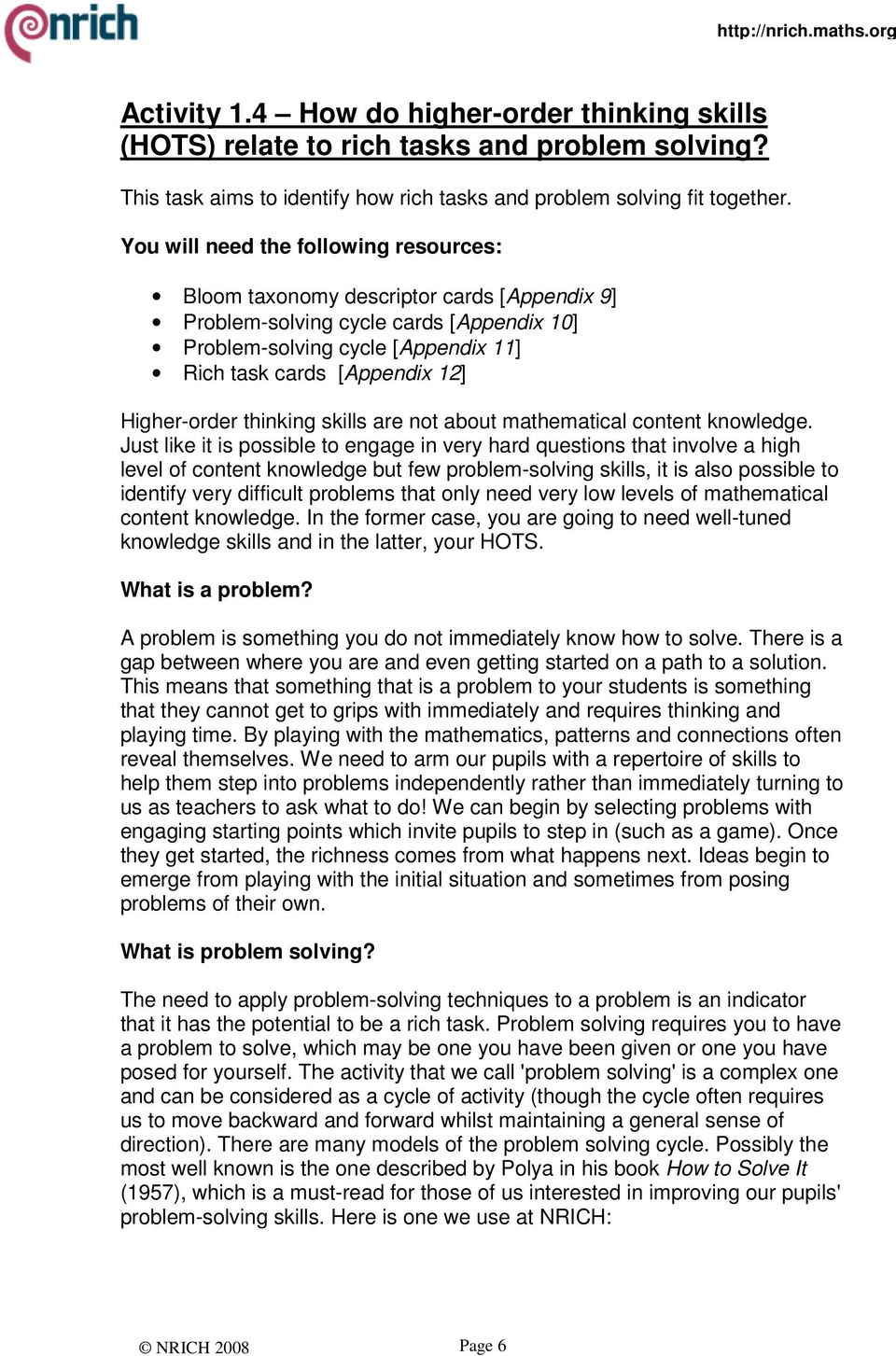
7 (Appendix 11 is a larger version of the above which might be easier to read.) The application of the problem-solving cycle is a high-order skill. Evidence suggests that few pupils utilise the problem-solving cycle effectively. One important thing to note is the emphasis the cycle places on the high-order thinking skills described by Bloom. It is therefore not surprising that most pupils do not naturally have a sense of where they are and what they might do next. One of our aims when teaching mathematics is to help pupils become familiar with this process and have confidence to use it. See Polya, G. (1957). How to Solve it, Princeton University Press. How do rich tasks, the problem-solving cycle and higher-order thinking skills fit together? Here is a task to help answer this question. Task Cut out the problem-solving cycle cards (Appendix 10) and lay them out. Link them with the rich task description cards (Appendix 12) and with the different aspects of Bloom's taxonomy (Appendix 9). We feel that any problem has the potential to be a rich task but this depends on us as teachers offering those opportunities to our pupils. We will talk about this in Activity 2.1. Page 7
8 Activity 1.5 How do pupils progress in their problem solving? In the previous activity you were asked to think about the connections between higher-order thinking skills, problem solving and rich tasks. In the next set of activities we want to think about how we can support our pupils in problem solving. You will need the following resources: Task Progression cards [Appendix 13] Problem-solving cycle cards [Appendix 10] For reference you may want to refer to the progression list [Appendix 14] We have based this activity on the National Strategy's Primary Framework Assessment Guidelines. We are not asking you to think about assessment but about process skills and progression. The guidelines are based on three areas: problem solving, reasoning and communicating. There are two parts to this task. There is no 'right answer' to either part but the activities are designed to make you think about: the mathematical thinking and problem-solving skills you want your learners to develop the sorts of things your pupils will be doing the development of thinking and problem-solving skills over time (progression) It is the discussion you have as you undertake the task which is key. By making sense of phrases and describing what you mean by them in your own words you will come to your own view about how they inform what you are trying to help your pupils to learn. First you will need a set of the problem-solving cycle cards (Appendix 10) and of the progression cards (Appendix 13). [The Progression Cards are based on lists for Levels 2, 3, 4 and 5 so you might like to think about what would come before L2 and after L5.] Lay the cycle cards out and then distribute the progression cards amongst them. There will be quite a lot of discussion about what some of these mean. Remember that there is no right answer and a lot depends on your interpretation of a card's meaning. In the end you should put each card under the heading that feels like the 'best fit'. Do not agonise for too long on each card - you can change your mind at any time. When we did this task at NRICH we moved things around quite a lot during the second part of the task! Page 8
9 The second part of the task is about ordering the cards under each of the five process headings. The aim of this part of the task is for you to think about progression. What would you expect learners at different stages to be able to do? When we did this task we found it useful to group cards that seemed to be about similar things together before trying to order them. So, for example, under Analysis-Reasoning we found a few cards that seemed to be about 'organising' so we pulled these out and put them in order. The lists are not meant to be exhaustive so you might want to add some cards of your own. When you have finished the tasks you might find it useful to refer to the progression list (Appendix 14) as this will enable you to map what you have done to the Strategy document. Page 9

10 Activity 2.1 What do teachers do to support learners engaging with rich tasks? This pair of tasks build particularly on Activities 1.1, 1.3 & 1.4. The aim is to look at a problem and think about what we can do to help make it rich. This is because, regardless of a problem's potential, the way it is used affects its richness. You will need the following resources: Rich task cards [Appendix 12] Rich task sheet - what teachers can do [Appendix 15] What teachers do - master template sheet [Appendix 16] Suggested NRICH problem [Appendix 18] What teachers do - Magic Vs sheet [Appendix 17] Task 1 Stick each of the rich task cards (Appendix 12) on a separate A3 sheet. As a group, move around the sheets and add ideas for what you could do as teachers to help support each aspect of a rich task. This will be very general at this stage. If you need help some ideas are given on the what teachers can do sheet (Appendix 15). These ideas will become more specific when applied to a particular problem. Task 2 Work on the NRICH problem Magic Vs (Appendix 18) so you feel confident that you know it well. Fill in the column of the master sheet (Appendix 16) labelled 'What pupils could do'. Now fill in the column 'What teachers might do'. As you do this, think about the sorts of things you might do in the lesson to encourage pupils to tackle the problem and behave in the ways you have suggested in the middle column. Appendix 17 is what we produced when we tried this at NRICH. Page 10
![You will need the following resources: Rich task cards [Appendix 12] Rich task sheet - what teachers can do [Appendix 15] What teachers do - master template sheet [Appendix 16] Suggested NRICH](/docs-images/48/18973506/images/page_10.jpg "problem [Appendix 18] What teachers do - Magic Vs sheet [Appendix 17] Task 1 Stick each of the rich task cards (Appendix 12) on a separate A3 sheet.")
11 Activity 2.2 'HOTting up' your existing classroom materials So far we have given you activities to work with that are on the NRICH website. However, you probably have many activities you use in your own lessons that have the potential to be rich, or richer. The aim of this activity is to draw your attention to those problems and think about how you can use them to develop higher-order thinking skills and problem-solving skills, and what you might do to support this in the classroom. You will need the following resources: What teachers do - master template sheet [Appendix 16] Notes you made during the second task in Activity 1.2 What to do: This links to the work on higher-order thinking skills and Activity 2.1 on rich tasks. Here the aim is for us to think about what we can do as teachers with problems we already use. The emphasis is on what we do in the classroom rather than adjusting the problem itself as we did in Activity 1.2. Retrieve your jottings from the second task in Activity 1.2 and then, working in a pair, consider what you would do to as a teacher to support this problem. Use the blank template (Appendix 16) and the ideas of Activity 2.1 (where we did a similar task for Magic V's) to help. Why not share any good ideas with us at NRICH by ing us? [email protected] Page 11
12 Activity 3 Integrating rich tasks into the whole curriculum The aim of this activity is to integrate some rich tasks into curriculum planning. Although there are other possibilities, at this stage we will look at two sources for these tasks: NRICH exisiting schemes of work All the work we have done so far should feed into this activity, which is designed to be the starting point for a longer period of planning and development. The long-term aim is for you to think about your teaching and how it can be enhanced, but to start with you will need to select something that is realistic and achievable. You can always extend what you do at a later date. You will need the following resources: Your existing scheme of work The NRICH curriculum mapping documents [Appendix 19 for KS1 and Appendix 20 for KS2 but the versions online will be more recent] The NRICH site - particularly the Maths finder, which you can find at Task 1 First a reminder that we are not assuming that you are going to change everything now, you are just making a start. For this reason, we suggest you could begin by planning for a mathematical topic that you will teach this term. There are many different approaches to planning for the integration of rich tasks, for example you could: Look at your current scheme of work and use the content mapping documents to find problems that are a good fit with the particular topic you are covering. Consider what using and applying skills you want your pupils to develop and use the process mapping documents to identify appropriate problems. You might use these as one-off problems but they will also address subject content knowledge so why not use them when you are covering that topic in your scheme of work? Identify a theme to work on for a longer period of time. Examples of themes are: o problems that employ several aspects of content knowledge (e.g. factors and multiples) o the development of problem-solving skills (the whole process) o the development of particular mathematical thinking skills (e.g. 'working systematically' or 'visualising') o an application of mathematics (e.g. time and its measurement) Page 12

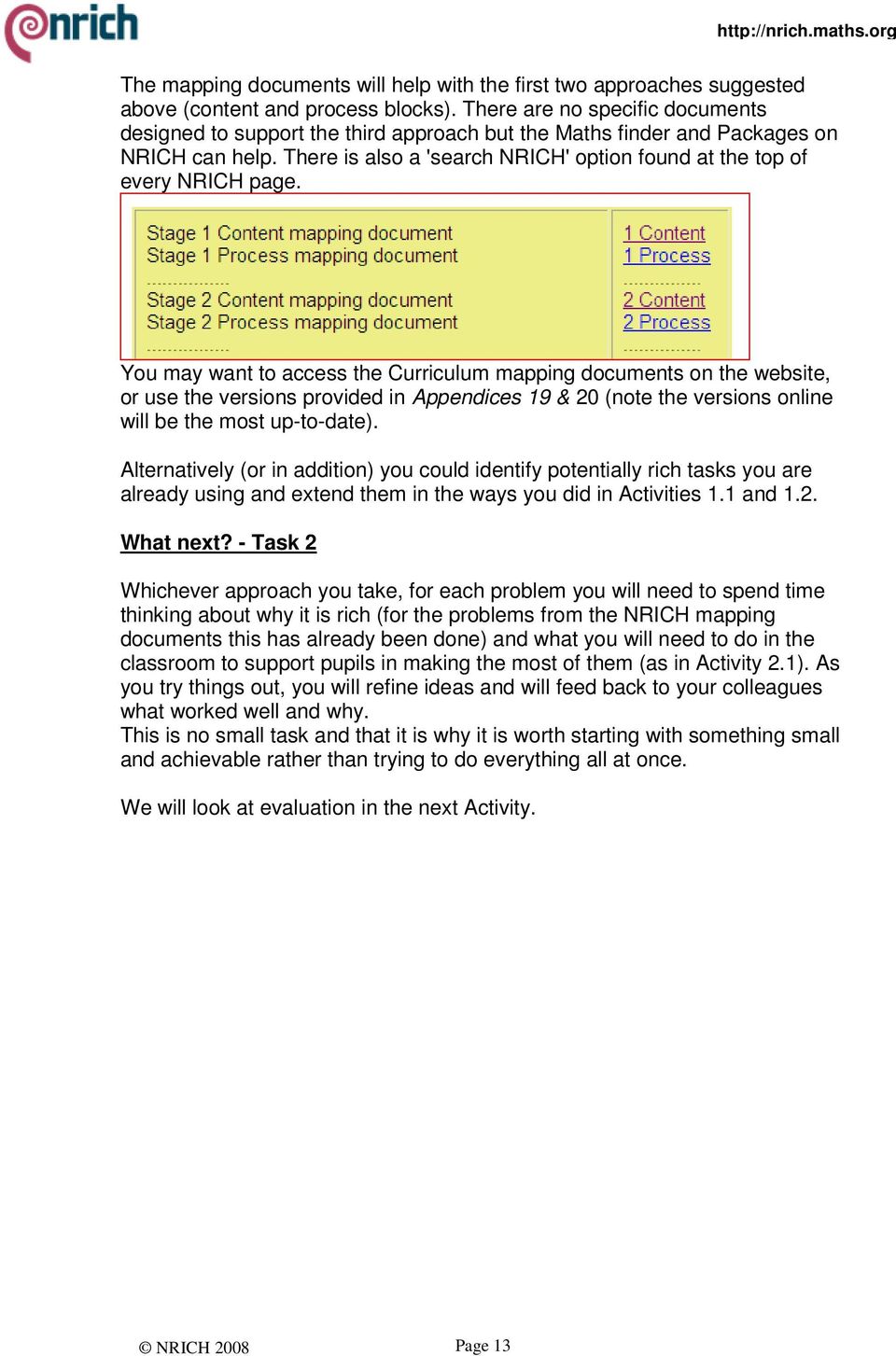
13 The mapping documents will help with the first two approaches suggested above (content and process blocks). There are no specific documents designed to support the third approach but the Maths finder and Packages on NRICH can help. There is also a 'search NRICH' option found at the top of every NRICH page. You may want to access the Curriculum mapping documents on the website, or use the versions provided in Appendices 19 & 20 (note the versions online will be the most up-to-date). Alternatively (or in addition) you could identify potentially rich tasks you are already using and extend them in the ways you did in Activities 1.1 and 1.2. What next? - Task 2 Whichever approach you take, for each problem you will need to spend time thinking about why it is rich (for the problems from the NRICH mapping documents this has already been done) and what you will need to do in the classroom to support pupils in making the most of them (as in Activity 2.1). As you try things out, you will refine ideas and will feed back to your colleagues what worked well and why. This is no small task and that it is why it is worth starting with something small and achievable rather than trying to do everything all at once. We will look at evaluation in the next Activity. Page 13
14 Activity 4.1 Assessing your embedding of rich tasks into the curriculum: Peer observation Having started to embed rich tasks into your scheme of work you will need to: assess what works and what does not make decisions on how to extend your mapping consider what further support you might need This Activity, along with Activities 4.2 and 4.3 are designed to help you with the above. The best way to go about evaluating and reviewing a particular lesson is to work with a colleague. However, what is suggested here can be used as a means of self-reflection. Before the lesson you will need to prepare: Your lesson plan The "what teachers do" sheet [Appendix 16] Either use this opportunity to do some peer observation, with a colleague using the prepared observation/reflection sheet, or during and after the lesson use the sheet to jot down some notes of your own. Discuss or reflect on: what was successful what you would do differently next time what key things pupils did that could be highlighted or drawn out more in future Use this to inform planning for next time. Page 14

15 Activity 4.2 Assessing your embedding of rich tasks into the curriculum: Evaluating a theme Undertaking the same sort of observation/reflection activity as you did in Activity 4.1 for individual lessons or a group of lessons is an important part of evaluating the success of a theme or series of linked lessons within a gven topic. In addition however, you need to look at the group of lessons more holistically. To do this you will need to consider: the aims or learning objectives for this group of lessons including: o what content you were hoping to cover o what using and applying/problem-solving skills you were hoping to address o what connections you were hoping to make o which aims were met/not met. Try to describe why and, where appropriate, how things might be improved. This might involve being more realistic about your aims or thinking of other ways in which you might approach the theme or support pupils whilst working on a theme. how the pupils responded over all: o did they enjoy it? o did they reach the level of working you expected? o did the work cater for their individual needs (were the support and extension ideas and materials appropriate)? Then update your planning documents: How you will modify the theme in future? This might involve removing it from your scheme of work or revising the 'what teachers do' sheet and lesson plan. List your recommended next steps. Include key points for colleagues who might try the same theme themselves. Page 15

16 Activity 4.3 Assessing your embedding of rich tasks into the curriculum: Thinking about what to do next Build on your experiences, adding in new material and trying it out. Using the mapping documents can ensure a range of experiences for your pupils. It is not enough to employ a concept or process once, you will need to revisit these again and again, each time thinking about how the pupils will develop. For example, when considering problem-solving skills, pupils will develop in different ways, such as: Becoming more independent with you having to do less supporting in order for them to think of ideas of their own. Applying more sophisticated content knowledge Being more equipped to talk about their mathematics More able to apply what they know in less familiar settings Better able to make connections with things they have done before Showing greater sophistication and organisation in their recording methods. How does your scheme of work allow this to happen? The important thing to do is: Reflect - evaluate - modify if necessary At NRICH we are really interested in finding our more about your experiences. Do us so we can share your ideas and findings with others. [email protected] Page 16
17 Appendix 1 for Activity 1.1 a copy for each pair of teachers RICH TASKS Current research evidence indicates that students who are given opportunities to work on their problem solving enjoy the subject more, are more confident and are more likely to continue studying mathematics, or mathematics related subjects, beyond 16. Most importantly, there is also evidence that they do better in standard tests. Rich tasks can enable pupils to: step into them even when the route to a solution is unclear, getting started and exploring is made accessible to pupils of wide ranging abilities pose as well as solve problems, make conjectures work at a range of levels extend knowledge or apply knowledge in new contexts allow for different methods have opportunities to broaden their problem-solving skills deepen and broaden mathematical content knowledge have potential to reveal underlying principles or make connections between areas of mathematics include intriguing contexts have opportunities to observe other people being mathematical or see the role of mathematics within cultural settings See also: Page 17
18 Appendix 2 for Activity 1.1 a copy for each teacher Rich task template: Why is. a rich task? Step into a problem even when the route to a solution is unclear (see definition of a problem below), getting started and exploring is made accessible to pupils of wide ranging abilities. Pose as well as solve problems, make conjectures Work at a range of levels Extend knowledge or apply knowledge in new contexts Allow for different methods Offer opportunities to broaden students problem-solving skills Deepen and broaden mathematical content knowledge Have potential to reveal underlying principles or make connections between areas of mathematics Include intriguing contexts Offer opportunities to observe other people being mathematical or the role of mathematics within cultural settings Page 18

19 Appendix 3 for Activity 1.1 a copy for each teacher of either appendices 3&4, or of appendices 5&6 This is a classroom task from the NRICH website. Notes about the task, including downloadable SMARTboard notebooks and other materials are available on the site from: tinyurl.com/6ysepn To download the SMARTboard file, click on the link. Then select Save As. It may be necessary to type.notebook at the end of the filename and to change the filetype to All files. Please check that you are running a new enough version of the SMARTboard software (version 9.5 or later). 'Eggs in Baskets' There are three baskets, a brown one, a red one and a pink one, holding a total of ten eggs. The Brown basket has one more egg in it than the Red basket. The Red basket has three eggs less than the Pink basket. How many eggs are in each basket? Page 19

20 Appendix 4 for Activity 1.1 a copy for each teacher of either appendices 3&4, or of appendices 5&6 Exemplar template for Eggs in Baskets, showing how it can be used in the classroom. The version online include links to view the video-clips and images. Aspects of a rich task Introducing the task so that the children can get started The problem allows children to make conjectures The task allows children to work at a range of levels The problem offers opportunities for children to use different methods Eggs in Baskets offers opportunities to broaden students problem-solving skills Ideas for teacher support The teacher encourages some general exploration of the situation by changing the context (sweets rather than eggs) and simplifying the problem (only 6 in total, as opposed to 10). Rather than having three unknowns to begin with, as in the NRICH problem, children start with one unknown (how many sweets in the third bag?) and then two (what could be in the second and third bags?). Clip Eggs1.wmv When shown the bag of four sweets, the children immediately begin to make conjectures. One suggests the other two bags will have one sweet each because 2 and 4 make 6. Then another pupil suggests that there could be 2 in the second bag and zero in the other. Clip Eggs2.wmv Here the resources provided allow this child to work on the problem in the way he feels comfortable, which is a good assessment opportunity for the teacher. Image EggsA.gif This learner has recorded the possible combinations using number sentences and has worked in a very systematic way. Note the sum which has been squeezed in near the top of the list it would be good to talk to him about the reasons for this. (There is a repetition here so this might be worth discussing too.) Clip Eggs3.wmv Here the teacher draws attention to the children s different ways of representing the problem (drawing sweets, using numerals, drawing dots, writing number sentences), emphasising why each is helpful. Interestingly, some children chose to opt for a different way following this discussion. Image EggsB.gif This pupil has chosen to represent five sweets in the quincunx arrangement, like that on a dice. Perhaps this is to make subsequent counting easier? Clip Eggs4.wmv Having been shown there are two sweets in the first bag and three in the second bag, the children talk about whether they need to see the number of sweets in the third bag. One says, 2 add 3 equals 5, add 1 equals 6. So I don t need to X-ray the last one? Another pupil responds, You do! Just to see You d like to check it using that? It s still going to be 1. This highlights the fact that it may be satisfying to check that our conjectures are true before moving on. See also image EggsA.gif Page 20

21 Appendix 5 for Activity 1.1 a copy for each teacher of either appendices 3&4, or of appendices 5&6 This is a classroom task from the NRICH website. Notes about the task, including a projectable, online, interactive presentation of the task are available from: tinyurl.com/5fmlao GOT IT GOT IT is an adding game for two. You can play against the computer or with a friend. Start with the GOT IT target 23. The first player chooses a whole number from 1 to 4. Players take turns to add a whole number from 1 to 4 to the running total. The player who hits the target of 23 wins the game. To change the game, choose a new GOT IT! target or a new range of numbers to add on. Page 21
22 Appendix 6 for Activity 1.1 a copy for each teacher of either appendices 3&4, or of appendices 5&6 RICH TASK TEMPLATE GOT IT WHY IS GOT IT A RICH TASK? Step into a problem even when the route to a solution is unclear (see definition of a problem below), getting started and exploring is made accessible to pupils of wide ranging abilities. Pose as well as solve problems, make conjectures Work at a range of levels Extend knowledge or apply knowledge in new contexts Allow for different methods Offer opportunities to broaden students problem-solving skills Deepen and broaden mathematical content knowledge Have potential to reveal underlying principles or make connections between areas of mathematics Include intriguing contexts The game is an engaging one and pupils are often motivated to find strategies in order to beat the computer or, if you do not have access to the interactivity, to beat the teacher. Pupils often extend the problem to different target numbers and a different range of numbers quite naturally. Other extensions include choosing a range of numbers that do not start at 1. Some pupils are excited to discover that the person reaching 18 first will win. You can simplify the starting point further with a lower target number and smaller range of numbers. At the highest level the generalisation to any target, any range requires high-level thinking and analytical skills This is a different and engaging context to meet and engage with mathematics It is interesting to see the different ways in which pupils come to an understanding of why their strategy works. Working backwards is a very useful skill in this case. Generalising results to any target and range and identifying the exceptions. In this task pupils are being asked to recognise and explain patterns and relationships, conjecture, generalise and predict. At the highest levels they should justify their generalisations using convincing arguments and proofs. For example the unexpected connection with factors and multiples It is not obvious that employing some mathematics will guarantee that you can always win. Offer opportunities to observe other people being mathematical or the role of mathematics within cultural settings Pupils challenging the teacher or computer and explaining what they will do next and why whilst others observe and listen Page 22
23 Appendix 7 for Activity 1.2 a copy for each pair of teachers (4 pages) HOTS1 These cards contain some lower-order questions and, focusing on the same mathematical topic, some more challenging questions - ones that require higher-order thinking skills. Cut them out and pair them up. 1. Fractions What is half of 6? 2. Triangles Which of these shapes are triangles? What is half of 10? What is half of 2? 3. Fair Feast Here is a picnic that Chris and Michael are going to share equally: 4. Grab it! Play on a blank 100 grid with a partner. Take turns to choose a number. If your number can be divided exactly by 2, score 2 points. If it can be divided exactly by 3, score 3 points and so on. (You can decide whether or not to count 1 and the number itself.) What are good numbers to pick? Why? What's the best number to pick? What are poor numbers to pick? Why? Can you tell what each of them will have? 5. Take Away Work out the following take away (subtraction) sums: 6. Hard or Easy? Look at the take away sums. Find the easiest, the hardest, and three which are not hard or easy. Do them and write down (or say) why you've chosen these five sums. Page 23
24 7. Making Sticks Kimie and Sebastian were making sticks from interlocking cubes. Kimie made blue sticks 2 cubes long. Sebastian made red sticks 3 cubes long. They both made a lot of sticks. 8. Domino Sorting Here are some dominoes taken out of a full set: Sort them into two groups, one with an odd number of spots and one with an even number of spots. Do you have any dominoes left over? Why, or why not? Kimie put her blue sticks end to end in a long line. Sebastian put his red sticks end to end in a line underneath Kimie's. Can they make their lines the same length? How many sticks could Kimie use? How many would Sebastian put down? How long is the line altogether? Can they make any other lines? Now put the dominoes into pairs. The number of spots on each pair of dominoes must make a total of 5. How many pairs can you make? Which dominoes are left over? Can you pair them up in any different ways so that each pair adds up to 5? Which dominoes are left over now? Are there any dominoes which are always left over? Can you explain why? 9. Seven Sticks Explore the triangles that can be made with seven sticks of the same length. 10. Near Doubles Add these near doubles etc Page 24
25 11. The Hundred Game This game is for two players. You need ten cards with the digits 0 to 9 on them. It might also be useful to have a two pieces of paper or card with two boxes drawn on them to represent a twodigit number. Turn the cards face down and mix them up. The aim of the game is to make the closest number to 100. Each player takes one card to start with and decides whether that is the units or tens digit of their number and places it on their paper in front of them. Each player then takes a second card which becomes the missing digit of their twodigit number. The winner is the player whose number is closer to 100. You could have a points system so that the player with the closer number scores 1 point and then play first to Squares Plot the three points listed below and then find the co-ordinates of the fourth point that is needed to complete a square: (a) (2,2) (4,2) (2,4) (b) (5,10) (9,10) (9,6) (c) (4,5) (3,6) (2,5) (d) (5,5) (4,8) (7,9) (e) etc. What strategies do you have for winning? 13. Stringy Quads You need a group of four people holding a loop of string. 14. Symmetry Draw all the lines of symmetry on these quadrilaterals. Make a quadrilateral with one line of symmetry. Make a quadrilateral with two lines of symmetry. Make a quadrilateral with three lines of symmetry. Make a quadrilateral with four lines of symmetry. What quadrilateral haven't you made? etc Page 25
26 15. Addition What is: 5+4? 3+9? 2+5? 16. U Two You need a 1-50 number grid and a partner. Take turns to draw a 5 square U shape on the grid. Add up the two biggest numbers in your U. Keep going until you can't fit any more Us on the grid, adding on your score each time. The winner has the bigger score. Your U could be upside down, or on its side. 3+3? 17. Sharing Do the following division (sharing) sums etc 18. Place Value Which of these numbers is bigger: 78 or 87? 92 or 91? 99 or 101? 19. Square It With a partner take it in turns to mark any spot on a square dotty grid (you should use different colours). The winner is the first to have four marks that can be joined by straight lines to form a square. 20. Multiples List the numbers between 1 and 30 that are: (a) in the two times table (b) in the three times table. Squares can be of any size and can be tilted. Page 26
27 Appendix 8 for Activity 1.2 a copy for each pair of teachers HOTS2 Encouraging Higher Order Thinking Skills (HOTS) Instead of asking different questions, we can change the ones we usually ask. How can you adapt ordinary maths questions so that they promote HOTS? Here are four key strategies that will help you to increase the challenge of standard questions in the classroom.. A. Here's the answer, what could the question be? Instead of: 3+3, 4+3, 5+3, Ask: The answer is 8; what could the adding up sum be? Instead of: What is the area of a rectangle which measures 4cm by 6cm? Ask: If the area of a rectangle is 24cm 2 what could its measurements be? Lists of practice questions and closed questions can immediately be made more challenging in this way, and this change allows children to show what they know and can do. You may well be surprised by the quality of their work! Some children will work systematically to produce their responses; this indicates that they have analysed the numerical structure. Make up some examples of your own. B. Make up your own Instead of: , , , ,... Ask: Choose the easiest and hardest subtraction sums, work them out, then make up an easy and hard example for someone else, saying why you think there are easy and hard. Choosing requires analysis, making up new questions requires synthesis, and sharing and discussing with another requires evaluation. Can you make up some similar examples involving other operations? How about other mathematical topics such as space and shape? Page 27
28 C. What if? Instead of: Find the different ways you can dress the teddy. Ask: What if there were two teddies? What if there were two hats as well? What if there were three T-shirts? What if...? Instead of: Put the L on the grid so that the sum of the squares it covers is 225. Ask: What if the sum is different? What if the shape is not an L? What if the grid is the two times table? What if...? Offering choice often increases children's motivation and hence engagement in a task. They have to understand the structure of the question in order to make sensible 'what if' suggestions. They will need to identify what aspects of the problem can be varied - analysis and synthesis. Look at questions you have recently given your pupils to do. Can you think of some what if questions. How would you encourage pupils to come up with what if questions of their own? Page 28
29 D. All answers Instead of: Make a symmetrical necklace with these beads. Ask: Make another... make another... how many can you make? How do you know you've got them all? Instead of: Make a triangle by joining three dots. Ask: Make another... make another... how many can you make? How do you know you've got them all? Page 29
30 Appendix 9 for Activity 1.3 & 1.4 a copy for each pair of teachers BLOOM S DESCRIPTORS Cut the cards out and put them in a line to reflect the order of development, complexity and demand (which represent the higher order thinking skills). Analysis Evaluation seeing pattern organization of parts recognition of hidden meanings identification of components Question Cues: analyze, separate, order, explain, connect, classify, arrange, divide, compare, select, explain, infer compare and discriminate between ideas assess value of theories, presentations make choices based on reasoned argument verify value of evidence recognize subjectivity Question Cues: assess, decide, rank, grade, test, measure, recommend, convince, select, judge, explain, discriminate, support, conclude, compare, summarize Application use information use methods, concepts, theories in new situations solve problems using required skills or knowledge Questions Cues: apply, demonstrate, calculate, complete, illustrate, show, solve, examine, modify, relate, change, classify, experiment, discover Comprehension understanding information grasp meaning translate knowledge into new context interpret facts, compare, contrast order, group, infer causes predict consequences Question Cues: summarize, describe, interpret, contrast, predict, associate, distinguish, estimate, differentiate, discuss, extend Knowledge observation and recall of information knowledge of dates, events, places knowledge of major ideas mastery of subject matter Question Cues: list, define, tell, describe, identify, show, label, collect, examine, tabulate, quote, name, who, when, where, etc. Synthesis use old ideas to create new ones generalize from given facts relate knowledge from several areas predict, draw conclusions Question Cues: combine, integrate, modify, rearrange, substitute, plan, create, design, invent, what if?, compose, formulate, prepare, generalise, rewrite Page 30
31 Appendix 10 for Activity 1.4 a copy for each pair of teachers Represent Identify the mathematical aspects of a situation or problem choose between representations simplify the situation or problem, using appropriate variables, symbols, diagrams and models select mathematical information, methods and tools to use. Analyse Use appropriate mathematical procedures make mathematical diagrams that represent a situation or the information given calculate accurately record methods, solutions and conclusions estimate, approximate and check working Analyse Use mathematical reasoning make connections within mathematics and use knowledge of related problems visualize, be systematic, and identify and classify patterns explore the effects of varying values and make and begin to justify conjectures and generalisations work logically Interpret and evaluate form convincing arguments consider the appropriateness and accuracy of results and conclusions look at data to find patterns and exceptions relate findings to the original context, identifying whether they support or refute conjectures Communicate and reflect communicate findings effectively and discuss results engage with someone else s mathematics consider the elegance and efficiency of other approaches to the problem make connections between the current situation and outcomes, and situations and outcomes they have met before Page 31
32 Appendix 11 for Activity 1.4 a copy for each teacher The Problem-Solving Cycle Represent Identify the mathematical aspects of a situation or problem choose between representations simplify the situation or problem, using appropriate variables, symbols, diagrams and models select mathematical information, methods and tools to use Communicate and reflect communicate findings effectively and discuss results engage with someone else s mathematics consider the elegance and efficiency of other approaches to the problem make connections between the current situation and outcomes, and situations and outcomes they have met before Analyse Use appropriate mathematical procedures make mathematical diagrams that represent a situation or the information given calculate accurately record methods, solutions and conclusions estimate, approximate and check working Use mathematical reasoning make connections within mathematics and use knowledge of related problems visualise, be systematic and identify and classify patterns explore the effects of varying values and make and begin to justify conjectures and generalisations work logically Interpret and evaluate form convincing arguments consider the appropriateness and accuracy of results and conclusions look at data to find patterns and exceptions relate findings to the original context, identifying whether they support Page 32 or refute conjectures
33 Appendix 12 for Activity 1.4 & 2.1 a copy for each pair of teachers RICH TASK CARDS step into a problem even when the route to a solution is unclear, getting started and exploring is made accessible to pupils of wide ranging abilities pose as well as solve problems, make conjectures work at a range of levels extend knowledge or apply knowledge in new contexts have opportunities to broaden their problem-solving skills deepen and broaden mathematical content knowledge potentially reveal underlying principles or make connections between areas of mathematics observe other people being mathematical or see the role of mathematics within cultural settings experience intriguing contexts employ different methods Page 33
34 Appendix 13 for Activity 1.5 a copy for each pair of teachers (2 pages) PROGRESSION CARDS begin to develop own ways of recording put the problem into their own words begin to look for patterns in results as they work and use them to find other possible outcomes recognise information that is important to solving the problem, determine what is missing and develop lines of enquiry begin to organise their work and check results respond to What if? questions begin to understand and use formulae and symbols to represent problems review their work and approaches begin to work in an organised way from the start review their work and reasoning, break a several-step problem or investigation into simpler steps search for a solution by trying out ideas of their own check answers and ensure solutions make sense in the context of the problem check as they work, spotting and correcting errors and reviewing methods check their methods and justify answers check their work and make appropriate corrections, e.g. decide that two numbers less than 100 cannot give a total more than 200 and correct the addition choose their own equipment appropriate to the task, including calculators consider appropriate units consider efficient methods, relating problems to previous experiences decide how best to represent conclusions, using appropriate recording select the mathematics they use in a wider range of classroom activities, e.g. show understanding of situations by describing them mathematically using symbols, words and diagrams talk about their findings by referring to their written work try different approaches and find ways of overcoming difficulties that arise when they are solving problems understand a general statement by finding particular examples that match it use and interpret mathematical symbols and diagrams use appropriate mathematical vocabulary use classroom discussions to break into a problem, recognising similarities to previous work Page 34
35 develop an organised approach as they get into recording their work on a problem use examples and counter-examples to justify conclusions discuss their mathematical work and begin to explain their thinking, e.g. draw simple conclusions of their own and give an explanation of their reasoning explain and justify their methods and solution Identify and obtain necessary information to carry through a task and solve mathematical problems identify more complex patterns, making generalisations in words and begin to express generalisations using symbolic notation identify patterns as they work and form their own generalisations/rules in words use related vocabulary accurately Use their own strategies within mathematics and in applying mathematics to practical context when they have solved a problem, pose a similar problem for a partner With support adopt a suggested model or systematic approach With support begin to appreciate the need to record and develop their own methods of recording With support describe the strategies and methods they use in their work make a generalisation with the assistance of probing questions and prompts make connections to previous work make their own suggestions of ways to tackle a range of problems organise their work from the outset, looking for ways to record systematically organise written work, e.g. record results in order pose and answer questions related to a problem predict what comes next in a simple number, shape or spatial pattern or sequence and give reasons for their opinions With support find a starting point, identifying key facts/relevant information With support listen to others explanations, try to make sense of them, compare. evaluate With support make connections and apply their knowledge to similar situations With support move between different representations of a problem e.g. a situation described in words, a diagram etc. With support test a statement such as The number 12 ends with a 2 so 12 sweets can t be shared equally by 3 children With support use apparatus, diagrams, role play, etc. to represent and clarify a problem With support use pictures, diagrams and symbols to communicate their thinking, or demonstrate a solution or process Page 35
36 Appendix 14 for Activity 1.5 a copy for each pair of teachers (2 pages) Progression Card List Based on the National Strategy's Primary Framework Assessment Guidelines for mathematics L2, L3, L4, L L2 1.0x select the mathematics they use in some classroom activities e.g. with support PS L2 1.1 With support find a starting point, identifying key facts/relevant information PS L2 1.2 With support use apparatus, diagrams, role play, etc. to represent and clarify a problem PS L2 1.3 With support move between different representations of a problem e.g. a situation described PS in words, a diagram etc. L2 1.4 With support adopt a suggested model or systematic approach PS L2 1.5 With support make connections and apply their knowledge to similar situations PS L2 2.0x discuss their work using mathematical language, e.g. with support C L2 2.1 With support describe the strategies and methods they use in their work C L2 2.2 With support listen to others explanations, try to make sense of them, compare. C evaluate L2 3.0x begin to represent their work using symbols and simple diagrams, e.g. with support C L2 3.1 With support use pictures, diagrams and symbols to communicate their thinking, or C L2 demonstrate a solution or process 3.2 With support begin to appreciate the need to record and develop their own methods of C recording L2 4.0x explain why an answer is correct, e.g. with support R L2 4.1 With support test a statement such as The number 12 ends with a 2 so 12 sweets can t be R L2 shared equally by 3 children 5.0 predict what comes next in a simple number, shape or spatial pattern or sequence and give reasons for R their opinions L3 1.0 select the mathematics they use in a wider range of classroom activities, e.g. PS L3 1.1 use classroom discussions to break into a problem, recognising similarities to previous work PS L3 1.2 put the problem into their own words PS L3 1.3 choose their own equipment appropriate to the task, including calculators PS L3 2.0 try different approaches and find ways of overcoming difficulties that arise when they are solving PS L3 problems 2.1 check their work and make appropriate corrections, e.g. decide that two numbers less than PS L3 100 cannot give a total more than 200 and correct the addition 2.2 begin to look for patterns in results as they work and use them to find other possible PS outcomes L3 3.0 begin to organise their work and check results C L3 3.1 begin to develop own ways of recording C L3 3.2 develop an organised approach as they get into recording their work on a problem C L3 4.0 discuss their mathematical work and begin to explain their thinking, e.g. C L3 4.1 use appropriate mathematical vocabulary C L3 4.2 talk about their findings by referring to their written work C L3 5.0 use and interpret mathematical symbols and diagrams C L3 6.0 understand a general statement by finding particular examples that match it R L3 6.1 make a generalisation with the assistance of probing questions and prompts R L3 7.0 review their work and reasoning, R L3 7.1 respond to What if? questions R L3 7.2 when they have solved a problem, pose a similar problem for a partner R L4 1.0x develop own strategies for solving problems, e.g. PS L4 1.1 make their own suggestions of ways to tackle a range of problems PS L4 1.2 make connections to previous work PS L4 1.3 pose and answer questions related to a problem PS L4 1.4 check answers and ensure solutions make sense in the context of the problem PS L4 1.5 review their work and approaches PS L4 2.0 Use their own strategies within mathematics and in applying mathematics to practical context PS L4 3.0x present information and results in a clear and organised way, e.g. C L4 3.1 organise written work, e.g. record results in order C L4 3.2 begin to work in an organised way from the start C L4 3.3 consider appropriate units C L4 3.4 use related vocabulary accurately C L4 4.0 search for a solution by trying out ideas of their own R L4 4.1 check their methods and justify answers R L4 4.2 identify patterns as they work and form their own generalisations/rules in words R Page 36
37 L5 1.0 Identify and obtain necessary information to carry through a task and solve mathematical problems PS L5 1.1 recognise information that is important to solving the problem, determine what is missing and PS develop lines of enquiry L5 1.2 break a several-step problem or investigation into simpler steps PS L5 1.3 consider efficient methods, relating problems to previous experiences PS L5 2.0x check results, considering whether these are reasonable, e.g. PS L5 2.1 check as they work, spotting and correcting errors and reviewing methods PS L5 3.0 solve word problems and investigations from a range of contexts PS L5 3.0 show understanding of situations by describing them mathematically using symbols, words and C diagrams L5 3.1 organise their work from the outset, looking for ways to record systematically C L5 3.2 decide how best to represent conclusions, using appropriate recording C L5 3.3 begin to understand and use formulae and symbols to represent problems C L5 4.0 draw simple conclusions of their own and give an explanation of their reasoning R L5 4.1 explain and justify their methods and solution R L5 4.2 identify more complex patterns, making generalisations in words and begin to express R generalisations using symbolic notation L5 4.3 use examples and counter-examples to justify conclusions R Page 37
38 Appendix 15 for Activity 2.1 a copy for each teacher (2 pages) A RICH TASK WHAT TEACHERS CAN DO Aspects of a rich task Ideas for teacher support Step into a problem even when the route to a solution is unclear, getting started and exploring is made accessible to pupils of wide ranging abilities. Pose as well as solve problems, make conjectures Work at a range of levels Extend knowledge or apply knowledge in new contexts Allow for different methods Selecting appropriate tasks and problems for example those with a low threshold and a high ceiling. Asking pupils to spend a little time on their own then working in pairs and then sharing ideas about what the problem is about and how to get started Think Pair Share Encouraging some general exploration of the situation before pinning things down Considering and sharing different ways of representing the information Thinking about things like this you have seen before. It is a challenge for pupils to pose their own problems so a first step is to model asking what if questions yourself. Encourage learners to think about the things they can vary in a problem and to conjecture about the effect of any variation. At the end of a problem ask what next? or If we had time what might we do next? Highlight occasions where pupils do pose their own problems and share them with the group. Put unanswered questions and conjectures on a board. Use a conjecture board. When pupils come up with a conjecture they write it up and get others to consider it and either prove it or find a counter example Encouraging and discussing different ways of tackling a problem. Interpreting and evaluating findings can offer opportunities to work at a range of levels. Think about problems with open starting points, open middles and open ends these all contribute to allowing pupils to work at different levels. Generalisation enables extension and the use of algebra can extend problems. Reflect on the algebra, when it is used, and how it represents underpinning structure of a problem. For example: Why does.. generate a Fibonacci sequence? Set problems that offer scope to extend knowledge or which are set in new contexts. Ask questions of learners that encourage them to make connections: Have you done something before that was similar? What mathematics is in this problem? Encourage a range of representations at the start of the work. Discuss ideas for different approaches. Discuss different approaches, their effectiveness and efficiency at the end of the work. Value different approaches as representing learners different understandings and levels of confidence. Realise that methods used often reflect learners progress, areas of strength and weaknesses. Page 38
39 Aspects of a rich task Offer opportunities to broaden students problemsolving skills Deepen and broaden mathematical content knowledge Have potential to reveal underlying principles or make connections between areas of mathematics Include intriguing contexts Offer opportunities to observe other people being mathematical or the role of mathematics within cultural settings Ideas for teacher support Talk about what a pupil is doing. For example: How will you collect the data? Was that a good method, are there other ways that might have been more efficient?. Can you be more systematic? Can you generalise? Use problems that offer challenging contexts in which can help develop content knowledge Highlight the mixture of skills pupils are bringing to bear of problems: In this problem you needed to be able to in order to. Ask pupils what mathematics they used to tackle the problem, new things they have learnt and what they feel more confident about. Problems like this might not be as engaging at first sight their fascination comes from the patterns or ideas they reveal as you work on them. For example: The relationship between square and triangular numbers might come out of work on triangular numbers. Games or problems that have the same underpinning mathematics (e.g. nim or variations on noughts and crosses) Use games or challenges. Use problems that reveal interesting patterns. Identify mathematics in unfamiliar settings. When you notice some mathematics why not draw attention to it and use it. For example the sun shining through the window, arrangements of the desks, work on sports day such as laying out the track and recording results. When you see something intriguing in some mathematics draw pupils attention to it. For example, an unexpected pattern in geometry or arithmetic that needs to be explained. That two shapes with the same volume look completely different. Make a note on the board and ask pupils to think about it and return to it at odd moments over a period of time. Model being stuck sometimes. Allow pupils to ask and work on problems you do not know the answer to and say so. We will find out about this together Use video and films related to mathematics being used or which put mathematics in historical and cultural contests. For example, when tackling a problem involving a Fibonacci sequence show some examples of its occurrence in the world around us. When talking about being stuck discuss what mathematicians do. When doing work on time look at how this has been measured in the past. Page 39
40 Appendix 16 for Activity 2.1 & 2.2 & 4.1 a copy for each teacher (2 pages) WHAT TEACHERS DO MASTER SHEET Aspect of a Rich Task What pupils could do What teachers might do step into a problem even when the route to a solution is unclear, getting started and exploring is made accessible to pupils of wide ranging abilities. pose as well as solve problems, make conjectures work at a range of levels extend knowledge or apply knowledge in new contexts allow for different methods Page 40
41 offer opportunities to broaden students problem-solving skills deepen and broaden mathematical content knowledge have potential to reveal underlying principles or make connections between areas of mathematics include intriguing contexts offer opportunities to observe other people being mathematical or the role of mathematics within cultural settings Page 41
42 Appendix 17 for Activity 2.1 a copy for each pair of teachers (4 pages) MAGIC Vs WHAT TEACHERS DO Text in italics shows examples from a single lesson, with associated video-clips and images. This is not intended to be a model lesson. Aspect of a Rich Task What pupils might do What teachers could do step into a problem even when the route to a solution is unclear (see definition of a problem below), getting started and exploring is made accessible to pupils of wide ranging abilities. pose as well as solve problems, make conjectures By starting with the challenge of making a Magic V pupils wide ranging abilities can get into this problem. Sharing early findings can move the challenge on to finding all the solutions. The task lends itself readily to pupils posing their own problems and making conjectures, for example: Why is the number at the bottom always odd? A pupil conjectures that this is the case if you have 3 odd numbers and 2 even numbers, but that if you have 3 even numbers and two odd ones then the bottom number will be even. Clip MagicV4.wmv Will it always be odd? I think the number at the bottom is odd because there are more odds in the numbers 1-5 than evens. If I can find two pairs of numbers that add to the same total to go on the two arms of the V then it doesn t matter which number goes at the bottom. A pupil tries to find an example that satisfies this conjecture: Clip MagicV5.wmv Allow pupils to engage with the attributes of a Magic V by identifying similarities and differences between a Magic V and a non-magic V. Pupils are given a very open task to work on initially ( what questions could we ask about this?) and the teacher funnels the suggestions to focus on particular ideas Clips MagicV1.wmv, MagicV2.wmv, MagicV3.wmv and image MagicVA.jpg Give pupils time to work on the problem on their own Use Think pair share Ideas about what you notice and then conjectures pupils might make Share different ways of recording Ask questions such as: What do you notice? Can we justify that Write conjectures on the board. Encourage the whole group to work on an idea posed by one of their class. Page 42
43 work at a range of levels extend knowledge or apply knowledge in new contexts I think that opposite numbers in the arms of the V will have the same difference. See the clip MagicV6.wmv for further explanation of this. The pupils in this clip decide, wrongly, that this conjecture is incorrect. Pupils who do not readily work in a systematic way can gain insights into the value of being systematic and organised in their thinking. Some pupils are able to see why odd numbers must go at the bottom and the most able are able to develop convincing arguments for what will happen for any V. A pupils explains that he tried putting an even number at the bottom but then found he was left with three odds and an even which don t make an even total and therefore can t be split equally between the two arms. This proof by contradiction is a higher-order skill that children rarely use. The clip MagicV7.wmv exemplifies this. [This clip also exemplifies the value of giving pupils thinking time.] New knowledge can then be applied to different scenarios such as crosses or, more challenging H s. The clip MagicV8.wmv shows a pupil trying a Magic Cross. This does not require the application of high level content knowledge but this means that proof and convincing arguments associated with the setting can be shared and understood. I have often seen generalisations produced (for example if there are more odds an odd goes at the bottom) that can be refuted. Refutation is a higher order thinking skill that pupils rarely employ rigorously. Encourage pupils to write down findings; the teacher could demonstrate good recording methods to the class, or could share ideas that the pupils have developed. Provide materials (such as cards) for pupils to manipulate, so they can have greater confidence to try some ideas rather than aiming for an immediately correct solution. See the clip MagicV6.wmv for an example of this. [Discussion point: should we allow all children to choose whether or not to use materials such as cards, or only issue them to certain pupils?] Have ideas for extending the problem ready but try to encourage pupils to come up with ideas of their own with you helping them to select fruitful routes Encourage able pupils to generalise be ready with counter examples to get them rethinking. For example always an odd at the bottom does not work with the numbers 2,3,4,5,6 so set them the problem with different numbers. Ask: What are the variables/what can we change? Ask pupils to prove it Or ask how do you know that will always be the case When tackling problems in new contexts (such as larger Vs, crosses or, more challenging H s). Ask pupils not only to solve the problems but to describe what strategies they re-employed. What things worked and what didn t? What was the same and what different Page 43
44 Aspect of a Rich Task What pupils might do What teachers could do allow for different methods offer opportunities to broaden students problem-solving skills deepen and broaden mathematical content knowledge This task opens up a wide range of methods for finding solutions and offers room for much discussion. A pupil asks a friend to explain their idea with greater clarity: clip MagicV9.wmv. An alternative method is described in clip MagicV10.wmv and image MagicVB.jpg. The five numbers add to a total of 15, so once one number is chosen to go at the bottom of the V (in this example, 5), the rest (10) must be split equally between the two arms of the V. Being systematic is at the core of this problem. This child demonstrates all the possible arrangements for a certain magic total: clip MagicV12.wmv and image MagicVC.jpg Another child then explains how she uses the previous clip to work out how many Magic Vs there are altogether: clip MagicV13.wmv Identifying pattern and generalisation then enables similar problems to be tackled more efficiently (Have you seen something like this before?) In this task pupils are being asked to recognise and explain patterns and relationships, conjecture, generalise and predict. At the highest levels they should justify their generalisations using convincing arguments and proofs. Share different methods and discuss efficiency and effectiveness. An efficient method is only useful if you can use it. For example: the sum of the numbers 1 5 is 15 to share equally in the two arms an odd goes at the bottom and the rest is shared so: 15-5 = 10, then 10/2 is 5. A total of 5 in each arm means 1+4 and = 12, then 12/2 is 6. A total of 6 in each arm means 1+5 and 2+4 Find all the solutions to V with 2,3,4,5,6 in your head In the clip MagicV11.wmv the teacher draws attention to the efficient way that one group worked. They shared out the task so they all tried different possibilities. Share efficient and systematic recording methods and approaches to the problem. Ask pupils if they would tackle a similar problem in the same or a different way next time. Why? Where else has it been useful to be systematic in this way? Less able pupils will be honing their number bond and mental calculation skills. They can be encouraged to look at different starting numbers and different sized V s. Use pieces of paper to layout and try things out. Establishing rules for adding odd and even numbers including simple proofs (picture proofs). For example odd+odd=even might look like: : : : : : :. +. : : : : : : = : : : : : : : : : : : : : More able pupils can be encouraged to generalise rules and assess peers on the rigour of their proofs. Page 44
45 Aspect of a Rich Task What pupils might do What teachers could do have potential to reveal underlying principles or make connections between areas of mathematics A powerful underlying concept here is the relationships between even and odd numbers and sums of consecutive numbers. include intriguing contexts Pupils are intrigued by identifying efficient and labour saving strategies offer opportunities to observe other people being mathematical or the role of mathematics within cultural settings As a teacher you can model efficient techniques for solution to stimulate discussion Now this is what I call efficient followed by modelling the process. I have also found pupils seeing patterns in underpinning mathematics that I had not noticed and it is good for pupils to see you having to struggle to understand someone else s idea. See above re odds and evens. That you can add, subtract, multiply or divide numbers in a Magic V and it will still work. Although a Magic T looks the same, if the trunk of the T is longer than the arms it does not work why? Where else is it useful to be systematic? Where have we worked before where we have listed all possible outcomes? Dipping games rely on odds and evens can you arrange to make sure that a particular person is left at the end. Discussing efficient strategies For example the method described above works because it is efficient and there is a clear structure. How about other methods, do they generalise? Why do you like this method or someone else s method more? When pupils suggest ideas and strategies try to take on the role of learner asking questions such as: Why did you do that? What should I do if Would it work if I? - even if you think you know. In clip MagicV14.wmv and image MagicVD.jpg the teacher explicitly draws attention to the use of proof by contradiction as a powerful way to approach this problem. Clip MagicV15.wmv shows the teacher highlighting how findings from Magic Vs can be applied to other letter shapes. Page 45
46 Appendix 18 for Activity 2.1 a copy for each teacher This is a classroom task from the NRICH website. Notes about the task, including more resources are available from: tinyurl.com/5vte3f Magic Vs Place each of the numbers 1 to 5 in the V shape below so that the two arms of the V have the same total. How many different possibilities are there? What do you notice about all the solutions you find? Can you explain what you see? Can you convince someone that you have all the solutions? What happens if we use the numbers from 2 to 6? From 12 to 16? From 37 to 41? From 103 to 107? What can you discover about a V that has arms of length 4 using the numbers 1-7? Page 46
47 Appendix 19 for Activity 3 a copy for each teacher (or use it on the website) (4 pages) NRICH problems linked to the Framework for teaching mathematics in Foundation, Year 1 and Year 2 N.B. This is work in progress Strand 1 - Using and Applying Foundation Year 1 Year 2 Use developing mathematical ideas and methods to solve practical problems Solve problems involving counting, adding, subtracting, doubling or halving in the context of numbers, measures or money, for example to 'pay' and 'give change' Solve problems involving addition, subtraction, multiplication or division in contexts of numbers, measures or pounds and pence NRICH: Eggs in Baskets NRICH: The Brown Family Match sets of objects to numerals that represent the number of objects Sort objects, making choices and justifying decisions Talk about, recognise and recreate simple patterns Describe solutions to practical problems, drawing on experience, talking about their own ideas, methods and choices Strand 2 - Counting and Understanding Number Say and use number names in order in familiar contexts Describe a puzzle or problem using numbers, practical materials and diagrams; use these to solve the problem and set the solution in the original context Answer a question by selecting and using suitable equipment, and sorting information, shapes or objects; display results using tables and pictures Describe simple patterns and relationships involving numbers or shapes; decide whether examples satisfy given conditions Describe ways of solving puzzles and problems, explaining choices and decisions orally or using pictures Count reliably at least 20 objects, recognising that when rearranged the number of objects stays the same; estimate a number of objects that can be checked by counting NRICH: Making Sticks NRICH: Biscuit Decorations Identify and record the information or calculation needed to solve a puzzle or problem; carry out the steps or calculations and check the solution in the context of the problem NRICH: Birthday Cakes NRICH: The Amazing Splitting Plant Follow a line of enquiry; answer questions by choosing and using suitable equipment and selecting, organising and presenting information in lists, tables and simple diagrams Describe patterns and relationships involving numbers or shapes, make predictions and test these with examples NRICH: Caterpillars Present solutions to puzzles and problems in an organised way; explain decisions, methods and results in pictorial, spoken or written form, using mathematical language and number sentences Read and write two-digit and three-digit numbers in figures and words; describe and extend number sequences and recognise odd and even numbers NRICH: Ring a Ring of Numbers NRICH: Domino Sequences NRICH: Domino Number Patterns NRICH: Next Domino Page 47
48 Know that numbers identify how many objects are in a set Count reliably up to 10 everyday objects Estimate how many objects they can see and check by counting Compare and order numbers, using the related vocabulary; use the equals (equals) sign Read and write numerals from 0 to 20, then beyond; use knowledge of place value to position these numbers on a number track and number line NRICH: Tug of War Say the number that is 1 more or less than any given number, and 10 more or less for multiples of 10 Count up to 100 objects by grouping them and counting in tens, fives or twos; explain what each digit in a two-digit number represents, including numbers where 0 is a place holder; partition two-digit numbers in different ways, including into multiples of 10 and 1 NRICH: Grouping Goodies Order two-digit numbers and position them on a number line; use the greater than (greater than) and less than (less than) signs NRICH: 100 Square Jigsaw Estimate a number of objects; round two-digit numbers to the nearest 10 Count aloud in ones, twos, fives or tens NRICH: Incey Wincey Spider Use language such as 'more' or 'less' to compare two numbers Use ordinal numbers in different contexts Use the vocabulary of halves and quarters in context Find one half, one quarter and three quarters of shapes and sets of objects NRICH: Halving NRICH: Happy Halving Recognise numerals 1 to 9 Strand 3 Knowing and Using Number Facts Observe number relationships and patterns in the environment and use these to derive facts Find one more or one less than a number from 1 to 10 Derive and recall all pairs of numbers with a total of 10 and addition facts for totals to at least 5; work out the corresponding subtraction facts NRICH: Cuisenaire Environment NRICH: Domino Sorting Count on or back in ones, twos, fives and tens and use this knowledge to derive the multiples of 2, 5 and 10 to the tenth multiple NRICH: Are You Well Balanced? NRICH: Buzzy Bee Derive and recall all addition and subtraction facts for each number to at least 10, all pairs with totals to 20 and all pairs of multiples of 10 with totals up to 100 NRICH: Weighted Numbers NRICH: Number Balance Understand that halving is the inverse of doubling and derive and recall doubles of all numbers to 20, and the corresponding halves NRICH: The Tomato and the Bean Select two groups of objects to make a given total of objects Recall the doubles of all numbers to at least 10 NRICH: Magic Plant Derive and recall multiplication facts for the 2, 5 and 10 times-tables and the related division facts; Recognize multiples of 2, 5 and 10 NRICH: Clapping Times NRICH: Lots of Lollies Use knowledge of number facts and operations to estimate and check answers to calculations Page 48
49 Strand 4 Calculating Begin to relate addition to combining two groups of objects and subtraction to taking away In practical activities and discussion begin to use the vocabulary involved in adding and subtracting Count repeated groups of the same size Share objects into equal groups and count how many in each group Strand 5 Understanding Shape Use familiar objects and common shapes to create and recreate patterns and build models NRICH: Chairs and Tables NRICH: Repeating Patterns Use language such as circle or bigger to describe the shape and size of solids and flat shapes Use everyday words to describe position NRICH: Coloured Squares Relate addition to counting on; ecognize that addition can be done in any order; use practical and informal written methods to support the addition of a one-digit number or a multiple of 10 to a one-digit or two-digit number NRICH: Number Lines NRICH: Getting the Balance NRICH: Ladybirds in the Garden Understand subtraction as take away and find a difference by counting up; use practical and informal written methods to support the subtraction of a one-digit number from a one digit or two-digit number and a multiple of 10 from a two-digit number Use the vocabulary related to addition and subtraction and symbols to describe and record addition and subtraction number sentences NRICH: 2,4,6,8 Solve practical problems that involve combining groups of 2, 5 or 10, or sharing into equal groups Visualise and name common 2-D shapes and 3-D solids and describe their features; use them to make patterns, pictures and models NRICH: Building with Solid Shapes Identify objects that turn about a point (e.g. scissors) or about a line (e.g. a door); recognise and make whole, half and quarter turns NRICH: Turning Visualise and use everyday language to describe the position of objects and direction and distance when moving them, for example when placing or moving objects on a game board NRICH: 2 Rings Add or subtract mentally a one-digit number or a multiple of 10 to or from any two-digit number; use practical and informal written methods to add and subtract two-digit numbers NRICH: Butterfly Flowers NRICH: Number Round Up Understand that subtraction is the inverse of addition and vice versa; use this to derive and record related addition and subtraction number sentences NRICH: Secret Number Represent repeated addition and arrays as multiplication, and sharing and repeated subtraction (grouping) as division; use practical and informal written methods and related vocabulary to support multiplication and division, including calculations with remainders NRICH: Share Bears Use the symbols plus, -, multiplied by, divided by and equals to record and interpret number sentences involving all four operations; calculate the value of an unknown in a number sentence (e.g. square divided by 2 equals 6, 30 square equals 24) Visualise common 2-D shapes and 3-D solids; identify shapes from pictures of them in different positions and orientations; sort, make and describe shapes, referring to their properties NRICH: Matching Triangles NRICH: Complete the Square NRICH: Shadow Play NRICH: Skeleton Shapes Identify reflective symmetry in patterns and 2-D shapes and draw lines of symmetry in shapes Follow and give instructions involving position, direction and movement Page 49
50 Recognise and use whole, half and quarter turns, both clockwise and anticlockwise; know that a right angle represents a quarter turn NRICH: Turning Man Strand 6 - Measuring Use language such as 'greater', 'smaller', 'heavier' or 'lighter' to compare quantities Use everyday language related to time; order and sequence familiar events and measure short periods of time NRICH: Snap Strand 7 - Handling Data Sort familiar objects to identify their similarities and differences Estimate, measure, weigh and compare objects, choosing and using suitable uniform non-standard or standard units and measuring instruments (e.g. a lever balance, metre stick or measuring jug) NRICH: Sizing Them Up NRICH: Wallpaper Use vocabulary related to time; order days of the week and months; read the time to the hour and half hour Answer a question by recording information in lists and tables; present outcomes using practical resources, pictures, block graphs or pictograms NRICH: Noah Estimate, compare and measure lengths, weights and capacities, choosing and using standard units (m, cm, kg, litre) and suitable measuring instruments NRICH: Little Man Read the numbered divisions on a scale, and interpret the divisions between them (e.g. on a scale from 0 to 25 with intervals of 1 shown but only the divisions 0, 5, 10, 15 and 20 numbered); use a ruler to draw and measure lines to the nearest centimetre Use units of time (seconds, minutes, hours, days) and know the relationships between them; read the time to the quarter hour; identify time intervals, including those that cross the hour NRICH: Stop the Clock Answer a question by collecting and recording data in lists and tables; represent the data as block graphs or pictograms to show results; use ICT to organise and present data NRICH: Ladybird Count Count how many objects share a particular property, presenting results using pictures, drawings or numerals Use diagrams to sort objects into groups according to a given criterion; suggest a different criterion for grouping the same objects NRICH: Sort the Street Use lists, tables and diagrams to sort objects; explain choices using appropriate language, including 'not' NRICH: Carroll Diagrams Page 50
51 Appendix 20 for Activity 3 a copy for each teacher (or use it on the website) (7 pages) NRICH problems linked to the Framework for teaching mathematics in Years 3, 4, 5 and 6 (N.B. This is work in progress we would really appreciate your comments. Please [email protected]) Strand 1 - Using and Applying Year 3 Year 4 Year 5 Year 6 Year 6-7 Solve one-step and two-step problems involving numbers, money or measures, including time, choosing and carrying out appropriate calculations NRICH: A Square of Numbers Solve one-step and two-step problems involving numbers, money or measures, including time; choose and carry out appropriate calculations, using calculator methods where appropriate NRICH: The Puzzling Sweet Solve one-step and two-step problems involving whole numbers and decimals and all four operations, choosing and using appropriate calculation strategies, including calculator use NRICH: Money Bags Solve multi-step problems, and problems involving fractions, decimals and percentages; choose and use appropriate calculation strategies at each stage, including calculator use NRICH: Two Primes Make One Square Solve problems by breaking down complex calculations into simpler steps; choose and use operations and calculation strategies appropriate to the numbers and context; try alternative approaches to overcome difficulties; present, Represent the information in a puzzle or problem using numbers, images or diagrams; use these to find a solution and present it in context, where appropriate using.p notation or units of measure Follow a line of enquiry by deciding what information is important; make and use lists, tables and graphs to organise and interpret the information NRICH: Sweets in a Box Describe patterns and relationships involving numbers or shapes, and use these to solve problems Shop Represent a puzzle or problem using number sentences, statements or diagrams; use these to solve the problem; present and interpret the solution in the context of the problem NRICH: Buying a Balloon Suggest a line of enquiry and the strategy needed to follow it; collect, organise and interpret selected information to find answers Identify and use patterns, relationships and properties of numbers or shapes; investigate a statement involving numbers and test it with examples NRICH: Amy s Dominoes Represent a puzzle or problem by identifying and recording the information or calculations needed to solve it; find possible solutions and confirm them in the context of the problem NRICH: Sealed Solution NRICH: Prison Cells Plan and pursue an enquiry; present evidence by collecting, organising and interpreting information; suggest extensions to the enquiry Explore patterns, properties and relationships and propose a general statement involving numbers or shapes; identify examples for which the statement is true or false NRICH: Up and Down Staircases NRICH: What s it Worth? Tabulate systematically the information in a problem or puzzle; identify and record the steps or calculations needed to solve it, using symbols where appropriate; interpret solutions in the original context and check their accuracy NRICH: Counting Cards Suggest, plan and develop lines of enquiry; collect, organise and represent information, interpret results and review methods; identify and answer related questions Represent and interpret sequences, patterns and relationships involving numbers and shapes; suggest and test hypotheses; construct and use simple expressions and formulae in words then symbols (e.g. the cost of c pens at 15 pence each is 15c pence) NRICH: Sticky Triangles interpret and compare solutions Represent information or unknown numbers in a problem, for example in a table, formula or equation; explain solutions in the context of the problem Develop and evaluate lines of enquiry; identify, collect, organise and analyse relevant information; decide how best to represent conclusions and what further questions to ask Generate sequences and describe the general term; use letters and symbols to represent unknown numbers or variables; represent simple relationships as graphs Page 51
52 Describe and explain methods, choices and solutions to puzzles and problems, orally and in writing, using pictures and diagrams Report solutions to puzzles and problems, giving explanations and reasoning orally and in writing, using diagrams and symbols Explain reasoning using diagrams, graphs and text; refine ways of recording using images and symbols Explain reasoning and conclusions, using words, symbols or diagrams as appropriate NRICH: Make 37 NRICH: Got It! Explain and justify reasoning and conclusions, using notation, symbols and diagrams; find a counter-example to disprove a conjecture; use step-by-step deductions to solve problems involving shapes Strand 2 - Counting and Understanding Number Read, write and order whole numbers to at least 1000 and position them on a number line; count on from and back to zero in single-digit steps or multiples of 10 Partition three-digit numbers into multiples of 100, 10 and 1 in different ways Round two-digit or three-digit numbers to the nearest 10 or 100 and give estimates for their sums and differences Read and write proper fractions (e.g. three sevenths, nine tenths), interpreting the denominator as the parts of a whole and the numerator as the number of parts; identify and estimate fractions of shapes; use diagrams to compare fractions and establish equivalents Recognise and continue number sequences formed by counting on or back in steps of constant size Partition, round and order fourdigit whole numbers; use positive and negative numbers in context and position them on a number line; state inequalities using the symbols less than and greater than (e.g. -3 greater than -5, -1 less than plus1) Use decimal notation for tenths and hundredths and partition decimals; relate the notation to money and measurement; position one-place and twoplace decimals on a number line Recognise the equivalence between decimal and fraction forms of one half, quarters, tenths and hundredths Count from any given number in whole-number and decimal steps, extending beyond zero when counting backwards; relate the numbers to their position on a number line NRICH: Swimming Pool NRICH: Tug Harder! NRICH: First Connect Three Explain what each digit represents in whole numbers and decimals with up to two places, and partition, round and order these numbers Express a smaller whole number as a fraction of a larger one (e.g. recognise that 5 out of 8 is five eighths); find equivalent fractions (e.g. seven tenths equals fourteen twentieths, or nineteen tenths equals 1nine tenths); relate fractions to their decimal representations Understand percentage as the number of parts in every 100 and express tenths and hundredths as percentages Find the difference between a positive and a negative integer, or two negative integers, in context NRICH: Consecutive Numbers NRICH: Sea Level Use decimal notation for tenths, hundredths and thousandths; partition, round and order decimals with up to three places, and position them on the number line Express a larger whole number as a fraction of a smaller one (e.g. recognise that 8 slices of a 5-slice pizza represents eight fifths or 1three fifths pizzas); simplify fractions by cancelling common factors; order a set of fractions by converting them to fractions with a common denominator NRICH: Chocolate Express one quantity as a percentage of another (e.g. express pound400 as a percentage of pound1000); find equivalent percentages, decimals and fractions Compare and order integers and decimals in different contexts Order a set of fractions by converting them to decimals Recognise approximate proportions of a whole and use fractions and percentages to describe and compare them, for example when interpreting pie charts Use ratio notation, reduce a ratio to its simplest form and divide a quantity into two parts in a given ratio; solve simple problems involving ratio and direct proportion (e.g. identify the quantities needed to make a fruit drink by mixing water and juice in a given ratio) Page 52
53 Use diagrams to identify equivalent fractions (e.g. six eighths and three quarters, or seventy hundredths and seven tenths); interpret mixed numbers and position them on a number line (e.g. 3 one half) Use the vocabulary of ratio and proportion to describe the relationship between two quantities (e.g. 'There are 2 red beads to every 3 blue beads, or 2 beads in every 5 beads are red'); estimate a proportion (e.g. 'About one quarter of the apples in the box are green') Use sequences to scale numbers up or down; solve problems involving proportions of quantities (e.g. decrease quantities in a recipe designed to feed six people) NRICH: Blackcurrantiest Solve simple problems involving direct proportion by scaling quantities up or down NRICH: Orange Drink NRICH: Pumpkin Pie Problem Strand 3 - Knowing and Using Number Facts Derive and recall all addition and subtraction facts for each number to 20, sums and differences of multiples of 10 and number pairs that total 100 Derive and recall multiplication facts for the 2, 3, 4, 5, 6 and 10 times-tables and the corresponding division facts; recognise multiples of 2, 5 or 10 up to 1000 NRICH: Growing Garlic Use knowledge of number operations and corresponding inverses, including doubling and halving, to estimate and check calculations Use knowledge of addition and subtraction facts and place value to derive sums and differences of pairs of multiples of 10, 100 or 1000 Identify the doubles of two-digit numbers; use these to calculate doubles of multiples of 10 and 100 and derive the corresponding halves Derive and recall multiplication facts up to 10 multiplied by 10, the corresponding division facts and multiples of numbers to 10 up to the tenth multiple NRICH: Multiplication Square Jigsaw NRICH: Shape Times Shape NRICH: What do you Need? Use knowledge of rounding, number operations and inverses to estimate and check calculations Identify pairs of fractions that total 1 Use knowledge of place value and addition and subtraction of two-digit numbers to derive sums and differences and doubles and halves of decimals (e.g. 6.5 plus over minus 2.7, half of 5.6, double 0.34) Recall quickly multiplication facts up to 10 multiplied by 10 and use them to multiply pairs of multiples of 10 and 100; derive quickly corresponding division facts Identify pairs of factors of twodigit whole numbers and find common multiples (e.g. for 6 and 9) NRICH: Multiples Grid NRICH: Music to my Ears NRICH: Multiplication Squares NRICH: Flashing Lights Use knowledge of rounding, place value, number facts and inverse operations to estimate and check calculations Use knowledge of place value and multiplication facts to 10 multiplied by 10 to derive related multiplication and division facts involving decimals (e.g. 0.8 multiplied by 7, 4.8 divided by 6) Use knowledge of multiplication facts to derive quickly squares of numbers to 12multiplied by12 and the corresponding squares of multiples of 10 NRICH: One Wasn t Square Recognise that prime numbers have only two factors and identify prime numbers less than 100; find the prime factors of two-digit numbers NRICH: Factors and Multiples Game Use approximations, inverse operations and tests of divisibility to estimate and check results Consolidate rapid recall of number facts, including multiplication facts to 10 multiplied by 10 and the associated division facts Recognise the square roots of perfect squares to 12 multiplied by 12 Recognise and use multiples, factors, divisors, common factors, highest common factors and lowest common multiples in simple cases NRICH: What's in the Box? NRICH: Factor-Multiple Chains NRICH: The Moons of Vuvv Make and justify estimates and approximations to calculations Page 53
54 Strand 4 - Calculating Add or subtract mentally combinations of one-digit and two-digit numbers NRICH: Super Shapes Develop and use written methods to record, support or explain addition and subtraction of two-digit and three-digit numbers Multiply one-digit and two-digit numbers by 10 or 100, and describe the effect Use practical and informal written methods to multiply and divide two-digit numbers (e.g. 13 multiplied by 3, 50 divided by 4); round remainders up or down, depending on the context Understand that division is the inverse of multiplication and vice versa; use this to derive and record related multiplication and division number sentences NRICH: Secret Number Add or subtract mentally pairs of two-digit whole numbers (e.g. 47 plus 58, 91-35) NRICH: Twenty Divided Into Six Refine and use efficient written methods to add and subtract two-digit and three-digit whole numbers and pound.p Multiply and divide numbers to 1000 by 10 and then 100 (whole-number answers), understanding the effect; relate to scaling up or down NRICH: The Deca Tree Develop and use written methods to record, support and explain multiplication and division of two-digit numbers by a one-digit number, including division with remainders (e.g. 15 multiplied by 9, 98 divided by 6) Find fractions of numbers, quantities or shapes (e.g. one fifth of 30 plums, three eighths of a 6 by 4 rectangle) NRICH: A Bowl of Fruit NRICH: Fractional Triangles Extend mental-methods for whole-number calculations, for example to multiply a two-digit by a one-digit number (e.g. 12 multiplied by 9), to multiply by 25 (e.g. 16 multiplied by 25), to subtract one near-multiple of 1000 from another (e.g ) Use efficient written methods to add and subtract whole numbers and decimals with up to two places NRICH: Reach 100 Use understanding of place value to multiply and divide whole numbers and decimals by 10, 100 or 1000 Refine and use efficient written methods to multiply and divide HTU multiplied by U, TU multiplied by TU, U.t multiplied by U and HTU divided by U Find fractions using division (e.g. one hundredth of 5 kg), and percentages of numbers and quantities (e.g. 10percent, 5percent and 15percent of pound80) Calculate mentally with integers and decimals: U.t plus over minus U.t, TU multiplied by U, TU divided by U, U.t multiplied by U, U.t divided by U Use efficient written methods to add and subtract integers and decimals, to multiply and divide integers and decimals by a onedigit integer, and to multiply two-digit and three-digit integers by a two-digit integer Relate fractions to multiplication and division (e.g. 6 divided by 2 equals one half of 6 equals 6 multiplied by one half ); express a quotient as a fraction or decimal (e.g. 67 divided by 5 equals 13.4 or 13two fifths ); find fractions and percentages of whole-number quantities NRICH: Andy s Marbles NRICH: Would you Rather? NRICH: Forgot the Numbers Use a calculator to solve problems involving multi-step calculations Understand how the commutative, associative and distributive laws, and the relationships between operations, including inverse operations, can be used to calculate more efficiently; use the order of operations, including brackets Consolidate and extend mental methods of calculation to include decimals, fractions and percentages NRICH: Route Product Use standard column procedures to add and subtract integers and decimals, and to multiply two-digit and three-digit integers by a one-digit or twodigit integer; extend division to dividing three-digit integers by a two-digit integer NRICH: Two and Two NRICH: Trebling NRICH: All the Digits Calculate percentage increases or decreases and fractions of quantities and measurements (integer answers) Use bracket keys and the memory of a calculator to carry out calculations with more than one step; use the square root key Page 54
55 Find unit fractions of numbers and quantities (e.g. one half, one third, one quarter and one sixth of 12 litres) NRICH: Fair Feast Use a calculator to carry out one-step and two-step calculations involving all four operations; recognise negative numbers in the display, correct mistaken entries and interpret the display correctly in the context of money Use a calculator to solve problems, including those involving decimals or fractions (e.g. find three quarters of 150 g); interpret the display correctly in the context of measurement Strand 5 - Understanding Shape Relate 2-D shapes and 3-D solids to drawings of them; describe, visualise, classify, draw and make the shapes NRICH: Building Blocks NRICH: The Third Dimension Draw and complete shapes with reflective symmetry; draw the reflection of a shape in a mirror line along one side Read and record the vocabulary of position, direction and movement, using the four compass directions to describe movement about a grid Use a set-square to draw right angles and to identify right angles in 2-D shapes; compare angles with a right angle; recognise that a straight line is equivalent to two right angles Draw polygons and classify them by identifying their properties, including their line symmetry NRICH: Let s Reflect Visualise 3-D objects from 2-D drawings; make nets of common solids NRICH: A Puzzling Cube Recognise horizontal and vertical lines; use the eight compass points to describe direction; describe and identify the position of a square on a grid of squares NRICH: Square Corners Know that angles are measured in degrees and that one whole turn is 360degrees; compare and order angles less than 180degrees Identify, visualise and describe properties of rectangles, triangles, regular polygons and 3-D solids; use knowledge of properties to draw 2-D shapes, and to identify and draw nets of 3-D shapes NRICH: Square It NRICH: Cut Nets Read and plot coordinates in the first quadrant; recognise parallel and perpendicular lines in grids and shapes; use a setsquare and ruler to draw shapes with perpendicular or parallel sides Complete patterns with up to two lines of symmetry; draw the position of a shape after a reflection or translation Estimate, draw and measure acute and obtuse angles using an angle measurer or protractor to a suitable degree of accuracy; calculate angles in a straight line NRICH: Six Places to Visit Describe, identify and visualise parallel and perpendicular edges or faces; use these properties to classify 2-D shapes and 3-D solids NRICH: Where Are They? Make and draw shapes with increasing accuracy and apply knowledge of their properties NRICH: Stringy Quads NRICH: Making Cuboids Visualise and draw on grids of different types where a shape will be after reflection, after translations, or after rotation through 90degrees or 180degrees about its centre or one of its vertices Use coordinates in the first quadrant to draw, locate and complete shapes that meet given properties NRICH: A Cartesian Puzzle NRICH: Eight Hidden Squares Use correctly the vocabulary, notation and labelling conventions for lines, angles and shapes Extend knowledge of properties of triangles and quadrilaterals and use these to visualise and solve problems, explaining reasoning with diagrams NRICH: Nine-pin Triangles NRICH: Transformations on a Pegboard NRICH: Cut it Out NRICH: Quadrilaterals Know the sum of angles on a straight line, in a triangle and at a point, and recognise vertically opposite angles Use all four quadrants to find coordinates of points determined by geometric information NRICH: Coordinate Tan NRICH: Ten Hidden Squares Page 55
56 Estimate angles, and use a protractor to measure and draw them, on their own and in shapes; calculate angles in a triangle or around a point NRICH: How Safe Are You? Identify all the symmetries of 2- D shapes; transform images using ICT NRICH: Symmetry Challenge NRICH: Coordinate Challenge Construct a triangle given two sides and the included angle Strand 6 - Measuring Know the relationships between kilometres and metres, metres and centimetres, kilograms and grams, litres and millilitres; choose and use appropriate units to estimate, measure and record measurements Read, to the nearest division and half-division, scales that are numbered or partially numbered; use the information to measure and draw to a suitable degree of accuracy Read the time on a 12-hour digital clock and to the nearest 5 minutes on an analogue clock; calculate time intervals and find start or end times for a given time interval NRICH: Two Clocks Choose and use standard metric units and their abbreviations when estimating, measuring and recording length, weight and capacity; know the meaning of 'kilo', 'centi' and 'milli' and, where appropriate, use decimal notation to record measurements (e.g. 1.3 m or 0.6 kg) Interpret intervals and divisions on partially numbered scales and record readings accurately, where appropriate to the nearest tenth of a unit Draw rectangles and measure and calculate their perimeters; find the area of rectilinear shapes drawn on a square grid by counting squares NRICH: Torn Shapes Read, choose, use and record standard metric units to estimate and measure length, weight and capacity to a suitable degree of accuracy (e.g. the nearest centimetre); convert larger to smaller units using decimals to one place (e.g. change 2.6 kg to 2600 g) Interpret a reading that lies between two unnumbered divisions on a scale Draw and measure lines to the nearest millimetre; measure and calculate the perimeter of regular and irregular polygons; use the formula for the area of a rectangle to calculate the rectangle's area NRICH: Fitted Select and use standard metric units of measure and convert between units using decimals to two places (e.g. change 2.75 litres to 2750 ml, or vice versa) Read and interpret scales on a range of measuring instruments, recognising that the measurement made is approximate and recording results to a required degree of accuracy; compare readings on different scales, for example when using different instruments Calculate the perimeter and area of rectilinear shapes; estimate the area of an irregular shape by counting squares NRICH: Numerically Equal Convert between related metric units using decimals to three places (e.g. convert 1375 mm to m, or vice versa) Solve problems by measuring, estimating and calculating; measure and calculate using imperial units still in everyday use; know their approximate metric values Calculate the area of rightangled triangles given the lengths of the two perpendicular sides, and the volume and surface area of cubes and cuboids NRICH: Brush Loads NRICH: More Transformations on a Pegboard Page 56
57 Read time to the nearest minute; use am, pm and 12- hour clock notation; choose units of time to measure time intervals; calculate time intervals from clocks and timetables NRICH: Wonky Watches NRICH: Clocks Read timetables and time using 24-hour clock notation; use a calendar to calculate time intervals NRICH: How Many Times? NRICH: 5 on the Clock Strand 7 - Handling Data Answer a question by collecting, organising and interpreting data; use tally charts, frequency tables, pictograms and bar charts to represent results and illustrate observations; use ICT to create a simple bar chart Use Venn diagrams or Carroll diagrams to sort data and objects using more than one criterion NRICH: Venn Diagrams NRICH: More Carroll Diagrams Answer a question by identifying what data to collect; organise, present, analyse and interpret the data in tables, diagrams, tally charts, pictograms and bar charts, using ICT where appropriate Compare the impact of representations where scales have intervals of differing step size Describe the occurrence of familiar events using the language of chance or likelihood Answer a set of related questions by collecting, selecting and organising relevant data; draw conclusions, using ICT to present features, and identify further questions to ask NRICH: Real Statistics Construct frequency tables, pictograms and bar and line graphs to represent the frequencies of events and changes over time Find and interpret the mode of a set of data Describe and predict outcomes from data using the language of chance or likelihood NRICH: Domino Pick NRICH: Odds or Sixes? NRICH: Twelve Pointed Star Game NRICH: Same or Different? Solve problems by collecting, selecting, processing, presenting and interpreting data, using ICT where appropriate; draw conclusions and identify further questions to ask NRICH: It's a Tie Construct and interpret frequency tables, bar charts with grouped discrete data, and line graphs; interpret pie charts NRICH: Match the Matches Describe and interpret results and solutions to problems using the mode, range, median and mean Understand and use the probability scale from 0 to 1; find and justify probabilities based on equally likely outcomes in simple contexts NRICH: Roll These Dice Explore hypotheses by planning surveys or experiments to collect small sets of discrete or continuous data; select, process, present and interpret the data, using ICT where appropriate; identify ways to extend the survey or experiment Construct, interpret and compare graphs and diagrams that represent data, for example compare proportions in two pie charts that represent different totals Write a short report of a statistical enquiry and illustrate with appropriate diagram Page 57
Teachers should read through the following activity ideas and make their own risk assessment for them before proceeding with them in the classroom.
 Mathematical games Teacher notes Teachers should read through the following activity ideas and make their own risk assessment for them before proceeding with them in the classroom. Aims: To use mathematics
Math Games For Skills and Concepts
 Math Games p.1 Math Games For Skills and Concepts Original material 2001-2006, John Golden, GVSU permission granted for educational use Other material copyright: Investigations in Number, Data and Space,
Five High Order Thinking Skills
 Five High Order Introduction The high technology like computers and calculators has profoundly changed the world of mathematics education. It is not only what aspects of mathematics are essential for learning,
Commutative Property Grade One
 Ohio Standards Connection Patterns, Functions and Algebra Benchmark E Solve open sentences and explain strategies. Indicator 4 Solve open sentences by representing an expression in more than one way using
Writing learning objectives
 Writing learning objectives This material was excerpted and adapted from the following web site: http://www.utexas.edu/academic/diia/assessment/iar/students/plan/objectives/ What is a learning objective?
Mathematics Policy Bordesley Green Primary
 Aims Mathematics Policy Bordesley Green Primary The national curriculum and EYFS for mathematics aims to ensure that all pupils: Become fluent in the fundamentals of mathematics, including the varied and
The Crescent Primary School Calculation Policy
 The Crescent Primary School Calculation Policy Examples of calculation methods for each year group and the progression between each method. January 2015 Our Calculation Policy This calculation policy has
Mathematics mastery primary conference. Workshop. Jane Jones HMI, National lead for Mathematics
 Mathematics mastery primary conference Workshop Jane Jones HMI, National lead for Mathematics 26 January 2015 Aims: To explore, in the context of the new National Curriculum, expectations and implications,
Problem of the Month: Cutting a Cube
 Problem of the Month: The Problems of the Month (POM) are used in a variety of ways to promote problem solving and to foster the first standard of mathematical practice from the Common Core State Standards:
Area and Perimeter: The Mysterious Connection TEACHER EDITION
 Area and Perimeter: The Mysterious Connection TEACHER EDITION (TC-0) In these problems you will be working on understanding the relationship between area and perimeter. Pay special attention to any patterns
Sue Fine Linn Maskell
 FUN + GAMES = MATHS Sue Fine Linn Maskell Teachers are often concerned that there isn t enough time to play games in maths classes. But actually there is time to play games and we need to make sure that
In mathematics, there are four attainment targets: using and applying mathematics; number and algebra; shape, space and measures, and handling data.
 MATHEMATICS: THE LEVEL DESCRIPTIONS In mathematics, there are four attainment targets: using and applying mathematics; number and algebra; shape, space and measures, and handling data. Attainment target
Maths Targets for pupils in Year 2
 Maths Targets for pupils in Year 2 A booklet for parents Help your child with mathematics For additional information on the agreed calculation methods, please see the school website. ABOUT THE TARGETS
Numeracy Targets. I can count at least 20 objects
 Targets 1c I can read numbers up to 10 I can count up to 10 objects I can say the number names in order up to 20 I can write at least 4 numbers up to 10. When someone gives me a small number of objects
Time needed. Before the lesson Assessment task:
 Formative Assessment Lesson Materials Alpha Version Beads Under the Cloud Mathematical goals This lesson unit is intended to help you assess how well students are able to identify patterns (both linear
ALGEBRA. sequence, term, nth term, consecutive, rule, relationship, generate, predict, continue increase, decrease finite, infinite
 ALGEBRA Pupils should be taught to: Generate and describe sequences As outcomes, Year 7 pupils should, for example: Use, read and write, spelling correctly: sequence, term, nth term, consecutive, rule,
Handouts for teachers
 ASKING QUESTIONS THAT ENCOURAGE INQUIRY- BASED LEARNING How do we ask questions to develop scientific thinking and reasoning? Handouts for teachers Contents 1. Thinking about why we ask questions... 1
Numeracy and mathematics Experiences and outcomes
 Numeracy and mathematics Experiences and outcomes My learning in mathematics enables me to: develop a secure understanding of the concepts, principles and processes of mathematics and apply these in different
Tasks to Move Students On
 Maths for Learning Inclusion Tasks to Move Students On Part 1 Maths for Learning Inclusion (M4LI) Tasks to Move Students On Numbers 1 10 Structuring Number Maths for Learning Inclusion (M4LI) Tasks to
Guidance paper - The use of calculators in the teaching and learning of mathematics
 Guidance paper - The use of calculators in the teaching and learning of mathematics Background and context In mathematics, the calculator can be an effective teaching and learning resource in the primary
Current California Math Standards Balanced Equations
 Balanced Equations Current California Math Standards Balanced Equations Grade Three Number Sense 1.0 Students understand the place value of whole numbers: 1.1 Count, read, and write whole numbers to 10,000.
An Australian Microsoft Partners in Learning (PiL) Project
 An Australian Microsoft Partners in Learning (PiL) Project 1 Learning objects - Log on to the website: http://www.curriculumsupport.education.nsw.gov.au/countmein/ - Select children Select children - This
Decomposing Numbers (Operations and Algebraic Thinking)
 Decomposing Numbers (Operations and Algebraic Thinking) Kindergarten Formative Assessment Lesson Designed and revised by Kentucky Department of Education Mathematics Specialists Field-tested by Kentucky
Fractions as Numbers INTENSIVE INTERVENTION. National Center on. at American Institutes for Research
 National Center on INTENSIVE INTERVENTION at American Institutes for Research Fractions as Numbers 000 Thomas Jefferson Street, NW Washington, DC 0007 E-mail: [email protected] While permission to reprint this
Unit 8 Angles, 2D and 3D shapes, perimeter and area
 Unit 8 Angles, 2D and 3D shapes, perimeter and area Five daily lessons Year 6 Spring term Recognise and estimate angles. Use a protractor to measure and draw acute and obtuse angles to Page 111 the nearest
Decimals and Percentages
 Decimals and Percentages Specimen Worksheets for Selected Aspects Paul Harling b recognise the number relationship between coordinates in the first quadrant of related points Key Stage 2 (AT2) on a line
1. I have 4 sides. My opposite sides are equal. I have 4 right angles. Which shape am I?
 Which Shape? This problem gives you the chance to: identify and describe shapes use clues to solve riddles Use shapes A, B, or C to solve the riddles. A B C 1. I have 4 sides. My opposite sides are equal.
Counting Money and Making Change Grade Two
 Ohio Standards Connection Number, Number Sense and Operations Benchmark D Determine the value of a collection of coins and dollar bills. Indicator 4 Represent and write the value of money using the sign
Grade 1 Geometric Shapes Conceptual Lessons Unit Outline Type of Knowledge & SBAC Claim Prerequisite Knowledge:
 Grade 1 Geometric Shapes Conceptual Lessons Unit Outline Type of Knowledge & SBAC Claim Prerequisite Knowledge: Standards: Lesson Title and Objective/Description Shape names: square, rectangle, triangle,
Five daily lessons. Page 8 Page 8. Page 12. Year 2
 Unit 2 Place value and ordering Year 1 Spring term Unit Objectives Year 1 Read and write numerals from 0 to at least 20. Begin to know what each digit in a two-digit number represents. Partition a 'teens'
RACE TO CLEAR THE MAT
 RACE TO CLEAR THE MAT NUMBER Place Value Counting Addition Subtraction Getting Ready What You ll Need Base Ten Blocks, 1 set per group Base Ten Blocks Place-Value Mat, 1 per child Number cubes marked 1
Circuits and Boolean Expressions
 Circuits and Boolean Expressions Provided by TryEngineering - Lesson Focus Boolean logic is essential to understanding computer architecture. It is also useful in program construction and Artificial Intelligence.
Understanding Ratios Grade Five
 Ohio Standards Connection: Number, Number Sense and Operations Standard Benchmark B Use models and pictures to relate concepts of ratio, proportion and percent. Indicator 1 Use models and visual representation
Unit 1 Number Sense. In this unit, students will study repeating decimals, percents, fractions, decimals, and proportions.
 Unit 1 Number Sense In this unit, students will study repeating decimals, percents, fractions, decimals, and proportions. BLM Three Types of Percent Problems (p L-34) is a summary BLM for the material
Alignment of Taxonomies
 Alignment of Taxonomies Bloom s Taxonomy of Cognitive Domain Bloom s Taxonomy Cognitive Domain Revised Cognitive Demand Mathematics Cognitive Demand English Language Arts Webb s Depth of Knowledge Knowledge
Unit 4 Measures time, mass and area
 Unit 4 Measures time, mass and area Five daily lessons Year 4 Spring term (Key objectives in bold) Unit Objectives Year 4 Estimate/check times using seconds, minutes, hours. Page 98 Know and use the relationships
A Concrete Introduction. to the Abstract Concepts. of Integers and Algebra using Algebra Tiles
 A Concrete Introduction to the Abstract Concepts of Integers and Algebra using Algebra Tiles Table of Contents Introduction... 1 page Integers 1: Introduction to Integers... 3 2: Working with Algebra Tiles...
1 ST GRADE COMMON CORE STANDARDS FOR SAXON MATH
 1 ST GRADE COMMON CORE STANDARDS FOR SAXON MATH Calendar The following tables show the CCSS focus of The Meeting activities, which appear at the beginning of each numbered lesson and are taught daily,
FIRST GRADE MATH Summer 2011
 Standards Summer 2011 1 OA.1 Use addition and subtraction within 20 to solve word problems involving situations of adding to, taking from, putting together, taking apart, and comparing, with unknowns in
Problem of the Month: Perfect Pair
 Problem of the Month: The Problems of the Month (POM) are used in a variety of ways to promote problem solving and to foster the first standard of mathematical practice from the Common Core State Standards:
Teaching children to calculate mentally
 Teaching children to calculate mentally Teaching children to calculate mentally First published in 2010 Ref: 00365-2010PDF-EN-01 Disclaimer The Department for Education wishes to make it clear that the
Haberdashers Adams Federation Schools
 Haberdashers Adams Federation Schools Abraham Darby Academy Reading Policy Developing reading skills Reading is arguably the most crucial literacy skill for cross-curricular success in secondary schools.
Tom wants to find two real numbers, a and b, that have a sum of 10 and have a product of 10. He makes this table.
 Sum and Product This problem gives you the chance to: use arithmetic and algebra to represent and analyze a mathematical situation solve a quadratic equation by trial and improvement Tom wants to find
MATHS ACTIVITIES FOR REGISTRATION TIME
 MATHS ACTIVITIES FOR REGISTRATION TIME At the beginning of the year, pair children as partners. You could match different ability children for support. Target Number Write a target number on the board.
Unit 6 Number and Operations in Base Ten: Decimals
 Unit 6 Number and Operations in Base Ten: Decimals Introduction Students will extend the place value system to decimals. They will apply their understanding of models for decimals and decimal notation,
Paper 1. Calculator not allowed. Mathematics test. First name. Last name. School. Remember KEY STAGE 3 TIER 5 7
 Ma KEY STAGE 3 Mathematics test TIER 5 7 Paper 1 Calculator not allowed First name Last name School 2009 Remember The test is 1 hour long. You must not use a calculator for any question in this test. You
Using games to support. Win-Win Math Games. by Marilyn Burns
 4 Win-Win Math Games by Marilyn Burns photos: bob adler Games can motivate students, capture their interest, and are a great way to get in that paperand-pencil practice. Using games to support students
Planning and Writing Essays
 Planning and Writing Essays Many of your coursework assignments will take the form of an essay. This leaflet will give you an overview of the basic stages of planning and writing an academic essay but
Charlesworth School Year Group Maths Targets
 Charlesworth School Year Group Maths Targets Year One Maths Target Sheet Key Statement KS1 Maths Targets (Expected) These skills must be secure to move beyond expected. I can compare, describe and solve
Assessment Management
 Facts Using Doubles Objective To provide opportunities for children to explore and practice doubles-plus-1 and doubles-plus-2 facts, as well as review strategies for solving other addition facts. www.everydaymathonline.com
Differentiated Instruction Strategies
 Miss Taylor Brooke Stancil s Differentiated Instruction Strategies Choral Response: Choral response is a very simple technique in which the teacher asks questions to the class as a whole and the students
Prentice Hall Mathematics: Course 1 2008 Correlated to: Arizona Academic Standards for Mathematics (Grades 6)
 PO 1. Express fractions as ratios, comparing two whole numbers (e.g., ¾ is equivalent to 3:4 and 3 to 4). Strand 1: Number Sense and Operations Every student should understand and use all concepts and
Mathematics. What to expect Resources Study Strategies Helpful Preparation Tips Problem Solving Strategies and Hints Test taking strategies
 Mathematics Before reading this section, make sure you have read the appropriate description of the mathematics section test (computerized or paper) to understand what is expected of you in the mathematics
STRAND: Number and Operations Algebra Geometry Measurement Data Analysis and Probability STANDARD:
 how August/September Demonstrate an understanding of the place-value structure of the base-ten number system by; (a) counting with understanding and recognizing how many in sets of objects up to 50, (b)
Level 1 - Maths Targets TARGETS. With support, I can show my work using objects or pictures 12. I can order numbers to 10 3
 Ma Data Hling: Interpreting Processing representing Ma Shape, space measures: position shape Written Mental method s Operations relationship s between them Fractio ns Number s the Ma1 Using Str Levels
Has difficulty with counting reliably in tens from a multiple of ten
 Has difficulty with counting reliably in tens from a multiple of ten Opportunity for: looking for patterns 5 YR / 100-square Tens cards (Resource sheet 24) Multiples of ten (10 100) written on A5 pieces
Mathematics. Programme of study for key stage 3 and attainment targets (This is an extract from The National Curriculum 2007)
 Mathematics Programme of study for key stage 3 and attainment targets (This is an extract from The National Curriculum 2007) Crown copyright 2007 Qualifications and Curriculum Authority 2007 Curriculum
SuperSpeed Math. Addition, Subtraction, Multiplication, Division And the Gnarlies!
 SuperSpeed Math, copyright Chris Biffle SuperSpeed Math Addition, Subtraction, Multiplication, Division And the Gnarlies! Chris Biffle Crafton Hills College Yucaipa, California [email protected] SuperSpeed
0.75 75% ! 3 40% 0.65 65% Percent Cards. This problem gives you the chance to: relate fractions, decimals and percents
 Percent Cards This problem gives you the chance to: relate fractions, decimals and percents Mrs. Lopez makes sets of cards for her math class. All the cards in a set have the same value. Set A 3 4 0.75
OA3-10 Patterns in Addition Tables
 OA3-10 Patterns in Addition Tables Pages 60 63 Standards: 3.OA.D.9 Goals: Students will identify and describe various patterns in addition tables. Prior Knowledge Required: Can add two numbers within 20
St Anne s catholic primary school. Maths 2015
 St Anne s catholic primary school Maths 2015 MISSION STATEMENT Saint Anne s lives and teaches the Gospel values of Jesus in a safe loving and joyful community. 1 Aims and objectives: Mathematics teaches
Mathematics Policy. Michael Sobell Sinai School
 Mathematics Policy 2014 Mathematics Policy Section 1: Introduction Mathematics is a creative and highly inter-connected discipline that has been developed over centuries, providing the solution to some
How we teach calculations in Maths A Parent s Guide
 How we teach calculations in Maths A Parent s Guide Belmont Maths Department 2011 1 Contents Introduction...Page 3 Maths at Belmont...Page 4 Addition...Page 5 Subtraction...Page 7 Multiplication...Page
Grade 5 Math Content 1
 Grade 5 Math Content 1 Number and Operations: Whole Numbers Multiplication and Division In Grade 5, students consolidate their understanding of the computational strategies they use for multiplication.
Mathematics Second Practice Test 1 Levels 4-6 Calculator not allowed
 Mathematics Second Practice Test 1 Levels 4-6 Calculator not allowed Please read this page, but do not open your booklet until your teacher tells you to start. Write your name and the name of your school
Maths Non-negotiables
 Maths Non-negotiables Arithmetic must be taught on a daily basis. Its focus should be developing mental strategies fluency. Times tables should be a key mental maths focus in year 3 4. The new curriculum
Math Journal HMH Mega Math. itools Number
 Lesson 1.1 Algebra Number Patterns CC.3.OA.9 Identify arithmetic patterns (including patterns in the addition table or multiplication table), and explain them using properties of operations. Identify and
Unit 5 Length. Year 4. Five daily lessons. Autumn term Unit Objectives. Link Objectives
 Unit 5 Length Five daily lessons Year 4 Autumn term Unit Objectives Year 4 Suggest suitable units and measuring equipment to Page 92 estimate or measure length. Use read and write standard metric units
Mathematical goals. Starting points. Materials required. Time needed
 Level A3 of challenge: C A3 Creating and solving harder equations equations Mathematical goals Starting points Materials required Time needed To enable learners to: create and solve equations, where the
TEACHER S GUIDE TO RUSH HOUR
 Using Puzzles to Teach Problem Solving TEACHER S GUIDE TO RUSH HOUR Includes Rush Hour 2, 3, 4, Rush Hour Jr., Railroad Rush Hour and Safari Rush Hour BENEFITS Rush Hour is a sliding piece puzzle that
The relationship between the volume of a cylinder and its height and radius
 The relationship between the volume of a cylinder and its height and radius Problem solving lesson for Volume 3 rd Year Higher Level Teacher: Cara Shanahan Lesson plan developed by: Stephanie Hassett,
Geometry Solve real life and mathematical problems involving angle measure, area, surface area and volume.
 Performance Assessment Task Pizza Crusts Grade 7 This task challenges a student to calculate area and perimeters of squares and rectangles and find circumference and area of a circle. Students must find
Problem of the Month: Fair Games
 Problem of the Month: The Problems of the Month (POM) are used in a variety of ways to promote problem solving and to foster the first standard of mathematical practice from the Common Core State Standards:
Mathematics Instructional Cycle Guide
 Mathematics Instructional Cycle Guide Fractions on the number line 3NF2a Created by Kelly Palaia, 2014 Connecticut Dream Team teacher 1 CT CORE STANDARDS This Instructional Cycle Guide relates to the following
Math vocabulary can be taught with what Montessorians call the Three Period Lesson.
 Full Transcript of: Montessori Mathematics Materials Presentations Introduction to Montessori Math Demonstrations ( Disclaimer) This program is intended to give the viewers a general understanding of the
Kindergarten Math Content 1
 Kindergarten Math Content 1 Number and Operations: Whole Numbers Counting and the Number System A main focus in Kindergarten is counting, which is the basis for understanding the number system and for
Unit 13 Handling data. Year 4. Five daily lessons. Autumn term. Unit Objectives. Link Objectives
 Unit 13 Handling data Five daily lessons Year 4 Autumn term (Key objectives in bold) Unit Objectives Year 4 Solve a problem by collecting quickly, organising, Pages 114-117 representing and interpreting
Module 4. Questioning
 Module 4 Questioning 90 Training materials for the foundation subjects Module 4 Questioning Objectives To develop teachers self-awareness and analysis of their own questioning techniques To identify key
Addition of Multidigit Numbers
 Addition of Multidigit Numbers Objectives To review the partial-sums algorithm used to solve multidigit addition problems; and to introduce a column-addition method similar to the traditional addition
First Grade Exploring Two-Digit Numbers
 First Grade Exploring Two-Digit Numbers http://focusonmath.files.wordpress.com/2011/02/screen-shot-2011-02-17-at-3-10-19-pm.png North Carolina Department of Public Instruction www.ncdpi.wikispaces.net
Investigating Quadrilaterals Grade Four
 Ohio Standards Connection Geometry and Spatial Sense Benchmark A Provide rationale for groupings and comparisons of two-dimensional figures and three-dimensional objects. Indicator 3 Identify similarities
Code Kingdoms Learning a Language
 codekingdoms Code Kingdoms Unit 2 Learning a Language for kids, with kids, by kids. Resources overview We have produced a number of resources designed to help people use Code Kingdoms. There are introductory
Paper 1. Calculator not allowed. Mathematics test. First name. Last name. School. Remember KEY STAGE 3 TIER 4 6
 Ma KEY STAGE 3 Mathematics test TIER 4 6 Paper 1 Calculator not allowed First name Last name School 2009 Remember The test is 1 hour long. You must not use a calculator for any question in this test. You
Hide the spies Teacher notes. Activity description. Suitability. Time. AMP resources. Equipment. Key mathematical language.
 Hide the spies Teacher notes Activity description Pupils investigate where four spies should sit in a square park so that they cannot see each other, and how many such are possible. Suitability Pupils
Naturally Connected Curriculum Project OUTDOOR MATHS
 OUTDOOR MATHS Who are these resources for? Natural Connections resources are aimed at teachers who are new to outdoor learning and are intended as an initial helping hand to get started. Teachers with
Shell Mentoring Toolkit
 Shell Mentoring Toolkit A reference document for mentors and mentees Human Resources LEARNING 25/07/2007 Copyright: Shell International Ltd 2006 CONTENTS What is Mentoring? 4 The Mentor s Role The Role
2016 national curriculum assessments. Key stage 1. Interim teacher assessment frameworks at the end of key stage 1. September 2015
 2016 national curriculum assessments Key stage 1 Interim teacher assessment frameworks at the end of key stage 1 September 2015 2016 National national Curriculum curriculum assessments Interim teacher
Learning Goals & Success Criteria
 Learning Goals & Success Criteria Assessment for Learning Video Series VIEWING GUIDE A resource to support the implementation of GROWING SUCCESS: Assessment, Evaluation, and Reporting in Ontario Schools.
Grade 7 Mathematics. Unit 2. Integers. Estimated Time: 15 Hours
 Grade 7 Mathematics Integers Estimated Time: 15 Hours [C] Communication [CN] Connections [ME] Mental Mathematics and Estimation [PS] Problem Solving [R] Reasoning [T] Technology [V] Visualization Grade
Thought for the Day Master Lesson
 Welcome and Introductions Lesson 2 LESSON 2 Thought for the Day Master Lesson Thought for the Day Education is not the filling of a pail, but the lighting of a fire. William Butler Yeats Overview: The
+ = has become. has become. Maths in School. Fraction Calculations in School. by Kate Robinson
 + has become 0 Maths in School has become 0 Fraction Calculations in School by Kate Robinson Fractions Calculations in School Contents Introduction p. Simplifying fractions (cancelling down) p. Adding
WORKPLACE SAFETY KIT A STEP BY STEP GUIDE TO SAFETY FOR BUSINESS GUIDE 2001. WorkCover NSW Health and Safety Guide. WorkCover. Watching out for you.
 WORKPLACE SAFETY KIT A STEP BY STEP GUIDE TO SAFETY FOR BUSINESS GUIDE 2001 WorkCover NSW Health and Safety Guide WorkCover. Watching out for you. Table of Contents Table of Content: How to Use the Workplace
To download the script for the listening go to: http://www.teachingenglish.org.uk/sites/teacheng/files/learning-stylesaudioscript.
 Learning styles Topic: Idioms Aims: - To apply listening skills to an audio extract of non-native speakers - To raise awareness of personal learning styles - To provide concrete learning aids to enable
An Introduction to Number Theory Prime Numbers and Their Applications.
 East Tennessee State University Digital Commons @ East Tennessee State University Electronic Theses and Dissertations 8-2006 An Introduction to Number Theory Prime Numbers and Their Applications. Crystal
Securing number facts, calculating, identifying relationships
 1 of 19 The National Strategies Primary Year 4 Block E: Three 3-week units Securing number facts, calculating, identifying relationships Tables 10 10; multiples Written methods: TU U; TU U; rounding remainders
Balanced Assessment Test Algebra 2008
 Balanced Assessment Test Algebra 2008 Core Idea Task Score Representations Expressions This task asks students find algebraic expressions for area and perimeter of parallelograms and trapezoids. Successful
Pocantico Hills School District Grade 1 Math Curriculum Draft
 Pocantico Hills School District Grade 1 Math Curriculum Draft Patterns /Number Sense/Statistics Content Strands: Performance Indicators 1.A.1 Determine and discuss patterns in arithmetic (what comes next
KINETON GREEN PRIMARY SCHOOL MATHEMATICS POLICY FEBRUARY 2015
 KINETON GREEN PRIMARY SCHOOL MATHEMATICS POLICY FEBRUARY 2015 Review Date: February 2018 Contents 1 Introduction... 2 2 The Aims of Mathematics... 2 3 Entitlement... 3 4 Implementation... 3 5 Organisation
Year 9 mathematics test
 Ma KEY STAGE 3 Year 9 mathematics test Tier 6 8 Paper 1 Calculator not allowed First name Last name Class Date Please read this page, but do not open your booklet until your teacher tells you to start.
Minnesota Academic Standards
 A Correlation of to the Minnesota Academic Standards Grades K-6 G/M-204 Introduction This document demonstrates the high degree of success students will achieve when using Scott Foresman Addison Wesley