
MELSEC-QS CC-Link IE Field Network Master/ Local Module User's Manual -QS0J71GF11-T2
|
|
|
- Kory Kelly
- 9 years ago
- Views:
Transcription
1 MELSEC-QS CC-Link IE Field Network Master/ Local Module User's Manual -QS0J71GF11-T2

2

3 SAFETY PRECAUTIONS (Read these precautions before using this product.) Before using this product, please read this manual and the relevant manuals carefully and pay full attention to safety to handle the product correctly. The precautions given in this manual are concerned with this product only. For the safety precautions of the programmable controller system, refer to the user's manual for the CPU module used. In this manual, the safety precautions are classified into two levels: " WARNING" and " CAUTION". WARNING CAUTION Indicates that incorrect handling may cause hazardous conditions, resulting in death or severe injury. Indicates that incorrect handling may cause hazardous conditions, resulting in minor or moderate injury or property damage. Under some circumstances, failure to observe the precautions given under " CAUTION" may lead to serious consequences. Observe the precautions of both levels because they are important for personal and system safety. Make sure that the end users read this manual and then keep the manual in a safe place for future reference. [Design Precautions] WARNING When a safety programmable controller detects an error in an external power supply or a failure in programmable controller main module, it turns off all the outputs. Create an external circuit to securely stop the power of hazard by turning off the outputs. Incorrect configuration may result in an accident. To inhibit restart without manual operation after safety functions was performed and outputs were turned off, create an interlock program which uses a reset button for restart. If CC-Link IE Field Network error has been detected, create a sequence program that turns off the outputs in the program. If the CC-Link IE Field Network is restored with the outputs on, it may suddenly operate and result in an accident. [Design Precautions] CAUTION Do not bunch the wires of external devices or communication cables together with the main circuit or power lines, or install them close to each other. They should be installed 100 mm (3.94 inch) or more from each other. Not doing so could result in noise that would cause malfunctions. 1
4 [Installation Precautions] [Wiring Precautions] CAUTION Use a safety programmable controller in the environment that meets the general specifications described in the QSCPU User's Manual (Hardware Design, Maintenance and Inspection). Using this programmable controller in an environment outside the range of the general specifications could result in electric shock, fire, erroneous operation, and damage to or deterioration of the product. While pressing the installation lever located at the bottom of module, insert the module fixing tab into the fixing hole in the base unit until it stops. Then, securely mount the module with the fixing hole as a supporting point. Incorrect loading of the module can cause a failure or drop. Secure the module to the base unit with screws. Tighten the screw in the specified torque range. If the screws are too loose, it may cause a drop of the screw or module. Overtightening may cause a drop due to the damage of the screw or module. Completely turn off the external supply power used in the system before mounting or removing the module. Not doing so could result in damage to the product. Do not directly touch the module's conductive parts or electronic components. Doing so may cause malfunctions or a failure. WARNING Be sure to shut off all phases of the external supply power used by the system before wiring. Not completely turning off all power could result in electric shock or damage to the product. When energizing or operating the module after installation or wiring, be sure to close the attached terminal cover. Not doing so may result in electric shock. 2
5 [Wiring Precautions] CAUTION Tighten a module fixing screw within the specified torque range. If the module fixing screw is too loose, it may cause a drop of the screw or module. Overtightening the screw may cause a drop due to the damage of the screw or module. Be sure there are no foreign substances such as sawdust or wiring debris inside the module. Such debris could cause a fire, failure, or malfunctions. The module has an ingress prevention label on its top to prevent foreign matter, such as wire chips, from entering the module during wiring. Do not peel this label during wiring. Before starting system operation, be sure to peel this label because of heat dissipation. Be sure to fix the communication cables or power cables by ducts or clamps when connecting them to the module. Failure to do so may cause damage of the module or cables due to a wobble, unintentional shifting, or accidental pull of the cables, or malfunctions due to poor contact of the cable. When removing the connected communication cables or power cables, do not pull the cable with grasping the cable part. Pulling the cable connected to a module may result in malfunctions or damage of the module or cable. For the cables to be used in CC-Link IE Field Network, use the ones specified by the manufacturer. Otherwise, the performance of CC-Link IE Field Network is not guaranteed. As to the maximum overall cable length and station - to station cable length, follow the specifications described in the MELSEC-QS CC-Link IE Field Network Master/Local Module User's Manual. If not following the specification, the normal data transmission is not guaranteed. 3

6 [Startup and Maintenance Precautions] [Startup and Maintenance Precautions] [Disposal Precautions] WARNING Turn off all phases of the external supply power used in the system when cleaning the module or retightening the module fixing screws. Not doing so could result in electric shock. Tighten a fixing screw within the specified torque range. If the module fixing screw is too loose, it may cause a drop of the screw or module. Overtightening the screw may cause a drop due to the damage of the screw or module. CAUTION Do not disassemble or modify the modules. Doing so could cause a failure, malfunctions, injury, or fire. If the product is repaired or remodeled by other than the specified FA centers or us, the warranty is not covered. Completely turn off the external supply power used in the system before mounting or removing the module. Not doing so may result in a failure or malfunctions of the module. Restrict the mounting/removal of a module, base unit, and terminal block up to 50 times (IEC compliant), after the first use of the product. Failure to do so may cause the module to malfunction due to poor contact of connector. Before touching the module, always touch grounded metal, etc. to discharge static electricity from human body, etc. Not doing so may result in a failure or malfunctions of the module. CAUTION When disposing of this product, treat it as industrial waste. When disposing of batteries, separate them from other wastes according to the local regulations. (For details of the Battery Directive in EU member states, refer to the QSCPU User's Manual (Hardware Design, Maintenance and Inspection).) 4
7 CONDITIONS OF USE FOR THE PRODUCT (1) Although MELCO has obtained the certification for Product's compliance to the international safety standards IEC61508, EN954-1/ISO from TUV Rheinland, this fact does not guarantee that Product will be free from any malfunction or failure. The user of this Product shall comply with any and all applicable safety standard, regulation or law and take appropriate safety measures for the system in which the Product is installed or used and shall take the second or third safety measures other than the Product. MELCO is not liable for damages that could have been prevented by compliance with any applicable safety standard, regulation or law. (2) MELCO prohibits the use of Products with or in any application involving, and MELCO shall not be liable for a default, a liability for defect warranty, a quality assurance, negligence or other tort and a product liability in these applications. (a) power plants, (b) trains, railway systems, airplanes, airline operations, other transportation systems, (c) hospitals, medical care, dialysis and life support facilities or equipment, (d) amusement equipments, (e) incineration and fuel devices, (f) handling of nuclear or hazardous materials or chemicals, (g) mining and drilling, (h) and other applications where the level of risk to human life, health or property are elevated. 5

8 INTRODUCTION Thank you for purchasing the Mitsubishi MELSEC-QS series programmable controllers. This manual describes the overview of the CC-Link IE Field Network, and operating procedure, system configuration, parameter setting, functions, programming, and troubleshooting of the QS0J71GF11-T2, CC-Link IE Field Network master/local module (hereafter abbreviated as master/local module). Before using this product, please read this manual and the relevant manuals carefully and develop familiarity with the functions and performance of the MELSEC-QS series programmable controller to handle the product correctly. When applying the program examples introduced in this manual to the actual system, ensure the applicability and confirm that it will not cause system control problems. Please make sure that the end users read this manual. COMPLIANCE WITH THE EMC, LOW VOLTAGE, AND MACHINERY DIRECTIVES (1) Method of ensuring compliance To ensure that Mitsubishi programmable controllers maintain EMC, Low Voltage, and Machinery Directives when incorporated into other machinery or equipment, certain measures may be necessary. Please refer to one of the following manuals. QSCPU User's Manual (Hardware Design, Maintenance and Inspection) Safety Guidelines (This manual is included with the base unit.) The CE mark on the side of the programmable controller indicates compliance with EMC, Low Voltage, and Machinery Directives. (2) For the product This product complies with the EMC, Low Voltage, and Machinery Directives. Before using this product, please read this manual, the relevant manuals, the manuals for standard programmable controllers, and the safety standards carefully and pay full attention to safety to handle the product correctly. The descriptions are based on the requirements of the Directives and the harmonized standards. However, they do not guarantee that the entire machinery constructed according to the descriptions complies with the EMC, Low Voltage, and Machinery Directives. The manufacture of the machinery must determine the testing method for compliance and declare conformity to the EMC, Low Voltage, and Machinery Directives. 6
9 RELEVANT MANUALS (1) Introduction Manual Read the following manual before designing and constructing a safety system. Manual name <manual number (model code)> Safety Application Guide <SH ENG, 13JR90> Description Explains the overview, construction method, laying and wiring examples, and application programs of the safety-related system. (2) CC-Link IE Field Network (relevant) manuals When using CC-Link IE Field Network for the first time, refer to this manual. The following table lists and describes CC-Link IE Field Network manuals. Manual name <manual number (model code)> MELSEC-Q CC-Link IE Field Network Master/Local Module User's Manual <SH ENG, 13JZ47> MELSEC-L CC-Link IE Field Network Master/Local Module User s Manual <SH ENG, 13JZ54> MELSEC-L CC-Link IE Field Network Head Module User's Manual <SH ENG, 13JZ48> CC-Link IE Field Network Ethernet Adapter Module User's Manual <SH ENG, 13JZ50> CC-Link IE Field Network Interface Board User's Manual (For SW1DNC-CCIEF-B) <SH ENG, 13JZ58> Description Overview of CC-Link IE Field Network, and specifications, procedures before operation, system configuration, installation, wiring, settings, functions, programming, and troubleshooting of the MELSEC-Q series master/local module Overview of CC-Link IE Field Network, and specifications, procedures before operation, system configuration, installation, wiring, settings, functions, programming, and troubleshooting of the MELSEC-L series master/local module Specifications, procedures before operation, system configuration, installation, wiring, settings, and troubleshooting of the head module Specifications, procedures before operation, system configuration, installation, wiring, settings, and troubleshooting of the Ethernet adapter module Specifications, procedures before operation, system configuration, settings, functions, programming, and troubleshooting of the CC-Link IE Field Network interface board (3) CPU module user's manual Manual name <manual number (model code)> QSCPU User's Manual (Hardware Design, Maintenance and Inspection) <SH ENG, 13JR92> QSCPU User's Manual (Function Explanation, Program Fundamentals) <SH ENG, 13JR93> QSCPU Programming Manual (Common Instructions) <SH ENG, 13JW01> Description Explains the specifications of the QSCPU, safety power supply module, safety base unit, etc. Explains the functions, programming methods, devices, etc. that are necessary to create programs with the QSCPU. Explains how to use the sequence instructions, basic instructions, application instructions, and QSCPU dedicated instructions. 7

10 (4) Operating manual Manual name <manual number (model code)> GX Developer Version 8 Operating Manual <SH E, 13JU41> GX Developer Version 8 Operating Manual (Safety Programmable Controller) <SH ENG, 13JU53> Description Explains the online functions of GX Developer, such as the programming, printout, monitoring, and debugging methods. Explains the functions of GX Developer that are added or changed to support the safety programmable controller. 8

11 Memo 9

12 CONTENTS CONTENTSAFETY PRECAUTIONS CONDITIONS OF USE FOR THE PRODUCT INTRODUCTION COMPLIANCE WITH THE EMC, LOW VOLTAGE, AND MACHINERY DIRECTIVES RELEVANT MANUALS MANUAL PAGE ORGANIZATION TERM PACKING LIST CHAPTER 1 CC-Link IE FIELD NETWORK CC-Link IE Field Network Master/Local Modules CHAPTER 2 PART NAMES 30 CHAPTER 3 SPECIFICATIONS General Specifications Performance Specifications Function List Using the master/local module as a master station (safety station) Using the master/local module as a local station List of I/O Signals List of Buffer Memory Addresses CHAPTER 4 PROCEDURES BEFORE OPERATION 45 CHAPTER 5 SYSTEM CONFIGURATION CC-Link IE Field Network Configuration Single network system Multi-network system Network Components Cables Hubs Applicable Systems CHAPTER 6 INSTALLATION AND WIRING Installation Tests Before Wiring Hardware test Self-loopback test Wiring Tests After Wiring Loop test Cable test Communication test

13 CHAPTER 7 PARAMETER SETTING Parameter List Network Setting Network Configuration Setting Network Operation Setting Refresh Parameters Safety Communication Setting Routing Parameters CHAPTER 8 FUNCTIONS Safety Communication Function Communication with safety stations Error log registration function Safety station interlock function Cyclic Transmission Data flow and link device assignment Link refresh Assurance of cyclic data integrity Scan synchronization specification Input status setting in case of failure Output status setting for CPU module STOP Cyclic transmission stop and restart Transient Transmission Communication within the same network Communication with different networks Reserved station specification and reserved station function disable Error Invalid Station and Temporary Error Invalid Station Setting Function Loopback Function CHAPTER 9 CC-Link IE FIELD NETWORK DIAGNOSTICS Diagnostic Items Starting Diagnostics Diagnostic Window Link Start/Stop Network Event History Canceling/Restoring Reserved Station Setting Setting/Canceling Temporary Error Invalid Station Remote Operation CHAPTER 10 DEDICATED INSTRUCTIONS List of Dedicated Instructions Precautions for Dedicated Instructions Precautions for link dedicated instructions

14 10.3 Understanding the Documentation on Dedicated Instructions JP/GP.READ (Reading Data from the Programmable Controller on Another Station) JP/GP.SREAD (Reading Data from the Programmable Controller on Another Station) JP/GP.WRITE (Writing Data to the Programmable Controller on Another Station) JP/GP.SWRITE (Writing Data to the Programmable Controller on Another Station) JP/GP.REQ (Reading/Writing Clock Data) CHAPTER 11 PROGRAMMING Precautions for Programming Communication Example of when Safety Stations and a Standard Station are Used System configuration example Master station (standard station) settings Local station (safety station) settings Checking the network status Program example Using Link Special Relay (SB) and Link Special Register (SW) CHAPTER 12 TROUBLESHOOTING Before Troubleshooting Troubleshooting Procedure Checking the LEDs Troubleshooting by Symptom Safety communication cannot be established Cyclic transmission cannot be performed Transient transmission cannot be performed Station is disconnected from the network Station is repeatedly disconnected and reconnected Communication is unstable Error Code List Checking the Master/Local Module Status by System Monitor APPENDICES Appendix 1 Details of I/O Signals Appendix 1.1 Module failure (X0) Appendix 1.2 Own station data link status (X1) Appendix 1.3 Other stations data link status (X3) Appendix 1.4 Module ready (XF) Appendix 2 Details of Buffer Memory Addresses Appendix 2.1 Link device area (buffer memory address: 0 to (0 H to 4A1F H )) Appendix 2.2 RX offset/size information (buffer memory address: to (4C00 H to 4CEF H )) Appendix 2.3 RY offset/size information (buffer memory address: to (4D00 H to 4DEF H )) Appendix 2.4 RWw offset/size information (buffer memory address: to (4E00 H to 4EEF H ))

15 Appendix 2.5 RWr offset/size information (buffer memory address: to (4F00 H to 4FEF H )) Appendix 2.6 Own station information (buffer memory address: to (5020 H to 5038 H )) Appendix 2.7 Other station information (buffer memory address: to (5040 H to 5F3F H )) Appendix 3 Link Special Relay (SB) List Appendix 4 Link Special Register (SW) List Appendix 5 Processing Time Appendix 5.1 Link refresh time Appendix 5.2 Link scan time Appendix 5.3 Cyclic transmission delay time Appendix 5.4 Transmission interval monitoring time Appendix 5.5 Safety refresh monitoring time Appendix 5.6 Transmission delay time of dedicated instructions Appendix 6 New and Improved Functions Appendix 7 Comparison with an Existing Product Appendix 7.1 Comparison between the CC-Link Safety master module and the master/local module Appendix 7.2 Comparison between the Q series master/local module and the master/local module Appendix 8 Precautions for When Connecting the MELSEC iq-r Series Module Appendix 9 Checking the Serial Number and Function Version Appendix 10External Dimension Diagram INDEX 325 REVISIONS WARRANTY
16 MANUAL PAGE ORGANIZATION In this manual, pages are organized and the symbols are used as shown below. The following illustration is for explanation purpose only, and should not be referred to as an actual documentation. "" is used for window names and items. shows operating procedures. The chapter of the current page is shown. shows mouse operations. *1 [ ] is used for items in the menu bar and the project window. The section of the current page is shown. Ex. shows setting or operating examples. shows reference manuals. shows reference pages. shows notes that require attention. shows useful information. *1 The mouse operation example is provided below. Menu bar Ex. [Online] [Write to PLC...] Select [Online] on the menu bar, and then select [Write to PLC...]. Project data list Ex. Project data list [Parameter] [PLC parameter] In the Project data list, expand [Parameter] and select [PLC parameter]. 14
![The chapter of the current page is shown. shows mouse operations. *1 [ ] is used for items in the menu bar and the project window. The section of the current page is shown. Ex.](/docs-images/43/18819643/images/page_16.jpg "shows setting or operating examples. shows reference manuals. shows reference pages. shows notes that require attention. shows useful information. *1 The mouse operation example is provided below.")
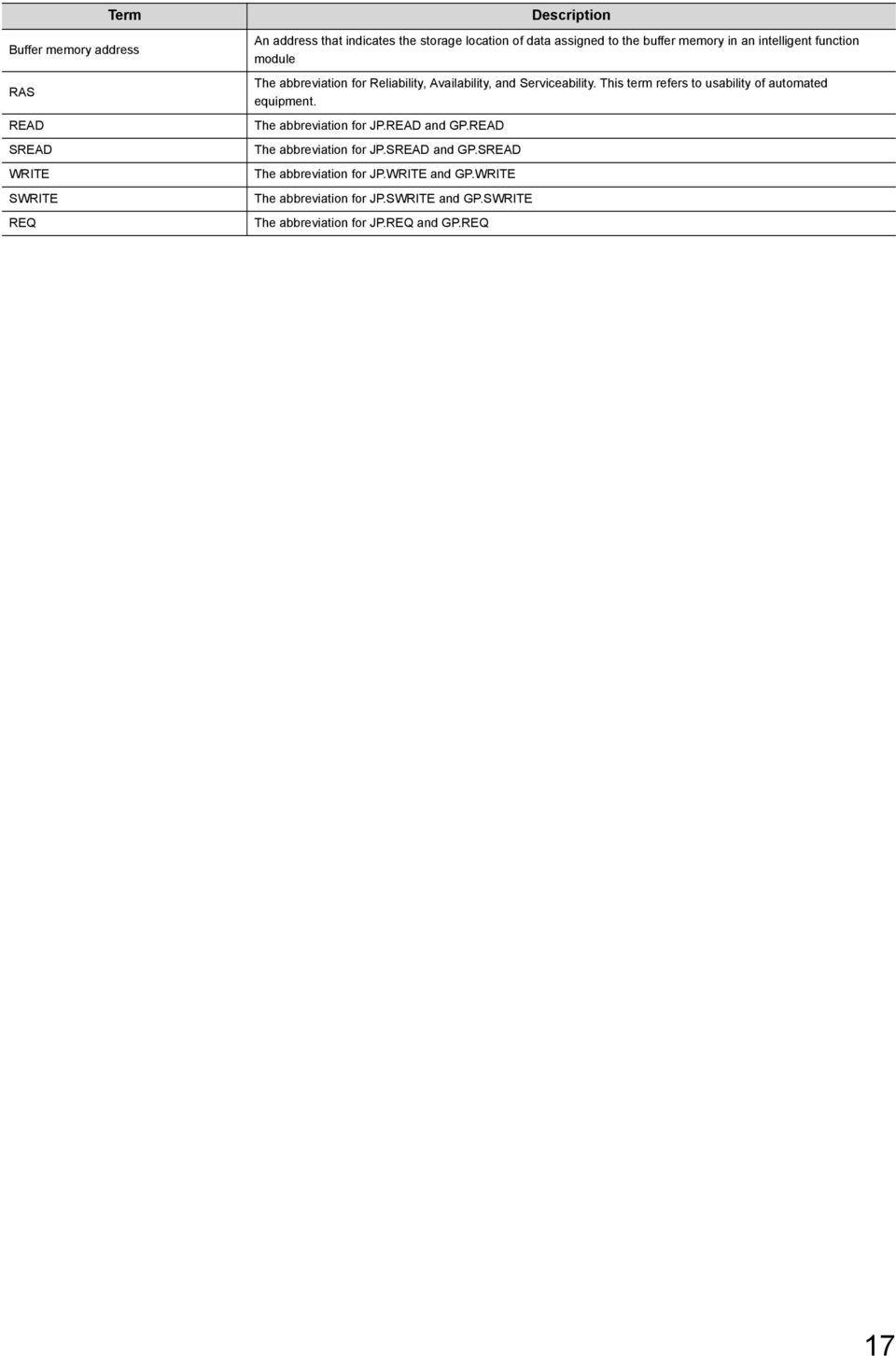
17 TERM Unless otherwise specified, this manual uses the following terms. Term Safety programmable controller Standard programmable controller QSCPU LCPU QCPU QnACPU ACPU System A CPU System B CPU Control system CPU Standby system CPU Control CPU Programming tool GX Developer GX Works2 CC-Link IE Field Network CC-Link Safety CPU module Master/local module Q series master/local module L series master/local module CC-Link Safety master module Head module Ethernet adapter module CC-Link IE Field Network interface board Network module Intelligent function module Safety data Safety connection Safety communication Standard communication Cyclic transmission Transient transmission Safety station Standard station Description A generic term for a safety CPU module, a safety power supply module, a safety main base unit, a CC-Link Safety master module, CC-Link Safety remote I/O modules, and a master/local module A generic term for MELSEC-Q series, MELSEC-L series, MELSEC-QnA series, MELSEC-A series, and MELSEC- FX series modules (This term is used to distinguish a programmable controller that uses these modules from a safety programmable controller.) Another term for the MELSEC-QS series CPU module Another term for the MELSEC-L series CPU module Another term for the MELSEC-Q series CPU module Another term for the MELSEC-QnA series CPU module Another term for the MELSEC-A series CPU module A CPU module where the system A connector of a tracking cable is connected in a redundant system A CPU module where the system B connector of a tracking cable is connected in a redundant system A CPU module that controls operations in a redundant system A CPU module that stands by in case the control system fails in a redundant system A CPU module that controls connected I/O modules and intelligent function modules. In a multiple CPU system, there are multiple CPU modules and each connected module can be controlled by a different CPU module. A generic term for GX Works2 and GX Developer The product name of the software package for the MELSEC programmable controllers A high-speed and large-capacity open field network that is based on Ethernet (1000BASE-T) A field network system where data processing for control and information can be simultaneously performed at high speed The abbreviation for the QS001CPU safety CPU module The abbreviation for the QS0J71GF11-T2 CC-Link IE Field Network master/local module. This module supports safety functions. The abbreviation for the QJ71GF11-T2 CC-Link IE Field Network master/local module The abbreviation for the LJ71GF11-T2 CC-Link IE Field Network master/local module The abbreviation for the QS0J61BT12 CC-Link Safety system master module The abbreviation for the LJ72GF15-T2 CC-Link IE Field Network head module The abbreviation for the NZ2GF-ETB CC-Link IE Field Network Ethernet adapter module The abbreviation for the Q81BD-J71GF11-T2 CC-Link IE Field Network interface board A generic term for the following modules: Module on CC-Link IE Field Network CC-Link IE Controller Network module Ethernet interface module MELSECNET/H module MELSECNET/10 module A MELSEC-Q/L series module that has functions other than input and output, such as an A/D converter module and D/A converter module Data exchanged through safety communication A connection established for safety communication A function to exchange safety data between safety stations on the same network A generic term for cyclic transmission and transient transmission A function by which data are periodically exchanged among stations on the same network using link devices (RX, RY, RWw, and RWr) A function of communication with another station, which is used when requested by a dedicated instruction or a programming tool A generic term for a station that performs safety communication and standard communication A generic term for a station that performs standard communication 15

18 Term Master station Local station Remote I/O station Remote device station Intelligent device station Slave station Reserved station Relay station Data link Seamless communication Routing Dedicated instruction Link dedicated instruction Return Disconnection Loopback Device Link device Remote input (RX) Remote output (RY) Remote register (RWr) Remote register (RWw) Link special relay (SB) Link special register (SW) Link scan (Link scan time) Link refresh Baton pass Buffer memory A station that controls the entire network. Only one master station can be used in a network. This station serves as a safety station or a standard station, and can perform cyclic transmission and transient transmission with all stations. When set as a safety station, the station can perform safety communication with another safety station on the same network. A station that serves as a safety station or a standard station. This station can perform cyclic transmission and transient transmission with the master station and other local stations. When set as a safety station, the station can perform safety communication with another safety station on the same network. The station is controlled by programs in the CPU module or other equivalent modules on the station. A station that exchanges I/O signals (bit data) with the master station by cyclic transmission A station that exchanges I/O signals (bit data) and I/O data (word data) with another station by cyclic transmission. This station responds to a transient transmission request from another station. A station that exchanges I/O signals (bit data) and I/O data (word data) with another station by cyclic transmission. This station responds to a transient transmission request from another station and also issues a transient transmission request to another station. A generic term for a local station, remote I/O station, remote device station, and intelligent device station A station reserved for future use. This station is not actually connected, but counted as a connected station. A station that includes two or more network modules. Data are passed through this station to stations on other networks. Generic term for cyclic transmission and transient transmission Communication that allows users to access a different kind of networks without having to consider the differences as if data were exchanged within one single network. A process of selecting paths for communication with other networks. CC-Link IE Field Network requires communication paths to be preset using routing parameters to communicate with stations on different networks. An instruction that simplifies programming for using functions of intelligent function modules A dedicated instruction used for transient transmission with a programmable controller on another station. This instruction allows a master/local module to communicate with programmable controllers on the same network (CC-Link IE Field Network) and on other networks (Ethernet, CC-Link IE Controller Network, and MELSECNET/H). Processing that restarts data link when a station recovers from an error Processing that stops data link if a data link error occurs A function that disconnects the station in which an error has occurred, and continues data link with the stations that are operating normally. Stations connected after the faulty station can also continue data link. A device (X, Y, M, D, or others) in a CPU module A device (RX, RY, RWr, or RWw) in a module on CC-Link IE Field Network Bit data input from a slave station to the master station (For some areas in a local station, data are input in the opposite direction.) Page 103, Section Bit data output from the master station to a slave station (For some areas in a local station, data are output in the opposite direction.) Page 103, Section Word data input from a slave station to the master station (For some areas in a local station, data are input in the opposite direction.) Page 103, Section Word data output from the master station to a slave station (For some areas in a local station, data are output in the opposite direction.) Page 103, Section Bit data that indicates the operating status and data link status of a module on CC-Link IE Field Network Word data that indicates the operating status and data link status of a module on CC-Link IE Field Network Time required for all the stations on the network to transmit data. The link scan time depends on data volume and the number of transient transmission requests. Data transfer between a link device in a module on CC-Link IE Field Network and a device in a CPU module. Link refresh is performed in the END processing of the CPU module's sequence scan. A token to send data over a network Description A memory in an intelligent function module, where data (such as setting values and monitoring values) exchanged with a CPU module are stored 16

19 Term Buffer memory address RAS READ SREAD WRITE SWRITE REQ An address that indicates the storage location of data assigned to the buffer memory in an intelligent function module The abbreviation for Reliability, Availability, and Serviceability. This term refers to usability of automated equipment. The abbreviation for JP.READ and GP.READ The abbreviation for JP.SREAD and GP.SREAD The abbreviation for JP.WRITE and GP.WRITE The abbreviation for JP.SWRITE and GP.SWRITE The abbreviation for JP.REQ and GP.REQ Description 17
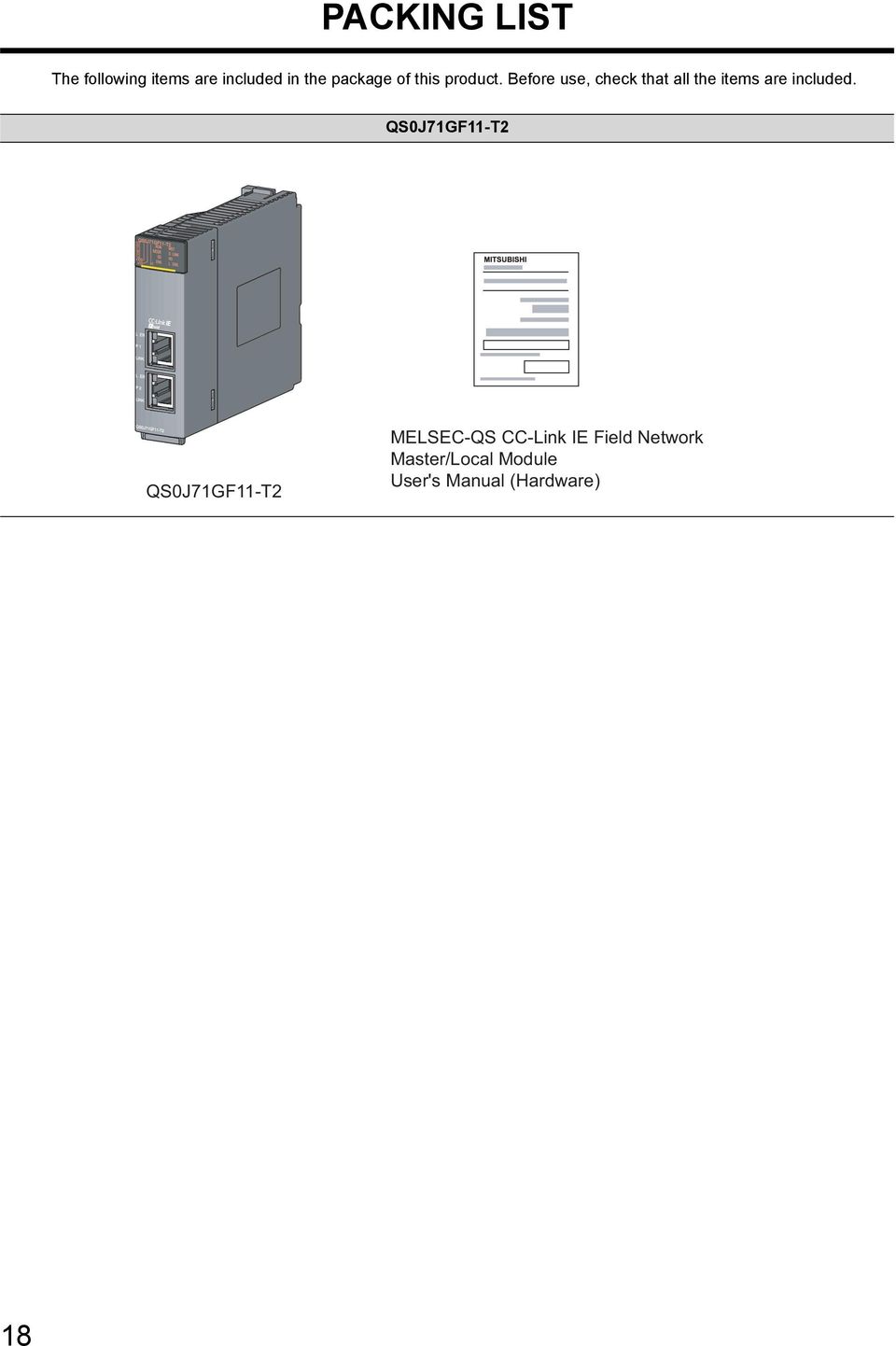
20 PACKING LIST The following items are included in the package of this product. Before use, check that all the items are included. QS0J71GF11-T2 QS0J71GF11-T2 MELSEC-QS CC-Link IE Field Network Master/Local Module User's Manual (Hardware) 18
21 CHAPTER 1 CC-Link IE FIELD NETWORK CHAPTER 1 CC-Link IE FIELD NETWORK CC-Link IE Field Network CC-Link IE Field Network is a high-speed and large-capacity open field network that is based on Ethernet (1000BASE-T). (1) Data communication High-speed and large-capacity data communication is available between a master station and slave stations on CC-Link IE Field Network. A safety station can operate safety communication and standard communication simultaneously. (a) Safety communication Data communication ensuring high safety (safety communication) can be performed. Data is communicated after a safety connection is established between safety stations on the same network. ( Page 96, Section 8.1) Master station (safety station) Local station (safety station) 1) Safety connection establishment Safety CPU module Device Master station (safety station) 2) Safety data transfer Local station (safety station) Safety CPU module Device 1.1 CC-Link IE Field Network After safety connection is established, data is communicated. Device Device 3) Safety data transfer 19
22 (b) Standard communication Periodic communication (cyclic transmission) Data is periodically communicated among stations within the same network. ( Page 102, Section 8.2) Master station (standard station) Intelligent device station Intelligent device station Local station (safety station) Local station (safety station) CPU module X Master station (standard station) RX Intelligent device station RX Intelligent device station RX Local station (safety station) RY Safety CPU module Y Local station (safety station) RY Safety CPU module Y Y RY RY RY RX X RX X W RWw RWr RWw RWr RWw RWr RWr RWw W RWr RWw W Non-periodic communication (transient transmission) Data is communicated upon request. ( Page 117, Section 8.3) Safety CPU module Command Master station (safety station) Read request Local station (safety station) Safety CPU module Instruction Device Response data Device 1234H 1234H 20
23 CHAPTER 1 CC-Link IE FIELD NETWORK (2) 1Gbps communication speed 1Gbps communication speed allows high-speed communication. Also, the takt time can be reduced due to the improved performance of communication response. 1 (3) Use of Ethernet cable A 1000BASE-T-compliant Ethernet is used for the connection interface. The wiring cost can be reduced because 1000BASE-T-compliant Ethernet cables are commercially available. ( Page 56, Section 5.2) 1000BASE-T (4) Flexible wiring for system arrangements The network can be wired into star topology, line topology, and ring topology. ( Page 47, Section 5.1.1) For star topology, a 1000BASE-T compliant switching hub can be used. ( Page 57, Section 5.2.2) Wiring is highly flexible because a network can consist of a combination of star and line topologies. For example, the control panels can be connected through a star topology and the production lines through a line topology. Star topology Line topology Line topology Line topology 1.1 CC-Link IE Field Network 21
24 1.2 Master/Local Modules A master/local module is used to connect a safety programmable controller to CC-Link IE Field Network. The module is used being mounted on a safety base unit. The module can be used as the following stations on CC-Link IE Field Network. Master station (safety station) Local station (safety station) Local station (standard station) (1) Communication that ensures safety (safety communication) Data communication ensuring high safety (safety communication) can be performed. Data is communicated after a safety connection is established between safety stations on the same network. ( Page 96, Section 8.1) (a) Safety stations added on CC-Link IE Field Network Safety programmable controllers and standard programmable controllers can co-exist on the same network. A network system with high safety can be easily established by adding safety stations on an existing CC-Link IE Field Network. ( Page 47, Section 5.1.1) Adding a station Safety communication Adding a station Safety station Standard station Standard station Safety station The master/local module has acquired certification of the highest safety level (SIL3 of IEC 61508, Category 4 of EN 654-1, and Category 4 performance level "e" of EN ISO ) applicable to programmable controllers. 22
25 CHAPTER 1 CC-Link IE FIELD NETWORK (2) High-speed periodic communication (cyclic transmission) Since transmission delay time is short, delay caused by the network does not need to be considered (if the link scan time of each master/local module is shorter than the scan time of the safety CPU module). 1 Command High speed Master/local modules can perform cyclic transmissions in combination with the following functions: ( Page 35, Section 3.3) Auto transfer of data between the link devices in the master/local module and the devices in the safety CPU module Cyclic data assurance in units of 32 bits or per station Status setting (hold or clear) of input data of standard communication to which a data link error has occurred Station reservation for future connection, and others 1.2 Master/Local Modules 23
26 (3) Non-periodic communication (transient transmission) with programmable controllers on other stations (a) Reading or writing data A master/local module can access programmable controllers on other stations by dedicated instructions. ( Page 152, Section 10.1) Seamless access of programmable controllers on other networks such as Ethernet, CC-Link IE Controller Network, MELSECNET/H, and MELSECNET/10 is also possible. Safety CPU module Command Master station (safety station) Local station (safety station) Safety CPU module READ Device Device 1234H 1234H 24
27 CHAPTER 1 CC-Link IE FIELD NETWORK (4) Settings and diagnostics by GX Developer 1 (a) Setting parameters Parameters for master/local modules can be set using GX Developer. ( Page 77, CHAPTER 7) 1.2 Master/Local Modules 25
28 (b) Checking CC-Link IE Field Network status graphically CC-Link IE Field Network status can be checked using GX Developer. Error locations, error causes, and event history are displayed on the window. This allows the system to quickly recover from errors. ( Page 124, CHAPTER 9) Displays error details Displays the status of CC-Link IE Field Network Displays the network event history 26
29 CHAPTER 1 CC-Link IE FIELD NETWORK (c) Seamless access to other networks GX Developer can seamlessly access (test or monitor) systems composed of CC-Link IE Field Network and other networks. The accessible networks are Ethernet, CC-Link IE Controller Network, MELSECNET/H, MELSECNET/10, and CC-Link. Seamless access enables the user to change the access target without modifying the connection between the personal computer and programmable controller. For details on access range, refer to the following. QSCPU User s Manual (Function Explanation, Program Fundamentals) 1 Systems on other networks can be tested or monitored. CC-Link IE Controller Network Network No. 1 GX Developer Seamless access CC-Link IE Field Network Network No. 2 (Relay station) 1.2 Master/Local Modules 27
30 (5) Replacing CC-Link IE Field Network devices without stopping the system For star topology, slave stations can be replaced without powering off the whole system. Star topology Replacement (6) RAS function when a communication error occurs (a) During safety communication When a communication error occurs between safety stations, communication is automatically disconnected in order to prevent incorrect input/output from/to the faulty station. ( Page 100, Section 8.1.3) Safety communication Master station (safety station) Station No. 0 Error Local station (safety station) Station No. 3 Local station (standard station) Station No. 2 Local station (standard station) Station No. 1 Master station (safety station) Station No. 0 Communication disconnection and interlock Local station (safety station) Station No. 3 Local station (standard station) Station No. 2 Local station (standard station) Station No. 1 28
31 CHAPTER 1 CC-Link IE FIELD NETWORK (b) During standard communication When a communication error occurs, communication is automatically disconnected in order to prevent incorrect input/output from/to the faulty station. When the disconnected station gets back to normal operation, it automatically returns to the network and resumes data link. ( Page 35, Section 3.3.1) 1 Standard communication Master station (safety station) Station No. 0 Local station (safety station) Station No. 3 Local station (standard station) Station No. 2 Error Local station (standard station) Station No. 1 Communication is automatically disconnected. Master station (safety station) Station No. 0 Local station (safety station) Station No. 3 Local station (standard station) Station No. 2 Disconnection Local station (standard station) Station No. 1 When recovered from fault 1.2 Master/Local Modules Standard communication Master station (safety station) Station No. 0 Local station (safety station) Station No. 3 Local station (standard station) Station No. 2 Reconnection Local station (standard station) Station No. 1 29
32 CHAPTER 2 PART NAMES This chapter describes the names of each part of the master/local modules. 1) 2) 3) No. Name Application RUN LED Indicates the operating status. ON Operates normally. OFF A hardware failure or a watchdog timer error has occurred. MST LED Indicates the station type. ON Operates as a master station (safety station). OFF Operates as a local station. MODE LED Indicates the mode. ON In online mode. Flashing In test mode (The module is performing a hardware test, self-loopback test, or loop test.) 1) OFF In offline mode. (Data link not performed) D LINK LED Indicates the status of the data link. ON Data link in operation (cyclic transmission in progress) Flashing Data link in operation (cyclic transmission stopped) OFF Data link not performed (disconnected) SD LED Displays the sending status of data. ON Sending data. OFF Data not sent. RD LED Displays the reception status of data. ON Receiving data. OFF Data not received. 30
33 CHAPTER 2 PART NAMES No. Name Application ERR. LED Indicates the error status of the master/local module. The description of the errors can be confirmed in CC- Link IE Field Network diagnostics. ( Page 124, CHAPTER 9) ON Flashing OFF One of the following errors has occurred: A stop error occurs in the safety CPU module. An error was detected in all stations. Modules with same station number exist on the network. A network parameter is corrupted. The network parameter does not match the installation status. (Reserved station specification, number of connected stations, network number etc.) A data link faulty station was detected. Working normally. Indicates the error status of the received data and the circuit. When the L ERR. LED is on, you can check the L ER LED for "P1" or "P2" to see on which port the error was detected. 2 1) L ERR. LED ON OFF ST.NO. The description of the errors can be confirmed in CC-Link IE Field Network diagnostics. ( Page 124, CHAPTER 9) This LED automatically turns off when the module has received normal data and loopback is completed in ring topology. The module has received abnormal data. The module is performing loopback. The module has received normal data. The module is not performing loopback. Displays the station number of the master/local module. Displays the station number. Ex. Station No ON = 15 OFF Operates as a master station (safety station). (station No. 0) PORT1 connector for CC-Link IE Field Network (RJ45 connector) P1 Connect an Ethernet cable. ( Page 64, Section 6.3) There are no restrictions on the connection order of the cables for the "P1" connector and "P2" connector. L ER ON The module has received abnormal data. The module is performing loopback. 2) LED LINK OFF ON The module has received normal data. The module is not performing loopback. Linkup in progress. LED OFF Linkdown in progress. PORT2 connector for CC-Link IE Field Network (RJ45 connector) P2 Connect an Ethernet cable. ( Page 64, Section 6.3) There are no restrictions on the connection order of the cables for the "P1" connector and "P2" connector. L ER LED LINK LED (Same as the "P1" connector) 3) Serial number display Displays the serial number printed on the rating plate. 31
34 Remark For LED indication when the master/local module is in test mode (when the module performs hardware test, self-loopback test, or loop test), refer to the following. Hardware test: Page 60, Section Self-loopback test: Page 62, Section Loop test: Page 67, Section
35 CHAPTER 3 SPECIFICATIONS CHAPTER 3 SPECIFICATIONS This chapter describes the specifications, function list, I/O signal, and buffer memory of the master/local module. 3.1 General Specifications 3 For the general specifications of the master/local module, refer to the following. QSCPU User's Manual (Hardware Design and Maintenance and Inspection) 3.2 Performance Specifications Item Specifications Number of connectable Master station (safety station) 1 station (Up to 120 slave stations can be connected to the master station (safety station).) stations per network Local station (standard station) 120 stations Number of connectable safety stations per network 32 stations Maximum number of networks 239 Maximum number of Asynchronous mode 31 connections safety connections per station Synchronous mode 8 connections Number of safety inputs/outputs per safety connection Maximum link points per network Master station (safety station) Maximum link points per station Local station *1 Input 8 words Output 8 words RX points, 2KB RY points, 2KB RWr 8192 points, 16KB RWw 8192 points, 16KB RX points, 2KB RY points, 2KB RWr 8192 points, 16KB RWw 8192 points, 16KB RX 2048 points, 256 bytes RY 2048 points, 256 bytes RWr 1024 points, 2048 bytes *2 3.1 General Specifications RWw 1024 points, 2048 bytes *2 33
36 Item Communication speed Network topology Connection cable *1 The maximum number of points for one master station is listed. A local station can receive data from other stations in addition to this number of points. ( Page 96, Section 8.1.1) *2 256 points and 512 bytes when "Online (High Speed Mode)" is set Specifications 1Gbps Line topology, star topology (Coexistence of line topology and star topology is possible.), and ring topology An Ethernet cable that meets the 1000BASE-T standard: Category 5e or higher (double shielded, STP), straight cable ( Page 56, Section 5.2.1) Maximum station-to-station 100m max. (Compliant with ANSI/TIA/EIA-568-B (Category 5e)) Ethernet distance ( Page 66, Section 6.3 (2)) Line topology: 12000m (when cables are connected to 1 master station and 120 slave stations) Overall cable distance Star topology: Depends on the system configuration. Ring topology: 12100m (when cables are connected to 1 master station and 120 slave stations) Number of cascade connections Up to 20 Communication method Token passing method Number of occupied I/O points 32 points (I/O assignment: Intelligent 32 points) Internal current consumption (5VDC) 0.85A External dimensions 98(H) 27.4(W) 115(D) [mm] Weight 0.18kg 34
37 CHAPTER 3 SPECIFICATIONS 3.3 Function List Using the master/local module as a master station (safety station) (1) Safety communication function 3 Function Description Reference Communication with safety stations Error log registration function Safety station interlock function Communication starts among safety stations on the same network after safety connections are established. Information on errors occurred in safety stations and errors occurred in communications among safety stations are transferred to the safety CPU module and registered as error logs. If an error occurs in safety communication, this function cuts off the safety communication and prevents automatic resumption of the communication. Page 96, Section Page 99, Section Page 100, Section (2) Cyclic transmission Function Description Reference Communication by Communication RX and RY with other Communication by stations RWr and RWw Device and link Link refresh device access Mode selection for cyclic transmission Assurance of cyclic data integrity Scan synchronization specification Input status setting for data link faulty station Output status setting for CPU STOP Cyclic transmission stop and restart The master station (safety station) communicates I/O data in units of bits with other stations. Page 81, Section 7.3 The master station (safety station) communicates I/O data in units Page 103, Section of words with other stations. Transfer between the link device of the master/local module and the Page 86, Section 7.5 device of the safety CPU module is performed automatically. Page 104, Section This mode is selected for optimizing the performance of cyclic transmission based on the cyclic transmission and transient transmission frequency. Page 79, Section 7.2 (1) The mode can be selected from "Online (Normal mode)" and "Online (High-speed mode)". The cyclic data integrity is assured in units of 32 bits or stationbased units. Page 106, Section Link scan is set to asynchronous or synchronous with the sequence Page 112, Section scan of the safety CPU module. Select whether the input data from another station where the data Page 113, Section link error occurred is cleared or held. When the safety CPU module mounted with a master/local module is set to STOP, whether cyclic data output is held or cleared can be Page 115, Section selected. During debugging and other operations, cyclic transmission is stopped. (Data reception from the slave station and data Page 116, Section transmission from own stations are stopped.) Also, the stopped Page 138, Section 9.4 cyclic transmission is restarted. Transient transmission is not stopped. 3.3 Function List Using the master/local module as a master station (safety station) 35
38 (3) Transient transmission Function Description Reference Communication within the same network Communication with different networks Transient transmission is performed to other stations using dedicated instructions and GX Developer. By setting the routing parameters (communication path) using GX Developer in advance, transient transmission can be performed to stations on different networks through dedicated instructions or GX Developer. Seamless communication is available with the following networks. Ethernet CC-Link IE Controller Network MELSECNET/H MELSECNET/10 CC-Link (when using GX Developer) Page 152, CHAPTER 10 Page 92, Section 7.7 Page 118, Section (4) RAS function Function Description Reference Slave station disconnection Automatic return Loopback function Only the slave station where an error occurs is disconnected, and data link continues with the stations that are operating normally. In a line topology, all stations connected after the faulty station are disconnected. When the station disconnected from the network due to a data link failure recovers, it automatically returns to the network and restarts data link (for standard communication only). Only the station where an error occurs is disconnected, and data link continues with the stations that are operating normally. All stations after the faulty station are disconnected in line topology. By using the loopback function with ring topology, data link continues with the stations that are operating normally. Page 121, Section 8.6 (5) Diagnostic function Function Description Reference CC-Link IE Field Network diagnostics The status of CC-Link IE Field Network can be checked by GX Developer. The faulty area, cause of the fault and its corrective Page 124, CHAPTER 9 action, and event history can be checked in GX Developer. Hardware test Check the internal hardware of the master/local module. Page 60, Section Individual unit Check the communication circuit of the transmission system of the diagnostics Self-loopback test Page 62, Section master/local module. Check the network circuit status and parameter setting status of Own network Loop test Page 67, Section each station. diagnostics Cable test Check the connection status of the Ethernet cable. Page 74, Section Other network Check whether the communication path for transient transmission Communication test diagnostics from the own station to the target station is correct. Page 75, Section
39 CHAPTER 3 SPECIFICATIONS (6) Other functions Function Description Reference The reserved stations are included in the number of stations that Reserved station specification Temporary cancel of the reserved station setting will be connected to the network in the future without actually connecting them. Reserved stations are not detected as faulty stations even though they are not actually connected. Reserved station specification can be temporarily cancelled without changing the parameters. Page 119, Section 8.4 Page 142, Section Prevent the master station from detecting a slave station as a faulty Error invalid station and temporary error invalid station setting station even if the slave station is disconnected during data link. This can be used when replacing a slave station during data link, for instance. Page 120, Section 8.5 Page 146, Section Function List Using the master/local module as a master station (safety station) 37
40 3.3.2 Using the master/local module as a local station (1) Safety communication function (using the master/local module as a local station (safety station)) Function Description Reference Communication with safety stations Error log registration function Safety station interlock function Communication starts among safety stations on the same network after safety connections are established. Information on errors occurred in safety stations and errors occurred in communications among safety stations are transferred to the safety CPU module and registered as error logs. If an error occurs in safety communication, this function cuts off the safety communication and prevents automatic resumption of the communication. Page 96, Section Page 99, Section Page 100, Section (2) Cyclic transmission Function Description Reference Communication by Communication RX and RY with other Communication by stations RWr and RWw Device and link Link refresh device access Assurance of cyclic data integrity Input status setting for data link faulty station Output status setting for CPU STOP Cyclic transmission stop and restart I/O data in bit units is communicated between the local station and other stations. Page 81, Section 7.3 I/O data in word units is communicated between the local station Page 103, Section and other stations. Transfer between the link device of the master/local module and the Page 86, Section 7.5 device of the safety CPU module is performed automatically. Page 104, Section The cyclic data integrity is assured in units of 32 bits or stationbased units. Page 106, Section Select whether the input data from another station where the data Page 113, Section link error occurred is cleared or held. When the safety CPU module mounted with a master/local module is set to STOP, whether cyclic data output is held or cleared can be Page 115, Section selected. During debugging and other operations, cyclic transmission is stopped. (Data reception from the slave station and data Page 116, Section transmission from own stations are stopped.) Also, the stopped Page 138, Section 9.4 cyclic transmission is restarted. Transient transmission is not stopped. 38
41 CHAPTER 3 SPECIFICATIONS (3) Transient transmission Function Description Reference Communication within the same network Transient transmission is performed to other stations using dedicated instructions and GX Developer. Page 152, CHAPTER 10 By setting the routing parameters (communication path) using GX Communication with different networks Developer in advance, transient transmission can be performed to stations on different networks through dedicated instructions or GX Developer. Seamless communication is available with the following networks. Ethernet CC-Link IE Controller Network MELSECNET/H MELSECNET/10 CC-Link (when using GX Developer) Page 92, Section 7.7 Page 118, Section (4) Diagnostic function Function Description Reference CC-Link IE Field Network diagnostics The status of CC-Link IE Field Network can be checked by GX Developer. The faulty area, cause of the fault and its corrective Page 124, CHAPTER 9 action, and event history can be checked in GX Developer. Hardware test Check the internal hardware of the master/local module. Page 60, Section Individual unit Check the communication circuit of the transmission system of the diagnostics Self-loopback test Page 62, Section master/local module. Check the network circuit status and parameter setting status of Own network Loop test Page 67, Section each station. diagnostics Cable test Check the connection status of the Ethernet cable. Page 74, Section Other network Check whether the communication path for transient transmission Communication test diagnostics from the own station to the target station is correct. Page 75, Section Function List Using the master/local module as a local station 39
42 3.4 List of I/O Signals This section lists I/O signals for the safety CPU module. The I/O signal assignment of when the start I/O number of the master/local module is "0000" (the module is mounted to the 0 slot of the safety main base unit) is shown below. The device X is an input signal from the master/local module to the safety CPU module. The device Y is an output signal from the safety CPU module to the master/local module. Signal direction: Master/local module Safety CPU module Signal direction: Safety CPU module Master/local module Device number Signal name Device number Signal name X0 Module failure Y0 X1 Own station data link status Y1 X2 Use prohibited Y2 X3 Other stations data link status Y3 X4 Y4 X5 Y5 X6 Y6 X7 Y7 X8 Y8 X9 Use prohibited Y9 XA YA XB YB XC YC XD YD XE YE XF Module ready YF X10 Y10 Use prohibited X11 Y11 X12 Y12 X13 Y13 X14 Y14 X15 Y15 X16 Y16 X17 Y17 Use prohibited X18 Y18 X19 Y19 X1A Y1A X1B Y1B X1C Y1C X1D Y1D X1E Y1E X1F Y1F 40
43 CHAPTER 3 SPECIFICATIONS Do not use (turn on) any "use prohibited" signals as an input or output signal to the safety CPU module. Doing so may cause malfunction of the programmable controller system. For details on the I/O signals, refer to "I/O Signals". ( Page 264, Appendix 1) List of I/O Signals 41
44 3.5 List of Buffer Memory Addresses The buffer memory is used to exchange data between the master/local module and the safety CPU module. The buffer memory values are defaulted when the power is turned off or the safety CPU module is reset. Address (Decimal (Hexadecimal)) Name Initial value Read, write Refer to 0 to 1023 (0 to 3FF H ) Remote input (RX) Read 1024 to 2047 (400 H to 7FF H ) 2048 to (800 H to 27FF H ) Remote output (RY) Remote register (RWw) Read, write to (2800 H to 47FF H ) Link device area Remote register (RWr) 0 Read Page 266, Appendix to (4800 H to 481F H ) Link special relay (SB) to for read and write to for read only to (4820 H to 4A1F H ) Link special register (SW) to for read and write to for read only to (4A20 H to 4BFF H ) System area (4C00 H ) Station No. 1 RX offset (4C01 H ) Station No. 1 RX size to RX offset/size information to (4CEE H ) Station No. 120 RX offset 0 Read Page 269, Appendix (4CEF H ) Station No. 120 RX size to (4CF0 H to 4CFF H ) System area (4D00 H ) Station No. 1 RY offset (4D01 H ) to (4DEE H ) RY offset/size information Station No. 1 RY size to Station No. 120 RY offset 0 Read Page 269, Appendix (4DEF H ) Station No. 120 RY size to (4DF0 H to 4DFF H ) System area 42
45 CHAPTER 3 SPECIFICATIONS Address (Decimal (Hexadecimal)) Name Initial value Read, write Refer to (4E00 H ) Station No. 1 RWw offset (4E01 H ) to (4EEE H ) RWw offset/size information Station No. 1 RWw size to Station No. 120 RWw offset 0 Read Page 270, Appendix (4EEF H ) Station No. 120 RWw size to (4EF0 H to 4EFF H ) System area (4F00 H ) Station No. 1 RWr offset (4F01 H ) to (4FEE H ) RWr offset/size information Station No. 1 RWr size to Station No. 120 RWr offset 0 Read Page 270, Appendix (4FEF H ) Station No. 120 RWr size to (4FF0 H to 501F H ) System area (5020 H ) (5021 H ) (5022 H ) (5023 H ) to (5024 H to 5027 H ) (5028 H ) Own station (network card) information System area Manufacturer code 0 Model type 1 Model code 6 or 7 Version *1 Controller information valid/invalid flag Read Page 271, Appendix List of Buffer Memory Addresses (5029 H ) Manufacturer code (502A H ) Model type (502B H ) Own station (controller) information Model code 0 Read, write Page 271, Appendix (502C H ) Version to (502D H to 5036 H ) Model name string to (5037 H to 5038 H ) Vendor-specific device information 43
46 Address (Decimal (Hexadecimal)) Name Initial value Read, write Refer to to (5039 H to 503A H ) System area (5040 H ) Manufacturer code (5041 H ) (5042H) Other station (network card) information (station No. 1) Model type Model code 0 Read Page 272, Appendix (5043H) Version to (5044 H to 5047 H ) System area (5048 H ) Controller information valid/invalid flag (5049 H ) Manufacturer code (504A H ) Model type (504B H ) (504C H ) Other station (controller information) (station No. 1) Model code Version 0 Read Page 272, Appendix to (504D H to 5056 H ) Model name string to (5057 H to 5058 H ) Vendor-specific device information to (5059 H to 505F H ) System area to (5060 H to 5F3F H ) Other station information (station No. 2 to No. 120) Same as other station information (station No. 1) to (5F40 H to 7FFF H ) System area *1 Since the version of a master/local module is stored, the initial value depends on the master/local module used. Do not write data to "System area". Doing so may cause malfunction of the programmable controller system. 44
47 CHAPTER 4 PROCEDURES BEFORE OPERATION CHAPTER 4 PROCEDURES BEFORE OPERATION This chapter lists the procedures to be performed before operation of CC-Link IE Field Network. Remark The programming chapter in this manual provides examples for each procedure (from System consideration to Debug ) described below. ( Page 209, CHAPTER 11) Check box System consideration Consider the system configuration and link device assignments. Page 47, CHAPTER 5 Page 96, Section Page 103, Section Installation Mount the master/local module to the safety main base unit. Page 59, Section 6.1 Safety CPU operation mode check Check that the safety CPU module is in test mode (the TEST LED of the safety CPU module is on) after power-on. QSCPU User's Manual (Hardware Design, Maintenance and Inspection) Unit test Perform a unit test on each module. Page 60, Section 6.2 Manual for slave stations Wiring Connect an Ethernet cable to each module. Page 64, Section 6.3 Cable check Perform a cable test on the master/local module. Page 74, Section To the next page 45
48 Check box Configuration Set the parameters for each module. Page 77, CHAPTER 7 Network diagnostics Perform a loop test on the master station, and check if it can properly communicate by the configured parameters. Page 67, Section Programming Create a program. Page 209, CHAPTER 11 Debug Debug the program by using CC-Link IE Field Network diagnostics. Page 124, CHAPTER 9 Safety CPU operation mode change (to safety mode) Change the safety CPU operation mode to safety mode using GX Developer. QSCPU User's Manual (Hardware Design, Maintenance and Inspection) 46
49 CHAPTER 5 SYSTEM CONFIGURATION CHAPTER 5 SYSTEM CONFIGURATION 5.1 CC-Link IE Field Network Configuration This section describes CC-Link IE Field Network configurations. The master/local module operates as the following station in CC-Link IE Field Network: Master station (safety station) Local station (safety station) Local station (standard station) Single network system 5 (1) Overall system configuration Single network system is a system that consists of a master station and slave stations connected by Ethernet cables. (a) Configuring a system using safety stations only One master station (safety station) and up to 31 local stations (safety stations) can be connected. Switching hub Ethernet cable (1000BASE-T) Master station (safety station) 1 station Local station (safety station) Up to 31 stations 5.1 CC-Link IE Field Network Configuration Single network system 47
50 (b) Configuring a system using safety stations and standard stations One master station (standard station) and up to 120 slave stations can be connected per network. Up to 32 safety stations can be connected per network. Switching hub Ethernet cable (1000BASE-T) Master station (standard station) 1 station Local station (standard station) Local station (safety station) Up to 32 stations Slave station Up to 120 stations When a safety station is set as a master station, the following restrictions apply: Some dedicated instructions cannot be used. ( Page 317, Appendix 7.2) Interlink transmission is not available. The maximum number of safety connections per master/local module is as follows: Asynchronous mode: 31 connections Synchronous mode: 8 connections 48
51 CHAPTER 5 SYSTEM CONFIGURATION (2) Network configuration (a) Network topology The network can be wired into star topology, line topology, and ring topology. A network can consist of a combination of star and line topologies, but the ring topology cannot be combined with star or line topology. Switching hub Star topology Line topology 5 Star and line topologies mixed Switching hub Switching hub Item Description The network is configured into a star using a switching hub and Ethernet cables. Slave stations can be easily added to the network using this topology. (Add slave stations Star topology one by one. If multiple slave stations are added at a time, all stations on the network will be reconnected. Therefore, an error may momentarily occur in all the stations.) Data link continues with the stations that are operating normally. The network is configured into a line by connecting the modules with Ethernet cables, but without a switching hub. If an error occurs, stations after the faulty station will be disconnected.*1 Line topology Line topology Master station (safety station) (Station No. 0) Stations after the faulty station are disconnected. Fault CC-Link IE Field Network Configuration Single network system Ring topology
52 Item Description The network is configured into a ring using Ethernet cables. Data link continues with the stations that are operating normally. *1 Ring topology Ring topology Master station (safety station) (Station No. 0) The system will continue data link among normal stations only. Fault *1 Add/remove slave stations one by one. If multiple slave stations are added/removed at a time, all stations on the network will be reconnected, and an error may momentarily occur in all the stations. (b) Station number and connection position Modules can be connected in any order regardless of the station number. Station No. 1 Station No. 0 ( Master station (safety station) ) Station No. 3 Station No. 2 (c) Cascade connection Up to 20-layer connection is available for the cascade connection. Switching hub Up to 20-layer cascade connection Remark For wiring method, refer to Page 64, Section
53 CHAPTER 5 SYSTEM CONFIGURATION (3) Precautions (a) Connecting devices to the same network Do not connect Ethernet devices (e.g. personal computer) other than CC-Link IE Field Network devices to the switching hub used by CC-Link IE Field Network. Doing so will cause timeout in the master station, resulting in disconnection of all the stations. (b) Configuration in which data link cannot be performed (incorrectly configured ring topology) Do not wire devices as shown below. Doing so will cause an error in all stations and data link cannot be performed. Connecting both PORT1 and PORT2 to the switching hub 5 Ex. Switching hub Cannot connect both Ethernet ports to the switching hub. Ring topology through a switching hub Ex. Switching hub 5.1 CC-Link IE Field Network Configuration Single network system 51
54 (c) Ring topology To configure a ring topology, select "Use" under "Loopback Function Setting" in the network parameter window for the master station. ( Page 81, Section 7.3) (d) Using a switching hub to configure a ring topology If ring topology is configured by connecting two stations through two of the switching hub's ports, the following problems may arise: If an Ethernet cable is disconnected, loopback cannot be detected. If a station is disconnected due to failure or power-off, data link will stop. Therefore, do not use a switching hub to configure the ring topology. Switching hub (e) Offline mode station in ring topology In the following cases, the master station or the station connected to the offline mode station cannot detect loopback. One of the Ethernet cables connected to the offline mode station is disconnected. Master station (safety station) Station in Offline mode No loopback is detected. No loopback is detected. A station connected to the offline mode station is disconnected. Master station (safety station) Station in Offline mode Fault No loopback is detected. No loopback is detected. To detect loopback, set the offline mode station as a reserved station. When the offline mode station is disconnected, loopback can be detected. A station during the RESET status and a station with no station number setting operate as an offline mode station does. 52
55 CHAPTER 5 SYSTEM CONFIGURATION (f) Connecting/disconnecting a cable and powering off/on a device When the operations listed below are performed, all stations on the network may be reconnected. At that time, a data link error or a baton pass error may momentarily occur in all the stations, and outputs of the connected slave stations may turn off. Network configuration Star topology Line topology, ring topology Operation Powering a slave station or switching hub off and on Connecting/disconnecting an Ethernet cable connected to the switching hub Disconnecting an Ethernet cable from a slave station and connecting it to another slave station or the switching hub Disconnecting more than nine stations, or half the number of slave stations or more in the system Changing the network topology when adding a slave station Simultaneously powering off/on systems on multiple stations Simultaneously connecting/disconnecting Ethernet cables to/from multiple stations (When a data link faulty station returns, a data link error will occur in all the stations.) Disconnecting more than nine stations, or half the number of slave stations or more in the system Changing the network topology when adding a slave station 5 Momentary error in all the stations To hold the outputs as a measure when a data link error occurs, configure the following settings: Master/local module Insertion/removal or power-off/power-on Set input data to be used from the faulty station. Project data list [Parameter] [Network param] [Ethernet/CC IE/MELSECNET] 5.1 CC-Link IE Field Network Configuration Single network system button Note that data input by safety communication is cleared even if the above setting is configured. 53
56 (g) Connected station numbers Do not duplicate station numbers. Data link may be stopped when the station number is duplicated. Duplication Station No. 0 Station No. 1 Station No. 1 Station No. 2 (Data link may stop.) (h) Power-on order To avoid incorrect input from slave stations, power on slave stations before the master station. (i) Submaster function A master/local module cannot be used as a submaster station. In addition, if a safety station is used in a system which includes a submaster station, an error may occur in safety communications when the control is switched between a master station and a submaster station. 54
57 CHAPTER 5 SYSTEM CONFIGURATION Multi-network system The multi-network system is a system in which multiple networks are connected by some relay stations. Up to 239 networks can be connected. CC-Link IE Controller Network Network No. 2 5 (Relay station) Network No. 1 CC-Link IE Field Network Only one master/local module can be mounted on a safety base unit. Therefore, a safety programmable controller cannot relay more than one CC-Link IE Field Network. To relay more than one CC-Link IE Field Network systems, use a standard programmable controller. Safety communications can be achieved among safety stations on the same network. Cyclic transmission communication is available only in the same network. Transient transmission communication is available with other networks as well as the same network. Communications can be made with stations up to eight networks apart (number of relay stations: 7). ( Page 154, Section 10.1 (1) (b)) 5.1 CC-Link IE Field Network Configuration Multi-network system 55
58 5.2 Network Components CC-Link IE Field Network consists of components such as cables and hubs Cables For wiring, use the 1000BASE-T compliant Ethernet cables. Ethernet cable Connector Type Category 5e or higher (Double shielded/stp) Straight cable RJ45 connector The following conditioning cables: IEEE802.3 (1000BASE-T) ANSI/TIA/EIA-568-B (Category 5e) For CC-Link IE Field Network wiring, use the recommended wiring components by CC-Link Partner Association. Cables for CC-Link IE Controller Network cannot be used for CC-Link IE Field Network. (1) Product Cables for CC-Link IE Field Network are available from Mitsubishi Electric System & Service Co., Ltd. (Catalogs for cable are also available.) Also, the connector processing of cable length is available for your preference. Please consult your local Mitsubishi Electric System & Service Co., Ltd. Type CC-Link IE Field Network cable Model (manufacturer) SC-E5EW series (Mitsubishi Electric System & Service Co., Ltd.) Remark Cable types The following cable types are available depending on the operating environment: Standard type: Cables for inside the control panel and indoor connection L type: Cables for outdoor connection Cables and relay adapters of flame retardant or waterproof type are also available. Please contact your Mitsubishi Electric System & Service Co., Ltd. 56
59 CHAPTER 5 SYSTEM CONFIGURATION Hubs Use hubs that meet all the conditions listed below: Compliance with the IEEE802.3 (1000BASE-T) Support of the auto MDI/MDI-X function Support of the auto-negotiation function Switching hub (layer 2 switch) *1 Operation is not guaranteed if the hubs do not meet these conditions. *1 A repeater hub is not available. (1) Mitsubishi product Type Industrial switching hub Model name NZ2EHG-T Network Components Hubs 57
60 5.3 Applicable Systems This section describes MELSEC-QS series systems that include the master/local module. Master/local module Programming tool available for master/local modules Page 58, Section 5.3 (2) Applicable CPU modules, and the number of mountable modules Page 58, Section 5.3 (1) (1) Applicable safety CPU modules and the number of mountable modules (a) Safety CPU module The following safety CPU module is applicable to the master/local module. Safety CPU module Serial number (first five digits) QS001CPU or later (b) Number of mountable modules For the number of mountable modules, refer to the following. QSCPU User's Manual (Hardware Design, Maintenance and Inspection) (c) Mounting to a MELSECNET/H remote I/O station The master/local module cannot be mounted to any MELSECNET/H remote I/O stations. Mount the module on a safety base unit on which a safety CPU module is mounted. (2) Applicable programming tool GX Developer is required for setting and diagnosing master/local modules. GX Works2 cannot be used. Software Version GX Developer Version 8.98C or later (3) Module replacement Replacing the module before the following time elapses is recommended. Module Master/local module Replacement time 10 years 58
61 CHAPTER 6 INSTALLATION AND WIRING CHAPTER 6 INSTALLATION AND WIRING This chapter describes the installation and wiring of a master/local module. 6.1 Installation This section describes the installation of a master/local module. (1) Handling precautions The following is a list of precautions for handling the master/local module: Do not drop or apply strong shock to the module case since it is made from resin. Doing so may cause failure. Do not remove the printed-circuit board of the module from the case. Doing so may cause failure. Prevent foreign matter such as dust or wire chips from entering the module. Such foreign matter can cause a fire, failure, or malfunction. A protective film is attached to the top of the module to prevent foreign matter, such as wire chips, from entering the module during wiring. Do not remove the film during wiring. Remove it for heat dissipation before system operation. Before handling the module, touch a grounded metal object to discharge the static electricity from the human body. Failure to do so may cause the module to fail or malfunction. Tighten the screws such as module fixing screws within the following range. Screw Tightening torque range Module fixing screw (M3 12) 0.36 to 0.48N m To mount the module, while pressing the module mounting lever located in the lower part of the module, fully insert the module fixing projection(s) into the hole(s) in the base unit and press the module until it snaps into place. Be sure to tighten the module fixing screw within the specified tightening torque range. Incorrect mounting may cause malfunction, failure or drop of the module Installation (2) Installation environment For details on installation environment, refer to the following. QSCPU User's Manual (Hardware Design, Maintenance and Inspection) 59
62 6.2 Tests Before Wiring This section describes module tests that should be performed before network wiring Hardware test Hardware test checks the hardware inside the master/local modules. (1) Procedure 1. Mount the master/local module on the safety base unit, and connect GX Developer to the safety CPU module. An Ethernet cable is not connected to the master/local modules. Select one from the followings: "CC IE Field (Master station [Safety])", "CC IE Field (Local station [Safety])", or "CC IE Field (Local station)". Select "H/W test". 2. Set network parameters in GX Developer as shown in the figure to left. Project data list [Parameter] [Network param] [Ethernet/CC IE/MELSECNET] 3. Write the network parameters set in GX Developer to the safety CPU module. [Online] [Write to PLC] 4. Reset the safety CPU module or power off and on or powering off on the system. 5. Hardware test begins. S T. N O RUN MODE 4 SD 8 ERR. MST D LINK RD L ERR. : ON : Flashing The MODE LED of master/local modules flashes, and each of the 1 LED repeatedly turns on and off ( ). 60
63 CHAPTER 6 INSTALLATION AND WIRING When completed S T. N O RUN 2 2 MODE 4 4 SD 8 8 ERR When failed MST D LINK RD L ERR. : ON : Flashing 6. D LINK LED turns on when the test is completed. When completed The 1 LED turns off. When failed Any one of the 1 LEDs turns on, and the ERR. LED turns on. When the test fails, the possible cause is hardware failure of the master/local modules. Please consult your local Mitsubishi service center or representative with the detailed problem description. S T. N O RUN 2 2 MODE 4 4 SD 8 8 ERR MST D LINK RD L ERR. : ON : Flashing 6 Remark The test status and result can be checked through monitoring the link special relays on GX Developer. Item Description When completed Hardware test completion status (SB0090): ON Hardware test normal/abnormal end (SB0091): OFF When failed Hardware test completion status (SB0090): ON Hardware test normal/abnormal end (SB0091): ON (2) Precautions (a) Settings Do not enter values for "Network Configuration Setting" and "Refresh parameters". When link refresh is executed during a hardware test, the test may fail. 6.2 Tests Before Wiring Hardware test (b) Operations Do not access the buffer memory through the program during the hardware test. Doing so may cause the test to fail. 61
64 6.2.2 Self-loopback test Self-loopback test checks the communication circuit of the master/local module. When conducting the self-loopback test, use a normal Ethernet cable. ( Page 56, Section 5.2) 1. Mount the master/local module on the safety base unit, and connect GX Developer to the safety CPU module. Select one from the followings: "CC IE Field (Master station [Safety])", "CC IE Field (Local station [Safety])", or "CC IE Field (Local station)". Select "Self-loopback test". 2. Set network parameters in GX Developer as shown in the figure to left. Project data list [Parameter] [Network param] [Ethernet/CC IE/MELSECNET] 3. Write the network parameters set in GX Developer to the safety CPU module. [Online] [Write to PLC] 4. Connect PORT1 and PORT2 of the master/local modules with an Ethernet cable. ( Page 64, Section 6.3) Ethernet cable or powering off on 5. Reset the safety CPU module or power off and on the system. 62
65 CHAPTER 6 INSTALLATION AND WIRING 6. Self-loopback test begins. S T. N O RUN MODE SD MST D LINK RD L ER P1 LINK L ER : ON : Flashing The MODE LED of master/local modules flashes, and each of the 10 LED repeatedly turns on and off ( ). Also, the SD LED, RD LED, and LINK LED turn on ERR L ERR. P2 LINK When completed S T. N O. S T. N O RUN MST 2 2 MODE D LINK 4 4 SD RD 8 8 ERR. L ERR. : ON 10 1 : Flashing When failed RUN MST 2 2 MODE D LINK 4 4 SD RD 8 8 ERR. L ERR. : ON 7. D LINK LED turns on, and SD LED and RD LED turn off when the test is completed. When completed The 10 LED turns off. When failed Any one of the 10 LEDs turns on, and the ERR. LED turns on. If the test fails, replace the Ethernet cable and execute the test again. If the test fails again, the possible cause is hardware failure of the master/local modules. Please consult your local Mitsubishi service center or representative with the detailed problem description : Flashing Remark The test status and result can be checked through monitoring the link special relays on GX Developer. Item Description When completed Self-loopback test completion status (SB0092): ON Self-loopback test normal/abnormal end (SB0093): OFF When failed Self-loopback test completion status (SB0092): ON Self-loopback test normal/abnormal end (SB0093): ON Tests Before Wiring Self-loopback test 63
66 6.3 Wiring This section describes the cable wiring and precautions. For network configuration, cables, and hubs used for the wiring, refer to the system configuration. ( Page 47, CHAPTER 5) (1) Ethernet cable connection (a) Connecting the cable 1. Power off the master/local module and the connected device. 2. Push the Ethernet cable connector into the master/local module until it clicks. Pay attention to the connector's direction. L ER P1 LINK 3. Power on the master/local module and the connected device. 4. Check whether the LINK LED of the port connected with an Ethernet cable is on. The time between the power-on and the LINK LED turning on may vary. The LINK LED usually turns on in a few seconds. Note, however, that the time may be extended further if the linkup process is repeated depending on the status of the device on the line. If the LINK LED does not turn on, refer to the troubleshooting section and take corrective actions. ( Page 239, Section 12.3) 64
67 CHAPTER 6 INSTALLATION AND WIRING PORT1 and PORT2 need not to be distinguished. When only one connector is used in star topology, either PORT1 or PORT2 is applicable. L ER P1 LINK L ER P2 LINK Either one can be used. QS0J71GF11-T2 When using two connectors for line topology and ring topology, an Ethernet cable can be connected to the connectors in any combination. For example, the cable can be connected between PORT1s or between PORT1 and PORT2. L ER Connection between PORT1s or PORT2s L ER L ER L ER Connection between PORT1 and PORT2 L ER L ER 6 P1 P1 P1 P1 P1 P1 LINK LINK LINK LINK LINK LINK L ER L ER L ER L ER L ER L ER P2 P2 P2 P2 P2 P2 LINK LINK LINK LINK LINK LINK QS0J71GF11-T2 QS0J71GF11-T2 QS0J71GF11-T2 QS0J71GF11-T2 QS0J71GF11-T2 QS0J71GF11-T2 (b) Disconnecting the cable 1. Power off the system. 2. Press the latch down and unplug the Ethernet cable. 6.3 Wiring 65
68 (2) Precautions This section describes wiring precautions. (a) Handling Place the Ethernet cable in a duct or clamp them. If not, dangling cable may swing or inadvertently be pulled, resulting in damage to the module or cables or malfunction due to poor contact. Do not touch the core of the cable-side or module-side connector, and protect it from dirt or dust. If oil from your hand, dirt or dust is attached to the core, it can increase transmission loss, arising a problem in data link. Check the following: Is any Ethernet cable disconnected? Is any of the Ethernet cables shorted? Are the connectors securely connected? (b) Broken cable latch Do not use Ethernet cables with broken latches. Doing so may cause the cable to unplug or malfunction. (c) Connecting and disconnecting the Ethernet cable Hold the connector part when connecting and disconnecting the Ethernet cable. Pulling a cable connected to the module may damage the module or cable, or result in malfunction due to poor contact. (d) Connectors without Ethernet cable Attached connector cover should be placed to prevent foreign matter such as dirt or dust. (e) Maximum station-to-station distance (maximum cable length) The maximum station-to-station distance is 100m. However, the distance may be shorter depending on the operating environment of the cable. For details, contact your cable manufacturer. (f) Bend radius The bend radius of the Ethernet cable is limited. For details, see the specifications of the Ethernet cable to be used. (g) Network configuration For wiring, check Page 49, Section (2) and Page 51, Section (3) to prevent incorrect wiring 66
69 CHAPTER 6 INSTALLATION AND WIRING 6.4 Tests After Wiring This section describes loop and cable tests that should be performed after network wiring. Perform these tests to the actual operating network configuration Loop test The loop test checks each station's network line and parameter setting status to verify whether the network is operating correctly. The test completes approximately in 10 seconds. Start testing from the master station. To use a standard programmable controller for the master station, refer to the following manual. User s manual for the CC-Link IE Field Network master/local module used The test allows checking of the following items: 6 Item Description Master station duplication check Checks if the master station is duplicated. Station number duplication check Checks if stations on the network are duplicated. Out-of-range station No. check Checks if the number of connected slave stations exceeds the number of slave stations set to the master station. Reserved station specification check Checks if the specified reserved stations are actually connected. Consistency check of the number of connected stations Consistency check for the number of total slave stations set by parameters and actual connected slave stations. Station type check Consistency check for the station type of slave stations set in master stations and actual connected station type. Loopback check Detects whether loopback is being performed when "Use" is selected under "Loopback Function Setting" in the network parameter window for the master station. (1) Performing a loop test This section describes the procedure using the following system configuration example. 6.4 Tests After Wiring Loop test Master station (safety station) Local station (safety station) Local station (safety station) Local station (safety station) 67
70 (a) Preparing for a loop test After wiring, set the local stations (safety stations) to online mode before executing the loop test. 1. Connect GX Developer to the CPU module. 2. Set the local stations (safety stations) to online mode by GX Developer. Master station (safety station) Local station (safety station) Ex. In the case of a local station (safety station) Select "CC IE Field (Local station [Safety])". Select "Online." 3. Reset the slave stations or power off and on to set the mode to online. Remark For slave stations other than the local station where the master/local module is mounted, also set their mode to online. For the setting method of slave stations, refer to the manual of the slave station used. 68
71 CHAPTER 6 INSTALLATION AND WIRING (b) Procedure Perform a loop test from the master station (safety station). 1. Connect GX Developer to the safety CPU module. Master station (safety station) Select "CC IE Field (Master station [Safety])". Select "Loop test". 2. Set network parameters in GX Developer as shown in the figure to left. Project data list [Parameter] [Network param] [Ethernet/CC IE/MELSECNET] 6 3. Configure the network configuration setting in the network parameter. ( Page 81, Section 7.3) Project data list [Parameter] [Network param] [Ethernet/CC IE/MELSECNET] button 4. Write the network parameters set in GX Developer to the safety CPU module. [Online] [Write to PLC] 6.4 Tests After Wiring Loop test or powering off on 5. Reset the safety CPU module or power off and on the system. Master station (safety station) S T. N O RUN MST MODE D LINK SD RD ERR. L ERR. Local station (safety station) S T. N O RUN MST MODE D LINK SD RD ERR. L ERR : ON : Flashing 6. Loop test begins. Master station (safety station) The MODE and D LINK LEDs flash. Also, each of the 10 LED and 1 LED repeatedly turns on and off ( ). However, if errors are detected, the test is immediately terminated (failure). Local station (safety station) Data link stops on all stations. Also, the MODE, D LINK, and 100 LEDs flash. 69
72 When completed S T. N O RUN 2 2 MODE 4 4 SD 8 8 ERR When failed MST D LINK RD L ERR. : ON : Flashing 7. Check the test result with LEDs of the master station (safety station). D LINK LED turns on when the test is completed. When completed The 10 and 1 LEDs turn off. When failed Any one of the 10 and 1 LEDs turns on, and the ERR. LED turns on. Error details can be specified depending on the lighting status of 10 and 1 LEDs. S T. N O RUN 2 2 MODE 4 4 SD 8 8 ERR MST D LINK RD L ERR. : ON : Flashing Master station duplication Station No. duplication Invalid station No. Reserved station specification error (A station that exists on the network is set as a reserved station in the master station.) Loopback stations exist. Station type setting error Inconsistent number of total slave stations All stations faulty Select "Online (Normal Mode)" or "Online (High Speed Mode)". Identify the error location through GX Developer or link special register (SW), and take actions. ( Page 72, Section (2)) 8. When the loop test is completed, slave stations will be in online mode. Set the master station (safety station) to "Online (Normal Mode)" or "Online (High Speed Mode)" through the network parameter. Write the network parameters to the Safety CPU module. or Power OFF ON During the loop test, data link stops on all stations. 70
73 CHAPTER 6 INSTALLATION AND WIRING Remark The test status and result can be viewed through monitoring the link special relays on GX Developer. Item When completed When failed Description Loop test completion status (SB0094): ON Loop test normal/abnormal end (SB0095): OFF Loop test completion status (SB0094): ON Loop test normal/abnormal end (SB0095): ON Tests After Wiring Loop test 71
74 (2) Actions if the loop test fails (a) Checking by GX Developer In the CC-Link IE Field Network diagnostics, identify the error location and take action. Then, execute the loop test again. 1. Open the "CC IE Field Diagnostics" window. [Diagnostics] [CC IE Field diagnostics] 2. The error location is displayed on top of the diagnostic window. 3. Click the error location. Click 4. Click the button on the bottom right of the window to display the error descriptions. or powering off on 5. Reset the safety CPU module on the master station (safety station) or power off and on the system to retry the loop test. With CC-Link IE Field Network diagnostics, a station where network number mismatch, master station duplication, station number duplication, or station type error occurs cannot be selected. Check the error details by directly connecting GX Developer to the faulty station and displaying the system monitor window. ( Page 261, Section 12.6) 72
75 CHAPTER 6 INSTALLATION AND WIRING (b) Checking by link special register (SW) Identify the error location by link special register (SW) and take actions. After the actions, execute the loop test again. 1. Check the error locations and descriptions by link special register (SW), and take actions. Error cause Master station duplication, station number duplication, out-of-range station No., reserved station specification, or station type All station errors or inconsistent number of connected stations Loopback stations exist. Action Parameter error status (each station) (SW0170 to SW0177) checks error locations. Take corrective actions by checking error codes on Parameter setting status (SW004C). ( Page 246, Section 12.5) Identify the error stations on baton pass status (each station) (SW00A0 to SW00A7). The following actions are taken on error stations. Replace the Ethernet cable. Adjust the total number of slave stations set to the master station (safety station) to the number of connected slave stations. Check if the station set in the network configuration setting of GX Developer matches with the connected station. Set the station number for the station where a station number is not set. Replace the master/local modules. The network is not configured in ring topology or is incorrectly configured. ( Page 49, Section (2)) Check connection status of stations between the stations specified at Loopback station number 1 (SW0070) and Loopback station number 2 (SW0071), and connected Ethernet cables. To use a network configuration other than the ring topology, clear the "Use" checkbox under "Loopback Function Setting" in the network parameter window for the master station (safety station) Reset the safety CPU module on the master station (safety station) or power off and on the system to retry the loop test. 6.4 Tests After Wiring Loop test 73
76 6.4.2 Cable test Cable test checks if the Ethernet cables are properly connected. Only the Ethernet cable connected to the PORT1 or PORT2 of the target station is tested. For the whole network status, perform the loop test. ( Page 67, Section 6.4.1) 1. Connect GX Developer to the safety CPU module. Station No. 0 Station No. 1 Station No. 2 Station No Open the "Cable Test" window. [Diagnostics] [CC IE Field diagnostics] button 3. Enter a station number and click the button to operate the test. If an error occurs, take corrective actions according to the error message. 74
77 CHAPTER 6 INSTALLATION AND WIRING Communication test Communication test checks if transient transmission data can be properly routed from the own station to the communication target. Take the following system configuration as an example of communication test procedure. CC-Link IE Field Network CC-Link IE Field Network Station No. 2 Own station (request source) Station No. 0 Station No. 0 Station No. 2 Network No. 1 Network No. 3 Station No. 1 Station No. 3 (Relay station 1) Station No. 0 Network No. 2 Station No. 1 (Relay station 2) Station No. 2 Station No. 3 Station No. 4 Communication target 6 CC-Link IE Field Network CC-Link IE Field Network GX Developer CC-Link IE Field Network 1. Connect GX Developer to the safety CPU module. Station No. 2 Station No. 1 Own station (request source) Station No. 0 Station No. 3 (Relay station 1) Station No. 0 Station No. 0 Network No. 1 Network No. 3 Network No. 2 Station No. 1 (Relay station 2) Station No. 2 Station No. 3 Station No. 2 Station No. 4 Communication target 6.4 Tests After Wiring Communication test CC-Link IE Field Network Routing parameters for stations of network No. 1 No setting is required for station No. 3 because data are transmitted via the station itself. Routing parameters for stations of network No. 2 No setting is required for station No. 0 because data are transmitted via the station itself. 2. Set routing parameters in GX Develoepr as shown in the figure to left. ( Page 92, Section 7.7) Project data list [Parameter] [Network param] [Ethernet/CC IE/MELSECNET] button Routing parameters for stations of network No. 3 No setting is required for station No. 2 because data are transmitted via the station itself. No setting is required for station No. 3 because data are transmitted via the station itself. 75
78 3. Write the network parameters set in GX Developer to the safety CPU module. [Online] [Write to PLC] or powering off on 4. Reset the safety CPU module or power off and on the system. 5. Open the "Communication Test" window and enter values for "Target Station" and "Communication Data Setting". [Diagnostics] [CC IE Field diagnostics] button 6. Click the button to perform the communication test. If an error occurs, take actions according to the error message. When conducting the test on relay stations, set the receiving (relay) station in "Target Station". Setting the sending (relay) station will cause an error. Network No. 1 Network No. 2 Station No. 0 Own station (request source) Station No. 1 Station No. 2 Receiving Sending (relay) station (relay) station Station No. 0 76
79 CHAPTER 7 PARAMETER SETTING CHAPTER 7 PARAMETER SETTING This chapter describes CC-Link IE Field Network parameters. The network parameters are set for either the master station or slave stations. This manual describes network parameters for master/local modules. For slave station settings, refer to the manuals for the slave stations used. 7.1 Parameter List The following table lists CC-Link IE Field Network parameters. (1) Parameters set for a master/local module The following table lists parameters that need to be set for safety and standard communications : Always, : When required, : Cannot be set 7.1 Parameter List Setting Master Local Local Item station station station Reference (safety (safety (standard station) station) station) Network type Starting I/O No. 1 Network setting Network No. Total stations Page 79, Section 7.2 Station No. Mode 77
80 Setting Master Local Local Item station station station Reference (safety (safety (standard station) station) station) Station No. 2 Setting Network Configuration Station Type RX/RY Setting *1 RWw/RWr Setting *1 Reserved/Error Invalid Station Alias Comment Page 81, Section 7.3 Link Scan Mode Setting Supplementary Setting Loopback Function Setting Block Data Assurance per Station 3 Network Operation Setting Parameter Name Data Link Faulty Station Setting Output Setting During CPU STOP Page 85, Section Refresh parameters Page 86, Section 7.5 Communication Target Station No. 5 Safety Communication Setting Open Method Transmission Interval Monitoring Time Safety Refresh Monitoring Time Page 90, Section 7.6 Safety Data Transfer Device Setting Page 92, Section 6 Routing parameters 7.7 *1 This parameter needs to be set for standard communication (needs not to be set for safety communication). Always set parameters. Failure to do so will cause "NETWORK PARAMETER ERROR" in the safety CPU module. 78
81 CHAPTER 7 PARAMETER SETTING 7.2 Network Setting Set the network number, station number, and other parameters for the master/local module. (1) Setting procedure 1. Open the setting window in GX Developer. Project data list [Parameter] [Network param] [Ethernet/CC IE/MELSECNET] 2. Set parameters in the window. 3. Click the button. 7 Item Description Setting range Network type CC IE Field (Master station [Safety]) Select whether to use the master/local module as a master station CC IE Field (Local station [Safety]) (safety station) or a local station. CC IE Field (Local station) Only one master station (safety station) can be set for one network. (Default: Blank) Starting I/O No. Enter the start I/O number of the master/local module in increments of Within the number of I/O points of the 16 points. safety CPU module (Default: Blank) Network No. Enter the network number of the master/local module. 1 to 239 (Default: Blank) Total stations Enter the number of slave stations connected to the master station (safety station) including reserved slave stations. This setting is available when "CC IE Field (Master Station [Safety])" is 1 to 120 (Default: Blank) selected in "Network type". Station No. Master station (safety station): Fixed Enter the station number of the master/local module. Set a station at "0". number different from those used in the same network. Local station: 1 to 120 Note that the master station (safety station) number is fixed at "0". (Default: Blank) 7.2 Network Setting 79
82 Item Description Setting range Select a master station (safety station) mode. Two online modes are available. Select an online mode according to the system. Mode Online (Normal Mode) Online (High Speed Mode) Description This mode performs cyclic transmission and transient transmission without losing their inherent speed performance. This mode is suitable for a system that performs I/O control and analog control, and transmits large amount of data for management, monitoring, and diagnostics by transient transmission. Use this mode for general applications. This mode preferentially performs cyclic transmission for high-speed communications. Note that the maximum number of points assigned to RWw/RWr is 256 points per local station. In this mode, the processing speed of transient transmission is slower than in "Online (Normal Mode)". Online (Normal Mode) Online (High Speed Mode) Offline H/W test Self-loopback test Loop test (Default: Online (Normal Mode)) Mode Offline H/W test Self-loopback test Loop test Select this mode to disconnect the master/local module from the network for stopping data link with other stations. Select this mode to perform a hardware test. ( Page 60, Section 6.2.1) Select this mode to perform a self-loopback test. ( Page 62, Section 6.2.2) Select this mode to perform a loop test. ( Page 67, Section 6.4.1) Select a local station mode. Mode Online Offline H/W test Self-loopback test Description Select this mode to connect the master/local module to the network for performing data link with other stations. Select this mode to disconnect the master/local module from the network for stopping data link with other stations. Select this mode to perform a hardware test. ( Page 60, Section 6.2.1) Select this mode to perform a self-loopback test. ( Page 62, Section 6.2.2) Online Offline H/W test Self-loopback test (Default: Online) (2) Setting example For setting example, refer to Page 209, CHAPTER
83 CHAPTER 7 PARAMETER SETTING 7.3 Network Configuration Setting Set parameters of slave stations (the number of points and assignment of link devices) in the master station (safety station). Also, set link scan mode and block data assurance per station. This setting is available when "CC IE Field (Master Station [Safety])" is selected in network setting. (1) Setting procedure 1. Configure network setting. ( Page 79, Section 7.2) 2. Open the setting window in GX Developer. Project data list [Parameter] [Network param] [Ethernet/CC IE/MELSECNET] button 3. Set parameters in the window. 4. Click the button. 7 Item Description Setting range Assignment Method Select a link device assignment method. Points/Start: Enter the points and start numbers of link devices. Start/End: Enter the start and end numbers of link devices. Points/Start Start/End (Default: Start/End) Number of PLCs Displays the number of slave stations set for "Total Stations" in network setting. 1 to 120 Station No. Enter the number of a slave station connected to the network. (Starting from 1 (default), numbers are Station numbers can be set at random (cannot be duplicated). displayed by the value set in "Total stations" in network setting.) Remote I/O Station Station Type Remote Device Station Select a slave station type. Select the station type same as that of the Intelligent Device Station slave station connected to the network. Local Station (Default: Intelligent Device Station) 7.3 Network Configuration Setting 81
84 Item Description Setting range Points: RX/RY Setting Set assignment for RX/RY for each slave station. ( Page 103, Section 8.2.1) Enter values in increments of 16 points (Start: 0 H, End: F H ). Station Type Local Station, Intelligent Device Station Setting range 16 to 2048 Remote Device Station 16 to 128 Remote I/O Station 16 to 64 Device number: 0 to 3FFF H (Default: Blank) Points: Station Type Setting range RWw/RWr Setting Set assignment for RWw/RWr in increments of 4 points for each slave station. ( Page 103, Section 8.2.1) Local Station, Intelligent Device Station 4 to 1024 Remote Device Station 4 to 64 Remote I/O Station Cannot be set. Refresh Device Reserved/Error Invalid Station Alias Comment Link devices of the master/local module to be transferred by link refresh and the transfer target safety CPU module devices are displayed. This item is displayed when refresh parameters have been set. ( Page 86, Section 7.5) Set this item to reserve the slave station or to set the slave station as an error invalid station. ( Page 119, Section 8.4, Page 120, Section 8.5) No Setting The slave station is connected to the network. Reserved Station The slave station is reserved for future expansion. By reserving a slave station, link device assignment will not change even if the slave station is added or the reservation is cancelled. Therefore, the program needs not to be modified. Physical connection of the slave station is not required. Invalid Station Even if a slave station is disconnected during data link, the master station (safety station) will not detect the slave station as a faulty station. However, if a local station (safety station) set as an error invalid station or a temporary error invalid station is disconnected, an error will occur in safety communication with the disconnected station. Enter the name of a device on the slave station if required. Enter the comment of the slave station if required. Device number: 0 to 1FFF H (Default: Blank) No Setting Reserved Station Invalid Station (Default: Blank) Up to 8 characters (Default: Blank) Up to 32 characters (Default: Blank) 82
85 CHAPTER 7 PARAMETER SETTING Item Description Setting range Set link scan mode and block data assurance per station. (1) Link Scan Mode Setting Item Description button Asynchronous Constant Scan Link scan is performed asynchronously with the sequence scan of the safety CPU module. Select this item to shorten input transmission delay time when sequence scan takes much time than link scan. Note that output transmission delay time will become longer. Cyclic transmission is performed punctually. Link scan time will be the constant link scan time set in this setting. However, when the actual link scan time is longer than the specified link scan time, cyclic transmission is performed by actual link scan time. Link Scan Mode Setting: Asynchronous, Synchronous (Default: Asynchronous) Loopback Function Setting: Selected (Use)/not selected (Default: Not selected) 7 Synchronous While constant link scan is used to keep link scan time constant, the transmission delay time is not kept constant by this function. To keep transmission delay time constant, select "Synchronous". Link scan is performed synchronously with the sequence scan of the safety CPU module. Select this item in the following cases: To shorten output transmission delay time (Note that when sequence scan takes much time than link scan, input transmission delay time will become longer.) To keep transmission delay time constant *1 *1 The sequence scan must be constant as well. Set "Constant Scanning" in the "PLC RAS" of the PLC Parameter window. (2) Loopback Function Setting Select whether to use the loopback function. ( Page 121, Section 8.6) To configure a network in ring topology, select the checkbox. Block Data Assurance per Station: Selected (Assure Block Data)/not selected (Default: Selected) 7.3 Network Configuration Setting (3) Block Data Assurance per Station Select whether to assure data integrity on a station basis in link refresh between the safety CPU module and the master/local module. ( Page 106, Section 8.2.3) 83
86 Item Description Setting range Equally assign link devices to slave stations with preset conditions. Start station: 1 to the end slave station number End station: Number set to "Start station" to the end slave station number button Item Start station End station Start No. Description Enter the start station number of slave stations for which link devices are equally assigned. Enter the end station number of slave stations for which link devices are equally assigned. Enter the start number of link devices to be equally assigned. Start No.: Same values set in "RX/RY Setting" and "RWw/RWr Setting" Total points assigned: Same values set in "RX/RY Setting" and "RWw/RWr Setting" (Default: Blank) Total points assigned Enter the total points of link devices to be equally assigned. Assign the same link device points to all slave stations. Enter the points in the field right next to the button. button Points entered in this field will be reflected to the "Points" of "RX/RY Setting". Half of the points entered in this field will be reflected to the "Points" of "RWw/RWr Setting". (2) Precautions When "Synchronous" is set under "Link Scan Mode Setting" of "Supplementary Setting", observe the following. Change the program or the system configuration so that the sequence scan time of the safety CPU module may be within 200ms. Failure to do so may cause disconnection of slave stations. Set the sequence scan time of safety CPU modules on local stations (safety stations) so that it may be longer than or equal to the link scan time. If the sequence scan time is shorter than the link scan time, an error occurs in safety communication. To avoid this, set the constant scan time of the safety CPU modules on the local stations (safety stations). For how to calculate link scan time, refer to Page 303, Appendix 5.2. For how to set the constant scan time of a safety CPU module, refer to the following. QSCPU User s Manual (Function Explanation, Program Fundamentals) (3) Setting example For setting example, refer to Page 209, CHAPTER
87 CHAPTER 7 PARAMETER SETTING 7.4 Network Operation Setting Set operating status of a network if a data link error occurs or the safety CPU module is set to STOP. 1. Configure network setting. ( Page 79, Section 7.2) 2. Open the setting window in GX Developer. Project data list [Parameter] [Network param] [Ethernet/CC IE/MELSECNET] 3. Set parameters in the window. button 7 Item Description Setting range Parameter Name Enter the name of network operation setting parameters if desired. Up to 8 characters Select whether to hold or clear data input by standard communication Turn OFF or 0 Clear Input Data from the slave station where a data link error has occurred. (RX/RY) Data Link Faulty Station ( Page 113, Section 8.2.5) Hold Input Data (RX/RY) Setting Data input by safety communication will be cleared regardless of this (Default: Turn OFF or 0 Clear Input setting and safety CPU operation mode. Data (RX/RY)) Select whether to hold or clear cyclic data output when the safety CPU Hold Output Setting During module mounted with the master/local module is set to STOP. Clear (ALL OFF) CPU STOP ( Page 115, Section 8.2.6) (Default: Hold) 7.4 Network Operation Setting 85
88 7.5 Refresh Parameters Set the ranges of link devices of the master/local module and safety CPU module devices for which link refresh is to be performed. (1) Setting procedure 1. Configure network setting. ( Page 79, Section 7.2) 2. Open the setting window in GX Developer. Project data list [Parameter] [Network param] [Ethernet/CC IE/MELSECNET] 3. Set parameters in the window. 4. Click the button. button Item Description Setting range Assignment method Select a link device assignment method. Points/Start: Enter the points and start numbers of link devices. Start/End: Enter the start and end numbers of link devices. Points/Start Start/End (Default: Start/End) 86
89 CHAPTER 7 PARAMETER SETTING Item Description Setting range Dev. name Select link refresh ranges of SB and SW. Link refresh range can be set for both "Transfer SB" and "Transfer SW" by 1. ( Page 104, Section 8.2.2) Ex. (1) Transfer SB Link side: Fixed at "SB". PLC side: M, B, D, W, SB (2) Transfer SW Link side: Fixed at "SW". PLC side: M, B, D, W, SW (Default: Blank) Transfer SB Transfer SW Points, Start, End 0000H 01FFH 0000H 01FFH Device name (SB) Device name (SW) Transfer SB Transfer SW Device name (SB) Device name (SW) 0000H 01FFH 0000H 01FFH Link side: 0 to 1FF H PLC side: Within device range of safety CPU module (Default: Blank) Set bit devices in increments of 16 points and word devices in increments of 4 points. Master/local module Safety CPU module Select link refresh ranges of RX, RY, RWr, and RWw. Link refresh ranges can be set up to 8. ( Page 104, Section 8.2.2) Ex. Link side: RX, RY, RWr, RWw PLC side: When RX is set to Link Side : X, M, B, D, W 7 When RY is set to Link Side : Dev. name Y, M, B, T, C, ST, D, W Transfer 1 to 8 Points, Start, End 0000H 00FFH 0000H 00FFH 0000H 00FFH 0000H 00FFH Device name (RX) Device name (RY) Device name (RWr) Device name (RWw) Transfer 1 Transfer 2 Transfer 3 Transfer 4 Device name (X) Device name (Y) Device name (W) Device name (W) 1000H 10FFH 1000H 10FFH 0000H 00FFH 0100H 01FFH When RWr is set to Link Side : M, B, D, W When RWw is set to Link Side : M, B, T, C, ST, D, W (Default: Blank) Link side: 0 to 3FFF H for RX/RY 0 to 1FFF H for RWr/RWw PLC side: Within device range of safety CPU module (Default: Blank) 7.5 Refresh Parameters Set bit devices in increments of 16 points and word devices in increments of 4 points. Master/local module Safety CPU module button Reset refresh parameters to default. 87
90 (2) Checking method 1. Clicking the button in the "Network parameters Setting the number of Ethernet/CC IE/MELSECNET cards." window will open the "assignment image" window. ( Page 79, Section 7.2) 2. Select a device to be displayed and the magnification ratio in the window, and check the image of refresh parameter assignment. 1) Click 2) Set "Device (PLC side)", "Device (Link side)", and "Display magnification". 3) The assignment image is displayed. 3. A red part in the CPU side device indicates that the device in the red part overlaps with the device set for another refresh parameter. Correct the refresh parameters. 88
91 CHAPTER 7 PARAMETER SETTING (3) Precautions (a) Device set to "Device (PLC side)" Set a device range that differs from the one used for the following: Refresh parameters for other network modules Auto refresh parameters for CC-Link Safety master module I/O numbers used for network modules (b) Link refresh range Set only link devices used in the safety CPU module for link refresh range. Doing so will reduce link refresh points, resulting in a shorter link refresh time. (c) Changing link device assignment in the "Network Configuration Setting" window Correct the link refresh ranges of refresh parameters. (4) Setting example For setting example, refer to Page 209, CHAPTER Refresh Parameters 89
92 7.6 Safety Communication Setting Set safety communication parameters for stations that perform safety communication. This setting can be configured when "CC IE Field (Master station [Safety])" and "CC IE Field (Local station [Safety])" are set in network setting. (1) Setting procedure 1. Open the setting window in GX Developer. Project data list [Parameter] [Network param] [Ethernet/CC IE/MELSECNET] 2. Set parameters in the window. 3. Click the button. button Item Description Setting range Assignment Method Total Number of Stations Host Station No. Select how to assign safety CPU module devices. Points/Start: Set devices by the number of device points and the start number. Start/End: Set devices by the start and last device numbers. When CC IE Field (Master station [Safety]) is selected in network setting, the number of slave stations set in Total stations is displayed. When CC IE Field (Local station [Safety]) is selected in network setting, the number of slave stations is not displayed. When CC IE Field (Master station [Safety]) is selected in network setting, 0 is displayed. When CC IE Field (Local station [Safety]) is selected in network setting, own station number set to Station No. in network setting is displayed. Points/Start Start/End (Default: Start/End) 90
93 CHAPTER 7 PARAMETER SETTING Item Description Setting range Transmission Interval Monitoring Time Communication Target Station No. Open Method Safety Refresh Monitoring Time (ms) In each safety connection, batch-set monitoring time for a receiving station to detect safety communication errors. ( Page 308, Appendix 5.4) Set the communication target s station number. Select how to establish safety connection. Active: Establishes safety connection from the own station. Passive: Establishes safety connection upon request from the communication target station. In each safety connection, set monitoring time for a receiving station to detect safety communication errors. Set this item for the Active side of the stations that perform safety communication. ( Page 309, Appendix 5.5) Set a CPU module device where safety data are stored. Ex. 1 to 1000 (Default: 25) Master station (safety station): 1 to 120 Local station: 0 to 120 (Default: Blank) Active Passive (Default: Active) 2 to 2000 (Default: 60) Device Name: X, M, B, D, W Points: Receive Data Storage Device 0000H 007FH Device name (X) Safety data reception Device Device Range Bit devices 16 to 128 Word devices 1 to 8 Start End Device range of the safety CPU module 7 (Default: Blank) Set bit devices in units of 16 points and word devices in units Safety Data Transfer Device Setting Send Data Storage Device Safety CPU module (own station) Safety CPU module (communication target station) Set a CPU module device from where safety data are sent. Ex. 0000H 001FH Device name (Y) Safety data transmission Device of 1 points. Device Name: Y, M, B, T, C, ST, D, W Points: Device Range Bit devices 16 to 128 Word devices 1 to 8 Start End Device range of the safety CPU module 7.6 Safety Communication Setting Safety CPU module (own station) Safety CPU module (communication target station) (Default: Blank) Set bit devices in units of 16 points and word devices in units of 1 points. button Batch-set Safety Refresh Monitoring Time. ( Page 309, Appendix 5.5) Enter the time in the area right to the button. 2 to 2000 (Default: Blank) 91
94 7.7 Routing Parameters Set communication paths for transient transmission between a station in the own network and stations in other networks. (1) Setting procedure 1. Open the setting window in GX Developer. Project data list [Parameter] [Network param] [Ethernet/CC IE/MELSECNET] button 2. Set parameters in the window. 3. Click the button. Item Description Setting range Target network No. Set a relay station through which data are sent to stations in other networks by transient transmission in the own network. Up to 8 communication paths can be set. 1 to 239 (Default: Blank) Set routing parameters as shown below. Ex. Setting to transmit data to network number by transient transmission To go to network No., data passes through station No. of its own network No.. Relay network No. 1 to 239 (Default: Blank) No routing parameter setting is required for network No. because the module of network No. is mounted on the relay station. Station that needs routing parameters*1 Relay station No. Network No. (Relay station) 0 to 120 (Default: Blank) Network No. 92
95 CHAPTER 7 PARAMETER SETTING *1 Routing parameters need not to be set for stations for which routing parameters are not available (e.g. station including a head module). The station communicates with other networks according to routing parameters set to the master station. Transient transmission range Communications can be made with stations up to eight networks apart (number of relay stations: 7). Setting for stations that do not perform transient transmission to other networks Routing parameters are not required for stations that do not perform transient transmission to other networks; however, setting the same routing parameters to all stations is recommended. Station which does not perform transient transmission Network No. (Relay station) Network No. It is recommended to set the same routing parameters as for. and can communicate by the same routing parameters, since they pass through the same relay station. 7 Note that routing parameters need not to be set for stations for which routing parameters are not available (e.g. station including a head module). The station communicates with other networks according to routing parameters set to the master station. (2) Checking method To check whether routing parameters have been correctly set and transient transmission can be performed, perform a communication test from CC-Link IE Field Network diagnostics. ( Page 75, Section 6.4.3) (3) Precautions (a) Different control CPUs are set to the network modules on a relay station in a multiple CPU system Set the same routing parameters to all the control CPUs. 7.7 Routing Parameters Control CPU setting Set the same routing parameters. 93
96 (b) When multiple master/local modules with the same network number are connected to one system Set the station number of a module with the smallest slot number in "Relay Station No.". In a multiple CPU system, set the station number of a module with the smallest slot number, regardless of the CPU number of the control CPU. Network No.1 Network No.2 Station No.0 CPU module Station No.1 Station No.2 Station No.3 Slot No Station No.0 Set "1" in "Relay Station No.". 94
97 CHAPTER 7 PARAMETER SETTING (4) Setting example The following shows an example to perform transient transmission from the station number 2 in the network number 1 to the station number 4 in the network number 3. CC-Link IE Field Network Network No. 1 Master station (Request source) Station No. 0 Station No. 1 Station No. 2 Station No. 2 Station No. 1 Station No. 5 Station No. 4 (Relay station 1) Station No. 3 Station No. 1 Network No. 2 (Relay station 2) Station No. 4 Station No. 5 Network No. 3 Station No. 4 (Request target) Station No. 3 Station No. 2 Station No. 3 Station Transient transmission (request) Transient transmission (response) Request source Station No. 2 Target network No. Relay network No. Relay station No Goes through station No. 3 of network No. 1 to reach network No. 3. Station No. 2 7 Relay station 1 Station No. 3 Station No. 1 Target network No. Relay network No. Relay station No Goes through station No. 4 of network No. 2 to reach network No. 3. Station No. 3 Station No. 1 Passes data to the request source on network No. 1. Relay station 2 Request target Station No. 4 Station No. 5 Station No. 4 Passes data to the request target on network No. 3. Station No. 4 Station No. 5 Target network No. Relay network No Goes through station No. 1 of network No. 2 to reach network No. 1. Automatically passes data to the relay station. Relay station No. 7.7 Routing Parameters (Setting for request target) (Setting for relay station 2) (Setting for relay station 1) 95
98 CHAPTER 8 FUNCTIONS This chapter explains the functions of the master/local module. 8.1 Safety Communication Function This section explains functions related to safety communication Communication with safety stations One-on-one safety communication is available periodically between safety stations on the same network. The following devices are used for data communication: X, Y, M, B, D, W, T, ST, and C. 96
99 CHAPTER 8 FUNCTIONS (1) Safety communication flow After a safety connection is established, safety data is sent periodically from safety stations on both stations. The device status in the safety CPU module on a station (sending side) is stored into a device in the safety CPU module on the other station (receiving side). The figure below is an example of safety communication between a master station (safety station) and a local station (safety station). Safety communication between local stations (safety station) is also the same. Safety connection establishment Station No. 0 Safety CPU module Device Master station (safety station) Local station (safety station) Station No. 1 Safety CPU module Device Sequence scan END END 2 Safety data transfer Device 1 3 M0 Y Output from a master station (safety station) The device in the safety CPU module on a master station (safety station) turns on. The device status in the safety CPU module on the master station (safety station) is stored into the device in the safety CPU module on the local station (safety station) by safety data transfer. 4 Safety data transfer Device Sequence scan END END M0 Y 8.1 Safety Communication Function Communication with safety stations 3 4 Output from a local station (safety station) The device in the safety CPU module on a local station (safety station) turns on. The device status in the safety CPU module on the local station (safety station) is stored into the device in the safety CPU module on the master station (safety station) by safety data transfer. 97
100 (2) Setting method Assign devices to be used for safety communication in the safety communication setting. ( Page 90, Section 7.6) Devices used for safety communication are highlighted in yellow or green in ladder programs on GX Developer. ( GX Developer Version 8 Operating Manual (Safety Programmable Controller)) The following figure is an example of a ladder program with a device highlighted in yellow. Highlighted in yellow If an error occurs in safety communication, safety data from a station with an error is cleared. A safety connection can be established only while baton bass is performed after configuring the safety communication setting of both stations (sending side and receiving side).note that stations not set to the network configuration setting of the master station and reserved stations cannot establish a safety connection. Check whether a safety connection is established or not at special registers (SD1420 to SD1427) (Safety refresh communication status of each safety station) and a special relay (SM1421) (Safety refresh communication status of safety master station). ( QSCPU User s Manual (Function Explanation, Program Fundamentals)) The following data can be held only when the safety CPU mode is set to the test mode: output data of safety communication when the safety CPU module is on the STOP status. ( Page 115, Section 8.2.6) 98
101 CHAPTER 8 FUNCTIONS Error log registration function Under the following occasions, error information can be registered to a safety CPU module as an error log. When a moderate error (an error that stops input/output) has occurred on a safety station When a communication error has occurred between safety stations during safety communication The error log is held even if the power is turned off. (1) When a moderate error has occurred on a safety station When a moderate error is detected on a safety station, the error information is registered to the safety CPU module on the station. The other safety station detects the error as a communication error, and registers the error information on the safety CPU module on the station. Moderate error detected A master/local module on the error station (moderate error) transfers error information to the safety CPU module. Error information is registered as an error log. Communication error detected A master/local module on the communication target station detects the communication error and transfers error information to the safety CPU module. Error information is registered as an error log. Moderate error 8 (2) When a communication error has occurred between safety stations Both stations detect a communication error, and register the error information to the safety CPU module of own station. Communication error detected Each master/local module on both stations transfers error information to the safety CPU module. Error information is registered as an error log. 8.1 Safety Communication Function Error log registration function Communication error (3) Checking method The registered error information can be checked on the PLC diagnostics of GX Developer. ( Version 8 Operating Manual) GX Developer 99
102 8.1.3 Safety station interlock function When a communication error has occurred between safety stations, communication is automatically cut to prevent incorrect input or output from the error station. The safety communication between the stations becomes "safety station interlock status", and it does not resume until the safety interlock status is released. Note that standard communication automatically resumes even under the safety interlock status if the communication error cause is eliminated. The safety station interlock function prevents equipment stopped by a communication error from suddenly resuming its operation after it recovers from the error. (1) Checking method Under the safety station interlock status, the bit of the following special relay or special registers turn on. : Bit that turns on, : N/A Stations communicated (through safety communication) Station to be check Safety station interlock status (SD1700 to SD1707) *1 Safety master station interlock status (SM1700) Master station (safety station) and local station (safety station) Master station (safety station) Local station (safety station) Local station (safety station) and local station (safety station) Local station (safety station) *1 A bit that turns on is the one designated for the station No. of the local station (safety station) which is in safety communication with own station. 100
103 CHAPTER 8 FUNCTIONS (2) Releasing method The safety station interlock status is released when the bit of the following special relay or special registers is turned on. : Bit that turns on, : N/A Stations communicated (through safety communication) Station to be checked Safety station interlock release request (SD1720 to SD1727) *1 Safety master station interlock release request (SM1720) Master station (safety station) and local station (safety station) Master station (safety station) Local station (safety station) Local station (safety station) and local station (safety station) Local station (safety station) *1 A bit that turns on is the one designated for the station No. of the local station (safety station) which is in safety communication with own station. Request release of the safety station interlock status on both stations where safety communication is cut after solving the communication error cause. A release request of the safety station interlock is activated at the rising edge of the device as follows. Performed by a master/local module. Performed by a program. 8 Safety station interlock status (SM1700,SD1700 to SD1707) Safety station interlock cancel request (SM1720,SD1720 to SD1727) OFF OFF ON ON An error occurs in communications with a safety station. OFF A safety station interlock is released. ON OFF An error occurs in communications with a safety station. ON Enabled on the rising edge. OFF A safety station interlock is released. 8.1 Safety Communication Function Safety station interlock function For details on special relays and special registers, refer to the following manual. QSCPU User s Manual (Hardware Design, Maintenance and Inspection) 101
104 8.2 Cyclic Transmission Data communication is available periodically among stations on the same network. Link devices (RX, RY, RWr, and RWw) are used. 102
105 CHAPTER 8 FUNCTIONS Data flow and link device assignment (1) Master station (safety station) and local station Data can be written into the send range of each station's link device (RY, RWw) and can be sent to any station on the same network. The status data of the link devices (RY, RWw) of the master station (safety station) are stored in the link devices (RX, RWr) of each local station. The status data of the link devices (RY, RWw) of local stations are stored in the link devices (RX, RWr) of the master station (safety station) and the link devices (RY, RWw) of other local stations. Safety CPU module Device Sequence scan END END 8 Link refresh Station No. 0 Master station (safety station) RX, RWr Station No. 1 Station No. 2 Station No. 3 Link scan Station No. 1 Local station RX, RWr Station No. 1 Station No. 2 Station No. 3 Station No. 2 Local station RX, RWr Station No. 1 Station No. 2 Station No. 3 Station No. 3 Local station RX, RWr Station No. 1 Station No. 2 Station No. 3 4 Link refresh Safety CPU module Device Sequence scan END END Device Sequence scan M0 Y END END 2 Link refresh 1 RY, RWw Sand range to station No. 1 Sand range to station No. 2 Send range to station No Output from the master station (safety station) The device of the safety CPU module turns on. RY, RWw Send range from station No. 1 Station No. 2 Station No. 3 RY, RWw Station No. 1 Send range from station No. 2 Station No. 3 Area for sending to other stations RY, RWw Station No. 1 Station No. 2 Send range from station No. 3 The device status data of the safety CPU module is stored in the link device (RY, RWw) of the master station (safety station) by link refresh. 6 Link refresh 5 Device M0 Y Sequence scan END END 8.2 Cyclic Transmission Data flow and link device assignment The status data of the link device (RY, RWw) of the master station (safety station) is stored in the link device (RX, RWr) of the local station by link scan. The status data of the link device (RX, RWr) of the local station is stored in the device of the safety CPU module. Input from the local station The device of the safety CPU module turns on. The status data of the device of the safety CPU module is stored in the own station send range of the link device (RY, RWw). The status data of the link device (RY, RWw) of the local station is stored in the link device (RX, RWr) of the master station (safety station) by link scan. The status data of the link device (RX, RWr) of the master station (safety station) is stored in the device of the safety CPU module by link refresh. 103
106 8.2.2 Link refresh Data can be automatically transferred between the link devices of the master/local module and the devices of the safety CPU module. Safety CPU module Device Link refresh Master/local odule Link device RX RY RWr RWw (1) Concept of the link refresh range The area range set with the refresh parameters and also specified in Network Configuration Setting is executed by link refresh. Safety CPU module Device Master/local module Link device Range set by refresh parameters Actual link refresh range Link refresh Link refresh Empty Empty Range set in the network configuration setting Link refresh (2) Shortening the link refresh time and transmission delay time Use the following method to shorten time mentioned above by reducing the number of link refresh points of the safety CPU module. In the refresh parameters setting, set only the link devices used in the safety CPU module as the link refresh range. ( Page 86, Section 7.5) (3) Setting method The link refresh is assigned by the Refresh Parameters. ( Page 86, Section 7.5) (4) Precautions For cyclic data assurance of more than 32 bits, use one of the following methods. Enable the Block Data Assurance per Station setting. ( Page 81, Section 7.3, Page 108, Section (2)) Create an interlock program. ( Page 109, Section (3)) 104
107 CHAPTER 8 FUNCTIONS Network Configuration Setting is send to slave stations from the master station (safety station) as parameters. Therefore, the link refresh is not started until a slave station receives the parameters from the master station (safety station) (Parameter reception status (SB0077) turns off.) even if refresh parameters are set for the slave station Cyclic Transmission Link refresh 105
108 8.2.3 Assurance of cyclic data integrity The cyclic data integrity can be assured in 32-bit units or for each station. Method 32-bit data assurance Block Data Assurance per Station Interlock program Description Assures data in 32-bit units. Data is automatically assured by satisfying assignment conditions of link devices. Assures data in station-based units. Data is assured by enabling the station-based block data assurance in the parameter setting. Assures data of more than 32 bits. Data is assured by performing interlocks on programs. (1) 32-bit data assurance The RWr and RWw data can be assured in 32-bit units. To enable 32-bit data assurance, disable block data assurance per station. Project data list [Parameter] [Network param] [Ethernet/CC IE/MELSECNET] button button Clear the checkbox. 106
109 CHAPTER 8 FUNCTIONS (a) Access to cyclic data When link devices are accessed, the integrity of the 32-bit data can be assured by accessing RWr and RWw with the following conditions satisfied: The start device number of RWr/RWw is multiples of 2. The number of points assigned to RWr/RWw is multiples of 2. Safety CPU module Device Master/local module RWr, RWw 0H 1H 2 words (32 bits) 2 words (32 bits) Access by using start device No. which is multiples of 2 and in 2-word (32-bit) units 2H 3H 4H 5H 2 words (32 bits) 2 words (32 bits) Link refresh 2 words (32 bits) 2 words (32 bits) 6H 7H 2 words (32 bits) 2 words (32 bits) For data assurance of more than 32 bits, use the block data assurance per station or interlock programs Cyclic Transmission Assurance of cyclic data integrity 107
110 (2) Block data assurance per station Integrity of the cyclic data is assured for each station by handshake between the safety CPU module and master/local module for a link refresh. (a) Setting Enable "Block Data Assurance per Station" in Network Configuration Setting of the master station (safety station). ( Page 81, Section 7.3) Once this setting is enabled on the master station (safety station), integrity of the data for all stations is assured for each station. Select the checkbox. (b) Access to link devices During a link refresh, data are assured for each station as shown below. Safety CPU module Device Master/local module Link device Data assurance Station No. 1 Station No. 1 Data assurance Data assurance Data assurance Station No. 2 Station No. 3 Link refresh Station No. 2 Station No. 3 Data assurance Data assurance Data assurance Station No. 4 Station No. 4 Data assurance 108
111 CHAPTER 8 FUNCTIONS (3) Interlock program Data of more than 32 bits can be assured with the Block Data Assurance per Station setting disabled. Use either of the following methods. Interlock using X and Y Interlock using devices other than X and Y (when X, Y cannot be used as an interlock device) (a) Example of interlock using X and Y An example of sending data in W0 to W3 of the master station (safety station) (station No. 0) to W600 to W603 of the local station (station No. 1) is shown below. (X1000 and Y1000 are used for a handshake to the safety CPU modules of RX and RY.) Master station (safety station) (Station No. 0) Local station (Station No. 1) Sending station Receiving station Program Master/local module Master station (safety station) (Station No. 0) Sending station 1 Master/local module 2 3 Data flow Send request Send data (W) Local station (Station No. 1) Receiving station SET Y Safety CPU module Y1000 X1000 Master station (safety station) RY0 RX0 RY0 RX0 Local station Safety CPU module Y1000 X1000 X1000 Receive data (W) Cyclic Transmission Assurance of cyclic data integrity W0 RWw0 RWw0 W0 Cyclic transmission W600 RWr0 RWr0 W600 Link refresh The send request turns on. The contents of D0 to D3 are transferred to W0 to W3. Upon completion of storage in W0 to W3, Y1000 at the sending station for a handshake is turned on. Cyclic transmission sends RWw followed by RY, and X1000 of the receiving station turns on. The contents of W600 to W603 are stored in D0 to D3. Upon completion of storage in D0 to D3, Y1000 at the receiving station for a handshake is turned on. 109
112 7 8 When the data are sent to the receiving station, Y1000 at the sending station is turned off. When X1000 at the receiving station turns off, Y1000 at the receiving station is turned off. (b) Example of interlock using devices other than X and Y The following shows an example of sending data in W0 to W3 of the master station (safety station) (station No. 0) to W600 to W603 of the local station (station No. 1). This is a method used when X and Y cannot be used as interlock devices. (B0 and B600 are used for a handshake to the safety CPU modules of RWr and RYWw.) Master station (safety station) (Station No. 0) Local station (Station No. 1) Sending station Receiving station Master/local module Master/local module Program Master station (safety station) (Station No. 0) Sending station Local station (Station No. 1) Receiving station Data flow Safety CPU module Master station (safety station) Local station Safety CPU module Send request Send data (W) W0 B0 RWw0 RWwFE0 RWw0 RWwFE0 W0 B0 B600 Receive data (W) SET B0 W600 RWr0 RWr0 W600 B600 RWrFE0 RWrFE0 B600 Cyclic transmission Link refresh The send request turns on. The contents of D0 to D3 are transferred to W0 to W3. Upon completion of storage in W0 to W3, B0 at the sending station for a handshake is turned on. 110
113 CHAPTER 8 FUNCTIONS Cyclic transmission sends signals starting from RWw0 following by signals starting from RWwFE0, and B600 at the receiving station is turned on. The contents of W600 to W603 are stored in D0 to D3. Upon completion of storage in D0 to D3, B0 at the receiving station for a handshake is turned on. When the data are sent to the receiving station, B0 at the sending station is turned off. When B600 at the receiving station turns off, B0 at the receiving station is turned off Cyclic Transmission Assurance of cyclic data integrity 111
114 8.2.4 Scan synchronization specification Whether to synchronize the link scan with the safety CPU module's sequence scan or not can be selected. (1) Difference between asynchronous and synchronous settings (a) Asynchronous setting Link scan is performed asynchronously with the sequence scan of the safety CPU module. Select this item to shorten input transmission delay time when sequence scan takes much time than link scan. Note that output transmission delay time will become longer. (b) Synchronous setting Link scan is performed synchronously with the sequence scan of the safety CPU module. Select this item in the following cases: To shorten output transmission delay time (Note that when sequence scan takes much time than link scan, input transmission delay time will become longer.) To keep transmission delay time constant (In the PLC Parameter setting of the safety CPU module, "Constant Scanning" must be set, and the sequence scan must be set to be performed at the specified intervals.) (2) Setting method Scan synchronization is specified in Network Configuration Setting. ( Page 81, Section 7.3) 112
115 CHAPTER 8 FUNCTIONS Input status setting in case of failure For the master/local module, whether to hold or clear input data from a data link faulty station can be set.. Status Input status of data link faulty station Range where the settings are enabled Clearing or holding the following RX and RY input data can be selected. Master station RX Local station RX and RY (only the input data from other stations) Even if Clear is set, input data will be held for two seconds after disconnection. The RWr and RWw input data are held regardless of any setting. Master station RWr Local station RWr and RWw (only the input data from other stations) Area for which "Clear" or "Hold" can be selected in the data link faulty station input status setting Area where data are cleared when a stop error occurs in the safety CPU module Area where data are held regardless of the setting 8 Station No. 0 Master station (safety station) RX Station No. 1 Station No. 2 RY Station No. 1 Station No. 2 RWw Station No. 1 Station No. 2 Station No. 1 Local station RY Station No. 1 Station No. 2 RX Station No. 1 Station No. 2 RWr Station No. 1 Station No. 2 Station No. 2 Local station RY Station No. 1 Station No. 2 RX Station No. 1 Station No. 2 RWr Station No. 1 Station No Cyclic Transmission Input status setting in case of failure RWr Station No. 1 Station No. 2 RWw Station No. 1 Station No. 2 RWw Station No. 1 Station No. 2 Input data of safety communication from the data link faulty station is cleared regardless of the input status setting of the data link faulty station and the safety CPU operation mode. 113
116 (1) Setting method (a) Input status of data link faulty station It can be set in the Network Operation Setting. ( Page 85, Section 7.4) (2) Precautions (a) When data link is stopped by users When cyclic transmission is stopped using one of the following methods, the input status of the faulty station is held. CC-Link IE Field Network diagnostics ( Page 138, Section 9.4) Link special relay (SB), link special register (SB) ( Page 221, Section 11.3 (1)) (b) Setting on a station with a data link error When the following settings are set to "Hold" on the station where a data link error has occurred, the input status of the own station upon error is held, regardless of setting. "Network Operating Setting" "Output Setting During CPU STOP" ( Page 115, Section 8.2.6) "PLC Parameter" "Intelligent Function Module Detailed Setting" "Error Time Output Mode" (only when the station with a data link error is a standard programmable controller) ( User's manual for the CC-Link IE Field Network master/local module used) 114
117 CHAPTER 8 FUNCTIONS Output status setting for CPU module STOP When the safety CPU module mounted with a master/local module is set to STOP, whether cyclic data output is held or cleared can be selected. (1) Active range Depending on the device set for link refresh, the output status is fixed to hold or clear regardless of the setting in "Output Setting During CPU STOP". The table below shows a relationship between the output status of devices set for link refresh and "Output Setting During CPU STOP". Output setting during CPU STOP Link refresh device Hold Clear (ALL OFF) Y Clear Clear RY Other than Y Hold Clear RWw All available devices Hold Hold (2) Setting method Set the output status for the case where the safety CPU module switch is set to STOP. Select hold or clear in "Network Operation Setting". ( Page 85, Section 7.4) 8 (3) Precautions (a) When "Output Setting During CPU STOP" is set to clear When the safety CPU module is on the STOP status, data cannot be forcibly output to a slave station by GX Developer. 8.2 Cyclic Transmission Output status setting for CPU module STOP For output of safety communication, the content set in "Output Setting During CPU STOP" is active only when the safety CPU operation mode is on the test mode. Under the safety mode, output is cleared regardless of the setting. 115
118 8.2.7 Cyclic transmission stop and restart During debugging and other operations, cyclic transmission is stopped. (Data reception from the slave station and data transmission from own stations are stopped.) Also, the stopped cyclic transmission is restarted. Safety communication and transient transmission are not stopped. ( Page 138, Section 9.4) This cannot be performed when the safety CPU operation mode is on the safety mode. 116
119 CHAPTER 8 FUNCTIONS 8.3 Transient Transmission This function allows communication with other stations when a request is made by a method such as a dedicated instruction. Communication is also possible with different networks Communication within the same network Transient transmission can be performed to other stations through dedicated instructions or GX Developer. ( Page 152, CHAPTER 10) Ex. With a dedicated instruction (READ), accessing a programmable controller of another station Safety CPU module 1 Command Master station (safety station) Local station Safety CPU module READ Device 3 2 Device 1234H 1234H 8 To batch-set clocks of all stations or each group of stations on CC-Link IE Field Network, use the REQ instruction. ( Page 194, Section 10.8) 8.3 Transient Transmission Communication within the same network 117
120 8.3.2 Communication with different networks By setting the routing parameters (communication path) using GX Developer in advance, transient transmission can be performed to stations on different networks through dedicated instructions or GX Developer. Seamless communication is available with the following networks. ( Page 92, Section 7.7) Ethernet CC-Link IE Controller Network MELSECNET/H MELSECNET/10 CC-Link (when using GX Developer) CC-Link IE Controller Network Network No. 1 Set the communication route by routing parameters in advance. (Relay station) Network No. 2 CC-Link IE Field Network Communications can be made with stations up to eight networks apart (number of relay stations: 7).( Page 154, Section 10.1 (1) (b)) To batch-set clocks of all stations on CC-Link IE Field Network, use the REQ instruction. ( Page 194, Section 10.8) 118
121 CHAPTER 8 FUNCTIONS 8.4 Reserved station specification and reserved station function disable Reserved station specification allows setting of a station that is not actually connected at present but will be connected to the network in the future (must be included in the total number of stations for the network). Reserved stations are not detected as faulty stations even though they are not actually connected. When the reserved station function is disabled, a slave station specified as a reserved station can be canceled temporarily without changing the GX Developer setting. (1) Reserved station specification A slave station can be specified as a reserved station in the Network Configuration Setting. ( Page 81, Section 7.3) (Not actually connected.) Master station (safety station) (Station No. 0) Slave station (Station No. 1) Slave station (Station No. 2) Slave station (Station No. 3) Reserved station 8 Network Configuration Setting (2) Reserved station function disable and cancel Select "Reserved Station". This is used when connecting a reserved-status slave station to the network. For details on the reserved station function disable, refer to Page 142, Section 9.6. This cannot be performed when the safety CPU operation mode is on the safety mode. 8.4 Reserved station specification and reserved station function disable 119
122 8.5 Error Invalid Station and Temporary Error Invalid Station Setting Function When a slave station is set as an error invalid station, even if it is disconnected from the network during data link, the master station will not detect it as faulty station. Furthermore, by the temporary error invalid station setting function, a slave station can be temporarily set as an error invalid station without changing the GX Developer setting each time. (1) Error invalid station setting A slave station can be set as an error invalid station in Network Configuration Setting. ( Page 81, Section 7.3) Master station (safety station) (Station No. 0) Network Configuration Setting Slave station (Station No. 1) Slave station (Station No. 2) Slave station (Station No. 3) Error invalid station No data link error will be detected on this station even in the case of an error or power OFF. Select "Invalid Station". (2) Temporary error invalid station This function is useful for various operations such as replacing a slave station during data link by temporarily setting it as an error invalid station. For details, refer to Page 146, Section 9.7. This cannot be performed when the safety CPU operation mode is on the safety mode. When the local station (safety station) is set as an error invalid station or a temporary error invalid station also, if the local station (safety station) gets disconnected, safety communication with the disconnected station fails. 120
123 CHAPTER 8 FUNCTIONS 8.6 Loopback Function This function disconnects the station in which an error has occurred from the network and continues data link with the stations that are operating normally. All stations after the faulty station are disconnected in line topology. By using the loopback function with ring topology, data link continues with the stations that are operating normally. To use this function, configure the network in ring topology and select "Use" under "Loopback Function Setting" in the Network Parameter window for the master station. Ring topology If a fault occurs, the system will loopback data, continuing data link. Fault Line topology Stations after the faulty station are disconnected. Fault Loopback Function 121
124 (1) Setting procedure 1. Configure the network in ring topology. 2. Select "Use" under "Loopback Function Setting" in the network configuration setting for the master station (safety station). Project data list [Parameter] [Network param] [Ethernet/CC IE/MELSECNET] button button Select the checkbox. (2) Program that detects loopback station numbers (master station (safety station) only) By detecting loopback station numbers, a faulty station can be found. Whether loopback is being performed or not can be checked by Loopback function setting status (SB0078) and Loopback status (SB0065). Ex. Program that stores loopback station numbers to D1000 and D1001 Data link status is checked. Loopback station number 1 is stored. Loopback station number 2 is stored. For details on link special relay (SB) and link special register (SW), refer to the following. Page 273, Appendix 3, Page 286, Appendix 4 (3) Precautions (a) Loopback during safety communication When an error occurs on the safety station which is in safety communication, the safety monitoring timeout error may be detected before the loopback function is performed. If the safety monitoring timeout error is detected, release the safety station interlock function, and resume safety communication. ( Page 100, Section 8.1.3) 122
125 CHAPTER 8 FUNCTIONS (b) Loopback function setting and network configuration For ring topology, select "Use" in "Loopback Function Setting". For network topology other than ring topology, clear the checkbox. If the loopback function setting and the network configuration are inconsistent, an error may occur in all stations and data link cannot be performed Loopback Function 123
126 CHAPTER 9 CC-Link IE FIELD NETWORK DIAGNOSTICS This section describes how to check error locations, error causes, and event history by the CC-Link IE Field Network diagnostics of GX Developer. With the diagnostic function, status of other stations can also be monitored. When the master station is a standard programmable controller, perform CC-Link IE Field Network diagnostics using GX Works2. For details, refer to the following. User s manual for the CC-Link IE Field Network master/local module used 9.1 Diagnostic Items The following table lists items that can be diagnosed by CC-Link IE Field Network diagnostics (when GX Developer is connected to the master/local module). The diagnostic items depend on the connected station
127 CHAPTER 9 CC-Link IE FIELD NETWORK DIAGNOSTICS GX Developer is connected to: : Diagnosed : Diagnosed with restrictions : Not diagnosed 9 Item Master station (safety station) Local station Restrictions Reference 1 Display of network configuration diagram and error status Display of disconnected cable and disconnected station Display of selected station status and error details Modules that do not support GX Developer (e.g. Ethernet adapter module) cannot be diagnosed. Page 130, Section Slave station number setting Restrictions on master station (safety station) This setting can be configured only when the safety CPU operation mode is test mode. Communication Test Page 75, Section Cable Test Page 74, Section Link Start/Stop Restrictions on master station (safety station) This setting can be configured only when the safety CPU operation mode is test mode. Restrictions on local stations Data link of the own station can be started/stopped when the safety CPU operation mode is test mode. Page 138, Section Diagnostic Items 125
128 GX Developer is connected to: Item Master station (safety station) Local station Restrictions Reference Network Event History Events that can be collected depend on the station type. Event history data can be collected/cleared only when the safety CPU operation mode is test mode. Page 140, Section 9.5 Reserved Station Function Enable Restrictions on master station (safety station) This setting can be configured only when the safety CPU operation mode is test mode. Page 142, Section Restrictions on local stations Reserved stations can be displayed (cannot be set). 5 Restrictions on master station (safety station) This setting can be configured only when the safety CPU Temporary Error Invalid Station operation mode is test mode. Setting/Restore Page 146, Section 9.7 Restrictions on local stations Temporary error invalid stations can be displayed (cannot be set). System Monitor Modules that do not support GX Page 235, Section 12.2 Remote Operation Developer (e.g. Ethernet adapter module) cannot perform these functions. Page 151, Section
129 CHAPTER 9 CC-Link IE FIELD NETWORK DIAGNOSTICS 9.2 Starting Diagnostics 9 This section describes how to use CC-Link IE Field Network diagnostics. 1. Connect GX Developer to the safety CPU module. If a slave station cannot be monitored due to an error such as cable disconnection, directly connect a programming tool, which is supported by the programmable controller used, to the slave station. Connect GX Works2 to a slave station that uses a standard programmable controller, and connect GX Developer to a slave station that uses a safety programmable controller. 2. Start CC-Link IE Field Network diagnostics from the menu. [Diagnostics] [CC IE Field diagnostics] When another station has been specified as a connected station CC-Link IE Field Network diagnostics cannot be started when another station has been specified in "Other Station Setting" of the "Transfer Setup" window. Directly connect a programming tool, which is supported by the programmable controller used, to the target station, and start CC-Link IE Field Network diagnostics. Start from the "System Monitor" window CC-Link IE Field Network diagnostics can also be started from the "System Monitor" window. Click the master/local module. Click the button. 9.2 Starting Diagnostics 127
130 3. Select the station to be diagnosed from "Select Station" or "Network Status".,, or is displayed on the module icon of the station where an error occurs. The module icon of a disconnected station is displayed in monochrome ( ) is displayed on the icon of a cable where a communication error occurs. To check the details of the communication error, click the neighboring stations of. is displayed if the network is configured in ring topology although the loopback function is disabled. is displayed if the network is configured in star topology although the loopback function is enabled. is displayed if the network is incorrectly configured in ring topology. Descriptions of icons Clicking the button will display a brief description of the icon. Stations that cannot be selected The following stations cannot be diagnosed: A station whose network number mismatches A station where the master station is duplicated A station whose station number is duplicated A station whose station type is incorrect Check the error details by directly connecting a programming tool, which is supported by the programmable controller used, to the faulty station, and opening the System Monitor window. ( Page 261, Section 12.6) 128
131 CHAPTER 9 CC-Link IE FIELD NETWORK DIAGNOSTICS 4. Status of a station selected in "Network Status" is displayed in "Selected Station Communication Status Monitor". ( Page 130, Section 9.3) The station status is displayed on the top of "Selected Station Communication Status Monitor". 9 If an error occurs, a button indicating the error (e.g. button allows checking of error details and corrective actions. button) is displayed. Clicking the The selected station status is displayed. Click. 5. If an error occurs in the safety CPU module, click the button to check the error details and corrective actions. 6. Various tests and operations can be performed from "Operation" Test", "Information Confirmation/Set", and "Selected Station Operation" on the bottom left of the window. ( Page 138, Section 9.4 to Page 151, Section 9.8) Various tests and operations can be performed. 9.2 Starting Diagnostics 129
132 9.3 Diagnostic Window This section describes items displayed in the "CC IE Field Diagnostics" window. (1) Displayed items Select Diagnostics Destination Monitor Status Item Module Select Station Description Displays the master/local module being diagnosed. Select a station to be diagnosed. If an error occurs in the selected station, "(Error)" is displayed after the station number. A station can also be selected by clicking the module icon displayed in "Network Status". In "Select Station", modules not displayed in "Network Status" can also be selected. button Starts monitoring of CC-Link IE Field Network diagnostics. button Stops monitoring of CC-Link IE Field Network diagnostics. 130
133 CHAPTER 9 CC-Link IE FIELD NETWORK DIAGNOSTICS Item Description Displays the meaning of icons displayed in the "CC IE Field Diagnostics" window. 9 button Network Status Total Slave Stations (Set In Parameter) Total Slave Stations (Connected) Current Link Scan Time The Number of Stations Error Occurs Displays the total number of slave stations set by parameter. Displays the total number of slave stations during data link on CC-Link IE Field Network. Displays the link scan time of the displayed network. Displays the number of stations within the network where an error has occurred. 9.3 Diagnostic Window 131
134 Item Description Displays the configuration of CC-Link IE Field Network and each station status. If station status is not displayed, check if the master stations or the station numbers do not duplicate. (1) Icon The module type and station number are displayed with an icon. 1) 2) 3) 4) Click Selection Double-click Displays the "System Monitor" dialog box. Right-click Executes a test or debugging. keys on the keyboard Move the focus to the module to be diagnosed, and determine it with the Space key. 1) Indicates the station connected to GX Developer (own station). 2) Displays the network type and station number. "?" is displayed when a station number has not been set. When the text s background is colored, the relevant station may have been configured as a reserved station or an error invalid station. Click the button to see a description of the background colors. Network Status Network configuration display area Shows module status. Open the description window of the icon with the button. 3) If is displayed, refer to "If is displayed in "Network Status"" and take corrective actions. ( Page 136, Section 9.3 (2)) 4) Displays a port to which an Ethernet cable is connected. (2) Display of network configuration Network configuration is displayed according to the connection status. Actual system configuration (Star topology) GX Developer Master station (safety station) (Station No. 0) Switching hub Local station (safety station) (Station No. 1) Network configuration window display Local station (safety station) (Station No. 2) Local station (safety station) (Station No. 3) Actual system configuration (Line topology) GX Developer Master station (safety station) (Station No. 0) Local station (safety station) (Station No. 1) Local station (safety station) (Station No. 2) Network configuration window display 132
135 CHAPTER 9 CC-Link IE FIELD NETWORK DIAGNOSTICS Item Description Actual system configuration (Star and line mixed) 9 GX Developer Master station (safety station) (Station No. 0) Connection to PORT1 Switching hub Connection to PORT2 Local station (safety station) (Station No. 3) Local station (safety station) (Station No. 1) Local station (safety station) (Station No. 4) Local station (safety station) (Station No. 2) Local station (safety station) (Station No. 5) Network configuration window display Network Status Network configuration display area Actual system configuration (Ring topology) GX Developer Master station (safety station) (Station No. 0) Local station (safety station) (Station No. 1) Local station (safety station) (Station No. 2) Network configuration window display 9.3 Diagnostic Window 133
136 Item Description However, in the following cases, network configuration displayed in the network configuration display area differs from the actual configuration. Two stations are connected through a switching hub. Branches are not displayed in the network configuration display area. Actual system configuration GX Developer Master station (safety station) (Station No. 0) Switching hub Local station (safety station) (Station No. 1) Network configuration window display Switching hubs are in cascade connection. Network Status Network configuration display area Only one branch is displayed. Actual system configuration GX Developer Master station (safety station) (Station No. 0) Switching hub Switching hub Local station (safety station) (Station No. 1) Network configuration window display Local station (safety station) (Station No. 2) Local station (safety station) (Station No. 3) Local station (safety station) (Station No. 4) 134
137 CHAPTER 9 CC-Link IE FIELD NETWORK DIAGNOSTICS Item Description Displays status of the station selected in "Network Status". When a station where an error has occurred is selected When a station with no station No. setting is selected 9 1) 2) 3) 4) 5) 6) 7) Displays operating status. 1) : Normal : Error (Data link is continued.) (yellow) : Error (Data link is stopped.) (red) 2) Displays a mode. 3) Displays a MAC address. Selected Station Communication Status Monitor 4) Sets a station number for a slave station to which a station number has not been set. This button is displayed only when a slave station meeting the following conditions has been selected in "Network Status". The slave station supports station number setting from the master station (safety station). A station number has not been set to the slave station. *1 5) 6) When a station set in "Network Configuration Setting" is added, the external device on a slave station outputs data input from the master station (safety station), simultaneously with configuration of the station number setting. Therefore, set the safety CPU module to STOP or check that outputs from the external device will not cause a problem beforehand. Click this button to check error details. Take corrective actions, following description displayed in "Error Factor" and "Troubleshooting". Displays the LED status of a module and communication status of PORT1 and PORT2. ( Page 30, CHAPTER 2) 9.3 Diagnostic Window 7) Displays status of the cables connected to PORT1 and PORT2. : Normal : Error (cable disconnection) : Error (other than cable disconnection) *1 For how to clear the station number set for a slave station in CC-Link IE Field Network diagnostics, refer to the manuals for modules used on slave stations. Operation Test button button Performs a communication test. ( Page 75, Section 6.4.3) Performs a cable test. ( Page 74, Section 6.4.2) button Starts or stops cyclic transmission. ( Page 138, Section 9.4) 135
138 Item Description Information Confirmation/ Set button button Displays event history of a network. ( Page 140, Section 9.5) Temporarily cancels a reservation for a slave station or reserves the slave station again. ( Page 142, Section 9.6) button Sets a slave station as a temporary error invalid station. ( Page 146, Section 9.7) Selected Station Operation button button Displays the System Monitor window. ( Page 235, Section 12.2) Performs remote operation (RUN, STOP, and RESET operations) to the safety CPU module. ( Page 151, Section 9.8) (2) If is displayed in "Network Status" (a) If the system does not contain a switching hub Ring topology is configured even though the loopback function is disabled. Take the following measures: When not using the loopback function Disconnect an Ethernet cable connected to any station on the network (either PORT1 or PORT2). The network topology will become a line topology and data link will start. When using the loopback function Enable the loopback function and rewrite the network parameters to the safety CPU module. ( Page 121, Section 8.6 ) 136
139 CHAPTER 9 CC-Link IE FIELD NETWORK DIAGNOSTICS (b) If the system contains a switching hub is displayed due to any of the following causes: Ring topology is configured even though the loopback function is disabled. Star topology is configured even though the loopback function is enabled. The network is incorrectly configured in ring topology. 9 Take the following measures: 1. Check if the loopback function setting is correctly configured. ( Page 121, Section 8.6) If incorrect, correct the network parameters and rewrite them to the safety CPU module. When data link starts across the entire network, this procedure is successful. 2. When the loopback function is disabled, perform the following measures. 1) Disconnect one Ethernet cable connected to the switching hub and power off and then on the hub. (Repeat this operation until data link starts over the network.) 2) When data link starts over the network, check the network configuration by CC-Link IE Field Network diagnostics. ( Page 124, CHAPTER 9) 3. When the loopback function is enabled, take the following measures. Configure the network in ring topology without a switching hub. Connecting a switching hub will cause a problem such as data link failure. ( Page 51, Section (3)) 9.3 Diagnostic Window 137
140 9.4 Link Start/Stop Cyclic transmission can be stopped or restarted. Receiving data from slave stations and sending data of the own station can be disabled in a case such as debugging. Also, stopped cyclic transmission can be restarted. Safety communication and transient transmission cannot be stopped by link start/stop. Ex. When stopping data link of station No. 2 Cyclic transmission Link refresh Safety CPU module Station No. 0 Master station (safety station) Station No. 1 Local station Station No. 2 Local station Device RX, RWr RX, RWr RX, RWr Station No. 1 Station No. 1 Station No. 1 Station No. 2 Station No. 2 Station No. 2 Device RY, RWw Sand range to station No. 1 Sand range to station No. 2 RY, RWw Send range from station No. 1 Station No. 2 RY, RWw Station No. 1 Send range from station No. 2 Cyclic transmission stopped 1. Connect GX Developer to the safety CPU module. 2. Start CC-Link IE Field Network diagnostics from the menu. [Diagnostics] [CC IE Field diagnostics] 3. Click the button in the "CC IE Field Diagnostics" window. Or right-click a module icon in "Network Status", and click [Link Start/Stop]. The "Link Start/Stop" window opens. 138
141 CHAPTER 9 CC-Link IE FIELD NETWORK DIAGNOSTICS Select a station for starting or stopping cyclic transmission in "Selected Status". When GX Developer is connected to a local station, only own station can be selected. The connected station can be checked in "Network Status". 5. Select whether to start or stop cyclic transmission in "Link Start/Stop Executing Contents". Selecting "Forced Link Start" will forcibly start cyclic transmission of the station where cyclic transmission was stopped by a command from another station or by link special relay (SB) or link special register (SW). 6. Click the button. The execution status of cyclic transmission can be checked in "Link Status". 9 Mode The link start/stop is not available in loop test mode. When the safety CPU module is reset or the system is powered off and on Even if cyclic transmission was stopped by link stop, it will be restarted by resetting the safety CPU module or powering off and on the system. If the link stop is executed to an error invalid station or temporary error invalid station Note that the station is displayed as a station during data link in the "CC IE Field Diagnostics" window even after data link has been stopped. Check the data link status in Data link status (own station) (SB0049). (If SB0049 is on, data link is stopped.) Station where link start cannot be performed Link start cannot be performed in the following cases. Station where cyclic transmission was stopped due to an error Station where link was stopped by a command from another station *1 Station where link was stopped by link special relay (SB) or link special register (SW) *1 9.4 Link Start/Stop *1 Selecting "Forced Link Start" will start the link. Remark Cyclic transmission can be started and stopped with link special relay (SB) and link special register (SW). ( Page 221, Section 11.3) 139
142 9.5 Network Event History The history of events occurred in the own station and in the network can be displayed. When the master station (safety station) is the target module, event history of the entire network can be displayed. The history data are useful for troubleshooting at the start of the network system. (1) Displaying event history 1. Connect GX Developer to the safety CPU module. 2. Start CC-Link IE Field Network diagnostics from the menu. [Diagnostics] [CC IE Field diagnostics] 3. Click the button in the "CC IE Field Diagnostics" window. Or right-click a module icon in "Network Status", and click [Network Event History]. The "Network Event History" window opens. 4. Click the button to select the events to be collected. 5. Select events to be collected and click the button. Events that can be collected depend on the station type (master station (safety station) or local station). 6. Click each title to sort the events. The number of displayed events Up to 1000 events can be displayed. When the maximum is reached, the events will be erased in sequence starting from the oldest one and the latest events will be displayed. Incorrect display of error occurrence time and date If an error occurs during initial processing of the safety CPU module, "0000/00/00 00:00:00" will be displayed. 140
143 CHAPTER 9 CC-Link IE FIELD NETWORK DIAGNOSTICS (2) Clearing event history 1. Click the button in the "Network Event History" window. 9 (3) Storing event history data (a) Auto-save feature Since event history data are automatically saved on the flash ROM, they will not be lost by powering off and on or resetting the safety CPU module. Remark Auto-save may fail if performed between the time that the safety CPU module is reset or is powered off and on and initial processing is completed. If failed, the event, Invalid event history data." is displayed in Event history contents. Events, generated one second before the safety CPU module is reset or is powered off, are not saved to event history. (b) Storing event history data in a CSV file Event history data can be saved as a CSV file. 1. Click the button in the "Network Event History" window and save the event history data in a CSV file. 9.5 Network Event History 141
144 9.6 Canceling/Restoring Reserved Station Setting A reservation for a slave station can be temporarily cancelled. Use this function to cancel the reservation of a slave station when it is connected to the network, or to reset it as a reserved station. (1) Selecting the target module in "Network Status" (a) Temporarily canceling a reservation 1. Connect a slave station specified as a reserved station to the network. 2. Connect GX Developer to the safety CPU module. 3. Start CC-Link IE Field Network diagnostics from the menu. [Diagnostics] [CC IE Field diagnostics] 4. In "Network Status", right-click the icon of the station for which reservation is to be cancelled. Click [Reserved Station Function Disable In Selected Station]. The text background turns orange. The reservation for the slave station is temporarily cancelled. 5. Debug the slave station that has been added. (b) Reserving the slave station again 1. In "Network Status", right-click the icon of the station to be reserved again. Click [Reserved Station Function Disable In Selected Station]. The text background turns light blue. The slave station is reserved again. 142
145 CHAPTER 9 CC-Link IE FIELD NETWORK DIAGNOSTICS Parameter setting The network parameter does not reflect the temporary cancellation of reserved station specification. Resetting the master station (safety station) or powering off the system Temporary cancellation of reserved station setting is reset, and the slave station returns to the status set by the network parameter of the master station (safety station). Disconnecting a station for which reservation has been temporarily cancelled If the safety CPU module on the master station (safety station) is reset, or the system is powered off, the master station (safety station) and local stations will differ in the following: ERR. LED status Reserved station setting status (SW00C0 to SW00C7) and Reserved station function disable status (SW0180 to SW0187) The difference can be corrected by the following procedure. 1. Reconnect the disconnected station. 2. Temporarily cancel the reservation and then reserve the station again. Checking the number of a station specified as a reserved station The number of a station specified as a reserved station can be checked in the "Reserved Station Function Enable" window. ( Page 144, Section 9.6 (2)) 9 Remark A reservation for a slave station can also be temporarily cancelled/reset using link special relay (SB) and link special register (SW) of the master station (safety station). ( Page 221, Section 11.3) 9.6 Canceling/Restoring Reserved Station Setting 143
146 (2) Selecting the target module in the "Reserved Station Function Enable" window Reservation of multiple slave stations can be temporarily cancelled through the "Reserved Station Function Enable" window all at once. (a) Temporarily canceling a reservation 1. Connect a slave station specified as a reserved station to the network. 2. Connect GX Developer to the safety CPU module. 3. Start CC-Link IE Field Network diagnostics from the menu. [Diagnostics] [CC IE Field diagnostics] 4. Click the button in the "CC IE Field Diagnostics" window. The "Reserved Station Function Enable" window opens. 5. Click a station number for temporarily canceling the reservation in "Reserved Station List". The station number and the background turn red and orange, respectively. Ex. : Only reserved stations can be selected. The background of a reserved station number is displayed in light blue. 6. Clicking the button will temporarily cancel the reservation. 7. Debug the slave station that has been added. Parameter setting The network parameter does not reflect the temporary cancellation of reserved station specification. Resetting the master station (safety station) or powering off the system Temporary cancellation of reserved station setting is reset, and the slave station returns to the status set by the network parameter of the master station (safety station). Disconnecting a station for which reservation has been temporarily cancelled If the safety CPU module on the master station (safety station) is reset, or the system is powered off, the master station (safety station) and local stations will differ in the following: ERR. LED status Reserved station setting status (SW00C0 to SW00C7) and Reserved station function disable status (SW0180 to SW0187) The difference can be corrected by the following procedure. 1. Reconnect the disconnected station. 2. Temporarily cancel the reservation and then reserve the station again. 144
147 CHAPTER 9 CC-Link IE FIELD NETWORK DIAGNOSTICS Remark 9 A reservation for a slave station can also be temporarily cancelled/reset using link special relay (SB) and link special register (SW) of the master station (safety station). ( Page 221, Section 11.3) (b) Reserving the slave station again 1. Open the "Reserved Station Function Enable" window in the same manner as shown in (a) Temporarily canceling a reservation. 2. In "Reserved Station List", click the number of the station to be reserved again. The station number and the background turn red and light blue, respectively. Ex. : Only stations not specified as a reserved station can be selected (displayed in orange). 3. Clicking the button will reserve the slave station again. 9.6 Canceling/Restoring Reserved Station Setting 145
148 9.7 Setting/Canceling Temporary Error Invalid Station A slave station not set as an error invalid station can be temporarily set as an error invalid station. Use this function to temporarily prevent detection of a slave station error or to cancel temporary error invalid station setting. However, if a local station (safety station) set as a temporary error invalid station is disconnected, an error will occur in safety communication with the disconnected station. (1) Selecting the target module in "Network Status" (a) Temporary error invalid station setting 1. Connect GX Developer to the safety CPU module. 2. Start CC-Link IE Field Network diagnostics from the menu. [Diagnostics] [CC IE Field diagnostics] 3. In "Network Status", right-click the icon of the station for which temporary error invalid station setting is to be configured. Click [Temporary Error Invalid Station Setting In Selected Station]. The text background turns yellow. The target station is temporarily set as an error invalid station. (b) Canceling temporary error invalid station setting 1. In "Network Status", right-click the icon of the station for which temporary error invalid station setting is to be cancelled. Click [Temporary Error Invalid Station Setting In Selected Station]. The text background turns white. The temporary error invalid station setting is cancelled. 146
149 CHAPTER 9 CC-Link IE FIELD NETWORK DIAGNOSTICS 9 Station for which temporary error invalid station setting cannot be configured When reservation for a slave station is temporarily cancelled, temporary error invalid station setting cannot be configured for the station. Using an error invalid station in line topology In the following case, even if a data link error occurs in the station set as an error invalid station, the station is not detected as a data link faulty station. However, subsequently connected stations are detected as data link faulty stations. Error invalid station Master station (safety station) (Station No. 0) Not a data link faulty station Data link faulty stations Fault Parameter setting The network parameter does not reflect temporary error invalid station setting. Resetting the master station (safety station) or powering off the system Temporary error invalid station setting is reset, and the slave station returns to the status set by the network parameter of the master station (safety station). Disconnecting a station for which temporary error invalid station setting has been configured If the safety CPU module on the master station (safety station) is reset, or the system is powered off, the master station (safety station) and local stations will differ in the following: ERR. LED status Temporary error invalid station setting (SW00E0 to SW00E7) The difference can be corrected by the following procedure. 1. Reconnect the disconnected station. 2. Configure temporary error invalid station setting and then cancel the setting. Checking error invalid station numbers Error invalid station numbers can be checked in the "Temporary Error Invalid Station Setting/Restore" window. ( Page 148, Section 9.7 (2)) Remark Temporary error invalid station can also be set/cancelled using link special relay (SB) and link special register (SW) of the master station (safety station). ( Page 221, Section 11.3) 9.7 Setting/Canceling Temporary Error Invalid Station 147
150 (2) Selecting the target module in the "Temporary Error Invalid Station Setting/Restore" window Temporary error invalid station setting can be configured to multiple slave stations through the "Temporary Error Invalid Station Setting/Restore" window all at once. (a) Temporary error invalid station setting 1. Connect GX Developer to the safety CPU module. 2. Start CC-Link IE Field Network diagnostics from the menu. [Diagnostics] [CC IE Field diagnostics] 3. Click the button in the "CC IE Field Diagnostics" window. The "Temporary Error Invalid Station Setting/Restore" window opens. 4. In "Error Invalid Station List", click the number of the station for which temporary error invalid station setting is to be configured. The station number and the background turn red and yellow, respectively. Ex. : Only stations for which temporary error invalid station setting has not been configured can be selected (displayed in white). 5. Clicking the button will temporarily set the station as an error invalid station. 148
151 CHAPTER 9 CC-Link IE FIELD NETWORK DIAGNOSTICS 9 Station for which temporary error invalid station setting cannot be configured When reservation for a slave station is temporarily cancelled, temporary error invalid station setting cannot be configured for the station. Using an error invalid station in line topology In the following cases, even if a data link error occurs in a station set as an error invalid station, the station is not detected as a data link faulty station. However, stations subsequent to the disconnected station are detected as a data link faulty station. Error invalid station Master station (safety station) (Station No. 0) Not a data link faulty station Data link faulty stations Fault Parameter setting The network parameter does not reflect temporary error invalid station setting. Resetting the master station (safety station) or powering off the system Temporary error invalid station setting is reset, and the slave station returns to the status set by the network parameter of the master station (safety station). Disconnecting a station for which temporary error invalid station setting has been configured If the safety CPU module on the master station (safety station) is reset, or the system is powered off, the master station (safety station) and local stations will differ in the following: ERR. LED status Temporary error invalid station setting (SW00E0 to SW00E7) The difference can be corrected by the following procedure. 1. Reconnect the disconnected station. 2. Configure temporary error invalid station setting and then cancel the setting. Remark Temporary error invalid station can also be set/cancelled using link special relay (SB) and link special register (SW) of the master station (safety station). ( Page 221, Section 11.3) 9.7 Setting/Canceling Temporary Error Invalid Station 149
152 (b) Canceling temporary error invalid station setting 1. Open the "Temporary Error Invalid Station Setting/Restore" window in the same manner as shown in (a) Temporary error invalid station setting. 2. In "Error Invalid Station List", click the number of the station for which temporary error invalid station setting is to be cancelled. The station number and the background turn red and white, respectively. Ex. : Only temporary error invalid stations can be selected. The background of a temporary error invalid station number is displayed in yellow. 3. Clicking the button will cancel the temporary error invalid station setting. 150
153 CHAPTER 9 CC-Link IE FIELD NETWORK DIAGNOSTICS 9.8 Remote Operation 9 Remote operations (RUN, STOP, and RESET operations) can be executed from GX Developer to the station selected in the "CC IE Field Diagnostics" window. The displayed window varies depending on the station selected. For the operations with a module other than a master/local module selected, refer to the manual for the module used. 1. Connect GX Developer to the safety CPU module. 2. Start the CC-Link IE Field Network diagnostics from the menu. [Diagnostics] [CC IE Field diagnostics] 3. Select the module where the remote operations are performed in the "CC IE Field Diagnostics" window. 4. Click the button in the "CC IE Field Diagnostics" window. Or right-click a module icon in "Network Status", and click [Remote Operation]. The "Remote operation" window will open. 5. Select a remote operation for the safety CPU module under "Operation" and "Operation during RUN". Item RUN STOP Reset *1 Device memory Signal flow Description Select a remote operation for the safety CPU module. Select whether to clear device memory data in the safety CPU module when remote RUN is performed. Select whether to hold signal flow when remote RUN is performed. 9.8 Remote Operation 6. Click the button to perform the remote operation. *1 To perform remote RESET, preset "Allow" in "Remote reset" in the "PLC system" of the PLC Parameter window. 151
154 CHAPTER 10 DEDICATED INSTRUCTIONS Dedicated instructions facilitate programming for using intelligent function modules. This chapter describes dedicated instructions that can be used in the master/local modules List of Dedicated Instructions The following describes dedicated instructions that can be used in the master/local modules and their transmission range. (1) Link dedicated instructions These instructions are used for transient transmission to or from programmable controllers on other stations. Each link dedicated instruction allows access to a station on a network other than CC-Link IE Field Network. 152
155 CHAPTER 10 DEDICATED INSTRUCTIONS Instruction READ SREAD (a) List of dedicated instructions Description Reads data from the device of another station's programmable controller. (In units of words) For the SREAD instruction, when data read is completed, the device on the other station is turned on. Data reading from the other station by the SREAD instruction can be checked. Safety CPU module Command READ Word device 2594 Master/local module Channel 1 Channel 2 Master/local module Safety CPU module Word device 2594 Target station (other stations) Target station Target network type QSCPU QCPU LCPU QnACPU Intelligent device station 10 WRITE SWRITE Writes data in the device of another station's programmable controller. (In units of words) For the SWRITE instruction, when data write is completed, the other station's device is turned on. It can be confirmed that data was written to the other station by the SWRITE instruction. Safety CPU module Master/local module Network module CPU module Word device Command Channel 1 WRITE Channel CC-Link IE Field Network CC-Link IE Controller Network MELSECNET/H MELSECNET/10 Ethernet QCPU LCPU QnACPU Intelligent device station REQ Reads/write clock data from/to a programmable controller on another station. *1 Safety CPU module Command REQ Master/local module Channel 1 Channel 2 Network module CPU module clock data SD210 * 1 Clock data cannot be written to a safety CPU module by the REQ instruction. QSCPU QCPU LCPU QnACPU Ethernet adapter module 10.1 List of Dedicated Instructions 153
156 (b) Transient transmission range of the link dedicated instruction Single network system It is possible to communicate with all stations on the network. Multiple network system Communications can be made with stations up to eight networks apart by setting routing parameters. ( Page 92, Section 7.7) CC-Link IE Field Network Own station Safety CPU module Safety CPU module Network No. 1 (Relay station 1) Safety CPU module Safety CPU module (Relay station 2) CPU module Network No. 2 Network No. 3 CPU module CPU module (Relay station 3) CPU module CPU module Network No. 4 (Relay station 4) Network No. 5 (Relay station 5) CPU module Network No. 6 (Relay station 6) CPU module Network No. 7 CPU module CPU module (Relay station 7) CPU module Network No. 9 Network No. 8 CPU module CPU module (Relay station 8) CPU module Only one master/local module can be mounted on a safety base unit. Therefore, a safety programmable controller cannot relay more than one CC-Link IE Field Network. To relay more than one CC-Link IE Field Network systems, use a standard programmable controller. Use the communication test in CC-Link IE Field Network diagnostics to check whether the routing of transient transmission from the own station to the destination is correctly performed or not. 154
157 CHAPTER 10 DEDICATED INSTRUCTIONS 10.2 Precautions for Dedicated Instructions Precautions for link dedicated instructions 10 The following describes precautions when using link dedicated instructions. (1) Changing data specified for dedicated instructions Do not change each data (such as control data) until a dedicated instruction operation is completed. (2) When a dedicated instruction cannot be completed Check if the master/local module is in the online mode. Under the offline mode, the instruction is not executed. (3) Executing multiple link dedicated instructions simultaneously When executing multiple link dedicated instructions simultaneously, make sure that the channels for the instructions are not duplicated. Link dedicated instructions with the same channel cannot be executed simultaneously. To use the same channel for multiple link dedicated instructions, execute one after completion of another. The completion status of the dedicated instruction can be checked by the completion device of the dedicated instruction. (a) Channel A channel is an area of a network module where data handled by a link dedicated instruction is stored. By using multiple channels, it is possible to simultaneously access from the own station to other stations or concurrently read from and write to the same network module. (b) Number of channels The master/local module has 2 channels that can be used for link dedicated instructions. By using 2 channels simultaneously, two instructions can be executed at the same time. (c) Application example of channels Simultaneous access to other stations from the own station Use a different own station channel for each request destination. Channel 1: Write to station No. 1 Channel 2: Write to station No. 2 WRITE WRITE Station No. 0 (Own station) Channel 1 Channel 2 Station No. 1 (Other station) Station No. 2 (Other station) 10.2 Precautions for Dedicated Instructions Precautions for link dedicated instructions 155
158 (4) Executing link dedicated instructions to AnUCPU stations (a) Executing an instruction to AnUCPU stations Never execute a master/local module dedicated instruction to AnUCPU stations. Doing so will cause "MAIN CPU DOWN" or "WDT ERROR", and may result in an operation stop in the AnUCPU. (b) Executing an instruction to all stations on a network that contains an AnUCPU station Use the group specification to exclude the AnUCPU. (5) Executing link dedicated instructions to group-specified or all-specified stations in a multiple CPU system The instruction can be executed to only the control CPUs of the stations. Specify 0000 H or 03FF H for the target station's CPU type ((S1)+3) of the instruction. (a) Executing an instruction to all the specified stations Configure the system so that the target stations have the same control CPU No Control CPU setting Set the same control CPU No. 156
159 CHAPTER 10 DEDICATED INSTRUCTIONS (b) Specifying a CPU by the target station s CPU type If the CPU No. set for the target station's CPU type is different than that of the control CPU, the instruction is not executed (However, an error does not occur in the request source). When executing a WRITE instruction under the following conditions: Target station's CPU type Multi-CPU No. 1 (03E0H) Target station No. All stations (FFH) Control CPU setting Since the control CPU of the CC-Link IE Field Network module is No. 2, the instruction to multi-cpu No. 1 is not executed Precautions for Dedicated Instructions Precautions for link dedicated instructions 157
160 10.3 Understanding the Documentation on Dedicated Instructions The following page illustration is for explanation purpose only, and should not be referred to as an actual documentation. Instruction name Execution condition of the instruction Structure of the instruction in the ladder mode shows the devices applicable to the instruction Descriptions of setting data and data type Setting side User : Device value is set by the user. System: Device value is set by the CPU module. 158
161 CHAPTER 10 DEDICATED INSTRUCTIONS Instruction execution conditions include the following types: Any time During on On the rising edge During off On the falling edge No symbol The following types of devices are used for the dedicated instructions on CC-Link IE Field Network: Internal device Constant Bit* 1 Word K, H X, Y, M, F, V, B T, ST, C, D, W K, H 10 *1 For bit data, a bit-specified word device can be used. For example, Word device.bit No. is used for the bit specification of a word device. (The bit number is specified in hexadecimal.) For example, bit 10 of D0 is specified by D0.A. However, bit specification cannot be used for timer (T), retentive timer (ST), and counter (C). For details on each device, refer to the following. QSCPU User's Manual (Function Explanation, Program Fundamentals) The following data types are available: Data type Bit BIN 16-bit Device name Description Bit data or the start number of bit data 16-bit binary data or the start number of word device Device name data 10.3 Understanding the Documentation on Dedicated Instructions 159
162 10.4 JP/GP.READ (Reading Data from the Programmable Controller on Another Station) This instruction reads data from the device of the programmable controller on another station. (In units of words) JP.READ Start contact JP.READ Jn (S1) (S2) or "(S2)" (D1) (D2) GP.READ Start contact GP.READ Un (S1) (S2) or "(S2)" (D1) (D2) Available devices Setting data Internal device (System, user) Constant Bit Word K, H (S1) Others (S2) *1 (D1) (D2) *1 T, C, D, W, ST, SD, and SW can be used. (1) Setting data Setting data Description Set by Data type Jn Own station's network No. (1 to 239, 254) 254: Network specified in Valid Module During Other Station Access Start I/O number of the master/local module of the own station 16-bit binary Un (00 to 3E H : Upper 2 digits of the I/O number expressed in 3 digits) User Start device of the own station where control data is stored (S1) ( Page 161, Section 10.4 (1) (a)) Start device of the target station where data to be read is stored (S2) ( Page 163, Section 10.4 (1) (b)) Device name Start device of the own station where read data is stored (D1) A continuous area for the read data length is required ( Page 163, Section 10.4 (1) (c)) System (D2) Device of the own station, which is turned on for 1 scan upon completion of the instruction. (D2)+1 is turned on as well when the instruction fails. Bit 160
163 CHAPTER 10 DEDICATED INSTRUCTIONS (a) Control data Device Item Setting data Setting range Set by (S1)+0 Abnormal end type b15 to b7 to b ) Abnormal end type (bit 7) Specify the set status of data in case of abnormal end. 0: After (S1)+11, no data is set for abnormal end. 1: After (S1)+11, data is set for abnormal end H 0081 H User 10 (S1)+1 Completion status The status of the instruction completion is stored. 0: Normal Other than 0: Error ( Page 246, Section 12.5) System (S1)+2 Channels used by own station Specify the channels to be used by the own station. ( Page 155, Section ) 1 to 2 User Specify the CPU module on the station to be accessed. Set value Description 0000 H Control CPU (The access destination is the same as that of when 03FF H is selected.) 03D0 H Control system CPU (redundant CPU only) 03D1 H Standby system CPU (redundant CPU only) 03D2 H System A CPU (redundant CPU only) 03D3 H System B CPU (redundant CPU only) (S1)+3 Target station's CPU type 03E0 H 03E1 H Control CPU (single CPU system) CPU No.1 (multiple CPU system) CPU No.2 (multiple CPU system) 0000 H 03D0 H to 03D3 H 03E0 H to 03E3 H User 03E2 H CPU No.3 (multiple CPU system) 03FF H 03E3 H CPU No.4 (multiple CPU system) 03FF H Control CPU When the instruction is executed by specifying a control system CPU (03D0 H ) or standby system CPU (03D1 H ), if system switching occurs in the target station, the instruction may fail (CPU module error code: 4244 H, 4248 H ). If the above error occurs and the instruction fails, execute the instruction again. (S1)+4 Specify the network No. of the target station. Target station's 1 to to 239: Network No. network No : Specify this when 254 is set for Jn. User (S1)+5 Specify the target station number. Target station 125 (7D H ) Master station: 125 (7D H ) number 1 to 120 Local station, intelligent device station: 1 to 120 User (S1)+6 Unused 0 User During instruction execution For the case where the instruction is not completed within the 0 to 15 User Number of monitoring time specified by (S1)+8, specify the number of (S1)+7 resends times the instruction is resent. When the instruction is completed The number of resends (result) is stored. System (S1)+8 Specify the monitoring time until instruction completion. If the instruction is not completed within the specified time, the Arrival monitoring instruction is resent for the number of resends specified by (S1)+7. time 0: 10 seconds 1 to 32767: 1 to seconds 0 to User 10.4 JP/GP.READ (Reading Data from the Programmable Controller on Another Station) 161
164 Device Item Setting data Setting range Set by (S1)+9 Read data length Specify the number of words to be read. 1 to 960 From QnACPU: 1 to 480 words User (S1)+10 Unused 0 User The valid or invalid status of data after (S1)+12 is stored. (Data is stored when "1: Data at the time of abnormal end is set in the area starting from (S1)+11." is set in the abnormal end type in (S1)+11 Clock set flag (S1)+0.) The stored data is not cleared even if the dedicated System instruction is normally completed. 0: Invalid 1: Valid Clock data of abnormal end are stored in BCD format. (Data is stored when "1: Data at the time of abnormal end is set in the area starting from (S1)+11." is set in the abnormal end type in (S1)+0.) The stored data is not cleared even if the dedicated instruction is normally completed. (S1)+12 to (S1)+15 Clock data of abnormal end b15 b8 b7 b0 (S1)+12 (S1)+13 (S1)+14 Month (01H to 12H) Hour (00H to 23H) Second (00H to 59H) Year (00H to 99H), last 2 digits Day (01H to 31H) Minute (00H to 59H) System (S1)+15 Year (00H to 99H), first 2 digits Day of week (00H to 06H) 00H (Sun.) to 06H (Sat.) When the target station is QnACPU, 00 H is stored in the year (the first two digits of the year). The network No. of the station in which an error was detected is stored. (S1)+16 Error-detected station's network (Data is stored when "1: Data at the time of abnormal end is set in the area starting from (S1)+11." is set in the abnormal end type in System No.* 1 (S1)+0.) The stored data is not cleared even if the dedicated instruction is normally completed. 1 to 239: Network No. The station number of the station in which an error was detected is stored. (Data is stored when "1: Data at the time of abnormal end is set in (S1)+17 Error-detected station number *1 the area starting from (S1)+11." is set in the abnormal end type in (S1)+0.) The stored data is not cleared even if the dedicated instruction is normally completed. System Master station: 125 (7D H ) Local station, intelligent device station: 1 to 120 *1 If Completion status ((S1)+1) is "Channel in use (dedicated instruction) (error codes: D25A H and D25B H )", data is not stored. 162
165 CHAPTER 10 DEDICATED INSTRUCTIONS (b) Start device of the target station where data to be read is stored If the device setting in PLC Parameter is different between the own and target stations, use "(S2)" (with doublequotation marks) to specify. (c) Start device of the own station where read data is stored Specify the own station's start device (D1), within the available range so that the read data can be stored. 10 Ex. When the area addressed D150 or higher of the own station CPU is already used Correct (D50 is specified in (D1).) Incorrect (D100 is specified in (D1).) Own station CPU Other station CPU Own station CPU Other station CPU D0 D words 100 words D99 D100 D149 D150 D150 D199 D0 D99 : Data to be read with READ instruction : Area already used by own station's CPU : Duplicated area (2) Function (a) READ instruction overview The instruction reads data by the specified number of words (control data ((S1)+9)) from the target station start device (S2) into the own station word devices (after (D1)). Specify the target stations in control data ((S1)+4 and (S1)+5). When the reading from devices of the target station is completed, the completion device (D2) turns on. [Own station] Safety CPU module Master/local module CPU module Network module (D1) READ Channel 1 Channel 2 [Target station] (b) Target stations which can be specified For details on target stations which can be specified, refer to the following. ( Page 152, Section 10.1 (1)) (S2) 10.4 JP/GP.READ (Reading Data from the Programmable Controller on Another Station) 163
166 (c) Checking the execution status of the READ instruction The execution status (completion or error) of the READ instruction can be checked using the following device specified for the setting data. Completion device (D2) It is turned on in the END processing of the scan after completion of the READ instruction, and is turned off in the next END processing. Completion status indication device ((D2)+1) It is turned on in the END processing of the scan after completion of the READ instruction, and is turned off in the next END processing only if the READ instruction fails. (d) READ instruction execution timing When completed READ Sequence scan 0 END 0 END 0 END 0 END 0 END ON Own station CPU Start contact Completion device (Device specified in (D2)) OFF OFF ON OFF OFF Completion status indication device (Device of (D2)+1) OFF 1 scan Read data storage device (Device specified in (D1)) 100 Master/local module Channel 1 Network module Target station CPU Sequence scan Read data storage device (Device specified in (S2)) 0 END 0 END 0 END 0 END 0 END
167 CHAPTER 10 DEDICATED INSTRUCTIONS When failed Sequence scan READ 0 END 0 END 0 END 0 END 0 END 10 ON Start contact OFF OFF Own station CPU Completion device (Device specified in (D2)) OFF ON OFF Completion status indication device (Device of (D2)+1) OFF ON 1 scan OFF Completion status (Device of (S1)+1) Error code Master/local module Channel 1 Target station error (3) Error When the dedicated instruction fails, error details can be checked by any of the following methods: (a) In GX Developer Error details can be checked using CC-Link IE Field Network diagnostics. ( Page 124, CHAPTER 9) (b) By devices Completion status indication device ((D2)+1) is turned on and an error code is stored in Completion status ((S1)+1) of the control data. According to the error code, check the error details and take a corrective action. ( Page 246, Section 12.5) 10.4 JP/GP.READ (Reading Data from the Programmable Controller on Another Station) 165
168 (4) Program example The following program is for reading data of D250 to D254 of station No. 4 (target station) into D700 to D704 of station No. 0 (own station) when M101 is turned on. (a) System configuration example Station No. 0 Station No. 4 READ instruction request source (Own station) Safety CPU module D700 D701 D702 D703 D704 Master/local module Channel 1 READ instruction request target (Target station) Safety CPU module D250 D251 D252 D253 D254 Master/local module Network No. 1 (b) Devices used in the program example Link special relay (SB), link special register (SW) Device Description Device Description SB0047 Baton pass status (own station) SW00A0.3 Baton pass status (each station) of station No. 4 Devices used by the user Device Description Device Description M100 Control data setting command D200 to D217 Control data M101 Start contact D700 to D704 Read data storage device (station No. 0) M105 M106 Completion device Completion status indication device (c) READ instruction setting The setting of READ instruction control data is as follows. Device Item Set value (S1)+0 D200 Abnormal end type 0081 H (Sets data for abnormal end) (S1)+1 D201 Completion status (Setting is not required because it is set by the system) (S1)+2 D202 Channels used by own station 1 (S1)+3 D203 Target station's CPU type 0000 H (control CPU) (S1)+4 D204 Target station's network No. 1 (S1)+5 D205 Target station number 4 (S1)+6 D206 (Unused) 0 (S1)+7 D207 Number of resends 5 times (S1)+8 D208 Arrival monitoring time 0 (10 seconds) (S1)+9 D209 Read data length 5 words (S1)+10 D210 (Unused) 0 (S1)+11 D211 Clock set flag (S1)+12 to (S1)+15 D212 to D215 Clock data of abnormal end (S1)+16 D216 Error-detected station's network No. (S1)+17 D217 Error-detected station number (Setting is not required because it is set by the system) 166
169 CHAPTER 10 DEDICATED INSTRUCTIONS (d) Program example The following program is written to the safety CPU module of station No Control data setting for READ instruction Processing program upon completion Execution of READ instruction Processing program upon failure 10.4 JP/GP.READ (Reading Data from the Programmable Controller on Another Station) 167
170 10.5 JP/GP.SREAD (Reading Data from the Programmable Controller on Another Station) This instruction reads data from the device of the programmable controller on another station. (In units of words) With the SREAD instruction, when data read is completed, the device of the other station is turned on. Data reading with the SREAD instruction can be confirmed by this. JP.SREAD Start contact JP.SREAD Jn (S1) (S2) or "(S2)" (D1) (D2) (D3) GP.SREAD Start contact GP.SREAD Un (S2) (S1) or (D1) (D2) "(S2)" *2*3 (D3) *2*3 Available devices Setting data Internal device (System, user) Constant Bit Word K, H (S1) Others (S2) * 1 (D1) (D2) (D3) *1 T, C, D, W, ST, SD, and SW can be used. *2 For the SREAD instruction, the read notification device (D3) can be omitted in the programming. However, the operation is the same as the READ instruction. The SREAD instruction can operate differently depending on whether read notification device (D3) is omitted or not. *3 When the target station is a Basic model QCPU or a safety CPU module, the data set in the read notification device (D3) is ignored. (Operation is the same as the READ instruction.) 168
171 CHAPTER 10 DEDICATED INSTRUCTIONS (1) Setting data Setting data Jn Un (S1) (S2) Description Set by Data type Own station's network No. (1 to 239, 254) 254: Network specified in Valid Module During Other Station Access Start I/O number of the master/local module of the own station 16-bit binary (00 to 3E H : Upper 2 digits of the I/O number expressed in 3 digits) User Start device of the own station where control data is stored ( Page 169, Section 10.5 (1) (a)) Start device of the target station where data to be read is stored ( Page 169, Section 10.5 (1) (b)) Device name 10 Start device of the own station where read data is stored (D1) A continuous area for the read data length is required. ( Page 169, Section 10.5 (1) (c)) (D2) (D3) Device of the own station, which is turned on for 1 scan upon completion of the instruction. (D2)+1 is turned on as well when the instruction fails. Device of the target station, which is turned on for 1 scan upon completion of the instruction. Data reading from another station can be confirmed. System Bit (a) Control data The SREAD instruction control data is the same as that of the READ instruction ( Page 160, Section 10.4) (b) Start device of the target station where data to be read is stored The target station's start device where data to be read by the SREAD instruction is stored is the same as that of the READ instruction. ( Page 160, Section 10.4) (c) Start device of the own station where read data is stored The start device of the own station where data read by the SREAD instruction is stored is the same as that of the READ instruction. ( Page 160, Section 10.4) 10.5 JP/GP.SREAD (Reading Data from the Programmable Controller on Another Station) 169
172 (2) Function (a) SREAD instruction overview The instruction reads data by the specified number of words (control data ((S1)+9)) from the target station start device (S2) into the own station word devices (after (D1)). Specify the target stations in control data ((S1)+4 and (S1)+5). When the reading of the data specified in (S2) is completed, the following devices are turned on. Own station: Completion device (D2) Target station: Read notification device (D3) [Own station] [Target station] Safety CPU module Master/local module CPU module Network module (D1) (S2) SREAD Channel 1 Channel 2 (b) Target stations which can be specified For details on target stations which can be specified, refer to the following. Page 152, Section 10.1 (1) (c) Checking the execution status of the SREAD instruction The execution status (completion or error) of the SREAD instruction can be checked using the following device specified for the setting data. Completion device (D2) It is turned on in the END processing of the scan after completion of the SREAD instruction, and is turned off in the next END processing. Completion status indication device ((D2)+1) It is turned on in the END processing of the scan after completion of the SREAD instruction, and is turned off in the next END processing only if the SREAD instruction fails. 170
173 CHAPTER 10 DEDICATED INSTRUCTIONS (d) SREAD instruction execution timing When completed SREAD 10 Sequence scan 0 END 0 END 0 END 0 END 0 END ON Start contact OFF OFF Own station CPU Completion device (Device specified in (D2)) Completion status indication device (Device of (D2)+1) OFF OFF ON 1 scan OFF Read data storage device (Device specified in (D1)) 100 Master/local module Channel 1 Network module Target station CPU Sequence scan Read data storage device (Device specified in (S2)) Read notification device (Device specified in (D3)) 0 END 0 END 0 END 0 END 0 END OFF 100 ON 1 scan OFF 10.5 JP/GP.SREAD (Reading Data from the Programmable Controller on Another Station) 171
174 When failed SREAD Sequence scan Start contact 0 END 0 END OFF ON 0 END 0 END 0 END OFF Own station CPU Completion device (Device specified in (D2)) Completion status indication device (Device of (D2)+1) Completion status (Device of (S1)+1) OFF OFF ON OFF ON OFF 1 scan Error code Master/local module Channel 1 Target station error (3) Error When the dedicated instruction fails, error details can be checked by any of the following methods: (a) In GX Developer Error details can be checked using CC-Link IE Field Network diagnostics. ( Page 124, CHAPTER 9) (b) By devices Completion status indication device ((D2)+1) is turned on and an error code is stored in Completion status ((S1)+1) of the control data. According to the error code, check the error details and take a corrective action. ( Page 246, Section 12.5) 172
175 CHAPTER 10 DEDICATED INSTRUCTIONS (4) Program example Just like the READ instruction program example, this program example is for reading data of D250 to D254 of station No. 4 (target station) into D700 to D704 of station No. 0 (own station) when M101 is turned on. Furthermore, when the read notification device (D3) of the target station is turned on, Y60 of the target station is turned on. 10 Remark Compared to the READ instruction program example, the SREAD instruction program example has a different section where the read notification device (D3) is specified at the end of the arguments. ( Page 166, Section 10.4 (4)) (a) System configuration example Same as the READ instruction program example. (b) Devices used in the program example Link special relay (SB), link special register (SW) Same as the READ instruction program example. Devices used by users The devices used in the SREAD instruction request source (station No. 0) are the same as those in the READ instruction program example. Devices used in the SREAD instruction request destination (station No. 4) Device Description Device Description M107 Read notification device Y60 Read completion device (c) SREAD instruction setting Same as the READ instruction program example JP/GP.SREAD (Reading Data from the Programmable Controller on Another Station) 173
176 (d) Program example Program example in SREAD instruction request source (station No. 0) Control data setting for SREAD instruction Processing program upon completion Execution of SREAD instruction Processing program upon failure Program example in SREAD instruction request destination (station No. 4) 174
177 CHAPTER 10 DEDICATED INSTRUCTIONS 10.6 JP/GP.WRITE (Writing Data to the Programmable Controller on Another Station) This instruction writes data to the device of the programmable controller on another station. (In units of words) 10 JP.WRITE Start contact JP.WRITE Jn (S1) (S2) (D1) or "(D1)" (D2) GP.WRITE Start contact GP.WRITE Un (D1) (S1) (S2) or (D2) "(D1)" Available devices Setting data Internal device (System, user) Constant Bit Word K, H (S1) Others (S2) (D1) *1 (D2) *1 T, C, D, W, ST, SD, and SW can be used. When specifying SD/SW, data can be written in the range that the user can set. For details on SD/SW, refer to the following. Manuals for the CPU module and network module of the target station (1) Setting data Setting data Description Set by Data type Jn Own station's network No. (1 to 239, 254) 254: Network specified in Valid Module During Other Station Access 16-bit binary Un Start I/O number of the master/local module of the own station (00 to 3E H : Upper 2 digits of the I/O number expressed in 3 digits) User Start device of the own station where control data is stored (S1) ( Page 176, Section 10.6 (1) (a)) Start device of the own station where data to be written is stored (S2) ( Page 179, Section 10.6 (1) (b)) Device name Start device of the target station where data is to be written (D1) (A continuous area for with the write data length is required.) ( Page 179, Section 10.6 (1) (c)) System (D2) Device of the own station, which is turned on for 1 scan upon completion of the instruction. (D2)+1 is turned on as well when the instruction fails. Bit 10.6 JP/GP.WRITE (Writing Data to the Programmable Controller on Another Station) 175
178 (a) Control data Device Item Setting data Setting range Set by b15 to b7 to b ) Execution type (bit 0) 0: Without arrival confirmation When the target station is on the same network The process is completed when data is sent from the own station. Request source Target station Completed When the target station is on another network The process is completed when data arrives at the relay station on the same network. Request source Completed Relay station Target station 0000 H (S1)+0 Execution/abnorm al end type 0001 H 0080 H User 1: With arrival confirmation The process is completed when data is written in the target station H Request source Relay station Completed Target station Completed Target station When "0: Without arrival confirmation" is specified, the result is regarded as normal on the own station even if the writing to the target station fails, as follows. When communication ends normally even though sent data are abnormal When data cannot be written to the target station, because instructions are executed to the same station from multiple stations (The target station generates an error code (D202 H or D282 H )) 2) Abnormal end type (bit 7) Specify the data set status in case of abnormal end. 0: After (S1)+11, no data is set for abnormal end. 1: After (S1)+11, data for abnormal end is set. (S1)+1 Completion status The status of the instruction completion is stored. 0: Normal Other than 0: Error ( Page 246, Section 12.5) System 176
179 CHAPTER 10 DEDICATED INSTRUCTIONS Device Item Setting data Setting range Set by (S1)+2 Channels used by own station Specify the channels to be used by the own station. ( Page 155, Section (3)) 1 to 2 User Specify the CPU module on the station to be accessed. Set value Description 0000 H Control CPU (The access destination is the same as that of when 03FF H is selected.) 10 03D0 H Control system CPU (redundant CPU only) 03D1 H Standby system CPU (redundant CPU only) 03D2 H System A CPU (redundant CPU only) 03D3 H System B CPU (redundant CPU only) (S1)+3 Target station's CPU type 03E0 H 03E1 H Control CPU (single CPU system) CPU No.1 (multiple CPU system) CPU No.2 (multiple CPU system) 0000 H 03D0 H to 03D3 H 03E0 H to 03E3 H User 03E2 H CPU No.3 (multiple CPU system) 03FF H 03E3 H CPU No.4 (multiple CPU system) 03FF H Control CPU When the instruction is executed by specifying a control system CPU (03D0 H ) or standby system CPU (03D1 H ), if system switching occurs in the target station, the instruction may fail (CPU module error code: 4244 H, 4248 H ). If the above error occurs and the instruction fails, execute the instruction again. (S1)+4 Target station's network No. Specify the network No. of the target station. 1 to 239: Network No. 254: Specify this when 254 is set for Jn. 1 to User 10.6 JP/GP.WRITE (Writing Data to the Programmable Controller on Another Station) 177
180 Device Item Setting data Setting range Set by Specify the target station number. (1) Station number specification Master station: 125 (7D H ) Local station, intelligent device station: 1 to 120 To increase the reliability of data, it is recommended to execute the instruction with the execution type in (S1)+0 set to "1: With arrival confirmation". (2) Group specification (The target station is on a network other than CC-Link IE Field Network.) 81 H to A0 H : All stations in Group No. 1 to No. 32 (It can be set when the execution type set for (S1)+0 is "0: Without arrival confirmation".) Group No. 1: 81H Group No. 2: 82H 125 (7D H ) (S1)+5 Target station number Group No. 32: A0H (3) All stations specification FF H : All stations on the target station's network No. (excluding 1 to H to A0 H FF H User the own station) (It can be set when the execution type set for (S1)+0 is "0: Without arrival confirmation".) When using the group specification or all stations specification Specify 0000 H or 03FF H for the target station's CPU type ((S1)+3) ( Page 156, Section (5)) The group specification cannot be used for CC-Link IE Field Network stations. Writing of the data cannot be confirmed on the target station. For whether data was written normally, check the device of the write target station. Data cannot be written to the station with the station number already in use or the station with no station number setting. Correct the error then execute the instruction. (S1)+6 Unused 0 User During instruction execution For the case where the instruction is not completed within the monitoring time specified by (S1)+8, specify the number of 0 to 15 User (S1)+7 Number of resends times the instruction is resent. (It can be set when the execution type set by (S1)+0 is "1: With arrival confirmation".) When the instruction is completed The number of resends (result) is stored. (Valid when the System execution type set by (S1)+0 is "1: With arrival confirmation".) Specify the monitoring time until instruction completion. (It can be set when the execution type set by (S1)+0 is "1: With arrival (S1)+8 Arrival monitoring time confirmation".) If the instruction is not completed within the specified time, the instruction is resent for the number of resends specified by (S1)+7. 0 to User 0: 10 seconds 1 to 32767: 1 to seconds (S1)+9 Write data length Specify the number of words to be written. 1 to 960 To QnACPU: 1 to 480 words User (S1)+10 Unused 0 User 178
181 CHAPTER 10 DEDICATED INSTRUCTIONS Device Item Setting data Setting range Set by The valid or invalid status of data after (S1)+12 is stored. (Data is stored when "1: Data at the time of abnormal end is set in the area starting from (S1)+11." is set in the abnormal end type in (S1)+11 Clock set flag (S1)+0.) The stored data is not cleared even if the dedicated instruction is normally completed. System 10 0: Invalid 1: Valid Clock data of abnormal end is stored in BCD format. (Data is stored when "1: Data at the time of abnormal end is set in the area starting from (S1)+11." is set in the abnormal end type in (S1)+0.) The stored data is not cleared even if the dedicated instruction is normally completed. (S1)+12 to (S1)+15 Clock data of abnormal end b15 b8 b7 b0 (S1)+12 (S1)+13 (S1)+14 Month (01H to 12H) Hour (00H to 23H) Second (00H to 59H) Year (00H to 99H), last 2 digits Day (01H to 31H) Minute (00H to 59H) System (S1)+15 Year (00H to 99H), first 2 digits Day of week (00H to 06H) 00H (Sun.) to 06H (Sat.) When the target station is QnACPU, 00 H is stored in the year (the first two digits of the year). The network No. of the station in which an error was detected is stored. Error-detected (Data is stored when "1: Data at the time of abnormal end is set in (S1)+16 station's network the area starting from (S1)+11." is set in the abnormal end type in System No.* 1 (S1)+0.) The stored data is not cleared even if the dedicated instruction is normally completed. 1 to 239: Network No. (S1)+17 The station number of the station in which an error was detected is stored. (Data is stored when "1: Data at the time of abnormal end is set in Error-detected the area starting from (S1)+11." is set in the abnormal end type in station number* 1 (S1)+0.) The stored data is not cleared even if the dedicated System instruction is normally completed. Master station: 125 (7D H ) Local station, intelligent device station: 1 to 120 *1 If Completion status ((S1)+1) is "Channel in use (dedicated instruction) (error codes: D25A H and D25B H )", data is not stored. (b) Start device of the own station where data to be written is stored Specify the start device of the own station that stores data to be written. (c) Start device of the target station where data is to be written If the device setting in PLC Parameter is different between the own and target stations, use "(D1)" (with doublequotation marks) to specify. Specify the start device (D1) of the target station, within the available range so that the write data can be stored. Ex. When the area addressed D150 or higher of the target station CPU is already used 10.6 JP/GP.WRITE (Writing Data to the Programmable Controller on Another Station) 179
182 Correct (D50 is specified in (D1).) Incorrect (D100 is specified in (D1).) D0 D99 Own station CPU Other station CPU Own station CPU Other station CPU D0 100 words 100 words D50 D99 D100 D149 D150 D150 D199 : Data to be write with WRITE instruction : Area already used by own station's CPU : Duplicated area 180
183 CHAPTER 10 DEDICATED INSTRUCTIONS (2) Function (a) WRITE instruction overview The instruction writes data by the specified number of words (control data ((S1) + 9)) from the own station start device (S2) into the target station word devices (after (D1)). Specify the target stations in control data ((S1)+4 and (S1)+5). When the writing to devices of the target station is completed, the completion device (D2) turns on. 10 [Own station] [Target station] Safety CPU module Master/local module CPU module Network module (S2) (D1) WRITE Channel 1 Channel 2 (b) Target stations which can be specified For details on target stations which can be specified, refer to the following. Page 152, Section 10.1 (1) 10.6 JP/GP.WRITE (Writing Data to the Programmable Controller on Another Station) 181
184 (c) Checking the execution status of the WRITE instruction The execution status (completion or error) of the WRITE instruction can be checked using the following device specified by the setting data. Completion device (D2) It is turned on in the END processing of the scan after completion of the WRITE instruction, and is turned off in the next END processing. Completion status indication device ((D2)+1) It is turned ON in the END processing of the scan after completion of the WRITE instruction, and is turned off in the next END processing only if the WRITE instruction fails. (d) WRITE instruction execution timing When completed WRITE Sequence scan Start contact 0 END 0 END OFF ON 0 END 0 END 0 END OFF Own station CPU Completion device (Device specified in (D2)) OFF ON OFF Completion status indication device (Device of (D2)+1) OFF 1 scan Write data storage device (Device specified in (S2)) 3000 Master/local module Channel 1 Network module Target station CPU Sequence scan Write data storage device (Device specified in (D1)) 0 END 0 END 0 END 0 END 0 END
185 CHAPTER 10 DEDICATED INSTRUCTIONS When failed Sequence scan WRITE 0 END 0 END 0 END 0 END 0 END 10 ON Start contact OFF OFF Own station CPU Completion device (Device specified in (D2)) OFF ON ON OFF Completion status indication device (Device of (D2)+1) OFF 1 scan OFF Write data storage device (Device specified in (S2)) 3000 Completion status (Device of (S1)+1) Error code Master/local module Channel 1 Target station error (3) Error When the dedicated instruction fails, error details can be checked by any of the following methods: (a) In GX Developer Error details can be checked using CC-Link IE Field Network diagnostics. ( Page 124, CHAPTER 9) (b) By devices Completion status indication device ((D2)+1) is turned on and an error code is stored in Completion status ((S1)+1) of the control data. According to the error code, check the error details and take a corrective action. ( Page 246, Section 12.5) 10.6 JP/GP.WRITE (Writing Data to the Programmable Controller on Another Station) 183
186 (4) Program example The following program is for writing data of D750 to D753 of station No. 2 (own station) into D300 to D303 of station No. 3 (target station) when M112 is turned on. (a) System configuration example Station No. 0 Station No. 2 CPU module Network module WRITE request source (Own station) Safety CPU module D750 D751 D752 D753 Master/local module Channel 2 Network No. 1 Safety CPU module Master/local module WRITE request target (Target station) CPU module D300 D301 D302 D303 Network module Station No. 1 Station No
187 CHAPTER 10 DEDICATED INSTRUCTIONS (b) Devices used in the program example Link special relay (SB), link special register (SW) Device Description Device Description SB0047 Baton pass status (own station) SW00A0.2 Baton pass status (each station) of station No Remark For details on link special relay (SB) and link special register (SW), refer to the following: Page 273, Appendix 3, Page 286, Appendix 4 Devices used by the user Device Description Device Description M110 Control data setting command D220 to D237 Control data M111 Write data setting command D750 to D753 Write data storage device (station No. 2) M112 Start contact M115 Completion device M116 Completion status indication device (c) WRITE instruction setting The setting of WRITE instruction control data is as follows. Device Item Set value (S1)+0 D220 Execution/abnormal end type 0081 H. (With arrival confirmation, sets data for abnormal end) (S1)+1 D221 Completion status (Setting is not required because it is set by the system) (S1)+2 D222 Channels used by own station 2 (S1)+3 D223 Target station's CPU type 0000 H (control CPU) (S1)+4 D224 Target station's network No. 1 (S1)+5 D225 Target station number 3 (S1)+6 D226 (Unused) 0 (S1)+7 D227 Number of resends 5 times (S1)+8 D228 Arrival monitoring time 0 (10 seconds) (S1)+9 D229 Write data length 4 words (S1)+10 D230 (Unused) 0 (S1)+11 D231 Clock set flag (S1)+12 to D232 to D235 Clock data of abnormal end (S1)+15 (S1)+16 D236 Error-detected station's (Setting is not required because it is set by the system) network No. (S1)+17 D237 Error-detected station number 10.6 JP/GP.WRITE (Writing Data to the Programmable Controller on Another Station) 185
188 (d) Program example The following program is written to the safety CPU module of station No. 2. Control data setting for WRITE instruction Stores write data in D750 to D753. Processing program upon completion Execution of WRITE instruction Processing program upon failure 186
189 CHAPTER 10 DEDICATED INSTRUCTIONS 10.7 JP/GP.SWRITE (Writing Data to the Programmable Controller on Another Station) This instruction writes data to the device of the programmable controller on another station. (In units of words) With the SWRITE instruction, the device of the other station is turned on when data writing is completed. Data writing with the SREAD instruction can be confirmed by this. 10 JP.SWRITE Start contact JP.SWRITE Jn (S1) (S2) (D1) or "(D1)" (D2) (D3) GP.SWRITE Start contact GP.SWRITE Un (D1) (S1) (S2) or (D2) "(D1)" *2*3 (D3) *2*3 Available devices Setting data Internal device (System, user) Constant Bit Word K, H (S1) Others (S2) (D1) *1 (D2) (D3) *1 T, C, D, W, ST, SD, and SW can be used. When specifying SD/SW, it can be written in the range that the user can set. For details on SD/SW, refer to the following. Manuals for the CPU module and network module of the target station *2 For the SWRITE instruction, the write notification device (D3) can be omitted in the programming. However, the operation is the same as the WRITE instruction. The SWRITE instruction can operate differently depending on whether the write notification device (D3) is omitted or not. *3 When the target station is a Basic model QCPU, the data set in the write notification device (D3) is ignored. (Operation is the same as the WRITE instruction.) 10.7 JP/GP.SWRITE (Writing Data to the Programmable Controller on Another Station) 187
190 (1) Setting data Setting data Description Set by Data type Jn Un (S1) Own station's network No. (1 to 239, 254) 254: Network specified in Valid Module During Other Station Access Start I/O number of the master/local module of the own station (00 to 3E H : Upper 2 digits of the I/O number expressed in 3 digits) Start device of the own station where control data is stored ( Page 188, Section 10.7 (1) (a)) User 16-bit binary (S2) Start device of the own station where data to be written is stored ( Page 188, Section 10.7 (1) (b)) Device name Start device of the target station where data is to be written (D1) (A continuous area with the write data length is required.) ( Page 188, Section 10.7 (1) (c)) (D2) (D3) Device of the own station, which is turned on for 1 scan upon completion of the instruction. (D2)+1 is turned on as well when the instruction fails. Device of the target station, which is turned on for 1 scan upon completion of the instruction. (Data writing from another station can be confirmed.) System Bit (a) Control data The control data of the SWRITE instruction control data is the same as that of the WRITE instruction ( Page 175, Section 10.6) (b) Start device of the own station where data to be written is stored The start device of the own station where data to be written by the SWRITE instruction is stored, is the same as that of the WRITE instruction ( Page 175, Section 10.6) (c) Start device of the target station where data is to be written The start device of the target station, is the same as that of the WRITE instruction ( Page 175, Section 10.6) 188
191 CHAPTER 10 DEDICATED INSTRUCTIONS (2) Function (a) SWRITE instruction overview The instruction writes data by the specified number of words (control data ((S1) + 9)) from the own station start device (S2) into the target station word devices (after (D1)). Specify the target stations in control data ((S1)+4 and (S1)+5). When the writing of the data specified by (S2) is completed, the following devices are turned on. Own station: Completion device (D2) Target station: Write notification device (D3) 10 [Own station] [Target station] Safety CPU module Master/local module CPU module Network module (S2) (D1) SWRITE Channel 1 Channel 2 (b) Target stations which can be specified For details on target stations which can be specified, refer to the following. Page 152, Section 10.1 (1) (c) Checking the execution status of the SWRITE instruction The execution status (completion or error) of the SWRITE instruction can be checked using the following device specified for the setting data. Completion device (D2) It is turned on in the END processing of the scan after completion of the SWRITE instruction, and is turned off in the next END processing. Completion status indication device ((D2)+1) It is turned on in the END processing of the scan after completion of the SWRITE instruction, and is turned off in the next END processing only if the SWRITE instruction fails JP/GP.SWRITE (Writing Data to the Programmable Controller on Another Station) 189
192 (d) SWRITE instruction execution timing When completed SWRITE Sequence scan Start contact 0 END 0 END OFF ON 0 END 0 END 0 END OFF Own station CPU Completion device (Device specified in (D2)) Completion status indication device (Device of (D2)+1) OFF OFF ON 1 scan OFF Write data storage device (Device specified in (S2)) 3000 Master/local module Channel 1 Network module Sequence scan 0 END 0 END 0 END 0 END 0 END Target station CPU Write data storage device (Device specified in (D1)) Write notification device (Device specified in (D3)) OFF ON scan OFF 190
193 CHAPTER 10 DEDICATED INSTRUCTIONS When failed Sequence scan SWRITE 0 END 0 END 0 END 0 END 0 END 10 ON Start contact OFF OFF Own station CPU Completion device (Device specified in (D2)) Completion status indication device (Device of (D2)+1) Write data storage device (Device specified in (S2)) OFF OFF 3000 ON ON 1 scan OFF OFF Completion status (Device of (S1)+1) Error code Master/local module Channel 1 Target station error (3) Error When the dedicated instruction fails, error details can be checked by any of the following methods: (a) In GX Developer Error details can be checked using CC-Link IE Field Network diagnostics. ( Page 124, CHAPTER 9) (b) By devices Completion status indication device ((D2)+1) is turned on and an error code is stored in Completion status ((S1)+1) of the control data. According to the error code, check the error details and take a corrective action. ( Page 246, Section 12.5) 10.7 JP/GP.SWRITE (Writing Data to the Programmable Controller on Another Station) 191
194 (4) Program example Compared to the WRITE instruction program example, the SWRITE instruction program example has a different section where the write notification device (D3) is specified at the end of the arguments. Remark For details on the WRITE instruction sample program, refer to the following. Page 184, Section 10.6 (4) Just like the WRITE instruction program example, this program example is for writing data of D750 to D753 of station No. 2 (own station) into D300 to D303 of station No. 3 (target station) when M112 is turned on. Furthermore, when the write notification device (D3) of the target station is turned on, the data of D300 to D303 are stored in D500 to D503. (a) System configuration example Same as the WRITE instruction program example. (b) Devices used in the program example Link special relay (SB), link special register (SW) Same as the WRITE instruction program example. Devices used by users The devices used in the SWRITE instruction request source (station No. 2) are the same as those in WRITE instruction program example. Device used in the SWRITE instruction request destination (station No. 3) Device Description Device Description M117 Write notification device D500 to D503 Devices that store the data of D300 to D303 (c) SWRITE instruction setting Same as the WRITE instruction program example. 192
195 CHAPTER 10 DEDICATED INSTRUCTIONS (d) Program example Program example in SWRITE instruction request source (station No. 2) 10 Control data setting for SWRITE instruction Stores write data in D750 to D753. Processing program upon completion Processing program upon failure Program example in SWRITE instruction request destination (station No. 3) Execution of SWRITE instruction 10.7 JP/GP.SWRITE (Writing Data to the Programmable Controller on Another Station) 193
196 10.8 JP/GP.REQ (Reading/Writing Clock Data) This instruction reads and writes the clock data of the programmable controller on another station. JP.REQ Start contact JP.REQ Jn (S1) (S2) (D1) (D2) GP.REQ Start contact GP.REQ Un (S1) (S2) (D1) (D2) Setting data Available devices Internal device (System, user) Constant Bit Word K, H Others (S1) (S2) (D1) (D2) (1) Setting data Setting data Description Set by Data type Jn Un (S1) Own station's network No. (1 to 239, 254) 254: Network specified in Valid Module During Other Station Access Start I/O number of the master/local module of own station (00 to 3E H : Upper 2 digits of the I/O number expressed in 3 digits) Start device of the own station where control data is stored ( Page 195, Section 10.8 (1) (a)) User 16-bit binary (S2) Start device of the own station where receive data is stored ( Page 198, Section 10.8 (1) (b)) Device name (D1) (D2) Start device of the own station where response data is stored ( Page 199, Section 10.8 (1) (c)) Device of the own station, which is turned on for 1 scan upon completion of the instruction (D2)+1 is turned on as well when the instruction fails. System Bit 194
197 CHAPTER 10 DEDICATED INSTRUCTIONS (a) Control data Device Item Setting data Setting range Set by (S1)+0 Abnormal end type b15 to b7 to b4 to b ) Abnormal end type (bit 7) Specify the set status of data in case of abnormal end. 0: After (S1)+11, no data is set for abnormal end 1: After (S1)+11, data is set for abnormal end 0011 H 0091 H User 10 (S1)+1 Completion status The status of the instruction completion is stored. 0: Normal Other than 0: Error ( Page 246, Section 12.5) System (S1)+2 Channels used by own station Specify the channels to be used by the own station. ( Page 155, Section (3)) 1 to 2 User Specify the CPU module on the station to be accessed. Set value Description 0000 H Control CPU (The access destination is the same as that of when 03FF H is selected.) 03D0 H Control system CPU (redundant CPU only) 03D1 H Standby system CPU (redundant CPU only) 03D2 H System A CPU (redundant CPU only) 03D3 H System B CPU (redundant CPU only) (S1)+3 Target station's CPU type 03E0 H 03E1 H Control CPU (single CPU system) CPU No.1 (multiple CPU system) CPU No.2 (multiple CPU system) 0000 H 03D0 H to 03D3 H 03E0 H to 03E3 H User 03E2 H CPU No.3 (multiple CPU system) 03FF H (S1)+4 Target station's network No. 03E3 H CPU No.4 (multiple CPU system) 03FF H Control CPU When the instruction is executed by specifying a control system CPU (03D0 H ) or standby system CPU (03D1 H ), if system switching occurs in the target station, the instruction may fail (CPU module error code: 4244 H, 4248 H ). If the above error occurs and the instruction fails, execute the instruction again. Specify the network No. of the target station. 1 to 239: Network No. 254: Specify this when 254 is set for Jn. 1 to User 10.8 JP/GP.REQ (Reading/Writing Clock Data) 195
198 Device Item Setting data Setting range Set by Specify the target station number. (1) Station number specification Master station: 125 (7D H ) Local station, intelligent device station: 1 to 120 (2) Group specification (The target station is on a network other than a CC-Link IE Field Network.) 81 H to A0 H : All stations in Group No. 1 to 32 Can only be specified for clock data write. Group No. 1: 81H Group No. 2: 82H Group No. 32: A0H (3) All stations specification 125 (7D H ) (S1)+5 Target station's number FF H : All stations on the target station network No. (excluding own station) 1 to H to A0 H User Can only be specified for clock data write. FF H When executing instructions using the group specification or all stations specification Specify "0000 H " or "03FF H " for the target station CPU type ((S1)+3) ( Page 156, Section (5)) The group specification cannot be used for CC-Link IE Field Network stations. Arrival confirmation as to whether data was written in the target station cannot be used. To check whether data was written normally, check the clock data of the write target station. Clock data cannot be written to the station with the station number already in use or the station with no station number setting. Correct the error then execute the instruction. (S1)+6 Unused 0 User During instruction execution (S1)+7 Number of resends For the case where the instruction is not completed within the monitoring time specified by (S1)+8, specify the number of times the instruction is resent. 0 to 15 User When the instruction is completed The number of resends (result) is stored. System Specify the monitoring time until instruction completion. (S1)+8 Arrival monitoring time If the instruction is not completed within the specified time, the instruction is resent for the number of resends specified by (S1)+7. 0: 10 seconds 0 to User 1 to 32767: 1 to seconds Specify the request data count (word). (S1)+9 Request data length (Word count of data to be stored in own station start device (S2) where request data is stored) 2: Clock data read 2, 6 User 6: Clock data write Store the response data count (word). (S1)+10 Response data length (Word count of data to be stored in own station start device (D1) where response data is stored) 6: Clock data read System 2: Clock data write 196
199 CHAPTER 10 DEDICATED INSTRUCTIONS Device Item Setting data Setting range Set by The valid or invalid status of data after (S1)+12 is stored. (Data is stored when "1: Data at the time of abnormal end is set in the area starting from (S1)+11." is set in the abnormal end type in (S1)+11 Clock set flag (S1)+0.) The stored data is not cleared even if the dedicated instruction is normally completed. System 10 0: Invalid 1: Valid Clock data of abnormal end are stored in the BCD format. (Data is stored when "1: Data at the time of abnormal end is set in the area starting from (S1)+11." is set in the abnormal end type in (S1)+0.) The stored data is not cleared even if the dedicated instruction is normally completed. (S1)+12 to (S1)+15 Clock data of abnormal end b15 b8 b7 b0 (S1)+12 (S1)+13 (S1)+14 Month (01H to 12H) Hour (00H to 23H) Second (00H to 59H) Year (00H to 99H), last 2 digits Day (01H to 31H) Minute (00H to 59H) System (S1)+15 Year (00H to 99H), first 2 digits Day of week (00H to 06H) 00H (Sun.) to 06H (Sat.) When the target station is QnACPU, "00 H " is stored in the year (the first two digits of the year). The network No. of the station in which an error was detected is stored. Error-detected (Data is stored when "1: Data at the time of abnormal end is set in (S1)+16 station's network the area starting from (S1)+11." is set in the abnormal end type in System No. *1 (S1)+0.) The stored data is not cleared even if the dedicated instruction is normally completed. 1 to 239: Network No. (S1)+17 The station number of the station in which an error was detected is stored. (Data is stored when "1: Data at the time of abnormal end is set in Error-detected the area starting from (S1)+11." is set in the abnormal end type in station number *1 (S1)+0.) The stored data is not cleared even if the dedicated System instruction is normally completed. Master station: 125 (7D H ) Local station, intelligent device station: 1 to 120 *1 If Completion status ((S1)+1) is "Channel in use (dedicated instruction) (error codes: D25A H and D25B H )", data is not stored JP/GP.REQ (Reading/Writing Clock Data) 197
200 (b) Request data (a user sets all) Device Item Setting data 0001 H : Clock data read Clock data read Clock data write (S2)+0 (S2)+1 Request type Sub-request type 0011 H : Clock data write (when station number is specified by (S1)+5) 0031 H : Clock data write (when all stations or groups are specified by (S1)+5) 0002 H : Clock data read 0001 H : Clock data write 1) Change pattern (bit 0 to 7) From ((S2)+2 upper byte) to ((S2)+5), specify the item to be changed. 0 : Do not change 1 : Change b7 0 b6 b5 b4 b3 b2 b1 b0 (S2)+2 Change pattern, clock data to be changed Yeah (last 2 digits) Month Day Hour Minute Second Day of week 2) Change year (bit 8 to 15) Use BCD format to specify the year (lower 2 digits of the year). b15 Year (00H to 99H), last 2 digits b8 (S2)+3 Use BCD format to specify the clock data to be changed. (S2)+4 (S2)+5 Clock data to be changed (continued) b15 b8 b7 b0 (S2)+3 (S2)+4 (S2)+5 Day (01H to 31H) Minute (00H to 59H) Day of week (00H to 06H) Month (01H to 12H) Hour (00H to 23H) Second (00H to 59H) 00H (Sun.) to 06H (Sat.) : Sets : Does not set When system protection is applied to the target station CPU, clock data cannot be written in. In the clock data write by the REQ instruction, the first two digits of the year cannot be changed. To change the first two digits of the year, connect a programming tool to the CPU module to which clock data is written. Then change the clock data. 198
201 CHAPTER 10 DEDICATED INSTRUCTIONS (c) Response data (the system sets all) When the target station No. ((S1)+5) is all stations or group specification (81 H to A0 H, FF H ), response data are not stored. Device Item Setting data Clock data read Clock data write 10 (D1)+0 (D1)+1 Request type Sub-request type 0081 H : Clock data read 0091 H : Clock data write (when station number is specified by (S1)+5) 0002 H : Clock data read 0001 H : Clock data write (D1)+2 Read clock data is stored in the BCD format. (D1)+3 (D1)+4 (D1)+5 Read clock data b15 b8 b7 b0 (D1)+2 Month (01H to 12H) Year (00H to 99H), last 2 digits (D1)+3 (D1)+4 (D1)+5 Hour (00H to 23H) Second (00H to 59H) 00H Day (01H to 31H) Minute (00H to 59H) Day of week (00H to 06H) 00H (Sun.) to 06H (Sat.) : Stores : Does not store 10.8 JP/GP.REQ (Reading/Writing Clock Data) 199
202 (2) Function (a) REQ instruction overview The instruction sends request data (S2) to the target station for requesting service. Specify the target stations in control data ((S1)+4 and (S1)+5). When the request to the target station is completed, the completion device (D2) turns on. [Own station] [Target station] Safety CPU module Master/local module CPU module Network module (S2) REQ Channel 1 Channel 2 Clock data read/write (b) Target stations which can be specified For details on target stations which can be specified, refer to the following. Page 152, Section 10.1 (1) (c) Checking the execution status of an REQ instruction The execution status (completion or error) of the REQ instruction can be checked using the following device specified for the setting data. Completion device (D2) It is turned on in the END processing of the scan after completion of the REQ instruction, and is turned off in the next END processing. Completion status indication device ((D2)+1) It is turned on in the END processing of the scan after completion of the REQ instruction, and is turned off in the next END processing only if the REQ instruction fails. 200
203 CHAPTER 10 DEDICATED INSTRUCTIONS (d) REQ instruction execution timing When the start contact starts up from OFF to ON, the processing is performed one time. When completed 10 REQ Sequence scan 0 END 0 END 0 END 0 END 0 END ON Own station CPU Start contact Completion device (Device specified in (D2)) OFF OFF ON OFF OFF Completion status indication device (Device of (D2)+1) OFF 1 scan Master/local module Channel 1 Network module Target station CPU Sequence scan 0 END 0 END 0 END 0 END 0 END Clock data read/write 10.8 JP/GP.REQ (Reading/Writing Clock Data) 201
204 When failed REQ Sequence scan 0 END 0 END 0 END 0 END 0 END Own station CPU Start contact Completion status (Device of (S1)+1) OFF Completion device (Device specified in (D2)) OFF Completion status indication device (Device of (D2)+1) OFF ON OFF ON OFF ON OFF 1 scan Error code Master/local module Channel 1 Target station error (3) Error When the dedicated instruction fails, error details can be checked by any of the following methods: (a) In GX Developer Error details can be checked using CC-Link IE Field Network diagnostics. ( Page 124, CHAPTER 9) (b) By devices Completion status indication device ((D1)+1) is turned on, and an error code is stored in Completion status ((S1)+1) of the control data. According to the error code, check the error details and take a corrective action. ( Page 246, Section 12.5) 202
205 CHAPTER 10 DEDICATED INSTRUCTIONS (4) Program example (Reading clock data) The following program is for reading clock data of the safety CPU module of the station No. 2 (target station) to the station No. 0 (own station) when M131 is turned on. (a) System configuration example 10 REQ request source (Own station) Safety CPU module Station No. 0 Station No. 2 Master/local module REQ request target (Target station) CPU module Network module REQ Channel 2 Clock data read Network No. 1 (b) Devices used in the program example Link special relay (SB), Link special register (SW) Device Description Device Description SB0047 Baton pass status (own station) SW00A0.1 Baton pass status (each station) of station No. 2 Remark For details on link special relay (SB) and link special register (SW), refer to the following: Page 273, Appendix 3, Page 286, Appendix 4 Devices used by a user Device Description Device Description M130 Control data, D270 to request data setting command D287 Control data M131 Start contact D290 to D291 Request data M135 Completion device D300 to D305 Response data M136 Completion status indication device 10.8 JP/GP.REQ (Reading/Writing Clock Data) 203
206 (c) REQ instruction (clock data read) setting The following program is for the setting of REQ instruction (clock data read). Control data Device Item Set value (S1)+0 D270 Abnormal end type (S1)+1 D271 Completion status 0091 H (Sets data for abnormal end) (Setting is not required because it is set by the system.) (S1)+2 D272 Channels used by own station 2 (S1)+3 D273 Target station's CPU type 0000 H (control CPU) (S1)+4 D274 Target station's network No. 1 (S1)+5 D275 Target station number 2 (S1)+6 D276 (Unused) 0 (S1)+7 D277 Number of resends 5 times (S1)+8 D278 Arrival monitoring time 0 (10 seconds) (S1)+9 D279 Request data length 2 (clock data read) (S1)+10 D280 Response data length (S1)+11 D281 Clock set flag (S1)+12 to (S1)+15 D282 to D285 Clock data of abnormal end (Setting is not required because it is set by the (S1)+16 D286 Error-detected station's network No. system.) (S1)+17 D287 Error-detected station number Request data Device Item Set value (S2)+0 D290 Request type 0001 H (clock data read) (S2)+1 D291 Sub-request type 0002 H (clock data read) 204
207 CHAPTER 10 DEDICATED INSTRUCTIONS (d) Program example The following program is written to the safety CPU module of station No Control data setting for REQ instruction Request data setting for REQ instruction Processing program upon completion Execution of REQ instruction Processing program upon failure 10.8 JP/GP.REQ (Reading/Writing Clock Data) 205
208 (5) Program example (Writing clock data) The following program is for writing clock data (8:30:00) in all stations of network No. 1 when M141 is turned on. System configuration example REQ request source (Own station) Safety CPU module REQ Station No. 1 Station No. 2 Master/local module Channel 2 REQ request target (Target station) CPU module Clock data write (8:30:00) Network module Network No. 1 REQ request target (Target station) CPU module Network module REQ request CPU module Network module target (Target station) Clock data write (8:30:00) Clock data write (8:30:00) Station No. 0 Station No. 3 (a) Devices used in the program example Link special relay (SB) Device Description Device Description SB0047 Baton pass status (own station) SB00A0 Baton pass status (each station) Remark For details on the link special relay (SB), refer to the following. Page 273, Appendix 3 Devices used by users Device Description Device Description M140 Control data, D310 to request data setting command D327 Control data M141 Start contact D330 to D335 Request data M145 Completion device D340 to D341 Response data M146 Completion status indication device 206
209 CHAPTER 10 DEDICATED INSTRUCTIONS (b) REQ instruction (clock data write) setting The following shows the setting of REQ instruction (clock data write). Control data Device Item Set value (S1)+0 D310 Abnormal end type 0091 H (Sets data for abnormal end) 10 (S1)+1 D311 Completion status (Setting is not required because it is set by the system.) (S1)+2 D312 Channels used by own station 2 (S1)+3 D313 Target station's CPU type 0000 H (control CPU) (S1)+4 D314 Target station's network No. 1 (S1)+5 D315 Target station number FF H (all stations) (S1)+6 D316 (Unused) 0 (S1)+7 D317 Number of resends 5 times (S1)+8 D318 Arrival monitoring time 0 (10 seconds) (S1)+9 D319 Request data length 6 (clock data write) (S1)+10 D320 Response data length (S1)+11 D321 Clock set flag (S1)+12 to (S1)+15 D322 to D325 Clock data of abnormal end (Setting is not required because it is set by the (S1)+16 D326 Error-detected station's network No. system.) (S1)+17 D327 Error-detected station number Request data Device Item Set value 0031 H (S2)+0 D330 Request type (Clock data write (when all stations or groups are specified by (S1)+5) (S2)+1 D331 Sub-request type 0001 H (clock data write) (S2)+2 D332 Change pattern, clock data to be changed 0038 H (change hours, minutes, and seconds) (S2)+3 D H (date, month (no setting)) (S2)+4 D H (minutes, hours (8:30)) Clock data to be changed 0000 H (S2)+5 D335 (The day of the week (no setting), second (00 seconds)) 10.8 JP/GP.REQ (Reading/Writing Clock Data) 207
210 (c) Program example The following program is written to the safety CPU module of station No. 1. Control data setting for REQ instruction Request data setting for REQ instruction Processing program upon completion Execution of REQ instruction Processing program upon failure 208
211 CHAPTER 11 PROGRAMMING CHAPTER 11 PROGRAMMING This chapter describes programming and startup examples of when safety and standard communications are made among safety and standard stations on CC-Link IE Field Network. For programming and startup examples not described in this chapter, refer to the following Item Reference Safety communication between the master station (safety Safety Application Guide station) and a local station (safety station) Standard communication between local stations (standard User s manual for the CC-Link IE Field Network master/local module used stations) Precautions for Programming This section describes precautions to create CC-Link IE Field Network programs. (1) Safety communication program Refer to the following. Safety Application Guide (2) Cyclic transmission program For a cyclic transmission program, interlock with the following link special relay (SB) and link special register (SW). ( Page 273, Appendix 3, Page 286, Appendix 4) Data link status (own station) (SB0049) Data link status (each station) (SW00B0 to SW00B7) Ex. Interlock example Communication program with station No. 1 Checking the data link status of station No Precautions for Programming Communication program with station No. 2 Checking the data link status of station No
212 (3) Transient transmission program For a transient transmission program, interlock with the following link special relay (SB) and link special register (SW). ( Page 273, Appendix 3, Page 286, Appendix 4) Baton pass status (own station) (SB0047) Baton pass status (each station) (SW00A0 to SW00A7) Ex. Interlock example Start contact Dedicated instruction to station No
213 CHAPTER 11 PROGRAMMING 11.2 Communication Example of when Safety Stations and a Standard Station are Used This section shows an example of when the master station (standard station) communicates with local stations (safety stations) System configuration example 11 The following system configuration is used to explain communication between the master station (standard station) and local stations (safety stations). (1) System configuration Power supply module (Q62P) CPU module (Q10UDHCPU) Q series master/local module (QJ71GF11-T2) Input module (QX10) Output module (QY10) Safety power supply module (QS061P-A1) Safety CPU module (QS001CPU) Master/local module (QS0J71GF11-T2) Master station (standard station) (Station No. 0) X/Y00 to X/Y1F Local station (safety station) (Station No. 1) X/Y00 to X/Y1F Local station (safety station) (Station No. 2) X/Y00 to X/Y1F Ethernet cable (1000BASE-T) Network No. 1 Ethernet cable (1000BASE-T) 11.2 Communication Example of when Safety Stations and a Standard Station are Used System configuration example 211
214 (2) Device assignment Station No. 0 Station No. 1 Station No. 2 CPU module FF FF X Station No. 1 Station No. 2 Master station (standard station) RX 0 FF 100 1FF Station No. 1 Station No. 2 Local station (safety station) RX 0 Station No. 1 Station No. 2 FF 100 1FF Safety CPU module X Station No. 1 Station No FF FF Local station (safety station) RX 0 Station No. 1 Station No. 2 FF 100 1FF Safety CPU module X 1000 Station No. 1 Station No. 2 10FF FF FF FF Y Send range to station No. 1 Send range to station No. 2 RY 0 Send range to station FF No Send range to station 1FF No. 2 RY Send range from station No. 1 Station No. 2 0 FF 100 1FF Y Send range 1000 from station No. 1 Station No. 2 10FF FF RY Station No. 1 Send range from station No. 2 0 FF 100 1FF Y Station No. 1 Send range from station No FF FF FF FF W Station No. 1 Station No. 2 0 FF 100 1FF RWr Station No. 1 Station No. 2 RWr 0 Station No. 1 Station No. 2 FF 100 1FF W Station No. 1 Station No FF 700 7FF RWr Station No. 1 Station No. 2 0 FF 100 1FF W Station No. 1 Station No FF 700 7FF 0 FF 100 1FF W Send range to station No. 1 Send range to station No. 2 RWw 0 Send range to station FF No Send range to station 1FF No. 2 RWw Send range from station No. 1 Station No. 2 0 FF 100 1FF W Send range 0 from station No. 1 Station No. 2 FF 100 1FF RWw 0 Station No. 1 FF Send range 100 from station No. 2 1FF W Station No. 1 Send range from station No. 2 0 FF 100 1FF Y Send range from station No F X Station No F X Station No F Y Send range 1200 from station No F Area for sending to other stations Standard communication (transmission from the master station (standard station)) Standard communication (transmission from the local station (safety station)) Safety communication Link refresh 212
215 CHAPTER 11 PROGRAMMING Master station (standard station) settings Connect GX Works2 to the master station (standard station) and set parameters. Setting Master station (standard station) (Station No. 0) Local station (safety station) (Station No. 1) Local station (safety station) (Station No. 2) Create a project using GX Works2. Select "QCPU (Q mode)" in "PLC Series" and "Q10UDH" in "PLC Type". [Project] [New] 2. Display the network parameter window and set parameters as follows: Project window [Parameter] [Network Parameter] [Ethernet/CC IE/MELSECNET] 11.2 Communication Example of when Safety Stations and a Standard Station are Used Master station (standard station) settings 213
216 3. Display the network configuration setting window and set parameters as follows: Project window [Parameter] [Network Parameter] [Ethernet/CC IE/MELSECNET] button 4. Display the refresh parameter window and set parameters as follows: Project window [Parameter] [Network Parameter] [Ethernet/CC IE/MELSECNET] button 5. Write the parameters to the CPU module on the master station (standard station), and either reset or power it off and on. [Online] [Write to PLC] RESET or powering off on In this example, default values were used for parameters that are not shown above. For parameter setting, refer to the parameter explanation chapter in the following. User s manual for the CC-Link IE Field Network master/local module used 214
217 CHAPTER 11 PROGRAMMING Local station (safety station) settings Connect GX Developer to a local station (safety station) and set parameters. Setting Setting Master station (standard station) (Station No. 0) Local station (safety station) (Station No. 1) Local station (safety station) (Station No. 2) Create a project using GX Developer. Select "QSCPU" in "PLC series" and "QS001" in "PLC Type". [Project] [New project] 2. Enter a user name and password Communication Example of when Safety Stations and a Standard Station are Used Local station (safety station) settings 215
218 3. Display the network parameter window and set parameters as follows: Project data list [Parameter] [Network param] [Ethernet/CC IE/MELSECNET] Enter 1 or Display the refresh parameter window and set parameters as follows: Set the same refresh parameters for local stations (safety stations) of station No. 1 and station No. 2. Project data list [Parameter] [Network param] [Ethernet/CC IE/MELSECNET] button 216
219 CHAPTER 11 PROGRAMMING 5. Configure safety communication setting. Set devices for the local stations (safety stations) of station No.1 and station No.2 so that they do not overlap with ones set for refresh parameters. Project data list [Parameter] [Network param] [Ethernet/CC IE/MELSECNET] button Station No Station No Write the parameters to the safety CPU modules on the local stations (safety stations), and either reset or power them off and on. [Online] [Write to PLC] or powering off on In this example, default values were used for parameters that are not shown above. For parameter setting, refer to the parameter explanation chapter. ( Page 77, CHAPTER 7) 11.2 Communication Example of when Safety Stations and a Standard Station are Used Local station (safety station) settings 217
220 Checking the network status Once parameters are set for the master station (standard station) and local stations (safety stations), the CC-Link IE Field Network diagnostics of GX Works2 can be used to check whether data link is normally operating. 1. Connect GX Works2 to the master station (standard station). 2. Start CC-Link IE Field Network diagnostics from the menu. [Diagnostics] [CC IE Field diagnostics] If the following display appears, data link is normal. If,, or is displayed in "Network Status", an error has occurred. Use CC-Link IE Field Network diagnostics to identify the cause of the error and take actions. ( Page 127, Section 9.2) Ex. If an error occurs in a local station (safety station) (station No.1) 218
221 CHAPTER 11 PROGRAMMING Program example This section shows a program example. (1) Safety communication among local stations (safety stations) (a) Devices used in the program Devices used by the user 11 Device Description M10 Safety station interlock cancel request signal SD Safety station interlock status of local station (safety station) (station No. 1) SD Safety station interlock cancel request of local station (safety station) (station No. 1) SD Safety station interlock status of local station (safety station) (station No. 2) SD Safety station interlock cancel request of local station (safety station) (station No. 2) (b) Program example 1. Create the following program in the project for local stations (safety stations) of station No.1 and station No.2 using GX Developer. Program for a local station (safety station) of station No. 1 Safety station interlock with station No. 2 is released. Safety communication program with station No. 2 Program for a local station (safety station) of station No. 2 Safety communication program with station No Write the program to the safety CPU modules on the local stations (safety stations) (station No.1 and station No.2), and either reset or power them off and on. [Online] [Write to PLC] or powering off 3. Set the safety CPU modules on the local stations (safety stations) to RUN. on Safety station interlock with station No. 1 is released Communication Example of when Safety Stations and a Standard Station are Used Program example 219
222 (2) Standard communication among master station (standard station) and local stations (safety stations) (a) Devices used in the program Link special relay (SB) and link special registers (SW) Device Description Device Description SB0049 Data link status (own station) SW00B0.0 Data link status (each station) (station No. 1) SW00B0.1 Data link status (each station) (station No. 2) Devices used by the user Device Description M0 Communication condition establishment flag (station No. 1) M1 Communication condition establishment flag (station No. 2) N0 Nesting (station No. 1) N1 Nesting (station No. 2) (b) Program example 1. Create the following program in the project for the master station (standard station) using GX Works2. Communication program with station No. 1 Checking the data link status of station No. 1 Communication program with station No. 2 Checking the data link status of station No. 2 If a response is not received for several link scans, the station is determined as a cyclic transmission faulty station, and the status is stored in Data link status (each station) (SW00B0 to SW00B7). 2. Write the program to the CPU module on the master station (standard station), and either reset or power it off and on. [Online] [Write to PLC] RESET or powering off on 3. Set the CPU module on the master station (standard station) to RUN. RUN 220
223 CHAPTER 11 PROGRAMMING 11.3 Using Link Special Relay (SB) and Link Special Register (SW) This section describes how to use link special relay (SB) and link special register (SW). Remark For details on link special relay (SB) and link special register (SW), refer to the following: Page 273, Appendix 3 Page 286, Appendix 4 11 (1) Stop and restart of cyclic transmission Stop and restart of cyclic transmission are executed by CC-Link IE Field Network diagnostics, but can also be executed through link special relays (SB) and link special registers (SW). ( Page 138, Section 9.4) (a) Stop and restart of cyclic transmission (other station) (Cyclic transmission stop) 1. Specify the station to stop cyclic transmission in the following link special registers (SW). Specifying a target station Link stop/start direction (SW0000) Specifying a station number Link stop/start direction (SW0001 to SW0008) 2. Turn on System link stop (SB0003). 3. When the master/local module accepts the request, System link stop request accept status (SB0056) turns on. 4. When cyclic transmission stop is completed, System link stop completion status (SB0057) turns on. 5. Station number of the station that sent the cyclic transmission stop request is stored in Data link stop request station (SW004A). (It is stored in the station that received the stop request.) 6. If cyclic transmission is stopped with error, an error code will be stored in Data link stop status (entire system) (SW0053). 7. Turn off System link stop (SB0003) Using Link Special Relay (SB) and Link Special Register (SW) 221
224 (Cyclic transmission restart) 8. Specify the station to restart cyclic transmission in the following link special registers (SW). Specifying a target station Link stop/start direction (SW0000) Specifying a station number Link stop/start direction (SW0001 to SW0008) 9. Turn on System link start (SB0002). 10. When the master/local module accepts the request, System link start request accept status (SB0054) turns on. 11. When cyclic transmission restart is completed, System link start completion status (SB0055) turns on. 12. If cyclic transmission is restarted with error, an error code will be stored in Data link start status (entire system) (SW0052). 13. Turn off System link start (SB0002). Number Description Number Description SB0002 System link start SW0000 Link stop/start direction SB0003 System link stop SW0001 to SW0008 Link stop/start direction SB0054 System link start request accept status SW004A Data link stop request station SB0055 System link start completion status SW0052 Data link start status (entire system) SB0056 System link stop request accept status SW0053 Data link stop status (entire system) SB0057 System link stop completion status 222
225 CHAPTER 11 PROGRAMMING (b) Cyclic transmission stop/restart (own station) (Cyclic transmission stop) 1. Turn on Link stop (own station) (SB0001). 2. When the master/local module accepts the request, Link stop request accept status (own station) (SB0052) turns on. 3. When cyclic transmission stop is completed, Link stop completion status (own station) (SB0053) turns on. 4. If cyclic transmission is stopped with error, an error code will be stored in Data link stop status (own station) (SW0051). 5. Turn off Link stop (own station) (SB0001). 11 (Cyclic transmission restart) 6. Turn on Link start (own station) (SB0000). 7. When the master/local module accepts the request, Link start request accept status (own station) (SB0050) turns on. 8. When cyclic transmission restart is completed, Link start completion status (own station) (SB0051) turns on. 9. If the cyclic transmission is restarted with error, an error code will be stored in Data link start status (own station) (SW0050). 10. Turn off Link start (own station) (SB0000). Number Description Number Description SB0000 Link start (own station) SW0050 Data link start status (own station) SB0001 Link stop (own station) SW0051 Data link stop status (own station) SB0050 SB0051 SB0052 SB0053 Link start request accept status (own station) Link start completion status (own station) Link stop request accept status (own station) Link stop completion status (own station) 11.3 Using Link Special Relay (SB) and Link Special Register (SW) 223
226 (2) Checking data link status Data link status is checked by CC-Link IE Field Network diagnostics, but can also be checked through link special relays (SB) and link special registers (SW). ( Page 124, CHAPTER 9) (a) Checking the data link status (other stations) 1. Link scan time can be checked in SW005A to SW005B and SW0060 to SW If an error occurs in data link, any of the following link special relays (SB) will turn on. Baton pass status (each station) (SB00A0) Baton pass status (master station) (SB00A1) Data link status (each station) (SB00B0) Data link status (master station) (SB00B1) 3. When Baton pass status (each station) (SB00A0) turns on, the station number where an error has occurred is stored in Baton pass status (each station) (SW00A0 to SW00A7). When Data link status (each station) (SB00B0) turns on, the station number where an error has occurred is stored in Data link status (each station) (SW00B0 to SW00B7). Details on the causes of error can be checked by link special relay (SB) and link special register (SW) corresponding to the station number where the error has occurred. ( Page 225, Section 11.3 (2) (b)) Number Description Number Description SW005A Maximum baton pass station SW005B Maximum cyclic transmission station SW0060 Maximum link scan time SW0061 Minimum link scan time SW0062 Current link scan time SW00A0 SB00A0 Baton pass status (each station) to Baton pass status (each station) SW00A7 SB00A1 Baton pass status (master station) SW00B0 SB00B0 Data link status (each station) to Data link status (each station) SW00B7 SB00B1 Data link status (master station) Remark If the master station is powered on before slave stations, data link may be reconfigured. During the reconfiguration (maximum 13 seconds), an error is detected using SB00B0. Starting up the master station last can prevent data link from being reconfigured. 224
227 CHAPTER 11 PROGRAMMING (b) Checking data link status (own station) 1. Link scan time can be checked in SW0060 to SW If an error occurs in data link, either of the following link special relays (SB) will turn on. Baton pass status (own station) (SB0047) Data link status (own station) (SB0049) 3. The cause of error will be stored in the following link special registers (SW). Baton pass status (own station) (SW0047) Cause of baton pass interruption (SW0048) Cause of data link stop (SW0049) 11 Number Description Number Description SB0047 Baton pass status (own station) SW0047 Baton pass status (own station) SW0048 Cause of baton pass interruption SB0049 Data link status (own station) SW0049 Cause of data link stop SW0060 SW0061 SW0062 Maximum link scan time Minimum link scan time Current link scan time 11.3 Using Link Special Relay (SB) and Link Special Register (SW) 225
228 (3) Detecting line errors Line errors are detected by CC-Link IE Field Network diagnostics, but can also be detected through link special relays (SB) and link special registers (SW). ( Page 124, CHAPTER 9) (a) Checking line errors on other stations 1. If other stations receive an error frame due to a line error, any of the following link special relays (SB) will turn on. PORT1 error frame reception status (each station) (SB0120) PORT1 error frame reception status (master station) (SB0121) PORT2 error frame reception status (each station) (SB0130) PORT2 error frame reception status (master station) (SB0131) PORT1 error frame detection (each station) (SB0140) PORT1 error frame detection (master station) (SB0141) PORT2 error frame detection (each station) (SB0150) PORT2 error frame detection (master station) (SB0151) 2. When one of the link special relays (SB) shown above turns on, the station number that received an error frame can be checked by link special register (SW) of the same number (other than SB0121, SB0131, SB0141, and SB0151). Details on the causes of error can be checked by link special relay (SB) and link special register (SW) corresponding to the station number where the error has occurred. ( Page 227, Section 11.3 (3) (b)) Number Description Number Description SB0120 PORT1 error frame reception status (each station) SW0120 to SW0127 PORT1 error frame reception status (each station) SB0121 PORT1 error frame reception status (master station) SB0130 PORT2 error frame reception status (each station) SW0130 to SW0137 PORT2 error frame status (present) SB0131 PORT2 error frame reception status (master station) SB0140 PORT1 error frame detection (each station) SW0140 to SW0147 PORT1 error frame detection (each station) SB0141 PORT1 error frame detection (master station) SB0150 PORT2 error frame detection (each station) SW0150 to SW0157 PORT2 error frame detection (each station) SB0151 PORT2 error frame detection (master station) 226
229 CHAPTER 11 PROGRAMMING (b) Checking the line status (own station) 1. If there is a line error in own station, one of SB006A to SB006F is turned on. 2. Line status can be checked by SW0064, and SW0066 to SW006B. Number Description Number Description SB006A PORT1 linkup status (own station) SW0064 Connection status (own station) SB006B PORT2 linkup status (own station) SW0066 Actual link scan time (lower 1 word) SB006C PORT1 error frame reception status (own station) SW0067 Actual link scan time (upper 1 word) 11 SB006D PORT2 error frame reception status (own station) SW0068 PORT1 line error occurrence rate (max.) SB006E PORT1 error frame detection (own station) SW0069 PORT1 line error occurrence rate (present) SB006F PORT2 error frame detection (own station) SW006A PORT2 line error occurrence rate (max.) SW006B PORT2 line error occurrence rate (present) (4) Detecting cable disconnections Cable disconnection is detected by CC-Link IE Field Network diagnostics, but can also be detected through link special relays (SB) and link special registers (SW). ( Page 124, CHAPTER 9) 1. If a cable is disconnected, baton pass error causes Baton pass status (own station) (SB0047) to turn on H is stored in Cause of baton pass interruption (SW0048). Details on the causes of error can be checked by link special relay (SB) and link special register (SW) corresponding to the station number where the error has occurred. Number Description Number Description SB0047 Baton pass status (own station) SW0048 Cause of baton pass interruption 11.3 Using Link Special Relay (SB) and Link Special Register (SW) 227
230 (5) Checking loopback execution status Whether loopback is being performed or not can be checked through link special relay (SB) and link special registers (SW). ( Page 124, CHAPTER 9) 1. While loopback is performed, Loopback status (SB0065) is on. 2. Loopback station numbers are stored to Loopback station number (SW0070 and SW0071). No. Description No. Description SB0065 Loopback status SW0070 Loopback station number 1 SW0071 Loopback station number 2 Ex. Loopback when a cable is disconnected between station No. 2 and stations No. 3 Station No. 0 Station No. 1 Station No. 2 Station No. 3 SW0070 and SW0071 store "2" and "3", respectively. Remark If the master station is powered on before slave stations, data link may be reconfigured. During the reconfiguration (maximum 13 seconds), an error is detected using SB00B0. Starting up the master station last can prevent data link from being reconfigured. (6) Checking communication error and network event history Communication errors and network events are detected by CC-Link IE Field Network diagnostics, but can also be detected through link special relays (SB) and link special registers (SW). ( Page 124, CHAPTER 9) 1. The number of communication errors is stored in SW0074 to SW0077, and SW007C to SW007F. The number can be cleared by Clear communication error count (SB0006). 2. When network event history occurs, Event history status (SB007A) is turned on. Number of network event history items is stored in Event history cumulative count (SW007A). The number can be cleared by Event history count clear (SB0009) Number Description Number Description SB0006 Clear communication error count SB0009 Event count clear SW0074 PORT1 cable disconnection detection count SW0075 PORT1 receive error detection count SW0076 PORT1 total no. of received data (lower 1 word) SW0077 PORT1 total no. of received data (upper 1 word) SB007A Event history status SW007A Event count SW007C PORT2 cable disconnection detection count SW007D PORT2 receive error detection count SW007E PORT2 total no. of received data (lower 1 word) SW007F PORT2 total no. of received data (upper 1 word) 228
231 CHAPTER 11 PROGRAMMING (7) Checking test results before wiring Test results are checked through the LED on the master/local module, but can also be checked through link special relays (SB). ( Page 60, Section 6.2) (a) Checking hardware test results 1. When the hardware test is completed, Hardware test completion status (SB0090) is turned on. 2. When failed, Hardware test normal/abnormal end (SB0091) is turned on. 11 Number Description Number Description SB0090 SB0091 Hardware test completion status Hardware test normal/abnormal end (b) Checking self-loopback test results 1. When the self-loopback test is completed, Self-loopback test completion status (SB0092) is turned on. 2. When failed, Self-loopback test normal/abnormal end (SB0093) is turned on. Number Description Number Description SB0092 SB0093 Self-loopback test completion status Self-loopback test normal/abnormal end (8) Checking test results after wiring Test results are checked by CC-Link IE Field Network diagnostics, but can also be checked through link special relays (SB). ( Page 67, Section 6.4) (a) Checking loop test results 1. When a loop test is started, Loop test request accept status (SB009A) is turned on. 2. When the loop test is completed, Loop test completion status (SB0094) is turned on. 3. When failed, Loop test normal/abnormal end (SB0095) is turned on. Number Description Number Description SB0094 SB0095 SB009A Loop test completion status Loop test normal/abnormal end Loop test request accept status 11.3 Using Link Special Relay (SB) and Link Special Register (SW) 229
232 (9) Checking parameter status The reflection status and setting contents of parameters can be checked by link special relay (SB) and link special register (SW). (a) Checking the parameter status (other stations) 1. When a station on the network has a parameter error, Parameter error status (each station) (SB0170) is turned on. 2. The station number where the parameter error occurs is stored in Parameter error status (each station) (SW0170 to SW0177). 3. Details on the parameters on each station can be checked by the link special relay (SB) and link special register (SW) on each station. Number Description Number Description SB0170 Parameter error status (each station) SW0170 to SW0177 Parameter error status (each station) (b) Checking the parameter status (own station) 1. When reception of parameters is completed, Parameter reception status (SB0077) turns off. 2. When a parameter has an error, Received parameter error (SB004D) is turned on and the error code is stored in Parameter setting status (SW004C) Number Description Number Description SB004D Received parameter error SW004C Parameter setting status SB0077 Parameter reception status 3. When parameters are reflected in the master/local module, contents of the parameter is stored in the following link special relay (SB) and link special register (SW). Number Description Number Description SB0040 Network type (own station) SW0040 Network No. SW0042 Station No. SB0043 Mode (own station) SW0043 Mode status SB0044 Station setting (own station) (1) SW0046 Module type SB0045 Station setting (own station) (2) SW0058 Number of total slave stations (setting) SW0059 Number of total slave stations (current value) SB0060 Constant scan status SW0063 Constant link scan set value SB0072 Scan mode setting information SB0073 Operation status specified for CPU stop error SB0074 Reserved station specification status SB0075 Error invalid station setting status SB0078 Loopback function setting status SB007B Input data status of data link faulty station SB007D Hold/clear status setting for CPU STOP SB00C0 Reserved station setting status SW00C0 to SW00C7 Reserved station setting status SB00D0 Error invalid station setting SW00D0 to SW00D7 Error invalid station setting 230
233 CHAPTER 11 PROGRAMMING (10) Checking CPU module status CPU module status is checked by CC-Link IE Field Network diagnostics, but can also be checked through link special relays (SB) and link special registers (SW). ( Page 124, CHAPTER 9) (a) Checking the CPU module status (other stations) 1. Whether the CPU module is in RUN or STOP can be checked by the following link special relays (SB) and link special register (SW). CPU RUN status (master station) (SB00F1) When CPU RUN status (each station) (SB00F0) is turned on, check the station number using CPU RUN status (each station) (SW00F0). 2. A continuation error of the CPU module can be checked by the following link special relays (SB) and link special register (SW). CPU operation status (master station) (2) (SB0111) When CPU operation status (each station) (2) (SB0110) is turned on, check the station number using Operation status (each station) (2) (SW0110). 3. A stop error of the CPU module can be checked by the following link special relays (SB) and link special register (SW). CPU operation status (master station) (1) (SB0101) When CPU operation status (each station) (1) (SB0100) is turned on, check the station number using Operation status (each station) (1) (SW0100). 11 Number Description Number Description SB00F0 CPU RUN status (each station) SW00F0 CPU RUN status (each station) SB00F1 CPU RUN status (master station) SB0100 CPU operation status (each station) (1) SW0100 Operation status (each station) (1) SB0101 CPU operation status (master station) (1) SB0110 CPU operation status (each station) (2) SW0110 Operation status (each station) (2) SB0111 CPU operation status (master station) (2) (b) Checking safety CPU module status (own station) 1. Whether the safety CPU module is in RUN or STOP can be checked by CPU RUN status (own station) (SB004C). 2. If a continuation error occurs in the safety CPU module, Own station's CPU status (1) (SB004A) turns on. If a stop error occurs in the safety CPU module, Own station's CPU status (2) (SB004B) turns on. 3. The safety CPU module status can be checked by Own station's CPU status (SW004B). Number Description Number Description SB004A Own station's CPU status (1) SB004B Own station's CPU status (2) SW004B Own station's CPU status SB004C CPU RUN status (own station) 11.3 Using Link Special Relay (SB) and Link Special Register (SW) 231
234 (11)Dedicated instructions The following link special relays (SB) and link special registers (SW) are used for dedicated instructions. ( Page 152, CHAPTER 10) (a) Common link dedicated instruction Processing results of link dedicated instructions can be checked by Send/receive instruction (1) processing result (SW0030) for channel 1 and Send/receive instruction (2) processing result (SW0031) for channel 2. Number Description Number Description SW0030 Send/receive instruction (1) processing result SW0031 Send/receive instruction (2) processing result 232
235 CHAPTER 11 PROGRAMMING (12) Canceling/restoring reserved station setting Canceling/restoring reserved station setting is executed by CC-Link IE Field Network diagnostics, but can also be executed through link special relays (SB) and link special registers (SW). ( Page 142, Section 9.6) (a) Canceling reserved station setting 1. Specify the station number to cancel reserved station setting in Reserved station function disable/temporary error invalid station setting (SW0010 to SW0017). 2. Turn on Reserved station function disable request (SB0012). 3. Reserved station function disable request accept status (SB005C) is turned on. 4. When reserved station setting is cancelled, Reserved station function disable completion status (SB005D) turns on. 5. Reserved station function disable status (SB0180) is turned on and the station number of the station in reserved station function disable status is stored in Reserved station function disable status (SW0180 to SW0187). 6. When the reserved station setting is cancelled with error, an error code will be stored in Result of reserved station function disable (SW0056). 7. Turn off Reserved station function disable request (SB0012). 11 Number Description Number Description SB0012 Reserved station function disable request SW0010 to SW0017 Reserved station function disable/temporary error invalid station setting SB005C Reserved station function disable request accept status SW0056 Result of reserved station function disable SB005D Reserved station function disable completion status SB0180 Reserved station function disable status SW0180 to SW0187 Reserved station function disable status (b) Restoring reserved station setting 1. Specify the station number to restore reserved station setting in Reserved station function disable/temporary error invalid station setting (SW0010 to SW0017), 2. Turn on Reserved station specification enable request (SB0013). 3. Reserved station specification enable request accept status (SB005E) is turned on. 4. When cancellation of the reserved station specification is completed, Reserved station specification enabled status (SB005F) is turned on. 5. Use Reserved station function disable status (SW0180 to SW0187) to check whether the station returned to the reserved station. When the network no longer has a station for which reserved station function is disabled, Reserved station function disable status (SB0180) is turned off. 6. When the reserved station setting is restored with error, an error code will be stored in Result of reserved station function enable (SW0057). 7. Turn off Reserved station specification enable request (SB0013). Number Description Number Description 11.3 Using Link Special Relay (SB) and Link Special Register (SW) SB0013 Reserved station specification enable request SW0010 to SW0017 Reserved station function disable/temporary error invalid station setting SB005E Reserved station specification enable request accept status SW0057 Result of reserved station function enable SB005F Reserved station specification enabled status SB0180 Reserved station function disable status SW0180 to SW0187 Reserved station function disable status 233
236 (13)Setting/Canceling a temporary error invalid station Setting/Canceling a temporary error invalid station is executed by CC-Link IE Field Network diagnostics, but can also be executed through link special relays (SB) and link special registers (SW). ( Page 146, Section 9.7) (a) Setting a temporary error invalid station 1. Specify the station number to set a temporary error invalid station in Reserved station function disable/temporary error invalid station setting (SW0010 to SW0017), 2. Turn on Temporary error invalid request (SB0010). 3. Temporary error invalid request accept status (SB0058) is turned on. 4. When a temporary error invalid station is set, Temporary error invalid setting completion status (SB0059) turns on. 5. Temporary error invalid station status (SB00E0) turns on, and the station No. of the temporary error invalid station is stored in Temporary error invalid station status (SW00E0 to SW00E7). 6. When the temporary error invalid station is set with error, an error code will be stored in Temporary error invalid station setting result (SW0054). 7. Turn off Temporary error invalid request (SB0010). Number Description Number Description SB0010 Temporary error invalid request SW0010 to SW0017 Reserved station function disable/temporary error invalid station setting SB0058 Temporary error invalid request accept status SW0054 Temporary error invalid station setting result SB0059 Temporary error invalid setting completion status SB00E0 Temporary error invalid station status SW00E0 to SW00E7 Temporary error invalid station setting (b) Canceling a temporary error invalid station 1. Specify the station number to cancel a temporary error invalid station in Reserved station function disable/temporary error invalid station setting (SW0010 to SW0017). 2. Turn on Temporary error invalid setting cancel request (SB0011). 3. Temporary error invalid setting cancel request accept status (SB005A) is turned on. 4. When the cancellation is completed, Temporary error invalid setting cancel completion status (SB005B) turns on. 5. Use Temporary error invalid station setting (SW00E0 to SW00E7) to check whether the temporary error invalid station is cancelled. When the network no longer has a temporary error invalid station, Temporary error invalid station status (SB00E0) is turned off. 6. When the temporary error invalid station is cancelled with error, an error code will be stored in Temporary error invalid station setting cancel result (SW0055). 7. Turn off Temporary error invalid setting cancel request (SB0011). Number Description Number Description SB0011 Temporary error invalid setting cancel request SW0010 to SW0017 Reserved station function disable/temporary error invalid station setting SB005A Temporary error invalid setting cancel request accept status SW0055 Temporary error invalid station setting cancel result SB005B Temporary error invalid setting cancel completion status SB00E0 Temporary error invalid station status SW00E0 to SW00E7 Temporary error invalid station setting 234
237 CHAPTER 12 TROUBLESHOOTING CHAPTER 12 TROUBLESHOOTING This chapter describes errors that may occur on CC-Link IE Field Network, causes of the errors, and corrective actions Before Troubleshooting Check that the POWER LED of the safety power supply module and the ALIVE LED of the safety CPU module are on. If either or both are off, troubleshoot the safety CPU module. ( QSCPU User s Manual (Hardware Design, Maintenance and Inspection)) Troubleshooting Procedure The procedure for identifying the cause of the problem and taking action is explained below. Use a programming tool supported by the programmable controller used: GX Developer for safety programmable controllers and GX Works2 for standard programmable controllers. If a slave station cannot be monitored due to cable disconnection or any other error, directly connect the programming tool to the slave station Before Troubleshooting 235
238 (1) Procedure The following describes a procedure for identifying the cause of an error and the action when the master station is a safety programmable controller. When the master station is a standard programmable controller, refer to the following. User s manual for the CC-Link IE Field Network master/local module used 1. Connect GX Developer to the safety CPU module, and open the "System Monitor" window. [Diagnostics] [System monitor] 2. Select the module in which an error has occurred. When a module other than the master/local module is selected Page 237, Section 12.2 (1) (a) When the selected module is the master/local module Page 238, Section 12.2 (1) (b) If data link cannot be performed even though no error is indicated in the "System Monitor" window, select the master/local module, and click the button. ( Page 238, Section 12.2 (1) (b)) 236
239 CHAPTER 12 TROUBLESHOOTING (a) Checking for error in modules other than the master/local module 1. Select a module other than the master/local module in the "System Monitor" window, and click the button. The window corresponding to the module will open. (In the illustration on the left, the safety CPU module is selected.) If the button is not supported by the module, click the button. 2. Identify the error location and take action. ( User s manual for the module used) If data link cannot be performed even after the above operation is performed, perform the following: Checking for error using CC-Link IE Field Network diagnostics ( Page 124, CHAPTER 9) Checking the LEDs ( Page 239, Section 12.3) Troubleshooting by symptom ( Page 242, Section 12.4) 12.2 Troubleshooting Procedure 237
240 (b) Checking for error in the master/local module 1. Select the master/local module in the "System Monitor" window, and click the button. The "CC IE Field Diagnostics" window will open. In the CC-Link IE Field Network diagnostics, identify the cause of the error and take action. ( Page 124, CHAPTER 9) 2. If data link cannot be performed even after the above operation is performed, perform the following: Checking the LEDs ( Page 239, Section 12.3) Troubleshooting by symptom ( Page 242, Section 12.4) 238
241 CHAPTER 12 TROUBLESHOOTING 12.3 Checking the LEDs The following explains how to troubleshoot the system by the LEDs. (1) The RUN LED turns off Check item Is the master/local module mounted correctly? Action Securely mount the master/local module on the safety base unit. If the above action does not solve the problem, perform the following tests on the master/local module to check for hardware error. Hardware test ( Page 60, Section 6.2.1) Self-loopback test ( Page 62, Section 6.2.2) 12 (2) The MODE LED turns off or is flashing Check item Is the master/local module set to online mode? Action Change the mode of the master/local module to Online. ( Page 79, Section 7.2) If the above action does not solve the problem, perform the following tests on the master/local module to check for hardware error. Hardware test ( Page 60, Section 6.2.1) Self-loopback test ( Page 62, Section 6.2.2) (3) The D LINK LED turns off or is flashing Check item Is the master station connected to the network and operating normally? Are 1000BASE-T-compliant Ethernet cables used? Is the station-to-station distance 100m or less? Does the cabling condition (bend radius) meet the specification? Is any Ethernet cable disconnected? Is the loopback function enabled for the master station? Are other stations connected to the master/local modules operating normally? Is the switching hub operating normally? Action If an error has occurred in the CPU module of the master station, remove the cause of the CPU module error. ( Page 235, Section 12.2) Connect a programming tool, which is supported by the programmable controller used, to the master station. Check if the master station is performing data link using CC-Link IE Field Network diagnostics, and take action. ( Page 124, CHAPTER 9) When the master station is the module of the MELSEC-QS series, and there is a local station of the MELSEC iq-r series module, refer to the following. ( Page 320, Appendix 8) Replace the cables with 1000BASE-T-compliant Ethernet cables. ( Page 56, Section 5.2.1) Change the station-to-station distance to 100m or less. Refer to the manual for the Ethernet cable, and correct the bend radius. Replace the Ethernet cable. Configure the network in ring topology without a switching hub. Power on the other stations. Check if a 1000BASE-T-compliant switching hub is used. ( Page 57, Section 5.2.2) Power off and then on the switching hub Checking the LEDs 239
242 Check item Check that the cables are not connected as described below. Both PORT1 and PORT2 are connected to a switching hub. Although the loopback function is disabled, the network is configured in ring topology. Although the loopback function is enabled, the network is configured in star topology. The network is incorrectly configured in ring topology. Action Correct the wiring. ( Page 47, Section 5.1.1) If the system does not contain a switching hub When not using the loopback function Disconnect an Ethernet cable connected to any station on the network (either PORT1 or PORT2). The network topology will become a line topology and data link will start. When using the loopback function Enable the loopback function and rewrite the network parameter to the CPU module. ( Page 121, Section 8.6) If the system contains a switching hub 1. Check if the loopback function setting is correctly configured. ( Page 121, Section 8.6) If incorrect, correct the network parameter and rewrite it to the CPU module. When data link starts across the entire network, this procedure is successful. 2. Disconnect one Ethernet cable connected to the switching hub and power off and then on the hub. (Repeat this operation until data link starts over the network.) 3. When data link starts over the network, check the network configuration by CC-Link IE Field Network diagnostics. ( Page 124, CHAPTER 9) Is the station number of the master/local module duplicated with any of the other stations? Change the duplicated station number. If the above actions do not solve the problem, perform the following tests on the master/local module to check for an error. Hardware test ( Page 60, Section 6.2.1) Self-loopback test ( Page 62, Section 6.2.2) Loop test ( Page 67, Section 6.4.1) Cable test ( Page 74, Section 6.4.2) (4) The ERR. LED turns on Connect GX Developer to the safety CPU module mounted with the master/local station whose ERR. LED is on, identify the cause of the error, and take action. ( Page 235, Section 12.2) If the cause of the error cannot be identified using GX Developer, perform the following tests to the master/local module to check for hardware error. Hardware test ( Page 60, Section 6.2.1) Self-loopback test ( Page 62, Section 6.2.2) (5) The ERR. LED is flashing Check item Is the disconnected station displayed in the network configuration diagram of CC-Link IE Field Network diagnostics? Action Perform the troubleshooting shown in "When the D LINK LED turned off or is flashing". ( Page 239, Section 12.3 (3)) If the above action does not solve the problem, "Total Stations" set in the Network Parameter window for the master station differs from the number of slave stations on the network. Correct the parameter. 240
243 CHAPTER 12 TROUBLESHOOTING (6) The L ERR. LED turns on Check item Are the Ethernet cables operating normally? Is the switching hub operating normally? Are other stations connected to the master/local modules operating normally? Action Check if 1000BASE-T-compliant Ethernet cables are used. ( Page 33, Section 3.2) Check if the station-to-station distance is 100m or less. ( Page 66, Section 6.3 (2)) Check if the Ethernet cables are not disconnected. Check if a 1000BASE-T-compliant switching hub is used. ( Page 57, Section 5.2.2) Check if the switching hub is on. Check if the systems on other stations are on. 12 Is the master station set to online mode? Change the mode of the module to Online. ( Page 79, Section 7.2) Is there any noise affecting the system? Is the loopback function enabled for the master station? Check the wiring condition. When the loopback function is enabled, check if the ring topology is correctly configured for the port where the L ERR. LED is on. ( Page 47, Section 5.1.1) If the above actions do not solve the problem, follow the directions shown in "Communication is unstable". ( Page 245, Section ) (7) The LINK LED turns off Check item Are 1000BASE-T-compliant Ethernet cables used? Is the station-to-station distance 100m or less? Does the cabling condition (bend radius) meet the specification? Is any Ethernet cable disconnected? Are the switching hub and other stations connected to the master/local module normal? Action Replace the cables with 1000BASE-T-compliant Ethernet cables. ( Page 56, Section 5.2.1) Change the station-to-station distance to 100m or less. Refer to the manual for the Ethernet cable, and correct the bend radius. Replace the Ethernet cable. Power on the switching hub and the other stations Checking the LEDs If the above actions do not solve the problem, perform the following tests on the master/local module to check for an error. Hardware test ( Page 60, Section 6.2.1) Self-loopback test ( Page 62, Section 6.2.2) Cable test ( Page 74, Section 6.4.2) 241
244 12.4 Troubleshooting by Symptom Troubleshooting methods are described by symptom. Perform these troubleshooting if the following communications cannot be established even though no error is detected in the master/local module. Safety communication Cyclic transmission Transient transmission If an error has occurred in the master/local module, identify the error cause using GX Developer. ( Page 235, Section 12.2) Safety communication cannot be established The following lists the actions to be taken if safety communication cannot be established. Check item In Network Configuration Setting of the master station, is the safety station specified as a reserved station? Do the station numbers set in Network Configuration Setting of the master station match those set for corresponding safety stations? Is safety connection set among safety stations that perform safety communication? Is the same "Open Method" set to safety stations that perform safety communication? Is the transmission interval monitoring time value valid? Is the safety refresh monitoring time value valid? Does safety station interlock status (SM1700, SD1700 to SD1707) indicate interlock status? Is a standard station set in "Communication Target Station No." in Safety Communication Setting"? Is "Safety Data Transfer Device Setting" correctly set? Is any transfer target device in "Safety Data Transfer Device Setting" overlapped with any refresh target device of another network module? Action Cancel the reserved station setting. ( Page 81, Section 7.3) Correct station number (s). Set safety connection among safety stations that perform safety communication in "Safety Communication Setting". ( Page 90, Section 7.6) Set one of the safety stations "Active" and the other "Passive". ( Page 90, Section 7.6) Correct the transmission interval monitoring time value. ( Page 308, Appendix 5.4) Correct the safety refresh monitoring time value. ( Page 309, Appendix 5.5) Release the interlock using safety station interlock release request (SM1720, SD1720 to SD1727). ( Page 100, Section 8.1.3) Set a safety station for "Communication Target Station No.". ( Page 90, Section 7.6) Correct "Safety Data Transfer Device Setting" set for the safety stations that perform safety communication. ( Page 90, Section 7.6) Correct "Safety Data Transfer Device Setting" or the refresh parameters. Overlap of a transfer target device can be checked in the "Assignment Image" window through a programming tool supported by the programmable controller used. ( Page 88, Section 7.5 (2)) If the above actions do not solve the problem, perform the following tests on the master/local module to check for hardware error. Hardware test ( Page 60, Section 6.2.1) Self-loopback test ( Page 62, Section 6.2.2) 242
245 CHAPTER 12 TROUBLESHOOTING Cyclic transmission cannot be performed The following lists the actions to be taken if cyclic data are not delivered to the master or a slave station. Check item Is the D LINK LED of the master or slave station on? In the network configuration settings of the master station, is a slave station specified as a reserved station? In the network configuration settings of the master station, is "RX/RY Setting" or "RWw/RWr Setting" for slave stations configured? Do the station numbers set in the network configuration settings of the master station match those set for corresponding slave stations? Do the station types set in the network configuration settings of the master station match those set for the connected slave stations? Are the refresh parameters set within correct ranges? Action If the D LINK LED is flashing or off, perform troubleshooting. ( Page 239, Section 12.3 (3)) Cancel the reserved station setting. ( Page 81, Section 7.3) Set RX/RY or RWw/RWr data for each slave station within the allowable range. ( Page 81, Section 7.3) Correct station number (s). Check the station types set in "Network Configuration Setting" of the master station. Correct the refresh parameters. Link devices and link refresh assignment can be confirmed in either of the following. Network Configuration Settings ( Page 81, Section 7.3) "Assignment Image" window ( Page 88, Section 7.5 (2)) 12 Correct the refresh parameters. Overlap of a refresh target device can Is any refresh target device in the refresh parameter window be checked in the "Assignment Image" window through a programming overlapped with that of another network module? tool supported by the programmable controller used. ( Page 88, Section 7.5 (2)) Is the station number of the master/local module duplicated with any of the other stations? Change the duplicated station number. If the above actions do not solve the problem, perform the following tests on the master/local module to check for hardware error. Hardware test ( Page 60, Section 6.2.1) Self-loopback test ( Page 62, Section 6.2.2) 12.4 Troubleshooting by Symptom Cyclic transmission cannot be performed 243
246 Transient transmission cannot be performed The following lists the actions to be taken if transient transmission cannot be performed with the target station, and a programming tool supported by the programmable controller used cannot perform monitoring. Check item Is the D LINK LED of the master or slave station on or flashing? Is the baton passing status of the target station normal? Are the following control data of the dedicated instruction correct? Target station s CPU type Target station s network number Target station number Is the station number of the master/local module duplicated with any of the other stations? Action If the D LINK LED is off, perform troubleshooting. ( Page 239, Section 12.3 (3)) In the CC-Link IE Field Network diagnostics, identify the cause of the error and take action. ( Page 124, CHAPTER 9) Correct the control data of the dedicated instruction. Change the duplicated station number. If the above actions do not solve the problem, perform the following tests on the master/local module to check for an error. Hardware test ( Page 60, Section 6.2.1) Self-loopback test ( Page 62, Section 6.2.2) Communication test ( Page 75, Section 6.4.3) Station is disconnected from the network The following is the troubleshooting action to be taken when a station in data link is disconnected. Check item Is the ambient temperature for the module within the specified range? Action Keep the ambient temperature within the specified range by taking action such as removing heat source. If the above action does not solve the problem, perform the following tests on the master/local module to check for an error. Hardware test ( Page 60, Section 6.2.1) Self-loopback test ( Page 62, Section 6.2.2) Cable test ( Page 74, Section 6.4.2) 244
247 CHAPTER 12 TROUBLESHOOTING Station is repeatedly disconnected and reconnected The following lists the troubleshooting actions to be taken when a station in data link is repeatedly disconnected and reconnected. Check item Are 1000BASE-T-compliant Ethernet cables used? Is the station-to-station distance 100m or less? Does the cabling condition (bend radius) meet the specification? Is any Ethernet cable disconnected? Is the switching hub normal? Action Replace the cables with 1000BASE-T-compliant Ethernet cables. ( Page 56, Section 5.2.1) Change the station-to-station distance to 100m or less. Refer to the manual for the Ethernet cable, and correct the bend radius. Replace the Ethernet cable. Power on the switching hub. 12 If the above actions do not solve the problem, perform the following tests on the master/local module to check for an error. Hardware test ( Page 60, Section 6.2.1) Self-loopback test ( Page 62, Section 6.2.2) Cable test ( Page 74, Section 6.4.2) Communication is unstable The following lists the troubleshooting actions to be taken when link scan time or transmission delay time is long or when a transient transmission timeout occurred. Check item Action If the L ERR. LED is on or flashing, perform troubleshooting. Is the L ERR. LED of the master or slave station off? ( Page 241, Section 12.3 (6)) Is the ambient temperature for the module within the specified Keep the ambient temperature within the specified range by taking range? action such as removing heat source. Is any error shown in "Selected Station Communication Status If an error is identified at PORT1 or PORT2, perform a cable test and a Monitor" of CC-Link IE Field Network diagnostics? self-loopback test. Is there any noise affecting the system? Check the wiring condition. If the above actions do not solve the problem, perform the following tests on the master/local module to check for an error. Hardware test ( Page 60, Section 6.2.1) Self-loopback test ( Page 62, Section 6.2.2) Cable test ( Page 74, Section 6.4.2) 12.4 Troubleshooting by Symptom Station is repeatedly disconnected and reconnected 245
248 12.5 Error Code List Error codes of the master/local module are listed below. Error code Error Action D000 H to D007 H D00F H Network module failure Network module failure A malfunction may have occurred due to noise. Check the wire and cable distances and grounding condition of each device, and take measures against noise. Execute hardware and self-loopback tests. If a failure occurs again, the hardware of the master/local module may be faulty. Please consult your local Mitsubishi representative. A malfunction may have occurred due to noise. Check the wire and cable distances and grounding condition of each device, and take measures against noise. Execute hardware and self-loopback tests. If a failure occurs again, the hardware of the master/local module may be faulty. Please consult your local Mitsubishi representative. D010 H Parameter error (RX size over) Correct the points assigned to the RX devices. D011 H Parameter error (RY size over) Correct the points assigned to the RY devices. D012 H Parameter error (RWw size over) Correct the points assigned to the RWw devices. D013 H Parameter error (RWr size over) Correct the points assigned to the RWr devices. D014 H to D016 H D018 H D019 H to D01C H D020 H Network module failure Parameter error (constant link scan time error) Network module failure Network module failure A malfunction may have occurred due to noise. Check the wire and cable distances and grounding condition of each device, and take measures against noise. Execute hardware and self-loopback tests. If a failure occurs again, the hardware of the master/local module may be faulty. Please consult your local Mitsubishi representative. Correct the constant link scan time. A malfunction may have occurred due to noise. Check the wire and cable distances and grounding condition of each device, and take measures against noise. Execute hardware and self-loopback tests. If a failure occurs again, the hardware of the master/local module may be faulty. Please consult your local Mitsubishi representative. A malfunction may have occurred due to noise. Check the wire and cable distances and grounding condition of each device, and take measures against noise. Execute hardware and self-loopback tests. If a failure occurs again, the hardware of the master/local module may be faulty. Please consult your local Mitsubishi representative. D030 H to D033H Connection failure Correct the wiring. D035 H Connection failure Correct the wiring. D036 H D037 H Network module failure Incorrect number of stations A malfunction may have occurred due to noise. Check the wire and cable distances and grounding condition of each device, and take measures against noise. Execute hardware and self-loopback tests. If a failure occurs again, the hardware of the master/local module may be faulty. Please consult your local Mitsubishi representative. Check the network status using the CC-Link IE Field Network diagnostics of the programming tool. If the number of slave stations per network is more than 120, reduce it to 120 or less. 246
249 CHAPTER 12 TROUBLESHOOTING Error code Error Action A malfunction may have occurred due to noise. Check the wire and cable distances and grounding condition of each device, and take measures D040 H Network module failure against noise. Execute hardware and self-loopback tests. If a failure occurs again, the hardware of the master/local module may be faulty. Please consult your local Mitsubishi representative. Check the network status using the CC-Link IE Field Network diagnostics D041 H Incorrect number of stations of the programming tool. If the number of slave stations per network is more than 120, reduce it to 120 or less. D080 H to D084 H Network module failure A malfunction may have occurred due to noise. Check the wire and cable distances and grounding condition of each device, and take measures against noise. Execute hardware and self-loopback tests. If a failure occurs again, the hardware of the master/local module may be faulty. Please consult your local Mitsubishi representative. 12 If the own station, target station, or relay station is disconnected from the network, identify the cause of the disconnection and take action. D0A0 H Transient data transmission response wait timeout When the mode of the master station is "Online (High Speed Mode)", change it to "Online (Normal Mode)" and retry the operation. When the target station or the relay station is overloaded and cannot receive transient data, reduce the frequency of transient transmission and retry the operation. Check if the cables and the switching hub are connected properly. Exchange the cable connected to PORT1 with that connected to PORT2, D0A1 H D0A2 H D0A3 H Transient data transmission completion wait timeout Transient data transmission processing wait timeout Transient data transmission error and retry the operation. Reduce the frequency of transient transmission, and retry the operation. Execute hardware and self-loopback tests. If a failure occurs again, the hardware of the master/local module may be faulty. Please consult your local Mitsubishi representative. Reduce the frequency of transient transmission, and retry the operation. Check if the switching hub and the cables at the request source are connected properly. If the own station, target station, or relay station is disconnected from the network, identify the cause of the disconnection and take action. Correct the number of the station for which transient data is to be sent, and retry the operation. If the station for which transient data is to be sent is on another network, check if the routing parameters for each station are correctly set Error Code List Check if the cables and the switching hub are connected properly. Exchange the cable connected to PORT1 with that connected to PORT2, and retry the operation. D0A4 H to D0A6 H Transient transmission failed Reduce the frequency of transient transmission, and retry the operation. Execute hardware and self-loopback tests. If a failure occurs again, the hardware of the master/local module may be faulty. Please consult your local Mitsubishi representative. Check if the cables and the switching hub are connected properly. Exchange the cable connected to PORT1 with that connected to PORT2, and retry the operation. D0A7 H Transient reception failed Reduce the frequency of transient transmission, and retry the operation. Execute hardware and self-loopback tests. If a failure occurs again, the hardware of the master/local module may be faulty. Please consult your local Mitsubishi representative. D0C0 H Reserved station specification failed (another process in progress) Wait for a while, and reserve the station again. 247
250 Error code Error Action D0C1 H D0C2 H D0C3 H D0C4 H D0C5 H D0C6 H D0D0 H D0E0 H D0E1 H D0E2 H D0E3 H D0E4 H D0F0 H D100 H to D101 H D110 H to D113 H D200 H Reserved station cancellation failed (another process in progress) Data link stop failed (another process in progress) Data link start failed (another process in progress) Temporary error invalid station setting failed (another process in progress) Temporary error invalid station cancellation failed (another process in progress) Another station number change failed (another process in progress) Another station number setting failed (another process in progress) Station type mismatch Own station reserved Station No. duplication (own station) Own station No. out of range Multiple master stations (including own station) Network module failure Network module failure Network module failure Transient data received twice Wait for a while, and cancel the reserved station setting again. Wait for a while, and instruct the data link stop again. Wait for a while, and instruct the data link start again. Wait for a while, and set the temporary error invalid station again. Wait for a while, and cancel the temporary error invalid station setting again. Wait for a while, and set the station number of another station. Wait for a while, and set the station number of another station. In "Network Configuration Setting" for the master station, change the station type to that of the own station. In "Network Configuration Setting" for the master station, cancel the reserved station setting. Change the station number of the own station to a station number that is not reserved. Set a unique station number. After taking the above action, power off and on all the stations that detected the station number duplication error, or reset them. Add information of the own station to "Network Configuration Setting" of the master station. Check the network status using the CC-Link IE Field Network diagnostics of the programming tool. Check if the cables and the switching hub are connected properly. After taking the above action, power off and on all the stations that detected this error, or reset them. A malfunction may have occurred due to noise. Check the wire and cable distances and grounding condition of each device, and take measures against noise. Execute hardware and self-loopback tests. If a failure occurs again, the hardware of the master/local module may be faulty. Please consult your local Mitsubishi representative. A malfunction may have occurred due to noise. Check the wire and cable distances and grounding condition of each device, and take measures against noise. Execute hardware and self-loopback tests. If a failure occurs again, the hardware of the master/local module may be faulty. Please consult your local Mitsubishi representative. A malfunction may have occurred due to noise. Check the wire and cable distances and grounding condition of each device, and take measures against noise. Execute hardware and self-loopback tests. If a failure occurs again, the hardware of the master/local module may be faulty. Please consult your local Mitsubishi representative. Check the network status using the CC-Link IE Field Network diagnostics of the programming tool. Check if the cables and the switching hub are connected properly. If the request source is on another network, check if the routing parameters are correctly set. 248
251 CHAPTER 12 TROUBLESHOOTING Error code Error Action D201 H Header information error in transient transmission Correct the header information at the request source, and retry the operation. Reduce the frequency of transient transmission, and retry the operation. D202 H Send buffer full When the mode of the master station is "Online (High Speed Mode)", change it to "Online (Normal Mode)" and retry the operation. Check if the cables and the switching hub are connected properly. D203 H Read/write address error in transient transmission Correct the read/write address at the request source, and retry the operation. D204 H D205 H Network No. error in transient transmission Target station No. error in transient transmission Correct the network number at the request source, and retry the operation. If the request source is on another network, check if the routing parameters are correctly set. Correct the target station number at the request source, and retry the operation. 12 D206 H Network No. error in transient transmission Correct the network number at the request source, and retry the operation. If the request source is on another network, check if the routing parameters are correctly set. D207 H Invalid number of relays in transient transmission Change the system configuration so that the number of relay stations may be seven or less. Check if the routing parameters are correctly set. D208 H Network No. error in transient transmission Correct the network number at the request source, and retry the operation. If the request source is on another network, check if the routing parameters are correctly set. D209 H to D20A H Target station No. error in transient transmission Correct the target station number at the request source, and retry the operation. D20B H Specified master station No. error in transient transmission Correct the target station number at the request source, and retry the operation. D20C H D20D H Current master station No. error in transient transmission Transient data transmission completion wait timeout Correct the target station number at the request source, and retry the operation. Check the network status using the CC-Link IE Field Network diagnostics of the programming tool. When the own station, target station, or relay station detected an error, identify the cause of the error and take action. Reduce the frequency of transient transmission, and retry the operation. When the mode of the master station is "Online (High Speed Mode)", change it to "Online (Normal Mode)" and retry the operation. Check if the switching hub and the cables at the request source are connected properly Error Code List D20E H Header information error in transient transmission Correct the header information at the request source, and retry the operation. D20F H Target station No. error in transient transmission Check that the command can be requested to all or a group of stations at the request source, and retry the operation. D210 H Target station No. error in transient transmission Correct the header information at the request source, and retry the operation. D211 H Own station No. not set (dedicated instruction) Set the station number in the parameter setting, and retry the operation. Check if the switching hub and the cables at the request source are connected properly. D212 H Transient transmission failed Exchange the cable connected to PORT1 with that connected to PORT2 at the request source, and retry the operation. Reduce the frequency of transient transmission, and retry the operation. D213 H Transient data command error Correct the request command at the request source, and retry the operation. D214 H Transient data length error Correct the data length at the request source, and retry the operation. D215 H Transient data request error Change the mode to Online, and retry the operation. 249
252 Error code Error Action D216 H to D217 H Transient data command error Correct the request command at the request source, and retry the operation. D218 H Incorrect number of read/write transient data Correct the number of read/write device data at the request source, and retry the operation. D219 H Transient data attribute code error Correct the attribute code at the request source, and retry the operation. D21A H Transient data access code error Correct the access code at the request source, and retry the operation. D21B H to D21C H D21D H D21E H D21F H Transient data request error Network No. error in transient transmission Target station No. error in transient transmission Network module failure Abnormal transient data were issued from the CPU module. Replace the CPU module and retry the operation. If this error persists, please consult your local Mitsubishi representative. A cable test cannot be executed for a different network. Correct "Testing Station Setting", and execute the cable test again. Transient data that cannot be sent to a different network were received. Correct the network number or the target station number at the request source, and retry the operation. A communication test cannot be executed on a sending (relay) station. Correct the "Target Station" setting, and execute the communication test again. Transient data of the application type that cannot be executed on the own station were received. Correct the application type or the target station number at the request source, and retry the operation. A malfunction may have occurred due to noise. Check the wire and cable distances and grounding condition of each device, and take measures against noise. Execute hardware and self-loopback tests. If a failure occurs again, the hardware of the master/local module may be faulty. Please consult your local Mitsubishi representative. D220 H No master station Add a master station to the network. D222 H Transient data command error Correct the request command at the request source, and retry the operation. D223 H D22E H D22F H D230 H D231 H D232 H Transient error Station No. setting not available for the target station No baton pass executed in the target station Invalid station No. setting Station No. already set in the target station Station No. setting target not exist Check the network status using the CC-Link IE Field Network diagnostics of the programming tool. Check if the cables and the switching hub are connected properly. If the request source is on another network, check if the routing parameters are correctly set. If this error persists, please consult your local Mitsubishi representative. Although change of the target station number was attempted online from the master station, the target station does not have the online station number setting function. Check the manual for the target station if the station number setting function is available. If the function is supported by the model, please consult your local Mitsubishi representative. Check the communication status of the station whose station number is to be changed. The station number change was attempted for the own station (master station). Check that no station number is set for the target station. The station number has been already set for the target station. Check that no station number is set for the target station. The station where the station number change was attempted does not exist. Check that no station number is set for the target station. D233 H Station No. setting out of range Set the station number within 1 to 120, and retry the operation. 250
253 CHAPTER 12 TROUBLESHOOTING Error code Error Action Correct the network number at the request source of the dedicated D240 H Target network No. error (dedicated instruction) instruction, and retry the operation. If the request source is on another network, check if the routing parameters are correctly set. Correct the target station number at the request source of the dedicated D241 H Target station No. error (dedicated instruction) instruction, and retry the operation. If the request source is on another network, check if the routing parameters are correctly set. Correct the command code at the request source of the dedicated D242 H Command code error (dedicated instruction) instruction, and retry the operation. If the request source is on another network, check if the routing parameters are correctly set. 12 Set the used channel within the allowable range at the request source of D243 H Used channel error (dedicated instruction) the dedicated instruction, and retry the operation. If the request source is on another network, check if the routing parameters are correctly set. D244 H Incorrect transient data Correct the transient data at the request source, and retry the operation. If this error persists, please consult your local Mitsubishi representative. Correct the target station number at the request source of the dedicated D245 H Target station No. error (dedicated instruction) instruction, and retry the operation. If the request source is on another network, check if the routing parameters are correctly set. D246 H Incorrect transient data Correct the transient data at the request source, and retry the operation. If this error persists, please consult your local Mitsubishi representative. Check the network status using the CC-Link IE Field Network diagnostics of the programming tool. D247 H D248 H D249 H Dedicated instruction received twice Incorrect transient data Target station s CPU type error (dedicated instruction) Check if the switching hub and the cables at the request source are connected properly. If the request source is on another network, check if the routing parameters are correctly set. Correct the transient data at the request source, and retry the operation. If this error persists, please consult your local Mitsubishi representative. Correct the target station s CPU type at the request source of the dedicated instruction, and retry the operation. If the request source is on another network, check if the routing parameters are correctly set Error Code List Correct the arrival monitoring time at the request source of the dedicated instruction, and retry the operation. When the own station, target station, or relay station detected an error, D24A H Arrival monitoring time error (dedicated instruction) identify the cause of the error and take action. Reduce the frequency of transient transmission, and retry the operation. When the mode of the master station is "Online (High Speed Mode)", change it to "Online (Normal Mode)" and retry the operation. Check if the switching hub and the cables at the request source are connected properly. Correct the number of resends at the request source of the dedicated instruction, and retry the operation. When the own station, target station, or relay station detected an error, D24B H Number of resends error (dedicated instruction) identify the cause of the error and take action. Reduce the frequency of transient transmission, and retry the operation. When the mode of the master station is "Online (High Speed Mode)", change it to "Online (Normal Mode)" and retry the operation. Check if the switching hub and the cables at the request source are connected properly. 251
254 Error code Error Action D24C H D24D H D24E H D24F H D250 H D251 H D252 H D253 H D254 H Target network No. error (dedicated instruction) Network module failure Target station setting error (dedicated instruction) Own station No. not set (dedicated instruction) Flash ROM failure Arrival check error (dedicated instruction) Transmission completion wait timeout (dedicated instruction) Response timer timeout (dedicated instruction) Network module failure Correct the network number at the request source of the dedicated instruction, and retry the operation. If the request source is on another network, check if the routing parameters are correctly set. A malfunction may have occurred due to noise. Check the wire and cable distances and grounding condition of each device, and take measures against noise. Execute hardware and self-loopback tests. If a failure occurs again, the hardware of the master/local module may be faulty. Please consult your local Mitsubishi representative. A value set for the control block of the dedicated instruction is out of range. Correct the value, and retry the operation. If this error persists, please consult your local Mitsubishi representative. Set the station number in the network parameter dialog box, and retry the operation. If this error persists, please consult your local Mitsubishi representative. The flash ROM may be faulty. Check the wire and cable distances and grounding condition of each device, and take measures against noise. Execute hardware and self-loopback tests. If a failure occurs again, the hardware of the master/local module may be faulty. Please consult your local Mitsubishi representative. Increase the number of resends at the request source of the dedicated instruction, and retry the operation. When the own station, target station, or relay station detected an error, identify the cause of the error and take action. Reduce the frequency of transient transmission, and retry the operation. When the mode of the master station is "Online (High Speed Mode)", change it to "Online (Normal Mode)" and retry the operation. Check if the switching hub and the cables at the request source are connected properly. Check the network status using the CC-Link IE Field Network diagnostics of the programming tool. Increase the number of resends at the request source of the dedicated instruction, and retry the operation. Reduce the frequency of transient transmission, and retry the operation. When the mode of the master station is "Online (High Speed Mode)", change it to "Online (Normal Mode)" and retry the operation. Correct the number of link dedicated instructions that is simultaneously executed within the range. ( Page 155, Section (3)) If this error persists, please consult your local Mitsubishi representative. Check the network status using the CC-Link IE Field Network diagnostics of the programming tool. Increase the number of resends at the request source of the dedicated instruction, and retry the operation. Reduce the frequency of transient transmission, and retry the operation. Correct the number of link dedicated instructions that is simultaneously executed within the range. ( Page 155, Section (3)) If this error persists, please consult your local Mitsubishi representative. A malfunction may have occurred due to noise. Check the wire and cable distances and grounding condition of each device, and take measures against noise. Execute hardware and self-loopback tests. If a failure occurs again, the hardware of the master/local module may be faulty. Please consult your local Mitsubishi representative. 252
255 CHAPTER 12 TROUBLESHOOTING Error code Error Action D255 H Target station No. error (dedicated instruction) Correct the value in Target station number (control data), and retry the operation. If this error persists, please consult your local Mitsubishi representative. D256 H Execution/abnormal end type error (dedicated instruction) Correct the value in Execution/abnormal end type (control data), and retry the operation. If this error persists, please consult your local Mitsubishi representative. D257 H Request type error (REQ) Correct the value in Request type (request data), and retry the operation. If this error persists, please consult your local Mitsubishi representative. D258 H D259 H Specified/current control station not exist (dedicated instruction) Mode error during dedicated instruction execution Correct the value in Target station number (control data), and retry the operation. If this error persists, please consult your local Mitsubishi representative. Change the mode of the master station from loop test to online, and retry the operation. If this error persists, please consult your local Mitsubishi representative. 12 Retry the operation after a while. D25A H Channel in use (dedicated instruction) Change the value in Channels used by own station or Target station's channel (control data). D25B H Channel in use (dedicated instruction) Change the value in Channels used by own station or Target station's channel (control data). D25C H Invalid function version (dedicated instruction) A value set for the control block of the dedicated instruction is out of range. Correct the value, and retry the operation. If this error persists, please consult your local Mitsubishi representative. D25D H Incorrect transient data Correct the transient data at the request source, and retry the operation. If this error persists, please consult your local Mitsubishi representative. A malfunction may have occurred due to noise. Check the wire and cable distances and grounding condition of each device, and take measures D25E H to D260 H D262 H to D26D H Network module failure Network module failure against noise. Execute hardware and self-loopback tests. If a failure occurs again, the hardware of the master/local module may be faulty. Please consult your local Mitsubishi representative. A malfunction may have occurred due to noise. Check the wire and cable distances and grounding condition of each device, and take measures against noise. Execute hardware and self-loopback tests. If a failure occurs again, the hardware of the master/local module may be faulty. Please consult your local Mitsubishi representative Error Code List D280 H Transient data request error Correct the request command at the request source, and retry the operation. D281 H D282 H D283 H Transient reception failed Receive queue full Transient transmission failed Check the network status using the CC-Link IE Field Network diagnostics of the programming tool. When the target station or the relay station is overloaded and cannot receive transient data, send the data to the target/relay station after the load on the station is reduced. Once pausing the transient transmission, and retry the operation. Reduce the frequency of transient transmission, and retry the operation. If this error persists, please consult your local Mitsubishi representative. Check the network status using the CC-Link IE Field Network diagnostics of the programming tool. Exchange the cable connected to PORT1 with that connected to PORT2 at the request source, and retry the operation. Reduce the frequency of transient transmission, and retry the operation. 253
256 Error code Error Action D2A0 H to D2B0 H D602 H to D609 H D60A H D60D H to D610 H D611 H D612 H D613 H D614 H D615 H D616 H D617 H D618 H D619 H to D61A H Network module failure Parameter error Parameter error (link scan mode/constant link scan time setting error) Network module failure Parameter error (device range assignment error (RWw)) Parameter error (device range assignment error (RWw)) Parameter error (device range assignment error (RWr)) Parameter error (device range assignment error (RWr)) Parameter error (device range assignment error (RY)) Parameter error (device range assignment error (RY)) Parameter error (device range assignment error (RX)) Parameter error (device range assignment error (RX)) Parameter error A malfunction may have occurred due to noise. Check the wire and cable distances and grounding condition of each device, and take measures against noise. Execute hardware and self-loopback tests. If a failure occurs again, the hardware of the master/local module may be faulty. Please consult your local Mitsubishi representative. Write the network parameters to the CPU module again. If this error persists, please consult your local Mitsubishi representative. Write the network parameters to the CPU module again. Set "Asynchronous" to the link scan mode, or do not set the constant link scan time. If this error persists, please consult your local Mitsubishi representative. A malfunction may have occurred due to noise. Check the wire and cable distances and grounding condition of each device, and take measures against noise. Execute hardware and self-loopback tests. If a failure occurs again, the hardware of the master/local module may be faulty. Please consult your local Mitsubishi representative. Write the network parameters to the CPU module again. Correct the value in the size of the link device in the slave station(s) (setting data), and retry the operation. If this error persists, please consult your local Mitsubishi representative. Write the network parameters to the CPU module again. Correct the value in the offset of the link device in the slave station(s) (setting data), and retry the operation. If this error persists, please consult your local Mitsubishi representative. Write the network parameters to the CPU module again. Correct the value in the size of the link device in the slave station(s) (setting data), and retry the operation. If this error persists, please consult your local Mitsubishi representative. Write the network parameters to the CPU module again. Correct the value in the offset of the link device in the slave station(s) (setting data), and retry the operation. If this error persists, please consult your local Mitsubishi representative. Write the network parameters to the CPU module again. Correct the value in the size of the link device in the slave station(s) (setting data), and retry the operation. If this error persists, please consult your local Mitsubishi representative. Write the network parameters to the CPU module again. Correct the value in the offset of the link device in the slave station(s) (setting data), and retry the operation. If this error persists, please consult your local Mitsubishi representative. Write the network parameters to the CPU module again. Correct the value in the size of the link device in the slave station(s) (setting data), and retry the operation. If this error persists, please consult your local Mitsubishi representative. Write the network parameters to the CPU module again. Correct the value in the offset of the link device in the slave station(s) (setting data), and retry the operation. If this error persists, please consult your local Mitsubishi representative. Write the network parameters to the CPU module again. If this error persists, please consult your local Mitsubishi representative. 254
257 CHAPTER 12 TROUBLESHOOTING Error code Error Action D61B H Parameter error (device duplication (RWw)) D61C H D61D H Parameter error (device duplication (RWr)) Parameter error (device duplication (RY)) Write the network parameters to the CPU module again. Correct the value in the offset or the size of the link device in the slave station(s) (setting data), and retry the operation. If this error persists, please consult your local Mitsubishi representative. D61E H Parameter error (device duplication (RX)) A malfunction may have occurred due to noise. Check the wire and cable D61FH Network module failure distances and grounding condition of each device, and take measures against noise. Execute hardware and self-loopback tests. If a failure occurs again, the hardware of the master/local module may be faulty. Please consult your local Mitsubishi representative. 12 D620 H Incorrect transient data Check the transient data at the request source, and retry the operation. If this error persists, please consult your local Mitsubishi representative. D621 H Parameter error Write the network parameters to the CPU module again. If this error persists, please consult your local Mitsubishi representative. D622 H Parameter error (total number of slave stations error) Write the network parameters to the CPU module again. Correct the total number of slave stations, and retry the operation. If this error persists, please consult your local Mitsubishi representative. Write the network parameters to the CPU module again. D623 H Parameter error (link scan mode error) Correct the link scan mode, and retry the operation. If this error persists, please consult your local Mitsubishi representative. D624 H Parameter error (constant link scan time setting error) Write the network parameters to the CPU module again. Correct the constant link scan time, and retry the operation. If this error persists, please consult your local Mitsubishi representative. D625 H D626 H Parameter error (block data assurance per station setting error) Parameter error (loopback setting error) Write the network parameters to the CPU module again. Correct the setting in "Block Data Assurance per Station", and retry the operation. If this error persists, please consult your local Mitsubishi representative. Write the network parameters to the CPU module again. Correct the loopback function setting, and retry the operation. If this error persists, please consult your local Mitsubishi representative Error Code List Write the network parameters to the CPU module again. D627 H Parameter error (slave station setting information error) Correct the value in the slave station setting information (setting data), and retry the operation. If this error persists, please consult your local Mitsubishi representative. Write the network parameters to the CPU module again. D628 H Parameter error (station type error) Correct the value in the station type (setting data), and retry the operation. If this error persists, please consult your local Mitsubishi representative. Write the network parameters to the CPU module again. D629 H Parameter error (station No. range error) Correct the value in the station No. (setting data) within 1 to 120, and retry the operation. If this error persists, please consult your local Mitsubishi representative. D62A H Parameter error (data link faulty station setting error) Write the network parameters to the CPU module again. Correct the data link faulty station setting, and retry the operation. If this error persists, please consult your local Mitsubishi representative. D62B H Parameter error (output status setting for CPU STOP error) Write the network parameters to the CPU module again. Correct the output status setting for CPU STOP, and retry the operation. If this error persists, please consult your local Mitsubishi representative. D62C H Parameter error (interrupt setting error) Write the network parameters to the CPU module again. Correct the interrupt setting, and retry the operation. If this error persists, please consult your local Mitsubishi representative. 255
258 Error code Error Action D62D H D630 H D701 H D706 H D70B H D720 H D721 H D722 H D723 H Data link start failed Network module failure Temporary reserved station cancel/temporary error invalid station setting not set Request error of temporary error invalid station setting/cancel or reserved station cancel/restoration (when the own station is a local station) Request error of temporary error invalid station setting/cancel or reserved station cancel/restoration (when different settings are simultaneously performed) Data link start/stop instruction out of range Data link start/stop retry error (another station) Data link start/stop retry error (own station) Data link start/stop retry error (entire system) Data link start failed due to any of the following causes. Remove the error cause, and retry the operation. Station No. not set CPU module error on the own station Master station duplication Station type mismatch Master station lost Own station No. out of range Station No. duplication (own station) Own station reserved Parameter error Parameter communication in progress Parameters not received (master station only and no slave station exists) Link stop command A malfunction may have occurred due to noise. Check the wire and cable distances and grounding condition of each device, and take measures against noise. Execute hardware and self-loopback tests. If a failure occurs again, the hardware of the master/local module may be faulty. Please consult your local Mitsubishi representative. Set the target station(s) in Reserved station function disable/temporary error invalid station setting (SW0010 to SW0017), and retry the operation. Temporary error invalid station setting/cancel or reserved station cancel/restoration cannot be executed from a local station. Retry the operation from the master station. Temporary error invalid station setting/cancel using SB0010 and SB0011 or reserved station cancel/restoration using SB0012 and SB0013 cannot be simultaneously executed. Retry the operation so that only one bit in SB0010 to SB0013 may turn on after all bits in them are turned off. Check the setting, and stop or start data link. Retry the operation after the stop or restart of data link is completed. D724 H Data link start/stop station error Check the setting, and stop or start data link. D725 H Station type error (station that starts/stops data link throughout the entire system) A local station cannot start or stop data link of all or multiple stations. Perform these operations from the master station. D726 H Transient data command error Correct the request command at the request station, and retry the operation. D727 H Data link start/stop commandinstructing stations different Data link start was instructed from a station different from the one that had instructed the data link stop. Instruct data link start and data link stop from the same station. The method of the data link start differs from that of the data link stop. Instruct the data link start using the same method as the data link stop ( Ex. Data link is stopped using the CC-Link IE Field Network diagnostics, and the data link is started using a program). Data link start failed. Forcibly restart the data link. 256
259 CHAPTER 12 TROUBLESHOOTING Error code Error Action D728 H Data link start/stop commandinstructing stations different Data link start was instructed during execution of data link. Instruct data link stop then data link start. D72B H to D72C H Illegal access to network module error Data were written to a use-prohibited SB/SW or buffer memory. Correct the destination address. D730 H Illegal access to network module error Data were written to a use-prohibited SB/SW or buffer memory. Correct the destination address. D780 H History acquisition setting data full The area for writing history acquisition setting data for network event history is insufficient. Reset or power off and on the CPU module. A malfunction may have occurred due to noise. Check the wire and cable D781 H Network module failure distances and grounding condition of each device, and take measures against noise. Execute hardware and self-loopback tests. If a failure occurs again, the hardware of the master/local module may be faulty. Please consult your local Mitsubishi representative. 12 D782 H History acquisition setting data error The previous history acquisition setting data for network event history were not written successfully. Reset or power off and on the CPU module. The read request by the CC-Link IE Field Network diagnostics of the programming tool is incorrect. Close the "CC IE Field Diagnostics" D783 H to D784 H Transient data request error window, and request it again. Check the read request data at the request station, and retry the operation. D785 H Flash ROM failure The maximum number of writes to the flash ROM is exceeded. Replace the master/local module. The flash ROM may be faulty. Execute hardware and self-loopback tests. If a D786 H Flash ROM failure failure occurs again, the hardware of the master/local module may be faulty. Please consult your local Mitsubishi representative. A malfunction may have occurred due to noise. Check the wire and cable D800 H D803 H to D805 H Network module failure Network module failure distances and grounding condition of each device, and take measures against noise. Execute hardware and self-loopback tests. If a failure occurs again, the hardware of the master/local module may be faulty. Please consult your local Mitsubishi representative. A malfunction may have occurred due to noise. Check the wire and cable distances and grounding condition of each device, and take measures against noise. Execute hardware and self-loopback tests. If a failure occurs again, the hardware of the master/local module may be faulty. Please consult your local Mitsubishi representative Error Code List D806 H Receive queue full Reduce the frequency of transient transmission, and retry the operation. Check if the cables and the switching hub are connected properly. A malfunction may have occurred due to noise. Check the wire and cable distances and grounding condition of each device, and take measures D807 H Network module failure against noise. Execute hardware and self-loopback tests. If a failure occurs again, the hardware of the master/local module may be faulty. Please consult your local Mitsubishi representative. D80A H to D80F H Parameter error Write the network parameters to the CPU module again. If this error persists, please consult your local Mitsubishi representative D812 H to D813 H Parameter error Write the network parameters to the CPU module again. If this error persists, please consult your local Mitsubishi representative. 257
260 Error code Error Action D814 H D816 H D819 H Network module failure Network module failure CPU module failure A malfunction may have occurred due to noise. Check the wire and cable distances and grounding condition of each device, and take measures against noise. Execute hardware and self-loopback tests. If a failure occurs again, the hardware of the master/local module may be faulty. Please consult your local Mitsubishi representative. A malfunction may have occurred due to noise. Check the wire and cable distances and grounding condition of each device, and take measures against noise. Execute hardware and self-loopback tests. If a failure occurs again, the hardware of the master/local module may be faulty. Please consult your local Mitsubishi representative. Replace the CPU module. If this error persists, please consult your local Mitsubishi representative. D81A H CPU module stop error Check the error in the "PLC Diagnostics" window of the programming tool. D81B H Programmable controller power failure The power is off. Turn it on. D81D H D81F H to D825 H D826 H D827 H D902 H Network module failure Network module failure Flash ROM failure Communication RAM failure Incorrect online test data A malfunction may have occurred due to noise. Check the wire and cable distances and grounding condition of each device, and take measures against noise. Execute hardware and self-loopback tests. If a failure occurs again, the hardware of the master/local module may be faulty. Please consult your local Mitsubishi representative. A malfunction may have occurred due to noise. Check the wire and cable distances and grounding condition of each device, and take measures against noise. Execute hardware and self-loopback tests. If a failure occurs again, the hardware of the master/local module may be faulty. Please consult your local Mitsubishi representative. The maximum number of writes to the flash ROM is exceeded. Reset the CPU module. If a failure occurs again, the hardware of the master/local module may be faulty. Please consult your local Mitsubishi representative. A malfunction may have occurred due to noise. Check the wire and cable distances and grounding condition of each device, and take measures against noise. Execute hardware and self-loopback tests. If a failure occurs again, the hardware of the master/local module may be faulty. Please consult your local Mitsubishi representative. Correct the data at the station that started the online test, and retry the operation. If this error persists, please consult your local Mitsubishi representative. D903 H Communication test retry error After completion of the communication test, retry the operation. D905 H D906 H D909 H Communication monitoring timeout in communication test Communication test transmission completion wait timeout Header information error in transient transmission Check the network status using the CC-Link IE Field Network diagnostics of the programming tool, take action, and retry the operation. Check if the routing parameters are correctly set. Check the network status using the CC-Link IE Field Network diagnostics of the programming tool, take action, and retry the operation. Reduce the frequency of transient transmission, and retry the operation. When the mode of the master station is "Online (High Speed Mode)", change it to "Online (Normal Mode)" and retry the operation. Check if the routing parameters are correctly set. Correct the header information at the request source, and retry the operation. 258
261 CHAPTER 12 TROUBLESHOOTING Error code Error Action D90A H Communication test data received Check the network status using the CC-Link IE Field Network diagnostics of twice the programming tool, take action, and retry the operation. D90B H Incorrect number of stations Check the network status using the CC-Link IE Field Network diagnostics of the programming tool. If the number of slave stations per network is more than 120, reduce it to 120 or less. Correct the "Target Station" setting in the "Communication Test" window, D90C H Invalid communication test target and retry the operation. station Under "Target Station", set a station including a different CPU module from the station set in "Connected Station (Own)". D90D H Cable test retry error After completion of the cable test, retry the operation. DA00 H to DA01 H Network module failure A malfunction may have occurred due to noise. Check the wire and cable distances and grounding condition of each device, and take measures against noise. Execute hardware and self-loopback tests. If a failure occurs again, the hardware of the master/local module may be faulty. Please consult your local Mitsubishi representative. DA10 H to DA18 H Network module failure A malfunction may have occurred due to noise. Check the wire and cable distances and grounding condition of each device, and take measures against noise. Execute hardware and self-loopback tests. If a failure occurs again, the hardware of the master/local module may be faulty. Please consult your local Mitsubishi representative. DAD0 H to DAD4 H Network module failure A malfunction may have occurred due to noise. Check the wire and cable distances and grounding condition of each device, and take measures against noise. Execute hardware and self-loopback tests. If a failure occurs again, the hardware of the master/local module may be faulty. Please consult your local Mitsubishi representative. DAE0 H to DAE3 H Network module failure A malfunction may have occurred due to noise. Check the wire and cable distances and grounding condition of each device, and take measures against noise. Execute hardware and self-loopback tests. If a failure occurs again, the hardware of the master/local module may be faulty. Please consult your local Mitsubishi representative. DAE4 H CPU module failure Execute hardware and self-loopback tests. If this error persists, please consult your local Mitsubishi representative. DAE5 H Network module failure A malfunction may have occurred due to noise. Check the wire and cable distances and grounding condition of each device, and take measures against noise. Execute hardware and self-loopback tests. If a failure occurs again, the hardware of the master/local module may be faulty. Please consult your local Mitsubishi representative. DAE6 H CC-Link IE Field not supported by the Use a CPU module compatible with the master/local module. CPU If this error persists, please consult your local Mitsubishi representative. DAE7 H Network module failure A malfunction may have occurred due to noise. Check the wire and cable distances and grounding condition of each device, and take measures against noise. Execute hardware and self-loopback tests. If a failure occurs again, the hardware of the master/local module may be faulty. Please consult your local Mitsubishi representative. DAE8 H Switch setting information error Clear the intelligent function module switch setting, and write the setting data to the CPU module again. If this error persists, please consult your local Mitsubishi representative Error Code List 259
262 Error code Error Action DAF1 H DAF2 H DAF3 H DAF5 H to DAF7 H DAF8 H to DAF9 H Network module failure Flash ROM failure Flash ROM failure Network module failure Flash ROM failure A malfunction may have occurred due to noise. Check the wire and cable distances and grounding condition of each device, and take measures against noise. Execute hardware and self-loopback tests. If a failure occurs again, the hardware of the master/local module may be faulty. Please consult your local Mitsubishi representative. The flash ROM may be faulty. Check the wire and cable distances and grounding condition of each device, and take measures against noise. Execute hardware and self-loopback tests. If a failure occurs again, the hardware of the master/local module may be faulty. Please consult your local Mitsubishi representative. The flash ROM may be faulty. Check the wire and cable distances and grounding condition of each device, and take measures against noise. Execute hardware and self-loopback tests. If a failure occurs again, the hardware of the master/local module may be faulty. Please consult your local Mitsubishi representative. A malfunction may have occurred due to noise. Check the wire and cable distances and grounding condition of each device, and take measures against noise. Execute hardware and self-loopback tests. If a failure occurs again, the hardware of the master/local module may be faulty. Please consult your local Mitsubishi representative. The flash ROM may be faulty. Execute hardware and self-loopback tests. If a failure occurs again, the hardware of the master/local module may be faulty. Please consult your local Mitsubishi representative. 260
263 CHAPTER 12 TROUBLESHOOTING 12.6 Checking the Master/Local Module Status by System Monitor In the "System Monitor" window of GX Developer, the network No. and LED status of the master/local module can be checked. 1. Open the "System Monitor" window. [Diagnostics] [System monitor] 2. Select a module to be checked under "Installed status", and click the button Click the button in the "Module s Detailed Information" window Checking the Master/Local Module Status by System Monitor 261
264 4. The "H/W Information" window opens. Item Display format RUN ONLINE H/W LED Information TEST OFFLINE Description Switches the display format of "H/W LED Information" and "H/W SW Information". Shows the condition of the RUN LED. 0000: OFF 0001: ON Shows whether the master/local module is in online mode. 0000: Other than online 0001: Online Shows whether the master/local module is in test mode. 0000: Other than test mode 0001: Test mode Shows whether the master/local module is in offline mode. 0000: Other than offline mode 0001: Offline mode 262
265 CHAPTER 12 TROUBLESHOOTING Item M/S. ERR. PARAM.ERR. PORT1.L ER PORT1.LINK MASTER H/W LED Information LOCAL TOKEN PASS DATA LINK PORT2.L ER PORT2.LINK NETWORK NO. STATION NO. MODE H/W SW Information CONFIG. Description Shows whether master station or station number is duplicated 0000: No duplication of master station or station number 0001: Master station or station number duplicated Shows the parameter error status. 0000: No error 0001: Error Shows the L ER LED status of PORT : OFF 0001: ON Shows the LINK LED status of PORT : OFF 0001: ON Shows the station type (master station) of the master/local module. 0000: Local station or no parameter 0001: Master station Shows the station type (local station) of the master/local module. 0000: Master station or no parameter 0001: Local station Shows the baton pass status of the master/local module. 0000: No baton (token) passing 0001: Baton (token) passing Shows the data link status of the master/local module. 0000: No data link 0001: Data link in execution Shows the L ER LED status of PORT : OFF 0001: ON Shows the LINK LED status of PORT : OFF 0001: ON Displays the network number. Displays the station number. When no station number is set, 0 is displayed. Shows the mode of the master/local module. 0000: Online (Normal Mode) 0001: Online (High Speed Mode) 0002: Offline 0006: Loop test 0007: Self-loopback test 0009: Hardware test Shows the station type of the master/local module. 0000: Master station 0003: Local station Checking the Master/Local Module Status by System Monitor 263
266 APPENDICES Appendix 1 Details of I/O Signals The following describes I/O signals for the safety CPU module of the master/local module in detail. The I/O numbers in Appendix 1 are shown based on a start I/O number setting of 0 for the master/local module. Appendix 1.1 Module failure (X0) This is a signal that confirms the status of the master/local module. OFF: Module normal ON: Module failure Module failure (X0) Module READY (XF) Power-on Appendix 1.2 Own station data link status (X1) This is a signal that confirms the own station s data link status. OFF: Data link stop ON: Data link in progress Data link status (own station) (SB0049) has the same signal, but when using it in a program, use either X1 or SB0049 only. Also note that the on/off conditions for X1 and SB0049 are reversed. When an error occurs, the cause of the fault can be checked by CC-Link IE Field Network diagnostics or Cause of data link stop (SW0049). 264
267 APPENDICES Appendix 1.3 Other stations data link status (X3) This is a signal that confirms the other station s data link status. OFF: All stations normal ON: Faulty station found Data link status (each station) (SB00B0) has the same signal, but when using it in a program, use either X3 or SB00B0 only. When an error occurs, the faulty station can be checked by CC-Link IE Field Network diagnostics or Data link status (each station) (SW00B0 to SW00B7). Appendix 1.4 Module ready (XF) A This is a signal that confirms the status of module operation preparation. OFF: N/A for module operation ON: Available for module operation For the module ready timing chart, refer to Module failure (X0). ( Page 264, Appendix 1.1) Appendix 1 Details of I/O Signals Appendix 1.3 Other stations data link status (X3) 265
268 Appendix 2 Details of Buffer Memory Addresses This section describes the buffer memory of the master/local module. Appendix 2.1 Link device area (buffer memory address: 0 to (0 H to 4A1F H )) This buffer memory stores the RX, RY, RWw, and RWr values. (1) Remote input (buffer memory address: 0 to 1023 (0 H to 3EF H )) This buffer memory stores the RX value. The RX start number and number of points for each station No. can be checked by the RX offset/size information (buffer memory address: to (4C00 H to 4CEF H ). ( Page 269, Appendix 2.2) Each bit corresponds to 1 bit of RX. b15 b14 b13 b12 b11 b10 b9 b8 b7 b6 b5 b4 b3 b2 b1 b0 0(0H) RX F RX E RX D RX C RX B RX A RX 9 RX 8 RX 7 RX 6 RX 5 RX 4 RX 3 RX 2 RX 1 RX (3FFH) RX 3FFF RX 3FFE RX 3FFD RX 3FFC RX 3FFB RX 3FFA RX 3FF9 RX 3FF8 RX 3FF7 RX 3FF6 RX 3FF5 RX 3FF4 RX 3FF3 RX 3FF2 RX 3FF1 RX 3FF0 (2) Remote output (RY) (buffer memory address: 1024 to 2047 (400 H to 7FF H )) This buffer memory stores the RY value. The RY start number and number of points for each station No. can be checked by the RY offset/size information (buffer memory address: to (4D00 H to 4DEF H )). ( Page 269, Appendix 2.3) Each bit corresponds to 1 bit of RY. b15 b14 b13 b12 b11 b10 b9 b8 b7 b6 b5 b4 b3 b2 b1 b0 1024(400H) RY F RY E RY D RY C RY B RY A RY 9 RY 8 RY 7 RY 6 RY 5 RY 4 RY 3 RY 2 RY 1 RY (7FFH) RY 3FFF RY 3FFE RY 3FFD RY 3FFC RY 3FFB RY 3FFA RY 3FF9 RY 3FF8 RY 3FF7 RY 3FF6 RY 3FF5 RY 3FF4 RY 3FF3 RY 3FF2 RY 3FF1 RY 3FF0 266
269 APPENDICES (3) Remote register (RWw) (buffer memory address: 2048 to (800 H to 27FF H )) This buffer memory stores the RWw value. The RWw start number and number of points for each station No. can be checked by the RWw/offset size information (buffer memory address: to (4E00 H to 4EEF H )). ( Page 270, Appendix 2.4) b15 b14 b13 b12 b11 b10 b9 b8 b7 b6 b5 b4 b3 b2 b1 b0 2048(800H) 2049(801H) 10239(27FFH) RWw0 RWw1 RWw1FFF A (4) Remote register (RWr) (buffer memory address: to (2800 H to 47FF H )) This buffer memory stores the RWr value. The RWr start number and number of points for each station No. can be checked by the RWr offset/size information (buffer memory address: to (4F00 H to 4FEF H )). ( Page 270, Appendix 2.5) b15 b14 b13 b12 b11 b10 b9 b8 b7 b6 b5 b4 b3 b2 b1 b (2800H) 10241(2801H) 18431(47FFH) (5) Link special relay (SB) (buffer memory address: to (4800 H to 481 F H )) This buffer memory stores the SB value (4800H) 18463(481FH) b15 SB F SB 1FF b14 SB E SB 1FE b13 SB D SB 1FD b12 SB C SB 1FC b11 SB B SB 1FB b10 SB A SB 1FA b9 SB 9 SB 1F9 RWr0 RWr1 RWr1FFF b8 SB 8 SB 1F8 b7 SB 7 SB 1F7 b6 SB 6 SB 1F6 b5 SB 5 SB 1F5 b4 SB 4 SB 1F4 Each bit corresponds to 1 bit of SB. b3 SB 3 SB 1F3 b2 SB 2 SB 1F2 b1 SB 1 SB 1F1 b0 SB 0 SB 1F0 Appendix 2 Details of Buffer Memory Addresses Appendix 2.1 Link device area (buffer memory address: 0 to (0 H to 4A1F H )) 267
270 (6) Link special register (SW) (buffer memory address: to (4820 H to 4A1F H )) This buffer memory stores the SW value. b15 b14 b13 b12 b11 b10 b9 b8 b7 b6 b5 b4 b3 b2 b1 b (4820H) 18465(4821H) SW0 SW (4A1FH) SW1FF 268
271 APPENDICES Appendix 2.2 RX offset/size information (buffer memory address: to (4C00 H to 4CEF H )) This buffer memory stores the start number and the number of points of RX for each station (4C00H) Station No. 1 Offset 19457(4C01H) Station No. 1 Size (in units of words) 19458(4C02H) Station No. 2 Offset 19459(4C03H) Station No. 2 Size (in units of words) 19694(4CEEH) 19695(4CEFH) Station No. 120 Station No. 120 Offset Size (in units of words) A The offset and size buffer memory address for each station No. can be calculated using the following formula: Offset buffer memory address = (station No.-1) 2 Size buffer memory address = (station No.-1) 2 Appendix 2.3 RY offset/size information (buffer memory address: to (4D00 H to 4DEF H )) This buffer memory stores the start number and the number of points of RY for each station (4D00H) Station No. 1 Offset 19713(4D01H) Station No. 1 Size (in units of words) 19714(4D02H) Station No. 2 Offset 19715(4D03H) Station No. 2 Size (in units of words) 19950(4DEEH) Station No. 120 Offset 19951(4DEFH) Station No. 120 Size (in units of words) The offset and size buffer memory address for each station No. can be calculated using the following formula: Offset buffer memory address = (station No.-1) 2 Size buffer memory address = (station No.-1) Appendix 2 Details of Buffer Memory Addresses Appendix 2.2 RX offset/size information (buffer memory address: to (4C00 H to 4CEF H ))
272 Appendix 2.4 RWw offset/size information (buffer memory address: to (4E00 H to 4EEF H )) This buffer memory stores the start number and the number of points of RWw for each station (4E00H) 19969(4E01H) 19970(4E02H) 19971(4E03H) Station No. 1 Station No. 1 Station No. 2 Station No. 2 Offset Size (in units of words) Offset Size (in units of words) 20206(4EEEH) 20207(4EEFH) Station No. 120 Station No. 120 Offset Size (in units of words) The offset and size buffer memory address for each station No. can be calculated using the following formula: Offset buffer memory address = (station No.-1) 2 Size buffer memory address = (station No.-1) 2 Appendix 2.5 RWr offset/size information (buffer memory address: to (4F00 H to 4FEF H )) This buffer memory stores the start number and the number of points of RWr for each station (4F00H) 20225(4F01H) 20226(4F02H) 20227(4F03H) Station No. 1 Station No. 1 Station No. 2 Station No. 2 Offset Size (in units of words) Offset Size (in units of words) 20462(4FEEH) 20463(4FEFH) Station No. 120 Station No. 120 Offset Size (in units of words) The offset and size buffer memory address for each station No. can be calculated using the following formula: Offset buffer memory address = (station No.-1) 2 Size buffer memory address = (station No.-1) 2 270
273 APPENDICES Appendix 2.6 Own station information (buffer memory address: to (5020 H to 5038 H )) This buffer memory stores the own station's information on the network. (1) Own station (network card) information (buffer memory address: to (5020 H to 5023 H )) Address Name Description (5020 H ) Manufacturer code This buffer memory stores the own station's master/local (5021 H ) Model type module information (5022 H ) Model code The following values are stored in the model code: 6: When the standard station is set as the station type (5023 H ) Version 7: When the safety station is set as the station type A (2) Own station (controller) information (buffer memory address: to (5028 H to 5038 H )) Address Name Description (5028 H ) Controller information valid/invalid flag This buffer memory stores whether the value stored in the own station (controller) information is valid or invalid. 0: Invalid 1: Valid (5029 H ) Manufacturer code (502A H ) Model type (502B H ) Model code (502C H ) Version to (502D H to 5036 H ) Model name string to (5037 H to 5038 H ) Vendor-specific device information This buffer memory stores the own station s master/local module information. Appendix 2 Details of Buffer Memory Addresses Appendix 2.6 Own station information (buffer memory address: to (5020 H to 5038 H )) 271
274 Appendix 2.7 Other station information (buffer memory address: to (5040 H to 5F3F H )) This buffer memory stores other stations information on the network. (1) Other station (network card) information (station No. 1) (buffer memory address: to (5040 H to 5047 H )) Address Name Description (5040 H ) Manufacturer code (5041 H ) Model type (5042 H ) Model code This buffer memory stores another station s (station No. 1) information (5043 H ) Version to (5044 H to 5047 H ) System area (2) Other station (controller) information (station No. 1) (buffer memory address: to (5048 H to 505F H )) Address Name Description (5048 H ) Controller information valid/invalid flag This buffer memory stores whether the value stored in another station (controller) information (station No. 1) is valid or invalid. 0: Invalid 1: Valid (5049 H ) Manufacturer code (504A H ) Model type (504B H ) Model code (504C H ) Version to (504D H to 5056 H ) Model name string This buffer memory stores another station s (station No. 1) master/local module information to (5057 H to 5058 H ) Vendor-specific device information to (5059 H to 505F H ) System area (3) Other station information (station No. 2 to No. 120) (buffer memory address: to (5060 H to 5F3F H )) The information for station No. 2 to No. 120 is stored in the same order as the information for other station (network card) information (station No. 1) and other station (controller) information (station No. 1). 272
275 APPENDICES Appendix 3 Link Special Relay (SB) List The link special relay (SB) is turned on/off depending on various factors at data link. Any error status of the data link can be confirmed by using and monitoring it in the program. (1) Application of the link special relay (SB) By using link special relays (SB), the status of CC-Link IE Field Network can be checked from HMI (Human Machine Interface) as well as GX Developer. (2) Refresh of the link special relay (SB) The link special relay (SB) uses "Transfer SB" of the refresh parameters to refresh the device of the safety CPU module. ( Page 86, Section 7.5) A (3) Ranges that is turned on/off by users and by the system The following ranges correspond to when the link special relays (SB) are assigned from SB0000 to SB01FF. Turned on/off by users: SB0000 to SB001F Turned on/off by the system: SB0020 to SB01FF (4) Link special relay (SB) list The following table shows the link special relays (SB) when they are assigned from SB0000 to SB01FF. Available link special relays are the same for all safety CPU operation modes. Do not turn on or off areas whose numbers are not on the link special relay (SB) list. Doing so may cause malfunction of the programmable controller system. For the usage of the link special relay (SB), refer to the following. Page 221, Section 11.3 Appendix 3 Link Special Relay (SB) List 273
276 Availability Number Name Description The own station's cyclic transmission is restarted. OFF: No start direction ON: Start direction (enabled during start-up) Master station (safety station) Local station SB0000 Link start (own station) (Conditions) This is enabled when Baton pass status (own station) (SB0047) is off. For SB0000 to SB0003, this is enabled when only one of them is turned on. The own station's cyclic transmission is stopped. OFF: No stop direction ON: Stop direction (enabled during start-up) SB0001 Link stop (own station) (Conditions) This is enabled when Baton pass status (own station) (SB0047) is off. For SB0000 to SB0003, this is enabled when only one of them is turned on. Cyclic transmission of the entire system is restarted. The station where cyclic transmission is restarted is specified by the Link stop/start direction (SW0000 to SW0008). OFF: No start direction SB0002 System link start ON: Start direction (enabled during start-up) (Conditions) This is enabled when Baton pass status (own station) (SB0047) is off. For SB0000 to SB0003, this is enabled when only one of them is turned on. Cyclic transmission of the entire system is stopped. The station where cyclic transmission is stopped is specified by the Link stop/start direction (SW0000 to SW0008). OFF: No stop direction SB0003 System link stop ON: Stop direction (enabled during start-up) (Conditions) This is enabled when Baton pass status (own station) (SB0047) is off. For SB0000 to SB0003, this is enabled when only one of them is turned on. Clears the link special registers for the communication error (SW0068 to SW006B, SW0074 to SW0077, SW007C to SW007F, SW0120 to SB0006 Clear communication error count SW0127, SW0130 to SW0137, SW0140 to SW0147, and SW0150 to SW0157). OFF: No clear direction ON: Clear direction (valid while this relay is on) This clears the Event history status (SB007A) and Event count SB0009 Event count clear (SW007A). OFF: No clear direction ON: Clear direction (Errors are not counted while this is ON.) Stations specified in Reserved station function disable/temporary error SB0010 Temporary error invalid request invalid station setting (SW0010 to SW0017) are set as temporary error invalid stations. OFF: No request ON: Request issued 274
277 APPENDICES Availability Master Number Name Description station Local (safety station station) Stations specified in Reserved station function disable/temporary error SB0011 Temporary error invalid setting cancel request invalid station setting (SW0010 to SW0017) are canceled from temporary error invalid stations. OFF: No request ON: Request issued Stations specified in Reserved station function disable/temporary error SB0012 SB0013 Reserved station function disable request Reserved station specification enable request invalid station setting (SW0010 to SW0017) are temporarily canceled from reserved stations. OFF: No request ON: Request issued Stations specified in Reserved station function disable/temporary error invalid station setting (SW0010 to SW0017) are returned to reserved stations. Only stations that were temporarily canceled can be returned to reserved stations. OFF: No request ON: Request issued A SB0040 Network type (own station) Stores the network type of own station. ON: Field network Stores the mode of own station. SB0043 Mode (own station) OFF: Online ON: Not online SB0044 SB0045 SB0047 Station setting (own station) (1) Station setting (own station) (2) Baton pass status (own station) This stores if the own station is a master station or not. OFF: Not master station ON: Master station This stores if the own station is a local station or not. OFF: Not local station ON: Local station (Condition) This is enabled when Station setting (own station) (1) (SB0044) is off. Stores the baton pass status for the own station (transient transmission possible). OFF: Normal ON: Error If an error occurs, the cause of the error can be checked by the Baton pass status (own station) (SW0047) and Cause of baton pass interruption (SW0048). Depending on the timing of the link refresh, the update of Baton pass status (own station) (SW0047) and Cause of baton pass interruption (SW0048) may be offset by one sequence scan. Appendix 3 Link Special Relay (SB) List Stores the own station's data link status. OFF: Normal ON: Error If an error occurs, the cause of the error can be checked by Cause of SB0049 Data link status (own station) data link stop (SW0049). Depending on the timing of the link refresh, the update of Cause of data link stop (SW0049) may be offset by one sequence scan. (Condition) This is enabled when Baton pass status (own station) (SB0047) is off. 275
278 Availability Number Name Description Stores the continuation error status of the own station's safety CPU SB004A Own station's CPU module. status (1) OFF: Normal ON: Continuation error SB004B Stores the stop error status of the own station's safety CPU module. Own station's CPU OFF: Normal status (2) ON: Stop error SB004C Stores the RUN status of the own station's safety CPU module. CPU RUN status (own OFF: RUN station) ON: STOP or safety CPU module stop due to an error Stores the status of the received parameter. (own parameter status SB004D Received parameter during master station) error OFF: Parameter normal ON: Parameter error Turns on when a cyclic transmission start request by Link start (own station) (SB0000) is accepted. SB0050 Link start request accept status (own station) OFF: Not accepted (SB0000 is off) ON: Start accepted (SB0000 is on) (Condition) This is enabled when Baton pass status (own station) (SB0047) is off. Turns on when Link start request accept status (own station) (SB0050) turns on, and cyclic transmission start is completed. SB0051 OFF: Start not completed (SB0000 is off) Link start completion ON: Start completed (SB0000 is on) status (own station) Master station (safety station) Local station (Condition) This is enabled when Baton pass status (own station) (SB0047) is off. Turns on when a cyclic transmission stop request by Link stop (own station) (SB0001) is accepted. SB0052 Link stop request accept status (own station) OFF: Not accepted (SB0001 is off) ON: Stop accepted (SB0001 is on) (Condition) This is enabled when Baton pass status (own station) (SB0047) is off. Turns on when Link stop request accept status (own station) (SB0052) turns on, and cyclic transmission stop is completed. SB0053 Link stop completion status (own station) OFF: Stop not completed (SB0001 is off) ON: Stop completed (SB0001 is on) (Condition) This is enabled when Baton pass status (own station) (SB0047) is off. Turns on when a cyclic transmission start request by System link start (SB0002) is accepted. SB0054 System link start request accept status OFF: Not accepted (SB0002 is off) ON: Start accepted (SB0002 is on) (Condition) This is enabled when Baton pass status (own station) (SB0047) is off. 276
279 APPENDICES Availability Number Name Description Turns on when System link start request accept status (SB0054) turns on, and cyclic transmission start is completed. SB0055 OFF: Start not completed (SB0002 is off) System link start ON: Start completed (SB0002 is on) completion status Master station (safety station) Local station (Condition) This is enabled when Baton pass status (own station) (SB0047) is off. Turns on when a cyclic transmission stop request by System link stop SB0056 System link stop request accept status (SB0003) is accepted. OFF: Not accepted (SB0003 is off) ON: Stop accepted (SB0003 is on) A (Condition) This is enabled when Baton pass status (own station) (SB0047) is off. Turns on when System link stop accept status (SB0056) turns on, and cyclic transmission stop is completed. SB0057 System link stop completion status OFF: Stop not completed (SB0003 is off) ON: Stop completed (SB0003 is on) (Condition) This is enabled when Baton pass status (own station) (SB0047) is off. SB0058 Temporary error invalid request accept status Turns on when Temporary error invalid request (SB0010) is accepted. OFF: Not accepted (SB0010 is off) ON: Invalid accepted (SB0010 is on) SB0059 SB005A SB005B Temporary error invalid setting completion status Temporary error invalid setting cancel request accept status Temporary error invalid setting cancel completion status Turns on when Temporary error invalid request accept status (SB0058) is turned on and the temporary error invalid processing is completed. OFF: Not completed ON: Completed or error completion Turns on when Temporary error invalid setting cancel request (SB0011) is accepted. OFF: Not accepted ON: Cancel accepted Turns on when Temporary error invalid setting cancel request accept status (SB005A) is turned on and the temporary error invalid setting cancel process is completed. OFF: Not completed ON: Completed or error completion Appendix 3 Link Special Relay (SB) List SB005C Reserved station function disable request accept status Turns on when Reserved station function disable request (SB0012) is accepted. OFF: Not accepted ON: Cancel accepted Turns on when Reserved station function disable request accept status SB005D Reserved station function disable completion status (SB005C) is turned on and disabling the reserved station function is completed. OFF: Not completed ON: Completed or error completion SB005E Reserved station specification enable request accept status Turns on when Reserved station specification enable request (SB0013) is accepted. OFF: Not accepted ON: Enable accepted 277
280 Availability Number Name Description SB005F Reserved station specification enabled status Turns on when Reserved station specification enable request accept status (SB005E) is turned on and the reserved station specification enable processing is completed. OFF: Not completed ON: Completed or error completion Stores the constant link scan status. OFF: Constant link scan is disabled SB0060 Constant link scan ON: Constant link scan is enabled status (Condition) This is enabled when Data link status (own station) (SB0049) is off. SB0065 Loopback status Stores loopback execution status. The loopback station numbers can be checked by Loopback station number 1 (SW0070) and Loopback station number 2 (SW0071). OFF: Normal (no loopback stations) ON: Error (loopback being performed) (Loopback stations exist.) Master station (safety station) Local station SB006A SB006B SB006C SB006D SB006E SB006F PORT1 linkup status (own station) PORT2 linkup status (own station) PORT1 error frame reception status (own station) PORT2 error frame reception status (own station) PORT1 error frame detection (own station) PORT2 error frame detection (own station) (Condition) This is enabled when Baton pass status (own station) (SB0047) is off and Loopback function setting status (SB0078) is on. Stores the linkup status of PORT1 (own station). OFF: Linkup in progress ON: Linkdown in progress The time that the linkup starts after power-on or Ethernet cable connection may vary. Normally, it takes a few seconds. Depending on device status on the line, a linkup process is repeated, resulting in the increase in the time. Stores the linkup status of PORT2 (own station). OFF: Linkup in progress ON: Linkdown in progress The time that the linkup starts after power-on or Ethernet cable connection may vary. Normally, it takes a few seconds. Depending on device status on the line, a linkup process is repeated, resulting in the increase in the time. Stores if an error frame is received at the own station's PORT1. OFF: An error frame has not yet been received ON: An error frame has been received Stores if an error frame is received at the own station's PORT2. OFF: An error frame has not yet been received ON: An error frame has been received Stores if an error frame was received from power-on until the present at the own station's PORT1. OFF: An error frame has not yet been received ON: An error frame has been received Stores if an error frame was received from power-on until the present at the own station's PORT2. OFF: An error frame has not yet been received ON: An error frame has been received 278
281 APPENDICES Availability Master Number Name Description station Local (safety station station) SB0072 Scan mode setting information Stores the scan mode setting status. OFF: Asynchronous mode ON: Synchronous mode SB0073 Operation status specified for CPU stop error Stores the operating status during a CPU stop error due to parameters. OFF: Stop ON: Continue Stores the reserved station specification status due to parameters. The SB0074 Reserved station specification status reserved station number can be checked using Reserved station setting status (SW00C0 to SW00C7). OFF: Not specified ON: Specified A Stores the Error invalid station setting status due to parameters. The SB0075 Error invalid station setting status station No. set for the error invalid station can be checked by Error invalid station setting (SW00D0 to SW00D7). OFF: Not specified ON: Specified SB0077 Parameter reception status Stores the parameter reception status from the master station. OFF: Reception completed ON: Reception not completed Stores the setting status of the loopback function configured by the SB0078 Loopback function setting status parameter. OFF: Not used ON: Used SB007A SB007B Event history status Input data status of data link faulty station Stores the network event history occurrence. OFF: No event history ON: Event history found If the event history is found, the cumulative number of network event history can be checked by the Event count (SW007A). Depending on the timing of the link refresh, the update of Event count (SW007A) may be offset by one sequence scan. This area is cleared when Event count clear (SB0009) is turned on. Stores the own station's setting status for "Data Link Disorder Station Setting". OFF: OFF or cleared to 0 ON: Hold Appendix 3 Link Special Relay (SB) List Stores the own station's setting status for "Output Setting during CPU SB007D Hold/clear status setting for CPU STOP STOP". OFF: Hold ON: Clear (ALL OFF) Stores the hardware test completion status. SB0090 Hardware test completion status OFF: Not executed or execution in progress ON: Completed If completed, the completion status can be checked by Hardware test normal/abnormal end (SB0091). 279
282 Availability Number Name Description Stores the hardware test normal completion or abnormal completion status. SB0091 OFF: Normal completion Hardware test ON: Abnormal completion normal/abnormal end Master station (safety station) Local station (Condition) This is enabled when Hardware test completion status (SB0090) is on. Stores the self-loopback test completion status. SB0092 Self-loopback test completion status OFF: Not executed or execution in progress ON: Completed If completed, the completion status can be checked by Self-loopback test normal/abnormal end (SB0093). Stores the self-loopback test normal completion or abnormal completion status. OFF: Normal completion SB0093 Self-loopback test normal/abnormal end ON: Abnormal completion (Condition) This is enabled when Self-loopback test completion status (SB0092) is on. Stores the loop test completion status. SB0094 Loop test completion status OFF: Not executed or execution in progress ON: Completed If completed, the completion status can be checked by Loop test normal/abnormal end (SB0095). Stores the loop test normal completion or abnormal completion status. OFF: Normal completion SB0095 Loop test normal/abnormal end ON: Abnormal completion (Condition) This is enabled when Loop test completion status (SB0094) is on. Stores the loop test request accept status. OFF: Loop test not accepted SB009A Loop test request accept status ON: Loop test accepted The master station is turned on during loop test mode. The slave stations are turned on during the loop test and turned off when the loop test is completed. Stores the baton pass status for each station. OFF: All stations normal ON: Faulty station found If a faulty station is found, the status of each station can be checked by Baton pass status (each station) (SW00A0 to SW00A7). SB00A0 Baton pass status (each station) Depending on the timing of the link refresh, the update of Baton pass status (each station) (SW00A0 to SW00A7) may be offset by one sequence scan. (Conditions) This is enabled when Baton pass status (own station) (SB0047) is off. Reserved stations and stations higher than the maximum station No. are ignored. 280
283 APPENDICES Availability Master Number Name Description station Local (safety station station) Stores the baton pass status for master station. OFF: Normal SB00A1 Baton pass status (master station) ON: Error (Condition) This is enabled when Baton pass status (own station) (SB0047) is off. Stores the cyclic transmission status for each station. OFF: Cyclic transmission for all stations in progress SB00B0 Data link status (each station) ON: Cyclic transmission not executed for some stations If cyclic transmission are not executed for some stations, the status of each station can be checked by Data link status (each station) (SW00B0 to SW00B7). Depending on the timing of the link refresh, the update of Data link status (each station) (SW00B0 to SW00B7) may be offset by one sequence scan. A (Conditions) This is enabled when Baton pass status (own station) (SB0047) is off. Reserved stations and stations higher than the maximum station No. are ignored. Stores the cyclic transmission status for the master station. OFF: Normal SB00B1 SB00C0 Data link status (master station) Reserved station setting status ON: Error (Condition) This is enabled when Baton pass status (own station) (SB0047) is off. Stores if there are any reserved stations. OFF: No reserved stations ON: Reserved stations found When a reserved station has been set, each station status can be checked using Reserved station setting status (SW00C0 to SW00C7). Depending on the timing of the link refresh, the update of Reserved station setting status (SW00C0 to SW00C7) may be offset by one sequence scan. (Condition) This is enabled when Baton pass status (own station) (SB0047) is off. Appendix 3 Link Special Relay (SB) List Stores if there are any error invalid stations. OFF: No error invalid stations ON: Error invalid station found If an error invalid station is found, the status of each station can be SB00D0 Error invalid station setting checked by Error invalid station setting (SW00D0 to SW00D7). Depending on the timing of the link refresh, the update of Error invalid station setting (SW00D0 to SW00D7) may be offset by one sequence scan. (Condition) This is enabled when Baton pass status (own station) (SB0047) is off. 281
284 Availability Number Name Description Stores if there are any temporary error invalid stations. OFF: No temporary error invalid stations ON: Temporary error invalid station found If a temporary error invalid station is found, the status of each station can be checked by Temporary error invalid station setting (SW00E0 to SB00E0 Temporary error invalid SW00E7). station status Depending on the timing of the link refresh, the update of Temporary error invalid station setting (SW00E0 to SW00E7) may be offset by one sequence scan. Master station (safety station) Local station SB00F0 CPU RUN status (each station) (Condition) This is enabled when Baton pass status (own station) (SB0047) is off. Stores the RUN status of each station's CPU module. OFF: All stations are in RUN or STEP-RUN status ON: Station in STOP or PAUSE status found If a station in STOP or PAUSE status is found, the status of each station can be checked by the CPU RUN status (each station) (SW00F0 to SW00F7). Depending on the timing of the link refresh, the update of CPU RUN status (each station) (SW00F0 to SW00F7) may be offset by one sequence scan. SB00F1 SB0100 CPU RUN status (master station) CPU operation status (each station) (1) (Condition) This is enabled when Baton pass status (own station) (SB0047) is off. Stores the RUN status of the master station's CPU module. OFF: RUN or STEP-RUN status ON: STOP or PAUSE status (Condition) This is enabled when Baton pass status (own station) (SB0047) is off. Stores the stop error status for each station. OFF: All stations normal ON: Station with stop error found If a station with a stop error is found, the status of each station can be checked by Operation status (each station) (1) (SW0100 to SW0107). Depending on the timing of the link refresh, the update of Operation status (each station) (1) (SW0100 to SW0107) may be offset by one sequence scan. SB0101 CPU operation status (master station) (1) (Condition) This is enabled when Baton pass status (own station) (SB0047) is off. Stores the stop error status of the master station's CPU module. OFF: Normal ON: Stop error occurred (Condition) This is enabled when Baton pass status (own station) (SB0047) is off. 282
285 APPENDICES Availability Master Number Name Description station Local (safety station station) Stores the continuation error status for each station. OFF: All stations normal ON: Station with continuation error found If a station with a continuation error is found, the status of each station can be checked by Operation status (each station) (2) (SW0110 to SB0110 CPU operation status (each station) (2) SW0117). Depending on the timing of the link refresh, the update of Operation status (each station) (2) (SW0110 to SW0117) may be offset by one sequence scan. (Condition) This is enabled when Baton pass status (own station) (SB0047) is off. A Stores the continuation error status of the master station's CPU module. OFF: Normal SB0111 CPU operation status (master station) (2) ON: Continuation error occurred (Condition) This is enabled when Baton pass status (own station) (SB0047) is off. Stores if an error frame is received at each station's PORT1. OFF: An error frame has not yet been received at any stations. ON: An error frame has been received at one or more stations. If an error frame has been received, the status of each station can be SB0120 SB0121 PORT1 error frame reception status (each station) PORT1 error frame reception status (master station) checked by the PORT1 error frame reception status (each station) (SW0120 to SW0127). Depending on the timing of the link refresh, the update of PORT1 error frame reception status (each station) (SW0120 to SW0127) may be offset by one sequence scan. (Condition) This is enabled when Baton pass status (own station) (SB0047) is off. Stores if an error frame is received at the master station's PORT1. OFF: An error frame has not yet been received ON: An error frame has been received (Condition) This is enabled when Baton pass status (own station) (SB0047) is off. Appendix 3 Link Special Relay (SB) List Stores if an error frame is received at each station's PORT2. OFF: An error frame has not yet been received at any stations. ON: An error frame has been received at one or more stations. If an error frame has been received, the status of each station can be SB0130 PORT2 error frame reception status (each station) checked by the PORT2 error frame reception status (each station) (SW0130 to SW0137). Depending on the timing of the link refresh, the update of PORT2 error frame reception status (each station) (SW0130 to SW0137) may be offset by one sequence scan. (Condition) This is enabled when Baton pass status (own station) (SB0047) is off. 283
286 Availability Number Name Description Stores if an error frame is received at the master station's PORT2. OFF: An error frame has not yet been received PORT2 error frame ON: An error frame has been received SB0131 reception status (master station) (Condition) This is enabled when Baton pass status (own station) (SB0047) is off. Stores if an error frame was received from power-on until the present at each station's PORT1. OFF: An error frame has not been received at any stations ON: An error frame has been received at one or more stations If an error frame has been received, the status of each station can be checked by the PORT1 error frame detection (each station) (SW0140 to PORT1 error frame SB0140 SW0147). detection (each station) Depending on the timing of the link refresh, the update of PORT1 error frame detection (each station) (SW0140 to SW0147) may be offset by one sequence scan. Master station (safety station) Local station SB0141 SB0150 PORT1 error frame detection (master station) PORT2 error frame detection (each station) (Condition) This is enabled when Baton pass status (own station) (SB0047) is off. Stores if an error frame was received from power-on until the present at the master station's PORT1. OFF: An error frame has not yet been received ON: An error frame has been received at least once (Condition) This is enabled when Baton pass status (own station) (SB0047) is off. Stores if an error frame was received from power-on until the present at each station's PORT2. OFF: An error frame has not been received at any stations ON: An error frame has been received at one or more stations If an error frame has been received, the status of each station can be checked by the PORT2 error frame detection (each station) (SW0150 to SW0157). Depending on the timing of the link refresh, the update of PORT2 error frame detection (each station) (SW0150 to SW0157) may be offset by one sequence scan. SB0151 PORT2 error frame detection (master station) (Condition) This is enabled when Baton pass status (own station) (SB0047) is off. Stores if an error frame was received from power-on until the present at the master station's PORT2. OFF: An error frame has not yet been received ON: An error frame has been received at least once (Condition) This is enabled when Baton pass status (own station) (SB0047) is off. 284
287 APPENDICES Availability Number Name Description Stores the parameter status for each station. OFF: No parameter errors for any stations ON: Parameter error detected at one or more stations Master station (safety station) Local station SB0170 Parameter error status (each station) If a parameter error occurs, the status of each station can be checked by the Parameter error status (each station) (SW0170 to SW0177). Depending on the timing of the link refresh, the update of Parameter error status (each station) (SW0170 to SW0177) may be offset by one sequence scan. (Conditions) This is enabled when Baton pass status (own station) (SB0047) is off. Reserved stations and stations higher than the maximum station No. are ignored. This stores if a reserved station function is disabled. OFF: No disabled reserved station function ON: Disabled reserved station function found A SB0180 Reserved station function disable status If a reserved station function is disabled, the status of each station can be checked by the Reserved station function disable status (SW0180 to SW0187). Depending on the timing of the link refresh, the update of Reserved station function disable status (SW0180 to SW0187) may be offset by one sequence scan. (Condition) This is enabled when Baton pass status (own station) (SB0047) is off. Appendix 3 Link Special Relay (SB) List 285
288 Appendix 4 Link Special Register (SW) List The link special register (SW) stores the information during data link as a numerical value. Error locations and causes can be checked by the using and monitoring the link special register (SW) in programs. (1) Application of link special registers (SW) By using link special registers (SW), the status of CC-Link IE Field Network can be checked from HMI (Human Machine Interfaces) as well as GX Developer. (2) Link special register (SW) refresh The link special register (SW) uses "Transfer SW" of the refresh parameters to refresh the device of the safety CPU module. ( Page 86, Section 7.5) (3) Ranges to which data are stored by users and by the system The following ranges correspond to when the link special registers (SW) are assigned from SW0000 to SW01FF. Stored by users: SW0000 to SW001F Stored by the system: SW0020 to SW01FF (4) Link special register (SW) list The following table shows the link special registers (SW) when they are assigned from SW0000 to SW01FF. Available link special registers are the same for all safety CPU operation modes. Do not write any data to an area whose number is not on the link special register (SW) list. Doing so may cause malfunction of the programmable controller system. For the usage of the link special register (SW), refer to Page 221, Section
289 APPENDICES Availability Master Number Name Description station Local (safety station station) Sets the station where cyclic transmission is stopped or started. 00 H : Own station 01 H : All stations 02 H : Specified station SW H : Own station (Forced link start) 81 H : All stations (Forced link start) 82 H : Specified station (Forced link start) Stopping/starting of cyclic transmission is performed by System link start (SB0002) or System link stop (SB0003). When setting 02 H or 82 H by the Link stop/start direction (SW0000), this A sets the station No. that stops or starts cyclic transmission. Link stop/start direction 0: No direction issued for stop or start 1: Direction issued for stop or start b15 b14 b13 b12 b11 b10 b9 b8 b7 b6 b5 b4 b3 b2 b1 b0 SW0001 to SW0008 SW0001 SW0002 SW0003 SW SW SW SW SW SW0010 to SW0017 Reserved station function disable/temporary error invalid station setting Each number in the table represents station No. Specify the slave station for which the reserved station setting is to be temporary cancelled/restored, or the temporary error invalid station setting is to be set/cancelled. 0: Not specified 1: Specified b15 b14 b13 b12 b11 b10 b9 b8 b7 b6 b5 b4 b3 b2 b1 b0 SW SW SW SW SW SW SW Appendix 4 Link Special Register (SW) List SW Each number in the table represents station No. (Conditions) For some stations, reserved station setting cannot be temporarily cancelled/restored and temporary error invalid station setting cannot be configured/cancelled. ( Page 142, Section 9.6, Page 146, Section 9.7) Stations higher than the maximum station No. are ignored. Stores the processing results of the link dedicated instruction that used SW0030 Send/receive instruction (1) processing result the own station's channel 1. 0: Normal completion 1 or higher: Abnormal completion ( Page 246, Section 12.5) 287
290 Availability Number Name Description Stores the processing results of the link dedicated instruction that used SW0031 Send/receive instruction the own station's channel 2. (2) processing result 0: Normal completion 1 or higher: Abnormal completion ( Page 246, Section 12.5) Master station (safety station) Local station SW0040 SW0042 SW0043 SW0047 SW0048 SW0049 Network No. Station No. Mode status Baton pass status (own station) Cause of baton pass interruption Cause of data link stop Stores the network number of own station. Range: 1 to 239 Stores the station number of own station. Range: 125 (master station), 1 to 120 (slave station), 0 (station No. not set) Stores the mode of own station. 0: Online (Normal Mode) (Local station: Online) 1: Online (High Speed Mode) 2: Offline 6: Loop test 7: Self-loopback test 9: Hardware test Stores the baton pass status for the own station (transient transmission possible). 0: Data link in progress 2: Baton pass in progress 3: Baton pass stopped 4: Test in progress 5: Offline Stores the cause of interruption in the communication (baton pass) of own station. 00 H : At normal communication or power-on 30 H : Cable disconnection 33 H : Disconnection or reconnection in progress 40H: Offline mode 41 H : Hardware test 42 H : Self-loopback test Stores the cause which stopped the data link of own station. 00 H : At normal communication or power-on 01 H : Stop command issued 02 H : Monitoring timeout 05 H : No slave stations (master station only) 10 H : Parameter not received (local stations only) 11 H : Own station No. out of range 12 H : Own station specified as reserved 13 H : Station No. duplication (own station) 14 H : Master station duplication 16 H : Station No. not set 18 H : Parameter error 19 H : Parameter communication in progress 1A H : Station type mismatch 20 H : Safety CPU module stop error 60 H : Incorrect ring topology configuration (master station only) 288
291 APPENDICES Availability Number Name Description Stores the station No. of the station that performed the cyclic transmission stop request for the own station. Range: 1 to 120, 125 (master station) SW004A Data link stop request The cyclic transmission stop request is performed by System link stop station (SB0003). Master station (safety station) Local station (Condition) This is enabled when Baton pass status (own station) (SB0047) is off. Stores the own station's status. 00 H : No module mounted 01 H : STOP (Normal) A SW004B Own station's CPU status 02 H : STOP (Stop error occurring) 03 H : STOP (Continuation error occurring) 04 H : RUN (Normal) 05 H : RUN (Continuation error occurring) 0E H : Reset in progress 0F H : Initial processing Stores the parameter status. 0: Normal SW004C Parameter setting status 1 or higher: Abnormal ( Page 246, Section 12.5) (Condition) This is enabled when the Received parameter error (SB004D) is on. SW0050 Data link start status (own station) Stores the results when cyclic transmission is started by Link start (own station) (SB0000). 0: Normal 1 or higher: Abnormal ( Page 246, Section 12.5) When Link start (own station) (SB0000) is turned off, the stored error definition is cleared. (Condition) This is enabled when Baton pass status (own station) (SB0047) is off. Stores the results when cyclic transmission is stopped by Link stop (own station) (SB0001). 0: Normal Appendix 4 Link Special Register (SW) List 1 or higher: Abnormal ( Page 246, Section 12.5) SW0051 Data link stop status (own station) When Link stop (own station) (SB0001) is turned off, the stored error definition is cleared. (Condition) This is enabled when Baton pass status (own station) (SB0047) is off. 289
292 Availability Number Name Description Stores the results when cyclic transmission is started by System link start (SB0002). 0: Normal 1 or higher: Error definition in own station SW0052 Data link start status ( Page 246, Section 12.5) (entire system) When System link start (SB0002) is turned off, the stored error definition is cleared. Master station (safety station) Local station (Condition) This is enabled when Baton pass status (own station) (SB0047) is off. Stores the results when cyclic transmission is stopped by System link stop (SB0003). 0: Normal 1 or higher: Error definition in own station SW0053 Data link stop status (entire system) ( Page 246, Section 12.5) When System link stop (SB0003) is turned off, the stored error definition is cleared. (Condition) This is enabled when Baton pass status (own station) (SB0047) is off. Stores the results when executing the temporary error invalid station setting. SW0054 Temporary error invalid station setting result 0: Normal 1 or higher: Abnormal ( Page 246, Section 12.5) When Temporary error invalid request (SB0010) is turned off, the stored error definition is cleared. Stores the results when canceling the temporary error invalid station setting. Temporary error invalid 0: Normal SW0055 station setting cancel result 1 or higher: Abnormal ( Page 246, Section 12.5) When Temporary error invalid setting cancel request (SB0011) is turned off, the stored error definition is cleared. Stores the result when disabling reserved station function. 0: Normal SW0056 Result of reserved station function disable 1 or higher: Abnormal ( Page 246, Section 12.5) When Reserved station function disable request (SB0012) is turned off, the stored error definition is cleared. Stores the result when reserved station function disable is undone 0: Normal SW0057 Result of reserved station function enable 1 or higher: Abnormal ( Page 246, Section 12.5) When Reserved station specification enable request (SB0013) is turned off, the stored error definition is cleared. SW0058 Number of total slave stations (setting) Stores the number of total slave stations that are set by the parameters. Range: 1 to
293 APPENDICES Availability Master Number Name Description station Local (safety station station) SW0059 Number of total slave stations (current value) Stores the number of total slave stations that are actually connected by data link in CC-Link IE Field Network. Range: 1 to 120 (0 when own station is disconnected) Stores the maximum station No. of the stations where the baton pass is performed. SW005A SW005B Maximum baton pass station Maximum cyclic transmission station Range: 1 to 120 (0 when own station is disconnected) (Condition) This is enabled when Baton pass status (own station) (SB0047) is off. Stores the maximum station No. of the station where the cyclic transmission is performed. Range: 1 to 120 (0 when own station is disconnected) (Condition) This is enabled when Data link status (own station) (SB0049) is off. A Stores the maximum value of the link scan time during cyclic transmission. (Unit: ms) SW0060 Maximum link scan time (Condition) This is enabled when Baton pass status (own station) (SB0047) is off. Stores the minimum value of the link scan time during cyclic transmission. (Unit: ms) SW0061 SW0062 SW0063 Minimum link scan time Current link scan time Constant link scan set value (Condition) This is enabled when Baton pass status (own station) (SB0047) is off. Stores the current value of the link scan time during cyclic transmission. The stored value contains a maximum error of 1 ms. (Unit: ms) (Condition) This is enabled when Baton pass status (own station) (SB0047) is off. Stores the setting value of the contact link scan that is set in the supplementary setting. 0: No setting 1 to 200: Setting value of contact link scan time (Unit: ms) (Condition) This is enabled when Data link status (own station) (SB0049) is off. Appendix 4 Link Special Register (SW) List 291
294 Availability Number Name Description Stores the connection status of own station. 00 H : Normal (communication in progress on PORT1 and PORT2) 01 H : Normal (communication in progress on PORT1, cable disconnected on PORT2) 04 H : Normal (loopback communication in progress on PORT1, cable disconnected on PORT2) Master station (safety station) Local station 10 H : Normal (cable disconnected on PORT1, communication in SW0064 Connection status (own station) progress on PORT2) 11 H : Disconnecting (cable disconnected on PORT1 and PORT2) 12 H : Disconnecting (cable disconnected on PORT1, establishing line on PORT2) 21 H : Disconnecting (establishing line on PORT1, cable disconnected on PORT2) 22 H : Disconnecting (establishing line on PORT1 and PORT2) 40 H : Normal (cable disconnected on PORT1, loopback communication in progress on PORT2) SW0066 SW0067 Actual link scan time (lower 1 word) Actual link scan time (upper 1 word) Stores the link scan time during cyclic transmission. (Unit: µs) Stores the occurrence rate (maximum value) of received error frames at SW0068 PORT1 line error occurrence rate (max.) the own station's PORT1. (Unit: %) When Clear communication error count (SB0006) is turned on, the stored occurrence rate is cleared. SW0069 PORT1 line error occurrence rate (present) Stores the occurrence rate (current value) of received error frames at the own station's PORT1. (Unit: %) When Clear communication error count (SB0006) is turned on, the stored occurrence rate is cleared. Stores the occurrence rate (maximum value) of received error frames at SW006A PORT2 line error occurrence rate (max.) the own station's PORT2. (Unit: %) When Clear communication error count (SB0006) is turned on, the stored occurrence rate is cleared. SW006B PORT2 line error occurrence rate (present) Stores the occurrence rate (current value) of received error frames at the own station's PORT2. (Unit: %) When Clear communication error count (SB0006) is turned on, the stored occurrence rate is cleared. Stores the number of the station where loopback is being performed. The other loopback station number can be checked by Loopback station number 2 (SW0071). 0: No loopback stations 1 to 120: Slave station SW0070 Loopback station number 1 125: Master station 255: Station number not set If loopback occurs at a station whose station number is duplicated, the station number is stored in this register. (Condition) This is enabled when Baton pass status (own station) (SB0047) is off. 292
295 APPENDICES Availability Master Number Name Description station Local (safety station station) Stores the number of the station where loopback is being performed. The other loopback station number can be checked by Loopback station number 1 (SW0070). 0: No loopback stations 1 to 120: Slave station SW0071 Loopback station number 2 125: Master station 255: Station number not set If loopback occurs at a station whose station number is duplicated, the station number is stored in this register. (Condition) This is enabled when Baton pass status (own station) (SB0047) is off. A Stores the (cumulative) count that was detected for cable disconnections SW0074 PORT1 cable disconnection detection count at the PORT1. When Clear communication error count (SB0006) is turned on, the stored occurrence rate is cleared. When FFFF H is counted, the value returns to 0 and the module continues to count. Stores the (cumulative) count that data was received at the PORT1. SW0075 PORT1 receive error detection count The count stores only error data that is not transmitted to all stations. When Clear communication error count (SB0006) is turned on, the stored occurrence rate is cleared. When FFFF H is counted, counting stops. SW0076 SW0077 SW007A SW007C PORT1 total no. of received data (lower 1 word) PORT1 total no. of received data (upper 1 word) Event count PORT2 cable disconnection detection count Stores the (cumulative) count that data was received at the PORT1. When Clear communication error count (SB0006) is turned on, the stored occurrence rate is cleared. When FFFFFFFF H is counted, counting stops. Stores the count of the network event history. This stored count is cleared when Event count clear (SB0009) is turned on. When FFFF H is counted, counting stops. Stores the (cumulative) count that was detected for cable disconnections at the PORT2. When Clear communication error count (SB0006) is turned on, the stored occurrence rate is cleared. When FFFF H is counted, the value returns to 0 and the module Appendix 4 Link Special Register (SW) List continues to count. Stores the (cumulative) count that error data was received at the PORT2. SW007D PORT2 receive error detection count The count stores only error data that is not transmitted to all stations. When Clear communication error count (SB0006) is turned on, the stored occurrence rate is cleared. When FFFF H is counted, counting stops. 293
296 Availability Number Name Description SW007E SW007F PORT2 total no. of received data (lower 1 word) PORT2 total no. of received data (upper 1 word) Stores the (cumulative) count that data was received at the PORT2. When Clear communication error count (SB0006) is turned on, the stored occurrence rate is cleared. When FFFFFFFF H is counted, counting stops. Stores the baton pass status for each station. 0: Baton pass normal station 1: Baton pass faulty station Master station (safety station) Local station If multiple stations change from faulty to normal, because they are reconnected to the network one by one per link scan, the time until the status changes to "0: Baton pass normal station" may vary by several seconds. If no response is received for one link scan, the station is determined to be a baton pass faulty station. SW00A0 to SW00A7 Baton pass status (each station) b15 b14 b13 b12 b11 b10 b9 b8 b7 b6 b5 b4 b3 b2 b1 b0 SW00A SW00A SW00A SW00A SW00A SW00A SW00A SW00A Each number in the table represents a station No. is fixed to 0. (Conditions) This is enabled when Baton pass status (own station) (SB0047) is off. Reserved stations and stations higher than the maximum station No. are ignored. 294
297 APPENDICES Availability Number Name Description Stores the cyclic transmission status for each station. 0: Cyclic transmission normal station 1: Cyclic transmission faulty station Master station (safety station) Local station If multiple stations change from faulty to normal, because they are reconnected to the network one by one per link scan, the time until the status changes to "0: Cyclic transmission normal station" may vary by several seconds. If no response is received for several link scans, the station is determined to be a cyclic transmission faulty station. A SW00B0 to SW00B7 Data link status (each station) b15 b14 b13 b12 b11 b10 b9 b8 b7 b6 b5 b4 b3 b2 b1 b0 SW00B SW00B SW00B SW00B SW00B SW00B SW00B SW00B Each number in the table represents a station No. is fixed to 0. (Conditions) This is enabled when Baton pass status (own station) (SB0047) is off. SW00C0 to SW00C7 Reserved station setting status Stations higher than the maximum station No. are ignored. Stores the setting status of the reserved station. 0: Other than reserved station (also includes stations specified as reserved station disable status) 1: Reserved station b15 b14 b13 b12 b11 b10 b9 b8 b7 b6 b5 b4 b3 b2 b1 b0 SW00C SW00C SW00C SW00C SW00C SW00C SW00C Appendix 4 Link Special Register (SW) List SW00C Each number in the table represents a station No. is fixed to 0. (Conditions) This is enabled when Baton pass status (own station) (SB0047) is off. Holds the data immediately before the error. This is enabled only for normal stations in Baton pass status (each station) (SW00A0 to SW00A7). Stations higher than the maximum station No. are ignored. 295
298 Availability Number Name Description Stores the setting status of error invalid stations. 0: Other than error invalid station 1: Error invalid station Master station (safety station) Local station SW00D0 to SW00D7 Error invalid station setting status b15 b14 b13 b12 b11 b10 b9 b8 b7 b6 b5 b4 b3 b2 b1 b0 SW00D SW00D SW00D SW00D SW00D SW00D SW00D SW00D Each number in the table represents a station No. is fixed to 0. (Conditions) This is enabled when Baton pass status (own station) (SB0047) is off. Stations higher than the maximum station No. are ignored. Stores the setting status of the temporary error invalid station. 0: Other than temporary error invalid station 1: Temporary error invalid station SW00E0 to SW00E7 Temporary error invalid station setting status SW00E SW00E SW00E SW00E SW00E SW00E SW00E SW00E Each number in the table represents a station No. is fixed to 0. (Conditions) b15 b14 b13 b12 b11 b10 b9 b8 b7 b6 b5 b4 b3 b2 b1 b0 This is enabled when Baton pass status (own station) (SB0047) is off. Holds the data immediately before the error. This is enabled only for normal stations in Baton pass status (each station) (SW00A0 to SW00A7). Reserved stations and stations higher than the maximum station No. are ignored. 296
299 APPENDICES Availability Number Name Description Stores the RUN status of each station. 0: RUN, STEP-RUN 1: STOP, PAUSE, stop error Master station (safety station) Local station b15 b14 b13 b12 b11 b10 b9 b8 b7 b6 b5 b4 b3 b2 b1 b0 SW00F SW00F SW00F SW00F SW00F0 to SW00F7 CPU RUN status (each station) SW00F SW00F SW00F SW00F A Each number in the table represents a station No. is fixed to 0. (Conditions) This is enabled when Baton pass status (own station) (SB0047) is off. Holds the data immediately before the error. This is enabled only for normal stations in Baton pass status (each station) (SW00A0 to SW00A7). Reserved stations and stations higher than the maximum station No. are ignored. Stores the stop error status for each station. 0: Normal SW0100 to SW0107 Operation status (each station) (1) 1: Stop error b15 b14 b13 b12 b11 b10 b9 b8 b7 b6 b5 b4 b3 b2 b1 b0 SW SW SW SW SW SW SW SW Each number in the table represents a station No. is fixed to 0. (Conditions) Appendix 4 Link Special Register (SW) List This is enabled when Baton pass status (own station) (SB0047) is off. Holds the data immediately before the error. This is enabled only for normal stations in Baton pass status (each station) (SW00A0 to SW00A7). Reserved stations and stations higher than the maximum station No. are ignored. 297
300 Availability Number Name Description Stores the continuation error status for each station. 0: Normal 1: Continuation error Master station (safety station) Local station SW0110 to SW0117 Operation status (each station) (2) b15 b14 b13 b12 b11 b10 b9 b8 b7 b6 b5 b4 b3 b2 b1 b0 SW SW SW SW SW SW SW SW Each number in the table represents a station No. is fixed to 0. (Conditions) This is enabled when Baton pass status (own station) (SB0047) is off. Holds the data immediately before the error. This is enabled only for normal stations in Baton pass status (each station) (SW00A0 to SW00A7). Reserved stations and stations higher than the maximum station No. are ignored. Stores the station number receiving an error frame on the transmission path at each station s PORT1. 0: A line error is not occurring on the transmission path of each station's PORT1. 1: A line error is occurring on the transmission path of each station's PORT1. When Clear communication error count (SB0006) is turned on, the stored status is cleared. SW0120 to SW0127 PORT1 error frame reception status (each station) b15 b14 b13 b12 b11 b10 b9 b8 b7 b6 b5 b4 b3 b2 b1 b0 SW SW SW SW SW SW SW SW Each number in the table represents a station No. is fixed to 0. (Conditions) This is enabled when Baton pass status (own station) (SB0047) is off. Holds the data immediately before the error. This is enabled only for normal stations in Baton pass status (each station) (SW00A0 to SW00A7). 298
301 APPENDICES Availability Number Name Description Stores the station number receiving an error frame on the transmission path at each station's PORT2. 0: A line error has not yet occurred on the transmission path of the own station's PORT2. 1: A line error has occurred on the transmission path of the own station's PORT2. Master station (safety station) Local station When Clear communication error count (SB0006) is turned on, the stored status is cleared. SW0130 to SW0137 PORT2 error frame reception status (each station) b15 b14 b13 b12 b11 b10 b9 b8 b7 b6 b5 b4 b3 b2 b1 b0 SW SW SW SW A SW SW SW SW Each number in the table represents a station No. is fixed to 0. (Conditions) This is enabled when Baton pass status (own station) (SB0047) is off. Holds the data immediately before the error. SW0140 to SW0147 PORT1 error frame detection (each station) This is enabled only for normal stations in Baton pass status (each station) (SW00A0 to SW00A7). Stores the station number receiving an error frame on the transmission path at each station's PORT1. 0: A line error is not currently occurred on the transmission path of the own station's PORT1. 1: A line error is currently occurred on the transmission path of the own station's PORT1. When Clear communication error count (SB0006) is turned on, the stored status is cleared. b15 b14 b13 b12 b11 b10 b9 b8 b7 b6 b5 b4 b3 b2 b1 b0 SW SW SW SW Appendix 4 Link Special Register (SW) List SW SW SW SW Each number in the table represents a station No. is fixed to 0. (Conditions) This is enabled when Baton pass status (own station) (SB0047) is off. Holds the data immediately before the error. This is enabled only for normal stations in Baton pass status (each station) (SW00A0 to SW00A7). 299
302 Availability Number Name Description Stores the station number that has received an error frame from poweron until the present on the transmission path at each station s PORT2. 0: A line error is not currently occurred on the transmission path of the own station's PORT2. 1: A line error is currently occurred on the transmission path of the own station's PORT2. Master station (safety station) Local station When Clear communication error count (SB0006) is turned on, the stored status is cleared. SW0150 to SW0157 PORT2 error frame detection (each station) b15 b14 b13 b12 b11 b10 b9 b8 b7 b6 b5 b4 b3 b2 b1 b0 SW SW SW SW SW SW SW SW Each number in the table represents a station No. is fixed to 0. (Conditions) This is enabled when Baton pass status (own station) (SB0047) is off. Holds the data immediately before the error. This is enabled only for normal stations in Baton pass status (each station) (SW00A0 to SW00A7). Stores the parameter status for each station. 0: No parameter error 1: Parameter error found SW0170 to SW0177 Parameter error status (each station) b15 b14 b13 b12 b11 b10 b9 b8 b7 b6 b5 b4 b3 b2 b1 b0 SW SW SW SW SW SW SW SW Each number in the table represents a station No. is fixed to 0. (Conditions) This is enabled when Baton pass status (own station) (SB0047) is off. Holds the data immediately before the error. This is enabled only for normal stations in Baton pass status (each station) (SW00A0 to SW00A7). Reserved stations and stations higher than the maximum station No. are ignored. 300
303 APPENDICES Availability Number Name Description Stores the station that is currently in reserved station function disable status. 0: No reserved station function disable is specified 1: Reserved station function disable in progress Master station (safety station) Local station b15 b14 b13 b12 b11 b10 b9 b8 b7 b6 b5 b4 b3 b2 b1 b0 SW SW SW SW0180 to SW0187 Reserved station function disable status SW SW SW SW A SW Each number in the table represents a station No. is fixed to 0. (Conditions) This is enabled when Baton pass status (own station) (SB0047) is off. Holds the data immediately before the error. This is enabled only for normal stations in Baton pass status (each station) (SW00A0 to SW00A7). Stations higher than the maximum station No. are ignored. Appendix 4 Link Special Register (SW) List 301
304 Appendix 5 Processing Time This chapter describes the processing time of CC-Link IE Field Network. Appendix 5.1 Link refresh time The following are formulas to calculate the link refresh time. (1) Safety communication STR = KM1 + KM2 n [ms] str: Link refresh time of safety communication n: Link refresh time of the receiving side of safety communication KM1,KM2: Constant (KM1=2.80, KM2=0.20) (2) Standard communication T, R = KM3 + KM4 RX + RY + SB + RWr + RWw + SW 16 [ms] T: R: Link refresh time of the sending side of standard communication Link refresh time of the receiving side of standard communication RX: Total number of RX points that are actually being link-refreshed *1 RY: Total number of RY points that are actually being link-refreshed *1 RWr: Total number of RWr points that are actually being link-refreshed *1 RWw: Total number of RWw points that are actually being link-refreshed *1 SB: Number of SB points SW: Number of SW points KM3, KM4: Constant (KM3=0.09, KM4=0.41( 10-3 ) *2 *1 Total number of link device points for the range set by the refresh parameters and set in the network configuration setting. Note that the points assigned to reserved stations are excluded. *2 This value is for standard communication between safety CPU modules. 302
305 APPENDICES Appendix 5.2 Link scan time The following is the formula to calculate the link scan time (when the link scan mode is asynchronous). LS = N P + (Number of connected slave stations Ka) + Kb + Kc + Kd (Number of interrupt conditions in the interrupt setting) (Ke total of all stations) 1000 [ms] Item Normal mode Cyclic transmission mode High speed mode A Np α: Total number of points of "RX/RY Setting" in "Network Configuration Settings" β: Total number of points of "RWw/RWr Setting" in "Network Configuration Settings" Ka 25.8 Conditions When "Turn OFF or 0 Clear Input Data (RX/RY)" is set in the Network Operation Setting When "Hold input data (RX/RY)" is set in the Network Operation Setting Kb Kc (Maximum transient processing Total number of slave stations set in the parameters 80 (0 when transient transmission is not performed) time) (0 when transient transmission is not performed) Kd (Maximum data link processing time when the station is disconnected Total number of ports used in the switching hub 3000 (9000 when the switching hub is not used) from or returned to the network) Value Appendix 5 Processing Time Appendix 5.2 Link scan time The table below shows the processing time factor of each module. Add values of all stations. Ke (Processing time factor of each module) Module Value Master/local module Safety station: 300 Standard station: 0 Other than master/local module 0 303
306 Appendix 5.3 Cyclic transmission delay time The following is the formula to calculate cyclic transmission delay time. (1) Safety communication The table below shows formulas to calculate time from when a device in the safety CPU module of the sending station turns on or off until that of the receiving station turns on or off. The formula for transmission delay time for safety communication through the following roots are all the same. Master station (safety station) Local station (safety station) Master station (safety station) Local station (safety station) Local station (safety station) Local station (safety station) Calculation value Formula Normal value (in a stable connection) (SM of the sending station 1) + (LS (n1+n2)) + (SM of the receiving station 1) Normal value (in an unstable connection) (Safety refresh monitoring time 4) - (transmission interval monitoring time of the sending station 3) - (transmission interval monitoring time of the receiving station 4) + (SM of the receiving station 3) SM: Sequence scan time LS: Link scan time n1: SM of the receiving station LS (Round up the calculated value to the nearest integer.) n2: Number of safety connections at the sending station (Round up the calculated value to the nearest integer.) 304
307 APPENDICES (2) Standard communication (a) Between the master station and an intelligent device station Master station (RX/RWr) Intelligent device station (input) The following time is shown: The time between a signal input to the intelligent device station and the CPU module device of the master station turning on or off The time between data input to the intelligent device station and the data being stored in the CPU module device of the master station Calculation Block Data Assurance per Station No Block Data Assurance per Station value Asynchronous mode Synchronous mode Asynchronous mode Synchronous mode Normal value (SM 1) + (LS n1) + Rio (SM 1) + (LS 1) + Rio (SM 1) + (LS 1) + Rio (SM 1) + (LS 1) + Rio A Maximum value (SM 1) + {LS (n1 + 1)} + Rio (SM 1) + (LS 2) + Rio (SM 1) + (LS 2) + Rio (SM 1) + (LS 2) + Rio SM : Master station sequence scan time LS : Link scan time n1 : SM LS (Round up the calculated value to the nearest integer.) Rio : Intelligent device station processing time ( Manual for the intelligent device station used) Calculation value Master station (RY/RWw) Intelligent device station (output) The following time is shown: The time between the CPU module device of the master station turning on or off and the output of the intelligent device station being turning on or off The time between data set to the CPU module device of the master station and the data output to the intelligent device station Block data assurance per station No block data assurance per station Asynchronous mode Synchronous mode Asynchronous mode Synchronous mode Normal value (SM n2) + (LS 1) + Rio (SM 1) + (LS 1) + Rio (SM 1) + (LS 1) + Rio (SM 1) + (LS 1) + Rio Maximum value (SM n2) + (LS 2) + Rio (SM n2) + (LS 1) + Rio (SM 2) + (LS 2) + Rio (SM n2) + (LS 1) + Rio SM : Master station sequence scan time LS : Link scan time n2 : LS SM (Round up the calculated value to the nearest integer.) Rio : Intelligent device station processing time ( Manual for the intelligent device station used) Appendix 5 Processing Time Appendix 5.3 Cyclic transmission delay time 305
308 (b) Master station and local stations Master station (RX) Local station (RY) The table below shows formulas to calculate time from when a device in the CPU module of the local station turns on or off until that of the master station turns on or off. [When m = 1] Calculation value Block data assurance per station No block data assurance per station Asynchronous mode Synchronous mode Asynchronous mode Synchronous mode Normal value (SM 1) + (LS k) + (SL 1) (SM 1) + (LS 1) + (SL 1) (SM 1) + (LS 1) + (SL 1) (SM 1) + (LS 1) + (SL 1) Maximum value (SM 1) + (LS (k + n1)) + (SL 1) (SM 1) + (LS k) + (SL 1) (SM 1) + (LS 2) + (SL 1) (SM 1) + (LS k) + (SL 1) [When m = 2 to 4] Calculation value Block data assurance per station No block data assurance per station Asynchronous mode Synchronous mode Asynchronous mode Synchronous mode Normal value (SM 1) + (LS m k) + (SL n) (SM 1) + (LS m) + (SL n) (SM 1) + (LS m) + (SL n) (SM 1) + (LS m) + (SL n) Maximum value (SM 1) + (LS m (k + n1)) + (SL (n + 1)) (SM 1) + (LS m 2) + (SL (n + 1)) (SM 1) + (LS (n1 + 1)) + (SL 2) (SM 1) + (LS m 2) + (SL 2) SM: Sequence scan time of the master station LS: Link scan time SL: Sequence scan time of the local station n1: SM LS (Round up the calculated value to the nearest integer.) n: (LS m) SL (Round up the calculated value to the nearest integer.) k: SL (LS m) (Round up the calculated value to the nearest integer.) m: Number of points of "RWw/RWr Setting" set for the local station in "Network Configuration Settings" Item Number of points in "RWw/RWr Setting" 0 to 256 words 257 to 512 words 513 to 768 words 769 to 1024 words m Master station (RY) Local station (RX) The table below shows formulas to calculate time from when a device in the CPU module of the master station turns on or off until that of the local station turns on or off. Calculation value Block data assurance per station No block data assurance per station Asynchronous mode Synchronous mode Asynchronous mode Synchronous mode Normal value (SM 1) + (LS n3) + (SL 1) (SM 1) + (LS 1) + (SL 2) (SM 1) + (LS 1) + (SL 1) (SM 1) + (LS 1) + (SL 1) Maximum value (SM 1) + (LS (n3 + 1)) + (SL 2) (SM 1) + (LS 2) + (SL 2) (SM 1) + (LS 2) + (SL 2) (SM 1) + (LS 2) + (SL 2) SM: Sequence scan time of the master station LS: Link scan time SL: Sequence scan time of the local station n3: (SL LS) (Round up the calculated value to the nearest integer.) 306
309 APPENDICES Master station (RWr) Local station (RWw) The table below shows formulas to calculate time from when data is set in the CPU module device of the local station until the data is stored in that of the master station. [When m = 1] Calculation value Block data assurance per station No block data assurance per station Asynchronous mode Synchronous mode Asynchronous mode Synchronous mode Normal value (SM 1) + (LS k) + (SL 1) (SM 1) + (LS 1) + (SL 1) (SM 1) + (LS 1) + (SL 1) (SM 1) + (LS 1) + (SL 1) Maximum value (SM 2) + (LS (k + n1)) + (SL 1) [When m = 2 to 4] (SM 2) + (LS k) + (SL 1) (SM 2) + (LS 2) + (SL 1) (SM 2) + (LS k) + (SL 1) Calculation value Block data assurance per station No block data assurance per station Asynchronous mode Synchronous mode Asynchronous mode Synchronous mode Normal value Maximum value (SM 1) + (LS m k) + (SL n) (SM 2) + (LS m (k + n1)) + (SL (n + 1)) (SM 1) + (LS m) + (SL n) (SM 1) + (LS m ) + (SL n ) (SM 1) + (LS m) + (SL n) (SM 2) + (LS m 2) + (SL (n + 1)) (SM 2) + ((LS (n1 + 1)) + (SL 2) (SM 2) + (LS m 2) + (SL 2) A SM: Sequence scan time of the master station LS: Link scan time SL: Sequence scan time of the local station n1: SM LS (Round up the calculated value to the nearest integer.) n: (LS m) SL (Round up the calculated value to the nearest integer.) k: SL (LS m) (Round up the calculated value to the nearest integer.) m: Number of points of "RWw/RWr Setting" set for the local station in "Network Configuration Settings" Item Number of points in "RWw/RWr Setting" 0 to 256 words 257 to 512 words 513 to 768 words 769 to 1024 words Calculation value m Master station (RWw) Local station (RWr) The table below shows formulas to calculate time from when data is set in the CPU module device of the master station until the data is stored in that of the local station. Block data assurance per station No block data assurance per station Asynchronous mode Synchronous mode Asynchronous mode Synchronous mode Normal value (SM 1) + (LS n3) + (SL 1) (SM 1) + (LS 1) + (SL 1) (SM 1) + (LS 1) + (SL 1) (SM 1) + (LS 1) + (SL 1) Maximum value (SM 1) + (LS (n3 +1)) + (SL 2) (SM 1) + (LS 2) + (SL 2) (SM 1) + (LS 2) + (SL 2) (SM 1) + (LS 2) + (SL 2) SM: Sequence scan time of the master station LS: Link scan time SL: Sequence scan time of the local station n3: SL LS (Round up the calculated value to the nearest integer.) Appendix 5 Processing Time Appendix 5.3 Cyclic transmission delay time 307
310 Appendix 5.4 Transmission interval monitoring time Transmission interval monitoring time is the time monitored by the receiving station for each safety connection to detect the following safety communication errors. Delay in transmission interval of safety data due to an error on the sending station Safety data loss on the transmission path due to noise Set transmission interval monitoring time to both safety stations (active side and passive side) that perform safety communication. ( Page 90, Section 7.6) The time value must satisfy the following formula. Asynchronous mode Synchronous mode SM of sending station + 2 [ms] 1 SM of sending station + 2 [ms] 1 or or LS [ms] 1 LS + 2 [ms] 1 *1 Use the larger value. SM: To calculate transmission interval monitoring time on the active side: Sequence scan time of the active side (maximum value) To calculate transmission interval monitoring time on the passive side: Sequence scan time of the passive side (maximum value) LS: Link scan time : Number of safety connections at the sending station 8 (Round up the calculated value to the nearest integer.) If time between a safety data transmission and the next safety data transmission on the sending station exceeds the transmission interval monitoring time, the receiving station detects an safety monitoring timeout error and stops safety communication. The safety data to be received from the sending station is cleared at the time. When the safety CPU module detects a safety monitoring timeout error, check if the transmission interval monitoring time satisfies the formula above. If the difference between the transmission interval monitoring time of own station and that of the communication target station is four times or more, change the transmission interval monitoring time so that the difference stays less than four times. 308
311 APPENDICES Appendix 5.5 Safety refresh monitoring time Safety refresh monitoring time is the time monitored by the receiving station for each safety connection to detect the following safety communication errors. Safety communication stop due to an error on the sending station Safety communication stop due to an error on the transmission path, such as cable disconnection or hub failure. Set safety refresh monitoring time to one of the safety stations (active side) that performs safety communication. *1 ( Page 90, Section 7.6) *1 The active side and the passive side use the same safety refresh monitoring time. The time value must satisfy the following formula. Safety refresh monitoring time Transmission interval monitoring time (active side) + Transmission interval monitoring time (passive side) + LS ( + 1) [ms] A LS: Link scan time : Number of safety connections on the active side Number of safety connections on the passive side: Number of safety connections on the active side 8 (Round up the calculated value to the nearest integer.) Number of safety connections on the active side < Number of safety connections on the passive side: Number of safety connections on the passive side 8 (Round up the calculated value to the nearest integer.) If time between a safety data reception and the next safety data reception on the receiving station exceeds the safety refresh monitoring time, the receiving station detects an safety monitoring timeout error and stops safety communication. The safety data to be received from the sending station is cleared at the time. When the safety CPU module detects a safety monitoring timeout error, check if the safety refresh monitoring time satisfies the formula above. Appendix 5 Processing Time Appendix 5.5 Safety refresh monitoring time 309
312 Appendix 5.6 Transmission delay time of dedicated instructions The following is the formula to calculate the transmission delay time of dedicated instructions (time after a dedicated instruction is issued until the execution of the instruction is completed). (1) Between the master station and an intelligent device station (a) Master station (safety station) Intelligent device station (standard station) TD1: LS 12 m + Rio + SM [ms] LS: Link scan time Rio: Intelligent device station processing time SM: Master station sequence scan time m: Number of divided sending = Value that "Data length 480" is rounded up to the nearest integer (2) Between the master station and a local station (a) Master station Local station The formula for transmission delay time of dedicated instructions through the following roots is all the same. Master station (safety station) Local station (standard station) Master station (standard station) Local station (safety station) Master station (safety station) Local station (safety station) TD1: LS 12 m + SL + SM [ms] LS: Link scan time SL: Local station sequence scan time SM: Master station sequence scan time m: Number of divided sending = Value that "Data length 480" is rounded up to the nearest integer (b) Master station Local station The formula for transmission delay time of dedicated instructions through the following roots is all the same. Master station (safety station) Local station (standard station) Master station (standard station) Local station (safety station) Master station (safety station) Local station (safety station) TD1: LS 12 m + SM + SL [ms] LS: Link scan time SM: Master station sequence scan time SL: Local station sequence scan time m: Number of divided sending = Value that "Data length 480" is rounded up to the nearest integer 310
313 APPENDICES (3) Between local stations The formula for transmission delay time of dedicated instructions through the following roots is all the same. Local station (safety station) Local station (standard station) Local station (standard station) Local station (safety station) Local station (safety station) Local station (safety station) TD1: LS 12 m + SLr + SLs [ms] LS: Link scan time SLr: Sequence scan time of the receiving side local station SLs: Sequence scan time of the sending side local station m: Number of divided sending = Value that "Data length 480" is rounded up to the nearest integer A Appendix 5 Processing Time Appendix 5.6 Transmission delay time of dedicated instructions 311
314 Appendix 6 New and Improved Functions The following table lists the new and improved functions. : No restriction on serial number and version New or improved function Applicable module (first five digits of the serial number) Applicable GX Developer version Connecting the MELSEC iq-r series module as a local station ( Page 320, Appendix 8) "16022" or later 312
315 APPENDICES Appendix 7 Comparison with an Existing Product This chapter explains the difference between the master/local module and an existing product. Appendix 7.1 Comparison between the CC-Link Safety master module and the master/local module (1) Performance specifications comparison Item Specifications CC-Link Safety master module (QS0J61BT12) Master/local module (QS0J71GF11-T2) 1 station Number of Safety master station 1 station (Up to 120 slave stations can be connectable or (Up to 64 remote stations can be connected to the master station (safety stations per Master station (safety station) connected to the safety master station.) station).) network Local station (standard station) 120 stations RX 2048 points points Maximum link points per network RY 2048 points points RWr 256 points 8192 points RWw 256 points 8192 points Own station: RX 2048 points points Safety master station RY 2048 points points or Master station (safety RWr 256 points 8192 points station) RWw 256 points 8192 points RX 2048 points Own station: RY 2048 points Local station RWr 1024 points Maximum link RWw 1024 points points per station RX 32 points Receiving station: RY 32 points Safety remote station RWr 0 points RWw 0 points RX 128 points Receiving station: RY 128 points Standard remote RWr 16 points station RWw 16 points A Appendix 7 Comparison with an Existing Product Appendix 7.1 Comparison between the CC-Link Safety master module and the master/local module 313
316 Item Specifications CC-Link Safety master module (QS0J61BT12) Master/local module (QS0J71GF11-T2) Selectable from Communication speed 156kbps/625kbps/2.5Mbps/5Mbps/10M 1Gbps bps An Ethernet cable that meets the 1000BASE-T standard: Connection cable Ver.1.10-compatible CC-Link dedicated Category 5e or higher (double shielded, cable STP), straight cable ( Page 56, Section 5.2.1) Maximum 100m (Compliant with Maximum station-to-station Maximum 100m ANSI/TIA/EIA-568-B(Category 5e)) distance (at transmission speed of 10Mbps) Transmission ( Page 66, Section 6.3 (2)) specification Line topology: 12000m (when connected to 1 master station and 120 slave stations) Total distance 100m Star topology: Depends on the (at transmission speed of 10Mbps) system configuration Ring topology: 12100m (when connected to 1 master station and 120 slave stations) Network topology Bus topology Line topology, star topology (Coexistence of line topology and star topology is possible.), and ring topology Master station (safety station), local Station type Safety master station station (safety station), local station (standard station) Communication method Broadcast polling Token passing method Number of occupied I/O points 32 points (I/O assignment: Intelligent 32 points) Internal current consumption (5VDC) 0.46A 0.85A External dimensions 98(H) 27.4(W) 90(D) [mm] 98(H) 27.4(W) 115(D) [mm] Weight 0.12kg 0.18kg 314
317 APPENDICES (2) Functional comparison (a) Added functions The following are the functions added on the master/local module. Function Description Reference Cyclic transmission Transient transmission CC-Link IE Field Network diagnostics Mode selection for cyclic transmission Assurance of cyclic data integrity Input status setting for data link faulty station Output status setting for CPU STOP Cyclic transmission stop and restart Communication with different networks Network configuration display Self-loopback test This mode can be selected for optimizing the performance of cyclic transmission based on the frequencies of cyclic transmission and transient transmission. Page 79, Section 7.2 (1) The mode can be selected from "Online (Normal mode)" and "Online (High-speed mode)". The cyclic data integrity is assured in units of 32 bits or station-based Page 106, Section units. Select whether the input data from another station where the data Page 113, Section link error occurred is cleared or held. When the safety CPU module mounted with a master/local module is set to STOP, whether cyclic data output is held or cleared can be Page 115, Section selected. During debugging and other operations, cyclic transmission is stopped. (Data reception from the slave station and data Page 116, Section transmission from own stations are stopped). Also, the stopped cyclic Page 138, Section 9.4 transmission is restarted. Transient transmission is not stopped. By presetting routing parameters (communication paths) through GX Developer, transient transmission can be performed among stations of different network types using dedicated instructions and GX Developer. Seamless communications with the following networks can be Page 92, Section 7.7 achieved: Page 118, Section Ethernet CC-Link IE Controller Network MELSECNET/H MELSECNET/10 CC-Link (using GX Developer) The network configuration can be checked on the CC-Link IE Field Page 124, CHAPTER 9 Network diagnostics of GX Developer. Check the communication circuit of the transmission system of the Page 62, Section master/local module. Cable test Check the connection status of the Ethernet cable. Page 74, Section Communication test Check whether transient transmission s communication path from the own station to the target station is correct. Page 75, Section Network event history The history of events that occurred in the own station and on the network is displayed. For the master station, the event history of the entire network can be displayed, and so it can be used for troubleshooting at network start-up. Page 140, Section 9.5 Slave station additional functions Slave stations that are not set in the master station parameters can be added during data link. Other functions Reserved Station Function disable Reserved station specification can be temporarily canceled without changing the parameters. Page 119, Section 8.4 Page 142, Section 9.6 A Appendix 7 Comparison with an Existing Product Appendix 7.1 Comparison between the CC-Link Safety master module and the master/local module 315
318 (b) Modified functions The following are the functions modified in the master/local module. Function Slave station cut-off function Standby master function Data link status setting if the CPU module on the master station is faulty Note for replacement When the master/local module is connected in line topology, stations placed after the disconnected station become data link faulty station. To prevent disconnection of normal stations, connect CC-Link IE Field Network in star topology. ( Page 49, Section (2)) This function is not available for the master/local module. This setting is fixed to "Continue" for the master/local module. 316
319 APPENDICES Appendix 7.2 Comparison between the Q series master/local module and the master/local module (1) Performance specifications comparison Specifications Item Q series master/local module (QJ71GF11-T2) Master/local module Number of connectable safety stations per network 32 stations Maximum number of safety Asynchronous mode 31 connections connections per station Synchronous mode 8 connections Number of safety Input 8 words inputs/outputs per safety connection Output 8 words Station type Master station (standard station) Submaster station (standard station) Local station (standard station) Master station (safety station) Local station (safety station) Local station (standard station) A (2) Functional comparison (a) Added functions The following are the functions added on the master/local module (QS0J71GF11-T2). Function Description Reference Communication with safety stations Communication starts among safety stations on the same network after safety connections are established. Page 96, Section Safety communication function Error log registration function Safety station interlock function Information on errors occurred in safety stations and errors occurred in communications among safety stations are transferred to the safety CPU module and registered as error logs. If an error occurs in safety communication, this function cuts off the safety communication and prevents automatic resumption of the communication. Page 99, Section Page 100, Section Appendix 7 Comparison with an Existing Product Appendix 7.2 Comparison between the Q series master/local module and the master/local module 317
320 (b) Modified functions The following are the functions modified in the master/local module (QS0J71GF11-T2). Cyclic transmission Transient transmission Diagnostic function Function Direct access to link devices Interlink transmission parameters Input status setting for data link faulty station Output status setting for CPU STOP Output status setting for CPU stop error Cyclic transmission stop and restart Communication by dedicated instruction CC-Link IE Field Network diagnostics Note for replacement Cannot be performed with the master/local module (QS0J71GF11-T2). Input data of safety communication from the data link faulty station is cleared regardless of the input status setting of the data link faulty station and the safety CPU operation mode. Safety communication output data under the STOP status of the safety CPU module can be hold only when the safety CPU operation mode is on the test mode. Cannot be performed with the master/local module (QS0J71GF11-T2). Cannot be performed when the safety CPU operation mode is the safety mode. The following dedicated instructions cannot be used with the master/local module (QS0J71GF11-T2). SEND (sends data to a programmable controller on other station) RECV (receives data from a programmable controller on other station) RECVS (receives data from a programmable controller on other station) REMFR (reads out data from the intelligent device station) REMTO (writes data into the intelligent device station) RIRD (reads out data from a target station) RIWT (writes data into a target station) CCPASET (parameter settings) UINI (own Station (local station) number setting) Note that remote RUN/STOP cannot be operated by the REQ instruction. (1) The following items cannot be diagnosed for modules that are not applicable to GX Developer (such as the Ethernet adapter module). Display of selected station status and error details System Monitor Remote operation (2) Diagnosis of the following items from the master station is available only when the safety CPU operation mode in on the test mode. Link Start/Stop Reserved Station Function Enable Temporary Error Invalid Station Setting/Restore (3) When setting station No. of slave stations from the master station (safety station), diagnosis is available only when the safety CPU operation mode is on the test mode. (4) Network event history data can be collected/cleared only when the safety CPU operation mode is test mode. 318
321 APPENDICES Other functions Function Reserved station specification Reserved station function disable Error invalid station and temporary error invalid station setting Interrupt request to CPU Module IP packet transfer function Submaster function Communication by GX Works2 Note for replacement Cannot be performed when the safety CPU operation mode is the safety mode. Cannot be performed when the safety CPU operation mode is the safety mode. Even when a local station (safety station) is set as an error invalid station or a temporary error invalid station, the master station (safety station) recognizes the local station (safety station) as a faulty station if the local station (safety station ) gets disconnected during data link. Cannot be performed with the master/local module (QS0J71GF11-T2). GX Works2 cannot be used. A Appendix 7 Comparison with an Existing Product Appendix 7.2 Comparison between the Q series master/local module and the master/local module 319
322 Appendix 8 Precautions for When Connecting the MELSEC iq-r Series Module Follow the precautions below when connecting the MELSEC iq-r series module as a local station in a system where the master station is the module of the MELSEC-QS series. (1) Serial number of the master station Use the modules with a serial number (first five digits) of the master station of "16022" or later. (2) When the serial number (first five digits) of the master station is "16021" or earlier If the serial number (first five digits) of the master station is "16021" or earlier, set "RX/RY Setting" in "Network Configuration Settings" of the master station to any of the following. Action Before change Example Set the largest end number in all stations to multiples of 32-1 by changing the number of cyclic assignment points or adding the reserved station. After change Before change Reduce the largest end number in all stations to 7F H or less. After change 320
323 APPENDICES Appendix 9 Checking the Serial Number and Function Version The serial No. and function version of a master/local module can be checked on the rating plate, the front of the module, and the system monitor of GX Developer. (1) Checking on the rating plate The rating plate is located on the side of the master/local module. MAC address Serial No. (first 5 digits) A Function version Relevant regulation standards (2) Checking on the front of the module The serial No. and function version on the rating plate are printed on the front (at the bottom) of the module. QS0J71GF11-T2 Function version Appendix 9 Checking the Serial Number and Function Version Serial No. 321
324 (3) Checking using GX Developer The serial No. and function version can be checked on "Product Information List" in "System Monitor". [Diagnostics] [System monitor] button The serial No. displayed on the product information list dialogue box of GX Developer may differ from that on the rating plate and the front of the module. The serial No. on the rating plate and the front of the module indicates the management information of the product. The serial No. displayed on "Product Information List" of GX Developer indicates the functional information of the product. The functional information of the product is updated when a new function is added. 322
325 APPENDICES Appendix 10 External Dimension Diagram 98 A (Unit: mm) Appendix 10 External Dimension Diagram 323
326 Memo 324
327 INDEX 0 to 9 A B C D 32-bit data assurance Applicable CPU modules and number of modules.. 58 Applicable systems Assurance of cyclic data integrity Asynchronous Automatic return Bend radius Block data assurance per station ,108 Cable test Cables Canceling/Restoring reserved station setting Cascade connection CC-Link IE Field Network ,19 CC-Link IE Field Network configuration CC-Link IE Field Network diagnostics CC-Link Safety master module Checking for failure of any other than the master/local module Checking for failure of the master/local module Checking on the rating plate Checking the LEDs Checking the serial number and function version Communication Example of when Safety Stations and a Standard Station are Used Communication is unstable Communication Target Station No Communication test Communication with different networks Comparison between the CC-Link Safety master module and the master/local module Comparison between the Q series master/local module and the master/local module Compliance with the EMC, low voltage, and machinery directives CONFIG Connecting the cable Constant scan Cyclic transmission Cyclic transmission cannot be performed Cyclic transmission delay time D LINK LED Data flow DATA LINK Data link faulty station setting Diagnostic Items E F G H I J L Diagnostic Window Disconnecting the cable ERR. LED Error code list Error invalid station Error invalid station setting Error log registration function Ethernet adapter module Ethernet cable connection External dimensions Function list General specifications GX Developer GX Works ,58 Handling Hardware test Head module Hubs Input and output status settings in case of failure Installation Installation and wiring Intelligent device station Interlock program Internal current consumption (5VDC) JP/GP.READ JP/GP.REQ (reading/writing clock data) JP/GP.SWRITE JP/GP.WRITE L ER LED L ERR. LED L series master/local module Link dedicated instruction Link device Link device area Link device area (buffer memory address: 0 to (0 H to 4A1F H )) Link device assignment I
328 M N O LINK LED Link refresh ,104 Link refresh time Link scan time ,303 Link special register (SW) list Link special relay (SB) Link special relay (SB) list Link start/stop List of buffer memory addresses List of I/O signals LOCAL Local station Loop test Loopback function Loopback Function Setting M/S. ERR Manual page organization MASTER Master station Master/local module ,22 Maximum link points per network Maximum number of networks Maximum number of safety connections per station Maximum number of send points per station... 33,313 Maximum station-to-station distance (maximum cable length) MODE Mode MODE LED Module failure (X0) ,264 Module ready (XF) ,265 Module replacement MST LED Multi-network system Network components Network configuration setting Network event history Network module NETWORK NO Network No Network operation setting Network setting Network status Non-periodic communication (transient transmission) Number of connectable stations per network... 33,313 Number of modules Number of safety inputs/outputs per safety connection OFFLINE Offline (high speed mode) ONLINE Online (normal mode) Open Method P Q R Other station (controller information) (station No.1) Other station (network card) information (station No.1) Other station information (buffer memory address: to (5040 H to 5F3F H )) Other station information (station No.2 to No.120).. 44 Other stations data link status (X3) ,265 Output setting during CPU STOP Output status setting for CPU module STOP Own station (controller) information Own station (network card) information Own station data link status (X1) ,264 Own station information (buffer memory address: to (5020 H to 5038 H )) P P Packing list PARAM.ERR Parameter setting Part names Performance specifications PORT1.L ER PORT1.LINK PORT2.L ER PORT2.LINK Precautions for programming Procedures before operation Processing time Programming Programming tool Q series master/local module RAS RD LED Refresh parameters Relay station Relevant manuals Remote operation Reserved station function disable Reserved station specification Reserved/error invalid station Return Routing parameters RUN RUN LED RWr offset/size information RWr offset/size information (buffer memory address: to (4F00 H to 4FEF H )) RWw offset/size information RWw offset/size information (buffer memory address: to (4E00 H to 4EEF H )) RWw/RWr Setting RX offset/size information RX offset/size information (buffer memory address: to (4C00 H to 4CEF H ))
329 RX/RY setting RY offset/size information RY offset/size information (buffer memory address: to (4D00 H to 4DEF H )) W Weight Wiring S Safety communication ,19 Safety Communication Setting Safety connection Safety CPU module Safety data Safety Data Transfer Device Setting Safety precautions Safety programmable controller Safety refresh monitoring time ,309,310 Safety station Safety station interlock function Scan synchronization specification SD LED Self-loopback test Serial number display Slave station disconnection Specifications ST.NO Standard communication Standard programmable controller Standard station Station is disconnected from the network Station is repeatedly disconnected and reconnected STATION NO Station No Station number and connection position Synchronous System configuration System monitor I 7 8 T U Temporary error invalid station Temporary error invalid station/restore TERM TEST Tests after wiring The D LINK LED turns off or is flashing The ERR. LED is flashing The ERR. LED turns on The L ERR. LED turns on The LINK LED turns off The MODE LED turns off or is flashing The RUN LED turns off TOKEN PASS Transient transmission Transient transmission cannot be performed Transmission Interval Monitoring Time Troubleshooting Troubleshooting by symptom Troubleshooting procedure Using link special relay (SB) and link special register (SW)
330 REVISIONS *The manual number is given on the bottom left of the back cover. Print date *Manual number Revision May 2011 SH(NA) ENG-A First edition May 2013 SH(NA) ENG-B Partial correction RELEVANT MANUALS, TERMS, Section 6.3, 7.5, 10.4, 10.6, 10.8, Appendix 3, 5.3 Addition Appendix 5.6 September 2014 SH(NA) ENG-C Partial correction Section 7.3, 8.2.3, 12.2, 12.3, Appendix 5.2, 5.3 Addition Appendix 6, 8 Japanese manual version SH C This manual confers no industrial property rights or any rights of any other kind, nor does it confer any patent licenses. Mitsubishi Electric Corporation cannot be held responsible for any problems involving industrial property rights which may occur as a result of using the contents noted in this manual MITSUBISHI ELECTRIC CORPORATION 328
331 WARRANTY Please confirm the following product warranty details before using this product. 1. Gratis Warranty Term and Gratis Warranty Range If any faults or defects (hereinafter "Failure") found to be the responsibility of Mitsubishi occurs during use of the product within the gratis warranty term, the product shall be repaired at no cost via the sales representative or Mitsubishi Service Company. However, if repairs are required onsite at domestic or overseas location, expenses to send an engineer will be solely at the customer's discretion. Mitsubishi shall not be held responsible for any re-commissioning, maintenance, or testing on-site that involves replacement of the failed module. [Gratis Warranty Term] The gratis warranty term of the product shall be for one year after the date of purchase or delivery to a designated place. Note that after manufacture and shipment from Mitsubishi, the maximum distribution period shall be six (6) months, and the longest gratis warranty term after manufacturing shall be eighteen (18) months. The gratis warranty term of repair parts shall not exceed the gratis warranty term before repairs. [Gratis Warranty Range] (1) The range shall be limited to normal use within the usage state, usage methods and usage environment, etc., which follow the conditions and precautions, etc., given in the instruction manual, user's manual and caution labels on the product. (2) Even within the gratis warranty term, repairs shall be charged for in the following cases. 1. Failure occurring from inappropriate storage or handling, carelessness or negligence by the user. Failure caused by the user's hardware or software design. 2. Failure caused by unapproved modifications, etc., to the product by the user. 3. When the Mitsubishi product is assembled into a user's device, Failure that could have been avoided if functions or structures, judged as necessary in the legal safety measures the user's device is subject to or as necessary by industry standards, had been provided. 4. Failure that could have been avoided if consumable parts (battery, backlight, fuse, etc.) designated in the instruction manual had been correctly serviced or replaced. 5. Failure caused by external irresistible forces such as fires or abnormal voltages, and Failure caused by force majeure such as earthquakes, lightning, wind and water damage. 6. Failure caused by reasons unpredictable by scientific technology standards at time of shipment from Mitsubishi. 7. Any other failure found not to be the responsibility of Mitsubishi or that admitted not to be so by the user. 2. Onerous repair term after discontinuation of production (1) Mitsubishi shall accept onerous product repairs for seven (7) years after production of the product is discontinued. Discontinuation of production shall be notified with Mitsubishi Technical Bulletins, etc. (2) Product supply (including repair parts) is not available after production is discontinued. 3. Overseas service Overseas, repairs shall be accepted by Mitsubishi's local overseas FA Center. Note that the repair conditions at each FA Center may differ. 4. Exclusion of loss in opportunity and secondary loss from warranty liability Regardless of the gratis warranty term, Mitsubishi shall not be liable for compensation of damages caused by any cause found not to be the responsibility of Mitsubishi, loss in opportunity, lost profits incurred to the user by Failures of Mitsubishi products, special damages and secondary damages whether foreseeable or not, compensation for accidents, and compensation for damages to products other than Mitsubishi products, replacement by the user, maintenance of on-site equipment, start-up test run and other tasks. 5. Changes in product specifications The specifications given in the catalogs, manuals or technical documents are subject to change without prior notice. 329
332 Microsoft, Windows, Windows Vista, Windows NT, Windows XP, Windows Server, Visio, Excel, PowerPoint, Visual Basic, Visual C++, and Access are either registered trademarks or trademarks of Microsoft Corporation in the United States, Japan, and other countries. Intel, Pentium, and Celeron are either registered trademarks or trademarks of Intel Corporation in the United States and other countries. Ethernet is a registered trademark of Xerox Corp. The SD and SDHC logos are either registered trademarks or trademarks of SD-3C, LLC. All other company names and product names used in this manual are either trademarks or registered trademarks of their respective companies. 330 SH(NA) ENG-C
333
334 SH(NA) ENG-C(1409)MEE MODEL: QS0J71GF11-T2-U-SY-E MODEL CODE: 13JZ53 HEAD OFFICE : TOKYO BUILDING, MARUNOUCHI, CHIYODA-KU, TOKYO , JAPAN NAGOYA WORKS : 1-14, YADA-MINAMI 5-CHOME, HIGASHI-KU, NAGOYA, JAPAN When exported from Japan, this manual does not require application to the Ministry of Economy, Trade and Industry for service transaction permission. Specifications subject to change without notice.
Open Field Network CC-Link Troubleshooting Guide
 2006 Mar Open Field etwork CC-Link Troubleshooting Guide Mitsubishi Electric Corporation agoya Works is a factory certified for ISO14001 (standards for environmental management systems) and ISO9001 (standards
SAFETY PRECAUTION. (Always read these instructions before using the products.)
 SAFETY PRECAUTION (Always read these instructions before using the products.) When designing the system, always read the relevant manuals and give sufficient consideration to safety. During the exercise,
How to read this guide
 How to read this guide The following shows the symbols used in this Quick start guide with descriptions and examples. Symbol Description Example P oint Reference Caution [ ] This symbol explains information
Setting/Monitoring Tools for the C Controller Module Version 4 Operating Manual -SW4PVC-CCPU-E
 Setting/Monitoring Tools for the C Controller Module Version 4 Operating Manual -SW4PVC-CCPU-E SAFETY PRECAUTIONS (Read these precautions before using this product.) Before using this product, please
Electronic Multi-Measuring Instrument
 MITSUBISHI Electronic Multi-Measuring Instrument Programming Manual (CC-Link) For ver.1 remote device station Model ME96NSR-MB or ME96NSR with Optional Plug-in Module : ME-0040C-NS96 ME96SSH-MB or ME96SSR-MB
MELSEC iq-r High-Speed Counter Module User's Manual (Application) -RD62P2 -RD62P2E -RD62D2
 MELSEC iq-r High-Speed Counter Module User's Manual (Application) -RD62P2 -RD62P2E -RD62D2 SAFETY PRECAUTIONS (Read these precautions before using this product.) Before using this product, please read
CC-Link Network Monitor Function
 CC-Link Network Monitor Function Sample Screen Manual Mitsubishi Electric Corporation Using the Samples The sample screen data and files such as the instruction manual can be used upon agreement to the
SAFETY PRECAUTIONS (Please read these instructions before using this equipment.)
 SAFETY PRECAUTIONS (Please read these instructions before using this equipment.) Before using this product, please read this manual and the relevant manuals introduced in this manual carefully and pay
Setup and Programming of the. Master Module R72-11Z-SLSASG-028
 Setup and Programming of the FX3U-16CCL-M eth1000_large.jpg FX3U CC-LINK Master Module R72-11Z-SLSASG-028 Contents Contents... i FURTHER READING REFERENCE LIST... ii Chapter 1 Introduction... 1-1 Chapter
CW Configurator Operating Manual -SW1DND-RCCPU-E
 CW Configurator Operating Manual -SW1DND-RCCPU-E SAFETY PRECAUTIONS (Read these precautions before using this product.) Before using this product, please read this manual and the relevant manuals carefully
SAFETY PRECAUTIONS (Read these precautions before using this product.)
 SAFETY PRECAUTIONS (Read these precautions before using this product.) Before using this product, please read this manual and the relevant manuals carefully and pay full attention to safety to handle the
5-port / 8-port 10/100BaseTX Industrial Ethernet Switch User Manual
 5-port / 8-port 10/100BaseTX Industrial Ethernet Switch User Manual Content Overview... 1 Introduction... 1 Features... 3 Packing List... 4 Safety Precaution... 4 Hardware Description... 5 Front Panel...
MELSEC FX Series FX3U-32DP. PROFIBUS-DP Interface Block. Programmable Controllers. User's Manual MITSUBISHI ELECTRIC INDUSTRIAL AUTOMATION
 MITSUBISHI ELECTRIC MELSEC FX Series Programmable Controllers User's Manual FX3U-32DP PROFIBUS-DP Interface Block Art. no: JY997D25201 01032007 Version A MITSUBISHI ELECTRIC INDUSTRIAL AUTOMATION Safety
DVPPF02-H2. PROFIBUS DP Slave Communication Module Application Manual
 DVPPF02-H2 PROFIBUS DP Slave Communication Module Application Manual Warning Please read this instruction carefully before use and follow this instruction to operate the device in order to prevent damages
SIMATIC NET. CP 243-2 AS-Interface Master B C. Preface Contents. Technical Description and Installation Instructions Interface to the User Program
 Preface Contents SIMATIC NET CP 243-2 AS-Interface Master Manual Technical Description and Installation Instructions Interface to the User Program 2 in the S7-200 CPU Access to the Data of the AS-i Slaves
GOT-A900 Series Operating Manual
 GOT-A9 Series Operating Manual (SW4D5C-GOTR-PACKE compatible Extended Option Functions Manual) MITSUBISHI Graphic Operation Terminal SAFETY PRECAUTIONS (Always read these instructions before using this
LS1024B / LS2024B/ LS3024B. Solar Charge Controller USER MANUAL
 EPSOLAR LS1024B / LS2024B/ LS3024B Solar Charge Controller USER MANUAL Thank you very much for selecting our product! This manual offers important information and suggestions with respect to installation,
Electronic Multi-Measuring Instrument
 MITSUBISHI Electronic Multi-Measuring Instrument Programming Manual (CC-Link) Model ME96NSR-MB or ME96NSR with optional Plug-in Module : ME-0040C-NS96 CONTENTS 1. General Description... 2 2. Specification...
SIMATIC S7-300. Getting Started for First Time Users. Order No.: 6ZB5310-0NC02-0BA0 04/2007 A5E01094750-01
 SIMATIC S7-300 Getting Started for First Time Users Order No.: 6ZB5310-0NC02-0BA0 04/2007 A5E01094750-01 Safety Guidelines This manual contains notices you have to observe in order to ensure your personal
R60 USB to CAN interface Manual (1.5 EN)
 R60 USB to CAN interface Manual (1.5 EN) General information R60 USB to CAN interface Manual Version 1.5 EN, 02/2010, DOC01586 Copyright 2010 by ; all rights reserved. Eugen-Adolff-Strasse 134, D-71522
EXTERNAL DIMENSIONS AND PARTS
 FX2N-4DA SPECIAL FUNCTION BLOCK USER S GUIDE JY992D65901A This manual contains text, diagrams and explanations which will guide the reader in the correct installation and operation of the FX2N-4DA special
Barcode Reader Connection Guide (COGNEX SLMP Connection)
 Barcode Reader Connection Guide (COGNEX SLMP Connection) CONTENTS SAFETY PRECAUTIONS... A- REVISIONS... A- INTRODUCTION About This Connection Guide... Required Modules and Devices... Input/output cables...
E/P Regulator (DeviceNet TM type) ITV1000/2000/3000/2090-DE* Series
 Doc. No. ITV2-OM00095-B P R O D U C T N A M E E/P Regulator (DeviceNet TM type) MODEL/ Series/ Product Number ITV1000/2000/3000/2090-DE* Series Install and operate the product only after reading the Operation
USER'S MANUAL. FX3U-64DP-M PROFIBUS-DP Master Block
 USER'S MANUAL FX3U-64DP-M PROFIBUS-DP Master Block Safety Precautions (Read these precautions before use.) Before installation, operation, maintenance or inspection of this product, thoroughly read through
L5354 ControlNet Communications Interface
 L5354 ControlNet Communications Interface Technical Manual HA470733 Issue 2 Copyright SSD Drives Inc 2005 All rights strictly reserved. No part of this document may be stored in a retrieval system, or
Model 1756 Test Lead Kit
 Keithley Instruments 28775 Aurora Road Cleveland, Ohio 44139 1-888-KEITHLEY http://www.keithley.com Model 1756 Test Lead Kit Gerneral Purpose Test Lead Information Description These test leads allow you
ENET-710. ENET-710 - Ethernet Module ENET-710 JAN / 06 FOUNDATION
 ENET-710 ENET-710 - Ethernet Module JAN / 06 ENET-710 FOUNDATION E N E T 7 1 0 ME smar www.smar.com Specifications and information are subject to change without notice. Up-to-date address information is
Perle 10/100 Ethernet Media Converters
 Perle 10/100 Ethernet Media Converters Installation Guide S-110-XXXXXX S-110-XXXXXX-XT P/N 5500302-16 (Rev B) Overview This document contains instructions necessary for the installation and operation of
Daker DK 1, 2, 3 kva. Manuel d installation Installation manual. Part. LE05334AC-07/13-01 GF
 Daker DK 1, 2, 3 kva Manuel d installation Installation manual Part. LE05334AC-07/13-01 GF Daker DK 1, 2, 3 kva Index 1 Introduction 24 2 Conditions of use 24 3 LCD Panel 25 4 Installation 28 5 UPS communicator
No. : EX##-OMF0004 OPERATION MANUAL. SI unit EX12#-SMB1
 No. : EX##-OMF0004 OPERATION MANUAL EX12#-SMB1 Contents 1. Safety instructions ------------------------------------------------------ P3 2. Notes ------------------------------------------------------
Installation Instructions for Alarm Module Kit A043F059
 Instruction Sheet 07-2013 Installation Instructions for Alarm Module Kit A043F059 1 Introduction The information contained within is based on information available at the time of going to print. In line
SAFETY PRECAUTIONS (Please read these instructions before using this equipment.)
 SAFETY PRECAUTIONS (Please read these instructions before using this equipment.) Before using this product, please read this manual and the relevant manuals introduced in this manual carefully and pay
alpha DSL WTM HS Instructions for use ADSL modem alpha DSL WTM HS
 alpha DSL WTM HS Instructions for use ADSL modem alpha DSL WTM HS Safety precautions Safety precautions The DSL modem alpha DSL WTM HS complies with the European norm EN60950 safety of information technology
INSTALLATION GUIDE. Card Reader & Controller with KIM Swipe Reader for Solitaire 850 / 950 / 850L Learnlok PK2930
 INSTALLATION GUIDE Card Reader & Controller with KIM Swipe Reader for Solitaire 850 / 950 / 850L Learnlok PK2930 Card Reader and Controller Model 3.5 with KIM Swipe Reader Table of Contents 1. Features..................................
M7250P. PoE Powered. Gigabit Ethernet Media Converter 1000BASE-TX TO 1000BASE-SX/LX. Installation Guide
 M7250P PoE Powered Gigabit Ethernet Media Converter 1000BASE-TX TO 1000BASE-SX/LX Installation Guide September 2009 VERSITRON, Inc. 83 Albe Drive - Suite C Newark, DE 19702 www.versitron.com www.versitron.com
Safety Precautions. Copyright / Trademarks
 Safety Precautions Observe the following notices to ensure personal safety or to prevent accidents. To ensure that you use this product correctly, read this User s Manual thoroughly before use. Make sure
Wireless Router Setup Manual
 Wireless Router Setup Manual NETGEAR, Inc. 4500 Great America Parkway Santa Clara, CA 95054 USA 208-10082-02 2006-04 2006 by NETGEAR, Inc. All rights reserved. Trademarks NETGEAR is a trademark of Netgear,
PLC Master / Slave Example
 PLC Master / Slave Example A 2 PLC The Example This chapter provides an example of a PLC master / slave network and is designed for the experienced user. This chapter does not provide detailed descriptions
Chapter 10 Troubleshooting
 Chapter 10 Troubleshooting This chapter explains how you can troubleshoot a specific problem, such as abnormal LED activity or no system power, when you power up the router. Topic Page Diagnosing Problems
Connect to a remote PC via Ethernet with a monitor, keyboard, and mouse. This network monitor offers both long distance and wireless transmission.
 17" (43 cm) LCD Monitor Connect to a remote PC via Ethernet with a monitor, keyboard, and mouse. This network monitor offers both long distance and wireless transmission. Long Distance Transmission Easily
Mobile Data Power Model: MDP-25
 Mobile Data Power Model: MDP-25 Topic Section Features... 2 Operational Features Summary... 2 Back-up Battery Power Internal Charger Voltage Spike Protection RF Noise Filtering Warning of Imminent Loss
HP ProCurve High-Speed Transceivers Installation Guide
 HP ProCurve High-Speed Transceivers Installation Guide Introduction The HP ProCurve High-Speed Transceivers can be installed into a number of HP ProCurve networking devices to provide 100 Mbps and 1000
HP UPS R1500 Generation 3
 HP UPS R1500 Generation 3 Installation Instructions Part Number 650952-001 NOTE: The rating label on the device provides the class (A or B) of the equipment. Class B devices have a Federal Communications
HMI display Installation Guide
 HMI display Installation Guide Product Description Specifications Important Information o Package Contents o Related Documents o Accessories Cautions and Warnings Mounting and Dimensions o BAC-DIS-ENC
Instruction Manual Copy Adapter "CPAD-C1A" "CP Fuji Electric Systems Co., Ltd. INR-SI47-0886a-EU Rev 052010
 Instruction n Manual Copy Adapter "CPAD-C1A" Thank you for purchasing our Copy Adapter CPAD-C1A. This product is designed to copy function codes and their data, which are stored in the FRENIC-Mini series
Instruction Manual. 2in1 LAN Tester & Multimeter. Model: LA-1011
 Instruction Manual 2in1 LAN Tester & Multimeter Model: LA-1011 1 Contents Introduction... Features... Safety Precautions.. Meter Description... Electrical Specification... Operation.. AutoRanging Multimeter.
AGS. Owner's Manual. Xantrex Automatic Generator Start Control System
 AGS Owner's Manual Xantrex Automatic Generator Start Control System TABLE OF CONTENTS INTRODUCTION...3 Main Features...3 Safety Summary...3 THINGS YOU SHOULD KNOW...4 THEORY OF OPERATION...5 System...5
Smart DeviceNet Remote I/O Terminals
 Smart DeviceNet Remote I/O Terminals ather and Use Information for Effective Preventive Maintenance et more useful data for preventive maintenance when you build cost-effective parallel information systems
PROFINET IO Diagnostics 1
 PROFINET IO is a very cost effective and reliable technology. However, extensive installations can have thousands of PROFINET IO devices operating on many networks. The reliable operation of these networks
MELSEC WS Series WS0-CPU0 WS0-CPU1 SW1DNN-WS0ADR-B. Safety Controller. Operating Manual MITSUBISHI ELECTRIC MITSUBISHI ELECTRIC INDUSTRIAL AUTOMATION
 MITSUBISHI ELECTRIC MELSEC WS Series Safety Controller Operating Manual WS0-CPU0 WS0-CPU1 SW1DNN-WS0ADR-B Art. no.: SH(NA)-080856 02032010 Version B MITSUBISHI ELECTRIC INDUSTRIAL AUTOMATION This document
INTELLIGENT CONTROL MODULE SA-2000-II HARDWARE MANUAL. Access Technologies International, Inc.
 SA-2000-II HARDWARE MANUAL Access Technologies International, Inc. 1 Table of Contents 1. Introduction 3 2. Features 3 3. Specification 4 4. Identifying Supplied Parts 4 5. Panel Description 5 6. Connection
SCADAPack E ISaGRAF 3 User Manual
 SCADAPack E ISaGRAF 3 User Manual 2 SCADAPack E ISaGRAF 3 User Manual Table of Contents Part I ISaGRAF 3 User Manual 3 1 Technical... Support 3 2 Safety... Information 4 3 Preface... 6 4 Overview... 8
Brake module AX5021. Documentation. Please read this document carefully before installing and commissioning the brake module!
 Documentation Brake module AX5021 Please read this document carefully before installing and commissioning the brake module! Version : 1.2 : 2012.03.05 Date Article-no. : TDmlAX-5021-0000-0200 Page 2/8
Teleservice via RS232 interface XC100/XC200
 User Manual 10/10 MN0500005Z-EN replaces 07/04 AWB74-1490GB Teleservice via RS interface XC100/XC00 All brand and product names are trademarks or registered trademarks of the owner concerned. Emergency
Terminal and Dimension
 Ethernet Extender Model Number: SJ-L-DSL Complete Installation Guide Product Description Product Features SJ-L-DSL is network signal extension device, which consists of remote unit and local unit. It can
User Manual. Video Doorphone CDV-1020AQ
 User Manual Video Doorphone CDV-1020AQ 513-11, Sangdaewon-dong, Jungwon-gu, Seongnam-si, Gyeonggi-do, Korea Int l Business Dept. Tel. : +82-31-7393-540~550 Fax. : +82-31-745-2133 Web site : www.commax.com
COLOR VIDEO DOOR PHONE CDV-71BE/D
 COLOR VIDEO DOOR PHONE CDV-71BE/D 513-11, Sangdaewon-dong, Jungwon-gu, Seongnam-si, Gyeonggi-do, Korea Int l Business Dept. : Tel.; +82-31-7393-540~550 Fax.; +82-31-745-2133 Web site : www.commax.com Printed
User manual Compact Web PLC WP240 series IEC-line
 User manual Compact Web PLC WP240 series IEC-line update: 09-01-2014 IEC-line by OVERDIGIT overdigit.com 1. General description The WP240 device is a PLC, programmable in IEC61131-3 language using CoDeSys
Mitsubishi Programmable Logic Controller QJ71PB92V
 PROFIBUS-DP Master Module User's Manual Mitsubishi Programmable Logic Controller QJ7PB9V SAFETY PRECAUTIONS (Read these precautions before using.) Before using this product, please read this manual and
Manual for Fire Suppression & Methane Detection System
 Manual for Fire Suppression & Methane Detection System Fogmaker North America Post address: 150 Gordon Dr Exton, PA 19341 Delivery address: 150 Gordon Dr Exton, PA 19341 Tel: 610-265-3610 Fax: 610-265-8327
IN-OUT Thermometer with Cable Free Sensor and Clock
 IN-OUT Thermometer with Cable Free Sensor and Clock MODEL: RAR232 USER'S MANUAL INTRODUCTION Congratulations on your purchase of the RAR232 In-Out Thermometer with 433MHz cable free sensor and calendar
MAKING MODERN LIVING POSSIBLE. AK-SC255 On-Site Installation Guide DANFOSS ELECTRONIC CONTROLS & SENSORS
 MAKING MODERN LIVING POSSIBLE AK-SC255 On-Site Installation Guide DANFOSS ELECTRONIC CONTROLS & SENSORS How to Use This Guide Read this Guide completely as you install and start up your new AK-SC 255 controller.
Safety Manual BT50(T) Safety relay / Expansion relay
 Safety Manual BT50(T) Safety relay / Expansion relay ABB Jokab Safety Varlabergsvägen 11, SE-434 39, Sweden www.abb.com/jokabsafety Read and understand this document Please read and understand this document
How To Use An Nc Express5800 Card (Nec) With A Remote Management Card (Ec) On A Pc Or Mac Computer (Nemca) With An Ipa/Sda/Sdu) On An Ipad Or
 Remote Management Card User s Guide 07/2004 8115-01_RMC CONTENTS Safety Indications... 3 About Remote Management Card... 4 Components... 4 Installation / Removal / Replacement... 5 Installation... 6 Removal...
LevelOne IFE-0500 4-Port PoE + 1-Port TP Industrial Fast Ethernet Switch User Manual
 LevelOne IFE-0500 4-Port PoE + 1-Port TP Industrial Fast Ethernet Switch User Manual Ver. 1.0.0-0711 1 FCC Warning This Equipment has been tested and found to comply with the limits for a Class-A digital
T7560A,B,C Digital Wall Module
 T7560A,B,C Digital Wall Module HONEYWELL EXCEL 5000 OPEN SYSTEM BEFORE INSTALLATION All wiring must comply with local electrical codes and ordinances or as specified on installation wiring diagrams. Digital
MIC-BP4 Bi-Phase Converter Card For the MIC400 series camera
 MIC-BP4 Bi-Phase Converter Card for the MIC400 PTZ Camera Series Bosch Security Systems EN Installation and Operation Manual BP4 Bi-phase card Installation and Operation Manual AAAEN 2 MIC-BP4 Bi-Phase
Monitor and control the sensors through network. supported OPTEX FA CO., LTD. Remote controlling of fiber sensors. Reduces wires and saves space
 CC-Link Communication Unit * FASTUS is a product brand of Optex FA. Monitor and control the sensors through network supported Remote controlling of fiber sensors Reduces wires and saves space OPTEX FA
DeviceNet Bus Software Help for Programming an Allen Bradley Control System
 FBP FieldBusPlug V7 DeviceNet Bus Software Help for Programming an Allen Bradley Control System DeviceNet Software Help for Programming an Allen Bradley Control System Contents Page General Purpose...
ConneXium Ethernet Switches TCSESU0 F N0 Quick Reference Guide
 31007950 7/2009 ConneXium Ethernet Switches TCSESU0 F N0 Quick Reference Guide 7/2009 31007950.02 www.schneider-electric.com NOTICE Read these instructions carefully, and look at the equipment to become
USER MANUAL. PingBrother EPIW104 managed passive poe switch & IP watchdog
 USER MANUAL PingBrother EPIW104 managed passive poe switch & IP watchdog CONTENT Content... 2 Chapter 1... 3 1.1 Preface... 3 1.2 CE mark warning... 3 1.3 FCC warning... 4 Chapter 2... 5 2.1 Physical description...
VFS24/32HDIP. Public Display IP Monitor User Manual
 VFS24/32HDIP Public Display IP Monitor User Manual 2 Contents Before You Begin...4 Side Panel Control buttons...6 Connections...7 OSD Function...7 LCD monitor Mounting Guide...9 Getting started... 10 Power
How To Set Up An Inverter
 MAKING MODERN LIVING POSSIBLE SOLAR INVERTERS Installation Guide GSM Option Kit FLX series www.danfoss.com/solar Safety Safety Safety Message Types WARNING Safety information important for human safety.
AXIS T81B22 DC 30W Midspan
 INSTALLATION GUIDE AXIS T81B22 DC 30W Midspan ENGLISH About this Document This document includes instructions for installing AXIS T81B22 on your network. Previous experience of networking will be beneficial
When any of the following symbols appear, read the associated information carefully. Symbol Meaning Description
 Samba OPLC SM35-J-R20 Installation Guide The Unitronics SM35-J-R20 offers the following onboard I/Os: 12 Digital Inputs, configurable via wiring to include: 1 HSC/Shaft-encoder Input, 2 Analog inputs (only
JNIOR. Overview. Get Connected. Get Results. JNIOR Model 310. JNIOR Model 312. JNIOR Model 314. JNIOR Model 410
 The INTEG is an Ethernet I/O (digital, analog) device that monitors and controls a small set of process signals. functions as both basic I/O for integration with another application or system AND as a
MicroTech II McQuay Maverick II Rooftop Unit Controller BACnet Communication Module (MS/TP)
 Installation and Maintenance Manual IM 852 Group: Controls Part Number: IM 852 Date: June 2007 Supercedes: New MicroTech II McQuay Maverick II Rooftop Unit Controller BACnet Communication Module (MS/TP)
BLACK BOX. T1/E1 Link Extenders OCTOBER 2007 MT195A-T1 MT196A-E1
 BLACK BOX NETWORK SERVICES OCTOBER 2007 MT195A-T1 MT196A-E1 T1/E1 Link Extenders Important This is a Class A device and is intended for use in a light industrial environment. It is not intended nor approved
aseries A13B Mini Bullet Camera User Manual
 aseries A13B Mini Bullet Camera User Manual Thank you for purchasing our product. If there are any questions, or requests, please do not hesitate to contact the dealer. This manual applies to the MicroView
MILLENIUM INSTALLATION MANUAL NTR 735 A. Simple Automation Control Module (MAS)
 MILLENIUM Table of contents 1. INTRODUCTION 1 2. HARDWARE DESCRIPTION 2 3. INSTALLATION 5 4. CONNECTION 6 5. USER SAFETY AND PROTECTION OF EQUIPMENT 8 1. Introduction The MILLENIUM series has been designed
Documentation. M-Bus 130-mbx
 Documentation M-Bus 130-mbx Introduction The mx M-Bus module is part of the mx Smart Slot communications family. With the integrated SmartSlot technology, mx systems ag offers automatic consumer data read-out
THE NEW GENERATION IN TECHNOLOGY. NI-3103A Alarm Clock w/fm Radio ipod & iphone Docking. Operating Instructions
 THE NEW GENERATION IN TECHNOLOGY NI-3103A Alarm Clock w/fm Radio ipod & iphone Docking Operating Instructions Table of Contents Important Safeguards... 3 Parts... 6 Controls... 6 To Set Up... 7 ipod/iphone
USER MANUAL WARNING! CONTENTS MODEL 1 SPECIFICATIONS READ ALL INSTRUCTIONS BEFORE PROCEEDING. Non-Programmable Single Stage Heat/Cool Thermostat
 Builder MODEL 1010 Series Non-Programmable Single Stage Heat/Cool Thermostat USER MANUAL Compatible with low voltage single stage gas, oil or electric heating or cooling systems, including single stage
I.S. 1 remote I/O system Redundant coupling via PROFIBUS DP
 I.S. 1 remote I/O system Redundant coupling via PROFIBUS DP 1. Functions An I. S. 1 fieldstation can be equipped with a primary and a redundant central unit (), whereby each has its own independent PROFIBUS
Network Operation and Troubleshooting
 and Troubleshooting 7 2 and Troubleshooting Starting the Network PLC as Master Networks If you re using a PLC as the master station, you must put the CPU in Run mode before the communications program can
User Manual. Interface Adapter IA1 / Computer Interface EFOY 600 / EFOY 900 / EFOY 1200 / EFOY 1600
 User Manual Interface Adapter IA1 / Computer Interface EFOY 600 / EFOY 900 / EFOY 1200 / EFOY 1600 2 1. Introduction 1. Introduction 1.1 Introduction Thank you for choosing an EFOY product. Please read
Installation & Operation Manual
 GET CONNECTED Installation & Operation Manual DEVICE INTEGRATION AND CHARGING KIT TranzIt USB IS32 Note to Readers, The information contained within the following documentation is subject to change without
543-0032-00, 943-0032-00. User s Manual
 543-0032-00, 943-0032-00 User s Manual 1 Comfort Alert Diagnostics Faster Service And Improved Accuracy The Comfort Alert diagnostics module is a breakthrough innovation for troubleshooting heat pump and
UniStream CPU-for-Panel
 UniStream CPU-for-Panel Installation Guide USC-P-B10 Unitronics UniStream platform comprises control devices that provide robust, flexible solutions for industrial automation. This guide provides basic
EKI-2525 5-port 10/100Base-TX Industrial Unmanaged Ethernet Switch. EKI-2528 8-port 10/100Base-TX Industrial Unmanaged Ethernet Switch.
 EKI-2525 5-port 10/100Base-TX Industrial Unmanaged Ethernet Switch EKI-2528 8-port 10/100Base-TX Industrial Unmanaged Ethernet Switch User Manual Copyright The documentation and the software included with
AC 800M. EtherNet/IP DeviceNet Linking Device LD 800DN. Power and productivity for a better world TM SP1134
 AC 800M EtherNet/IP DeviceNet Linking Device LD 800DN SP1134 Power and productivity for a better world TM AC 800M EtherNet/IP DeviceNet Linking Device LD 800DN NOTICE This document contains information
Quick Installation Guide 24-port PoE switch with 2 copper Gigabit ports and 2 Gigabit SFP ports (af Version 15.4W)
 Quick Installation Guide 24-port PoE switch with 2 copper Gigabit ports and 2 Gigabit SFP ports (af Version 15.4W) Table of Contents Introduction.. Power Over Ethernet (PoE) & Features.... Unpacking and
StorTrends 3400 Hardware Guide for Onsite Support
 StorTrends 3400 Hardware Guide for Onsite Support MAN-3400-SS 11/21/2012 Copyright 1985-2012 American Megatrends, Inc. All rights reserved. American Megatrends, Inc. 5555 Oakbrook Parkway, Building 200
FriendlyNet Hub 5-Port or 8-Port Ethernet Hub User s Manual
 FriendlyNet Hub 5-Port or 8-Port Ethernet Hub User s Manual Asanté Technologies, Inc. 821 Fox Lane San Jose, CA 95131 Copyright Notice Copyright 1997 by Asanté Technologies, Inc. All rights reserved. No
Terminal and Dimension
 Ethernet Extender Model Number: SJ-L-DSL Product Description Product Features SJ-L-DSL is a network signal extension device, which consists of remote unit and local unit. It can transmit network signal
GE Power Controls FIELDBUS APPENDIX PROFIBUS DP. Doc. No.: ASTAT Plus PB_Appendix-v0
 GE Power Controls = FIELDBUS APPENDIX PROFIBUS DP = Doc. No.: ASTAT Plus PB_Appendix-v0 Fieldbus Appendix: PROFIBUS DP 1 Fieldbus Introduction...... 2 1.1 Introduction to Profibus-DP... 2 1.2 Network Overview...
Oil and Coolant Circulating Heating System. Model - OCSM
 Oil and Coolant Circulating Heating System Model - OCSM Installation & Operation Manual 216280-000 REV 2 Identifying Your System The HOTSTART heating system is designed to heat fluids for use in marine
OPT-700 - SERIAL TO FIBER OPTIC CONVERTER
 USER S MANUAL OPT-700 - SERIAL TO FIBER OPTIC CONVERTER JUL / 05 OPT-700 VERSION 1 TM FOUNDATION OPT700ME smar www.smar.com Specifications and information are subject to change without notice. Up-to-date
INSTALLATION GUIDE 1
 INSTALLATION GUIDE 1 Setting information MAC-558IF-E address(mac) MAC-558IF-E serial number(id) MAC-558IF-E code(pin) Indoor unit model name Indoor unit serial number Outdoor unit model name Outdoor unit
Creating the program. TIA Portal. SIMATIC Creating the program. Loading the block library. Deleting program block Main [OB1] Copying program blocks
![Creating the program. TIA Portal. SIMATIC Creating the program. Loading the block library. Deleting program block Main [OB1] Copying program blocks](/thumbs/37/17675850.jpg "Creating the program. TIA Portal. SIMATIC Creating the program. Loading the block library. Deleting program block Main [OB1] Copying program blocks") Loading the block library 1 Deleting program block Main [OB1] 2 TIA Portal SIMATIC Getting Started Copying program blocks 3 Cyclic interrupt OB 4 Copying tag tables 5 Compiling a project 6 Load project
Loading the block library 1 Deleting program block Main [OB1] 2 TIA Portal SIMATIC Getting Started Copying program blocks 3 Cyclic interrupt OB 4 Copying tag tables 5 Compiling a project 6 Load project