
Pearson BTEC Level 5 Certificate in Management (QCF) Pearson BTEC Level 5 Diploma in Management (QCF) Specification. BTEC Professional qualifications
|
|
|
- Hilary Joseph
- 10 years ago
- Views:
Transcription
1 Pearson BTEC Level 5 Certificate in Management (QCF) Pearson BTEC Level 5 Diploma in Management (QCF) Specification BTEC Professional qualifications First teaching March 2015
2 Edexcel, BTEC and LCCI qualifications Edexcel, BTEC and LCCI qualifications are awarded by Pearson, the UK s largest awarding body offering academic and vocational qualifications that are globally recognised and benchmarked. For further information, please visit our qualification websites at or Alternatively, you can get in touch with us using the details on our contact us page at qualifications.pearson.com/contactus About Pearson Pearson is the world's leading learning company, with 40,000 employees in more than 70 countries working to help people of all ages to make measurable progress in their lives through learning. We put the learner at the centre of everything we do, because wherever learning flourishes, so do people. Find out more about how we can help you and your learners at qualifications.pearson.com References to third-party material made in this specification are made in good faith. We do not endorse, approve or accept responsibility for the content of materials, which may be subject to change, or any opinions expressed therein. (Material may include textbooks, journals, magazines and other publications and websites.) All information in this specification is correct at time of publication. ISBN All the material in this publication is copyright Pearson Education Limited 2015

3 Purpose of this specification The purpose of a specification as defined by Ofqual is to set out: the qualification s objective any other qualification that a learner must have completed before taking the qualification any prior knowledge, skills or understanding that the learner is required to have before taking the qualification units that a learner must have completed before the qualification will be awarded and any optional routes any other requirements that a learner must have satisfied before they will be assessed or before the qualification will be awarded the knowledge, skills and understanding that will be assessed as part of the qualification (giving a clear indication of their coverage and depth) the method of any assessment and any associated requirements relating to it the criteria against which the learner s level of attainment will be measured (such as assessment criteria) any specimen materials any specified levels of attainment.

4 BTEC Professional qualification titles covered by this specification Pearson BTEC Level 5 Certificate in Management (QCF) Pearson BTEC Level 5 Diploma in Management (QCF) These qualifications have been accredited to the Qualifications and Credit Framework (QCF) and are eligible for public funding as determined by the Department for Education (DfE) under Section 96 of the Learning and Skills Act Details of funding approval will be available on the Learning Aims Reference Service (LARS) database, which replaces the Learning Aim Reference Application (LARA). In the interim, the LARS Lite database is available to check funding approval. Alternatively, the Skills Funding Agency s simplified funding catalogues can be used to check funding approval The QCF Qualification Number (QN) should be used by centres when they wish to seek public funding for their learners. Each unit within a qualification will also have a QCF unit code unit reference number (URN). The QCF qualification and unit reference numbers will appear on learners final certification documentation. The QN s for the qualifications in this publication are: Pearson BTEC Level 5 Certificate in Management (QCF) 601/5622/3 Pearson BTEC Level 5 Diploma in Management (QCF) 601/5623/5 These qualification titles will appear on learners certificates. Learners need to be made aware of this when they are recruited by the centre and registered with Pearson.

5 Contents What are BTEC Level 5 Professional qualifications? 1 Features of BTEC Level 5 qualifications in Management 2 Key features of the Pearson BTEC Level 5 Certificate in Management (QCF) 2 Key features of the Pearson BTEC Level 5 Diploma in Management (QCF) 3 National Occupational Standards 3 Rules of combination 4 Rules of combination for BTEC Level 5 qualifications 4 Pearson BTEC Level 5 Certificate in Management (QCF) 5 Pearson BTEC Level 5 Diploma in Management (QCF) 6 Assessment 8 Quality assurance of centres 9 Approval 9 Quality assurance guidance 9 Programme design and delivery 10 Mode of delivery 10 Resources 10 Delivery approach 10 Access and recruitment 11 Access to qualifications for learners with disabilities or specific needs 11 Restrictions on learner entry 12 Recognising prior learning and achievement 12 Unit format 13 Unit title 13 Unit reference number 13 QCF level 13 Credit value 13 Guided learning hours 13 Unit aim 13

6 Unit introduction 13 Learning outcomes 14 Assessment criteria 14 Unit content 14 Essential guidance for tutors 15 Units 17 Unit 1: Principles of Management and Leadership 21 Unit 2: Strategic Business Management and Planning 29 Unit 3: Strategic Decision Making 37 Unit 4: Principles of Business Finance 45 Unit 5: Product and/or Service Portfolio Management 51 Unit 6: Quality Management in an Organisation 57 Unit 7: Principles of Innovation and Change Management 63 Unit 8: Customer Relationship Management 71 Unit 9: Business Risk Management 77 Unit 10: Staff Recruitment and Selection 85 Unit 11: Business Process Management 91 Unit 12: Corporate Social Responsibility and Sustainability 97 Unit 13: Marketing Management 107 Unit 14: Corporate Communications 115 Unit 15: Strategic Project Management 123 Unit 16: Successful Business Team Development 129 Unit 17: Understand How to Manage Work Activities to Improve Business Performance 135 Unit 18: Budget Management 141 Unit 19: Business Administration Systems 147 Unit 20: Principles of Customer Service Management 153 Unit 21: Principles of Operational Planning 163 Unit 22: Managing Information and Knowledge 169 Unit 23: Human Resource Management 175 Unit 24: Principles of Business Skills Needed for Proposals and Pitches 183 Unit 25: Managing Personal and Professional Development 189 Unit 26: Understanding Organisational Structure, Culture, and Values 197 Unit 27: Stakeholder Engagement and Management 205

7 Further information and useful publications 213 How to obtain National Occupational Standards 213 Professional development and training 214 Annexe A 215 Mapping of mandatory units against NVQ 215 Annexe B 217 Unit mapping overview 217
8

9 What are BTEC Level 5 Professional qualifications? BTEC Professional qualifications are qualifications at Level 4 to Level 8 in the Qualifications and Credit Framework (QCF) and are designed to provide professional work-related qualifications in a range of sectors. They give learners the knowledge, understanding and skills that they need to prepare for employment. The qualifications also provide career development opportunities for those already in work. Consequently they provide a course of study for full-time or part-time learners in schools, colleges and training centres. BTEC Professional qualifications provide much of the underpinning knowledge and understanding for the National Occupational Standards for the sector, where these are appropriate. They are supported by the relevant Standards Setting Body (SSB) or Sector Skills Council (SSC). A number of BTEC Professional qualifications are recognised as the knowledge components of Apprenticeship Frameworks. On successful completion of a BTEC Professional qualification, learners can progress to or within employment and/or continue their study in the same or related vocational area. The QCF is a framework which awards credit for qualifications and units and aims to present qualifications in a way that is easy to understand and measure. It enables learners to gain qualifications at their own pace along flexible routes. There are three sizes of qualification in the QCF: Award (1 to 12 credits) Certificate (13 to 36 credits) Diploma (37 credits and above). Every unit and qualification in the framework will have a credit value. The credit value of a unit specifies the number of credits that will be awarded to a learner who has achieved the learning outcomes of the unit. The credit value of a unit is based on: one credit for those learning outcomes achievable in 10 hours of learning learning time defined as the time taken by learners at the level of the unit, on average, to complete the learning outcomes of the unit to the standard determined by the assessment criteria. The credit value of the unit will remain constant in all contexts, regardless of the assessment method used for the qualification(s) to which it contributes. Learning time should address all learning (including assessment) relevant to the learning outcomes, regardless of where, when and how the learning has taken place. 1

10 Features of BTEC Level 5 qualifications in Management BTEC Level 5 in Management qualifications have been developed to offer increased flexibility to learners around the core elements of both management and leadership. It may be most appropriate for learners from sectors and industries that operate within rigid hierarchies or where strategic operations are managed within corporate functions, therefore learners have minimal accountability and autonomy for strategic planning and strategic decision making. This qualification gives learners the opportunity to: engage in learning that is relevant to them and which will provide opportunities to develop a range of skills and techniques, personal skills and attributes essential for successful performance in working life achieve a nationally recognised Level 5 vocationally-related qualification progress in their employment into senior management or leading job roles progress to related general and/or vocational qualifications such as those in finance, marketing, recruitment and selection, or leading and management within a specific vocational sector. Key features of the Pearson BTEC Level 5 Certificate in Management (QCF) The BTEC Level 5 Certificate offers an engaging programme for those who are clear about the vocational area they want to progress to. It is designed for learners from any sector or industry, for example healthcare, retail, construction, and gives them an opportunity to: develop wider technical and strategic management knowledge to enable them to progress in to roles that have additional management or functional responsibilities broaden the depth and breadth of their learning, covering concepts of leadership, including a selection of themes such as finance and budgeting, recruitment and selection, stakeholder engagement and marketing, strategic decision making progress to Senior Manager, Head of Department or Director job roles progress to a range of management and other professional qualifications at Level 6 and above, such as the Level 7 Diploma in Strategic Management. 2
11 Key features of the Pearson BTEC Level 5 Diploma in Management (QCF) The BTEC Level 5 Diploma extends the work related focus from the BTEC Level 5 Certificate. This qualification gives the learner an opportunity to: develop role-specific and wider technical knowledge to support competence in roles such as Manager, Senior Manager, Director or Head of Department through the study of leadership and management principles, and through a selection of themes in areas such as management activities, business processes, risk management, business performance and improvement, strategic business planning and decision making develop a foundation of knowledge and understanding at Level 5 based on the Management National Occupational Standards (NOS) and complements the outcomes in the Level 5 NVQ Diploma in Management and Leadership pursue own personal development or progress onto other professional qualifications at Level 6 and above, such as the Level 7 Diploma in Strategic Management extend their programme of study through a complementary NVQ or other related vocational or personal and social development qualification. National Occupational Standards Where relevant, BTEC Level 5 qualifications are designed to provide some of the underpinning knowledge and understanding for the National Occupational Standards (NOS), as well as developing practical skills in preparation for work and possible achievement of NVQs in due course. NOS form the basis of National Vocational Qualifications (NVQs). BTEC Level 5 (QCF) qualifications do not purport to deliver occupational competence in the sector, which should be demonstrated in a work context. Annexe A shows a mapping of the mandatory units in the qualification against the underpinning knowledge of the Pearson Edexcel Level 4 NVQ in Management (QCF). The Pearson BTEC Level 5 Certificate/Diploma in Management (QCF) relates to the Management and Leadership NOS. 3

12 Rules of combination The rules of combination specify the credits that need to be achieved, through the completion of particular units, for the qualification to be awarded. All accredited qualifications within the QCF have rules of combination. Rules of combination for BTEC Level 5 qualifications When combining units for BTEC Level 5 management qualifications, it is the centre s responsibility to ensure that the following rules of combination are adhered to. Pearson BTEC Level 5 Certificate in Management (QCF) 1 Qualification credit value: a minimum of 23 credits. 2 Minimum credit to be achieved at, or above, the level of the qualification: 14 credits. 3 All credits must be achieved from the units listed in this specification. Pearson BTEC Level 5 Diploma in Management (QCF) 1 Qualification credit value: a minimum of 39 credits. 2 Minimum credit to be achieved at, or above, the level of the qualification: 30 credits. 3 All credits must be achieved from the units listed in this specification. 4

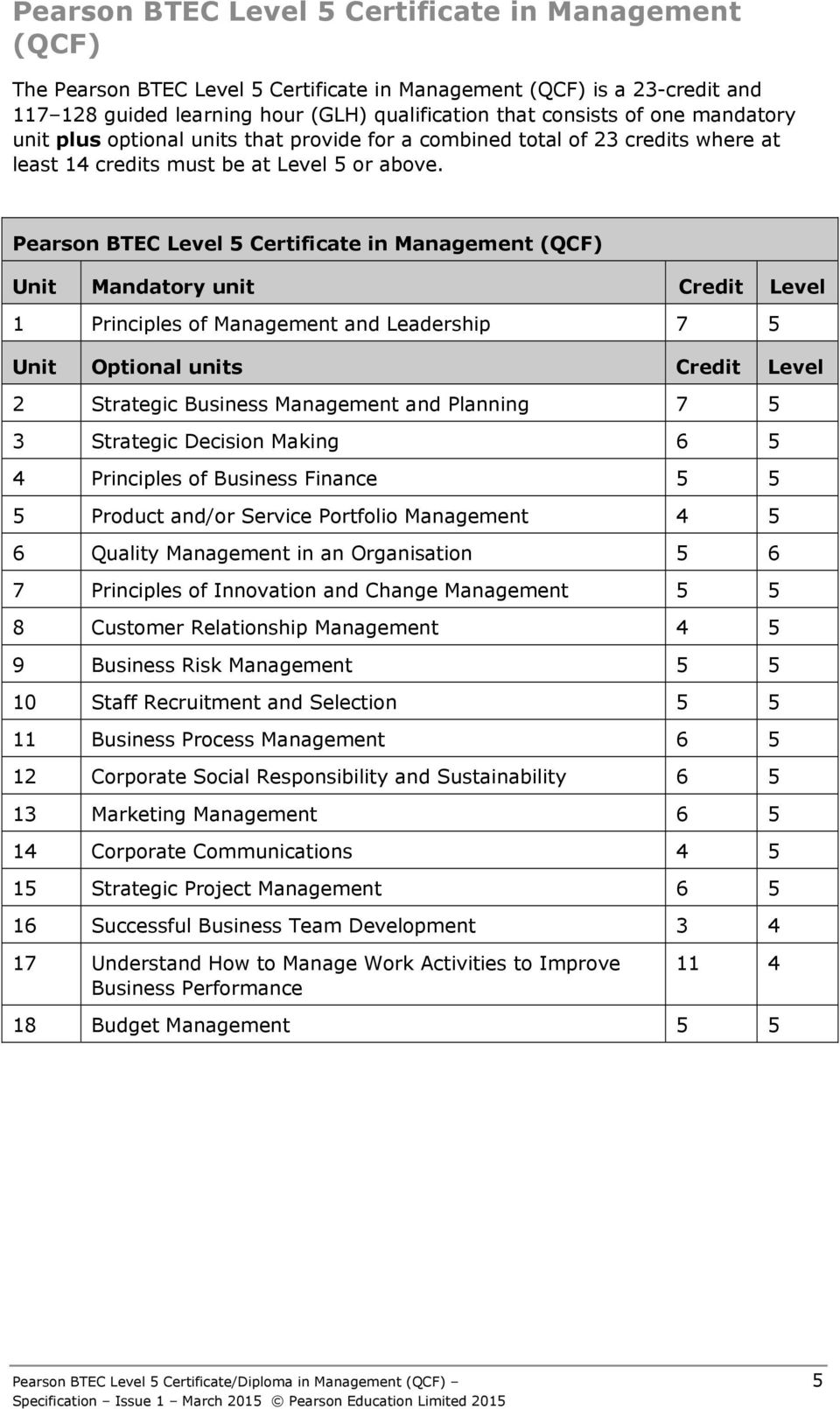
13 Pearson BTEC Level 5 Certificate in Management (QCF) The Pearson BTEC Level 5 Certificate in Management (QCF) is a 23-credit and guided learning hour (GLH) qualification that consists of one mandatory unit plus optional units that provide for a combined total of 23 credits where at least 14 credits must be at Level 5 or above. Pearson BTEC Level 5 Certificate in Management (QCF) Unit Mandatory unit Credit Level 1 Principles of Management and Leadership 7 5 Unit Optional units Credit Level 2 Strategic Business Management and Planning Strategic Decision Making Principles of Business Finance Product and/or Service Portfolio Management Quality Management in an Organisation Principles of Innovation and Change Management Customer Relationship Management Business Risk Management Staff Recruitment and Selection Business Process Management Corporate Social Responsibility and Sustainability Marketing Management Corporate Communications Strategic Project Management Successful Business Team Development Understand How to Manage Work Activities to Improve Business Performance Budget Management 5 5 5
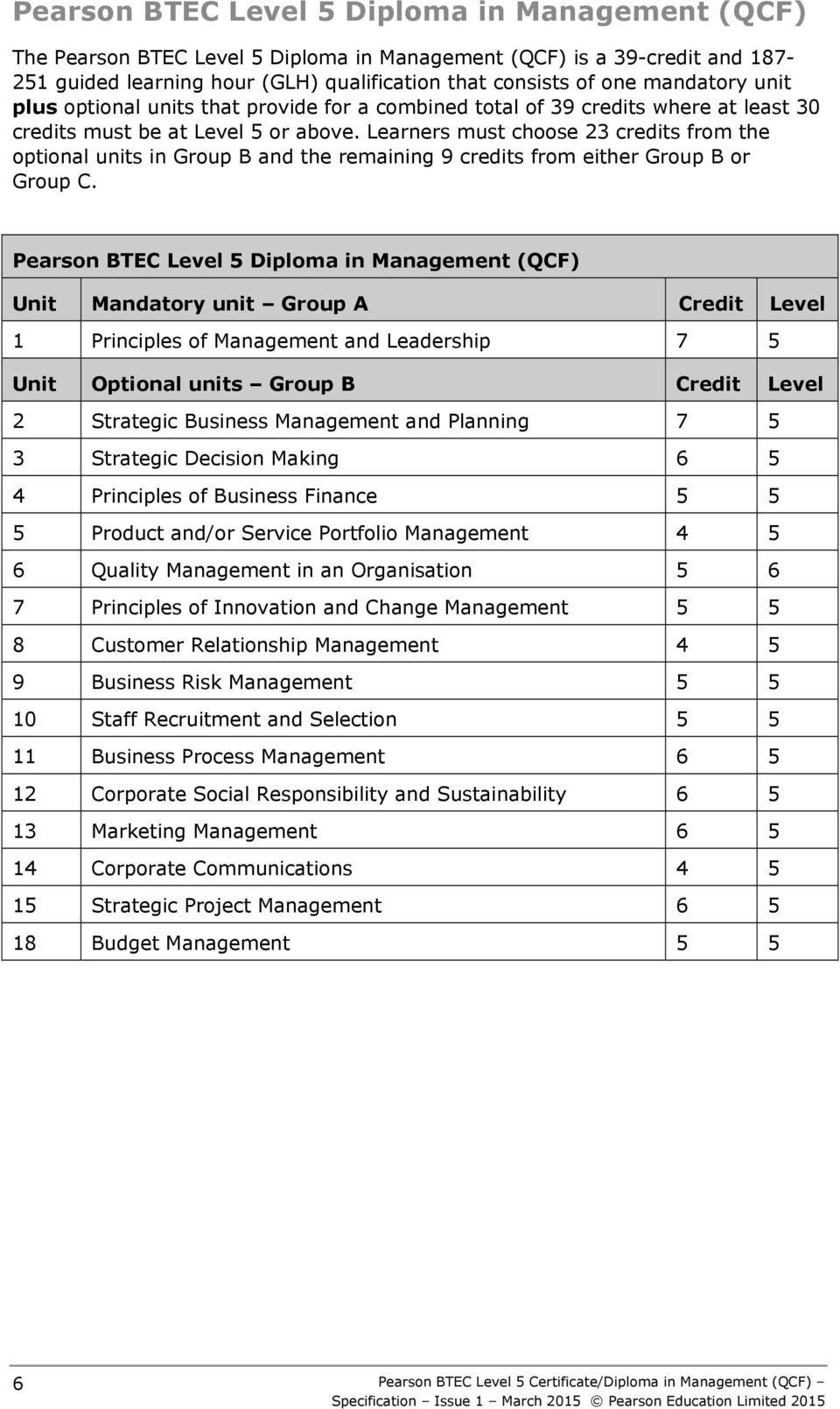
14 Pearson BTEC Level 5 Diploma in Management (QCF) The Pearson BTEC Level 5 Diploma in Management (QCF) is a 39-credit and guided learning hour (GLH) qualification that consists of one mandatory unit plus optional units that provide for a combined total of 39 credits where at least 30 credits must be at Level 5 or above. Learners must choose 23 credits from the optional units in Group B and the remaining 9 credits from either Group B or Group C. Pearson BTEC Level 5 Diploma in Management (QCF) Unit Mandatory unit Group A Credit Level 1 Principles of Management and Leadership 7 5 Unit Optional units Group B Credit Level 2 Strategic Business Management and Planning Strategic Decision Making Principles of Business Finance Product and/or Service Portfolio Management Quality Management in an Organisation Principles of Innovation and Change Management Customer Relationship Management Business Risk Management Staff Recruitment and Selection Business Process Management Corporate Social Responsibility and Sustainability Marketing Management Corporate Communications Strategic Project Management Budget Management 5 5 6
15 Pearson BTEC Level 5 Diploma in Management (QCF) Unit Optional units Group C Credit Level 16 Successful Business Team Development Understand How to Manage Work Activities to Improve Business Performance Business Administration Systems Principles of Customer Service Management Principles of Operational Planning Managing Information and Knowledge Human Resource Management Principles of Business Skills Needed for Proposals and Pitches Managing Personal and Professional Development Understanding Organisational Structure, Culture, and Values Stakeholder Engagement and Management 4 4 7

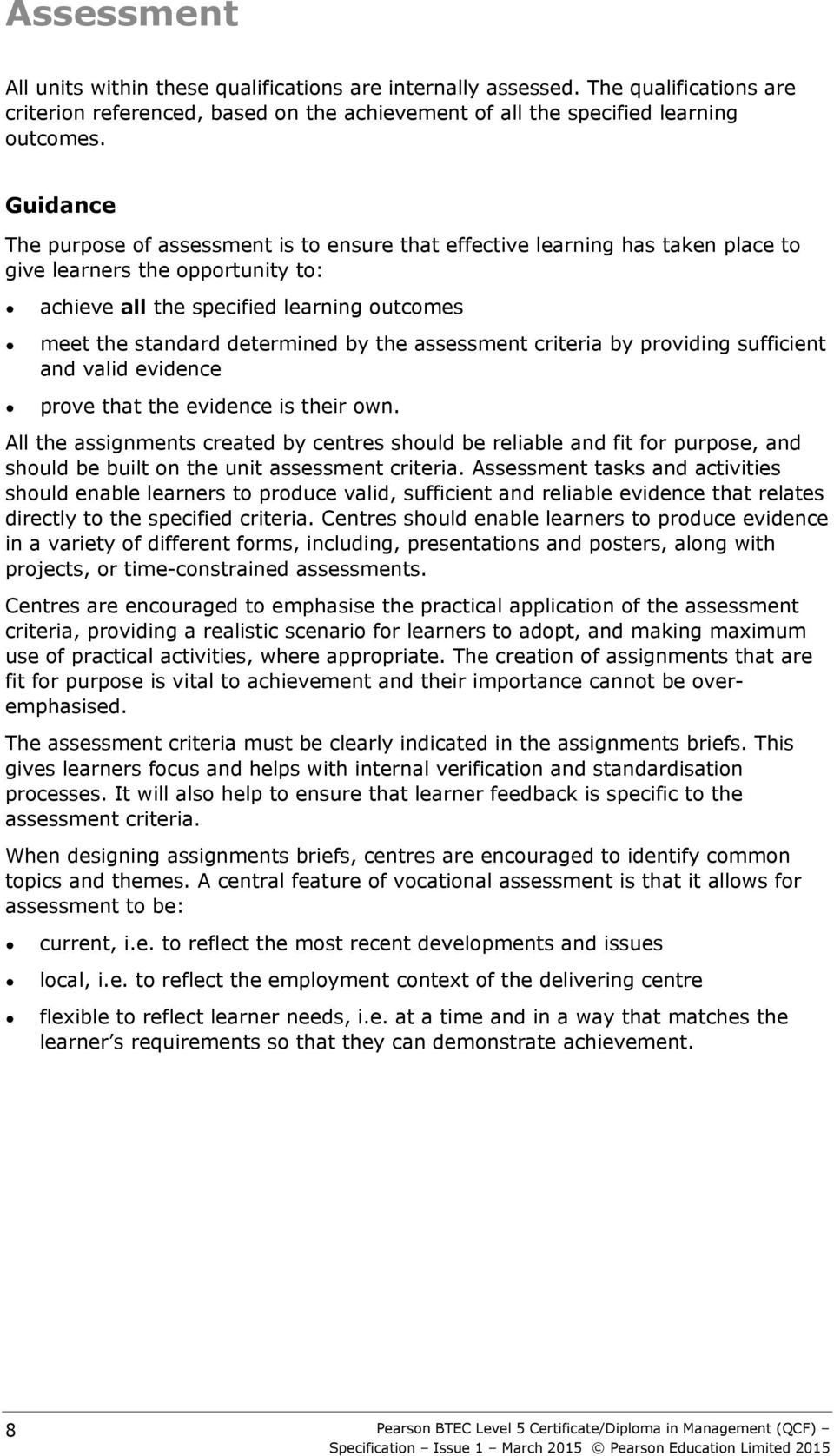
16 Assessment All units within these qualifications are internally assessed. The qualifications are criterion referenced, based on the achievement of all the specified learning outcomes. Guidance The purpose of assessment is to ensure that effective learning has taken place to give learners the opportunity to: achieve all the specified learning outcomes meet the standard determined by the assessment criteria by providing sufficient and valid evidence prove that the evidence is their own. All the assignments created by centres should be reliable and fit for purpose, and should be built on the unit assessment criteria. Assessment tasks and activities should enable learners to produce valid, sufficient and reliable evidence that relates directly to the specified criteria. Centres should enable learners to produce evidence in a variety of different forms, including, presentations and posters, along with projects, or time-constrained assessments. Centres are encouraged to emphasise the practical application of the assessment criteria, providing a realistic scenario for learners to adopt, and making maximum use of practical activities, where appropriate. The creation of assignments that are fit for purpose is vital to achievement and their importance cannot be overemphasised. The assessment criteria must be clearly indicated in the assignments briefs. This gives learners focus and helps with internal verification and standardisation processes. It will also help to ensure that learner feedback is specific to the assessment criteria. When designing assignments briefs, centres are encouraged to identify common topics and themes. A central feature of vocational assessment is that it allows for assessment to be: current, i.e. to reflect the most recent developments and issues local, i.e. to reflect the employment context of the delivering centre flexible to reflect learner needs, i.e. at a time and in a way that matches the learner s requirements so that they can demonstrate achievement. 8
17 Qualification grade Learners who achieve the minimum eligible credit value specified by the rule of combination will achieve the qualification at pass grade. In BTEC Level 5 Professional qualifications each unit has a credit value which specifies the number of credits that will be awarded to a learner who has achieved the learning outcomes of the unit. This has been based on: one credit for those learning outcomes achievable in 10 hours of learning time learning time being defined as the time taken by learners at the level of the unit, on average, to complete the learning outcomes of the unit to the standard determined by the assessment criteria the credit value of the unit remaining constant regardless of the method of assessment used or the qualification to which it contributes. Quality assurance of centres BTEC Level 4 7 qualifications provide a flexible structure for learners enabling programmes of varying credits and combining different levels. For the purposes of quality assurance, all individual qualifications and units are considered as a whole. Centres delivering BTEC Level 4 7 qualifications must be committed to ensuring the quality of the units and qualifications they deliver, through effective standardisation of assessors and verification of assessor decisions. Centre quality assurance and assessment is monitored and guaranteed by Pearson. Pearson quality assurance processes will involve: centre approval for those centres not already recognised as a centre for BTEC qualifications approval for BTEC Level 4-7 qualifications and units. For all centres delivering BTEC qualifications at Levels 4 7, Pearson allocates a Standards Verifier (SV) for each sector offered who will conduct an annual visit to quality assure the programmes. Approval Centres are required to declare their commitment to ensuring the quality of the programme of learning and providing appropriate assessment opportunities for learners that lead to valid and accurate assessment outcomes. In addition, centres will commit to undertaking defined training and online standardisation activities. Centres already holding approval are able to gain qualification approval online. New centres must complete a centre approval application. Quality assurance guidance Details of quality assurance for BTEC Level 4 7 qualifications are available on our website qualifications.pearson.com. 9

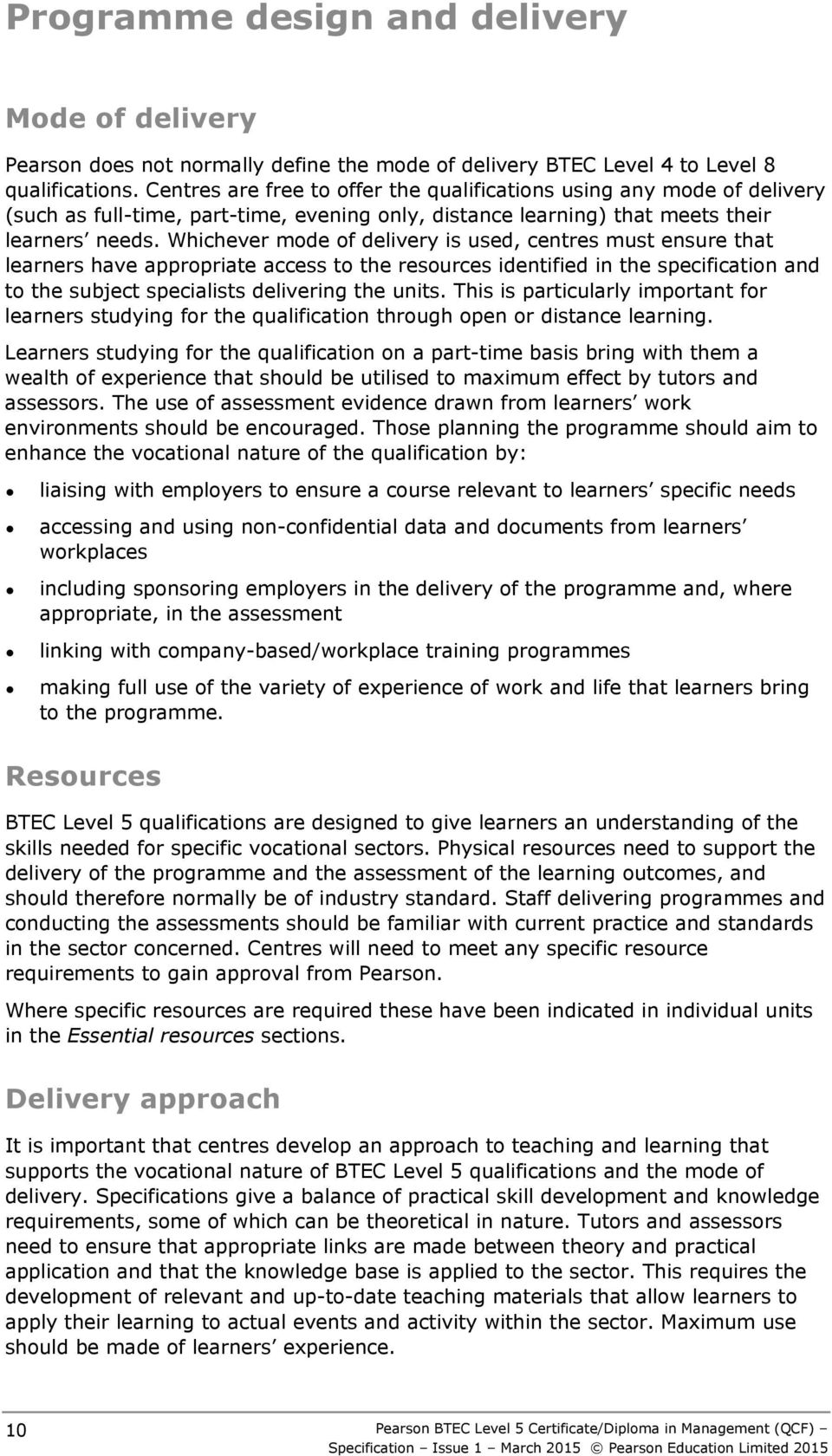
18 Programme design and delivery Mode of delivery Pearson does not normally define the mode of delivery BTEC Level 4 to Level 8 qualifications. Centres are free to offer the qualifications using any mode of delivery (such as full-time, part-time, evening only, distance learning) that meets their learners needs. Whichever mode of delivery is used, centres must ensure that learners have appropriate access to the resources identified in the specification and to the subject specialists delivering the units. This is particularly important for learners studying for the qualification through open or distance learning. Learners studying for the qualification on a part-time basis bring with them a wealth of experience that should be utilised to maximum effect by tutors and assessors. The use of assessment evidence drawn from learners work environments should be encouraged. Those planning the programme should aim to enhance the vocational nature of the qualification by: liaising with employers to ensure a course relevant to learners specific needs accessing and using non-confidential data and documents from learners workplaces including sponsoring employers in the delivery of the programme and, where appropriate, in the assessment linking with company-based/workplace training programmes making full use of the variety of experience of work and life that learners bring to the programme. Resources BTEC Level 5 qualifications are designed to give learners an understanding of the skills needed for specific vocational sectors. Physical resources need to support the delivery of the programme and the assessment of the learning outcomes, and should therefore normally be of industry standard. Staff delivering programmes and conducting the assessments should be familiar with current practice and standards in the sector concerned. Centres will need to meet any specific resource requirements to gain approval from Pearson. Where specific resources are required these have been indicated in individual units in the Essential resources sections. Delivery approach It is important that centres develop an approach to teaching and learning that supports the vocational nature of BTEC Level 5 qualifications and the mode of delivery. Specifications give a balance of practical skill development and knowledge requirements, some of which can be theoretical in nature. Tutors and assessors need to ensure that appropriate links are made between theory and practical application and that the knowledge base is applied to the sector. This requires the development of relevant and up-to-date teaching materials that allow learners to apply their learning to actual events and activity within the sector. Maximum use should be made of learners experience. 10
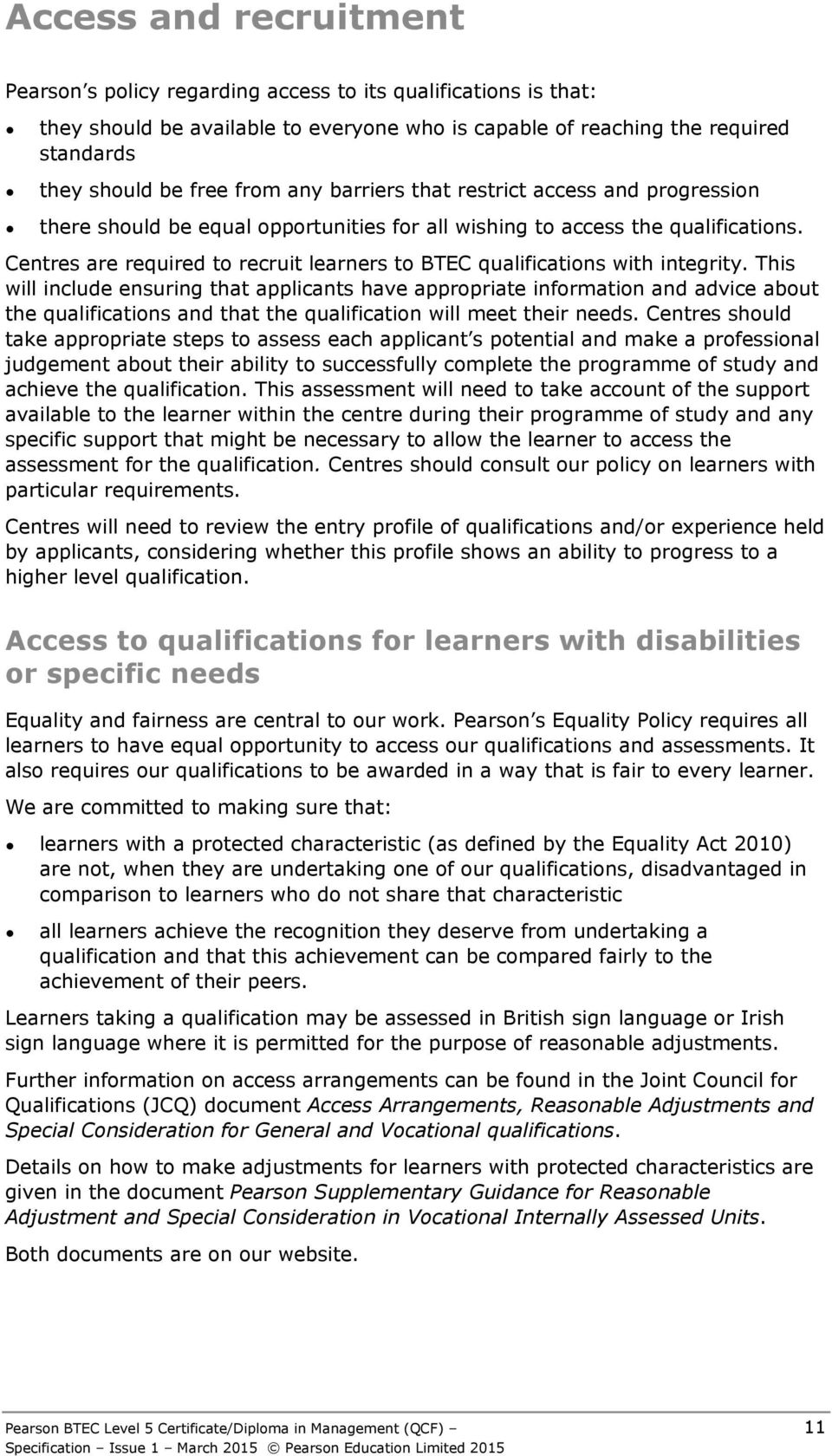
19 Access and recruitment Pearson s policy regarding access to its qualifications is that: they should be available to everyone who is capable of reaching the required standards they should be free from any barriers that restrict access and progression there should be equal opportunities for all wishing to access the qualifications. Centres are required to recruit learners to BTEC qualifications with integrity. This will include ensuring that applicants have appropriate information and advice about the qualifications and that the qualification will meet their needs. Centres should take appropriate steps to assess each applicant s potential and make a professional judgement about their ability to successfully complete the programme of study and achieve the qualification. This assessment will need to take account of the support available to the learner within the centre during their programme of study and any specific support that might be necessary to allow the learner to access the assessment for the qualification. Centres should consult our policy on learners with particular requirements. Centres will need to review the entry profile of qualifications and/or experience held by applicants, considering whether this profile shows an ability to progress to a higher level qualification. Access to qualifications for learners with disabilities or specific needs Equality and fairness are central to our work. Pearson s Equality Policy requires all learners to have equal opportunity to access our qualifications and assessments. It also requires our qualifications to be awarded in a way that is fair to every learner. We are committed to making sure that: learners with a protected characteristic (as defined by the Equality Act 2010) are not, when they are undertaking one of our qualifications, disadvantaged in comparison to learners who do not share that characteristic all learners achieve the recognition they deserve from undertaking a qualification and that this achievement can be compared fairly to the achievement of their peers. Learners taking a qualification may be assessed in British sign language or Irish sign language where it is permitted for the purpose of reasonable adjustments. Further information on access arrangements can be found in the Joint Council for Qualifications (JCQ) document Access Arrangements, Reasonable Adjustments and Special Consideration for General and Vocational qualifications. Details on how to make adjustments for learners with protected characteristics are given in the document Pearson Supplementary Guidance for Reasonable Adjustment and Special Consideration in Vocational Internally Assessed Units. Both documents are on our website. 11
20 Restrictions on learner entry The Pearson BTEC Level 5 Certificate and Diploma in Management (QCF) are accredited on the QCF for learners aged 18 and above. Recognising prior learning and achievement Recognition of Prior Learning Recognition of Prior Learning (RPL) is a method of assessment (leading to the award of credit) that considers whether a learner can demonstrate that they can meet the assessment requirements for a unit through knowledge, understanding or skills they already possess and so do not need to develop through a course of learning. Pearson encourages centres to recognise learners previous achievements and experiences whether at work, home and at leisure, as well as in the classroom. RPL provides a route for the recognition of the achievements resulting from continuous learning. RPL enables recognition of achievement from a range of activities using any valid assessment methodology. Provided that the assessment requirements of a given unit or qualification have been met, the use of RPL is acceptable for accrediting a unit, units or a whole qualification. Evidence of learning must be sufficient, reliable and valid. There is further guidance in our policy document Recognition of Prior Learning Policy and Process, available on our website. Credit transfer Credit transfer describes the process of using a credit or credits awarded in the context of a different qualification or awarded by a different awarding organisation towards the achievement requirements of another qualification. All awarding organisations recognise the credits awarded by all other awarding organisations that operate within the QCF. If learners achieve credits with other awarding organisations, they do not need to retake any assessment for the same units. The centre must keep evidence of credit achievement. 12

21 Unit format All units in BTEC Level 5 Professional qualifications have a standard format. The unit format is designed to give guidance on the requirements of the qualification for learners, tutors, assessors and those responsible for monitoring national standards. Each unit has the following sections. Unit title The unit title is on the QCF and this form of words will appear on the learner s Notification of Performance (NOP). Unit reference number Each unit is assigned a unit reference number that appears with the unit title on the Register of Regulated Qualifications. QCF level All units and qualifications within the QCF have a level assigned to them. There are nine levels of achievement, from Entry to Level 8. The QCF Level Descriptors and, where appropriate, the NOS and/or other sector/professional benchmarks, inform the allocation of level. Credit value All units have a credit value. The minimum credit value that may be determined for a unit is one, and credits can only be awarded in whole numbers. Learners will be awarded credits for the successful completion of whole units. Guided learning hours Guided learning hours are defined as all the times when a tutor, trainer or facilitator is present to give specific guidance towards the learning aim being studied on a programme. This definition includes lectures, tutorials and supervised study in, for example, open learning centres and learning workshops. It also includes time spent by staff assessing learners achievements. It does not include the time spent by staff marking assignments or homework where the learner is not present. Unit aim This gives a summary of what the unit aims to do. Unit introduction The unit introduction gives the reader an appreciation of the unit in the vocational setting of the qualification, as well as highlighting the focus of the unit. It gives the reader a snapshot of the unit and the key knowledge, skills and understanding gained while studying the unit. The unit introduction also highlights any links to the appropriate vocational sector by describing how the unit relates to that sector. 13
22 Learning outcomes The learning outcomes of a unit set out what a learner knows, understands or is able to do as the result of a process of learning. Assessment criteria Assessment criteria specify the standard required by the learner to achieve each learning outcome. Unit content The unit content identifies the breadth of knowledge, skills and understanding needed to design and deliver a programme of learning to achieve each of the learning outcomes. This is informed by the underpinning knowledge and understanding requirements of the related National Occupational Standards (NOS), where relevant. The content provides the range of subject material for the programme of learning and specifies the skills, knowledge and understanding required for achievement of the unit. Each learning outcome is stated in full and then the key phrases or concepts related to that learning outcome are listed in italics followed by the subsequent range of related topics. Relationship between content and assessment criteria The learner should have the opportunity to cover all of the unit content. It is not a requirement of the unit specification that all of the content is assessed. However, the indicative content will need to be covered in a programme of learning in order for learners to be able to meet the standard determined in the assessment criteria. Content structure and terminology The information below shows the unit content is structured and gives the terminology used to explain the different components within the content. Learning outcome: this is shown in bold at the beginning of each section of content. Italicised sub-heading: it contains a key phrase or concept. This is content which must be covered in the delivery of the unit. Colons mark the end of an italicised sub-heading. Elements of content: the elements are in plain text and amplify the subheading. The elements must be covered in the delivery of the unit. Semi-colons mark the end of an element. Brackets contain amplification of content which must be covered in the delivery of the unit. e.g. is a list of examples, used for indicative amplification of an element (that is, the content specified in this amplification could be covered or could be replaced by other, similar material). 14
23 Essential guidance for tutors This section gives tutors additional guidance and amplification to aid understanding and a consistent level of delivery and assessment. It is divided into the following sections. Delivery explains the content s relationship to the learning outcomes and offers guidance about possible approaches to delivery. This section is based on the more usual delivery modes but is not intended to rule out alternative approaches. Assessment gives amplification about the nature and type of evidence that learners need to produce in order to achieve the unit. This section should be read in conjunction with the assessment criteria. Essential resources identifies any specialist resources needed to allow learners to generate the evidence required for each unit. The centre will be asked to ensure that any requirements are in place when it seeks approval from Pearson to offer the qualification. Indicative resource materials gives a list of resource material that benchmarks the level of study. 15
24 16
25 Units 17
26 18
27 Units Unit 1: Principles of Management and Leadership 21 Unit 2: Strategic Business Management and Planning 29 Unit 3: Strategic Decision Making 37 Unit 4: Principles of Business Finance 45 Unit 5: Product and/or Service Portfolio Management 51 Unit 6: Quality Management in an Organisation 57 Unit 7: Principles of Innovation and Change Management 63 Unit 8: Customer Relationship Management 71 Unit 9: Business Risk Management 77 Unit 10: Staff Recruitment and Selection 85 Unit 11: Business Process Management 91 Unit 12: Corporate Social Responsibility and Sustainability 97 Unit 13: Marketing Management 107 Unit 14: Corporate Communications 115 Unit 15: Strategic Project Management 123 Unit 16: Successful Business Team Development 129 Unit 17: Understand How to Manage Work Activities to Improve Business Performance 135 Unit 18: Budget Management 141 Unit 19: Business Administration Systems 147 Unit 20: Principles of Customer Service Management 153 Unit 21: Principles of Operational Planning 163 Unit 22: Managing Information and Knowledge 169 Unit 23: Human Resource Management 175 Unit 24: Principles of Business Skills Needed for Proposals and Pitches 183 Unit 25: Managing Personal and Professional Development 189 Unit 26: Understanding Organisational Structure, Culture, and Values 197 Unit 27: Stakeholder Engagement and Management
28 20
29 Unit 1: Principles of Management and Leadership Unit reference number: R/506/2070 QCF Level 5: BTEC Professional Credit value: 7 Guided learning hours: 24 Unit aim The aim of this unit is for learners to study leadership and management theories and principles, leadership styles and motivating and managing performance. Unit summary Successful businesses need leaders to provide them with direction and purpose and managers to ensure that business activities allow the vision to be fulfilled and goals achieved. In this unit you will learn about the theories that have shaped the understanding of leadership and management and how these ideas have provided a guide to action for managers and leaders who secure success for their businesses. Consideration will be given to leadership styles and how and why they are used and the extent to which they are effective. Styles have to be tailored to different purposes and situations; what works in the police service may not work in a software business starting up and vice versa. Managers and leaders can motivate and empower staff to work effectively to contribute to business success. In some cases, business leaders are revered for the ways in which they inspire their employees by articulating the mission and goals of the business. More traditionally, a reward system is used and rewards can be tailored to motivate specific groups and particular individuals. Reward systems are one facet of performance management. Other techniques are used to develop employees performance to ensure that the work they do contributes to the achievement of business goals. 21
30 Learning outcomes and assessment criteria In order to pass this unit, the evidence that the learner presents for assessment needs to demonstrate that they can meet all the learning outcomes for the unit. The assessment criteria determine the standard required to achieve the unit. On completion of this unit a learner should: Learning outcomes 1 Understand leadership and management theories and principles Assessment criteria 1.1 Characterise the concepts and nature of management and the function of leadership 1.2 Evaluate concepts and definitions of leadership and their influence on management 1.3 Evaluate the influence of effective and ineffective leadership and management on team behaviour and business performance 2 Understand leadership styles 2.1 Analyse the characteristics of different leadership styles 2.2 Evaluate the suitability of different leadership styles for different purposes and situations 2.3 Evaluate the factors that affect the suitability of different management styles 2.4 Evaluate the ethical dimensions of leadership styles 3 Understand motivation and empowerment 3.1 Analyse the relationship between job satisfaction, commitment, motivation, empowerment and business performance 3.2 Evaluate the implications of motivation and empowerment for an organisation s structure and culture 3.3 Analyse the implications for employee relations policy of a strategy that empowers a workforce 3.4 Analyse the principles underpinning a reward strategy 22
31 Learning outcomes 4 Understand the management of performance Assessment criteria 4.1 Assess approaches to performance management and appraisal 4.2 Assess the factors involved in managing a work-life balance and their implications for individuals 4.3 Evaluate the use of tools and techniques to measure human resource interventions 4.4 Identify areas for improvement through reflection on their own practice 23
32 Unit content 1 Understand leadership and management theories and principles Leadership and management: leadership principles; strategic vision creation; mission; aims; inspiring others; influencing others; establishing culture; establishing structure; determining policy framework; providing direction; leadership theories, e.g. trait theory, behavioural theory; transformational leadership; management principles; implement vision to achieve objectives; plan; co-ordinate; monitor; control; optimise; management theories, e.g. scientific management (F W Taylor); human relations (G E Mayo); behavioural (e.g. D M McGregor); systems theory (L von Bertalanffy), contingency (F E Fielder); chaos theory (T Peters); differences between management and leadership Business performance: improving business performance; developing and leading; effective management of resources; innovation; implementing change, reviewing objectives; reviewing performance; stakeholder engagement; negative impact of ineffective leadership and management, e.g. loss of competitive advantage; stagnation; decline 2 Understand leadership styles Leadership and management styles: management and leadership style, e.g. autocratic, charismatic, persuasive, participative; influences on style, e.g. organisational culture; values of managers/leaders; emotional leadership styles, e.g. D Goleman Six Leadership Styles, Hay-McBer Emotional Competence Inventory, V Dulewicz and M Higgs Leadership Dimensions; R Blake and J Mouton s Managerial Grid; differentiation between management and leadership styles in given situations adapting management and leadership styles in given situations; impact of styles on decision making Ethical dimensions: ethical issues; corporate governance; responsibility; accountability; moral hazard; external factors, e.g. legislation, codes of conduct; social obligations; corporate citizenship; internal, e.g. ownership model; values; vision; mission; culture; sustainability; leadership and management responses 24
33 3 Understand motivation and empowerment Motivation: purpose, e.g. productivity, engagement, commitment, job satisfaction; theories of motivation; sources of motivation (intrinsic, extrinsic); content theories, e.g. A Maslow Hierarchy of Needs, D M McGregor Theory and Theory Y, F Herzberg Motivation-Hygiene theory, C Alderfer Existence, Relatedness and Growth (ERG) theory; process theories, e.g. V Vroom Expectancy theory, R House and G Dessler Path-Goal theory; F Heider Attribution theory; E Deci and M Ryan Self-determination theory; motivational techniques, e.g. rewards (financial, non-financial), praise, encouragement, recognition, celebration of achievement, clear goals, feedback, learning and development Empowerment: delegation (power, authority, tasks, decision making); impact of structure (flat and matrix structures, lines of management, reporting lines, communication channels); impact on culture (autonomy, responsibility, decision making, accountability, motivation, job satisfaction); productivity gains; support business objectives Reward strategy: purposes, e.g. recruit, retain, remunerate; engage, motivate; productivity; short-term rewards; long-term rewards; employee recognition; link rewards to business results; financial rewards, non-financial rewards; external competitiveness 4 Understand the management of performance Performance management: purpose; improve employee performance; improve team performance; improve business performance; performance plans; performance indicators, e.g. productivity, output, attitude, commitment; gathering performance information; appraisal; causes of effective performance and underperformance; review; rewarding good performance; remedying poor performance, e.g. mentoring; counselling, training, development, discipline, termination of employment Personal development: work-life balance; personal development plans; professional development plans; implications; resource requirements; targets; milestones; review; reflection 25
34 Essential guidance for tutors Delivery The learning outcomes in this unit can be delivered flexibly. Tutors have the opportunity to use a wide a range of teaching and learning strategies, including lectures, discussions, seminar presentations, case studies, video clips, internet research and library resources. Tutors can illustrate points with reference to examples of businesses that demonstrate best practice in respect of management and leadership. Many learners will use self-directed study together with the expertise and skills they may have developed in a career and be able to reflect on their experience of management and leadership. To introduce the unit and learning outcome 1, it could be useful to have a group discussion on the term leadership and the differences between management and leadership. There are many views that leadership is different from managing and learners can work in small groups, research articles to be presented to the whole class and debated. Tutor input on management and leadership styles can lead into learner discussions comparing similarities and differences and consider their own management/leadership style. For learning outcome 2, learners could be shown video/dvd clips of different leadership styles and discuss the types of situations within which the different styles would be effective and ineffective. Learning outcome 3 could start on a discussion on the relationship between empowerment and motivation and its influence on an organisations paradigm, linking in performance management and work life balance from learning outcome 4. Assessment guidance Centres will devise and mark the assessment for this unit. Learners must meet all assessment criteria to pass the unit. A range of assessment instruments can be used such as (but not confined to) reports, proposals, plans, presentations, question and answer, case studies, exercises, simulations. All assessment methods are acceptable provided the assessment enables the learner to produce relevant evidence that can be judged against the assessment criteria. For learning outcomes 1 and 2, an investigative assignment could be used to review current approaches to management and leadership (AC 1.3, 2.3, 2.4). The assignment could be in the form of a presentation with supporting materials for a group of management trainees recently recruited to a business. In the presentation there could be an exploration of management theories and principles as well as management and leadership styles (AC 1.1, 1.2, 2.1, 2.2). For learning outcomes 3 and 4, a case study could be used to consider performance management. Learners could produce a guide for managers in a business were performance management needed to be improved, and how, if at all, motivation and empowerment can influence performance (AC 3.1, 3.4, 4.2, 4.3, 4.4). Assessment can be for individual learning outcomes or for groups of learning outcomes within a unit and can be combined with the assessment of outcomes and criteria from other units. The latter would require an assessment map to identify where outcomes and criteria are assessed. 26
35 Resources Books Adair J The Inspirational Leader: How to Motivate, Encourage and Achieve Success (Kogan Page, 2005) ISBN: Armstrong M and Baron A Managing Performance: Performance Management in Action (Developing Practice) (2nd edition) (Chartered Institute of Personnel and Development, 2004) ISBN: Cameron E and Green M Making Sense of Change Management: A Complete Guide to the Models Tools and Techniques of Organizational Change (3rd edition), (Kogan Page, 2012) ISBN: Gold G, Thorpe R and Mumford A Leadership and Management Development (5th edition) (Chartered Institute of Personnel and Development, 2010) ISBN: Journal Management Today, Haymarket Media Group Ltd, has articles on management topics Websites ACAS provide information on managing employee performance free management library, information on leadership and management subjects Chartered Institute of Management, practical advice on management issues with a range of online resources on management topics. Membership is required to access the materials. Podcasts The Bottom Line podcasts and downloads chaired by Evan Davies or Stephanie Flanders. The podcasts bring together current practitioners to discuss current business matters. Many podcasts touch on topics relevant to the unit, for example the podcasts on Who s the Boss? and Self Improvement consider aspects of management and leadership. They can be searched through and downloaded from: 27
36 28
37 Unit 2: Strategic Business Management and Planning Unit reference number: K/506/3659 QCF Level 5: BTEC Professional Credit value: 7 Guided learning hours: 40 Unit aim The aim of this unit is for learners to study the role of strategic planning and management in an organisation and how internal and external environmental factors can influence the planning process. The unit will also consider strategies to help the organisation to achieve competitive advantage. Unit summary Strategic plans shape the long-term purpose and direction of businesses. These plans are agreed by the board in response to evaluating the internal and external business environment. The changing business environment often results in strategic plans then involves radical change, for example when a software house elects to develop electric vehicles. In this unit you will learn about the importance of strategic planning in businesses and how and why businesses develop their strategic plans. Strategies vary between businesses. Some opt for growth, others opt for market share and yet others opt for brand leadership. Various factors are weighed up in developing strategy, including the influence of the external environment, the business mission and the degree of risk associated with strategic options. Environmental factors are significant and businesses have to respond to global pressures and the interests of a wide diversity of stakeholders in formulating strategic plans. Consideration will be given to how a selected strategy is used to achieve competitive advantage. Brand leadership may allow market skimming pricing, and growth in market share forces competitors to play catch up. Strategic planning underpins the long-term development of businesses and provides the framework for the development of operations that will ensure achievement of business objectives. 29
38 Learning outcomes and assessment criteria In order to pass this unit, the evidence that the learner presents for assessment needs to demonstrate that they can meet all the learning outcomes for the unit. The assessment criteria determine the standard required to achieve the unit. On completion of this unit a learner should: Learning outcomes 1 Understand the role of strategic planning in organisations 2 Understand the impact of internal and external factors on organisations 3 Understand the strategies that organisations use to achieve competitive advantage 4 Understand the environmental factors that affect strategic business management and planning Assessment criteria 1.1 Evaluate processes by which organisations identify their goals and values 1.2 Discuss the purpose and role of strategic business management and planning in an organisation 1.3 Evaluate the classic and contemporary models used in developing business strategies and plans 2.1 Analyse ways in which the internal and external environment can influence organisational management and planning strategies 2.2 Discuss the influence of organisational governance requirements on management and planning strategies 2.3 Explore the impact of internal and external risk factors on strategic business management activities 3.1 Analyse ways in which an organisation positions itself to outperform its competitors 3.2 Evaluate appropriate competitor advantage strategies for emerging, maturing and declining positions 4.1 Discuss how emerging global issues can impact upon on the strategic management and planning activities in an organisation 4.2 Evaluate the impact of stakeholder interests in shaping strategic management and planning activities in an organisation 4.3 Analyse ways in which organisations respond to environmental factors, when making strategic plans 30
39 Unit content 1 Understand the role of strategic planning in organisations Business objectives: vision; mission; values; goals; objectives; setting objectives, e.g. founder, owners, primary decision makers, nominal group technique, expert judgement, straw man, group consensus; strategic planning features including direction, focus, resources, time constraints, achievable outcomes, performance indicators; framework for managerial action Strategic planning: models, e.g. mechanistic planning; goals-based planning; issues-based planning; alignment planning; scenario planning; organic planning; real-time planning; strategy hierarchy; consistency between business strategy and subsidiary strategies 2 Understand the impact of internal and external factors on organisations Business environment: environmental analysis techniques: external to include political, economic, social, technological, legal and ethical (PESTLE) analysis, environmental scanning, horizon scanning; internal, e.g. strengths, weaknesses, opportunities threats (SWOT) analysis and mission, objectives, strategies, tactics (MOST) analysis; business environments (macro-environment, mesoenvironment, micro-environment) Governance: UK Corporate Governance Code; business leadership; establishing mission; providing direction; long-term planning; creating and delegating authority; establishing policies and procedures; legal and regulatory compliance; oversight of progress; ensuring business continuity; culture; lines of accountability; strategy review Risk: types (operational, financial, hazard, strategic); uncertainty; risk probability; impact of risk; cost of risk; recognising risk as a factor in strategic planning 3 Understand the strategies that organisations use to achieve competitive advantage Competitive advantage: revenue growth; sales volumes; profitability; market share; productivity; cost control; market leadership; technological leadership; innovation; reputation; integration of business functions; responsiveness to customers; pricing strategies Strategies: product based, e.g. differentiation, innovation, diversification, contraction; price/cost based; service based; growth; market dominance; re-engineering; de-layering; re-structuring; downsizing; market position (emerging, maturing, declining); matching strategy to market position 31
40 4 Understand the environmental factors that affect strategic business management and planning Environmental factors: global issues; location of production; cost of production; emerging markets; supply chain management; environmental concerns, e.g. carbon emissions, genetically modified products; international trade agreements; economic alliances; international monetary environment; ethical concerns; responding to global and environmental factors in strategic plans Stakeholders: stakeholders internal, e.g. managers, employees; external, e.g. owners, lenders, government agencies, competitors; stakeholders interests, e.g. claims, power, influence, priority; responding to stakeholder interests in strategic plans 32
41 Essential guidance for tutors Delivery The learning outcomes in this unit can be delivered flexibly. Tutors have the opportunity to use a wide a range of teaching and learning strategies, including lectures, discussions, seminar presentations, case studies, video clips, internet research and library resources. Tutors can illustrate points with reference to examples of businesses that demonstrate best practice. Many learners will use self-directed study together with the expertise and skills they may have developed in a career and be able to reflect on their experience of business management and planning. For learning outcome 1, learners could research the goals and values for a range of organisations from their websites and share these with the whole class. A tutor-led presentation and group discussion on models for developing business strategies and plans, followed by a class debate on the purpose and role of strategic business management and planning. For learning outcome 2, the tutor could introduce the topic and discuss the influence of internal and external factors, including risk factors, on the organisation s management and planning strategies. Learners could be given case studies to discuss the influence of governance on planning in small groups. For learning outcome 3, learners could be given case studies to analyse how the company positioned itself to outperform its competitors, and evaluate competitive strategies that could be used at the various stages of the company s life cycle. For learning outcome 4, learners could be given scenarios to discuss as a whole group how emerging global issues impact on strategic management and their planning activities. Learners could research organisations to evaluate the impact of stakeholder interest in shaping management and planning activities, and analyse ways in which organisations respond. Assessment guidance Centres will devise and mark the assessment for this unit. Learners must meet all assessment criteria to pass the unit. A range of assessment instruments can be used such as (but not confined to) reports, proposals, plans, presentations, question and answer, case studies, exercises, simulations. All assessment methods are acceptable provided the assessment enables the learner to produce relevant evidence that can be judged against the assessment criteria. For AC 1.1, learners could provide a written piece of work on the process and methods used to identify goals and values, and to evaluate their effectiveness. For AC 1.2 and 1.3, learners could evaluate classic and contemporary models used to develop strategies and plans and present this to the whole class leading to a discussion on the role of strategic business management and planning led by the learner. 33
42 For AC 2.1, learners could provide a written piece of work explaining a range of internal and external environmental factors that influence management planning and discuss the influence of organisational governance requirements on management and planning strategies. Learners could then analyse a case study to determine the environmental factors that influence organisational management and planning strategies, including internal and external risk factors. For AC 3.1 learners could use work-based problems to analyse ways in which they could position their organisation to outperform competitors, followed up with written work that evaluates a competitive strategy for a business at each stage of its life cycle. For AC 4.1 and 4.3, learners could lead a presentation on emerging global issues and their impact on strategic management and planning activities and an analysis of ways in which organisations respond to environmental factors when developing strategic plans. For AC 4.2, learners could work in groups evaluate a range of stakeholders and their interests and their impact on shaping strategic management and planning activities. Assessment can be for individual learning outcomes, for groups of learning outcomes within a unit and can be combined with the assessment of outcomes and criteria from other units. The latter would require an assessment map to identify where outcomes and criteria are assessed. Assessment in this unit could be integrated with the assessment in Unit 3: Strategic Decision Making. 34
43 Resources Books Evans V F T Essential Guide to Developing a Business Strategy: How to Use Strategic Planning to Start Up or Grow Your Business (1st edition), (F T Publishing International, 2013) ISBN: Johnson G, Scholes K and Whittington R Exploring Corporate Strategy: Text and Cases (8th edition) (FT Prentice Hall, 2007) ISBN: Journals Management Today, Haymarket Media Group Ltd, has articles on management topics including business strategy and planning. The Economist, The Economist Newspaper Ltd, has a business section and articles on business strategy and planning from time to time. Websites the free management library, information on strategic planning subjects. Chartered Institute of Management, practical advice on management issues with a range of online resources on management topics. Membership is required to access the materials. Podcasts The Bottom Line Podcasts and Downloads chaired by Evan Davies or Stephanie Flanders. The podcasts bring together current practitioners to discuss current business matters. Many podcasts touch on topics relevant to the unit, for example the podcasts on Transformation and Planning for the Future consider aspects of strategic planning. They can be searched through and downloaded from In Business with Peter Day has podcasts on relevant topics such as Survival Strategy and The New Manufacturing. They can be found at: Broadcasts In conjunction with the Open University the BBC series Business Boomers looks at a number of current business developments, including strategic planning and decision making. 35
44 36
45 Unit 3: Strategic Decision Making Unit reference number: K/506/3662 QCF Level 5: BTEC Professional Credit value: 6 Guided learning hours: 32 Unit aim The aim of this unit is for learners to study the role of information in strategic decision making and how information systems can support business activity. Unit summary Businesses have to adapt and change in response to internal and external factors if they are to survive. Strategic development necessitates strategic decision making to shape the future purpose and direction of businesses. In this unit you will learn about the role of information in strategic decision making. Markets are fluid and businesses need to understand the markets in which they operate in order to capitalise on any changes. For example regulations and public concerns in respect of carbon emissions require vehicle manufacturers to make strategic decisions about engine technologies and the associated investment in research, development and production. To make such decisions, businesses need extensive, reliable information support systems to ensure that effective decisions are made. These can be based on quantitative approaches but they may have limitations when qualitative information for decision making is considered. Strategic decision making may involve the application of structured tools in order to make optimal decisions that will ensure a business survival and development. 37
46 Learning outcomes and assessment criteria In order to pass this unit, the evidence that the learner presents for assessment needs to demonstrate that they can meet all the learning outcomes for the unit. The assessment criteria determine the standard required to achieve the unit. On completion of this unit a learner should: Learning outcomes 1 Understand the role of information in strategic decision making 2 Understand how information systems support business activity 3 Understand quantitative approaches to strategic decision making Assessment criteria 1.1 Discuss the link between strategic decision making and business goals 1.2 Evaluate the role of information in strategic decision making 1.3 Evaluate the requirement for integrated information systems to support strategic decision making 1.4 Discuss the need to align information systems with business strategy 1.5 Assess the need for a corporate information systems strategy 2.1 Evaluate the contribution of information systems to business planning 2.2 Assess the value of information systems to business decision making 2.3 Assess the role of information systems in supporting business operations 3.1 Analyse ways in which quantitative approaches are used to support strategic decision making 3.2 Evaluate the reliability of quantitative techniques used in strategic decision making 3.3 Evaluate the limitations of quantitative techniques in strategic decision making 38
47 Learning outcomes 4 Understand systems approaches to strategic decision making Assessment criteria 4.1 Evaluate the contribution of systems approaches to strategic decision making 4.2 Discuss how decision making theories can inform strategic decision making 4.3 Analyse the limitations of decisionmaking theories in strategic decision making 39
48 Unit content 1 Understand the role of information in strategic decision making Information: quality of information, e.g. complete, organised, accurate, relevant, reliable, intelligible, timely, fit-for-purpose; type of information (tacit, explicit); provision of certainty; risk reduction; informed decision making; prompt decision making; control (strategic, managerial); competitive advantage, business insights; evaluate strategic options; communication with relevant stakeholders Information systems: networks (intranets, extranets); worldwide web; hardware; software; communications; management information systems (MIS); decision support systems (DSS); automated decision making; systems integration; shared data; systems connectivity; alignment with business strategy; costs; benefits; corporate information systems strategy 2 Understand how information systems support business activity Planning: informed decision making; uncertainty reduction; factoring risk; formulating plans; objective setting; establishing benchmarks; implementing vision; efficient use of resources; improved competitively; systems efficiencies Decision making: levels of decision making (strategic, tactical, operational); problem definition; analysis of alternatives; prioritising options; selecting from alternatives; fallback options; quantifying costs and benefits of decisions; improved reliability; speed of decision making; issues requiring decisions (bounded, unbounded); unintended consequences Operations: operational areas, e.g. manufacturing; distribution; marketing; customer relationship management; finance; human resources; activities (plan, co-ordinate, monitor, feedback, control, optimise) 3 Understand quantitative approaches to strategic decision making Quantitative approaches: statistical techniques; operational research; linear programming; business analytics; game theory; project management (critical path management [CPM], performance evaluation review technique [PERT]); process planning; simulation; use of software tools, e.g. statistical analysis system (SAS), Statistical Package for the Social Sciences (SPSS), enterprise resource planning Limitations: assumptions; quality of data; qualitative factors; reliability of technique; confidence in output information; predictive usefulness; system shock (exogenous, endogenous); interpretive subjectivity 40
49 4 Understand systems approaches to strategic decision making Systems approaches: approaches, e.g. soft systems methodology, viable systems model, system dynamics, strategic options development and analysis, critical systems heuristics; advantages and limitations of systems approaches Decision-making theories: choice under uncertainty; theories, e.g. rational model; incremental decision-making model; mixed scanning model; contingency theory; expected utility theory; limitations of decision making theories, e.g. assumptions; incomplete problem definition, information overload, subjectivity 41
50 Essential guidance for tutors Delivery The learning outcomes in this unit can be delivered flexibly. Tutors have the opportunity to use a wide a range of teaching and learning strategies, including lectures, discussions, seminar presentations, case studies, video clips, internet research and library resources. Tutors can illustrate points with reference to examples of businesses that demonstrate best practice. Many learners will use self-directed study together with the expertise and skills they may have developed in a career and be able to reflect on their experience of strategic decision making. For learning outcome 1, the tutor could introduce the topic with a presentation, followed by a discussion or debate on the link between strategic decision making and business goals, the role of information systems and the need to align this with the business strategy. Learners could carry out research on integrated information systems that support strategic decision making and evaluate the outcome. For learning outcome 2, learners could research academic websites on information systems and how they influence business planning and decision making, learners could then present their work in groups to the whole class, followed by tutor-led discussion or debate. For learning outcome 3, the tutor could present the topic supported by handouts and supporting articles, learners could then carry out additional research on methods used to conducting a quantitative approach to support strategic decision making and evaluate its reliability and limitations and present their findings in a report. For learning outcome 4, following a tutor-led introduction, learners could carry out additional research into the methods and contribution of a systems approach towards strategic decision making, and analysing any limitations and to present their findings to the whole class. Assessment guidance Centres will devise and mark the assessment for this unit. Learners must meet all assessment criteria to pass the unit. A range of assessment instruments can be used such as (but not confined to) reports, proposals, plans, presentations, question and answer, case studies, exercises, simulations. All assessment methods are acceptable provided the assessment enables the learner to produce relevant evidence that can be judged against the assessment criteria. For AC 1.1, the learner could discuss the link between strategic decision-making and business goals in a piece of written work. For AC 1.2 and 1.3, the learner could use a work-based problem that requires them to evaluate the role of information and integrated information systems to support strategic decision making, using evidence from the problem to support their evaluation. For AC 1.4 and 1.5, the learner could produce a report to assess the need for a corporate information systems strategy and discuss the need to align information systems to business strategy. 42
51 For AC 2.1, 2.2 and 2.3, learners could research academic and business websites on the contribution of information systems to business planning and decision making and supporting business operations, and then present their findings in a report and make a presentation to deliver to the whole class. For AC 3.1, 3.2 and 3.3, learners could research academic websites and produce a report on quantitative approaches to support decision making, the reliability of quantitative techniques as well as evaluating their limitations. For AC 4.1, 4.2 and 4.3, learners could conduct research and evaluate the contribution of systems approach decision making, discuss decision-making theories and analysing its limitations, and make a presentation to the whole class. Assessment can be for individual learning outcomes or for groups of learning outcomes within a unit and can be combined with the assessment of outcomes and criteria from other units. The latter would require an assessment map to identify where outcomes and criteria are assessed. Assessment in this unit could be integrated with the assessment in Unit 15: Strategic Business Management and Planning 43
52 Resources Books Cameron E and Green M Making Sense of Change Management: A Complete Guide to the Models Tools and Techniques of Organizational Change (3rd edition), (Kogan Page, 2012) ISBN: Harvard Business Review on Decision Making (Harvard Business School Press, 2001) ISBN: Hoch S J, Kunreuther, H C and Gunther R E (editors) Wharton on Making Decisions (new edition) (John Wiley and Sons, 2004) ISBN: Monahan G E Management Decision Making: Spreadsheet Modeling, Analysis, and Application (Cambridge University Press, 2000) ISBN Wang C Managerial Decision Making Leadership, (John Wiley and Sons, 2010) ISBN: Journals Management Today Haymarket Media Group Ltd. has articles on management topics, including strategic change and decision making Websites the Chartered Institute of Management website provides practical advice on management issues with a range of online resources on management topics. Membership is required to access the materials. the free management library, information on decision making and strategic management. Podcasts The Bottom Line podcasts and downloads chaired by Evan Davies or Stephanie Flanders. The podcasts bring together current practitioners to discuss current business matters. Many podcasts touch on topics relevant to the unit, for example the podcasts on Decision Making, Transformation, Futurology for Business and Planning for the Future consider aspects of strategic change and decision making. They can be searched through and downloaded from Broadcasts In conjunction with the Open University the BBC series Business Boomers looks at a number of current business developments including strategic development and decision making. 44
53 Unit 4: Principles of Business Finance Unit reference number: Y/506/2054 QCF Level 5: BTEC Professional Credit value: 5 Guided learning hours: 33 Unit aim The aim of this unit is to give the learner knowledge, understanding and skills relating to the financial information used in the management and decision-making process for an organisation. Unit summary Effective financial management underpins business success. Finance provides the funds for a business operations and ensures its stability and continuity. Additionally, financial management generates information that informs the decision making required to ensure that businesses meet their objectives. In this unit you will learn about how to analyse the financial health of a business in respect of its profitability and stability. All businesses need to produce accounts in order to have an insight into their financial position. Balance sheets provide information on the sources of finance and how they are then used within the business. Income statements measure the profit position of businesses. In addition, managers need financial information to support decision making. Consideration will be given to management accounting and how it is used in the decision-making process. It helps answer questions about what price to charge for a product or service so it is not sold at a loss, whether to make or buy a product and which among alternative capital investments should be chosen. Financial management provides the techniques that help measure whether a business is sustainable and whether it is meeting its objectives. 45
54 Learning outcomes and assessment criteria In order to pass this unit, the evidence that the learner presents for assessment needs to demonstrate that they can meet all the learning outcomes for the unit. The assessment criteria determine the standard required to achieve the unit. On completion of this unit a learner should: Learning outcomes 1 Understand business finance within a management context 2 Understand the commercial implications of managerial decisions Assessment criteria 1.1 Explain how to analyse the financial health of an organisation by interpreting a set of accounts and management information 1.2 Explain the uses and limitations of financial ratios 1.3 Explain the uses of statutory financial reports 1.4 Explain the difference between the uses of cost accounting and management accounting 1.5 Explain the benefits and limitations of short-term and long-term financing options 1.6 Explain how to carry out a costbenefit analysis 2.1 Analyse the uses of management accounts for decision-making purposes 2.2 Evaluate the importance of break even, contribution and their underlying assumptions 2.3 Evaluate the effectiveness and suitability of budgetary control methods 2.4 Explain tools and techniques to identify commercial opportunities and risks 2.5 Assess the commercial impact of managerial decisions 46
55 Unit content 1 Understand business finance within a management context Interpreting accounts: financial statements; income statements; cash flow statements; types of business; use of reports by stakeholders (owners, managers, employees, suppliers, customers, financiers, government); stakeholders interests Types of accounting: management accounting; regulatory framework (Companies Act 2006, Partnership Act 1890, Financial Reporting Standards); cost accounting; purposes (costing, budgeting, pricing, control, decision making) Ratio analysis: purposes (profitability, liquidity, efficiency; shareholder returns, financing); gross profit percentage; net profit percentage; return on capital employed (ROCE); current ratio; acid test ratio; debtors collection period; creditors payment period; turnover period; earnings per share; dividend cover; dividend yield; price/earnings (P/E) ratio; gearing ratio; interest cover; limitations of ratio use Sources of finance: capital markets; retained earnings; bank borrowing; government schemes; venture capital; trade credit; factoring; leasing; business angels; purposes of finance; duration; matching sources to purpose Cost benefit analysis: investment appraisal; techniques (discounted cash flow; net present value, payback period); benefits, e.g. recognition of externalities, prioritises investments; problems, e.g. valuation of costs and benefits, attitudes to risk 2 Understand the commercial implications of managerial decisions Management accounting: decision making (financial strategy, investment, costing; budgeting, expenditure, cash management); financial analysis; assessing financial risk; financial planning; cost measurement; cost apportionment; impact of decisions (costs, pricing, profits, sustainability, continuity; flexibility, competitive advantage, business objectives) Break even: break-even point; revenues, costs (fixed, variable); margin of safety; uses; limitations, e.g. cost assumptions, impact of stockholding, supply side focus Budgetary control: purposes (plan, co-ordinate, monitor, control); budgetary methods (incremental, zero-based, fixed, flexible); master budget; subsidiary budgets; variance analysis; budgetary assumptions; budget flexing; uncertainty; risk Commercial opportunities and risks: identification of opportunities, e.g. environmental scanning, environmental analysis, market research; business analytics; forecasting; types of risk (operational, financial, hazard, strategic); assessing potential impact of risks; managing risks 47
56 Essential guidance for tutors Delivery The learning outcomes in this unit can be delivered flexibly. Tutors have the opportunity to use a wide a range of teaching and learning strategies, including lectures, discussions, seminar presentations, case studies, video clips, internet research and library resources. Tutors can illustrate points with reference to examples of businesses that demonstrate best practice. Many learners will use self-directed study together with the expertise and skills they may have developed in a career and be able to reflect on their experience of finance. For learning outcome 1, the tutor could introduce the topic and the technical terms. Learners could research on the Companies House website, to look at examples of companies accounts and management information, and in groups they could discuss how they would analyse the information with the tutor close by for support. The tutor will need to present how to use and the limitations of financial ratios, look at financing options and explain the difference between cost and management accounting. For learning outcome 2, the tutor will lead discussions and presentations on using management accounting information in the decision-making process. Learners could be provided with work-based problems where they will be required to make a variety of calculations and prepare a report on how the data can support and lead decision making. Assessment Centres will devise and mark the assessment for this unit. Learners must meet all assessment criteria to pass the unit. A range of assessment instruments can be used such as (but not confined to) reports, proposals, plans, presentations, question and answer, case studies, exercises, simulations. All assessment methods are acceptable provided the assessment enables the learner to produce relevant evidence that can be judged against the assessment criteria. For all learning outcomes a series of financially based scenarios could be provided to allow learners to manipulate financial data and to explain how and why it is used to manage businesses. The assignment could be in the form materials to help nonfinancial managers understand the importance of finance to the wellbeing of a business. For AC 1.1, 1.2 and 1.3, learners could produce a written report on how to analyse the financial health of an organisation from their set of accounts or statutory financial reports, using financial ratios to support outcomes. For AC 1.4 and 1.5, learners could be provided with hypothetical scenarios for which financing is required for both long- and short term, learners could support their selection with calculations using different financing options and carrying out a cost-benefit analysis. 48
57 For AC 2.1, learners could produce a report on the use of management accounting in the decision-making process and then using a work-based problem, evaluate the importance of carrying out a break-even analysis for AC 2.2. For AC 2.3, 2.4 and 2.5, learners could use a problem scenario to evaluate a range of budgetary control methods, explain the tools and techniques used to identify commercial opportunities and risk and assess the commercial impact of their decision. Assessment can be for individual learning outcomes or for groups of learning outcomes within a unit and can be combined with the assessment of outcomes and criteria from other units. The latter would require an assessment map to identify where outcomes and criteria are assessed. 49
58 Resources Books Dyson J R Accounting for Non-Accounting Students, (8th edition) (FT Prentice Hall, 2011) ISBN: McKenzie F T Guide to Using and Interpreting Company Accounts (4th edition) (Financial Times/Prentice Hall, 2009) ISBN: Rice A Accounts demystified (6th edition) (Prentice Hall Business, 2001) ISBN: Journal Accountancy Age Incisive Financial Publishing Limited, has articles on financial topics Websites The Times 100: financial case studies Financial Reporting Council, information on accounting standards the UK Government portal, guidance of law that affects businesses Podcasts The World of Business podcasts and downloads chaired by Peter Day. The podcasts bring together practitioners to discuss current business matters. 50
59 Unit 5: Product and/or Service Portfolio Management Unit reference number: J/506/3880 QCF Level 5: BTEC Professional Credit value: 4 Guided learning hours: 26 Unit aim The aim of this unit is for learners to study the requirements for a portfolio of products or services and how these are developed. Unit summary Businesses need to exploit their brands and to manage the risks of being too dependent on particular products or services. To this end they develop portfolios of products and services so that competitive advantage is sustained and developed. In this unit you will learn about the need for a product and/or service portfolio in an organisation. A bank may offer its current account holders loans, insurance, motorvehicle breakdown cover and a credit card. It becomes a one-stop shop for an individual s requirements in respect of financial products and services. For the business, a bank may provide diversification, but into closely-related products. Consideration will be given to how businesses develop a portfolio of products and/or services that provide additional revenue streams and mitigate the risk of being too dependent on any single product or service. Portfolio management means that unprofitable or outmoded products and/or services are withdrawn but that new products and services are added. Confectionery companies develop a range of ice creams that carry the brand name of popular chocolate bars. Garages develop an aftermarket for products and services that do not come with a vehicle sale, such as servicing packages and accessories. These techniques improve relationships with customers, help develop loyalty and improve revenues and profits, thereby contributing to the achievement of business objectives. 51
60 Learning outcomes and assessment criteria In order to pass this unit, the evidence that the learner presents for assessment needs to demonstrate that they can meet all the learning outcomes for the unit. The assessment criteria determine the standard required to achieve the unit. On completion of this unit a learner should: Learning outcomes 1 Understand the requirement for a product and/or service portfolio in an organisation 2 Understand how to develop a portfolio of products and/or services Assessment criteria 1.1 Assess how a product and/or service portfolio can provide an organisation with a competitive advantage 1.2 Discuss how a product and/or service portfolio can be structured to achieve organisational goals 1.3 Examine the trade-off between the benefits and the risks in having a product and/or service portfolio 2.1 Explain how to build a product and/or service portfolio 2.2 Evaluate the link between a product and/or service portfolio and the product and/or service lifecycle 2.3 Evaluate the relationship between a product and/or service portfolio and marketing in achieving organisational objectives 2.4 Evaluate the significance of feedback in the design, pricing and promotion of a product and/or service portfolio 52
61 Unit content 1 Understand the requirement for a product and/or service portfolio in an organisation Product and service portfolios: support business objectives; structure of product/service portfolio; growth-share/bcg matrix (market growth, market share; cash flow management); requirement for portfolio, e.g. balance business dependencies on particular products/services; manage product/service growth and decline Benefits and risks: identifying benefits; risk spreading; financial benefits, e.g. profits, growth, market share, sales; non-financial benefits, e.g. reputation, brand leadership, quality; quantifying benefits; identifying risks; declining product/service, falling revenues; over dependence on particular products/services; costs; financial risks; non-financial risks, e.g. reputation, quality; quantifying risks 2 Understand how to develop a portfolio of products and/or services Building product and service portfolios: marketing strategy; purpose of portfolio, e.g. widening product/service range (complement, compete); new markets; new customers; cross marketing; product surround; aftermarket products/services; after-sales support; brand exploitation; market analysis (environmental scanning; environmental analysis, e.g. PESTLE analysis); portfolio design with the growth-share/bcg matrix Product lifecycle: stages (development, introduction, growth, maturity, saturation, decline); managing product life cycle; product/service portfolio optimisation; synchronisation of product/service portfolio with product life cycle; portfolio analysis for marketing; range of products/services; core products/services; product fit; product contribution to marketing mission and objectives; profitability; competitive position; retain/develop/abandon products/services Feedback: sources of feedback; types (quantitative, qualitative); feedback evaluation; use in portfolio analysis; use in decision making about product/service portfolio (design, structure, pricing, promotion) 53
62 Essential guidance for tutors Delivery For this unit, tuition for the learning outcomes lends itself to flexible delivery. Tutors have the opportunity to use as wide a range of teaching and learning strategies as possible, including lectures, discussions, seminar presentations, case studies, video clips, internet research and library resources. Tutors can illustrate points with reference to examples of businesses that demonstrate best practice. Many learners will use self-directed study together with the expertise and skills they may have developed in a career and be able to reflect on their experience of portfolio management. For learning outcome 1, the tutor could introduce the topic through the use of case studies of organisations with diverse product/service portfolios and then engage learners in a class discussion on the benefits and risk of a service/product portfolio. Learners could then be asked to research organisations and academic websites on how a product/service portfolio can achieve a competitive advantage and structured to achieve organisational goals. For learning outcome 2, learners could work in groups and use simulated material to build a product/service portfolio for an organisation, they should consider the product/service lifecycle and how this can influence the size of the portfolio and present their feedback to the whole class. The tutor could discuss the relationship between marketing and a product/service portfolio in achieving organisational goals, and evaluate the role of feedback in the design, pricing and promotion of the portfolio. Assessment Centres will devise and mark the assessment for this unit. Learners must meet all assessment criteria to pass the unit. A range of assessment instruments can be used such as (but not confined to) reports, proposals, plans, presentations, question and answer, case studies, exercises, simulations. All assessment methods are acceptable provided the assessment enables the learner to produce relevant evidence that can be judged against the assessment criteria. For AC 1.1, the learner could produce written work on how a portfolio can provide an organisation with a competitive advantage, using researched material as evidence to reinforce their work. For AC 1.2 and 1.3, learners could present their report on how a product/service portfolio is structured to achieve organisational goals and making the decision as to the benefits and risks in having such a portfolio. For AC 2.1 and 2.2, using a work-based problem or scenario, learners could devise a product/service portfolio providing a rationale for their decision, including how the life cycle of the product/service has been incorporated into their decision, and present this to the whole class. For AC 2.3 and 2.4, learners can produce written work, based on research, evaluating the relationship between the portfolio and marketing and the significance of feedback in the design, price and promotion of the product/service. 54
63 Assessment can be for individual learning outcomes or for groups of learning outcomes within a unit and can be combined with the assessment of outcomes and criteria from other units. The latter would require an assessment map to identify where outcomes and criteria are assessed. 55
64 Resources Books Baker M and Hart S The Marketing Book (6th edition) (Routledge, 2007) ISBN Clark K B and Wheelwright S C Managing New Product and Process Development: Text and Cases (The Free Press, 1992) ISBN West D, Ford J and Ibrahim E Strategic Marketing: Creating Competitive Advantage (2nd edition) (OUP Oxford, 2010) ISBN These books contain information relevant for the unit but go beyond product and service portfolio management. Journals Marketing Week Centaur Communications Ltd, has current news about marketing-related topics The Economist The Economist Newspaper Ltd, has a business section and articles on innovation, competitiveness and product development, a subscription is required Websites The Times 100: case studies on a range of product development and marketing subjects the free management library, information on product development and a range of marketing topics Podcasts The Bottom Line podcasts and downloads chaired by Evan Davies or Stephanie Flanders. The podcasts bring together practitioners to discuss current business matters. Many podcasts touch on topics relevant to the unit, for example the podcasts on Rejuvenation and New Marketing consider aspects of product and service development. They can be searched through and downloaded from: 56
65 Unit 6: Quality Management in an Organisation Unit reference number: Y/602/1479 QCF Level 6: BTEC Professional Credit value: 5 Guided learning hours: 30 Unit aim The aim of this unit is to give learners an understanding of integrated quality systems, particularly the concept of Total Quality Management and how to embed it successfully into the culture of an organisation. Unit summary Ensuring that there are quality management procedures in business means that work is done efficiently, there are no defects in outputs and wastage is minimised. By adopting quality management techniques, business ensure that good products and services come to market and that costs are driven down so sustainable competitive advantage is developed and maintained. In this unit you will learn about the about the contribution of total quality management (TQM) to business effectiveness. The British Standards Institution (BSI) defines total quality management as a methodology to make the organization structure, management and quality system more effective in meeting organizational objectives by maximising its human and material resources. It uses ideas such as statistical control, zero defect production and quality control to optimise business performance and has led to lean production practices and the formulation of effective quality assurance systems for businesses. Consideration will be given on to how develop and embed TQM into business practice and culture as, in many cases, they offer significantly modified approaches to managing business operations. TQM practices require monitoring to ensure their effectiveness and their contribution to a business s triple bottom line and the achievement of its goals. 57
66 Learning outcomes and assessment criteria In order to pass this unit, the evidence that the learner presents for assessment needs to demonstrate that they can meet all the learning outcomes for the unit. The assessment criteria determine the standard required to achieve the unit. On completion of this unit a learner should: Learning outcomes 1 Understand the concept of Total Quality Management (TQM) 2 Understand the culture needed to embed TQM 3 Understand the systems that support TQM Assessment criteria 1.1 Discuss the importance of quality within an organisation 1.2 Explain the concept of Total Quality Management (TQM) 1.3 Discuss the theories of TQM 1.4 Analyse the difficulties associated with the implementation of TQM 2.1 Explain the importance of teamwork in TQM 2.2 Discuss the role of training and development in embedding TQM into the culture of an organisation 2.3 Analyse the management techniques which underpin successful integration of TQM into the culture of an organisation 2.4 Evaluate the promotion of continuous quality improvement within an organisation s culture 3.1 Describe methods of monitoring TQM 3.2 Explain methods of controlling TQM 3.3 Evaluate quality standards that support TQM 58
67 Unit content 1 Understand the concept of Total Quality Management (TQM) Total quality management: definitions, e.g. British Standards Institute BS7850-1, International Organization for Standardization ISO 9000:2005, Chartered Quality Institute; dimensions of TQM, e.g. customer focus (internal, external), continuous improvement, process control, management and leadership, teamwork Theories of total quality management: contributions of Deming, Crosby, Juran, Ishikawa, Taguchi, Feigenbaum, European Foundation for Quality Management; methodologies, e.g. Six Sigma and DMAIC (define, measure, analyse, improve, control); lean manufacturing, zero defects, just-in-time, quick response manufacturing Impact of total quality management: quality improvement (products, services, processes); competitive advantage (cost management, revenues, sales volumes, market share, profitability, quality, reputation, market leadership); business objectives; customer needs (internal, external); value added; continuous improvement; difficulties, e.g. level of commitment (strategic, operational), availability of resources, lack of expertise, costs, re-engineering required, timescales 2 Understand the culture needed to embed TQM Teamwork: purposes (involvement; empowerment, cohesion, engagement, commitment); shared objectives; open communication; receptive to ideas; mutual respect; co-operative working; team organisation; quality circles; team structures; complementary roles Culture: strategic mission; organisational culture, e.g. open, transparent, collaborative, sharing knowledge; managerial culture, e.g. support, delegation, responsibility, autonomy, accountability; team culture Implementation: managerial commitment; managerial structure; responsibilities; allocate resources; employee commitment; training and development; communicating change; specifying success factors; apply TQM methods; monitor TQM implementation; control of TQM 3 Understand the systems that support TQM Total quality management standards: International Organization for Standardization standards (ISO 9001:2008 requirements, ISO 9004:2009 improving effectiveness, ISO 19011:2011 internal and external audits) Managing total quality management: control process; performance measurement; impact measurement; self-assessment; audits (internal, external); review processes; evaluation processes; improvements 59
68 Essential guidance for tutors Delivery The learning outcomes in this unit can be delivered flexibly. Tutors have the opportunity to use a wide a range of teaching and learning strategies, including lectures, discussions, seminar presentations, case studies, video clips, internet research and library resources. Tutors can illustrate points with reference to examples of businesses that demonstrate best practice. Many learners will use self-directed study together with the expertise and skills they may have developed in a career and be able to reflect on their experience of total quality management. For learning outcome 1, the tutor could introduce the topic using a presentation and discussion on the importance of quality and the concepts and theories of Total Quality Management (TQM) and their associated difficulties. Learners could then research academic materials on TQM to support the discussion. For learning outcome 2, the tutor could use case studies and articles to discuss the need to embed a culture of TQM with an organisation and discuss factors such as teamwork, the need for training and development, management techniques and the need to continuously promote quality improvement with an organisation. For learning outcome 3, learners could be asked to research on systems used to support TQM such as monitoring output, methods of control and how to evaluate quality standards that support TQM. Assessment Centres will devise and mark the assessment for this unit. Learners must meet all assessment criteria to pass the unit. A range of assessment instruments can be used such as (but not confined to) reports, proposals, plans, presentations, question and answer, case studies, exercises, simulations. All assessment methods are acceptable provided the assessment enables the learner to produce relevant evidence that can be judged against the assessment criteria. For AC 1.1, 1.2, 1.3 and 1.4, the learner could produce written work discussing the importance of quality, explaining some of the concepts and theories for Total Quality Management (TQM) and analysing the difficulties in implementing TQM. For AC 2.1, 2.2, 2.3 and 2.3, using a work-based problem, the learner could produce a strategy on embedding TQM within an organisation, ensuring that they cover aspects of teamwork, learning and development, what techniques management will use to integrate TQM and the benefits of promoting continuous TQM. For AC 3.1, 3.2 and 3.3, the learner could produce a report on potential systems that support TQM, this would entail methods of monitoring and controlling quality output, along with evaluating the quality standards used to support TQM. Assessment can be for individual learning outcomes or for groups of learning outcomes within a unit and can be combined with the assessment of outcomes and criteria from other units. The latter would require an assessment map to identify where outcomes and criteria are assessed. 60
69 Resources Books Crosby P Quality Without Tears: The Art of Hassle-Free Management (McGraw-Hill Professional, 1995) ISBN: Deming W E, Orsini J (editor) and Cahill D D (editor) The Essential Deming: Leadership Principles from the Father of Quality (McGraw-Hill Professional, 2013) ISBN: Oakland J S Total Quality Management and Operational Excellence (4th Edition): Text with Cases (Routledge, 2014) ISBN: Journals Management Today Haymarket Media Group Ltd, has articles on management topics, including quality management Websites has introductory material on quality management free management library, information on quality management subjects the Chartered Institute of Management, practical advice on management issues with a range of online resources on quality management. Membership is required to access the materials Podcasts The Bottom Line podcasts and downloads chaired by Evan Davies or Stephanie Flanders. The podcasts bring together practitioners to discuss current business matters. Many podcasts touch on topics relevant to the unit, for example the podcast on Quality considers its importance to business. They can be searched through and downloaded from: 61
70 62
71 Unit 7: Principles of Innovation and Change Management Unit reference number: A/506/3682 QCF Level 5: BTEC Professional Credit value: 5 Guided learning hours: 32 Unit aim The aim of this unit is for learners to study the need for innovation and change within an organisation, and how the organisation culture can promote innovation. Learners will study key principles, theories and models relating to change and the role of communication and relationship management within change processes. Unit summary Well-managed innovation and change lead directly to the improvement of competitive advantage. New products, services, materials, processes and markets all drive business efficiency and attract new customers, so helping businesses meet their objectives. In this unit you will learn about the need for innovation and change in businesses. Many businesses, such as aerospace and pharmaceutical firms, actively seek to innovate by investing in research and development activity. Businesses want to offer more-profitable products and services, customers want cheaper and better products and services, and regulators impose legal requirements on markets. So, for example, aircraft are made from lighter material and use fuel-efficient engines so that they can carry more passengers further while at the same time complying with environmental protection requirements. Businesses need to develop a culture that supports and promotes innovation and the consequential changes that are required. You will learn how employees can be encouraged and supported to innovate and change by seeing such developments as opportunities rather than as threats. Consideration will be given to how change may have some negative impact but that the aim is to ensure that this is outweighed by the beneficial impact. Discount retailers take trade away from established retailers who may have to close branches but an established retailer may then move into multichannel retailing with an online store and develop convenience stores and station outlets. Change requires all stakeholders to be kept informed and engaged but it underpins the drive for businesses to maintain their competitive advantage and achieve their goals. 63
72 Learning outcomes and assessment criteria In order to pass this unit, the evidence that the learner presents for assessment needs to demonstrate that they can meet all the learning outcomes for the unit. The assessment criteria determine the standard required to achieve the unit. On completion of this unit a learner should: Learning outcomes 1 Understand the need for innovation and change in organisations 2 Understand how organisational culture can promote innovation 3 Understand key principles, theories and models relating to change in organisations 4 Understand the role of communication and relationship management within change processes Assessment criteria 1.1 Analyse the relationship between innovation and competitive advantage in an organisation 1.2 Discuss the contribution of internal and external factors to organisational change 2.1 Evaluate the management styles needed to promote an innovative culture in an organisation 2.2 Analyse the features of a culture that supports innovation in an organisation 2.3 Assess sources of innovation in an organisation 2.4 Examine ways in which innovation is encouraged in an organisation 3.1 Discuss organisational factors that might enable change and those which might hinder change processes in an organisation 3.2 Evaluate current theories and models relating to change and how they might support effective change management in an organisation 4.1 Evaluate ways in which positive work relationships can support change processes 4.2 Discuss the different communication needs and types of support that might be required by different stakeholder groups 64
73 Unit content 1 Understand the need for innovation and change in organisations Innovation and competitive advantage: innovation (product, service, process, material, markets); sources of innovation (research and development; invention; improvements; suggestions; patents; licences; collaboration, market research); types of innovation (incremental, breakthrough, radical); innovation process (design; develop; test; implement; monitor; review); competitive advantage (increased revenues, increased sales volumes, profitability, reduced costs, increased market share; technological leadership, market leadership, reputation) Factors affecting organisational change: internal, e.g. objectives (mission, aims, goals), management style, structure, control, culture, efficiency, cost reduction; external, e.g. political, economic, social, technical, environmental, legal; maintaining competitive advantage 2 Understand how organisational culture can promote innovation Management styles: autocratic; paternalistic; democratic; laissez-faire; contribution of different management styles to innovation Culture: strategic mission; organisational culture, e.g. open, transparent, collaborative; managerial culture, e.g. support, delegation, responsibility, autonomy, accountability; team culture, e.g. synergistic roles; resource availability 3 Understand key principles, theories and models relating to change in organisations Enabling change: change required (nature, parameters, intended impact); moving to an agreed, desired position; obtaining support; structuring change; resource commitment; communicate change to stakeholders; test; implementation; impact measurement; review processes; evaluation processes; change iterations Change theories and models: change theories (evolutionary, planned change, life-cycle, cultural); model approaches (linear, e.g. market pull, technology push, phase-gate; coupling; parallel lines; continuous improvement); types of model, e.g. Lewin s unfreeze, change refreeze change management model, Kotter's 8-step change model; McKinsey's 7-S Model; Prosci s ADKAR model 65
74 4 Understand the role of communication and relationship management within change processes Positive work relationships: open communications; respectful for others views; receptive to ideas; shared objectives; commitment to change; co-operative working Communication needs: stakeholders internal, e.g. managers, employees; external, e.g. owners, lenders, government agencies, competitors; stakeholders interests, e.g. claims, power, influence, priority; impacts of change; benefits of change; disadvantages of change; dealing with uncertainty; transition arrangements; communication techniques 66
75 Essential guidance for tutors Delivery The learning outcomes in this unit can be delivered flexibly. Tutors can deliver the theoretical material in respect of innovation and change management using a wide range of teaching and learning strategies, including lectures, discussions, seminar presentations, case studies, video clips, internet research and library resources, where the learner can work individually and in a group researching and gathering information about the subject. Tutors can illustrate points with reference to examples of businesses that demonstrate best practice in respect of change and innovation. Many learners will use self-directed study together with the expertise and skills they may have developed in a career and be able to reflect on their experience of change and innovation. To introduce the unit and learning outcome 1, it could be useful to have a group discussion on the need for innovation and change, asking learners to research organisations and their causes for change and how change influences innovation and vice-versa. Tutor input on innovation and change can lead into learner discussion and debate. Learning outcome 2 could be a good topic for small groups of learners to discuss and debate the benefits of innovation, or research into the types of organisations that are known for being innovative and look for trends in areas where innovation occurs and the management style that fosters an innovative climate. Learners could use case studies simulated or real information from an organisation. For learning outcomes 3 and 4, the tutor can introduce learners to theoretical models of change management. It is useful at this stage for the tutor to use current examples of organisations undergoing change to show how these models could apply. Assessment Centres will devise and mark the assessment for this unit. Learners must meet all assessment criteria to pass the unit. A range of assessment instruments can be used such as (but not confined to) reports, proposals, plans, presentations, question and answer, case studies, exercises, simulations. All assessment methods are acceptable provided the assessment enables the learner to produce relevant evidence that can be judged against the assessment criteria. For AC 1.1 and 1.2, learners could research case studies on the relationship between innovation and competitive advantage citing organisations where possible to demonstrate the relationship. This could then be presented to the whole class by including a discussion on internal and external factors to organisational change. For AC 2.1, 2.2 and 2.4, learners could work in groups to analyse the features of an organisation that supports an innovative culture and evaluate management styles that promote such a culture and examine the ways in which this is encouraged. Their work can be presented as a written group project which would include an assessment of where innovation is sourced for AC 2.3, using evidence from research to support the response. 67
76 For AC 3.1 and 3.2, learners could produce a written piece of work evaluating key principles, theories and models relating to change and discuss why there is a need for innovation and change and the factors that support and hinder these changes. For AC 4.1, learners could evaluate a work-based problem on how positive work relationships support change processes, and for AC 4.2 learners could devise a communication strategy in response to the case study, discussing the different communication needs and types of support that different stakeholder groups may need. Assessment can be for individual learning outcomes or for groups of learning outcomes within a unit and can be combined with the assessment of outcomes and criteria from other units. The latter would require an assessment map to identify where outcomes and criteria are assessed. 68
77 Resources Books Cameron E, and Green M Making Sense of Change Management: A Complete Guide to the Models Tools and Techniques of Organizational Change (Kogan Page, 2012) ISBN: Chesbrough H W Open Innovation: The New Imperative for Creating and Profiting from Technology (Harvard Business School Press, 2003) ISBN: De Kare-Silver M e-shock 2020: How the Digital Technology Revolution Is Changing Business and All Our Lives (Palgrave Macmillan, 2011) ISBN: Johnson G, Scholes K and Whittington R Exploring Corporate Strategy: Text and Cases (8th edition) (FT Prentice Hall, 2007) ISBN Manwani S IT-Enabled Business Change: Successful Management, (British Computer Society, 2008) ISBN: (also available as a Kindle edition, ASIN: B004G8QZVK) Journals Management Today Haymarket Media Group Ltd, has articles on management topics including strategic change and organisational change The Economist The Economist Newspaper Ltd, has a business section and articles on innovation and change management from time to time as well as an extensive archive Websites free management library, information on creativity and innovation the Chartered Institute of Management provides practical advice on management issues with a range of online resources on managing change. Membership is required to access the materials Podcasts The Bottom Line podcasts and downloads chaired by Evan Davies or Stephanie Flanders. The podcasts bring together practitioners to discuss current business matters. Many podcasts touch on topics relevant to the unit, for example the podcasts on Transformation, Futurology for Business and Incumbents vs Upstarts consider aspects of innovation and change. They can be searched and downloaded from: Broadcasts In conjunction with the Open University the BBC series Business Boomers looks at a number of current business developments and cases in respect of innovation and change. 69
78 70
79 Unit 8: Customer Relationship Management Unit reference number: R/506/3686 QCF Level 5: BTEC Professional Credit value: 4 Guided learning hours: 24 Unit aim The aim of this unit is for learners to study the role of customer relationship management in achieving organisation goals and methods used to manage improvement. Unit summary Businesses need to establish positive relationships with their customers. Managing customer relationships involves finding the customers and keeping them by engaging with them in ways that both provide customer satisfaction and ensure profitable and continuing business opportunities. In this unit you will learn about the importance of customer relationship management. All businesses spend money, time and energy finding customers so it is important to get value from and offer value to customers by ensuring the relationship is enduring and profitable. All customers can be kept warm and encouraged to become more active through the promotion of additional products and services, by providing information and offering inducements to buy. Important customers might be given preferential trading terms and become lead customers to persuade other businesses to follow suit. Consideration will be given to how technology has provided the means to improve the management of customer relationships by enabling the profiling and monitoring of individual customers. Tailoring the relationships will strengthen them and make them more effective as customers provide repeat business and buy ancillary services. Managing customer relationships also means that unprofitable customers are dropped. Having effective management of customer relationships and satisfied customers, directly contributes to the achievement of an organisation's strategic objectives. 71
80 Learning outcomes and assessment criteria In order to pass this unit, the evidence that the learner presents for assessment needs to demonstrate that they can meet all the learning outcomes for the unit. The assessment criteria determine the standard required to achieve the unit. On completion of this unit a learner should: Learning outcomes 1 Understand the importance of customer relationship management in an organisation 2 Understand methods to improve the management of customer relationships in an organisation Assessment criteria 1.1 Evaluate the role of customer relationship management in sourcing and retaining customers 1.2 Analyse internal and external factors that impact upon an organisation s ability to find new customers and retain existing customers 1.3 Discuss the relationship between effective customer relationship management and having a competitive advantage 1.4 Evaluate the role of customer relationships as a source of innovation and growth 2.1 Evaluate methods used to measure the effectiveness of the customer relationship management system 2.2 Discuss ways in which the management and the monitoring of customer relationships could be improved 2.3 Evaluate methods used to monitor improvement to the management of customer relationships 2.4 Evaluate the extent to which the management of customer relationships leads to the achievement of an organisation s strategic objectives 72
81 Unit content 1 Understand the importance of customer relationship management Purpose of customer relationship management: finding customers; retaining customers, winning back customers; building loyalty; adding value, e.g. additional sales, after-sales services, customer support; targeted marketing; tailoring information; individualised relationships; customising products and services; rewarding customers; contributing to the achievement of business objectives Factors affecting customer relationship management: internal, e.g. customer focus, marketing orientation, resources, staffing, information requirements, costs; external, e.g. technological change, customer tastes and preferences; buyer decision making; customer volatility; competitor activities; legal and regulatory requirements, e.g. Consumer Protection (Distance Selling) Regulations 2000, Consumer Credit Acts 1974 and 2006 Competitive advantage: reduced costs (acquiring customers, retaining customers, customer loyalty); increased revenues (repeat sales, aftermarket sales, cross-selling); increased sales volumes; improved profitability; increased market share; integration of functions (sales, marketing, customer service, technical support, finance); use of technology (tracking, profiling, history); communications techniques (social media, mobile computing, telephony); reputation; dynamic pricing 2 Understand methods to improve the management of customer relationships in an organisation Measurement and monitoring: data types (qualitative, quantitative); data collection (manual, computer-based, automatic); customer analytics; data mining; customer profiling; market analysis; segmentation analysis; predictive analysis; review management of customer relationships; evaluation of management of customer relationships; potential improvements to management of customer relationships Improving customer relationship management: strategic priority; allocate resources; implement software solutions (data collection, analytics); modify business processes; customer support, e.g. help desk, responses to frequently asked questions (FAQ), 24/7 service, online advice; customer communication; obtaining feedback; responsiveness to feedback Meeting objectives: customer engagement; meeting customer needs; adding value; growth (sales, revenues, market share, profits); cost management; improve processes (marketing, sales, logistics, customer support, finance); achievement against key performance indicators 73
82 Essential guidance for tutors Delivery The learning outcomes in this unit can be delivered flexibly. Tutors have the opportunity to use a wide a range of teaching and learning strategies, including lectures, discussions, seminar presentations, case studies, video clips, internet research and library resources. Tutors can illustrate points with reference to examples of businesses that demonstrate best practice. Many learners will use self-directed study together with the expertise and skills they may have developed in a career and be able to reflect on their experience of customer relationship management. For learning outcome 1, the tutor could introduce the topic of customer relationship management through a presentation and discussion, focusing on sourcing and retaining customers, and evaluating the role of customer relationships as a source for innovation and growth. Learners could then follow this up with academic research. For learning outcome 2, the learner could introduce the methods, concepts and theories on improving customer relationship management, and using a case study learners could work in groups to research and evaluate customer relationship management systems, how monitoring could be improved and the extent to which management of customer relationships could achieve organisations strategic objectives. Assessment Centres will devise and mark the assessment for this unit. Learners must meet all assessment criteria to pass the unit. A range of assessment instruments can be used such as (but not confined to) reports, proposals, plans, presentations, question and answer, case studies, exercises, simulations. All assessment methods are acceptable provided the assessment enables the learner to produce relevant evidence that can be judged against the assessment criteria. For AC 1.1 and 1.2, following academic research, the learner could produce a report evaluating the role of customer relationship management, and an analysis of factors that could impact upon an organisation, when sourcing and retaining customers. For AC 1.3 and 1.4, the learner could produce a report and present this to the whole class on the relationship between customer relationship management and gaining a competitive advantage and as a source of innovation and growth. For AC 2.1, using an appropriate case study, the learner could produce a report evaluating the methods used to measure customer relationship management systems. For AC 2.2, 2.3 and 2.4, the learner could continue using the case study as the basis to discuss how the organisation could manage the monitoring of customer relationship, evaluate the methods used to monitor improvement and relate this to how effectively the organisations strategic objectives were achieved, and present their work to the whole class. 74
83 Assessment can be for individual learning outcomes or for groups of learning outcomes within a unit and can be combined with the assessment of outcomes and criteria from other units. The latter would require an assessment map to identify where outcomes and criteria are assessed. Resources Books Buttle F and Makin S Customer Relationship Management (2nd edition), (Routledge, 2008) ISBN (also available as a Kindle edition, ASIN: B003L783WQ) Rastogi E Customer Relationship Management: Text and Cases (Excel Books, 2011) ISBN (also available as a Kindle edition, ASIN: B00BI22IN6) Journals Journal of Marketing Management Westburn Publishers Ltd, has articles on customer relationship management Marketing Week Centaur Communications Ltd, has current news about marketing-related topics Websites provides information on customer relationship management Free Management Library, information on marketing and customer service subjects The Open University, information on marketing communications and customer relationships Podcasts The Bottom Line Podcasts and Downloads chaired by Evan Davies or Stephanie Flanders. The podcasts bring together practitioners to discuss current business matters. Many podcasts touch on topics relevant to the unit, for example the podcasts on Digital Marketplaces, Big Data and Marketing and Mess consider aspects of marketing and customer relationships. The podcasts can be searched and downloaded from: Broadcasts In conjunction with the Open University the BBC series Business Boomers looks at a number of current business developments, including a consideration of marketing 75
84 76
85 Unit 9: Business Risk Management Unit reference number: D/506/3691 QCF Level 5: BTEC Professional Credit value: 5 Guided learning hours: 30 Unit aim The aim of this unit is for learners to study risk factors that organisations face and their potential impact. The unit will examine risk management and risk interdependencies along with the role of customer relationship management in achieving organisation goals and methods used to manage improvement. Unit introduction Business activities carry with them associated risks and uncertainties that pose threats. Risks can arise internally from routine operations such as extending credit to customers with a poor credit history. They can also arise externally from developments in the business environment such as a change in consumer tastes when there is a move from fixed-line telephones to mobile telephones. As risks threaten existing business activity, risk management techniques are developed and applied to anticipate and control them in order to ensure operational continuity. In this unit you will learn about the nature of business risk and the factors that affect it. Risks can be identified, measured and quantified and doing so provides businesses with a guide to action. Some risks are low level and can be easily managed by building routine risk control processes into day to-day activities. For instance, food production requires the adoption of good hygiene practices. Other risks are less routine and controllable. An oil spill from a production platform can have wide-ranging unpredictable consequences. Consideration will be given to how businesses build in resilience to their systems to predict and control risk, and to ensure continuity of operations. Energy-generating companies have surplus capacity and can switch between power-generation plants in response to fluctuations in demand so that their operations are not compromised. Minimising and managing risk allows business continuity, thereby enabling businesses to achieve their objectives. 77
86 Learning outcomes and assessment criteria In order to pass this unit, the evidence that the learner presents for assessment needs to demonstrate that they can meet all the learning outcomes for the unit. The assessment criteria determine the standard required to achieve the unit. On completion of this unit a learner should: Learning outcomes Assessment criteria 1 Understand business risk concepts 1.1 Examine the internal and external risk factors that an organisation faces 1.2 Assess the potential impact of the risk factors that an organisation faces 1.3 Discuss risk management models 1.4 Explain the laws and legislation relating to risk management 2 Understand how to identify risk and risk probability 3 Understand business resilience and the management of risk 2.1 Discuss risk and risk interdependencies 2.2 Examine criteria against which risk management can be assessed 2.3 Evaluate the effectiveness of methods used for calculating risk probability 3.1 Explore the relationship between risk management, disaster recovery and business continuity 3.2 Evaluate a range of scenario planning and crisis management models 3.3 Analyse the benefit of risk governance structures and ownership 3.4 Evaluate techniques used to minimise business risk 3.5 Examine ways in which risk management techniques can be built into routine business processes 78
87 Unit content 1 Understand business risk concepts Risk factors: internal, e.g. capital sufficiency, process breakdown, robustness of systems; external, e.g. natural disaster, competitor activities, customer preferences; reputational perception; categories of risk, e.g. operational, financial, hazard, strategic; consequences, e.g. financial loss, output halted, reputational damage, business cessation Risk management: identifying risks; quantifying risks; potential impacts of risks; risk rating; risk control; monitoring the risk environment; business risk management models, e.g. risk maturity model, Committee of Sponsoring Organizations of the Treadway Commission (COSO), International Risk Governance Council (IRGC) Risk Governance Framework Legal and regulatory framework: general legislation, e.g. Health and Safety at Work Act 1974; Companies Act 2006; industry specific regulation, e.g. for banking the Banking Act 2009, for aviation the Civil Aviation Act 2012; business risk management standards, e.g. ISO 31000:2009 Principles and Guidelines on Implementation, ISO/IEC 31010:2009 Risk Management: Risk Assessment Techniques 2 Understand how to identify risk and risk probability Risk identification: risk assessment; risk interdependencies, e.g. loss of output, customer dissatisfaction, bad-will generation, reputational damage; impact of risk occurring Risk management criteria: criteria, e.g. mandate, organisational structure, resources, methodologies, reporting lines, oversight (directorial, managerial) Calculating risk probability: statistical measures of probability; establishing probability of a risk occurring; cost of a risk = (probability of a risk event happening) x (expected cost/loss when the risk event happens); using risk probabilities to manage risk 3 Understand business resilience and the management of risk Business resilience: risk management; business continuity, e.g. identifying business critical activities, maintaining business critical activities when risk occurs, recovering business critical activities, integrating business continuity plan with risk management plan; disaster recovery Scenario planning: isolating risk factors for analysis; scenario assumptions; creating scenarios; simulations; risk mapping; alternative futures; scenario outcomes; implications, e.g. strategy, operations, resource requirements, costs, management Crisis management: diagnosis; containment; business recovery; implementation of change; management responses, e.g. Perrier Water benzene contamination, BP Deepwater Horizon oil spill 79
88 Risk governance: risk management strategy; risk management policies; risk management structures; purposes, e.g. risk management, avoiding risks, mitigating impact of risk 80
89 Essential guidance for tutors Delivery The learning outcomes can be delivered flexibly. Tutors can deliver the theoretical material in respect of innovation and change management using a wide range of teaching and learning strategies. These include lectures, discussions, seminar presentations, case studies, video clips, internet research and library resources, where the learner can work individually and in a group researching and gathering information about the subject. Tutors can illustrate points with reference to examples of businesses that demonstrate best practice in respect of change and innovation. Many learners will use self-directed study together with the expertise and skills they may have developed in a career and be able to reflect on their experience of change and innovation. For learning outcome 1, the tutor could introduce the topic with a presentation on risk management models and legislation. Case studies could be used to identify risk factors and assessing their potential impact to an organisation. For learning outcome 2, using a case study or a work sheet, learners could work in groups to discuss risk management criteria and risk interdependencies and evaluate methods for calculating risk probability. For learning outcome 3, learners could research disaster recovery and continuity strategies and explore their relationship with risk management. Using a case study, learners could work in groups to evaluate suitable scenario planning and crisis management models. The tutor could engage a classroom discussion on governance and ownership, techniques to minimise business risk and how to build risk management techniques into routine business processes. Assessment Centres will devise and mark the assessment for this unit. Learners must meet all assessment criteria to pass the unit. A range of assessment instruments can be used such as (but not confined to) reports, proposals, plans, presentations, question and answer, case studies, exercises, simulations. All assessment methods are acceptable provided the assessment enables the learner to produce relevant evidence that can be judged against the assessment criteria. AC 1.1, 1.2, 1.3 and 1.4 could be assessed using an integrated assignment based on a case study. The assignment could be in the form of a report requiring learners to explore the concept of business risk and how it relates to the case study. The need to identify the impact of risk and to build in business resilience could then be examined. For AC 2.1, 2.2 and 2.3, a case study could be used to allow the learner to examine risk and risk interdependencies, along with criteria against which risk management can be assessed and evaluate methods that calculate risk probability. 81
90 For AC 3.1, the learner could research academic and business websites on disaster recovery, business continuity and present a report on their relationship. For AC 3.2, 3.4 and 3.5 a range of scenario planning, crisis management and techniques used to minimise risk could be evaluated and presented in written format. AC 3.3 could be a presentation on the benefit of risk governance structures and ownership. Assessment can be for individual learning outcomes or for groups of learning outcomes within a unit and can be combined with the assessment of outcomes and criteria from other units. The latter would require an assessment map to identify where outcomes and criteria are assessed. 82
91 Resources Books Crouhy M, Galai D, and Mark R The Essentials of Risk Management: The Definitive Guide for the Non-risk Professional (McGraw-Hill Professional, 2006) ISBN Hopkin P Fundamentals of Risk Management: Understanding, Evaluating and Implementing Effective Risk Management (2nd edition), (Kogan Page, 2012) ISBN Journals Risk Management has articles on risk management Websites HM Government portal, a business continuity toolkit The Free Management Library, information on risk management topics The International Risk Governance Council, a risk governance framework Podcasts The Bottom Line podcasts and downloads chaired by Evan Davies or Stephanie Flanders. The podcasts bring together practitioners to discuss current business matters, for example the podcast on Futurology for Business considers aspects of risk. Podcasts can be searched and downloaded from: 83
92 84
93 Unit 10: Staff Recruitment and Selection Unit reference number: R/506/3865 QCF Level 5: BTEC Professional Credit value: 5 Guided learning hours: 29 Unit aim The aim of this unit is for learners to study the impact of legislation on the recruitment and selection process and understand how to effectively conduct the selection process. Unit introduction Staff recruitment and selection is an essential but costly procedure for any organisation. Recruiting and appointing personnel with the rights skills, knowledge and expertise will impact on the success of the organisation. Implementing an effective recruitment and selection process will ensure that the people appointed will make a positive contribution to the organisation meeting their objectives. In this unit you will learn how employment legislation will impact on the recruitment and selection process and how they are incorporated into an organisation policies and procedures. Recruiting and selecting staff can be an expensive process and before it is implemented an organisation must review their current and future objectives. As a manager, you will have knowledge of the current and future objectives of the organisation and this will help in clarifying the need to recruit additional staff. Investigating where there is a need to recruit new staff will be beneficial in producing effective job descriptions and person specifications. Implementing an effective selection process will ensure that only an employee with the required skills, knowledge and expertise are selected for the job role. 85
94 Learning outcomes and assessment criteria In order to pass this unit, the evidence that the learner presents for assessment needs to demonstrate that they can meet all the learning outcomes for the unit. The assessment criteria determine the standard required to achieve the unit. On completion of this unit a learner should: Learning outcomes 1 Understand the impact of legislation on the recruitment and selection process 2 Understand how to recruit personnel to meet an identified gap in staff resources 3 Understand how to conduct a selection process Assessment criteria 1.1 Examine how current employment legislation impacts upon staff recruitment and selection 1.2 Assess how current employment legislation can be incorporated into organisational policies for staff recruitment and selection 2.1 Analyse staffing resources to meet business needs 2.2 Evaluate the components of a business case for additional staffing resources 2.3 Evaluate the components of a job description and person specification 3.1 Evaluate the effectiveness of the stages for a selection process 3.2 Evaluate methods implemented to support a selection decision 86
95 Unit content 1 Understand the impact of legislation on the recruitment and selection process Legislation impact on staff recruitment and selection: current employment legislation: Equality Act 2010 (combination of the Equal Pay Act 1970, Race Relations Act 1976, Sex Discrimination Act 1975, Disability Discrimination Act 1995); impact on recruiting and selection, e.g. discrimination; pay; equality; contracts; data protection Incorporating current employment legislation into organisational policies: recruitment and selection procedures (equality and diversity, disability); recruitment and selection policies (discipline and grievances, dismissal and redundancy, maternity/paternity, health and safety) 2 Understand how to recruit personnel to meet an identified gap in staff resources Staff resources to meet current and future objectives: current staffing requirement: skills and knowledge required to achieve objectives, current staffing requirements and staffing levels; future staffing requirements: job analysis, e.g. skills, expertise and knowledge required, gaps in current staffing skills, expertise and knowledge Components of a business case for additional staffing resources: staff planning: reason to increase staffing levels, internal and external factors, e.g. increase in demand for products, diversifying product range, new or changing market environment, developments in technology, change to skills required, employee turnover, relocation Components of a job description and person specification: job analysis to identify the skills that must be included in the job description and person specification; job description to state the purpose, format, key components (job title, role and responsibilities, line management); person specification to state the purpose, format and key components (essential and desirable attributes, skills and knowledge, qualifications, experience) 3 Understand how to conduct a selection process The selection process: stages of the selection process (advertising position, reviewing applications, short listing, interview process, hiring, reference checks); evaluation of process to include costs involved, e.g. recruitment and selection process; training, resources utilised, effectiveness of process, e.g. effectiveness of job specification; suitability of selected staff; validity of process; limitations; propose justified improvements, e.g. areas for improvement; job analysis; cost effectiveness; selection techniques Methods to support effective selection decision: selection of suitable/unsuitable personnel, rigour of selection methods, validity of processes, retention, development of staff 87
96 Essential guidance for tutors Delivery The learning outcomes in this unit can be delivered flexibly. Tutors have the opportunity to use a wide a range of teaching and learning strategies, including lectures, discussions, seminar presentations, case studies, video clips, internet research and library resources. Tutors can illustrate points with reference to examples of businesses that demonstrate best practice in respect of recruitment and selection. Many learners will use self-directed study together with the expertise and skills they may have developed in their career and be able to reflect on their experience of recruitment and selection. To introduce the unit and learning outcome 1, it could be useful to have a group discussion on the relationship between, and need for, legislation in recruitment and selection, and its impact on recruitment. The tutor could share examples or templates of typical recruitment and selection policies with learners working in small groups to design their own policies which they can then present to the whole class. Tutor input on effective policies for recruitment and selection can lead to learner discussions. For learning outcome 2, learners could discuss the difference between identifying a business need against a department need, for recruiting staff. Learners could work in groups or pairs to devise a job description and person specification to present to the whole class and provide a rationale for the components incorporated. In learning outcome 3, learners could debate over the stages of a selection process and its effectiveness in selecting the right candidate. Assessment guidance Centres will devise and mark the assessment for this unit. Learners must meet all assessment criteria to pass the unit. A range of assessment instruments can be used such as (but not confined to) reports, proposals, plans, presentations, question and answer, case studies, exercises, simulations. All assessment methods are acceptable provided the assessment enables the learner to produce relevant evidence that can be judged against the assessment criteria. For AC 1.1 and 1.2, the use of a case study or a problem scenario, could allow learners to analyse how well legislation has been incorporated into an organisations policy and if there are any possible repercussions to the organisation as a result of the policy and meeting employment legislation requirements. For AC 2.3, learners could design a job description or a person specification and present their design to the whole class, providing a rationale for the components incorporated and explaining their strengths and weaknesses. For AC 2.1 and 2.2, learners could then write a report on the key features off and the reasons for undertaking a job analysis, this would incorporate making a business case to support the need for additional staff. 88
97 For AC 3.1, learners could produce a written piece of work on the stages of a selection process, analysing benefits and limitations of each stage. For AC3.2, a work-based problem or scenario question using a job description, person specification and a selection of candidate profiles could be used to report on the method chosen to support the selection decision. Assessment can be for individual learning outcomes or for groups of learning outcomes within a unit and can be combined with the assessment of outcomes and criteria from other units. The latter would require an assessment map to identify where outcomes and criteria are assessed. 89
98 Resources Books Newell Brown J and Swain A The Professional Recruiter's Handbook: Delivering Excellence in Recruitment Practice (Kogan Page, 2009) ISBN: Yeung R Successful Interviewing and Recruitment (Kogan Page, 2008) ISBN: Journals Management Today Haymarket Business Media People Management Chartered Institute of Personnel and Development Professional Manager bi-monthly publication published by the Chartered Management Institute Websites learning materials and case studies on human resources matters information on current legislation and recruitment and selection information on current legislation and the impact for employers 90
99 Unit 11: Business Process Management Unit reference number: L/506/3878 QCF Level 5: BTEC Professional Credit value: 6 Guided learning hours: 35 Unit aim The aim of this unit is for learners to examine the principles and models of sustainable process management and discuss the need for continuous review and management of business processes. Unit summary Business processes are designed and implemented in order to ensure that business activities are efficiently organised and function by using an agreed, codified set of processes and practices that allow work to be done in a systematic way. In this unit you will learn about the techniques used to design business processes in areas such as manufacturing, distribution and administration. Processes are complex and inter-related so it is important to find optimal solutions. How much vehicle assembly should be automated and how much should be dome manually? The answer will differ between a mass producer and a specialist sports-car maker. Processes need to be sustainable so that resources are used effectively and the business will continue to operate successfully into the future. Business processes need to be continuously managed. For example, supermarkets have added click and collect services to their regular operations. No-frills airlines offer allocated seating to attract business travellers. In both cases it is to maintain competitive advantage. All processes need to be assessed and evaluated to ensure that they function productively, align with other processes and contribute to the achievement of business objectives. 91
100 Learning outcomes and assessment criteria In order to pass this unit, the evidence that the learner presents for assessment needs to demonstrate that they can meet all the learning outcomes for the unit. The assessment criteria determine the standard required to achieve the unit. On completion of this unit a learner should: Learning outcomes 1 Understand the techniques used to design a business process 2 Understand how to design a sustainable business process 3 Understand the need for the continuous management of business processes Assessment criteria 1.1 Examine the principles and models of process management 1.2 Evaluate processes used to deliver organisational objectives that meet legal and industry regulations 1.3 Discuss how to apply analytical and problem-solving tools 2.1 Discuss how to identify processes that deliver organisational objectives, goals and outcomes 2.2 Evaluate ways in which sustainability can be integrated within the business process 2.3 Evaluate the criteria for designing a sustainable business process 2.4 Discuss types of resource that can be used to ensure that objectives are met 2.5 Explain how to establish the stakeholders and stakeholder responsibilities 3.1 Explain the importance of managing, monitoring and reviewing the business processes 3.2 Evaluate the systems and documentation implemented to monitor and review business processes 3.3 Discuss how to identify when corrective action is necessary to maintain effective business processes 3.4 Analyse the cost and benefit of implementing effective business processes 92
101 Unit content 1 Understand the techniques used to design a business process Process management: process identification; process specification; process documentation; process governance and management; process operation; process review; process modification; contribution of processes to business objectives; legal and regulatory compliance (external, e.g. relevant national and international law, internal, e.g. governance rules, business practice standards, safety, security) Models and tools: conceptual models, e.g. business reference model, workflow reference model, object transformation process model; purposes, e.g. function definition, application interfaces, client interfaces, operation, control; problem solving tools, e.g. brainstorming, cause-effect diagrams, fishbone diagrams, force field analysis; purposes, e.g. problem identification, analysis, identification of potential solutions, resource requirements 2 Understand how to design a sustainable business process Business process design: business process re-engineering (BPR); BPR cycle (process identification, analysis, design, testing, implementation); systematic design of business processes and workflows; alignment of processes to business objectives; application of information technology, e.g. e-commerce, CAD/CAM, additive manufacturing Sustainability: business continuity; business efficiency; sustainability criteria, e.g. financial, economic, social, environmental; key performance indicators, e.g. triple bottom line, wastage rates, level of carbon emissions; impact assessment for sustainability practices; techniques for integrating sustainability (governance, policies, procedures, practices); resource requirements, e.g. capital, physical resources, human resources, intellectual capital Stakeholders: internal, e.g. managers, employees; external, e.g. owners, lenders, government agencies, competitors; stakeholders interests, e.g. claims, power, influence, priority; stakeholders responsibilities and obligations, e.g. to their own interests, to business, to society to the environment; techniques for establishing stakeholder interests, e.g. surveys, focus groups, horizon scanning 3 Understand the need for the continuous management of business processes Managing business processes: design; implementation; operation; monitoring; review; evaluation; corrective action; process redevelopment; managerial influences (response to changes in the environment (internal, external)); importance including business improvement, e.g. profitability, productivity, efficiency, cost control; maintaining competitive advantage Documentation: design specifications; operating procedures and guides; recording data on system operation; reviews; evaluations; performance assessments; reporting Impact measurement: productivity; profitability; efficiency; social impact; cost benefit analysis 93
102 Guidance Delivery The learning outcomes for this unit can be delivered flexibly. Tutors have the opportunity to use a wide a range of teaching and learning strategies, including lectures, discussions, seminar presentations, case studies, video clips, internet research and library resources. Tutors can illustrate points with reference to examples of businesses that demonstrate best practice. Many learners will use self-directed study together with the expertise and skills they may have developed in a career and be able to reflect on their experience of process management. For learning outcome 1, the tutor could introduce the topic with a presentation on the principles and models of process management, and lead into a group activity where learners using problem scenarios, evaluate the process used and discuss their results with the class. For learning outcome 2, the tutor could present the key topic areas followed by learners working in groups and reviewing resources and evaluating case studies regarding sustainable business processes. For learning outcome 3, the tutor could arrange for a guest speaker to discuss the importance of managing and evaluating business processes and the benefit of carrying out a cost benefit analysis. Learners could apply the information to problem scenarios. Assessment guidance Centres will devise and mark the assessment for this unit. Learners must meet all assessment criteria to pass the unit. A range of assessment instruments can be used such as (but not confined to) reports, proposals, plans, presentations, question and answer, case studies, exercises, simulations. All assessment methods are acceptable provided the assessment enables the learner to produce relevant evidence that can be judged against the assessment criteria. For AC 1.1, 1.2 and 1.3, using a work-based problem or case study, learners could produce a report that examines process management models and principles, evaluates the systems referred to on the task and discuss how they would apply analytical- and problem-solving tools. For AC 2.1, 2.2, 2.3, 2.4 and 2.5, learners could carry out academic research and present their research in the form of a report to the whole class, which will discuss how processes can be identified that deliver organisational objectives and goals, evaluate ways in which sustainability is integrated into business processes and establishing stakeholders and responsibility. For AC 3.1 and 3.3, learners could make a presentation to the whole class on the importance of managing, monitoring, reviewing and taking corrective action for effective business processes. For AC3.2 and 3.4, using a problem scenario, learners could evaluate the systems and documentation for a business process and analyse the cost benefit of maintaining or implementing new business processes. 94
103 Assessment can be for individual learning outcomes or for groups of learning outcomes within a unit and can be combined with the assessment of outcomes and criteria from other units. The latter would require an assessment map to identify where outcomes and criteria are assessed. 95
104 Resources Books Cameron E, and Green M Making Sense of Change Management: A Complete Guide to the Models Tools and Techniques of Organizational Change (Kogan Page, 2012) ISBN: Davenport T Process Innovation: Reengineering Work Through Information Technology (Harvard Business School Press, 1992) ISBN: Websites The Free Management Library, information on organisational change subjects Chartered Institute of Management, practical advice on management issues with a range of online resources on change management topics. Membership is required to access the materials Podcasts The Bottom Line podcasts and downloads chaired by Evan Davies or Stephanie Flanders. The podcasts, from the BBC and the Open University, bring together practitioners to discuss current business matters. Many podcasts touch on topics relevant to the unit, for example the podcast on Materials considers aspects of process change in response to cost changes. They can be searched through and downloaded from Journals The Economist The Economist Newspaper Ltd has a business section and produces specialist reports such as Building Process Excellence, Lessons from the Leaders Management Today published by Haymarket Media Group Ltd, has articles on management topics, including change management 96
105 Unit 12: Corporate Social Responsibility and Sustainability Unit reference number: J/506/3877 QCF Level 5: BTEC Professional Credit value: 6 Guided learning hours: 36 Unit aim The aim of this unit is to give learners an understanding of corporate social responsibility and sustainability and the impact on organisations. The unit also provides an introduction to the concept of business ethics and the conduct of the organisation. Unit introduction Corporate social responsibility and sustainability issues are a growing concern for several organisations. Many organisations are aware and concerned about the impact their activities have on the environment and also the impact of their operation on their reputation and image. Many customers do not evaluate an organisation on just the features of their products and services, but also on what business practices they are engaged in, how their products are produced, and the effect on society of the organisation s activities. Consequently, issues such as animal testing, environmental damage, irresponsible marketing and fair working conditions have become highly important for organisations to consider. Stakeholders and especially customer demands have played a central role in getting organisations to consider the impact their operations have on society and the environment. Over the past decade, organisations have been implementing sustainability programmes to manage their environmental impacts, reduce resource use and improve their social responsibility. Media coverage has made consumers and other stakeholders more aware of the ethical behaviour of organisations. The increase in consumer awareness has resulted in many organisations promoting their social values to gain competitive advantage. Corporate social responsibility and sustainability are no longer viewed as just a regulatory requirement that satisfies stakeholders interest but also as an investment that could bring financial returns. However, there are mixed views and theories on whether corporate social responsibility and sustainability adds to or takes away from an organisations profits and value. There are also mixed views on whether it is possible to measure the impact of corporate social responsibility and sustainability on non-financial activities. 97
106 Learning outcomes and assessment criteria In order to pass this unit, the evidence that the learner presents for assessment needs to demonstrate that they can meet all the learning outcomes for the unit. The assessment criteria determine the standard required to achieve the unit. On completion of this unit a learner should: Learning outcomes 1 Understand the characteristics of corporate social responsibility and sustainability 2 Understand the impact of corporate social responsibility and sustainability strategy on business performance 3 Understand the strategic requirement for corporate social responsibility and sustainability Assessment criteria 1.1 Discuss types of corporate social responsibility and sustainability activity 1.2 Analyse the range of stakeholders who have an interest in corporate responsibility and sustainability 1.3 Evaluate the impact of legal and regulatory requirements on a business, in respect of corporate social responsibility and sustainability 1.4 Examine ways in which corporate social responsibility and sustainability is managed 2.1 Evaluate the impact of stakeholders interests on corporate social responsibility and sustainability 2.2 Evaluate ways in which corporate social responsibility and sustainability requirements can be incorporated into the development of new products and services 2.3 Discuss how corporate social responsibility and sustainability requirements can affect business performance 3.1 Explore the need for businesses to develop a corporate social responsibility and sustainability strategy 3.2 Evaluate the social impacts business activities have on society 3.3 Evaluate the environmental impacts business activities have on society 98
107 Learning outcomes 4 Understand ethical approaches to leadership and management Assessment criteria 4.1 Analyse the approaches businesses adopt at a strategic level when managing ethical issues 4.2 Evaluate the impact of an ethical approach to leadership and management on a business 4.3 Evaluate the impact of corporate social responsibility and sustainability on leadership and management 99
108 Unit content 1 Understand the characteristics of corporate social responsibility and sustainability Sustainability: definition; types, e.g. social, ecological, economic, political; managing waste and recycling; using sustainable resources; reducing carbon footprint; improving work activities and production processes; reducing pollution; climate change; monitoring impact of activities; identifying improvements Corporate social responsibility: definition, e.g. how organisations integrate social and environmental concerns into business operations; corporate governance; stakeholder and community engagement; human rights; green initiatives; importance of ethical codes of practice, e.g. in sales and marketing, intellectual property; role and responsibility of managers, e.g. energy awareness training, publishing initiatives, targets and results Stakeholders: primary stakeholders; secondary stakeholders; key stakeholders; owners, e.g. proprietors, partners, shareholders; government (international, national, regional, local); employees; internal and external customers; suppliers; community organisations; pressure groups, e.g. Friends of the Earth, Consumers Association; trades unions; investors, e.g. banks, venture capital providers, debenture holders; importance of stakeholders; roles; responsibilities; interests; concerns; influence of stakeholders on organisations Environmental legislation: EU legislation; UK legislation; environmental protection (air, environmental permitting, land, waste, water, chemicals); noise and nuisance; climate change; energy conservation (the most up-to-date legislation covering these issues must be used); Environmental standards: ISO14001; Eco-Management Audit System (EMAS), Energy Efficiency Scheme; integration of standards with wider management systems Management: focus of mission statements; objectives linked to sustainability and social responsibility; implementing sustainability policies and procedures; embedding sustainability across all organisational functions; measuring progress towards sustainability goals; presenting information and progress to stakeholders; defining responsibility and accountable 100
109 2 Understand the impact of corporate social responsibility and sustainability strategy on business performance Impact of shareholders interest: primary stakeholders will be interested in the organisation performance, their work activities, conduct and reputation; secondary stakeholders can indirectly affect the organisation by preventing the organisation from succeeding or by supporting the organisation s efforts; corporate actions made only be in the interests of some stakeholders; pressure from different stakeholders which forces organisation to take action; corporate social responsibility and sustainability strategy are positively accepted when they are in the interests of stakeholders; there may be a conflicts of interest between stakeholder groups, e.g. shareholders versus environmentalists Development of new products/service: integrate sustainability into all aspects of the product development cycle; production, e.g. reduction in the energy and water used, raw materials, reduce waste products, less packaging, marketing activities; purchasing, e.g. rating for equipment, suppliers, with similar sustainability and social responsibility policies, repair and reuse equipment Business performance: sustainability can be driver for innovation, growth; impact on financial performance, e.g. shareholder value, revenue, market share; impact on non-financial performance such as saving energy, reducing waste; employee and customer satisfaction; companies not involved in corporate social responsibility and sustainability activities may be unattractive to customers, employees, suppliers and other stakeholders; the cost of allocating resources to incorporate and report on corporate social responsibility and sustainability activities; costs incurred for promoting and providing information to stakeholders; customer perceptions will impact on sale, revenue, profits; competitive advantages of being seen as a corporate social responsibility organisation; the approaches to measure the impact on performance 101
110 3 Understand the strategic requirement for corporate social responsibility and sustainability Strategy: strategy will show the commitment made to corporate social responsibility and sustainability; summaries the actions to be taken towards operating in a socially responsible manner; identifies whether operations are ethical; identifies, positive behaviour towards the community and environment; positive impact of corporate social responsibility and sustainability, e.g. performance, image, may attract more investors, fall in overheads, stakeholders perception; improved image will attract more customers and sales which impact on profits; critics of corporate social responsibility and sustainability; customers will react more to negative corporate social responsibility efforts; if marketing is seen as false the organisation may lose loyalty, trust; the ability to measure the impact of non-financial activities Social impact on society: business decisions influence employees, customers, suppliers and competitors; operations that affect communities, destroy lives, destroy a way of life; implementation of social goals; labour practices, e.g. child labour; impact on human rights and labour relations; fair wages and working conditions; equality and diversity policies and procedures; negative impact on society, e.g. accounting fraud, breaking regulatory or legal constraints, false advertising, discriminating activities Environmental impact on society: pollution; climate change; responsible managing of waste and recycling; biodiversity; using sustainable resources; reducing carbon footprint; improving work activities and production processes; methods of reducing impact on the environment and the use of natural resources Impact of issues: legal compliance and statutory duties; loss of reputation, poor publicity; types of damage; methods for minimising impact of damage; corrective actions; monitoring impact of activities; identifying improvements 102
111 4 Understand ethical approaches to leadership and management Ethical issues: corporate governance; corporate social responsibility; sustainability; human rights and discrimination; corruption; trading fairly; legal and regulatory compliance; business practices; production, e.g. animal testing, genetically modified foodstuffs, planned obsolescence; sales and marketing, e.g. spamming, product placement, green washing; finance, e.g. bribery, executive pay, insider trading, lobbying Business approaches: adapting business behaviour; implementing codes of ethics; responding to ethical pressures; implementing ethical practices; influence of stakeholders and pressure groups; ethics embedded in business models, organisational strategy and decision making processes; utilising staff with appropriate skills to scrutinise performance and strategies; appropriateness of the adopted approach Impact of ethical approach on a business: benefits from demonstrating high ethical standards; reputation, ethical policies can add value to brands and corporate reputation; public image; ethical trade; value added; impact on competitiveness; complying with relevant legislation and codes of practice, e.g. UK law, EU law; UN Declaration on Human Rights Impact of corporate social responsibility and sustainability on leadership and management: senior managers and leaders must demonstrate total support for corporate social responsibility and sustainability processes; commitment to corporate social responsibility and sustainability; corporate social responsibility and sustainability incorporated and defined in mission statement and objectives; need to produce and implement new policies and procedures; analysing operations to ensure they satisfy social responsibility and sustainability policies; implementing staff training and awareness; implementing procedures which measure the impact of corporate social responsibility and sustainability processes 103
112 Essential guidance for tutors Delivery The learning outcomes for this unit can be delivered flexibly. Tutors have the opportunity to use a wide a range of teaching and learning strategies, including lectures, discussions, seminar presentations, case studies, video clips, internet research and library resources. Tutors can illustrate points with reference to examples of businesses that demonstrate best practice in respect of corporate social responsibility and sustainability. Many learners will use self-directed study together with the expertise and skills they may have developed in a career and be able to reflect on their experience of corporate social responsibility and sustainability. Learners may have some knowledge and experience of managing corporate social responsibility and sustainability activities and they should be encouraged to share their experiences with their peers. Other learners may be familiar with corporate social responsibility and sustainability activities through various forms of media which they can discuss with their peers. Current media articles or case studies on corporate social responsibility and sustainability activities could also be used to support learners in understanding how corporate social responsibility and sustainability activities can impact on corporate reputation and image. To introduce the unit and for learning outcome 1, learners could analyse a case study and research organisations websites for corporate social responsibility activities, and present their findings to the whole class, which could then open up into a class discussion or debate on what corporate social responsibility means. The tutor could provide an overview of regulation and legislation that impact upon a business. For learning outcome 2, the tutor could introduce a range of stakeholders and learners could work in groups and analyse stakeholder interest their impact on a business s corporate social responsibility and into new product design. For learning outcome 3, learners could research and evaluate a range of organisations corporate social responsibility strategies against the impact upon society and its environment. Learners could work in groups and discuss the advantages and disadvantages of implementing a strategy for corporate social responsibility and sustainability. For learning outcome 4, the tutor could introduce the topic of managing ethical issues and the impact of corporate social responsibility and sustainability on leadership and management, this could lead into group discussion and then taken further into a whole-class discussion. 104
113 Assessment Centres will devise and mark the assessment for this unit. Learners must meet all assessment criteria to pass the unit. A range of assessment instruments can be used such as (but not confined to) reports, proposals, plans, presentations, question and answer, case studies, exercises, simulations. All assessment methods are acceptable provided the assessment enables the learner to produce relevant evidence that can be judged against the assessment criteria. For AC 1.1 and 1.3, learners could analyse a case study and research organisations websites for corporate social responsibility activities, and present their findings to the whole class, which could then open up into a class discussion or debate on what corporate social responsibility means. For AC 1.4, the tutor could provide an overview of the regulation and legislation that impact on a business. This could be followed up with the learner producing a report based on a case study, where they explain the main legal and regulatory requirements that relate to the scenario and how they would manage sustainability. For AC 2.1, learners could work in groups and identify a range of stakeholders and analyse their different interests and examine the impact that different groups of stakeholders will have on corporate social responsibility and sustainability and present their findings to the whole class, followed by a whole-class discussion. For AC 2.2, learners can present ways in which corporate social responsibility and sustainability requirements can be incorporated into the development of new products or services and, using empirical evidence for AC 2.3, produce a report on how corporate social responsibility affects business performance. For AC 3.1, using case studies or problem scenarios, learners can produce written work exploring and debating the need for businesses to develop a corporate social responsibility and sustainability strategy, and incorporate AC 3.2 and 3.3 by evaluating the social and environmental impacts that business activities have on society. For AC 4.1, 4.2 and 4.3, learners can research a range of businesses and their approach to the strategic management of ethical issues and how this can drive the role of ethical leadership and management, the learner could then, using empirical evidence to support their supposition, give a presentation to the whole class and debate the impact of corporate social responsibility and sustainability on leadership and management. Assessment can be for individual learning outcomes or for groups of learning outcomes within a unit and can be combined with the assessment of outcomes and criteria from other units. The latter would require an assessment map to identify where outcomes and criteria are assessed. 105
114 Resources Books Crane A and Matten D Business Ethics (Oxford University Press, 2003) ISBN: Dresner S The Principles of Sustainability (Routledge, 2008) ISBN: Epstein M Making Sustainability Work: Best Practices in Managing and Measuring Corporate Social, Environmental and Economic Impacts (Greenleaf Publishing, 2008) ISBN: Fisher C and Lovell A Business Ethics and Values: Individual, Corporate and International Perspectives (Financial Times/Prentice Hall, 2008) ISBN: Webley S Developing a Code of Business Ethics: A Guide to Best Practice (Institute of Business Ethics, 2003) ISBN: X Journals Ethical Consumer Ethical Consumer Research Association Publishing Ltd Journal of Environmental Management Elsevier Websites Business Ethics, corporate responsibility; online magazine UK Environment Agency, management toolkits for different sectors Institute of Business Ethics, relevant case studies and information the professional membership body for the Institute of Environmental Management and Assessment International Standards Organisation (ISO), publishes environmental standards 106
115 Unit 13: Marketing Management Unit reference number: F/506/3876 QCF Level 5: BTEC Professional Credit value: 6 Guided learning hours: 35 Unit aim The aim of this unit is to give learners the understanding and skills needed to be able to support active engagement in the process of marketing management. Unit introduction Today marketing has a more prominent role in an organisation as organisations move more towards market-orientation. Today, organisations have become more aware of the changing needs of their customers and the increasingly competitive market place. To maintain or improve their market share an organisation will need good marketing knowledge and accurate decision making processes. To remain competitive an organisation will need to be constantly aware of changes in competition, consumers needs and market forces. Managers will need to be proactive in making adjusting to marketing plans and adapting operations to achieve marketing objectives and strategies. An organisation will remain competitive and more efficient if the marketing function is integrated and coordinated with other functional departments. All managers will require some knowledge of marketing principles to gain a deeper understanding of their organisation s links with customers. This enables them to contribute effectively to the achievement of their organisation s marketing plans and to carry out effective internal marketing of their own area of work. Having an understanding of marketing principles will help managers understand the importance of the marketing mix and market segmentation. To have an effective marketing mix the product must have the correct features, the right price, be in the right place at the right time and have appropriate promotional activities that make the target consumers aware of the products existence and availability. Dividing the market into different customers segments allows organisations to decide on the potential customer segment for their product. The development of effective marketing mix strategies, careful segmentation and targeting of customers are crucial tools in helping organisations to achieve organisational and marketing objectives. In this unit, learners will gain an understanding of the marketing strategies that can help managers achieve marketing and organisational goals in a competitive marketplace that is focused on satisfying customer needs. 107
116 Learning outcomes and assessment criteria In order to pass this unit, the evidence that the learner presents for assessment needs to demonstrate that they can meet all the learning outcomes for the unit. The assessment criteria determine the standard required to achieve the unit. On completion of this unit a learner should: Learning outcomes 1 Understand the contribution of marketing to the achievement of organisational objectives 2 Understand how to make marketing mix proposals that exploit marketing opportunities 3 Understand how to develop a marketing strategy Assessment criteria 1.1 Analyse how a marketing orientation by an organisation supports the achievement of its objectives 1.2 Evaluate the contribution of marketing principles to the achievement of organisational objectives 1.3 Discuss the reasons for integrating the marketing function with other functional activities 2.1 Discuss how to structure a marketing mix for an organisation s products/services 2.2 Evaluate the role of market segmentation in providing insights about the structure of target markets for an organisation 2.3 Develop a marketing mix for a selected product/service proposal to meet the needs of a defined segment in a target market 3.1 Discuss how to identify the objectives of marketing strategies 3.2 Analyse the resources required to develop a marketing strategy 3.3 Explore how to implement a marketing strategy to ensure that it contributes to the achievement of organisational objectives 3.4 Discuss the purposes of reviewing marketing strategies 108
117 Unit content 1 Understand the contribution of marketing to the achievement of organisational objectives Marketing orientation: a market-orientated company organises its activities, products and services around the wants and needs of its customers; customer focus is the responsibility of the whole organisation; effectiveness of marketing orientations; customer and competitor orientation; how marketing strategies and objectives emanate from the organisational mission statement; advantages, disadvantages of marketing orientation Principles: market analysis, e.g. use of macro-market analysis techniques such as SWOT (strengths, weaknesses, opportunities, threats) and PESTLE (political, economic, social, technological, legal, environmental); consideration of microenvironment factors such as stakeholder pressures and the influence of direct and indirect competitors; buyer behaviour analysis; selecting target markets, e.g. segmenting consumer markets, segmentation of industrial markets; designing marketing strategies, e.g. setting marketing objectives linked to organisational goals; positioning, new product strategies; planning marketing programmes, e.g. marketing campaigns, advertising campaigns, designing sales promotions; organising, implementing and controlling the marketing effort, e.g. customer relationship management (CRM); use of information technology and CRM effort; organising resources; controlling the budget Integration of marketing activities: strategies impact on other departments, e.g. finance, production, operations, sales, human resources, administration, research and development; emphasis on communication and collaboration between functions; research and development, driven by the marketing concept, needs of consumers central to any new research and development; operations such as warehousing, logistic, transport and production working together to ensure that advertised products are available; human resources will recruit staff with relevant marketing skills and expertise 2 Understand how to make marketing mix proposals that exploit marketing opportunities Marketing mix: combination of 4Ps, product, price, place, promotion; role of market research; buyer behaviour; the 7Ps, include the 4 original plus people, physical evidence and process Product or service: brand name, identity, image, awareness; life cycle; features, benefits, accessories, packaging, warranty or support; new product development Price: pricing strategies, introduction price; discounting; demand elasticity Place: distribution to customers; supply chain; warehousing; logistics and transportation; getting the products in the right place at the right time 109
118 Promotion: introduction to the market, advertising and marketing, sales promotions; promotional mix; advertising, above and below the line, public relations, sponsorship, branding, direct marketing, online methods Market segmentation: segments geographic, demographic, behavioural, psychographic; knowledge of target markets needs and expectations; tailor marketing mix to target market 3 Understand how to develop a marketing strategy Objectives: difference between marketing objectives and marketing strategies; marketing objectives derived from organisational objectives; marketing objectives linked to organisational goals; defines what needs to be achieved through marketing activities; provide direction for employees; different objectives for different size businesses; reflect current corporate and marketing situation; key market factors; SMART objectives; identify opportunities; potential for key market segments; objectives such as increase product awareness, highlighting product benefits, improve or increase advertising, introduce promotional activities; respond to competition in the market place; the use of the marketing mix; marketing objectives supports organisational corporate social responsibility and ethics policies Resource requirements: finance, e.g. investment to introduce new products, promotional activities; people with relevant skills, knowledge and expertise; marketing budget Strategies: the process to achieve marketing objectives; coordination of different functional departments and activities across the organisation; marketing strategies which align and support organisational goals and objectives, e.g. increase market share, improve customer base; organisation objectives defines the marketing goals; issuing of tasks and setting timeframes; awareness of current corporate and marketing situation; knowledge on market changes and market activity; aware of competitor activity and any growth; supporting organisational ethics and corporate social responsibility Reviewing strategies: monitoring, review and control mechanisms; marketing control systems; measures of marketing performance; tracking of progress; review to see if activities are successful; revise strategies to meet changes in the market and customer needs; implications of not reviewing strategies, missed opportunities, new competitors, improved products introduced into the marketplace; risks, issues if marketing strategy fails 110
119 Essential guidance for tutors Delivery The learning outcomes in this unit can be delivered flexibly Tutors have the opportunity to use a wide a range of teaching and learning strategies, including lectures, discussions, seminar presentations, case studies, video clips, internet research and library resources. Tutors can illustrate points with reference to examples of businesses that demonstrate best practice. Many learners will use self-directed study together with the expertise and skills they may have developed in a career and be able to reflect on their experience of marketing. This unit introduces learners to the principles of marketing and the contribution that marketing makes in the achievement of the organisational objectives. Learners may have experience in marketing management and they should be encouraged to share their knowledge to complement tutor input. Marketing case studies or extracts from the media will be a useful ways of illustrating how different organisations develop the marketing mix to help them achieve their marketing and organisational goals. For learning outcome 1, the tutor could introduce the learner to marketing orientation where customer focus becomes the responsibility of the entire organisation. Learners will need to understand the benefits of market orientation for the customers and the organisation, and understand how the marketing function supports the organisation in achieving their objectives by integrating marketing with the other functional areas. A group discussion could highlight how the marketing function works within their own organisation or, alternatively, case studies could be used to discuss the function of marketing within a large organisation. Topical case studies are a useful way of demonstrating how applying the principles of marketing can contribute to the achievement of an organisation s aims and objectives. Learners will need to have the opportunity to practise using marketing principles such as SWOT and PESTLE analysis through case studies, or through profiles of organisations that are available on the internet or in good-quality newspapers and business journals. For learning outcome 2, learners could be given case studies to develop their understanding of the marketing mix and demonstrate how the elements of the marketing mix are interlinked. Learners could research organisations to understand how they segment and target their markets and how organisations will have different approaches to how they use the marketing mix and segment the market for their products. Learners could, individually or in groups use case studies or organisations in the media to identify their target markets and the suitability of their marketing mix. For learning outcome 3, the tutor could introduce the topic of marketing objectives and strategies through a presentation and classroom discussion, with emphasis on how marketing objectives can define what the organisation wants to achieve through their marketing activities and, depending on the size and type of the business, opportunities and the impact of competitor activity within the marketplace. A discussion on how marketing objectives and strategies contribute to the achievement of the organisational objectives would help to reinforce the topic. 111
120 Assessment Centres will devise and mark the assessment for this unit. Learners must meet all assessment criteria to pass the unit. A range of assessment instruments can be used such as (but not confined to) reports, proposals, plans, presentations, question and answer, case studies, exercises, simulations. All assessment methods are acceptable provided the assessment enables the learner to produce relevant evidence that can be judged against the assessment criteria. For AC 1.1, using a case study, learners could produce written work on how marketing orientation supports the achievements of the organisational objectives. They would need to identify the separate factors of marketing orientation and how they are related. For AC 1.2 and 1.3, learners could continue to use the case study to evaluate the contribution of marketing principles and discuss the purpose of integrating the marketing function with the other functional activities. For AC 2.1 and 2.2, learners could make a presentation to the whole class on a marketing mix structure for an organisation s product or services and evaluate the role of market segmentation in providing insight into the structure of target markets. For AC 2.3, using a case study, learners could develop a marketing mix for a product or service proposal, clearly identifying which segment of the market is being targeted and why. For AC 3.1, 3.2, 3.3 and 3.4, using a problem scenario, learners could produce written work that requires them to discuss the objectives of a marketing strategy and how this strategy links into the organisational objectives. They will also be required to analyse the resources required to develop a marketing strategy and examine how to implement and review a marketing strategy that contributes to the organisational objectives. Assessment can be for individual learning outcomes or for groups of learning outcomes within a unit and can be combined with the assessment of outcomes and criteria from other units. The latter would require an assessment map to identify where outcomes and criteria are assessed. 112
121 Resources Books Chernev A Strategic Marketing Management, 5th Edition (Brightstar Media, 2009) ISBN: Kotler P and Keller K L A Framework for Marketing Management (Pearson Education, 2008) ISBN: Lambin J J Market Driven Management: Strategic and Operational Marketing, 2nd Edition (Palgrave Macmillan, 2007) ISBN Levens M Marketing (Pearson Education, 2009) ISBN: Pride W F and Ferrell O C Marketing (Houghton Mifflin, 2007) ISBN: Winer R and Dhar R Marketing Management, 4th Edition (Pearson Education, 2010) ISBN: Journals European Journal of Marketing Emerald International Journal of Research in Marketing Elsevier The Journal of Customer Behaviour Westburn Publishers Ltd Journal of Marketing Communications Routledge Websites management learning resources and articles and links on strategic marketing management a range of case studies on marketing topics Chartered Institute of Marketing resources available only to members Chartered Management Institute searchable database with access to articles and books for members only free case studies on a range of marketing topics 113
122 114
123 Unit 14: Corporate Communications Unit reference number: A/506/3875 QCF Level 5: BTEC Professional Credit value: 4 Guided learning hours: 26 Unit aim The aim of this unit is to examine corporate communication strategies and its relationship with corporate objectives and corporate reputation. Unit introduction The reputation, survival and success of any organisation will rest on their ability to communicate with the customers and as well as employees and stakeholders. Effective communications play an important role in ensuring the understanding of organisational policies, procedures and practices. The decisions made by managers need to be communicated and synchronised to ensure that every functional area and employee work effectively together. It is through the management of communications that an organisation can integrate and coordinate the different functions to ensure workforce harmonisation and achieve organisation goals and objectives. It is important that both internal and external channels of communication are reviewed and evaluated to identify areas for improvement. A corporate communication strategy is the outcome of a strategic thinking process where managers make decisions to identify and manage corporate communications and communicate them to stakeholders. To ensure effective relationships with both internal and external stakeholders, every corporate organisation will need to implement communication methods that meet the needs of the audience and the message. Where effective corporate communications strategies are incorporated into a business structure this will enhance the opportunity for the organisation to achieve its goals and objectives. 115
124 Learning outcomes and assessment criteria In order to pass this unit, the evidence that the learner presents for assessment needs to demonstrate that they can meet all the learning outcomes for the unit. The assessment criteria determine the standard required to achieve the unit. On completion of this unit a learner should: Learning outcomes 1 Understand the importance of corporate communication 2 Understand the dimensions of corporate communication processes 3 Understand how to plan the development of an organisational communication strategy Assessment criteria 1.1 Discuss the purpose of corporate communication strategies 1.2 Assess how corporate communications link to corporate objectives 1.3 Analyse the relationship between corporate communications and corporate reputation 2.1 Examine the reasons for the different types of corporate communication 2.2 Evaluate ways in which the effectiveness of corporate communication processes can be measured 2.3 Discuss the purpose of a communication audit 2.4 Discuss how a corporate communication process can be improved 3.1 Develop objectives and success criteria for a communication strategy 3.2 Analyse communication messages and their relevance to different audiences 3.3 Discuss communication methods and techniques used to address different stakeholders 116
125 Unit content 1 Understand the importance of corporate communication Purpose: creates an effective bridge between the organisation and the public; creates and reinforces a positive image about an organisation; effective and timely dissemination of information; smooth and affirmative relationship with all stakeholders (internal and external); allows all employees to understand the vision and direction of an organisation; encourages understanding of communication tools and techniques; sophisticated approaches to global communication; two-way communication channels Links to corporate objectives: supports strategic goals and objectives; supports management and human resources initiatives; helps employees understand organisational strategic goals and objectives and the reasons behind them; promotes strong corporate culture, company loyalty, corporate philosophy, corporate citizenship; promotes transparency and accountability; focuses efforts and resources on the activities and audiences most likely to have the biggest impact on the organisation Links to corporate reputation: perception of key stakeholders; creating a positive reputation; building confidence and trust; important for growth and survival 2 Understand the dimensions of corporate communication processes Reason for communication: inform; exchange information; share information; motivation; involvement; participation; developing a learning organisation; personal development; team development; building intellectual capital; knowledge management; supporting decision making; supporting work operations; information (clear, accurate, up to date, relevant, fit for purpose, timely, cost effective); relative for audience; relative for situation Methods for measuring effectiveness: planning and launching, surveys, questionnaires, panels, interviews, critical incident analysis, network analysis, participant observation, document review, focus groups; online methods, e.g. online surveys, questionnaires, video conferencing; survey participants, channels for distributing survey questions, how to receive completed questionnaires, evaluating, reporting Purpose of communication audit: internal; external; identify strengths and weaknesses; effectiveness of communications; identify areas for improvement; identify barriers to communications; quantitative and qualitative data; outcome of audit, identify areas where improvements are needed Improvements to communications: setting objectives for improvement; alignment with business goals; improved speed; improved accuracy; improved detail; improved clarity; consistency; completeness; timeliness; availability of information to users (employees, managers, customers) 117
126 3 Understand how to plan the development of an organisational communication strategy Strategy for effective communications: objectives; context; medium; audience; implementation; monitoring versus evaluation; feedback processes; setting and measuring outcomes; action planning; agreeing timescales; cost benefit analysis; feedback systems; surveys and interviews; measuring inputs; processes; outputs and outcomes; quantitative and qualitative measures; 80/20 rule; disseminating awareness; sustainability Message: context; target audience, e.g. age group, gender, culture; audience knowledge; relevance; purpose of communication; chosen medium; style; language features, e.g. lexis, collocation, idiomatic expressions, modes of address Communication methods: types of communication, e.g. report, letter, presentation, meeting; information required by different stakeholders; formal; informal; passive text; factual texts; technical vocabulary relevant to purpose; persuasive techniques 118
127 Essential guidance for tutors Delivery The learning outcomes in this unit can be delivered flexibly. Tutors have the opportunity to use a wide a range of teaching and learning strategies, including lectures, discussions, seminar presentations, case studies, video clips, internet research and library resources. Tutors can illustrate points with reference to examples of businesses that demonstrate best practice. Many learners will use self-directed study together with the expertise and skills they may have developed in a career and be able to reflect on their experience of corporate communications. For learning outcome 1, the tutor could discuss how corporate communications link with corporate objectives and the relationship between corporate communications and corporate reputation. This could be followed up by learners carrying out and applying their research to a case study and sharing examples of how corporate communication links into corporate reputation and corporate objectives. For learning outcome 2, learners could examine different types of corporate communications and evaluate the ways they are used in group discussion, followed by a presentation to the whole class on effective measures and audits of corporate For learning outcome 3, learners could research organisations corporate communication strategy and examine how successfully the organisation met their objectives. Learners could analyse how relevant and appropriate the message is for their intended audience and stakeholders. Assessment Centres will devise and mark the assessment for this unit. Learners must meet all assessment criteria to pass the unit. A range of assessment instruments can be used such as (but not confined to) reports, proposals, plans, presentations, question and answer, case studies, exercises, simulations. All assessment methods are acceptable provided the assessment enables the learner to produce relevant evidence that can be judged against the assessment criteria. For AC 1.1, learners could discuss the purpose of a corporate communication strategy, taking into account the organisation image, standards, stakeholders, vision and the global nature of communication. For AC 1.2 and AC 1.3, using a case study, learners could assess how well corporate communications link to corporate objectives and analyse the relationship between corporate communication and corporate branding. 119
128 For AC 2.1, learners could make a presentation to the whole class on the different types of corporate communications and the need to adapt the strategy for different situations and audiences. For AC 2.2, learners could be provided with a work-based problem, and evaluate the effectiveness of internal and external communication processes and how this could be measured, For AC 2.3 and 2.4, learners could produce written work, which will discuss the purpose and benefit of a communication audit, taking into account internal and external factors, and how a corporate communication process can be improved, providing examples to reinforce their argument. For AC 3.1, using a work-based scenario, learners could develop the objectives and the success criteria for a communication strategy, demonstrating an understanding of the processes involved such as identifying the audience, medium, timeframe and costs. For AC 3.2, learners could be provided with a range of case studies to analyse and assess how effectively the message was relevant to the different types of audiences. For AC 3.3, learners could produce written work, discussing different communication methods and techniques used for both internal and external stakeholders and why the method or technique was appropriate. Assessment can be for individual learning outcomes or for groups of learning outcomes within a unit and can be combined with the assessment of outcomes and criteria from other units. The latter would require an assessment map to identify where outcomes and criteria are assessed. 120
129 Resources Books Clutterbuck D and Hirst S Talking Business: Making Communication Work (Butterworth-Heinemann, 2003) ISBN Holtz S Corporate Conversations: A Guide to Crafting Effective and Appropriate Internal Communications (Amacom, 2003) ISBN McClave H J Communication for Business (Gill & Macmillan, August 2008) ISBN-13: O Hair D, Friedrich G W and Dixon L D Strategic Communication in Business and the Professions, 5th Edition (Houghton Mifflin, 2004) ISBN Journals British Journal of Management John Wiley and Sons Journal of Communication Management Emerald Journal of Management Studies John Wiley and Sons Management Today Haymarket Business Media Strategic Communication Management Melcrum Websites Local Government Improvement and Development, developing a strategic communication strategy in the public sector which equally applies to the private sector articles on strategic planning Overseas Development Institute, how to write a communications strategy 121
130 122
131 Unit 15: Strategic Project Management Unit reference number: K/506/3869 QCF Level 5: BTEC Professional Credit value: 6 Guided learning hours: 32 Unit aim The aim of this unit is to examine the role of project management in supporting strategic objectives. Unit introduction Strategic projects specify the activities that give a practical shape to the strategic plans that determine the long-term purpose and direction of businesses. Governments have infrastructure projects to develop high-speed rail networks: vehicle manufacturers have projects to build driverless cars. The projects are agreed at a senior level and aim to sustain and improve national and corporate competitive advantage. In this unit you will learn about the importance of project planning and the contribution of a range of stakeholders to the planning process. Project plans are complex and consider both macro- and micro issues. The viability of projects carries risk and uncertainty but nonetheless criteria need to be set in order to measure project efficacy whether it be better connectivity and shorter travel times in the case of high-speed trains or consumer acceptance and fewer accidents with driverless cars. Plans need to be implemented and gain acceptance from interested parties and the value of a project has ultimately to be measured to judge whether it provides value for money and contributes to the achievement of societal and business objectives. 123
132 Learning outcomes and assessment criteria In order to pass this unit, the evidence that the learner presents for assessment needs to demonstrate that they can meet all the learning outcomes for the unit. The assessment criteria determine the standard required to achieve the unit. On completion of this unit a learner should: Learning outcomes 1 Understand the impact of strategic objectives on project selection and management 2 Understand the elements of a project planning process 3 Understand how to implement the project plan 4 Understand how to evaluate the outcomes of a project Assessment criteria 1.1 Discuss how projects support the strategic objectives of an organisation 1.2 Evaluate internal and external environmental factors that influence the selection of a project that supports strategic objectives 2.1 Evaluate the roles of project stakeholders in planning a project 2.2 Evaluate ways in which to establish the viability of a project against specified criteria 2.3 Examine the components and characteristics of a project plan 2.4 Explain how to prepare a project plan 3.1 Discuss the purpose of a project implementation plan 3.2 Discuss ways in which to gain stakeholder commitment and support for project implementation 3.3 Explain how to implement a project plan 4.1 Analyse ways in which the outcomes of a project are evaluated to measure project performance 4.2 Analyse ways in which to measure project performance against agreed criteria 4.3 Assess the benefits of sharing the outcomes of a project evaluation, within an organisation 124
133 Unit content 1 Understand the impact of strategic objectives on project selection and management Strategic objectives: vision; mission; values; goals; objectives; ranking projects; selecting projects; alignment of projects to support strategic objectives; influence of environmental factors (external to include political, economic, social, technological, legal and ethical; internal to include strengths, weaknesses, opportunities threats) 2 Understand the elements of a project planning process Project planning: stakeholders (internal, e.g. board, managers, project team; external, e.g. shareholders, consultants, community groups); evaluating project feasibility; criteria for project selection (financial, non-financial); business case rationale; viability; deliverables; success/failure criteria; project scope; establishing base lines; producing the project plan Project phases: phases (initiate, plan, execute, monitor/control, evaluate/close); identification of activity, e.g. product breakdown structure (PBS), work breakdown structure (WBS), work package; critical paths; project execution strategy; identifying goals; project specification Project management: systems, e.g. procedures, processes; project information support (IS) systems, integrating human and material resources; resource requirements and costs; agree roles and allocate responsibilities; SMART targets; timescales; milestones; audit trails; review points; managerial sign off 3 Understand how to implement the project plan Project implementation: implementation plan; purposes (sufficiency of preparation, plan ownership, description of the project, project goals); inform stakeholders; identify timelines; specify roles and responsibilities; sequencing of activities; contingency arrangements; acceptance tests; termination requirements, e.g. audit trails, punch lists, close-out reports, post-project appraisals, comparison of project outcome with objectives; post implementation activities; implementation plan sign off; hand over; initiate plan activities Stakeholder commitment: stakeholder identification; stakeholders interests, e.g. claims, power, influence, priority; prioritising stakeholders; identifying influential stakeholders; stakeholder engagement, e.g. seeking views; using expertise, multi-way communication, transparency; responding to stakeholder interests in implementation plans, obtaining consensus 4 Understand how to evaluate the outcomes of a project Evaluation: record project outcomes; performance against agreed criteria; validate outcomes; analysis; evaluation (success, failure); impact; implications; further development; disseminating project outcomes to stakeholders; benefits of sharing outcomes, e.g. transparency, informing stakeholders, scrutinising outcomes, basis for discussion, determining future action 125
134 Essential guidance for tutors Delivery The learning outcomes in this unit can be delivered flexibly. Tutors have the opportunity to use a wide a range of teaching and learning strategies, including lectures, discussions, seminar presentations, case studies, video clips, internet research and library resources. Tutors can illustrate points with reference to examples of businesses that demonstrate best practice. Many learners will use self-directed study together with the expertise and skills they may have developed in a career and be able to reflect on their experience of project management. For learning outcome 1, the tutor could introduce the topic with a discussion on how projects support organisations strategic objectives and evaluate the environmental factors that influence project selection. For learning outcome 2, using case studies and working in groups, learners could evaluate the roles of project stakeholders and the criteria used to support a project, and examine the components of a project plan. For learning outcome 3, learners could work in groups to research and present their work on implementing a project plan, this would include its purpose, gaining stakeholder commitment and how using a work-based problem, explain how they would implement their project plan. For learning outcome 4, the tutor could lead a discussion on how to evaluate a project plan to include evaluation methods, ways in which project performance is measured and benefits of sharing the outcomes of a project evaluation. Learners could then be given case studies to evaluate. Assessment guidance Centres will devise and mark the assessment for this unit. Learners must meet all assessment criteria to pass the unit. A range of assessment instruments can be used such as (but not confined to) reports, proposals, plans, presentations, question and answer, case studies, exercises, simulations. All assessment methods are acceptable provided the assessment enables the learner to produce relevant evidence that can be judged against the assessment criteria. For AC 1.1 and 1.2, the learner could research and present how projects support strategic objectives of an organisation and show examples of these using real organisations, then using case studies, evaluate internal and external factors that could influence project selection. For AC 2.1, 2.2, 2.3 and 2.4, using a case study, the learner could research and present a project plan to the whole class, having evaluated the roles of stakeholders and their selection, the criteria used to select the project and its components and characteristics. 126
135 For AC 3.1, 3.2 and 3.3, the learner could present written work on the purpose of a project implementation plan, how to gain stakeholder commitment and using a problem scenario, explain how they would implement a project plan. For AC 4.1, 4.2 and 4.3, the learner could be given a range of case studies to analyse methods used to evaluate project performance and the criteria used to measure performance against, along with an assessment of the benefit to the organisation in sharing project evaluation outcomes. 127
136 Resources Books Bowhill B Business Planning and Control: Integrated Accounting, Strategy and People (John Wiley and Sons, 2008) ISBN: Evans V FT Essential Guide to Developing a Business Strategy: How to Use Strategic Planning to Start Up or Grow Your Business (1st edition) (FT Publishing International, 2013) ISBN: Haugan G T Project Planning and Scheduling (Project Management Essential Library), (Kogan Page, 2002) ISBN: Lewis J P Project Planning, Scheduling, and Control: The Ultimate Hands-On Guide to Bringing Projects in On Time and On Budget, (5th edition) (McGraw-Hill Professional, 2010) ISBN: Websites the Free Management Library, information on project management subjects Chartered Institute of Management, practical advice on management issues with a range of online resources on management topics. Membership is required to access the materials Podcasts The Bottom Line podcasts and downloads chaired by Evan Davies or Stephanie Flanders. The podcasts, from the BBC and the Open University, bring together current practitioners to discuss current business matters. Many podcasts touch on topics relevant to the unit, for example the podcasts on Transformation and Planning for the Future consider aspects of strategic projects and planning. They can be searched through and downloaded from: Journals Management Today Haymarket Media Group Ltd. has articles on management topics, including business strategy and project management Project Management Journal The Project Management Institute has a range of material on project management, including a journal and a knowledge centre 128
137 Unit 16: Successful Business Team Development Unit reference number: F/506/3926 QCF Level 4: BTEC Professional Credit value: 3 Guided learning hours: 22 Unit aim The aim of this unit is for learners to examine the characteristics of what makes a successful business team and how to use these characteristics to develop successful business teams. Unit introduction Teamwork has become an important element in many organisations and the success of an organisation is often reliant on the effectiveness and efficiency of the different teams. However, for a team to be successful and function effectively they have to be planned and supported. In this unit you will learn how establishing a successful business team requires an understating of team dynamics and an understanding of the importance of leading and developing a team. You will gain an understanding on how team dynamics can impact on the success of the team and effect the organisation in achieving their objectives. The success of any team will depend on the fostering of constructive relationships between team members and the commitment to open communications channels. Maintaining motivation in all team members is a crucial aspect of successful business teams. Team members will need to be assigned personal goals and objectives that provide the opportunity to develop their strengths and skills but which impacts positively on the objectives of the team and the organisation. A successful business team will monitor their activities, reflect on how they work and look for ways of improving their performance. 129
138 Learning outcomes and assessment criteria In order to pass this unit, the evidence that the learner presents for assessment needs to demonstrate that they can meet all the learning outcomes for the unit. The assessment criteria determine the standard required to achieve the unit. On completion of this unit a learner should: Learning outcomes 1 Understand the characteristics of successful business teams 2 Understand how to develop successful business teams Assessment criteria 1.1 Discuss the characteristics of effective business teams 1.2 Analyse the value of theoretical models when building effective business teams 1.3 Evaluate the effectiveness of having defined team roles and successful business teams 2.1 Evaluate methods used for team development that support team members to achieve given objectives 2.2 Assess the techniques used to motivate individuals and teams to achieve given objectives 2.3 Examine how performance feedback can be used to develop teams 2.4 Discuss how to determine criteria to monitor the effectiveness of teams 2.5 Assess how to develop team performance against agreed criteria 130
139 Unit content 1 Understand the characteristics of successful business teams Characteristics of effective business team: definition of team (e.g. difference between a group and a team); types of team e.g. functional, project, matrix, contract, self-managed team; characteristics of successful business teams, e.g. participative leadership, loyalty, trust, open communication, shared goals and objectives, shared responsibility, shared vision, common purpose, cooperation between members, motivation; effectiveness of having defined team roles (e.g. Belbin s team role theory, Myers-Briggs Type Indicator (MBTI), contribution of different team roles, establishing a balanced team, strengths and weaknesses) Analysis of theoretical models: behavioural models (e.g. Blake and Mouton s Managerial Grid; McGregor s theory X and Y model), Contingency/situational models (e.g. Adair s Action Centred Leadership model, Tannenbaum and Schmidt s Leadership Continuum, Fielder s contingency model), Hersey- Blanchard Situational Leadership model, Transformational Leadership, Transactional Leadership (Bennis, Bass) 2 Understand how to develop successful business teams Team development and motivation techniques: stages of team development, i.e. development stages (e.g. Tuckman; Leigh and Maynard s, Honey s chaotic); team leader role (e.g. facilitating development); team building (e.g. development activities, training, mentoring, coaching); motivating team members; importance of motivation; importance of negotiation and bargaining skills for motivation; theories of motivation (e.g. McGregor s Theory X and theory Y, Herzberg s Motivation-Hygiene theory, Maslow s Hierarchy of Needs, Vroom s Expectancy theory, Alderfer s ERG theory, Deci and Ryan s selfdetermination theory); factors that motivate people to perform (e.g. praise, encouragement, recognition, celebration of achievement, clear goals, clear feedback, open communication channels, development opportunities) Performance feedback: importance of continuous feedback relating to objectives, e.g. listening, observing, open communications, asking others; sources of feedback, e.g. performance reviews, appraisals, monitoring activities, colleagues and customers Leigh and Maynard s Effective Feedback Monitoring and developing team performance: monitor team performance by setting SMART objectives, comparison of performance with standards, quantitybased measures (e.g. production levels, customer enquiries and feedback, error rates, speed of response), qualitative measures (e.g. views, opinions, performance data, sampling, timing, proportion of work checked), methods of collecting and interpreting data on performance (e.g. work schedules, progress review meetings, milestones, regular reporting systems), importance of contingency plans, e.g. making adjustments to plans; develop teams by measuring and evaluating performance, e.g. against objectives and achievements, setting, reviewing and re-setting SMART objectives, e.g. benchmarks and targets and taking corrective action, involvement of team members in reviewing performance, importance of celebrating achievements, team-building activities, training and development 131
140 Essential guidance for tutors Delivery The learning outcomes in this unit can be delivered flexibly. Tutors have the opportunity to use a wide a range of teaching and learning strategies, including lectures, discussions, seminar presentations, case studies, video clips, internet research and library resources. Tutors can illustrate points with reference to examples of businesses that demonstrate best practice. Many learners will use self-directed study together with the expertise and skills they may have developed in a career and be able to reflect on their experience of team development. For learning outcome 1, the tutor could introduce the topic through a discussion exploring the characteristics of successful business teams and the distinction between teams and successful teams, learners could participate in a professional discussion on the characteristics of successful teams. For learning outcome 2, learners could research and present different techniques used to develop and motivate teams. Learners could work in groups to discuss and assess the importance of team development, how to proceed through the developmental stages and evaluate factors implemented to motivate team members to achieve both their objectives and the team objectives. Assessment Centres will devise and mark the assessment for this unit. Learners must meet all assessment criteria to pass the unit. A range of assessment instruments can be used such as (but not confined to) reports, proposals, plans, presentations, question and answer, case studies, exercises, simulations. All assessment methods are acceptable provided the assessment enables the learner to produce relevant evidence that can be judged against the assessment criteria. For AC 1.1 and 1.2, the learner could present written work that discusses how the balance of different roles could impact on the success of the team, using their knowledge of relevant theories, such as Belbin team role theory; and analysing different theoretical models. For AC 1.3 using a case study or work-based problem, the learner could evaluate the effectiveness of business teams where team roles have been defined. For AC 2.1, the learner could discuss and present to the whole class, the different criteria implemented to monitor the effectiveness of teams, such as, quantity-based or qualitative measures. The discussion could be extended to focus on the different processes which could be implemented to develop teams, for example teambuilding activities and training. For AC 2.2 and 2.3, the learner could use a case study to assess the techniques used to motivate staff and examine how performance feedback could develop teams further. For AC 2.4 and 2.5, the learner could work on a group-based project to discuss how to determine criteria to monitor team effectiveness, and assess how team performance could be developed against agreed criteria. 132
141 Assessment can be for individual learning outcomes or for groups of learning outcomes within a unit and can be combined with the assessment of outcomes and criteria from other units. The latter would require an assessment map to identify where outcomes and criteria are assessed. 133
142 Resources Books Boynton A and Fischer B Virtuoso Teams: The Extraordinary Stories of Extraordinary Teams (Financial Times/Prentice Hall, 2008) ISBN: Dufrene D and Lehman C Building High-Performance Teams, 4th Edition (South-Western, Division of Thomson Learning, 2010) ISBN: Kehoe D Developing High Performance Teams (McGraw-Hill Professional, 2008) ISBN: Leigh A and Maynard M Leading Your Team: How to Involve and Inspire Teams, 2nd Edition (Nicholas Brealey Publishing, 2002) ISBN: Martin Hays J Building High-performance Teams: A Practitioner's Guide (Argos Press, 2004) ISBN: McCreary J S Creating the I in Team: Building Superior Teams with Intelligence, Initiative and Integrity (Sunstone Press, 2007) ISBN: Runde C and Flanagan T A Building Conflict Confident Teams (Jossey-Bass, 2008) ISBN: Vogt J W Recharge your Team: The Grounded Visioning Approach (Praeger Publishers Inc, 2008) ISBN: Journals Leader to Leader Leader to Leader Institute Management Today Haymarket Business Media People Management Chartered Institute of Personnel and Development Websites Belbin s team roles theory 12 tips for winning teams short article on building winning teams overview of leadership theories and models articles and further links on building successful business teams 134
143 Unit 17: Understand How to Manage Work Activities to Improve Business Performance Unit reference number: A/506/4220 QCF Level 4: BTEC Professional Credit value: 11 Guided learning hours: 43 Unit aim The aim of this unit is to provide learners with the understanding and skills to manage their activities in the business workplace to improve their effectiveness and efficiency. Unit introduction This unit focuses on the effective and efficient planning and management of business work activities. In this unit, you will gain an understanding and the skills needed to design and implement operational systems to improve their effectiveness and efficiency and achieve the desired results for the business. You are encouraged to consider the importance and interrelationship of business processes and the implementation of operational plans, together with quality systems and health and safety, in achieving satisfactory results. 135
144 Learning outcomes and assessment criteria In order to pass this unit, the evidence that the learner presents for assessment needs to demonstrate that they can meet all the learning outcomes for the unit. The assessment criteria determine the standard required to achieve the unit. On completion of this unit a learner should: Learning outcomes 1 Understand the importance of business processes in delivering outcomes based on business goals and objectives 2 Understand how work plans are developed 3 Understand how to monitor work plans and systems to improve organisational performance Assessment criteria 1.1 Analyse the effect of the mission, aims and objectives of an organisation on its structure and culture 1.2 Explain the methodology used to map processes to the organisation s goals and objectives 2.1 Explain the importance of identifying and prioritising outcomes for work plans 2.2 Explain the purpose of agreeing SMART objectives that align people and other resources in an effective and efficient way 2.3 Evaluate the usefulness of techniques used to manage activities 2.4 Assess factors to be taken into account when allocating and agreeing work with team members 2.5 Explain how to produce a work plan which promotes goals and objectives 3.1 Assess the importance of implementing quality audit systems/practice to manage and monitor quality standards 3.2 Explain the importance of embedding a quality culture to improve organisational performance 3.3 Explain the importance of providing leadership and direction for own area of responsibility 3.4 Evaluate methods used to monitor progress and provide feedback to team members 136
145 Learning outcomes 4 Understand health and safety requirements when managing business activities Assessment criteria 4.1 Explain the impact of health and safety legislation on work activities 4.2 Explain the purpose and benefits of carrying out a risk assessment when managing work activities 4.3 Assess the importance of reviewing organisational health and safety policies and procedures 137
146 Unit content 1 Understand the importance of business processes in delivering outcomes based on business goals and objectives Functions: interrelationships of functions, mission, aims, objectives and culture; interrelationship with processes Processes: principles and models of effective process management; types of business process measures, output; quality gateways; how to evaluate suitability 2 Understand how work plans are developed Techniques used to manage activities: random sampling; non-random sampling; stakeholder analysis; documentation review; direct observation; costbenefit analysis (CBA) Factors when allocating and agreeing work: strengths and weaknesses; resource; holiday; knowledge; ability to work as a team 3 Understand how to monitor work plans and systems to improve organisational performance Systems: Total Quality Management (TQM), TQM philosophy, principles, methods and techniques; quality systems, quality circles, ISO9000/EN29000 or subsequent current amendments, managing and monitoring quality Organisational performance: principles of models which underpin organisational performance; types of performance measures and how to determine and set them; cost/benefit analysis; risk analysis; the value of a customer-focused culture; the importance of prevention rather than correction; importance of developing a continual improvement culture and how to involve others; planning, proposing, implementing and evaluating change; identifying wider implications of change within the organisation; Business Process Re-engineering (BPR) Importance of providing leadership and direction: provide positive environment; helps grow a business; employees have direction and are motivated Methods used to monitor progress: benchmarks; individual goals and objectives Methods used to provide feedback: one-to-one meetings, appraisal meetings, 360-degree feedback; personal development plans (PDPs) 4 Understand health and safety requirements when managing business activities Health and safety: legislation and regulations relating to health and safety at work; organisational policies and procedures regarding health and safety; risk assessment and monitoring; practical application of regulations; public attitudes and concerns relating to health and safety 138
147 Essential guidance for tutors Delivery Learners are expected to enquire into the topics under discussion, to question theory and to compare and contrast theory with their professional knowledge and practice. For some learners this will mean building on existing knowledge and earlier studies, while for others it will mean drawing on experience gained in a work environment. Delivery will be through blended learning, using business resources and class-based teaching. Standard tuition materials, texts, business simulations, exercises and formative assessments can be used. Other delivery techniques can also be used, for example practical work, guest speakers, tutorials, seminars and discussion groups where personal and professional practice can be shared and discussed. Learners are encouraged to engage in social learning to carry out practical work, discuss problems, consider experiences, work on case studies, prepare reports for presentation and carry out research on managing work activities to improve business performance. Learners in work are expected to use their working context and roles to learn about the practical techniques associated managing work activities to improve business performance. Assessment This guidance supports assessors in making decisions about how best to assess each unit and the evidence needed to meet the assessment requirements. Centres can adapt the guidance for learners and the particular assessment context, as appropriate. It is important that suitable organisations are chosen for investigation so that learners can acquire the information they need to meet the assessment criteria. Evidence can be presented as written reports or presentations. If presentations are used, then copies of slides, handouts and presenter notes must be included, as well as learner observation records completed by the tutor. For learning outcome 1, learners need to be given a selected organisation to research. They need to analyse the effect of the mission, aims and objectives of an organisation on its structure and culture (AC 1.1) and explain the methodology used to map processes to the organisation s goals and objectives (AC 1.2). Learners can build on learning outcome 1 in order to achieve learning outcome 2. It would be beneficial for learners to have the opportunity to participate in role plays and discussion groups as this will give them the examples based on their own and others personal experience to help achieve learning outcome 2. Learners need to explain the importance of identifying and prioritising outcomes for work plans (AC 2.1), explain the purpose of agreeing SMART objectives that align people and other resources in an effective and efficient way (AC 2.2) and evaluate the usefulness of techniques used to manage activities (AC 2.3). This can be built on to achieve AC 2.4 and 2.5, assess factors to be taken into account when allocating and agreeing work with team members and explain how to produce a work plan which promotes goals and objectives. 139
148 For learning outcome 3, learners need to assess the importance of implementing quality audit systems/practice to manage and monitor quality standards (AC 3.1), explain the importance of embedding a quality culture to improve organisational performance (AC 3.2), explain the importance of providing leadership and direction for own area of responsibility (AC 3.3) and evaluate methods used to monitor progress and provide feedback to team members (AC 3.4). Discussion groups will assist learners when completing learning outcome 4. For learning outcome 4, learners need to explain the impact of health and safety legislation on work activities (AC 4.1), explain the purpose and benefits of carrying out a risk assessment when managing work activities (AC 4.2) and assess the importance of reviewing organisational health and safety policies and procedures (AC 4.3). Assessment can be for individual learning outcomes or for groups of learning outcomes within a unit and can be combined with the assessment of outcomes and criteria from other units. The latter would require an assessment map to identify where outcomes and criteria are assessed Indicative resource materials Books Heizer J and Render B Principles of Operations Management and Student DVD & CD-ROM (7th edition) (Pearson Education, 2008) ISBN: Krajewski L, Ritzman L and Malhotra M Operations Management: International Version (Pearson Education, 2009) ISBN: Slack N et al Operations Management/Quantitative Analysis in Operations Management/Companion Website with Gradetracker Student Access Card: Operations Management (5th edition) (Financial Times/Prentice Hall, 2008) ISBN:
149 Unit 18: Budget Management Unit reference number: Y/506/3866 QCF Level 4: BTEC Professional Credit value: 5 Guided learning hours: 29 Unit aim The aim of this unit is to give the learner an understanding of the importance of budget planning and how budgets support the business decision-making process. The unit also provides an introduction to the importance that costs play in the financial planning process for an organisation. Unit introduction Organisations today are operating in a constantly changing environment where the need for effective budgeting is playing a more important role in supporting business decision making and business performance. Budgeting encourages an organisation to plan for the future and will provide the knowledge on where to allocate and utilise resources within the organisation. Effective budgeting will help to coordinate the activities across different functional departments and responsibility centres so that organisational objectives can be achieved. It is important that managers making decisions understand the role of budget planning and control and are able to use them to inform decision-making processes. Budgets can be utilised to monitor and evaluate business operations and will act as an early warning system when plans may need to be revised. Information from budgets and costs will provide managers with the information to make informed decisions about production levels, pricing strategies, competitive strategies and any future investments. Managers will be given responsibility for reviewing and controlling the budget and will need an understanding of the strategies which could be implemented when the actual performance has not met predicted targets. For an organisation to run effectively it is important that managers have an understanding of the costs incurred in the production of their products. They will need to identify whether the performance in one area of the organisation is impacting on the profits from another area. This unit enables learners to develop an understanding of the importance of budgeting and the impact on the decision-making process in organisations. 141
150 Learning outcomes and assessment criteria In order to pass this unit, the evidence that the learner presents for assessment needs to demonstrate that they can meet all the learning outcomes for the unit. The assessment criteria determine the standard required to achieve the unit. On completion of this unit a learner should: Learning outcomes 1 Understand the impact of internal and external factors on budgetary planning in a business Assessment criteria 1.1 Assess the need for long- and short-term budgetary plans in a business 1.2 Discuss the relationship between functional departments and responsibility centres 1.3 Evaluate internal and external sources of information used to determine cost, price and demand 2 Understand how to manage a budget 2.1 Evaluate strategies used to manage budget variance 2.2 Assess how budgetary management controls are used to optimise business performance 3 Understand how to analyse cost information in business 3.1 Distinguish between the different types of cost incurred by businesses 3.2 Discuss the uses of cost data for business planning and control purposes 3.3 Evaluate methods and techniques used to calculate business costs 142
151 Unit content 1 Understand the impact of internal and external factors on budgetary planning in a business Long-term and short-term planning: roles of long- medium- and short-term planning, turning the corporate plan into a series of short-term plans (budgets), strategic planning, operational planning and management control Functional departments and responsibilities centres: functional departments, e.g. production, sales, HR, research and development, purchasing, marketing; responsibilities centres, e.g. revenue centres, expense centres, profit centres, investment centres; relationship between functional departments and responsibilities centres; difference in how inputs and outputs are measured Internal and external sources of information: past data on trends, e.g. costs, sales, profit margins, changes in consumer needs, suppliers; government, e.g. changes to taxation, interest rates; information on competitor activity; new technological developments which would impact on sales; reliability of source; accuracy of information 2 Understand how to manage a budget Variance: difference between budgeted figures and actual figures; positive/favourable variance; adverse/unfavourable variance; identify reason for variance; where remedial actions are needed; adjustments to forecasts; reduction in spending, e.g. change supplier, reduce labour or overheads; adjustments to processes, e.g. change to production process, increase or reduce advertising Budgetary management controls: clearly defined responsibilities; planning for future; early detection of problems; identification of potential problems; identify and set targets; promotes coordination of activities; ability to review and revise forecasts; management and allocation of resources and finance to meet business objectives; evaluation and monitoring process; basis for performance appraisal; ability to take corrective actions; investigation of unaccounted variance 3 Understand how to analyse cost information in business Cost: start-up costs; operating costs; fixed costs do not change with production levels, e.g. heating, lighting, rent; variable costs will change depending on how much is produced, e.g. raw materials; semi-variable costs; direct costs directly associated with the production of a product or service, e.g. raw materials, labour costs; indirect costs not directly linked to a specific product, e.g. heating, advertising; total costs Use of cost data for business planning: cost, profit and investment centres; how standard costing and variance analysis can contribute to control of costs and other decisions in the organisation; cost benefit analysis; break even analysis to identify when revenue is equal to costs; trend analysis; how marginal costing/contribution analysis contributes to decision making Costing methods and techniques: process costing; job costing; batch costing; product costing; activity based costing; use of cost centres to identify profitable areas of the business; absorption costing; the concept of a standard cost for products and/or services, how standard costs are calculated; the concept of marginal cost, how marginal cost is calculated; pay back method 143
152 Essential guidance for tutors Delivery The learning outcomes in this unit can be delivered flexibly. Tutors have the opportunity to use a wide a range of teaching and learning strategies, including lectures, discussions, seminar presentations, case studies, video clips, internet research and library resources. Tutors can illustrate points with reference to examples of businesses that demonstrate best practice. Many learners will use self-directed study together with the expertise and skills they may have developed in a career and be able to reflect on their experience of management and leadership. The learners may not be accountants so, wherever possible, delivery needs to be in the context of how useful financial planning and decision making is to organisations and the relevance to learners emphasised. There may be learners in the group who have experience of costing/budgeting and planning in their role as a manager and it is important to draw on this experience for the benefit of others in the group. For learning outcome 1, the tutor can introduce the topic by exploring and discussing the internal and external factors that influence budgets, evaluate the need to have short- and long-term budgetary plans and where the source of information could be gathered to inform planning. Using case studies or problem scenarios learners could work in groups to discuss and then present the appropriateness of short- and long-term budgets, which internal and external factors determine the budgetary requirements, deciding which departments would feed into and have responsibility over the budget and evaluating the source of information used to determine the budget. For learning outcome 2, the tutor could discuss and demonstrate budgetary control methods, processes and strategies. Using case studies and task sheets, learners could practice calculating budget variance and producing a report as to how well the organisation managed their budget and how the budget management controls impacted upon the business performance. For learning outcome 3, learners could be given an applied task requiring them to investigate and calculate different types of cost and report on how this information could be used to implement future budgetary management controls. Learners will need an introduction to the different methods and techniques a business will use to calculate costs such as process, job, batch, product and activity-based costing. Learners will need an introduction to how cost data is used for planning business and controlling operations and how this supports an organisation in achieving their objectives. Learners could be encouraged to share their experience of calculating business costs and how cost data is used for business planning and control within their own organisation. Alternatively, learners could be provided with a relevant case study. 144
153 Assessment guidance Centres will devise and mark the assessment for this unit. Learners must meet all assessment criteria to pass the unit. A range of assessment instruments can be used such as (but not confined to) reports, proposals, plans, presentations, question and answer, case studies, exercises, simulations. All assessment methods are acceptable provided the assessment enables the learner to produce relevant evidence that can be judged against the assessment criteria. For AC 1.1, learners could analyse case studies or problem scenarios to assess the need for long- and short-term budgetary plans within an organisation. For AC 1.2, learners can work in groups to discuss and present the relationship between the functional departments and responsibility centres and how they impact on the budget planning process in terms of accountability and determining the budget. For AC 1.3, a case study could be used for learners to evaluate the internal and external sources of information, its reliability and report on the factors that determine the cost, price and demand. For AC 2.1, learners could use a case study and task sheets to evaluate budget management strategies used to manage budget variance. For both AC 2.1 and 2.2, learners can then produce a written report to identify if the variance is positive or negative, evaluate the strategies that the organisation has implemented for budgetary management controls and assess how well those controls managed to optimise business performance. For AC 3.1, using a work-based problem or problem scenario, learners are to distinguish between the different types of business costs. For AC 3.2, the learner can discuss how the cost data will be used to inform business planning and control, using evidence to support their response and, for AC 3.3, the learner can then evaluate the methods and techniques used to calculate the business cost. Assessment can be for individual learning outcomes or for groups of learning outcomes within a unit and can be combined with the assessment of outcomes and criteria from other units. The latter would require an assessment map to identify where outcomes and criteria are assessed. 145
154 Resources Books Brookson S Managing Budgets (Dorling Kindersley, 2000) ISBN: Drury C Management and Cost Accounting, 7th Edition (Cengage Learning, 2007) ISBN: Higgins R C Analysis for Financial Management, 9th Edition (McGraw-Hill Higher Education, 2009) ISBN: Lucey T Management Accounting, 5th Edition (Thomson Learning, 2003) ISBN: Journal Accounting Technician Association of Accounting Technicians Websites The Association of Accounting Technicians accountancy news and information Association of Accounting Technicians Online accounting news, information and case studies Chartered Institute of Management Accountants educational website for business, finance and economics 146
155 Unit 19: Business Administration Systems Unit reference number: F/506/4140 QCF Level 4: BTEC Professional Credit value: 6 Guided learning hours: 31 Unit aim The aim of this unit is to give learners an understanding of administrative systems in organisations and the contribution of systems thinking to efficient administrative performance. There is a focus on understanding how the role and function of policies and procedures enable organisations to meet customer requirements. Unit introduction All organisations have a back office, the places where administration takes place away from the view of customers. Administration is an important part of business activity. Invoices have to be sent out, money collected, records of hours worked have to be maintained and wages and salaries have to be paid. In this unit, you will learn about the features of administrative systems employed in different types and sizes of organisations with an explanation of how information flows are managed. The arrival of information and communication technology (ICT) and its increasing sophistication mean that it is now widely used in supporting administration and improving the efficiency of organisations. This unit will help you to understand how systems thinking affects the administrative performance of organisations, by looking at its contribution to efficient administrative performance, the stages of systems development and the potential drawbacks of systems thinking in a business context. There are significant benefits to implementing systems change, particularly when it improves the administrative performance of an organisation. For example systems for online billing and collecting debts with direct debits improve the cash flow in an organisation whilst at the same time reducing costs. A distinction will be drawn between administrative policies and administrative procedures, both formal and informal, and the relationship between them, particularly in respect of the role and function of policies and procedures in meeting customer requirements by evaluating the extent to which they are effective. 147
156 Learning outcomes and assessment criteria In order to pass this unit, the evidence that the learner presents for assessment needs to demonstrate that they can meet all the learning outcomes for the unit. The assessment criteria determine the standard required to achieve the unit. On completion of this unit a learner should: Learning outcomes Assessment criteria 1 Understand administrative systems 1.1 Explain the features of administrative systems used in different types and sizes of organisation 1.2 Explain how organisations manage the flow of information 1.3 Evaluate the role of information and communication technology (ICT) in supporting administration 2 Understand how systems thinking affects the administrative performance of organisations 3 Understand the role of policies and procedures in meeting customer requirements 2.1 Explain the stages of systems development 2.2 Explain the contribution of systems thinking to efficient administrative performance 2.3 Analyse the drawbacks to systems thinking in an organisational context 2.4 Evaluate the benefits of implementing systems change 3.1 Explain the difference between administrative policies and procedures 3.2 Analyse the purpose of formal and informal administrative policies and procedures 3.3 Analyse methods for evaluating the effectiveness of procedures 3.4 Analyse the relationship between formulating policy and preparing procedures 3.5 Analyse how to ensure the procedures meet customer requirements 148
157 Unit content 1 Understand administrative systems Administrative systems: size of organisation; type of organisation; purposes, e.g. support business activity, provide back office services; functional areas, e.g. personnel, payroll, purchasing, sales, accounting, client management; methods, e.g. paper based, computer based Managing information flow: information flows between information generators and information users; information flows across functional areas; internal flows; external flows; types of information, e.g. text, numbers, graphics, audio, video; content; level of detail; volume of information; timing; intelligibility; differentiating between essential and useful information; frequency; storage; retrieval; recording information flows; confirming receipt of information; acting on information Role of information and communication technology (ICT) in supporting administration: hardware; software, e.g. databases; local area networks; wide area networks; world wide web; supporting administration; storing data; manipulating data; retrieving information; formatting information for users to provide intelligibility and clarity; speed of information flows; consistent information; information integration; information analysis 2 Understand how systems thinking affects the administrative performance of organisations Stages of systems development: investigation; analysis; design; testing; documenting; implementation; operation; maintenance Systems thinking: organisation systems; organisation sub-systems; interaction of system components on a system; hard systems; soft systems; contribution to efficient administrative performance; problem solving; performance analysis; dealing with recurring problems; action affecting environment; unobvious problem solving; drawbacks to systems thinking; unplanned consequences; time requirement; unclear system boundaries; failure to see the big picture Benefits of implementing systems change: efficiency; cost reduction; revenue generation; integration of processes both internal and external; fewer staff; immediacy of response; responsiveness to user needs; closeness to the customer (internal, external); competitive advantage; supporting achievement of organisation goals 149
158 3 Understand the role of policies and procedures in meeting customer requirements Administrative policy and procedures: policies (formal and informal); formal administrative policies and procedures; broad philosophy; principles; rules to guide decisions, e.g. equality policy, health and safety policy; achievement of specified outcomes; regulation of actions and conduct; procedures (formal and informal); specific rules, e.g. procedure for dealing with late payers; relationship between formulating policy and producing procedures; support the implementation of a policy; establish accountability, e.g. who, what, where, when, why; characteristics, e.g. specific, factual, succinct, to the point; content, e.g. descriptions of processes, timelines, forms, templates; standard operating procedures; methods of procedure; informal administrative policies and procedures; custom and practice; undocumented; short circuit established policies and procedures to achieve desired outcomes; update and amend formal policies and procedures; provide advice or ideas; provide specific guidance Procedures meeting customer requirements: customer needs; match product and/or service to customer requirements; provide product and/or service to customer; provide information; provide support; customer relationship management; customer views; feedback; customer tracking Methods for evaluating the effectiveness of procedures: monitor; gather data from interested parties; review against best practice and/or desired outcomes; evaluate; propose improvements and/or changes 150
159 Essential guidance for tutors Delivery Learners are expected to enquire into the topics under discussion, to question theory and to compare and contrast theory with their professional knowledge and practice. For some learners this will mean building on existing knowledge and earlier studies, while for others it will mean drawing on experience gained in a work environment. Delivery will be through blended learning, using business resources and class-based teaching. Standard tuition materials, texts, business simulations, exercises and formative assessments can be used. Other delivery techniques can also be used, for example practical work, role play, tutorials, seminars and discussion groups where personal and professional practice can be shared and discussed. Learners are encouraged to engage in social learning to carry out practical work, discuss problems, consider experiences, work on case studies, prepare reports for presentation and carry out research on an organisation s administration systems. Learners in work are expected to use their working context and roles to learn about the practical techniques associated with an organisation s administration systems. Assessment This guidance supports assessors in making decisions about how best to assess each unit and the evidence needed to meet the assessment requirements. Centres can adapt the guidance for learners and the particular assessment context, as appropriate. It is important that suitable organisations are chosen for investigation so that learners can acquire the information they need to meet the assessment criteria. Evidence can be presented as written reports or presentations. If presentations are used, then copies of slides, handouts and presenter notes must be included, as well as learner observation records completed by the tutor. For AC 1.1, learners will need to explain the features of administrative systems used in different sizes of organisations. For AC 1.2, learners will need to explain how organisations manage the flow of information. This can be built on for AC 1.3, evaluate the role of information and communication technology (ICT) in supporting administration. Learners should use a selected organisation for learning outcome 2. For AC 2.1 and AC 2.2, learners need to explain the stages of systems development and explain the contribution of systems thinking to efficient administrative performance. This can be built on for AC 2.3 and AC 2.4, analyse the drawbacks to systems thinking in an organisational context and evaluate the benefits of implementing change. Learners should also use their selected organisation for learning outcome 3. For AC 3.1, learners need to explain the difference between administrative policies and procedures. This can be built on for AC 3.2 and AC 3.3, analyse the purpose of formal and informal administrative policies and procedures and analyse methods for evaluating the effectiveness of procedures. For AC 3.4 and AC 3.5, learners need to analyse the relationship between formulating policy and preparing procedures and analyse how to ensure the procedures meet customer requirements. 151
160 Assessment can be for individual learning outcomes or for groups of learning outcomes within a unit and can be combined with the assessment of outcomes and criteria from other units. The latter would require an assessment map to identify where outcomes and criteria are assessed. Indicative resource materials Books Appleby R C Modern Business Administration (Financial Times/Prentice Hall, 1994) ISBN: Benyon-Davies P Business Information Systems (Palgrave Macmillan, 2009) ISBN: Sherwood D Seeing the Forest for the Trees: A Manager's Guide to Applying Systems Thinking (Nicholas Brealey Publishing, 2002) ISBN: Websites business education site with materials on business administration free management library, articles on various aspects of business administration, policies and procedures, also has materials on finance 152
161 Unit 20: Principles of Customer Service Management Unit reference number: A/506/4217 QCF Level 4: BTEC Professional Credit value: 8 Guided learning hours: 80 Unit aim The aim of this unit is to give learners knowledge and understanding of customer service principles and the systems required in a management role. The unit also looks at the links between management responsibilities and the key principles. Unit introduction Organisations have developed a language and approach for customer service that are recognised and understood as the basic principles for service excellence. In this unit, you will understand and explain the key principles of customer service and the way they can be applied in specific customer service management situations in a more strategic way. The basic principles defined in this unit underpin all aspects of making customer service work; they will enable you to put professional customer practice into the context of your occupational sector and organisation. Management responsibilities in a role directly related to customer service, generally involve a set of skills, knowledge and understanding of systems that might be expected of any manager. However, the nature of customer service means that there are further skills and knowledge needed when specific customer service responsibilities are undertaken. In this unit, you will consider the links between management responsibilities and the key principles of customer service. Achieving excellent customer service depends on the skills and knowledge of the staff who provide it. To be effective, organisations need to constantly review how effective their customer service is and what improvements should be made. Sometimes customer service improvements will depend on the training and development of staff skills. In this unit, you will consider the development and training needed for staff, what options should be considered, and how the success of the development and training should be monitored. Improvements to customer service are based on an awareness of customer wishes and expectations. In this unit, you will learn how to gather information on customer awareness by seeking structured feedback from customers about their experiences. When this information has been collected it must be analysed and interpreted in order to use it for making improvements to customer service. 153
162 Learning outcomes and assessment criteria In order to pass this unit, the evidence that the learner presents for assessment needs to demonstrate that they can meet all the learning outcomes for the unit. The assessment criteria determine the standard required to achieve the unit. On completion of this unit a learner should: Learning outcomes 1 Understand the principles of management in customer service 2 Understand how to manage recruitment and training to support customer service Assessment criteria 1.1 Evaluate how management and leadership styles impact on customer service 1.2 Explain how customer service systems and processes balance: customer satisfaction financial considerations legislation 1.3 Evaluate the importance of developing customer service policies that support the culture and ethics of the organisation 2.1 Analyse the personal and professional skills required to deliver effective customer service in the organisation 2.2 Explain how to recruit and select staff for a customer service role 2.3 Analyse methods used to train and develop staff in customer service delivery 2.4 Explain the relationship between staff training, experience, personality and customer service delivery 154
163 Learning outcomes 3 Understand the management of customer service delivery Assessment criteria 3.1 Analyse the roles and responsibilities of customer service management in relation to: the organisation s service offer customer expectations customer satisfaction 3.2 Appraise the use of customer service as a competitive tool by the commercial sector 3.3 Appraise the use of customer service as a contribution to best value in the public or third sector 3.4 Evaluate how customer service values and ethics are demonstrated and maintained 3.5 Appraise the key features of a customer service culture within an organisation 3.6 Analyse how technology can be used to improve customer service delivery 4 Understand the value of monitoring, evaluating and continuous improvement in customer service delivery 4.1 Explain the importance of monitoring the delivery of customer service within the organisation 4.2 Evaluate the methods for monitoring customer service performance 4.3 Explain how risk assessment is applied within customer service delivery 4.4 Evaluate ways in which an organisation can seek continuous improvement in customer service 4.5 Explain the importance of establishing collaborative partnerships in customer service 155
164 Unit content 1 Understand the principles of management in customer service Customer service management: definition of customer service; customer service management role, e.g. setting SMART team objectives, linking performance to customer-focused objectives, creating a customer-focused culture, motivating and leading a team to deliver effective customer service, communicating, building customer relationships, managing conflict, handling customer complaints, effective decision making; identifying key features of good customer service in other organisations; understanding organisation s aims for customer service excellence; translating organisational aims into team actions Management and leadership: management, e.g. planning, organising, coordinating, controlling; leadership attributes and skills, e.g. delivering results, showing enthusiasm, integrity, courage, sensitivity, commitment; communicating the vision clearly; cultivating key relationships; creating sense of common purpose with team; taking responsibility for making things happen; encouraging and supporting others; application of leadership behaviours and styles to work groups, having a good cultural fit within the organisation; theories of leadership qualities, e.g. Adair, Peters, Kanter, Mintzberg; emotional intelligence Impact of management and leadership style: styles, e.g. autocratic, charismatic, persuasive, participative; influences on style, e.g. culture of organisation, beliefs and values of manager/leader; Blake and Mouton s Managerial Grid Organisational systems and processes: importance, e.g. for developing plans for customer service operations; working within budgets and balancing financial considerations, e.g. investment in staff, materials; compliance with legislation and regulatory organisations, e.g. Ofsted, Ofqual, Financial Services Authority, Office of Rail Regulator, Ofcom; balancing needs of organisation, e.g. role of regulations with setting standards, ensuring parity across sector, ensuring range of services offered, consumer protection, health and safety, equal opportunities and discrimination, data protection; surpassing customer needs and/or expectations, providing a personal service Customer service policies: types, e.g. staff training, handling customer queries and/or complaints, keeping customer records, updating customers; procedures for improving or introducing new products and/or services; pricing strategies; adapting policies and procedures to find solutions to customer problems; communication within organisation; completing financial transactions; importance of developing a customer service strategy, e.g. to gain a competitive advantage, ensure customer satisfaction; contributing to the ethical and values base of the organisation, e.g. sourcing raw materials, reducing carbon emissions, fair trade; being consistent with organisational practice; using ethics base as part of customer service promise; impacts of unethical behaviour, e.g. reduction in customers; recommending changes to policies and procedures 156
165 2 Understand how to manage recruitment and training to support customer service Skills to deliver effective customer service: personal skills; importance of interpersonal communications, e.g. body language, active listening, questioning, assertiveness, successful negotiation; personal presentation; professional skills; the importance of coaching and mentoring staff; using occupational standards to identify competencies, product knowledge Recruitment and selection: scope of job role; meeting organisational policies and procedures for recruitment and selection; employment legislation relating to pay, discrimination, equality, contractual terms and conditions Training and development: importance of staff development in customer service delivery, e.g. to improve customer service, implementing standards, to maintain team focus, to motivate; identifying training needs; ways of developing the team, e.g. on-site and off-site training, identifying appropriate qualifications, making it systematic with service standards, service measurement; benefits and drawbacks of different training and development methods; reward and recognition for team members, using technology in the team to support customers, using systems and processes; supporting team, e.g. through delegation and empowerment, motivation and inspiration; assessing impact of training on customer service performance, e.g. planning appraisals, knowing team s strengths and weaknesses, providing feedback via appraisal, meetings, , newsletter; threats to team development, e.g. high turnover, weak or authoritarian leadership, poor definition of goals; importance of developing own team leader/manager performance; relationship between staff training, experience, personality and customer service delivery 3 Understand the management of customer service delivery Customer service delivery: the organisation s service offer; the extent and limits of the offer according to type of sector, e.g. private sector as a competitive tool, public and third sectors to provide best value; aim to be over and above what an organisation would usually do; customer service promise, e.g. several customer service offers packaged together Customer expectations: meeting and exceeding expectations, e.g. anticipating customer needs, prompt and polite service, availability of products, and services, ensuring safe and hygienic products, services and environment, providing accurate and up-to-date information, ensuring appearance meets organisational profile/image Establishing customer service culture: key features of a customer service culture, e.g. having a customer focus, demonstrating good customer service skills, demonstrating communication and listening skills with internal and external customers, managing change, service recovery and complaint handling; importance of maintaining customer service values and ethics, e.g. competitive advantage, enhanced public image, repeat business Use of technology to improve customer service delivery: website forums for customers to access; for quick responses to customer enquiries and requests; customer relationship management software, e.g. data-gathering tools to analyse customer behaviour; features and functionality of technology; evaluating options for using technology 157
166 4 Understand the value of monitoring, evaluating and continuous improvement in customer service delivery Monitoring: purpose, e.g. to evaluate quality of customer service, meeting organisational standards, enhanced public image, customer satisfaction; monitoring customer loyalty, e.g. repeat business, new customers; monitoring techniques, e.g. mystery shoppers, comment cards, observation; monitoring and measuring team performance, e.g. staff turnover, customer feedback via surveys, informal comments, level of complaints; benefits and drawbacks of options for monitoring performance; using financial data, e.g. turnover, repeat business; analysing statistical data; taking corrective action, e.g. supporting and developing under-performing team members, reviewing and evaluating team responsibilities and working arrangements; making recommendations and presenting information Risk assessment: importance of managing risk; carrying out risk assessment and implementing it in relation to customer service problems, e.g. identifying risk in different stages of customer service process and its consequences, probability of the risk occurring; types of customer service risk, e.g. financial, reputational, health and safety, delivering sub-standard services or products; importance of identifying and assessing individual risks so that they can be classified and prioritised; identifying trends and patterns; actions to minimise risks, e.g. carrying out a cost benefit analysis, SWOT (strengths, weaknesses, opportunities, threats) analysis; developing staff awareness of identified risks Continuous improvement: importance of monitoring for future performance of customer service, e.g. efficiency of operation, to bring about improvements; methods, e.g. staff training, staffing levels, employee of the month, reviewing products and services offered, loyalty schemes assessment criteria; planning for change in competitive environment, e.g. improvements to quality of service, reliability, keeping staff by improving job satisfaction, working environment, attracting new customers, increasing turnover, complying with legal obligations; establishing collaborative partnerships and network of contacts 158
167 Essential guidance for tutors Delivery Learners are expected to enquire into the topics under discussion, to question theory and to compare and contrast theory with their professional knowledge and practice. For some learners this will mean building on existing knowledge and earlier studies, while for others it will mean drawing on experience gained in a work environment. Delivery will be through blended learning, using business resources and class-based teaching. Standard tuition materials, texts, business simulations, exercises and formative assessments can be used. Other delivery techniques can also be used, for example practical work, role play, guest speakers, tutorials, seminars and discussion groups where personal and professional practice can be shared and discussed. Learners are encouraged to engage in social learning to carry out practical work, discuss problems, consider experiences, work on case studies, prepare reports for presentation and carry out research on customer service management. Learners in work are expected to use their working context and roles to learn about the practical techniques associated with customer service management. Assessment This guidance supports assessors in making decisions about how best to assess each unit and the evidence needed to meet the assessment requirements. Centres can adapt the guidance for learners and the particular assessment context, as appropriate. It is important that suitable organisations are chosen for investigation so that learners can acquire the information they need to meet the assessment criteria. Evidence can be presented as written reports or case studies, records of activities undertaken and presentations. If presentations are used, then copies of slides, handouts and presenter notes must be included, as well as learner observation records completed by the tutor. For AC 1.1, learners will need to demonstrate that they have researched enough information to explain the relationship between management and leadership, including the skills and knowledge needed. Learners should evaluate how management and leadership styles impact on customer service by relating it to a customer service management role and responsibilities. For AC 1.2, learners will need to consider how effective customer service depends on a combination of organisational systems and the skills of those responsible for customer service delivery. Learners should use examples from their selected organisation to explain how customer service systems and process balance customer satisfaction, financial considerations and the requirements of legislation, for example relating to consumer protection, data protection and health and safety. 159
168 For AC 1.3, learners need to evaluate the importance of developing customer service policies that support the culture and ethics of the organisation. Learners should examine the ethics and value base of their selected organisation and assess how organisational policies affect the approach to customer service while meeting the needs and objectives of the organisation. For AC 2.1, learners need to analyse the different personal and professional skills needed for effective customer service delivery. They should complete a selfassessment of their skills and use examples from at least two different job roles involving customer service in their selected organisation, to provide a comparison of key skills and attributes for the different types of role and responsibilities. For AC 2.2, learners need to explain the policies and procedures for recruiting and selecting staff for an identified customer service role in their selected organisation. For AC 2.3 and AC 2.4, learners need to analyse the different methods used by an organisation to train and develop staff in customer service delivery. They should examine how training needs are identified in an organisation and assess the benefits and drawbacks of different methods used, focusing on how this contributes to effective customer service delivery. This will enable learners to explain how effective customer service delivery by staff involves a combination of skills acquired through training, experience and personality. For AC 3.1, learners need to analyse an organisation s customer service management role and responsibilities in relation to its customer service offer, customer expectations and customer satisfaction. Learners should identify the policies and procedures used by the organisation to deliver effective customer service and continuously meet the expectations of customers in different customer service situations. For AC 3.2 and AC 3.3, learners need to consider how customer service is used in different sectors. Examples should be given to help appraise how it is used by a commercial organisation to gain a competitive advantage and deliver a competitive service, as well as how it is used as a contribution to best value in the public or third sectors. For AC 3.4 and AC 3.5, learners need to evaluate how customer service values and ethics are demonstrated and maintained. This will include an appraisal on the key features of a customer service culture in an organisation and the importance for the organisation of maintaining the values and ethics. For AC 3.6, learners must analyse how technology can be used to improve customer service delivery. They should examine options for technology that will improve customer service delivery, drawing on examples to support it, such as the use of web forums for reviewing products or services. For AC 4.1 and AC 4.2, learners need to give reasons for monitoring customer service in an organisation and consider the options for monitoring customer service performance, evaluating the benefits and drawbacks of each option. For AC 4.3, learners need to explain how risk assessment is applied to customer service situations and problems. Learners should explain how to evaluate risk according to probability of occurrence and consequences of occurrence, and explain the techniques used for assessing financial, reputational and health and safety risks. 160
169 For AC 4.4, learners need to outline the steps an organisation takes to monitor and maintain effective delivery of customer service and evaluate how this promotes continuous improvement in customer service delivery. For AC 4.5, learners need to explain the importance of establishing a strong network of contacts with similar interests in customer service, giving examples of collaborative partnerships. Assessment can be for individual learning outcomes or for groups of learning outcomes within a unit and can be combined with the assessment of outcomes and criteria from other units. The latter would require an assessment map to identify where outcomes and criteria are assessed. 161
170 Indicative resource materials Books Buttle F Customer Relationship Management: Concepts and Technologies (2nd edition) (Butterworth-Heinemann, 2008) ISBN: Cross A and Hailstone P Managing Customer Service (Management Pocketbooks, 2008) ISBN: Gold G, Thorpe R and Mumford A Leadership and Management Development (Chartered Institute of Personnel and Development, 2010) ISBN: Journals Customer First Institute of Customer Service Management Today Haymarket Business Media People Management Chartered Institute of Personnel and Development Professional Manager Chartered Management Institute Training Journal Websites Institute of Customer Service, information on customer service LeadershipNow, resource for articles and blogs on leadership challenges free management library, articles and blogs on planning leadership development Chartered Management Institute, a searchable database which members can use to access journal articles and other publications 162
171 Unit 21: Principles of Operational Planning Unit reference number: M/506/4182 QCF Level 4: BTEC Professional Credit value: 15 Guided learning hours: 67 Unit aim The aim of this unit is to give learners knowledge and understanding of the principles of operational planning, including the activities that make up operations management, the relationship between operations and business performance and the importance of administration in operations management. Unit introduction Operational planning is an important aspect of the day-to-day running of a business. In this unit, you will gain an understanding of the activities that make up operations management, including the main types of operations found within business, how all operational activities can be represented as systems and the characteristics which differentiate operational systems. You will also learn about the relationship between operations and business performance, including how the operations function supports business performance, the main internal measures of success used by businesses and how internal measures of success link to business objectives. Finally, you will gain an understanding of the importance of administration in operations management, including the relationship between operations and administrative management, the process and functional approaches to operations management, the relationship between operations and the supply chain and the link between operations and quality management. 163
172 Learning outcomes and assessment criteria In order to pass this unit, the evidence that the learner presents for assessment needs to demonstrate that they can meet all the learning outcomes for the unit. The assessment criteria determine the standard required to achieve the unit. On completion of this unit a learner should: Learning outcomes 1 Understand the activities that make up operations management 2 Understand the relationship between operations and business performance 3 Understand the importance of administration in operations management Assessment criteria 1.1 Outline the main types of operations found within business 1.2 Explain how all operational activities can be represented as systems 1.3 Analyse the characteristics which differentiate operational systems 2.1 Describe how the operations function supports business performance 2.2 Identify the main internal measures of success used by businesses 2.3 Evaluate how internal measures of success link to business objectives 3.1 Analyse the relationship between operations and administrative management 3.2 Critically compare the process and functional approaches to operations management 3.3 Analyse the relationship between operations and the supply chain 3.4 Explain the link between operations and quality management 164
173 Unit content 1 Understand the activities that make up operations management Main types of operations: management process; operational processes; supporting processes Characteristics of operational systems: main features; advantages and disadvantages; extra functionality; across organisation use 2 Understand the relationship between operations and business performance How operations function supports business performance: shares ideas; brings together resources and ideas to create product; improve processes; help achieve objectives; flexibility; increase collaboration Internal measures of success: key performance measures; profit; increase customer base, improve customer satisfaction; increase employee satisfaction 3 Understand the importance of administration in operations management Relationship between operations and administrative management: efficiency; access to knowledge and information Process approach: measured inputs; measured outputs; Hazard Analysis of Critical Control Points (HACCP) Supply chain: different people/resources/departments involved in developing a product/service through the different stages of operation; efficiency; resources; who is involved Operations and quality management: reliability; efficiency; responsiveness to customers; flexibility; competitive; price; Total Quality Management 165
174 Essential guidance for tutors Delivery Learners are expected to enquire into the topics under discussion, to question theory and to compare and contrast theory with their professional knowledge and practice. For some learners this will mean building on existing knowledge and earlier studies, while for others it will mean drawing on experience gained in a work environment. Delivery will be through blended learning, using business resources and class-based teaching. Standard tuition materials, texts, business simulations, exercises and formative assessments can be used. Other delivery techniques can also be used, for example practical work, role play, tutorials, seminars and discussion groups where personal and professional practice can be shared and discussed. Learners are encouraged to engage in social learning to carry out practical work, discuss problems, consider experiences, work on case studies, prepare reports for presentation and carry out research on operational planning. Learners in work are expected to use their working context and roles to learn about the practical techniques associated with operational planning. Assessment This guidance supports assessors in making decisions about how best to assess each unit and the evidence needed to meet the assessment requirements. Centres can adapt the guidance for learners and the particular assessment context, as appropriate. It is important that suitable organisations are chosen for investigation so that learners can acquire the information they need to meet the assessment criteria. Evidence can be presented as a written report or presentation. If a presentation is used, then copies of slides, handouts and presenter notes must be included, as well as learner observation records completed by the tutor. It would be beneficial for learners to work in discussion groups, to help them gain examples based on their own and other experiences. For learning outcome 1, learners will need to outline the main types of operations found in their selected business (AC 1.1), explain how all operational activities can be represented as systems (AC 1.2) and analyse at least three characteristics which differentiate operational systems (AC 1.3). For learning outcome 2, learners will need to describe how the operations function supports business performance in their selected organisation (AC 2.1), identify the main internal measures of success used by their selected business (AC 2.2) and evaluate how internal measures of success link to their business objectives (AC 2.3). 166
175 For learning outcome 3, learners will need to analyse the relationship between operations and administrative management (AC 3.1), critically compare the process and functional approaches to operations management in their selected organisation (AC 3.2), analyse the relationship between operations and the supply chain (AC 3.3) and explain the link between operations and quality management (AC 3.4). Evidence of Recognition of Prior Learning (RPL) can also be used within the unit to confirm competence. Wherever possible, the learning outcomes in this unit should be assessed holistically across the qualification. 167
176 Indicative resource materials Website online resources for Sports Management, a section of the website is dedicated to operational planning 168
177 Unit 22: Managing Information and Knowledge Unit reference number: F/506/4218 QCF Level 4: BTEC Professional Credit value: 15 Guided learning hours: 72 Unit aim The aim of this unit is to give learners knowledge and understanding of the importance of managing the flow of information and knowledge in an organisation. Unit introduction Information and work-based knowledge are the most valuable resources that an organisation possesses. The effective gathering, protection, analysis, processing and dissemination of information are vital to the success of any organisation. Organisations must ensure that their information systems are reliable, efficient and able to cope with rapid change. This unit is designed to develop knowledge and understanding of managing information and knowledge in an organisation. In this unit, you will learn how to manage information and knowledge within organisations, including the relationship between data, information and knowledge and the benefits information and knowledge management brings to organisations. You will also learn about the role of ICT in managing information and knowledge, including how ICT affects organisational communication and how ICT can be used to disseminate knowledge throughout the organisation. Finally, you will gain an understanding about the links between knowledge management strategy and competitive advantage, including the importance of maintaining a learning culture in a changing environment, how knowledge management strategies and processes facilitate and support organisational learning and the relationship between organisational learning and competitive advantage. 169
178 Learning outcomes and assessment criteria In order to pass this unit, the evidence that the learner presents for assessment needs to demonstrate that they can meet all the learning outcomes for the unit. The assessment criteria determine the standard required to achieve the unit. On completion of this unit a learner should: Learning outcomes 1 Understand the need to manage information and knowledge within organisations 2 Understand the role of ICT in managing information and knowledge 3 Understand the links between knowledge management strategy and competitive advantage Assessment criteria 1.1 Analyse the main features of information management 1.2 Explain the relationship between data, information and knowledge 1.3 Analyse the concept of knowledge management 1.4 Analyse the benefits information and knowledge management brings to organisations 2.1 Describe the types and nature of organisational information systems 2.2 Explain how information and communication technology (ICT) affects organisational communication 2.3 Evaluate how ICT can be used to disseminate knowledge throughout the organisation 3.1 Explain the role and importance of knowledge for organisations 3.2 Analyse the importance of maintaining a learning culture in a changing environment 3.3 Evaluate how knowledge management strategies and processes facilitate and support organisational learning 3.4 Evaluate the relationship between organisational learning and competitive advantage 170
179 Unit content 1 Understand the need to manage information and knowledge within organisations Information management: definition; organisation; controlling; processing; reporting; maintaining; paper-based; electronic Relationship between data, information and knowledge: pyramid; overlap Knowledge management: definition; capturing; developing; sharing; link to organisational objectives; models, e.g. Nonaka and Takeuchi Benefits of information and knowledge management: learning culture; improves decision making; organisations chance of success increases; use expertise across organisation; increase revenue; collaboration increase; help manage change; help prepare for the future 2 Understand the role of ICT in managing information and knowledge Organisational information systems: different systems for different levels/needs; input, process, output; Transaction Process Systems (TPSs); Management Information Systems (MIS); Executive Information Systems (EISs); Decision Support Systems (DSSs) How ICT affects organisational communication: most communication is electronic; impersonal; more efficient; resources; lower cost; quicker response How ICT can be used to disseminate knowledge: storage; circulate; shared areas to centralise knowledge, e.g. intranet, server; store reliable and valid knowledge 3 Understand the links between knowledge management strategy and competitive advantage Role and importance of knowledge: improves performance; collaborative culture; increases innovation in employees; problems solved quicker; evaluation on previous problems and solutions Maintaining a learning culture: motivation; staff retention; learning and development; understanding and appreciation of other areas of the organisation; help manage change; increase productivity; increase revenue How knowledge management strategies and processes facilitate and support learning: encourage collaboration; encourage own research to find the answer; encourage sharing 171
180 Essential guidance for tutors Delivery Learners are expected to enquire into the topics under discussion, to question theory and to compare and contrast theory with their professional knowledge and practice. For some learners this will mean building on existing knowledge and earlier studies, while for others it will mean drawing on experience gained in a work environment. Delivery will be through blended learning, using business resources and class-based teaching. Standard tuition materials, texts, business simulations, exercises and formative assessments can be used. Other delivery techniques can also be used, for example practical work, role play, tutorials, seminars and discussion groups where personal and professional practice can be shared and discussed. Learners are encouraged to engage in social learning to carry out practical work, discuss problems, consider experiences, work on case studies, prepare reports for presentation and carry out research on managing information and knowledge. Learners in work are expected to use their working context and roles to learn about the practical techniques associated with managing information and knowledge. Assessment This guidance supports assessors in making decisions about how best to assess each unit and the evidence needed to meet the assessment requirements. Centres can adapt the guidance for learners and the particular assessment context, as appropriate. It is important that suitable organisations are chosen for investigation so that learners can acquire the information they need to meet the assessment criteria. Evidence can be presented as a written report or presentation. If a presentation is used, then copies of slides, handouts and presenter notes must be included, as well as learner observation records completed by the tutor. Working in discussion groups for this unit, will enable the learner to use examples base on their own and other personal experience. For learning outcome 1, learners will focus on the need to manage information and knowledge with in organisations. Using either their own organisation or an organisation that has been selected for them, learners will need to analyse the main features of information management (AC 1.1), explain the relationship between data, information and knowledge (AC 1.2), analyse the concept of knowledge management (AC 1.3) and analyse at least three benefits information and knowledge management brings to organisations (AC 1.4). For learning outcome 2, learners will need to begin by describing the types and nature of organisational information systems (AC 2.1). They can then, using examples, explain how ICT affects organisational communication (AC 2.2) and evaluate how ICT can be used to disseminate knowledge throughout the organisation (AC 2.3). 172
181 Focusing on their selected organisation for learning outcome 3, learners will need to explain the role and importance of knowledge for organisations (AC 3.1), analyse, with examples, the importance of maintaining a learning culture in a changing environment (AC 3.2), evaluate how knowledge management strategies and processes facilitate and support organisational learning (AC 3.3) and evaluate the relationship between organisational learning and competitive advantage (AC 3.4). Evidence of Recognition of Prior Learning (RPL) can also be used within the unit to confirm competence. Wherever possible, the learning outcomes in this unit should be assessed holistically across the qualification. Indicative resource materials Books Cornellison J Corporate Communication: A Guide to Theory and Practice (Sage Publications, 2008) ISBN: Davenport T and Prusak L Working Knowledge: How Organizations Manage What They Know (Harvard Business School Press, 2000) ISBN: Websites free management library, links to articles on communication The Times 100, case studies on managing information and knowledge 173
182 174
183 Unit 23: Human Resource Management Unit reference number: L/506/4206 QCF Level 4: BTEC Professional Credit value: 5 Guided learning hours: 38 Unit aim The aim of this unit is to give learners an introduction to the concepts and practices of human resource management and focuses on the management of recruitment, retention and employment cessation. Unit introduction The success of an organisation depends to a great degree on recruiting the right people. The human resource management process is important as it contributes to the achievement of organisational goals through ensuring that staff of the right calibre are selected to fill vacancies. While they are on the payroll, staff must make a valued contribution to the work of the organisation. Eventually they will leave, more often than not because they find alternative employment or retire. Occasionally, employment has to be terminated. However, the focus of human resource management has moved beyond personnel management towards a more proactive approach that, in addition to the traditional roles associated with staff management, also considers how to get the best people and the best out of people so that they work in roles and in ways that are closely aligned to organisational objectives. This often leads to the commonplace assertion by many senior managers that our employees are our most valuable resource. In this unit, you will consider how human resource management deals with these aspects of working. Human resource management takes place against a background of organisational needs, policies and procedures, shaped by legal and regulatory requirements. In this unit, you will learn about UK, national and European legislation. Organisations with effective human resource management policies, processes and practices in place will have fully-committed, skilled employees who contribute effectively to the organisation and in competitive contexts this is a significant contribution in maintaining a competitive advantage. 175
184 Learning outcomes and assessment criteria In order to pass this unit, the evidence that the learner presents for assessment needs to demonstrate that they can meet all the learning outcomes for the unit. The assessment criteria determine the standard required to achieve the unit. On completion of this unit a learner should: Learning outcomes 1 Understand the role of human resource management 2 Understand how to recruit employees 3 Understand how to reward employees in order to motivate and retain them 4 Understand the mechanisms for cessation of employment Assessment criteria 1.1 Explain the difference between personnel management and human resource management 1.2 Analyse the function of human resource management in contributing to the purpose of the organisation 1.3 Evaluate the roles and responsibilities of line managers in human resource management 1.4 Assess the impact of the legal and regulatory framework on human resource management 2.1 Analyse the reasons for human resource planning in organisations 2.2 Describe the stages involved in planning human resource requirements 2.3 Analyse the recruitment and selection process 3.1 Examine the methods organisations use to monitor employee performance 3.2 Assess the link between motivational theory and reward 3.3 Evaluate the effectiveness of reward systems in organisations 4.1 Identify the reasons for cessation of employment 4.2 Describe employment exit procedures 4.3 Assess the impact of the legal and regulatory framework on employment cessation arrangements 176
185 Unit content 1 Understand the role of human resource management Personnel management and human resource management: definitions; development of personnel management; change in contexts leading to human resource management (HRM); similarities and differences between personnel management and HRM; models of HRM, e.g. Guest, Storey Human resource management function: tasks, e.g. selection, recruitment, payroll administration, employee motivation, reward management, employment termination; training and development; performance management, e.g. planning, monitoring, recording, actioning; employee relations; working in partnership with functional areas; involvement of line managers, e.g. selection, recruitment, training, coaching, mentoring, appraisal, grievance, discipline, termination; ethical issues; equality of opportunity Employment legislation: Sex Discrimination Act 1995/97; Race Relations Act 1992; Race Relations Amendment Act 2000; Equal Pay Act 1970; Equality Act 2010; European Working Time Directive; Employment Act 2008; Employment Relations Act 2004; Work and Families Act 2006; national minimum wage; Data Protection Act 1998; employment tribunals 2 Understand how to recruit employees Human resource planning: definition, links to organisational purposes, organisational strategy, senior management; purpose, e.g. increased volume of business, changes to the required skill sets, employee turnover; labour cost control; time horizon, e.g. short term, medium term, long term; internal planning factors, e.g. organisational needs, demand for products and services, new products and services, new markets, technological change, location of production; workforce profiles, e.g. age, gender, ethnicity, ability, skills; external planning factors; supply and demand for labour, e.g. local, national, international; government policy; labour market competition; changing nature of work; impact of technology Recruitment and selection: recruitment policies; recruitment procedures; aims and objectives of the selection process; job analysis; job description, e.g. purpose, standard formats, responsibilities; scope of post, e.g. education and qualifications, experience; person specification, e.g. purpose, standard formats, job title, location in management line; essential and desirable attributes; recruitment methods, e.g. advertising vacancies, application methods including web-based methods, agencies, headhunters; interviews; assessment centres; tests, e.g. psychological, psychometric, aptitude, practical; CVs; letters of application; references 177
186 3 Understand how to reward employees in order to motivate and retain them Monitoring: probation; appraisal, feedback; performance indicators, achievement against targets; goal theory; SMART (specific, measurable, achievable, realistic, time-based) targets, e.g. sales, growth, financial, waiting times, pass rates, punctuality, attendance; benchmarking Motivation: theories of motivation, e.g. Taylor, Mayo, Maslow, Herzberg, McGregor, McClelland, Vroom; relationship between motivation theories and reward; employee involvement techniques; membership of work groups board; works councils quality circles; intra-organisational groups, e.g. transnational, national, site specific; devolved authority and responsibility; open communications; organisational culture, ethos, values, mission; national accreditation, e.g. Investors in People (IIP), Charter Mark, International Standards Organisation (ISO) Reward management: job evaluation; factors determining pay; reward systems; performance-related pay; pension schemes; profit sharing; employee share options; mortgage subsidies; re-location fees; bonuses; company vehicles; loans and advances; childcare; school fees; corporate clothes; staff discounts; flexible working; leave; health care; extended parental leave; career breaks; cafeteria incentive schemes; salary sacrifice schemes; contracts of employment 4 Understand the mechanisms for cessation of employment Reasons: dismissal, e.g. wrongful, unfair, justified; termination of employment, e.g. resignation, retirement, termination of contract; redundancy; redeployment; retraining Management of exit: procedures, e.g. retirement, resignation, dismissal, redundancy; legal and regulatory framework; counselling; training; employment tribunals, e.g. role, composition, powers and procedures 178
187 Essential guidance for tutors Delivery Learners are expected to enquire into the topics under discussion, to question theory and to compare and contrast theory with their professional knowledge and practice. For some learners this will mean building on existing knowledge and earlier studies, while for others it will mean drawing on experience gained in a work environment. Delivery will be through blended learning, using business resources and class-based teaching. Standard tuition materials, texts, business simulations, exercises and formative assessments can be used. Other delivery techniques can also be used, for example practical work, role play, guest speakers, tutorials, seminars and discussion groups where personal and professional practice can be shared and discussed. Learners are encouraged to engage in social learning to carry out practical work, discuss problems, consider experiences, work on case studies, prepare reports for presentation and carry out research on human resource management. Learners in work are expected to use their working context and roles to learn about the practical techniques associated with human resource management. Assessment This guidance supports assessors in making decisions about how best to assess each unit and the evidence needed to meet the assessment requirements. Centres can adapt the guidance for learners and the particular assessment context, as appropriate. It is important that suitable organisations are chosen for investigation so that learners can acquire the information they need to meet the assessment criteria. Evidence can be presented as written reports or presentations. If presentations are used, then copies of slides, handouts and presenter notes must be included, as well as learner observation records completed by the tutor. For AC 1.1, learners need to show that they understand the development of the HRM concept by explaining the differences with personnel management. For AC 1.2, learners need to analyse HR functions in a selected organisation, preferably their own workplace, to assess how they contribute to organisational purposes. This will lead to AC 1.3, where learners will draw on the role and responsibilities of line managers in HRM, again using supporting examples from a selected organisation. For AC 1.4, learners need to assess the impact of the legal and regulatory framework on HRM. They will need to outline the purpose of current employment legislation when recruiting staff and analyse how legislation is incorporated into organisational policies and procedures, relating it to a selected organisation. Evidence for learning outcome 1 could be in the form of a report, briefing document, or presentation. 179
188 For learning outcome 2, learners will need to understand the reasons why vacancies occur and be able to analyse the factors that influence organisations when they plan their human resources. For AC 2.1, learners should examine how an organisation is developing and how changes that may arise from internal decisions and external events can affect the direction the organisation is moving in. For example, there may be a gap between the demand for and supply of particular skills. This can link with AC 2.2 to describe the stages involved in planning the human resource requirements for the organisation from the business strategy through to resourcing plans. To meet AC 2.3, learners need to analyse the recruitment and selection process. Evidence can be in the form of a detailed report that covers a range of aspects of the recruitment and selection process in a selected organisation. For AC 3.1 and AC 3.3, learners could research a suitable organisation, such as their workplace, or use a case study to examine the methods organisations use to monitor employee performance and the effectiveness of reward systems. For AC 3.2, learners will show how the ideas from theorists on motivation have shaped the way that organisations motivate their employees. Some reward systems emphasise payments by results and are influenced more by ideas of scientific management and Taylorism. Other reward systems emphasise the personal and social nature of motivation and draw on ideas from Maslow and Herzberg. Learners need to assess the link between motivational theory and reward, showing how motivation affects employee performance, as it is clear that employees value aspects of working other than just the pay they receive. Learners also need to evaluate the effectiveness of reward systems in a selected organisation. For learning outcome 4, learners need to research at least three different reasons for cessation of employment, such as dismissal and redundancy, and describe the employment exit procedures followed by a selected organisation, considering how the legal and regulatory framework impacts on these employment cessation arrangements. Assessment can be for individual learning outcomes or for groups of learning outcomes within a unit and can be combined with the assessment of outcomes and criteria from other units. The latter would require an assessment map to identify where outcomes and criteria are assessed. 180
189 Indicative resource materials Books Armstrong M Armstrong s Handbook of Human Resource Management Practice (12th edition) (Kogan Page, 2012) ISBN: Lewis D, Sargeant M and Schwab B Employment Law: The Essentials (11th edition) (CIPD, 2011) ISBN: Mankin D Human Resource Development (OUP Oxford, 2009) ISBN: Slocombe M Employment Law Made Easy (12th edition) (Lawpack, 2012) ISBN: Journals People Management HR news magazine from the Chartered Institute of Personnel and Development (CIPD) Personnel Review Emeraldinsight.com Personnel Today Chartered Institute of Personnel and Development (CIPD) Websites Investors in People, the standard for developing staff Personnel Today, HR jobs, articles, networking and statistics 181
190 182
191 Unit 24: Principles of Business Skills Needed for Proposals and Pitches Unit reference number: F/506/4221 QCF Level 4: BTEC Professional Credit value: 12 Guided learning hours: 68 Unit aim The aim of this unit is to provide learners with an understanding of the concepts and skills involved in the development and implementation of a business idea through the practical application of relevant theories. Unit introduction This is a broad-based unit which focuses on the application of business concepts in a practical context. Learners will understand the academic and business skills involved in researching a market, analysing data and making informed decisions. In this unit, you will be required to develop a business idea by identifying a gap in the market. Through this process, you will practice and further develop skills in market research and data analysis. You will then consider the market environment for your chosen product and/or service using a variety of business tools, for example PESTLE analysis and Porter s Five Forces. Next, you will understand how to create a business proposal and analyse the importance of checking the proposal with the customer or department that it affect and then circulate the proposal for consideration. 183
192 Learning outcomes and assessment criteria In order to pass this unit, the evidence that the learner presents for assessment needs to demonstrate that they can meet all the learning outcomes for the unit. The assessment criteria determine the standard required to achieve the unit. On completion of this unit a learner should: Learning outcomes 1 Understand ways of researching and analysing a market 2 Understand the areas that need to be analysed before starting a business proposal 3 Understand how to create a business proposal 4 Understand the importance of checking the business proposal and circulating to the appropriate people Assessment criteria 1.1 Analyse the importance of using appropriate online resources, including market and industry reports, when conducting market research 1.2 Evaluate the importance of analysing current trends in a market 1.3 Evaluate the importance of establishing the strengths and weaknesses of a potential product or service 2.1 Evaluate the importance of including a PESTLE analysis on the macro-environment in a proposal 2.2 Explain why a target market should be identified 2.3 Explain Porter s Five Forces 2.4 Evaluate the importance of analysing the micro-environment in a proposal 3.1 Describe the sections that need to be included in a business proposal 4.1 Analyse the importance of checking the business proposal with the customer/department that it affects 4.2 Explain who a business proposal is circulated to 184
193 Unit content 1 Understand ways of researching and analysing a market Market research: market share; growth; market trends; market reports; industry profiles; data Current trends in market: new products/services; old products/services being withdrawn; new marketing techniques; competitors leaving market; new competitors joining the market Importance of establishing strengths and weaknesses of a potential product or service: make improvements, changes that are appropriate; understanding costings and resources; marketing strategy 2 Understand the areas that need to be analysed before starting a business proposal Macro-environment: PESTLE analysis (political, economic, social, technological, environmental, legal); external factors; uncontrollable factors; market potential Target market: market segmentation (geographic, demographic, psychographic and behavioural); positioning Porter s Five Forces: factors that affect an organisations ability to serve its customers and make a profit; factors (supplier power, threat of substitution, buyer power, threat of new entry, competitive rivalry) Micro-environment: challenges inside a company, e.g. resource, marketing, suppliers Business proposal: factors to consider for robustness, e.g. competitors (direct and indirect market share), strengths and weaknesses, research and analysis of proposal 3 Understand how to create a business proposal Business proposal: outline problem; analysis, e.g. PESTLE, SWOT; solution and intended outcome; impact on other departments/products/services; costings; resources needed 4 Understand the importance of checking the business proposal and circulating to the appropriate people Importance of checking business proposals with the customer/department that it affects: ensure the proposal can be done; check timescales are appropriate; check outcomes are correct 185
194 Essential guidance for tutors Delivery Learners are expected to enquire into the topics under discussion, to question theory and to compare and contrast theory with their professional knowledge and practice. For some learners this will mean building on existing knowledge and earlier studies, while for others it will mean drawing on experience gained in a work environment. Delivery will be through blended learning, using business resources and class-based teaching. Standard tuition materials, texts, business simulations, exercises and formative assessments can be used. Other delivery techniques can also be used, for example practical work, role play, guest speakers, tutorials, seminars and discussion groups where personal and professional practice can be shared and discussed. Learners are encouraged to engage in social learning to carry out practical work, discuss problems, consider experiences, work on case studies, prepare reports for presentation and carry out research on business skills needed for proposals and pitches. Learners in work are expected to use their working context and roles to learn about the practical techniques associated with business skills needed for proposals and pitches. Assessment This guidance supports assessors in making decisions about how best to assess each unit and the evidence needed to meet the assessment requirements. Centres can adapt the guidance for learners and the particular assessment context, as appropriate. It is important that suitable organisations are chosen for investigation so that learners can acquire the information they need to meet the assessment criteria. Evidence can be presented as a written business proposal or presentation. If a presentation is used, then copies of slides, handouts and presenter notes must be included, as well as learner observation records completed by the tutor. At the start of this unit, learners could be given a proposal for a new potential product. Learners could begin by analysing current trends in the market (AC 1.2) and evaluating the importance of establishing strengths and weaknesses of the potential product (AC 1.3). During this research, the learner will need to analyse the importance of using appropriate online resources, including market and industry reports. Learners could begin by setting out their business proposals, highlighting the different sections that will need to be completed (AC 3.1). This can then be developed for learning outcome 2. Learners can complete a PESTLE analysis on the macro-environment for their potential product (AC 2.1), identify their target market (AC 2.2) and analyse Porter s Five Forces as part of the micro-environment (AC 2.4). By analysing and identifying these areas the learner will also be evaluating the importance of these areas. For assessment criterion 2.3, learners will need to explain Porter s Five Forces. 186
195 For learning outcome 4, learners will need to analyse the importance of checking the business proposal with the customer and/or department that it affects (AC 4.1) and explain who a business proposal is circulated to (AC 4.2). Assessment can be for individual learning outcomes or for groups of learning outcomes within a unit and can be combined with the assessment of outcomes and criteria from other units. The latter would require an assessment map to identify where outcomes and criteria are assessed Indicative resource materials Books Forsyth P Persuasive Writing for Business: How to Write Proposals, Letters, s and Other Business Communications to Influence, Impress and Persuade (Book Shaker, 2014) ISBN: Lewis H Bids, Tenders and Proposals: Winning Business Through Best Practice (Bids, Tenders & Proposals: Winning Business Through Best Practice) (4th edition) (Kogan Page, 2012) ISBN:
196 188
197 Unit 25: Managing Personal and Professional Development Unit reference number: Y/506/4452 QCF Level 4: BTEC Professional Credit value: 6 Guided learning hours: 20 Unit aim The aim of this unit is to give learners an understanding of the need for personal and professional development. The unit also provides an introduction to the concept of implementing and monitoring personal professional development plans. Unit introduction Success as a manager requires both the development of professional and personal skills that support working effectively in the interests of the business. If you continuously develop your skills and knowledge then this will help you to be fully prepared to achieve goals or to approach changes in the workplace. In this unit you will learn about the trends and developments that are currently influencing the need for the development of personal and professional skills. This unit will provide the opportunity for you to explore the importance of ensuring that your personal professional development plan reflects your personal values and goals as well as those of your employer. You will consider how to use professional networks and professional bodies to assist your development as well as how to set development objectives and devise a plan to achieve the targets you have set yourself. You will go on to explore the value of constructive feedback and how to review and monitor your progress as you implement your personal professional development plan. 189
198 Learning outcomes and assessment criteria In order to pass this unit, the evidence that the learner presents for assessment needs to demonstrate that they can meet all the learning outcomes for the unit. The assessment criteria determine the standard required to achieve the unit. On completion of this unit a learner should: Learning outcomes 1 Understand the factors which influence the need for personal and professional development 2 Understand how to plan for personal and professional development 3 Understand how to implement and monitor a personal professional development plan Assessment criteria 1.1 Analyse trends and developments in management that influence the need for professional development 1.2 Explain the importance of own values, career and personal goals in planning professional development 1.3 Analyse how changes in the work environment impact on the requirement for professional and personal development 1.4 Assess the benefits of planning own professional development 2.1 Assess the value of professional networks and professional bodies in professional development 2.2 Describe how to develop an effective personal development plan 2.3 Explain the different learning styles and how they contribute to personal development planning 2.4 Explain how development activities are prioritised for personal and professional development 2.5 Assess the effectiveness of different development activities in improving personal performance 3.1 Explain how to implement a personal development plan 3.2 Assess the value of constructive feedback in implementing and monitoring the development plan 3.3 Explain how to monitor personal development and progression against objectives 190
199 Unit content 1 Understand the factors which influence the need for personal and professional development Factors: globalisation, technology change, sustainability, corporate social responsibility, study of psychology, e.g. goal theory, motivation theories, change models, business ecosystems, e.g. Google, Facebook, Silicon Roundabout/Tech City; fast pace of change; longer working lives Developments in management: e.g. collective leadership and staff empowerment; diversity and inclusion in management; talent management; knowledge management; innovation Impact of personal factors: own values, e.g. congruence of individual and organisational values, impact of congruence on commitment and work satisfaction (Taylor Cox); career goals, e.g. promotion, remuneration, professional qualification; personal goals, e.g. job satisfaction, fulfilment, worklife balance, social interaction with colleagues; goal congruence leads to improved morale, high performance standards, high levels of motivation Changes in the work environment: organisational restructuring; downsizing; growth; succession planning; talent management; process improvements; outsourcing; off-shoring; on-shoring; product development; new materials development Benefits of planning own professional development: allocate resources; ready to take opportunities that arise; attract support of others; opportunity for reflection and research; increase own commitment; increase own employability; contribute to own work effectiveness; support achievement of business objectives 2 Understand how to plan for personal and professional development Professional networks: building links to help achieve aims; principles, e.g. give before receiving, build trust and reputation, seek groups relevant to aims, plan networking, maintain network, deliver on commitments and promises, be positive, sustained focused effort, life balance; value of professional networks, e.g. increased knowledge, support for professional development, meet likeminded people; ideas and insights, possible career openings Professional bodies: value, e.g. networking opportunities; learning opportunities through meetings; access to learning resources via libraries and resource banks; professional status; professional codes of practice or standards; enhance reputation of profession; represent profession, e.g. lobbying government ministers Develop a personal and professional development plan: analyse current job role requirements, e.g. knowledge, understanding, skills; analyse requirements of aspirational role; use of tools such as skills audits, personal SWOT (strengths, weaknesses, opportunities, threats); analysis against National Occupational Standards (NOS); identify gaps in knowledge, understanding and skills; determine priorities; set learning objectives in SMART form (specific, measurable, achievable, resourced, timed); determine activities to achieve learning objectives 191
200 Learning styles: models such as Kolb s learning style inventory; Fleming s VARK (visual, aural, read/write, kinaesthetic); Honey and Mumford s model (activist, reflector, theorist, pragmatist); purpose of model for informing selection of learning methods Prioritising development activities: urgent versus important; urgent factors, e.g. organisational objectives, own current job role requirements, skill shortage; important factors, e.g. work towards long-term career objectives; development needed to fulfil medium/long term organisational objectives, assisting line manager in determining priorities Assess effectiveness of development activities: Kirkpatrick s four levels of evaluation model, e.g. reaction of the learner to the training, learning or increase in knowledge, behaviour or capability improvement; results or effect on the business 3 Understand how to implement and monitor a personal professional development plan Implementing a personal professional development plan: develop written plan; share/agree with manager/mentor; schedule development activities; reflect on learning experiences; modify planned activities as needed Constructive feedback: specific; issue based; respectful; observation based; invites recipient to discuss Value of feedback: learn from successes and mistakes; aids development; encourages further learning Monitoring personal development: schedule time for monitoring; arrange manager or mentor support; collect feedback; consider and reflect on feedback; review progress against learning objectives; revise planned activities as needed; revise learning objectives as needed; evaluate benefits from achieving objectives; record decisions 192
201 Essential guidance for tutors Delivery The learning outcomes in this unit can be delivered flexibly. Tutors can deliver the unit using a wide range of teaching and learning strategies, including lectures, discussions, seminar presentations, case studies, video clips, internet research and library resources, where the learner can work individually and in a group researching and gathering information about the subject. Tutors can illustrate points with reference to examples of businesses that are recognised as having effective professional development planning practices. Many learners will use self-directed study together with the expertise and skills they may have developed in a career and be able to reflect on their experience of planning and implementing personal and professional development processes. To introduce the unit, it could be useful for learners to conduct research into factors that influence the need for personal and professional development. For learning outcome 1, tutor input on the concepts of personal and professional development can lead to a whole-group discussion where learners can contribute based on their research and their experiences, whether from their employing organisations or societal. Learning outcome 2 would be suitable for learners to undertake practical planning activities and research, focusing on their own development planning supported by tutor input to summarise and emphasise key concepts and principles. This learning outcome presents a good opportunity for learners to reflect on their own development experiences whether as the leader/manager or as an individual undertaking the development process in relation to the assessment criteria. For learning outcome 3, a guest speaker with a human resource/professional development background could be used to introduce the topic by presenting an insight into implementing and monitoring development plans. This can then be followed up with tutor input and whole-group discussion. Assessment Assessment for this unit could be through a written assignment, a reflective journal or perhaps a presentation. If a presentation is used evidence should be collected in the form of an observation record which is sufficiently detailed to enable internal and external verification to take place. This should be supported by other evidence such as the learner s presentation notes, slides or visual aids. The assessment criteria require the learner to explain, analyse and assess so it is important that the method of assessment produces evidence showing that the learner has gone beyond a mere summarising of the main points and has fully explained or analysed as required. Research sources used must be attributed and at this level referencing to sources is required. If the learner is working concurrently towards a competence-based qualification and has to produce a personal development plan, then it would be beneficial for the assessment of this part of the two qualifications to be planned together. 193
202 Learning outcome 1 is about understanding why all managers need to be continuously undertaking personal development so this may be well placed at an early stage in the learner s development of their own plan. However it does require some maturity of perspective and knowledge of working life so in some cases it may be best left until a later stage. The assessment of the benefits of planning own professional development for AC1.4 should show evaluation skills such as using data from different sources, weighing up its value and relevance and drawing the findings together so as to make a soundly-based assessment. Learning outcome 2 is about knowing how to plan for personal and professional development and could be addressed if the learner is at the point of developing their own plan for work, another qualification or as a useful personal development exercise. AC2.1 and AC2.5 require the learner to assess so a description would not be an adequate response. The assessment methods need to allow the learner time to reflect and make judgements. For learning outcome 3, the learner needs to show they understand how to implement and monitor a personal professional development plan. If the learner is working on a personal professional development plan then it could be assessed at time the learner is implementing and monitoring the plan, or some learners may prefer to finish it off soon after then have studied for the rest of the unit. Assessment can be for individual learning outcomes or for groups of learning outcomes within a unit and can be combined with the assessment of outcomes and criteria from other units. The latter would require an assessment map to identify where outcomes and criteria are assessed. 194
203 Resources Books Cottrell S Skills for Success: Personal Development and Employability (Palgrave Macmillan, 2010) ISBN: Gold G, Thorpe R and Mumford A Leadership and Management Development, 5th edition (CIPD, 2010) ISBN: Megginson D and Whitaker V Continuing Professional Development, 2nd edition, (CIPD, 2007) ISBN: O Neill-Blackwell J Engage: The Trainer s Guide to Learning Styles (John Wiley and Sons, 2012) ISBN Pedler M A Manager's Guide to Self Development, 5th edition (McGraw-Hill, 2006) ISBN: Websites includes information and advice on networking, Kirkpatrick s model and learning styles the Chartered Institute of Personnel and Development offers relevant resources on CPD (continuing professional development) a free management library with articles on personal and professional development the website of the Chartered Management Institute, offers information on a number of management and development issues Other Evan Davis The Bottom line podcast Self-Improvement, (27/02/14), available from article summarising Harvard Business School report on the five most prominent current trends in management 195
204 196
205 Unit 26: Understanding Organisational Structure, Culture, and Values Unit reference number: T/506/4457 QCF Level 4: BTEC Professional Credit value: 6 Guided learning hours: 20 Unit aim The aim of this unit is to give learners an understanding of the development and role that the structure of an organisation plays in its effectiveness and the importance of an organisations culture in the achievement of high performance. The unit also provides an introduction to the relationship between organisational values and organisational culture and behaviour. Unit introduction The structure, culture and values of an organisation are key factors in defining how, why and where it operates. When you start a new job one of the first things you will do is to be inducted into the organisation s structure, culture and values. This unit will enable you to understand what is meant by these terms and how the structure, culture and values each affect decisions the organisation makes about how it conducts its business and, in turn, how this impacts your everyday working life. You will learn about the different types of organisational structure and why different organisations have different structures. You will explore how the organisational culture varies in different organisations and how organisations seek to build a high-performance culture. Values or our ideas about what is good or important are a guide to how we behave and in this unit you will consider how beneficial it can be if the organisation and the workers share the values affecting working life. 197
206 Learning outcomes and assessment criteria In order to pass this unit, the evidence that the learner presents for assessment needs to demonstrate that they can meet all the learning outcomes for the unit. The assessment criteria determine the standard required to achieve the unit. On completion of this unit a learner should: Learning outcomes 1 Understand the development and role of organisational structures in organisational effectiveness 2 Understand how organisational culture is developed and the value of a high-performance culture 3 Understand the relationship between organisational values and organisational culture and behaviour Assessment criteria 1.1 Compare the use of different types of formal organisational structures 1.2 Analyse the factors affecting the development of a formal organisational structure 1.3 Assess the extent to which informal organisational structures contribute to achieving organisational effectiveness 2.1 Examine the factors influencing the development of organisational culture 2.2 Evaluate the influence of different groups of stakeholders on organisational culture 2.3 Analyse the different types of organisational cultures 2.4 Analyse the features of a highperformance organisational culture 2.5 Explain how organisational cultural analysis can be used to align organisational culture to strategy 3.1 Explain the concept of organisational values 3.2 Analyse the benefits to an organisation of having a set of shared values 3.3 Examine the relationship between organisational values and organisational culture 3.4 Analyse different models of organisational behaviour 3.5 Assess the impact of organisational culture and values on team and individual behaviour in an organisation 198
207 Unit content 1 Understand the development and role of organisational structures in organisational effectiveness Organisational structures: line, line and staff, matrix, team; mechanistic versus organic; centralised versus decentralised; flat versus tall Factors affecting development of formal structure: size of organisation; product or service; organisational life cycle; strategy; business environment; type of workforce; Hardy s three significant workforces: professional core, contractual fringe and flexible labour force Grouping of work: function, product or service, location, nature of work, common timescales, staff employed, customer groups, combinations of methods of grouping work Informal organisational structures: difference between formal and informal structure; benefits, e.g. promote communication, provide satisfaction, provide social control; potential drawbacks, e.g. resistance to change, role conflict, lack of control over information of informal structure Organisational effectiveness: achievement of objectives, efficiency, sustainability, growth, competitive advantage, reputation, influence, external benchmarking 2 Understand how organisational culture is developed and the value of a high-performance culture Organisational culture: definitions, e.g. Schein s levels of culture artefacts, values and basic underlying assumptions Influences on organisational cultures: history of organisation; primary function; technology; goals; size; location; management and staff; environment; other spheres of culture, e.g. national, professional, functional cultures of stakeholders Types of organisational culture: Handy s types of culture, e.g. power, role, task, person; Deal and Kennedy s tough-guy macho, work-hard/play hard, bet-yourcompany and process cultures; Cameron and Quinn s culture types, e.g. clan, adhocracy, market, hierarchy, bases of theories; limitations of validity of theories Stakeholders: owners, customers, managers, staff, suppliers, employer bodies, employee bodies, local community, government Features of high-performance culture: consistency, coordination, control, high demands made on employees, care for employees, studies of Peters and Waterman excellent organisations, Heller s study of top European companies; achievement of objectives, continuous improvement, level of employee commitment and identification with the business, reputational enhancement, positive perceptions (internal and external) 199
208 Organisational cultural analysis: alignment of culture with strategy, analytical tools, e.g. Cameron and Quinn (1999) Organization Culture Assessment Instrument (OCAI) dimensions for measurement (dominant characteristics, organisational leadership, management of employees, organisational glue, strategic emphasis); Johnson s cultural web, e.g. stories and myths, rituals and routines, control systems, symbols, organisational structure, power structure, the paradigm; use of Johnson s web in cultural analysis 3 Understand the relationship between organisational values and organisational culture and behaviour Values: definitions, e.g. De Vito s organised system of attitudes, Johannesen s conceptions of The Good or The Desirable ; impact of values on motivation and human behaviour; examples of values affecting workplace behaviour, e.g. hard work, financial security, honesty, financial success, ethical behaviour, fair treatment of employees and stakeholders, sustainability, community engagement Organisational values: definitions, e.g. Milton Rokeach s enduring organisation of beliefs concerning preferable mode of conduct ; examples of organisational value statements, e.g. Body Shop Benefits of shared values: increased integrity, coherence and integration leading to improved performance (Cloke and Goldsmith); congruence between personal and organisational values in promoting employee satisfaction, increased commitment of employees and reduced staff turnover (Taylor Cox); ability to communicate values to stakeholders; building trust of stakeholders (Covey) Challenges of shared values: difficulty embedding common set of values (Lucas); dangers of common set of values, e.g. risk taking, lack of flexibility, group think Relationship between values and culture: influence of values on all decision making; Schein s levels of culture: artefacts, values and basic underlying assumptions; Howe, Howe and Mindell s value dimensions, e.g. locus of control, self-esteem, tolerance of ambiguity, social ambiguity and risk taking; influence of value dimensions on organisational culture Models of organisational behaviour: autocratic, custodial, supportive, collegial (Cunningham, Eberle); co-existence of different models in one organisation Impact of organisational values and culture on team behaviour: pervasiveness of organisational culture affecting selection of team members, team objectives, decision making; organisational culture as the largest and most controlling system (Egan); Chatman and Cha s tools, e.g. recruitment and selection, social tools and training, reward system Impact of organisational values and culture on individual behaviour: Schein s quadrant (1968), e.g. conformity, isolation, creative individualism, rebellion and need to balance socialisation and individualisation 200
209 Essential guidance for tutors Delivery The learning outcomes in this unit can be delivered flexibly. Tutors can deliver the unit using a wide range of teaching and learning strategies, including lectures, discussions, seminar presentations, case studies, video clips, internet research and library resources, where the learner can work individually and in a group researching and gathering information about the subject. Tutors can illustrate points with reference to examples of businesses that are recognised as having structures and values that support a high-performance culture. Many learners will use self-directed study together with the expertise and skills they may have developed in a career and be able to reflect on their experience of organisational structures, cultures and values. To introduce the unit, it could be useful for learners to conduct research into the concept of organisational effectiveness and the impact that different types of structure and culture will have on this. For learning outcome 1, tutor input on the concept of formal organisational structure can lead to a whole-group discussion where learners can contribute based on their research and their experiences, whether from their employing organisations or societal. It is important that learners are able to underpin their understanding of the concepts with the relevant theories or models. Learning outcome 2 would be suitable for case studies and small-group discussions supported by tutor input to summarise and emphasise key concepts and principles. This learning outcome presents a good opportunity for learners to reflect on their own experiences of organisational culture whether as the leader/manager or part of a team in relation to the assessment criteria. For learning outcome 3, a guest speaker with experience of organisational change and innovation management could be used to introduce the topic by presenting an insight into the relationship between organisational values, culture and behaviour. This can then be followed up by tutor input and whole-group discussion. Assessment Assessment for this unit could be through a written assignment, a reflective journal or a presentation. If a presentation is used, evidence should be collected in the form of an observation record that is sufficiently detailed to enable internal and external verification to take place. This should be supported by other evidence such as the learner s presentation notes, slides or visual aids. The assessment criteria require the learner to explain, analyse, assess and evaluate so it is important that the method of assessment produces evidence showing that the learner has gone beyond a mere summarising of the main points and has fully explained, analysed or evaluated as required. Research sources used must be attributed and at this level referencing to sources is required. If the learner is working concurrently towards a competency-based qualification in management and leadership, then a holistic approach to the assessment of similarly-themed units within both qualifications could be helpful to the learner, for example the learner could reflect on whether theory can be used to explain how their organisation s structure and cultural practices have been designed. 201
210 Learning outcome 1 is about organisational structures. AC1.2 and AC1.3 would have greater meaning for the learner if they were based on an organisation with which they are familiar. If this is not possible then a case study could be used. Learning outcome 2 is about organisational culture. Assessment of AC2.2 and AC2.5 could be based on the same organisation(s) referred to in learning outcome 1. For AC2.1 and AC2.3, a wider perspective of organisational culture is required, so the organisations referred to learning outcome 1 could be used as an example rather than the main source. AC2.2 requires the learner to evaluate and to achieve this the learner needs to demonstrate evaluation skills such as selection from different sources of information, weighing of value of different information based on considerations of reliability and impartiality, setting criteria and drawing justifiable conclusions. Learning outcome 3 is about values of the individual and the impact of shared organisational values. The assessment criteria require the learner to explain, analyse, examine and assess so the learner may need to be supported to ensure their evidence is sufficiently developed and analytical to satisfy these assessment criteria. Assessment can be for individual learning outcomes or for groups of learning outcomes within a unit and can be combined with the assessment of outcomes and criteria from other units. The latter would require an assessment map to identify where outcomes and criteria are assessed. 202
211 Resources Books Boddy D Management: An Introduction, 6th edition (F T Prentice Hall, 2008) ISBN: Covey S The Speed of Trust: The One Thing That Changes Everything (Simon and Schuster, 2008) ISBN: Mullins L J Management and Organisational Behaviour, 10th edition (F T Publishing International, 2013) ISBN Shockley-Zalabak P Fundamentals of Organizational Communication, 8th edition (Pearson International Edition, 2011) ISBN: Websites the Chartered Institute of Personnel and Development, information on how to get a booklet on staff wellbeing Chartered Management Institute, has some learning resources and articles on organisational cultures, values and communication learning resources to support development of organisational cultures, values and communication Body Shop page showing its values Other Evan Davis The Bottom Line podcast Transformation (13/03/14), available from Peter Day s World of Business podcasts Bad Company (11/08/11 and 10/09/11), available from: 203
212 204
213 Unit 27: Stakeholder Engagement and Management Unit reference number: T/506/4460 QCF Level 4: BTEC Professional Credit value: 4 Guided learning hours: 13 Unit aim The aim of this unit is to give learners an understanding of the importance of stakeholder engagement to an organisation and the expectations that different stakeholder groups may have. The unit also provides an introduction to strategies and methods for developing and improving stakeholder relationship management. Unit introduction People who work at any level within an organisation need to engage with stakeholders in order to successfully perform their job role. The most effective stakeholder engagement happens when there is communication between stakeholders and relationships are built. The term stakeholder includes many different groups of people including customers, staff, suppliers and regulators whose needs and contributions can be very different and yet whose cooperation and collaboration can be of immense value to the organisation. In this unit you will have the opportunity to learn how organisations identify, analyse and manage their interactions with stakeholders. You will explore the importance to the organisation of engaging with its stakeholders and how to manage the process. You will consider the different groups of stakeholders and their interests and expectations. You will learn about the tools and techniques to analyse the different stakeholder needs and how the results of this analysis influence the stakeholder engagement plan. You will consider the risks associated with stakeholder engagement and how to mitigate them. You will go on to consider strategies for managing stakeholder groups that have competing interests and how to promote collaborative relationships with stakeholders. Finally, you will consider the importance of monitoring stakeholder management activities to ensure that objectives are achieved. 205
214 Learning outcomes and assessment criteria In order to pass this unit, the evidence that the learner presents for assessment needs to demonstrate that they can meet all the learning outcomes for the unit. The assessment criteria determine the standard required to achieve the unit. On completion of this unit a learner should: Learning outcomes 1 Understand the expectations of organisational stakeholder groups 2 Understand the process of stakeholder engagement and its value to an organisation 3 Understand how to develop and improve stakeholder relationship management Assessment criteria 1.1 Differentiate between primary and secondary stakeholder groups 1.2 Analyse the expectations of different stakeholder groups and the potential conflict of interest between groups 2.1 Assess the value of stakeholder engagement to an organisation 2.2 Discuss the main stages in the stakeholder engagement process 2.3 Analyse techniques used to identify the relevant stakeholders with whom to engage 2.4 Evaluate the suitability of different methods of engaging with stakeholders in relation to stakeholder level of participation and engagement goals 2.5 Analyse strategies for managing risks associated with stakeholder engagement 3.1 Analyse strategies that may be used to meet the competing needs and interests of different stakeholder groups 3.2 Assess the suitability of methods of developing and maintaining collaborative relationships with different stakeholders 3.3 Assess the importance of monitoring the effectiveness of stakeholder relationships 206
215 Unit content 1 Understand the expectations of organisational stakeholder groups Stakeholders: definition of stakeholders, i.e. those who can affect or who are affected by an organisation, strategy or project ; includes users/beneficiaries, governance, influencers, providers (Office of Government Commerce (OCG) stakeholder categories); primary stakeholder: major direct involvement with economic transactions; types, e.g. suppliers, employees, customers, service users; indirect stakeholders: indirect link with organisation; less dependency; groups, e.g. general public, investors, community groups, news media, pressure groups, legislators Stakeholder expectations: interests of different stakeholder groups; suppliers, e.g. repeat orders, prompt payments; employees, e.g. good pay rate, job security; customers, e.g. high quality, competitive price, availability; service users, e.g. high quality, flexibility; investors, e.g. high returns, growth; community groups, e.g. control over environment, sympathetic to cause; general public, e.g. influence over changes; news media, e.g. interesting stories; financial, e.g. profits; organisational stability, e.g. sustainability; economic, e.g. market dominance Conflicts of interest: inevitable; competing/incompatible stakeholder interests and priorities; examples of interests giving rise to conflict, e.g. pricing, outsource/in-house activities, business strategy, operating tactics 2 Understand the process of stakeholder engagement and its value to an organisation Stakeholder engagement: differing definitions of stakeholder engagement such as process used by an organisation to engage relevant stakeholders for purpose to achieve accepted outcomes (AccountAbility) and means of describing a broader, more inclusive, and continuous process between a company and those potentially impacted that encompasses a range of activities and approaches (International Finance Corporation) Value of stakeholder engagement: plans shaped to satisfy needs of all stakeholders; learning about stakeholder s views; feeling of ownership of decisions; gaining support and cooperation; responding to stakeholder s interests; less resistance; assist organisation to meet corporate social responsibility aims Stakeholder engagement process: planning; identification; analysis; engagement planning; engagement; management, review and reporting Identification of stakeholders with whom to engage: brainstorming; mind mapping; previous projects; stakeholder lists; organisation charts; directories; Office of Government Commerce (OCG) stakeholder categories (users/beneficiaries, governance (steering groups, boards), influencers (trade unions, media); providers (suppliers, partners) Stakeholder analysis: purpose; importance to planning process; effective use of resources; increase effectiveness; increase likelihood of successful outcome 207
216 Stakeholder analysis: process listing potential stakeholders, identifying stakeholder expectations, identifying views of performance in meeting expectations, classifying as supporting or opposing, recording strategic issues and actions; benefits and limitations of analysis technique; suitability to context Stakeholder influence diagrams: process power versus interest grid mapping, identifying influences from one stakeholder to another, importance of influence relationships; benefits and limitations of technique; suitability to context Different methods of engaging with stakeholders: focus groups; workshops; surveys; opinion polls; web 2.0 tools; social media; road shows; meetings, e.g. AGM; interviews; newsletters; joint planning; governance; public relations: lobbying, media strategy; advantages and disadvantages of each method; need for clarity as to decision making power Stakeholder level of participation: power; influence; use of stakeholder influence diagram Engagement goals: from planning stage; relationship between power, influence and engagement goals, e.g. to consult with people from all age groups in a community Risks associated with stakeholder engagement: failure to achieve goals; damage to organisational reputation; lack of stakeholder acceptance; potential negative impact on customer retention and loyalty; negative publicity; lack of awareness of roles and responsibilities; crisis management; conflicting views; impact on working relationships between stakeholders; organisation may substitute stakeholder engagement for corporate social responsibility/ethics Strategies for managing risks: governance and management structures; clear planning and review processes; clarity over accountabilities for stakeholder engagement; collection of data against stakeholder engagement objectives; timely reviews; independent reviewers/evaluators; social media monitoring; complaints and grievance policies; whistleblowing policies 3 Understand how to develop and improve stakeholder relationship management Strategies that may be used to meet the competing needs and interests of different stakeholder groups: managing expectations; conflict resolution techniques Managing expectations: setting expectations, e.g. being honest, articulating risks and issues, communicating progress, not making assumptions; monitoring expectations, e.g. listening to stakeholders spoken and unspoken words, observing actions and contexts, identifying source of expectations, periodically checking for changes in expectations; influencing expectations, e.g. addressing unrealistic expectations early, using influencing skills and techniques, explaining why expectations are not realistic, balancing give and take (concessions and compromises) Conflict resolution techniques: different approaches, e.g. avoidance, domination, accommodation, consensus, compromise; use of facilitation; negotiation 208
217 Use of expectation and conflict resolution techniques: seeking stakeholder input during planning; addressing concerns before they escalate; clarifying and resolving issues in a timely manner; communicating and working with stakeholders to meet their needs/expectations; building trust by active listening and respecting others views; gathering information to identify issues; generating and negotiating solutions Methods of developing and maintaining collaboration: focus groups; workshops; surveys; opinion polls; web 2.0 tools; social media; road shows; meetings; interviews; joint planning; governance; reports on progress; websites; consultation over issues Suitability of methods for stakeholder groups: objectives of engagement; cost vs power/influence; sensitivity about issues; media preferences; language/ literacy/it competencies; ability to travel; time constraints; level of complexity of interaction; benefits of face to face, e.g. build relationships, active listening, rapport; disadvantages of face to face, e.g. time, cost, loss of control, usually infrequent; communication mix for each group Monitoring effectiveness: importance of monitoring; allocation of responsibility for monitoring; methods: comparison with objectives in plan; collection of data surveys, social media monitoring, complaints and compliments monitoring; costs (financial, opportunity) of stakeholder management activities; costs vs benefits; independence of reviewer; review of validity of the stakeholder management objectives 209
218 Essential guidance for tutors Delivery The learning outcomes in this unit can be delivered flexibly. Tutors can deliver the unit using a wide range of teaching and learning strategies, including lectures, discussions, seminar presentations, case studies, video clips, internet research and library resources, where the learner can work individually and in a group researching and gathering information about the subject. Tutors can illustrate points with reference to examples of businesses that are recognised as having effective stakeholder engagement and management practices. Many learners will use self-directed study together with the expertise and skills they may have developed in a career and be able to reflect on their experience of stakeholder engagement and management. To introduce the unit, it could be useful for learners to conduct research into the concept of organisational stakeholder groups and their expectations. For learning outcome 1, tutor input on the concept of primary and secondary stakeholder groups can lead to a whole group discussion where learners can contribute based on their research and their experiences, whether from their employing organisations or societal. It is important that learners are able to underpin their understanding of the concepts with the relevant theories. Learning outcome 2 would be suitable for case studies and small group discussions supported by tutor input to summarise and emphasise key concepts and principles. This learning outcome presents a good opportunity for learners to reflect on their own experiences on stakeholder engagement, whether as the leader/manager or part of a team in relation to the assessment criteria. For learning outcome 3, a guest speaker with a stakeholder management background could be used to introduce the topic by presenting an insight into strategies and methods that may be used to meet the needs of stakeholders, monitor stakeholder collaboration and improve the effectiveness of relationship management. This can then be followed up by tutor input and whole group discussion. Assessment Assessment for this unit could be through a written assignment, a reflective journal or a presentation. If a presentation is used, evidence should be collected in the form of an observation record that is sufficiently detailed to enable internal and external verification to take place. This should be supported by other evidence such as the learner s presentation notes, slides or visual aids. If the learner is working concurrently towards a competency-based qualification in management and leadership, then a holistic approach to the assessment of similarly-themed units within both qualifications could be helpful to the learner; for example the learner could reflect on whether theory can be used to explain how their organisation s stakeholder engagement processes have been designed. Learning outcome 1 is about differentiating between primary and secondary stakeholders and the expectations of the different stakeholder groups. For AC1.1, the differentiation needs to be contextualised as primary and secondary classifications can be influenced by the degree of dependence of the stakeholder. For AC1.2, the conflicts of interest could best be assessed using an organisation or sufficiently detailed case study. 210
219 For learning outcome 2, the assessment methods require the learner to provide appropriately detailed and reflective work and the assessment be applied to a specified organisation. When evaluating the suitability of different stakeholder engagement methods (AC2.4), the learner needs to demonstrate skills such as the ability to use various information sources, evaluate the validity, accuracy and impartiality of the sources, set criteria for evaluation and draw soundly-based conclusions. Learning outcome 3 could be assessed through a learner presentation supported with research finding on strategies and methods used in the on-going stakeholder management process. The learner could also reflect on how and why the strategies and methods should be reviewed, and, where necessary developed and improved. For learning outcome 3, the presentation and supporting evidence will need to ensure a sufficiently detailed, analytical and evaluative response is given to satisfy the assessment criteria. Throughout this unit learners could base their responses on organisation(s) with which they are familiar. If the learner is employed it would be useful to examine the employer s stakeholder engagement and management. If the learner is not in suitable work then an organisation with which there are links such as a charity or community organisation could be used. A case study can be developed with tutors negotiating with an organisation and obtaining agreement for relevant, suitable information to be made available and for a senior manager to give a presentation. Assessment can be for individual learning outcomes or for groups of learning outcomes within a unit and can be combined with the assessment of outcomes and criteria from other units. The latter would require an assessment map to identify where outcomes and criteria are assessed. 211
220 Resources Books Freeman R E et al Stakeholder Theory: The State of the Art (Cambridge University Press, 2010), ISBN: Friedman A L and Miles S Stakeholders: Theory and Practice (Oxford University Press, 2006) ISBN: Scharioth J and Huber M Achieving Excellence in Stakeholder Management (Springer, 2004) ISBN: Journal Greenwood M (2007) Stakeholder Engagement: Beyond the Myth of Corporate Responsibility. Journal of Business Ethics (Springer, 2007), 74 (4), Websites the UK Cabinet Office Mutuals Information Service, provides a guide on Planning Stakeholder Engagement Activity in the Public Service Other Evan Davis The Bottom Line podcast Contacts, (16/06/11) and Investor Relations (25/07/13), available from Stakeholder engagement: a practical guide The Guardian, 10 April 2013 International Finance Corporation Stakeholder Engagement a Good Practice Handbook for Companies Doing Business in Emerging Markets, 2007 International Finance Corporation 212
221 Further information and useful publications To get in touch with us visit our Contact us pages: Edexcel: BTEC: Pearson Work Based Learning and Colleges: books, software and online resources for UK schools and colleges: Key publications: Adjustments for candidates with disabilities and learning difficulties Access and Arrangements and Reasonable Adjustments, General and Vocational qualifications (Joint Council for Qualifications (JCQ)) Equality Policy (Pearson) Recognition of Prior Learning Policy and Process (Pearson) UK Information Manual (Pearson) UK Quality Vocational Assurance Handbook (Pearson) All of these publications are available on our website qualifications.pearson.com Publications on the quality assurance of BTEC qualifications are available on our website. Our publications catalogue lists all the material available to support our qualifications. To access the catalogue and order publications, please go to our website. Additional resources If you need further learning and teaching materials to support planning and delivery for your learners, there is a wide range of BTEC resources available. Any publisher can seek endorsement for their resources, and, if they are successful, we will list their BTEC resources on our website. How to obtain National Occupational Standards Please contact: Skills CFA 6 Graphite Square Vauxhall Walk London SE11 5EE Contact telephone: Website: [email protected] 213
222 Professional development and training Pearson supports UK and international customers with training related to BTEC qualifications. This support is available through a choice of training options offered on our website. The support we offer focuses on a range of issues, such as: planning for the delivery of a new programme planning for assessment and grading developing effective assignments building your team and teamwork skills developing learner-centred learning and teaching approaches building in effective and efficient quality assurance systems. The national programme of training we offer is on our website. You can request centre-based training through the website or you can contact one of our advisers in the Training from Pearson UK team via Customer Services to discuss your training needs. BTEC training and support for the lifetime of the qualifications Training and networks: our training programme ranges from free introductory events through sector-specific opportunities to detailed training on all aspects of delivery, assignments and assessment. We also host some regional network events to allow you to share your experiences, ideas and best practice with other BTEC colleagues in your region. Regional support: our team of Curriculum Development Managers and Curriculum Support Consultants, based around the country, are responsible for providing advice and support in centres. They can help you with planning and curriculum developments. To get in touch with our dedicated support teams please visit: qualifications.pearson/contactus Your Pearson support team Whether you want to talk to a sector specialist, browse online or submit your query for an individual response, there s someone in our Pearson support team to help you whenever and however you need: Subject Advisors: find out more about our subject advisor team immediate, reliable support from a fellow subject expert at qualifications.pearson.com Ask the Expert: submit your question online to our Ask the Expert online service on our website and we will make sure your query is handled by a subject specialist. 214
223 Annexe A Mapping of mandatory units against NVQ The grid below maps the knowledge covered in the mandatory units of BTEC Level 5 Professional qualifications in Management against the underpinning knowledge of the NVQ in Management and Leadership. KEY # indicates partial coverage of the NVQ unit a blank space indicates no coverage of the underpinning knowledge BTEC Level 5 Unit 1 Edexcel Level 5 NVQ Principles of Management and Leadership R/506/2070 A/506/2046 Contribute to the development of a strategic plan L/506/1953 Provide leadership and management # 215
224 216
225 Annexe B Unit mapping overview Mandatory units from the Pearson BTEC Level 5 Diploma in Management and Leadership (QCF) (specification start date 01/08/2010) mapped against the mandatory units in the Pearson BTEC Level 5 Diploma in Management (QCF) (specification start date 01/04/2015) Old units Unit 1 Unit 14 (Optional) Unit 17 (Optional) Principles of Management and Leadership Principles of Strategic Management Management Decision Making New units R/602/1366 A/602/1488 K/602/2054 Unit 1 Principles of Management and Leadership X R/506/2070 KEY P Partial mapping (some topics from the old unit appear in the new unit) F Full mapping (topics in old unit match new unit exactly or almost exactly) X Full mapping + new (all the topics from the old unit appear in the new unit, but new unit also contains new topic(s)) ma130215\wordproc\lt\pd\btec PROFESSIONAL QUALS\ _BTEC_PROF_L5_Mngmnt.DOC.1 226/0 217
226 March 2015 For information about Edexcel, BTEC or LCCI qualifications visit qualifications.pearson.com BTEC is a registered trademark of Pearson Education Limited Pearson Education Limited. Registered in England and Wales No Registered Office: 80 Strand, London WC2R 0RL. VAT Reg No GB
Specification. BTEC Professional qualifications
 Pearson BTEC Level 5 Award in Management and Leadership (QCF) Pearson BTEC Level 5 Certificate in Management and Leadership (QCF) Pearson BTEC Level 5 Diploma in Management and Leadership (QCF) Specification
MANAGEMENT AND LEADERSHIP
 Professional Developing the skills learners need for workplace progression BTEC Professional Qualifications in MANAGEMENT AND LEADERSHIP Specification From August 2010 Accredited on the QCF Edexcel BTEC
Edexcel BTEC Level 7 Award, Certificate, Diploma and Extended Diploma in Strategic Management and Leadership (QCF)
 Edexcel BTEC Level 7 Award, Certificate, Diploma and Extended Diploma in Strategic Management and Leadership (QCF) BTEC Professional qualifications Specification From August 2010 Issue 2 Pearson Education
BTEC Level 3 Certificate, BTEC Level 3 Subsidiary Diploma, BTEC Level 3 90-credit Diploma, BTEC Level 3 Diploma and BTEC Level 3 Extended Diploma in
 BTEC Level 3 Certificate, BTEC Level 3 Subsidiary Diploma, BTEC Level 3 90-credit Diploma, BTEC Level 3 Diploma and BTEC Level 3 Extended Diploma in Issue 3 Pearson Education Ltd is one of the UK s largest
Specification. BTEC Entry 3, Level 1
 Specification BTEC Entry 3, Level 1 Edexcel Entry Level BTEC Award in Caring for Children (Entry 3) (QCF) Edexcel Level 1 BTEC Award/Certificate/Diploma in Caring for Children (QCF) For first teaching
BTEC Level 5 Diploma in Automotive Management and Leadership (QCF)
 BTEC Level 5 Diploma in Automotive Management and Leadership (QCF) BTEC Professional qualification Specification First teaching September 2012 Pearson Education Limited is one of the UK's largest awarding
LEVEL QCF. Accredited
 LEVEL QCF Accredited Issue 8 February 2015 Edexcel, BTEC and LCCI qualifications Edexcel, BTEC and LCCI qualifications are awarded by Pearson, the UK s largest awarding body offering academic and vocational
Pearson BTEC Level 4 Diploma in Management and Leadership (QCF) Specification
 Pearson BTEC Level 4 Diploma in Management and Leadership (QCF) Specification BTEC Professional qualifications First teaching September 2014 Edexcel, BTEC and LCCI qualifications Edexcel, BTEC and LCCI
Specification. Issue 5. First teaching September 2010
 Pearson BTEC Entry Level Award in Business Administration (Entry 3) (QCF) Pearson BTEC Level 1 Award/Certificate/ Diploma in Business Administration (QCF) Specification Issue 5 First teaching September
Pearson BTEC Level 5 Award in Principles of Managing the Learning and Development Function (QCF)
 Pearson BTEC Level 5 Award in Principles of Managing the Learning and Development Function (QCF) BTEC Professional qualifications Specification First teaching August 2014 Pearson Education Limited is one
LEVEL QCF. Accredited
 LEVEL QCF Accredited Issue 5 March 2015 Edexcel, BTEC and LCCI qualifications Edexcel, BTEC and LCCI qualifications are awarded by Pearson, the UK s largest awarding body offering academic and vocational
LEVEL QCF. Accredited
 LEVEL QCF Accredited Issue 5 March 2015 Edexcel, BTEC and LCCI qualifications Edexcel, BTEC and LCCI qualifications are awarded by Pearson, the UK s largest awarding body offering academic and vocational
BTEC Level 3 Certificate, BTEC Level 3 Subsidiary Diploma, BTEC Level 3 90-credit Diploma, BTEC Level 3 Diploma and BTEC Level 3 Extended Diploma in
 BTEC Level 3 Certificate, BTEC Level 3 Subsidiary Diploma, BTEC Level 3 90-credit Diploma, BTEC Level 3 Diploma and BTEC Level 3 Extended Diploma in For first teaching September 2010 90-credit Diploma
Edexcel Level 3 Awards and Certificate in Assessing the Quality of Assessment (QCF)
 Edexcel Level 3 Awards and Certificate in Assessing the Quality of Assessment (QCF) Specification Edexcel specialist qualification First teaching September 2010 Issue 2 Pearson Education Ltd is one of
Specification. Edexcel BTEC Level 3 Certificate/Diploma in Skills and Activities for Sport and Active Leisure (Sports Science) (QCF)
 Specification BTEC Specialist qualifications Edexcel BTEC Level 3 Certificate/Diploma in Skills and Activities for Sport and Active Leisure (Sports Science) (QCF) Supplementary information For first teaching
BTEC Level 3 Certificate, BTEC Level 3 Subsidiary Diploma, BTEC Level 3 90-credit Diploma, BTEC Level 3 Diploma and BTEC Level 3 Extended Diploma in
 BTEC Level 3 Certificate, BTEC Level 3 Subsidiary Diploma, BTEC Level 3 90-credit Diploma, BTEC Level 3 Diploma and BTEC Level 3 Extended Diploma in Issue 2 Pearson Education Ltd is one of the UK s largest
Pearson Edexcel Level 5 NVQ Diploma in Management (QCF) Specification
 Pearson Edexcel Level 5 NVQ Diploma in Management (QCF) Specification NVQ/Competence-based qualification First registration February 2014 Edexcel and BTEC qualifications are awarded by Pearson, the UK
Enterprise and Entrepreneurship
 Pearson BTEC Level 3 in Enterprise and Entrepreneurship Pearson BTEC Level 3 Subsidiary Diploma Pearson BTEC Level 3 90-credit Diploma Pearson BTEC Level 3 Diploma Pearson BTEC Level 3 Extended Diploma
Pearson BTEC Level 3 Diploma for Residential Childcare (England) (QCF) Specification
 Pearson BTEC Level 3 Diploma for Residential Childcare (England) (QCF) Specification Combined (Competence and Knowledge) qualification First registration January 2015 Edexcel, BTEC and LCCI qualifications
LEVEL QCF. Accredited
 LEVEL QCF Accredited Issue 9 February 2015 Edexcel, BTEC and LCCI qualifications Edexcel, BTEC and LCCI qualifications are awarded by Pearson, the UK s largest awarding body offering academic and vocational
BTEC Level 3 Certificate, BTEC Level 3 Subsidiary Diploma, BTEC Level 3 90-credit Diploma, BTEC Level 3 Diploma and BTEC Level 3 Extended Diploma in
 BTEC Level 3 Certificate, BTEC Level 3 Subsidiary Diploma, BTEC Level 3 90-credit Diploma, BTEC Level 3 Diploma and BTEC Level 3 Extended Diploma in Issue 2 Pearson Education Ltd is one of the UK s largest
Specification. Edexcel BTEC Level 3 Diploma and BTEC Level 3 Extended Diploma in Electrical/Electronic Engineering (QCF) BTEC Nationals
 Specification BTEC Nationals Edexcel BTEC Level 3 Diploma and BTEC Level 3 Extended Diploma in Electrical/Electronic Engineering (QCF) For first teaching September 2010 February 2010 Edexcel, a Pearson
Higher Nationals LEVEL QCF. Accredited
 Higher Nationals LEVEL QCF Accredited Issue 4 July 2011 Edexcel, a Pearson company, is the UK s largest awarding body, offering academic and vocational qualifications and testing to more than 25,000 schools,
Specification. Edexcel BTEC Level 2 Extended Certificate in Beauty Therapy Services and BTEC Level 2 Diploma in Beauty Therapy (QCF) BTEC Firsts
 Specification BTEC Firsts Edexcel BTEC Level 2 Extended Certificate in Beauty Therapy Services and BTEC Level 2 Diploma in Beauty Therapy (QCF) For first teaching September 2010 October 2010 Edexcel, a
Pearson Edexcel Level 3 Certificate in Hospitality Retail Outlet Management (QCF) Specification
 Pearson Edexcel Level 3 Certificate in Hospitality Retail Outlet Management (QCF) Specification NVQ/Competence-based qualification First registration January 2014 Pearson Education Limited is one of the
Specification. Edexcel NVQ qualification. Edexcel Level 3 NVQ Certificate in Management (QCF)
 Specification Edexcel NVQ qualification Edexcel Level 3 NVQ Certificate in Management (QCF) For first registration August 2010 Edexcel, a Pearson company, is the UK s largest awarding organisation offering
BTEC Level 1/Level 2 First Award in Business Specification
 BTEC Level 1/Level 2 First Award in Business Specification First teaching September 2012 Issue 2 Pearson Education Limited is one of the UK's largest awarding organisations, offering academic and vocational
Pearson BTEC Level 5 Diploma in Leadership and Management for Residential Childcare (England) (QCF)
 Pearson BTEC Level 5 Diploma in Leadership and Management for Residential Childcare (England) (QCF) Specification BTEC Professional qualifications First teaching January 2015 Issue 2 Edexcel, BTEC and
BTEC Level 3 Certificate, BTEC Level 3 Subsidiary Diploma, BTEC Level 3 90-credit Diploma, BTEC Level 3 Diploma and BTEC Level 3 Extended Diploma in
 BTEC Level 3 Certificate, BTEC Level 3 Subsidiary Diploma, BTEC Level 3 90-credit Diploma, BTEC Level 3 Diploma and BTEC Level 3 Extended Diploma in For first teaching September 2010 90-credit Diploma
Pearson BTEC Level 1/ Level 2 First Diploma in Business Specification
 Pearson BTEC Level 1/ Level 2 First Diploma in Business Specification First teaching September 2013 Pearson Education Limited is one of the UK s largest awarding organisations, offering academic and vocational
LEVEL QCF. Accredited
 LEVEL QCF Accredited Issue 5 February 2015 Edexcel, BTEC and LCCI qualifications Edexcel, BTEC and LCCI qualifications are awarded by Pearson, the UK s largest awarding body offering academic and vocational
Edexcel BTEC Level 5 Diploma in Innovation and Growth (QCF)
 Edexcel BTEC Level 5 Diploma in Innovation and Growth (QCF) BTEC Professional Combined Competence and Knowledge qualification Specification First teaching October 2012 Pearson Education Limited is one
Specification. Edexcel BTEC Level 3 Certificate in Counselling Skills (QCF) Edexcel BTEC Level 3 Diploma in Counselling Skills (QCF)
 Specification BTEC Specialist qualifications Edexcel BTEC Level 3 Certificate in Counselling Skills (QCF) Edexcel BTEC Level 3 Diploma in Counselling Skills (QCF) First teaching April 2011 Edexcel, a Pearson
Pearson Edexcel BTEC Level 7 Diploma in Strategic Management and Leadership
 Pearson Edexcel BTEC Level 7 Diploma in Strategic Management and Leadership at the London College of Business Programme Title Awarding Body Pearson Edexcel BTEC Level 7 Diploma in Strategic Management
Specification. BTEC Specialist qualifications
 Specification BTEC Specialist qualifications Edexcel BTEC Level 2 Award in Food Safety in Health and Social Care and Early Years and Childcare Settings (QCF) Edexcel BTEC Level 2 Award in Promoting Food
Specification. Edexcel BTEC Level 3 Certificate and BTEC Level 3 Subsidiary Diploma in Personal and Business Finance (QCF) BTEC Nationals
 Specification BTEC Nationals Edexcel BTEC Level 3 Certificate and BTEC Level 3 Subsidiary Diploma in Personal and Business Finance (QCF) For first teaching September 2010 January 2010 Edexcel, a Pearson
Welcome to your BTEC First 2012 specification
 Pearson Education Limited is one of the UK's largest awarding organisations, offering academic and vocational qualifications and testing to schools, colleges, employers and other places of learning, both
Specification. Specification HEALTH AND SOCIAL CARE HEALTH AND SOCIAL CARE BTEC FIRST. From September 2012. Issue 2. Issue 2.
 BTEC FIRST Issue 2 For more information on Edexcel and BTEC qualifications please visit our website: www.edexcel.com BTEC is a registered trademark of Pearson Education Limited Pearson Education Limited.
3 Specification LEVEL. From September 2010. Accredited on the QCF
 Sport LEVEL 3 Specification From September 2010 Accredited on the QCF Edexcel BTEC Level 3 Certificate in Sport Edexcel BTEC Level 3 Subsidiary Diploma in Sport Edexcel BTEC Level 3 Diploma in Sport Edexcel
BTEC Higher Nationals. Guidance and units. Edexcel Level 4 BTEC Higher Nationals in Graphic Design
 BTEC Higher Nationals Guidance and units Edexcel Level 4 BTEC Higher Nationals in Graphic Design May 2004 London Qualifications is one of the leading examining and awarding bodies in the UK and throughout
Welcome to your BTEC First 2012 specification
 BTEC Level 1/Level 2 First Certificate in Information and Creative Technology BTEC Level 1/Level 2 First Extended Certificate in Information and Creative Technology Specification First teaching September
BTEC Level 3 Certificate, BTEC Level 3 Subsidiary Diploma, BTEC Level 3 90-credit Diploma, BTEC Level 3 Diploma and BTEC Level 3 Extended Diploma in
 BTEC Level 3 Certificate, BTEC Level 3 Subsidiary Diploma, BTEC Level 3 90-credit Diploma, BTEC Level 3 Diploma and BTEC Level 3 Extended Diploma in Issue 2 Pearson Education Ltd is one of the UK s largest
VPQ Level 6 Business, Management and Enterprise
 VPQ Level 6 Business, Management and Enterprise VPQ Level 6 Certificate in Business, Management and Enterprise The VPQ Level 6 Certificate in Business, Management and Enterprise is a 30 credit qualification.
QCF. Residential childcare. Centre Handbook
 QCF Residential childcare Centre Handbook OCR Level 3 Diploma for Residential Childcare (England) Entry code 10405 OCR Level 5 Diploma in Leadership and Management for Residential Childcare (England) Entry
Pearson BTEC Level 3 National Diplomas in Fitness Services, Leisure Operations, Sports Performance and Excellence Specification
 Pearson BTEC Level 3 National Diplomas in Fitness Services, Leisure Operations, Sports Performance and Excellence Specification First teaching September 2016 Issue 1 Edexcel, BTEC and LCCI qualifications
Distance Learning Policy
 Distance Learning Policy For internal and external use September 2013 Issue 1.0 Quality, Standards and Research Contents Scope of policy 3 Policy statement 3 Regulatory references 7 Policy review date
Higher National Certificate in Electrical-Electronic Engineering
 Higher National Certificate in Electrical-Electronic Engineering 2 Department: Engineering 3 Course Validation Number: 4 UCAS Code: 5 Qualification/Award Title: Higher National Certificate 6 Awarding Body:
Foundation Degree (Arts) International Hospitality Management
 Foundation Degree (Arts) International Programme Specification Programme Code: 2C44 Programme valid from September 2014 Valid for delivery at: University of Derby Derby College (from September 2015) CONTENTS
BTEC. Edexcel Level 4 BTEC Higher Nationals in Business. Issue 2. September 2004. Edexcel Level 4 BTEC Higher Nationals. Guidance and units.
 BTEC Edexcel Level 4 BTEC Higher Nationals in Business Issue 2 September 2004 Guidance and units Edexcel Level 4 BTEC Higher Nationals Business London Qualifications is one of the leading examining and
BTEC. Edexcel Level 5 BTEC Higher Nationals in. Hospitality Management. July 2005. Guidance and units. Hospitality Management
 BTEC Edexcel Level 5 BTEC Higher Nationals in Hospitality Management July 2005 Guidance and units Edexcel Level 5 BTEC Higher Nationals in Hospitality Management Edexcel Limited is one of the leading examining
ATHE Level 6 Qualifications in Healthcare Management
 ATHE Level 6 Qualifications in Healthcare Management ATHE Level 6 Award in Financial Decision Making for Managers (QCF) ATHE Level 6 Award in Leading Organisational Equality and Diversity (QCF) ATHE Level
Supporting Teaching and Learning in Schools
 QCF Supporting Teaching and Learning in Schools OCR Level 3 Certificate in Supporting Teaching and Learning in Schools Scheme code 04468 Scheme code 04469 Scheme code 04470 Centre Handbook OCR Level 3
Distance Assessment Policy
 Distance Assessment Policy For internal and external use September 2013 Issue 1.0 Quality, Standards and Research Contents Contents 2 Scope of policy 3 Policy statement 4 Regulatory references 8 Policy
Volunteer Managers National Occupational Standards
 Volunteer Managers National Occupational Standards Contents 00 Forward 00 Section 1 Introduction 00 Who are these standards for? 00 Why should you use them? 00 How can you use them? 00 What s in a Standard?
Level 4 NVQ in Sales (6770)
 Level 4 NVQ in Sales (6770) Standards and assessment requirements V 0.3 Q500/1865/6 www.cityandguilds.com August 2007 Version 3.0 Level 2 NVQ in Sales (6770) 1 About City & Guilds City & Guilds is the
PROGRAMME SPECIFICATION
 PROGRAMME SPECIFICATION 1. Programme Title BA (Hons) Counselling 2. Name of final Award (s) 3. Awarding body/institution 4. Teaching institution 5. Mode (s) of Delivery GENERAL INFORMATION BA (Hons) Counselling
Level 5 Diploma in Managing the Supply Chain (QCF) Qualification Specification
 Level 5 Diploma in Managing the Supply Chain (QCF) Qualification Specification Created: May 2012 Version: 1.0 Accreditation Number: 600/5605/8 Qualification Start Date: 1 st June 2012 Qualification Last
Qualification Specification. Higher Apprenticeship in Retail Management Level 4 (England)
 Qualification Specification Higher Apprenticeship in Retail Management Level 4 (England) Version 2.0 (July 2016) Page 1 of 21 This qualification specification covers the following qualifications: Qualification
Our Framework Summary
 Our Framework Summary REVIEW Evaluate and improve P Develop str improve Take action to improve DO We believe organisations succeed by realising the potential of their people. Because good people make a
Pearson Edexcel Level 2 Award/Certificate/Diploma in Retail Skills (QCF)
 Pearson Edexcel Level 2 Award/Certificate/Diploma in Retail Skills (QCF) Specification Competence-based qualifications First registration September 2011 Issue 5 Edexcel, BTEC and LCCI qualifications Edexcel,
BA (Hons) International Hospitality Business Management (top up)
 BA (Hons) International Hospitality Business Management (top up) Incorporating the award of: University Advanced Diploma in International Hospitality Business Management Programme Specification May 2013
Flexible, online studies & locally delivered UK HND, Degree & Masters level qualifications in:
 Flexible, online studies & locally delivered UK HND, Degree & Masters level qualifications in: Accounting & Finance Business Marketing Law Human Resource Leadership & Management Health & Social Care Teacher
Developing Teams in Business
 Unit 19: Developing Teams in Business Unit code: QCF Level 3: Credit value: 10 Guided learning hours: 60 Aim and purpose T/502/5450 BTEC National The aim of this unit is for learners to understand the
Edexcel BTEC Level 2 Award in Food Safety in Catering (QCF) Edexcel BTEC Level 3 Award in Supervising Food Safety in Catering (QCF)
 Specification BTEC Specialist qualifications Edexcel BTEC Level 2 Award in Food Safety in Catering (QCF) Edexcel BTEC Level 3 Award in Supervising Food Safety in Catering (QCF) Edexcel BTEC Level 4 Award
Leadership and Management Training
 Bury College Business Solutions Leadership and Management Training The employers choice. For all your company training needs. Bury College Business Solutions - Customer Excellence Award Winner 2011 Develop
IQ Level 3 NVQ Diploma in Management (QCF) Specification
 IQ Level 3 NVQ Diploma in Management (QCF) Specification Regulation No: 600/6699/4 Page 1 of 94 IQB/0.2/115 Version 1.0 10/10/2012 Author CZ Contents Page Introduction... 4 About this Qualification (Description,
COURSE INFORMATION BSB61015 Advanced Diploma of Leadership and Management
 COURSE INFORMATION BSB61015 Advanced Diploma of Leadership and Management What is the Australian Qualifications Framework? The Australian Qualifications Framework (AQF) establishes the quality of Australian
HND Business & Accounting. Programme Specification
 HND Business & Accounting Programme Specification Awarding Body: Teaching Institution: Final Award: Programme Title: Mode of Study: Language of Study: UCAS Code: Edexcel (BTEC) South and City College Birmingham
Advanced Certificate in Professional Business and Enterprise Support Services. Qualification and Unit Specification
 Advanced Certificate in Professional Business and Enterprise Support Services Qualification and Unit Specification Contents Page Qualification Overview.............................................. 3 Unit
We believe organisations succeed by realising the potential of their people. Because good people make a great business.
 We believe organisations succeed by realising the potential of their people. Because good people make a great business. Our unique approach The Investors in People Framework underpins our assessment methodology.
Pearson BTEC Level 3 National Diploma in
 Pearson BTEC Level 3 National Diploma in Film and Television Production Film and Television Visual Effects Sound Production Digital Publishing Digital Games Design and Development Specification First teaching
Valid from: 2012 Faculty of Humanities and Social Sciences Oxford and Cherwell Valley College Thames Valley Police
 APPENDIX H Programme Specification Programme Specification Foundation Degree Policing Valid from: 2012 Faculty of Humanities and Social Sciences Oxford and Cherwell Valley College Thames Valley Police
Management and Leadership. Level 5 NVQ Diploma in Management and Leadership (QCF)
 Management and Leadership Level 5 NVQ Diploma in Management and Leadership (QCF) 2014 Skills CFA Level 5 NVQ Diploma in Management and Leadership (QCF) Page 1 Level 5 NVQ Diploma in Management and Leadership
datasheet QCF Contact Centre Operations What is an NVQ?
 QCF Contact Centre Operations Contact Centre Operations Level 2 Certificate (10265) Contact Centre Operations Level 3 Diploma (10268) Contact Centre Operations Level 4 Diploma (10269) OCR s qualifications
POSTGRADUATE PROGRAMME SPECIFICATION
 POSTGRADUATE PROGRAMME SPECIFICATION Programme Title: Awarding Body: Teaching Institution: Masters of Business Administration International (MBA International) Staffordshire University Staffordshire University
Programme Specification 2015/16
 Programme Specification 2015/16 1. Awarding body University of Surrey 2. Teaching institution (if different) N/A 3. Final award BSc (Hons) 4. Programme title/route/pathway International Events Management
Programme Title: MSc/Diploma/Certificate in Advancing Nursing Practice
 THE UNIVERSITY OF EDINBURGH PROGRAMME SPECIFICATION FOR MSc in Advancing Nursing Practice Awarding Institution: The University of Edinburgh Teaching Institution: The University of Edinburgh Programme accredited
Multi-skilled Vehicle Collision Repair (England)
 Multi-skilled Vehicle Collision Repair (England) Latest framework version? Please use this link to see if this is the latest issued version of this framework: afo.sscalliance.org/frameworkslibrary/index.cfm?id=fr02283
BTEC Centre Guide to Assessment (Entry Level to Level 3)
 BTEC Centre Guide to Assessment (Entry Level to Level 3) BTEC Centre Guide to Assessment: Entry Level to Level 3 Contents Which qualifications does this guide cover? 3 Important note: updated assessment
Human Resource Management
 Course Specification Human Resource Management Association of Business Executives (ABE) July 2012 Prepared By Arun Chalise Course Specification 2012 Page 1 Course Specification Human Resource Management
Qualification Specification. Higher Apprenticeship in Business & Professional Administration Level 4 (England)
 Qualification Specification Higher Apprenticeship in Business & Professional Administration Level 4 (England) Version 2.0 (July 2016) Qualification Specification: Business Administration: Higher Apprenticeship
HND Creative Media - Computer Game Design. Programme Specification
 HND Creative Media - Computer Game Design Programme Specification Programme Specification HND in Creative Media Production (Computer Game Design) Awarding Body: Teaching Institution: Final Award: Programme
EDI Level 3 Certificate in Customer Service
 Vocational Qualifications EDI Level 3 Certificate in Customer Service Specification Effective from: 1 August 2010 QCFS0110 Version 1 For further information contact us: Tel. +44 (0) 8707 202 909 Email.
UNDERGRADUATE PROGRAMME SPECIFICATION
 UNDERGRADUATE PROGRAMME SPECIFICATION Programme Title: Awarding Body: Teaching Institution: Final Awards: Intermediate Awards: Mode of Study: UCAS Codes: QAA Subject Benchmarks: JACS Code: Forensic Investigation
Personal and Professional Development in Health and Social Care
 Unit 6: Personal and Professional Development in Health and Social Care Unit code: QCF Level 3: Credit value: 20 Guided learning hours: 120 Aim and purpose D/600/8958 BTEC Nationals This unit aims to enable
Arrangements for: SQA Level 2 Certificate in Plant Operations General Construction (Construction) (QCF) SQA Code: GD3R 54 Ofqual Code: 600/2724/1
 Arrangements for: SQA Level 2 Certificate in Plant Operations General Construction (Construction) (QCF) SQA Code: GD3R 54 Ofqual Code: 600/2724/1 Operational start date: 1 September 2011 Date of original
V2 Programme Specification HNC Level 4 Diploma in Electrical and Electronic Engineering
 V2 Programme Specification HNC Level 4 Diploma in Electrical and Electronic Engineering V2HE 1. Awarding Organisation Pearson 2. Teaching Institution Highbury College Portsmouth 3. Programme Accredited
Level 5 Diploma in Compliance Risk Management. Meeting your professional development needs
 Level 5 Diploma in Compliance Risk Management Meeting your professional development needs Contents Introduction Qualification overview About this qualification Assessment methods The Legal and Regulatory
QCF. Business Administration. Centre Handbook. OCR Level 2 Diploma in Business Administration Entry code 10383. Oxford Cambridge and RSA
 Oxford Cambridge and RSA QCF Business Administration Centre Handbook OCR Level 2 Diploma in Business Administration Entry code 10383 OCR 2014 September 2014 OCR Level 2 Diploma in Business Administration
Pearson BTEC Nationals in Art and Design from 2016
 Pearson BTEC Nationals in Art and Design from 2016 Introductory Guide Introducing your new BTEC Nationals in Art and Design Your Introductory Guide at a glance Flexible choice of subjects and course sizes
IAM Level 4. Diploma in Business and Administrative Management. Qualification handbook. 2011 edition
 IAM Level 4 Diploma in Business and Administrative Management Qualification handbook 2011 edition Published by the IAM IAM 2011 Registered charity number 254807 Published 2011 All rights reserved. This
PGCert/PGDip/MA Education PGDip/Masters in Teaching and Learning (MTL) Programme Specifications
 PGCert/PGDip/MA Education PGDip/Masters in Teaching and Learning (MTL) Programme Specifications Faculty of Education, Law and Social Sciences School of Education December 2011 Programme Specification PG
Pearson BTEC Nationals in Creative Digital Media Production from 2016
 Pearson BTEC Nationals in Creative Digital Media Production from 2016 Introductory Guide Introducing your new BTEC Nationals in Creative Digital Media Production Your Introductory Guide at a glance Flexible
All LJMU programmes are delivered and assessed in English. Psychology
 PROGRAMME SPECIFICATION Bachelor of Science with Honours in Applied Sport Psychology Awarding institution Teaching institution UCAS Code JACS Code Programme Duration Language of Programme Subject benchmark
2015 2016 master s courses fashion & law
 2015 2016 master s courses fashion & law postgraduate programmes master s course fashion & law 02 Brief Overview Brief Descriptive Summary These Master s courses admit students with prior knowledge in
Qualification Specification for OCN NI Level 3 Certificate in Holistic Health and Complementary Therapies (QCF) Qualification No: 601/2776/4
 Qualification Specification for OCN NI Level 3 Certificate in Holistic Health and Complementary Therapies (QCF) Qualification No: 601/2776/4 1 Qualification Regulation Information Qualification Number:
Management. Level 3 Diploma in Management (QCF) 2014 Skills CFA Level 3 Diploma in Management (QCF) Page 1
 Management Level 3 Diploma in Management (QCF) 2014 Skills CFA Level 3 Diploma in Management (QCF) Page 1 Level 3 Diploma in Management (combined qualification) Qualification Title Credit Value 55 Level
EDI Level 3 NVQ in Customer Service
 EDI Level 3 NVQ in Customer Service Candidate Pack Effective from: 1 August 2006 Accreditation Number: 100/6105/8 Subject code : N2263 ASNC1235 Vision Statement Our vision is to contribute to the achievements