
Pearson BTEC Level 4 Diploma in Management and Leadership (QCF) Specification
|
|
|
- Joel Vincent Dorsey
- 10 years ago
- Views:
Transcription
1 Pearson BTEC Level 4 Diploma in Management and Leadership (QCF) Specification BTEC Professional qualifications First teaching September 2014

2 Edexcel, BTEC and LCCI qualifications Edexcel, BTEC and LCCI qualifications are awarded by Pearson, the UK s largest awarding body offering academic and vocational qualifications that are globally recognised and benchmarked. For further information, please visit our qualification websites at or Alternatively, you can get in touch with us using the details on our contact us page at About Pearson Pearson is the world's leading learning company, with 40,000 employees in more than 70 countries working to help people of all ages to make measurable progress in their lives through learning. We put the learner at the centre of everything we do, because wherever learning flourishes, so do people. Find out more about how we can help you and your learners at: References to third-party material made in this specification are made in good faith. We do not endorse, approve or accept responsibility for the content of materials, which may be subject to change, or any opinions expressed therein. (Material may include textbooks, journals, magazines and other publications and websites.) All information in this specification is correct at time of publication. ISBN All the material in this publication is copyright Pearson Education Limited 2014

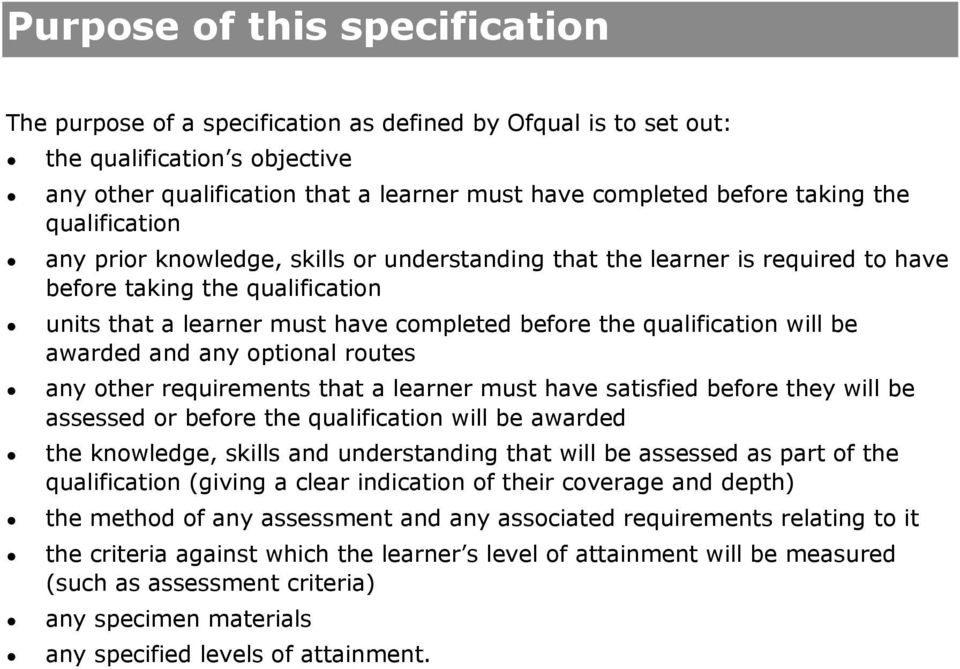
3 Purpose of this specification The purpose of a specification as defined by Ofqual is to set out: the qualification s objective any other qualification that a learner must have completed before taking the qualification any prior knowledge, skills or understanding that the learner is required to have before taking the qualification units that a learner must have completed before the qualification will be awarded and any optional routes any other requirements that a learner must have satisfied before they will be assessed or before the qualification will be awarded the knowledge, skills and understanding that will be assessed as part of the qualification (giving a clear indication of their coverage and depth) the method of any assessment and any associated requirements relating to it the criteria against which the learner s level of attainment will be measured (such as assessment criteria) any specimen materials any specified levels of attainment.
4 BTEC Professional qualification titles covered by this specification Pearson BTEC Level 4 Diploma in Management and Leadership This qualification has been accredited to the Qualifications and Credit Framework (QCF) and is eligible for public funding as determined by the Department for Education (DfE) under Section 96 of the Learning and Skills Act Details of funding approval will be available on the Learning Aims Reference Service (LARS) database, which replaces the Learning Aim Reference Application (LARA). In the interim, the LARS Lite database is available to check funding approval. Alternatively, the Skills Funding Agency s simplified funding catalogues can be used to check funding approval The QCF Qualification Number (QN) should be used by centres when they wish to seek public funding for their learners. Each unit within a qualification will also have a QCF unit reference number (URN). The QCF qualification and unit reference numbers will appear on learners final certification documentation. The QN for the qualification in this publication is: Pearson BTEC Level 4 Diploma in Management and Leadership (QCF) 601/3500/1 This qualification title will appear on learners certificates. Learners need to be made aware of this when they are recruited by the centre and registered with Pearson.

5 Contents What are BTEC Level 4 Professional qualifications? 1 Key features of the Pearson BTEC Level 4 in Management and Leadership (QCF) 2 National Occupational Standards 3 Rules of combination 4 Rules of combination for Pearson BTEC Level 4 qualifications 4 Pearson BTEC Level 4 Diploma in Management and Leadership (QCF) 5 Assessment 6 Quality assurance of centres 7 Approval 7 Quality assurance guidance 7 Programme design and delivery 8 Mode of delivery 8 Resources 8 Delivery approach 8 Access and recruitment 9 Access to qualifications for learners with disabilities or specific needs 9 Restrictions on learner entry 10 Recognising prior learning and achievement 10 Unit format 11 Unit title 11 Unit reference number 11 QCF level 11 Credit value 11 Guided learning hours 11 Unit aim 11 Unit introduction 11 Learning outcomes 12 Assessment criteria 12 Unit content 12 Essential guidance for tutors 13

6 Units 15 Unit 1: Principles of Building Respectful and Productive Working Relationships in Organisations 19 Unit 2: Managing Personal and Professional Development 29 Unit 3: Principles of Management and Leadership in Organisations 35 Unit 4: Operational and Human Resource Planning and Management 43 Unit 5: Business Performance Measurement and Improvement 53 Unit 6: Corporate Social Responsibility and Sustainability 61 Unit 7: Budget Management 71 Unit 8: Understanding Organisational Structure, Culture, and Values 79 Unit 9: Staff Recruitment and Selection 85 Unit 10: Principles of Business Strategic Planning and Development 91 Unit 11: Stakeholder Engagement and Management 99 Unit 12: Principles of Innovation and Change Management 107 Unit 13: Understand the Legal Context of Business 113 Unit 14: Principles of Project Management 123 Unit 15: Principles of Quality Management 129 Further information and useful publications 134 How to obtain National Occupational Standards 134 Professional development and training 135 Annexe A 137 Mapping with NVQs 137 Annexe B 139 Unit mapping overview 139

7 What are BTEC Level 4 Professional qualifications? BTEC Professional qualifications are qualifications at Level 4 to Level 8 in the Qualifications and Credit Framework (QCF) and are designed to provide professional work-related qualifications in a range of sectors. They give learners the knowledge, understanding and skills that they need to prepare for employment. The qualifications also provide career development opportunities for those already in work. Consequently they provide a course of study for full-time or part-time learners in schools, colleges and training centres. BTEC Professional qualifications provide much of the underpinning knowledge and understanding for the National Occupational Standards for the sector, where these are appropriate. They are supported by the relevant Standards Setting Body (SSB) or Sector Skills Council (SSC). A number of BTEC Professional qualifications are recognised as the knowledge components of Apprenticeships Frameworks. On successful completion of a BTEC Professional qualification, learners can progress to or within employment and/or continue their study in the same or related vocational area. The QCF is a framework which awards credit for qualifications and units and aims to present qualifications in a way that is easy to understand and measure. It enables learners to gain qualifications at their own pace along flexible routes. There are three sizes of qualification in the QCF: Award (1 to 12 credits) Certificate (13 to 36 credits) Diploma (37 credits and above). Every unit and qualification in the framework will have a credit value. The credit value of a unit specifies the number of credits that will be awarded to a learner who has achieved the learning outcomes of the unit. The credit value of a unit is based on: one credit for those learning outcomes achievable in 10 hours of learning learning time defined as the time taken by learners at the level of the unit, on average, to complete the learning outcomes of the unit to the standard determined by the assessment criteria. The credit value of the unit will remain constant in all contexts, regardless of the assessment method used for the qualification(s) to which it contributes. Learning time should address all learning (including assessment) relevant to the learning outcomes, regardless of where, when and how the learning has taken place. 1

8 Key features of the Pearson BTEC Level 4 in Management and Leadership (QCF) The Pearson BTEC Level 4 Diploma in Management and Leadership (QCF) qualification forms the technical knowledge component of the Level 4 Higher Apprenticeship in Management. This qualification has been designed for learners to develop the managerial and technical knowledge required to effectively manage people, processes and performance within an operational area of responsibility. The qualification is suitable for learners who work in, or want to work in management and leadership roles such as Manager, Area Manager, Business Manager, Quality Manager and Business Improvement Manager. The qualification gives learners the opportunity to: develop managerial and wider technical knowledge to underpin competence in the job roles stated above. This includes the knowledge covering the principles and practices of effective leadership and management, resource planning and management, recruitment and selection, budget management, stakeholder engagement and management and developing respectful and productive working relationships. It also covers concepts such as organisation structure and culture and corporate social responsibility and sustainability develop specialist technical knowledge to provide learners with a framework for extending their occupational skills to specialised management and leadership roles. This objective is supported by the inclusion of content themes such as business performance measurement and improvement, business strategic planning and development, quality management, innovation and change management, legal context of business and project management progress to the Pearson Edexcel Level 4 NVQ Diploma in Management (QCF) to complete the Level 4 Higher Apprenticeship in Management. Learners could also progress to the Pearson Edexcel Level 5 NVQ Diploma in Management and Leadership (QCF) and the Pearson BTEC Level 5 Diploma in Management and Leadership (QCF), which are components of the Level 5 Higher Apprenticeship in Management and Leadership. With further development, learners can alternatively progress into job roles requiring a more complex set of skills such as Senior Manager, Head of Department and Director achieve a nationally recognised Level 4 vocationally-related qualification. This qualification is for all learners aged 18+ and 19+ who are capable of reaching the required standards. Learners do not need any prior qualifications, knowledge or experience before starting the qualification however they are likely to be employed in an operational, technician, associate professional or first line management role; already have core occupational competence and knowledge within the sector, but are aspiring to make the transition from first line manager to middle management level. Learners may also be seeking work within the business and professional management sector, or intending to return to work at management level after unemployment. 2

9 National Occupational Standards Where relevant, BTEC Level 4 qualifications are designed to provide the relevant underpinning knowledge and understanding for the National Occupational Standards (NOS), as well as developing practical skills in preparation for work and possible achievement of NVQs in due course. NOS form the basis of National Vocational Qualifications (NVQs). BTEC Level 4 (QCF) qualifications do not purport to deliver occupational competence in the sector, which should be demonstrated in a work context. Annexe A shows a mapping of the mandatory units in the qualification against the underpinning knowledge of the Pearson Edexcel Level 4 NVQ in Management and Leadership (QCF). The Pearson BTEC Level 4 Diploma in Management and Leadership relates to the following NOS. Management and Leadership National Occupational Standards March 2012 Business and Administration National Occupational Standards January

10 Rules of combination The rules of combination specify the credits that need to be achieved, through the completion of particular units, for the qualification to be awarded. All accredited qualifications within the QCF have rules of combination. Rules of combination for Pearson BTEC Level 4 qualifications When combining units for a Pearson BTEC Level 4 in Management and Leadership, it is the centre s responsibility to ensure that the following rules of combination are adhered to. Pearson BTEC Level 4 Diploma in Management and Leadership 1 Qualification credit value: a minimum of 37 credits. 2 Minimum credit to be achieved at, or above, the level of the qualification: 31 credits. 3 All credits must be achieved from the units listed in this specification. 4

11 Pearson BTEC Level 4 Diploma in Management and Leadership (QCF) The Pearson BTEC Level 4 Diploma in Management and Leadership (QCF) is a 37 credit and guided learning hour (GLH) qualification that consists of 4 mandatory units providing 26 credits plus optional units providing a minimum of 11 credits. At least 31 credits must be at Level 4 or above. Pearson BTEC Level 4 Diploma in Management and Leadership (QCF) Unit Mandatory units Credit Level 1 Principles of Building Respectful and Productive Working Relationships in Organisations Managing Personal and Professional Development Principles of Management and Leadership in Organisations Operational and Human Resource Planning and Management 7 4 Unit Optional units (minimum of 11 credits) Credit Level 5 Business Performance Measurement and Improvement Corporate Social Responsibility and Sustainability Budget Management Understanding Organisational structure, culture, and values Staff Recruitment and Selection Principles of Business Strategic Planning and Development Stakeholder Engagement and Management Principles of Innovation and Change Management Understand the Legal Context of Business Principles of Project Management Principles of Quality Management 4 4 5

12 Assessment All units within this qualification are internally assessed. The qualifications are criterion referenced, based on the achievement of all the specified learning outcomes. Guidance The purpose of assessment is to ensure that effective learning has taken place to give learners the opportunity to: achieve all the specified learning outcomes meet the standard determined by the assessment criteria by providing sufficient and valid evidence prove that the evidence is their own. All the assignments created by centres should be reliable and fit for purpose, and should be built on the unit assessment criteria. Assessment tasks and activities should enable learners to produce valid, sufficient and reliable evidence that relates directly to the specified criteria. Centres should enable learners to produce evidence in a variety of different forms, including, presentations and posters, along with projects, or time-constrained assessments. Centres are encouraged to emphasise the practical application of the assessment criteria, providing a realistic scenario for learners to adopt, and making maximum use of practical activities, where appropriate. The creation of assignments that are fit for purpose is vital to achievement and their importance cannot be overemphasised. The assessment criteria must be clearly indicated in the assignments briefs. This gives learners focus and helps with internal verification and standardisation processes. It will also help to ensure that learner feedback is specific to the assessment criteria. When designing assignments briefs, centres are encouraged to identify common topics and themes. A central feature of vocational assessment is that it allows for assessment to be: current, i.e. to reflect the most recent developments and issues local, i.e. to reflect the employment context of the delivering centre flexible to reflect learner needs, i.e. at a time and in a way that matches the learner s requirements so that they can demonstrate achievement. 6

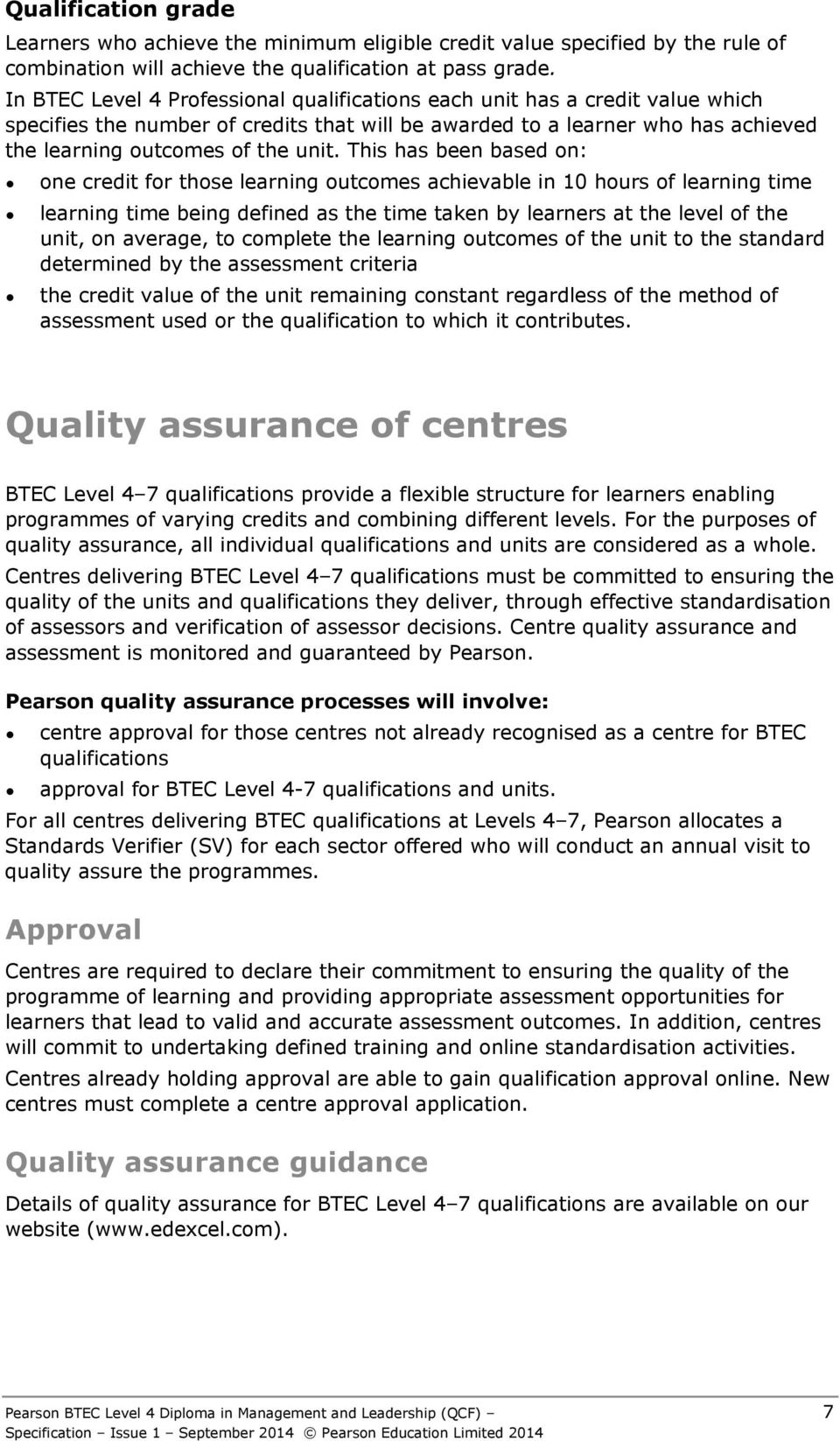
13 Qualification grade Learners who achieve the minimum eligible credit value specified by the rule of combination will achieve the qualification at pass grade. In BTEC Level 4 Professional qualifications each unit has a credit value which specifies the number of credits that will be awarded to a learner who has achieved the learning outcomes of the unit. This has been based on: one credit for those learning outcomes achievable in 10 hours of learning time learning time being defined as the time taken by learners at the level of the unit, on average, to complete the learning outcomes of the unit to the standard determined by the assessment criteria the credit value of the unit remaining constant regardless of the method of assessment used or the qualification to which it contributes. Quality assurance of centres BTEC Level 4 7 qualifications provide a flexible structure for learners enabling programmes of varying credits and combining different levels. For the purposes of quality assurance, all individual qualifications and units are considered as a whole. Centres delivering BTEC Level 4 7 qualifications must be committed to ensuring the quality of the units and qualifications they deliver, through effective standardisation of assessors and verification of assessor decisions. Centre quality assurance and assessment is monitored and guaranteed by Pearson. Pearson quality assurance processes will involve: centre approval for those centres not already recognised as a centre for BTEC qualifications approval for BTEC Level 4-7 qualifications and units. For all centres delivering BTEC qualifications at Levels 4 7, Pearson allocates a Standards Verifier (SV) for each sector offered who will conduct an annual visit to quality assure the programmes. Approval Centres are required to declare their commitment to ensuring the quality of the programme of learning and providing appropriate assessment opportunities for learners that lead to valid and accurate assessment outcomes. In addition, centres will commit to undertaking defined training and online standardisation activities. Centres already holding approval are able to gain qualification approval online. New centres must complete a centre approval application. Quality assurance guidance Details of quality assurance for BTEC Level 4 7 qualifications are available on our website ( 7
14 Programme design and delivery Mode of delivery Pearson does not normally define the mode of delivery BTEC Level 4 to Level 8 qualifications. Centres are free to offer the qualifications using any mode of delivery (such as full-time, part-time, evening only, distance learning) that meets their learners needs. Whichever mode of delivery is used, centres must ensure that learners have appropriate access to the resources identified in the specification and to the subject specialists delivering the units. This is particularly important for learners studying for the qualification through open or distance learning. Learners studying for the qualification on a part-time basis bring with them a wealth of experience that should be utilised to maximum effect by tutors and assessors. The use of assessment evidence drawn from learners work environments should be encouraged. Those planning the programme should aim to enhance the vocational nature of the qualification by: liaising with employers to ensure a course relevant to learners specific needs accessing and using non-confidential data and documents from learners workplaces including sponsoring employers in the delivery of the programme and, where appropriate, in the assessment linking with company-based/workplace training programmes making full use of the variety of experience of work and life that learners bring to the programme. Resources BTEC Level 4 qualifications are designed to give learners an understanding of the skills needed for specific vocational sectors. Physical resources need to support the delivery of the programme and the assessment of the learning outcomes, and should therefore normally be of industry standard. Staff delivering programmes and conducting the assessments should be familiar with current practice and standards in the sector concerned. Centres will need to meet any specific resource requirements to gain approval from Pearson. Where specific resources are required these have been indicated in individual units in the Essential resources sections. Delivery approach It is important that centres develop an approach to teaching and learning that supports the vocational nature of BTEC Level 4 qualifications and the mode of delivery. Specifications give a balance of practical skill development and knowledge requirements, some of which can be theoretical in nature. Tutors and assessors need to ensure that appropriate links are made between theory and practical application and that the knowledge base is applied to the sector. This requires the development of relevant and up-to-date teaching materials that allow learners to apply their learning to actual events and activity within the sector. Maximum use should be made of learners experience. 8

15 Access and recruitment Pearson s policy regarding access to its qualifications is that: they should be available to everyone who is capable of reaching the required standards they should be free from any barriers that restrict access and progression there should be equal opportunities for all wishing to access the qualifications. Centres are required to recruit learners to BTEC qualifications with integrity. This will include ensuring that applicants have appropriate information and advice about the qualifications and that the qualification will meet their needs. Centres should take appropriate steps to assess each applicant s potential and make a professional judgement about their ability to successfully complete the programme of study and achieve the qualification. This assessment will need to take account of the support available to the learner within the centre during their programme of study and any specific support that might be necessary to allow the learner to access the assessment for the qualification. Centres should consult our policy on learners with particular requirements. Centres will need to review the entry profile of qualifications and/or experience held by applicants, considering whether this profile shows an ability to progress to a higher level qualification. Access to qualifications for learners with disabilities or specific needs Equality and fairness are central to our work. Pearson s Equality Policy requires all learners to have equal opportunity to access our qualifications and assessments. It also requires our qualifications to be awarded in a way that is fair to every learner. We are committed to making sure that: learners with a protected characteristic (as defined by the Equality Act 2010) are not, when they are undertaking one of our qualifications, disadvantaged in comparison to learners who do not share that characteristic all learners achieve the recognition they deserve from undertaking a qualification and that this achievement can be compared fairly to the achievement of their peers. Learners taking a qualification may be assessed in British sign language or Irish sign language where it is permitted for the purpose of reasonable adjustments. Further information on access arrangements can be found in the Joint Council for Qualifications (JCQ) document Access Arrangements, Reasonable Adjustments and Special Consideration for General and Vocational qualifications. Details on how to make adjustments for learners with protected characteristics are given in the document Pearson Supplementary Guidance for Reasonable Adjustment and Special Consideration in Vocational Internally Assessed Units. Both documents are on our website at: 9

16 Restrictions on learner entry Pearson BTEC Level 4 in Management and Leadership is accredited on the QCF for learners aged 18 and above. Recognising prior learning and achievement Recognition of Prior Learning Recognition of Prior Learning (RPL) is a method of assessment (leading to the award of credit) that considers whether a learner can demonstrate that they can meet the assessment requirements for a unit through knowledge, understanding or skills they already possess and so do not need to develop through a course of learning. Pearson encourages centres to recognise learners previous achievements and experiences whether at work, home and at leisure, as well as in the classroom. RPL provides a route for the recognition of the achievements resulting from continuous learning. RPL enables recognition of achievement from a range of activities using any valid assessment methodology. Provided that the assessment requirements of a given unit or qualification have been met, the use of RPL is acceptable for accrediting a unit, units or a whole qualification. Evidence of learning must be sufficient, reliable and valid. There is further guidance in our policy document Recognition of Prior Learning Policy and Process, available on our website at Credit transfer Credit transfer describes the process of using a credit or credits awarded in the context of a different qualification or awarded by a different awarding organisation towards the achievement requirements of another qualification. All awarding organisations recognise the credits awarded by all other awarding organisations that operate within the QCF. If learners achieve credits with other awarding organisations, they do not need to retake any assessment for the same units. The centre must keep evidence of credit achievement. 10

17 Unit format All units in BTEC Level 4 Professional qualifications have a standard format. The unit format is designed to give guidance on the requirements of the qualification for learners, tutors, assessors and those responsible for monitoring national standards. Each unit has the following sections. Unit title The unit title is on the QCF and this form of words will appear on the learner s Notification of Performance (NOP). Unit reference number Each unit is assigned a unit reference number that appears with the unit title on the Register of Regulated Qualifications. QCF level All units and qualifications within the QCF have a level assigned to them. There are nine levels of achievement, from Entry to Level 8. The QCF Level Descriptors and, where appropriate, the NOS and/or other sector/professional benchmarks, inform the allocation of level. Credit value All units have a credit value. The minimum credit value that may be determined for a unit is one, and credits can only be awarded in whole numbers. Learners will be awarded credits for the successful completion of whole units. Guided learning hours Guided learning hours are defined as all the times when a tutor, trainer or facilitator is present to give specific guidance towards the learning aim being studied on a programme. This definition includes lectures, tutorials and supervised study in, for example, open learning centres and learning workshops. It also includes time spent by staff assessing learners achievements. It does not include the time spent by staff marking assignments or homework where the learner is not present. Unit aim This gives a summary of what the unit aims to do. Unit introduction The unit introduction gives the reader an appreciation of the unit in the vocational setting of the qualification, as well as highlighting the focus of the unit. It gives the reader a snapshot of the unit and the key knowledge, skills and understanding gained while studying the unit. The unit introduction also highlights any links to the appropriate vocational sector by describing how the unit relates to that sector. 11

18 Learning outcomes The learning outcomes of a unit set out what a learner knows, understands or is able to do as the result of a process of learning. Assessment criteria Assessment criteria specify the standard required by the learner to achieve each learning outcome. Unit content The unit content identifies the breadth of knowledge, skills and understanding needed to design and deliver a programme of learning to achieve each of the learning outcomes. This is informed by the underpinning knowledge and understanding requirements of the related National Occupational Standards (NOS), where relevant. The content provides the range of subject material for the programme of learning and specifies the skills, knowledge and understanding required for achievement of the unit. Each learning outcome is stated in full and then the key phrases or concepts related to that learning outcome are listed in italics followed by the subsequent range of related topics. Relationship between content and assessment criteria The learner should have the opportunity to cover all of the unit content. It is not a requirement of the unit specification that all of the content is assessed. However, the indicative content will need to be covered in a programme of learning in order for learners to be able to meet the standard determined in the assessment criteria. Content structure and terminology The information below shows the unit content is structured and gives the terminology used to explain the different components within the content. Learning outcome: this is shown in bold at the beginning of each section of content. Italicised sub-heading: it contains a key phrase or concept. This is content which must be covered in the delivery of the unit. Colons mark the end of an italicised sub-heading. Elements of content: the elements are in plain text and amplify the subheading. The elements must be covered in the delivery of the unit. Semi-colons mark the end of an element. Brackets contain amplification of content which must be covered in the delivery of the unit. e.g. is a list of examples, used for indicative amplification of an element (that is, the content specified in this amplification could be covered or could be replaced by other, similar material). 12

19 Essential guidance for tutors This section gives tutors additional guidance and amplification to aid understanding and a consistent level of delivery and assessment. It is divided into the following sections. Delivery explains the content s relationship to the learning outcomes and offers guidance about possible approaches to delivery. This section is based on the more usual delivery modes but is not intended to rule out alternative approaches. Assessment gives amplification about the nature and type of evidence that learners need to produce in order to achieve the unit. This section should be read in conjunction with the assessment criteria. Indicative resource materials gives a list of resource material that benchmarks the level of study. 13

20 14

21 Units 15
22 16
23 Units Unit 1: Principles of Building Respectful and Productive Working Relationships in Organisations 19 Unit 2: Managing Personal and Professional Development 29 Unit 3: Unit 4: Principles of Management and Leadership in Organisations 35 Operational and Human Resource Planning and Management 43 Unit 5: Business Performance Measurement and Improvement 53 Unit 6: Corporate Social Responsibility and Sustainability 61 Unit 7: Budget Management 71 Unit 8: Understanding Organisational Structure, Culture, and Values 79 Unit 9: Staff Recruitment and Selection 85 Unit 10: Principles of Business Strategic Planning and Development 91 Unit 11: Stakeholder Engagement and Management 99 Unit 12: Principles of Innovation and Change Management 107 Unit 13: Understand the Legal Context of Business 113 Unit 14: Principles of Project Management 123 Unit 15: Principles of Quality Management
24 18
25 Unit 1: Principles of Building Respectful and Productive Working Relationships in Organisations Unit reference number: H/506/4454 QCF Level 4: BTEC Professional Credit value: 7 Guided learning hours: 23 Unit aim This unit provides the learner with an understanding of the how to create a fair, supportive and rewarding working environment and the importance of communication in creating effective working relationships. The unit also provides an introduction to the practices of conflict resolution and conflict management in the workplace. Unit introduction For any a manager it is vitally important to build respectful and productive working relationships with your colleagues, whether they are your peers or those who report to you. Often your success, and the success of the organisation as a whole, will depend on the quality of the working relationships you build with your colleagues. In this unit you will learn the principles of communicating effectively in the workplace and how giving and receiving feedback helps to improve performance and increase the speed of learning as well as support the development of a positive open culture. You will explore the sources of conflict in the workplace and the strategies that can be used to resolve and manage conflict so that it is constructive rather than disruptive. You will consider the importance of creating a fair and supportive working environment and how to do this while recognising the achievements of your colleagues or staff. Staff well-being makes for a productive and happy workforce and you will explore what can be done to promote this and how the effectiveness of well-being initiatives such as healthcare, childcare, health education and caring for the worklife balance can be evaluated. Finally, you will consider how organisations can create a learning and innovation culture through measures such as enhancing learning opportunities and reducing the blame culture, and why this is important for the future success of any organisation and its staff. 19
26 Learning outcomes and assessment criteria In order to pass this unit, the evidence that the learner presents for assessment needs to demonstrate that they can meet all the learning outcomes for the unit. The assessment criteria determine the standard required to achieve the unit. On completion of this unit a learner should: Learning outcomes 1 Understand the use of communication in creating effective working relationships 2 Understand the practices of conflict resolution and conflict management in the workplace. 3 Understand how to create a fair, supportive and rewarding working environment Assessment criteria 1.1 Explain the principles of effective communications in the workplace 1.2 Assess the impact of ineffective communications on working relationships and performance standards 1.3 Explain the importance of giving and receiving constructive feedback to colleagues in the workplace. 2.1 Analyse the sources of conflict in the workplace 2.2 Compare the concepts of conflict resolution and conflict management 2.3 Analyse techniques that may be used to manage and resolve conflict in the workplace 3.1 Assess the impact of Equality legislation on management practices 3.2 Assess the value of diversity in the workplace 3.3 Evaluate techniques for promoting equality and diversity in the work environment 3.4 Evaluate different methods of recognising achievement in the work environment 3.5 Explain the importance of recognising achievement in the work environment 3.6 Describe qualitative information and quantitative data that can be used to evaluate staff wellbeing 3.7 Evaluate initiatives that may be implemented to improve staff wellbeing 20
27 Learning outcomes Assessment criteria 3.8 Evaluate different methods of developing a learning and innovation culture in an organisation 3.9 Assess the value of a learning and innovation culture to organisational performance 21
28 Unit content 1 Understand the use of communication in creating effective working relationships Effective communication: predominance of communication in manager s role; purpose of communication in the workplace; competence in communication, e.g. Littlejohn and Jabusch s knowledge competency, sensitivity competency, skills competency, values competency; communication model, e.g. sender/encoder, receiver/decoder, message, channel, feedback/effects, environment; principles, e.g. determine purpose, analyse audience, select medium, organise thoughts, establish order, write/prepare, check understanding, receive feedback or observe effects from audience/recipient Ineffective communication: causes of miscommunication, e.g. differing inferences, word-meaning confusion, differing perceptions, information overload and timing, non-verbal messages, noise, poor listening, personality differences, gender differences, intercultural differences; impact on working relationships, e.g. misunderstandings, mistakes, loss of motivation, negative impact on climate, failure to build trust, reduced productivity Constructive feedback: value in learning; relevance to learning cycle (Kolb); feedback model such as Roebuck s ERASER, e.g. be exact, know the result, create awareness, switch the behaviour, evidence, reward good behaviour; principles, e.g. immediate, positive if possible, verbal/non-verbal cues should send same message, first and last parts of message most remembered Giving and receiving constructive feedback: improves performance; reduces errors; aids understanding; aids own learning; aids learning of others; helps understand others feelings; creates climate where feedback is given/received 2 Understand the practices of conflict resolution and conflict management in the workplace Conflict: definition of conflict; likelihood of conflicts in organisations; sources of conflict: differences in perception, limited resources, departmentalisation, work activities, role conflict, inequitable treatment, violation of territory, environmental change, personality differences, cultural differences; conflict stages, e.g. Pondy s latent, perceived, felt, manifest and conflict aftermath; conflict styles, e.g. avoidance, competition, compromise, accommodation, collaboration Conflict management: positive and negative outcomes of conflict; tactics, e.g. Schmidt; tactics designed to escalate, reduce, maintain at present level or avoid conflict Conflict resolution: problem solving approach; process for conflict resolution, e.g. self-analysis, calling a meeting to work on problem, defining problem, developing solutions, narrowing choices for actions, committing to solutions; monitoring process; guidelines for productive conflict, e.g. identify common goals and interests; develop norms to work on problems; focus on mutual gain; changes to resolve conflict, e.g. clarification of goals and objectives; resource distribution; human resource management policies and procedures; nonmonetary rewards; development of interpersonal/group process skills; group activities; change in leadership style; organisational processes; formalise agreements on solutions; monitoring and review of effectiveness of solutions 22
29 3 Understand how to create a fair, supportive and rewarding working environment Equality legislation: principles of Equalities Act 2010; protection against discrimination in relation to dismissal, employment terms and conditions, pay and benefits, training, recruitment, redundancy; protected grounds for discrimination, e.g. age, transsexual, marital or civil partnership status, pregnancy or parenthood, disability, race, colour, nationality, ethnicity, religion, gender, sexual orientation Management practices: importance of following organisational procedures for protected areas, e.g. to promote job satisfaction, employee retention, motivation, sound reputation as employer; to avoid complaints, recourse to employment tribunals, compensation awards; sources of advice and guidance, e.g. Equality Advisory Support Service (EASS), Advisory Conciliation and Arbitration Service (ACAS) Value of diversity: definition of diversity; benefits, e.g. wider talent pool from which to draw staff, reflect taste, style and opinions of range of customers or service users, attract talented people; improved customer relations; acting on ethical principles; mirroring the structure of society Techniques for promoting equality and diversity: compliant organisational policies and procedures for recruitment and selection, positive discrimination practices, staff appraisals, allocation of training, setting conditions of employment, staff discipline, promotion, mentoring, harassment, redundancy, pay and benefits; communication of organisational policies and procedures to all staff; inclusion of principles in staff induction programmes; training for managers; monitoring implementation through collection and analysis of data; arrangements for whistle-blowers; use of diverse role-models in internal and external publicity Methods of recognising achievement in the workplace: private versus public recognition; formal versus informal; formal methods, e.g. performance management system, organisational awards, remuneration system, regular one to one feedback sessions; informal methods, e.g. thanking, praise, celebratory social events Importance of recognising achievement: reinforce good behaviour; motivate achievers; motivate other staff; encourage retention of high achievers Staff well-being: definition of well-being; shared responsibility; quantitative methods of evaluating employees well-being, e.g. absence, cause of sickness, staff turnover, achievement of well-being objectives, staff surveys with closed questions; qualitative methods of evaluating employees well-being, e.g. interviews, staff surveys with open questions; focus groups; monitoring of social media Staff well-being initiatives: private healthcare cover, e.g. physiotherapy, private health insurance; counselling services; stop smoking support; weight loss support; subsidised gym membership; kitchen facilities; fresh water provision; health education; no blame culture; teamwork; flexible working hours; work-life balance scheme; childcare vouchers Evaluation: improved productivity/efficiency; reduced sickness; reduced staff turnover; improved reputation as employer; motivation; commitment; employee satisfaction 23
30 Methods of developing a learning and innovation culture: policies for learning organisation; reducing blame culture; enabling loose, creative and lateral thinking; resourcing; coaching; mentoring; removing blocks to creativity, e.g. perceptual, emotional, process, communication, cultural (Goodman); enabling stages of the innovation process, e.g. preparation, incubation, illumination, verification Value of learning and innovation culture to organisational performance: value, e.g. to facilitate rapid change, gain competitive advantage through product development, process redevelopment, use of new materials; rapid adaptation to changing business environment Organisational performance measures: achievement of strategic objectives; growth, e.g. turnover, market share, assets, profit; value of pipeline of new products; returns for shareholders; customer satisfaction; achievement against benchmarked organisations; external quality standards; share price 24
31 Essential guidance for tutors Delivery For this unit tuition for the learning outcomes lends itself to flexible delivery approaches. Tutors can deliver the unit using a wide range of teaching and learning strategies including lectures, discussions, seminar presentations, case studies, video clips, internet research and library resources, where the learner can work individually and in a group researching and gathering information about the subject. Tutors can illustrate points with reference to examples of businesses that have a good track record in developing positive employment relationships and promoting employee wellbeing. As many learners will have experience in management at various levels, this presents the opportunity to bring the content to life with the richness of personal experiences and suitable anonymised real-life situations. For learning outcome 1, tutor input on the models and concept of effective workplace communication can lead to a whole group discussion where learners can share their experiences of the impact of ineffective communication and the importance of constructive feedback this should be looked at not only from the organisational perspective but also from the individual and personal level. Learning outcome 2 would be suitable for case studies and/or small group discussions supported by tutor input to summarise and emphasise key concepts and principles of conflict resolution and management. The use of reflection would be good for learners to assess the effectiveness of their past practice in resolving and managing conflict and how they could improve in the future. Alternatively, they could reflect on how they have personal dealt with conflict in their working environment. For learning outcome 3, learners could conduct research on equality and diversity legislation and management best practices using the relevant websites listed in the resources section. Individual learners could be asked to make presentations related to different assessment criteria, which could then be lead to a whole group discussion giving learners the opportunity to share their experiences. Reflection on practice and case studies of organisations demonstrating best practice would also be useful in delivering the content related to this learning outcome. Assessment Assessment for this unit could be through a written assignment, a reflective journal or a presentation. If a presentation is used evidence should be collected in the form of an observation record that is sufficiently detailed to enable internal and external verification to take place. This should be supported by other evidence such as the learner s presentation notes, slides or visual aids. If the learner is concurrently undertaking a competence based qualification in management then it would be good practice for the assessment to be designed holistically; for example the learner could reflect on whether the theory can be used to explain how their organisation s practices for creating a fair and supportive working environment have been designed. Throughout the unit learners are required to explain, assess, analyse, compare or evaluate. The assessment methods used must allow sufficient opportunity and stimulus to enable the learner to produce evidence that fully covers the criteria. The learner will need to demonstrate higher level skills in developing evidence that is justifiable and soundly based. 25
32 Learning outcome 1 is about effective and ineffective workplace communication and feedback. The learner needs to show they understand the principles. For example, a reflective account examining how communication issues are scrutinised, that is linked with relevant principles and studies would suit many learners. Learning outcome 2 is about conflict management and conflict resolution. Where possible, it would be beneficial for the learner to apply the learned practices and techniques to real conflicts in their evidence as this will add to the richness of the assessment. Learning outcome 3 covers a range of topics including equality, diversity, recognition of achievement, staff well-being and the development of a learning and innovation culture. Learners could present their understanding of the characteristics of a supportive working environment based on the concepts above and the case studies used to support learning outcomes 1 and 2. Where possible, this could be supported by a reflection of their own experiences. Evidence of Recognition of Prior Learning (RPL) can be used in the unit to confirm competence. Wherever possible, the learning outcomes in this unit should be assessed holistically across the qualification. Indicative resource materials Books Mullins LJ - Management and Organisational Behaviour, 10th edition (Pearson, 2013) ISBN Roebuck D B - Improving Business Communication Skills, 4th edition (Prentice Hall, 2005) ISBN Shockley-Zalabak P - Fundamentals of Organizational Communication, 8th edition (Pearson, 2011) ISBN Websites the Advisory, Conciliation and Arbitration Service (ACAS), includes resources on equality and diversity - the website of the Chartered Institute of Personnel and Development from which a booklet on staff well-being can be obtained - the website of the UK Government Equalities Office, includes news and reports on equality issues - the UK government s Equality Advisory Service website, providing information on discrimination issues - the UK government website, providing guidance on the Equalities Act the UK Justice ministry, providing links to information on employment tribunals - learning resources to support development of skills needed to succeed in a career, including communication and relationship management - website of the Chartered Managers Institute, providing resources on performance management 26
33 Other ACAS -Delivering Equality and Diversity (Advisory Booklet), available from Evan Davis Bottom line podcast Mental Health, (03/07/14), available from Government Equalities Office - Equality Act 2010 Guidance booklets, available from Peter Day s World of Business podcast Disability at Work, (12/01/13), available from Tehrani N - What s happening with well-being at work? (Part of The Change Agenda), (CIPD), available from 27
34 28
35 Unit 2: Managing Personal and Professional Development Unit reference number: Y/506/4452 QCF Level 4: BTEC Professional Credit value: 6 Guided learning hours: 20 Unit aim This unit gives learners an understanding of the need for personal and professional development. This unit also provides an introduction to the concept of implementing and monitoring personal professional development plans. Unit introduction Success as a manager requires both the development of professional and personal skills that support working effectively in the interests of the business. If you continuously develop your skills and knowledge then this will help you to be fully prepared to achieve goals or to approach changes in the workplace. In this unit you will learn about the trends and developments that are currently influencing the need for the development of personal and professional skills. This unit will provide the opportunity for you to explore the importance of ensuring that your personal professional development plan reflects your personal values and goals as well as those of your employer. You will also consider how to use professional networks and professional bodies to assist your development as well as how to set development objectives and devise a plan to achieve the targets you have set yourself. You will go on to explore the value of constructive feedback, and how to review and monitor your progress as you implement your personal professional development plan. 29
36 Learning outcomes and assessment criteria In order to pass this unit, the evidence that the learner presents for assessment needs to demonstrate that they can meet all the learning outcomes for the unit. The assessment criteria determine the standard required to achieve the unit. On completion of this unit a learner should: Learning outcomes 1 Understand the factors which influence the need for personal and professional development 2 Understand how to plan for personal and professional development 3 Understand how to implement and monitor a personal professional development plan Assessment criteria 1.1 Analyse trends and developments in management that influence the need for professional development 1.2 Explain the importance of own values, career and personal goals in planning professional development 1.3 Analyse how changes in the work environment impact on the requirement for professional and personal development 1.4 Assess the benefits of planning own professional development 2.1 Assess the value of professional networks and professional bodies in professional development 2.2 Describe how to develop an effective personal professional development plan 2.3 Explain the different learning styles and how they contribute to personal development planning 2.4 Explain how development activities are prioritized for personal and professional development 2.5 Assess the effectiveness of different development activities in improving personal performance 3.1 Explain how to implement a personal development plan 3.2 Assess the value of constructive feedback in implementing and monitoring the development plan 3.3 Explain how to monitor personal development and progression against objectives 30
37 Unit content 1 Understand the factors which influence the need for personal and professional development Factors: globalisation, technology change, sustainability, corporate social responsibility, study of psychology, e.g. goal theory, motivation theories, change models, business ecosystems, e.g. Google, Facebook, Silicon Roundabout/Tech City; fast pace of change; longer working lives Developments in management: e.g. collective leadership and staff empowerment; diversity and inclusion in management; talent management; knowledge management; innovation Impact of personal factors: own values, e.g. congruence of individual and organisational values, impact of congruence on commitment and work satisfaction (Taylor Cox); career goals, e.g. promotion, remuneration, professional qualification; personal goals, e.g. job satisfaction, fulfilment, worklife balance, social interaction with colleagues; goal congruence leads to improved morale, high performance standards, high levels of motivation Changes in the work environment: organisational restructuring; downsizing; growth; succession planning; talent management; process improvements; outsourcing; off-shoring; on-shoring; product development; new materials development Benefits of planning own professional development: allocate resources; ready to take opportunities that arise; attract support of others; opportunity for reflection and research; increase own commitment; increase own employability; contribute to own work effectiveness; support achievement of business objectives 2 Understand how to plan for personal and professional development Professional networks: building links to help achieve aims; principles, e.g. give before receiving, build trust and reputation, seek groups relevant to aims, plan networking, maintain network, deliver on commitments and promises, be positive, sustained focussed effort, life balance; value of professional networks, e.g. increased knowledge, support for professional development, meet likeminded people; ideas and insights, possible career openings Professional bodies: value, e.g. networking opportunities; learning opportunities through meetings; access to learning resources via libraries and resource banks; professional status; professional codes of practice or standards; enhance reputation of profession; represent profession, e.g. lobbying government ministers Develop a personal and professional development plan: analyse current job role requirements, e.g. knowledge, understanding, skills; analyse requirements of aspirational role; use of tools such as skills audits, personal SWOT (strengths, weaknesses, opportunities, threats); analysis against National Occupational Standards (NOS); identify gaps in knowledge, understanding and skills; determine priorities; set learning objectives in SMART form (specific, measurable, achievable, resourced, timed); determine activities to achieve learning objectives 31
38 Learning styles: models such as Kolb s learning style inventory; Fleming s VARK (visual, aural, read/write, kinaesthetic); Honey and Mumford s model (activist, reflector, theorist, pragmatist); purpose of model for informing selection of learning methods Prioritizing development activities: urgent versus important; urgent factors, e.g. organisational objectives, own current job role requirements, skill shortage; important factors, e.g. work towards long term career objectives; development needed to fulfil medium/long term organisational objectives, assisting line manager in determining priorities Assess effectiveness of development activities: Kirkpatrick s four levels of evaluation model, e.g. reaction of the learner to the training, learning or increase in knowledge, behaviour or capability improvement; results or effect on the business 3 Understand how to implement and monitor a personal professional development plan Implementing a personal professional development plan: develop written plan; share/agree with manager/mentor; schedule development activities; reflect on learning experiences; modify planned activities as needed Constructive feedback: specific; issue based; respectful; observation based; invites recipient to discuss Value of feedback: learn from successes and mistakes; aids development; encourages further learning Monitoring personal development: schedule time for monitoring; arrange manager or mentor support; collect feedback; consider and reflect on feedback; review progress against learning objectives; revise planned activities as needed; revise learning objectives as needed; evaluate benefits from achieving objectives; record decisions 32
39 Essential guidance for tutors Delivery For this unit tuition for the learning outcomes lends itself to flexible delivery approaches. Tutors can deliver the unit using a wide range of teaching and learning strategies including lectures, discussions, seminar presentations, case studies, video clips, internet research and library resources, where the learner can work individually and in a group researching and gathering information about the subject. Tutors can illustrate points with reference to examples of businesses that are recognised as having effective professional development planning practices. Many learners will use self-directed study together with the expertise and skills they may have developed in a career and be able to reflect on their experience of planning and implementing personal and professional development processes. To introduce the unit, it could be useful for learners to conduct research into factors that influence the need for personal and professional development. For learning outcome 1, tutor input on the concepts of personal and professional development can lead to a whole group discussion where learners can contribute based on their research and their experiences. Learning outcome 2 would be suitable for learners to undertake practical planning activities and research focussing on their own development planning supported by tutor input to summarise and emphasise key concepts and principles. This learning outcome presents a good opportunity for learners to reflect on their own experiences with managing personal and professional development whether as a manager people manager or for themselves. For learning outcome 3, a guest speaker with a Human Resource/Professional development background could be used to introduce the topic by presenting an insight into implementing and monitoring development plans. This can then be followed up by tutor input and whole group discussion. Assessment Assessment for this unit could be through a written assignment, a reflective journal or perhaps a presentation. If a presentation is used evidence should be collected in the form of an observation record that is sufficiently detailed to enable internal and external verification to take place. This should be supported by other evidence such as the learner s presentation notes, slides or visual aids. The assessment criteria require the learner to explain, analyse and assess so it is important that the method of assessment produces evidence showing that the learner has gone beyond a mere summarising of the main points and has fully explained or analysed as required. Research sources used must be attributed and at this level referencing to sources is required. If the learner is concurrently working towards a competence based qualification and has to produce a personal development plan, then it would be beneficial for the assessment of this part of the two qualifications to be planned together. Learning outcome 1 is about understanding why all managers need to be continuously undertaking personal development so this could be well placed at an early stage in the learner s development of their own plan. However it does require some maturity of perspective and knowledge of working life so in some cases it can be best left until a later stage. The assessment of the benefits of planning own professional development for AC1.4 should show evaluation skills such as using data from different sources, weighing up its value and relevance and drawing the findings together so as to make a soundly based assessment. 33
40 Learning outcome 2 is about knowing how to plan for personal and professional development and could be addressed if the learner is at the point of developing their own plan for work, another qualification or as a useful personal development exercise. AC2.1 and AC2.5 require the learner to assess so a description would not be an adequate response. The assessment methods need to allow the learner time to reflect and make judgements. For learning outcome 3 the learner needs to show they understand how to implement and monitor a personal professional development plan. If the learner is working on a personal professional development plan then it could be assessed at time the learner is implementing and monitoring the plan, or some learners may prefer to finish it off soon after then have studied for the rest of the unit. Evidence of Recognition of Prior Learning (RPL) can be used in the unit to confirm competence. Wherever possible, the learning outcomes in this unit should be assessed holistically across the qualification. Indicative resource materials Books Cottrell S Skills for Success: Personal Development and Employability, (Palgrave Macmillan, 2010) ISBN Gold G, Thorpe R and Mumford A Leadership and Management Development, 5th edition, (CIPD, 2010) ISBN Megginson D and Whitaker V Continuing Professional Development, 2nd edition, (CIPD, 2007) ISBN O Neill-Blackwell J Engage: The Trainer s Guide to Learning Styles, (John Wiley and Sons, 2012) ISBN Pedler M A Manager's Guide to Self Development, 5th edition, (McGraw-Hill, 2006) ISBN Websites - including information and advice on networking, Kirkpatrick s model and learning styles - the Chartered Institute of Personnel and Development offering relevant resources on CPD (continuing professional development) - a free management library with articles on personal and professional development the website of the Chartered Management Institute, offering information on a number of management and development issues Other Evan Davis Bottom line podcast Self-Improvement, (27/02/14), available from article summarising Harvard Business School report on the 5 most prominent current trends in management 34
41 Unit 3: Principles of Management and Leadership in Organisations Unit reference number: L/506/4478 QCF Level 4: BTEC Professional Credit value: 6 Guided learning hours: 20 Unit aim This unit provides the learner with an understanding of the concepts of leadership and managerial effectiveness within organisations. The unit also provides an introduction to the principles and practices of managing the performance of individuals in organisations. Unit introduction In work you will often be called on to take your lead from senior people in the organisation and then use your own management and leadership skills to gain the buy in of others and achieve organisational objectives. In this unit you will learn about management and leadership in organisations and how to interpret and use the key terms such as levels, leadership, management, responsibility and accountability, vision and values. You will also gain an understanding of how organisations develop managerial effectiveness through delegation and various methods of leadership development. You will go on to find out how workplace performance is managed through formal performance management schemes and also through coaching and mentoring and the use of effective communication. Effective management and leadership ensures that all employees efforts are working together and contributing to future success of the organisation. 35
42 Learning outcomes and assessment criteria In order to pass this unit, the evidence that the learner presents for assessment needs to demonstrate that they can meet all the learning outcomes for the unit. The assessment criteria determine the standard required to achieve the unit. On completion of this unit a learner should: Learning outcomes 1 Understand the concept of leadership in organisations 2 Understand the development of managerial effectiveness in organisations 3 Understand the principles and practices of managing the performance of individuals in organisations Assessment criteria 1.1 Compare the different levels of leadership in organisations 1.2 Compare the concepts of assigned leadership and emergent leadership 1.3 Distinguish between responsibility and accountability in leadership 1.4 Analyse the relationship between organisational vision, values and goals and leadership 2.1 Describe the skills, attitudes and behaviours of effective leaders 2.2 Analyse different models and styles of leadership used in organisations 2.3 Analyse the practices of effective leaders and managers 2.4 Evaluate the role of delegation and empowerment in managerial effectiveness 2.5 Assess the impact of organisational structure, culture and climate on managerial effectiveness 3.1 Analyse the concept of performance management 3.2 Analyse the main tools used in performance management in organisations 3.3 Assess the value of mentoring and coaching in managing the performance of individuals in an organisation 3.4 Evaluate the role of effective communication in managing the performance of individuals in an organisation 36
43 Unit content 1 Understand the concept of leadership in organisations Levels of leadership: definitions; difference between leadership and management, e.g. The 7-S organisational framework (Watson); leadership defined by role; leadership inside/outside of organisation s hierarchy, e.g. Maxwell s 5 Levels of Leadership hierarchy Assigned leadership and emergent leadership: assigned leadership, e.g. power (French and Raven, 1959); emergent leadership, e.g. communication behaviours (Fisher, 1974); personality (Foti, 1998); gender bias (Watson and Hoffman, 2004); social identity theory (Hogg, 2011) Responsibility and accountability: responsibility, i.e. obligation of subordinate to perform duties, possibility of reprimand; accountability, i.e. ultimate responsibility, cannot be delegated, responsibility for staff, performance, results, accountability to senior managers, owners, stakeholders Relationship between organisational vision, values and goals and leadership: vision for future; values shaping actions; goals feeding into action plans; leaders create and communicate vision, engage and motivate; get buy-in 2 Understand the development of managerial effectiveness in organisations Leadership skills: traits vs. process approach; Action-centred leadership (Adair), people skills, e.g. relating, communication verbal and non-verbal, patience, active listening); James Scouller s Three Levels of Leadership model from 2011 (Public, Private and Personal) Leadership attitudes: Theory X, e.g. workers inherently lazy Y, e.g. workers inherently self-motivated, (McGregor) Leadership behaviours: leadership as a behavioural category, e.g. Ohio State Leadership Studies, Employee centred and production centred supervisors ; 2 Dimensions of Managerial Leadership (Blake and McCanse) Models and styles of leadership: models, e.g. Continuum of Leadership (Tannenbaum and Schmidt, 1973); leadership styles, e.g. - authoritarian, democratic and laissez-faire; functional approach; situational approach, Fiedler s Contingency Model, Hay and Mcber Coercive, Authoritative, Affiliative, Democratic, Pacesetting, Coaching Practices of effective leaders and managers: e.g. select right people, show empathy, communicate, lead by example, delegate, are positive and constructive, thank and reward staff, develop staff, encourage innovation, be flexible Delegation and empowerment: definition of delegation, purpose of delegation; benefits of delegation to manager, organisation and staff; delegation and motivation; responsibility and authority; levels of decision making; delegation process, e.g. identification of work to delegate, matching of work to staff capacities; gradual delegation models, e.g. recommend/act/delegate; principles of learning such as learning curve, learning styles, conscious/unconscious competence (Johari Window); definitions of empowerment; forms of empowerment(lashley), True Empowerment (Stewart, Theory E), effectiveness of empowerment (Wall and Wood) 37
44 Impact on managerial effectiveness: definition of organisational culture/climate; link and interaction between leaders and culture (Organizational Culture and Leadership, Schein), Organisation Structure types, e.g. functional, line, appropriacy of structures; benefits of different structures; flat vs. tall structures; impact on managerial effectiveness, e.g. hierarchies, span of control, workload; delegation, e.g. impact of culture: on practices, decisions, behaviour; different cultures, e.g. aggressive, constructive Organisational climate: meaning of climate such as prevailing atmosphere, level of morale, feelings of belonging, perceptions of members of the organisation; features of a healthy organisational climate; impact on performance, e.g. Goldsmith and Clutterbuck study of world s top companies 3 Understand the principles and practices of managing the performance of individuals in organisations Performance management: control; monitoring activities against plans; key features, e.g. strategic, integrated, performance improvement, personal and professional development; purpose, e.g. achieving high levels of organisational performance; benefits and limitations Performance management tools: performance appraisal, including features, techniques and benefits; 360 degree feedback, including limitations and benefits; learning and development including learning styles and learning interventions (formal and informal); objectives and performance standards; reward systems, e.g. performance related pay Mentoring: features of mentoring, e.g. structured programme; inductive and deductive, mentor as expert, value to organisation: spread expertise; efficient development responding to individual; benefit to individual: improved ability to do job; increase skill set; time efficient Coaching: features of coaching, e.g. coach not necessarily an expert, primarily benefiting the individual; GROW (goals, reality, options, wrap-up) model; value to organisation: develop talent, motivate, coaching culture as revitalising (Kalinauckas and King); aid constant improvement; value to individual: space and time to understand, support for change, time efficient personal development, individual at centre Effective communication: features of effective communication, e.g. message clarity, mutual understanding; recognising others point of view, trust, buy-in to goals, openness, improve organisational climate, collaboration; communication model: sender/encoder, receiver/decoder, message, channel, feedback/effects 38
45 Essential guidance for tutors Delivery For this unit tuition for the learning outcomes lends itself to flexible delivery. Tutors can deliver the unit using a wide range of teaching and learning strategies including lectures, discussions, seminar presentations, case studies, video clips, internet research and library resources, where the learner can work individually and in a group researching and gathering information about the subject. Tutors can illustrate points with reference to examples of businesses that are recognised as having effective management and leadership practices. Many learners will use self-directed study together with the expertise and skills they may have developed in a career and be able to reflect on their experience of management and leadership. To introduce the unit, it could be useful for learners to conduct research into the concept of leadership and the different theories of leadership models and styles. For learning outcome 1, tutor input on the concept of leadership can lead to a whole group discussion where learners can contribute based on their research and their experiences, whether from their employing organisations or societal. It is important that learners are able to underpin their understanding of the concepts with the relevant theories. Learning outcome 2 would be suitable for case studies and small group discussions supported by tutor input to summarise and emphasise key concepts and principles. This learning outcome presents a good opportunity for learners to reflect on their own experiences whether as the leader/manager or part of a team in relation to the assessment criteria. For learning outcome 3, a guest speaker with a Human Resource background could be used to introduce the topic by presenting an insight into the importance and economic value of performance management and the tools used in a good performance management system. This can then be followed up by tutor input and whole group discussion. Assessment This unit requires the learner to show an understanding of a range of management and leadership principles, models and concepts. Appropriate methods of assessment include written assignments, a reflective account and presentation. If a presentation is used evidence should be collected in the form of an observation record that is sufficiently detailed to enable internal and external verification to take place. This should be supported by other evidence such as the learner s presentation notes, slides or visual aids. If the learner is concurrently undertaking a competence based qualification in management then it would be good practice for the assessment to be designed holistically; for example the learner could reflect on whether theory can be used to explain how their organisation s practices have been designed. All assessment criteria require the learner to compare, evaluate, explain, analyse etc. so care should be taken to ensure that the assessment methods and the methods of recording any oral elements permit the collection of suitable evidence. Learning outcome 1 is about leadership in organisations and could be assessed through an assignment supported with research such as the learner interviews conducted with senior managers of organisations to highlight the hierarchical levels within an organisation (AC1.1). The learner will need to ensure that they make comparisons for both AC1.1 and AC
46 Learning outcome 2 is about the development of managerial effectiveness in organisations and includes a number of models. It would help to deter plagiarism and ensure relevance to the learner if the models are related, where possible, to examples from their own experiences whether as the leader/manager or part of a team, or to independently researched case studies. The responses to AC2.3 and AC2.5 could be largely drawn from an analysis of practices in researched case studies, linked with the relevant theoretical models. Learning outcome 3 has links with Unit 5: Business Performance Measurement and Improvement, so a holistic approach could be considered. For AC3.1 and AC3.2 an analysis is required so the learner may need some support to ensure that there is sufficient depth in their evidence. For AC3.3 and AC3.4 the learner should demonstrate higher level skills such as the ability to use a range of sources of information, the ability to judge the relevance, reliability and impartiality of information sources, an understanding of different viewpoints and the ability to draw justifiable conclusions. Assessment of this learning outcome could be through an evaluative report, supported by an analysis of common performance management tools and an assessment of the value of mentoring and coaching methodologies used. This could be related to the case studies/evidence presented for learning outcome 2. Evidence of Recognition of Prior Learning (RPL) can be used in the unit to confirm competence. Wherever possible, the learning outcomes in this unit should be assessed holistically across the qualification. Indicative resource materials Books Adair J The Inspirational Leader: How to Motivate, Encourage and Achieve Success, (Kogan Page, 2009) ISBN Bennis W and Goldsmith J Learning to Lead, 4th edition, (Basic Books 2010) ISBN Boddy D Management: An Introduction, 6th edition, (Pearson, 2013) ISBN Maxwell J C 5 Levels of Leadership: Proven Steps to Maximise your Potential, (Center Street, 2013) ISBN Mullins L J Management and Organisational Behaviour, 10th edition (Pearson, 2013) ISBN Shockley-Zalabak P Fundamentals of Organizational Communication: Knowledge, Sensitivity, Skills, Values, 8th edition (Pearson, 2011) ISBN Thompson J and Martin F Strategic Management: Awareness and Change, 5th edition, (Cengage Learning EMEA, 2005) ISBN Websites - a careers website that has articles on management practices - the Chartered Institute of Personnel and Development: provides a booklet on staff well being - provides learning resources to support development of skills needed to succeed in a career - the Chartered Managers Institute: provision of learning resources on various aspects of management and HR issues 40
47 Other Evan Davis Bottom line podcast Leadership (15/03/12), available from Evan Davis Bottom line podcast Who s the Boss? (24/10/13), available from 41
48 42
49 Unit 4: Operational and Human Resource Planning and Management Unit reference number: R/506/4479 QCF Level 4: BTEC Professional Credit value: 7 Guided learning hours: 23 Unit aim This unit provides the learner with an understanding of the principles and practice of operational planning and physical resource management in organisations. The unit also provides an introduction to health and safety requirements when managing work activities in organisations. Unit introduction Excellence in operations management can provide the crucial competitive advantage in an increasingly competitive world. An example of this is the way low cost airlines have re-designed the traditional operations to enable cost cutting and thereby increase the size of the market for flights. Wherever you work, your organisation will undertake operations, whether this is making products or providing a service or a combination of both. All organisations need to employ the right number of people with the right skills and make plans in order to ensure that they achieve their objectives and work is completed effectively and efficiently. In this unit you will learn the principles of operational planning and how to use some of the common tools and techniques. You will consider ways of managing physical resources and how to undertake workforce planning and talent management. Health and safety is crucially important when planning operations and in this unit you will learn about the legal principles and how these are applied within an organisation through the use of health and safety policies and procedures and risk assessments. 43
50 Learning outcomes and assessment criteria In order to pass this unit, the evidence that the learner presents for assessment needs to demonstrate that they can meet all the learning outcomes for the unit. The assessment criteria determine the standard required to achieve the unit. On completion of this unit a learner should: Learning outcomes 1 Understand the principles and practice of operational planning in organisations 2 Understand the principles and practices of physical resource management and work force planning Assessment criteria 1.1 Assess the need for operational planning for different types of operations 1.2 Discuss the process of developing an operational plan for an organisation 1.3 Evaluate the use of different planning tools and techniques in the operational planning for an organisation 1.4 Assess the usefulness of different decision making techniques for operational planning decisions 1.5 Explain the purpose of risk analyses and risk management in operational planning 1.6 Assess how the interdependencies in work activities impact on operational planning and implementation 2.1 Analyse the principles underpinning the management of physical resources 2.2 Explain methods of analysing the physical resource needs of an organisation 2.3 Analyse the potential impact of physical resource use on the environment and the actions that can be taken to minimise adverse effects 2.4 Analyse the factors to be considered in evaluating the quality and effectiveness of physical resources 2.5 Evaluate the use of different workforce planning models and approaches in determining the human resource requirements of an organisation 2.6 Analyse approaches to the identification and development of talent in different organisations 44
51 Learning outcomes 3 Understand health and safety requirements in managing work activities in organisations Assessment criteria 3.1 Assess the impact of health and safety legislation on carrying out work activities in an organisation 3.2 Explain the purpose and benefits of carrying out a risk assessment when managing work activities 3.3 Assess the need to regularly review organisational health and safety policies and procedures 45
52 Unit content 1 Understand the principles and practice of operational planning in organisations Operational planning: definition of operational management, i.e. transforming inputs into outputs ; relationship to strategic planning; impact on achievement of purpose, cost of product or service, quality, customer satisfaction, revenue, profit; planning time horizons: short range, intermediate range, long range; definition of operational plan, i.e. plan prepared by a component of an organisation that clearly defines actions it will take to support the strategic objectives and plans of upper management Types of operations: products; services; four dimensions of operations known as four Vs of operations volume, e.g. quantity of goods or services, variety, e.g. different types of products or services, variation, e.g. change in level of demand over time, visibility, e.g. exposure of internal working to customers; impact of dimensions on operational planning Developing an operational plan: SMART (Specific, Measurable, Achievable, Relevant, Time-bound) objectives, stakeholder input, activities, tasks, resources, efficiency, interdependencies, outputs, outcomes, performance indicators, targets; importance of KPIs (key performance indicators); development of KPIs; features of effective KPIs Planning tools and techniques: budgeting; scheduling; charting, e.g. Gantt, milestones, review points, load; analysis, e.g. breakeven, PERT (Programme Evaluation and Review Techniques), linear programming; forecasting; capacity planning, e.g. demand management, capacity management; scenario planning, contingency planning Decision making techniques: decision tables; decision trees; decision making under uncertainty and certainty; cost-benefit analysis Risk analyses: internal risks, e.g. capital sufficiency; external risks, e.g. natural disaster, environmental uncertainty, supply chain, competitor activities; categories of risk, e.g. operational, financial; consequences, e.g. financial loss, reputational damage; risk management process, e.g. identify hazards, assess hazards, make risk decisions, implement controls, supervise; scenario modelling in risk analysis, e.g. what if scenarios; statistical techniques, e.g. SPS analysis Interdependencies: levels of organisational structure interdependencies; pooled, e.g. shared resources; sequential, e.g. output of one unit is input for another; reciprocal, e.g. constant interaction required; impact on work activities, e.g. increasing coordination requirements, reducing certainty, reliance on individuals; management of interdependencies, e.g. eliminate interdependence, reduce need for coordination, increase coordination 46
53 2 Understand the principles and practices of resource management and work force planning Principles of resource management: meet strategic objectives; cost minimisation, efficiency; effectiveness; sustainability; continuity Physical resources: business premises; plant; machinery; equipment; materials, stocks Management of premises, plant, equipment: initial costs (purchase, training, opportunity cost); on-going costs (maintenance, insurance, space) lease/purchase decisions; in-house/outsource decisions; relationship between maintenance and reliability; preventative maintenance; total productive maintenance; repair capability Management of materials and stocks: pros and cons of keeping stock; balance between cost saving and customer service; types of inventory, e.g. raw material, work in progress, maintenance/repair/operating, finished goods; ABC inventory categorisation system, e.g. A very important, B important, C- marginally important; use in determining procurement and inventory processes; analysis of work schedules; risk analysis; cycle counting; economic order (EOQ) quantity model Methods of analysing physical resource needs: cost benefit analysis; project appraisal techniques for capital items, e.g. NPV net present value, IRR internal rate of return, MCA - multi criteria analysis, CEA cost effectiveness analysis Impact of physical resources on the environment: depletion of natural resources; loss of biodiversity; global warming and extreme weather conditions; pollution of air, water, land Actions to minimise adverse effects: energy/water/waste management; product design; sustainable procurement; recycling; ethical standards; environmental management standards (ISO14001); monitoring internal and external suppliers standards Quality and Effectiveness of physical resources: definition of quality as consistent conformance to customers expectation; customers perceptions; quality standards; characteristics measured, e.g. reliability, accuracy, within tolerance specified; timeliness of deliveries; fit with customers needs; conformity with ethical requirements; sustainability Workforce Planning Models: e.g. specify current workforce requirement, implications for workforce (number, quality, skills, expertise), estimate future workforce requirement, profile current workforce, estimate future supply of staff, action plan to address imbalances between demand and supply, monitor and continually evaluate balance between future requirements and supply; Hay Group s Strategic intent, benchmarking, workforce analysis, recommendations and solutions and implementation; tools, e.g. workforce future scenarios, succession planning, gap analysis Talent Management: identification; assessment tools, e.g. competency assessment, performance appraisal, forecast of potential, measurement scales for performance and potential; classification of employees, e.g. superkeeper, keeper, solid citizens, misfit; development, e.g. training, rewards, education, assignments and development activities (TREADS); importance to organisation; implications of failure 47
54 3 Understand health and safety requirements in managing work activities in organisations Health and Safety Legislation: Health and Safety at Work Act 1974 (HASAWA) requirements: safe plant and systems, safe means of handling, use, storage and transport of articles and substances, information, instruction, training and supervision, safe place of work and safe access, covers employees, customers, visitors, public Control of Substances Hazardous to Health requirements: assessment of risks and effective operation of controls, information and training for workers Impact of legislation: Planning activities; staff training; purchasing equipment or materials Risk Assessments: identify hazards; determine who is at risk of harm; evaluate risk in terms of likelihood and severity; decide on precautions; record findings and implement; review and update; purpose of risk assessments, e.g. avoid harm to people, comply with legislation; benefits of risk assessments, e.g. avoid litigation, avoid wasting time dealing with accidents, enhance reputation with customers and staff, record of actions in the event of litigation Organisational Health and Safety policies: policy; application of legislation within organisational context; procedures, e.g. roles; specific responsibilities, locations, types of operations, types of materials Review of organisational health and safety policies and procedures: responses to changes in legislation, equipment, materials, processes, organisational restructuring, work patterns, type of staff, scale of operations, results of checks, e.g. medical, pollution, accidents or near misses, ill health related to work, new developments in safety knowledge; best practice Importance of having updated policies and procedures: effectiveness; evidence of fulfilling requirements; legal and regulatory compliance; continuing effective protections, e.g. business, employees, community 48
55 Essential guidance for tutors Delivery For this unit tuition for the learning outcomes lends itself to flexible delivery approaches. Tutors can deliver the unit using a wide range of teaching and learning strategies including lectures, discussions, seminar presentations, case studies, video clips, internet research and library resources, where the learner can work individually and in a group researching and gathering information about the subject. Tutors can illustrate points with reference to examples of businesses that demonstrate effective practice in operations and human resource management. Many learners will use self-directed study together with the expertise and skills they may have developed in a career and be able to reflect on their experience of operational planning and management. To introduce this unit, it could be useful for learners to conduct research into the principles that underpin operational planning and physical resource management. For learning outcome 1, tutor input on the processes, tools and techniques used to develop generic plans, and more specifically, an operational plan can lead to a whole group discussion where learners can contribute based on their research and their experiences, whether from their employing organisations or societal. It is important that learners are able to underpin their understanding of the practice with the relevant principles of planning. Learning outcome 2 would be suitable for case studies and small group discussions supported by tutor input to summarise and emphasise key concepts and principles of physical resource management and work force planning. This learning outcome presents a good opportunity for learners to reflect on their own experiences whether as the resource planner/manager or part of a team in relation to the assessment criteria. For learning outcome 3, a guest speaker with a health and safety background could be used to introduce the topic by presenting insights into the impact that health and safety and its requirements has on the management of activities in organisations and the necessity for organisations to regularly review health and safety policies and procedures. This can then be followed up by tutor input and whole group discussion. Assessment This unit requires the learner to demonstrate an understanding of both principles and techniques. Appropriate assessment methods could include written assignments, a reflective account, and presentation. If a presentation is used evidence should be collected in the form of an observation record that is sufficiently detailed to enable internal and external verification to take place. This should be supported by other evidence such as the learner s presentation notes, slides or visual aids. If the learner is concurrently working towards a competency qualification in management and leadership, then it could be beneficial to the learner to plan the assessments together; for example the learner could reflect on whether the theory can be used to explain how their organisation s operational planning practices have been designed. 49
56 To achieve the assessment criteria throughout the unit the learner must ensure that the evidence presented demonstrates fully adherence to command verbs such as explain, assess, analyse and evaluate. In order to do this they need to show higher level skills such as selecting information from a range of sources, judging the accuracy, reliability and impartiality of different sources of information, determining evaluation criteria and drawing justifiable conclusions. Some learners may need to be supported as they develop skills in evaluation. Learning outcome 1 requires the learner to include different tools, techniques or types of operations so a response focussing on just one tool or technique would be insufficient. There is a significant amount of knowledge in this learning outcome so care needs to be taken over timing and preparation for assessment. For learning outcome 2, it may be necessary to use case studies of different organisations to provide a source of information on which to support a written assignment on physical resource management, workforce planning and talent management. If assessment is linked holistically with a competency programme this will require careful mapping and management to ensure all assessment criteria are fully satisfied. For learning outcome 3, the use of case studies on health and safety requirements should be considered where it is not possible for the learner to reflect on real work experiences of health and safety management. Learning outcome 3 could be assessed through assignment, supported with a reflective account where the learner reflects on their role. Evidence of Recognition of Prior Learning (RPL) can be used in the unit to confirm competence. Wherever possible, the learning outcomes in this unit should be assessed holistically across the qualification. Indicative resource materials Books Berger LA and Berger DR - The Talent Management Handbook: Creating a Sustainable Competitive Advantage by Selecting, Developing, and Promoting the Best People, 2nd edition (McGraw-Hill, 2011) ISBN Boddy D Management: An Introduction, 6th edition, (Pearson, 2013) ISBN Heizer J and Render B - Operations Management Sustainability and Supply Chain Management, 11th edition (Pearson, 2014) ISBN Slack N, Chambers S and Johnston R - Operations Management, 5th edition, (Pearson, 2007) ISBN
57 Websites website providing articles on operational planning tools - training organisation website including some resources on facilities management - website of the UK s National Standards Body from which information on quality standards can be obtained - website providing case studies with some relevant to operations management - the Chartered Institute for Personnel and Development: planning resources are available to members - website for Hay Group including some resources relevant to workforce planning the Health and Safety Executive, with information on current health and safety legislation and practice - website of Human Resource Solutions, a consulting company including free HR-related resources - website of the Human Capital Institute including resources on workforce planning and talent management - website of the Institute of Operational Risk including articles about operational risk in the finance industry Other Tomorrow s Workforce (Hay Group) booklet explaining Hay Group s strategic workforce planning approach 51
58 52
59 Unit 5: Business Performance Measurement and Improvement Unit reference number: M/506/4456 QCF Level 4: BTEC Professional Credit value: 6 Guided learning hours: 20 Unit aim This unit provides the learner with an understanding of the nature and value of business performance measurement and the associated frameworks and measures used. The unit also provides an introduction to the role of management information in improving business performance. Unit introduction The measurement of business performance is critical for all organisations as it gives a clear indication as to how likely an organisation is to achieve its objectives. The performance of your organisation will be important to you as a successful organisation is much more able to achieve its targets, continuously improve and maintain a competitive advantage. At some point in your career you are likely to become involved in the measurement of business performance. In this unit you will learn why and how business performance is measured. You will explore a range of both financial and non-financial performance measures and find out what they mean and why an organisation might choose those measures. You will consider different frameworks used in performance measurement such as including the Balanced Scorecard and Total Quality Management. Underpinning all business performance systems are management information systems and you will learn the key role they play in enabling business performance measurement to take place. 53
60 Learning outcomes and assessment criteria In order to pass this unit, the evidence that the learner presents for assessment needs to demonstrate that they can meet all the learning outcomes for the unit. The assessment criteria determine the standard required to achieve the unit. On completion of this unit a learner should: Learning outcomes 1 Understand the nature and value of business performance measurement 2 Understand the measures used in performance measurement systems in business organisations 3 Understand the frameworks used in performance measurement systems in business organisations 4 Understand the role of management information in improving business performance Assessment criteria 1.1 Analyse the benefits of modern business performance measurement to an organisation 1.2 Analyse the features of an effective performance measurement system 1.3 Assess the relationship between corporate strategy and performance measurement systems 2.1 Differentiate between financial and non-financial performance measures 2.2 Examine different non-financial and financial performance measures used in performance measurement systems 2.3 Compare the use of leading and lagging performance measures in performance management systems 2.4 Differentiate between Key Performance Indicators (KPIs) and performance measures 2.5 Evaluate the role of Key Performance Indicators in measuring the performance of an organisation 3.1 Analyse the use of the Balance Scorecard Framework in measuring business performance 3.2 Examine the benefits and limitations of Total Quality Management in measuring business performance 3.3 Compare different measurement frameworks in business performance measurement 4.1 Explain the functions of a management information system (MIS) 4.2 Assess how management information can be used to improve the performance of an organisation 54
61 Unit content 1 Understand the nature and value of business performance measurement Business performance measurement: control process, e.g. set performance standards (using appropriate objectives), measure actual vs. planned performance, correct major deviations; benefits, e.g. targets more likely met, avoids lack of control, ensures focus on right areas, rewards good performance, acts quickly on under performance, defined measure of achievement for all stakeholders Effective performance management systems: align with business drivers; align with corporate strategy; include coaching for engagement and performance; employee ownership and development; differentiates between the performance of individuals; focuses on real issues and not the process; balance of financial and non-financial performance measures; useful; accessible; reliable Relationship between corporate strategy and performance management systems: vision; mission; strategy; goals; objectives; action plan; goals and objectives feed into long/short term objectives; alignment of performance management with strategy; ensure performance delivers the objectives of the strategy 2 Understand the measures used in performance measurement systems in business organisations Financial performance measures: at different levels of organisation; profitability, e.g. ROCE, gross/net profit margin, asset turnover; liquidity, e.g. current ratio, quick ratio, inventory holding period, debtor collection period, creditor period; gearing, e.g. financial gearing, interest cover; investor ratios, e.g. earnings per share (EPS) dividend cover/yield, earning yield; disadvantages of having only financial measures, e.g. short-term, internal focus, temptation to manipulate results, backward looking, limited picture Non-financial performance measures: management of human resources, e.g. staff turnover, absentee rates, results of job satisfaction surveys, competence surveys; product and service quality; comparison with competition re value, performance; brand awareness; company profile, e.g. brand loyalty, name awareness, perceived quality Leading performance measures: indicators of performance: forward looking; predict desired future state; measure inputs determining outcomes; enables faster response to associated changes in workplace Lagging performance measures: historical; quantified statement of facts; backwards looking; measure results achieved; respond slowly to changes in workplace Key Performance Indicators (KPIs): KPI definition; quantifiable; agreed in advance; reflect critical success factors of organization; defined; can change as organization s goals change Performance measures: developed for each objective; provide measure of performance, e.g. effectiveness, efficiency, quality, timeliness, productivity, safety 55
62 KPI s and organisation s performance: KPIs measure progress towards goals; link between goals and mission; optimum number of KPIs; focus attention on organisational goals; motivate staff; link between focus, motivation and organisation s performance 3 Understand the frameworks used in performance measurement systems in business organisations Balance Scorecard Framework: the four perspectives, e.g. financial performance, customer satisfaction, internal process, innovation and learning; fast, comprehensive; includes past performance and future capacity Total Quality Management (TQM): i.e. Management system for customer focused organisation that involves all employees in continual improvement. ; key elements, e.g. customer focus, total employee involvement, process centred integrated system; strategic and systematic approach; continual improvement; fact based decision making; communications; performance measurement Activity based costing (ABC): i.e. assigns cost to manufacturing activity; principles; use Economic value added (EVA): i.e. a measure of organisation s financial performance based on residual wealth calculation ; principles; use Competing Values Framework (Quinn): i.e. tool to determine which measures to use ; principles; use in public/not for profit enterprises; development from inputs only model to take in outputs 4 Understand the role of management information in improving business performance Management Information Systems (MIS): computer based; functions, e.g. collect data, organise data, produce routine or bespoke reports, provide feedback on performance, alert manager to problems, assist with decision making, enable control systems, keep information safe and secure, provide central depository for information Management Information and organisation performance: integration of MIS with performance management system; enable ongoing performance monitoring; open and transparent; enable shortfalls to be identified earlier; enable remedial actions to be taken; efficient communication of progress; managers make more informed decisions; enables faster changes in response to changes in business environment; easier for senior manager to see whole picture 56
63 Essential guidance for tutors Delivery For this unit tuition for the learning outcomes lends itself to flexible delivery approaches. Tutors can deliver the unit using a wide range of teaching and learning strategies including lectures, discussions, seminar presentations, case studies, video clips, internet research and library resources, where the learner can work individually and in a group researching and gathering information about the subject. Tutors can illustrate points with reference to examples of businesses that demonstrate effective practices in business performance management. Many learners will use self-directed study together with the expertise and skills they may have developed in a career and be able to reflect on their experience of measuring business performance. To introduce the unit, it could be useful for learners to conduct research into the concept of performance measurement and the systems that support this. For learning outcome 1, tutor input on the concept of business performance measurement can lead to a whole group discussion where learners can contribute based on their research and their experiences of performance measurement, whether from their employing organisations or societal. Learning outcome 2 would be suitable for case studies on the different measurement systems and the associated measures used, and small group discussions into these supported by tutor input to summarise and emphasise key concepts and principles. This learning outcome presents a good opportunity for learners to reflect on their own experiences of business performance measures and systems, whether as the leader/manager or part of a team in relation to the assessment criteria. For learning outcome 3, a guest speaker with a performance measurement background could be used to introduce the topic by presenting an insight into the use of different frameworks in business performance measurement. This can then be followed up by tutor input and whole group discussion. Learning outcome 4 would be suitable for case studies or a guest speaker to give insight into the role of management information in improving business performance. This could be followed up by small group discussions and tutor input to reinforce key concepts. Assessment This unit requires the learner to show an understanding of a range of management and leadership principles, models and concepts. Appropriate methods of assessment include written assignments, a reflective account and presentation. If a presentation is used evidence should be collected in the form of an observation record that is sufficiently detailed to enable internal and external verification to take place. This should be supported by other evidence such as the learner s presentation notes, slides or visual aids. This unit has close links to learning outcomes in Unit 3: Principles of Management and Leadership in Organisations so holistic approach to assessment should be considered. 57
64 If the learner is concurrently working towards a competency based qualification in management then a holistic approach to assessing both programmes would be beneficial to the learner; for example the learner could reflect on whether theory can be used to explain how their organisation s performance measurement systems and practices have been designed. Throughout the unit learners are required to explain, analyse, differentiate, compare or evaluate. The assessment methods used must allow sufficient opportunity and stimulus to enable the learner to produce evidence that fully covers the criteria. The learner will need to demonstrate higher level skills in developing evidence that is justifiable and soundly based. Learning outcome 1 takes an overview of business performance measurement in an organisation. For AC1.2, the learner could be presented with a case study of an effective performance measurement system in practice. The learner needs to demonstrate evaluation skills and produce a justified assessment when producing evidence for AC1.3. For learning outcome 2, the learner needs to demonstrate an understanding of a range of performance measures, both financial and non-financial. The use of case study should be considered to illustrate clear examples of performance measures and KPIs. If the learner is also working towards a related competency programme this unit could be assessed alongside a unit in which the learner is setting or reviewing achievement against performance measures. For learning outcome 3, it would be beneficial for learners to have access to case studies/scenarios for the use of the Balance Scorecard and Total Quality Management as they are required to take an overview of these different frameworks. Learners are likely to need support for their learning in preparation for the assessment of this learning outcome. Care needs to be taken to ensure the learner compares a number of different measurement frameworks for AC3.3. Learning outcome 4 is about management information systems and learners in work would benefit from being able to learn about their own organisation s MIS when preparing for assessment of these assessment criteria. AC4.2 requires that the learner considers a specific organisation so if the learner does not have access to suitable information they would need to use a case study or similar. Evidence of Recognition of Prior Learning (RPL) can be used in the unit to confirm competence. Wherever possible, the learning outcomes in this unit should be assessed holistically across the qualification. Indicative resource materials Books Boddy D - Management: An Introduction, 6th edition, (FT Prentice Hall, 2013) ISBN Hutchinson S - Performance Management: Theory and Practice, (CIPD, 2013) ISBN Mullins LJ - Management and Organisational Behaviour, 10th Edition (FT Publishing International, 2013) ISBN
65 Websites - website of the UK professional body for Human Resources and people development, including some free resources including an overview of performance management Other Evan Davis Bottom line podcast Quality, (11/10/12), available from 59
66 60
67 Unit 6: Corporate Social Responsibility and Sustainability Unit reference number: J/506/3877 QCF Level 5: BTEC Professional Credit value: 6 Guided learning hours: 36 Unit aim This unit gives learners an understanding of corporate social responsibility and sustainability and the impact on organisations. This unit also provides an introduction to the concept of business ethics and the conduct of the organisation. Unit introduction Corporate social responsibility and sustainability issues are a growing concern for several organisations. Many organisations are aware and concerned about the impact their activities have on the environment and also the impact of their operation on their reputation and image. Many customers do not evaluate an organisation on just the features of their products and services, but also on what business practices they are engaged in, how their products are produced, and what effect on society the organisation activities has. Consequently, issues such as animal testing, environmental damage, irresponsible marketing, fair working conditions have become highly important for organisations to consider. Stakeholders and especially customer demands have played a central role in getting organisations to consider the impact their operations have on society and the environment. Over the past decade, organisations have been implementing sustainability programmes to manage their environmental impacts, reduce resource use and improve their social responsibility. Media coverage has made consumers and other stakeholders more aware of the ethical behaviour of organisations. The increase in consumer awareness has resulted in many organisations promoting their social values to gain competitive advantage. Corporate social responsibility and sustainability are no longer viewed as just a regulatory requirement that satisfies stakeholders interest but also as an investment that could bring financial returns. However, there are mixed views and theories on whether corporate social responsibility and sustainability adds to or takes away from an organisations profits and value. There are also mixed views on whether it is possible to measure the impact of corporate social responsibility and sustainability on non-financial activities. 61
68 Learning outcomes and assessment criteria In order to pass this unit, the evidence that the learner presents for assessment needs to demonstrate that they can meet all the learning outcomes for the unit. The assessment criteria determine the standard required to achieve the unit. On completion of this unit a learner should: Learning outcomes 1 Understand the characteristics of corporate social responsibility and sustainability 2 Understand the impact of corporate social responsibility and sustainability strategy on business performance 3 Understand the strategic requirement for corporate social responsibility and sustainability Assessment criteria 1.1 Discuss types of corporate social responsibility and sustainability activity 1.2 Analyse the range of stakeholders who have an interest in corporate responsibility and sustainability 1.3 Evaluate the impact of legal and regulatory requirements on a business, in respect of corporate social responsibility and sustainability 1.4 Examine ways in which corporate social responsibility and sustainability is managed 2.1 Evaluate the impact of stakeholders interests on corporate social responsibility and sustainability 2.2 Evaluate ways in which corporate social responsibility and sustainability requirements can be incorporated into the development of new products and services 2.3 Discuss how corporate social responsibility and sustainability requirements can affect business performance 3.1 Explore the need for businesses to develop a corporate social responsibility and sustainability strategy 3.2 Evaluate the social impacts business activities have on society 3.3 Evaluate the environmental impacts business activities have on society 62
69 Learning outcomes 4 Understand ethical approaches to leadership and management Assessment criteria 4.1 Analyse the approaches businesses adopt at a strategic level when managing ethical issues 4.2 Evaluate the impact of an ethical approach to leadership and management on a business 4.3 Evaluate the impact of corporate social responsibility and sustainability on leadership and management 63
70 Unit content 1 Understand the characteristics of corporate social responsibility and sustainability Sustainability: definition; types, e.g. social, ecological, economic, political; managing waste and recycling; using sustainable resources; reducing carbon footprint; improving work activities and production processes; reducing pollution; climate change; monitoring impact of activities; identifying improvements Corporate social responsibility: definition, e.g. how organisations integrate social and environmental concerns into business operations; corporate governance; stakeholder and community engagement; human rights; green initiatives; importance of ethical codes of practice, e.g. in sales and marketing, intellectual property; role and responsibility of managers, e.g. energy awareness training, publishing initiatives, targets and results Stakeholders: primary stakeholders; secondary stakeholders; key stakeholders; owners, e.g. proprietors, partners, shareholders; government (international, national, regional, local); employees; internal and external customers; suppliers; community organisations; pressure groups, e.g. Friends of the Earth, Consumers Association; trades unions; investors, e.g. banks, venture capital providers, debenture holders; importance of stakeholders; roles; responsibilities; interests; concerns; influence of stakeholders on organisations Environmental legislation: EU legislation; UK legislation; environmental protection (air, environmental permitting, land, waste, water, chemicals); noise and nuisance; climate change; energy conservation (the most up-to-date legislation covering these issues must be used); Environmental standards: ISO14001; Eco-Management Audit System (EMAS), Energy Efficiency Scheme; integration of standards with wider management systems Management: focus of mission statements; objectives linked to sustainability and social responsibility; implementing sustainability policies and procedures; embedding sustainability across all organisational functions; measuring progress towards sustainability goals; presenting information and progress to stakeholders; defining responsibility and accountable 2 Understand the impact of corporate social responsibility and sustainability strategy on business performance Impact of shareholders interest: primary stakeholders will be interested in the organisation performance, their work activities, conduct and reputation; secondary stakeholders can indirectly affect the organisation by preventing the organisation from succeeding or by supporting the organisation s efforts; corporate actions made only be in the interests of some stakeholders; pressure from different stakeholders that forces organisation to take action; corporate social responsibility and sustainability strategy are positively accepted when they are in the interests of stakeholders; there may be a conflicts of interest between stakeholder groups, e.g. shareholders versus environmentalists 64
71 Development of new products\service: integrate sustainability into all aspects of the product development cycle; production, e.g. reduction in the energy and water used, raw materials, reduce waste products, less packaging, marketing activities; purchasing, e.g. rating for equipment, suppliers, with similar sustainability and social responsibility policies, repair and reuse equipment Business performance: sustainability can be driver for innovation, growth; impact on financial performance, e.g. shareholder value, revenue, market share; impact on non-financial performance such as saving energy, reducing waste; employee and customer satisfaction; companies not involved in corporate social responsibility and sustainability activities may be unattractive to customers, employees, suppliers and other stakeholders; the cost of allocating resources to incorporate and report on corporate social responsibility and sustainability activities; costs incurred for promoting and providing information to stakeholders; customer perceptions will impact on sale, revenue, profits; competitive advantages of being seen as a corporate social responsibility organisation; the approaches to measure the impact on performance 3 Understand the strategic requirement for corporate social responsibility and sustainability Strategy: strategy will show the commitment made to corporate social responsibility and sustainability; summaries the actions to be taken towards operating in a socially responsible manner; identifies whether operations are ethical; identifies, positive behaviour towards the community and environment; positive impact of corporate social responsibility and sustainability, e.g. performance, image, may attract more investors, fall in overheads, stakeholders perception; improved image will attract more customers and sales that impact on profits; critics of corporate social responsibility and sustainability; customers will react more to negative corporate social responsibility efforts; if marketing is seen as false the organisation may lose loyalty, trust; the ability to measure the impact of non-financial activities Social impact on society: business decisions influence employees, customers, suppliers and competitors; operations that affect communities, destroy lives, destroys a way of life; implementation of social goals; labour practices, e.g. child labour; impact on human rights and labour relations; fair wages and working conditions; equality and diversity policies and procedures; negative impact on society, e.g. accounting fraud, breaking regulatory or legal constraints, false advertising, discriminating activities Environmental impact on society: pollution; climate change; responsible managing of waste and recycling; biodiversity; using sustainable resources; reducing carbon footprint; improving work activities and production processes; methods of reducing impact on the environment and the use of natural resources Impact of issues: legal compliance and statutory duties; loss of reputation, poor publicity; types of damage; methods for minimising impact of damage; corrective actions; monitoring impact of activities; identifying improvements 65
72 4 Understand ethical approaches to leadership and management Ethical issues: corporate governance; corporate social responsibility; sustainability; human rights and discrimination; corruption; trading fairly; legal and regulatory compliance; business practices; production, e.g. animal testing, genetically modified foodstuffs, planned obsolescence; sales and marketing, e.g. spamming, product placement, green washing; finance, e.g. bribery, executive pay, insider trading, lobbying Business approaches: adapting business behaviour; implementing codes of ethics; responding to ethical pressures; implementing ethical practices; influence of stakeholders and pressure groups; ethics embedded in business models, organisational strategy and decision making processes; utilising staff with appropriate skills to scrutinise performance and strategies; appropriateness of the adopted approach Impact of ethical approach on a business: benefits from demonstrating high ethical standards; reputation, ethical policies can add value to brands and corporate reputation; public image; ethical trade; value added; impact on competitiveness; complying with relevant legislation and codes of practice, e.g. UK law, EU law; UN Declaration on Human Rights Impact of corporate social responsibility and sustainability on leadership and management: senior managers and leaders must demonstrate total support for corporate social responsibility and sustainability processes; commitment to corporate social responsibility and sustainability; corporate social responsibility and sustainability incorporated and defined in mission statement and objectives; need to produce and implement new policies and procedures; analysing operations to ensure they satisfy social responsibility and sustainability policies; implementing staff training and awareness; implementing procedures that measure the impact of corporate social responsibility and sustainability processes 66
73 Essential guidance for tutors Delivery For this unit, tuition for the learning outcomes lends itself to flexible delivery. Tutors have the opportunity to use as wide a range of teaching and learning strategies as possible, including lectures, discussions, seminar presentations, case studies, video clips, internet research and library resources. Tutors can illustrate points with reference to examples of businesses that demonstrate best practice in respect of corporate social responsibility and sustainability. Many learners will use self-directed study together with the expertise and skills they may have developed in a career and be able to reflect on their experience of corporate social responsibility and sustainability. Learners may have some knowledge and experience of managing corporate social responsibility and sustainability activities and they should be encouraged to share their experiences with their peers. Other learners may be familiar with corporate social responsibility and sustainability activities through various forms of media that they can discuss with their peers. Current media articles or case studies on corporate social responsibility and sustainability activities could also be used to support learners in understanding how corporate social responsibility and sustainability activities can impact on corporate reputation and image. To introduce the unit and for learning outcome 1, learners could analyse a case study and research organisations websites for corporate social responsibility activities, and present their findings to the whole class, which could then open up into a class discussion or debate on what corporate social responsibility means. The tutor could provide an overview of regulation and legislation that impact on a business. For learning outcome 2, the tutor could introduce a range of stakeholders and learners could work in groups and analyse stakeholder interest their impact on a business s corporate social responsibility and into new product design. For learning outcome 3, learners could research and evaluate a range of organisations corporate social responsibility strategies against the impact on society and its environment. Learners could work in groups and discuss the advantages and disadvantages of implementing a strategy for corporate social responsibility and sustainability. For learning outcome 4, the tutor could introduce the topic of managing ethical issues and the impact of corporate social responsibility and sustainability on leadership and management, this could lead into group discussion and then taken further into a whole class discussion. Assessment Centres will devise and mark the assessment for this unit. Learners must meet all assessment criteria to pass the unit. A range of assessment instruments can be used such as (but not confined to) reports, proposals, plans, presentations, question and answer, case studies, exercises, simulations, All assessment methods are acceptable provided the assessment enables the learner to produce relevant evidence that can be judged against the assessment criteria. 67
74 For AC1.1 and AC1.3 learners could analyse a case study and research organisations websites for corporate social responsibility activities, and present their findings to the whole class, which could then open up into a class discussion or debate on what corporate social responsibility means. For AC1.4, the tutor could provide an overview of regulation and legislation that impact on a business, which could be followed up by the learner producing a report based on a case study, where the learner explains the main legal and regulatory requirements that relate to the scenario and how they would manage sustainability. For AC2.1, learners could work in groups and identify a range of stakeholders and analyse their different interests and examine the impact that different groups of stakeholders will have on corporate social responsibility and sustainability and present their findings to the whole class, followed by a whole class discussion. For AC2.2 learners can present ways in which corporate social responsibility and sustainability requirements can be incorporated into the development of new products or services, and using empirical evidence for AC2.3, produce a report on how corporate social responsibility affects business performance. For AC3.1 using case studies or problem scenarios, leaners can produce written work exploring and debating the need for businesses to develop a corporate social responsibility and sustainability strategy, and incorporate AC3.2 and AC3.3 by evaluating the social and environmental impacts that business activities have on society. For AC4.1; AC4.2 and AC4.3 learners can research a range of businesses and their approach to the strategic management of ethical issues and how this can drive the role of ethical leadership and management, the learner could then, using empirical evidence to support their supposition, give a presentation to the whole class and debate the impact of corporate social responsibility and sustainability on leadership and management. Assessment can be for individual learning outcomes or for groups of learning outcomes within a unit and can be combined with the assessment of outcomes and criteria from other units. The latter would require an assessment map to identify where outcomes and criteria are assessed. Evidence of Recognition of Prior Learning (RPL) can be used in the unit to confirm competence. Wherever possible, the learning outcomes in this unit should be assessed holistically across the qualification. Indicative resource materials Books Crane A and Matten D Business Ethics, (Oxford University Press, 2003) ISBN Dresner S The Principles of Sustainability, (Routledge, 2008) ISBN Epstein M Making Sustainability Work: Best Practices in Managing and Measuring Corporate Social, Environmental and Economic Impacts, (Greenleaf Publishing, 2008) ISBN Fisher C and Lovell A Business Ethics and Values: Individual, Corporate and International Perspectives, (Financial Times/Prentice Hall, 2008) ISBN Webley S Developing a Code of Business Ethics: A Guide to Best Practice, (Institute of Business Ethics, 2003) ISBN
75 Journals Ethical Consumer (Ethical Consumer Research Association Publishing Ltd) Journal of Environmental Management (Elsevier) Websites the Business Ethics magazine of Corporate Responsibility the Institute of Business Ethics, providing relevant case studies and information - the International Standards Organisation (ISO) publishes environmental standards - the professional membership body for the Institute of Environmental Management and Assessment the UK Environment Agency management toolkits for different sectors 69
76 70
77 Unit 7: Budget Management Unit reference number: Y/506/3866 QCF Level 5: BTEC Professional Credit value: 5 Guided learning hours: 29 Unit aim This unit provides the learner with an understanding of the importance of budget planning and how budgets support the business decision making process. The unit also provides an introduction to the importance that costs play in the financial planning process for an organisation. Unit introduction Organisations today are operating in a constantly changing environment where the need for effective budgeting is playing a more important role in supporting business decision making and business performance. Budgeting encourages an organisation to plan for the future and will provide the knowledge on where to allocate and utilise resources within the organisation. Effective budgeting will help to coordinate the activities across different functional departments and responsibility centres so that organisational objectives can be achieved. It is important that managers making decisions understand the role of budget planning and control and are able to use them to inform decision making processes. Budgets can be utilised to monitor and evaluate business operations and will act as an early warning system when future plans may need to be revised. Information from budgets and costs will provide managers with the information to make informed decisions about production levels, pricing strategies, competitive strategies and any future investments. Managers will be given responsibility for reviewing and controlling the budget and will need an understanding of the strategies that could be implemented when the actual performance has not met predicted targets. For an organisation to run effectively it is important that managers have an understanding of the costs incurred in the production of their products. They will need to identify whether the performance in one area of the organisation is impacting on the profits from another area. This unit enables learners to develop an understanding of the importance of budgeting and the impact on the decision-making process in organisations. 71
78 Learning outcomes and assessment criteria In order to pass this unit, the evidence that the learner presents for assessment needs to demonstrate that they can meet all the learning outcomes for the unit. The assessment criteria determine the standard required to achieve the unit. On completion of this unit a learner should: Learning outcomes 1 Understand the impact of internal and external factors on budgetary planning in a business 2 Understand how to manage a budget 3 Understand how to analyse cost information in business Assessment criteria 1.1 Assess the need for long and short term budgetary plans in a business 1.2 Discuss the relationship between functional departments and responsibility centres 1.3 Evaluate internal and external sources of information used to determine cost, price and demand 2.1 Evaluate strategies used to manage budget variance 2.2 Assess how budgetary management controls are used to optimise business performance 3.1 Distinguish between the different types of cost incurred by businesses 3.2 Discuss the uses of cost data for business planning and control purposes 3.3 Evaluate methods and techniques used to calculate business costs 72
79 Unit content 1 Understand the impact of internal and external factors on budgetary planning in a business Long-term and short-term planning: roles of long- medium- and short-term planning, turning the corporate plan into a series of short-term plans (budgets), strategic planning, operational planning and management control Functional departments and responsibilities centres: functional departments, e.g. production, sales, HR, research and development, purchasing, marketing; responsibilities centres, e.g. revenue centres, expense centres, profit centres, investment centres; relationship between functional departments and responsibilities centres; difference in how inputs and outputs are measured Internal and external sources of information: past data on trends, e.g. costs, sales, profit margins, changes in consumer needs, suppliers; government, e.g. changes to taxation, interest rates; information on competitor activity; new technological developments that would impact on sales; reliability of source; accuracy of information 2 Understand how to manage a budget Variance: difference between budgeted figures and actual figures; positive/favourable variance; adverse/unfavourable variance; identify reason for variance; where remedial actions are needed; adjustments to forecasts; reduction in spending, e.g. change supplier, reduce labour or overheads; adjustments to processes, e.g. change to production process, increase or reduce advertising Budgetary management controls: clearly defined responsibilities; planning for future; early detection of problems; identification of potential problems; identify and set targets; promotes coordination of activities; ability to review and revise forecasts; management and allocation of resources and finance to meet business objectives; evaluation and monitoring process; basis for performance appraisal; ability to take corrective actions; investigation of unaccounted variance 3 Understand how to analyse cost information in business Cost: start-up costs; operating costs; fixed costs do not change with production levels, e.g. heating, lighting, rent; variable costs will change depending on how much is produced, e.g. raw materials; semi-variable costs; direct costs directly associated with the production of a product or service, e.g. raw materials, labour costs; indirect costs not directly linked to a specific product, e.g. heating, advertising; total costs Use of cost data for business planning: cost, profit and investment centres; how standard costing and variance analysis can contribute to control of costs and other decisions in the organisation; cost benefit analysis; break even analysis to identify when revenue is equal to costs; trend analysis; how marginal costing/contribution analysis contributes to decision making 73
80 Costing methods and techniques: process costing; job costing; batch costing; product costing; activity based costing; use of cost centres to identify profitable areas of the business; absorption costing; the concept of a standard cost for products and/or services, how standard costs are calculated; the concept of marginal cost, how marginal cost is calculated; pay back method 74
81 Essential guidance for tutors Delivery For this unit, tuition for the learning outcomes lends itself to flexible delivery. Tutors have the opportunity to use as wide a range of teaching and learning strategies as possible, including lectures, discussions, seminar presentations, case studies, video clips, internet research and library resources. Tutors can illustrate points with reference to examples of businesses that demonstrate best practice. Many learners will use self-directed study together with the expertise and skills they may have developed in a career and be able to reflect on their experience of management and leadership. The learners may not be accountants so, wherever possible, delivery needs to be in the context of how useful financial planning and decision making is to organisations and the relevance to learners emphasised. There may be learners in the group who have experience of costing/budgeting and planning in their role as a manager and it is important to draw on this experience for the benefit of others in the group. For learning outcome 1, the tutor can introduce the topic by exploring and discussing the internal and external factors that influence budgets, evaluate the need to have short and long term budgetary plans and where the source of information could be gathered to inform planning. Using case studies or problem scenarios learners could work in groups to discuss and then present the appropriateness of short and long term budgets, which internal and external factors determine the budgetary requirements, deciding which departments would feed into and have responsibility over the budget and evaluating the source of information used to determine the budget. For learning outcome 2, the tutor could discuss and demonstrate budgetary control methods, processes and strategies. Using case studies and task sheets, learners could practice calculating budget variance and producing a report as to how well the organisation managed their budget and how the budget management controls impacted on the business performance. For learning outcome 3, learners could be given an applied task requiring them to investigate and calculate different types of cost and report on how this information could be used to implement future budgetary management controls. Learners will need an introduction to the different methods and techniques a business will use to calculate costs such as process, job, batch, product and activity based costing. Learners will need an introduction to how cost data is used for planning business and controlling operations and how this supports an organisation in achieving their objectives. Learners could be encouraged to share their experience of calculating business costs and how cost data is used for business planning and control within their own organisation. Alternatively the learners could be provided with a relevant case study. 75
82 Assessment Centres will devise and mark the assessment for this unit. Learners must meet all assessment criteria to pass the unit. A range of assessment instruments can be used such as (but not confined to) reports, proposals, plans, presentations, question and answer, case studies, exercises, simulations, All assessment methods are acceptable provided the assessment enables the learner to produce relevant evidence that can be judged against the assessment criteria. For AC1.1, learners could use analyse a case studies or problem scenarios to assess the need for long and short term budgetary plans within an organisation; for AC1.2 learners can work in groups to discuss and present the relationship between the functional departments and responsibility centres and how they impact on the budget planning process in terms of accountability and determining the budget. For AC1.3, a case study could be used for learners to evaluate the internal and external sources of information, its reliability and report on the factors that determine the cost, price and demand. For AC2.1 learners could use a case study and task sheets to evaluate budget management strategies used to manage budget variance. For both AC2.1 and AC2.2 learners can then produce a written report to identify if the variance is positive or negative, evaluate the strategies that the organisation has implemented for budgetary management controls and assess how well those controls managed to optimise business performance. For AC3.1 using a work based problem or problem scenario, learners are to distinguish between the different types of business costs; for AC3.2 the leaner can discuss how the cost data will be used to inform business planning and control, using evidence to support their response, and for AC3.3 the learner can then evaluate the methods and techniques used to calculate the business cost. Assessment can be for individual learning outcomes, for groups of learning outcomes within a unit and can be combined with the assessment of outcomes and criteria from other units. This latter would require an assessment map to identify where outcomes and criteria are assessed. Evidence of Recognition of Prior Learning (RPL) can be used in the unit to confirm competence. Wherever possible, the learning outcomes in this unit should be assessed holistically across the qualification. Indicative resource materials Books Brookson S Managing Budgets, (Dorling Kindersley, 2000) ISBN Drury C Management and Cost Accounting, 7th edition (Cengage Learning, 2007) ISBN Higgins RC Analysis for Financial Management, 9th edition (McGraw-Hill Higher Education, 2009) ISBN Lucey T Management Accounting, 5th edition (Thomson Learning, 2003) ISBN
83 Journals Accounting Technician (Association of Accounting Technicians) Websites - the Association of Accounting Technicians - accountancy news and information the Association of Accounting Technicians Online - accounting news, information and case studies the Chartered Institute of Management Accountants - educational website for business, finance and economics 77
84 78
85 Unit 8: Understanding Organisational Structure, Culture, and Values Unit reference number: T/506/4457 QCF Level 4: BTEC Professional Credit value: 6 Guided learning hours: 20 Unit aim This unit provides the learner with an understanding of the development and role that the structure of an organisation plays in its effectiveness and the importance of an organisations culture in the achievement of high performance. The unit also provides an introduction to the relationship between organisational values and organisational culture and behaviour. Unit introduction The structure, culture and values of an organisation are key factors in defining how, why and where it operates. When you start a new job one of the first things you will do is to be inducted into the organisation s structure, culture and values. This unit will enable you to understand what is meant by these terms and how the structure, culture and values each affect decisions the organisation makes about how it conducts its business and, in turn, how this impacts your everyday working life. You will learn about the different types of organisational structure and why different organisations have different structures. You will explore how the organisational culture varies in different organisations and how organisations seek to build a high performance culture. Values or our ideas about what is good or important are a guide to how we behave and in this unit you will consider how beneficial it can be if the organisation and the workers share the values affecting working life. 79
86 Learning outcomes and assessment criteria In order to pass this unit, the evidence that the learner presents for assessment needs to demonstrate that they can meet all the learning outcomes for the unit. The assessment criteria determine the standard required to achieve the unit. On completion of this unit a learner should: Learning outcomes 1 Understand the development and role of organisational structures in organisational effectiveness 2 Understand how organisational culture is developed and the value of a high-performance culture 3 Understand the relationship between organisational values and organisational culture and behaviour Assessment criteria 1.1 Compare the use of different types of formal organisational structures 1.2 Analyse the factors affecting the development of a formal organisational structure 1.3 Assess the extent to which informal organisational structures contribute to achieving organisational effectiveness 2.1 Examine the factors influencing the development of organisational culture 2.2 Evaluate the influence of different groups of stakeholders on organisational culture 2.3 Analyse the different types of organisational cultures 2.4 Analyse the features of a highperformance organisational culture 2.5 Explain how organisational cultural analysis can be used to align organisational culture to strategy 3.1 Explain the concept of organisational values 3.2 Analyse the benefits to an organisation of having a set of shared values 3.3 Examine the relationship between organisational values and organisational culture 3.4 Analyse different models of organisational behaviour 3.5 Assess the impact of organisational culture and values on team and individual behaviour in an organisation 80
87 Unit content 1 Understand the development and role of organisational structures in organisational effectiveness Organisational structures: line, line and staff, matrix, team; mechanistic versus organic; centralised versus decentralised; flat versus tall Factors affecting development of formal structure: size of organisation; product or service; organisational life cycle; strategy; business environment; type of workforce; Hardy s three significant workforces: professional core, contractual fringe and flexible labour force Grouping of work: function, product or service, location, nature of work, common time scales, staff employed, customer groups, combinations of methods of grouping work Informal organisational structures: difference between formal and informal structure; benefits, e.g. promote communication, provide satisfaction, provide social control; potential drawbacks, e.g. resistance to change, role conflict, lack of control over information of informal structure Organisational effectiveness: achievement of objectives, efficiency, sustainability, growth, competitive advantage, reputation, influence, external benchmarking 2 Understand how organisational culture is developed and the value of a high-performance culture Organisational culture: definitions, e.g. Schein s levels of culture - artefacts, values and basic underlying assumptions Influences on organisational cultures: history of organisation; primary function; technology; goals; size; location; management and staff; environment; other spheres of culture, e.g. national, professional, functional cultures of stakeholders Types of organisational culture: Handy s types of culture, e.g. power, role, task, person; Deal and Kennedy s tough-guy macho, work-hard/play hard, bet-yourcompany and process cultures; Cameron and Quinn s culture types, e.g. clan, adhocracy, market, hierarchy, bases of theories; limitations of validity of theories Stakeholders: owners, customers, managers, staff, suppliers, employer bodies, employee bodies, local community, government Features of high performance culture: consistency, coordination, control, high demands made on employees, care for employees, studies of Peters and Waterman excellent organisations, Heller s study of top European companies; achievement of objectives, continuous improvement, level of employee commitment and identification with the business, reputational enhancement, positive perceptions (internal and external) Organisational cultural analysis: alignment of culture with strategy, analytical tools, e.g. Cameron and Quinn (1999) Organization Culture Assessment Instrument (OCAI) dimensions for measurement (dominant characteristics, organisational leadership, management of employees, organisational glue, strategic emphasis); Johnson s cultural web, e.g. stories and myths, rituals and routines, control systems, symbols, organisational structure, power structure, the paradigm; use of Johnson s web in cultural analysis 81
88 3 Understand the relationship between organisational values and organisational culture and behaviour Values: definitions, e.g. De Vito s organised system of attitudes, Johannesen s conceptions of The Good or The Desirable ; impact of values on motivation and human behaviour; examples of values affecting workplace behaviour, e.g. hard work, financial security, honesty, financial success, ethical behaviour, fair treatment of employees and stakeholders, sustainability, community engagement Organisational values: definitions, e.g. Milton Rokeach s enduring organisation of beliefs concerning preferable mode of conduct ; examples of organisational value statements, e.g. Body Shop Benefits of shared values: increased integrity, coherence and integration leading to improved performance (Cloke and Goldsmith); congruence between personal and organisational values in promoting employee satisfaction, increased commitment of employees and reduced staff turnover (Taylor Cox); ability to communicate values to stakeholders; building trust of stakeholders (Covey) Challenges of shared values: difficulty embedding common set of values (Lucas); dangers of common set of values, e.g. risk taking, lack of flexibility, group think Relationship between values and culture: influence of values on all decision making; Schein s levels of culture: artefacts, values and basic underlying assumptions; Howe, Howe and Mindell s value dimensions, e.g. locus of control, self-esteem, tolerance of ambiguity, social ambiguity and risk taking; influence of value dimensions on organisational culture Models of organisational behaviour: Autocratic, custodial, supportive, collegial (Cunningham, Eberle); co-existence of different models in one organisation Impact of organisational values and culture on team behaviour: pervasiveness of organisational culture affecting selection of team members, team objectives, decision making; organisational culture as the largest and most controlling system (Egan); Chatman and Cha s tools, e.g. recruitment and selection, social tools and training, reward system Impact of organisational values and culture on individual behaviour: Schein s quadrant (1968), e.g. conformity, isolation, creative individualism, rebellion and need to balance socialisation and individualisation 82
89 Essential guidance for tutors Delivery For this unit tuition for the learning outcomes lends itself to flexible delivery approaches. Tutors can deliver the unit using a wide range of teaching and learning strategies including lectures, discussions, seminar presentations, case studies, video clips, internet research and library resources, where the learner can work individually and in a group researching and gathering information about the subject. Tutors can illustrate points with reference to examples of businesses that are recognised as having structures and values that support a high-performance culture. Many learners will use self-directed study together with the expertise and skills they may have developed in a career and be able to reflect on their experience of organisational structures, cultures and values. To introduce the unit, it could be useful for learners to conduct research into the concept of organisational effectiveness and the impact that different types of structure and culture will have on this. For learning outcome 1, tutor input on the concept of formal organisational structure can lead to a whole group discussion where learners can contribute based on their research and their experiences, whether from their employing organisations or societal. It is important that learners are able to underpin their understanding of the concepts with the relevant theories or models. Learning outcome 2 would be suitable for case studies and small group discussions supported by tutor input to summarise and emphasise key concepts and principles. This learning outcome presents a good opportunity for learners to reflect on their own experiences of organisational culture whether as the leader/manager or part of a team in relation to the assessment criteria. For learning outcome 3, a guest speaker with experience of organisational change and innovation management could be used to introduce the topic by presenting an insight into the relationship between organisational values, culture and behaviour. This can then be followed up by tutor input and whole group discussion. Assessment Assessment for this unit could be through a written assignment, a reflective journal or perhaps a presentation. If a presentation is used evidence should be collected in the form of an observation record that is sufficiently detailed to enable internal and external verification to take place. This should be supported by other evidence such as the learner s presentation notes, slides or visual aids. The assessment criteria require the learner to explain, analyse, assess and evaluate so it is important that the method of assessment produces evidence showing that the learner has gone beyond a mere summarising of the main points and has fully explained, analysed or evaluated as required. Research sources used must be attributed and at this level referencing to sources is required. If the learner is concurrently working towards a competency based qualification in management and leadership, then a holistic approach to the assessment of similarly-themed units in both qualifications could be helpful to the learner; for example the learner could reflect on whether theory can be used to explain how their organisation s structure and cultural practices have been designed. Learning outcome 1 is about organisational structures. AC1.2 and AC1.3 would have greater meaning for the learner if they were based on an organisation with which they are familiar. If this is not possible then a case study could be used. 83
90 Learning outcome 2 is about organisational culture. Assessment of AC2.2 and AC2.5 could be based on the same organisation(s) referred to in learning outcome 1. For AC2.1 and AC2.3, a wider perspective of organisational culture is required, so the organisations referred to learning outcome 1 could be used as an example rather than the main source. AC2.2 requires the learner to evaluate and to achieve this the learner needs to demonstrate evaluation skills such as selection from different sources of information, weighing of value of different information based on considerations of reliability and impartiality, setting criteria and drawing justifiable conclusions. Learning outcome 3 is about values of the individual and the impact of shared organisational values. The assessment criteria require the learner to explain, analyse, examine and assess so the learner may need to be supported to ensure their evidence is sufficiently developed and analytical to satisfy these assessment criteria. Evidence of Recognition of Prior Learning (RPL) can be used in the unit to confirm competence. Wherever possible, the learning outcomes in this unit should be assessed holistically across the qualification. Indicative resource materials Books Boddy D Management: An Introduction, 6th edition, (FT Prentice Hall, 2008) ISBN Covey S The Speed of Trust: The One Thing That Changes Everything (Simon and Schuster, 2008) ISBN Mullins LJ Management and Organisational Behaviour, 10th edition (FT Publishing International, 2013) ISBN Shockley-Zalabak P Fundamentals of Organizational Communication, 8th edition (Pearson International Edition, 2011) ISBN Websites - web page of the Body Shop page showing its values - the Chartered Institute of Personnel and Development: from which a booklet on staff well-being can be obtained. - learning resources to support development of organisational cultures, values and communication - website of the Chartered Managers Institute which has some learning resources and articles on organisational cultures, values and communication Other Evan Davis Bottom line podcast Transformation, (13/03/14), available from Peter Day s World of Business podcasts Bad Company, (11/08/11 and 10/09/11), available from 84
91 Unit 9: Staff Recruitment and Selection Unit reference number: R/506/3865 QCF Level 5: BTEC Professional Credit value: 5 Guided learning hours: 29 Unit aim This unit will study the impact of legislation on the recruitment and selection process and understand how to effectively conduct the selection process. Unit introduction Staff recruitment and selection is an essential but costly procedure for any organisation. Recruiting and appointing personnel with the rights skills, knowledge and expertise will impact on the success of the organisation. Implementing an effective recruitment and selection process will ensure that the people appointed will make a positive contribution to the organisation meeting their objectives. In this unit you will learn how employment legislation will impact on the recruitment and selection process and how they are incorporated into an organisation policies and procedures. Recruiting and selecting staff can be an expensive process and before it is implemented an organisation must review their current and future objectives. As a manager you will have knowledge of the current and future objectives of the organisation and this will help in clarifying the need to recruit additional staff. Investigating where there is a need to recruit new staff will be beneficial in producing effective job descriptions and person specifications. Implementing an effective selection process will ensure that only employees with the required skills, knowledge and expertise are selected for the job role. 85
92 Learning outcomes and assessment criteria In order to pass this unit, the evidence that the learner presents for assessment needs to demonstrate that they can meet all the learning outcomes for the unit. The assessment criteria determine the standard required to achieve the unit. On completion of this unit a learner should: Learning outcomes 1 Understand the impact of legislation on the recruitment and selection process 2 Understand how to recruit personnel to meet an identified gap in staff resources 3 Understand how to conduct a selection process Assessment criteria 1.1 Examine how current employment legislation impacts upon staff recruitment and selection 1.2 Assess how current employment legislation can be incorporated into organisational policies for staff recruitment and selection 2.1 Analyse staffing resources to meet business needs 2.2 Evaluate the components of a business case for additional staffing resources 2.3 Evaluate the components of a job description and person specification 3.1 Evaluate the effectiveness of the stages for a selection process 3.2 Evaluate methods implemented to support a selection decision 86
93 Unit content 1 Understand the impact of legislation on the recruitment and selection process Legislation impact on staff recruitment and selection: current employment legislation, e.g. Equality Act 2010 (combination of the Equal Pay Act 1970, Race Relations Act 1976, Sex Discrimination Act 1975, Disability Discrimination Act 1995); impact on recruiting and selection, e.g. discrimination; pay; equality; contracts; data protection Incorporating current employment legislation into organisational policies: recruitment and selection procedures ( equality and diversity, disability; recruitment and selection policies (discipline and grievances, dismissal and redundancy, maternity/paternity, health and safety) 2 Understand how to recruit personnel to meet an identified gap in staff resources Staff resources to meet current and future objectives: current staffing requirement; skills and knowledge required to achieve objectives, current staffing levels; future staffing requirements; job analysis, e.g. skills, expertise and knowledge required, gaps in current staffing skills, expertise and knowledge Components of a business case for additional staffing resources: staff planning; reason to increase staffing levels, internal and external factors, e.g. increase in demand for products, diversifying product range, new or changing market environment, developments in technology, change to skills required, employee turnover, relocation Components of a job description and person specification: job analysis to identify the skills that must be included in the job description and person specification; job description to state the purpose, format, key components, e.g. job title, role and responsibilities, line management; person specification to state the purpose, format and key components, e.g. essential and desirable attributes, skills and knowledge, qualifications, experience 3 Understand how to conduct a selection process The selection process: stages of the selection process (advertising position, reviewing applications, short listing, interview process, hiring, reference checks); evaluation of process to include costs involved, e.g. recruitment and selection process; training, resources utilised, effectiveness of process, e.g. effectiveness of job specification, suitability of selected staff, validity of process, limitations; propose justified improvements, e.g. areas for improvement; job analysis; cost effectiveness; selection techniques Methods to support effective selection decision: selection of suitable/unsuitable personnel, rigour of selection methods, validity of processes, retention, development of staff 87
94 Essential guidance for tutors Delivery For this unit, tuition for the learning outcomes lends itself to flexible delivery. Tutors have the opportunity to use as wide a range of teaching and learning strategies as possible, including lectures, discussions, seminar presentations, case studies, video clips, internet research and library resources. Tutors can illustrate points with reference to examples of businesses that demonstrate best practice in respect of recruitment and selection. Many learners will use self-directed study together with the expertise and skills they may have developed in their career and be able to reflect on their experience of recruitment and selection. To introduce the unit and learning outcome 1, it could be useful to have a group discussion on the relationship and need for legislation in recruitment and selection, and its impact on recruitment, the tutor could share examples or templates of typical recruitment and selection policies and learners can work in small groups to design their own policies that they can then present to the whole class. Tutor input on effective policies for recruitment and selection can lead into learner discussions. For learning outcome 2, learners could discuss the difference between identifying a business need against a department need, for recruiting staff. Learners could work in groups or pairs to devise a job description and person specification to present to the whole class and provide a rationale for the components incorporated. In learning outcome 3, learners could debate over the stages of a selection process and its effectiveness in selecting the right candidate. Assessment Centres will devise and mark the assessment for this unit. Learners must meet all assessment criteria to pass the unit. A range of assessment instruments can be used such as (but not confined to) reports, proposals, plans, presentations, question and answer, case studies, exercises, simulations, All assessment methods are acceptable provided the assessment enables the learner to produce relevant evidence that can be judged against the assessment criteria. For AC1.1 and 1.2 the use of a case study or a problem scenario, could allow learners to analyse how well legislation has been incorporated into an organisations policy and if there are any possible repercussions to the organisation as a result of the policy and meeting employment legislation requirements. For AC2.3 learners could design a job description or a person specification and present their design to the whole class providing a rationale for the components incorporated and explaining their strengths and weaknesses. For AC2.1 and 2.2 learners could then write a report on the key features off and the reasons for undertaking a job analysis, this would incorporate making a business case to support the need for additional staff. For AC3.1 learners could produce a written piece of work on the stages of a selection process, analysing benefits and limitations of each stage. For AC3.2 a work based problem or scenario question using a job description, person specification and a selection of candidate profiles could be used to report on the method chosen to support the selection decision 88
95 Assessment can be for individual learning outcomes, for groups of learning outcomes within a unit and can be combined with the assessment of outcomes and criteria from other units. This latter would require an assessment map to identify where outcomes and criteria are assessed. Evidence of Recognition of Prior Learning (RPL) can be used in the unit to confirm competence. Wherever possible, the learning outcomes in this unit should be assessed holistically across the qualification. Indicative resource materials Books Newell Brown J and Swain A The Professional Recruiter's Handbook: Delivering Excellence in Recruitment Practice, (Kogan Page, 2009) ISBN Yeung R Successful Interviewing and Recruitment, (Kogan Page, 2008) ISBN Journals Management Today (Haymarket Business Media) People Management (Chartered Institute of Personnel and Development) Professional Manager (A bi-monthly publication - Chartered Management Institute) Websites - learning materials and case studies on human resources matters - information on current legislation and recruitment and selection - information on current legislation and the impact for employers 89
96 90
97 Unit 10: Principles of Business Strategic Planning and Development Unit reference number: F/506/4459 QCF Level 4: BTEC Professional Credit value: 5 Guided learning hours: 17 Unit aim This unit provides the learner with an understanding of the benefits and process of strategic planning the different frameworks and models used in a strategy audit. The unit also provides an introduction to the use of different models in strategy formulation. Unit introduction Business strategy is about setting or reviewing the overall direction of the organisation. Strategic planning provides a framework for informing the direction a business will take and allows it to decide what activities to develop in order to meet its objectives. You may not be asked to lead in formulating a strategy at an early stage in your career but you may be involved in helping to implement it. You will need to understand the importance of strategic planning and development to your organisation as you may be called on to explain why certain changes are taking place, and having an understanding of how strategy is formulated could be very helpful. In this unit you will learn about the role and benefits of strategic planning in businesses, how businesses go about the process of strategic planning, the frameworks and models commonly employed and the influence of stakeholders on strategy. You will explore the importance of strategic planning; for example, the formulation of strategies to maximise opportunities and minimise threats faced by the organisation. You will consider the analytical tools and techniques used in strategic audit. Finally, you will investigate how organisations formulate strategy, including deciding which products or services to invest in and selecting strategies to maintain, grow or even shrink their business. 91
98 Learning outcomes and assessment criteria In order to pass this unit, the evidence that the learner presents for assessment needs to demonstrate that they can meet all the learning outcomes for the unit. The assessment criteria determine the standard required to achieve the unit. On completion of this unit a learner should: Learning outcomes 1 Understand the benefits and process of strategic planning 2 Understand the different frameworks and models used in a strategy audit 3 Understand the use of different models in strategy formulation Assessment criteria 1.1 Analyse the relationship between strategy and tactics 1.2 Analyse the benefits of strategic planning to an organisation 1.3 Discuss strategic planning as a tool for formulating and implementing business strategy 1.4 Evaluate the role of stakeholders in developing organisational strategy 2.1 Analyse the different techniques used to conduct a strategic analysis of the business environment 2.2 Explain how a SWOT analysis is generated from a strategy audit 2.3 Interpret SWOT and PEST analyses in particular contexts 2.4 Evaluate the use of Porter s Five Forces Analysis in strategic analysis 3.1 Assess how product portfolio analysis supports the formulation of a product strategy 3.2 Analyse different growth strategies in strategy formulation 3.3 Apply strategies for the growth of an organisation in differing contexts 92
99 Unit content 1 Understand the benefits and process of strategic planning Strategic planning: business strategy; purpose of strategy in dictating activities; achievement of strategic goals; controlling use of all resources; long term orientation Tactics: i.e. the chosen types of activities needed to achieve the objectives (Goldratt, Goldratt, Abramov); sub-goals; using sub-set of resources; shorter term than strategy Relationship: difference between strategy and tactics; interdependence of strategy and tactics; levels of organisation from which strategy and tactics derive, i.e. top management develop strategy, unit managers develop tactics Process of strategic planning: Identify direction, provide a framework for action, identify resources required, identify timeframes, identify subsidiary plans and actions, enable formulation of tactics, identify risks, specify contingency plans Benefits of strategic planning: establish priorities; raise awareness of strengths and weaknesses; recognize opportunities and threats, e.g. Taylor and Hussey s approaches to planning; informal or formal planning; traps to avoid in formal planning Ringbakk or Steiner 1979 Strategic planning: tool for business strategy: Mintzberg (1989) strategies either planned or emerge; entrepreneurial mode, adaptive mode; strategic planning, e.g. implementation planning; planning process helps implementation (finite detail, monitoring and control processes, buy-in) Role of stakeholders: i.e. any group or individual who can affect, or is affected by, the performance of the organisation (Freeman 1984); internal and external stakeholders, e.g. employees, suppliers, local community; role of stakeholders in developing organisational strategy, e.g. Newbound and Luffman s (1979) current and future strategies affected by pressures; stakeholder theory (Freeman 1984) 2 Understand the different frameworks and models used in a strategy audit Strategic analysis of business environment, purpose; strategic audit; internal and external External Analysis: macro and micro; micro: factors in micro-environment; Porter s 5 forces as measures of competition (potential entrants, suppliers bargaining power, industry competitors, bargaining power of buyers, substitutes); limitations of Porter s 5 forces model; macro: PESTEL (political, economic, social, technological, environmental, legal) Internal Analysis: strategic capability; resources (tangible, intangible, unique); competences; core competences; value chain analysis SWOT Strengths, Weaknesses, Opportunities, Threats; potential opportunities and threats in environment; organisation s strengths/weaknesses to exploit/overcome them; how SWOT is developed from internal and external analyses 93
100 3 Understand the use of different models in strategy formulation Product portfolio: definition, i.e. range of items sold by a business ; concept of portfolio of products or services Product portfolio analysis: BCG (Boston Consultancy Matrix) (1968); snapshot of product Portfolio growth: market share; determination of strategy depending on product position in matrix; link to overall organization strategy Strategy formulation: growth; consolidation; survival; contraction; market leadership Growth strategies: types of growth; Ansoff s growth matrix, e.g. market penetration, market development, product development, diversification; use in determining product and market growth strategies; McKinsey Growth Pyramid, e.g. generic options and investment structures Differing contexts: sector, e.g. public, private, not for profit; size of organisation; life-cycle stage of organisation; mission; vision; key stakeholders; market types and characteristics 94
101 Essential guidance for tutors Delivery For this unit tuition for the learning outcomes lends itself to flexible delivery approaches. Tutors can deliver the unit using a wide range of teaching and learning strategies including lectures, discussions, seminar presentations, case studies, video clips, internet research and library resources, where the learner can work individually and in a group researching and gathering information about the subject. Tutors can illustrate points with reference to examples of businesses that are recognised as having effective strategic planning and development practices. Many learners will use self-directed study together with the expertise and skills they may have developed in a career and be able to reflect on their experience of strategic planning. To introduce the unit, it could be useful for learners to conduct research into the concept of strategic planning and the frameworks and models that support this. For learning outcome 1, tutor input on the concept of strategic planning can lead to a whole group discussion where learners can contribute based on their research and their experiences of organisational strategy, whether from their employing organisations or societal. It is important that learners are able to underpin their understanding of the concepts with the relevant theories. Learning outcome 2 would be suitable for case studies of strategic audits and the different frameworks/models used, and small group discussions into these supported by tutor input to summarise and emphasise key concepts and principles. This learning outcome presents a good opportunity for learners to reflect on their own experiences of strategic audit, whether as the leader/manager or part of a team in relation to the assessment criteria. For learning outcome 3, a guest speaker with a strategic planning background could be used to introduce the topic by presenting an insight into the use of different models in strategy formulation. This can then be followed up by tutor input and whole group discussion. 95
102 Assessment Assessment for this unit could be through a written assignment, a reflective journal or perhaps a presentation. If a presentation is used evidence should be collected in the form of an observation record that is sufficiently detailed to enable internal and external verification to take place. This should be supported by other evidence such as the learner s presentation notes, slides or visual aids. If the learner is concurrently working towards a competency based qualification in management a holistic approach to assessing similarly-themed units in the two qualifications could benefit the learner; for example, the learner could reflect on whether theory can be used to explain their organisation s use of different frameworks and models when planning strategy. For learning outcome 1, the learner needs to analyse, discuss and evaluate so the assessment method should encourage the type of reflection needed to fulfil these criteria. The learners work could be based on a case study for a selected organisation that can be supplemented with examples from the learners own research, observations and experiences. Using a selected organisation allows the learner to consider the practical dimensions of strategic planning, such as the role of stakeholders in AC1.4, in a specific situation. For learning outcome 2, the learner needs to demonstrate understanding of the different types of strategic environmental analysis and the tools commonly used. AC2.3 requires the learner to interpret SWOT and PEST analysis in particular contexts. As this refers to more than one context the learner will need to use carefully chosen case examples for this assessment criterion. Using one case study for all assessment criteria provides a more meaningful learning experience, demonstrating how the ideas in the criteria are linked and interact in business contexts. Learning outcome 3 is about models used to assist with making strategic planning decisions. For AC3.3, the learner will need to select a particular organisation, examining its current position and suggesting what growth strategies could be used when the contexts change. For example, a public sector organisation might need to consider an alternative strategy for growth if it were to be privatised or if its mission were changed. Evidence of Recognition of Prior Learning (RPL) can be used in the unit to confirm competence. Wherever possible, the learning outcomes in this unit should be assessed holistically across the qualification. Indicative resource materials Books Boddy D Management: An Introduction, 6th edition (FT Prentice Hall, 2013) ISBN Johnson G, Whittington R and Scholes K Exploring Strategy: Texts and Cases, 9th edition (Pearson, 2011) ISBN Thompson J and Martin F Strategic Management Awareness and Change, 7th edition (Cengage Learning EMEA, 2014) ISBN
103 Websites - website with some relevant resources on goals, strategy, objectives and tactics public.wsu.edu/~engrmgmt/holt/em534/goldratt/strategic-tactic.html - link to work of Glodrat, Goldrat and Abramov on Strategy and Tactics - website of resources provider with some relevant resources, including Porter s Five Forces - website for slide-sharing with relevant presentations, including analysing the external business environment /Stakeholder-Engagement-and-Corporate-Responsibility - information on stakeholder engagement and corporate social responsibility - website with relevant resources on strategic audit Other Evan Davis Bottom line podcast Rejuvenation, (03/02/11), available from Evan Davis Bottom line podcast Plan B, (11/11/10), available from Peter Day s World of Business podcast The Art of Strategy, (02/02/13), available from 97
104 98
105 Unit 11: Stakeholder Engagement and Management Unit reference number: T/506/4460 QCF Level 4: BTEC Professional Credit value: 4 Guided learning hours: 13 Unit aim This unit provides the learner with an understanding of the importance of stakeholder engagement to an organisation and the expectations that different stakeholder groups may have. The unit also provides an introduction to strategies and methods for developing and improving stakeholder relationship management. Unit introduction People who work at any level within an organisation need to engage with stakeholders in order to successfully perform their job role. The most effective stakeholder engagement happens when there is communication between stakeholders and relationships are built. The term stakeholder includes many different groups of people including customers, staff, suppliers and regulators whose needs and contributions can be very different and yet whose cooperation and collaboration can be of immense value to the organisation. In this unit you will have the opportunity to learn how organisations identify, analyse and manage their interactions with stakeholders. You will explore the importance to the organisation of engaging with its stakeholders and how to manage the process. You will consider the different groups of stakeholders and their interests and expectations. You will learn about the tools and techniques to analyse the different stakeholder needs and how the results of this analysis influence the stakeholder engagement plan. You will consider the risks associated with stakeholder engagement and how to mitigate them. You will go on to consider strategies for managing stakeholder groups that have competing interests and how to promote collaborative relationships with stakeholders. Finally, you will consider the importance of monitoring stakeholder management activities to ensure that objectives are achieved. 99
106 Learning outcomes and assessment criteria In order to pass this unit, the evidence that the learner presents for assessment needs to demonstrate that they can meet all the learning outcomes for the unit. The assessment criteria determine the standard required to achieve the unit. On completion of this unit a learner should: Learning outcomes 1 Understand the expectations of organisational stakeholder groups 2 Understand process of stakeholder engagement and its value to an organisation 3 Understand how to develop and improve stakeholder relationship management Assessment criteria 1.1 Differentiate between primary and secondary stakeholder groups 1.2 Analyse the expectations of different stakeholder groups and the potential conflict of interest between groups 2.1 Assess the value of stakeholder engagement to an organisation 2.2 Discuss the main stages in the stakeholder engagement process 2.3 Analyse techniques used to identify the relevant stakeholders with whom to engage 2.4 Evaluate the suitability of different methods of engaging with stakeholders in relation to stakeholder level of participation and engagement goals 2.5 Analyse strategies for managing risks associated with stakeholder engagement 3.1 Analyse strategies that may be used to meet the competing needs and interests of different stakeholder groups 3.2 Assess the suitability of methods of developing and maintaining collaborative relationships with different stakeholders 3.3 Assess the importance of monitoring the effectiveness of stakeholder relationships 100
107 Unit content 1 Understand the expectations of organisational stakeholder groups Stakeholders: definition of stakeholders, i.e. those who can affect or are affected by an organisation, strategy or project ; includes users/beneficiaries, governance, influencers, providers (Office of Government Commerce (OCG) stakeholder categories); primary stakeholder: major direct involvement with economic transactions; types, e.g. suppliers, employees, customers, service users; indirect stakeholders: indirect link with organisation; less dependency; groups e.g. general public, investors, community groups, news media, pressure groups, legislators Stakeholder expectations: interests of different stakeholder groups; suppliers, e.g. repeat orders, prompt payments; employees, e.g. good pay rate, job security; customers, e.g. high quality, competitive price, availability; service users, e.g. high quality, flexibility; investors, e.g. high returns, growth; community groups, e.g. control over environment, sympathetic to cause; general public, e.g. influence over changes; news media, e.g. interesting stories; financial, e.g. profits; organisational stability, e.g. sustainability; economic, e.g. market dominance Conflicts of interest: inevitable; competing/incompatible stakeholder interests and priorities; examples of interests giving rise to conflict e.g. pricing, outsource/in-house activities, business strategy, operating tactics 2 Understand the process of stakeholder engagement and its value to an organisation Stakeholder engagement: differing definitions of stakeholder engagement such as process used by an organisation to engage relevant stakeholders for purpose to achieve accepted outcomes (AccountAbility) and means of describing a broader, more inclusive, and continuous process between a company and those potentially impacted that encompasses a range of activities and approaches (International Finance Corporation) Value of stakeholder engagement: plans shaped to satisfy needs of all stakeholders; learning about stakeholder s views; feeling of ownership of decisions; gaining support and cooperation; responding to stakeholder s interests; less resistance; assist organisation to meet corporate social responsibility aims Stakeholder engagement process: planning; identification; analysis; engagement planning; engagement; management, review and reporting Identification of stakeholders with whom to engage: brainstorming; mind mapping; previous projects; stakeholder lists; organisation charts; directories; Office of Government Commerce (OCG) stakeholder categories (users/beneficiaries, governance (steering groups, boards), influencers (trade unions, media); providers (suppliers, partners) Stakeholder analysis: purpose; importance to planning process: effective use of resources; increase effectiveness; increase likelihood of successful outcome Stakeholder analysis: process: listing potential stakeholders, identifying stakeholder expectations, identifying views of performance in meeting expectations, classifying as supporting or opposing, recording strategic issues and actions; benefits and limitations of analysis technique; suitability to context 101
108 Stakeholder influence diagrams: process: power versus interest grid mapping, identifying influences from one stakeholder to another, importance of influence relationships; benefits and limitations of technique; suitability to context Different methods of engaging with stakeholders: focus groups; workshops; surveys; opinion polls; web 2.0 tools; social media; road shows; meetings, e.g. AGM; interviews; newsletters; joint planning; governance; public relations: lobbying, media strategy; advantages and disadvantages of each method; need for clarity as to decision making power Stakeholder level of participation: power; influence; use of stakeholder influence diagram Engagement goals: from planning stage; relationship between power, influence and engagement goals, e.g. to consult with people from all age groups in a community Risks associated with stakeholder engagement: failure to achieve goals; damage to organisational reputation; lack of stakeholder acceptance; potential negative impact on customer retention and loyalty; negative publicity; lack of awareness of roles and responsibilities; crisis management; conflicting views; impact on working relationships between stakeholders; organisation may substitute stakeholder engagement for Corporate Social Responsibility/ethics Strategies for managing risks: governance and management structures; clear planning and review processes; clarity over accountabilities for stakeholder engagement; collection of data against stakeholder engagement objectives; timely reviews; independent reviewers/evaluators; social media monitoring; complaints and grievance policies; whistleblowing policies 3 Understand how to develop and improve stakeholder relationship management Strategies that may be used to meet the competing needs and interests of different stakeholder groups: managing expectations; conflict resolution techniques Managing expectations: setting expectations, e.g. being honest, articulating risks and issues, communicating progress, not making assumptions; monitoring expectations, e.g. listening to stakeholders spoken and unspoken words, observing actions and contexts, identifying source of expectations, periodically checking for changes in expectations; influencing expectations, e.g. addressing unrealistic expectations early, using influencing skills and techniques, explaining why expectations are not realistic, balancing give and take (concessions and compromises) Conflict resolution techniques: different approaches, e.g. avoidance, domination, accommodation, consensus, compromise; use of facilitation; negotiation Use of expectation and conflict resolution techniques: seeking stakeholder input during planning; addressing concerns before they escalate; clarifying and resolving issues in a timely manner; communicating and working with stakeholders to meet their needs/expectations; building trust by active listening and respecting others views; gathering information to identify issues; generating and negotiating solutions Methods of developing and maintaining collaboration: focus groups; workshops; surveys; opinion polls; web 2.0 tools; social media; road shows; meetings; interviews; joint planning; governance; reports on progress; websites; consultation over issues 102
109 Suitability of methods for stakeholder groups: objectives of engagement; cost vs. power/influence; sensitivity about issues; media preferences; language/ literacy/it competencies; ability to travel; time constraints; level of complexity of interaction; benefits of face to face, e.g. build relationships, active listening, rapport; disadvantages of face to face, e.g. time, cost, loss of control, usually infrequent; communication mix for each group Monitoring effectiveness: Importance of monitoring; allocation of responsibility for monitoring; methods: comparison with objectives in plan; collection of data surveys, social media monitoring, complaints and compliments monitoring; costs (financial, opportunity) of stakeholder management activities; costs vs benefits; independence of reviewer; review of validity of the stakeholder management objectives 103
110 Essential guidance for tutors Delivery For this unit tuition for the learning outcomes lends itself to flexible delivery approaches. Tutors can deliver the unit using a wide range of teaching and learning strategies including lectures, discussions, seminar presentations, case studies, video clips, internet research and library resources, where the learner can work individually and in a group researching and gathering information about the subject. Tutors can illustrate points with reference to examples of businesses that are recognised as having effective stakeholder engagement and management practices. Many learners will use self-directed study together with the expertise and skills they may have developed in a career and be able to reflect on their experience of stakeholder engagement and management. To introduce the unit, it could be useful for learners to conduct research into the concept of organisational stakeholder groups and their expectations. For learning outcome 1, tutor input on the concept of primary and secondary stakeholder groups can lead to a whole group discussion where learners can contribute based on their research and their experiences, whether from their employing organisations or societal. It is important that learners are able to underpin their understanding of the concepts with the relevant theories. Learning outcome 2 would be suitable for case studies and small group discussions supported by tutor input to summarise and emphasise key concepts and principles. This learning outcome presents a good opportunity for learners to reflect on their own experiences on stakeholder engagement, whether as the leader/manager or part of a team in relation to the assessment criteria. For learning outcome 3, a guest speaker with a stakeholder management background could be used to introduce the topic by presenting an insight into strategies and methods that may be used to meet the needs of stakeholders, monitor stakeholder collaboration and improve the effectiveness of relationship management. This can then be followed up by tutor input and whole group discussion. Assessment Assessment for this unit could be through a written assignment, a reflective journal or perhaps a presentation. If a presentation is used evidence should be collected in the form of an observation record that is sufficiently detailed to enable internal and external verification to take place. This should be supported by other evidence such as the learner s presentation notes, slides or visual aids. If the learner is concurrently working towards a competency based qualification in management and leadership, then a holistic approach to the assessment of similarly-themed units in both qualifications could be helpful to the learner; for example the learner could reflect on whether theory can be used to explain how their organisation s stakeholder engagement processes have been designed. Learning outcome 1 is about differentiating between primary and secondary stakeholders and the expectations of the different stakeholder groups. For AC1.1 the differentiation needs to be contextualised as primary and secondary classifications can be influenced by the degree of dependence of the stakeholder. For AC1.2, the conflicts of interest could best be assessed using an organisation or sufficiently detailed case study. 104
111 For learning outcome 2, the assessment methods require the learner to provide appropriately detailed and reflective work and the assessment be applied to a specified organisation. When evaluating the suitability of different stakeholder engagement methods (AC2.4), the learner needs to demonstrate skills such as the ability to use various information sources, evaluate the validity, accuracy and impartiality of the sources, set criteria for evaluation and draw soundly based conclusions. Learning outcome 3 could be assessed through a learner presentation supported with research finding on strategies and methods used in the on-going stakeholder management process. The learner could also reflect on how and why the strategies and methods should be reviewed, and, where necessary developed and improved. For learning outcome 3 the presentation and supporting evidence will need to ensure a sufficiently detailed, analytical and evaluative response is given to satisfy the assessment criteria. Throughout this unit the learner could base their responses on organisation(s) with which they are familiar. If the learner is employed it would be useful to examine the employer s stakeholder engagement and management. If the learner is not in suitable work then an organisation with which there are links such as a charity or community organisation could be used. A case study can be developed with tutors negotiating with an organisation and obtaining agreement for relevant, suitable information to be made available and for a senior manager to give a presentation. Evidence of Recognition of Prior Learning (RPL) can be used in the unit to confirm competence. Wherever possible, the learning outcomes in this unit should be assessed holistically across the qualification. Indicative resource materials Books Freeman RE et al Stakeholder Theory: The State of the Art, (Cambridge University Press, 2010), ISBN Friedman AL and Miles S Stakeholders: Theory and Practice, (Oxford University Press, 2006) ISBN Scharioth J and Huber M Achieving Excellence in Stakeholder Management, (Springer 2004) ISBN Journals Greenwood M (2007) Stakeholder Engagement: Beyond the Myth of Corporate Responsibility. Journal of Business Ethics, (Springer, 2007), 74 (4), Websites mutuals.cabinetoffice.gov.uk - the UK Cabinet Office Mutuals Information Service: provides a guide on Planning Stakeholder Engagement Activity in the Public Service - website with free resources on stakeholder identification, analysis and engagement Other Evan Davis Bottom line podcast - Contacts, (16/06/11) and Investor Relations (25/07/13), available from The Guardian: Stakeholder engagement: a practical guide 10 April 2013 International Finance Corporation Stakeholder Engagement - a Good Practice Handbook for Companies Doing Business in Emerging Markets,
112 106
113 Unit 12: Principles of Innovation and Change Management Unit reference number: A/506/3682 QCF Level 5: BTEC Professional Credit value: 5 Guided learning hours: 32 Unit aim This unit will study the need for innovation and change within an organisation, and how the organisation culture can promote innovation. You will study key principles, theories and models relating to change and the role of communication and relationship management within change processes. Unit introduction Well managed innovation and change lead directly the improvement of a business competitive advantage. New products, services, materials, processes and markets all drive business efficiency and attract new customers so helping businesses meet their objectives. In this unit you will learn about the need for innovation and change in businesses. Many, such as aerospace and pharmaceutical firms actively seek to innovate by investing in research and development activity. Businesses want to offer more profitable products and services, customers want cheaper and better products and services and regulators impose legal requirements on markets. So for example aircraft are made from lighter materials, use fuel efficient engines so that they can carry more passengers further while at the same time complying with environmental protection requirements. Businesses need to develop a culture that supports and promotes innovation and the consequential changes that are required. You will learn how employees can be encouraged and supported to innovate and change by seeing such developments as opportunities rather than as threats. Consideration will be given to how change may have some negative impact but that the aim is to ensure that this is outweighed by the beneficial impact. Discount retailers take trade away from established retailers who may have to close branches but an established retailer may then move into multichannel retailing with an on-line store and develop convenience stores and station outlets. Change requires all stakeholders to be kept informed and engaged but it underpins businesses drive to maintain their competitive advantage and to achieve their goals. 107
114 Learning outcomes and assessment criteria In order to pass this unit, the evidence that the learner presents for assessment needs to demonstrate that they can meet all the learning outcomes for the unit. The assessment criteria determine the standard required to achieve the unit. On completion of this unit a learner should: Learning outcomes 1 Understand the need for innovation and change in organisations 2 Understand how organisational culture can promote innovation 3 Understand key principles, theories and models relating to change in organisations 4 Understand the role of communication and relationship management within change processes Assessment criteria 1.1 Analyse the relationship between innovation and competitive advantage in an organisation 1.2 Discuss the contribution of internal and external factors to organisational change 2.1 Evaluate the management styles needed to promote an innovative culture in an organisation 2.2 Analyse the features of a culture that supports innovation in an organisation 2.3 Assess sources of innovation in an organisation 2.4 Examine ways in which innovation is encouraged in an organisation 3.1 Discuss organisational factors that might enable change and those which might hinder change processes in an organisation 3.2 Evaluate current theories and models relating to change and how they might support effective change management in an organisation 4.1 Evaluate ways in which positive work relationships can support change processes 4.2 Discuss the different communication needs and types of support that might be required by different stakeholder groups 108
115 Unit content 1 Understand the need for innovation and change in organisations Innovation and competitive advantage: innovation, e.g. product, service, process, material, markets; sources of innovation, e.g. research and development, invention, improvements, suggestions, patents, licences, collaboration, market research; types of innovation, e.g. incremental, breakthrough, radical; innovation process, e.g. design, develop, test, implement, monitor, review; competitive advantage, e.g. increased revenues, increased sales volumes, profitability, reduced costs, increased market share, technological leadership, market leadership, reputation Factors affecting organisational change: internal, e.g. objectives (mission, aims, goals), management style, structure, control, culture, efficiency, cost reduction; external e.g. political, economic, social, technical, environmental, legal; maintaining competitive advantage 2 Understand how organisational culture can promote innovation Management styles: autocratic; paternalistic; democratic; laissez-faire; contribution of different management styles to innovation Culture: strategic mission; organisational culture, e.g. open, transparent, collaborative; managerial culture, e.g. support, delegation, responsibility, autonomy, accountability; team culture, e.g. synergistic roles; resource availability 3 Understand key principles, theories and models relating to change in organisations Enabling change: change required (nature, parameters, intended impact); moving to an agreed, desired position; obtaining support; structuring change; resource commitment; communicate change to stakeholders; test; implementation; impact measurement; review processes; evaluation processes; change iterations Change theories and models: change theories, e.g. evolutionary, planned change, life-cycle, cultural; model approaches, e.g. linear (market pull, technology push, phase-gate, coupling, parallel lines, continuous improvement); types of model, e.g. Lewin s unfreeze, change refreeze change management model, Kotter's 8-step change model, McKinsey's 7-S Model, Prosci s ADKAR model 4 Understand the role of communication and relationship management within change processes Positive work relationships: open communications; respectful for others views; receptive to ideas; shared objectives; commitment to change; co-operative working Communication needs: stakeholders internal, e.g. managers, employees; external, e.g. owners, lenders, government agencies, competitors; stakeholders interests, e.g. claims, power, influence, priority; impacts of change; benefits of change; disadvantages of change; dealing with uncertainty; transition arrangements; communication techniques 109
116 Essential guidance for tutors Delivery For this unit tuition for the learning outcomes lends itself to flexible delivery. Tutors can deliver the theoretical material in respect of innovation and change management using a wide range of teaching and learning strategies including lectures, discussions, seminar presentations, case studies, video clips, internet research and library resources, where the learner can work individually and in a group researching and gathering information about the subject. Tutors can illustrate points with reference to examples of businesses that demonstrate best practice in respect of change and innovation. Many learners will use self-directed study together with the expertise and skills they may have developed in a career and be able to reflect on their experience of change and innovation. To introduce the unit and learning outcome 1, it could be useful to have a group discussion on the need for innovation and change, asking learners to research organisations and their causes for change and how change influences innovation and vice-versa. Tutor input on innovation and change can lead into learner discussion and debate. Learning outcome 2 could be a good topic for small groups of learners to discuss and debate the benefits of innovation, or research into the types of organisations that are known for being innovative and look for trends in areas where innovation occurs and the management style that fosters an innovative climate. Learners could use case studies simulated or real information from an organisation. For learning outcome 3 and 4, the tutor can introduce learners to theoretical models of change management. It is useful at this stage for the tutor to use current examples of organisations undergoing change to show how these models could apply. Assessment Centres will devise and mark the assessment for this unit. Learners must meet all assessment criteria to pass the unit. A range of assessment instruments can be used such as (but not confined to) reports, proposals, plans, presentations, question and answer, case studies, exercises, simulations, All assessment methods are acceptable provided the assessment enables the learner to produce relevant evidence that can be judged against the assessment criteria. For AC1.1 and 1.2, leaners could research case studies on the relationship between innovation and competitive advantage citing organisations where possible to demonstrate the relationship. This could then be presented to the whole class by including a discussion on internal and external factors to organisational change. For AC2.1, 2.2 and 2.4 leaners could work in groups to analyse the features of an organisation that supports an innovative culture and evaluate management styles that promote such a culture and examine the ways in which this is encouraged. Their work can be presented as a written group project that would include an assessment of where innovation is sourced for AC2.3, using evidence from research to support the response For AC3.1 and 3.2, learners could produce a written piece of work evaluating key principles, theories and models relating to change and discuss why there is a need for innovation and change and the factors that support and hinder these changes. 110
117 For AC4.1 learners could evaluate a work-based problem on how positive work relationships support change processes, and for AC4.2 leaners could devise a communication strategy in response to the case study, discussing the different communication needs and types of support that different stakeholder groups may need. Assessment can be for individual learning outcomes, for groups of learning outcomes within a unit and can be combined with the assessment of outcomes and criteria from other units. This latter would require an assessment map to identify where outcomes and criteria are assessed. Evidence of Recognition of Prior Learning (RPL) can be used in the unit to confirm competence. Wherever possible, the learning outcomes in this unit should be assessed holistically across the qualification. Indicative resource materials Books Cameron E and Green M - Making Sense of Change Management: A Complete Guide to the Models Tools and Techniques of Organizational Change, (Kogan Page, 2012) ISBN Chesbrough HW - Open Innovation: The New Imperative for Creating and Profiting from Technology, (Harvard Business School Press, 2003) ISBN De Kare-Silver M - e-shock 2020: How the Digital Technology Revolution Is Changing Business and All Our Lives, (Palgrave Macmillan, 2011) ISBN Johnson G, Scholes K and Whittington R - Exploring Corporate Strategy: Text and Cases, 8th edition (FT Prentice Hall, 2007) ISBN Manwani S - IT-Enabled Business Change: Successful Management, (British Computer Society, 2008) ISBN Also available as a Kindle edition, ASIN: B004G8QZVK Journals Management Today, Haymarket Media Group Ltd. has articles on management topics including strategic change and organisational change The Economist, The Economist Newspaper Ltd. has a business section and articles on innovation and change management from time to time as well as an extensive archive Websites - the Free Management Library: information on creativity and innovation the Chartered Institute of Management provide practical advice on management issues with a range of online resources on managing change. Membership is required to access the materials Other The Bottom Line Podcasts and Downloads chaired by Evan Davies or Stephanie Flanders. The podcasts bring together current practitioners to discuss current business matters. Many podcasts touch on topics relevant to the unit. They can be searched and downloaded from For example, the podcasts on Transformation, Futurology for Business and Incumbents vs. Upstarts consider aspects of innovation and change. 111
118 112
119 Unit 13: Understand the Legal Context of Business Unit reference number: D/506/1939 QCF Level: 3 Credit value: 6 Guided learning hours: 44 Unit aim This unit gives learners an understanding of the legal framework within which businesses operate and the principles of business governance. This unit also provides an introduction to how contract law affects a business and the requirements of employment law. Unit introduction It is vitally important that all businesses are aware of legislation, the legal context in which they operate, and their legal responsibilities. Legislation is designed to stop businesses from being harmed by the illegal acts of competitors, customers, suppliers, employees and even government. Legislation has an impact on all aspects of a business operation, whether it relates to how the business is structured, how the business conducts its relationships with others or how it employs staff. In this unit you will learn about the legal framework in which businesses operate and how government departments and agencies influence and enforce policies that affect everyday business operations. You will develop understanding of corporate governance and statutory legal requirements across all aspects of business. You will explore the importance of agreeing contracts for people, products and services and the legal considerations that need to be taken into account when forming contractual agreements with others. In a business context, you will confirm the differences between neglect and liability and understand how they have an impact on the organisation and others. Employment law is one of the most complex legal areas of a business and with the most significant consequences. You will focus on your understanding of the rights and responsibilities of employers, and the importance, value and content of typical contracts of employment, including variations that meet the needs of a range of workers, and working arrangements. You will explore the legal requirements for a business in relation to workplace health and safety and legislation that prevents discrimination in the workplace. 113
120 Learning outcomes and assessment criteria In order to pass this unit, the evidence that the learner presents for assessment needs to demonstrate that they can meet all the learning outcomes for the unit. The assessment criteria determine the standard required to achieve the unit. On completion of this unit a learner should: Learning outcomes 1 Understand the legal framework within which businesses operate 2 Understand the principles of business governance 3 Understand how contract law affects a business 4 Understand the requirements of employment law Assessment criteria 1.1 Explain the legal requirements of different types of business 1.2 Describe the roles and powers of government departments and agencies in regulating business 1.3 Explain the legal provisions relating to intellectual property 2.1 Explain the corporate governance statutory framework of a business 2.2 Explain the roles and responsibilities of an organisation s governing body 2.3 Explain the financial reporting requirements of an organisation 3.4 Explain the elements of a valid business contract 3.2 Analyse different types of contracts 3.3 Explain the difference between negligence and liability 3.4 Explain the liabilities and entitlements of sellers and purchasers of goods and services 4.1 Describe the sources, institutions and enforcement systems for individual employment rights 4.2 Explain the features of types of worker and employment contracts for service 4.3 Explain the implications of contracts of service and contracts for service 4.4 Explain the implications of different types of employment status 4.5 Explain the requirements for an organisation for health and safety 4.6 Explain the requirements for an organisation for equality and diversity 114
121 Learning outcomes Assessment criteria 4.7 Explain the implications for an organisation of wrongful dismissal, unfair dismissal and redundancy 4.8 Describe the impact of human rights legislation on the employment relationship 115
122 Unit content 1 Understand the legal framework within which businesses operate Types of business: sole trader, e.g. partnership, company; private limited company (Ltd.); franchises; workers cooperative; limited liability partnership (LLP); public limited company (PLC) Legal requirements: intellectual property, e.g. trademarks, copyrights, patents; trading laws, e.g. Trade Descriptions Act 1968, Sale of Goods Act 1979, Supply of Goods and Services Act 1982, Data Protection Act 1998, Consumer Protection Act 1987, Price Marking Order 2004; insurance, e.g. employers liability (ELI), public liability (PLI), indemnity, motor, insurance relating to specialist equipment; tax liabilities (HMRC), e.g. Inland Revenue, Customs and Excise; health and safety, e.g. Health and Safety at Work Act 1974, Health and Safety at Work Regulations 1999, Manual Handling Operations Regulations 1992, Health and Safety (Display Screen Equipment) Regulations 1992, Workplace (Health, Safety and Welfare) Regulations 1992, Working time regulations 1998, Control of Substances Hazardous to Health (COSHH) 2002, Reporting of Injuries Diseases and Dangerous Occurrences Regulations (RIDDOR) 2013; equality and diversity, e.g. Equality Act 2010; discipline and grievances at work, e.g. ACAS disciplinary and grievances code of practice 2009, Trade Union and Labour Relations (Consolidation) Act 1992 Legislative government departments: Attorney General s Office, e.g. Criminal Prosecution Service, serious fraud Business related government departments: Department for Business, Innovation and Skills (BIS), e.g. Land Registry, Companies House, Skills Funding Agency (SFA); Department for Communities and Local Government, e.g. Planning Inspectorate, building regulations; Department for Environment, Food and Rural Affairs, e.g. Environment Agency, Department for Work and Pensions (with oversight for the Health & Safety Executive), Independent Living Fund, Pensions Advisory Service; Department of Health, e.g. public health, NHS; Home Office, e.g. Disclosure and Barring Service, immigration Roles of government departments and agencies: providing government services, creating legislation, providing funding, providing sources of information, maintaining regulatory authorities, appointment of ombudsmen Powers of government departments and agencies: agreeing new policies, enforcement of policies, creation and enforcement of legislation, issuing licenses, taking measures for public health and safety Role of local authority: setting business rates, grants and funding, granting licenses and permits for business activity, enforcement, e.g. health and safety, planning authority, building regulations, environmental health, fair trading, licensing, product safety, consumer credit; advice and guidance Powers of local authority: regulation, formal enforcement notices, prosecution, license or permit revocation, seizure of goods, cessation of business activity Intellectual property: definition; protection of inventions; patents and role of Patent Office (UK); copyright; trademarks and business names; role of Intellectual Property Office (IPO), European Union Patent Office Infringement of intellectual property rights: unauthorised use of intellectual property, patent hearings, copyright tribunal, passing off 116
123 2 Understand the principles of business governance Statutory framework of a business: legal, self-regulatory, the Companies Act 2006 Corporate governance: a corporations rights, duties and obligations, board structure and membership, board management, directors remuneration, financial controls, accountability and audit, relations with shareholders Governing bodies: Board of Governors, Board of Directors Roles and responsibilities: establishing policies and objectives, appointment and performance management of the chief executive, accountability for financial resources, approving annual budgets, accounting for company performance, remuneration of company management User groups: owners, managers, employees, suppliers, customers, lenders, government, potential investors, different needs from financial statements Reporting requirements: profitability, liquidity, cashflow, job security, Accounting Standards Board (ASBs) statement of principles, International Accounting Standards Board (IASBs) framework for the presentation of financial statements Legislation: current legislation, including Companies Acts 1985, 1989 and 2006, Partnership Act 1890, European directives Other regulations: International Accounting Standards (IASs), International Financial Reporting Standards and the main differences from UK Statements of Standard Accounting Practice (SSAPs) and Financial Reporting Standards (FRSs), The Accounting Standards Board (ASB) 3 Understand how contract law affects a business Business contract: common definition of contract; elements of a valid contract, e.g. offer and acceptance, intention to create legal relations, lawful consideration, capacity, legal formalities Matters covered in a contract: parties of the contract; contract date; definitions used in the contract; goods and services being provided or received; payment amount and payment date; interest on late payments; delivery dates or performance date for services; insurance promises; guarantee promises; termination dates; renewal terms; damages for breach of contract; special considerations Types of contract: sale and purchase of a business agreement, partnership agreements, leases of a business premises, leases of plant and equipment, employment agreements Differences between negligence and liability: responsibility, lack of responsibility Sale of goods: statutory implied terms, transfer of property and possession, seller s remedies against the buyer, consumer s remedies against the seller, relevant legislation, e.g. Sale of Goods Act 1979, Trade Descriptions Act 1968, Price Marking Order 2004 Supply of services: statutory implied terms, seller s remedies, consumer s remedies, relevant legislation, e.g. Consumer Protection Act 1987, Supply of Goods and Services Act 1982 Product liability: defective goods, consumer remedies against the producer of defective goods, relevant legislation, e.g. Sale of Goods Act
124 4 Understand the requirements of employment law Individual employment rights: time off, e.g. annual leave maternity/paternity leave, absences, sickness; working hours; flexible working, e.g. childcare; minimum wage; redundancy; unfair dismissal; grievance procedures; terms and conditions of employment Sources of employment law: UK primary and secondary legislation, European Union (EU) directives and regulations, common law Institutions and enforcement systems: courts and tribunals, Advisory, Conciliation and Arbitration Service (ACAS), Equality and Human Rights Commission (EHRC) Types of worker and employment contracts: full time and part time contracts; fixed term contracts; agency staff; freelance, consultants and contractors; zerohours contracts; employment of family, young people and volunteers Features of contracts for service: main points, e.g. pay, working hours, holidays, sickness, notice period, pension scheme; purpose, e.g. agreement between employer and employer or worker, employment rights and responsibilities, duties; relates to a person who is self-employed, who provides services to clients, neither an employee nor a worker, business-to-business relationship Contracts of service: relates to a person in employment, an employee for payroll and employment rights purposes, a worker for other employment rights purposes, mutuality of obligation, employee to perform work as directed, the employer to pay for the work performed, degree of control exercised by the employer over the work performed by the employee Implications of different types of contract: legal protection, compensations and benefits, tax and insurance matters, health and safety matters Types of employment status: employees, e.g. hired directly by the organisation; workers e.g. casual, seasonal, freelance, contractors, volunteers; self-employed Implications of employment status: job security, flexibility, access to benefits, work patterns, e.g. many of the differences identified under contracts of/contracts for service Organisational requirements for health and safety: compliance with relevant health and safety legislation; implementation of legal processes, documents and notices, e.g. health and safety policy; displaying and sharing health and safety information; maintaining a safe workplace, e.g. risk assessment, equipment testing; allocating staff responsibilities, e.g. health and safety officers, fire wardens, first aiders; duty of care, occupational health practices and policies, management of ill health at work, accidents at work, ergonomics, stress and stress management Discrimination in employment: forms of discrimination, e.g. gender, ethnicity, religion, disability, age, sexual orientation, education Organisation requirements for equality and diversity: workplace equal opportunities practices and initiatives, e.g. Opportunity 2000 and Positive Action; codes of practice; implementing policy, staff awareness training; monitoring The legislative framework: direct and indirect discrimination; current legislation, e.g. Equality Act
125 Termination of employment status: types, Wrongful dismissal, e.g. employer breaks terms of contract; Unfair dismissal, e.g. fictitious/unfair reason for dismissal, employer behaved unreasonably; Redundancy, e.g. business insolvency, business takeover, business restructure, e.g. role no longer exists Management of exit: procedures, e.g. resignation, dismissal, redundancy; compliance with legal and regulatory framework; support, e.g. counselling, training, job hunting Implications of exit: demoralised surviving workforce, employment tribunal cases, compensation claims, reputation, business sustainability Human rights: legislation, e.g. Human Rights Act 1998; identified rights, e.g. right to life, right to liberty and security, right to a fair trial, respect for your private and family life, home and correspondence, freedom of thought, belief and religion, freedom of expression, right to marry and start a family, right to education, protection from discrimination in respect of these rights and freedoms Employment relationships: e.g. how workplaces are managed and organised; individual and collective representation at work; trade union recognition and membership; dispute resolution; fair treatment at work; family-friendly policies; employment equality, selection and recruitment; how learning and training activities are undertaken; adoption of high involvement management practices 119
126 Essential guidance for tutors Delivery For this unit tuition for the learning outcomes lends itself to flexible delivery approaches. Tutors can deliver the unit using a wide range of teaching and learning strategies including lectures, discussions, seminar presentations, case studies, video clips, internet research and library resources, where the learner can work individually and in a group researching and gathering information about the subject. Tutors can illustrate points with reference to examples of businesses that demonstrate effective practice in governance and employment practices. Many learners will use self-directed study together with the expertise and skills they may have developed in a career and be able to reflect on their experience of working within the legal requirements that affect all business operations. To introduce this unit, it could be useful for learners to conduct research into the legal requirements and frameworks that underpin the operations of all businesses. For learning outcome 1, tutor input on the legal requirements of different business operations and the role of government in enforcing these can lead to a whole group discussion where learners can contribute based on their research and their experiences, whether from their employing organisations or societal. It is important that learners are able to underpin their understanding the legal framework with the relevant principles that govern the legal requirements associated with it. Learning outcome 2 would be suitable for case studies and small group discussions supported by tutor input to summarise and emphasise key concepts and principles of business governance. This learning outcome presents a good opportunity for learners to reflect on their own experiences whether as the manager or part of a team in relation to the assessment criteria. For learning outcome 3, a guest speak with a legal background could be used to introduce the topic by presenting an insight into the affect that contract law has on a business. This can then be followed up by tutor input and whole group discussion on the characteristics of different contracts and the requirements of each. Learning outcome 4 would be suitable for case studies or a guest speaker with a Human Resources background to give insight into the requirements of employment law. This could be followed up by small group discussions and tutor input to reinforce key concepts. Assessment This unit requires the learner to show an understanding of the legal requirements and frameworks that a business must comply with when operating. Appropriate methods of assessment include written assignments, a reflective account and presentation. If a presentation is used evidence should be collected in the form of an observation record that is sufficiently detailed to enable internal and external verification to take place. This should be supported by other evidence such as the learner s presentation notes, slides or visual aids. The assessment criteria require the learner to explain and analyse so it is important that the method of assessment produces evidence showing that the learner has gone beyond a mere summarising of the main points and has fully explained or analysed as required. Research sources used must be attributed and at this level referencing to sources is required. 120
127 If the learner is concurrently working towards a competency based qualification in management and leadership, then a holistic approach to the assessment of similarly-themed units in both qualifications could be helpful to the learner; for example the learner could reflect on whether theory can be used to explain how their organisation s operations have been planned to comply with the legal requirements. Learning outcome 1 could be assessed through written assignment or presentation. For AC1.1 the learner must consider legal requirements that relate to multiple businesses operating in different sectors - Case studies could be used to provide a range of different types of business for the learner to base their responses on. For AC1.2 the learner needs to consider local and central government in their responses. For learning outcome 2, the use of case studies is recommended to provide varied examples of business governance in action; however AC2.2 and AC2.3 would have greater meaning for the learner if they were based on an organisation with which they are familiar. For AC2.3 learners are expected to recall requirements of the Inland Revenue and Customs and Excise. For learning outcome 3 the learner will need to be exposed to a range of valid and invalid contracts. The use of exemplars and case studies is recommended. This learning outcome could be assessed through written assignment or learner presentation. Learning outcome 3 can be assessed in conjunction with AC4.2 and AC4.3. For learning outcome 4 the learner will need to review a range of employment contracts. For AC4.5 and AC4.6 it can be beneficial for the learner to base their responses on organisation(s) that they are familiar with. If the learner is employed it would be useful to examine their employer s health and safety and equality and diversity policies. If the learner is not in suitable work then an organisation with which there are links such as a charity or community organisation could be used. For AC4.7 case studies from employment tribunals should be considered as a valid source of information. This learning outcome could be assessed through written assignment or learner presentation. There could also be the opportunity for a learner to reflect on their own experiences in relation to employment law. Evidence of Recognition of Prior Learning (RPL) can be used in the unit to confirm competence. Wherever possible, the learning outcomes in this unit should be assessed holistically across the qualification. Indicative resource materials Books Cushway B - The employers handbook : an essential guide to employment law, personnel policies and procedures, 10th edition (Kogan Page, 2014) ISBN Jones L - Introduction to Business Law, 2nd edition (Oxford University Press, 2013) ISBN Websites the Advisory, Conciliation and Arbitration Service (ACAS): information, advice, training, conciliation and other services for employers and employees to help prevent or resolve workplace problems the Health and Safety Executive: information and guidance on workplace health and safety the Official home of UK legislation: information on all legislation passed by UK government 121
128 122
129 Unit 14: Principles of Project Management Unit reference number: F/506/4185 QCF Level 4: BTEC Professional Credit value: 10 Guided learning hours: 57 Unit aim The aim of this unit is to give learners an understanding of the principles of project management in business. Learners will be required to develop a business case for a specified project that will then be executed and evaluated. Unit introduction Businesses may have a wide number of reasons for commencing a project. For example they may be looking to expand their range of products and services, target new customers or develop new market areas. In this unit, learners will develop understanding of the critical requirements for a successful project. A potential project will need to be identified before you can consider the scope, definition and objectives of the project and how it could impact on a business. It could be useful for you to develop a business case to support the selected project and appreciate the significance of the key roles of the project manager and sponsor. You will have to utilise project lifecycle planning and identify the project stakeholders and their management which will be operative throughout the lifecycle of the project. You will also need to access sources of appropriate data and information and consider resourcing, monitoring and controls for the project. You will need to understand the importance of critical success factors and performance measurement in monitoring and evaluating the project. Finally, you will assess the achievement of the project against objectives and the business case and present the outcomes. 123
130 Learning outcomes and assessment criteria In order to pass this unit, the evidence that the learner presents for assessment needs to demonstrate that they can meet all the learning outcomes for the unit. The assessment criteria determine the standard required to achieve the unit. On completion of this unit a learner should: Learning outcomes 1 Understand the importance of the initiation phase of a project 2 Understand how to execute a project Assessment criteria 1.1 Define the aim, scope and objectives of a project 1.2 Evaluate the importance of identifying the tasks, deliverables and schedule of a project 1.3 Assess the importance of identifying the impact of a project on the business 1.4 Identify the components of a business case that supports a project 2.1 Evaluate the role of the project manager in a project 2.2 Explain the role of the project sponsor in a project 2.3 Assess the importance of selecting a project lifecycle plan to achieve the project objectives 2.4 Assess the importance of analysing sources of data and information to support a project 2.5 Explain the importance of defining project stakeholders and their management throughout a project lifecycle 2.6 Explain project resourcing, monitoring and controls 2.7 Assess the importance of identifying the critical success factors in the realisation of a project 2.8 Assess the importance of specifying performance measures to monitor project outcomes 2.9 Evaluate ways to monitor the progress of a project through its lifecycle 124
131 Learning outcomes 3 Understand how to evaluate and present project outcomes Assessment criteria 3.1 Explain how to assess the achievement of project outcomes against project scope objectives 3.2 Assess the importance of evaluating the outcomes of a project against the original business case 3.3 Explain how to present the outcomes of a project 125
132 Unit content 1 Understand the importance of the initiation phase of a project Project aim, scope and objectives: need, e.g. emergence, recognition, articulation; aims, e.g. goals, mission, values; scope, e.g. stakeholder involvement (internal, external), requirements, feasibility, constraints, required amendments; objectives, e.g. specific, measurable, achievable, realistic, timescales, methods Business case: rationale; analysis, e.g. PESTEL, SWOT; relationship to project aims and objectives; deliverables; goals; project impact, e.g. internal, external, positive, negative, short term, long term 2 Understand how to execute a project Project manager: planning; execution; monitoring; control; closure Project sponsor: project initiation; securing spending authority and resources; champion; goals and objectives; decision making; high-level planning; Project Initiation Plan; support; troubleshooting and alterations; meeting deliverables; giving approval to proceed; steering committee; delegating Project lifecycle: stages (definition, planning, execution, delivery) Sources of data and information: primary research, e.g. surveys, questionnaires, interviews, focus groups; secondary research, e.g. trade publications, newspapers, public sources, commercial sources, websites; quantitative data; qualitative information Stakeholders: internal, e.g. functional areas, employees, managers; external, e.g. shareholders, customers, suppliers, contractors, local residents Resourcing: roles of project sponsor and manager; finance; staff; expertise; equipment and materials; timescales Monitoring and controls: project management templates and software; accountabilities; targets; tracking systems; liaison with team and other stakeholders Critical success factors (CSFs): identification; key factors, e.g. strategic, environmental, industry specific, internal, managerial; Six Sigma quality improvement Performance measures: key attributes, e.g. valid, reliable, responsive, functional, credible, available, understandable; specifying performance measures Ways to monitor the progress of a project: focus group meetings; weekly reports; Gantt chart 3 Understand how to evaluate and present project outcomes Project outcomes in relation to original business case: degree to which critical success factors are met; achievement of performance measures; positive outcomes; negative outcomes; implications (internal, external); potential future developments (short term, long term) Presentation: format (formal, informal, written, verbal); style; use of visual aids; use of media; suitability for intended audience; relevance of project outcomes to project objectives; implications for business; timing; conclusion 126
133 Essential guidance for tutors Delivery Learners are expected to enquire into the topics under discussion, to question theory and to compare and contrast theory with their professional knowledge and practice. For some learners this will mean building on existing knowledge and earlier studies, while for others it will mean drawing on experience gained in a work environment. Delivery will be through blended learning, using business resources and class-based teaching. Standard tuition materials, texts, business simulations, exercises and formative assessments can be used. Other delivery techniques can also be used, for example, practical work, guest speakers, tutorials, seminars and discussion groups where personal and professional practice can be shared and discussed can also be used. Learners are encouraged to engage in social learning to carry out practical work, discuss problems, consider experiences, work on case studies, prepare reports for presentation and carry out research on project management. Learners in work are expected to use their working context and roles to learn about the practical techniques associated with project management. Assessment This guidance supports assessors in making decisions about how best to assess each unit and the evidence needed to meet the assessment requirements. Centres can adapt the guidance for learners and the particular assessment context, as appropriate. It is important that suitable organisations are chosen for investigation so that learners can acquire the information they need to meet the assessment criteria. It would be useful for learners to either use a potential project from a selected organisation or a case study of a project that has been undertaken. Evidence can be presented as written reports or presentations. If presentations are used, then copies of slides, handouts and presenter notes must be included, as well as learner observation records completed by the tutor. For learning outcome 1, it could be useful to start with AC1.4, identify the components of a business case. This will then then be developed for AC1.1, AC1.2 and AC1.3, where learners need to define the aim, scope and objectives of a project, evaluate the importance of identifying the tasks, deliverables and schedule of a project and assess the importance of identifying the impact of a project on the business. Learners can build on learning outcome 1 in order to achieve learning outcome 2. It could be beneficial for learners to become a project manager for a project or observe a project that has been started. This will give them the opportunity to understand the role of the project manager (AC2.1), the role of the project sponsor (AC2.2), the importance of defining project stakeholders and their management throughout a project lifecycle (AC2.5), project resourcing, monitoring and controls (AC2.6), the importance of specifying performance measures to monitor project outcomes (AC2.8) and ways to monitor the progress of a project through its lifecycle (AC2.9). By writing a report about the specific areas to consider during a project, learners will be able to demonstrate the appropriate breadth and depth to meet the level of the demand for the assessment criteria, e.g. explaining, assessing and evaluating. 127
134 The report will also allow learners to include the importance of selecting a project lifecycle plan to achieve the project objectives (AC2.3), the importance of analysing sources of data and information to support a project (AC2.4) and the importance of identifying the critical success factors in the realisation of a project (AC2.7). Including examples in their report will help the learner to illustrate their understanding. For learning outcome 3, it would be beneficial for learners to be part of a project evaluation meeting either in their workplace or as a role-play. This would give learners first-hand experience in understanding how to assess the achievement of project outcomes against project scope objectives (AC3.1), the importance of evaluating the outcomes of a project against the original business case (AC3.2) and how to present the outcomes of a project (AC3.3). Evidence of Recognition of Prior Learning (RPL) can be used in the unit to confirm competence. Wherever possible, the learning outcomes in this unit should be assessed holistically across the qualification. Indicative resource materials Books Horine G Project Management Absolute Beginner s Guide (Absolute Beginner s Guides), 3rd edition (QUE, 2012) ISBN Kerzner H, International Institute for Learning Project Management: Best Practices: Achieving Global Excellence (The Iil/Wiley Series in Project Management), 2nd edition (John Wiley & Sons, 2010) ISBN Williams M The Principles of Project Management, (SITEPOINT, 2008) ISBN Journals Project Manager Today Websites Association for Project Management: website about developing and promoting project and programme management The Open University: has courses on project management 128
135 Unit 15: Principles of Quality Management Unit reference number: A/506/4167 QCF Level 4: BTEC Professional Credit value: 4 Guided learning hours: 37 Unit aim The aim of the unit is to give learners an understanding of the importance of having good quality products, services and business practices. The unit also helps learners to understand how the management of quality in a business contributes to the achievement of business goals. Unit introduction In this unit, you will consider the role of managing quality in businesses and how it supports the effective operation of businesses. Some products, for example motor vehicles, have to be built in compliance with the law, which in effect defines a particular quality threshold. However, manufacturers want to do more than just the legal and regulatory minimum. For example, they want components to arrive just in time, they want products to be made with zero defects and they want a productive workforce. You will learn that many businesses adopt a policy of trying to promote continuous improvement in all their activities. By managing quality, managers will help improve the performance of businesses. If vehicles are produced with zero defects there will be no costly product recalls, repair and maintenance costs will be lower and customers will be satisfied and may want to tell others about the benefits of a particular model. Sales may increase as more of the manufacturer s vehicles are purchased and the manufacturer may be able to charge a premium price for good quality vehicles. Increased output will lead to lower average costs. All of which contributes to profitability. You will understand that administrative systems contribute to the management of quality and the quality of administrative systems contributes directly to meeting customer needs and ensuring the continuation of profitable relationships and therefore supporting the achievement of business goals. 129
136 Learning outcomes and assessment criteria In order to pass this unit, the evidence that the learner presents for assessment needs to demonstrate that they can meet all the learning outcomes for the unit. The assessment criteria determine the standard required to achieve the unit. On completion of this unit a learner should: Learning outcomes 1 Understand approaches to quality management 2 Understand the benefits of quality management 3 Understand the use of quality controls Assessment criteria 1.1 Evaluate the concept, purpose and scope of quality management 1.2 Distinguish between quality management, quality control and quality assurance 1.3 Analyse the features of different approaches to quality management 1.4 Explain the benefits of adopting an holistic approach to quality management 1.5 Analyse the role of administrative systems in the effective management of quality 2.1 Analyse the potential benefits to an organisation of effective quality management 2.2 Explain the relationship between quality management and customer satisfaction 2.3 Evaluate the impact of quality management on continuous improvement 3.1 Explain the purpose of user and non-user surveys 3.2 Analyse the relationship between quality controls and customer complaints 3.3 Evaluate the risks attached to the self-assessment on the quality of business performance 3.4 Evaluate the benefits of involving others in the management of quality 130
137 Unit content 1 Understand approaches to quality management Quality control: ensuring everything produced/sold meets a defined set of standards Quality assurance: a process of checking that the products/service meets specific requirements Different approaches to quality management: quality management components (quality planning, quality control, quality assurance, quality improvement); ensuring consistency; ensuring good quality; product quality; service quality; process quality; Deming s 14 Points for Management, e.g. product/service improvement, building in quality; Six Sigma; developing the leadership of change, training, plan-do-act-check; prevention of problems, e.g. zero defects, get it right first time; business process re-engineering; compliance approaches, e.g. target setting, inspection; assurance; ownership-based approaches, e.g. pride in work, individual s responsibility for quality Holistic approach to quality management: integrate work across functional areas; holistic/inclusive approaches to quality management (individuals, teams, clients, suppliers, functions, systems); multi-disciplinary approach to quality; multi-level teams; transparency; participatory culture; customer expectations; customer care; meeting customer needs; requirements of suppliers; supplier care; operations management (purchasing, selling, manufacturing, human resources, finance, logistics) Role of administrative systems: promoting quality; communicating quality management requirements; monitoring quality, e.g. products, services, processes; gathering data; reputational management; managing consequences of poor quality 2 Understand the benefits of quality management Benefits of effective quality management: quality standards, e.g. International Standards ISO9000 series, British Standards Institute (BSI) BS5750, Investors in People, CE marking, Royal warrants; customer requirements met; organisations requirements met; help organisation achieve goals and objectives; competitive advantage Quality management and customer satisfaction: meet customer needs and expectations; continuous improvement Continuous improvement: understand the need; measures of success; strategies; using data; implementing change 3 Understand the use of quality controls User and non-user surveys: understand strengths and weaknesses; identify demand and need Relationship between quality controls and customer complaints: customer satisfaction and complaints handling, e.g. ISO Involving others in management of quality: continuous process improvement; improve motivation; teamwork; holistic approach 131
138 Essential guidance for tutors Delivery Learners are expected to enquire into the topics under discussion, to question theory and to compare and contrast theory with their professional knowledge and practice. For some learners this will mean building on existing knowledge and earlier studies, while for others it will mean drawing on experience gained in a work environment. Delivery will be through blended learning, using business resources and class-based teaching. Standard tuition materials, texts, business simulations, exercises and formative assessments can be used. Other delivery techniques can also be used, for example, practical work, role play, tutorials, seminars and discussion groups where personal and professional practice can be shared and discussed can also be used. Learners are encouraged to engage in social learning to carry out practical work, discuss problems, consider experiences, work on case studies, prepare reports for presentation and carry out research into quality management. Learners in work are expected to use their working context and roles to learn quality management. Assessment This guidance supports assessors in making decisions about how best to assess each unit and the evidence needed to meet the assessment requirements. Centres can adapt the guidance for learners and the particular assessment context, as appropriate. It is important that suitable organisations are chosen for investigation so that learners can acquire the information they need to meet the assessment criteria. Evidence can be presented as written reports or presentations. If presentations are used, then copies of slides, handouts and presenter notes must be included, as well as learner observation records completed by the tutor. Learners could begin by evaluating the concept, purpose and scope of quality management (AC1.1), distinguish between quality management, quality control and quality assurance (AC1.2), analyse the features of different approaches to quality management (AC1.3), explain the benefits of adopting an holistic approach to quality management (AC1.4) and analyse the role of administrative systems in the effective management of quality (AC1.5). For learning outcome 2, learners need to understand the benefits of quality management. It would be beneficial for learners to be given a case study about an organisation and the quality management process they have implemented. They could begin by analysing the benefits to an organisation of effective quality management (AC2.1), explain the relationship between quality management and customer satisfaction (AC2.2) and evaluate the impact of quality management on continuous improvement. This can be built on for learning outcome 3. It would be beneficial for learners to use their case study and discussion groups explain the purpose of user and nonuser surveys (AC3.1), analyse the relationship between quality controls and customer complaints (AC3.2), evaluate the risks attached to the self-assessment on the quality of business performance (AC3.3) and evaluate the benefits of involving others in the management of quality (AC3.3). Evidence of Recognition of Prior Learning (RPL) can be used in the unit to confirm competence. Wherever possible, the learning outcomes in this unit should be assessed holistically across the qualification. 132
139 Indicative resource materials Books Hoyle D ISO 9000 Quality Systems Handbook, (Butterworth-Heinemann, 2009) ISBN Webber L and Wallace M Quality Control for Dummies, (John Wiley and Sons, 2007) ISBN Journals The Economist (The Economist Newspaper Ltd) has articles on quality management from time to time and offers a current perspective on the application of quality management systems to business The Financial Times (Financial Times Group) is a daily business newspaper that reports on stories that will include those dealing with quality management systems in business Websites Biz/ed: material on Total Quality Management Free management library: articles on organisational performance and quality management 133
140 Further information and useful publications To get in touch with us visit our Contact us pages: Edexcel: BTEC: Pearson Work Based Learning and Colleges: books, software and online resources for UK schools and colleges: Key publications: Adjustments for candidates with disabilities and learning difficulties Access and Arrangements and Reasonable Adjustments, General and Vocational qualifications (Joint Council for Qualifications (JCQ)) Equality Policy (Pearson) Recognition of Prior Learning Policy and Process (Pearson) UK Information Manual (Pearson) UK Quality Vocational Assurance Handbook (Pearson). All of these publications are available on our website. Publications on the quality assurance of BTEC qualifications are available on our website at Our publications catalogue lists all the material available to support our qualifications. To access the catalogue and order publications, please go to Additional resources If you need further learning and teaching materials to support planning and delivery for your learners, there is a wide range of BTEC resources available. Any publisher can seek endorsement for their resources, and, if they are successful, we will list their BTEC resources on our website at: How to obtain National Occupational Standards Please contact: Skills CFA 6 Graphite Square Vauxhall Walk, London, UK SE11 5EE Tel: [email protected] 134
141 Professional development and training Pearson supports UK and international customers with training related to BTEC qualifications. This support is available through a choice of training options offered on our website: The support we offer focuses on a range of issues, such as: planning for the delivery of a new programme planning for assessment and grading developing effective assignments building your team and teamwork skills developing learner-centred learning and teaching approaches building in effective and efficient quality assurance systems. The national programme of training we offer is on our website at: You can request centre-based training through the website or you can contact one of our advisers in the Training from Pearson UK team via Customer Services to discuss your training needs. BTEC training and support for the lifetime of the qualifications Training and networks: our training programme ranges from free introductory events through sector-specific opportunities to detailed training on all aspects of delivery, assignments and assessment. We also host some regional network events to allow you to share your experiences, ideas and best practice with other BTEC colleagues in your region. Regional support: our team of Curriculum Development Managers and Curriculum Support Consultants, based around the country, are responsible for providing advice and support in centres. They can help you with planning and curriculum developments. To get in touch with our dedicated support teams please visit: Your Pearson support team Whether you want to talk to a sector specialist, browse online or submit your query for an individual response, there s someone in our Pearson support team to help you whenever and however you need: Subject Advisors: find out more about our subject advisor team immediate, reliable support from a fellow subject expert at: Ask the Expert: submit your question online to our Ask the Expert online service and we will make sure your query is handled by a subject specialist. 135
142 136
143 Annexe A Mapping with NVQs The grid below maps the knowledge covered in the Pearson BTEC Level 4 Professional qualifications in Management and Leadership (QCF) against the underpinning knowledge of the Pearson Edexcel Level 4 NVQ in Management and Leadership (QCF). KEY # indicates partial coverage of the NVQ unit a blank space indicates no coverage of the underpinning knowledge Units Level 4 NVQ in Management and Leadership Mandatory units (in bold) Principles of Building Respectful and Productive Working Relationships (H/506/4454) Managing Personal and Professional Development (Y/506/4452) Principles of Management and Leadership in Organisations (L506/4450) Operational and Human Resource Planning and Management (R/506/4451) Business Performance Measurement and Improvement (M/506/4456) Stakeholder engagement and management (T/506/4460) Manage personal and professional Development (T/506/2952) Full Coverage LO1 LO2 LO3 Provide leadership and management (L/506/1953) Full Coverage LO1 LO2 LO3 137
144 Units Level 4 NVQ in Management and Leadership Mandatory units (in bold) Principles of Building Respectful and Productive Working Relationships (H/506/4454) Managing Personal and Professional Development (Y/506/4452) Principles of Management and Leadership in Organisations (L506/4450) Operational and Human Resource Planning and Management (R/506/4451) Business Performance Measurement and Improvement (M/506/4456) Stakeholder engagement and management (T/506/4460) Develop and implement an operational plan (Y/506/1955) Partial Coverage LO1 # LO2 # LO3 # LO4 # Partial Coverage LO1 # LO2 # LO3 # LO4 # Develop working relationships with Stakeholders (F/506/1982) Partial Coverage LO1 LO2 # LO3 # LO4 Full Coverage LO1 LO2 LO3 LO4 138
145 Annexe B Unit mapping overview This qualification replaces the Pearson BTEC Level 4 Diploma in Management (QCF) as of 01/09/2014. Old units New units Unit 1 Unit 2 Unit 3 Unit 4 Unit 5 Unit 1 P Unit 2 F Unit 3 P Unit 4 P Unit 5 P Unit 6 Unit 7 Unit 8 P Unit 9 Unit 10 P Unit 11 P Unit 12 Unit 13 Unit 14 P Unit 15 P KEY P Partial mapping (some topics from the old unit appear in the new unit) F Full mapping (topics in old unit match new unit exactly or almost exactly) X Full mapping + new (all the topics from the old unit appear in the new unit, but new unit also contains new topic(s)) Db230914G:\WORDPROC\LT\PD\BTEC PROFESSIONAL QUALS\ _BTEC_PROF_L4_MAN\ _BTEC_PROF_L4_MAN.DOC.1 146/0 139
146 September 2014 For more information on Edexcel and BTEC qualifications please visit our websites: and BTEC is a registered trademark of Pearson Education Limited Pearson Education Limited. Registered in England and Wales No Registered Office: Edinburgh Gate, Harlow, Essex CM20 2JE. VAT Reg No GB
Specification. BTEC Professional qualifications
 Pearson BTEC Level 5 Award in Management and Leadership (QCF) Pearson BTEC Level 5 Certificate in Management and Leadership (QCF) Pearson BTEC Level 5 Diploma in Management and Leadership (QCF) Specification
Pearson BTEC Level 5 Certificate in Management (QCF) Pearson BTEC Level 5 Diploma in Management (QCF) Specification. BTEC Professional qualifications
 Pearson BTEC Level 5 Certificate in Management (QCF) Pearson BTEC Level 5 Diploma in Management (QCF) Specification BTEC Professional qualifications First teaching March 2015 Edexcel, BTEC and LCCI qualifications
Specification. BTEC Entry 3, Level 1
 Specification BTEC Entry 3, Level 1 Edexcel Entry Level BTEC Award in Caring for Children (Entry 3) (QCF) Edexcel Level 1 BTEC Award/Certificate/Diploma in Caring for Children (QCF) For first teaching
Specification. Issue 5. First teaching September 2010
 Pearson BTEC Entry Level Award in Business Administration (Entry 3) (QCF) Pearson BTEC Level 1 Award/Certificate/ Diploma in Business Administration (QCF) Specification Issue 5 First teaching September
LEVEL QCF. Accredited
 LEVEL QCF Accredited Issue 8 February 2015 Edexcel, BTEC and LCCI qualifications Edexcel, BTEC and LCCI qualifications are awarded by Pearson, the UK s largest awarding body offering academic and vocational
BTEC Level 3 Certificate, BTEC Level 3 Subsidiary Diploma, BTEC Level 3 90-credit Diploma, BTEC Level 3 Diploma and BTEC Level 3 Extended Diploma in
 BTEC Level 3 Certificate, BTEC Level 3 Subsidiary Diploma, BTEC Level 3 90-credit Diploma, BTEC Level 3 Diploma and BTEC Level 3 Extended Diploma in Issue 3 Pearson Education Ltd is one of the UK s largest
Edexcel BTEC Level 7 Award, Certificate, Diploma and Extended Diploma in Strategic Management and Leadership (QCF)
 Edexcel BTEC Level 7 Award, Certificate, Diploma and Extended Diploma in Strategic Management and Leadership (QCF) BTEC Professional qualifications Specification From August 2010 Issue 2 Pearson Education
LEVEL QCF. Accredited
 LEVEL QCF Accredited Issue 5 March 2015 Edexcel, BTEC and LCCI qualifications Edexcel, BTEC and LCCI qualifications are awarded by Pearson, the UK s largest awarding body offering academic and vocational
LEVEL QCF. Accredited
 LEVEL QCF Accredited Issue 5 March 2015 Edexcel, BTEC and LCCI qualifications Edexcel, BTEC and LCCI qualifications are awarded by Pearson, the UK s largest awarding body offering academic and vocational
Pearson Edexcel Level 5 NVQ Diploma in Management (QCF) Specification
 Pearson Edexcel Level 5 NVQ Diploma in Management (QCF) Specification NVQ/Competence-based qualification First registration February 2014 Edexcel and BTEC qualifications are awarded by Pearson, the UK
MANAGEMENT AND LEADERSHIP
 Professional Developing the skills learners need for workplace progression BTEC Professional Qualifications in MANAGEMENT AND LEADERSHIP Specification From August 2010 Accredited on the QCF Edexcel BTEC
Pearson BTEC Level 5 Award in Principles of Managing the Learning and Development Function (QCF)
 Pearson BTEC Level 5 Award in Principles of Managing the Learning and Development Function (QCF) BTEC Professional qualifications Specification First teaching August 2014 Pearson Education Limited is one
Specification. Edexcel BTEC Level 3 Certificate/Diploma in Skills and Activities for Sport and Active Leisure (Sports Science) (QCF)
 Specification BTEC Specialist qualifications Edexcel BTEC Level 3 Certificate/Diploma in Skills and Activities for Sport and Active Leisure (Sports Science) (QCF) Supplementary information For first teaching
Edexcel Level 3 Awards and Certificate in Assessing the Quality of Assessment (QCF)
 Edexcel Level 3 Awards and Certificate in Assessing the Quality of Assessment (QCF) Specification Edexcel specialist qualification First teaching September 2010 Issue 2 Pearson Education Ltd is one of
Pearson BTEC Level 3 Diploma for Residential Childcare (England) (QCF) Specification
 Pearson BTEC Level 3 Diploma for Residential Childcare (England) (QCF) Specification Combined (Competence and Knowledge) qualification First registration January 2015 Edexcel, BTEC and LCCI qualifications
LEVEL QCF. Accredited
 LEVEL QCF Accredited Issue 9 February 2015 Edexcel, BTEC and LCCI qualifications Edexcel, BTEC and LCCI qualifications are awarded by Pearson, the UK s largest awarding body offering academic and vocational
BTEC Level 3 Certificate, BTEC Level 3 Subsidiary Diploma, BTEC Level 3 90-credit Diploma, BTEC Level 3 Diploma and BTEC Level 3 Extended Diploma in
 BTEC Level 3 Certificate, BTEC Level 3 Subsidiary Diploma, BTEC Level 3 90-credit Diploma, BTEC Level 3 Diploma and BTEC Level 3 Extended Diploma in Issue 2 Pearson Education Ltd is one of the UK s largest
Higher Nationals LEVEL QCF. Accredited
 Higher Nationals LEVEL QCF Accredited Issue 4 July 2011 Edexcel, a Pearson company, is the UK s largest awarding body, offering academic and vocational qualifications and testing to more than 25,000 schools,
Specification. Edexcel NVQ qualification. Edexcel Level 3 NVQ Certificate in Management (QCF)
 Specification Edexcel NVQ qualification Edexcel Level 3 NVQ Certificate in Management (QCF) For first registration August 2010 Edexcel, a Pearson company, is the UK s largest awarding organisation offering
BTEC Level 5 Diploma in Automotive Management and Leadership (QCF)
 BTEC Level 5 Diploma in Automotive Management and Leadership (QCF) BTEC Professional qualification Specification First teaching September 2012 Pearson Education Limited is one of the UK's largest awarding
BTEC Level 3 Certificate, BTEC Level 3 Subsidiary Diploma, BTEC Level 3 90-credit Diploma, BTEC Level 3 Diploma and BTEC Level 3 Extended Diploma in
 BTEC Level 3 Certificate, BTEC Level 3 Subsidiary Diploma, BTEC Level 3 90-credit Diploma, BTEC Level 3 Diploma and BTEC Level 3 Extended Diploma in For first teaching September 2010 90-credit Diploma
Specification. Edexcel BTEC Level 3 Diploma and BTEC Level 3 Extended Diploma in Electrical/Electronic Engineering (QCF) BTEC Nationals
 Specification BTEC Nationals Edexcel BTEC Level 3 Diploma and BTEC Level 3 Extended Diploma in Electrical/Electronic Engineering (QCF) For first teaching September 2010 February 2010 Edexcel, a Pearson
BTEC Level 1/Level 2 First Award in Business Specification
 BTEC Level 1/Level 2 First Award in Business Specification First teaching September 2012 Issue 2 Pearson Education Limited is one of the UK's largest awarding organisations, offering academic and vocational
Enterprise and Entrepreneurship
 Pearson BTEC Level 3 in Enterprise and Entrepreneurship Pearson BTEC Level 3 Subsidiary Diploma Pearson BTEC Level 3 90-credit Diploma Pearson BTEC Level 3 Diploma Pearson BTEC Level 3 Extended Diploma
Specification. Edexcel BTEC Level 2 Extended Certificate in Beauty Therapy Services and BTEC Level 2 Diploma in Beauty Therapy (QCF) BTEC Firsts
 Specification BTEC Firsts Edexcel BTEC Level 2 Extended Certificate in Beauty Therapy Services and BTEC Level 2 Diploma in Beauty Therapy (QCF) For first teaching September 2010 October 2010 Edexcel, a
Pearson BTEC Level 5 Diploma in Leadership and Management for Residential Childcare (England) (QCF)
 Pearson BTEC Level 5 Diploma in Leadership and Management for Residential Childcare (England) (QCF) Specification BTEC Professional qualifications First teaching January 2015 Issue 2 Edexcel, BTEC and
Pearson Edexcel Level 3 Certificate in Hospitality Retail Outlet Management (QCF) Specification
 Pearson Edexcel Level 3 Certificate in Hospitality Retail Outlet Management (QCF) Specification NVQ/Competence-based qualification First registration January 2014 Pearson Education Limited is one of the
BTEC Level 3 Certificate, BTEC Level 3 Subsidiary Diploma, BTEC Level 3 90-credit Diploma, BTEC Level 3 Diploma and BTEC Level 3 Extended Diploma in
 BTEC Level 3 Certificate, BTEC Level 3 Subsidiary Diploma, BTEC Level 3 90-credit Diploma, BTEC Level 3 Diploma and BTEC Level 3 Extended Diploma in Issue 2 Pearson Education Ltd is one of the UK s largest
LEVEL QCF. Accredited
 LEVEL QCF Accredited Issue 5 February 2015 Edexcel, BTEC and LCCI qualifications Edexcel, BTEC and LCCI qualifications are awarded by Pearson, the UK s largest awarding body offering academic and vocational
Pearson BTEC Level 1/ Level 2 First Diploma in Business Specification
 Pearson BTEC Level 1/ Level 2 First Diploma in Business Specification First teaching September 2013 Pearson Education Limited is one of the UK s largest awarding organisations, offering academic and vocational
Specification. Specification HEALTH AND SOCIAL CARE HEALTH AND SOCIAL CARE BTEC FIRST. From September 2012. Issue 2. Issue 2.
 BTEC FIRST Issue 2 For more information on Edexcel and BTEC qualifications please visit our website: www.edexcel.com BTEC is a registered trademark of Pearson Education Limited Pearson Education Limited.
Welcome to your BTEC First 2012 specification
 Pearson Education Limited is one of the UK's largest awarding organisations, offering academic and vocational qualifications and testing to schools, colleges, employers and other places of learning, both
Welcome to your BTEC First 2012 specification
 BTEC Level 1/Level 2 First Certificate in Information and Creative Technology BTEC Level 1/Level 2 First Extended Certificate in Information and Creative Technology Specification First teaching September
QCF. Residential childcare. Centre Handbook
 QCF Residential childcare Centre Handbook OCR Level 3 Diploma for Residential Childcare (England) Entry code 10405 OCR Level 5 Diploma in Leadership and Management for Residential Childcare (England) Entry
Specification. Edexcel BTEC Level 3 Certificate in Counselling Skills (QCF) Edexcel BTEC Level 3 Diploma in Counselling Skills (QCF)
 Specification BTEC Specialist qualifications Edexcel BTEC Level 3 Certificate in Counselling Skills (QCF) Edexcel BTEC Level 3 Diploma in Counselling Skills (QCF) First teaching April 2011 Edexcel, a Pearson
Specification. BTEC Specialist qualifications
 Specification BTEC Specialist qualifications Edexcel BTEC Level 2 Award in Food Safety in Health and Social Care and Early Years and Childcare Settings (QCF) Edexcel BTEC Level 2 Award in Promoting Food
Edexcel BTEC Level 5 Diploma in Innovation and Growth (QCF)
 Edexcel BTEC Level 5 Diploma in Innovation and Growth (QCF) BTEC Professional Combined Competence and Knowledge qualification Specification First teaching October 2012 Pearson Education Limited is one
Pearson Edexcel BTEC Level 7 Diploma in Strategic Management and Leadership
 Pearson Edexcel BTEC Level 7 Diploma in Strategic Management and Leadership at the London College of Business Programme Title Awarding Body Pearson Edexcel BTEC Level 7 Diploma in Strategic Management
BTEC Higher Nationals. Guidance and units. Edexcel Level 4 BTEC Higher Nationals in Graphic Design
 BTEC Higher Nationals Guidance and units Edexcel Level 4 BTEC Higher Nationals in Graphic Design May 2004 London Qualifications is one of the leading examining and awarding bodies in the UK and throughout
Pearson BTEC Level 3 National Diplomas in Fitness Services, Leisure Operations, Sports Performance and Excellence Specification
 Pearson BTEC Level 3 National Diplomas in Fitness Services, Leisure Operations, Sports Performance and Excellence Specification First teaching September 2016 Issue 1 Edexcel, BTEC and LCCI qualifications
Specification. Edexcel BTEC Level 3 Certificate and BTEC Level 3 Subsidiary Diploma in Personal and Business Finance (QCF) BTEC Nationals
 Specification BTEC Nationals Edexcel BTEC Level 3 Certificate and BTEC Level 3 Subsidiary Diploma in Personal and Business Finance (QCF) For first teaching September 2010 January 2010 Edexcel, a Pearson
BTEC Level 3 Certificate, BTEC Level 3 Subsidiary Diploma, BTEC Level 3 90-credit Diploma, BTEC Level 3 Diploma and BTEC Level 3 Extended Diploma in
 BTEC Level 3 Certificate, BTEC Level 3 Subsidiary Diploma, BTEC Level 3 90-credit Diploma, BTEC Level 3 Diploma and BTEC Level 3 Extended Diploma in For first teaching September 2010 90-credit Diploma
VPQ Level 6 Business, Management and Enterprise
 VPQ Level 6 Business, Management and Enterprise VPQ Level 6 Certificate in Business, Management and Enterprise The VPQ Level 6 Certificate in Business, Management and Enterprise is a 30 credit qualification.
Qualification Specification. Higher Apprenticeship in Business & Professional Administration Level 4 (England)
 Qualification Specification Higher Apprenticeship in Business & Professional Administration Level 4 (England) Version 2.0 (July 2016) Qualification Specification: Business Administration: Higher Apprenticeship
IQ Level 3 NVQ Diploma in Management (QCF) Specification
 IQ Level 3 NVQ Diploma in Management (QCF) Specification Regulation No: 600/6699/4 Page 1 of 94 IQB/0.2/115 Version 1.0 10/10/2012 Author CZ Contents Page Introduction... 4 About this Qualification (Description,
3 Specification LEVEL. From September 2010. Accredited on the QCF
 Sport LEVEL 3 Specification From September 2010 Accredited on the QCF Edexcel BTEC Level 3 Certificate in Sport Edexcel BTEC Level 3 Subsidiary Diploma in Sport Edexcel BTEC Level 3 Diploma in Sport Edexcel
Developing Teams in Business
 Unit 19: Developing Teams in Business Unit code: QCF Level 3: Credit value: 10 Guided learning hours: 60 Aim and purpose T/502/5450 BTEC National The aim of this unit is for learners to understand the
datasheet QCF Contact Centre Operations What is an NVQ?
 QCF Contact Centre Operations Contact Centre Operations Level 2 Certificate (10265) Contact Centre Operations Level 3 Diploma (10268) Contact Centre Operations Level 4 Diploma (10269) OCR s qualifications
BTEC. Edexcel Level 4 BTEC Higher Nationals in Business. Issue 2. September 2004. Edexcel Level 4 BTEC Higher Nationals. Guidance and units.
 BTEC Edexcel Level 4 BTEC Higher Nationals in Business Issue 2 September 2004 Guidance and units Edexcel Level 4 BTEC Higher Nationals Business London Qualifications is one of the leading examining and
Social Media and Digital Marketing (England)
 Social Media and Digital Marketing (England) Latest framework version? Please use this link to see if this is the latest issued version of this framework: afo.sscalliance.org/frameworkslibrary/index.cfm?id=fr01743
IAM Levels 4 and 5. Certificate in Business and Administrative Management. Qualification handbook. 2011 edition
 IAM Levels 4 and 5 Certificate in Business and Administrative Management Qualification handbook 2011 edition Published by the IAM IAM 2011 Registered charity number 254807 Published 2011 All rights reserved.
Supporting Teaching and Learning in Schools
 QCF Supporting Teaching and Learning in Schools OCR Level 3 Certificate in Supporting Teaching and Learning in Schools Scheme code 04468 Scheme code 04469 Scheme code 04470 Centre Handbook OCR Level 3
Qualification Specification. Higher Apprenticeship in Retail Management Level 4 (England)
 Qualification Specification Higher Apprenticeship in Retail Management Level 4 (England) Version 2.0 (July 2016) Page 1 of 21 This qualification specification covers the following qualifications: Qualification
BTEC. Edexcel Level 5 BTEC Higher Nationals in. Hospitality Management. July 2005. Guidance and units. Hospitality Management
 BTEC Edexcel Level 5 BTEC Higher Nationals in Hospitality Management July 2005 Guidance and units Edexcel Level 5 BTEC Higher Nationals in Hospitality Management Edexcel Limited is one of the leading examining
Management. Level 3 Diploma in Management (QCF) 2014 Skills CFA Level 3 Diploma in Management (QCF) Page 1
 Management Level 3 Diploma in Management (QCF) 2014 Skills CFA Level 3 Diploma in Management (QCF) Page 1 Level 3 Diploma in Management (combined qualification) Qualification Title Credit Value 55 Level
IAM Level 5. Diploma in Business and Administrative Management. Qualification handbook. 2011 edition
 IAM Level 5 Diploma in Business and Administrative Management Qualification handbook 2011 edition Published by the IAM IAM 2011 Registered charity number 254807 Published 2011 All rights reserved. This
EDI Level 3 NVQ in Customer Service
 EDI Level 3 NVQ in Customer Service Candidate Pack Effective from: 1 August 2006 Accreditation Number: 100/6105/8 Subject code : N2263 ASNC1235 Vision Statement Our vision is to contribute to the achievements
Higher National Certificate in Electrical-Electronic Engineering
 Higher National Certificate in Electrical-Electronic Engineering 2 Department: Engineering 3 Course Validation Number: 4 UCAS Code: 5 Qualification/Award Title: Higher National Certificate 6 Awarding Body:
PGCert/PGDip/MA Education PGDip/Masters in Teaching and Learning (MTL) Programme Specifications
 PGCert/PGDip/MA Education PGDip/Masters in Teaching and Learning (MTL) Programme Specifications Faculty of Education, Law and Social Sciences School of Education December 2011 Programme Specification PG
Management and Leadership. Level 5 NVQ Diploma in Management and Leadership (QCF)
 Management and Leadership Level 5 NVQ Diploma in Management and Leadership (QCF) 2014 Skills CFA Level 5 NVQ Diploma in Management and Leadership (QCF) Page 1 Level 5 NVQ Diploma in Management and Leadership
BTEC Level 3 Certificate, BTEC Level 3 Subsidiary Diploma, BTEC Level 3 90-credit Diploma, BTEC Level 3 Diploma and BTEC Level 3 Extended Diploma in
 BTEC Level 3 Certificate, BTEC Level 3 Subsidiary Diploma, BTEC Level 3 90-credit Diploma, BTEC Level 3 Diploma and BTEC Level 3 Extended Diploma in Issue 2 Pearson Education Ltd is one of the UK s largest
IAM Level 4. Diploma in Business and Administrative Management. Qualification handbook. 2011 edition
 IAM Level 4 Diploma in Business and Administrative Management Qualification handbook 2011 edition Published by the IAM IAM 2011 Registered charity number 254807 Published 2011 All rights reserved. This
Our Framework Summary
 Our Framework Summary REVIEW Evaluate and improve P Develop str improve Take action to improve DO We believe organisations succeed by realising the potential of their people. Because good people make a
Multi-skilled Vehicle Collision Repair (England)
 Multi-skilled Vehicle Collision Repair (England) Latest framework version? Please use this link to see if this is the latest issued version of this framework: afo.sscalliance.org/frameworkslibrary/index.cfm?id=fr02283
PROGRAMME SPECIFICATION
 PROGRAMME SPECIFICATION 1. Programme Title BA (Hons) Counselling 2. Name of final Award (s) 3. Awarding body/institution 4. Teaching institution 5. Mode (s) of Delivery GENERAL INFORMATION BA (Hons) Counselling
Pearson Edexcel Level 2 Award/Certificate/Diploma in Retail Skills (QCF)
 Pearson Edexcel Level 2 Award/Certificate/Diploma in Retail Skills (QCF) Specification Competence-based qualifications First registration September 2011 Issue 5 Edexcel, BTEC and LCCI qualifications Edexcel,
Volunteer Managers National Occupational Standards
 Volunteer Managers National Occupational Standards Contents 00 Forward 00 Section 1 Introduction 00 Who are these standards for? 00 Why should you use them? 00 How can you use them? 00 What s in a Standard?
Pearson BTEC Level 3 National Diploma in
 Pearson BTEC Level 3 National Diploma in Film and Television Production Film and Television Visual Effects Sound Production Digital Publishing Digital Games Design and Development Specification First teaching
Distance Learning Policy
 Distance Learning Policy For internal and external use September 2013 Issue 1.0 Quality, Standards and Research Contents Scope of policy 3 Policy statement 3 Regulatory references 7 Policy review date
Human Resources Report 2014 and People Strategy
 24 February 2015 Council 5 To consider Human Resources Report 2014 and People Strategy Issue 1 The annual report on Human Resources issues and a proposed People Strategy. Recommendations 2 Council is asked
Setting Standards Achieving Success
 Setting Standards Achieving Success Resolve F1 customer service problems Manage a project B5 Provide B10 leadership for your team Manage risk F5 team E14 Support E1 Manage a budget team and virtual working
Foundation Degree (Arts) International Hospitality Management
 Foundation Degree (Arts) International Programme Specification Programme Code: 2C44 Programme valid from September 2014 Valid for delivery at: University of Derby Derby College (from September 2015) CONTENTS
Leadership and Management Training
 Bury College Business Solutions Leadership and Management Training The employers choice. For all your company training needs. Bury College Business Solutions - Customer Excellence Award Winner 2011 Develop
Edexcel BTEC Level 2 Award in Food Safety in Catering (QCF) Edexcel BTEC Level 3 Award in Supervising Food Safety in Catering (QCF)
 Specification BTEC Specialist qualifications Edexcel BTEC Level 2 Award in Food Safety in Catering (QCF) Edexcel BTEC Level 3 Award in Supervising Food Safety in Catering (QCF) Edexcel BTEC Level 4 Award
The Workplace Supervisor, Coach and Mentor
 WESTERN AUSTRALIA The Workplace Supervisor, Coach and Mentor A resource for Disability Service supervisors and coordinators to support staff involved in accredited training. Acknowledgements This guide
BTEC. Edexcel BTEC Professional Diploma in Business Information Technology (BIT) February 2006. Edexcel BTEC Professional Diploma in Business
 BTEC Edexcel BTEC Professional Diploma in Business Information Technology (BIT) February 2006 Guidance and units Edexcel BTEC Professional Diploma in Business Information Technology Edexcel Limited is
ATHE Level 6 Qualifications in Healthcare Management
 ATHE Level 6 Qualifications in Healthcare Management ATHE Level 6 Award in Financial Decision Making for Managers (QCF) ATHE Level 6 Award in Leading Organisational Equality and Diversity (QCF) ATHE Level
Level 5 Diploma in Managing the Supply Chain (QCF) Qualification Specification
 Level 5 Diploma in Managing the Supply Chain (QCF) Qualification Specification Created: May 2012 Version: 1.0 Accreditation Number: 600/5605/8 Qualification Start Date: 1 st June 2012 Qualification Last
APPRENTICESHIPS EMPLOYERS GUIDE
 APPRENTICESHIPS EMPLOYERS GUIDE WELCOME I am delighted to welcome you to this practical guide which aims to help businesses implement the Apprenticeship programmes offered at Seevic College. We have delivered
HND Business & Accounting. Programme Specification
 HND Business & Accounting Programme Specification Awarding Body: Teaching Institution: Final Award: Programme Title: Mode of Study: Language of Study: UCAS Code: Edexcel (BTEC) South and City College Birmingham
Building Services Engineering Technology and Project Management (England)
 Building Services Engineering Technology and Project Management (England) Latest framework version? Please use this link to see if this is the latest issued version of this framework: afo.sscalliance.org/frameworkslibrary/index.cfm?id=fr01261
Programme Specification. MSc Human Resource Management. Valid from: September 2015 Faculty of Business
 Programme Specification MSc Human Resource Management Valid from: September 2015 Faculty of Business SECTION 1: GENERAL INFORMATION Awarding body: Teaching institution and location: Final award: Programme
Personal and Professional Development in Health and Social Care
 Unit 6: Personal and Professional Development in Health and Social Care Unit code: QCF Level 3: Credit value: 20 Guided learning hours: 120 Aim and purpose D/600/8958 BTEC Nationals This unit aims to enable
Blackburn College Teaching, Learning and Assessment Strategy. 25 August 2015
 Blackburn College Teaching, Learning and Assessment Strategy 25 August 2015 1 Introduction This document provides a Teaching, Learning and Assessment Strategy covering all of the College s Further Education
Valid from: 2012 Faculty of Humanities and Social Sciences Oxford and Cherwell Valley College Thames Valley Police
 APPENDIX H Programme Specification Programme Specification Foundation Degree Policing Valid from: 2012 Faculty of Humanities and Social Sciences Oxford and Cherwell Valley College Thames Valley Police
We believe organisations succeed by realising the potential of their people. Because good people make a great business.
 We believe organisations succeed by realising the potential of their people. Because good people make a great business. Our unique approach The Investors in People Framework underpins our assessment methodology.
Criteria for the Diploma qualifications in business, administration and finance at levels 1, 2 and 3
 Criteria for the Diploma qualifications in business, administration and finance at levels 1, 2 and 3 Version 2 July 2007 QCA/07/3319 Contents Purpose... 4 Aims... 5 Diversity and inclusion... 7 Structure...
Customer Service. Level 3 Diploma in Customer Service (QCF) 2014 Skills CFA Level 3 Diploma in Customer Service (QCF) Page 1
 Customer Service Level 3 Diploma in Customer Service (QCF) 2014 Level 3 Diploma in Customer Service (QCF) Page 1 Level 3 Diploma in Customer Service (combined qualification) Qualification Title Credit
Relationship Manager (Banking) Assessment Plan
 1. Introduction and Overview Relationship Manager (Banking) Assessment Plan The Relationship Manager (Banking) is an apprenticeship that takes 3-4 years to complete and is at a Level 6. It forms a key
BTEC Centre Guide to Assessment (Entry Level to Level 3)
 BTEC Centre Guide to Assessment (Entry Level to Level 3) BTEC Centre Guide to Assessment: Entry Level to Level 3 Contents Which qualifications does this guide cover? 3 Important note: updated assessment
JOB DESCRIPTION. Contract Management and Business Intelligence
 JOB DESCRIPTION DIRECTORATE: DEPARTMENT: JOB TITLE: Contract Management and Business Intelligence Business Intelligence Business Insight Manager BAND: 7 BASE: REPORTS TO: Various Business Intelligence
BSB50613 Diploma of Human Resources Management. Course Overview
 BSB50613 Diploma of Human Resources Management Course Overview Table of Contents Table of Contents... 1 1. Welcome... 2 1.1 VECCI Team... 2 2. BSB50613 Diploma of Human Resources Management... 2 2.1 Program
Qualifications for the Fire Sector
 Qualifications for the Fire Sector 1 Contents 3 Why choose Pearson Work Based Learning and Colleges for fire sector qualifications 4 Qualifications Fire Safety 4 Fire and Rescue Services in the Community
How To Work For An Aviation Organisation
 Unit 12: Human Resources in the Aviation Industry Unit code: R/504/2286 QCF Level 3: BTEC Nationals Credit value: 9 Guided learning hours: 54 Aim and purpose The aim of this unit is to give learners knowledge
Honours Degree (top-up) Computing Abbreviated Programme Specification Containing Both Core + Supplementary Information
 Honours Degree (top-up) Computing Abbreviated Programme Specification Containing Both Core + Supplementary Information 1 Awarding Institution / body: Lancaster University 2a Teaching institution: University
Programme Specification 2015/16
 Programme Specification 2015/16 1. Awarding body University of Surrey 2. Teaching institution (if different) N/A 3. Final award BSc (Hons) 4. Programme title/route/pathway International Events Management
Course Information Handbook 2016. BSB50615 Diploma of Human Resources Management
 Course Information Handbook 2016 BSB50615 Diploma of Human Resources Management Description of Qualification This qualification reflects the role of individuals working in a variety of roles within the
Qualification Specification for OCN NI Level 3 Certificate in Holistic Health and Complementary Therapies (QCF) Qualification No: 601/2776/4
 Qualification Specification for OCN NI Level 3 Certificate in Holistic Health and Complementary Therapies (QCF) Qualification No: 601/2776/4 1 Qualification Regulation Information Qualification Number:
Leading Experts in Employment Law, Industrial Relations and best practice Human Resource Management in Ireland
 Leading Experts in Employment Law, Industrial Relations and best practice Human Resource Management in Ireland Who We Are Established in 2003, we are one of Ireland s best-known and respected providers